Introduction To Organizing And Effective Long Term Recovery Process In Disaster Affected Communities - Presentation Transcript
Long Term Recovery Models, Best Practices, and Lessons Learned.
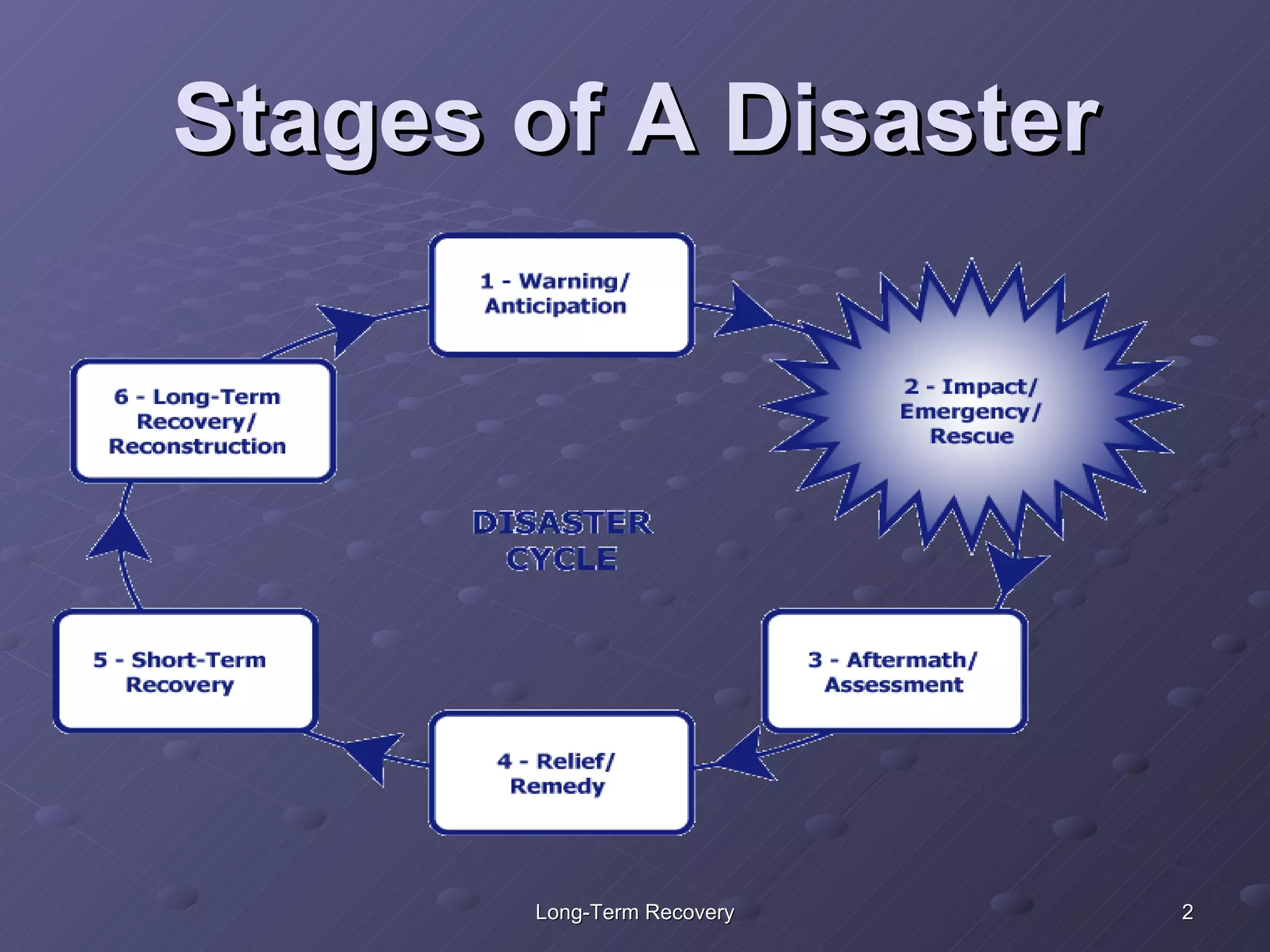
Stages of A Disaster
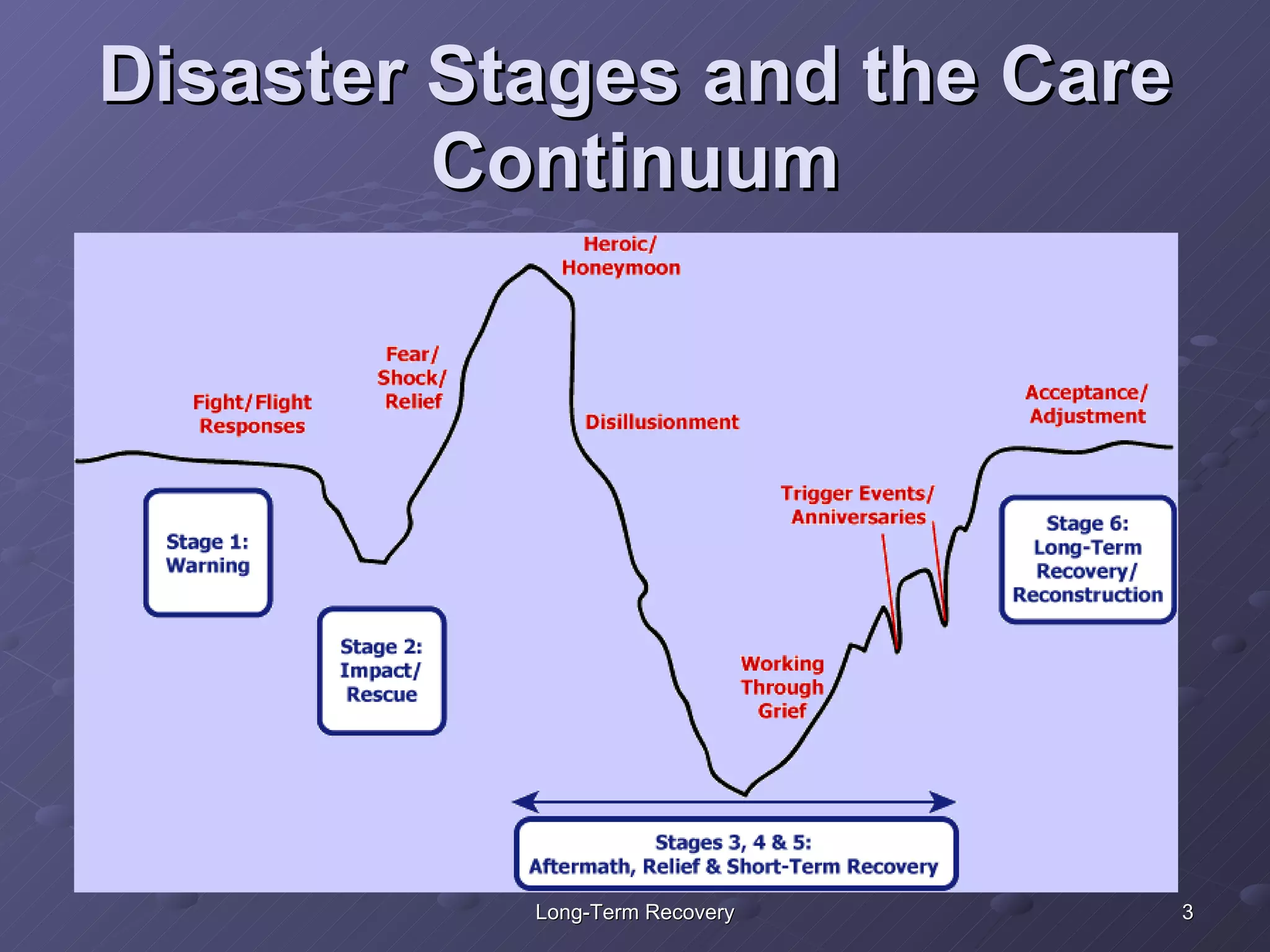
Disaster Stages and the Care Continuum
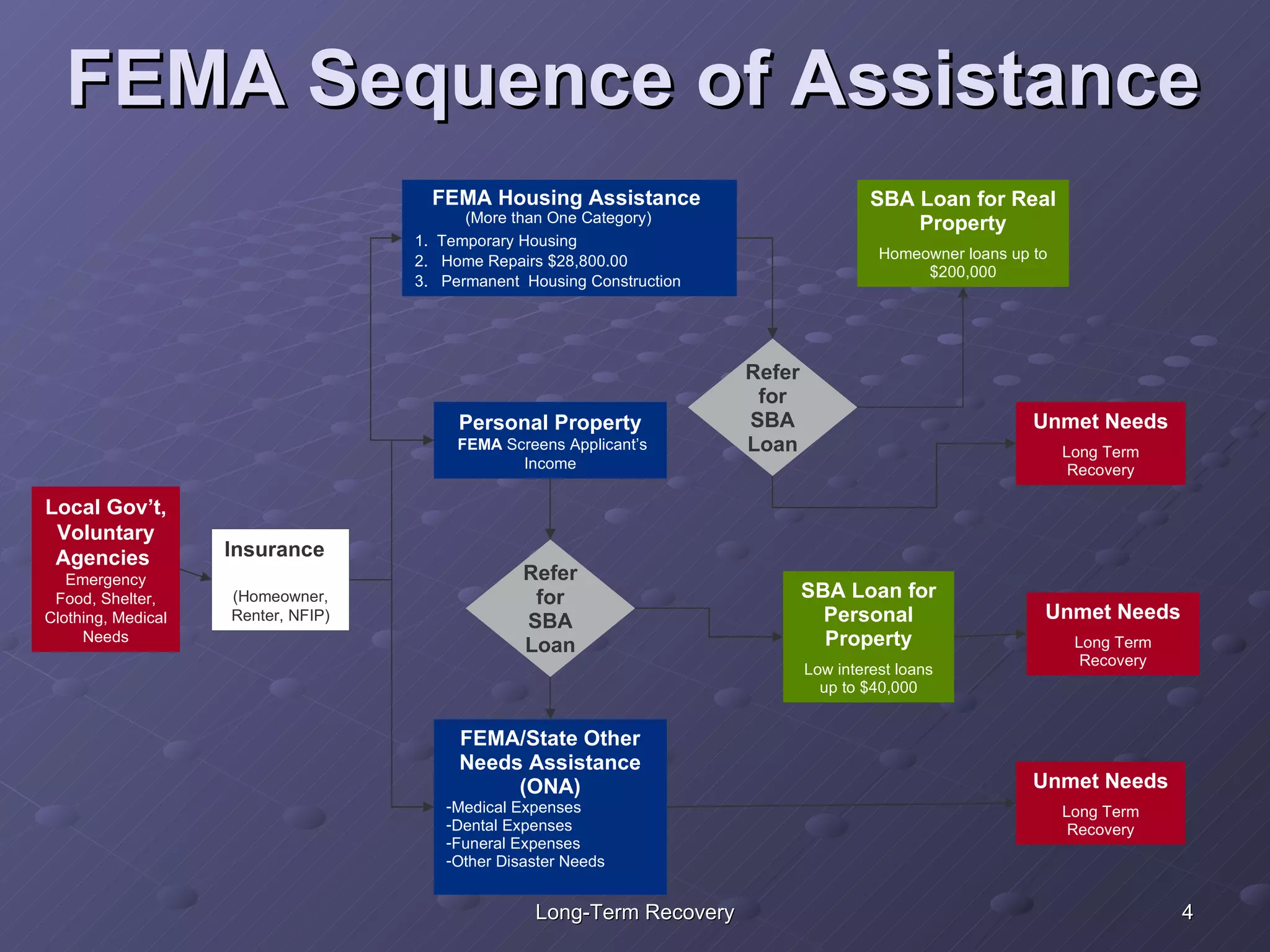
FEMA Sequence of Assistance Local Gov’t, Voluntary Agencies Emergency Food, Shelter, Clothing, Medical Needs Insurance (Homeowner, Renter, NFIP)
FEMA/State Other Needs Assistance (ONA)
Medical Expenses
Dental Expenses
Funeral Expenses
Other Disaster Needs
FEMA Housing Assistance (More than One Category) 1. Temporary Housing 2. Home Repairs $28,800.00 3. Permanent Housing Construction SBA Loan for Real Property Homeowner loans up to $200,000 Unmet Needs Long Term Recovery SBA Loan for Personal Property Low interest loans up to $40,000 Unmet Needs Long Term Recovery Unmet Needs Long Term Recovery Refer for SBA Loan Personal Property FEMA Screens Applicant’s Income Refer for SBA Loan
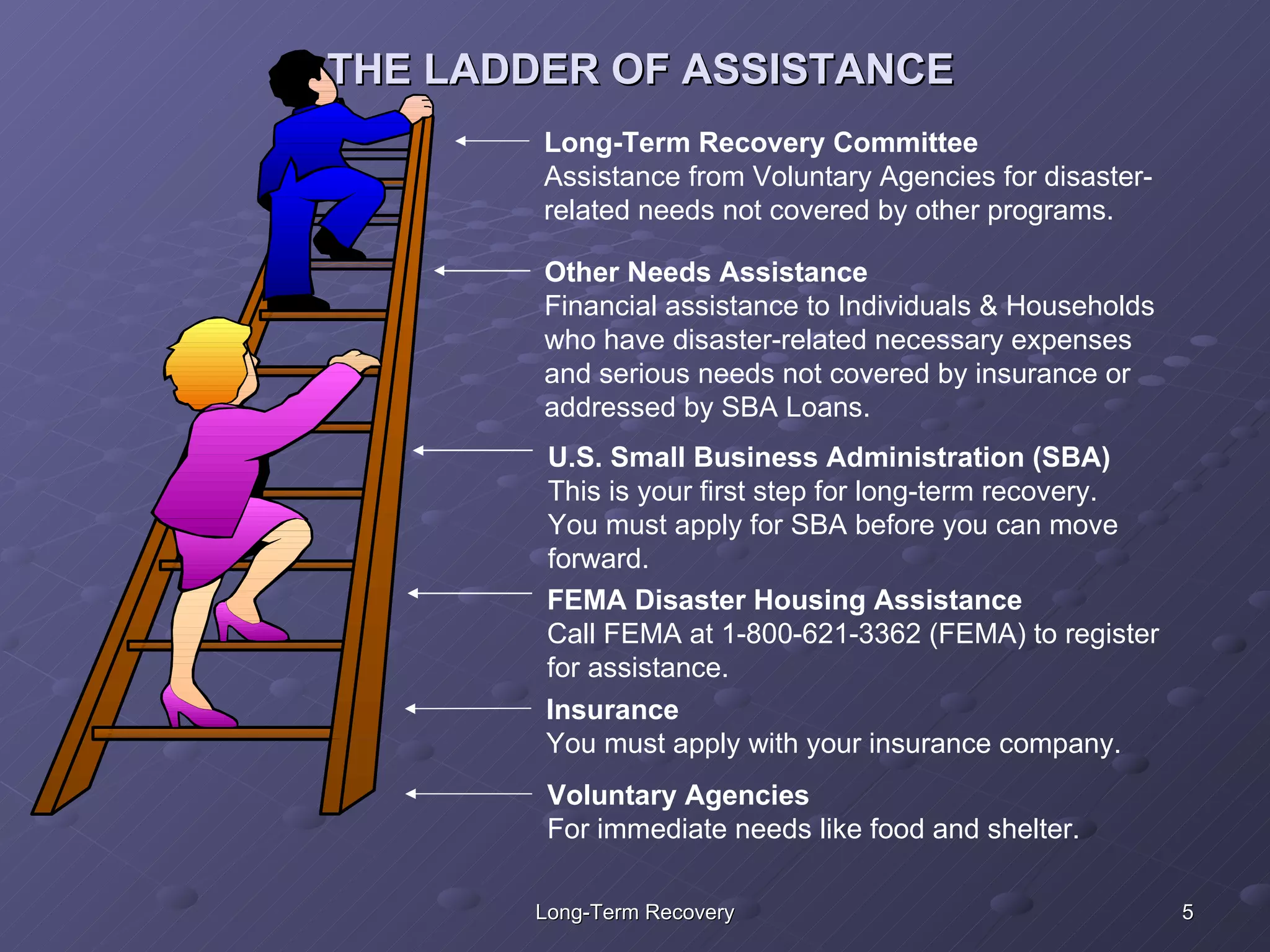
THE LADDER OF ASSISTANCE Long-Term Recovery Committee Assistance from Voluntary Agencies for disaster- related needs not covered by other programs. Other Needs Assistance Financial assistance to Individuals & Households who have disaster-related necessary expenses and serious needs not covered by insurance or addressed by SBA Loans. U.S. Small Business Administration (SBA) This is your first step for long-term recovery. You must apply for SBA before you can move forward. FEMA Disaster Housing Assistance Call FEMA at 1-800-621-3362 (FEMA) to register for assistance. Insurance You must apply with your insurance company. Voluntary Agencies For immediate needs like food and shelter.
Long Term Recovery is needed when personal resources, insurance, government grant / loans are insufficient to meet the need.
Recovery Issues
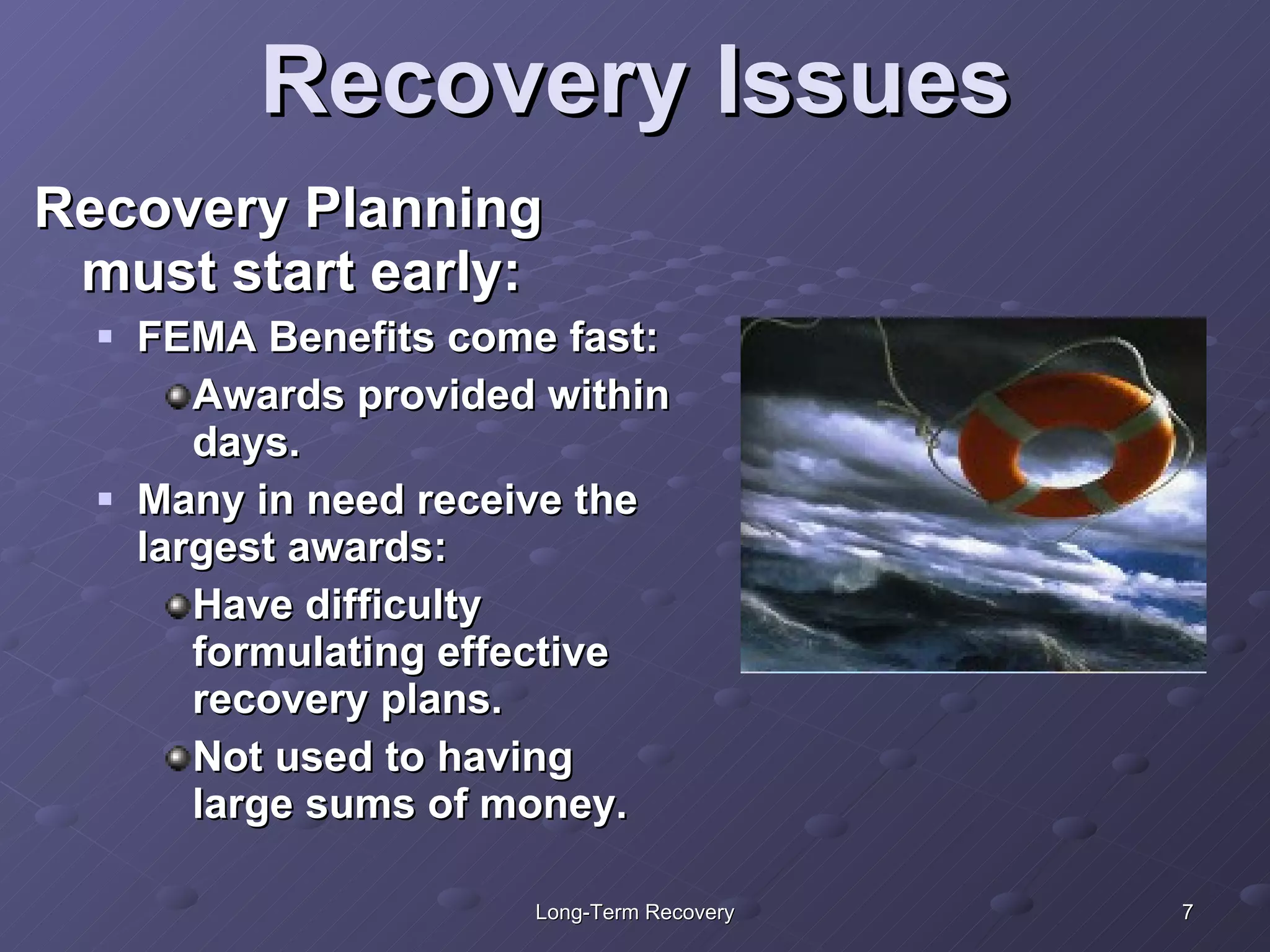
Recovery Planning must start early:
FEMA Benefits come fast:
Awards provided within days.
Many in need receive the largest awards:
Have difficulty formulating effective recovery plans.
Not used to having large sums of money.
Recovery Issues
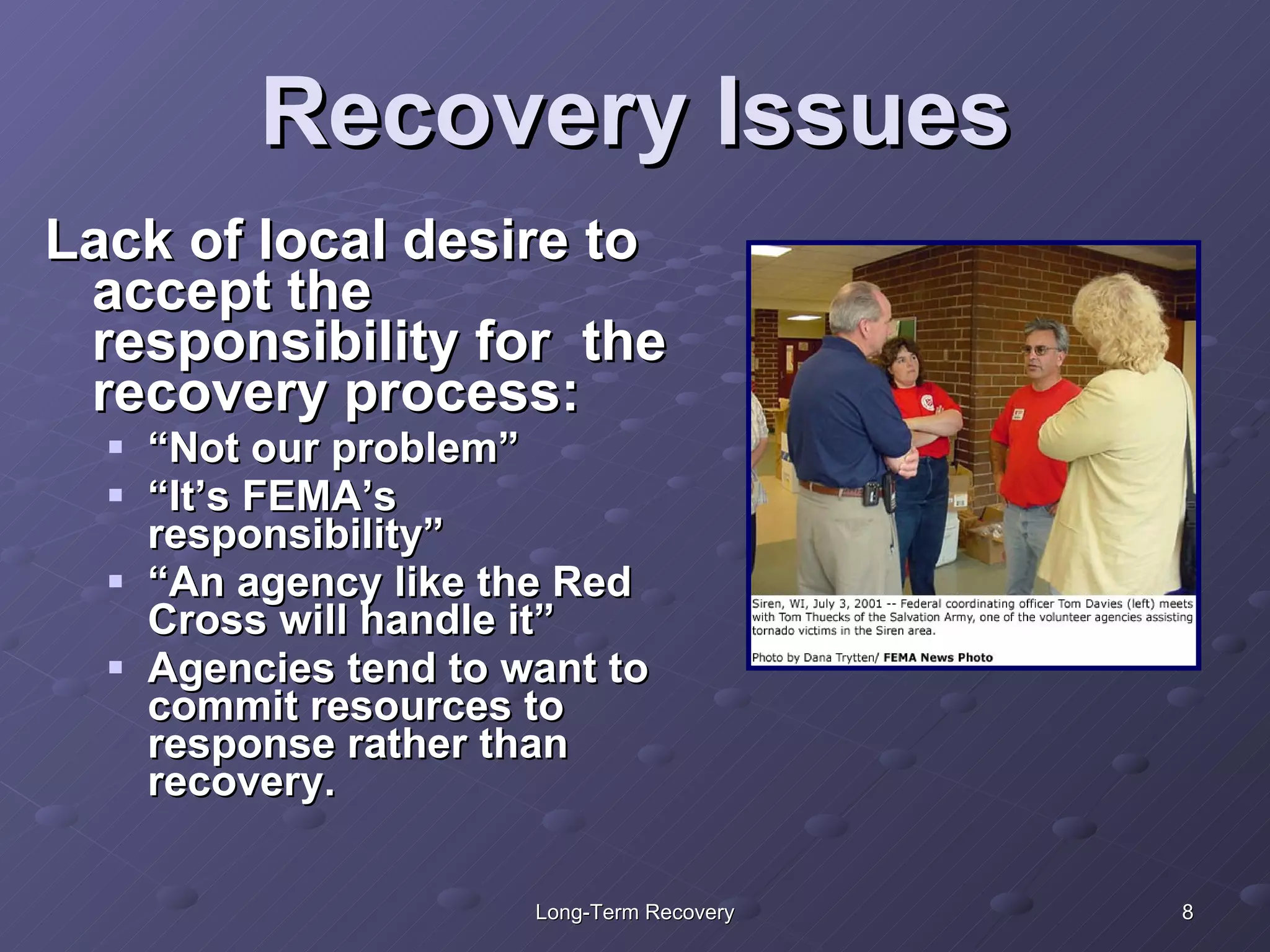
Lack of local desire to accept the responsibility for the recovery process:
“ Not our problem”
“ It’s FEMA’s responsibility”
“ An agency like the Red Cross will handle it”
Agencies tend to want to commit resources to response rather than recovery.
Recovery Issues
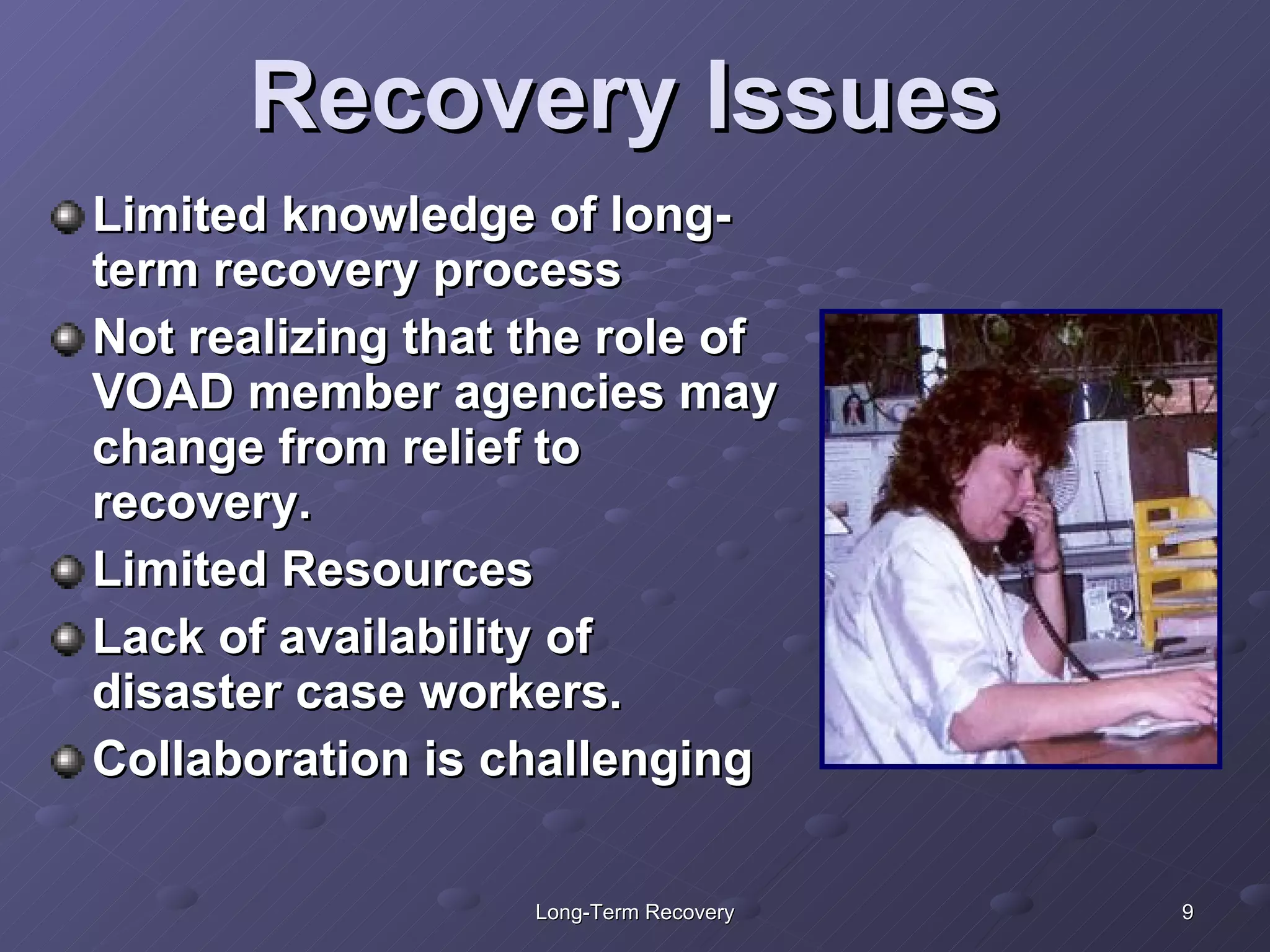
Limited knowledge of long-term recovery process
Not realizing that the role of VOAD member agencies may change from relief to recovery.
Limited Resources
Lack of availability of disaster case workers.
Collaboration is challenging
Recovery Issues
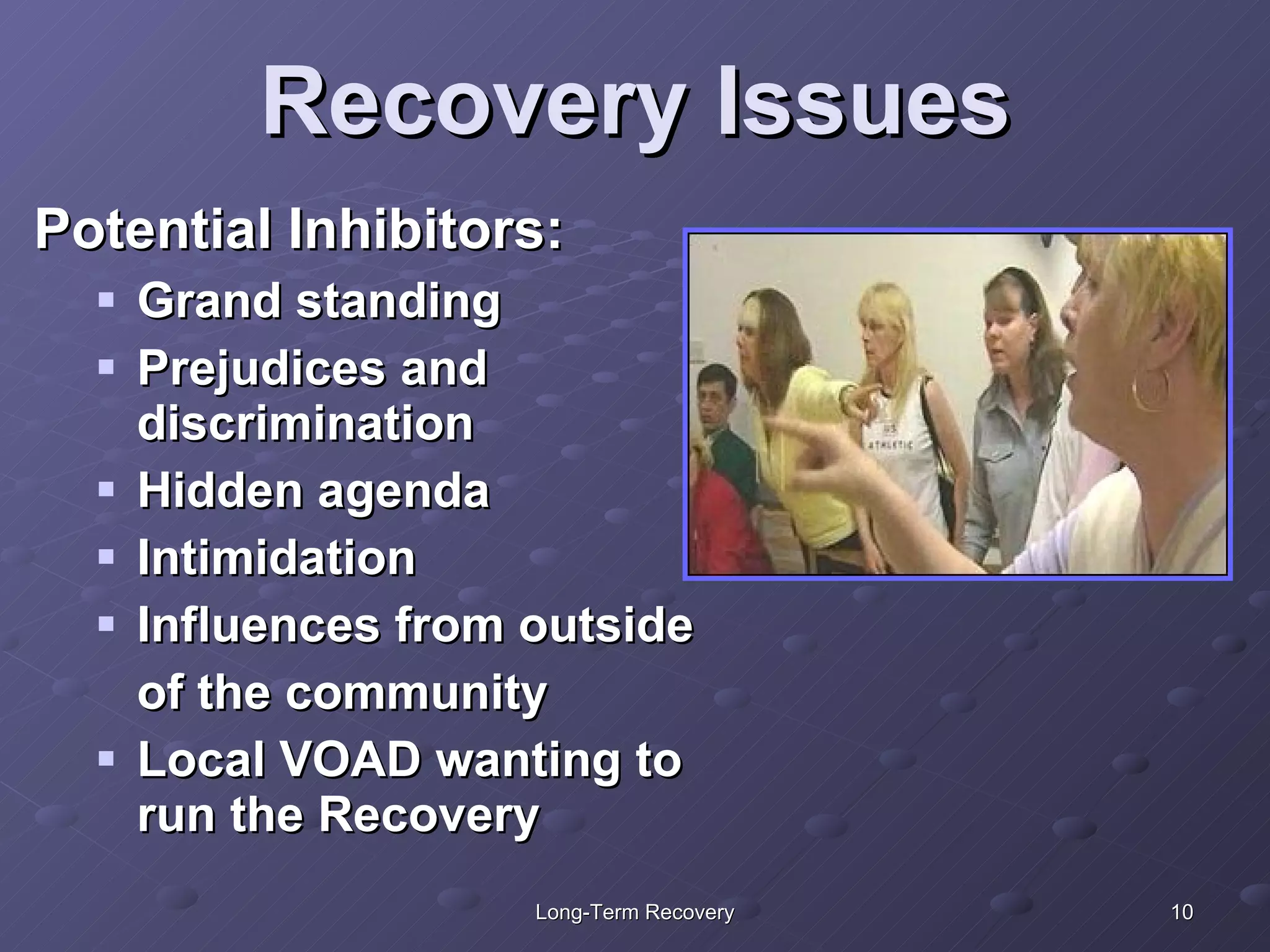
Potential Inhibitors:
Grand standing
Prejudices and discrimination
Hidden agenda
Intimidation
Influences from outside
of the community
Local VOAD wanting to run the Recovery
Recovery Issues
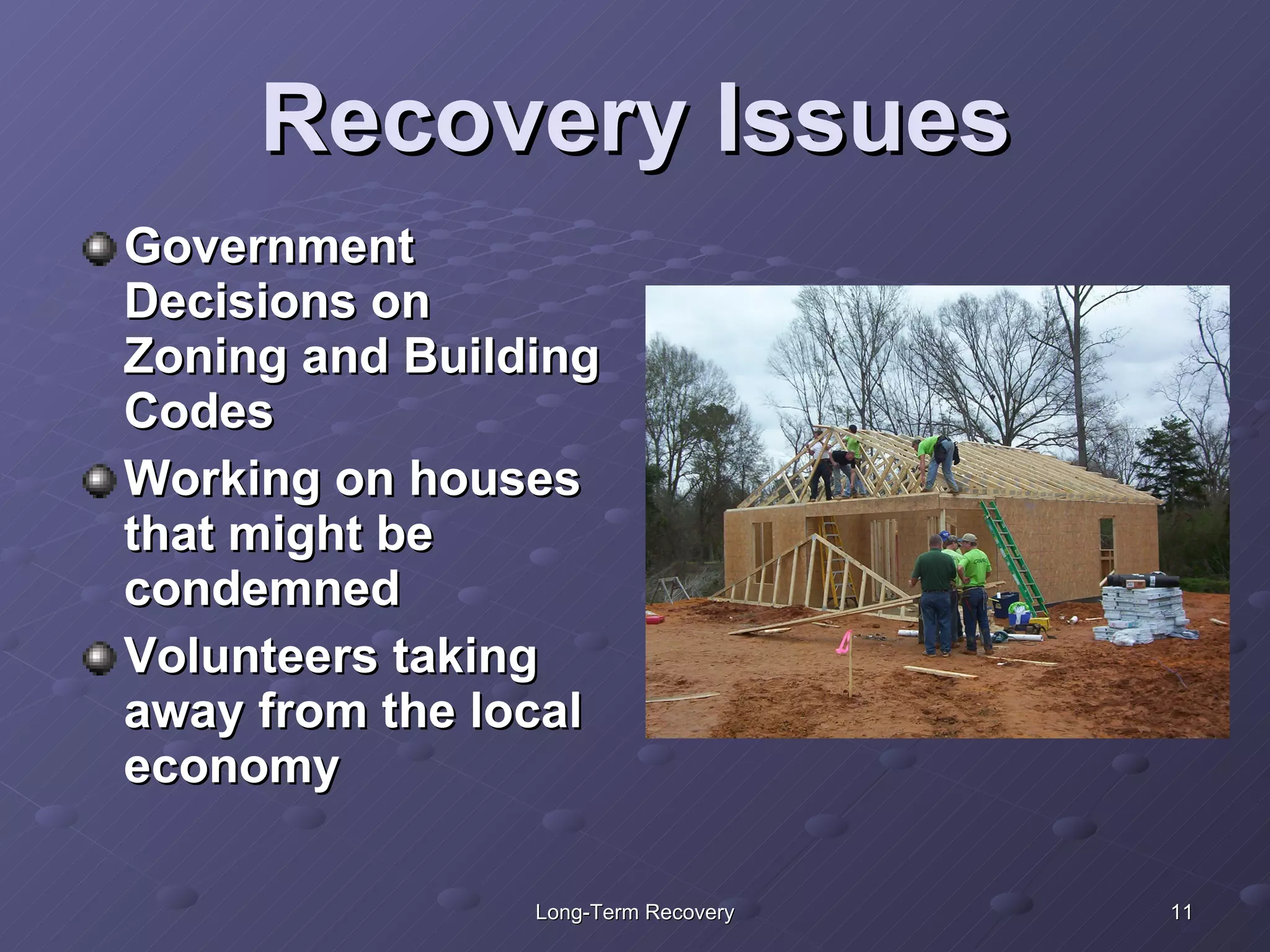
Government Decisions on Zoning and Building Codes
Working on houses that might be condemned
Volunteers taking away from the local economy
Key Long Term Recovery Functions
Collaboration!
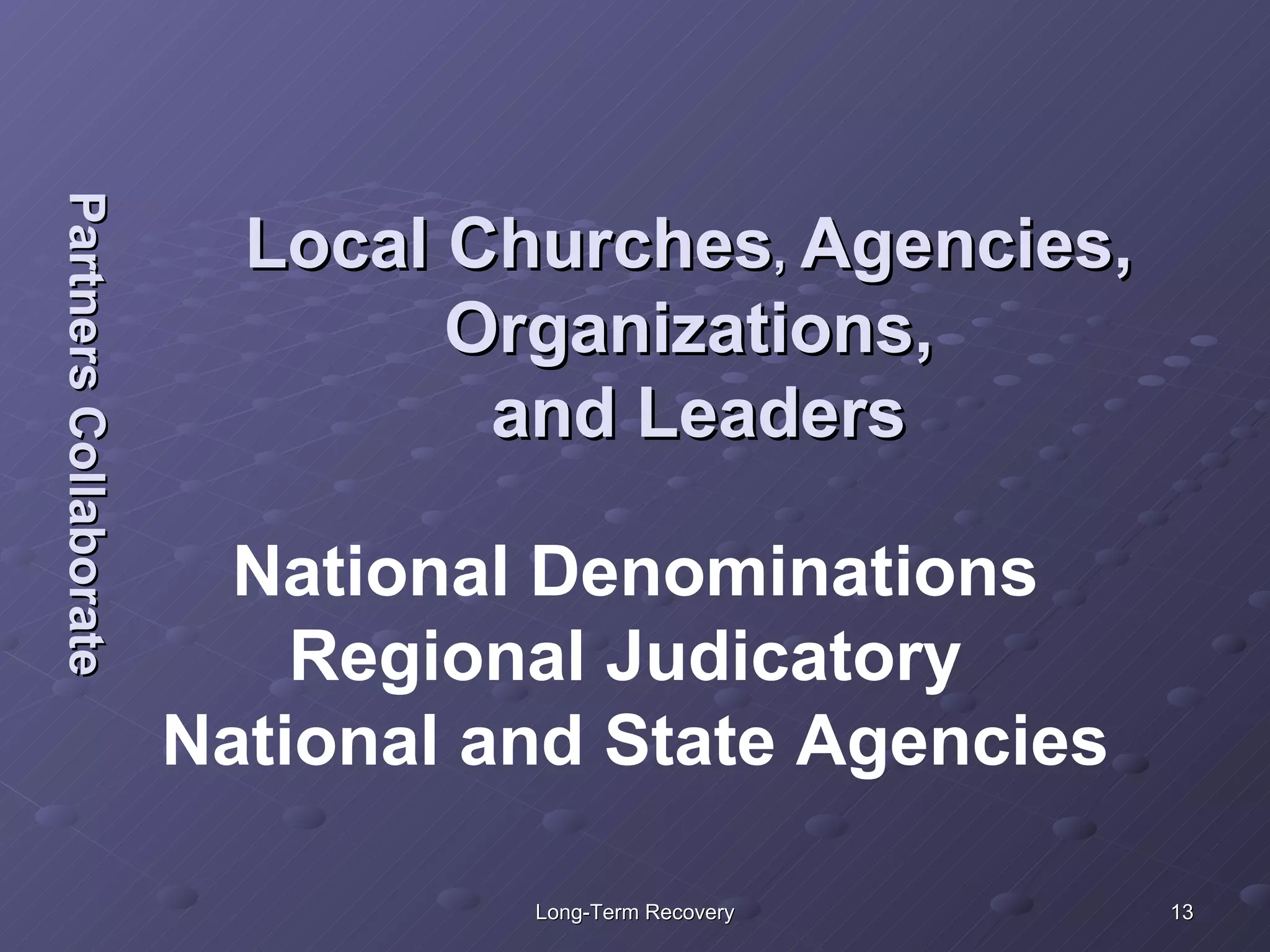
Partners Collaborate National Denominations Regional Judicatory National and State Agencies Local Churches , Agencies, Organizations, and Leaders
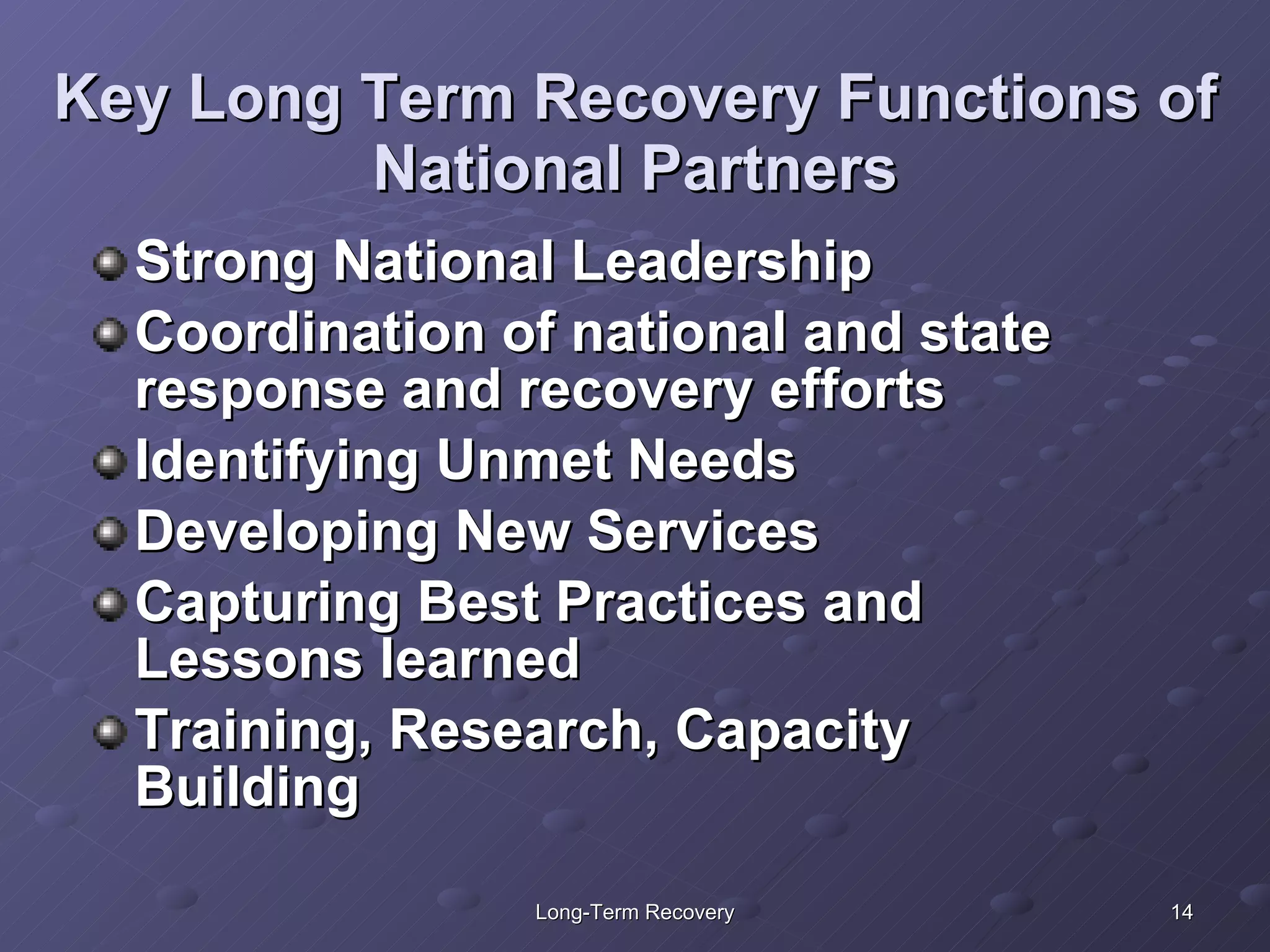
Key Long Term Recovery Functions of National Partners
Strong National Leadership
Coordination of national and state response and recovery efforts
Identifying Unmet Needs
Developing New Services
Capturing Best Practices and Lessons learned
Training, Research, Capacity Building
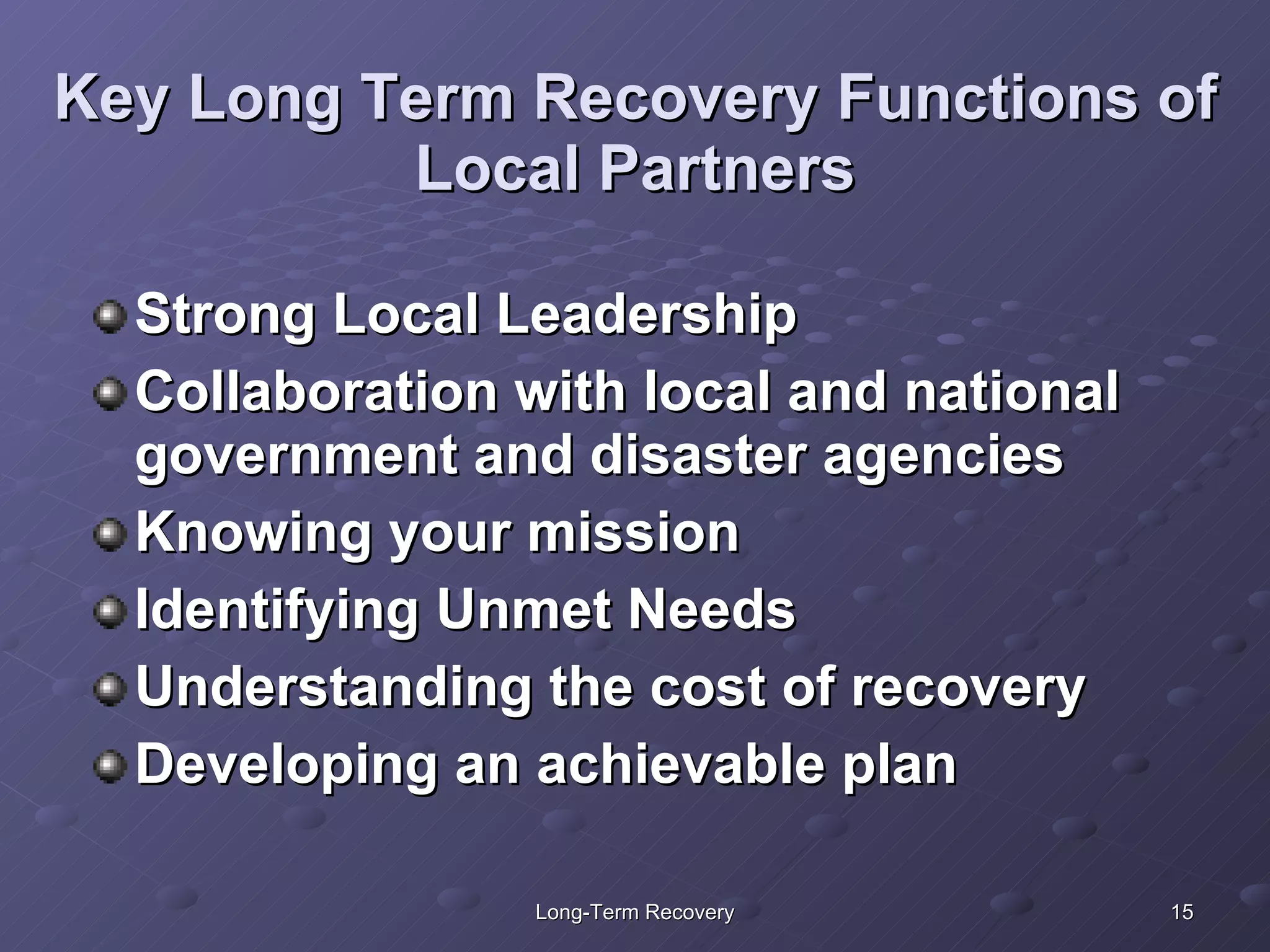
Key Long Term Recovery Functions of Local Partners
Strong Local Leadership
Collaboration with local and national government and disaster agencies
Knowing your mission
Identifying Unmet Needs
Understanding the cost of recovery
Developing an achievable plan
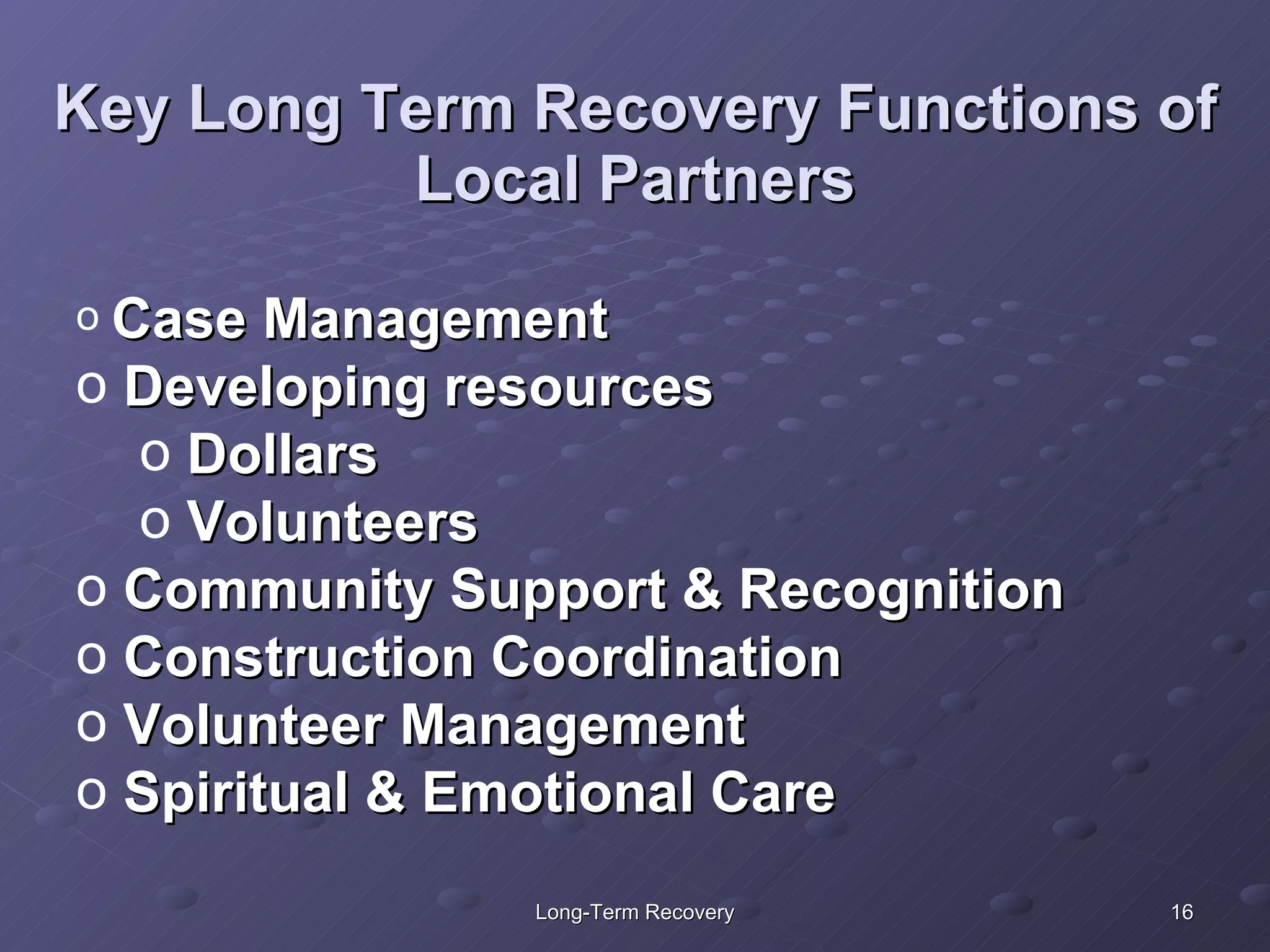
Key Long Term Recovery Functions of Local Partners
Case Management
Developing resources
Dollars
Volunteers
Community Support & Recognition
Construction Coordination
Volunteer Management
Spiritual & Emotional Care
One of the Primary Keys to Success:
Effective Local Leadership!
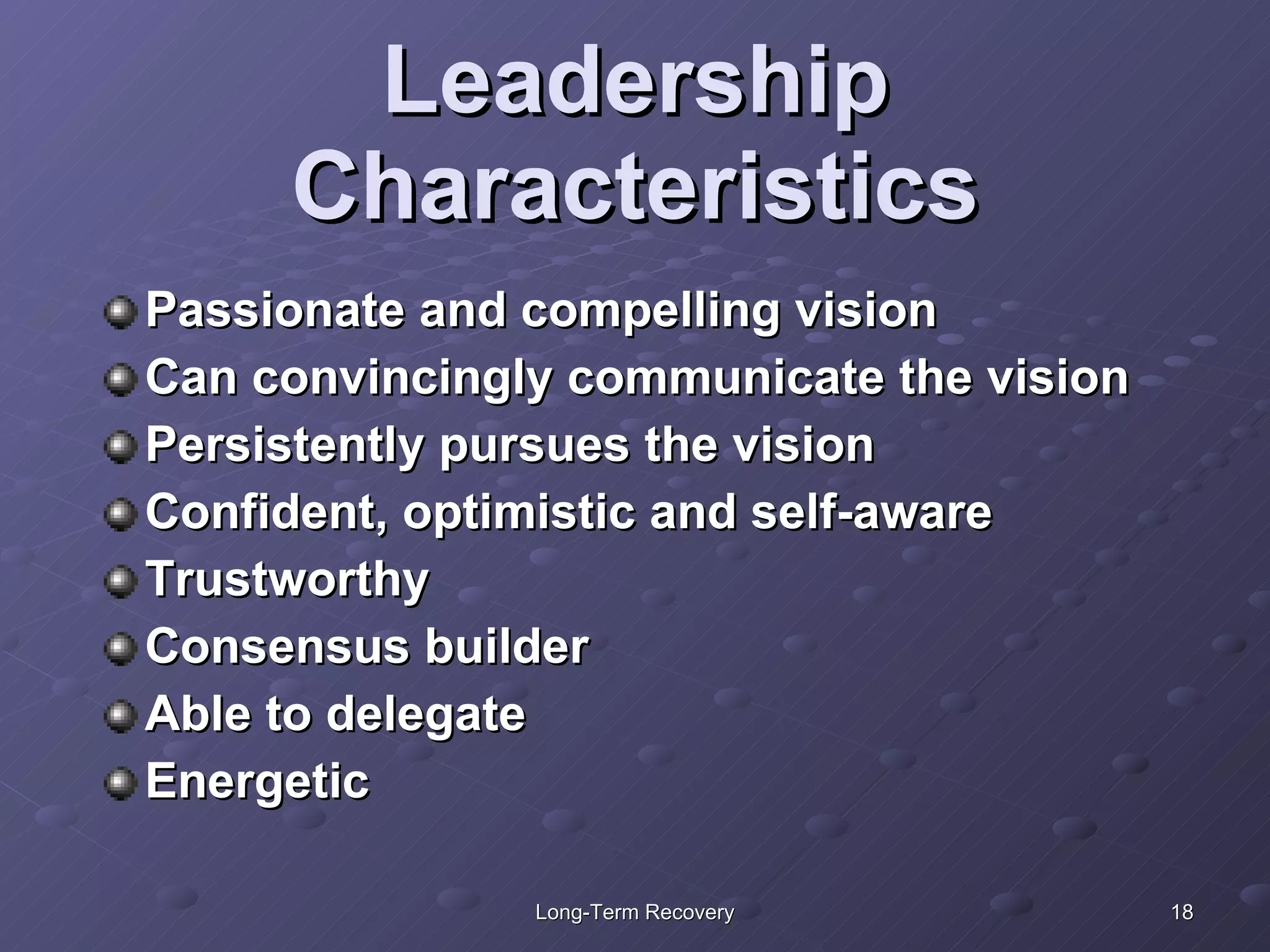
Leadership Characteristics
Passionate and compelling vision
Can convincingly communicate the vision
Persistently pursues the vision
Confident, optimistic and self-aware
Trustworthy
Consensus builder
Able to delegate
Energetic
Key Long Term Recovery Functions
Collaboration!
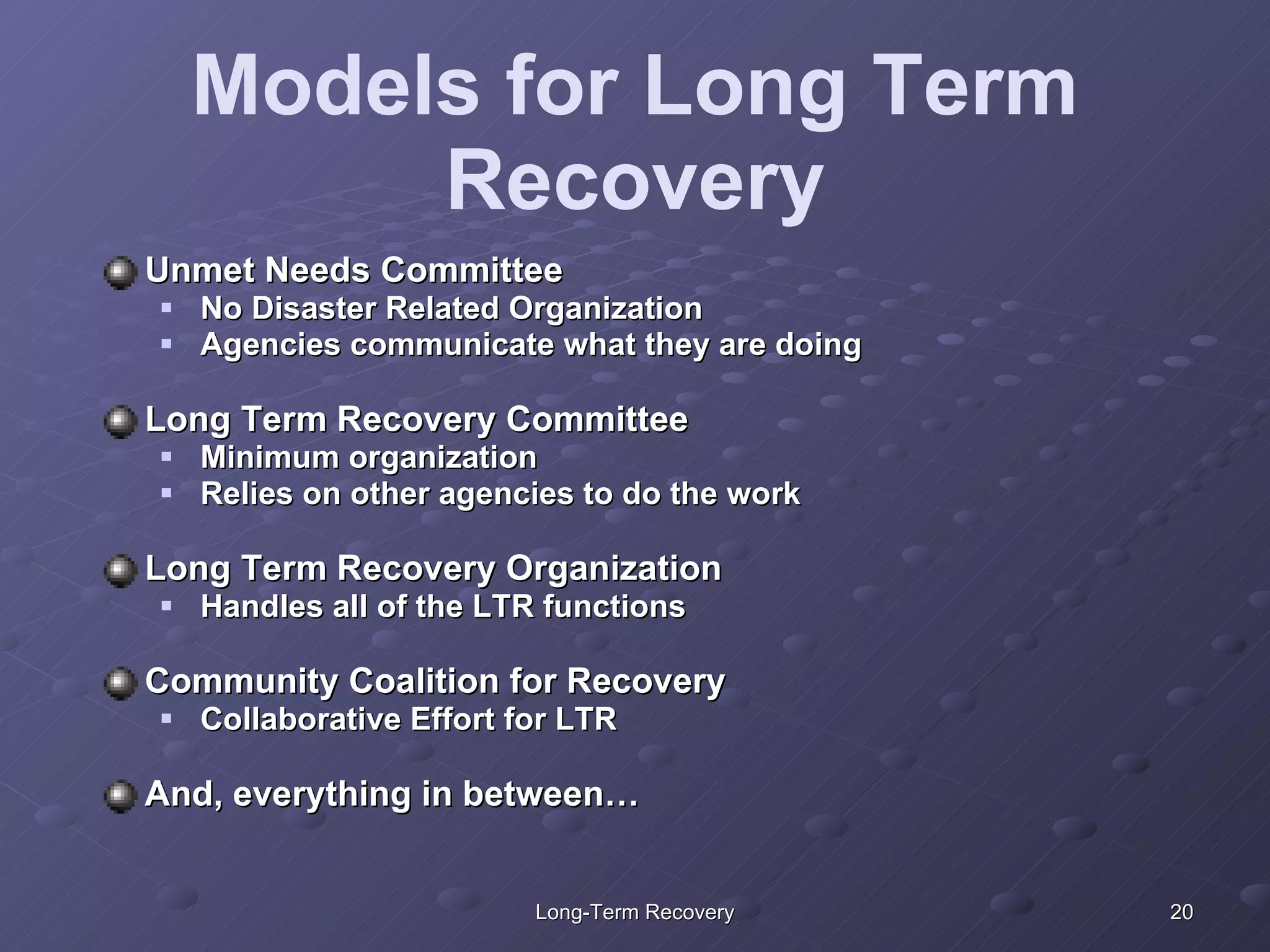
Models for Long Term Recovery
Unmet Needs Committee
No Disaster Related Organization
Agencies communicate what they are doing
Long Term Recovery Committee
Minimum organization
Relies on other agencies to do the work
Long Term Recovery Organization
Handles all of the LTR functions
Community Coalition for Recovery
Collaborative Effort for LTR
And, everything in between…
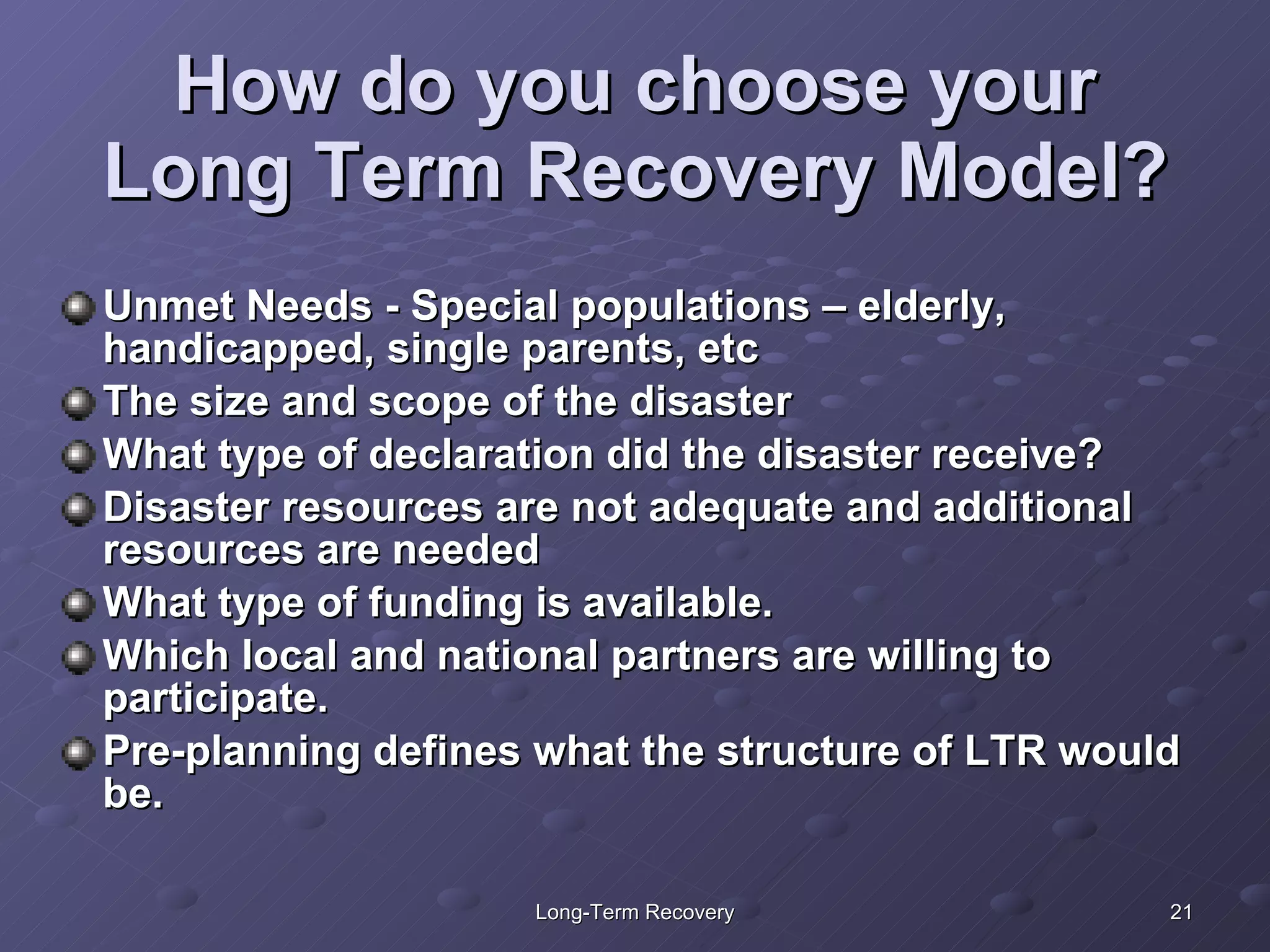
How do you choose your Long Term Recovery Model?
Unmet Needs - Special populations – elderly, handicapped, single parents, etc
The size and scope of the disaster
What type of declaration did the disaster receive?
Disaster resources are not adequate and additional resources are needed
What type of funding is available.
Which local and national partners are willing to participate.
Pre-planning defines what the structure of LTR would be.
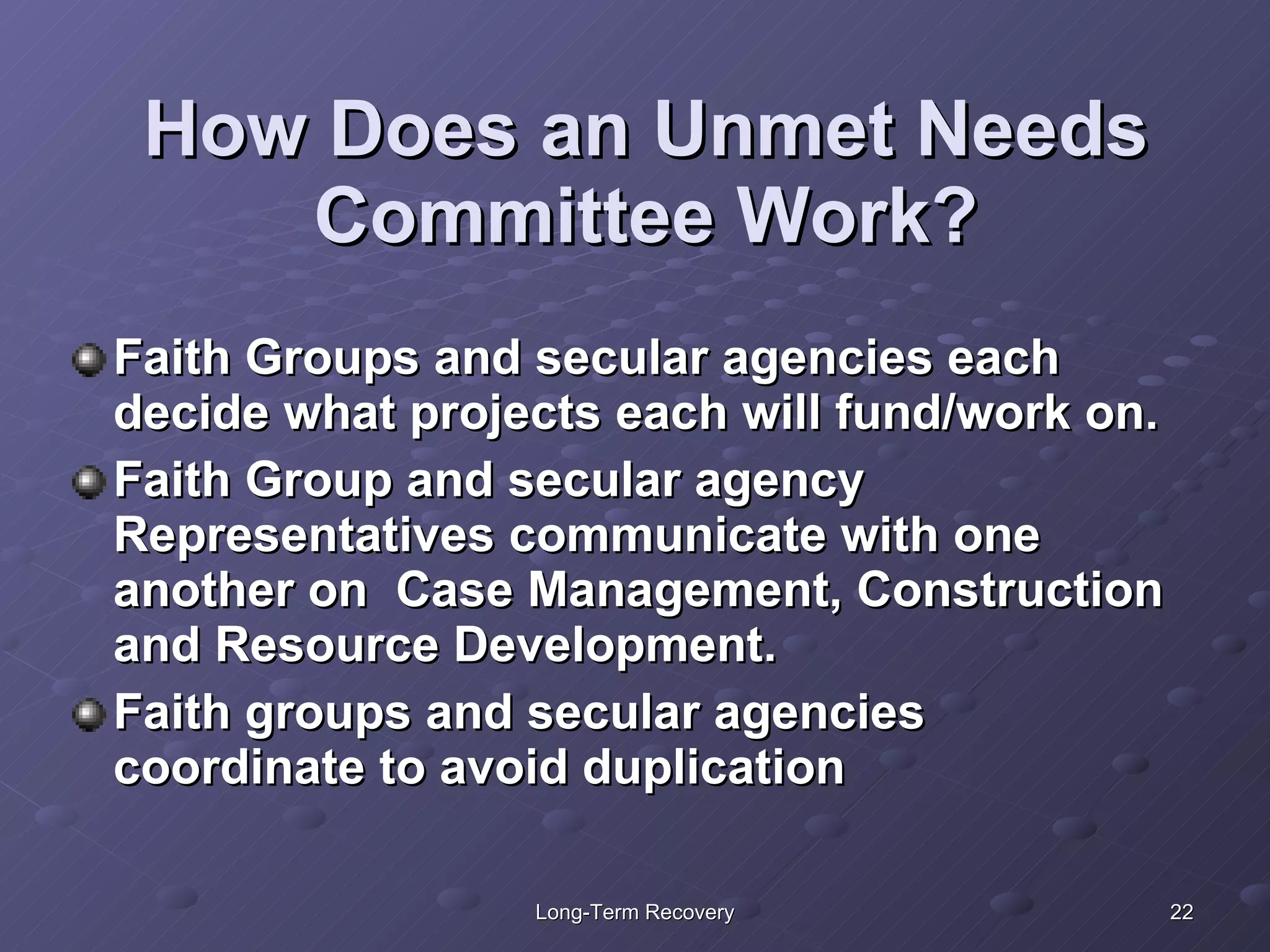
How Does an Unmet Needs Committee Work?
Faith Groups and secular agencies each decide what projects each will fund/work on.
Faith Group and secular agency Representatives communicate with one another on Case Management, Construction and Resource Development.
Faith groups and secular agencies coordinate to avoid duplication
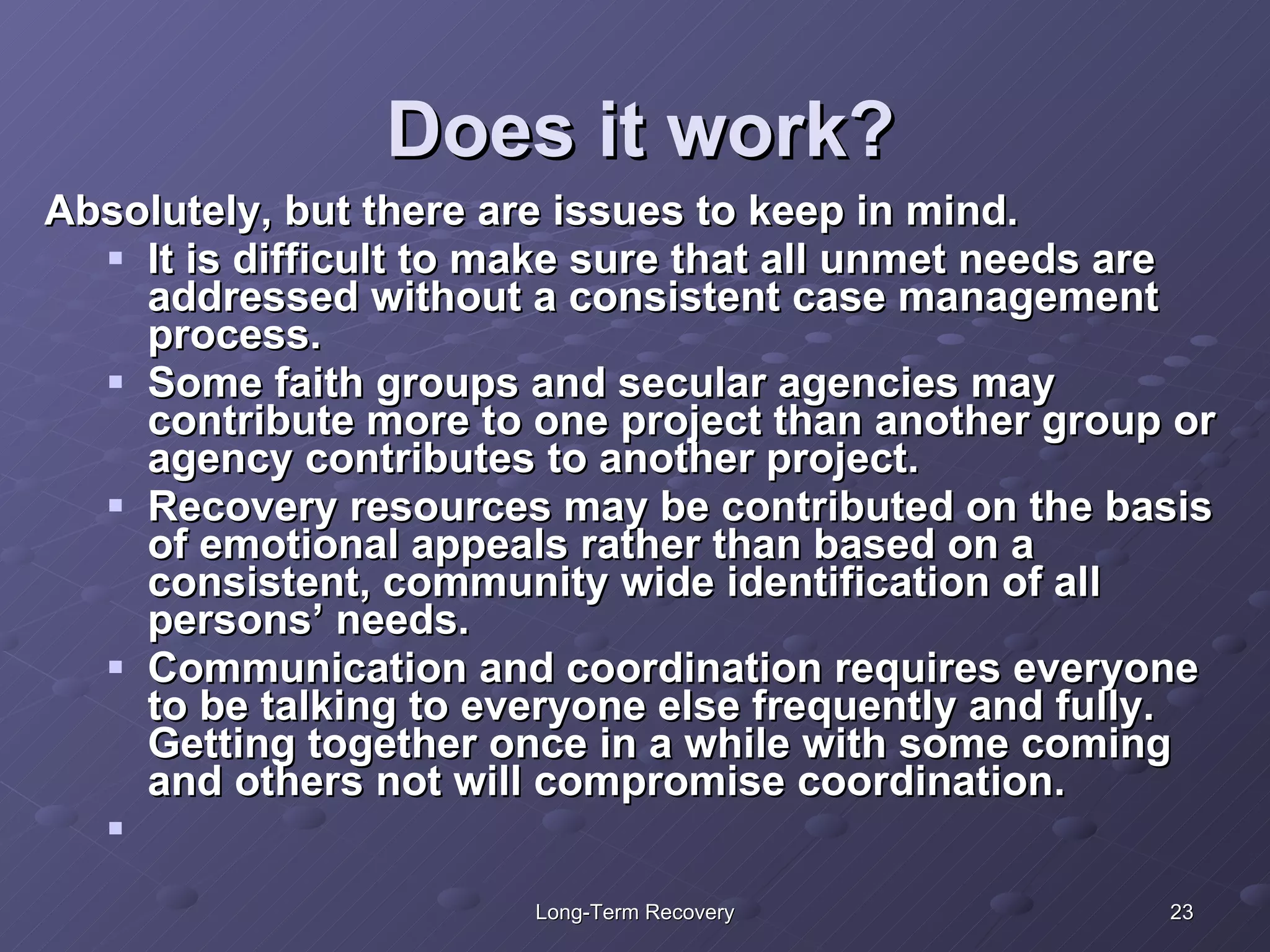
Does it work?
Absolutely, but there are issues to keep in mind.
It is difficult to make sure that all unmet needs are addressed without a consistent case management process.
Some faith groups and secular agencies may contribute more to one project than another group or agency contributes to another project.
Recovery resources may be contributed on the basis of emotional appeals rather than based on a consistent, community wide identification of all persons’ needs.
Communication and coordination requires everyone to be talking to everyone else frequently and fully. Getting together once in a while with some coming and others not will compromise coordination.
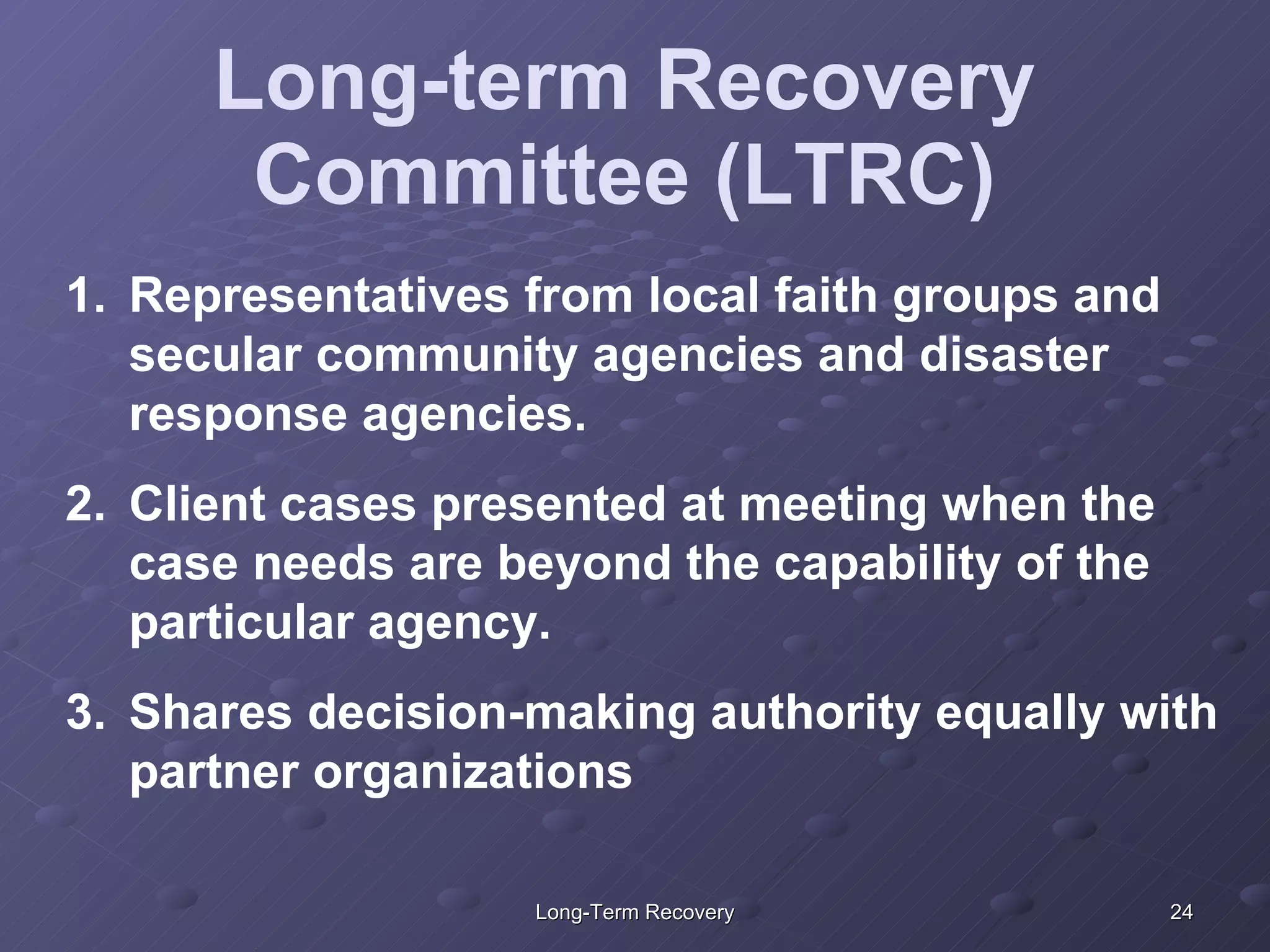
Long-term Recovery Committee (LTRC)
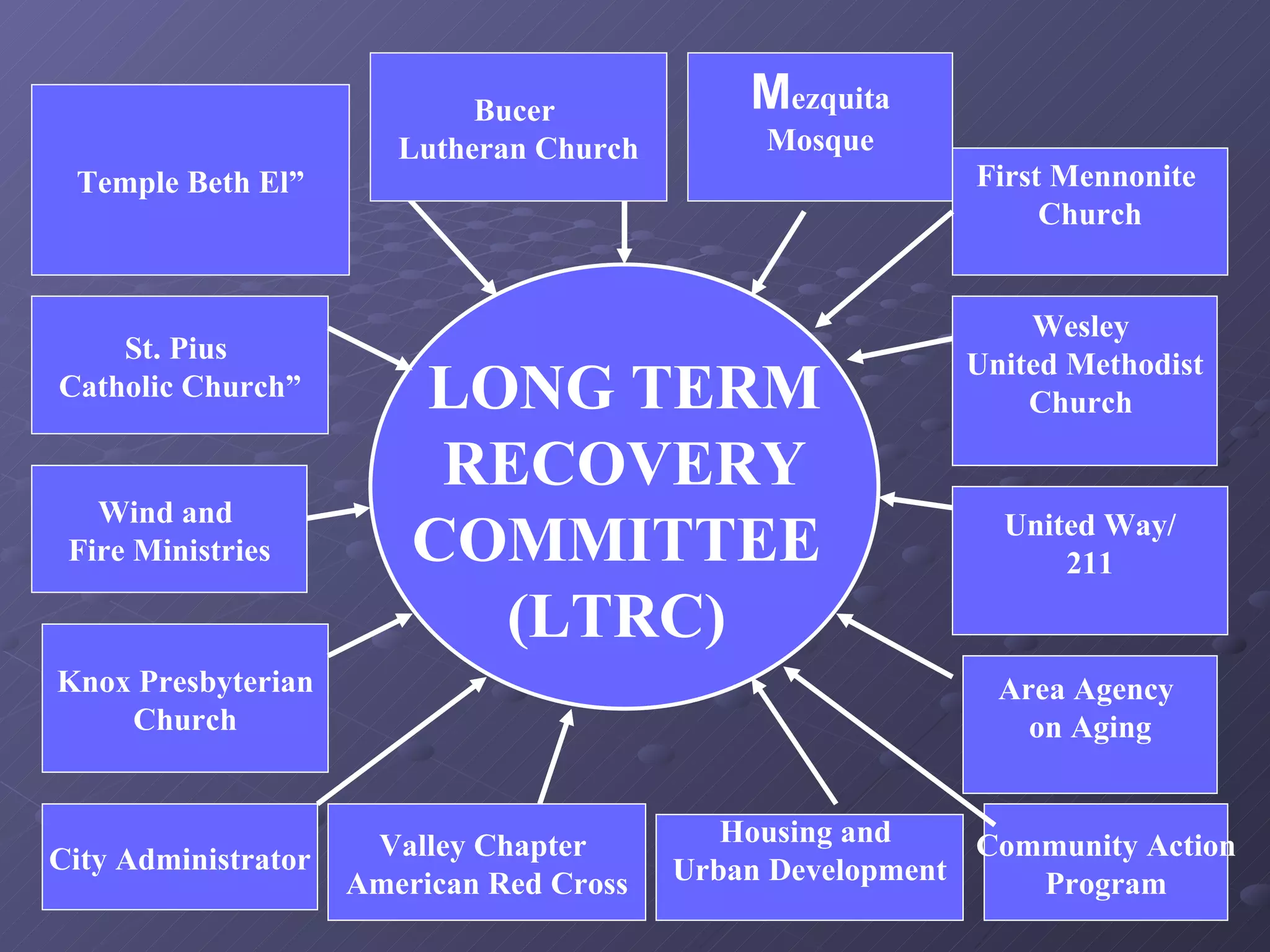
Representatives from local faith groups and secular community agencies and disaster response agencies.
Client cases presented at meeting when the case needs are beyond the capability of the particular agency.
Shares decision-making authority equally with partner organizations
Long-term Recovery Committee (LTRC)
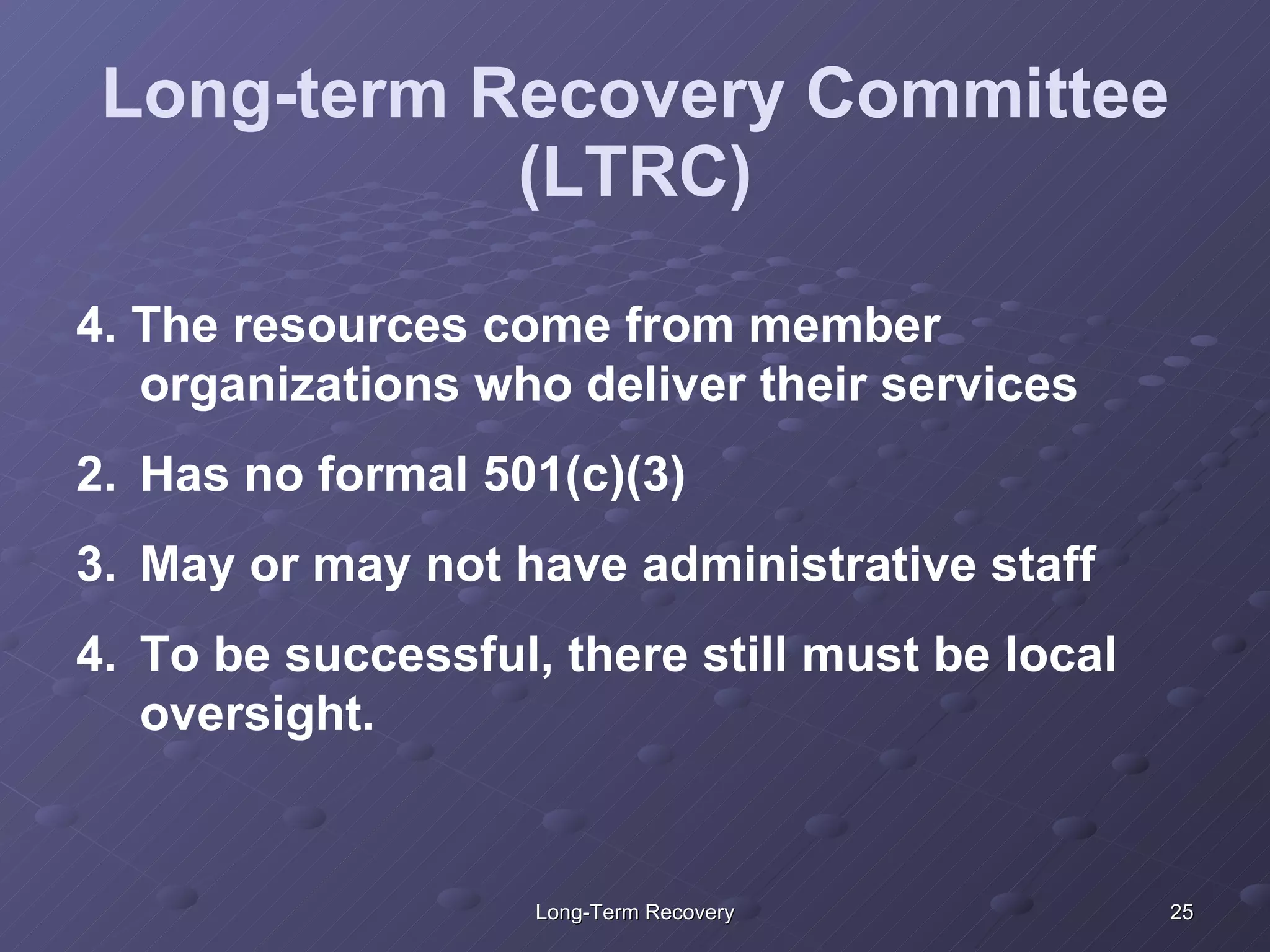
4. The resources come from member organizations who deliver their services
Has no formal 501(c)(3)
May or may not have administrative staff
To be successful, there still must be local oversight.
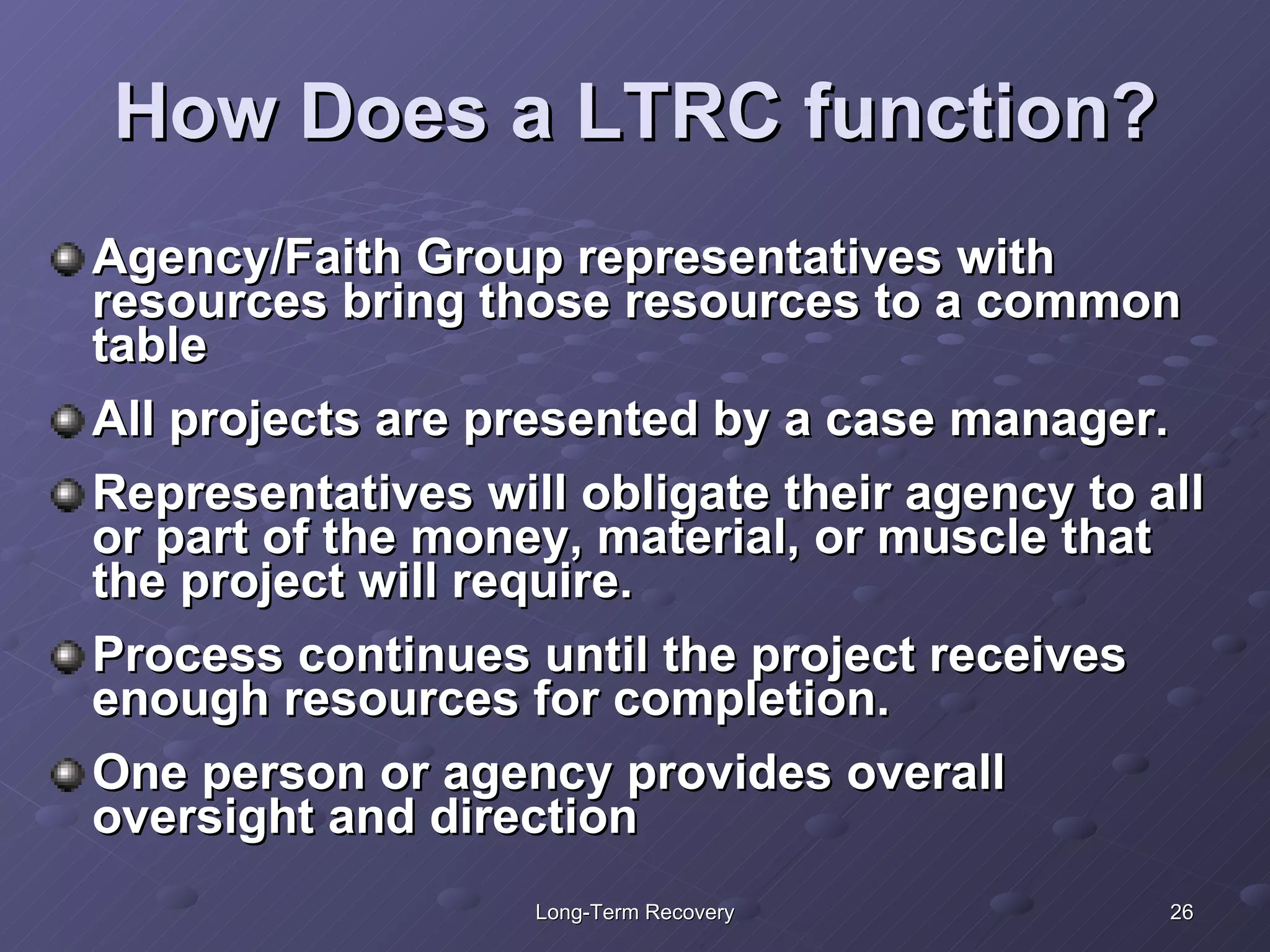
How Does a LTRC function?
Agency/Faith Group representatives with resources bring those resources to a common table
All projects are presented by a case manager.
Representatives will obligate their agency to all or part of the money, material, or muscle that the project will require.
Process continues until the project receives enough resources for completion.
One person or agency provides overall oversight and direction
Knox Presbyterian Church Temple Beth El” Wesley United Methodist Church St. Pius Catholic Church” M ezquita Mosque First Mennonite Church Wind and Fire Ministries United Way/ 211 LONG TERM RECOVERY COMMITTEE (LTRC) Valley Chapter American Red Cross City Administrator Housing and Urban Development Bucer Lutheran Church Community Action Program Area Agency on Aging
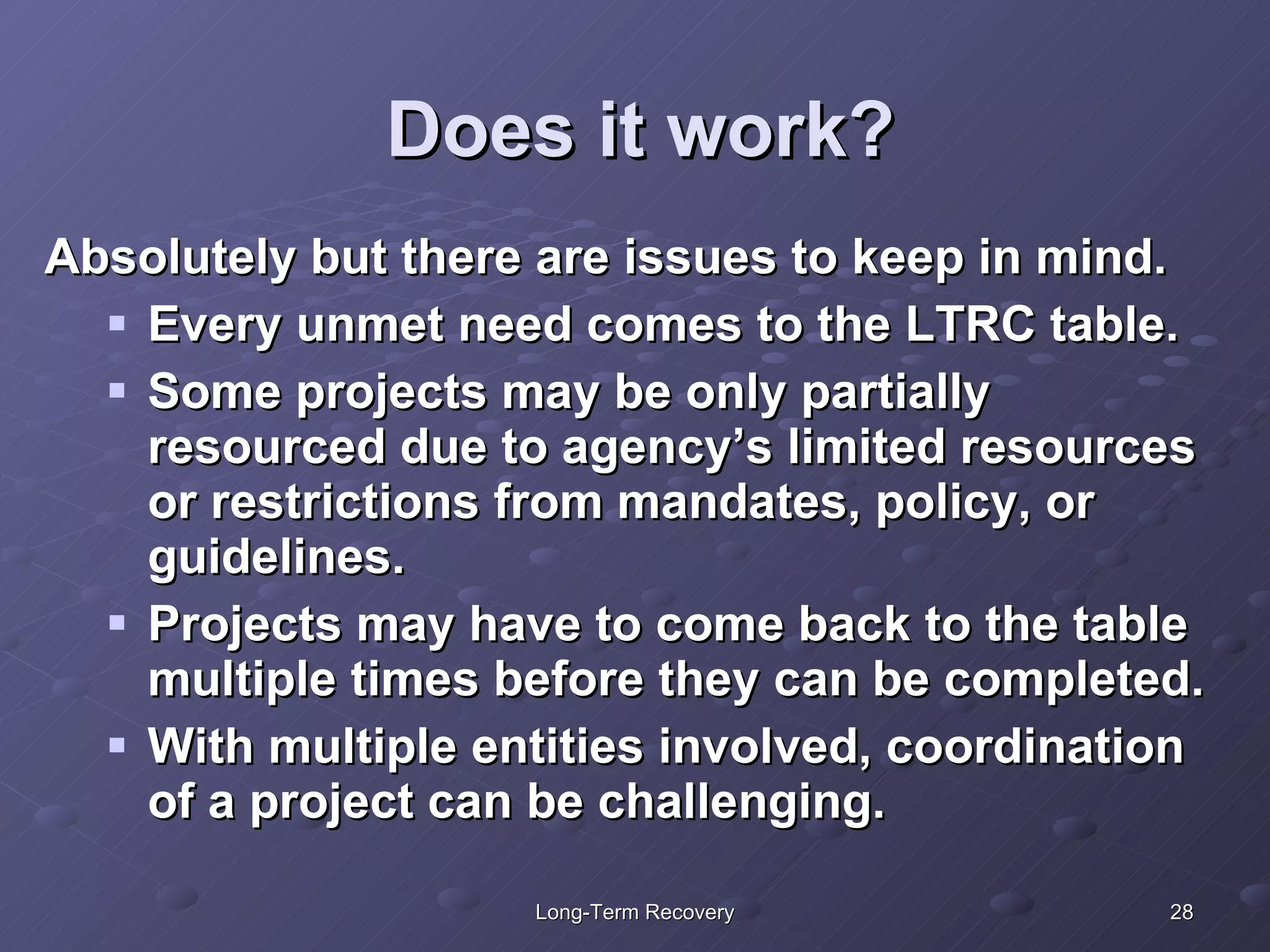
Does it work?
Absolutely but there are issues to keep in mind.
Every unmet need comes to the LTRC table.
Some projects may be only partially resourced due to agency’s limited resources or restrictions from mandates, policy, or guidelines.
Projects may have to come back to the table multiple times before they can be completed.
With multiple entities involved, coordination of a project can be challenging.
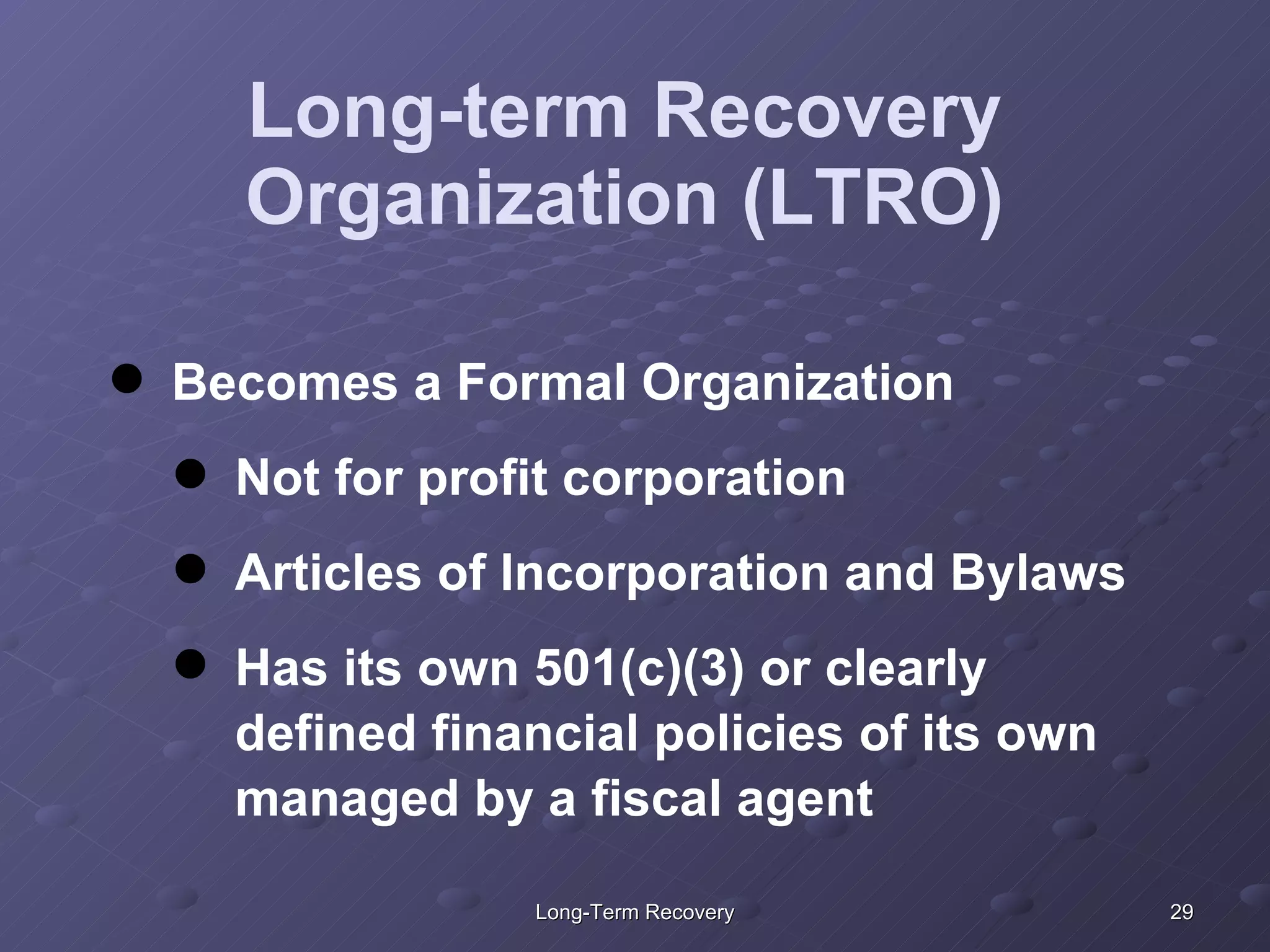
Long-term Recovery Organization (LTRO)
Becomes a Formal Organization
Not for profit corporation
Articles of Incorporation and Bylaws
Has its own 501(c)(3) or clearly defined financial policies of its own managed by a fiscal agent
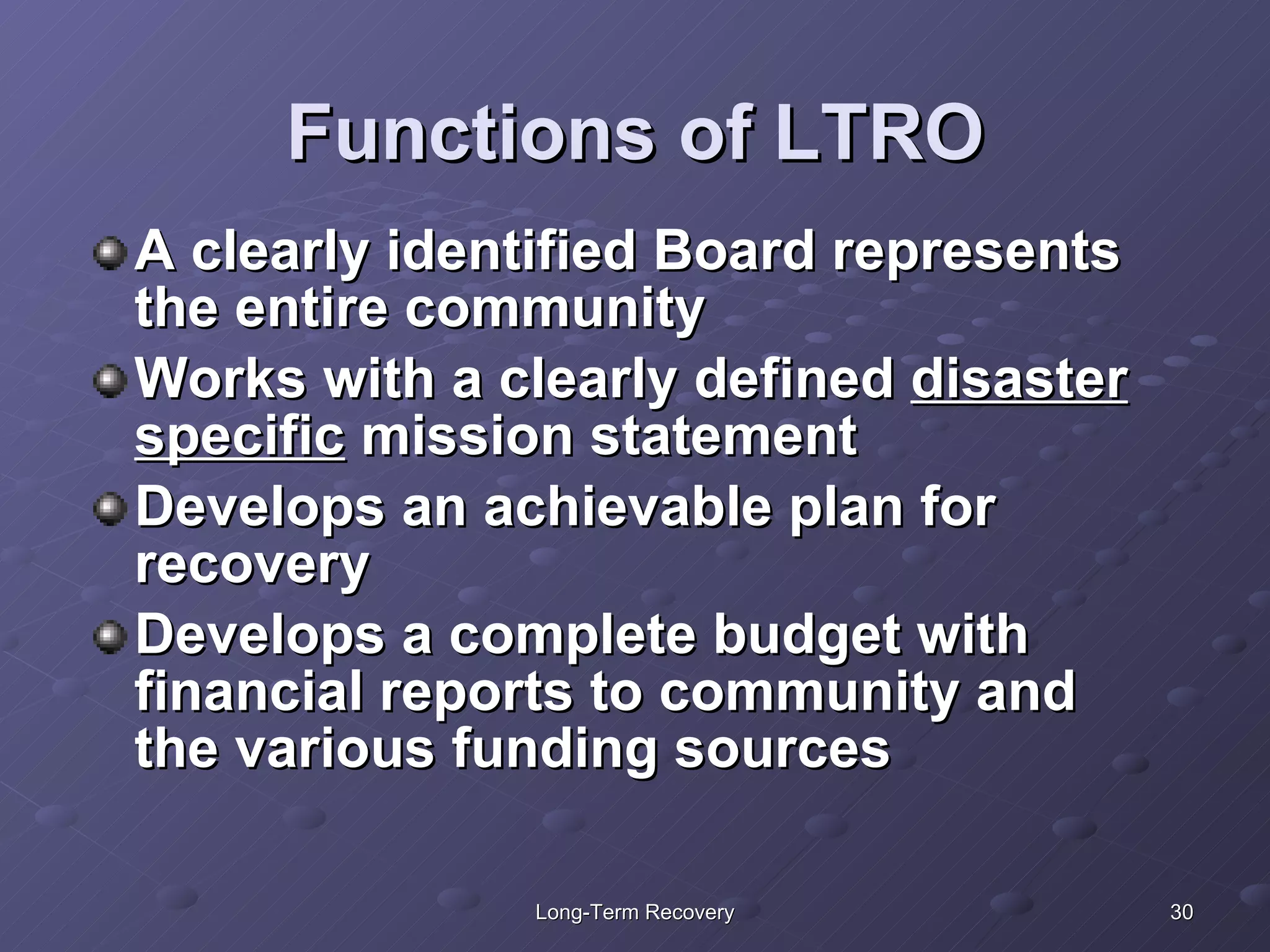
Functions of LTRO
A clearly identified Board represents the entire community
Works with a clearly defined disaster specific mission statement
Develops an achievable plan for recovery
Develops a complete budget with financial reports to community and the various funding sources
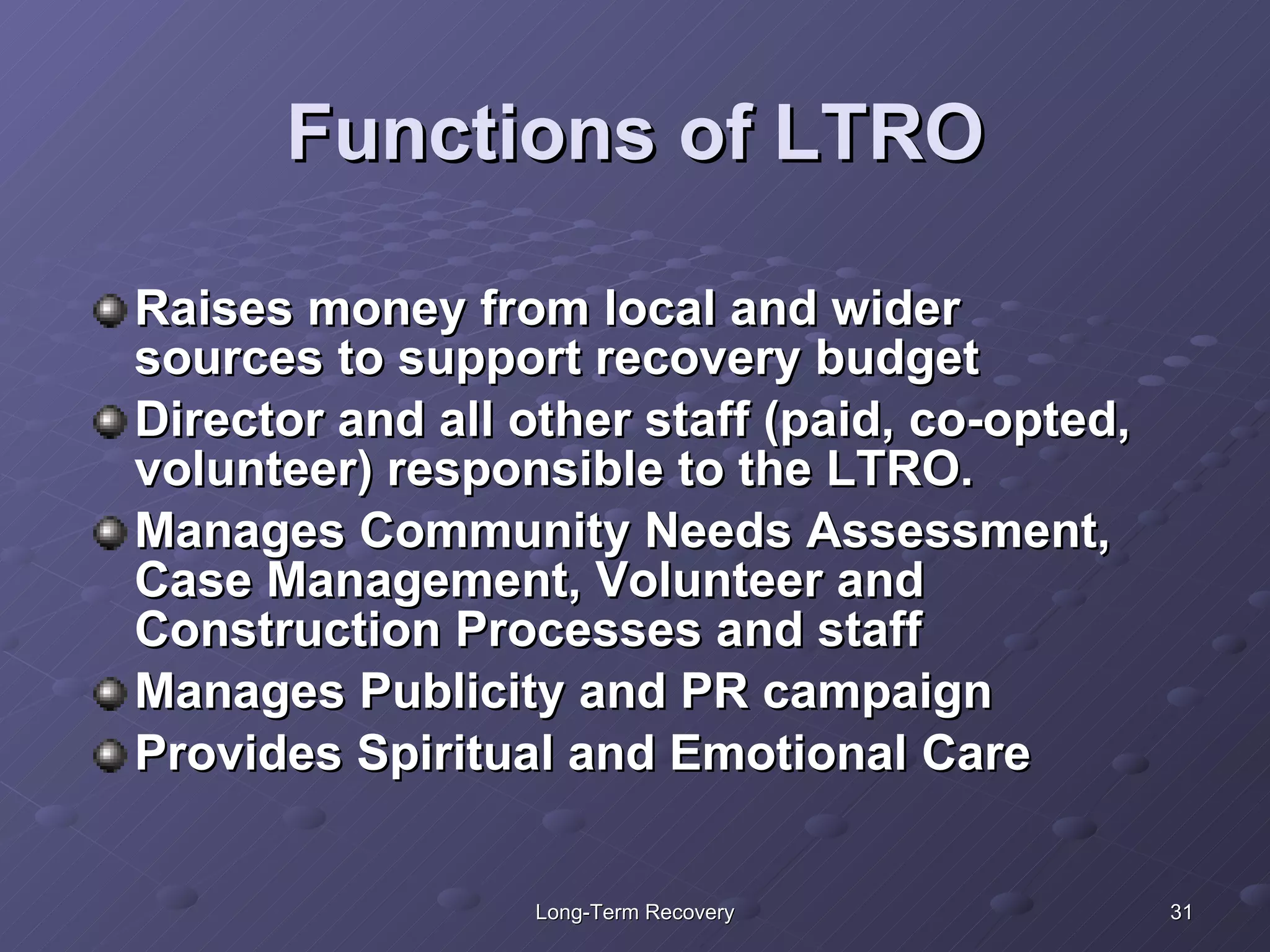
Functions of LTRO
Raises money from local and wider sources to support recovery budget
Director and all other staff (paid, co-opted, volunteer) responsible to the LTRO.
Manages Community Needs Assessment, Case Management, Volunteer and Construction Processes and staff
Manages Publicity and PR campaign
Provides Spiritual and Emotional Care
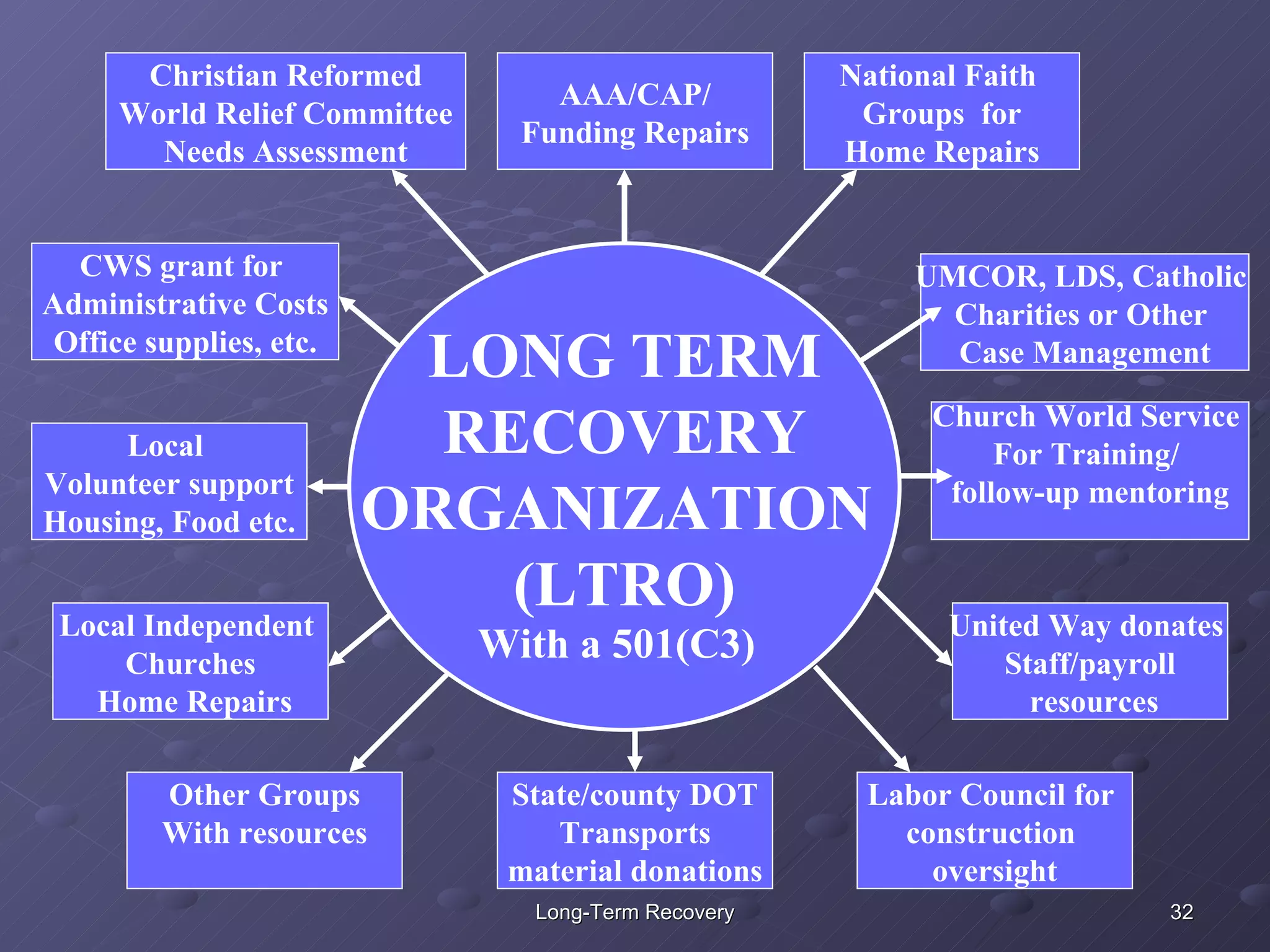
Other Groups With resources Christian Reformed World Relief Committee Needs Assessment UMCOR, LDS, Catholic Charities or Other Case Management CWS grant for Administrative Costs Office supplies, etc. National Faith Groups for Home Repairs Labor Council for construction oversight Local Independent Churches Home Repairs United Way donates Staff/payroll resources LONG TERM RECOVERY ORGANIZATION (LTRO) With a 501(C3) Local Volunteer support Housing, Food etc. Church World Service For Training/ follow-up mentoring AAA/CAP/ Funding Repairs State/county DOT Transports material donations
Does it work?
Absolutely but there are issues to keep in mind.
Managing the legal and organizational aspects of an LTRO consumes some time and resources.
Requires a level of trust among faith groups and secular agencies that may not be attainable in some communities.
Some faith groups and secular agencies cannot contribute to a common organization because of law, policy, or mandates.
Implies a long term existence that may not be necessary in some disasters or possible in some communities.
Responsibilty and liability is concentrated rather than disbursed to many agencies.
Disaster recovery is evolving!
A community agency, such as Emergency Management, United Way, University Extension, or other agency may convene the initial LTR meeting and assume leadership
Government and publicly funded agencies
(EMA, AAA, CAP, Health Dept., USDA, others) have disaster recovery resources and mandates
These agencies may or may not know that the faith community also have disaster ministries.
Faith-based Partners are Essential
Attract and leverage denominational money, material, and muscle
Access local, regional, national trained Volunteer groups
Attract local dollars
Improve sustainability of effort
Provide Community Recognition
Provide long term communications
Accomplishes more for the community!
Interfaith Partnering with Secular Agencies
Secular agencies will continue to have non-disaster roles and responsibilities
Faith Groups will also continue their individual and unique non-disaster lives
An existing or newly formed Interfaith Group may meet to coordinate disaster recovery roles
Interfaith Partnering with Secular Agencies
The faith community MUST exercise their role and responsibility in the larger community effort for recovery
The Interfaith Group needs to have representation on the Executive Committee with authority to speak for the Interfaith group and its members
Various members of the Interfaith Group may also serve on Sub-committees along with agency representatives
Interfaith Partnering with Secular Agencies
The faith community will be well received when we speak with a consistent and unified voice
When we cooperate and coordinate with the larger community effort,
the community will benefit most
the faith community will be seen as caring about the most critical needs of the community
the faith community will be faithful to the call to be the “caring arms of God.”
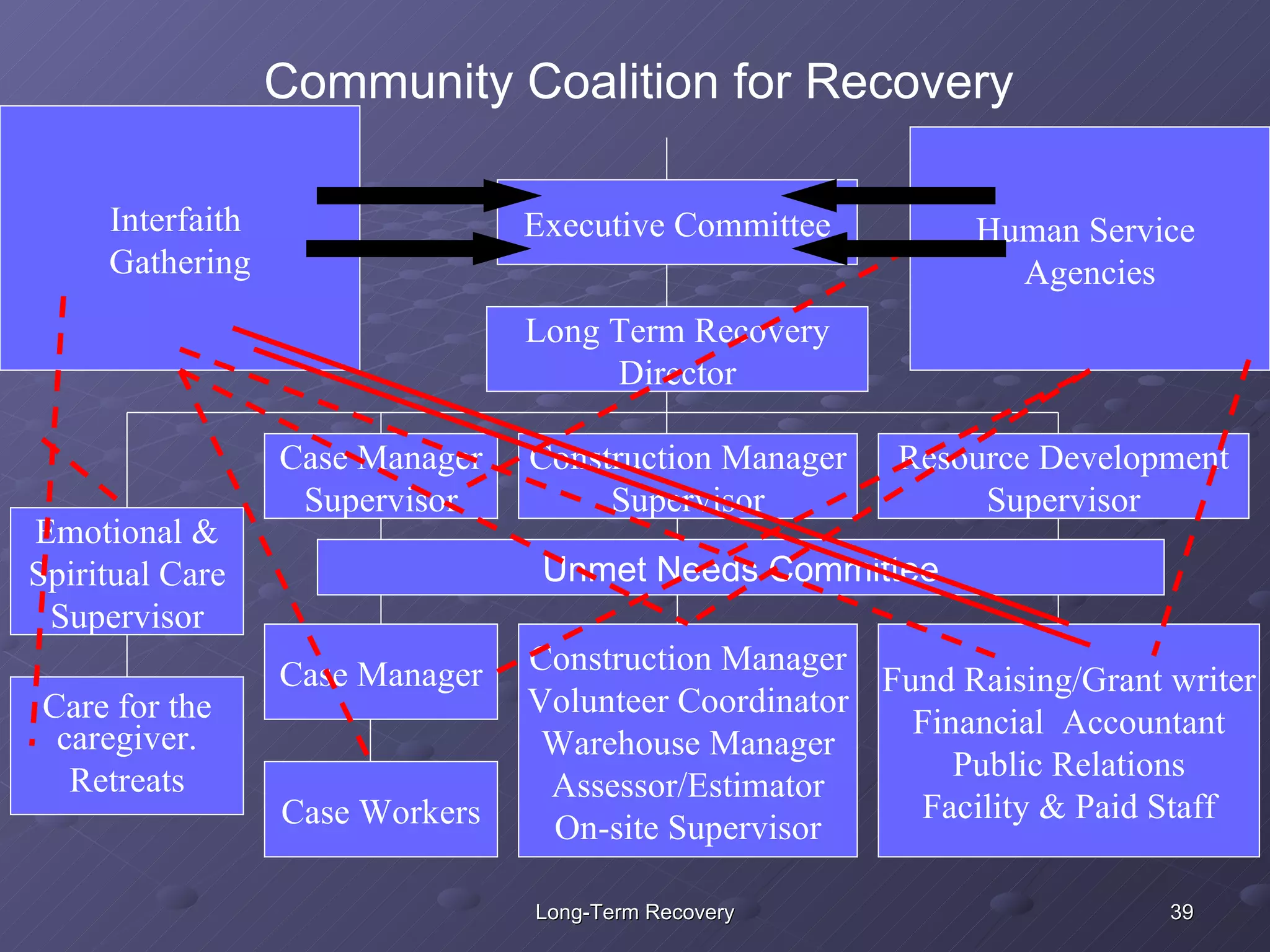
Interfaith Gathering Executive Committee Long Term Recovery Director Case Manager Supervisor Construction Manager Supervisor Resource Development Supervisor Case Manager Construction Manager Volunteer Coordinator Warehouse Manager Assessor/Estimator On-site Supervisor Fund Raising/Grant writer Financial Accountant Public Relations Facility & Paid Staff Case Workers Emotional & Spiritual Care Supervisor Care for the caregiver. Retreats Unmet Needs Committee Community Coalition for Recovery Human Service Agencies
Does it work?
Absolutely but there are issues to keep in mind.
The very size and complexity of a Coalition makes communication and coordination more difficult.
Faith Groups and secular agencies must increase their capacities to continue their regular operations and participate in the Recovery Coalition.
The number of meetings for the Interfaith Group and the many subcommittees can be daunting.
Therefore, the total number of people needed is increased and may not be available in some communities.
.
Does it work?
Absolutely but there are issues to keep in mind.
Clearly identified roles and tasks for each group and subcommittee are necessary to avoid duplication of efforts and turf issues.
Identifying the right persons to serve in the right places and getting those people in place requires significant attention to identifying individuals’ skills and weaknesses.
CREDITS
This presentation makes use of material developed and funded by Church World Service and its affiliated denominations.
Other materials used include NVOAD Recovery Manual and best practices of the presenter.
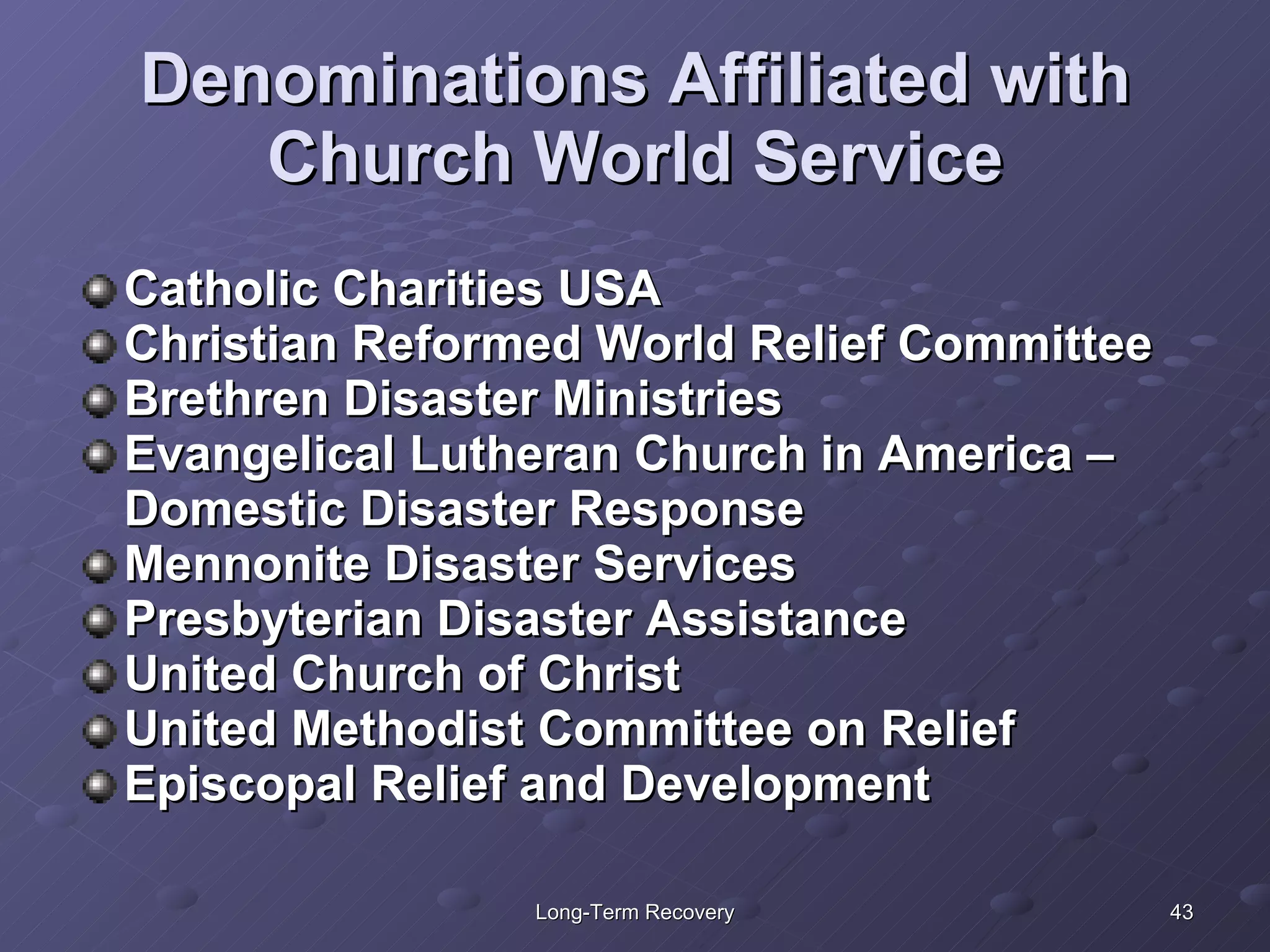
Denominations Affiliated with Church World Service
Catholic Charities USA
Christian Reformed World Relief Committee
Brethren Disaster Ministries
Evangelical Lutheran Church in America – Domestic Disaster Response
Mennonite Disaster Services
Presbyterian Disaster Assistance
United Church of Christ
United Methodist Committee on Relief
Episcopal Relief and Development
Community Arise
web site.
http://www.communityarise.com
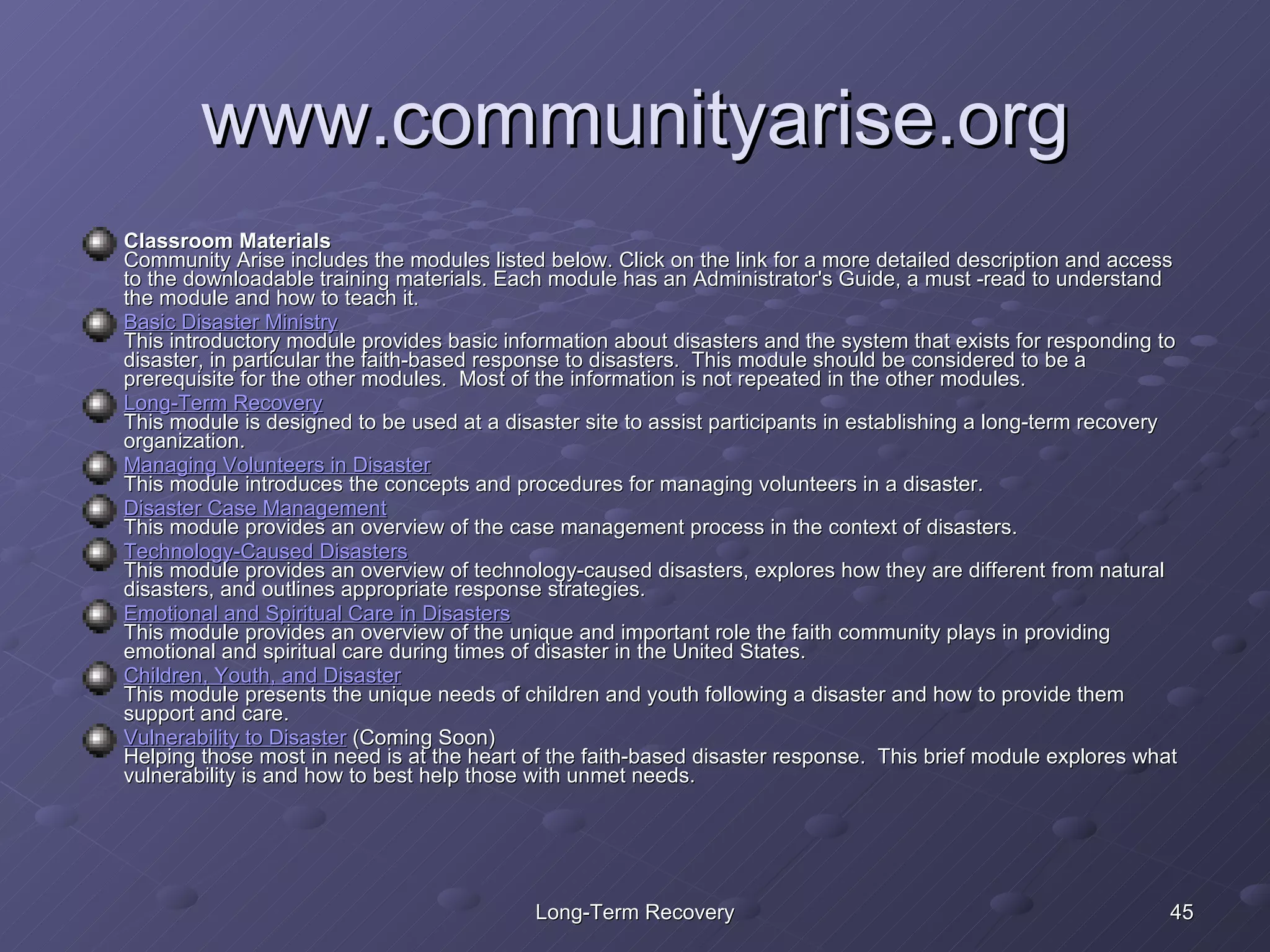
www.communityarise.org
Classroom Materials Community Arise includes the modules listed below. Click on the link for a more detailed description and access to the downloadable training materials. Each module has an Administrator's Guide, a must -read to understand the module and how to teach it.
Basic Disaster Ministry This introductory module provides basic information about disasters and the system that exists for responding to disaster, in particular the faith-based response to disasters. This module should be considered to be a prerequisite for the other modules. Most of the information is not repeated in the other modules.
Long-Term Recovery This module is designed to be used at a disaster site to assist participants in establishing a long-term recovery organization.
Managing Volunteers in Disaster This module introduces the concepts and procedures for managing volunteers in a disaster.
Disaster Case Management This module provides an overview of the case management process in the context of disasters.
Technology-Caused Disasters This module provides an overview of technology-caused disasters, explores how they are different from natural disasters, and outlines appropriate response strategies.
Emotional and Spiritual Care in Disasters This module provides an overview of the unique and important role the faith community plays in providing emotional and spiritual care during times of disaster in the United States.
Children, Youth, and Disaster This module presents the unique needs of children and youth following a disaster and how to provide them support and care.
Vulnerability to Disaster (Coming Soon) Helping those most in need is at the heart of the faith-based disaster response. This brief module explores what vulnerability is and how to best help those with unmet needs.
0 comments
Post a comment