
Numismatics, Begginers guide
•Download as PPSX, PDF•
2 likes•1,410 views

This is a simple guide for people who wants to start a paper money collection. Thirteen important points that make a bill valuable and worth collect.

Recommended
Recommended
More Related Content
Viewers also liked
Viewers also liked (8)
More from Liliana Elena Gonzalez Castro
More from Liliana Elena Gonzalez Castro (20)
Recently uploaded
Recently uploaded (20)
Numismatics, Begginers guide
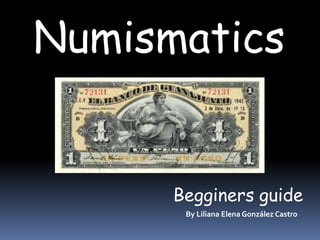
- 1. Numismatics Begginers guide By Liliana Elena González Castro
- 2. Numismatics: The study or collection of paper money, coins, and often medals.
- 3. Banknote: Piece of paper issued by a bank representing its promise to pay a specific sum to the bearer on demand and acceptable as money.
- 4. Note: A piece of paper currency.
- 5. Paper money: currency printed on paper. Includes all the various materials that have served as paper surrogates, for instance the polymer notes.
- 6. This is a simple guide for people who wants to start a paper money collection. Thirteen important points that make a bill valuable and worth collect.
- 7. 1.- Issue Date: The banknote below was issued in Argentina, January 1st, 1884
- 8. 2.- Issuing Authority: The banknote below was issued by El Banco de España in 1927
- 9. 3.- Authorized Signatures: The note below was signed by Ernesto “Che Guevara” in Cuba.
- 10. 4.- Portrait: Head or face view of a person, real or allegorical in a note’s vignette. Ruben Dario´s portrait below.
- 11. 5.- Serial Number: The note below shows a “radar” (the same backward and forward) serial number 663366
- 12. 6.- Denomination: Also called “face value”. The banknote below from Yugoslavia has a face value of 500 million Dinara.
- 13. 7.- Watermark is a security device. The note below has the Tutankhamen’s mask as a watermark at right
- 14. 8.- Printer's Name: The note below was printed by American Banknote Company
- 15. 9.- Overprints: The banknote below has a face value of 1 Cruzado novo overprinted on 1000 Cruzados banknote
- 16. 10.- Specimen: Invalid note overprinted or perforated with the word specimen. It has usually all zero serial numbers.
- 17. 11.- Notgeld: From the German roots “not” (necessity) and “geld” (money).
- 18. 11.- Notgeld were produced by almost 3500 German and Austria towns and cities from 1914 to 1922.
- 19. 12.- Polymer (plastic ) currency note technology was developed in Australia. The banknote below is year 2000 from Romania.
- 20. 13.- Pick number is assigned to every single note in the Standard Catalogs of World Paper Money. Below is Zaire, pick number 40
- 21. Liliana Elena González Castro www.AsesoriaInternet.com http://twitter.com/LilianaElena http://slideshare.net/LilianaElena