Another way of talking
       about theme:
Using grounded theory in the
         humanities
                 James Kelley
   Mississippi State University – Meridian
                  MLA 2013
A little background
My first (near) use of grounded theory without
ever having heard the term:

“Song, Story, or History: Resisting Claims of a
Coded Message in the African American Spiritual
‘Follow the Drinking Gourd.’” The Journal of
Popular Culture 41.2 (2008)
Multiple sources
Multiple sources, including:
• Two episodes on television series: The Fresh
  Prince of Bel-Air and Treasure Hunters
• Internet sites for and by educators at the K-12
  level (including over 50 lesson plans)
• Internet sites (and an educational video) by
  three government agencies: NASA, NSA, NPS
• Published pieces in the academic and popular
  presses
Theoretical sampling
My method of collecting information resembled the
“theoretical sampling” discussed in Barney Glaser
and Anselm Strauss’ The Discovery of Grounded
Theory: Strategies for Qualitative Research (1967).
•The sampling was purposeful, not random or
rigidly preplanned.
•The number and types of groups were not
determined until the research was completed.
There was “an ongoing inclusion of groups.”
Approach to the information
My method of making sense of the information
also resembled their methods. According to
Glaser and Strauss,
•grounded theory requires the “hard study of
much data.”
•grounded theory is the opposite of “logo-
deductive theory.” It is “grounded in” and
“emerges from” the data.
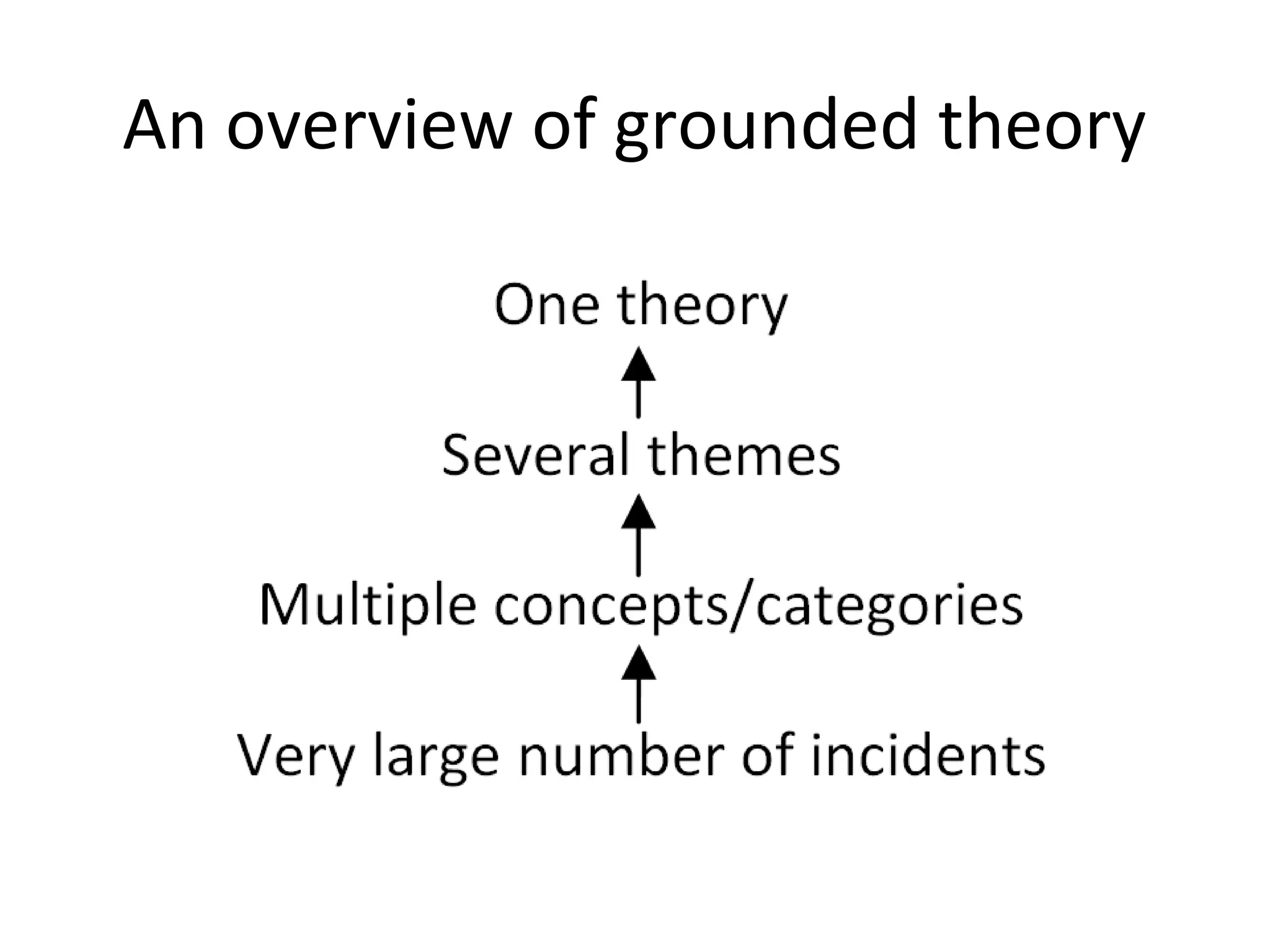
An overview of grounded theory
Recursive process
Collecting, coding, and analyzing are done
together as much as possible. They blur and
intertwine continuously. One should not
disregard the “fresh analytical idea” that occurs
after the process has begun. The “constant
comparison” of different groups highlights
meaningful similarities and differences.
When does the process end?
Example of To Kill a Mockingbird
To Kill a Mockingbird is the single most widely
discussed novel at enotes.com. There are
presently:
6,664 Q&A items for To Kill a Mockingbird
2,848 Q&A items for Lord of the Flies
1,440 Q&A items for 1984
1,340 Q&A items for The Scarlet Letter
1,060 Q&A items for Frankenstein
Theme 1: Moral Character
When talking to students about fictional
characters in Lee’s novel, particularly when
talking about Atticus Finch and Bob Ewell, the
teachers frequently move from character
analysis to explicit and implicit statements of
morality. Describing the fictional characters in
the novel becomes a way of talking about moral
character in our world.
Theme 2: Life Lessons
When talking to students about the experiences
and changes of the younger characters in the
novel, particularly when talking about Scout and
Jem Finch, the teachers frequently move in their
answers toward explicit and implicit discussions
of identity development, intellectual and social
development, loss of innocence, growing
awareness of hypocrisy and evil in the world,
and other topics related to adolescence.
Theme 3: Text and Context
When talking to students about the novel’s
setting and publication date, the teachers touch
briefly on past and present organizations of
race, class, and gender. The novel’s immediate
setting (the town of Maycomb, AL) often
receives detailed treatment in the teachers’
answers, whereas discussions of social
structures in the early 1930s and in the late
1950s are often brief and undeveloped.
Bringing the themes together
The teachers’ tendency to focus on unchanging and
universal truths, particularly the central idea of a
young person learning to distinguish between good
and evil – coupled with the tendency to discuss the
novel without reference to the Jim Crow laws of the
period in which the story is set and/or the early
Civil Rights era during which the novel was first
published – transforms the complex novel To Kill a
Mockingbird into a simple and timeless morality
tale.
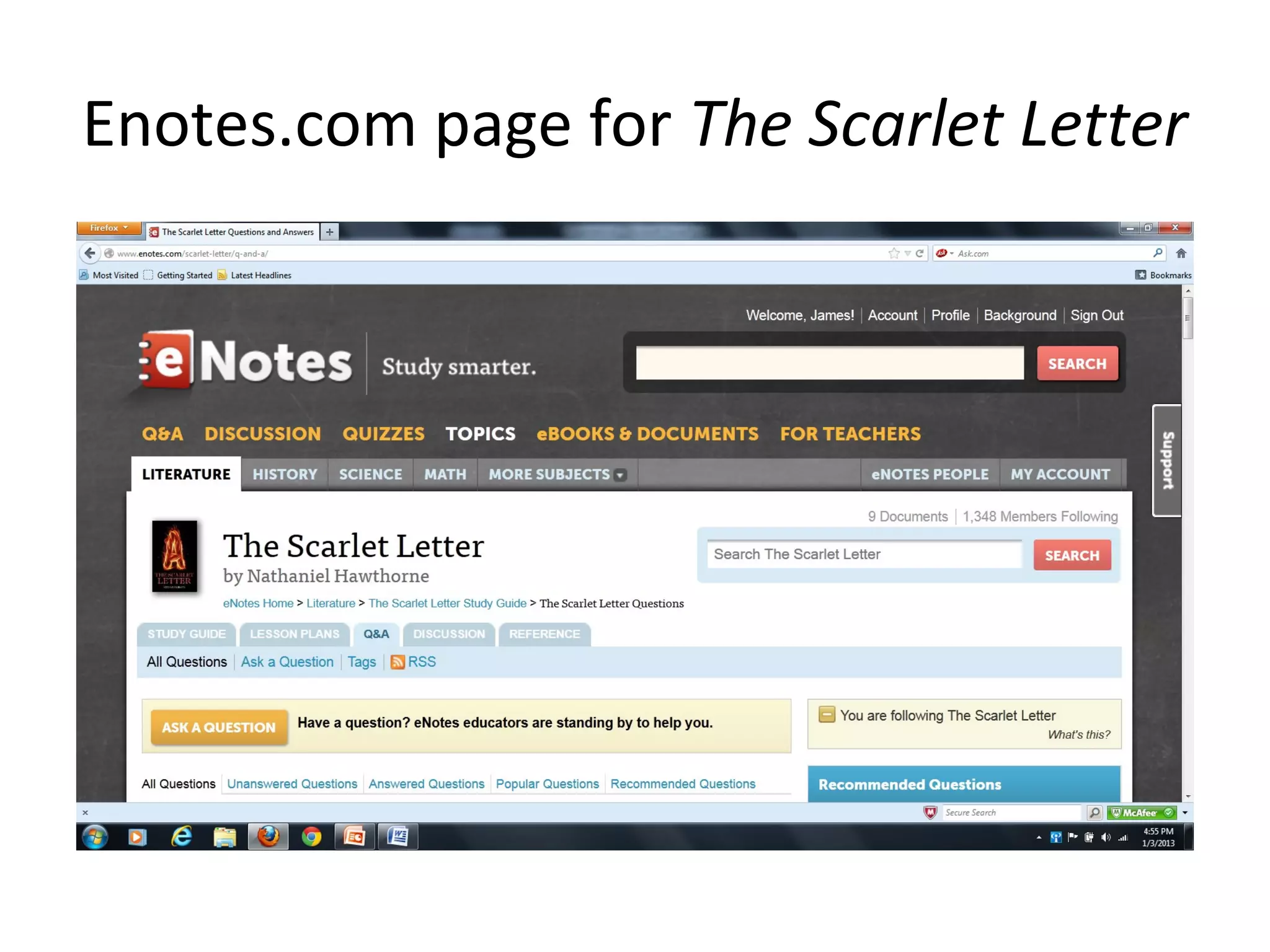
Enotes.com page for The Scarlet Letter
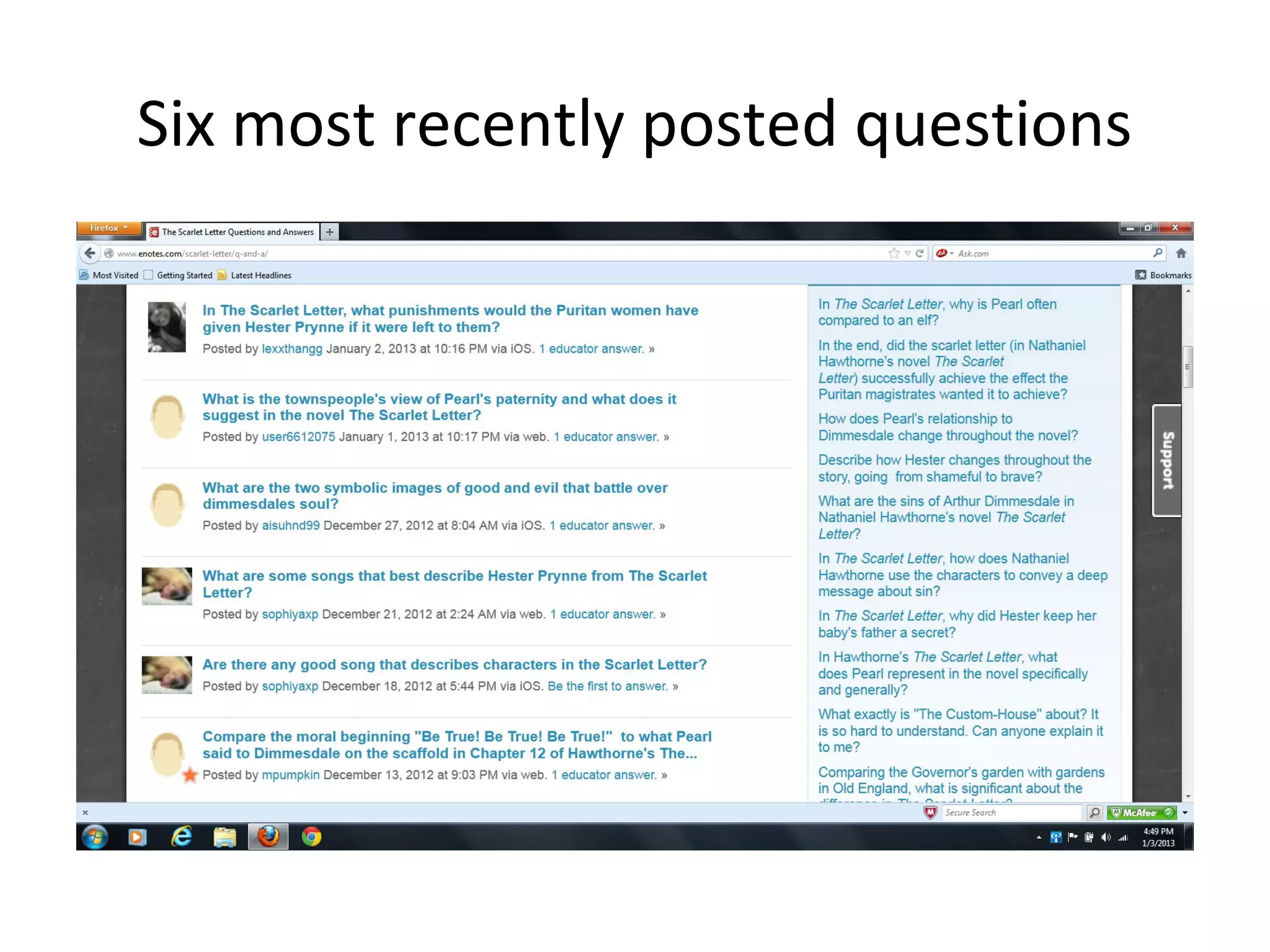
Six most recently posted questions
Sample teachers’ posts on
            the rose bush
The following two posts can be compared and
contrasted for the following:
•Level of detail
•Discussion of symbolism
•Discussion of ambiguity
•Use of direct quotations from the novel
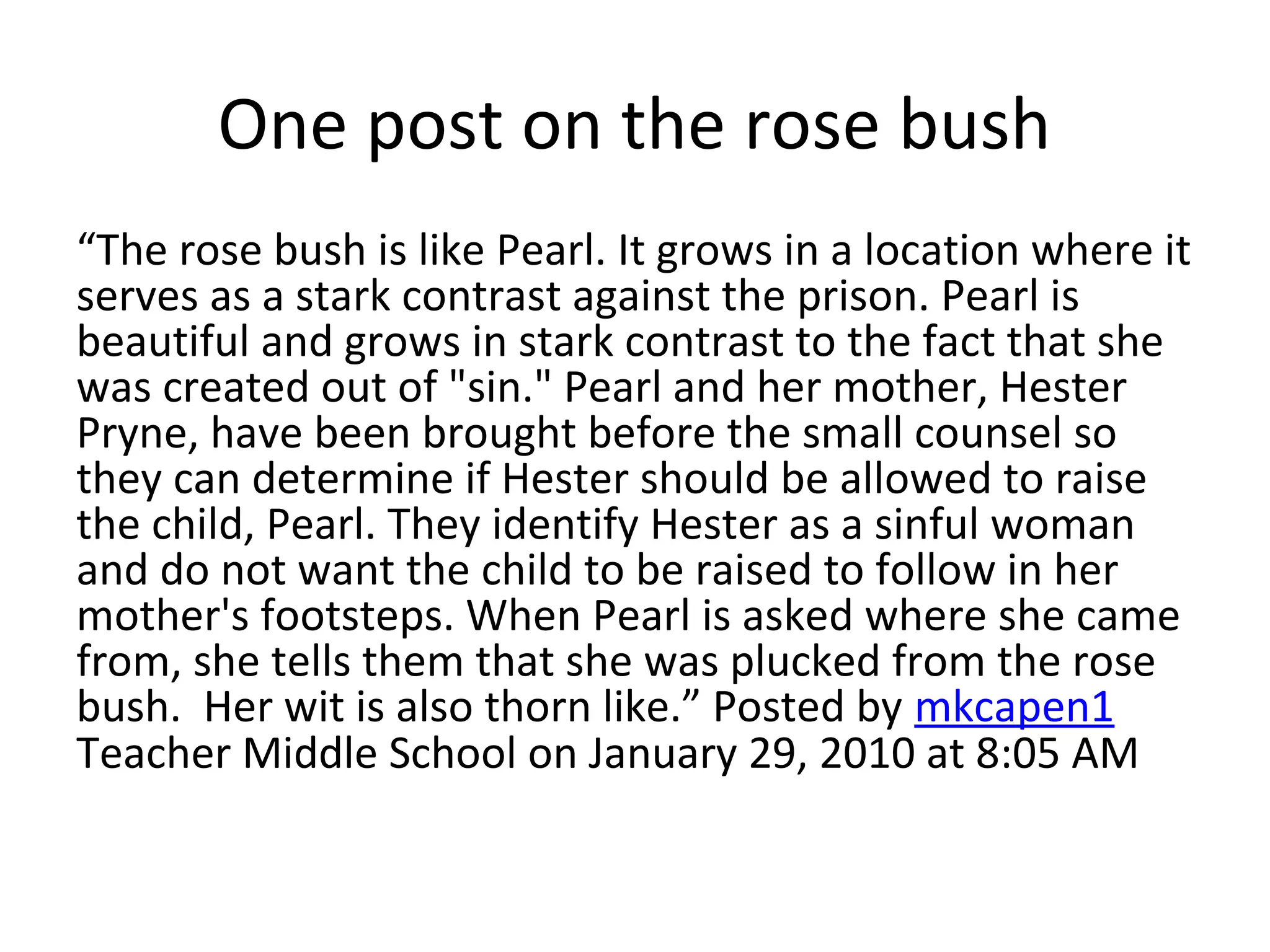
One post on the rose bush
“The rose bush is like Pearl. It grows in a location where it
serves as a stark contrast against the prison. Pearl is
beautiful and grows in stark contrast to the fact that she
was created out of "sin." Pearl and her mother, Hester
Pryne, have been brought before the small counsel so
they can determine if Hester should be allowed to raise
the child, Pearl. They identify Hester as a sinful woman
and do not want the child to be raised to follow in her
mother's footsteps. When Pearl is asked where she came
from, she tells them that she was plucked from the rose
bush. Her wit is also thorn like.” Posted by mkcapen1
Teacher Middle School on January 29, 2010 at 8:05 AM
A second post on the rose bush
“The rose bush in this novel is another example of a
symbol, just like the character of Hester Prynne,
that defies easy interpretation and eschews
classification. The narrator remains deliberately
vague about how this important symbol can be
interpreted, but what I think your question refers
to is one possible legend that is cited as a potential
explanation for the existence of the rose bush at
the prison door, which is a rather incongruous place
for a such a beautiful flower to grow.
A second post on the rose bush, cont.
“Note what the text tells us about this: “This rosebush, by a
strange chance, has been kept alive in history; but whether it
had merely survived out of the stern old wilderness, so long
after the fall of the gigantic pines and oaks that originally
overshadowed it--or whether, as there is fair authority for
believing, it had sprung up under the footsteps of the sainted
Ann Hutchinson, as she entered the prison door--we shall not
take upon us to determine.” Thus we can see that one potential
story that explains the existence of the rose bush is that it
sprang up beneath the saint Ann Hutchinson as she entered the
prison door, but the truth of this rumor is never given.” Posted
by accessteacher Teacher High School - 10th Grade on July 28,
2011 at 9:38 PM
To Kill a Mockingbird and
             The Scarlet Letter
I now wonder where the differences lie in how
teachers discuss these two novels:
The individual teachers?
The school grades?
The texts themselves?
I wonder if we are more likely to ascribe complexity
to some texts (e.g. Hawthorne’s novels and short
stories) and less likely to do the same for others
(e.g. Robert Frost’s poetry, To Kill a Mockingbird, or
Harry Potter).
Celebration of flexibility and freedom
The Discovery of Grounded Theory is worth
reading not only for its discussion of the method
but also for its challenge to the still dominant
model in social science research:
•“the rigorous rules of verification” are “so
stifling to the creative energies required for
discovering theory” (7)
•“escaping the shackles of existing theories” (38)
Literary Studies
I have used grounded theory to examine
discussions of specific literary works:
•Harper Lee’s To Kill a Mockingbird
•Nathaniel Hawthorne’s “Young Goodman
Brown” and The Scarlet Letter
•Robert Frost’s poetry, concentrating on “The
Road Not Taken” and “Stopping by Woods on a
Snowy Evening”
•J.K. Rowling’s Harry Potter
Cultural Studies
I have also used grounded theory to examine non-literary
phenomena:
•claims of a coded message in the song “Follow the
Drinking Gourd”
•how gamers talk about the physical appearance of the
male characters that they are able to create and
manipulate within a popular online multiplayer game
•choices for names of guilds by LGBT gamers in online
games
•motivations and aesthetic concerns of people who
create and/or consume “celebrity fake” pornography
Conclusion
Glaser and Strauss had only the sociologist in mind
as they wrote their book, stating that generating
sociological theory is something that “only
sociologists can do.”
But their method, built around the “hard study of
much data” and intended to liberate “the creative
energies required for discovering theory,” can help
any of us answer almost any question that begins
with the words “How do people…?”
Source
Glaser, Barney G. and Anselm L. Strauss. The
  Discovery of Grounded Theory: Strategies for
  Qualitative Research. Chicago: Aldine
  Publishing, 1967.

Grounded Theory in the Humanities

  • 1.
    Another way oftalking about theme: Using grounded theory in the humanities James Kelley Mississippi State University – Meridian MLA 2013
  • 2.
    A little background Myfirst (near) use of grounded theory without ever having heard the term: “Song, Story, or History: Resisting Claims of a Coded Message in the African American Spiritual ‘Follow the Drinking Gourd.’” The Journal of Popular Culture 41.2 (2008)
  • 3.
    Multiple sources Multiple sources,including: • Two episodes on television series: The Fresh Prince of Bel-Air and Treasure Hunters • Internet sites for and by educators at the K-12 level (including over 50 lesson plans) • Internet sites (and an educational video) by three government agencies: NASA, NSA, NPS • Published pieces in the academic and popular presses
  • 4.
    Theoretical sampling My methodof collecting information resembled the “theoretical sampling” discussed in Barney Glaser and Anselm Strauss’ The Discovery of Grounded Theory: Strategies for Qualitative Research (1967). •The sampling was purposeful, not random or rigidly preplanned. •The number and types of groups were not determined until the research was completed. There was “an ongoing inclusion of groups.”
  • 5.
    Approach to theinformation My method of making sense of the information also resembled their methods. According to Glaser and Strauss, •grounded theory requires the “hard study of much data.” •grounded theory is the opposite of “logo- deductive theory.” It is “grounded in” and “emerges from” the data.
  • 6.
    An overview ofgrounded theory
  • 7.
    Recursive process Collecting, coding,and analyzing are done together as much as possible. They blur and intertwine continuously. One should not disregard the “fresh analytical idea” that occurs after the process has begun. The “constant comparison” of different groups highlights meaningful similarities and differences. When does the process end?
  • 8.
    Example of ToKill a Mockingbird To Kill a Mockingbird is the single most widely discussed novel at enotes.com. There are presently: 6,664 Q&A items for To Kill a Mockingbird 2,848 Q&A items for Lord of the Flies 1,440 Q&A items for 1984 1,340 Q&A items for The Scarlet Letter 1,060 Q&A items for Frankenstein
  • 9.
    Theme 1: MoralCharacter When talking to students about fictional characters in Lee’s novel, particularly when talking about Atticus Finch and Bob Ewell, the teachers frequently move from character analysis to explicit and implicit statements of morality. Describing the fictional characters in the novel becomes a way of talking about moral character in our world.
  • 10.
    Theme 2: LifeLessons When talking to students about the experiences and changes of the younger characters in the novel, particularly when talking about Scout and Jem Finch, the teachers frequently move in their answers toward explicit and implicit discussions of identity development, intellectual and social development, loss of innocence, growing awareness of hypocrisy and evil in the world, and other topics related to adolescence.
  • 11.
    Theme 3: Textand Context When talking to students about the novel’s setting and publication date, the teachers touch briefly on past and present organizations of race, class, and gender. The novel’s immediate setting (the town of Maycomb, AL) often receives detailed treatment in the teachers’ answers, whereas discussions of social structures in the early 1930s and in the late 1950s are often brief and undeveloped.
  • 12.
    Bringing the themestogether The teachers’ tendency to focus on unchanging and universal truths, particularly the central idea of a young person learning to distinguish between good and evil – coupled with the tendency to discuss the novel without reference to the Jim Crow laws of the period in which the story is set and/or the early Civil Rights era during which the novel was first published – transforms the complex novel To Kill a Mockingbird into a simple and timeless morality tale.
  • 13.
    Enotes.com page forThe Scarlet Letter
  • 14.
    Six most recentlyposted questions
  • 15.
    Sample teachers’ postson the rose bush The following two posts can be compared and contrasted for the following: •Level of detail •Discussion of symbolism •Discussion of ambiguity •Use of direct quotations from the novel
  • 16.
    One post onthe rose bush “The rose bush is like Pearl. It grows in a location where it serves as a stark contrast against the prison. Pearl is beautiful and grows in stark contrast to the fact that she was created out of "sin." Pearl and her mother, Hester Pryne, have been brought before the small counsel so they can determine if Hester should be allowed to raise the child, Pearl. They identify Hester as a sinful woman and do not want the child to be raised to follow in her mother's footsteps. When Pearl is asked where she came from, she tells them that she was plucked from the rose bush. Her wit is also thorn like.” Posted by mkcapen1 Teacher Middle School on January 29, 2010 at 8:05 AM
  • 17.
    A second poston the rose bush “The rose bush in this novel is another example of a symbol, just like the character of Hester Prynne, that defies easy interpretation and eschews classification. The narrator remains deliberately vague about how this important symbol can be interpreted, but what I think your question refers to is one possible legend that is cited as a potential explanation for the existence of the rose bush at the prison door, which is a rather incongruous place for a such a beautiful flower to grow.
  • 18.
    A second poston the rose bush, cont. “Note what the text tells us about this: “This rosebush, by a strange chance, has been kept alive in history; but whether it had merely survived out of the stern old wilderness, so long after the fall of the gigantic pines and oaks that originally overshadowed it--or whether, as there is fair authority for believing, it had sprung up under the footsteps of the sainted Ann Hutchinson, as she entered the prison door--we shall not take upon us to determine.” Thus we can see that one potential story that explains the existence of the rose bush is that it sprang up beneath the saint Ann Hutchinson as she entered the prison door, but the truth of this rumor is never given.” Posted by accessteacher Teacher High School - 10th Grade on July 28, 2011 at 9:38 PM
  • 19.
    To Kill aMockingbird and The Scarlet Letter I now wonder where the differences lie in how teachers discuss these two novels: The individual teachers? The school grades? The texts themselves? I wonder if we are more likely to ascribe complexity to some texts (e.g. Hawthorne’s novels and short stories) and less likely to do the same for others (e.g. Robert Frost’s poetry, To Kill a Mockingbird, or Harry Potter).
  • 20.
    Celebration of flexibilityand freedom The Discovery of Grounded Theory is worth reading not only for its discussion of the method but also for its challenge to the still dominant model in social science research: •“the rigorous rules of verification” are “so stifling to the creative energies required for discovering theory” (7) •“escaping the shackles of existing theories” (38)
  • 21.
    Literary Studies I haveused grounded theory to examine discussions of specific literary works: •Harper Lee’s To Kill a Mockingbird •Nathaniel Hawthorne’s “Young Goodman Brown” and The Scarlet Letter •Robert Frost’s poetry, concentrating on “The Road Not Taken” and “Stopping by Woods on a Snowy Evening” •J.K. Rowling’s Harry Potter
  • 22.
    Cultural Studies I havealso used grounded theory to examine non-literary phenomena: •claims of a coded message in the song “Follow the Drinking Gourd” •how gamers talk about the physical appearance of the male characters that they are able to create and manipulate within a popular online multiplayer game •choices for names of guilds by LGBT gamers in online games •motivations and aesthetic concerns of people who create and/or consume “celebrity fake” pornography
  • 23.
    Conclusion Glaser and Strausshad only the sociologist in mind as they wrote their book, stating that generating sociological theory is something that “only sociologists can do.” But their method, built around the “hard study of much data” and intended to liberate “the creative energies required for discovering theory,” can help any of us answer almost any question that begins with the words “How do people…?”
  • 24.
    Source Glaser, Barney G.and Anselm L. Strauss. The Discovery of Grounded Theory: Strategies for Qualitative Research. Chicago: Aldine Publishing, 1967.