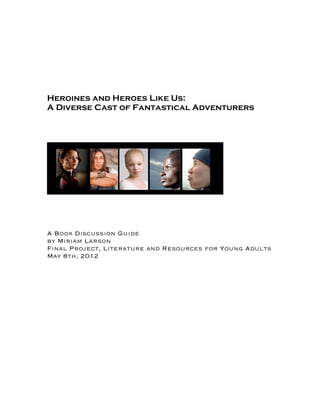
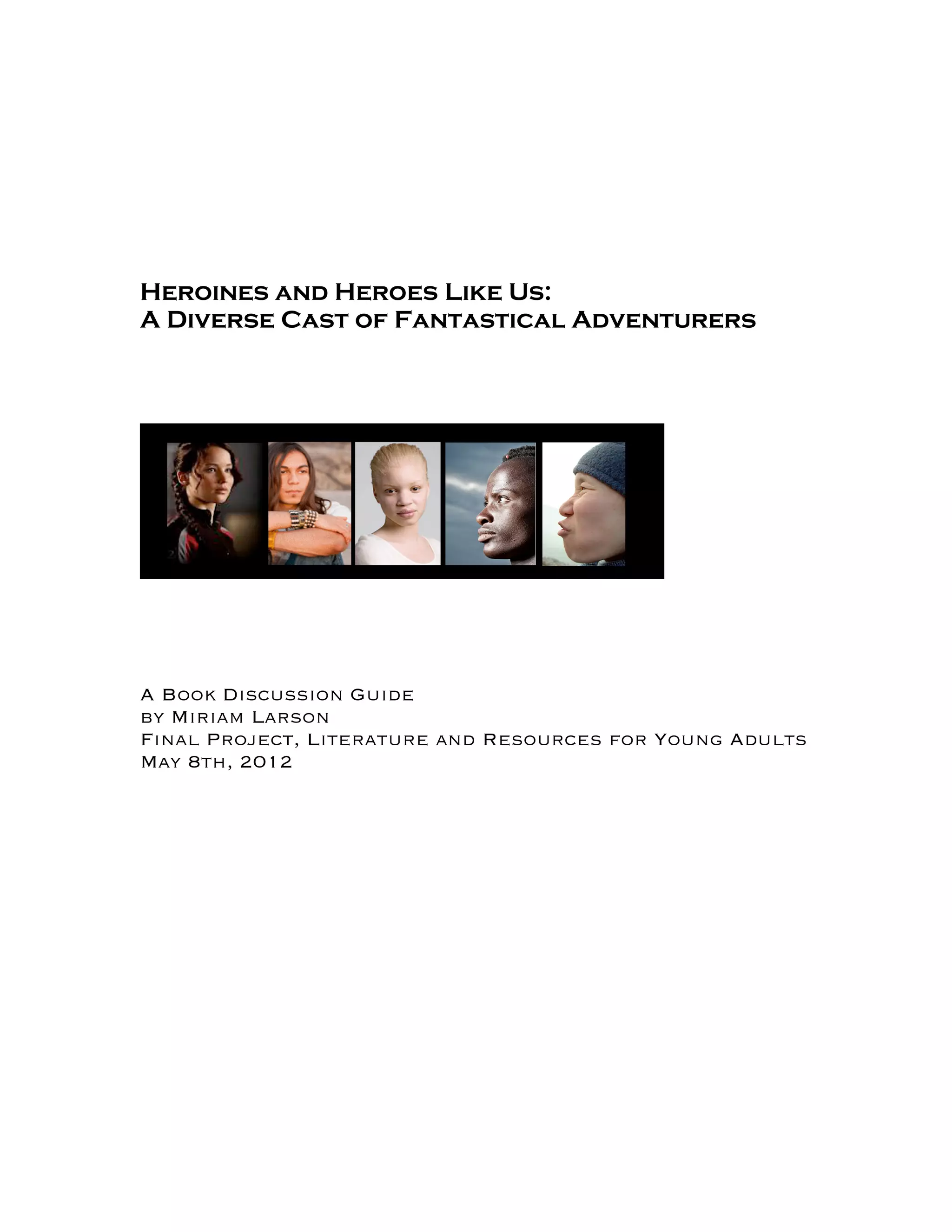
Heroines and Heroes Like Us:
A Diverse Cast of Fantastical Adventurers


A Book Discussion Guide
by Miriam Larson
Final Project, Literature and Resources for Young Adults
May 8th, 2012
Audience
With the rise of high profile fantasy books and movies like Harry Potter and The Hunger
Games, fantasy has moved to a level of unprecedented visibility. But many of the main
characters are white and their stories represent a mainstream view of European or
American culture. This book group aims to specifically reach out to African American,
Latino and American Indian youth to engage in dialogue around less traditional fantasy
and science fiction. Of course, youth of all identities are welcome to participate and it is
my hope that any participant will gain something from reading beyond the traditional
bounds of Euro-Fantasy.

This book club will be open so that teens can come when they are interested in the book.
However, there will be strong encouragement for teens to come to multiple sessions so
that we have more of a chance to build community and comfort in discussions. The target
age range is high school teens ages 13-18. Because the majority of the books (four out of
six) feature girls, and because reading for pleasure is less common among boys, I
anticipate that participants will be majority girls.

Publicity Plan

Successful publicity will be key to having dynamic and rich discussions. In order to
successfully recruit participants, I plan to maximize publicity via face-to-face contact and
word of mouth. These social means of communicating allow people to make personal
connections and feel comfortable joining a new activity group. The following are plans
for outreach:

At the end of the school year, I will visit English and Language Arts classrooms to book
talk the selected books and meet students. I will also make connections with extra-
curricular teen groups, particularly creative writing clubs and community service groups.
In addition to talking specifically with adults, I will share the list of books and
information about the book club with teachers and school librarians who may know
individual students with an interest in the theme.

An additional venue where I will recruit students is at local summer enrichment
programs. I will meet with program leaders to introduce the book club and invite their
teens to participate as part of the summer program. Teens involved in summer programs
may come to the library initially to check out the reading club books or other books and
then return for a discussion group on the book they have chosen. I will talk with the
program coordinators about the best way to facilitate participation. One option is for
teens to have a weekly library visit built into their schedule. That time would coordinate
with the book discussion group, allowing teens that are interested to join the discussion.
Alternatively, teens might vote to choose one book they will all read and travel to the
library on the day when that book will be discussed. In discussing the best option with
program coordinators, I will emphasize that the best scenario allows teens to choose
which book(s) they read and allows teens the option to participate or not in the book club.

In addition to community outreach, I will use established library programs and publicity
channels to publicize the book club:

   •   I will book talk these books for the Manga Club and encourage teen participants
       in other library programs to consider reading a book club selection over the
       summer.
   •   I will post information about the books and the book club on the teen blog for the
       library as well as the adult blog to encourage parents to tell their kids about the
       book club. I will utilize book trailers when available including the following:
           o Wolf Mark: http://www.youtube.com/watch?v=R0yekVghUzk
           o Half World: http://www.hiromigoto.com/books/half-world/
   •   In advance of each week’s book, I will feature targeted publicity about the book
       on the library website, when available, make use of the gripping video trailers
       (see web links below).
   •   I will create a display with the books and book club information in the teen space.
   •   I will encourage all reference desk staff to mention the book club to teens they
       know or teens that have readers’ advisory questions. The handouts will be useful
       to allow staff to give teen visitors information about the book club that they can
       take home with them.

Additional publicity and flyering:
   • Local teen hang-out spaces including movie theaters, malls, restaurants,
       community centers and churches.
   • Parenting listservs and blogs (like chambanamoms.com and homeschool
       listservs).

About the Theme

In many ways, this book club is about a genre. The genre could perhaps best be described
as speculative fiction but I use the word “fantasy” in the title because it is a more familiar
title. Within this genre, the theme is narrowed to a focus on books with a diverse cast of
characters and many of these books challenge norms of fantasy and science fiction. As
stated in the discussion of audience, with the increasing popularity of fantasy young
people of color will find that there are fewer fantasy and science fiction books with
characters and authors that look like them. In order to cultivate a pluralistic society,
librarians must take the lead in advocating for books written by and about people of
color. This benefits not only young people of color who benefit from seeing themselves
represented, but all youth who are growing up in an increasingly diverse and globalized
world.

Depending on the book club participants, we may delve more deeply into themes of
cultural diversity and representation in literature. Other groups may be more interested in
how each author builds their world, and these books provide a rich variety of
“otherworlds” that will inspire teen writers and readers to be creative in their
interpretations. In my questions I have included prompts that approach the books from a
variety of interest angles.

About the Selection Process

These six books were chosen with the explicit intent of encouraging teens to read fantasy
beyond the mainstream. I chose to begin with The Hunger Games both because of its
popularity and because there are many issues that can be discussed in the book. For teens
new to fantasy and science fiction, The Hunger Games is likely to be familiar and they
may be interested in reading more fantasy and science fiction. In this way I hope to create
an entry point for new readers.

The remaining books all feature main characters that are American young people of color
or teens in fantasy-inspired lands set outside of the United States (Japan, Brazil and
Nigeria). Akata Witch and City of Beats appeal to a slightly younger audience, while the
last three books in the series have more complex plots and deal with more mature
content. Parable of the Sower and Half World in particular will appeal to older audience
and contain some violence and sexually explicit content. By leaving these to the end, I
hope to set younger readers up with skills to discuss these later books and appropriate
expectations for each book’s content. After each book club meeting, I will book talk the
book for the next week in order to familiarize youth with the books and allow them to
assess which books best fit their interests. This will also be a chance to encourage
participants to come to multiple book club meetings.

Book Summaries

Hunger Games
by Suzanne Collins

A dictatorship must have a means of sustaining intimidation. In Panem, a dystopian
future United States, the Capitol dominates twelve districts by taking one teenager from
each district and pitting the twelve young people against each other in an event known as
the Hunger Games. When Katniss’ sister is chosen, Katniss volunteers to sacrifice herself
instead. Will she survive?

City of Beasts
by Isabel Allende

Alex must rely on his new friend Nadia and his instincts to survive his journey through
the Amazon jungle. But there is more at stake than his own survival. The survival of the
indigenous people is at risk and depends partly on Nadia and Alex’s role in helping to
defeat the profit-hungry businessmen who want to destroy the jungle.
Akata Witch
by Nnedi Okorafor

To get into Leopard Knocks, the local village of the Leopard People, Sunny has to learn
to call her spirit face. Before she knew about Leopard Knocks, Sunny only knew she was
different because her Nigerian classmates thought it was weird that she’d grown up in
American and because she was albino. But when Sunny meets three other young people
who have powers and can cross into Leopard Knocks, the foursome must learn to use
their powers quickly if they are going to face the coming evil that threatens the surival of
the Earth.

Wolf Mark
by Joseph Bruchac

Luke is an Abenaki Indian American with unusual skills and a birthmark shaped like a
wolf on his wrist. After his mom’s death, Luke knows that his drunk and depressed dad
will not help him understand his powers. And then his father is kidnapped. As Luke
begins to uncover the bioterrorist threat he’s up against, he must rely on his own
resilience to find his father and face the international threat.

Parable of the Sower
by Octavia Butler

Lauren Olamina is an empath; she can feel what other people feel. Lauren lives in a
futuristic United States where violence and poverty run rampant; and it is hard for her to
avoid feeling other peoples’ emotions, especially pain. When her walled community is
destroyed and Lauren is forced to find a new place to live, her empathy, vision and
determination make her a beacon of light and others begin to follow. Will Lauren’s new
community survive and be able to carve out a new home amidst the rubble?

Half World
by Hiromi Goto

Melanie’s life is a struggle. She is teased by classmates for being overweight, her mother
has little money, and she has no close friends. When she comes home to find that her
mother has been kidnapped into another world, her struggle transforms into a struggle for
survival in a nightmarish world where Melanie’s actions may determine the balance
between the world of the spirits and the world of the living.
Discussion Guide: The Hunger Games by
Suzanne Collins

 •   Hunger Games has gained a huge following, particularly since the release of the
     movie. What made you interested in reading the book and discussing it in a
     group?

 •   Katniss describes District 12 as a place where you can “starve to death in safety”
     (pg 6). Does District 12 seem like a convincing city trapped under the thumb of
     the Capitol? Why or Why not? Does Panem and its atrocious dictatorship seem
     like a place that could exist in the real world?

 •   It’s easy to get caught up in the excitement of the hunger games but it is also a
     horrendous gladiator-like tradition. Did you find yourself at times getting caught
     up in the Capitol’s excitement about fashion and stardom in the games? When
     were you horrified by the spectacle of the hunger games? Did you ever feel both
     caught up in the spectacle and horrified by it?

 •   When Peeta declares his love for Katniss in the interview, does he really mean it
     or did Haymitch create the “star-crossed lovers” story? What does Haymitch
     mean when he says, “It’s all a big show. It’s all how you’re perceived”? Why do
     they need to impress sponsors and what are those sponsors looking for when they
     are watching the Games? (From Scholastic Discussion Guide,
     http://mediaroom.scholastic.com/files/HungerGames_TrilogyDiscussionGuide.pd
     f)

 •   In 1848, Karl Marx wrote in The Communist Manifesto, “The history of all
     hitherto existing society is the history of class struggles.” How does this statement
     apply to the society and government of Panem? Do you believe there is any
     chance to eradicate class struggles in the future? (From Scholastic Discussion
     Guide,
     http://mediaroom.scholastic.com/files/HungerGames_TrilogyDiscussionGuide.pd
     f)

 •   There are many instances when competitors in the hunger games take mercy on
     each other, even when they could make a kill (Thresh takes mercy on Katniss, for
     example, pg. 288). And they also form intentional alliances, the ultimate alliance
     being the one between Peeta and Katniss. Are these instances of cooperation
     futile? What might they mean for the viewers across Panem?
Discussion Guide: City of Beasts by Isabelle
Allende

  •   Throughout the book, Alex is confronted with a lot of emotionally intense
      situations. In the beginning of the book, Alex explodes with anger when he sees
      his dad shaving his mom’s head. As the adventure unfolds, does Alex change as a
      character? Does he change because he chooses to or because of his
      circumstances?

  •   Professor Leblanc is a character that seems purposefully depicted as an archetypal
      misogynist, conceited pig. How did you respond to his character? Did he seem
      realistic or exaggerated?

  •   The members of the exhibition repeat different stereotypes about Indians.
      Sometimes they expect the Indians to be violent and savage, other times they are
      described as naĂŻve and in need of being protected. In what ways does this story
      reinforce stereotypes about Indians? In what ways does it oppose stereotypes,
      perhaps by presenting different perspectives?

  •   Allende’s novel communicates a strong moral about the importance of preserving
      cultural heritage and natural resources? How does the fantasy genre help or hurt
      the communication of Allende’s moral?

  •   Some reviewers have critiqued this book as wordy and containing “labored
      language” (Kirkus Review). Did you find this to be the case? Do any passages
      stand out to you? Do you think this has anything to do with the fact that this book
      is a translation?
Discussion Guide: Akata Witch by Nnedi
Okorafor

 •   Some have called this book “Africa’s answer to Harry Potter.” What are the
     similarities and differences between Harry Potter’s story and Sunny’s? Is this a
     comparison that you would use in telling other people about this book?

 •   Because so much fantasy is set in Europe, many fantasy readers are used to
     European culture as the backdrop for fantasy. In Akata Witch the author is very
     intentional about challenging Western dominance. For example, Sasha scoffs
     when Anatov talks about the scholar who wrote Fast Facts for Free Agents who
     went to Europe and American in search of “civilized ideas” (pg 112). What other
     instances do you notice where Nigerian culture is integral to the story and
     characters? If you are a fantasy reader, what is it like to have a different cultural
     setting for a magical world?

 •   “The only way you can earn chittim is by learning,” explains Orlu (pg 82). What
     are examples of times when Sunny or the four friends earn chittim? Did you
     appreciate this aspect of the magical “world building” the author does? What
     other examples of “world building” did you appreciate? Where there parts of the
     magical world that felt like they did not fit or were not fully formed?

 •   Although knowledge is more valued than money by the Leopard People, they are
     not above greed for power. How do the four friends struggle with thirst for
     power? Black Hat Otokoto is the ultimate symbol of greed; he was a Nigerian oil
     dealer who did business with the Americans. Is greed and thirst for power the evil
     in this story? Or are there characters who are more identifiable enemies?

 • How does Sunny develop as a character? How does her growing knowledge of
     her family history impact her growing power? Why is Sunny’s mother so
     distrustful of magic and of the reality of Leopard People?
Discussion Guide: Wolf Mark by Joseph
Bruchac

   •   Joseph Bruchac employs many examples of foreshadowing and suspense building
       throughout the book. What evidence did you see of either foreshadowing or
       suspense building in the language of the text? In the structure of the text?

   •   After the first time Luke wears the skin, he notices changes in his personality.
       What has changed? Where do these changes come from? How does Luke feel
       about these changes?

   •   Because Luke is a skinwalker, he is unable to touch electronics like cell phones
       and computers. What would your life be like if you were unable to use these
       items? What skills has Luke developed to adapt to this restriction?

   •   In an interview about the book, Joseph Bruchac says of Wolf Mark, “I hope it both
       entertains and teaches a lesson.” What are some themes or lessons that you see in
       the novel? If you wrote a novel, would you try to communicate a lesson?

   •   Maxico is a company that uses genetic engineering for sinister purposes. Do you
       think something similar could ever happen in real life? What are some of the
       moral or ethical debates surrounding genetic engineering?


From Discussion Questions for Wolf Mark, available on Lee and Low Books’ website:
http://www.leeandlow.com/p/wolfmark_dq.mhtml
Discussion Guide: Parable of the Sower by
Octavia Butler

 •   “All that you touch/You Change./All that you Change/Changes you./The only
     lasting truth/Is Change./God/Is Change.” These lines from the Earthseed religion
     that Lauren is creating present a view of the world that has very little divine
     support. Why does Lauren see the world this way? Why are her followers drawn
     in by her vision?

 •   Lauren’s hyperempathy is described as a “disease.” Do you think it is a benefit or
     an impediment for Lauren?

 •   Butler’s vision of the future of the United States is bleak and harsh. Are there
     aspects of the dystopia that you feel might become reality? Are there aspects of it
     that you do not think will become reality?

 •   Butler started writing science fiction at a time when there were very few African
     American science fiction authors. Do you think her racial identity impacts the
     way Lauren and others are portrayed? Or does the identification of Butler as an
     African American science fiction author unnecessarily categorize her as different
     from other science fiction authors?

 •   An important issue in this novel is how well people know one another and when
     and how to trust people. Lauren struggles between her love for Curtis and her
     concern that he might not understand or accept both her hyperempathy or her
     Earthseed ideas. She also tells Harry Balter about her hyperempathy, and he
     worries that he can't trust her because he feels like he doesn't really know her.
     How do you learn to trust? How much do you have to know about a person in
     order to trust that person? What sort of lessons about trust do you think this novel
     holds for us? (from Reading Group Guides, http://www.readinggroupguides.com/
     guides_P/parable_of_the_sower1.asp)
Discussion Guide: Half World by Hiromi Got o

 •   Melanie is character fated to follow the path of prophecy, but she is not a
     particularly heroic character. Did you relate to her more because of this? If not,
     would you have liked her to be more adventurous, decisive or self-assured? How
     would a more heroic character have changed the story?

 •   When Melanie meets Gao Zhen Xi, the elder scholar describes Half World as
     follows: “For eons upon eons we are caught in our Half Lives, repeating our
     moment of greatest trauma. Over the years some of the stronger ones have
     managed to extend their patterns, and make small changes, and in this way we
     have built societies and cities, occupations and some kind of purpose. But always
     we are yanked back to the Spirit-breaking moment, to begin the cycle once more.
     Some have never been able to break their pattern” (pg 101). This is in contrast to
     how Half World is supposed to work. In the Prologue, Half World is described as
     the place where “all the ills of mortality had to be integrated and resolved before
     they could rise from mortal fetters into light and Spirit” (pg 1).

 •   Which characters seemed caught in their patterns? Which characters in Half
     World have broken their patterns and seemed able to create meaning for
     themselves? What do you think allowed them to do this?

 •   What pattern does Mr. Glueskin seem to be trapped in? Although he seems like
     the evil character, even Melanie recognizes that he is trapped in Half World. How
     would you attribute good and evil in Mr. Glueskin’s actions? In Half World at
     large?

 •   Half World could be interpreted as a metaphor for the ways in which we have to
     struggle with our negative and destructive patterns. Did you this interpretation
     strike you as you read the book? Are there any individual or collective patterns
     that you feel like you, your friends or your community repeat unnecessarily?

 •   This book is very image-rich. What descriptions of images stay with you? Can
     you share a passage? Given the image-rich description, did the illustrations add to
     or detract from your imagining of the story?

Book discussiongroupfinal

  • 1.
    Heroines and HeroesLike Us: A Diverse Cast of Fantastical Adventurers A Book Discussion Guide by Miriam Larson Final Project, Literature and Resources for Young Adults May 8th, 2012
  • 2.
    Audience With the riseof high profile fantasy books and movies like Harry Potter and The Hunger Games, fantasy has moved to a level of unprecedented visibility. But many of the main characters are white and their stories represent a mainstream view of European or American culture. This book group aims to specifically reach out to African American, Latino and American Indian youth to engage in dialogue around less traditional fantasy and science fiction. Of course, youth of all identities are welcome to participate and it is my hope that any participant will gain something from reading beyond the traditional bounds of Euro-Fantasy. This book club will be open so that teens can come when they are interested in the book. However, there will be strong encouragement for teens to come to multiple sessions so that we have more of a chance to build community and comfort in discussions. The target age range is high school teens ages 13-18. Because the majority of the books (four out of six) feature girls, and because reading for pleasure is less common among boys, I anticipate that participants will be majority girls. Publicity Plan Successful publicity will be key to having dynamic and rich discussions. In order to successfully recruit participants, I plan to maximize publicity via face-to-face contact and word of mouth. These social means of communicating allow people to make personal connections and feel comfortable joining a new activity group. The following are plans for outreach: At the end of the school year, I will visit English and Language Arts classrooms to book talk the selected books and meet students. I will also make connections with extra- curricular teen groups, particularly creative writing clubs and community service groups. In addition to talking specifically with adults, I will share the list of books and information about the book club with teachers and school librarians who may know individual students with an interest in the theme. An additional venue where I will recruit students is at local summer enrichment programs. I will meet with program leaders to introduce the book club and invite their teens to participate as part of the summer program. Teens involved in summer programs may come to the library initially to check out the reading club books or other books and then return for a discussion group on the book they have chosen. I will talk with the program coordinators about the best way to facilitate participation. One option is for teens to have a weekly library visit built into their schedule. That time would coordinate with the book discussion group, allowing teens that are interested to join the discussion. Alternatively, teens might vote to choose one book they will all read and travel to the library on the day when that book will be discussed. In discussing the best option with
  • 3.
    program coordinators, Iwill emphasize that the best scenario allows teens to choose which book(s) they read and allows teens the option to participate or not in the book club. In addition to community outreach, I will use established library programs and publicity channels to publicize the book club: • I will book talk these books for the Manga Club and encourage teen participants in other library programs to consider reading a book club selection over the summer. • I will post information about the books and the book club on the teen blog for the library as well as the adult blog to encourage parents to tell their kids about the book club. I will utilize book trailers when available including the following: o Wolf Mark: http://www.youtube.com/watch?v=R0yekVghUzk o Half World: http://www.hiromigoto.com/books/half-world/ • In advance of each week’s book, I will feature targeted publicity about the book on the library website, when available, make use of the gripping video trailers (see web links below). • I will create a display with the books and book club information in the teen space. • I will encourage all reference desk staff to mention the book club to teens they know or teens that have readers’ advisory questions. The handouts will be useful to allow staff to give teen visitors information about the book club that they can take home with them. Additional publicity and flyering: • Local teen hang-out spaces including movie theaters, malls, restaurants, community centers and churches. • Parenting listservs and blogs (like chambanamoms.com and homeschool listservs). About the Theme In many ways, this book club is about a genre. The genre could perhaps best be described as speculative fiction but I use the word “fantasy” in the title because it is a more familiar title. Within this genre, the theme is narrowed to a focus on books with a diverse cast of characters and many of these books challenge norms of fantasy and science fiction. As stated in the discussion of audience, with the increasing popularity of fantasy young people of color will find that there are fewer fantasy and science fiction books with characters and authors that look like them. In order to cultivate a pluralistic society, librarians must take the lead in advocating for books written by and about people of color. This benefits not only young people of color who benefit from seeing themselves represented, but all youth who are growing up in an increasingly diverse and globalized world. Depending on the book club participants, we may delve more deeply into themes of cultural diversity and representation in literature. Other groups may be more interested in how each author builds their world, and these books provide a rich variety of
  • 4.
    “otherworlds” that willinspire teen writers and readers to be creative in their interpretations. In my questions I have included prompts that approach the books from a variety of interest angles. About the Selection Process These six books were chosen with the explicit intent of encouraging teens to read fantasy beyond the mainstream. I chose to begin with The Hunger Games both because of its popularity and because there are many issues that can be discussed in the book. For teens new to fantasy and science fiction, The Hunger Games is likely to be familiar and they may be interested in reading more fantasy and science fiction. In this way I hope to create an entry point for new readers. The remaining books all feature main characters that are American young people of color or teens in fantasy-inspired lands set outside of the United States (Japan, Brazil and Nigeria). Akata Witch and City of Beats appeal to a slightly younger audience, while the last three books in the series have more complex plots and deal with more mature content. Parable of the Sower and Half World in particular will appeal to older audience and contain some violence and sexually explicit content. By leaving these to the end, I hope to set younger readers up with skills to discuss these later books and appropriate expectations for each book’s content. After each book club meeting, I will book talk the book for the next week in order to familiarize youth with the books and allow them to assess which books best fit their interests. This will also be a chance to encourage participants to come to multiple book club meetings. Book Summaries Hunger Games by Suzanne Collins A dictatorship must have a means of sustaining intimidation. In Panem, a dystopian future United States, the Capitol dominates twelve districts by taking one teenager from each district and pitting the twelve young people against each other in an event known as the Hunger Games. When Katniss’ sister is chosen, Katniss volunteers to sacrifice herself instead. Will she survive? City of Beasts by Isabel Allende Alex must rely on his new friend Nadia and his instincts to survive his journey through the Amazon jungle. But there is more at stake than his own survival. The survival of the indigenous people is at risk and depends partly on Nadia and Alex’s role in helping to defeat the profit-hungry businessmen who want to destroy the jungle.
  • 5.
    Akata Witch by NnediOkorafor To get into Leopard Knocks, the local village of the Leopard People, Sunny has to learn to call her spirit face. Before she knew about Leopard Knocks, Sunny only knew she was different because her Nigerian classmates thought it was weird that she’d grown up in American and because she was albino. But when Sunny meets three other young people who have powers and can cross into Leopard Knocks, the foursome must learn to use their powers quickly if they are going to face the coming evil that threatens the surival of the Earth. Wolf Mark by Joseph Bruchac Luke is an Abenaki Indian American with unusual skills and a birthmark shaped like a wolf on his wrist. After his mom’s death, Luke knows that his drunk and depressed dad will not help him understand his powers. And then his father is kidnapped. As Luke begins to uncover the bioterrorist threat he’s up against, he must rely on his own resilience to find his father and face the international threat. Parable of the Sower by Octavia Butler Lauren Olamina is an empath; she can feel what other people feel. Lauren lives in a futuristic United States where violence and poverty run rampant; and it is hard for her to avoid feeling other peoples’ emotions, especially pain. When her walled community is destroyed and Lauren is forced to find a new place to live, her empathy, vision and determination make her a beacon of light and others begin to follow. Will Lauren’s new community survive and be able to carve out a new home amidst the rubble? Half World by Hiromi Goto Melanie’s life is a struggle. She is teased by classmates for being overweight, her mother has little money, and she has no close friends. When she comes home to find that her mother has been kidnapped into another world, her struggle transforms into a struggle for survival in a nightmarish world where Melanie’s actions may determine the balance between the world of the spirits and the world of the living.
  • 6.
    Discussion Guide: TheHunger Games by Suzanne Collins • Hunger Games has gained a huge following, particularly since the release of the movie. What made you interested in reading the book and discussing it in a group? • Katniss describes District 12 as a place where you can “starve to death in safety” (pg 6). Does District 12 seem like a convincing city trapped under the thumb of the Capitol? Why or Why not? Does Panem and its atrocious dictatorship seem like a place that could exist in the real world? • It’s easy to get caught up in the excitement of the hunger games but it is also a horrendous gladiator-like tradition. Did you find yourself at times getting caught up in the Capitol’s excitement about fashion and stardom in the games? When were you horrified by the spectacle of the hunger games? Did you ever feel both caught up in the spectacle and horrified by it? • When Peeta declares his love for Katniss in the interview, does he really mean it or did Haymitch create the “star-crossed lovers” story? What does Haymitch mean when he says, “It’s all a big show. It’s all how you’re perceived”? Why do they need to impress sponsors and what are those sponsors looking for when they are watching the Games? (From Scholastic Discussion Guide, http://mediaroom.scholastic.com/files/HungerGames_TrilogyDiscussionGuide.pd f) • In 1848, Karl Marx wrote in The Communist Manifesto, “The history of all hitherto existing society is the history of class struggles.” How does this statement apply to the society and government of Panem? Do you believe there is any chance to eradicate class struggles in the future? (From Scholastic Discussion Guide, http://mediaroom.scholastic.com/files/HungerGames_TrilogyDiscussionGuide.pd f) • There are many instances when competitors in the hunger games take mercy on each other, even when they could make a kill (Thresh takes mercy on Katniss, for example, pg. 288). And they also form intentional alliances, the ultimate alliance being the one between Peeta and Katniss. Are these instances of cooperation futile? What might they mean for the viewers across Panem?
  • 7.
    Discussion Guide: Cityof Beasts by Isabelle Allende • Throughout the book, Alex is confronted with a lot of emotionally intense situations. In the beginning of the book, Alex explodes with anger when he sees his dad shaving his mom’s head. As the adventure unfolds, does Alex change as a character? Does he change because he chooses to or because of his circumstances? • Professor Leblanc is a character that seems purposefully depicted as an archetypal misogynist, conceited pig. How did you respond to his character? Did he seem realistic or exaggerated? • The members of the exhibition repeat different stereotypes about Indians. Sometimes they expect the Indians to be violent and savage, other times they are described as naïve and in need of being protected. In what ways does this story reinforce stereotypes about Indians? In what ways does it oppose stereotypes, perhaps by presenting different perspectives? • Allende’s novel communicates a strong moral about the importance of preserving cultural heritage and natural resources? How does the fantasy genre help or hurt the communication of Allende’s moral? • Some reviewers have critiqued this book as wordy and containing “labored language” (Kirkus Review). Did you find this to be the case? Do any passages stand out to you? Do you think this has anything to do with the fact that this book is a translation?
  • 8.
    Discussion Guide: AkataWitch by Nnedi Okorafor • Some have called this book “Africa’s answer to Harry Potter.” What are the similarities and differences between Harry Potter’s story and Sunny’s? Is this a comparison that you would use in telling other people about this book? • Because so much fantasy is set in Europe, many fantasy readers are used to European culture as the backdrop for fantasy. In Akata Witch the author is very intentional about challenging Western dominance. For example, Sasha scoffs when Anatov talks about the scholar who wrote Fast Facts for Free Agents who went to Europe and American in search of “civilized ideas” (pg 112). What other instances do you notice where Nigerian culture is integral to the story and characters? If you are a fantasy reader, what is it like to have a different cultural setting for a magical world? • “The only way you can earn chittim is by learning,” explains Orlu (pg 82). What are examples of times when Sunny or the four friends earn chittim? Did you appreciate this aspect of the magical “world building” the author does? What other examples of “world building” did you appreciate? Where there parts of the magical world that felt like they did not fit or were not fully formed? • Although knowledge is more valued than money by the Leopard People, they are not above greed for power. How do the four friends struggle with thirst for power? Black Hat Otokoto is the ultimate symbol of greed; he was a Nigerian oil dealer who did business with the Americans. Is greed and thirst for power the evil in this story? Or are there characters who are more identifiable enemies? • How does Sunny develop as a character? How does her growing knowledge of her family history impact her growing power? Why is Sunny’s mother so distrustful of magic and of the reality of Leopard People?
  • 9.
    Discussion Guide: WolfMark by Joseph Bruchac • Joseph Bruchac employs many examples of foreshadowing and suspense building throughout the book. What evidence did you see of either foreshadowing or suspense building in the language of the text? In the structure of the text? • After the first time Luke wears the skin, he notices changes in his personality. What has changed? Where do these changes come from? How does Luke feel about these changes? • Because Luke is a skinwalker, he is unable to touch electronics like cell phones and computers. What would your life be like if you were unable to use these items? What skills has Luke developed to adapt to this restriction? • In an interview about the book, Joseph Bruchac says of Wolf Mark, “I hope it both entertains and teaches a lesson.” What are some themes or lessons that you see in the novel? If you wrote a novel, would you try to communicate a lesson? • Maxico is a company that uses genetic engineering for sinister purposes. Do you think something similar could ever happen in real life? What are some of the moral or ethical debates surrounding genetic engineering? From Discussion Questions for Wolf Mark, available on Lee and Low Books’ website: http://www.leeandlow.com/p/wolfmark_dq.mhtml
  • 10.
    Discussion Guide: Parableof the Sower by Octavia Butler • “All that you touch/You Change./All that you Change/Changes you./The only lasting truth/Is Change./God/Is Change.” These lines from the Earthseed religion that Lauren is creating present a view of the world that has very little divine support. Why does Lauren see the world this way? Why are her followers drawn in by her vision? • Lauren’s hyperempathy is described as a “disease.” Do you think it is a benefit or an impediment for Lauren? • Butler’s vision of the future of the United States is bleak and harsh. Are there aspects of the dystopia that you feel might become reality? Are there aspects of it that you do not think will become reality? • Butler started writing science fiction at a time when there were very few African American science fiction authors. Do you think her racial identity impacts the way Lauren and others are portrayed? Or does the identification of Butler as an African American science fiction author unnecessarily categorize her as different from other science fiction authors? • An important issue in this novel is how well people know one another and when and how to trust people. Lauren struggles between her love for Curtis and her concern that he might not understand or accept both her hyperempathy or her Earthseed ideas. She also tells Harry Balter about her hyperempathy, and he worries that he can't trust her because he feels like he doesn't really know her. How do you learn to trust? How much do you have to know about a person in order to trust that person? What sort of lessons about trust do you think this novel holds for us? (from Reading Group Guides, http://www.readinggroupguides.com/ guides_P/parable_of_the_sower1.asp)
  • 11.
    Discussion Guide: HalfWorld by Hiromi Got o • Melanie is character fated to follow the path of prophecy, but she is not a particularly heroic character. Did you relate to her more because of this? If not, would you have liked her to be more adventurous, decisive or self-assured? How would a more heroic character have changed the story? • When Melanie meets Gao Zhen Xi, the elder scholar describes Half World as follows: “For eons upon eons we are caught in our Half Lives, repeating our moment of greatest trauma. Over the years some of the stronger ones have managed to extend their patterns, and make small changes, and in this way we have built societies and cities, occupations and some kind of purpose. But always we are yanked back to the Spirit-breaking moment, to begin the cycle once more. Some have never been able to break their pattern” (pg 101). This is in contrast to how Half World is supposed to work. In the Prologue, Half World is described as the place where “all the ills of mortality had to be integrated and resolved before they could rise from mortal fetters into light and Spirit” (pg 1). • Which characters seemed caught in their patterns? Which characters in Half World have broken their patterns and seemed able to create meaning for themselves? What do you think allowed them to do this? • What pattern does Mr. Glueskin seem to be trapped in? Although he seems like the evil character, even Melanie recognizes that he is trapped in Half World. How would you attribute good and evil in Mr. Glueskin’s actions? In Half World at large? • Half World could be interpreted as a metaphor for the ways in which we have to struggle with our negative and destructive patterns. Did you this interpretation strike you as you read the book? Are there any individual or collective patterns that you feel like you, your friends or your community repeat unnecessarily? • This book is very image-rich. What descriptions of images stay with you? Can you share a passage? Given the image-rich description, did the illustrations add to or detract from your imagining of the story?