Middleware Everywhere - Ready for Mobile and
                  Cloud


Dr Mark Little
Red Hat, Inc.
1/11/2011

                                      1
Overview
•Where are we today and why?
•Mobile and Cloud
  •Ubiquitous computing in the large
  •The real cloud!
•Hardware and software forces in action
•What does this mean for today’s middleware
 offerings?
•The future of Java and standards
                                         2
30 years ago …
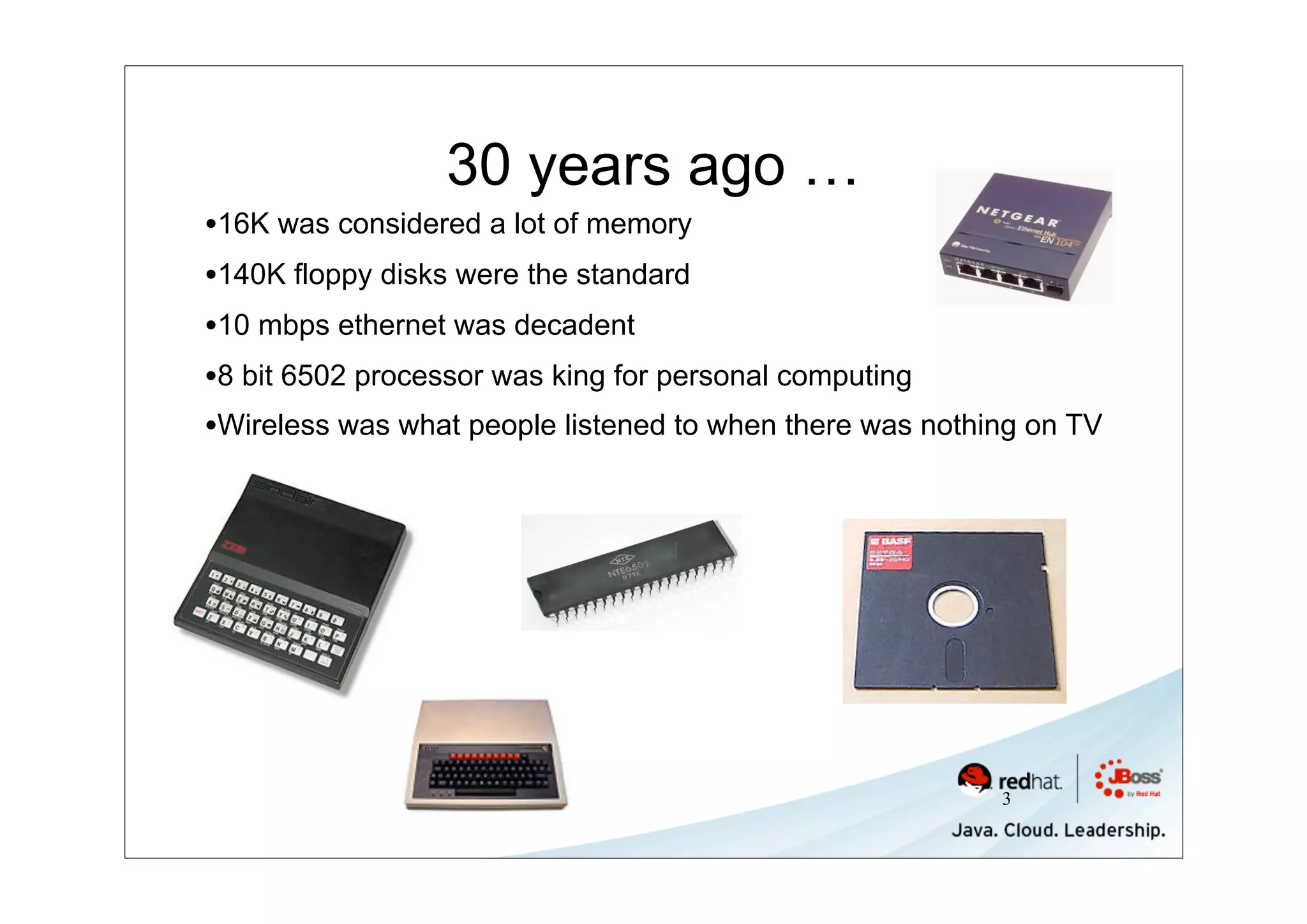
•16K was considered a lot of memory
•140K floppy disks were the standard
•10 mbps ethernet was decadent
•8 bit 6502 processor was king for personal computing
•Wireless was what people listened to when there was nothing on TV


                                                          3
Today …
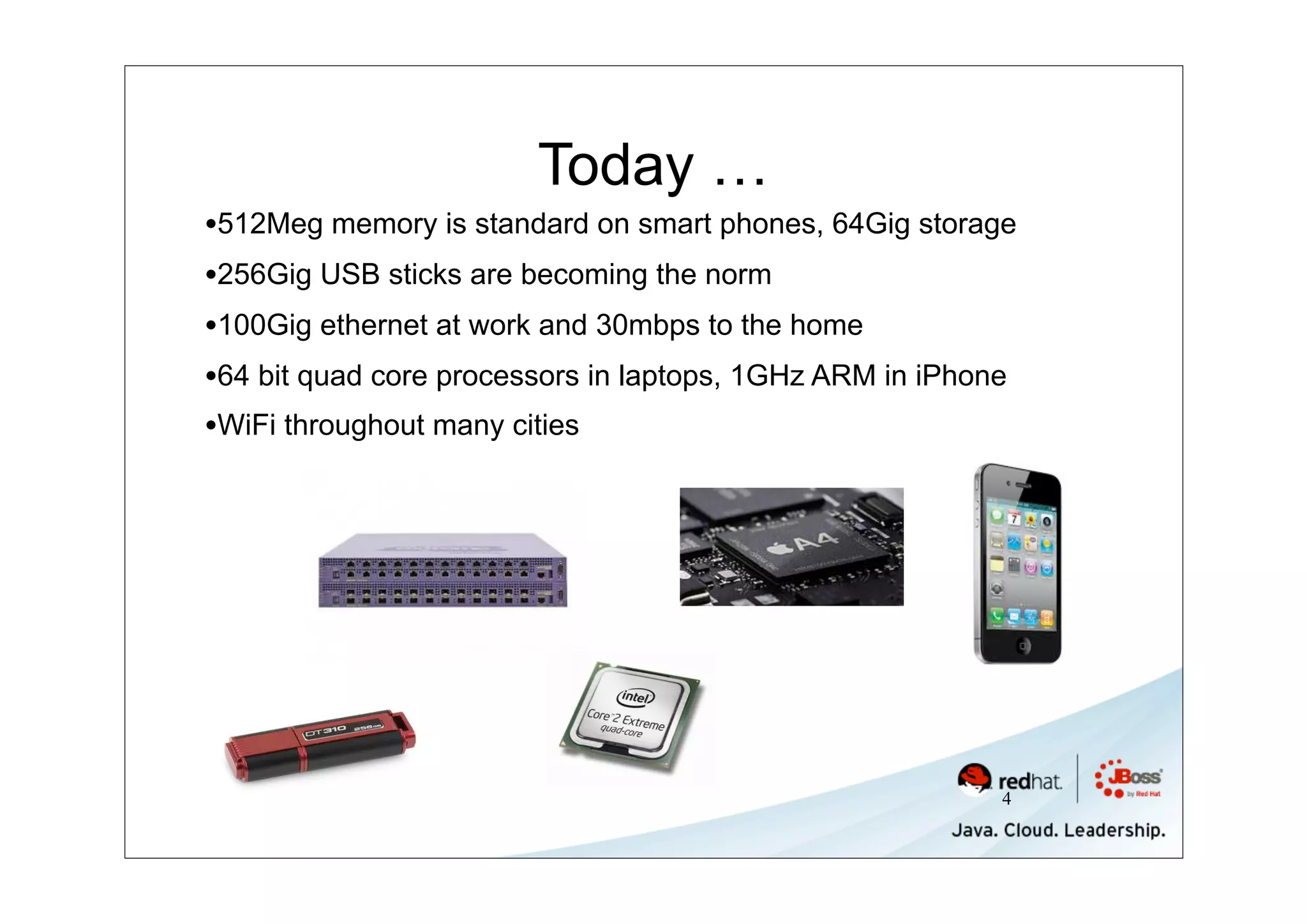
•512Meg memory is standard on smart phones, 64Gig storage
•256Gig USB sticks are becoming the norm
•100Gig ethernet at work and 30mbps to the home
•64 bit quad core processors in laptops, 1GHz ARM in iPhone
•WiFi throughout many cities


                                                         4
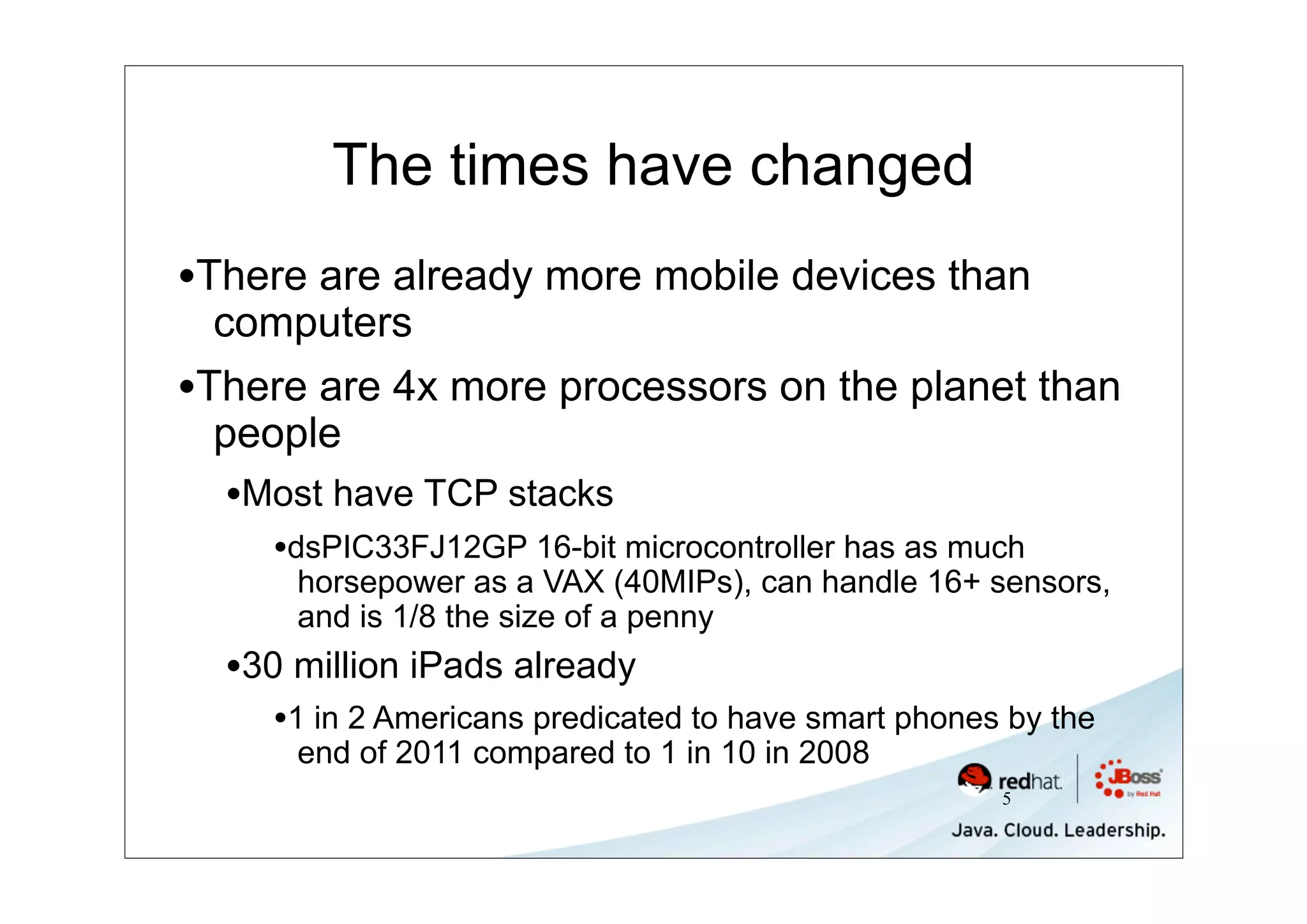
The times have changed
•There are already more mobile devices than
  computers
•There are 4x more processors on the planet than
  people
  •Most have TCP stacks
    •dsPIC33FJ12GP 16-bit microcontroller has as much
      horsepower as a VAX (40MIPs), can handle 16+ sensors,
      and is 1/8 the size of a penny
  •30 million iPads already
    •1 in 2 Americans predicated to have smart phones by the
      end of 2011 compared to 1 in 10 in 2008
                                                     5
6
Past, present and future
•The laptop concept originally devised for children
  •Now laptops replace desktop
•Java and Linux helped to popularise middleware
•But Java is not cool any more
  •Ruby, Scala, Erlang, JavaScript, …
•Coolness is iPhones, Androids, POH5, …
•Those are the new frontiers of application
 development

                                              7
“Little’s law” (thanks to Parkinson)
•“Work expands to use the power available”
  •Basic word processors on PCs
    •Publisher-quality implementations now on laptops
  •Games pushing the envelope from Pong through
   Space Invaders to CoD
    •MVCC
    •Distributed systems
    •Grids
  •Mobile devices contain more and more personal data
    •Wallets via NFC
  •Disconnected operation is the normal situation
                                                        8
Application complexity
•Types of applications increasing in complexity
  •Online purchases
  •Distributed peer-to-peer interactions
•Enterprise requirements becoming a necessity
  •Security and identity
  •High performance, low latency, reliable messaging
  •Database updates with transactions
  •Workflows as inter-app interactions increase

                                               9
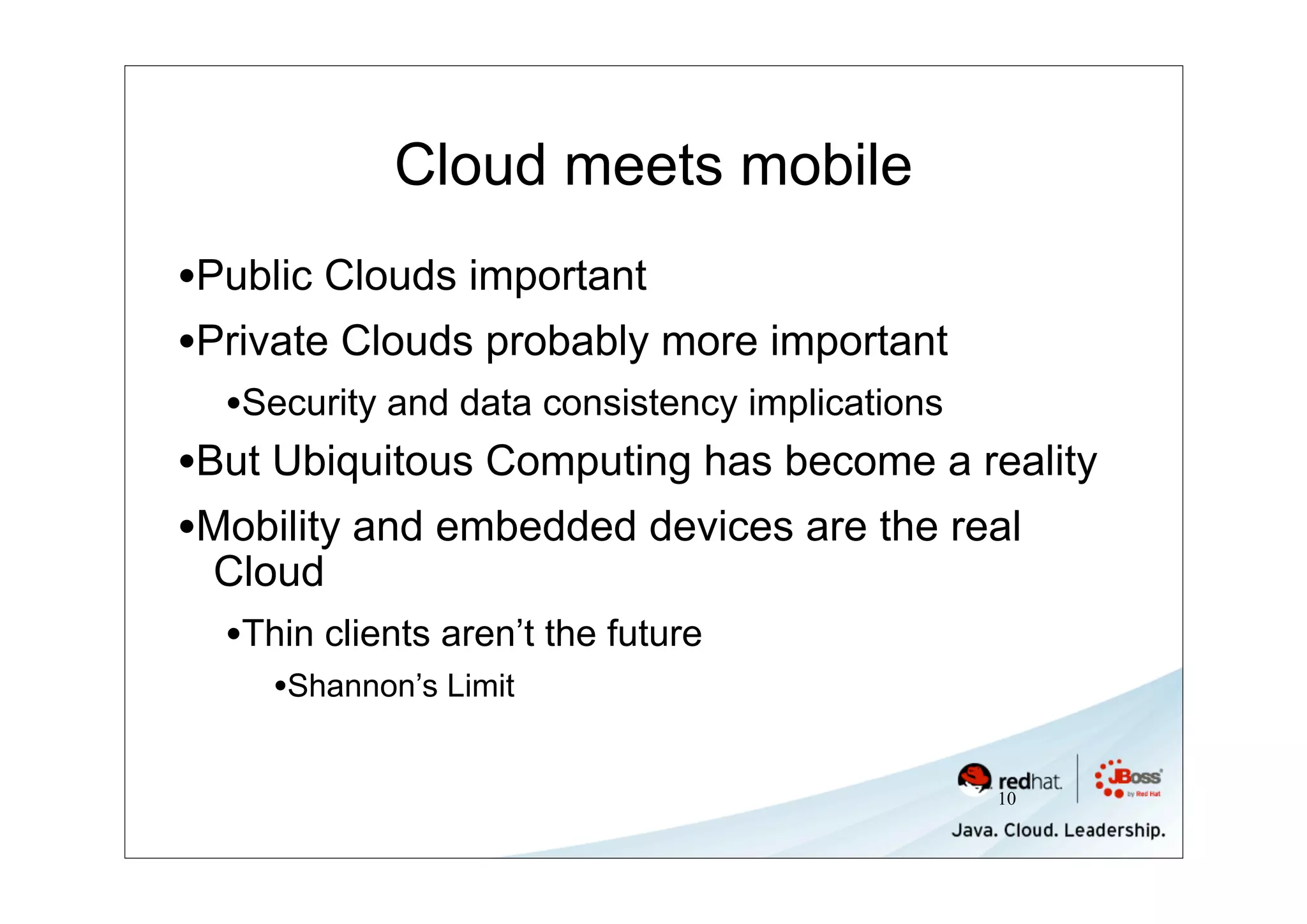
Cloud meets mobile
•Public Clouds important
•Private Clouds probably more important
  •Security and data consistency implications
•But Ubiquitous Computing has become a reality
•Mobility and embedded devices are the real
 Cloud
  •Thin clients aren’t the future
     •Shannon’s Limit

                                                10
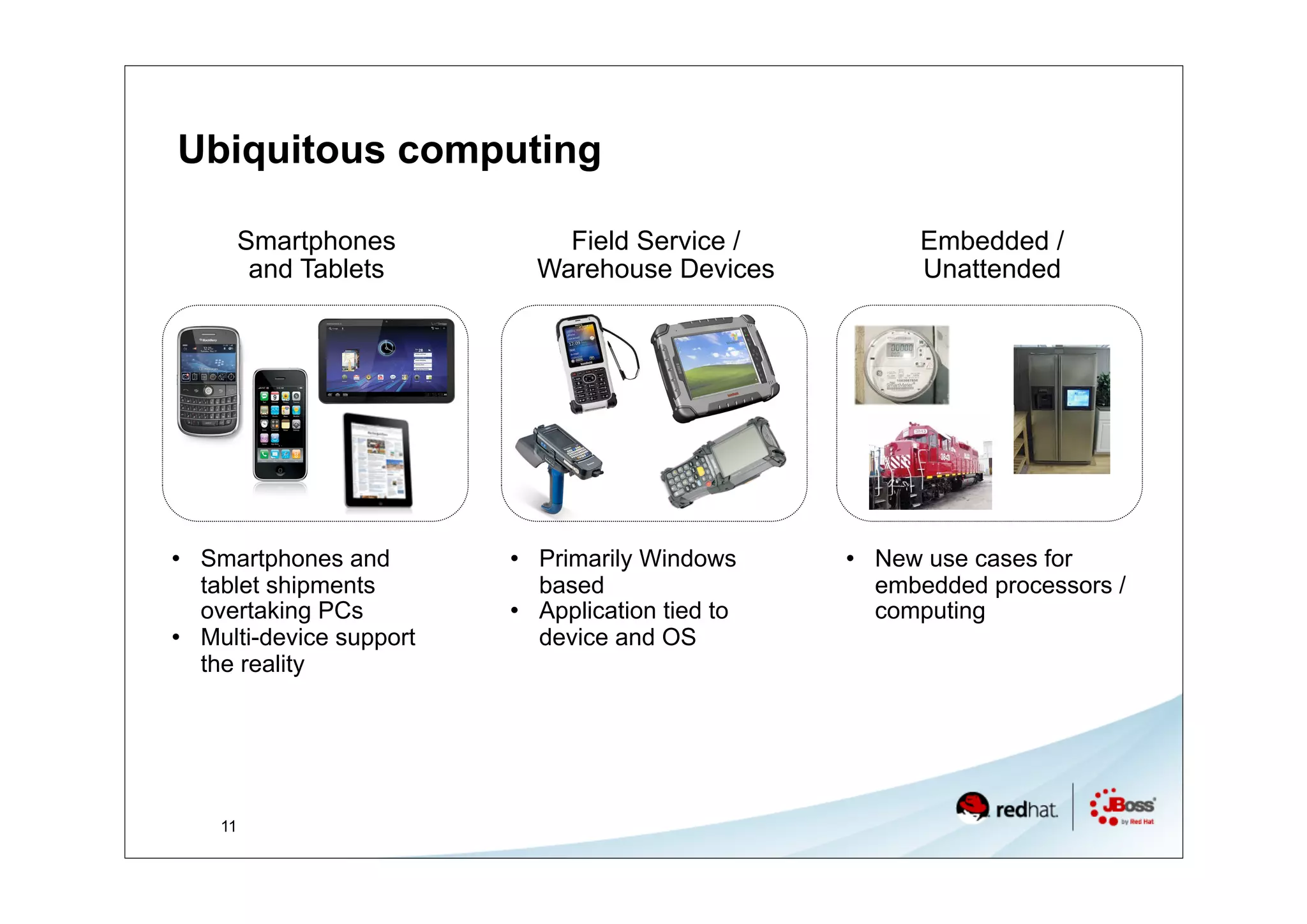
Ubiquitous computing

          Smartphones            Field Service /            Embedded /
           and Tablets         Warehouse Devices            Unattended


   Smartphones and           Primarily Windows        New use cases for
    tablet shipments           based                     embedded processors /
    overtaking PCs            Application tied to       computing
   Multi-device support       device and OS
    the reality


     11
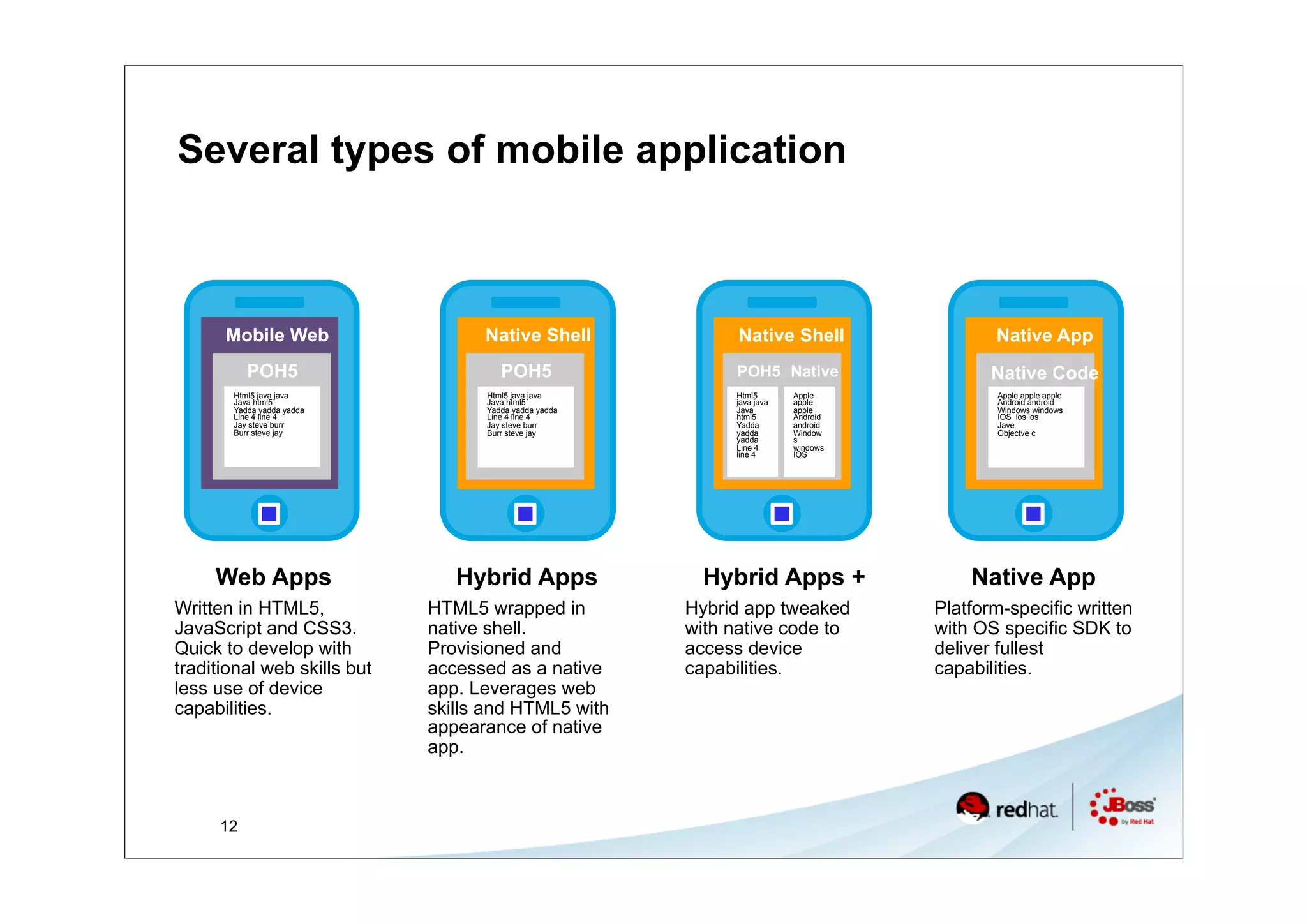
Several types of mobile application


      Mobile Web                   Native Shell              Native Shell                Native App
          POH5                        POH5                  POH5 Native                  Native Code
       Html5 java java             Html5 java java          Html5       Apple            Apple apple apple
       Java html5                  Java html5               java java   apple            Android android
       Yadda yadda yadda           Yadda yadda yadda        Java        apple            Windows windows
       Line 4 line 4               Line 4 line 4            html5       Android          IOS ios ios
       Jay steve burr              Jay steve burr           Yadda       android          Jave
       Burr steve jay              Burr steve jay           yadda       Window           Objectve c
                                                            yadda       s
                                                            Line 4      windows
                                                            line 4      IOS


     Web Apps                   Hybrid Apps              Hybrid Apps +                Native App
Written in HTML5,            HTML5 wrapped in          Hybrid app tweaked         Platform-specific written
JavaScript and CSS3.         native shell.             with native code to        with OS specific SDK to
Quick to develop with        Provisioned and           access device              deliver fullest
traditional web skills but   accessed as a native      capabilities.              capabilities.
less use of device           app. Leverages web
capabilities.                skills and HTML5 with
                             appearance of native
                             app.


     12
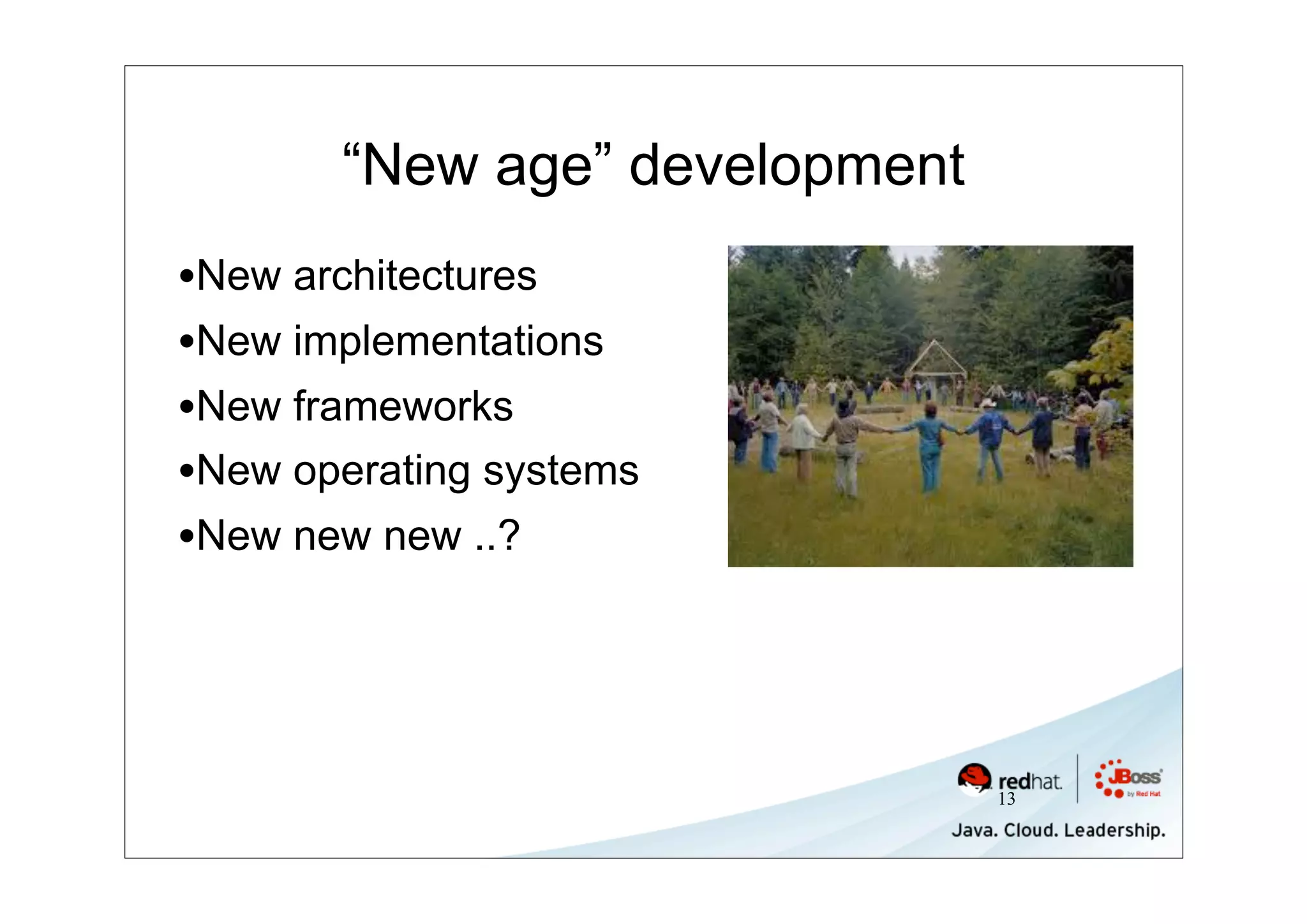
“New age” development
•New architectures
•New implementations
•New frameworks
•New operating systems
•New new new ..?


                               13
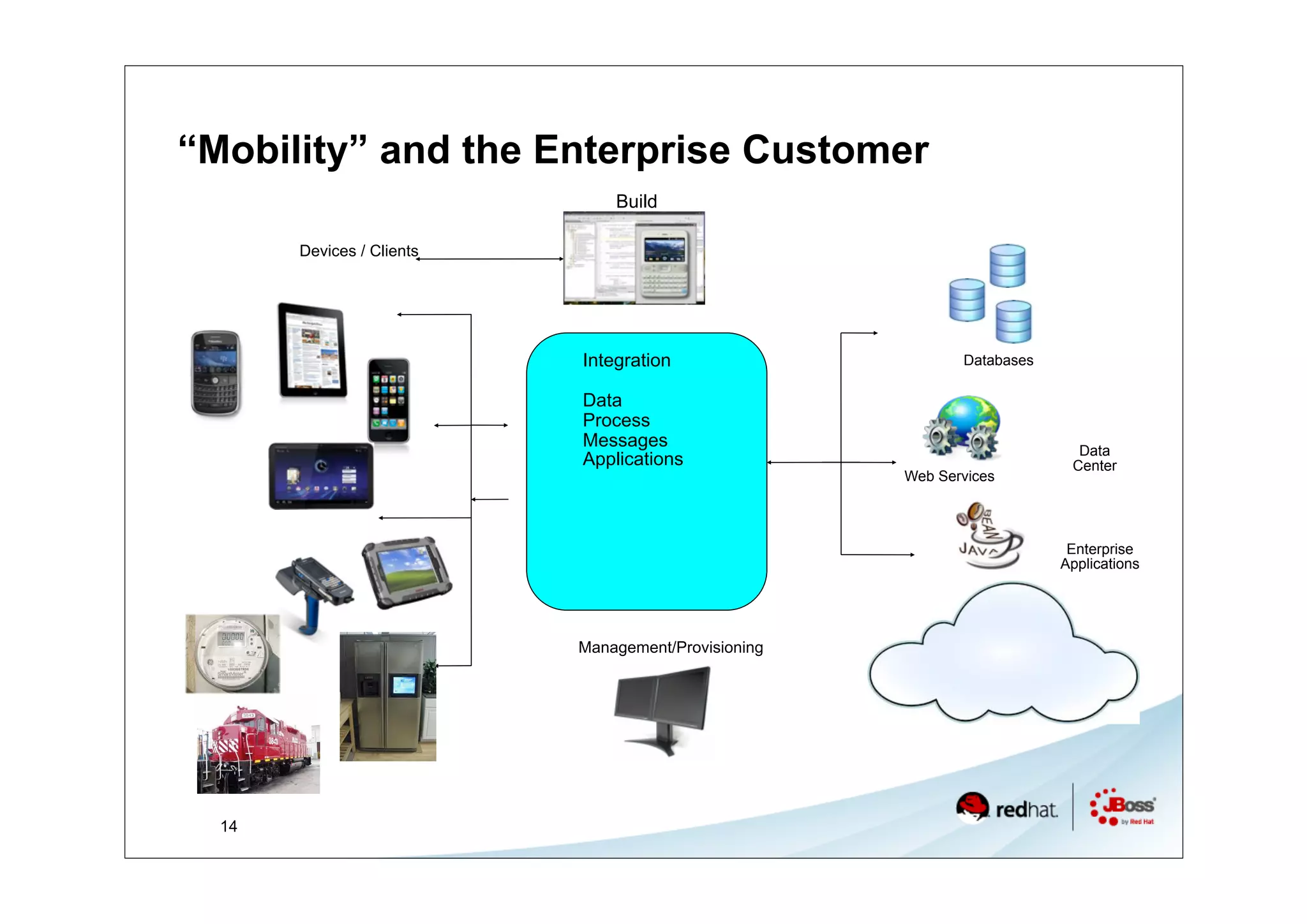
“Mobility” and the Enterprise Customer
                               Build

       Devices / Clients


                           Integration                      Databases

                           Data
                           Process
                           Messages
                                                                          Data
                           Applications                                  Center
                                                     Web Services


                                                                         Enterprise
                                                                        Applications


                           Management/Provisioning


  14
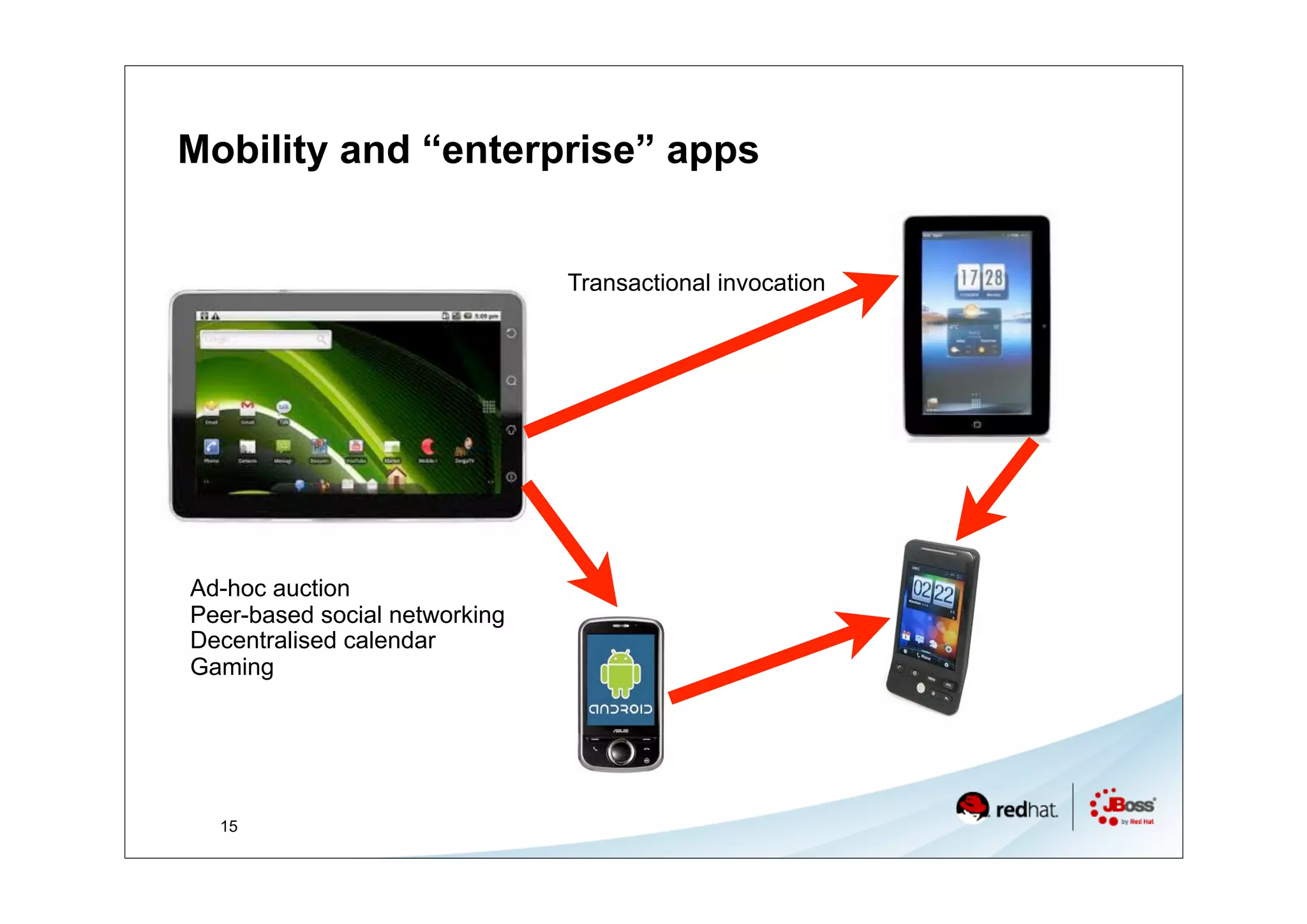
Mobility and “enterprise” apps


                               Transactional invocation


Ad-hoc auction
Peer-based social networking
Decentralised calendar
Gaming


  15
For whom the bell tolls?
          Middleware?


•Hold on ... haven’t we heard
 this death knell before?


                                16
Remember Web Services/REST/
 <blank> as death of middleware?


•Not if you are objective!


                             17
Middleware over the years
•RPC first used in the 1970’s to link Unix systems
•Bespoke implementations through the 80’s
  •Argus, Emerald, Arjuna, Camelot/Avalon, ISIS
•Standards began to evolve
  •ANSA
  •DCE
•More cross-vendor industrial standards
  •CORBA
  •J(2)EE
  •Web Services                               18
40 years of middleware shows ...
•Many things common
  •Security
  •Messaging
  •Transactions
  •Replication/Cacheing
  •Data store (e.g., database)
  •Distribution
  •Multi-tenancy (multi-threaded/multi-application)
•The industry has spent 40+ years designing
 enterprise infrastructures
                                                 19
So what does this mean?
•Middleware is needed whatever the deployment
 environment
  •Mainframes, servers, laptops etc.
•Don’t tie the definition of middleware to an
 implementation
•Mobile and Cloud should not be new silos for
 developers!
•Enterprise requirements transcend deployment
 realities
                                                20
So are cloud/mobile the death of
            middleware?
•Many commonalities with “traditional” middleware
  •Enterprise requirements for all but trivial apps
•Obviously Java is not the only application
 language
  •But why not a common runtime?
  •Lots of popular JVM-based languages
•Lack of cloud/mobile standards


                                                      21
Present and future directions
•As an industry we must build on our existing
 implementations
•We must provide a natural upgrade path for
 existing users
  •We cannot afford to repeat the DCE/CORBA,
    DCOM/.NET or CORBA/J(2)EE days
•Evolution rather than revolution
•Why?

                                               22
Some ubiquitous computing realities
•Trust is important!
•Trust is measured in:
  •Who is providing the service?
     •And are they doing it in a way that matches my
      requirements?
  •Are they living up to my required QoS
     •Fault tolerance, performance, etc.
•Several well publicised Cloud outages and
  intrusions
  •Mobile viruses, identity theft ...
•Still very early in the adoption cycle                23
Java Enterprise Edition 6
   Turns out that EE6 has many of the required
    capabilities
         Standards based too!
   EE6 represents a great evolution for 40 years of
    work!
   New capabilities (e.g., JAX-RS, CDI,
    BeanValidation)
   Input from wider open source communities and
    users
   Profiles
                                             24
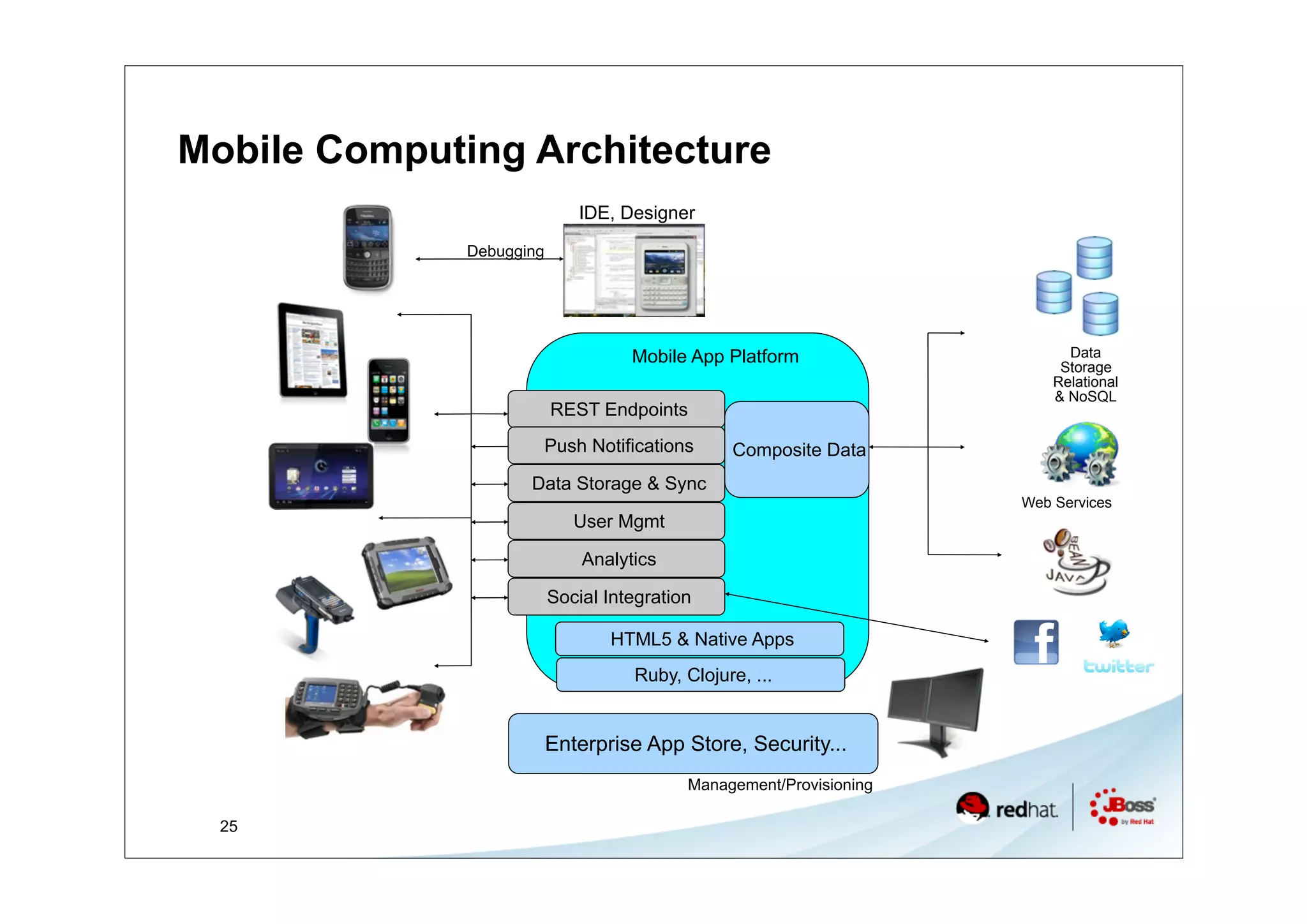
Mobile Computing Architecture
                              IDE, Designer

              Debugging


                                    Mobile App Platform                    Data
                                                                          Storage
                                                                         Relational
                                                                         & NoSQL
                          REST Endpoints
                          Push Notifications    Composite Data
                     Data Storage & Sync
                                                                     Web Services
                             User Mgmt

                              Analytics

                          Social Integration

                                 HTML5 & Native Apps
                                    Ruby, Clojure, ...


                          Enterprise App Store, Security...
                                           Management/Provisioning

  25
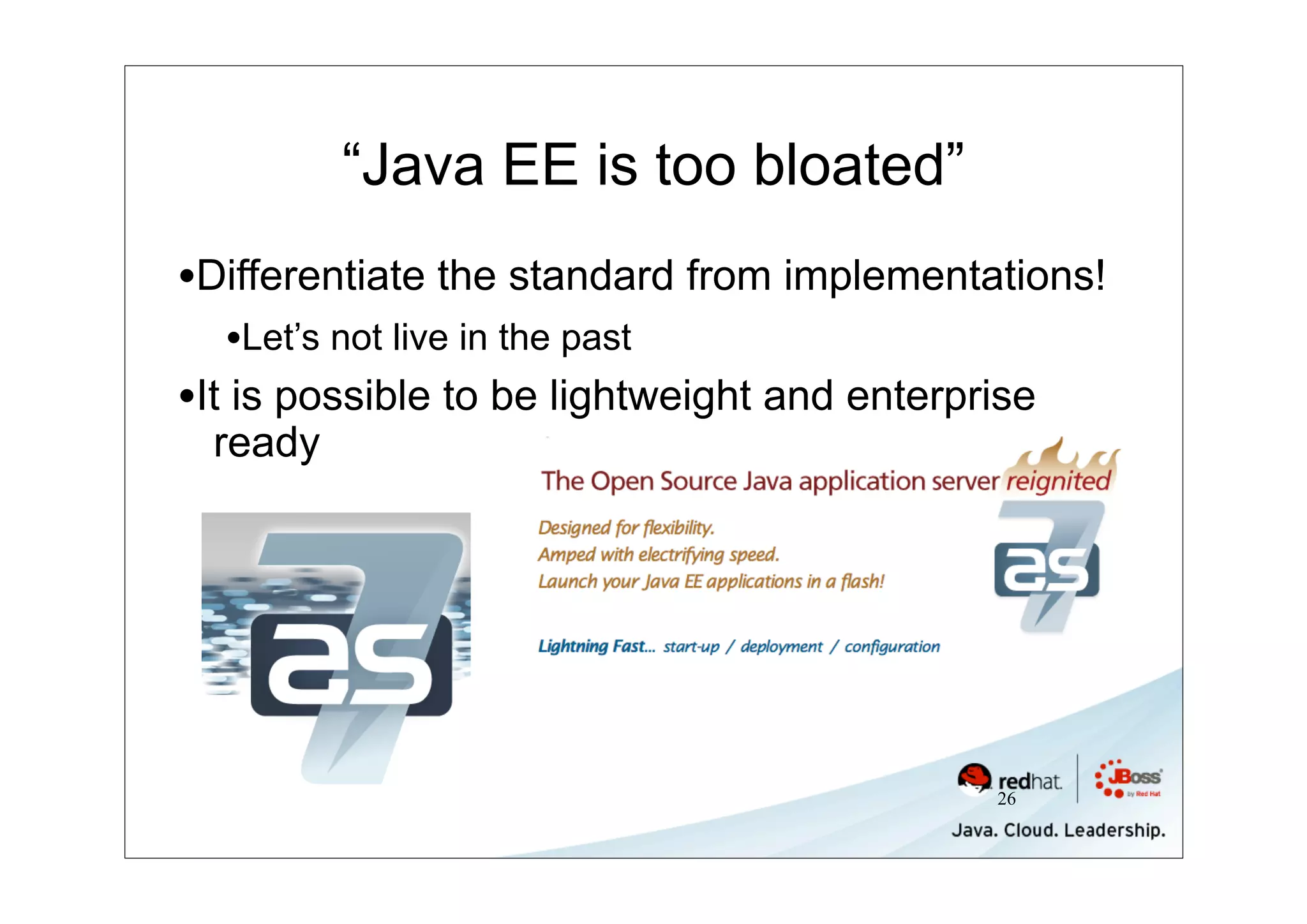
“Java EE is too bloated”
•Differentiate the standard from implementations!
  •Let’s not live in the past
•It is possible to be lightweight and enterprise
  ready


                                             26
Standards

•JCP reinvigorated
•Java ME
  •Merging of Java ME EC with SE/EE
  •ME-next?
•Java PaaS
  •Various non-standard solutions
  •OSGi, OMG, JCP
•Open source helps drive experience
  •Don’t standardise too early!
                                      27
But there are still open areas

•It’s not all doom and gloom
•But it’s not all perfection either
•Several key issues remain
   •Reliability
   •Development models
   •Data


                                         28
Trustworthy systems

•Can we build a system that …
  •Only services authorised users
     •Service cannot be denied
     •Information cannot be stolen
  •Is always available
     •Out less than 1 second per 100 years
     •1950’s 90% availability
     •2010 99.99% availability for well managed sites (50 minutes/
       year)
•Software reliability is not keeping pace with
  hardware
  •Getting more expensive and less reliable                 29
Problems with development
                  models
•We have yet to make parallel programming
 easy
  •Only automatic parallelism has “won”
  •Managing computer clusters is a major cost
•New computer architectures are highly parallel
  •Many-core chips are a reality
     •Core’s per chip will only increase
  •But we don’t know how to utilise them efficiently
•So, the scale-up problem is not solved
                                                30
The data problem
•There is a movement away from traditional databases
•The bandwidth problem still remains
   •Economic necessity mandates putting the data near the application
   •The cost of wide-area networking has fallen more slowly than all other
      IT hardware costs
   •But how can data be in multiple places at the same time?
•Flavours if “SQL”
   •OldSQL
   •Not Only SQL (aka No SQL)
   •NewSQL


                                                                 31
Conclusions
•Cloud and mobile will evolve
•Enterprise middleware applications aren’t going
 away
  •The industry cannot afford to track multiple platforms
  •Middleware components should be available to all
•The next decade will be defined by ubiquitous
 computing
•There are still areas that need to be addressed
  •NoSQL
  •Multi-tenancy
                                                 32
  •Transactions

Keynote | Middleware Everywhere - Ready for Mobile and Cloud | Dr. Mark Little

  • 1.
    Middleware Everywhere -Ready for Mobile and Cloud Dr Mark Little Red Hat, Inc. 1/11/2011 1
  • 2.
    Overview •Where are wetoday and why? •Mobile and Cloud •Ubiquitous computing in the large •The real cloud! •Hardware and software forces in action •What does this mean for today’s middleware offerings? •The future of Java and standards 2
  • 3.
    30 years ago… •16K was considered a lot of memory •140K floppy disks were the standard •10 mbps ethernet was decadent •8 bit 6502 processor was king for personal computing •Wireless was what people listened to when there was nothing on TV 3
  • 4.
    Today … •512Meg memoryis standard on smart phones, 64Gig storage •256Gig USB sticks are becoming the norm •100Gig ethernet at work and 30mbps to the home •64 bit quad core processors in laptops, 1GHz ARM in iPhone •WiFi throughout many cities 4
  • 5.
    The times havechanged •There are already more mobile devices than computers •There are 4x more processors on the planet than people •Most have TCP stacks •dsPIC33FJ12GP 16-bit microcontroller has as much horsepower as a VAX (40MIPs), can handle 16+ sensors, and is 1/8 the size of a penny •30 million iPads already •1 in 2 Americans predicated to have smart phones by the end of 2011 compared to 1 in 10 in 2008 5
  • 6.
  • 7.
    Past, present andfuture •The laptop concept originally devised for children •Now laptops replace desktop •Java and Linux helped to popularise middleware •But Java is not cool any more •Ruby, Scala, Erlang, JavaScript, … •Coolness is iPhones, Androids, POH5, … •Those are the new frontiers of application development 7
  • 8.
    “Little’s law” (thanksto Parkinson) •“Work expands to use the power available” •Basic word processors on PCs •Publisher-quality implementations now on laptops •Games pushing the envelope from Pong through Space Invaders to CoD •MVCC •Distributed systems •Grids •Mobile devices contain more and more personal data •Wallets via NFC •Disconnected operation is the normal situation 8
  • 9.
    Application complexity •Types ofapplications increasing in complexity •Online purchases •Distributed peer-to-peer interactions •Enterprise requirements becoming a necessity •Security and identity •High performance, low latency, reliable messaging •Database updates with transactions •Workflows as inter-app interactions increase 9
  • 10.
    Cloud meets mobile •PublicClouds important •Private Clouds probably more important •Security and data consistency implications •But Ubiquitous Computing has become a reality •Mobility and embedded devices are the real Cloud •Thin clients aren’t the future •Shannon’s Limit 10
  • 11.
    Ubiquitous computing Smartphones Field Service / Embedded / and Tablets Warehouse Devices Unattended  Smartphones and  Primarily Windows  New use cases for tablet shipments based embedded processors / overtaking PCs  Application tied to computing  Multi-device support device and OS the reality 11
  • 12.
    Several types ofmobile application Mobile Web Native Shell Native Shell Native App POH5 POH5 POH5 Native Native Code Html5 java java Html5 java java Html5 Apple Apple apple apple Java html5 Java html5 java java apple Android android Yadda yadda yadda Yadda yadda yadda Java apple Windows windows Line 4 line 4 Line 4 line 4 html5 Android IOS ios ios Jay steve burr Jay steve burr Yadda android Jave Burr steve jay Burr steve jay yadda Window Objectve c yadda s Line 4 windows line 4 IOS Web Apps Hybrid Apps Hybrid Apps + Native App Written in HTML5, HTML5 wrapped in Hybrid app tweaked Platform-specific written JavaScript and CSS3. native shell. with native code to with OS specific SDK to Quick to develop with Provisioned and access device deliver fullest traditional web skills but accessed as a native capabilities. capabilities. less use of device app. Leverages web capabilities. skills and HTML5 with appearance of native app. 12
  • 13.
    “New age” development •Newarchitectures •New implementations •New frameworks •New operating systems •New new new ..? 13
  • 14.
    “Mobility” and theEnterprise Customer Build Devices / Clients Integration Databases Data Process Messages Data Applications Center Web Services Enterprise Applications Management/Provisioning 14
  • 15.
    Mobility and “enterprise”apps Transactional invocation Ad-hoc auction Peer-based social networking Decentralised calendar Gaming 15
  • 16.
    For whom thebell tolls? Middleware? •Hold on ... haven’t we heard this death knell before? 16
  • 17.
    Remember Web Services/REST/ <blank> as death of middleware? •Not if you are objective! 17
  • 18.
    Middleware over theyears •RPC first used in the 1970’s to link Unix systems •Bespoke implementations through the 80’s •Argus, Emerald, Arjuna, Camelot/Avalon, ISIS •Standards began to evolve •ANSA •DCE •More cross-vendor industrial standards •CORBA •J(2)EE •Web Services 18
  • 19.
    40 years ofmiddleware shows ... •Many things common •Security •Messaging •Transactions •Replication/Cacheing •Data store (e.g., database) •Distribution •Multi-tenancy (multi-threaded/multi-application) •The industry has spent 40+ years designing enterprise infrastructures 19
  • 20.
    So what doesthis mean? •Middleware is needed whatever the deployment environment •Mainframes, servers, laptops etc. •Don’t tie the definition of middleware to an implementation •Mobile and Cloud should not be new silos for developers! •Enterprise requirements transcend deployment realities 20
  • 21.
    So are cloud/mobilethe death of middleware? •Many commonalities with “traditional” middleware •Enterprise requirements for all but trivial apps •Obviously Java is not the only application language •But why not a common runtime? •Lots of popular JVM-based languages •Lack of cloud/mobile standards 21
  • 22.
    Present and futuredirections •As an industry we must build on our existing implementations •We must provide a natural upgrade path for existing users •We cannot afford to repeat the DCE/CORBA, DCOM/.NET or CORBA/J(2)EE days •Evolution rather than revolution •Why? 22
  • 23.
    Some ubiquitous computingrealities •Trust is important! •Trust is measured in: •Who is providing the service? •And are they doing it in a way that matches my requirements? •Are they living up to my required QoS •Fault tolerance, performance, etc. •Several well publicised Cloud outages and intrusions •Mobile viruses, identity theft ... •Still very early in the adoption cycle 23
  • 24.
    Java Enterprise Edition6  Turns out that EE6 has many of the required capabilities  Standards based too!  EE6 represents a great evolution for 40 years of work!  New capabilities (e.g., JAX-RS, CDI, BeanValidation)  Input from wider open source communities and users  Profiles 24
  • 25.
    Mobile Computing Architecture IDE, Designer Debugging Mobile App Platform Data Storage Relational & NoSQL REST Endpoints Push Notifications Composite Data Data Storage & Sync Web Services User Mgmt Analytics Social Integration HTML5 & Native Apps Ruby, Clojure, ... Enterprise App Store, Security... Management/Provisioning 25
  • 26.
    “Java EE istoo bloated” •Differentiate the standard from implementations! •Let’s not live in the past •It is possible to be lightweight and enterprise ready 26
  • 27.
    Standards •JCP reinvigorated •Java ME •Merging of Java ME EC with SE/EE •ME-next? •Java PaaS •Various non-standard solutions •OSGi, OMG, JCP •Open source helps drive experience •Don’t standardise too early! 27
  • 28.
    But there arestill open areas •It’s not all doom and gloom •But it’s not all perfection either •Several key issues remain •Reliability •Development models •Data 28
  • 29.
    Trustworthy systems •Can webuild a system that … •Only services authorised users •Service cannot be denied •Information cannot be stolen •Is always available •Out less than 1 second per 100 years •1950’s 90% availability •2010 99.99% availability for well managed sites (50 minutes/ year) •Software reliability is not keeping pace with hardware •Getting more expensive and less reliable 29
  • 30.
    Problems with development models •We have yet to make parallel programming easy •Only automatic parallelism has “won” •Managing computer clusters is a major cost •New computer architectures are highly parallel •Many-core chips are a reality •Core’s per chip will only increase •But we don’t know how to utilise them efficiently •So, the scale-up problem is not solved 30
  • 31.
    The data problem •Thereis a movement away from traditional databases •The bandwidth problem still remains •Economic necessity mandates putting the data near the application •The cost of wide-area networking has fallen more slowly than all other IT hardware costs •But how can data be in multiple places at the same time? •Flavours if “SQL” •OldSQL •Not Only SQL (aka No SQL) •NewSQL 31
  • 32.
    Conclusions •Cloud and mobilewill evolve •Enterprise middleware applications aren’t going away •The industry cannot afford to track multiple platforms •Middleware components should be available to all •The next decade will be defined by ubiquitous computing •There are still areas that need to be addressed •NoSQL •Multi-tenancy 32 •Transactions