A Hard Unsolved Problem?
Post-Treatment Bias in Big Social Science Questions

                                        Gary King

                           Institute for Quantitative Social Science
                                       Harvard University


              Talk at the “Hard Problems in Social Science” Symposium,
                            Harvard University 4/10/2010


                                                                 Talk at the “Hard Problems in S
Gary King (Harvard IQSS)               Post-Treatment Bias                                 /9
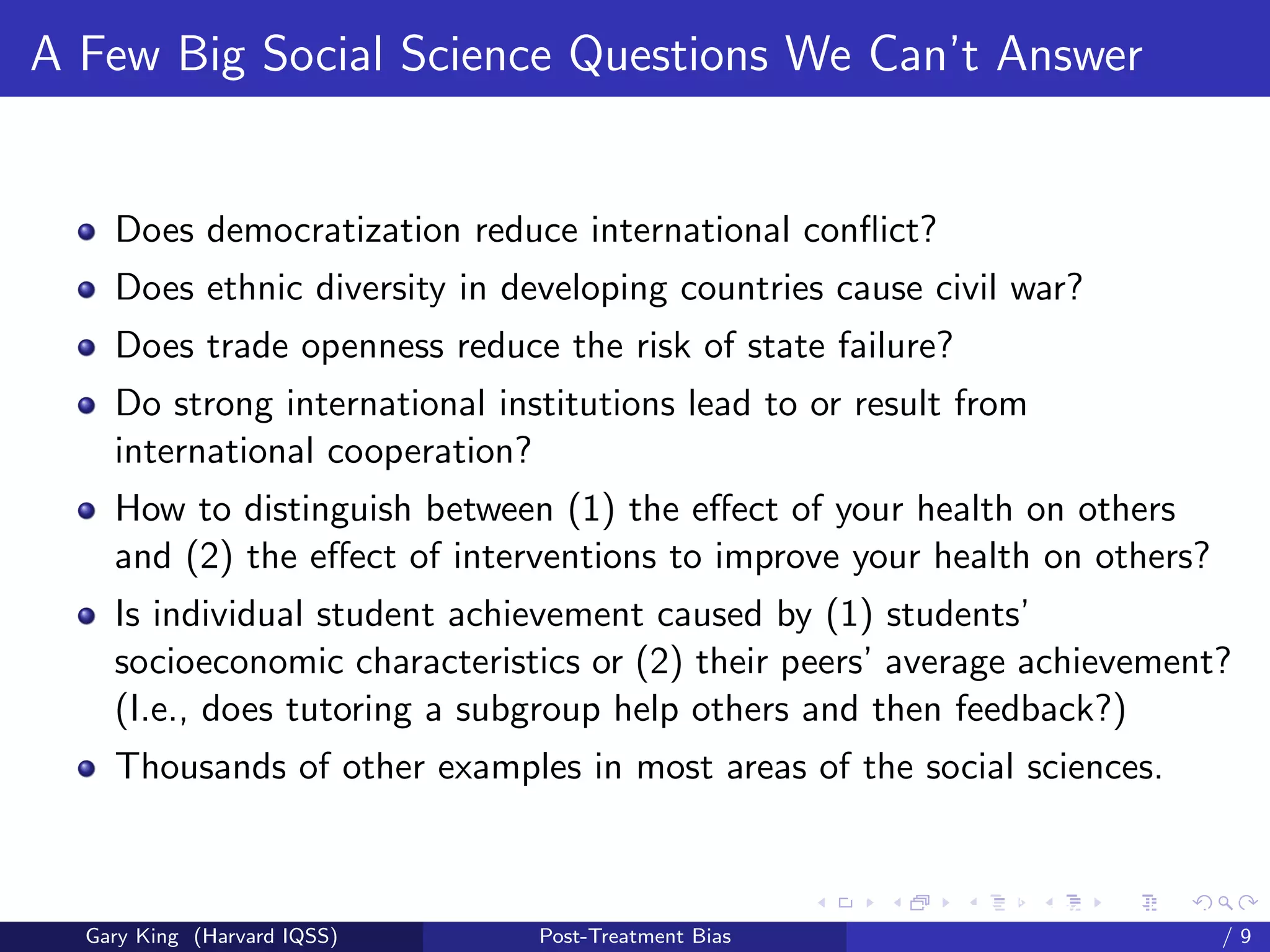
A Few Big Social Science Questions We Can’t Answer


                                                   Talk at the “Hard Problems in S
  Gary King (Harvard IQSS)   Post-Treatment Bias                             /9
A Few Big Social Science Questions We Can’t Answer


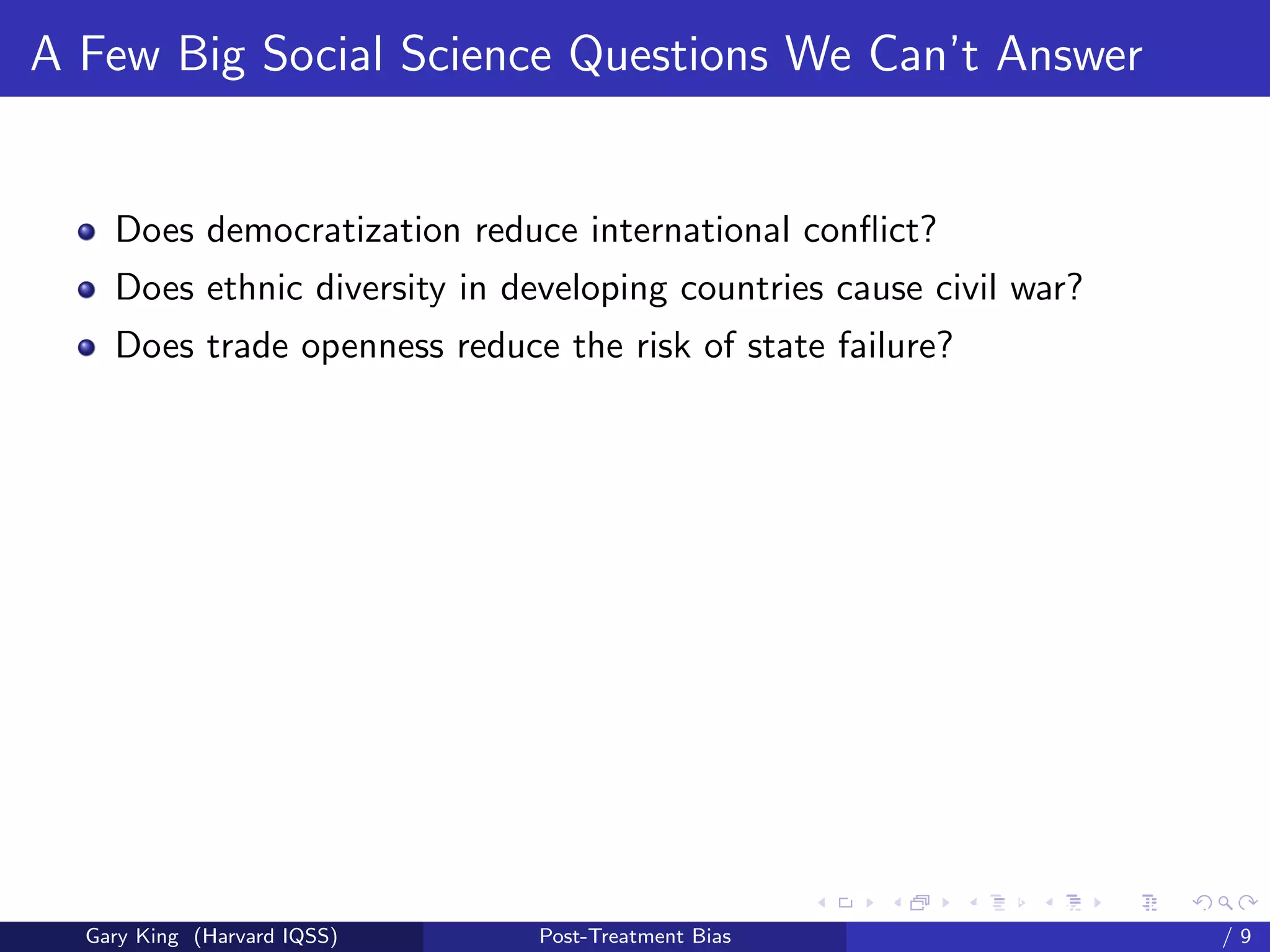
    Does democratization reduce international conflict?


                                                   Talk at the “Hard Problems in S
  Gary King (Harvard IQSS)   Post-Treatment Bias                             /9
A Few Big Social Science Questions We Can’t Answer


    Does democratization reduce international conflict?
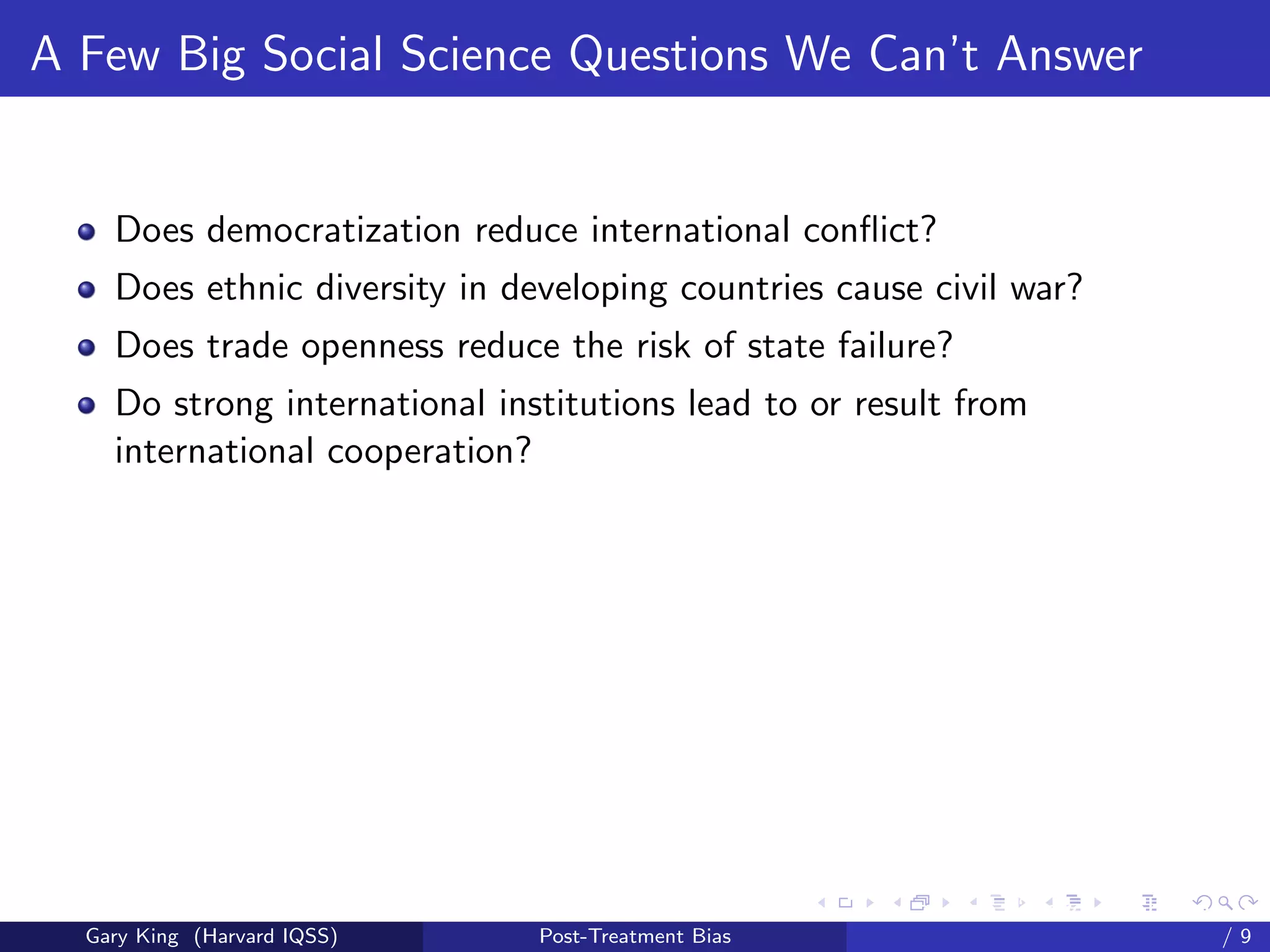
    Does ethnic diversity in developing countries cause civil war?


                                                     Talk at the “Hard Problems in S
  Gary King (Harvard IQSS)     Post-Treatment Bias                             /9
A Few Big Social Science Questions We Can’t Answer


    Does democratization reduce international conflict?
    Does ethnic diversity in developing countries cause civil war?
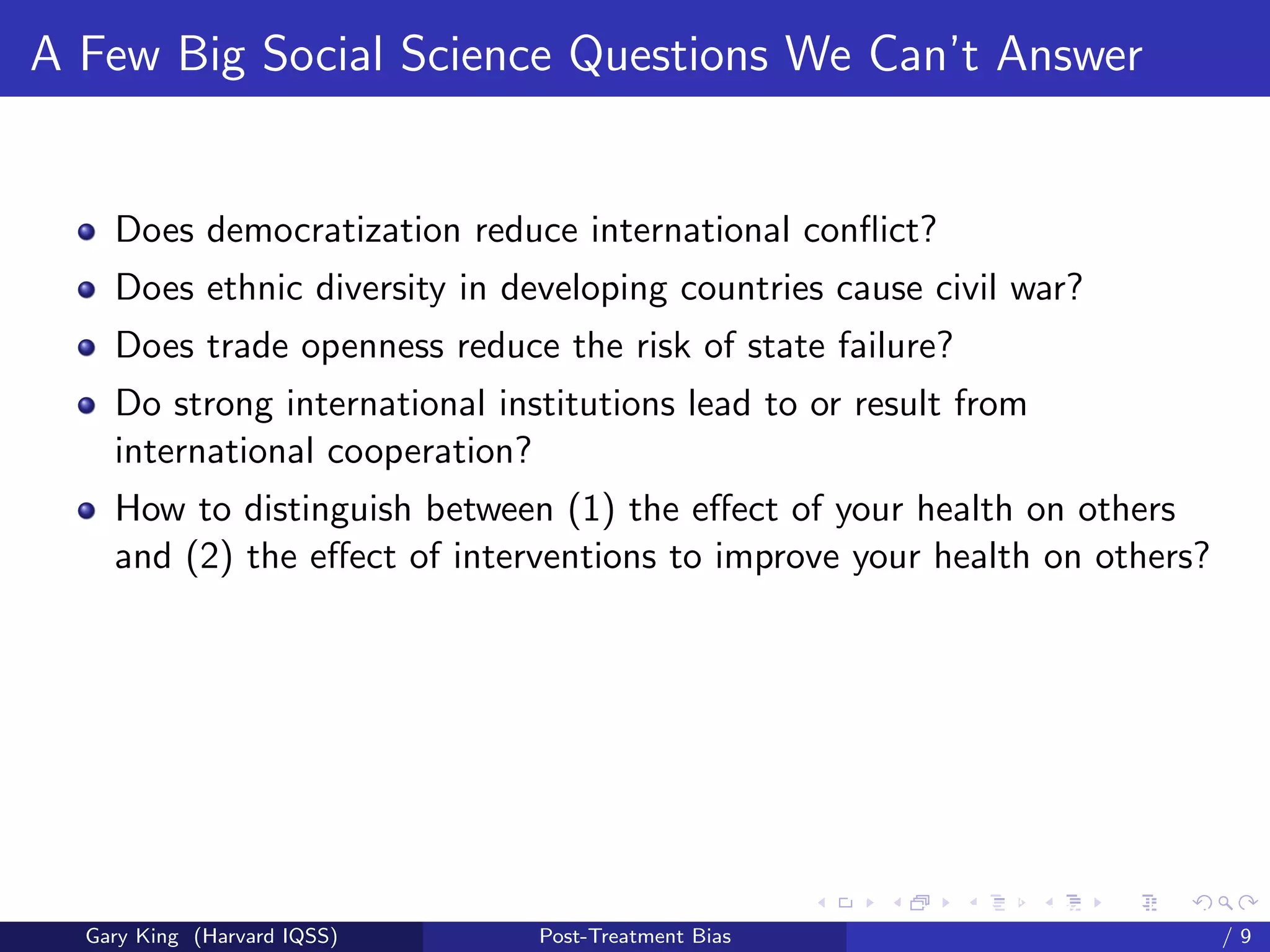
    Does trade openness reduce the risk of state failure?


                                                     Talk at the “Hard Problems in S
  Gary King (Harvard IQSS)     Post-Treatment Bias                             /9
A Few Big Social Science Questions We Can’t Answer


    Does democratization reduce international conflict?
    Does ethnic diversity in developing countries cause civil war?
    Does trade openness reduce the risk of state failure?
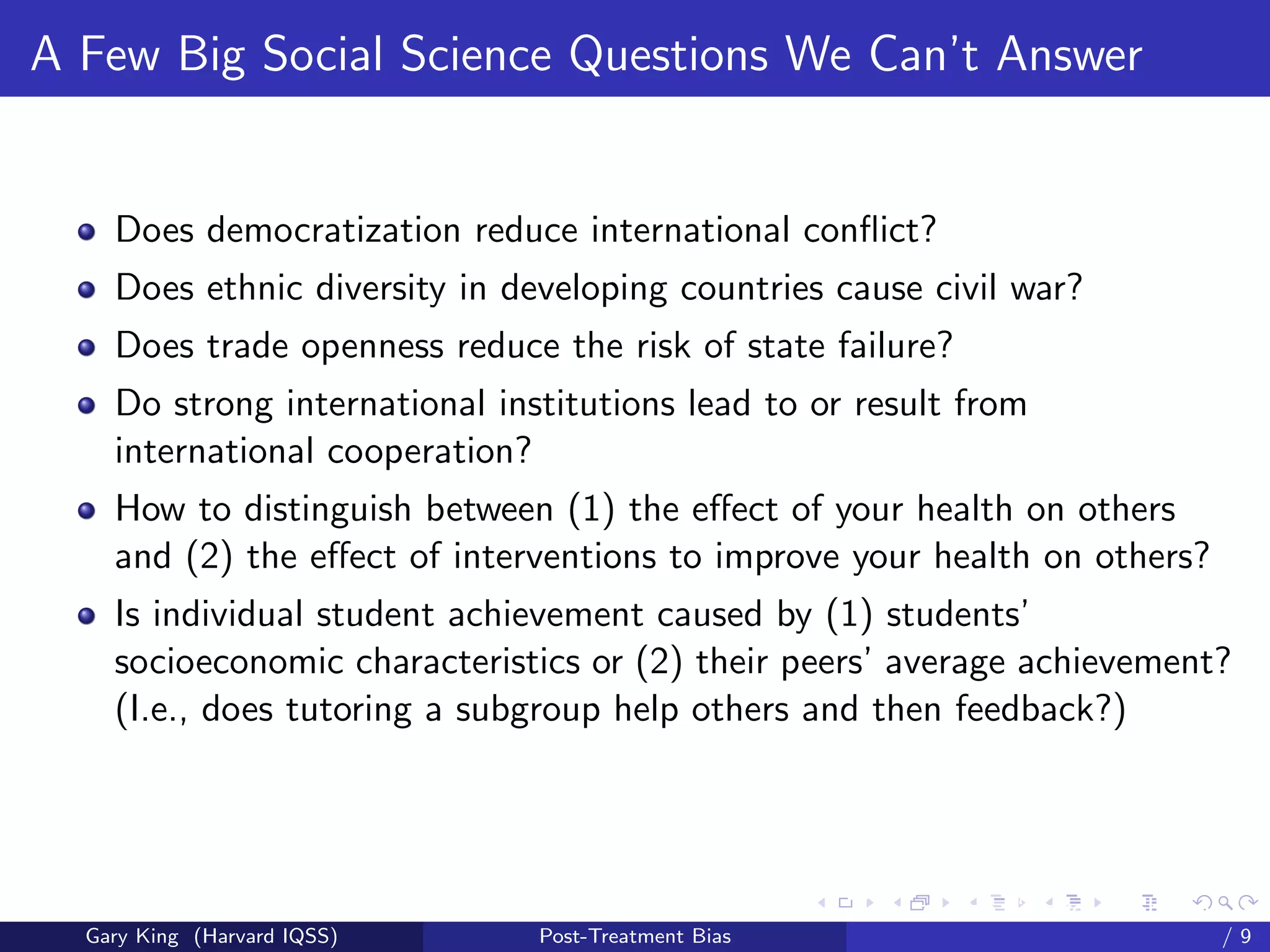
    Do strong international institutions lead to or result from
    international cooperation?


                                                     Talk at the “Hard Problems in S
  Gary King (Harvard IQSS)     Post-Treatment Bias                             /9
A Few Big Social Science Questions We Can’t Answer


    Does democratization reduce international conflict?
    Does ethnic diversity in developing countries cause civil war?
    Does trade openness reduce the risk of state failure?
    Do strong international institutions lead to or result from
    international cooperation?
    How to distinguish between (1) the effect of your health on others
    and (2) the effect of interventions to improve your health on others?


                                                     Talk at the “Hard Problems in S
  Gary King (Harvard IQSS)     Post-Treatment Bias                             /9
A Few Big Social Science Questions We Can’t Answer


    Does democratization reduce international conflict?
    Does ethnic diversity in developing countries cause civil war?
    Does trade openness reduce the risk of state failure?
    Do strong international institutions lead to or result from
    international cooperation?
    How to distinguish between (1) the effect of your health on others
    and (2) the effect of interventions to improve your health on others?
    Is individual student achievement caused by (1) students’
    socioeconomic characteristics or (2) their peers’ average achievement?
    (I.e., does tutoring a subgroup help others and then feedback?)


                                                     Talk at the “Hard Problems in S
  Gary King (Harvard IQSS)     Post-Treatment Bias                             /9
A Few Big Social Science Questions We Can’t Answer


    Does democratization reduce international conflict?
    Does ethnic diversity in developing countries cause civil war?
    Does trade openness reduce the risk of state failure?
    Do strong international institutions lead to or result from
    international cooperation?
    How to distinguish between (1) the effect of your health on others
    and (2) the effect of interventions to improve your health on others?
    Is individual student achievement caused by (1) students’
    socioeconomic characteristics or (2) their peers’ average achievement?
    (I.e., does tutoring a subgroup help others and then feedback?)
    Thousands of other examples in most areas of the social sciences.


                                                     Talk at the “Hard Problems in S
  Gary King (Harvard IQSS)     Post-Treatment Bias                             /9
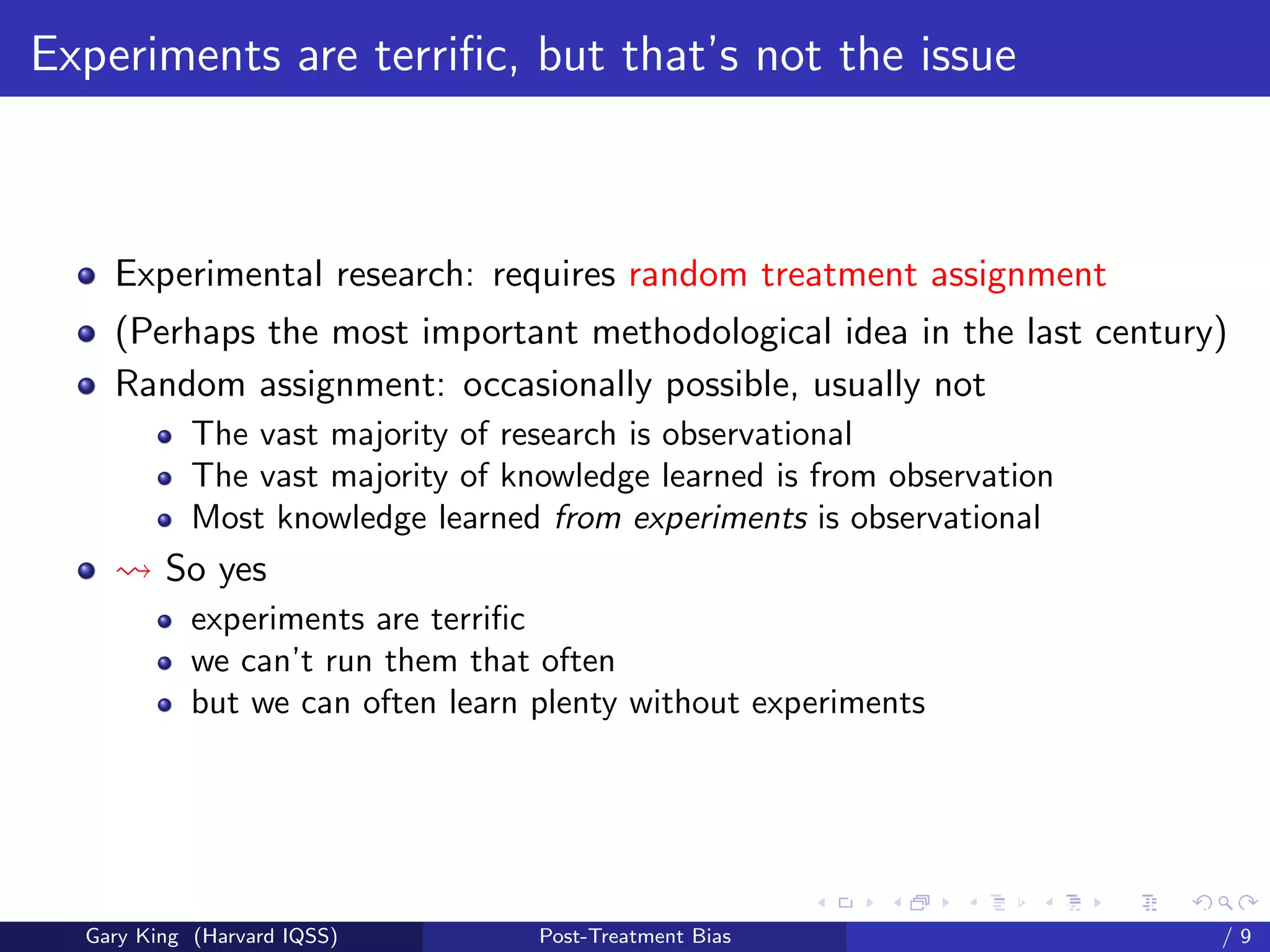
Experiments are terrific, but that’s not the issue


                                                   Talk at the “Hard Problems in S
  Gary King (Harvard IQSS)   Post-Treatment Bias                             /9
Experiments are terrific, but that’s not the issue


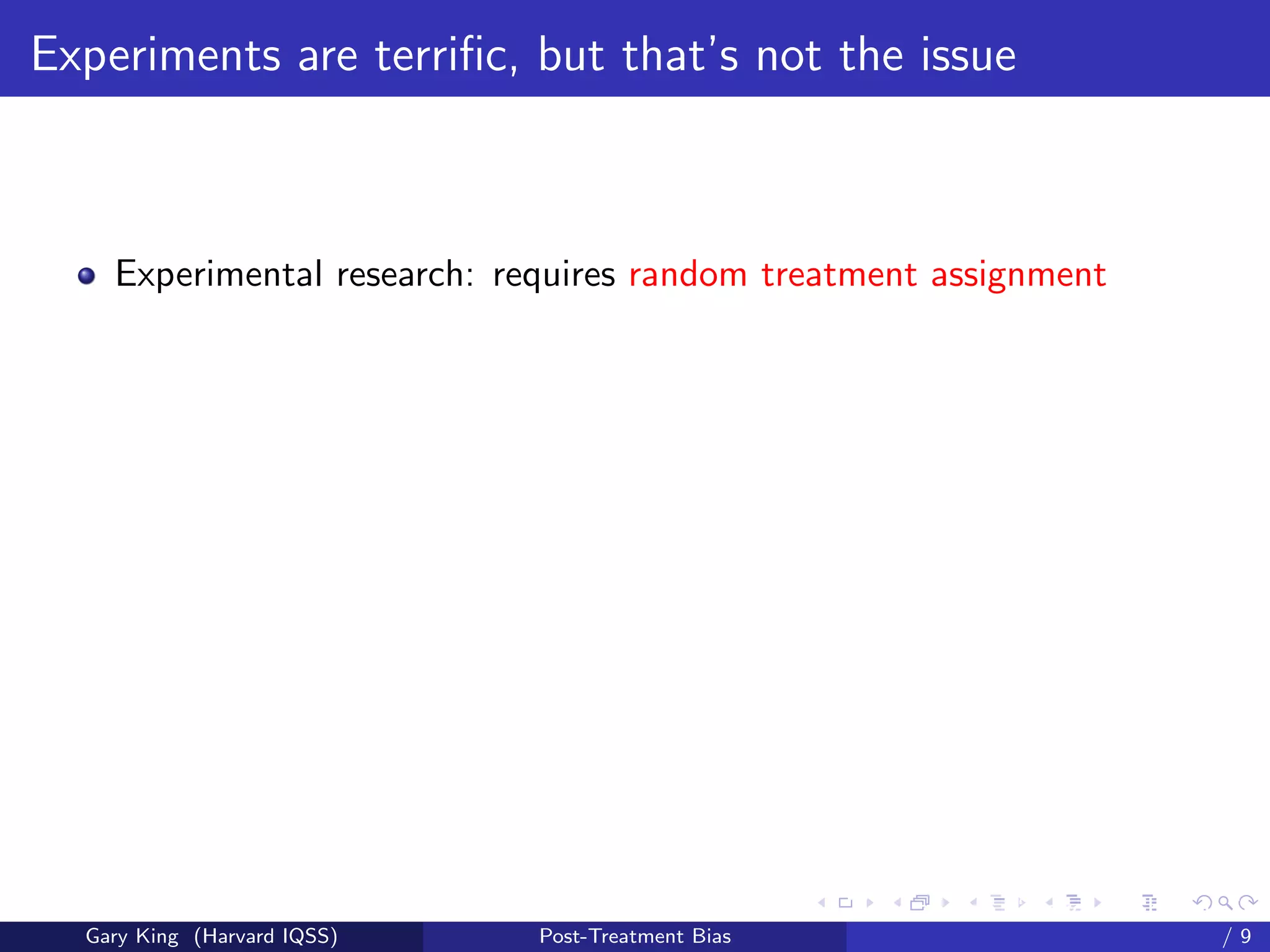
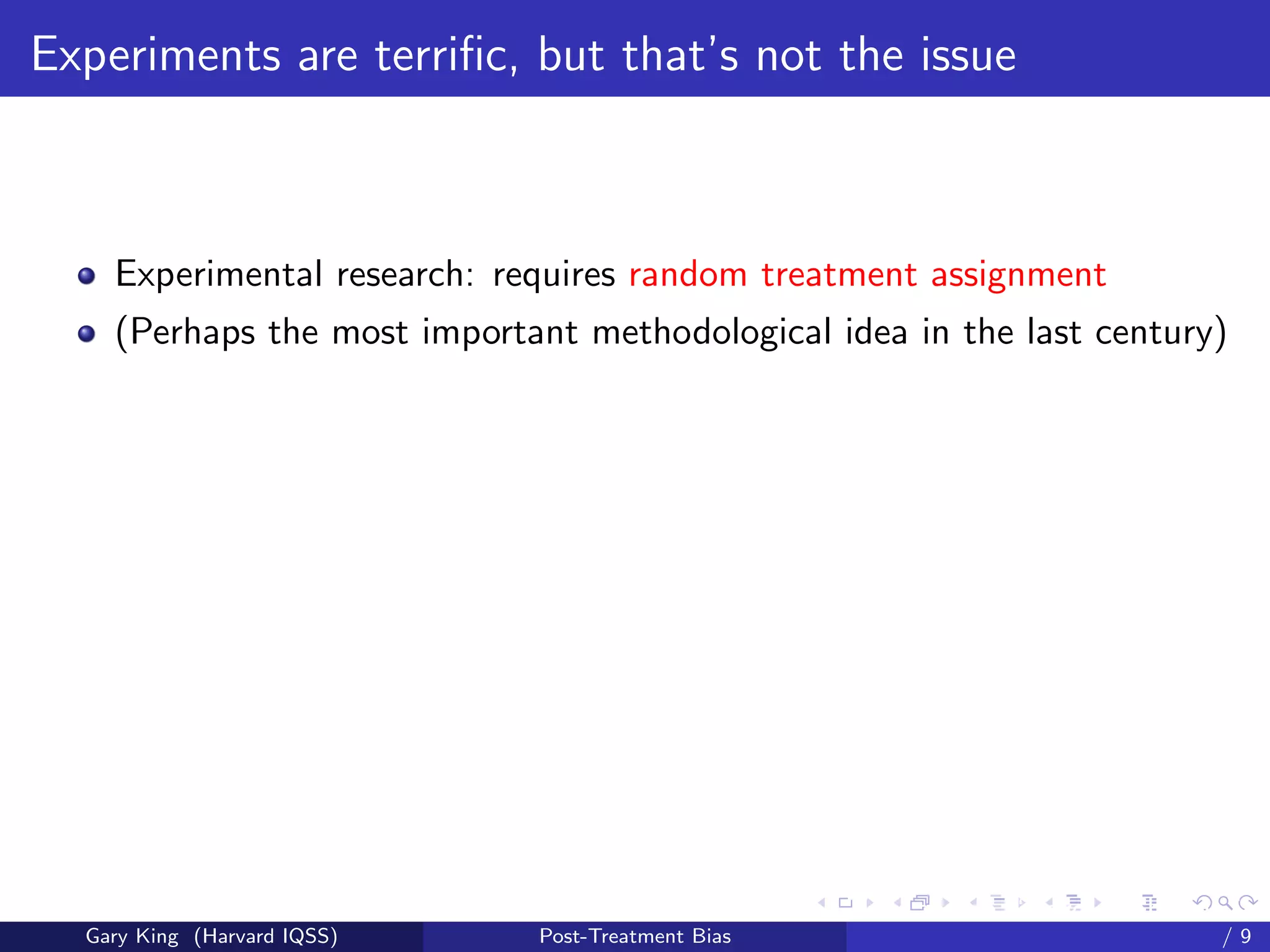
    Experimental research: requires random treatment assignment


                                                   Talk at the “Hard Problems in S
  Gary King (Harvard IQSS)   Post-Treatment Bias                             /9
Experiments are terrific, but that’s not the issue


    Experimental research: requires random treatment assignment
    (Perhaps the most important methodological idea in the last century)


                                                   Talk at the “Hard Problems in S
  Gary King (Harvard IQSS)   Post-Treatment Bias                             /9
Experiments are terrific, but that’s not the issue


    Experimental research: requires random treatment assignment
    (Perhaps the most important methodological idea in the last century)
    Random assignment: occasionally possible


                                                   Talk at the “Hard Problems in S
  Gary King (Harvard IQSS)   Post-Treatment Bias                             /9
Experiments are terrific, but that’s not the issue


    Experimental research: requires random treatment assignment
    (Perhaps the most important methodological idea in the last century)
    Random assignment: occasionally possible, usually not


                                                   Talk at the “Hard Problems in S
  Gary King (Harvard IQSS)   Post-Treatment Bias                             /9
Experiments are terrific, but that’s not the issue


    Experimental research: requires random treatment assignment
    (Perhaps the most important methodological idea in the last century)
    Random assignment: occasionally possible, usually not
            The vast majority of research is observational


                                                          Talk at the “Hard Problems in S
  Gary King (Harvard IQSS)          Post-Treatment Bias                             /9
Experiments are terrific, but that’s not the issue


    Experimental research: requires random treatment assignment
    (Perhaps the most important methodological idea in the last century)
    Random assignment: occasionally possible, usually not
            The vast majority of research is observational
            The vast majority of knowledge learned is from observation


                                                         Talk at the “Hard Problems in S
  Gary King (Harvard IQSS)         Post-Treatment Bias                             /9
Experiments are terrific, but that’s not the issue


    Experimental research: requires random treatment assignment
    (Perhaps the most important methodological idea in the last century)
    Random assignment: occasionally possible, usually not
            The vast majority of research is observational
            The vast majority of knowledge learned is from observation
            Most knowledge learned from experiments is observational


                                                         Talk at the “Hard Problems in S
  Gary King (Harvard IQSS)         Post-Treatment Bias                             /9
Experiments are terrific, but that’s not the issue


    Experimental research: requires random treatment assignment
    (Perhaps the most important methodological idea in the last century)
    Random assignment: occasionally possible, usually not
            The vast majority of research is observational
            The vast majority of knowledge learned is from observation
            Most knowledge learned from experiments is observational
         So yes


                                                         Talk at the “Hard Problems in S
  Gary King (Harvard IQSS)         Post-Treatment Bias                             /9
Experiments are terrific, but that’s not the issue


    Experimental research: requires random treatment assignment
    (Perhaps the most important methodological idea in the last century)
    Random assignment: occasionally possible, usually not
            The vast majority of research is observational
            The vast majority of knowledge learned is from observation
            Most knowledge learned from experiments is observational
         So yes
            experiments are terrific


                                                            Talk at the “Hard Problems in S
  Gary King (Harvard IQSS)            Post-Treatment Bias                             /9
Experiments are terrific, but that’s not the issue


    Experimental research: requires random treatment assignment
    (Perhaps the most important methodological idea in the last century)
    Random assignment: occasionally possible, usually not
            The vast majority of research is observational
            The vast majority of knowledge learned is from observation
            Most knowledge learned from experiments is observational
         So yes
            experiments are terrific
            we can’t run them that often


                                                         Talk at the “Hard Problems in S
  Gary King (Harvard IQSS)         Post-Treatment Bias                             /9
Experiments are terrific, but that’s not the issue


    Experimental research: requires random treatment assignment
    (Perhaps the most important methodological idea in the last century)
    Random assignment: occasionally possible, usually not
            The vast majority of research is observational
            The vast majority of knowledge learned is from observation
            Most knowledge learned from experiments is observational
         So yes
            experiments are terrific
            we can’t run them that often
            but we can often learn plenty without experiments


                                                         Talk at the “Hard Problems in S
  Gary King (Harvard IQSS)         Post-Treatment Bias                             /9
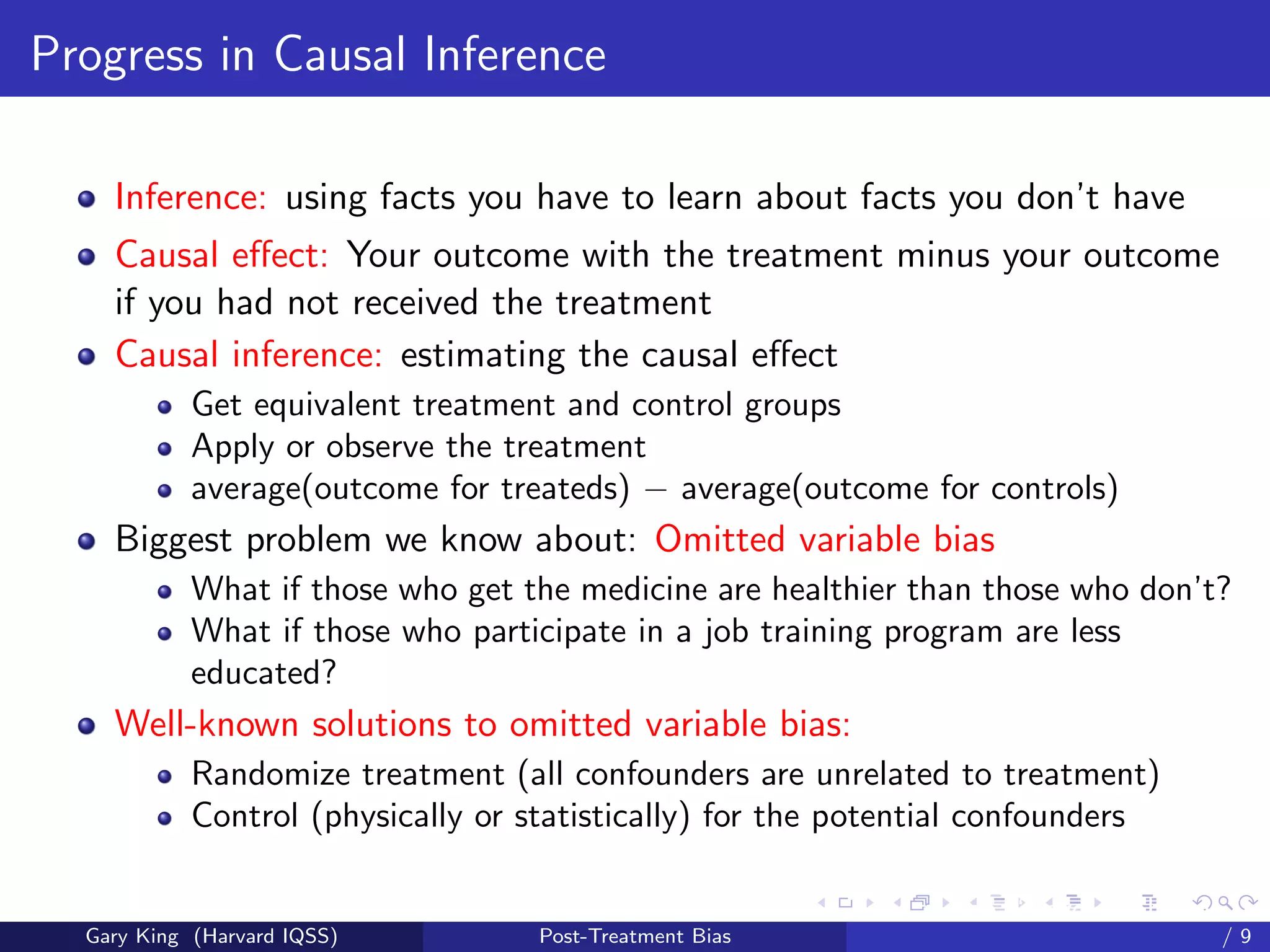
Progress in Causal Inference


                                                   Talk at the “Hard Problems in S
  Gary King (Harvard IQSS)   Post-Treatment Bias                             /9
Progress in Causal Inference

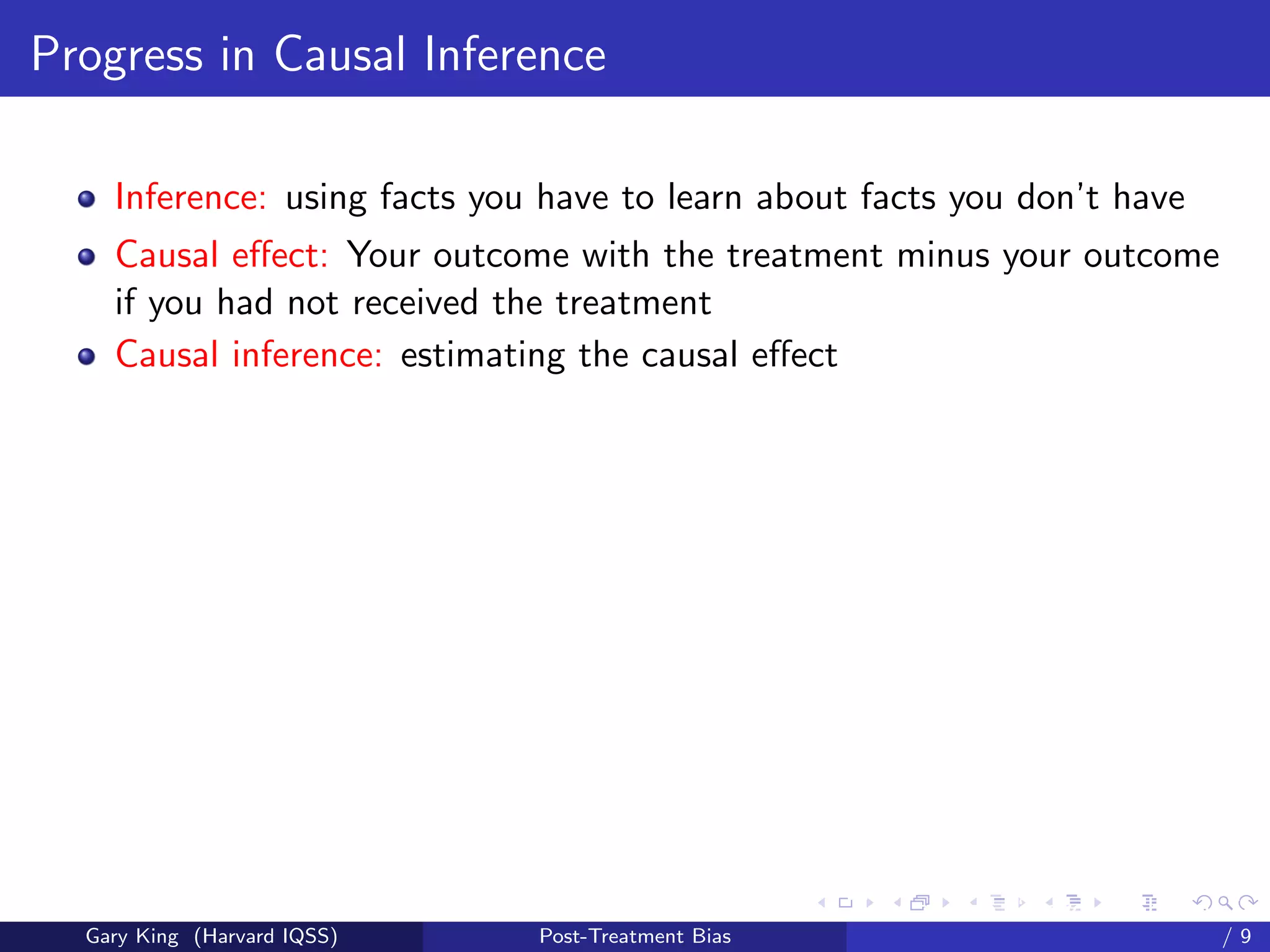
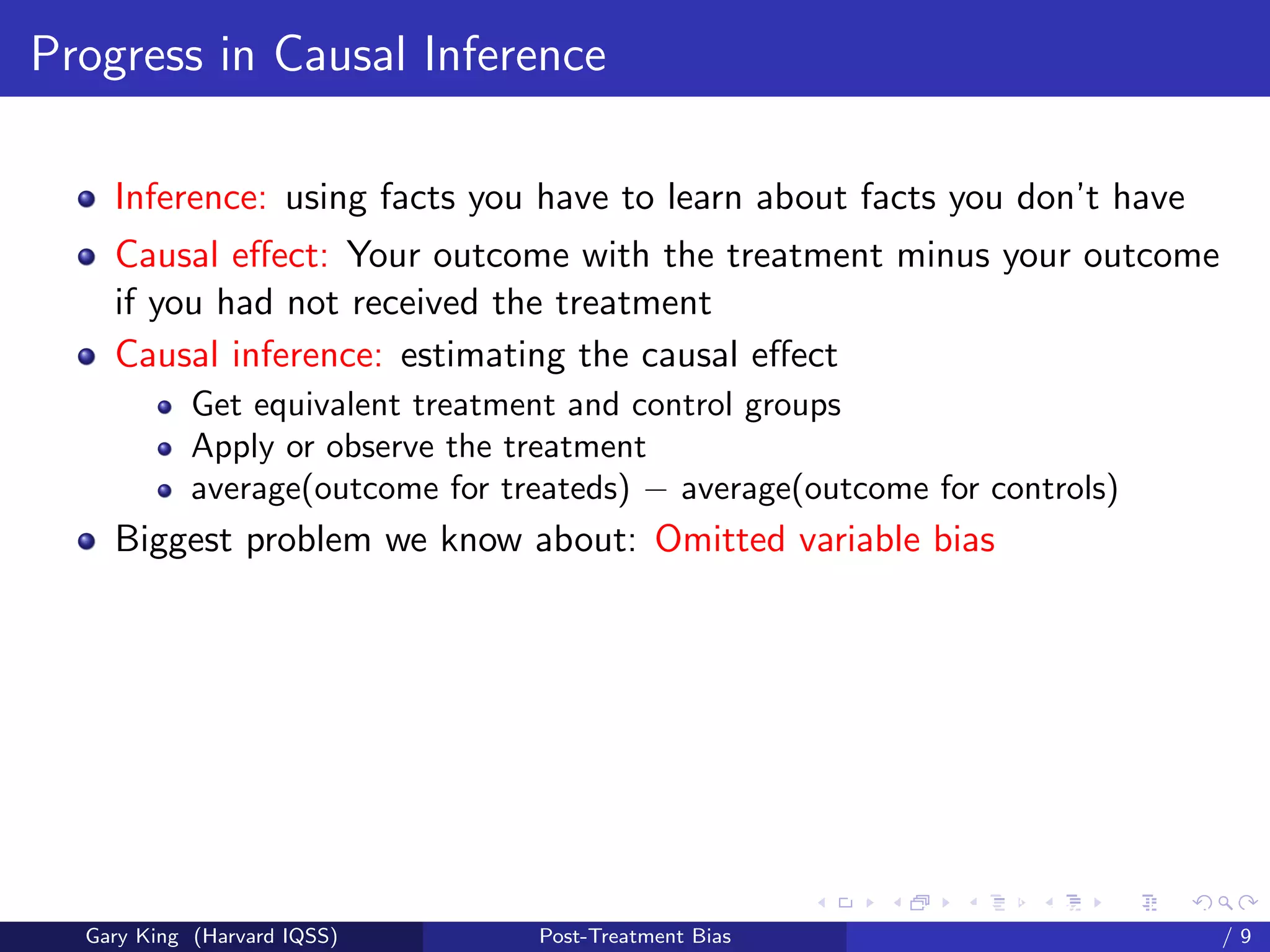
    Inference: using facts you have to learn about facts you don’t have


                                                    Talk at the “Hard Problems in S
  Gary King (Harvard IQSS)    Post-Treatment Bias                             /9
Progress in Causal Inference

    Inference: using facts you have to learn about facts you don’t have
    Causal effect: Your outcome with the treatment minus your outcome
    if you had not received the treatment


                                                    Talk at the “Hard Problems in S
  Gary King (Harvard IQSS)    Post-Treatment Bias                             /9
Progress in Causal Inference

    Inference: using facts you have to learn about facts you don’t have
    Causal effect: Your outcome with the treatment minus your outcome
    if you had not received the treatment
    Causal inference: estimating the causal effect


                                                    Talk at the “Hard Problems in S
  Gary King (Harvard IQSS)    Post-Treatment Bias                             /9
Progress in Causal Inference

    Inference: using facts you have to learn about facts you don’t have
    Causal effect: Your outcome with the treatment minus your outcome
    if you had not received the treatment
    Causal inference: estimating the causal effect
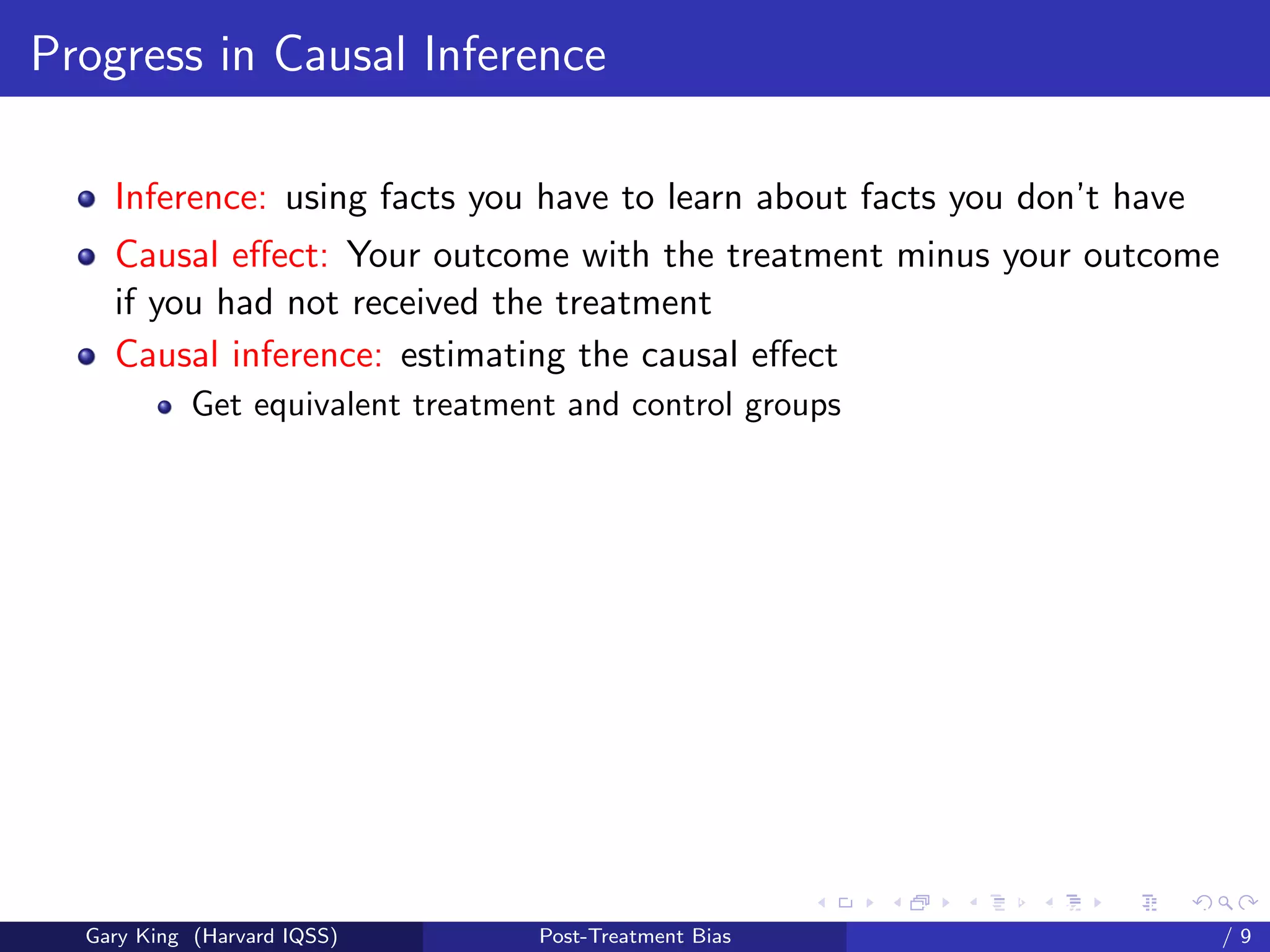
            Get equivalent treatment and control groups


                                                          Talk at the “Hard Problems in S
  Gary King (Harvard IQSS)         Post-Treatment Bias                              /9
Progress in Causal Inference

    Inference: using facts you have to learn about facts you don’t have
    Causal effect: Your outcome with the treatment minus your outcome
    if you had not received the treatment
    Causal inference: estimating the causal effect
            Get equivalent treatment and control groups
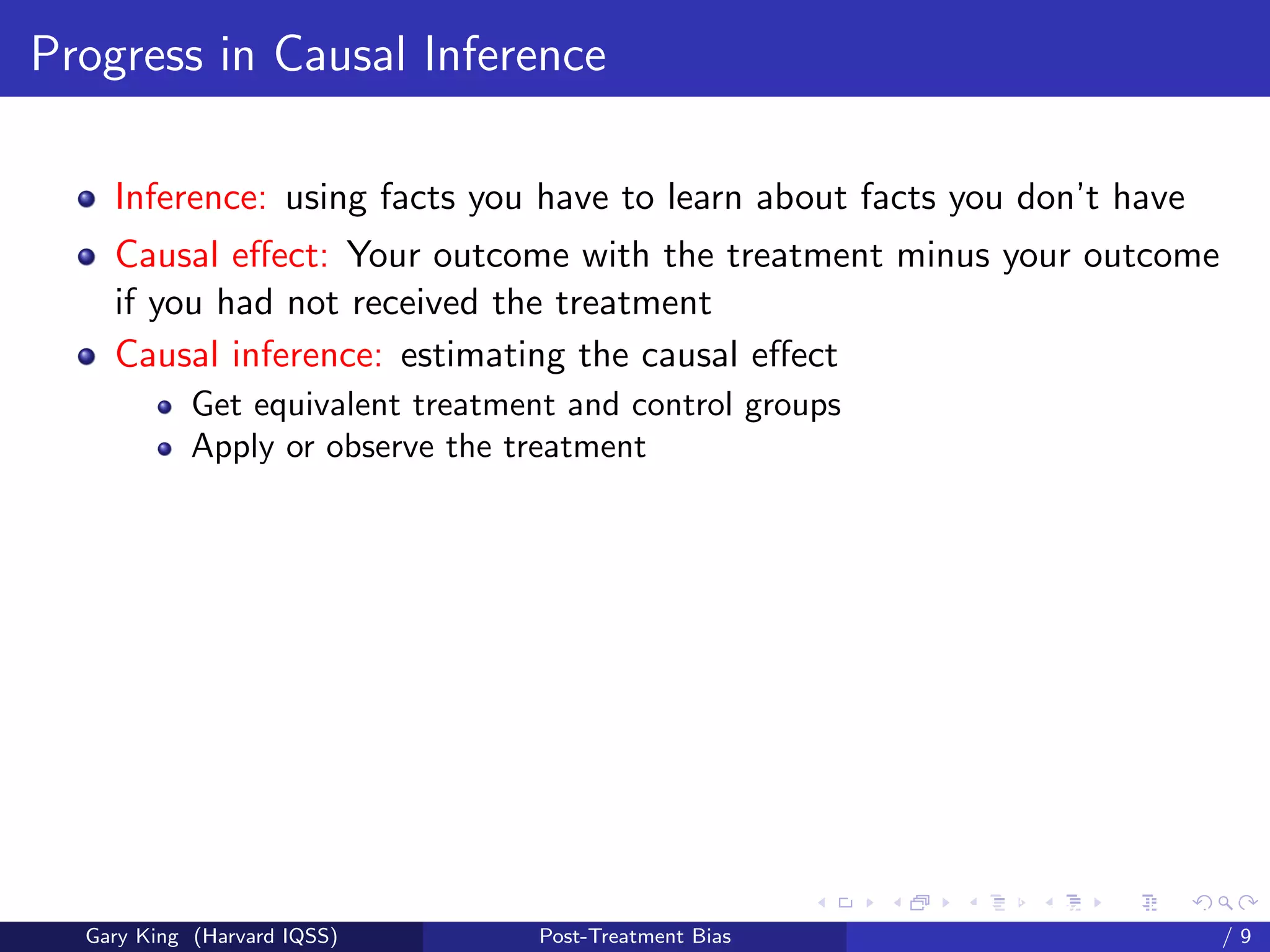
            Apply or observe the treatment


                                                          Talk at the “Hard Problems in S
  Gary King (Harvard IQSS)         Post-Treatment Bias                              /9
Progress in Causal Inference

    Inference: using facts you have to learn about facts you don’t have
    Causal effect: Your outcome with the treatment minus your outcome
    if you had not received the treatment
    Causal inference: estimating the causal effect
            Get equivalent treatment and control groups
            Apply or observe the treatment
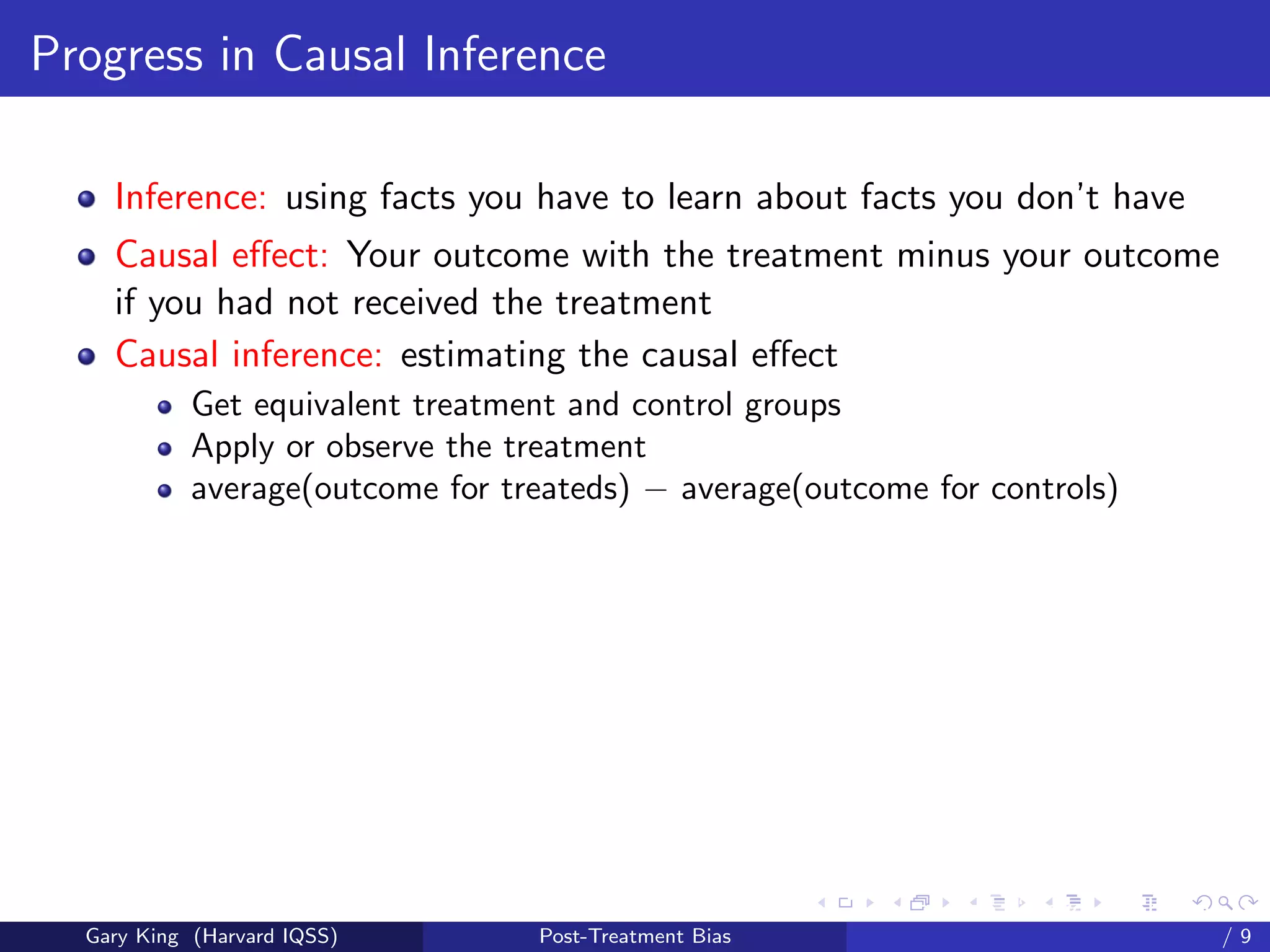
            average(outcome for treateds) − average(outcome for controls)


                                                        Talk at the “Hard Problems in S
  Gary King (Harvard IQSS)        Post-Treatment Bias                             /9
Progress in Causal Inference

    Inference: using facts you have to learn about facts you don’t have
    Causal effect: Your outcome with the treatment minus your outcome
    if you had not received the treatment
    Causal inference: estimating the causal effect
            Get equivalent treatment and control groups
            Apply or observe the treatment
            average(outcome for treateds) − average(outcome for controls)
    Biggest problem we know about: Omitted variable bias


                                                        Talk at the “Hard Problems in S
  Gary King (Harvard IQSS)        Post-Treatment Bias                             /9
Progress in Causal Inference

    Inference: using facts you have to learn about facts you don’t have
    Causal effect: Your outcome with the treatment minus your outcome
    if you had not received the treatment
    Causal inference: estimating the causal effect
            Get equivalent treatment and control groups
            Apply or observe the treatment
            average(outcome for treateds) − average(outcome for controls)
    Biggest problem we know about: Omitted variable bias
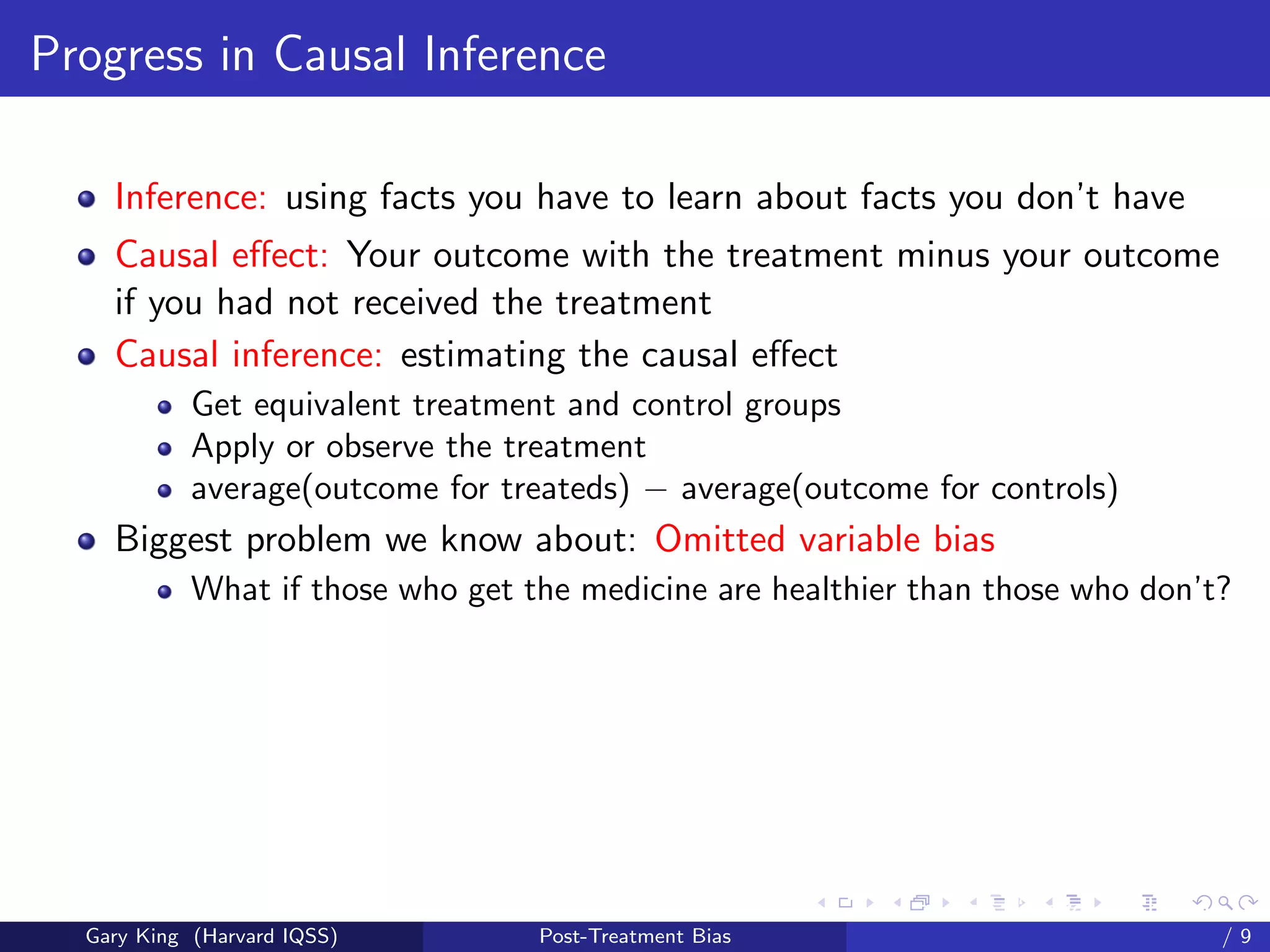
            What if those who get the medicine are healthier than those who don’t?


                                                         Talk at the “Hard Problems in S
  Gary King (Harvard IQSS)         Post-Treatment Bias                             /9
Progress in Causal Inference

    Inference: using facts you have to learn about facts you don’t have
    Causal effect: Your outcome with the treatment minus your outcome
    if you had not received the treatment
    Causal inference: estimating the causal effect
            Get equivalent treatment and control groups
            Apply or observe the treatment
            average(outcome for treateds) − average(outcome for controls)
    Biggest problem we know about: Omitted variable bias
            What if those who get the medicine are healthier than those who don’t?
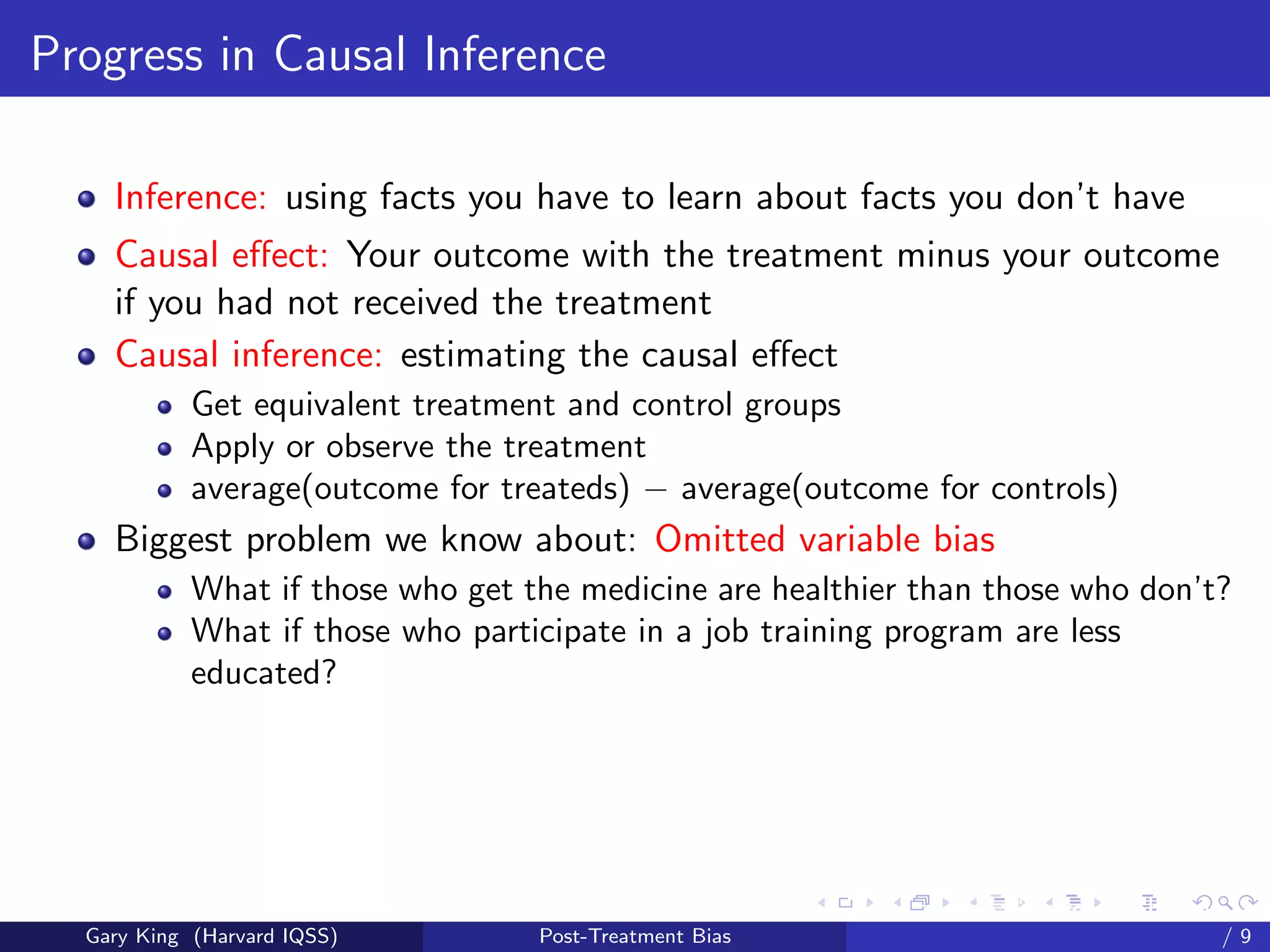
            What if those who participate in a job training program are less
            educated?


                                                         Talk at the “Hard Problems in S
  Gary King (Harvard IQSS)         Post-Treatment Bias                             /9
Progress in Causal Inference

    Inference: using facts you have to learn about facts you don’t have
    Causal effect: Your outcome with the treatment minus your outcome
    if you had not received the treatment
    Causal inference: estimating the causal effect
            Get equivalent treatment and control groups
            Apply or observe the treatment
            average(outcome for treateds) − average(outcome for controls)
    Biggest problem we know about: Omitted variable bias
            What if those who get the medicine are healthier than those who don’t?
            What if those who participate in a job training program are less
            educated?
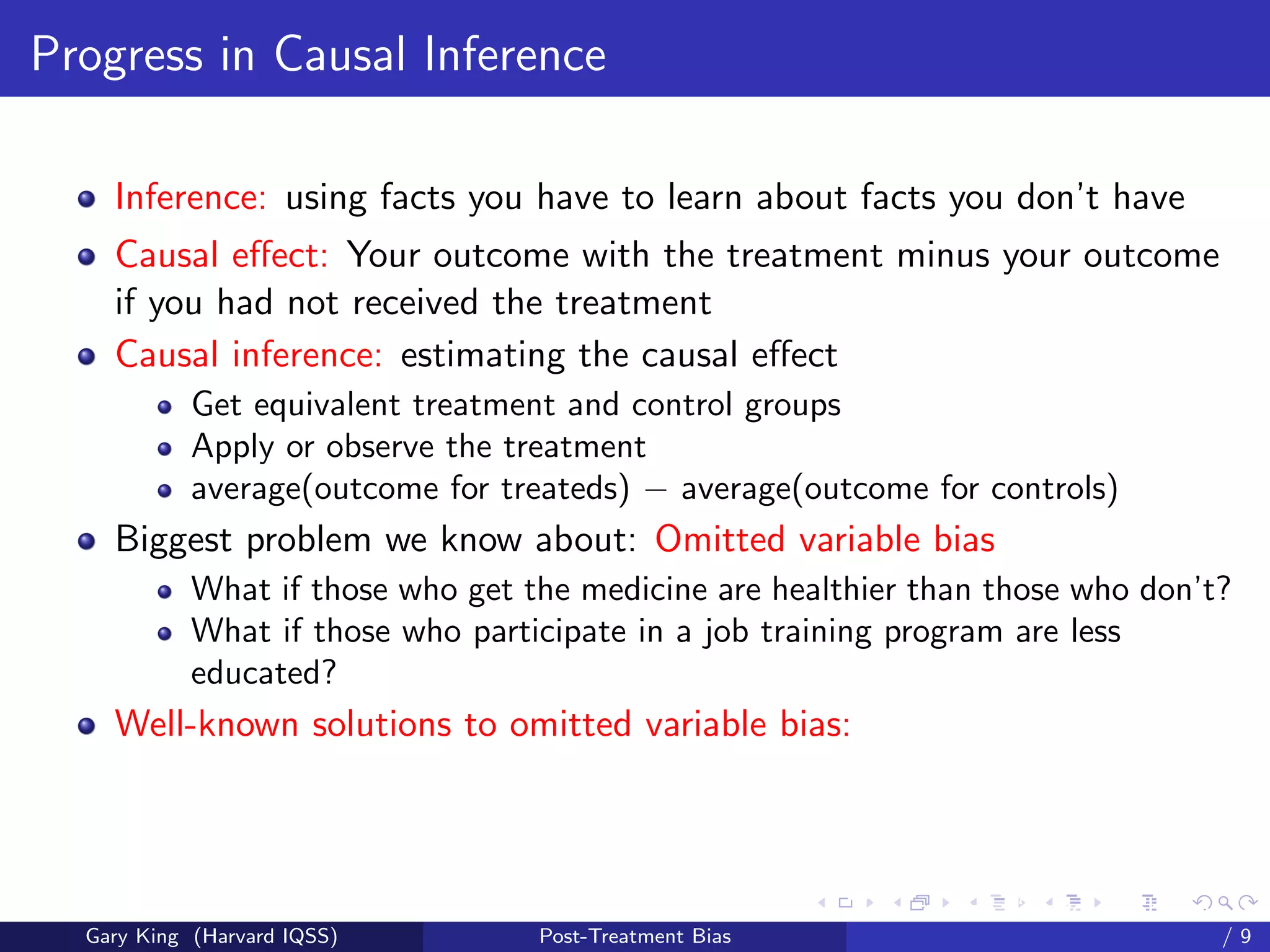
    Well-known solutions to omitted variable bias:


                                                         Talk at the “Hard Problems in S
  Gary King (Harvard IQSS)         Post-Treatment Bias                             /9
Progress in Causal Inference

    Inference: using facts you have to learn about facts you don’t have
    Causal effect: Your outcome with the treatment minus your outcome
    if you had not received the treatment
    Causal inference: estimating the causal effect
            Get equivalent treatment and control groups
            Apply or observe the treatment
            average(outcome for treateds) − average(outcome for controls)
    Biggest problem we know about: Omitted variable bias
            What if those who get the medicine are healthier than those who don’t?
            What if those who participate in a job training program are less
            educated?
    Well-known solutions to omitted variable bias:
            Randomize treatment (all confounders are unrelated to treatment)


                                                         Talk at the “Hard Problems in S
  Gary King (Harvard IQSS)         Post-Treatment Bias                             /9
Progress in Causal Inference

    Inference: using facts you have to learn about facts you don’t have
    Causal effect: Your outcome with the treatment minus your outcome
    if you had not received the treatment
    Causal inference: estimating the causal effect
            Get equivalent treatment and control groups
            Apply or observe the treatment
            average(outcome for treateds) − average(outcome for controls)
    Biggest problem we know about: Omitted variable bias
            What if those who get the medicine are healthier than those who don’t?
            What if those who participate in a job training program are less
            educated?
    Well-known solutions to omitted variable bias:
            Randomize treatment (all confounders are unrelated to treatment)
            Control (physically or statistically) for the potential confounders

                                                          Talk at the “Hard Problems in S
  Gary King (Harvard IQSS)          Post-Treatment Bias                             /9
So What’s Post-Treatment Bias?


                                                   Talk at the “Hard Problems in S
  Gary King (Harvard IQSS)   Post-Treatment Bias                             /9
So What’s Post-Treatment Bias?


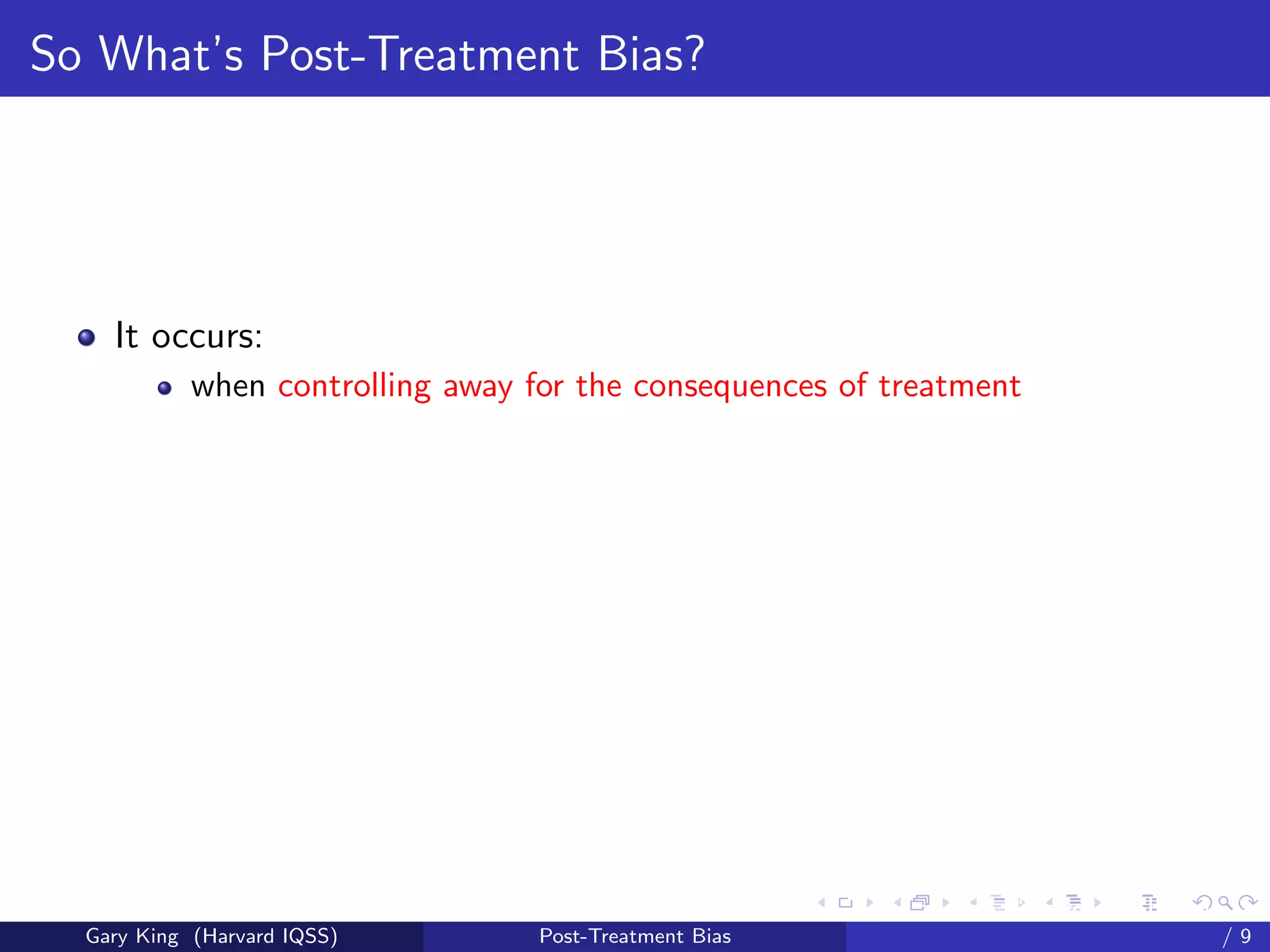
    It occurs:


                                                   Talk at the “Hard Problems in S
  Gary King (Harvard IQSS)   Post-Treatment Bias                             /9
So What’s Post-Treatment Bias?


    It occurs:
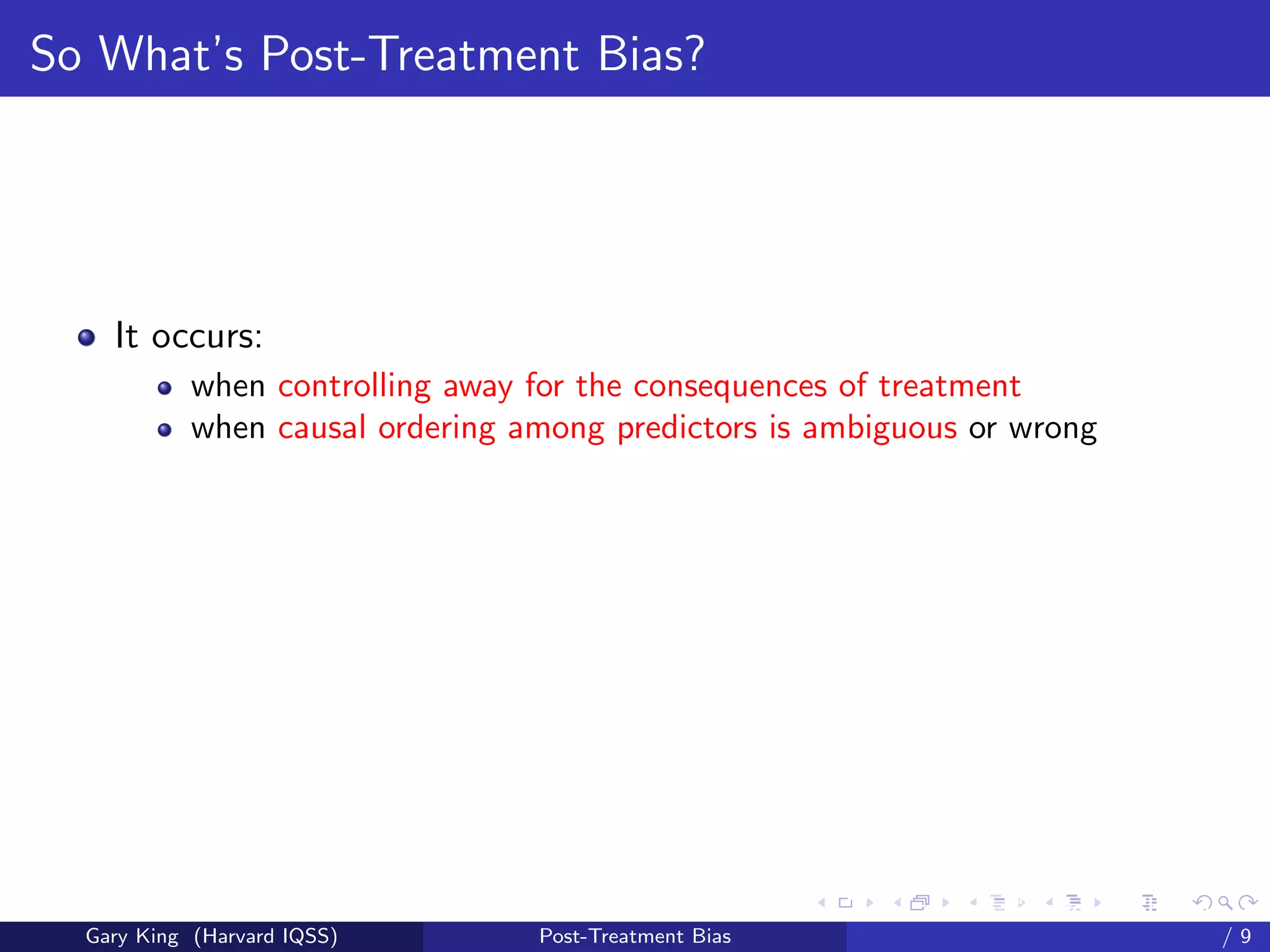
            when controlling away for the consequences of treatment


                                                         Talk at the “Hard Problems in S
  Gary King (Harvard IQSS)         Post-Treatment Bias                             /9
So What’s Post-Treatment Bias?


    It occurs:
            when controlling away for the consequences of treatment
            when causal ordering among predictors is ambiguous or wrong


                                                        Talk at the “Hard Problems in S
  Gary King (Harvard IQSS)        Post-Treatment Bias                             /9
So What’s Post-Treatment Bias?


    It occurs:
            when controlling away for the consequences of treatment
            when causal ordering among predictors is ambiguous or wrong
    Resulting biases can go in either direction


                                                        Talk at the “Hard Problems in S
  Gary King (Harvard IQSS)        Post-Treatment Bias                             /9
So What’s Post-Treatment Bias?


    It occurs:
            when controlling away for the consequences of treatment
            when causal ordering among predictors is ambiguous or wrong
    Resulting biases can go in either direction
    The problem is obvious once you think about it


                                                        Talk at the “Hard Problems in S
  Gary King (Harvard IQSS)        Post-Treatment Bias                             /9
So What’s Post-Treatment Bias?


    It occurs:
            when controlling away for the consequences of treatment
            when causal ordering among predictors is ambiguous or wrong
    Resulting biases can go in either direction
    The problem is obvious once you think about it
    For many big social science questions, we have no solution


                                                        Talk at the “Hard Problems in S
  Gary King (Harvard IQSS)        Post-Treatment Bias                             /9
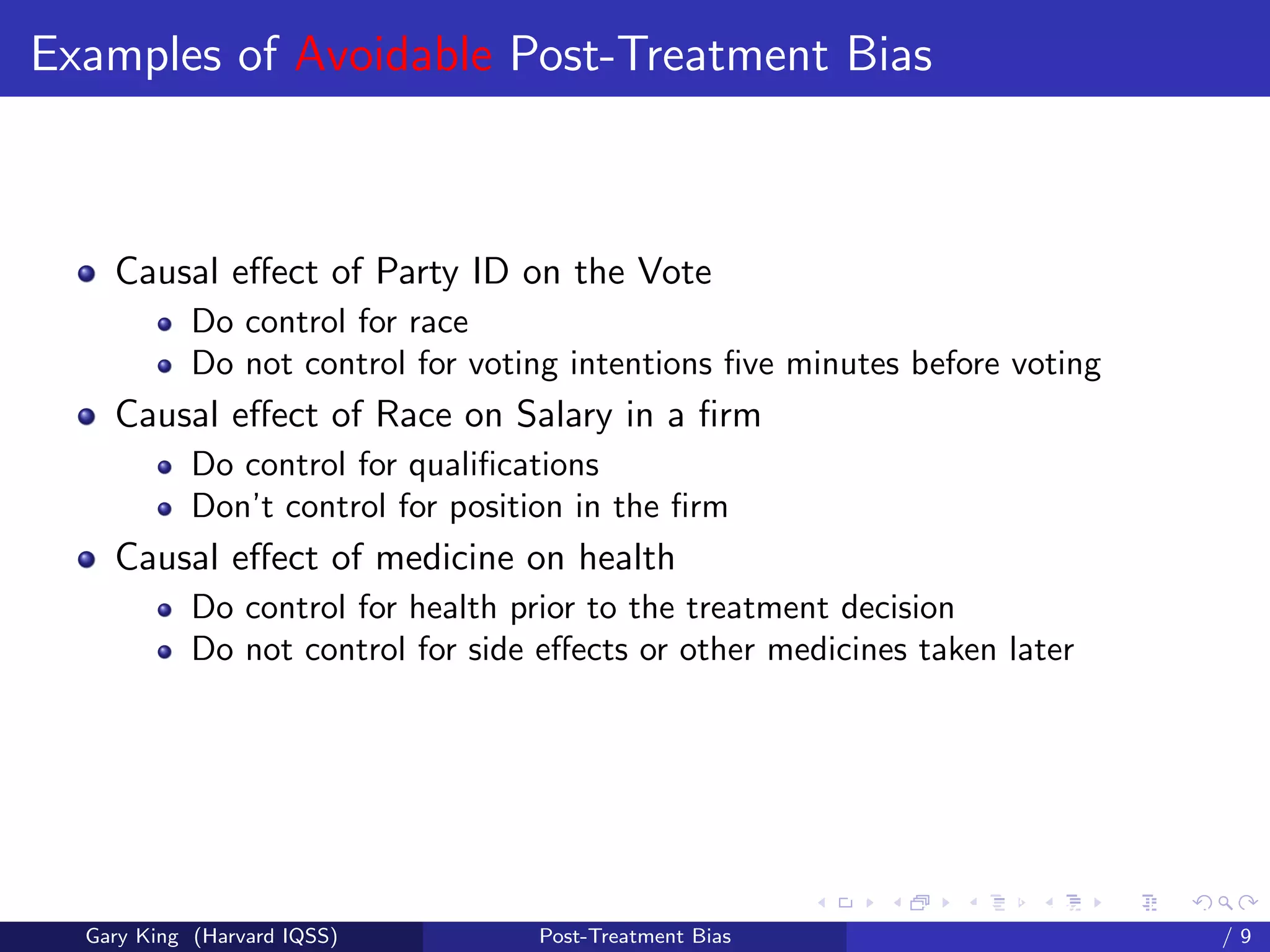
Examples of Avoidable Post-Treatment Bias


                                                   Talk at the “Hard Problems in S
  Gary King (Harvard IQSS)   Post-Treatment Bias                             /9
Examples of Avoidable Post-Treatment Bias


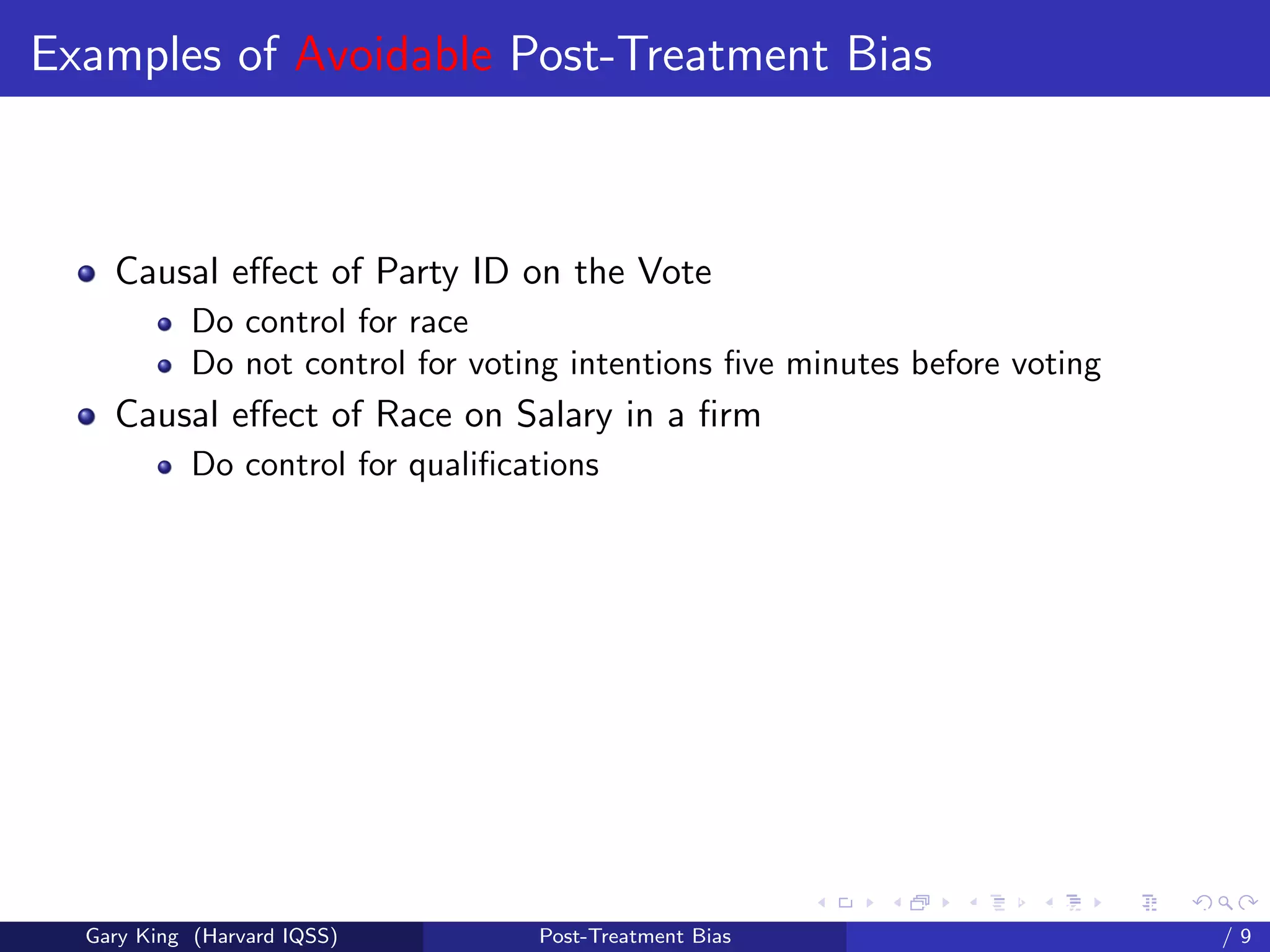
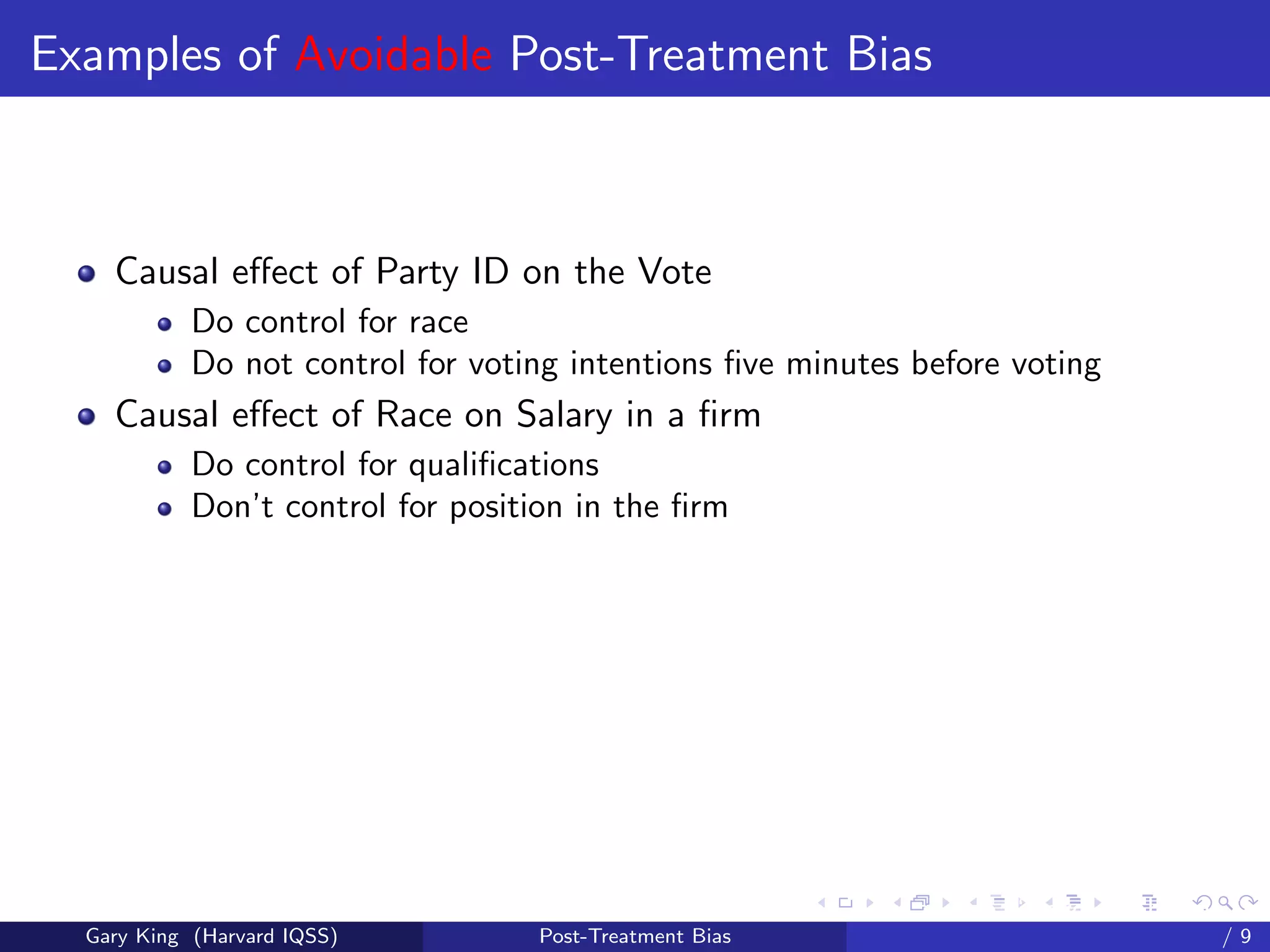
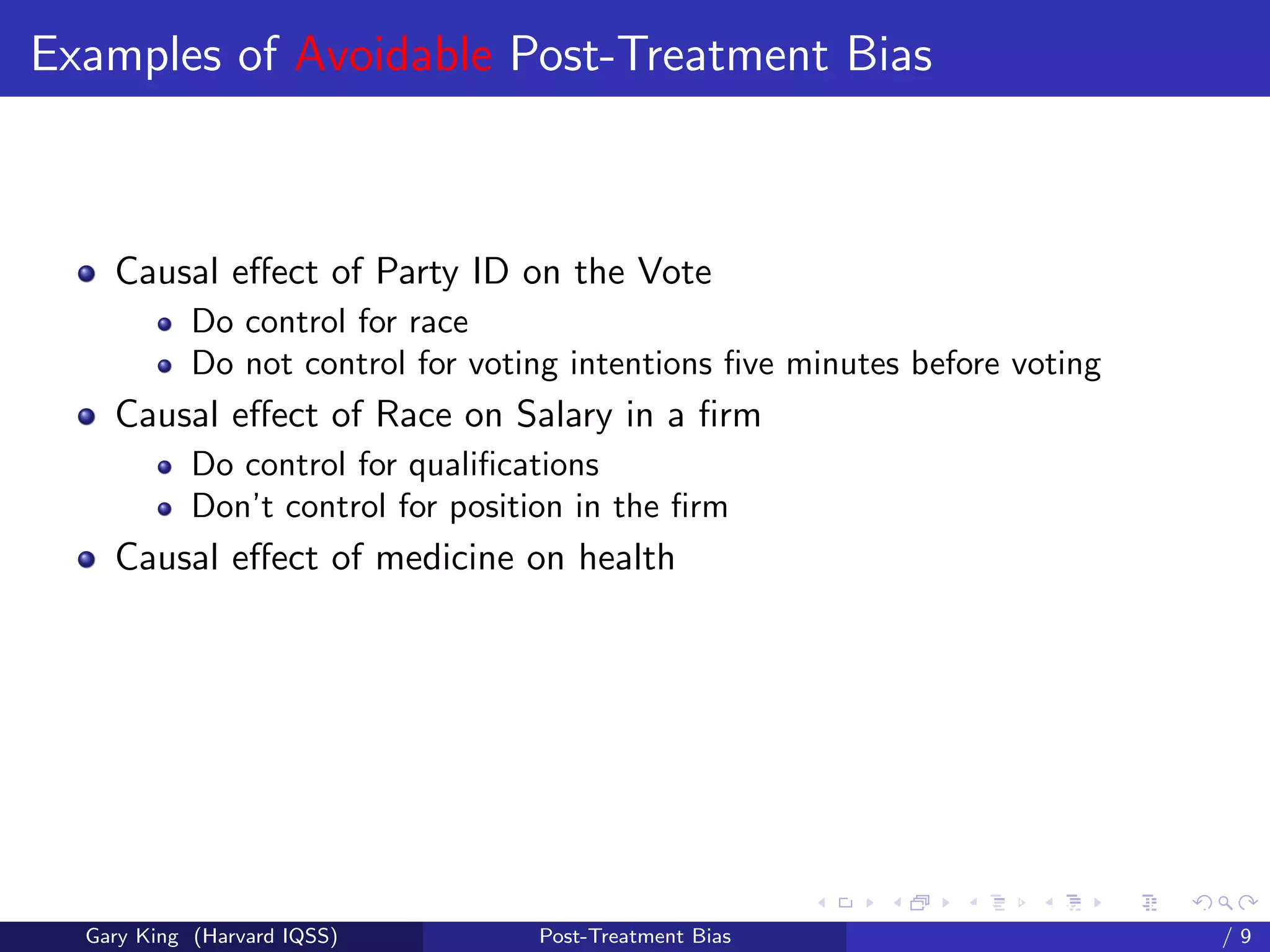
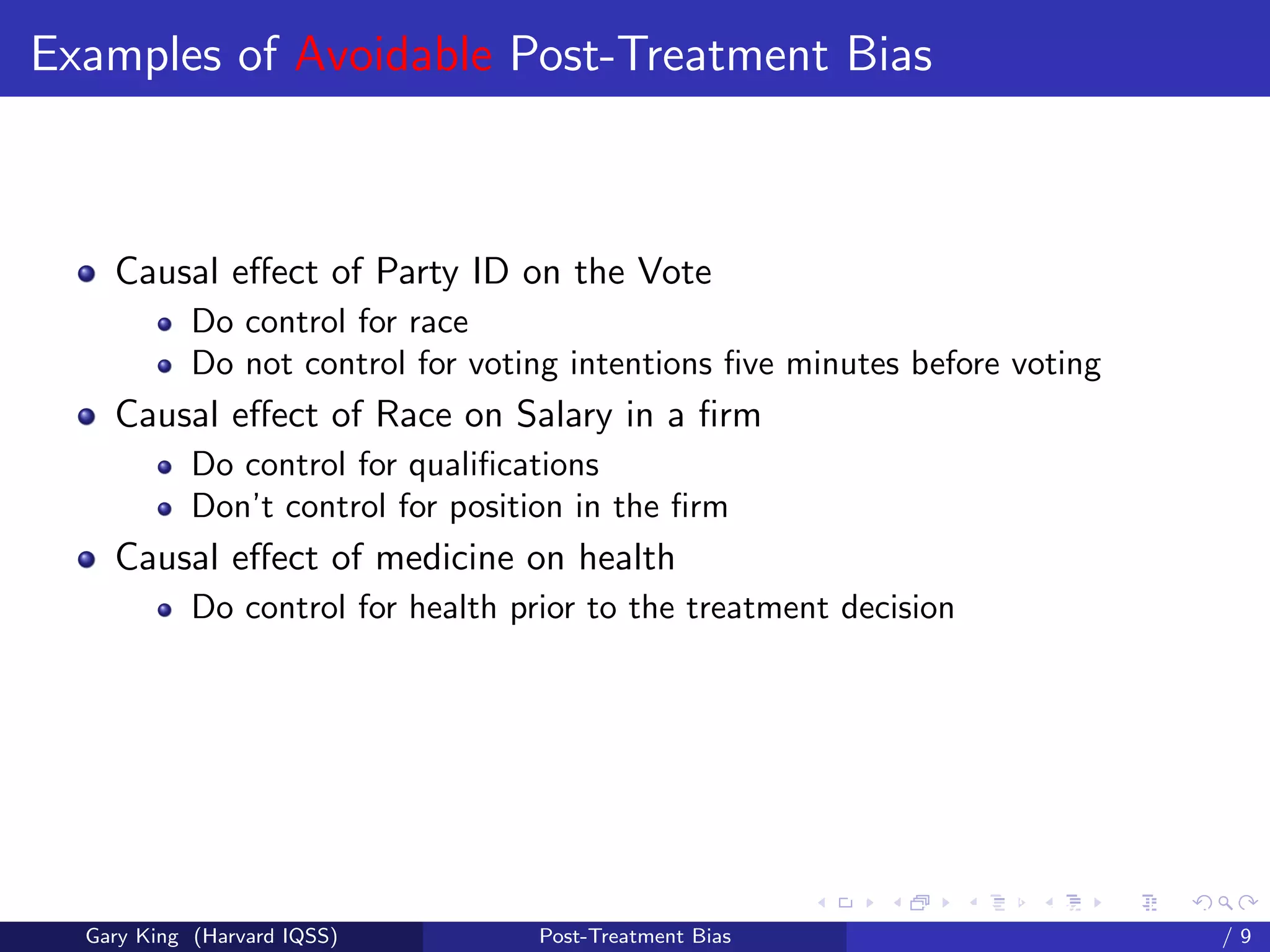
    Causal effect of Party ID on the Vote


                                                   Talk at the “Hard Problems in S
  Gary King (Harvard IQSS)   Post-Treatment Bias                             /9
Examples of Avoidable Post-Treatment Bias


    Causal effect of Party ID on the Vote
            Do control for race


                                                        Talk at the “Hard Problems in S
  Gary King (Harvard IQSS)        Post-Treatment Bias                             /9
Examples of Avoidable Post-Treatment Bias


    Causal effect of Party ID on the Vote
            Do control for race
            Do not control for voting intentions five minutes before voting


                                                         Talk at the “Hard Problems in S
  Gary King (Harvard IQSS)         Post-Treatment Bias                             /9
Examples of Avoidable Post-Treatment Bias


    Causal effect of Party ID on the Vote
            Do control for race
            Do not control for voting intentions five minutes before voting
    Causal effect of Race on Salary in a firm


                                                         Talk at the “Hard Problems in S
  Gary King (Harvard IQSS)         Post-Treatment Bias                             /9
Examples of Avoidable Post-Treatment Bias


    Causal effect of Party ID on the Vote
            Do control for race
            Do not control for voting intentions five minutes before voting
    Causal effect of Race on Salary in a firm
            Do control for qualifications


                                                         Talk at the “Hard Problems in S
  Gary King (Harvard IQSS)         Post-Treatment Bias                             /9
Examples of Avoidable Post-Treatment Bias


    Causal effect of Party ID on the Vote
            Do control for race
            Do not control for voting intentions five minutes before voting
    Causal effect of Race on Salary in a firm
            Do control for qualifications
            Don’t control for position in the firm


                                                         Talk at the “Hard Problems in S
  Gary King (Harvard IQSS)         Post-Treatment Bias                             /9
Examples of Avoidable Post-Treatment Bias


    Causal effect of Party ID on the Vote
            Do control for race
            Do not control for voting intentions five minutes before voting
    Causal effect of Race on Salary in a firm
            Do control for qualifications
            Don’t control for position in the firm
    Causal effect of medicine on health


                                                         Talk at the “Hard Problems in S
  Gary King (Harvard IQSS)         Post-Treatment Bias                             /9
Examples of Avoidable Post-Treatment Bias


    Causal effect of Party ID on the Vote
            Do control for race
            Do not control for voting intentions five minutes before voting
    Causal effect of Race on Salary in a firm
            Do control for qualifications
            Don’t control for position in the firm
    Causal effect of medicine on health
            Do control for health prior to the treatment decision


                                                          Talk at the “Hard Problems in S
  Gary King (Harvard IQSS)          Post-Treatment Bias                             /9
Examples of Avoidable Post-Treatment Bias


    Causal effect of Party ID on the Vote
            Do control for race
            Do not control for voting intentions five minutes before voting
    Causal effect of Race on Salary in a firm
            Do control for qualifications
            Don’t control for position in the firm
    Causal effect of medicine on health
            Do control for health prior to the treatment decision
            Do not control for side effects or other medicines taken later


                                                          Talk at the “Hard Problems in S
  Gary King (Harvard IQSS)          Post-Treatment Bias                             /9
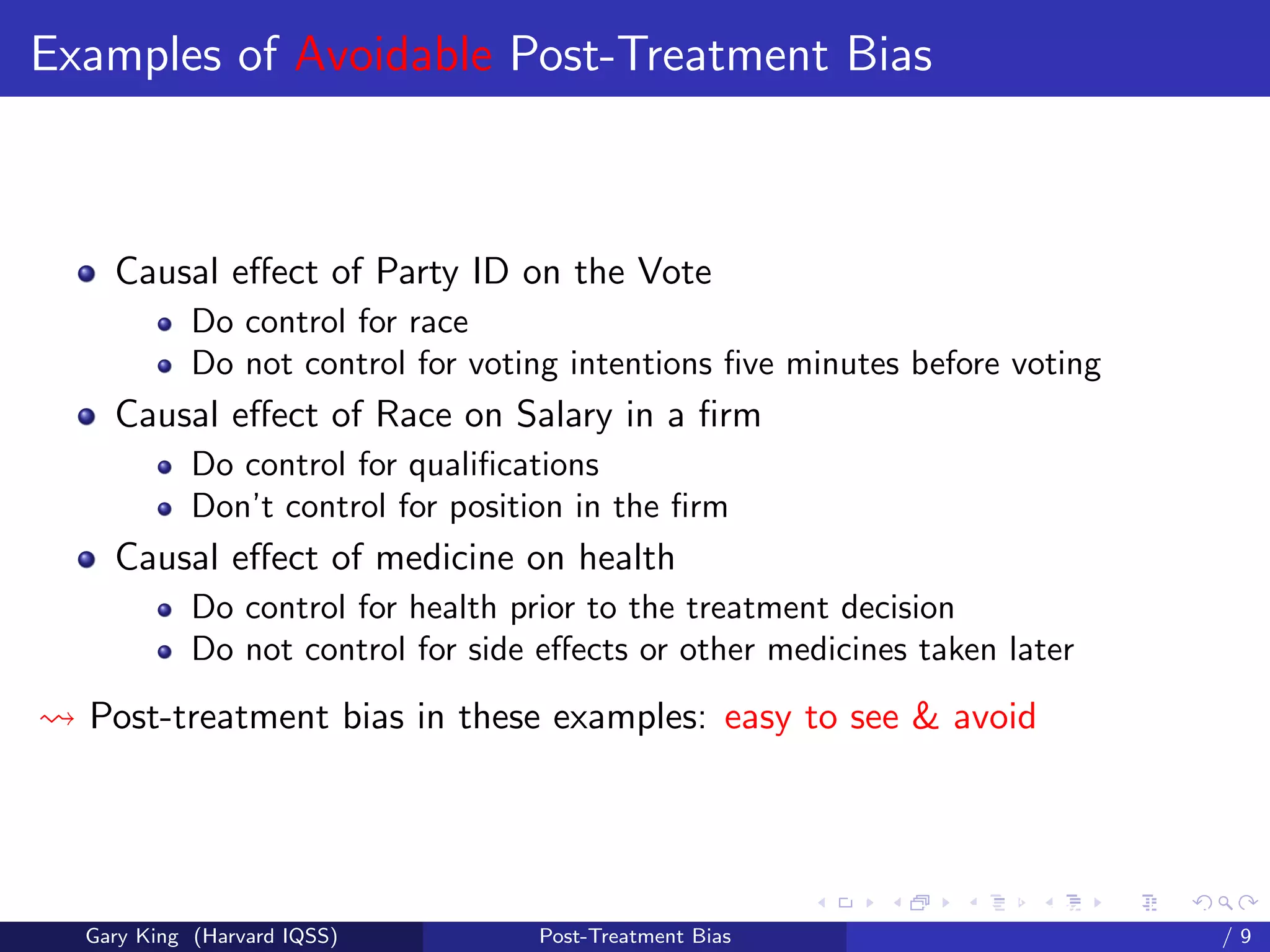
Examples of Avoidable Post-Treatment Bias


    Causal effect of Party ID on the Vote
            Do control for race
            Do not control for voting intentions five minutes before voting
    Causal effect of Race on Salary in a firm
            Do control for qualifications
            Don’t control for position in the firm
    Causal effect of medicine on health
            Do control for health prior to the treatment decision
            Do not control for side effects or other medicines taken later
  Post-treatment bias in these examples: easy to see & avoid


                                                          Talk at the “Hard Problems in S
  Gary King (Harvard IQSS)          Post-Treatment Bias                             /9
Examples of Unavoidable Post-Treatment Bias


                                                   Talk at the “Hard Problems in S
  Gary King (Harvard IQSS)   Post-Treatment Bias                             /9
Examples of Unavoidable Post-Treatment Bias

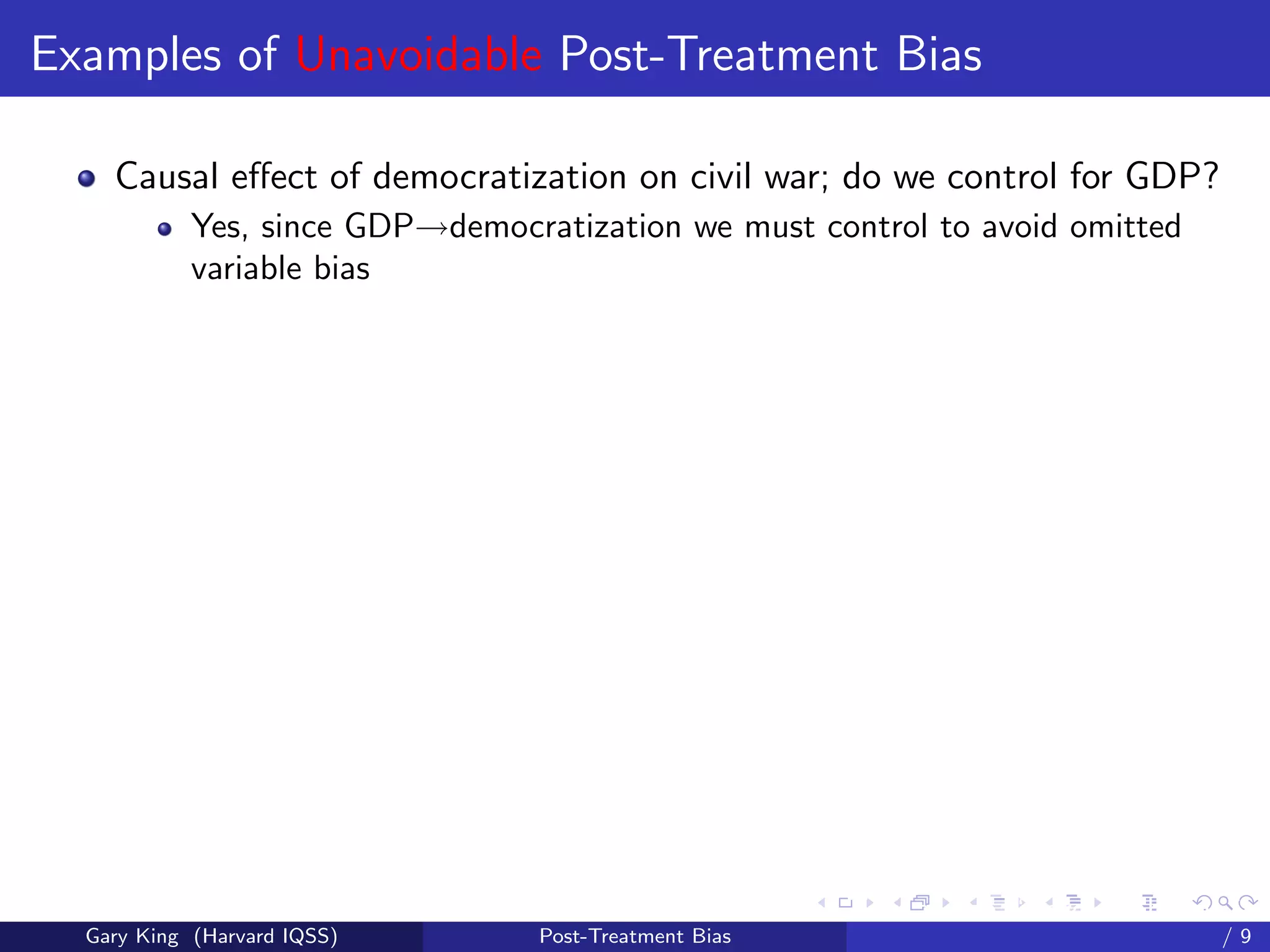
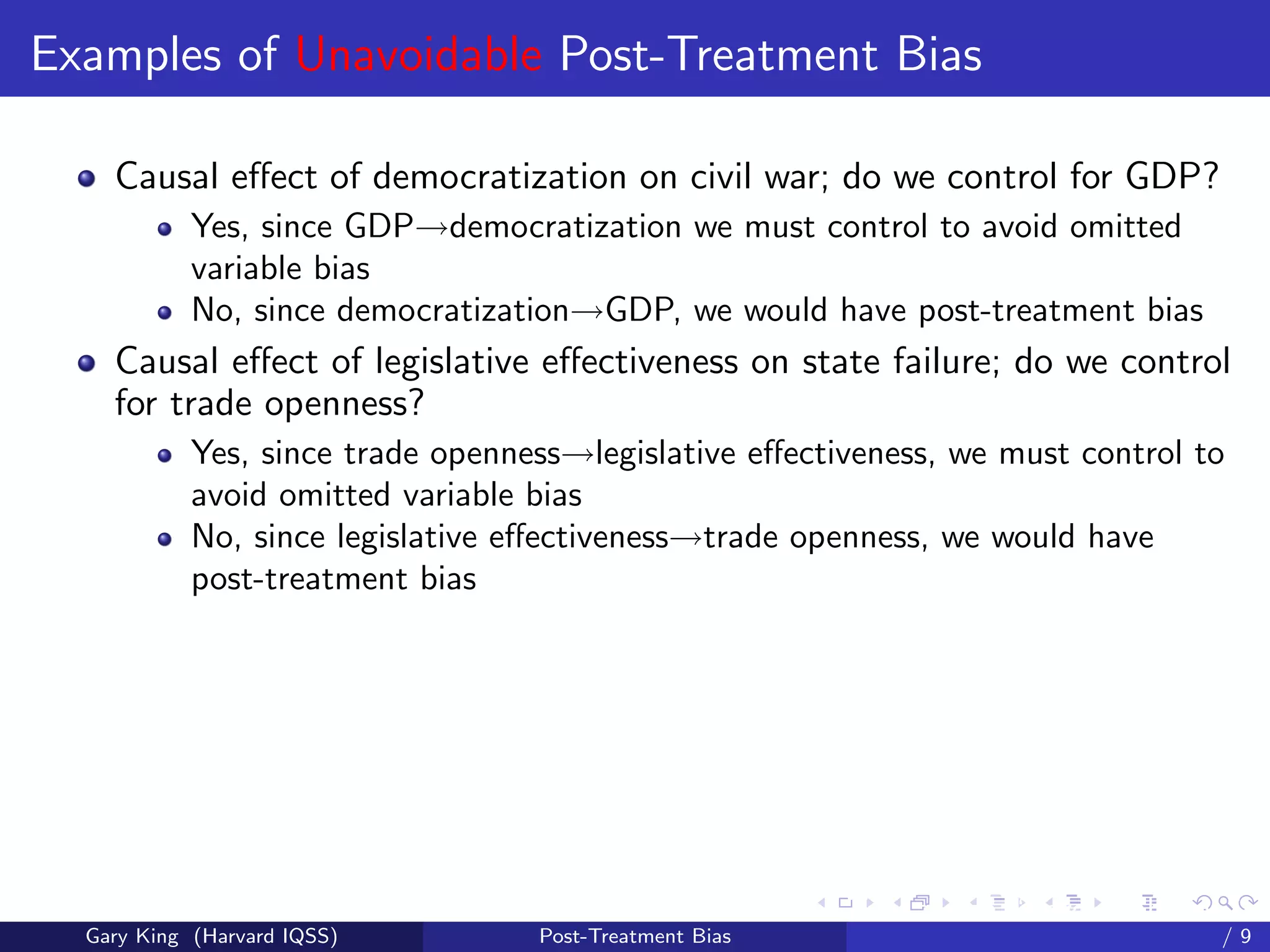
    Causal effect of democratization on civil war; do we control for GDP?


                                                    Talk at the “Hard Problems in S
  Gary King (Harvard IQSS)    Post-Treatment Bias                             /9
Examples of Unavoidable Post-Treatment Bias

    Causal effect of democratization on civil war; do we control for GDP?
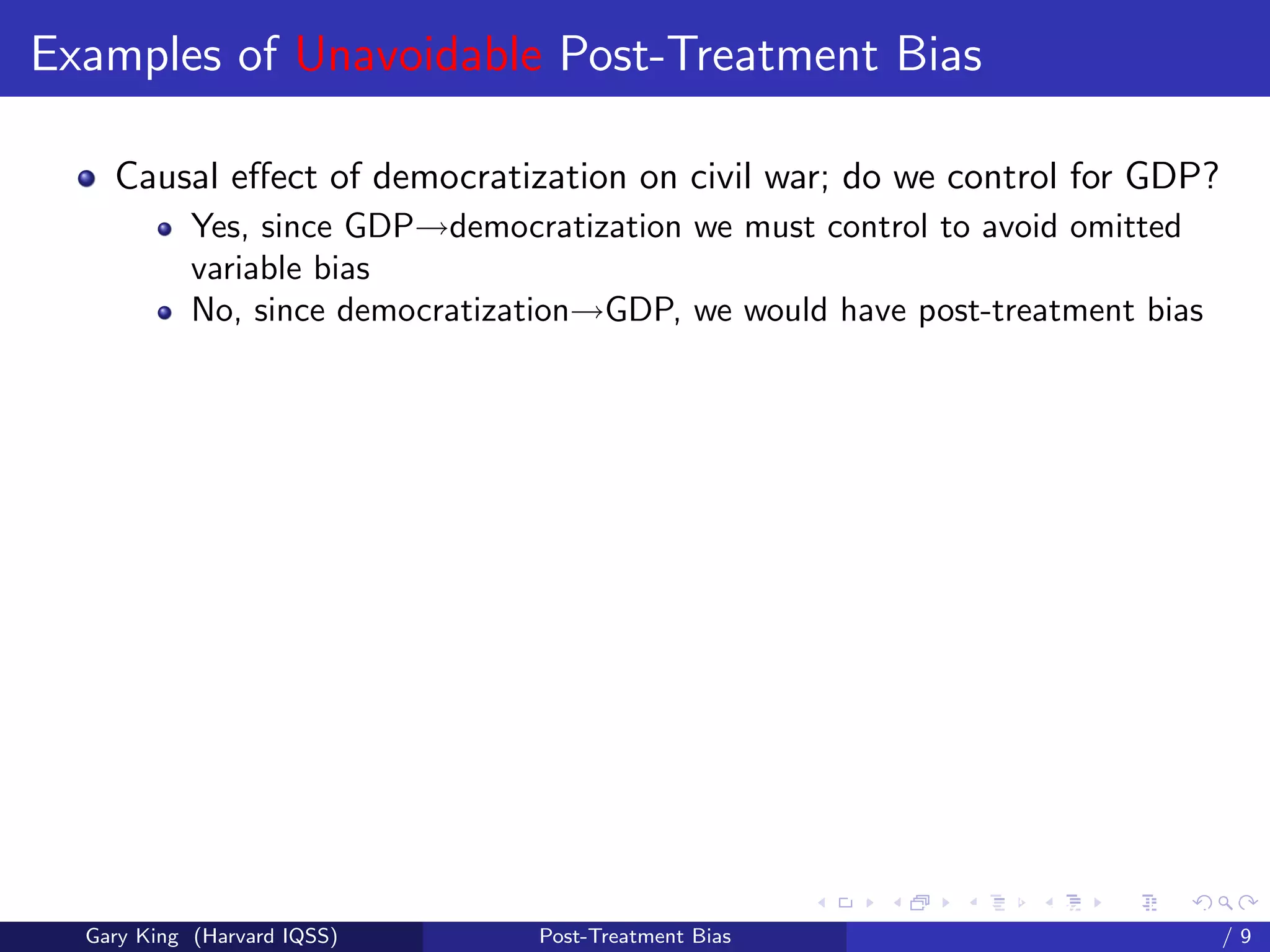
            Yes, since GDP→democratization we must control to avoid omitted
            variable bias


                                                        Talk at the “Hard Problems in S
  Gary King (Harvard IQSS)        Post-Treatment Bias                             /9
Examples of Unavoidable Post-Treatment Bias

    Causal effect of democratization on civil war; do we control for GDP?
            Yes, since GDP→democratization we must control to avoid omitted
            variable bias
            No, since democratization→GDP, we would have post-treatment bias


                                                        Talk at the “Hard Problems in S
  Gary King (Harvard IQSS)        Post-Treatment Bias                             /9
Examples of Unavoidable Post-Treatment Bias

    Causal effect of democratization on civil war; do we control for GDP?
            Yes, since GDP→democratization we must control to avoid omitted
            variable bias
            No, since democratization→GDP, we would have post-treatment bias
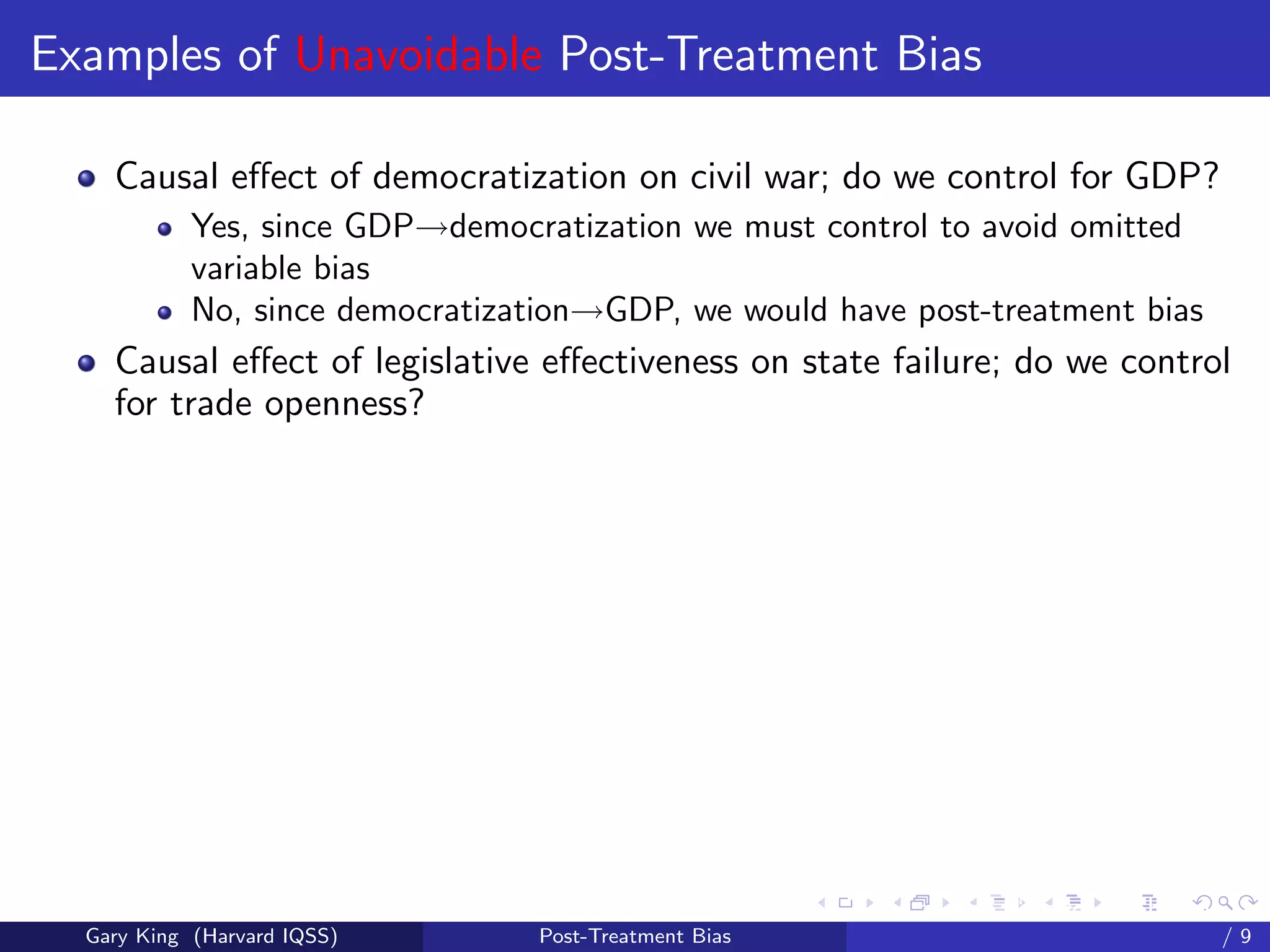
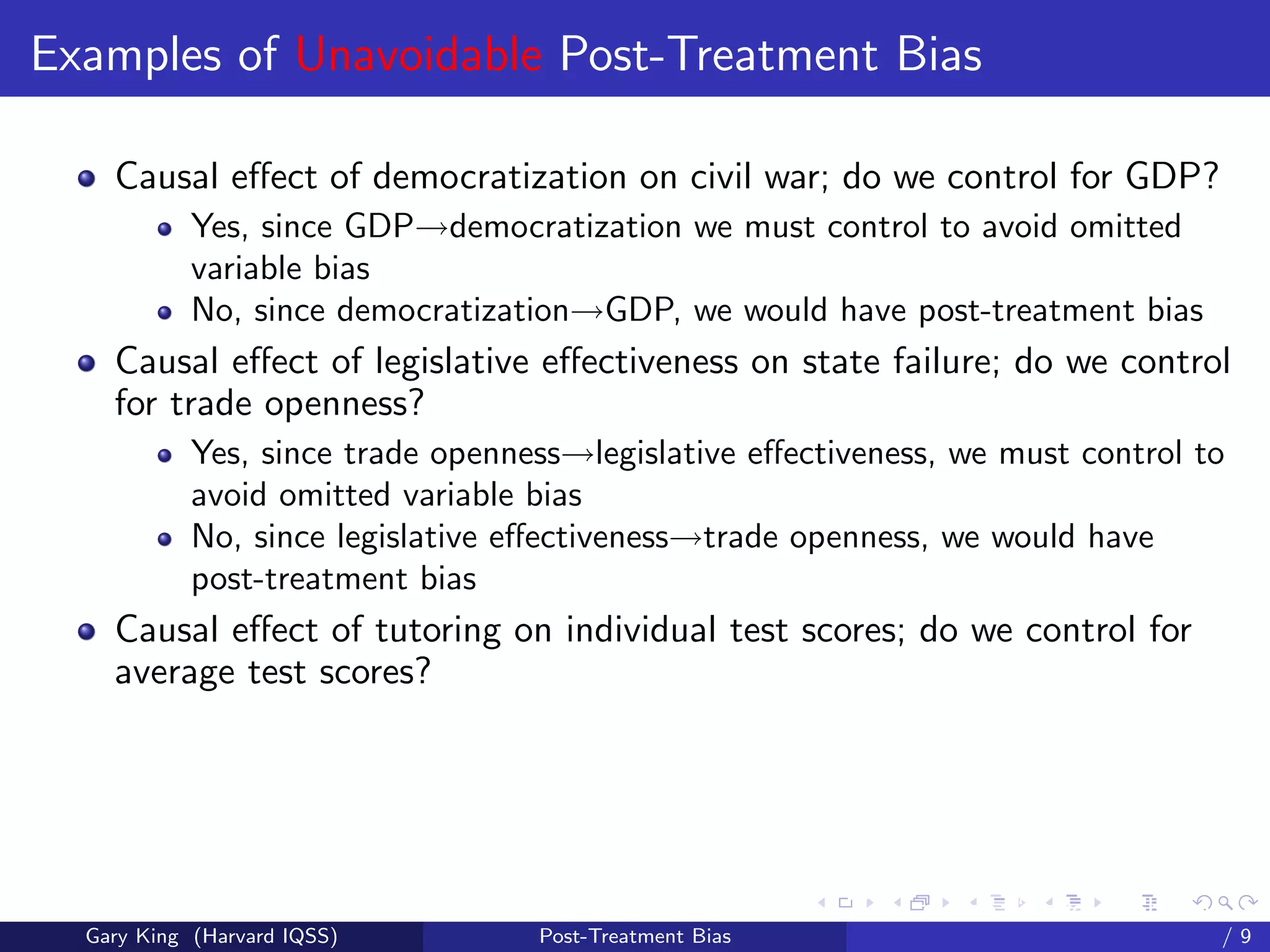
    Causal effect of legislative effectiveness on state failure; do we control
    for trade openness?


                                                        Talk at the “Hard Problems in S
  Gary King (Harvard IQSS)        Post-Treatment Bias                             /9
Examples of Unavoidable Post-Treatment Bias

    Causal effect of democratization on civil war; do we control for GDP?
            Yes, since GDP→democratization we must control to avoid omitted
            variable bias
            No, since democratization→GDP, we would have post-treatment bias
    Causal effect of legislative effectiveness on state failure; do we control
    for trade openness?
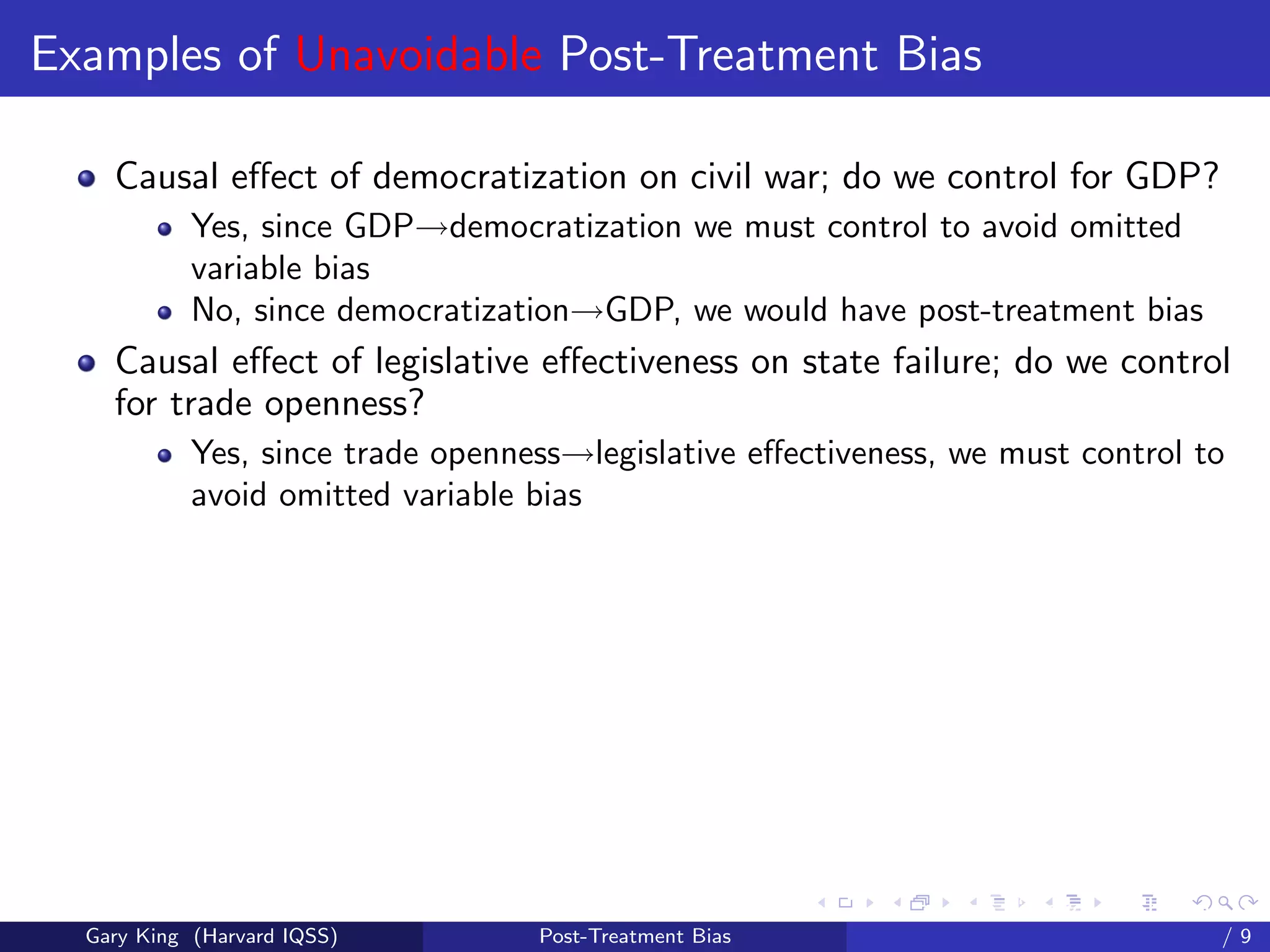
            Yes, since trade openness→legislative effectiveness, we must control to
            avoid omitted variable bias


                                                         Talk at the “Hard Problems in S
  Gary King (Harvard IQSS)         Post-Treatment Bias                             /9
Examples of Unavoidable Post-Treatment Bias

    Causal effect of democratization on civil war; do we control for GDP?
            Yes, since GDP→democratization we must control to avoid omitted
            variable bias
            No, since democratization→GDP, we would have post-treatment bias
    Causal effect of legislative effectiveness on state failure; do we control
    for trade openness?
            Yes, since trade openness→legislative effectiveness, we must control to
            avoid omitted variable bias
            No, since legislative effectiveness→trade openness, we would have
            post-treatment bias


                                                         Talk at the “Hard Problems in S
  Gary King (Harvard IQSS)         Post-Treatment Bias                             /9
Examples of Unavoidable Post-Treatment Bias

    Causal effect of democratization on civil war; do we control for GDP?
            Yes, since GDP→democratization we must control to avoid omitted
            variable bias
            No, since democratization→GDP, we would have post-treatment bias
    Causal effect of legislative effectiveness on state failure; do we control
    for trade openness?
            Yes, since trade openness→legislative effectiveness, we must control to
            avoid omitted variable bias
            No, since legislative effectiveness→trade openness, we would have
            post-treatment bias
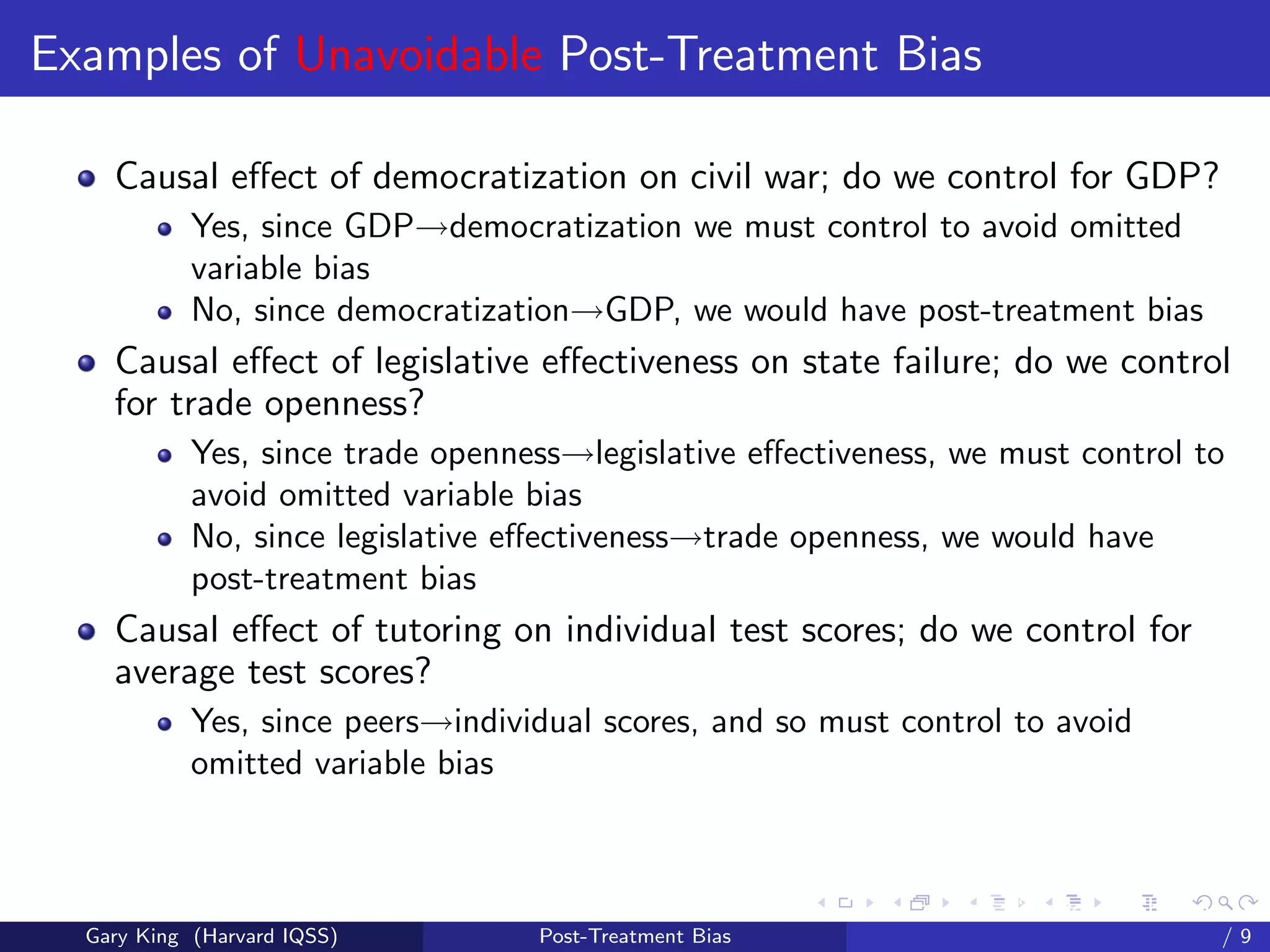
    Causal effect of tutoring on individual test scores; do we control for
    average test scores?


                                                         Talk at the “Hard Problems in S
  Gary King (Harvard IQSS)         Post-Treatment Bias                             /9
Examples of Unavoidable Post-Treatment Bias

    Causal effect of democratization on civil war; do we control for GDP?
            Yes, since GDP→democratization we must control to avoid omitted
            variable bias
            No, since democratization→GDP, we would have post-treatment bias
    Causal effect of legislative effectiveness on state failure; do we control
    for trade openness?
            Yes, since trade openness→legislative effectiveness, we must control to
            avoid omitted variable bias
            No, since legislative effectiveness→trade openness, we would have
            post-treatment bias
    Causal effect of tutoring on individual test scores; do we control for
    average test scores?
            Yes, since peers→individual scores, and so must control to avoid
            omitted variable bias


                                                         Talk at the “Hard Problems in S
  Gary King (Harvard IQSS)         Post-Treatment Bias                             /9
Examples of Unavoidable Post-Treatment Bias

    Causal effect of democratization on civil war; do we control for GDP?
            Yes, since GDP→democratization we must control to avoid omitted
            variable bias
            No, since democratization→GDP, we would have post-treatment bias
    Causal effect of legislative effectiveness on state failure; do we control
    for trade openness?
            Yes, since trade openness→legislative effectiveness, we must control to
            avoid omitted variable bias
            No, since legislative effectiveness→trade openness, we would have
            post-treatment bias
    Causal effect of tutoring on individual test scores; do we control for
    average test scores?
            Yes, since peers→individual scores, and so must control to avoid
            omitted variable bias
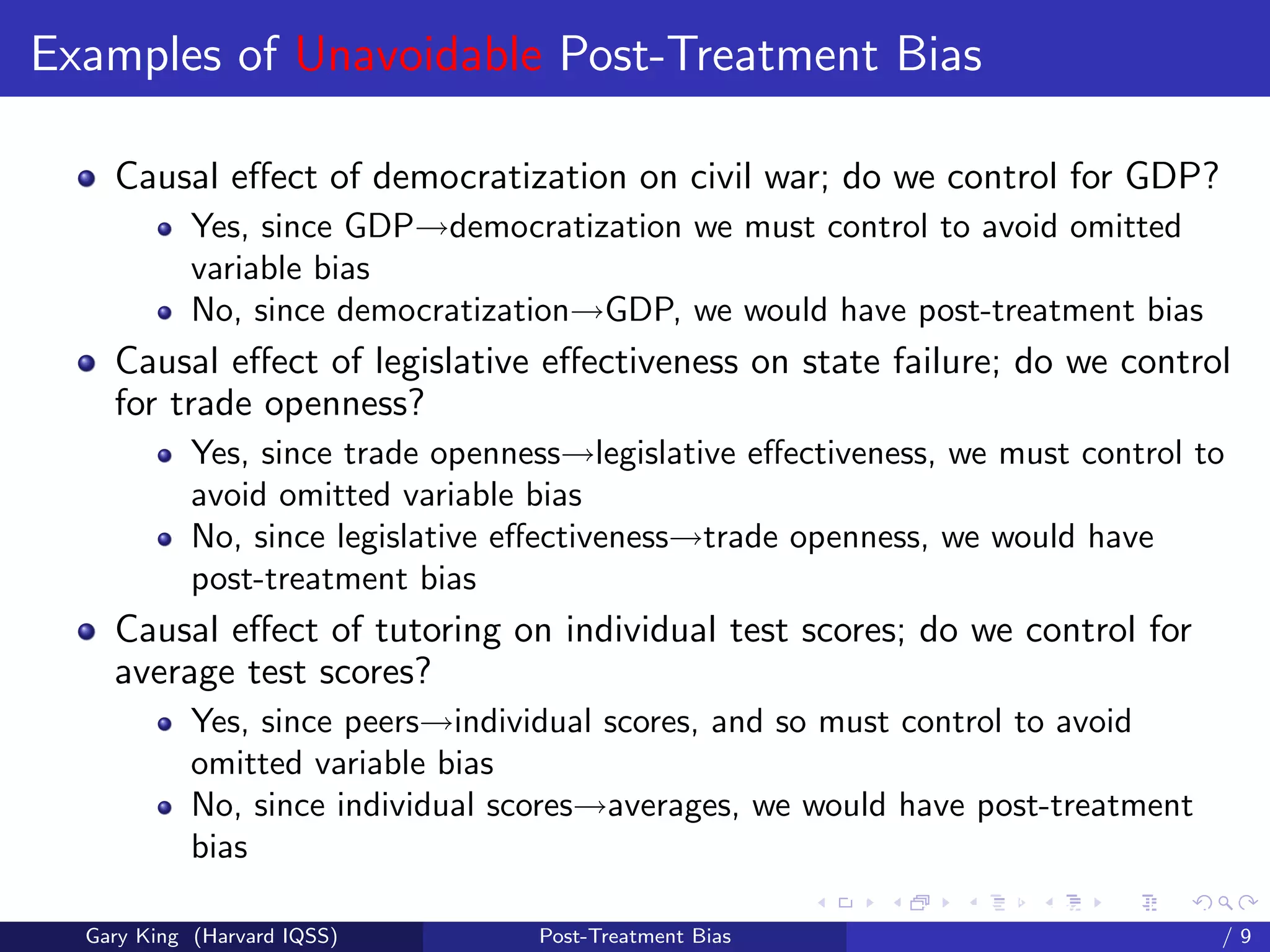
            No, since individual scores→averages, we would have post-treatment
            bias
                                                         Talk at the “Hard Problems in S
  Gary King (Harvard IQSS)         Post-Treatment Bias                             /9
Solutions for Post-Treatment Bias?


                                                   Talk at the “Hard Problems in S
  Gary King (Harvard IQSS)   Post-Treatment Bias                             /9
Solutions for Post-Treatment Bias?


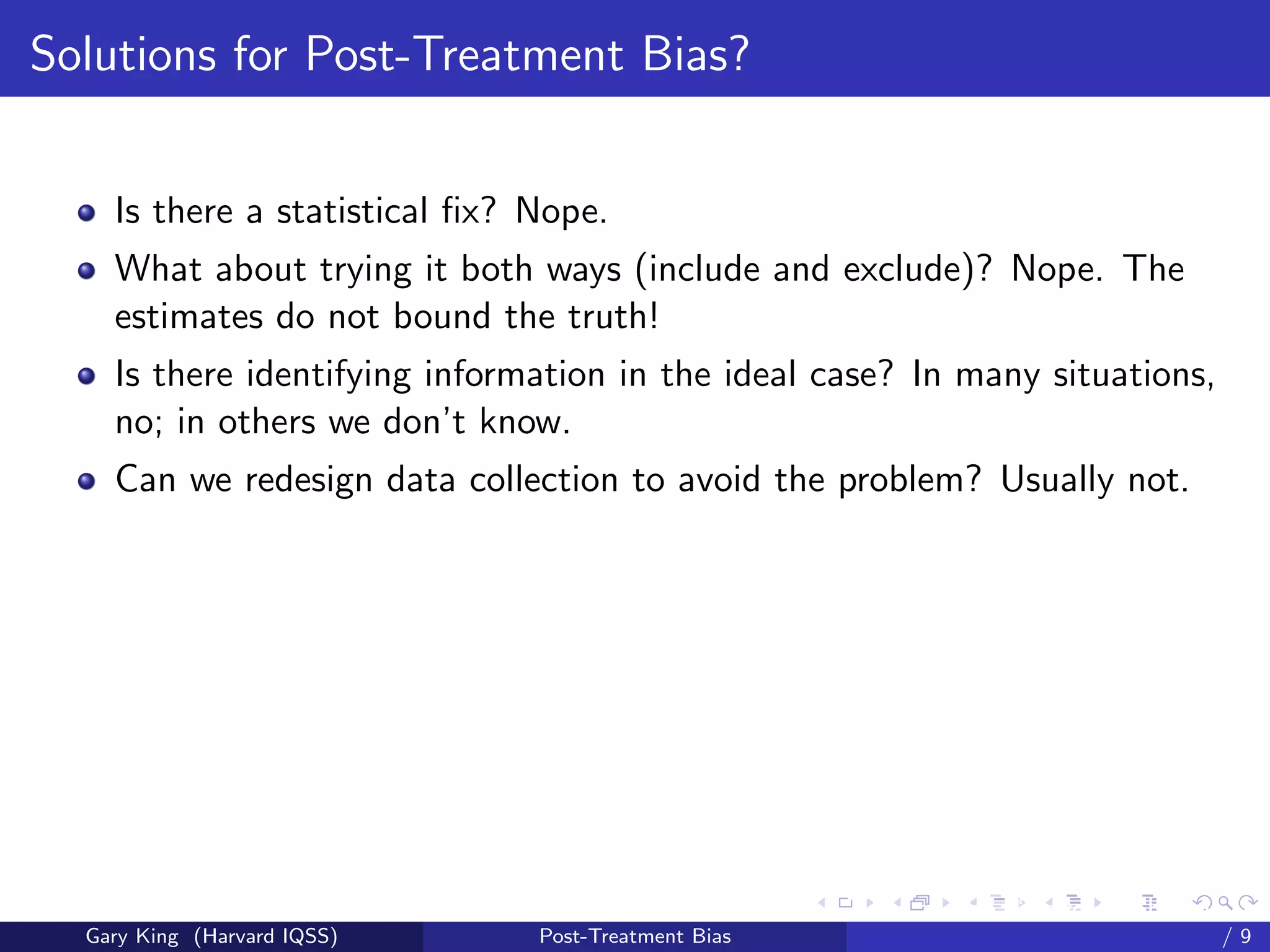
    Is there a statistical fix?


                                                       Talk at the “Hard Problems in S
  Gary King (Harvard IQSS)       Post-Treatment Bias                             /9
Solutions for Post-Treatment Bias?


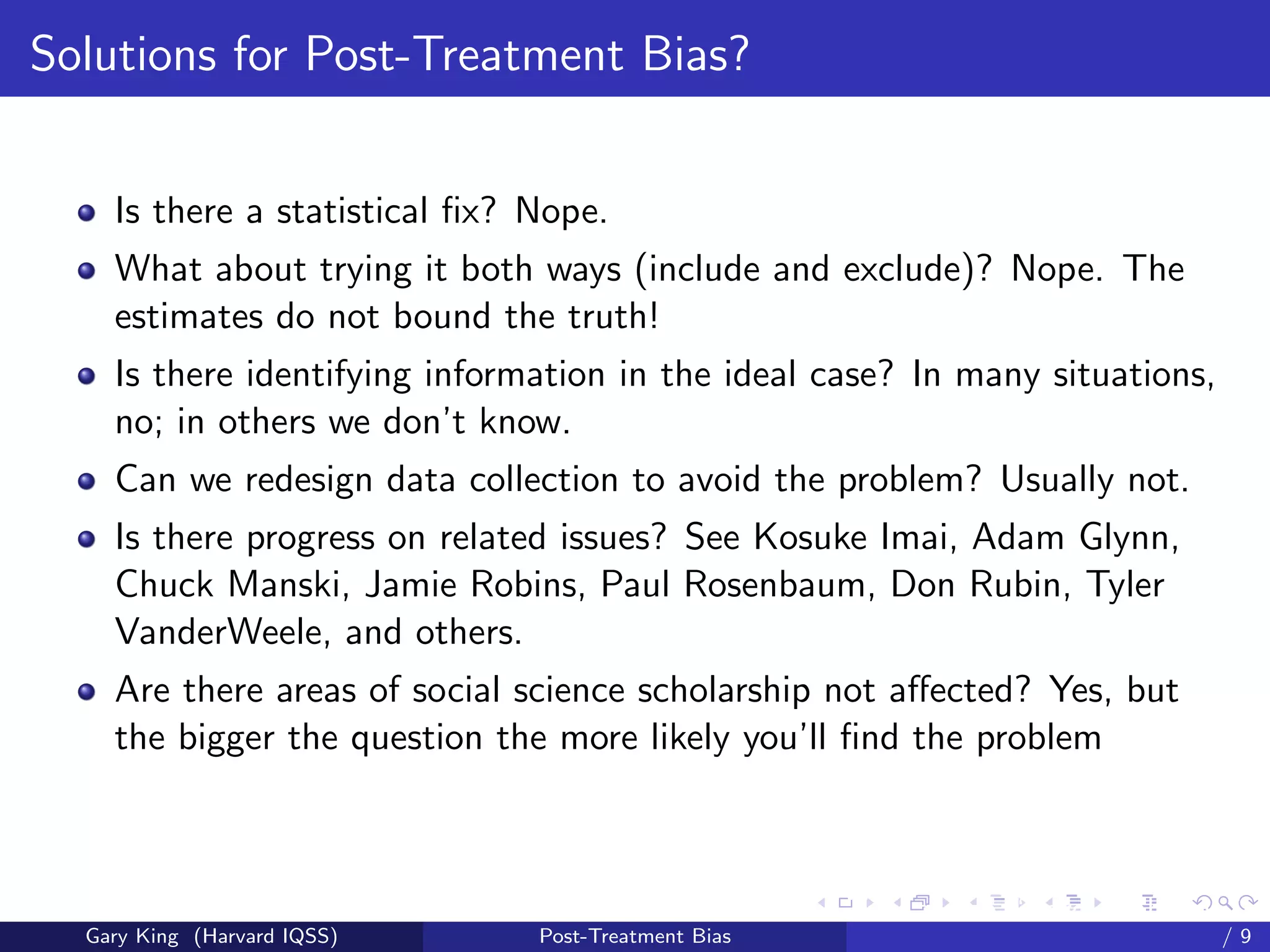
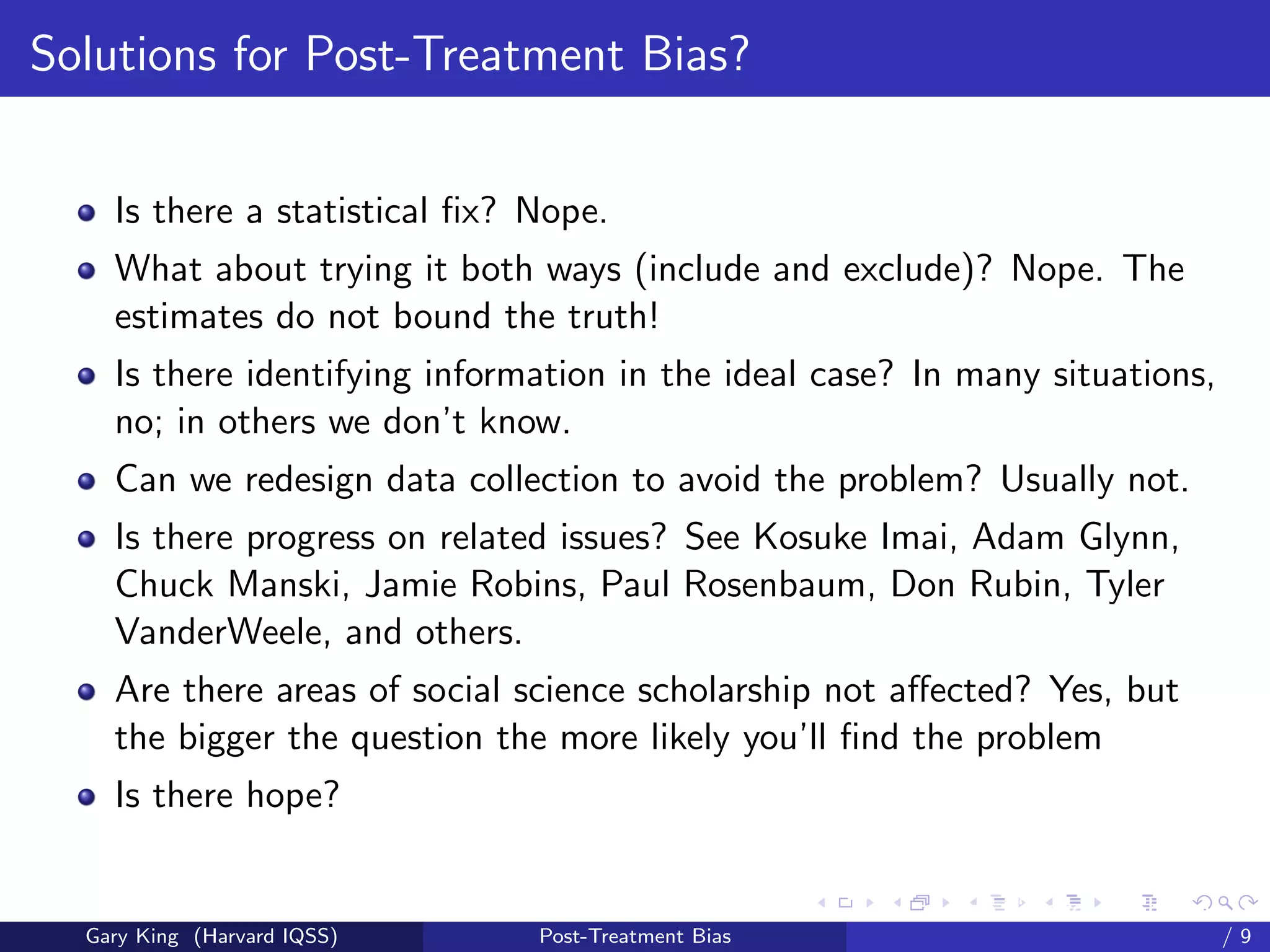
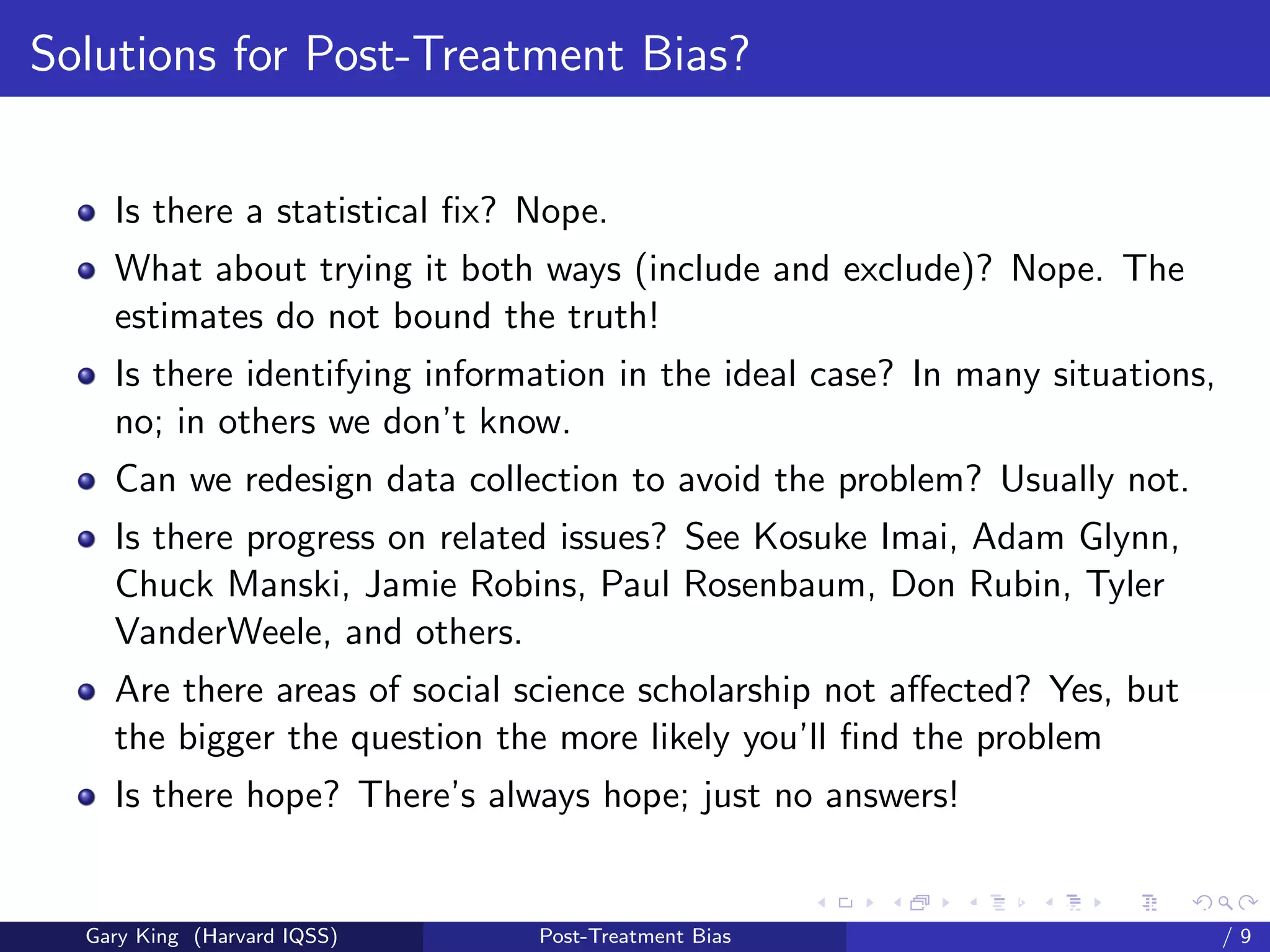
    Is there a statistical fix? Nope.


                                                     Talk at the “Hard Problems in S
  Gary King (Harvard IQSS)     Post-Treatment Bias                             /9
Solutions for Post-Treatment Bias?


    Is there a statistical fix? Nope.
    What about trying it both ways (include and exclude)?


                                                     Talk at the “Hard Problems in S
  Gary King (Harvard IQSS)     Post-Treatment Bias                             /9
Solutions for Post-Treatment Bias?


    Is there a statistical fix? Nope.
    What about trying it both ways (include and exclude)? Nope. The
    estimates do not bound the truth!


                                                     Talk at the “Hard Problems in S
  Gary King (Harvard IQSS)     Post-Treatment Bias                             /9
Solutions for Post-Treatment Bias?


    Is there a statistical fix? Nope.
    What about trying it both ways (include and exclude)? Nope. The
    estimates do not bound the truth!
    Is there identifying information in the ideal case?


                                                     Talk at the “Hard Problems in S
  Gary King (Harvard IQSS)     Post-Treatment Bias                             /9
Solutions for Post-Treatment Bias?


    Is there a statistical fix? Nope.
    What about trying it both ways (include and exclude)? Nope. The
    estimates do not bound the truth!
    Is there identifying information in the ideal case? In many situations,
    no; in others we don’t know.


                                                     Talk at the “Hard Problems in S
  Gary King (Harvard IQSS)     Post-Treatment Bias                             /9
Solutions for Post-Treatment Bias?


    Is there a statistical fix? Nope.
    What about trying it both ways (include and exclude)? Nope. The
    estimates do not bound the truth!
    Is there identifying information in the ideal case? In many situations,
    no; in others we don’t know.
    Can we redesign data collection to avoid the problem?


                                                     Talk at the “Hard Problems in S
  Gary King (Harvard IQSS)     Post-Treatment Bias                             /9
Solutions for Post-Treatment Bias?


    Is there a statistical fix? Nope.
    What about trying it both ways (include and exclude)? Nope. The
    estimates do not bound the truth!
    Is there identifying information in the ideal case? In many situations,
    no; in others we don’t know.
    Can we redesign data collection to avoid the problem? Usually not.


                                                     Talk at the “Hard Problems in S
  Gary King (Harvard IQSS)     Post-Treatment Bias                             /9
Solutions for Post-Treatment Bias?


    Is there a statistical fix? Nope.
    What about trying it both ways (include and exclude)? Nope. The
    estimates do not bound the truth!
    Is there identifying information in the ideal case? In many situations,
    no; in others we don’t know.
    Can we redesign data collection to avoid the problem? Usually not.
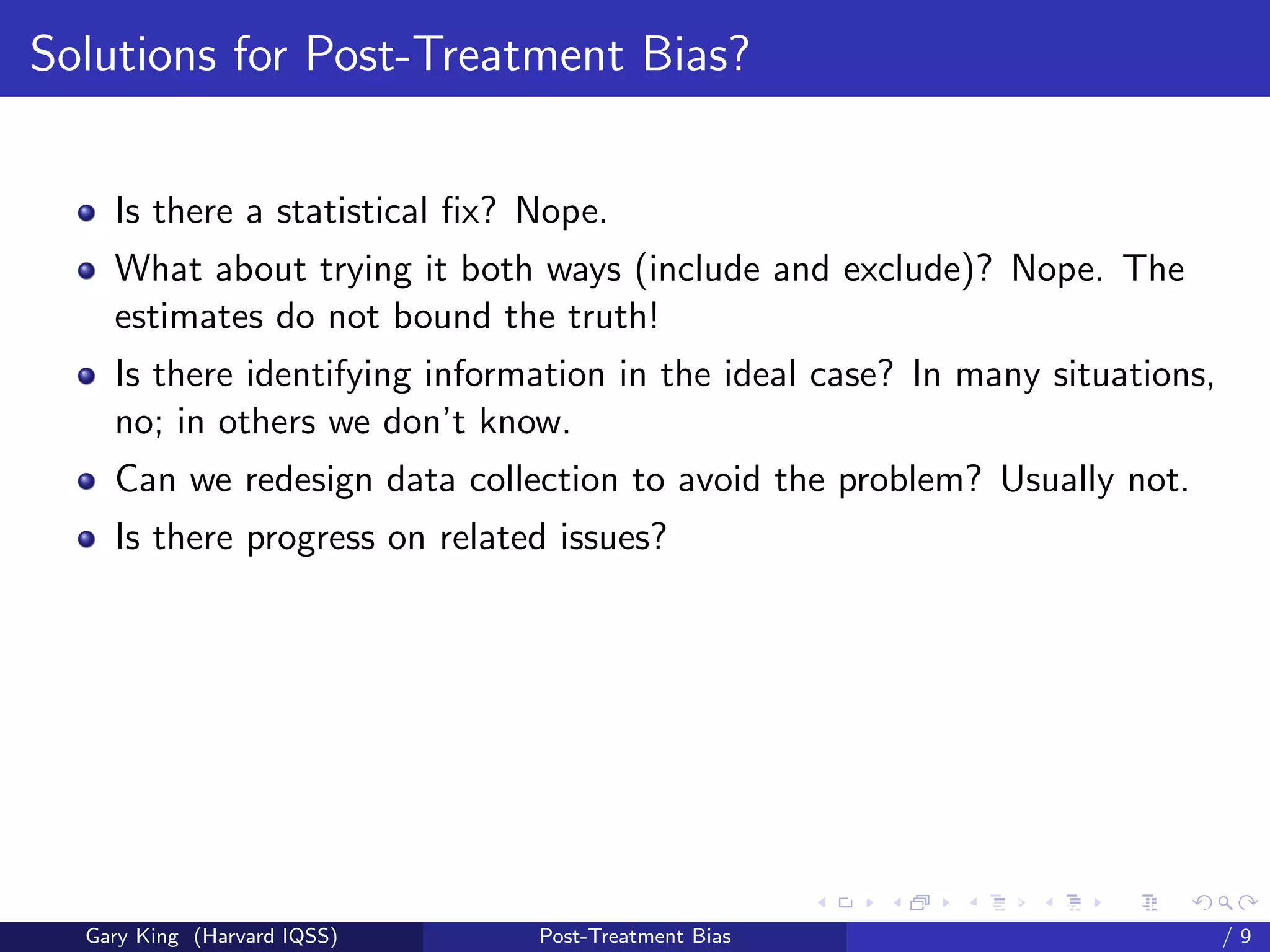
    Is there progress on related issues?


                                                     Talk at the “Hard Problems in S
  Gary King (Harvard IQSS)     Post-Treatment Bias                             /9
Solutions for Post-Treatment Bias?


    Is there a statistical fix? Nope.
    What about trying it both ways (include and exclude)? Nope. The
    estimates do not bound the truth!
    Is there identifying information in the ideal case? In many situations,
    no; in others we don’t know.
    Can we redesign data collection to avoid the problem? Usually not.
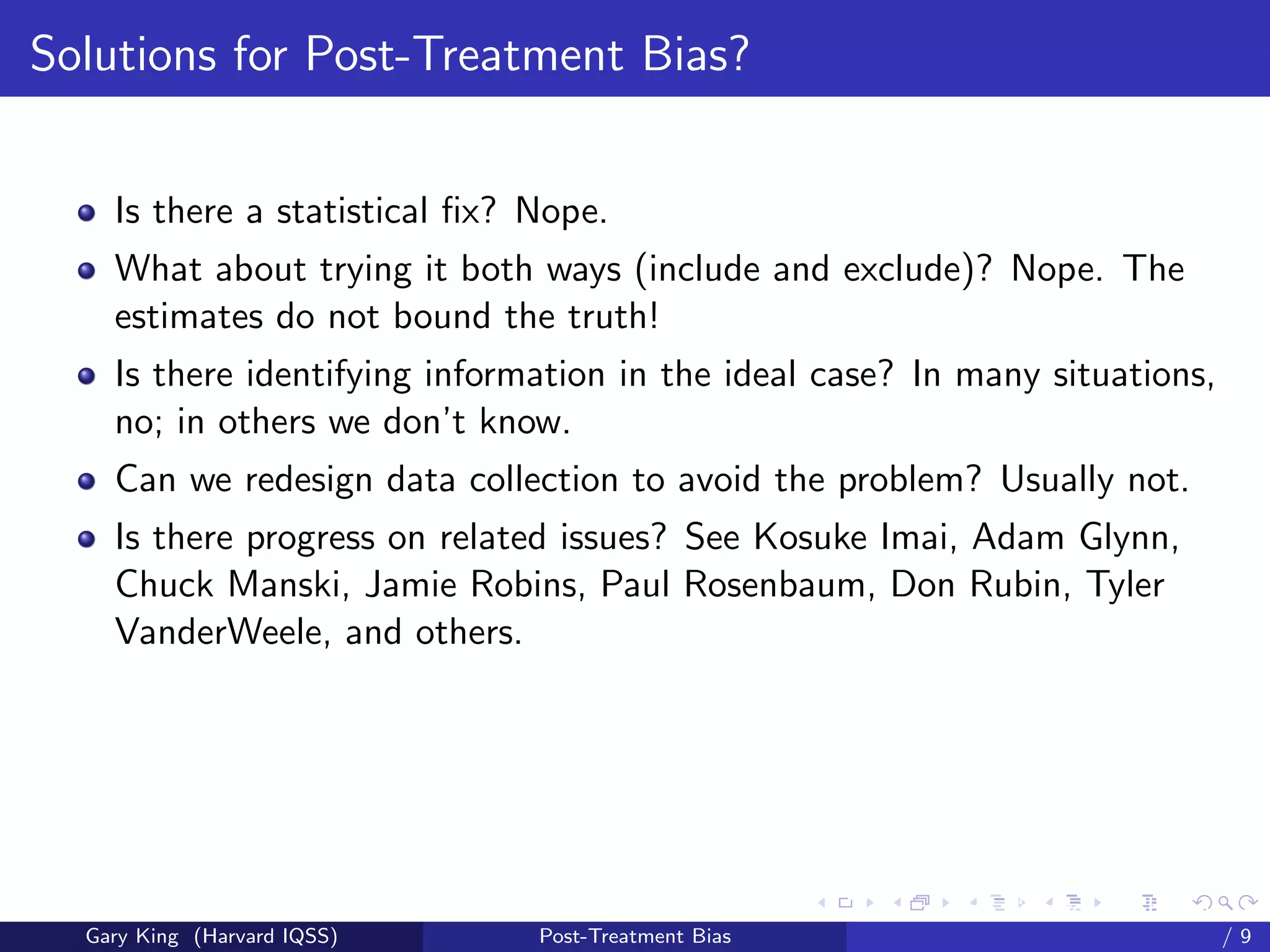
    Is there progress on related issues? See Kosuke Imai, Adam Glynn,
    Chuck Manski, Jamie Robins, Paul Rosenbaum, Don Rubin, Tyler
    VanderWeele, and others.


                                                     Talk at the “Hard Problems in S
  Gary King (Harvard IQSS)     Post-Treatment Bias                             /9
Solutions for Post-Treatment Bias?


    Is there a statistical fix? Nope.
    What about trying it both ways (include and exclude)? Nope. The
    estimates do not bound the truth!
    Is there identifying information in the ideal case? In many situations,
    no; in others we don’t know.
    Can we redesign data collection to avoid the problem? Usually not.
    Is there progress on related issues? See Kosuke Imai, Adam Glynn,
    Chuck Manski, Jamie Robins, Paul Rosenbaum, Don Rubin, Tyler
    VanderWeele, and others.
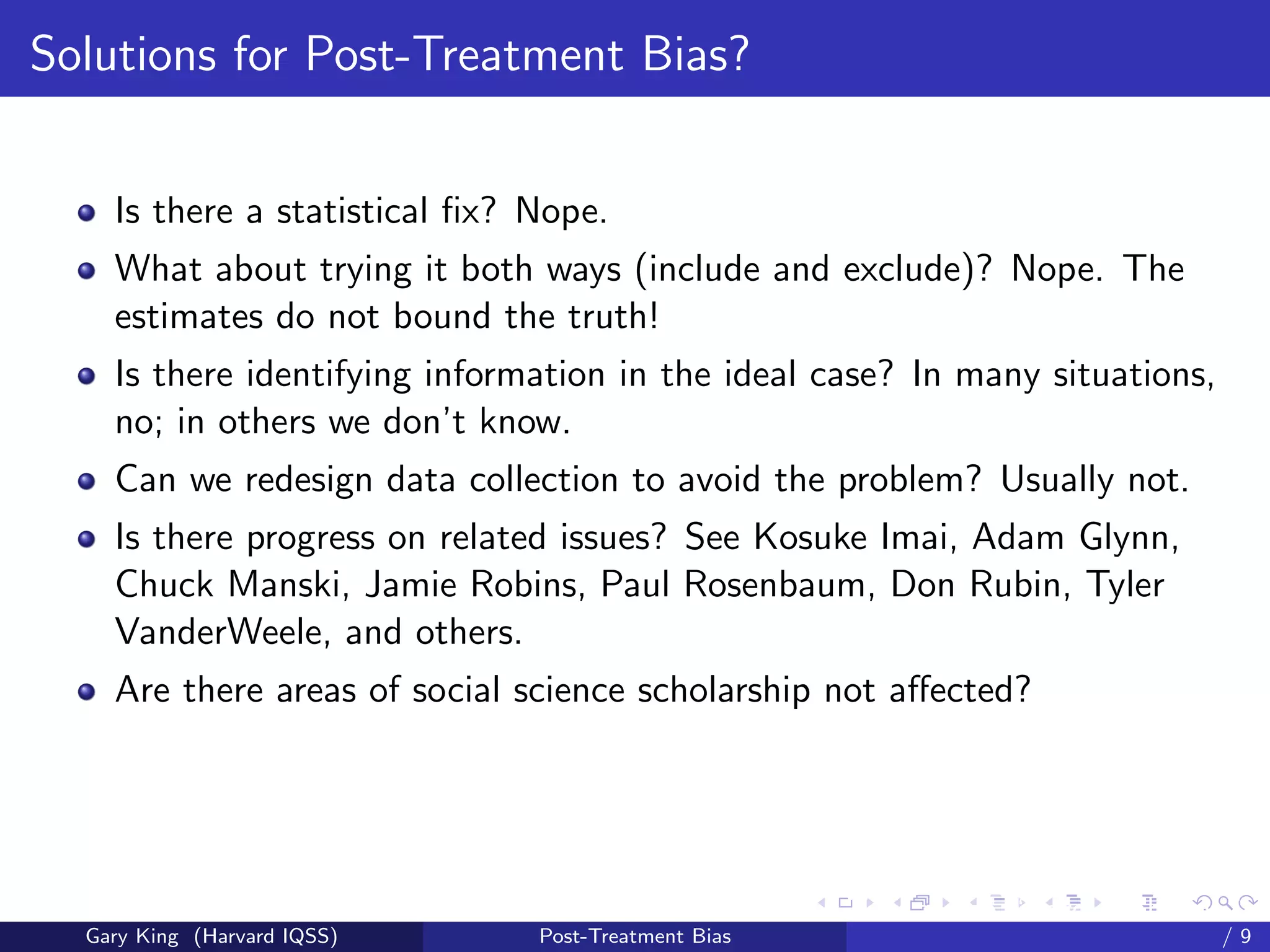
    Are there areas of social science scholarship not affected?


                                                     Talk at the “Hard Problems in S
  Gary King (Harvard IQSS)     Post-Treatment Bias                             /9
Solutions for Post-Treatment Bias?


    Is there a statistical fix? Nope.
    What about trying it both ways (include and exclude)? Nope. The
    estimates do not bound the truth!
    Is there identifying information in the ideal case? In many situations,
    no; in others we don’t know.
    Can we redesign data collection to avoid the problem? Usually not.
    Is there progress on related issues? See Kosuke Imai, Adam Glynn,
    Chuck Manski, Jamie Robins, Paul Rosenbaum, Don Rubin, Tyler
    VanderWeele, and others.
    Are there areas of social science scholarship not affected? Yes, but
    the bigger the question the more likely you’ll find the problem


                                                     Talk at the “Hard Problems in S
  Gary King (Harvard IQSS)     Post-Treatment Bias                             /9
Solutions for Post-Treatment Bias?


    Is there a statistical fix? Nope.
    What about trying it both ways (include and exclude)? Nope. The
    estimates do not bound the truth!
    Is there identifying information in the ideal case? In many situations,
    no; in others we don’t know.
    Can we redesign data collection to avoid the problem? Usually not.
    Is there progress on related issues? See Kosuke Imai, Adam Glynn,
    Chuck Manski, Jamie Robins, Paul Rosenbaum, Don Rubin, Tyler
    VanderWeele, and others.
    Are there areas of social science scholarship not affected? Yes, but
    the bigger the question the more likely you’ll find the problem
    Is there hope?

                                                     Talk at the “Hard Problems in S
  Gary King (Harvard IQSS)     Post-Treatment Bias                             /9
Solutions for Post-Treatment Bias?


    Is there a statistical fix? Nope.
    What about trying it both ways (include and exclude)? Nope. The
    estimates do not bound the truth!
    Is there identifying information in the ideal case? In many situations,
    no; in others we don’t know.
    Can we redesign data collection to avoid the problem? Usually not.
    Is there progress on related issues? See Kosuke Imai, Adam Glynn,
    Chuck Manski, Jamie Robins, Paul Rosenbaum, Don Rubin, Tyler
    VanderWeele, and others.
    Are there areas of social science scholarship not affected? Yes, but
    the bigger the question the more likely you’ll find the problem
    Is there hope? There’s always hope; just no answers!

                                                     Talk at the “Hard Problems in S
  Gary King (Harvard IQSS)     Post-Treatment Bias                             /9
For more information


                  http://GKing.Harvard.edu


                                                   Talk at the “Hard Problems in S
  Gary King (Harvard IQSS)   Post-Treatment Bias                             /9

Gary King- Hard Unsolved Problem in Social Science:Post Treatment Bias

  • 1.
    A Hard UnsolvedProblem? Post-Treatment Bias in Big Social Science Questions Gary King Institute for Quantitative Social Science Harvard University Talk at the “Hard Problems in Social Science” Symposium, Harvard University 4/10/2010 Talk at the “Hard Problems in S Gary King (Harvard IQSS) Post-Treatment Bias /9
  • 2.
    A Few BigSocial Science Questions We Can’t Answer Talk at the “Hard Problems in S Gary King (Harvard IQSS) Post-Treatment Bias /9
  • 3.
    A Few BigSocial Science Questions We Can’t Answer Does democratization reduce international conflict? Talk at the “Hard Problems in S Gary King (Harvard IQSS) Post-Treatment Bias /9
  • 4.
    A Few BigSocial Science Questions We Can’t Answer Does democratization reduce international conflict? Does ethnic diversity in developing countries cause civil war? Talk at the “Hard Problems in S Gary King (Harvard IQSS) Post-Treatment Bias /9
  • 5.
    A Few BigSocial Science Questions We Can’t Answer Does democratization reduce international conflict? Does ethnic diversity in developing countries cause civil war? Does trade openness reduce the risk of state failure? Talk at the “Hard Problems in S Gary King (Harvard IQSS) Post-Treatment Bias /9
  • 6.
    A Few BigSocial Science Questions We Can’t Answer Does democratization reduce international conflict? Does ethnic diversity in developing countries cause civil war? Does trade openness reduce the risk of state failure? Do strong international institutions lead to or result from international cooperation? Talk at the “Hard Problems in S Gary King (Harvard IQSS) Post-Treatment Bias /9
  • 7.
    A Few BigSocial Science Questions We Can’t Answer Does democratization reduce international conflict? Does ethnic diversity in developing countries cause civil war? Does trade openness reduce the risk of state failure? Do strong international institutions lead to or result from international cooperation? How to distinguish between (1) the effect of your health on others and (2) the effect of interventions to improve your health on others? Talk at the “Hard Problems in S Gary King (Harvard IQSS) Post-Treatment Bias /9
  • 8.
    A Few BigSocial Science Questions We Can’t Answer Does democratization reduce international conflict? Does ethnic diversity in developing countries cause civil war? Does trade openness reduce the risk of state failure? Do strong international institutions lead to or result from international cooperation? How to distinguish between (1) the effect of your health on others and (2) the effect of interventions to improve your health on others? Is individual student achievement caused by (1) students’ socioeconomic characteristics or (2) their peers’ average achievement? (I.e., does tutoring a subgroup help others and then feedback?) Talk at the “Hard Problems in S Gary King (Harvard IQSS) Post-Treatment Bias /9
  • 9.
    A Few BigSocial Science Questions We Can’t Answer Does democratization reduce international conflict? Does ethnic diversity in developing countries cause civil war? Does trade openness reduce the risk of state failure? Do strong international institutions lead to or result from international cooperation? How to distinguish between (1) the effect of your health on others and (2) the effect of interventions to improve your health on others? Is individual student achievement caused by (1) students’ socioeconomic characteristics or (2) their peers’ average achievement? (I.e., does tutoring a subgroup help others and then feedback?) Thousands of other examples in most areas of the social sciences. Talk at the “Hard Problems in S Gary King (Harvard IQSS) Post-Treatment Bias /9
  • 10.
    Experiments are terrific,but that’s not the issue Talk at the “Hard Problems in S Gary King (Harvard IQSS) Post-Treatment Bias /9
  • 11.
    Experiments are terrific,but that’s not the issue Experimental research: requires random treatment assignment Talk at the “Hard Problems in S Gary King (Harvard IQSS) Post-Treatment Bias /9
  • 12.
    Experiments are terrific,but that’s not the issue Experimental research: requires random treatment assignment (Perhaps the most important methodological idea in the last century) Talk at the “Hard Problems in S Gary King (Harvard IQSS) Post-Treatment Bias /9
  • 13.
    Experiments are terrific,but that’s not the issue Experimental research: requires random treatment assignment (Perhaps the most important methodological idea in the last century) Random assignment: occasionally possible Talk at the “Hard Problems in S Gary King (Harvard IQSS) Post-Treatment Bias /9
  • 14.
    Experiments are terrific,but that’s not the issue Experimental research: requires random treatment assignment (Perhaps the most important methodological idea in the last century) Random assignment: occasionally possible, usually not Talk at the “Hard Problems in S Gary King (Harvard IQSS) Post-Treatment Bias /9
  • 15.
    Experiments are terrific,but that’s not the issue Experimental research: requires random treatment assignment (Perhaps the most important methodological idea in the last century) Random assignment: occasionally possible, usually not The vast majority of research is observational Talk at the “Hard Problems in S Gary King (Harvard IQSS) Post-Treatment Bias /9
  • 16.
    Experiments are terrific,but that’s not the issue Experimental research: requires random treatment assignment (Perhaps the most important methodological idea in the last century) Random assignment: occasionally possible, usually not The vast majority of research is observational The vast majority of knowledge learned is from observation Talk at the “Hard Problems in S Gary King (Harvard IQSS) Post-Treatment Bias /9
  • 17.
    Experiments are terrific,but that’s not the issue Experimental research: requires random treatment assignment (Perhaps the most important methodological idea in the last century) Random assignment: occasionally possible, usually not The vast majority of research is observational The vast majority of knowledge learned is from observation Most knowledge learned from experiments is observational Talk at the “Hard Problems in S Gary King (Harvard IQSS) Post-Treatment Bias /9
  • 18.
    Experiments are terrific,but that’s not the issue Experimental research: requires random treatment assignment (Perhaps the most important methodological idea in the last century) Random assignment: occasionally possible, usually not The vast majority of research is observational The vast majority of knowledge learned is from observation Most knowledge learned from experiments is observational So yes Talk at the “Hard Problems in S Gary King (Harvard IQSS) Post-Treatment Bias /9
  • 19.
    Experiments are terrific,but that’s not the issue Experimental research: requires random treatment assignment (Perhaps the most important methodological idea in the last century) Random assignment: occasionally possible, usually not The vast majority of research is observational The vast majority of knowledge learned is from observation Most knowledge learned from experiments is observational So yes experiments are terrific Talk at the “Hard Problems in S Gary King (Harvard IQSS) Post-Treatment Bias /9
  • 20.
    Experiments are terrific,but that’s not the issue Experimental research: requires random treatment assignment (Perhaps the most important methodological idea in the last century) Random assignment: occasionally possible, usually not The vast majority of research is observational The vast majority of knowledge learned is from observation Most knowledge learned from experiments is observational So yes experiments are terrific we can’t run them that often Talk at the “Hard Problems in S Gary King (Harvard IQSS) Post-Treatment Bias /9
  • 21.
    Experiments are terrific,but that’s not the issue Experimental research: requires random treatment assignment (Perhaps the most important methodological idea in the last century) Random assignment: occasionally possible, usually not The vast majority of research is observational The vast majority of knowledge learned is from observation Most knowledge learned from experiments is observational So yes experiments are terrific we can’t run them that often but we can often learn plenty without experiments Talk at the “Hard Problems in S Gary King (Harvard IQSS) Post-Treatment Bias /9
  • 22.
    Progress in CausalInference Talk at the “Hard Problems in S Gary King (Harvard IQSS) Post-Treatment Bias /9
  • 23.
    Progress in CausalInference Inference: using facts you have to learn about facts you don’t have Talk at the “Hard Problems in S Gary King (Harvard IQSS) Post-Treatment Bias /9
  • 24.
    Progress in CausalInference Inference: using facts you have to learn about facts you don’t have Causal effect: Your outcome with the treatment minus your outcome if you had not received the treatment Talk at the “Hard Problems in S Gary King (Harvard IQSS) Post-Treatment Bias /9
  • 25.
    Progress in CausalInference Inference: using facts you have to learn about facts you don’t have Causal effect: Your outcome with the treatment minus your outcome if you had not received the treatment Causal inference: estimating the causal effect Talk at the “Hard Problems in S Gary King (Harvard IQSS) Post-Treatment Bias /9
  • 26.
    Progress in CausalInference Inference: using facts you have to learn about facts you don’t have Causal effect: Your outcome with the treatment minus your outcome if you had not received the treatment Causal inference: estimating the causal effect Get equivalent treatment and control groups Talk at the “Hard Problems in S Gary King (Harvard IQSS) Post-Treatment Bias /9
  • 27.
    Progress in CausalInference Inference: using facts you have to learn about facts you don’t have Causal effect: Your outcome with the treatment minus your outcome if you had not received the treatment Causal inference: estimating the causal effect Get equivalent treatment and control groups Apply or observe the treatment Talk at the “Hard Problems in S Gary King (Harvard IQSS) Post-Treatment Bias /9
  • 28.
    Progress in CausalInference Inference: using facts you have to learn about facts you don’t have Causal effect: Your outcome with the treatment minus your outcome if you had not received the treatment Causal inference: estimating the causal effect Get equivalent treatment and control groups Apply or observe the treatment average(outcome for treateds) − average(outcome for controls) Talk at the “Hard Problems in S Gary King (Harvard IQSS) Post-Treatment Bias /9
  • 29.
    Progress in CausalInference Inference: using facts you have to learn about facts you don’t have Causal effect: Your outcome with the treatment minus your outcome if you had not received the treatment Causal inference: estimating the causal effect Get equivalent treatment and control groups Apply or observe the treatment average(outcome for treateds) − average(outcome for controls) Biggest problem we know about: Omitted variable bias Talk at the “Hard Problems in S Gary King (Harvard IQSS) Post-Treatment Bias /9
  • 30.
    Progress in CausalInference Inference: using facts you have to learn about facts you don’t have Causal effect: Your outcome with the treatment minus your outcome if you had not received the treatment Causal inference: estimating the causal effect Get equivalent treatment and control groups Apply or observe the treatment average(outcome for treateds) − average(outcome for controls) Biggest problem we know about: Omitted variable bias What if those who get the medicine are healthier than those who don’t? Talk at the “Hard Problems in S Gary King (Harvard IQSS) Post-Treatment Bias /9
  • 31.
    Progress in CausalInference Inference: using facts you have to learn about facts you don’t have Causal effect: Your outcome with the treatment minus your outcome if you had not received the treatment Causal inference: estimating the causal effect Get equivalent treatment and control groups Apply or observe the treatment average(outcome for treateds) − average(outcome for controls) Biggest problem we know about: Omitted variable bias What if those who get the medicine are healthier than those who don’t? What if those who participate in a job training program are less educated? Talk at the “Hard Problems in S Gary King (Harvard IQSS) Post-Treatment Bias /9
  • 32.
    Progress in CausalInference Inference: using facts you have to learn about facts you don’t have Causal effect: Your outcome with the treatment minus your outcome if you had not received the treatment Causal inference: estimating the causal effect Get equivalent treatment and control groups Apply or observe the treatment average(outcome for treateds) − average(outcome for controls) Biggest problem we know about: Omitted variable bias What if those who get the medicine are healthier than those who don’t? What if those who participate in a job training program are less educated? Well-known solutions to omitted variable bias: Talk at the “Hard Problems in S Gary King (Harvard IQSS) Post-Treatment Bias /9
  • 33.
    Progress in CausalInference Inference: using facts you have to learn about facts you don’t have Causal effect: Your outcome with the treatment minus your outcome if you had not received the treatment Causal inference: estimating the causal effect Get equivalent treatment and control groups Apply or observe the treatment average(outcome for treateds) − average(outcome for controls) Biggest problem we know about: Omitted variable bias What if those who get the medicine are healthier than those who don’t? What if those who participate in a job training program are less educated? Well-known solutions to omitted variable bias: Randomize treatment (all confounders are unrelated to treatment) Talk at the “Hard Problems in S Gary King (Harvard IQSS) Post-Treatment Bias /9
  • 34.
    Progress in CausalInference Inference: using facts you have to learn about facts you don’t have Causal effect: Your outcome with the treatment minus your outcome if you had not received the treatment Causal inference: estimating the causal effect Get equivalent treatment and control groups Apply or observe the treatment average(outcome for treateds) − average(outcome for controls) Biggest problem we know about: Omitted variable bias What if those who get the medicine are healthier than those who don’t? What if those who participate in a job training program are less educated? Well-known solutions to omitted variable bias: Randomize treatment (all confounders are unrelated to treatment) Control (physically or statistically) for the potential confounders Talk at the “Hard Problems in S Gary King (Harvard IQSS) Post-Treatment Bias /9
  • 35.
    So What’s Post-TreatmentBias? Talk at the “Hard Problems in S Gary King (Harvard IQSS) Post-Treatment Bias /9
  • 36.
    So What’s Post-TreatmentBias? It occurs: Talk at the “Hard Problems in S Gary King (Harvard IQSS) Post-Treatment Bias /9
  • 37.
    So What’s Post-TreatmentBias? It occurs: when controlling away for the consequences of treatment Talk at the “Hard Problems in S Gary King (Harvard IQSS) Post-Treatment Bias /9
  • 38.
    So What’s Post-TreatmentBias? It occurs: when controlling away for the consequences of treatment when causal ordering among predictors is ambiguous or wrong Talk at the “Hard Problems in S Gary King (Harvard IQSS) Post-Treatment Bias /9
  • 39.
    So What’s Post-TreatmentBias? It occurs: when controlling away for the consequences of treatment when causal ordering among predictors is ambiguous or wrong Resulting biases can go in either direction Talk at the “Hard Problems in S Gary King (Harvard IQSS) Post-Treatment Bias /9
  • 40.
    So What’s Post-TreatmentBias? It occurs: when controlling away for the consequences of treatment when causal ordering among predictors is ambiguous or wrong Resulting biases can go in either direction The problem is obvious once you think about it Talk at the “Hard Problems in S Gary King (Harvard IQSS) Post-Treatment Bias /9
  • 41.
    So What’s Post-TreatmentBias? It occurs: when controlling away for the consequences of treatment when causal ordering among predictors is ambiguous or wrong Resulting biases can go in either direction The problem is obvious once you think about it For many big social science questions, we have no solution Talk at the “Hard Problems in S Gary King (Harvard IQSS) Post-Treatment Bias /9
  • 42.
    Examples of AvoidablePost-Treatment Bias Talk at the “Hard Problems in S Gary King (Harvard IQSS) Post-Treatment Bias /9
  • 43.
    Examples of AvoidablePost-Treatment Bias Causal effect of Party ID on the Vote Talk at the “Hard Problems in S Gary King (Harvard IQSS) Post-Treatment Bias /9
  • 44.
    Examples of AvoidablePost-Treatment Bias Causal effect of Party ID on the Vote Do control for race Talk at the “Hard Problems in S Gary King (Harvard IQSS) Post-Treatment Bias /9
  • 45.
    Examples of AvoidablePost-Treatment Bias Causal effect of Party ID on the Vote Do control for race Do not control for voting intentions five minutes before voting Talk at the “Hard Problems in S Gary King (Harvard IQSS) Post-Treatment Bias /9
  • 46.
    Examples of AvoidablePost-Treatment Bias Causal effect of Party ID on the Vote Do control for race Do not control for voting intentions five minutes before voting Causal effect of Race on Salary in a firm Talk at the “Hard Problems in S Gary King (Harvard IQSS) Post-Treatment Bias /9
  • 47.
    Examples of AvoidablePost-Treatment Bias Causal effect of Party ID on the Vote Do control for race Do not control for voting intentions five minutes before voting Causal effect of Race on Salary in a firm Do control for qualifications Talk at the “Hard Problems in S Gary King (Harvard IQSS) Post-Treatment Bias /9
  • 48.
    Examples of AvoidablePost-Treatment Bias Causal effect of Party ID on the Vote Do control for race Do not control for voting intentions five minutes before voting Causal effect of Race on Salary in a firm Do control for qualifications Don’t control for position in the firm Talk at the “Hard Problems in S Gary King (Harvard IQSS) Post-Treatment Bias /9
  • 49.
    Examples of AvoidablePost-Treatment Bias Causal effect of Party ID on the Vote Do control for race Do not control for voting intentions five minutes before voting Causal effect of Race on Salary in a firm Do control for qualifications Don’t control for position in the firm Causal effect of medicine on health Talk at the “Hard Problems in S Gary King (Harvard IQSS) Post-Treatment Bias /9
  • 50.
    Examples of AvoidablePost-Treatment Bias Causal effect of Party ID on the Vote Do control for race Do not control for voting intentions five minutes before voting Causal effect of Race on Salary in a firm Do control for qualifications Don’t control for position in the firm Causal effect of medicine on health Do control for health prior to the treatment decision Talk at the “Hard Problems in S Gary King (Harvard IQSS) Post-Treatment Bias /9
  • 51.
    Examples of AvoidablePost-Treatment Bias Causal effect of Party ID on the Vote Do control for race Do not control for voting intentions five minutes before voting Causal effect of Race on Salary in a firm Do control for qualifications Don’t control for position in the firm Causal effect of medicine on health Do control for health prior to the treatment decision Do not control for side effects or other medicines taken later Talk at the “Hard Problems in S Gary King (Harvard IQSS) Post-Treatment Bias /9
  • 52.
    Examples of AvoidablePost-Treatment Bias Causal effect of Party ID on the Vote Do control for race Do not control for voting intentions five minutes before voting Causal effect of Race on Salary in a firm Do control for qualifications Don’t control for position in the firm Causal effect of medicine on health Do control for health prior to the treatment decision Do not control for side effects or other medicines taken later Post-treatment bias in these examples: easy to see & avoid Talk at the “Hard Problems in S Gary King (Harvard IQSS) Post-Treatment Bias /9
  • 53.
    Examples of UnavoidablePost-Treatment Bias Talk at the “Hard Problems in S Gary King (Harvard IQSS) Post-Treatment Bias /9
  • 54.
    Examples of UnavoidablePost-Treatment Bias Causal effect of democratization on civil war; do we control for GDP? Talk at the “Hard Problems in S Gary King (Harvard IQSS) Post-Treatment Bias /9
  • 55.
    Examples of UnavoidablePost-Treatment Bias Causal effect of democratization on civil war; do we control for GDP? Yes, since GDP→democratization we must control to avoid omitted variable bias Talk at the “Hard Problems in S Gary King (Harvard IQSS) Post-Treatment Bias /9
  • 56.
    Examples of UnavoidablePost-Treatment Bias Causal effect of democratization on civil war; do we control for GDP? Yes, since GDP→democratization we must control to avoid omitted variable bias No, since democratization→GDP, we would have post-treatment bias Talk at the “Hard Problems in S Gary King (Harvard IQSS) Post-Treatment Bias /9
  • 57.
    Examples of UnavoidablePost-Treatment Bias Causal effect of democratization on civil war; do we control for GDP? Yes, since GDP→democratization we must control to avoid omitted variable bias No, since democratization→GDP, we would have post-treatment bias Causal effect of legislative effectiveness on state failure; do we control for trade openness? Talk at the “Hard Problems in S Gary King (Harvard IQSS) Post-Treatment Bias /9
  • 58.
    Examples of UnavoidablePost-Treatment Bias Causal effect of democratization on civil war; do we control for GDP? Yes, since GDP→democratization we must control to avoid omitted variable bias No, since democratization→GDP, we would have post-treatment bias Causal effect of legislative effectiveness on state failure; do we control for trade openness? Yes, since trade openness→legislative effectiveness, we must control to avoid omitted variable bias Talk at the “Hard Problems in S Gary King (Harvard IQSS) Post-Treatment Bias /9
  • 59.
    Examples of UnavoidablePost-Treatment Bias Causal effect of democratization on civil war; do we control for GDP? Yes, since GDP→democratization we must control to avoid omitted variable bias No, since democratization→GDP, we would have post-treatment bias Causal effect of legislative effectiveness on state failure; do we control for trade openness? Yes, since trade openness→legislative effectiveness, we must control to avoid omitted variable bias No, since legislative effectiveness→trade openness, we would have post-treatment bias Talk at the “Hard Problems in S Gary King (Harvard IQSS) Post-Treatment Bias /9
  • 60.
    Examples of UnavoidablePost-Treatment Bias Causal effect of democratization on civil war; do we control for GDP? Yes, since GDP→democratization we must control to avoid omitted variable bias No, since democratization→GDP, we would have post-treatment bias Causal effect of legislative effectiveness on state failure; do we control for trade openness? Yes, since trade openness→legislative effectiveness, we must control to avoid omitted variable bias No, since legislative effectiveness→trade openness, we would have post-treatment bias Causal effect of tutoring on individual test scores; do we control for average test scores? Talk at the “Hard Problems in S Gary King (Harvard IQSS) Post-Treatment Bias /9
  • 61.
    Examples of UnavoidablePost-Treatment Bias Causal effect of democratization on civil war; do we control for GDP? Yes, since GDP→democratization we must control to avoid omitted variable bias No, since democratization→GDP, we would have post-treatment bias Causal effect of legislative effectiveness on state failure; do we control for trade openness? Yes, since trade openness→legislative effectiveness, we must control to avoid omitted variable bias No, since legislative effectiveness→trade openness, we would have post-treatment bias Causal effect of tutoring on individual test scores; do we control for average test scores? Yes, since peers→individual scores, and so must control to avoid omitted variable bias Talk at the “Hard Problems in S Gary King (Harvard IQSS) Post-Treatment Bias /9
  • 62.
    Examples of UnavoidablePost-Treatment Bias Causal effect of democratization on civil war; do we control for GDP? Yes, since GDP→democratization we must control to avoid omitted variable bias No, since democratization→GDP, we would have post-treatment bias Causal effect of legislative effectiveness on state failure; do we control for trade openness? Yes, since trade openness→legislative effectiveness, we must control to avoid omitted variable bias No, since legislative effectiveness→trade openness, we would have post-treatment bias Causal effect of tutoring on individual test scores; do we control for average test scores? Yes, since peers→individual scores, and so must control to avoid omitted variable bias No, since individual scores→averages, we would have post-treatment bias Talk at the “Hard Problems in S Gary King (Harvard IQSS) Post-Treatment Bias /9
  • 63.
    Solutions for Post-TreatmentBias? Talk at the “Hard Problems in S Gary King (Harvard IQSS) Post-Treatment Bias /9
  • 64.
    Solutions for Post-TreatmentBias? Is there a statistical fix? Talk at the “Hard Problems in S Gary King (Harvard IQSS) Post-Treatment Bias /9
  • 65.
    Solutions for Post-TreatmentBias? Is there a statistical fix? Nope. Talk at the “Hard Problems in S Gary King (Harvard IQSS) Post-Treatment Bias /9
  • 66.
    Solutions for Post-TreatmentBias? Is there a statistical fix? Nope. What about trying it both ways (include and exclude)? Talk at the “Hard Problems in S Gary King (Harvard IQSS) Post-Treatment Bias /9
  • 67.
    Solutions for Post-TreatmentBias? Is there a statistical fix? Nope. What about trying it both ways (include and exclude)? Nope. The estimates do not bound the truth! Talk at the “Hard Problems in S Gary King (Harvard IQSS) Post-Treatment Bias /9
  • 68.
    Solutions for Post-TreatmentBias? Is there a statistical fix? Nope. What about trying it both ways (include and exclude)? Nope. The estimates do not bound the truth! Is there identifying information in the ideal case? Talk at the “Hard Problems in S Gary King (Harvard IQSS) Post-Treatment Bias /9
  • 69.
    Solutions for Post-TreatmentBias? Is there a statistical fix? Nope. What about trying it both ways (include and exclude)? Nope. The estimates do not bound the truth! Is there identifying information in the ideal case? In many situations, no; in others we don’t know. Talk at the “Hard Problems in S Gary King (Harvard IQSS) Post-Treatment Bias /9
  • 70.
    Solutions for Post-TreatmentBias? Is there a statistical fix? Nope. What about trying it both ways (include and exclude)? Nope. The estimates do not bound the truth! Is there identifying information in the ideal case? In many situations, no; in others we don’t know. Can we redesign data collection to avoid the problem? Talk at the “Hard Problems in S Gary King (Harvard IQSS) Post-Treatment Bias /9
  • 71.
    Solutions for Post-TreatmentBias? Is there a statistical fix? Nope. What about trying it both ways (include and exclude)? Nope. The estimates do not bound the truth! Is there identifying information in the ideal case? In many situations, no; in others we don’t know. Can we redesign data collection to avoid the problem? Usually not. Talk at the “Hard Problems in S Gary King (Harvard IQSS) Post-Treatment Bias /9
  • 72.
    Solutions for Post-TreatmentBias? Is there a statistical fix? Nope. What about trying it both ways (include and exclude)? Nope. The estimates do not bound the truth! Is there identifying information in the ideal case? In many situations, no; in others we don’t know. Can we redesign data collection to avoid the problem? Usually not. Is there progress on related issues? Talk at the “Hard Problems in S Gary King (Harvard IQSS) Post-Treatment Bias /9
  • 73.
    Solutions for Post-TreatmentBias? Is there a statistical fix? Nope. What about trying it both ways (include and exclude)? Nope. The estimates do not bound the truth! Is there identifying information in the ideal case? In many situations, no; in others we don’t know. Can we redesign data collection to avoid the problem? Usually not. Is there progress on related issues? See Kosuke Imai, Adam Glynn, Chuck Manski, Jamie Robins, Paul Rosenbaum, Don Rubin, Tyler VanderWeele, and others. Talk at the “Hard Problems in S Gary King (Harvard IQSS) Post-Treatment Bias /9
  • 74.
    Solutions for Post-TreatmentBias? Is there a statistical fix? Nope. What about trying it both ways (include and exclude)? Nope. The estimates do not bound the truth! Is there identifying information in the ideal case? In many situations, no; in others we don’t know. Can we redesign data collection to avoid the problem? Usually not. Is there progress on related issues? See Kosuke Imai, Adam Glynn, Chuck Manski, Jamie Robins, Paul Rosenbaum, Don Rubin, Tyler VanderWeele, and others. Are there areas of social science scholarship not affected? Talk at the “Hard Problems in S Gary King (Harvard IQSS) Post-Treatment Bias /9
  • 75.
    Solutions for Post-TreatmentBias? Is there a statistical fix? Nope. What about trying it both ways (include and exclude)? Nope. The estimates do not bound the truth! Is there identifying information in the ideal case? In many situations, no; in others we don’t know. Can we redesign data collection to avoid the problem? Usually not. Is there progress on related issues? See Kosuke Imai, Adam Glynn, Chuck Manski, Jamie Robins, Paul Rosenbaum, Don Rubin, Tyler VanderWeele, and others. Are there areas of social science scholarship not affected? Yes, but the bigger the question the more likely you’ll find the problem Talk at the “Hard Problems in S Gary King (Harvard IQSS) Post-Treatment Bias /9
  • 76.
    Solutions for Post-TreatmentBias? Is there a statistical fix? Nope. What about trying it both ways (include and exclude)? Nope. The estimates do not bound the truth! Is there identifying information in the ideal case? In many situations, no; in others we don’t know. Can we redesign data collection to avoid the problem? Usually not. Is there progress on related issues? See Kosuke Imai, Adam Glynn, Chuck Manski, Jamie Robins, Paul Rosenbaum, Don Rubin, Tyler VanderWeele, and others. Are there areas of social science scholarship not affected? Yes, but the bigger the question the more likely you’ll find the problem Is there hope? Talk at the “Hard Problems in S Gary King (Harvard IQSS) Post-Treatment Bias /9
  • 77.
    Solutions for Post-TreatmentBias? Is there a statistical fix? Nope. What about trying it both ways (include and exclude)? Nope. The estimates do not bound the truth! Is there identifying information in the ideal case? In many situations, no; in others we don’t know. Can we redesign data collection to avoid the problem? Usually not. Is there progress on related issues? See Kosuke Imai, Adam Glynn, Chuck Manski, Jamie Robins, Paul Rosenbaum, Don Rubin, Tyler VanderWeele, and others. Are there areas of social science scholarship not affected? Yes, but the bigger the question the more likely you’ll find the problem Is there hope? There’s always hope; just no answers! Talk at the “Hard Problems in S Gary King (Harvard IQSS) Post-Treatment Bias /9
  • 78.
    For more information http://GKing.Harvard.edu Talk at the “Hard Problems in S Gary King (Harvard IQSS) Post-Treatment Bias /9