Sigrid Heuer
GCP meeting, Hyderabad, Sept 2011
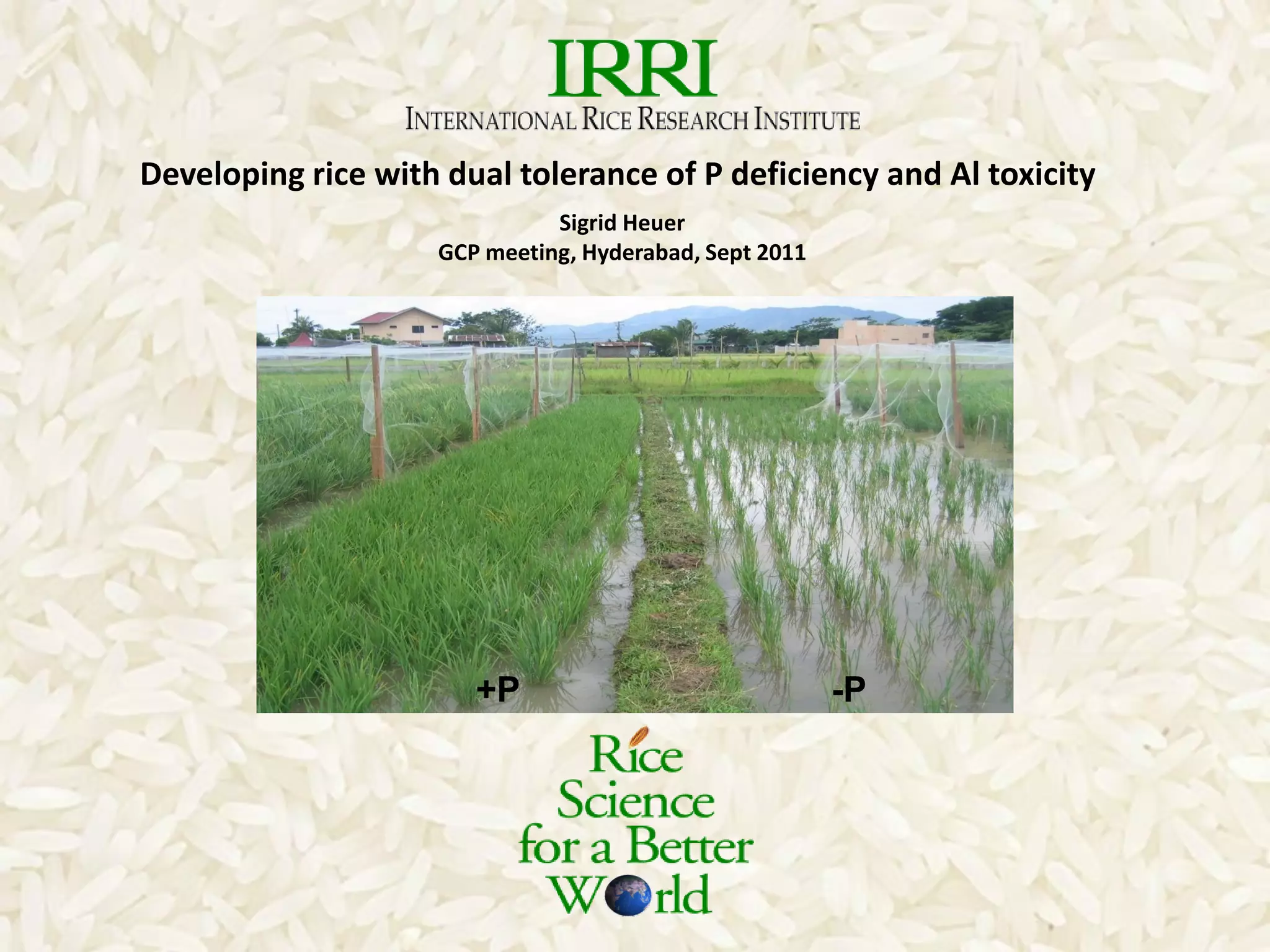
+P -P
Developing rice with dual tolerance of P deficiency and Al toxicity
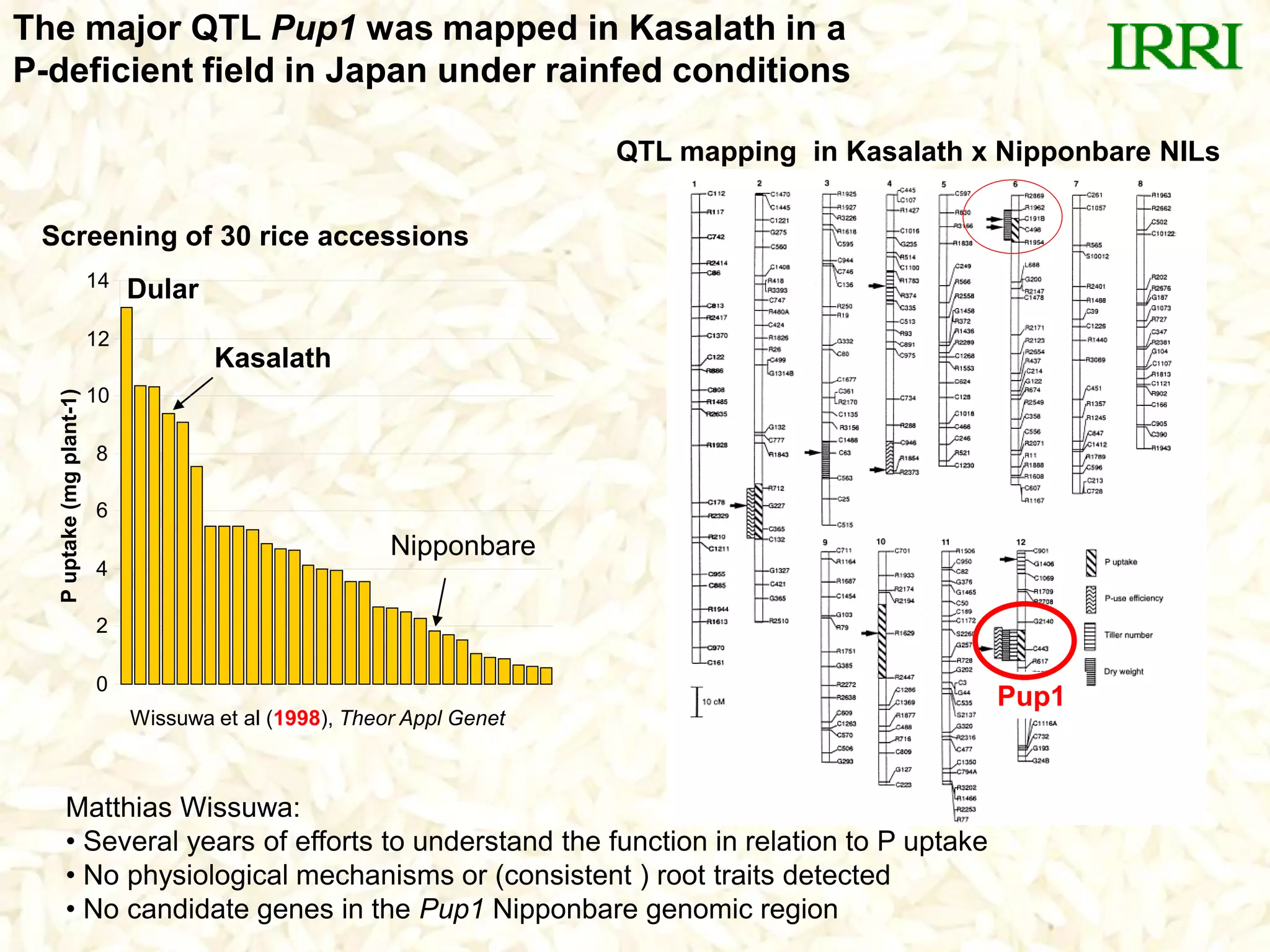
The major QTL Pup1 was mapped in Kasalath in a
P-deficient field in Japan under rainfed conditions
Nipponbare
Kasalath
0
2
4
6
8
10
12
14
Puptake(mgplant-1)
Screening of 30 rice accessions
Dular
Wissuwa et al (1998), Theor Appl Genet
Pup1
QTL mapping in Kasalath x Nipponbare NILs
Matthias Wissuwa:
• Several years of efforts to understand the function in relation to P uptake
• No physiological mechanisms or (consistent ) root traits detected
• No candidate genes in the Pup1 Nipponbare genomic region
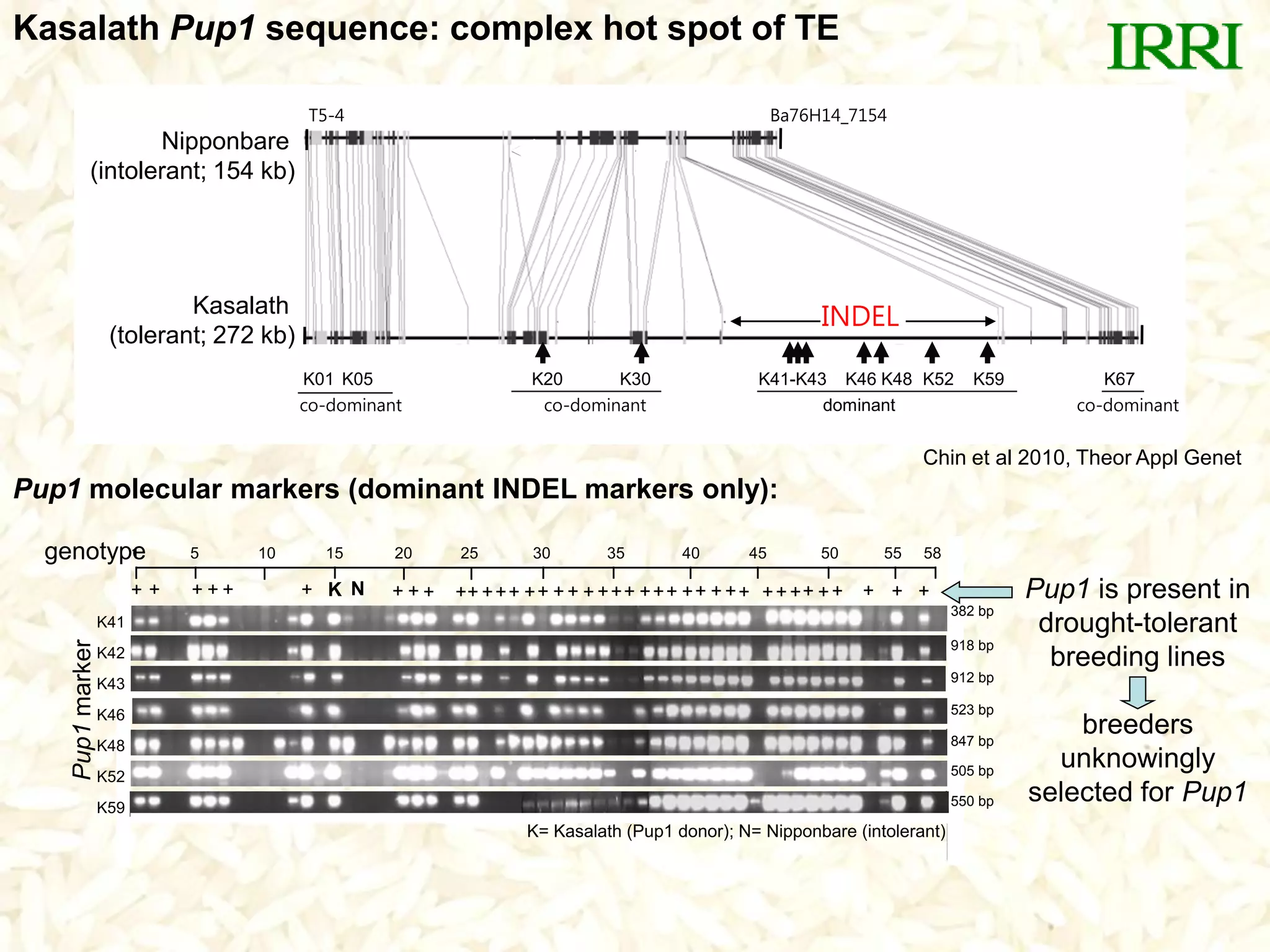
Kasalath Pup1 sequence: complex hot spot of TE
Pup1 molecular markers (dominant INDEL markers only):
+ + + + + + K + + + ++++ ++ + + +++ +++ ++ + + + +++ +++ ++ + ++
382 bp
918 bp
912 bp
523 bp
847 bp
505 bp
550 bp
N
K42
K46
K41
K43
K48
K52
K59
5 10 15 20 25 30 35 40 45 50 551 58
Pup1marker
K= Kasalath (Pup1 donor); N= Nipponbare (intolerant)
genotype
T5-4 Ba76H14_7154
K41-K43 K46 K48 K52 K59K20 K30
INDEL
dominantco-dominant
K01 K05
co-dominant
K67
co-dominant
Nipponbare
(intolerant; 154 kb)
Kasalath
(tolerant; 272 kb)
Pup1 is present in
drought-tolerant
breeding lines
breeders
unknowingly
selected for Pup1
Chin et al 2010, Theor Appl Genet
co-dominantdominant
K N IR64 IR74 B D SB H2O
amplicon (bp)
K / N
OsPupK20-2OsPupK46-
2
OsPupK29-
1
K1
K5
K20-1
K20-1Mse
K20-2
K20-2Bsp
K29-1
K29-2
K29-3
K41
K42
K43
K45
K46-1
K46-2
K48
K52
K59
125 / 122
272 / 280
240 / 243
201 / 243
982 / 995
231+349+402 / 413+582
212 / 206
219 / 212
236 / 248
382 / none
918 / none
912 / none
276 / none
523 / none
227 / none ~550 unspecific
847 / none
505 / none ~700 unspecific
550 / none
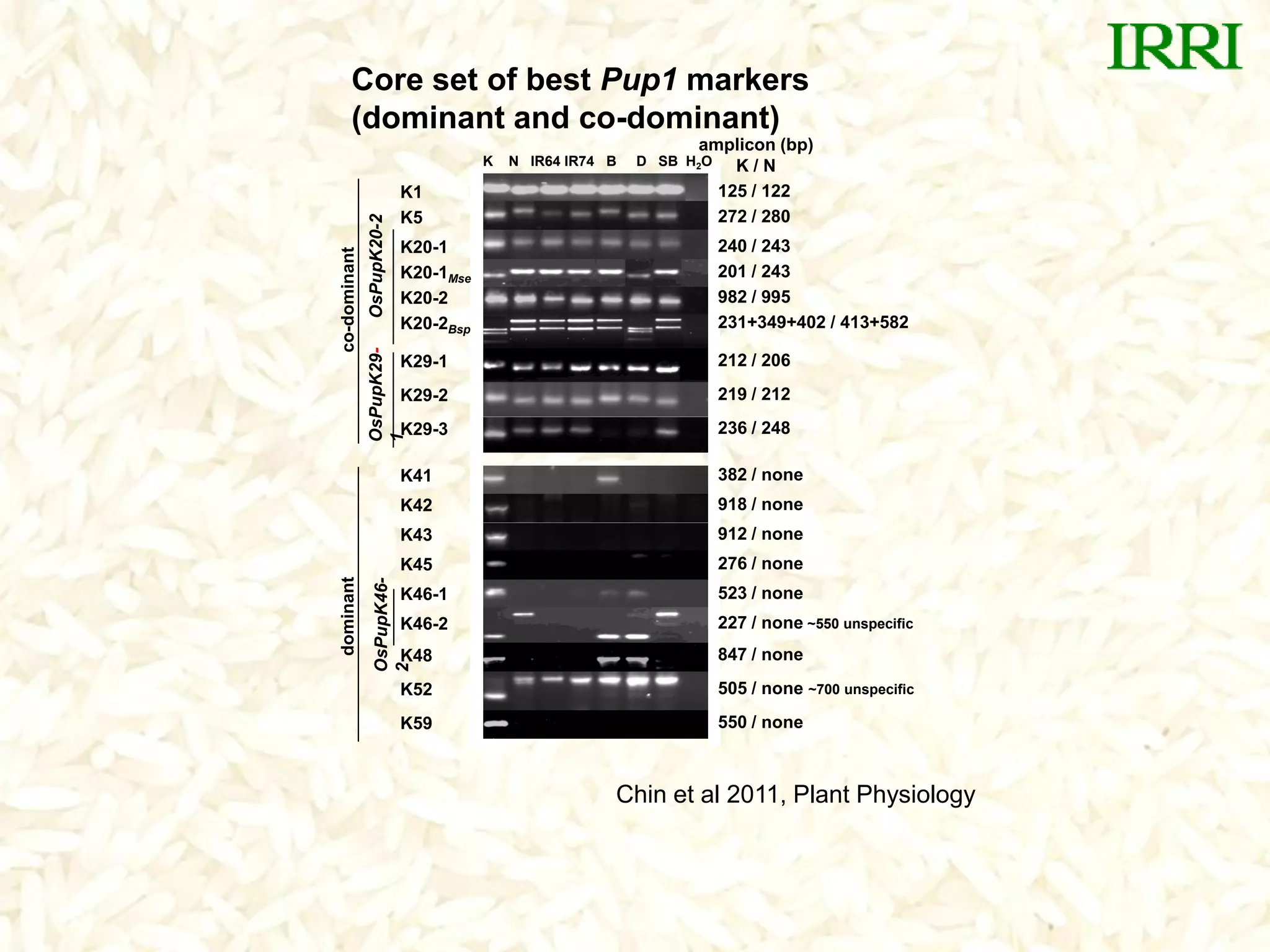
Core set of best Pup1 markers
(dominant and co-dominant)
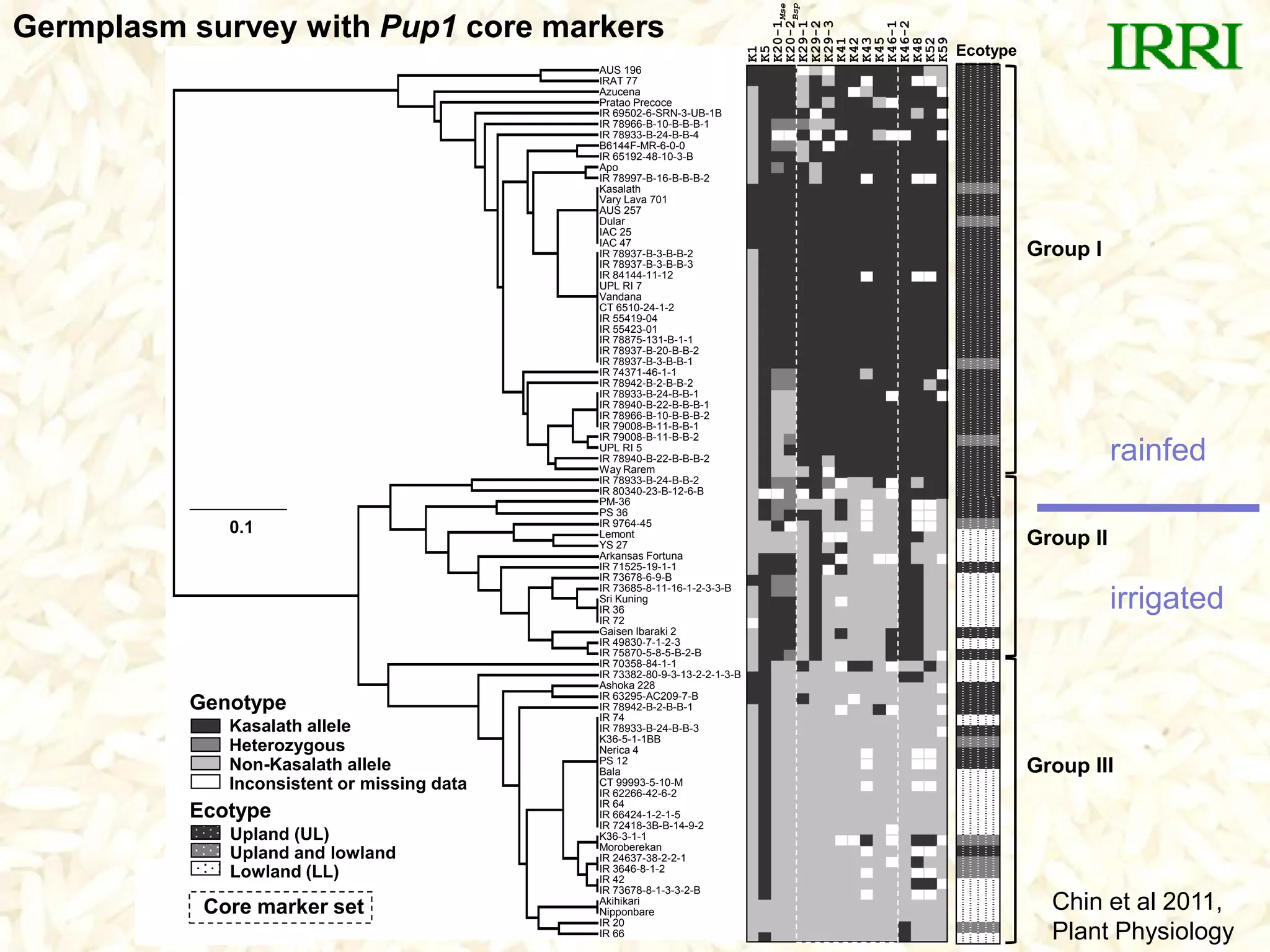
Chin et al 2011, Plant Physiology
0.1
AUS 196
IRAT 77
Azucena
Pratao Precoce
IR 69502-6-SRN-3-UB-1B
IR 78966-B-10-B-B-B-1
IR 78933-B-24-B-B-4
B6144F-MR-6-0-0
IR 65192-48-10-3-B
Apo
IR 78997-B-16-B-B-B-2
Kasalath
Vary Lava 701
AUS 257
Dular
IAC 25
IAC 47
IR 78937-B-3-B-B-2
IR 78937-B-3-B-B-3
IR 84144-11-12
UPL RI 7
Vandana
CT 6510-24-1-2
IR 55419-04
IR 55423-01
IR 78875-131-B-1-1
IR 78937-B-20-B-B-2
IR 78937-B-3-B-B-1
IR 74371-46-1-1
IR 78942-B-2-B-B-2
IR 78933-B-24-B-B-1
IR 78940-B-22-B-B-B-1
IR 78966-B-10-B-B-B-2
IR 79008-B-11-B-B-1
IR 79008-B-11-B-B-2
UPL RI 5
IR 78940-B-22-B-B-B-2
Way Rarem
IR 78933-B-24-B-B-2
IR 80340-23-B-12-6-B
PM-36
PS 36
IR 9764-45
Lemont
YS 27
Arkansas Fortuna
IR 71525-19-1-1
IR 73678-6-9-B
IR 73685-8-11-16-1-2-3-3-B
Sri Kuning
IR 36
IR 72
Gaisen Ibaraki 2
IR 49830-7-1-2-3
IR 75870-5-8-5-B-2-B
IR 70358-84-1-1
IR 73382-80-9-3-13-2-2-1-3-B
Ashoka 228
IR 63295-AC209-7-B
IR 78942-B-2-B-B-1
IR 74
IR 78933-B-24-B-B-3
K36-5-1-1BB
Nerica 4
PS 12
Bala
CT 99993-5-10-M
IR 62266-42-6-2
IR 64
IR 66424-1-2-1-5
IR 72418-3B-B-14-9-2
K36-3-1-1
Moroberekan
IR 24637-38-2-2-1
IR 3646-8-1-2
IR 42
IR 73678-8-1-3-3-2-B
Akihikari
Nipponbare
IR 20
IR 66
K1
K5
K20-1Mse
K20-2Bsp
K29-1
K29-2
K29-3
K41
K42
K43
K45
K46-1
K46-2
K48
K52
K59
Group I
Group II
Group III
Ecotype
Non-Kasalath allele
Heterozygous
Kasalath allele
Inconsistent or missing data
Genotype
Ecotype
Upland (UL)
Upland and lowland
Lowland (LL)
Core marker set Chin et al 2011,
Plant Physiology
Germplasm survey with Pup1 core markers
rainfed
irrigated
Lowland Upland
P+ P- P+ P- Well-watered Drought
P T SM G P T SM G P T SM G P T SM G P T SM G P T SM G
P: plant height
T: tiller number
S: straw weight
M: maturity
G: grain yield
Pup1
Markers (#380)
by chromosome
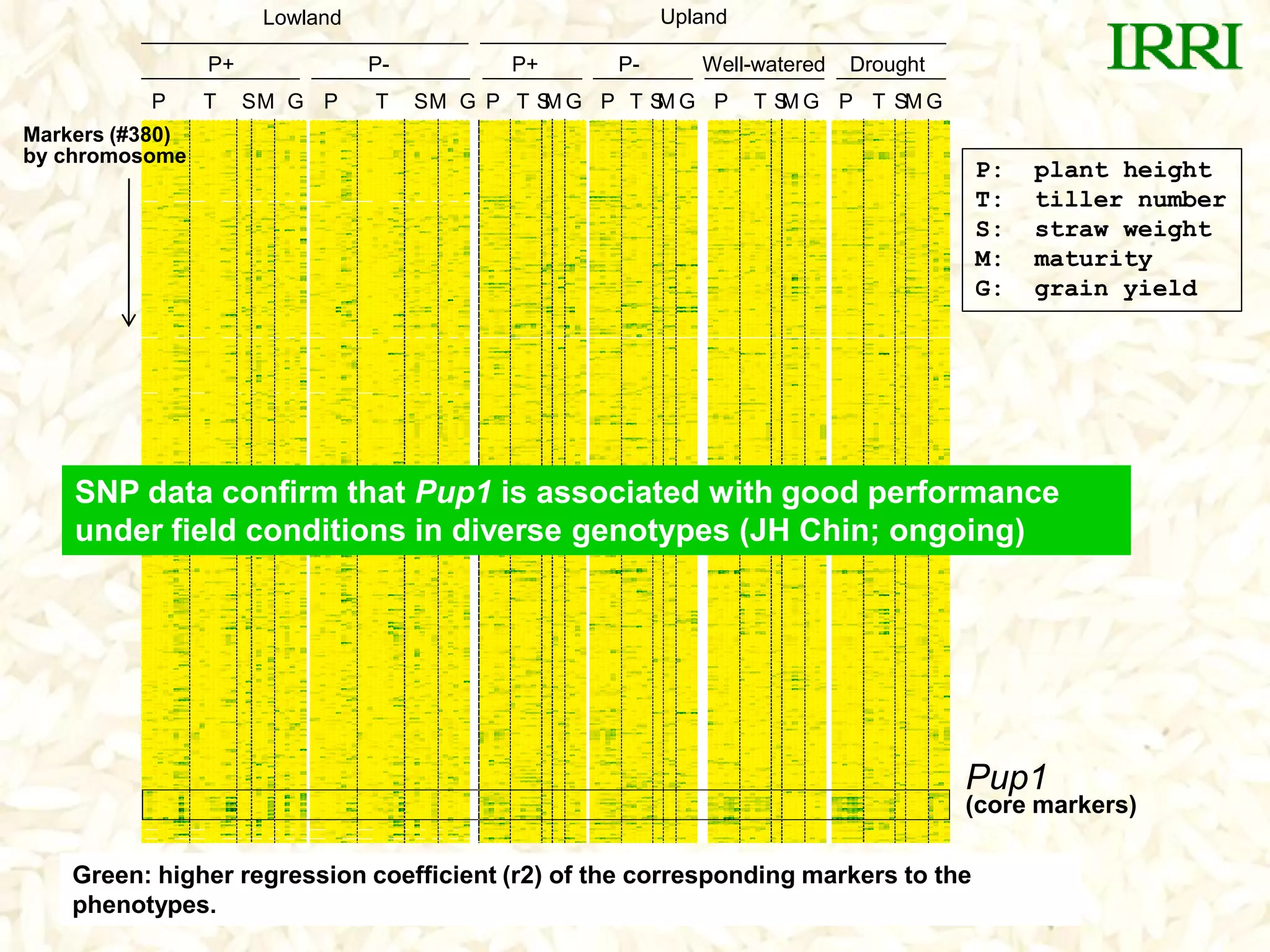
Green: higher regression coefficient (r2) of the corresponding markers to the
phenotypes.
SNP data confirm that Pup1 is associated with good performance
under field conditions in diverse genotypes (JH Chin; ongoing)
(core markers)
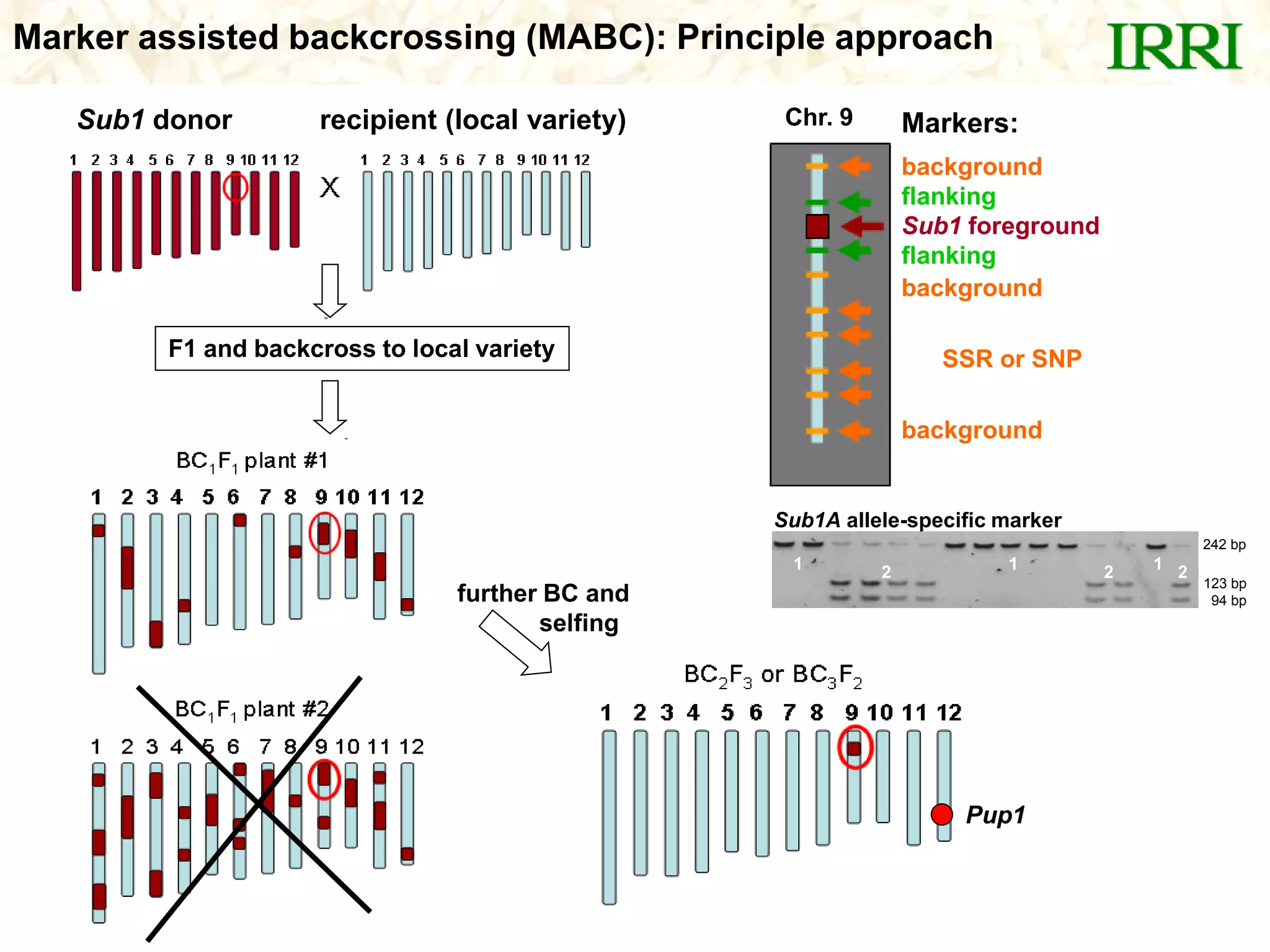
Marker assisted backcrossing (MABC): Principle approach
1 2 1 12 2
242 bp
123 bp
94 bp
Sub1A allele-specific marker
Markers:
background
flanking
Sub1 foreground
flanking
background
SSR or SNP
background
Chr. 9
further BC and
selfing
Sub1 donor recipient (local variety)
F1 and backcross to local variety
Pup1
c
sister 4 (IR64-KK-NN) IR64-Pup1 BC2F3
= PH218-5-3 ?
BC2F4
IR64-Pup1 IR64
BC2F4
IR74-Pup1 IR74
K20-2Bsp
K29-1
K46-1
GAPDH
allele
IR74
-Pup1
+Pup1
IR64
-Pup1
+Pup1
IR74-Pup1 IR64-Pup1
N N K N N K
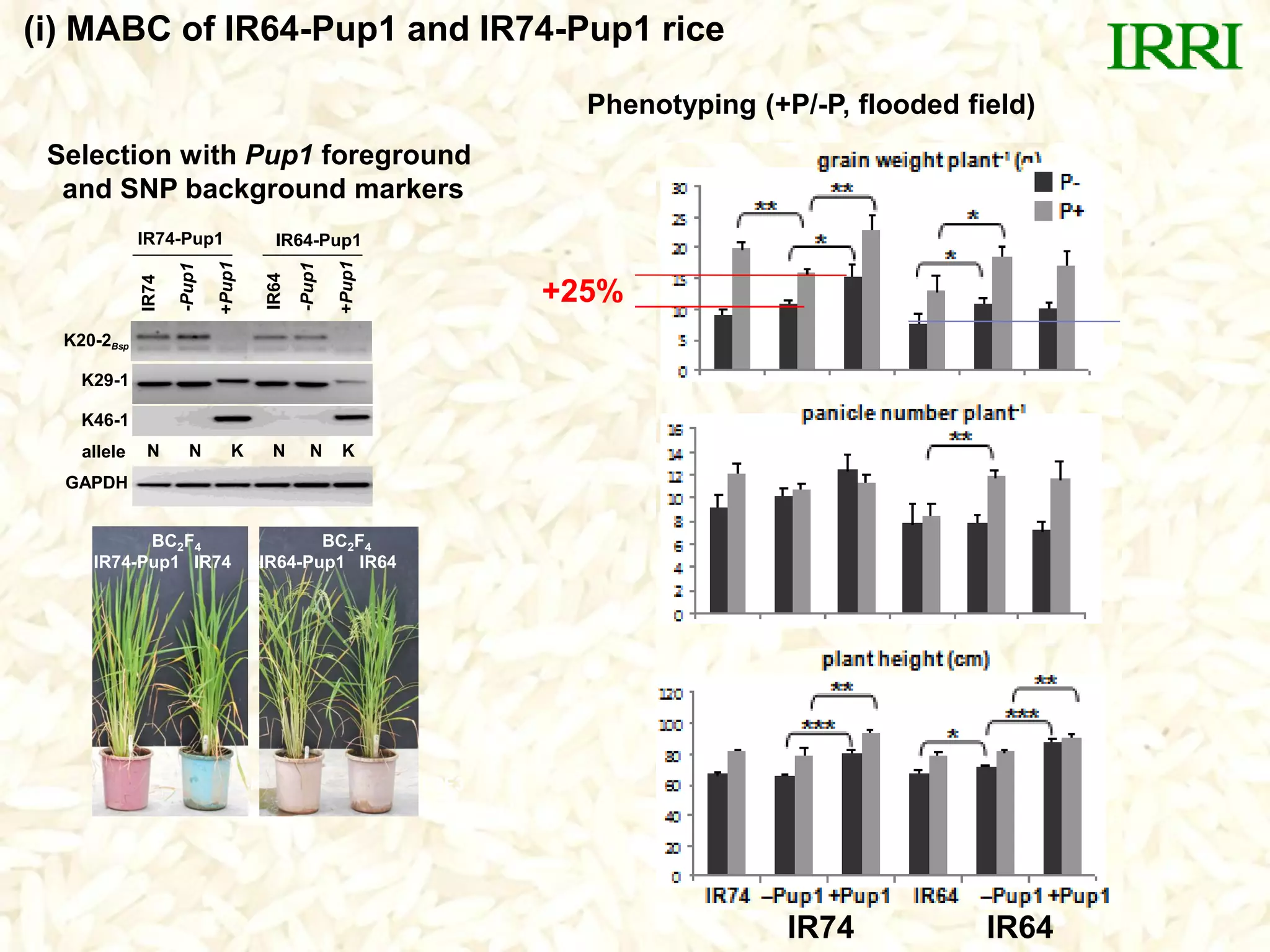
Selection with Pup1 foreground
and SNP background markers
(i) MABC of IR64-Pup1 and IR74-Pup1 rice
Phenotyping (+P/-P, flooded field)
IR74 IR64
+25%
Chin et al 2011, Plant Physiol
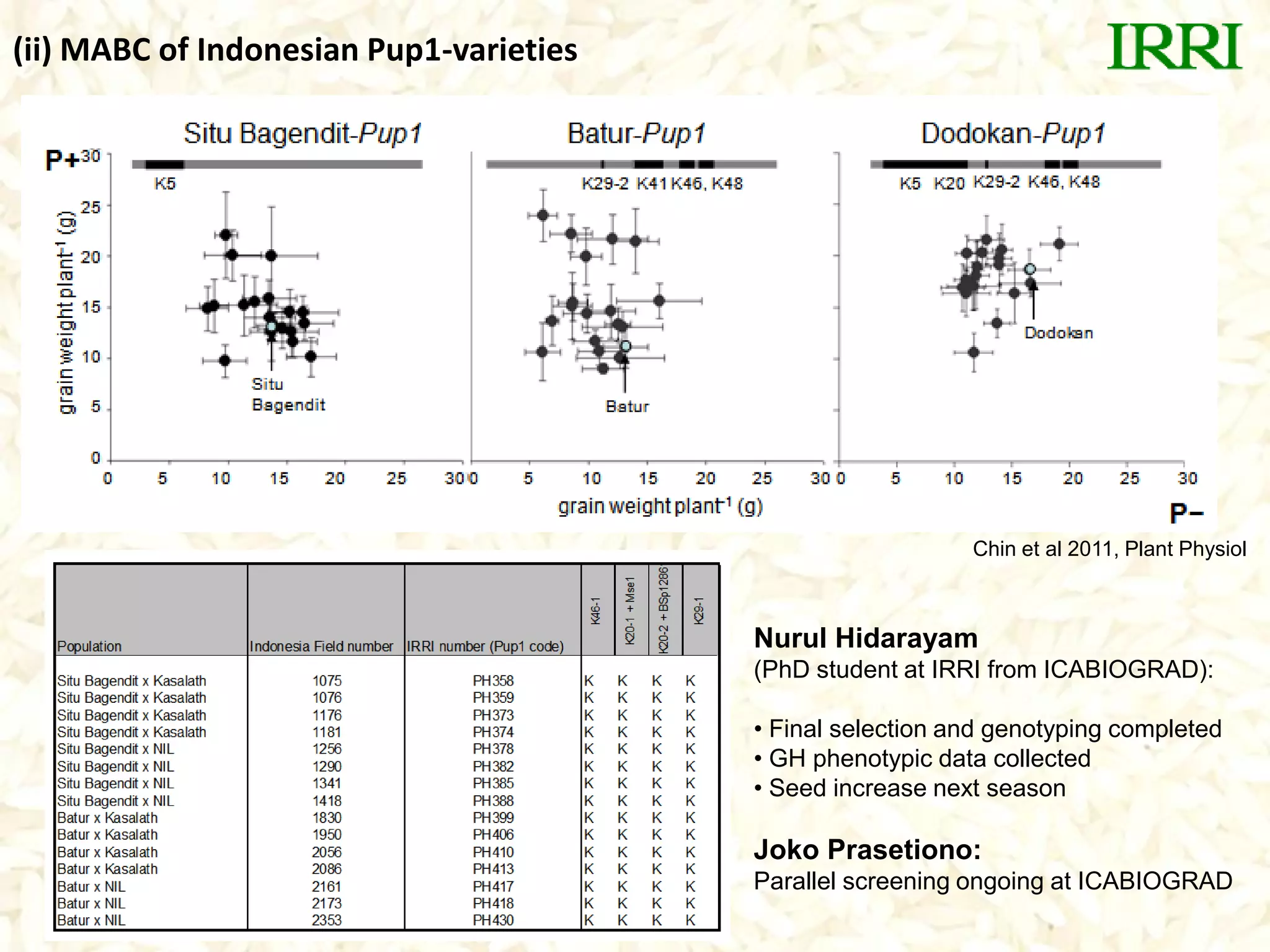
(ii) MABC of Indonesian Pup1-varieties
Nurul Hidarayam
(PhD student at IRRI from ICABIOGRAD):
• Final selection and genotyping completed
• GH phenotypic data collected
• Seed increase next season
Joko Prasetiono:
Parallel screening ongoing at ICABIOGRAD
Pup1 region
93-11 (742 bp)
Kasalath (278 kb)
Nipponbare (154 kb)
Connecting lines
Percent identity
LEGEND
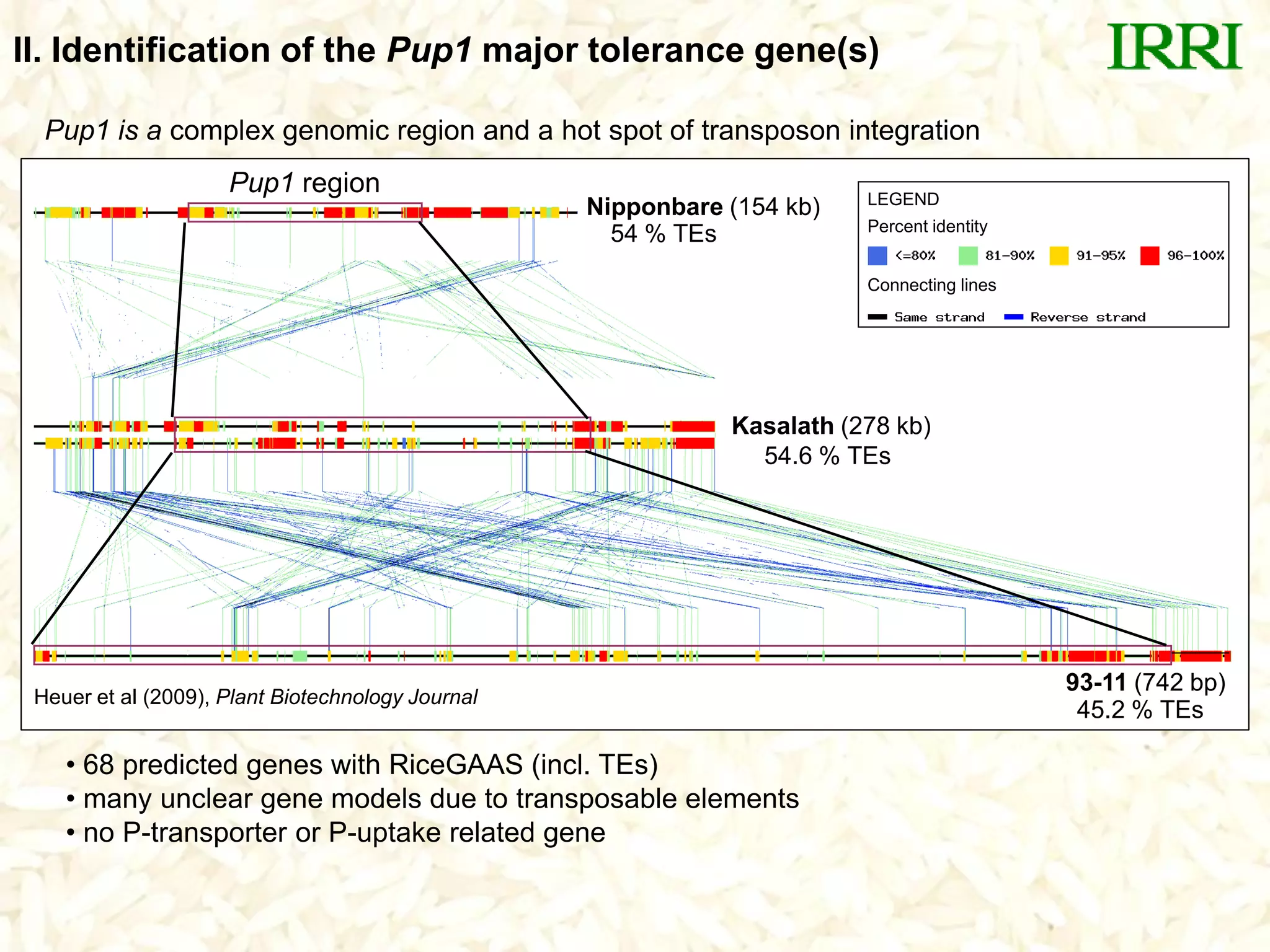
• 68 predicted genes with RiceGAAS (incl. TEs)
• many unclear gene models due to transposable elements
• no P-transporter or P-uptake related gene
Heuer et al (2009), Plant Biotechnology Journal
Pup1 is a complex genomic region and a hot spot of transposon integration
54 % TEs
54.6 % TEs
45.2 % TEs
II. Identification of the Pup1 major tolerance gene(s)
20
29
Kasalath
4, 5
Nipponbare
67
5349
1
protein kinase
hypothetical proteindirigent gene
(PupK-21n)
fatty acid DOX/
unknown protein
aspartic
proteinase
Zn knuckle and
Zn finger protein
DUF568
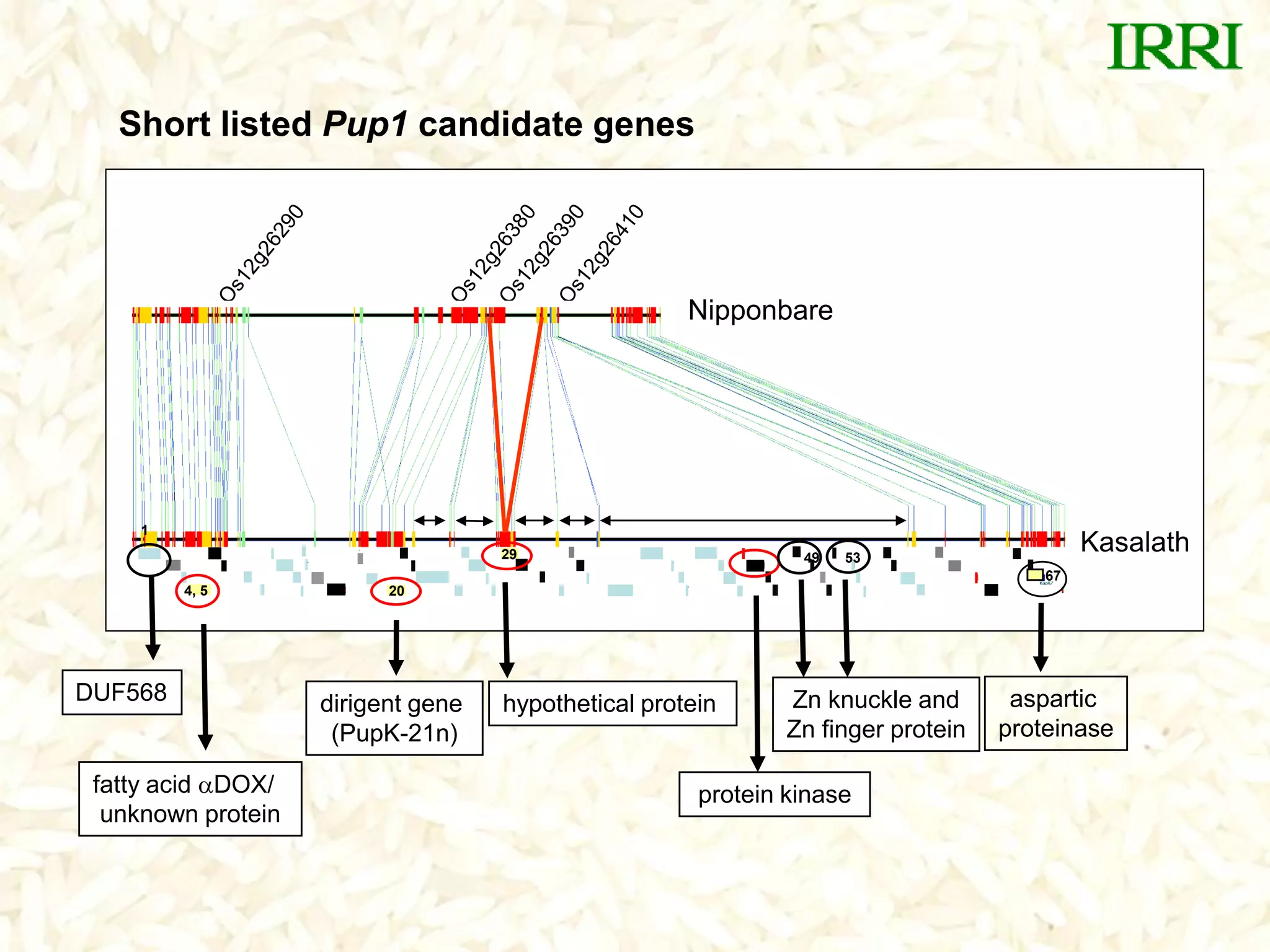
Short listed Pup1 candidate genes
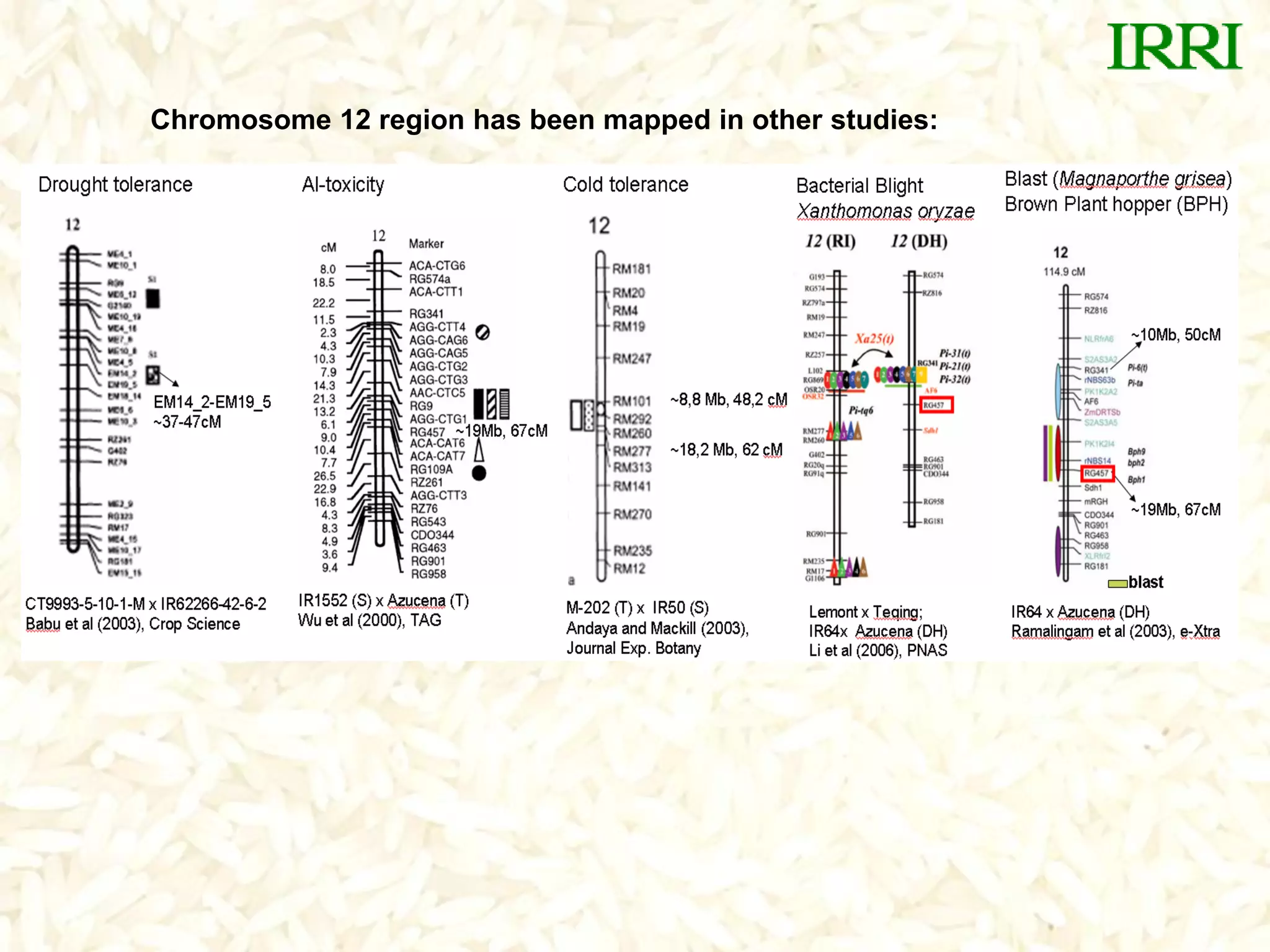
Chromosome 12 region has been mapped in other studies:
Summary
• Final set of Pup1 gene/allele specific markers available
• Development of Pup1-breeding lines by MABC completed (2 irrigated, 2(3) rainfed)
• First field data confirm beneficial effect of Pup1
• Seed increase ongoing at IRRI and ICABIOGRAD
• Pup1 major tolerance gene is a constitutive enhancer of root growth
• Acts upstream of genes with key function in root growth and stress response
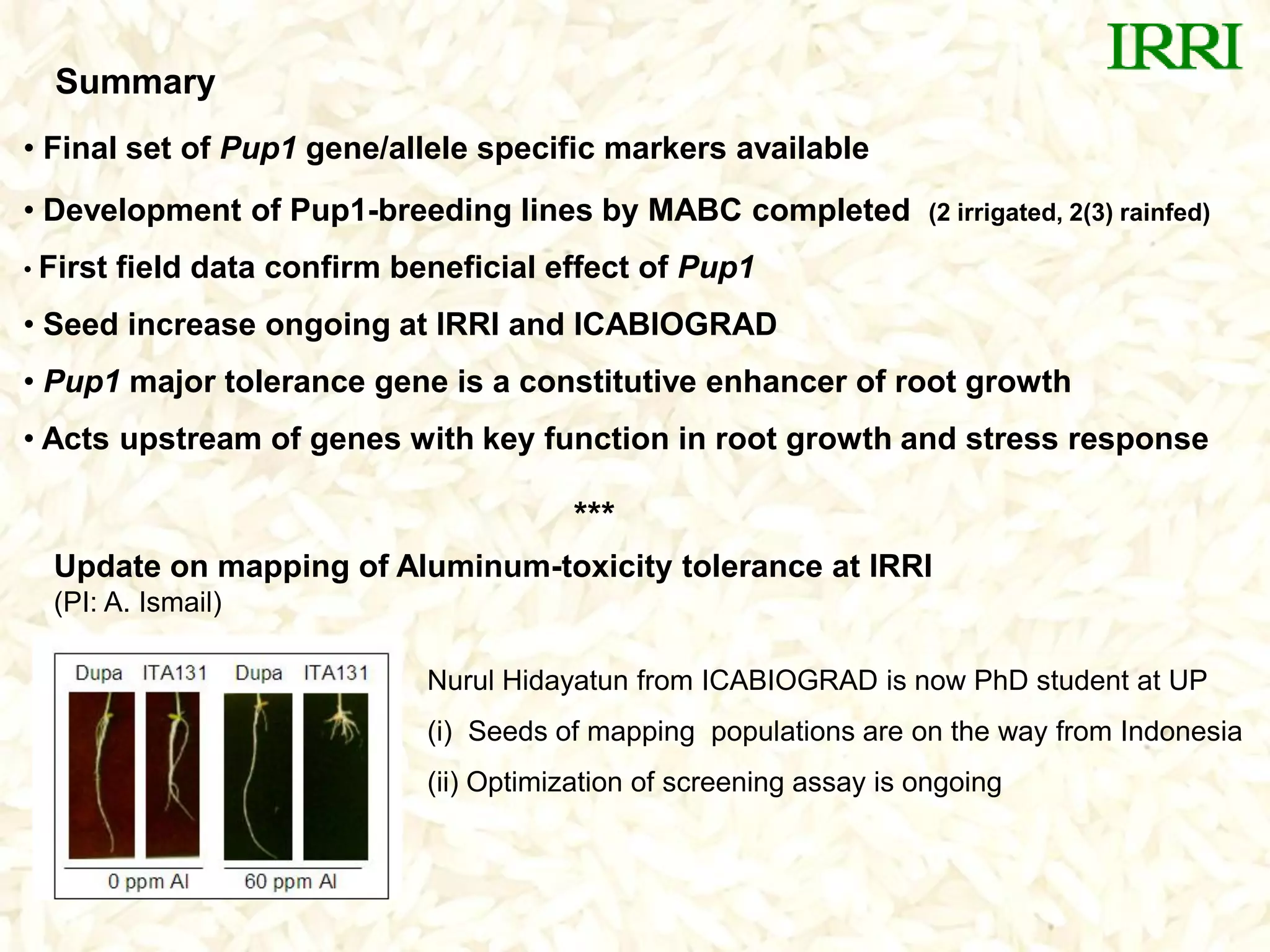
Update on mapping of Aluminum-toxicity tolerance at IRRI
(PI: A. Ismail)
Nurul Hidayatun from ICABIOGRAD is now PhD student at UP
(i) Seeds of mapping populations are on the way from Indonesia
(ii) Optimization of screening assay is ongoing
***
GRM 2011: Rice with dual strength -- Phosphorus uptake efficiency and alumunium tolerance

GRM 2011: Rice with dual strength -- Phosphorus uptake efficiency and alumunium tolerance

  • 1.
    Sigrid Heuer GCP meeting,Hyderabad, Sept 2011 +P -P Developing rice with dual tolerance of P deficiency and Al toxicity
  • 2.
    The major QTLPup1 was mapped in Kasalath in a P-deficient field in Japan under rainfed conditions Nipponbare Kasalath 0 2 4 6 8 10 12 14 Puptake(mgplant-1) Screening of 30 rice accessions Dular Wissuwa et al (1998), Theor Appl Genet Pup1 QTL mapping in Kasalath x Nipponbare NILs Matthias Wissuwa: • Several years of efforts to understand the function in relation to P uptake • No physiological mechanisms or (consistent ) root traits detected • No candidate genes in the Pup1 Nipponbare genomic region
  • 3.
    Kasalath Pup1 sequence:complex hot spot of TE Pup1 molecular markers (dominant INDEL markers only): + + + + + + K + + + ++++ ++ + + +++ +++ ++ + + + +++ +++ ++ + ++ 382 bp 918 bp 912 bp 523 bp 847 bp 505 bp 550 bp N K42 K46 K41 K43 K48 K52 K59 5 10 15 20 25 30 35 40 45 50 551 58 Pup1marker K= Kasalath (Pup1 donor); N= Nipponbare (intolerant) genotype T5-4 Ba76H14_7154 K41-K43 K46 K48 K52 K59K20 K30 INDEL dominantco-dominant K01 K05 co-dominant K67 co-dominant Nipponbare (intolerant; 154 kb) Kasalath (tolerant; 272 kb) Pup1 is present in drought-tolerant breeding lines breeders unknowingly selected for Pup1 Chin et al 2010, Theor Appl Genet
  • 4.
    co-dominantdominant K N IR64IR74 B D SB H2O amplicon (bp) K / N OsPupK20-2OsPupK46- 2 OsPupK29- 1 K1 K5 K20-1 K20-1Mse K20-2 K20-2Bsp K29-1 K29-2 K29-3 K41 K42 K43 K45 K46-1 K46-2 K48 K52 K59 125 / 122 272 / 280 240 / 243 201 / 243 982 / 995 231+349+402 / 413+582 212 / 206 219 / 212 236 / 248 382 / none 918 / none 912 / none 276 / none 523 / none 227 / none ~550 unspecific 847 / none 505 / none ~700 unspecific 550 / none Core set of best Pup1 markers (dominant and co-dominant) Chin et al 2011, Plant Physiology
  • 5.
    0.1 AUS 196 IRAT 77 Azucena PrataoPrecoce IR 69502-6-SRN-3-UB-1B IR 78966-B-10-B-B-B-1 IR 78933-B-24-B-B-4 B6144F-MR-6-0-0 IR 65192-48-10-3-B Apo IR 78997-B-16-B-B-B-2 Kasalath Vary Lava 701 AUS 257 Dular IAC 25 IAC 47 IR 78937-B-3-B-B-2 IR 78937-B-3-B-B-3 IR 84144-11-12 UPL RI 7 Vandana CT 6510-24-1-2 IR 55419-04 IR 55423-01 IR 78875-131-B-1-1 IR 78937-B-20-B-B-2 IR 78937-B-3-B-B-1 IR 74371-46-1-1 IR 78942-B-2-B-B-2 IR 78933-B-24-B-B-1 IR 78940-B-22-B-B-B-1 IR 78966-B-10-B-B-B-2 IR 79008-B-11-B-B-1 IR 79008-B-11-B-B-2 UPL RI 5 IR 78940-B-22-B-B-B-2 Way Rarem IR 78933-B-24-B-B-2 IR 80340-23-B-12-6-B PM-36 PS 36 IR 9764-45 Lemont YS 27 Arkansas Fortuna IR 71525-19-1-1 IR 73678-6-9-B IR 73685-8-11-16-1-2-3-3-B Sri Kuning IR 36 IR 72 Gaisen Ibaraki 2 IR 49830-7-1-2-3 IR 75870-5-8-5-B-2-B IR 70358-84-1-1 IR 73382-80-9-3-13-2-2-1-3-B Ashoka 228 IR 63295-AC209-7-B IR 78942-B-2-B-B-1 IR 74 IR 78933-B-24-B-B-3 K36-5-1-1BB Nerica 4 PS 12 Bala CT 99993-5-10-M IR 62266-42-6-2 IR 64 IR 66424-1-2-1-5 IR 72418-3B-B-14-9-2 K36-3-1-1 Moroberekan IR 24637-38-2-2-1 IR 3646-8-1-2 IR 42 IR 73678-8-1-3-3-2-B Akihikari Nipponbare IR 20 IR 66 K1 K5 K20-1Mse K20-2Bsp K29-1 K29-2 K29-3 K41 K42 K43 K45 K46-1 K46-2 K48 K52 K59 Group I Group II Group III Ecotype Non-Kasalath allele Heterozygous Kasalath allele Inconsistent or missing data Genotype Ecotype Upland (UL) Upland and lowland Lowland (LL) Core marker set Chin et al 2011, Plant Physiology Germplasm survey with Pup1 core markers rainfed irrigated
  • 6.
    Lowland Upland P+ P-P+ P- Well-watered Drought P T SM G P T SM G P T SM G P T SM G P T SM G P T SM G P: plant height T: tiller number S: straw weight M: maturity G: grain yield Pup1 Markers (#380) by chromosome Green: higher regression coefficient (r2) of the corresponding markers to the phenotypes. SNP data confirm that Pup1 is associated with good performance under field conditions in diverse genotypes (JH Chin; ongoing) (core markers)
  • 7.
    Marker assisted backcrossing(MABC): Principle approach 1 2 1 12 2 242 bp 123 bp 94 bp Sub1A allele-specific marker Markers: background flanking Sub1 foreground flanking background SSR or SNP background Chr. 9 further BC and selfing Sub1 donor recipient (local variety) F1 and backcross to local variety Pup1
  • 8.
    c sister 4 (IR64-KK-NN)IR64-Pup1 BC2F3 = PH218-5-3 ? BC2F4 IR64-Pup1 IR64 BC2F4 IR74-Pup1 IR74 K20-2Bsp K29-1 K46-1 GAPDH allele IR74 -Pup1 +Pup1 IR64 -Pup1 +Pup1 IR74-Pup1 IR64-Pup1 N N K N N K Selection with Pup1 foreground and SNP background markers (i) MABC of IR64-Pup1 and IR74-Pup1 rice Phenotyping (+P/-P, flooded field) IR74 IR64 +25%
  • 9.
    Chin et al2011, Plant Physiol (ii) MABC of Indonesian Pup1-varieties Nurul Hidarayam (PhD student at IRRI from ICABIOGRAD): • Final selection and genotyping completed • GH phenotypic data collected • Seed increase next season Joko Prasetiono: Parallel screening ongoing at ICABIOGRAD
  • 10.
    Pup1 region 93-11 (742bp) Kasalath (278 kb) Nipponbare (154 kb) Connecting lines Percent identity LEGEND • 68 predicted genes with RiceGAAS (incl. TEs) • many unclear gene models due to transposable elements • no P-transporter or P-uptake related gene Heuer et al (2009), Plant Biotechnology Journal Pup1 is a complex genomic region and a hot spot of transposon integration 54 % TEs 54.6 % TEs 45.2 % TEs II. Identification of the Pup1 major tolerance gene(s)
  • 11.
    20 29 Kasalath 4, 5 Nipponbare 67 5349 1 protein kinase hypotheticalproteindirigent gene (PupK-21n) fatty acid DOX/ unknown protein aspartic proteinase Zn knuckle and Zn finger protein DUF568 Short listed Pup1 candidate genes
  • 12.
    Chromosome 12 regionhas been mapped in other studies:
  • 13.
    Summary • Final setof Pup1 gene/allele specific markers available • Development of Pup1-breeding lines by MABC completed (2 irrigated, 2(3) rainfed) • First field data confirm beneficial effect of Pup1 • Seed increase ongoing at IRRI and ICABIOGRAD • Pup1 major tolerance gene is a constitutive enhancer of root growth • Acts upstream of genes with key function in root growth and stress response Update on mapping of Aluminum-toxicity tolerance at IRRI (PI: A. Ismail) Nurul Hidayatun from ICABIOGRAD is now PhD student at UP (i) Seeds of mapping populations are on the way from Indonesia (ii) Optimization of screening assay is ongoing ***