BRT: Made in Latin America Dario Hidalgo Luis Gutierrez EMBARQ, The WRI Center for Sustainable Transport Brookings Institution Washington DC, March  8, 2011
 
BRT around the world 120 cities with BRT Systems and Bus Corridors 4,335 km 6,683 stations 30,000 buses 26.8 million passengers per weekday  1% of the world´s urban population (2010) 1.4 times the combined population of New York and Newark (2010)
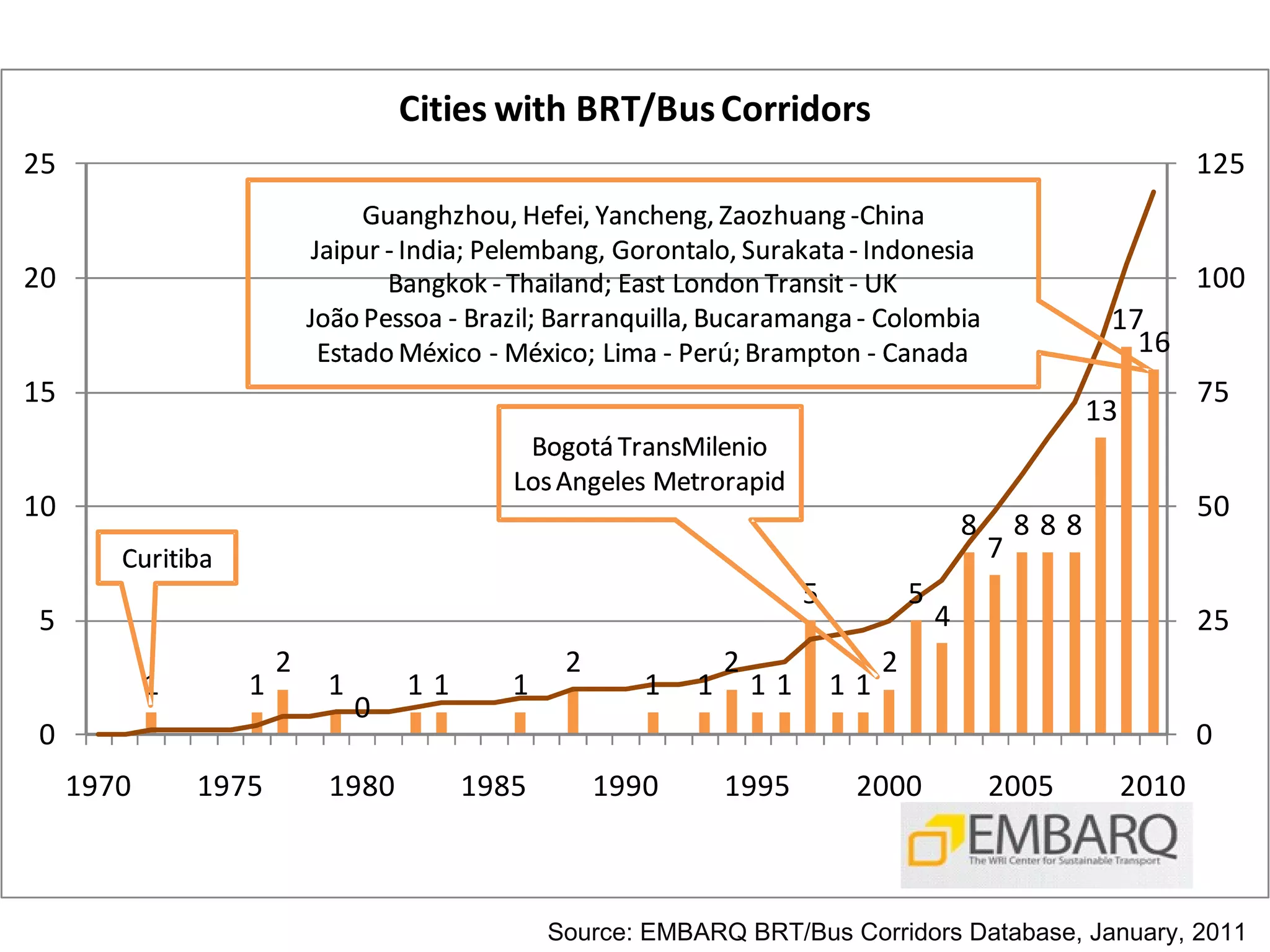
Source: EMBARQ BRT/Bus Corridors Database, January, 2011
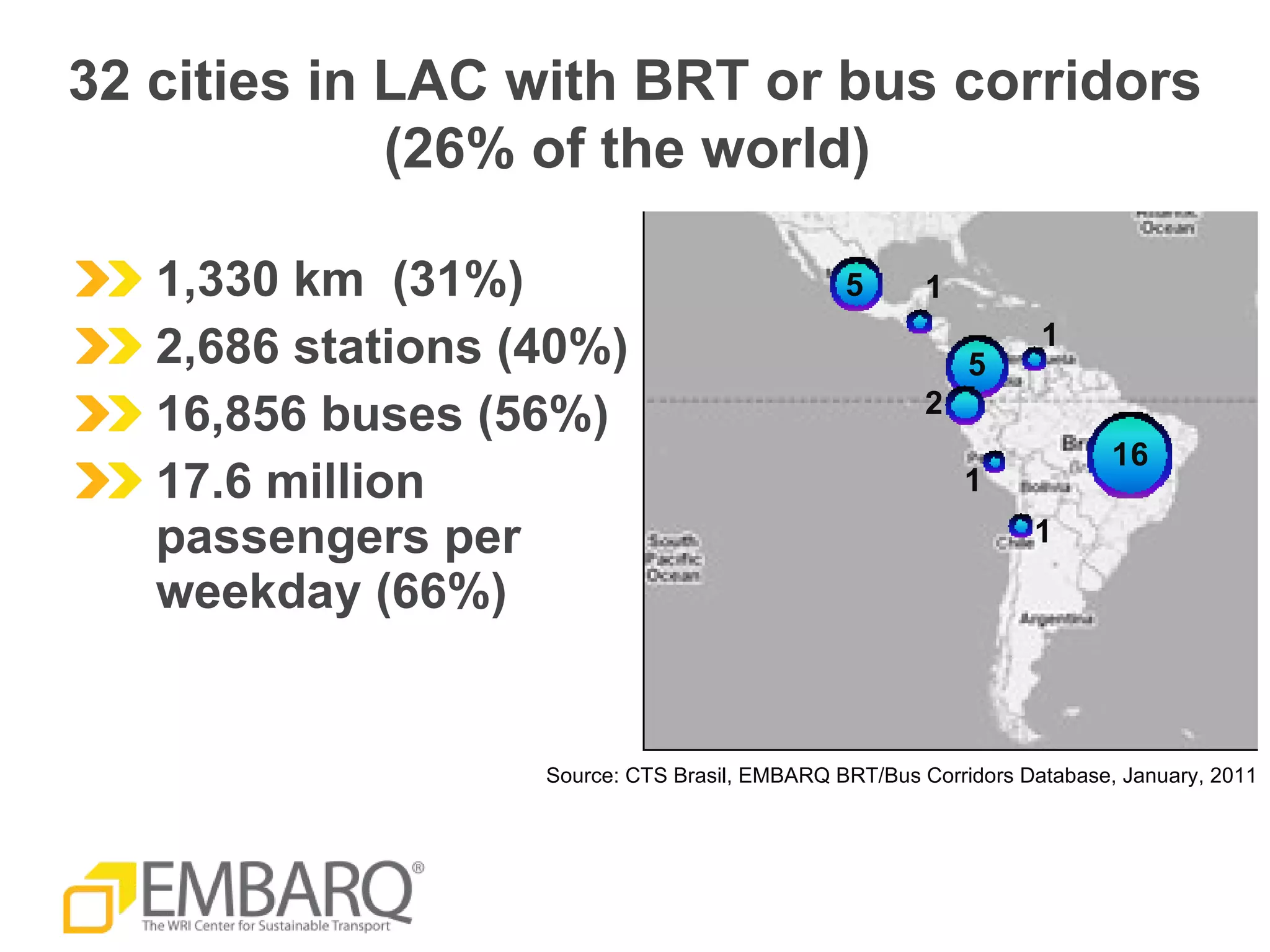
1,330 km  (31%) 2,686 stations (40%) 16,856 buses (56%) 17.6 million passengers per weekday (66%) Source: CTS Brasil, EMBARQ BRT/Bus Corridors Database, January, 2011 32 cities in LAC with BRT or bus corridors (26% of the world)
Curitiba, RIT, 72 km median busways 2.3 million pax/day Initial Corridor 1972
Curitiba new BRT Corridor (2009-2010) Rodovia BR116  “Before” Photo: URBS Linha Verde “Now” Photo: CTS Brasil Linha Verde “Future” Image: URBS
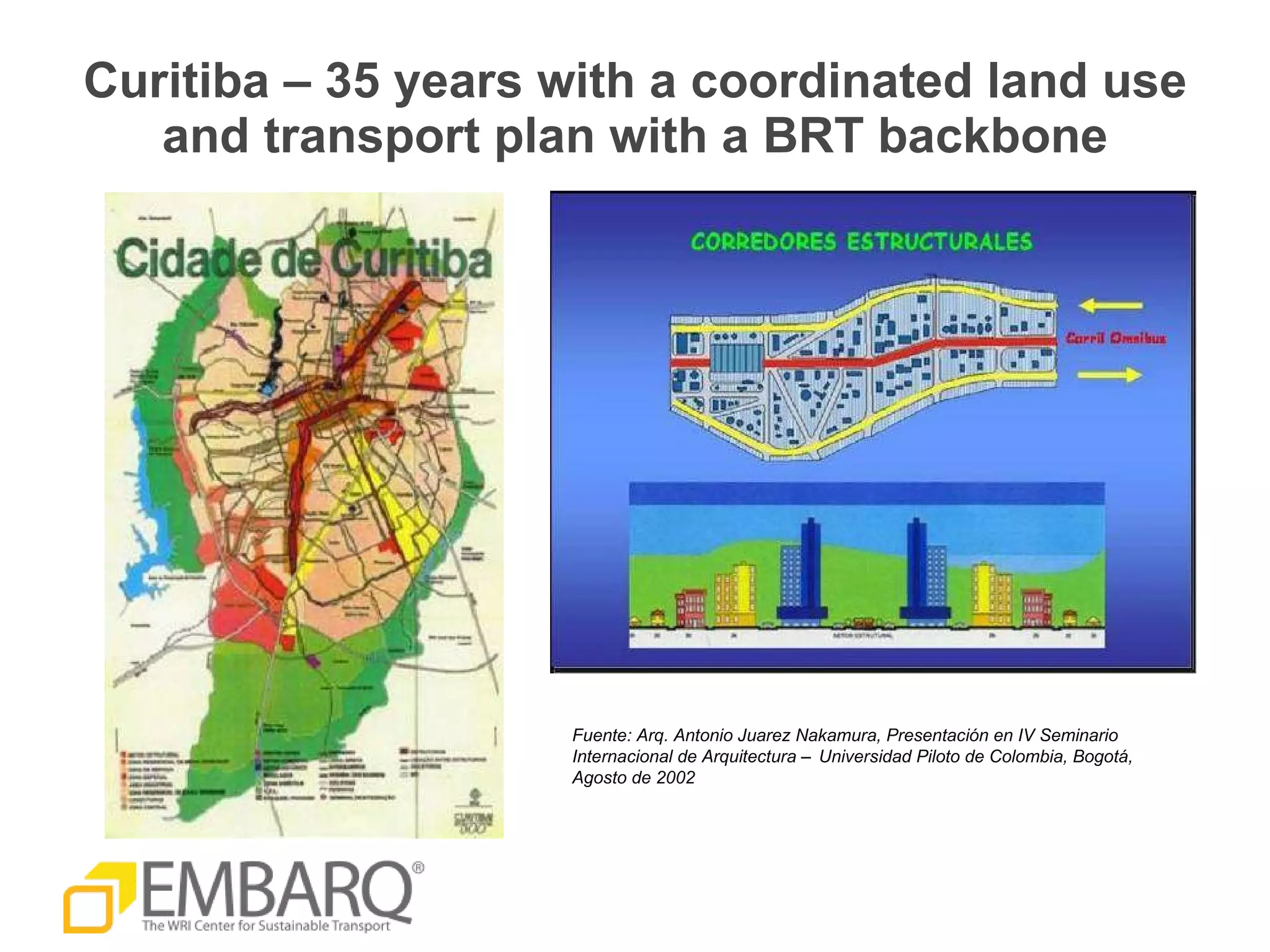
Curitiba – 35 years with a coordinated land use and transport plan with a BRT backbone Fuente: Arq. Antonio Juarez Nakamura, Presentación en IV Seminario Internacional de Arquitectura – Universidad Piloto de Colombia, Bogotá, Agosto de 2002
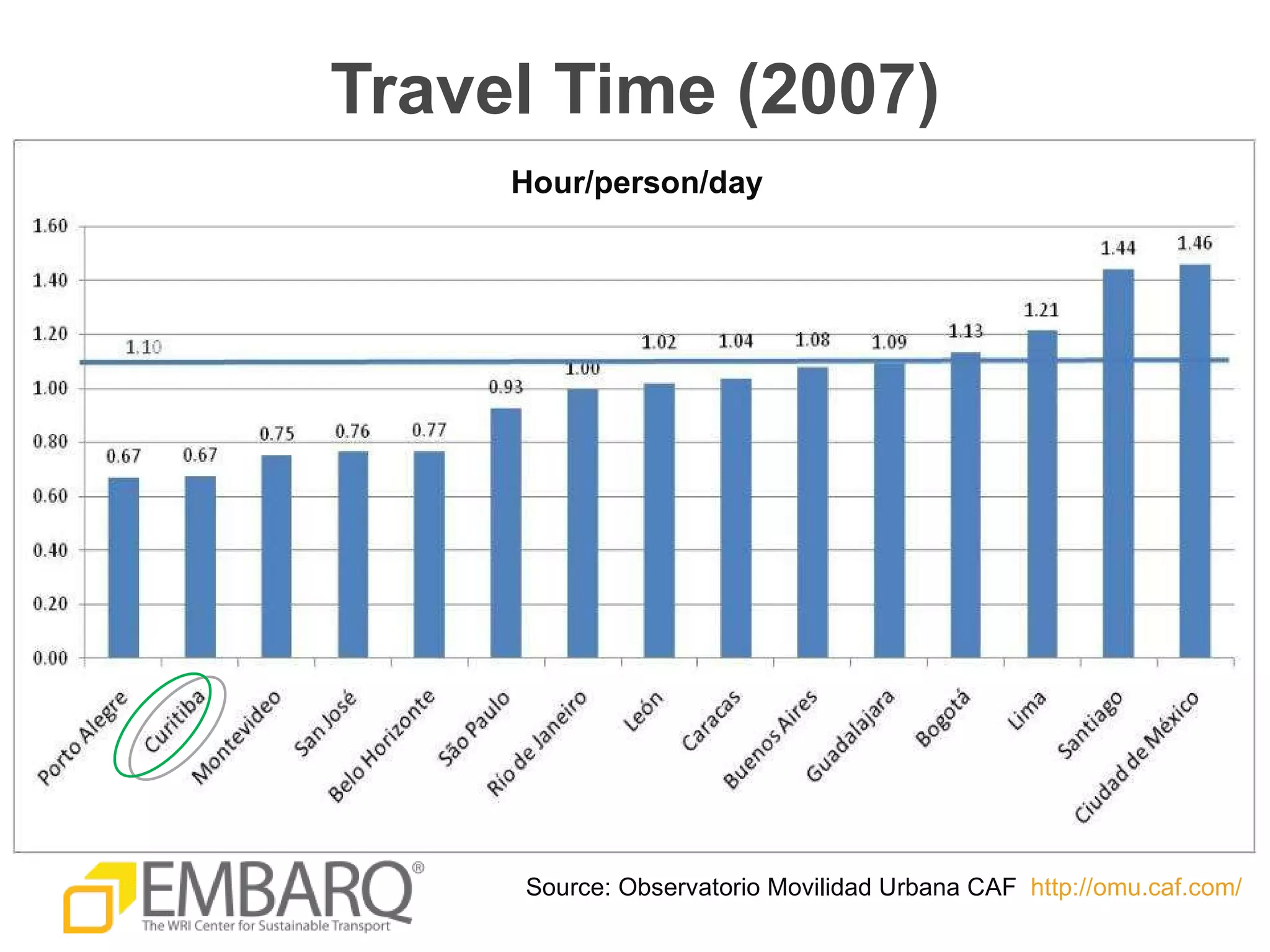
Travel Time (2007) Source: Observatorio Movilidad Urbana CAF  http://omu.caf.com/   Hour/person/day
Tailpipe Emissions(2007) Source: Observatorio Movilidad Urbana CAF  http://omu.caf.com/   Ton per day per million people
Road Safety (2007) Source: Observatorio Movilidad Urbana CAF  http://omu.caf.com/   Road Fatalities per 100,000 people
Quito, Metrobús-Q, 37 Km median busways, 440,000 pax/day  Initial corridor in 1995
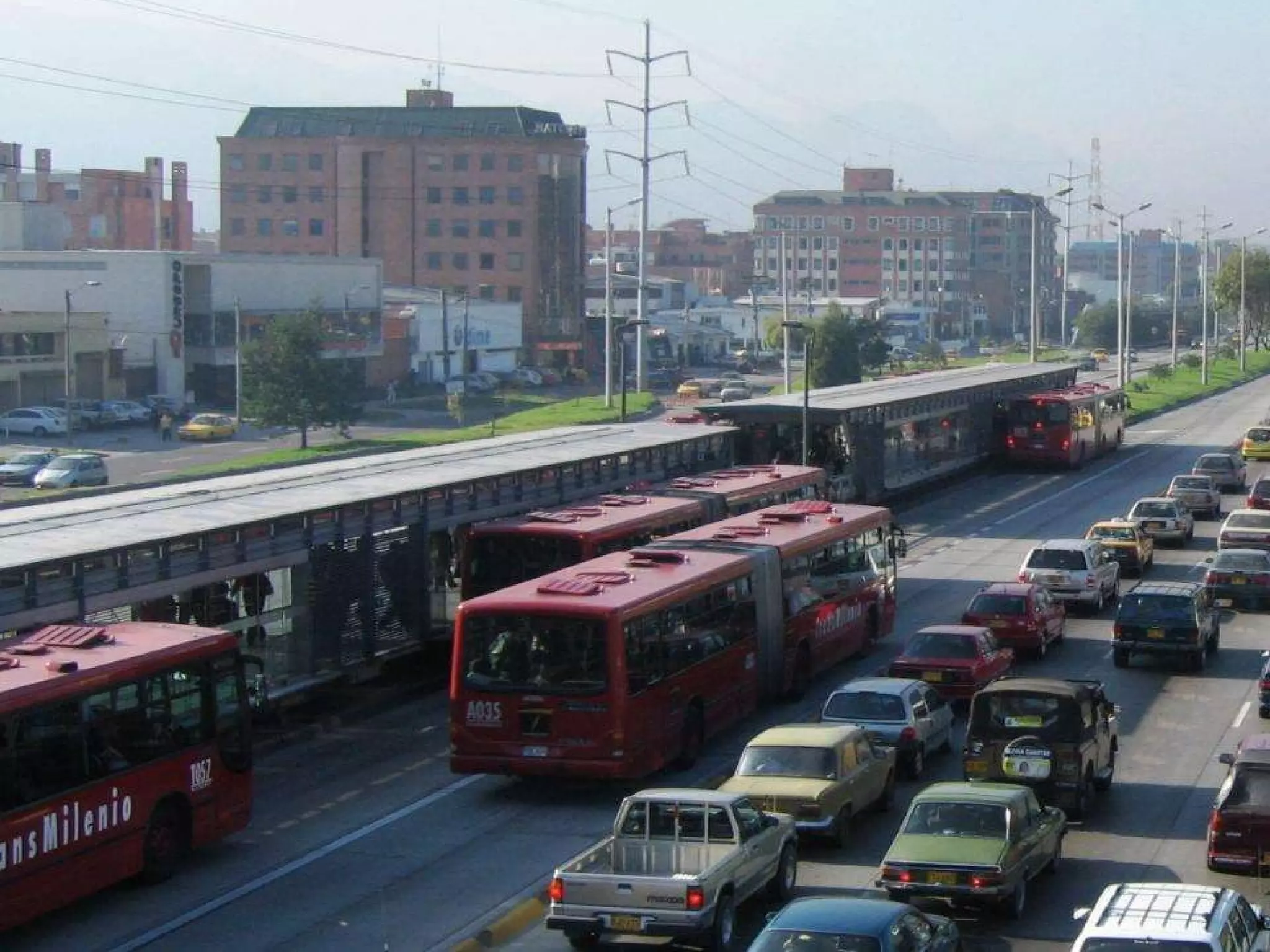
Bogot á, TransMilenio,  84 Km median busways,  1,7 million pax/day   Initial Corridor 2000
Bogotá TransMilenio  Eje Ambiental Avenida Jiménez Photo ITDP
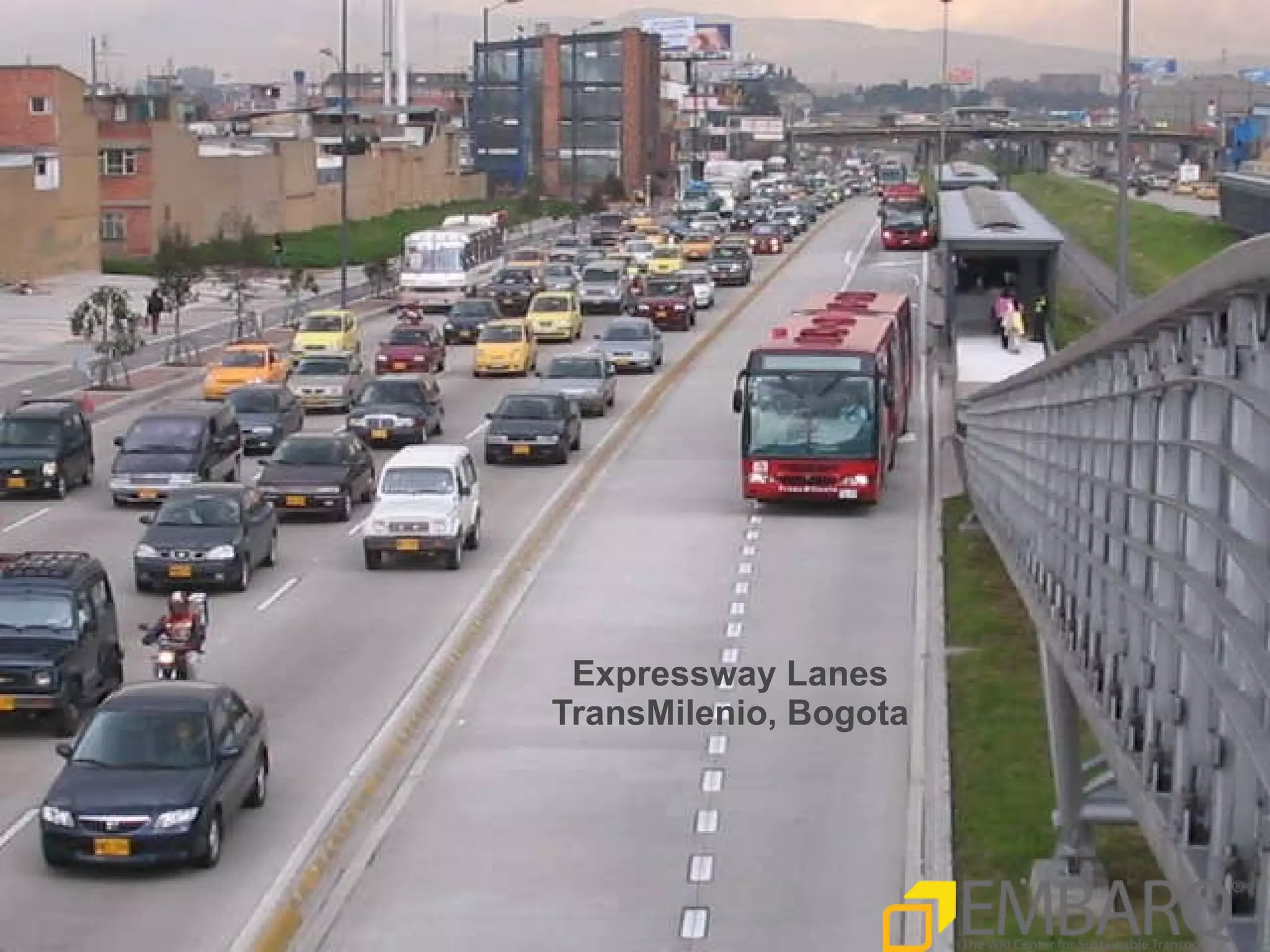
Expressway Lanes TransMilenio, Bogota
Fuentes: Encuesta Anual “Bogotá ¿Cómo Vamos?”  www.eltiempo.com ;  Total Public Transport Traditional Public Transport TransMilenio BRTS  Private (Car, Two Wheeler) Active Transport (Walking, Bicycle) Main mode of transport 1998-2009
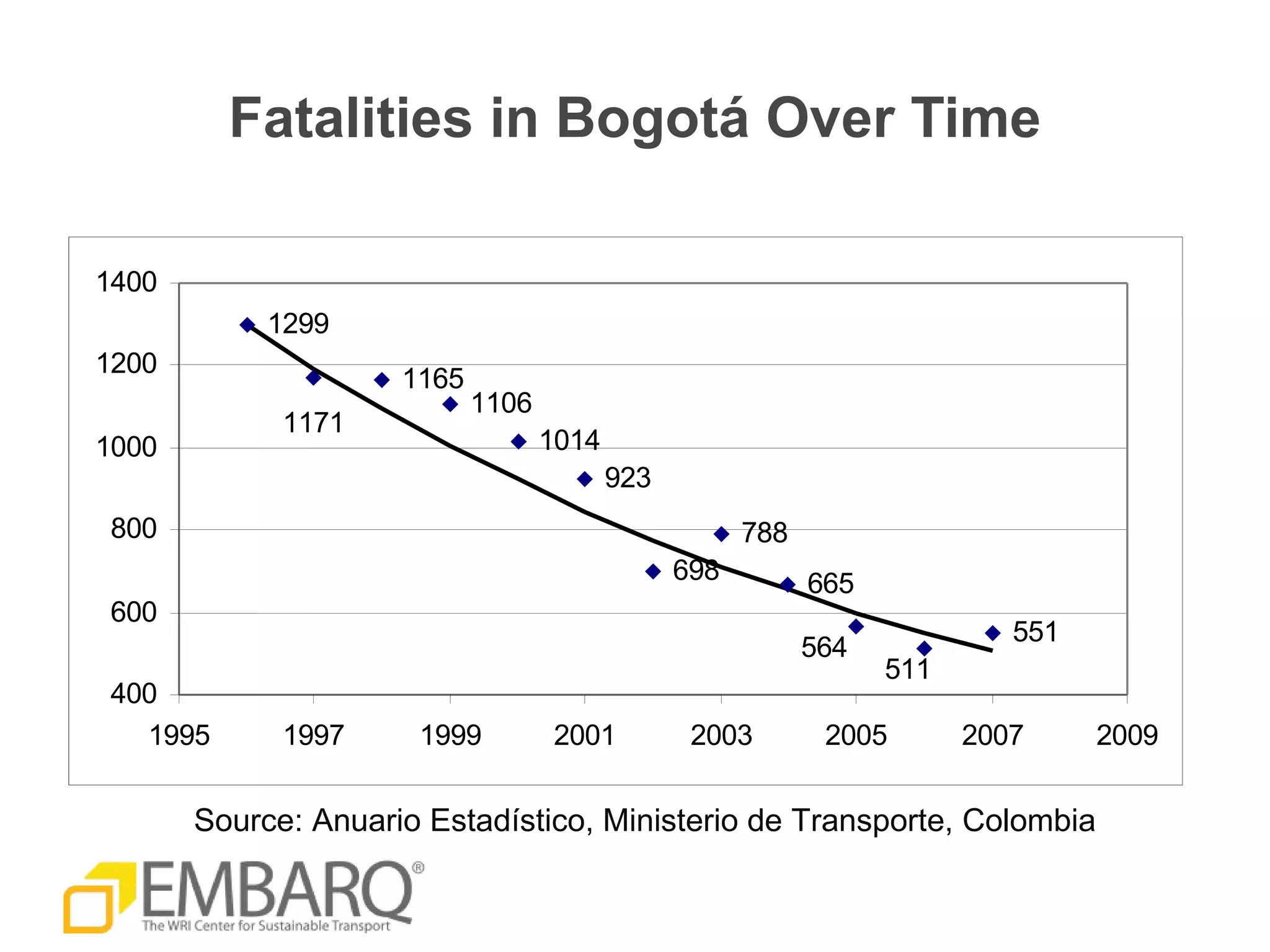
Fatalities in Bogotá Over Time Source: Anuario Estadístico, Ministerio de Transporte, Colombia
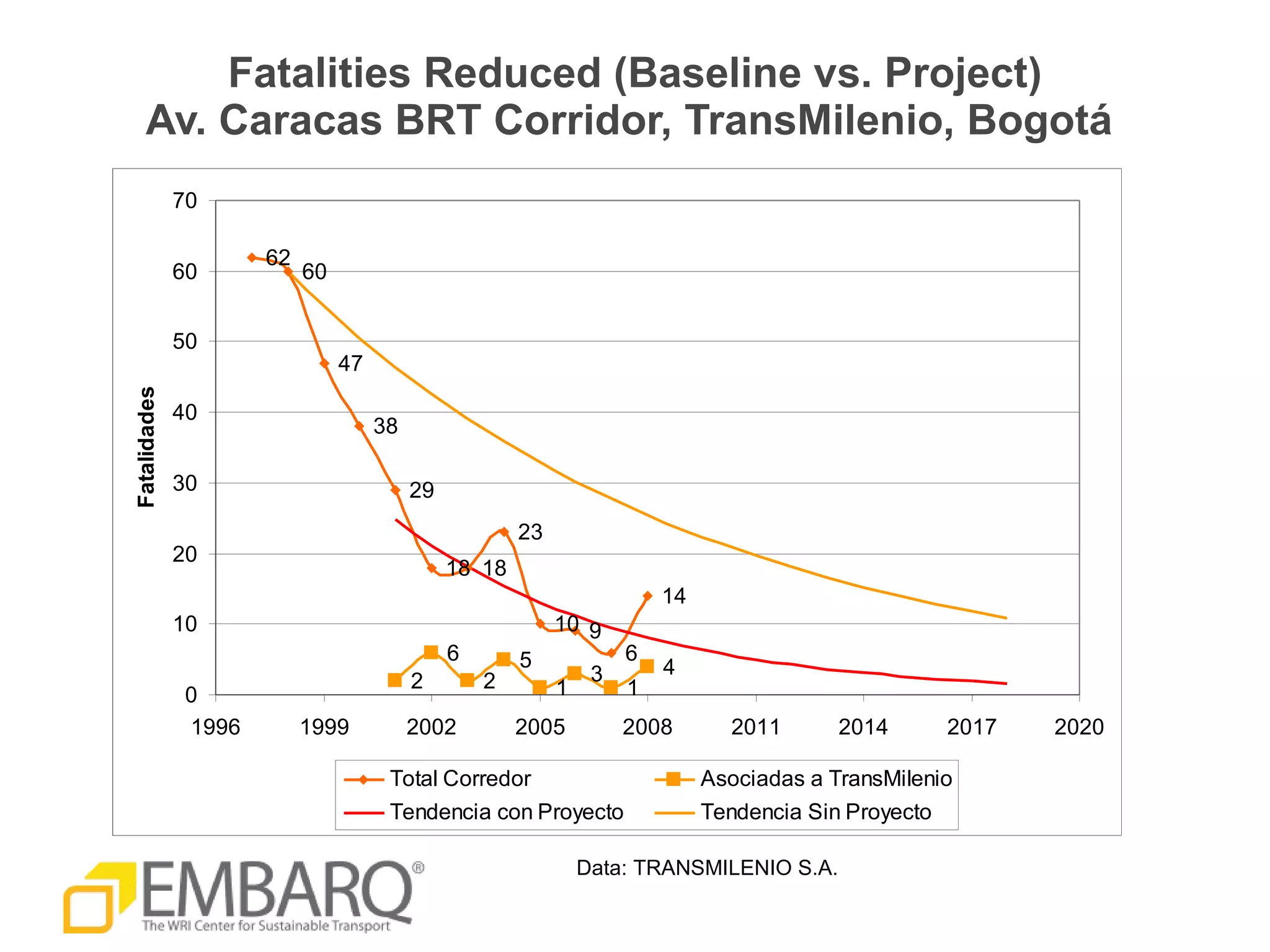
Fatalities Reduced (Baseline vs. Project) Av. Caracas BRT Corridor, TransMilenio, Bogotá  Data: TRANSMILENIO S.A.
Sao Paulo, 104 Km median busways + preferential buslanes, 5,761,000 pax/day Initial busways 1980, Reconstructed in 2003
León de Guanajuato, M éxico , Optibús,  31 Km median busways (60% segregated)  Initial corridor 2003
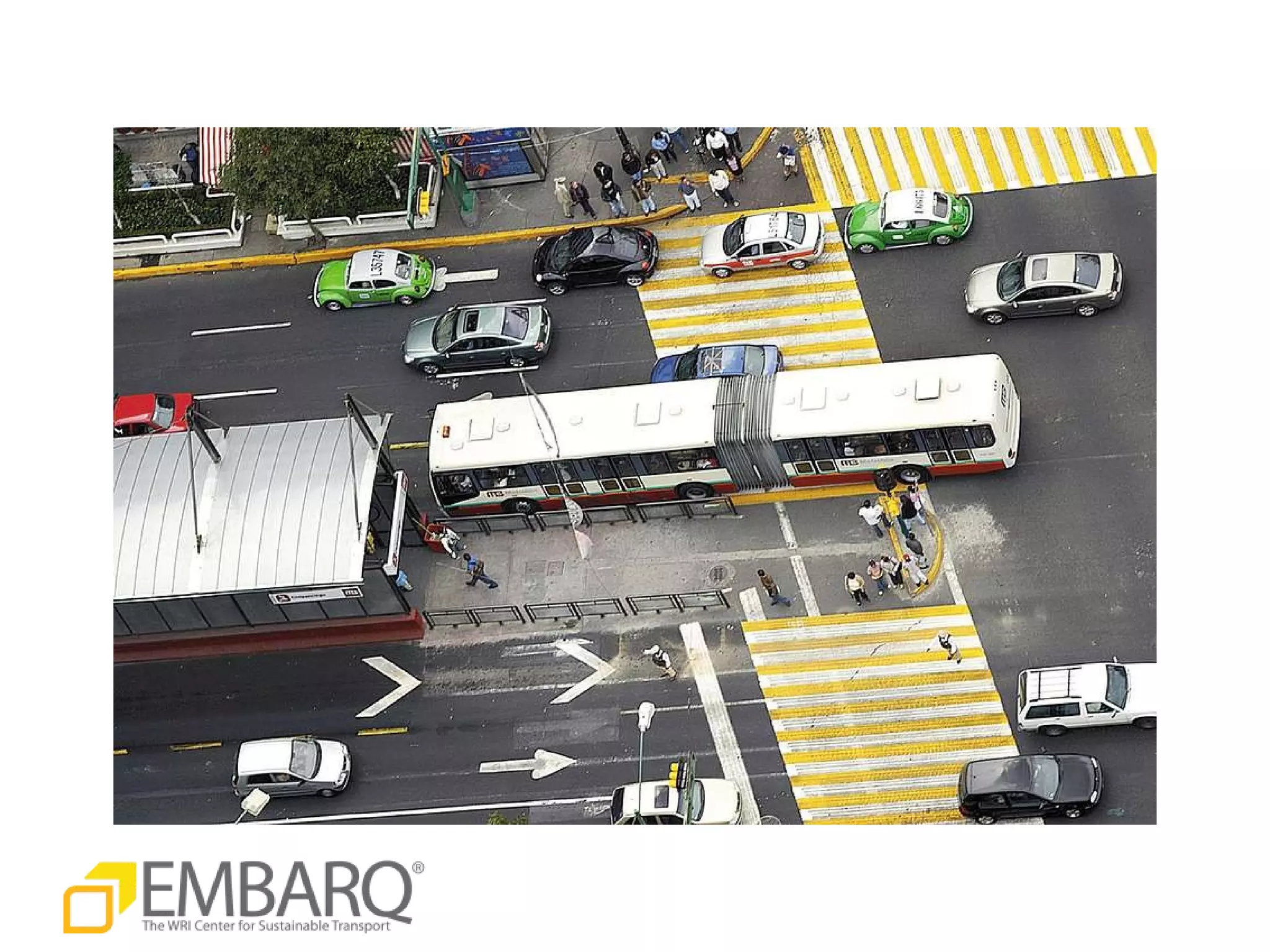
México City, Metrobús,  66 Km median busways, 570,000 pax/day  Initial Corridor 2005
 
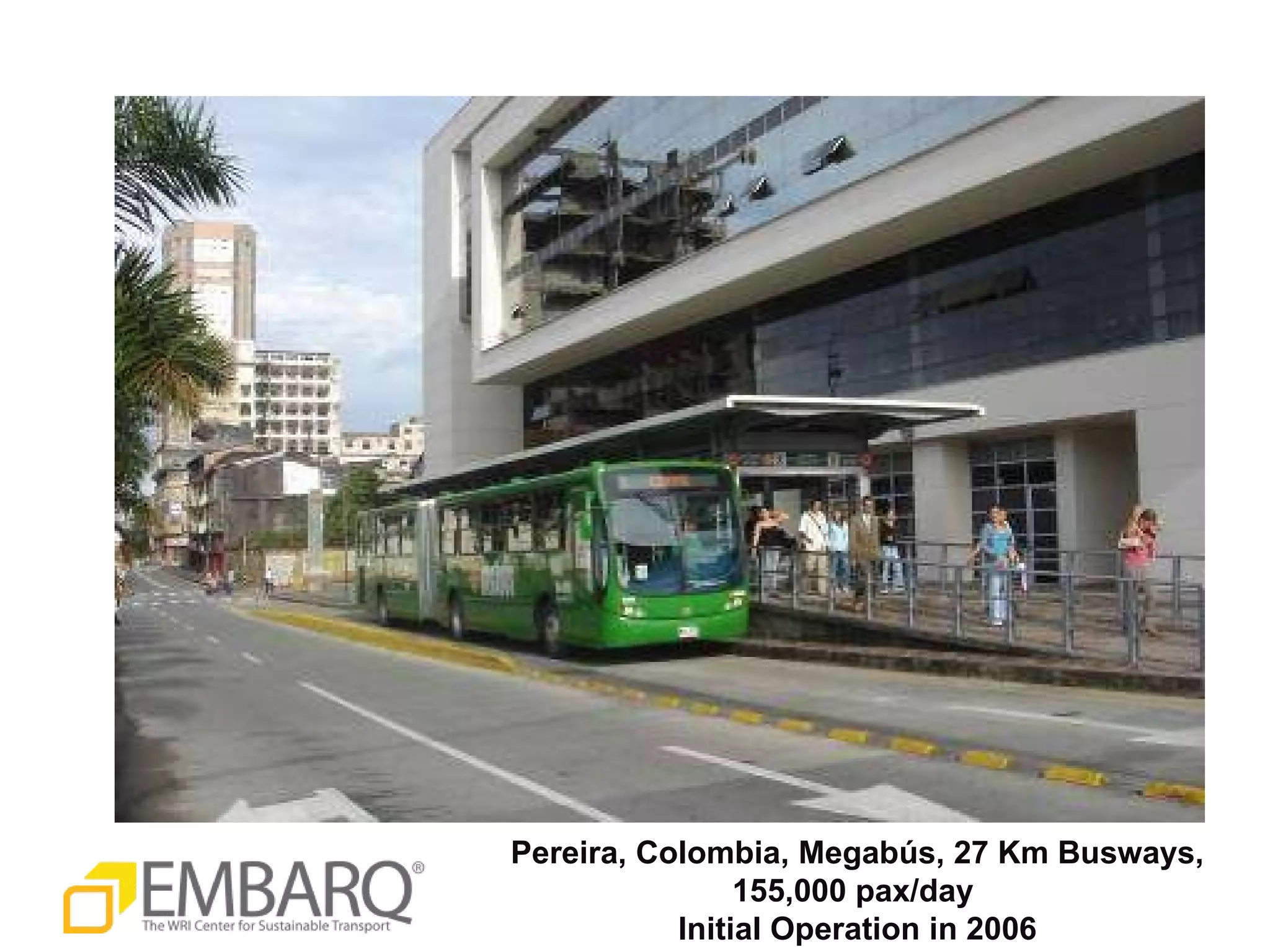
Pereira, Colombia, Megab ú s, 27 Km Busways, 155,000 pax/day  Initial Operation in 2006
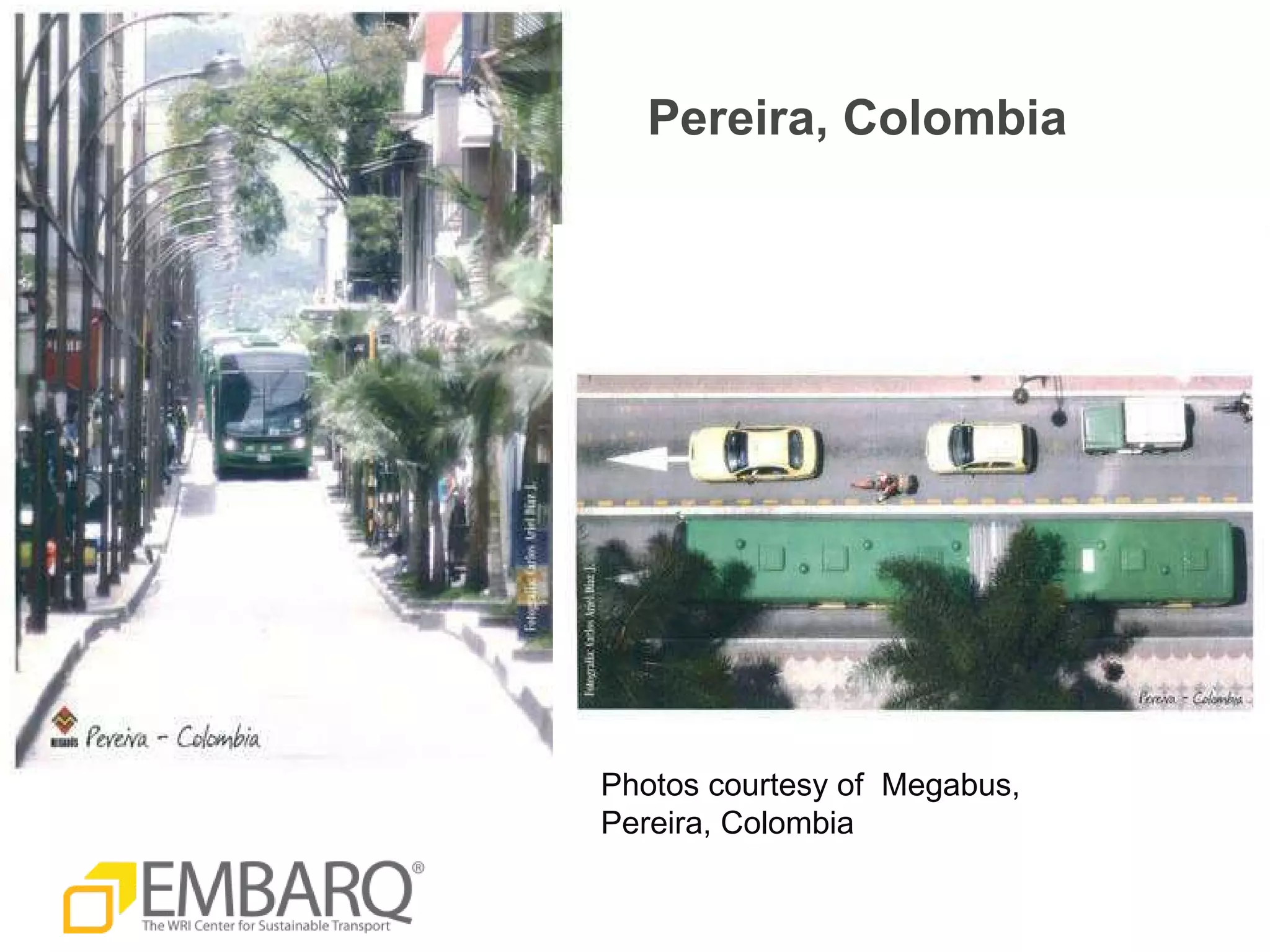
Pereira, Colombia Photos courtesy of  Megabus, Pereira, Colombia
Guayaquil, Ecuador, Metrovía,  16 Km Busways,  96,000 pax/day  Initial Corridor 2006 Photos by D. Hidalgo
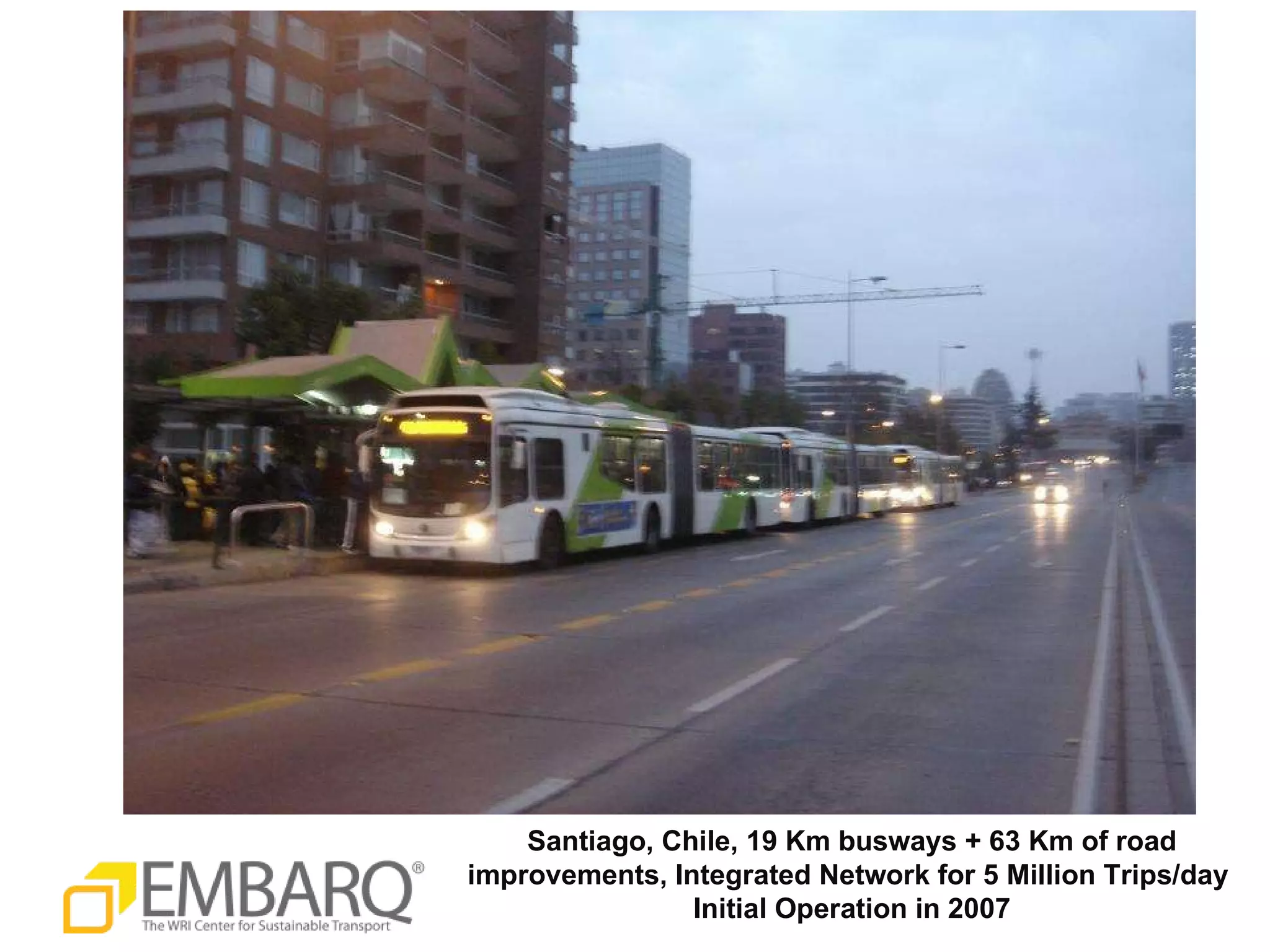
Santiago, Chile, 19 Km busways + 63 Km of road improvements, Integrated Network for 5 Million Trips/day  Initial Operation in 2007
Guatemala City, February 2007 Photo: Sapfan (Jan Pesula)
Cali, Colombia 27 Km busways 130,000 pax/day Initial Operation in 2009 Photo: Metrocali
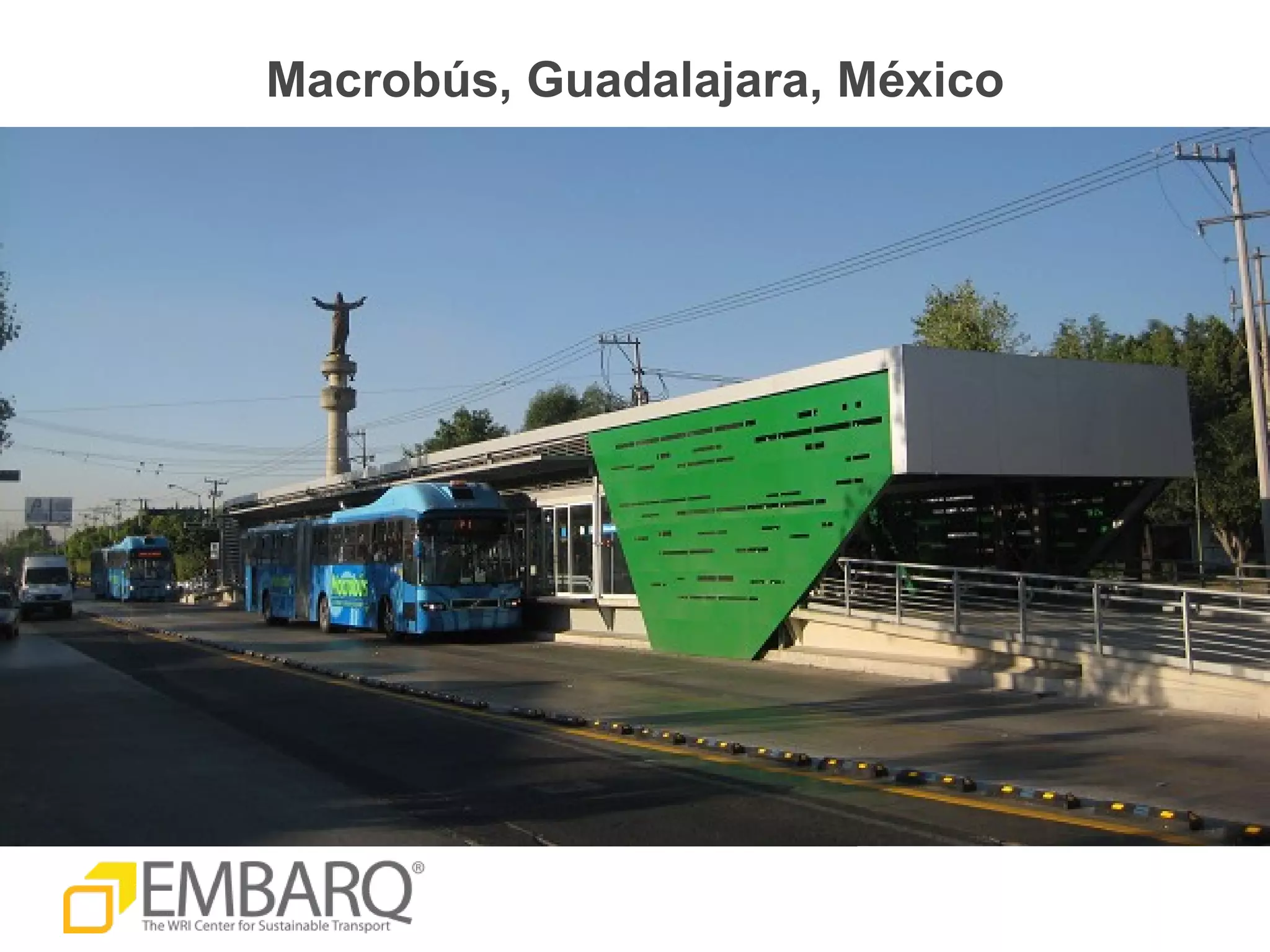
Macrobús, Guadalajara, México
 
Transmetro, Barranquilla, Colombia Opened 10 July 2010 13.4 km dedicated busway 15 Stations 92 articulated buses 32,0000 pax/day Photo via transmetro.gov.co Sources:  http://transmetro.gov.co/web2010/ Ministry of Transport, Mass Transit Group, Oct 2010
Metrol í nea, Bucaramanga, Colombia Opened 21 December 2009 8.9 km trunk corridor 7.7 auxiliary corridors (25.2 km plan.) 24 stations  75,000 pax/day Photo: http://www.metrolinea.gov.co/  Source: Ministry of Transport, Mass Transit Group, Oct 2010
Mexibús, Estado México, México Initial operation Nov 30, 2010 16 km exclusive busway 21 stations 130,000 pax/day (expected) Photo:  http://transeunte.org/tag/mexibus/ Source:  http://transporteinformativo.com/pasaje/inicia-operaciones-mexibus-con-63-autobuses-articulados-volvo
Metropolitano, Lima, Peru Initial Operation, May 2010 First high capacity bus system with CNG only 27 km busways, 80% with overtaking at stations 35 stations 308 articulated buses 82,000 pax/day south section (854,000 pax/day expected) 21 km/hour commercial speed  Photo: Protransporte, Lima, May 2010 Source: Menckhoff, G., Ochoa, C., Ardila, A. “El Metropolitano de Lima:  Implementación y Primeros Resultados de un Nuevo Sistema BRT” CLATPU, Octubre 2010
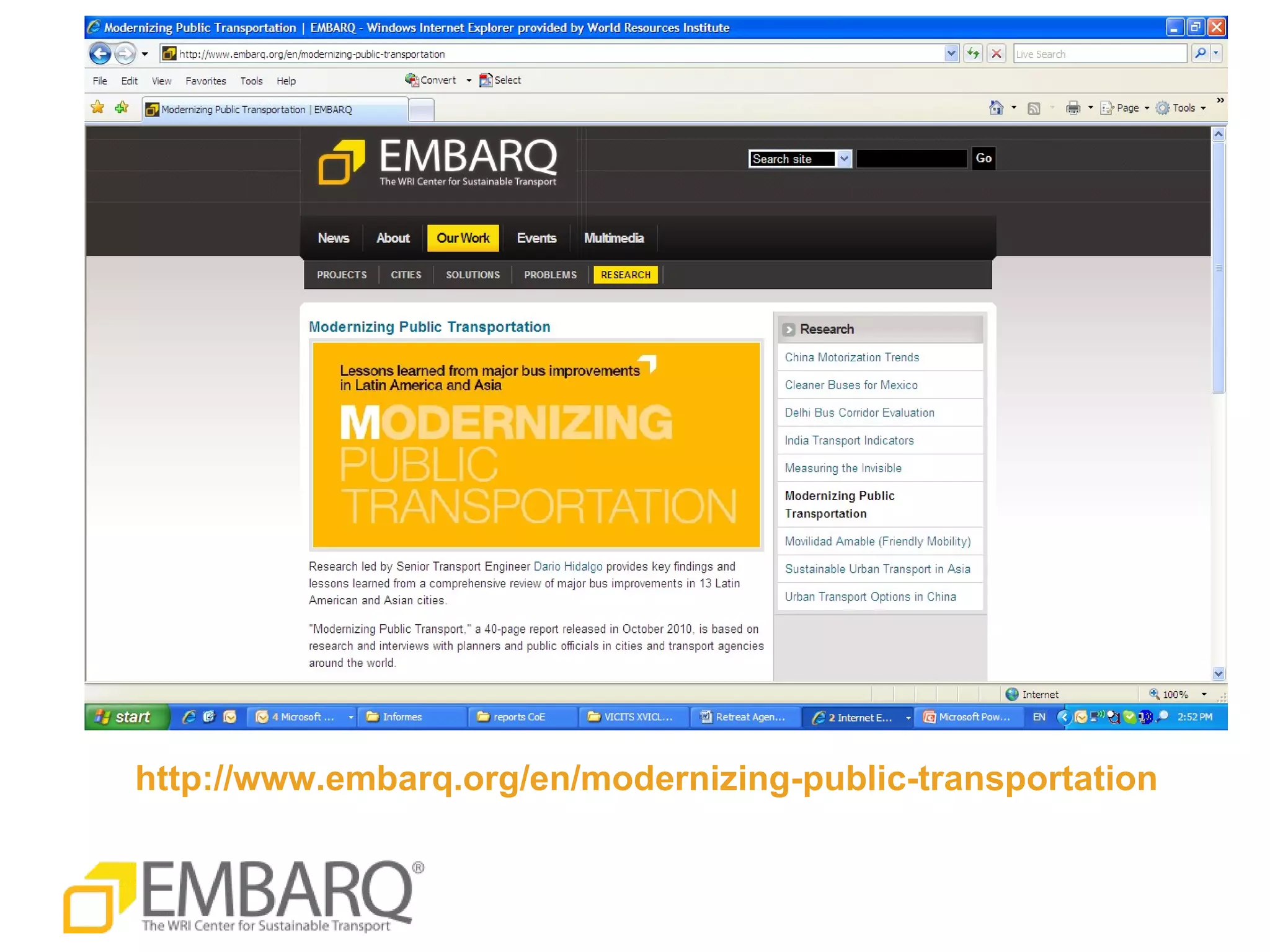
http://www.embarq.org/en/modernizing-public-transportation
Varied throughput (2009)
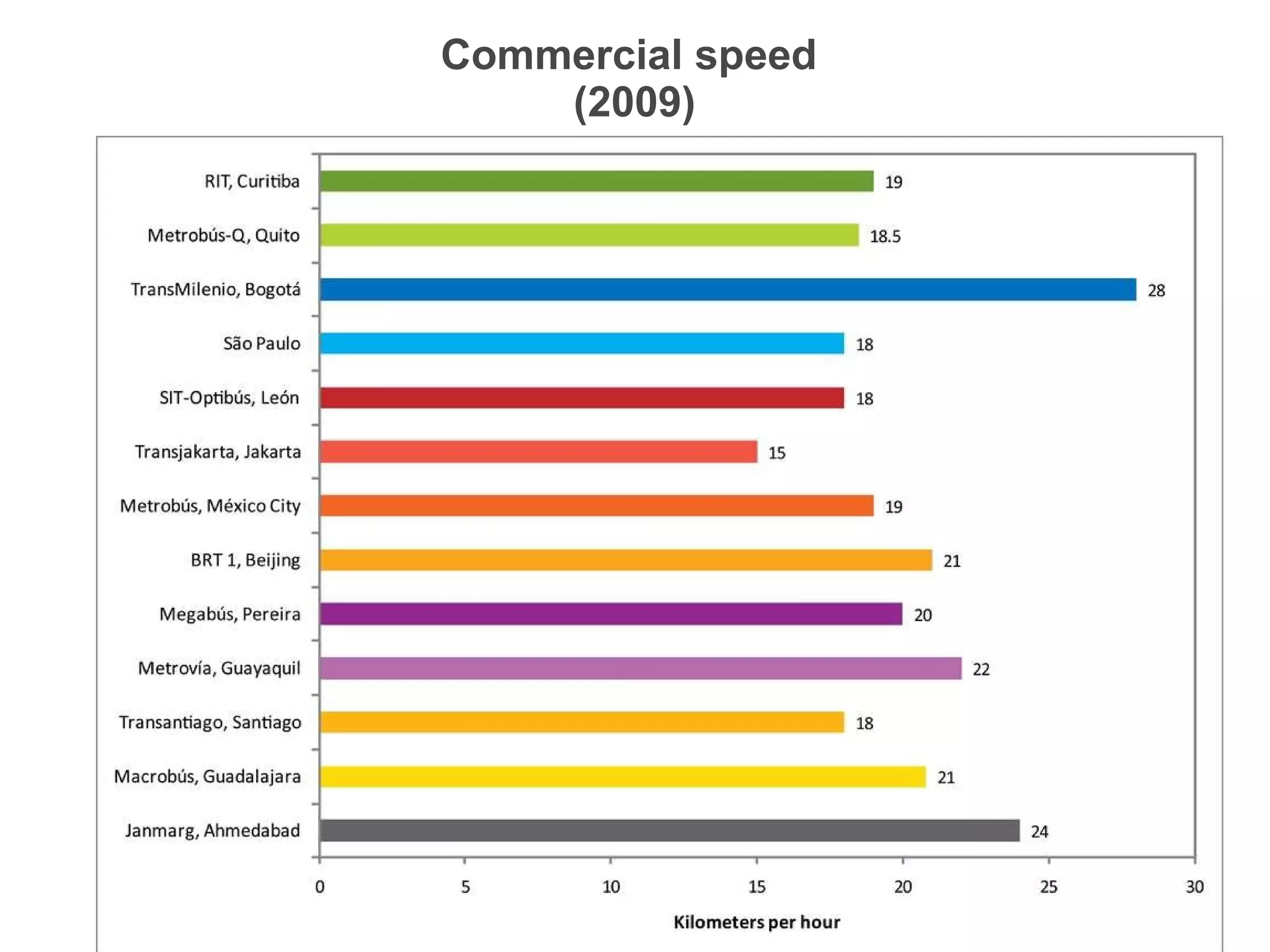
Commercial speed  (2009)
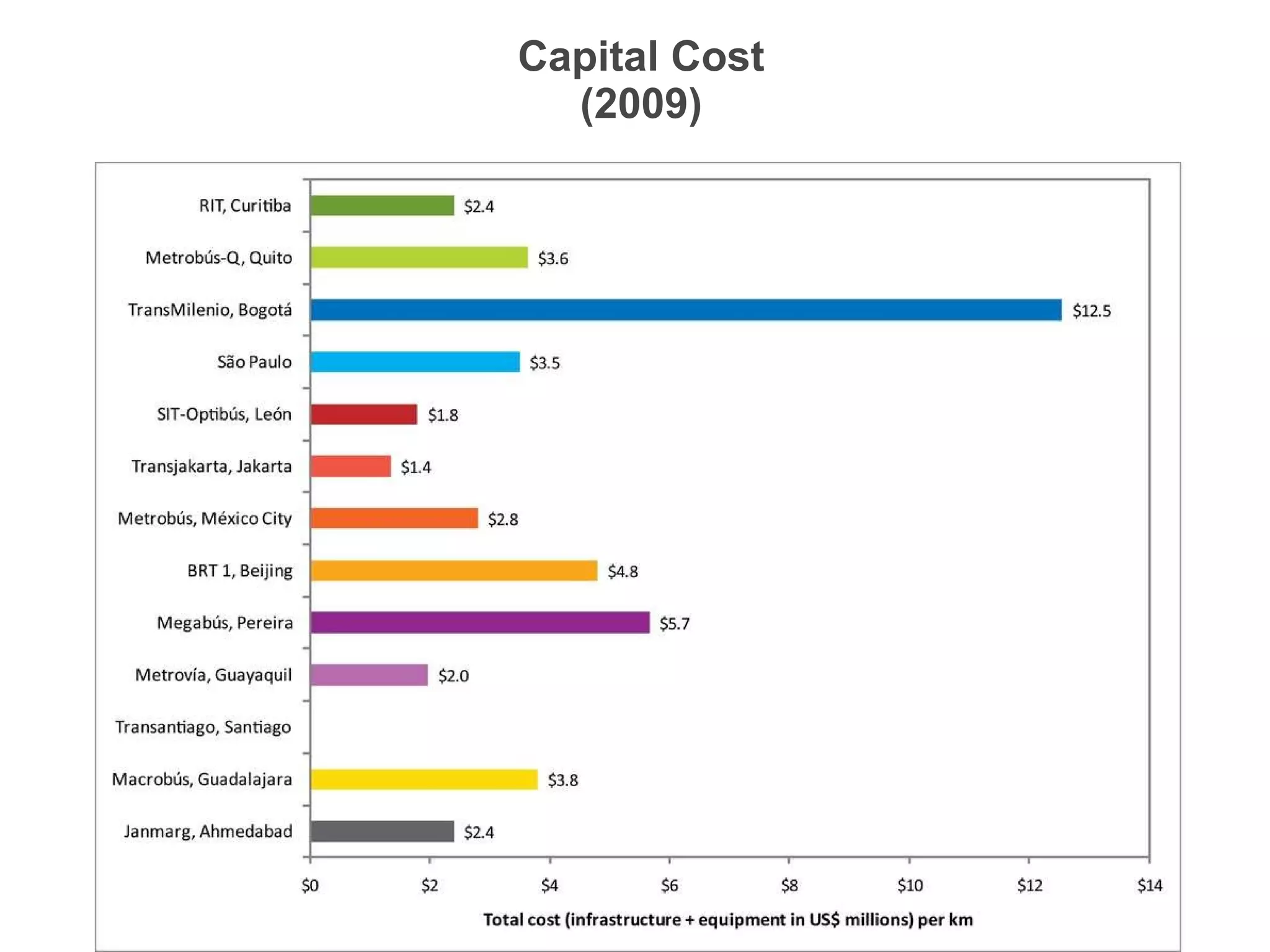
Capital Cost (2009)
What Went Wrong Filename/RPS Number Rushed implementation Very tight financial planning  Very high occupancy levels Early deterioration of infrastructure Issues with technological components Insufficient user education Common problems
 
Latin American Association of Integrated Bus Systems and BRT Agencies
 
Lessons for the US Good performance  High capacity Low cost Rapid implementation High positive impact  Travel time, emissions, accidents BRT is  a feature or an aspiration of most cities
¡Muchas Gracias! Volvo Research and Educational Foundations
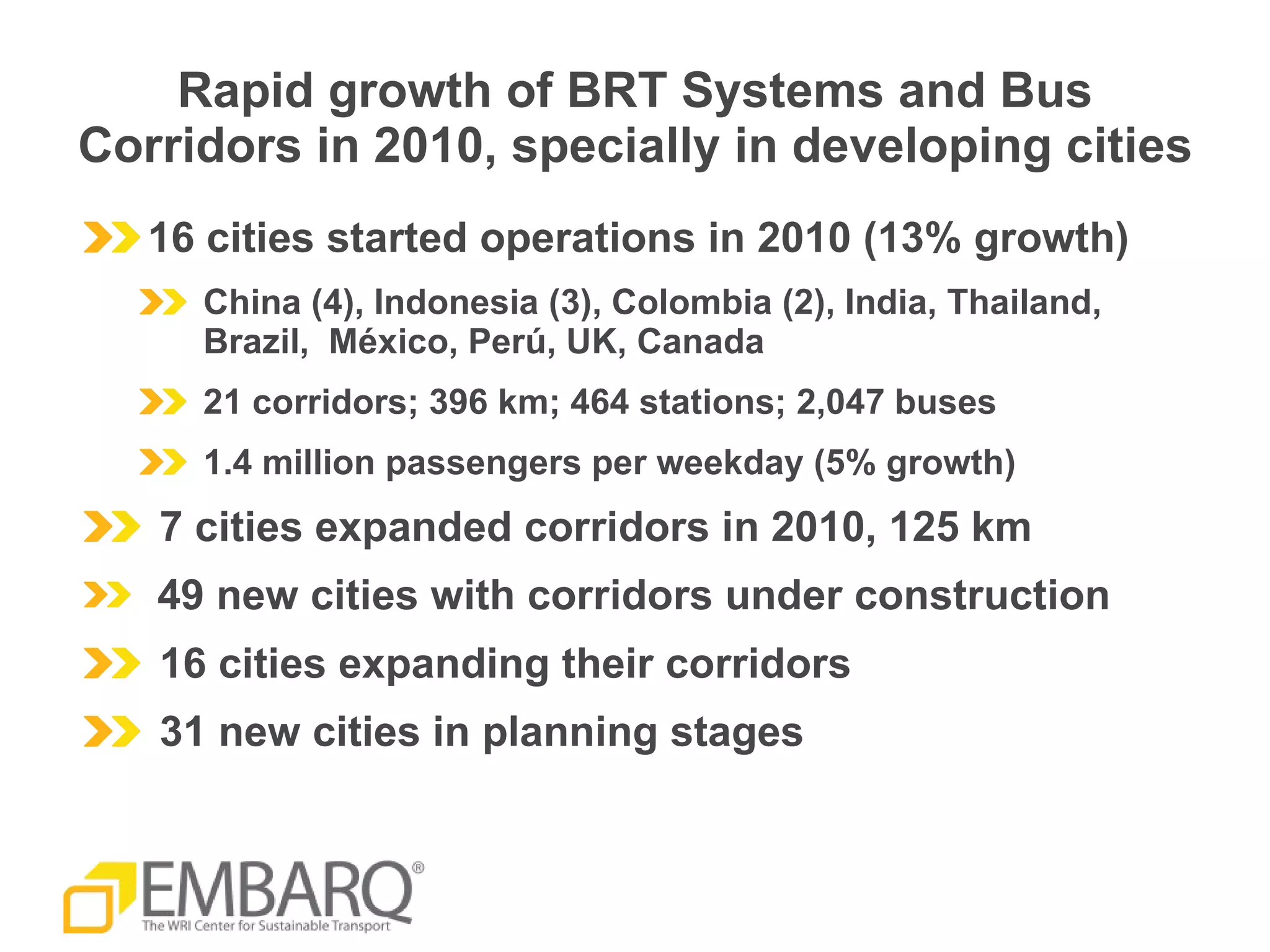
Rapid growth of BRT Systems and Bus Corridors in 2010, specially in developing cities 16 cities started operations in 2010 (13% growth) China (4), Indonesia (3), Colombia (2), India, Thailand, Brazil,  M é xico, Perú, UK, Canada 21 corridors; 396 km; 464 stations; 2,047 buses  1.4 million passengers per weekday (5% growth) 7 cities expanded corridors in 2010, 125 km 49 new cities with corridors under construction 16 cities expanding their corridors 31 new cities in planning stages
Cities with the most used BRT/Bus Corridors Networks 2010 Source: EMBARQ BRT/Bus Corridors Database, January, 2011 Dark color strong segregation, stations with prepayment Name Corridors Km Pax/day  Prioridade Transporte Colectivo, Sao Paulo, Brazil 10 301.3 6,843,664  Rede Integrada de Transporte, Curitiba, Brazil 6 72.0 2,260,000  TransMilenio, Bogota, Colombia 7 84.0 1,700,000  Busways, Taipei, China Taiwan 10 30.3 1,680,000  Tehran BRT, Iran 5 91.0 1,440,000  Prioridade Transporte Colectivo, Porto Alegre, Brazil 10 57.2 1,170,000  Guangzhou BRT, China 1 22.5 800,000  Optibus, Leon, Mexico 4 31.0 700,000  Metrobus, Istanbul, Turkey 2 43.0 700,000  Metrobus, Mexico City, Mexico 2 66.0 570,000  Metrorapid, Los Angeles, USA 21 390.2 464,600  Metrobus-Q, Quito, Ecuador 3 42.2 440,000  Prioridade Transporte Colectivo, Belo Horizonte, Brazil 2 23.7 435,000
Cities with the Longest BRT/Bus Corridors Networks 2010  Source: EMBARQ BRT/Bus Corridors Database, January, 2011 Dark color strong segregation, stations with prepayment Name Corridors Km Metrorapid, Los Angeles, California 21 390.2 Prioridade Transporte Colectivo, Sao Paulo, Brazil 10 301.3 SmartBus, Melbourne, Australia 4 233.0 MIO, Cali, Colombia 6 179.0 Trans Jakarta, Jakarta, Indonesia 10 172.2 LINK, Phoenix, USA 4 128.0 Metrobus, Monterrey, Mexico 3 101.0 Tehran BRT, Iran 5 91.0 Trans Hulonthanlangi, Indonesia 3 90.0 Trans Jogja, Indonesia 3 90.0 TransMilenio, Bogota, Colombia 7 84.0 TransMetro, Pekanbaru, Indonesia 2 74.0 Rede Integrada de Transporte, Curitiba, Brazil 6 72.0
Systems expansions 2010 125 km 3% increase over existing km in 2009  Source: EMBARQ BRT/Bus Corridors Database, January, 2011 Name City Expansion (growth) Transjakarta Jakarta, Indonesia +48 km  (34%) BRT Teheran Teheran, Iran +21km  (31%) Janmarg Ahmedabad, India +20 km  (105%) Select Bus New York City  +14 km  (121%) Xiamen BRT Xiamen, China +11 km  (28%) Hangzhou BRT Hangzhou, China +6 km  (46%) Optibús León, México +5 km  (19%)
Source: EMBARQ BRT/Bus Corridors Database, January, 2011 Region Country 49 Cities with BRT/Bus Corridors under Construction Dec 2010 Africa (3) Ghana (1) Accra (Ghana),  South Africa (2) Cape Town, Nelson Mandela Bay Asia (12)  India (6) Surat, Indore, Bhopal, Vishakhapatnam, Vijayawada, Rajkot Jordan (1) Amman Korea, Republic (1) Changwon Turkey (1) Kocaeli (Izmit) Europe (23) France (20) Annenasse, Antibes-Sophia Antipolis, Cannes, La Rochelle, Lille,  Lyon, Metz, Nancy, Nice, Nimes, Perpignan, Rennes, Saint-Brieuc, Saint-Etienne, Saint-Nazaire, Saint-Pierre-de la-Reunion, Sait-Paul-de-la-Reunion, Toulouse, Tours, Valenciennes Italy (1) Bologna,  UK (2) Cambridge, Leigh-Salford-Manchester Latin America and the Caribbean (10) Argentina (1) Buenos Aires Colombia (3) Cartagena, Medell ín, Soacha México (1) Monterrey Panamá (1) Panamá City Paraguay (1) Asunción Perú (1) Arequipa Puerto Rico (1) San Juan Venezuela (1) Barquisimeto USA and Canada (9) USA (9) Albany (NY), Austin (TX), Berkeley (CA), Fort Collins (CO),  Grand Rapids (MI), Roaring Forks Valley (CO), San Bernardino (CA),  San Francisco (CA), Seattle (WA)
Source: EMBARQ BRT/Bus Corridors Database, January, 2011 Region Country 16 Cities with BRT/Bus Corridors under Expansion  December 2010 Africa (1) South Africa (1) Johannesburg Asia (4)  India (3) Ahmedabad, Jaipur, Pune Iran (1) Teheran Latin America and the Caribbean (10) Brasil (5) Belo Horizonte, Curitiba, Porto Alegre, Recife, Salvador Colombia (2) Bogotá, Cali Guatemala (1) Guatemala City México (2) León, México City USA and Canada (1) USA (1) New York City (NY)
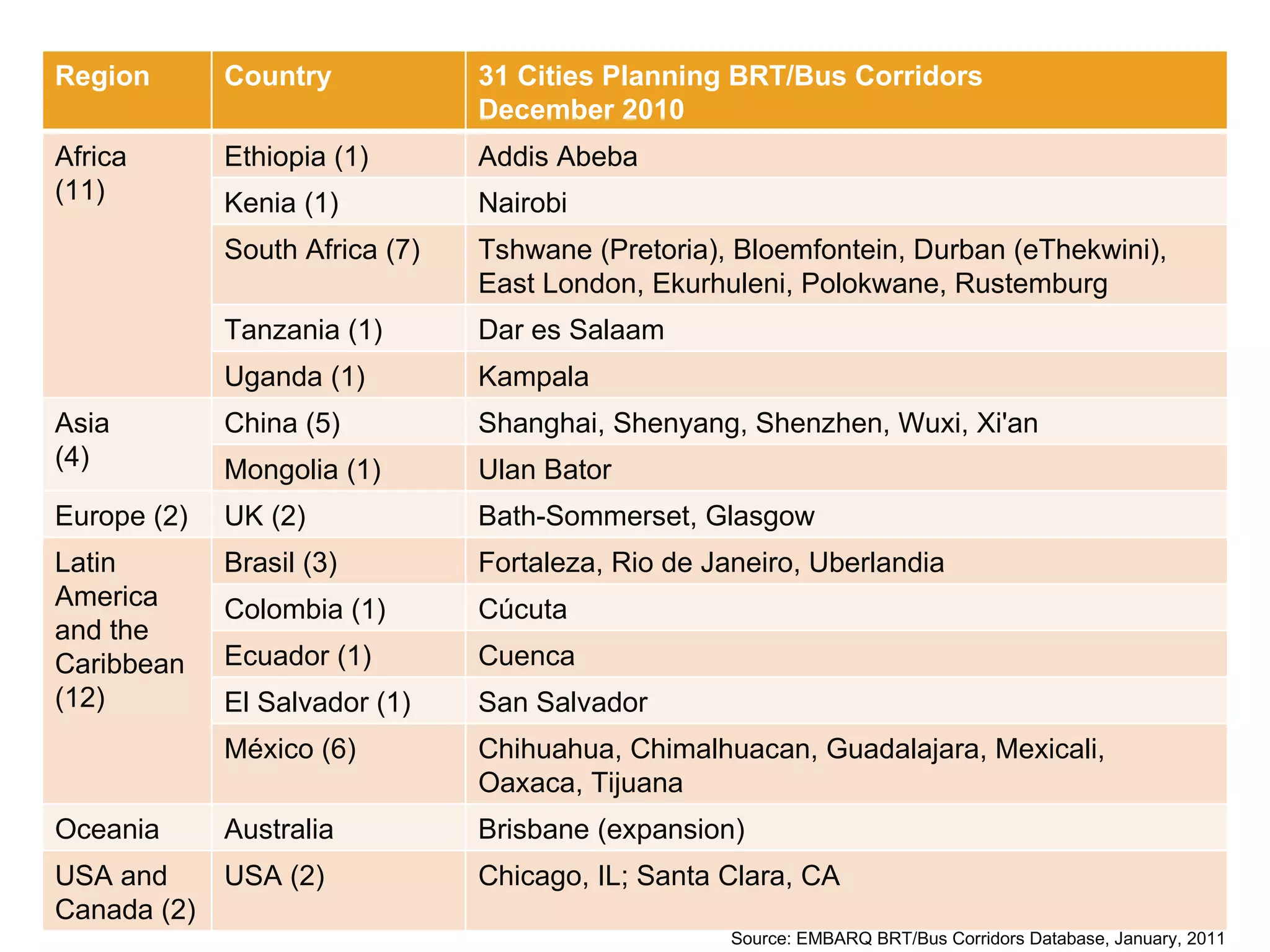
Source: EMBARQ BRT/Bus Corridors Database, January, 2011 Region Country 31 Cities Planning BRT/Bus Corridors  December 2010 Africa  (11) Ethiopia (1) Addis Abeba Kenia (1) Nairobi South Africa (7) Tshwane (Pretoria), Bloemfontein, Durban (eThekwini), East London, Ekurhuleni, Polokwane, Rustemburg Tanzania (1) Dar es Salaam Uganda (1) Kampala Asia (4)  China (5) Shanghai, Shenyang, Shenzhen, Wuxi, Xi'an Mongolia (1) Ulan Bator Europe (2) UK (2) Bath-Sommerset, Glasgow Latin America and the Caribbean (12) Brasil (3) Fortaleza, Rio de Janeiro, Uberlandia Colombia (1) Cúcuta Ecuador (1) Cuenca El Salvador (1) San Salvador México (6) Chihuahua, Chimalhuacan, Guadalajara, Mexicali, Oaxaca, Tijuana Oceania Australia Brisbane (expansion) USA and Canada (2) USA (2) Chicago, IL; Santa Clara, CA

BRT: Made in Latin America

  • 1.
    BRT: Made inLatin America Dario Hidalgo Luis Gutierrez EMBARQ, The WRI Center for Sustainable Transport Brookings Institution Washington DC, March 8, 2011
  • 2.
  • 3.
    BRT around theworld 120 cities with BRT Systems and Bus Corridors 4,335 km 6,683 stations 30,000 buses 26.8 million passengers per weekday 1% of the world´s urban population (2010) 1.4 times the combined population of New York and Newark (2010)
  • 4.
    Source: EMBARQ BRT/BusCorridors Database, January, 2011
  • 5.
    1,330 km (31%) 2,686 stations (40%) 16,856 buses (56%) 17.6 million passengers per weekday (66%) Source: CTS Brasil, EMBARQ BRT/Bus Corridors Database, January, 2011 32 cities in LAC with BRT or bus corridors (26% of the world)
  • 6.
    Curitiba, RIT, 72km median busways 2.3 million pax/day Initial Corridor 1972
  • 7.
    Curitiba new BRTCorridor (2009-2010) Rodovia BR116 “Before” Photo: URBS Linha Verde “Now” Photo: CTS Brasil Linha Verde “Future” Image: URBS
  • 8.
    Curitiba – 35years with a coordinated land use and transport plan with a BRT backbone Fuente: Arq. Antonio Juarez Nakamura, Presentación en IV Seminario Internacional de Arquitectura – Universidad Piloto de Colombia, Bogotá, Agosto de 2002
  • 9.
    Travel Time (2007)Source: Observatorio Movilidad Urbana CAF http://omu.caf.com/ Hour/person/day
  • 10.
    Tailpipe Emissions(2007) Source:Observatorio Movilidad Urbana CAF http://omu.caf.com/ Ton per day per million people
  • 11.
    Road Safety (2007)Source: Observatorio Movilidad Urbana CAF http://omu.caf.com/ Road Fatalities per 100,000 people
  • 12.
    Quito, Metrobús-Q, 37Km median busways, 440,000 pax/day Initial corridor in 1995
  • 13.
    Bogot á, TransMilenio, 84 Km median busways, 1,7 million pax/day Initial Corridor 2000
  • 14.
    Bogotá TransMilenio Eje Ambiental Avenida Jiménez Photo ITDP
  • 15.
  • 16.
    Fuentes: Encuesta Anual“Bogotá ¿Cómo Vamos?” www.eltiempo.com ; Total Public Transport Traditional Public Transport TransMilenio BRTS Private (Car, Two Wheeler) Active Transport (Walking, Bicycle) Main mode of transport 1998-2009
  • 17.
    Fatalities in BogotáOver Time Source: Anuario Estadístico, Ministerio de Transporte, Colombia
  • 18.
    Fatalities Reduced (Baselinevs. Project) Av. Caracas BRT Corridor, TransMilenio, Bogotá Data: TRANSMILENIO S.A.
  • 19.
    Sao Paulo, 104Km median busways + preferential buslanes, 5,761,000 pax/day Initial busways 1980, Reconstructed in 2003
  • 20.
    León de Guanajuato,M éxico , Optibús, 31 Km median busways (60% segregated) Initial corridor 2003
  • 21.
    México City, Metrobús, 66 Km median busways, 570,000 pax/day Initial Corridor 2005
  • 22.
  • 23.
    Pereira, Colombia, Megabú s, 27 Km Busways, 155,000 pax/day Initial Operation in 2006
  • 24.
    Pereira, Colombia Photoscourtesy of Megabus, Pereira, Colombia
  • 25.
    Guayaquil, Ecuador, Metrovía, 16 Km Busways, 96,000 pax/day Initial Corridor 2006 Photos by D. Hidalgo
  • 26.
    Santiago, Chile, 19Km busways + 63 Km of road improvements, Integrated Network for 5 Million Trips/day Initial Operation in 2007
  • 27.
    Guatemala City, February2007 Photo: Sapfan (Jan Pesula)
  • 28.
    Cali, Colombia 27Km busways 130,000 pax/day Initial Operation in 2009 Photo: Metrocali
  • 29.
  • 30.
  • 31.
    Transmetro, Barranquilla, ColombiaOpened 10 July 2010 13.4 km dedicated busway 15 Stations 92 articulated buses 32,0000 pax/day Photo via transmetro.gov.co Sources: http://transmetro.gov.co/web2010/ Ministry of Transport, Mass Transit Group, Oct 2010
  • 32.
    Metrol í nea,Bucaramanga, Colombia Opened 21 December 2009 8.9 km trunk corridor 7.7 auxiliary corridors (25.2 km plan.) 24 stations 75,000 pax/day Photo: http://www.metrolinea.gov.co/ Source: Ministry of Transport, Mass Transit Group, Oct 2010
  • 33.
    Mexibús, Estado México,México Initial operation Nov 30, 2010 16 km exclusive busway 21 stations 130,000 pax/day (expected) Photo: http://transeunte.org/tag/mexibus/ Source: http://transporteinformativo.com/pasaje/inicia-operaciones-mexibus-con-63-autobuses-articulados-volvo
  • 34.
    Metropolitano, Lima, PeruInitial Operation, May 2010 First high capacity bus system with CNG only 27 km busways, 80% with overtaking at stations 35 stations 308 articulated buses 82,000 pax/day south section (854,000 pax/day expected) 21 km/hour commercial speed Photo: Protransporte, Lima, May 2010 Source: Menckhoff, G., Ochoa, C., Ardila, A. “El Metropolitano de Lima: Implementación y Primeros Resultados de un Nuevo Sistema BRT” CLATPU, Octubre 2010
  • 35.
  • 36.
  • 37.
  • 38.
  • 39.
    What Went WrongFilename/RPS Number Rushed implementation Very tight financial planning Very high occupancy levels Early deterioration of infrastructure Issues with technological components Insufficient user education Common problems
  • 40.
  • 41.
    Latin American Associationof Integrated Bus Systems and BRT Agencies
  • 42.
  • 43.
    Lessons for theUS Good performance High capacity Low cost Rapid implementation High positive impact Travel time, emissions, accidents BRT is a feature or an aspiration of most cities
  • 44.
    ¡Muchas Gracias! VolvoResearch and Educational Foundations
  • 45.
    Rapid growth ofBRT Systems and Bus Corridors in 2010, specially in developing cities 16 cities started operations in 2010 (13% growth) China (4), Indonesia (3), Colombia (2), India, Thailand, Brazil, M é xico, Perú, UK, Canada 21 corridors; 396 km; 464 stations; 2,047 buses 1.4 million passengers per weekday (5% growth) 7 cities expanded corridors in 2010, 125 km 49 new cities with corridors under construction 16 cities expanding their corridors 31 new cities in planning stages
  • 46.
    Cities with themost used BRT/Bus Corridors Networks 2010 Source: EMBARQ BRT/Bus Corridors Database, January, 2011 Dark color strong segregation, stations with prepayment Name Corridors Km Pax/day Prioridade Transporte Colectivo, Sao Paulo, Brazil 10 301.3 6,843,664 Rede Integrada de Transporte, Curitiba, Brazil 6 72.0 2,260,000 TransMilenio, Bogota, Colombia 7 84.0 1,700,000 Busways, Taipei, China Taiwan 10 30.3 1,680,000 Tehran BRT, Iran 5 91.0 1,440,000 Prioridade Transporte Colectivo, Porto Alegre, Brazil 10 57.2 1,170,000 Guangzhou BRT, China 1 22.5 800,000 Optibus, Leon, Mexico 4 31.0 700,000 Metrobus, Istanbul, Turkey 2 43.0 700,000 Metrobus, Mexico City, Mexico 2 66.0 570,000 Metrorapid, Los Angeles, USA 21 390.2 464,600 Metrobus-Q, Quito, Ecuador 3 42.2 440,000 Prioridade Transporte Colectivo, Belo Horizonte, Brazil 2 23.7 435,000
  • 47.
    Cities with theLongest BRT/Bus Corridors Networks 2010 Source: EMBARQ BRT/Bus Corridors Database, January, 2011 Dark color strong segregation, stations with prepayment Name Corridors Km Metrorapid, Los Angeles, California 21 390.2 Prioridade Transporte Colectivo, Sao Paulo, Brazil 10 301.3 SmartBus, Melbourne, Australia 4 233.0 MIO, Cali, Colombia 6 179.0 Trans Jakarta, Jakarta, Indonesia 10 172.2 LINK, Phoenix, USA 4 128.0 Metrobus, Monterrey, Mexico 3 101.0 Tehran BRT, Iran 5 91.0 Trans Hulonthanlangi, Indonesia 3 90.0 Trans Jogja, Indonesia 3 90.0 TransMilenio, Bogota, Colombia 7 84.0 TransMetro, Pekanbaru, Indonesia 2 74.0 Rede Integrada de Transporte, Curitiba, Brazil 6 72.0
  • 48.
    Systems expansions 2010125 km 3% increase over existing km in 2009 Source: EMBARQ BRT/Bus Corridors Database, January, 2011 Name City Expansion (growth) Transjakarta Jakarta, Indonesia +48 km (34%) BRT Teheran Teheran, Iran +21km (31%) Janmarg Ahmedabad, India +20 km (105%) Select Bus New York City +14 km (121%) Xiamen BRT Xiamen, China +11 km (28%) Hangzhou BRT Hangzhou, China +6 km (46%) Optibús León, México +5 km (19%)
  • 49.
    Source: EMBARQ BRT/BusCorridors Database, January, 2011 Region Country 49 Cities with BRT/Bus Corridors under Construction Dec 2010 Africa (3) Ghana (1) Accra (Ghana), South Africa (2) Cape Town, Nelson Mandela Bay Asia (12) India (6) Surat, Indore, Bhopal, Vishakhapatnam, Vijayawada, Rajkot Jordan (1) Amman Korea, Republic (1) Changwon Turkey (1) Kocaeli (Izmit) Europe (23) France (20) Annenasse, Antibes-Sophia Antipolis, Cannes, La Rochelle, Lille, Lyon, Metz, Nancy, Nice, Nimes, Perpignan, Rennes, Saint-Brieuc, Saint-Etienne, Saint-Nazaire, Saint-Pierre-de la-Reunion, Sait-Paul-de-la-Reunion, Toulouse, Tours, Valenciennes Italy (1) Bologna, UK (2) Cambridge, Leigh-Salford-Manchester Latin America and the Caribbean (10) Argentina (1) Buenos Aires Colombia (3) Cartagena, Medell ín, Soacha México (1) Monterrey Panamá (1) Panamá City Paraguay (1) Asunción Perú (1) Arequipa Puerto Rico (1) San Juan Venezuela (1) Barquisimeto USA and Canada (9) USA (9) Albany (NY), Austin (TX), Berkeley (CA), Fort Collins (CO), Grand Rapids (MI), Roaring Forks Valley (CO), San Bernardino (CA), San Francisco (CA), Seattle (WA)
  • 50.
    Source: EMBARQ BRT/BusCorridors Database, January, 2011 Region Country 16 Cities with BRT/Bus Corridors under Expansion December 2010 Africa (1) South Africa (1) Johannesburg Asia (4) India (3) Ahmedabad, Jaipur, Pune Iran (1) Teheran Latin America and the Caribbean (10) Brasil (5) Belo Horizonte, Curitiba, Porto Alegre, Recife, Salvador Colombia (2) Bogotá, Cali Guatemala (1) Guatemala City México (2) León, México City USA and Canada (1) USA (1) New York City (NY)
  • 51.
    Source: EMBARQ BRT/BusCorridors Database, January, 2011 Region Country 31 Cities Planning BRT/Bus Corridors December 2010 Africa (11) Ethiopia (1) Addis Abeba Kenia (1) Nairobi South Africa (7) Tshwane (Pretoria), Bloemfontein, Durban (eThekwini), East London, Ekurhuleni, Polokwane, Rustemburg Tanzania (1) Dar es Salaam Uganda (1) Kampala Asia (4) China (5) Shanghai, Shenyang, Shenzhen, Wuxi, Xi'an Mongolia (1) Ulan Bator Europe (2) UK (2) Bath-Sommerset, Glasgow Latin America and the Caribbean (12) Brasil (3) Fortaleza, Rio de Janeiro, Uberlandia Colombia (1) Cúcuta Ecuador (1) Cuenca El Salvador (1) San Salvador México (6) Chihuahua, Chimalhuacan, Guadalajara, Mexicali, Oaxaca, Tijuana Oceania Australia Brisbane (expansion) USA and Canada (2) USA (2) Chicago, IL; Santa Clara, CA

Editor's Notes

  • #33 u
  • #42 SIBRT is a member-driven, non-profit association of public transportation agencies in Latin America committed to advance urban public transportation and improve quality of life in the region’s cities