The TclQuadcode
Compiler
Status report on Tcl type
analysis and code
generation
Donal Fellowsorcid.org/0000-0002-9091-5938
Kevin Kenny
What is going on?
Ü  Want to Make Tcl Faster
Ü  Everyone benefits
Ü  Lehenbauer Challenges
Ü  2 times faster (“Perl” territory)
Ü  Better algorithms
Ü  Better buffer management
Ü  Bytecode optimization
Ü  10 times faster (“C” territory)
Ü  Needs more radical approach
2
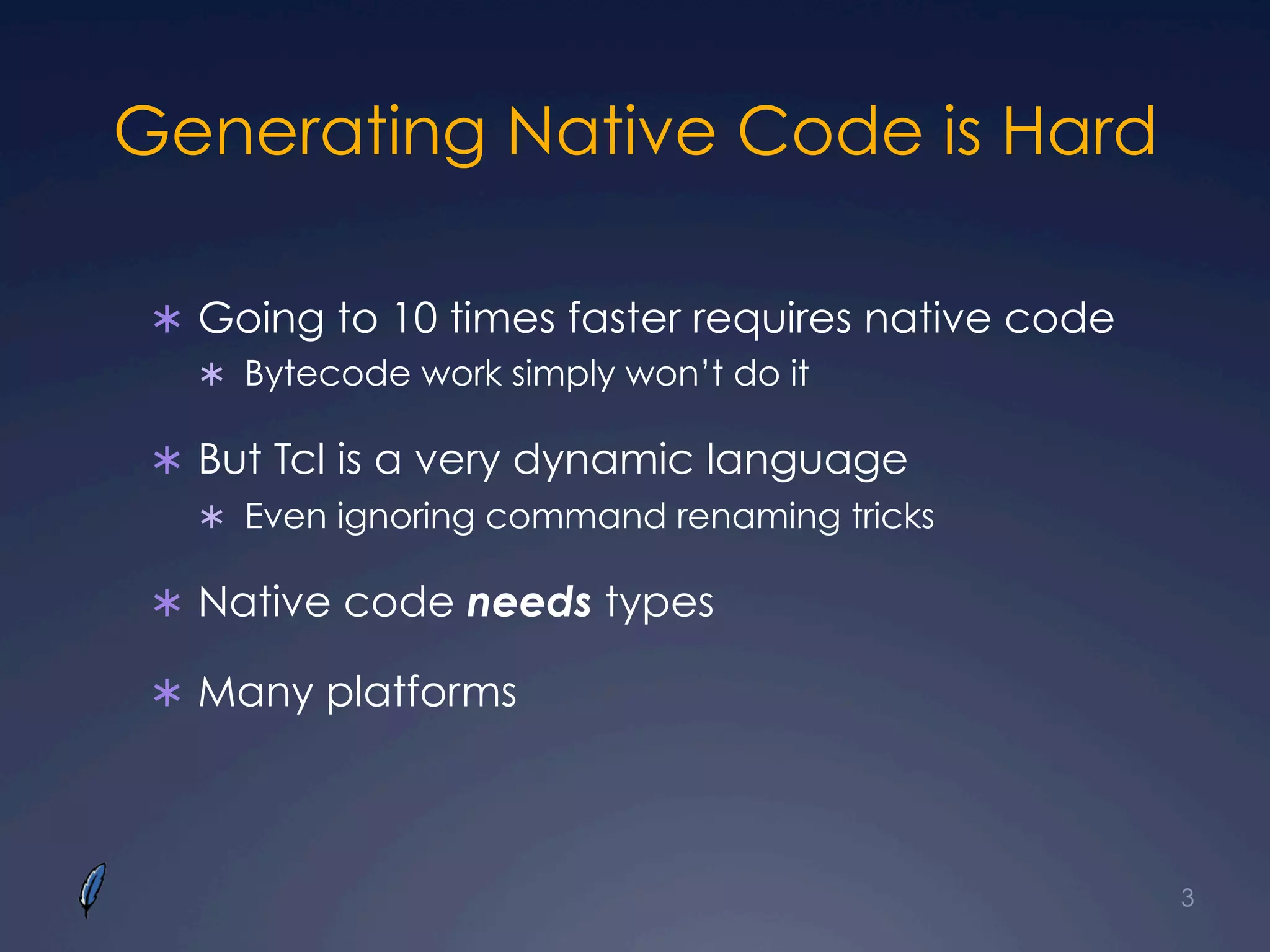
Generating Native Code is Hard
Ü  Going to 10 times faster requires native code
Ü  Bytecode work simply won’t do it
Ü  But Tcl is a very dynamic language
Ü  Even ignoring command renaming tricks
Ü  Native code needs types
Ü  Many platforms
3
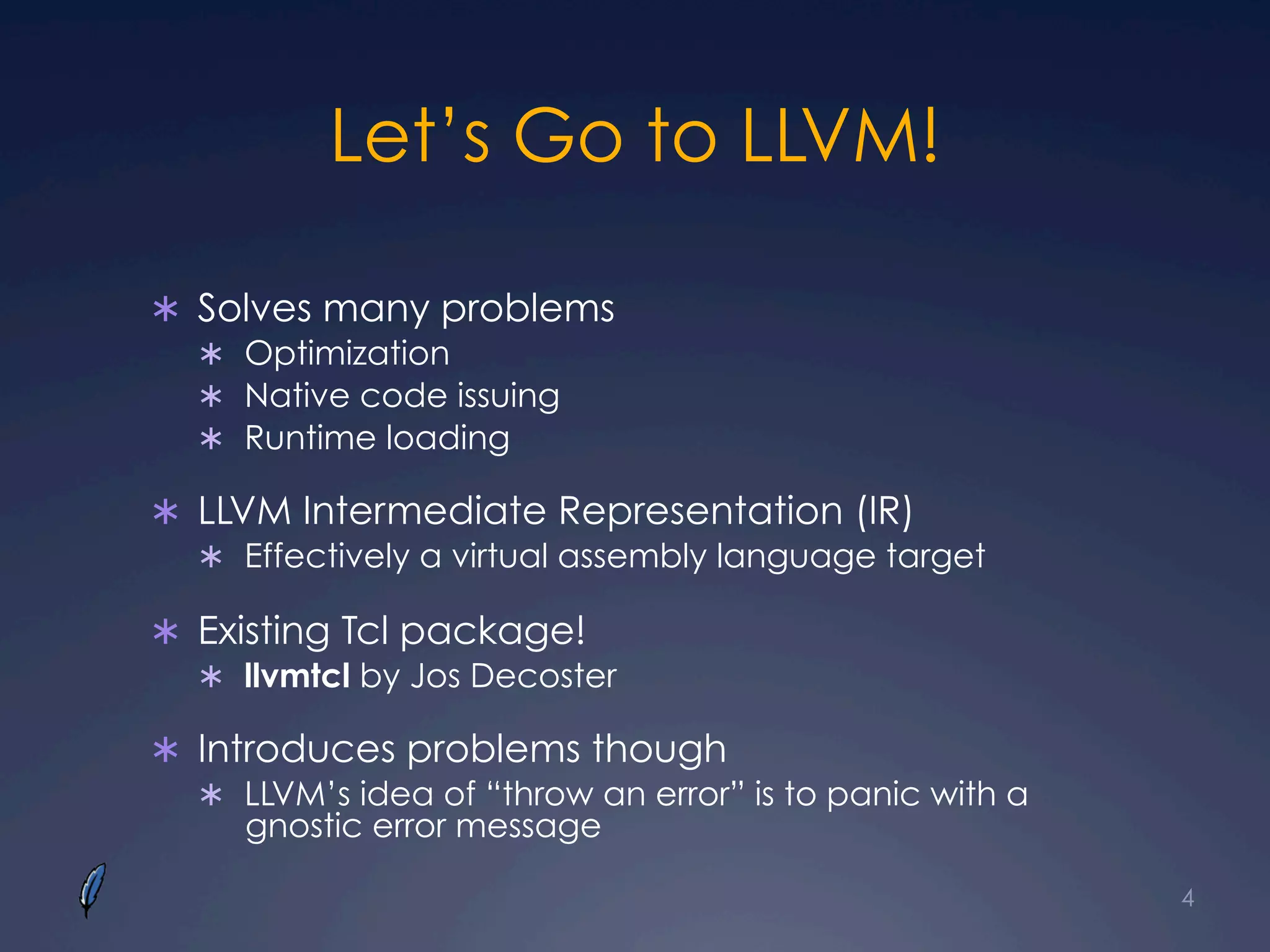
Let’s Go to LLVM!
Ü  Solves many problems
Ü  Optimization
Ü  Native code issuing
Ü  Runtime loading
Ü  LLVM Intermediate Representation (IR)
Ü  Effectively a virtual assembly language target
Ü  Existing Tcl package!
Ü  llvmtcl by Jos Decoster
Ü  Introduces problems though
Ü  LLVM’s idea of “throw an error” is to panic with a
gnostic error message
4
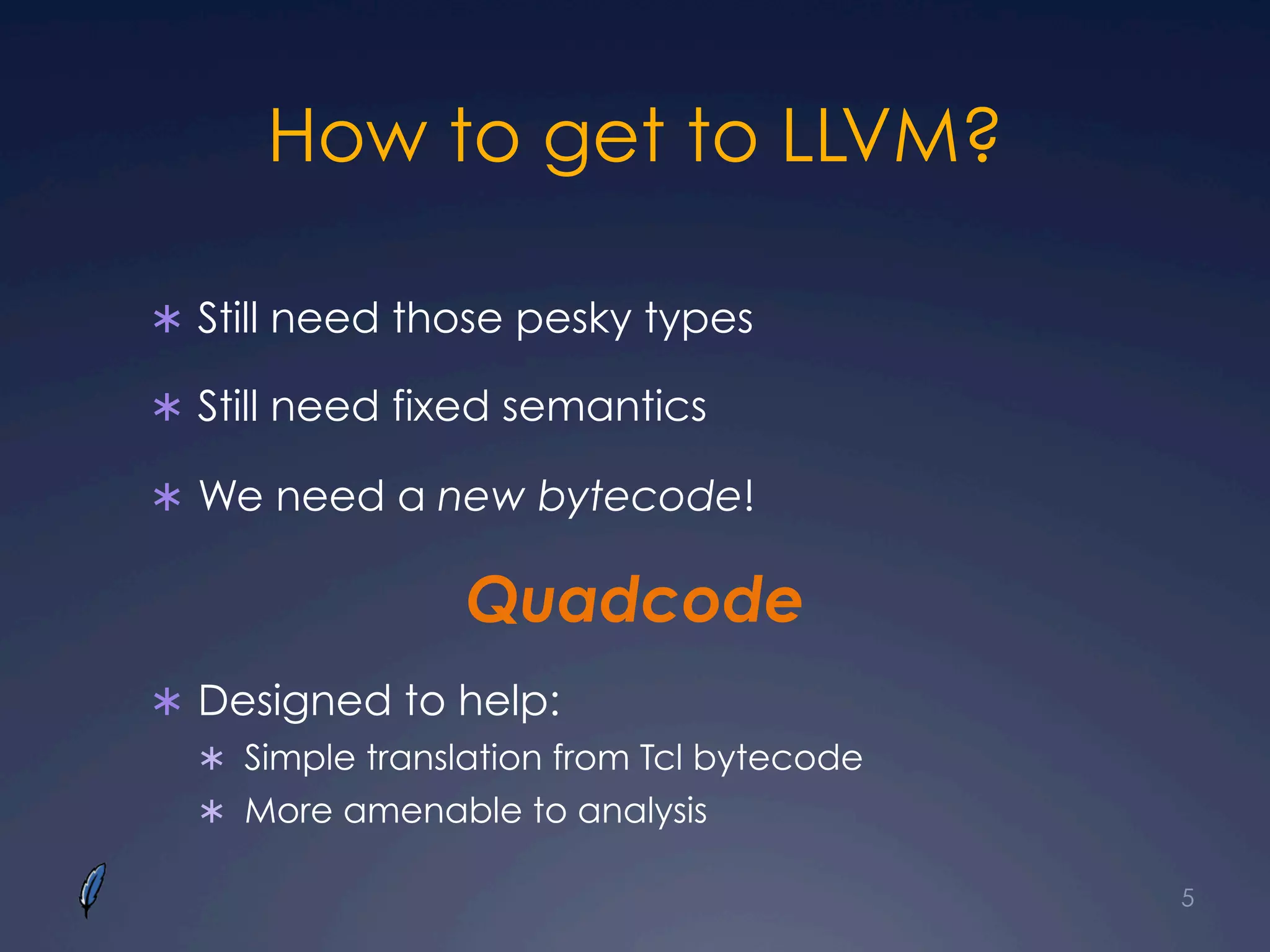
How to get to LLVM?
Ü  Still need those pesky types
Ü  Still need fixed semantics
Ü  We need a new bytecode!
Quadcode
Ü  Designed to help:
Ü  Simple translation from Tcl bytecode
Ü  More amenable to analysis
5
6
Quadcode
Tcl Analysis with
Quadcode
Ü  Based on three-address code assembly
Ü  The Tcl code:
set	
  a	
  [expr	
  {	
  $b	
  +	
  1	
  }]	
  
Ü  Equivalent Tcl bytecode:
loadScalar	
  %b;	
  push	
  “1”;	
  add;	
  storeScalar	
  %a	
  
Ü  Equivalent (optimized) quadcode:
add	
  {var	
  a}	
  {var	
  b}	
  {literal	
  1}
Ü  No stack
Ü  Temporary variables used as required
8
Example: Tcl code to bytecode
proc cos {x {n 16}} {
set x [expr {double($x)}]
set n [expr {int($n)}]
set j 0
set s 1.0
set t 1.0
set i 0
while {[incr i] < $n} {
set t [expr {
-$t*$x*$x / [incr j] / [incr j]
}]
set s [expr {$s + $t}]
}
return $s
}
...
29: startCommand {pc 42} 1
38: push1 {literal 0}
40: storeScalar1 {scalar j}
42: pop
43: startCommand {pc 56} 1
52: push1 {literal 1.0}
54: storeScalar1 {scalar s}
56: pop
57: startCommand {pc 70} 1
66: push1 {literal 1.0}
68: storeScalar1 {scalar t}
70: pop
71: startCommand {pc 84} 1
80: push1 {literal 0}
82: storeScalar1 {scalar i}
84: pop
85: startCommand {pc 179} 1
94: jump1 {pc 160}
96: startCommand {pc 142} 2
105: loadScalar1 {scalar t}
107: uminus
108: loadScalar1 {{scalar arg} x}
110: mult
111: loadScalar1 {{scalar arg} x}
113: mult
114: startCommand {pc 126} 1
123: incrScalar1Imm {scalar j} 1
126: div
127: startCommand {pc 139} 1
136: incrScalar1Imm {scalar j} 1
139: div
140: storeScalar1 {scalar t}
142: pop
...
9
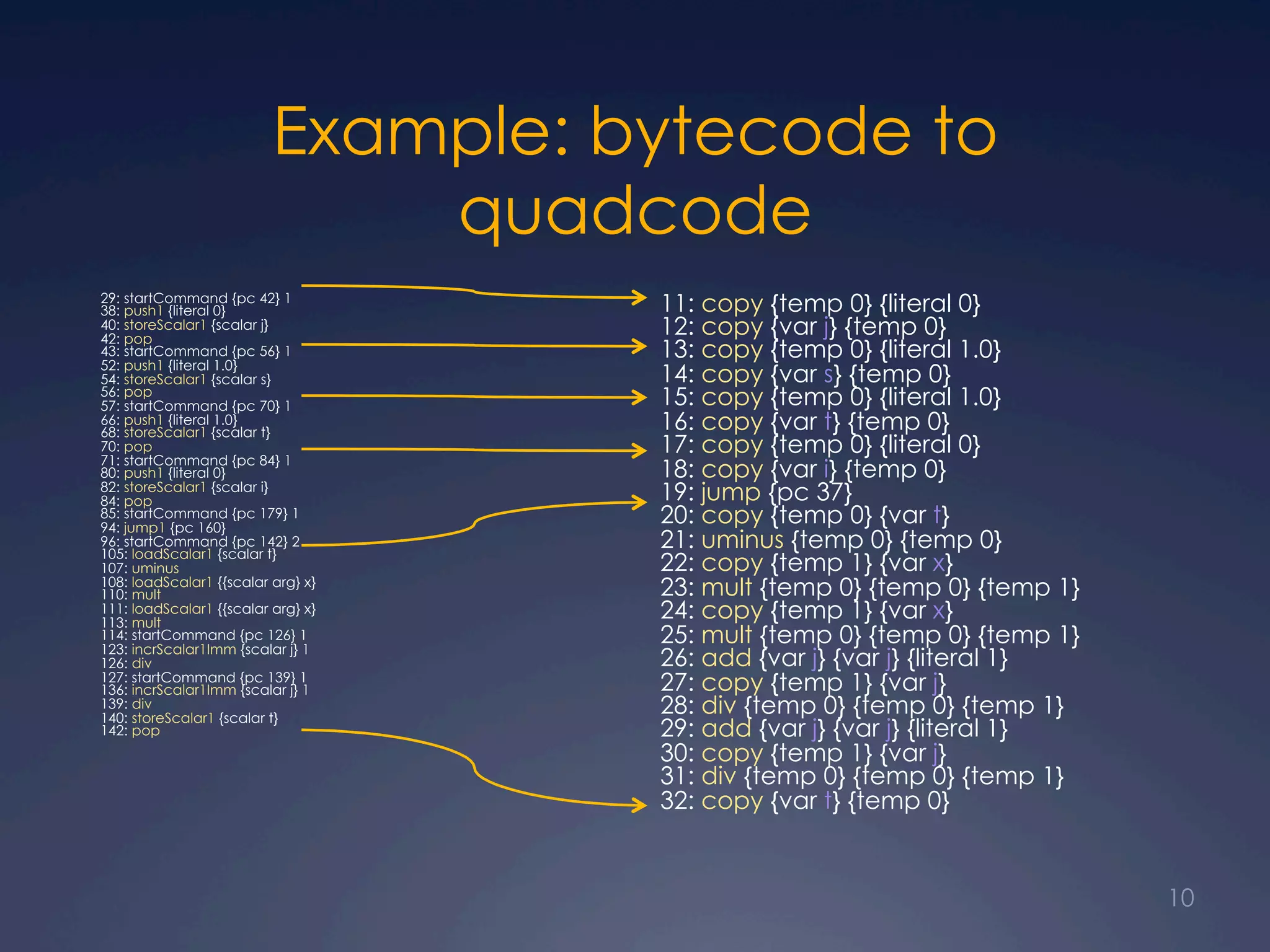
Example: bytecode to
quadcode
29: startCommand {pc 42} 1
38: push1 {literal 0}
40: storeScalar1 {scalar j}
42: pop
43: startCommand {pc 56} 1
52: push1 {literal 1.0}
54: storeScalar1 {scalar s}
56: pop
57: startCommand {pc 70} 1
66: push1 {literal 1.0}
68: storeScalar1 {scalar t}
70: pop
71: startCommand {pc 84} 1
80: push1 {literal 0}
82: storeScalar1 {scalar i}
84: pop
85: startCommand {pc 179} 1
94: jump1 {pc 160}
96: startCommand {pc 142} 2
105: loadScalar1 {scalar t}
107: uminus
108: loadScalar1 {{scalar arg} x}
110: mult
111: loadScalar1 {{scalar arg} x}
113: mult
114: startCommand {pc 126} 1
123: incrScalar1Imm {scalar j} 1
126: div
127: startCommand {pc 139} 1
136: incrScalar1Imm {scalar j} 1
139: div
140: storeScalar1 {scalar t}
142: pop
11: copy {temp 0} {literal 0}
12: copy {var j} {temp 0}
13: copy {temp 0} {literal 1.0}
14: copy {var s} {temp 0}
15: copy {temp 0} {literal 1.0}
16: copy {var t} {temp 0}
17: copy {temp 0} {literal 0}
18: copy {var i} {temp 0}
19: jump {pc 37}
20: copy {temp 0} {var t}
21: uminus {temp 0} {temp 0}
22: copy {temp 1} {var x}
23: mult {temp 0} {temp 0} {temp 1}
24: copy {temp 1} {var x}
25: mult {temp 0} {temp 0} {temp 1}
26: add {var j} {var j} {literal 1}
27: copy {temp 1} {var j}
28: div {temp 0} {temp 0} {temp 1}
29: add {var j} {var j} {literal 1}
30: copy {temp 1} {var j}
31: div {temp 0} {temp 0} {temp 1}
32: copy {var t} {temp 0}
10
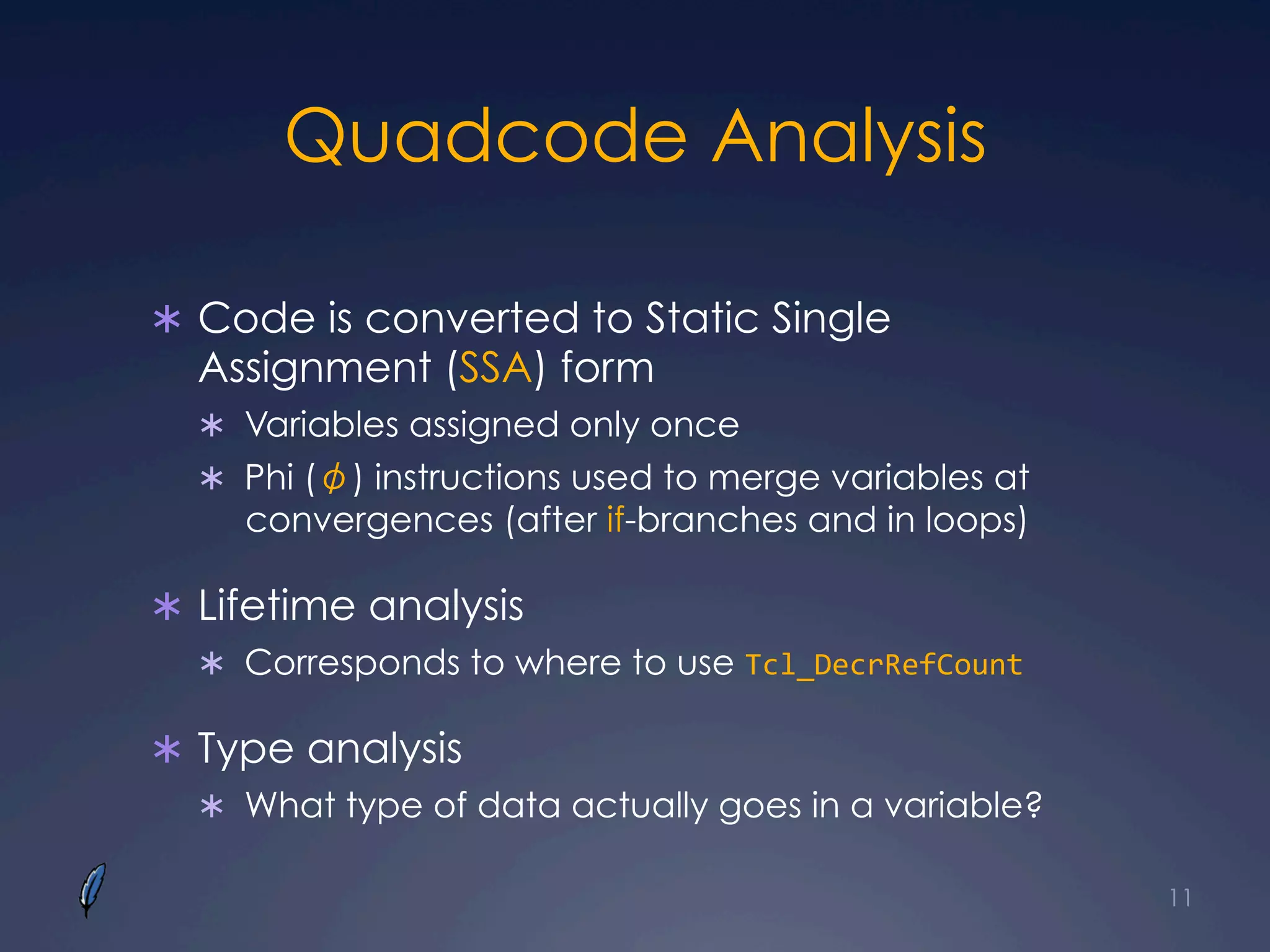
Quadcode Analysis
Ü  Code is converted to Static Single
Assignment (SSA) form
Ü  Variables assigned only once
Ü  Phi (φ) instructions used to merge variables at
convergences (after if-branches and in loops)
Ü  Lifetime analysis
Ü  Corresponds to where to use Tcl_DecrRefCount	
  
Ü  Type analysis
Ü  What type of data actually goes in a variable?
11
Example: Tcl code to
cleaned-up quadcode
proc cos {x {n 16}} {
set x [expr {double($x)}]
set n [expr {int($n)}]
set j 0
set s 1.0
set t 1.0
set i 0
while {[incr i] < $n} {
set t [expr {
-$t*$x*$x / [incr j] / [incr j]
}]
set s [expr {$s + $t}]
}
return $s
}
0: param {var x} {arg 0}
1: param {var n} {arg 1}
2: invoke {var x} {literal tcl::mathfunc::double} {var x}
3: invoke {var n} {literal tcl::mathfunc::int} {var n}
4: copy {var j} {literal 0}
5: copy {var s} {literal 1.0}
6: copy {var t} {literal 1.0}
7: copy {var i} {literal 0}
8: jump {pc 18}
9: uminus {temp 0} {var t}
10: mult {temp 0} {temp 0} {var x}
11: mult {temp 0} {temp 0} {var x}
12: add {var j} {var j} {literal 1}
13: div {temp 0} {temp 0} {var j}
14: add {var j} {var j} {literal 1}
15: div {temp 0} {temp 0} {var j}
16: copy {var t} {temp 0}
17: add {var s} {var s} {temp 0}
18: add {var i} {var i} {literal 1}
19: lt {temp 0} {var i} {var n}
20: jumpTrue {pc 9} {temp 0}
21: return {} {var s}
12
Note that this is before SSA analysis
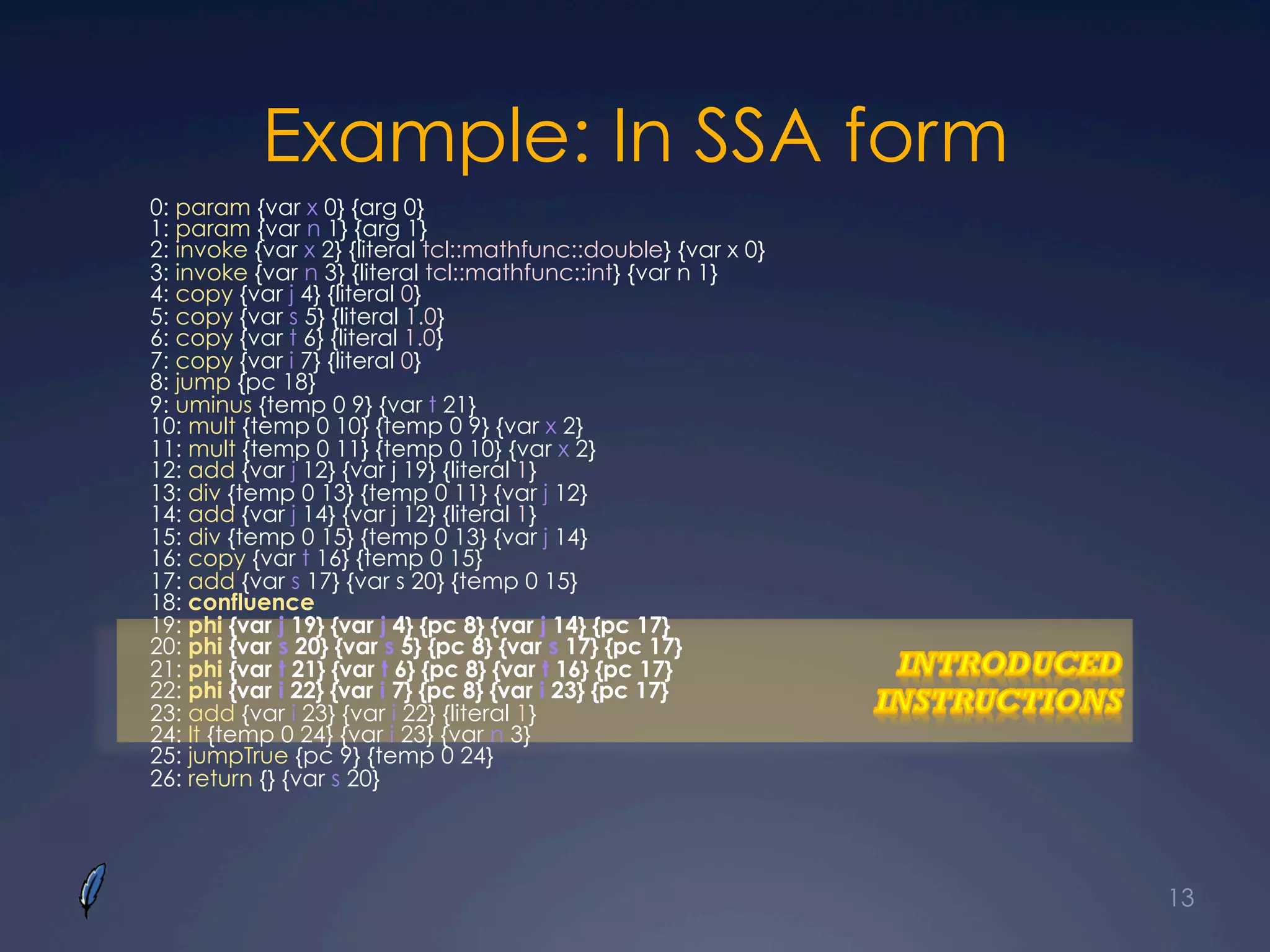
Example: In SSA form
0: param {var x 0} {arg 0}
1: param {var n 1} {arg 1}
2: invoke {var x 2} {literal tcl::mathfunc::double} {var x 0}
3: invoke {var n 3} {literal tcl::mathfunc::int} {var n 1}
4: copy {var j 4} {literal 0}
5: copy {var s 5} {literal 1.0}
6: copy {var t 6} {literal 1.0}
7: copy {var i 7} {literal 0}
8: jump {pc 18}
9: uminus {temp 0 9} {var t 21}
10: mult {temp 0 10} {temp 0 9} {var x 2}
11: mult {temp 0 11} {temp 0 10} {var x 2}
12: add {var j 12} {var j 19} {literal 1}
13: div {temp 0 13} {temp 0 11} {var j 12}
14: add {var j 14} {var j 12} {literal 1}
15: div {temp 0 15} {temp 0 13} {var j 14}
16: copy {var t 16} {temp 0 15}
17: add {var s 17} {var s 20} {temp 0 15}
18: confluence
19: phi {var j 19} {var j 4} {pc 8} {var j 14} {pc 17}
20: phi {var s 20} {var s 5} {pc 8} {var s 17} {pc 17}
21: phi {var t 21} {var t 6} {pc 8} {var t 16} {pc 17}
22: phi {var i 22} {var i 7} {pc 8} {var i 23} {pc 17}
23: add {var i 23} {var i 22} {literal 1}
24: lt {temp 0 24} {var i 23} {var n 3}
25: jumpTrue {pc 9} {temp 0 24}
26: return {} {var s 20}
13
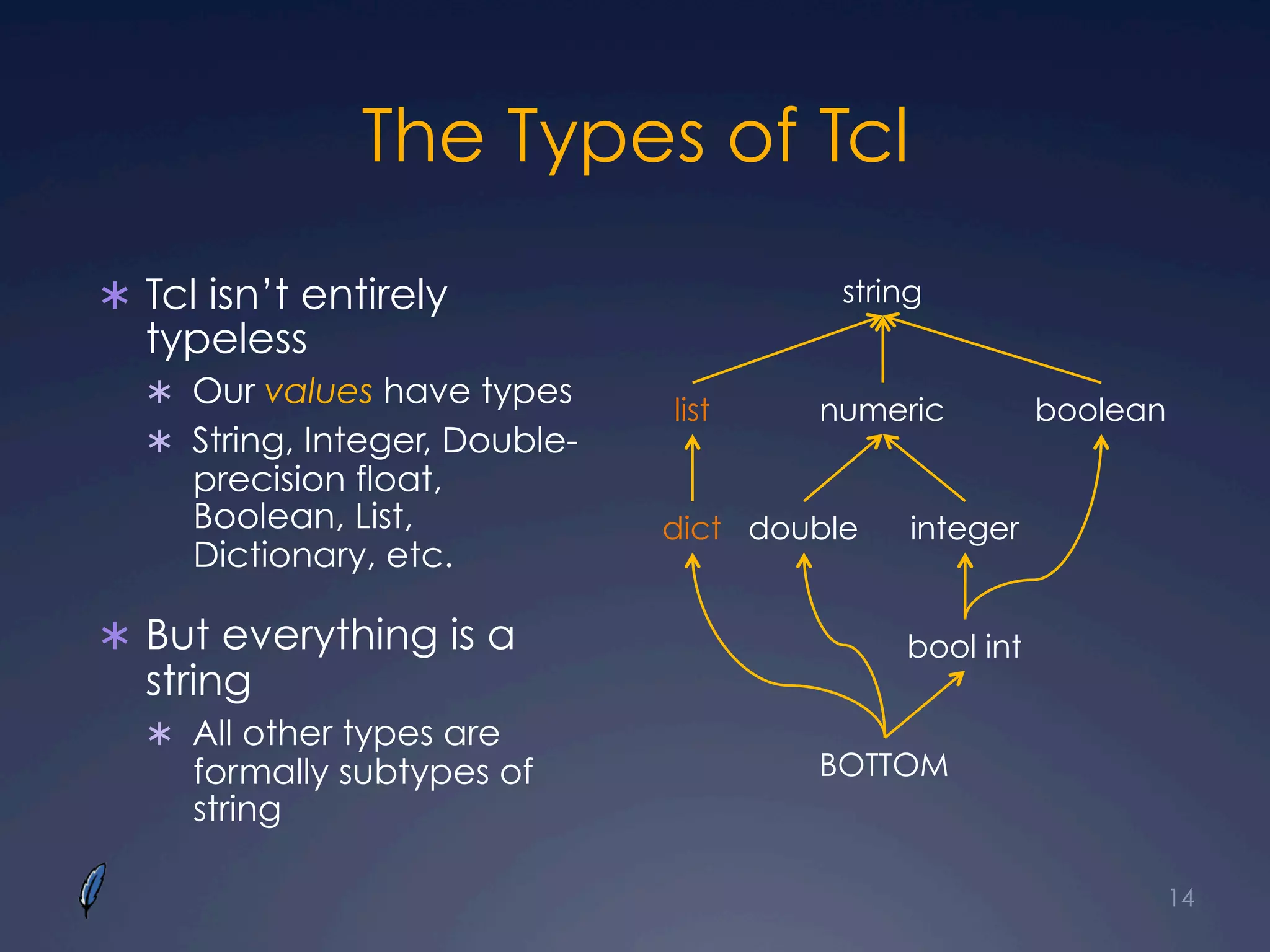
The Types of Tcl
Ü  Tcl isn’t entirely
typeless
Ü  Our values have types
Ü  String, Integer, Double-
precision float,
Boolean, List,
Dictionary, etc.
Ü  But everything is a
string
Ü  All other types are
formally subtypes of
string
14
string
double integer
booleannumeric
bool int
BOTTOM
list
dict
Example: Determined Types
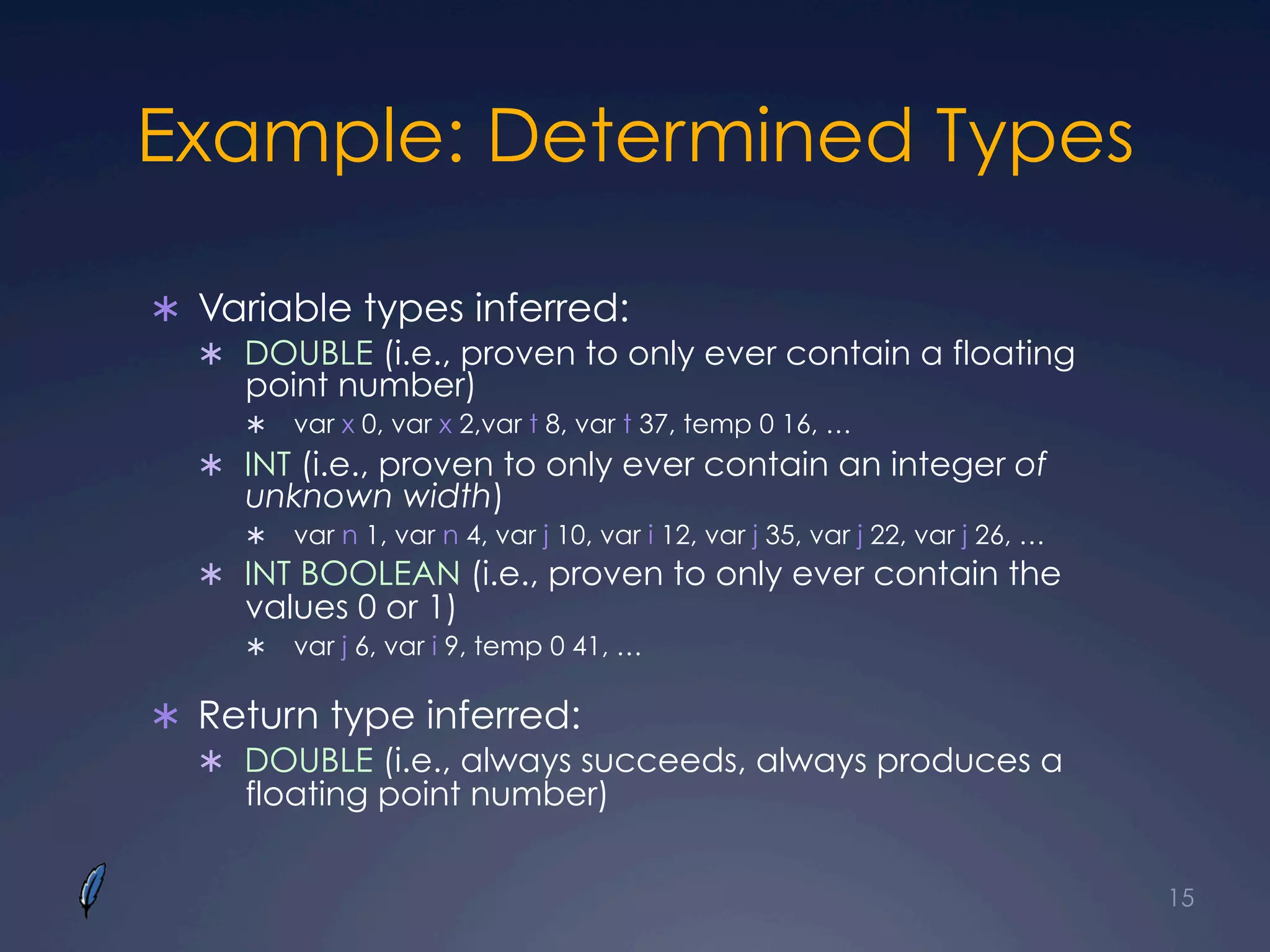
Ü  Variable types inferred:
Ü  DOUBLE (i.e., proven to only ever contain a floating
point number)
Ü  var x 0, var x 2,var t 8, var t 37, temp 0 16, …
Ü  INT (i.e., proven to only ever contain an integer of
unknown width)
Ü  var n 1, var n 4, var j 10, var i 12, var j 35, var j 22, var j 26, …
Ü  INT BOOLEAN (i.e., proven to only ever contain the
values 0 or 1)
Ü  var j 6, var i 9, temp 0 41, …
Ü  Return type inferred:
Ü  DOUBLE (i.e., always succeeds, always produces a
floating point number)
15
Neat Tech along the Way
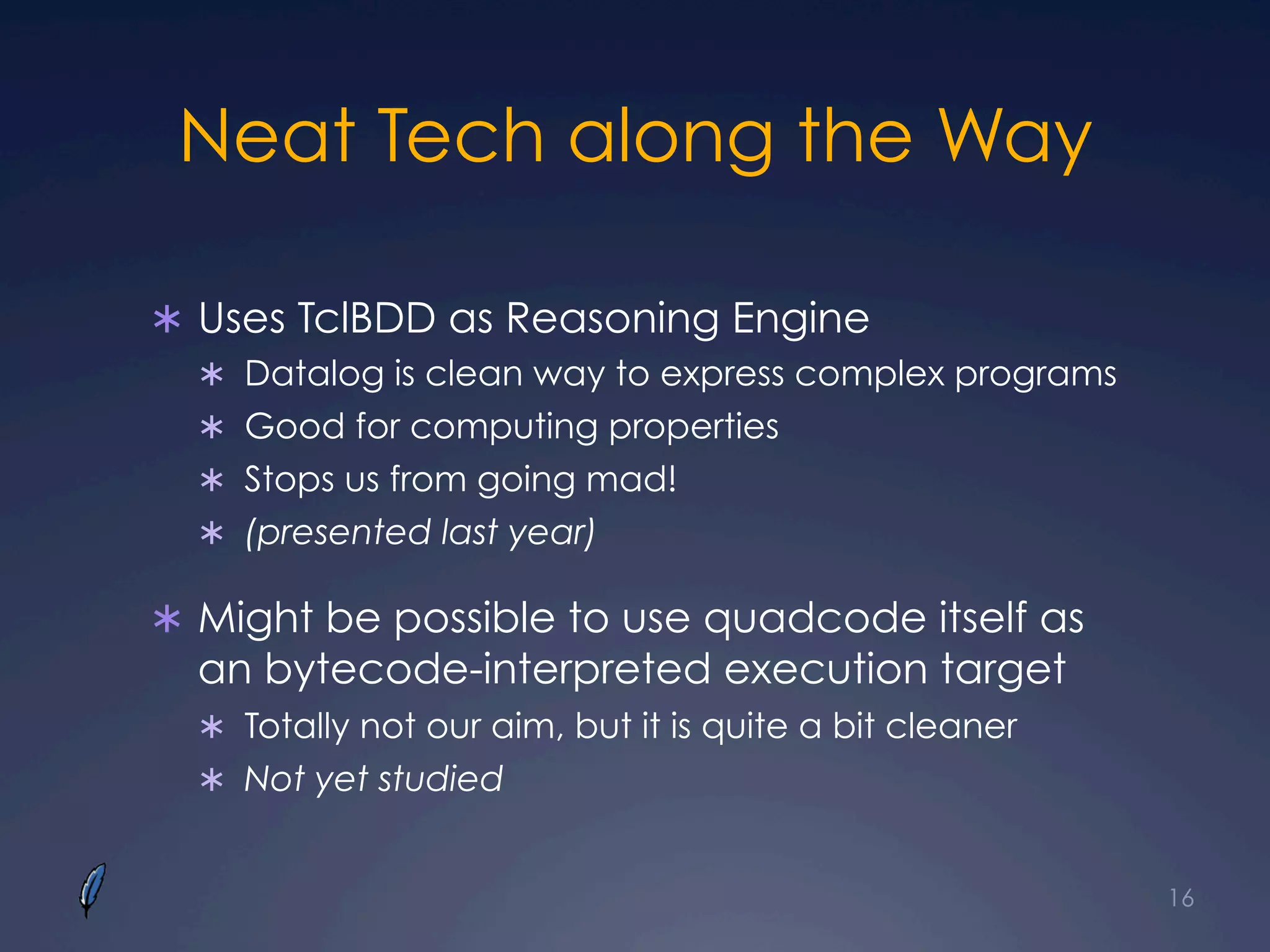
Ü  Uses TclBDD as Reasoning Engine
Ü  Datalog is clean way to express complex programs
Ü  Good for computing properties
Ü  Stops us from going mad!
Ü  (presented last year)
Ü  Might be possible to use quadcode itself as
an bytecode-interpreted execution target
Ü  Totally not our aim, but it is quite a bit cleaner
Ü  Not yet studied
16
We’re at the Station…
17
LLVM IR
Generating
18
Generating LLVM
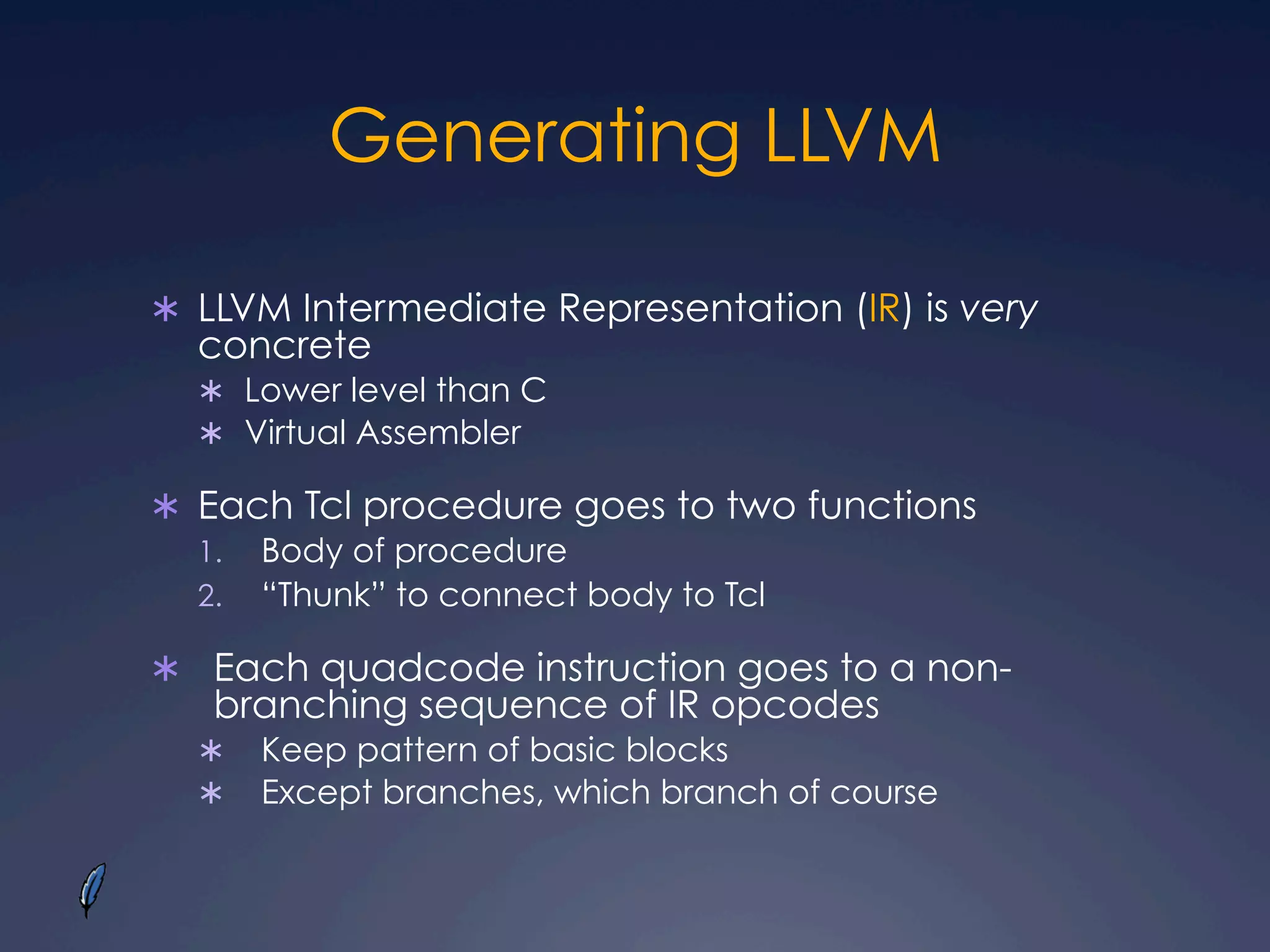
Ü  LLVM Intermediate Representation (IR) is very
concrete
Ü  Lower level than C
Ü  Virtual Assembler
Ü  Each Tcl procedure goes to two functions
1.  Body of procedure
2.  “Thunk” to connect body to Tcl
Ü  Each quadcode instruction goes to a non-
branching sequence of IR opcodes
Ü  Keep pattern of basic blocks
Ü  Except branches, which branch of course
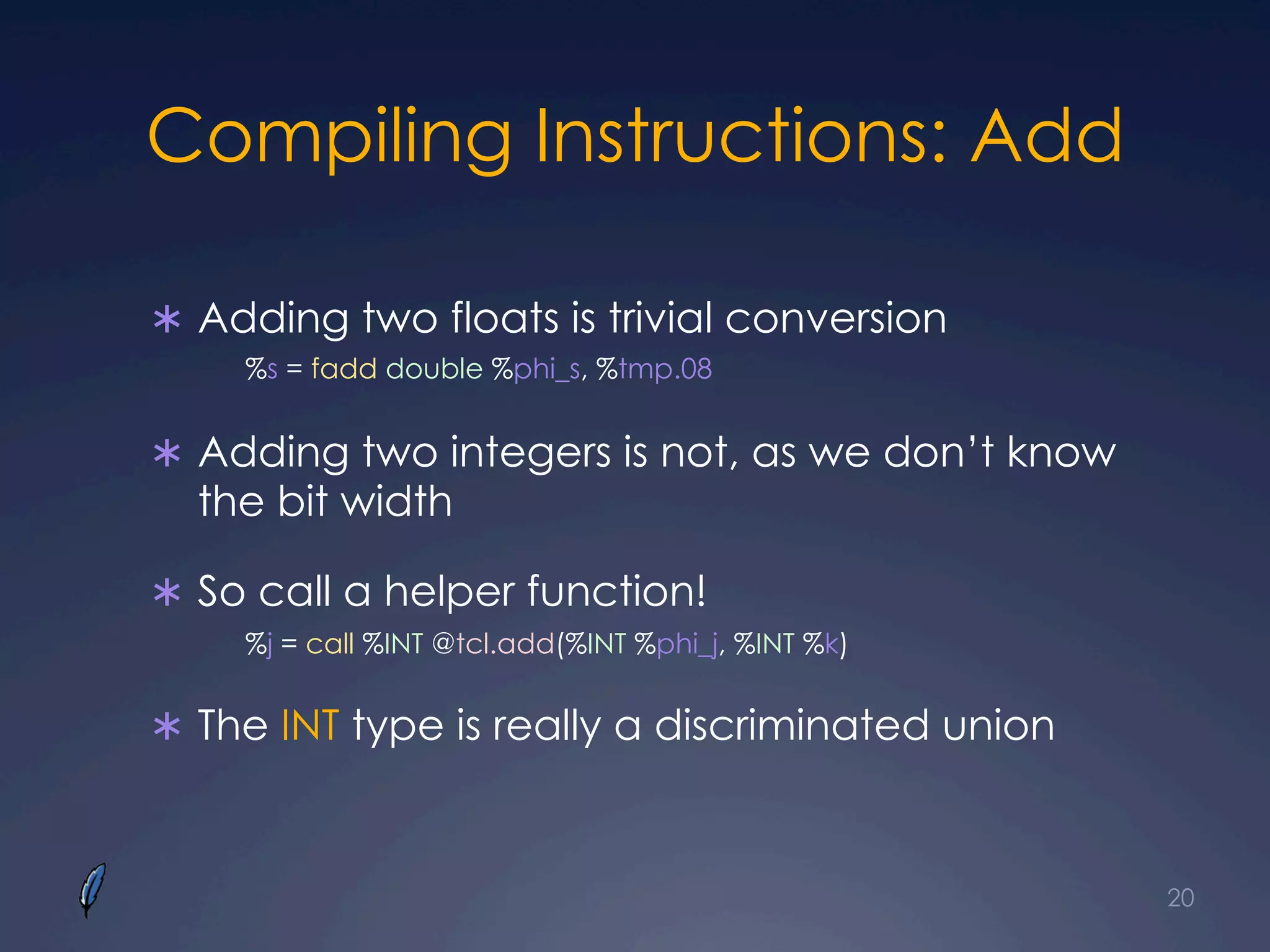
Compiling Instructions: Add
Ü  Adding two floats is trivial conversion
%s = fadd double %phi_s, %tmp.08
Ü  Adding two integers is not, as we don’t know
the bit width
Ü  So call a helper function!
%j = call %INT @tcl.add(%INT %phi_j, %INT %k)
Ü  The INT type is really a discriminated union
20
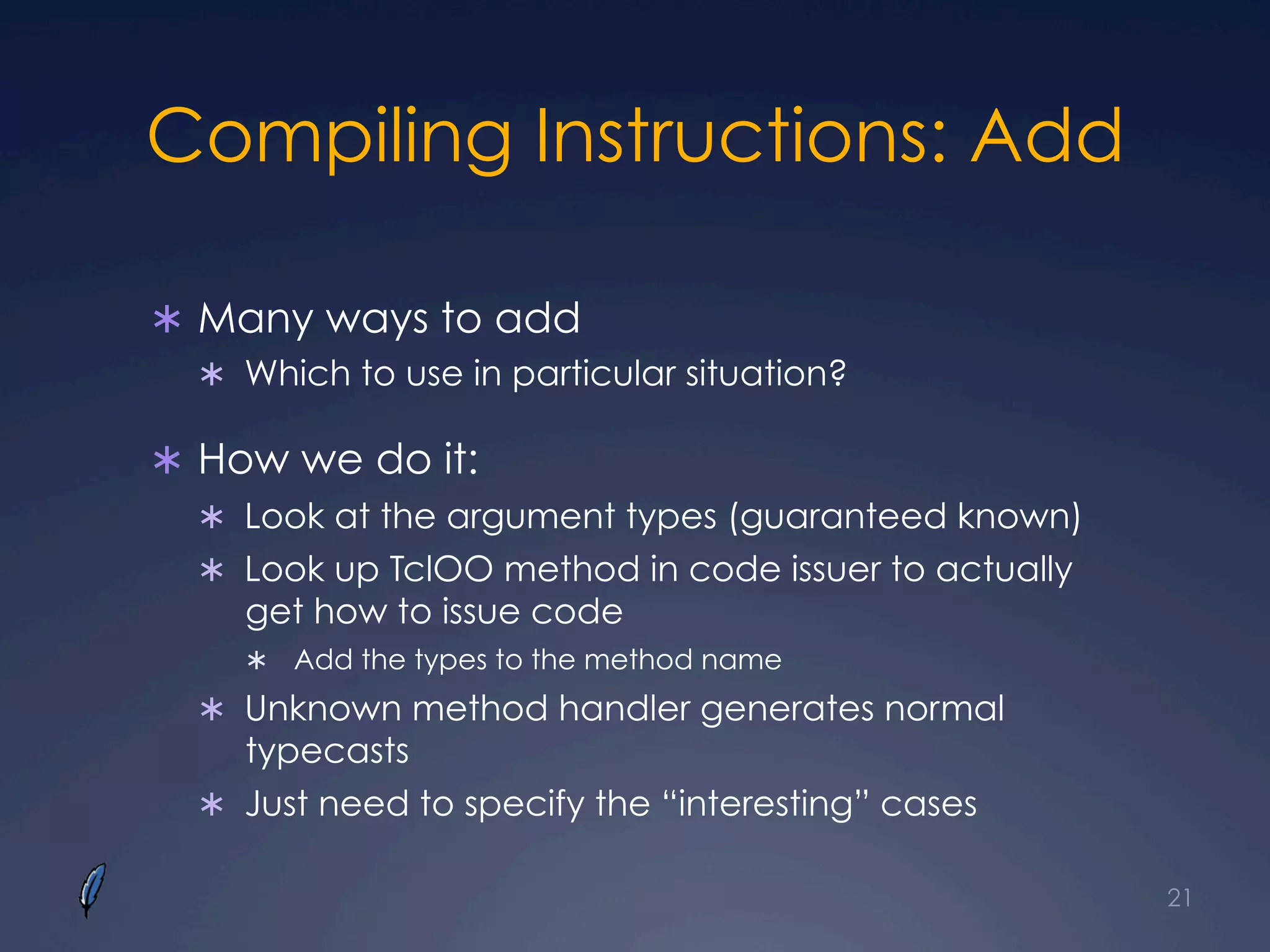
Compiling Instructions: Add
Ü  Many ways to add
Ü  Which to use in particular situation?
Ü  How we do it:
Ü  Look at the argument types (guaranteed known)
Ü  Look up TclOO method in code issuer to actually
get how to issue code
Ü  Add the types to the method name
Ü  Unknown method handler generates normal
typecasts
Ü  Just need to specify the “interesting” cases
21
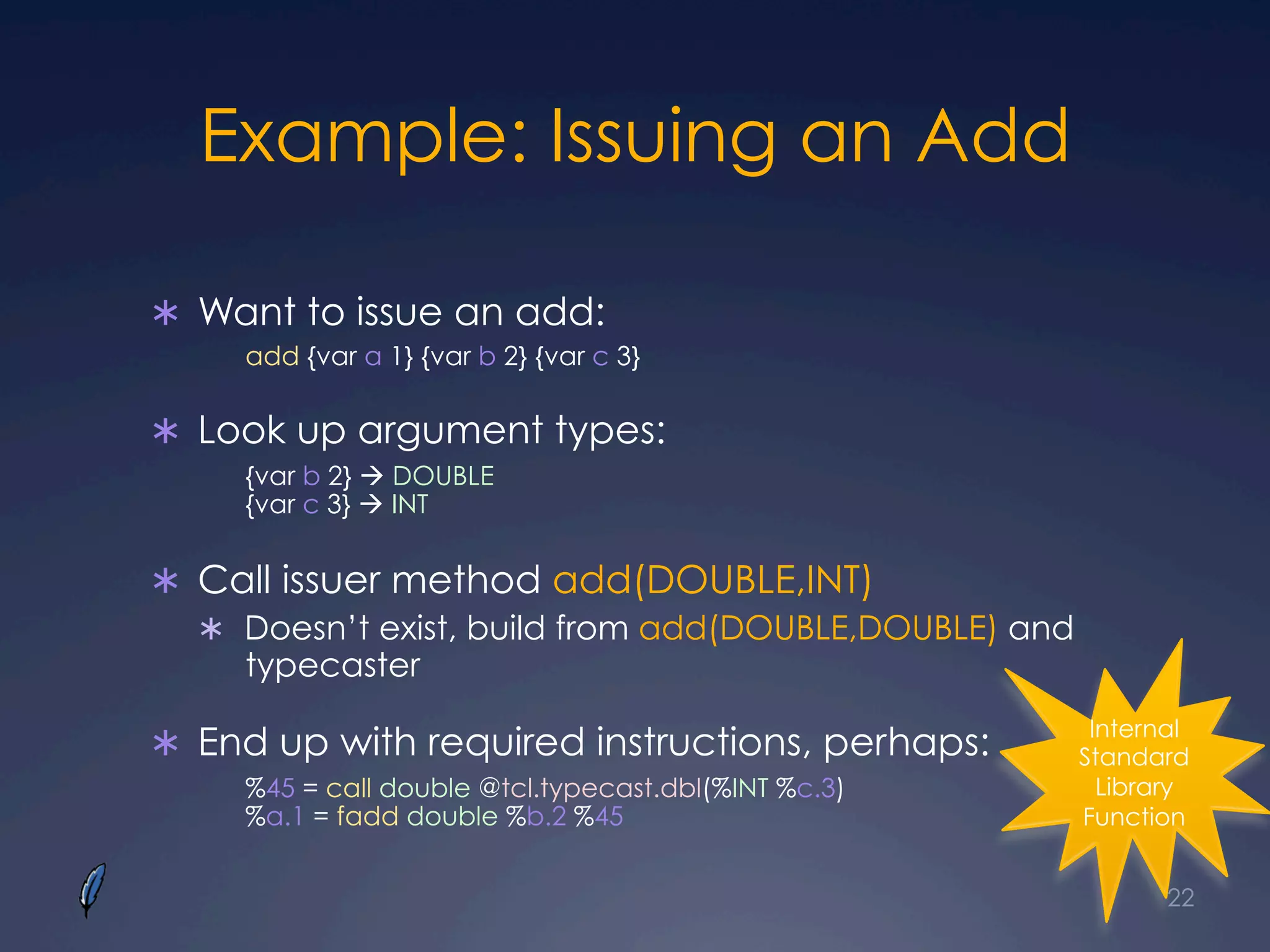
Example: Issuing an Add
Ü  Want to issue an add:
add {var a 1} {var b 2} {var c 3}
Ü  Look up argument types:
{var b 2} à DOUBLE
{var c 3} à INT
Ü  Call issuer method add(DOUBLE,INT)
Ü  Doesn’t exist, build from add(DOUBLE,DOUBLE) and
typecaster
Ü  End up with required instructions, perhaps:
%45 = call double @tcl.typecast.dbl(%INT %c.3)
%a.1 = fadd double %b.2 %45
22
Internal
Standard
Library
Function
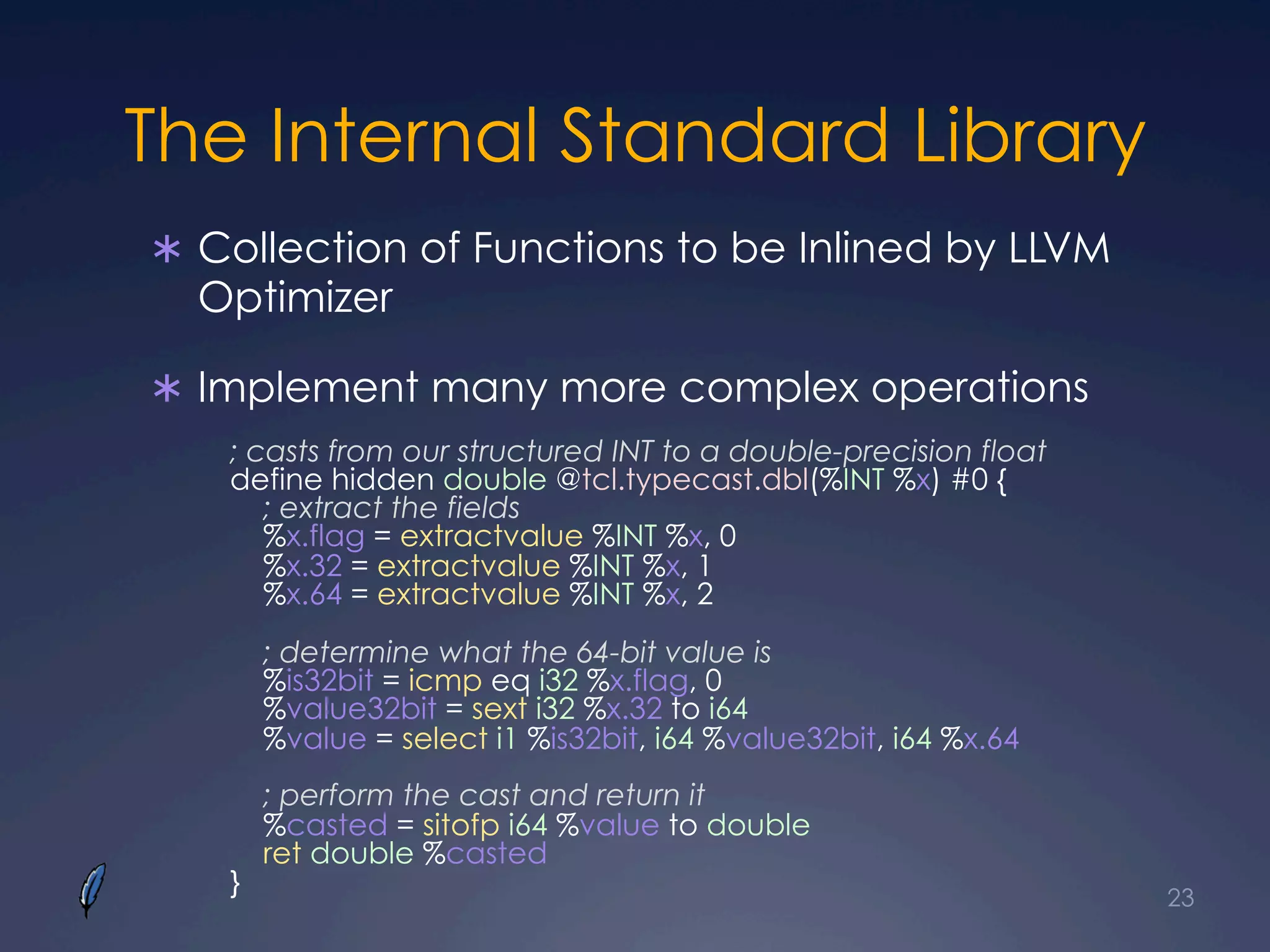
The Internal Standard Library
Ü  Collection of Functions to be Inlined by LLVM
Optimizer
Ü  Implement many more complex operations
23
; casts from our structured INT to a double-precision float
define hidden double @tcl.typecast.dbl(%INT %x) #0 {
; extract the fields
%x.flag = extractvalue %INT %x, 0
%x.32 = extractvalue %INT %x, 1
%x.64 = extractvalue %INT %x, 2
; determine what the 64-bit value is
%is32bit = icmp eq i32 %x.flag, 0
%value32bit = sext i32 %x.32 to i64
%value = select i1 %is32bit, i64 %value32bit, i64 %x.64
; perform the cast and return it
%casted = sitofp i64 %value to double
ret double %casted
}
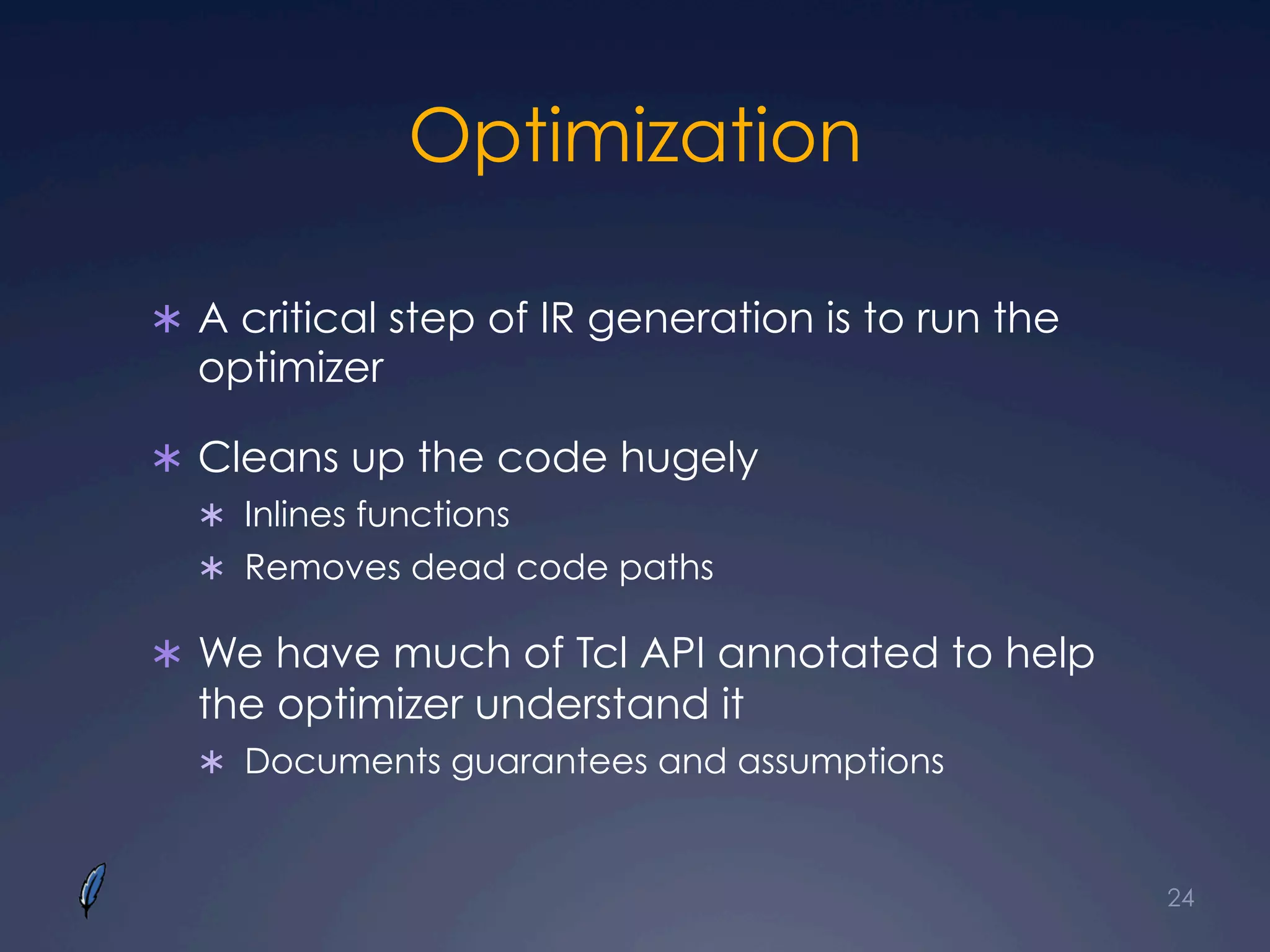
Optimization
Ü  A critical step of IR generation is to run the
optimizer
Ü  Cleans up the code hugely
Ü  Inlines functions
Ü  Removes dead code paths
Ü  We have much of Tcl API annotated to help
the optimizer understand it
Ü  Documents guarantees and assumptions
24
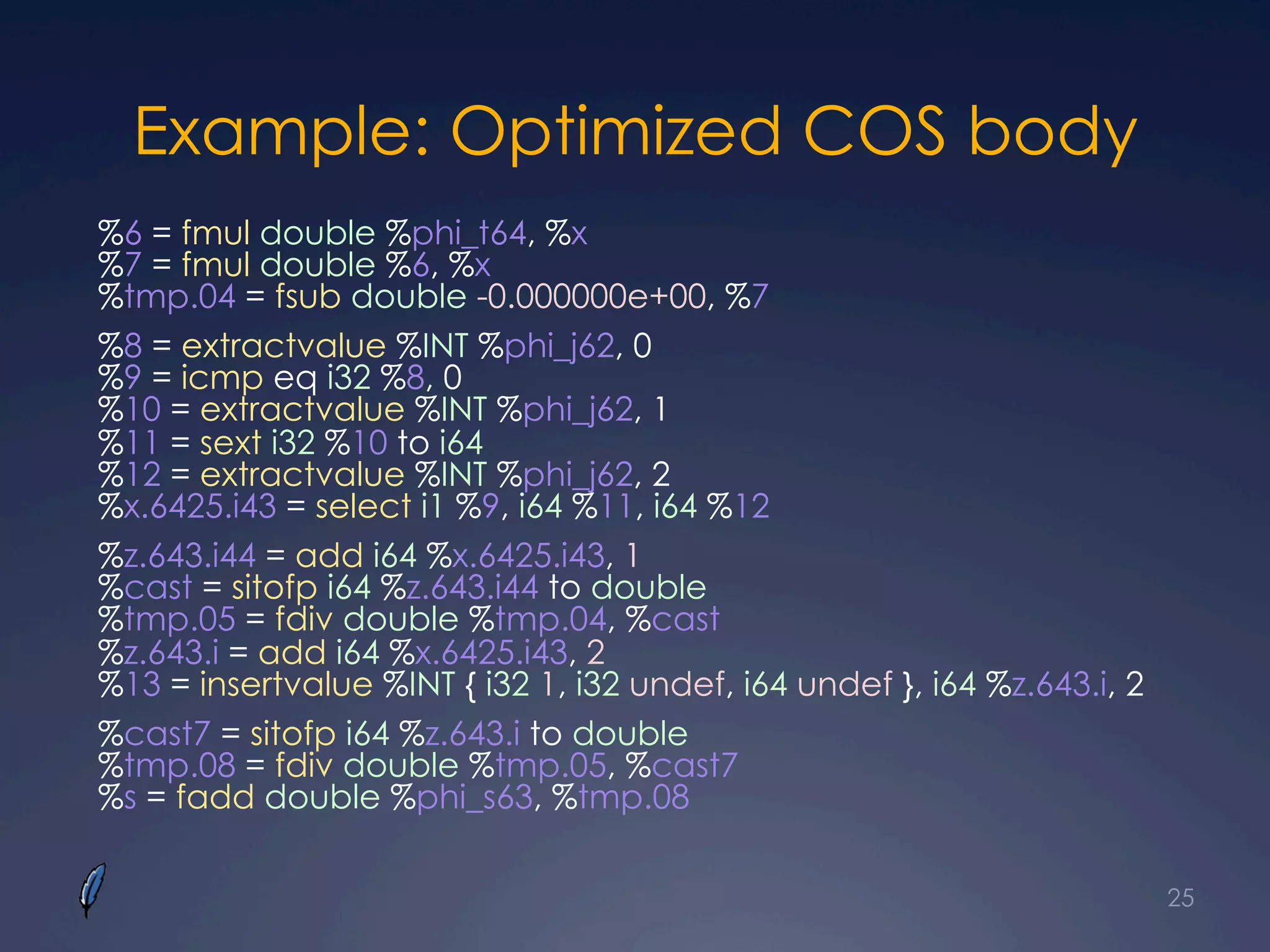
Example: Optimized COS body
%6 = fmul double %phi_t64, %x
%7 = fmul double %6, %x
%tmp.04 = fsub double -0.000000e+00, %7
%8 = extractvalue %INT %phi_j62, 0
%9 = icmp eq i32 %8, 0
%10 = extractvalue %INT %phi_j62, 1
%11 = sext i32 %10 to i64
%12 = extractvalue %INT %phi_j62, 2
%x.6425.i43 = select i1 %9, i64 %11, i64 %12
%z.643.i44 = add i64 %x.6425.i43, 1
%cast = sitofp i64 %z.643.i44 to double
%tmp.05 = fdiv double %tmp.04, %cast
%z.643.i = add i64 %x.6425.i43, 2
%13 = insertvalue %INT { i32 1, i32 undef, i64 undef }, i64 %z.643.i, 2
%cast7 = sitofp i64 %z.643.i to double
%tmp.08 = fdiv double %tmp.05, %cast7
%s = fadd double %phi_s63, %tmp.08
25
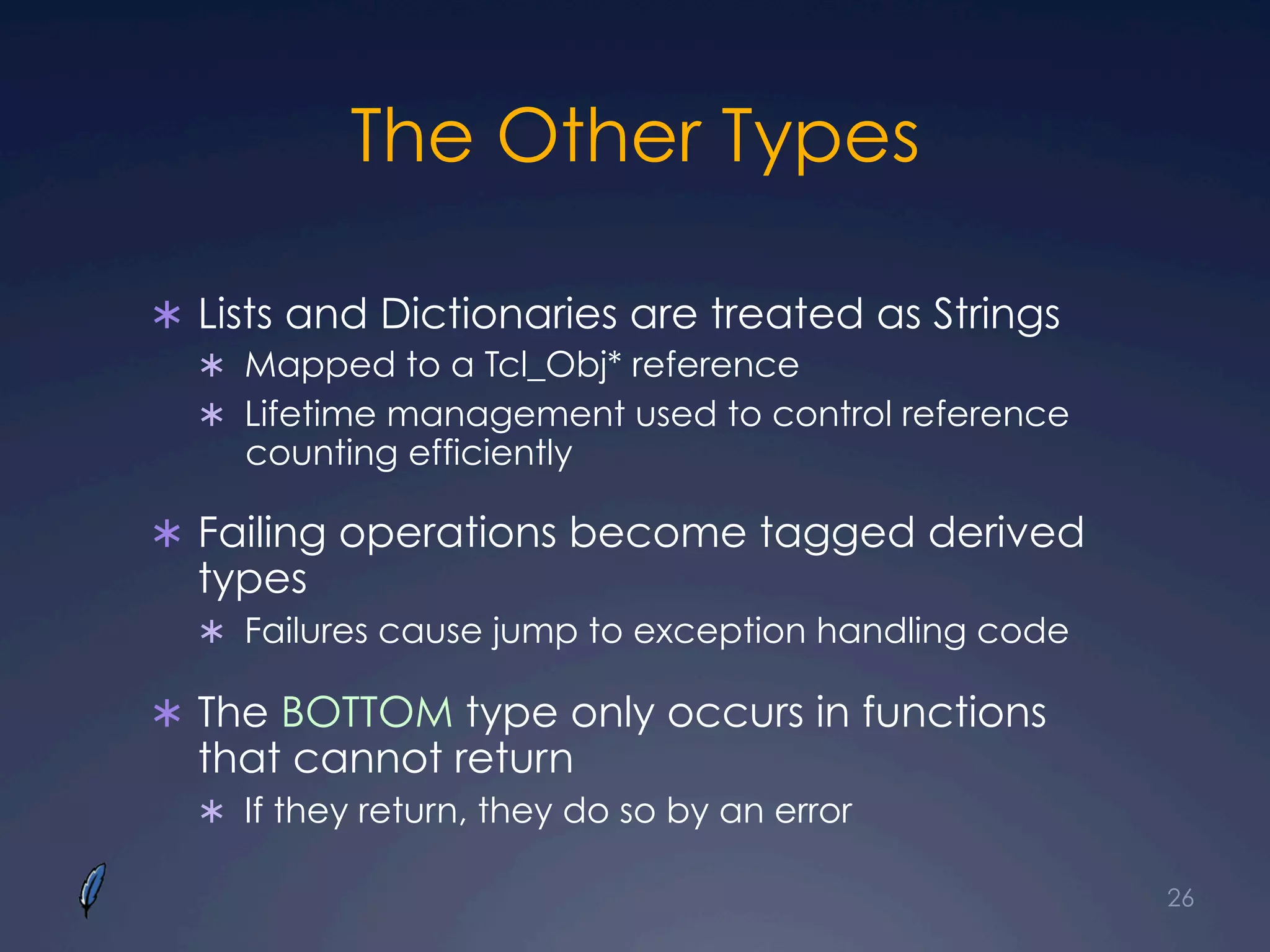
The Other Types
Ü  Lists and Dictionaries are treated as Strings
Ü  Mapped to a Tcl_Obj* reference
Ü  Lifetime management used to control reference
counting efficiently
Ü  Failing operations become tagged derived
types
Ü  Failures cause jump to exception handling code
Ü  The BOTTOM type only occurs in functions
that cannot return
Ü  If they return, they do so by an error
26
Neat Tech along the Way
Ü  Closures
Ü  Callbacks which
capture local variables
Ü  Locally-scoped
Variables
Ü  Easy way to stop
variables from one
place spreading
elsewhere
Ü  Prevented many nasty
bugs
Example from Standard Library Builder
# Create local LLVM function: tcl.int.32
set f [$m local "tcl.int.32" int<-INT ReadNone]
params x
build {
my condBr [my isInt32 $x] $x32 $x64
label x32:
my ret [my int.32 $x]
label x64:
my ret [my cast(int) [my int.64 $x]]
}
# Make closure to create call to tcl.int.32
my closure getInt32 {arg {resultName ""}} {
my call [$f ref] [list $arg] $resultName
}
27
Heading Out…
28
FAST?
So, is this thing
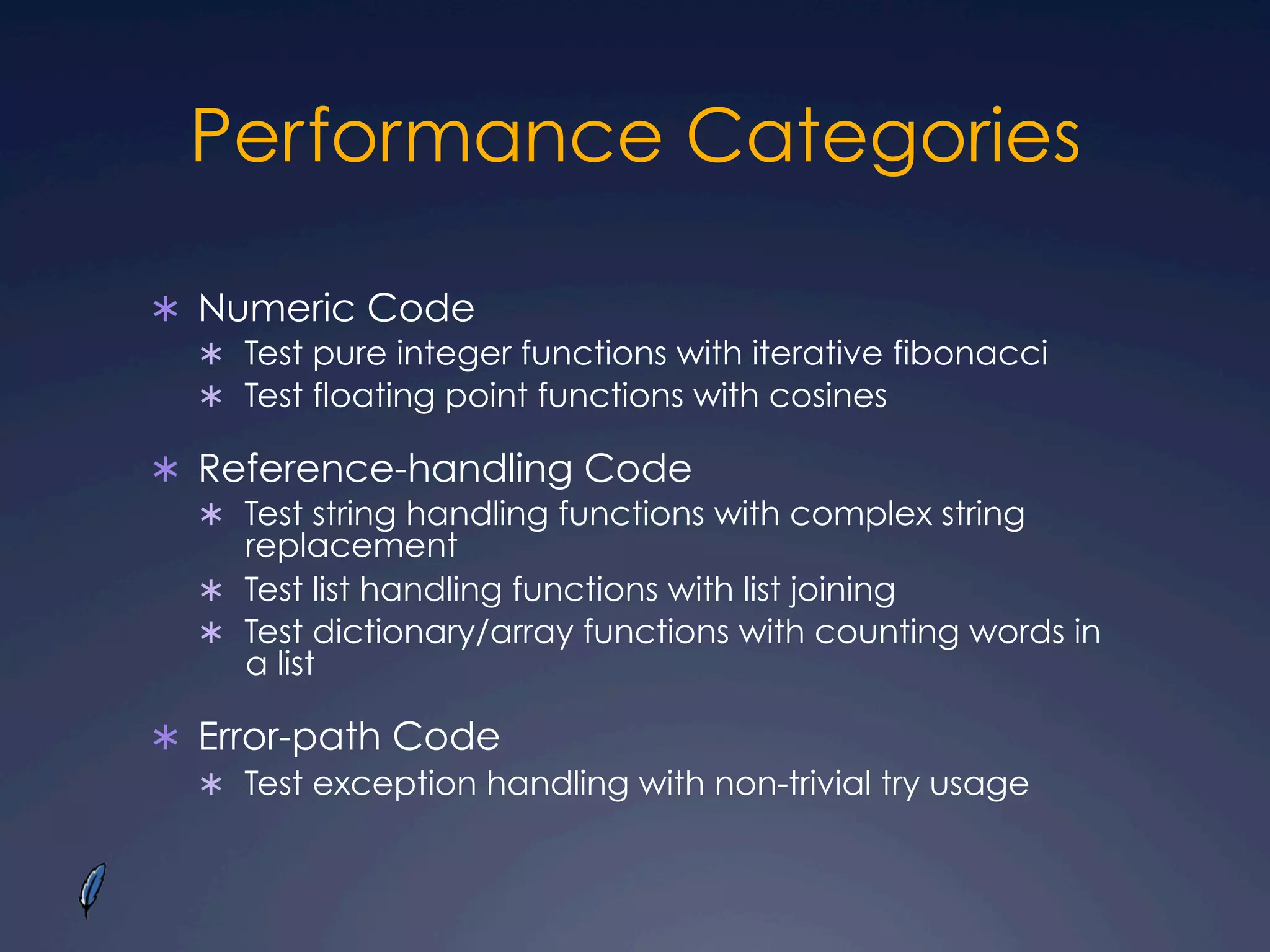
Performance Categories
Ü  Numeric Code
Ü  Test pure integer functions with iterative fibonacci
Ü  Test floating point functions with cosines
Ü  Reference-handling Code
Ü  Test string handling functions with complex string
replacement
Ü  Test list handling functions with list joining
Ü  Test dictionary/array functions with counting words in
a list
Ü  Error-path Code
Ü  Test exception handling with non-trivial try usage
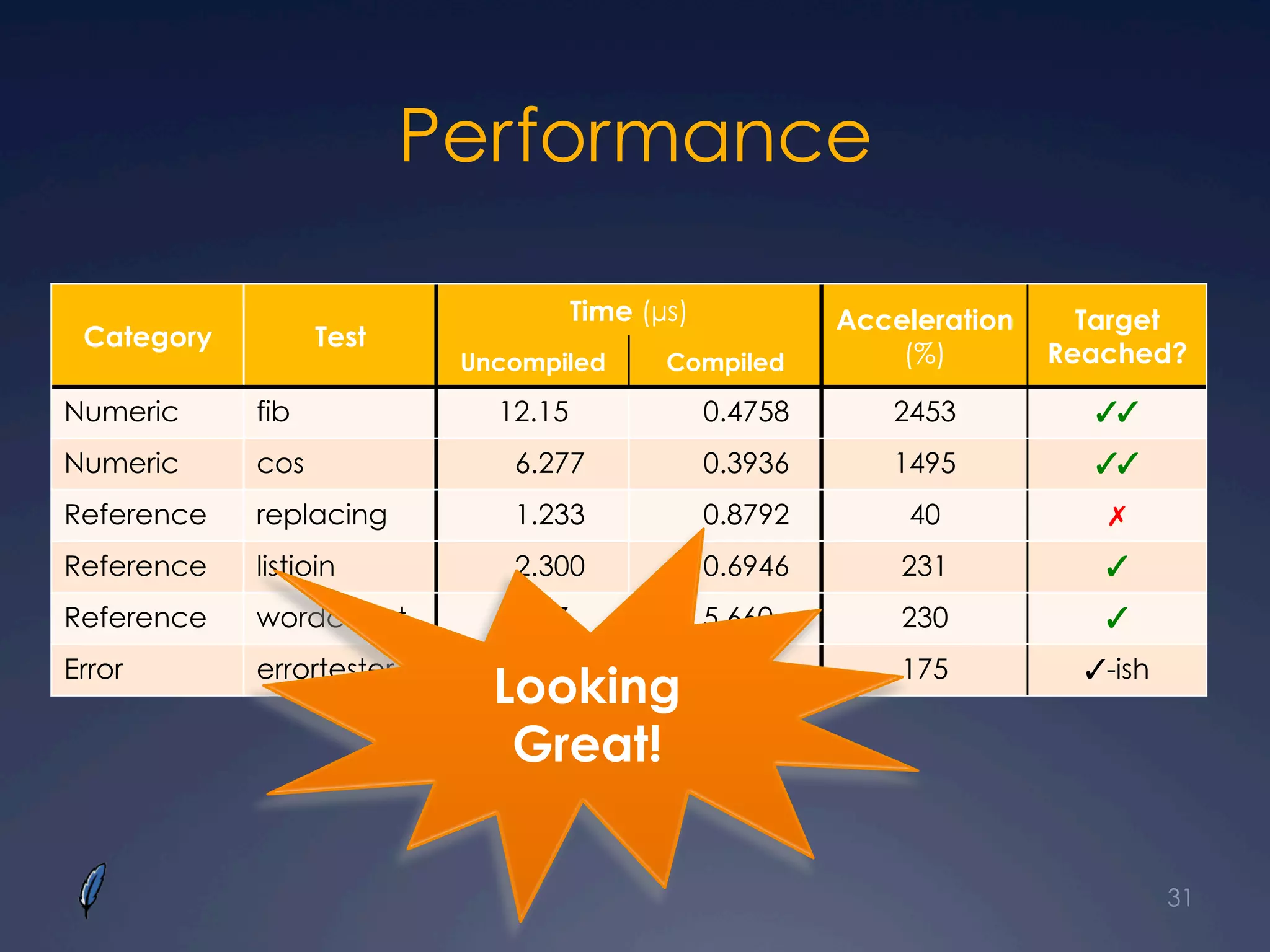
Performance
Category Test
Time (µs) Acceleration
(%)
Target
Reached?Uncompiled Compiled
Numeric fib 12.15 0.4758 2453 ✓✓
Numeric cos 6.277 0.3936 1495 ✓✓
Reference replacing 1.233 0.8792 40 ✗
Reference listjoin 2.300 0.6946 231 ✓
Reference wordcount 18.67 5.660 230 ✓
Error errortester 13.73 4.999 175 ✓-ish
31
Looking
Great!
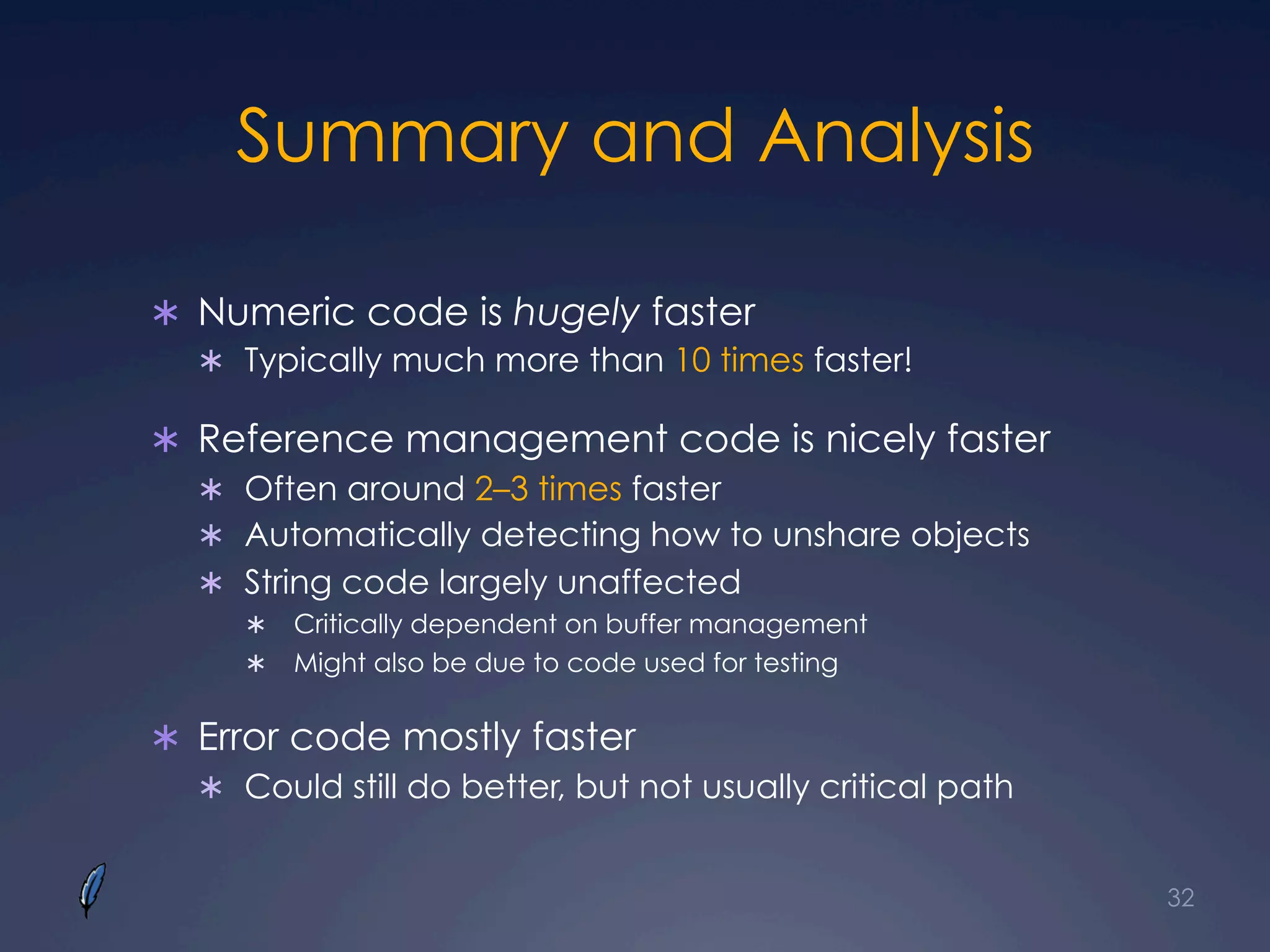
Summary and Analysis
Ü  Numeric code is hugely faster
Ü  Typically much more than 10 times faster!
Ü  Reference management code is nicely faster
Ü  Often around 2–3 times faster
Ü  Automatically detecting how to unshare objects
Ü  String code largely unaffected
Ü  Critically dependent on buffer management
Ü  Might also be due to code used for testing
Ü  Error code mostly faster
Ü  Could still do better, but not usually critical path
32
Going Fast!
33
Future
Looking to the
34
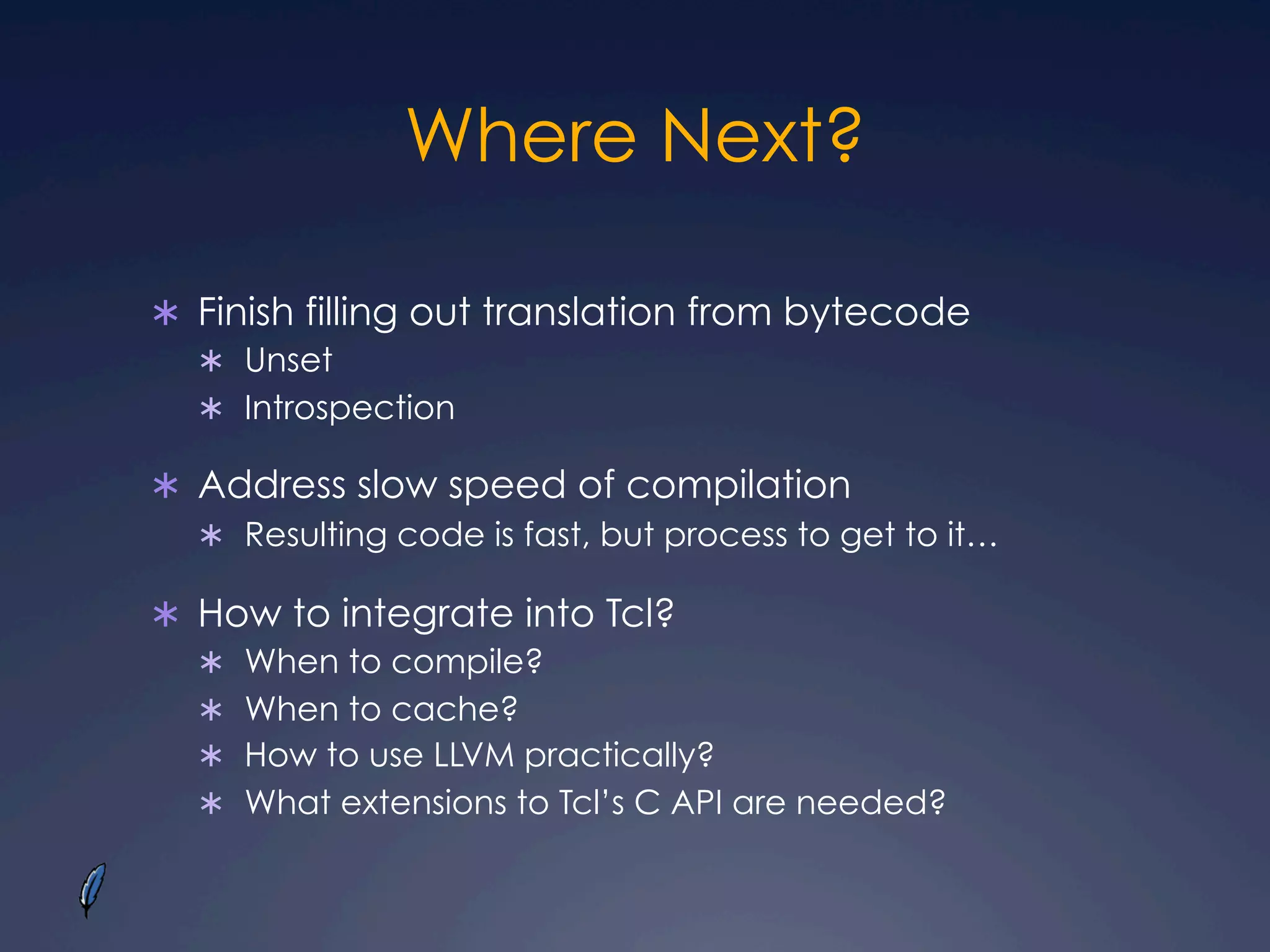
Where Next?
Ü  Finish filling out translation from bytecode
Ü  Unset
Ü  Introspection
Ü  Address slow speed of compilation
Ü  Resulting code is fast, but process to get to it…
Ü  How to integrate into Tcl?
Ü  When to compile?
Ü  When to cache?
Ü  How to use LLVM practically?
Ü  What extensions to Tcl’s C API are needed?
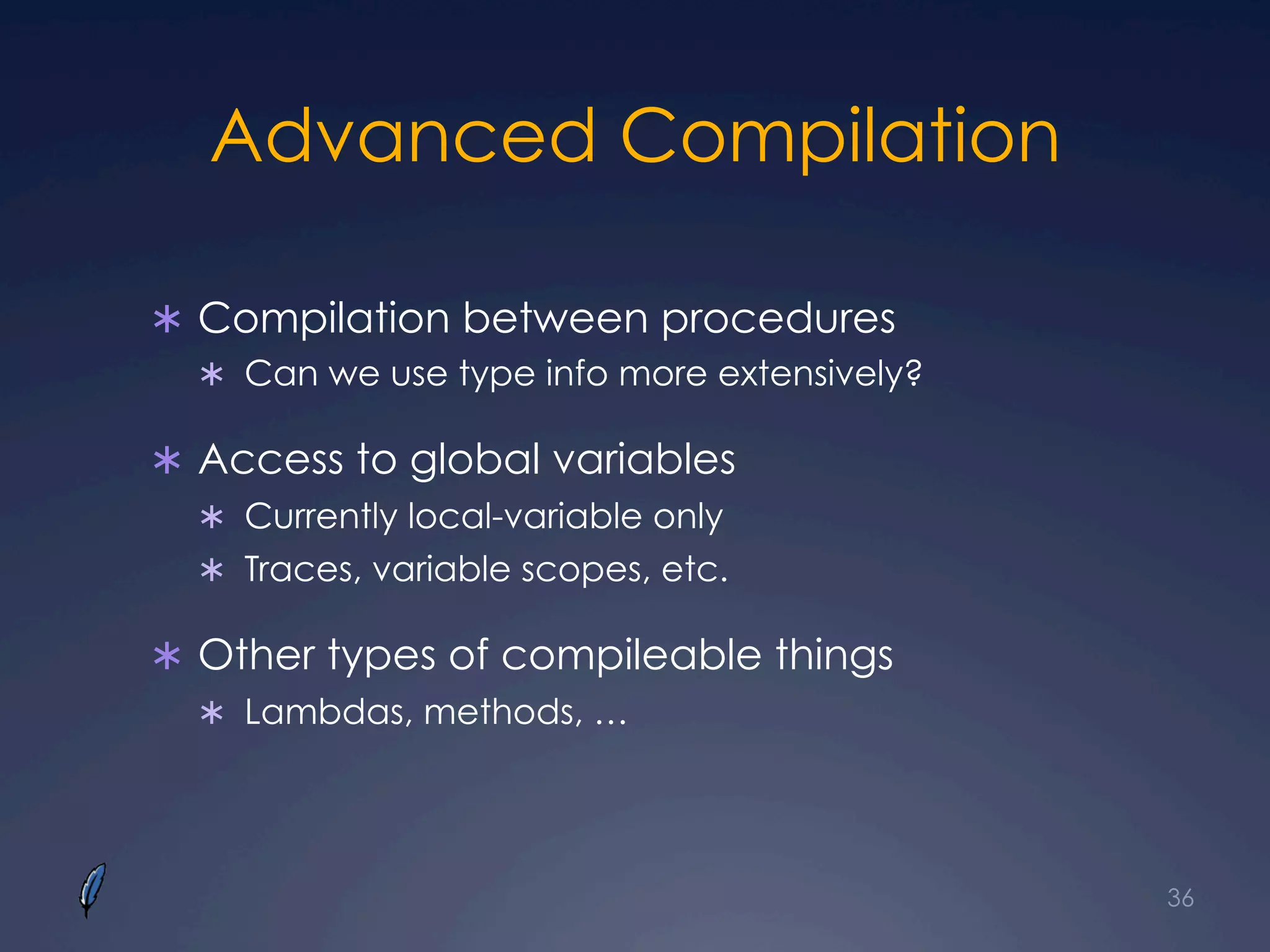
Advanced Compilation
Ü  Compilation between procedures
Ü  Can we use type info more extensively?
Ü  Access to global variables
Ü  Currently local-variable only
Ü  Traces, variable scopes, etc.
Ü  Other types of compileable things
Ü  Lambdas, methods, …
36
Longer-term Questions
Ü  What changes should we do in Tcl in light of
this?
Ü  Already some ideas:
Ü  Change incr to support floats
Ü  Some way to annotate suggested types on arguments
Ü  If we bite the LLVM bullet, what other
changes follow?
Ü  Need to link to C++ libraries to use LLVM
Ü  Implement official C++ API to Tcl?
37

The TclQuadcode Compiler

  • 1.
    The TclQuadcode Compiler Status reporton Tcl type analysis and code generation Donal Fellowsorcid.org/0000-0002-9091-5938 Kevin Kenny
  • 2.
    What is goingon? Ü  Want to Make Tcl Faster Ü  Everyone benefits Ü  Lehenbauer Challenges Ü  2 times faster (“Perl” territory) Ü  Better algorithms Ü  Better buffer management Ü  Bytecode optimization Ü  10 times faster (“C” territory) Ü  Needs more radical approach 2
  • 3.
    Generating Native Codeis Hard Ü  Going to 10 times faster requires native code Ü  Bytecode work simply won’t do it Ü  But Tcl is a very dynamic language Ü  Even ignoring command renaming tricks Ü  Native code needs types Ü  Many platforms 3
  • 4.
    Let’s Go toLLVM! Ü  Solves many problems Ü  Optimization Ü  Native code issuing Ü  Runtime loading Ü  LLVM Intermediate Representation (IR) Ü  Effectively a virtual assembly language target Ü  Existing Tcl package! Ü  llvmtcl by Jos Decoster Ü  Introduces problems though Ü  LLVM’s idea of “throw an error” is to panic with a gnostic error message 4
  • 5.
    How to getto LLVM? Ü  Still need those pesky types Ü  Still need fixed semantics Ü  We need a new bytecode! Quadcode Ü  Designed to help: Ü  Simple translation from Tcl bytecode Ü  More amenable to analysis 5
  • 6.
  • 7.
  • 8.
    Quadcode Ü  Based onthree-address code assembly Ü  The Tcl code: set  a  [expr  {  $b  +  1  }]   Ü  Equivalent Tcl bytecode: loadScalar  %b;  push  “1”;  add;  storeScalar  %a   Ü  Equivalent (optimized) quadcode: add  {var  a}  {var  b}  {literal  1} Ü  No stack Ü  Temporary variables used as required 8
  • 9.
    Example: Tcl codeto bytecode proc cos {x {n 16}} { set x [expr {double($x)}] set n [expr {int($n)}] set j 0 set s 1.0 set t 1.0 set i 0 while {[incr i] < $n} { set t [expr { -$t*$x*$x / [incr j] / [incr j] }] set s [expr {$s + $t}] } return $s } ... 29: startCommand {pc 42} 1 38: push1 {literal 0} 40: storeScalar1 {scalar j} 42: pop 43: startCommand {pc 56} 1 52: push1 {literal 1.0} 54: storeScalar1 {scalar s} 56: pop 57: startCommand {pc 70} 1 66: push1 {literal 1.0} 68: storeScalar1 {scalar t} 70: pop 71: startCommand {pc 84} 1 80: push1 {literal 0} 82: storeScalar1 {scalar i} 84: pop 85: startCommand {pc 179} 1 94: jump1 {pc 160} 96: startCommand {pc 142} 2 105: loadScalar1 {scalar t} 107: uminus 108: loadScalar1 {{scalar arg} x} 110: mult 111: loadScalar1 {{scalar arg} x} 113: mult 114: startCommand {pc 126} 1 123: incrScalar1Imm {scalar j} 1 126: div 127: startCommand {pc 139} 1 136: incrScalar1Imm {scalar j} 1 139: div 140: storeScalar1 {scalar t} 142: pop ... 9
  • 10.
    Example: bytecode to quadcode 29:startCommand {pc 42} 1 38: push1 {literal 0} 40: storeScalar1 {scalar j} 42: pop 43: startCommand {pc 56} 1 52: push1 {literal 1.0} 54: storeScalar1 {scalar s} 56: pop 57: startCommand {pc 70} 1 66: push1 {literal 1.0} 68: storeScalar1 {scalar t} 70: pop 71: startCommand {pc 84} 1 80: push1 {literal 0} 82: storeScalar1 {scalar i} 84: pop 85: startCommand {pc 179} 1 94: jump1 {pc 160} 96: startCommand {pc 142} 2 105: loadScalar1 {scalar t} 107: uminus 108: loadScalar1 {{scalar arg} x} 110: mult 111: loadScalar1 {{scalar arg} x} 113: mult 114: startCommand {pc 126} 1 123: incrScalar1Imm {scalar j} 1 126: div 127: startCommand {pc 139} 1 136: incrScalar1Imm {scalar j} 1 139: div 140: storeScalar1 {scalar t} 142: pop 11: copy {temp 0} {literal 0} 12: copy {var j} {temp 0} 13: copy {temp 0} {literal 1.0} 14: copy {var s} {temp 0} 15: copy {temp 0} {literal 1.0} 16: copy {var t} {temp 0} 17: copy {temp 0} {literal 0} 18: copy {var i} {temp 0} 19: jump {pc 37} 20: copy {temp 0} {var t} 21: uminus {temp 0} {temp 0} 22: copy {temp 1} {var x} 23: mult {temp 0} {temp 0} {temp 1} 24: copy {temp 1} {var x} 25: mult {temp 0} {temp 0} {temp 1} 26: add {var j} {var j} {literal 1} 27: copy {temp 1} {var j} 28: div {temp 0} {temp 0} {temp 1} 29: add {var j} {var j} {literal 1} 30: copy {temp 1} {var j} 31: div {temp 0} {temp 0} {temp 1} 32: copy {var t} {temp 0} 10
  • 11.
    Quadcode Analysis Ü  Codeis converted to Static Single Assignment (SSA) form Ü  Variables assigned only once Ü  Phi (φ) instructions used to merge variables at convergences (after if-branches and in loops) Ü  Lifetime analysis Ü  Corresponds to where to use Tcl_DecrRefCount   Ü  Type analysis Ü  What type of data actually goes in a variable? 11
  • 12.
    Example: Tcl codeto cleaned-up quadcode proc cos {x {n 16}} { set x [expr {double($x)}] set n [expr {int($n)}] set j 0 set s 1.0 set t 1.0 set i 0 while {[incr i] < $n} { set t [expr { -$t*$x*$x / [incr j] / [incr j] }] set s [expr {$s + $t}] } return $s } 0: param {var x} {arg 0} 1: param {var n} {arg 1} 2: invoke {var x} {literal tcl::mathfunc::double} {var x} 3: invoke {var n} {literal tcl::mathfunc::int} {var n} 4: copy {var j} {literal 0} 5: copy {var s} {literal 1.0} 6: copy {var t} {literal 1.0} 7: copy {var i} {literal 0} 8: jump {pc 18} 9: uminus {temp 0} {var t} 10: mult {temp 0} {temp 0} {var x} 11: mult {temp 0} {temp 0} {var x} 12: add {var j} {var j} {literal 1} 13: div {temp 0} {temp 0} {var j} 14: add {var j} {var j} {literal 1} 15: div {temp 0} {temp 0} {var j} 16: copy {var t} {temp 0} 17: add {var s} {var s} {temp 0} 18: add {var i} {var i} {literal 1} 19: lt {temp 0} {var i} {var n} 20: jumpTrue {pc 9} {temp 0} 21: return {} {var s} 12 Note that this is before SSA analysis
  • 13.
    Example: In SSAform 0: param {var x 0} {arg 0} 1: param {var n 1} {arg 1} 2: invoke {var x 2} {literal tcl::mathfunc::double} {var x 0} 3: invoke {var n 3} {literal tcl::mathfunc::int} {var n 1} 4: copy {var j 4} {literal 0} 5: copy {var s 5} {literal 1.0} 6: copy {var t 6} {literal 1.0} 7: copy {var i 7} {literal 0} 8: jump {pc 18} 9: uminus {temp 0 9} {var t 21} 10: mult {temp 0 10} {temp 0 9} {var x 2} 11: mult {temp 0 11} {temp 0 10} {var x 2} 12: add {var j 12} {var j 19} {literal 1} 13: div {temp 0 13} {temp 0 11} {var j 12} 14: add {var j 14} {var j 12} {literal 1} 15: div {temp 0 15} {temp 0 13} {var j 14} 16: copy {var t 16} {temp 0 15} 17: add {var s 17} {var s 20} {temp 0 15} 18: confluence 19: phi {var j 19} {var j 4} {pc 8} {var j 14} {pc 17} 20: phi {var s 20} {var s 5} {pc 8} {var s 17} {pc 17} 21: phi {var t 21} {var t 6} {pc 8} {var t 16} {pc 17} 22: phi {var i 22} {var i 7} {pc 8} {var i 23} {pc 17} 23: add {var i 23} {var i 22} {literal 1} 24: lt {temp 0 24} {var i 23} {var n 3} 25: jumpTrue {pc 9} {temp 0 24} 26: return {} {var s 20} 13
  • 14.
    The Types ofTcl Ü  Tcl isn’t entirely typeless Ü  Our values have types Ü  String, Integer, Double- precision float, Boolean, List, Dictionary, etc. Ü  But everything is a string Ü  All other types are formally subtypes of string 14 string double integer booleannumeric bool int BOTTOM list dict
  • 15.
    Example: Determined Types Ü Variable types inferred: Ü  DOUBLE (i.e., proven to only ever contain a floating point number) Ü  var x 0, var x 2,var t 8, var t 37, temp 0 16, … Ü  INT (i.e., proven to only ever contain an integer of unknown width) Ü  var n 1, var n 4, var j 10, var i 12, var j 35, var j 22, var j 26, … Ü  INT BOOLEAN (i.e., proven to only ever contain the values 0 or 1) Ü  var j 6, var i 9, temp 0 41, … Ü  Return type inferred: Ü  DOUBLE (i.e., always succeeds, always produces a floating point number) 15
  • 16.
    Neat Tech alongthe Way Ü  Uses TclBDD as Reasoning Engine Ü  Datalog is clean way to express complex programs Ü  Good for computing properties Ü  Stops us from going mad! Ü  (presented last year) Ü  Might be possible to use quadcode itself as an bytecode-interpreted execution target Ü  Totally not our aim, but it is quite a bit cleaner Ü  Not yet studied 16
  • 17.
    We’re at theStation… 17
  • 18.
  • 19.
    Generating LLVM Ü  LLVMIntermediate Representation (IR) is very concrete Ü  Lower level than C Ü  Virtual Assembler Ü  Each Tcl procedure goes to two functions 1.  Body of procedure 2.  “Thunk” to connect body to Tcl Ü  Each quadcode instruction goes to a non- branching sequence of IR opcodes Ü  Keep pattern of basic blocks Ü  Except branches, which branch of course
  • 20.
    Compiling Instructions: Add Ü Adding two floats is trivial conversion %s = fadd double %phi_s, %tmp.08 Ü  Adding two integers is not, as we don’t know the bit width Ü  So call a helper function! %j = call %INT @tcl.add(%INT %phi_j, %INT %k) Ü  The INT type is really a discriminated union 20
  • 21.
    Compiling Instructions: Add Ü Many ways to add Ü  Which to use in particular situation? Ü  How we do it: Ü  Look at the argument types (guaranteed known) Ü  Look up TclOO method in code issuer to actually get how to issue code Ü  Add the types to the method name Ü  Unknown method handler generates normal typecasts Ü  Just need to specify the “interesting” cases 21
  • 22.
    Example: Issuing anAdd Ü  Want to issue an add: add {var a 1} {var b 2} {var c 3} Ü  Look up argument types: {var b 2} à DOUBLE {var c 3} à INT Ü  Call issuer method add(DOUBLE,INT) Ü  Doesn’t exist, build from add(DOUBLE,DOUBLE) and typecaster Ü  End up with required instructions, perhaps: %45 = call double @tcl.typecast.dbl(%INT %c.3) %a.1 = fadd double %b.2 %45 22 Internal Standard Library Function
  • 23.
    The Internal StandardLibrary Ü  Collection of Functions to be Inlined by LLVM Optimizer Ü  Implement many more complex operations 23 ; casts from our structured INT to a double-precision float define hidden double @tcl.typecast.dbl(%INT %x) #0 { ; extract the fields %x.flag = extractvalue %INT %x, 0 %x.32 = extractvalue %INT %x, 1 %x.64 = extractvalue %INT %x, 2 ; determine what the 64-bit value is %is32bit = icmp eq i32 %x.flag, 0 %value32bit = sext i32 %x.32 to i64 %value = select i1 %is32bit, i64 %value32bit, i64 %x.64 ; perform the cast and return it %casted = sitofp i64 %value to double ret double %casted }
  • 24.
    Optimization Ü  A criticalstep of IR generation is to run the optimizer Ü  Cleans up the code hugely Ü  Inlines functions Ü  Removes dead code paths Ü  We have much of Tcl API annotated to help the optimizer understand it Ü  Documents guarantees and assumptions 24
  • 25.
    Example: Optimized COSbody %6 = fmul double %phi_t64, %x %7 = fmul double %6, %x %tmp.04 = fsub double -0.000000e+00, %7 %8 = extractvalue %INT %phi_j62, 0 %9 = icmp eq i32 %8, 0 %10 = extractvalue %INT %phi_j62, 1 %11 = sext i32 %10 to i64 %12 = extractvalue %INT %phi_j62, 2 %x.6425.i43 = select i1 %9, i64 %11, i64 %12 %z.643.i44 = add i64 %x.6425.i43, 1 %cast = sitofp i64 %z.643.i44 to double %tmp.05 = fdiv double %tmp.04, %cast %z.643.i = add i64 %x.6425.i43, 2 %13 = insertvalue %INT { i32 1, i32 undef, i64 undef }, i64 %z.643.i, 2 %cast7 = sitofp i64 %z.643.i to double %tmp.08 = fdiv double %tmp.05, %cast7 %s = fadd double %phi_s63, %tmp.08 25
  • 26.
    The Other Types Ü Lists and Dictionaries are treated as Strings Ü  Mapped to a Tcl_Obj* reference Ü  Lifetime management used to control reference counting efficiently Ü  Failing operations become tagged derived types Ü  Failures cause jump to exception handling code Ü  The BOTTOM type only occurs in functions that cannot return Ü  If they return, they do so by an error 26
  • 27.
    Neat Tech alongthe Way Ü  Closures Ü  Callbacks which capture local variables Ü  Locally-scoped Variables Ü  Easy way to stop variables from one place spreading elsewhere Ü  Prevented many nasty bugs Example from Standard Library Builder # Create local LLVM function: tcl.int.32 set f [$m local "tcl.int.32" int<-INT ReadNone] params x build { my condBr [my isInt32 $x] $x32 $x64 label x32: my ret [my int.32 $x] label x64: my ret [my cast(int) [my int.64 $x]] } # Make closure to create call to tcl.int.32 my closure getInt32 {arg {resultName ""}} { my call [$f ref] [list $arg] $resultName } 27
  • 28.
  • 29.
  • 30.
    Performance Categories Ü  NumericCode Ü  Test pure integer functions with iterative fibonacci Ü  Test floating point functions with cosines Ü  Reference-handling Code Ü  Test string handling functions with complex string replacement Ü  Test list handling functions with list joining Ü  Test dictionary/array functions with counting words in a list Ü  Error-path Code Ü  Test exception handling with non-trivial try usage
  • 31.
    Performance Category Test Time (µs)Acceleration (%) Target Reached?Uncompiled Compiled Numeric fib 12.15 0.4758 2453 ✓✓ Numeric cos 6.277 0.3936 1495 ✓✓ Reference replacing 1.233 0.8792 40 ✗ Reference listjoin 2.300 0.6946 231 ✓ Reference wordcount 18.67 5.660 230 ✓ Error errortester 13.73 4.999 175 ✓-ish 31 Looking Great!
  • 32.
    Summary and Analysis Ü Numeric code is hugely faster Ü  Typically much more than 10 times faster! Ü  Reference management code is nicely faster Ü  Often around 2–3 times faster Ü  Automatically detecting how to unshare objects Ü  String code largely unaffected Ü  Critically dependent on buffer management Ü  Might also be due to code used for testing Ü  Error code mostly faster Ü  Could still do better, but not usually critical path 32
  • 33.
  • 34.
  • 35.
    Where Next? Ü  Finishfilling out translation from bytecode Ü  Unset Ü  Introspection Ü  Address slow speed of compilation Ü  Resulting code is fast, but process to get to it… Ü  How to integrate into Tcl? Ü  When to compile? Ü  When to cache? Ü  How to use LLVM practically? Ü  What extensions to Tcl’s C API are needed?
  • 36.
    Advanced Compilation Ü  Compilationbetween procedures Ü  Can we use type info more extensively? Ü  Access to global variables Ü  Currently local-variable only Ü  Traces, variable scopes, etc. Ü  Other types of compileable things Ü  Lambdas, methods, … 36
  • 37.
    Longer-term Questions Ü  Whatchanges should we do in Tcl in light of this? Ü  Already some ideas: Ü  Change incr to support floats Ü  Some way to annotate suggested types on arguments Ü  If we bite the LLVM bullet, what other changes follow? Ü  Need to link to C++ libraries to use LLVM Ü  Implement official C++ API to Tcl? 37