OSC
Office of Scholarly Communication
Stop Press: Libraries' Role in the
Future of Publishing
Dr Danny Kingsley
Head, Office of Scholarly Communication
University of Cambridge
@dannykay68
Assisted by: NiamhTumelty
Librarian, Dept of Engineering
University of Cambridge
@niamhpage
OSC
• The hashtag for this session is #SLA2016
#StopPress
• There will be a series of live tweets going out
as the session runs so you don’t need to
frantically note urls etc.
Join in!!
OSC Contents
• Who are we?
• Changing role of libraries
• What is publishing
• Staffing implications: recruitment and skill sets
• Software, hardware and hosting options
• Business plans
• Engaging the community and encouraging
uptake
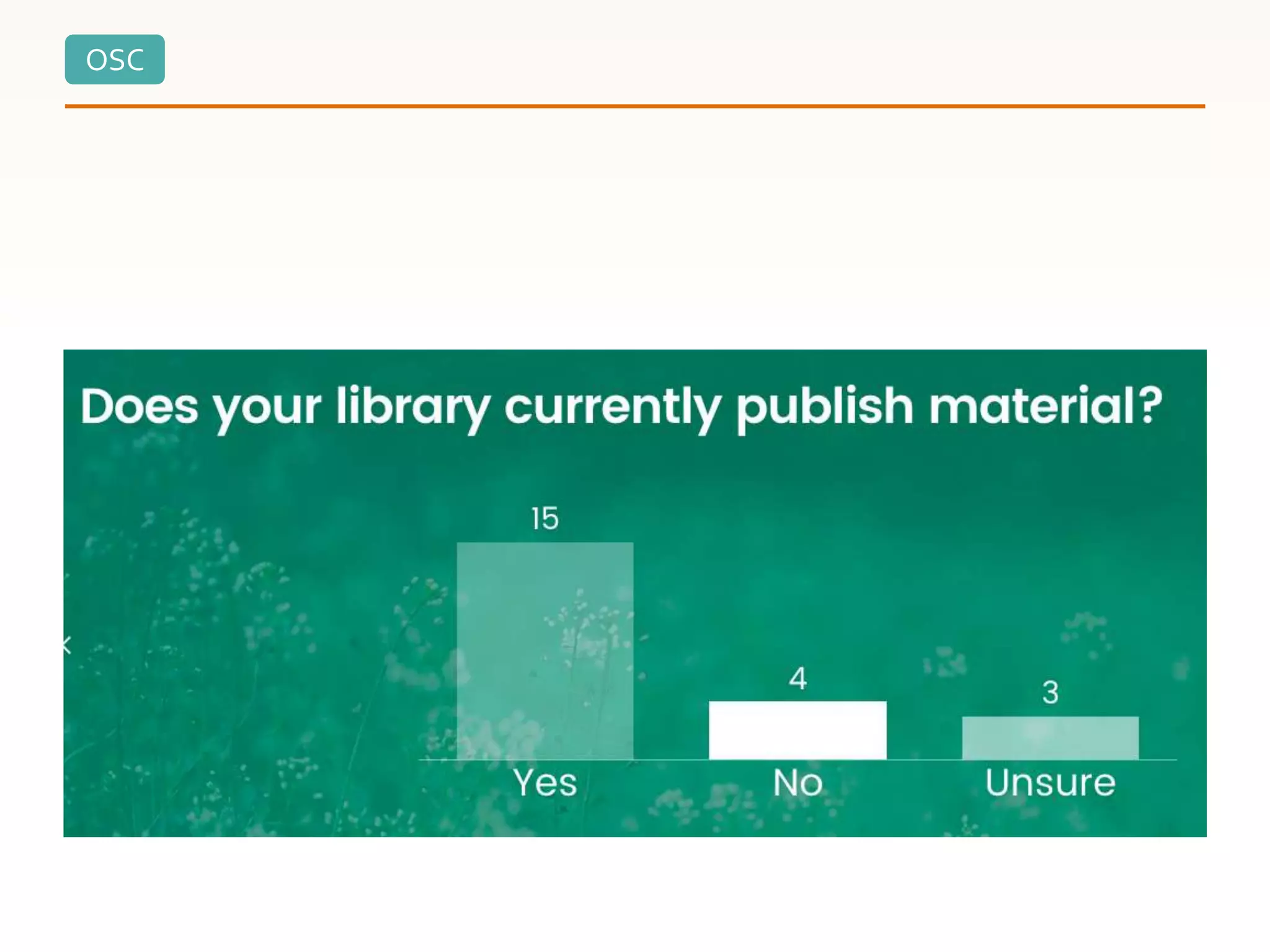
OSC Who are we? – govote.at
OSC
OSC
OSC
Aren’t libraries supposed to be curators?
Why are we doing this?
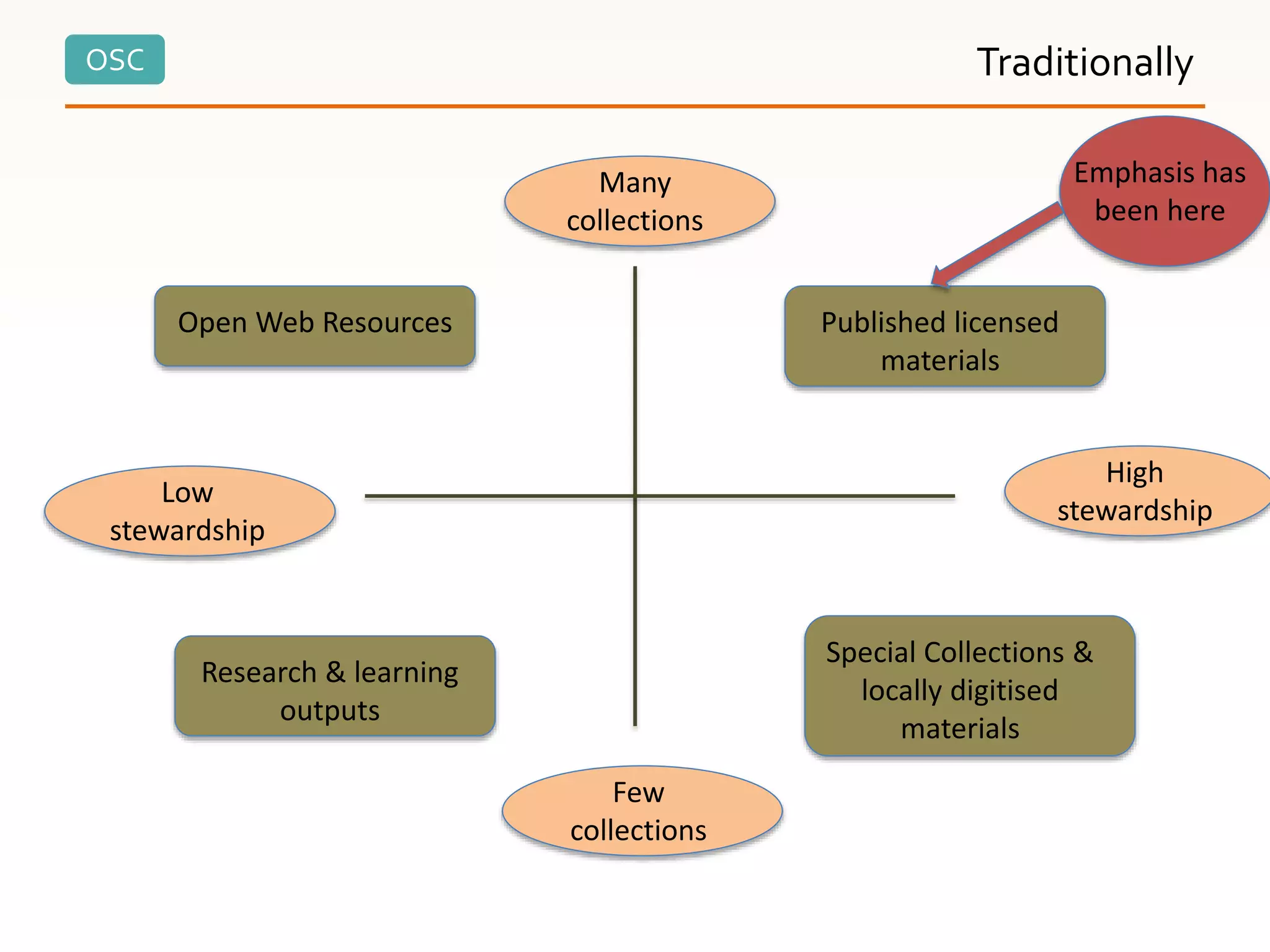
OSC Traditionally
Open Web Resources Published licensed
materials
Research & learning
outputs
Special Collections &
locally digitised
materials
Many
collections
Few
collections
Low
stewardship
High
stewardship
Emphasis has
been here
OSC
• Science 28 April 2016 “Who's downloading
pirated papers? Everyone”
– http://www.sciencemag.org/news/2016/04/whos-
downloading-pirated-papers-everyone
• Including people who have legal access.The
interface is better than the one libraries offer.
Threats
OSC Correlation between research hotspots and Sci-Hub use
http://www.sciencemag.org/news/2016/04/whos-downloading-pirated-papers-everyone
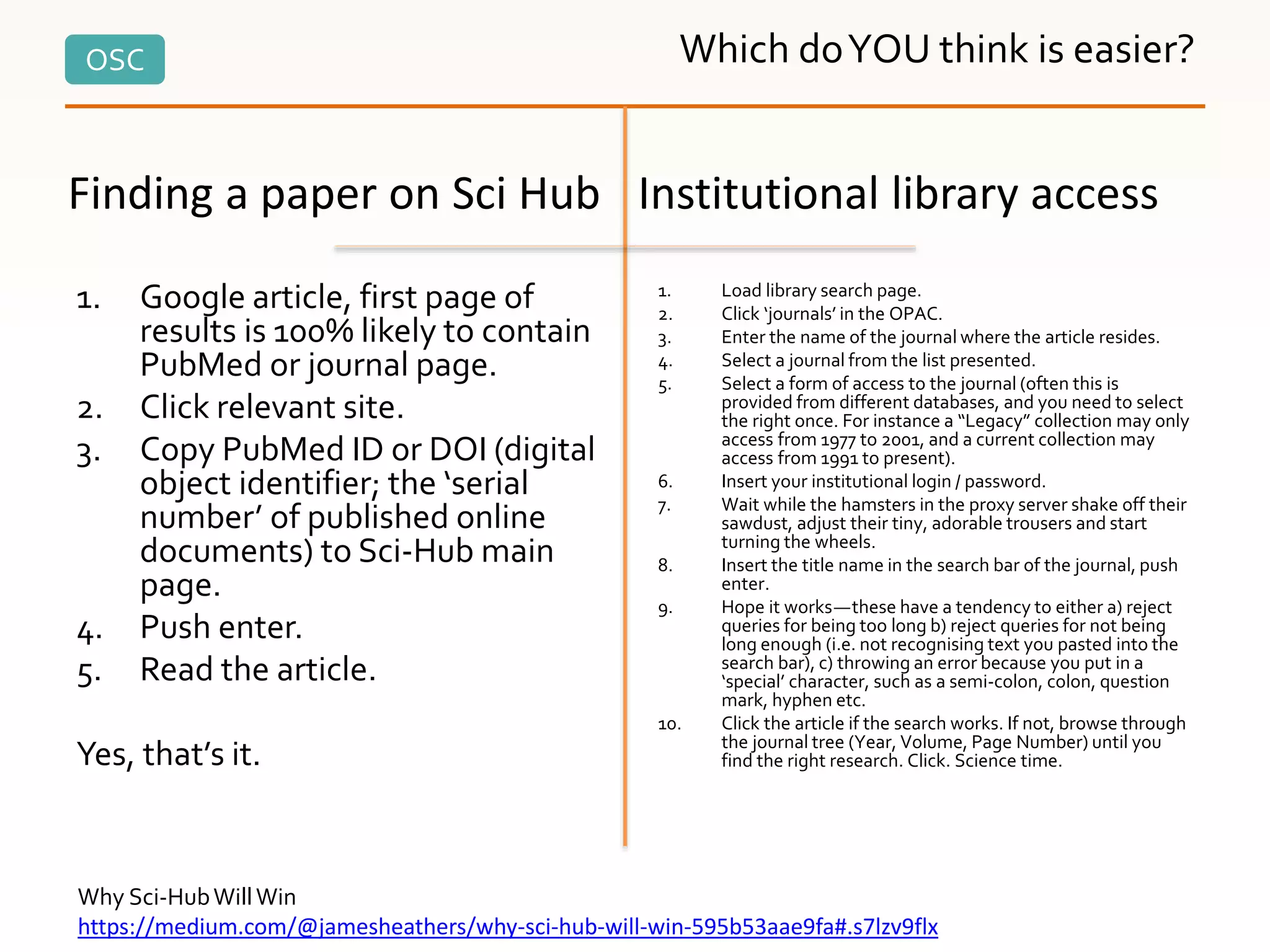
OSC Which doYOU think is easier?
1. Google article, first page of
results is 100% likely to contain
PubMed or journal page.
2. Click relevant site.
3. Copy PubMed ID or DOI (digital
object identifier; the ‘serial
number’ of published online
documents) to Sci-Hub main
page.
4. Push enter.
5. Read the article.
Yes, that’s it.
1. Load library search page.
2. Click ‘journals’ in the OPAC.
3. Enter the name of the journal where the article resides.
4. Select a journal from the list presented.
5. Select a form of access to the journal (often this is
provided from different databases, and you need to select
the right once. For instance a “Legacy” collection may only
access from 1977 to 2001, and a current collection may
access from 1991 to present).
6. Insert your institutional login / password.
7. Wait while the hamsters in the proxy server shake off their
sawdust, adjust their tiny, adorable trousers and start
turning the wheels.
8. Insert the title name in the search bar of the journal, push
enter.
9. Hope it works—these have a tendency to either a) reject
queries for being too long b) reject queries for not being
long enough (i.e. not recognising text you pasted into the
search bar), c) throwing an error because you put in a
‘special’ character, such as a semi-colon, colon, question
mark, hyphen etc.
10. Click the article if the search works. If not, browse through
the journal tree (Year, Volume, Page Number) until you
find the right research. Click. Science time.
Why Sci-HubWillWin
https://medium.com/@jamesheathers/why-sci-hub-will-win-595b53aae9fa#.s7lzv9flx
Finding a paper on Sci Hub Institutional library access
OSC And publishers are moving in on our territory
See: “Watch out, it's behind you: publishers' tactics and the challenge they
pose for librarians”
http://www.slideshare.net/DannyKingsley/watch-out-its-behind-you-
publishers-tactics-and-the-challenge-they-pose-for-librarians
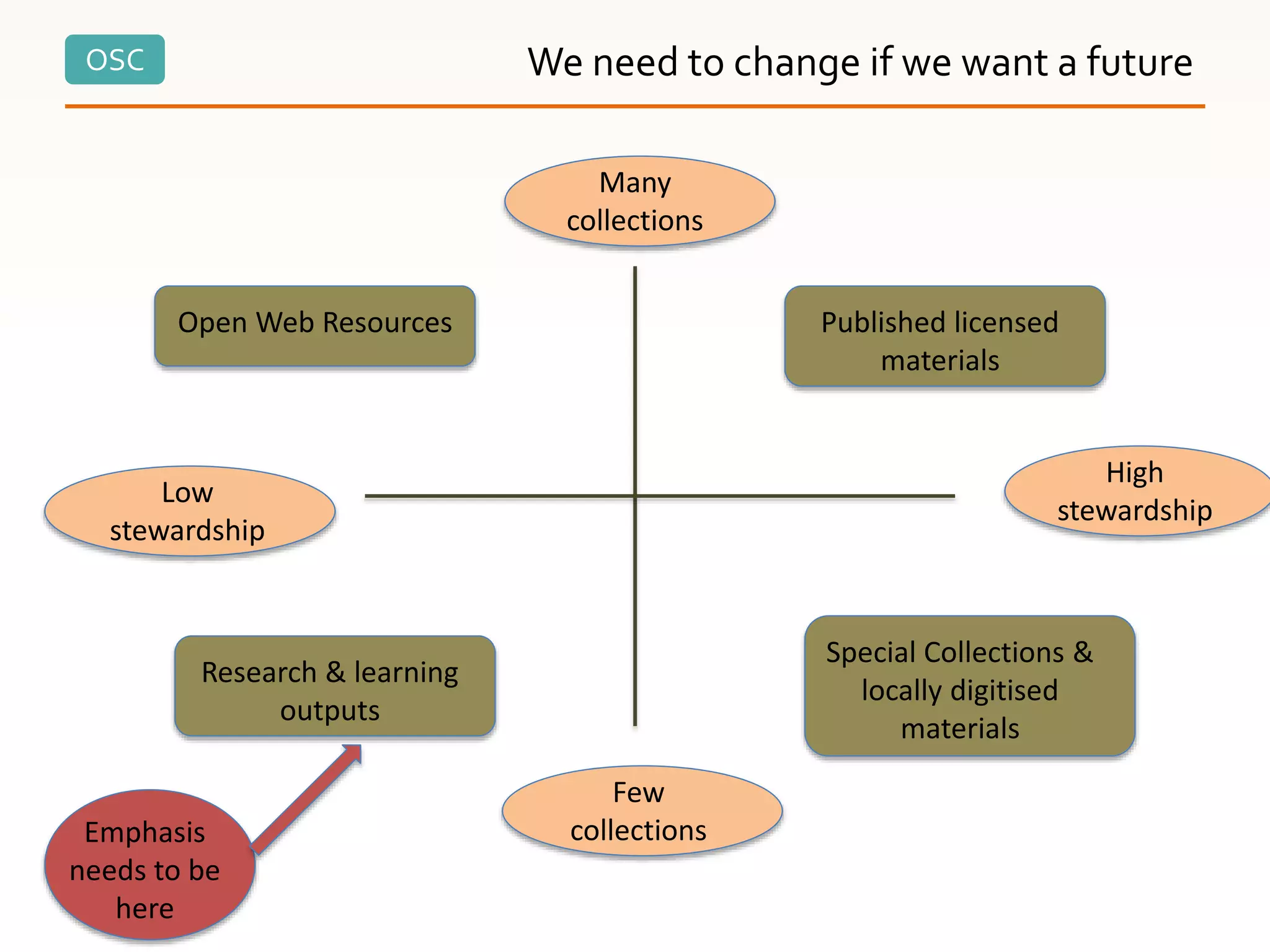
OSC We need to change if we want a future
Open Web Resources Published licensed
materials
Research & learning
outputs
Special Collections &
locally digitised
materials
Many
collections
Few
collections
Low
stewardship
High
stewardship
Emphasis
needs to be
here
OSC This can be seen as a threat or an opportunity
“In the digital-world supply chain, where the internet, and not
the library, has become the first point of departure for
researchers, libraries have been disintermediated, cut out not
only of the distribution link in the supply chain but also of
establishing what is trustworthy.”
http://scholarlykitchen.sspnet.org/2015/12/16/the-knowledge-supply-chain-in-
the-internet-age-who-decides-what-information-is-trustworthy/
OSC Let’s face it -
• We need to diversify to stay relevant
– We know about managing content
– We have access to material that is generated by
our organisations
– We have expertise and something to say
– We have a relationship with our community
OSC
• By moving into a publishing role
– We can raise visibility and status of library/information services in the
organisation
– We can regain control of academic discourse
– We can continue the support role Libraries have traditionally
provided.
• We are in a good position
– We can showcase hidden content from our organisation
– We have a captive audience - in terms of researchers or staff
members
– In an academic environment can co-opt the student population
Opportunity
Image: CC BY-SA 3.0 NY http://www.thebluediamondgallery.com/tablet/b/business-opportunity.html
OSC
What are we talking about?
• Social media
• Newsletters
• Journals
• Bibliographies
• Datasets
• Others?
When you say publishing…
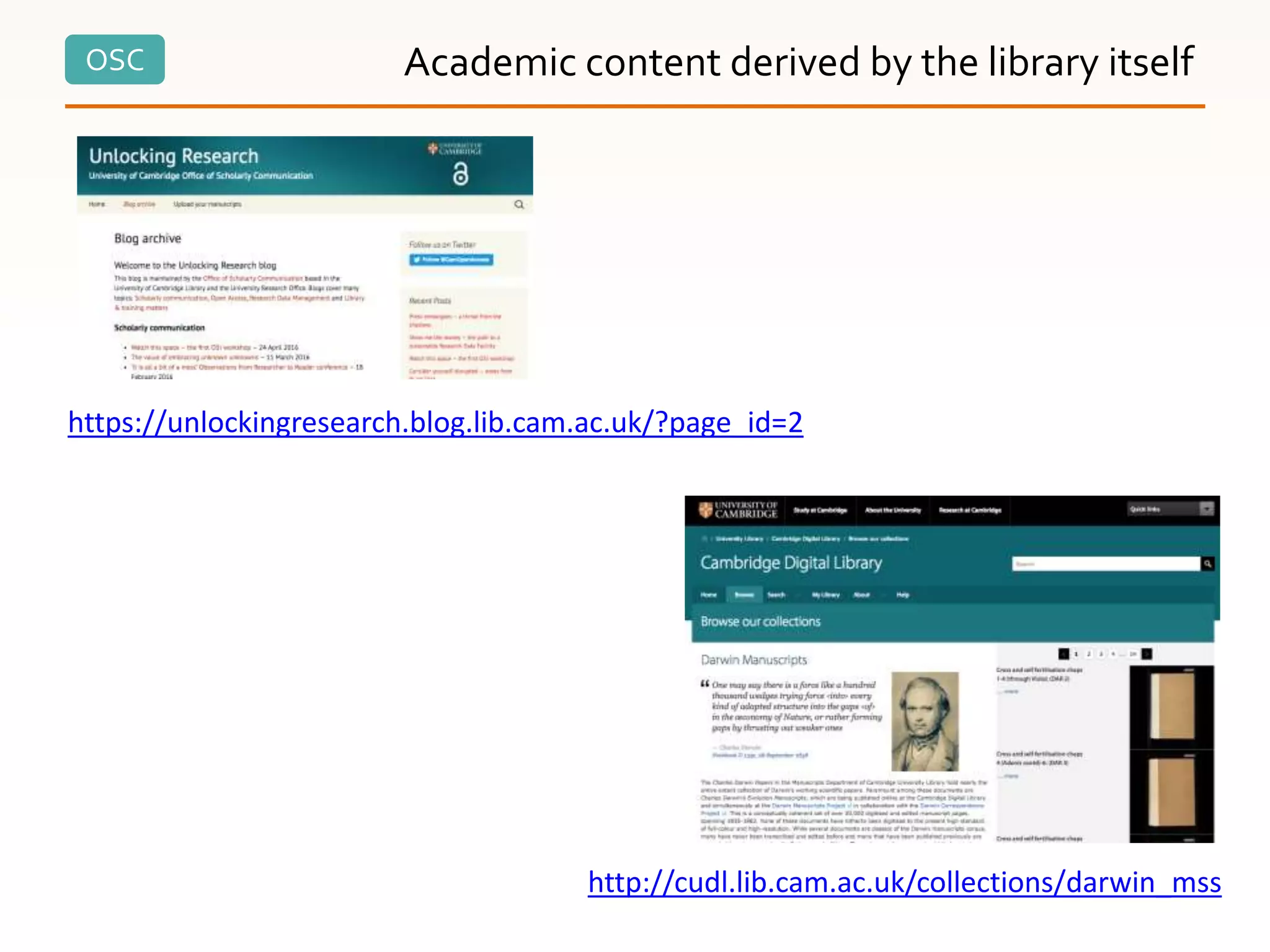
OSC Academic content derived by the library itself
https://unlockingresearch.blog.lib.cam.ac.uk/?page_id=2
http://cudl.lib.cam.ac.uk/collections/darwin_mss
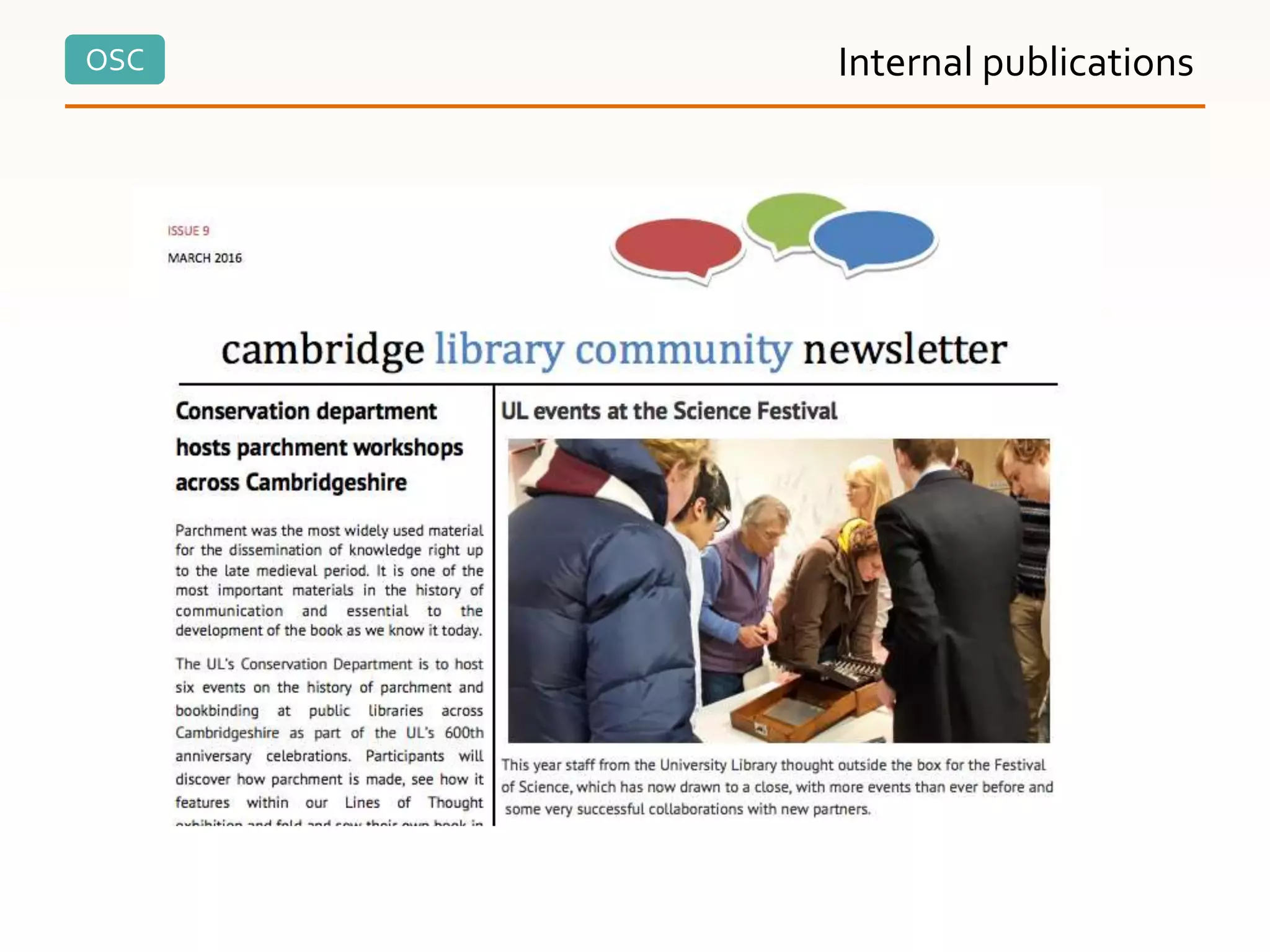
OSC Internal publications
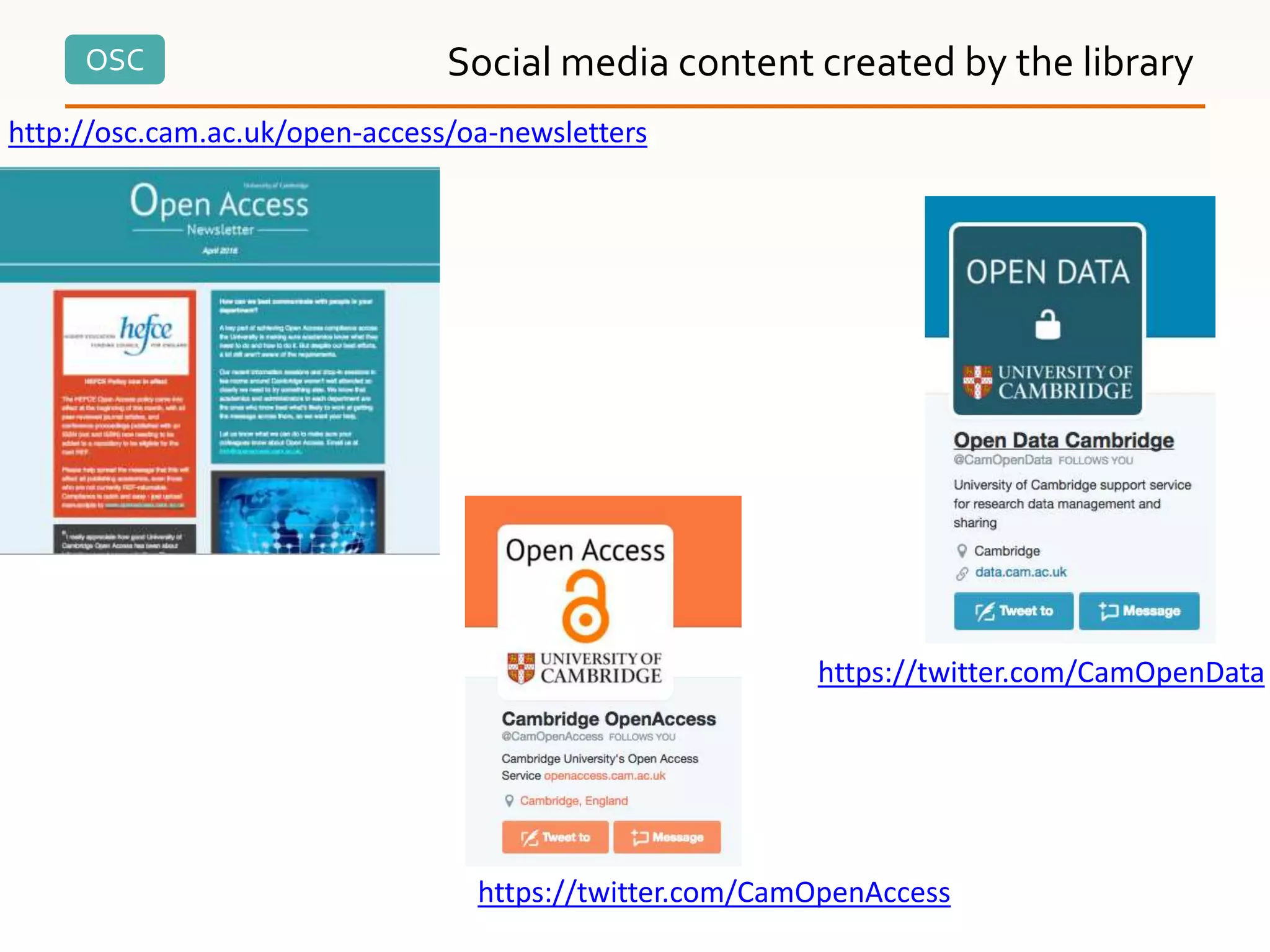
OSC Social media content created by the library
http://osc.cam.ac.uk/open-access/oa-newsletters
https://twitter.com/CamOpenData
https://twitter.com/CamOpenAccess
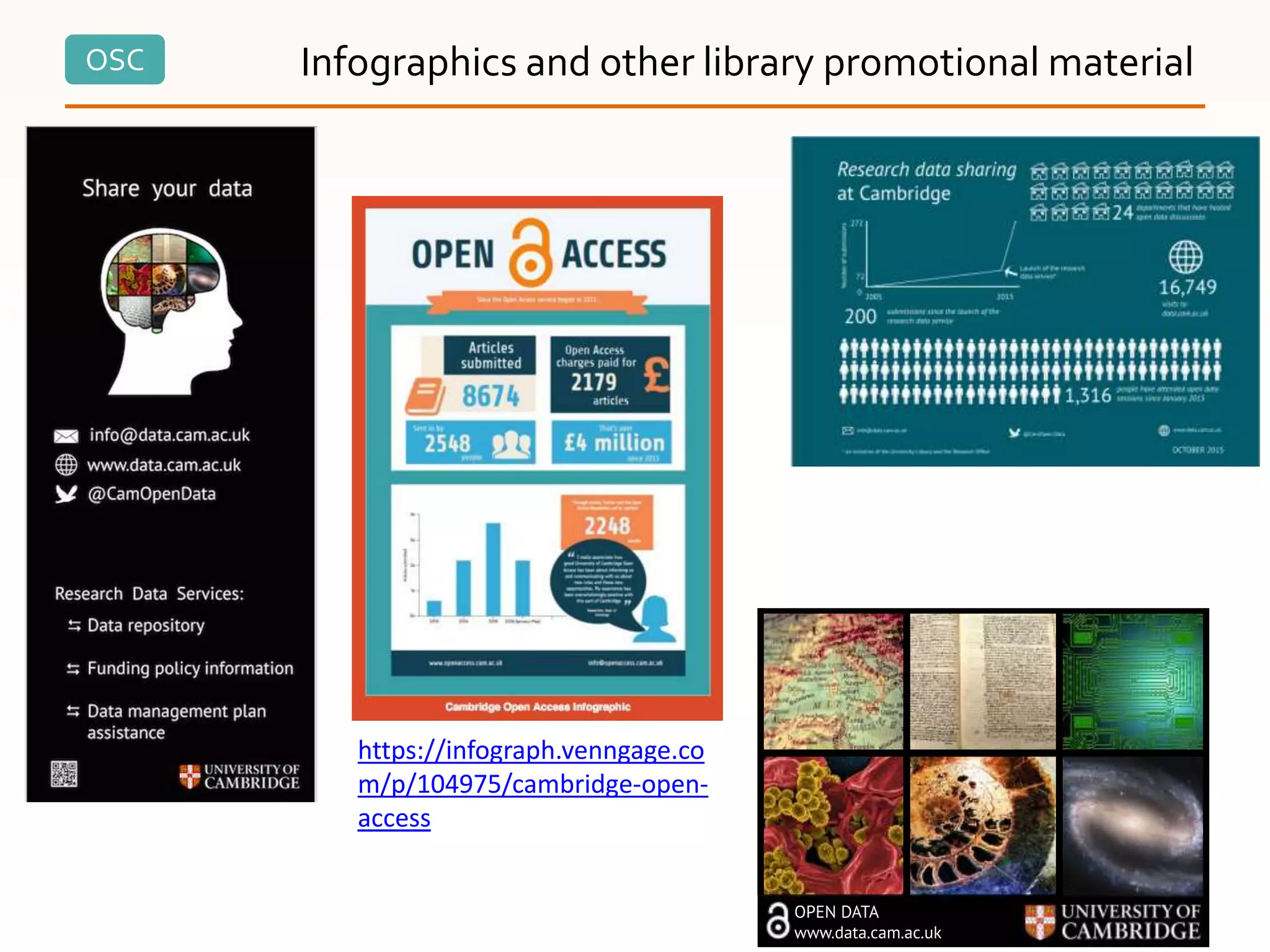
OSC Infographics and other library promotional material
https://infograph.venngage.co
m/p/104975/cambridge-open-
access
OSC
But you know what – that *is* real publishing.
You are doing it already!
I thought this session was about
*real* publishing
OSC Real publishing - theses and grey literature
https://www.repository.cam.ac.uk/handle/1810/253562
OSC
https://www.repository.cam.ac.uk/handle/1810/255394
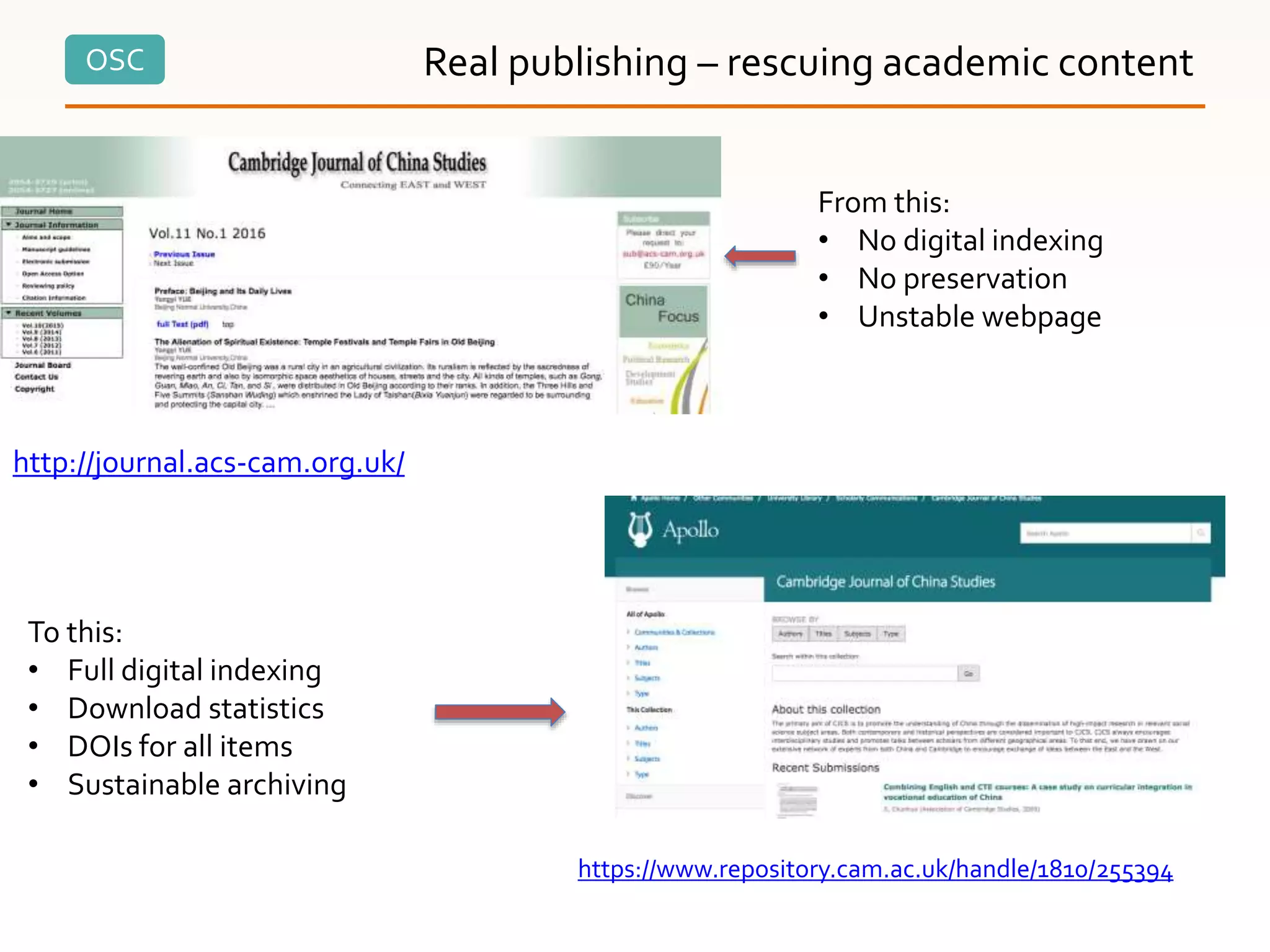
Real publishing – rescuing academic content
http://journal.acs-cam.org.uk/
From this:
• No digital indexing
• No preservation
• Unstable webpage
To this:
• Full digital indexing
• Download statistics
• DOIs for all items
• Sustainable archiving
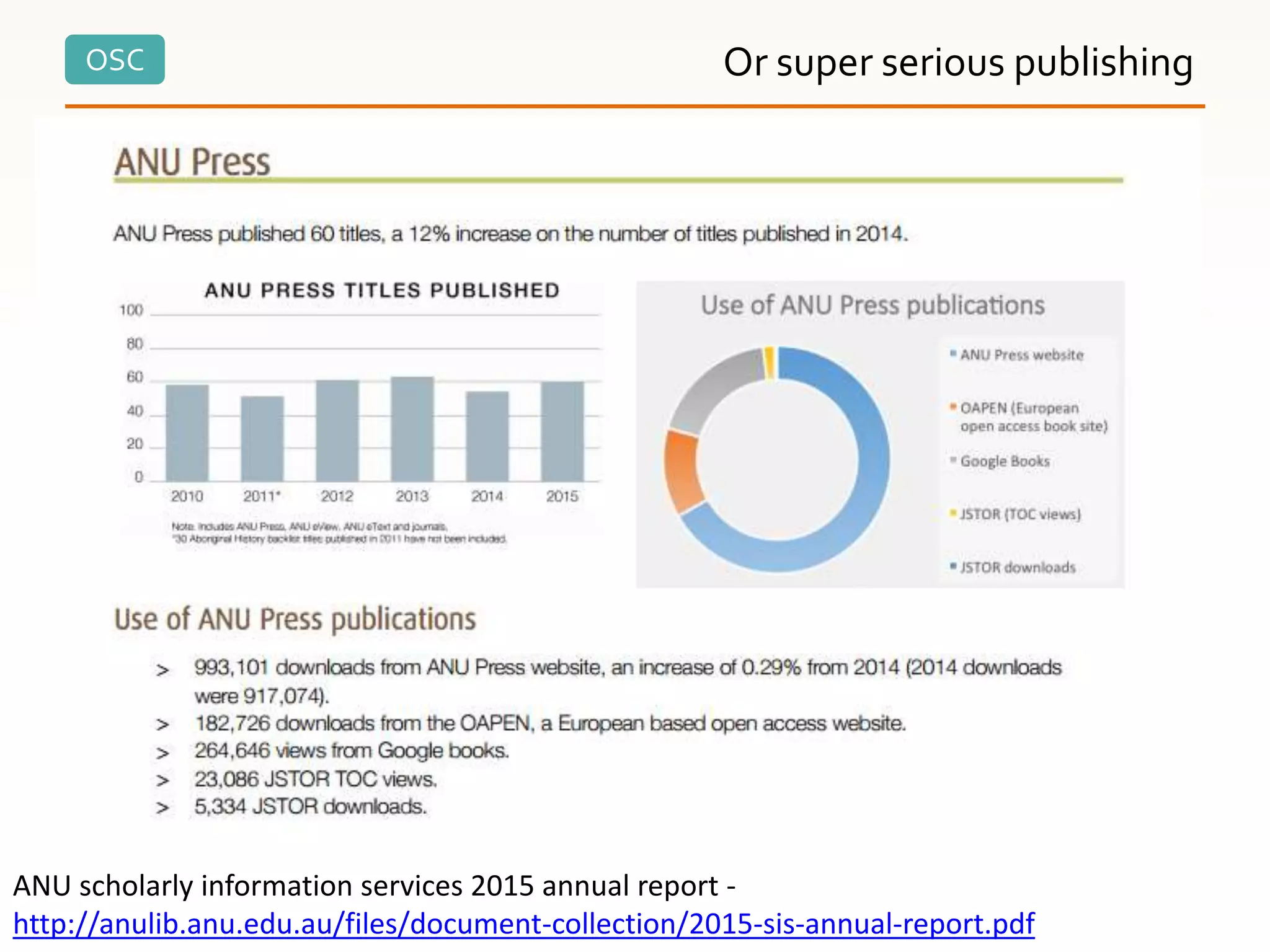
OSC Or super serious publishing
ANU scholarly information services 2015 annual report -
http://anulib.anu.edu.au/files/document-collection/2015-sis-annual-report.pdf
OSC
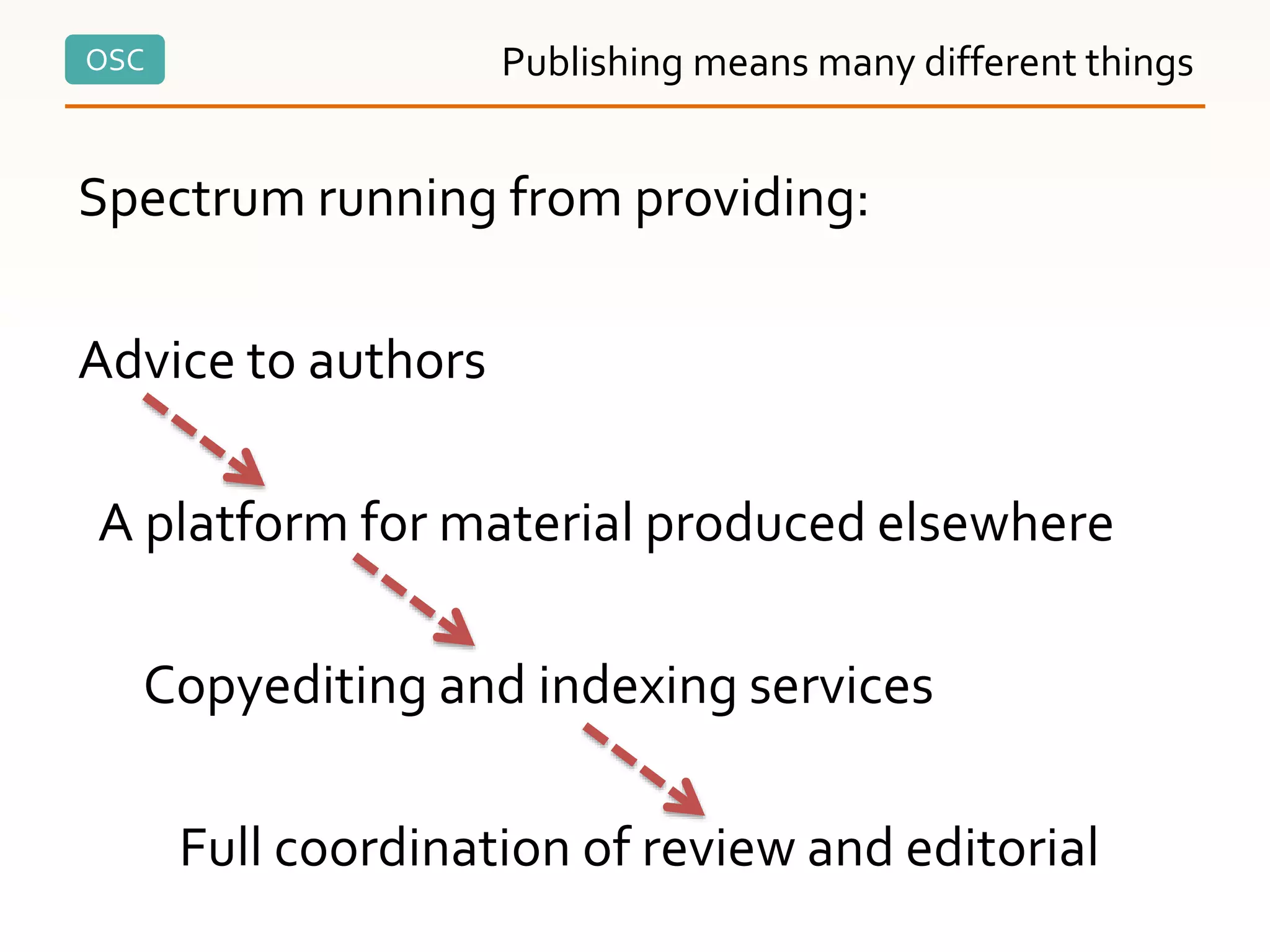
Spectrum running from providing:
Advice to authors
A platform for material produced elsewhere
Copyediting and indexing services
Full coordination of review and editorial
Publishing means many different things
OSC Time to vote again
OSC
There are a few things to consider:
Business Case
Staffing
Infrastructure
Marketing
If you are considering setting up
a full publishing service
OSC
• The hashtag for this session is #SLA2016
#StopPress
• We want to build some shared resources.
– Tweet links to resources on ‘Library as Publisher’
– Tweet links to some good examples you know about
(including your own!)
• If you have examples you want to share please
come up to a microphone
Join in!!
OSC
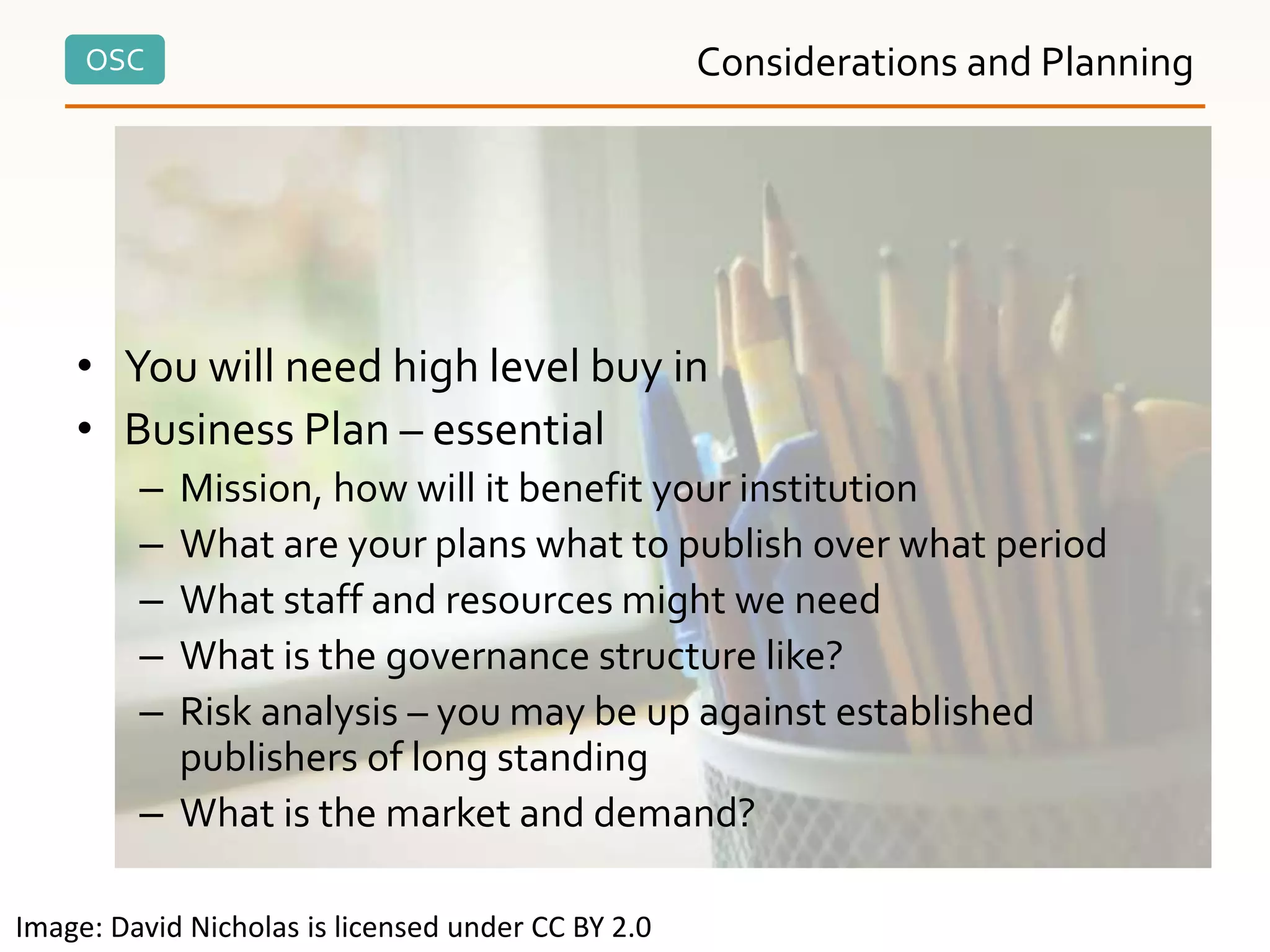
• You will need high level buy in
• Business Plan – essential
– Mission, how will it benefit your institution
– What are your plans what to publish over what period
– What staff and resources might we need
– What is the governance structure like?
– Risk analysis – you may be up against established
publishers of long standing
– What is the market and demand?
Considerations and Planning
Image: David Nicholas is licensed under CC BY 2.0
OSC
• SPARC Europe: ‘Business PlanToolkit -
Publishing an OpenAccess Journal’
http://sparceurope.org/wp-
content/uploads/2016/01/BusinessPLAN_OAJ
ournals_0116.pdf
Helpful
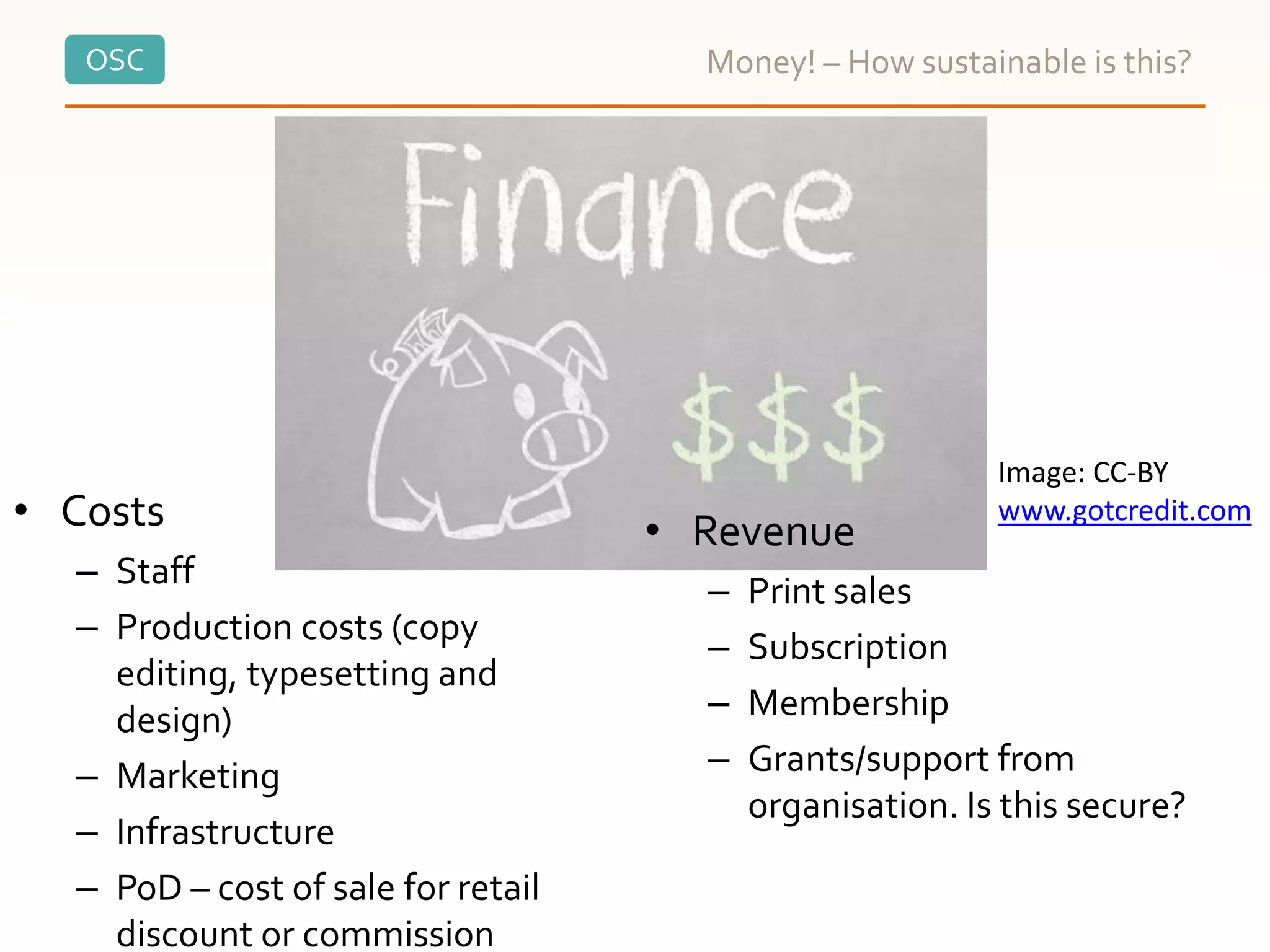
OSC Money! – How sustainable is this?
• Costs
– Staff
– Production costs (copy
editing, typesetting and
design)
– Marketing
– Infrastructure
– PoD – cost of sale for retail
discount or commission
• Revenue
– Print sales
– Subscription
– Membership
– Grants/support from
organisation. Is this secure?
Image: CC-BY
www.gotcredit.com
OSC
Who and what do we need to make it happen?
But how do we go about this?
Image: Marc Wathieu (CC BY-NC 2.0) https://www.flickr.com/photos/marcwathieu/3024646907/
OSC Providing advice
• You can do this stuff right now:
– Support with getting materials indexed
– Abstracting services
– Advice on third party copyright
– Advice on legal deposit
– Advice on licences e.g. Creative Commons
– Advice on access models: green/gold/hybrid/paywall
OSC
• Someone has to do some of this at some stage:
– Development editing
– Copy editing
– Typesetting
– Proofing
– Cover design
– Freelance pool management
– Working on budgets and schedules
• These are outside the usual set of skills in a Library.
The other skills may not exist in your current workforce
Image: Wilhei (Own work) [CC-BY 3.0] https://www.lib.utk.edu/tndp/2013/07/26/typesetting/
OSC Staffing
• Training vs Recruiting
• What roles are needed and in what numbers?
• Technical/advocacy…
Image: CC-BY-SA Europeana Creative http://pro.europeana.eu/blogpost/a-journey-s-end-is-the-beginning-of-a-new-
adventur
OSC Software and hardware
• Websites
– Drupal,WordPress
• Repositories
– DSpace, Eprints (open source)
– bepress http://www.bepress.com/ (proprietary)
• Hosting publishing platforms
– Open Journal Systems https://pkp.sfu.ca/ojs/ (open source)
• External publishing platforms
– Scholastica https://scholasticahq.com/ (low cost)
– DigitalCommons http://www.bepress.com/editors.html
• Partnerships
– Ubiquity Press http://www.ubiquitypress.com/site/publish/
– Partner with a university press
Open source vs proprietary?
OSC
What are the other challenges?
Can we talk about some
examples?
OSC
• If you have academic and editorial boards at
faculty levels. Getting people to publish with you
is a challenge.
• Getting credibility is difficult.
• Working through the peer review process and
finding experts and getting review
• Managing the author collaboration and response
to those reviews.
Acquisitions and peer review
Image: Nic McPhee (flickr, CC BY-SA 2.0)
OSC
• Barcodes and ISBN
• DOIs
• CC-BY licences
• Copyright
• Legal deposit obligations
• ONIX, Nielsen/Bowker
• Metadata for other platforms and services
• Third party aggregators (usually commercial)
• Journal indexing
Dissemination
Image by flickr user C!... CC BY 2.0
OSC
• Marketing
– Often neglected but very important, digital and
traditional
– How best to reach audiences efficiently and within small
budgets
– Author contribution/care – the authors are your best
advertising
• Work with your existing resources within the
institution – look internally as well as externally
Marketing
OSC
• Association of American University Presses http://www.aaupnet.org/
• Coalition for Networked Information http://www.cni.org/
• CrossRef – http://www.crossref.org/
• Directory of Open Access Journals - http://www.doaj.org/
• International Digital Publishing Forum - http://idpf.org/
• Library PublishingCoalition - http://www.educopia.org/programs/lpc
• National Digital Stewardship Alliance -
http://digitalpreservation.gov/ndsa/index.html
• National Information Standards Organization - http://www.niso.org/
• OAPEN Foundation - http://www.oapen.org/home
• ORCID - http://about.orcid.org/
• SPARC - http://www.sparc.arl.org//
• Text Encoding InitiativeConsortium - http://www.tei-c.org/
Support organisations
Image: GotCredit, CC BY 2.0
OSC Thanks and questions
• Email:
– info@osc.cam.ac.uk
• Web:
– www.osc.cam.ac.uk
– www.data.cam.ac.uk
– www.openaccess.cam.ac.uk
• Unlocking Research blog:
– https://unlockingresearch.blog.lib.cam.ac.uk/
• Twitter:
– @dannykay68
– @CamOpenData
– @CamOpenAccess

Stop Press: Libraries' Role in the Future of Publishing

  • 1.
    OSC Office of ScholarlyCommunication Stop Press: Libraries' Role in the Future of Publishing Dr Danny Kingsley Head, Office of Scholarly Communication University of Cambridge @dannykay68 Assisted by: NiamhTumelty Librarian, Dept of Engineering University of Cambridge @niamhpage
  • 2.
    OSC • The hashtagfor this session is #SLA2016 #StopPress • There will be a series of live tweets going out as the session runs so you don’t need to frantically note urls etc. Join in!!
  • 3.
    OSC Contents • Whoare we? • Changing role of libraries • What is publishing • Staffing implications: recruitment and skill sets • Software, hardware and hosting options • Business plans • Engaging the community and encouraging uptake
  • 4.
    OSC Who arewe? – govote.at
  • 5.
  • 6.
  • 7.
    OSC Aren’t libraries supposedto be curators? Why are we doing this?
  • 8.
    OSC Traditionally Open WebResources Published licensed materials Research & learning outputs Special Collections & locally digitised materials Many collections Few collections Low stewardship High stewardship Emphasis has been here
  • 9.
    OSC • Science 28April 2016 “Who's downloading pirated papers? Everyone” – http://www.sciencemag.org/news/2016/04/whos- downloading-pirated-papers-everyone • Including people who have legal access.The interface is better than the one libraries offer. Threats
  • 10.
    OSC Correlation betweenresearch hotspots and Sci-Hub use http://www.sciencemag.org/news/2016/04/whos-downloading-pirated-papers-everyone
  • 11.
    OSC Which doYOUthink is easier? 1. Google article, first page of results is 100% likely to contain PubMed or journal page. 2. Click relevant site. 3. Copy PubMed ID or DOI (digital object identifier; the ‘serial number’ of published online documents) to Sci-Hub main page. 4. Push enter. 5. Read the article. Yes, that’s it. 1. Load library search page. 2. Click ‘journals’ in the OPAC. 3. Enter the name of the journal where the article resides. 4. Select a journal from the list presented. 5. Select a form of access to the journal (often this is provided from different databases, and you need to select the right once. For instance a “Legacy” collection may only access from 1977 to 2001, and a current collection may access from 1991 to present). 6. Insert your institutional login / password. 7. Wait while the hamsters in the proxy server shake off their sawdust, adjust their tiny, adorable trousers and start turning the wheels. 8. Insert the title name in the search bar of the journal, push enter. 9. Hope it works—these have a tendency to either a) reject queries for being too long b) reject queries for not being long enough (i.e. not recognising text you pasted into the search bar), c) throwing an error because you put in a ‘special’ character, such as a semi-colon, colon, question mark, hyphen etc. 10. Click the article if the search works. If not, browse through the journal tree (Year, Volume, Page Number) until you find the right research. Click. Science time. Why Sci-HubWillWin https://medium.com/@jamesheathers/why-sci-hub-will-win-595b53aae9fa#.s7lzv9flx Finding a paper on Sci Hub Institutional library access
  • 12.
    OSC And publishersare moving in on our territory See: “Watch out, it's behind you: publishers' tactics and the challenge they pose for librarians” http://www.slideshare.net/DannyKingsley/watch-out-its-behind-you- publishers-tactics-and-the-challenge-they-pose-for-librarians
  • 13.
    OSC We needto change if we want a future Open Web Resources Published licensed materials Research & learning outputs Special Collections & locally digitised materials Many collections Few collections Low stewardship High stewardship Emphasis needs to be here
  • 14.
    OSC This canbe seen as a threat or an opportunity “In the digital-world supply chain, where the internet, and not the library, has become the first point of departure for researchers, libraries have been disintermediated, cut out not only of the distribution link in the supply chain but also of establishing what is trustworthy.” http://scholarlykitchen.sspnet.org/2015/12/16/the-knowledge-supply-chain-in- the-internet-age-who-decides-what-information-is-trustworthy/
  • 15.
    OSC Let’s faceit - • We need to diversify to stay relevant – We know about managing content – We have access to material that is generated by our organisations – We have expertise and something to say – We have a relationship with our community
  • 16.
    OSC • By movinginto a publishing role – We can raise visibility and status of library/information services in the organisation – We can regain control of academic discourse – We can continue the support role Libraries have traditionally provided. • We are in a good position – We can showcase hidden content from our organisation – We have a captive audience - in terms of researchers or staff members – In an academic environment can co-opt the student population Opportunity Image: CC BY-SA 3.0 NY http://www.thebluediamondgallery.com/tablet/b/business-opportunity.html
  • 17.
    OSC What are wetalking about? • Social media • Newsletters • Journals • Bibliographies • Datasets • Others? When you say publishing…
  • 18.
    OSC Academic contentderived by the library itself https://unlockingresearch.blog.lib.cam.ac.uk/?page_id=2 http://cudl.lib.cam.ac.uk/collections/darwin_mss
  • 19.
  • 20.
    OSC Social mediacontent created by the library http://osc.cam.ac.uk/open-access/oa-newsletters https://twitter.com/CamOpenData https://twitter.com/CamOpenAccess
  • 21.
    OSC Infographics andother library promotional material https://infograph.venngage.co m/p/104975/cambridge-open- access
  • 22.
    OSC But you knowwhat – that *is* real publishing. You are doing it already! I thought this session was about *real* publishing
  • 23.
    OSC Real publishing- theses and grey literature https://www.repository.cam.ac.uk/handle/1810/253562
  • 24.
    OSC https://www.repository.cam.ac.uk/handle/1810/255394 Real publishing –rescuing academic content http://journal.acs-cam.org.uk/ From this: • No digital indexing • No preservation • Unstable webpage To this: • Full digital indexing • Download statistics • DOIs for all items • Sustainable archiving
  • 25.
    OSC Or superserious publishing ANU scholarly information services 2015 annual report - http://anulib.anu.edu.au/files/document-collection/2015-sis-annual-report.pdf
  • 26.
    OSC Spectrum running fromproviding: Advice to authors A platform for material produced elsewhere Copyediting and indexing services Full coordination of review and editorial Publishing means many different things
  • 27.
    OSC Time tovote again
  • 28.
    OSC There are afew things to consider: Business Case Staffing Infrastructure Marketing If you are considering setting up a full publishing service
  • 29.
    OSC • The hashtagfor this session is #SLA2016 #StopPress • We want to build some shared resources. – Tweet links to resources on ‘Library as Publisher’ – Tweet links to some good examples you know about (including your own!) • If you have examples you want to share please come up to a microphone Join in!!
  • 30.
    OSC • You willneed high level buy in • Business Plan – essential – Mission, how will it benefit your institution – What are your plans what to publish over what period – What staff and resources might we need – What is the governance structure like? – Risk analysis – you may be up against established publishers of long standing – What is the market and demand? Considerations and Planning Image: David Nicholas is licensed under CC BY 2.0
  • 31.
    OSC • SPARC Europe:‘Business PlanToolkit - Publishing an OpenAccess Journal’ http://sparceurope.org/wp- content/uploads/2016/01/BusinessPLAN_OAJ ournals_0116.pdf Helpful
  • 32.
    OSC Money! –How sustainable is this? • Costs – Staff – Production costs (copy editing, typesetting and design) – Marketing – Infrastructure – PoD – cost of sale for retail discount or commission • Revenue – Print sales – Subscription – Membership – Grants/support from organisation. Is this secure? Image: CC-BY www.gotcredit.com
  • 33.
    OSC Who and whatdo we need to make it happen? But how do we go about this? Image: Marc Wathieu (CC BY-NC 2.0) https://www.flickr.com/photos/marcwathieu/3024646907/
  • 34.
    OSC Providing advice •You can do this stuff right now: – Support with getting materials indexed – Abstracting services – Advice on third party copyright – Advice on legal deposit – Advice on licences e.g. Creative Commons – Advice on access models: green/gold/hybrid/paywall
  • 35.
    OSC • Someone hasto do some of this at some stage: – Development editing – Copy editing – Typesetting – Proofing – Cover design – Freelance pool management – Working on budgets and schedules • These are outside the usual set of skills in a Library. The other skills may not exist in your current workforce Image: Wilhei (Own work) [CC-BY 3.0] https://www.lib.utk.edu/tndp/2013/07/26/typesetting/
  • 36.
    OSC Staffing • Trainingvs Recruiting • What roles are needed and in what numbers? • Technical/advocacy… Image: CC-BY-SA Europeana Creative http://pro.europeana.eu/blogpost/a-journey-s-end-is-the-beginning-of-a-new- adventur
  • 37.
    OSC Software andhardware • Websites – Drupal,WordPress • Repositories – DSpace, Eprints (open source) – bepress http://www.bepress.com/ (proprietary) • Hosting publishing platforms – Open Journal Systems https://pkp.sfu.ca/ojs/ (open source) • External publishing platforms – Scholastica https://scholasticahq.com/ (low cost) – DigitalCommons http://www.bepress.com/editors.html • Partnerships – Ubiquity Press http://www.ubiquitypress.com/site/publish/ – Partner with a university press Open source vs proprietary?
  • 38.
    OSC What are theother challenges? Can we talk about some examples?
  • 39.
    OSC • If youhave academic and editorial boards at faculty levels. Getting people to publish with you is a challenge. • Getting credibility is difficult. • Working through the peer review process and finding experts and getting review • Managing the author collaboration and response to those reviews. Acquisitions and peer review Image: Nic McPhee (flickr, CC BY-SA 2.0)
  • 40.
    OSC • Barcodes andISBN • DOIs • CC-BY licences • Copyright • Legal deposit obligations • ONIX, Nielsen/Bowker • Metadata for other platforms and services • Third party aggregators (usually commercial) • Journal indexing Dissemination Image by flickr user C!... CC BY 2.0
  • 41.
    OSC • Marketing – Oftenneglected but very important, digital and traditional – How best to reach audiences efficiently and within small budgets – Author contribution/care – the authors are your best advertising • Work with your existing resources within the institution – look internally as well as externally Marketing
  • 42.
    OSC • Association ofAmerican University Presses http://www.aaupnet.org/ • Coalition for Networked Information http://www.cni.org/ • CrossRef – http://www.crossref.org/ • Directory of Open Access Journals - http://www.doaj.org/ • International Digital Publishing Forum - http://idpf.org/ • Library PublishingCoalition - http://www.educopia.org/programs/lpc • National Digital Stewardship Alliance - http://digitalpreservation.gov/ndsa/index.html • National Information Standards Organization - http://www.niso.org/ • OAPEN Foundation - http://www.oapen.org/home • ORCID - http://about.orcid.org/ • SPARC - http://www.sparc.arl.org// • Text Encoding InitiativeConsortium - http://www.tei-c.org/ Support organisations Image: GotCredit, CC BY 2.0
  • 43.
    OSC Thanks andquestions • Email: – info@osc.cam.ac.uk • Web: – www.osc.cam.ac.uk – www.data.cam.ac.uk – www.openaccess.cam.ac.uk • Unlocking Research blog: – https://unlockingresearch.blog.lib.cam.ac.uk/ • Twitter: – @dannykay68 – @CamOpenData – @CamOpenAccess