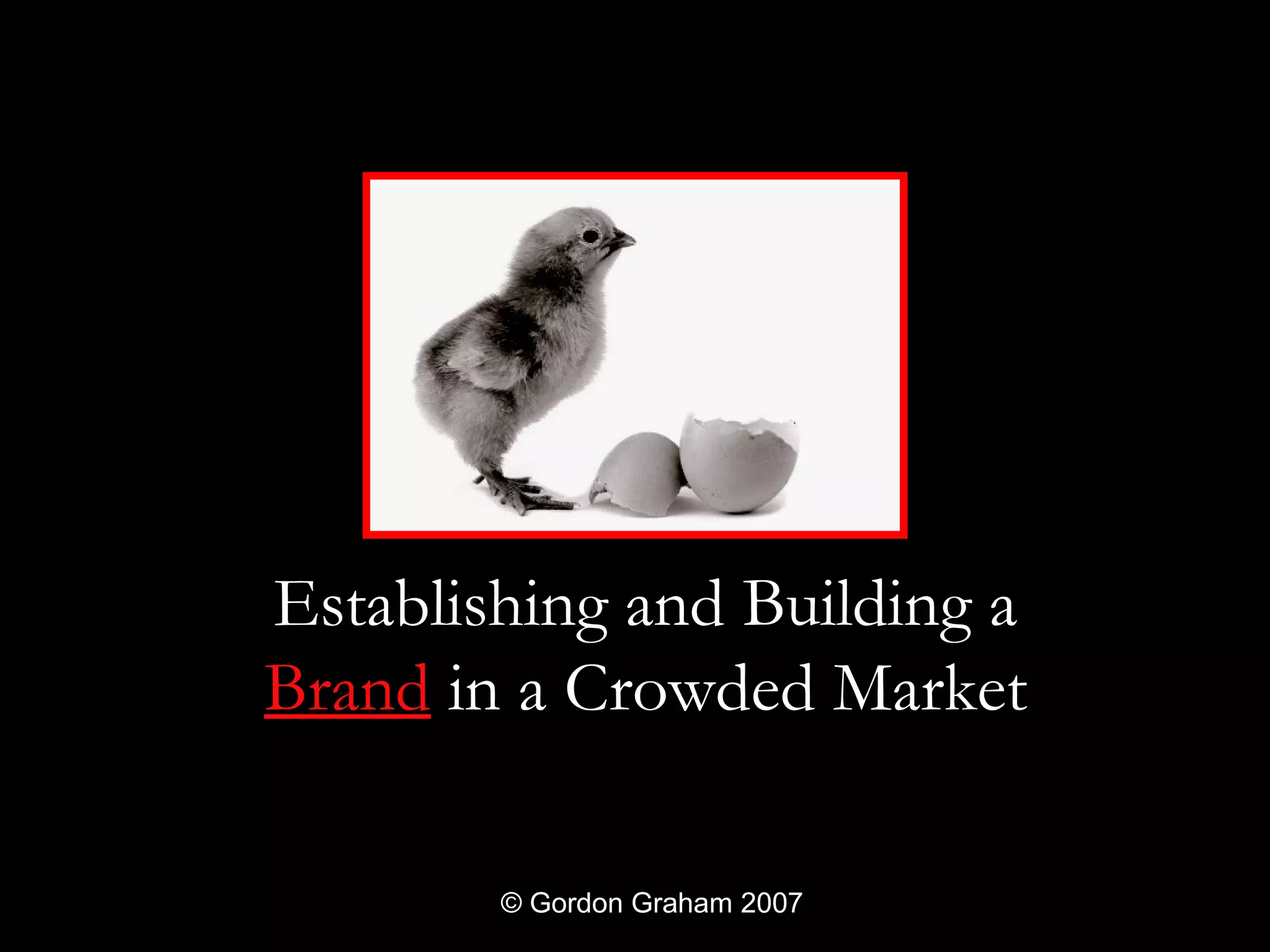
Establishing and Building a
Brand in a Crowded Market

        © Gordon Graham 2007
Brands run deep:
 “Mythological symbols touch and
exhilarate centers of life beyond the
reach of vocabularies and coercion.”
- Joseph Campbell, Masks of God,
            Vol. 4
What is a brand?


Multiple definitions. Multiple
perspectives. Multiple roles.
What is a brand?
 “. . . the promise, the big idea, and
the expectations that reside inside the
head of each customer’s mind about a
 product, service, or company . . .the
  brand is shorthand. It stands for
              something.”
     - Alina Wheeler (2006)
What is a brand?
 “. . . a set of mental associations,
held by the consumer, which add to
the perceived value of a product or
                service.”
  - Kevin Lane Keller (1998)
What is a brand?
“ . . . a brand is a concept . . . a brand
     shapes and reflects our quest for
               meaning.”“
     - Bobby J. Calder (2005)
“ . . . a brand is a meaning system.”“
      - Patrick Hanlon (2006)
Definitions will emphasize what a brand
is (physical appearance) or what it does
                  (role).
What do brands do?
 They remind us of a past product/service
experience. They communicate how we see
ourselves. Brands are fantasy. Escapism. A
 brand is often just an umbilical cord to a
             world elsewhere.
Brands represent the world as it ought to
  be not how it is. Romanticism. Brands
represent values and ideals. They simplify
                 our day.
Brands help satisfy a need to belong to
something larger than ourselves. At the
  same time, they help us express our
             individuality.
Thanks to Rob Walker (2008) for this.
Hugh MacLeod, Gapingvoid.com
Brands
         .
             .
                are
               ..
                 ..
                .
 MAGIC MAKING
But . . .
  hugely successful brands can also
Brands amount as the result of an
  emerge simply to as much as
   80% of a firm’s assets.
   awesome product
        - Economist (2008)
                                   .
So let’s not take this branding thing too
   Brands amount to as muchmediocre
far. Branding is no substitute for   as
        80% oflack of product innovation.
 products or a   a firm’s assets.
           - Economist (2008)
You can only fool people for a while.
Country of Origin & Stereotypes:


Chinese brands. Now we’re talking values,
  trust and the relative attractiveness of
                 cultures.
What is culture?
“. . . the sum of a set of shared values.”
       - Bradley Hall (2008)
     “ . . . inherited ethical habit.”
    - Francis Fukuyama (1995)
Individualism + Low Trust in China
      Small firms. Family run at core.
          Fragmented industries.
   Destructive, subsidized competition.
Little cooperation. Few transnational firms.
 Short-term thinking. Emergent Strategy.
On to the

BRAND        ®


Building > > >
What will this presentation
            cover?
1. Why firms should establish a brand.
2. The steps in establishing a new brand.
3. A short list of recommended branding
   books.
1. Why establish a brand?
Consumers face a dizzying
    array of choices.
Products drift towards
  commoditization.
A brand differentiates the
product from similar offerings.
A brand reduces the need to
  compete on price alone.
The goal of a brand
  is to establish a
monopoly position
   for a non-core
product attribute in
  the mind of an
     individual.
Identity             Image
{PR/Advertising}       {Reality}

   The Firm        Staff & Customers
Who controls a brand’s
 Firm         meaning?


Market
                Length of Time
                Brand Engages
                    Market
2. Steps in establishing a new brand.
I: Establish the meaning of the brand


    “The power of a brand is inversely
       proportional to its scope.”

   - Laura and Al Ries, The Origin of Brands
A good way to do this is by
         asking:


What’s the brand’s
 Point of View?
Broad
Scope
         CVS: general drug store products
         CVS: general drug store products


               Body Shop: body


Narrow          New Brand
Scope
               A hair care store?
Point of View? Who is the
         Enemy?
Beauty doesn’t have to be
at the expense of animals’
         welfare.
Dig deep for a position within an
existing category - or create a new
  category or, better yet, a new
             product!
“Healthy” or “organic” are no
      longer brand positions or
   differentiators. These are now
categories. Dig deeper if you want to
            differentiate.
Your brand needs to . . .


 Stand for
something
Categories diverge not converge

          General Motors Models in 1955:
                       25
          General Motors Models in 2005:
                       325


Source: The Machine That Changed the World (1990)
Brands and their Owners
    Range Rover: Indian
 French’s Mustard: British
Glenmorangie Scotch: French
   Trader Joe’s: German
Diffuse Ownership
Brands are often part owned by
 sovereign funds and private
  equity groups from various
           countries.
Some points to remember:


   Brands cannot stretch very far
Customers buy brands not companies
    Brand decisions are strategic
You can build a brand portfolio
         organically
Or through acquisition
II: Name

Choose a name that’s:
      unique
       short
    easy to say
  easy to spell . . .
if possible, the name should suggest
the product category:

Captain Morgan         Rum
Lunesta              Sleeping pills
Samsonite           Strong luggage
Alternatively, you can
create meaning around
 a meaningless word.
This is what Starbucks
  did with its brand.
III: Physical Elements of the Brand:


     Choose a logo or name mark
          Choose a colour(s)
           Choose a tagline
Final thought:

     . . . we all think everyone else’s
shopping quirks are weird and irrational
 - but that our own make perfect sense.
  Rob Walker, New York Times Magazine
                 (2009)
The Origin of Brands, Al and Laura Ries
Brand Meaning, Mark Batey
Designing Brand Identity: A complete guide
to creating, building and sustaining strong
brands, Alina Wheeler
Brand Leadership, David Aacker and
Eric Joachimsthaler
The New Strategic Brand Management:
Creating and sustaining brand equity long
term, Jean-Noel Kapferer
I’m very interested in business training
and course design for e-learning Feel
   free to get in touch! Thanks!

    Gordon@westportwire.com

             © Gordon Graham 2007

Brand first, branding second

  • 1.
    Establishing and Buildinga Brand in a Crowded Market © Gordon Graham 2007
  • 2.
    Brands run deep: “Mythological symbols touch and exhilarate centers of life beyond the reach of vocabularies and coercion.” - Joseph Campbell, Masks of God, Vol. 4
  • 3.
    What is abrand? Multiple definitions. Multiple perspectives. Multiple roles.
  • 4.
    What is abrand? “. . . the promise, the big idea, and the expectations that reside inside the head of each customer’s mind about a product, service, or company . . .the brand is shorthand. It stands for something.” - Alina Wheeler (2006)
  • 5.
    What is abrand? “. . . a set of mental associations, held by the consumer, which add to the perceived value of a product or service.” - Kevin Lane Keller (1998)
  • 6.
    What is abrand? “ . . . a brand is a concept . . . a brand shapes and reflects our quest for meaning.”“ - Bobby J. Calder (2005) “ . . . a brand is a meaning system.”“ - Patrick Hanlon (2006)
  • 7.
    Definitions will emphasizewhat a brand is (physical appearance) or what it does (role).
  • 8.
    What do brandsdo? They remind us of a past product/service experience. They communicate how we see ourselves. Brands are fantasy. Escapism. A brand is often just an umbilical cord to a world elsewhere.
  • 9.
    Brands represent theworld as it ought to be not how it is. Romanticism. Brands represent values and ideals. They simplify our day.
  • 10.
    Brands help satisfya need to belong to something larger than ourselves. At the same time, they help us express our individuality. Thanks to Rob Walker (2008) for this.
  • 11.
  • 12.
    Brands . . are .. .. . MAGIC MAKING
  • 13.
    But . .. hugely successful brands can also Brands amount as the result of an emerge simply to as much as 80% of a firm’s assets. awesome product - Economist (2008) .
  • 14.
    So let’s nottake this branding thing too Brands amount to as muchmediocre far. Branding is no substitute for as 80% oflack of product innovation. products or a a firm’s assets. - Economist (2008)
  • 15.
    You can onlyfool people for a while.
  • 16.
    Country of Origin& Stereotypes: Chinese brands. Now we’re talking values, trust and the relative attractiveness of cultures.
  • 17.
    What is culture? “.. . the sum of a set of shared values.” - Bradley Hall (2008) “ . . . inherited ethical habit.” - Francis Fukuyama (1995)
  • 18.
    Individualism + LowTrust in China Small firms. Family run at core. Fragmented industries. Destructive, subsidized competition. Little cooperation. Few transnational firms. Short-term thinking. Emergent Strategy.
  • 19.
    On to the BRAND ® Building > > >
  • 20.
    What will thispresentation cover? 1. Why firms should establish a brand. 2. The steps in establishing a new brand. 3. A short list of recommended branding books.
  • 21.
  • 22.
    Consumers face adizzying array of choices.
  • 23.
    Products drift towards commoditization.
  • 24.
    A brand differentiatesthe product from similar offerings.
  • 25.
    A brand reducesthe need to compete on price alone.
  • 26.
    The goal ofa brand is to establish a monopoly position for a non-core product attribute in the mind of an individual.
  • 27.
    Identity Image {PR/Advertising} {Reality} The Firm Staff & Customers
  • 28.
    Who controls abrand’s Firm meaning? Market Length of Time Brand Engages Market
  • 29.
    2. Steps inestablishing a new brand.
  • 30.
    I: Establish themeaning of the brand “The power of a brand is inversely proportional to its scope.” - Laura and Al Ries, The Origin of Brands
  • 31.
    A good wayto do this is by asking: What’s the brand’s Point of View?
  • 32.
    Broad Scope CVS: general drug store products CVS: general drug store products Body Shop: body Narrow New Brand Scope A hair care store?
  • 33.
    Point of View?Who is the Enemy?
  • 34.
    Beauty doesn’t haveto be at the expense of animals’ welfare.
  • 35.
    Dig deep fora position within an existing category - or create a new category or, better yet, a new product!
  • 36.
    “Healthy” or “organic”are no longer brand positions or differentiators. These are now categories. Dig deeper if you want to differentiate.
  • 37.
    Your brand needsto . . . Stand for something
  • 38.
    Categories diverge notconverge General Motors Models in 1955: 25 General Motors Models in 2005: 325 Source: The Machine That Changed the World (1990)
  • 39.
    Brands and theirOwners Range Rover: Indian French’s Mustard: British Glenmorangie Scotch: French Trader Joe’s: German
  • 40.
    Diffuse Ownership Brands areoften part owned by sovereign funds and private equity groups from various countries.
  • 41.
    Some points toremember: Brands cannot stretch very far Customers buy brands not companies Brand decisions are strategic
  • 42.
    You can builda brand portfolio organically
  • 43.
  • 44.
    II: Name Choose aname that’s: unique short easy to say easy to spell . . .
  • 45.
    if possible, thename should suggest the product category: Captain Morgan Rum Lunesta Sleeping pills Samsonite Strong luggage
  • 46.
    Alternatively, you can createmeaning around a meaningless word. This is what Starbucks did with its brand.
  • 47.
    III: Physical Elementsof the Brand: Choose a logo or name mark Choose a colour(s) Choose a tagline
  • 48.
    Final thought: . . . we all think everyone else’s shopping quirks are weird and irrational - but that our own make perfect sense. Rob Walker, New York Times Magazine (2009)
  • 49.
    The Origin ofBrands, Al and Laura Ries Brand Meaning, Mark Batey Designing Brand Identity: A complete guide to creating, building and sustaining strong brands, Alina Wheeler Brand Leadership, David Aacker and Eric Joachimsthaler The New Strategic Brand Management: Creating and sustaining brand equity long term, Jean-Noel Kapferer
  • 50.
    I’m very interestedin business training and course design for e-learning Feel free to get in touch! Thanks! Gordon@westportwire.com © Gordon Graham 2007