Blaze Automation is India's leading manufacturer of Home Automation equipment. Also Blaze has a professional Research and Development team to cater the needs of Security and Automation Needs of the clients in India and Abroad
WHY INSTALL OCCUPANCYSENSOR CONTROLS? Lighting occupancy sensors save energy and money by detecting activity in work areas and automatically turning lights on when people enter a room and off when people have left. Used properly, occupancy sensors can be a cost-effective way to reduce the operating time of lighting systems, resulting in outstanding energy savings. Occupancy sensors are most effective in spaces that are frequently unoccupied, including offices, warehouses, storerooms, restrooms, loading docks, corridors, stairwells, office lounges and conference rooms. Savings are made by ensuring that lighting is only energised when required.
3.
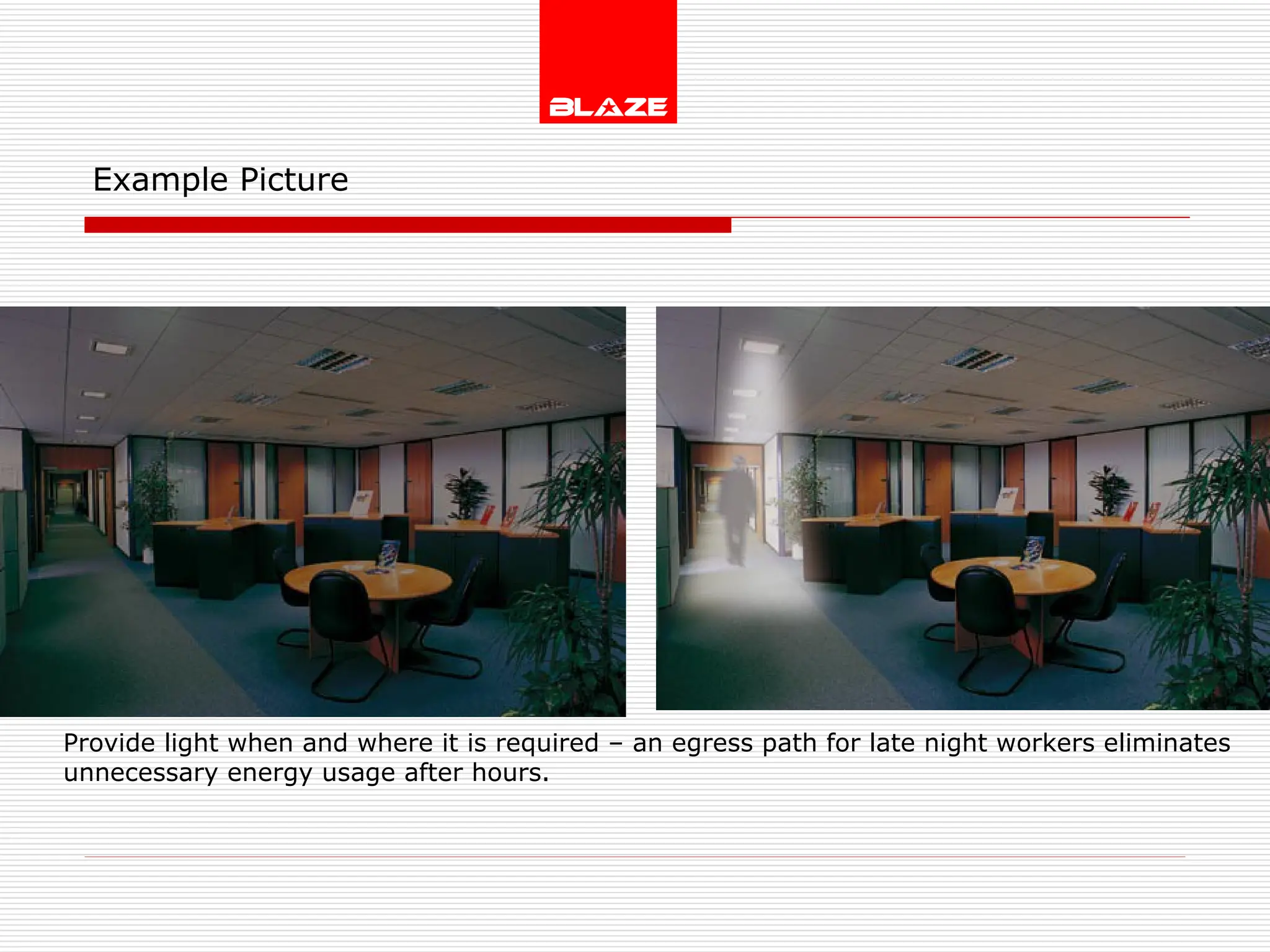
Example Picture Provide light when and where it is required – an egress path for late night workers eliminates unnecessary energy usage after hours.
4.
Estimates average savingpotential for different space types using occupancy sensors Private office 13–50% Conference room 22–65% Classroom 40–46% Restrooms 30–90% Corridors 30–80% Store areas (including warehouses) 45–80%
5.
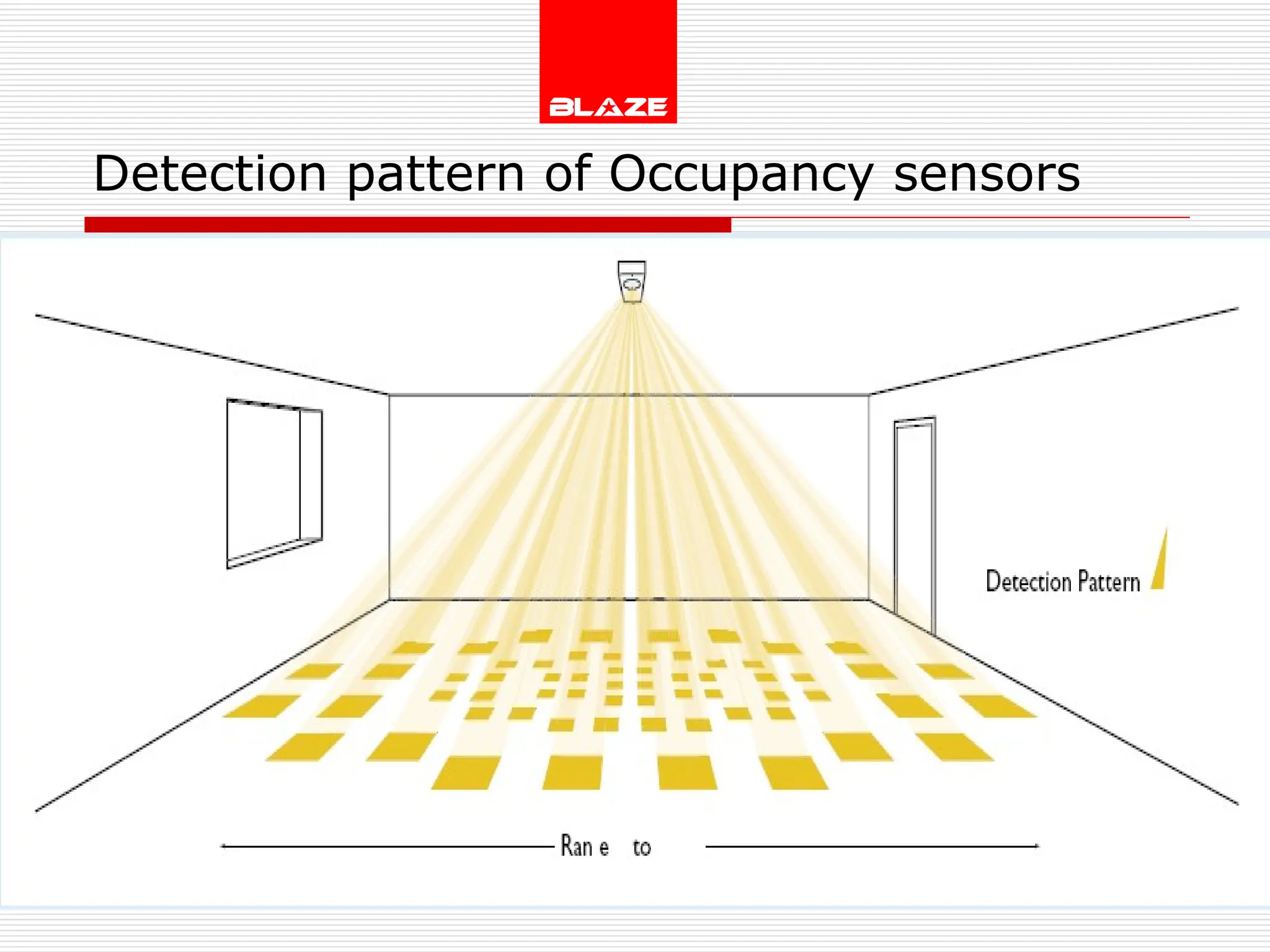
HOW OCCUPANCY SENSORSWORK Occupancy sensors typically consist of a motion detector, electronic control, controllable switch (relay) and power supply. Most units detect motion by sensing heat (infrared radiation), shifts in the frequency of reflected ultrasonic waves, or a combination of the two. When the sensor detects motion, the electronic control sends a signal to the relay, which opens or closes the power circuit, turning the lights on or off.
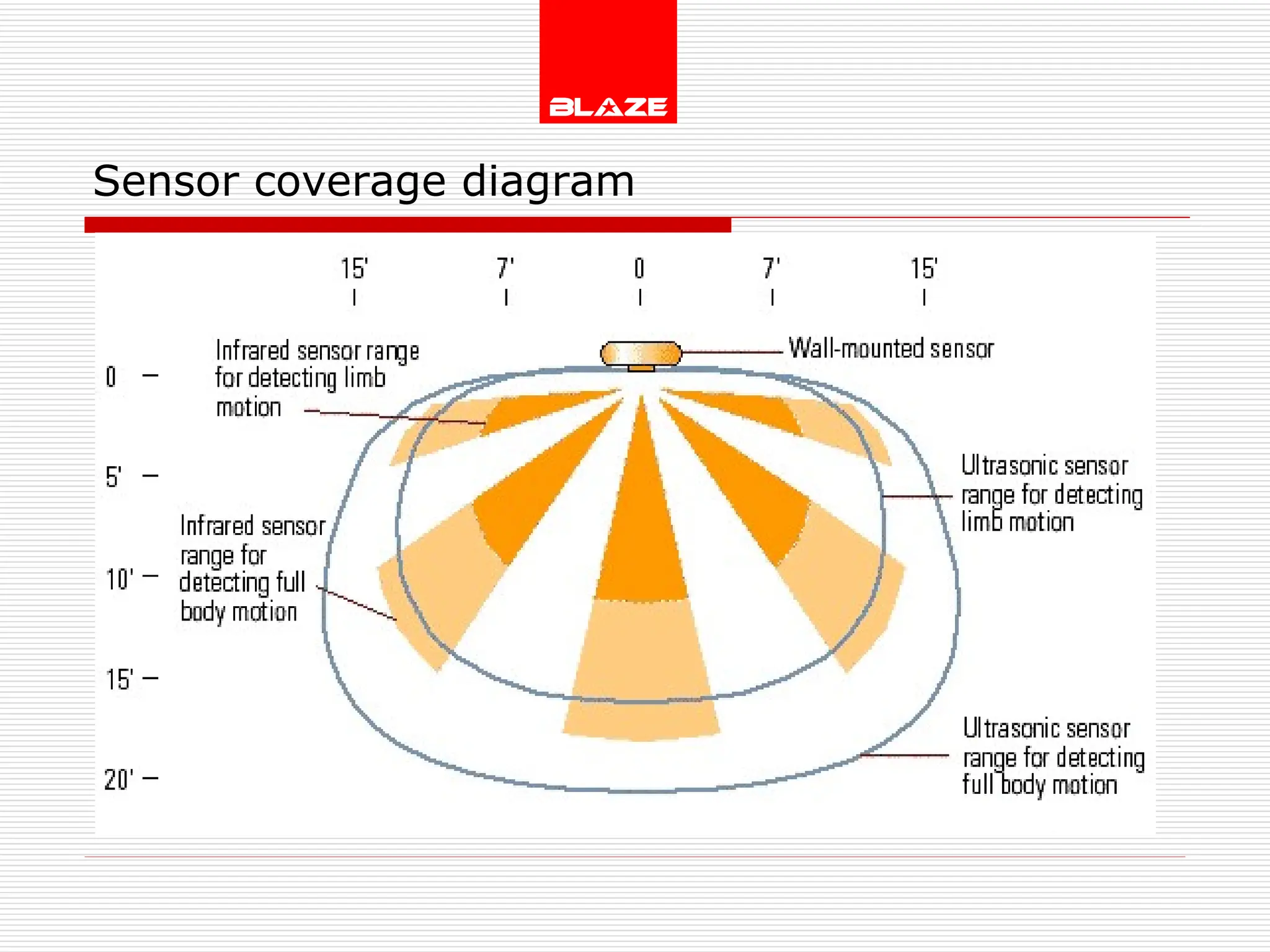
Passive Infrared (PIR)Occupancy Sensors and its working conditions Infrared sensors detect the difference in heat emitted by humans in motion from heat emitted by the background space. The sensitivity of PIR sensors to small movements decreases at distances greater than 15 feet. They require a direct line of sight to sense motion. The sensor’s field of view can be adjusted and should not be directed toward an open door where it may pick up people who are passing the doorway, but not entering the room.
8.
Ultrasonic Occupancy Sensorsand its working conditions Ultrasonic sensors emit a high-frequency signal that is undetectable by humans and animals. This signal bounces off objects, surfaces and people in a space. It then returns to the sensor, which interprets change in the frequency as motion. Ultrasonic sensors are highly sensitive to small movements up to 25 feet. They typically offer a larger coverage area than PIR sensors, but should not be mounted in high ceiling applications (over 14 feet). They may be prone to false triggering if placed too close to an HVAC vent.
9.
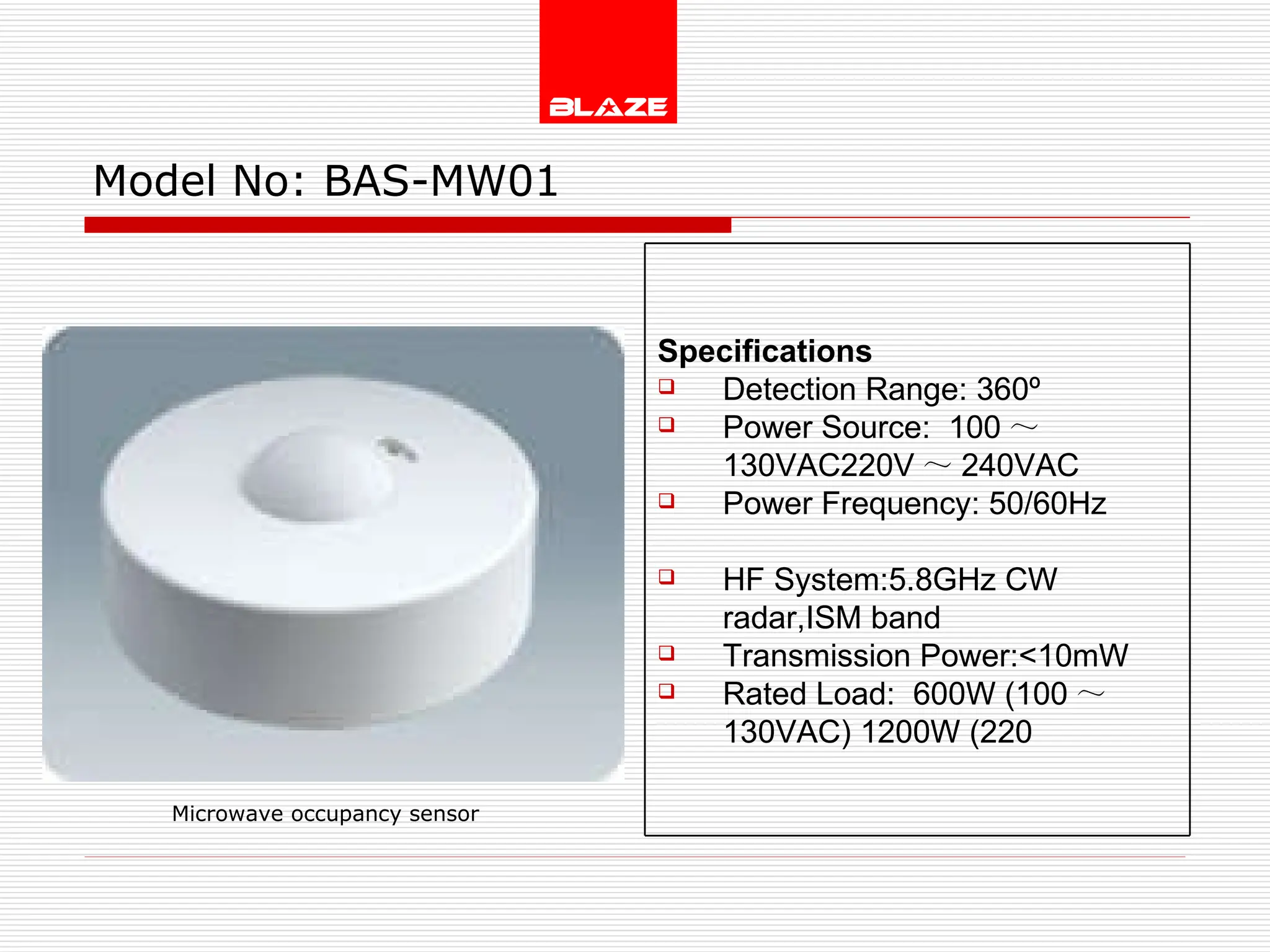
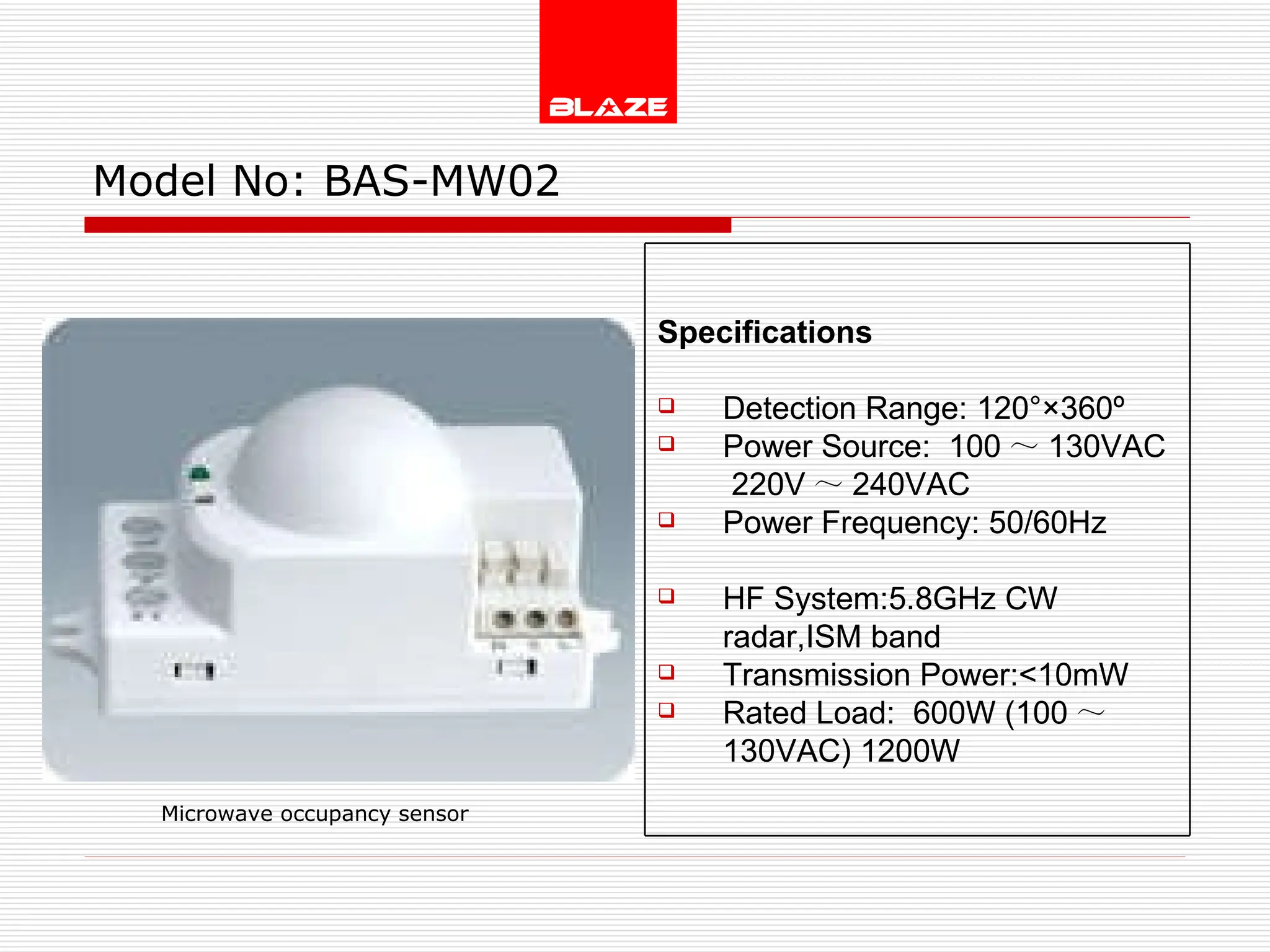
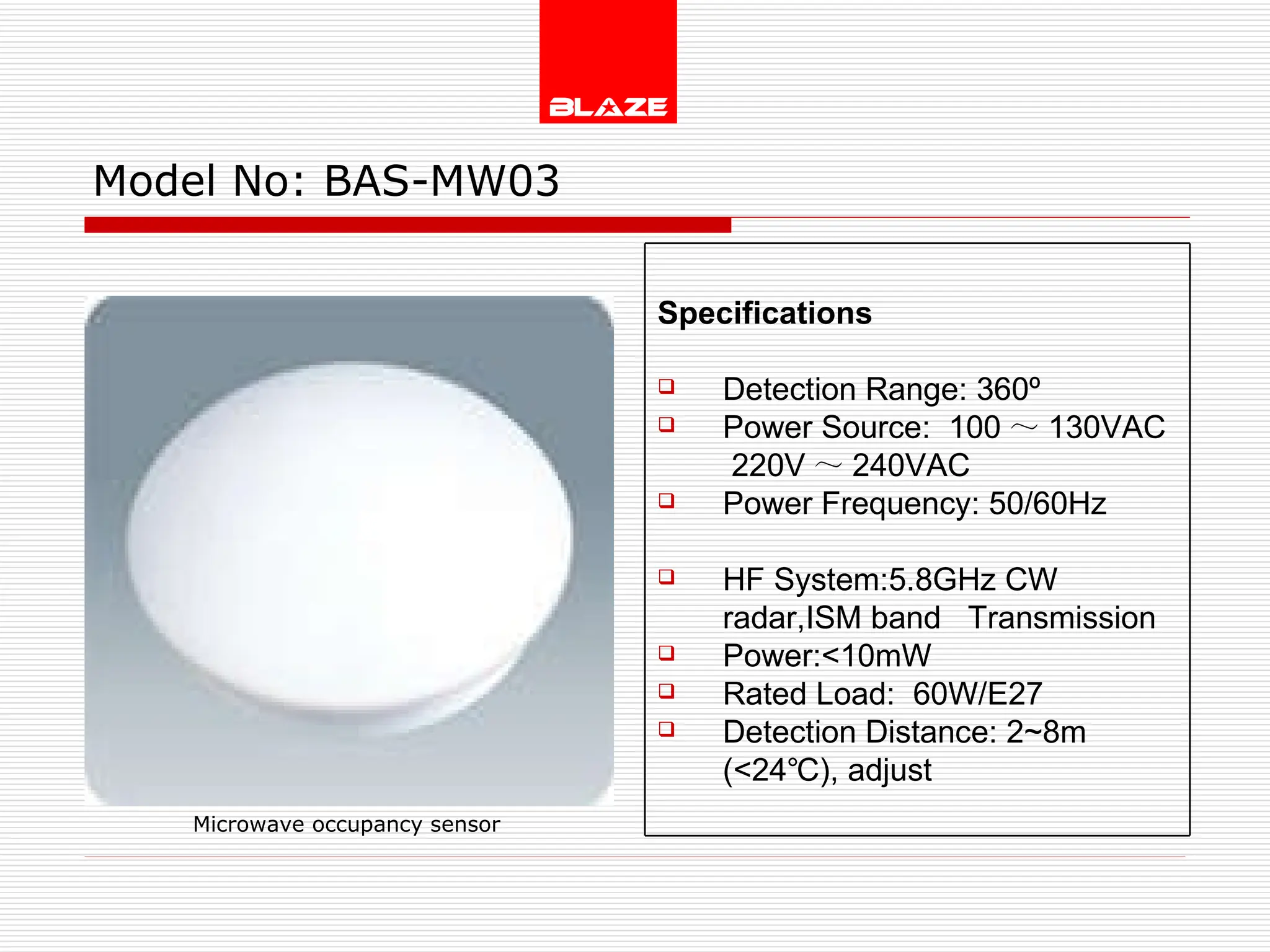
Microwave and audiblesound occupancy sensors Microwave sensors are similar to ultrasonic, in that they emit a signal and measure a change in frequency when that signal is reflected. Audible sound sensors, which listen for noise made by people or machines, are best applied in an industrial facility or warehouse.
10.
Dual-Technology occupancy SensorsDual-technology sensors employ both PIR and ultrasonic technologies for maximum coverage and reliability with fewer false triggers. It take advantage of the PIR units' resistance to false triggering and the sensitivity of ultrasonics. These sensors activate light sonly when both technologies detect movement, and because either of the two technologies is enough to hold the lights on, these sensors significantly reduce the possibility of false on and off triggers.
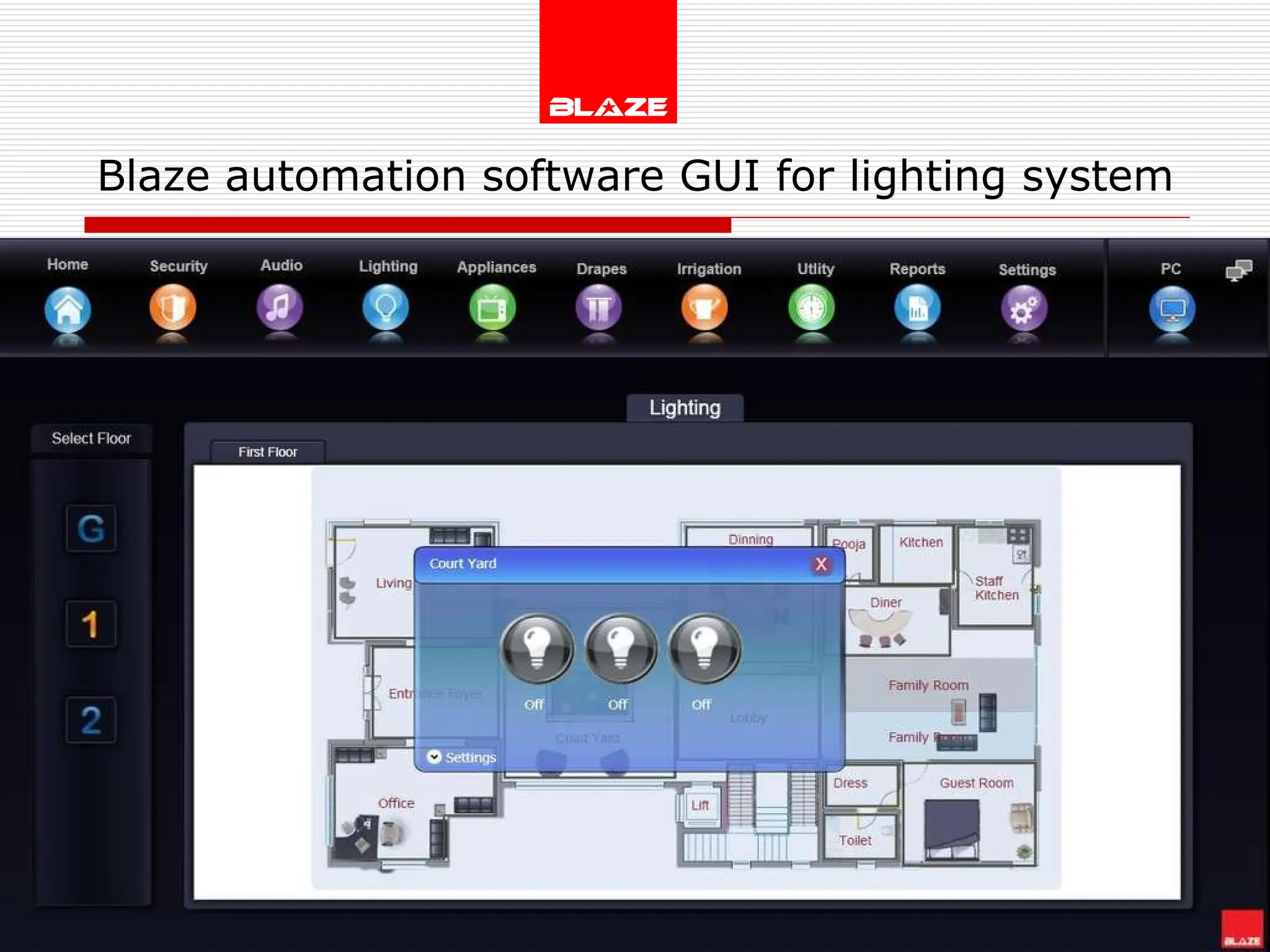
Occupancy sensor basedlighting control by BLAZE A sophisticated lighting control system can provide significant cost savings in any environment from office towers to scientific laboratories, to sports field and stadiums. The BLAZE energy management solution is a building block approach – start with basic on/off control and incorporate dimming, time based control and powerful monitoring and reporting solutions to provide the ultimate in energy conservation. Normally savings in energy usage of about 40% can be obtained from the installation of occupancy sensor based lighting. Product and installation can normally be financed from savings achieved in only a few years. All you will notice is an immediate reduction in your bills. This sensors can be integrated to Blaze automation software by which one can control and monitor lighting system of home, office or building space etc.
Features Blaze Occupancysensors All occupancy detection sensors feature advanced robust wireless RF platform Easy installation with out retrofit or reconstruction On-board management selectable setting for maximum control without requiring advanced technical knowledge Multiple rooms, HVAC and balcony doors easily accommodated with no additional wiring required Occupancy detection only requires single occupant movement. Wide range of cost effective and reliable occupancy sensor are available with BLAZE
16.
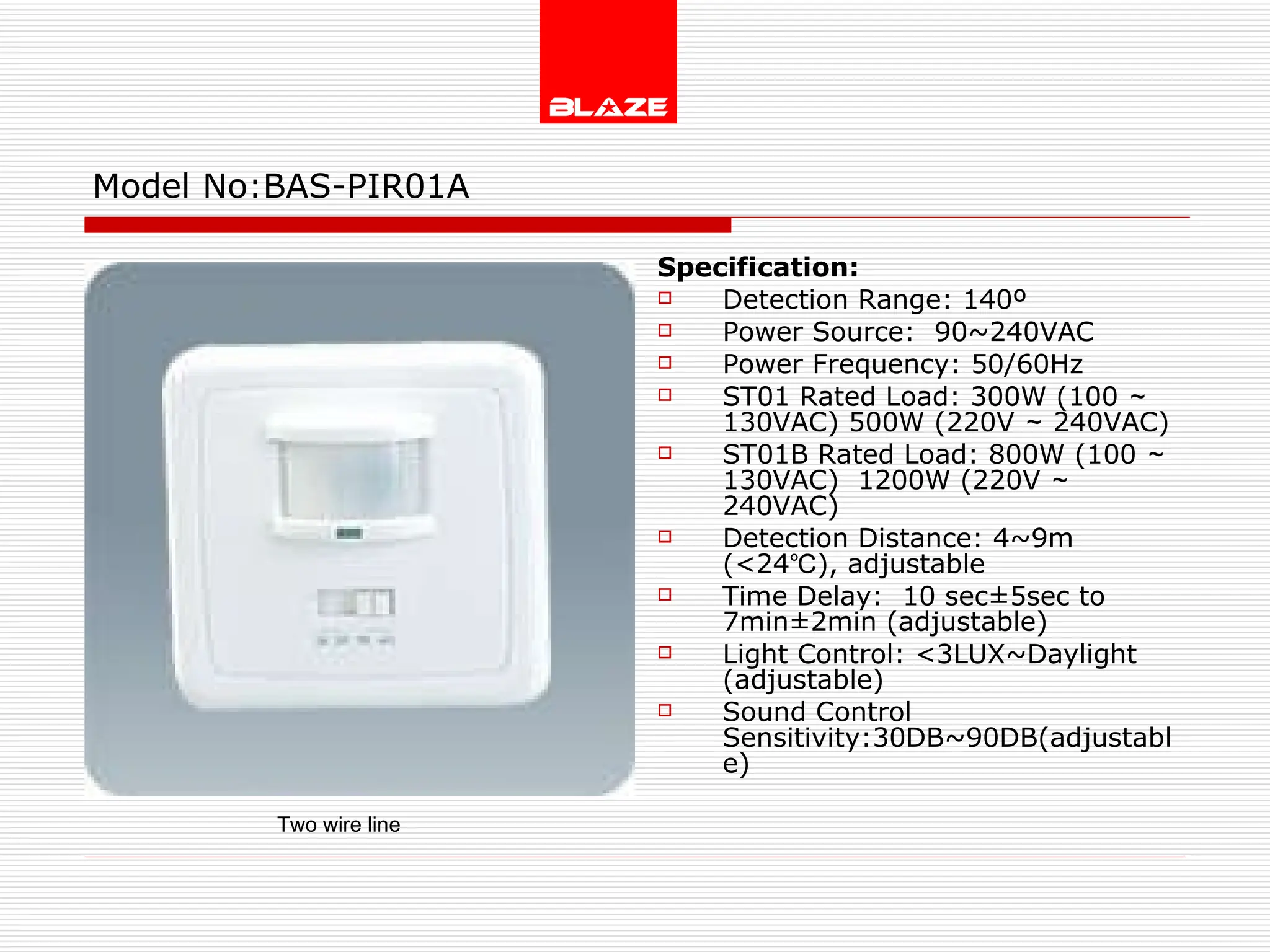
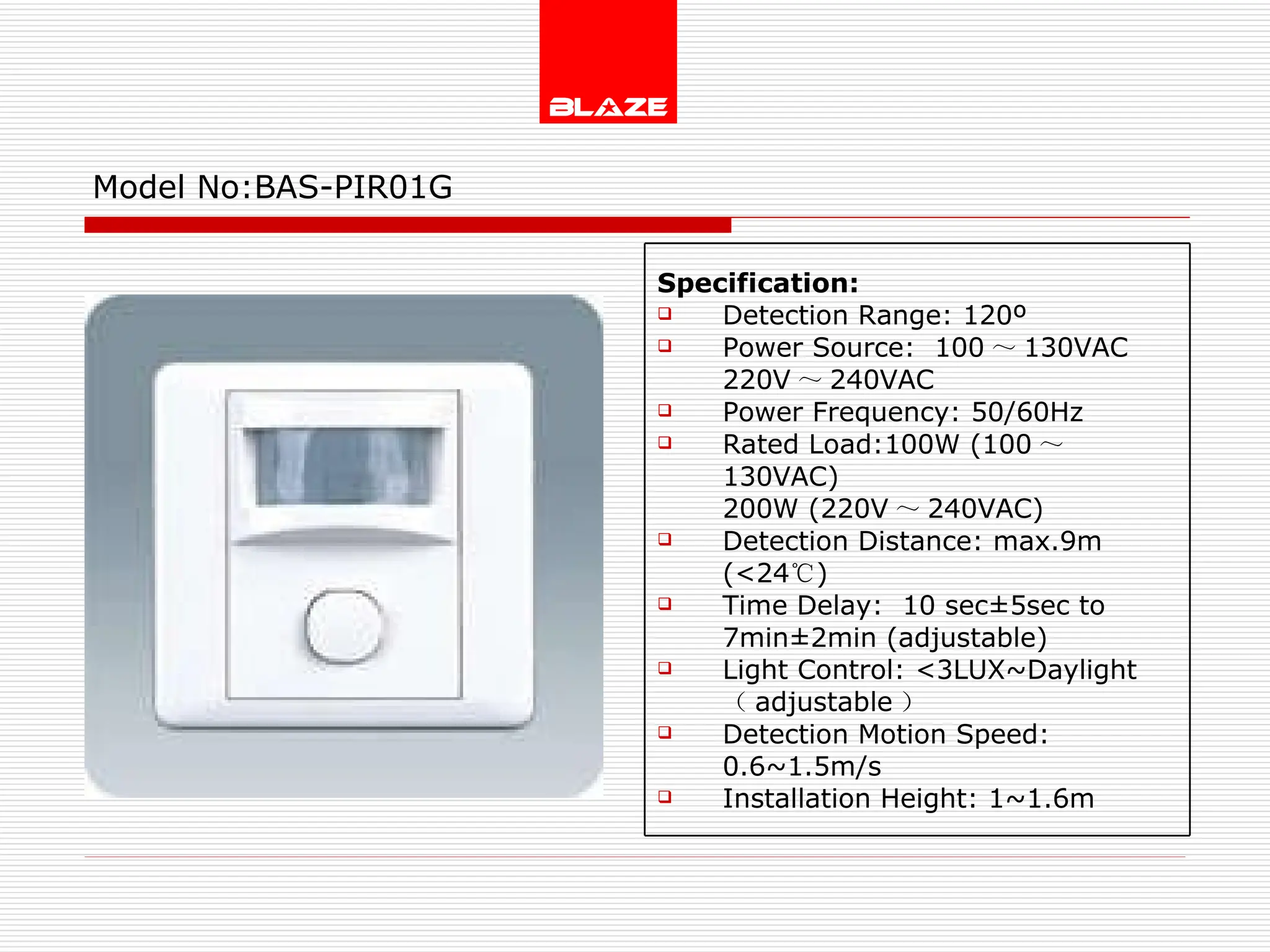
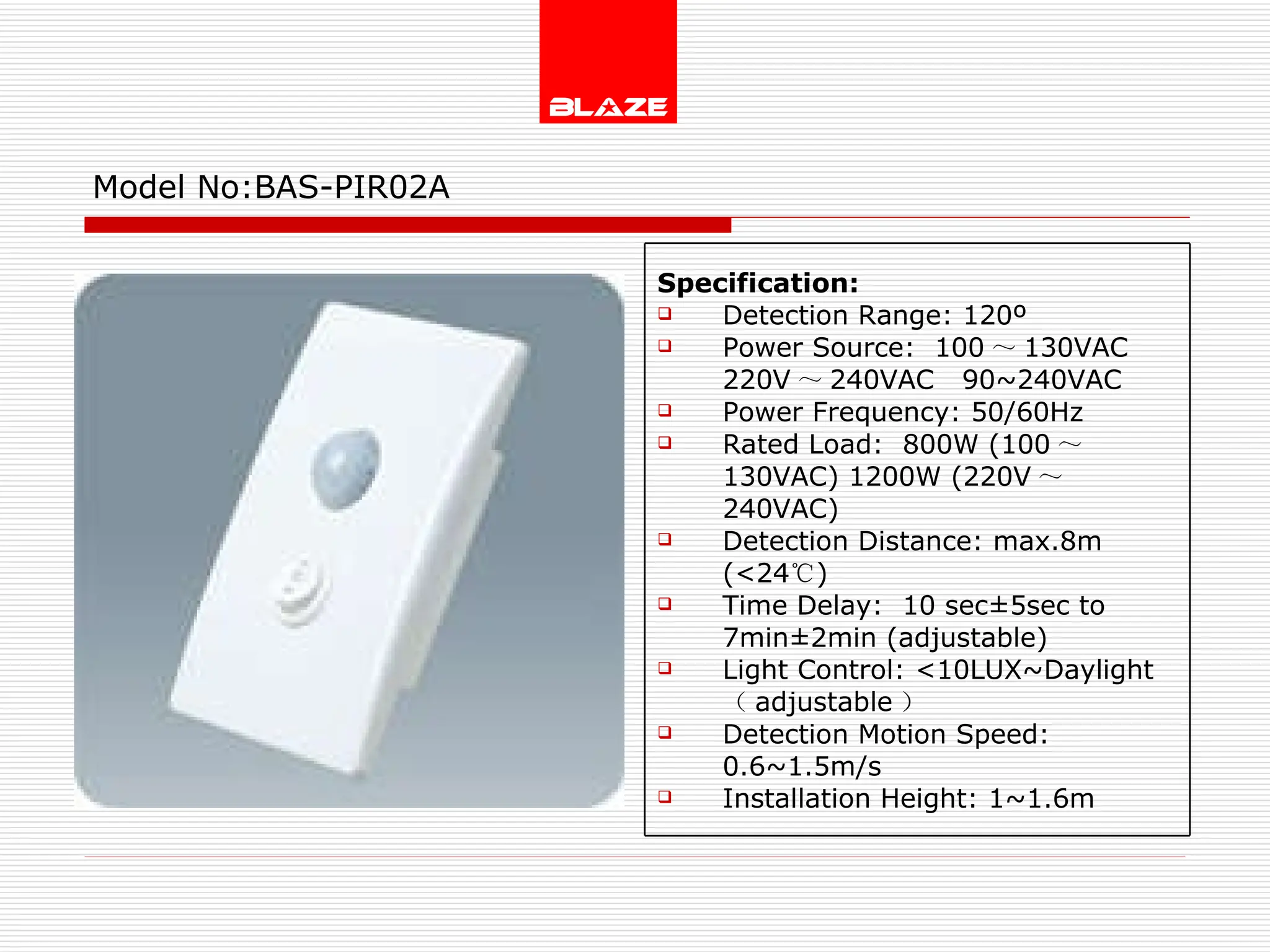
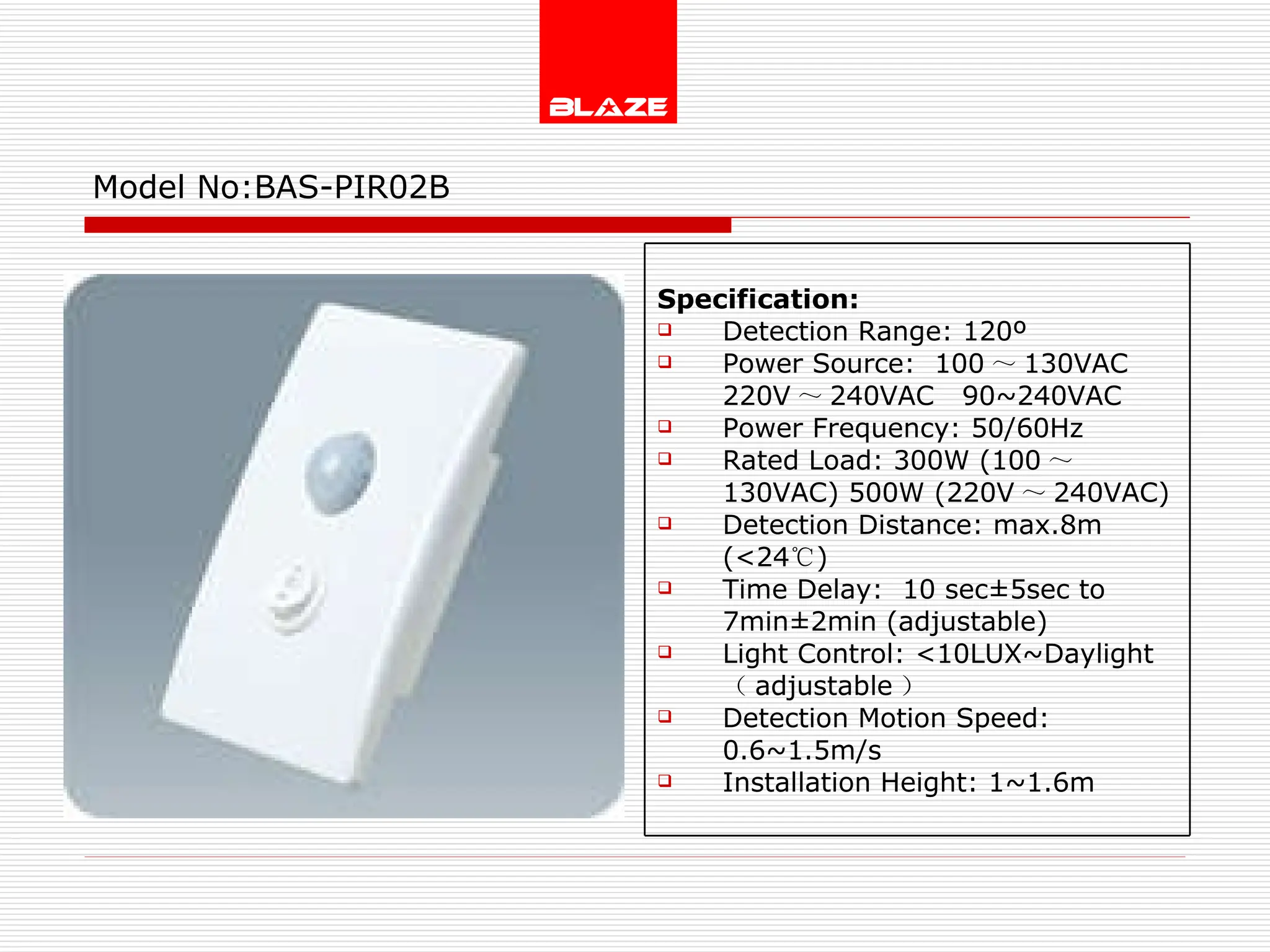
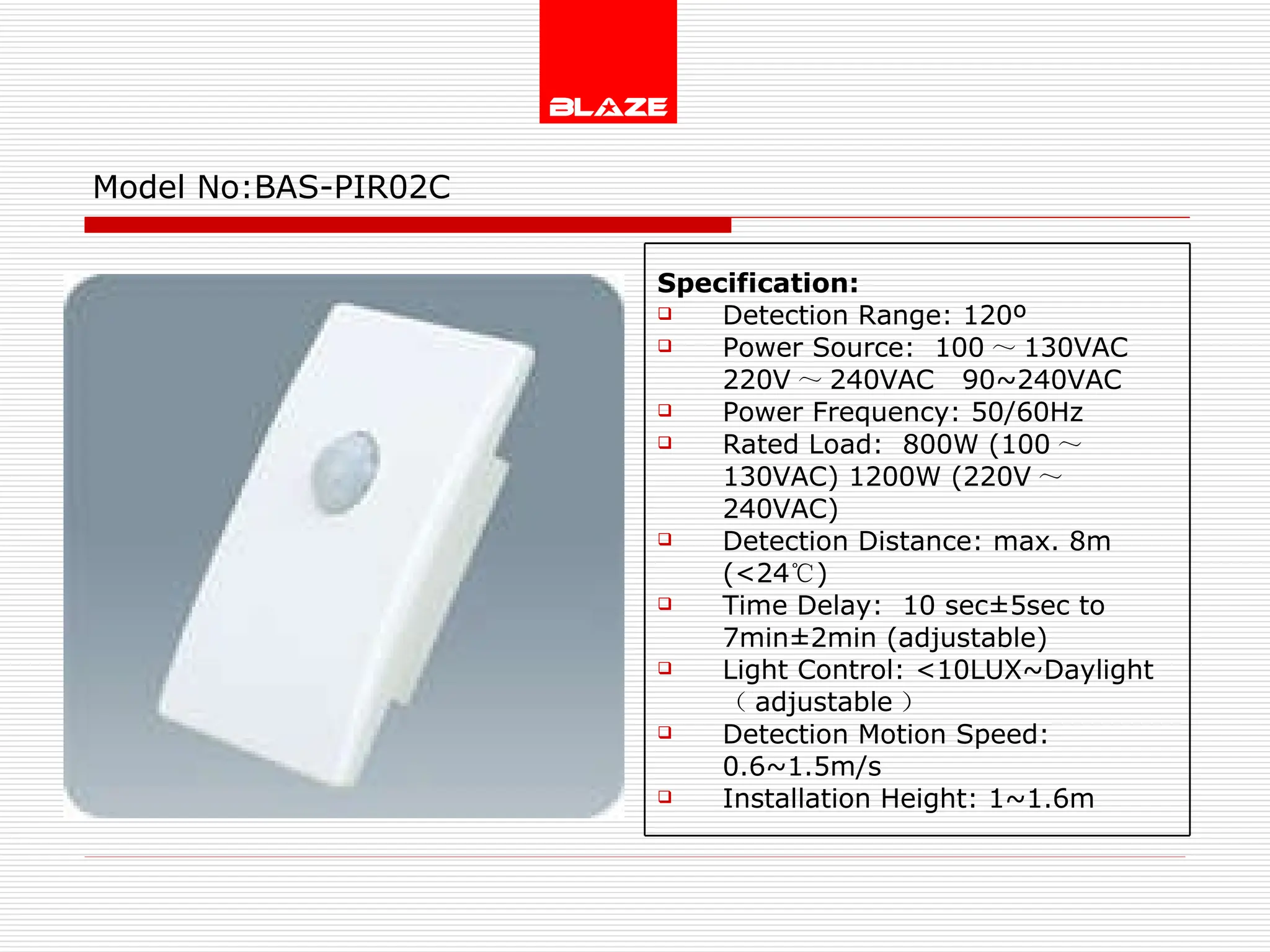
Model No: BAS-PIR01ASpecification: Detection Range: 140º Power Source: 90~240VAC Power Frequency: 50/60Hz ST01 Rated Load: 300W (100 ~ 130VAC) 500W (220V ~ 240VAC) ST01B Rated Load: 800W (100 ~ 130VAC) 1200W (220V ~ 240VAC) Detection Distance: 4~9m (<24℃), adjustable Time Delay: 10 sec±5sec to 7min±2min (adjustable) Light Control: <3LUX~Daylight (adjustable) Sound Control Sensitivity:30DB~90DB(adjustable) Two wire line
17.
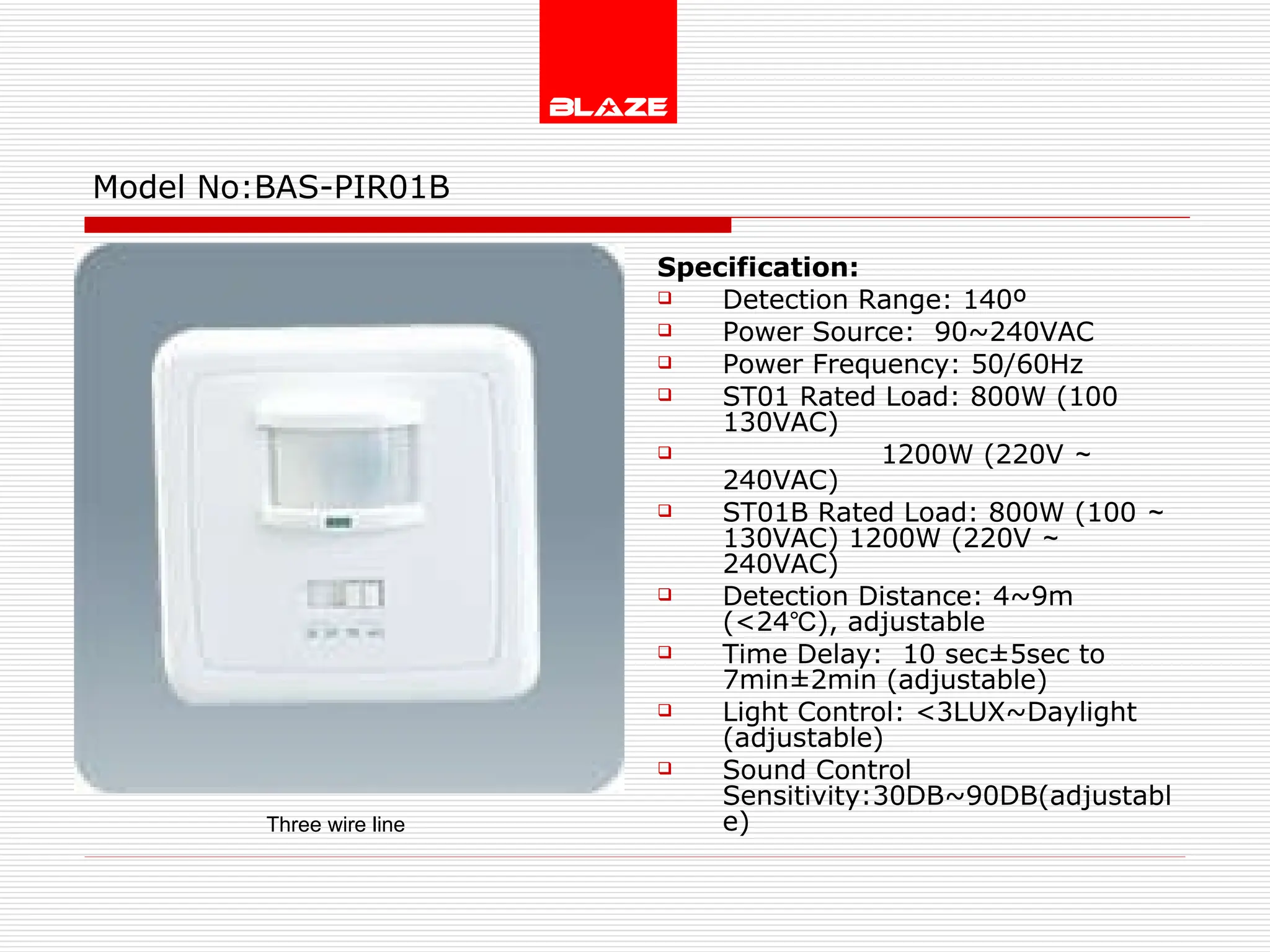
Model No: BAS-PIR01BSpecification: Detection Range: 140º Power Source: 90~240VAC Power Frequency: 50/60Hz ST01 Rated Load: 800W (100 130VAC) 1200W (220V ~ 240VAC) ST01B Rated Load: 800W (100 ~ 130VAC) 1200W (220V ~ 240VAC) Detection Distance: 4~9m (<24℃), adjustable Time Delay: 10 sec±5sec to 7min±2min (adjustable) Light Control: <3LUX~Daylight (adjustable) Sound Control Sensitivity:30DB~90DB(adjustable) Three wire line
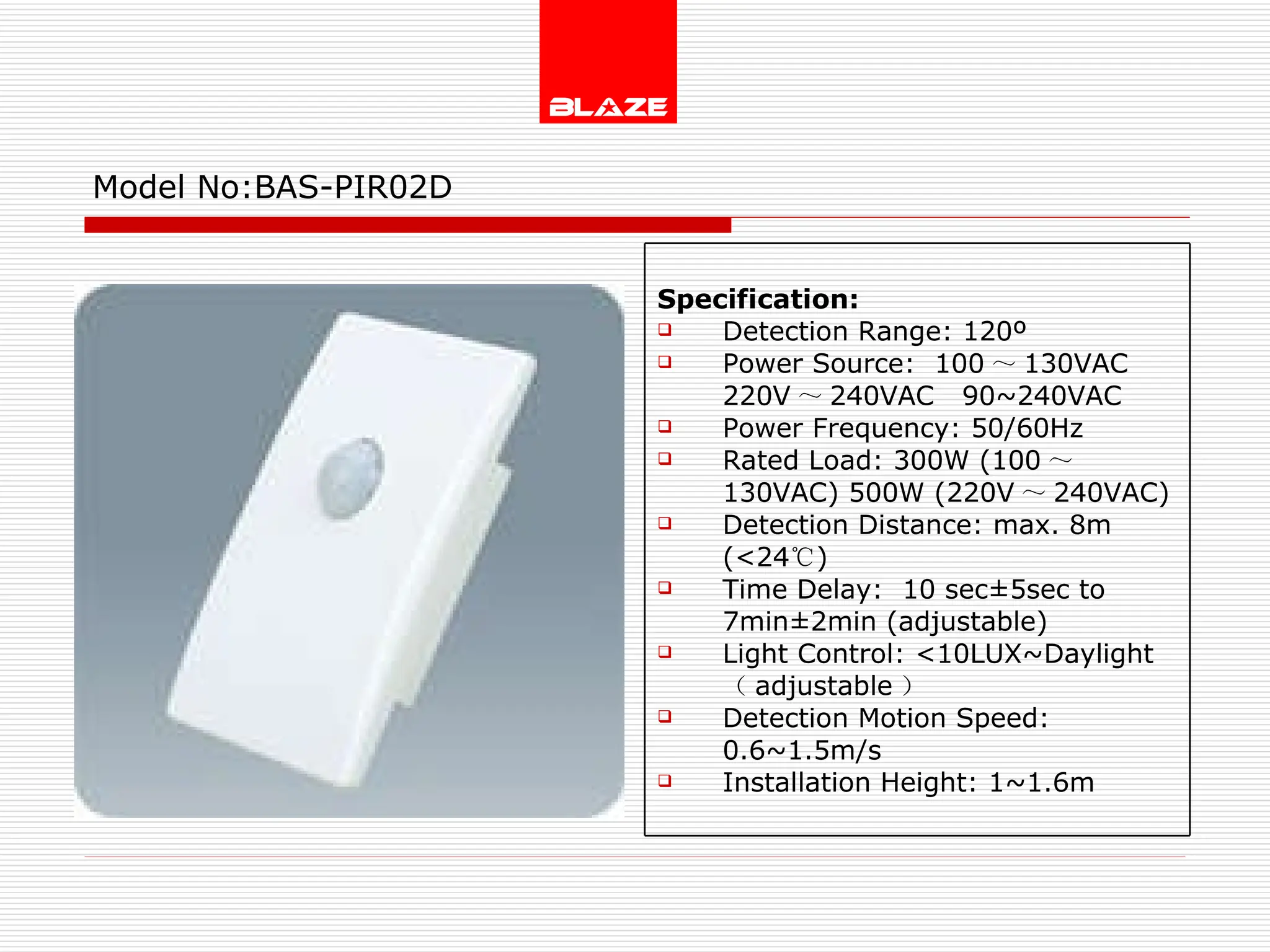
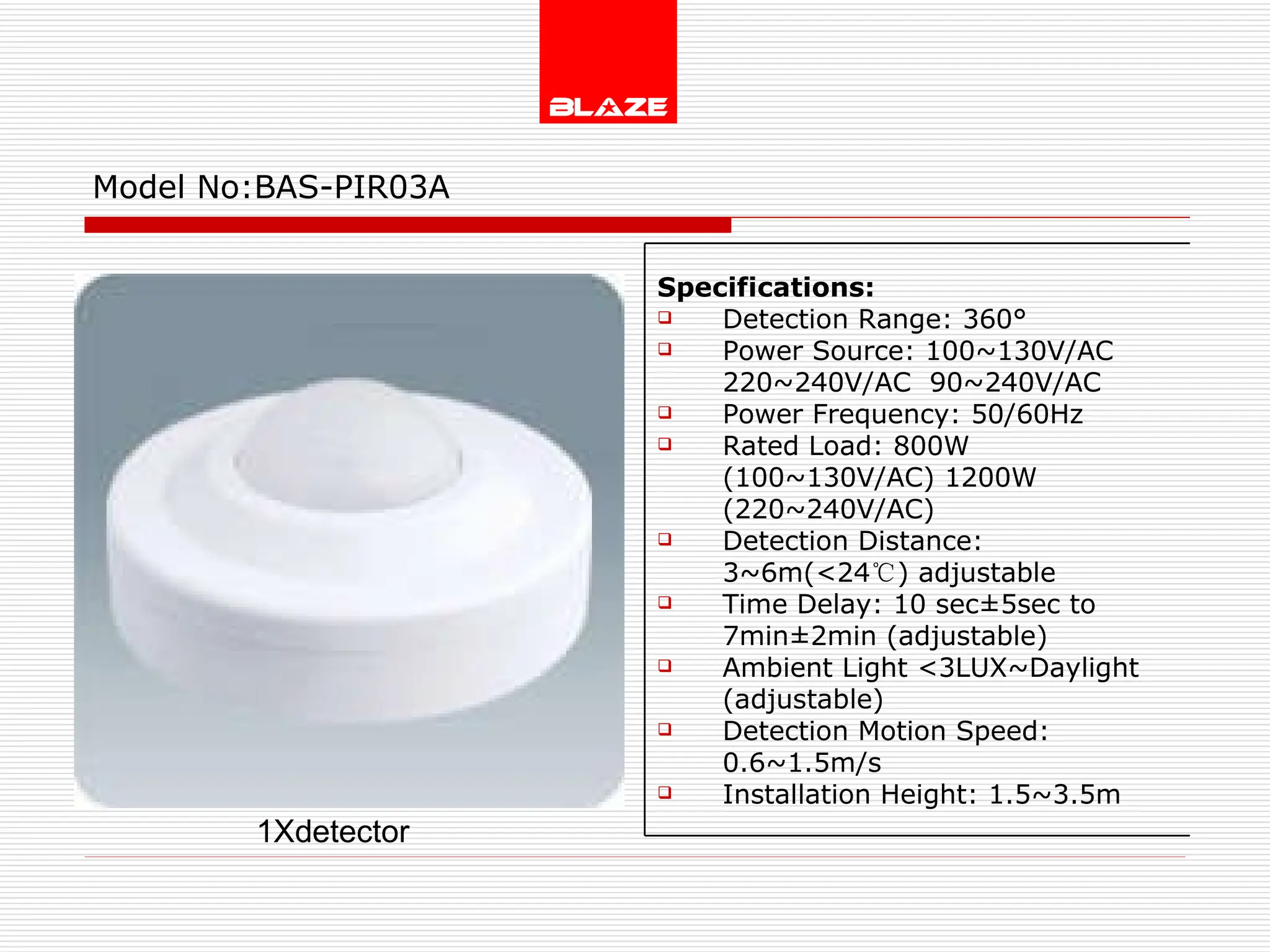
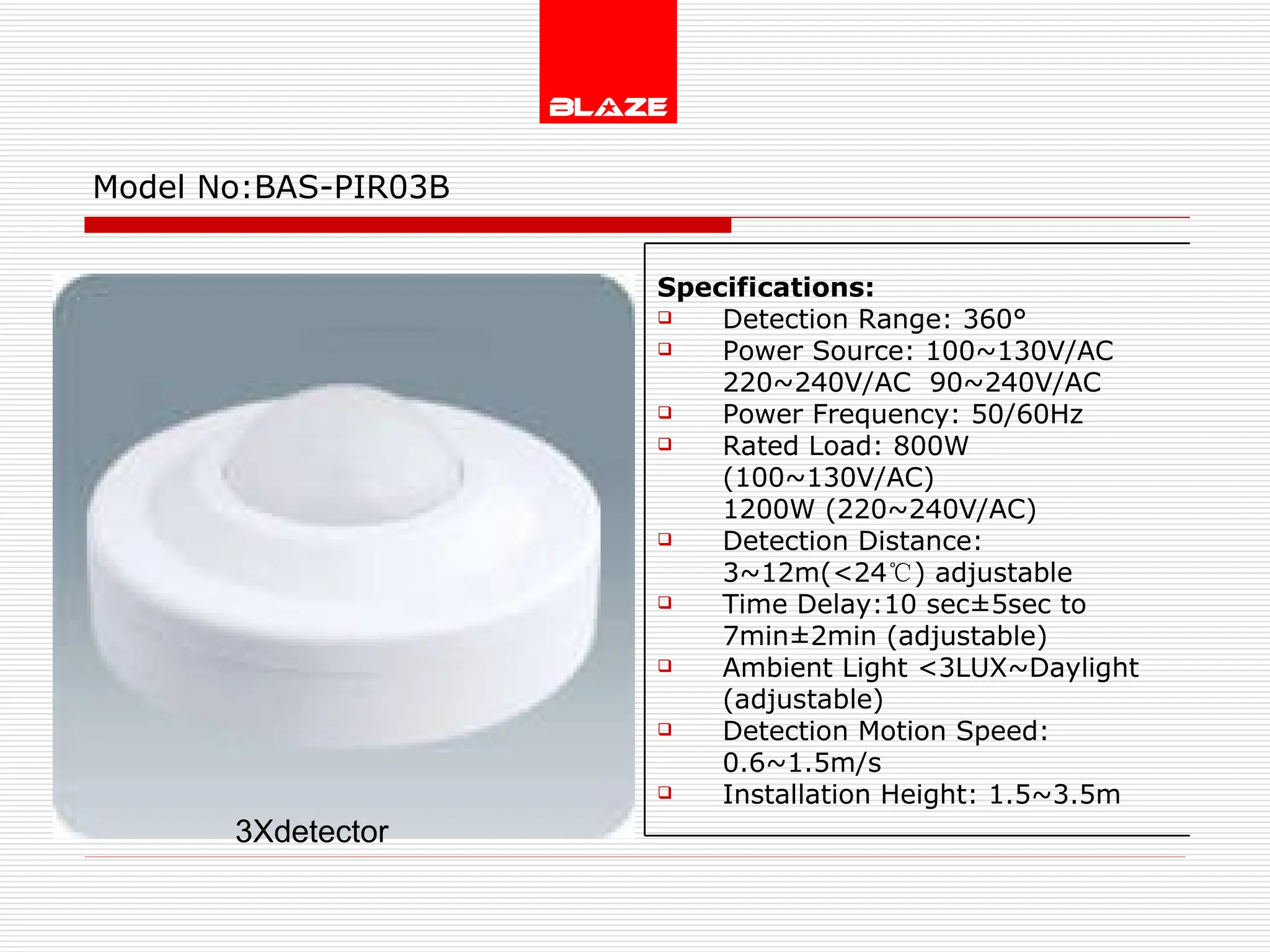
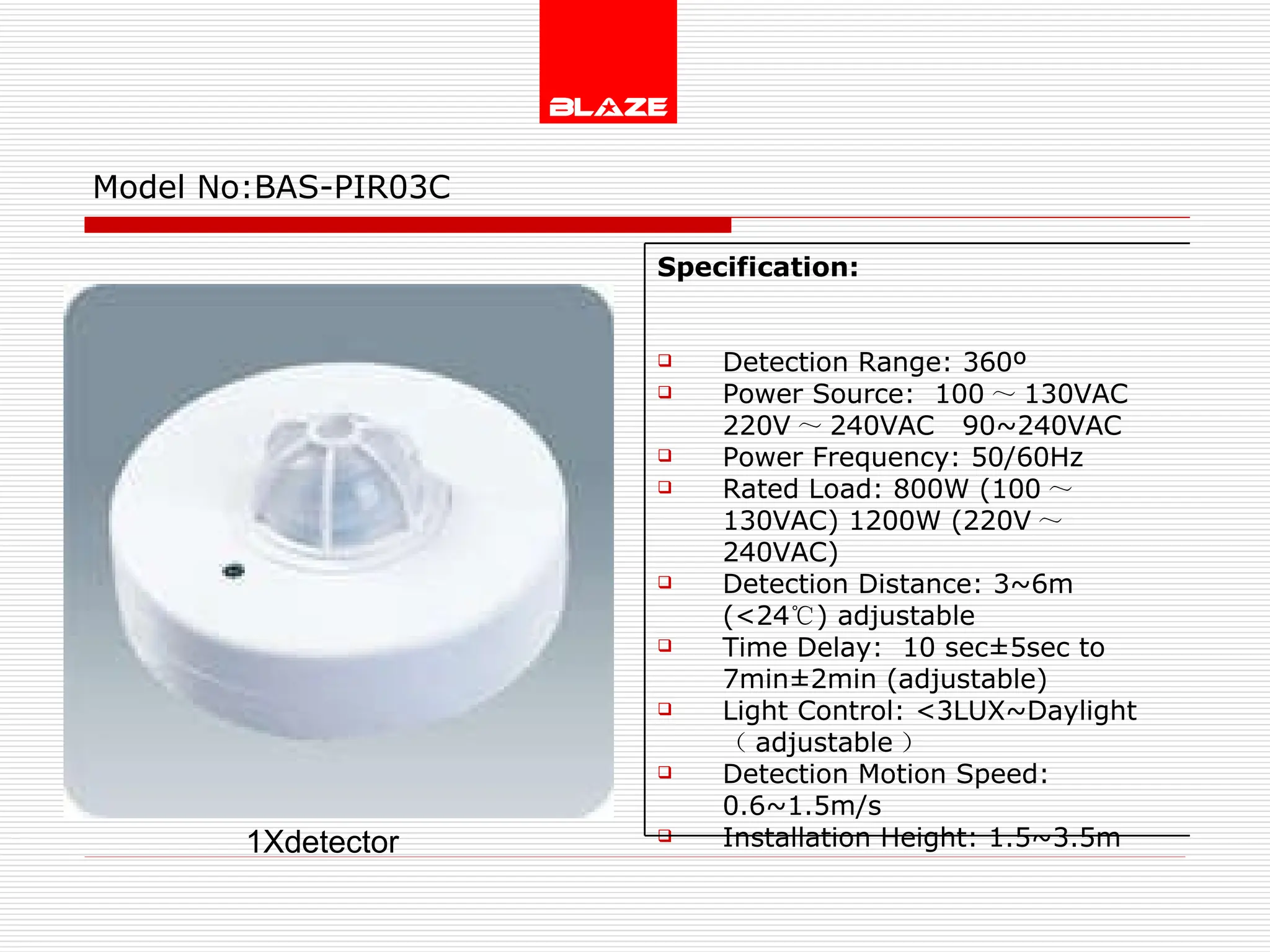
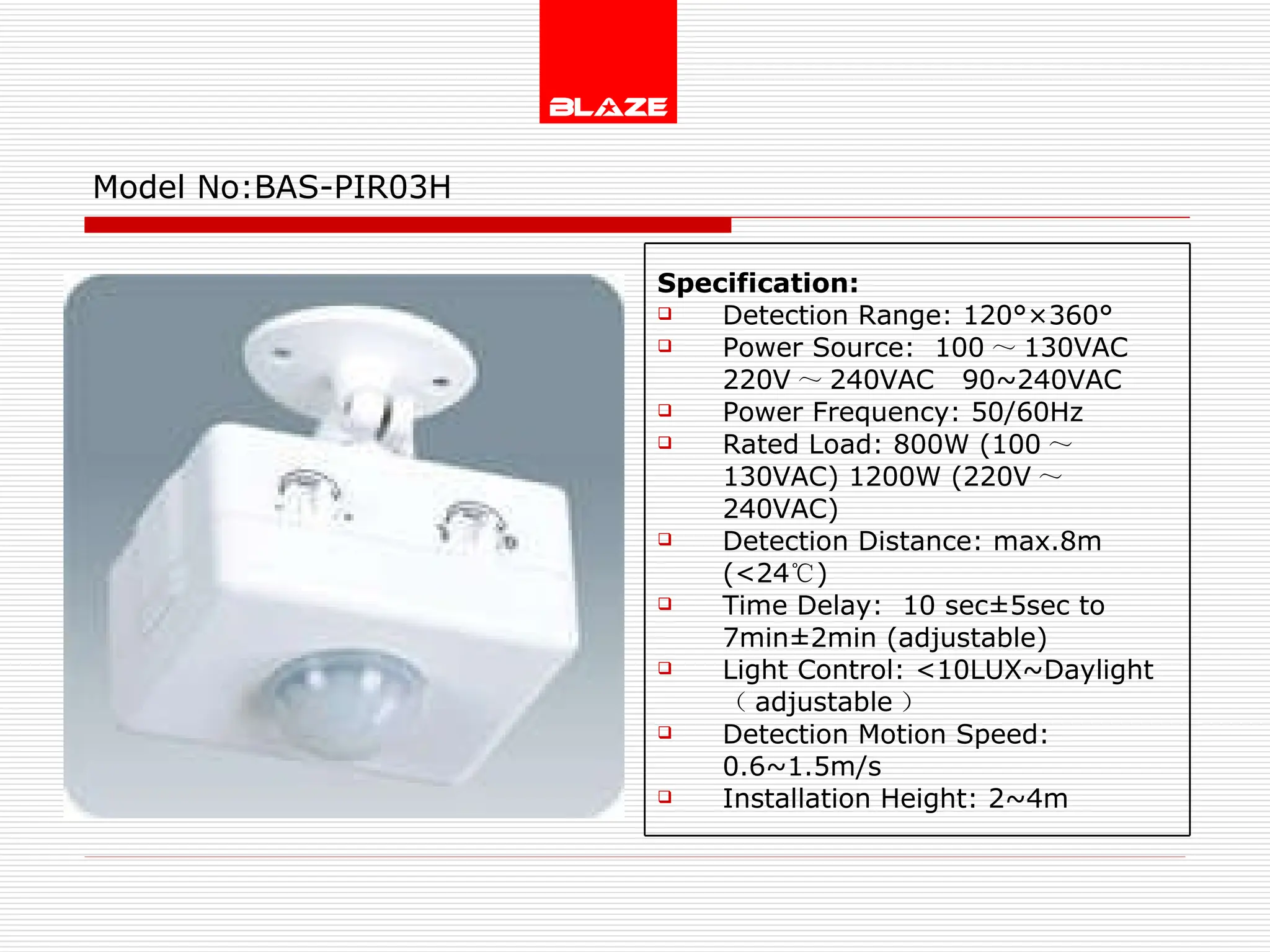
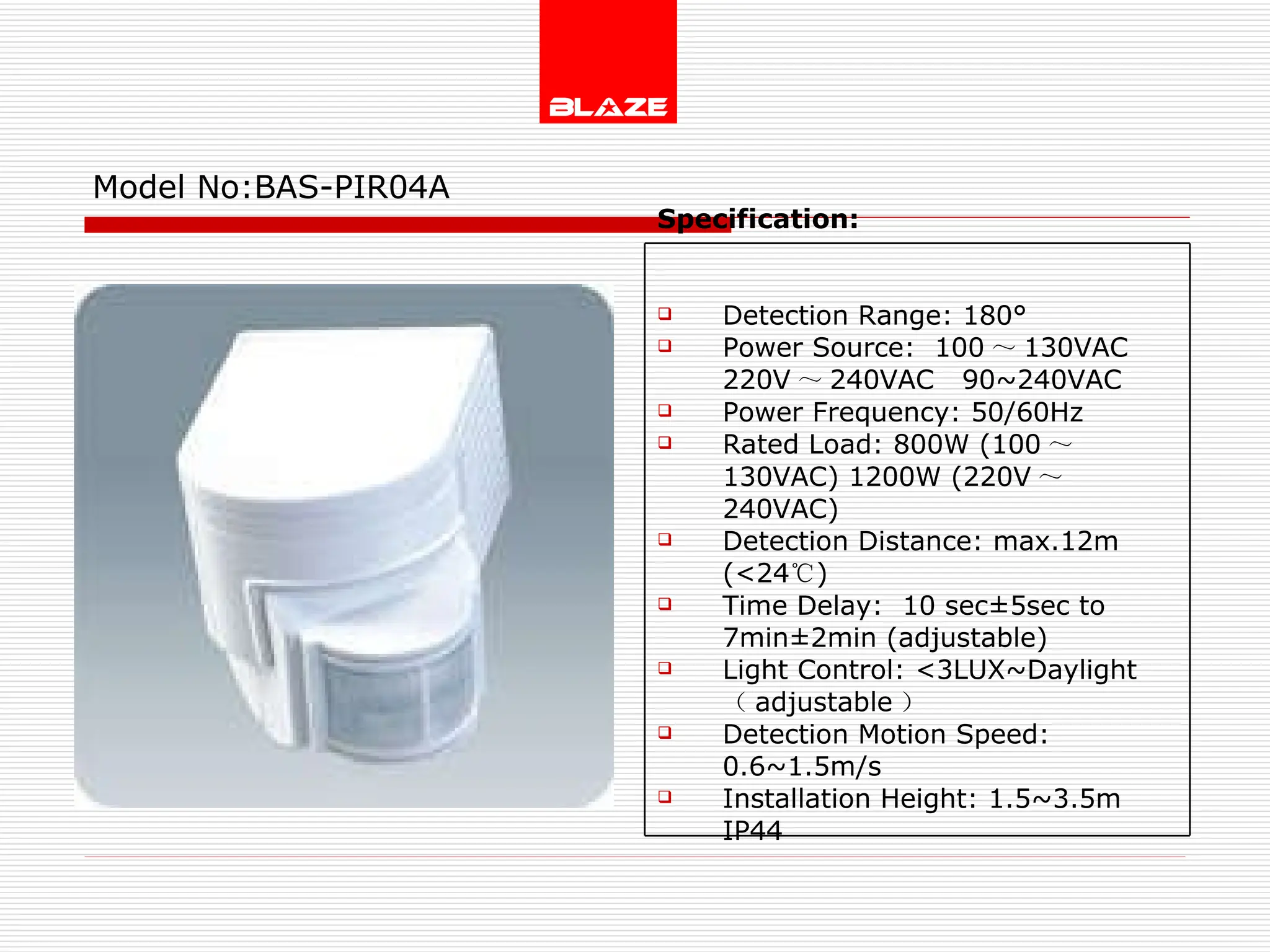
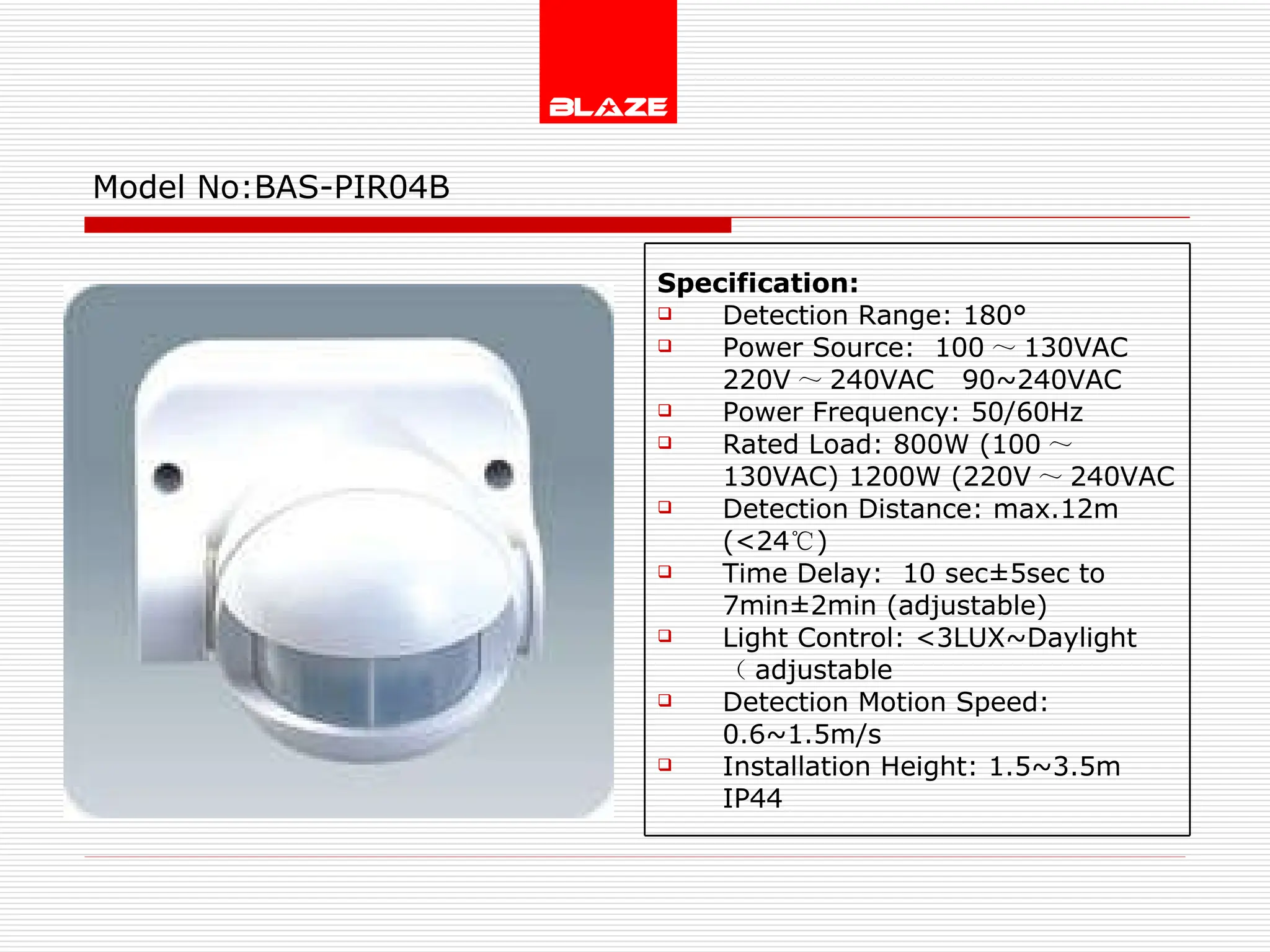
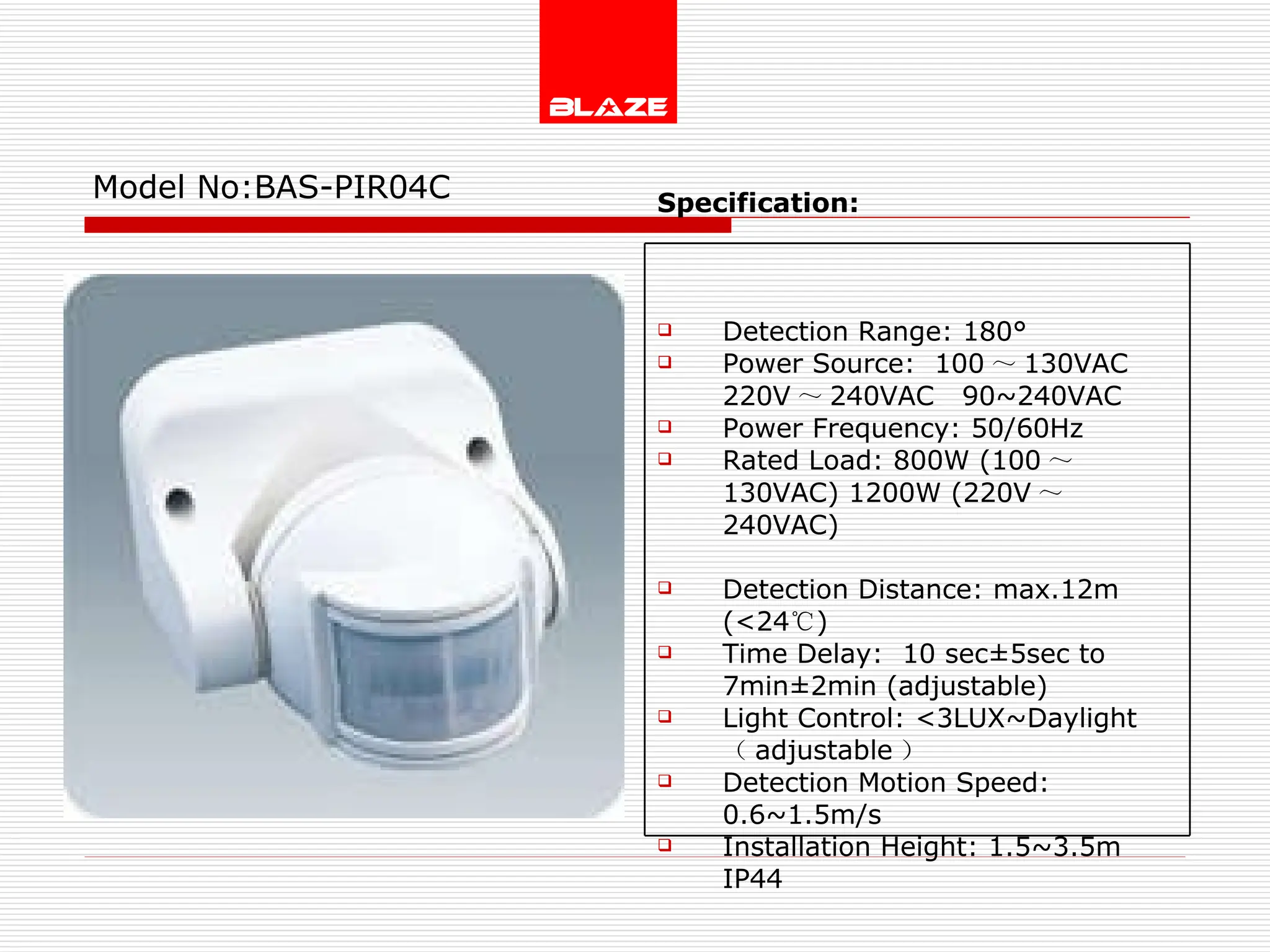
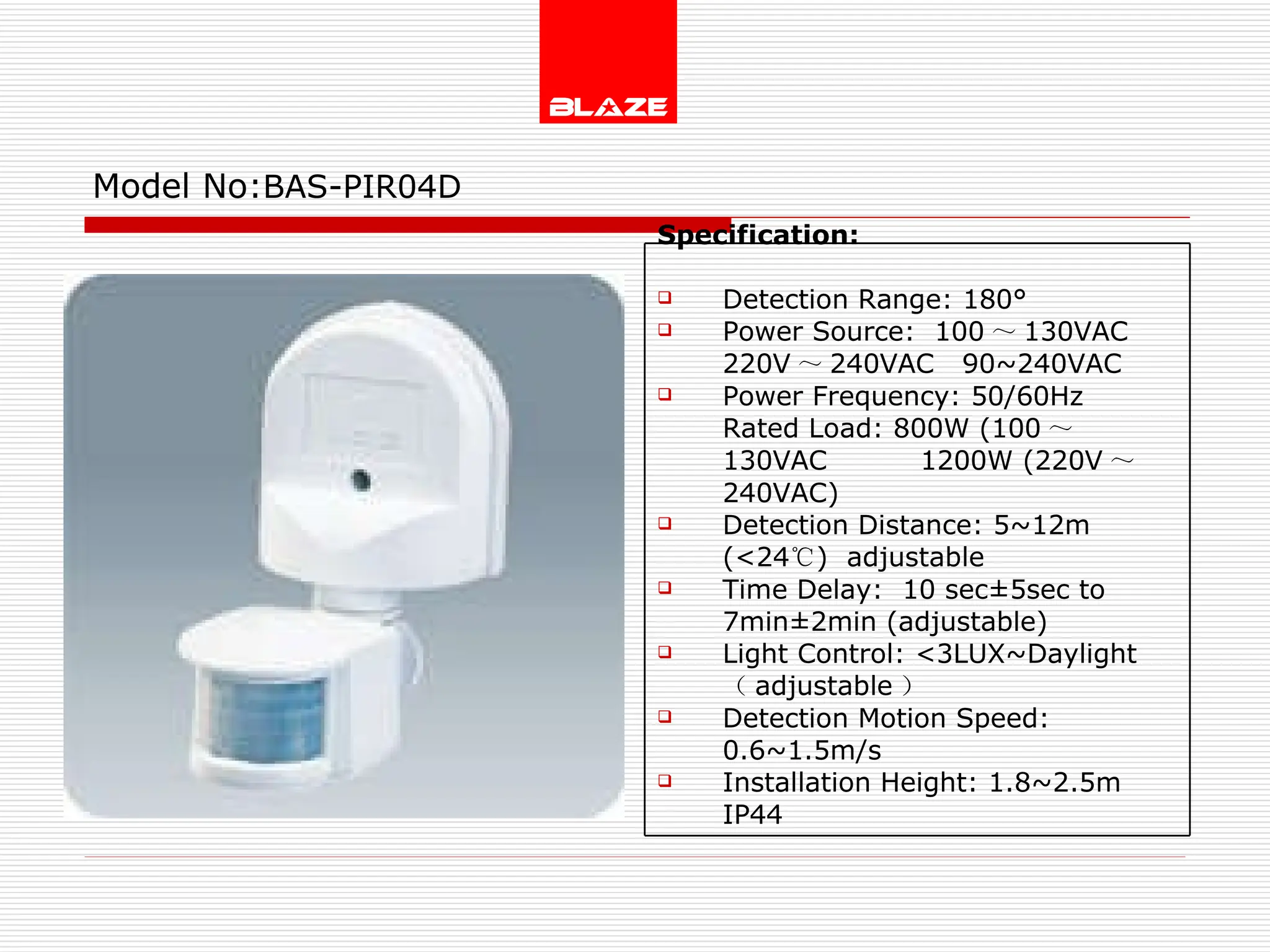
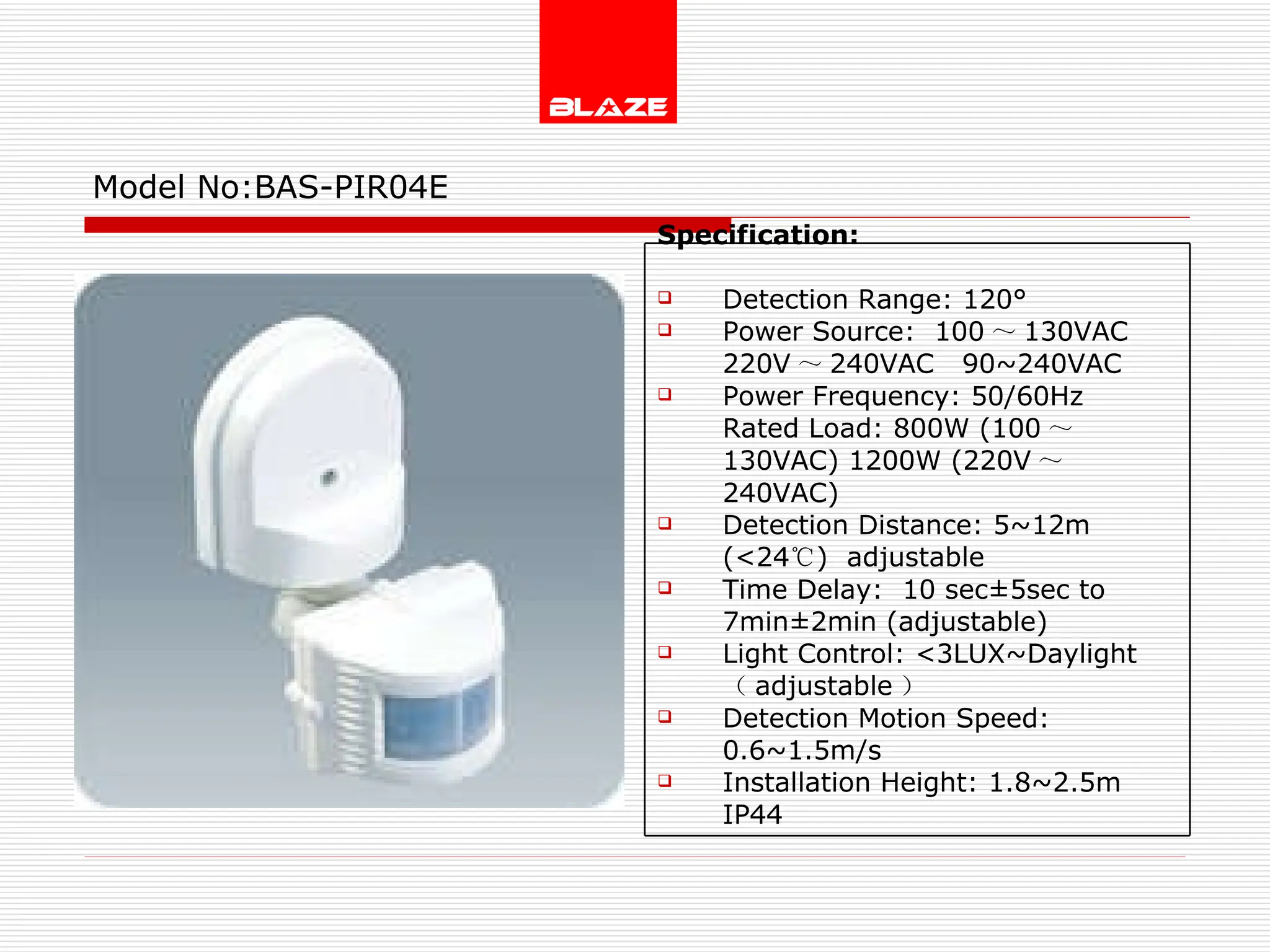
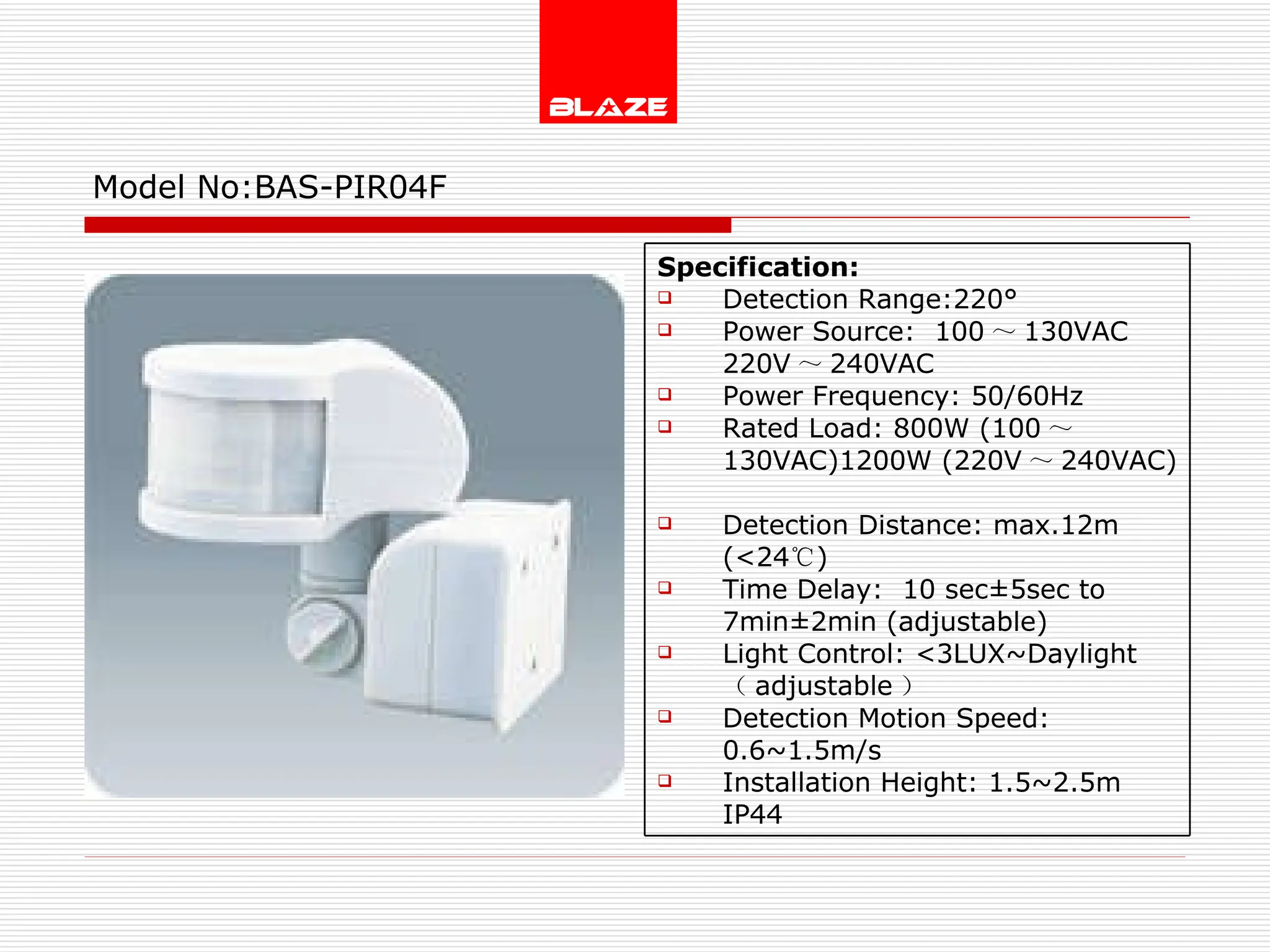
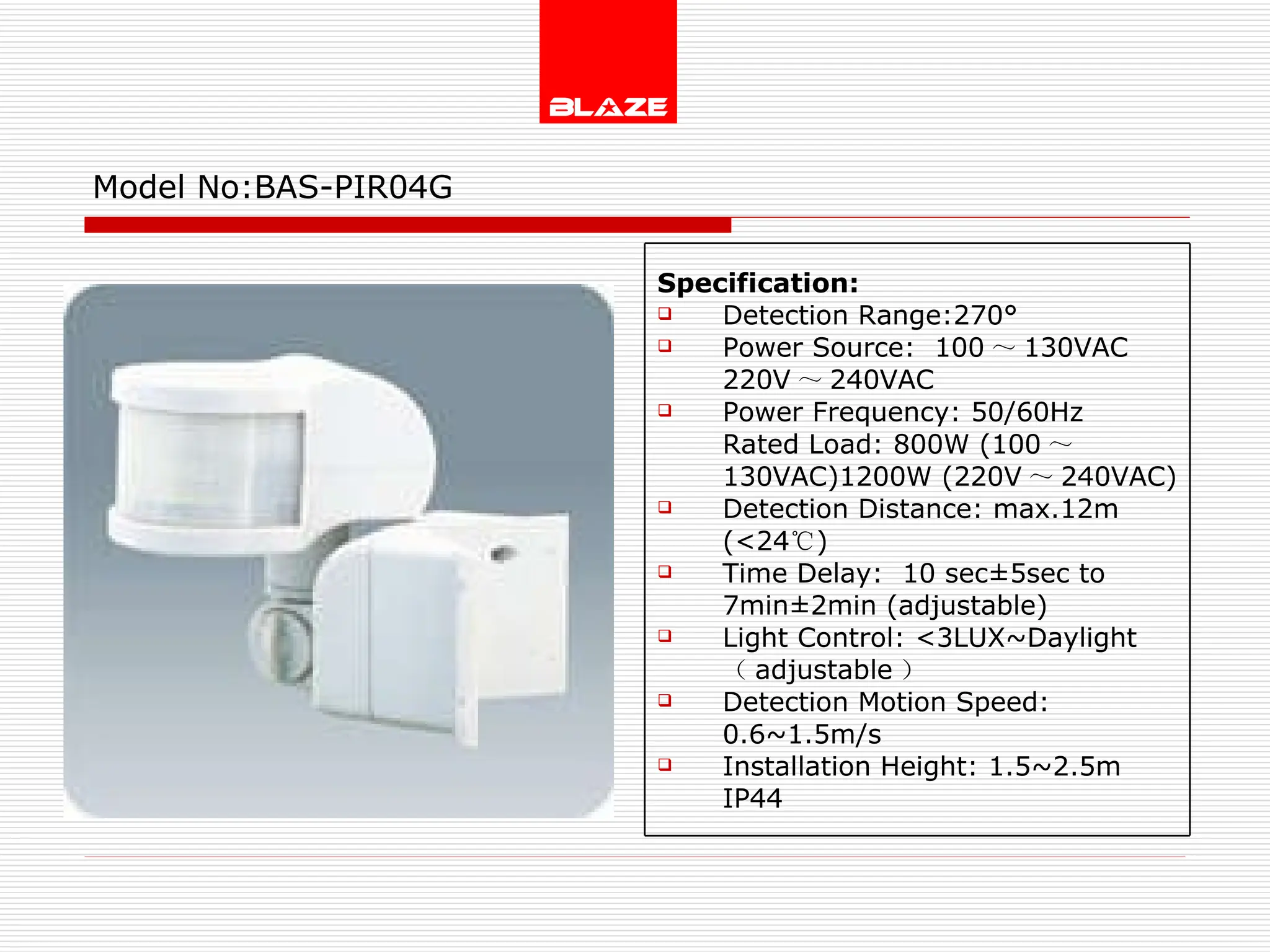


![Profile Blaze Automation [Brief]](https://cdn.slidesharecdn.com/ss_thumbnails/profileblazeautomationbrief-100301090806-phpapp02-thumbnail.jpg?width=640&height=640&fit=bounds)


