BAYESIAN STATISTICAL
CONCEPTS
A gentle introduction
Alex Etz
@alxetz ßTwitter (no ‘e’ in alex)
alexanderetz.com ßBlog
November 5th 2015
Why do we do statistics?
•  Deal with uncertainty
•  Will it rain today? How much?
•  When will my train arrive?
•  Describe phenomena
•  It rained 4cm today
•  My arrived between at 1605
•  Make predictions
•  It will rain between 3-8 cm today
•  My train will arrive between 1600 and 1615
Prediction is key
•  Description is boring
•  Description:
•  On this IQ test, these women averaged 3 points higher than these men
•  Prediction is interesting
•  Prediction:
•  On this IQ test, the average woman will score above the average man
•  Quantitative (precise) prediction is gold
•  Quantitative prediction:
•  On this IQ test, women will score between 1-3 pts higher than men
Evidence is prediction
•  Not just prediction in isolation
•  Competing prediction
•  Statistical evidence is comparative
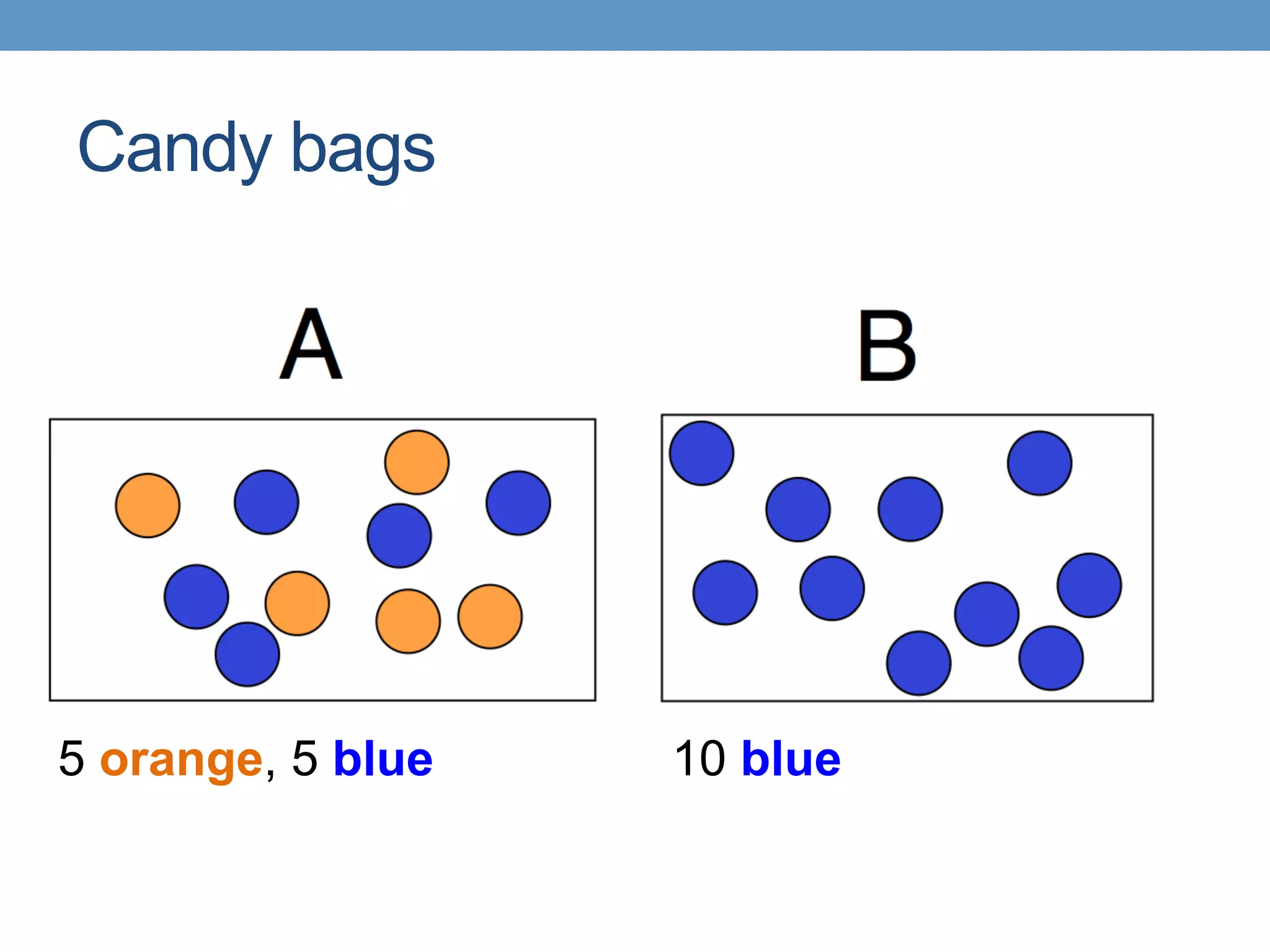
Candy bags
5 orange, 5 blue 10 blue
Candy bags
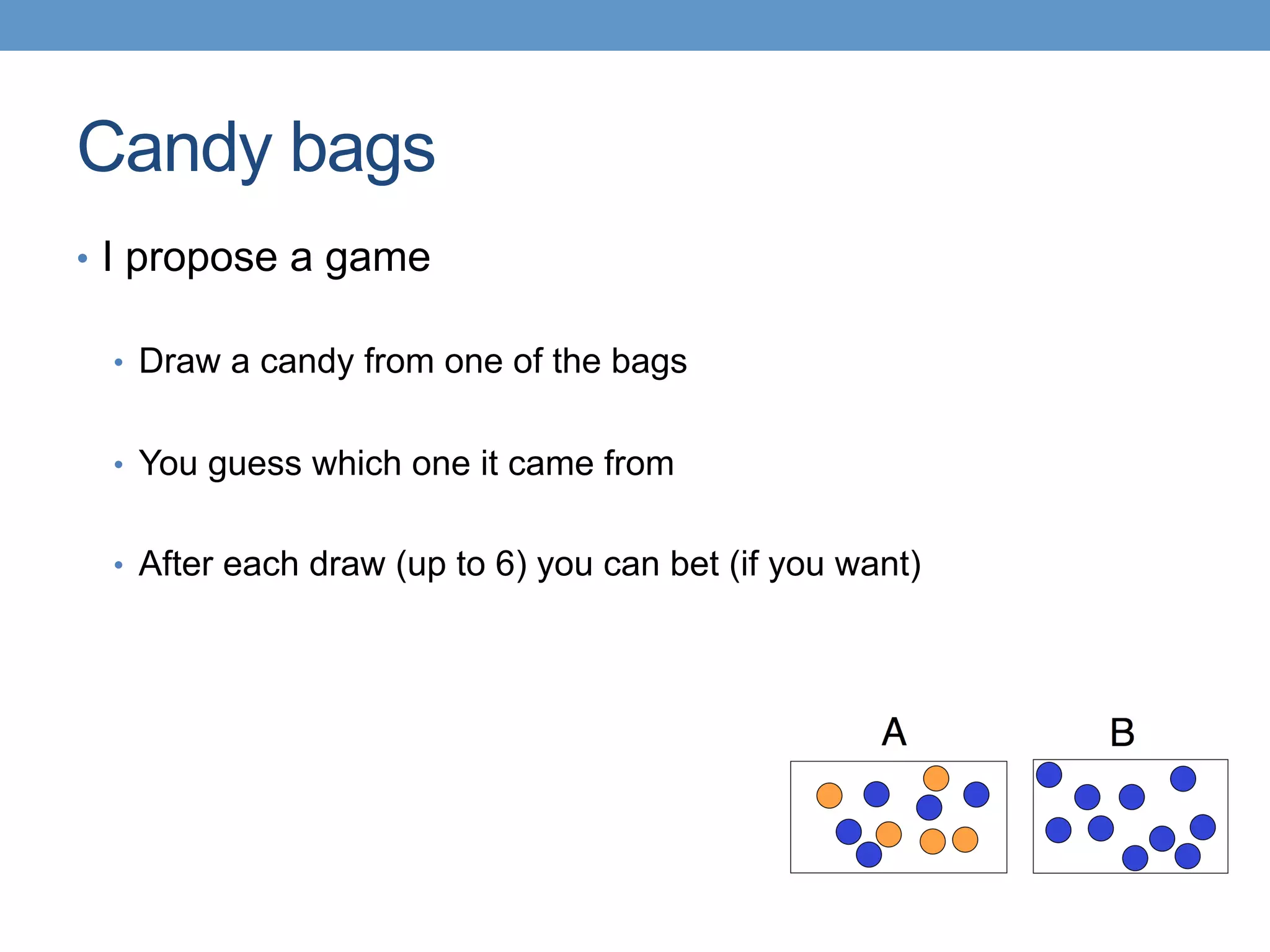
•  I propose a game
•  Draw a candy from one of the bags
•  You guess which one it came from
•  After each draw (up to 6) you can bet (if you want)
Candy bags
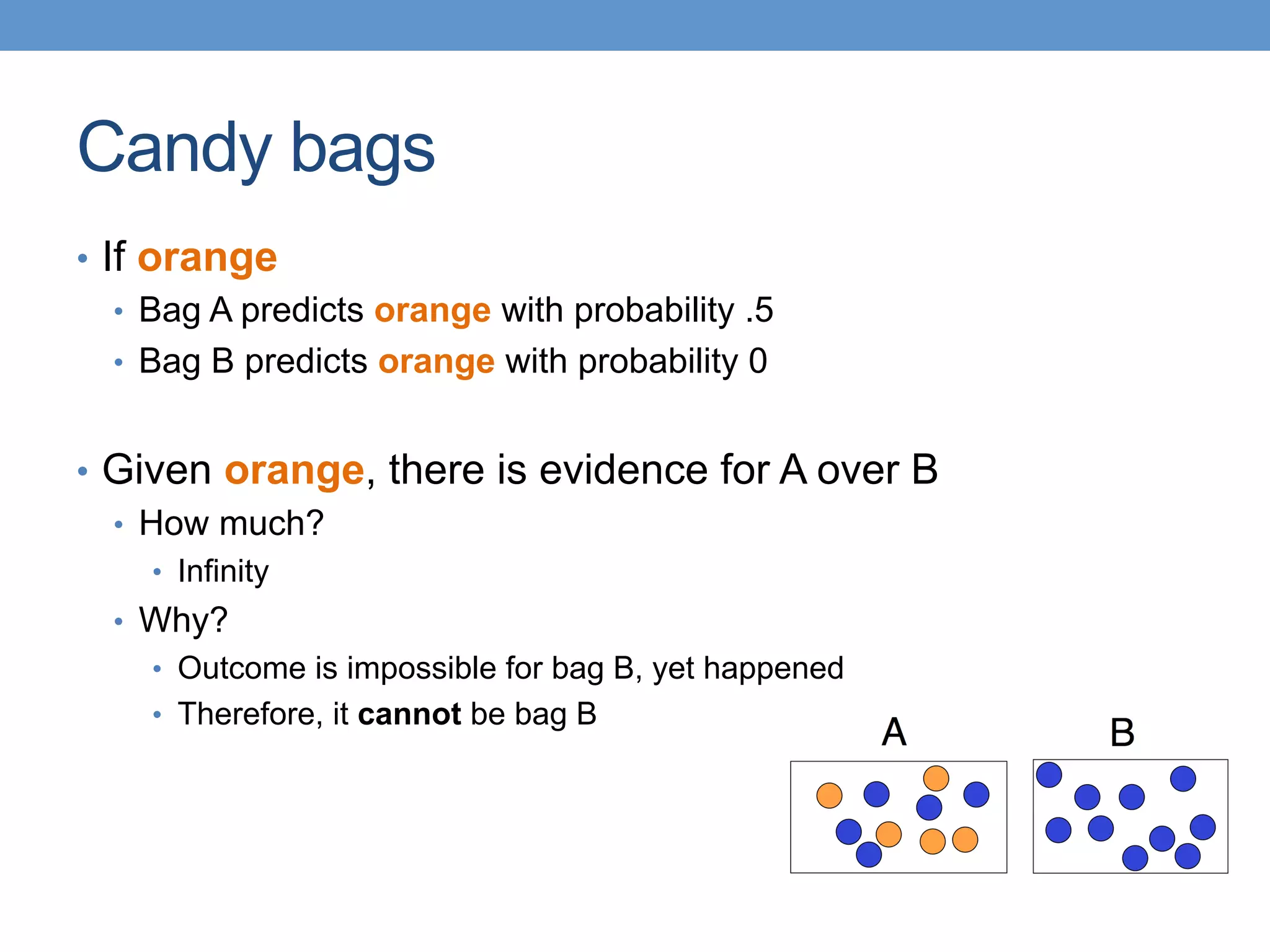
•  If orange
•  Bag A predicts orange with probability .5
•  Bag B predicts orange with probability 0
•  Given orange, there is evidence for A over B
•  How much?
•  Infinity
•  Why?
•  Outcome is impossible for bag B, yet happened
•  Therefore, it cannot be bag B
Candy bags
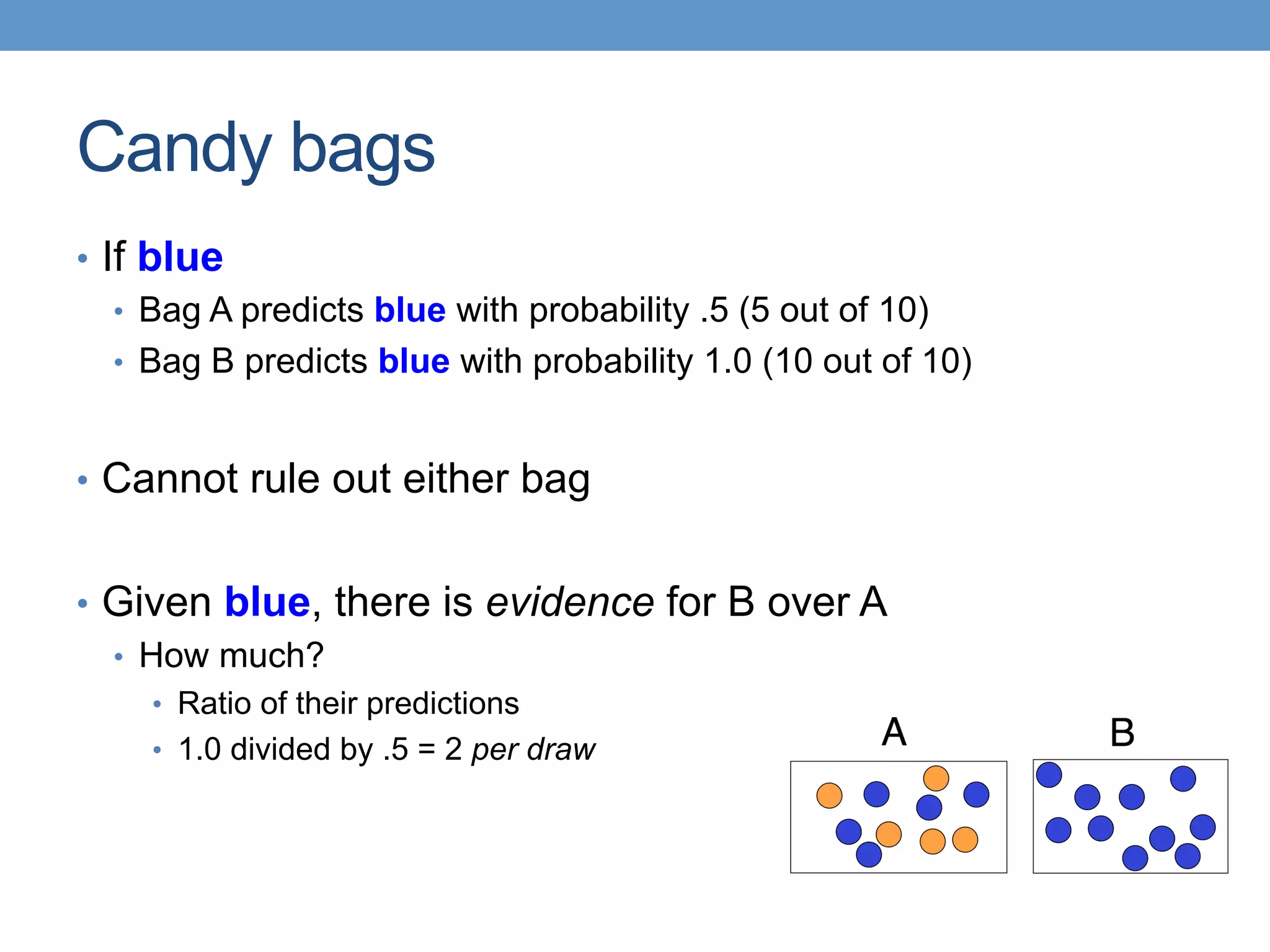
•  If blue
•  Bag A predicts blue with probability .5 (5 out of 10)
•  Bag B predicts blue with probability 1.0 (10 out of 10)
•  Cannot rule out either bag
•  Given blue, there is evidence for B over A
•  How much?
•  Ratio of their predictions
•  1.0 divided by .5 = 2 per draw
Evidence is prediction
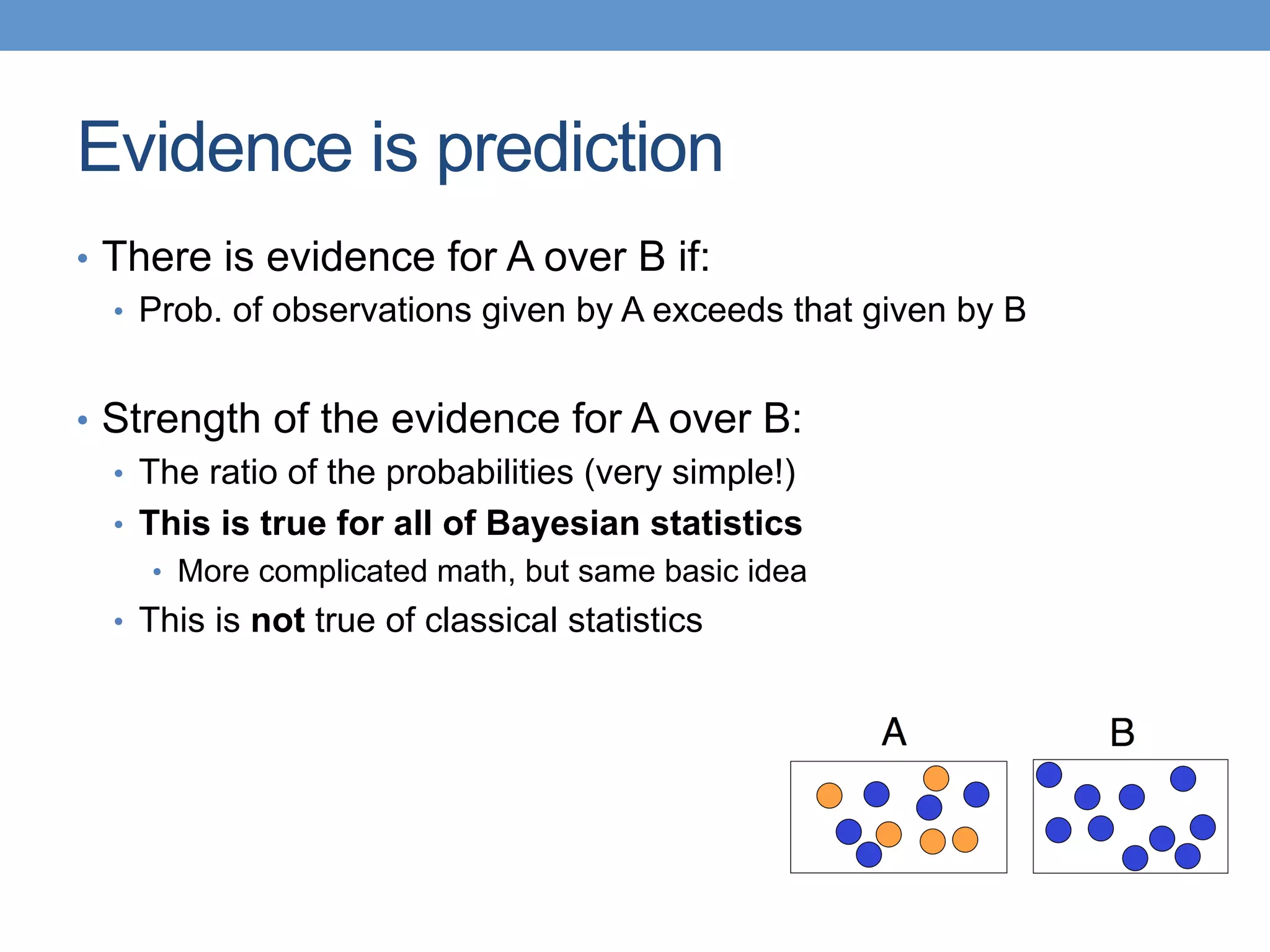
•  There is evidence for A over B if:
•  Prob. of observations given by A exceeds that given by B
•  Strength of the evidence for A over B:
•  The ratio of the probabilities (very simple!)
•  This is true for all of Bayesian statistics
•  More complicated math, but same basic idea
•  This is not true of classical statistics
Candy bag and a deck of cards
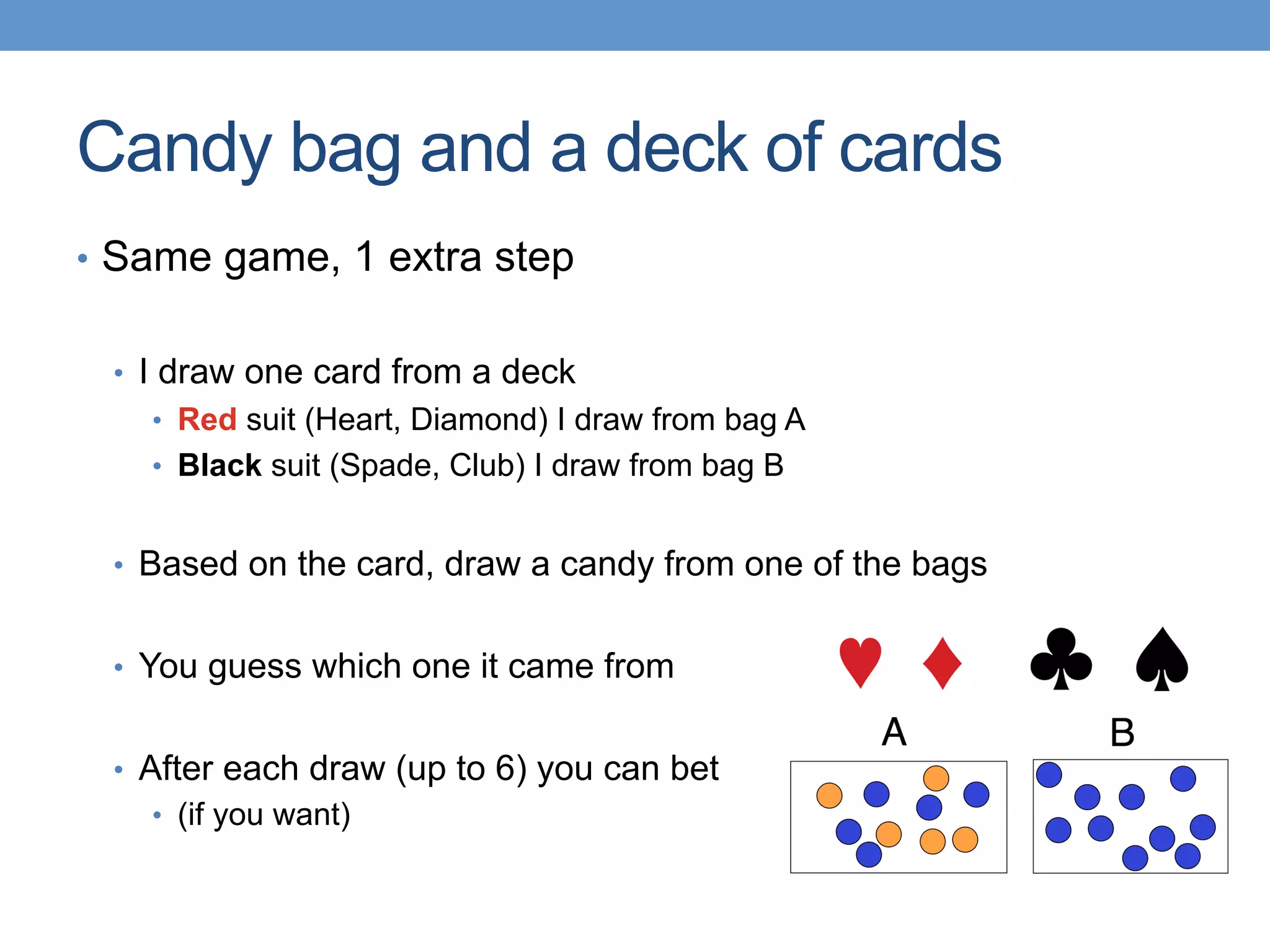
•  Same game, 1 extra step
•  I draw one card from a deck
•  Red suit (Heart, Diamond) I draw from bag A
•  Black suit (Spade, Club) I draw from bag B
•  Based on the card, draw a candy from one of the bags
•  You guess which one it came from
•  After each draw (up to 6) you can bet
•  (if you want)
Candy bags and a deck of cards
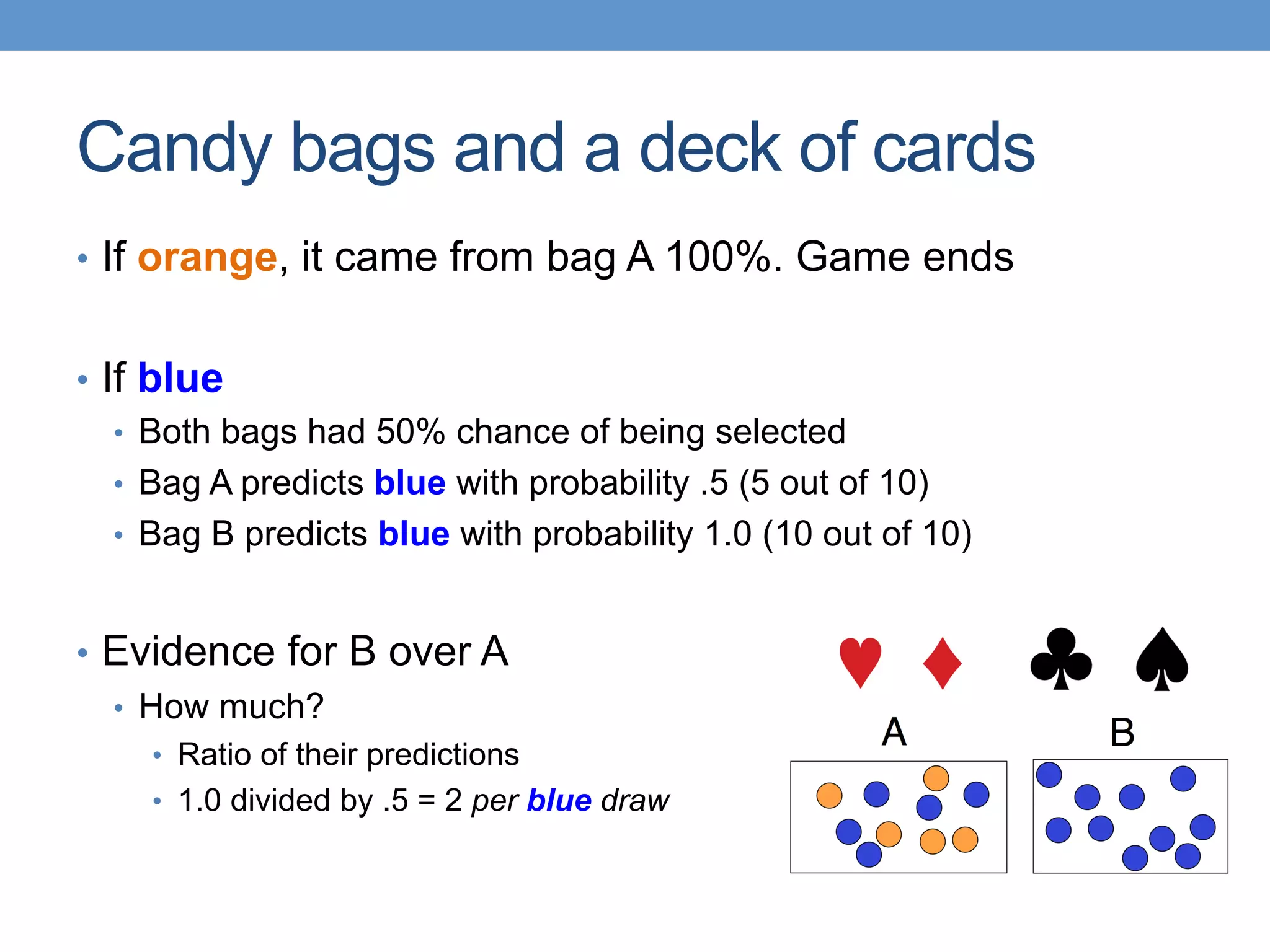
•  If orange, it came from bag A 100%. Game ends
•  If blue
•  Both bags had 50% chance of being selected
•  Bag A predicts blue with probability .5 (5 out of 10)
•  Bag B predicts blue with probability 1.0 (10 out of 10)
•  Evidence for B over A
•  How much?
•  Ratio of their predictions
•  1.0 divided by .5 = 2 per blue draw
Candy bags and a deck of cards
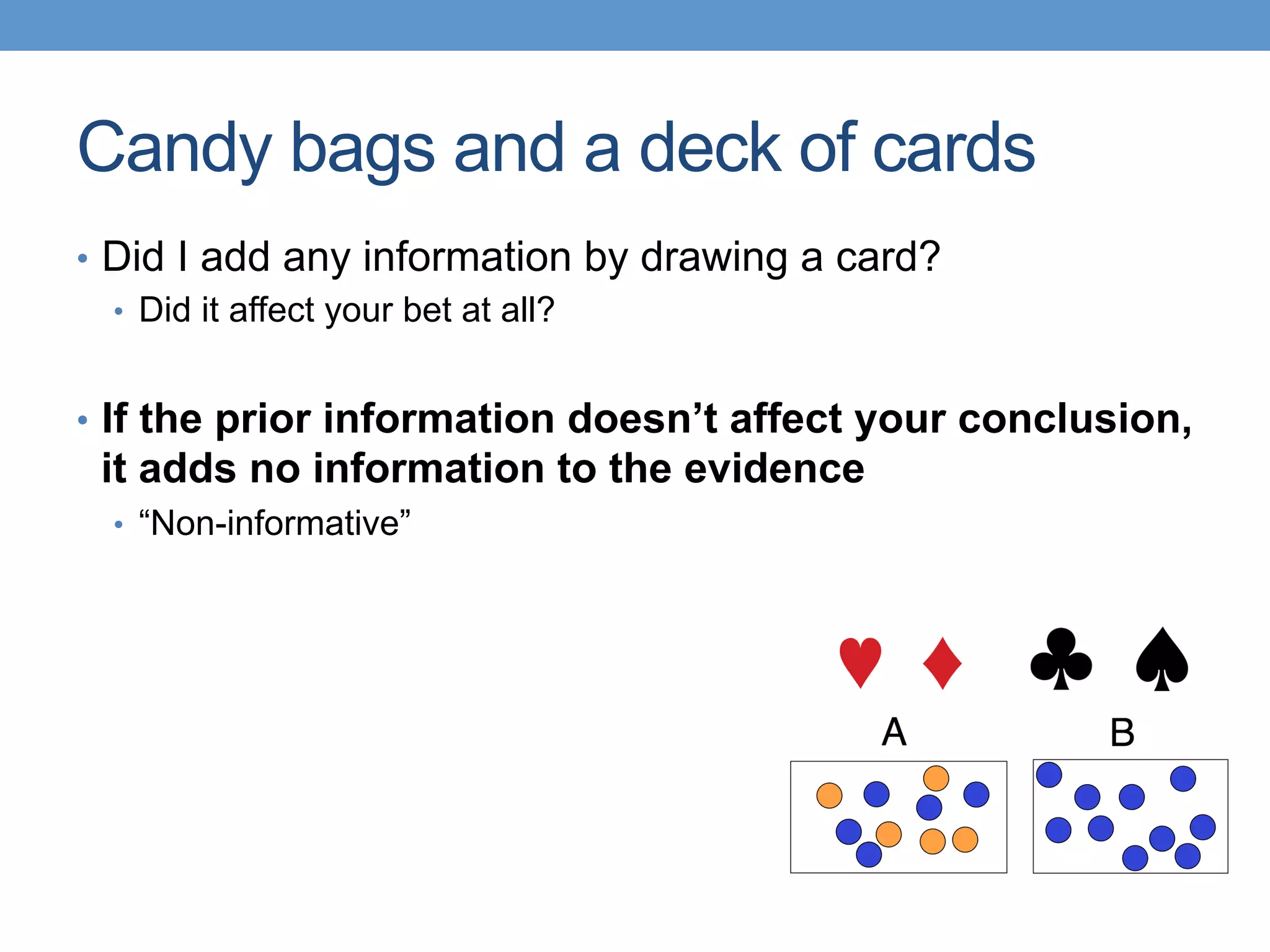
•  Did I add any information by drawing a card?
•  Did it affect your bet at all?
•  If the prior information doesn’t affect your conclusion,
it adds no information to the evidence
•  “Non-informative”
Candy bags and a deck of cards
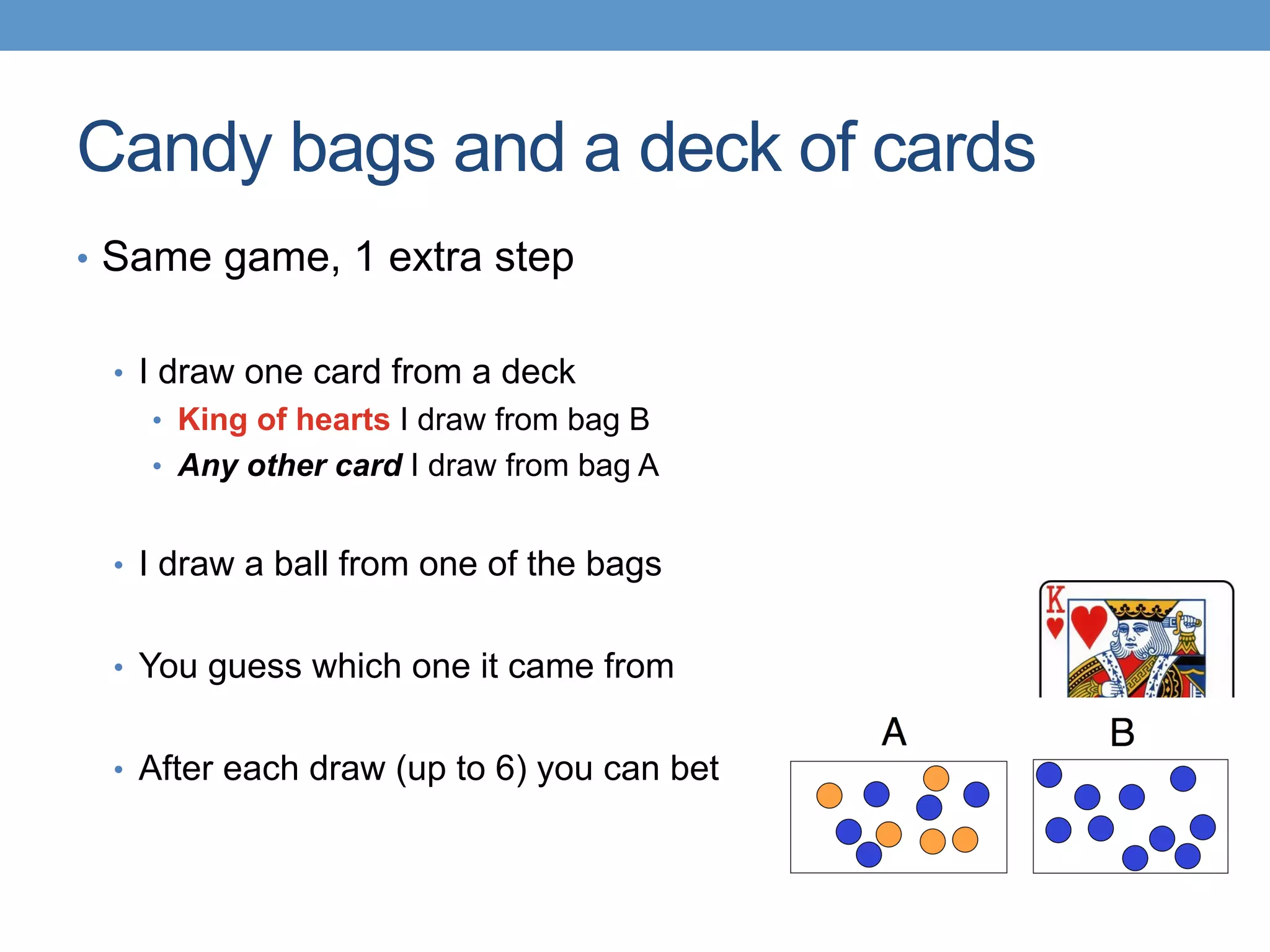
•  Same game, 1 extra step
•  I draw one card from a deck
•  King of hearts I draw from bag B
•  Any other card I draw from bag A
•  I draw a ball from one of the bags
•  You guess which one it came from
•  After each draw (up to 6) you can bet
Candy bags and a deck of cards
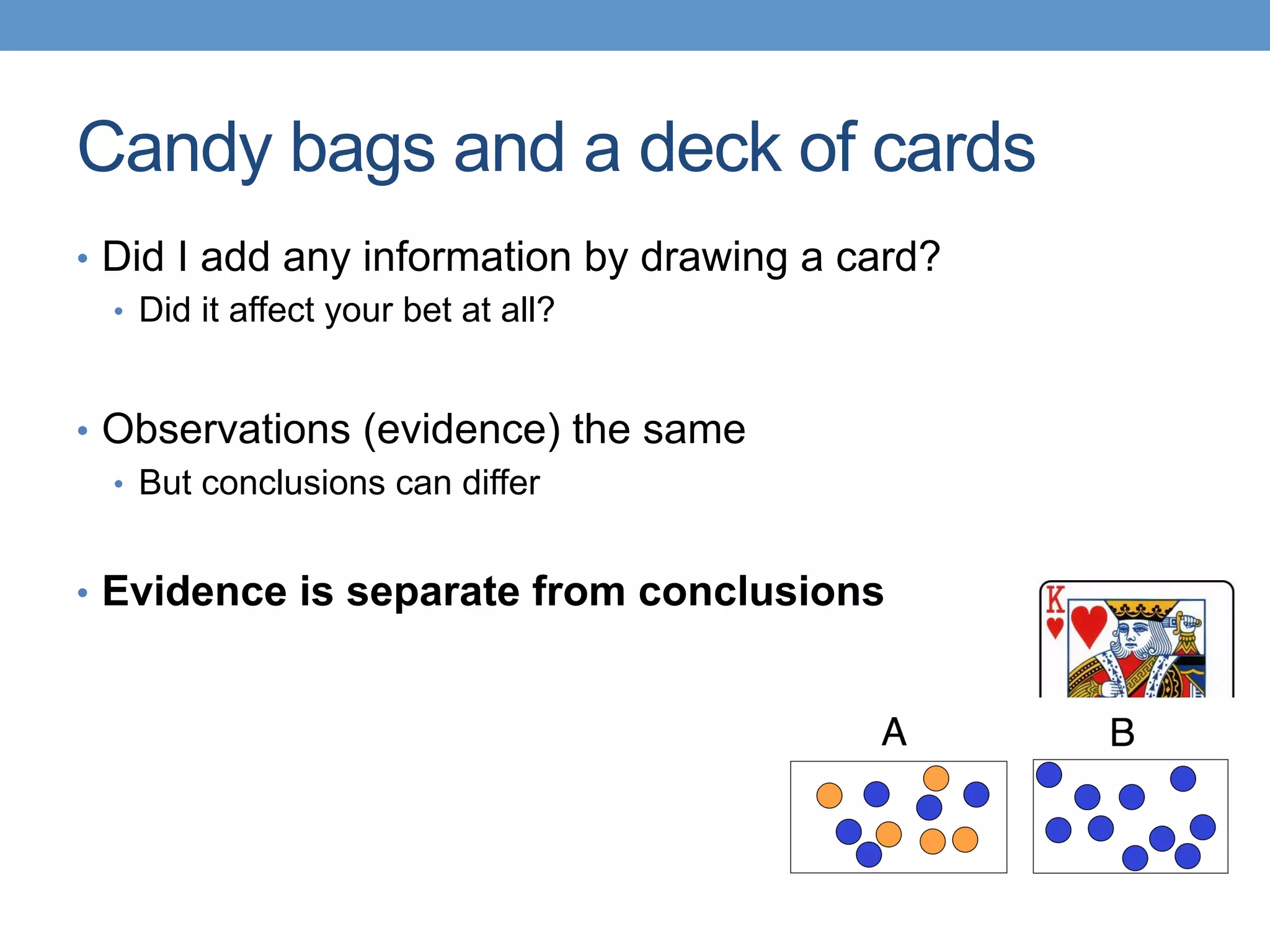
•  Did I add any information by drawing a card?
•  Did it affect your bet at all?
•  Observations (evidence) the same
•  But conclusions can differ
•  Evidence is separate from conclusions
• The 1 euro bet
•  If orange draw
•  Bet on bag A, you win 100%
•  We have ruled out bag B
•  If blue draw
•  Bet on bag A, chance you win is x%
•  Bet on bag B, chance you win is (1-x)%
Betting on the odds
Betting on the odds
•  Depends on:
•  Evidence from sample (candies drawn)
•  Other information (card drawn, etc.)
•  A study only provides the evidence contained in the
sample
•  You must provide the outside information
•  Is the hypothesis initially implausible?
•  Is this surprising? Expected?
Betting on the odds
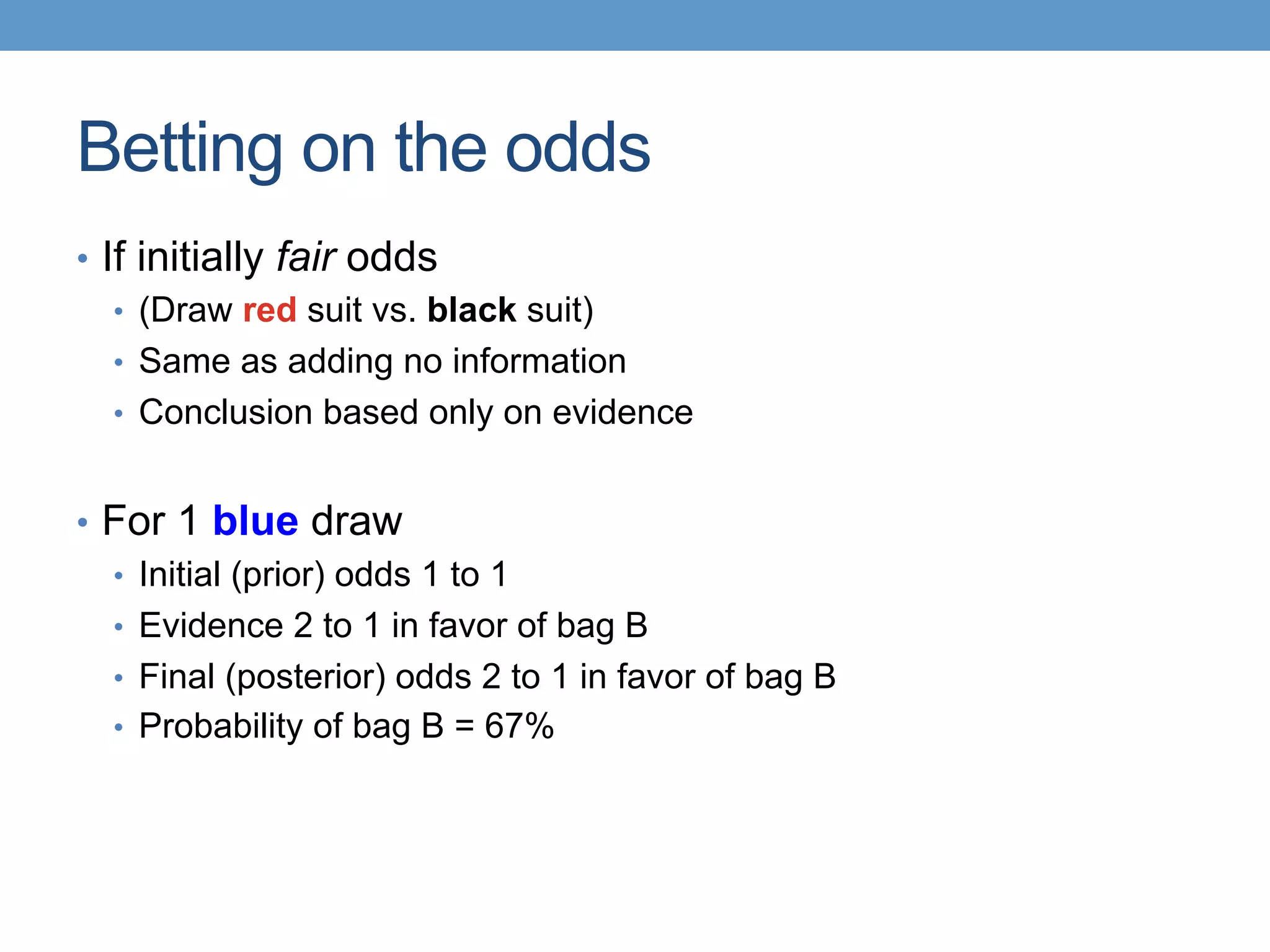
•  If initially fair odds
•  (Draw red suit vs. black suit)
•  Same as adding no information
•  Conclusion based only on evidence
•  For 1 blue draw
•  Initial (prior) odds 1 to 1
•  Evidence 2 to 1 in favor of bag B
•  Final (posterior) odds 2 to 1 in favor of bag B
•  Probability of bag B = 67%
Betting on the odds
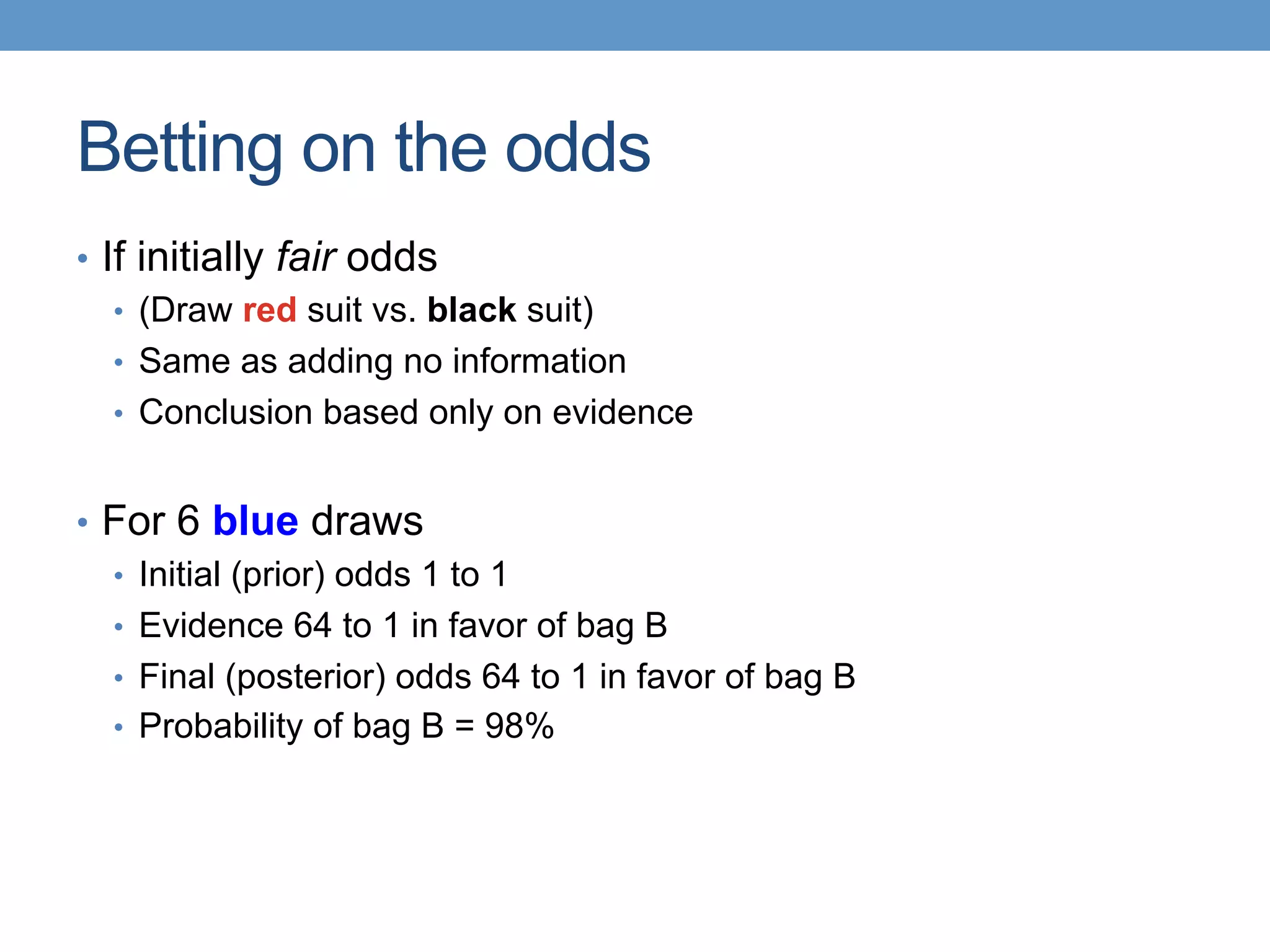
•  If initially fair odds
•  (Draw red suit vs. black suit)
•  Same as adding no information
•  Conclusion based only on evidence
•  For 6 blue draws
•  Initial (prior) odds 1 to 1
•  Evidence 64 to 1 in favor of bag B
•  Final (posterior) odds 64 to 1 in favor of bag B
•  Probability of bag B = 98%
Betting on the odds
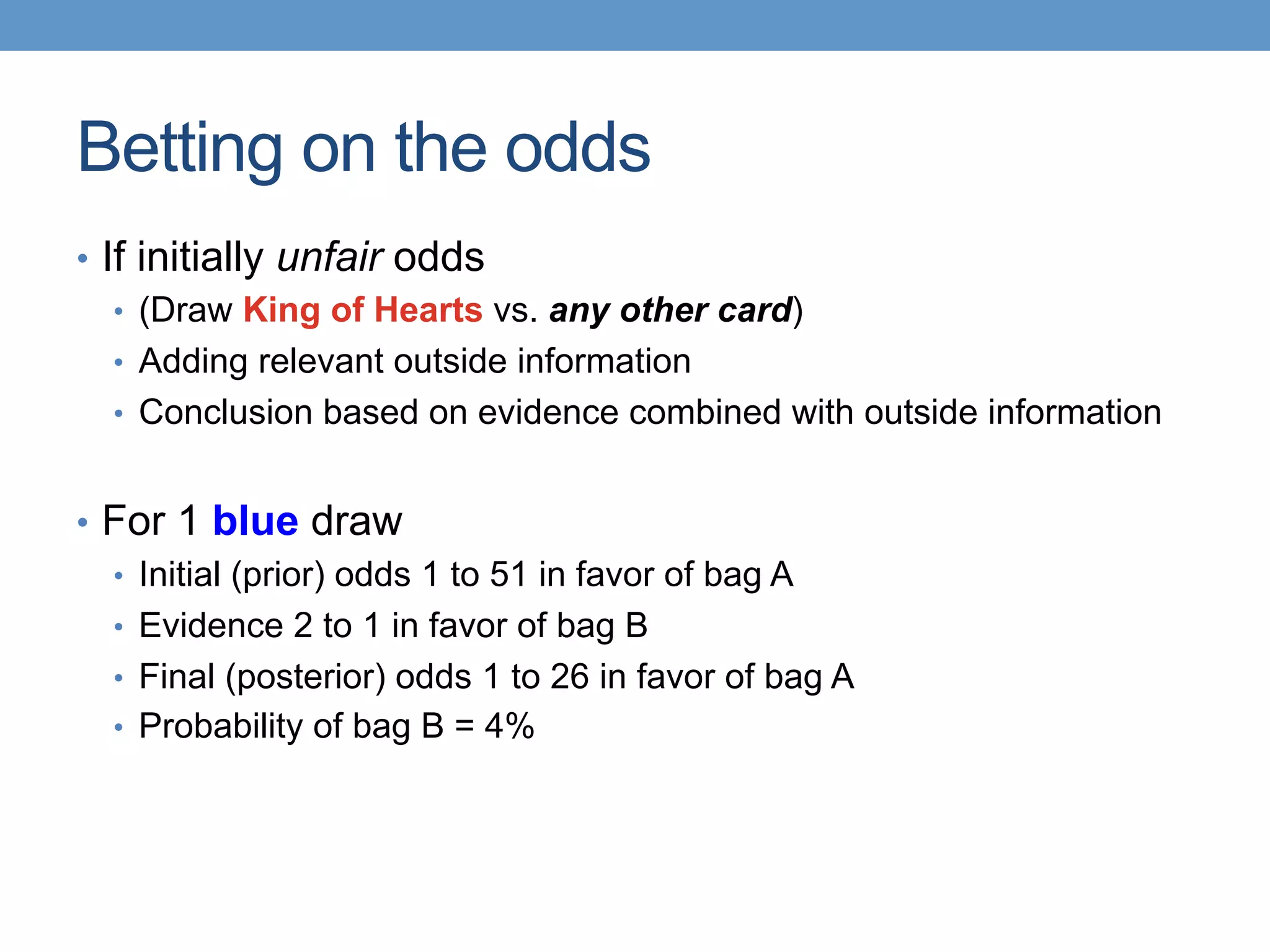
•  If initially unfair odds
•  (Draw King of Hearts vs. any other card)
•  Adding relevant outside information
•  Conclusion based on evidence combined with outside information
•  For 1 blue draw
•  Initial (prior) odds 1 to 51 in favor of bag A
•  Evidence 2 to 1 in favor of bag B
•  Final (posterior) odds 1 to 26 in favor of bag A
•  Probability of bag B = 4%
Betting on the odds
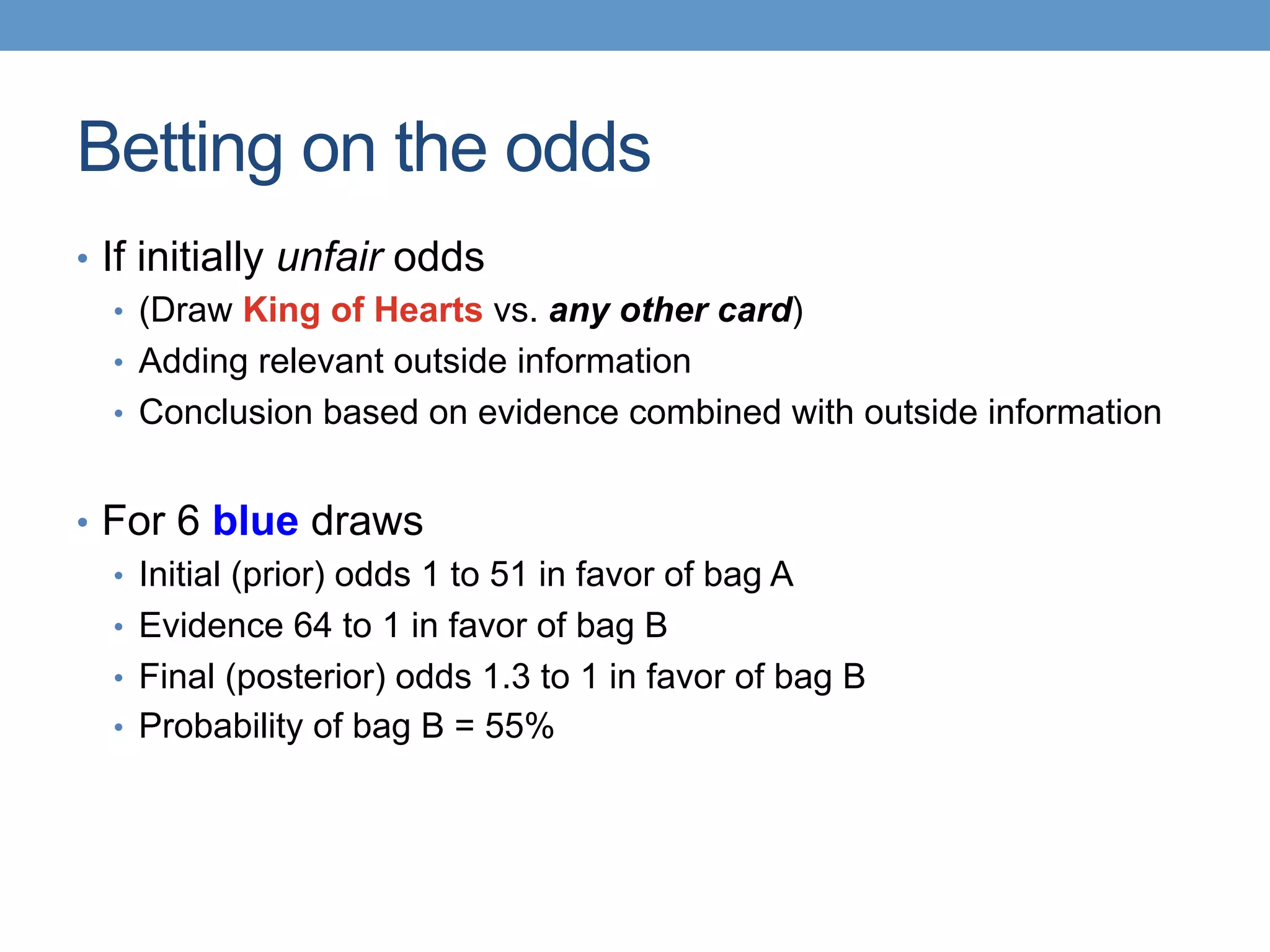
•  If initially unfair odds
•  (Draw King of Hearts vs. any other card)
•  Adding relevant outside information
•  Conclusion based on evidence combined with outside information
•  For 6 blue draws
•  Initial (prior) odds 1 to 51 in favor of bag A
•  Evidence 64 to 1 in favor of bag B
•  Final (posterior) odds 1.3 to 1 in favor of bag B
•  Probability of bag B = 55%
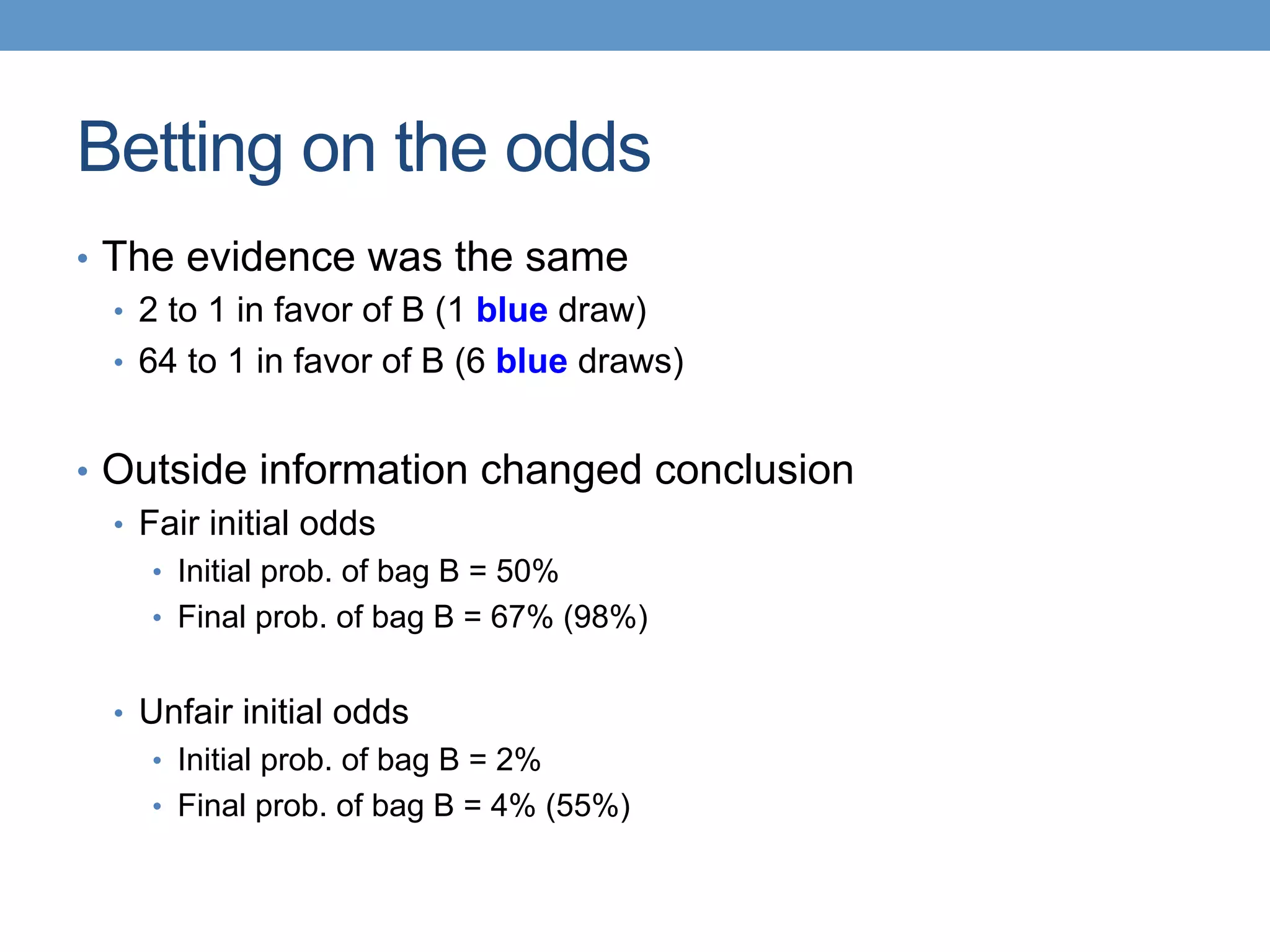
Betting on the odds
•  The evidence was the same
•  2 to 1 in favor of B (1 blue draw)
•  64 to 1 in favor of B (6 blue draws)
•  Outside information changed conclusion
•  Fair initial odds
•  Initial prob. of bag B = 50%
•  Final prob. of bag B = 67% (98%)
•  Unfair initial odds
•  Initial prob. of bag B = 2%
•  Final prob. of bag B = 4% (55%)
Should you take the bet?
•  If I offer you a 1 euro bet:
•  Bet on the bag that has the highest probability
•  For other bets, decide based on final odds
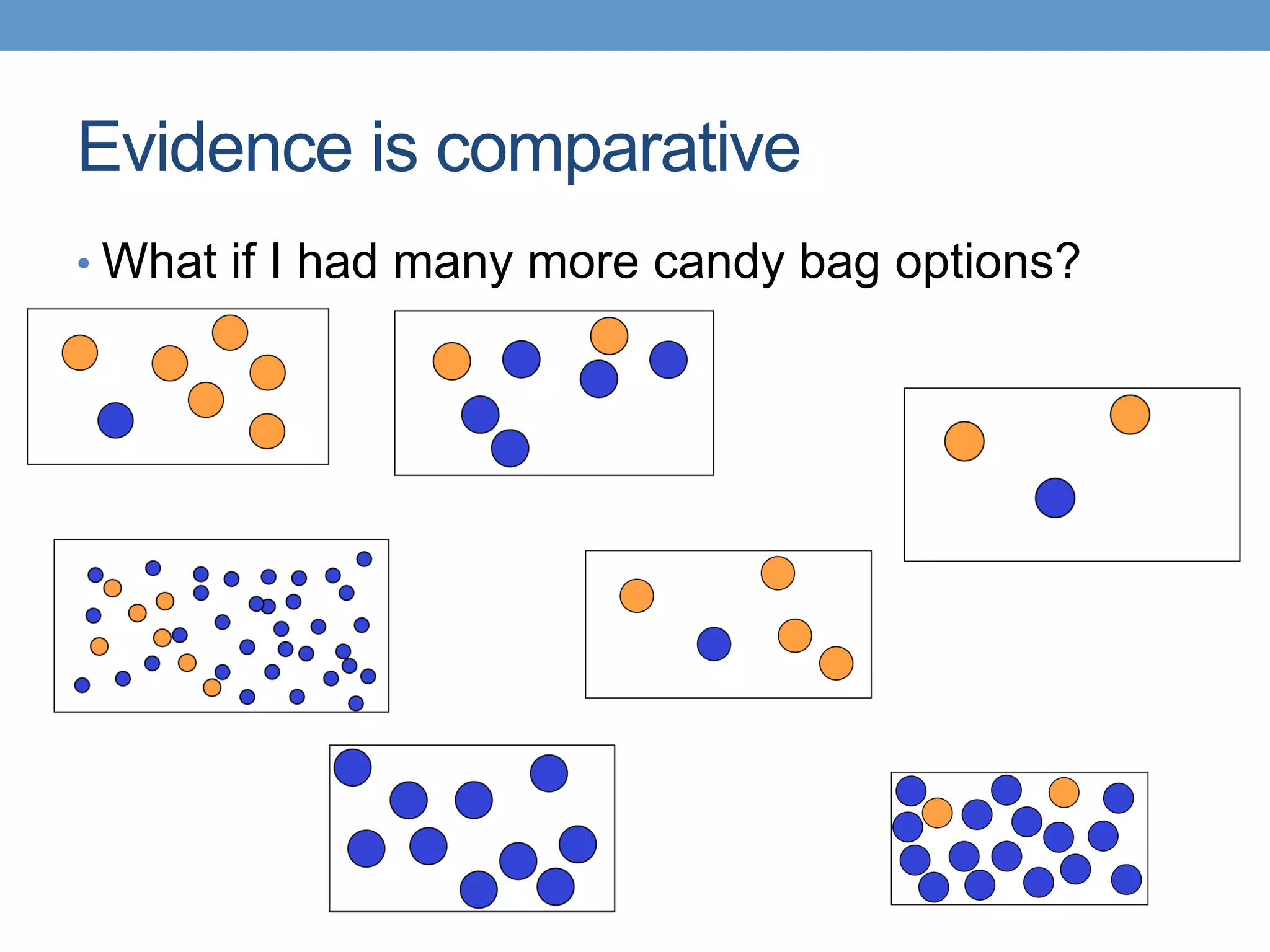
Evidence is comparative
• What if I had many more candy bag options?
Graphing the evidence
•  What if I wanted to compare every possible option at
once?
•  Graph it!
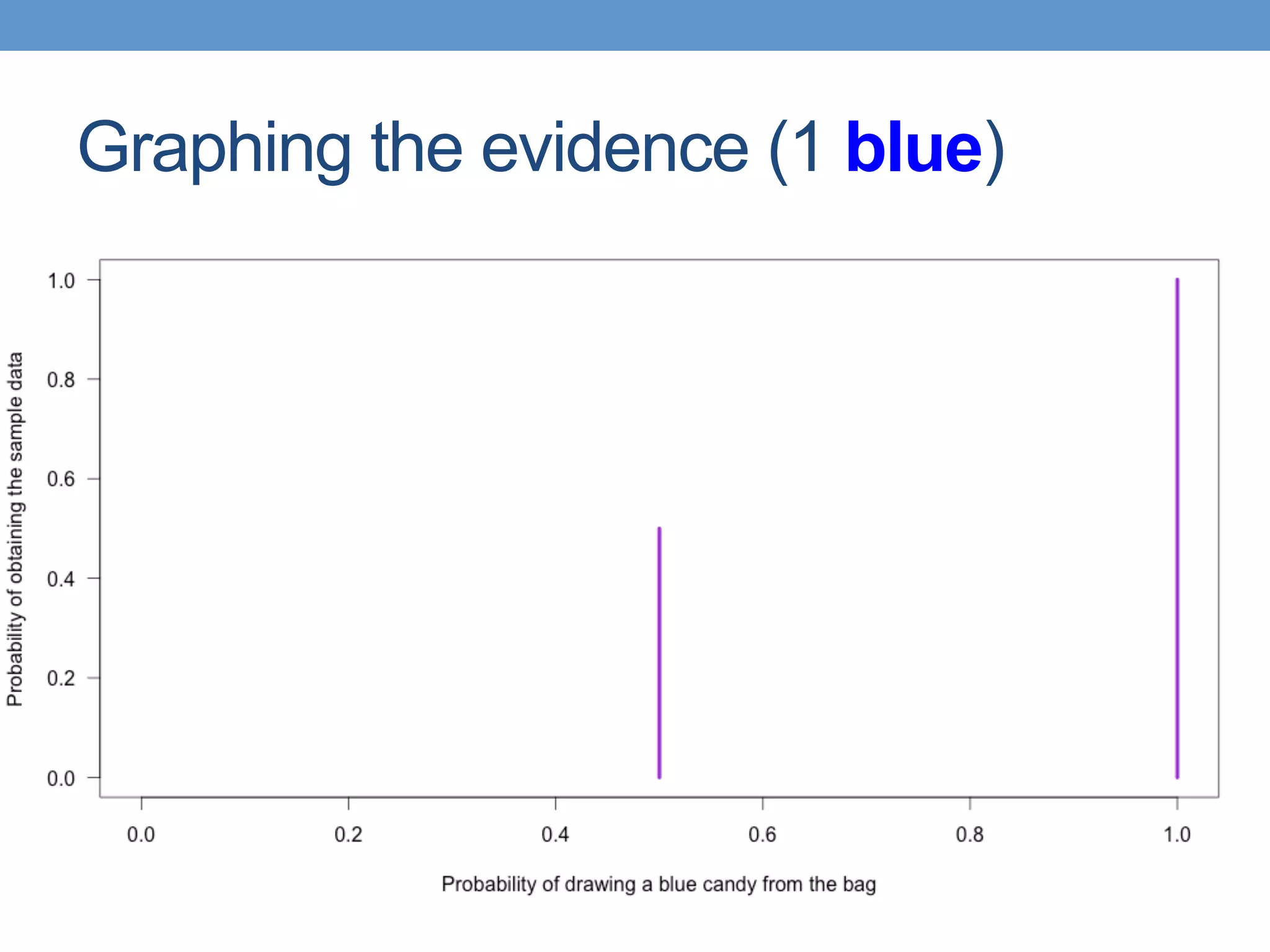
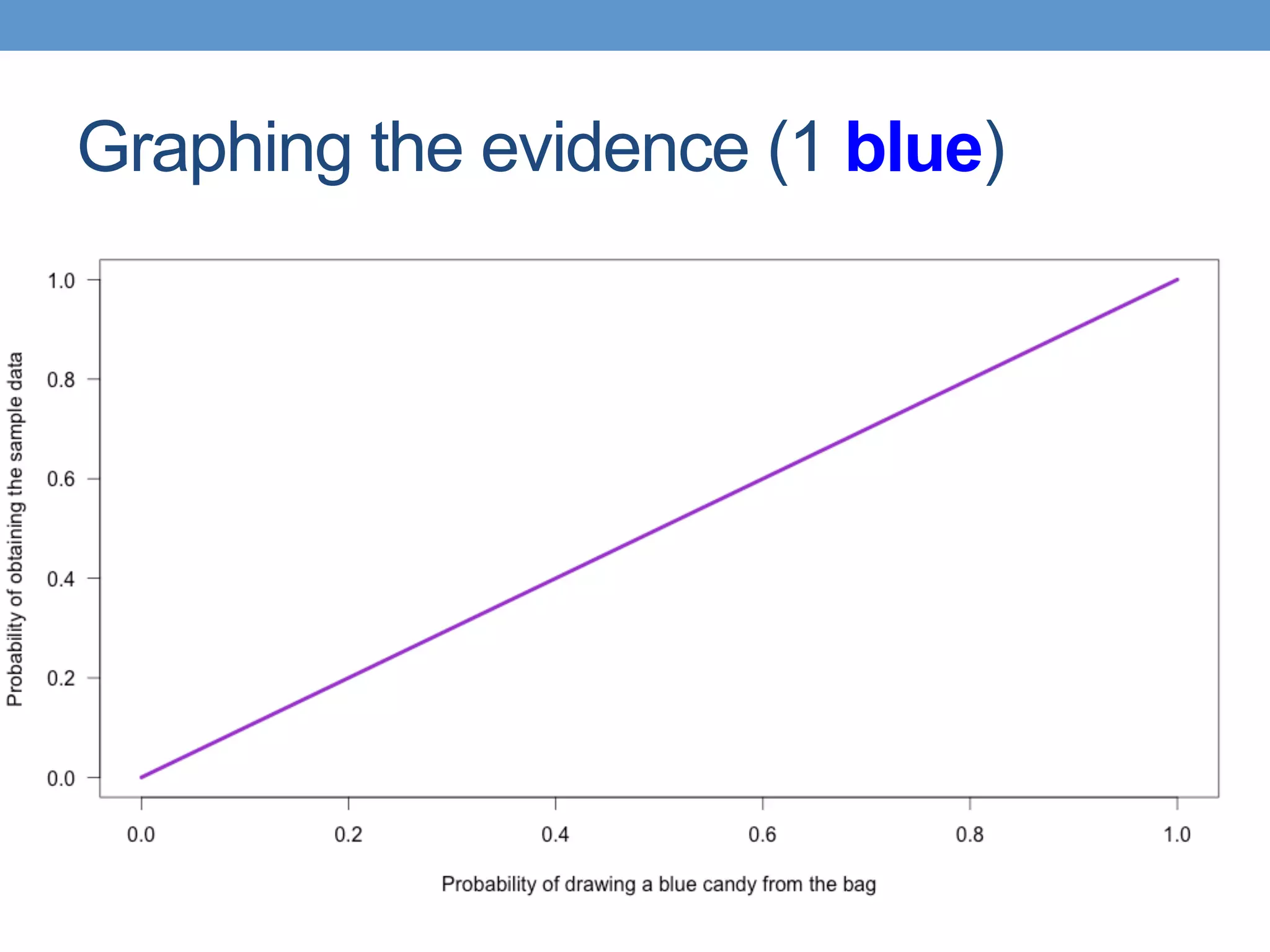
Graphing the evidence (1 blue)
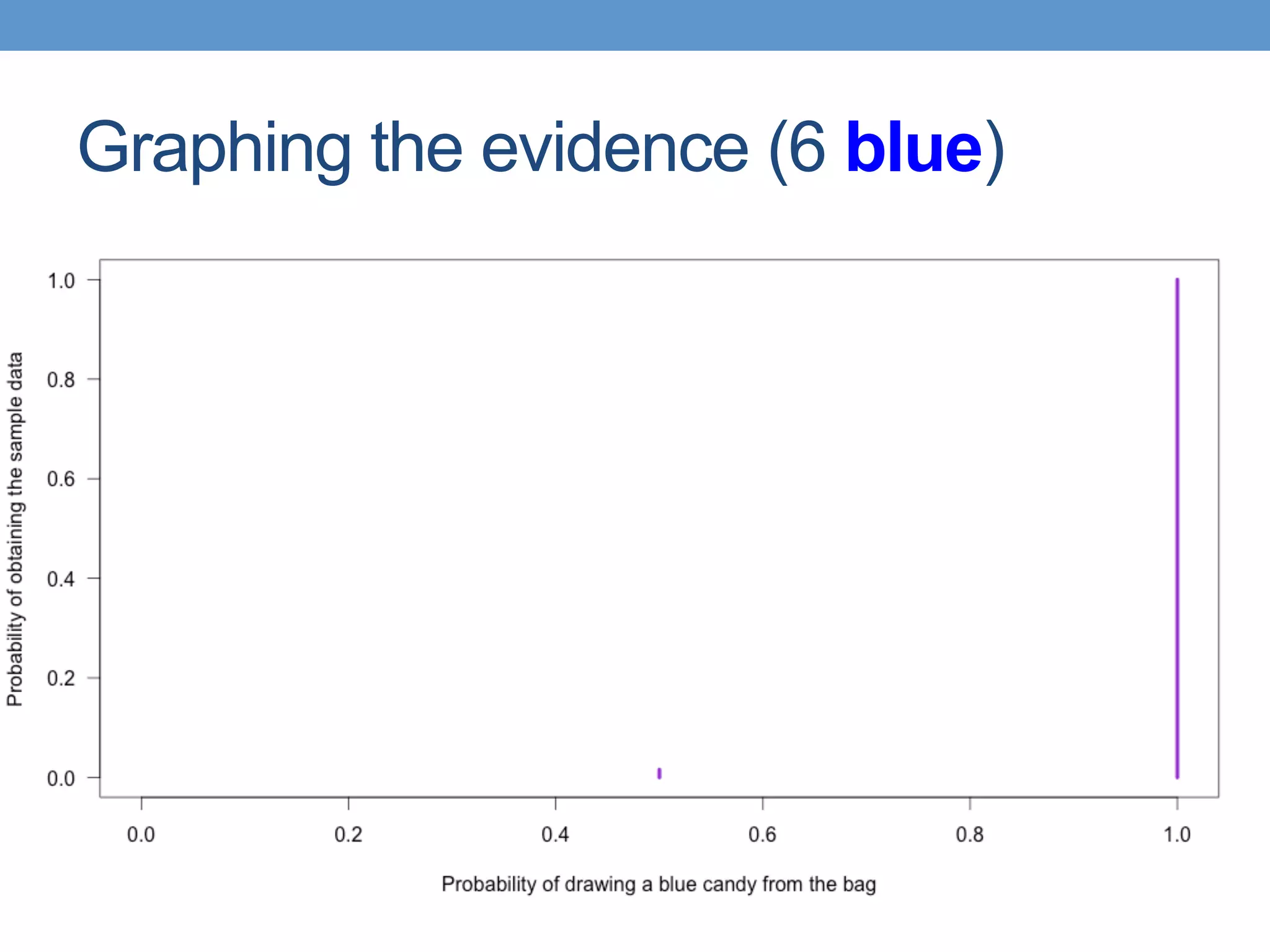
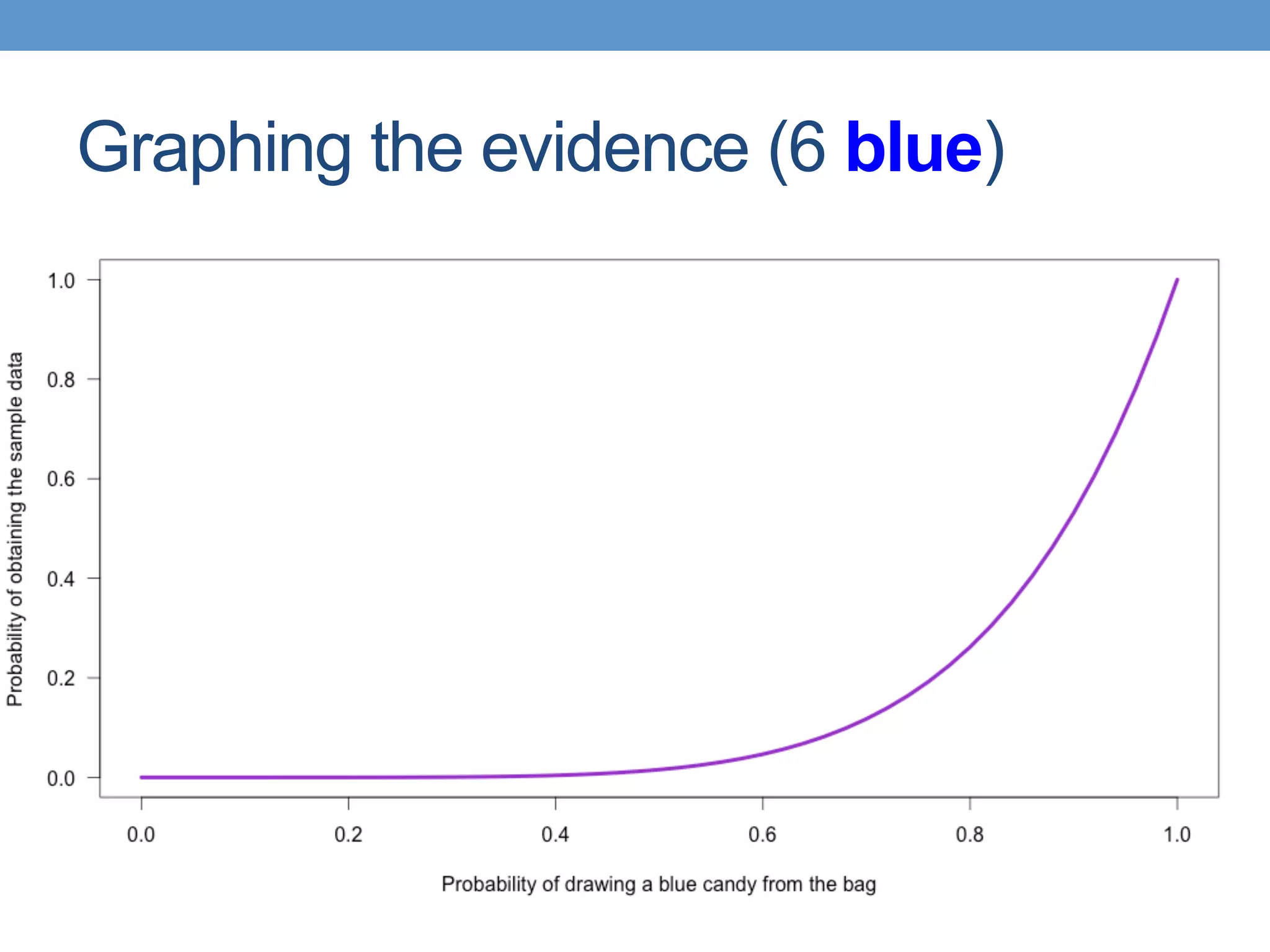
Graphing the evidence (6 blue)
Graphing the evidence
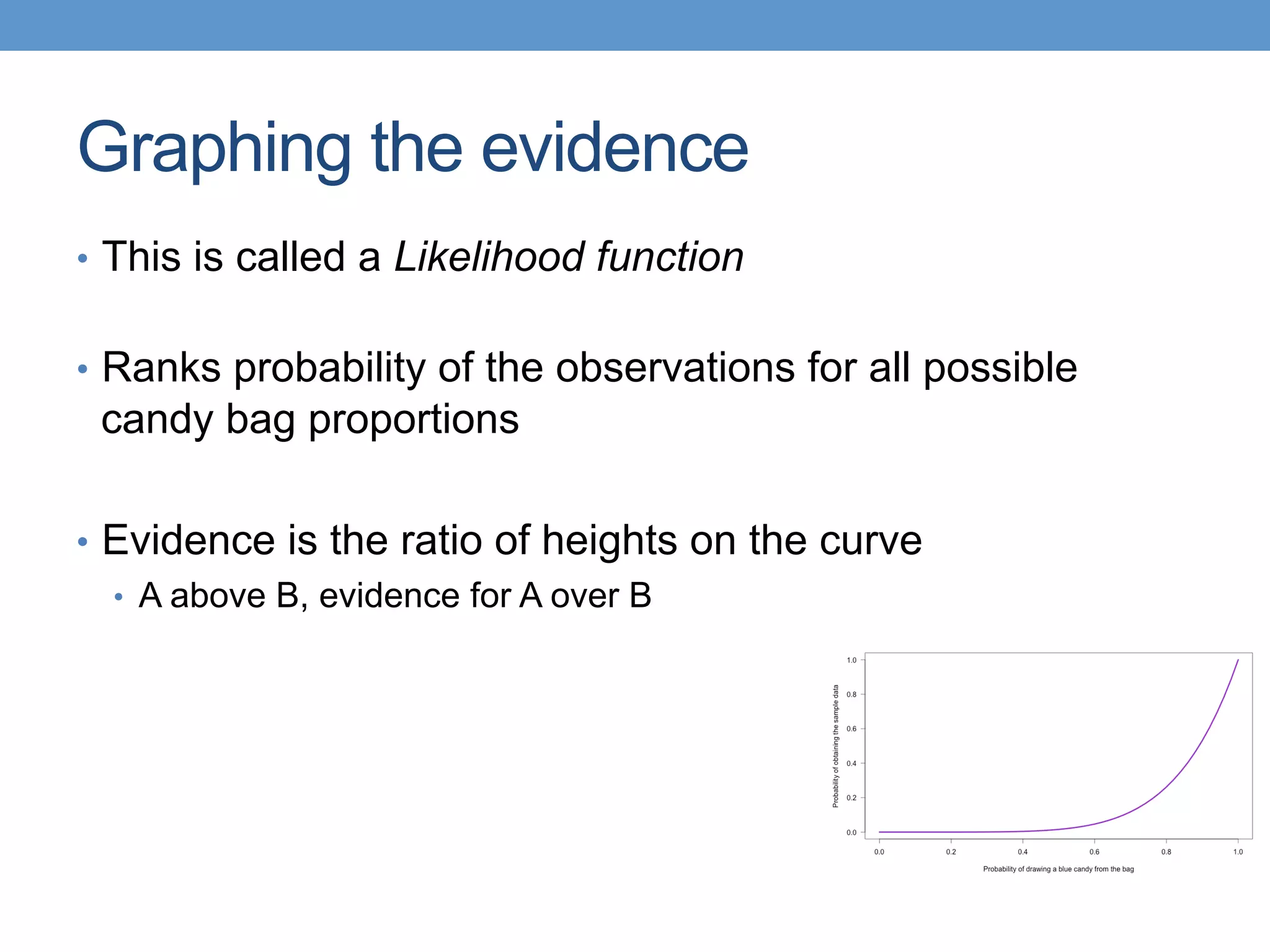
•  This is called a Likelihood function
•  Ranks probability of the observations for all possible
candy bag proportions
•  Evidence is the ratio of heights on the curve
•  A above B, evidence for A over B
Graphing the evidence
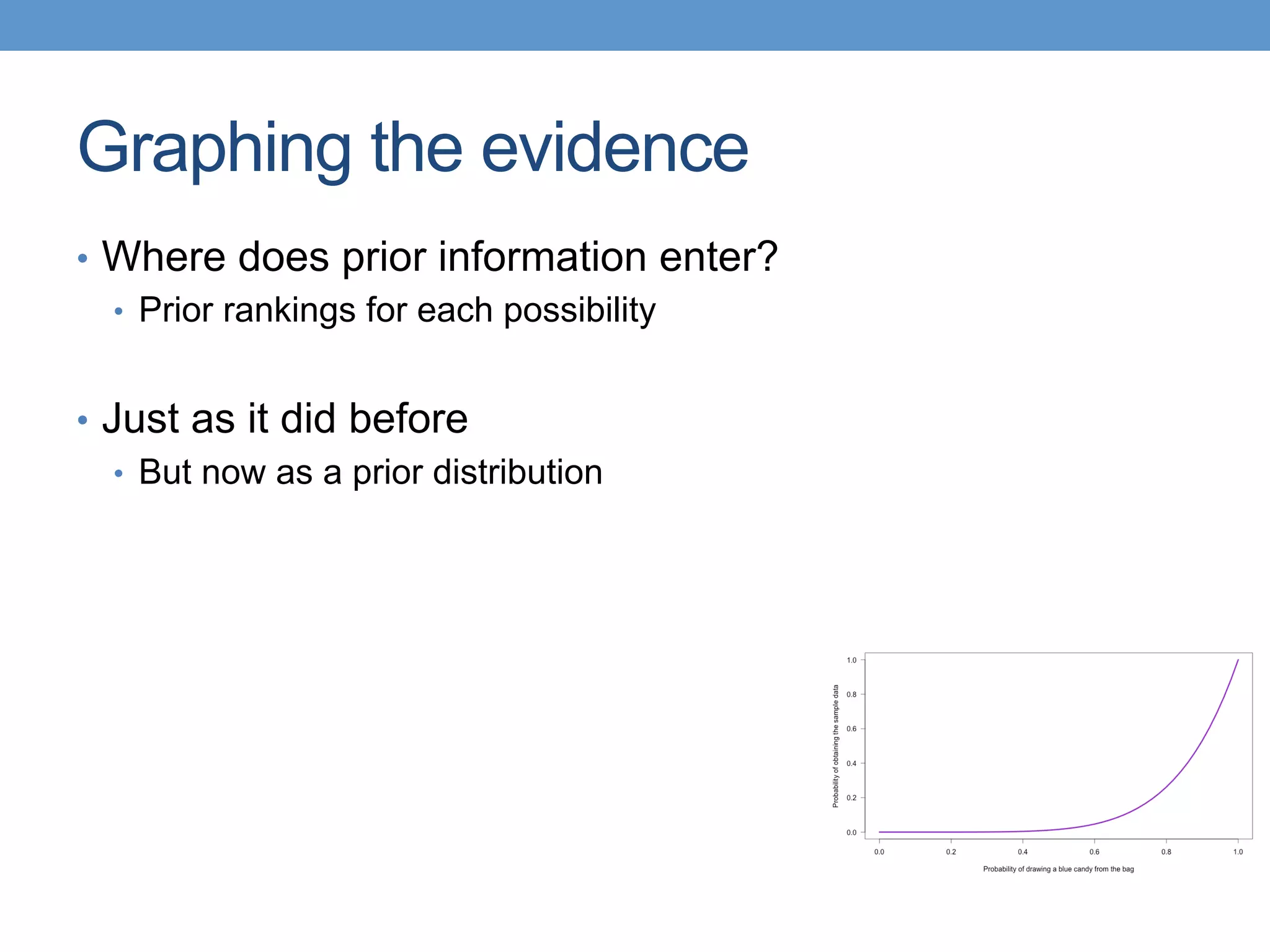
•  Where does prior information enter?
•  Prior rankings for each possibility
•  Just as it did before
•  But now as a prior distribution
Prior information
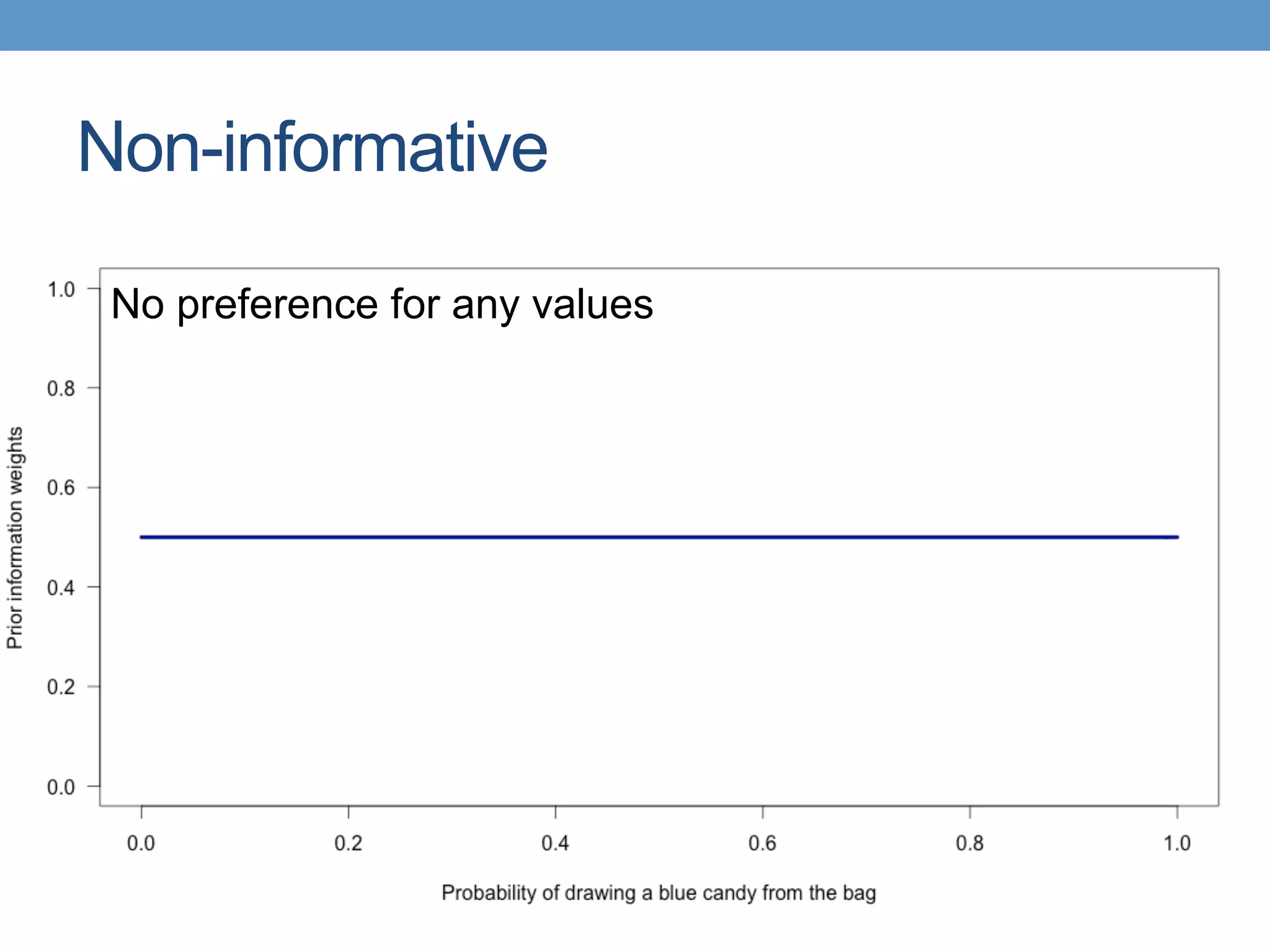
•  “Non-informative” prior information
•  All possibilities ranked equally
•  i.e. no value preferred over another
•  Weak prior information; vague knowledge
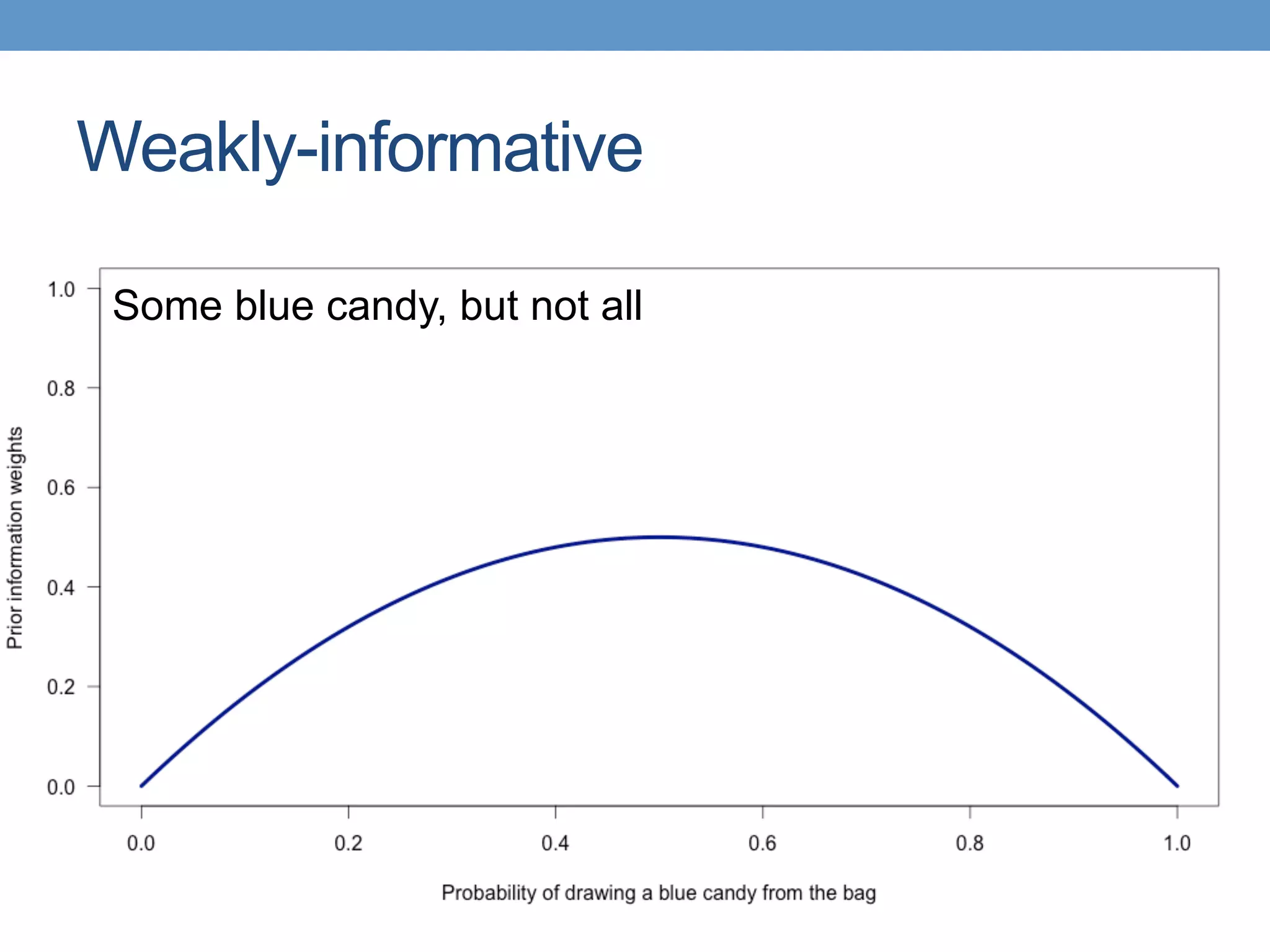
•  “The bag has some blue candy, but not all blue candy”
•  After Halloween, for example
•  Saw some blue candy given out, but also other candies
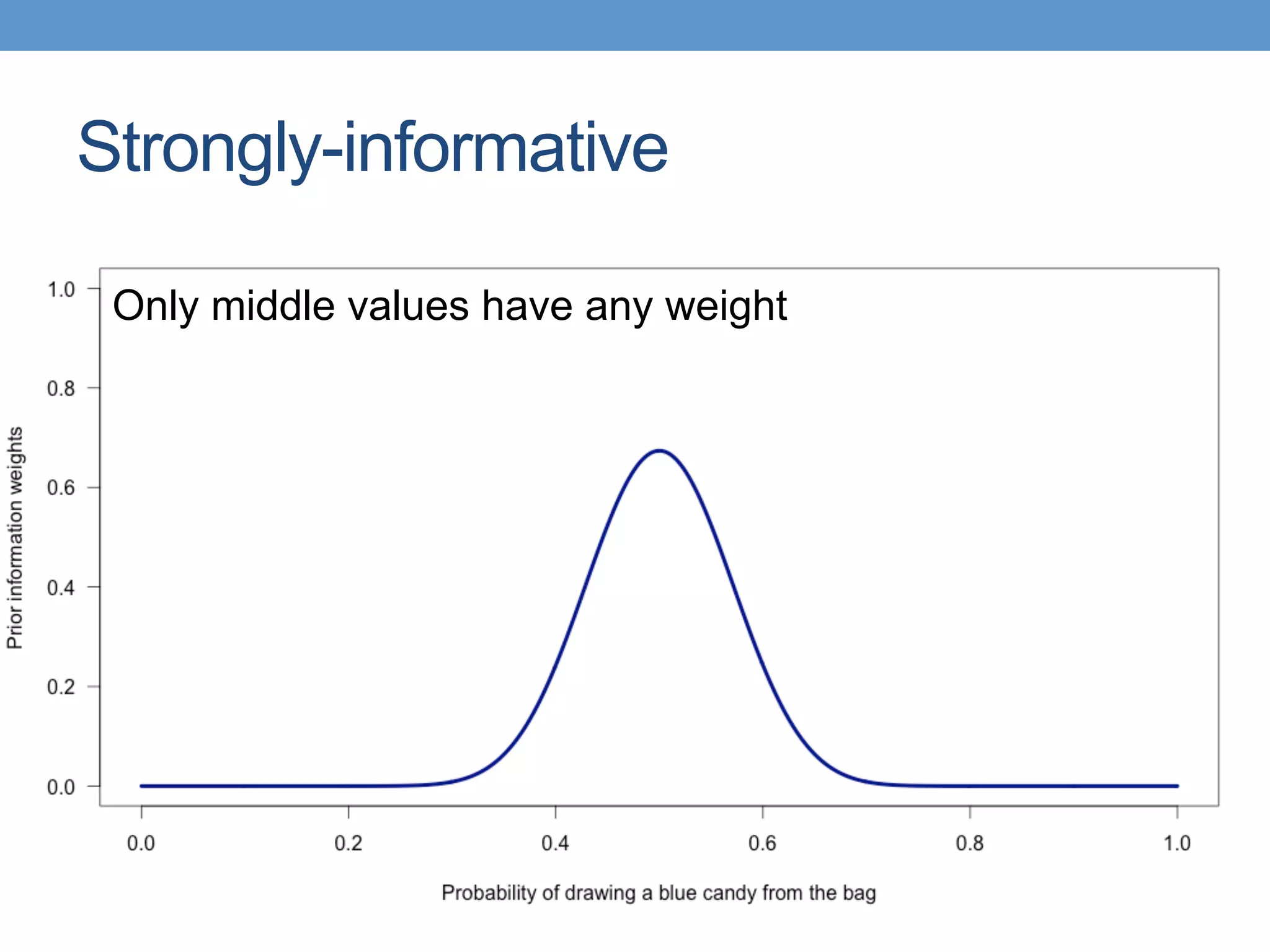
•  Strong prior information
•  “Proportion of women in the population is between 40% and 60%”
Non-informative
No preference for any values
Weakly-informative
Some blue candy, but not all
Strongly-informative
Only middle values have any weight
Information and context
•  Your prior information depends on context!
•  And depends on what you know!
•  Just like drawing cards in the game
•  Just harder to specify
•  Intuitive, personal
•  Conclusions must take context into account

Bayesian statistical concepts

  • 1.
    BAYESIAN STATISTICAL CONCEPTS A gentleintroduction Alex Etz @alxetz ßTwitter (no ‘e’ in alex) alexanderetz.com ßBlog November 5th 2015
  • 2.
    Why do wedo statistics? •  Deal with uncertainty •  Will it rain today? How much? •  When will my train arrive? •  Describe phenomena •  It rained 4cm today •  My arrived between at 1605 •  Make predictions •  It will rain between 3-8 cm today •  My train will arrive between 1600 and 1615
  • 3.
    Prediction is key • Description is boring •  Description: •  On this IQ test, these women averaged 3 points higher than these men •  Prediction is interesting •  Prediction: •  On this IQ test, the average woman will score above the average man •  Quantitative (precise) prediction is gold •  Quantitative prediction: •  On this IQ test, women will score between 1-3 pts higher than men
  • 4.
    Evidence is prediction • Not just prediction in isolation •  Competing prediction •  Statistical evidence is comparative
  • 5.
    Candy bags 5 orange,5 blue 10 blue
  • 6.
    Candy bags •  Ipropose a game •  Draw a candy from one of the bags •  You guess which one it came from •  After each draw (up to 6) you can bet (if you want)
  • 7.
    Candy bags •  Iforange •  Bag A predicts orange with probability .5 •  Bag B predicts orange with probability 0 •  Given orange, there is evidence for A over B •  How much? •  Infinity •  Why? •  Outcome is impossible for bag B, yet happened •  Therefore, it cannot be bag B
  • 8.
    Candy bags •  Ifblue •  Bag A predicts blue with probability .5 (5 out of 10) •  Bag B predicts blue with probability 1.0 (10 out of 10) •  Cannot rule out either bag •  Given blue, there is evidence for B over A •  How much? •  Ratio of their predictions •  1.0 divided by .5 = 2 per draw
  • 9.
    Evidence is prediction • There is evidence for A over B if: •  Prob. of observations given by A exceeds that given by B •  Strength of the evidence for A over B: •  The ratio of the probabilities (very simple!) •  This is true for all of Bayesian statistics •  More complicated math, but same basic idea •  This is not true of classical statistics
  • 10.
    Candy bag anda deck of cards •  Same game, 1 extra step •  I draw one card from a deck •  Red suit (Heart, Diamond) I draw from bag A •  Black suit (Spade, Club) I draw from bag B •  Based on the card, draw a candy from one of the bags •  You guess which one it came from •  After each draw (up to 6) you can bet •  (if you want)
  • 11.
    Candy bags anda deck of cards •  If orange, it came from bag A 100%. Game ends •  If blue •  Both bags had 50% chance of being selected •  Bag A predicts blue with probability .5 (5 out of 10) •  Bag B predicts blue with probability 1.0 (10 out of 10) •  Evidence for B over A •  How much? •  Ratio of their predictions •  1.0 divided by .5 = 2 per blue draw
  • 12.
    Candy bags anda deck of cards •  Did I add any information by drawing a card? •  Did it affect your bet at all? •  If the prior information doesn’t affect your conclusion, it adds no information to the evidence •  “Non-informative”
  • 13.
    Candy bags anda deck of cards •  Same game, 1 extra step •  I draw one card from a deck •  King of hearts I draw from bag B •  Any other card I draw from bag A •  I draw a ball from one of the bags •  You guess which one it came from •  After each draw (up to 6) you can bet
  • 14.
    Candy bags anda deck of cards •  Did I add any information by drawing a card? •  Did it affect your bet at all? •  Observations (evidence) the same •  But conclusions can differ •  Evidence is separate from conclusions
  • 15.
    • The 1 eurobet •  If orange draw •  Bet on bag A, you win 100% •  We have ruled out bag B •  If blue draw •  Bet on bag A, chance you win is x% •  Bet on bag B, chance you win is (1-x)% Betting on the odds
  • 16.
    Betting on theodds •  Depends on: •  Evidence from sample (candies drawn) •  Other information (card drawn, etc.) •  A study only provides the evidence contained in the sample •  You must provide the outside information •  Is the hypothesis initially implausible? •  Is this surprising? Expected?
  • 17.
    Betting on theodds •  If initially fair odds •  (Draw red suit vs. black suit) •  Same as adding no information •  Conclusion based only on evidence •  For 1 blue draw •  Initial (prior) odds 1 to 1 •  Evidence 2 to 1 in favor of bag B •  Final (posterior) odds 2 to 1 in favor of bag B •  Probability of bag B = 67%
  • 18.
    Betting on theodds •  If initially fair odds •  (Draw red suit vs. black suit) •  Same as adding no information •  Conclusion based only on evidence •  For 6 blue draws •  Initial (prior) odds 1 to 1 •  Evidence 64 to 1 in favor of bag B •  Final (posterior) odds 64 to 1 in favor of bag B •  Probability of bag B = 98%
  • 19.
    Betting on theodds •  If initially unfair odds •  (Draw King of Hearts vs. any other card) •  Adding relevant outside information •  Conclusion based on evidence combined with outside information •  For 1 blue draw •  Initial (prior) odds 1 to 51 in favor of bag A •  Evidence 2 to 1 in favor of bag B •  Final (posterior) odds 1 to 26 in favor of bag A •  Probability of bag B = 4%
  • 20.
    Betting on theodds •  If initially unfair odds •  (Draw King of Hearts vs. any other card) •  Adding relevant outside information •  Conclusion based on evidence combined with outside information •  For 6 blue draws •  Initial (prior) odds 1 to 51 in favor of bag A •  Evidence 64 to 1 in favor of bag B •  Final (posterior) odds 1.3 to 1 in favor of bag B •  Probability of bag B = 55%
  • 21.
    Betting on theodds •  The evidence was the same •  2 to 1 in favor of B (1 blue draw) •  64 to 1 in favor of B (6 blue draws) •  Outside information changed conclusion •  Fair initial odds •  Initial prob. of bag B = 50% •  Final prob. of bag B = 67% (98%) •  Unfair initial odds •  Initial prob. of bag B = 2% •  Final prob. of bag B = 4% (55%)
  • 22.
    Should you takethe bet? •  If I offer you a 1 euro bet: •  Bet on the bag that has the highest probability •  For other bets, decide based on final odds
  • 23.
    Evidence is comparative • Whatif I had many more candy bag options?
  • 24.
    Graphing the evidence • What if I wanted to compare every possible option at once? •  Graph it!
  • 25.
  • 26.
  • 27.
  • 28.
  • 29.
    Graphing the evidence • This is called a Likelihood function •  Ranks probability of the observations for all possible candy bag proportions •  Evidence is the ratio of heights on the curve •  A above B, evidence for A over B
  • 30.
    Graphing the evidence • Where does prior information enter? •  Prior rankings for each possibility •  Just as it did before •  But now as a prior distribution
  • 31.
    Prior information •  “Non-informative”prior information •  All possibilities ranked equally •  i.e. no value preferred over another •  Weak prior information; vague knowledge •  “The bag has some blue candy, but not all blue candy” •  After Halloween, for example •  Saw some blue candy given out, but also other candies •  Strong prior information •  “Proportion of women in the population is between 40% and 60%”
  • 32.
  • 33.
  • 34.
  • 35.
    Information and context • Your prior information depends on context! •  And depends on what you know! •  Just like drawing cards in the game •  Just harder to specify •  Intuitive, personal •  Conclusions must take context into account

Editor's Notes

  • #7 Draw white, white, black
  • #33 Like when I drew colors to pick the basket