Nestlé Continuous Excellence
Introduction to the TPM Reference Guide
24th September 2008
NCE/ 2
Agenda
Role and structure of the TPM reference guide
Examples:
Factory Implementation Strategy
Pillar Autonomous Maintenance
Use of the Reference guide
Conclusion
NCE/ 3
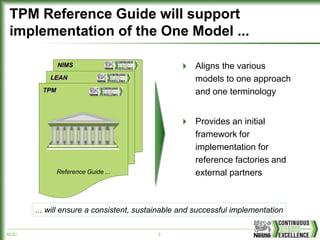
TPM Reference Guide will support
implementation of the One Model ...
Reference Guide ...
TPM
LEAN
NIMS
... will ensure a consistent, sustainable and successful implementation
Aligns the various
models to one approach
and one terminology
Provides an initial
framework for
implementation for
reference factories and
external partners
NCE/ 4
The Reference Guide is not
An exhaustive training document
A complete description of all elements of TPM
A guide to implement TPM in Markets without TPM Competence
What are the characteristics
of the TPM reference guide
The Reference Guide
Shows the Nestlé way of doing TPM
Demonstrates mandatory implementation elements unless
otherwise noted as recommended or example
Aligns the various TPM market models to one approach and
one terminology
Provides an initial framework for implementation of TPM with
focus on Maturity Phase 0
NCE/ 5
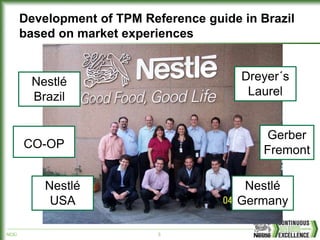
Development of TPM Reference guide in Brazil
based on market experiences
Nestlé
Brazil
Nestlé
USA
Dreyer´s
Laurel
Gerber
Fremont
Nestlé
Germany
CO-OP
NCE/ 6
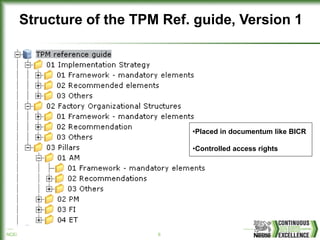
Structure of the TPM Ref. guide, Version 1
•Placed in documentum like BICR
•Controlled access rights
NCE/ 7
Agenda
Role and structure of the TPM reference guide
Examples:
Factory Implementation Strategy
Pillar Autonomous Maintenance
Use of the Reference guide
Conclusion
NCE/ 8
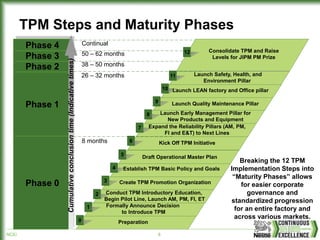
TPM Steps and Maturity Phases
0
1
2
3
4
5
6
7
8
9
10
11
12
Phase 0
Phase 1
Phase 2
Phase 3
Phase 4
Consolidate TPM and Raise
Levels for JIPM PM Prize
Launch Safety, Health, and
Environment Pillar
Formally Announce Decision
to Introduce TPM
Preparation
Create TPM Promotion Organization
Establish TPM Basic Policy and Goals
Draft Operational Master Plan
Expand the Reliability Pillars (AM, PM,
FI and E&T) to Next Lines
Kick Off TPM Initiative
Launch Early Management Pillar for
New Products and Equipment
Launch Quality Maintenance Pillar
Launch LEAN factory and Office pillar
Conduct TPM Introductory Education,
Begin Pilot Line, Launch AM, PM, FI, ET
8 months
26 – 32 months
38 – 50 months
50 – 62 months
Continual
Breaking the 12 TPM
Implementation Steps into
“Maturity Phases” allows
for easier corporate
governance and
standardized progression
for an entire factory and
across various markets.
Cumulative
conclusion
time
(Indicative
times)
NCE/ 11
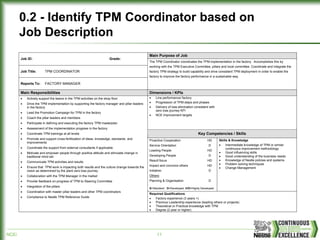
0.2 - Identify TPM Coordinator based on
Job Description
Main Purpose of Job
Job ID: Grade:
Job Title: TPM COORDINATOR
Reports To: FACTORY MANAGER
The TPM Coordinator coordinates the TPM implementation in the factory. Accomplishes this by
working with the TPM Executive Committee, pillars and local committee. Coordinate and integrate the
factory TPM strategy to build capability and drive consistent TPM deployment in order to enable the
factory to improve the factory performance in a sustainable way.
Main Responsibilities Dimensions / KPIs
 Line performance/ factory
 Progression of TPM steps and phases
 Delivery of loss elimination consistent with
zero loss journey KPI
 NCE improvement targets
Key Competencies / Skills
Proactive Cooperation HD
Service Orientation D
Leading People HD
Developing People D
Result focus HD
Impact and convince others HD
Initiative: D
Others:
Planning & Organisation D
S=Standard D=Developed H/D=Highly Developed
Skills & Knowledge
 Intermediate knowledge of TPM or similar
continuous improvement methodology
 Good influencing skills
 Good understanding of the business needs
 Knowledge of Nestle policies and systems
 Problem solving techniques
 Change Management
 Actively support the teams in the TPM activities on the shop floor
 Drive the TPM implementation by supporting the factory manager and pillar leaders
in the factory
 Lead the Promotion Campaign for TPM in the factory
 Coach the pillar leaders and members
 Participate in defining and executing the factory TPM masterplan
 Assessment of the implementation progress in the factory
 Coordinate TPM trainings at all levels
 Promote and support cross-fertilization of ideas, knowledge, standards and
improvements
 Coordinate the support from external consultants if applicable
 Motivate and empower people through positive attitude and stimulate change in
traditional mind set
 Communicate TPM activities and results
 Ensure that TPM work is impacting both results and the culture change towards the
vision as determined by the plant zero loss journey
 Collaboration with the TPM Manager in the market
 Provide feedback on progress of TPM to Steering Committee
 Integration of the pillars
 Coordination with master pillar leaders and other TPM coordinators
 Compliance to Nestle TPM Reference Guide
Required Qualifications
 Factory experience (3 years +)
 Previous Leadership experience (leading others or projects)
 Theoretical or Practical knowledge with TPM
 Degree (2 year or higher)
NCE/ 12
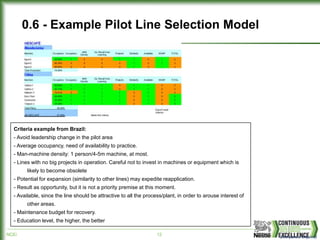
Criteria example from Brazil:
- Avoid leadership change in the pilot area
- Average occupancy, need of availability to practice.
- Man-machine density: 1 person/4-5m machine, at most.
- Lines with no big projects in operation. Careful not to invest in machines or equipment which is
likely to become obsolete
- Potential for expansion (similarity to other lines) may expedite reapplication.
- Result as opportunity, but it is not a priority premise at this moment.
- Available, since the line should be attractive to all the process/plant, in order to arouse interest of
other areas.
- Maintenance budget for recovery.
- Education level, the higher, the better
(link para o arquivo)
0.6 - Example Pilot Line Selection Model
NCE/ 13
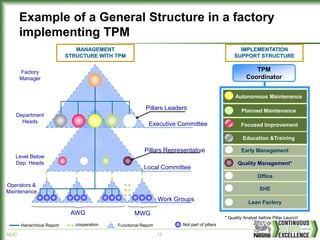
Example of a General Structure in a factory
implementing TPM
IMPLEMENTATION
SUPPORT STRUCTURE
Autonomous Maintenance
Education &Training
Planned Maintenance
Focused Improvement
Early Management
Quality Management*
Office
SHE
TPM
Coordinator
Factory
Manager
Department
Heads
Executive Committee
Local Committee
Pillars Representative
Level Below
Dep. Heads
Pillars Leaders
MANAGEMENT
STRUCTURE WITH TPM
Lean Factory
Work Groups
Operators &
Maintenance
AWG MWG
Hierarchical Report cooperation Functional Report Not part of pillars
* Quality Analyst before Pillar Launch
NCE/ 14
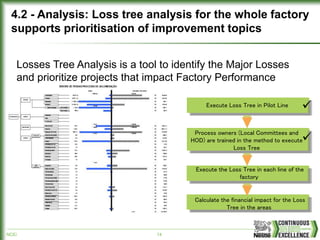
Execute Loss Tree in Pilot Line
Process owners (Local Committees and
HOD) are trained in the method to execute
Loss Tree
Execute the Loss Tree in each line of the
factory
Calculate the financial impact for the Loss
Tree in the areas
4.2 - Analysis: Loss tree analysis for the whole factory
supports prioritisation of improvement topics
Losses Tree Analysis is a tool to identify the Major Losses
and prioritize projects that impact Factory Performance


NCE/ 15
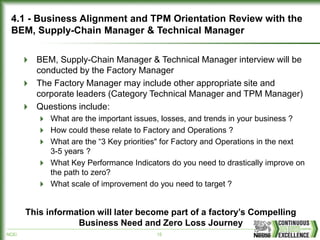
BEM, Supply-Chain Manager & Technical Manager interview will be
conducted by the Factory Manager
The Factory Manager may include other appropriate site and
corporate leaders (Category Technical Manager and TPM Manager)
Questions include:
What are the important issues, losses, and trends in your business ?
How could these relate to Factory and Operations ?
What are the “3 Key priorities" for Factory and Operations in the next
3-5 years ?
What Key Performance Indicators do you need to drastically improve on
the path to zero?
What scale of improvement do you need to target ?
4.1 - Business Alignment and TPM Orientation Review with the
BEM, Supply-Chain Manager & Technical Manager
This information will later become part of a factory’s Compelling
Business Need and Zero Loss Journey
NCE/ 16
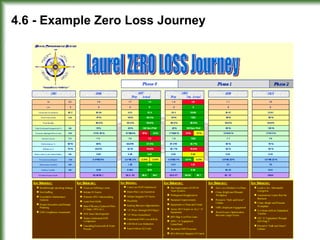
1. CBN & ZLJ
4.6 - Example Zero Loss Journey
NCE/ 17
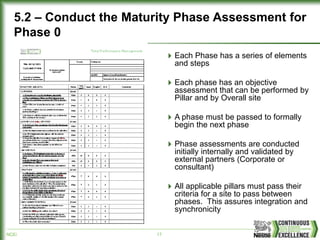
5.2 – Conduct the Maturity Phase Assessment for
Phase 0
Each Phase has a series of elements
and steps
Each phase has an objective
assessment that can be performed by
Pillar and by Overall site
A phase must be passed to formally
begin the next phase
Phase assessments are conducted
initially internally and validated by
external partners (Corporate or
consultant)
All applicable pillars must pass their
criteria for a site to pass between
phases. This assures integration and
synchronicity
NCE/ 18
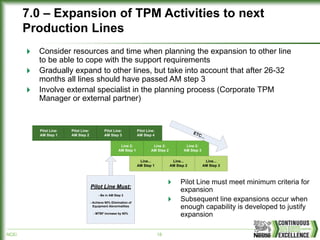
7.0 – Expansion of TPM Activities to next
Production Lines
Pilot Line:
AM Step 1
Pilot Line:
AM Step 2
Pilot Line:
AM Step 3
Line 2:
AM Step 1
Line 2:
AM Step 2
Line 2:
AM Step 3
Pilot Line:
AM Step 4
Line...
AM Step 1
Line...
AM Step 2
Line...
AM Step 3
Pilot Line Must:
- Be in AM Step 3
- Achieve 90% Elimination of
Equipment Abnormalities
- MTBF increase by 60%
ETC...
Pilot Line must meet minimum criteria for
expansion
Subsequent line expansions occur when
enough capability is developed to justify
expansion
Consider resources and time when planning the expansion to other line
to be able to cope with the support requirements
Gradually expand to other lines, but take into account that after 26-32
months all lines should have passed AM step 3
Involve external specialist in the planning process (Corporate TPM
Manager or external partner)
NCE/ 19
Agenda
Role and structure of the TPM reference guide
Examples:
Factory Implementation Strategy
Pillar Autonomous Maintenance
Use of the Reference guide
Conclusion
NCE/ 20
Agenda
Foreword
Pillar Definition
Pillar Methodology
Pillar Structure
Work Groups
Pillar Management
Key Learnings
NCE/ 21
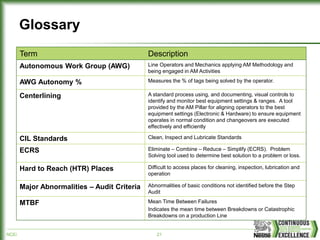
Term Description
Autonomous Work Group (AWG) Line Operators and Mechanics applying AM Methodology and
being engaged in AM Activities
AWG Autonomy % Measures the % of tags being solved by the operator.
Centerlining A standard process using, and documenting, visual controls to
identify and monitor best equipment settings & ranges. A tool
provided by the AM Pillar for aligning operators to the best
equipment settings (Electronic & Hardware) to ensure equipment
operates in normal condition and changeovers are executed
effectively and efficiently
CIL Standards Clean, Inspect and Lubricate Standards
ECRS Eliminate – Combine – Reduce – Simplify (ECRS). Problem
Solving tool used to determine best solution to a problem or loss.
Hard to Reach (HTR) Places Difficult to access places for cleaning, inspection, lubrication and
operation
Major Abnormalities – Audit Criteria Abnormalities of basic conditions not identified before the Step
Audit
MTBF Mean Time Between Failures
Indicates the mean time between Breakdowns or Catastrophic
Breakdowns on a production Line
Glossary
NCE/ 22
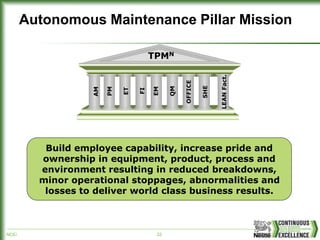
Autonomous Maintenance Pillar Mission
TPMN
LEAN
Fact.
ET
AM
PM
EM
QM
OFFICE
SHE
FI
Build employee capability, increase pride and
ownership in equipment, product, process and
environment resulting in reduced breakdowns,
minor operational stoppages, abnormalities and
losses to deliver world class business results.
NCE/ 23
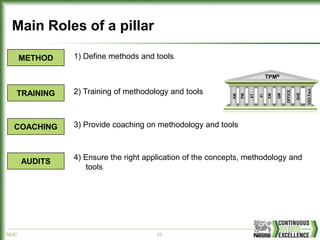
Main Roles of a pillar
METHOD 1) Define methods and tools
TRAINING 2) Training of methodology and tools
COACHING 3) Provide coaching on methodology and tools
4) Ensure the right application of the concepts, methodology and
tools
TPMN
VSO
Fact.
ET
AM
PM
EM
QM
OFFICE
SHE
FI
TPMN
VSO
Fact.
ET
AM
PM
EM
QM
OFFICE
SHE
FI
AUDITS
NCE/ 24
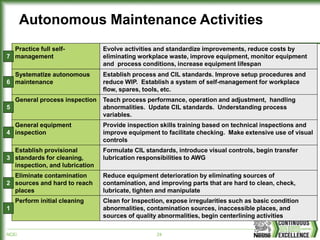
Autonomous Maintenance Activities
Perform initial cleaning Clean for Inspection, expose irregularities such as basic condition
abnormalities, contamination sources, inaccessible places, and
sources of quality abnormalities, begin centerlining activities
1
Eliminate contamination
sources and hard to reach
places
Reduce equipment deterioration by eliminating sources of
contamination, and improving parts that are hard to clean, check,
lubricate, tighten and manipulate
2
Establish provisional
standards for cleaning,
inspection, and lubrication
Formulate CIL standards, introduce visual controls, begin transfer
lubrication responsibilities to AWG
3
General equipment
inspection
Provide inspection skills training based on technical inspections and
improve equipment to facilitate checking. Make extensive use of visual
controls
4
General process inspection Teach process performance, operation and adjustment, handling
abnormalities. Update CIL standards. Understanding process
variables.
5
Systematize autonomous
maintenance
Establish process and CIL standards. Improve setup procedures and
reduce WIP. Establish a system of self-management for workplace
flow, spares, tools, etc.
6
Practice full self-
management
Evolve activities and standardize improvements, reduce costs by
eliminating workplace waste, improve equipment, monitor equipment
and process conditions, increase equipment lifespan
7
NCE/ 25
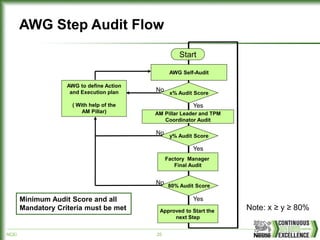
AWG Step Audit Flow
Minimum Audit Score and all
Mandatory Criteria must be met
Start
AWG Self-Audit
x% Audit Score
AWG to define Action
and Execution plan
( With help of the
AM Pillar) AM Pillar Leader and TPM
Coordinator Audit
Factory Manager
Final Audit
y% Audit Score
80% Audit Score
Approved to Start the
next Step
Yes
No
No
No
Yes
Yes
Note: x ≥ y ≥ 80%
NCE/ 26
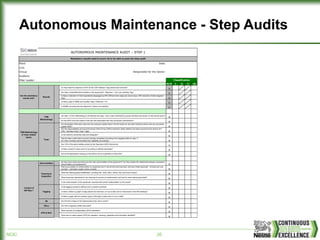
Autonomous Maintenance - Step Audits
Plant: Date:
Line:
Group: Responsible for the Sector:
Auditors:
Pillar Leader:
M/R 1 4 7 10
Do they meet the objective of 30% for the GAP between Tags placed and removed?
R
Are there unidentified abnormalities in the equipment? Objective < 10% over pending Tags.
R
Is there a reduction of minor operational stoppages by 25% (Where minor stops are not an issue, 25% reduction of other targeted
loss) R
Is there a gap of Safety and Qualtity Tags ( Objective = 0!)
R
Is NGMP according the line objective? (Value to be defined)
R
Are step 1 of the methodology to be followed and step 1 and 2 well understood by group members and shown on the activity board?
M
Do the AWG know the losses of the loss tree associated with their production line/machine?
M
Are the targets of the team clear and can everyone explain them? Are the trends for the main indicators shown and can everybody
explain them? M
Are the responsibilities among Autonomous Work Group (AWG) members clearly defined and does everyone know what to do?
(OPL, Activities Chart, Tools, Tags) M
Is the machine ownership clear and adequate?
M
Has the team a skill matrix and are trainings completed according to the targeted skills for step 1?
Do Team members demonstrate their capability accordingly? M
Are 10% of the abnormalities solved by the Operators (AWG Autonomy)
R
Is there a board in place and is it according to defined standards?
M
Are all the participants working on the actions and is it possible to check this?
M
Abnormalities
Do they know where and which are the main abnormalities of the equipment? Can they explain the relationship between equipment
abnormalities and breakdowns? M
Past accumulation of contamination on equipment and in the environment has been removed (initial cleaning)? All bolts and nuts
are tight. Lubrication system works correctly. M
Were the cleaning plans established, including who, what, when, where, why, and how to clean?
M
Were temporary standards for the cleaning of sources of contamination and hard to reach places generated?
M
Is the initial situation of the equipment recorded with photo's (before/after) on the board?
M
Is the tagging procedure defined and is properly working?
M
Is there a follow up graph of tags placed and removed, is it up to date and is it discussed in the AM meetings?
M
Is there a graph with the problem types of the tags in place and is it up to date?
M
5S Are the first 2 Steps of 5S implemented (Sort, Set in order)?
M
OPLs Are OPLs regularily written and used?
M
Were sources of contamination (SOC) identified?
M
Were hard to reach places (HTR) for operation, cleaning, inspection and lubrication identified?
M
Are the mandatory
results met?
TPM
Methodology
Team
Results
TPM Methodology
& Team related
topics
Content of
AM Step 1
Tagging
HTR & SOC
Cleaning &
Inspection
Classification
AUTONOMOUS MAINTENANCE AUDIT – STEP 1
Mandatory results need to score 10 to be able to pass the step audit
NCE/ 27
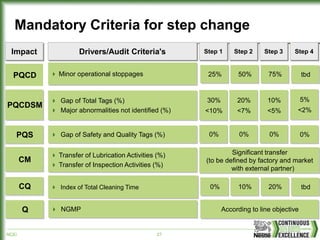
Mandatory Criteria for step change
Drivers/Audit Criteria's
Impact
 Minor operational stoppages
PQCD
PQCDSM
 Gap of Total Tags (%)
 Major abnormalities not identified (%)
PQS  Gap of Safety and Quality Tags (%)
 Transfer of Lubrication Activities (%)
 Transfer of Inspection Activities (%)
CM
Step 1
30%
<10%
0%
Step 2
20%
<7%
0%
Step 3
10%
<5%
0%
Step 4
5%
<2%
0%
CQ  Index of Total Cleaning Time
Q  NGMP According to line objective
Significant transfer
(to be defined by factory and market
with external partner)
25% 50% 75% tbd
0% 10% 20% tbd
NCE/ 28
Agenda
Role and structure of the TPM reference guide
Examples:
Factory Implementation Strategy
Pillar Autonomous Maintenance
Use of the Reference guide
Conclusion
NCE/ 29
How should it be used?
Factories to go through before starting TPM
Look up for clarification in the course of the implementation
Take templates and good examples
Use of the TPM reference guide
Who will have initial access to the reference guide?
Use by factory, market and head office responsibles who are involved in
implementation in the TPM factories (Status: 220 users)
Use also by EFESO to ensure consistency in the support to the factories
NCE/ 30
Conclusion
Management of the TPM Reference guide:
Process will be developed to further improve the reference guide:
capture feedback from the reference factories and external specialists
Validation committee for update process to be defined (Markets, Centre,
etc.)
Regular update e.g. twice per year
Elements to be defined:
Remaining pillars (EM, QM, SHE, Office, LEAN factory)
Phase assessments
Further details for AM, PM for later implementation phase
NCE/ 31
Conclusion
The TPM Reference guide:
is based on applied methodologies and principles with proven feasibility
is developed by factory and market representatives with TPM experience
(Brazil, Gerber, Dreyer´s, USA, Germany)
is an detailed, initial framework for the TPM Roll-out (161 files)
supports to have a disciplined implementation approach
is not a guide to implement TPM in Markets without TPM Competence.
Practical experience is needed!
TPM implementation based on the TPM Reference guide
will be ensured by audits
NCE/ 32
“…engage everyone’s heart & mind
in a consumer-driven War on Waste”

intro tpm ref guide.ppt

  • 1.
    Nestlé Continuous Excellence Introductionto the TPM Reference Guide 24th September 2008
  • 2.
    NCE/ 2 Agenda Role andstructure of the TPM reference guide Examples: Factory Implementation Strategy Pillar Autonomous Maintenance Use of the Reference guide Conclusion
  • 3.
    NCE/ 3 TPM ReferenceGuide will support implementation of the One Model ... Reference Guide ... TPM LEAN NIMS ... will ensure a consistent, sustainable and successful implementation Aligns the various models to one approach and one terminology Provides an initial framework for implementation for reference factories and external partners
  • 4.
    NCE/ 4 The ReferenceGuide is not An exhaustive training document A complete description of all elements of TPM A guide to implement TPM in Markets without TPM Competence What are the characteristics of the TPM reference guide The Reference Guide Shows the Nestlé way of doing TPM Demonstrates mandatory implementation elements unless otherwise noted as recommended or example Aligns the various TPM market models to one approach and one terminology Provides an initial framework for implementation of TPM with focus on Maturity Phase 0
  • 5.
    NCE/ 5 Development ofTPM Reference guide in Brazil based on market experiences Nestlé Brazil Nestlé USA Dreyer´s Laurel Gerber Fremont Nestlé Germany CO-OP
  • 6.
    NCE/ 6 Structure ofthe TPM Ref. guide, Version 1 •Placed in documentum like BICR •Controlled access rights
  • 7.
    NCE/ 7 Agenda Role andstructure of the TPM reference guide Examples: Factory Implementation Strategy Pillar Autonomous Maintenance Use of the Reference guide Conclusion
  • 8.
    NCE/ 8 TPM Stepsand Maturity Phases 0 1 2 3 4 5 6 7 8 9 10 11 12 Phase 0 Phase 1 Phase 2 Phase 3 Phase 4 Consolidate TPM and Raise Levels for JIPM PM Prize Launch Safety, Health, and Environment Pillar Formally Announce Decision to Introduce TPM Preparation Create TPM Promotion Organization Establish TPM Basic Policy and Goals Draft Operational Master Plan Expand the Reliability Pillars (AM, PM, FI and E&T) to Next Lines Kick Off TPM Initiative Launch Early Management Pillar for New Products and Equipment Launch Quality Maintenance Pillar Launch LEAN factory and Office pillar Conduct TPM Introductory Education, Begin Pilot Line, Launch AM, PM, FI, ET 8 months 26 – 32 months 38 – 50 months 50 – 62 months Continual Breaking the 12 TPM Implementation Steps into “Maturity Phases” allows for easier corporate governance and standardized progression for an entire factory and across various markets. Cumulative conclusion time (Indicative times)
  • 9.
    NCE/ 11 0.2 -Identify TPM Coordinator based on Job Description Main Purpose of Job Job ID: Grade: Job Title: TPM COORDINATOR Reports To: FACTORY MANAGER The TPM Coordinator coordinates the TPM implementation in the factory. Accomplishes this by working with the TPM Executive Committee, pillars and local committee. Coordinate and integrate the factory TPM strategy to build capability and drive consistent TPM deployment in order to enable the factory to improve the factory performance in a sustainable way. Main Responsibilities Dimensions / KPIs  Line performance/ factory  Progression of TPM steps and phases  Delivery of loss elimination consistent with zero loss journey KPI  NCE improvement targets Key Competencies / Skills Proactive Cooperation HD Service Orientation D Leading People HD Developing People D Result focus HD Impact and convince others HD Initiative: D Others: Planning & Organisation D S=Standard D=Developed H/D=Highly Developed Skills & Knowledge  Intermediate knowledge of TPM or similar continuous improvement methodology  Good influencing skills  Good understanding of the business needs  Knowledge of Nestle policies and systems  Problem solving techniques  Change Management  Actively support the teams in the TPM activities on the shop floor  Drive the TPM implementation by supporting the factory manager and pillar leaders in the factory  Lead the Promotion Campaign for TPM in the factory  Coach the pillar leaders and members  Participate in defining and executing the factory TPM masterplan  Assessment of the implementation progress in the factory  Coordinate TPM trainings at all levels  Promote and support cross-fertilization of ideas, knowledge, standards and improvements  Coordinate the support from external consultants if applicable  Motivate and empower people through positive attitude and stimulate change in traditional mind set  Communicate TPM activities and results  Ensure that TPM work is impacting both results and the culture change towards the vision as determined by the plant zero loss journey  Collaboration with the TPM Manager in the market  Provide feedback on progress of TPM to Steering Committee  Integration of the pillars  Coordination with master pillar leaders and other TPM coordinators  Compliance to Nestle TPM Reference Guide Required Qualifications  Factory experience (3 years +)  Previous Leadership experience (leading others or projects)  Theoretical or Practical knowledge with TPM  Degree (2 year or higher)
  • 10.
    NCE/ 12 Criteria examplefrom Brazil: - Avoid leadership change in the pilot area - Average occupancy, need of availability to practice. - Man-machine density: 1 person/4-5m machine, at most. - Lines with no big projects in operation. Careful not to invest in machines or equipment which is likely to become obsolete - Potential for expansion (similarity to other lines) may expedite reapplication. - Result as opportunity, but it is not a priority premise at this moment. - Available, since the line should be attractive to all the process/plant, in order to arouse interest of other areas. - Maintenance budget for recovery. - Education level, the higher, the better (link para o arquivo) 0.6 - Example Pilot Line Selection Model
  • 11.
    NCE/ 13 Example ofa General Structure in a factory implementing TPM IMPLEMENTATION SUPPORT STRUCTURE Autonomous Maintenance Education &Training Planned Maintenance Focused Improvement Early Management Quality Management* Office SHE TPM Coordinator Factory Manager Department Heads Executive Committee Local Committee Pillars Representative Level Below Dep. Heads Pillars Leaders MANAGEMENT STRUCTURE WITH TPM Lean Factory Work Groups Operators & Maintenance AWG MWG Hierarchical Report cooperation Functional Report Not part of pillars * Quality Analyst before Pillar Launch
  • 12.
    NCE/ 14 Execute LossTree in Pilot Line Process owners (Local Committees and HOD) are trained in the method to execute Loss Tree Execute the Loss Tree in each line of the factory Calculate the financial impact for the Loss Tree in the areas 4.2 - Analysis: Loss tree analysis for the whole factory supports prioritisation of improvement topics Losses Tree Analysis is a tool to identify the Major Losses and prioritize projects that impact Factory Performance  
  • 13.
    NCE/ 15 BEM, Supply-ChainManager & Technical Manager interview will be conducted by the Factory Manager The Factory Manager may include other appropriate site and corporate leaders (Category Technical Manager and TPM Manager) Questions include: What are the important issues, losses, and trends in your business ? How could these relate to Factory and Operations ? What are the “3 Key priorities" for Factory and Operations in the next 3-5 years ? What Key Performance Indicators do you need to drastically improve on the path to zero? What scale of improvement do you need to target ? 4.1 - Business Alignment and TPM Orientation Review with the BEM, Supply-Chain Manager & Technical Manager This information will later become part of a factory’s Compelling Business Need and Zero Loss Journey
  • 14.
    NCE/ 16 1. CBN& ZLJ 4.6 - Example Zero Loss Journey
  • 15.
    NCE/ 17 5.2 –Conduct the Maturity Phase Assessment for Phase 0 Each Phase has a series of elements and steps Each phase has an objective assessment that can be performed by Pillar and by Overall site A phase must be passed to formally begin the next phase Phase assessments are conducted initially internally and validated by external partners (Corporate or consultant) All applicable pillars must pass their criteria for a site to pass between phases. This assures integration and synchronicity
  • 16.
    NCE/ 18 7.0 –Expansion of TPM Activities to next Production Lines Pilot Line: AM Step 1 Pilot Line: AM Step 2 Pilot Line: AM Step 3 Line 2: AM Step 1 Line 2: AM Step 2 Line 2: AM Step 3 Pilot Line: AM Step 4 Line... AM Step 1 Line... AM Step 2 Line... AM Step 3 Pilot Line Must: - Be in AM Step 3 - Achieve 90% Elimination of Equipment Abnormalities - MTBF increase by 60% ETC... Pilot Line must meet minimum criteria for expansion Subsequent line expansions occur when enough capability is developed to justify expansion Consider resources and time when planning the expansion to other line to be able to cope with the support requirements Gradually expand to other lines, but take into account that after 26-32 months all lines should have passed AM step 3 Involve external specialist in the planning process (Corporate TPM Manager or external partner)
  • 17.
    NCE/ 19 Agenda Role andstructure of the TPM reference guide Examples: Factory Implementation Strategy Pillar Autonomous Maintenance Use of the Reference guide Conclusion
  • 18.
    NCE/ 20 Agenda Foreword Pillar Definition PillarMethodology Pillar Structure Work Groups Pillar Management Key Learnings
  • 19.
    NCE/ 21 Term Description AutonomousWork Group (AWG) Line Operators and Mechanics applying AM Methodology and being engaged in AM Activities AWG Autonomy % Measures the % of tags being solved by the operator. Centerlining A standard process using, and documenting, visual controls to identify and monitor best equipment settings & ranges. A tool provided by the AM Pillar for aligning operators to the best equipment settings (Electronic & Hardware) to ensure equipment operates in normal condition and changeovers are executed effectively and efficiently CIL Standards Clean, Inspect and Lubricate Standards ECRS Eliminate – Combine – Reduce – Simplify (ECRS). Problem Solving tool used to determine best solution to a problem or loss. Hard to Reach (HTR) Places Difficult to access places for cleaning, inspection, lubrication and operation Major Abnormalities – Audit Criteria Abnormalities of basic conditions not identified before the Step Audit MTBF Mean Time Between Failures Indicates the mean time between Breakdowns or Catastrophic Breakdowns on a production Line Glossary
  • 20.
    NCE/ 22 Autonomous MaintenancePillar Mission TPMN LEAN Fact. ET AM PM EM QM OFFICE SHE FI Build employee capability, increase pride and ownership in equipment, product, process and environment resulting in reduced breakdowns, minor operational stoppages, abnormalities and losses to deliver world class business results.
  • 21.
    NCE/ 23 Main Rolesof a pillar METHOD 1) Define methods and tools TRAINING 2) Training of methodology and tools COACHING 3) Provide coaching on methodology and tools 4) Ensure the right application of the concepts, methodology and tools TPMN VSO Fact. ET AM PM EM QM OFFICE SHE FI TPMN VSO Fact. ET AM PM EM QM OFFICE SHE FI AUDITS
  • 22.
    NCE/ 24 Autonomous MaintenanceActivities Perform initial cleaning Clean for Inspection, expose irregularities such as basic condition abnormalities, contamination sources, inaccessible places, and sources of quality abnormalities, begin centerlining activities 1 Eliminate contamination sources and hard to reach places Reduce equipment deterioration by eliminating sources of contamination, and improving parts that are hard to clean, check, lubricate, tighten and manipulate 2 Establish provisional standards for cleaning, inspection, and lubrication Formulate CIL standards, introduce visual controls, begin transfer lubrication responsibilities to AWG 3 General equipment inspection Provide inspection skills training based on technical inspections and improve equipment to facilitate checking. Make extensive use of visual controls 4 General process inspection Teach process performance, operation and adjustment, handling abnormalities. Update CIL standards. Understanding process variables. 5 Systematize autonomous maintenance Establish process and CIL standards. Improve setup procedures and reduce WIP. Establish a system of self-management for workplace flow, spares, tools, etc. 6 Practice full self- management Evolve activities and standardize improvements, reduce costs by eliminating workplace waste, improve equipment, monitor equipment and process conditions, increase equipment lifespan 7
  • 23.
    NCE/ 25 AWG StepAudit Flow Minimum Audit Score and all Mandatory Criteria must be met Start AWG Self-Audit x% Audit Score AWG to define Action and Execution plan ( With help of the AM Pillar) AM Pillar Leader and TPM Coordinator Audit Factory Manager Final Audit y% Audit Score 80% Audit Score Approved to Start the next Step Yes No No No Yes Yes Note: x ≥ y ≥ 80%
  • 24.
    NCE/ 26 Autonomous Maintenance- Step Audits Plant: Date: Line: Group: Responsible for the Sector: Auditors: Pillar Leader: M/R 1 4 7 10 Do they meet the objective of 30% for the GAP between Tags placed and removed? R Are there unidentified abnormalities in the equipment? Objective < 10% over pending Tags. R Is there a reduction of minor operational stoppages by 25% (Where minor stops are not an issue, 25% reduction of other targeted loss) R Is there a gap of Safety and Qualtity Tags ( Objective = 0!) R Is NGMP according the line objective? (Value to be defined) R Are step 1 of the methodology to be followed and step 1 and 2 well understood by group members and shown on the activity board? M Do the AWG know the losses of the loss tree associated with their production line/machine? M Are the targets of the team clear and can everyone explain them? Are the trends for the main indicators shown and can everybody explain them? M Are the responsibilities among Autonomous Work Group (AWG) members clearly defined and does everyone know what to do? (OPL, Activities Chart, Tools, Tags) M Is the machine ownership clear and adequate? M Has the team a skill matrix and are trainings completed according to the targeted skills for step 1? Do Team members demonstrate their capability accordingly? M Are 10% of the abnormalities solved by the Operators (AWG Autonomy) R Is there a board in place and is it according to defined standards? M Are all the participants working on the actions and is it possible to check this? M Abnormalities Do they know where and which are the main abnormalities of the equipment? Can they explain the relationship between equipment abnormalities and breakdowns? M Past accumulation of contamination on equipment and in the environment has been removed (initial cleaning)? All bolts and nuts are tight. Lubrication system works correctly. M Were the cleaning plans established, including who, what, when, where, why, and how to clean? M Were temporary standards for the cleaning of sources of contamination and hard to reach places generated? M Is the initial situation of the equipment recorded with photo's (before/after) on the board? M Is the tagging procedure defined and is properly working? M Is there a follow up graph of tags placed and removed, is it up to date and is it discussed in the AM meetings? M Is there a graph with the problem types of the tags in place and is it up to date? M 5S Are the first 2 Steps of 5S implemented (Sort, Set in order)? M OPLs Are OPLs regularily written and used? M Were sources of contamination (SOC) identified? M Were hard to reach places (HTR) for operation, cleaning, inspection and lubrication identified? M Are the mandatory results met? TPM Methodology Team Results TPM Methodology & Team related topics Content of AM Step 1 Tagging HTR & SOC Cleaning & Inspection Classification AUTONOMOUS MAINTENANCE AUDIT – STEP 1 Mandatory results need to score 10 to be able to pass the step audit
  • 25.
    NCE/ 27 Mandatory Criteriafor step change Drivers/Audit Criteria's Impact  Minor operational stoppages PQCD PQCDSM  Gap of Total Tags (%)  Major abnormalities not identified (%) PQS  Gap of Safety and Quality Tags (%)  Transfer of Lubrication Activities (%)  Transfer of Inspection Activities (%) CM Step 1 30% <10% 0% Step 2 20% <7% 0% Step 3 10% <5% 0% Step 4 5% <2% 0% CQ  Index of Total Cleaning Time Q  NGMP According to line objective Significant transfer (to be defined by factory and market with external partner) 25% 50% 75% tbd 0% 10% 20% tbd
  • 26.
    NCE/ 28 Agenda Role andstructure of the TPM reference guide Examples: Factory Implementation Strategy Pillar Autonomous Maintenance Use of the Reference guide Conclusion
  • 27.
    NCE/ 29 How shouldit be used? Factories to go through before starting TPM Look up for clarification in the course of the implementation Take templates and good examples Use of the TPM reference guide Who will have initial access to the reference guide? Use by factory, market and head office responsibles who are involved in implementation in the TPM factories (Status: 220 users) Use also by EFESO to ensure consistency in the support to the factories
  • 28.
    NCE/ 30 Conclusion Management ofthe TPM Reference guide: Process will be developed to further improve the reference guide: capture feedback from the reference factories and external specialists Validation committee for update process to be defined (Markets, Centre, etc.) Regular update e.g. twice per year Elements to be defined: Remaining pillars (EM, QM, SHE, Office, LEAN factory) Phase assessments Further details for AM, PM for later implementation phase
  • 29.
    NCE/ 31 Conclusion The TPMReference guide: is based on applied methodologies and principles with proven feasibility is developed by factory and market representatives with TPM experience (Brazil, Gerber, Dreyer´s, USA, Germany) is an detailed, initial framework for the TPM Roll-out (161 files) supports to have a disciplined implementation approach is not a guide to implement TPM in Markets without TPM Competence. Practical experience is needed! TPM implementation based on the TPM Reference guide will be ensured by audits
  • 30.
    NCE/ 32 “…engage everyone’sheart & mind in a consumer-driven War on Waste”