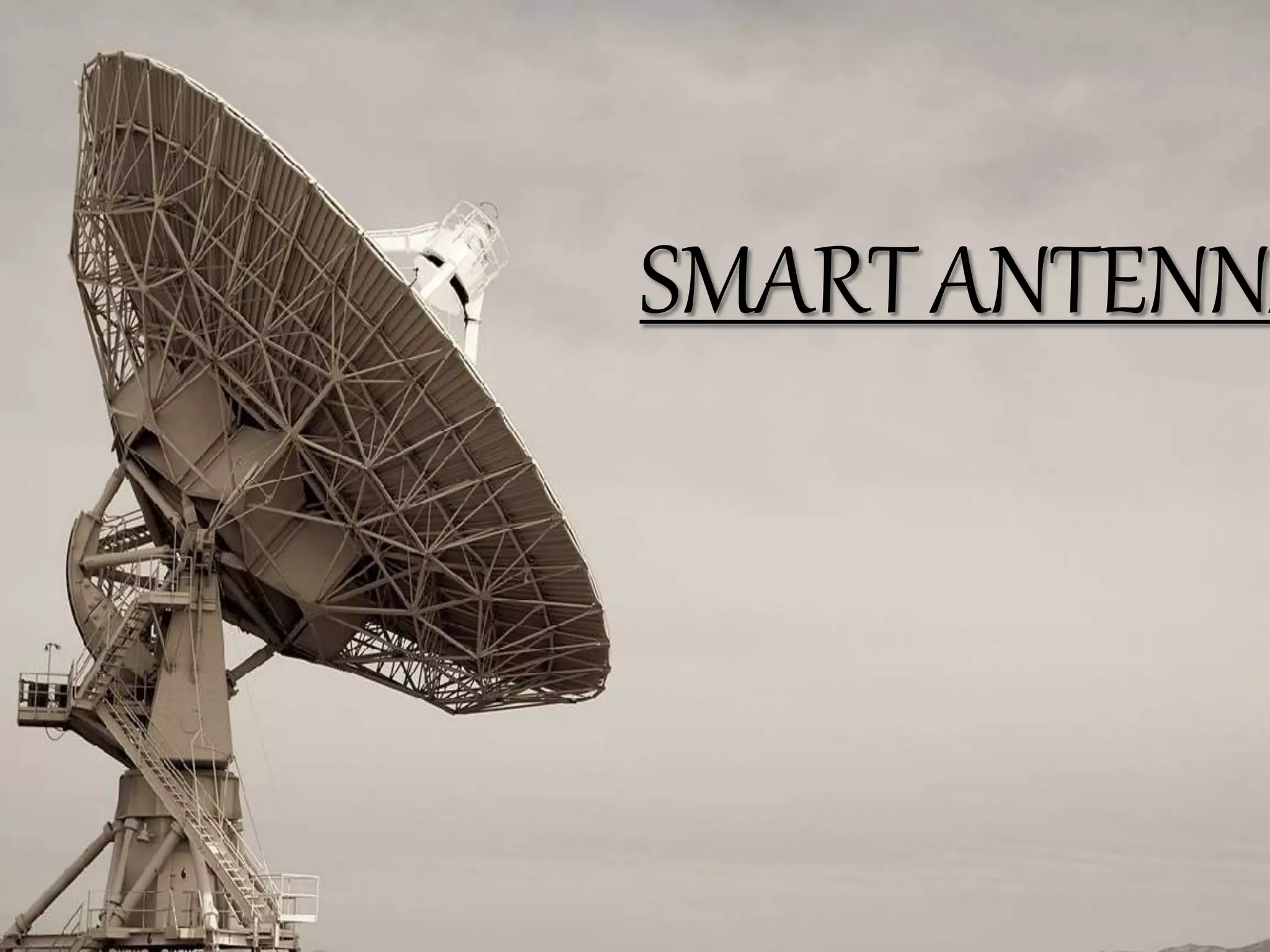
SMART ANTENNAS
PRESENTATION BY
apoorva k. Shetti
2bu09ec006
UNDER THE GUIDANCE OF
Lect. AMARJEETSINGH THAKUR
SMARTANTENNA
INTRODUCTION
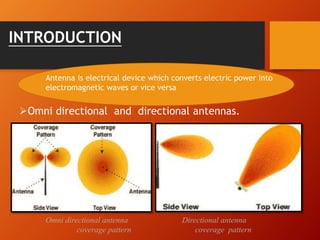
Omni directional and directional antennas.
Omni directional antenna Directional antenna
coverage pattern coverage pattern
Antenna is electrical device which converts electric power into
electromagnetic waves or vice versa
WHAT IS A SMART ANTENNA ?
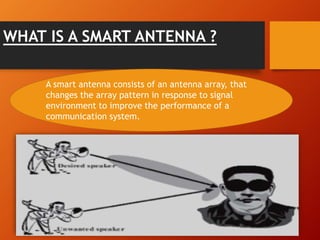
A smart antenna consists of an antenna array, that
changes the array pattern in response to signal
environment to improve the performance of a
communication system.
SMART ANTENNA DESCRIPTION
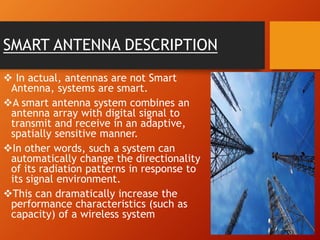
 In actual, antennas are not Smart
Antenna, systems are smart.
A smart antenna system combines an
antenna array with digital signal to
transmit and receive in an adaptive,
spatially sensitive manner.
In other words, such a system can
automatically change the directionality
of its radiation patterns in response to
its signal environment.
This can dramatically increase the
performance characteristics (such as
capacity) of a wireless system
AIMS OF SMART ANTENNAS?
A smart antenna is a multi-element antenna where
the signals received at each antenna element are
intelligently combined to improve the performance
of the wireless system
To maximize the antenna gain in the desired
direction.
To minimize the gain in directions of interferers
Increase signal range
Suppress interfering signals
Combat signal fading
Increase the capacity of wireless systems
WHAT MAKES SMART ANTENNAS
SMART?
A simple antenna works for a simple RF environment.
 Smart antenna solutions are required as the number
of users, interference, and propagation complexity
grow.
 Their smarts reside in their digital signal-processing
facilities
TYPES OF SMART ANTENNA
PHASED BEAM ANTENNA
- a finite number of fixed ,predefined
patterns.
ADAPTIVE ARRAY ANTENNA
- an infinite number of patterns
PHASED BEAM ANTENNAS
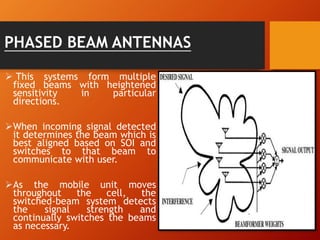
 This systems form multiple
fixed beams with heightened
sensitivity in particular
directions.
When incoming signal detected
it determines the beam which is
best aligned based on SOI and
switches to that beam to
communicate with user.
As the mobile unit moves
throughout the cell, the
switched-beam system detects
the signal strength and
continually switches the beams
as necessary.
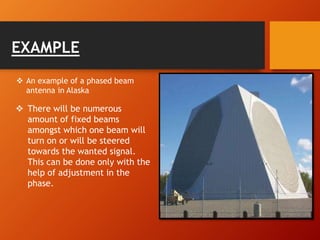
 There will be numerous
amount of fixed beams
amongst which one beam will
turn on or will be steered
towards the wanted signal.
This can be done only with the
help of adjustment in the
phase.
 An example of a phased beam
antenna in Alaska
EXAMPLE
BLOCK DIAGRAM OF THE PBA
Figure : Block diagram
of Switched beam
systems
 PSN, which forms multiple
beams looking in certain
directions.
 RF Switch actuates the right
beam in the desired
direction.
 The PSN subdivides sector
into many narrow beams,
then each beam is considered
as individual sector serving
user or group of users.
OPERATING PRINCIPLE
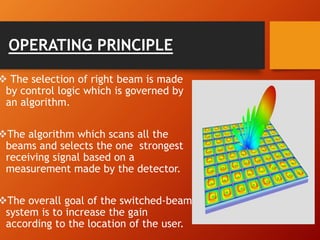
 The selection of right beam is made
by control logic which is governed by
an algorithm.
The algorithm which scans all the
beams and selects the one strongest
receiving signal based on a
measurement made by the detector.
The overall goal of the switched-beam
system is to increase the gain
according to the location of the user.
ADAPTIVE ARRAY ANTENNAS
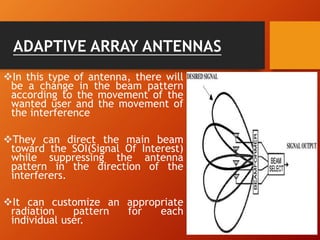
In this type of antenna, there will
be a change in the beam pattern
according to the movement of the
wanted user and the movement of
the interference
They can direct the main beam
toward the SOI(Signal Of Interest)
while suppressing the antenna
pattern in the direction of the
interferers.
It can customize an appropriate
radiation pattern for each
individual user.
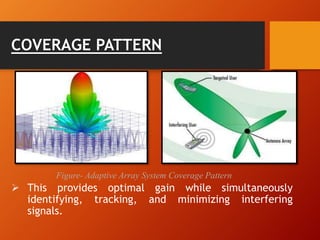
COVERAGE PATTERN
 This provides optimal gain while simultaneously
identifying, tracking, and minimizing interfering
signals.
Figure- Adaptive Array System Coverage Pattern
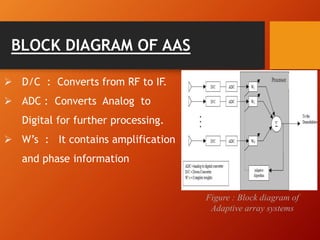
BLOCK DIAGRAM OF AAS
Figure : Block diagram of
Adaptive array systems
 D/C : Converts from RF to IF.
 ADC : Converts Analog to
Digital for further processing.
 W’s : It contains amplification
and phase information
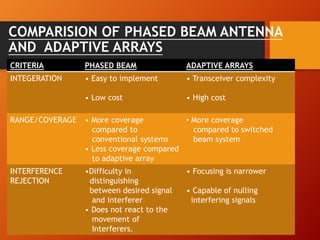
COMPARISION OF PHASED BEAM ANTENNA
AND ADAPTIVE ARRAYS
CRITERIA PHASED BEAM ADAPTIVE ARRAYS
INTEGERATION • Easy to implement
• Low cost
• Transceiver complexity
• High cost
RANGE/COVERAGE • More coverage
compared to
conventional systems
• Less coverage compared
to adaptive array
• More coverage
compared to switched
beam system
INTERFERENCE
REJECTION
•Difficulty in
distinguishing
between desired signal
and interferer
• Does not react to the
movement of
Interferers.
• Focusing is narrower
• Capable of nulling
interfering signals
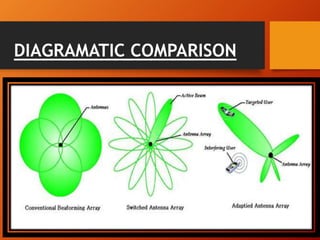
DIAGRAMATIC COMPARISON
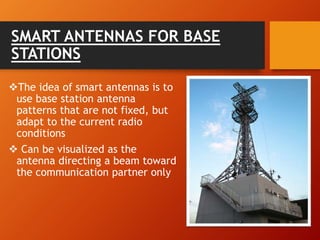
SMART ANTENNAS FOR BASE
STATIONS
The idea of smart antennas is to
use base station antenna
patterns that are not fixed, but
adapt to the current radio
conditions
 Can be visualized as the
antenna directing a beam toward
the communication partner only
SPACE DIVISION MULTIPLE ACCESS
Among the most sophisticated utilization of smart
antenna technology is SDMA.
It employs advanced technique to, in effect, locate
and track fixed and mobile terminals, adaptively
steering transmission signal toward user and interferers.
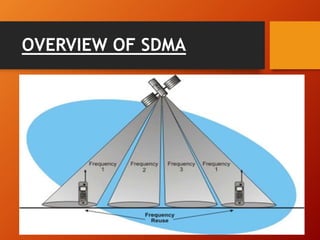
Beams are sliced to keep different users in different
beams at the same frequency which allows reuse of
frequency.
This technology achieves superior levels of interference
suppression and reduces RF pollution.
OVERVIEW OF SDMA
SPECIFICATIONS OF SDMA
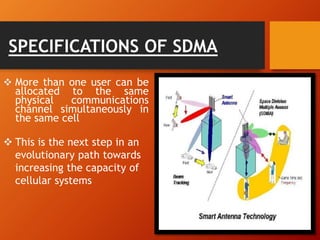
 More than one user can be
allocated to the same
physical communications
channel simultaneously in
the same cell
 This is the next step in an
evolutionary path towards
increasing the capacity of
cellular systems
ADVANTAGES OF SMART ANTENNA
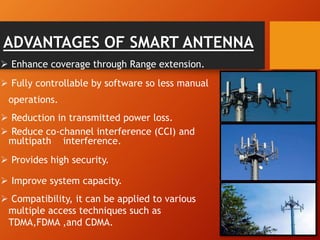
 Enhance coverage through Range extension.
 Fully controllable by software so less manual
operations.
 Reduction in transmitted power loss.
 Reduce co-channel interference (CCI) and
multipath interference.
 Provides high security.
 Improve system capacity.
 Compatibility, it can be applied to various
multiple access techniques such as
TDMA,FDMA ,and CDMA.
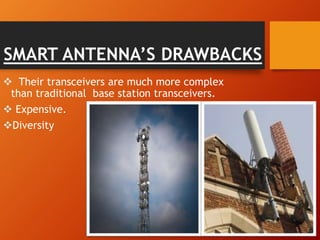
SMART ANTENNA’S DRAWBACKS
 Their transceivers are much more complex
than traditional base station transceivers.
 Expensive.
Diversity
OTHER APPLICATIONS OF SAS:
Cellular and wireless networks
Electronic warfare (EWF) as a countermeasure to electronic jamming
Satellite systems
CONCLUSION
Smart antennas are the intelligent antenna systems that vastly
improve the efficiency of wireless transmission.
SAS can achieve
 High transmission data rate
 Increased Coverage area
 Effectively reducing multipath and co channel interference.
 They are software-controllable, remotely configurable.
 Promising technology to resolve the traffic capacity .
Hence smart antenna system is indeed a modern age marvel

Smart antenna systems

  • 1.
    SMART ANTENNAS PRESENTATION BY apoorvak. Shetti 2bu09ec006 UNDER THE GUIDANCE OF Lect. AMARJEETSINGH THAKUR SMARTANTENNA
  • 2.
    INTRODUCTION Omni directional anddirectional antennas. Omni directional antenna Directional antenna coverage pattern coverage pattern Antenna is electrical device which converts electric power into electromagnetic waves or vice versa
  • 3.
    WHAT IS ASMART ANTENNA ? A smart antenna consists of an antenna array, that changes the array pattern in response to signal environment to improve the performance of a communication system.
  • 4.
    SMART ANTENNA DESCRIPTION In actual, antennas are not Smart Antenna, systems are smart. A smart antenna system combines an antenna array with digital signal to transmit and receive in an adaptive, spatially sensitive manner. In other words, such a system can automatically change the directionality of its radiation patterns in response to its signal environment. This can dramatically increase the performance characteristics (such as capacity) of a wireless system
  • 5.
    AIMS OF SMARTANTENNAS? A smart antenna is a multi-element antenna where the signals received at each antenna element are intelligently combined to improve the performance of the wireless system To maximize the antenna gain in the desired direction. To minimize the gain in directions of interferers Increase signal range Suppress interfering signals Combat signal fading Increase the capacity of wireless systems
  • 6.
    WHAT MAKES SMARTANTENNAS SMART? A simple antenna works for a simple RF environment.  Smart antenna solutions are required as the number of users, interference, and propagation complexity grow.  Their smarts reside in their digital signal-processing facilities
  • 7.
    TYPES OF SMARTANTENNA PHASED BEAM ANTENNA - a finite number of fixed ,predefined patterns. ADAPTIVE ARRAY ANTENNA - an infinite number of patterns
  • 8.
    PHASED BEAM ANTENNAS This systems form multiple fixed beams with heightened sensitivity in particular directions. When incoming signal detected it determines the beam which is best aligned based on SOI and switches to that beam to communicate with user. As the mobile unit moves throughout the cell, the switched-beam system detects the signal strength and continually switches the beams as necessary.
  • 9.
     There willbe numerous amount of fixed beams amongst which one beam will turn on or will be steered towards the wanted signal. This can be done only with the help of adjustment in the phase.  An example of a phased beam antenna in Alaska EXAMPLE
  • 10.
    BLOCK DIAGRAM OFTHE PBA Figure : Block diagram of Switched beam systems  PSN, which forms multiple beams looking in certain directions.  RF Switch actuates the right beam in the desired direction.  The PSN subdivides sector into many narrow beams, then each beam is considered as individual sector serving user or group of users.
  • 11.
    OPERATING PRINCIPLE  Theselection of right beam is made by control logic which is governed by an algorithm. The algorithm which scans all the beams and selects the one strongest receiving signal based on a measurement made by the detector. The overall goal of the switched-beam system is to increase the gain according to the location of the user.
  • 12.
    ADAPTIVE ARRAY ANTENNAS Inthis type of antenna, there will be a change in the beam pattern according to the movement of the wanted user and the movement of the interference They can direct the main beam toward the SOI(Signal Of Interest) while suppressing the antenna pattern in the direction of the interferers. It can customize an appropriate radiation pattern for each individual user.
  • 13.
    COVERAGE PATTERN  Thisprovides optimal gain while simultaneously identifying, tracking, and minimizing interfering signals. Figure- Adaptive Array System Coverage Pattern
  • 14.
    BLOCK DIAGRAM OFAAS Figure : Block diagram of Adaptive array systems  D/C : Converts from RF to IF.  ADC : Converts Analog to Digital for further processing.  W’s : It contains amplification and phase information
  • 15.
    COMPARISION OF PHASEDBEAM ANTENNA AND ADAPTIVE ARRAYS CRITERIA PHASED BEAM ADAPTIVE ARRAYS INTEGERATION • Easy to implement • Low cost • Transceiver complexity • High cost RANGE/COVERAGE • More coverage compared to conventional systems • Less coverage compared to adaptive array • More coverage compared to switched beam system INTERFERENCE REJECTION •Difficulty in distinguishing between desired signal and interferer • Does not react to the movement of Interferers. • Focusing is narrower • Capable of nulling interfering signals
  • 16.
  • 17.
    SMART ANTENNAS FORBASE STATIONS The idea of smart antennas is to use base station antenna patterns that are not fixed, but adapt to the current radio conditions  Can be visualized as the antenna directing a beam toward the communication partner only
  • 18.
    SPACE DIVISION MULTIPLEACCESS Among the most sophisticated utilization of smart antenna technology is SDMA. It employs advanced technique to, in effect, locate and track fixed and mobile terminals, adaptively steering transmission signal toward user and interferers. Beams are sliced to keep different users in different beams at the same frequency which allows reuse of frequency. This technology achieves superior levels of interference suppression and reduces RF pollution.
  • 19.
  • 20.
    SPECIFICATIONS OF SDMA More than one user can be allocated to the same physical communications channel simultaneously in the same cell  This is the next step in an evolutionary path towards increasing the capacity of cellular systems
  • 21.
    ADVANTAGES OF SMARTANTENNA  Enhance coverage through Range extension.  Fully controllable by software so less manual operations.  Reduction in transmitted power loss.  Reduce co-channel interference (CCI) and multipath interference.  Provides high security.  Improve system capacity.  Compatibility, it can be applied to various multiple access techniques such as TDMA,FDMA ,and CDMA.
  • 22.
    SMART ANTENNA’S DRAWBACKS Their transceivers are much more complex than traditional base station transceivers.  Expensive. Diversity
  • 23.
    OTHER APPLICATIONS OFSAS: Cellular and wireless networks Electronic warfare (EWF) as a countermeasure to electronic jamming Satellite systems
  • 24.
    CONCLUSION Smart antennas arethe intelligent antenna systems that vastly improve the efficiency of wireless transmission. SAS can achieve  High transmission data rate  Increased Coverage area  Effectively reducing multipath and co channel interference.  They are software-controllable, remotely configurable.  Promising technology to resolve the traffic capacity . Hence smart antenna system is indeed a modern age marvel