Characteristics
• Servant Leader
• Communicative and social
• Facilitative
• Assertive
• Situational Awareness
• Continual improvement
• Attitude of empowerment
• Conflict resolution
• Attitude of transparency
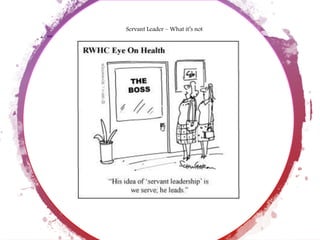
Servant Leader – What it’s not
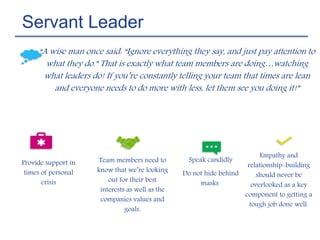
Servant Leader
“A wise man once said: “Ignore everything they say, and just pay attention to
what they do.” That is exactly what team members are doing…watching
what leaders do! If you’re constantly telling your team that times are lean
and everyone needs to do more with less, let them see you doing it!”
Speak candidly
Do not hide behind
masks
Provide support in
times of personal
crisis
Team members need to
know that we’re looking
out for their best
interests as well as the
companies values and
goals.
Empathy and
relationship-building
should never be
overlooked as a key
component to getting a
tough job done well.
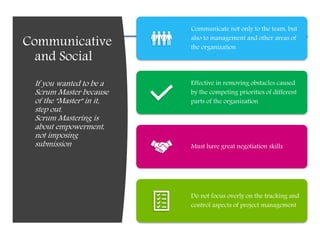
Communicative
and Social
If you wanted to be a
Scrum Master because
of the "Master" in it,
step out.
Scrum Mastering is
about empowerment,
not imposing
submission
Communicate not only to the team, but
also to management and other areas of
the organization
Effective in removing obstacles caused
by the competing priorities of different
parts of the organization
Must have great negotiation skills
Do not focus overly on the tracking and
control aspects of project management
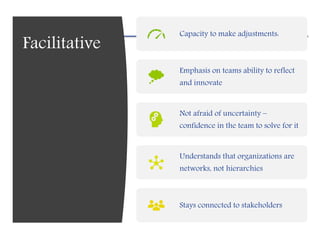
Facilitative
Capacity to make adjustments:
Emphasis on teams ability to reflect
and innovate
Not afraid of uncertainty –
confidence in the team to solve for it
Understands that organizations are
networks, not hierarchies
Stays connected to stakeholders
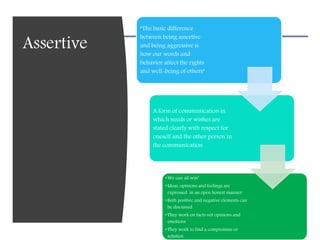
Assertive
“The basic difference
between being assertive
and being aggressive is
how our words and
behavior affect the rights
and well-being of others”
A form of communication in
which needs or wishes are
stated clearly with respect for
oneself and the other person in
the communication
Assertive leader
•We can all win’
•Ideas, opinions and feelings are
expressed in an open honest manner
•Both positive and negative elements can
be discussed
•They work on facts not opinions and
emotions
•They work to find a compromise or
solution
Situational
Awareness
• Know what to Look For
• Understand What it means
• Know How to Proceed
• When to Direct
• When to Coach
• When to Support
• When to Delegate
Continual
improvement
• Retrospective
– Start doing
– Stop doing
– Continue doing
• For retrospectives to be helpful, they must be
effective. Without a focus, they can easily turn
into non-productive gripe sessions.
• Lead with curiosity
Attitude of Empowerment
RESOLVE CONFLICTS: The
scrum master is responsible for
removing certain barriers
HANDLING IMPEDIMENTS: A
scrum master must actually
work to help remove
impediments reported during
the daily scrum.
PROTECTING THE TEAM: The
scrum master must protect the
team from disruptive outside
influences.
Conflict
Resolution
• A conflict is more than just a disagreement. It is a
situation in which one or both parties perceive a
threat (whether or not the threat is real).
• Conflicts continue to fester when ignored. Because
conflicts involve perceived threats to our well-
being and survival, they stay with us until we face
and resolve them.
• We respond to conflicts based on our perceptions
of the situation, not necessarily to an objective
review of the facts. Our perceptions are
influenced by our life experiences, culture,
values, and beliefs.
• Conflicts trigger strong emotions. If you aren’t
comfortable with your emotions or able to
manage them in times of stress, you won’t be able
to resolve conflict successfully.
• Conflicts are an opportunity for growth. When
you’re able to resolve conflict in a relationship, it
builds trust. You can feel secure knowing your
relationship can survive challenges and
disagreement
Attitude of Transparency
• What does transparency mean in Agile?
““Scrum keeps everything about a project visible to everyone.”
(Ken Schwaber, Agile Software Development with Scrum)
• Actions that promote transparency – Scrum Master & Product Owner
• We are primarily discovering, not constructing
• Walk the gemba -In business, gemba refers to the place where value is
created; The “Scrum board” helps walk the gemba.
• To Partner with the team, not subcontract it.
• Develop interest in the team's technical activities.
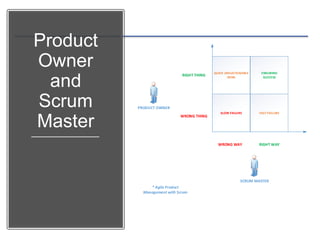
Product
Owner
and
Scrum
Master
QUICK UNSUSTAINABLE
WINS
SLOW FAILURE
ENDURING
SUCCESS
FAST FAILURE
RIGHT THING
WRONG THING
RIGHT WAYWRONG WAY
PRODUCT OWNER
SCRUM MASTER
* Agile Product
Management with Scrum
Thank You for
Attending
“At its root, Scrum is based on a simple idea:
whenever you start a project, why not regularly
check in, see if what you’re doing is heading in the
right direction, and if it’s actually what people
want? And question whether there are any ways to
improve how you’re doing what you’re doing, any
ways of doing it better and faster, and what might
be keeping you from doing that.”
― Jeff Sutherland, Scrum: The Art of Doing Twice
the Work in Half the Time

Characteristics of an effective Scrum Master

  • 2.
    Characteristics • Servant Leader •Communicative and social • Facilitative • Assertive • Situational Awareness • Continual improvement • Attitude of empowerment • Conflict resolution • Attitude of transparency
  • 3.
    Servant Leader –What it’s not
  • 4.
    Servant Leader “A wiseman once said: “Ignore everything they say, and just pay attention to what they do.” That is exactly what team members are doing…watching what leaders do! If you’re constantly telling your team that times are lean and everyone needs to do more with less, let them see you doing it!” Speak candidly Do not hide behind masks Provide support in times of personal crisis Team members need to know that we’re looking out for their best interests as well as the companies values and goals. Empathy and relationship-building should never be overlooked as a key component to getting a tough job done well.
  • 5.
    Communicative and Social If youwanted to be a Scrum Master because of the "Master" in it, step out. Scrum Mastering is about empowerment, not imposing submission Communicate not only to the team, but also to management and other areas of the organization Effective in removing obstacles caused by the competing priorities of different parts of the organization Must have great negotiation skills Do not focus overly on the tracking and control aspects of project management
  • 6.
    Facilitative Capacity to makeadjustments: Emphasis on teams ability to reflect and innovate Not afraid of uncertainty – confidence in the team to solve for it Understands that organizations are networks, not hierarchies Stays connected to stakeholders
  • 7.
    Assertive “The basic difference betweenbeing assertive and being aggressive is how our words and behavior affect the rights and well-being of others” A form of communication in which needs or wishes are stated clearly with respect for oneself and the other person in the communication Assertive leader •We can all win’ •Ideas, opinions and feelings are expressed in an open honest manner •Both positive and negative elements can be discussed •They work on facts not opinions and emotions •They work to find a compromise or solution
  • 8.
    Situational Awareness • Know whatto Look For • Understand What it means • Know How to Proceed • When to Direct • When to Coach • When to Support • When to Delegate
  • 9.
    Continual improvement • Retrospective – Startdoing – Stop doing – Continue doing • For retrospectives to be helpful, they must be effective. Without a focus, they can easily turn into non-productive gripe sessions. • Lead with curiosity
  • 10.
    Attitude of Empowerment RESOLVECONFLICTS: The scrum master is responsible for removing certain barriers HANDLING IMPEDIMENTS: A scrum master must actually work to help remove impediments reported during the daily scrum. PROTECTING THE TEAM: The scrum master must protect the team from disruptive outside influences.
  • 11.
    Conflict Resolution • A conflictis more than just a disagreement. It is a situation in which one or both parties perceive a threat (whether or not the threat is real). • Conflicts continue to fester when ignored. Because conflicts involve perceived threats to our well- being and survival, they stay with us until we face and resolve them. • We respond to conflicts based on our perceptions of the situation, not necessarily to an objective review of the facts. Our perceptions are influenced by our life experiences, culture, values, and beliefs. • Conflicts trigger strong emotions. If you aren’t comfortable with your emotions or able to manage them in times of stress, you won’t be able to resolve conflict successfully. • Conflicts are an opportunity for growth. When you’re able to resolve conflict in a relationship, it builds trust. You can feel secure knowing your relationship can survive challenges and disagreement
  • 12.
    Attitude of Transparency •What does transparency mean in Agile? ““Scrum keeps everything about a project visible to everyone.” (Ken Schwaber, Agile Software Development with Scrum) • Actions that promote transparency – Scrum Master & Product Owner • We are primarily discovering, not constructing • Walk the gemba -In business, gemba refers to the place where value is created; The “Scrum board” helps walk the gemba. • To Partner with the team, not subcontract it. • Develop interest in the team's technical activities.
  • 13.
    Product Owner and Scrum Master QUICK UNSUSTAINABLE WINS SLOW FAILURE ENDURING SUCCESS FASTFAILURE RIGHT THING WRONG THING RIGHT WAYWRONG WAY PRODUCT OWNER SCRUM MASTER * Agile Product Management with Scrum
  • 14.
    Thank You for Attending “Atits root, Scrum is based on a simple idea: whenever you start a project, why not regularly check in, see if what you’re doing is heading in the right direction, and if it’s actually what people want? And question whether there are any ways to improve how you’re doing what you’re doing, any ways of doing it better and faster, and what might be keeping you from doing that.” ― Jeff Sutherland, Scrum: The Art of Doing Twice the Work in Half the Time

Editor's Notes

  • #2 This is a discussion – about what it takes to be a perfect scrum master . The characteristics I highlight in this presentation are there to serve as guide to our discussion
  • #3 You have to be communicative in order to be facilitative You have to be situational aware in order to know when to be assertive or when there is a conflict You have to empower your team to be able to make improvements.
  • #5 Influence without authority. - Be authentic Do not hide behind masks Christine decided to be tough. She was the CEO of credit reporting/debt collection company. The company had recently been acquired by a financial equity company and she promised a dramatic increase in performance – she wasn’t sure her young team was upto it – so she put on a mask of toughness – 3 STRIKES your out. – lead to a dysfunctional work environment She then decided to be more open- richer conversations – decided to be more vulnerable /authentic Authentic comes from confidence, confidence comes from taking risks but cannot take risks unless you are prepared to be vulnerable
  • #6 com·mu·ni·cate  To convey information about; make known; impart:-o reveal clearly; manifest so·cial -  Living together in communities (Definition of community from a business perspective - A group of people having common interests) – communication helps with building communities. If you wanted to be ScrumMaster because of the "Master" in it, step out. ScrumMastering is about empowerment, not imposing submission There is, however, no single way to motivate people. It is up to each ScrumMaster to identify how to turn the personal interests and values of the team members into new motivations  Keep a positive attitude all day long, even during boring meetings, even when facing harsh realities. This mind-set enables the team spirit to be in continuous improvement mode. Negotiating Some negotiators, like Donald Dell, seem to be naturals. They can sense the emotional state of other parties and respond effectively in the moment. They also recognize that their own outlook strongly influences other people’s moods and behavior, because emotions are contagious. They are able to navigate complicated situations and elicit constructive engagement from people who might not otherwise be cooperative. Donald Dell was one of the first agents for professional athletes — think Stan Smith, Michael Jordan, and Andy Roddick — and he's one of the greatest dealmakers ever.
  • #7  fa·cil·i·tate  make easy or easier:  Facilitative leadership is used to sustain momentum by meeting challenges without a set action plan. Facilitative leaders value creativity, reflection, and brain storming over planning, commands, and efficiency 1.You have the capacity to make adjustments: As a facilitative leader you aren’t afraid to change plans, ideas, and strategies. 2. You put emphasis on people’s ability to reflect and innovate: You trust your peers and employees to be able to create new solutions and ideas in creative ways. 6. You are not afraid of uncertainty: When faced with a new problem you are confidant it can be solved by your innovative team. 7. You think organizations are networks, not hierarchies: You feel that everyone is a team member and has a equal say while you disregard traditional chain-0f-command discipline. Find ways to collaborate among the team and external Too many managers, Conger says, wrongly view persuasion and negotiation as tools for manipulation. But conducted with an eye toward mutual benefit, they can vastly enhance your influence
  • #8 Aggressive leader I win-you lose’ No debate Threats, manipulation and blame are evident They want to get their own way Cold, hard and sarcastic tone of voice Leadership position feelings of superiority. This may be maintained by putting other people down Body Language Assertive leader Open body language (positive) Steady eye contact (positive) Respectful of body space (positive ) Warm smile + Open steady gestures + Aggressive leader Pointing Aggressive gesturing Striding around Staring / glaring Thumping fists pointing
  • #9 Directing – This leadership approach is most appropriate when the followers have low willingness and low ability for the task at hand. When the followers cannot do the job and are unwilling or afraid to try, then the leader must take a highly directive role. Directing requires those in charge to define the roles and tasks of the followers, and supervise them closely. Decisions are made by those in charge and communication is one-way. If the leader focused more on the relationship in this situation, the followers would become confused about what must be done and what is optional. Directing is often used when the issue is serious or comes with drastic consequences if not successful. The leader maintains a directive position to ensure all required actions are completed. Coaching – This leadership approach is most appropriate when the followers have high willingness but low ability for the task at hand. Like Directing, Coaching still requires leaders to define roles and tasks clearly, but the leader seeks ideas and suggestions from the follower. Decisions remain the leader's prerogative, but communication is much more two-way. Followers needing coaching require direction and supervision because they are still relatively inexperienced, but they also need support and praise to build their self-esteem, and involvement in decision-making to restore their commitment. While Coaching, the leader spends time listening, advising, and helping the follower gain necessary skills in order to do the task autonomously next time. Supporting – This leadership approach is most appropriate when the followers have low willingness but high ability for the task at hand. Supportive leadership works when the follower can do the job, but is refusing to do it or showing a lack of commitment. The leader need not worry about showing them what to do, but instead should be concerned with finding out why the followers are refusing and work to persuade them to cooperate. The key to supportive leadership is motivating and building confidence in people! Clarification on the details of the process won’t matter, as the follower already knows what to do but lacks the motivation to act. Supportive leadership involves listening, giving praise and making the followers feel good when they show the necessary commitments for success. Delegating – This leadership approach is most appropriate when the followers have high willingness and high ability. Leaders should rely on delegating when the follower can do the job and is motivated to do it. There is a high amount of trust that the follower will do well, and the follower requires little supervision or support. Delegating still keeps the leader involved in the decisions and problem-solving, but execution is mostly in the hands of the followers. Because the follower has the most control, he is responsible for communicating information back up to the leader. Followers at this level have less need for support or frequent praise, although as with anyone, occasional recognition is always encouraged
  • #10 One general manager of a large construction company used this metaphor to counteract the destructive competitive culture that pervaded his team. His attitude toward new project bids had always been “If we don’t win, we’ve failed.” His aim was to motivate, but the result was fear. After reflecting on his behavior and its consequences, the general manager realized that he needed to set an example by taking a new approach—“If we don’t win, we have an opportunity to learn.” He set up a new review process, in which everyone had to reject aggression and blame in favor of curiosity and learning revenue went up by more than 250%,
  • #11 http://www.scrumalliance.org/community/articles/2007/june/empowering-teams-the-scrummaster-s-role em·pow·er 1. To invest with power, especially legal power or official authority. 2. To equip or supply with an ability; enable (To supply with the means, knowledge, or opportunity; make able): Scrum teams feel truly empowered when they understand that the ScrumMaster is actually looking out for the team and will protect the team from outside influences that can rob the team of its power. More specifically, the ScrumMaster needs to Eliminate (or sufficiently reduce) “command and control" management practices so that teams can run their own sprint planning sessions in the areas of task estimates, task sequencing, and task assignments, as well as run sprint reviews and retrospectives openly and honestly so that they actually make a difference going forward. Ensure that dysfunctional meeting participants are controlled, even if by a third-party facilitator. Ensure that barriers between team members are removed, even if by a third-party facilitator. Effectively work with the team to remove impediments, proving a level of true commitment to the team. Protect the team from stressful outside influences and unnecessary meetings, enabling the team to work together with reduced interruption. Two significant factors often prevent Scrum teams from becoming empowered, ultimately leading to their failure: Organizational command and control behavior Specific Scrum Master shortcomings Sprint Planning Sessions. Symptoms include managers or ScrumMasters: Questioning (or influencing) team task estimates. Directing the order in which tasks should be completed during a sprint. Directing which team members should be assigned to specific tasks. Sprint Planning Sessions. Symptoms include managers or ScrumMasters: Questioning (or influencing) team task estimates. Directing the order in which tasks should be completed during a sprint. Directing which team members should be assigned to specific tasks. Sprint Reviews/Demonstrations and Retrospectives. Symptoms include: Managers and/or ScrumMasters who take charge of the session and state their observations first. This often influences the team to stifle their best observations for fear of contradicting the manager. Little meaningful feedback from the team. The result is that no “go-forward” improvements result from the sessions.
  • #12 To be in or come into opposition; differ – especially between team members Resolve Conflicts: The ScrumMaster is responsible for removing certain barriers, including barriers: * Between individual developers (or between any individual team members) * Between developers and test engineers (especially when first working together cross-functionally) * Between the development team and the product owner. The aim is to get people to resolve issues on their own through a process that improves—or at least does not damage—their relationships.
  • #13 http://www.scrumalliance.org/community/articles/2013/june/transparency-in-agile-product-development What are the specific steps that promote transparency Genba (現場?, also roma,nized as gemba) is a Japanese term meaning "the real place." In business, genba refers to the place where value is created; “Scrum board” helps walk the Gemba In my experience, the best Kanban (Scrum) boards share the following characteristics: Updates are made by the team members who are performing the work Facilitate a sense of community when the team is performing their stand-up Give stakeholders a full, unobstructed view of the work at hand Can be easily accessed and are not restricted by layers of security Are highly visible Are highly transparent Enable teams and management to quickly identify bottlenecks in  the workflow or value stream Encourage stakeholders to go to the Gemba 1. We are primarily discovering, not constructing. Even for the priority features you add to the product backlog, you may not be sure if they are the right ones. You need help from the team to go the extra mile to shape those features and deliver them incrementally and iteratively. Having that will help both the team and you gain the knowledge required so that the end user will use those features. Product discovery has more complexity than Christopher Columbus had when he discovered the New World. That complexity is that the validity of feature discovery is time limited. If you discover a new land, you've discovered something that lasts forever. However, what you discover about product features will soon change or can quickly become obsolete 2. Walk the gemba. As product owner and ScrumMaster, invite the user community as well as management to walk to the place where the team works (the gemba). Tell them to visit this place and talk to the team whenever they like. Share with them the visual product backlog, release plan, burn-down chart, product vision, and other valuable artifacts. Encourage them to listen attentively to the team, ask questions, and communicate their feedback. These acts replace status reporting and management reviews with a much more powerful, collaborative, vivid, and authentic project picture