The Webheads and Distributed Communities of Practice  Vance Stevens Petroleum Institute, Abu Dhabi, UAE Presentation made as panelist on a colloquium held March 27, 2009 at the  annual TESOL Convention in Denver  Vance Stevens TESOL 2009
Global and local visions:  Evolving communities of practice Panelists: Vance Stevens,  Suresh Canagarajah, Yuko Goto-Butler,  Toni Hull, Perin Jusara, Golge Seferoglu,  Takako Nishino, and Jane Hoelker March 27, 2009 at   10:00 a.m. at the  Annual TESOL Convention in Denver  Colloquium abstract : Whether learning or teaching English in the EFL context, the model of Communities of Practice moves individuals and groups forward in their development. Examples of shared practices implemented in elementary, secondary and tertiary institutions as well as in programs of teacher professional development conducted on worldwide communication networks are discussed.  Presented at the colloquium, entitled: Vance Stevens TESOL 2009
The Webheads and Distributed Communities of Practice:  Abstract In these times of globalization and worldwide communication networks, distributed communities of practice (e.g. any CoP that cannot rely on face-to-face meetings and interactions as its primary vehicle for connecting members) are becoming more common.  This presentation discusses CoPs implemented for educational technology specialists, many particularly concerned with language learning, in ongoing teacher professional development,  foremost through Webheads in Action  http://webheads.info   and in various other communities and offshoots from these, such as TESOL-sponsored EVO (Electronic Village Online).  The concept of distributed CoPs has been addressed by Etienne Wenger.  How Wenger’s concept of CoPs has evolved after his encounter with the Webheads online will also be discussed. Vance Stevens TESOL 2009 Vance Stevens TESOL 2009
Characteristics of CoPs They promote  knowledge  of a  domain They revolve around a  practice Community  aspects They form spontaneously, voluntarily They have particularly defined community spaces in which they interact Most frequently understood to be defined by Etienne Wenger; e.g.  Vance Stevens TESOL 2009 Vance Stevens TESOL 2009
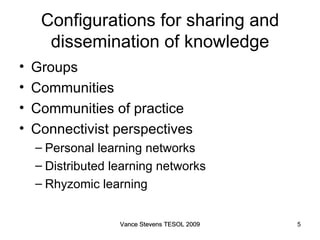
Configurations for sharing and dissemination of knowledge Groups Communities Communities of practice Connectivist perspectives Personal learning networks Distributed learning networks Rhyzomic learning Vance Stevens TESOL 2009 Vance Stevens TESOL 2009
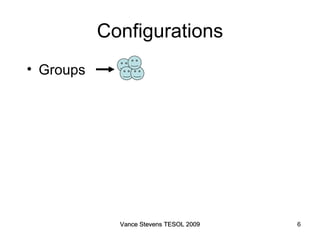
Configurations Groups Vance Stevens TESOL 2009 Vance Stevens TESOL 2009
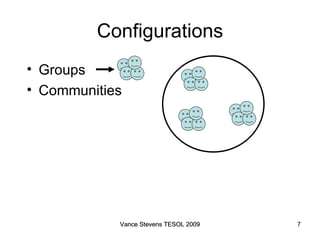
Configurations Groups Communities Vance Stevens TESOL 2009 Vance Stevens TESOL 2009
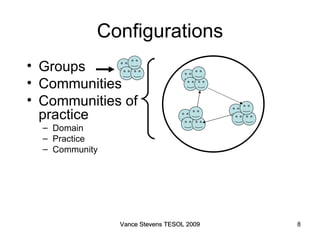
Configurations Groups Communities Communities of  practice Domain Practice Community Vance Stevens TESOL 2009 Vance Stevens TESOL 2009
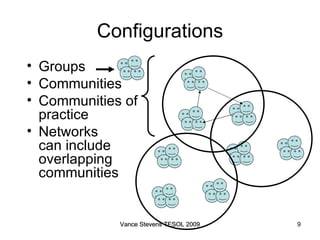
Configurations Groups Communities Communities of practice Networks can include  overlapping communities Vance Stevens TESOL 2009 Vance Stevens TESOL 2009
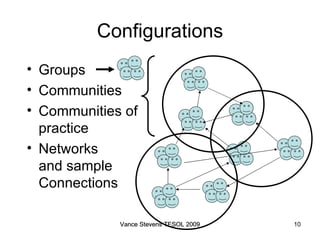
Configurations Groups Communities Communities of practice Networks and sample Connections Vance Stevens TESOL 2009 Vance Stevens TESOL 2009
Webheads in Action WiA formed as result of 2002 EVO sesson Educators who engage in  Helping each other pursue lifelong, just-in-time, informal learning Through experimentation in use of social-media and computer mediated communications tools Webheads in Action Online Convergence WiAOC 2005, 2007, 2009  http://wiaoc.org   Vance Stevens TESOL 2009 Vance Stevens TESOL 2009
Webheads: is it a Group? Community? Network? Started out as a Yahoo Group Developed sense of community Conceived itself as a community of practice EVOnline workshop: Reflection through experience and experiment with a communities of practice online:  http://vancestevens.com/papers/tesol/baltimore2003/copractice.html#workshop   Colloquium: "Case study of a community of practice":  http://vancestevens.com/papers/tesol/baltimore2003/copractice.html#colloquium Vance Stevens TESOL 2009 Vance Stevens TESOL 2009
Webheads as a CoP Chris Johnson  joined Webheads in order to study the community as a possible example of a distributed CoP Etienne Wenger on his doctoral committee  found that Webheads fit most of the criteria outlined by Wenger, except possibly on not having a defined space for interaction Conclusion: Webheads was  almost  a CoP (came close) ‏ Johnson , Christopher. (2003). Annotated Bibliography: Web version. Communties of practice bibliography created for Webheads in Action EVOnline sessions, at  http://sites.inka.de/manzanita/dissertation/biblio_COP.htm Johnson , Christopher. (2003). CoP Theory Overview. Retrieved February 12, 2004 from:  http://sites.inka.de/manzanita/cop/ Vance Stevens TESOL 2009 Vance Stevens TESOL 2009
Wenger on Webheads as CoP Cristina Costa said she felt that she was a member of a CoP when she realized her practice had begun to change  I asked Etienne whether his concept of CoPs had evolved after his encounter with the Webheads online Referred to Cristina’s comment as one indication that Webheads was a CoP He said that the fact that Webheads met in so many spaces while clearly being a CoP was a revelation to him, that he realized he could redefine his previous thinking on constraints on SPACE occupied by distributed CoPs Etienne Wenger in keynote “interview” with Suzanne Nyrop  at 2007 WiAOC (Webheads in Action Online Convergence)  http://wiaoc.org   (WiAOC 2009 is May 22-24 this year). Vance Stevens TESOL 2009 Vance Stevens TESOL 2009
Knowledge  dissimenation through  communities and networks Downes on distributed learning networks Knowing ( where’s Waldo?)  Once you know, you can’t not know Knowledge exists throughout nodes in a network Wenger notes (2002:6) ‏ Increasing complexity of knowledge requires greater … collaboration; whereas … Half life of knowledge is getting shorter Cormier - rhizomatic learning to deal with increasingly rapid obsolescence of knowledge Siemens – connectivism stresses importance of pipes over content Vance Stevens TESOL 2009 Vance Stevens TESOL 2009
Jack Richards plenary Denver TESOL 2009 (March 27) ‏ About what teachers need to KNOW in order to practice effectively Research indicates that teachers tend to revert to traditional methods rather than activate what they are exposed to in training curricula Derick Wenmouth (also from NZ) mentioned similar research findings at K-12 Online 2008 Vance Stevens TESOL 2009
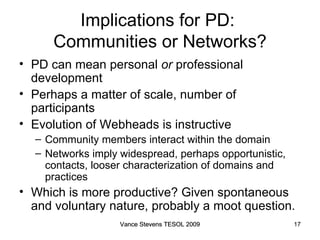
Implications for PD:  Communities or Networks? PD can mean personal  or  professional development Perhaps a matter of scale, number of participants Evolution of Webheads is instructive Community members interact within the domain Networks imply widespread, perhaps opportunistic, contacts, looser characterization of domains and practices Which is more productive? Given spontaneous and voluntary nature, probably a moot question. Vance Stevens TESOL 2009 Vance Stevens TESOL 2009
References Wenger , E. (1998) Communities of practice Learning as a social system. Retrieved April 22, 2005, from:  http://www.co-i-l.com/coil/knowledge-garden/cop/lss.shtml Wenger , E. (2002). Richard McDermott, and William M. Snyder. Cultivating communities of practice. Boston: Harvard Business School Press. 284 pages. Wenger , E. (2004a). Communities of practice: A brief introduction. Retrieved April 22, 2005 from:  http://www.ewenger.com/theory/index.htm .  Wenger , E. (2004b). Cultivating communities of practice: A quick start-up guide. Retrieved April 22, 2005, from  http://www.ewenger.com/theory/start-up_guide_PDF.pdf Find this slide show online at  http://slideshare.net/vances   Vance Stevens TESOL 2009 Vance Stevens TESOL 2009

The Webheads And Distributed Communities Of Practice

  • 1.
    The Webheads andDistributed Communities of Practice Vance Stevens Petroleum Institute, Abu Dhabi, UAE Presentation made as panelist on a colloquium held March 27, 2009 at the annual TESOL Convention in Denver Vance Stevens TESOL 2009
  • 2.
    Global and localvisions: Evolving communities of practice Panelists: Vance Stevens, Suresh Canagarajah, Yuko Goto-Butler, Toni Hull, Perin Jusara, Golge Seferoglu, Takako Nishino, and Jane Hoelker March 27, 2009 at 10:00 a.m. at the Annual TESOL Convention in Denver Colloquium abstract : Whether learning or teaching English in the EFL context, the model of Communities of Practice moves individuals and groups forward in their development. Examples of shared practices implemented in elementary, secondary and tertiary institutions as well as in programs of teacher professional development conducted on worldwide communication networks are discussed. Presented at the colloquium, entitled: Vance Stevens TESOL 2009
  • 3.
    The Webheads andDistributed Communities of Practice: Abstract In these times of globalization and worldwide communication networks, distributed communities of practice (e.g. any CoP that cannot rely on face-to-face meetings and interactions as its primary vehicle for connecting members) are becoming more common. This presentation discusses CoPs implemented for educational technology specialists, many particularly concerned with language learning, in ongoing teacher professional development, foremost through Webheads in Action http://webheads.info and in various other communities and offshoots from these, such as TESOL-sponsored EVO (Electronic Village Online). The concept of distributed CoPs has been addressed by Etienne Wenger. How Wenger’s concept of CoPs has evolved after his encounter with the Webheads online will also be discussed. Vance Stevens TESOL 2009 Vance Stevens TESOL 2009
  • 4.
    Characteristics of CoPsThey promote knowledge of a domain They revolve around a practice Community aspects They form spontaneously, voluntarily They have particularly defined community spaces in which they interact Most frequently understood to be defined by Etienne Wenger; e.g. Vance Stevens TESOL 2009 Vance Stevens TESOL 2009
  • 5.
    Configurations for sharingand dissemination of knowledge Groups Communities Communities of practice Connectivist perspectives Personal learning networks Distributed learning networks Rhyzomic learning Vance Stevens TESOL 2009 Vance Stevens TESOL 2009
  • 6.
    Configurations Groups VanceStevens TESOL 2009 Vance Stevens TESOL 2009
  • 7.
    Configurations Groups CommunitiesVance Stevens TESOL 2009 Vance Stevens TESOL 2009
  • 8.
    Configurations Groups CommunitiesCommunities of practice Domain Practice Community Vance Stevens TESOL 2009 Vance Stevens TESOL 2009
  • 9.
    Configurations Groups CommunitiesCommunities of practice Networks can include overlapping communities Vance Stevens TESOL 2009 Vance Stevens TESOL 2009
  • 10.
    Configurations Groups CommunitiesCommunities of practice Networks and sample Connections Vance Stevens TESOL 2009 Vance Stevens TESOL 2009
  • 11.
    Webheads in ActionWiA formed as result of 2002 EVO sesson Educators who engage in Helping each other pursue lifelong, just-in-time, informal learning Through experimentation in use of social-media and computer mediated communications tools Webheads in Action Online Convergence WiAOC 2005, 2007, 2009 http://wiaoc.org Vance Stevens TESOL 2009 Vance Stevens TESOL 2009
  • 12.
    Webheads: is ita Group? Community? Network? Started out as a Yahoo Group Developed sense of community Conceived itself as a community of practice EVOnline workshop: Reflection through experience and experiment with a communities of practice online: http://vancestevens.com/papers/tesol/baltimore2003/copractice.html#workshop Colloquium: "Case study of a community of practice": http://vancestevens.com/papers/tesol/baltimore2003/copractice.html#colloquium Vance Stevens TESOL 2009 Vance Stevens TESOL 2009
  • 13.
    Webheads as aCoP Chris Johnson joined Webheads in order to study the community as a possible example of a distributed CoP Etienne Wenger on his doctoral committee found that Webheads fit most of the criteria outlined by Wenger, except possibly on not having a defined space for interaction Conclusion: Webheads was almost a CoP (came close) ‏ Johnson , Christopher. (2003). Annotated Bibliography: Web version. Communties of practice bibliography created for Webheads in Action EVOnline sessions, at http://sites.inka.de/manzanita/dissertation/biblio_COP.htm Johnson , Christopher. (2003). CoP Theory Overview. Retrieved February 12, 2004 from: http://sites.inka.de/manzanita/cop/ Vance Stevens TESOL 2009 Vance Stevens TESOL 2009
  • 14.
    Wenger on Webheadsas CoP Cristina Costa said she felt that she was a member of a CoP when she realized her practice had begun to change I asked Etienne whether his concept of CoPs had evolved after his encounter with the Webheads online Referred to Cristina’s comment as one indication that Webheads was a CoP He said that the fact that Webheads met in so many spaces while clearly being a CoP was a revelation to him, that he realized he could redefine his previous thinking on constraints on SPACE occupied by distributed CoPs Etienne Wenger in keynote “interview” with Suzanne Nyrop at 2007 WiAOC (Webheads in Action Online Convergence) http://wiaoc.org (WiAOC 2009 is May 22-24 this year). Vance Stevens TESOL 2009 Vance Stevens TESOL 2009
  • 15.
    Knowledge dissimenationthrough communities and networks Downes on distributed learning networks Knowing ( where’s Waldo?) Once you know, you can’t not know Knowledge exists throughout nodes in a network Wenger notes (2002:6) ‏ Increasing complexity of knowledge requires greater … collaboration; whereas … Half life of knowledge is getting shorter Cormier - rhizomatic learning to deal with increasingly rapid obsolescence of knowledge Siemens – connectivism stresses importance of pipes over content Vance Stevens TESOL 2009 Vance Stevens TESOL 2009
  • 16.
    Jack Richards plenaryDenver TESOL 2009 (March 27) ‏ About what teachers need to KNOW in order to practice effectively Research indicates that teachers tend to revert to traditional methods rather than activate what they are exposed to in training curricula Derick Wenmouth (also from NZ) mentioned similar research findings at K-12 Online 2008 Vance Stevens TESOL 2009
  • 17.
    Implications for PD: Communities or Networks? PD can mean personal or professional development Perhaps a matter of scale, number of participants Evolution of Webheads is instructive Community members interact within the domain Networks imply widespread, perhaps opportunistic, contacts, looser characterization of domains and practices Which is more productive? Given spontaneous and voluntary nature, probably a moot question. Vance Stevens TESOL 2009 Vance Stevens TESOL 2009
  • 18.
    References Wenger ,E. (1998) Communities of practice Learning as a social system. Retrieved April 22, 2005, from: http://www.co-i-l.com/coil/knowledge-garden/cop/lss.shtml Wenger , E. (2002). Richard McDermott, and William M. Snyder. Cultivating communities of practice. Boston: Harvard Business School Press. 284 pages. Wenger , E. (2004a). Communities of practice: A brief introduction. Retrieved April 22, 2005 from: http://www.ewenger.com/theory/index.htm . Wenger , E. (2004b). Cultivating communities of practice: A quick start-up guide. Retrieved April 22, 2005, from http://www.ewenger.com/theory/start-up_guide_PDF.pdf Find this slide show online at http://slideshare.net/vances Vance Stevens TESOL 2009 Vance Stevens TESOL 2009