

Market Failure – Information
Failures
Market Failure
Information
Failures
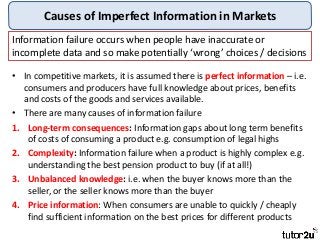
Causes of Imperfect Information in Markets
• In competitive markets, it is assumed there is perfect information – i.e.
consumers and producers have full knowledge about prices, benefits
and costs of the goods and services available.
• There are many causes of information failure
1. Long-term consequences: Information gaps about long term benefits
of costs of consuming a product e.g. consumption of legal highs
2. Complexity: Information failure when a product is highly complex e.g.
understanding the best pension product to buy (if at all!)
3. Unbalanced knowledge: i.e. when the buyer knows more than the
seller, or the seller knows more than the buyer
4. Price information: When consumers are unable to quickly / cheaply
find sufficient information on the best prices for different products
Information failure occurs when people have inaccurate or
incomplete data and so make potentially ‘wrong’ choices / decisions
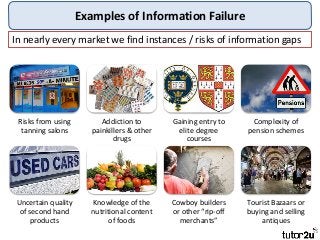
Examples of Information Failure
In nearly every market we find instances / risks of information gaps
Risks from using
tanning salons
Addiction to
painkillers & other
drugs
Gaining entry to
elite degree
courses
Complexity of
pension schemes
Uncertain quality
of second hand
products
Knowledge of the
nutritional content
of foods
Cowboy builders
or other “rip-off
merchants”
Tourist Bazaars or
buying and selling
antiques
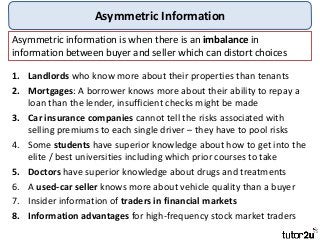
Asymmetric Information
1. Landlords who know more about their properties than tenants
2. Mortgages: A borrower knows more about their ability to repay a
loan than the lender, insufficient checks might be made
3. Car insurance companies cannot tell the risks associated with
selling premiums to each single driver – they have to pool risks
4. Some students have superior knowledge about how to get into the
elite / best universities including which prior courses to take
5. Doctors have superior knowledge about drugs and treatments
6. A used-car seller knows more about vehicle quality than a buyer
7. Insider information of traders in financial markets
8. Information advantages for high-frequency stock market traders
Asymmetric information is when there is an imbalance in
information between buyer and seller which can distort choices
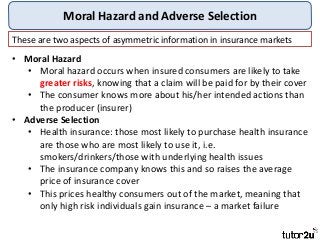
Moral Hazard and Adverse Selection
These are two aspects of asymmetric information in insurance markets
• Moral Hazard
• Moral hazard occurs when insured consumers are likely to take
greater risks, knowing that a claim will be paid for by their cover
• The consumer knows more about his/her intended actions than
the producer (insurer)
• Adverse Selection
• Health insurance: those most likely to purchase health insurance
are those who are most likely to use it, i.e.
smokers/drinkers/those with underlying health issues
• The insurance company knows this and so raises the average
price of insurance cover
• This prices healthy consumers out of the market, meaning that
only high risk individuals gain insurance – a market failure
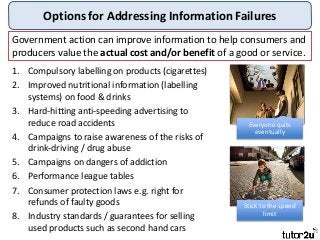
Options for Addressing Information Failures
1. Compulsory labelling on products (cigarettes)
2. Improved nutritional information (labelling
systems) on food & drinks
3. Hard-hitting anti-speeding advertising to
reduce road accidents
4. Campaigns to raise awareness of the risks of
drink-driving / drug abuse
5. Campaigns on dangers of addiction
6. Performance league tables
7. Consumer protection laws e.g. right for
refunds of faulty goods
8. Industry standards / guarantees for selling
used products such as second hand cars
Government action can improve information to help consumers and
producers value the actual cost and/or benefit of a good or service.
Everyone quits
eventually
Stick to the speed
limit
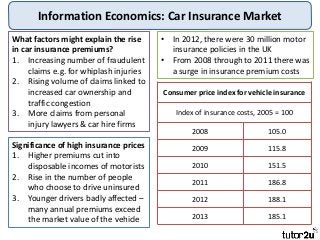
Information Economics: Car Insurance Market
• In 2012, there were 30 million motor
insurance policies in the UK
• From 2008 through to 2011 there was
a surge in insurance premium costs
Consumer price index for vehicle insurance
Index of insurance costs, 2005 = 100
2008 105.0
2009 115.8
2010 151.5
2011 186.8
2012 188.1
2013 185.1
What factors might explain the rise
in car insurance premiums?
1. Increasing number of fraudulent
claims e.g. for whiplash injuries
2. Rising volume of claims linked to
increased car ownership and
traffic congestion
3. More claims from personal
injury lawyers & car hire firms
Significance of high insurance prices
1. Higher premiums cut into
disposable incomes of motorists
2. Rise in the number of people
who choose to drive uninsured
3. Younger drivers badly affected –
many annual premiums exceed
the market value of the vehicle
Get help from fellow
students, teachers and
tutor2u on Twitter:
@tutor2u_econ
Tutor2u
Keep up-to-date with economics,
resources, quizzes and
worksheets for your economics
course.

Tutor2u - Market Failure – Information Failures

  • 1.
    Market Failure –Information Failures
  • 2.
  • 3.
    Causes of ImperfectInformation in Markets • In competitive markets, it is assumed there is perfect information – i.e. consumers and producers have full knowledge about prices, benefits and costs of the goods and services available. • There are many causes of information failure 1. Long-term consequences: Information gaps about long term benefits of costs of consuming a product e.g. consumption of legal highs 2. Complexity: Information failure when a product is highly complex e.g. understanding the best pension product to buy (if at all!) 3. Unbalanced knowledge: i.e. when the buyer knows more than the seller, or the seller knows more than the buyer 4. Price information: When consumers are unable to quickly / cheaply find sufficient information on the best prices for different products Information failure occurs when people have inaccurate or incomplete data and so make potentially ‘wrong’ choices / decisions
  • 4.
    Examples of InformationFailure In nearly every market we find instances / risks of information gaps Risks from using tanning salons Addiction to painkillers & other drugs Gaining entry to elite degree courses Complexity of pension schemes Uncertain quality of second hand products Knowledge of the nutritional content of foods Cowboy builders or other “rip-off merchants” Tourist Bazaars or buying and selling antiques
  • 5.
    Asymmetric Information 1. Landlordswho know more about their properties than tenants 2. Mortgages: A borrower knows more about their ability to repay a loan than the lender, insufficient checks might be made 3. Car insurance companies cannot tell the risks associated with selling premiums to each single driver – they have to pool risks 4. Some students have superior knowledge about how to get into the elite / best universities including which prior courses to take 5. Doctors have superior knowledge about drugs and treatments 6. A used-car seller knows more about vehicle quality than a buyer 7. Insider information of traders in financial markets 8. Information advantages for high-frequency stock market traders Asymmetric information is when there is an imbalance in information between buyer and seller which can distort choices
  • 6.
    Moral Hazard andAdverse Selection These are two aspects of asymmetric information in insurance markets • Moral Hazard • Moral hazard occurs when insured consumers are likely to take greater risks, knowing that a claim will be paid for by their cover • The consumer knows more about his/her intended actions than the producer (insurer) • Adverse Selection • Health insurance: those most likely to purchase health insurance are those who are most likely to use it, i.e. smokers/drinkers/those with underlying health issues • The insurance company knows this and so raises the average price of insurance cover • This prices healthy consumers out of the market, meaning that only high risk individuals gain insurance – a market failure
  • 7.
    Options for AddressingInformation Failures 1. Compulsory labelling on products (cigarettes) 2. Improved nutritional information (labelling systems) on food & drinks 3. Hard-hitting anti-speeding advertising to reduce road accidents 4. Campaigns to raise awareness of the risks of drink-driving / drug abuse 5. Campaigns on dangers of addiction 6. Performance league tables 7. Consumer protection laws e.g. right for refunds of faulty goods 8. Industry standards / guarantees for selling used products such as second hand cars Government action can improve information to help consumers and producers value the actual cost and/or benefit of a good or service. Everyone quits eventually Stick to the speed limit
  • 8.
    Information Economics: CarInsurance Market • In 2012, there were 30 million motor insurance policies in the UK • From 2008 through to 2011 there was a surge in insurance premium costs Consumer price index for vehicle insurance Index of insurance costs, 2005 = 100 2008 105.0 2009 115.8 2010 151.5 2011 186.8 2012 188.1 2013 185.1 What factors might explain the rise in car insurance premiums? 1. Increasing number of fraudulent claims e.g. for whiplash injuries 2. Rising volume of claims linked to increased car ownership and traffic congestion 3. More claims from personal injury lawyers & car hire firms Significance of high insurance prices 1. Higher premiums cut into disposable incomes of motorists 2. Rise in the number of people who choose to drive uninsured 3. Younger drivers badly affected – many annual premiums exceed the market value of the vehicle
  • 9.
    Get help fromfellow students, teachers and tutor2u on Twitter: @tutor2u_econ
  • 10.
    Tutor2u Keep up-to-date witheconomics, resources, quizzes and worksheets for your economics course.

Editor's Notes

  • #3 Rather like externalities, it is rare that you will encounter a market where information failure does not exist! The assumption of perfect information in competitive markets is easily dropped when you have covered this topic. The examiners want you to distinguish between symmetric and asymmetric information and also understand how imperfect market information may lead to a misallocation of resources, for example, in decisions over how much to spend on health care, education, pensions, tobacco and alcohol. You should look to link your revision on information failures with the study of merit and de-merit goods and services. This is a topic with loads of real world examples to consider.