English
Thesis Statements
Thesis Statements
• What is a thesis statement?
▫ A summary of your argument in 1-3 sentences
▫ The main idea that you will explore in-depth
within the body of your essay
▫ Your debatable opinion
Placement
• Your thesis statement should come early in your
paper, so the reader immediately knows the
direction and purpose of your essay
▫ Ideally at the end of your introductory paragraph
▫ Note: When reading longer texts, particularly
book-length works, the thesis can come after
several introductory paragraphs
Tone
• Write in third person
▫ Eliminate statements such as “I think,” “In my
opinion,” “In this essay, I will show…”
▫ It is already understood that the essay is your
opinion, so there is no need to state it
▫ Writing in third person will give your essay a
stronger factual voice, making it more emphatic
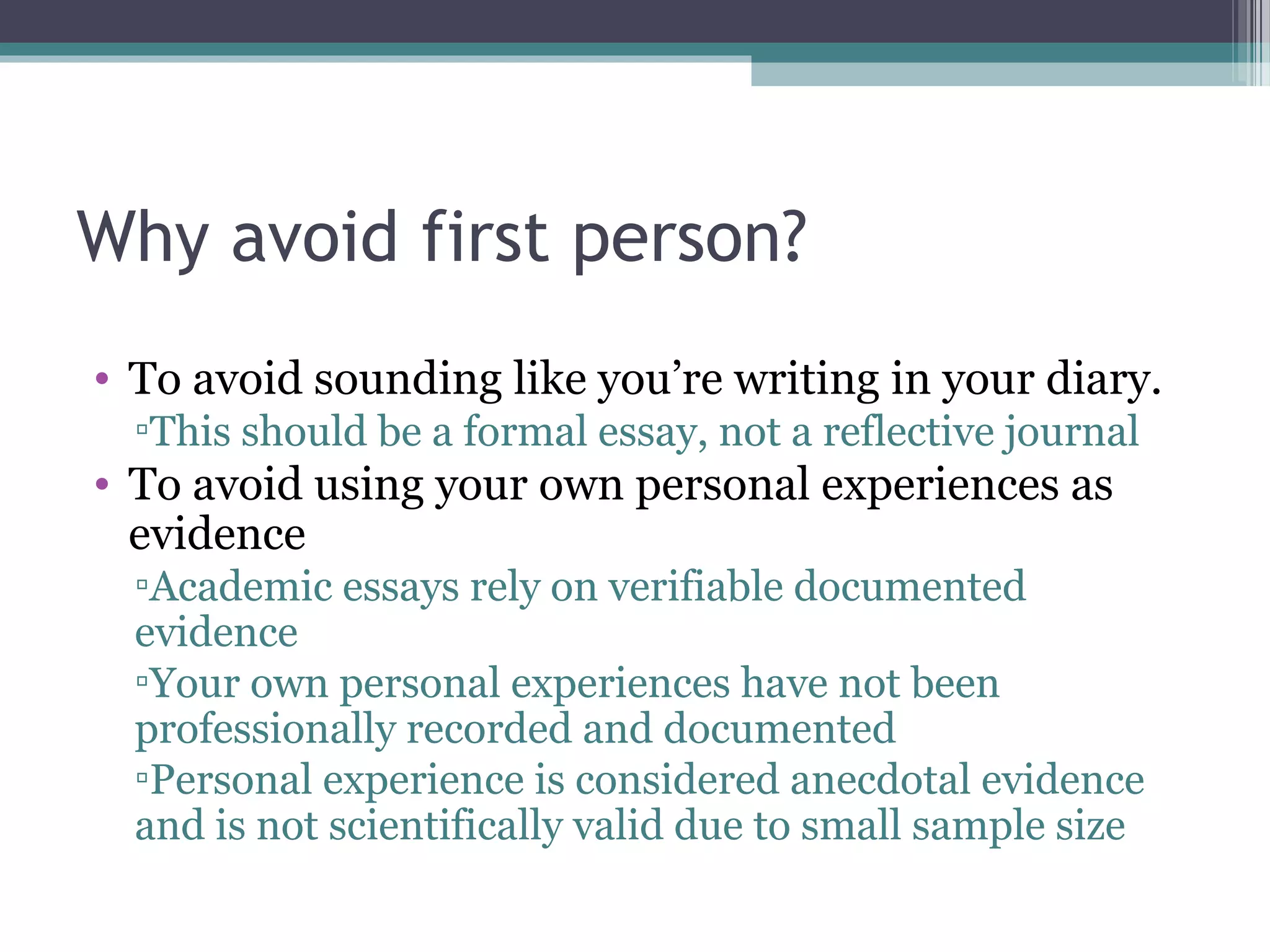
Why avoid first person?
• To avoid sounding like you’re writing in your diary.
▫This should be a formal essay, not a reflective journal
• To avoid using your own personal experiences as
evidence
▫Academic essays rely on verifiable documented
evidence
▫Your own personal experiences have not been
professionally recorded and documented
▫Personal experience is considered anecdotal evidence
and is not scientifically valid due to small sample size
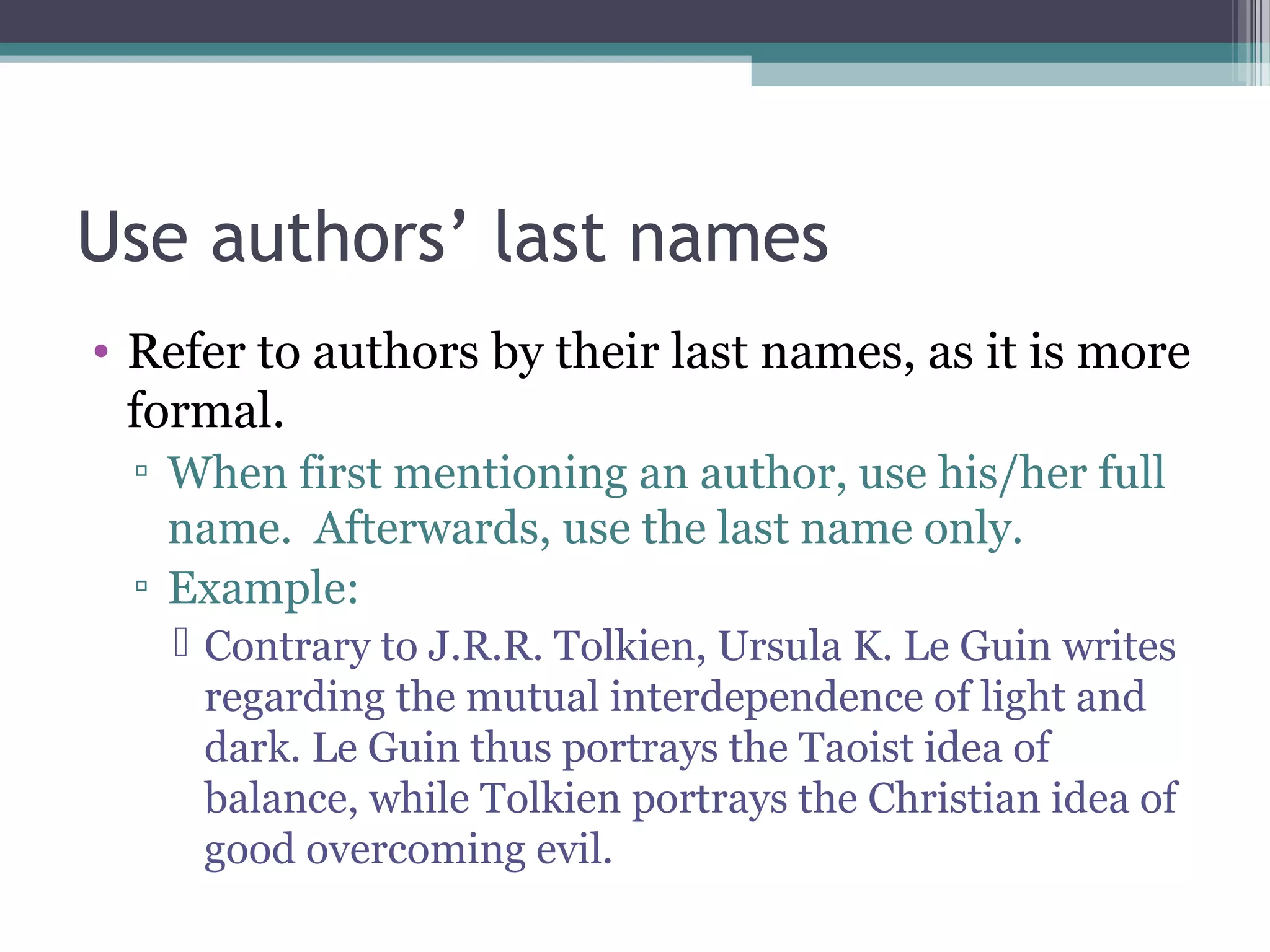
Use authors’ last names
• Refer to authors by their last names, as it is more
formal.
▫ When first mentioning an author, use his/her full
name. Afterwards, use the last name only.
▫ Example:
 Contrary to J.R.R. Tolkien, Ursula K. Le Guin writes
regarding the mutual interdependence of light and
dark. Le Guin thus portrays the Taoist idea of
balance, while Tolkien portrays the Christian idea of
good overcoming evil.
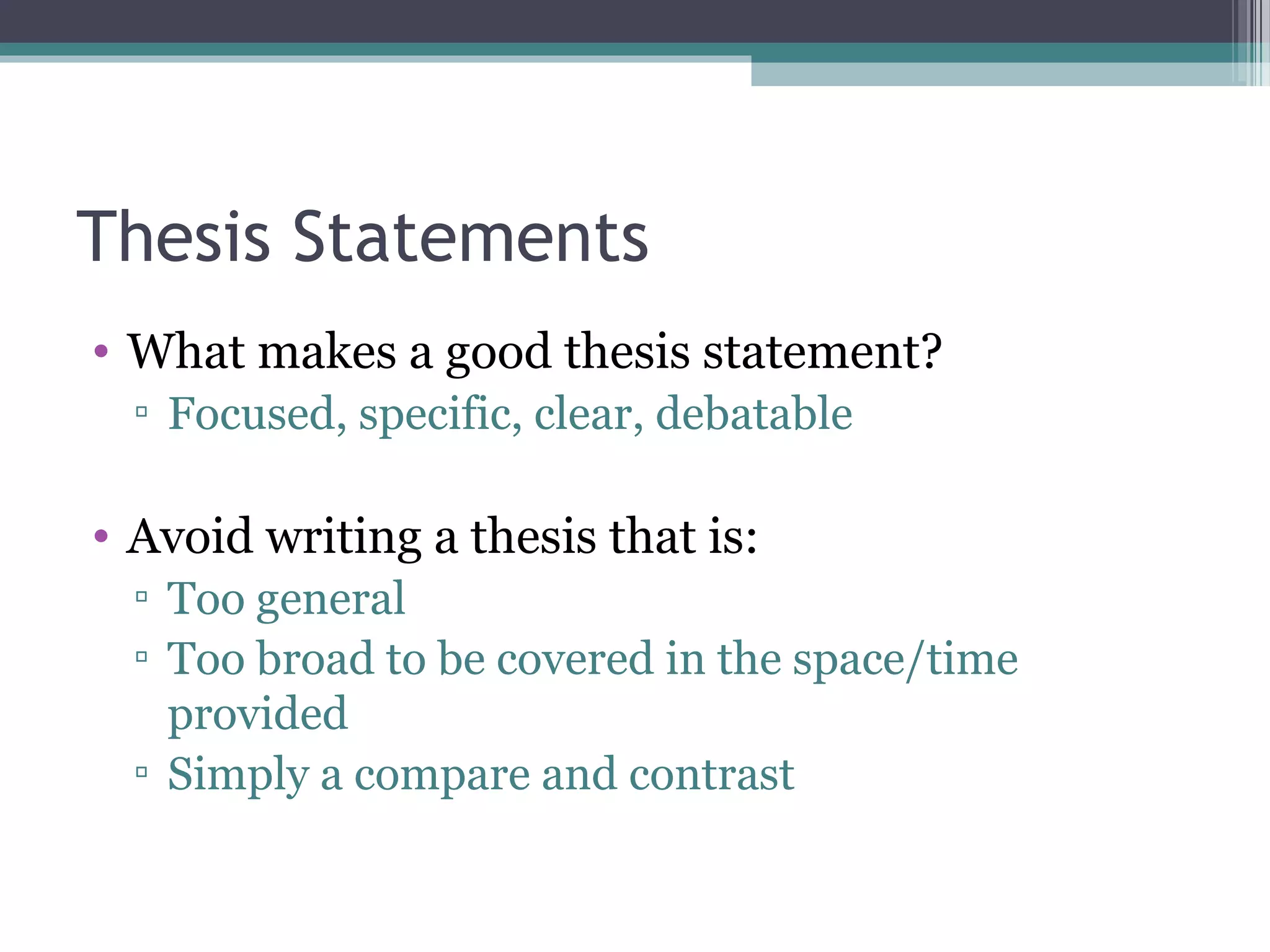
Thesis Statements
• What makes a good thesis statement?
▫ Focused, specific, clear, debatable
• Avoid writing a thesis that is:
▫ Too general
▫ Too broad to be covered in the space/time
provided
▫ Simply a compare and contrast
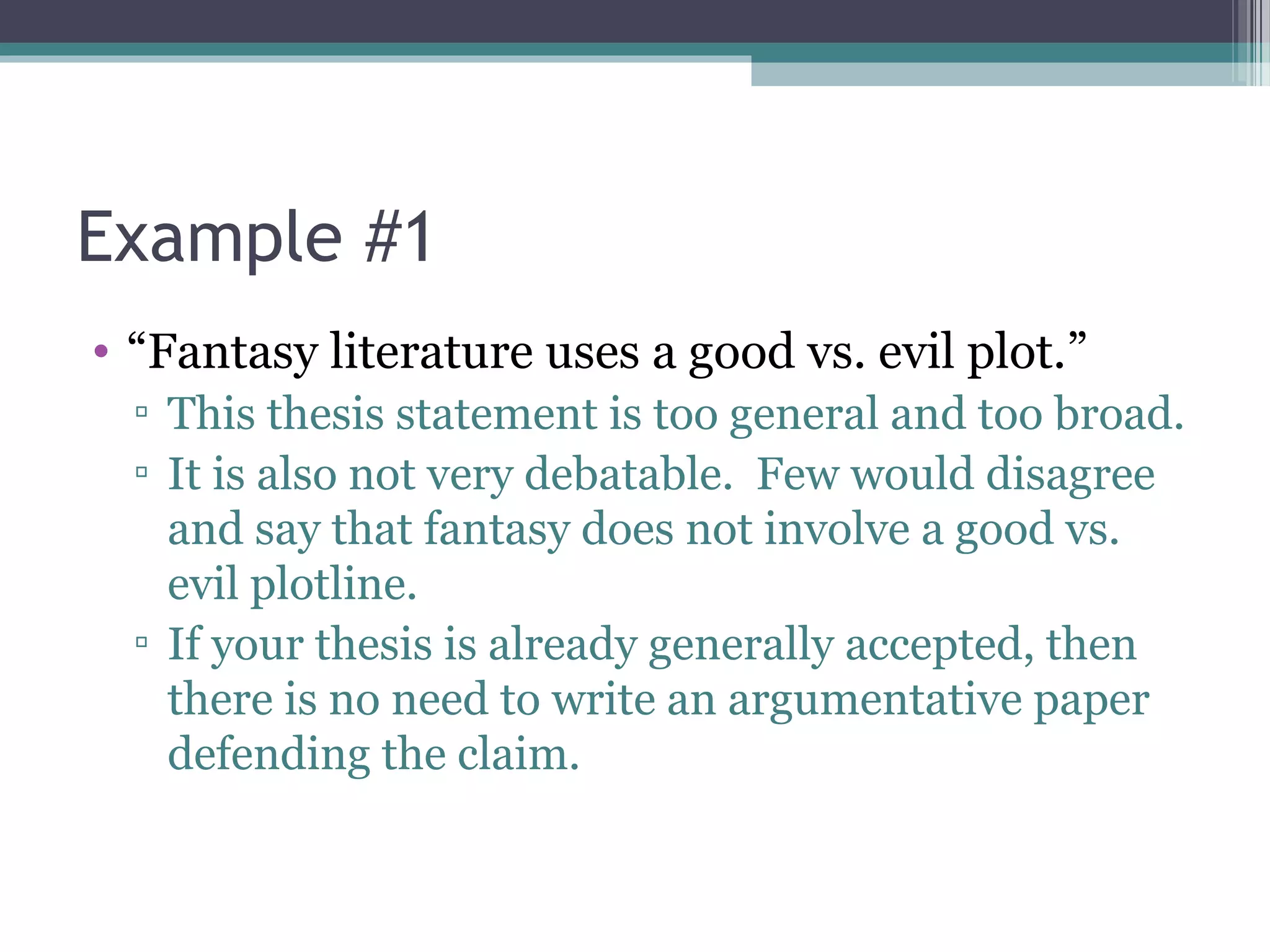
Example #1
• “Fantasy literature uses a good vs. evil plot.”
▫ This thesis statement is too general and too broad.
▫ It is also not very debatable. Few would disagree
and say that fantasy does not involve a good vs.
evil plotline.
▫ If your thesis is already generally accepted, then
there is no need to write an argumentative paper
defending the claim.
Example #2
• “In both Harry Potter and The Lord of the
Rings, good triumphs over evil; Voldemort is
defeated in Harry Potter while Sauron is
defeated in The Lord of the Rings.”
▫ A mediocre thesis statement that is mostly
compare & contrast and largely observational
Be specific
• Refine your thesis by asking yourself “So what?”
 “Fantasy literature uses a good vs. evil plot.” That’s great,
but so what?
 What does this mean for the book/genre? Which books
exactly are you referring to? Does all of fantasy literature
use the good vs. evil plot device?
• A better thesis statement: “Much of fantasy literature,
such as Harry Potter and The Lord of the Rings, features
an over-simplistic binary of good versus evil, which
reduces its characters to one-dimensional didactic
devices.”
 Much more specific, narrow, and focused
 Improved diction and vocabulary
Be clear
• Remember your reader
▫ Don’t assume that your reader will automatically
know what you mean
▫ Clarify, demonstrate, define
 With your thesis statement, as well as throughout
the body of your essay

English: Thesis Statements

  • 1.
  • 2.
    Thesis Statements • Whatis a thesis statement? ▫ A summary of your argument in 1-3 sentences ▫ The main idea that you will explore in-depth within the body of your essay ▫ Your debatable opinion
  • 3.
    Placement • Your thesisstatement should come early in your paper, so the reader immediately knows the direction and purpose of your essay ▫ Ideally at the end of your introductory paragraph ▫ Note: When reading longer texts, particularly book-length works, the thesis can come after several introductory paragraphs
  • 4.
    Tone • Write inthird person ▫ Eliminate statements such as “I think,” “In my opinion,” “In this essay, I will show…” ▫ It is already understood that the essay is your opinion, so there is no need to state it ▫ Writing in third person will give your essay a stronger factual voice, making it more emphatic
  • 5.
    Why avoid firstperson? • To avoid sounding like you’re writing in your diary. ▫This should be a formal essay, not a reflective journal • To avoid using your own personal experiences as evidence ▫Academic essays rely on verifiable documented evidence ▫Your own personal experiences have not been professionally recorded and documented ▫Personal experience is considered anecdotal evidence and is not scientifically valid due to small sample size
  • 6.
    Use authors’ lastnames • Refer to authors by their last names, as it is more formal. ▫ When first mentioning an author, use his/her full name. Afterwards, use the last name only. ▫ Example:  Contrary to J.R.R. Tolkien, Ursula K. Le Guin writes regarding the mutual interdependence of light and dark. Le Guin thus portrays the Taoist idea of balance, while Tolkien portrays the Christian idea of good overcoming evil.
  • 7.
    Thesis Statements • Whatmakes a good thesis statement? ▫ Focused, specific, clear, debatable • Avoid writing a thesis that is: ▫ Too general ▫ Too broad to be covered in the space/time provided ▫ Simply a compare and contrast
  • 8.
    Example #1 • “Fantasyliterature uses a good vs. evil plot.” ▫ This thesis statement is too general and too broad. ▫ It is also not very debatable. Few would disagree and say that fantasy does not involve a good vs. evil plotline. ▫ If your thesis is already generally accepted, then there is no need to write an argumentative paper defending the claim.
  • 9.
    Example #2 • “Inboth Harry Potter and The Lord of the Rings, good triumphs over evil; Voldemort is defeated in Harry Potter while Sauron is defeated in The Lord of the Rings.” ▫ A mediocre thesis statement that is mostly compare & contrast and largely observational
  • 10.
    Be specific • Refineyour thesis by asking yourself “So what?”  “Fantasy literature uses a good vs. evil plot.” That’s great, but so what?  What does this mean for the book/genre? Which books exactly are you referring to? Does all of fantasy literature use the good vs. evil plot device? • A better thesis statement: “Much of fantasy literature, such as Harry Potter and The Lord of the Rings, features an over-simplistic binary of good versus evil, which reduces its characters to one-dimensional didactic devices.”  Much more specific, narrow, and focused  Improved diction and vocabulary
  • 11.
    Be clear • Rememberyour reader ▫ Don’t assume that your reader will automatically know what you mean ▫ Clarify, demonstrate, define  With your thesis statement, as well as throughout the body of your essay