






>< nextprevious
Object Oriented Design Principles
How to become a SOLID programmer
Tran Duc Thang
Framgia Vietnam - Business Strategy Office - Human Development Section
A guide to make a well-designed application with Laravel
1
>< nextprevious
“Proper Object Oriented design makes
a developer's life easy, whereas bad
design makes it a disaster.”
2
Table of Contents
01
Design Principles first look
‣ What is Design Principle?
‣ Design Principle vs Design Pattern
02
03
04
>< nextprevious
SOLID in depth
‣ What are SOLID?
‣ Decoding SOLID
‣ Other related principles
Building well-design app
‣ A story with MVC
‣ Some ideas when working with Laravel
‣ Symptoms of Bad Design
Summarisation
‣ Annotations, disclaims and notes
3
>< nextprevious
Design Principles
• Object Oriented Design Patterns
‣ A general repeatable solution to a commonly
occurring problem in software design.
‣ A description or template for how to solve a
problem that can be used in many different
situations.
‣ Gained popularity after the book “Design
Patterns: Elements of Reusable Object-
Oriented Software” was published in 1994
by the so-called “Gang of Four”
4
>< nextprevious
Design Principles
• Object Oriented Design Principles
‣ Associated to Robert Cecil Martin who
gathered them in “Agile Software
Development: Principles, Patterns, and
Practices”
‣ Represent a set of guidelines that ensures
OOP concepts, then helps us to avoid having
a bad design.
‣ It’s abstract. (Not concrete).
5
>< nextprevious
Design Principles
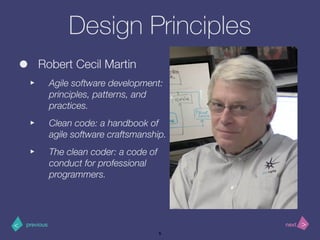
• Robert Cecil Martin
‣ Agile software development:
principles, patterns, and
practices.
‣ Clean code: a handbook of
agile software craftsmanship.
‣ The clean coder: a code of
conduct for professional
programmers.
6
>< nextprevious
Design Principles
• Some Software Design Principles in examples
‣ DRY (Don’t Repeat Yourself)
‣ KISS (Keep It Simple, Stupid!)
‣ YAGNI (You Aren't Gonna Need It)
7
>< nextprevious
Design Principles
• Design Patterns vs Design Principles
‣ Principles: low-level, general guidelines
‣ Patterns: high-level, concrete examples.
Provide reusable solutions to real world
problems.
‣ Good Design Patterns should comply good
Design Principles
8
>< nextprevious
SOLID in depth
• What are SOLID?
‣ A mnemonic acronym introduced by Michael
Feathers for the “first five principles”
named by Robert Cecil Martin.
‣ Single responsibility principle
‣ Open/closed principle
‣ Liskov substitution principle
‣ Interface segregation principle
‣ Dependency inversion principle
9
>< nextprevious
SOLID in depth
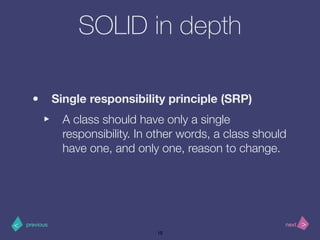
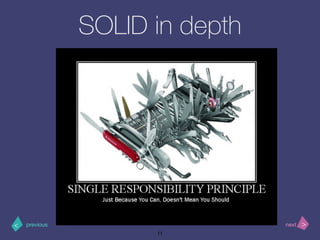
• Single responsibility principle (SRP)
‣ A class should have only a single
responsibility. In other words, a class should
have one, and only one, reason to change.
10
>< nextprevious
SOLID in depth
11
>< nextprevious
SOLID in depth
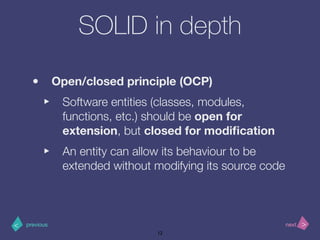
• Open/closed principle (OCP)
‣ Software entities (classes, modules,
functions, etc.) should be open for
extension, but closed for modification
‣ An entity can allow its behaviour to be
extended without modifying its source code
12
>< nextprevious
SOLID in depth
13
>< nextprevious
SOLID in depth
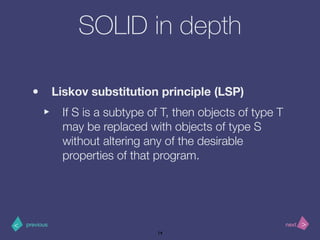
• Liskov substitution principle (LSP)
‣ If S is a subtype of T, then objects of type T
may be replaced with objects of type S
without altering any of the desirable
properties of that program.
14
>< nextprevious
SOLID in depth
15
>< nextprevious
SOLID in depth
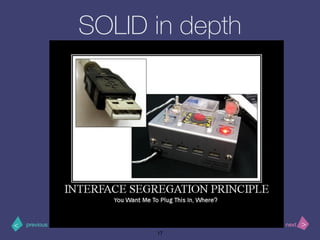
• Interface segregation principle (ISP)
‣ No client should be forced to depend on
methods it does not use.
‣ Many client-specific interfaces are better than
one general-purpose interface.
16
>< nextprevious
SOLID in depth
17
>< nextprevious
SOLID in depth
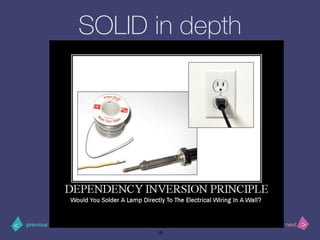
• Dependency inversion principle (ISP)
‣ High-level modules should not depend on
low-level modules. Both should depend on
abstractions.
‣ Abstractions should not depend on details.
Details should depend on abstractions.
18
>< nextprevious
SOLID in depth
19
>< nextprevious
SOLID in depth
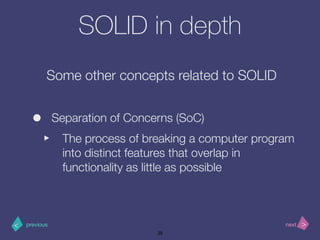
Some other concepts related to SOLID
• Separation of Concerns (SoC)
‣ The process of breaking a computer program
into distinct features that overlap in
functionality as little as possible
20
>< nextprevious
SOLID in depth
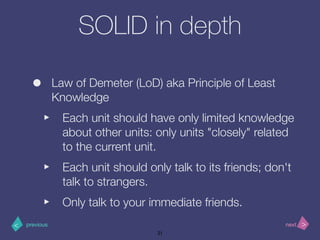
• Law of Demeter (LoD) aka Principle of Least
Knowledge
‣ Each unit should have only limited knowledge
about other units: only units "closely" related
to the current unit.
‣ Each unit should only talk to its friends; don't
talk to strangers.
‣ Only talk to your immediate friends.
21
>< nextprevious
SOLID in depth
• Program to an interface, not an implementation
‣ One of good object-oriented design
techniques that GoF mentioned in “Design
Patterns: Elements of Reusable Object-
Oriented Software”
22
>< nextprevious
SOLID in depth
• SOLID in Action - Checkout examples at Github
https://github.com/wataridori/solid-php-example
23
>< nextprevious
SOLID in depth
All SOLID principles work perfectly together.
Breaking one principle may also make some (or even
all) of the remaining principles become broken too!
24
>< nextprevious
Building well-designed app
• The MVC Story: Model vs Controller
‣ Where to put your business logic?
‣ Fat Controllers - Skinny Models?
‣ Fat Models - Skinny Controllers?
‣ Fat Models - Fat Controllers?
25
>< nextprevious
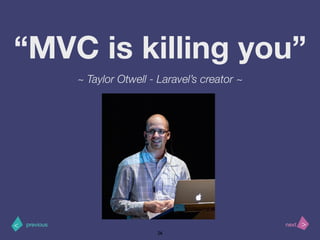
“MVC is killing you”
~ Taylor Otwell - Laravel’s creator ~
26
>< nextprevious
Think different!
“Think outside of the ‘Model’ Box”
27
>< nextprevious
• Some ideas when working with Laravel
‣ Get rid of “Model” with lots of business, try “Entity”
‣ Repository design pattern for Data Access Layer
‣ Form Request Validation
‣ Job
‣ Event
‣ View Presenter, or any kind of wrappers that helps you get rid of
God Object
‣ Design Patterns
‣ …
Building well-designed app
28
>< nextprevious
• Symptoms of Bad Design
‣ Rigidity
‣ Fragility
‣ Immobility
‣ Viscosity
‣ Needless Complexity
‣ Needless Repetition
‣ Opacity
Building well-designed app
29
>< nextprevious
• Funny: Avoid STUPID codes
‣ Singleton Pattern
‣ Tight coupling
‣ Untestability
‣ Premature Optimization
‣ Indescriptive Naming
‣ Duplication
Building well-designed app
30
>< nextprevious
Summarisation
• SOLID principles, as well as other design
principles and design patterns help you to build
large applications which are easy-to-be-
extended, easy-to-be-maintained, easy-to-be-
tested.
31
>< nextprevious
Summarisation
• SOLID principles, as well as other design
principles and design patterns help you to build
LARGE applications which are easy-to-be-
extended, easy-to-be-maintained, easy-to-be-
tested.
• Principles are just a set of GUIDELINES. They
are not LAWS!
• Don’t take the above argument as a reason to
be lazy!
32
>< nextprevious
Summarisation
Extract Responsibilities
&&
Programming to the Interface
33
>< nextprevious
References
‣ https://en.wikipedia.org/wiki/SOLID_(object-oriented_design)
‣ http://butunclebob.com/ArticleS.UncleBob.PrinciplesOfOod
‣ http://www.oodesign.com/
‣ https://lostechies.com/derickbailey/2009/02/11/solid-
development-principles-in-motivational-pictures/
‣ https://nikic.github.io/2011/12/27/Dont-be-STUPID-GRASP-
SOLID.html
‣ http://williamdurand.fr/2013/07/30/from-stupid-to-solid-code/
‣ http://www.codeproject.com/Articles/567768/Object-Oriented-
Design-Principles
‣ “Design Principles and Design Patterns” - Robert C. Martin
‣ “From Apprentice To Artisan” - Taylor Otwell
34
>< nextprevious
Thank you for listening!
Q&A
For any discussion, you can refer this post on Viblo
https://viblo.asia/thangtd90/posts/pVYRPJPmG4ng
35

Object Oriented Design Principles

  • 1.
    >< nextprevious Object OrientedDesign Principles How to become a SOLID programmer Tran Duc Thang Framgia Vietnam - Business Strategy Office - Human Development Section A guide to make a well-designed application with Laravel 1
  • 2.
    >< nextprevious “Proper ObjectOriented design makes a developer's life easy, whereas bad design makes it a disaster.” 2
  • 3.
    Table of Contents 01 DesignPrinciples first look ‣ What is Design Principle? ‣ Design Principle vs Design Pattern 02 03 04 >< nextprevious SOLID in depth ‣ What are SOLID? ‣ Decoding SOLID ‣ Other related principles Building well-design app ‣ A story with MVC ‣ Some ideas when working with Laravel ‣ Symptoms of Bad Design Summarisation ‣ Annotations, disclaims and notes 3
  • 4.
    >< nextprevious Design Principles •Object Oriented Design Patterns ‣ A general repeatable solution to a commonly occurring problem in software design. ‣ A description or template for how to solve a problem that can be used in many different situations. ‣ Gained popularity after the book “Design Patterns: Elements of Reusable Object- Oriented Software” was published in 1994 by the so-called “Gang of Four” 4
  • 5.
    >< nextprevious Design Principles •Object Oriented Design Principles ‣ Associated to Robert Cecil Martin who gathered them in “Agile Software Development: Principles, Patterns, and Practices” ‣ Represent a set of guidelines that ensures OOP concepts, then helps us to avoid having a bad design. ‣ It’s abstract. (Not concrete). 5
  • 6.
    >< nextprevious Design Principles •Robert Cecil Martin ‣ Agile software development: principles, patterns, and practices. ‣ Clean code: a handbook of agile software craftsmanship. ‣ The clean coder: a code of conduct for professional programmers. 6
  • 7.
    >< nextprevious Design Principles •Some Software Design Principles in examples ‣ DRY (Don’t Repeat Yourself) ‣ KISS (Keep It Simple, Stupid!) ‣ YAGNI (You Aren't Gonna Need It) 7
  • 8.
    >< nextprevious Design Principles •Design Patterns vs Design Principles ‣ Principles: low-level, general guidelines ‣ Patterns: high-level, concrete examples. Provide reusable solutions to real world problems. ‣ Good Design Patterns should comply good Design Principles 8
  • 9.
    >< nextprevious SOLID indepth • What are SOLID? ‣ A mnemonic acronym introduced by Michael Feathers for the “first five principles” named by Robert Cecil Martin. ‣ Single responsibility principle ‣ Open/closed principle ‣ Liskov substitution principle ‣ Interface segregation principle ‣ Dependency inversion principle 9
  • 10.
    >< nextprevious SOLID indepth • Single responsibility principle (SRP) ‣ A class should have only a single responsibility. In other words, a class should have one, and only one, reason to change. 10
  • 11.
  • 12.
    >< nextprevious SOLID indepth • Open/closed principle (OCP) ‣ Software entities (classes, modules, functions, etc.) should be open for extension, but closed for modification ‣ An entity can allow its behaviour to be extended without modifying its source code 12
  • 13.
  • 14.
    >< nextprevious SOLID indepth • Liskov substitution principle (LSP) ‣ If S is a subtype of T, then objects of type T may be replaced with objects of type S without altering any of the desirable properties of that program. 14
  • 15.
  • 16.
    >< nextprevious SOLID indepth • Interface segregation principle (ISP) ‣ No client should be forced to depend on methods it does not use. ‣ Many client-specific interfaces are better than one general-purpose interface. 16
  • 17.
  • 18.
    >< nextprevious SOLID indepth • Dependency inversion principle (ISP) ‣ High-level modules should not depend on low-level modules. Both should depend on abstractions. ‣ Abstractions should not depend on details. Details should depend on abstractions. 18
  • 19.
  • 20.
    >< nextprevious SOLID indepth Some other concepts related to SOLID • Separation of Concerns (SoC) ‣ The process of breaking a computer program into distinct features that overlap in functionality as little as possible 20
  • 21.
    >< nextprevious SOLID indepth • Law of Demeter (LoD) aka Principle of Least Knowledge ‣ Each unit should have only limited knowledge about other units: only units "closely" related to the current unit. ‣ Each unit should only talk to its friends; don't talk to strangers. ‣ Only talk to your immediate friends. 21
  • 22.
    >< nextprevious SOLID indepth • Program to an interface, not an implementation ‣ One of good object-oriented design techniques that GoF mentioned in “Design Patterns: Elements of Reusable Object- Oriented Software” 22
  • 23.
    >< nextprevious SOLID indepth • SOLID in Action - Checkout examples at Github https://github.com/wataridori/solid-php-example 23
  • 24.
    >< nextprevious SOLID indepth All SOLID principles work perfectly together. Breaking one principle may also make some (or even all) of the remaining principles become broken too! 24
  • 25.
    >< nextprevious Building well-designedapp • The MVC Story: Model vs Controller ‣ Where to put your business logic? ‣ Fat Controllers - Skinny Models? ‣ Fat Models - Skinny Controllers? ‣ Fat Models - Fat Controllers? 25
  • 26.
    >< nextprevious “MVC iskilling you” ~ Taylor Otwell - Laravel’s creator ~ 26
  • 27.
    >< nextprevious Think different! “Thinkoutside of the ‘Model’ Box” 27
  • 28.
    >< nextprevious • Someideas when working with Laravel ‣ Get rid of “Model” with lots of business, try “Entity” ‣ Repository design pattern for Data Access Layer ‣ Form Request Validation ‣ Job ‣ Event ‣ View Presenter, or any kind of wrappers that helps you get rid of God Object ‣ Design Patterns ‣ … Building well-designed app 28
  • 29.
    >< nextprevious • Symptomsof Bad Design ‣ Rigidity ‣ Fragility ‣ Immobility ‣ Viscosity ‣ Needless Complexity ‣ Needless Repetition ‣ Opacity Building well-designed app 29
  • 30.
    >< nextprevious • Funny:Avoid STUPID codes ‣ Singleton Pattern ‣ Tight coupling ‣ Untestability ‣ Premature Optimization ‣ Indescriptive Naming ‣ Duplication Building well-designed app 30
  • 31.
    >< nextprevious Summarisation • SOLIDprinciples, as well as other design principles and design patterns help you to build large applications which are easy-to-be- extended, easy-to-be-maintained, easy-to-be- tested. 31
  • 32.
    >< nextprevious Summarisation • SOLIDprinciples, as well as other design principles and design patterns help you to build LARGE applications which are easy-to-be- extended, easy-to-be-maintained, easy-to-be- tested. • Principles are just a set of GUIDELINES. They are not LAWS! • Don’t take the above argument as a reason to be lazy! 32
  • 33.
  • 34.
    >< nextprevious References ‣ https://en.wikipedia.org/wiki/SOLID_(object-oriented_design) ‣http://butunclebob.com/ArticleS.UncleBob.PrinciplesOfOod ‣ http://www.oodesign.com/ ‣ https://lostechies.com/derickbailey/2009/02/11/solid- development-principles-in-motivational-pictures/ ‣ https://nikic.github.io/2011/12/27/Dont-be-STUPID-GRASP- SOLID.html ‣ http://williamdurand.fr/2013/07/30/from-stupid-to-solid-code/ ‣ http://www.codeproject.com/Articles/567768/Object-Oriented- Design-Principles ‣ “Design Principles and Design Patterns” - Robert C. Martin ‣ “From Apprentice To Artisan” - Taylor Otwell 34
  • 35.
    >< nextprevious Thank youfor listening! Q&A For any discussion, you can refer this post on Viblo https://viblo.asia/thangtd90/posts/pVYRPJPmG4ng 35