1
ecipe policy brief — 06/2015
POLICY BRIEF
Data Localisation in Russia:
A Self-imposed Sanction
by Matthias Bauer, Hosuk Lee-Makiyama, Erik van der Marel, Bert Verschelde
No. 6/2015
• Cross-border data flows are an integral
mechanism of today’s economy, impacting a
country’s competitiveness and growth. All eco-
nomic sectors rely on secure, cost-efficient and
real-time access to data. A requirement that
all data-related business processes must take
place within a country does not only affect social
networks and e-commerce, but any business
directly or indirectly.
• The Russian privacy legislation (the “OPD
Law”) has been amended by a new law (FZ-
242) that includes a clear data localisation re-
quirement. Article 18 §5 of the law requires data
operators to ensure that any collection or use of
personal data of Russian citizens is made using
databases located inside Russia.
• Data localisation leads to productivity
losses as firms may not be able to use services
provided from abroad, or must set up their own
domesticdatacentresinsideRussia.Experience
shows that the data-intensive service industry
will pass on new costs from regulatory compli-
ance to other sectors of the economy, and the
productivity loss it generates leads to lower re-
turns of investment.
• The losses are equivalent to -0.27% of
gross domestic product (GDP), equivalent to
a loss of 286 billion roubles (US$ 5.7 billion).
Applied with 2015 IMF forecasts, the Russian
economy would contract by -4.1% this year. In-
vestments in the Russian economy would drop
by -1.41% or 187 billion roubles, with consider-
able effects on employment. The manufacturing
sectors are hardest hit, as they must absorb cost
increases from their suppliers.
• These highly negative results have taken
into account any possible positive effects (e.g.
from Russian data processing firms replacing
foreign ones). However, the losses are too large
to be offset by new jobs created or government
initiatives like subsidies and other incentives.
Russia’s production structure would shift to-
wards less innovative and volatile sectors such
as agriculture, raw materials and energy.
• Yetthenumericalresultsofthisanalysisdo
not fully capture the longer term adverse effects
of regulations of data flows on technological
progress, competitive behaviour and Russian
firms’ innovative capacities. Since these factors
are the main drivers of long-run economic out-
put growth, our results are likely to significantly
underestimatetheeconomiclossesarisingfrom
data localisation requirements.
INTRODUCTION — THE IMPORTANCE OF DATA TO THE ECONOMY
Over the last decade, data has become a critically important resource for business. As global
economies have become digitalised, firms are increasingly using data in their production processes
and in servicing their clients. Manufacturing depends on real-time connection with its suppliers,
market places and transporters; service industries like logistics, retail, public utilities or financial
services depend on processing information to deliver to its clients; provision of healthcare and
social services process more data than ever before. In short, cross-border data flows are an integral
mechanism of today’s economy, impacting a country’s competitiveness and growth.
Recent statistics show that data even plays a similar (or sometimes bigger) role in
manufacturing than raw materials or energy – a fact that may surprise many 1
. Businesses of all
kinds are sending, receiving and processing data across borders to improve efficiency and to grow.
They rely on secure, cost-efficient and real-time access to data across borders. In fact, 75% of the
1
See Bauer, Lee-Makiyama, van der Marel, ‘A Methodology to Estimate the Costs of Data Regulations’, ECIPE Working Paper,
02/2014
EXECUTIVE SUMMARY
2
ecipe policy brief — 06/2015
value derived from the internet comes from traditional industries 2
. As a result, if a law requires
that all data-related business processes must take place within a country, it does not only affect
social networks and e-commerce; any business is affected by such a requirement to localise data.
Through the new amendment to the OPD Law, designated FZ-242, Russia may now
introduce a requirement to localise any personal data physically within the country. However,
much (if not all) data contains information that could be construed as personal data. In reality,
there is no technical or legal way to separate personal data from non-personal mechanical
information. Any transaction on the internet made while logged in to an account is effectively
personal data, and even the most harmless pieces of company data will contain information
about the employee. The scope of the law is sweeping, and firms are likely to store non-personal
data locally.
Russia is not the first country in the world to impose such data localisation requirements
across all sectors of the economy: Vietnam, China, Indonesia and India have implemented
similar laws. However, none of these developing countries has a GDP per capita that exceeds
US$ 5 000. 3
Russia – with an economic output that is three times larger – will be the first
modern economy to attempt full data localisation. Also, half of Russia’s GDP comes from the
services sector, which uses data extensively. A cost prohibitive measure that forces firms to store
their data in every country in which they operate would have unforeseeable consequences for the
Russian economy and its ability to attract investments and create jobs.
It is worth noting that other BRIC nations, notably Brazil, have withdrawn data localisation
laws for fear of hurting its own economy. Given the precarious economic conditions in Russia, it
is critical that the country is not exposed to further risks of damaging the economy.
OVERVIEW OF DATA REGULATIONS IN RUSSIA
In Russia, data protection has been covered since 27 July 2006 by Federal Law FZ-152, also
known as the OPD Law or the On Personal Data law. It contains similar provisions to those
in the 1995 European Data Protection Directive and has been in force since 26 January 2007.
The law contains a number of requirements for companies engaging in commercial activities in
Russia by introducing administrative barriers. These barriers include a battery of requirements
such as the consent requirement for data collection and transfer to third parties; that data is
subject to the right to review or to be forgotten; an obligation for the data processor to notify
both the data subject and the authorities in case of a data breach, and the obligation to appoint
a data protection officer (DPO) when handling personal data. Russia also imposes financial
penalties on non-compliance.
In July 2014, the Russian OPD Law was amended by a new law to include a clear data
localisation requirement. The amendment, FZ-242, allows data to flow out from Russia.
However, article 18 §5 requires data operators to ensure that the recording, systematisation,
accumulation, storage, update/amendment and retrieval of personal data of Russian citizens is
made using databases located inside Russia. This amendment has been passed by both the State
Duma (Lower House of Parliament) and the Federation Council (Upper House of Parliament)
and is scheduled to enter into force on 1 September 2015.
Data localisation requirements do not make Russia more resilient to security breaches,
natural disasters and technical disruptions compared to storing data in multiple locations. But
such a mandate disrupts data flows and economic production by forcing businesses to choose
less efficient local suppliers to handle data within Russia. The increased costs result in either
higher prices for consumers, or the decision by businesses to remove themselves from the Russian
market altogether. Therefore, Russian businesses and consumers may not be able to afford or
access all the technological advantages available globally. This is why, in the short run, data
localisation requirements reduce both demand and supply, resulting in loss of productivity,
competitiveness and economic activity. In the long run, such policies also make a country less
attractive to investment and deprive an economy of its innovative and economic potential. Taken
2
McKinsey Global Institute, ‘Internet Matters: The Net’s Sweeping Impact on Growth, Jobs, and Prosperity’, 2011
3
World Bank World Development Index, 2013
3
ecipe policy brief — 06/2015
together, the policy weakens Russia’s position as an international actor and its ability to attract
investments.
A BRIEF METHODOLOGICAL NOTE
Typically, data-related activities account for between 4% and 31% of production input
in services industries.4
Costs for these inputs will increase if the firms can no longer use their
current IT infrastructure or suppliers located abroad. Data centres may have to be set up by
foreign and domestic enterprises. Such costs can be measured in real-life surveys. In turn, the
impact of such costs on productivity (or in economic terms, total factor productivity) has been
assessed using an econometrical approach. These costs are passed on to their customers – who
may be manufacturers, exporters, the government, or private households – and further reduce
productivity.
Secondly, foreign firms who export to Russian customers find themselves facing a new
trade barrier when their data about their customers must be stored inside Russia. This barrier
is associated with a cost that leads to Russia paying slightly higher prices for its imports – an
increase that can be measured as tariff equivalents (so-called ad valorem equivalents) on both
services and goods, depending on how data-intensive these imports are.
Thirdly, as many industries become less productive, returns on domestic and foreign
investments in Russia will go down. A contributing factor to these lower returns is lower efficiency
in research activities (from core R&D and product development, to marketing and customer
relations management) as conducting R&D in Russia incurs higher costs from processing and
analysing data.
In this analysis, the impact from the data localisation requirement as well as the privacy
regulation (introduced in 2007 by the OPD Law) is presented. Whereas no privacy legislation is
ever fully complied with, we assume that all private entities dealing with personal data in Russia
would comply as envisaged.
The analysis uses a computable general equilibrium model (CGE) based on the GTAP8
database, which is a well-acknowledged methodology that is frequently used for trade
and economic impact analyses by academia and policymakers worldwide. Based on these
computations, we calculate the impact of data privacy and data localisation requirements on key
variables – real GDP, sectorial output, domestic income, exports, and investment.
THE RESULTS OF THE SIMULATIONS
The results from amendment FZ-242 are considerable. Compared to a scenario where the
amendment is not passed, Russia will experience a loss of GDP of -0.27%. This is an economic
loss equivalent to 286 billion roubles (US$ 5.7 billion).5
Moreover, Russia’s real GDP is already
0.25% lower due to OPD Law (FZ-152), assuming the law was complied with or implemented
fully. The result is in line with GDP effects from similar measures in Brazil and India (-0.6% and
-0.7%), where data localisation laws were revoked or delayed.
4
See note 1.
5
Based on World Bank WDI, 2014 at RUBUSD=50.54
4
ecipe policy brief — 06/2015
FIGURE 1. REAL GDP LOSSES (%) FROM PRIVACY LAW
(OPD LAW/FZ-152, ASSUMING FULL COMPLIANCE) AND DATA LOCALISATION (FZ-242)
Putting these numbers into context, the economic growth in Russia was initially projected to be
+1.9% in 2014. 6
Due to the Ukraine crisis, rouble devaluation and falling oil prices, the actual
growth was significantly less – a mere +0.6%. Growth projections for this year (2015) predict a
deep recession, where the Russian economy would contract by -3.8%.7
Incorporating the effects
from FZ-242 will further deepen Russia’s economic recession, down to -4.1% for 2015 based
on IMF projections.
FIGURE 2. IMF PROJECTIONS ON REAL GDP (%),
INCLUDING EFFECTS FROM DATA LOCALISATION (FZ-242)
Source: own calculations, GTAP8.
6
IMF World Economic Outlook, October 2014.
7
IMF World Economic Outlook, April 2015. Note that Russia’s Economy Minister has pointed towards -3% based on oil
prices at US$50 per barrel and capital outflows of US$115 bn quoted in Reuters/Interfax: http://in.reuters.com/arti-
cle/2015/01/31/russia-crisis-economy-forecasts-update-idINL6N0VA0DG20150131 – J.P.Morgan revises the projections
to -2.8%. Effects from FZ-242 on these projections will be -3.3% and -3.1% respectively.
5
ecipe policy brief — 06/2015
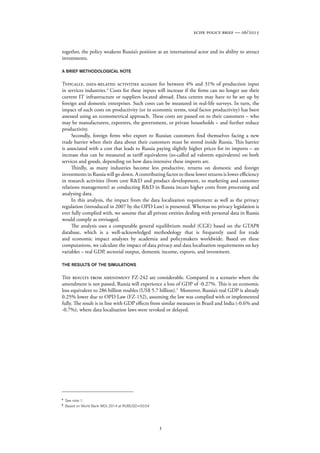
Figure 3 shows the output losses for goods and services from data localisation. The numbers
indicate surprisingly that manufacturing is more affected than services. As mentioned,
manufacturing depends on various different types of services, such as telecoms, business services
or transports. Any cost increases amongst such services are passed downstream and absorbed by
the manufacturers in the Russian economy.
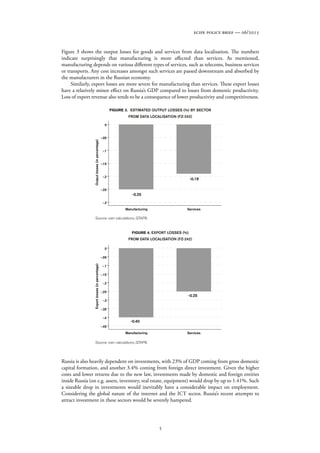
Similarly, export losses are more severe for manufacturing than services. These export losses
have a relatively minor effect on Russia’s GDP compared to losses from domestic productivity.
Loss of export revenue also tends to be a consequence of lower productivity and competitiveness.
FIGURE 3. ESTIMATED OUTPUT LOSSES (%) BY SECTOR
FROM DATA LOCALISATION (FZ-242)
FIGURE 4. EXPORT LOSSES (%)
FROM DATA LOCALISATION (FZ-242)
Russia is also heavily dependent on investments, with 23% of GDP coming from gross domestic
capital formation, and another 3.4% coming from foreign direct investment. Given the higher
costs and lower returns due to the new law, investments made by domestic and foreign entities
inside Russia (on e.g. assets, inventory, real estate, equipment) would drop by up to 1.41%. Such
a sizeable drop in investments would inevitably have a considerable impact on employment.
Considering the global nature of the internet and the ICT sector, Russia’s recent attempts to
attract investment in these sectors would be severely hampered.
Source: own calculations, GTAP8.
6
ecipe policy brief — 06/2015
FIGURE 5. ESTIMATED INVESTMENT LOSSES
DUE TO DATA LOCALISATION
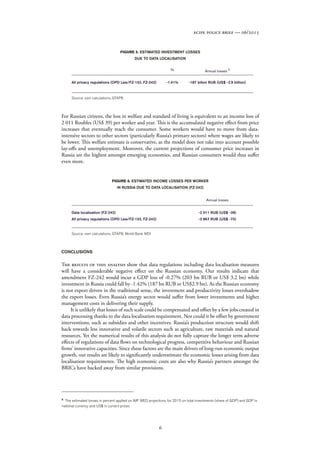
For Russian citizens, the loss in welfare and standard of living is equivalent to an income loss of
2 011 Roubles (US$ 39) per worker and year. This is the accumulated negative effect from price
increases that eventually reach the consumer. Some workers would have to move from data-
intensive sectors to other sectors (particularly Russia’s primary sectors) where wages are likely to
be lower. This welfare estimate is conservative, as the model does not take into account possible
lay-offs and unemployment. Moreover, the current projections of consumer price increases in
Russia are the highest amongst emerging economies, and Russian consumers would thus suffer
even more.
FIGURE 6. ESTIMATED INCOME LOSSES PER WORKER
IN RUSSIA DUE TO DATA LOCALISATION (FZ-242)
CONCLUSIONS
The results of this analysis show that data regulations including data localisation measures
will have a considerable negative effect on the Russian economy. Our results indicate that
amendment FZ-242 would incur a GDP loss of -0.27% (203 bn RUB or US$ 3.2 bn) while
investment in Russia could fall by -1.42% (187 bn RUB or US$2.9 bn). As the Russian economy
is not export driven in the traditional sense, the investment and productivity losses overshadow
the export losses. Even Russia’s energy sector would suffer from lower investments and higher
management costs in delivering their supply.
It is unlikely that losses of such scale could be compensated and offset by a few jobs created in
data processing thanks to the data localisation requirement. Nor could it be offset by government
interventions, such as subsidies and other incentives. Russia’s production structure would shift
back towards less innovative and volatile sectors such as agriculture, raw materials and natural
resources. Yet the numerical results of this analysis do not fully capture the longer term adverse
effects of regulations of data flows on technological progress, competitive behaviour and Russian
firms’ innovative capacities. Since these factors are the main drivers of long-run economic output
growth, our results are likely to significantly underestimate the economic losses arising from data
localisation requirements. The high economic costs are also why Russia’s partners amongst the
BRICs have backed away from similar provisions.
All privacy regulations (OPD Law/FZ-152, FZ-242) -1.41% -187 billon RUB (US$ -2.9 billion)
% Annual losses 8
Source: own calculations, GTAP8
Data localisation (FZ-242)
All privacy regulations (OPD Law/FZ-152, FZ-242)
-2 011 RUB (US$ -39)
-3 867 RUB (US$ -75)
Annual losses
Source: own calculations, GTAP8, World Bank WDI
8
The estimated losses in percent applied on IMF WEO projections for 2015 on total investments (share of GDP) and GDP in
national currency and US$ in current prices
7
ecipe policy brief — 06/2015
Data-driven industries, typically e-commerce, tourism, financial services, logistics and most
form of business services would also be affected in the first instance – and indirectly affect those
sectors that are dependent on these services. Innovation intensive areas in services and high-end
manufacturing, which are of vital importance for Russia’s economic development, will be hurt
most. Importantly, these are the sectors that the Russian Bank for Development has earmarked
for export support to boost Russia’s economy.
If the objective of data localisation policies are to keep foreign competitors out, this
amendment is a classic case of not seeing the woods for the trees – the law causes more damage
to Russia itself than to others. Russia’s ability to withstand foreign economic pressure depends on
a strong economy, while the new law also sets a regional precedent for Russian firms becoming
targets for similar treatment overseas. In the current political environment, Russia’s ability to
uphold the standard of living, attracting investments and create jobs is critically dependent on
perceptions about its business climate. As seen, one single paragraph of an amendment could
have a far-reaching consequences on that business climate, and everything that depends on it.

Data Localisation in Russia - A Self-imposed Sanction

  • 1.
    1 ecipe policy brief— 06/2015 POLICY BRIEF Data Localisation in Russia: A Self-imposed Sanction by Matthias Bauer, Hosuk Lee-Makiyama, Erik van der Marel, Bert Verschelde No. 6/2015 • Cross-border data flows are an integral mechanism of today’s economy, impacting a country’s competitiveness and growth. All eco- nomic sectors rely on secure, cost-efficient and real-time access to data. A requirement that all data-related business processes must take place within a country does not only affect social networks and e-commerce, but any business directly or indirectly. • The Russian privacy legislation (the “OPD Law”) has been amended by a new law (FZ- 242) that includes a clear data localisation re- quirement. Article 18 §5 of the law requires data operators to ensure that any collection or use of personal data of Russian citizens is made using databases located inside Russia. • Data localisation leads to productivity losses as firms may not be able to use services provided from abroad, or must set up their own domesticdatacentresinsideRussia.Experience shows that the data-intensive service industry will pass on new costs from regulatory compli- ance to other sectors of the economy, and the productivity loss it generates leads to lower re- turns of investment. • The losses are equivalent to -0.27% of gross domestic product (GDP), equivalent to a loss of 286 billion roubles (US$ 5.7 billion). Applied with 2015 IMF forecasts, the Russian economy would contract by -4.1% this year. In- vestments in the Russian economy would drop by -1.41% or 187 billion roubles, with consider- able effects on employment. The manufacturing sectors are hardest hit, as they must absorb cost increases from their suppliers. • These highly negative results have taken into account any possible positive effects (e.g. from Russian data processing firms replacing foreign ones). However, the losses are too large to be offset by new jobs created or government initiatives like subsidies and other incentives. Russia’s production structure would shift to- wards less innovative and volatile sectors such as agriculture, raw materials and energy. • Yetthenumericalresultsofthisanalysisdo not fully capture the longer term adverse effects of regulations of data flows on technological progress, competitive behaviour and Russian firms’ innovative capacities. Since these factors are the main drivers of long-run economic out- put growth, our results are likely to significantly underestimatetheeconomiclossesarisingfrom data localisation requirements. INTRODUCTION — THE IMPORTANCE OF DATA TO THE ECONOMY Over the last decade, data has become a critically important resource for business. As global economies have become digitalised, firms are increasingly using data in their production processes and in servicing their clients. Manufacturing depends on real-time connection with its suppliers, market places and transporters; service industries like logistics, retail, public utilities or financial services depend on processing information to deliver to its clients; provision of healthcare and social services process more data than ever before. In short, cross-border data flows are an integral mechanism of today’s economy, impacting a country’s competitiveness and growth. Recent statistics show that data even plays a similar (or sometimes bigger) role in manufacturing than raw materials or energy – a fact that may surprise many 1 . Businesses of all kinds are sending, receiving and processing data across borders to improve efficiency and to grow. They rely on secure, cost-efficient and real-time access to data across borders. In fact, 75% of the 1 See Bauer, Lee-Makiyama, van der Marel, ‘A Methodology to Estimate the Costs of Data Regulations’, ECIPE Working Paper, 02/2014 EXECUTIVE SUMMARY
  • 2.
    2 ecipe policy brief— 06/2015 value derived from the internet comes from traditional industries 2 . As a result, if a law requires that all data-related business processes must take place within a country, it does not only affect social networks and e-commerce; any business is affected by such a requirement to localise data. Through the new amendment to the OPD Law, designated FZ-242, Russia may now introduce a requirement to localise any personal data physically within the country. However, much (if not all) data contains information that could be construed as personal data. In reality, there is no technical or legal way to separate personal data from non-personal mechanical information. Any transaction on the internet made while logged in to an account is effectively personal data, and even the most harmless pieces of company data will contain information about the employee. The scope of the law is sweeping, and firms are likely to store non-personal data locally. Russia is not the first country in the world to impose such data localisation requirements across all sectors of the economy: Vietnam, China, Indonesia and India have implemented similar laws. However, none of these developing countries has a GDP per capita that exceeds US$ 5 000. 3 Russia – with an economic output that is three times larger – will be the first modern economy to attempt full data localisation. Also, half of Russia’s GDP comes from the services sector, which uses data extensively. A cost prohibitive measure that forces firms to store their data in every country in which they operate would have unforeseeable consequences for the Russian economy and its ability to attract investments and create jobs. It is worth noting that other BRIC nations, notably Brazil, have withdrawn data localisation laws for fear of hurting its own economy. Given the precarious economic conditions in Russia, it is critical that the country is not exposed to further risks of damaging the economy. OVERVIEW OF DATA REGULATIONS IN RUSSIA In Russia, data protection has been covered since 27 July 2006 by Federal Law FZ-152, also known as the OPD Law or the On Personal Data law. It contains similar provisions to those in the 1995 European Data Protection Directive and has been in force since 26 January 2007. The law contains a number of requirements for companies engaging in commercial activities in Russia by introducing administrative barriers. These barriers include a battery of requirements such as the consent requirement for data collection and transfer to third parties; that data is subject to the right to review or to be forgotten; an obligation for the data processor to notify both the data subject and the authorities in case of a data breach, and the obligation to appoint a data protection officer (DPO) when handling personal data. Russia also imposes financial penalties on non-compliance. In July 2014, the Russian OPD Law was amended by a new law to include a clear data localisation requirement. The amendment, FZ-242, allows data to flow out from Russia. However, article 18 §5 requires data operators to ensure that the recording, systematisation, accumulation, storage, update/amendment and retrieval of personal data of Russian citizens is made using databases located inside Russia. This amendment has been passed by both the State Duma (Lower House of Parliament) and the Federation Council (Upper House of Parliament) and is scheduled to enter into force on 1 September 2015. Data localisation requirements do not make Russia more resilient to security breaches, natural disasters and technical disruptions compared to storing data in multiple locations. But such a mandate disrupts data flows and economic production by forcing businesses to choose less efficient local suppliers to handle data within Russia. The increased costs result in either higher prices for consumers, or the decision by businesses to remove themselves from the Russian market altogether. Therefore, Russian businesses and consumers may not be able to afford or access all the technological advantages available globally. This is why, in the short run, data localisation requirements reduce both demand and supply, resulting in loss of productivity, competitiveness and economic activity. In the long run, such policies also make a country less attractive to investment and deprive an economy of its innovative and economic potential. Taken 2 McKinsey Global Institute, ‘Internet Matters: The Net’s Sweeping Impact on Growth, Jobs, and Prosperity’, 2011 3 World Bank World Development Index, 2013
  • 3.
    3 ecipe policy brief— 06/2015 together, the policy weakens Russia’s position as an international actor and its ability to attract investments. A BRIEF METHODOLOGICAL NOTE Typically, data-related activities account for between 4% and 31% of production input in services industries.4 Costs for these inputs will increase if the firms can no longer use their current IT infrastructure or suppliers located abroad. Data centres may have to be set up by foreign and domestic enterprises. Such costs can be measured in real-life surveys. In turn, the impact of such costs on productivity (or in economic terms, total factor productivity) has been assessed using an econometrical approach. These costs are passed on to their customers – who may be manufacturers, exporters, the government, or private households – and further reduce productivity. Secondly, foreign firms who export to Russian customers find themselves facing a new trade barrier when their data about their customers must be stored inside Russia. This barrier is associated with a cost that leads to Russia paying slightly higher prices for its imports – an increase that can be measured as tariff equivalents (so-called ad valorem equivalents) on both services and goods, depending on how data-intensive these imports are. Thirdly, as many industries become less productive, returns on domestic and foreign investments in Russia will go down. A contributing factor to these lower returns is lower efficiency in research activities (from core R&D and product development, to marketing and customer relations management) as conducting R&D in Russia incurs higher costs from processing and analysing data. In this analysis, the impact from the data localisation requirement as well as the privacy regulation (introduced in 2007 by the OPD Law) is presented. Whereas no privacy legislation is ever fully complied with, we assume that all private entities dealing with personal data in Russia would comply as envisaged. The analysis uses a computable general equilibrium model (CGE) based on the GTAP8 database, which is a well-acknowledged methodology that is frequently used for trade and economic impact analyses by academia and policymakers worldwide. Based on these computations, we calculate the impact of data privacy and data localisation requirements on key variables – real GDP, sectorial output, domestic income, exports, and investment. THE RESULTS OF THE SIMULATIONS The results from amendment FZ-242 are considerable. Compared to a scenario where the amendment is not passed, Russia will experience a loss of GDP of -0.27%. This is an economic loss equivalent to 286 billion roubles (US$ 5.7 billion).5 Moreover, Russia’s real GDP is already 0.25% lower due to OPD Law (FZ-152), assuming the law was complied with or implemented fully. The result is in line with GDP effects from similar measures in Brazil and India (-0.6% and -0.7%), where data localisation laws were revoked or delayed. 4 See note 1. 5 Based on World Bank WDI, 2014 at RUBUSD=50.54
  • 4.
    4 ecipe policy brief— 06/2015 FIGURE 1. REAL GDP LOSSES (%) FROM PRIVACY LAW (OPD LAW/FZ-152, ASSUMING FULL COMPLIANCE) AND DATA LOCALISATION (FZ-242) Putting these numbers into context, the economic growth in Russia was initially projected to be +1.9% in 2014. 6 Due to the Ukraine crisis, rouble devaluation and falling oil prices, the actual growth was significantly less – a mere +0.6%. Growth projections for this year (2015) predict a deep recession, where the Russian economy would contract by -3.8%.7 Incorporating the effects from FZ-242 will further deepen Russia’s economic recession, down to -4.1% for 2015 based on IMF projections. FIGURE 2. IMF PROJECTIONS ON REAL GDP (%), INCLUDING EFFECTS FROM DATA LOCALISATION (FZ-242) Source: own calculations, GTAP8. 6 IMF World Economic Outlook, October 2014. 7 IMF World Economic Outlook, April 2015. Note that Russia’s Economy Minister has pointed towards -3% based on oil prices at US$50 per barrel and capital outflows of US$115 bn quoted in Reuters/Interfax: http://in.reuters.com/arti- cle/2015/01/31/russia-crisis-economy-forecasts-update-idINL6N0VA0DG20150131 – J.P.Morgan revises the projections to -2.8%. Effects from FZ-242 on these projections will be -3.3% and -3.1% respectively.
  • 5.
    5 ecipe policy brief— 06/2015 Figure 3 shows the output losses for goods and services from data localisation. The numbers indicate surprisingly that manufacturing is more affected than services. As mentioned, manufacturing depends on various different types of services, such as telecoms, business services or transports. Any cost increases amongst such services are passed downstream and absorbed by the manufacturers in the Russian economy. Similarly, export losses are more severe for manufacturing than services. These export losses have a relatively minor effect on Russia’s GDP compared to losses from domestic productivity. Loss of export revenue also tends to be a consequence of lower productivity and competitiveness. FIGURE 3. ESTIMATED OUTPUT LOSSES (%) BY SECTOR FROM DATA LOCALISATION (FZ-242) FIGURE 4. EXPORT LOSSES (%) FROM DATA LOCALISATION (FZ-242) Russia is also heavily dependent on investments, with 23% of GDP coming from gross domestic capital formation, and another 3.4% coming from foreign direct investment. Given the higher costs and lower returns due to the new law, investments made by domestic and foreign entities inside Russia (on e.g. assets, inventory, real estate, equipment) would drop by up to 1.41%. Such a sizeable drop in investments would inevitably have a considerable impact on employment. Considering the global nature of the internet and the ICT sector, Russia’s recent attempts to attract investment in these sectors would be severely hampered. Source: own calculations, GTAP8. Source: own calculations, GTAP8.
  • 6.
    6 ecipe policy brief— 06/2015 FIGURE 5. ESTIMATED INVESTMENT LOSSES DUE TO DATA LOCALISATION For Russian citizens, the loss in welfare and standard of living is equivalent to an income loss of 2 011 Roubles (US$ 39) per worker and year. This is the accumulated negative effect from price increases that eventually reach the consumer. Some workers would have to move from data- intensive sectors to other sectors (particularly Russia’s primary sectors) where wages are likely to be lower. This welfare estimate is conservative, as the model does not take into account possible lay-offs and unemployment. Moreover, the current projections of consumer price increases in Russia are the highest amongst emerging economies, and Russian consumers would thus suffer even more. FIGURE 6. ESTIMATED INCOME LOSSES PER WORKER IN RUSSIA DUE TO DATA LOCALISATION (FZ-242) CONCLUSIONS The results of this analysis show that data regulations including data localisation measures will have a considerable negative effect on the Russian economy. Our results indicate that amendment FZ-242 would incur a GDP loss of -0.27% (203 bn RUB or US$ 3.2 bn) while investment in Russia could fall by -1.42% (187 bn RUB or US$2.9 bn). As the Russian economy is not export driven in the traditional sense, the investment and productivity losses overshadow the export losses. Even Russia’s energy sector would suffer from lower investments and higher management costs in delivering their supply. It is unlikely that losses of such scale could be compensated and offset by a few jobs created in data processing thanks to the data localisation requirement. Nor could it be offset by government interventions, such as subsidies and other incentives. Russia’s production structure would shift back towards less innovative and volatile sectors such as agriculture, raw materials and natural resources. Yet the numerical results of this analysis do not fully capture the longer term adverse effects of regulations of data flows on technological progress, competitive behaviour and Russian firms’ innovative capacities. Since these factors are the main drivers of long-run economic output growth, our results are likely to significantly underestimate the economic losses arising from data localisation requirements. The high economic costs are also why Russia’s partners amongst the BRICs have backed away from similar provisions. All privacy regulations (OPD Law/FZ-152, FZ-242) -1.41% -187 billon RUB (US$ -2.9 billion) % Annual losses 8 Source: own calculations, GTAP8 Data localisation (FZ-242) All privacy regulations (OPD Law/FZ-152, FZ-242) -2 011 RUB (US$ -39) -3 867 RUB (US$ -75) Annual losses Source: own calculations, GTAP8, World Bank WDI 8 The estimated losses in percent applied on IMF WEO projections for 2015 on total investments (share of GDP) and GDP in national currency and US$ in current prices
  • 7.
    7 ecipe policy brief— 06/2015 Data-driven industries, typically e-commerce, tourism, financial services, logistics and most form of business services would also be affected in the first instance – and indirectly affect those sectors that are dependent on these services. Innovation intensive areas in services and high-end manufacturing, which are of vital importance for Russia’s economic development, will be hurt most. Importantly, these are the sectors that the Russian Bank for Development has earmarked for export support to boost Russia’s economy. If the objective of data localisation policies are to keep foreign competitors out, this amendment is a classic case of not seeing the woods for the trees – the law causes more damage to Russia itself than to others. Russia’s ability to withstand foreign economic pressure depends on a strong economy, while the new law also sets a regional precedent for Russian firms becoming targets for similar treatment overseas. In the current political environment, Russia’s ability to uphold the standard of living, attracting investments and create jobs is critically dependent on perceptions about its business climate. As seen, one single paragraph of an amendment could have a far-reaching consequences on that business climate, and everything that depends on it.