VoLearn: A Cross-Modal Operable Motion-Learning
System Combined with Virtual Avatar and Auditory
Feedback
2022 ACM Ubicomp (IMWUT)
Chengshuo Xia1, Xinrui Fang1, Riku Arakawa2, Yuta Sugiura1
1. Keio University, Japan
2. Carnegie Mellon University, United States
2
Background: less feedback and non-customized learning
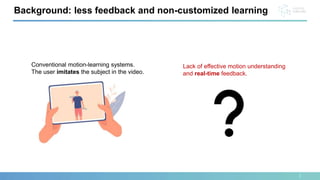
Conventional motion-learning systems.
The user imitates the subject in the video.
Lack of effective motion understanding
and real-time feedback.
3
Background: non-customized learning
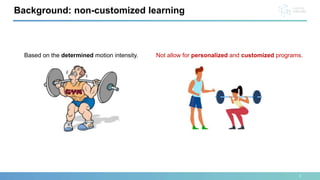
Based on the determined motion intensity. Not allow for personalized and customized programs.
4
Our goal:
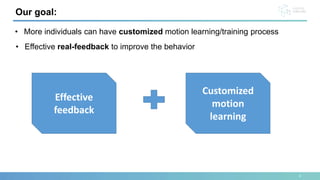
• More individuals can have customized motion learning/training process
Effective
feedback
Customized
motion
learning
• Effective real-feedback to improve the behavior
5
Related Work: motion tutorials
[1] FORME
[2] Natsuki Hamanishi and Jun Rekimoto. 2020. PoseAsQuery: Full-Body Interface for Repeated Observation of a Person in a Video with Ambiguous Pose Indexes and Performed Poses. In Proceedings of the
Augmented Humans International Conference. ACM, New York, NY, USA, 1–11.
[3] Christopher Clarke, Doga Cavdir, Patrick Chiu, Laurent Denoue, and Don Kimber. 2020. Reactive Video: Adaptive Video Playback Based on User Motion for Supporting Physical Activity. In Proceedings of the 33rd
Annual ACM Symposium on User Interface Software and Technology. ACM, New York, NY, USA, 196–208.
Exercise mirro [1] PoseAsQuert [2] ReactiveVideo [3]
6
2. Related Work: feedback based on error
[1] Maurício Sousa, João Vieira, Daniel Medeiros, Artur Arsenio, and Joaquim Jorge. 2016. SleeveAR: Augmented reality for rehabilitation using realtime feedback. In Proceedings of the 21st international conference
on intelligent user interfaces. ACM, New York, NY, USA, 175–185.
[2] Richard Tang, Xing-Dong Yang, Scott Bateman, Joaquim Jorge, and Anthony Tang. 2015. Physio@ Home: Exploring visual guidance and feedback techniques for physiotherapy exercises. In Proceedings of the 33rd
Annual ACM Conference on Human Factors in Computing Systems. ACM, New York, NY, USA, 4123–4132.
[3] MilkaTrajkova andFrancesco Cafaro. 2018. Takes Tutu to ballet: designing visual and verbal feedback for augmented mirrors. Proceedings of the ACM on Interactive, Mobile, Wearable and Ubiquitous
Technologies 2, 1 (2018), 1–30.
Exercise mirro [1] Physio@Home [2]: Tutu[3]:
Proposed system
8
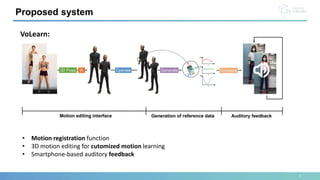
VoLearn:
• Motion registration function
• 3D motion editing for cutomized motion learning
• Smartphone-based auditory feedback
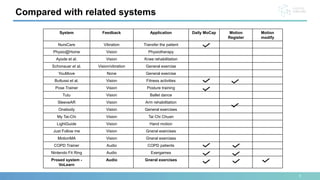
Compared with related systems
System Feedback Application Daily MoCap Motion
Register
Motion
modify
NursCare Vibration Transfer the patient
Physio@Home Vision Physiotherapy
Ayode et al. Vision Knee rehabilitation
Schonauer et al. Vision/vibration General exercise
YouMove None General exercise
Buttussi et al. Vision Fitness activities
Pose Trainer Vision Posture training
Tutu Vision Ballet dance
SleeveAR Vision Arm rehabilitation
Onebody Vision General exercises
My Tai-Chi Vision Tai Chi Chuan
LightGuide Vision Hand motion
Just Follow me Vision Gneral exercises
MotionMA Vision Gneral exercises
COPD Trainer Audio COPD patients
Nintendo Fit Ring Audio Exergames
Prosed system -
VoLearn
Audio Gneral exercises
9
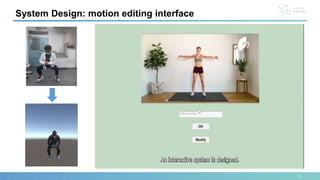
System Design: motion editing interface
11
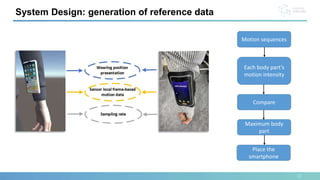
System Design: generation of reference data
12
Motion sequences
Each body part’s
motion intensity
Compare
Maximum body
part
Place the
smartphone
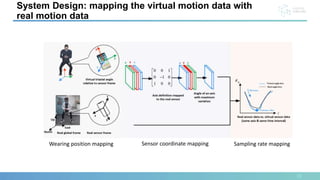
System Design: mapping the virtual motion data with
real motion data
13
Wearing position mapping Sensor coordinate mapping Sampling rate mapping
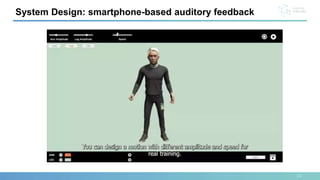
System Design: smartphone-based auditory feedback
14
15
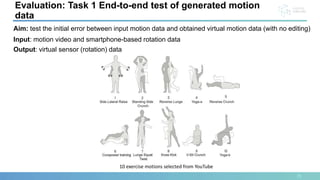
Input: motion video and smartphone-based rotation data
Output: virtual sensor (rotation) data
Aim: test the initial error between input motion data and obtained virtual motion data (with no editing)
10 exercise motions selected from YouTube
Evaluation: Task 1 End-to-end test of generated motion
data
16
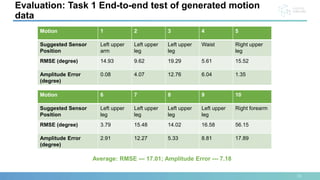
Motion 1 2 3 4 5
Suggested Sensor
Position
Left upper
arm
Left upper
leg
Left upper
leg
Waist Right upper
leg
RMSE (degree) 14.93 9.62 19.29 5.61 15.52
Amplitude Error
(degree)
0.08 4.07 12.76 6.04 1.35
Motion 6 7 8 9 10
Suggested Sensor
Position
Left upper
leg
Left upper
leg
Left upper
leg
Left upper
leg
Right forearm
RMSE (degree) 3.79 15.48 14.02 16.58 56.15
Amplitude Error
(degree)
2.91 12.27 5.33 8.81 17.89
Average: RMSE --- 17.01; Amplitude Error --- 7.18
Evaluation: Task 1 End-to-end test of generated motion
data
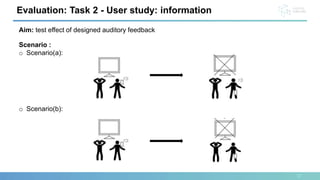
Evaluation: Task 2 - User study: information
17
Scenario :
o Scenario(a):
o Scenario(b):
Aim: test effect of designed auditory feedback
18
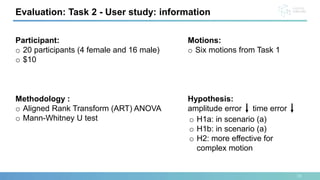
Participant:
o 20 participants (4 female and 16 male)
o $10
Evaluation: Task 2 - User study: information
Motions:
o Six motions from Task 1
Methodology :
o Aligned Rank Transform (ART) ANOVA
o Mann-Whitney U test
Hypothesis:
amplitude error time error
o H1a: in scenario (a)
o H1b: in scenario (a)
o H2: more effective for
complex motion
19
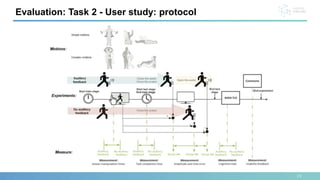
Evaluation: Task 2 - User study: protocol
20
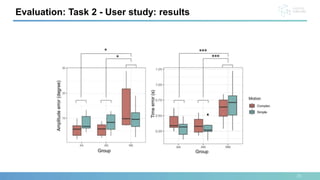
Evaluation: Task 2 - User study: results
21
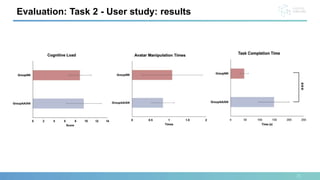
Evaluation: Task 2 - User study: results
22
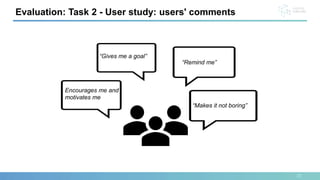
Evaluation: Task 2 - User study: users' comments
“Gives me a goal”
Encourages me and
motivates me
“Remind me”
“Makes it not boring”
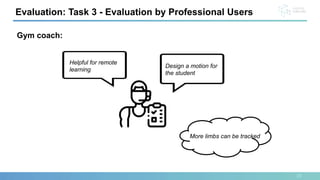
Evaluation: Task 3 - Evaluation by Professional Users
23
Gym coach:
Design a motion for
the student
Helpful for remote
learning
More limbs can be tracked
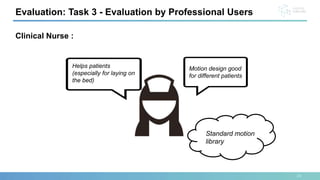
Evaluation: Task 3 - Evaluation by Professional Users
24
Helps patients
(especially for laying on
the bed)
Motion design good
for different patients
Standard motion
library
Clinical Nurse :
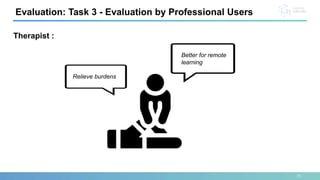
Evaluation: Task 3 - Evaluation by Professional Users
25
Relieve burdens
Better for remote
learning
Therapist :
Discussion and Limitation
26
High-performance 3D motion reconstruction
Current characteristics
Better for support mode (user should be familiar with motions)
One limb tracking
Further motion edition
More informative feedback with audio
Long learning effect
Limitation :
27
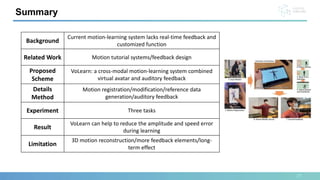
Summary
Background
Current motion-learning system lacks real-time feedback and
customized function
Related Work Motion tutorial systems/feedback design
Proposed
Scheme
VoLearn: a cross-modal motion-learning system combined
virtual avatar and auditory feedback
Details
Method
Motion registration/modification/reference data
generation/auditory feedback
Experiment Three tasks
Result
VoLearn can help to reduce the amplitude and speed error
during learning
Limitation
3D motion reconstruction/more feedback elements/long-
term effect
Thank you very much!

VoLearn: A Cross-Modal Operable Motion-Learning System Combined with Virtual Avatar and Auditory Feedback

  • 1.
    VoLearn: A Cross-ModalOperable Motion-Learning System Combined with Virtual Avatar and Auditory Feedback 2022 ACM Ubicomp (IMWUT) Chengshuo Xia1, Xinrui Fang1, Riku Arakawa2, Yuta Sugiura1 1. Keio University, Japan 2. Carnegie Mellon University, United States
  • 2.
    2 Background: less feedbackand non-customized learning Conventional motion-learning systems. The user imitates the subject in the video. Lack of effective motion understanding and real-time feedback.
  • 3.
    3 Background: non-customized learning Basedon the determined motion intensity. Not allow for personalized and customized programs.
  • 4.
    4 Our goal: • Moreindividuals can have customized motion learning/training process Effective feedback Customized motion learning • Effective real-feedback to improve the behavior
  • 5.
    5 Related Work: motiontutorials [1] FORME [2] Natsuki Hamanishi and Jun Rekimoto. 2020. PoseAsQuery: Full-Body Interface for Repeated Observation of a Person in a Video with Ambiguous Pose Indexes and Performed Poses. In Proceedings of the Augmented Humans International Conference. ACM, New York, NY, USA, 1–11. [3] Christopher Clarke, Doga Cavdir, Patrick Chiu, Laurent Denoue, and Don Kimber. 2020. Reactive Video: Adaptive Video Playback Based on User Motion for Supporting Physical Activity. In Proceedings of the 33rd Annual ACM Symposium on User Interface Software and Technology. ACM, New York, NY, USA, 196–208. Exercise mirro [1] PoseAsQuert [2] ReactiveVideo [3]
  • 6.
    6 2. Related Work:feedback based on error [1] Maurício Sousa, João Vieira, Daniel Medeiros, Artur Arsenio, and Joaquim Jorge. 2016. SleeveAR: Augmented reality for rehabilitation using realtime feedback. In Proceedings of the 21st international conference on intelligent user interfaces. ACM, New York, NY, USA, 175–185. [2] Richard Tang, Xing-Dong Yang, Scott Bateman, Joaquim Jorge, and Anthony Tang. 2015. Physio@ Home: Exploring visual guidance and feedback techniques for physiotherapy exercises. In Proceedings of the 33rd Annual ACM Conference on Human Factors in Computing Systems. ACM, New York, NY, USA, 4123–4132. [3] MilkaTrajkova andFrancesco Cafaro. 2018. Takes Tutu to ballet: designing visual and verbal feedback for augmented mirrors. Proceedings of the ACM on Interactive, Mobile, Wearable and Ubiquitous Technologies 2, 1 (2018), 1–30. Exercise mirro [1] Physio@Home [2]: Tutu[3]:
  • 7.
    Proposed system 8 VoLearn: • Motionregistration function • 3D motion editing for cutomized motion learning • Smartphone-based auditory feedback
  • 8.
    Compared with relatedsystems System Feedback Application Daily MoCap Motion Register Motion modify NursCare Vibration Transfer the patient Physio@Home Vision Physiotherapy Ayode et al. Vision Knee rehabilitation Schonauer et al. Vision/vibration General exercise YouMove None General exercise Buttussi et al. Vision Fitness activities Pose Trainer Vision Posture training Tutu Vision Ballet dance SleeveAR Vision Arm rehabilitation Onebody Vision General exercises My Tai-Chi Vision Tai Chi Chuan LightGuide Vision Hand motion Just Follow me Vision Gneral exercises MotionMA Vision Gneral exercises COPD Trainer Audio COPD patients Nintendo Fit Ring Audio Exergames Prosed system - VoLearn Audio Gneral exercises 9
  • 9.
    System Design: motionediting interface 11
  • 10.
    System Design: generationof reference data 12 Motion sequences Each body part’s motion intensity Compare Maximum body part Place the smartphone
  • 11.
    System Design: mappingthe virtual motion data with real motion data 13 Wearing position mapping Sensor coordinate mapping Sampling rate mapping
  • 12.
    System Design: smartphone-basedauditory feedback 14
  • 13.
    15 Input: motion videoand smartphone-based rotation data Output: virtual sensor (rotation) data Aim: test the initial error between input motion data and obtained virtual motion data (with no editing) 10 exercise motions selected from YouTube Evaluation: Task 1 End-to-end test of generated motion data
  • 14.
    16 Motion 1 23 4 5 Suggested Sensor Position Left upper arm Left upper leg Left upper leg Waist Right upper leg RMSE (degree) 14.93 9.62 19.29 5.61 15.52 Amplitude Error (degree) 0.08 4.07 12.76 6.04 1.35 Motion 6 7 8 9 10 Suggested Sensor Position Left upper leg Left upper leg Left upper leg Left upper leg Right forearm RMSE (degree) 3.79 15.48 14.02 16.58 56.15 Amplitude Error (degree) 2.91 12.27 5.33 8.81 17.89 Average: RMSE --- 17.01; Amplitude Error --- 7.18 Evaluation: Task 1 End-to-end test of generated motion data
  • 15.
    Evaluation: Task 2- User study: information 17 Scenario : o Scenario(a): o Scenario(b): Aim: test effect of designed auditory feedback
  • 16.
    18 Participant: o 20 participants(4 female and 16 male) o $10 Evaluation: Task 2 - User study: information Motions: o Six motions from Task 1 Methodology : o Aligned Rank Transform (ART) ANOVA o Mann-Whitney U test Hypothesis: amplitude error time error o H1a: in scenario (a) o H1b: in scenario (a) o H2: more effective for complex motion
  • 17.
    19 Evaluation: Task 2- User study: protocol
  • 18.
    20 Evaluation: Task 2- User study: results
  • 19.
    21 Evaluation: Task 2- User study: results
  • 20.
    22 Evaluation: Task 2- User study: users' comments “Gives me a goal” Encourages me and motivates me “Remind me” “Makes it not boring”
  • 21.
    Evaluation: Task 3- Evaluation by Professional Users 23 Gym coach: Design a motion for the student Helpful for remote learning More limbs can be tracked
  • 22.
    Evaluation: Task 3- Evaluation by Professional Users 24 Helps patients (especially for laying on the bed) Motion design good for different patients Standard motion library Clinical Nurse :
  • 23.
    Evaluation: Task 3- Evaluation by Professional Users 25 Relieve burdens Better for remote learning Therapist :
  • 24.
    Discussion and Limitation 26 High-performance3D motion reconstruction Current characteristics Better for support mode (user should be familiar with motions) One limb tracking Further motion edition More informative feedback with audio Long learning effect Limitation :
  • 25.
    27 Summary Background Current motion-learning systemlacks real-time feedback and customized function Related Work Motion tutorial systems/feedback design Proposed Scheme VoLearn: a cross-modal motion-learning system combined virtual avatar and auditory feedback Details Method Motion registration/modification/reference data generation/auditory feedback Experiment Three tasks Result VoLearn can help to reduce the amplitude and speed error during learning Limitation 3D motion reconstruction/more feedback elements/long- term effect
  • 26.