Reaction Paper

                                 Stephanie Aedo Vega.

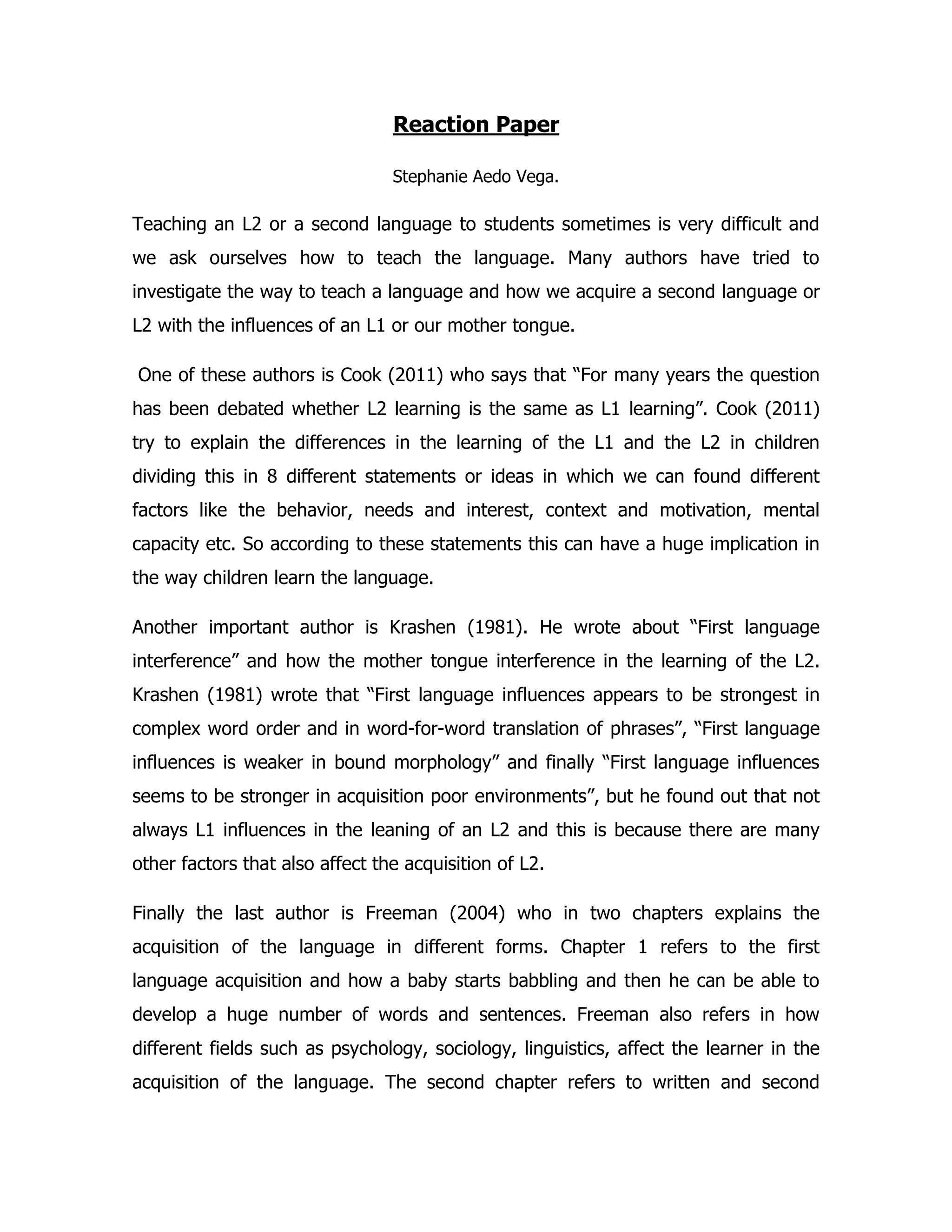
Teaching an L2 or a second language to students sometimes is very difficult and
we ask ourselves how to teach the language. Many authors have tried to
investigate the way to teach a language and how we acquire a second language or
L2 with the influences of an L1 or our mother tongue.

One of these authors is Cook (2011) who says that “For many years the question
has been debated whether L2 learning is the same as L1 learning”. Cook (2011)
try to explain the differences in the learning of the L1 and the L2 in children
dividing this in 8 different statements or ideas in which we can found different
factors like the behavior, needs and interest, context and motivation, mental
capacity etc. So according to these statements this can have a huge implication in
the way children learn the language.

Another important author is Krashen (1981). He wrote about “First language
interference” and how the mother tongue interference in the learning of the L2.
Krashen (1981) wrote that “First language influences appears to be strongest in
complex word order and in word-for-word translation of phrases”, “First language
influences is weaker in bound morphology” and finally “First language influences
seems to be stronger in acquisition poor environments”, but he found out that not
always L1 influences in the leaning of an L2 and this is because there are many
other factors that also affect the acquisition of L2.

Finally the last author is Freeman (2004) who in two chapters explains the
acquisition of the language in different forms. Chapter 1 refers to the first
language acquisition and how a baby starts babbling and then he can be able to
develop a huge number of words and sentences. Freeman also refers in how
different fields such as psychology, sociology, linguistics, affect the learner in the
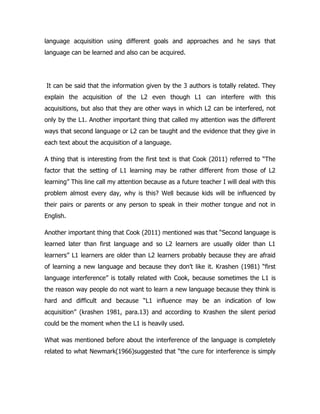
acquisition of the language. The second chapter refers to written and second
language acquisition using different goals and approaches and he says that
language can be learned and also can be acquired.


It can be said that the information given by the 3 authors is totally related. They
explain the acquisition of the L2 even though L1 can interfere with this
acquisitions, but also that they are other ways in which L2 can be interfered, not
only by the L1. Another important thing that called my attention was the different
ways that second language or L2 can be taught and the evidence that they give in
each text about the acquisition of a language.

A thing that is interesting from the first text is that Cook (2011) referred to “The
factor that the setting of L1 learning may be rather different from those of L2
learning” This line call my attention because as a future teacher I will deal with this
problem almost every day, why is this? Well because kids will be influenced by
their pairs or parents or any person to speak in their mother tongue and not in
English.

Another important thing that Cook (2011) mentioned was that “Second language is
learned later than first language and so L2 learners are usually older than L1
learners” L1 learners are older than L2 learners probably because they are afraid
of learning a new language and because they don’t like it. Krashen (1981) “first
language interference” is totally related with Cook, because sometimes the L1 is
the reason way people do not want to learn a new language because they think is
hard and difficult and because “L1 influence may be an indication of low
acquisition” (krashen 1981, para.13) and according to Krashen the silent period
could be the moment when the L1 is heavily used.

What was mentioned before about the interference of the language is completely
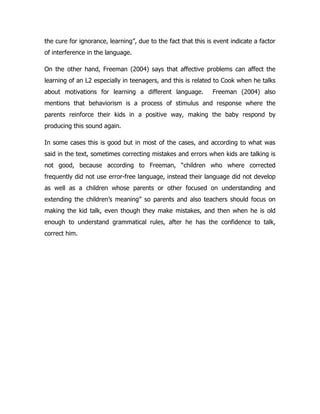
related to what Newmark(1966)suggested that “the cure for interference is simply
the cure for ignorance, learning”, due to the fact that this is event indicate a factor
of interference in the language.

On the other hand, Freeman (2004) says that affective problems can affect the
learning of an L2 especially in teenagers, and this is related to Cook when he talks
about motivations for learning a different language.           Freeman (2004) also
mentions that behaviorism is a process of stimulus and response where the
parents reinforce their kids in a positive way, making the baby respond by
producing this sound again.

In some cases this is good but in most of the cases, and according to what was
said in the text, sometimes correcting mistakes and errors when kids are talking is
not good, because according to Freeman, “children who where corrected
frequently did not use error-free language, instead their language did not develop
as well as a children whose parents or other focused on understanding and
extending the children’s meaning” so parents and also teachers should focus on
making the kid talk, even though they make mistakes, and then when he is old
enough to understand grammatical rules, after he has the confidence to talk,
correct him.
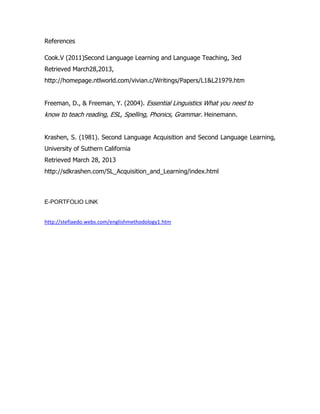
References

Cook.V (2011)Second Language Learning and Language Teaching, 3ed
Retrieved March28,2013,
http://homepage.ntlworld.com/vivian.c/Writings/Papers/L1&L21979.htm


Freeman, D., & Freeman, Y. (2004). Essential Linguistics What you need to
know to teach reading, ESL, Spelling, Phonics, Grammar. Heinemann.


Krashen, S. (1981). Second Language Acquisition and Second Language Learning,
University of Suthern California
Retrieved March 28, 2013
http://sdkrashen.com/SL_Acquisition_and_Learning/index.html


E-PORTFOLIO LINK


http://stefiaedo.webs.com/englishmethodology1.htm

Reaction paper

  • 1.
    Reaction Paper Stephanie Aedo Vega. Teaching an L2 or a second language to students sometimes is very difficult and we ask ourselves how to teach the language. Many authors have tried to investigate the way to teach a language and how we acquire a second language or L2 with the influences of an L1 or our mother tongue. One of these authors is Cook (2011) who says that “For many years the question has been debated whether L2 learning is the same as L1 learning”. Cook (2011) try to explain the differences in the learning of the L1 and the L2 in children dividing this in 8 different statements or ideas in which we can found different factors like the behavior, needs and interest, context and motivation, mental capacity etc. So according to these statements this can have a huge implication in the way children learn the language. Another important author is Krashen (1981). He wrote about “First language interference” and how the mother tongue interference in the learning of the L2. Krashen (1981) wrote that “First language influences appears to be strongest in complex word order and in word-for-word translation of phrases”, “First language influences is weaker in bound morphology” and finally “First language influences seems to be stronger in acquisition poor environments”, but he found out that not always L1 influences in the leaning of an L2 and this is because there are many other factors that also affect the acquisition of L2. Finally the last author is Freeman (2004) who in two chapters explains the acquisition of the language in different forms. Chapter 1 refers to the first language acquisition and how a baby starts babbling and then he can be able to develop a huge number of words and sentences. Freeman also refers in how different fields such as psychology, sociology, linguistics, affect the learner in the acquisition of the language. The second chapter refers to written and second
  • 2.
    language acquisition usingdifferent goals and approaches and he says that language can be learned and also can be acquired. It can be said that the information given by the 3 authors is totally related. They explain the acquisition of the L2 even though L1 can interfere with this acquisitions, but also that they are other ways in which L2 can be interfered, not only by the L1. Another important thing that called my attention was the different ways that second language or L2 can be taught and the evidence that they give in each text about the acquisition of a language. A thing that is interesting from the first text is that Cook (2011) referred to “The factor that the setting of L1 learning may be rather different from those of L2 learning” This line call my attention because as a future teacher I will deal with this problem almost every day, why is this? Well because kids will be influenced by their pairs or parents or any person to speak in their mother tongue and not in English. Another important thing that Cook (2011) mentioned was that “Second language is learned later than first language and so L2 learners are usually older than L1 learners” L1 learners are older than L2 learners probably because they are afraid of learning a new language and because they don’t like it. Krashen (1981) “first language interference” is totally related with Cook, because sometimes the L1 is the reason way people do not want to learn a new language because they think is hard and difficult and because “L1 influence may be an indication of low acquisition” (krashen 1981, para.13) and according to Krashen the silent period could be the moment when the L1 is heavily used. What was mentioned before about the interference of the language is completely related to what Newmark(1966)suggested that “the cure for interference is simply
  • 3.
    the cure forignorance, learning”, due to the fact that this is event indicate a factor of interference in the language. On the other hand, Freeman (2004) says that affective problems can affect the learning of an L2 especially in teenagers, and this is related to Cook when he talks about motivations for learning a different language. Freeman (2004) also mentions that behaviorism is a process of stimulus and response where the parents reinforce their kids in a positive way, making the baby respond by producing this sound again. In some cases this is good but in most of the cases, and according to what was said in the text, sometimes correcting mistakes and errors when kids are talking is not good, because according to Freeman, “children who where corrected frequently did not use error-free language, instead their language did not develop as well as a children whose parents or other focused on understanding and extending the children’s meaning” so parents and also teachers should focus on making the kid talk, even though they make mistakes, and then when he is old enough to understand grammatical rules, after he has the confidence to talk, correct him.
  • 4.
    References Cook.V (2011)Second LanguageLearning and Language Teaching, 3ed Retrieved March28,2013, http://homepage.ntlworld.com/vivian.c/Writings/Papers/L1&L21979.htm Freeman, D., & Freeman, Y. (2004). Essential Linguistics What you need to know to teach reading, ESL, Spelling, Phonics, Grammar. Heinemann. Krashen, S. (1981). Second Language Acquisition and Second Language Learning, University of Suthern California Retrieved March 28, 2013 http://sdkrashen.com/SL_Acquisition_and_Learning/index.html E-PORTFOLIO LINK http://stefiaedo.webs.com/englishmethodology1.htm