Adoption of AI for
SME Competitive
Advantage
Arthur Siahaan, Henky Lesmana, Safril
Tjandraatmadja
Agenda
Introduction
01
Competitive Advantage
02
AI Adoption
03
Discussion & Conclusion
04
Introduction
The Age of AI
1. AI is becoming the new operational foundation of business—the core of a company’s
operating model, defining how the company drives the execution of tasks.
2. AI is not only displacing human activity, it is changing the very concept of the firm
3. When a business is driven by AI, software instructions and algorithms make up the
critical path in the way the firm delivers value
• Strong AI: capable of simulating human reasoning
• Weak AI: perform tasks that were traditionally performed by human being
4. AI have three magic words: Scalability, Scope, Learning
• Scalability: deliver as much value at the lowest cost (order taking is digitized)
• Scope: range of activities it performs (e.g. centralized warehouse, etc)
• Learning: to improve and innovate
• The system do not incur human complexity cost (communication and coordination), decrease in efficiency
and tireless
Transforming Competition
1. As we enter the age of artificial intelligence, the emergence of digital operating models
is transforming competition
2. This digital representation of human activity can learn and improve itself transform
the ways a firm can (and should) operate
3. Digital operating modes:
• Improve scalability, scope and learning of business VS Introduce set of challenges
4. As it collides with traditional company the digital operating model can overwhelm the
status quo
Traditional Business
1. Traditional business needs to understand how to leverage existing strengths in new
ways and transform operating capabilities to support new strategies
2. Size = double-edge swords
• As it grows:
• deliver more value at cheaper price
• operating model becomes more complex – come all kind of problem
• In other words: complexity becomes the downfall of traditional company
• Increase operational cost
• Decrease service levels
The Consequences of Digitalization
1. Business Model: firm promises to create and capture value
• In traditional companies à value creation and value capture created from same
resources
• In fully digital firms à value creation and value capture can be separated much more
easily and often come from different stakeholders (Google Ads)
2. Operating Model: deliver the values
• The goal is to deliver the values at scale, to achieve sufficient scope and to respond
to changes by engaging in sufficient learning.
Parameters Reflecting the External
Technological Environment
1. Availability of latest technologies à In a country, to what
extent are the latest technologies available?
2. Firm-level technology absorption à In a country, to what
extent do businesses adopt the latest technologies?
3. Foreign Direct Investment (FDI) and technology transfer à
To what extent does FDI bring new technology in the
country?
4. Individuals using Internet à Percentage of individuals using
the Internet
5. Fixed broadband Internet subscriptions à Fixedbroadband
Internet subscriptions per 100 population
6. International Internet bandwidth à International bandwidth
is the contracted capacity of international connection
between countries for transmitting internet traffic.
Source : Supriyo Das, Amit Kundu, Arabinda Bhattacharya, 2020
Both institutional capabilities
and external capabilities
emerged as significant factors
toward creating sustainable
technological environments for
entrepreneurs.
Competitive
Advantage
Competitive Advantage in Digital Economies
1. The ability:
• To shape and control the network (digital connections, carry data, powerful software
algorithm, ignore traditional boundaries, growing economy and social system)
• To harvest the volume and variety of the transaction carry.
2. Moves toward to most central in connecting business, aggregating data that flows
between and extracting value through powerful analytic and AI
Traditional Business Issues
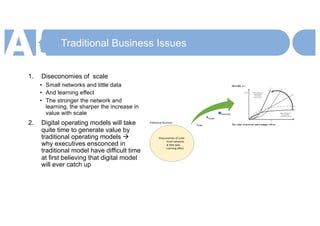
1. Diseconomies of scale
• Small networks and little data
• And learning effect
• The stronger the network and
learning, the sharper the increase in
value with scale
2. Digital operating models will take
quite time to generate value by
traditional operating models à
why executives ensconced in
traditional model have difficult time
at first believing that digital model
will ever catch up
Scale
Scope
Learning
Diseconomies of scale:
- Small networks
& little data
- Learning effect
Traditional Business
Characteristics of SME in ASEAN
1. Productivity
2. Foreign ownership
3. Financial characteristics
4. Innovation efforts
5. Managerial/entrepreneurial attitude
UMKM Indonesia Issues
General Issues :
1. Low adoption of information technology among ultra-micro entrepreneurs
2. Low awareness of the benefits of SME IT applications
3. Intention to use advanced IT system is very low, however the usage of social media is
quite massive
4. Internal Factors
• Insufficient working capital for business development
• Human resources issues - entrepreneurs do not yet have an adequate entrepreneurial spirit
• Weak business networks and market penetration capabilities
5. External Factors
• The business climate (business ecosystem) is not yet fully conducive
• Limited business facilities and infrastructure
• Implications free trade act
AI Adoption
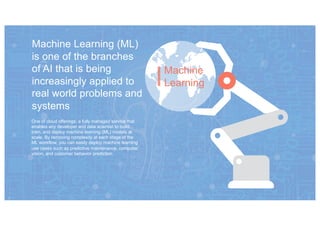
Machine Learning (ML)
is one of the branches
of AI that is being
increasingly applied to
real world problems and
systems
Machine
Learning
One of cloud offerings: a fully managed service that
enables any developer and data scientist to build,
train, and deploy machine learning (ML) models at
scale. By removing complexity at each stage of the
ML workflow, you can easily deploy machine learning
use cases such as predictive maintenance, computer
vision, and customer behavior prediction
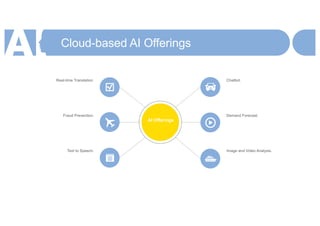
Cloud-based AI Offerings
Chatbot.
Demand Forecast.
Image and Video Analysis.
Real-time Translation.
Fraud Prevention.
Text to Speech.
AI Offerings
Cloud-based Chatbot
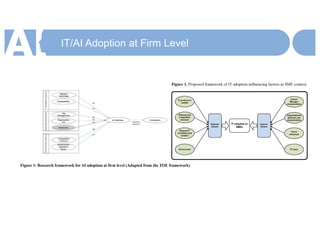
IT/AI Adoption at Firm Level
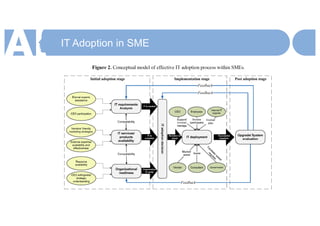
IT Adoption in SME
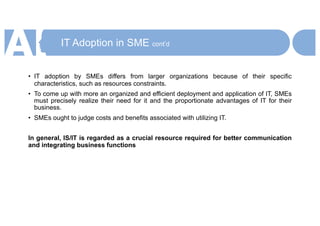
IT Adoption in SME cont’d
• IT adoption by SMEs differs from larger organizations because of their specific
characteristics, such as resources constraints.
• To come up with more an organized and efficient deployment and application of IT, SMEs
must precisely realize their need for it and the proportionate advantages of IT for their
business.
• SMEs ought to judge costs and benefits associated with utilizing IT.
In general, IS/IT is regarded as a crucial resource required for better communication
and integrating business functions
Failure and Dissatisfaction of IT Adoption in SME
• Inappropriate connection between adopted IT and enterprise strategies,
• Inadequate realization of organizational issues,
• Inadequate realization of end user necessities,
• Lack of manager and employee involvement in different stages of IT adoption,
• Lack of required resources (knowledge, skills, finance, management),
• Inadequate teaching and preparation of end users,
• Business size and fund limitations to employ IT specialists,
• Unqualified management in highly centralized CEO structures,
• Inappropriate government assistance role and supportive regulation,
• Dissatisfaction with IT-created competitive advantages due to improper interactions with
competitors, suppliers and customers, and
• The particular characteristics of organizations, their culture and family involvement in the
business.
Discussion &
Conclusion
What should SME do?
1. Knowing their current position in IT adoption ?
2. Challenge the industry standards ?
3. Work with them and become their chosen, best suppliers ?
Action Plan to Adopt AI
1. Implementation of cutting edge technology ahead of other firms is an important
mechanism for firms to achieve competitive advantage
2. AI allows an organisation to obtain a competitive advantage, reduce costs (Press,
2016) and opportunities to transfer into new businesses (Ransbotham et al. 2017),
raise top-line profits, increase efficiency and amplify human intelligence (Curran &
Purcel, 2017).
3. Begins by mapping the most important economic networks connected to a business
and examining the flows of valuable data and the opportunities that exist to gain CA
through AI.
4. Evaluate the potential of each major network for value creation and capture at scale à
will strengthen or weaken the values
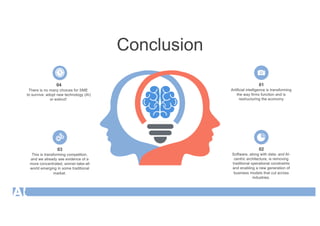
Conclusion
01
Artificial intelligence is transforming
the way firms function and is
restructuring the economy
02
Software, along with data- and AI-
centric architecture, is removing
traditional operational constraints
and enabling a new generation of
business models that cut across
industries.
03
This is transforming competition,
and we already see evidence of a
more concentrated, winner-take-all
world emerging in some traditional
market.
04
There is no many choices for SME
to survive: adopt new technology (AI)
or extinct!
Thank You
References
1. Marco Iansiti & Karim R. Lakhani (2020). Competing In The Age Of Ai. Harvard
Business Review Pres, Boston, MA
2. Morteza Ghobakhloo, Tang Sai Hong, Mohammad Sadegh Sabouri and Norzima
Zulkifli (2012). Strategies for Successful Information Technology Adoption in Small and
Medium-sized Enterprises. Information journal
3. Supriyo Das, Amit Kundu, Arabinda Bhattacharya (2020). Technology Adaptation and
Survival of SMEs: A Longitudinal Study of Developing Countries. Technology
Innovation Management Review
4. Junghee Han & Chang-min Park (2017). Case study on adoption of new technology for
innovation Perspective of institutional and corporate entrepreneurship
5. C. Harvie & D. Narjoko & S. Oum (2010). Firm Characteristic Determinants of SME
Participation in Production Networks. ERIA discussion paper series
6. Sulaiman AlSheibani, Yen Cheung, Chris Messom (2018). Artificial Intelligence
Adoption: AI-readiness at Firm-Level (Research-in-Progress)

Artificial-Intelligence-Adoption for SME v1.0 Rev SFT.pdf

  • 1.
    Adoption of AIfor SME Competitive Advantage Arthur Siahaan, Henky Lesmana, Safril Tjandraatmadja
  • 2.
  • 3.
  • 4.
    The Age ofAI 1. AI is becoming the new operational foundation of business—the core of a company’s operating model, defining how the company drives the execution of tasks. 2. AI is not only displacing human activity, it is changing the very concept of the firm 3. When a business is driven by AI, software instructions and algorithms make up the critical path in the way the firm delivers value • Strong AI: capable of simulating human reasoning • Weak AI: perform tasks that were traditionally performed by human being 4. AI have three magic words: Scalability, Scope, Learning • Scalability: deliver as much value at the lowest cost (order taking is digitized) • Scope: range of activities it performs (e.g. centralized warehouse, etc) • Learning: to improve and innovate • The system do not incur human complexity cost (communication and coordination), decrease in efficiency and tireless
  • 5.
    Transforming Competition 1. Aswe enter the age of artificial intelligence, the emergence of digital operating models is transforming competition 2. This digital representation of human activity can learn and improve itself transform the ways a firm can (and should) operate 3. Digital operating modes: • Improve scalability, scope and learning of business VS Introduce set of challenges 4. As it collides with traditional company the digital operating model can overwhelm the status quo
  • 6.
    Traditional Business 1. Traditionalbusiness needs to understand how to leverage existing strengths in new ways and transform operating capabilities to support new strategies 2. Size = double-edge swords • As it grows: • deliver more value at cheaper price • operating model becomes more complex – come all kind of problem • In other words: complexity becomes the downfall of traditional company • Increase operational cost • Decrease service levels
  • 7.
    The Consequences ofDigitalization 1. Business Model: firm promises to create and capture value • In traditional companies à value creation and value capture created from same resources • In fully digital firms à value creation and value capture can be separated much more easily and often come from different stakeholders (Google Ads) 2. Operating Model: deliver the values • The goal is to deliver the values at scale, to achieve sufficient scope and to respond to changes by engaging in sufficient learning.
  • 8.
    Parameters Reflecting theExternal Technological Environment 1. Availability of latest technologies à In a country, to what extent are the latest technologies available? 2. Firm-level technology absorption à In a country, to what extent do businesses adopt the latest technologies? 3. Foreign Direct Investment (FDI) and technology transfer à To what extent does FDI bring new technology in the country? 4. Individuals using Internet à Percentage of individuals using the Internet 5. Fixed broadband Internet subscriptions à Fixedbroadband Internet subscriptions per 100 population 6. International Internet bandwidth à International bandwidth is the contracted capacity of international connection between countries for transmitting internet traffic. Source : Supriyo Das, Amit Kundu, Arabinda Bhattacharya, 2020 Both institutional capabilities and external capabilities emerged as significant factors toward creating sustainable technological environments for entrepreneurs.
  • 9.
  • 10.
    Competitive Advantage inDigital Economies 1. The ability: • To shape and control the network (digital connections, carry data, powerful software algorithm, ignore traditional boundaries, growing economy and social system) • To harvest the volume and variety of the transaction carry. 2. Moves toward to most central in connecting business, aggregating data that flows between and extracting value through powerful analytic and AI
  • 11.
    Traditional Business Issues 1.Diseconomies of scale • Small networks and little data • And learning effect • The stronger the network and learning, the sharper the increase in value with scale 2. Digital operating models will take quite time to generate value by traditional operating models à why executives ensconced in traditional model have difficult time at first believing that digital model will ever catch up Scale Scope Learning Diseconomies of scale: - Small networks & little data - Learning effect Traditional Business
  • 12.
    Characteristics of SMEin ASEAN 1. Productivity 2. Foreign ownership 3. Financial characteristics 4. Innovation efforts 5. Managerial/entrepreneurial attitude
  • 13.
    UMKM Indonesia Issues GeneralIssues : 1. Low adoption of information technology among ultra-micro entrepreneurs 2. Low awareness of the benefits of SME IT applications 3. Intention to use advanced IT system is very low, however the usage of social media is quite massive 4. Internal Factors • Insufficient working capital for business development • Human resources issues - entrepreneurs do not yet have an adequate entrepreneurial spirit • Weak business networks and market penetration capabilities 5. External Factors • The business climate (business ecosystem) is not yet fully conducive • Limited business facilities and infrastructure • Implications free trade act
  • 14.
  • 15.
    Machine Learning (ML) isone of the branches of AI that is being increasingly applied to real world problems and systems Machine Learning One of cloud offerings: a fully managed service that enables any developer and data scientist to build, train, and deploy machine learning (ML) models at scale. By removing complexity at each stage of the ML workflow, you can easily deploy machine learning use cases such as predictive maintenance, computer vision, and customer behavior prediction
  • 16.
    Cloud-based AI Offerings Chatbot. DemandForecast. Image and Video Analysis. Real-time Translation. Fraud Prevention. Text to Speech. AI Offerings
  • 17.
  • 18.
  • 19.
  • 20.
    IT Adoption inSME cont’d • IT adoption by SMEs differs from larger organizations because of their specific characteristics, such as resources constraints. • To come up with more an organized and efficient deployment and application of IT, SMEs must precisely realize their need for it and the proportionate advantages of IT for their business. • SMEs ought to judge costs and benefits associated with utilizing IT. In general, IS/IT is regarded as a crucial resource required for better communication and integrating business functions
  • 21.
    Failure and Dissatisfactionof IT Adoption in SME • Inappropriate connection between adopted IT and enterprise strategies, • Inadequate realization of organizational issues, • Inadequate realization of end user necessities, • Lack of manager and employee involvement in different stages of IT adoption, • Lack of required resources (knowledge, skills, finance, management), • Inadequate teaching and preparation of end users, • Business size and fund limitations to employ IT specialists, • Unqualified management in highly centralized CEO structures, • Inappropriate government assistance role and supportive regulation, • Dissatisfaction with IT-created competitive advantages due to improper interactions with competitors, suppliers and customers, and • The particular characteristics of organizations, their culture and family involvement in the business.
  • 22.
  • 23.
    What should SMEdo? 1. Knowing their current position in IT adoption ? 2. Challenge the industry standards ? 3. Work with them and become their chosen, best suppliers ?
  • 24.
    Action Plan toAdopt AI 1. Implementation of cutting edge technology ahead of other firms is an important mechanism for firms to achieve competitive advantage 2. AI allows an organisation to obtain a competitive advantage, reduce costs (Press, 2016) and opportunities to transfer into new businesses (Ransbotham et al. 2017), raise top-line profits, increase efficiency and amplify human intelligence (Curran & Purcel, 2017). 3. Begins by mapping the most important economic networks connected to a business and examining the flows of valuable data and the opportunities that exist to gain CA through AI. 4. Evaluate the potential of each major network for value creation and capture at scale à will strengthen or weaken the values
  • 25.
    Conclusion 01 Artificial intelligence istransforming the way firms function and is restructuring the economy 02 Software, along with data- and AI- centric architecture, is removing traditional operational constraints and enabling a new generation of business models that cut across industries. 03 This is transforming competition, and we already see evidence of a more concentrated, winner-take-all world emerging in some traditional market. 04 There is no many choices for SME to survive: adopt new technology (AI) or extinct!
  • 26.
  • 27.
    References 1. Marco Iansiti& Karim R. Lakhani (2020). Competing In The Age Of Ai. Harvard Business Review Pres, Boston, MA 2. Morteza Ghobakhloo, Tang Sai Hong, Mohammad Sadegh Sabouri and Norzima Zulkifli (2012). Strategies for Successful Information Technology Adoption in Small and Medium-sized Enterprises. Information journal 3. Supriyo Das, Amit Kundu, Arabinda Bhattacharya (2020). Technology Adaptation and Survival of SMEs: A Longitudinal Study of Developing Countries. Technology Innovation Management Review 4. Junghee Han & Chang-min Park (2017). Case study on adoption of new technology for innovation Perspective of institutional and corporate entrepreneurship 5. C. Harvie & D. Narjoko & S. Oum (2010). Firm Characteristic Determinants of SME Participation in Production Networks. ERIA discussion paper series 6. Sulaiman AlSheibani, Yen Cheung, Chris Messom (2018). Artificial Intelligence Adoption: AI-readiness at Firm-Level (Research-in-Progress)