The Future of HR
How RPA Technology is
Automating HR to Save Time &
Increase Productivity
The world is in the middle
of a major revolution in the
way that work is done.
And the way businesses view
the role of the human worker
has changed significantly
from the Industrial Age to the
Digital Age.
4
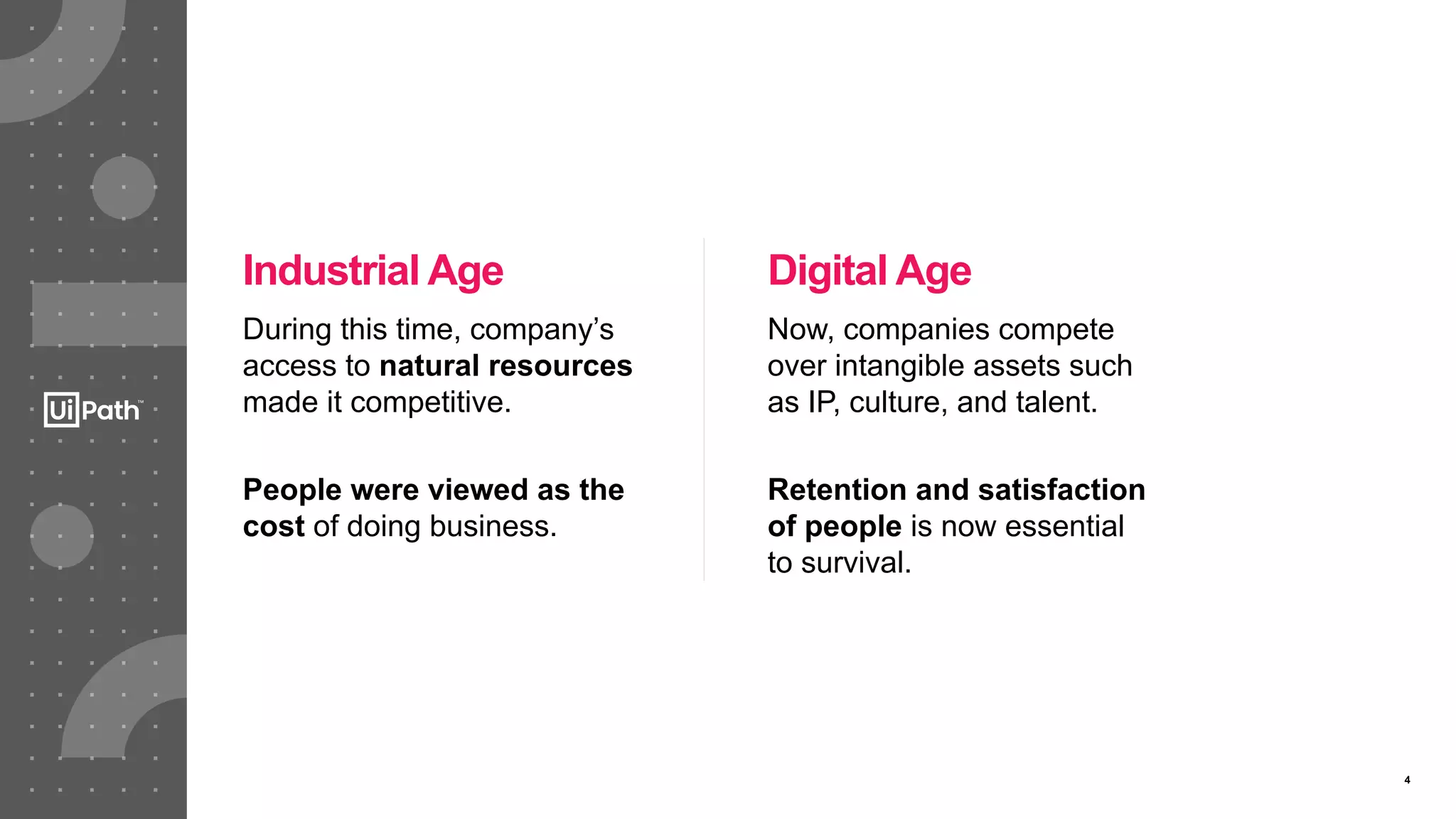
Industrial Age
During this time, company’s
access to natural resources
made it competitive.
People were viewed as the
cost of doing business.
Digital Age
Now, companies compete
over intangible assets such
as IP, culture, and talent.
Retention and satisfaction
of people is now essential
to survival.
5
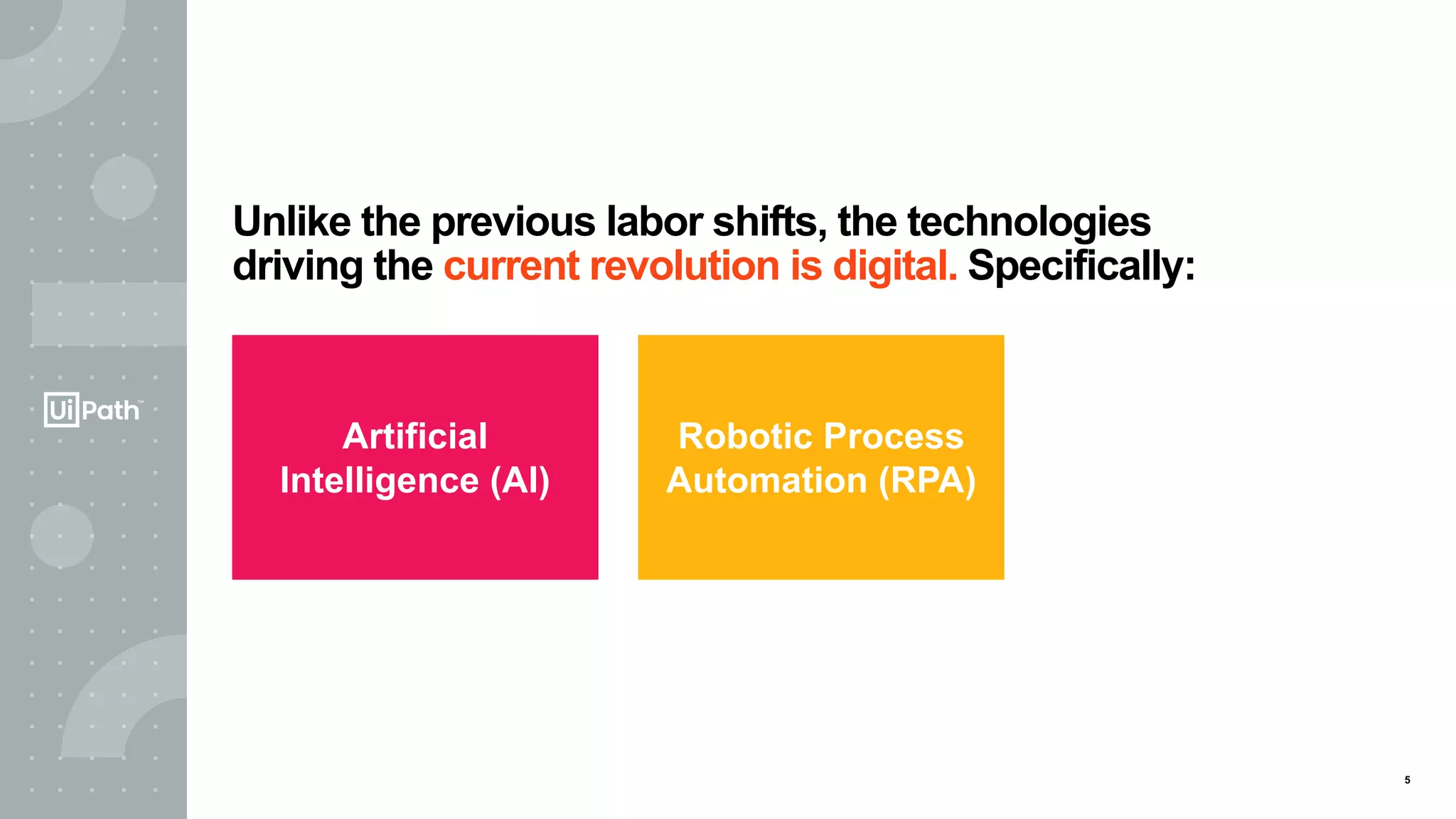
Artificial
Intelligence (AI)
Robotic Process
Automation (RPA)
Unlike the previous labor shifts, the technologies
driving the current revolution is digital. Specifically:
6
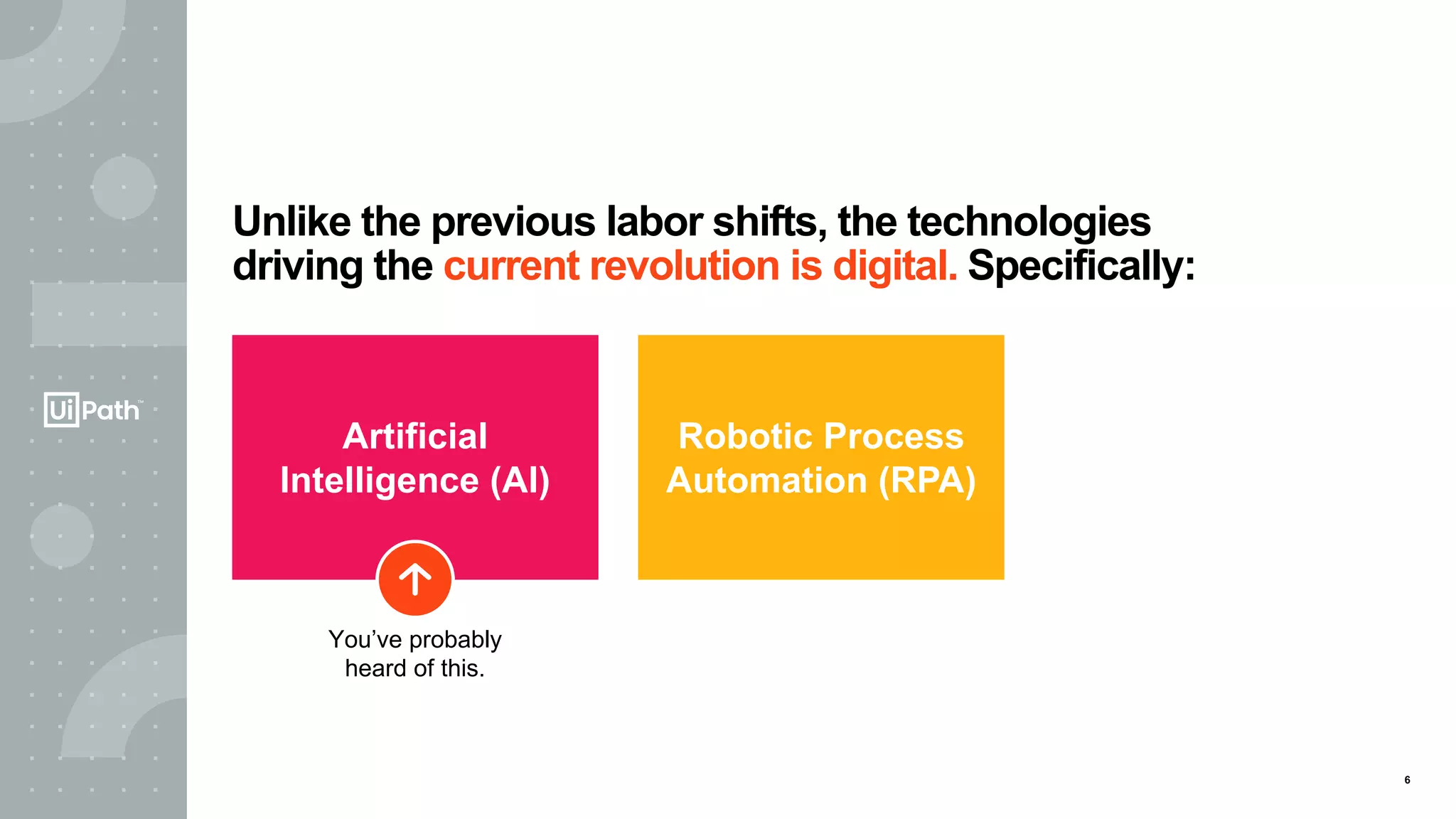
Artificial
Intelligence (AI)
Robotic Process
Automation (RPA)
Unlike the previous labor shifts, the technologies
driving the current revolution is digital. Specifically:
You’ve probably
heard of this.
7
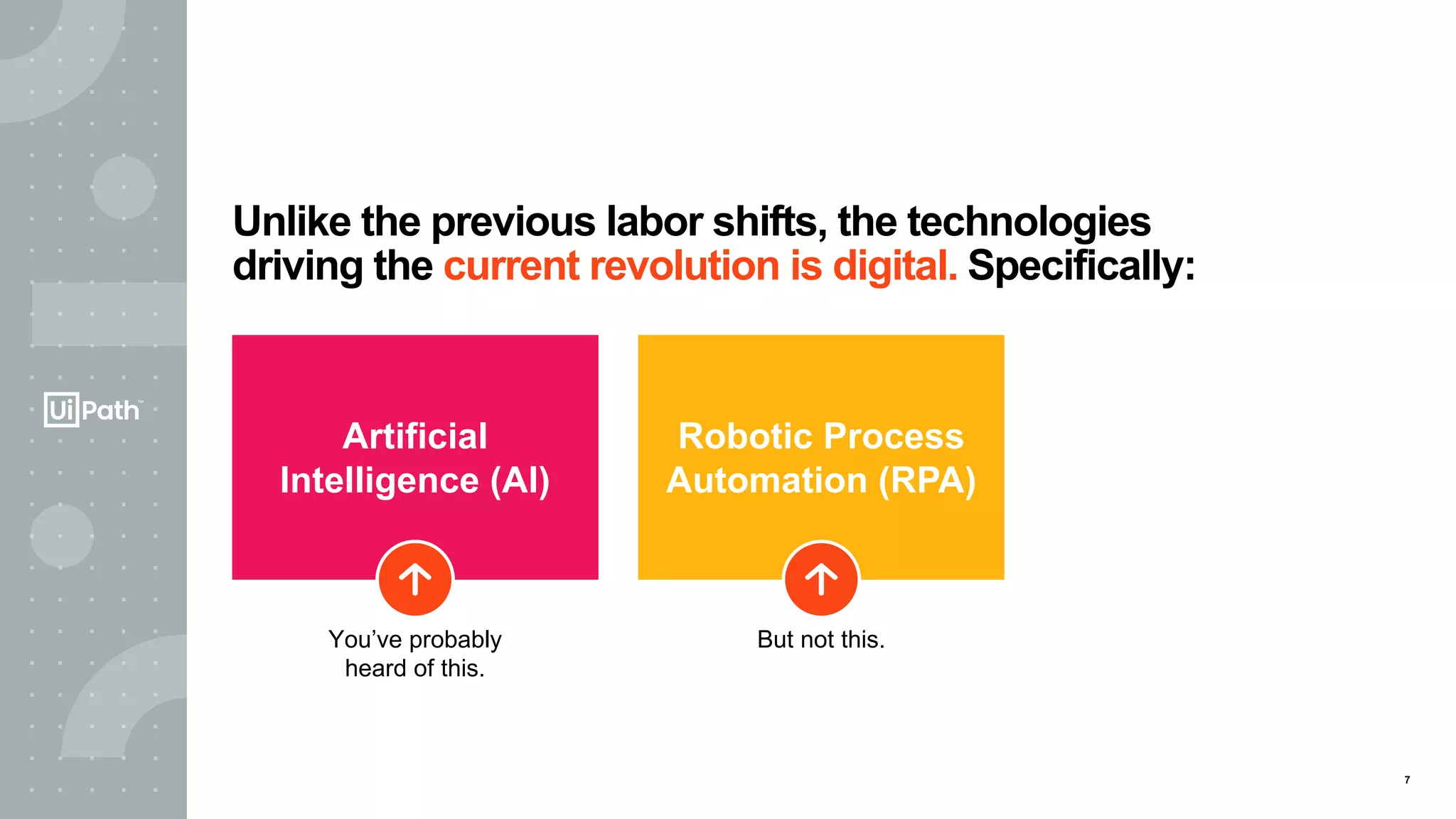
Artificial
Intelligence (AI)
Robotic Process
Automation (RPA)
Unlike the previous labor shifts, the technologies
driving the current revolution is digital. Specifically:
But not this.You’ve probably
heard of this.
8
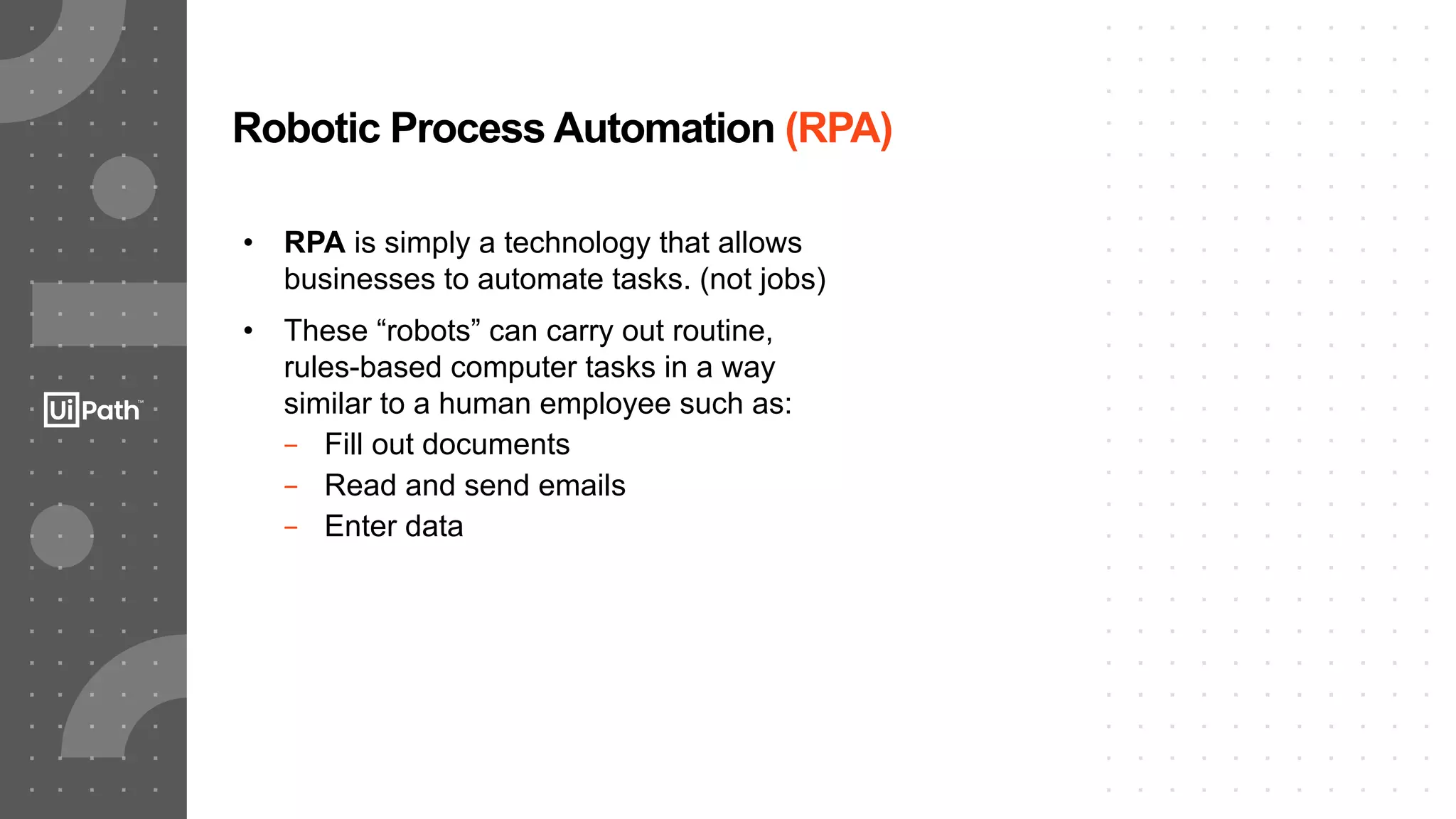
Robotic Process Automation (RPA)
• RPA is simply a technology that allows
businesses to automate tasks. (not jobs)
• These “robots” can carry out routine,
rules-based computer tasks in a way
similar to a human employee such as:
− Fill out documents
− Read and send emails
− Enter data
RPA fundamentally shifts
Talent Management and
Human Resources functions.
(BTW, we wrote an entire whitepaper
on this. Click anywhere on this slide
to check it out.)
RPA fundamentally shifts
Talent Management and
Human Resources functions.
11
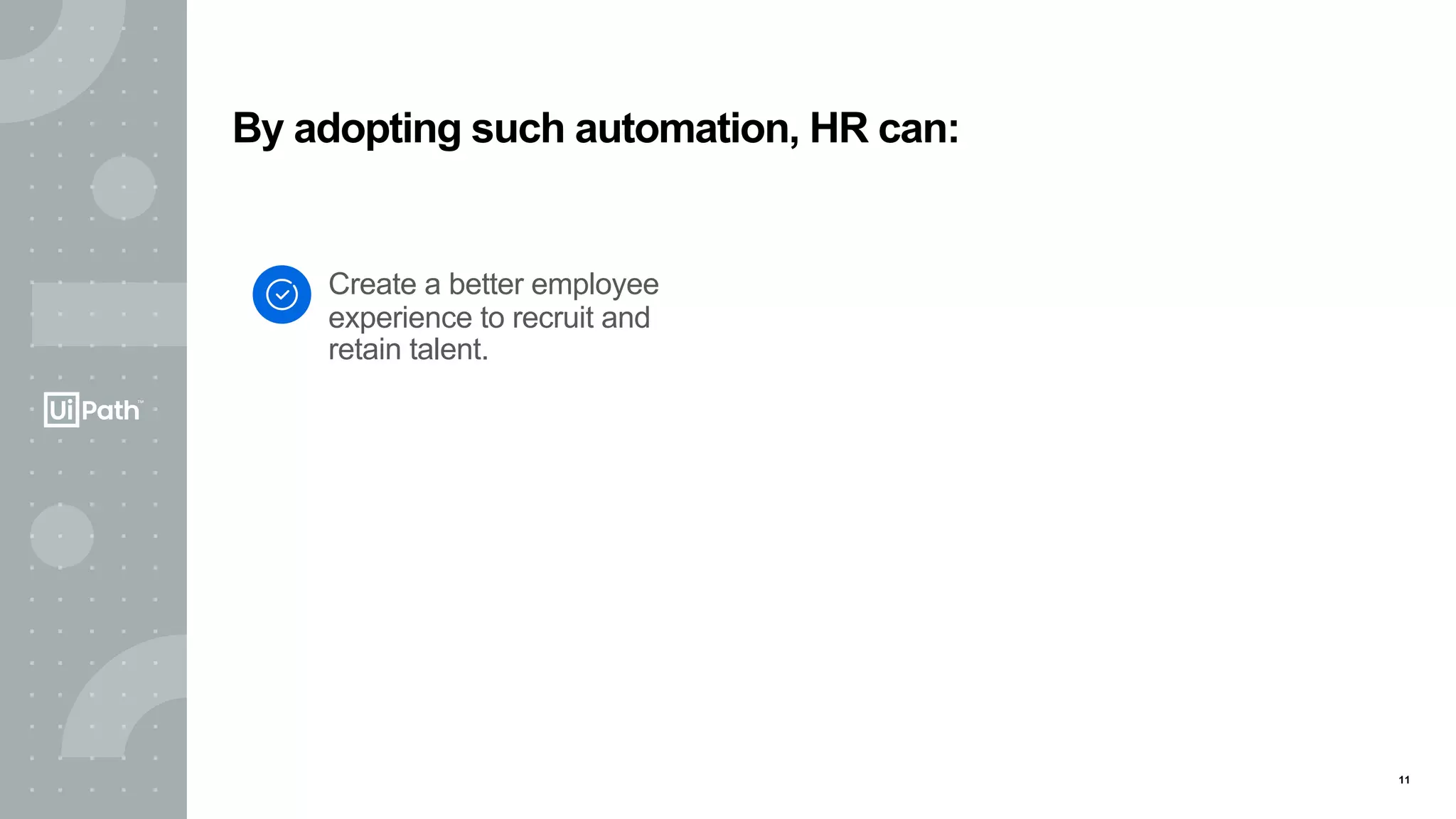
Create a better employee
experience to recruit and
retain talent.
By adopting such automation, HR can:
12
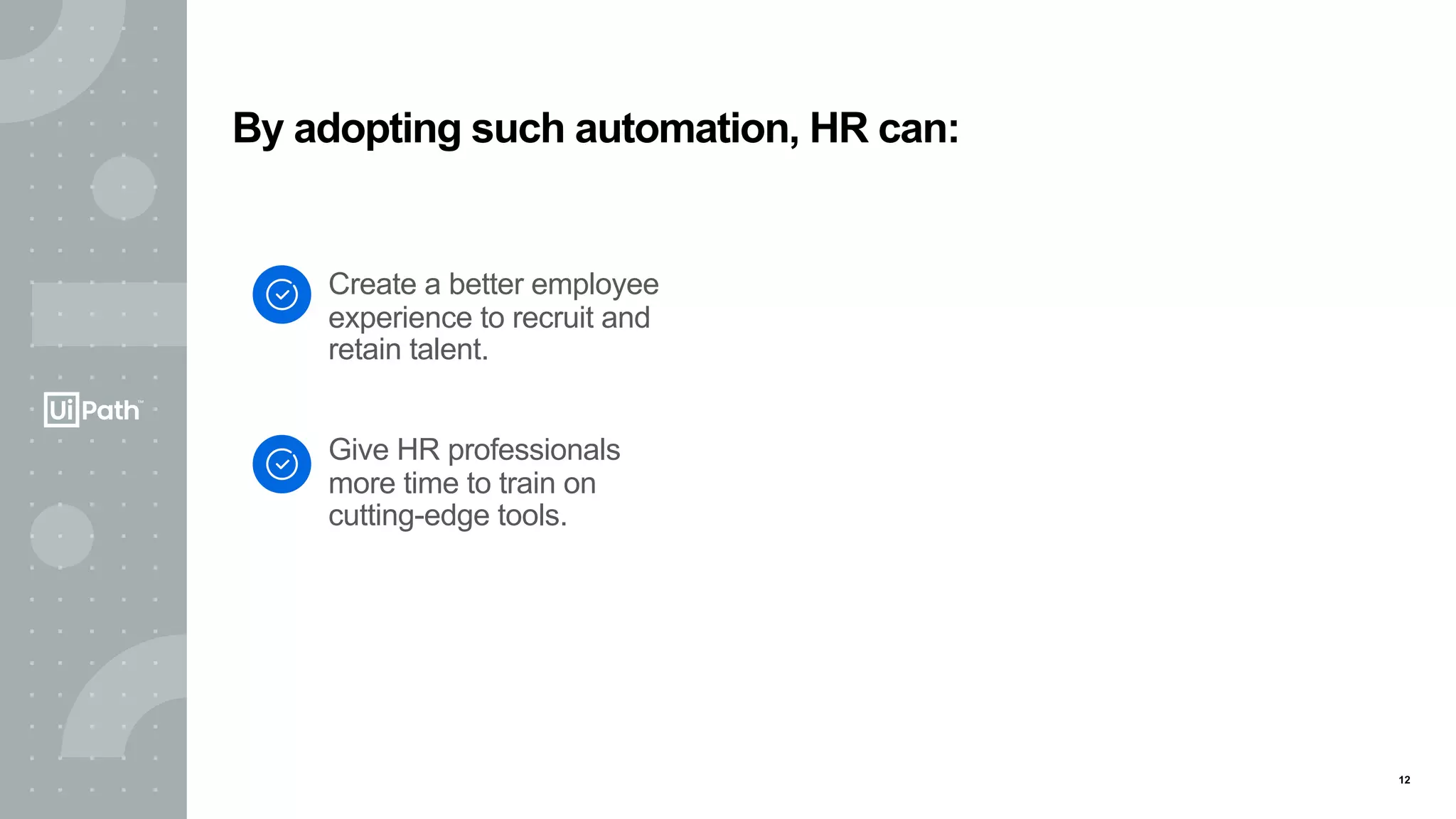
Create a better employee
experience to recruit and
retain talent.
Give HR professionals
more time to train on
cutting-edge tools.
By adopting such automation, HR can:
13
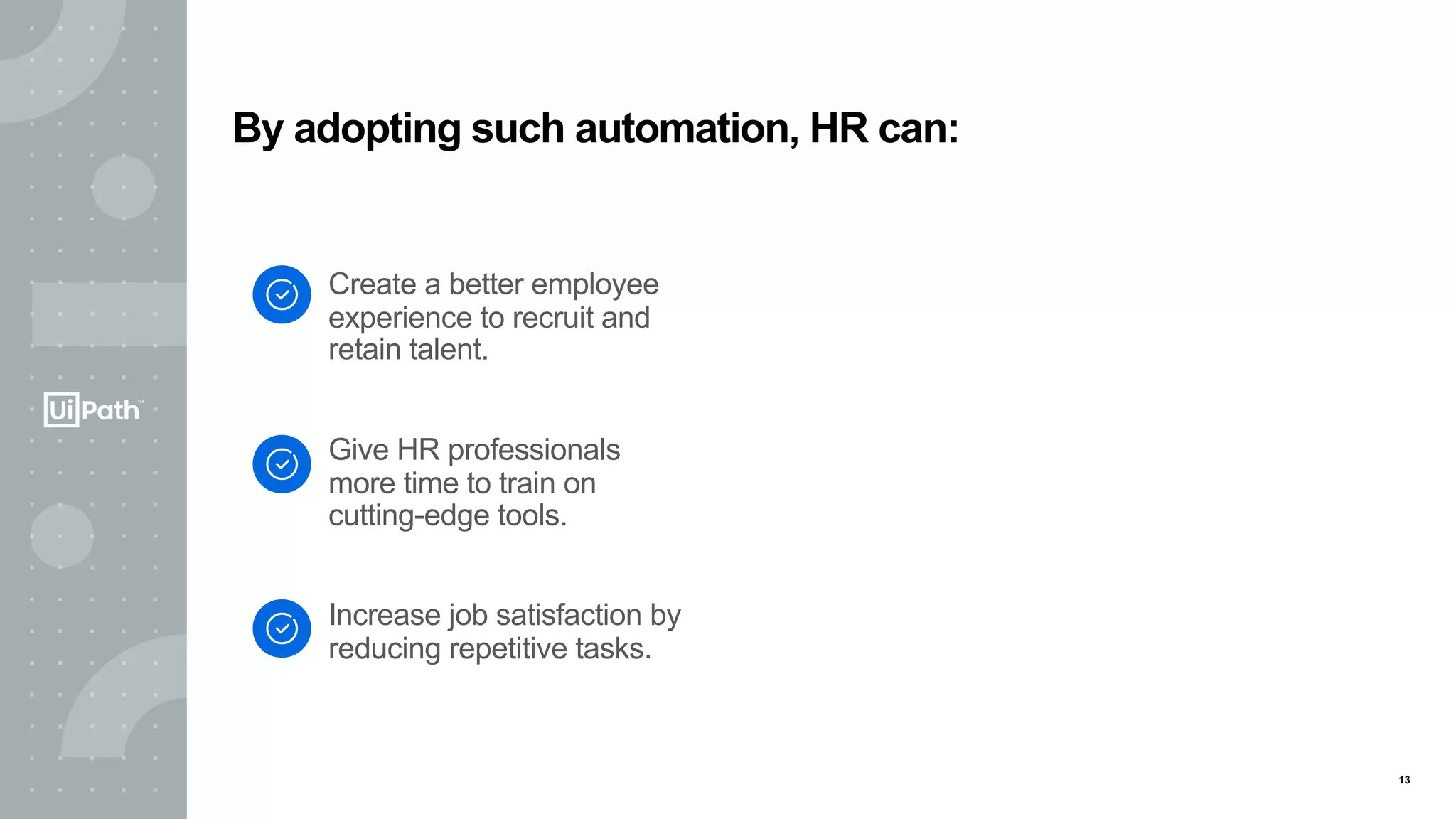
Create a better employee
experience to recruit and
retain talent.
Give HR professionals
more time to train on
cutting-edge tools.
Increase job satisfaction by
reducing repetitive tasks.
By adopting such automation, HR can:
14
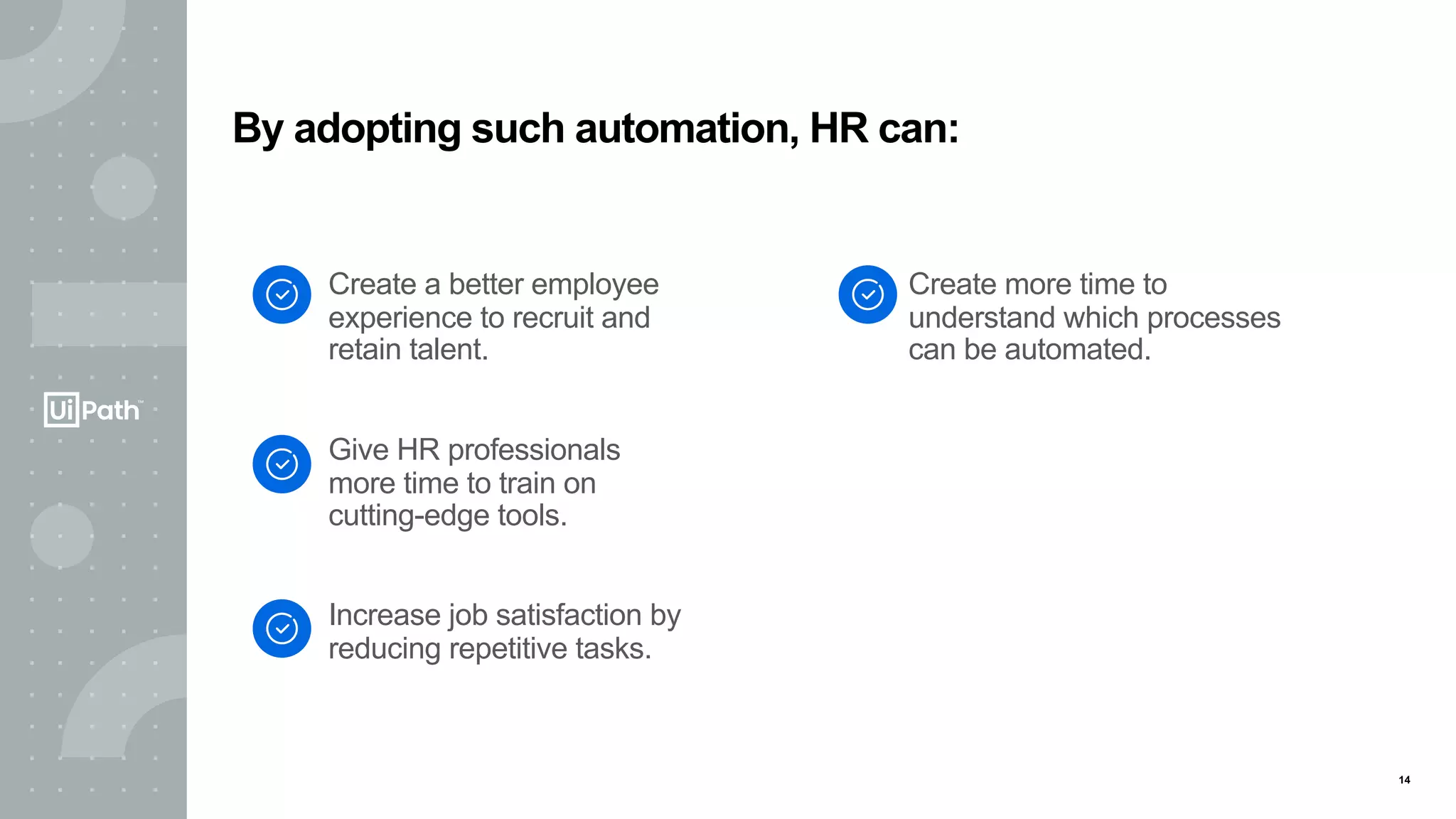
Create a better employee
experience to recruit and
retain talent.
Give HR professionals
more time to train on
cutting-edge tools.
Increase job satisfaction by
reducing repetitive tasks.
Create more time to
understand which processes
can be automated.
By adopting such automation, HR can:
15
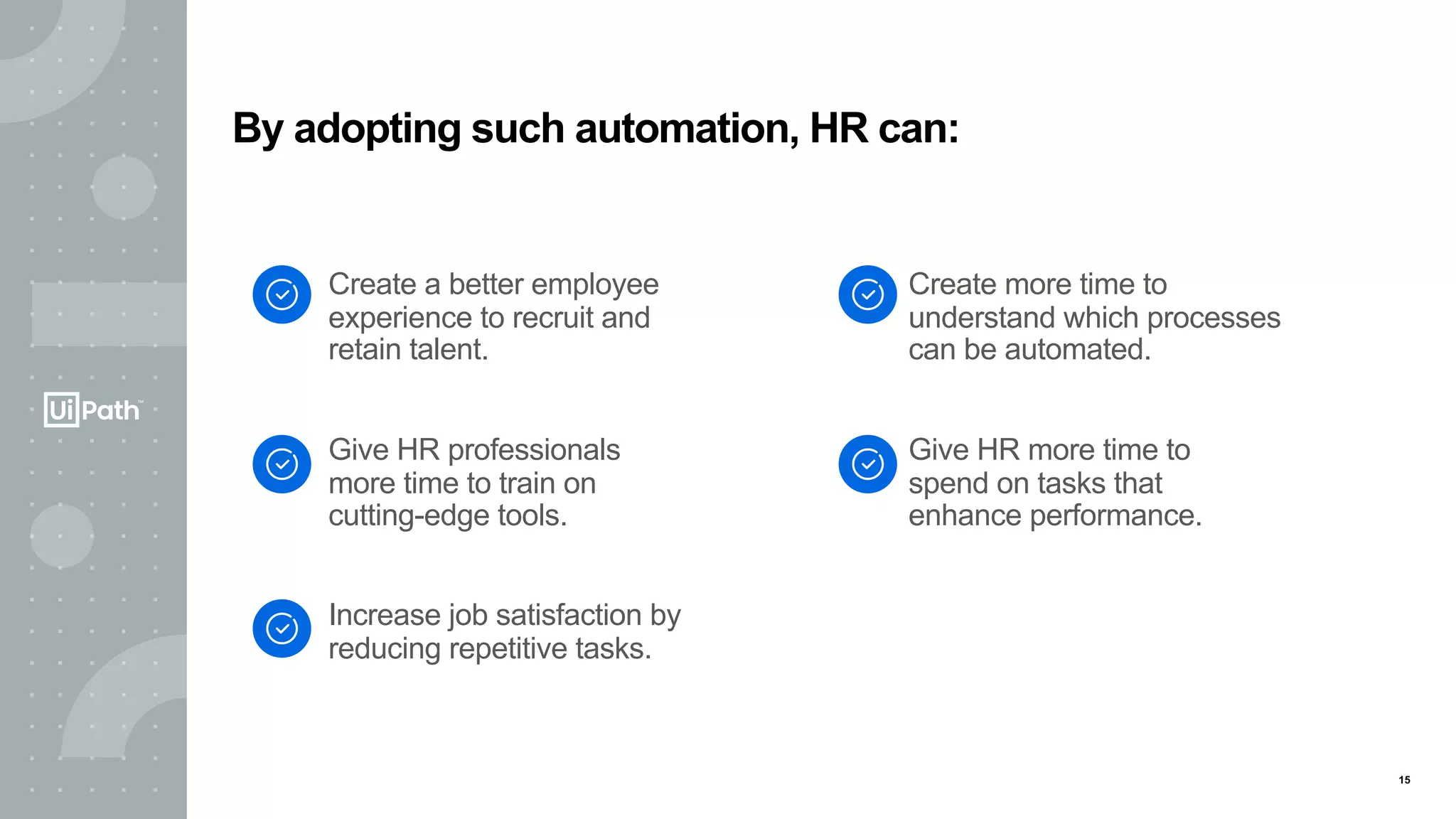
Create a better employee
experience to recruit and
retain talent.
Give HR professionals
more time to train on
cutting-edge tools.
Increase job satisfaction by
reducing repetitive tasks.
Create more time to
understand which processes
can be automated.
Give HR more time to
spend on tasks that
enhance performance.
By adopting such automation, HR can:
16SOURCE: Gallup
The time is now.
87%
87% of employees worldwide
are not engaged.
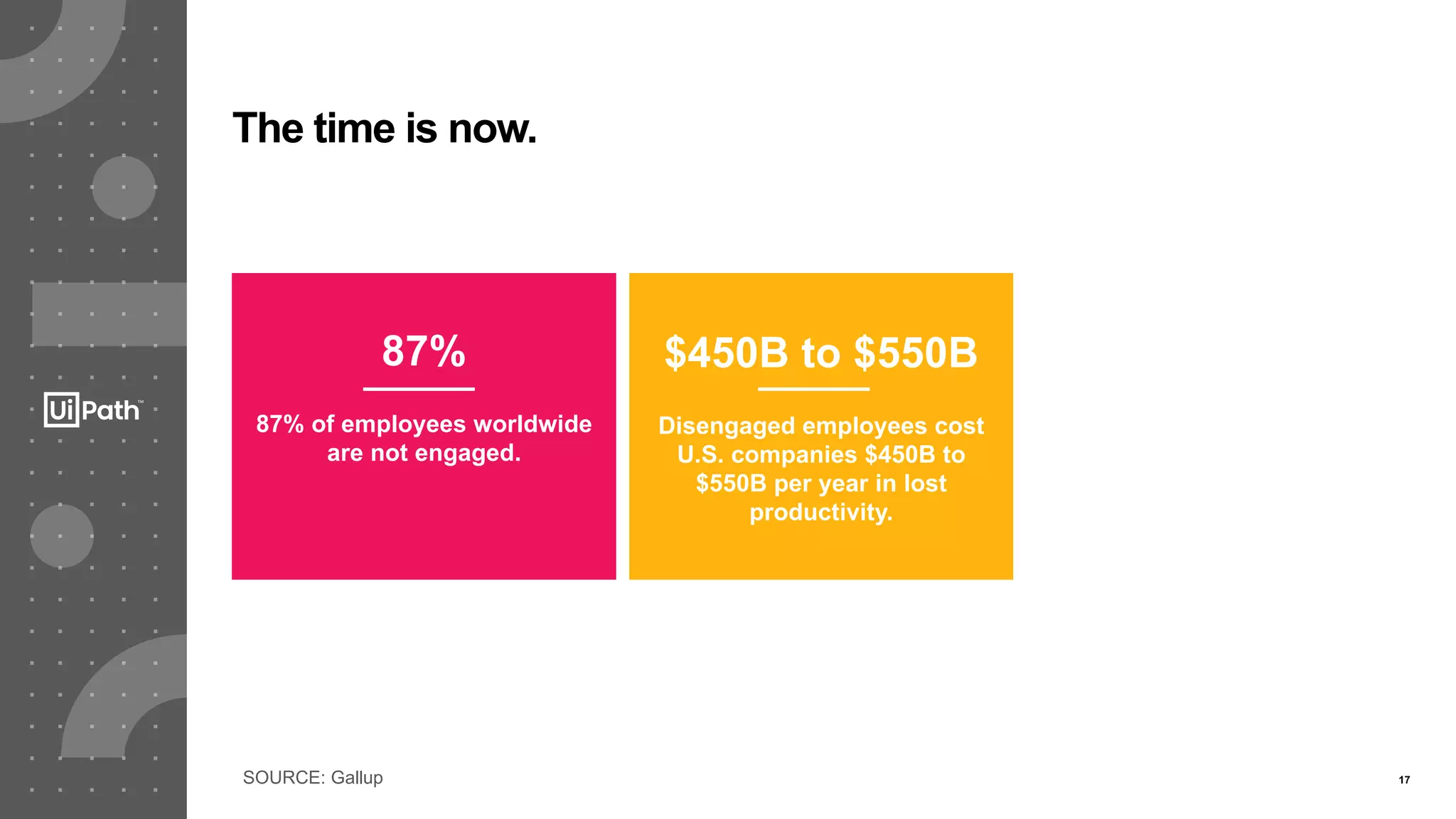
17SOURCE: Gallup
The time is now.
87%
87% of employees worldwide
are not engaged.
$450B to $550B
Disengaged employees cost
U.S. companies $450B to
$550B per year in lost
productivity.
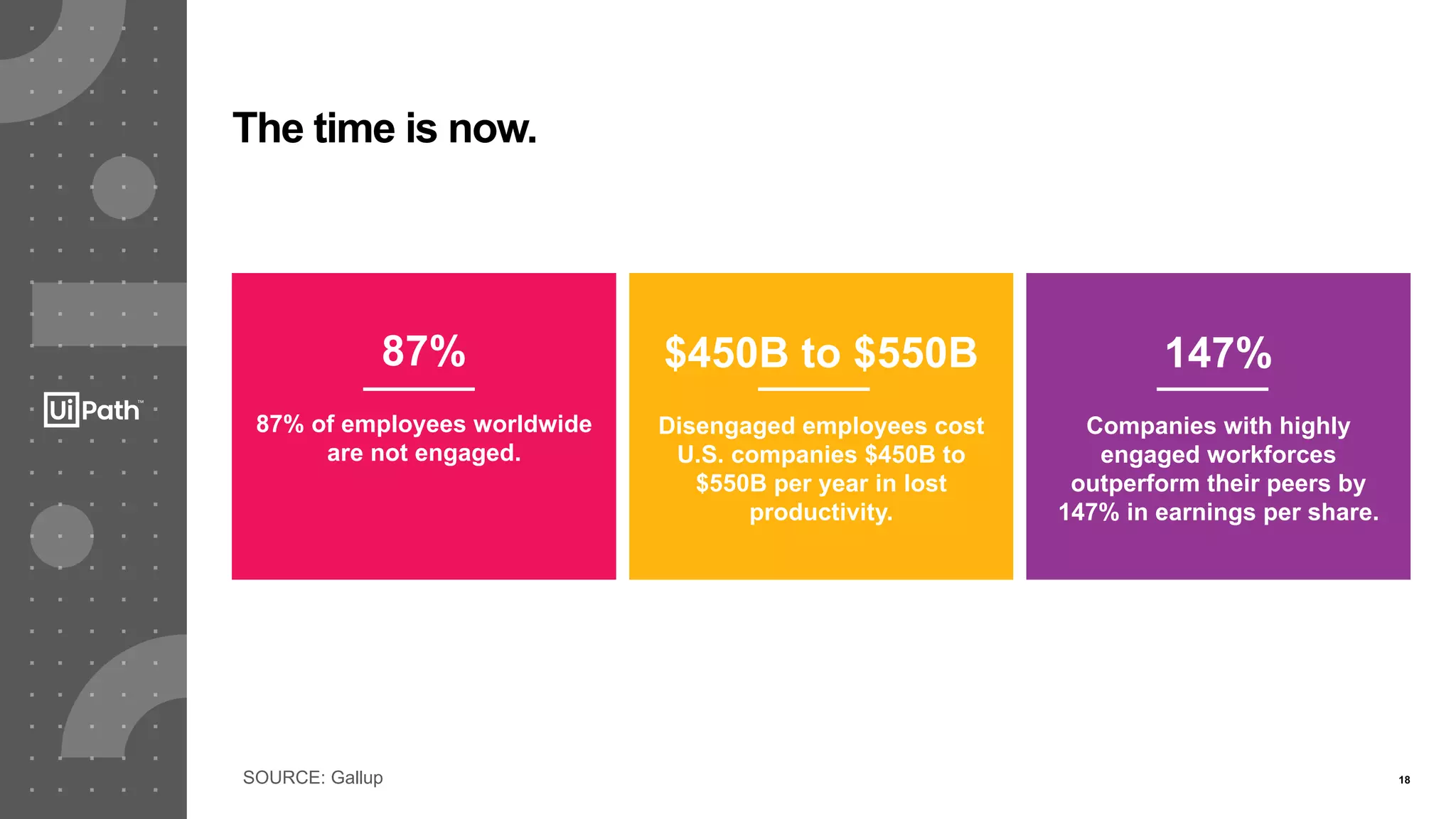
18SOURCE: Gallup
The time is now.
87%
87% of employees worldwide
are not engaged.
$450B to $550B
Disengaged employees cost
U.S. companies $450B to
$550B per year in lost
productivity.
147%
Companies with highly
engaged workforces
outperform their peers by
147% in earnings per share.
19
Here at UiPath, we recently worked
with EDP Valor on implementing
their RPA initiatives.
Let’s use them as an example.
20
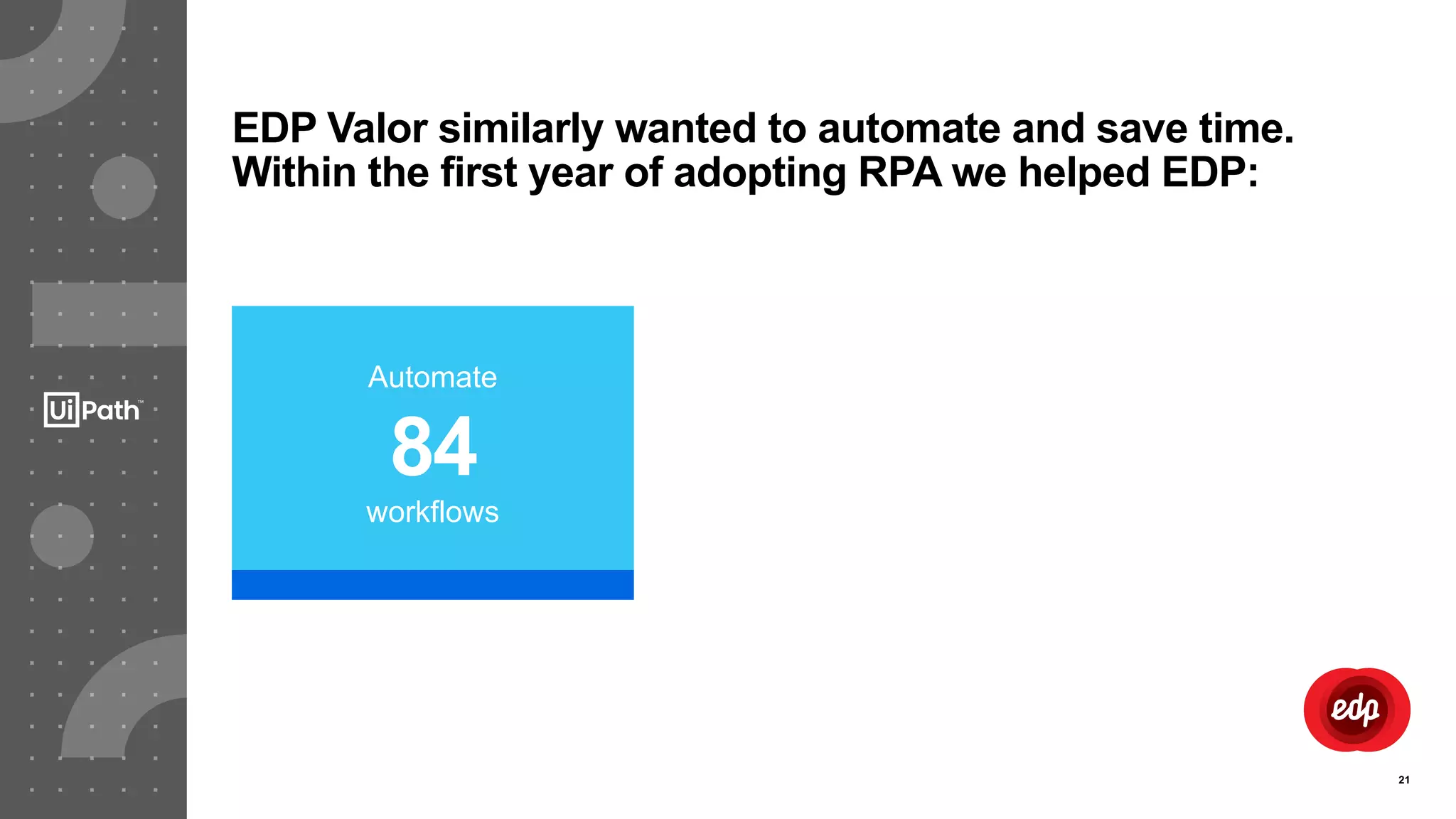
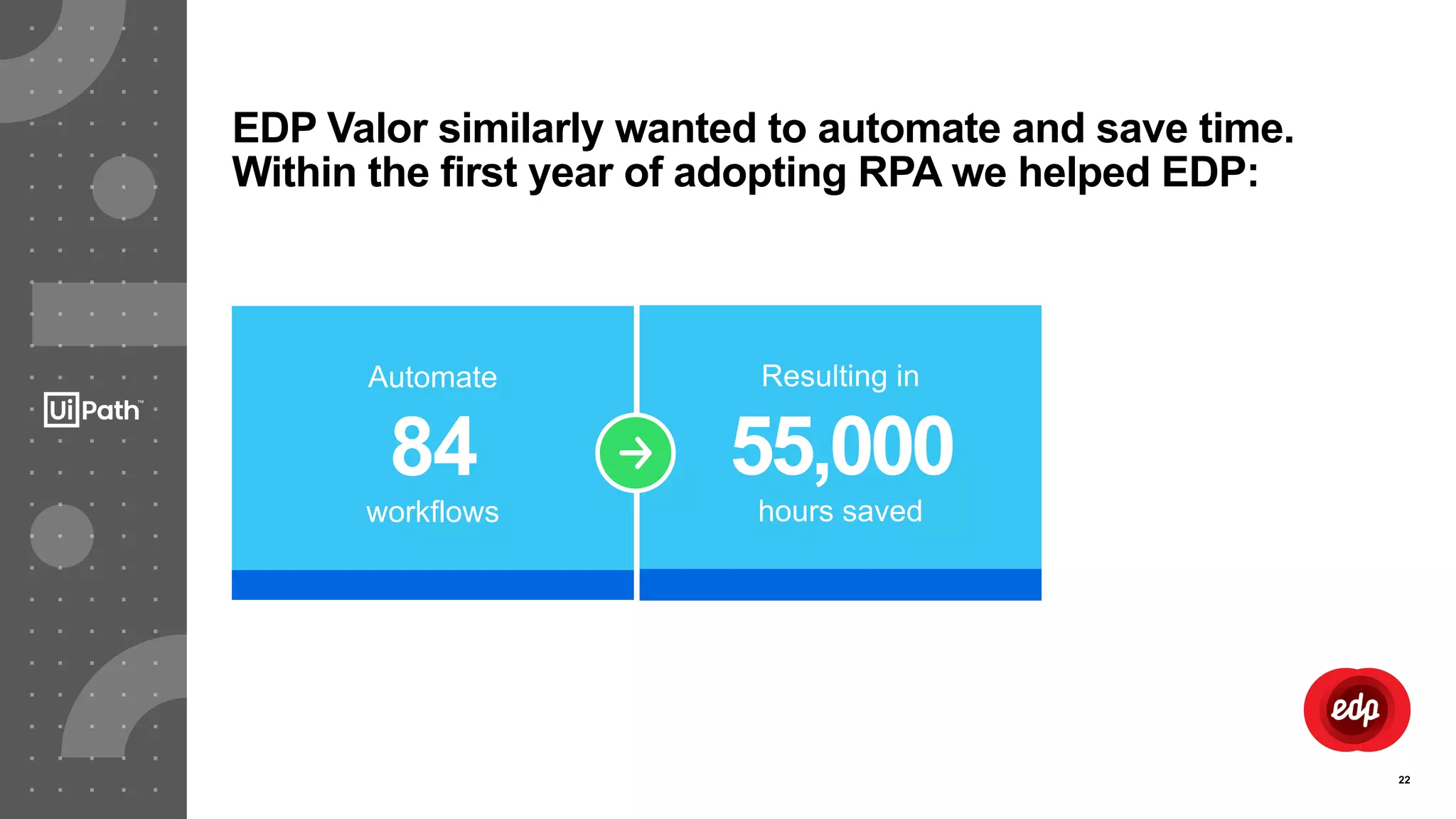
EDP Valor similarly wanted to automate and save time.
Within the first year of adopting RPA we helped EDP:
21
EDP Valor similarly wanted to automate and save time.
Within the first year of adopting RPA we helped EDP:
Automate
84
workflows
22
EDP Valor similarly wanted to automate and save time.
Within the first year of adopting RPA we helped EDP:
Automate
84
workflows
Resulting in
55,000
hours saved
23
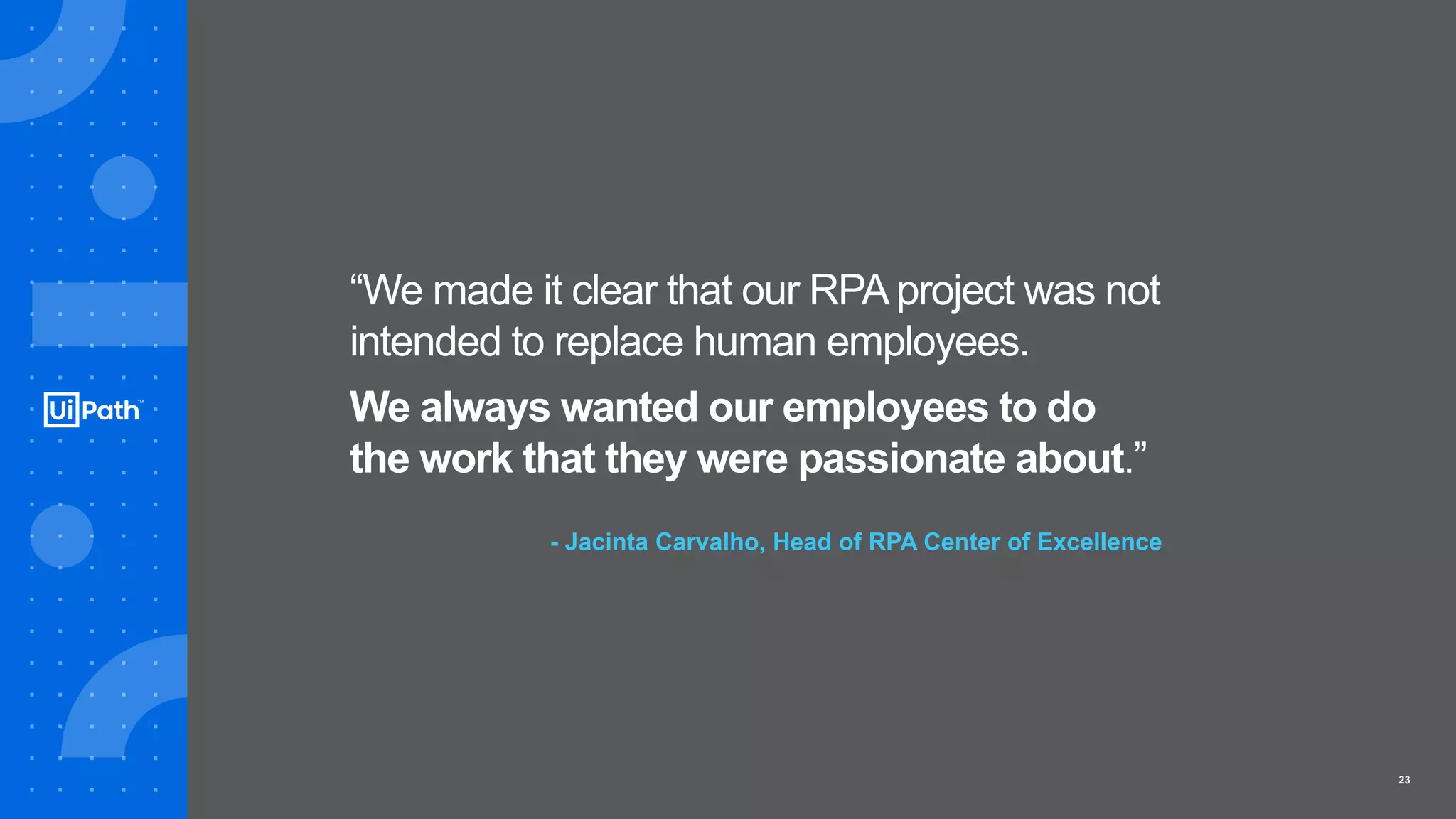
“We made it clear that our RPAproject was not
intended to replace human employees.
We always wanted our employees to do
the work that they were passionate about.”
- Jacinta Carvalho, Head of RPA Center of Excellence
This example only shows
the beginning of all that’s
possible with RPA.
25
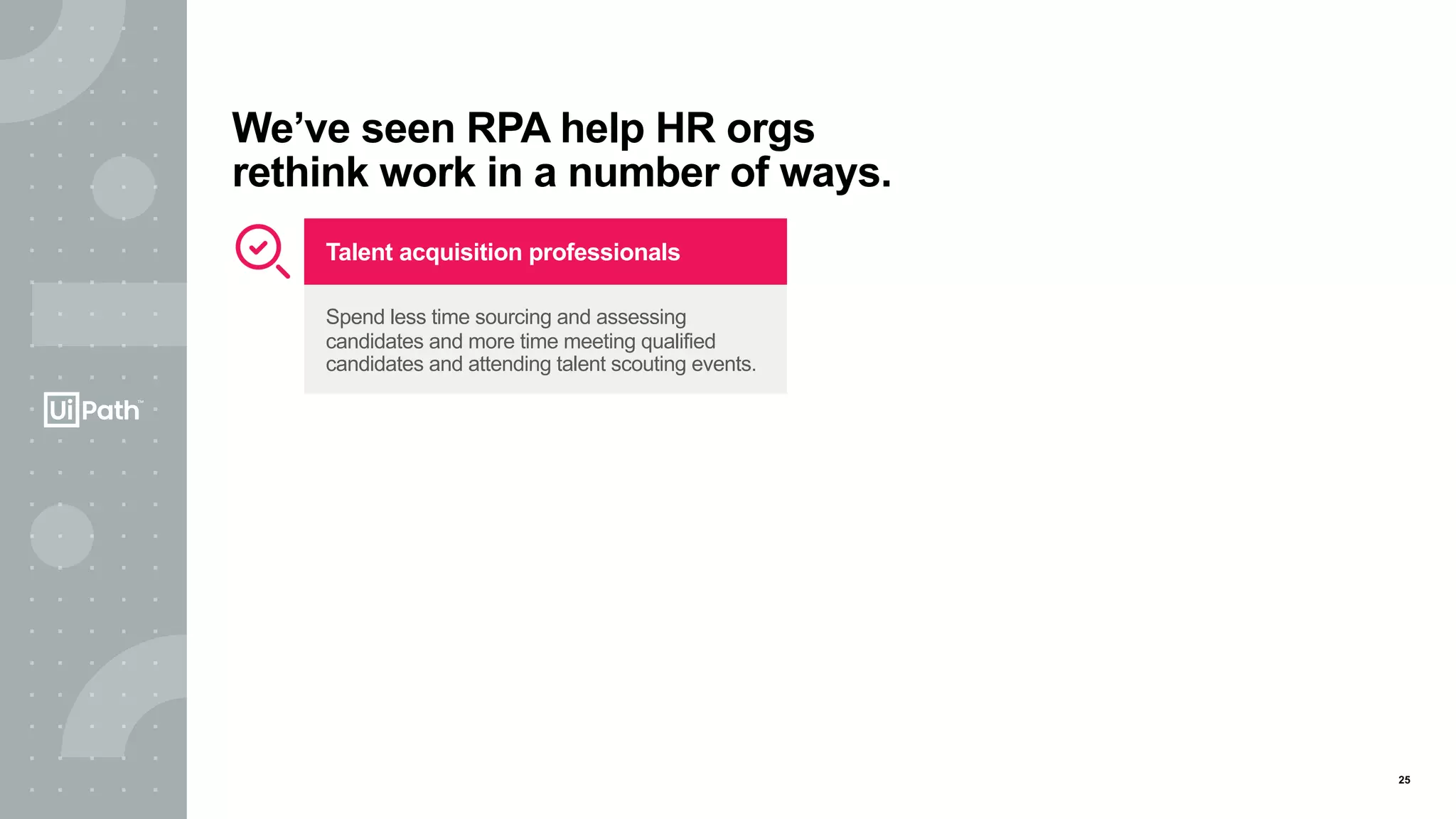
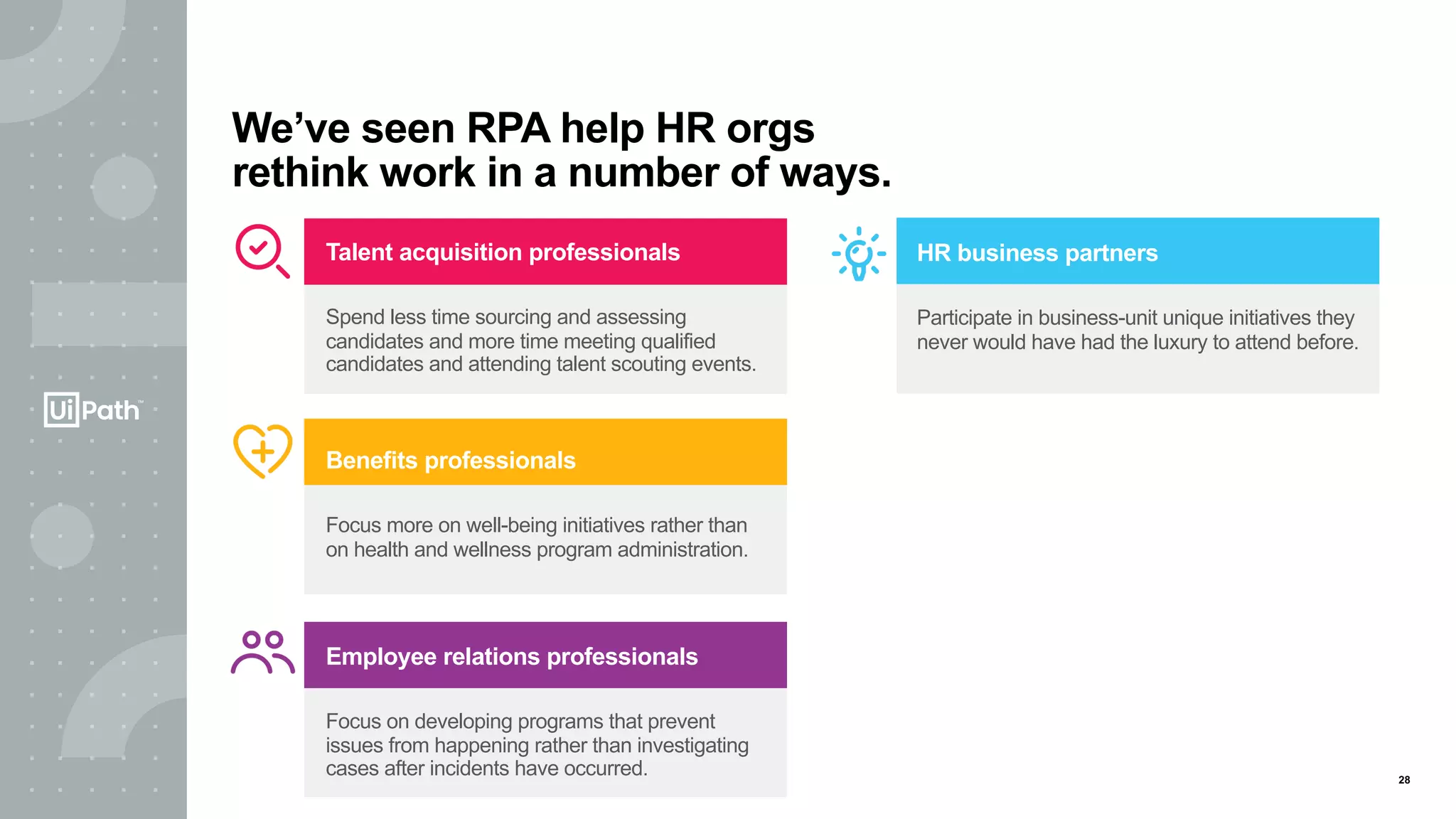
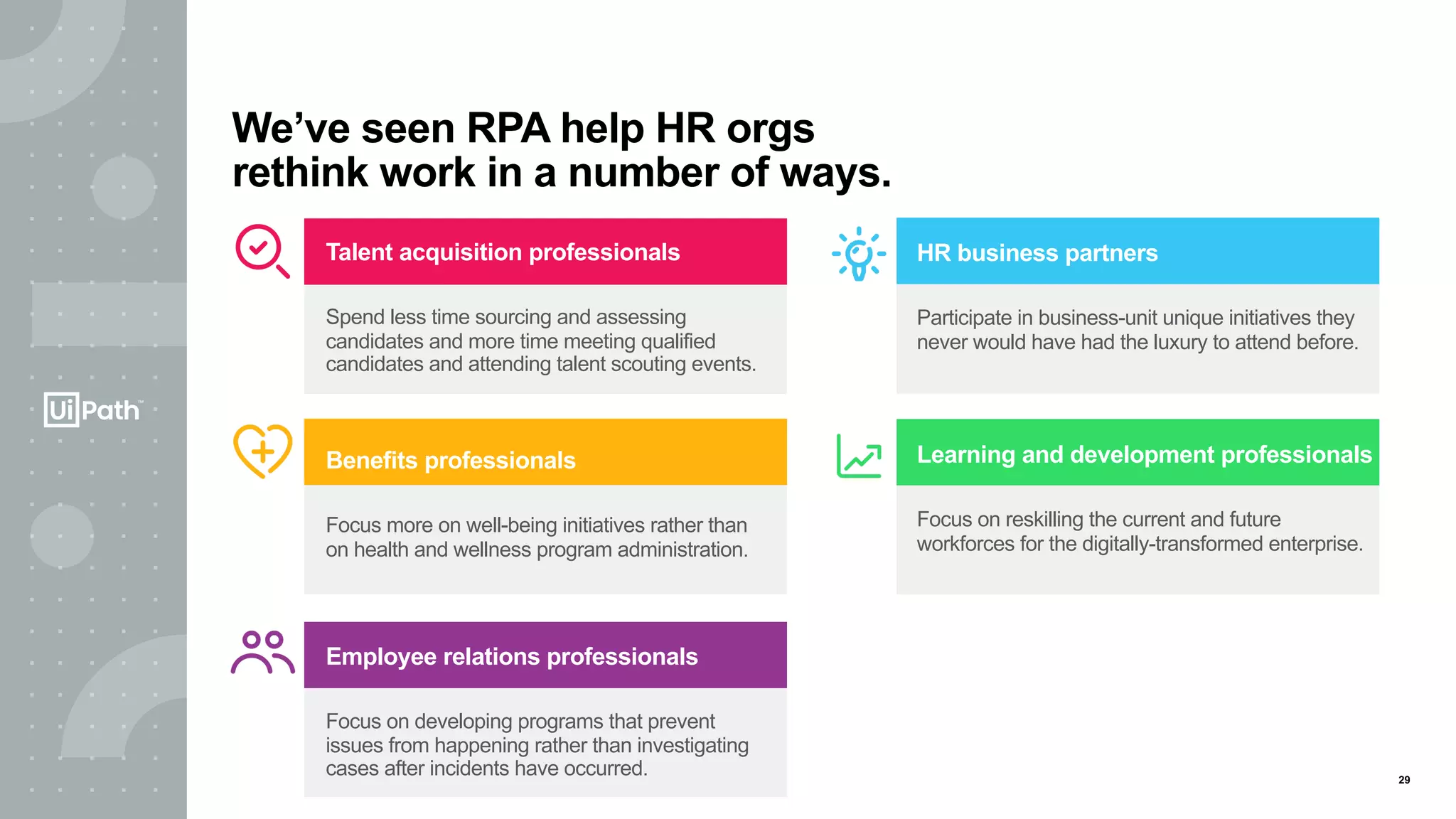
We’ve seen RPA help HR orgs
rethink work in a number of ways.
Talent acquisition professionals
Spend less time sourcing and assessing
candidates and more time meeting qualified
candidates and attending talent scouting events.
26
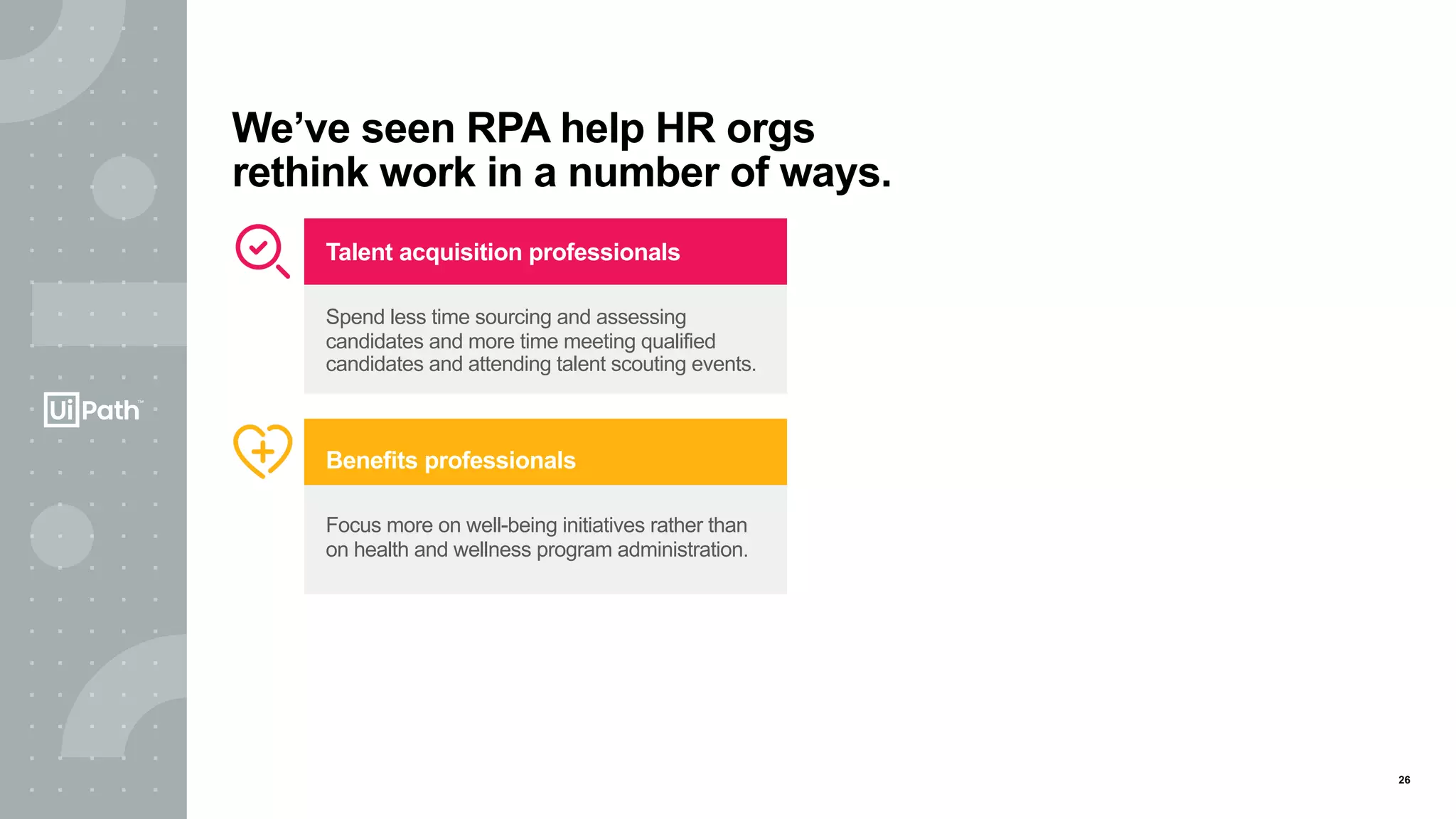
We’ve seen RPA help HR orgs
rethink work in a number of ways.
Benefits professionals
Focus more on well-being initiatives rather than
on health and wellness program administration.
Talent acquisition professionals
Spend less time sourcing and assessing
candidates and more time meeting qualified
candidates and attending talent scouting events.
27
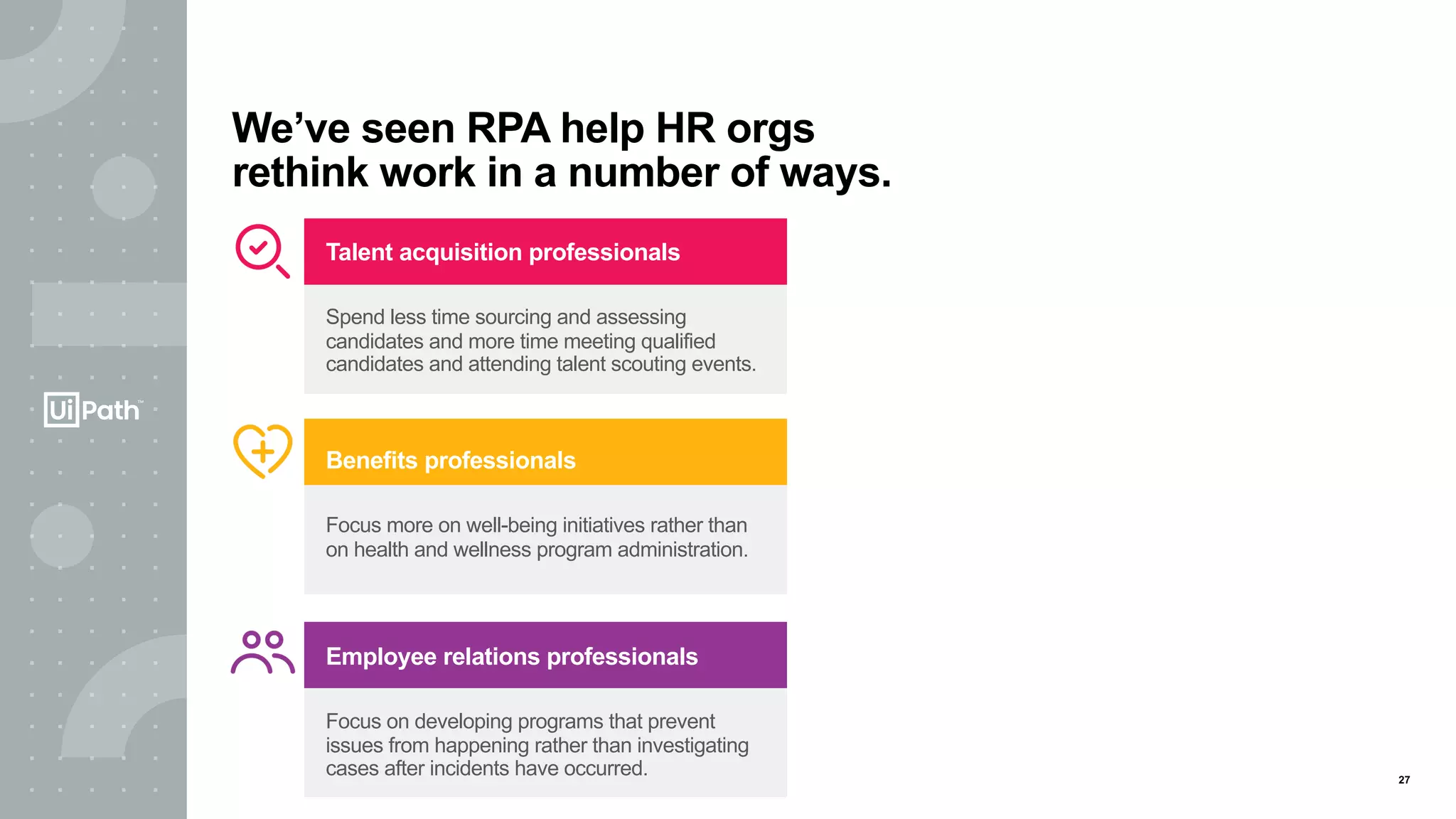
We’ve seen RPA help HR orgs
rethink work in a number of ways.
Benefits professionals
Focus more on well-being initiatives rather than
on health and wellness program administration.
Employee relations professionals
Focus on developing programs that prevent
issues from happening rather than investigating
cases after incidents have occurred.
Talent acquisition professionals
Spend less time sourcing and assessing
candidates and more time meeting qualified
candidates and attending talent scouting events.
28
We’ve seen RPA help HR orgs
rethink work in a number of ways.
Benefits professionals
Focus more on well-being initiatives rather than
on health and wellness program administration.
Employee relations professionals
Focus on developing programs that prevent
issues from happening rather than investigating
cases after incidents have occurred.
HR business partners
Participate in business-unit unique initiatives they
never would have had the luxury to attend before.
Talent acquisition professionals
Spend less time sourcing and assessing
candidates and more time meeting qualified
candidates and attending talent scouting events.
29
We’ve seen RPA help HR orgs
rethink work in a number of ways.
Benefits professionals
Focus more on well-being initiatives rather than
on health and wellness program administration.
Employee relations professionals
Focus on developing programs that prevent
issues from happening rather than investigating
cases after incidents have occurred.
HR business partners
Participate in business-unit unique initiatives they
never would have had the luxury to attend before.
Learning and development professionals
Focus on reskilling the current and future
workforces for the digitally-transformed enterprise.
Talent acquisition professionals
Spend less time sourcing and assessing
candidates and more time meeting qualified
candidates and attending talent scouting events.
30
“Bots can act as a ‘third arm’ for the HR
organization by supporting transactional
activities such as time collection, payroll,
and record keeping.”
- McKinsey & Company Analysts
The benefits of RPA are extensive.
31
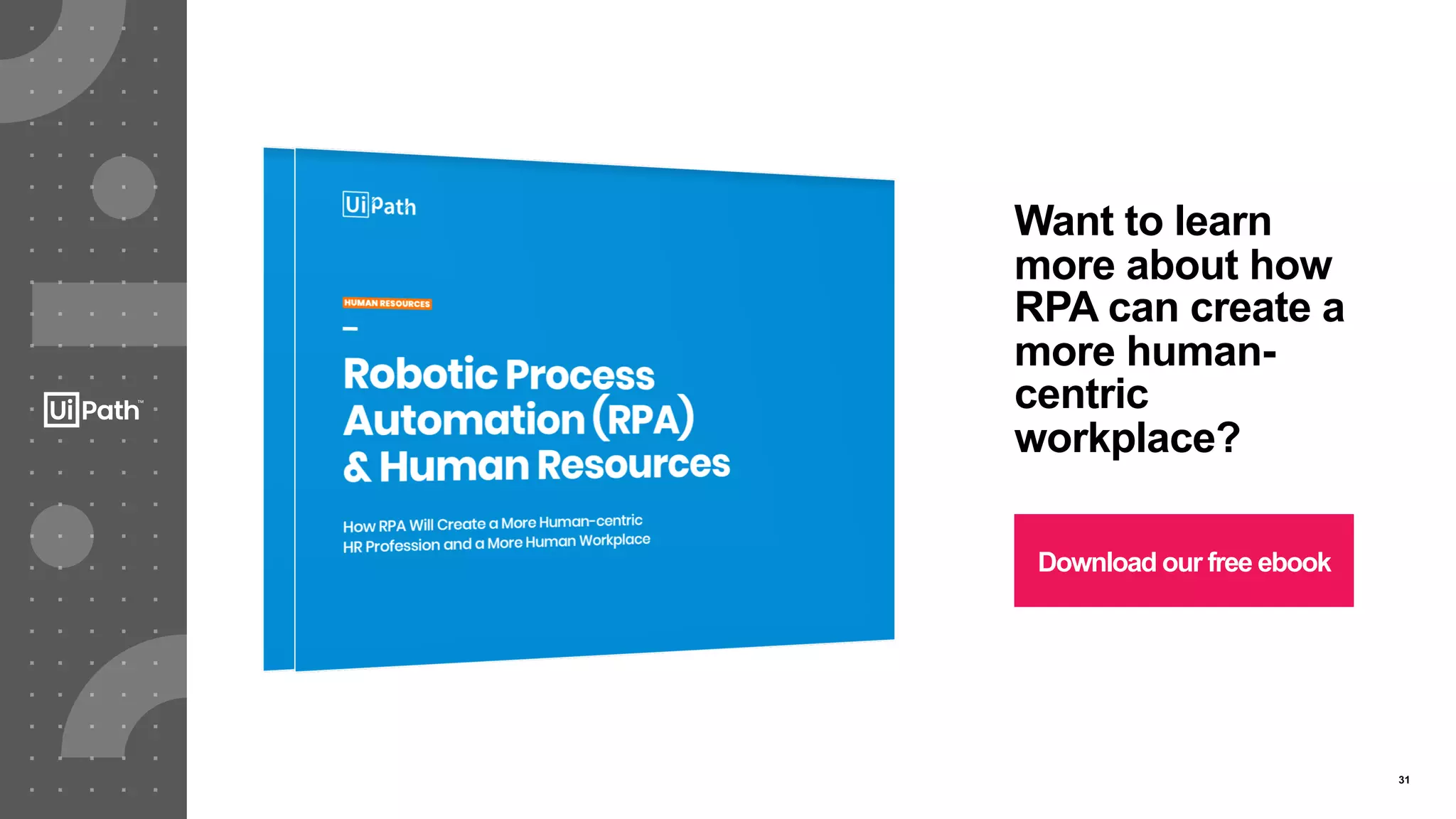
Want to learn
more about how
RPA can create a
more human-
centric
workplace?
Download our free ebook

How RPA Technology is Automating HR to Save Time & Increase Productivity

  • 1.
    The Future ofHR How RPA Technology is Automating HR to Save Time & Increase Productivity
  • 2.
    The world isin the middle of a major revolution in the way that work is done.
  • 3.
    And the waybusinesses view the role of the human worker has changed significantly from the Industrial Age to the Digital Age.
  • 4.
    4 Industrial Age During thistime, company’s access to natural resources made it competitive. People were viewed as the cost of doing business. Digital Age Now, companies compete over intangible assets such as IP, culture, and talent. Retention and satisfaction of people is now essential to survival.
  • 5.
    5 Artificial Intelligence (AI) Robotic Process Automation(RPA) Unlike the previous labor shifts, the technologies driving the current revolution is digital. Specifically:
  • 6.
    6 Artificial Intelligence (AI) Robotic Process Automation(RPA) Unlike the previous labor shifts, the technologies driving the current revolution is digital. Specifically: You’ve probably heard of this.
  • 7.
    7 Artificial Intelligence (AI) Robotic Process Automation(RPA) Unlike the previous labor shifts, the technologies driving the current revolution is digital. Specifically: But not this.You’ve probably heard of this.
  • 8.
    8 Robotic Process Automation(RPA) • RPA is simply a technology that allows businesses to automate tasks. (not jobs) • These “robots” can carry out routine, rules-based computer tasks in a way similar to a human employee such as: − Fill out documents − Read and send emails − Enter data
  • 9.
    RPA fundamentally shifts TalentManagement and Human Resources functions.
  • 10.
    (BTW, we wrotean entire whitepaper on this. Click anywhere on this slide to check it out.) RPA fundamentally shifts Talent Management and Human Resources functions.
  • 11.
    11 Create a betteremployee experience to recruit and retain talent. By adopting such automation, HR can:
  • 12.
    12 Create a betteremployee experience to recruit and retain talent. Give HR professionals more time to train on cutting-edge tools. By adopting such automation, HR can:
  • 13.
    13 Create a betteremployee experience to recruit and retain talent. Give HR professionals more time to train on cutting-edge tools. Increase job satisfaction by reducing repetitive tasks. By adopting such automation, HR can:
  • 14.
    14 Create a betteremployee experience to recruit and retain talent. Give HR professionals more time to train on cutting-edge tools. Increase job satisfaction by reducing repetitive tasks. Create more time to understand which processes can be automated. By adopting such automation, HR can:
  • 15.
    15 Create a betteremployee experience to recruit and retain talent. Give HR professionals more time to train on cutting-edge tools. Increase job satisfaction by reducing repetitive tasks. Create more time to understand which processes can be automated. Give HR more time to spend on tasks that enhance performance. By adopting such automation, HR can:
  • 16.
    16SOURCE: Gallup The timeis now. 87% 87% of employees worldwide are not engaged.
  • 17.
    17SOURCE: Gallup The timeis now. 87% 87% of employees worldwide are not engaged. $450B to $550B Disengaged employees cost U.S. companies $450B to $550B per year in lost productivity.
  • 18.
    18SOURCE: Gallup The timeis now. 87% 87% of employees worldwide are not engaged. $450B to $550B Disengaged employees cost U.S. companies $450B to $550B per year in lost productivity. 147% Companies with highly engaged workforces outperform their peers by 147% in earnings per share.
  • 19.
    19 Here at UiPath,we recently worked with EDP Valor on implementing their RPA initiatives. Let’s use them as an example.
  • 20.
    20 EDP Valor similarlywanted to automate and save time. Within the first year of adopting RPA we helped EDP:
  • 21.
    21 EDP Valor similarlywanted to automate and save time. Within the first year of adopting RPA we helped EDP: Automate 84 workflows
  • 22.
    22 EDP Valor similarlywanted to automate and save time. Within the first year of adopting RPA we helped EDP: Automate 84 workflows Resulting in 55,000 hours saved
  • 23.
    23 “We made itclear that our RPAproject was not intended to replace human employees. We always wanted our employees to do the work that they were passionate about.” - Jacinta Carvalho, Head of RPA Center of Excellence
  • 24.
    This example onlyshows the beginning of all that’s possible with RPA.
  • 25.
    25 We’ve seen RPAhelp HR orgs rethink work in a number of ways. Talent acquisition professionals Spend less time sourcing and assessing candidates and more time meeting qualified candidates and attending talent scouting events.
  • 26.
    26 We’ve seen RPAhelp HR orgs rethink work in a number of ways. Benefits professionals Focus more on well-being initiatives rather than on health and wellness program administration. Talent acquisition professionals Spend less time sourcing and assessing candidates and more time meeting qualified candidates and attending talent scouting events.
  • 27.
    27 We’ve seen RPAhelp HR orgs rethink work in a number of ways. Benefits professionals Focus more on well-being initiatives rather than on health and wellness program administration. Employee relations professionals Focus on developing programs that prevent issues from happening rather than investigating cases after incidents have occurred. Talent acquisition professionals Spend less time sourcing and assessing candidates and more time meeting qualified candidates and attending talent scouting events.
  • 28.
    28 We’ve seen RPAhelp HR orgs rethink work in a number of ways. Benefits professionals Focus more on well-being initiatives rather than on health and wellness program administration. Employee relations professionals Focus on developing programs that prevent issues from happening rather than investigating cases after incidents have occurred. HR business partners Participate in business-unit unique initiatives they never would have had the luxury to attend before. Talent acquisition professionals Spend less time sourcing and assessing candidates and more time meeting qualified candidates and attending talent scouting events.
  • 29.
    29 We’ve seen RPAhelp HR orgs rethink work in a number of ways. Benefits professionals Focus more on well-being initiatives rather than on health and wellness program administration. Employee relations professionals Focus on developing programs that prevent issues from happening rather than investigating cases after incidents have occurred. HR business partners Participate in business-unit unique initiatives they never would have had the luxury to attend before. Learning and development professionals Focus on reskilling the current and future workforces for the digitally-transformed enterprise. Talent acquisition professionals Spend less time sourcing and assessing candidates and more time meeting qualified candidates and attending talent scouting events.
  • 30.
    30 “Bots can actas a ‘third arm’ for the HR organization by supporting transactional activities such as time collection, payroll, and record keeping.” - McKinsey & Company Analysts The benefits of RPA are extensive.
  • 31.
    31 Want to learn moreabout how RPA can create a more human- centric workplace? Download our free ebook