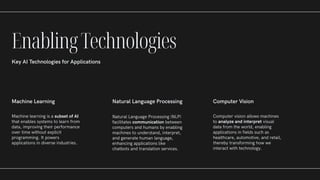
Machine Learning
Machine learningis a subset of AI
that enables systems to learn from
data, improving their performance
over time without explicit
programming. It powers
applications in diverse industries.
Natural Language Processing
Natural Language Processing (NLP)
facilitates communication between
computers and humans by enabling
machines to understand, interpret,
and generate human language,
enhancing applications like
chatbots and translation services.
Computer Vision
Computer vision allows machines
to analyze and interpret visual
data from the world, enabling
applications in fields such as
healthcare, automotive, and retail,
thereby transforming how we
interact with technology.
EnablingTechnologies
Key AI Technologies for Applications
4.
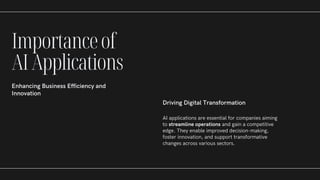
Importanceof
AIApplications
Enhancing Business Efficiencyand
Innovation
Driving Digital Transformation
AI applications are essential for companies aiming
to streamline operations and gain a competitive
edge. They enable improved decision-making,
foster innovation, and support transformative
changes across various sectors.
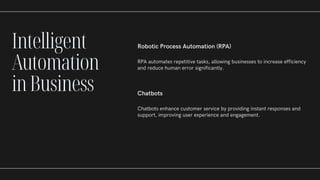
Robotic Process Automation(RPA)
RPA automates repetitive tasks, allowing businesses to increase efficiency
and reduce human error significantly.
Chatbots
Chatbots enhance customer service by providing instant responses and
support, improving user experience and engagement.
Intelligent
Automation
inBusiness
7.
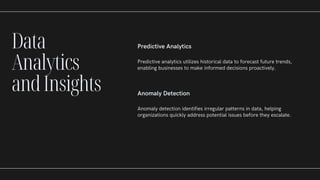
Predictive Analytics
Predictive analyticsutilizes historical data to forecast future trends,
enabling businesses to make informed decisions proactively.
Anomaly Detection
Anomaly detection identifies irregular patterns in data, helping
organizations quickly address potential issues before they escalate.
Data
Analytics
andInsights
8.
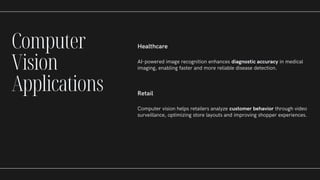
Healthcare
AI-powered image recognitionenhances diagnostic accuracy in medical
imaging, enabling faster and more reliable disease detection.
Retail
Computer vision helps retailers analyze customer behavior through video
surveillance, optimizing store layouts and improving shopper experiences.
Computer
Vision
Applications
9.
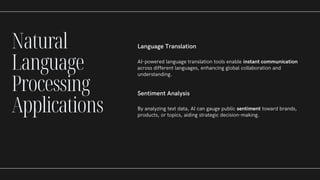
Language Translation
AI-powered languagetranslation tools enable instant communication
across different languages, enhancing global collaboration and
understanding.
Sentiment Analysis
By analyzing text data, AI can gauge public sentiment toward brands,
products, or topics, aiding strategic decision-making.
Natural
Language
Processing
Applications
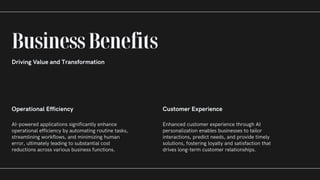
Operational Efficiency
AI-powered applicationssignificantly enhance
operational efficiency by automating routine tasks,
streamlining workflows, and minimizing human
error, ultimately leading to substantial cost
reductions across various business functions.
Customer Experience
Enhanced customer experience through AI
personalization enables businesses to tailor
interactions, predict needs, and provide timely
solutions, fostering loyalty and satisfaction that
drives long-term customer relationships.
BusinessBenefits
Driving Value and Transformation
12.
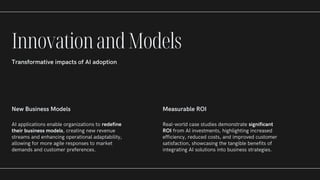
New Business Models
AIapplications enable organizations to redefine
their business models, creating new revenue
streams and enhancing operational adaptability,
allowing for more agile responses to market
demands and customer preferences.
Measurable ROI
Real-world case studies demonstrate significant
ROI from AI investments, highlighting increased
efficiency, reduced costs, and improved customer
satisfaction, showcasing the tangible benefits of
integrating AI solutions into business strategies.
InnovationandModels
Transformative impacts of AI adoption
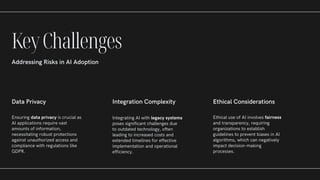
Data Privacy
Ensuring dataprivacy is crucial as
AI applications require vast
amounts of information,
necessitating robust protections
against unauthorized access and
compliance with regulations like
GDPR.
Integration Complexity
Integrating AI with legacy systems
poses significant challenges due
to outdated technology, often
leading to increased costs and
extended timelines for effective
implementation and operational
efficiency.
Ethical Considerations
Ethical use of AI involves fairness
and transparency, requiring
organizations to establish
guidelines to prevent biases in AI
algorithms, which can negatively
impact decision-making
processes.
KeyChallenges
Addressing Risks in AI Adoption
15.
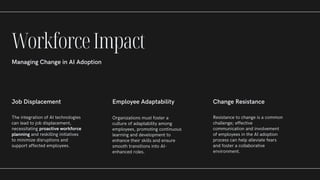
Job Displacement
The integrationof AI technologies
can lead to job displacement,
necessitating proactive workforce
planning and reskilling initiatives
to minimize disruptions and
support affected employees.
Employee Adaptability
Organizations must foster a
culture of adaptability among
employees, promoting continuous
learning and development to
enhance their skills and ensure
smooth transitions into AI-
enhanced roles.
Change Resistance
Resistance to change is a common
challenge; effective
communication and involvement
of employees in the AI adoption
process can help alleviate fears
and foster a collaborative
environment.
WorkforceImpact
Managing Change in AI Adoption
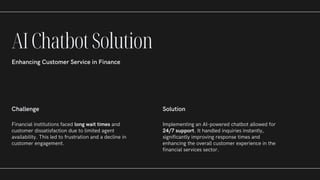
Challenge
Financial institutions facedlong wait times and
customer dissatisfaction due to limited agent
availability. This led to frustration and a decline in
customer engagement.
Solution
Implementing an AI-powered chatbot allowed for
24/7 support. It handled inquiries instantly,
significantly improving response times and
enhancing the overall customer experience in the
financial services sector.
AIChatbotSolution
Enhancing Customer Service in Finance
18.
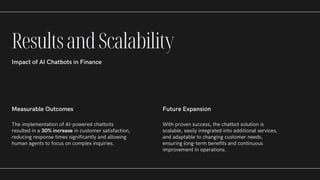
Measurable Outcomes
The implementationof AI-powered chatbots
resulted in a 30% increase in customer satisfaction,
reducing response times significantly and allowing
human agents to focus on complex inquiries.
Future Expansion
With proven success, the chatbot solution is
scalable, easily integrated into additional services,
and adaptable to changing customer needs,
ensuring long-term benefits and continuous
improvement in operations.
ResultsandScalability
Impact of AI Chatbots in Finance
19.
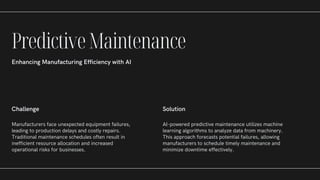
Challenge
Manufacturers face unexpectedequipment failures,
leading to production delays and costly repairs.
Traditional maintenance schedules often result in
inefficient resource allocation and increased
operational risks for businesses.
Solution
AI-powered predictive maintenance utilizes machine
learning algorithms to analyze data from machinery.
This approach forecasts potential failures, allowing
manufacturers to schedule timely maintenance and
minimize downtime effectively.
PredictiveMaintenance
Enhancing Manufacturing Efficiency with AI
20.
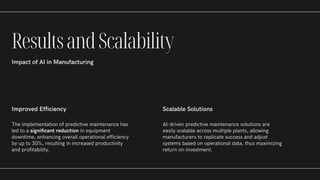
Improved Efficiency
The implementationof predictive maintenance has
led to a significant reduction in equipment
downtime, enhancing overall operational efficiency
by up to 30%, resulting in increased productivity
and profitability.
Scalable Solutions
AI-driven predictive maintenance solutions are
easily scalable across multiple plants, allowing
manufacturers to replicate success and adjust
systems based on operational data, thus maximizing
return on investment.
ResultsandScalability
Impact of AI in Manufacturing
21.
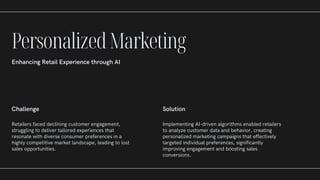
Challenge
Retailers faced decliningcustomer engagement,
struggling to deliver tailored experiences that
resonate with diverse consumer preferences in a
highly competitive market landscape, leading to lost
sales opportunities.
Solution
Implementing AI-driven algorithms enabled retailers
to analyze customer data and behavior, creating
personalized marketing campaigns that effectively
targeted individual preferences, significantly
improving engagement and boosting sales
conversions.
PersonalizedMarketing
Enhancing Retail Experience through AI
22.
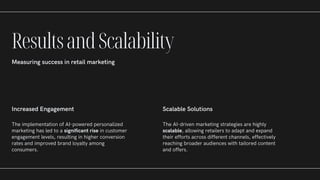
Increased Engagement
The implementationof AI-powered personalized
marketing has led to a significant rise in customer
engagement levels, resulting in higher conversion
rates and improved brand loyalty among
consumers.
Scalable Solutions
The AI-driven marketing strategies are highly
scalable, allowing retailers to adapt and expand
their efforts across different channels, effectively
reaching broader audiences with tailored content
and offers.
ResultsandScalability
Measuring success in retail marketing
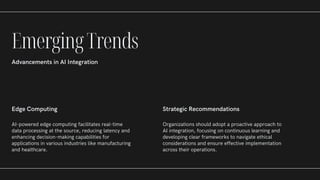
Edge Computing
AI-powered edgecomputing facilitates real-time
data processing at the source, reducing latency and
enhancing decision-making capabilities for
applications in various industries like manufacturing
and healthcare.
Strategic Recommendations
Organizations should adopt a proactive approach to
AI integration, focusing on continuous learning and
developing clear frameworks to navigate ethical
considerations and ensure effective implementation
across their operations.
EmergingTrends
Advancements in AI Integration
25.
Contact
For further inquiriesand resources,
please reach out to us directly.
Phone: 123-456-7890
Email: hello@reallygreatsite.com
Website: www.reallygreatsite.com