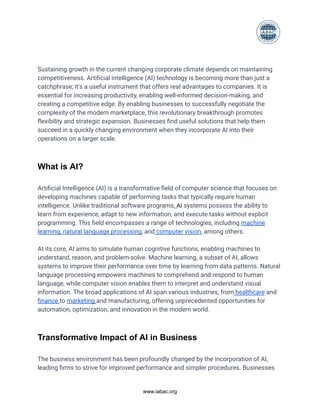
The Power of Artificial Intelligence
Technology in Modern Business
www.iabac.org
Sustaining growth in the current changing corporate climate depends on maintaining
competitiveness. Artificial intelligence (AI) technology is becoming more than just a
catchphrase; it's a useful instrument that offers real advantages to companies. It is
essential for increasing productivity, enabling well-informed decision-making, and
creating a competitive edge. By enabling businesses to successfully negotiate the
complexity of the modern marketplace, this revolutionary breakthrough promotes
flexibility and strategic expansion. Businesses find useful solutions that help them
succeed in a quickly changing environment when they incorporate AI into their
operations on a larger scale.
What is AI?
Artificial Intelligence (AI) is a transformative field of computer science that focuses on
developing machines capable of performing tasks that typically require human
intelligence. Unlike traditional software programs, AI systems possess the ability to
learn from experience, adapt to new information, and execute tasks without explicit
programming. This field encompasses a range of technologies, including machine
learning, natural language processing, and computer vision, among others.
At its core, AI aims to simulate human cognitive functions, enabling machines to
understand, reason, and problem-solve. Machine learning, a subset of AI, allows
systems to improve their performance over time by learning from data patterns. Natural
language processing empowers machines to comprehend and respond to human
language, while computer vision enables them to interpret and understand visual
information. The broad applications of AI span various industries, from healthcare and
finance to marketing and manufacturing, offering unprecedented opportunities for
automation, optimization, and innovation in the modern world.
Transformative Impact of AI in Business
The business environment has been profoundly changed by the incorporation of AI,
leading firms to strive for improved performance and simpler procedures. Businesses
www.iabac.org
are looking for innovative ways to cut expenses, and using AI is one workable answer.
With its many uses, this technology is essential for managing the complexities of
today's marketplace. AI is a game-changer because it gives companies useful tools that
help them adapt to a changing business environment. This change is a calculated
reaction to the difficulties presented by the current state of the market, where gaining
operational efficiency and preserving a competitive advantage depend heavily on the
effective application of AI.
Balancing Innovation and Responsibility Optimizing AI's
Impact on Business Operations
Implementing AI in business presents immense benefits but also challenges.
Companies grapple with concerns such as safeguarding data privacy, navigating ethical
considerations, and addressing the imperative of upskilling the workforce. Tackling
these hurdles is pivotal for optimizing AI's positive impact on business operations.
Striking a balance between innovation and responsible deployment ensures that
businesses can harness the potential advantages of AI while mitigating associated
risks, fostering a sustainable and effective integration of this transformative technology
into their operations.
How can businesses harness the power of AI to overcome
challenges and drive success in the modern period?
Artificial Intelligence (AI) has become a transformative force in the business world,
offering a myriad of benefits that contribute to increased efficiency, strategic
decision-making, and overall competitiveness. Here are several key reasons highlighting
the importance of AI in business
1. Enhanced Decision-Making
AI systems are capable of processing and analyzing vast amounts of data at speeds
impossible for humans. This enables businesses to make informed, data-driven
decisions. Whether it's predicting market trends, identifying potential risks, or optimizing
supply chain logistics, AI provides valuable insights that empower organizations to stay
ahead in a vibrant market.
www.iabac.org
2. Operational Efficiency and Automation
AI excels at automating routine and repetitive tasks, freeing up human resources to
focus on more complex and creative aspects of their roles. From data entry and
processing to customer service inquiries, automation through AI improves operational
efficiency, reduces errors, and allows employees to engage in higher-value work.
3. Customer Experience Enhancement
AI plays a crucial role in enhancing customer experiences. Chatbots and virtual
assistants powered by AI provide immediate and personalized responses to customer
queries, improving satisfaction and engagement. AI algorithms also analyze customer
data to deliver personalized recommendations, fostering stronger relationships between
businesses and their clientele.
4. Predictive Analytics for Forecasting
AI's predictive analytics capabilities enable businesses to anticipate future trends and
behaviors. By analyzing historical data, AI algorithms can forecast demand, optimize
inventory levels, and improve resource allocation. This proactive approach helps
businesses stay agile and respond effectively to market changes.
5. Innovative Product Development
AI accelerates the product development lifecycle by facilitating tasks such as design,
prototyping, and testing. Machine learning algorithms can identify patterns in consumer
preferences, enabling businesses to create innovative products that align with market
demands. This fosters a culture of continuous innovation and adaptability.
6. Cost Savings and Resource Optimization
Automation through AI not only increases efficiency but also contributes to cost
savings. By automating routine tasks, businesses can optimize resource allocation,
reduce operational costs, and allocate human resources to tasks that require creativity,
critical thinking, and emotional intelligence.
7. Cybersecurity and Risk Management
AI plays a crucial role in cybersecurity by detecting and preventing cyber threats in
real-time. Machine learning algorithms can analyze patterns of user behavior to identify
anomalies that may indicate security breaches. This proactive approach enhances a
business's ability to safeguard sensitive data and protect against potential cyberattacks.
www.iabac.org
8. Global Market Competitiveness
In a globalized business environment, staying competitive is essential. AI provides
businesses with tools to analyze global market trends, adapt marketing strategies to
diverse audiences, and customize products and services based on regional preferences.
This adaptability is crucial for maintaining competitiveness on a global scale.
Key Components of AI in Modern Business
The key components of artificial intelligence (AI) in modern business encompass a
range of technologies and applications that collectively contribute to enhancing
decision-making, optimizing operations, and fostering innovation. Understanding these
components is crucial for businesses looking to leverage AI effectively. Here are some
key components
1. Machine Learning (ML)
● Machine learning is a subset of AI that enables systems to learn and improve
from experience without being explicitly programmed. ML algorithms analyze
data, identify patterns, and make predictions or decisions.
● ML is used for predictive analytics, personalized recommendations, fraud
detection, and automated decision-making processes.
2. Natural Language Processing (NLP)
● NLP involves the interaction between computers and human language. It enables
machines to understand, interpret, and generate human-like text, making it
possible for machines to comprehend and respond to natural language queries.
● Chatbots, virtual assistants, and sentiment analysis in customer feedback are
common applications of NLP in business.
3. Computer Vision
● Computer vision enables machines to interpret and make decisions based on
visual data. It involves the use of algorithms to analyze and understand images
or videos.
● Image and facial recognition, quality control in manufacturing, and augmented
reality experiences are examples of computer vision applications in business.
www.iabac.org
4. Deep Learning
● Deep learning is a subset of machine learning that involves neural networks with
multiple layers (deep neural networks). It excels at complex pattern recognition
and feature extraction.
● Deep learning is used in image and speech recognition, natural language
processing, and advanced decision-making systems.
5. Robotics
● Robotics in AI involves the use of intelligent machines or robots that can perform
tasks autonomously or semi-autonomously. These machines often integrate
sensors and AI algorithms for perception and decision-making.
● Robotic process automation (RPA) for repetitive tasks, automated logistics and
warehouse management, and autonomous vehicles are examples of AI-powered
robotics in business.
6. Data Analytics
● Data analytics involves the use of AI to analyze and interpret large sets of data,
extracting meaningful insights. It includes descriptive, diagnostic, predictive, and
prescriptive analytics.
● Businesses use data analytics for market research, customer segmentation,
demand forecasting, and identifying opportunities for improvement.
7. Reinforcement Learning
● Reinforcement learning is a type of machine learning where an algorithm learns
by interacting with its environment and receiving feedback in the form of rewards
or penalties.
● Reinforcement learning is applied in optimization problems, such as supply chain
management, where systems learn to make decisions that lead to optimal
outcomes over time.
8. AI-powered Automation
● AI-powered automation involves using AI to automate routine and repetitive
tasks, allowing human workers to focus on higher-value activities that require
creativity and critical thinking.
● Automation of customer service tasks, data entry, and document processing are
common applications of AI-powered automation in business.
www.iabac.org
Understanding and strategically implementing these key components of AI empower
businesses to harness the full potential of artificial intelligence, driving efficiency,
innovation, and competitive advantage in the modern business panorama.
AI Solutions in Businesses
Artificial Intelligence (AI) solutions have become integral to modern businesses, offering
practical applications that enhance efficiency, decision-making, and overall
competitiveness. In operational contexts, businesses utilize AI for automation,
streamlining routine tasks, and optimizing resource allocation.
AI-driven analytics enable data-driven decision-making by processing vast datasets,
providing valuable insights for strategic planning. Customer-facing applications, such as
AI-powered chatbots, enhance customer experiences by delivering personalized
interactions and immediate responses to inquiries.
Businesses also deploy AI for innovative product development, leveraging machine
learning algorithms to identify market trends and tailor offerings to consumer
preferences. The implementation of AI solutions requires careful consideration of data
privacy and ethical considerations, emphasizing the importance of responsible AI
practices. As businesses continue to evolve in the digital age, integrating AI solutions
strategically remains crucial for staying competitive and adapting to the vibrant
demands of the modern market.
The future of AI in business
The future of AI in business holds immense promise, driven by ongoing advancements
in technology and a growing recognition of AI's potential. Businesses are expected to
increasingly integrate AI into their operations, leveraging its capabilities to enhance
decision-making, optimize processes, and innovate product development. As AI
algorithms continue to evolve, they will offer more sophisticated insights, enabling
organizations to stay ahead in vibrant markets.
Additionally, AI's role in improving customer experiences through personalized
interactions and streamlined services is poised to become even more pronounced.
www.iabac.org
Despite these positive trajectories, challenges such as ethical considerations, data
privacy, and workforce adaptation remain key areas of focus. As businesses manage
this changing environment, strategic AI adoption, ethical implementation, and
continuous innovation will be essential for opening up the full benefits of AI in shaping
the future of successful enterprises.
The transformative impact of Artificial Intelligence (AI) on decision-making, operational
efficiency, and creativity is a clear indication of its potency in modern business. It is
imperative for firms to adopt responsible AI practices as they negotiate the deployment
obstacles. Future developments look to further integrate systems even more, as AI
develops to provide more complex insights and better customer service. Businesses need
to adopt AI strategically in order to thrive in this changing environment. They need to
strike a balance between innovation and morality in order to maintain competitiveness
and sustainable growth.
www.iabac.org