COMIX
WHAT’S A COMIX?
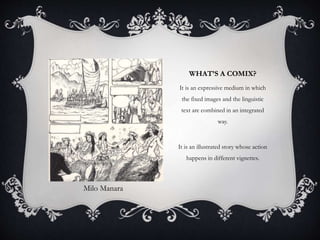
It is an expressive medium in which
the fixed images and the linguistic
text are combined in an integrated
way.
It is an illustrated story whose action
happens in different vignettes.
Milo Manara
ORIGIN OF THE COMIX
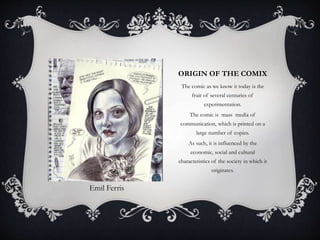
The comic as we know it today is the
fruit of several centuries of
experimentation.
The comic is mass media of
communication, which is printed on a
large number of copies.
As such, it is influenced by the
economic, social and cultural
characteristics of the society in which it
originates.
Emil Ferris
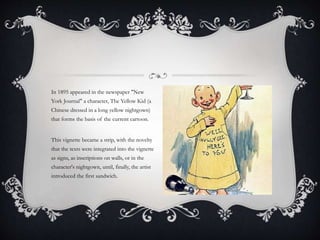
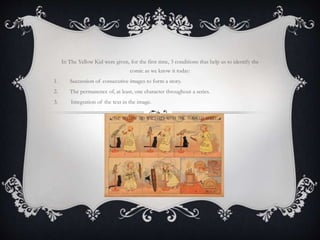
In 1895 appeared in the newspaper "New
York Journal" a character, The Yellow Kid (a
Chinese dressed in a long yellow nightgown)
that forms the basis of the current cartoon.
This vignette became a strip, with the novelty
that the texts were integrated into the vignette
as signs, as inscriptions on walls, or in the
character's nightgown, until, finally, the artist
introduced the first sandwich.
In The Yellow Kid were given, for the first time, 3 conditions that help us to identify the
comic as we know it today:
1. Succession of consecutive images to form a story.
2. The permanence of, at least, one character throughout a series.
3. Integration of the text in the image.
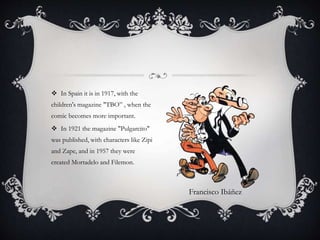
 In Spain it is in 1917, with the
children's magazine "TBO” , when the
comic becomes more important.
 In 1921 the magazine "Pulgarcito"
was published, with characters like Zipi
and Zape, and in 1957 they were
created Mortadelo and Filemon.
Francisco Ibáñez
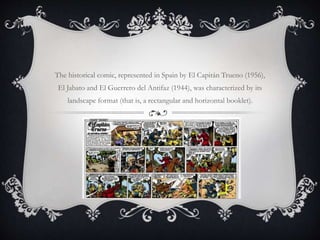
The historical comic, represented in Spain by El Capitán Trueno (1956),
El Jabato and El Guerrero del Antifaz (1944), was characterized by its
landscape format (that is, a rectangular and horizontal booklet).
FEATURES OF THE COMIX
 Narrative message
 Verb-iconic language
 Use of specific codes
 Mass media
 Its purpose is to entertain
COMIX ELEMENTS
VISUAL LANGUAGE: THE IMAGE
VERBAL LANGUAGE: THE WORD
CONVENTIONAL SIGNS
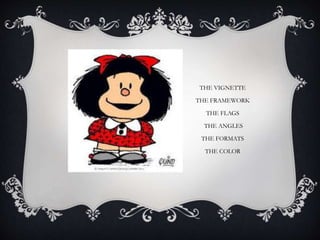
THE VIGNETTE
THE FRAMEWORK
THE FLAGS
THE ANGLES
THE FORMATS
THE COLOR
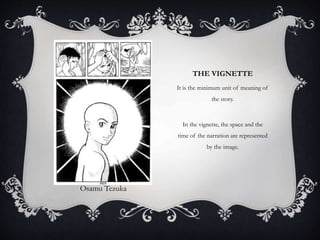
THE VIGNETTE
It is the minimum unit of meaning of
the story.
In the vignette, the space and the
time of the narration are represented
by the image.
Osamu Tezuka
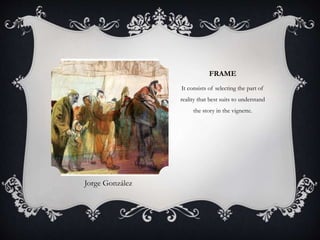
FRAME
It consists of selecting the part of
reality that best suits to understand
the story in the vignette.
Jorge González
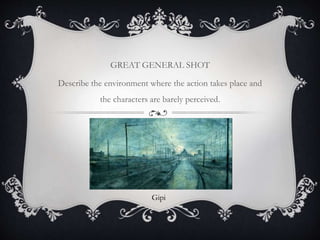
GREAT GENERAL SHOT
Describe the environment where the action takes place and
the characters are barely perceived.
Gipi
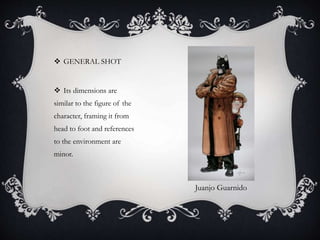
 GENERAL SHOT
 Its dimensions are
similar to the figure of the
character, framing it from
head to foot and references
to the environment are
minor.
Juanjo Guarnido
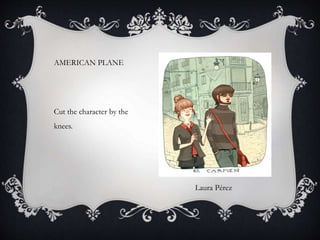
AMERICAN PLANE
Cut the character by the
knees.
Laura Pérez
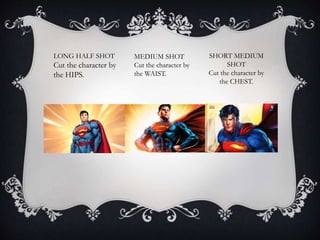
LONG HALF SHOT
Cut the character by
the HIPS.
MEDIUM SHOT
Cut the character by
the WAIST.
SHORT MEDIUM
SHOT
Cut the character by
the CHEST.
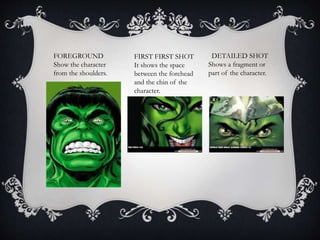
FOREGROUND
Show the character
from the shoulders.
FIRST FIRST SHOT
It shows the space
between the forehead
and the chin of the
character.
DETAILED SHOT
Shows a fragment or
part of the character.
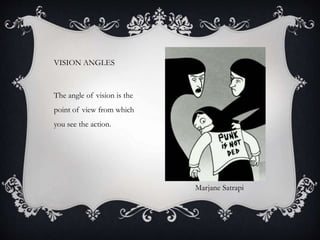
VISION ANGLES
The angle of vision is the
point of view from which
you see the action.
Marjane Satrapi
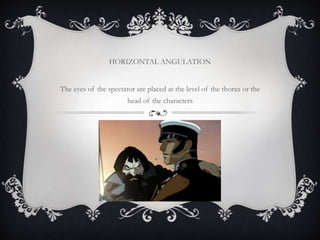
HORIZONTAL ANGULATION
The eyes of the spectator are placed at the level of the thorax or the
head of the characters
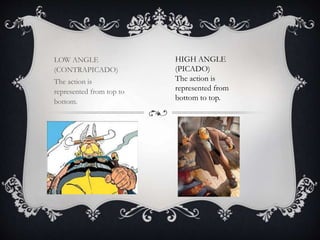
LOW ANGLE
(CONTRAPICADO)
The action is
represented from top to
bottom.
HIGH ANGLE
(PICADO)
The action is
represented from
bottom to top.
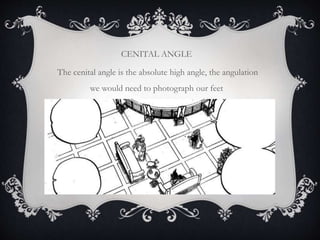
CENITAL ANGLE
The cenital angle is the absolute high angle, the angulation
we would need to photograph our feet
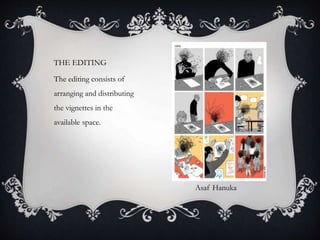
THE EDITING
The editing consists of
arranging and distributing
the vignettes in the
available space.
Asaf Hanuka
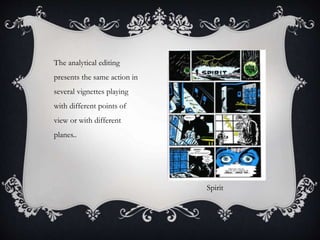
The analytical editing
presents the same action in
several vignettes playing
with different points of
view or with different
planes..
Spirit
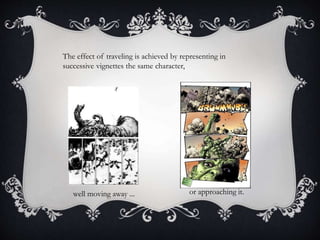
The effect of traveling is achieved by representing in
successive vignettes the same character,
well moving away ... or approaching it.
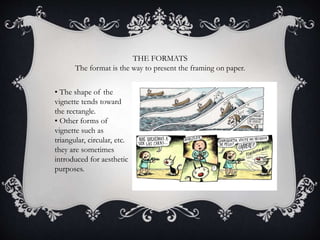
THE FORMATS
The format is the way to present the framing on paper.
• The shape of the
vignette tends toward
the rectangle.
• Other forms of
vignette such as
triangular, circular, etc.
they are sometimes
introduced for aesthetic
purposes.
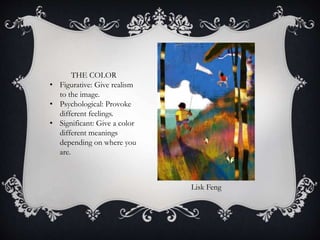
THE COLOR
• Figurative: Give realism
to the image.
• Psychological: Provoke
different feelings.
• Significant: Give a color
different meanings
depending on where you
are.
Lisk Feng
VERBAL LANGUAGE IN
COMIX
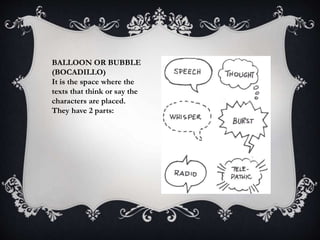
BALLOON OR BUBBLE
(BOCADILLO)
It is the space where the
texts that think or say the
characters are placed.
They have 2 parts:
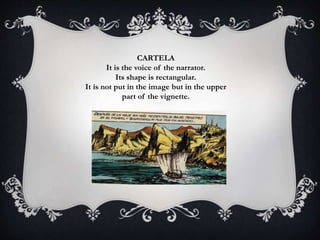
CARTELA
It is the voice of the narrator.
Its shape is rectangular.
It is not put in the image but in the upper
part of the vignette.
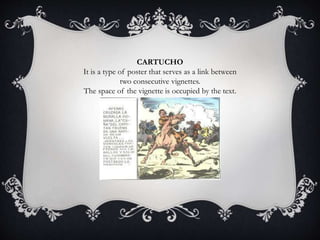
CARTUCHO
It is a type of poster that serves as a link between
two consecutive vignettes.
The space of the vignette is occupied by the text.
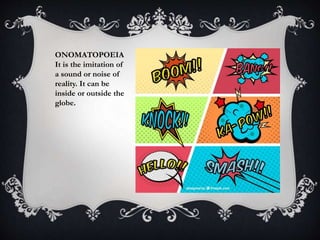
ONOMATOPOEIA
It is the imitation of
a sound or noise of
reality. It can be
inside or outside the
globe.
VISUAL SIGNS IN COMIX
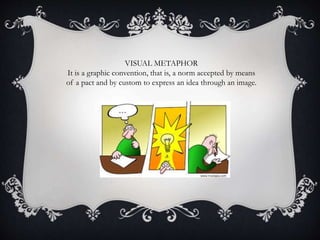
VISUAL METAPHOR
It is a graphic convention, that is, a norm accepted by means
of a pact and by custom to express an idea through an image.
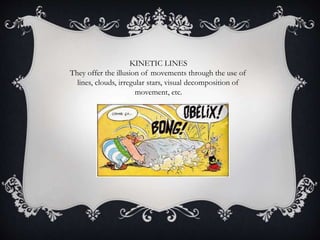
KINETIC LINES
They offer the illusion of movements through the use of
lines, clouds, irregular stars, visual decomposition of
movement, etc.

Comix

  • 1.
  • 2.
    WHAT’S A COMIX? Itis an expressive medium in which the fixed images and the linguistic text are combined in an integrated way. It is an illustrated story whose action happens in different vignettes. Milo Manara
  • 3.
    ORIGIN OF THECOMIX The comic as we know it today is the fruit of several centuries of experimentation. The comic is mass media of communication, which is printed on a large number of copies. As such, it is influenced by the economic, social and cultural characteristics of the society in which it originates. Emil Ferris
  • 4.
    In 1895 appearedin the newspaper "New York Journal" a character, The Yellow Kid (a Chinese dressed in a long yellow nightgown) that forms the basis of the current cartoon. This vignette became a strip, with the novelty that the texts were integrated into the vignette as signs, as inscriptions on walls, or in the character's nightgown, until, finally, the artist introduced the first sandwich.
  • 5.
    In The YellowKid were given, for the first time, 3 conditions that help us to identify the comic as we know it today: 1. Succession of consecutive images to form a story. 2. The permanence of, at least, one character throughout a series. 3. Integration of the text in the image.
  • 6.
     In Spainit is in 1917, with the children's magazine "TBO” , when the comic becomes more important.  In 1921 the magazine "Pulgarcito" was published, with characters like Zipi and Zape, and in 1957 they were created Mortadelo and Filemon. Francisco Ibáñez
  • 7.
    The historical comic,represented in Spain by El Capitán Trueno (1956), El Jabato and El Guerrero del Antifaz (1944), was characterized by its landscape format (that is, a rectangular and horizontal booklet).
  • 8.
    FEATURES OF THECOMIX  Narrative message  Verb-iconic language  Use of specific codes  Mass media  Its purpose is to entertain
  • 9.
    COMIX ELEMENTS VISUAL LANGUAGE:THE IMAGE VERBAL LANGUAGE: THE WORD CONVENTIONAL SIGNS
  • 10.
    THE VIGNETTE THE FRAMEWORK THEFLAGS THE ANGLES THE FORMATS THE COLOR
  • 11.
    THE VIGNETTE It isthe minimum unit of meaning of the story. In the vignette, the space and the time of the narration are represented by the image. Osamu Tezuka
  • 12.
    FRAME It consists ofselecting the part of reality that best suits to understand the story in the vignette. Jorge González
  • 13.
    GREAT GENERAL SHOT Describethe environment where the action takes place and the characters are barely perceived. Gipi
  • 14.
     GENERAL SHOT Its dimensions are similar to the figure of the character, framing it from head to foot and references to the environment are minor. Juanjo Guarnido
  • 15.
    AMERICAN PLANE Cut thecharacter by the knees. Laura Pérez
  • 16.
    LONG HALF SHOT Cutthe character by the HIPS. MEDIUM SHOT Cut the character by the WAIST. SHORT MEDIUM SHOT Cut the character by the CHEST.
  • 17.
    FOREGROUND Show the character fromthe shoulders. FIRST FIRST SHOT It shows the space between the forehead and the chin of the character. DETAILED SHOT Shows a fragment or part of the character.
  • 18.
    VISION ANGLES The angleof vision is the point of view from which you see the action. Marjane Satrapi
  • 19.
    HORIZONTAL ANGULATION The eyesof the spectator are placed at the level of the thorax or the head of the characters
  • 20.
    LOW ANGLE (CONTRAPICADO) The actionis represented from top to bottom. HIGH ANGLE (PICADO) The action is represented from bottom to top.
  • 21.
    CENITAL ANGLE The cenitalangle is the absolute high angle, the angulation we would need to photograph our feet
  • 22.
    THE EDITING The editingconsists of arranging and distributing the vignettes in the available space. Asaf Hanuka
  • 23.
    The analytical editing presentsthe same action in several vignettes playing with different points of view or with different planes.. Spirit
  • 24.
    The effect oftraveling is achieved by representing in successive vignettes the same character, well moving away ... or approaching it.
  • 25.
    THE FORMATS The formatis the way to present the framing on paper. • The shape of the vignette tends toward the rectangle. • Other forms of vignette such as triangular, circular, etc. they are sometimes introduced for aesthetic purposes.
  • 26.
    THE COLOR • Figurative:Give realism to the image. • Psychological: Provoke different feelings. • Significant: Give a color different meanings depending on where you are. Lisk Feng
  • 28.
  • 29.
    BALLOON OR BUBBLE (BOCADILLO) Itis the space where the texts that think or say the characters are placed. They have 2 parts:
  • 30.
    CARTELA It is thevoice of the narrator. Its shape is rectangular. It is not put in the image but in the upper part of the vignette.
  • 31.
    CARTUCHO It is atype of poster that serves as a link between two consecutive vignettes. The space of the vignette is occupied by the text.
  • 32.
    ONOMATOPOEIA It is theimitation of a sound or noise of reality. It can be inside or outside the globe.
  • 33.
  • 34.
    VISUAL METAPHOR It isa graphic convention, that is, a norm accepted by means of a pact and by custom to express an idea through an image.
  • 35.
    KINETIC LINES They offerthe illusion of movements through the use of lines, clouds, irregular stars, visual decomposition of movement, etc.