By Sarah Macedo


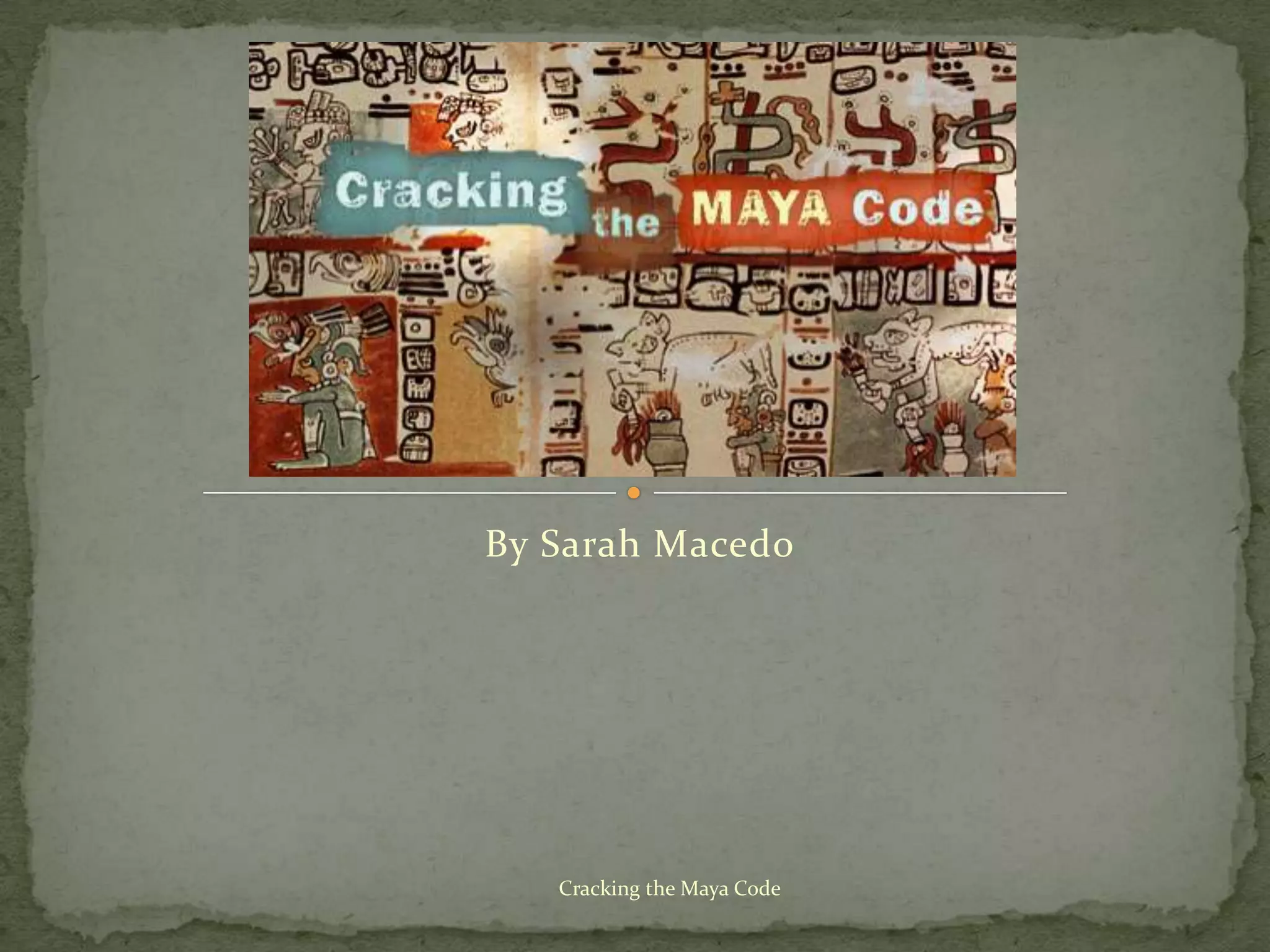
   Cracking the Maya Code
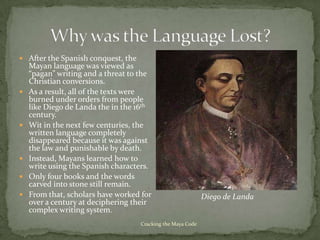
 After the Spanish conquest, the
    Mayan language was viewed as
    “pagan” writing and a threat to the
    Christian conversions.
   As a result, all of the texts were
    burned under orders from people
    like Diego de Landa the in the 16th
    century.
   Wit in the next few centuries, the
    written language completely
    disappeared because it was against
    the law and punishable by death.
   Instead, Mayans learned how to
    write using the Spanish characters.
   Only four books and the words
    carved into stone still remain.
   From that, scholars have worked for                      Diego de Landa
    over a century at deciphering their
    complex writing system.
                                    Cracking the Maya Code
 One of the first things to do was observe
  as many examples of the written
  language as possible.
 In the case of the Maya, this was done
  through the re-discovery of ancient ruins
  like Palenque and the revival of lost
  Mayan texts found in Mexico, Spain, and
  France.
 Accuracy in any copies of the materials is
  crucial because any little detail could
  hinder further development or lead to
  false conclusions.
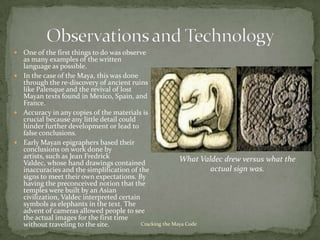
 Early Mayan epigraphers based their
  conclusions on work done by
  artists, such as Jean Fredrick                          What Valdec drew versus what the
  Valdec, whose hand drawings contained
  inaccuracies and the simplification of the                      actual sign was.
  signs to meet their own expectations. By
  having the preconceived notion that the
  temples were built by an Asian
  civilization, Valdec interpreted certain
  symbols as elephants in the text. The
  advent of cameras allowed people to see
  the actual images for the first time
  without traveling to the site.           Cracking the Maya Code
 Another crucial element of deciphering
  is the recognition of patters.
 In 1810 Constantine Rafinesque realized
  that since no more than four dots
  (symbolizing the number one) appear in
  one sequence, the number five was
  represented by a bar
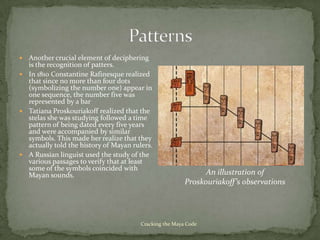
 Tatiana Proskouriakoff realized that the
  stelas she was studying followed a time
  pattern of being dated every five years
  and were accompanied by similar
  symbols. This made her realize that they
  actually told the history of Mayan rulers.
 A Russian linguist used the study of the
  various passages to verify that at least
  some of the symbols coincided with
  Mayan sounds.                                                An illustration of
                                                         Proskouriakoff’s observations


                                        Cracking the Maya Code
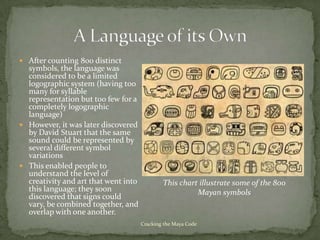
 After counting 800 distinct
  symbols, the language was
  considered to be a limited
  logographic system (having too
  many for syllable
  representation but too few for a
  completely logographic
  language)
 However, it was later discovered
  by David Stuart that the same
  sound could be represented by
  several different symbol
  variations
 This enabled people to
  understand the level of
  creativity and art that went into           This chart illustrate some of the 800
  this language; they soon                              Mayan symbols
  discovered that signs could
  vary, be combined together, and
  overlap with one another.
                                      Cracking the Maya Code
 Much of the early work on the
  written Mayan language centered
  around the declarations and
  approval of Mayan “specialist” Eric
  Thompson. He claimed the
  language was not syllabic and that
  the writing on the stelas carried no
  historical meanings.
 However, many of his theories were
  later proved to be wrong (as
  illustrated by the examples on slide
  5).
 Working together and sharing
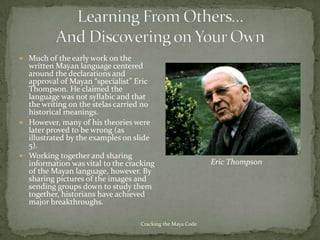
  information was vital to the cracking                     Eric Thompson
  of the Mayan language, however. By
  sharing pictures of the images and
  sending groups down to study them
  together, historians have achieved
  major breakthroughs.

                                   Cracking the Maya Code
 Another important element in the
  understanding of the Mayan
  language was to learn about the
  spoken Mayan language still known
  by native populations today
 By knowing what sounds make up
  specific words, the syllabic writing
  system could be deciphered.
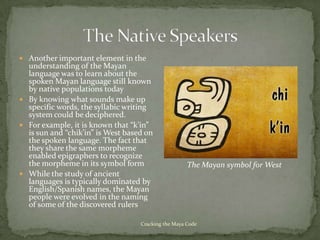
 For example, it is known that “k’in”
  is sun and “chik’in” is West based on
  the spoken language. The fact that
  they share the same morpheme
  enabled epigraphers to recognize
  the morpheme in its symbol form                    The Mayan symbol for West
 While the study of ancient
  languages is typically dominated by
  English/Spanish names, the Mayan
  people were evolved in the naming
  of some of the discovered rulers

                                   Cracking the Maya Code
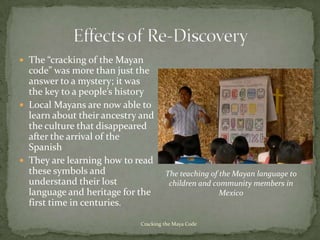
 The “cracking of the Mayan
  code” was more than just the
  answer to a mystery; it was
  the key to a people’s history
 Local Mayans are now able to
  learn about their ancestry and
  the culture that disappeared
  after the arrival of the
  Spanish
 They are learning how to read
  these symbols and                  The teaching of the Mayan language to
  understand their lost               children and community members in
  language and heritage for the                      Mexico
  first time in centuries.

                            Cracking the Maya Code
 “Cracking the Maya Code”. Nova. PBS. 8 April 2008.
  Television.
IMAGES TAKEN FROM:
 http://www.pbs.org/wgbh/nova/ancient/cracking-
  maya-code.html
 http://users.skynet.be/fa039055/lifedeat.htm
 Screen shots from “Cracking the Maya Code”


                       Cracking the Maya Code

Cracking the Mayan Code

  • 1.
    By Sarah Macedo Cracking the Maya Code
  • 2.
     After theSpanish conquest, the Mayan language was viewed as “pagan” writing and a threat to the Christian conversions.  As a result, all of the texts were burned under orders from people like Diego de Landa the in the 16th century.  Wit in the next few centuries, the written language completely disappeared because it was against the law and punishable by death.  Instead, Mayans learned how to write using the Spanish characters.  Only four books and the words carved into stone still remain.  From that, scholars have worked for Diego de Landa over a century at deciphering their complex writing system. Cracking the Maya Code
  • 3.
     One ofthe first things to do was observe as many examples of the written language as possible.  In the case of the Maya, this was done through the re-discovery of ancient ruins like Palenque and the revival of lost Mayan texts found in Mexico, Spain, and France.  Accuracy in any copies of the materials is crucial because any little detail could hinder further development or lead to false conclusions.  Early Mayan epigraphers based their conclusions on work done by artists, such as Jean Fredrick What Valdec drew versus what the Valdec, whose hand drawings contained inaccuracies and the simplification of the actual sign was. signs to meet their own expectations. By having the preconceived notion that the temples were built by an Asian civilization, Valdec interpreted certain symbols as elephants in the text. The advent of cameras allowed people to see the actual images for the first time without traveling to the site. Cracking the Maya Code
  • 4.
     Another crucialelement of deciphering is the recognition of patters.  In 1810 Constantine Rafinesque realized that since no more than four dots (symbolizing the number one) appear in one sequence, the number five was represented by a bar  Tatiana Proskouriakoff realized that the stelas she was studying followed a time pattern of being dated every five years and were accompanied by similar symbols. This made her realize that they actually told the history of Mayan rulers.  A Russian linguist used the study of the various passages to verify that at least some of the symbols coincided with Mayan sounds. An illustration of Proskouriakoff’s observations Cracking the Maya Code
  • 5.
     After counting800 distinct symbols, the language was considered to be a limited logographic system (having too many for syllable representation but too few for a completely logographic language)  However, it was later discovered by David Stuart that the same sound could be represented by several different symbol variations  This enabled people to understand the level of creativity and art that went into This chart illustrate some of the 800 this language; they soon Mayan symbols discovered that signs could vary, be combined together, and overlap with one another. Cracking the Maya Code
  • 6.
     Much ofthe early work on the written Mayan language centered around the declarations and approval of Mayan “specialist” Eric Thompson. He claimed the language was not syllabic and that the writing on the stelas carried no historical meanings.  However, many of his theories were later proved to be wrong (as illustrated by the examples on slide 5).  Working together and sharing information was vital to the cracking Eric Thompson of the Mayan language, however. By sharing pictures of the images and sending groups down to study them together, historians have achieved major breakthroughs. Cracking the Maya Code
  • 7.
     Another importantelement in the understanding of the Mayan language was to learn about the spoken Mayan language still known by native populations today  By knowing what sounds make up specific words, the syllabic writing system could be deciphered.  For example, it is known that “k’in” is sun and “chik’in” is West based on the spoken language. The fact that they share the same morpheme enabled epigraphers to recognize the morpheme in its symbol form The Mayan symbol for West  While the study of ancient languages is typically dominated by English/Spanish names, the Mayan people were evolved in the naming of some of the discovered rulers Cracking the Maya Code
  • 8.
     The “crackingof the Mayan code” was more than just the answer to a mystery; it was the key to a people’s history  Local Mayans are now able to learn about their ancestry and the culture that disappeared after the arrival of the Spanish  They are learning how to read these symbols and The teaching of the Mayan language to understand their lost children and community members in language and heritage for the Mexico first time in centuries. Cracking the Maya Code
  • 9.
     “Cracking theMaya Code”. Nova. PBS. 8 April 2008. Television. IMAGES TAKEN FROM:  http://www.pbs.org/wgbh/nova/ancient/cracking- maya-code.html  http://users.skynet.be/fa039055/lifedeat.htm  Screen shots from “Cracking the Maya Code” Cracking the Maya Code