Arsia • Agenzia Regionale per lo Sviluppo 
e l’Innovazione nel settore Agricolo-forestale 
via Pietrapiana, 30 - 50121 Firenze 
tel. 055 27551 - fax 055 2755216/2755231 
www.arsia.toscana.it 
email: posta@arsia.toscana.it 
Coordinamento: Roberto D’Alonzo - Arsia 
So Far: Social Services in Multifunctional Farms (‘Social Farming’) 
Web-site: http//:sofar.unipi.it 
Contacts: francovo@vet.unipi.it 
tel. 0039 050 2216918 or 0039 050 2210500 
Project no.: 022682 
So Far: Social Services in Multifunctional Farms (‘Social Farming’) 
Specific Support Action 
Priority [8.1.B.1.1] 
Grafic design and Editing: 
LCD srl, Firenze 
Press: Press Service srl, Sesto Fiorentino (FI) 
ISBN 978-88-8295-107-8 
© Copyright 2009 Arsia • Regione Toscana
Supporting policies 
for Social Farming in Europe 
Progressing Multifunctionality 
in Responsive Rural Areas 
Francesco Di Iacovo, Deirdre O’Connor 
editors 
Arsia • Agenzia Regionale per lo Sviluppo e l’Innovazione 
nel settore Agricolo-forestale, Firenze
Credits 
Editors: Francesco Di Iacovo, Deirdre O’Connor 
Chapter co-ordinators: 
Chapter 1: Jan Hassink 
Chapter 2: Paolo Pieroni 
Chapter 3: Joost Dessein 
Chapter 4: Gerald Assouline 
Chapter 5: Greet Bloom 
Chapter 6: Francesco Di Iacovo, Deirdre O’Connor. 
Chapter Credits 
Introduction: F. Di Iacovo. 
Chapter 1: J. Hassink, with contributions from each national team. 
Chapter 2: 2.1, 2.2 P. Pieroni; 2.2.1 F. Di Iacovo; 2.2.2 P. Pieroni; 2.3 G. Assouline; 
2.4 K. Vadnal; 2.5 M. Kalisch, T. van Elsen; 2.6 A. Mc Gloin, 2.7 J. Dessein, 
G. van Huylenbroeck, M. Calus, W. Rombaut; 2.8 G. Bloom, J. Hassink. 
Chapter 3: 3.1 J. Dessein; 3.2 J. Hassink, K. Vadnal; 3.3 M. Kalisch, T. van Elsen; 
3.4 A. Mc Gloin; 3.5 K. Vadnal, J. Dessein; 3.6 F. Di Iacovo. 
Chapter 4: 4.1, 4.2, 4.4 G. Assouline; 4.3 G. Assouline, A. Mc Gloin, D. O’Connor. 
Chapter 5: 5.1, 5.2 F. Di Iacovo; 5.3, 5.4 G. Bloom, F. Di Iacovo; 5.4.1-5.5 G. Bloom, 
F. Di Iacovo, M. Calus, J. Hassink, M. Kalisch, T. van Elsen, K. Vadnal, A. Mc Gloin; 
5.6 G. Bloom. 
Chapter 6: F. Di Iacovo, D. O’Connor. 
Photographs Credits: 
G. Assouline, G. Bloom, W. Rombaut, J. Hassink, T. van Elsen, P. Pieroni. 
Video Credits: Paolo Pieroni, Andrea Fioravanti. 
Thanks 
A special thanks goes to all the people who were actively involved throughout the SoFar 
Project – particularly in the national and EU platforms activities and in videomaking. This 
work comes directly from their contributions and from their voices. The project could 
not have existed in the absence of these existing practices on the ground. To all those 
involved in social farming at grassroots-level and through their day-to-day commitment as 
members of society we address our sincere appreciation. To Arsia who offered significant 
technical support throughout the entire process, we also express our appreciation.
Index 
Presentation 7 
Introduction 11 
1. Social farming across Europe: overview 21 
1.1 What is social farming? 21 
1.2 Significance of social farming today 23 
1.3 History of social farming 25 
1.4 Dynamics of social farming 27 
1.5 Estimation of the actual number of social farms 
in the SoFar countries 29 
1.6 Developing networks 29 
1.7 Regulatory systems 30 
1.8 Different types of social farming 33 
1.9 Further description of diversity of social farms 35 
1.10 Benefits for the service-users 40 
1.11 Qualities of social farms 41 
2. “A journey through social farming in Europe”: 
the case studies 43 
2.1 A brief presentation 43 
2.2 Italy 44 
2.3 France 65 
2.4 Slovenia 78 
2.5 Germany 90 
2.6 Ireland 98 
2.7 Belgium (Flanders) 110 
2.8 The Netherlands 120 
2.9 Conclusions 130 
3. A critical reading from cases and emerging issues 131 
3.1 Transversal reading of cases 131
6 A R S I A 
3.2 Inclusive effects 132 
3.3 Landscape and environment 135 
3.4 Gender issues 140 
3.5 Economic features 143 
3.6 Policies and institutions in social farming 146 
4. Building a european stakeholders’ perspective 
of social farming 151 
4.1 Overview 151 
4.2 Action research to involve stakeholders in establishing 
social farming as a european policy focus 151 
4.3 The production of social farming policy positions 
by social farming professional actors 161 
4.4 A policy process: building and consolidation 
of networking dynamics 168 
4.5 Concluding remarks 173 
5. Priority areas and innovation strategies 
for further developing Social Farming in Europe 175 
5.1 Introduction 175 
5.2 A bottom-up approach and policy network 
for a new perspective on Social Farming 176 
5.3 Mainstreaming Social Farming in Europe 179 
5.4 Priority areas in Social Farming 183 
5.5 Innovative strategies 196 
5.6 Final conclusions 201 
6. Conclusions 203 
References 216
Presentation 
In 2003, Arsia started an innovative activity on social farming 
in Tuscany. The project was a first attempt to better understand, 
survey and give recognition to social farmers across Tuscany. The 
initiative was the first one carried out in Italy and it yielded quite 
successful results. For the first time about 70 projects related to 
social farming emerged from the shadows and their promoters 
began to present and to communicate their daily activities on social 
issues related to farming. The organisation of an initial network 
was useful in order to define a new arena where the concept of 
social farming could be presented and debated and could include 
newcomers in such discussions. From the outset and until now, the 
Arsia project has been able to establish networks at regional level 
and to reinforce local dynamics by affecting political processes. The 
Tuscany Region has been quite active in addressing social farming 
with specific measures in the Regional Development Plan (Rdp), 
initially during the 2000-06 EU planning period and later on in the 
new Rdp. 
The establishment of a local network with project holders and 
with Pisa University was the entry point to engage in the SoFar 
project. The SoFar project would actively contribute to the defini-tion 
of EU agricultural policies by addressing the innovative field 
of social farming. Until now, Social Farming seems to have been 
an under-recognised application of multifunctional agriculture. 
However, in the context of better re-considering on-farm activities, 
social farming may usefully fit with many urgent societal issues in 
both rural and peri-urban areas. 
Perhaps in Europe there is an increasing consensus around the 
idea that social services in rural areas could play an active role in 
rural development processes in order to improve local livelihoods
8 A R S I A 
and to support economic viability. In that respect there are enough 
cases in Europe that show us that farmers can actively contribute to 
improve healthcare services and to support rural everyday life. 
But social farming presents also other attributes that are already 
known to many local practitioners. Social farming offers the oppor-tunity 
to work with plants and animals among small groups of peo-ple. 
There is evidence about the therapeutics effect for less empow-ered 
people involved in social farming. In many cases such practices 
are organised in peri-urban areas for local urban populations. They 
enable services to expand their supply and offer the opportunity to 
build new bridges between cities and the countryside. 
The results of the SoFar project are quite important for differ-ent 
reasons.They open a window into a phenomenon that was not 
well evaluated until now, but they also establish in a concrete way, 
different possibilities for establishing collaboration among research 
units, support centres and local practitioners in order to built new 
pathways of change in rural areas. There is a strong need for innova-tion 
in most EU rural areas; sometimes the efforts are needed to face 
specific questions, but there is also a real need for innovative meth-odological 
approaches to face these changes. In that respect SoFar 
and social farming are offering both a concept and a methodological 
approach to better promote a living countryside in Europe. 
Maria Grazia Mammuccini 
Arsia Director
Supporting policies 
for Social Farming in Europe 
Progressing Multifunctionality 
in Responsive Rural Areas 
Francesco Di Iacovo, Deirdre O’Connor 
editors
Introduction 
Historically, agricultural and rural societies, all over Europe, 
have developed initiatives and practices promoting different forms 
of solidarity, social assistance and social inclusion. 
In particular we may speak of social farming (or ‘care farming’ or 
‘green care’) as those farming practices aimed at promoting disad-vantaged 
people’s rehabilitation, education and care and/or towards 
the integration of people with ‘low contractual capacity’ (i.e. intel-lectual 
and physical disabilities, convicts, those with drug addiction, 
minors, migrants) but also practices that support services in rural 
areas for specific target groups such as children and the elderly. 
As a tentative definition social farming (SF) is both a traditional 
and an innovative use of agriculture frequently introduced from 
“grassroots level” by both new and established farmers. SF includes 
all activities that use agricultural resources, both from plants and 
animals, in order to promote (or to generate) therapy, rehabilitation, 
social inclusion, education and social services in rural areas. How-ever, 
it is strictly related to farm activities where (small) groups of 
people can stay and work together with family farmers and social 
practitioners. 
Social Farming adopts a multifunctional view of agriculture. The 
main products, in addition to saleable produce, are health and employ-ment, 
education or therapy. Agriculture offers opportunities for peo-ple 
to participate in the varied rhythms of the day and the year, be 
it in growing food or working with domestic animals. Social farming 
includes agricultural enterprises and market gardens that integrate peo-ple 
with physical, mental or emotional disabilities; farms which offer 
openings for the socially disadvantaged, for young offenders or those 
with learning difficulties, people with drug dependencies, the long-term 
unemployed; active senior citizens; school and kindergarten farms
12 A R S I A 
and many more. Prevention of illness, inclusion and a better quality of 
life are features of social agriculture. 
The special added value of social farming is the possibility for 
disadvantaged people to be integrated into a living context, where 
their personal capabilities are valued and enhanced. The presence 
of the farmers, the contact and relationship with other living beings 
– animals and plants, the assumption of specific responsibilities, are 
some of the key features of the rehabilitative practices generated by 
social farming. 
Of course, the definition of social farming is not yet agreed across 
Europe. There are still different ways of identifying it (farming for 
health, green care, social farming) as a way to use agriculture for social 
purposes. SF is both a new and a traditional concept. It originates 
from the traditional rural self-help systems that were well-established 
in rural areas before the modernisation of agriculture and the rise of 
the public welfare system. Nowadays the concept has been radically 
reformed in an innovative and ever-changing way. In order to build 
a life sustaining web (Barnes, 2007) it is important to accompany for-mal 
and professional social services systems with an extensive system 
of more informal relationships. Moreover, informal systems should 
improve the capacity of the local context to include and increase the 
opportunities for weaker actors. 
All over rural Europe, there is a widespread and rich patrimony 
of diverse agricultural realities – inherited from the past or created 
more recently – which are characterised by distinctive, sound rela-tionships 
between farming practices of those of social inclusion. 
In many cases these experiences were born autonomously, root-ed 
in the strong, personal, ethical beliefs and motivation of their 
promoters, who carried a function of collective interest – invisibly 
and in isolation. In fact, the ‘invisibility’ of such realities is reflected 
in the absence of a clearly defined judicial/institutional framework 
for social farming in most countries and at European level which 
makes objective assessment of these realities a difficult task. 
However, social farming is an evolving, dynamic scenario, 
which is receiving increased attention from multiple stakeholders 
in recent times. It has already visibly matured in some countries, 
such as The Netherlands, where social farming is a legally recog-nised 
and formalised activity. 
However, in most countries and at European level, SF isn’t as 
yet an organised system, but more a patchwork-like reality, mainly
S oaci l afr mi n g i n E u r oep 13 
developed on a voluntary basis in the form of “bottom-up” actions, 
unsupported by any specific policies and/or institutional frame-work. 
There is a clear need for a process of improvement that can 
extend the supply of social services by multifunctional farms and 
enhance their quality. The creation of a social farming ‘system’ 
will be a long-term, evolutionary, multi-actor process that should 
be based on the experience of those rural actors who have already 
started by developing the reality thus far. At the same time, in the 
process of expanding and “normalising” social farming, we should 
not lose sight of its original spirit and values, such as solidarity 
and social responsibility, on which most of the pioneering experi-ences 
were based. Thus, it is apparent that the building of a new 
institutional environment for social farming requires close atten-tion, 
involving different actors into a dialogue and ensuring active 
participation by previous and current protagonists. 
SF can be also linked to a rural development discourse. A strong 
theme in most of the rural development literature is that a lack of 
opportunities in rural areas is often connected to the absence of 
adequate and innovative services for everyday life. In this arena, 
SF can offer appropriate solutions that fit the local needs of inhab-itants. 
In rural areas, flexibility and proximity, scope economies 
and informality are some key words that characterise the use of 
agriculture and farms for providing services to local inhabitants 
and rural communities1, in the face of the erosion of public health/ 
care provision (Di Iacovo, 2003). 
Social farming is an emerging issue in many EU countries due to 
an increasing focus on different aspects of multifunctional agricul-ture 
as well as concerns about public health expenditure and the 
efficacy of social services. 
Social farming is connected to many critical issues. It is an example 
of an innovative response to the transition from old to new eco-nomic 
regimes. This process of change affects agriculture as well as 
other sectors such as health, care, education, and the employment 
sector. Social farming seems to be at the intersection of many points 
of convergence such as: multifunctional agriculture; the fiscal crises 
of States; concerns over the individualisation and efficacy of serv- 
1 For example kindergarten services or day-services for the elderly.
14 A R S I A 
ices and the re-organisation of local life under a sustainable system 
for organising services in both urban and rural contexts. 
The idea of social farming is connected to the possibility of re-gener-ating 
relationships between different groups of people and within 
local communities. It offers also the possibility for better linking 
urban and rural areas, by improving quality of life at local level, 
both in peri-urban and rural areas. 
Social farming reflects different thinking about the idea develop-ment 
itself. In this case, the need to mobilise local resources in inno-vative 
ways is crucial in order to provide solutions to local needs. 
Social farming can be also considered as an “informal” service offered 
by subsistence agriculture. It is not the case that SF means a reduc-tion 
in the quality of services in poorer areas but, on the contrary, can 
serve as a way to improve their efficacy by connecting formal and 
professional services with more informal and non-professional sys-tems. 
This means that in different contexts, health/care systems can 
introduce agricultural resources into already well-structured organi-sational 
systems. Consequently, these professional services can be 
augmented by incorporating those resources that already exist within 
the informal services available to local families and communities. 
The term SF has recently entered the domain of rural development in 
EU, reflected in a wide constellation of different practices that are 
emerging from different territories; experiences that, in many cases, 
were born as bottom-up initiatives that have “grown in the shade” 
for a long time. 
Social farming is gaining attention from an increasing range of 
stakeholders in recent times. On one hand, this results from a new, 
widespread positive perception of agricultural and rural resources, 
leading to an increasing interest about the beneficial effects of natural 
spaces and agricultural areas on the social, physical and mental wellbe-ing 
of people. Health institutions are keen to find alternative practices 
that are more embedded in social contexts. At the same time, social 
farming represents a new chance for farmers to carry out alternative 
services, to broaden and diversify the scope of their activities and their 
role in society. The integration between agricultural practices and social 
services may also provide new sources of income for farmers, enhanc-
S oaci l afr mi n g i n E u r oep 15 
ing the image of agriculture in society and establishing new connections 
between rural and urban citizens. 
Social farming links two worlds – the agricultural and the social. In 
that respect it is sometimes problematic to create new knowledge 
and to share competencies between different stakeholders, aimed at 
reorienting the use of agricultural resources for health/care purpos-es. 
SF requires multi-skilled, multi-sectoral integrated approaches 
to be better understood and developed. 
Also depending on the different categories of service-users, SF 
is highly demanding in terms of designing integrated policies in rural 
development, local development, employment and social affairs. 
Social farming can be seen also a process of social innovation where 
collective learning, bottom-up approaches and practices rooted in local 
experiences are producing a process of radical change, affecting poli-cies 
at regional and national level. In this process, there appears to be a 
specific role for the organisation of policy networks at regional, national 
and EU level. Their role should be to improve awareness of social 
farming; to seek greater public attention and resources; to increase the 
knowledge and evidence base and, at the same time, to work towards 
developing a judicial/institutional framework that supports and affirms 
a different culture of caring for less-empowered people, linked to a dif-ferent 
use of agricultural resources. 
The debate around SF is developing rapidly in most of the EU coun-tries 
at grassroots level. Meanwhile, it seems more difficult to engage 
institutional actors – both at national and EU levels. 
Building on some existing evidence about SF, the overall aim 
of the SoFar project was to support the building of a new institu-tional 
environment for social farming; to provide a linkage between 
research and practitioners/rural actors and to bring different Euro-pean 
experiences closer together, in order to compare, exchange 
and co-ordinate experiences and activities. 
The project was carried out by a partnership of seven Universi-ties 
and Research Centres in the EU. 
Pisa University, Department of Animal Production (Italy) co-ordinated 
the project. Other participants were Wageningen Univer-sity 
(The Netherlands); Forschungsinstitut für Biologischen Landbau
16 A R S I A 
(Research Institute of Organic Agriculture), Standort Witzenhausen 
(Germany); University of Ghent Faculty of Bioscience and Engi-neering, 
Dept of Agricultural Economics (Belgium); Department 
Agronomy, Biotechnical Faculty, University of Lubljana, (Slovenia); 
Qap Decision (France); National University of Ireland, Dublin (Ire-land), 
Agenzia Regionale per lo Sviluppo e l’Innovazione nel settore 
Agricolo-forestale - Arsia Regione Toscana, Firenze (Italy). 
As partners of Ghent University, two other groups in Belgium 
were involved in the project. They were Groone Zorn, the Flemish 
centre for social farming, and the Social Science Unit of Ilvo (Insti-tute 
for Agriculture and Fisheries Research). 
The partners were strongly motivated and committed to this 
topic. They were also very well established at regional/country 
level. Both these elements contributed enormously to the level of 
debate within the group as well as the possibility of facilitating 
exchanges and the participation of a large number of stakeholders 
in the different steps and activities of the project. 
The different scientific backgrounds of the participating institu-tions 
ensured a wide inter-disciplinary view – the specific expertise 
of participants included the fields of rural development; economics; 
marketing; politics; sociology; communication; gender studies and 
community development. In addition, the presence of partners from 
very different geographical contexts increased the opportunities: 
• to compare experiences in different countries – social farming 
practices; institutional/policy support; cross-cutting related 
issues (e.g. economic benefits, gender and ethical issues, rela-tions 
with other dimensions of multifunctionality) and to bench-mark 
reference points across Europe; 
• to connect existing experiences and networks within country/ 
regional contexts and also to build a European-wide co-ordina-ted 
system from this patchwork-like reality; 
• to design a shared innovation strategy – rooted in several 
countries’ backgrounds – to support co-ordinated policy-ma-king 
at European level. 
The project lasted 30 months and was organised in the following 
steps and activities: 
1. Fact-finding and analysis: Literature review, exploratory survey 
and detailed information about social farms (produced descrip-tions 
of 110 reference cases and a smaller number – 14 – of more 
detailed stories);
S oaci l afr mi n g i n E u r oep 17 
2. Developing national ‘platforms’ 14 working groups comprising 
about 250 participants in total, Swot analysis and innovation 
strategies at country/regional level; 
3. Developing a European ‘platform’ (2 working groups with about 
100 participants in total): Evolution of the project activities from 
the local level to the establishment of the European Platforms, 
EU Swot analysis and EU innovation strategies; 
4. Communication activities: Web operational support, information, 
newsletter and dissemination activities. 
The project adopted a participatory approach bridging scientific 
knowledge with grounded/empirical knowledge (e.g. small working 
groups with rural actors and policy-makers) and integrating different 
perspectives (e.g. stakeholders’ perspectives, country/regional back-grounds). 
In that respect, the organisation of different platforms – at 
regional/country and EU level – was the engine of the action research 
methodology. It was able to provide the linkage between research 
and agricultural practitioners and rural development players, and 
enhanced co-ordination of research activities between the EU, the 
Member States and regional research institutions. 
Another key function of the regional/country and EU plat-forms 
in bringing together key stakeholders and rural develop-ment 
researchers was to support the designing of future policies at 
regional and European levels. 
A special added value of this project was its ‘grounded’ charac-ter, 
which means that scientific knowledge was interchanged and 
enriched with field-based knowledge. The participatory approach 
of the project contributed to generating a sense of empowerment 
among rural actors and offered also a new model of developing 
(scientific) support to policy-making, more closely aligned to the 
idea of ‘interactive policy making’. 
In a way the project also offered the opportunity to animate – and in 
some cases to begin – the debate about SF in participating countries. 
Through the platform activities (carried out at regional and 
trans-national levels and based on a participatory approach), the 
following specific objectives were pursued: 
1. To assess (and compare): 
– The features of existing realities; 
– The scientific evidence about the effects of agro-social rehabili-tative 
practices; 
2. To compare and share:
18 A R S I A 
– Concepts and vocabulary; 
– (Reference) procedures; 
– (Potential) systems of support; 
3. To enhance: 
– Networking and co-ordination among stakeholders and rese-archers; 
– Dissemination of the experiences and lessons learned; 
– Capacity for enhanced visibility, positioning, and profile 
within the system. 
4. To design innovation strategies at country/regional and Euro-pean 
levels; 
5. To learn methodological lessons about the development of parti-cipatory 
research as a valid way to provide scientific support to 
policies. 
These objectives were developed into the following results pre-sented 
on the project web site (http://sofar.unipi.it): 
• A State of the Art, describing and analysing current characteristics 
of social farming in the participating countries/regions, and pro-viding 
an overview of the situation in other EU countries; 
• An inventory of rural actors (i.e. social farms) and other stake-holders 
in the different participating countries/regions and an 
overview of other EU countries; 
• Country/regional ‘innovation strategies’ designed collaborati-vely 
by researchers and different representatives of rural actors 
and public institutions; 
• A European ‘innovation strategy’ designed collaboratively by 
researchers and different representatives of rural actors and 
public institutions; 
• Mono-thematic papers addressing issues related to social far-ming 
and (i) gender issues, (ii) economic issues (e.g. farm viabi-lity), 
(iii) other services in multifunctional farms (e.g. landscape 
care), (iv) policy issues concerning agriculture and other sectors 
(e.g. health, quality of life, social inclusion); 
• A report on methodological lessons learned (participatory work 
within platforms). 
This book and the video-documentary included, illustrates the 
research questions and the outcomes of the project. 
Chapter One offers a complete overview of the State of the Art’ 
of SF across participating countries/regions. It presents some basic
S oaci l afr mi n g i n E u r oep 19 
knowledge about social farming; it assesses and compares the features 
of existing social/care-farming initiatives and offers some scientific 
evidence about the agro-social rehabilitative practices. It introduces 
key concepts/vocabulary and information about procedures and sys-tems 
of support for social/care-farming experiences in Europe. 
Chapter Two can be interpreted as a journey around the differ-ent 
realities of SF in participating countries/regions. It provides 
some information on the different national/regional contexts as 
well as the specific cases and stories encountered in the course of 
the project. The cases presented are the same as those recorded in 
the video work so that readers can gain an understanding and a 
visual insight into different EU SF projects. 
Chapter Three begins with some brief comparative analysis of 
the cases presented in Chapter Two. It also presents a transversal 
reading of some specific issues in social farming such as gender; 
social inclusion; policies; economics; health impacts and environ-mental 
effects. 
Chapter Four describes and analyses the participatory process 
underpinning much of the project’s activities and discusses its main 
achievements. Some of the key questions, propositions and stake-holder 
views that emerged during the platform activities are also 
summarised in this chapter. 
Chapter Five summarises most of the points emerging from 
the platforms in the form of an EU innovation strategy for SF. This 
innovation strategy for SF is organised around four priority areas 
and for each of them specific actions are presented. 
Due to the specific methodological approach adopted, it was 
sometime difficult to fully disentangle the research from the policy 
dimensions of both the activities and the results. This very particular 
environment in which the project operated generated some significant 
challenges in reconciling the project timetable with the time required 
for undertaking a participatory process aimed at increasing collective 
learning around SF. The book is an attempt to present the feedback and 
results from the various project activities, but at the same time to offer 
a common and shared starting point for analysing the actual situation, 
the expectations and possible future strategies for SF in Europe. 
The hope of the project partners is that it could offer innova-tive 
insights into the formulation and implementation of EU rural 
development policies regarding multifunctional agriculture and 
social farming.
1. Social Farming across Europe: 
overview 
1.1 What is social farming? 
Social farming (SF) is an emerging topic for different stakehold-ers 
across Europe: farmers, farmers’ organisations, service-users 
of social farms and their organisations, providers of social and 
health care services, other stakeholders in social and health care 
and local, regional and national authorities. It is an innovative 
approach located within two concepts: multifunctional agriculture 
and community-based social/health care. Social farming includes 
all activities that use agricultural resources, both from plants and 
animals, in order to promote (or to generate) social services in rural 
areas. Examples of these services are rehabilitation, therapy, shel-tered 
work, life-long education and other activities that contribute 
to social inclusion. 
The general definition of social farming is not yet agreed around 
Europe. At the same time, today there are different ways to indicate 
what the phenomenon is about (farming for health, green care, care 
farming, social farming) and to show how agriculture is used for 
social purposes. Initiatives for social farming are often introduced 
by farmers and local communities. 
Social farming is both a new and a traditional concept. It origi-nates 
from the traditional rural self-help networks that were well-established 
in rural areas before the modernisation of agriculture and 
the rise of the public welfare system. Nowadays the concept has been 
substantially reformed in an innovative and an evolving way. 
As proposed during the German platform in their Manifesto, 
Social Farming adopts a multifunctional view of agriculture. The 
main products, in addition to saleable produce, are health and 
employment, education or therapy. Agriculture offers opportuni-ties 
for people to participate in the varied rhythms of the day and 
the year, be it in growing food or working with domestic animals.
22 A R S I A 
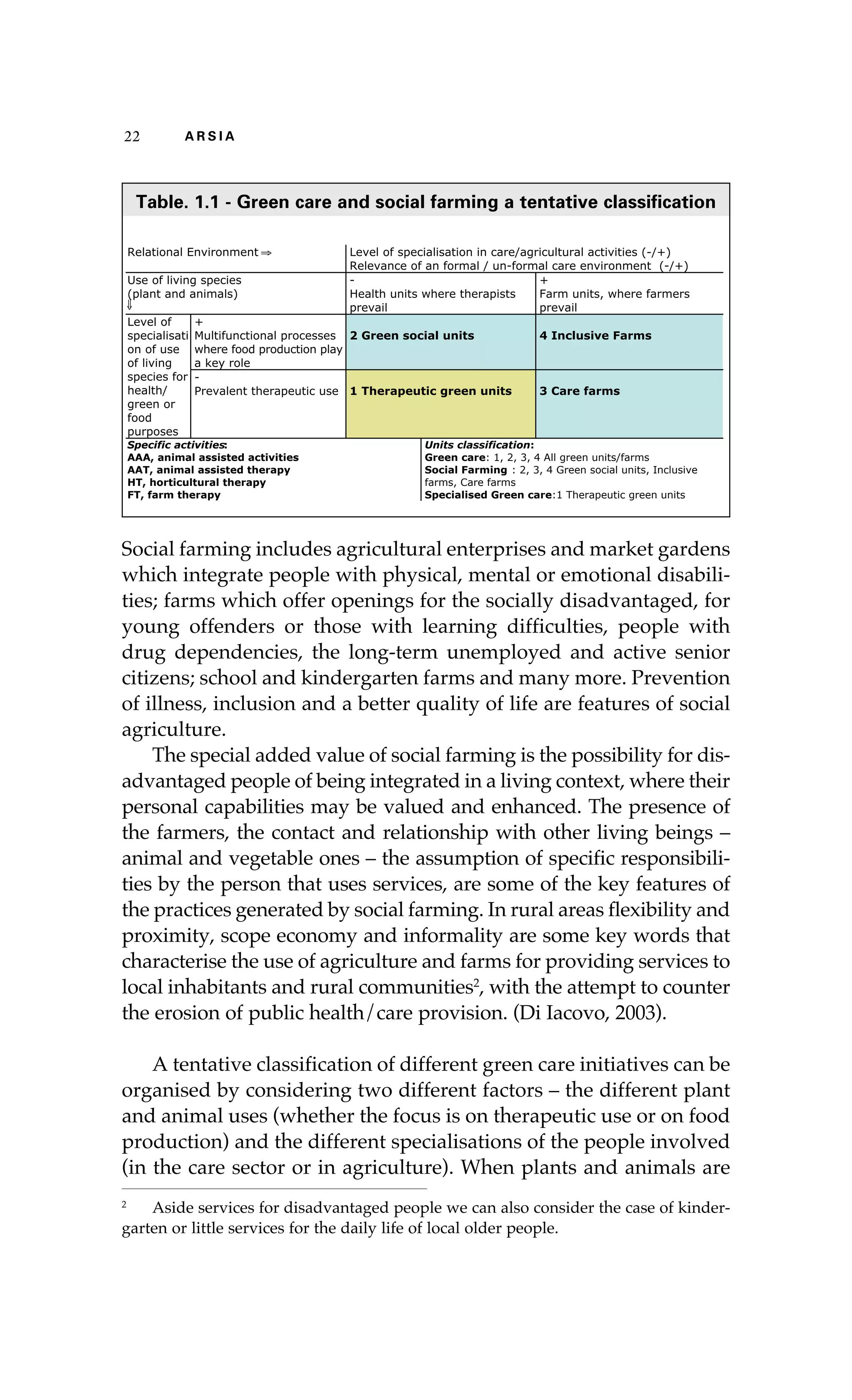
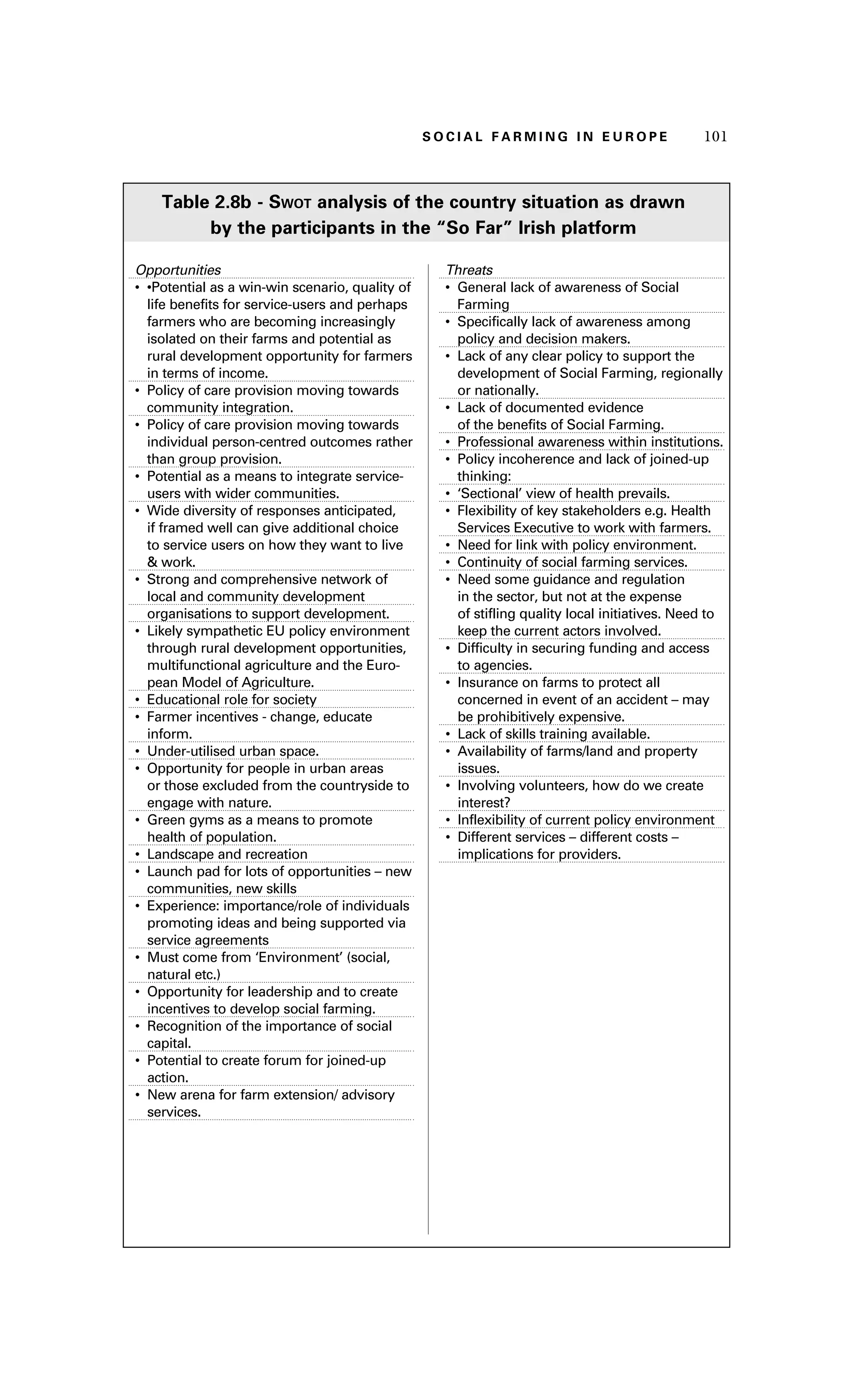
Table. 1.1 - Green care and social farming a tentative classification 
Relational Environment Level of specialisation in care/agricultural activities (-/+) 
Relevance of an formal / un-formal care environment (-/+) 
Use of living species 
(plant and animals) 
- 
Health units where therapists 
prevail 
+ 
Farm units, where farmers 
prevail 
Level of 
specialisati 
on of use 
of living 
species for 
health/ 
green or 
food 
purposes 
+ 
Multifunctional processes 
where food production play 
a key role 
2 Green social units 4 Inclusive Farms 
- 
Prevalent therapeutic use 1 Therapeutic green units 3 Care farms 
Specific activities: 
AAA, animal assisted activities 
AAT, animal assisted therapy 
HT, horticultural therapy 
FT, farm therapy 
Units classification: 
Green care: 1, 2, 3, 4 All green units/farms 
Social Farming : 2, 3, 4 Green social units, Inclusive 
farms, Care farms 
Specialised Green care:1 Therapeutic green units 
Social farming includes agricultural enterprises and market gardens 
which integrate people with physical, mental or emotional disabili-ties; 
farms which offer openings for the socially disadvantaged, for 
young offenders or those with learning difficulties, people with 
drug dependencies, the long-term unemployed and active senior 
citizens; school and kindergarten farms and many more. Prevention 
of illness, inclusion and a better quality of life are features of social 
agriculture. 
The special added value of social farming is the possibility for dis-advantaged 
people of being integrated in a living context, where their 
personal capabilities may be valued and enhanced. The presence of 
the farmers, the contact and relationship with other living beings – 
animal and vegetable ones – the assumption of specific responsibili-ties 
by the person that uses services, are some of the key features of 
the practices generated by social farming. In rural areas flexibility and 
proximity, scope economy and informality are some key words that 
characterise the use of agriculture and farms for providing services to 
local inhabitants and rural communities2, with the attempt to counter 
the erosion of public health/care provision. (Di Iacovo, 2003). 
A tentative classification of different green care initiatives can be 
organised by considering two different factors – the different plant 
and animal uses (whether the focus is on therapeutic use or on food 
production) and the different specialisations of the people involved 
(in the care sector or in agriculture). When plants and animals are 
2 Aside services for disadvantaged people we can also consider the case of kinder-garten 
or little services for the daily life of local older people.
S oaci l afr mi n g i n E u r oep 23 
mainly used for therapeutic purposes by therapists we have mainly 
“green therapeutic units”. For initiatives such as small gardens, pet 
therapy in hospitals or specialised health centres, it can be prob-lematic 
to name them as social farms. In other cases, where food 
production prevails and/or the initiatives are provided by those 
with agricultural expertise, we have different types of social farms 
(“green social units” such as “Type B” co-operatives in Italy; inclu-sive 
farms – the prevalent situation in Flanders, care farms – found 
in the Netherlands where specialisation in health/care services can 
prevail inside farms). 
Most of the discussion and the cases presented in the book refer 
to social farming and not to therapeutic green units. 
1.2 Significance of social farming today 
Social farming fits with the changing needs in society. It is inter-esting 
for the social and health care sectors, as it is linked to the 
strong demand for inclusive development coming from the fields of 
social and health care services (processes of socialisation). 
Nowadays inclusion of service-users into society, providing 
meaningful activities/work that leads to empowerment, greater 
independence and better social status and an approach that takes 
the potential of service-users as a starting point – rather than their 
limitations are all central elements in the desired renewal of the 
health and social care/rehabilitation sector (van Weeghel et al., 
2005; Schols & van Schriek-van Meel, 2006). Social farming fits with 
the changing philosophies in care. It is considered to be a good 
example of the socialization of care. 
Social farming is also an inspiring development for the agricul-tural 
sector and rural areas. Since World War II, a strong agro-food 
sector has developed in the more urbanised regions of Europe. In 
these areas agriculture and rural areas have changed dramatically 
(Maris & de Veer, 1971). Mechanisation, new technologies, increased 
chemical use, specialization and government policies have resulted 
in rapidly-increasing productivity (Veldkamp et al., 2008). These 
developments have now led to over-specialisation, environmental 
pressures and encroachment on public spaces (Wiskerke & van 
der Ploeg, 2004). This has caused the agro-food sector to come up 
against its ecological and social limits (Dunn, 2003). In the less
24 A R S I A 
densely populated areas of Europe, abandonment of farms and 
rural areas is an issue. There is a great need for more sustainable 
systems of agricultural production that meet the changing needs of 
society (Veldkamp et al., 2008). There is a need to find a better bal-ance 
between the values of people, planet and prosperity. 
Social farming is an inspiring example of a more sustainable type 
of multifunctional agriculture, with reference to the social values of 
agriculture. In the discussion on multifunctionality (Oecd, 2001) the 
inclusive potential of agricultural practices and the contribution of 
rural communities have been overlooked. This is also the case in 
relation to the significant positive effects that social farming can 
have on the agricultural sector itself. Social farming gives broader 
insights by providing the opportunity to become involved in other 
sectors (education, health and the social sector). So: 
– It will enlarge the number and typology of stakeholders, 
– Both the young generation and the wider society have the 
opportunity to change their perceptions about farming 
– Farmers have the opportunity to build new networks and circu-its 
that can be helpful to promote their production particularly 
to ethical consumers. 
– Farmers may change their own entrepreneurial attitude towards 
the idea of corporate social responsibility. 
– It will provide a source of direct income for farmers in return for 
services provided. 
Social farming may have a wide impact on many aspects of agri-culture 
and its links with society, arising from: 
• The benefits for ‘service-users’, in terms of empowerment, quali-ty 
of life, social inclusion, education, employment and therapy. 
• Innovation: in agriculture, social welfare, health care and educa-tion 
• New sustainable links between agriculture, social and health 
care sectors, education and society 
• Strengthening urban-rural relationships; stimulating urban agri-culture 
and healthy cities 
• Economics of farms and rural areas via diversification opportu-nities 
• Reputation and the social responsibility of enterprises 
• Improving social capital in rural areas 
• Strengthening social services in rural areas; healthy and vibrant 
rural communities and the preservation of landscapes.
S oaci l afr mi n g i n E u r oep 25 
1.3 History of social farming 
The development of social farming differs in each country 
because of differences in culture and the structure of their health, 
social and education services. Although the concrete starting point 
is hard to define, the emergence of individual initiatives in social 
farming can be traced from the 1960s. In Italy social co-operatives 
emerged after the closing down of psychiatric institutions in 1980. 
Many of the co-operatives include agricultural activities. In Ger-many 
the first social institutions, founded at the end of the 19th 
century to help people in need, often had a farming unit to supply 
their own kitchens and nutritional needs. These institutions have 
also had a long tradition of integrating people who use services into 
the work. As they grew bigger, they struggled particularly since the 
1960s when food prices fell and many of the farming units were 
closed down. Others were transformed to sheltered workshops and 
still exist. Some of them were re-established in the 1980s and 1990s 
when the awareness for nature and environment issues heightened 
and the selling of organic products became lucrative again. In the 
Netherlands and Ireland many of the first pioneers were inspired by 
anthroposophic and Christian principles. In Slovenia, the majority 
of projects started in the late 1990s. They were introduced by pio-neers 
who were motivated by the innovative potential of interlacing 
social care and agriculture (Vadnal, 2008). 
In France and Flanders it is difficult to pinpoint the start of 
social farming. It seems important to remark that almost all ini-tiatives, 
with different nuances, express a kind of choice regarding 
social solidarity (e.g. the wish to help people). The driving forces 
behind the phenomenon of private solidarity-based initiatives have 
been discussed in several studies (van Schaik, 1997; Iommi, 2005; 
Zamaro, 2002; Baars & Bloksma, 2008). 
There were various reasons for pioneers to start a social farm: 
• The desire to respond to the needs of particular disadvantaged 
groups (e.g. initiatives started by families of disadvantaged peo-ple); 
• The need or wish to find an alternative to the intensification of 
agriculture; 
• The wish to share farm life with particular disadvantaged 
groups; 
• The wish to pursue goals related to social justice and solidarity 
(putting personal values and beliefs into practice) as part of
26 A R S I A 
90 
80 
70 
60 
50 
40 
30 
20 
10 
0 
Netherl Flanders Germany Ireland 
Private f. 
Institut f. 
Fig. 1.1 - Development of two types of social farms in the Netherlands and 
Flanders: private family farms and institutional social farms 
personal/family/community life-style choices (e.g. initiatives 
strongly based on ideals/ideological values); 
• The wish to carry out (alternative) professional practice in this 
field (e.g. initiatives started by professional operators in the 
social/care/educational sectors); 
• The opportunity to have new possible sources of incomes and/ 
or the wish to open up to local community (e.g. initiatives star-ted 
by agricultural businesses). 
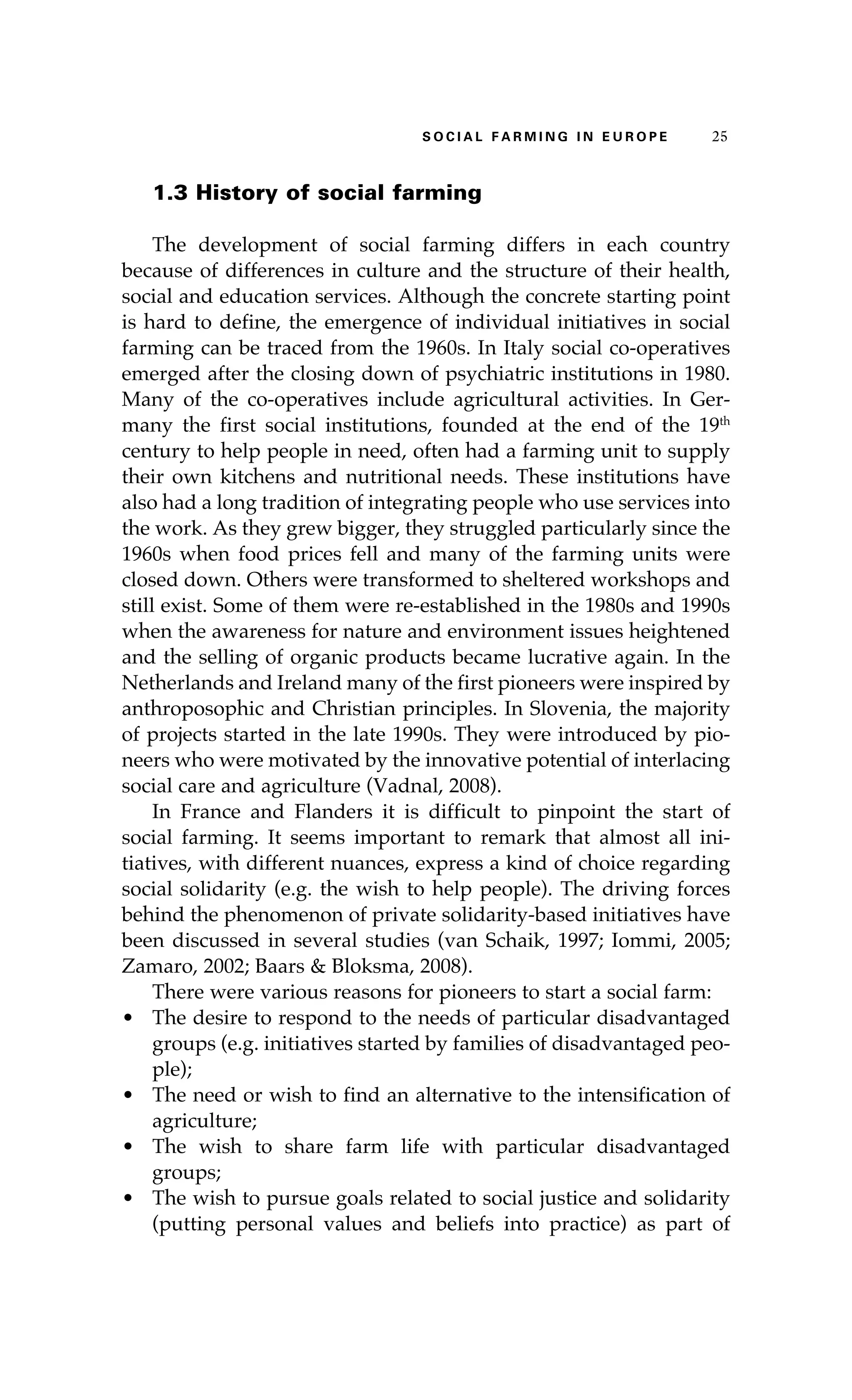
The number of social farms is increasing rapidly in Flanders and 
the Netherlands where family farms are the dominant providers 
of Social Farming social/health services (fig. 1.1). In those coun-tries, 
this is due to the increasing number of private social farms. 
In Flanders the increase was from 45 in 2003 to 258 in 2007; and in 
the Netherlands from 51 in 1998 to 756 in 2007. In both countries, 
it is only the number of private social farms that is increasing. The 
number of “institutional” social farms remains constant.
S oaci l afr mi n g i n E u r oep 27 
1.4 Dynamics of social farming 
A dynamic process is underway regarding the organisation of 
social farming across Europe. It has changed the organisation of 
practices as well as the relationships at local, regional, national and 
even international level. About four different stages can be distin-guished, 
each of which is different in terms of how social farming 
has developed; in terms of the awareness by different sectoral inter-ests 
(agriculture and social/health care sector) and as a consequence 
the regulatory systems adopted at local/regional/country level. 
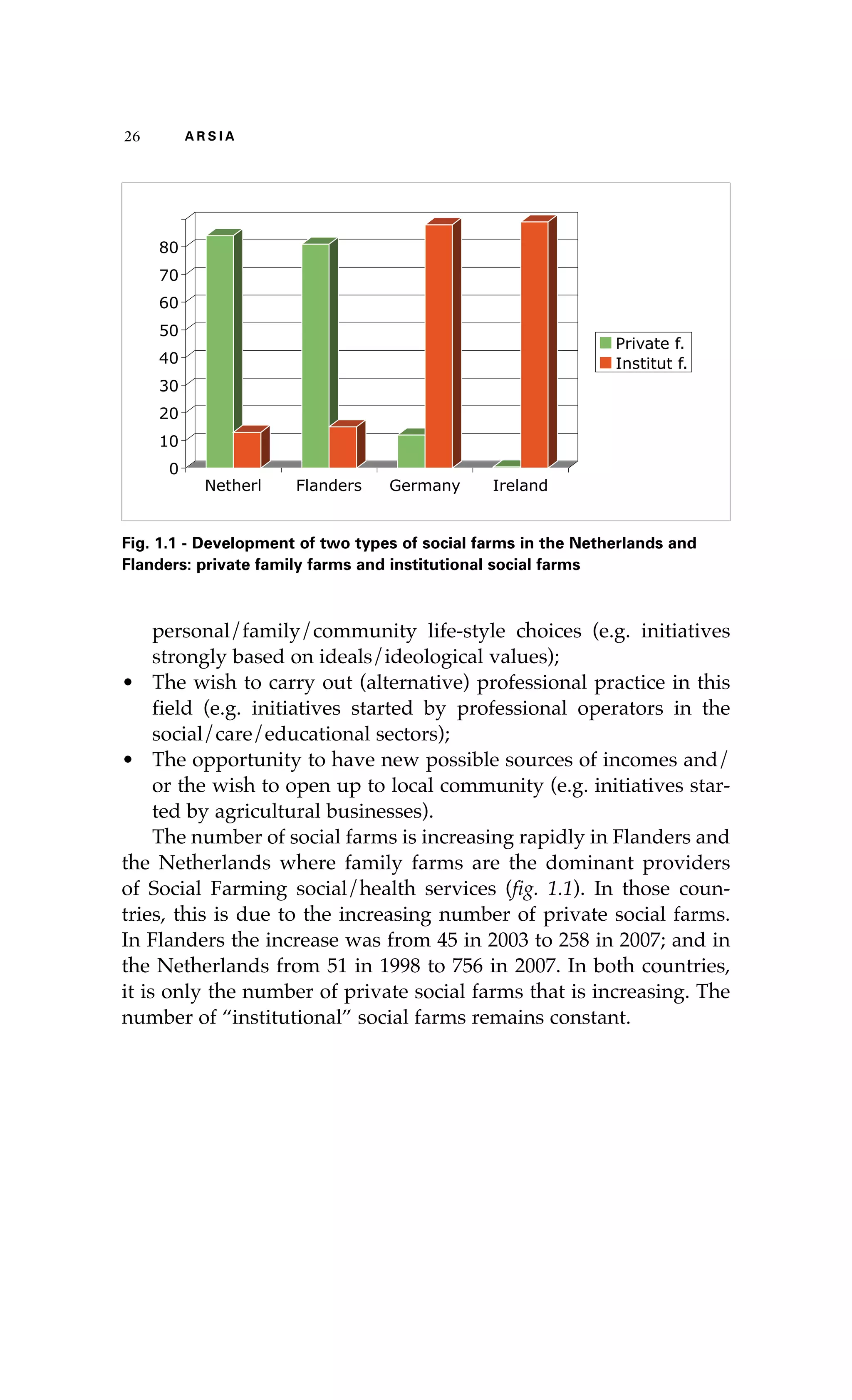
Pioneering situation: In this stage there are relatively few examples 
of social farming. It is characterised by voluntary action rooted in a 
strong motivation. Private farms undertake their own projects and 
farmers enter the system because of their own commitment. There is 
a low level of awareness by the wider society. Slovenia is at this stage 
at the moment, although social farming is already gaining a status 
outside the agriculture sector, similar to the position in Germany. 
Multifunctional agriculture: In this stage the profile of social farm-ing 
is increasing. The interest comes mainly from agriculture and 
there are local initiatives, both private and public. There is a low level 
of awareness from the public funding sources related to the care sec-tor. 
The strong commitment from farmers is a key success factor. 
Flanders is at this stage at the moment. Social farming is sup-ported 
by funds from the agricultural and rural development 
domain. 
SF as a recognised system in social/health care: In this stage there is 
a strong level of interest in social farming from the health care sec-tor. 
Public institutions related to social welfare or health recognise 
social farming as relevant applying to both private and public struc-tures. 
Germany and Ireland are at this stage at the moment. Social 
farms are often developed into professionally-based, care-oriented 
farms that are part of the health care sector. Private family farms are 
still in a pioneering situation in both countries. 
SF as an inclusive model: In this stage there is a large number of 
initiatives, strongly embedded at grassroots level and in the wider 
society. They have organised themselves into regional and national 
networks. There is involvement from both the agricultural and
28 A R S I A 
awareness care/health educational, labour 
public sector 
“SF” a recognized 
system outside 
agriculture (ie the 
Netherlands) 
SF supported projects (ie 
France, Italy) 
“SF” a reputational/responsible 
Pioneering 
(ie Slovenia) 
multifunctional agriculture 
system (Italy) 
awareness agriculture public 
(ie Flanders) 
- sector 
+ 
- 
+ 
Fig. 1.2 - Awareness of public actors and organisation of social farming (SF) 
Table 1.2 - Number of social farms in the different SoFar countries 
and the number of users (Source SoFar estimation) 
Private Institutional Others Total n. Users 
Belgium (Flanders) 258 38 12 308 2.000 
France 
– associative social inclusion 400 400 
farms / gardens 
– pedagogic farms 1200 
– therapeutic farms 200 300 500 
Germany 
- therapeutic farms 12 150 162 
- school farms 58 58 
Ireland *2 **92 12 106 2.000 
Italy 
– therapeutic/inclusive/social 150 65 450 675 
farms / gardens 
– prisons 10 10 
– pedagogic farms 
Netherlands 746 83 10 839 10.000 
Slovenia 4 6 5 15 500 
* Refers to Irish family farms. 
** Refers to Direct funded institutional services, 3rd Sector, Camphill Community farms.
S oaci l afr mi n g i n E u r oep 29 
social care/health sectors. The Netherlands, Italy and France are 
more or less at this stage. 
Schematically the stages can be presented as indicated in fig. 1.2 
(adapted from Di Iacovo, 2008). 
1.5 Estimation of the actual number of social 
farms in the SoFar countries 
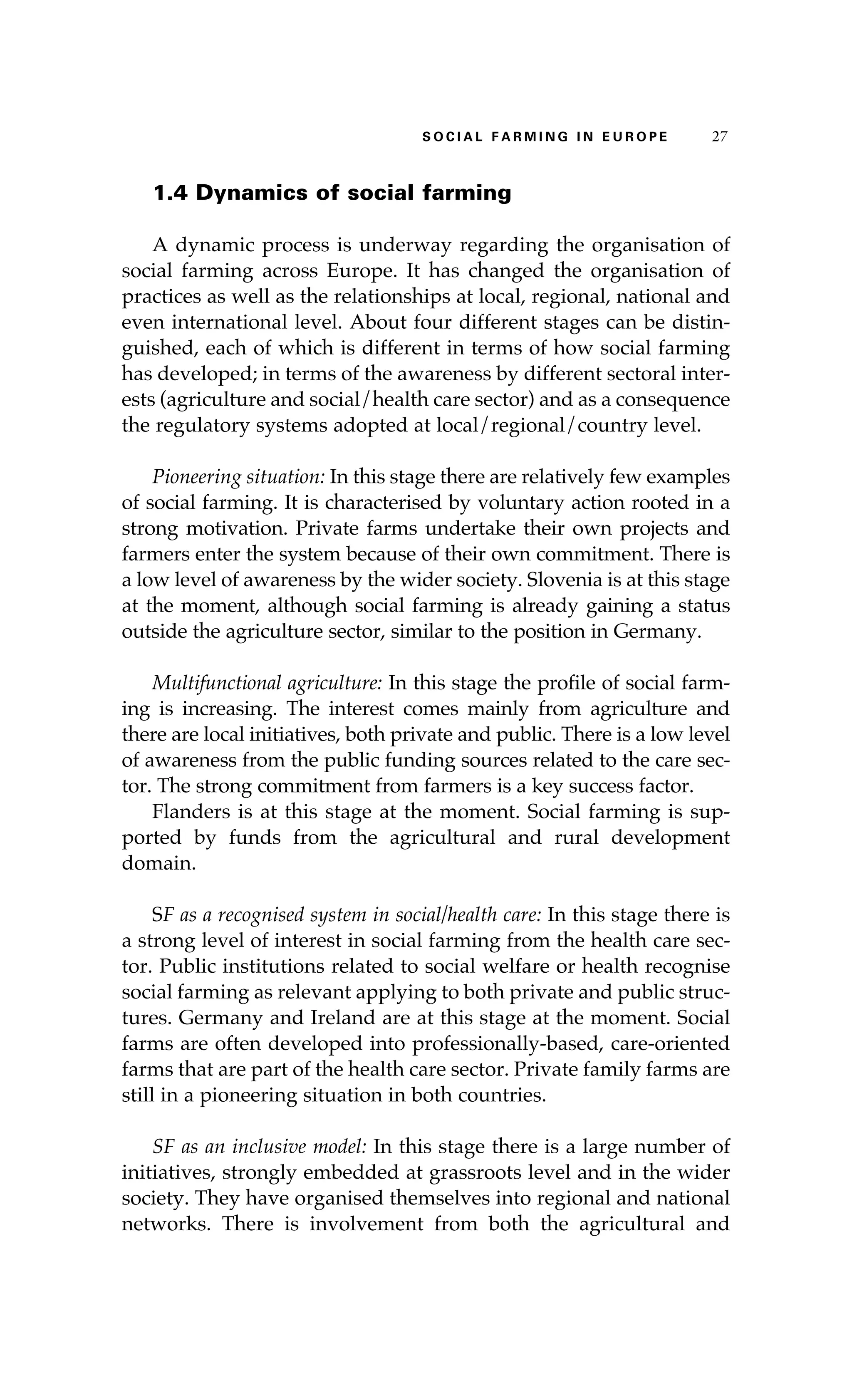
Unfortunately it is not yet possible to give a good estimate of the 
number of social farms in the different countries and the number of 
service-users. 
However, for some of the countries we can make a reasonably 
good estimate of the different types of social farms (Table 1.2). 
1.6 Developing Networks 
The variation in the development of social farming – in terms of 
different levels of awareness is also evident from the networks that 
have evolved in social farming. In Ireland and Slovenia, the SoFar 
project was the first initiative to identify existing projects and to 
bring them together. 
In France, there are distinct regional and national networks 
of community garden projects and pedagogic farms. In Germany 
separate regional and national networks for the different service-user 
groups have developed. In Italy, the existing networks in social 
farming are organised at a regional level. 
The Netherlands and Flanders are the only two countries with 
both national and regional support centres for social farming. These 
have produced national databases of social farms, national newslet-ters 
and operate to impact on national policies that affect social farm-ing. 
There is a strong involvement of the farmers’ organisations. 
In the Netherlands the national network have also stimulated 
the development of regional networks and new foundations of 
social farmers at regional level. They invest in quality improvement, 
lobbying and enter into financial arrangements with the care and 
social sectors. 
• National/regional centres: Netherlands, Flanders 
• Separate networks: Germany, Italy, France 
• Isolated projects: Ireland, Slovenia.
30 A R S I A 
1.7 Regulatory systems 
There is a great difference in the regulatory environment for 
social farming between the different countries. Except in the case 
of Flanders, “social/care farming” is not defined in any specific 
national regulations. There are however different regulations that 
can support social farms. We will describe the regulations for the 
different countries: 
Italy 
Italy has regulation for social co-operatives. Social co-operatives 
can perform agricultural activities. Two types of “social co-opera-tives” 
are officially recognised and supported: 
• Type “A” that can provide care and educational services (e.g. 
home care, management of day centres, residential shelters, or 
kindergartens). Fees differ between categories and vary between 
30-70 euro/person/day. 
• Type “B” that can operate in all sectors of business (agricul-ture, 
industry, commerce and services) with the purpose of 
integrating disadvantaged people into the workforce. They are 
obliged to include at least 30% of disadvantaged people into 
the workforce. At the same time, Type “B” social co-operatives 
can benefit from tax relief and are treated favourably by public 
institutions in competitive tenders (e.g. contracts for the mainte-nance 
of public parks and gardens and for other services). The 
law provides also for the creation of agreements where jobs are 
offered by private enterprises. So, disadvantaged people are fre-quently 
employed. In the case of social co-operatives they can be 
members of the organisation as well. 
The scenario looks different for social farming initiatives on 
private (“commercial”) farms. A specific regulatory framework for 
these kinds of initiatives has not been established yet. 
Germany 
There are no regulations specifically concerning social farming. 
German social leglislation strongly regulates social work and its 
performance. Administration bodies, budgets and institutions differ 
in each federal state. Specialisation and professionalism often inhibit 
cross-border attempts to combine social work and farming or food 
processing. For example the installation of a work-place for a person 
with a disability in a food processing unit where cows’ milk is proc-
S oaci l afr mi n g i n E u r oep 31 
essed must comply with several rules of the related to food hygiene, 
health and safety as well as standards for fire protection. These speci-fications 
are often prohibitive for small-scale initiatives. 
In the care sector regarding the employment for people with 
disabilities, there is a special regulation inhibiting the independent 
employment on normal family farms. Only sheltered workshops 
with more than 120 service-users have access to health budgets. The 
founders of the Federal Republic of Germany wanted to prevent 
people with disabilities from abuse and thought that big institutions 
were the best way to reach that goal. 
Slovenia 
Social farming as a supplementary on-farm activity of family 
farms was recognised by Rural Development plan 2007-2013. It 
means that a family farmer can still act in the field of social farming 
only as a sub-contractor of a social care institution. Social farming 
is practiced by many social enterprises in rural areas that provide 
vocational rehabilitation and training, as well as subsidised and/or 
sheltered employment for people with disabilities (Zakon, 2007a). 
Social care institutions (Zakon, 2007b) and special-needs social 
care institutions in particular very often use agricultural activities 
to broaden the range of activities for service-users with no work 
capacity. The same holds for centres for protection and care, but 
they are involved in vocational rehabilitation and training, as well 
as in provision of sheltered employment. 
Flanders 
In Flanders, there are specific regulations for social farms. Rural 
development funds are used to pay farmers for their services. The 
regulation is restricted to private commercial farms. At least 35% 
of the income should come from the agricultural enterprise. The 
maximum support is 40 euro/per day irrespective of the number 
of users. 
Netherlands 
There are three possibilities for social farmers to get access to 
funds from the health care sector. They can become a sub-contractor 
of an officially accredited care institution. A second possibility is to 
make use of the personal budgets of service-users (Pgb). The Pgb 
was introduced to diversify the supply of care and to shorten wait-ing 
lists. With this Pgb service-users or their representatives can
32 A R S I A 
Charity 
Public 
payments 
Public projects 
(employment) 
Public compensation 
(agriculture) 
Food markets 
(ethical and direct 
selling) 
Associations 
(I, Fr) 
Social Coops B 
(I) 
Public structures 
(D,SL, Irl) 
Social Coops A (I) 
Farms (NL) 
Public funds 
(Health/care/ 
educational 
sector) 
Farms (FL) 
Farms (I) 
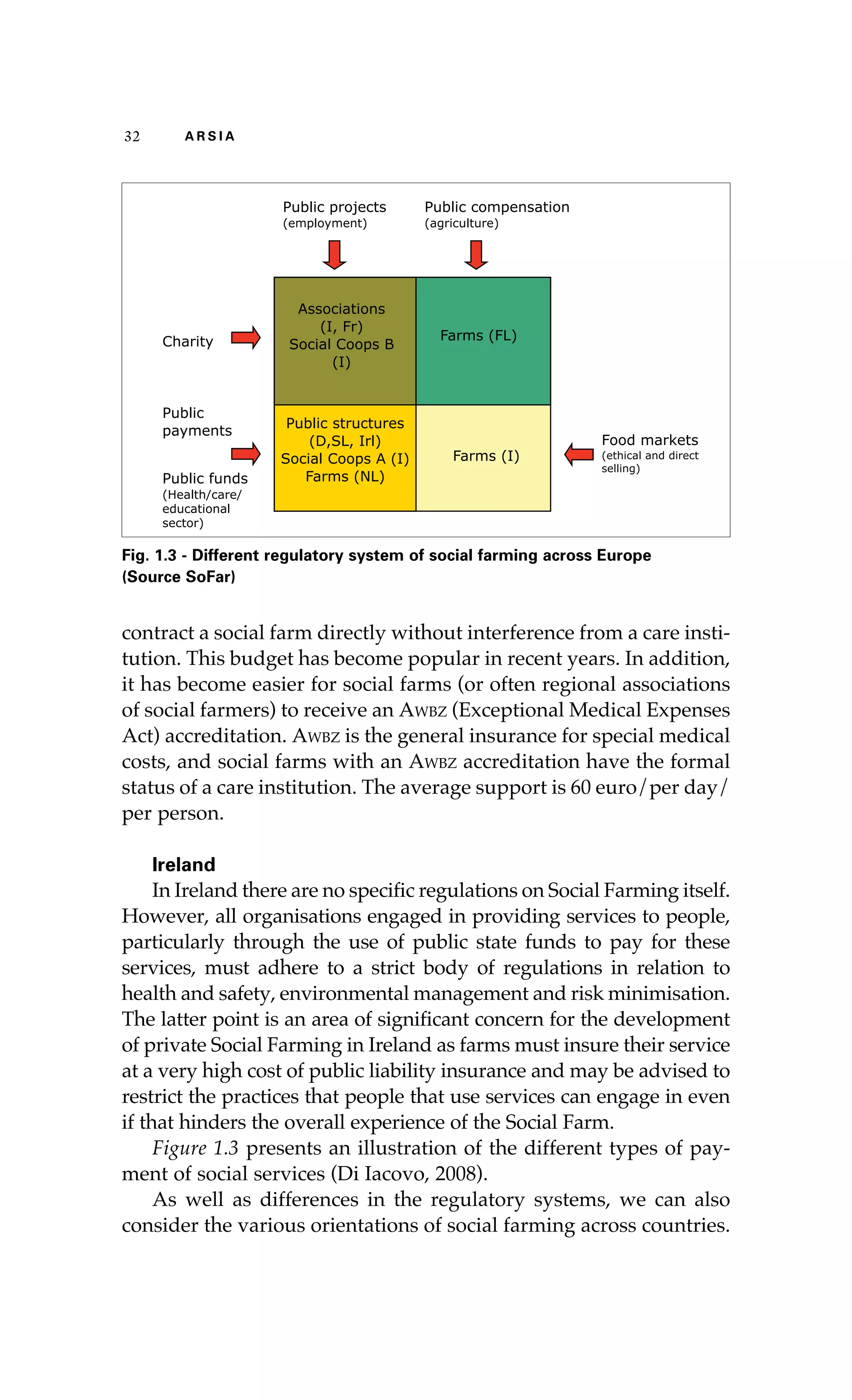
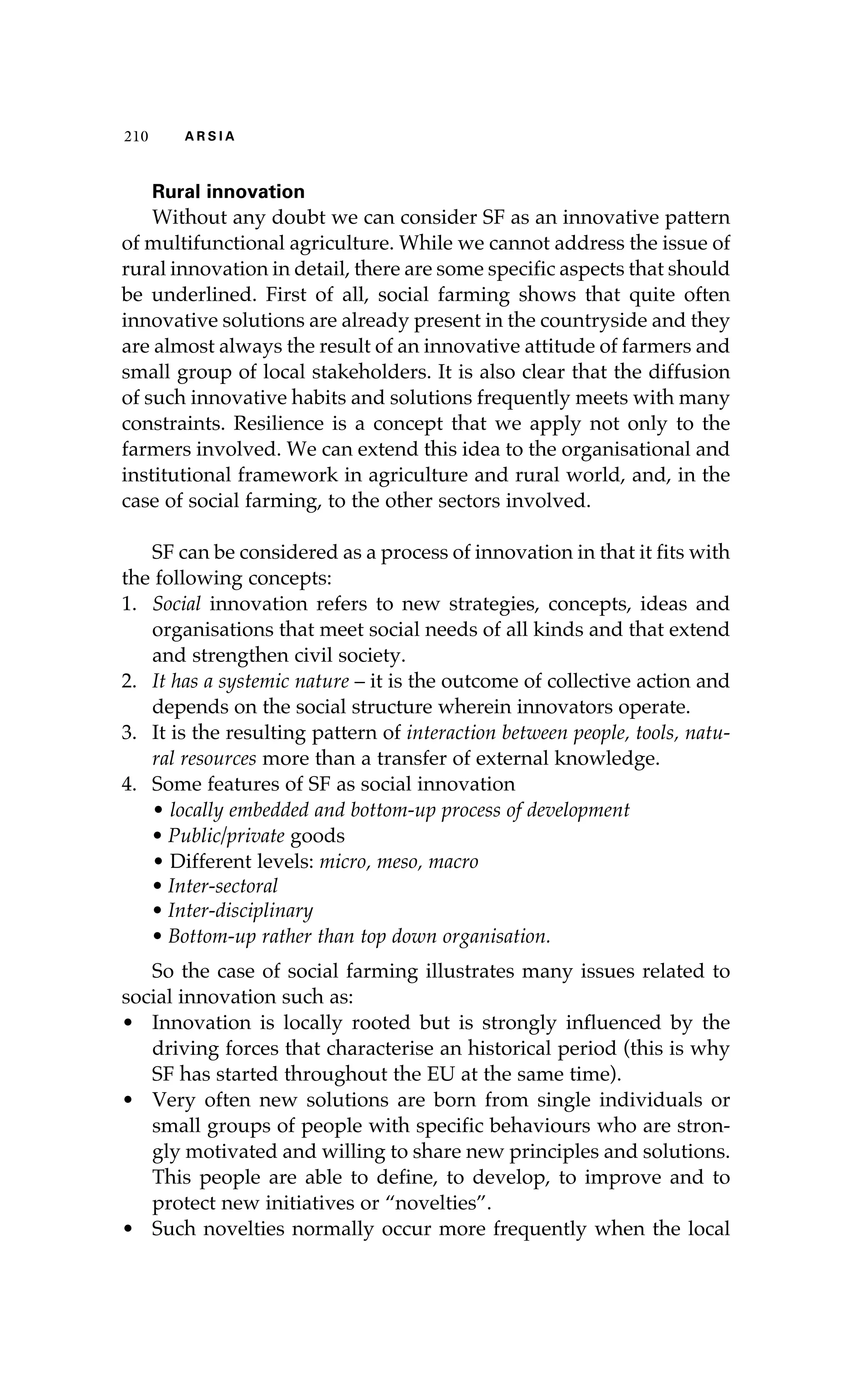
Fig. 1.3 - Different regulatory system of social farming across Europe 
(Source SoFar) 
contract a social farm directly without interference from a care insti-tution. 
This budget has become popular in recent years. In addition, 
it has become easier for social farms (or often regional associations 
of social farmers) to receive an Awbz (Exceptional Medical Expenses 
Act) accreditation. Awbz is the general insurance for special medical 
costs, and social farms with an Awbz accreditation have the formal 
status of a care institution. The average support is 60 euro/per day/ 
per person. 
Ireland 
In Ireland there are no specific regulations on Social Farming itself. 
However, all organisations engaged in providing services to people, 
particularly through the use of public state funds to pay for these 
services, must adhere to a strict body of regulations in relation to 
health and safety, environmental management and risk minimisation. 
The latter point is an area of significant concern for the development 
of private Social Farming in Ireland as farms must insure their service 
at a very high cost of public liability insurance and may be advised to 
restrict the practices that people that use services can engage in even 
if that hinders the overall experience of the Social Farm. 
Figure 1.3 presents an illustration of the different types of pay-ment 
of social services (Di Iacovo, 2008). 
As well as differences in the regulatory systems, we can also 
consider the various orientations of social farming across countries.
S oaci l afr mi n g i n E u r oep 33 
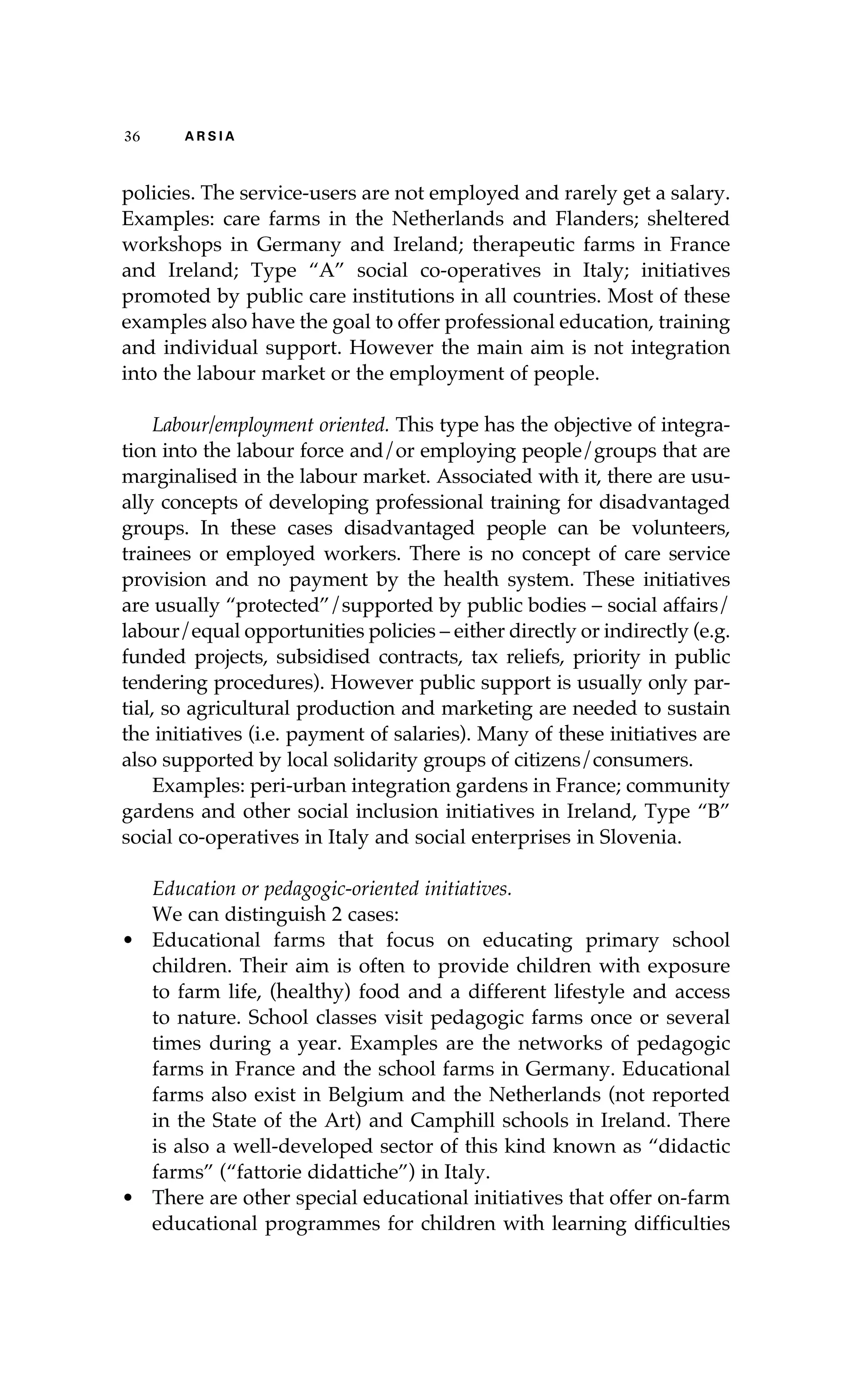
Society & social sector 
Italy, Slovenia, France 
Germany, Ireland 
Netherlands 
Belgium 
Health sector Agriculture 
Fig. 1.4 - Orientation of social farming in Europe 
Germany and Ireland are mainly oriented towards the health sector. 
Italy, Slovenia and France are oriented more towards the social and 
employment sector and the Netherlands and Belgium towards the 
agricultural sector (especially Belgium). 
1.8 Different types of social farming 
We observed a great diversity of social farming initiatives among 
the SoFar countries. First we will describe the dominant types of 
social farms in the different countries. 
Netherlands and Belgium 
Most social farms in Belgium and the Netherlands are private, 
family-based social farms. Most farms are open to people with dif-ferent 
backgrounds. The number of service-users is mostly limited 
to less than 10 per day. On many farms agricultural production is 
the core activity and social services are of secondary importance. 
Ireland, Germany and Slovenia 
Most social farms in Ireland, Germany and Slovenia were set up 
by the third sector (e.g. religious groups, Camphill communities, 
user organisations). They have developed into institutional, profes-sionally- 
based, care-oriented farms. They often focus on one group
34 A R S I A 
of service-users. The main groups are people with mental health 
issues, intellectual disabilities or drug and alcohol abuse problems. 
However, there is a broad spectrum of applications evident. There 
are many professionals involved in the provision of social care. 
In Germany there is a special law concerning the services and 
requirements in sheltered workshops for people with disabilities, 
the Werkstättenverordnung (Wvo). Among other issues such as 
salary and working time, the law demands that the workshops 
provide many different activities and a minimum of 120 users. This 
article may stem from the general belief that a large number of 
service-users is needed to guarantee sufficient quality of the serv-ices 
provided. This lies in the history of Germany. The founders of 
the Federal Republic of Germany wanted to prevent people with 
disabilities from abuse and thought that big institutions were the 
best way to reach that goal. Today this law could be problematic 
when sheltered workshops claim a “right on clients” (they have 
to fill their numbers of places) and may hinder family farms from 
integrating individuals with disabilities. In Ireland and Slovenia 
there is a strong focus on developing person-centred services leav-ing 
behind the days of the ‘big institutions’. Social services are the 
core business and the agricultural production is of less importance. 
Notwithstanding, there is significant interest from care/service pro-vider 
organisations in working with private farmers in a non-insti-tutional 
farm setting. At the same time, Slovenian social enterprises 
in rural areas are engaged in large-scale agricultural production 
that is essential for the sustainability of their special employment 
programmes for people with disabilities 
Italy 
In Italy the existence of social co-operatives type A and type 
B, focussing on care and on labour integration respectively is the 
defining characteristic. They are not-for-profit enterprises and 
community-based initiatives strongly integrated into the social 
environment. They can benefit from the special regulations that 
exist for social co-operatives. In the meantime, increasing numbers 
of private farms are entering the sector. Their social farming activ-ity 
can be both a voluntary one and/or more linked to the idea of 
social responsibility and linked to ethical consumers. New services 
are also provided by farmers – such as kindergardens. For private 
farmers agriculture is the core activity.
S oaci l afr mi n g i n E u r oep 35 
France 
What is particular to France is the existence of different net-works 
of social farms: 
• Several networks, national and regional, of community-based 
gardens focussing on labour integration for underprivileged 
people. These gardens benefit from social inclusion policies 
related to unemployment. Most of them are managed by not-for-profit 
associations. So they have associative forms. 
• Different networks of more than 1200 pedagogic farms that are 
used by primary schools. 
There are also therapeutic (individual or associated) farms that 
are in most cases connected to particular unconventional profes-sional/ 
disciplinary approaches to therapy. As there are no labelling 
or certification rules for therapeutic farms in France, we know that 
their number is significant but not known with any certainty and 
dispersed throughout the territory. Once again, they are mostly 
associative farms. 
1.9 Further description of diversity 
of social farms 
We can distinguish different types of social farms according to 
various criteria. As with all typologies, the boundary between one 
type and another can be often hazy or overlapping. 
There is diversity in goals, the kind of organisation, the kind of 
target group and the main activity. We will describe the different 
types of social farms along these lines. 
1.9.1 Diversity in goals 
First of all, according to their main purpose, we can distinguish 
between: 
• care oriented 
• labour (employment) oriented 
• education/pedagogic oriented. 
Care oriented. This first type represents a concept of care-service 
provision to satisfy the needs of service-users. Farms (or more 
generally the owners of SF initiatives) are care-services provid-ers. 
There is usually a payment or monetary compensation for the 
services paid by public bodies – health/welfare and/or agricultural
36 A R S I A 
policies. The service-users are not employed and rarely get a salary. 
Examples: care farms in the Netherlands and Flanders; sheltered 
workshops in Germany and Ireland; therapeutic farms in France 
and Ireland; Type “A” social co-operatives in Italy; initiatives 
promoted by public care institutions in all countries. Most of these 
examples also have the goal to offer professional education, training 
and individual support. However the main aim is not integration 
into the labour market or the employment of people. 
Labour/employment oriented. This type has the objective of integra-tion 
into the labour force and/or employing people/groups that are 
marginalised in the labour market. Associated with it, there are usu-ally 
concepts of developing professional training for disadvantaged 
groups. In these cases disadvantaged people can be volunteers, 
trainees or employed workers. There is no concept of care service 
provision and no payment by the health system. These initiatives 
are usually “protected”/supported by public bodies – social affairs/ 
labour/equal opportunities policies – either directly or indirectly (e.g. 
funded projects, subsidised contracts, tax reliefs, priority in public 
tendering procedures). However public support is usually only par-tial, 
so agricultural production and marketing are needed to sustain 
the initiatives (i.e. payment of salaries). Many of these initiatives are 
also supported by local solidarity groups of citizens/consumers. 
Examples: peri-urban integration gardens in France; community 
gardens and other social inclusion initiatives in Ireland, Type “B” 
social co-operatives in Italy and social enterprises in Slovenia. 
Education or pedagogic-oriented initiatives. 
We can distinguish 2 cases: 
• Educational farms that focus on educating primary school 
children. Their aim is often to provide children with exposure 
to farm life, (healthy) food and a different lifestyle and access 
to nature. School classes visit pedagogic farms once or several 
times during a year. Examples are the networks of pedagogic 
farms in France and the school farms in Germany. Educational 
farms also exist in Belgium and the Netherlands (not reported 
in the State of the Art) and Camphill schools in Ireland. There 
is also a well-developed sector of this kind known as “didactic 
farms” (“fattorie didattiche”) in Italy. 
• There are other special educational initiatives that offer on-farm 
educational programmes for children with learning difficulties
S oaci l afr mi n g i n E u r oep 37 
or for those who have problems with the law or social inclusion 
issues; those with family problems or those in foster care etc. 
Examples: These initiatives are present in all countries, but are 
less widespread, visible and popular. 
1.9.2 Type of organisation 
According to the legal basis underpinning the activities of the 
promoters/holder (or the social farming initiative), we can distin-guish 
between: 
• third sector 
• private 
• institutional. 
The “third sector” initiatives are promoted and carried out by 
“social-private” organisations that are usually not-for-profit ones. 
These initiatives are usually directly or indirectly supported by 
public bodies and policies. This type is dominant in Italy and France 
and common in Slovenia and Ireland. 
Examples: Italian initiatives run by social co-operatives and/or 
associations, French peri-urban gardens and therapeutic initiatives 
run by family associations. In Slovenia, social enterprises were set 
up by service-users’ organisations. They provide vocational reha-bilitation 
and training and subsidised or sheltered employment. 
Most of the sheltered workshops in Germany, the majority of the 
initiatives in Ireland, the majority of the so-called institutional farms 
in the Netherlands and Flanders were set up by religious organi-sations, 
anthroposophical organisations, welfare organisations or 
service-users’ organisations. They can be considered as third sector 
initiatives, as the founding organisations own and operate the farm. 
In many countries they are called institutional farms, as historically, 
the care and labour force inclusion services were institutionalised/ 
regulated. They have access to mainstream funding and are recog-nised 
as officially approved health/social service organisations. 
The private initiatives are promoted and carried out by private 
enterprises/businesses, particularly in the field of agriculture (i.e. 
individual or associated farms). Private farms usually work by 
linking with public bodies (e.g. health, education, legal institutions) 
and can be directly or indirectly supported. This type of initiative 
is dominant in the Netherlands and Belgium. In the other countries 
they exist, but are less important. Examples: Care farms in Flanders
38 A R S I A 
800 
700 
600 
500 
400 
300 
200 
100 
0 
2000 2002 2004 2006 2007 
Private Fl 
Privat Neth 
Institut Fl 
Institut Neth 
Fig. 1.5 - Percentage of social farms that are private family businesses and 
institutional/third sector initiatives in 4 SoFar countries (Hassink J., 2008) 
and in the Netherlands; similar cases scattered in other countries 
(Italy, France, Slovenia, Germany and Ireland); training projects and 
subsidised contracts for the employment of disadvantaged groups/ 
individuals in the case of Italian private farms. 
The institutional initiatives are promoted and carried out directly 
by public bodies. They can be developed within social, health, edu-cation 
or legal institutions – and so are run by the personnel of these 
public bodies. These are prominent within Ireland, particularly in 
mental health services which is generally directly provided by the 
State and as referred to above, by well established religious/Chris-tian 
services that provide services on behalf of the state, are largely 
funded by the state and have become more secularised over time. 
In most countries they are in a minority. 
1.9.3 Kind of organisation 
According to the characteristics of the organisation and the use 
of labour we can also distinguish between: 
• Family-based 
• Community-based 
• Professionally-based 
• Service-user based: self-organisation by service-users. 
Family-based initiatives are initiated by a farmer’s family. It is
S oaci l afr mi n g i n E u r oep 39 
based on their motivation to include social services in their pri-vate 
enterprise. Their motivation can be religious or humanitar-ian. 
Examples: Care farms in Flanders and in the Netherlands are 
typically family-based. Furthermore, in Italy many initiatives are 
connected to so called “family-houses” (integrating persons with 
challenges within the family). 
Community-based initiatives are initiated by a group of people 
often inspired by the Church or other lay Christian, social or com-munal 
ideals. Examples: Many initiatives in Italy are typically 
community-based, such as those inspired by Christian principles 
or other lay social/communal ideals. The same is true for Camphill 
initiatives and religious-inspired initiatives in Germany and Ireland 
(such as the Brothers of Charity in Ireland). Other examples include 
the services created by families or friends of those who require such 
services – in response to the failure by other agencies to provide 
them. Peri-urban garden initiatives in France and Italian social co-operatives 
appear to be based on community/co-operative schemes 
with input also from professional personnel. 
Professionally-based: Institutional initiatives are usually profes-sionally- 
based and are initiated by professionals in care institutions. 
In this, there is more focus on the qualifications of the personnel 
compared to other types of initiatives. 
There may be a lot of overlap between Types 2 and 3 outlined 
above, as in many cases the community-based initiatives have 
become very professionalised as services as services. They are insti-tutional 
in scope and in terms of professionalism, while they may 
also be third-sector managed. 
Service-user based. Some initiatives, among the “third sector” are 
service-user based. Service-users are in charge of the organisation 
of the initiative. 
1.9.4 Types of Target Groups 
We can distinguish initiatives that focus on a specific target 
group from those that include a mix of service-users with different 
backgrounds. 
In Germany, Slovenia and Ireland many social farms are spe-cialised 
farms for people with mental health issues, intellectual dis-ability 
or drug and alcohol abuse issues.
40 A R S I A 
In Belgium and the Netherlands, most care farms are open to a 
mix of people, including people with mental health issues, intellec-tual 
disability, those with a history of addiction, youth or long-term 
unemployed. 
In France, Italy and Ireland, employment-oriented initiatives 
include a range of people. However, they typically include those 
with less serious forms of disability who are relatively more capa-ble/ 
skilful and able to work autonomously. 
1.9.5 Main activity – Focus on agricultural production 
or on social services 
According to the main activity undertaken (in terms of labour 
used and the economic importance of the activity) we can distin-guish 
between: 
• Care- (or education-) based 
• Agriculture-based. 
The former (care-based) are represented by initiatives/enter-prises 
in which the social/care (or educational) component is the 
main one. It is the main activity and source of income and this is 
reflected also in the profile of the personnel (e.g. professional back-ground) 
as well as in the approach to the work and operational 
procedures. Agricultural production has a secondary role. 
The latter (agriculture-based) represent the opposite case. Agri-cultural 
production is the main component and social/care activi-ties 
have a relatively secondary role. 
Examples: In Flanders and in the Netherlands private care farms 
are mostly agriculture-based while institutional initiatives are usu-ally 
care-based. In Italy initiatives run by Type “A” social co-opera-tives 
are usually care-based while Type “B” social co-operatives or 
those run by private farms are agriculture-based. 
1.10 Benefits for the service-users 
In spite of the huge differences in initiatives across the seven 
countries, very similar effects are reported for the service-users of 
social farming. There are reports on improvement in their general 
well-being, their sense of freedom and space and their integration 
into society. In addition, all case studies report positive effects on 
physical health, mental health and social well-being. These effects 
can be characterised as follows (Elings & Hassink, 2008):
S oaci l afr mi n g i n E u r oep 41 
Table 1.3 - Summary of benefits of social farming for service-users 
Physical health effects Mental health effects Social effects 
More physical strength Increase in self-esteem Better social interaction 
Better appetite Increase in self-respect More social contacts 
Development of skills Enthusiasm More social skills 
Better use of energy Increase in self- awareness More independence 
Better use of senses Increase in responsibility Employment 
1.11 Qualities of social farms 
In accordance with the observed benefits for the service-users, 
there is also agreement to a large extent on the health-promoting ele-ments 
of social farms. Based on interviews in different countries, four 
main aspects of the care farm can be distinguished that are appreci-ated 
by service-users: a) the community on the farm, b) the attitude of 
the farmer, c) the type of work and d) the green environment. 
Community: A highly-valued aspect by service-users is the sense 
of community on the farm. Service-users indicate that they feel safe 
and at home in the group and that they are accepted and respected. 
Most of them appreciate the small-scale and the possibility to make 
new contacts. Some service-users also indicate that they appreciate 
the diversity of the group working on the farm. 
Attitude of the farmer. An important quality is the attitude of the 
farmer. Service-users are approached as normal people rather than 
being seen as patients. They experience respect with no prejudice. 
They express that the farmer gives them confidence and responsibili-ty. 
In particular, service-users with a psychiatric background mention 
that it is important to receive respect from so-called “normal” people. 
It is also a relief to them that they do not have to tell their whole his-tory 
again. Service-users mention the personal relationship with the 
farmer and his/her concern for them as an important quality. 
Work. Service-users mention several aspects that are related to 
the work performed on the farm. 
• Working according to their capacity: Service-users value that they 
can work at their own pace and that they can take a rest when 
having a bad day.
42 A R S I A 
• Real, useful work: Service-users mention the importance of real 
and useful work. They find it important that they are not exclu-ded 
from society and make a useful contribution. 
• Structure: Farm activities offer structure to one’s life and a sense 
of the passing of time with the natural rhythm of the days and 
the seasons. 
• Diversity of activities: Service-users appreciate the diversity of 
activities that can be done. The farm can be a place that offers a 
broader range of activities than conventional day-based activity 
centres. 
Green environment. Different qualities of the green environment 
were mentioned by users. 
• Space and quietness: Service-users appreciate the quietness and 
space of the farm environment. They experience it as an envi-ronment 
with far less stimulus than the urban areas where many 
of them come from. The space gives them the possibility to be 
alone when necessary. 
• Experiencing nature: Aspects that are appreciated by many ser-vice- 
users are being outside and experiencing aspects of nature 
like the flowers, the birds, the sun and the wind. 
• Farm animals: Another important aspect that is mentioned by 
service-users is the contact with farm animals such as cows, pigs, 
chickens, the dog and the cat.
2. “A journey through social farming 
in Europe”: the case studies 
2.1 A brief presentation 
The direct observation of lived realities and the study of actual 
cases are fundamental elements of any socio-economic research. 
This is especially true for the understanding of “social farming” in 
Europe, a concept recently identified that actually embraces a wide 
range of heterogeneous experiences taking place in different (physi-cal, 
socio-political, cultural, institutional) environments, in different 
times and subject to different driving forces and objectives. Under-standing 
this diversity must be the basis for any attempt at common 
policy regulation and/or common action to support “social farm-ing”. 
So, in this sense, the analysis of case studies has formed the 
backbone of the project. 
The case studies conducted by each national research team par-ticipating 
in the project and presented in this chapter were brought 
together in a fieldwork exercise using video documentation. This 
was carried out through a real international “journey” – conducted 
by Paolo Pieroni, part of the Italian research team, together with 
Andrea Fioravanti, who has already been involved in social farm-ing 
as a “service-user” for many years in Italy – who travelled and 
visited these particular case studies in the Winter/early Spring of 
2008. This documentary “journey” was made possible by the active 
co-operation of each national team and the willingness of the local 
project-holders and stakeholders who were open to taking this 
opportunity for exchange. 
The video documentary (contained in the dvd Annex) and the 
description of the case studies which follows complement each 
other. The dvd aims to represent tangible fragments of real life, 
grasped at a particular point in space and time; incorporating the 
everyday dimension of these very specific and almost hidden, social 
agricultural worlds, making them visible: the faces, the hands at
44 A R S I A 
work, the labour and production processes; the particular human 
relations as well as the ones with plants, animals and nature. There-fore, 
the documentary is aimed mainly at incorporating the visual/ 
tangible dimension of the case studies. This approach was also 
necessary because of the difficulty of translation and the limited 
resources that made it necessary to reduce “spoken words” to a 
minimum. In the end, the interviews produced during the journey 
were not included and only a small amount of dialogue remains. 
However, such dialogue is not really necessary for the viewer’s 
comprehension of the case. 
Additional information and an analytical discussion of the case 
studies (e.g. background, milestones, crucial support, external envi-ronment, 
outcomes, challenges and actions required) are supplied 
in the following pages. The case studies are preceded by a brief 
description of the national background and a picture of the state 
of the art of “social farming” in the country. A “Swot” analysis 
(Strengths, Weaknesses, Opportunities and Threats) of social farm-ing, 
developed by the stakeholders involved in the project within 
the regional/national platforms is also included. 
Comparative analysis and an overall discussion of the cases are 
contained in the next chapter. 
2.2 Italy 
The topic of social farming has become more prominent in recent 
years in Italy. This is the result of a growing network of interest and 
practice that is expanding across the country, involving many dif-ferent 
actors. This network, though quite unstructured as yet, has 
started to meet more frequently, to start discussing and exchanging 
experiences and subsequently to organise different forms of promo-tion 
and awareness-raising. This growing network was promoted 
by the regional agency for rural development of Tuscany initially, 
together with some University Institutes who, through exploratory 
research, were able to involve numerous field operators and differ-ent 
stakeholders. Today, the main national agricultural organisations, 
different “local action groups” of the Leader-plus initiative and sev-eral 
other regional bodies are involved in the network, all over the 
country. Organisations of users still do not exist. Some special meas-ures 
on “social farming” were introduced into some regional plans
S oaci l afr mi n g i n E u r oep 45 
for rural development (implementation plans of the EU Common 
Agricultural Policy). The topic has also reached the Italian Parliament 
and the national media, presenting it in the public domain. 
The “SoFar” project has been a relevant element in fostering and 
reinforcing this increasing prominence by adding a European per-spective. 
Table 2.1 shows the results of the Swot analysis (“Strengths, 
Weaknesses, Opportunities and Threats”) of the national situation, 
as drawn by the participants in the Italian platform of the project. 
At present, most of the social farming initiatives in Italy are 
related to so-called “social co-operatives”. There are two different 
types: co-operatives that offer social services on behalf of the State 
(called “Type A”) and co-operatives that engage in production as 
a means of including disadvantaged people as employed work- 
Table 2.1 - Swot analysis of the country situation as drawn 
by the participants in the “So Far” Italian platform 
Strengths 
• Social inclusive potential 
• Acting at multiple levels 
• Confirmed by empirical practice 
• Possibility for tailor-made practices 
• Comparatively cheap 
• Motivations and enthusiasm 
of the promoters 
• Integration/embeddedness at territorial 
level 
• Increased sensitiveness and awareness 
• Producing entrepreneurial innovation 
and diversification 
• Involving youth in agriculture. 
Weaknesses 
• Unclear/complicated judicial framework 
• Still limited diffusion and consolidation 
• Gap between demand and supply 
• Difficulties in starting up 
• Difficulties arising from different 
professional ‘cultures’ 
• Confusion of roles and competencies 
• Lack of (on-farm) tutorship 
• Voluntary-based efforts 
• No certification of efficacy 
• Prejudice towards disability 
• Lack of transport/connections 
• No special distinction for the goods and 
services produced ‘socially’ 
• Risk of creating charity-based marketing. 
Opportunities 
• Increased sensitivity and awareness 
of public institutions and society 
• Positive public reputation/image 
• Labour integration for disadvantaged 
categories 
• Potential definition of a new judicial 
framework 
• Wider recognition and support by 
institutions 
• Broadening relations and networks 
• International exchanges 
• Gender opportunities 
• Enhanced reputation/image of (social) 
enterprises 
• ‘Social’ marketing. 
Threats 
• Too many expectations 
• Too many rules 
• Standardisation and loss of original value 
systems and motivations 
• Local/regional fragmentation 
• Maintaining of sector-based logic 
• Maintaining current judicial framework 
• Competition between different actors 
• Development of opportunistic behaviours 
• Market-oriented welfare systems 
• Hospitals in the countryside.
46 A R S I A 
ers (“Type B”). Several social co-operatives run activities in rural 
areas and/or in the field of agriculture. Social co-operatives are 
usually defined as “social-private” organisations, because their 
specific organisational form is between private and public enti-ties. 
In fact, social co-operatives are enterprises/private initiatives 
that are not profit-oriented and pursue social goals – they work by 
“subcontracting” the management of public social services and can 
operate in all areas which benefit from special measures (e.g. tax 
exemptions). Disadvantaged people can be members and users or 
employed workers of these co-operatives. 
A new frontier for “social farming” in Italy is the involvement of 
private farmers. This could be a means of strengthening the overall 
social development of rural areas and of offering new opportunities 
to farmers themselves. Some successful pioneering experiences are 
examples of this potential (e.g. the Colombini Case). In this case in 
particular, the farmer has become the corner-stone of a wider collec-tive 
social action developed at local level. 
At the same time, there are no standard practices of “social farm-ing” 
in Italy. A huge diversity has emerged. This can be viewed 
both as a positive and a negative feature (see Swot analysis). This 
diversity is the result of a wide spectrum of initiatives, most of 
which came about as bottom-up actions, started by the commit-ment 
of their initiators to provide a response to emerging social 
needs (as a consequence of a lack of State initiatives in social/ 
care fields, particularly evident after the welfare crisis during the 
1970s) and/or by the desire to put their personal social ideals into 
practice. So, “bottom-up” initiatives of this kind, like the case of “Il 
Forteto” which follows, were started several years before the crea-tion 
of legally-based “social co-operatives” (that occurred during 
the 1990s). Thus they have developed with a strong spontaneous, 
rather than a standardised character. 
2.2.1 Creating win-win solutions among farmers 
and public structures (Oriss “Giardino dei Semplici”, 
SdS Valdera, Associazione Valdera Insieme) 
Key point 
Social farming can be a win-win solution capable of meeting the 
different needs of users, farmers, local institutions, local communi-ties 
and local consumers, creating common advantages.
S oaci l afr mi n g i n E u r oep 47 
The initiative named 
Giardino dei semplici 
(G.d.S.) was launched in 
2002 in the Valdera area 
(Pisa province) by an Ngo 
active in the health/care 
field. The project aims to 
promote socio-therapeutic 
activities and labour inte-gration 
services for people 
Project Profile 
at Colombini Farm 
today 
– 0 + 
Knowledge in care – 
Knowledge in agriculture + 
Experience in care 0 
Experience in agriculture + 
Female role in social farming + 
Male role in social farming + 
Accessibility of the farm + 
Dedicated space on the farm – 
Dedicated agricultural processes – 
with psychiatric problems 
through horticulture and 
agriculture. The initiators were able to progressively involve third 
partners in the initiative, particularly public socio-health services, 
local administrations and some private farms in the area. The project 
aims to show the potential for development of new forms of co-oper-ation 
at territorial level for the health and well-being of the population 
(i.e. a “pact for health” as defined by the same promoters). As well as 
benefiting the psychiatric services’ users, the initiative has produced 
important effects around increasing the numbers of participating pri-vate 
farms. Particularly, in the case of Colombini family farm, which 
is an organic professional farm producing vegetables, it has progres-sively 
transformed its system/style of farming because of the labour 
integration experience and the new support it has gained in the local 
community. This has occurred through “solidarity purchasing” – by 
selling directly via a box scheme system, achieving significant eco-nomic 
results and regularly including people with disabilities into the 
work. There is also the issue of personal satisfaction and enrichment. 
Nowadays the local institution for health/care services (SdS - “Società 
della Salute”) has codified about 13 different services from agriculture 
that can be provided by farms and at the same time social farms have 
established an association to better define their activity and to improve 
arrangements for including disadvantaged people in line with SdS. 
Description 
The project is quite complex because it is organised as a pathway 
of development that can evolve step by step and can include new 
subjects and new activities. The project can be split in four different 
sub-groups of activities. 
The first one is the socio-therapeutic inclusion for groups of less 
empowered people, driven by professionals in conjunction with
48 A R S I A 
Producing vegetables at Colombini farm (IT) 
some local farms, and until now, funded by Esf projects on voca-tional 
training organised by the Pisa province. This approach also 
involves on-farm training for groups. There are normally groups of 
6/8 users that follow theoretical and practical classes about horti-culture 
and animal assisted therapy/activities. Courses last about 
4/6 months and are tutored by health/care professionals. At this 
stage users go on to farms and gain increased confidence about 
agricultural activities. 
The second activity provides vocational training and work inclu-sion 
for those members that would like, and are able, to work and 
to pursue on-farm activities. Direct relationships between individu-als 
– or groups of individuals – and selected farms are established. 
This approach is supported in a different way by the Pisa Province’s 
labour office with specific grants and tuition is provided by the 
health/care professionals using a tutor on farm. 
The third approach relates to the institutional arrangements 
established in the SdS in order to improve and formalise SF prac-tices 
at local level. SdS has established a local agreement involving 
a large number of public/private partners, including local farming 
associations. The agreement process formalised different services
S oaci l afr mi n g i n E u r oep 49 
recognised by SdS. Some of them (socio-therapeutic activities, chil-dren’s 
gardens, support for the elderly) can be directly funded by 
the public system or by families. Other activities are recognised and 
supported through mechanisms to improve the work environment 
at farm level; through improved promotion for agricultural prod-ucts 
with a specific brand, i.e. by organising a database for ethical 
products. Tuscany’s “rural development plan” co-finances struc-tural 
investments for on-farm measures to enable diversification 
activities including the development of structures and buildings 
which are accessible for people with specific needs (all different 
target groups). 
The fourth activity relates to the relationships with local ethical 
consumers organised as a supporting purchasing group that direct-ly 
buys agricultural products from select local farms participating in 
SF projects. Farmers participating in the network can increase their 
reputation with local consumers and better promote their products. 
In the case of the Colombini farm – the first one involved in the GdS 
project, the farm income increased considerably as well as having a 
greater labour force (from 5 to 11 people employed, four of whom 
were part of the first socio-therapeutic project). 
Background, milestones and crucial support 
The project named G.d.S. was promoted by a local non-govern-mental 
organisation working in the fields of health and develop-ment 
based in the area of Valdera but operating mainly in Mali 
(Oriss “Organizzazione Interdisciplinare Sviluppo e Salute” – i.e. 
“Interdisciplinary organisation for development and health”). It 
started with the aim of creating a rehabilitative pilot experience, 
aimed at people with psychiatric problems. It was inspired by two 
main motives: the Anglo-Saxon tradition of horticultural therapy 
and the local historical tradition of the use of herbs for medical pur-poses, 
drawing on the presence in the Ngo of a retired psychiatrist 
who used to work in the area. 
Involving both social/care rehabilitation, as well as the recovery 
of heritage, a first therapeutic gardening initiative was created by 
Oriss in the years 2002-2004, with the support of all local adminis-trations 
of the area (SdS Valdera). A small piece of land was given 
by the local municipality to build an open laboratory and it started 
its first practice with 7 psychiatric service-users. Assisted therapeu-tic 
horticulture carried out over one year produced visible positive 
effects (both physical and mental) on participants: enhanced self-es-
50 A R S I A 
Main steps in Valdera project 
SdS defines rules and formalises social farming 
practices 2008 in its Social Plan 
SdS establishes an agreement with many public 
and private stakeholders in order to codify 
practices in social farming 
2007 
A second project funded by the Pisa province 
starts with a second group of people with mental 
disabilities 
After the first good results a project funded by 
Pisa province on vocational training and work 
inclusion reinforces the initiative 
2005 
2006 
The Colombini farm wins a prize on CSR and 
enlarges the market with local consumers. Users 
get a job in the farms 
2004 
ORISS involves local farms (Colombini, S. 
Ermo) in the project and start to establish 
connection with ethical consumers 
2003 
ORISS starts a pilot project named Giardino dei 
Semplici in order to use resources from 
agriculture in socio-therapeutic activities in 
agreement with health services and local 
municipalities 
2002 
Fig. 2.1 - Main steps of the social farming initiative in Valdera (province of Pisa) 
teem; autonomy; responsibility; reduced addiction; improved sense 
of well-being. This is related to the special features of horticultural 
work that entails physical engagement, open-air activity, personal 
responsibility, relations with others, as well as with organisms and 
environment. The acknowledgement of the job done, recognition by 
educators and by “important” people such as administrators, were 
also important sources of satisfaction. 
As a next step, from the perspective of training and labour inclu-sion, 
participants were offered the opportunity of integration into 
some private (for profit) farms in the area. Through the intervention of 
Oriss, an agreement of “socio-therapeutic integration” was established 
between 2 farms and local socio-health bodies. This is a voluntary-based 
agreement; farmers do not receive any compensation nor give 
any compensation to practitioners. In accordance with their personal 
beliefs, farmers agree on the proposal seeing in it an opportunity to 
receive possible support in the form of labour, and/or for the wish to 
co-operate with a local initiative promoted by local institutions. 
Alessandro Colombini – a young farmer who inherited a tradi-tional 
family farm of 18 hectares in a hilly area – is the main actor 
involved in this second stage of the initiative. The farm produces
S oaci l afr mi n g i n E u r oep 51 
vegetables that are organically certified. Participants join the farm 
3 days a week, for a period of one year. At the end of the training 
period, two people leave, two are conventionally employed on the 
farm, and the other three participants continue to join the farm as 
paid trainees (small grants paid by the province through the Euro-pean 
Social Fund). In all, it is considered a very positive balance for 
participants, both in quantitative and qualitative terms (e.g. appre-ciation 
of the experience, personal benefits). 
After some initial difficulties (e.g. how to find suitable jobs and 
tasks for each person), the experience produced a series of positive 
effects for the farm too. Disadvantaged people demonstrated the 
ability to do many different jobs and to make a real contribution 
to on-farm production. Work inclusion is facilitated by legal struc-tures 
and measures. It enables enterprises to enter into subsidised 
contracts with disadvantaged people. Over and above this, a sense 
of personal satisfaction/enrichment is experienced by the farmer 
through this new social activity and engagement at territorial level. 
The farming system/style is being progressively transformed 
by the social initiative. Of particular relevance is the support of 
organised “solidarity” purchasing groups. The produce, previous- 
Colombini farm 
Social 
responsibility 
Improving local 
inclusion for 
inhabitants 
Giardino dei 
Semplici 
Threats of public 
services in promoting 
social inclusion 
Difficulties and 
opportunities 
evaluation 
To fit abilities, skills 
and activities 
Health/care 
professionals 
Social inclusion for 
weak people 
Answers to local 
stakeholders 
Increasing the 
firm reputation 
Increasing 
relational capital 
Differentiation 
& responsability 
Purchuasing 
ethic groups 
GDO 
Exploring 
new local 
markets 
Scholar 
canteen 
Families 
Public social services 
Municipalities 
Improving local 
capabilities 
Creating 
value Increasing workers’ 
motivation & 
knowledge 
Fig. 2.2 - Development of the social farming initiative in Valdera (interpretative 
framework)
52 A R S I A 
ly sold to the mass market, 
is today completely sold to 
final consumers. Custom-ers 
(e.g. families) organised 
into groups of purchasers 
have increased from 10 to 
500. They are mainly active/ 
aware consumers from the 
city of Pisa, who have cho-sen 
to buy from Colombini’s 
Local Profile – 0 + 
Tutorial external support + 
Technical advice + 
Networks and relationships 
+ 
with other projects 
Political supports + 
Financial supports + 
Public recognition + 
Community support + 
farm, because of the environmental and social features of its produce. 
They are now in constant touch with the farmer through e-mail, and 
also participate in decisions about farming choices. While previously 
the farm produced only 3 kind of vegetables, today the produce con-sists 
of around 50 different kinds. The income has almost doubled. 
The overall success of the first project has attracted new farmers to 
the initiative. Today another 4 farms in the area (involved in ani-mal 
and wine production) have become actively engaged in social 
farming. In co-operation with these farms, a new training course in 
agriculture was promoted by Oriss involving a new group of 9 psy-chiatric 
service-users, and funded through the European Social Fund. 
This second project was funded by the Pisa Province in 2005-2007 
(Esf on vocational training). The SdS has followed the second project 
more closely and started to promote an agreement on Social Farming 
(2007-2008) and to define codes of practice and procedures in order 
to formally introduce Social Farming (SF) as a practice capable of 
increasing local quality of life and social inclusion. 
What was crucial in all activities and in all stages was the pos-sibility 
to share and build a common knowledge base starting from 
very different backgrounds (agriculture, education, health/care 
etc.) and attitudes in a very open arena. The project was able to mix 
practical evidence and experience with more theoretical and con-ceptual 
activities, communicating externally the results achieved 
and progressively increasing the number of stakeholders involved. 
The support from the consumer gave an added value to all projects 
moving it away from public subsidies and changing ideas about the 
nature of public support itself. 
External environment 
At the initial stage, the project was facilitated by the intensive 
effort and commitment of Oriss and also by the good relationships
S oaci l afr mi n g i n E u r oep 53 
that the retired psychiatrist had in many areas including the health 
care system. However, it was also facilitated by many external 
contributors. These included the Pisa province (labour department) 
which offered the support for the first pilot initiative and the local 
psychiatric public unit. Step by step there were new supports. Oriss 
tried to find new markets for the products of the farms involved. 
Professionals working in the local hospital started to organise a 
“solidarity” purchasing group and to buy fresh vegetables directly 
from the farms. Also, in the area a large initiative of organised 
ethical consumers became aware of it and made contact with the 
initiative. In 2003 an initial contact with Pisa University and Arsia 
(Regional agency for innovation and development in agriculture 
and forestry) strengthened the project. The effectiveness of the first 
project increased the attention from the local SdS. Pisa province 
offered also some support, via the University, in order to animate 
and facilitate the debate around SF at territorial level. More gener-ally, 
Pisa University was also increasing its research activities on SF 
with a project of “experimental economy”. With support from the 
University and Oriss, the Colombini farm participated in an award 
on corporate social responsibility at national level and won first 
prize in the small enterprise section. It was the only farm participat- 
Fig. 2.3 - Network built around the social farming initiative in Valdera
54 A R S I A 
ing in the award. This meant a major increase in the visibility and 
the reputation of the farm as well as of the project. The farm and the 
project become an example at national level of how to introduce a 
win-win solution in socio-therapeutic and labour inclusion projects. 
The network around the project started to expand and with it, the 
commitment of the SdS to formalise SF practices. Currently, about 
15 public/private stakeholders at local, regional and national levels 
are involved in the agreement. This activity run by the SdS is the 
first in Italy and was codified by Pisa University in a project funded 
by the Italian Welfare Minister, by the way of Aiab (an organic asso-ciation 
in Italy). 
Currently, the local environment is quite supportive for SF 
thanks to the increasing number of initiatives organised around it, 
the positive results of the projects and the networking initiatives 
defined at local, regional and national levels. 
Outcomes 
During its first pilot steps, the project achieved very interesting 
outcomes. Some of the people involved in the first G.d.S. project were 
heavily disadvantaged. Following their involvement in the project, 
some of them were able to recover from their condition and find a 
mainstream job. For others, there was still the opportunity to con-tinue 
the on-farm activity with the support of some external grant. 
For the farms involved – and especially for the Colombini 
farm – the participation in the project was offered as a gift, without 
any economic expectation. In the end, not only the attitude of the 
entrepreneur, but also the organisation and the market for the farm 
products, completely changed, also due to the reciprocity of rela-tions 
with local consumers. “It 
is clear that we are still at an 
early stage…however, results 
encourage me to keep going 
on ...” – Alessandro Colombi-ni 
commented two years ago. 
Regarding the state of his farm 
currently, he now comments: 
“It is running much better than 
before. In these areas agricul-ture 
was going to disappear… 
Today, my farm has become a 
sort of enlarged family. Con- 
Direct Outcomes – 0 + 
Therapeutic effects + 
Educational effects 0 
Work inclusion + 
Job creation + 
Other 0 
Indirect Outcomes – 0 + 
Environment + 
Landscape 0 
Biodiversity + 
Direct selling + 
Farm reputation + 
Farm viability +
S oaci l afr mi n g i n E u r oep 55 
sumers have supported the farm also at difficult times, for example 
when the produce was limited. This way I could make investments 
that were unthinkable before”. 
It is apparent that the social initiative has triggered a profound 
transformation of the farm, bringing to it the creation of a new 
model of “community supported agriculture”. The experience of 
Colombini and of the other 4 farms appears to be an important 
model for other farms as well. Having different features, the 5 farms 
can usefully play complementary roles and enrich the “social” 
options for participants (e.g. integrating them into different kind of 
activities). They are also reinforcing their co-operation in marketing 
initiatives (i.e. supplying families and groups of purchasers). At 
present a project for supplying school canteens is being studied, fos-tered 
by the Oriss association together with public administration; 
as well the organisation of occasional small fairs in the area. 
For local consumers the advantage is the opportunity to buy 
fresher organic food at the same price as conventional products. But 
also they are able to support the local economy and local ethical ini-tiatives. 
For the public structures the project offers the opportunity to 
diversify the services offered and analyse the results, but gives also 
the possibility of testing new alternatives in response to the reduc-tion 
in public expenditure. The users’ families also experienced some 
advantages in coping with their situation. Due to the activities on-farm, 
the families have more free time and some of them have started 
to devote it to voluntary/charity activities in the area. There are also 
some indirect outcomes at local level. Certainly, there is the promo-tion 
of organic food that has positive impacts from an environmental 
point of view. In addition, regarding biodiversity, the Colombini 
farm – and the other farms – have established an association whose 
production is based on local varieties. Some activities are also devot-ed 
to landscape management. There were important effects on farm 
reputation, direct selling and farm viability as well. 
Challenges and actions required 
The initiative started by Oriss is developing new forms of territo-rial 
co-operation that promote the health and well-being of citizens 
(i.e. the “pact for health”) but also agricultural/economic develop-ment. 
We may look at this as new forms of integrated territorial 
welfare and/or social economy characterised by a close co-oper-ation 
between public bodies, non for profit organisations, private 
businesses (i.e. farms), and civil society. At this stage the territorial
56 A R S I A 
project is quite advanced. 
There is the formal com-mitment 
of all institu-tional 
actors to support 
Main Challenges – 0 + 
Clear rules and definition + 
Specific laws 0 
Technical support + 
Financial supports 0 
Information/communication + 
Recognition 0 
Improving knowledge 
(research, education, transfer) 
and to recognise SF as 
a useful practice in the 
organisation of the local 
welfare. A challenge for 
+ 
the future is to make SF 
a common practice for a 
Networks + 
larger number of farms. 
Policy integration + 
It will take time and new 
Public recognition + 
efforts from many actors. 
A specific effort should be made to better monitor and evaluate the 
effectiveness of SF activities. In that respect the evaluation should 
be done at different levels such as service-users, local systems and 
social capital, farm viability and consumer satisfaction. A public 
recognition at national and EU level could contribute to reinforcing 
the local activities. In that respect SdS could promote communica-tion 
of the project and attempt to present it externally as an innova-tive 
and good practice. 
2.2.2 Production as a means of autonomy: 
the special and successful story of a ‘social farming’ 
community in Tuscany (“Il Forteto”) 
Keypoint 
“Il Forteto” is a special farming community in the mountainous 
area of Mugello (province of Florence) in Tuscany. It is the dream 
brought to reality by an idealistic group of young people during 
the 1970s, who had a strong wish to live together in an alternative 
manner – in contrast to the dominant models. They had the dream 
of having a place “where you can be accepted, be yourself and 
establish sound human relations with others…”. 
“Il Forteto” is an impressive enterprise (co-operative) today – 
one of the most important businesses in the agro-industrial sector in 
Tuscany. It produces and exports many kinds of cheese all over the 
world, while currently developing a series of other activities. 
The community includes more than 100 members, many of 
whom are people experiencing social disadvantage and/or intel-
S oaci l afr mi n g i n E u r oep 57 
lectual disability. An integrated system of fostering has been devel-oped 
through the years within the community. A number of disad-vantaged 
children and adolescents are included in the community, 
being sent via the Juvenile Court. They are offered a new family 
environment and a different community, as well as the opportunity 
to start working in the co-operative when they become adults. 
The people of “Il Forteto” never had the intention of developing 
care activities or services. What they do is simply part of their “pri-vate” 
ethical choice. They have never received any public monetary 
support for their activities, nor do they seek it. They have developed 
their agricultural business as a means of achieving autonomy, and 
thus as a means of making their social/community dream possible. 
Through its specificity, the case shows features that are typical 
of many social farming initiatives that have evolved in Tuscany 
and Italy in recent decades. These mainly developed on the basis of 
spontaneous initiatives and social and personal private motivations, 
with little public support. Public institutions are now rediscovering 
the values associated with these pioneering experiences and trying 
to develop new forms of support for social farming. 
Description 
According to those involved, we can explain what “Il Forteto” 
is today, based on three different dimensions: a. the enterprise (co-operative) 
and the economic dimension; b. the community experi-ence 
and the (internal) social dimension; c. the “foundation” that 
represents a more recent initiative that aims to promote its human, 
social and cultural values to the wider society. 
a. The enterprise and the economic dimension 
The enterprise is organised as a “co-operative”. Initially it was 
simply a co-operative of farmers, sharing capital, labour/man-agement 
and income. More recently, in accordance with the new 
legislation, this concept was broadened. This means that the co-operative 
includes today not only the “working partners” but also 
“contributing partners” (profit shareholders) who are both individ-uals 
and some large institutional partners who know the enterprise 
and want to support it. This has increased the financial resources 
to a significant extent – and consequently – the potential of the 
business. Activities have been broadened beyond farming to incor-porate 
agro-industrial enterprises (cheese production), commercial 
enterprises (food and plants shops) and the agro-tourism sector.
58 A R S I A 
These sectors (especially 
the cheese production) 
represent the main source 
of income. However, we 
may say that farming still 
constitutes the main iden-tity 
of the co-operative. 
The farm has 450 hec-tares, 
half of which are 
woodlands, with the other 
half comprises arable land, 
orchards and livestock pas-tures 
Project Profile at “Il Forteto” 
today 
– 0 + 
Knowledge in care – 
Knowledge in agriculture + 
Experience in care + 
Experience in agriculture + 
Female role in social farming 0 
Male role in social farming + 
Accessibility of the farm + 
Dedicated space on the farm 0 
Dedicated agricultural processes – 
(250 “Chianina” – traditional local breed beef cattle and 35 
“Maremma” horses – used in agro-tourism activities or to be sold). 
For the most part, production follows certified organic farming or low-impact 
protocols. 
Cheese production represents the most important source of 
income. The new dairy was built in 1992 according to the new 
hygienic regulations (Haccp) and more advanced technologies and 
subsequently expanded with new large rooms for aging and stor-age 
(in 2000). More than 15,000 quintals of cheese, of more than 30 
different varieties (made both from sheep and cows’ milk provided 
by associated producers all over Tuscany), are produced per year. 
The yearly turnover related to cheese production is around 16 mil-lion 
euro (data of 2004) – of which 66% is wholesale, 17% is retail 
sales and 17% exported all over the world. Of particular note is the 
fact that the co-operative is the major exporter of certified (Protected 
Denomination of Origin - Pdo) “Pecorino Toscano”. 
b. The community experience and the social dimension 
Since its beginning and still today, agriculture and economic 
development are not goals but means for “Il Forteto”. The main 
goal is to maintain the community experience. It exists today as an 
original and consolidated form of cohabitation. For more than 25 
years, all the community meets regularly at lunch and dinner time. 
To discuss issues, agree on tasks and take decisions, a short meeting 
takes place every day after dinner in the large dining room. 
The community experience is not defined as “ideological” by its 
members. It rather looks for new, alternative ways of establishing 
human relations, inspired by values such as transparency, authentic-ity 
and sharing “a new form of sociability among the members, to be
S oaci l afr mi n g i n E u r oep 59 
Working together in Cooperativa Il Forteto (IT) 
Living together in Cooperativa Il Forteto (IT)
60 A R S I A 
expressed in everyday life”. From this perspective, the community has 
opened itself up to include people with particular difficulties, especially 
minors with family problems. They are often children or adolescents 
who have suffered physical or mental violence or sexual abuse. 
Throughout the years the community has developed an inte-grated 
practice of anfostering that is still practiced today. Youths 
are introduced through direct contacts with the Juvenile Court. 
“New parents” in the form of a couple who may not be themselves 
close-knit take direct responsibility for them with the support of the 
rest of the community. Here, these young people lead a normal life 
(e.g. going at school locally etc.) and have the opportunity to remain 
– finding employment there – once they become adults. No money 
is received by the community for this form of social work, so foster-ing 
and similar practices of social inclusion are exclusively run on a 
voluntary basis. It is clear that terms like “social services”, “users” 
or “targets” are meaningless in the case of “Il Forteto”. 
c. The Foundation 
In order to give stronger continuity to the social initiative and 
to promote externally the values enshrined, more recently (1998) a 
group of members have created a new organisation. This is a foun-dation 
charged with promoting educational, cultural and research 
activities. It has developed numerous projects in co-operation with 
local schools, universities, and other institutions, particularly in the 
field of youth education and child-fostering. 
Background and milestones 
The idea of “Il Forteto” took shape in the years 1975-76 within 
a diverse group of 19-20 year old youths who frequented a church 
in the town of Prato (close to Florence) and became progressively 
engaged in recreational, social and educational initiatives. Driven 
by social Christian ideals and particularly influenced by some char-ismatic, 
well-known figures of those years (Don Milani and Don 
Balducci among others), the group progressed their wish to start a 
new community life together, as a way to experience human and 
social relations in a different way; to go beyond the narrow limits 
of traditional institutions – as the family was in their view – and 
beyond a selfish, utilitarian way of life. 
The co-operative was created in 1977. None of the group had 
special links with agriculture and the rural world. Agriculture “sim-ply 
seemed the right environment” to put their community idea
S oaci l afr mi n g i n E u r oep 61 
into practice. In fact, the rural families of historic times appeared 
to be inspired by a broader concept of family, so it was close their 
own idea. Therefore, they began agricultural production as a means 
of becoming autonomous and developing a new community life 
together. The co-operative appeared to be the legal organisational 
form closest to their own ideals – “all the members are self-em-ployed, 
nobody is the owner, the goal is not accumulating profit but 
creating and sharing opportunities by working together – so as to 
maintain everyday life in common”. 
The initial resources were very limited: some land rented by a 
friend – mainly woodlands – and a few animals – 40 sheep, 3 cows 
and 5 pigs. Furthermore nobody had any skills. Despite these limits, 
the strong motivation and the community spirit – that has always 
been the main characteristic of the group – made the experience 
and the co-operative progress. So, according to the same players, 
the main reasons behind the co-operative’s impressive economic 
development can be found in its “idealism capital”, its “humanist” 
philosophy to make the experience of each member richer (in terms 
of quality of life, e.g. sense of acceptance, self-esteem and satisfac-tion 
etc.) even when incomes were very limited – as in the initial 
period. This gave a strong motivation towards professionalisation, 
technological innovation and organisational improvement, result-ing 
in quantitative and qualitative growth. 
The co-operative has established contacts with different research 
institutes over the years. Several agro-technical innovations were 
experimented with and introduced. A big step forward occurred 
in 1992, with the creation of a new, large and advanced (in terms 
of technology) dairy, as already mentioned. This allowed them to 
increase the quality and quantity of cheese production, while main-taining 
the style of traditional cheese-making in the region. Direct 
selling, through the opening of a retail store managed by the co-op-erative 
directly, was anoth-er 
key factor in increasing 
incomes. Furthermore, the 
production is sold directly to 
the major distributors, with 
no intermediaries (in partic-ular 
to supermarket chains 
managed by the consumer 
co-operatives – co-op super-markets). 
Other commercial 
Local Profile – 0 + 
Tutorial external support 0 
Technical advice 0 
Networks and relationships 
with other projects 
+ 
Political supports + 
Financial supports – 
Public recognition + 
Community support +
62 A R S I A 
activity, especially the development of cheese exports, has been 
further developed in subsequent years. 
On the social side, the community experience has become 
increasingly consolidated. The practice of social inclusion of dis-advantaged 
people has been a characteristic since the beginning, 
as part of a collective ethical choice. In addition, the early years of 
the co-operative was the period in which the big psychiatric and 
childrens’ institutions were closing down in the country. So, there 
were particular needs emerging in those years. Nowadays, foster-ing 
activities continue in the community as a specific feature, part 
of community’s identity and as a consolidated practice. The foun-dation, 
whose special initiatives are opened up to wider society, 
represents the main recent development on the social side. 
External environment 
In the case of “il Forteto”, relations with the external environ-ment 
were initially very difficult. The initial group of youths was 
seen as free or eccentric and too far removed from ordinary stand-ards 
– a sort of group of hippies or mere idealists. Many families 
generated a strong opposition to the development of this group’s 
“adventure”. The institutional Church was also opposed to this 
unconventional experience. Clearly, the experience of “il Forteto” 
was in conflict with the conventional institution of the family. This 
opposition resulted in criminal charges and trials, but these had a 
positive resolution for the members of “Il Forteto”. 
However, “Il Forteto” was able to gain respect, approval and 
popularity through the years. Today, different public institutions 
Table 2.2 - Evolution of the co-operative: economic and employment impacts 
Economic results - Euro x 1000 
Total 
partners 
Employment results 
Year Turnover Net 
income 
Investments 
External 
full time 
workers 
Total 
employed 
personnel 
Total 
salaries 
€ x 1000 
1977 2 2 2 24 0 6 0,516 
1980 270 27 89 50 0 39 60 
1984 1.041 334 306 47 0 47 124 
1988 2.328 833 3.807 56 0 54 359 
1992 5.504 2.069 8.631 73 24 82 682 
1996 11.474 4.720 10.597 105 35 132 1.234 
2000 13.383 8.789 14.072 117 34 143 1.770 
2004 15.888 8.586 13.034 104 37 124 2.646
S oaci l afr mi n g i n E u r oep 63 
support it as an important 
socio-economic reality in the 
region. The co-operative cur-rently 
has numerous contacts 
with a range of different part-ners 
(“contributing partners” 
– other producers, commercial 
agents and consumers). The 
community has close relations 
with the Juvenile Courts of the 
area and other social institutions 
concerned with the practice of 
youth fostering. The Founda-tion 
promotes different kinds 
Direct Outcomes – 0 + 
Therapeutic effects + 
Educational effects + 
Work inclusion + 
Job creation + 
Other 0 
Indirect Outcomes – 0 + 
Environment + 
Landscape + 
Biodiversity + 
Direct selling + 
Farm reputation + 
Farm viability 0 
of initiatives in partnership with schools, universities and research 
institutions, public bodies and associations of different kinds. 
Outcomes 
The table below shows the economic and employment outcomes 
achieved by the co-operative over the years (essentially this refers to 
cheese production). The progressive increase over time is clear. The 
co-operative has been the major exporter of “Pecorino Toscano” (Pdo) 
in recent years, exporting to more than 10 countries including the Usa, 
Canada and Japan. These economic results were the basis on which the 
social project became sustainable and was able to grow. 
On the social side, “Il Forteto” estimates that about 110 “disad-vantaged 
people” (adults and minors) were hosted since its inception 
(for short or long periods and/or who are still part of the community 
today). The majority were children and adolescents who suffered 
neglect, abuse and abandonment. About half of them left the com-munity 
for different reasons, while the remainder are still present in 
the community and work in the co-operative (with the exception of 
minors and students), accounting for 20% of the full time workers. 
Furthermore 13 people with profound intellectual and physical dis-ability 
are employed as full-time workers as well. About 15 children 
and youths are fostered at present in the community, taken into care 
by some members via the Juvenile Court. 
Together with Ferroni (1999) we can affirm that “Il Forteto” 
could be seen as inventing and practicing a new, special form of com-munal 
life, “a new way of getting in touch with others, with ourselves 
and with things… capable of producing visible therapeutic effects”.
64 A R S I A 
The foundation has promoted a series of educational/research 
projects, as well as holding meetings and producing several publi-cations 
since its inception. 
Challenges and future actions 
All the 33 founder members of the community are still present/ 
involved today and are around 50 years old at this time. Indeed 
their experience appears mature and consolidated today. One 
group concentrates mainly on the social side through the founda-tion, 
while the other is more involved in the economic and techni-cal 
management of the co-operative. Both maintain their personal 
commitment at family and community level. Numerous public 
acknowledgements have already been achieved. Therefore, the 
members of “Il Forteto” do not appear to face particular challenges. 
Even in the face of questions about their future “…will the new 
generations – your children – continue your experience?” they don’t 
appear to be particularly worried. They say: “…It’s true, they have a 
different history and perspective from us. They found all this. They 
didn’t choose it or create it themselves. Not all of them have our 
own community spirit and would be ready to continue all this in 
the same way. However the community is an opportunity for them. 
It is something that has fulfilled our own life and could be useful/ 
helpful for many other people. They have a free choice now to keep 
it or leave it. It’s not a must that our children continue this same 
experience in their future…”. 
The critical questions raised by the “Il Forteto” case for regional 
institutions concerned with agricultural and rural development who 
have developed a new interest on the issue of “social farming” are: 
• Can such realities (that have an evident socio-economic value) 
be replicable somehow? 
• What should be the role of institutions in fostering such kinds of 
socio-economic development in the countryside? 
• What should be the direct relationship between agricultural 
institutions, social institutions and “social farms”?
S oaci l afr mi n g i n E u r oep 65 
2.3 France 
Diversity should be the key word for characterising the evolu-tion 
of social/care farming in France. One specificity of what is 
going on in France is that social/care farming is considered by the 
stakeholders concerned as a highly ethical and a solidarity activity 
rather than a (profitable) business. 
Social farming 
There is in France a long tradition of shared gardens, or workers’ 
gardens, since the 19th century, initially encouraged by the church, 
to alleviate the living conditions of the working class. Today, social 
farming is mostly an activity dominated by peri-urban vegetable and 
fruit production. This production is developed in so called gardens. 
Social inclusion gardening is mainly an associative activity, 
carried out by not-for-profit associations. They can be classified 
in two categories: day work gardens and gardens with hosting or 
residential capacity. 
There are several networks developing peri-urban gardening. 
These initiatives are set up for social purposes and not explicitly 
for the diversification of agricultural income – with the objective of 
social inclusion for marginalised or socially excluded people. The 
expansion of those initiatives has been stimulated by the political 
will to develop the social dimension of unemployment policies. The 
scope of public action towards these projects is inclusion into the 
economy, framed in the Law of Social Cohesion introduced in 2005. 
This heavy dependence on public subsidies is a source of tension: 
self-funding opportunities resulting from the production and mar-keting 
of vegetables to the members of the associations are rather 
limited and account for up to 15% of their budget. In the current 
period, subsidies are extremely volatile and some of those farms 
are experiencing serious difficulties and are under economic and 
financial pressures from public funding institutions. 
Therapeutic farming 
Such farms are more difficult to observe, quantify and analyse 
than social farms. 
Until now, there has been no official national label defining 
a therapeutic farm, which makes individual initiatives difficult 
to identify at the national level. Farms that are identified as care 
farms refer to many different kinds of therapy and their networks
66 A R S I A 
of affiliation are mainly research networks in different fields such 
as animal therapy3 (called also animal mediation), art therapy and 
music therapy. 
There are three categories of therapeutic farms: 
— Individual farms, hosting one or several service-users during the 
day and charging the host institutions of those people for the 
service; 
— Individual farms, with one or several service-users, who stay, 
live and work with the farm family, which receives some finan-cial 
support for hosting and accompanying those people 
— Associative farms (i.e. owned and set up by associations) with ser-vice- 
users who stay, live and work at the farm. Those associations 
can be ad-hoc associations set up for creating and managing the 
farm or can be existing associations for those with disabilities. 
Pedagogic farming 
They are widespread and cover a range of situations. All peda-gogic 
farms are not therapeutic and therapeutic farms can be peda-gogic 
ones. Therapeutic farms are considered and labeled as peda-gogic 
ones mainly when they work with children. Besides the broad 
diversity of the organisational forms, the objectives can be diverse 
within the same network: from simply the provision of informa-tion 
to education, or communication. Some can add other kinds of 
activities: recreational, social, therapeutic, heritage or commercial. 
Competition for public support 
These initiatives receive strong public support. Production and 
the sale of services may account for some 15% of the total resources. 
The other resources come mostly from municipalities, county and 
regional authorities. 
The current decentralisation process, à la française, means that 
the State transfers responsibilities to decentralised authorities and 
these authorities have to assume those charges with limited resourc-es. 
Such a process is leading to a situation of tension in which local 
public money is not expandable, while the needs are growing. This 
tension is observable for those initiatives which are residences for 
service users. They depend mostly on funding at the county level. 
A growing number of projects are submitted to the county for 
annual funding, instead of multi-annual funding which was the 
case until recently. 
3 There are several specialised associations for animal-assisted therapy, horse or 
equi-therapy, dog therapy, donkey therapy…
S oaci l afr mi n g i n E u r oep 67 
Strategic priorities 
In the current and future context of local and national budget-ary 
pressures, it is important to reinforce the necessity to maintain 
the practice of hosting people who are experiencing major social 
difficulties. 
Priority 1: to recognise social farming for its multiple functions: eco-nomic, 
social, environmental and territorial. This should be done 
at local, national and European (Cap reform) levels. 
Priority 2: to develop product quality and reciprocity of relations in 
social farms: it has an impact on territories and consum’actors 
(“members of the associations) it is interacting with. This should 
Table 2.3 - Swot analysis of the country situation as drawn 
by the participants in the “So Far” French platform 
Strengths 
• Ethics and strong involvement of staff 
working in social/care farms. 
• Quality of services and food products 
• Good relations with consumers, looking 
for direct contact with such producers 
• For service users, farming is very positive 
• Natural heritage, landscape and 
environment are maintained by many 
social farms 
• Positive local economic role by being 
integrated into social and economic fabric 
• Strong support of families and service 
users’ associations. 
Weaknesses 
• Lack of recognition of the specific contri-bution 
of social farming by policy makers 
• Existing social and health policies 
ignore the reality and constraints 
of social farming 
• Lack of professional recognition of the 
professional identity of staff with dual 
competencies, technical and social 
• Lack of training capacity for staff with dual 
competencies, technical and social 
• Fragmentation and strong heterogeneity 
of social farming 
• Strong dependence on public support. 
Opportunities 
• Needs will increase, because of societal 
dynamics and of the increased recognition 
of disability. “Borderline” people will be 
more numerous 
• Strong demand for product quality and 
closer relations between consumers and 
social farms 
• Strong demand for landscape and envi-ronment 
services from municipalities 
• Support could be expected from 
agri-environmental policies 
• Strong trend to de-institutionalise the 
relationship with service-users: the appro-ach 
is more individualised in developing 
necessary services. It is done for budge-tary 
reasons. It provides opportunities for 
small operations like farms 
• Awareness of the necessity to overcome 
fragmentation and strengthen networking 
strategies 
• CAP reform 
Threats 
• Increasing budgetary pressures on farms, 
because of higher costs and fewer 
subsidies 
• Intense competition for public subsidies, 
which puts at risk the quality of hosting 
services 
• High pressure to broaden the hosting 
capacities to different groups to fill up 
existing hosting capacities 
• Increased risk of failure to follow up 
arising the most fragile people 
• Land pressure is very intense, whether in 
mountain areas or valleys 
• Labour regulation (35 hours /week) makes 
it more difficult to recruit more staff and 
multi-skilled staff 
• Financial procedures are so complicated 
that bigger organisations with staff 
specialising in subsidy seeking/grant wri-ting 
have a higher likelihood 
of succeeding.
68 A R S I A 
contribute towards addressing the necessity to develop farms’ 
economic viability. This viability should also contribute towards 
preserving agricultural land. 
Priority 3: to recognise professional identity and develop training 
and skills of different categories of staff – technical and social. 
To achieve such priorities, key approaches have been estab-lished 
by professionals. 
Using a strategy of overcoming fragmentation and strengthen-ing 
networking should facilitate the recognition of the specific func-tions 
– social, economic, therapeutic, environmental – of this kind 
of agriculture. 
Forms can differ – inclusion gardens, individual farms, associa-tive 
ones – but the objective is common. Legal forms are very differ-ent 
– private or associative. In fact, it reflects the lack of recognition 
of this kind of agriculture. This variety is not a real hurdle to the 
development of projects. Maybe this is not the relevant debate: the 
most serious issue being the question of gaining acceptance of the 
specific contribution of social farming. 
This could be done at local level (in the territories where projects 
are developed), at regional level (as the region draws European 
subsidies). It could be useful to build a social farming network in 
Rhone Alpes region. 
2.3.1 The Farm of Bellechambre (Isère county) 
Key point 
The Farm of Bellechambre hosts on a permanent basis 28 peo-ple, 
mostly adults who have autism, in an alpine dairy farm and 
residence, located 30 km from Grenoble, on highlands at 1000 m 
altitude. It is a rather isolated place. According to their capabilities, 
service-users/residents work at different farm tasks (milking, clean-ing 
the stable, feeding poultry, making cheese, selling at the market-place…) 
and participate in many non-work activities, such as sport, 
art therapy and choir. Employees who are directly in contact with 
residents in their “life-groups” are doubly skilled, with social and 
technical competencies. The medical follow-up is done outside the 
farm – in the town with specialist doctors and hospitals. The main 
source of funding is County of Isère.
S oaci l afr mi n g i n E u r oep 69 
Bellechambre, A farm for autisme in the mountain (FR) 
A warm atmosphere in Bellechambre (FR)
70 A R S I A 
Description 
a. Social/care component 
28 people are hosted at Bellechambre, of whom 25% are women. 
Service-users have many different types of disability, with a major-ity 
being adults with autism. It operates seven days a week as the 
service-users are in residence. They are organised into three life 
groups, each one with its own technical team. 
In total 41 people, equivalent to 31 full time people, work at the 
Farm of Bellechambre. Project workers have dual skill sets: techni-cal 
and social, but not medical.. 
The farm is not a care setting. Individualised care is provided in 
the town – either at hospitals or private specialist doctors. 
Different activities are suggested to service-users, focused 
on self-expression: choir, drawing and painting, art therapy and 
sport. During the appropriate season, service-users go on vacation 
camps. 
Participation in the farm work is tailored for each person, accord-ing 
to his/her disability and capabilities. People are not contracted: 
the farming tasks are considered as productive and occupational. 
b. Agricultural activity 
The farm has been re-activated after 10 years of non-activity. 
Today, it is a dairy farm producing cheese and some meat. It is set 
up on 11 ha. and the livestock consists of 11 dairy cows, 6 pigs, 1 
horse, 30 rabbits and chickens. 
Service users work in milking, taking care of animals, cleaning the 
stable, feeding the poultry and making cheese. A balance needs to 
be found between rotating the tasks undertaken by the service-users 
which stimulates flexibility and maintaining the necessary stability of 
their way of life. Not all residents can work on all the activities. 
Other activities are table d’hote (serving meals), education and 
a weekly sales event at a market place in the valley. Landscape and 
forest maintenance activities are well suited for such a farm, but it is 
not a priority. There is a lack of financial support, lack of time, and 
no specific project has been set up so far. 
The sales value of the production is 76 000 euros. The situation 
is improving. 
Background and crucial support 
The national association Sésame Autisme, with its regional 
branch, initiated the project, by developing it and looking for
S oaci l afr mi n g i n E u r oep 71 
support and funding. The objective was to create the conditions 
for offering to adults with profound disability, mostly those with 
autism, stable living conditions with hosting, residential capacity 
within a farm. 
It was able to start in 1990 thanks to the support of families, the 
local municipality, public administration and the county, who pro-vided 
the residence and the farm. When the farm was set up, the 
project received 400,000 euros from the county for investment. Bel-lechambre’s 
budget is 1.8 million euros: 96% of which is subsidised. 
The farm and the residence are managed separately. 
• The residence/hosting activity is mostly funded by the county 
of Isère: Bellechambre receives 180 euros /day/ resident, paid 
for by the county. 
• The farm production activity is more or less self-funded (with 
normal Cap subsidies) for its running expenses. Staff salaries are 
paid by the residence, due to their dual function. 
External environment 
Strong connections have been established with: 
— therapeutic networks (hospitals, doctors), 
— service-users’ and disability associations (especially Sesame Autism), 
— other farms, 
— agricultural actors. 
Now Bellechambre is becoming a reference point for farmers. 
It organises on-site visits for other farmers and professional train-ing. 
Potentially interested individual farmers follow carefully the 
care activities at Bellechambre. It has a leading role in some profes-sional 
associations like Association des Producteurs Fermiers de 
l’Isère (Apfi), where social as well as quality issues are tackled and 
stable relationships have been built with the Agriculture Council 
technicians. 
In terms of services for those with autism, Bellechambre has become 
a reference point for authorities, medical actors, patients’ families. The 
waiting list is amazing as residential turn over is very low. In a way, it 
gives Bellechambre a strong negotiating power with local adminis-trations 
from social affairs, health and with the County. 
Isère County is considered in France as one of the most favour-able 
places to live for those with disabilities because of its many 
services, accessibility policy, and the presence of adapted residen-tial 
structures.
72 A R S I A 
Outcomes 
Multiple positive effects: 
a. Social effects 
According to local social workers, the effects on the personal and 
social wellbeing of the service-users are positive. External medical 
specialists confirm these positive impacts. 
More generally, it contributes to a better understanding of dis-ability: 
experiments and solutions are tested to provide improve-ments 
for users. There is also a better approach to the understand-ing 
of disability by the neighbourhood. 
b. Economic effects 
The reactivation of the farm in the rather isolated mountain area 
contributed to developing economic relations with local actors: 
direct selling, marketing, delivery, supply, inducing a positive 
impact on local rural development. Many employees and their 
families live in the surroundings, contributing by their presence 
to the maintenance of public services such as education, the post 
office, roads etc. 
c. Environmental and landscape effects 
Bellechambre is the only remaining farm in the surroundings 
– on the Plateau des Petites Roches. Its presence on 11 ha of main-tained 
pastures contributes to ensuring the openness and accessibil-ity 
of the mountain landscape and to preserving the biodiversity of 
pasture areas. 
Challenges and actions required 
Within the dominant French model of social farming, ie the 
associative organisational form, Bellechambre can be considered as 
representative of the dominant French social and therapeutic farm-ing 
model and typical of its vulnerability: 
— it is highly subsidised, 
— it succeeds in providing to service-users not only work, but resi-dence, 
social support and all kinds of activities (from art to sport 
practices), 
— the family association Sésame Autisme, plays a key role in the 
governance of the structure, 
— in the local scene, Bellechambre is a driver in the debates on 
social farming and social policies. 
The necessity for staff to have dual competencies, technical and 
social, makes it rather difficult to recruit new people. On the other hand,
S oaci l afr mi n g i n E u r oep 73 
the good working conditions are a factor in explaining the very low staff 
turnover, which is very rare in the French social sector. 
Users can stay at Bellechambre for ‘life’: there is no time limit 
on the length of stay. This raises a problem for prospective candi-dates 
– the waiting list is striking. There is also a very serious lack 
of residential capacity for the oldest service-users who might leave 
Bellechambre – what to do with 60 or 65 year-old people? This prob-lem 
is unsolved at the moment. 
In the medium-term, the decentralised organisation of the coun-try 
will be modified. The current government wishes to change the 
administrative organisation by eliminating the county level and 
strengthening the regional one. This shift is supposed to be operat-ed 
without any additional new financial means. Will Bellechambre 
be able to adjust to the new situation and continue to be supported 
at the same level by the Region Rhone Alpes? 
2.3.2 A Jardin de Cocagne: Solid’Action inclusion garden 
Key point 
Solid’Action is a social inclusion organisation, residence and 
working place, hosting some 17 service-users. It is located in a 
mountain area, 30 km from Grenoble, on highlands at 1000 m alti-tude. 
It is a member of the national Réseau Cocagne and has no 
agricultural production. It is dedicated mainly to selling services 
such as the maintenance of green space, forestry, path maintenance 
and cleaning of buildings and private gardens. It presents itself to 
funders as a family hosting system, where there is a very integrated 
life with the staff. The founder is very much respected by residents 
for his personal engagement and dedication. 
Description 
The non for profit association Solid’Action was set up in 2002 
and the initiative started in September 2004. Solid’Action is a part-ner 
of the national Réseau Cocagne and its director is a member 
of the board of the national network. From the beginning, it was 
conceived as a residence and working place. 
a. Service production and marketing activities 
The main activities are dedicated to selling services such as 
maintenance of green space, forestry, path maintenance and clean-
74 A R S I A 
Inclusive work in Solid’Action (FR) 
Looking to the fire in Solid’Action (FR)
S oaci l afr mi n g i n E u r oep 75 
ing of buildings and private gardens. There is no agricultural and 
food production. To participate in these tasks, service users are 
contracted as employees, through a specific legal contract called 
subsidised contracts, in which the State subsidises 65% of the total 
salary cost (24h a week), so service users are paid. 
b. Social care and inclusion 
There are 17 residents, two of whom are women. 4 are employed 
externally, 5 people with major challenges are in occupational 
activities and 8 are contracted by the organisation. The average age 
is 35 years. Most of the people come from the county. Solid’Action 
is dedicated to most excluded people coming from the streets, jail, 
those with addictions and those who are long-term unemployed. 
They say “…we host people nobody wants to host”. 
To accompany those residents, 7.5 people are engaged in social 
work (to help with all re-integration, social and administrative proce-dures) 
and service provision. Psychological and therapeutic follow-up 
is carried out in town by hospitals, doctors and specialists. 
As a hosting and working place, Solid’Action has a strong spe-cificity, 
due to its director’s choices – “…we are a hosting family”. The 
director and his wife (also working there) live in the same house as the 
residents and take their meals with them. The life of the residents and 
the director’s family is very collective and interlinked. For Christmas 
evening, service users and the director’s family celebrated together and 
spent their night looking at photos. They work, they live and they go 
on vacation together – for those who do not have other options. 
The founder is very respected by the residents for his personal 
engagement and dedication. Obviously, this characteristic makes 
Solid’Action a very unique experience. He was co-founder of 
Réseau Cocagne. He is a noted personality in the ‘business’, and 
also considered very atypical, considered to be too idealistic by 
other directors. 
Background and crucial support 
(a national network of social gardens – Réseau Cocagne) 
In 2007, some 90 Jardins de Cocagne were active in France and 
some 20 were planned for the short and medium term. The imple-mentation 
of the gardens is very uneven across the country, with a 
high density in the Eastern part of France and lower density in the 
Western part. There is the opportunity for growing the network in 
this part of the country. This feature is mainly due to history.
76 A R S I A 
According to the network, some 16,000 people, including gar-deners, 
permanent staff, consumer members, volunteers and project 
holders, are involved in the garden project. Permanent staff (pro-fessional 
technicians, directors, secretaries, psychologists, environ-mental 
activists and social workers) account for 450 people. In 2004, 
2500 gardeners (with inclusion contracts) were working in the gar-dens. 
“Consum’actors”, ie members of the associations, represent 
some 12,000 families and board volunteer administrators account 
for another 1200 people. Four fundamental principles underpin the 
development of the network: 
• The social and professional inclusion of people living in difficult 
social situations, 
• The organic vegetable production system, 
• The distribution of the production to a network of members 
through a weekly delivery basket, 
• The co-operation with local professional actors. 
The Cocagne network along with other European inclusion 
stakeholders participates in European projects and for several years 
(since 2007) has been benefiting from European Social Funds. 
External environment 
Subsidies to the managing association come from decentralised 
public administrations in the areas of social affairs, employment, jus-tice 
and the European Social Fund at county and regional level. Two-thirds 
of the organisation’s resources are subsidies. The remaining 
1/3 comes from the rent paid by residents (15% of residence costs) 
and revenue from the sales of services (18% of inclusion activity costs, 
mainly consisting of salaries and investment in materials). 
The expansion of this kind of initiative has been stimulated by 
the development of policies which address the social aspects of 
unemployment. The field of public action relevant to these projects 
is inclusion in the economy, framed in the Law of Social Cohesion 
voted in 2005. This law has integrated inclusion initiatives into the 
legal framework of employment, with the mission of assuring the 
recruitment and employment of unemployed persons with particu-lar 
social and professional difficulties, by developing activities that 
have a dimension of social benefit. This law is the continuation of a 
former law voted in 1998 to counter social exclusion. 
Since 2005, social inclusion through economic activity can result 
from: 
— production of goods and services for commercialisation,
S oaci l afr mi n g i n E u r oep 77 
— activity having social benefit, 
— activity having social benefit which may be connected to the 
commercialisation of goods and services. 
The law says also that only socially useful activities, with or 
without marketing, can benefit from subsidised work contracts . 
At local level, Solid’Action is immersed in a very dense social 
exclusion/inclusion web of organisations, both associative and 
administrative. It is also connected to town-based medical doctors 
and hospitals, as it has no medical function. 
Outcomes 
It is a very challenging type of population. Nobody wants to 
receive them. The impacts of the initiative varies substantially 
according to the profile of people. 
a. Economic and social effects 
It is difficult to have a sufficient time frame to assess this as the 
initiative is very young (established in 2004). 
4 users out of 17 are employed in “normal” conditions. This is 
the average rate of return for normal work conditions for Cocagne. 
For this local mountain area, the presence of Solid’Action is 
important in terms of economic relations with local suppliers and 
people who use services. Employees and their families live locally. 
So we can consider that Solid’Action contributes to maintaining the 
local economic and social fabric and keeping public services alive. 
b. Effects on service-users’ lives 
The long-term difficulties experienced by service-users con-tribute 
to psychological difficulties for many of them. According 
to service-users’ interviews, staying at Solid’Action helps them 
to recover, to think about what they would like to do and to get 
support for dealing with rather complicated administration proce-dures. 
However, some of them can’t recover even after a long stay 
there. Those with drug and alcohol addictions seem to face the most 
challenges in recovery. 
c. Landscape maintenance 
Landscape maintenance services (forestry, paths etc.) is one of 
the main sales areas. It has the effect of keeping the landscape open 
and accessible.
78 A R S I A 
Challenges and actions required 
The profile of the initiators of this experience as well as the pro-file 
of the service-users make this initiative exemplary in terms of 
engagement and objectives. 
It also makes it difficult to generalise and extrapolate. The activi-ties 
developed in the garden are atypical: unlike other Cocagne 
gardens, it does not produce food, although it is their intention to 
produce food to meet internal needs. 
The pressure related to public expenditure cuts for this type of 
social experiment increases its financial vulnerability and depend-ency. 
As in the case of Bellechambre, the drastic changes which will 
be implemented as part of the decentralisation process will force 
inclusion initiatives to adjust. Social expenditure budget cuts are 
putting pressure on Solid’Action to increase self-funding and mar-keting 
of their services in a rather difficult and uncertain economic 
context. 
2.4 Slovenia 
In Slovenia, as in many EU countries social farming is not yet 
organised. Instead, it exists as a patchwork of operations mostly 
developed from voluntary bases and bottom-up actions and is not 
supported by any specific policies or institutional framework. How-ever, 
increasing interest is emerging for utilising the positive effects 
of farming/gardening, as well as contact with domestic animals, on 
the quality of life of different groups of people with special needs. 
Analyses of 15 cases of “green programmes” focused on social 
care (social/care farming) revealed a common pattern as well as 
some differences within the activity. The majority of the projects 
began in the late 1990s. They were introduced by pioneers for whom 
the innovative potential of interlacing social care and agriculture is 
a challenge. The green programmes of social care are a testament to 
the innovation and reputations of their providers. Since their begin-nings 
the motivations behind the programmes have been aspirations 
for a better quality of life for the service-users and for inclusively-oriented 
social development. The majority of the service-users are 
young people and adults with intellectual disabilities and mental 
health issues. The green programmes are aimed at diversifying the 
portfolio of activities (occupational therapy, occupational rehabili-
S oaci l afr mi n g i n E u r oep 79 
Table 2.4 - Swot analysis of the country situation as drawn 
by the participants in the “So Far” Slovenian platform 
Opportunities 
• Increasing public awareness 
about human rights of people 
with disabilities 
• National policy on social care 
(community based provision 
of services, individualisation, 
private-public partnership) 
• Common agricultural policy 
(support for a multifunctional 
agriculture) 
Threats 
• Acceptability of the green pro-grammes 
by local communities 
• Multifunctionality of agriculture 
as a red herring 
• Bureaucratic over-regulation by 
the state 
Strengths /Opportunities 
– Government has to issue the 
Letter of Intent to implement 
green programmes for develo-ping 
and strengthening natio-nal 
social welfare 
– Green programmes have to 
be included into the system of 
social care on equal terms. 
– The associations of the service-users 
and the providers of 
green programmes have to be 
established. 
– Co-operation between all stake-holders 
has to be strengthened 
and diversified. 
– Regular monitoring, analysis 
and evaluation of good practi-ces 
at home and abroad have 
to be carried out. 
– Development of additional edu-cation 
for farmers 
Strengths/Threats 
– Preparation of executive legi-slation 
of quality 
– Co-operation of all relevant 
ministries to prepare inter-ministerial 
standing orders of 
green programmes 
– Formation of the working body 
at national level that will co-ordinate 
the activities in the 
field of green programmes 
Weaknesses /Opportunities 
– All involved have to accept the 
strategic decision of using avai-lable 
funds for development of 
green programmes. 
– Informing farmers what EU 
funds are available and training 
agricultural extension officers 
to help farmers with the appli-cations. 
– Stimulating co-operation 
between farmers and social 
care institutions. 
– Developing care for aged far-mers 
to create the possibility 
for them to stay on a farm. 
– Encouraging farmers who have 
family members with a disabili-ty 
to introduce green program-mes 
on their farm. 
Weaknesses/Threats 
– Ministry for Agriculture, Food 
and Forestry should inform 
potential providers and 
service-users about existing 
possibilities to carry out green 
programmes. 
– Ministry for Labour, Family and 
Social Affairs should inform 
potential providers about 
necessary activities to meet 
existing requirements, as well 
as what requirements are to be 
expected in the future. 
Strengths 
• Better use of on-farm 
resources 
• Diversification of 
farm incomes 
• Meeting the ser-vice- 
users’ needs 
• Job creation 
Weaknesses 
• Lack of knowled-ge 
and know-how 
• Poor economics 
• Lower compe-titiveness 
due 
to social stigma 
surrounding the 
service-users.
80 A R S I A 
tation, labour integration and education) for the service-users and 
upgrading the existing concepts, models and practices in the field 
of social work. The work of the providers is more or less invisible 
and there is no support from either the social care sector or from the 
agricultural sector although all the programmes are professionally 
planned and implemented. Lack of knowledge and practice were 
the major problems experienced by promoters when starting these 
programmes and has been a common experience. In addition, the 
lack of a proper legislative framework has been a major obstacle to 
further development. The majority of the programmes are micro 
projects that are oriented to meet the service-users’ needs first of 
all. For institutions, economic effects come second and income has 
to cover the costs. Yet, for the farmers, and young farmers in par-ticular, 
as well as social enterprises the economics of a programme 
is an important issue. The providers hold a very optimistic view of 
the future of the green programmes and their economic viability. 
This optimism is demonstrated by their investment in necessary 
facilities. Ambition to develop the programmes further is supported 
by generating very good outcomes for the service-users in terms of 
their personal and social skills and well-being. Because the green 
programmes take place in the open (farms, gardens, parks), they 
provide the possibility for the general public to learn about real 
capabilities of people with special needs and to understand them 
better. Additionally, by practicing low input technology, as well as 
by taking care of landscape amenities, the green programmes have 
an important and positive environmental impact. 
Key stakeholders in general (farmers, social-care institutions, 
social enterprises, people with special needs, local communities and 
government) know little or nothing about social farming and have 
very little experience of it. However, they show a reasonable level 
of interest and a preference for exploring the possibilities offered by 
the green programmes of social care (social farming). Furthermore, 
through good practices in the field of interlacing agriculture with 
occupational therapy and activities in many welfare institutions, the 
requisite operational knowledge is accumulating. However, in order 
to realise nationwide expansion of the programmes, “inclusion” and 
“normalisation” are needed at the public level. This means that green 
programmes of social care have to be included among (the common) 
agricultural policy, as well as in social welfare policies. 
Thus, it is apparent that building a new institutional environment 
is a crucial pre-requisite for the economic viability and public rec-
S oaci l afr mi n g i n E u r oep 81 
ognition of social farming as a new dynamic scenario of sustainable 
rural development. 
The structure of the Swot matrix shows that it was easier for Slov-enian 
stakeholders to assess external factors (opportunities/threats) 
than internal ones (strengths/weaknesses). There are at least two 
reasons for this: 
• The green programmes of social care are very new phenomena 
without enough practical experiences to permit comprehensive 
evaluation as of yet; 
• As in the field of social care and agriculture policy-making, the 
green programmes are still invisible. The pioneers of these pro-grammes 
are facing numerous unfamiliar obstacles that frustra-te 
them and make their day-to-day practice quite difficult. 
Furthermore, they scored weaknesses and threats a little higher 
than strengths and opportunities. Therefore, in the actual initial 
developmental stage, elimination of weaknesses to avoid threats and 
to take advantage of opportunities is of the utmost importance to 
ensure the basic pre-conditions for further development. Once that is 
established, the use of the programmes’ strengths to take advantage 
of opportunities should be the dominant strategic guideline. 
2.4.1 Co-operation of the Centre for Protection and Care: 
Koper and Goat-Breeding Farm “Brdca” 
Key point 
The Centre for Protection and Care Koper, a public welfare insti-tution, 
is developing three types of green programme for social care: 
;providing occupations at the local nursery, maintenance of public 
parks and on-farm empirical learning and occupational activities. In 
the case of the latter, the inclusion of the service-users of the Cen-tre, 
adults with intellectual disability, into farming activities on the 
goat-breeding farm “Brdca” was introduced in the year 2003 as a 
pilot project within a feasibility study on social farming in Slovenia. 
Diversification of activities for service-users, because they long for 
change and wish to experience new places and to meet new people, 
was the main motivation for starting the project. For the manage-ment 
and employees, co-operation with the farm was a professional 
challenge leading to requests for reconsideration of the existing con-cepts, 
models and practices, as well as for their improvement and
82 A R S I A 
Planning the daily tasks in Koper and Goat-Breeding Farm “Brdca” (SL) 
Feeding hens, Co-operation of the Centre for Protection and Care (SL)
S oaci l afr mi n g i n E u r oep 83 
upgrade. As for the farmer, he was interested to learn and practice 
working with those with intellectual disability, as his goal was to 
generate half of the farm’s income from social care activities. All 
of the stakeholders, i.e. service-users, professionals and the farmer 
were involved in designing this working method. Initially, two to 
four service-users worked on the farm twice per week for one season 
under the supervision of the farmer. Later on, the format changed 
and a larger group of service-users is now working on the farm once 
per week for one season, along with two instructors and the farmer. 
Evaluation of the project shows that the goals and execution of the 
project were adequately defined and implemented and new content 
and activities were introduced into the occupational programmes. 
Finding room to encourage personal decision-making, as well as the 
conditions for permanent and empirical learning, preservation of 
knowledge/skills and better social contacts were created. However, 
the total costs of the project are high due to the transportation of the 
service-users and the farmer’s compensation. Because these costs 
are not covered through the Centre’s public funding, other sources 
have to be found (donations, tenders, sales of the products etc.). 
Description 
The centre is public social institution that provides day care and 
occupations for adults with intellectual disability. Agricultural occu-pations 
are provided in co-operation with different local partners: a 
farmer, a nursery/garden centre and private and public owners of 
gardens and parks. In this way more than 200 ha are available for 
service-users’ activities. The largest proportion is represented by 
municipal parks. In all cases ecological practices are promoted. The 
social/care component is represented by day care, living and work-ing 
and education. 
The programme was 
introduced in early 2000s. 
The motives were as fol-lows: 
diversification of the 
activities for the service-users 
and better quality of 
life for them, diversifica-tion 
of income services, 
strengthening the process 
of normalisation/integra-tion 
of the service-users 
Project Profile 
today 
– 0 + 
Knowledge in care + 
Knowledge in agriculture 0 
Experience in care + 
Experience in agriculture 0 
Female role in social farming + 
Male role in social farming + 
Accessibility of the farm + 
Dedicated space on the farm + 
Dedicated agricultural processes +
84 A R S I A 
and expanding their social network. A very important motive was 
to transform the general public’s attitude from one of pity for those 
with intellectual disability to respect and recognition. 
11 paid staff members qualified in health/social care and in 
therapy, and some with no special qualifications, work on the pro-gramme 
part-time. 
The service-users (55), who have an intellectual disability, take 
an active part in agricultural activities. The project is paid for the 
support given. 
The programme is funded partially by the centre, partially by the 
service-users who have their own budget and pay for the services 
themselves and partially by selling services on the open market. 
The impact of the green programme on the economic vability of 
the centre is moderate. Costs and income are balanced. More than 
doubling the capacity of the green programme in terms of number 
of service-users and of income is planned for the future. 
Background, milestones and crucial support 
An exploratory study on the feasibility of green programmes of 
social care (social farming) revealed that parents of those with intel-lectual 
disability and farmers do accept the idea of incorporating 
farms into a general provision of social services for those with intel-lectual 
disability. However, neither group has proper knowledge 
or experience with social or care farming (Vadnal, 2004; Vadnal, 
2005). Furthermore, the potential service-users of the on-farm social 
services and their potential providers, are aware of the possible ben-efits 
from social farming in terms of the service-users’ quality of life 
and efficient use of on-farm resources, as well as of the significant 
responsibility for all involved. However, the decision to take an 
active part in it will be not easy for either of the groups. Considering 
all this, the model of a green programme that has been suggested 
is to work with an institution as a project holder and with farmers 
as partners. Still, the implementation of a green programme as a 
supplementary on-farm activity should be gradual, transparent and 
economically viable and needs to be supported by building partner-ships 
between participants, i.e. the persons with special needs, the 
farmers and the institutions. 
Five years of experience with the on-farm green programme 
proves that the model does technically work in actual Slovenian 
conditions. However, operating in these real conditions identifies 
the major weakness of the model – the effects of giving a central role
S oaci l afr mi n g i n E u r oep 85 
Fig. 2.4 - Development of the green programmes of social care at the Centre 
for Protection and Care Koper 
to an institution. Institutions are notoriously ineffective in the field 
of resocialisation – they develop institutional behaviours, subordi-nate 
personality and hinder the development of social networking 
(Flaker, 1998; Ulaga, 1998). Altogether they are incompatible with 
the modern inclusive philosophy for social care. 
The problem created by this weakness cannot be overcome with-out 
profound changes in the role of the State in the area of social 
care. The State maintains its role of ensuring the provision of public 
services even in the face of adversity. Transitioning to the function 
of regulating and setting the scope and conditions for the provision 
of public services, including the required minimum standard and 
supervision of the provision of such services, has been announced 
but not yet implemented (Resolucija, 2006). 
The major strengths of this project are for management of the 
Centre to see co-operation with a farm as a possible means of 
improving the standard of care for adults with intellectual dis-ability, 
of building cohesion between organisational units and 
employees of the Centre as well as between employees and service-users 
and as a means of expanding the area of inclusion in a social 
environment to encompass rural surroundings. Through a multi-dimensional 
planning procedure, these goals were transformed into 
operational aims that corresponded to each group of stakeholders, 
management, employees, service-users and the farmer. This multi-dimensional 
evaluation procedure facilitates adjustments in terms 
of interests and performance. 
During the planning stage the issue of the service-users’ prefer-ences 
for agriculture/farming emerged. When given the opportunity 
to make choices about their involvement (self-advocacy), participants
86 A R S I A 
Fig. 2.5 - Consecutive project building procedure 
of urban origin were reluctant to join the project. On the other hand, 
those having some experience with agriculture/farming did not have 
second thoughts about joining. In order to overcome this problem 
for the future development of the green programmes, the potential 
service-users have to be introduced to the agriculture/farm related 
activities during the early stages of their special education (Košmelj 
& Vadnal, 2003). Therefore, it is crucial to “green” up the existing 
programmes of special education and training in order to provide 
the room for those with intellectual disability to acquire experiences 
within the programme and then to be able to evaluate them. 
On-farm activities were structured into three main groups: care 
for animals (cleaning the stable and its surroundings, trimming and 
feeding the animals), maintaining the landscape (Karstic grassland, 
forests and stone walls), and housekeeping (preparing food and tidy-ing). 
These activities were combined with a variety of seasonal activi-ties, 
such as picking fruits, herbs and mushrooms, gathering acorns 
for animals, preparing firewood, etc. These activities can only be 
carried out from May to October due to harsh winter conditions (fre-quent 
and strong north wind, snowdrifts and black ice). Introduction 
of year-round on-farm activities requires investment in facilities for 
service-users and for their corresponding winter activities (process-ing, 
packing). Both Centre and farmer applied for several tenders at 
local and national levels without any success. This indicates that there 
is a profound under-estimation of the innovative potential of social 
farming that may lead to the institutional isolation of social care.
S oaci l afr mi n g i n E u r oep 87 
The safety of the service-users on the farm has been an important 
issue to tackle. In this field it has been essential to balance properly 
the safety and freedom of all involved. This balance has been estab-lished 
through very intensive consultations between the profession-als 
and the farmer who was introduced to the Codex of Ethical Princi-ples 
of Social Care and is obliged to follow it. Furthermore, the lack of 
practical experience necessitates close on-farm co-operation between 
the professionals and the farmer, particularly at the beginning. The 
professionals from the Centre attend to the service-users during the 
first few visits and assist the farmer in their initial encounters with 
those who have moderate intellectual disability, as well as assisting 
the service-users through their first steps on the farm. 
The on-farm working day starts with planning daily activities 
while having morning tea or juice. The service-users are encouraged 
to suggest activities. The farmer and the service-users evaluate the 
suggestions in terms of their practicality and include them in a daily 
plan. All the work tasks are written into a diary that the farmer is 
obliged to keep for the purpose of transparency. Then, the service-users 
change into overalls. The farmer gives initial instructions and 
demonstrates the working procedure. The service-users work along-side 
the farmer. They perform simple operations independently. At 
the end of the working day the farmer and the service-users check 
the tasks they have fulfilled and compare the actual outcome with 
the planned one. The tasks that remain undone or unfinished are 
put into a plan for the next visit. 
The evaluation of the project by all stakeholders involved showed 
that all constituent elements have been met. The farmer stressed that 
the service-users’ quite different views of a farmer were staggering. 
Some of them see a farmer as an authority, others as someone who is 
in need of help or as a co-worker, etc. It was very difficult to accept all 
these different concepts. Yet, the farmer has to be able to work with 
all of them along with their different degrees of disability; being on 
good terms with them is essential. A farmer has to be attentive to all 
the service-users. Service-users have to feel at home. Therefore, the 
number of service-users and the degree of their disabilities matter. 
One care-taker can manage 5 or more service-users with mild degrees 
of intellectual disability. Yet in another case, one service-user with 
a moderate degree of intellectual disability requires an additional 
helper. In cases that involve service-users with moderate or profound 
degrees of intellectual disability, it is recommended that a farmer 
should work with just two service-users.
88 A R S I A 
External environment 
The Centre is faced with 
a dilemma: how to reconcile 
the rigid state system of pay-ments 
for social care with pro-fessional 
ambitions and the 
service-users’ welfare. Under 
such conditions the adjust-ment 
of social care activities 
depends heavily on the phi-losophy 
and creativity of the 
Local Profile – 0 + 
Tutorial external support + 
Technical advice 0 
Networks and relationships 
+ 
with other projects 
Political supports - 
Financial supports - 
Public recognition + 
Community support 0 
social care management. As outlined earlier, the Centre applied for 
many different tenders in the field of social services at the local and 
the national level, but without any success. This indicates that there 
is still a profound underestimation of the innovative potential of 
social farming. 
Outcomes 
The managers and employees found the co-ordination and imple-mentation 
of the green programme very demanding. It calls for 
additional efforts dedicated to organisation and implementation and 
involves great responsibility. Nevertheless, the working conditions are 
less stressful and more relaxed than elsewhere. The programme offers 
many possibilities to model diverse, more individualised approaches. 
Concerning the service-users, they adjusted to the new environment 
quickly and established good, relaxed and friendly interaction with the 
farmer. They learned the basic details of the work on a daily basis and 
regularly had the opportunity to alter plans with their ideas and sug-gestions. 
They took an active 
role in the evaluation procedure 
during the activities as well 
as at the end of the working 
day. The service-users came to 
know the surroundings, names 
of places and special character-istics 
of different parts of the 
farm. Through taking care of 
the animals they learned why 
the particular operation has to 
be carried out in a particular 
place and on a particular sched- 
Direct Outcomes – 0 + 
Therapeutic effects 0 
Educational effects + 
Work inclusion + 
Job creation + 
Other 
Indirect Outcomes – 0 + 
Environment + 
Landscape + 
Biodiversity + 
Direct selling - 
Farm reputation + 
Farm viability 0
S oaci l afr mi n g i n E u r oep 89 
ule. By performing the work procedures together they learned to co-op-erate 
and to help each other. The occupations were neither monotonous 
nor profit -oriented; they were well diversified, providing enough small 
and simple operations with meaningful, useful and attractive goals. 
Miss Teja and Mr. Borut were asked to present their experiences with 
the green programme on the farm to the professional public at the con-ference 
“Living with Downs Syndrome” (Življenje, 2008). While Miss 
Teja stressed social effects and accomplishments (we met the farmer, 
we worked together, we guided children4 during their visit to the farm 
etc.), Mr. Borut, who was in charge of the hens, expressed a high degree 
of awareness and responsibility. His statement “A fox ate hens” per-suaded 
the audience of the value of the green programmes. 
Challenges and actions required 
The centre is very active at meetings and activities with other 
farmers and institutions at all levels. Support for communication 
and information, definition of practical guidelines for poten-tial 
new entrant farmers, 
monetary compensation, 
vocational training, aids for 
structural investments and 
technical assistance are the 
measures that they see as 
crucial for the further devel-opment 
of green social care 
programmes. They are of 
the opinion that green social 
care programmes are clearly 
recognised by public institu-tions. 
They believe that the 
development of social farm-ing 
Main Challenges – 0 + 
Clear rules and definition + 
Specific laws + 
Technical support + 
Financial supports + 
Information/communication + 
Recognition + 
Improving knowledge 
(research, education, transfer) 
has to be supported by the State and local authorities partially. 
For the future, more than doubling the capacity of green pro-grammes 
in terms of number of service-users and of income is 
planned – under the conditions that green programmes will be 
included into systems of social inclusion, cohesion and equal oppor-tunities 
policies on equal terms and supported accordingly. 
+ 
Networks + 
Policy integration + 
Public recognition + 
4 Goat-breeding farm “Brdca” has executed pedagogical activities for the pupils of 
primary schools as an on-farm supplementary activity for several years. Participants 
in the green programme are also actively involved in this pedagogical activity.
90 A R S I A 
2.5 Germany 
With 82 million inhabitants Germany is the most densely popu-lated 
country in the European Union. Germany consists of 16 fed-eral 
states. In relation to agriculture, the social sector, therapy and 
pedagogy, these federal states have different laws. The consequence 
is that social farming in Brandenburg might face different rules and 
regulations than in Hessia. 
Furthermore, agricultural work is still under-appreciated work. 
In Germany it is either industrialised (strongly mechanised, large-scale, 
impersonal) or – if it provides social-economy type working 
places or therapeutic facilities – it is primarily manual work. This 
work is physically hard, repetitive and offers little choice. In mod-ern 
eyes, workplaces in agriculture may be seen as unattractive and 
underpaid. On the other hand the meaning of work itself is chang-ing 
currently and is seen increasingly as the fulfilment of one’s 
personality. In a world that is rapidly changing this could also be a 
strong element in a pedagogic or therapeutic setting: a place where 
work and place stay the same and people are needed every day. 
The discussion about occupation and employment for “fringe 
groups” and especially for people with disabilities is sensitive 
because of the special German history of the Nazi regime. Because 
people with disabilities were murdered during the Third Reich, 
the founders of the federal republic tried to assure the wellbeing of 
those with disabilities in large and diversified units, the so-called 
“sheltered workshops for disabled people” (WfbM). According to 
the existing rule (see German rule on workshops Wvo § 7;1) these 
sheltered workshops have to consist of at least 120 people. Their 
representatives ensure that the conditions in such institutions are 
favourable. The idea of workplaces for individuals on “normal” 
family farms is not favourably received based on the belief that 
service-users that are more capable might leave the sheltered work-shops. 
Consequently, these institutions will consist of only those 
people with more profound disabilities, causing greater segrega-tion 
and categorising these workshops as pure care institutions. But 
there are models of co-operation between workshops and farms 
in terms of external working places and they are increasing. The 
impact of the introduction of a personal budget for people with dis-abilities 
in Germany is quite uncertain. 
A national advisory service has been developed and a brochure 
on the possibilities and support for integrated workplaces on family
S oaci l afr mi n g i n E u r oep 91 
farms has been published by FiBL recently (available in the German 
language at www.gruene-werkstatt.de/zusammenschaffenwirwas/index. 
html). With these initiatives FiBL aims to connect interested farmers 
and support services for those with disabilities in a transparent way. 
In Germany there are different networks and associations 
according to the group of people who use services, specific treat-ments 
and particular theraputic approaches (such as horticultural 
or animal assisted therapy), education or rehabilitation. The net-works 
run internet platforms, publish newsletters, organise meet-ings 
and/or provide their members with other services. 
The network of school farms, Baglob, is also in operation and is 
seen as effective at the German level. A social farming umbrella net-work 
that would express and communicate interests on an EU level 
would be very much appreciated. There are hopeful experiences 
with individual youth welfare service projects on farms. Until now 
there has been a lack of public awareness of these projects. 
There is a huge number of people with problems but with no 
medical diagnosis asking for services on farms. These people might 
be in a personal crisis, less capable and/or in need of a good envi-ronment 
i.e. those just recently finished rehabilitation programmes, 
those experiencing burn-out, persistent truants or drop-outs, illegal 
immigrants and others. Often farmers have to refuse their requests 
when the law prohibits integration or social services refuse to pay 
the expenditures because they are not able to finance the care and 
input needed. As of now, these people are not linked into any 
networks, their number is unknown and there is low public aware-ness 
of their problems. Therefore we may speak of an “informal 
sector” or “grey area”. Research on the possibilities for helping and 
supporting these people is lacking. It should be a commonplace 
occurrence that less capable people can become integrated into farm 
work if they wish to and that the farmer gets financial support for 
his/her expenditure. The final goal should be a smooth transition 
between the different possible labour markets to enable participa-tion 
by all people. 
The Swot analysis was used to gather information about the 
strengths, weaknesses, opportunities and threats regarding social 
farming in Germany as a result of the first participative German 
platform (“Strategieforum”) on the 11th of May 2007 in Kassel. 
The analysis looks at social farming as a wholesome (new) way 
of connecting farming and some kinds of social services. Social 
farming is diverse and follows different goals. Therefore, it is some-
92 A R S I A 
Table 2.5 - Swot analysis of the country situation as drawn 
by the participants in the “So Far” German platform 
Strengths 
• Strong intrinsic motivations and personal 
engagement 
• High standards of integration and quality 
of service for people involved 
• “Natural setting” and natural relationships 
• Highly diverse farms and adapted working 
places 
• Processing and marketing of products on 
the farm 
• High quality products 
• Strong impact on rural development, rural 
value creation 
• Large scale and established structures i.e. 
sheltered workshops. 
Weaknesses 
• Uncertainty about the most suitable 
organisational form for a social farm 
• Diversity and differences of approaches 
• Lack of transparency and knowledge 
• Lack of appreciation in society and no 
support from medical/ social/educational 
sectors 
• Lack of professional PR 
• Economic pressure 
• Bureaucratic and judicial limitations 
• Lack of resources for networking 
• Not competitive. 
Opportunities 
• Increasing interest and requests from 
people with disabilities and private citizens 
• New approaches of social services 
required 
• New conceptualisations, change 
of paradigm 
• New forms of economic co-operation 
• Using existing networks 
• Political support 
• Use organic-societal approach as PR 
• Learn from other European projects 
and examples 
• Develop new services i.e. landscape 
maintenance. 
Threats 
• Farming and social work as two weak 
partners. 
• Assumption re weak competitive structure 
• Big and inflexible structures of social 
inclusion 
• Federal structures inhibit transparency 
and transferability 
• Increasing economic pressure 
• Lack of capacities among stakeholders for 
engagement with political institutions. 
times necessary to talk about each group of people with problems 
or each group of stakeholders on an individual basis in order to be 
completely accurate. 
The following tables are taken from Kalisch & van Elsen (2009) 
and give a synthesis of the results. 
2.5.1 City meets countryside: Organic farm Kuhhorst 
Key point 
The Organic Farm Kuhhorst was founded in 1991. It is an agricul-tural 
holding combined with a workshop for people with disabilities 
(WfbM structure) where the agricultural goods are produced, proc-essed 
and marketed. Kuhhorst is situated about 35 kilometres north 
of the city of Berlin in flat countryside that once was a huge bog.
S oaci l afr mi n g i n E u r oep 93 
The organic farm has been certified since 1992 under the regula-tions 
of the German association Gäa. It belongs to the Mosaik-Work-shops 
Company in Berlin and is a pilot project on the advancement 
of vocational training for people with disabilities. The farm offers 
work placements for more than 70 people with intellectual dis-abilities 
and provides their social integration. Some of them live in 
modern homes in the village itself, while others are brought to Kuh-horst 
every day by bus transfer. The farm is active in the network 
of “Green spaces in WfbM” and since 2002 has been one of 200 Ger-man 
“Demonstration farms” – organic farms that engage in public 
relations in terms of hosting open days, festivals, information points 
for visitors and consumer information. In 2006 Kuhhorst was the 
winner of the Organic Farming Award. The farm not only strives 
for organic premium products but is also registered as a “farm ark” 
– a movement to save endangered farm animals. 
The farm consists of about 400 hectares of arable fields and grass-lands. 
The animal and crop husbandry activities include dairy cows, 
pigs, poultry, vegetables and fruits. In many different fields of activity, 
high-quality premium food is produced that gets sold in the farm shop 
in Kuhhorst and marketed in many other organic shops in Berlin. The 
proximity to Berlin, their hospitality to guests and clients as well as their 
highly successful networking are crucial factors in their success. 
Description 
The organic farm Kuhhorst gGmbH grows cereals and animal 
fodder on about 400 hectares. There are 200 cattle for dairy produc-tion 
and 100 pigs for meat production. In the summer 600 ducks and 
800 geese are kept on pastures and complete the product range in the 
winter months. Besides the cows and pigs, visitors can also attend the 
petting zoo. The acquaintance with animals, plants and agricultural 
products enhances the sensory experience and social competence in a 
special way. The fields of action (on-the-job training) are: 
• Animal husbandry 
– Dairy and pigs, working in the sheds and in the fields (con-struction 
of paddocks) 
– Fattening geese and ducks 
• Gardening (fruits, vegetables, potatoes, flowers and herbs) 
• Processing of cereals and storage 
• Food processing 
– Production of pasta 
– Production of meat and sausage products
94 A R S I A 
Table 2.6 - Staff and employees (Kuhhorst) 
Staff 1 manager (farm and workshop) 
3 tractor drivers 
2 milkers 
3 apprentices 
1 secretary 
2 people preparing the work 
7 team leaders 
1 bus driver 
1 social trainer (Coaching service) 
4 young men in civil service 
18 care workers in homes for people with disabilities 
Social sector Employment of about 70 people with disabilities in 9 areas of work 
– Cheese dairy: milk and products from milk 
(cheese, curd cheese, yoghurt) 
• Sale 
– Farm shop and box scheme. 
In a special training kitchen, new recipes for cakes and biscuits are 
tested. The products are marketed mainly via the farm shop. Moreo-ver 
the products get delivered to shops and green markets in Berlin. 
The number of co-workers has grown despite various periods of 
re-organisation. Currently 22 permanent co-workers work and, in some 
cases also live, in Kuhhorst. There are also 4 young men completing 
alternative “civilian service” and some trainees helping. There are about 
70 people with disabilities working in Kuhhorst. Mosaik e.V. as the 
supporting organisation is an important voice for the interests of social 
and vocational integration of people with disabilities and also had a 
role in defining the goals in Kuhhorst. The aim of Mosaik is to facilitate 
participation in society. A strong community feeling supports this self-belief 
and brings together co-workers, workers in the workshops and 
the inhabitants of the homes to form a community. 
This community feeling combined with a powerful cordiality 
characterises the co-operation of the people in Kuhhorst. The organic 
farm provides not only modern and attractive working conditions 
but the chance for people with intellectual disabilities to work and 
live in a rural area. There are also diverse attractions and opportuni-ties 
that enhance personal development such as landscape, crafts and 
sports. Associated leisure time facilities include courses on wood-carving 
with a local artist, art therapy, cultural activities (such as
S oaci l afr mi n g i n E u r oep 95 
writing, reading, or soccer). For many people a life in the countryside 
is an alternative to life in the city. Therefore Mosaik e.V. offers hous-ing 
possibilities in Kuhhorst in direct proximity to the farm. Two 
homes can accommodate 24 inhabitants. These were newly built in 
2003 and are very comfortable. 
Background, milestones and crucial support 
For more than 30 years the supporting organisation Mosaik e.V. 
(in Western Berlin) has employed people with intellectual disabili-ties 
in different working and training areas. The political change 
in 1990 enabled the association to set up a workshop (WfbM) at an 
agricultural enterprise in the nearby federal state of Brandenburg. 
With such a Green workshop the existing traditional labour sup-ply 
of the workshops in Berlin needed to be expanded. In 1991 an 
appropriate place was found in the small village of Kuhhorst. 
Table 2.7 - Milestones (Kuhhorst) 
1991 • First contract lease and establishment of an organic farm 
1993 • Construction of two polytunnels in the horticultural unit 
• Purchase of 25 pregnant heifers and installation of a dairy 
• Construction of a house for vocational training in the horticultural unit 
or “Gardenhouse” and first work placements for people 
with disabilities in horticulture 
• Rebuilding of the old pig shed as the new house for geese 
1997 • Opening of the village pub “Dorfkrug” 
2000 • Construction of a new large cow shed in the outskirts of the area 
• Development and opening of the organic shop 
in the village pub “Dorfkrug” 
2001 • Rebuilding of the old barn as a new cereal store 
2002 • Rebuilding of the old cowshed as pig stables and laying 
the foundation stone for the new building of a workshop and for 2 new 
homes (volume of investment about 3,7 million euro) 
• Registration as “Demonstration farm” for organic farming 
2003 • Completion and opening of the 2 homes for people with disabilities 
(in total 24 places) 
2004 • Opening of the new workshop building for food processing 
2006 • Winning of the Organic Farming Award 
2007 • Registration as an Ark farm for endangered farm animals 
• Placed first with the Pro Animal-Award for species-appropriate 
animal husbandry 
2008 • Installation and opening of the solar plant in Kuhhorst in co-operation 
with the solar association Berlin-Brandenburg e.V.
96 A R S I A 
The animal farm at Kuhhorst (D) 
Direct selling at Kuhhorst (D)
S oaci l afr mi n g i n E u r oep 97 
In accordance with the recommendations of the European 
Union concerning the employment of people with disabilities (EU 
386HO379), Kuhhorst developed a complex model combining social 
and ecological objectives. The main issues for the organic farm Kuh-horst 
are: 
• Widening the scope of work opportunities in the region 
• Holistic and naturalistic work facilities for people with disabilities 
• Protection of natural resources i.e. securing soil fertility 
• Securing incomes in the rural area via organic farming, proces-sing 
and marketing of organic products. 
With these guiding principles, the former estate was rebuilt and 
developed as a different agricultural entity. The important mile-stones 
of the farm history are summed-up in the table 2.7. 
Outcomes 
Brandenburg is a German federal state with fragile rural struc-tures 
and is especially affected by unemployment. The initiative 
of the (West) Berlin social association Mosaik is therefore much 
appreciated. The initiative brings life to the region, brings a vivid 
exchange between the capital and a rural hinterland and creates 
working environments – not only for people with disabilities. It 
sets the agenda of sustainable development not only in the context 
of organic farming but also in the context of tourism, culture, the 
economy and social issues. The combination of production and 
marketing at the farm is very important, because the structures 
of food processing are underdeveloped in Brandenburg. Via the 
integration of food processing and marketing, new markets become 
accessible. As already referred to previously, the outcomes are posi-tive 
for many different actors. The people with disabilities experi-ence 
inclusion and are able to do meaningful and valued work 
regardless their mental and physical challenges. The outcomes are 
positive for individuals, the region, nature, organic agriculture, for 
the federal state of Brandenburg and for society in general. The dif-ferent 
awards of the last years are evidence of this. 
Challenges and actions required 
Organic Farm Kuhhorst is a well-functioning and constantly 
developing enterprise. The networks will be strengthened and 
broadened in the next years. Joachim Brych, the farm manager of 
Organic Farm Kuhhorst is quite engaged in international co-oper-ation 
in projects such as quality geese meat projects with organic
98 A R S I A 
farms in Italy, international youth exchanges and other social and 
agricultural as well as cultural projects and activities. 
The farm belongs to Mosaik in Berlin and it may be a challenge 
to implement the idea of organic performance and sustainability in 
other branches and workshops of the association. There is a village 
pub in Kuhhorst, which is not run by the farm but by Mosaik’s 
gastronomy branch. The gastronomy manager is not a convert to 
organic consumption and there are no organic and local dishes to be 
found either in the pub or at the workers’ canteen. This may appear 
to be a strange situation for tourists who visit the farm in the sum-mer 
and want to have a break at the café. 
Another challenge for the future will be the organisational struc-ture 
of the farm. The whole farm concept is based on its founder 
Joachim Brych. He had the idea, has written and developed the con-cept, 
has moved to Kuhhorst and has brought the farm to life. He is 
the one deciding on product recipes and staff requirements and he 
manages all aspects of the farm. As the farm grows, its management 
has to be shared among more players. One person cannot shoulder 
it all. After all the further development of a nice place to live and 
work will always be on the agenda. 
2.6 Ireland 
While the term ‘Social Farming’ is not one that is readily rec-ognised 
in Ireland, the use of agriculture and horticulture as an 
activity within or closely aligned with care settings (such as the 
Mental Health Services and Intellectual Disability Services) has a 
long history. There are many excellent working examples of good 
Social Farming practices currently in existence in Ireland although 
they may not have considered themselves as ‘Social Farms’. In 
former times, the use of agriculture and horticulture was often 
seen as a healthy vocational activity for people with problems, 
an activity that may have been familiar to many due to the agrar-ian 
based economy and which may often have made a significant 
contribution to the reduction of costs (through the provision of 
food) associated with running large residential institutions. Since 
the late 1980s, there has been a shift in care provision in Ireland 
from a predominantly institutional setting to a community-based 
model. In the past concerns were raised that institutions, caught in
S oaci l afr mi n g i n E u r oep 99 
a routine also concerned with the production of goods, lost sight of 
the goal of working for the well-being of the people with problems. 
This has changed and continues to evolve with the focus moving to 
‘people that use services and ‘person-centred outcomes’. In parallel 
to this, we have seen a growth in community-based Social Farming 
and horticultural initiatives since the early 1990s in Ireland. From 
a rural development perspective, of particular interest is the small 
but growing number of these initiatives which have benefited from 
the involvement and support of Leader companies (a number of 
which have included Social Farming in their development plans) 
and other community development programmes. 
In the broad context of social service provision in Ireland, the 
Catholic Church has historically been a key actor, in the past estab-lishing 
services to support and protect vulnerable people when 
the Irish State had little resources to do so. Today in Ireland the 
Irish state is the main funder of mainstream health and care pro-grammes. 
The role of the Catholic Church has changed in recent 
years in Ireland, due both to falling numbers of vocations which 
have had knock-on effects for service provision which has led to 
increased professionalisation and secularisation of services but also 
a shift in focus from direct service provision to more advocacy and 
policy-related work. Nevertheless, religious communities, generally 
in partnership arrangements with the State-funded health services 
are a key feature of many interventions in Social Farming in Ireland 
at the present time. The dominant type of Social Farm is one which 
is embedded within an existing institutional or community setting 
and privately owned farms that offer a social farming service in Ire-land 
are extremely rare. Consequently, it is frequently not relevant 
to analyse the contribution of care activities to farm income. In most 
cases the Social Farming element of care activities is not readily dis-tinguishable 
from the other care service elements and is treated as 
part of the overall operational budget. 
Potentially, the issue of Social Farming cross-cuts a range of 
policy domains including, inter alia, health; agriculture; rural devel-opment; 
environment; criminal justice and education. However, a 
joined-up approach to policy-making is not a strong feature of the 
Irish political landscape. Consequently, there is no evidence of any 
coherent policy to support the development of Social Farming in 
Ireland, either at an integrated level or, indeed, at a sectoral level. 
This is reflected in the ad-hoc nature of many of the initiatives under-taken 
which are largely determined by the vision of a small number
100 A R S I A 
Table 2.8a - Swot analysis of the country situation as drawn 
by the participants in the “So Far” Irish platform 
Strengths 
• Drive coming from communities rather 
than policy driven 
• Major resource of family farms around 
the country 
• Good examples of Social Farming in 
existence. Practitioners exist with skills 
• Creativity and resourcefulness 
of practitioners and others involved 
• Good practices taking place within social 
care services in relation to Social Farming 
• Existing compatible networks e.g. 
community/rural development networks, 
organic farming networks etc. 
• Extant social responsibility structure 
(community) and awareness of the need 
for inclusiveness 
• Farm activity creates ‘normalisation’ in 
life-farmers appreciate the wellbeing that 
can be derived from a farm 
• Opportunity for service user’s 
independence 
• Positive economics: costs of Social 
Farming vs. 24hour care, 7 days a week, 
medical benefits etc. 
• A large group of interested and/or 
concerned citizens 
• Good marketing model 
• Expert groups - religious and others 
with long history of care provision using 
agriculture and horticulture 
• Models available from other countries 
on how Social Farming has and can be 
developed 
• Multi-disciplinary nature of social farming. 
Weaknesses 
• Lack of awareness of the concept of Social 
Farming among farmers and its potential 
to promote quality of life for service users. 
• Confusion over what is meant by various 
terms. 
• Lack of awareness of current activity – 
good practices taking place but learning 
not being disseminated 
• Lack of a focus or network to support the 
development of Social Farming in Ireland 
• Lack of appropriate training in Social 
Farming for both farmers and other 
stakeholders. 
• Multi-disciplinary nature of Social Farming 
- difficult to find a home for the concept 
• Lack of co-ordination and coherence from 
statutory policy-makers 
• Fragmented responses from local offices 
of statutory agencies. Decision-makers in 
one area might support development and 
not in another area 
• Transport - getting service users to and 
from farms 
• Health and safety concerns on farms 
• Declining farm numbers and dependency 
culture 
• Availability of land for community garden 
projects. 
of key stakeholders in each situation and the receptivity of local 
decision-makers. There is no standard approach across the country 
but rather isolated and fragmented groups developing according to 
their needs with little replication taking place elsewhere. 
The lack of adequate funding to develop and maintain social 
services is highlighted by the plethora of training programmes 
developed in this area and squeezed to fit into programmes aimed 
at increasing participation in the labour market. Often in practice 
the project promoter or social care provider may not be interested 
in employment progression per se but rather finding the means to 
keep an initiative alive or establish a new project. Another difficulty 
that severely hinders development in this area is the lack of conti-nuity 
in funding. While a project may be able to secure funds for a
S oaci l afr mi n g i n E u r oep 101 
Table 2.8b - Swot analysis of the country situation as drawn 
by the participants in the “So Far” Irish platform 
Opportunities 
• •Potential as a win-win scenario, quality of 
life benefits for service-users and perhaps 
farmers who are becoming increasingly 
isolated on their farms and potential as 
rural development opportunity for farmers 
in terms of income. 
• Policy of care provision moving towards 
community integration. 
• Policy of care provision moving towards 
individual person-centred outcomes rather 
than group provision. 
• Potential as a means to integrate service-users 
with wider communities. 
• Wide diversity of responses anticipated, 
if framed well can give additional choice 
to service users on how they want to live 
& work. 
• Strong and comprehensive network of 
local and community development 
organisations to support development. 
• Likely sympathetic EU policy environment 
through rural development opportunities, 
multifunctional agriculture and the Euro-pean 
Model of Agriculture. 
• Educational role for society 
• Farmer incentives - change, educate 
inform. 
• Under-utilised urban space. 
• Opportunity for people in urban areas 
or those excluded from the countryside to 
engage with nature. 
• Green gyms as a means to promote 
health of population. 
• Landscape and recreation 
• Launch pad for lots of opportunities – new 
communities, new skills 
• Experience: importance/role of individuals 
promoting ideas and being supported via 
service agreements 
• Must come from ‘Environment’ (social, 
natural etc.) 
• Opportunity for leadership and to create 
incentives to develop social farming. 
• Recognition of the importance of social 
capital. 
• Potential to create forum for joined-up 
action. 
• New arena for farm extension/ advisory 
services. 
Threats 
• General lack of awareness of Social 
Farming 
• Specifically lack of awareness among 
policy and decision makers. 
• Lack of any clear policy to support the 
development of Social Farming, regionally 
or nationally. 
• Lack of documented evidence 
of the benefits of Social Farming. 
• Professional awareness within institutions. 
• Policy incoherence and lack of joined-up 
thinking: 
• ‘Sectional’ view of health prevails. 
• Flexibility of key stakeholders e.g. Health 
Services Executive to work with farmers. 
• Need for link with policy environment. 
• Continuity of social farming services. 
• Need some guidance and regulation 
in the sector, but not at the expense 
of stifling quality local initiatives. Need to 
keep the current actors involved. 
• Difficulty in securing funding and access 
to agencies. 
• Insurance on farms to protect all 
concerned in event of an accident – may 
be prohibitively expensive. 
• Lack of skills training available. 
• Availability of farms/land and property 
issues. 
• Involving volunteers, how do we create 
interest? 
• Inflexibility of current policy environment 
• Different services – different costs – 
implications for providers.
102 A R S I A 
pilot initiative – for example from Leader sources, it is left with no 
clear path to follow once the initial funding is exhausted as there is 
no clear home for Social Farming initiatives. 
In Ireland there are no dedicated formal networks established to 
promote the development of Social Farming. Activities conducted 
in the course of the SoFar project (such as the national and EU plat-forms) 
represented the first attempt to bring different actors from 
across the social care sectors together in a single grouping and feed-back 
from the stakeholders suggested that this was a highly valued 
outcome in its own right. Social Farming has a clear and positive 
resonance with service-users, farming people and service providers 
alike, as evidenced by the interest and willingness of stakeholders 
to engage in this research – all of which augurs well for the future 
development of Social Farming in Ireland, notwithstanding the 
considerable challenges which must be faced. 
2.6.1 Belmont Farm, Waterford 
Key Point 
The Services of the Brothers of Charity at Belmont in Water-ford 
utilises farming and horticulture to provide support services 
tailored to the needs of people with an intellectual disability to 
provide them with a good quality environment whilst teaching 
social and work skills to facilitate each person’s choice of living and 
personal growth. 
Description 
Based on the outskirts of Waterford city, in the South-east of 
Ireland, Belmont Farm (as part of Parkside Services) is a working 
farm embedded within an intellectual disability support service. 
The farm is owned and operated by a charitable (not for profit) com-pany 
limited by guarantee called Brothers of Charity Services that 
was established by the Brothers of Charity, a Christian organisation 
involved in the support and care of people who are marginalised 
by society. The farm and horticultural nursery are part of a range 
of social care occupation opportunities available to people who use 
the services. On a weekly basis there are 17 people using services 
on the farm (80% male) and 24 (85%) male) people using services in 
the horticulture area. A further 31 people are involved in the other 
workshop activities on the same site.
S oaci l afr mi n g i n E u r oep 103 
Belmont Farm, Waterford Bros of Charity (Irl) 
Belmont Farm itself is a 40 ha farm of mixed to free-draining 
soil which is conventionally managed. There are 50 dairy cows 
that are milked twice daily; 50 weanling cattle and 50 adult cattle, 
which are fattened for slaughter. On the farm a number of pedigree 
Aberdeen Angus are also bred; these are mainly for exhibiting at 
agricultural show competitions and the people using the service are 
very involved in this. 
Potatoes are grown on 0.8 ha and people using the service are 
involved in the preparation of the seed bed, sowing and harvest-ing. 
The potatoes that they grow that are surplus to their needs 
are bagged and sold around the area informally. Again the people 
using the service are heavily involved in the production but the real 
return for them is in selling them to local people – here they can see 
the rewards of their labour turn into “cash” and engage with the 
public. There used to be a larger area grown but this was reduced 
with the sale of some of the farm land. 
A pony is also kept on the farm. The Service has found that this 
can be very good for people who present with challenging behav-iours. 
These people can learn to develop relationships through 
riding and caring for the pony. The main advantage in the use of
104 A R S I A 
the farm is in therapeutic 
interventions for people 
with challenging behav-iour 
in that the farm gives 
them space and activities 
that are very structured 
– the cows have to be 
milked and the animals 
have to be fed under any 
circumstances. This gives 
the people using the serv-ice 
great predictability in 
Project Profile at Belmont Farm 
today 
– 0 + 
Knowledge in care + 
Knowledge in agriculture + 
Experience in care + 
Experience in agriculture + 
Female role in social farming + 
Male role in social farming + 
Accessibility of the farm + 
Dedicated space on the farm + 
Dedicated agricultural processes + 
what they are expecting to happen. This in turn reduces their anxi-ety 
thus reducing their challenging behaviour. The development of 
life and social skills as part of training has come much more to the 
forefront and Social Farming lends itself to this approach. At local 
agricultural shows, the participants exhibit the cattle, pony and veg-etables. 
They go to the National Ploughing Championship and to 
machinery shows because of their interest in farming. The ideology 
is that they are part of the community. 
There is also a horticultural nursery as part of the same overall 
service on 2ha. This was added in the early 1980s. A workshop was 
built for preparing cuttings, propagation and potting-up. A number 
of polythene tunnels were added for the growing-on of plants. This 
is a wholesale horticultural production nursery and they grow her-baceous 
plants, shrubs, ornamental trees etc. The annual production 
of shrubs can be up to 150,000 plants per year. People using the 
service choose to participate more in this than they did 20 years 
ago. They take cuttings, pot-on, propagation and do watering etc. 
There is a lot of labour involved with each part of the process in the 
nursery. 
People using services who have the ability are taught to drive 
the forklift on the farm and they are also prepared for the State 
theory test for driving. On the farm they also have a ‘Gator’ (Atv) 
which was purchased as a vehicle that would be easier for people to 
use (this is like a quad/4 wheel bike except it has a steering wheel 
as opposed to handle bars and has a protective cab). 
All staff on the farm and garden are dual qualified in agricul-ture/ 
horticulture and have social care training. There are 70 staff 
approximately based at Parkside. These include the workshop, farm
S oaci l afr mi n g i n E u r oep 105 
and nursery staff as well as the clinical back-up of psychologists, 
medical support and administration. These services also provide 
residential accommodation for 23 of the people that use the services 
and who also participate in day service activities. This residential 
accommodation is provided within the community in 8 separate 
houses with occupancy ranging from one to five people per house. 
On the farm there are three agricultural staff: the Farm Manager, 
another Agricultural Instructor and each year there is an agricul-tural 
student on placement for 9 months. There are an additional 
three staff that work on the farm but they are primarily specific sup-ports 
to people with additional requirements. If the person using 
the service decides he/she wants to be elsewhere that day then 
the assigned staff member goes with him. So in that way they are 
not really part of the farm staff. In the Horticultural Nursery there 
are three posts, 2 male full-time and two female staff job-sharing 
(1 full-time equivalent post). Occasionally there are students on 
work experience from a horticultural college or from a social care 
background. 
Background, milestones and crucial support 
This farm was a land bank surrounding part of a former psychiat-ric 
hospital. The former hospital treated patients with mental health 
(psychiatric) problems, people suffering from alcohol abuse and also 
provided care for people with an intellectual disability. When the 
hospital was closed in 1992 the mental health care and alcohol abuse 
treatment were moved to another hospital in the Waterford area 
run by the national Health Services Executive. People with intellec-tual 
disabilities started coming to Belmont campus in 1966 and were 
provided specialist care in an institutional environment which was in 
vogue at that time. During the 1980s the services started to diversify 
and de-institutionalise and it opened many community houses for peo-ple 
with an intellectual disability to live in and it also opened com-munity 
workshops to provide day services within the community. 
This was referred to as the community Model. 
In the 1990s training of people with a disability in specific skills 
and making them ready for some area of the jobs market was the 
model of service being provided. In this decade the ideology of sup-ported 
employment and community integration had been the model of 
service. This meant organisations supported people with an intel-lectual 
disability to access part or full-time employment in the open 
environment and also to integrate as part of the community – not
106 A R S I A 
Fig. 2.6 - Main steps in the development of Belmont Farm 
just as an enclave. Recent changes in the Irish labour market have 
negatively affected this model in that employment opportunities 
are scarce for all. People with an intellectual disability are not insu-lated 
from a world wide recession. There have been some people 
who were not able to access all the services outlined above and 
the Brothers of Charity Services have been innovative in providing 
semi-in-house services to provide opportunities for these people, so 
that they too can have a feeling of self-worth and self-actualisation. 
Some of these have been the developments on the farm and horti-cultural 
enterprises, which have served these people even though 
they may not have progressed to open employment. The Health 
Services Executive (National Health funding authority) provides 
the core funding for the service, effectively using the Brothers of 
Charity Services as a care provider on a sub-contract basis. 
The redevelopment of the farm commenced in the 1980s in 
response to the changes taking place in care services. Since the 1980s 
there has been a gradual movement away from residential institu-tional 
services towards promoting community integration through 
independent and supported living according to the capacity of 
people using service to attain independence. With the dissolution 
of formal institutional care there was a need for day services to 
provide occupation and structure for people using services. Initially 
there was a focus on providing vocational services; farming and 
horticulture would have been very familiar to many of the people
S oaci l afr mi n g i n E u r oep 107 
using services. However, in latter years there is increasing focus on 
responding to the needs of each individual using the service and 
tailoring services to address those needs rather than fitting the per-son 
into available services. This model is called the Person-Centred 
model of service provision. 
People using services choose to come to the farm or the other 
parts of the service. When the person comes out of their special school 
they can progress on to what is called the Rehabilitation Training pro-gramme. 
This gives the service-user exposure to different options in 
terms of training and potential work experiences. This organisation 
offers the person experience and participation in activities in the farm 
and horticultural nursery and alternative workshop occupations 
including woodwork, fence making, concrete products e.g. paving, 
arts and crafts and the organisation of sports and recreation. Over 
their time in the Rehabilitation Training programme, participants can 
request to be assigned to an area such as the farm or elsewhere. After 
2-3 years in the Rehabilitation Training Programme a participant can 
choose to come to the farm or not. 
People using the service may in many cases also work in main-stream 
employment for 1-2 days per week depending on the interests 
and ability of the person. They can earn up to € 120 before this has an 
impact on their disability payments (social welfare). However, many 
of the people who use the service like to maintain their social and 
support contact with the farm and don’t like being isolated from their 
group in the service by being employed full-time elsewhere. 
External environment 
The Brothers of Charity Services work in partnership with the 
Health Services Executive who are their main statutory funders 
and with other statutory and voluntary organizations such as gov-ernment 
agencies and special interest groups. They are affiliated 
to national representative 
organisations that support 
service providers including 
the National Federation of 
Voluntary Bodies and Inclu-sion 
Ireland. Belmont Farm 
are participating in a pio-neering 
multi-disciplinary 
network with actors from the 
farming sector – including 
Local Profile – 0 + 
Tutorial external support + 
Technical advice + 
Networks and relationships 
+ 
with other projects 
Political supports + 
Financial supports + 
Public recognition + 
Community support +
108 A R S I A 
practitioners and technical advisory services and also with actors 
from other care services, social inclusion etc services to promote and 
develop Social Farming in Ireland. 
Outcomes 
As this farm is part of a 
large care organisation there 
are professional multidisci-plinary 
teams that work with 
the staff including medical, 
psychiatric, psychological, 
social work, speech & lan-guage, 
recreational and occu-pational 
therapy. While all 
Direct Outcomes – 0 + 
Therapeutic effects + 
Educational effects + 
Work inclusion + 
Job creation + 
Other 0 
Indirect Outcomes – 0 + 
Environment + 
Landscape + 
Biodiversity + 
Direct selling + 
Farm reputation + 
Farm viability 0 
of the individual disciplines 
see the value in providing 
services in a spacious and 
activity-based environment, 
the psychology team is heav-ily 
involved in planning the interface between the individual with 
a disability and the farming activity. They believe that there is a lot 
of value in the farming work for these service-users. By coming to 
the farm they have a structure to their day. It gives them a sense of 
identity as they can say ‘they work on the farm’ and provides social 
networks with a mix of people. The farm also provides a sense of 
the seasons and a sense of time and its passing for the individuals 
accessing services. For some the work is relaxing, working with the 
soil and working with animals. Participants learn about the animal 
and learn to care for them. There is a sense of achievement. Some of 
the skills on the farm are quite difficult and require co-ordination 
e.g. during milking, people need to learn to sequence their work 
and this can be difficult to learn and is considered a great achieve-ment 
when they do. 
The Principal Psychologist devised a support system in con-sultation 
with staff. Staff that are providing particular supervision 
with a person using services review their progress and how they 
are getting on with current activities every two weeks with the staff 
supervisor. Every six weeks a review takes place between the peo-ple 
using the services and staff to review their progress and the suit-ability 
of the programme being offered. According to the Psycholo-gist, 
incidents of challenging behaviour can be seen to improve over
S oaci l afr mi n g i n E u r oep 109 
time on the farm. Between Feb 2005 and January 2006 the incidents 
of challenging behaviour among new people using services showed 
a mark decline, while at the same time the participation in farming 
activity had greatly increased. 
As an aim of the service is to help the person to be as independ-ent 
as possible and gain experience of life and work outside the 
support organisation, one of the opportunities for this is the use of 
agriculture and getting to know people that come in contact with 
the farm can be of great benefit. The people who use services can 
build a relationship with suppliers, gardeners, veterinarians etc. 
that come on to the farm and these outside people have the oppor-tunity 
to engage with these people in a non-clinical environment. 
Challenges and actions required 
According to the Farm Manager there is a challenge in managing 
a farm with such a strong emphasis on care. The farm has to look at 
its enterprises not just for their intrinsic farming value but also from 
what use this can be in the provision of therapeutic interventions. 
All farms present with inherent dangers and a keen eye must be 
kept to ensuring that the environment of the farm does not present 
unreasonable risk to any of the participants. Resources are always 
scarce so financial constraints are ever-present but social care is the 
primary aim of this farm. It provides an opportunity and space to 
channel the energies of persons using the services rather than sitting 
in a day centre. The physical activity and outdoor work provide 
each individual with a sense of worth, achievement and is gener-ally 
regarded as being healthier for them. It is a natural nurturing 
environment and many of the people using services come from a 
farming background so the work can be familiar to them and also 
transferable to their home and neighbouring environments. 
The Farm Manager has no doubts about the benefits of working 
and spending time on the farm to the person using services and sees 
a great need as well as suitability for a service such as this. Belmont 
Farm would like to develop relationships with external private farms 
whereby the people using services could get the opportunity and 
experience of working or spending time on farms in the wider com-munity. 
Of course this needs to be approached on a phased basis to 
ensure that the “host farmer” is comfortable with the requirements of 
having such people accessing their farm. Also there is need for back-up 
especially where people may have a propensity to act strongly in 
an unknown environment. It must also be recognised that although
110 A R S I A 
the people using services are keen to take up external work, they may 
also choose to attend the core facility a couple of days a week as their 
friends and social peer group are there and they can feel isolated in 
mainstream environments. So a balance is necessary according to the 
needs of the individual who uses the service. 
2.7 Belgium (Flanders) 
“Green Care” in Flanders is not new. Some specific initiatives 
have existed for a very long time. Yet, in the past few years, combin-ing 
agriculture and care has caught on as an idea in Flanders, in the 
agricultural and the horticultural sectors as well as in the care sector. 
The number of care farms has grown considerably. 
Most care farms are independent agricultural or horticultural farms 
that receive a limited number of service-users on a small scale. Flanders 
scores very well on the diversity of the target groups of Green Care. A 
broad range of vulnerable groups qualifies for Green Care: people with 
intellectual and/or physical disabilities, people with psychiatric chal-lenges 
and young people from youth welfare services etc. 
Green Care in Flanders can be found in varied and combined 
forms: day services, day-time or 24 hours a day basis, employment 
as re-integration or sheltered labour, as well as therapy in the shape 
of relaxation, personal development or learning social skills. 
The growing number of care farms shows clearly the positive 
effect of the incentives set up by the Support Centre for Green Care 
and the recent new legislation. 
The Flemish Support Centre for Green Care (‘Steunpunt Groene 
Zorg’) has officially existed since January 2004. Its primary goal is pro-moting 
Green Care in Flanders. Care organisations, active care farms 
and interested farmers/horticulturalists can contact the centre for: 
— all information on Green Care: visits, website, newsletter, trai-ning 
& extension; 
— contacts with interested care organisations and interested agri-cultural 
or horticultural farms; 
— support for the start-up of co-operation between care organisa-tions 
and farms; 
— meeting active Green Care initiatives: information and demon-stration 
days, study visits; consultation platforms, study groups, 
working groups;
S oaci l afr mi n g i n E u r oep 111 
Table 2.9 - Evolution of the number of Green Care initiatives 
in Flanders 
2003 2004 2005 2006 2007 2008 
Care farms 46 130 185 212 270 399 
Institutional farms 
and sheltered workshops 37 37 38 38 38 38 
Other social farming projects 10 11 12 12 12 12 
— screening of new care farms; 
— initial matching of service-users, organisations and farms. 
Behind the scenes, they also work/co-operate on: 
— promotion of the Green Care concept, 
— appropriate conditions for Green Care, 
— preparation of policy and consultation with public authorities, 
— extending national and international contacts, 
— engagement in research projects, 
— contributions regarding quality systems for Green Care initiatives. 
The Support Centre for Green Care has developed a quality 
guide. It describes the ideal situation on a care farm and the ideal 
co-operation between the farm, the care organisation and service-user. 
The guide contains a general description of a quality care farm, 
testimonies by people involved and many practical tips. The Flem-ish 
care farms do not use any standardised quality system. The care 
organisations have the final responsibility concerning their service-users 
and the co-operation with care farms. The agreements between 
Table 2.10 - Swot analysis of the country situation as drawn 
by the participants in the “So Far” Flemish platform 
Strengths 
• The strong internal organisation of green 
care as a sector is the most important 
strength 
• Green care as link between society, agri-culture 
and care 
• The supply of green care. 
Weaknesses 
• Insufficient of the non-agricultural 
administration in the support of initiatives 
is by far the most important weakness. 
• Difficulties in communication between 
care farms and care institutions. 
Opportunities 
• A increasing social demand 
• Legal framework. 
Threats 
• Lack of interest from the care sector, 
or more specifically the relevant policy 
domain 
• The limited system of remuneration.
112 A R S I A 
the care farm, the care organisation and the service-users are put into 
a kind of contract which is evaluated on a regular basis. 
A second factor in the growth of Green Care in Flanders is the 
subsidy for care farms. Since 1 December 2005, care farms can apply 
for official permission. New legislation, with a corresponding sub-sidy, 
was developed. This subsidy is principally conceived of as 
a compensation for the time a farmer (or his/her partner or staff) 
spends with the service-users, preventing him/her from working 
full-time on the farm. 
The following requirements are in place for an agricultural or 
horticultural business to be considered as an official care farm: 
— co-operation with a care organisation, officially recognised by 
the Welfare Department, or with a counselling centre for high 
school students, 
— farming or horticultural activities as the main or additional pro-fession, 
— using the official Care Farm contract. 
The legislation is not perfect yet and it still needs some adapta-tion. 
At the moment the agricultural or horticultural business must 
have a minimal viable size. This implies that projects with a limited 
agricultural aspect cannot be supported. Small-scale initiatives with 
an emphasis on the service-users find it very difficult to get sufficient 
financial support at the moment. The subsidy is fixed in the sense 
that it doesn’t take into account the intensity of care and the number 
of service-users. The budget for this subsidy comes from the Depart-ment 
of Agriculture. The Departments of Welfare and of Education 
helped to develop this new legislation, but they have not contributed 
to its costs so far. This may hamper the further development of Green 
Care in the future. 
2.7.1 Hoeve De Ploeg 
Key point 
Hoeve De Ploeg is a dairy farm. This family business is run by 
the children of the founder. According to prevailing standards in 
Flanders, this farm is rather impressive. For the last few years the 
farmers have made themselves accessible to vulnerable groups in 
society. These people have been put in contact with the farmers 
through different social services. They represent different target
S oaci l afr mi n g i n E u r oep 113 
groups of social farming. The people with impairments work in 
a one-to-one relationship with the farm owners. The interactions 
vary from providing an appropriate activity to providing educa-tional 
support, in the sense of developing social skills. Hoeve De 
Ploeg is a typical illustration of the structure and implementation 
of social farming in Flanders. The main objective of the enterprise 
is economic productivity. That commercial context offers the peo-ple 
who use social services the opportunity of experiencing social 
inclusion. 
Description 
Hoeve De Ploeg was founded in 1961 by the father of the current 
managers. The father started in 1986 with the processing of milk 
into cheese, butter and yoghurt. After his death the son and the four 
daughters stepped into the business. Their mother still lives at the 
farm. Together with the family-in-law and one cousin, they man-age 
the farm. The husband and son of the oldest daughter are also 
engaged in the enterprise. 
All together 9 people are engaged in the farm – most of them 
part-time. From that perspective, this case is rather exceptional in 
Flanders. Most dairy farms are run by only two people: the farmer 
and his wife. 
The men at Hoeve De Ploeg are busy with the animals, the milk-ing 
and the arable farming. The farm consists of more than 70 ha 
of arable land. The women are active in the processing of the milk. 
They process 450.000 litres a year. The dairy products are sold in the 
farm shop that was reopened in 2001. The shop is open every day. 
Three years ago the farmers were approached by the tutor of a 
social institution nearby. The institution Martine van Camp (called 
after the founder) organ-ises 
the daily activities of 
people with disabilities. 
The first person that was 
drawn to the farm activi-ties 
was a young boy with 
Downs Syndrome named 
Tom. The young man lives 
at home with his parents. 
On Wednesdays, it’s his 
farm-morning. Tom likes 
to spend that time tend- 
Project Profile 
today 
– 0 + 
Knowledge in care 0 
Knowledge in agriculture + 
Experience in care 0 
Experience in agriculture + 
Female role in social farming + 
Male role in social farming + 
Accessibility of the farm 0 
Dedicated space on the farm + 
Dedicated agricultural processes +
114 A R S I A 
ing the calves. This ‘farmer assistant’ is quite strong and active. He 
comes to the farm individually by bicycle. 
This first successful experience helped the farmers to accept six 
months later a second request from the same institution. This is a 
boy with autism called Karel who comes on Tuesday mornings. His 
activities need to be very simple and repetitive. Together with the 
women on the farm he prepares and labels the products to be sold 
in the shop. A formal structure and time-schedule is very important 
to him. Exactly at 9 o’clock Karel is brought by his father. On his 
command, and only on Tuesdays, everybody who’s working on the 
farm has to take a break at 11 o’clock. 
Last school year a third boy, Bram, came three days a week to 
the farmto help with different tasks. Bram is 16 years old. Because 
of problems at school – he was the victim of bullying – the manage-ment 
decided to give him a “time out” for 9 months. His activity at 
the farm had to rebuild his self-confidence. Because of the problems 
he was a timid boy at school. But now, among the cows, he can take 
a break. He worked at the farm during school-time from 9am to 
4pm. His tasks were varied. Mostly he helped in the sheds. 
His absence from school during his days on the care farm is 
legal. The boy is assisted by the Centre for Assistance to Pupils 
(Cap) that is officially recognized by the government. Every school 
is committed to work together with a Cap. 
In each collaboration, the support of the social services is crucial. The 
tutor or social assistant has to determine if working on the care farm 
would have a curative effect on the service user. In the case of Tom, it’s 
quite simple to foresee the positive effects of working on a social farm. 
It’s one facet of his busy and varied weekly programme that is set up to 
structure his life with activities according to his interests. 
But the situation of Bram was rather complex. He had no affinity 
with working on a farm. The social context at school was stressful. The 
Cap was not sure about the success of placing Bram in a care farm. The 
purpose of Bram’s participation in the farm activities was to encour-age 
his self-confidence and to develop social skills. He had to be able 
to restart school in September. The Cap social assistant had to discuss 
with Bram, his parents and his teachers to establish if a care farm – and 
what kind of one – would have these positive effects on Bram. 
In addition to providing motivation and assistance to the serv-ice- 
user and his environment, the social worker must support the 
care farmer. He/she is a professional farmer who has not had any 
education to assist young people in their social problems or to teach
S oaci l afr mi n g i n E u r oep 115 
social and professional skills. The provision of information to the 
farmer is for that reason of great importance. The farmers on Hoeve 
De Ploeg don’t need to know the life history of Bram and the others. 
What they need is some relevant information about the behavior of 
the potential ‘assistant farmer’. A careful introduction and a system-atic 
follow-up by the social worker are important in that regard. 
For each of the three groups of people who use services, the care 
farm makes an agreement with the social institution and with the 
service-user and, eventually, with his parents. Each of the three par-ties 
has his/her own responsibility: 
— The farmer provides activities adapted to the capacities of the 
people involved. He/she must be respectful with the personal 
information about the assistant farmer. 
— The duty of the social service is of course to guarantee the social 
rights of the service-user. He/she is responsible for a regular 
evaluation of the progression according to the pre-determined 
purposes. At the same time he/she has to support the farmer in 
providing assistance to the service-user. 
— Finally the assistant farmer must respect the rules of the house. 
Background, milestones and crucial support 
Hoeve De Ploeg serves as a model for more than 300 commercial 
farms in Flanders that are brought together in one network by the 
Support Centre for Green Care. 
This integrated model of care farming is not new. In earlier 
times it was common that vulnerable people were integrated into 
local farm activities. In those times there was a lot of manual work 
to do on the farm. The modification in the structure of agricultural 
enterprises and the increasing mechanisation made extra manpower 
redundant. Simultaneously the care sector developed towards great-er 
professionalisation. People with disabilities were brought together 
in institutions and got the chance to develop their capacities. 
Nowadays, the estrangement between agriculture and social 
care has reached an end. Social institutions have opened their doors 
to let service-users integrate into society. Farmers are looking for 
ways of diversifying their activities. They search for better commu-nication 
and integration into society. In this common movement the 
social and agricultural sectors meet each other again. 
The actual concept of care farming that is practiced by Hoeve De 
Ploeg and many others is characterized by a small-scale approach.
116 A R S I A 
That approach has several advantages: 
— The approach is an accessible one for farmers. The intensity of 
the engagement can be varied. The farmer chooses how many 
days a week he/she is available as a care farmer. 
— The social and psychological satisfaction levels of the farm 
family increases. 
— This project supports the social diversification of agriculture. 
— The social acceptability of the farmer’s agricultural practices is 
influenced in a positive way. 
— Green Care in this way widens the possibilities of economic 
diversification without losing the main objective of agriculture – 
that is producing food. 
— The assistant farmer has the chance to work in a real economic 
or commercial context. It is not an artificial situation. What he/ 
she does creates an economic surplus value. 
— He/she can do this work in a context outside the daily living 
environment. The other people he or she lives with (in the insti-tution 
or in the family) are not present. The ‘assistant farmer’ 
goes to work as everyone else does. 
— The care farmer is not a professional tutor. He/she is not concer-ned 
about the problems of the ‘assistant farmer’ but only about 
his/her capacities. 
The three boys in Hoeve De Ploeg have become part of the 
family. The farmer’s family and the ‘assistant farmers’ work 
together and have fun together. At noon, the mother prepares 
a “bread meal”. The ‘assistant farmer’ takes his/her place at 
the table, together with all the family members present. This 
aspect makes the integration process complete. Particularly for the 
young people, their adoption into the family life gives additional 
value. Often it’s a part of the educational goals of the institution. 
Basically, the model of social farming has not changed since 
earlier times. However, the construction of the co-operation has 
changed and had to be adapted to a more institutionalised society. 
Care farmers and ‘assistant farmers’ have to comply with rules con-cerning 
insurance, social security and labour regulation. For that 
reason the Support Centre for Green Care devised a model agree-ment 
that is accepted by government. 
The standard approach to care farming in Flanders makes it 
easy for professional farmers to enter the system. The most frequent 
motivation for farmers to embark on social farming is the social
S oaci l afr mi n g i n E u r oep 117 
Debating at the European platform (Sofar project) 
goal. The success of the system is that this social contribution can be 
integrated in the activities of the enterprise. 
The presence of a support centre for care farming and the support-ing 
policy has increased the appeal of social farming since 2004. 
External environment 
Since 2006 a legal framework has been encouraging farmers in 
Flanders to go for care activities at the farm. Professional farmers 
receive an allowance (a subsidy) for each half day that an assistant 
farmer works on the farm. 
If necessary, a farmer who wants to provide appropriate facili-ties 
for the service-users can get a subsidy for the necessary invest-ments. 
Both subsidies are paid by the Department of Agriculture 
(Flemish Government). 
Farmers and social workers can access the services that are sup-plied 
by the Support Centre for Green Care. That support centre 
developed, with the financial support of the Department of Agricul-ture, 
a Quality Guide for Green Care. The guide offers suggestions to 
improve the quality of the co-operation between the farmer, the social 
services and the service-users. It is the basis for the educational pro-
118 A R S I A 
gramme of the Support Centre. 
That programme brings care 
farmers twice a year together 
to exchange their experienc-es. 
Other meetings organised 
by the Support Centre are 
addressed to social workers to 
introduce them to the possi-bilities 
and conditions of social 
Local Profile – 0 + 
Tutorial external support + 
Technical advice 0 
Networks and relationships 
+ 
with other projects 
Political supports + 
Financial supports + 
Public recognition + 
Community support 0 
farming in Flanders. 
The Support Centre for Green Care is financed by the five pro-vincial 
governments. The work of the Centre facilitates the acces-sibility 
of Green Care to farmers and social workers. Since it started 
to work in 2004, the network of care farms has increased from 46 to 
382 at the end of 2008. 
Outcomes 
The social wellbeing of the care farmers of Hoeve De Ploeg 
has increased since the arrival of Tom, Karel and Bram. The three 
assistant farmers have also experienced benefits. The farm activities 
of Tom and Karel stimulate their social integration. Bram’s mental 
wellbeing strengthens him and enables him to restart his school 
activities. In September he finished his co-operation with the care 
farm and he embarked on a course to learn about landscaping. The 
acquaintance with agriculture has given him a new perspective for 
studies and perhaps for employment later. 
In general, institutions for special youth care and schools 
often work together with care farms in order to develop the social 
skills and orientation towards 
employment of young people. 
The one-to-one relationship 
guarantees enough attention 
for each of the young boys 
and girls. Satisfying the need 
for attention is very often a 
key to obtaining more accept-able 
social behavior. 
The increasing number of 
care farms seems to be good 
for the public reputation of 
farmers. People appreciate the 
Direct Outcomes – 0 + 
Therapeutic effects + 
Educational effects + 
Work inclusion + 
Job creation - 
Other 
Indirect Outcomes – 0 + 
Environment 0 
Landscape 0 
Biodiversity 0 
Direct selling 0 
Farm reputation + 
Farm viability +
S oaci l afr mi n g i n E u r oep 119 
social contribution of care farming. Most farmers do not have much 
in common with the social sector. On the other hand the agricultural 
sector is not known by social workers. For both of them social farm-ing 
opens a new world. This co-operation between the social and 
the agricultural sector contributes to greater mutual respect. 
The economic impact of the social activities on Hoeve De Ploeg 
can be considered as non-existent. Despite the subsidy social farm-ing 
does not represent any kind of economic diversification. The 
income for Hoeve De Ploeg because of their social activities was 
in 2008 not more than € 4.000 gross. Nevertheless care farming is 
an example of social diversification that gives more psychological 
satisfaction to the farmer’s family. From that point of view it’s ben-eficial 
to the viability of the farm. 
Challenges and actions required 
The discussion about the finance system of social care in Flan-ders 
can have direct consequences for the implementation of social 
farming as an economic diversification activity for agriculture. The 
possible financing, in the future, based on a system of personal 
budget for clients should open the possibility of social farming as 
an economic activity. In that system the client could shop freely 
on the market for social support services. If he/she wants to go 
to a care farm he will have to pay for it. At the moment, the per-sonal 
budget system has not yet been introduced and there is no 
certainty that it will be. In that case social farmers only can hope 
that the subsidy will increase. If not, care farming will remain as 
volunteer work. 
Since the restart of care farming in 2002 a diversification of target 
groups has been noticed. The 
traditional service-users that 
were sent by large institu-tions 
were people with dis-abilities, 
people with men-tal 
health issues or young 
people. The growing aware-ness 
about social farming 
and the facilitating service 
of the Support Centre for 
Green Care has meant that 
care farms became attractive 
for smaller and more mobile 
Main Challenges – 0 + 
Clear rules and definition + 
Specific laws 0 
Technical support 0 
Financial supports + 
Information/communication 0 
Recognition + 
Improving knowledge 
+ 
(research, education, transfer) 
Networks 0 
Policy integration + 
Public recognition 0
120 A R S I A 
services as well for more target groups. More than 50% of the clients 
in 2008 lived at home. 33% of the requests came from schools. This 
democratisation makes care farming accessible for underprivileged 
people. 
The growing number of care institutions and social services that 
work together with care farmers is a potential risk to guaranteeing 
the quality of the co-operation. 
Therefore the conditions for a high-quality co-operation between 
the care farmer and the social institution must be thoroughly clari-fied. 
The expectation about the goals that can be reached by appeal-ing 
to a care farm has to be clarified. 
In order to address this issue, a discussion between the Support 
Centre for Green Care and the Flemish administration of Welfare 
would be welcome. 
The recognition by policy could be stimulated within a pro-gramme 
of scientific research. Field workers are convinced about 
the preventive benefits of social farming. An investment of the pol-icy 
in social farms must lead to a reduction in public expenditure, 
especially in the mental health care sector. Scientific research on that 
issue would be a good basis to justify a stronger policy report. 
2.8 The Netherlands 
Care farming is by far the fastest-growing multifunctional agri-cultural 
sector in the Netherlands. The combination of agricultural 
work and care is not new, but exhibits a long-standing development, 
driven by idealism (often based on anthroposophic philosophy) and 
positive results. Since the end of 1990s, the Ministry of Agriculture, 
Nature and Food Quality and the Ministry of Health, Welfare and 
Sports have stimulated the development of care farms, as they are 
considered to be contributors to the desired integration of care into 
society. Since then, care farming has become more professionalised 
and the number of care farms has shown a spectacular growth 
(from 75 in 1998 to 720 in 2006). Until the 1990s, the main target 
groups were people with intellectual disabilities and people with 
psychiatric challenges. The number of other target groups, such as 
the elderly, people with an addiction background, those with burn-out, 
long-term unemployed, children etc., has been increasing over 
the last few years. Most of the clients are male.
S oaci l afr mi n g i n E u r oep 121 
Most care farms are dairy farms or some type of grassland-based 
farms. A distinction could be made between institutional care 
farms (14%) and non-institutional family-based care farms (86%). 
Institutional farms are generally more care-oriented than the non-institutional 
care farms. The number of clients and the number of 
days that care is provided per week is higher on institutional care 
farms. Approximately one-third of the care farms are classified as 
farms with formal co-operative arrangements with a care institution. 
The health institution pays the farmer for the care activities and the 
farmer has to negotiate financing with the care institution. In more 
than 40% of the farms, the service-users are mainly those with a 
personal budget (Pgb), which can be used by service-users or their 
representatives to buy supportive or stimulating day activities on 
the farm. Service-users with a personal budget have a direct contract 
with a care farm, without interference of a care institution. A grow-ing 
number of care farms have Awbz (Exceptional Medical Expenses 
Act) accreditation, i.e. the general insurance for special medical costs 
conferring farms with the formal status of a care institution. 
Next to farmers, lots of organisations and individuals are involved 
in care farms: social workers and therapists, service-users that 
are working in the field, representatives from (local) government, 
organisations for well-being, policymakers and insurers. Farmers 
often have good contacts with local organisations, but less contact 
with national organisations. In almost every province, groups of care 
farmers organise meetings in order to learn from each other. 
In an increasing number of regions care farmers have formed 
regional associations of care farmers. The aim of these regional 
associations is to match supply and demand, to introduce quality 
systems, to provide information about green care and to negotiate 
with health institutions and insurance companies about getting 
reasonable prices for the care activities. In several regions, these 
regional organisations of care farmers have received an Awbz 
(Exceptional Medical Expenses Act) accreditation, providing them 
with the formal status of a care institution. 
At the moment, there is no national policy regarding farming 
for health. However, care farming as such fits with the policy of 
different national departments. The Ministry of Welfare and Health 
wants care to be more embedded into society, while the Ministry of 
Agriculture, Nature and Food Quality has opted for increased con-tacts 
between society and agriculture and for new financial oppor-tunities 
for farmers. At regional level, provinces have developed
122 A R S I A 
general policies for farmers that combine farming with care, agri-cultural, 
and spatial planning policies. The current trend in policy 
is decentralisation. This means that in the future more policies will 
move from provinces to municipalities. 
Several research projects have focused on the relationships 
between nature and health and the significance and development 
of green care farms. Researchers from Wageningen University and 
Research Centre (Wageningen UR) collaborate with researchers 
from Trimbos Institute (Netherlands Institute of Mental Health and 
Addiction), Louis Bolk Institute (Institute for Biological Agriculture, 
Food and Health) and the universities of Utrecht (psychology) and 
Tilburg (chronic care). In 2005 three long-term research projects 
were started to determine the effects of care farms on elderly peo-ple, 
service-users with psychiatric challenges and those with an 
addiction history. In addition, research on the specific role of farm 
animals, plants and other working fields on the farm has begun. 
The rapid development of care farms was supported by different 
courses for farmers in the late 1990s. In September 2004 the first 
education programme for care farm managers began. In the same 
year, the first professional education for service-users of care farms 
began. In addition to these education programmes, a module ‘agri-culture 
and care’ was developed at Wageningen University as part 
of the study of ‘rural development’. 
Table 2.11 - Swot analysis of social farming in the Netherlands 
Strengths 
• Concept of social farming fits with the 
actual societal character of the era 
• Sector is becoming more robust 
• Character of farm management systems 
in social farming fits well with actual 
agricultural practice 
• Service-user-based approach has proven 
results. 
Weaknesses 
• Two sectors (agriculture and care) 
with their own characters 
• Agricultural sector views itself as inferior 
to care sector 
• Little interaction between both sectors 
• Effects of social farming are less visible 
• Social farming an ambiguous concept 
• High dependency on available funds 
• Care education doesn’t feature social 
farming as an education theme. 
Opportunities 
• Changes arising in different financial 
positions and possibilities 
• Changes in the care sector 
• Societal trends 
• Enhancement in networking 
• Increase of professionalism in social 
farming. 
Threats 
• Financial support systems will be changed 
• Changes in regulation 
• Relations between agriculture and care 
still unbalanced 
• House building corporations require high 
rates of interest 
• Uncertainty about the balancing of supply 
and demand.
S oaci l afr mi n g i n E u r oep 123 
A care farm in the Netherlands (NL ) 
In discussions with stakeholders and subsequent research, the 
broader benefits for society were discussed. It was shown that care 
farming contributes to the well-being of farmers and their families 
by increasing their quality of life and the economic and social vital-ity 
of rural areas. Care activities on farms also generate additional 
income and jobs: e.g. almost 600 additional jobs in rural areas in 2006. 
Moreover, the percentage of farmers with a successor is much higher 
among care farmers than conventional farmers (79% vs. 60%). It was 
also shown that 35% of care farmers would not be able to continue 
farming without the care activities – for financial reasons. Care farm-ers 
also contribute more to landscape quality because of receiving 
additional income – compared to conventional farmers. 
Although the number of care farms has increased rapidly over 
the last decade and the positive effect of nature on health is gener-ally 
accepted, social farming in the Netherlands faces many chal-lenges. 
The main challenges are: 
• To bridge the gap between rural and urban areas. 
• To extend networks of social farming. 
• To develop sustainable financing structures for social farming. 
• To develop scientific evidence on the positive effects of care 
farms and nature on health and well-being and to determine the
124 A R S I A 
health-promoting aspects for different target groups. 
• To use farms and nature not only curatively, but also preventa-tively. 
In the near future, the sector needs to provide more evidence 
about the positive effects of working on a farm or in nature for 
different kinds of people. Some farmers think that there is enough 
practical information to prove such effects, but it is generally 
accepted that more scientific evidence is essential. 
2.8.1 Thedinghsweert: an organic care farm and bakery 
Key point 
Thedinghsweert is a biodynamic care farm offering a mix of 
activities and products for adults with psychiatric problems or with 
mental and physical disabilities. The users work in small groups to 
offer a small-scale, safe environment. Due to the diversity of activi-ties, 
users get tasks fitting to their own personal capabilities and 
demands. This offers the possibility for the optimal development of 
the users’ skills. 
Description 
Thedinghsweert is a biodynamic care farm, initiated by a Care 
Institute. It is a working farm with indoor and outdoor crops and 
livestock, with a wood processing section, a packing section, a bak-ery 
and a shop. The products are mainly sold at the local market. 
Approximately 55 users and circa 35 professionals are present 
on the farm daily. The users are adults with psychiatric problems or 
with intellectual and physical disabilities. They are employed at the 
farm when it is indicated from a medical point of view. Those with 
drug and alcohol addictions are excluded as they are considered to 
bring too much disruption to the groups. 
In according with biodynamic principles, the daily schedule is 
rather strict. People arrive at the farm at a fixed time. A small group of 
users (12 people) lives in an apartment next to the farm. They also have 
to be at the farm at a fixed time and do not go home in between. 
The service-users work together with experienced professionals 
in groups on the field (arable crops), in the greenhouse (different 
crops), in the shed (horses, beef cows and sheep) or in the packing 
centre, the bakery or the artisan shop. Moreover, the farm collabo-rates 
with an organic restaurant nearby (also working with the same
S oaci l afr mi n g i n E u r oep 125 
kind of user groups). Service-users from the farm get the opportu-nity 
to work in the restaurant from time to time also. 
The daily concerns about the service-users’ care is in the hands 
of a care co-ordinator and coaches. They ensure that there is a pleas-ant, 
friendly working atmosphere that fits with each one’s personal 
needs and interests in order to stimulate growth and development 
towards integration into normal social life. The allocation of tasks is 
directed by the coaches. 
The service-users arrive at the farm at 9.00 am in the morning 
and leave at 4 pm. After a joint coffee session in which each person 
can bring in his/her personal story, daily activities are assigned to 
the users by the coaches. Breaks for coffee, lunch and tea are at fixed 
times as well. The activities at the farm are diverse and include: 
— the care for livestock (cows, horses, sheep) 
— maintenance of the stables 
— the sowing, the care and harvest of different crops 
— processing the products 
— maintenance of the machinery 
— preparation of (ca. 120) products for the bakery 
— sale of products in the bakery shop and on a stand 
— domestic activities (laundry, kitchen etc.) 
— support of administration. 
The service-users get tasks fitting to their own personal capabili-ties 
and demands, incorporating as much variation as possible and 
aiming at challenging them to stimulate a process of learning of new 
cognitive and social skills. 
Apart from activities for production, there is also time for 
relaxation and entertainment. On Friday afternoon they can turn 
their attention to sport activities, games, excursions or educational 
activities (like painting, playing instruments, telling stories etc.). 
Birthdays are also celebrated. The celebrations are important for 
getting a sense of the seasonal changes of nature. 
Based on the biodynamic idea, the farm can be characterised as 
an organisation in which agriculture, care and labour are inextri-cably 
connected. Recycling, an ample crop rotation schedule and 
farming without artificial fertilisers and the use of biocides are con-sidered 
to be a prerequisite for sustainable agriculture. The targets 
of the farm are: 
— a production system which is respectful towards and in har-mony 
with nature and the environment (no soil exhausting; no 
pollution);
126 A R S I A 
— the creation of valued labour; 
— growth in the supply of products complying with a societal 
demand; 
— the service-users (i.e. intellectually disabled) full functioning 
— activities that can be well executed by the service-users and 
— sufficient income from products sold, insurance and gifts to gua-rantee 
continuance in farm management. 
It is crucial that service-users have the right to work in a way 
that it fits their personality and contributes to their self-esteem. 
Background, milestones and crucial support 
The idea to start a farm initiated when 4 farmers had a brain-storm 
about the question “What to do for disabled people?” One of 
them had a child with a disability himself and was looking for new 
possibilities to set up a route of care. As a result, the organisation 
Thedinghsweert was founded in 1991 aimed at the creation of a 
valuable service for people with intellectual disability at a farm that 
was fit for this target group. The design for the organisation was 
inspired by the anthroposophic approach which basically assumes a 
coherence between the three human elements Body, Soul and Spirit. 
Fig. 2.7 - Main steps in the development of Thedinghsweert
S oaci l afr mi n g i n E u r oep 127 
People with a disorder in their development are considered to have 
an imbalance in the three elements, while their unique individuality 
or nature remains recognisably present and healthy. This considera-tion 
is the starting point for management on the farm. Organic farm-ing 
is the form of agricultural practice. The service-users are treated 
as equals and asked to show a mutual responsibility and respect 
for nature. The coaches use individual targets for each individual 
user. These are regularly discussed with the persons involved and/ 
or with their relatives. Individual routes are evaluated twice a year 
and – if necessary – adjusted. According to the biodynamic approach 
the tasks are well defined and recurrent. Stress is avoided. However, 
the intention is to bring the service-users into the ‘normal world’ and 
as much as possible to normalise service-users’ lives and to raise 
societal awareness for people with disabilities. 
At its foundation in 1991, the organisation had an area of 28 hec-tares. 
In 1993 the preparations were done and the first users were 
welcomed. In fig. 2.7, the history of the farm is presented in detail. 
As can be seen from the figure the farm grew rather fast towards 
its present level of 55 users and 35 employees. The employees are 
educated in care or experts in special fields (farmers, bakers etc.) 
and paid for their job. The service-users are not paid for their labour 
but have to pay for their care. 
During the process of taking in a new service-user, it is decided 
whether or not the work and atmosphere of the farm will fit. Then, 
an extended acquaintance takes place. After a probationary period 
of between a few weeks and two months, a decision is made about 
whether the service-user will stay or leave. 
External environment 
Thedinghsweert has a close relationship with different organisa-tions 
that can support both agricultural and care activities, like: 
— Different (anthroposophic) 
care organizations 
— Umbrella organisation 
green farming 
— Regional organisation 
green farming 
— National farmers organi-sation 
— Organisation for biodyna-mic 
Agriculture 
Local Profile – 0 + 
Tutorial external support + 
Technical advice + 
Networks and relationships 
+ 
with other projects 
Political supports + 
Financial supports + 
Public recognition + 
Community support +
128 A R S I A 
— (Local) organisations for people with disabilities 
— Local organisations of public housing. 
The Dutch government has an affinity with green farming and 
supports research on this subject. This results in contacts between 
the Ministry of Agriculture and employees of Thedinghsweert. One 
of them was also involved in the SoFar project. 
For selling the products of Thedinghsweert a contract has been 
made with the biodynamic retail organization (Odin). 
Outcomes 
From an economic perspective Thedinghsweert produces bio-dynamic 
products and employment for people with psychiatric 
problems or with mental and physical disabilities. The biodynam-ic 
products are sold at market 
prices. The costs of employing 
the service-users are determined 
within an Awbz (Exceptional 
Medical Expenses Act) finan-cial 
structure. The customers are 
the service-users and their fam-ily, 
individual buyers, organic 
Direct Outcomes – 0 + 
Therapeutic effects + 
Educational effects + 
Work inclusion + 
Job creation + 
Other 0 
Indirect Outcomes – 0 + 
Environment + 
Landscape + 
Biodiversity + 
Direct selling + 
Farm reputation + 
Farm viability + 
retailers and care organisations. 
From a social perspective 
Thedinghsweert has an impact 
on the wellbeing of the users 
and their relatives. Arising from 
their educational activities, serv-ice- 
users get the opportunity to 
develop their personal skills and are able to explore their individual 
abilities. From an ecological perspective Thedinghsweert contributes 
to 28 hectares of clean soil. 
From a societal perspective Thedinghsweert contributes to a green 
image of the local community, the care and the insurance organisations. 
Arising from careful public relations the outcomes have an effect on an 
evolutionary increase of the societal concern for green farming. 
Challenges and actions required 
Future challenges for Thedinghsweert (and other care farms as 
well) are: 
• A threat is the imminent cost-saving measures to be taken by 
the Ministry of Health, Welfare and Sports and the possible
S oaci l afr mi n g i n E u r oep 129 
Working at the national 
platform (Sofar project) 
new obligation to accommodate users from daily expenditures 
within a residential care structure. As a consequence, the care 
organisations will have the power to decide whether people with 
psychiatric problems or with intellectual and physical disabilities 
will be permitted to go to a care farm or not. Then, economic 
considerations will dominate the decision-making. 
In anticipation of this development, the management of Thed-inghsweert 
is discussing and studying the possibility of expanding 
their housing capacity. So, they may be able to interweave living and 
working better and be able to offer residential care to the community 
living in the apartments next to the farm. 
A new initiative is coming from individual entrepreneurs to 
lobby for the creation of a place of rest for employees from medium/ 
small enterprises who need a temporary rest because of overstrain, 
burn-out etc. Care farms are considered to be ideal places for recov-ery. 
Thedinghsweert is in the brainstorm phase to develop a route 
and action plan for this idea. The elaboration of this idea needs an 
extensive lobby and knowledge dissemination (management and 
employees of enterprises, company doctors etc.) about the effects of 
green farming on the recovery.
130 A R S I A 
2.9 Conclusions 
The “journey” undertaken, as shown in the video-documentary 
bears witness to the vitality of multiple social farming experiences 
across Europe: diverse people of different ages and genders, with 
different personal abilities or disabilities, at different latitudes and 
in different environments/settings – all engaged, in different ways, 
with concrete and diverse experiences of “social agriculture”, rich 
in many dimensions; multiple initiatives offering valid means and 
support for personal growth in diverse ways – from education to 
training, to social and labour integration. 
In this chapter we tried to go behind the scenes, so as to make 
clear, through an analytical discussion of the cases, the origin and 
the history of these initiatives, their organisational patterns, their 
actual status of development and future challenges, with a special 
attention on the national/regional context and the mechanisms of 
support. In the next chapter we will try to offer some elements of 
transnational comparative analysis of the cases. 
Thinking about the future of Social Farming during the national platform
3. A critical reading from cases 
and emerging issues 
3.1 Transversal reading of cases 
The previous chapter offered a plethora of social farming 
examples. Although they all share some characteristics (small-scale 
activities, initiatives that are driven by an intrinsic motivation rath-er 
than mere economic stimuli, and so on), at times they are very 
diverse. Although the individual cases obviously offered interesting 
reading, their diversity offers ample opportunity for an enriching 
transversal analysis as will be outlined in this chapter. 
Social Farming initiatives across Europe are characterised by 
diversity in terms of their stages and trajectories of development; 
their focus; their organisational structure; their scale of operation 
and their regulatory environment – among other features. 
Due to historical evolution and political choices, the institutional 
environment represents a gradient ranging from a well-structured 
and controlled environment, often large-scale and institutionally 
driven, to more ad-hoc, small-scale initiatives. Also the expectations 
about the role of the institutional environment differs: in some cases 
(not necessarily contained within regional borders) stakeholders 
want more regulation and structure; in other cases, the stakehold-ers 
want to remain or become more independent as they fear over-regulation 
or a deterioration in the quality of the service. 
The diversity is also apparent in the economic returns from the 
social farming activity. For some farmers, the care activity is part of 
a strict business plan and needs sufficient return on investment to 
be continued. For instance, some farmers in the Netherlands create 
a high economic return. For others, the economic effect of their care 
activity is of minor importance or even non-existent. Il Forteto in 
Italy is a case in point. 
The former point about the expectations vis-à-vis economic 
return, is related to another factor that creates diversity within the
132 A R S I A 
social farm sector in Europe. The intrinsic motivation to offer care 
on a farm is extremely diverse. An encompassing Christian ideol-ogy 
in Italy; a care farm in which a biodynamic cosmology in care 
is central; a therapeutic-centered and meaningful activity approach 
by the Brothers of Charity; a mere entrepreneur for whom social 
farming is but another economic opportunity – these are but a few 
examples of ideologies and motivations that eventually result in 
the establishment of care activities on a farm. 
This diversity leads to very different roles for agriculture within 
the whole realm of social farming. The role of agriculture or farm-ing 
activities is not limited to mere production. While in some 
contexts, such as the farms offering social farming in Flanders, 
agriculture is mainly an economic activity, in other contexts agri-culture 
is only a means to provide the environment in which users 
can receive care. Or sometime agricultural activities may just serve 
the purpose of sustaining a community. This range is often linked 
with the role played by therapeutic institutions, which vary from 
very being formalised and prescriptive, to non-existence or being 
seen as undesirable. 
These diverse aspects are explored in the transversal reading of 
the cases that have been presented to date. Subsequently, we focus 
on the inclusive effects of social farming (3.2), on the relationship 
between social farming and landscape and environment (3.3), on 
gender aspects of social farming (3.4), on its economic features (3.5) 
and on the role of policies and institutions (3.6). 
For many countries and regions involved, the SoFar project 
represented the first attempt to determine the nature and extent of 
social farming initiatives. Consequently, the availability and quali-ty 
of supporting data to examine cross-cutting issues in social farm-ing 
must be seen as a constraint on the analysis. For these reasons, 
the following discussion should be interpreted as exploratory and 
impressionistic – rather than definitive or conclusive, with the main 
purpose being to raise issues that warrant further examination. 
3.2 Inclusive effects 
Inclusion is about society changing to accommodate differ-ence 
and to combat discrimination (Inclusive Development, 2008). 
The analysis of more than one hundred cases revealed that in all 
countries the service-users of social farming belong to quite dif-
S oaci l afr mi n g i n E u r oep 133 
ferent disadvantaged social groups: they have an intellectual dis-ability, 
they have issues with mental health, they have reduced 
work capacities, they are stigmatised, they are marginalised by the 
labour market etc. They are more or less excluded from mainstream 
society because of their difference. Therefore, in term of inclusion 
social farming has to be discussed from two angles: 
• From the perspective of how the concept itself is integrated into 
inclusive development; 
• From the perspective of how it can contribute to inclusion of 
service-users. 
3.2.1 Social farming as an element of inclusive development 
Good practices, highlighted through various case-studies, 
proved that social farming is addressing key elements of inclusive 
development. 
The first and probably the most important is the intrinsic cul-ture 
of collaboration, networking, listening and tolerance between 
quite different stakeholder groups, such as people with special 
needs, farmers, local communities, social/health care professionals, 
policy-makers or administrators etc. 
Secondly, social farming represents community-based and 
community-oriented development approaches. In this way, it sup-ports 
new paradigms in the field of rural development as well as in 
the field of social care. 
Thirdly, social farming corresponds to a human rights frame-work 
through the provision of individualised and personalised 
services based upon the social model of disability. Its special added 
value is the possibility for a disadvantaged person to be integrated 
into an environment where their personal potential may be valued 
and enhanced. 
Fourthly, social farming has the potential to further broaden, 
diversify and add value to multifunctional agriculture. By interlacing 
farming with welfare services, social farming creates new markets 
for farmers, as well as an opportunity for the creation of market-based 
policies in both sectors through the transformation of public 
goods or positive externalities into private and semi-private goods. 
The extent to which these qualities can be realised depends very 
much on the realities of the relevant cultural, political and economic 
environments. In spite of many commonly-accepted objectives, it is 
problematic to create services with the active involvement of soci-ety 
(Lamb & Bachrach, 2001; Brun & Rapp, 2001). The consequence
134 A R S I A 
is that many disadvantaged groups in society lead an isolated life, 
where health professionals are the most important members of their 
social network (Dewees et al., 1996; Borge et al., 1999). Discussions at 
national and EU platforms within the SoFar project pointed to the 
different issues that hinder the development of social farming and 
suffocate its inclusive potential, such as the domination of a medi-cal 
model of health over a social-psychological one, the domina-tion 
of state-based social care over community-based ones and the 
unwillingness or incapacity of bureaucrats to overcome a sectoral 
approach to policy-making etc. Yet, social farming – although more 
or less still invisible and marginalised within mainstream society – 
provides all the evidence that change is possible. 
3.2.2 Inclusion of service-users through social farming 
The types of barriers faced by the service-users of social farming 
are attitudinal, political and linked to empowerment. Social farming is 
challenging all of these because the focus is on working together and 
performing the job that has to be done. Service-users say that they con-sider 
themselves as workers or farmers and not as patients or clients. 
Furthermore, its inclusion impact arises from the intervention that fol-lows 
ideas of being (Depla, 2004): as ordinary as possible (belonging to 
the community), as meaningful as possible (fulfillment of wishes), as 
integrated as possible (connectedness) and as active as possible. 
Society accepts and includes a person by tendering him/her an 
identity (Berger, 1995). Different societies have different attitudes 
towards people with special needs. Sometimes it is more and sometimes 
less benevolent according to actual socio-economic circumstances. Yet, 
social farming is a system that is user-oriented and based on high ethi-cal 
standards and solidarity. Users are approached as so-called normal 
persons, accepted for their capabilities; they experience respect without 
prejudice. So, social farming presents a feasible scenario of transition 
from a medical to a social model of disability. 
Furthermore, social farming takes place in the open (farms, gar-dens, 
parks). In this way it provides the possibility for the general 
public to learn about the real capabilities of people with special 
needs and to understand them better. 
Activities that are provided by social farming are, in the majority of 
cases, oriented to day-care with productive and meaningful activities, 
as well as integration into the workforce and rehabilitation. But, at the 
same time, case studies indicate that social farming still depends heavily 
on public funding and that it is very often (in about one third of cases)
S oaci l afr mi n g i n E u r oep 135 
organised within the traditional institutional framework. This is why 
there is still a very heavy dependence by the service-users on the dif-ferent 
kinds of institutions that define their choices. On the other hand, 
there are very many cases that are community-based and business-ori-ented 
social organisations (gardens, farms, enterprises, co-operatives, 
foundations). They illustrate how to practice de-institutionalisation, 
socialisation and inclusion successfully. 
In each and every case of social farming, there is evidence of 
empowerment-oriented and strengths-based practices that reflect 
the changing paradigm in social and health care (Chapin & Opal- 
Cox, 2001). The users are listened to, consulted and involved. 
They are encouraged to make their own choices that help them 
increase their self-esteem and independence. Empowerment hap-pens 
through social farming via better social interaction, more 
numerous and diversified social contacts and better social skills. 
Social farming is attracting the attention of many professionals 
in the social/health care sector who see it as a new professional 
challenge; a new and valuable opportunity to gain more knowledge 
and understanding of service-users’ capabilities and as a means 
of implementing new working methods. While they have found 
social farming practices demanding in terms of organisation and 
economics, they find it rewarding in terms of creativity, sociability, 
spontaneity, flexibility and its relaxed atmosphere. 
The professional challenge is to deepen professional knowledge 
regarding the implementation of new methods of working with 
service-users; better working conditions; room for creativity and 
higher levels of motivation at work in order to create an environ-ment 
that leads to a life as ordinary, meaningful, integrated and 
active as possible. 
3.3 Landscape and environment 
The appearance of cultural landscapes in Europe is influenced 
strongly by agriculture (van der Ploeg et al., 2002). In former times, 
cultural landscapes were a by-product of an agriculture with lots 
of manual work, whereas today a diverse and aesthetic landscape 
is preserved and developed only by active decisions and means. 
Today only 3% of the European population is engaged in agricul-ture, 
creating the landscape for the rest of society. Landscape is a 
factor of production for farmers. But landscape is also a place for
136 A R S I A 
living, working, home, experience, recreation, moving through and 
making connections. 
The connectedness of nature and culture is a typical feature of 
European cultural landscapes. The conversion to environmental 
friendly practices such as organic farming can be the starting point 
for higher levels of biodiversity. The realisation of this potential 
depends on whether the farmers recognise nature and landscape 
development as objectives of their farming styles and whether they 
succeed in integrating them into their agricultural practices. 
Against the background of European Union agricultural reform, 
according to which the ecological achievements of farms are to be 
rewarded in the future, and at the same time, jobs on farms are to 
be created outside the sphere of agricultural production, there is a 
new potential to develop organic farming in a multifunctional man-ner. 
Such multifunctionality can mean combining the production of 
food with social functions, such as providing space for recreation, 
care of the landscape, and the provision of care for those with dis-abilities. 
(Lenhard et al., 1997, Kalisch & van Elsen, 2008). 
Research suggests that the relationship people have with nature 
and landscape also forms their opinions about it and thus constitutes 
part of their identity. Loss of identity is one of the problems experi-enced 
by people with drug addiction and other marginalised groups 
in society (van Elsen et al., 2006). Could the approach of social farming 
also include care and therapy for nature and landscapes? Are there 
already examples of combining such aspects of multifunctionality? 
And, primarily, can multifunctionality play a role in enhancing a feel-ing 
of identity? Are social forms of agriculture destined to combine 
organic farming with nature conservation? 
From a theoretical point of view landscape work on farms 
and people with disabilities can be synergetic. It provides plenty 
of varied manual work that can be combined with daily routine 
work – especially in winter or other times when there is not much 
agricultural work to do. The strong communities (like associations 
that include parents of service-users and other supporters) support 
the farms that are not so dependent on profit in comparison with 
ordinary family farms. Through integration of people with disabili-ties, 
the need to produce high yields is lower and the ability and the 
desire to care and protect people and the landscape higher. Land-scape 
work can be used as an advertisement for the institution and 
to promote the farm. The philosophy of the community and identi-
S oaci l afr mi n g i n E u r oep 137 
fication with the location can thus be supported. Disadvantages lie 
in the additional need for resources that are already scarce. There 
is competition for time, space, workers and a shortage of profes-sional 
staff. Financial issues – you cannot sell landscape – may not 
be solved by the community alone. Another problem might be the 
capabilities of the people with disabilities. The potential of land-scape 
work depends on these issues. 
We have already made reference to the variable quality of the 
data supporting much of the analysis within the SoFar project – 
given its tentative and exploratory nature. Nevertheless, we can 
report some trends/observations related to landscape issues, based 
on the national/regional surveys of social farms undertaken as part 
of the effort to establish the “State of the Art” in each country. 
The share of organic social farms might be an indicator for 
increased environmental and ethical awareness on social farms. The 
contribution of organic farming to the protection of species and the 
environment has been proven by many studies, so it seems worth-while 
to compare the amount of organic care farms in the different 
countries. Within the SoFar project, the number of organic farms 
with social integration varies among the countries and does not give 
a consistent picture. Whereas in Germany about 60% of the social 
farms are certified organic, there are only 36 (40%) of 90 surveyed 
farms organic or low input in Ireland and 20 (13%) of 155 farms that 
are interested in social care work organic in Slovenia. 
Although the database of each country differs, the results show 
that the share of organic farms among the social farms is much higher 
than the average number of organic farms in the countries. That leads 
to the conclusion that these farms contribute per se to a healthy envi-ronment, 
even if they do not offer special landscape activities. 
Turning to landscape and conservation activities undertaken by 
social farms in participating countries in SoFar, in the Netherlands 
90% of the care farms are actively improving their environment by 
nature conservation measurements and 25% of the care farms (com-pared 
to 11% other farms) get some additional income for these 
measures. Also in Flanders many care farms are actively improving 
their environment and do not see any obstructing factors to do so 
– besides missing time and financial support. Many social farms in 
Ireland include some kind of environmental education. 
In Italy, the social co-operatives run landscape maintenance
138 A R S I A 
groups and get supported by an Italian law that favours social enter-prises 
when tendering for public contracts. These public orders are 
mostly simple and unsophisticated landscape maintenance measures 
in urban areas, rather than activities concerned with nature conserva-tion 
or landscape development. Low profile landscape maintenance 
seems to be rather suited as an activity for employing underprivi-leged 
people because the staff do not need much training, land own-ership 
is not an issue and the income can be acquired without high 
costs or expensive instruments. At least some examples in Germany 
show that there is a threat when social entrepreneurs have to compete 
with landscape maintenance businesses. 
Activities like mowing grass and caring for green space can be 
seen as a step towards other landscape activities to preserve and 
develop the biodiversity and biotopes within European cultural 
landscapes. Social faming has the potential to combine therapeutic 
goals, the employment of people and social activities to support 
nature. The awareness for this challenge within social farming 
should be enhanced. 
An example of the synergy between social agriculture and the 
development of the natural surroundings is provided by Surcenord 
Farm (see text box). 
Surcenord Farm 
Surcenord Farm is an organic gras-sland 
farm in France founded in 1978 
which keeps cattle and forms part of a 
remedial educational institution with 
several residential homes and wor-kshops. 
Fifteen young people with 
learning disabilities aged between 15 
and 27 receive instruction and the-rapy 
(riding, art therapy), work on the 
farm and undertake domestic duties. 
The two farmers place the land and 
the farm facilities at the disposal of the 
instructor and carers. Some seven or 
eight young people at a time, always 
accompanied by educators, are invol-ved 
in the farm work which mainly 
comprises work in the cattle sheds, 
harvesting fodder, woodland mana-gement 
and landscape care as well 
as the maintenance of fences and 
traditional irrigation systems. 
The farm is situated on about 100 ha 
of largely sloping land at 850-1140 m 
altitude in the Vosges (cf. Köppl & van 
Elsen 2005). It is managed as pastu-re 
and mowed for forage. The live-stock 
comprises 25 cows and calves, 
about 20 beef cattle, 10 heifers and 10 
horses. The products sold are meat, 
wood and woodchips. In 2004, the 
subsidies, which include state support 
for integration of the people with disa-bilities, 
comprised 44% of turnover.
S oaci l afr mi n g i n E u r oep 139 
The management of Surcenord Farm are working to open up 
the landscape, part of which has become scrubby with broom, by 
planned clearing. Farmer André Frommelt stressed that they are not 
trying to revert to the ‘monotony’ of the bare hillsides that were there 
at the end of the 19th century but rather they value a ‘diversity of 
habitats’ on the land they manage and strive to ‘maintain and further 
develop’ them. During tree-felling, individual pines, firs, rowans, 
junipers, dogrose and whitebeam are preserved. The tree stumps are 
left in the ground and eventually rot away. The fellings are used in 
the woodchip central-heating system which meets all the heating and 
hot water requirements of the living accommodation and the farm 
buildings, using some 3,000 cubic metres of fuel annually. 
Farmer André Frommelt sees himself as ‘more a student of 
nature than an environmentalist’. He is a member of several natu-ralist 
associations, is an amateur botanist and frequently devotes 
himself to the observation of wild animals. The cautious further 
opening of the landscape while maintaining a mosaic of open 
spaces, woodland margins, bushes and individual trees is intended 
to meet the requirements of, for example, red-backed shrikes and 
capercaillies. To protect whinchats, certain areas are used only 
after their nesting season. A sloping bog, which is subject to nature 
conservation status, is used particularly extensively and parts of it 
are fenced off to protect the coralroot orchid (Corallorhiza trifida), an 
endangered species. At the same site, André Frommelt would like 
to try to re-establish Bruchia vogesiaca, a species of moss that was 
discovered in the Vosges but has disappeared. In recent years there 
has been a close collaboration with the Ballons National Park in the 
Vosges. Partly at the instigation of the farmers, the Park has com-missioned 
various studies on botanical and entomological ques-tions 
and these in turn have yielded information on management 
for the farmers. 
The farmers are looking for opportunities to make a wider circle 
of people aware of ecological issues. Furthermore there is interest 
in ‘stronger and more regular scientific guidance’ directed towards 
concerns about species conservation. A medium-term plan for the 
farm is the construction of a solar-heating system for hot water and 
the installation of an ecological system for treating their own sew-age. 
As regards education, they are considering employing adult 
carers to help with setting up a meat and milk processing unit. 
To summarise the multifunctionality perspective of the care 
farm approach: Care farms “use” nature as a tool to “heal” or to
140 A R S I A 
employ people with disabilities; they use “natural processes” (such 
as animal-human interactions, natural rhythms in horticulture). 
Moreover, care farms can also contribute to the care of healthy 
nature and landscapes by additional manpower (service-users) 
and less economic pressure (additional income). That makes social 
farming a “win-win” situation, integrating functions such as caring 
for people with disabilities and contributing to the development of 
rural landscapes. 
Landscape care needs many helping hands. Social farming 
allows the use of hedgerows for dietary fodder and it allows exten-sive 
care for biotopes and provides experiences for children on 
school farms. Green care in agriculture or “social farming” might 
lead to new perspectives for healthy agriculture, healthy people and 
healthy landscapes in Europe. This makes social farming an impor-tant 
step towards healthy people and healthy landscapes. 
3.4 Gender issues 
As noted previously, Social Farming crosses many sectoral 
boundaries – but clearly agriculture and social care are central 
concerns. In both of these arenas, the analysis of gender issues is 
the basis of a wide-ranging body of academic and policy litera-ture. 
Recurring themes include the feminisation of the care-sector 
workforce; gender equality in the community and voluntary sector; 
the invisibility of care labour (both paid and unpaid) and the com-modification 
of care (Armstrong & Armstrong, 2004; Daly & Rake, 
2003; European Foundation for Living and Working Conditions, 
2006; Ungerson, 1997). Regarding agriculture specifically, a variety 
of gender equality issues arise in relation to professional status; 
recognition; visibility and contribution to the sector (European 
Commission, 2002). 
Notwithstanding the caveat on the quality of data emerging 
from the SoFar investigations due to its explorative and limited 
character, we can nonetheless provide some insights into some 
gender-related issues highlighted above – from a social farming 
perspective. Regarding the feminisation of care work, Daly and 
Rake (2003) argue that this is not the case only within the family/ 
domestic sphere, but is also reflected in paid care work. As the sec-tor 
has grown, women have formed an ever-larger majority of paid
S oaci l afr mi n g i n E u r oep 141 
care workers. Insights from various dimensions of the SoFar work 
(i.e. information contained in the national/regional State of the 
Art reports; national/regional case studies; national/regional/EU-level 
platforms addressed – all of which are addressed in Chapters 
1, 2 and 4 respectively of this volume) provide some support for 
this contention – but it is not uniform across all regions/countries 
studied. For example, in the case of Italy, the “typical” worker in 
agricultural social co-operatives is described as “young, female 
and qualified” and it is estimated that women account for approxi-mately 
70% of the workforce in this sector. In Slovenia, the State of 
the Art report noted that on approximately 70% of Care Farms, it is 
women who take responsibility for the service users. In the Nether-lands, 
the high proportion of females among volunteer workers in 
social farming was noteworthy. In some instances (Germany, Flan-ders), 
where social farming activities were differentiated between 
those that were strongly “agricultural-based” and those which were 
“care-based”, female staff were more likely to be assigned to the lat-ter 
category of work. 
It appears that women are highly visible and perhaps “over-represented” 
among the rank-and-file workforce in many social 
farming initiatives. The extent to which this visibility and level 
of participation is mirrored in other related arenas – such as net-working, 
advocacy, engagement with policy makers etc. – is an 
important issue, particularly given the stated objectives of the SoFar 
project. These include the development of networking mechanisms 
between practitioners/service-providers and researchers as well as 
measures to support the design of relevant policies for social/care 
farming at regional and European level. One relevant indicator is 
the gender breakdown of participation in various platform events 
organised in the course of the SoFar work. In the case of the first 
European platform, 22% of the “invited” participants (6 of the 27) 
were female, while in the second EU platform, 26% (8 of the 31 invit-ed 
participants) were female. If the national SoFar research project 
teams are included as participants at these events, the proportions 
rise to 31% and 33% respectively, reflecting the different gender bal-ance 
among the research contingent involved. Available data on the 
gender composition of the National Platforms (NPs) suggest a more 
mixed picture. Female participation rates at these events ranged 
from 20-25% (Germany 2nd NP, Ireland 1st NP); 35-40% (Flanders 
2nd NP, Ireland 2nd NP) to approximately 50% (Slovenia 2nd NP).
142 A R S I A 
While it is not possible to generalise from such limited evidence, 
it is worth noting that the relevant academic and policy literature 
(relating to agriculture; social care; community/voluntary sector) 
makes frequent reference to women’s under-representation at stra-tegic/ 
decision-making/policy-influencing levels in these sectors 
(European Commission, 2002; National Development Plan Gender 
Equality Unit 2002, European Foundation for Living and Working 
Conditions, 2006). While the above discussion has focused on gen-der 
issues related to the provision of care services, there are also 
insights on gender issues and the receipt of care services from the 
SoFar work. Again, based on information from the national State 
of the Art Reports and the case studies that were undertaken, the 
general picture that emerges is that service-users are predominantly 
male – approximately 75% in many cases (Ireland, France, Nether-lands 
and Slovenia). While this may be explained to some extent by 
a tendency to ascribe gendered work roles in relation to farming, 
it may also reflect the difficulties for recipients of care services in 
balancing their own roles as care-givers. For example, a theme that 
emerged among the national reports was that initiatives with resi-dential 
programmes (typically alcohol or drug treatment centres) 
are frequently inaccessible to women due to the lack of childcare 
provision. Another salient factor cited frequently by service provid-ers 
is the higher incidence of certain types of intellectual disability 
(eg. Autism) among the male population. 
Because of the “pioneering” and exploratory nature of much of 
the SoFar work, it can provide only partial answers to questions 
such as – whether there are different roles for men/women as 
service providers in social farming; whether there are gender dif-ferences 
in the uptake of certain types of initiatives and if so can 
we explain them; what is the gender profile of service users and 
providers across different countries/regions; does it vary much 
and why? Within the SoFar work, the desire to receive recognition 
and the ability to influence policy/decision-making processes have 
emerged as central challenges for all those who engage in it. From a 
gender perspective, what is at issue is whether such challenges are 
likely to be equally problematic for both men and women.
S oaci l afr mi n g i n E u r oep 143 
3.5 Economic features 
The majority of social farming cases that were studied are organ-ised 
in three types of working forms: farms (family farms, com-mercial 
farms), social organizations (social enterprises, social co-operatives) 
and institutions. Family farms are dominant in Flanders 
and in The Netherlands, while the organisational structure in other 
countries is more diverse. In France, social farming operates in the 
form of community gardens and urban farms, while in Italy social 
organisations prevail, In Slovenia, Germany and Ireland, social 
farming mostly takes place within various social care institutions. 
Horticulture, mixed farming and animal husbandry are the most 
frequent types of production practiced by social farming initiatives. 
In Italy, France, Ireland and Slovenia there are some cases that are 
providing green services such as the maintenance of public parks. 
As to the size of utilised land, there are cases that use less than 
1 ha and cases that are using several hundred ha. In France and 
Slovenia social farming initiatives are rather small-scale operations 
using up to 20 ha of land. In The Netherlands where family farms 
are the dominant actors in social farming, they use from 20 ha to 40 
ha, while family farms in Flanders, who are the main providers of 
green care in that region, tend to be slightly larger. Social farming 
initiatives in Italy are in the same range. On the other hand, social 
farming initiatives in Germany are comparatively large operations. 
There is evidence that the modern concept of social farming has 
strong origins in the agricultural tradition in Europe. In Italy and 
Ireland more than half of the initiatives have been in operation for 
20 years or more. Two of the cases studied in Ireland have been 
operational since the 1960s and in Italy since the 1970s. In Germany, 
the 1980s was the period when very many initiatives started to 
operate, while in France and Slovenia it was the 1990s. Institutional 
changes after the year 2000 in Flanders (the introduction of subsi-dies) 
and The Netherlands (personalised budget schemes) boosted 
the provision of green care on family farms in both countries. 
Due to different organisational forms of social farming initia-tives, 
the number of the service-users involved differs too. In the 
case of small-scale initiatives (community gardens, urban farms 
and family farms) the number of the service-users involved is rather 
small, while in the case of institutions and social organisations, the 
number is much larger. The most frequent number of service-users 
per initiative is three, while the average number is more than thirty.
144 A R S I A 
The table shows that numeri-cally, 
the smaller initiatives 
are far more frequent. In terms 
of service-users, on the other 
hand, there is a greater reli-ance 
on large-scale initiatives. 
Day care with produc-tive 
and meaningful activi-ties, 
living and working, as 
well as labour integration and 
rehabilitation are the most fre-quent 
Utilized land, ha Structure, % (N=113) 
>1 6,2 
1,1-10 18,6 
10,1-20 12,4 
20,1-30 17,7 
30,1-40 16,8 
40,1-100 8,8 
100,1-200 3,5 
<200,1 8,0 
Unkonwn 7,1 
Total 100,0 
services that are pro-vided 
by social farming initia-tives 
in the majority of cases in all countries. Therapeutic activities 
are much less frequent in the portfolio of social farming initiatives. 
About one-third of the cases studied depend on public funds, while 
about one-fifth is funded by a combination of public and private 
funds. This varies widely between different countries and regions. 
Various EU Projects have been instrumental in establishing some 
projects in Ireland and Slovenia. 
Social organisations in all countries combine public/private 
sources and market-based sales activities to fund their operations. 
Only a few cases are funded from private sources exclusively. 
In Flanders family farms involved in green care receive a special 
grant of 40 € per day, irrespective of the number of users. Most 
care farms have a yearly revenue from care activities of 1,000 € to 
10,000 € per year. The yearly costs vary from 100 € to 5,000 € per 
year. Insights from the Netherlands suggests that provision of care 
for 5 service-users, who are on the farm for 4 days a week with an 
average subvention per user of 50 € per day, generates additional 
income of 48,000 € annually. 
In this situation the costs are 
Number of users Structure, % (N=113) 
low and the contribution to 
Up to 10 23,9 
family income will probably 
11 to 20 21,2 
be more than 40,000 €. Social 
21-30 7,1 
co-operatives in Italy have an 
31-40 7,1 
average yearly turnover per 
41-50 5,3 
organisation 770,000 € in case 
51-60 3,5 
of social care, and 473,000 € in 
More than 61 13,3 
case of workforce integration. 
Unknown 18,6 
Agricultural co-operatives 
Total 100,0
S oaci l afr mi n g i n E u r oep 145 
that are hosting in average three service-users per day generate 165 
€ through their contract for a daily grant via social care public bod-ies. 
French social farming initiatives that combine organic vegetable 
production with the provision of different kinds of social services 
generates from150,000 € up to 1.5 million € annually. In Ireland, a 
farm that collaborates with a health institution as a subcontractor 
gets 36,000 € per person per year on a residential basis and approxi-mately 
20,000 € per year for non-residential services. A family farm 
that co-operates with a social care institution in Slovenia shares 
25-50 € per person per day as this is the amount that the institu-tion 
is paid for its day care services. Slovenian social organisations 
involved in the provision of employment rehabilitation and labour 
integration for 50 users generate about 600,000 € per year through 
the provision of green services. It is entitled to an annual subsidy of 
12,600 € per person. 
Although social farming initiatives are non-profit mainly, it is 
obvious that social farming seeks and requires good management 
to ensure that activities are economically viable. Costs and revenues 
are more or less balanced on about half of social farming initiatives 
in all countries, while for the other half, this ratio does not apply – 
costs are rather high and revenues are rather low. 
Investments in green care activities (facilities, equipment, tools 
for the service-users) depend not only on the economic situation but 
also on role of such services in the portfolio of the social farming 
initiative, as well as on the objectives in this field. One French co-operative 
has invested 400,000 €. In the Netherlands family farms’ 
investment into care activities varies between 200 € and 90,000 €. 
Two Slovenian social organisations with large-scale operations in 
green services (maintaining parks) invested between 300,000 € and 
450,000 € in equipment and tools for the service-users. 
It was very difficult for the promoters of social farming initia-tives 
to assess the future prospects for their economic situation. Yet, 
those who made such a guess (about one third of all cases), were 
more or less optimistic: they felt that their economic situation would 
be better in five years’ time. They envisage that revenues from social 
services will increase more than the costs of their provision. 
The holders of social farming initiatives were very reluctant 
to evaluate the economic importance of the social activities on the 
overall economic performance of an initiative. The majority of cases 
studied in Germany, relating to foundations in particular, reported
146 A R S I A 
a considerable economic impact. The same situation is perceived by 
an Italian Type A social co-operative. Slovenian and German social 
organisations and institutions, as well as some family farms in the 
Netherlands see this impact as moderate. Very many family farms 
in Flanders consider it as limited or non-existent. Therefore, the 
situation is quite diverse. The economic impact depends on many 
factors such as holder’s attitude, his/her ambition in the field of 
social farming, the local system of social/heath care and associated 
policies etc. 
3.6 Policies and institutions in social farming 
As emerged from the analysis of the cases, and as already pre-sented 
in Chapter 1, social farming is quite differently shaped in 
different EU countries, notwithstanding the fact that it can present 
similar features and characteristics at the same time. Such diversity 
is based upon four main aspects. Each project is distinct because it is 
born from grassroots level with few opportunities for exchange with 
others; it may be directed at very different targets in terms of service-users; 
growth occurs in different institutional contexts regarding 
the social sector; and it follows a process of progressive adaptation 
depending on the emerging needs in local communities. 
At EU level, the term “social farming” suggests a link with rural 
development policies as well as with social intervention at different 
institutional levels and in different fields, despite the fact that the 
process of recognition and integration between these policies is still 
under construction. 
Regarding its integration into rural development (RD) policies, 
social farming (SF) fits with many emerging issues, as presented by 
the cases illustrated in Chapter 2: 
• SF promotes a wider idea of multifunctional agriculture (as is 
the case for Hoeve de Ploeg farm in Flanders); 
• SF diversifies on-farm activities and can involve new family mem-bers 
in health/care provision, enhancing job opportunities for 
women and young people (like in the Netherlands or in Flanders) 
• SF is in keeping with the diversity that characterises rural EU 
areas and their social structure; 
• SF may represent an opportunity to reduce the lack of services 
in rural areas and to re-design them in a more innovative way
S oaci l afr mi n g i n E u r oep 147 
(Bellechambre farm in the Isere region in France acts in this 
way for adults with autism), increasing the quality of life and 
reducing the gap between urban and rural areas (in the case of 
the Kuhhorst farm in Germany), with regard to health/care pro-visions, 
especially for groups such as children (as in the Forteto 
case) and the elderly; 
• SF improves farmers’ reputation in society and – directly or indi-rectly 
– their income (an aspect evident in the Colombini farm, 
Italy); 
• SF offers services to urban citizens and establishes a new bridge 
between urban and rural areas (for farms working in peri-urban 
areas – eg. Kuhhorst and the Colombini farm); 
• SF re-introduces the concept of gift and reciprocity value, rein-forcing 
social capital (this is clear in the Hoeve de Ploeg farm); 
• SF reconnects local agriculture to local needs in a more sustai-nable 
and responsible way (the Brdca farm in Slovenja clearly 
reconnects agriculture to local social needs); 
• SF fits in with a scenario of sustainable rurality that is able to 
organise vibrant communities in different EU rural areas and to 
offer more sustainable models for emerging countries. 
SF should be better understood in the context of a multifunc-tional 
agriculture in order to promote innovative patterns of rural 
development that are less dependent on compensation and funding 
and better rooted in local resources and in a pro-active process of 
change. For the same reasons, the role of social services in rural 
development should be better analysed by RD policies, owing to 
their strong linkages and their involvement in rural development 
processes. This point has already been made by the Oecd5. SF can 
improve social services in rural areas but can also offer new and 
different solutions to social inclusion in urban and peri-urban areas 
(this is the case for Solid’Action as well as for Belmont farm). 
5 The Oecd Cologne meeting identified service delivery as a key to the develop-ment 
of rural regions. In this respect 6 key policy areas to improve service delivery in 
rural areas were mentioned: coherence with local needs and assets; equity and effi-ciency; 
innovative contracts among urban and rural; introduction of a logic based on 
investment rather than spending; organisation of effective and inclusive governance 
and strong innovation. It should be observed that SF is able to fit with all the six points 
addressed by the key message of the Oecd Cologne meeting on Innovative Service 
Delivery and in this respect SF is able to offer more than minimum support to improve 
the social fabric in rural areas.
148 A R S I A 
The definition of an EU common social policy is far from established 
at the present time. This is not to say that the EU has no policies in the 
social field. The intervention of the EU in social matters is based on the 
so-called “open co-ordination method” that encourages co-operation 
and exchange among Member States by using and promoting the use of 
best practice; the organisation of some minimum rules and regulations 
and some interventions approved by the Council. 
In the field of health/care/educational services, SF is able to 
offer a new response to: 
• the demand for new tools and innovative processes that are able 
to support professional services (farms like Belmont and Bellec-hambre 
came about through social care professionals who promo-ted 
the use of agriculture to improve the efficacy of the services 
offered) by valorising nature and informal relationships (Hoeve 
de Ploeg, Colombini and Brdca farms are clear examples where 
family farms were introduced in the local social stuctures); 
• the increasing demand for personalisation and effectiveness of 
public health/care services; 
• the opportunity to move to a caring strategy within the welfare 
system (see among the others the Bellechambre farm and the 
Belmont farm); 
• the demand for services based on flexibility and proximity (as is 
the case of services for older people in the Netherlands); 
• the need to increase efficiency in public services by using scope 
economies instead of scale economies. 
The presence of different systems influences the organisation of 
services for rural areas, as well as the organisation of SF practices. In 
all the cases presented, the external institutional and cultural envi-ronment 
represents an active medium capable of influencing the 
evolution of a project by reinforcing it or putting constraints on it. 
Perhaps, SF links together two sectors that are very differently 
regulated at EU level. The Cap is the most integrated policy in EU, 
while in social affairs, national policies are always dominant within 
a process of common co-ordination. Also welfare models6 are very 
6 According with M. Sibilla (2008) four different models can be defined across Europe: 
The social democratic: organised n northern EU Countries such as Finland, Denmark, 
Sweden and The Netherlands. This ensures universal rights to all citizens and it is 
based on high level of taxes.
S oaci l afr mi n g i n E u r oep 149 
differently shaped in EU countries in terms of how they impact on 
SF applications. At the same time, even where countries adopt the 
same welfare model7, SF may be present ins very different applica-tions 
and characteristics8. 
In all EU countries the welfare system is under strong pressure. 
EU intervention is acting to facilitate co-operation and benchmark-ing 
of different systems in order to achieve common results. A bet-ter 
understanding of SF practices, their organisation and discussion 
about best practices, could facilitate the evaluation and the diffusion 
of innovative tools for social and workforce inclusion. 
Most of cases presented are working in an intersface between 
agricultural and health/social policies. Working in this space 
presents some opportunities but also some difficulties. Local project 
holders, especially when they are not strictly connected with insti-tutional 
bodies, face some problems in trying order to harmonise 
their initiatives and to find material and personal supports. This 
is less relevant in case of the Netherlands and Flanders where the 
formalisation of the SF project is more effective and where rules and 
procedures are able to facilitate the start-up of new projects. 
What is clear at this stage in Europe is that SF is a concrete activ-ity, 
differently organised and harmonised in local/national rules 
and institutions, aiming for a clearer recognition from different 
stakeholders and policies. 
The corporatist model: (France, Belgium, Austria, Germany, Luxembourg) where 
welfare is mostly related to workforce participation (workfare). There are different 
instruments that promote vocational training and a minimum wage for people not 
included in the labour force 
The liberal model: it is mainly related to the Anglophone culture. It is mostly based on 
different supports for families with specific problems (working families’ tax credits, 
disabled persons’ tax credits, child benefit). 
The mediterranean model: it is based on a welfare mix (or welfare society) where the 
first and second sector (public and private) are integrated by the third sector and the 
family (fourth sector). The system is sometimes fragmented within different schemes. 
Voluntary associations are increasingly more active in organising networks, families 
play a strong role while there is no minimum wage for those who do not work. 
7 When we consider countries that adopt a social democratic model, we note that 
in Finland and Denmark social farming is not very well developed while it is the 
opposite case in the Netherlands and in Norway. 
8 In France and in Germany which adopt a corporatist model, SF is mostly addres-sed 
through workforce inclusion while in the Netherlands a wider range of services is 
offered.
150 A R S I A 
There is a general question here. Is social farming just a useful 
way to re-organise care services by involving farmers, or does it 
represent the “tip of the iceberg” of a more fundamental change 
that is open to creating new linkages within the social and economic 
organisation of local society and to open the space for a ‘fifth sector’ 
related to organisations not specialised in service provisions? 
Most of these aspects were analysed in depth during the SoFar 
project in the various platform activities by the different actors 
engaging in them. The subsequent chapters will provide more of a 
focus on them. The subsequent chapters will address these themes 
as well as possible strategies to adopt in order to increase the aware-ness 
of Social Farming across Europe.
4. Building a European stakeholders’ 
perspective of social farming 
4.1 Overview 
This chapter focuses on the presentation of the methodological 
approach adopted within the SoFar project that involved stake-holders 
in a collective dynamic, linking together researchers and 
practitioners, anchored in each country/region and scaled up at 
European level. 
The mobilisation of this participatory approach led to the pro-duction 
of a shared vision of the strengths and weaknesses of social 
farming in Europe and identified key issues, questions and priori-ties 
to be dealt with at European level, as conditions for the devel-opment 
of social farming in Europe. 
Those current policy issues need to be addressed by an intense 
European networking dynamic, anchored in our territories. It needs 
to be multi-purpose, with different mechanisms adopted for differ-ent 
functions. The SoFar networking dynamic shows the necessity of 
intervening simultaneously in different interdependent fields – poli-cy- 
making, practices, skills recognition and knowledge production. 
4.2 Action research to involve stakeholders 
in establishing social farming as a european 
policy focus 
In this part, we outline the participatory approach that was 
implemented to involve stakeholders in the development of a Euro-pean 
view on social farming and we also provide a preliminary 
assessment of the methodology used. It reflects the innovative way 
in which action research has been implemented in the development 
of social farming at a European scale. It also tries to identify the 
limitations in extrapolating this methodology to other contexts.
115522 AA RR SS II AA 
4.2.1 Intentions and unexpected results 
The major goals of the SoFar project as outlined in its Technical 
Annexe are: 
— To facilitate increased opportunities for meeting, making com-parisons 
and interaction among participants, eventually leading 
them to produce shared position papers, at country/regional as 
well as European level, that will contain strategic proposals for 
innovation related to social farming (‘innovation strategies’). 
— To create “a platform around the topic of social farming – brin-ging 
together key stakeholders and rural development resear-chers 
that can support the design of future policies at regional 
and European levels”. 
The SoFar project looked at involving social farming stakehold-ers 
through the implementation of a participatory process utilis-ing 
the platform methodology. This had a dual focus: to produce 
grounded research outcomes – innovation strategies – through the 
expression by stakeholders of “their” local diagnosis, needs and 
priorities; incorporating these findings as research inputs and legiti-mating 
those outcomes by organising European platforms with the 
participation of these stakeholders. 
The expression of their vision of social farming and the legiti-mation 
exercise necessitated the implementation of a participatory 
approach at all levels: regional, country and European. This social 
process produced unexpected results: the emergence of a European 
network connecting professionals to each other, the gradual con-struction 
of a common, shared discourse and vision9 on the prob-lems 
and priorities (more than the solutions) all of which eventually 
contributed to forging a social identity for this network. 
From a research perspective, the social farming network was 
subject to the social process which took place during the project. 
We will see below that this evolution introduced some tensions 
into the project process arising from a conflict between constraints 
imposed by the contractual obligations of the project (limited time; 
imperative to produce particular outcomes) and the expectations 
generated by the social process, with its slow and uncertain evolu-tion, 
producing its own knowledge and vision. 
9 Expressed by the German position paper for a European manifesto (see below).
SS ooaaccii ll aaffrr mmii nn gg ii nn EE uu rr ooeepp 115533 
4.2.2 The development of the participatory approach from 
local/national to European level 
The methodological proposition used to develop this participa-tory 
approach was inspired by the Future Workshop model con-ceived 
and tested by the Danish Board of Technology10. The Future 
Workshop Model was used as a reference point for the develop-ment 
of country/ regional platforms. 
The central pillar of the methodology was the platform tool. 
The platform approach was constructed using two consecutive 
national/regional platform meetings and two European platform 
meetings. One goal of the whole dynamic was to build a cumula-tive 
process. Each of those meetings (from country/regional level to 
European level) contributed to the construction of: 
— mutual understanding of the situation in each country 
— identification of “what we have in common”, 
— insights into “what we can learn from each other”, 
— joint reflection on questions and issues to be addressed to policy 
makers at European and at local levels. 
All of this process needed to be rooted in the experiences and 
shared interests of the many stakeholders involved in the develop-ment 
of social farming in Europe that could be mobilised in those 
different fora. 
The time issue proved to be a sensitive one. As with any project, 
there was a limited time-frame and resources. In this case, each 
sequence had to be choreographed carefully, as each stage in the 
sequence was feeding into the subsequent one. Consequently, the 
participatory dynamic was based on a gradual construction process, 
aimed at elaborating/producing knowledge and propositions that 
needed collective involvement at local and European level. 
The following scheme was adopted: 
From month 8 to 16 of the project: 
1. Each country organised one platform which lasted one day or 
more; 
2. Then the 1st EU meeting (month 16) took place with the partici-pation 
of representatives from each national platform. 
10 Experimented by the Danish Board of Technology, Copenhagen, Denmark. 
http://www.tekno.dk/subpage.php3?article=1235&toppic=kategori12&language=uk#future.
115544 AA RR SS II AA 
Box 4.1 – Key elements of the Future Workshop Model approach 
The purpose of this workshop method 
was to allow for the formulation of 
concrete solutions and action pro-posals 
based on participants’ own 
experiences that can be put into prac-tice. 
It was also to forge convergence 
between stakeholders’ concerns and 
visions towards a common strategic 
perspective. This method works best 
with 15-25 participants. This kind of 
workshop is a specific type of mee-ting 
that follows certain rules. During 
the course of the workshop there is 
time for brainstorming, debate, pre-sentation 
and proposition. The work 
alternates between plenary sessions 
and group work. The workshop for-mat 
and rules are there to ensure that 
everyone is heard, that all ideas are 
included in the debate and that parti-cipants 
work towards formulating an 
action/strategy plan. The Future Wor-kshop 
model incorporates a 3-stage 
work process: 
• A critical analysis is undertaken by 
each stakeholder group: attention 
is given to the critical analysis of the 
current situation. This analysis is 
documented. The most important 
points are selected and grouped 
into themes. This session conclu-des 
with a plenary where all groups 
present their diagnoses. 
• The visionary phase done by each 
stakeholder group. The critical 
analysis in Phase 1 forms the basis 
of a brainstorming session. Sugge-stions 
and ideas are noted down on 
large poster boards as draft action 
proposals and these are grouped 
into themes. This session conclu-des 
with a plenary. 
• The implementation/strategy deve-lopment 
phase with mixed groups 
of stakeholders. This phase focuses 
on a critical evaluation of the draft 
action proposals. The possibility 
for action and strategy-building is 
assessed and the elaboration is 
developed further with the empha-sis 
on more concrete steps towards 
action or the implementation of a 
project or development strategy. 
The time-frame for actions – from 
short to long term – is an important 
factor to take into consideration. 
This phase concludes with a plena-ry 
session. 
Generation and presentation of 
results: 
• Results: Action/policy proposals. 
• Indirect results: The workshop cre-ates 
debate and dialogue that often 
continues beyond the framework 
of the country/regional exercise. 
New links are forged that can lead 
to further exchange among the par-ticipants 
through their respective 
networks. 
• Presentation of results: All wor-kshop 
results are collated into a 
report into which additional mat-ters 
relating to the project can also 
be included. This input was crucial 
for the European platform.
SS ooaaccii ll aaffrr mmii nn gg ii nn EE uu rr ooeepp 115555 
From month 16 to 24: 
3. Each country organised a second platform; 
4. The 2nd EU meeting was organised subsequently (month 24). 
In between these events, there was a fine-tuning process, using 
email, web and small-group meetings with specific groups of stake-holders. 
Methodology of the European platforms: 
The two European platforms had different objectives and char-acteristics. 
The first one aimed to build a common knowledge base about 
the different situations in the various countries, in terms of experi-ences 
and the policy context. Understanding such diversity was 
considered as the appropriate starting point from which to reflect 
on common problems and priorities. So this first platform dedicated 
a lot of time to presentations and discussions about the concrete 
situations and lived experience of participants. 
4.2.3 Some lessons learned from this participatory approach 
To determine if this participatory approach could be used to 
stimulate social processes and deliberative policy elaboration in 
other contexts, we need to assess it. 
The difficulty in undertaking such an exercise is in how to evalu-ate 
the quality of a social process. Should this be done by: 
— examining the construction of a local and European networking 
relationship? 
— examining the collective involvement in this construction pro-cess? 
— observing policy-makers’ engagement with the process at natio-nal 
and European level? 
— with reference to participants’ own assessment of the process? 
Stakeholders involvement 
160 people attended the first series of national platforms that 
took place during 2007. 
170 people took part in the 2nd series which took place in early 
2008 – many of whom were “new” participants that had not been 
involved in the first round of national platforms. These people were 
mainly social farming professionals (from farms); social and health 
services workers and researchers. Politicians and officials from
115566 AA RR SS II AA 
relevant administrations did not appear in significant numbers in 
most countries. 
Between 3 to 5 people per country emerged from these national 
platforms to take part in the European platforms, while almost 
50% of those who attended the second European platform had not 
attended the first one. 
In this process, policy-makers were conspicuous by their absence 
We noted that policy-makers were weakly represented at local 
and European levels. Despite invitations and the project’s clear focus 
on the policy agenda, policy-makers were not significantly repre-sented. 
This is true in particular regarding the local platforms and the 
1st European platform. There were some encouraging signs at the 2nd 
European platform. Nevertheless, even at the 2nd European platform, 
Common Agricultural Policy officials did not appear, although a 
European policy adviser and an officer from Social Affairs contrib-uted 
and intervened. It is worth remembering that the SoFar project 
had the objective of formulating proposals for the European policy 
agenda about the development of the social functions of agriculture. 
At European level, this absence of policy-makers and decision-mak-ers 
from such fora is quite a common feature. It reveals a typical but 
very real disconnect between research outcomes and policy-making. 
Network-building and collective learning 
In some countries, stakeholders already knew each other and 
were part of similar networks – as in the cases of Belgium (Flan-ders), 
Netherlands, Slovenia and Italy. In the other countries – 
Ireland, Germany and France, the SoFar meetings facilitated the 
building of networks and addressed the issue of how to make those 
networks develop after the SoFar project. 
In terms of how we assess the quality of the networks emerging 
from the from SoFar process (their level of activity, their impact) – 
only time will tell. During the project, they were able to produce a 
diagnosis of their situation and a joint reflection on priorities at local 
and European level. 
This gradual construction occurred over one full year from 
Spring 2007 (1st platform) to Spring 2008 (2nd platform), with the 1st 
European platform taking place (Autumn 2007). This suggests that 
collective learning at country and European levels needed time to 
become established, for the deliberations to take place and for the 
building of collective identity. A key outcome expressed by partici-
SS ooaaccii ll aaffrr mmii nn gg ii nn EE uu rr ooeepp 115577 
Box 4.2 - Collective Swot analysis of social farming in Europe 
Strengths 
• Practices & Relations: high potential; 
tailor-made practices; comparatively 
cheap; small groups, social dimen-sion, 
familiar character, large supply; 
• Territorial Dimension: Integration at 
territorial level among society and 
economy; Increased sensitiveness 
and awareness, new ties, interest from 
consumers, effects on landscape; 
• Entrepreneurial Dimension: innova-tion 
& diversification; involving youth 
in agriculture; 
• Care users: strong benefits, support 
from families. 
Opportunities 
• Local Factors: increasing sensitivity and 
demand from society, positive reputa-tion; 
newcomers into agriculture; 
• Policies & Institutions: new judicial fra-mework; 
wider recognition and sup-port, 
multifunctional agriculture; 
• Practices: shift from medical to social 
model (citizens instead of patients), 
community integration (care in the 
community); 
• Networks: broadening relations and 
networks; 
• Marketing: enhanced reputation/ 
image; 
• Increase in need: European countries 
face an increase in citizens that will 
need care (e.g. ageing of society). 
Weaknesses 
• Rules and laws: judicial framework; 
limited extent of diffusion and con-solidation; 
gap between demand and 
supply, dependence on public sup-port, 
lack of recognition and evidence, 
strong heterogeneity; 
• Start-up: Difficulties in starting up; 
distances (physically and figurative-ly); 
difficulties in integrating different 
professional “cultures”; confusion of 
roles and competences; 
• Local factors: Prejudices about disabi-lity; 
Lack of transport. 
Threats 
• Policies & Institutions: bureaucracy; 
standardisation, loss of original value 
systems; no institutional change, lack 
of interest; 
• Actors: Competition among actors; 
development of opportunistic beha-viours; 
market-oriented welfare 
systems; creations of “hospitals in 
the countryside”; 
• Practices: incidents. 
pating stakeholders was the understanding of the reality of social 
farming in other countries; the awareness of the rich diversity and 
the expression/recognition of common problems and interests. 
The German proposition put forward in the course of the par-ticipatory 
process a proposal to develop and adopt a Social Farming 
manifesto for Europe that reflects the emergence of this collective 
identity. The adoption by all countries of this manifesto during the 
SoFar project would have been a major outcome, anticipating the
115588 AA RR SS II AA 
continuation of what has been established during the SoFar project. 
However, this did not happen and only Germany published the 
manifesto and distributed it among its partners. In other countries, 
the consultative process on the content of the manifesto is still on-going 
(just before the end of the SoFar project). Why? The adoption 
of the manifesto proposed by German stakeholders by all project 
partners would have necessitated dedicated time at local and Euro-pean 
level for the deliberations, amendments and adoption as a 
SoFar “outcome”. However, the time required could not be found, 
as it needed to be allocated to other goals and commitments – deter-mined 
at the outset of the project. 
Here we can see that the deliberative logic, with its uncertain 
and unplanned outcomes, is in conflict with the project manage-ment 
logic which must follow what has been promised (obligations 
regarding the results) three years previously. 
A shared vision of strengths and weaknesses 
of social farming in Europe 
According to the practitioners’ points of view, a collective view 
of the strengths, weaknesses, opportunities and threats (Swot) in 
social farming can be summed up as in box 4.2. 
In all SoFar countries, meetings with a variety of stakeholders 
were organised. During these meeting the strengths, weaknesses, 
threats and opportunities were discussed. 
According to the views of practitioners, a Swot on social farming 
can be summed up in a common grid as shown in box 4.2. 
This synthesis represents the common grounds identified from 
the national or regional Swot analyses presented above (Chapter 2). 
Different limitations may contribute to inhibiting the develop-ment 
of social farming, such as: 
— The disconnect between farming, social inclusion, employment 
and health care policies 
— The novelty of systems of community-based social care that 
need experience and dissemination 
— The still prevailing medical model of health 
— Unsuitable support strategies, fostering the emergence of “hospi-tals 
in the countryside” 
— Changes in care systems that potentially reduce quality. 
The shift from the medical to the social model in social and 
health care and the focus on the empowerment of users and their 
rights are all positive developments.
SS ooaaccii ll aaffrr mmii nn gg ii nn EE uu rr ooeepp 115599 
A further stimulus of the entrepreneurial spirit in social farming 
could result in a strong business community that develops respon-sive 
new services and arrangements – services that are attractive for 
society because they find an optimal balance in “people, planet and 
prosperity values”. Such services are beneficial for different groups 
of service-users, for the viability of rural areas, for landscape and for 
the continuity of rural enterprise. 
Policy development 
At country level, stakeholders were invited to follow a gradual 
construction process going from the diagnosis of existing situations 
and policies within their own contexts towards the identification of 
priorities and actions for their own contexts – and eventually for a 
broader European scale. 
Box 4.3 – Sample feedback from national/regional platforms 
France 
The 1st French platform 
The objectives were presented as fol-lows: 
• To facilitate dialogue and debate 
between actors connected to social 
and therapeutic farming in our region, 
recognising their different professio-nal 
backgrounds and levels of inter-vention; 
• To encourage them to reflect (in small 
groups and collectively) on the cur-rent 
situation, on their perspectives 
and on the strategic priorities that 
need to be implemented to progress 
the development of social farming; 
• To contribute to a broader debate and 
enlarge the networks; 
• To produce a report after the platform 
which will be circulated and inform 
the European platform. 
Germany 
The 2nd German platform 
It emphasise the importance (and pos-sible 
modalities about) building and 
consolidating networking strategies at 
European and local levels. The initiative 
to propose the adoption at European 
level of the Witzenhausen manifesto 
on the added value of social farming 
also came from Germany, as a way of 
building a common basis for developing 
European networking. 
Netherlands 
The 2nd Dutch platform 
Based on the results of the first natio-nal 
platform (June 2007) and the first 
European platform in Bruxelles (October 
2007) we wanted to deepen the results 
of these first platforms and come up 
with more concrete recommendations 
for international networking and concre-te 
actions for 
International co-operation. The objecti-ves 
were made more explicit and pre-sented 
to the participants as follows: 
• To formulate a framework for a Euro-pean 
research agenda 
• To make an action programme for co-operation 
between different countries 
• To formulate advice for national mini-stries 
on how to focus more on inter-national 
issues with respect to social 
farming.
116600 AA RR SS II AA 
In that sense, the platform concept was very relevant in: 
— Providing a local space within which exchange, debate and col-lective 
elaboration between researchers and professionals could 
take place; 
— Enabling stakeholders to discover or deepen their knowledge of 
the reality of Social Farming in other countries; 
— Enabling the gradual emergence of an awareness about the 
importance of the European dimension for the further develop-ment 
of social farming policies and initiatives in all countries. 
The “point of departure” for the 2nd local platforms reflected the 
immediate concerns of platform participants, by highlighting: 
— the importance of European and local network-strengthening 
— the necessity to tackle joint regulatory and policy goals at EU 
level 
— the importance of valuing the territorial impacts of social far-ming 
for our regions and countries. 
The scaling-up process at the European platform level 
The evaluations of European platform process by participants 
were generally very positive. Expectations regarding these meeting 
were usually very high. Participants in local platforms had valued 
roles as representatives in these European events and took them 
very seriously – becoming heavily involved in the debates and in 
(in)formal exchanges. They left those events with a clear explicit 
intention to continue the exchanges and formalise them beyond the 
So Far project. 
After the European platforms, what was assessed: 
Positively: 
— the knowledge and understanding of what is going on in other 
countries and increased awareness about the rich diversity of 
experiences, 
— the need for social farming in Europe to develop a coherent and 
harmonised vision based on a common definition; joint priori-ties/ 
actions and policy objectives, 
— the opportunity for participants to develop inter-personal rela-tionships 
that could lead to co-operation. 
More negatively: 
— the difficulty in achieving concrete results – such as common 
actions – and a circular dynamic which gave the impression
SS ooaaccii ll aaffrr mmii nn gg ii nn EE uu rr ooeepp 116611 
of repetition. This was due largely to the difficulties in trying 
to bring forth a shared joint vision of the kind of policies and 
instruments that need to be developed in Europe for social far-ming, 
— the predominance of the research logic and rhetoric in the Euro-pean 
fora, in contrast with most local platform dynamics, where 
researchers were supposed to be observers and facilitators and 
social farming professionals were to be the predominant players. 
After the 2nd European platform, the following questions were 
asked: 
• What did you expect of the platform meeting? Were your expec-tations 
fulfilled? 
– I expected the formulation of more concrete actions. In this 
respect the meeting did not fulfil my expectations. Maybe I 
hoped for more tangible outcomes. But it all takes time… 
– Contacts, exchange, nice people. Yes, this was satisfactory. 
– The topic and goal was as difficult as the meeting itself. 
– The elaboration of a definition of SoFar and the manifesto has 
been started. 
• Did they inspire you for your work? 
– The outcomes of the local platforms were probably more enri-ching 
for continuing the work at regional level. 
– At EU level, we should have focused our discussion on how 
and with whom to consolidate EU network. This should have 
been the main strategy and action to propose to the EU. This was 
what people had worked in their local platform. 
4.3 The production of social farming policy 
positions by social farming professional actors 
In this part, we present a synthesis of the main questions, propo-sitions 
and priorities developed by social farming actors in the 
course of the platforms. These propositions were produced through 
deliberations aimed at meeting the following objectives: 
• To provide a new European-wide perspective (information and 
knowledge obtained in the previous stages of the project), in 
order to build continuity; 
• To reflect on and propose a set of priorities to be tackled at local 
and European levels;
116622 AA RR SS II AA 
• To agree the content of what could be formulated at subsequent 
European fora. 
4.3.1 Debates on definitions and patterns of social farming 
in Europe: what are we talking about? 
The general definition about social farming is not yet agreed 
across Europe. There are still different ways of talking about the 
phenomenon (farming for health; green care; social farming; garden-ing 
therapy; green programmes of social/health care) and of using 
agriculture or gardening for social/health purposes. In one sense, 
stakeholders from the different participating countries underlined 
the necessity to adopt a common base, as a pre-condition for the 
development of any network. Social farming needs a clear defini-tion, 
in which its identity (in national and European contexts) and 
its relationship to the health/social and agricultural systems in each 
country is well expressed. On the other hand, a major feature of 
the way social farming is being developed in the seven countries is 
diversity with regard to: 
— policies and administrative schemes 
— organisational and operational forms 
— economic and social logic. 
During the 1st EU platform meeting in October 2007 in Brussels 
the stakeholders had fruitful discussions. It was stated that social 
farming is diverse. The different administrative models and cultures 
in Europe suggest the need for convergence and finding a common 
ground. The diversity in social farming and definitions impacts on 
political strategies. There was a discussion on whether to exclude 
or include initiatives on the basis of the definition used. Whereas 
the “inclusion” or broad approach is seen as a strength, it was also 
stated that the “melting pot situation” or the “big basket with many 
different things” does not enable the targeting of policies effectively 
and strategically. Some stakeholders had the opinion that a clear 
definition or a “common slogan” is needed (“to map Social Farm-ing”) 
as a means of addressing people and “persuading the Euro-pean 
public”. Others mentioned that such a definition should relate 
to the “original values” associated with social farming. Therefore, 
defining a characterisation or a description should be achieved. The 
questions of professionalisation versus solidarity and the balance 
between farming and social activity remained unsolved.
SS ooaaccii ll aaffrr mmii nn gg ii nn EE uu rr ooeepp 116633 
Social farming professionals involved formulated different 
propositions, such as: 
• Social farming covers a set of activities which all have a double 
dimension – production/valorisation of agricultural production 
and services on one hand and hosting/support (therapeutic and 
labour inclusion) to vulnerable groups on the other hand (France). 
• Social Farming definition should include the re-establishing of 
the social function of agriculture. It should recognise promotion 
of societal wellbeing rather than targeting of particular people 
with disabilities (Ireland). 
• Green programmes of social assistance/healthcare are an option 
for social or healthcare assistance, as a rule carried out as a 
subsidiary occupation on a family farm, where the users work 
with farm animals, cultivated plants and soil, or use its available 
resources. Agricultural activities (arable farming, horticulture, 
cattle farming) carried out by companies or social assistance, 
healthcare and educational institutions are also considered as 
green programmes (Slovenia). 
• Social Farming adopts a multifunctional view of agriculture: the 
main products, in addition to saleable produce, are health and 
employment, education or therapy. Agriculture offers opportu-nities 
for people to participate in the varied rhythms of the day 
and the year, be it in growing food or working with domestic 
animals (Germany)11. 
The different ways of thinking and building social farming in the 
different countries was debated during the platforms. During those 
exchanges, the Dutch perspective, the ‘Polder model’ emerged, as a 
reference point, about which stakeholders expressed their position. 
Some actors agreed on the characteristics of the Dutch model. It 
was considered to be the cheapest one in terms of subsidies and effi-ciency. 
Within it, service-users remain quite autonomous as they are 
more or less consumers with their own budgets. Additionally, rela-tionships 
with the policy-making authorities are more direct and 
clearly articulated. This model seems to be based on a kind of ideal 
internalised by many people based on the hypothesis that disability 
11 Witzenhausen Position Paper on Added Value in Social Farming. Call to decision-makers 
in industry, administration, politics and the public to support social agricul-ture 
in Germany. Compiled by participants of the workshop “Value-added in social 
farming”. 26 to 28th October 2007 in Witzenhausen, Germany.
116644 AA RR SS II AA 
should not be seen as a cost for society. But if it there is a cost, how 
should it be reimbursed? This vision about inclusion could lead to 
the negation of disability as a specific social issue to be dealt with 
by society. Others expressed reservations about the Dutch model: 
“I don’t agree with the vision of that considers social farming as 
an activity to enhance the income of farmers” (an Italian partner). 
The German perspective seemed also very interesting: very diverse 
groups of service-users; very different activities for those service-users; 
diversity of products – all of which operate within complex 
organisations. 
4.3.2 Key questions arising 
within the European platform process 
It is clear that the platform process was characterised by diver-sity 
– in terms of stakeholders’ backgrounds, experiences and per-spectives 
on social farming. Nevertheless, it is possible to discern 
some concrete questions that emerged during the EU platform 
process. To some extent, these questions contributed to identifying 
the priority areas for an innovation strategy for social farming in the 
EU – which will be discussed subsequently in this book. 
How service-users needs and rights should be incorporated 
into social farming practices and policies? 
This is highly relevant given that less empowered/marginalised 
groups and people of low contractual capacity are such key stake- 
Box 4.4 – Key questions from the 1st European platform 
The following concrete questions were 
addressed by social farming professio-nals 
during the 1st European platform : 
• How do we ensure that the rights/ 
needs of service users are incorpora-ted 
into social farming practices and 
policies? What methods should be 
used to achieve this? 
• How much agriculture should be 
involved in social farming? 
• How much social farming should 
be interwoven with agriculture – i.e. 
should it be seen a “niche activity” 
within farming and if so, what does 
this mean for policy? 
• How do we persuade institutions and 
policy-makers to exploit the benefits 
of social farming? 
• How should policies and structu-res 
across the relevant sectors be 
“joined-up” to provide the necessary 
supports to different types of social 
farming? 
• How can policy-making support the 
development of appropriate quality 
control and standards without losing 
values/identities? 
• Are there any logical and necessary 
steps in the development of social far-ming? 
And if there are – which ones?
SS ooaaccii ll aaffrr mmii nn gg ii nn EE uu rr ooeepp 116655 
holders. For many of the service users associated with social farm-ing, 
there are significant challenges in trying to influence policies 
and practices in “conventional” ways and in bringing insights from 
their own lived experience to bear on the policy-making process in 
meaningful ways. The local/national context is an important factor 
in establishing the extent to which service- users’ perspectives can 
be incorporated within a rights-based, entitlement or social justice 
framework as this varies widely across countries. There is an equal-ly 
strong challenge for those with whom the service-users engage 
to ensure that appropriate mechanisms for influencing policies are 
developed and disseminated. This issue has a particular resonance 
for researchers in developing and using participatory processes that 
can act as a means of accessing other people’s worlds; making those 
worlds accessible to others and putting people in charge of how 
they represent themselves and how they depict their situation. As 
others have argued, such approaches represent a shift in the control 
of the “politics of representation” from the professional to the ben-eficiary 
and from the observer to the observed12. 
To which extent agriculture and social farming are interlinked? 
Issues such as the diversity of experiences, the different trajecto-ries 
of social farming and the local/national contexts are relevant. 
There are clear distinctions between initiatives where agricultural 
resources are used in a purely therapeutic setting with little or 
no emphasis on production versus conventional “working farms” 
where a proportion of the agricultural resources are allocated to the 
provision of care services and many other arrangements which may 
be seen as “hybrids” of these approaches. 
By which means institutions and policy-makers can be persuaded 
to exploit the benefits of social farming? 
Central to this issue is the need to increase awareness of social 
farming not only among agricultural and rural stakeholders – but 
also among other relevant sectoral interests (health, education, 
social services, justice etc). This, in turn, takes us back to the issue 
of an appropriate definition for social farming. As outlined earlier, 
because diversity in social farming is one of its hallmarks, it is nei-ther 
necessary nor appropriate to have a definitive “label”. At the 
12 See for example, Booth T., Booth W. (2003), In the frame: Photovoice and mothers 
with learning difficulties. Disability & Society, 18 (4), pp. 431-442.
116666 AA RR SS II AA 
same time, there is a need to highlight and communicate the com-mon 
features that characterise social farming in different settings. 
This is essential in communicating the benefits of social farming to 
institutional interests, policy-makers and the wider society. There is 
also a need to build the evidence base about the benefits of social 
farming by undertaking and supporting research initiatives based 
on appropriate methodologies; identifying and disseminating of 
examples of best practice and facilitating the exchange of knowl-edge 
and experience among practitioners. 
How policies and structures across the relevant sectors 
should be “joined-up” to provide the necessary supports 
to different types of social farming? 
A characteristic of social farming is the range of policy domains 
across which it intersects. These include agriculture, health, rural 
development, environment, education and social services, among 
others. Not only are there are major challenges in formulating poli-cies 
across the range of sectors involved (agriculture, health, social 
affairs etc.), but also within particular policy domains (such as agri-culture 
or rural development). In many countries, the absence to date 
of a coherent policy framework has meant that in practice, there is 
no obvious “home” for social farming initiatives. This often has clear 
practical implications for practitioners such as an over-dependence 
on a “mosaic” of intermittent funding sources and an inability to 
develop initiatives beyond a pilot basis – which in turn contributes 
to the fragmented and ad-hoc nature of social farming initiatives in 
many countries. It appears that it is the smaller states (such as the 
Netherlands and Belgium) where regional/national networks are 
strongest that have been most successful in developing a level of 
policy coherence around social farming activities. 
They are more likely to have easy access to key decision-makers 
in different domains of policy and the requisite institutional and 
financial support. By contrast, more complex forms of decentralised 
governance, such as that which is currently underway in France, 
has led to less availability and greater uncertainty around the level 
of funding available for farming for social farming initiatives. In the 
case of Germany, the problems of policy coherence and co-ordina-tion 
are amplified by the fact that the country has 16 federal states, 
many of which have differing institutional frameworks across sec-tors 
such as agriculture, social services and health and education, 
among others.
SS ooaaccii ll aaffrr mmii nn gg ii nn EE uu rr ooeepp 116677 
How to develop appropriate regulation 
(standards and quality control measures)? 
This must be viewed against a backdrop of very different local/ 
national contexts and experiences. For example, the regulatory and 
legal environment in which social farming operates across Europe 
varies widely. It may be embedded primarily within sectors such 
as health (the Netherlands); the agriculture sector (Flanders); it 
may be linked with the social inclusion/social economy agenda 
(France, Italy, Germany) or the education sector (France) to a greater 
or lesser extent. In other countries, it may be considered conspicu-ous 
by its absence. In addition, regulatory frameworks relevant to 
Social Farming are embedded within profoundly differing welfare 
systems across the EU. The prevailing welfare model will shape the 
regulatory and legal environment in which social farming operates 
in different countries. Again the issue of coherence is an important 
one – how measures and instruments are framed and “joined-up” 
so as to be mutually reinforcing rather than contradictory. A shared 
characteristic of social farming across Europe is the importance of 
individuals’ and groups’ own beliefs and value systems in building 
initiatives from the “bottom-up” in a pioneering spirit. A recurrent 
theme throughout the SoFar process was the question of balancing 
the imperative to have the necessary standards, monitoring and qual-ity 
systems while not negatively impacting on the personal values 
and commitments which underscore many of these activities. There 
is a need for regulatory/legal instruments to provide the requisite 
degree of support, guidance and clarity for stakeholders without sti-fling 
the innovation, imagination and creativity which are hallmarks 
of social farming as it has evolved to date. However, this needs to be 
balanced against the imperative to safeguard the interests of service-users 
who are some of the most vulnerable and marginalised people 
in society. Related to an earlier question on the rights of service-users, 
there is a real challenge to identify mechanisms by which their needs 
remain paramount in the development and implementation of a legal 
and regulatory framework and in finding ways in which they can 
influence the process in a meaningful way. 
Are there logical steps to progress the development 
of social farming? 
There are significant differences in the trajectories of develop-ment; 
the focus of the initiatives; their origins; their organisational 
forms; their structures and scale and the underlying local/national
116688 AA RR SS II AA 
contexts. At the same time, there are a number of priority issues of 
shared concern among stakeholders which need to be addressed – 
many of which need to be considered as indivisible from each other 
rather than as a set of linear stages of progression. These include the 
need to find common ground on how social farming is defined and 
recognised; how knowledge systems related to social farming can 
be improved and better communicated; how national and interna-tional 
networks on social farming can be developed or strengthened 
and how an appropriate quality and standards framework can be 
developed. None of these questions can be addressed in isolation 
and at the same time progress in any one area can generate positive 
synergistic effects related to other issues. 
4.4 A policy process: building and consolidation 
of networking dynamics 
In many countries and regions, social farming networks already 
exist, albeit with different functions and based on different criteria: 
• The Netherlands and Flanders region are probably those that are 
the most co-ordinated. The networks play a role in interfacing 
with administrations/policy-makers and in providing technical 
support to the care farming sector. 
• In other countries the situation is more complex. In the face of 
fragmented national and regional policy-making schemes, which 
separate health, employment and agriculture policies, different coa-litions 
may co-exist, such as social inclusion networks in one arena 
and more dispersed care/health initiatives in a different arena. 
Notwithstanding the specificities of different networks and how 
they interact with policy-making, in all cases they aim to provide 
these different functions: 
• To be a tool of political intervention that engages in regional and 
national public policy debate to defend common interests ; 
• To work as a space for initiating, exchanging and capitalising on 
experiences; 
• To be a channel of communication about the characteristics and 
social contribution of social farming. 
Another important dimension of these relational dynamics is the 
driving impact they may have at territorial level. In some countries,
SS ooaaccii ll aaffrr mmii nn gg ii nn EE uu rr ooeepp 116699 
social farms, especially in co-operative or associative forms (France, 
Italy, Germany) tend to extend their political, economic, technical 
and social relationships into arenas such as rural re-vitalisation. 
Partially, this arises from their interest in communicating what they 
do; also because they need to develop such economic and technical 
exchanges and partly because local funding structures expect them 
to have such impacts. 
The participatory dynamic within the SoFar project was possible 
because of all those existing connections. Based on those experi-ences 
of building such relationships, professionals who participated 
in the platforms saw an urgency in the need to scale up those rela-tionships 
at European level. 
These networking dynamics need to be multi-purpose, with dif-ferent 
mechanisms according to their different functions. It does not 
mean that different networks deal with different functions. The SoFar 
networking dynamic shows the necessity of intervening simultane-ously 
in different interdependent fields – policy-making, practices, 
skills recognition and knowledge production. The potential influ- 
Box 4.5 – Proposition from Germany to set up a European network 
As an example, we present below what 
was proposed by German actors in 
social farming at their 2nd country pla-tform. 
It covers most of propositions 
outlined in other national platforms con-cerning 
the need for European level 
network construction. 
The implementation and structure of the 
European network. 
• The network needs a strong basis at 
national (or regional) level initially. 
• It is doubtful whether a (virtual) 
network relying on the internet can 
develop into a “real network“. The 
co-ordination of the networking acti-vities 
should be supported and for-thcoming. 
Participants and stakehol-ders 
would be over-stretched to do it 
themselves. This co-ordination needs 
dedicated responsible professionals 
who would take on the task of con-vening 
meetings; providing reports; 
organising events etc. 
• The European network could be orga-nised 
at two levels: an inner “circle” 
(the key stakeholders involved) and 
a broader circle that is open to the 
external actors. 
• There are farms and practitioners 
who need information themselves. 
It is important that interested people 
find a central point (i.e. SoFar website) 
that directs people systematically to 
particular farms as appropriate. 
… Specific actions (education) 
The European network should be 
strengthened via specific actions such as 
education or exchange among farmers 
(instead of making “global statements”). 
In the early stages it should be focused 
on a special action where stakeholders 
attach their personal interests. Later on 
additional tasks can be added and the 
network can grow.
117700 AA RR SS II AA 
ence of this network in terms of modification of existing frameworks 
depends on its capacity to intervene in those different arenas13. 
The policy function has the objective of getting recognition, support 
and harmonisation measures for social farming from European authori-ties. 
To achieve such goals, the policy network component should: 
— propose a manifesto which focuses on this common base and 
expresses its values, objectives and its means of reaching them. 
This can serve as an instrument for “recruiting” interested actors; 
— should serve as a way to be recognised as a discussion partner at 
EU level; 
— provide a framework for the development of rules and guidelines; 
— focus on some tangible actions; 
— work with existing networks on how to raise the issue of co-ordination 
between other groups or networks. 
The professional function consists of stimulating technical and 
professional exchanges in order to share experiences and practices, 
build a body of references and progressively codify practices among 
European social farming professionals. This could be done by: 
— promoting cross-sectoral involvement through exchanges in the 
network, linking social and health stakeholders with farming 
stakeholders 
— setting up channels and spaces for exchange of ideas between 
farmers, health organisations and policy-makers and exchanges 
between service-users 
— building an international database (and website), accessible to 
different interested parties with various levels of information in 
different languages. 
The research and production of knowledge function for an EU 
research agenda is addressed through this networking dynamic 
dealing with policy issues, technical and professional matters. This 
activity could focus on identifying those knowledge and research 
priorities that are currently lacking or absent. These could include: 
— knowledge production about care farming such as a systematic 
inventory of social farming initiatives and policies in the 27 
European member states and a mapping of the structure and 
organisational forms of the social farming sector in different 
countries (their networks; their organisation models) 
13 Assouline G., Matias M., Nunes J.A., Social mobilisation and conflict in socio-technical 
controversies: the values of dissent for democracy. European Sociological Association Con-ference 
on “Rethinking inequalities”, Research network on Social Movements (Torum, 
Poland, 9-12 September 2005).
SS ooaaccii ll aaffrr mmii nn gg ii nn EE uu rr ooeepp 117711 
Box 4.6a – Witzenhausen position paper 
on added value in social farming14 
Social Farming adopts a multifunctional 
view of agriculture. The main products, in 
addition to saleable produce, are health and 
employment, education or therapy. Agricul-ture 
offers opportunities for people to partici-pate 
in the varied rhythms of the day and the 
year, be it in growing food or working with 
domestic animals. Social farming includes 
agricultural enterprises and market gardens 
which integrate people with physical, men-tal 
or emotional illness; farms which offer 
opportunities for the socially disadvantaged, 
for young offenders or those with learning 
difficulties, people with drug dependencies, 
the long-term unemployed and active senior 
citizens; school and kindergarten farms and 
many more. Prevention of illness, inclusion 
and a better quality of life are all features of 
social agriculture. 
Throughout Europe social farming initiatives 
are springing up. Farming enterprises are 
increasingly becoming the focus of deve-lopment 
in rural areas, creating work and 
employment for the socially disadvantaged 
and people with disabilities and taking on an 
educational role. In countries such as Italy, 
Norway, Belgium and the Netherlands these 
individual initiatives have long since grown 
into movements, thanks to political and 
financial support. The development of social 
farming in Germany is lagging behind that in 
Europe. In the Netherlands and Belgium the 
number of Care Farms is growing rapidly. 
They integrate people with disabilities and 
therefore receive assistance from central 
co-ordinating authorities. In Italy, agricul-tural 
co-operatives are providing new jobs 
for socially disadvantaged people in under-developed 
areas. And in Scandinavia family 
businesses are developing new sources of 
income through providing social services. 
In Germany…. 
…The Future of Social Farming in Germany 
needs support and a reliable framework: 
This includes: 
1. Recognition of the added value of social 
farming for society 
The added value created for society by social 
farming must receive recognition and tar-geted 
support. The diversity of social and 
cultural services and the social endeavour 
for people and nature need public support 
in order to maintain and develop the various 
fields of activity in social farming. The inte-grative 
and educational work in particular, 
but also the health provision and therapeutic 
effects of social farming (through meaningful 
work and therapy, responsible use of natural 
resources, sustainable nutritional education) 
must be recognised, encouraged and rese-arched 
further. The potential cost-savings 
for health insurance schemes and the health 
sector as a result of health improvements 
appears to be an additional argument. 
2. Creating transparency in the legal fra-mework 
The confusing variety of laws, authorities 
and funding options for all user groups 
and providers as a result of the federal 
structure but also the responsibilities of dif-ferent 
government departments needs to 
be made more transparent and accessible 
to agricultural enterprises. In addition, mar-ginal 
groups in particular who do not fit any 
medical diagnosis or have fallen through the 
social security net, such as young people 
disaffected by school, burn out patients, 
the homeless, asylum seekers or emigrants 
need a legal framework which enables them 
to participate in social farming. 
3. Fostering communication and the exchan-ge 
of experience 
The opportunities for sharing experiences 
between different initiatives which have 
been very limited to date need to be impro-ved. 
Pioneer projects with their own history 
and development that are often unaware 
of one another need to be linked up and 
co-operation within existing networks needs 
to be promoted. Initiatives in social farming 
can be supported and access new sources of 
funding through joint publicity, publications, 
➥ 
14 Call to decision-makers in industry, administration, politics and the public to 
support social agriculture in Germany. Compiled by participants of the Workshop 
“Added Value in social farming”, (Witzenhausen, Germany, 26 - 28 October 2007).
117722 AA RR SS II AA 
Box 4.6b – Witzenhausen position paper 
on added value in social farming14 
a presence on the Internet and political 
representation of their interests. 
4. Setting up a central network and advisory 
service with co-ordinating responsibilities 
Social farming needs contact points. The 
creation of a central network and advisory 
service which could be established within 
the framework of existing advisory provi-sions 
would be a first step in overcoming the 
lack of transparency in the system of laws 
and authorities, officials, networks, funding 
and initiatives. This co-ordination would not 
only bring together supply and demand for 
social services on farms, but would give 
competent advice on options for further 
training and funding, thus helping to deve-lop 
and implement good ideas in the long 
term. The remit of this institution would also 
include representing the interests of social 
farming and informing the public. 
5. Promotion of education and training 
opportunities, supervision and coaching 
Education and training in social farming 
must be promoted by support for existing 
educational initiatives and the setting up of 
new ones. The job profile combines skills 
and qualifications in different disciplines and 
supplements the traditional job description 
of the farmer. Education and training mea-sures 
will secure, improve and develop the 
quality of social and agricultural services 
on farms. 
6. Support for interdisciplinary research on 
social farming 
Social farming needs support from research 
in the fields of therapy and medicine, social 
work and agriculture and education which 
cannot be separated from one another in 
the actual life and work on the farm. What 
is learned from experience regarding the 
effectiveness of integrating people in the 
daily and yearly rhythms on the farm and 
the communal agricultural work needs to be 
documented and used for the further deve-lopment 
of social farming. There needs to 
be support for the work in caring for nature 
and the cultural landscape which is made 
possible on social farms through many hel-ping 
hands. Interdisciplinary research which 
disseminates the knowledge gained from 
experience and integrates and supervises 
participating actors from practice, service-user 
groups and administration, can foster 
innovative ideas and involvement in social 
farming. Scientific support for pilot projects 
can be of help in the development of models 
based on single enterprises and cooperati-ves 
right up to entire model regions. 
7. Promotion of European co-operation 
The co-operation at a European level which 
has been started through the SoFar project 
(Soziale Landwirtschaft – Soziale Leistungen 
multifunktionaler Höfe [Social Farming – 
Social services on multifunctional farms], 
www.sofar-d.de/), the COST- Action Green 
Care in Agriculture (www.umb.no/greenca-re) 
and the Farming for Health international 
working group (www.farmingforhealth.org/) 
must be supported and developed. Prac-titioners 
and scientists throughout Europe 
need to learn from one another through the 
exchange of ideas, practical solutions and 
research projects in order to make innovati-ve 
ideas and solutions available for practical 
application. 
8. Outlook 
Social farming enterprises already provide 
society with added value at several levels 
within multifunctional agriculture. The mea-sures 
for supporting social farming detai-led 
in this position paper call upon politi-cians, 
ministers, scientists, consumers and 
the wider public to be aware of, recognise, 
maintain and promote these services. Social 
farming opens up the social, cultural, educa-tional 
and therapeutic potential of managing 
the land. 
We do not want to see social farming as 
merely another specialist option for agri-cultural 
enterprises, but also as a possible 
building block for a more socially-minded 
future. Social agricultural enterprises within 
transparent systems offer opportunities for 
the individual development of those in need 
of help, a sustainable approach to managing 
nature and the revitalisation of rural areas. 
When many individuals act in concert and 
develop social values, small-scale alternati-ves 
to the advancing rationalisation, com-petition 
and price wars are able to emerge. 
The added value of social farming opens up 
prospects of a potential paradigm shift.
SS ooaaccii ll aaffrr mmii nn gg ii nn EE uu rr ooeepp 117733 
— an assessment of the effectiveness of social farming, its specific 
qualities and critical success factors. 
Direct consultation with service-users and representative organ-isations 
should be part of the research processes. 
In order to broaden such interventions, it is essential to have 
active coalitions at regional and national levels that can attract and 
enrol new stakeholders and organisations and can communicate 
about those multiple actors at European level. The German position 
paper proposes a European manifesto for social farming develop-ment 
and may be an instrument for asserting what social farming is 
about and mobilising stakeholders regarding their common inter-ests 
and priorities. 
4.5 Concluding remarks 
We see the scope of the debate that needs to be undertaken 
throughout Europe in relation to social farming. 
• Should social farming be an additional business or niche within 
a multi-functional/service agriculture? 
• Should it be a model for developing a socially-minded and 
sustainable future in our societies? 
• Should we consider service-users as clients or partners in this 
new social model? 
• Should we let supply and demand be the pillars of social far-ming 
development? 
• Should we see social farming as a specific activity that needs to 
be supported or one that is driven by public instruments and 
policies? 
Questions and answers are numerous. Countries and regions in 
Europe have chosen different ways to deal with those key issues. 
Beyond this diversity, there are common interests and visions, 
expressed by practitioners and researchers, of the benefit of social 
farming for our societies.
5. Priority areas and innovation strategies 
for further developing Social Farming 
in Europe 
5.1 Introduction 
The final goal of the SoFar project was to create “a framework 
as well as a platform around the topic of social farming – bringing 
together key stakeholders and rural development researchers – 
which can support the design of future policies at regional and Euro-pean 
levels”. In a way the SoFar project represented a launch pad for 
a networking process devoted to the organisation of a pathway of 
change in social farming across Europe. Therefore, regional fora and 
a final international forum were organised to define common objec-tives 
and to formulate priority areas and innovative strategies. 
The construction of an EU view on social farming was the main 
focus of the discussions. The regional fora tried to build a common 
idea about the various perspectives on social farming, but also the 
actions necessary to organise at EU and country/regional levels. At 
the final EU platform in Bruxelles the results of the national fora 
were compiled and used to identify some priority areas. The final 
aims of the platform were: 
— To formulate a framework for a European research agenda, 
— To make an action programme for co-operation between diffe-rent 
countries, to improve social farming projects and enable 
exchange of experiences, 
— To formulate innovative strategies for the further development 
and embedding of Social Farming in a European context, 
— To integrate Social Farming into policy at regional level and at 
EU level, 
— To build up a policy network at local and EU levels. 
As already presented in Chapter 4, the 2nd EU platform repre-sented 
a crucial point in the process. It was not only the most critical 
part of the participatory process that had been established, but also
176 A R S I A 
the concluding event within the SoFar project. As noted previously, 
in the time available, the opportunities to debate and to exchange on 
quite critical points, to involve new stakeholders at the institutional 
EU/national level and to define an active plan were constrained. The 
process would need and deserved more time than was available to 
the project. Some of the points emerging during the discussion should 
have been more fully debated and discussed with the participants. 
Starting from the main points that emerged during the national 
and the EU platforms, new proposals were formulated by the 
research group and organised in a common framework. This chapter 
first presents some introductory topics related to a policy network 
and the process of change in social farming. Then, a Programme of 
Action for Social Farming is introduced for which 4 priority areas are 
selected. In combination with the priority areas, innovation strategies 
are formulated and elaborated for different levels and in different 
perspectives. 
The Manifesto proposed by the German Team in combination with 
the Programme of Action and the Innovation Strategies can be consid-ered 
as entry points for a new step in the process, aimed at improving 
and sharing these documents; implementing them at country/regional 
level as well as at EU level in a policy networking activity. 
5.2 A bottom-up approach and policy network 
for a new perspective on Social Farming 
Platform participants were acutely aware that the work of 
stakeholders involved in the field had the capacity to bring about 
changes in social farming (SF). For this reason there was also a lot 
of work to do to define the instruments and organisations necessary 
to enable this process. Some aspects emerged particularly strongly 
from the platforms, for example: 
• the strong commitment of most of the people involved in SF; 
• the awareness that a bottom-up approach is the right way to 
scale up the debate around the topic without losing the relevant 
values inherent in SF practices; 
• the opportunity to progressively include additional institutional 
stakeholders in the discussion and to build awareness about the 
evidence and the impact of SF across Europe. 
The idea to organise a specific network emerged as a common 
idea. Networking activities are seen as ways of bringing about
S oaci l afr mi n g i n E u r oep 177 
change in individual countries as well as at EU level. Networks may 
often create conditions for political intervention in a new field. The 
role of policy networks and the definition of some priority areas were 
debated during the SoFar Platforms with the EU stakeholders. 
Policy networks are normally established as means of adding 
new topics for consideration around a particular theme; of building 
communities of actors; of clarifying the meaning and understanding 
of the topic to be conveyed to external actors; of promoting the topic 
to a wider public (by research, communication and information, 
training, examples of good practice); of facilitating the establish-ment 
of new relationships and activities related to the subject and 
of attracting the funds and investments necessary to achieve the 
aforementioned aims. In this respect, the increasing evidence about 
social farming could be used to facilitate the organisation of policy 
networks, both at regional, country and EU level (Di Iacovo, 2007). 
The main task of these networks would be to reflect on experiences 
in order to trigger a process of innovation. More generally, policy 
networks can act to support ideas and thematic groups or may play 
a role in presenting the topic in wider arenas. Policy networks can: 
filter alternatives and ideas to arrive at policy recommendations; 
amplify and disseminate a message or an idea by means of a com-munication 
process and by organising and exchanging practices; 
provide resources for investments; convene people – bringing together 
groups and individuals; build communities to protect themselves 
from outside threats and facilitate the work in a more effective way. 
In SF, policy networks also play a function in building the evi-dence 
on the topic, on a step-by-step basis at this stage mainly at 
country/regional level. There is a growing debate about how to 
improve the dissemination of evidence and diffusion of information 
about projects and practices in SF in Europe. Quite often, reflec-tion 
on the use of agriculture for social purposes starts from local 
isolated experiences, but it moves quite swiftly towards an expand-ing 
network that is able to link together different and new public 
and private actors. Some of the main points of debate are related 
to exchanges about experiences and their effectiveness; reflection 
on the future of social farming, the relationships between policies 
of different sectors and the possibility of exploring new and more 
dedicated policies. This slow process increases the awareness of the 
people involved and, at the same time, can reinforce and improve 
the evidence base and relevance of social farming and promote an 
institutionalisation of the new practices. From this point of view,
178 A R S I A 
countries 
Level: local,regional, national, international 
Role: convene, build communities, facilitate, amplify, invest 
Actions: good practices, research activities, training/ education, support to networks, fund raising 
Novelties: 
Individual initiatives 
POLICY NETWORKS Sectorial 
Niches: 
Single group projects 
Paradigms: 
New knowledges 
Regimes: 
New set of rules 
Ireland Slovenia France Germany Italy Belgium The Netherlands 
Integrated 
time 
agriculture 
health/care 
education 
Labour 
Fig. 5.1* - Policy networks and pathways of change in Social Farming 
(Source: SoFar Project) 
social farming is comparable to a novelty in a strategic niche which 
can grow. The niches are managed at local level within different 
regimes (the institutional welfare system). The establishment of 
new practices reinforces the evidence about the value of agriculture 
for social purposes and attracts new subjects. As a consequence, it 
becomes easier to negotiate and to influence public institutions and 
to promote changes in existing regimes. This process is normally 
fed by the organisation of policy networks that can establish and 
develop relationships and actions. 
The process of change in SF is strongly dependent on the local 
capability to build specific pathways of change that promote the 
passage from a novelty situation (where pioneer and individual 
projects are mainly present15), to niches (where single projects 
groups are established and new local networks and communities of 
interests are defined). 
In many cases networks are born in an informal way by produc-ing 
trust, common understanding and designing new processes, 
practices and forms of collaboration (Marsden, 2004). At the very 
early stage these processes are far removed from institutional regu-lation 
and from any specific support. They define new arenas for 
debate where new actors may convene and start up a process of 
collective learning able to design new paradigms (with an increas- 
15 Novelties: when mainly individual initiatives are built it can be assimilated to the 
pioneering stage; Niches: in this case relationships start to be established and a new 
arena start to be defined. There are single project groups collaborating innside but 
not connected each other; Paradigms: relationships and exchange of information are 
increased and new knopwledge are estabished; Regimes: a new set of rules start to be 
defined, afecting institution and the juridical framework.
S oaci l afr mi n g i n E u r oep 179 
ing awareness of many stakeholders and the development of new 
knowledge about the phenomenon). However, initiatives may also 
fail and revert towards isolated practices again. In such cases, exter-nal 
support can be useful. The awareness of public institutions or 
agencies may inform a process of animation setting up new contacts 
and rebuilding arenas for debate. When paradigms consolidate, 
they can influence the organisation of new set of rules and may 
inspire the organisation of new regimes (fig. 5.1) (Wiskerke, 2004). 
In all contexts SF is, by its diffusion, already offering different 
kind of services to local society, sometimes without any recognition. 
We can reflect on the opportunity to promote SF across the EU and 
about policies that can support the facilitation of the organisation of 
SF. Policies networks at country and EU level should promote the 
debate around specific priority areas as set out in this chapter. By 
acting on different priority areas, according with regional/country/ 
EU situations, different actors involved should be able to promote 
SF in different contexts: 
• understanding and recognising of SF 
• testing and improving of SF 
• diversifying the scope and mainstreaming of SF 
• promoting and integrating SF 
• rethinking and deepening SF. 
This can promote SF among different EU countries in a compar-ative 
way. The passage from one step to another is normally linked 
to the organisation of policy networks at local level that can act in 
order to convene new actors, to promote the sector and to advocate 
new policies and new interventions. 
5.3 Mainstreaming Social Farming in Europe 
The main objectives for a Programme of Action are: 
a. An analysis and integration of SF at macro, meso and micro 
levels according with some specific priority areas. These levels 
mutually interact in a nested hierarchy (see fig. 5.2 and table 5.1). 
b. The mainstreaming of SF in projects and programmes at regio-nal 
and country levels, in Rural Development policies (RD) as 
well as their integration into other related policies (Health, Care, 
Employment, Justice, Education).
180 A R S I A 
Fig. 5.2 - Multiple levels as nested 
c. SF capacity-building to underpin the Commission’s capacity 
and to mainstream SF issues effectively. 
The macro level comprises major societal trends and develop-ments 
– such as political culture, worldviews, regimes and demog-raphy. 
It presents for example SF issues at EU policy level, relating 
to EU commitments to the CAP Health Check, the EU Agreement 
for Mental Health and Human Well-being and developments 
regarding multifunctionality in agriculture and socialisation of care. 
The reflection of these national commitments in sectoral policies and 
in national development plans should be taken into consideration at 
this level. The representation of SF at the highest decision-making 
levels (public and private sector) and the collection and reporting 
of national statistics are also issues which must be examined at this 
level. The checklist of issues to be considered at macro level also 
includes a question as to whether or not a budgetary analysis of SF 
within the relevant sectors has taken place. 
At meso level, relevant issues are the dominant structures, cultures 
and operational methods. It concerns the patchwork of paradigms in 
the fields of policy, culture, science, technology and delivery systems 
which may or may not reflect adherence to principles of SF in their 
structures and in the services they provide in different fields of social 
organisation. The emergence of co-operation between individual 
farmers or organisations, national and international networking and 
the governmental support are examples of developments at meso 
level. Institutions and organisations that are particular advocates of 
SF issues may be important stakeholders at this level.
S oaci l afr mi n g i n E u r oep 181 
The micro level addresses SF at farm/project level and at com-munity 
level and looks at the innovative organisation of practices, 
access for local users and institutions and the interaction of project 
holders and institutions within which such practices should be 
valorised. Examples are the small scale initiatives with biodynamic 
farms by individual committed farmers who are outside mainstream 
agriculture and/or single project or small group projects regarding 
SF. In some countries SF projects can also be run in an informal way 
and may not be explicitly recognised. Different stakeholders for SF 
issues, including users and farmer’s organisations and institutions 
at this level, should also be identified. They do not belong to the 
main structures of the system (regime), but are important in bring-ing 
about structural changes. 
In the table 5.1 below we tried to connect different countries 
according to a number of variables such as activities that have to 
happen at different levels (micro, meso, macro); the stages of the SF 
projects (novelty, niche, paradigm, regime) and the prevalent exist-ing 
EU welfare models. For each row a necessary activity is sug-gested 
in accordance with according with the stage and level of the 
particular country situation. 
It is the role of the policy networks organised around SF to 
understand their own position and situation and to act in order to 
promote the progression from one step to the next, according to 
Table 5.1 - Summary of main activities undertaken at macro, 
meso or micro level and EU countries 
Welfare models 
Traditional SF Evolutionary SF 
Level Stage Main activity Implicit SF Social democratic Corporatist Liberal Mediterranean 
MACRO Regime Rethinking 
and deepening 
The 
Netherlands 
(Norway) 
MESO Paradigm Promoting 
and integrating 
Flanders, 
Belgium 
Italy (from 
niche stage) 
MICRO Niche Diversifying 
the scope and 
mainstreaming 
France, 
Germany, 
Austria 
UK 
Novelty Understanding 
and recognising 
Testing 
and improving 
Bulgaria, 
Romania, 
Latvia, 
Lithuania, 
Slovenia, 
Slovakia, 
Czech rep., 
Hungary, 
Poland, 
Estonia 
Denmark, 
Sweden, Fin-land 
(to a niche 
stage) 
Luxem-bourg 
Ireland Spain, 
Greece, 
Portugal, 
Cyprus, 
Malta, 
(Turkey)
182 A R S I A 
their internal goals and the external context (models, cultural atti-tudes, 
policies…). 
Like all similar analytical frameworks, it necessarily oversimpli-fies 
the structure of a very complex situation. There are different 
inter-relationships between different levels of the same priority 
area, and the priority areas themselves are overlapping rather than 
discrete entities. Changes at macro level can put pressure on the 
existing regime at meso level, lead to internal restructuring and 
offer opportunities for niche developments at micro level. Table 5.1 
summarises the main activities that have to be undertaken at differ-ent 
levels and the countries that are already involved. 
The role of the existing networks is to reinforce their activities at 
country/regional level, and to promote the change from novelties 
to regimes. The main activities are undertaken by networks accord-ing 
to the starting situations, as indicated in the Table. Activities 
may address the priority areas defined subsequently by undertak-ing 
actions needed that are recommended in the innovation strategy 
for SF. Each network is naturally open to collaboration with other 
networks operating at country level. The co-operation among dif-ferent 
national networks can reinforce exchanges, proposals and 
actions at EU level. 
In the proposed scheme the EU role seems to be invisible. In 
reality, EU structures can offer substantial support for the proc-esses 
established at country/regional level. They can also serve to 
improve the evidence base of SF practices at EU level. 
As observed in some national platforms and in the EU platform, 
the EU rural network can be very useful in supporting country/ 
regional networks, in addition to having the co-ordination mecha-nisms 
at EU level that could promote SF across Europe. 
SF may become an important element in local quality of life 
issues in order to improve local services for urban/rural popula-tions. 
SF can also contribute to a key EU development objective 
and in the context of the requirement for sustainable development 
it may offer an opportunity for the concrete application of the EU 
principle of policy coherence and integration.
S oaci l afr mi n g i n E u r oep 183 
5.4 Priority Areas in Social Farming 
5.4.1 Elaboration of the priority areas 
The priority areas comprise activities of different kinds: research 
projects, pilot projects (both at farm level and different territorial 
levels, network supports and training and educational projects). A 
concrete action programme on each priority area can be formulated 
and is elaborated below. 
Priority area 1: Defining and reinforcing the idea of SF 
Short description 
Social farming is both an old and new concept when seen as the 
organisation of different kind of services for less empowered 
people in the context of a local community. It is also differently 
organised and recognised in different EU Countries. In some 
cases SF is still implicitly or informally arranged within family 
farms in a very traditional way. In other countries it is formally 
regulated and recognised by different institutions and stake-holders. 
At EU level it is important to improve the awareness 
about SF and to facilitate a comparative process of common 
understanding and sharing about this concept in order to: 
• make explicit what is still implicit in some contexts; 
• recognise existing SF practices; 
• reconnect innovation with the traditional use of agricultural 
resources in order to improve the efficiency/effectiveness of 
services in both rural and peri-urban areas. 
In order to achieve a clearer understanding about SF it is impor-tant 
to work on the different topics described below. 
• Analyze existing practices 
Social farming is a bottom-up process that normally starts at local 
level with the individual projects of farmers, public institutions and 
social groups (communities, third sector). Due to its origins, social 
farming follows a learning-by-doing process, thus make local projects 
quite different from another, with a richness and flexibility in terms 
of different contexts and service-users involved – but at the same time 
with a certain fragility. All projects are very demanding in terms of 
the work and attention necessary to make them successful. The result 
is that project promoters are fully absorbed by their own activities
184 A R S I A 
and they can pay little attention to other projects and stakeholders. 
In this respect there is a growing demand for a better understand-ing 
of SF in a wider context and for the possibility to meet, share, 
benchmark and exchange individual learning with other project 
owners to build a common knowledge and a shared definition of SF. 
This process can reinforce understanding about the topic and at the 
same time it can better facilitate and strengthen local experiences. In 
a weaker institutional framework it can be seen as a support, provid-ing 
affirmation about the activity carried out by local project owners. 
In stronger situations, it is normally seen as a way to reinforce and 
to better differentiate various activities within the sector. At EU level 
it is normally perceived as a way to better communicate the concept 
and to involve new actors and institutions around its promotion. 
• Social farming as a concept 
It is difficult and perhaps even useless to try to fully define 
social farming. More interesting would be to provide evidence of 
the value of social farming and identify some specific features that 
characterise such a field. The name itself links together two fields of 
activities – agriculture and the social sphere of life –suggesting the 
possibility of providing services and supports to people and com-munities 
by the use of resources from agriculture and valorising 
informal social networks within the local welfare system. 
Social farming as a concept links together aspects that are nor-mally 
never considered within the context of welfare provision. In 
regard to the competencies used, SF works at the same time with 
those who have professional and non-professional skills (both in 
agriculture and in health/care/educational fields). In terms of 
regulatory models, it adopts many systems such as market-based 
approaches (for services and products), contracts and ideas about 
gift and reciprocity. From an organisational point of view it can rep-resent 
an innovation in the welfare mix by establishing communi-ties 
of interest among many different public and private stakehold-ers 
around the idea of public good provision. With regard to the 
tools used, it introduces new infrastructures and natural elements 
into health/care/educational provisions. SF represents a break 
from the idea of specialism in favour of a more flexible organisa-tion 
of different activities that can include and address people with 
different needs in a more flexible and specific way, moving from 
the idea of client/user to a more inclusive idea of a whole person. 
It represents a growing opportunity in the organisation of welfare
S oaci l afr mi n g i n E u r oep 185 
systems. SF introduces a radical innovation in rural, agriculture and 
social services. The SF concept needs to be better debated, shared 
and expanded among public and private stakeholders in order to 
facilitate its common understanding – and its introduction to those 
who are unfamiliar with it. 
• Identify the specificities of social farming 
The concept behind social farming is linked to the use of agri-cultural/ 
farm’ resources, the contact with biological cycles (plants 
and animals), the presence of interactive groups (families/co-ops/ 
communities), the informal relations and the value of exchange and 
reciprocity, the possibility for less empowered people to share/take 
part in a normal life, the flexibility of time and space that allows 
for a more tailor-made environment and the ability to adapt and 
diversify services according to the needs of specific service-users. 
Such specificities mean that a large umbrella of services for very 
different options and users can be provided. A better understand-ing 
of the different elements that characterise SF and their beneficial 
effects should be organised in order to clarify the added value of SF 
in society. 
• Validation and recognition of SF 
What is unique in social farming is the presence of a different 
attitude by farmers in providing a public good as well as the will-ingness 
of health/care professionals to engage with agricultural 
processes. Quite often in SF there is a mix of market and non-market 
values linked together. Sometimes they are fully and formally rec-ognised 
by the society by means of direct payments or monetary 
compensation provided by the health or agricultural sector. In other 
cases they are recognised by ethical consumers by means of their 
appreciation of the agricultural product sold. 
In a way social farming can be recognised as a social respon-sibility 
by farmers towards the wider society. The second aspect 
that should be underlined is related to the possibility of providing 
local resources by farmers and agriculture in order to organise 
social services. Particularly in rural remote areas social farming 
has the possibility to replace professional social-care systems with 
more informal systems rooted in the locality and within families 
in order to re-establish local communities and innovative self-help 
networks.
186 A R S I A 
Starting from its specific features SF can be validated and rec-ognised 
in a wider perspective by the relevant public services that 
should more fully consider its effectiveness for service-users, by 
local communities that should be able to understand and evaluate 
its impact on social capital and by local ethical consumers who are 
willing to pay for products that incorporate such social values. 
• Identify the common grounds and differences 
at local/territorial level 
SF should be better understood by collecting information about 
different projects, analysing their structures, their organisation, the 
people involved and the results achieved. Gradually, a system of 
classification regarding different SF projects can emerge. Approach-es 
should be identified to better compare and to easily evaluate the 
on-going process of SF within the EU. 
• Define codes of practice and a manifesto 
Some common concepts and values related to SF should be ana-lysed 
and debated in the community of project holders as well as 
in the research and institutional communities. The organisation of a 
specific code of practice or manifesto could be the outcome, which 
at the same time, could act as an input into an ongoing process of 
understanding and exchange of ideas about the topic. 
• Connect SF to main political guidelines and strategy papers 
for social/educational/ health/agricultural sectors 
SF should be better connected to the main strategic statements 
related to the fields involved and gradually embedded into the 
political process. At EU level particularly, key statements on rural 
development and on social affairs should have a focus on analysing, 
introducing and linking the SF concept into the process of change. 
This process could be facilitated by the involvement and recruit-ment 
of new actors to the issue, especially those directly involved 
in planning and preparing strategic statements. 
Sources: At local level many supports can be found to begin the 
process in order to animate the building of an arena for debate. 
Some resources can be found by involving local authorities at dif-ferent 
level and sectors. 
Other institutions such banks and foundations can also sup-port 
initiatives at local, national and international levels. Some EU
S oaci l afr mi n g i n E u r oep 187 
projects could be combined in order to progress the subject as well 
as developing the relationships among those involved with these 
groups (e.g. Leonardo projects and other platforms, observatories 
on social affairs, Progress; those that require international networks 
and an EU scale. EU/national rural networks should be briefed in 
order to introduce SF in the political arena. 
Priority area 2: Improving knowledge about SF 
Short description 
The social farming movement started with high ideals and 
pioneering projects, each with its own history, development, 
motives and circle of people sharing ideas, dealing with simi-lar 
problems and finding solutions to them. So, different types 
of social farming have developed across Europe. Therefore, 
development and transfer of knowledge about social farming is 
important at several levels. 
In order to achieve an adequate exchange of knowledge about 
SF it is important to work on the different topics described below. 
• Knowledge for farmers 
Farmers and other initiators can learn from the experiences of 
colleagues at regional, national and international level. One way of 
organising learning is through exchange among farmers. This could 
be done through organised travels and visits to other social farms, 
conferences on specific issues and discussions about the particular 
qualities of different cases. 
To foster the professionalisation of social farming it is important 
to improve education and training about the topic. Until now there 
have been few courses that focus on strengthening both social and 
agricultural skills and competencies. Education and training for 
social farming must be promoted by providing support for existing 
educational initiatives and the setting up of new ones. The job pro-file 
combines skills and qualifications in different disciplines and 
is supplementary to the traditional job description of the farmer. 
Education and training measures will secure, improve and develop 
the quality of social and agricultural services on farms.
188 A R S I A 
• Linking sectors 
Social farming links the agricultural and social sectors. The 
observation is that this linkage does not occur naturally. Additional 
efforts are needed to build strong linkages. This is only possible 
when there are common goals and perspectives. To reach common 
perspectives, activities focused on shared goals are necessary. 
• Communication tools 
Communication between the partners involved in social farming 
and to the wider society is important. The use of various communi-cation 
tools can be helpful in this respect. Activities directed towards 
society in general could be: a national and international website 
focusing on social farming, newsletters, popular magazines, videos 
and a catchy slogan for social farming. Activities directed towards 
those partners in social farming could include focus groups and 
communities of interest. Activities directed towards policy makers 
and research could be articles in various journals and papers, pres-entations 
at symposia and existing networks. 
Initiatives in social farming can be supported and access to new 
sources of funding could happen through joint publicity, publica-tions, 
a presence on the internet and political representation of their 
interests. 
Regional and national support centres can play an important 
role in communication. Social farming needs contact points. The 
creation of a central network and advisory service established 
within the framework of existing advisory provisions could be a 
first step in overcoming the lack of transparency within complex 
system of laws and authorities, officials, networks, funding and 
initiatives. This co-ordination would not only bring together supply 
and demand for social services on farms, but would give competent 
advice on options for further training and funding, thus helping to 
develop and implement good ideas in the long term. The remit of 
this institution could also include representing the interests of social 
farming and informing the public. 
• Research data 
In order to develop SF from a niche experiment to a mainstream 
position, it is important to connect research with practice. To build 
evidence about the effectiveness of social farming, it is important 
that such research fits with the practice on social farms and involves 
both farmers and users.
S oaci l afr mi n g i n E u r oep 189 
In addition, it is crucial to analyse how social farming can develop 
at local, regional and national levels: what are the hindrances? what 
are the success factors? As a follow up, developments in different 
countries can be compared. Important aspects to consider could be 
the role of initiators, networks, regulations and policy support. 
Social farming needs support from research in the fields of thera-py, 
medicine, social work, agriculture and education – none of which 
can be separated from one another in the actual life and work on the 
farm. What is learned from real experiences regarding the effective-ness 
of integrating people in the daily and yearly rhythms on the 
farm and communal agricultural work needs to be documented and 
used for the further development of social farming. There needs to be 
support for the work in caring for nature and the cultural landscape 
which is made possible on social farms through many helping hands. 
Interdisciplinary research which disseminates the knowledge gained 
from experiences, integrates and supervises participating actors from 
practice, user groups and administration, can foster innovative ideas 
and involvement in social farming. Scientific support for pilot projects 
can be a help in developing models based on single enterprises and 
co-operatives as well as entire model regions. 
Sources or support schemes for this theme can be acquired by: 
products from the SoFar project, The Leonardo da Vinci Program 
(EU), the EU VII Research Framework, Cost actions, the Progress 
project, Community of Practice Farming For Health (CoP FFH), 
national support schemes, Voice EU audit system and existing 
national relationships with the EU. 
Priority area 3: Building networks on SF 
(nationally and internationally) 
Short description 
Development of a niche sector is successful when a joint ‘sense of 
urgency’ is felt by all participants involved in the sector; sufficient 
interactions with end-users occur; a broad network is formed with 
different types of stakeholders; clear expectations and goals are 
defined and learning takes place at different levels. 
Strong international networks are needed for further profes-sionalising 
social farming in an international context, for a 
more intense co-operation between different stakeholders and a
190 A R S I A 
guarantee of long-term continuation of the sector. In these net-works, 
an intense exchange of scientific and applied knowledge 
is necessary to effect a process of learning and exchange of ideas 
and experiences. For developing social farming further and 
gathering the ammunition for political lobbying, more knowl-edge 
is needed about different organisational models, financial 
structures and co-ordination mechanisms as implemented in 
different countries. There needs to be an intensive exchange of 
knowledge on effective management models and good agricul-tural 
practices between different countries. 
Until now, only scientific co-operation has taken place. It is neces-sary 
to extend this co-operation towards alliances between social 
farmers and other stakeholders embedded in the whole chain of 
the social farming practice and between people working on rural 
development and landscaping issues. This indicates a need for the 
set up of (international) exchange programmes between farmers, 
users, etc. These programmes should encompass both internation-al 
meetings and the initiation of collective pilots in which exchange 
of users may play a key role. Arising from this co-operation, these 
programmes provide more insight into the tasks and challenges 
on regional, national and international levels and will develop the 
SF sector further. 
In order to build the networks appropriately, it is important to 
work on the different topics described below. 
• Share activities and needs 
A collective approach is needed with respect to the definition 
and identity of SF. This requires: 
— Joint studies on effectiveness, specific qualities and critical suc-cess 
factors (Cost Actions). 
— Addressing the following questions: 
How do we define social farming in a national and European 
context? 
Which developments are generic and which are region specific? 
What lessons can be learned? 
What level within the EU is suitable for a fruitful debate and 
decisions on care issues that can be implemented at national and 
regional level? 
How is social farming in each country related to the characteri-stics 
of the health system in each country?
S oaci l afr mi n g i n E u r oep 191 
How does small-scale multifunctional farming fit within an EU 
legislative framework aimed at large-scale highly specialised 
farming? 
How can social farming attach itself to general EU legislation 
(such as rural development etc.)? 
What will reduce the gap between policy-makers and entrepre-neurs? 
— Active participation in small scale pilots addressing the imple-mentation 
of quality care systems (by representatives from the 
social farming sector), choosing Good Agricultural Practices 
(GAPs) as best practice examples. 
— The set-up of an international database (and website), accessible 
to different interested parties and providing different types of 
information (with different languages), will also contribute to an 
optimal exchange of knowledge and experience. 
— A close connection with the ‘Farming for Health’ network will 
also support the building of a strong network for green care. 
• Mobilise resources 
For strengthening the international network the co-operation 
between different interested parties should be mobilised and 
encouraged. A joint ‘sense of urgency’ by all parties is required to 
move towards a collective goal. This means: 
— “Joining-up” interests between different government depart-ments 
(Ministries of agriculture, welfare, economic affairs and 
education) and the formulation of joint actions. 
— European political lobbying from the ministries. 
— More tight co-operation with municipalities. 
— Stimulation of joint entrepreneurship. 
— EU funding for new initiatives (e.g. rural development). 
• Organise common actions 
A concrete action plan and clear engagement within the social 
agriculture sector can form the basis for the development of SF. 
Existing GAPs can serve as examples of best practice that can be 
replicated and implemented within the sector overall. This means: 
— Alliances between people working on rural development and 
landscape/nature issues. 
— The organisation of meetings for exchange of ideas between 
farmers, health organisations, policy-makers and scientists. 
— International exchange among users.
192 A R S I A 
— Connection to the ‘Farming for Health’ network is a prerequisite 
for success. 
• Involvement of new actors 
More insights are needed on the tasks and challenges at region-al, 
national and international level for further development of the 
SF sector. This means a careful embedding of SF in the health sector 
and sufficient financial support. The interest and investment by 
banks is an important condition for success. New actors who should 
be involved are service-users’ organisations and banks. 
• Development of service-users’ associations 
Service-user organisations now only operate at a national level. 
For building an international network the service-user organisations 
of different countries should meet and co-operate. At the moment, 
service-user groups differ between countries. For future co-opera-tion 
a discussion should be started on themes such as: ‘Who is the 
service-user?’, ‘What does the service-user exactly want?’, ‘To what 
extent is service-user emancipation guaranteed?’ 
The basis for these discussions might be laid when international 
exchange among service-users occurs. Then different service-user 
organisations should become involved in developing this new net-work. 
• More debate with other sectors 
Necessary transitions within a sector take place by the interac-tion 
of processes, activities and events at different levels. It needs to 
happen alongside societal trends and developments and needs to be 
embraced within the fields of policy, culture, science, technology and 
markets. For social farming this means more close co-operation with: 
— Municipalities 
— Health organisations 
— Other ministries. 
Sources or support schemes for this theme can be acquired by: 
the EU rural networks, existing networks (LAGs), the Leonardo da 
Vinci Program, local resources and CoP FFH.
S oaci l afr mi n g i n E u r oep 193 
Priority area 4: Identifying a common judicial framework 
and shared vision on SF 
Short description 
As highlighted repeatedly, Social Farming initiatives across 
Europe are characterised by the heterogeneity of experiences 
and diversity in terms of different stages and trajectories of 
development; the focus of the initiatives; their origins; differ-ent 
organisational forms, structures and scale – among others. 
Another important area in which this heterogeneity is manifest 
is the regulatory and legal framework in which Social Farm-ing 
operates at different levels of governance (local/regional, 
national, supra-national). To a large extent, analysis of this 
specific priority area is interdependent and indivisible from 
issues raised in the analysis of other priority areas – specifically 
questions related to how social farming is defined and recog-nised, 
how knowledge systems related to social farming can 
be improved and better communicated and how national and 
international networks on social farming can be developed or 
strengthened. 
Before looking at what actions may be taken to progress this pri-ority 
area, it is useful to identify some significant contextual issues. 
• Absence of commonality of approach 
As outlined earlier, on the evidence of the SoFar project, the 
regulatory and legal environment in which Social Farming operates 
across Europe varies widely. In some countries, it is quite underde-veloped 
(Ireland, Slovenia) while in others there is a link between 
specific sectors such as agriculture and health (the personal budget 
model used in the Netherlands); it may be embedded within the 
agriculture sector (the “compensatory payments” system adopted 
in Flanders); it may be linked with the social inclusion/social 
economy agenda (France, Italy, Germany) or the education sector 
(France) to a greater or lesser extent. 
• The importance of the “local” context 
Social farming is a cross-cutting issue spanning a range of sectors 
including agriculture, rural development, justice, health and social 
affairs – among others. For all countries, the question of coherence 
across these various sectors – in terms of how measures and instru-
194 A R S I A 
ments are framed and “joined-up” so as to be mutually reinforcing 
(rather than contradictory) – is an important one. A complicating 
factor is the existence of more complex forms of federal/regional or 
decentralised governance that exist in many EU states. Again, the 
SoFar evidence suggests that it is the smaller states/regions (such as 
the Netherlands and Flanders) where regional/national networks 
are strongest that have been most successful in developing a level 
of coherence across regulatory and legal systems. By contrast, more 
complex forms of decentralised governance, such as that which 
is currently underway in France, have led to greater uncertainty 
regarding the environment in which Social Farming operates. In the 
case of Germany, the problems of coherence and co-ordination are 
amplified by the fact that the country has 16 federal states, many 
of which have different legal and institutional frameworks across 
sectors such as agriculture, social services, health and education, 
among others. In addition, as pointed out elsewhere, regulatory 
and legal frameworks relevant to Social Farming will be embedded 
within profoundly differing welfare systems across the EU. Using 
the typology adopted elsewhere, such welfare regimes range from 
social democratic models to corporatist models, liberal models and 
Mediterranean models. What is at issue here is the extent to which 
the prevailing welfare model shapes the regulatory and legal envi-ronment 
in which social farming operates in different countries. For 
example, it is argued that in countries where the social democratic 
welfare model prevails, Social Farming is more likely to be formally 
regulated within a specific sectoral setting or policy domain – such 
as healthcare. Under liberal welfare regimes, Social Farming will 
be seen primarily as an activity for the community/voluntary/ 
charitable sector. 
• Ethics, Values and Regulation in Social Farming 
Notwithstanding the diversity of Social Farming experiences 
across Europe, a shared characteristic is the importance of commu-nities 
and individuals in driving the engagement and development 
of initiatives, often heavily influenced by individuals’ and groups’ 
own beliefs and value systems and built from the bottom-up in a 
“pioneering” spirit. In fact, one of the recurring themes through-out 
the SoFar work is how to develop appropriate standards, 
monitoring and quality systems without negatively impacting on 
the personal values and commitments which underscore many of 
these activities. There is a need for regulatory/legal instruments to
S oaci l afr mi n g i n E u r oep 195 
provide the requisite degree of support, guidance and clarity for 
those stakeholders without stifling the innovation, imagination, and 
creativity which are hallmarks of social farming as it has evolved to 
date. However, this needs to be balanced against the imperative to 
safeguard the interests of service-users who are some of the most 
vulnerable and marginalised people in society. 
• Service-Users in the Regulatory/Legal Framework 
A key challenge is to identify mechanisms by which the needs 
and rights of service-users remain paramount in the development 
and implementation of a legal and regulatory framework. This 
is an important issue for this sector, given that less empowered/ 
marginalised groups and people of low contractual capacity are 
such key stakeholders. For many of the service-users in social farm-ing, 
there are real difficulties in trying to influence the regulatory 
process in “conventional” ways and in communicating their lived 
experience from their own perspectives in a way that could usefully 
shape the process. Again, the local/national context is an important 
factor as the extent to which service-users’ perspectives are incorpo-rated 
within a rights-based or entitlement framework varies widely 
across countries. 
Sources or support schemes for this theme can be acquired by the 
EU Realignment Plan. 
As implied at the outset, many of the actions necessary to 
improve the regulatory environment must be reinforced by meas-ures 
proposed to address other priority areas. For example, meas-ures 
which develop or strengthen national and international 
networks will generate useful insights and inform how to build 
appropriate regulatory and legal frameworks. In addition, it can be 
argued that increasing awareness and recognition of social farming 
will be a driving force for the need for appropriate regulation. As 
social farming becomes more visible, regulation provides a way by 
which recognition can be afforded to providers of social farming but 
also a means of addressing societal concerns about the rights and 
entitlements of service-users.
196 A R S I A 
5.5 Innovative strategies 
After identifying the priority areas, the new innovative strate-gies 
might be formulated as described below. 
Priority area 1: Defining and reinforcing the idea of SF 
The identification of social farming as a concept moves through a slow 
process of collective knowledge. This should involve different actors 
playing an active role in the field as project holders; health/social 
care operators, farmers, institutional staff and politicians. Accord-ing 
with the local/country situation the process could immediately 
generate a consensus at national as well as local level and gradually 
enlarge the range of people involved. In order to facilitate the process 
the organisation of local networks should be facilitated. A network is 
a place where people can convene, exchange experiences and share 
information and knowledge, to attract new actors and to begin to 
codify their tacit knowledge about the phenomenon. At national/EU 
level the possibility to mainstream the topic exists through the use of 
institutional channels, reporting activities, workshops, dissemination 
of best practice and the exchange of knowledge. 
Actions to be taken: 
• Macro level 
• At EU and national level it could be quite difficult to define and to 
mainstream the idea of SF. However, some action could be taken in 
order to do it such as contacting/involving European/national par-liament 
representatives of your country/region who are active in the 
Rural Development committee and/or the Social Affairs committee 
• Organising meetings with the key actors involved in social farming 
who could collaborate in order to better communicate the concept 
of social farming (e.g. users’ associations) 
• To organise and communicate a manifesto 
• To build and involve key actors in wider networks 
• To exchange good practice and to introduce the SF concept in a 
more co-ordinated way. 
• Meso level 
• Is there already a shared and codified definition for social farming 
in your country/region?
S oaci l afr mi n g i n E u r oep 197 
• Are there initiatives that could be joined-up in order to increase the 
relevance of the subject? 
• Meetings among project holders 
• To present local projects to farmers or health/care/educational pro-fessionals 
• Open meetings and workshops 
• To better analyze processes and projects 
• To clarify key roles and instruments related to SF and so to validate 
and recognise practices. 
• Micro level 
• Quite often farmers are already providing services on the farm without 
any attention. They do not use the term SF and they are not encouraged 
to publicise the services offered. Have you tried to involve local technical 
services for farmers (extension agencies, research centres…) in order to 
try to introduce the subject at farm level? 
• To organise some visits of farmers to some local social farms? 
• Pilot projects 
• Meetings among project holders 
• To present local projects to farmers or health/care/educational pro-fessionals 
• Open meetings and workshops 
• Codify and formalise local projects and good practice 
• To organise local forums/networks on SF 
• To communicate clearly about local projects and the concept of SF. 
Priority area 2: Improving knowledge about SF 
Different types of social farming have developed across Europe. 
Therefore, development and transfer of knowledge about social 
farming is important at several levels. 
Actions to be taken: 
• Macro level 
• Analysis of factors stimulating or blocking the development of 
social farming in different countries 
• Work on a European Position paper (Manifesto) on social farming 
• Publishing existing knowledge and having a presence at relevant 
conferences.
198 A R S I A 
• Meso level 
• Research collaboration between researchers from the social and 
agricultural sectors and involvement of practitioners; organising 
joint meetings of experts in the social and agricultural sectors 
• Foster education, courses, relevant conferences 
• Link with projects on rural development, nature trusts etc. 
• Micro level 
• exchange visits for social farmers 
• open days on social farms with good PR 
• link with projects on rural development. 
Priority area 3: Building networks on SF 
(nationally and internationally) 
To ensure the building of a close international network, the exchange 
of scientific knowledge, ideas and exchanges among service-users 
should be facilitated. This needs the involvement of all stakeholders 
within the whole chain of social farming (i.e. farmers, agricultural and 
health organisations, financiers, political organisations and scientists). 
It requires the organisation of international meetings, pilot projects and 
the set-up of a wide-ranging lobby directed towards new organisations 
that have to be involved for the further development of SF. 
Actions to be taken: 
• Macro level 
Analysis of and dissemination on the effectiveness, specific qualities 
and critical success factors of social farming to persuade society of 
the strength of this approach for public welfare. 
• Meso level 
Collaboration between farmers, health organisations, policy-makers 
and scientists from different countries to define and identify the 
needs and necessary actions for the further development of social 
farming. 
• Micro level 
The exchange of knowledge, ideas and practical experiences at farm 
level and the initiation of new pilots based on Good Agricultural 
Practice as “best practice” examples.
S oaci l afr mi n g i n E u r oep 199 
Priority area 4: Identifying a common judicial framework 
and shared vision on SF 
Social Farming initiatives across Europe are characterised by the 
heterogeneity of experiences and diversity in terms of different 
stages and trajectories of development. This heterogeneity is also 
manifest in the regulatory and legal framework in which Social 
Farming operates at different levels of governance (local/regional, 
national, supra-national). Many of the actions necessary to improve 
the regulatory environment must be reinforced by measures pro-posed 
to address other priority areas. As social farming becomes 
more visible, regulation provides a way by which recognition can 
be afforded to providers of social farming, but also a means of 
addressing societal concerns about the rights and entitlements of 
service-users. 
Actions to be taken: 
• Macro level 
• Develop a more comprehensive audit of the variety of “models” 
used to deliver social farming across Europe. These vary substan-tially 
across countries/regions – in terms of extent to which they 
are agriculture-centred; medical-centred; welfare-centred; market-oriented; 
public-good oriented etc. This is an essential pre-requisite 
as different models of social farming clearly require different forms 
of regulatory and institutional support. 
• Demonstrate and communicate to the relevant authorities and 
institutions how social farming is a legitimate dimension of mul-tifunctional 
agriculture – to pave the way for its inclusion in rural 
development regulations and specific instruments – which has 
already happened at national/regional level in a small number of 
European countries. 
• For the same purpose described above, provide the evidence of the 
existence and potential of social farming as a vehicle for contributing 
to the social inclusion/social economy agenda to relevant authori-ties 
– in terms of best practice on different models and instruments 
that have been developed. 
• Because of the range of stakeholders involved, Social Farming is an 
arena in which measures and instruments need to be framed in a “joi-ned- 
up” way – but it is not unique in that regard. What can be learned 
from other relevant settings in terms of useful principles for devising 
and implementing appropriate legal and regulatory interventions?
200 A R S I A 
• Meso level 
• Identify appropriate “points of entry” where regulation for social 
farming could be influenced at this level – e.g. via LEADER or other 
rural development structures, health services, structures to address 
social inclusion etc. Highlight how relevant regulatory/legal fra-meworks 
have been introduced elsewhere. 
• In other national/regional settings that require a joined-up response 
to legal/regulatory issues, how are such instruments devised and 
implemented? Are there insights or models of good practice that can 
be drawn up? 
• Identify what lessons can be learned from the experience of “like-minded” 
coalitions/interest groups in terms of influencing the 
development/operation of the regulatory environment – (e.g. 
disability movement; conservation/heritage interests, anti-poverty 
coalitions; community and voluntary sector; various other social 
movements). 
• Identify mechanisms by which the perspective and experience of 
service-users can inform the design and implementation of regula-tory 
frameworks. Does this happen in other relevant setting (disabi-lity/ 
mental health/social inclusion interest groups – for example)? 
What have been the processes which took place? What has been the 
outcome? 
• How are such interactions framed – a human rights perspective; 
medical model; social justice etc.? What is the appropriate approach 
in the national/regional context? 
• Micro level 
• At local level, identify who are the key influencers regarding the 
regulation of social farming and how can they be engaged with. As 
above, identify local coalitions of “like-minded” interests who can 
contribute to the analysis of this issue. 
• Can specific participatory processes/techniques be harnessed as a 
means by which service-users can influence the regulation of their 
own environment? 
• Can you identify locally-based groups and initiatives who would 
be willing to engage in such work and how/by whom should it be 
supported?
S oaci l afr mi n g i n E u r oep 201 
5.6 Final conclusions 
This chapter presents an overview of new proposals based on 
the outcomes from the national and the EU platforms that have 
been organised into a common framework. The platforms can be 
seen a bottom-up process in which the following elements emerged 
as being valuable in the formation of a strong policy network: 
• the strong commitment of most of the people involved in SF; 
• the awareness that a bottom-up approach is the right way to 
scale up the debate around the topic without losing the relevant 
values inherent in SF practices; 
• the opportunity to progressively include additional institutional 
stakeholders in the discussion and to build awareness about the 
evidence and the impact of SF across Europe. 
For mainstreaming social farming in Europe a Programme of 
Action was established aimed at: 
• An analysis and integration of SF actions at macro, meso and 
micro levels according to some specific priority areas. 
• The mainstreaming of SF in projects and programmes at regio-nal 
and country levels, in Rural Development policies (RD) as 
well as their integration into other related policies (Health, Care, 
Employment, Justice, Education). 
• SF capacity building to underpin the Commission’s capacity to 
mainstream SF issues effectively. 
For this Programme of Action, priority areas were formu-lated 
based on the most important themes for an EU development 
agenda, as identified during the discussions at the platforms. For 
each priority area concrete actions were described and can be sum-marised 
as follows: 
PA 1: Defining and reinforcing the idea of SF 
• Analyse existing practices (a common knowledge base under-pinning 
a bottom-up process of definition) 
• Social farming as a concept 
• Identify the specificities of social farming 
• Validation and recognition of SF 
• Identify the common grounds and differences at local/territorial 
level 
• Define codes of practice and a manifesto
202 A R S I A 
• Connect SF to main political guidelines and strategy papers for 
social/educational/ health/agricultural sectors. 
PA 2: Improving knowledge about SF 
(Research & Education, Knowledge transfer, Communication) 
• Knowledge for farmers 
• Linking sectors 
• Communication tools 
• Research data. 
PA 3: Building networks on SF (nationally and internationally) 
• Share activities and needs 
• Mobilise resources 
• Organise common actions 
• Involvement of new actors 
• Development of service-users’ associations 
• More debate with other sectors. 
PA 4: Identifying a common judicial framework 
and shared vision on SF 
• Recognise the importance of the “local” context 
• Keep ethics and values at the heart of regulation in social far-ming 
• Keep Service-Users’ Rights paramount in the Regulatory/Legal 
Framework. 
Many of the actions necessary to improve the regulatory envi-ronment 
must be reinforced by measures proposed to address other 
priority areas. 
After identification of the priority areas, new innovative strate-gies 
could be formulated and implemented at macro, meso or micro 
level. It was made clear that networking should proceed. Both at 
national and international level new meetings should be organised 
to promote the further exchange of ideas, and the development/ 
implementation of the SF concept and best practice. Further co-operation 
between farmers from different countries is a prerequisite 
for further development of the sector within Europe.
6. Conclusions 
The aim of the SoFar project was to support EU policies related to 
multifunctional agriculture by exploring a different and unknown 
area related to social inclusion and social services. 
The project methodology involved two main approaches: a 
qualitative survey devoted to exploring the subject collecting some 
preliminary information (about cases, stakeholders, institutional 
frameworks). The second element, based on innovative participa-tory 
methodologies involved the organisation of national and EU 
platforms. Stakeholders were involved in defining the Swot at 
country and EU level, identifying strategies, actions and areas to 
address in order to promote focused policy instruments and initia-tives 
for Social Farming (SF) across Europe. 
This way of conducting the SoFar activities was more than 
an attempt to use alternative or more innovative ways of doing 
research. Ex-post we can conclude it was the right approach to use 
in this very specific and un-codified world. It was also the only way 
to respect the efforts of people who are active in the field, frequently 
operating in a low-key manner with little public recognition. 
As is clear from the foregoing chapters, the process of involving 
practitioners and institutions in the SoFar activities was not an easy 
or unproblematic one. However, the difficulties did not arise in 
attempting to attract people to take part in the survey work or in the 
platforms. In all cases, the response was enthusiastic. Stakeholders 
saw the SoFar project as a first attempt to have better insights and 
understanding into what they were already doing, to benchmark 
their practices with colleagues in other EU countries, to analyse 
opportunities and threats and to propose actions. 
The EU research framework applied to the SoFar project offered 
many opportunities such as 
• Increasing the knowledge about the topic;
204 A R S I A 
• Building a new arena around a new subject (Social farming) 
capable of including new actors in policy design; 
• Stimulating the opportunity to start to establish a network 
around SF; 
• Opening a space to enable reflection about how to promote a 
better integration among different institutional levels in order to 
promote SF; 
• Focusing on the opportunity to share competencies and resources 
at different levels and from different perspective in order to pro-mote 
SF. 
The SoFar project considered itself – and functioned also – as a 
process more than a project. It established some initial milestones 
in order to define a pathway of change in SF and in rural areas. Of 
course, as already debated in Chapter 4, this approach led to some 
elements of disconnection between the process started within the 
project and the project itself. Deadlines and project constraints are 
never useful for a dynamic process. 
During the SoFar project/process there was clearly a risk of an 
instrumental use of the participatory dynamic. At the same par-ticipants 
and researchers were aware of the opportunities presented 
from the application of this process. 
As a tangible result of the SoFar project, stakeholders established 
new contacts. They developed a greater awareness of the main fea-tures 
of social farming across Europe. They shared this knowledge 
and put it to work, by discussing future initiatives that would better 
represent their own activities – not merely as isolated projects but as 
a more integrated network. 
Participants were aware that the SoFar project could represent 
a starting point for future activities rather than an endpoint. This is 
also why the main perspective that was debated and agreed during 
the platforms was related to the organisation of a network capable 
of continuing the debate and to stimulating change in each country 
as well as at EU level. They focused the attention on communication 
as a useful tool to increase the knowledge and the awareness about 
Social Farming and to try to ease the process of change in regional 
as well as national and EU policies. 
Some more practical project results, such as the manifesto, 
the priority areas and the innovation strategies represent project
S oaci l afr mi n g i n E u r oep 205 
outputs that will be considered in future debate among different 
stakeholders and diverse initiatives16. 
What was also clear to stakeholders involved was that the proc-ess 
of policy formation and policy change is never linear – and more 
often is circular and iterative. This is clear from the priority areas 
identified and the actions presented in the innovation strategy. 
Because of the different stages of social farming across Europe 
as well as the different welfare models, it is impossible to define a 
single model or a specific path. At the same time, various actions 
can be organised in each region/country and at EU level in order to 
support the practices, to reinforce the scientific evidence about SF, 
to better organise the sector, to communicate and to support local 
initiatives. While SF practices can be diverse and the development 
trajectories at local level are necessarily different, the pathway of 
change can be seen as the same all over Europe and need the same 
types of actions and supports. 
This is the idea of the four priority areas: 
1. Defining and reinforcing the idea of Social Farming 
2. Improving knowledge about SF (involving research & education, 
Knowledge transfer and communication) 
3. Building networks (nationally and internationally) 
4. Identifying a common judicial framework and a shared vision 
on SF. 
The innovative strategies operate within the framework of the 
priority areas with specific action to be taken at different levels. 
They function as a set of pointers that practitioners all over EU can 
follow in order to support their own action. 
There are some more general remarks that we can reflect on at 
the conclusion of the SoFar process. They relate mainly to the fol-lowing 
five points: 
1. the relationships between SF, social policies and Rural Develop-ment 
policies at EU level; 
2. the connection between RD policies, social policies and SF; 
3. some reflection related to rural innovation; 
4. some final remarks regarding policies and public intervention 
for rural development, 
16 The manifesto has been already debated during a Cost 866 meeting in Thessalo-niki, 
and it will be presented in a public international debate in Modena, as well as in 
the Community of Practices Farming for Health in Pisa, may 2009. The same track will 
be followed for priority areas and innovation strategies.
206 A R S I A 
5. the transversal impact of SF on economic, environment and 
social issues. 
SF, social policies and Rural Development policies at EU level 
Social Farming extends the idea of multifunctional agriculture 
to the organisation of different kind of services for rural as well as 
urban dwellers. We can speculate on why, in the EU, a debate about 
social farming has not taken place to date. As is evident from the 
practices on the ground, this is not because it is only a theoretical 
possibility for farmers. 
In general, the first factor we can look at regarding this ques-tion 
is the EU approach to rural development. The dominant rural 
scenario is one which sees rural areas as mainly urban dependent. 
Rural areas are seen as hinterlands of global/urban nodes (Lennert, 
2008) As a consequence policies alternate between a paternalistic 
cohesion and a competitive paradigm. RD and political interven-tions 
promote a local economy based on soft tourism, integrated 
sectors, commodification of local natural resources and residential 
spaces. Multifunctional agriculture is seen more as a palliative to 
the productivist cost-price-squeeze, or as a spatial regulation of the 
consumption countryside rather than a key component of a sustain-able 
rural development (Marsden & Sonnino, 2008). 
In most rural areas, the incoherence of a model focused mostly on 
economic values has become evident with the erosion of social struc-ture 
and services (Shucksmith, 2004) normally linked to the presence 
of collective goods and public resources. Less attention has been 
given to new redistributive tools associated with sustainable rural 
areas (Shortall, 2004). Alternatively, sustainable ruralism is strictly 
connected to the organisation of a life-sustaining web (Barnes, 2008) 
based on new rules, different attitudes in local communities and a 
different organisation of pathways of innovation and policies. In 
that respect social farming could offer a strong contribution to more 
sustainable development in rural areas, as well as to a better integra-tion 
of urban demand with peri-urban supply. At the same time, 
RD policies should better integrate different aspects of sustainability 
into their approach by augmenting economic and environmental 
aspects with the social viability of local communities. 
This idea immediately leads to a second point, the connection 
between RD policies, social policies and SF.
S oaci l afr mi n g i n E u r oep 207 
RD policies, social policies and SF 
As scientists researching on rural development and rural poli-cies 
we should draw attention to thedisconnect between rural and 
social policies. As already said rural development is mainly focused 
on the economic and environmental viability of rural areas. Fur-thermore, 
in general Leader actions have mainly been focused on 
economic and environmental aspects, notwithstanding the fact that 
some LAGs have also addressed social services. It was believed that 
each national welfare system could provide enough resources in 
order to address social issues. 
At the same time, the EU political arena for social affairs is less 
integrated than the agricultural and rural development one. The 
Lisbon Summit of 2007 included social affairs in the framework 
of policies in which the EU can act. The intervention of the EU 
on social matters is based on the so-called “open co-ordination 
method” that encourages co-operation and exchange among Mem-ber 
States by using and promoting best practices, the organisation 
of some minimum rules and restrictions and some intervention 
approved by the Council. Member States define at EU level some 
common objectives related to social issues that they want to achieve. 
Each Member State acts according to their national policies but they 
are also committed to monitor and to evaluate the results achieved 
by using a common grid and by following common procedures. It 
is the responsibility of the Member States to define the needs for 
which basic services and infrastructure and a better support will 
be needed in their local context. The organisation of local services 
is dependent on the welfare models adopted in each country and 
from the internal institutional structure. Due to this institutional 
framework, each EU country follows specific models. What is evi-dent 
at EU and at national level is that social issues are addressed 
primarily based on the specific needs of different categories of 
citizens – rather than on a territorial basis. This could lead to some 
problems in the case of rural areas, especially when the main focus 
is on social needs in urban areas. Social policies are conceptualised 
differently from development policies. This explains also why it is 
difficult to introduce the concept of social farming, an activity that 
links in a particular way two very different sectors, farming/agri-culture 
and social practices. 
Rural areas faces specific issues and needs due to particular 
settlement patterns, infrastructural issues, specific social structures 
and difficulties in planning underpinned by ideas about scale
208 A R S I A 
economies. In rural areas, the organisation of social services should 
follow a specific direction more based on scope economy and multi-purpose 
activities and services. In this field multifunctional agricul-ture 
could prove to be a useful tool with which to reinforce the pro-vision 
of social services in rural areas – but it could also improves 
the efficacy of social services provided to urban citizens. 
In relation to SF, it has already been observed that there is a diver-sity 
and diffusion of projects in all EU countries. At the same time, 
according to the prevailing welfare model, practices are quite differ-ently 
organised and regulated in each country as analysed previously. 
However, in every EU country, SF is promoted in order to diversify, 
to innovate and to improve the efficacy of social services both for 
urban and rural citizens and for many different target groups. 
There are elements of SF that suggest it has a contribution to make 
to better coherence between RD models and social intervention. In all 
EU countries the organisation of the welfare system is under pressure 
to change. At the same time, strong limitations are emerging due to 
the economic and environmental crises. Responses to the environ-mental 
and economic crises demand completely different patterns of 
development and lifestyles in the EU as well as in other developed 
countries. Food provision, environmental resources and relational 
goods are receiving increased consideration in society. In this respect 
the role of rural areas and of their resources is becoming more impor-tant 
day by day, even with respect to urban contexts. 
More and more local systems are being asked to re-think their 
organisation. They should be able to attract external resources 
(Castells, 1998) in order to support local communities, but also to 
better mobilise and valorise internal resources in order to answer to 
local needs for daily environmental and social needs. With regard 
to rural development in the immediate future we need deeper 
reflection on the organisation of vibrant communities based on the 
triple “pillars” of economic, environmental and social viability – 
and better integration of these aspects. SF is in keeping with these 
needs. Multifunctional farms offer simultaneously products, better 
environmental services and social services. 
SF seems to be strongly in accordance with this new scenario. It 
offers at the same time the possibility to diversify on-farm activities and 
to diversify family income, to better valorise human resources present 
on the farm, especially by enhancing the participation of women and 
young people, to reduce the gap between urban and rural areas regard-ing 
the health/care provision and to reinforce social capital.
S oaci l afr mi n g i n E u r oep 209 
For these reasons SF should be better understood through the 
lens of multifunctional agriculture in order to promote innovative 
patterns of rural development, less dependent on compensation 
and funding and better rooted in local resources and service provi-sion 
– these are the hallmarks of a pro-active project of change. 
For the same reasons the role of social services in rural develop-ment 
should be better analysed through a rural development lens 
because of the strong linkages and the implication they have for 
rural development processes. The Oecd has already indicated that 
service delivery is key to the development of rural regions. In this 
respect 6 key policy areas to improve service delivery in rural areas 
were outlined: 
1. the supply of services should be designed to match the characte-ristics 
needs and assets of different rural regions; 
2. equity and efficiency targets should be carefully balanced; 
3. innovative rural-urban contracts should guide service delivery; 
4. governments should move away from a logic of spending to a 
logic of investment; 
5. effective and inclusive governance is key to rural service delivery; 
6. service delivery innovations should be encouraged. 
There is a general question here. Is social farming just a useful 
way to reorganise care services by involving farmers, or does it 
represent the result of a more radical change where new linkages 
are created between social and economic organisations in order to 
reorganise local welfare? A better understanding of SF practices, 
and the definition and the discussion of best practices, could facili-tate 
the evaluation and diffusion of innovative tools for social and 
labour inclusion, both in urban and rural areas. 
Although SF may be an attractive option to those who may wish 
to avail of it, it does not represent the only solution for the organisa-tion 
of suitable services in rural areas. The organisation of the wel-fare 
mix in rural areas is a complex subject that can only be solved 
with appropriate and strong intervention. But it should be observed 
that SF fits with all of the six points contained in the key message of 
the Oecd Cologne meeting on Innovative Service Delivery (outlined 
above) and as such, SF is able to play more than a minor role in 
improving the social networks of rural areas.
210 A R S I A 
Rural innovation 
Without any doubt we can consider SF as an innovative pattern 
of multifunctional agriculture. While we cannot address the issue of 
rural innovation in detail, there are some specific aspects that should 
be underlined. First of all, social farming shows that quite often 
innovative solutions are already present in the countryside and they 
are almost always the result of an innovative attitude of farmers and 
small group of local stakeholders. It is also clear that the diffusion 
of such innovative habits and solutions frequently meets with many 
constraints. Resilience is a concept that we apply not only to the 
farmers involved. We can extend this idea to the organisational and 
institutional framework in agriculture and rural world, and, in the 
case of social farming, to the other sectors involved. 
SF can be considered as a process of innovation in that it fits with 
the following concepts: 
1. Social innovation refers to new strategies, concepts, ideas and 
organisations that meet social needs of all kinds and that extend 
and strengthen civil society. 
2. It has a systemic nature – it is the outcome of collective action and 
depends on the social structure wherein innovators operate. 
3. It is the resulting pattern of interaction between people, tools, natu-ral 
resources more than a transfer of external knowledge. 
4. Some features of SF as social innovation 
• locally embedded and bottom-up process of development 
• Public/private goods 
• Different levels: micro, meso, macro 
• Inter-sectoral 
• Inter-disciplinary 
• Bottom-up rather than top down organisation. 
So the case of social farming illustrates many issues related to 
social innovation such as: 
• Innovation is locally rooted but is strongly influenced by the 
driving forces that characterise an historical period (this is why 
SF has started throughout the EU at the same time). 
• Very often new solutions are born from single individuals or 
small groups of people with specific behaviours who are stron-gly 
motivated and willing to share new principles and solutions. 
This people are able to define, to develop, to improve and to 
protect new initiatives or “novelties”. 
• Such novelties normally occur more frequently when the local
S oaci l afr mi n g i n E u r oep 211 
environment is more open – from a social, political, cultural and 
economic view – to innovation. 
• Such kinds of innovations are socially rooted. 
• Novelties can find a fertile environment but this may not always 
be the case. The passage from a “novelty” to the organisation of a 
niche of projects, a new paradigm and a different regime, depen-ds 
on many factors. One of the most important is the presence of 
people that can mediate and integrate the new solution in a bro-ader 
context and reduce the resistance in the local environment 
(Becattini, 1991, calls these figures versatile integrators). 
• In that respect the presence of a pilot project that is well defined, 
monitored, evaluated and communicated can facilitate the acti-vity 
of the versatile integrators. 
• A strong pilot project may feed more than one purpose. It can be 
understood and analysed by institutions and politicians (in the 
agricultural as well as in the social sector in case of SF), it can be 
easily presented to other practitioners and it can be communica-ted 
to civil society. 
• Only when an innovative solution is consolidated can policies 
can start to consider it as a new field of intervention. It has to be 
consolidated in order to reduce the risk of political failure and 
the negative involvement of policy makers. 
• This means that for a long period project holders alone are the 
only ones responsible for the life of the new initiative. In time, 
when they succeed in enlarging their audience they should be 
able to let “newcomers” (other practitioners, institutions, civil 
society, politicians) re-interpret the practice according to their 
own ideas and needs. Of course this is a negotiated process that 
can lead to a different vision emerging. 
• A more institutionalised idea of the innovation may develop 
after this process of negotiation, socialisation and change. 
• The definition of a set of rules depends on many different 
aspects as the diversity of SF across Europe already shows. 
Rural development policies 
Rural innovation is a social process of change. Rural develop-ment 
policies should take this into consideration and act accord-ingly. 
In order to facilitate rural innovation a fertile environment 
for novel solutions should be promoted. Leader programmes have 
followed this path by trying to promote organisational innovation
212 A R S I A 
from an institutional point of view and to stimulate local capacity to 
promote coherent strategies, actions and solutions. 
As social farming teaches us, there are still some aspects that 
should be better focused in rural innovation. These include the 
capability to build some strategic incubators for innovative action, 
building political tools to make it easier for novel projects to be sup-ported 
and to have the opportunity to consolidate and to develop. 
The development of social farming across Europe is strongly 
linked to some key aspects such as: 
1. Each policy is located within an institutional framework with clear 
values, knowledge, goals 
2. Political change has to acknowledge issues of policy legacy/inheri-tance 
(policy acting as a filter for change, resistant groups, national 
and local differences) 
3. The process of change can be referred to as: 
• horizontal policy integration (among sectors: agriculture, environ-ment, 
welfare). It seeks: 
i. new actors in the arena 
ii. the organisation of policy networks 
iii. new attitudes and mutual learning 
• vertical policy integration (from government to multi-level gover-nance). 
It requires a demand for: 
iv. public-private integration: new rules and procedures 
v. an attitude to share resources and knowledge. 
Typically, rural policies are able to promote “solutions to prob-lems” 
that are already well established and consolidated in the 
field. Only these kinds of approaches can be supported by the main 
institutional and political environment without any loss of credibil-ity 
at local level. However, the reality about the most innovative of 
solutions is that they are often built by local farmers and by small 
groups of stakeholders. They can also stay “in the shadow” for a 
long time without any attention from the wider public. 
In order to support such a cluster of novelties, it could be strategic 
to organise a “low-key” minimalist package of “tools” for support. This 
package (supports for local meetings, some instruments for communi-cation, 
some training activity organised at local level) should support 
local initiatives to increase their profile and to better represent/com-municate 
their activities “externally”. Such small groups of initiatives 
could be strongly consolidated with a small amount of resources but 
could have a high impact on rural innovation processes.
S oaci l afr mi n g i n E u r oep 213 
How could such objectives be achieved by EU policies? An 
opportunity could arise by linking a scoping activity driven by 
research exploring such activities with some specific supports intro-duced 
within ordinary regulations that have a focus on emerging 
rural activities. The EU level and the national, regional and institu-tional 
processes should be better integrated, not only from the point 
of view of procedures, but also by considering how to build com-mon 
objectives and strategies and to achieve common results. 
Governance means responsibility and subsidiarity. Bottom-up 
and top-down activities should be better co-ordinated with each 
other. “Scoping” research could identify from the bottom-up very 
innovative pathways of change (such as the case of SF). It is for the 
EU institutions to better understand the value and the relevance of 
such evidence on multifunctional agriculture in order to achieve 
a more sustainable ruralism (Shucksmith et al., 2007). In order to 
facilitate the diffusion of social farming practices in the ground two 
possible strategies can be designed: 
• To try to reinforce within the institutional communication struc-tures, 
the existence of such practices in order to reinforce the 
position of local project stakeholders in the local arena; 
• To start from the experience gained within the SoFar project to 
introduce new instruments in a policy for rural innovation that 
can better link research activities, EU tools and instruments, 
rural policies, national and regional decisions and local actions. 
The experience of the SoFar project supports the second hypoth-esis. 
There will always be a small risk arising from proposing solu-tions 
that may not be useful or could be redundant. Notwithstand-ing 
this uncertainty, at the same time, there could be the opportu-nity 
to promote more and more possibilities capable of supporting a 
long run sustainable countryside in Europe. In an uncertain world, 
such redundancy could be an exit strategy that would enable the 
selection of better solutions. 
Transversal issues 
We have stressed throughout the exploratory and tentative 
nature of our investigations within the SoFar project and the impor-tance 
of the specific local context. At the same time, the multiple 
dimensions of the SoFar work – national/regional State of the Art
214 A R S I A 
Reports and case studies; national, regional and EU-level platforms 
– provide useful insights into some cross-cutting themes and high-light 
issues that warrant further examination. – some of which have 
already been touched upon the in the earlier “transversal” analysis 
of the SoFar Work (see Chapter 3). Useful avenues to explore might 
be how social farming can contribute to specific dimensions of 
multifunctionality such as landscape quality or environmental con-servation. 
For example, insights from the SoFar work highlight the 
prevalence of organic and “low-input” production systems and the 
importance of landscape/conservation measures in social farming 
initiatives across Europe, suggesting that social faming may be a 
promising “vehicle” through which to contribute to the environ-mental 
dimensions of multifunctionality. 
Turning to issues of social inclusion, there is evidence that social 
farming practices are addressing key elements of inclusive develop-ment. 
By its nature, social farming demands collaboration and net-working 
between stakeholders from very different strata of society; 
initiatives are frequently embedded within a community-based/led 
development framework and are underpinned by a strong credo of 
social justice, rights and entitlement. For the service-users, empow-erment 
happens through social farming via better social interaction, 
more numerous and diversified social contacts, better social skills 
and engagement in meaningful and productive activities. Some of 
the key future questions for research and practice in social farming 
relate to how less-empowered and marginalised groups can bring 
their lived experience and insights to bear on these processes and 
what participatory mechanisms can be developed and disseminated 
to ensure that this happens. 
On a related issue, evidence from the SoFar analysis suggests 
that social farming may offer enhanced job opportunities for young 
people and women. However, we have also seen that many issues 
of gender equality that arise in related sectors (such as the care sec-tor 
and agriculture) may also be issues for consideration as the area 
of social farming develops. These include the feminisation of the 
workforce; the visibility of the labour force, the commodification of 
care and issues of professional status, recognition and representa-tion. 
Within the SoFar work, the desire to receive recognition and 
the ability to influence policy/decision-making processes have 
emerged as central challenges for all those who engage in it. How-ever, 
from a gender perspective, what may be worth exploring is
S oaci l afr mi n g i n E u r oep 215 
whether such challenges are likely to be experienced differentially 
by both men and women engaged with social farming (either as 
service-users or as service-providers) – i.e. to what extent the con-cept 
of “double disadvantage” is a relevant one. 
It is clear from the analysis of social farming within SoFar that 
it has the potential to add value to multifunctional agriculture by 
creating new opportunities to broaden and diversify farm-based 
activities and generating new sources of income for farmers. How-ever, 
our analysis also suggests that understanding the economic 
dimension of social farming requires a very nuanced approach and 
a deeper understanding of the relationship between ethics, values, 
economics and entrepreneurship in SF. Within the SoFar analysis, 
the attitudes held and positions taken on these matters vary consid-erably, 
evidenced by the diversity in practices ranging from those 
underpinned by a credo of volunteerism or philanthropy; the con-cept 
of compensatory payments to farms; contractual arrangements 
with institutional partners for service-provision and the develop-ment 
of market opportunities/economic relations that are linked to 
issues of ethical consumption and reputation. 
Concluding Remarks 
As outlined already, the overall aims of the SoFar project were 
to support the building of a new institutional environment for social 
farming; to provide a linkage between research and practitioners/ 
rural actors; to bring different European experiences closer together 
to facilitate exchange of experiences and activities and to contribute 
to the design and development of policies relevant to social farm-ing 
at regional and European level. Reflecting the different stages 
and trajectories of development in social farming across the various 
countries/regions, the project served, in some cases, as the first 
opportunity for those engaged to understand and reflect on experi-ences 
in other regions, while simultaneously serving as an avenue 
for enhanced networking and advocacy in those situations where 
SF is more established. A particular feature of this project was a 
methodological approach that was strongly rooted in participatory 
mechanisms. This approach contributed to generating a sense of 
empowerment among rural actors and offered also a new model 
of developing (scientific) support to policy-making, more closely 
aligned to the idea of ‘interactive policy making’.
References 
Amin A., Condehet P. (2000) - Organisational learning and governance through 
embedded practices. Journal of Management and Governance, 4: 93-116. 
Armstrong P., Armstrong H. (2004) - Thinking It Through: Women, Work and 
Caring in the New Millennium. Halifax, Nova Scotia: Dalhousie University. 
Assouline G., Matias M., Nunes J.A. (2005) - Social mobilisation and conflict in socio-technical 
controversies: the values of dissent for democracy. European Sociological 
Association Conference on “Rethinking inequalities” Research network on 
Social Movements, (Torum, Poland, 9-12 September 2005). 
Baars E., Bloksma J. (2008) - Changing paradigms in agriculture and care. Louis Bolk 
Instituut, Driebergen, Netherlands. 
Bagnasco A., Piselli F., Pizzorno A., Trigilia C. (2001) - Il capitale sociale. Il Mulino, 
Bologna. 
Bandura A. (1977) - Social learning theory. Prentice-Hall, Englewood Cliffs, NJ. 
Barnes M. (2008) - Care, deliberation and social justice. In Dessein J. (ed.), Proceedings 
of the Community of Practices Farming for Health, Ghent, Ilvo, Belgium. 
Bartunek J.M., Moch M.K. (1987) - First-order, second-order, and third-order change 
and organization development interventions. A cognitive approach. The Journal of 
Applied Behavioral Science, Vol. 23, No. 4, 483-500. 
Becattini G. (2001) - Distretti e ruralità: sfide al riduzionismo economico. Una replica. 
Questione Agraria, n. 1. 
Beck U. (1999) - Che cos’è la globalizzazione. Rischi e prospettive della società planeta-ria. 
Carocci, Roma. 
Benson K.J. (1982) - A Framework for Policy Analysis. In Rogers D., Whitten D. 
and Associates (eds.), Interorganizational Co-ordination: Theory, Research and 
Implementation, Ames, Iowa State University Press, pp. 137-176. 
Berger L.P. (1995) - Social perspective. In Cuzzort R.P., King E.W. (eds.), Twentieth-century 
Social Thought. Orlando, Harcourt Brace College Publishers, pp. 300-315. 
Booth T., Booth W. (2003) - In the frame: Photovoice and mothers with learning diffi-culties. 
Disability & Society, 18(4): 431-442. 
Borge L., Martinsen E.W., Ruud T. (1999) - Quality of life, loneliness and social con-tact 
among long-term psychiatric patients. Psychiatric Services, 50: 81-84. 
Borzel T. (1997) - What’s So Special About Policy Networks? - An Exploration of the 
Concept and Its Usefulness in Studying European Governance, European Integra-tion, 
online Papers (EIoP), Vol. 1 (1997), n. 016. 
Available at http://eiop.or.at/eiop/texte/1997-016a.htm 
Brun C., Rapp R. (2001) - Strengths-based case management: Individuals’ perspectives 
on strengths and the case manager relationship. Social Work, 46 (3): 278-288.
S oaci l afr mi n g i n E u r oep 217 
Bruni L., Pelligra V. (eds.) (2002) - Economia come impegno civile. Città Nuova, 
Padova. 
Brunori G., Rand S., Proost J. (2008) - Towards a conceptual framework for agricultu-ral 
and rural innovation policies, Deliverables 1 In-Sight project: Strengthening 
Innovation Processes for Growth and Development. 
Burt R.S. (2001) - Structural holes vs network closure as social capital. In Nan L., 
Cook K., Burt R.S. (eds.), Social capital - Theory and research. Aldine de 
Gruyter, Berlin. 
Campedelli M. (1998) - Del welfare municipale. Animazione sociale, n. 6-7: 70-78. 
Castells M. (1996) - The power of identity. Blackwell, Oxford. 
Castells M. (1998) - The rise of network society. Basil Blackwell, London. 
Cella G.P. (1997) - Le tre forme dello scambio, reciprocità, politica, mercato a partire da 
Karl Polany. Il Mulino, Bologna. 
Cerana N. (2004) - Comunicare la responsabilità sociale, Franco Angeli, Milano. 
Chapin R., Opal Cox E. (2001) - Changing the paradigm: strengths-based and 
empowerment-oriented social work with frail elders. Gerontological social work 
practice, issues, challenges and potential, 36 (3/4): 165-179. 
Cloke P., Widdowfield R.C., Melbourne P. (2000) - The hidden and emerging spaces 
of rural homelessness. Environment and planning A, 32 (1): 77-90. 
General Assembly of the UN (2006) - Convention on the Rights of Persons with 
Disabilities, December 13. 
Cooperativa agricola Il Forteto (2005) - Note di presentazione. Il Forteto, Vicchio 
(Firenze), Italy. 
Daly M., Rake K. (2003) - Gender and the Welfare State: Care, Work and Welfare in 
Europe and in the Usa. Polity Press, Cambridge. 
De Haan H.J., Long N. (1997) - Images and realities of rural life. van Gorcum, 
Assen. 
Depla M. (2004) - Community-based care for older people with severe mental illness. A 
study on the integration of mental health care into residential homes for the elderly. 
Trimbos Institute Utrecht, Netherlands. 
Dewees M., Pulice R.T., Mc Cormick L.L. (1996) - Community integration of former 
state hospital patients: outcomes of a policy shift in Vermont. Psychiatric Services, 
47: 1088-1092. 
Di Iacovo F. (2003) - New trends in relationships among farmers ad local communities. 
In Huylenbroeck G., Durand G. (eds.), Multifunctional agriculture, Ashgate, 
Aldershot England, pp. 101-128. 
Di Iacovo F. (2004) - Welfare rigenerativo e nuove forme di dialogo nel rurbano toscano. 
Rea, n. 4. 
Di Iacovo F. (2007) - Pathways of change in social farming: how to build new policies. 
In Gallis C. (ed.), Green care in agriculture: health effects, economics and policies. 
University Study Press, Thessaloniki, pp. 55-66. 
Di Iacovo F. (ed.) (2003) - Lo sviluppo sociale nelle aree rurali. Franco Angeli, Milano. 
Di Iacovo F. (ed.) (2008) - Agricoltura sociale: quando le campagne coltivano valori. 
Franco Angeli, Milano. 
Di Iacovo F. (2008) - Social farming: charity work, income generation - or something 
else?. In Dessein J. (ed.), Proceedings. of the Community of Practice Farming for 
Health, Ghent, Ilvo, Belgium, pp. 55-70. 
Di Iacovo F., Ciofani D. (2005) - Le funzioni sociali dell’agricoltura: analisi teorica ed 
evidenze empiriche. Rea, 1: 78-103.
218 A R S I A 
Dosi G. (1982) - Technological paradigms and technological trajectories – A suggested 
interpretation of the determinants and directions of technical change. Research 
Policy, 6: 147-162. 
Dunn E.C. (2003) - Trojan pig: paradoxes of food safety regulation. Environment and 
Planning A, 35: 1493-1511. 
Elings M., Hassink J. (2008) - Green care farms, a safe community between illness or addic-tion 
and the wider society. Journal of therapeutic communities, 29 (3): 310-322. 
Esping Andersen G. (1995) - Il welfare state senza il lavoro. L’ascesa del familismo nelle 
politiche sociali dell’Europa continentale. Stato e mercato, 45: 347-380. 
EU Commission (2008) - Background for workshop 4: The diversity of rural areas, har-nessing 
the development potential. In Europe’s rural areas in action - Facing the 
challenges of tomorrow (Limassol, Cyprus, October 16-17, 2008). 
EU Commission (2008) - The EU rural development policy: facing the challenges. Avai-lable 
from http://ec.europa.eu/agriculture/events/cyprus2008/index_en.htm 
European Commission (2002) - Gender Equality in Rural Development. Available 
from http://ec.europa.eu/agriculture/publi/newsletter/45/45_en.pdf 
European Foundation for the Improvement of Living and Working Conditions 
(2006) - Employment in Social Care in Europe. Office for Official Publications 
of the European Communities, Luxembourg. 
Ferroni G. (1999) - Forme di cultura e salute psichica: universo simbolico, ethos, aretè 
e regole di relazione nel mondo del Forteto. Il Mulino, Bologna. 
Flaker V. (1998) - Odpiranje norosti: vzpon in padec totalnih ustanov. Založba, 
Ljubljana. 
Geels F.W. (2004) - From sectoral systems of innovation to socio-technical systems, 
Insights about dynamics and change from sociology and institutional theory. Rese-arch 
Policy, 33: 897-920. 
Gorz A. (2004) - L’immateriale, conoscenza, valore, capitale. Bollati Boringhieri, 
Torino. 
Granovetter M. (1985) - Economic action and social structure. The problem of embed-dedness. 
American Journal of Sociology, 91 (3): 481-510. 
Guyomard H. (2008) - Rural areas: Current situation and future challenger. In Euro-pe’s 
rural areas in action - Facing the challenges of tomorrow (Limassol, Cyprus, 
October 16-17, 2008). 
Haas P.M. (1992) - Epistemic communities and international policy coordination. 
International Organization, 46(1): 1–35. 
Hassink J., van Dick M. (eds.) (2006) - Farming for Health: green care farming across 
Europe and the USA. Springer, Dordrecht. 
Hočevar V., Juvančič L. (2006) - A concept of multifunctionality and its dissemination 
to some new undefined areas. In Proceedings of the 1st International Conference 
on Agriculture and Rural Development. Competitiveness, multifunctionality 
and sustainability: a new perspective for agriculture and rural areas in Central and 
Eastern Europe (Topusko, Croatia, November 23-25, 2006), pp. 1-13. 
Howells J. (2006) - Intermediation and the role of intermediaries in innovation. Rese-arch 
Policy, 35: 715-728. 
Inclusive Development (2008) - International Disability and Development. Iddc. 
Iommi S. (ed.) (2005) - La Cooperazione Sociale nel sistema di welfare toscano, 1° Rap-porto. 
Irpet, Firenze. 
Kalisch M., van Elsen T. (2007) - Social Farming in Germany: Outcomes of the natio-nal 
experts meeting organised within the European SoFar project. In Gallis C.
S oaci l afr mi n g i n E u r oep 219 
(ed.), Green care in Agriculture: Health effects, Economics and Policies. University 
Studio Press, Thessaloniki, pp. 207-220. 
Kalisch M., van Elsen T. (2009) - Potenziale und Hemmnisse der Entwicklung Sozialer 
Landwirtschaft in Deutschland. -Beitr. 10. Wiss.-Tagung Ökol. Landbau: 402-405. 
Köppl K., van Elsen T. (2005) - Kulturlandschaft durch Ökologischen Landbau im 
Saint-Amarin-Tal (Südvogesen). In van Elsen T. (ed.), Einzelbetriebliche Natur-schutzberatung 
– ein Erfolgsrezept für mehr Naturschutz in der Landwirtschaft. 
FiBL Deutschland e.V., Witzenhausen, pp. 164-178. 
Košmelj K., Vadnal K. (2003) - Uporaba modelov logistične regresije za analizo 
povpraševanja po socialnih storitvah kot dopolnilne dejavnosti na kmetiji. Zbornik 
Biotehniške fakultete Univerze v Ljubljani, Kmetijstvo, 81 (2): 221-232. 
Lamb H.R., Bachrach L.L. (2001) - Some perspectives on deinstitutionalization. Psy-chiatric 
Services. 52: 1039-1045. 
Lanzalaco L., Lizzi R. (2008) - Governance e government come fattori strategici per le politi-che 
agricole e rurali. Paper presented in the XLV Sidea Congress, Portici, Italy. 
Latour B. (1987) - Science in action - How to follow scientists and engineers through 
society. Milton Keynes: Open University Press. 
Lenhard L., Moevius R., Dabbert S. (1997) - Struktur und Organisationsformen von 
Therapie und Betreuungseinrichtungen in der Landwirtschaft - eine explorative 
Studie. Berichte über Landwirtschaft, 75: 459-485. 
Lennert M. (2008) - Exploring rural futures The Espon scenarios. In Europe’s rural 
areas in action - Facing the challenges of tomorrow (Limassol, Cyprus, October 
16-17, 2008). 
Marini M. (ed.) (2000) - Le risorse immateriali. I fattori culturali dello sviluppo. 
Carocci, Roma. 
Maris A., de Veer J. (1973) - Dutch agriculture in the period 1950-1970 and a look 
ahead. European Review of Agricultural Economics, 1: 63-78. 
Marsden T., Sonnino R. (2008) - Rural development and the regional state: Denying 
multifunctional agriculture in the UK. Journal of Rural Studies, 24: 422-431. 
Marsden T. (2004) - The quest for ecological modernisation: re-spacing rural develop-ment 
and agri-food studies. Sociologia ruralis, 4 (2):129-146. 
Matthews A. (2008) - Changing rurality, what new policy requirements?. In Euro-pe’s 
rural areas in action-Facing the challenges of tomorrow, Limassol, Cyprus, 
October 16-17. 
Mendizabal E. (2006) - Understanding Networks. Working paper 271, Overseas 
Development Institute, London. 
Ministrstvo za kmetijstvo, gozdarstvo in prehrano (2008) - Program razvoja 
podeželja Republike Slovenije za obdobje 2007-2013. 
Moran W. (1993) - Rural space as intellectual property, Political Geography, 12 (3): 
263-277. 
Moro G. (1998) - Manuale di cittadinanza attiva. Carocci, Roma. 
Moseley M.J. (2000) - Innovation and rural development – Some Lessons from Britain 
and Western Europe. Planning Practice & Research, 15 (1/2): 95-115. 
National Development Plan Gender Equality Unit (2002) - Gender Equality in 
Community Development. Stationery Office, Dublin. 
National Disability Authority (2002) - Exploring the Research and Policy Gaps: A 
Review of Women and Disability. National Disability Authority, Dublin. 
Noferi M. (ed.) (2007) - Agricoltura sociale e agricoltura di comunità: esperienze, 
progetti, nuove forme di accoglienza e solidarietà nelle campagne toscane. Arsia 
Regione Toscana, Firenze.
220 A R S I A 
Oecd (2001) - Multifunctionality: Towards an Analytical Framework. Oecd, Paris. 
Osti G. (2000) - Il ruolo delle associazioni nello sviluppo socio-territoriale: il caso della 
Garfagnana. Sviluppo Locale, VII: 15. 
Powell W.W., Grodal S. (2005) - Networks of innovators. In Fagerberg J., Mowery 
D., Nelson R. (eds.), The Oxford Handbook of Innovation, Oxford University 
Press, New York. 
Ray C. (1998) - Culture, intellectual property and territorial rural development. Socio-logia 
Ruralis, 38 (1): 3-20. 
Resolucija o nacionalnem programmeu socialnega varstva za obdobje 2006-2010 (2006) 
- Uradni list RS, št. 39/2006. 
Rhodes R. (1997) - Understanding Governance, Policy networks, Reflexivity and 
Accountability. Buckingam Open University Press. 
Sabatier P.A., Jenkins-Smith H.C. (eds.) (1993) - Policy Change and Learning: an 
Advocacy Coalition Approach. Boulder and Oxford: Westview. 
Schols J.M., van Schriek-van Meel C. (2006) - Day care for demented elderly in a 
dairy farm setting; positive first impressions. Journal of the American Medical 
Directors Association, 456-459. 
Shortall S. (2004) - Social or economic goals, civic inclusion or exclusion? An analysis 
of rural development theory and practice. Sociologia Ruralis, 44 (1): 110-123. 
Shucksmith M. (2004) - Young people and social exclusion in rural areas. Sociologia 
Ruralis, 44 (1): 43-59. 
Shucksmith M., Cameron S., Merridew T. (2007) - First European Quality of Life 
Survey: Urban–rural differences. European Foundation for the improving of 
living and working conditions, Luxembourg. 
Sibilla M. (2008) - Sistemi comparati di welfare. Franco Angeli, Milano. 
Smith A., Stirling A., Berkhout F. (2005) - The governance of sustainable socio- tran-sitions. 
Research Policy, 34: 1491-1510. 
Ulaga J. (1998) - Kdo plete mrežo. In Golob. A. (ed.), Naša pot. Vseživljenjsko učenje: 
zbornik strokovnih prispevkov v obdobju 1994-1998. Draga, Center Dolfke 
Boštjančič: 46-53. 
Ungerson C. (1997) - Social Politics and the Commodification of Care. Social Politics, 
(4) 3: 362-381. 
Vadnal K. (2004) - Mnenja staršev oseb z motnjami v duševnem razvoju o možnosti 
vključitve kmetov v ponudbo socialnih storitev. Defektolgica slovenica, 12 (1): 19-37. 
Vadnal K. (2005) - Socialne storitve kot dopolnilna dejavnost na kmetiji - pogled kme-tov. 
In Kavčič S. (ed.), 3. Konferenca Daes (Moravske Toplice, 10.-11. november 
2005). Slovenija v EU - izzivi za kmetijstvo, živilstvo in podeželje. 1. izd. 
Ljubljana, Društvo agrarnih ekonomistov Slovenije – Daes: 293-301. 
Vadnal K. (2008) - Zeleni programi socialnega varstva kot sestavina politike enakih 
možnosti. Socialno delo, 47 (3-6): 187-193. 
van Der Ploeg J.D., Long A., Banks J. (eds.) (2002) - Living countrysides. Rural 
development processes in Europe: The state of the art. Elsevier, Doetinchem. 
van Elsen T., Günther A., Pedroli P. (2006) - The contribution of care farms to 
landscapes of the future. A challenge of multifunctional agriculture. In Hassink J., 
van Dijk M. (eds.), Farming for Health. Green Care Farming across Europe and the 
United States of America, Springer, Dordrecht, pp. 91-100. 
van Huylenbroeck G., Durand G. (eds.) (2003) - Multifunctional agriculture.Alder-shot, 
Ashgate. 
van Schaik J. (1997) - Where Agriculture and Care Meet. Stock taking of Practical 
Experiences on Care Farms. Stichting Omslag, Vorden.
S oaci l afr mi n g i n E u r oep 221 
van Weeghel J., van Audenhove Ch., Garanis-Papadatos T., Liégeois A., Mc 
Culloch A., Muijen M., Norecio B., Ploumbidis D., Bauduin D. (2005) - The 
components of good community care for people with severe mental illness: Views 
of stakeholders in five European countries. Psychiatric Rehabilitation Journal, 
28 (3): 274-281. 
Veldkamp A., van Altvorst A.C., Eweg R., Jacobsen E., van Kleef A., van Laten-steijn 
H., Mager S., Mommaas H., Smeets P.J.A.M., Spaans L., van Trijp J.C.M. 
(2008) - Triggering transitions towards sustainable development of the Dutch 
Agricultural sector: Transforum’s approach. Available from 
http://www.transforum.nl/component/option,com_docman/task,doc_view/gid,76/Itemid,47/lang,nl/ 
Winter M. (1997) - New policies and new skills. Agricultural change and technology 
transfer. Sociologia Ruralis, 37 (3 ): 363-381. 
Wiskerke J.S.C., van der Ploeg J. (eds.) (2004) - Seeds of transition: essays on novelty 
production, niches and regimes in agriculture. van Gorcum, Assen. 
Zakon o socialnem varstvu (2007) - Uradni list RS 3/2007. 
Zakon o zaposlitveni rehabilitaciji in zaposlovanju invalidov (2007) - Uradni list RS 
16/2007. 
Zamaro N. (2002) - Le istituzioni no-profit italiane, esigenze di analisi e appropriatezza 
delle rappresentazioni statistiche. Rivista italiana di politiche pubbliche, (1): 
151-167. 
Življenje z Downovim sindromom (2008) - Zbornik 1. strokovnega srečanja. Ljublja-na, 
17. oktober 2008. Ljubljana, Pedagoška fakulteta in Sožitje - Sekcija za 
Downov sindrom. 
Web-site: http//:sofar.unipi.it 
Contacts: francovo@vet.unipi.it 
tel. 0039 050 2216918/0039 050 2210500
Arsia, la comunicazione istituzionale 
al servizio dell’agricoltura 
L’attività editoriale 
L’Arsia svolge la propria attività editoriale attraverso una specifica linea, articolata in 
varie collane (monografie, quaderni tecnici, atti di convegni e seminari, manuali tecnici) 
e provvede direttamente alla loro diffusione. L’Agenzia regionale, infatti, pubblica i 
risultati di studi, ricerche e sperimentazioni, realizzati dai propri tecnici o commission-ati 
all’esterno, con l’intento di fornire attraverso la stampa (o utilizzando gli strumenti 
telematici) il materiale tecnico per la divulgazione e l’aggiornamento. L’elenco aggior-nato 
di tutte le pubblicazioni edite dall’Arsia è consultabile in internet all’indirizzo: 
www.arsia.toscana.it/vstore 
Monografie Arsia 
1. Il Vermentino. Studi e ricerche su un vitigno di interesse internazionale 
a cura di M. Giovannetti, L. Fabbrini, S. Tarducci, L. Bartalucci 
Filiera vitivinicola. 1997. 
2. L’organizzazione di servizi di gestione della fauna e della caccia in Francia. 
Atti del seminario di informazione a cura di M. Tocchini, P. Banti, L. Mori 
Gestione fauna selvatica. 1997. 
3. La politica agricola comunitaria e l’agricoltura toscana. 
Analisi e valutazione della riforma MacSharry 
a cura di L. Omodei Zorini, A. Fruttuosi, G. Franchini 
Politica agricola comunitaria. 1997. 
4. Produzioni agroalimentari di qualità e sistema economico locale: 
la filiera del Chianti Classico a cura di M. Dini. Filiera vitivinicola. 1997. 
5. L’esperienza Leader in Toscana. La rivitalizzazione delle aree rurali 
per la crescita dell’economia regionale a cura di F. Di Iacovo, N. Gouérec, 
V. Tellarini, R. D’Alonzo, R. Russu. Sviluppo rurale. 1997. 
6. Indagine Arti e Mestieri in via d’estinzione nell’artigianato rurale in Toscana 
a cura di E. De Reggi. Sviluppo rurale. 1997. 
7. L’Agricoltura dei Parchi in Toscana. Possibili utilizzazioni agricole 
delle aree limitrofe ai Parchi della Toscana. Sviluppo rurale. 1997. 
8. Agriturismo in Toscana. Monitoraggio di un campione di aziende agrituristiche 
per la validazione della “Proposta per la classificazione delle attività agrituristiche 
della Regione Toscana” a cura di G. Balestrieri. Sviluppo rurale. 1998. 
9. La commercializzazione dei prodotti biologici in Europa 
Mara Miele. Agricoltura biologica. 1998. 
10. L’omeopatia negli allevamenti di bovini da latte. Risultati produttivi, 
clinici e profilo immunitario a cura di F. Del Francia. Produzioni animali. 1999. 
11. La difesa integrata del vigneto in Toscana 
a cura di A. Guidotti, M. Ricciolini. Filiera vitivinicola 1999. 
12. La coltura dell’avena M. Baldanzi, E. Bonari, M. Machetti 
Agronomia e colture arboree. 2000. 
13. La Metcalfa negli ecosistemi italiani 
a cura di A. Lucchi. Difesa delle colture. 2000. 
14. Libro rosso degli insetti della Toscana a cura di A. Sforzi, L. Bartolozzi. 
Filiera foresta legno ed emergenze ambientali. 2001. 
15. La questione forestale in Toscana. Atti del convegno. Siena, Accademia dei Fisiocritici, 
27 novembre 1999. Filiera foresta legno ed emergenze ambientali. 2001.
16. La prevenzione dei danni alle colture da fauna selvatica. Gli Ungulati: metodi ed esperienze 
F. Santilli, L. Galardi, P. Banti, P. Cavallini, L. Mori 
Gestione fauna selvatica. 2002. 
17. Conservazione di fiori e fronde recise. 
Fisiologia e tecnologia postraccolta di prodotti floricoli freschi 
M. Reid, A. Ferrante. Filiera florovivaismo. 2002. 
18. L’uso delle erbe nella tradizione rurale della Toscana 
R.E. Uncini Manganelli, F. Camangi, P.E. Tomei, N. Oggiano. 
Etnobotanica. 2 voll., 2002. 
19. La Toscana nella storia dell’olivo e dell’olio 
Accademia dei Georgofili. Filiera olivo-oleicola. 2002. 
20. I vigneti sperimentali in Toscana a cura di L. Fabbrini. Filiera vitivinicola. 2003. 
21. La certificazione forestale: lo schema Pefc G. Torta. Filiera foresta legno. 2003. 
22. La memoria delle mani. Antichi mestieri rurali in Toscana: dalla salvaguardia 
a nuove occasioni di lavoro a cura di M. Noferi. Sviluppo rurale. 2003. 
23. Le Oasi di protezione faunistica in Toscana 
F. Bacci, S. Signorini. Gestione fauna selvatica 2003. 
24. Fauna toscana. Galliformi non migratori, Lagomorfi e Artiodattili 
Marco Masseti. Gestione fauna selvatica. 2003. 
25. Igiene e sicurezza in agricoltura (+ CD allegato) 
Raccolta legislativa a cura di A. Cappelli. Salute e sicurezza. 2003. 
26. La Cinta Senese. Gestione attuale di una razza antica 
a cura di O. Franci. Produzioni animali. 2004. 
27. Storia della micologia in Toscana (+ CD allegato) 
a cura di D. e M. Antonini. Filiera foresta-legno. 2004. 
28. Libro rosso dei Macromiceti della Toscana. Dal censimento alla Red list (+ CD allegato) 
a cura di D. Antonini e M. Antonini. Filiera foresta-legno. 2006. 
29. Piante ornamentali australiane a clima mediterraneo. 
2 voll.: 1. Aspetti generali e schede specifiche - 2. Le banksia 
G. Serra, C. Carrai. Filiera florovivaismo. 2006. 
30. L’etichetta dei prodotti alimentari (+ CD allegato) 
E. Romoli. Igiene e qualità degli alimenti. 2006. 
31. Agricoltura sociale e agricoltura di comunità. 
Esperienze, progetti, nuove forme di accoglienza e solidarietà nelle campagne toscane 
a cura di M. Noferi. Sviluppo rurale. 2006. 
32. L’uso delle erbe nella tradizione rurale della Toscana 
F. Camangi, A. Stefani, R.E. Uncini Manganelli, P.E. Tomei, N. Oggiano, A. Loni 
Etnobotanica. 3 voll. Edizione 2007. 
33. Le minireti di teleriscaldamento a cippato in Toscana. L’esperienza dei Gal toscani 
G. Nocentini, V. Francescato, E. Antonini, L. Casini, S. Stranieri 
Filiera foresta-legno. 2007. 
34. Avversità della vite e strategie di difesa integrata in Toscana 
a cura di D. Rizzo, M. Ricciolini. Filiera vitivinicola 2007. 
35. Linee guida per l’allevamento di starne e pernici rosse 
M. Bagliacca, B. Fronte, L. Galardi, P. Mani, F. Santilli 
Gestione fauna selvatica. 2008. 
36. Wildflowers: produzione, impiego, valorizzazione 
a cura di C. Carrai. Filiera florovivaismo. 2008. 
37. Supporting policies for Social Farming in Europe 
Progessing Multifunctionality in Responsive Rural Areas 
F. Di Iacovo, D. O’Connor eds. 
SoFar project: supporting EU agricultural policies. 2009.
Printed in may 2009 
at Sesto Fiorentino (FI) 
by Press Service srl 
on behalf 
ARSIA • Regione Toscana

Supporting Policies for Social Farming in Europe: Progressing Multifunctionality in Responsive Rural Areas

  • 2.
    Arsia • AgenziaRegionale per lo Sviluppo e l’Innovazione nel settore Agricolo-forestale via Pietrapiana, 30 - 50121 Firenze tel. 055 27551 - fax 055 2755216/2755231 www.arsia.toscana.it email: posta@arsia.toscana.it Coordinamento: Roberto D’Alonzo - Arsia So Far: Social Services in Multifunctional Farms (‘Social Farming’) Web-site: http//:sofar.unipi.it Contacts: francovo@vet.unipi.it tel. 0039 050 2216918 or 0039 050 2210500 Project no.: 022682 So Far: Social Services in Multifunctional Farms (‘Social Farming’) Specific Support Action Priority [8.1.B.1.1] Grafic design and Editing: LCD srl, Firenze Press: Press Service srl, Sesto Fiorentino (FI) ISBN 978-88-8295-107-8 © Copyright 2009 Arsia • Regione Toscana
  • 3.
    Supporting policies forSocial Farming in Europe Progressing Multifunctionality in Responsive Rural Areas Francesco Di Iacovo, Deirdre O’Connor editors Arsia • Agenzia Regionale per lo Sviluppo e l’Innovazione nel settore Agricolo-forestale, Firenze
  • 4.
    Credits Editors: FrancescoDi Iacovo, Deirdre O’Connor Chapter co-ordinators: Chapter 1: Jan Hassink Chapter 2: Paolo Pieroni Chapter 3: Joost Dessein Chapter 4: Gerald Assouline Chapter 5: Greet Bloom Chapter 6: Francesco Di Iacovo, Deirdre O’Connor. Chapter Credits Introduction: F. Di Iacovo. Chapter 1: J. Hassink, with contributions from each national team. Chapter 2: 2.1, 2.2 P. Pieroni; 2.2.1 F. Di Iacovo; 2.2.2 P. Pieroni; 2.3 G. Assouline; 2.4 K. Vadnal; 2.5 M. Kalisch, T. van Elsen; 2.6 A. Mc Gloin, 2.7 J. Dessein, G. van Huylenbroeck, M. Calus, W. Rombaut; 2.8 G. Bloom, J. Hassink. Chapter 3: 3.1 J. Dessein; 3.2 J. Hassink, K. Vadnal; 3.3 M. Kalisch, T. van Elsen; 3.4 A. Mc Gloin; 3.5 K. Vadnal, J. Dessein; 3.6 F. Di Iacovo. Chapter 4: 4.1, 4.2, 4.4 G. Assouline; 4.3 G. Assouline, A. Mc Gloin, D. O’Connor. Chapter 5: 5.1, 5.2 F. Di Iacovo; 5.3, 5.4 G. Bloom, F. Di Iacovo; 5.4.1-5.5 G. Bloom, F. Di Iacovo, M. Calus, J. Hassink, M. Kalisch, T. van Elsen, K. Vadnal, A. Mc Gloin; 5.6 G. Bloom. Chapter 6: F. Di Iacovo, D. O’Connor. Photographs Credits: G. Assouline, G. Bloom, W. Rombaut, J. Hassink, T. van Elsen, P. Pieroni. Video Credits: Paolo Pieroni, Andrea Fioravanti. Thanks A special thanks goes to all the people who were actively involved throughout the SoFar Project – particularly in the national and EU platforms activities and in videomaking. This work comes directly from their contributions and from their voices. The project could not have existed in the absence of these existing practices on the ground. To all those involved in social farming at grassroots-level and through their day-to-day commitment as members of society we address our sincere appreciation. To Arsia who offered significant technical support throughout the entire process, we also express our appreciation.
  • 5.
    Index Presentation 7 Introduction 11 1. Social farming across Europe: overview 21 1.1 What is social farming? 21 1.2 Significance of social farming today 23 1.3 History of social farming 25 1.4 Dynamics of social farming 27 1.5 Estimation of the actual number of social farms in the SoFar countries 29 1.6 Developing networks 29 1.7 Regulatory systems 30 1.8 Different types of social farming 33 1.9 Further description of diversity of social farms 35 1.10 Benefits for the service-users 40 1.11 Qualities of social farms 41 2. “A journey through social farming in Europe”: the case studies 43 2.1 A brief presentation 43 2.2 Italy 44 2.3 France 65 2.4 Slovenia 78 2.5 Germany 90 2.6 Ireland 98 2.7 Belgium (Flanders) 110 2.8 The Netherlands 120 2.9 Conclusions 130 3. A critical reading from cases and emerging issues 131 3.1 Transversal reading of cases 131
  • 6.
    6 A RS I A 3.2 Inclusive effects 132 3.3 Landscape and environment 135 3.4 Gender issues 140 3.5 Economic features 143 3.6 Policies and institutions in social farming 146 4. Building a european stakeholders’ perspective of social farming 151 4.1 Overview 151 4.2 Action research to involve stakeholders in establishing social farming as a european policy focus 151 4.3 The production of social farming policy positions by social farming professional actors 161 4.4 A policy process: building and consolidation of networking dynamics 168 4.5 Concluding remarks 173 5. Priority areas and innovation strategies for further developing Social Farming in Europe 175 5.1 Introduction 175 5.2 A bottom-up approach and policy network for a new perspective on Social Farming 176 5.3 Mainstreaming Social Farming in Europe 179 5.4 Priority areas in Social Farming 183 5.5 Innovative strategies 196 5.6 Final conclusions 201 6. Conclusions 203 References 216
  • 7.
    Presentation In 2003,Arsia started an innovative activity on social farming in Tuscany. The project was a first attempt to better understand, survey and give recognition to social farmers across Tuscany. The initiative was the first one carried out in Italy and it yielded quite successful results. For the first time about 70 projects related to social farming emerged from the shadows and their promoters began to present and to communicate their daily activities on social issues related to farming. The organisation of an initial network was useful in order to define a new arena where the concept of social farming could be presented and debated and could include newcomers in such discussions. From the outset and until now, the Arsia project has been able to establish networks at regional level and to reinforce local dynamics by affecting political processes. The Tuscany Region has been quite active in addressing social farming with specific measures in the Regional Development Plan (Rdp), initially during the 2000-06 EU planning period and later on in the new Rdp. The establishment of a local network with project holders and with Pisa University was the entry point to engage in the SoFar project. The SoFar project would actively contribute to the defini-tion of EU agricultural policies by addressing the innovative field of social farming. Until now, Social Farming seems to have been an under-recognised application of multifunctional agriculture. However, in the context of better re-considering on-farm activities, social farming may usefully fit with many urgent societal issues in both rural and peri-urban areas. Perhaps in Europe there is an increasing consensus around the idea that social services in rural areas could play an active role in rural development processes in order to improve local livelihoods
  • 8.
    8 A RS I A and to support economic viability. In that respect there are enough cases in Europe that show us that farmers can actively contribute to improve healthcare services and to support rural everyday life. But social farming presents also other attributes that are already known to many local practitioners. Social farming offers the oppor-tunity to work with plants and animals among small groups of peo-ple. There is evidence about the therapeutics effect for less empow-ered people involved in social farming. In many cases such practices are organised in peri-urban areas for local urban populations. They enable services to expand their supply and offer the opportunity to build new bridges between cities and the countryside. The results of the SoFar project are quite important for differ-ent reasons.They open a window into a phenomenon that was not well evaluated until now, but they also establish in a concrete way, different possibilities for establishing collaboration among research units, support centres and local practitioners in order to built new pathways of change in rural areas. There is a strong need for innova-tion in most EU rural areas; sometimes the efforts are needed to face specific questions, but there is also a real need for innovative meth-odological approaches to face these changes. In that respect SoFar and social farming are offering both a concept and a methodological approach to better promote a living countryside in Europe. Maria Grazia Mammuccini Arsia Director
  • 9.
    Supporting policies forSocial Farming in Europe Progressing Multifunctionality in Responsive Rural Areas Francesco Di Iacovo, Deirdre O’Connor editors
  • 11.
    Introduction Historically, agriculturaland rural societies, all over Europe, have developed initiatives and practices promoting different forms of solidarity, social assistance and social inclusion. In particular we may speak of social farming (or ‘care farming’ or ‘green care’) as those farming practices aimed at promoting disad-vantaged people’s rehabilitation, education and care and/or towards the integration of people with ‘low contractual capacity’ (i.e. intel-lectual and physical disabilities, convicts, those with drug addiction, minors, migrants) but also practices that support services in rural areas for specific target groups such as children and the elderly. As a tentative definition social farming (SF) is both a traditional and an innovative use of agriculture frequently introduced from “grassroots level” by both new and established farmers. SF includes all activities that use agricultural resources, both from plants and animals, in order to promote (or to generate) therapy, rehabilitation, social inclusion, education and social services in rural areas. How-ever, it is strictly related to farm activities where (small) groups of people can stay and work together with family farmers and social practitioners. Social Farming adopts a multifunctional view of agriculture. The main products, in addition to saleable produce, are health and employ-ment, education or therapy. Agriculture offers opportunities for peo-ple to participate in the varied rhythms of the day and the year, be it in growing food or working with domestic animals. Social farming includes agricultural enterprises and market gardens that integrate peo-ple with physical, mental or emotional disabilities; farms which offer openings for the socially disadvantaged, for young offenders or those with learning difficulties, people with drug dependencies, the long-term unemployed; active senior citizens; school and kindergarten farms
  • 12.
    12 A RS I A and many more. Prevention of illness, inclusion and a better quality of life are features of social agriculture. The special added value of social farming is the possibility for disadvantaged people to be integrated into a living context, where their personal capabilities are valued and enhanced. The presence of the farmers, the contact and relationship with other living beings – animals and plants, the assumption of specific responsibilities, are some of the key features of the rehabilitative practices generated by social farming. Of course, the definition of social farming is not yet agreed across Europe. There are still different ways of identifying it (farming for health, green care, social farming) as a way to use agriculture for social purposes. SF is both a new and a traditional concept. It originates from the traditional rural self-help systems that were well-established in rural areas before the modernisation of agriculture and the rise of the public welfare system. Nowadays the concept has been radically reformed in an innovative and ever-changing way. In order to build a life sustaining web (Barnes, 2007) it is important to accompany for-mal and professional social services systems with an extensive system of more informal relationships. Moreover, informal systems should improve the capacity of the local context to include and increase the opportunities for weaker actors. All over rural Europe, there is a widespread and rich patrimony of diverse agricultural realities – inherited from the past or created more recently – which are characterised by distinctive, sound rela-tionships between farming practices of those of social inclusion. In many cases these experiences were born autonomously, root-ed in the strong, personal, ethical beliefs and motivation of their promoters, who carried a function of collective interest – invisibly and in isolation. In fact, the ‘invisibility’ of such realities is reflected in the absence of a clearly defined judicial/institutional framework for social farming in most countries and at European level which makes objective assessment of these realities a difficult task. However, social farming is an evolving, dynamic scenario, which is receiving increased attention from multiple stakeholders in recent times. It has already visibly matured in some countries, such as The Netherlands, where social farming is a legally recog-nised and formalised activity. However, in most countries and at European level, SF isn’t as yet an organised system, but more a patchwork-like reality, mainly
  • 13.
    S oaci lafr mi n g i n E u r oep 13 developed on a voluntary basis in the form of “bottom-up” actions, unsupported by any specific policies and/or institutional frame-work. There is a clear need for a process of improvement that can extend the supply of social services by multifunctional farms and enhance their quality. The creation of a social farming ‘system’ will be a long-term, evolutionary, multi-actor process that should be based on the experience of those rural actors who have already started by developing the reality thus far. At the same time, in the process of expanding and “normalising” social farming, we should not lose sight of its original spirit and values, such as solidarity and social responsibility, on which most of the pioneering experi-ences were based. Thus, it is apparent that the building of a new institutional environment for social farming requires close atten-tion, involving different actors into a dialogue and ensuring active participation by previous and current protagonists. SF can be also linked to a rural development discourse. A strong theme in most of the rural development literature is that a lack of opportunities in rural areas is often connected to the absence of adequate and innovative services for everyday life. In this arena, SF can offer appropriate solutions that fit the local needs of inhab-itants. In rural areas, flexibility and proximity, scope economies and informality are some key words that characterise the use of agriculture and farms for providing services to local inhabitants and rural communities1, in the face of the erosion of public health/ care provision (Di Iacovo, 2003). Social farming is an emerging issue in many EU countries due to an increasing focus on different aspects of multifunctional agricul-ture as well as concerns about public health expenditure and the efficacy of social services. Social farming is connected to many critical issues. It is an example of an innovative response to the transition from old to new eco-nomic regimes. This process of change affects agriculture as well as other sectors such as health, care, education, and the employment sector. Social farming seems to be at the intersection of many points of convergence such as: multifunctional agriculture; the fiscal crises of States; concerns over the individualisation and efficacy of serv- 1 For example kindergarten services or day-services for the elderly.
  • 14.
    14 A RS I A ices and the re-organisation of local life under a sustainable system for organising services in both urban and rural contexts. The idea of social farming is connected to the possibility of re-gener-ating relationships between different groups of people and within local communities. It offers also the possibility for better linking urban and rural areas, by improving quality of life at local level, both in peri-urban and rural areas. Social farming reflects different thinking about the idea develop-ment itself. In this case, the need to mobilise local resources in inno-vative ways is crucial in order to provide solutions to local needs. Social farming can be also considered as an “informal” service offered by subsistence agriculture. It is not the case that SF means a reduc-tion in the quality of services in poorer areas but, on the contrary, can serve as a way to improve their efficacy by connecting formal and professional services with more informal and non-professional sys-tems. This means that in different contexts, health/care systems can introduce agricultural resources into already well-structured organi-sational systems. Consequently, these professional services can be augmented by incorporating those resources that already exist within the informal services available to local families and communities. The term SF has recently entered the domain of rural development in EU, reflected in a wide constellation of different practices that are emerging from different territories; experiences that, in many cases, were born as bottom-up initiatives that have “grown in the shade” for a long time. Social farming is gaining attention from an increasing range of stakeholders in recent times. On one hand, this results from a new, widespread positive perception of agricultural and rural resources, leading to an increasing interest about the beneficial effects of natural spaces and agricultural areas on the social, physical and mental wellbe-ing of people. Health institutions are keen to find alternative practices that are more embedded in social contexts. At the same time, social farming represents a new chance for farmers to carry out alternative services, to broaden and diversify the scope of their activities and their role in society. The integration between agricultural practices and social services may also provide new sources of income for farmers, enhanc-
  • 15.
    S oaci lafr mi n g i n E u r oep 15 ing the image of agriculture in society and establishing new connections between rural and urban citizens. Social farming links two worlds – the agricultural and the social. In that respect it is sometimes problematic to create new knowledge and to share competencies between different stakeholders, aimed at reorienting the use of agricultural resources for health/care purpos-es. SF requires multi-skilled, multi-sectoral integrated approaches to be better understood and developed. Also depending on the different categories of service-users, SF is highly demanding in terms of designing integrated policies in rural development, local development, employment and social affairs. Social farming can be seen also a process of social innovation where collective learning, bottom-up approaches and practices rooted in local experiences are producing a process of radical change, affecting poli-cies at regional and national level. In this process, there appears to be a specific role for the organisation of policy networks at regional, national and EU level. Their role should be to improve awareness of social farming; to seek greater public attention and resources; to increase the knowledge and evidence base and, at the same time, to work towards developing a judicial/institutional framework that supports and affirms a different culture of caring for less-empowered people, linked to a dif-ferent use of agricultural resources. The debate around SF is developing rapidly in most of the EU coun-tries at grassroots level. Meanwhile, it seems more difficult to engage institutional actors – both at national and EU levels. Building on some existing evidence about SF, the overall aim of the SoFar project was to support the building of a new institu-tional environment for social farming; to provide a linkage between research and practitioners/rural actors and to bring different Euro-pean experiences closer together, in order to compare, exchange and co-ordinate experiences and activities. The project was carried out by a partnership of seven Universi-ties and Research Centres in the EU. Pisa University, Department of Animal Production (Italy) co-ordinated the project. Other participants were Wageningen Univer-sity (The Netherlands); Forschungsinstitut für Biologischen Landbau
  • 16.
    16 A RS I A (Research Institute of Organic Agriculture), Standort Witzenhausen (Germany); University of Ghent Faculty of Bioscience and Engi-neering, Dept of Agricultural Economics (Belgium); Department Agronomy, Biotechnical Faculty, University of Lubljana, (Slovenia); Qap Decision (France); National University of Ireland, Dublin (Ire-land), Agenzia Regionale per lo Sviluppo e l’Innovazione nel settore Agricolo-forestale - Arsia Regione Toscana, Firenze (Italy). As partners of Ghent University, two other groups in Belgium were involved in the project. They were Groone Zorn, the Flemish centre for social farming, and the Social Science Unit of Ilvo (Insti-tute for Agriculture and Fisheries Research). The partners were strongly motivated and committed to this topic. They were also very well established at regional/country level. Both these elements contributed enormously to the level of debate within the group as well as the possibility of facilitating exchanges and the participation of a large number of stakeholders in the different steps and activities of the project. The different scientific backgrounds of the participating institu-tions ensured a wide inter-disciplinary view – the specific expertise of participants included the fields of rural development; economics; marketing; politics; sociology; communication; gender studies and community development. In addition, the presence of partners from very different geographical contexts increased the opportunities: • to compare experiences in different countries – social farming practices; institutional/policy support; cross-cutting related issues (e.g. economic benefits, gender and ethical issues, rela-tions with other dimensions of multifunctionality) and to bench-mark reference points across Europe; • to connect existing experiences and networks within country/ regional contexts and also to build a European-wide co-ordina-ted system from this patchwork-like reality; • to design a shared innovation strategy – rooted in several countries’ backgrounds – to support co-ordinated policy-ma-king at European level. The project lasted 30 months and was organised in the following steps and activities: 1. Fact-finding and analysis: Literature review, exploratory survey and detailed information about social farms (produced descrip-tions of 110 reference cases and a smaller number – 14 – of more detailed stories);
  • 17.
    S oaci lafr mi n g i n E u r oep 17 2. Developing national ‘platforms’ 14 working groups comprising about 250 participants in total, Swot analysis and innovation strategies at country/regional level; 3. Developing a European ‘platform’ (2 working groups with about 100 participants in total): Evolution of the project activities from the local level to the establishment of the European Platforms, EU Swot analysis and EU innovation strategies; 4. Communication activities: Web operational support, information, newsletter and dissemination activities. The project adopted a participatory approach bridging scientific knowledge with grounded/empirical knowledge (e.g. small working groups with rural actors and policy-makers) and integrating different perspectives (e.g. stakeholders’ perspectives, country/regional back-grounds). In that respect, the organisation of different platforms – at regional/country and EU level – was the engine of the action research methodology. It was able to provide the linkage between research and agricultural practitioners and rural development players, and enhanced co-ordination of research activities between the EU, the Member States and regional research institutions. Another key function of the regional/country and EU plat-forms in bringing together key stakeholders and rural develop-ment researchers was to support the designing of future policies at regional and European levels. A special added value of this project was its ‘grounded’ charac-ter, which means that scientific knowledge was interchanged and enriched with field-based knowledge. The participatory approach of the project contributed to generating a sense of empowerment among rural actors and offered also a new model of developing (scientific) support to policy-making, more closely aligned to the idea of ‘interactive policy making’. In a way the project also offered the opportunity to animate – and in some cases to begin – the debate about SF in participating countries. Through the platform activities (carried out at regional and trans-national levels and based on a participatory approach), the following specific objectives were pursued: 1. To assess (and compare): – The features of existing realities; – The scientific evidence about the effects of agro-social rehabili-tative practices; 2. To compare and share:
  • 18.
    18 A RS I A – Concepts and vocabulary; – (Reference) procedures; – (Potential) systems of support; 3. To enhance: – Networking and co-ordination among stakeholders and rese-archers; – Dissemination of the experiences and lessons learned; – Capacity for enhanced visibility, positioning, and profile within the system. 4. To design innovation strategies at country/regional and Euro-pean levels; 5. To learn methodological lessons about the development of parti-cipatory research as a valid way to provide scientific support to policies. These objectives were developed into the following results pre-sented on the project web site (http://sofar.unipi.it): • A State of the Art, describing and analysing current characteristics of social farming in the participating countries/regions, and pro-viding an overview of the situation in other EU countries; • An inventory of rural actors (i.e. social farms) and other stake-holders in the different participating countries/regions and an overview of other EU countries; • Country/regional ‘innovation strategies’ designed collaborati-vely by researchers and different representatives of rural actors and public institutions; • A European ‘innovation strategy’ designed collaboratively by researchers and different representatives of rural actors and public institutions; • Mono-thematic papers addressing issues related to social far-ming and (i) gender issues, (ii) economic issues (e.g. farm viabi-lity), (iii) other services in multifunctional farms (e.g. landscape care), (iv) policy issues concerning agriculture and other sectors (e.g. health, quality of life, social inclusion); • A report on methodological lessons learned (participatory work within platforms). This book and the video-documentary included, illustrates the research questions and the outcomes of the project. Chapter One offers a complete overview of the State of the Art’ of SF across participating countries/regions. It presents some basic
  • 19.
    S oaci lafr mi n g i n E u r oep 19 knowledge about social farming; it assesses and compares the features of existing social/care-farming initiatives and offers some scientific evidence about the agro-social rehabilitative practices. It introduces key concepts/vocabulary and information about procedures and sys-tems of support for social/care-farming experiences in Europe. Chapter Two can be interpreted as a journey around the differ-ent realities of SF in participating countries/regions. It provides some information on the different national/regional contexts as well as the specific cases and stories encountered in the course of the project. The cases presented are the same as those recorded in the video work so that readers can gain an understanding and a visual insight into different EU SF projects. Chapter Three begins with some brief comparative analysis of the cases presented in Chapter Two. It also presents a transversal reading of some specific issues in social farming such as gender; social inclusion; policies; economics; health impacts and environ-mental effects. Chapter Four describes and analyses the participatory process underpinning much of the project’s activities and discusses its main achievements. Some of the key questions, propositions and stake-holder views that emerged during the platform activities are also summarised in this chapter. Chapter Five summarises most of the points emerging from the platforms in the form of an EU innovation strategy for SF. This innovation strategy for SF is organised around four priority areas and for each of them specific actions are presented. Due to the specific methodological approach adopted, it was sometime difficult to fully disentangle the research from the policy dimensions of both the activities and the results. This very particular environment in which the project operated generated some significant challenges in reconciling the project timetable with the time required for undertaking a participatory process aimed at increasing collective learning around SF. The book is an attempt to present the feedback and results from the various project activities, but at the same time to offer a common and shared starting point for analysing the actual situation, the expectations and possible future strategies for SF in Europe. The hope of the project partners is that it could offer innova-tive insights into the formulation and implementation of EU rural development policies regarding multifunctional agriculture and social farming.
  • 21.
    1. Social Farmingacross Europe: overview 1.1 What is social farming? Social farming (SF) is an emerging topic for different stakehold-ers across Europe: farmers, farmers’ organisations, service-users of social farms and their organisations, providers of social and health care services, other stakeholders in social and health care and local, regional and national authorities. It is an innovative approach located within two concepts: multifunctional agriculture and community-based social/health care. Social farming includes all activities that use agricultural resources, both from plants and animals, in order to promote (or to generate) social services in rural areas. Examples of these services are rehabilitation, therapy, shel-tered work, life-long education and other activities that contribute to social inclusion. The general definition of social farming is not yet agreed around Europe. At the same time, today there are different ways to indicate what the phenomenon is about (farming for health, green care, care farming, social farming) and to show how agriculture is used for social purposes. Initiatives for social farming are often introduced by farmers and local communities. Social farming is both a new and a traditional concept. It origi-nates from the traditional rural self-help networks that were well-established in rural areas before the modernisation of agriculture and the rise of the public welfare system. Nowadays the concept has been substantially reformed in an innovative and an evolving way. As proposed during the German platform in their Manifesto, Social Farming adopts a multifunctional view of agriculture. The main products, in addition to saleable produce, are health and employment, education or therapy. Agriculture offers opportuni-ties for people to participate in the varied rhythms of the day and the year, be it in growing food or working with domestic animals.
  • 22.
    22 A RS I A Table. 1.1 - Green care and social farming a tentative classification Relational Environment Level of specialisation in care/agricultural activities (-/+) Relevance of an formal / un-formal care environment (-/+) Use of living species (plant and animals) - Health units where therapists prevail + Farm units, where farmers prevail Level of specialisati on of use of living species for health/ green or food purposes + Multifunctional processes where food production play a key role 2 Green social units 4 Inclusive Farms - Prevalent therapeutic use 1 Therapeutic green units 3 Care farms Specific activities: AAA, animal assisted activities AAT, animal assisted therapy HT, horticultural therapy FT, farm therapy Units classification: Green care: 1, 2, 3, 4 All green units/farms Social Farming : 2, 3, 4 Green social units, Inclusive farms, Care farms Specialised Green care:1 Therapeutic green units Social farming includes agricultural enterprises and market gardens which integrate people with physical, mental or emotional disabili-ties; farms which offer openings for the socially disadvantaged, for young offenders or those with learning difficulties, people with drug dependencies, the long-term unemployed and active senior citizens; school and kindergarten farms and many more. Prevention of illness, inclusion and a better quality of life are features of social agriculture. The special added value of social farming is the possibility for dis-advantaged people of being integrated in a living context, where their personal capabilities may be valued and enhanced. The presence of the farmers, the contact and relationship with other living beings – animal and vegetable ones – the assumption of specific responsibili-ties by the person that uses services, are some of the key features of the practices generated by social farming. In rural areas flexibility and proximity, scope economy and informality are some key words that characterise the use of agriculture and farms for providing services to local inhabitants and rural communities2, with the attempt to counter the erosion of public health/care provision. (Di Iacovo, 2003). A tentative classification of different green care initiatives can be organised by considering two different factors – the different plant and animal uses (whether the focus is on therapeutic use or on food production) and the different specialisations of the people involved (in the care sector or in agriculture). When plants and animals are 2 Aside services for disadvantaged people we can also consider the case of kinder-garten or little services for the daily life of local older people.
  • 23.
    S oaci lafr mi n g i n E u r oep 23 mainly used for therapeutic purposes by therapists we have mainly “green therapeutic units”. For initiatives such as small gardens, pet therapy in hospitals or specialised health centres, it can be prob-lematic to name them as social farms. In other cases, where food production prevails and/or the initiatives are provided by those with agricultural expertise, we have different types of social farms (“green social units” such as “Type B” co-operatives in Italy; inclu-sive farms – the prevalent situation in Flanders, care farms – found in the Netherlands where specialisation in health/care services can prevail inside farms). Most of the discussion and the cases presented in the book refer to social farming and not to therapeutic green units. 1.2 Significance of social farming today Social farming fits with the changing needs in society. It is inter-esting for the social and health care sectors, as it is linked to the strong demand for inclusive development coming from the fields of social and health care services (processes of socialisation). Nowadays inclusion of service-users into society, providing meaningful activities/work that leads to empowerment, greater independence and better social status and an approach that takes the potential of service-users as a starting point – rather than their limitations are all central elements in the desired renewal of the health and social care/rehabilitation sector (van Weeghel et al., 2005; Schols & van Schriek-van Meel, 2006). Social farming fits with the changing philosophies in care. It is considered to be a good example of the socialization of care. Social farming is also an inspiring development for the agricul-tural sector and rural areas. Since World War II, a strong agro-food sector has developed in the more urbanised regions of Europe. In these areas agriculture and rural areas have changed dramatically (Maris & de Veer, 1971). Mechanisation, new technologies, increased chemical use, specialization and government policies have resulted in rapidly-increasing productivity (Veldkamp et al., 2008). These developments have now led to over-specialisation, environmental pressures and encroachment on public spaces (Wiskerke & van der Ploeg, 2004). This has caused the agro-food sector to come up against its ecological and social limits (Dunn, 2003). In the less
  • 24.
    24 A RS I A densely populated areas of Europe, abandonment of farms and rural areas is an issue. There is a great need for more sustainable systems of agricultural production that meet the changing needs of society (Veldkamp et al., 2008). There is a need to find a better bal-ance between the values of people, planet and prosperity. Social farming is an inspiring example of a more sustainable type of multifunctional agriculture, with reference to the social values of agriculture. In the discussion on multifunctionality (Oecd, 2001) the inclusive potential of agricultural practices and the contribution of rural communities have been overlooked. This is also the case in relation to the significant positive effects that social farming can have on the agricultural sector itself. Social farming gives broader insights by providing the opportunity to become involved in other sectors (education, health and the social sector). So: – It will enlarge the number and typology of stakeholders, – Both the young generation and the wider society have the opportunity to change their perceptions about farming – Farmers have the opportunity to build new networks and circu-its that can be helpful to promote their production particularly to ethical consumers. – Farmers may change their own entrepreneurial attitude towards the idea of corporate social responsibility. – It will provide a source of direct income for farmers in return for services provided. Social farming may have a wide impact on many aspects of agri-culture and its links with society, arising from: • The benefits for ‘service-users’, in terms of empowerment, quali-ty of life, social inclusion, education, employment and therapy. • Innovation: in agriculture, social welfare, health care and educa-tion • New sustainable links between agriculture, social and health care sectors, education and society • Strengthening urban-rural relationships; stimulating urban agri-culture and healthy cities • Economics of farms and rural areas via diversification opportu-nities • Reputation and the social responsibility of enterprises • Improving social capital in rural areas • Strengthening social services in rural areas; healthy and vibrant rural communities and the preservation of landscapes.
  • 25.
    S oaci lafr mi n g i n E u r oep 25 1.3 History of social farming The development of social farming differs in each country because of differences in culture and the structure of their health, social and education services. Although the concrete starting point is hard to define, the emergence of individual initiatives in social farming can be traced from the 1960s. In Italy social co-operatives emerged after the closing down of psychiatric institutions in 1980. Many of the co-operatives include agricultural activities. In Ger-many the first social institutions, founded at the end of the 19th century to help people in need, often had a farming unit to supply their own kitchens and nutritional needs. These institutions have also had a long tradition of integrating people who use services into the work. As they grew bigger, they struggled particularly since the 1960s when food prices fell and many of the farming units were closed down. Others were transformed to sheltered workshops and still exist. Some of them were re-established in the 1980s and 1990s when the awareness for nature and environment issues heightened and the selling of organic products became lucrative again. In the Netherlands and Ireland many of the first pioneers were inspired by anthroposophic and Christian principles. In Slovenia, the majority of projects started in the late 1990s. They were introduced by pio-neers who were motivated by the innovative potential of interlacing social care and agriculture (Vadnal, 2008). In France and Flanders it is difficult to pinpoint the start of social farming. It seems important to remark that almost all ini-tiatives, with different nuances, express a kind of choice regarding social solidarity (e.g. the wish to help people). The driving forces behind the phenomenon of private solidarity-based initiatives have been discussed in several studies (van Schaik, 1997; Iommi, 2005; Zamaro, 2002; Baars & Bloksma, 2008). There were various reasons for pioneers to start a social farm: • The desire to respond to the needs of particular disadvantaged groups (e.g. initiatives started by families of disadvantaged peo-ple); • The need or wish to find an alternative to the intensification of agriculture; • The wish to share farm life with particular disadvantaged groups; • The wish to pursue goals related to social justice and solidarity (putting personal values and beliefs into practice) as part of
  • 26.
    26 A RS I A 90 80 70 60 50 40 30 20 10 0 Netherl Flanders Germany Ireland Private f. Institut f. Fig. 1.1 - Development of two types of social farms in the Netherlands and Flanders: private family farms and institutional social farms personal/family/community life-style choices (e.g. initiatives strongly based on ideals/ideological values); • The wish to carry out (alternative) professional practice in this field (e.g. initiatives started by professional operators in the social/care/educational sectors); • The opportunity to have new possible sources of incomes and/ or the wish to open up to local community (e.g. initiatives star-ted by agricultural businesses). The number of social farms is increasing rapidly in Flanders and the Netherlands where family farms are the dominant providers of Social Farming social/health services (fig. 1.1). In those coun-tries, this is due to the increasing number of private social farms. In Flanders the increase was from 45 in 2003 to 258 in 2007; and in the Netherlands from 51 in 1998 to 756 in 2007. In both countries, it is only the number of private social farms that is increasing. The number of “institutional” social farms remains constant.
  • 27.
    S oaci lafr mi n g i n E u r oep 27 1.4 Dynamics of social farming A dynamic process is underway regarding the organisation of social farming across Europe. It has changed the organisation of practices as well as the relationships at local, regional, national and even international level. About four different stages can be distin-guished, each of which is different in terms of how social farming has developed; in terms of the awareness by different sectoral inter-ests (agriculture and social/health care sector) and as a consequence the regulatory systems adopted at local/regional/country level. Pioneering situation: In this stage there are relatively few examples of social farming. It is characterised by voluntary action rooted in a strong motivation. Private farms undertake their own projects and farmers enter the system because of their own commitment. There is a low level of awareness by the wider society. Slovenia is at this stage at the moment, although social farming is already gaining a status outside the agriculture sector, similar to the position in Germany. Multifunctional agriculture: In this stage the profile of social farm-ing is increasing. The interest comes mainly from agriculture and there are local initiatives, both private and public. There is a low level of awareness from the public funding sources related to the care sec-tor. The strong commitment from farmers is a key success factor. Flanders is at this stage at the moment. Social farming is sup-ported by funds from the agricultural and rural development domain. SF as a recognised system in social/health care: In this stage there is a strong level of interest in social farming from the health care sec-tor. Public institutions related to social welfare or health recognise social farming as relevant applying to both private and public struc-tures. Germany and Ireland are at this stage at the moment. Social farms are often developed into professionally-based, care-oriented farms that are part of the health care sector. Private family farms are still in a pioneering situation in both countries. SF as an inclusive model: In this stage there is a large number of initiatives, strongly embedded at grassroots level and in the wider society. They have organised themselves into regional and national networks. There is involvement from both the agricultural and
  • 28.
    28 A RS I A awareness care/health educational, labour public sector “SF” a recognized system outside agriculture (ie the Netherlands) SF supported projects (ie France, Italy) “SF” a reputational/responsible Pioneering (ie Slovenia) multifunctional agriculture system (Italy) awareness agriculture public (ie Flanders) - sector + - + Fig. 1.2 - Awareness of public actors and organisation of social farming (SF) Table 1.2 - Number of social farms in the different SoFar countries and the number of users (Source SoFar estimation) Private Institutional Others Total n. Users Belgium (Flanders) 258 38 12 308 2.000 France – associative social inclusion 400 400 farms / gardens – pedagogic farms 1200 – therapeutic farms 200 300 500 Germany - therapeutic farms 12 150 162 - school farms 58 58 Ireland *2 **92 12 106 2.000 Italy – therapeutic/inclusive/social 150 65 450 675 farms / gardens – prisons 10 10 – pedagogic farms Netherlands 746 83 10 839 10.000 Slovenia 4 6 5 15 500 * Refers to Irish family farms. ** Refers to Direct funded institutional services, 3rd Sector, Camphill Community farms.
  • 29.
    S oaci lafr mi n g i n E u r oep 29 social care/health sectors. The Netherlands, Italy and France are more or less at this stage. Schematically the stages can be presented as indicated in fig. 1.2 (adapted from Di Iacovo, 2008). 1.5 Estimation of the actual number of social farms in the SoFar countries Unfortunately it is not yet possible to give a good estimate of the number of social farms in the different countries and the number of service-users. However, for some of the countries we can make a reasonably good estimate of the different types of social farms (Table 1.2). 1.6 Developing Networks The variation in the development of social farming – in terms of different levels of awareness is also evident from the networks that have evolved in social farming. In Ireland and Slovenia, the SoFar project was the first initiative to identify existing projects and to bring them together. In France, there are distinct regional and national networks of community garden projects and pedagogic farms. In Germany separate regional and national networks for the different service-user groups have developed. In Italy, the existing networks in social farming are organised at a regional level. The Netherlands and Flanders are the only two countries with both national and regional support centres for social farming. These have produced national databases of social farms, national newslet-ters and operate to impact on national policies that affect social farm-ing. There is a strong involvement of the farmers’ organisations. In the Netherlands the national network have also stimulated the development of regional networks and new foundations of social farmers at regional level. They invest in quality improvement, lobbying and enter into financial arrangements with the care and social sectors. • National/regional centres: Netherlands, Flanders • Separate networks: Germany, Italy, France • Isolated projects: Ireland, Slovenia.
  • 30.
    30 A RS I A 1.7 Regulatory systems There is a great difference in the regulatory environment for social farming between the different countries. Except in the case of Flanders, “social/care farming” is not defined in any specific national regulations. There are however different regulations that can support social farms. We will describe the regulations for the different countries: Italy Italy has regulation for social co-operatives. Social co-operatives can perform agricultural activities. Two types of “social co-opera-tives” are officially recognised and supported: • Type “A” that can provide care and educational services (e.g. home care, management of day centres, residential shelters, or kindergartens). Fees differ between categories and vary between 30-70 euro/person/day. • Type “B” that can operate in all sectors of business (agricul-ture, industry, commerce and services) with the purpose of integrating disadvantaged people into the workforce. They are obliged to include at least 30% of disadvantaged people into the workforce. At the same time, Type “B” social co-operatives can benefit from tax relief and are treated favourably by public institutions in competitive tenders (e.g. contracts for the mainte-nance of public parks and gardens and for other services). The law provides also for the creation of agreements where jobs are offered by private enterprises. So, disadvantaged people are fre-quently employed. In the case of social co-operatives they can be members of the organisation as well. The scenario looks different for social farming initiatives on private (“commercial”) farms. A specific regulatory framework for these kinds of initiatives has not been established yet. Germany There are no regulations specifically concerning social farming. German social leglislation strongly regulates social work and its performance. Administration bodies, budgets and institutions differ in each federal state. Specialisation and professionalism often inhibit cross-border attempts to combine social work and farming or food processing. For example the installation of a work-place for a person with a disability in a food processing unit where cows’ milk is proc-
  • 31.
    S oaci lafr mi n g i n E u r oep 31 essed must comply with several rules of the related to food hygiene, health and safety as well as standards for fire protection. These speci-fications are often prohibitive for small-scale initiatives. In the care sector regarding the employment for people with disabilities, there is a special regulation inhibiting the independent employment on normal family farms. Only sheltered workshops with more than 120 service-users have access to health budgets. The founders of the Federal Republic of Germany wanted to prevent people with disabilities from abuse and thought that big institutions were the best way to reach that goal. Slovenia Social farming as a supplementary on-farm activity of family farms was recognised by Rural Development plan 2007-2013. It means that a family farmer can still act in the field of social farming only as a sub-contractor of a social care institution. Social farming is practiced by many social enterprises in rural areas that provide vocational rehabilitation and training, as well as subsidised and/or sheltered employment for people with disabilities (Zakon, 2007a). Social care institutions (Zakon, 2007b) and special-needs social care institutions in particular very often use agricultural activities to broaden the range of activities for service-users with no work capacity. The same holds for centres for protection and care, but they are involved in vocational rehabilitation and training, as well as in provision of sheltered employment. Flanders In Flanders, there are specific regulations for social farms. Rural development funds are used to pay farmers for their services. The regulation is restricted to private commercial farms. At least 35% of the income should come from the agricultural enterprise. The maximum support is 40 euro/per day irrespective of the number of users. Netherlands There are three possibilities for social farmers to get access to funds from the health care sector. They can become a sub-contractor of an officially accredited care institution. A second possibility is to make use of the personal budgets of service-users (Pgb). The Pgb was introduced to diversify the supply of care and to shorten wait-ing lists. With this Pgb service-users or their representatives can
  • 32.
    32 A RS I A Charity Public payments Public projects (employment) Public compensation (agriculture) Food markets (ethical and direct selling) Associations (I, Fr) Social Coops B (I) Public structures (D,SL, Irl) Social Coops A (I) Farms (NL) Public funds (Health/care/ educational sector) Farms (FL) Farms (I) Fig. 1.3 - Different regulatory system of social farming across Europe (Source SoFar) contract a social farm directly without interference from a care insti-tution. This budget has become popular in recent years. In addition, it has become easier for social farms (or often regional associations of social farmers) to receive an Awbz (Exceptional Medical Expenses Act) accreditation. Awbz is the general insurance for special medical costs, and social farms with an Awbz accreditation have the formal status of a care institution. The average support is 60 euro/per day/ per person. Ireland In Ireland there are no specific regulations on Social Farming itself. However, all organisations engaged in providing services to people, particularly through the use of public state funds to pay for these services, must adhere to a strict body of regulations in relation to health and safety, environmental management and risk minimisation. The latter point is an area of significant concern for the development of private Social Farming in Ireland as farms must insure their service at a very high cost of public liability insurance and may be advised to restrict the practices that people that use services can engage in even if that hinders the overall experience of the Social Farm. Figure 1.3 presents an illustration of the different types of pay-ment of social services (Di Iacovo, 2008). As well as differences in the regulatory systems, we can also consider the various orientations of social farming across countries.
  • 33.
    S oaci lafr mi n g i n E u r oep 33 Society & social sector Italy, Slovenia, France Germany, Ireland Netherlands Belgium Health sector Agriculture Fig. 1.4 - Orientation of social farming in Europe Germany and Ireland are mainly oriented towards the health sector. Italy, Slovenia and France are oriented more towards the social and employment sector and the Netherlands and Belgium towards the agricultural sector (especially Belgium). 1.8 Different types of social farming We observed a great diversity of social farming initiatives among the SoFar countries. First we will describe the dominant types of social farms in the different countries. Netherlands and Belgium Most social farms in Belgium and the Netherlands are private, family-based social farms. Most farms are open to people with dif-ferent backgrounds. The number of service-users is mostly limited to less than 10 per day. On many farms agricultural production is the core activity and social services are of secondary importance. Ireland, Germany and Slovenia Most social farms in Ireland, Germany and Slovenia were set up by the third sector (e.g. religious groups, Camphill communities, user organisations). They have developed into institutional, profes-sionally- based, care-oriented farms. They often focus on one group
  • 34.
    34 A RS I A of service-users. The main groups are people with mental health issues, intellectual disabilities or drug and alcohol abuse problems. However, there is a broad spectrum of applications evident. There are many professionals involved in the provision of social care. In Germany there is a special law concerning the services and requirements in sheltered workshops for people with disabilities, the Werkstättenverordnung (Wvo). Among other issues such as salary and working time, the law demands that the workshops provide many different activities and a minimum of 120 users. This article may stem from the general belief that a large number of service-users is needed to guarantee sufficient quality of the serv-ices provided. This lies in the history of Germany. The founders of the Federal Republic of Germany wanted to prevent people with disabilities from abuse and thought that big institutions were the best way to reach that goal. Today this law could be problematic when sheltered workshops claim a “right on clients” (they have to fill their numbers of places) and may hinder family farms from integrating individuals with disabilities. In Ireland and Slovenia there is a strong focus on developing person-centred services leav-ing behind the days of the ‘big institutions’. Social services are the core business and the agricultural production is of less importance. Notwithstanding, there is significant interest from care/service pro-vider organisations in working with private farmers in a non-insti-tutional farm setting. At the same time, Slovenian social enterprises in rural areas are engaged in large-scale agricultural production that is essential for the sustainability of their special employment programmes for people with disabilities Italy In Italy the existence of social co-operatives type A and type B, focussing on care and on labour integration respectively is the defining characteristic. They are not-for-profit enterprises and community-based initiatives strongly integrated into the social environment. They can benefit from the special regulations that exist for social co-operatives. In the meantime, increasing numbers of private farms are entering the sector. Their social farming activ-ity can be both a voluntary one and/or more linked to the idea of social responsibility and linked to ethical consumers. New services are also provided by farmers – such as kindergardens. For private farmers agriculture is the core activity.
  • 35.
    S oaci lafr mi n g i n E u r oep 35 France What is particular to France is the existence of different net-works of social farms: • Several networks, national and regional, of community-based gardens focussing on labour integration for underprivileged people. These gardens benefit from social inclusion policies related to unemployment. Most of them are managed by not-for-profit associations. So they have associative forms. • Different networks of more than 1200 pedagogic farms that are used by primary schools. There are also therapeutic (individual or associated) farms that are in most cases connected to particular unconventional profes-sional/ disciplinary approaches to therapy. As there are no labelling or certification rules for therapeutic farms in France, we know that their number is significant but not known with any certainty and dispersed throughout the territory. Once again, they are mostly associative farms. 1.9 Further description of diversity of social farms We can distinguish different types of social farms according to various criteria. As with all typologies, the boundary between one type and another can be often hazy or overlapping. There is diversity in goals, the kind of organisation, the kind of target group and the main activity. We will describe the different types of social farms along these lines. 1.9.1 Diversity in goals First of all, according to their main purpose, we can distinguish between: • care oriented • labour (employment) oriented • education/pedagogic oriented. Care oriented. This first type represents a concept of care-service provision to satisfy the needs of service-users. Farms (or more generally the owners of SF initiatives) are care-services provid-ers. There is usually a payment or monetary compensation for the services paid by public bodies – health/welfare and/or agricultural
  • 36.
    36 A RS I A policies. The service-users are not employed and rarely get a salary. Examples: care farms in the Netherlands and Flanders; sheltered workshops in Germany and Ireland; therapeutic farms in France and Ireland; Type “A” social co-operatives in Italy; initiatives promoted by public care institutions in all countries. Most of these examples also have the goal to offer professional education, training and individual support. However the main aim is not integration into the labour market or the employment of people. Labour/employment oriented. This type has the objective of integra-tion into the labour force and/or employing people/groups that are marginalised in the labour market. Associated with it, there are usu-ally concepts of developing professional training for disadvantaged groups. In these cases disadvantaged people can be volunteers, trainees or employed workers. There is no concept of care service provision and no payment by the health system. These initiatives are usually “protected”/supported by public bodies – social affairs/ labour/equal opportunities policies – either directly or indirectly (e.g. funded projects, subsidised contracts, tax reliefs, priority in public tendering procedures). However public support is usually only par-tial, so agricultural production and marketing are needed to sustain the initiatives (i.e. payment of salaries). Many of these initiatives are also supported by local solidarity groups of citizens/consumers. Examples: peri-urban integration gardens in France; community gardens and other social inclusion initiatives in Ireland, Type “B” social co-operatives in Italy and social enterprises in Slovenia. Education or pedagogic-oriented initiatives. We can distinguish 2 cases: • Educational farms that focus on educating primary school children. Their aim is often to provide children with exposure to farm life, (healthy) food and a different lifestyle and access to nature. School classes visit pedagogic farms once or several times during a year. Examples are the networks of pedagogic farms in France and the school farms in Germany. Educational farms also exist in Belgium and the Netherlands (not reported in the State of the Art) and Camphill schools in Ireland. There is also a well-developed sector of this kind known as “didactic farms” (“fattorie didattiche”) in Italy. • There are other special educational initiatives that offer on-farm educational programmes for children with learning difficulties
  • 37.
    S oaci lafr mi n g i n E u r oep 37 or for those who have problems with the law or social inclusion issues; those with family problems or those in foster care etc. Examples: These initiatives are present in all countries, but are less widespread, visible and popular. 1.9.2 Type of organisation According to the legal basis underpinning the activities of the promoters/holder (or the social farming initiative), we can distin-guish between: • third sector • private • institutional. The “third sector” initiatives are promoted and carried out by “social-private” organisations that are usually not-for-profit ones. These initiatives are usually directly or indirectly supported by public bodies and policies. This type is dominant in Italy and France and common in Slovenia and Ireland. Examples: Italian initiatives run by social co-operatives and/or associations, French peri-urban gardens and therapeutic initiatives run by family associations. In Slovenia, social enterprises were set up by service-users’ organisations. They provide vocational reha-bilitation and training and subsidised or sheltered employment. Most of the sheltered workshops in Germany, the majority of the initiatives in Ireland, the majority of the so-called institutional farms in the Netherlands and Flanders were set up by religious organi-sations, anthroposophical organisations, welfare organisations or service-users’ organisations. They can be considered as third sector initiatives, as the founding organisations own and operate the farm. In many countries they are called institutional farms, as historically, the care and labour force inclusion services were institutionalised/ regulated. They have access to mainstream funding and are recog-nised as officially approved health/social service organisations. The private initiatives are promoted and carried out by private enterprises/businesses, particularly in the field of agriculture (i.e. individual or associated farms). Private farms usually work by linking with public bodies (e.g. health, education, legal institutions) and can be directly or indirectly supported. This type of initiative is dominant in the Netherlands and Belgium. In the other countries they exist, but are less important. Examples: Care farms in Flanders
  • 38.
    38 A RS I A 800 700 600 500 400 300 200 100 0 2000 2002 2004 2006 2007 Private Fl Privat Neth Institut Fl Institut Neth Fig. 1.5 - Percentage of social farms that are private family businesses and institutional/third sector initiatives in 4 SoFar countries (Hassink J., 2008) and in the Netherlands; similar cases scattered in other countries (Italy, France, Slovenia, Germany and Ireland); training projects and subsidised contracts for the employment of disadvantaged groups/ individuals in the case of Italian private farms. The institutional initiatives are promoted and carried out directly by public bodies. They can be developed within social, health, edu-cation or legal institutions – and so are run by the personnel of these public bodies. These are prominent within Ireland, particularly in mental health services which is generally directly provided by the State and as referred to above, by well established religious/Chris-tian services that provide services on behalf of the state, are largely funded by the state and have become more secularised over time. In most countries they are in a minority. 1.9.3 Kind of organisation According to the characteristics of the organisation and the use of labour we can also distinguish between: • Family-based • Community-based • Professionally-based • Service-user based: self-organisation by service-users. Family-based initiatives are initiated by a farmer’s family. It is
  • 39.
    S oaci lafr mi n g i n E u r oep 39 based on their motivation to include social services in their pri-vate enterprise. Their motivation can be religious or humanitar-ian. Examples: Care farms in Flanders and in the Netherlands are typically family-based. Furthermore, in Italy many initiatives are connected to so called “family-houses” (integrating persons with challenges within the family). Community-based initiatives are initiated by a group of people often inspired by the Church or other lay Christian, social or com-munal ideals. Examples: Many initiatives in Italy are typically community-based, such as those inspired by Christian principles or other lay social/communal ideals. The same is true for Camphill initiatives and religious-inspired initiatives in Germany and Ireland (such as the Brothers of Charity in Ireland). Other examples include the services created by families or friends of those who require such services – in response to the failure by other agencies to provide them. Peri-urban garden initiatives in France and Italian social co-operatives appear to be based on community/co-operative schemes with input also from professional personnel. Professionally-based: Institutional initiatives are usually profes-sionally- based and are initiated by professionals in care institutions. In this, there is more focus on the qualifications of the personnel compared to other types of initiatives. There may be a lot of overlap between Types 2 and 3 outlined above, as in many cases the community-based initiatives have become very professionalised as services as services. They are insti-tutional in scope and in terms of professionalism, while they may also be third-sector managed. Service-user based. Some initiatives, among the “third sector” are service-user based. Service-users are in charge of the organisation of the initiative. 1.9.4 Types of Target Groups We can distinguish initiatives that focus on a specific target group from those that include a mix of service-users with different backgrounds. In Germany, Slovenia and Ireland many social farms are spe-cialised farms for people with mental health issues, intellectual dis-ability or drug and alcohol abuse issues.
  • 40.
    40 A RS I A In Belgium and the Netherlands, most care farms are open to a mix of people, including people with mental health issues, intellec-tual disability, those with a history of addiction, youth or long-term unemployed. In France, Italy and Ireland, employment-oriented initiatives include a range of people. However, they typically include those with less serious forms of disability who are relatively more capa-ble/ skilful and able to work autonomously. 1.9.5 Main activity – Focus on agricultural production or on social services According to the main activity undertaken (in terms of labour used and the economic importance of the activity) we can distin-guish between: • Care- (or education-) based • Agriculture-based. The former (care-based) are represented by initiatives/enter-prises in which the social/care (or educational) component is the main one. It is the main activity and source of income and this is reflected also in the profile of the personnel (e.g. professional back-ground) as well as in the approach to the work and operational procedures. Agricultural production has a secondary role. The latter (agriculture-based) represent the opposite case. Agri-cultural production is the main component and social/care activi-ties have a relatively secondary role. Examples: In Flanders and in the Netherlands private care farms are mostly agriculture-based while institutional initiatives are usu-ally care-based. In Italy initiatives run by Type “A” social co-opera-tives are usually care-based while Type “B” social co-operatives or those run by private farms are agriculture-based. 1.10 Benefits for the service-users In spite of the huge differences in initiatives across the seven countries, very similar effects are reported for the service-users of social farming. There are reports on improvement in their general well-being, their sense of freedom and space and their integration into society. In addition, all case studies report positive effects on physical health, mental health and social well-being. These effects can be characterised as follows (Elings & Hassink, 2008):
  • 41.
    S oaci lafr mi n g i n E u r oep 41 Table 1.3 - Summary of benefits of social farming for service-users Physical health effects Mental health effects Social effects More physical strength Increase in self-esteem Better social interaction Better appetite Increase in self-respect More social contacts Development of skills Enthusiasm More social skills Better use of energy Increase in self- awareness More independence Better use of senses Increase in responsibility Employment 1.11 Qualities of social farms In accordance with the observed benefits for the service-users, there is also agreement to a large extent on the health-promoting ele-ments of social farms. Based on interviews in different countries, four main aspects of the care farm can be distinguished that are appreci-ated by service-users: a) the community on the farm, b) the attitude of the farmer, c) the type of work and d) the green environment. Community: A highly-valued aspect by service-users is the sense of community on the farm. Service-users indicate that they feel safe and at home in the group and that they are accepted and respected. Most of them appreciate the small-scale and the possibility to make new contacts. Some service-users also indicate that they appreciate the diversity of the group working on the farm. Attitude of the farmer. An important quality is the attitude of the farmer. Service-users are approached as normal people rather than being seen as patients. They experience respect with no prejudice. They express that the farmer gives them confidence and responsibili-ty. In particular, service-users with a psychiatric background mention that it is important to receive respect from so-called “normal” people. It is also a relief to them that they do not have to tell their whole his-tory again. Service-users mention the personal relationship with the farmer and his/her concern for them as an important quality. Work. Service-users mention several aspects that are related to the work performed on the farm. • Working according to their capacity: Service-users value that they can work at their own pace and that they can take a rest when having a bad day.
  • 42.
    42 A RS I A • Real, useful work: Service-users mention the importance of real and useful work. They find it important that they are not exclu-ded from society and make a useful contribution. • Structure: Farm activities offer structure to one’s life and a sense of the passing of time with the natural rhythm of the days and the seasons. • Diversity of activities: Service-users appreciate the diversity of activities that can be done. The farm can be a place that offers a broader range of activities than conventional day-based activity centres. Green environment. Different qualities of the green environment were mentioned by users. • Space and quietness: Service-users appreciate the quietness and space of the farm environment. They experience it as an envi-ronment with far less stimulus than the urban areas where many of them come from. The space gives them the possibility to be alone when necessary. • Experiencing nature: Aspects that are appreciated by many ser-vice- users are being outside and experiencing aspects of nature like the flowers, the birds, the sun and the wind. • Farm animals: Another important aspect that is mentioned by service-users is the contact with farm animals such as cows, pigs, chickens, the dog and the cat.
  • 43.
    2. “A journeythrough social farming in Europe”: the case studies 2.1 A brief presentation The direct observation of lived realities and the study of actual cases are fundamental elements of any socio-economic research. This is especially true for the understanding of “social farming” in Europe, a concept recently identified that actually embraces a wide range of heterogeneous experiences taking place in different (physi-cal, socio-political, cultural, institutional) environments, in different times and subject to different driving forces and objectives. Under-standing this diversity must be the basis for any attempt at common policy regulation and/or common action to support “social farm-ing”. So, in this sense, the analysis of case studies has formed the backbone of the project. The case studies conducted by each national research team par-ticipating in the project and presented in this chapter were brought together in a fieldwork exercise using video documentation. This was carried out through a real international “journey” – conducted by Paolo Pieroni, part of the Italian research team, together with Andrea Fioravanti, who has already been involved in social farm-ing as a “service-user” for many years in Italy – who travelled and visited these particular case studies in the Winter/early Spring of 2008. This documentary “journey” was made possible by the active co-operation of each national team and the willingness of the local project-holders and stakeholders who were open to taking this opportunity for exchange. The video documentary (contained in the dvd Annex) and the description of the case studies which follows complement each other. The dvd aims to represent tangible fragments of real life, grasped at a particular point in space and time; incorporating the everyday dimension of these very specific and almost hidden, social agricultural worlds, making them visible: the faces, the hands at
  • 44.
    44 A RS I A work, the labour and production processes; the particular human relations as well as the ones with plants, animals and nature. There-fore, the documentary is aimed mainly at incorporating the visual/ tangible dimension of the case studies. This approach was also necessary because of the difficulty of translation and the limited resources that made it necessary to reduce “spoken words” to a minimum. In the end, the interviews produced during the journey were not included and only a small amount of dialogue remains. However, such dialogue is not really necessary for the viewer’s comprehension of the case. Additional information and an analytical discussion of the case studies (e.g. background, milestones, crucial support, external envi-ronment, outcomes, challenges and actions required) are supplied in the following pages. The case studies are preceded by a brief description of the national background and a picture of the state of the art of “social farming” in the country. A “Swot” analysis (Strengths, Weaknesses, Opportunities and Threats) of social farm-ing, developed by the stakeholders involved in the project within the regional/national platforms is also included. Comparative analysis and an overall discussion of the cases are contained in the next chapter. 2.2 Italy The topic of social farming has become more prominent in recent years in Italy. This is the result of a growing network of interest and practice that is expanding across the country, involving many dif-ferent actors. This network, though quite unstructured as yet, has started to meet more frequently, to start discussing and exchanging experiences and subsequently to organise different forms of promo-tion and awareness-raising. This growing network was promoted by the regional agency for rural development of Tuscany initially, together with some University Institutes who, through exploratory research, were able to involve numerous field operators and differ-ent stakeholders. Today, the main national agricultural organisations, different “local action groups” of the Leader-plus initiative and sev-eral other regional bodies are involved in the network, all over the country. Organisations of users still do not exist. Some special meas-ures on “social farming” were introduced into some regional plans
  • 45.
    S oaci lafr mi n g i n E u r oep 45 for rural development (implementation plans of the EU Common Agricultural Policy). The topic has also reached the Italian Parliament and the national media, presenting it in the public domain. The “SoFar” project has been a relevant element in fostering and reinforcing this increasing prominence by adding a European per-spective. Table 2.1 shows the results of the Swot analysis (“Strengths, Weaknesses, Opportunities and Threats”) of the national situation, as drawn by the participants in the Italian platform of the project. At present, most of the social farming initiatives in Italy are related to so-called “social co-operatives”. There are two different types: co-operatives that offer social services on behalf of the State (called “Type A”) and co-operatives that engage in production as a means of including disadvantaged people as employed work- Table 2.1 - Swot analysis of the country situation as drawn by the participants in the “So Far” Italian platform Strengths • Social inclusive potential • Acting at multiple levels • Confirmed by empirical practice • Possibility for tailor-made practices • Comparatively cheap • Motivations and enthusiasm of the promoters • Integration/embeddedness at territorial level • Increased sensitiveness and awareness • Producing entrepreneurial innovation and diversification • Involving youth in agriculture. Weaknesses • Unclear/complicated judicial framework • Still limited diffusion and consolidation • Gap between demand and supply • Difficulties in starting up • Difficulties arising from different professional ‘cultures’ • Confusion of roles and competencies • Lack of (on-farm) tutorship • Voluntary-based efforts • No certification of efficacy • Prejudice towards disability • Lack of transport/connections • No special distinction for the goods and services produced ‘socially’ • Risk of creating charity-based marketing. Opportunities • Increased sensitivity and awareness of public institutions and society • Positive public reputation/image • Labour integration for disadvantaged categories • Potential definition of a new judicial framework • Wider recognition and support by institutions • Broadening relations and networks • International exchanges • Gender opportunities • Enhanced reputation/image of (social) enterprises • ‘Social’ marketing. Threats • Too many expectations • Too many rules • Standardisation and loss of original value systems and motivations • Local/regional fragmentation • Maintaining of sector-based logic • Maintaining current judicial framework • Competition between different actors • Development of opportunistic behaviours • Market-oriented welfare systems • Hospitals in the countryside.
  • 46.
    46 A RS I A ers (“Type B”). Several social co-operatives run activities in rural areas and/or in the field of agriculture. Social co-operatives are usually defined as “social-private” organisations, because their specific organisational form is between private and public enti-ties. In fact, social co-operatives are enterprises/private initiatives that are not profit-oriented and pursue social goals – they work by “subcontracting” the management of public social services and can operate in all areas which benefit from special measures (e.g. tax exemptions). Disadvantaged people can be members and users or employed workers of these co-operatives. A new frontier for “social farming” in Italy is the involvement of private farmers. This could be a means of strengthening the overall social development of rural areas and of offering new opportunities to farmers themselves. Some successful pioneering experiences are examples of this potential (e.g. the Colombini Case). In this case in particular, the farmer has become the corner-stone of a wider collec-tive social action developed at local level. At the same time, there are no standard practices of “social farm-ing” in Italy. A huge diversity has emerged. This can be viewed both as a positive and a negative feature (see Swot analysis). This diversity is the result of a wide spectrum of initiatives, most of which came about as bottom-up actions, started by the commit-ment of their initiators to provide a response to emerging social needs (as a consequence of a lack of State initiatives in social/ care fields, particularly evident after the welfare crisis during the 1970s) and/or by the desire to put their personal social ideals into practice. So, “bottom-up” initiatives of this kind, like the case of “Il Forteto” which follows, were started several years before the crea-tion of legally-based “social co-operatives” (that occurred during the 1990s). Thus they have developed with a strong spontaneous, rather than a standardised character. 2.2.1 Creating win-win solutions among farmers and public structures (Oriss “Giardino dei Semplici”, SdS Valdera, Associazione Valdera Insieme) Key point Social farming can be a win-win solution capable of meeting the different needs of users, farmers, local institutions, local communi-ties and local consumers, creating common advantages.
  • 47.
    S oaci lafr mi n g i n E u r oep 47 The initiative named Giardino dei semplici (G.d.S.) was launched in 2002 in the Valdera area (Pisa province) by an Ngo active in the health/care field. The project aims to promote socio-therapeutic activities and labour inte-gration services for people Project Profile at Colombini Farm today – 0 + Knowledge in care – Knowledge in agriculture + Experience in care 0 Experience in agriculture + Female role in social farming + Male role in social farming + Accessibility of the farm + Dedicated space on the farm – Dedicated agricultural processes – with psychiatric problems through horticulture and agriculture. The initiators were able to progressively involve third partners in the initiative, particularly public socio-health services, local administrations and some private farms in the area. The project aims to show the potential for development of new forms of co-oper-ation at territorial level for the health and well-being of the population (i.e. a “pact for health” as defined by the same promoters). As well as benefiting the psychiatric services’ users, the initiative has produced important effects around increasing the numbers of participating pri-vate farms. Particularly, in the case of Colombini family farm, which is an organic professional farm producing vegetables, it has progres-sively transformed its system/style of farming because of the labour integration experience and the new support it has gained in the local community. This has occurred through “solidarity purchasing” – by selling directly via a box scheme system, achieving significant eco-nomic results and regularly including people with disabilities into the work. There is also the issue of personal satisfaction and enrichment. Nowadays the local institution for health/care services (SdS - “Società della Salute”) has codified about 13 different services from agriculture that can be provided by farms and at the same time social farms have established an association to better define their activity and to improve arrangements for including disadvantaged people in line with SdS. Description The project is quite complex because it is organised as a pathway of development that can evolve step by step and can include new subjects and new activities. The project can be split in four different sub-groups of activities. The first one is the socio-therapeutic inclusion for groups of less empowered people, driven by professionals in conjunction with
  • 48.
    48 A RS I A Producing vegetables at Colombini farm (IT) some local farms, and until now, funded by Esf projects on voca-tional training organised by the Pisa province. This approach also involves on-farm training for groups. There are normally groups of 6/8 users that follow theoretical and practical classes about horti-culture and animal assisted therapy/activities. Courses last about 4/6 months and are tutored by health/care professionals. At this stage users go on to farms and gain increased confidence about agricultural activities. The second activity provides vocational training and work inclu-sion for those members that would like, and are able, to work and to pursue on-farm activities. Direct relationships between individu-als – or groups of individuals – and selected farms are established. This approach is supported in a different way by the Pisa Province’s labour office with specific grants and tuition is provided by the health/care professionals using a tutor on farm. The third approach relates to the institutional arrangements established in the SdS in order to improve and formalise SF prac-tices at local level. SdS has established a local agreement involving a large number of public/private partners, including local farming associations. The agreement process formalised different services
  • 49.
    S oaci lafr mi n g i n E u r oep 49 recognised by SdS. Some of them (socio-therapeutic activities, chil-dren’s gardens, support for the elderly) can be directly funded by the public system or by families. Other activities are recognised and supported through mechanisms to improve the work environment at farm level; through improved promotion for agricultural prod-ucts with a specific brand, i.e. by organising a database for ethical products. Tuscany’s “rural development plan” co-finances struc-tural investments for on-farm measures to enable diversification activities including the development of structures and buildings which are accessible for people with specific needs (all different target groups). The fourth activity relates to the relationships with local ethical consumers organised as a supporting purchasing group that direct-ly buys agricultural products from select local farms participating in SF projects. Farmers participating in the network can increase their reputation with local consumers and better promote their products. In the case of the Colombini farm – the first one involved in the GdS project, the farm income increased considerably as well as having a greater labour force (from 5 to 11 people employed, four of whom were part of the first socio-therapeutic project). Background, milestones and crucial support The project named G.d.S. was promoted by a local non-govern-mental organisation working in the fields of health and develop-ment based in the area of Valdera but operating mainly in Mali (Oriss “Organizzazione Interdisciplinare Sviluppo e Salute” – i.e. “Interdisciplinary organisation for development and health”). It started with the aim of creating a rehabilitative pilot experience, aimed at people with psychiatric problems. It was inspired by two main motives: the Anglo-Saxon tradition of horticultural therapy and the local historical tradition of the use of herbs for medical pur-poses, drawing on the presence in the Ngo of a retired psychiatrist who used to work in the area. Involving both social/care rehabilitation, as well as the recovery of heritage, a first therapeutic gardening initiative was created by Oriss in the years 2002-2004, with the support of all local adminis-trations of the area (SdS Valdera). A small piece of land was given by the local municipality to build an open laboratory and it started its first practice with 7 psychiatric service-users. Assisted therapeu-tic horticulture carried out over one year produced visible positive effects (both physical and mental) on participants: enhanced self-es-
  • 50.
    50 A RS I A Main steps in Valdera project SdS defines rules and formalises social farming practices 2008 in its Social Plan SdS establishes an agreement with many public and private stakeholders in order to codify practices in social farming 2007 A second project funded by the Pisa province starts with a second group of people with mental disabilities After the first good results a project funded by Pisa province on vocational training and work inclusion reinforces the initiative 2005 2006 The Colombini farm wins a prize on CSR and enlarges the market with local consumers. Users get a job in the farms 2004 ORISS involves local farms (Colombini, S. Ermo) in the project and start to establish connection with ethical consumers 2003 ORISS starts a pilot project named Giardino dei Semplici in order to use resources from agriculture in socio-therapeutic activities in agreement with health services and local municipalities 2002 Fig. 2.1 - Main steps of the social farming initiative in Valdera (province of Pisa) teem; autonomy; responsibility; reduced addiction; improved sense of well-being. This is related to the special features of horticultural work that entails physical engagement, open-air activity, personal responsibility, relations with others, as well as with organisms and environment. The acknowledgement of the job done, recognition by educators and by “important” people such as administrators, were also important sources of satisfaction. As a next step, from the perspective of training and labour inclu-sion, participants were offered the opportunity of integration into some private (for profit) farms in the area. Through the intervention of Oriss, an agreement of “socio-therapeutic integration” was established between 2 farms and local socio-health bodies. This is a voluntary-based agreement; farmers do not receive any compensation nor give any compensation to practitioners. In accordance with their personal beliefs, farmers agree on the proposal seeing in it an opportunity to receive possible support in the form of labour, and/or for the wish to co-operate with a local initiative promoted by local institutions. Alessandro Colombini – a young farmer who inherited a tradi-tional family farm of 18 hectares in a hilly area – is the main actor involved in this second stage of the initiative. The farm produces
  • 51.
    S oaci lafr mi n g i n E u r oep 51 vegetables that are organically certified. Participants join the farm 3 days a week, for a period of one year. At the end of the training period, two people leave, two are conventionally employed on the farm, and the other three participants continue to join the farm as paid trainees (small grants paid by the province through the Euro-pean Social Fund). In all, it is considered a very positive balance for participants, both in quantitative and qualitative terms (e.g. appre-ciation of the experience, personal benefits). After some initial difficulties (e.g. how to find suitable jobs and tasks for each person), the experience produced a series of positive effects for the farm too. Disadvantaged people demonstrated the ability to do many different jobs and to make a real contribution to on-farm production. Work inclusion is facilitated by legal struc-tures and measures. It enables enterprises to enter into subsidised contracts with disadvantaged people. Over and above this, a sense of personal satisfaction/enrichment is experienced by the farmer through this new social activity and engagement at territorial level. The farming system/style is being progressively transformed by the social initiative. Of particular relevance is the support of organised “solidarity” purchasing groups. The produce, previous- Colombini farm Social responsibility Improving local inclusion for inhabitants Giardino dei Semplici Threats of public services in promoting social inclusion Difficulties and opportunities evaluation To fit abilities, skills and activities Health/care professionals Social inclusion for weak people Answers to local stakeholders Increasing the firm reputation Increasing relational capital Differentiation & responsability Purchuasing ethic groups GDO Exploring new local markets Scholar canteen Families Public social services Municipalities Improving local capabilities Creating value Increasing workers’ motivation & knowledge Fig. 2.2 - Development of the social farming initiative in Valdera (interpretative framework)
  • 52.
    52 A RS I A ly sold to the mass market, is today completely sold to final consumers. Custom-ers (e.g. families) organised into groups of purchasers have increased from 10 to 500. They are mainly active/ aware consumers from the city of Pisa, who have cho-sen to buy from Colombini’s Local Profile – 0 + Tutorial external support + Technical advice + Networks and relationships + with other projects Political supports + Financial supports + Public recognition + Community support + farm, because of the environmental and social features of its produce. They are now in constant touch with the farmer through e-mail, and also participate in decisions about farming choices. While previously the farm produced only 3 kind of vegetables, today the produce con-sists of around 50 different kinds. The income has almost doubled. The overall success of the first project has attracted new farmers to the initiative. Today another 4 farms in the area (involved in ani-mal and wine production) have become actively engaged in social farming. In co-operation with these farms, a new training course in agriculture was promoted by Oriss involving a new group of 9 psy-chiatric service-users, and funded through the European Social Fund. This second project was funded by the Pisa Province in 2005-2007 (Esf on vocational training). The SdS has followed the second project more closely and started to promote an agreement on Social Farming (2007-2008) and to define codes of practice and procedures in order to formally introduce Social Farming (SF) as a practice capable of increasing local quality of life and social inclusion. What was crucial in all activities and in all stages was the pos-sibility to share and build a common knowledge base starting from very different backgrounds (agriculture, education, health/care etc.) and attitudes in a very open arena. The project was able to mix practical evidence and experience with more theoretical and con-ceptual activities, communicating externally the results achieved and progressively increasing the number of stakeholders involved. The support from the consumer gave an added value to all projects moving it away from public subsidies and changing ideas about the nature of public support itself. External environment At the initial stage, the project was facilitated by the intensive effort and commitment of Oriss and also by the good relationships
  • 53.
    S oaci lafr mi n g i n E u r oep 53 that the retired psychiatrist had in many areas including the health care system. However, it was also facilitated by many external contributors. These included the Pisa province (labour department) which offered the support for the first pilot initiative and the local psychiatric public unit. Step by step there were new supports. Oriss tried to find new markets for the products of the farms involved. Professionals working in the local hospital started to organise a “solidarity” purchasing group and to buy fresh vegetables directly from the farms. Also, in the area a large initiative of organised ethical consumers became aware of it and made contact with the initiative. In 2003 an initial contact with Pisa University and Arsia (Regional agency for innovation and development in agriculture and forestry) strengthened the project. The effectiveness of the first project increased the attention from the local SdS. Pisa province offered also some support, via the University, in order to animate and facilitate the debate around SF at territorial level. More gener-ally, Pisa University was also increasing its research activities on SF with a project of “experimental economy”. With support from the University and Oriss, the Colombini farm participated in an award on corporate social responsibility at national level and won first prize in the small enterprise section. It was the only farm participat- Fig. 2.3 - Network built around the social farming initiative in Valdera
  • 54.
    54 A RS I A ing in the award. This meant a major increase in the visibility and the reputation of the farm as well as of the project. The farm and the project become an example at national level of how to introduce a win-win solution in socio-therapeutic and labour inclusion projects. The network around the project started to expand and with it, the commitment of the SdS to formalise SF practices. Currently, about 15 public/private stakeholders at local, regional and national levels are involved in the agreement. This activity run by the SdS is the first in Italy and was codified by Pisa University in a project funded by the Italian Welfare Minister, by the way of Aiab (an organic asso-ciation in Italy). Currently, the local environment is quite supportive for SF thanks to the increasing number of initiatives organised around it, the positive results of the projects and the networking initiatives defined at local, regional and national levels. Outcomes During its first pilot steps, the project achieved very interesting outcomes. Some of the people involved in the first G.d.S. project were heavily disadvantaged. Following their involvement in the project, some of them were able to recover from their condition and find a mainstream job. For others, there was still the opportunity to con-tinue the on-farm activity with the support of some external grant. For the farms involved – and especially for the Colombini farm – the participation in the project was offered as a gift, without any economic expectation. In the end, not only the attitude of the entrepreneur, but also the organisation and the market for the farm products, completely changed, also due to the reciprocity of rela-tions with local consumers. “It is clear that we are still at an early stage…however, results encourage me to keep going on ...” – Alessandro Colombi-ni commented two years ago. Regarding the state of his farm currently, he now comments: “It is running much better than before. In these areas agricul-ture was going to disappear… Today, my farm has become a sort of enlarged family. Con- Direct Outcomes – 0 + Therapeutic effects + Educational effects 0 Work inclusion + Job creation + Other 0 Indirect Outcomes – 0 + Environment + Landscape 0 Biodiversity + Direct selling + Farm reputation + Farm viability +
  • 55.
    S oaci lafr mi n g i n E u r oep 55 sumers have supported the farm also at difficult times, for example when the produce was limited. This way I could make investments that were unthinkable before”. It is apparent that the social initiative has triggered a profound transformation of the farm, bringing to it the creation of a new model of “community supported agriculture”. The experience of Colombini and of the other 4 farms appears to be an important model for other farms as well. Having different features, the 5 farms can usefully play complementary roles and enrich the “social” options for participants (e.g. integrating them into different kind of activities). They are also reinforcing their co-operation in marketing initiatives (i.e. supplying families and groups of purchasers). At present a project for supplying school canteens is being studied, fos-tered by the Oriss association together with public administration; as well the organisation of occasional small fairs in the area. For local consumers the advantage is the opportunity to buy fresher organic food at the same price as conventional products. But also they are able to support the local economy and local ethical ini-tiatives. For the public structures the project offers the opportunity to diversify the services offered and analyse the results, but gives also the possibility of testing new alternatives in response to the reduc-tion in public expenditure. The users’ families also experienced some advantages in coping with their situation. Due to the activities on-farm, the families have more free time and some of them have started to devote it to voluntary/charity activities in the area. There are also some indirect outcomes at local level. Certainly, there is the promo-tion of organic food that has positive impacts from an environmental point of view. In addition, regarding biodiversity, the Colombini farm – and the other farms – have established an association whose production is based on local varieties. Some activities are also devot-ed to landscape management. There were important effects on farm reputation, direct selling and farm viability as well. Challenges and actions required The initiative started by Oriss is developing new forms of territo-rial co-operation that promote the health and well-being of citizens (i.e. the “pact for health”) but also agricultural/economic develop-ment. We may look at this as new forms of integrated territorial welfare and/or social economy characterised by a close co-oper-ation between public bodies, non for profit organisations, private businesses (i.e. farms), and civil society. At this stage the territorial
  • 56.
    56 A RS I A project is quite advanced. There is the formal com-mitment of all institu-tional actors to support Main Challenges – 0 + Clear rules and definition + Specific laws 0 Technical support + Financial supports 0 Information/communication + Recognition 0 Improving knowledge (research, education, transfer) and to recognise SF as a useful practice in the organisation of the local welfare. A challenge for + the future is to make SF a common practice for a Networks + larger number of farms. Policy integration + It will take time and new Public recognition + efforts from many actors. A specific effort should be made to better monitor and evaluate the effectiveness of SF activities. In that respect the evaluation should be done at different levels such as service-users, local systems and social capital, farm viability and consumer satisfaction. A public recognition at national and EU level could contribute to reinforcing the local activities. In that respect SdS could promote communica-tion of the project and attempt to present it externally as an innova-tive and good practice. 2.2.2 Production as a means of autonomy: the special and successful story of a ‘social farming’ community in Tuscany (“Il Forteto”) Keypoint “Il Forteto” is a special farming community in the mountainous area of Mugello (province of Florence) in Tuscany. It is the dream brought to reality by an idealistic group of young people during the 1970s, who had a strong wish to live together in an alternative manner – in contrast to the dominant models. They had the dream of having a place “where you can be accepted, be yourself and establish sound human relations with others…”. “Il Forteto” is an impressive enterprise (co-operative) today – one of the most important businesses in the agro-industrial sector in Tuscany. It produces and exports many kinds of cheese all over the world, while currently developing a series of other activities. The community includes more than 100 members, many of whom are people experiencing social disadvantage and/or intel-
  • 57.
    S oaci lafr mi n g i n E u r oep 57 lectual disability. An integrated system of fostering has been devel-oped through the years within the community. A number of disad-vantaged children and adolescents are included in the community, being sent via the Juvenile Court. They are offered a new family environment and a different community, as well as the opportunity to start working in the co-operative when they become adults. The people of “Il Forteto” never had the intention of developing care activities or services. What they do is simply part of their “pri-vate” ethical choice. They have never received any public monetary support for their activities, nor do they seek it. They have developed their agricultural business as a means of achieving autonomy, and thus as a means of making their social/community dream possible. Through its specificity, the case shows features that are typical of many social farming initiatives that have evolved in Tuscany and Italy in recent decades. These mainly developed on the basis of spontaneous initiatives and social and personal private motivations, with little public support. Public institutions are now rediscovering the values associated with these pioneering experiences and trying to develop new forms of support for social farming. Description According to those involved, we can explain what “Il Forteto” is today, based on three different dimensions: a. the enterprise (co-operative) and the economic dimension; b. the community experi-ence and the (internal) social dimension; c. the “foundation” that represents a more recent initiative that aims to promote its human, social and cultural values to the wider society. a. The enterprise and the economic dimension The enterprise is organised as a “co-operative”. Initially it was simply a co-operative of farmers, sharing capital, labour/man-agement and income. More recently, in accordance with the new legislation, this concept was broadened. This means that the co-operative includes today not only the “working partners” but also “contributing partners” (profit shareholders) who are both individ-uals and some large institutional partners who know the enterprise and want to support it. This has increased the financial resources to a significant extent – and consequently – the potential of the business. Activities have been broadened beyond farming to incor-porate agro-industrial enterprises (cheese production), commercial enterprises (food and plants shops) and the agro-tourism sector.
  • 58.
    58 A RS I A These sectors (especially the cheese production) represent the main source of income. However, we may say that farming still constitutes the main iden-tity of the co-operative. The farm has 450 hec-tares, half of which are woodlands, with the other half comprises arable land, orchards and livestock pas-tures Project Profile at “Il Forteto” today – 0 + Knowledge in care – Knowledge in agriculture + Experience in care + Experience in agriculture + Female role in social farming 0 Male role in social farming + Accessibility of the farm + Dedicated space on the farm 0 Dedicated agricultural processes – (250 “Chianina” – traditional local breed beef cattle and 35 “Maremma” horses – used in agro-tourism activities or to be sold). For the most part, production follows certified organic farming or low-impact protocols. Cheese production represents the most important source of income. The new dairy was built in 1992 according to the new hygienic regulations (Haccp) and more advanced technologies and subsequently expanded with new large rooms for aging and stor-age (in 2000). More than 15,000 quintals of cheese, of more than 30 different varieties (made both from sheep and cows’ milk provided by associated producers all over Tuscany), are produced per year. The yearly turnover related to cheese production is around 16 mil-lion euro (data of 2004) – of which 66% is wholesale, 17% is retail sales and 17% exported all over the world. Of particular note is the fact that the co-operative is the major exporter of certified (Protected Denomination of Origin - Pdo) “Pecorino Toscano”. b. The community experience and the social dimension Since its beginning and still today, agriculture and economic development are not goals but means for “Il Forteto”. The main goal is to maintain the community experience. It exists today as an original and consolidated form of cohabitation. For more than 25 years, all the community meets regularly at lunch and dinner time. To discuss issues, agree on tasks and take decisions, a short meeting takes place every day after dinner in the large dining room. The community experience is not defined as “ideological” by its members. It rather looks for new, alternative ways of establishing human relations, inspired by values such as transparency, authentic-ity and sharing “a new form of sociability among the members, to be
  • 59.
    S oaci lafr mi n g i n E u r oep 59 Working together in Cooperativa Il Forteto (IT) Living together in Cooperativa Il Forteto (IT)
  • 60.
    60 A RS I A expressed in everyday life”. From this perspective, the community has opened itself up to include people with particular difficulties, especially minors with family problems. They are often children or adolescents who have suffered physical or mental violence or sexual abuse. Throughout the years the community has developed an inte-grated practice of anfostering that is still practiced today. Youths are introduced through direct contacts with the Juvenile Court. “New parents” in the form of a couple who may not be themselves close-knit take direct responsibility for them with the support of the rest of the community. Here, these young people lead a normal life (e.g. going at school locally etc.) and have the opportunity to remain – finding employment there – once they become adults. No money is received by the community for this form of social work, so foster-ing and similar practices of social inclusion are exclusively run on a voluntary basis. It is clear that terms like “social services”, “users” or “targets” are meaningless in the case of “Il Forteto”. c. The Foundation In order to give stronger continuity to the social initiative and to promote externally the values enshrined, more recently (1998) a group of members have created a new organisation. This is a foun-dation charged with promoting educational, cultural and research activities. It has developed numerous projects in co-operation with local schools, universities, and other institutions, particularly in the field of youth education and child-fostering. Background and milestones The idea of “Il Forteto” took shape in the years 1975-76 within a diverse group of 19-20 year old youths who frequented a church in the town of Prato (close to Florence) and became progressively engaged in recreational, social and educational initiatives. Driven by social Christian ideals and particularly influenced by some char-ismatic, well-known figures of those years (Don Milani and Don Balducci among others), the group progressed their wish to start a new community life together, as a way to experience human and social relations in a different way; to go beyond the narrow limits of traditional institutions – as the family was in their view – and beyond a selfish, utilitarian way of life. The co-operative was created in 1977. None of the group had special links with agriculture and the rural world. Agriculture “sim-ply seemed the right environment” to put their community idea
  • 61.
    S oaci lafr mi n g i n E u r oep 61 into practice. In fact, the rural families of historic times appeared to be inspired by a broader concept of family, so it was close their own idea. Therefore, they began agricultural production as a means of becoming autonomous and developing a new community life together. The co-operative appeared to be the legal organisational form closest to their own ideals – “all the members are self-em-ployed, nobody is the owner, the goal is not accumulating profit but creating and sharing opportunities by working together – so as to maintain everyday life in common”. The initial resources were very limited: some land rented by a friend – mainly woodlands – and a few animals – 40 sheep, 3 cows and 5 pigs. Furthermore nobody had any skills. Despite these limits, the strong motivation and the community spirit – that has always been the main characteristic of the group – made the experience and the co-operative progress. So, according to the same players, the main reasons behind the co-operative’s impressive economic development can be found in its “idealism capital”, its “humanist” philosophy to make the experience of each member richer (in terms of quality of life, e.g. sense of acceptance, self-esteem and satisfac-tion etc.) even when incomes were very limited – as in the initial period. This gave a strong motivation towards professionalisation, technological innovation and organisational improvement, result-ing in quantitative and qualitative growth. The co-operative has established contacts with different research institutes over the years. Several agro-technical innovations were experimented with and introduced. A big step forward occurred in 1992, with the creation of a new, large and advanced (in terms of technology) dairy, as already mentioned. This allowed them to increase the quality and quantity of cheese production, while main-taining the style of traditional cheese-making in the region. Direct selling, through the opening of a retail store managed by the co-op-erative directly, was anoth-er key factor in increasing incomes. Furthermore, the production is sold directly to the major distributors, with no intermediaries (in partic-ular to supermarket chains managed by the consumer co-operatives – co-op super-markets). Other commercial Local Profile – 0 + Tutorial external support 0 Technical advice 0 Networks and relationships with other projects + Political supports + Financial supports – Public recognition + Community support +
  • 62.
    62 A RS I A activity, especially the development of cheese exports, has been further developed in subsequent years. On the social side, the community experience has become increasingly consolidated. The practice of social inclusion of dis-advantaged people has been a characteristic since the beginning, as part of a collective ethical choice. In addition, the early years of the co-operative was the period in which the big psychiatric and childrens’ institutions were closing down in the country. So, there were particular needs emerging in those years. Nowadays, foster-ing activities continue in the community as a specific feature, part of community’s identity and as a consolidated practice. The foun-dation, whose special initiatives are opened up to wider society, represents the main recent development on the social side. External environment In the case of “il Forteto”, relations with the external environ-ment were initially very difficult. The initial group of youths was seen as free or eccentric and too far removed from ordinary stand-ards – a sort of group of hippies or mere idealists. Many families generated a strong opposition to the development of this group’s “adventure”. The institutional Church was also opposed to this unconventional experience. Clearly, the experience of “il Forteto” was in conflict with the conventional institution of the family. This opposition resulted in criminal charges and trials, but these had a positive resolution for the members of “Il Forteto”. However, “Il Forteto” was able to gain respect, approval and popularity through the years. Today, different public institutions Table 2.2 - Evolution of the co-operative: economic and employment impacts Economic results - Euro x 1000 Total partners Employment results Year Turnover Net income Investments External full time workers Total employed personnel Total salaries € x 1000 1977 2 2 2 24 0 6 0,516 1980 270 27 89 50 0 39 60 1984 1.041 334 306 47 0 47 124 1988 2.328 833 3.807 56 0 54 359 1992 5.504 2.069 8.631 73 24 82 682 1996 11.474 4.720 10.597 105 35 132 1.234 2000 13.383 8.789 14.072 117 34 143 1.770 2004 15.888 8.586 13.034 104 37 124 2.646
  • 63.
    S oaci lafr mi n g i n E u r oep 63 support it as an important socio-economic reality in the region. The co-operative cur-rently has numerous contacts with a range of different part-ners (“contributing partners” – other producers, commercial agents and consumers). The community has close relations with the Juvenile Courts of the area and other social institutions concerned with the practice of youth fostering. The Founda-tion promotes different kinds Direct Outcomes – 0 + Therapeutic effects + Educational effects + Work inclusion + Job creation + Other 0 Indirect Outcomes – 0 + Environment + Landscape + Biodiversity + Direct selling + Farm reputation + Farm viability 0 of initiatives in partnership with schools, universities and research institutions, public bodies and associations of different kinds. Outcomes The table below shows the economic and employment outcomes achieved by the co-operative over the years (essentially this refers to cheese production). The progressive increase over time is clear. The co-operative has been the major exporter of “Pecorino Toscano” (Pdo) in recent years, exporting to more than 10 countries including the Usa, Canada and Japan. These economic results were the basis on which the social project became sustainable and was able to grow. On the social side, “Il Forteto” estimates that about 110 “disad-vantaged people” (adults and minors) were hosted since its inception (for short or long periods and/or who are still part of the community today). The majority were children and adolescents who suffered neglect, abuse and abandonment. About half of them left the com-munity for different reasons, while the remainder are still present in the community and work in the co-operative (with the exception of minors and students), accounting for 20% of the full time workers. Furthermore 13 people with profound intellectual and physical dis-ability are employed as full-time workers as well. About 15 children and youths are fostered at present in the community, taken into care by some members via the Juvenile Court. Together with Ferroni (1999) we can affirm that “Il Forteto” could be seen as inventing and practicing a new, special form of com-munal life, “a new way of getting in touch with others, with ourselves and with things… capable of producing visible therapeutic effects”.
  • 64.
    64 A RS I A The foundation has promoted a series of educational/research projects, as well as holding meetings and producing several publi-cations since its inception. Challenges and future actions All the 33 founder members of the community are still present/ involved today and are around 50 years old at this time. Indeed their experience appears mature and consolidated today. One group concentrates mainly on the social side through the founda-tion, while the other is more involved in the economic and techni-cal management of the co-operative. Both maintain their personal commitment at family and community level. Numerous public acknowledgements have already been achieved. Therefore, the members of “Il Forteto” do not appear to face particular challenges. Even in the face of questions about their future “…will the new generations – your children – continue your experience?” they don’t appear to be particularly worried. They say: “…It’s true, they have a different history and perspective from us. They found all this. They didn’t choose it or create it themselves. Not all of them have our own community spirit and would be ready to continue all this in the same way. However the community is an opportunity for them. It is something that has fulfilled our own life and could be useful/ helpful for many other people. They have a free choice now to keep it or leave it. It’s not a must that our children continue this same experience in their future…”. The critical questions raised by the “Il Forteto” case for regional institutions concerned with agricultural and rural development who have developed a new interest on the issue of “social farming” are: • Can such realities (that have an evident socio-economic value) be replicable somehow? • What should be the role of institutions in fostering such kinds of socio-economic development in the countryside? • What should be the direct relationship between agricultural institutions, social institutions and “social farms”?
  • 65.
    S oaci lafr mi n g i n E u r oep 65 2.3 France Diversity should be the key word for characterising the evolu-tion of social/care farming in France. One specificity of what is going on in France is that social/care farming is considered by the stakeholders concerned as a highly ethical and a solidarity activity rather than a (profitable) business. Social farming There is in France a long tradition of shared gardens, or workers’ gardens, since the 19th century, initially encouraged by the church, to alleviate the living conditions of the working class. Today, social farming is mostly an activity dominated by peri-urban vegetable and fruit production. This production is developed in so called gardens. Social inclusion gardening is mainly an associative activity, carried out by not-for-profit associations. They can be classified in two categories: day work gardens and gardens with hosting or residential capacity. There are several networks developing peri-urban gardening. These initiatives are set up for social purposes and not explicitly for the diversification of agricultural income – with the objective of social inclusion for marginalised or socially excluded people. The expansion of those initiatives has been stimulated by the political will to develop the social dimension of unemployment policies. The scope of public action towards these projects is inclusion into the economy, framed in the Law of Social Cohesion introduced in 2005. This heavy dependence on public subsidies is a source of tension: self-funding opportunities resulting from the production and mar-keting of vegetables to the members of the associations are rather limited and account for up to 15% of their budget. In the current period, subsidies are extremely volatile and some of those farms are experiencing serious difficulties and are under economic and financial pressures from public funding institutions. Therapeutic farming Such farms are more difficult to observe, quantify and analyse than social farms. Until now, there has been no official national label defining a therapeutic farm, which makes individual initiatives difficult to identify at the national level. Farms that are identified as care farms refer to many different kinds of therapy and their networks
  • 66.
    66 A RS I A of affiliation are mainly research networks in different fields such as animal therapy3 (called also animal mediation), art therapy and music therapy. There are three categories of therapeutic farms: — Individual farms, hosting one or several service-users during the day and charging the host institutions of those people for the service; — Individual farms, with one or several service-users, who stay, live and work with the farm family, which receives some finan-cial support for hosting and accompanying those people — Associative farms (i.e. owned and set up by associations) with ser-vice- users who stay, live and work at the farm. Those associations can be ad-hoc associations set up for creating and managing the farm or can be existing associations for those with disabilities. Pedagogic farming They are widespread and cover a range of situations. All peda-gogic farms are not therapeutic and therapeutic farms can be peda-gogic ones. Therapeutic farms are considered and labeled as peda-gogic ones mainly when they work with children. Besides the broad diversity of the organisational forms, the objectives can be diverse within the same network: from simply the provision of informa-tion to education, or communication. Some can add other kinds of activities: recreational, social, therapeutic, heritage or commercial. Competition for public support These initiatives receive strong public support. Production and the sale of services may account for some 15% of the total resources. The other resources come mostly from municipalities, county and regional authorities. The current decentralisation process, à la française, means that the State transfers responsibilities to decentralised authorities and these authorities have to assume those charges with limited resourc-es. Such a process is leading to a situation of tension in which local public money is not expandable, while the needs are growing. This tension is observable for those initiatives which are residences for service users. They depend mostly on funding at the county level. A growing number of projects are submitted to the county for annual funding, instead of multi-annual funding which was the case until recently. 3 There are several specialised associations for animal-assisted therapy, horse or equi-therapy, dog therapy, donkey therapy…
  • 67.
    S oaci lafr mi n g i n E u r oep 67 Strategic priorities In the current and future context of local and national budget-ary pressures, it is important to reinforce the necessity to maintain the practice of hosting people who are experiencing major social difficulties. Priority 1: to recognise social farming for its multiple functions: eco-nomic, social, environmental and territorial. This should be done at local, national and European (Cap reform) levels. Priority 2: to develop product quality and reciprocity of relations in social farms: it has an impact on territories and consum’actors (“members of the associations) it is interacting with. This should Table 2.3 - Swot analysis of the country situation as drawn by the participants in the “So Far” French platform Strengths • Ethics and strong involvement of staff working in social/care farms. • Quality of services and food products • Good relations with consumers, looking for direct contact with such producers • For service users, farming is very positive • Natural heritage, landscape and environment are maintained by many social farms • Positive local economic role by being integrated into social and economic fabric • Strong support of families and service users’ associations. Weaknesses • Lack of recognition of the specific contri-bution of social farming by policy makers • Existing social and health policies ignore the reality and constraints of social farming • Lack of professional recognition of the professional identity of staff with dual competencies, technical and social • Lack of training capacity for staff with dual competencies, technical and social • Fragmentation and strong heterogeneity of social farming • Strong dependence on public support. Opportunities • Needs will increase, because of societal dynamics and of the increased recognition of disability. “Borderline” people will be more numerous • Strong demand for product quality and closer relations between consumers and social farms • Strong demand for landscape and envi-ronment services from municipalities • Support could be expected from agri-environmental policies • Strong trend to de-institutionalise the relationship with service-users: the appro-ach is more individualised in developing necessary services. It is done for budge-tary reasons. It provides opportunities for small operations like farms • Awareness of the necessity to overcome fragmentation and strengthen networking strategies • CAP reform Threats • Increasing budgetary pressures on farms, because of higher costs and fewer subsidies • Intense competition for public subsidies, which puts at risk the quality of hosting services • High pressure to broaden the hosting capacities to different groups to fill up existing hosting capacities • Increased risk of failure to follow up arising the most fragile people • Land pressure is very intense, whether in mountain areas or valleys • Labour regulation (35 hours /week) makes it more difficult to recruit more staff and multi-skilled staff • Financial procedures are so complicated that bigger organisations with staff specialising in subsidy seeking/grant wri-ting have a higher likelihood of succeeding.
  • 68.
    68 A RS I A contribute towards addressing the necessity to develop farms’ economic viability. This viability should also contribute towards preserving agricultural land. Priority 3: to recognise professional identity and develop training and skills of different categories of staff – technical and social. To achieve such priorities, key approaches have been estab-lished by professionals. Using a strategy of overcoming fragmentation and strengthen-ing networking should facilitate the recognition of the specific func-tions – social, economic, therapeutic, environmental – of this kind of agriculture. Forms can differ – inclusion gardens, individual farms, associa-tive ones – but the objective is common. Legal forms are very differ-ent – private or associative. In fact, it reflects the lack of recognition of this kind of agriculture. This variety is not a real hurdle to the development of projects. Maybe this is not the relevant debate: the most serious issue being the question of gaining acceptance of the specific contribution of social farming. This could be done at local level (in the territories where projects are developed), at regional level (as the region draws European subsidies). It could be useful to build a social farming network in Rhone Alpes region. 2.3.1 The Farm of Bellechambre (Isère county) Key point The Farm of Bellechambre hosts on a permanent basis 28 peo-ple, mostly adults who have autism, in an alpine dairy farm and residence, located 30 km from Grenoble, on highlands at 1000 m altitude. It is a rather isolated place. According to their capabilities, service-users/residents work at different farm tasks (milking, clean-ing the stable, feeding poultry, making cheese, selling at the market-place…) and participate in many non-work activities, such as sport, art therapy and choir. Employees who are directly in contact with residents in their “life-groups” are doubly skilled, with social and technical competencies. The medical follow-up is done outside the farm – in the town with specialist doctors and hospitals. The main source of funding is County of Isère.
  • 69.
    S oaci lafr mi n g i n E u r oep 69 Bellechambre, A farm for autisme in the mountain (FR) A warm atmosphere in Bellechambre (FR)
  • 70.
    70 A RS I A Description a. Social/care component 28 people are hosted at Bellechambre, of whom 25% are women. Service-users have many different types of disability, with a major-ity being adults with autism. It operates seven days a week as the service-users are in residence. They are organised into three life groups, each one with its own technical team. In total 41 people, equivalent to 31 full time people, work at the Farm of Bellechambre. Project workers have dual skill sets: techni-cal and social, but not medical.. The farm is not a care setting. Individualised care is provided in the town – either at hospitals or private specialist doctors. Different activities are suggested to service-users, focused on self-expression: choir, drawing and painting, art therapy and sport. During the appropriate season, service-users go on vacation camps. Participation in the farm work is tailored for each person, accord-ing to his/her disability and capabilities. People are not contracted: the farming tasks are considered as productive and occupational. b. Agricultural activity The farm has been re-activated after 10 years of non-activity. Today, it is a dairy farm producing cheese and some meat. It is set up on 11 ha. and the livestock consists of 11 dairy cows, 6 pigs, 1 horse, 30 rabbits and chickens. Service users work in milking, taking care of animals, cleaning the stable, feeding the poultry and making cheese. A balance needs to be found between rotating the tasks undertaken by the service-users which stimulates flexibility and maintaining the necessary stability of their way of life. Not all residents can work on all the activities. Other activities are table d’hote (serving meals), education and a weekly sales event at a market place in the valley. Landscape and forest maintenance activities are well suited for such a farm, but it is not a priority. There is a lack of financial support, lack of time, and no specific project has been set up so far. The sales value of the production is 76 000 euros. The situation is improving. Background and crucial support The national association Sésame Autisme, with its regional branch, initiated the project, by developing it and looking for
  • 71.
    S oaci lafr mi n g i n E u r oep 71 support and funding. The objective was to create the conditions for offering to adults with profound disability, mostly those with autism, stable living conditions with hosting, residential capacity within a farm. It was able to start in 1990 thanks to the support of families, the local municipality, public administration and the county, who pro-vided the residence and the farm. When the farm was set up, the project received 400,000 euros from the county for investment. Bel-lechambre’s budget is 1.8 million euros: 96% of which is subsidised. The farm and the residence are managed separately. • The residence/hosting activity is mostly funded by the county of Isère: Bellechambre receives 180 euros /day/ resident, paid for by the county. • The farm production activity is more or less self-funded (with normal Cap subsidies) for its running expenses. Staff salaries are paid by the residence, due to their dual function. External environment Strong connections have been established with: — therapeutic networks (hospitals, doctors), — service-users’ and disability associations (especially Sesame Autism), — other farms, — agricultural actors. Now Bellechambre is becoming a reference point for farmers. It organises on-site visits for other farmers and professional train-ing. Potentially interested individual farmers follow carefully the care activities at Bellechambre. It has a leading role in some profes-sional associations like Association des Producteurs Fermiers de l’Isère (Apfi), where social as well as quality issues are tackled and stable relationships have been built with the Agriculture Council technicians. In terms of services for those with autism, Bellechambre has become a reference point for authorities, medical actors, patients’ families. The waiting list is amazing as residential turn over is very low. In a way, it gives Bellechambre a strong negotiating power with local adminis-trations from social affairs, health and with the County. Isère County is considered in France as one of the most favour-able places to live for those with disabilities because of its many services, accessibility policy, and the presence of adapted residen-tial structures.
  • 72.
    72 A RS I A Outcomes Multiple positive effects: a. Social effects According to local social workers, the effects on the personal and social wellbeing of the service-users are positive. External medical specialists confirm these positive impacts. More generally, it contributes to a better understanding of dis-ability: experiments and solutions are tested to provide improve-ments for users. There is also a better approach to the understand-ing of disability by the neighbourhood. b. Economic effects The reactivation of the farm in the rather isolated mountain area contributed to developing economic relations with local actors: direct selling, marketing, delivery, supply, inducing a positive impact on local rural development. Many employees and their families live in the surroundings, contributing by their presence to the maintenance of public services such as education, the post office, roads etc. c. Environmental and landscape effects Bellechambre is the only remaining farm in the surroundings – on the Plateau des Petites Roches. Its presence on 11 ha of main-tained pastures contributes to ensuring the openness and accessibil-ity of the mountain landscape and to preserving the biodiversity of pasture areas. Challenges and actions required Within the dominant French model of social farming, ie the associative organisational form, Bellechambre can be considered as representative of the dominant French social and therapeutic farm-ing model and typical of its vulnerability: — it is highly subsidised, — it succeeds in providing to service-users not only work, but resi-dence, social support and all kinds of activities (from art to sport practices), — the family association Sésame Autisme, plays a key role in the governance of the structure, — in the local scene, Bellechambre is a driver in the debates on social farming and social policies. The necessity for staff to have dual competencies, technical and social, makes it rather difficult to recruit new people. On the other hand,
  • 73.
    S oaci lafr mi n g i n E u r oep 73 the good working conditions are a factor in explaining the very low staff turnover, which is very rare in the French social sector. Users can stay at Bellechambre for ‘life’: there is no time limit on the length of stay. This raises a problem for prospective candi-dates – the waiting list is striking. There is also a very serious lack of residential capacity for the oldest service-users who might leave Bellechambre – what to do with 60 or 65 year-old people? This prob-lem is unsolved at the moment. In the medium-term, the decentralised organisation of the coun-try will be modified. The current government wishes to change the administrative organisation by eliminating the county level and strengthening the regional one. This shift is supposed to be operat-ed without any additional new financial means. Will Bellechambre be able to adjust to the new situation and continue to be supported at the same level by the Region Rhone Alpes? 2.3.2 A Jardin de Cocagne: Solid’Action inclusion garden Key point Solid’Action is a social inclusion organisation, residence and working place, hosting some 17 service-users. It is located in a mountain area, 30 km from Grenoble, on highlands at 1000 m alti-tude. It is a member of the national Réseau Cocagne and has no agricultural production. It is dedicated mainly to selling services such as the maintenance of green space, forestry, path maintenance and cleaning of buildings and private gardens. It presents itself to funders as a family hosting system, where there is a very integrated life with the staff. The founder is very much respected by residents for his personal engagement and dedication. Description The non for profit association Solid’Action was set up in 2002 and the initiative started in September 2004. Solid’Action is a part-ner of the national Réseau Cocagne and its director is a member of the board of the national network. From the beginning, it was conceived as a residence and working place. a. Service production and marketing activities The main activities are dedicated to selling services such as maintenance of green space, forestry, path maintenance and clean-
  • 74.
    74 A RS I A Inclusive work in Solid’Action (FR) Looking to the fire in Solid’Action (FR)
  • 75.
    S oaci lafr mi n g i n E u r oep 75 ing of buildings and private gardens. There is no agricultural and food production. To participate in these tasks, service users are contracted as employees, through a specific legal contract called subsidised contracts, in which the State subsidises 65% of the total salary cost (24h a week), so service users are paid. b. Social care and inclusion There are 17 residents, two of whom are women. 4 are employed externally, 5 people with major challenges are in occupational activities and 8 are contracted by the organisation. The average age is 35 years. Most of the people come from the county. Solid’Action is dedicated to most excluded people coming from the streets, jail, those with addictions and those who are long-term unemployed. They say “…we host people nobody wants to host”. To accompany those residents, 7.5 people are engaged in social work (to help with all re-integration, social and administrative proce-dures) and service provision. Psychological and therapeutic follow-up is carried out in town by hospitals, doctors and specialists. As a hosting and working place, Solid’Action has a strong spe-cificity, due to its director’s choices – “…we are a hosting family”. The director and his wife (also working there) live in the same house as the residents and take their meals with them. The life of the residents and the director’s family is very collective and interlinked. For Christmas evening, service users and the director’s family celebrated together and spent their night looking at photos. They work, they live and they go on vacation together – for those who do not have other options. The founder is very respected by the residents for his personal engagement and dedication. Obviously, this characteristic makes Solid’Action a very unique experience. He was co-founder of Réseau Cocagne. He is a noted personality in the ‘business’, and also considered very atypical, considered to be too idealistic by other directors. Background and crucial support (a national network of social gardens – Réseau Cocagne) In 2007, some 90 Jardins de Cocagne were active in France and some 20 were planned for the short and medium term. The imple-mentation of the gardens is very uneven across the country, with a high density in the Eastern part of France and lower density in the Western part. There is the opportunity for growing the network in this part of the country. This feature is mainly due to history.
  • 76.
    76 A RS I A According to the network, some 16,000 people, including gar-deners, permanent staff, consumer members, volunteers and project holders, are involved in the garden project. Permanent staff (pro-fessional technicians, directors, secretaries, psychologists, environ-mental activists and social workers) account for 450 people. In 2004, 2500 gardeners (with inclusion contracts) were working in the gar-dens. “Consum’actors”, ie members of the associations, represent some 12,000 families and board volunteer administrators account for another 1200 people. Four fundamental principles underpin the development of the network: • The social and professional inclusion of people living in difficult social situations, • The organic vegetable production system, • The distribution of the production to a network of members through a weekly delivery basket, • The co-operation with local professional actors. The Cocagne network along with other European inclusion stakeholders participates in European projects and for several years (since 2007) has been benefiting from European Social Funds. External environment Subsidies to the managing association come from decentralised public administrations in the areas of social affairs, employment, jus-tice and the European Social Fund at county and regional level. Two-thirds of the organisation’s resources are subsidies. The remaining 1/3 comes from the rent paid by residents (15% of residence costs) and revenue from the sales of services (18% of inclusion activity costs, mainly consisting of salaries and investment in materials). The expansion of this kind of initiative has been stimulated by the development of policies which address the social aspects of unemployment. The field of public action relevant to these projects is inclusion in the economy, framed in the Law of Social Cohesion voted in 2005. This law has integrated inclusion initiatives into the legal framework of employment, with the mission of assuring the recruitment and employment of unemployed persons with particu-lar social and professional difficulties, by developing activities that have a dimension of social benefit. This law is the continuation of a former law voted in 1998 to counter social exclusion. Since 2005, social inclusion through economic activity can result from: — production of goods and services for commercialisation,
  • 77.
    S oaci lafr mi n g i n E u r oep 77 — activity having social benefit, — activity having social benefit which may be connected to the commercialisation of goods and services. The law says also that only socially useful activities, with or without marketing, can benefit from subsidised work contracts . At local level, Solid’Action is immersed in a very dense social exclusion/inclusion web of organisations, both associative and administrative. It is also connected to town-based medical doctors and hospitals, as it has no medical function. Outcomes It is a very challenging type of population. Nobody wants to receive them. The impacts of the initiative varies substantially according to the profile of people. a. Economic and social effects It is difficult to have a sufficient time frame to assess this as the initiative is very young (established in 2004). 4 users out of 17 are employed in “normal” conditions. This is the average rate of return for normal work conditions for Cocagne. For this local mountain area, the presence of Solid’Action is important in terms of economic relations with local suppliers and people who use services. Employees and their families live locally. So we can consider that Solid’Action contributes to maintaining the local economic and social fabric and keeping public services alive. b. Effects on service-users’ lives The long-term difficulties experienced by service-users con-tribute to psychological difficulties for many of them. According to service-users’ interviews, staying at Solid’Action helps them to recover, to think about what they would like to do and to get support for dealing with rather complicated administration proce-dures. However, some of them can’t recover even after a long stay there. Those with drug and alcohol addictions seem to face the most challenges in recovery. c. Landscape maintenance Landscape maintenance services (forestry, paths etc.) is one of the main sales areas. It has the effect of keeping the landscape open and accessible.
  • 78.
    78 A RS I A Challenges and actions required The profile of the initiators of this experience as well as the pro-file of the service-users make this initiative exemplary in terms of engagement and objectives. It also makes it difficult to generalise and extrapolate. The activi-ties developed in the garden are atypical: unlike other Cocagne gardens, it does not produce food, although it is their intention to produce food to meet internal needs. The pressure related to public expenditure cuts for this type of social experiment increases its financial vulnerability and depend-ency. As in the case of Bellechambre, the drastic changes which will be implemented as part of the decentralisation process will force inclusion initiatives to adjust. Social expenditure budget cuts are putting pressure on Solid’Action to increase self-funding and mar-keting of their services in a rather difficult and uncertain economic context. 2.4 Slovenia In Slovenia, as in many EU countries social farming is not yet organised. Instead, it exists as a patchwork of operations mostly developed from voluntary bases and bottom-up actions and is not supported by any specific policies or institutional framework. How-ever, increasing interest is emerging for utilising the positive effects of farming/gardening, as well as contact with domestic animals, on the quality of life of different groups of people with special needs. Analyses of 15 cases of “green programmes” focused on social care (social/care farming) revealed a common pattern as well as some differences within the activity. The majority of the projects began in the late 1990s. They were introduced by pioneers for whom the innovative potential of interlacing social care and agriculture is a challenge. The green programmes of social care are a testament to the innovation and reputations of their providers. Since their begin-nings the motivations behind the programmes have been aspirations for a better quality of life for the service-users and for inclusively-oriented social development. The majority of the service-users are young people and adults with intellectual disabilities and mental health issues. The green programmes are aimed at diversifying the portfolio of activities (occupational therapy, occupational rehabili-
  • 79.
    S oaci lafr mi n g i n E u r oep 79 Table 2.4 - Swot analysis of the country situation as drawn by the participants in the “So Far” Slovenian platform Opportunities • Increasing public awareness about human rights of people with disabilities • National policy on social care (community based provision of services, individualisation, private-public partnership) • Common agricultural policy (support for a multifunctional agriculture) Threats • Acceptability of the green pro-grammes by local communities • Multifunctionality of agriculture as a red herring • Bureaucratic over-regulation by the state Strengths /Opportunities – Government has to issue the Letter of Intent to implement green programmes for develo-ping and strengthening natio-nal social welfare – Green programmes have to be included into the system of social care on equal terms. – The associations of the service-users and the providers of green programmes have to be established. – Co-operation between all stake-holders has to be strengthened and diversified. – Regular monitoring, analysis and evaluation of good practi-ces at home and abroad have to be carried out. – Development of additional edu-cation for farmers Strengths/Threats – Preparation of executive legi-slation of quality – Co-operation of all relevant ministries to prepare inter-ministerial standing orders of green programmes – Formation of the working body at national level that will co-ordinate the activities in the field of green programmes Weaknesses /Opportunities – All involved have to accept the strategic decision of using avai-lable funds for development of green programmes. – Informing farmers what EU funds are available and training agricultural extension officers to help farmers with the appli-cations. – Stimulating co-operation between farmers and social care institutions. – Developing care for aged far-mers to create the possibility for them to stay on a farm. – Encouraging farmers who have family members with a disabili-ty to introduce green program-mes on their farm. Weaknesses/Threats – Ministry for Agriculture, Food and Forestry should inform potential providers and service-users about existing possibilities to carry out green programmes. – Ministry for Labour, Family and Social Affairs should inform potential providers about necessary activities to meet existing requirements, as well as what requirements are to be expected in the future. Strengths • Better use of on-farm resources • Diversification of farm incomes • Meeting the ser-vice- users’ needs • Job creation Weaknesses • Lack of knowled-ge and know-how • Poor economics • Lower compe-titiveness due to social stigma surrounding the service-users.
  • 80.
    80 A RS I A tation, labour integration and education) for the service-users and upgrading the existing concepts, models and practices in the field of social work. The work of the providers is more or less invisible and there is no support from either the social care sector or from the agricultural sector although all the programmes are professionally planned and implemented. Lack of knowledge and practice were the major problems experienced by promoters when starting these programmes and has been a common experience. In addition, the lack of a proper legislative framework has been a major obstacle to further development. The majority of the programmes are micro projects that are oriented to meet the service-users’ needs first of all. For institutions, economic effects come second and income has to cover the costs. Yet, for the farmers, and young farmers in par-ticular, as well as social enterprises the economics of a programme is an important issue. The providers hold a very optimistic view of the future of the green programmes and their economic viability. This optimism is demonstrated by their investment in necessary facilities. Ambition to develop the programmes further is supported by generating very good outcomes for the service-users in terms of their personal and social skills and well-being. Because the green programmes take place in the open (farms, gardens, parks), they provide the possibility for the general public to learn about real capabilities of people with special needs and to understand them better. Additionally, by practicing low input technology, as well as by taking care of landscape amenities, the green programmes have an important and positive environmental impact. Key stakeholders in general (farmers, social-care institutions, social enterprises, people with special needs, local communities and government) know little or nothing about social farming and have very little experience of it. However, they show a reasonable level of interest and a preference for exploring the possibilities offered by the green programmes of social care (social farming). Furthermore, through good practices in the field of interlacing agriculture with occupational therapy and activities in many welfare institutions, the requisite operational knowledge is accumulating. However, in order to realise nationwide expansion of the programmes, “inclusion” and “normalisation” are needed at the public level. This means that green programmes of social care have to be included among (the common) agricultural policy, as well as in social welfare policies. Thus, it is apparent that building a new institutional environment is a crucial pre-requisite for the economic viability and public rec-
  • 81.
    S oaci lafr mi n g i n E u r oep 81 ognition of social farming as a new dynamic scenario of sustainable rural development. The structure of the Swot matrix shows that it was easier for Slov-enian stakeholders to assess external factors (opportunities/threats) than internal ones (strengths/weaknesses). There are at least two reasons for this: • The green programmes of social care are very new phenomena without enough practical experiences to permit comprehensive evaluation as of yet; • As in the field of social care and agriculture policy-making, the green programmes are still invisible. The pioneers of these pro-grammes are facing numerous unfamiliar obstacles that frustra-te them and make their day-to-day practice quite difficult. Furthermore, they scored weaknesses and threats a little higher than strengths and opportunities. Therefore, in the actual initial developmental stage, elimination of weaknesses to avoid threats and to take advantage of opportunities is of the utmost importance to ensure the basic pre-conditions for further development. Once that is established, the use of the programmes’ strengths to take advantage of opportunities should be the dominant strategic guideline. 2.4.1 Co-operation of the Centre for Protection and Care: Koper and Goat-Breeding Farm “Brdca” Key point The Centre for Protection and Care Koper, a public welfare insti-tution, is developing three types of green programme for social care: ;providing occupations at the local nursery, maintenance of public parks and on-farm empirical learning and occupational activities. In the case of the latter, the inclusion of the service-users of the Cen-tre, adults with intellectual disability, into farming activities on the goat-breeding farm “Brdca” was introduced in the year 2003 as a pilot project within a feasibility study on social farming in Slovenia. Diversification of activities for service-users, because they long for change and wish to experience new places and to meet new people, was the main motivation for starting the project. For the manage-ment and employees, co-operation with the farm was a professional challenge leading to requests for reconsideration of the existing con-cepts, models and practices, as well as for their improvement and
  • 82.
    82 A RS I A Planning the daily tasks in Koper and Goat-Breeding Farm “Brdca” (SL) Feeding hens, Co-operation of the Centre for Protection and Care (SL)
  • 83.
    S oaci lafr mi n g i n E u r oep 83 upgrade. As for the farmer, he was interested to learn and practice working with those with intellectual disability, as his goal was to generate half of the farm’s income from social care activities. All of the stakeholders, i.e. service-users, professionals and the farmer were involved in designing this working method. Initially, two to four service-users worked on the farm twice per week for one season under the supervision of the farmer. Later on, the format changed and a larger group of service-users is now working on the farm once per week for one season, along with two instructors and the farmer. Evaluation of the project shows that the goals and execution of the project were adequately defined and implemented and new content and activities were introduced into the occupational programmes. Finding room to encourage personal decision-making, as well as the conditions for permanent and empirical learning, preservation of knowledge/skills and better social contacts were created. However, the total costs of the project are high due to the transportation of the service-users and the farmer’s compensation. Because these costs are not covered through the Centre’s public funding, other sources have to be found (donations, tenders, sales of the products etc.). Description The centre is public social institution that provides day care and occupations for adults with intellectual disability. Agricultural occu-pations are provided in co-operation with different local partners: a farmer, a nursery/garden centre and private and public owners of gardens and parks. In this way more than 200 ha are available for service-users’ activities. The largest proportion is represented by municipal parks. In all cases ecological practices are promoted. The social/care component is represented by day care, living and work-ing and education. The programme was introduced in early 2000s. The motives were as fol-lows: diversification of the activities for the service-users and better quality of life for them, diversifica-tion of income services, strengthening the process of normalisation/integra-tion of the service-users Project Profile today – 0 + Knowledge in care + Knowledge in agriculture 0 Experience in care + Experience in agriculture 0 Female role in social farming + Male role in social farming + Accessibility of the farm + Dedicated space on the farm + Dedicated agricultural processes +
  • 84.
    84 A RS I A and expanding their social network. A very important motive was to transform the general public’s attitude from one of pity for those with intellectual disability to respect and recognition. 11 paid staff members qualified in health/social care and in therapy, and some with no special qualifications, work on the pro-gramme part-time. The service-users (55), who have an intellectual disability, take an active part in agricultural activities. The project is paid for the support given. The programme is funded partially by the centre, partially by the service-users who have their own budget and pay for the services themselves and partially by selling services on the open market. The impact of the green programme on the economic vability of the centre is moderate. Costs and income are balanced. More than doubling the capacity of the green programme in terms of number of service-users and of income is planned for the future. Background, milestones and crucial support An exploratory study on the feasibility of green programmes of social care (social farming) revealed that parents of those with intel-lectual disability and farmers do accept the idea of incorporating farms into a general provision of social services for those with intel-lectual disability. However, neither group has proper knowledge or experience with social or care farming (Vadnal, 2004; Vadnal, 2005). Furthermore, the potential service-users of the on-farm social services and their potential providers, are aware of the possible ben-efits from social farming in terms of the service-users’ quality of life and efficient use of on-farm resources, as well as of the significant responsibility for all involved. However, the decision to take an active part in it will be not easy for either of the groups. Considering all this, the model of a green programme that has been suggested is to work with an institution as a project holder and with farmers as partners. Still, the implementation of a green programme as a supplementary on-farm activity should be gradual, transparent and economically viable and needs to be supported by building partner-ships between participants, i.e. the persons with special needs, the farmers and the institutions. Five years of experience with the on-farm green programme proves that the model does technically work in actual Slovenian conditions. However, operating in these real conditions identifies the major weakness of the model – the effects of giving a central role
  • 85.
    S oaci lafr mi n g i n E u r oep 85 Fig. 2.4 - Development of the green programmes of social care at the Centre for Protection and Care Koper to an institution. Institutions are notoriously ineffective in the field of resocialisation – they develop institutional behaviours, subordi-nate personality and hinder the development of social networking (Flaker, 1998; Ulaga, 1998). Altogether they are incompatible with the modern inclusive philosophy for social care. The problem created by this weakness cannot be overcome with-out profound changes in the role of the State in the area of social care. The State maintains its role of ensuring the provision of public services even in the face of adversity. Transitioning to the function of regulating and setting the scope and conditions for the provision of public services, including the required minimum standard and supervision of the provision of such services, has been announced but not yet implemented (Resolucija, 2006). The major strengths of this project are for management of the Centre to see co-operation with a farm as a possible means of improving the standard of care for adults with intellectual dis-ability, of building cohesion between organisational units and employees of the Centre as well as between employees and service-users and as a means of expanding the area of inclusion in a social environment to encompass rural surroundings. Through a multi-dimensional planning procedure, these goals were transformed into operational aims that corresponded to each group of stakeholders, management, employees, service-users and the farmer. This multi-dimensional evaluation procedure facilitates adjustments in terms of interests and performance. During the planning stage the issue of the service-users’ prefer-ences for agriculture/farming emerged. When given the opportunity to make choices about their involvement (self-advocacy), participants
  • 86.
    86 A RS I A Fig. 2.5 - Consecutive project building procedure of urban origin were reluctant to join the project. On the other hand, those having some experience with agriculture/farming did not have second thoughts about joining. In order to overcome this problem for the future development of the green programmes, the potential service-users have to be introduced to the agriculture/farm related activities during the early stages of their special education (Košmelj & Vadnal, 2003). Therefore, it is crucial to “green” up the existing programmes of special education and training in order to provide the room for those with intellectual disability to acquire experiences within the programme and then to be able to evaluate them. On-farm activities were structured into three main groups: care for animals (cleaning the stable and its surroundings, trimming and feeding the animals), maintaining the landscape (Karstic grassland, forests and stone walls), and housekeeping (preparing food and tidy-ing). These activities were combined with a variety of seasonal activi-ties, such as picking fruits, herbs and mushrooms, gathering acorns for animals, preparing firewood, etc. These activities can only be carried out from May to October due to harsh winter conditions (fre-quent and strong north wind, snowdrifts and black ice). Introduction of year-round on-farm activities requires investment in facilities for service-users and for their corresponding winter activities (process-ing, packing). Both Centre and farmer applied for several tenders at local and national levels without any success. This indicates that there is a profound under-estimation of the innovative potential of social farming that may lead to the institutional isolation of social care.
  • 87.
    S oaci lafr mi n g i n E u r oep 87 The safety of the service-users on the farm has been an important issue to tackle. In this field it has been essential to balance properly the safety and freedom of all involved. This balance has been estab-lished through very intensive consultations between the profession-als and the farmer who was introduced to the Codex of Ethical Princi-ples of Social Care and is obliged to follow it. Furthermore, the lack of practical experience necessitates close on-farm co-operation between the professionals and the farmer, particularly at the beginning. The professionals from the Centre attend to the service-users during the first few visits and assist the farmer in their initial encounters with those who have moderate intellectual disability, as well as assisting the service-users through their first steps on the farm. The on-farm working day starts with planning daily activities while having morning tea or juice. The service-users are encouraged to suggest activities. The farmer and the service-users evaluate the suggestions in terms of their practicality and include them in a daily plan. All the work tasks are written into a diary that the farmer is obliged to keep for the purpose of transparency. Then, the service-users change into overalls. The farmer gives initial instructions and demonstrates the working procedure. The service-users work along-side the farmer. They perform simple operations independently. At the end of the working day the farmer and the service-users check the tasks they have fulfilled and compare the actual outcome with the planned one. The tasks that remain undone or unfinished are put into a plan for the next visit. The evaluation of the project by all stakeholders involved showed that all constituent elements have been met. The farmer stressed that the service-users’ quite different views of a farmer were staggering. Some of them see a farmer as an authority, others as someone who is in need of help or as a co-worker, etc. It was very difficult to accept all these different concepts. Yet, the farmer has to be able to work with all of them along with their different degrees of disability; being on good terms with them is essential. A farmer has to be attentive to all the service-users. Service-users have to feel at home. Therefore, the number of service-users and the degree of their disabilities matter. One care-taker can manage 5 or more service-users with mild degrees of intellectual disability. Yet in another case, one service-user with a moderate degree of intellectual disability requires an additional helper. In cases that involve service-users with moderate or profound degrees of intellectual disability, it is recommended that a farmer should work with just two service-users.
  • 88.
    88 A RS I A External environment The Centre is faced with a dilemma: how to reconcile the rigid state system of pay-ments for social care with pro-fessional ambitions and the service-users’ welfare. Under such conditions the adjust-ment of social care activities depends heavily on the phi-losophy and creativity of the Local Profile – 0 + Tutorial external support + Technical advice 0 Networks and relationships + with other projects Political supports - Financial supports - Public recognition + Community support 0 social care management. As outlined earlier, the Centre applied for many different tenders in the field of social services at the local and the national level, but without any success. This indicates that there is still a profound underestimation of the innovative potential of social farming. Outcomes The managers and employees found the co-ordination and imple-mentation of the green programme very demanding. It calls for additional efforts dedicated to organisation and implementation and involves great responsibility. Nevertheless, the working conditions are less stressful and more relaxed than elsewhere. The programme offers many possibilities to model diverse, more individualised approaches. Concerning the service-users, they adjusted to the new environment quickly and established good, relaxed and friendly interaction with the farmer. They learned the basic details of the work on a daily basis and regularly had the opportunity to alter plans with their ideas and sug-gestions. They took an active role in the evaluation procedure during the activities as well as at the end of the working day. The service-users came to know the surroundings, names of places and special character-istics of different parts of the farm. Through taking care of the animals they learned why the particular operation has to be carried out in a particular place and on a particular sched- Direct Outcomes – 0 + Therapeutic effects 0 Educational effects + Work inclusion + Job creation + Other Indirect Outcomes – 0 + Environment + Landscape + Biodiversity + Direct selling - Farm reputation + Farm viability 0
  • 89.
    S oaci lafr mi n g i n E u r oep 89 ule. By performing the work procedures together they learned to co-op-erate and to help each other. The occupations were neither monotonous nor profit -oriented; they were well diversified, providing enough small and simple operations with meaningful, useful and attractive goals. Miss Teja and Mr. Borut were asked to present their experiences with the green programme on the farm to the professional public at the con-ference “Living with Downs Syndrome” (Življenje, 2008). While Miss Teja stressed social effects and accomplishments (we met the farmer, we worked together, we guided children4 during their visit to the farm etc.), Mr. Borut, who was in charge of the hens, expressed a high degree of awareness and responsibility. His statement “A fox ate hens” per-suaded the audience of the value of the green programmes. Challenges and actions required The centre is very active at meetings and activities with other farmers and institutions at all levels. Support for communication and information, definition of practical guidelines for poten-tial new entrant farmers, monetary compensation, vocational training, aids for structural investments and technical assistance are the measures that they see as crucial for the further devel-opment of green social care programmes. They are of the opinion that green social care programmes are clearly recognised by public institu-tions. They believe that the development of social farm-ing Main Challenges – 0 + Clear rules and definition + Specific laws + Technical support + Financial supports + Information/communication + Recognition + Improving knowledge (research, education, transfer) has to be supported by the State and local authorities partially. For the future, more than doubling the capacity of green pro-grammes in terms of number of service-users and of income is planned – under the conditions that green programmes will be included into systems of social inclusion, cohesion and equal oppor-tunities policies on equal terms and supported accordingly. + Networks + Policy integration + Public recognition + 4 Goat-breeding farm “Brdca” has executed pedagogical activities for the pupils of primary schools as an on-farm supplementary activity for several years. Participants in the green programme are also actively involved in this pedagogical activity.
  • 90.
    90 A RS I A 2.5 Germany With 82 million inhabitants Germany is the most densely popu-lated country in the European Union. Germany consists of 16 fed-eral states. In relation to agriculture, the social sector, therapy and pedagogy, these federal states have different laws. The consequence is that social farming in Brandenburg might face different rules and regulations than in Hessia. Furthermore, agricultural work is still under-appreciated work. In Germany it is either industrialised (strongly mechanised, large-scale, impersonal) or – if it provides social-economy type working places or therapeutic facilities – it is primarily manual work. This work is physically hard, repetitive and offers little choice. In mod-ern eyes, workplaces in agriculture may be seen as unattractive and underpaid. On the other hand the meaning of work itself is chang-ing currently and is seen increasingly as the fulfilment of one’s personality. In a world that is rapidly changing this could also be a strong element in a pedagogic or therapeutic setting: a place where work and place stay the same and people are needed every day. The discussion about occupation and employment for “fringe groups” and especially for people with disabilities is sensitive because of the special German history of the Nazi regime. Because people with disabilities were murdered during the Third Reich, the founders of the federal republic tried to assure the wellbeing of those with disabilities in large and diversified units, the so-called “sheltered workshops for disabled people” (WfbM). According to the existing rule (see German rule on workshops Wvo § 7;1) these sheltered workshops have to consist of at least 120 people. Their representatives ensure that the conditions in such institutions are favourable. The idea of workplaces for individuals on “normal” family farms is not favourably received based on the belief that service-users that are more capable might leave the sheltered work-shops. Consequently, these institutions will consist of only those people with more profound disabilities, causing greater segrega-tion and categorising these workshops as pure care institutions. But there are models of co-operation between workshops and farms in terms of external working places and they are increasing. The impact of the introduction of a personal budget for people with dis-abilities in Germany is quite uncertain. A national advisory service has been developed and a brochure on the possibilities and support for integrated workplaces on family
  • 91.
    S oaci lafr mi n g i n E u r oep 91 farms has been published by FiBL recently (available in the German language at www.gruene-werkstatt.de/zusammenschaffenwirwas/index. html). With these initiatives FiBL aims to connect interested farmers and support services for those with disabilities in a transparent way. In Germany there are different networks and associations according to the group of people who use services, specific treat-ments and particular theraputic approaches (such as horticultural or animal assisted therapy), education or rehabilitation. The net-works run internet platforms, publish newsletters, organise meet-ings and/or provide their members with other services. The network of school farms, Baglob, is also in operation and is seen as effective at the German level. A social farming umbrella net-work that would express and communicate interests on an EU level would be very much appreciated. There are hopeful experiences with individual youth welfare service projects on farms. Until now there has been a lack of public awareness of these projects. There is a huge number of people with problems but with no medical diagnosis asking for services on farms. These people might be in a personal crisis, less capable and/or in need of a good envi-ronment i.e. those just recently finished rehabilitation programmes, those experiencing burn-out, persistent truants or drop-outs, illegal immigrants and others. Often farmers have to refuse their requests when the law prohibits integration or social services refuse to pay the expenditures because they are not able to finance the care and input needed. As of now, these people are not linked into any networks, their number is unknown and there is low public aware-ness of their problems. Therefore we may speak of an “informal sector” or “grey area”. Research on the possibilities for helping and supporting these people is lacking. It should be a commonplace occurrence that less capable people can become integrated into farm work if they wish to and that the farmer gets financial support for his/her expenditure. The final goal should be a smooth transition between the different possible labour markets to enable participa-tion by all people. The Swot analysis was used to gather information about the strengths, weaknesses, opportunities and threats regarding social farming in Germany as a result of the first participative German platform (“Strategieforum”) on the 11th of May 2007 in Kassel. The analysis looks at social farming as a wholesome (new) way of connecting farming and some kinds of social services. Social farming is diverse and follows different goals. Therefore, it is some-
  • 92.
    92 A RS I A Table 2.5 - Swot analysis of the country situation as drawn by the participants in the “So Far” German platform Strengths • Strong intrinsic motivations and personal engagement • High standards of integration and quality of service for people involved • “Natural setting” and natural relationships • Highly diverse farms and adapted working places • Processing and marketing of products on the farm • High quality products • Strong impact on rural development, rural value creation • Large scale and established structures i.e. sheltered workshops. Weaknesses • Uncertainty about the most suitable organisational form for a social farm • Diversity and differences of approaches • Lack of transparency and knowledge • Lack of appreciation in society and no support from medical/ social/educational sectors • Lack of professional PR • Economic pressure • Bureaucratic and judicial limitations • Lack of resources for networking • Not competitive. Opportunities • Increasing interest and requests from people with disabilities and private citizens • New approaches of social services required • New conceptualisations, change of paradigm • New forms of economic co-operation • Using existing networks • Political support • Use organic-societal approach as PR • Learn from other European projects and examples • Develop new services i.e. landscape maintenance. Threats • Farming and social work as two weak partners. • Assumption re weak competitive structure • Big and inflexible structures of social inclusion • Federal structures inhibit transparency and transferability • Increasing economic pressure • Lack of capacities among stakeholders for engagement with political institutions. times necessary to talk about each group of people with problems or each group of stakeholders on an individual basis in order to be completely accurate. The following tables are taken from Kalisch & van Elsen (2009) and give a synthesis of the results. 2.5.1 City meets countryside: Organic farm Kuhhorst Key point The Organic Farm Kuhhorst was founded in 1991. It is an agricul-tural holding combined with a workshop for people with disabilities (WfbM structure) where the agricultural goods are produced, proc-essed and marketed. Kuhhorst is situated about 35 kilometres north of the city of Berlin in flat countryside that once was a huge bog.
  • 93.
    S oaci lafr mi n g i n E u r oep 93 The organic farm has been certified since 1992 under the regula-tions of the German association Gäa. It belongs to the Mosaik-Work-shops Company in Berlin and is a pilot project on the advancement of vocational training for people with disabilities. The farm offers work placements for more than 70 people with intellectual dis-abilities and provides their social integration. Some of them live in modern homes in the village itself, while others are brought to Kuh-horst every day by bus transfer. The farm is active in the network of “Green spaces in WfbM” and since 2002 has been one of 200 Ger-man “Demonstration farms” – organic farms that engage in public relations in terms of hosting open days, festivals, information points for visitors and consumer information. In 2006 Kuhhorst was the winner of the Organic Farming Award. The farm not only strives for organic premium products but is also registered as a “farm ark” – a movement to save endangered farm animals. The farm consists of about 400 hectares of arable fields and grass-lands. The animal and crop husbandry activities include dairy cows, pigs, poultry, vegetables and fruits. In many different fields of activity, high-quality premium food is produced that gets sold in the farm shop in Kuhhorst and marketed in many other organic shops in Berlin. The proximity to Berlin, their hospitality to guests and clients as well as their highly successful networking are crucial factors in their success. Description The organic farm Kuhhorst gGmbH grows cereals and animal fodder on about 400 hectares. There are 200 cattle for dairy produc-tion and 100 pigs for meat production. In the summer 600 ducks and 800 geese are kept on pastures and complete the product range in the winter months. Besides the cows and pigs, visitors can also attend the petting zoo. The acquaintance with animals, plants and agricultural products enhances the sensory experience and social competence in a special way. The fields of action (on-the-job training) are: • Animal husbandry – Dairy and pigs, working in the sheds and in the fields (con-struction of paddocks) – Fattening geese and ducks • Gardening (fruits, vegetables, potatoes, flowers and herbs) • Processing of cereals and storage • Food processing – Production of pasta – Production of meat and sausage products
  • 94.
    94 A RS I A Table 2.6 - Staff and employees (Kuhhorst) Staff 1 manager (farm and workshop) 3 tractor drivers 2 milkers 3 apprentices 1 secretary 2 people preparing the work 7 team leaders 1 bus driver 1 social trainer (Coaching service) 4 young men in civil service 18 care workers in homes for people with disabilities Social sector Employment of about 70 people with disabilities in 9 areas of work – Cheese dairy: milk and products from milk (cheese, curd cheese, yoghurt) • Sale – Farm shop and box scheme. In a special training kitchen, new recipes for cakes and biscuits are tested. The products are marketed mainly via the farm shop. Moreo-ver the products get delivered to shops and green markets in Berlin. The number of co-workers has grown despite various periods of re-organisation. Currently 22 permanent co-workers work and, in some cases also live, in Kuhhorst. There are also 4 young men completing alternative “civilian service” and some trainees helping. There are about 70 people with disabilities working in Kuhhorst. Mosaik e.V. as the supporting organisation is an important voice for the interests of social and vocational integration of people with disabilities and also had a role in defining the goals in Kuhhorst. The aim of Mosaik is to facilitate participation in society. A strong community feeling supports this self-belief and brings together co-workers, workers in the workshops and the inhabitants of the homes to form a community. This community feeling combined with a powerful cordiality characterises the co-operation of the people in Kuhhorst. The organic farm provides not only modern and attractive working conditions but the chance for people with intellectual disabilities to work and live in a rural area. There are also diverse attractions and opportuni-ties that enhance personal development such as landscape, crafts and sports. Associated leisure time facilities include courses on wood-carving with a local artist, art therapy, cultural activities (such as
  • 95.
    S oaci lafr mi n g i n E u r oep 95 writing, reading, or soccer). For many people a life in the countryside is an alternative to life in the city. Therefore Mosaik e.V. offers hous-ing possibilities in Kuhhorst in direct proximity to the farm. Two homes can accommodate 24 inhabitants. These were newly built in 2003 and are very comfortable. Background, milestones and crucial support For more than 30 years the supporting organisation Mosaik e.V. (in Western Berlin) has employed people with intellectual disabili-ties in different working and training areas. The political change in 1990 enabled the association to set up a workshop (WfbM) at an agricultural enterprise in the nearby federal state of Brandenburg. With such a Green workshop the existing traditional labour sup-ply of the workshops in Berlin needed to be expanded. In 1991 an appropriate place was found in the small village of Kuhhorst. Table 2.7 - Milestones (Kuhhorst) 1991 • First contract lease and establishment of an organic farm 1993 • Construction of two polytunnels in the horticultural unit • Purchase of 25 pregnant heifers and installation of a dairy • Construction of a house for vocational training in the horticultural unit or “Gardenhouse” and first work placements for people with disabilities in horticulture • Rebuilding of the old pig shed as the new house for geese 1997 • Opening of the village pub “Dorfkrug” 2000 • Construction of a new large cow shed in the outskirts of the area • Development and opening of the organic shop in the village pub “Dorfkrug” 2001 • Rebuilding of the old barn as a new cereal store 2002 • Rebuilding of the old cowshed as pig stables and laying the foundation stone for the new building of a workshop and for 2 new homes (volume of investment about 3,7 million euro) • Registration as “Demonstration farm” for organic farming 2003 • Completion and opening of the 2 homes for people with disabilities (in total 24 places) 2004 • Opening of the new workshop building for food processing 2006 • Winning of the Organic Farming Award 2007 • Registration as an Ark farm for endangered farm animals • Placed first with the Pro Animal-Award for species-appropriate animal husbandry 2008 • Installation and opening of the solar plant in Kuhhorst in co-operation with the solar association Berlin-Brandenburg e.V.
  • 96.
    96 A RS I A The animal farm at Kuhhorst (D) Direct selling at Kuhhorst (D)
  • 97.
    S oaci lafr mi n g i n E u r oep 97 In accordance with the recommendations of the European Union concerning the employment of people with disabilities (EU 386HO379), Kuhhorst developed a complex model combining social and ecological objectives. The main issues for the organic farm Kuh-horst are: • Widening the scope of work opportunities in the region • Holistic and naturalistic work facilities for people with disabilities • Protection of natural resources i.e. securing soil fertility • Securing incomes in the rural area via organic farming, proces-sing and marketing of organic products. With these guiding principles, the former estate was rebuilt and developed as a different agricultural entity. The important mile-stones of the farm history are summed-up in the table 2.7. Outcomes Brandenburg is a German federal state with fragile rural struc-tures and is especially affected by unemployment. The initiative of the (West) Berlin social association Mosaik is therefore much appreciated. The initiative brings life to the region, brings a vivid exchange between the capital and a rural hinterland and creates working environments – not only for people with disabilities. It sets the agenda of sustainable development not only in the context of organic farming but also in the context of tourism, culture, the economy and social issues. The combination of production and marketing at the farm is very important, because the structures of food processing are underdeveloped in Brandenburg. Via the integration of food processing and marketing, new markets become accessible. As already referred to previously, the outcomes are posi-tive for many different actors. The people with disabilities experi-ence inclusion and are able to do meaningful and valued work regardless their mental and physical challenges. The outcomes are positive for individuals, the region, nature, organic agriculture, for the federal state of Brandenburg and for society in general. The dif-ferent awards of the last years are evidence of this. Challenges and actions required Organic Farm Kuhhorst is a well-functioning and constantly developing enterprise. The networks will be strengthened and broadened in the next years. Joachim Brych, the farm manager of Organic Farm Kuhhorst is quite engaged in international co-oper-ation in projects such as quality geese meat projects with organic
  • 98.
    98 A RS I A farms in Italy, international youth exchanges and other social and agricultural as well as cultural projects and activities. The farm belongs to Mosaik in Berlin and it may be a challenge to implement the idea of organic performance and sustainability in other branches and workshops of the association. There is a village pub in Kuhhorst, which is not run by the farm but by Mosaik’s gastronomy branch. The gastronomy manager is not a convert to organic consumption and there are no organic and local dishes to be found either in the pub or at the workers’ canteen. This may appear to be a strange situation for tourists who visit the farm in the sum-mer and want to have a break at the café. Another challenge for the future will be the organisational struc-ture of the farm. The whole farm concept is based on its founder Joachim Brych. He had the idea, has written and developed the con-cept, has moved to Kuhhorst and has brought the farm to life. He is the one deciding on product recipes and staff requirements and he manages all aspects of the farm. As the farm grows, its management has to be shared among more players. One person cannot shoulder it all. After all the further development of a nice place to live and work will always be on the agenda. 2.6 Ireland While the term ‘Social Farming’ is not one that is readily rec-ognised in Ireland, the use of agriculture and horticulture as an activity within or closely aligned with care settings (such as the Mental Health Services and Intellectual Disability Services) has a long history. There are many excellent working examples of good Social Farming practices currently in existence in Ireland although they may not have considered themselves as ‘Social Farms’. In former times, the use of agriculture and horticulture was often seen as a healthy vocational activity for people with problems, an activity that may have been familiar to many due to the agrar-ian based economy and which may often have made a significant contribution to the reduction of costs (through the provision of food) associated with running large residential institutions. Since the late 1980s, there has been a shift in care provision in Ireland from a predominantly institutional setting to a community-based model. In the past concerns were raised that institutions, caught in
  • 99.
    S oaci lafr mi n g i n E u r oep 99 a routine also concerned with the production of goods, lost sight of the goal of working for the well-being of the people with problems. This has changed and continues to evolve with the focus moving to ‘people that use services and ‘person-centred outcomes’. In parallel to this, we have seen a growth in community-based Social Farming and horticultural initiatives since the early 1990s in Ireland. From a rural development perspective, of particular interest is the small but growing number of these initiatives which have benefited from the involvement and support of Leader companies (a number of which have included Social Farming in their development plans) and other community development programmes. In the broad context of social service provision in Ireland, the Catholic Church has historically been a key actor, in the past estab-lishing services to support and protect vulnerable people when the Irish State had little resources to do so. Today in Ireland the Irish state is the main funder of mainstream health and care pro-grammes. The role of the Catholic Church has changed in recent years in Ireland, due both to falling numbers of vocations which have had knock-on effects for service provision which has led to increased professionalisation and secularisation of services but also a shift in focus from direct service provision to more advocacy and policy-related work. Nevertheless, religious communities, generally in partnership arrangements with the State-funded health services are a key feature of many interventions in Social Farming in Ireland at the present time. The dominant type of Social Farm is one which is embedded within an existing institutional or community setting and privately owned farms that offer a social farming service in Ire-land are extremely rare. Consequently, it is frequently not relevant to analyse the contribution of care activities to farm income. In most cases the Social Farming element of care activities is not readily dis-tinguishable from the other care service elements and is treated as part of the overall operational budget. Potentially, the issue of Social Farming cross-cuts a range of policy domains including, inter alia, health; agriculture; rural devel-opment; environment; criminal justice and education. However, a joined-up approach to policy-making is not a strong feature of the Irish political landscape. Consequently, there is no evidence of any coherent policy to support the development of Social Farming in Ireland, either at an integrated level or, indeed, at a sectoral level. This is reflected in the ad-hoc nature of many of the initiatives under-taken which are largely determined by the vision of a small number
  • 100.
    100 A RS I A Table 2.8a - Swot analysis of the country situation as drawn by the participants in the “So Far” Irish platform Strengths • Drive coming from communities rather than policy driven • Major resource of family farms around the country • Good examples of Social Farming in existence. Practitioners exist with skills • Creativity and resourcefulness of practitioners and others involved • Good practices taking place within social care services in relation to Social Farming • Existing compatible networks e.g. community/rural development networks, organic farming networks etc. • Extant social responsibility structure (community) and awareness of the need for inclusiveness • Farm activity creates ‘normalisation’ in life-farmers appreciate the wellbeing that can be derived from a farm • Opportunity for service user’s independence • Positive economics: costs of Social Farming vs. 24hour care, 7 days a week, medical benefits etc. • A large group of interested and/or concerned citizens • Good marketing model • Expert groups - religious and others with long history of care provision using agriculture and horticulture • Models available from other countries on how Social Farming has and can be developed • Multi-disciplinary nature of social farming. Weaknesses • Lack of awareness of the concept of Social Farming among farmers and its potential to promote quality of life for service users. • Confusion over what is meant by various terms. • Lack of awareness of current activity – good practices taking place but learning not being disseminated • Lack of a focus or network to support the development of Social Farming in Ireland • Lack of appropriate training in Social Farming for both farmers and other stakeholders. • Multi-disciplinary nature of Social Farming - difficult to find a home for the concept • Lack of co-ordination and coherence from statutory policy-makers • Fragmented responses from local offices of statutory agencies. Decision-makers in one area might support development and not in another area • Transport - getting service users to and from farms • Health and safety concerns on farms • Declining farm numbers and dependency culture • Availability of land for community garden projects. of key stakeholders in each situation and the receptivity of local decision-makers. There is no standard approach across the country but rather isolated and fragmented groups developing according to their needs with little replication taking place elsewhere. The lack of adequate funding to develop and maintain social services is highlighted by the plethora of training programmes developed in this area and squeezed to fit into programmes aimed at increasing participation in the labour market. Often in practice the project promoter or social care provider may not be interested in employment progression per se but rather finding the means to keep an initiative alive or establish a new project. Another difficulty that severely hinders development in this area is the lack of conti-nuity in funding. While a project may be able to secure funds for a
  • 101.
    S oaci lafr mi n g i n E u r oep 101 Table 2.8b - Swot analysis of the country situation as drawn by the participants in the “So Far” Irish platform Opportunities • •Potential as a win-win scenario, quality of life benefits for service-users and perhaps farmers who are becoming increasingly isolated on their farms and potential as rural development opportunity for farmers in terms of income. • Policy of care provision moving towards community integration. • Policy of care provision moving towards individual person-centred outcomes rather than group provision. • Potential as a means to integrate service-users with wider communities. • Wide diversity of responses anticipated, if framed well can give additional choice to service users on how they want to live & work. • Strong and comprehensive network of local and community development organisations to support development. • Likely sympathetic EU policy environment through rural development opportunities, multifunctional agriculture and the Euro-pean Model of Agriculture. • Educational role for society • Farmer incentives - change, educate inform. • Under-utilised urban space. • Opportunity for people in urban areas or those excluded from the countryside to engage with nature. • Green gyms as a means to promote health of population. • Landscape and recreation • Launch pad for lots of opportunities – new communities, new skills • Experience: importance/role of individuals promoting ideas and being supported via service agreements • Must come from ‘Environment’ (social, natural etc.) • Opportunity for leadership and to create incentives to develop social farming. • Recognition of the importance of social capital. • Potential to create forum for joined-up action. • New arena for farm extension/ advisory services. Threats • General lack of awareness of Social Farming • Specifically lack of awareness among policy and decision makers. • Lack of any clear policy to support the development of Social Farming, regionally or nationally. • Lack of documented evidence of the benefits of Social Farming. • Professional awareness within institutions. • Policy incoherence and lack of joined-up thinking: • ‘Sectional’ view of health prevails. • Flexibility of key stakeholders e.g. Health Services Executive to work with farmers. • Need for link with policy environment. • Continuity of social farming services. • Need some guidance and regulation in the sector, but not at the expense of stifling quality local initiatives. Need to keep the current actors involved. • Difficulty in securing funding and access to agencies. • Insurance on farms to protect all concerned in event of an accident – may be prohibitively expensive. • Lack of skills training available. • Availability of farms/land and property issues. • Involving volunteers, how do we create interest? • Inflexibility of current policy environment • Different services – different costs – implications for providers.
  • 102.
    102 A RS I A pilot initiative – for example from Leader sources, it is left with no clear path to follow once the initial funding is exhausted as there is no clear home for Social Farming initiatives. In Ireland there are no dedicated formal networks established to promote the development of Social Farming. Activities conducted in the course of the SoFar project (such as the national and EU plat-forms) represented the first attempt to bring different actors from across the social care sectors together in a single grouping and feed-back from the stakeholders suggested that this was a highly valued outcome in its own right. Social Farming has a clear and positive resonance with service-users, farming people and service providers alike, as evidenced by the interest and willingness of stakeholders to engage in this research – all of which augurs well for the future development of Social Farming in Ireland, notwithstanding the considerable challenges which must be faced. 2.6.1 Belmont Farm, Waterford Key Point The Services of the Brothers of Charity at Belmont in Water-ford utilises farming and horticulture to provide support services tailored to the needs of people with an intellectual disability to provide them with a good quality environment whilst teaching social and work skills to facilitate each person’s choice of living and personal growth. Description Based on the outskirts of Waterford city, in the South-east of Ireland, Belmont Farm (as part of Parkside Services) is a working farm embedded within an intellectual disability support service. The farm is owned and operated by a charitable (not for profit) com-pany limited by guarantee called Brothers of Charity Services that was established by the Brothers of Charity, a Christian organisation involved in the support and care of people who are marginalised by society. The farm and horticultural nursery are part of a range of social care occupation opportunities available to people who use the services. On a weekly basis there are 17 people using services on the farm (80% male) and 24 (85%) male) people using services in the horticulture area. A further 31 people are involved in the other workshop activities on the same site.
  • 103.
    S oaci lafr mi n g i n E u r oep 103 Belmont Farm, Waterford Bros of Charity (Irl) Belmont Farm itself is a 40 ha farm of mixed to free-draining soil which is conventionally managed. There are 50 dairy cows that are milked twice daily; 50 weanling cattle and 50 adult cattle, which are fattened for slaughter. On the farm a number of pedigree Aberdeen Angus are also bred; these are mainly for exhibiting at agricultural show competitions and the people using the service are very involved in this. Potatoes are grown on 0.8 ha and people using the service are involved in the preparation of the seed bed, sowing and harvest-ing. The potatoes that they grow that are surplus to their needs are bagged and sold around the area informally. Again the people using the service are heavily involved in the production but the real return for them is in selling them to local people – here they can see the rewards of their labour turn into “cash” and engage with the public. There used to be a larger area grown but this was reduced with the sale of some of the farm land. A pony is also kept on the farm. The Service has found that this can be very good for people who present with challenging behav-iours. These people can learn to develop relationships through riding and caring for the pony. The main advantage in the use of
  • 104.
    104 A RS I A the farm is in therapeutic interventions for people with challenging behav-iour in that the farm gives them space and activities that are very structured – the cows have to be milked and the animals have to be fed under any circumstances. This gives the people using the serv-ice great predictability in Project Profile at Belmont Farm today – 0 + Knowledge in care + Knowledge in agriculture + Experience in care + Experience in agriculture + Female role in social farming + Male role in social farming + Accessibility of the farm + Dedicated space on the farm + Dedicated agricultural processes + what they are expecting to happen. This in turn reduces their anxi-ety thus reducing their challenging behaviour. The development of life and social skills as part of training has come much more to the forefront and Social Farming lends itself to this approach. At local agricultural shows, the participants exhibit the cattle, pony and veg-etables. They go to the National Ploughing Championship and to machinery shows because of their interest in farming. The ideology is that they are part of the community. There is also a horticultural nursery as part of the same overall service on 2ha. This was added in the early 1980s. A workshop was built for preparing cuttings, propagation and potting-up. A number of polythene tunnels were added for the growing-on of plants. This is a wholesale horticultural production nursery and they grow her-baceous plants, shrubs, ornamental trees etc. The annual production of shrubs can be up to 150,000 plants per year. People using the service choose to participate more in this than they did 20 years ago. They take cuttings, pot-on, propagation and do watering etc. There is a lot of labour involved with each part of the process in the nursery. People using services who have the ability are taught to drive the forklift on the farm and they are also prepared for the State theory test for driving. On the farm they also have a ‘Gator’ (Atv) which was purchased as a vehicle that would be easier for people to use (this is like a quad/4 wheel bike except it has a steering wheel as opposed to handle bars and has a protective cab). All staff on the farm and garden are dual qualified in agricul-ture/ horticulture and have social care training. There are 70 staff approximately based at Parkside. These include the workshop, farm
  • 105.
    S oaci lafr mi n g i n E u r oep 105 and nursery staff as well as the clinical back-up of psychologists, medical support and administration. These services also provide residential accommodation for 23 of the people that use the services and who also participate in day service activities. This residential accommodation is provided within the community in 8 separate houses with occupancy ranging from one to five people per house. On the farm there are three agricultural staff: the Farm Manager, another Agricultural Instructor and each year there is an agricul-tural student on placement for 9 months. There are an additional three staff that work on the farm but they are primarily specific sup-ports to people with additional requirements. If the person using the service decides he/she wants to be elsewhere that day then the assigned staff member goes with him. So in that way they are not really part of the farm staff. In the Horticultural Nursery there are three posts, 2 male full-time and two female staff job-sharing (1 full-time equivalent post). Occasionally there are students on work experience from a horticultural college or from a social care background. Background, milestones and crucial support This farm was a land bank surrounding part of a former psychiat-ric hospital. The former hospital treated patients with mental health (psychiatric) problems, people suffering from alcohol abuse and also provided care for people with an intellectual disability. When the hospital was closed in 1992 the mental health care and alcohol abuse treatment were moved to another hospital in the Waterford area run by the national Health Services Executive. People with intellec-tual disabilities started coming to Belmont campus in 1966 and were provided specialist care in an institutional environment which was in vogue at that time. During the 1980s the services started to diversify and de-institutionalise and it opened many community houses for peo-ple with an intellectual disability to live in and it also opened com-munity workshops to provide day services within the community. This was referred to as the community Model. In the 1990s training of people with a disability in specific skills and making them ready for some area of the jobs market was the model of service being provided. In this decade the ideology of sup-ported employment and community integration had been the model of service. This meant organisations supported people with an intel-lectual disability to access part or full-time employment in the open environment and also to integrate as part of the community – not
  • 106.
    106 A RS I A Fig. 2.6 - Main steps in the development of Belmont Farm just as an enclave. Recent changes in the Irish labour market have negatively affected this model in that employment opportunities are scarce for all. People with an intellectual disability are not insu-lated from a world wide recession. There have been some people who were not able to access all the services outlined above and the Brothers of Charity Services have been innovative in providing semi-in-house services to provide opportunities for these people, so that they too can have a feeling of self-worth and self-actualisation. Some of these have been the developments on the farm and horti-cultural enterprises, which have served these people even though they may not have progressed to open employment. The Health Services Executive (National Health funding authority) provides the core funding for the service, effectively using the Brothers of Charity Services as a care provider on a sub-contract basis. The redevelopment of the farm commenced in the 1980s in response to the changes taking place in care services. Since the 1980s there has been a gradual movement away from residential institu-tional services towards promoting community integration through independent and supported living according to the capacity of people using service to attain independence. With the dissolution of formal institutional care there was a need for day services to provide occupation and structure for people using services. Initially there was a focus on providing vocational services; farming and horticulture would have been very familiar to many of the people
  • 107.
    S oaci lafr mi n g i n E u r oep 107 using services. However, in latter years there is increasing focus on responding to the needs of each individual using the service and tailoring services to address those needs rather than fitting the per-son into available services. This model is called the Person-Centred model of service provision. People using services choose to come to the farm or the other parts of the service. When the person comes out of their special school they can progress on to what is called the Rehabilitation Training pro-gramme. This gives the service-user exposure to different options in terms of training and potential work experiences. This organisation offers the person experience and participation in activities in the farm and horticultural nursery and alternative workshop occupations including woodwork, fence making, concrete products e.g. paving, arts and crafts and the organisation of sports and recreation. Over their time in the Rehabilitation Training programme, participants can request to be assigned to an area such as the farm or elsewhere. After 2-3 years in the Rehabilitation Training Programme a participant can choose to come to the farm or not. People using the service may in many cases also work in main-stream employment for 1-2 days per week depending on the interests and ability of the person. They can earn up to € 120 before this has an impact on their disability payments (social welfare). However, many of the people who use the service like to maintain their social and support contact with the farm and don’t like being isolated from their group in the service by being employed full-time elsewhere. External environment The Brothers of Charity Services work in partnership with the Health Services Executive who are their main statutory funders and with other statutory and voluntary organizations such as gov-ernment agencies and special interest groups. They are affiliated to national representative organisations that support service providers including the National Federation of Voluntary Bodies and Inclu-sion Ireland. Belmont Farm are participating in a pio-neering multi-disciplinary network with actors from the farming sector – including Local Profile – 0 + Tutorial external support + Technical advice + Networks and relationships + with other projects Political supports + Financial supports + Public recognition + Community support +
  • 108.
    108 A RS I A practitioners and technical advisory services and also with actors from other care services, social inclusion etc services to promote and develop Social Farming in Ireland. Outcomes As this farm is part of a large care organisation there are professional multidisci-plinary teams that work with the staff including medical, psychiatric, psychological, social work, speech & lan-guage, recreational and occu-pational therapy. While all Direct Outcomes – 0 + Therapeutic effects + Educational effects + Work inclusion + Job creation + Other 0 Indirect Outcomes – 0 + Environment + Landscape + Biodiversity + Direct selling + Farm reputation + Farm viability 0 of the individual disciplines see the value in providing services in a spacious and activity-based environment, the psychology team is heav-ily involved in planning the interface between the individual with a disability and the farming activity. They believe that there is a lot of value in the farming work for these service-users. By coming to the farm they have a structure to their day. It gives them a sense of identity as they can say ‘they work on the farm’ and provides social networks with a mix of people. The farm also provides a sense of the seasons and a sense of time and its passing for the individuals accessing services. For some the work is relaxing, working with the soil and working with animals. Participants learn about the animal and learn to care for them. There is a sense of achievement. Some of the skills on the farm are quite difficult and require co-ordination e.g. during milking, people need to learn to sequence their work and this can be difficult to learn and is considered a great achieve-ment when they do. The Principal Psychologist devised a support system in con-sultation with staff. Staff that are providing particular supervision with a person using services review their progress and how they are getting on with current activities every two weeks with the staff supervisor. Every six weeks a review takes place between the peo-ple using the services and staff to review their progress and the suit-ability of the programme being offered. According to the Psycholo-gist, incidents of challenging behaviour can be seen to improve over
  • 109.
    S oaci lafr mi n g i n E u r oep 109 time on the farm. Between Feb 2005 and January 2006 the incidents of challenging behaviour among new people using services showed a mark decline, while at the same time the participation in farming activity had greatly increased. As an aim of the service is to help the person to be as independ-ent as possible and gain experience of life and work outside the support organisation, one of the opportunities for this is the use of agriculture and getting to know people that come in contact with the farm can be of great benefit. The people who use services can build a relationship with suppliers, gardeners, veterinarians etc. that come on to the farm and these outside people have the oppor-tunity to engage with these people in a non-clinical environment. Challenges and actions required According to the Farm Manager there is a challenge in managing a farm with such a strong emphasis on care. The farm has to look at its enterprises not just for their intrinsic farming value but also from what use this can be in the provision of therapeutic interventions. All farms present with inherent dangers and a keen eye must be kept to ensuring that the environment of the farm does not present unreasonable risk to any of the participants. Resources are always scarce so financial constraints are ever-present but social care is the primary aim of this farm. It provides an opportunity and space to channel the energies of persons using the services rather than sitting in a day centre. The physical activity and outdoor work provide each individual with a sense of worth, achievement and is gener-ally regarded as being healthier for them. It is a natural nurturing environment and many of the people using services come from a farming background so the work can be familiar to them and also transferable to their home and neighbouring environments. The Farm Manager has no doubts about the benefits of working and spending time on the farm to the person using services and sees a great need as well as suitability for a service such as this. Belmont Farm would like to develop relationships with external private farms whereby the people using services could get the opportunity and experience of working or spending time on farms in the wider com-munity. Of course this needs to be approached on a phased basis to ensure that the “host farmer” is comfortable with the requirements of having such people accessing their farm. Also there is need for back-up especially where people may have a propensity to act strongly in an unknown environment. It must also be recognised that although
  • 110.
    110 A RS I A the people using services are keen to take up external work, they may also choose to attend the core facility a couple of days a week as their friends and social peer group are there and they can feel isolated in mainstream environments. So a balance is necessary according to the needs of the individual who uses the service. 2.7 Belgium (Flanders) “Green Care” in Flanders is not new. Some specific initiatives have existed for a very long time. Yet, in the past few years, combin-ing agriculture and care has caught on as an idea in Flanders, in the agricultural and the horticultural sectors as well as in the care sector. The number of care farms has grown considerably. Most care farms are independent agricultural or horticultural farms that receive a limited number of service-users on a small scale. Flanders scores very well on the diversity of the target groups of Green Care. A broad range of vulnerable groups qualifies for Green Care: people with intellectual and/or physical disabilities, people with psychiatric chal-lenges and young people from youth welfare services etc. Green Care in Flanders can be found in varied and combined forms: day services, day-time or 24 hours a day basis, employment as re-integration or sheltered labour, as well as therapy in the shape of relaxation, personal development or learning social skills. The growing number of care farms shows clearly the positive effect of the incentives set up by the Support Centre for Green Care and the recent new legislation. The Flemish Support Centre for Green Care (‘Steunpunt Groene Zorg’) has officially existed since January 2004. Its primary goal is pro-moting Green Care in Flanders. Care organisations, active care farms and interested farmers/horticulturalists can contact the centre for: — all information on Green Care: visits, website, newsletter, trai-ning & extension; — contacts with interested care organisations and interested agri-cultural or horticultural farms; — support for the start-up of co-operation between care organisa-tions and farms; — meeting active Green Care initiatives: information and demon-stration days, study visits; consultation platforms, study groups, working groups;
  • 111.
    S oaci lafr mi n g i n E u r oep 111 Table 2.9 - Evolution of the number of Green Care initiatives in Flanders 2003 2004 2005 2006 2007 2008 Care farms 46 130 185 212 270 399 Institutional farms and sheltered workshops 37 37 38 38 38 38 Other social farming projects 10 11 12 12 12 12 — screening of new care farms; — initial matching of service-users, organisations and farms. Behind the scenes, they also work/co-operate on: — promotion of the Green Care concept, — appropriate conditions for Green Care, — preparation of policy and consultation with public authorities, — extending national and international contacts, — engagement in research projects, — contributions regarding quality systems for Green Care initiatives. The Support Centre for Green Care has developed a quality guide. It describes the ideal situation on a care farm and the ideal co-operation between the farm, the care organisation and service-user. The guide contains a general description of a quality care farm, testimonies by people involved and many practical tips. The Flem-ish care farms do not use any standardised quality system. The care organisations have the final responsibility concerning their service-users and the co-operation with care farms. The agreements between Table 2.10 - Swot analysis of the country situation as drawn by the participants in the “So Far” Flemish platform Strengths • The strong internal organisation of green care as a sector is the most important strength • Green care as link between society, agri-culture and care • The supply of green care. Weaknesses • Insufficient of the non-agricultural administration in the support of initiatives is by far the most important weakness. • Difficulties in communication between care farms and care institutions. Opportunities • A increasing social demand • Legal framework. Threats • Lack of interest from the care sector, or more specifically the relevant policy domain • The limited system of remuneration.
  • 112.
    112 A RS I A the care farm, the care organisation and the service-users are put into a kind of contract which is evaluated on a regular basis. A second factor in the growth of Green Care in Flanders is the subsidy for care farms. Since 1 December 2005, care farms can apply for official permission. New legislation, with a corresponding sub-sidy, was developed. This subsidy is principally conceived of as a compensation for the time a farmer (or his/her partner or staff) spends with the service-users, preventing him/her from working full-time on the farm. The following requirements are in place for an agricultural or horticultural business to be considered as an official care farm: — co-operation with a care organisation, officially recognised by the Welfare Department, or with a counselling centre for high school students, — farming or horticultural activities as the main or additional pro-fession, — using the official Care Farm contract. The legislation is not perfect yet and it still needs some adapta-tion. At the moment the agricultural or horticultural business must have a minimal viable size. This implies that projects with a limited agricultural aspect cannot be supported. Small-scale initiatives with an emphasis on the service-users find it very difficult to get sufficient financial support at the moment. The subsidy is fixed in the sense that it doesn’t take into account the intensity of care and the number of service-users. The budget for this subsidy comes from the Depart-ment of Agriculture. The Departments of Welfare and of Education helped to develop this new legislation, but they have not contributed to its costs so far. This may hamper the further development of Green Care in the future. 2.7.1 Hoeve De Ploeg Key point Hoeve De Ploeg is a dairy farm. This family business is run by the children of the founder. According to prevailing standards in Flanders, this farm is rather impressive. For the last few years the farmers have made themselves accessible to vulnerable groups in society. These people have been put in contact with the farmers through different social services. They represent different target
  • 113.
    S oaci lafr mi n g i n E u r oep 113 groups of social farming. The people with impairments work in a one-to-one relationship with the farm owners. The interactions vary from providing an appropriate activity to providing educa-tional support, in the sense of developing social skills. Hoeve De Ploeg is a typical illustration of the structure and implementation of social farming in Flanders. The main objective of the enterprise is economic productivity. That commercial context offers the peo-ple who use social services the opportunity of experiencing social inclusion. Description Hoeve De Ploeg was founded in 1961 by the father of the current managers. The father started in 1986 with the processing of milk into cheese, butter and yoghurt. After his death the son and the four daughters stepped into the business. Their mother still lives at the farm. Together with the family-in-law and one cousin, they man-age the farm. The husband and son of the oldest daughter are also engaged in the enterprise. All together 9 people are engaged in the farm – most of them part-time. From that perspective, this case is rather exceptional in Flanders. Most dairy farms are run by only two people: the farmer and his wife. The men at Hoeve De Ploeg are busy with the animals, the milk-ing and the arable farming. The farm consists of more than 70 ha of arable land. The women are active in the processing of the milk. They process 450.000 litres a year. The dairy products are sold in the farm shop that was reopened in 2001. The shop is open every day. Three years ago the farmers were approached by the tutor of a social institution nearby. The institution Martine van Camp (called after the founder) organ-ises the daily activities of people with disabilities. The first person that was drawn to the farm activi-ties was a young boy with Downs Syndrome named Tom. The young man lives at home with his parents. On Wednesdays, it’s his farm-morning. Tom likes to spend that time tend- Project Profile today – 0 + Knowledge in care 0 Knowledge in agriculture + Experience in care 0 Experience in agriculture + Female role in social farming + Male role in social farming + Accessibility of the farm 0 Dedicated space on the farm + Dedicated agricultural processes +
  • 114.
    114 A RS I A ing the calves. This ‘farmer assistant’ is quite strong and active. He comes to the farm individually by bicycle. This first successful experience helped the farmers to accept six months later a second request from the same institution. This is a boy with autism called Karel who comes on Tuesday mornings. His activities need to be very simple and repetitive. Together with the women on the farm he prepares and labels the products to be sold in the shop. A formal structure and time-schedule is very important to him. Exactly at 9 o’clock Karel is brought by his father. On his command, and only on Tuesdays, everybody who’s working on the farm has to take a break at 11 o’clock. Last school year a third boy, Bram, came three days a week to the farmto help with different tasks. Bram is 16 years old. Because of problems at school – he was the victim of bullying – the manage-ment decided to give him a “time out” for 9 months. His activity at the farm had to rebuild his self-confidence. Because of the problems he was a timid boy at school. But now, among the cows, he can take a break. He worked at the farm during school-time from 9am to 4pm. His tasks were varied. Mostly he helped in the sheds. His absence from school during his days on the care farm is legal. The boy is assisted by the Centre for Assistance to Pupils (Cap) that is officially recognized by the government. Every school is committed to work together with a Cap. In each collaboration, the support of the social services is crucial. The tutor or social assistant has to determine if working on the care farm would have a curative effect on the service user. In the case of Tom, it’s quite simple to foresee the positive effects of working on a social farm. It’s one facet of his busy and varied weekly programme that is set up to structure his life with activities according to his interests. But the situation of Bram was rather complex. He had no affinity with working on a farm. The social context at school was stressful. The Cap was not sure about the success of placing Bram in a care farm. The purpose of Bram’s participation in the farm activities was to encour-age his self-confidence and to develop social skills. He had to be able to restart school in September. The Cap social assistant had to discuss with Bram, his parents and his teachers to establish if a care farm – and what kind of one – would have these positive effects on Bram. In addition to providing motivation and assistance to the serv-ice- user and his environment, the social worker must support the care farmer. He/she is a professional farmer who has not had any education to assist young people in their social problems or to teach
  • 115.
    S oaci lafr mi n g i n E u r oep 115 social and professional skills. The provision of information to the farmer is for that reason of great importance. The farmers on Hoeve De Ploeg don’t need to know the life history of Bram and the others. What they need is some relevant information about the behavior of the potential ‘assistant farmer’. A careful introduction and a system-atic follow-up by the social worker are important in that regard. For each of the three groups of people who use services, the care farm makes an agreement with the social institution and with the service-user and, eventually, with his parents. Each of the three par-ties has his/her own responsibility: — The farmer provides activities adapted to the capacities of the people involved. He/she must be respectful with the personal information about the assistant farmer. — The duty of the social service is of course to guarantee the social rights of the service-user. He/she is responsible for a regular evaluation of the progression according to the pre-determined purposes. At the same time he/she has to support the farmer in providing assistance to the service-user. — Finally the assistant farmer must respect the rules of the house. Background, milestones and crucial support Hoeve De Ploeg serves as a model for more than 300 commercial farms in Flanders that are brought together in one network by the Support Centre for Green Care. This integrated model of care farming is not new. In earlier times it was common that vulnerable people were integrated into local farm activities. In those times there was a lot of manual work to do on the farm. The modification in the structure of agricultural enterprises and the increasing mechanisation made extra manpower redundant. Simultaneously the care sector developed towards great-er professionalisation. People with disabilities were brought together in institutions and got the chance to develop their capacities. Nowadays, the estrangement between agriculture and social care has reached an end. Social institutions have opened their doors to let service-users integrate into society. Farmers are looking for ways of diversifying their activities. They search for better commu-nication and integration into society. In this common movement the social and agricultural sectors meet each other again. The actual concept of care farming that is practiced by Hoeve De Ploeg and many others is characterized by a small-scale approach.
  • 116.
    116 A RS I A That approach has several advantages: — The approach is an accessible one for farmers. The intensity of the engagement can be varied. The farmer chooses how many days a week he/she is available as a care farmer. — The social and psychological satisfaction levels of the farm family increases. — This project supports the social diversification of agriculture. — The social acceptability of the farmer’s agricultural practices is influenced in a positive way. — Green Care in this way widens the possibilities of economic diversification without losing the main objective of agriculture – that is producing food. — The assistant farmer has the chance to work in a real economic or commercial context. It is not an artificial situation. What he/ she does creates an economic surplus value. — He/she can do this work in a context outside the daily living environment. The other people he or she lives with (in the insti-tution or in the family) are not present. The ‘assistant farmer’ goes to work as everyone else does. — The care farmer is not a professional tutor. He/she is not concer-ned about the problems of the ‘assistant farmer’ but only about his/her capacities. The three boys in Hoeve De Ploeg have become part of the family. The farmer’s family and the ‘assistant farmers’ work together and have fun together. At noon, the mother prepares a “bread meal”. The ‘assistant farmer’ takes his/her place at the table, together with all the family members present. This aspect makes the integration process complete. Particularly for the young people, their adoption into the family life gives additional value. Often it’s a part of the educational goals of the institution. Basically, the model of social farming has not changed since earlier times. However, the construction of the co-operation has changed and had to be adapted to a more institutionalised society. Care farmers and ‘assistant farmers’ have to comply with rules con-cerning insurance, social security and labour regulation. For that reason the Support Centre for Green Care devised a model agree-ment that is accepted by government. The standard approach to care farming in Flanders makes it easy for professional farmers to enter the system. The most frequent motivation for farmers to embark on social farming is the social
  • 117.
    S oaci lafr mi n g i n E u r oep 117 Debating at the European platform (Sofar project) goal. The success of the system is that this social contribution can be integrated in the activities of the enterprise. The presence of a support centre for care farming and the support-ing policy has increased the appeal of social farming since 2004. External environment Since 2006 a legal framework has been encouraging farmers in Flanders to go for care activities at the farm. Professional farmers receive an allowance (a subsidy) for each half day that an assistant farmer works on the farm. If necessary, a farmer who wants to provide appropriate facili-ties for the service-users can get a subsidy for the necessary invest-ments. Both subsidies are paid by the Department of Agriculture (Flemish Government). Farmers and social workers can access the services that are sup-plied by the Support Centre for Green Care. That support centre developed, with the financial support of the Department of Agricul-ture, a Quality Guide for Green Care. The guide offers suggestions to improve the quality of the co-operation between the farmer, the social services and the service-users. It is the basis for the educational pro-
  • 118.
    118 A RS I A gramme of the Support Centre. That programme brings care farmers twice a year together to exchange their experienc-es. Other meetings organised by the Support Centre are addressed to social workers to introduce them to the possi-bilities and conditions of social Local Profile – 0 + Tutorial external support + Technical advice 0 Networks and relationships + with other projects Political supports + Financial supports + Public recognition + Community support 0 farming in Flanders. The Support Centre for Green Care is financed by the five pro-vincial governments. The work of the Centre facilitates the acces-sibility of Green Care to farmers and social workers. Since it started to work in 2004, the network of care farms has increased from 46 to 382 at the end of 2008. Outcomes The social wellbeing of the care farmers of Hoeve De Ploeg has increased since the arrival of Tom, Karel and Bram. The three assistant farmers have also experienced benefits. The farm activities of Tom and Karel stimulate their social integration. Bram’s mental wellbeing strengthens him and enables him to restart his school activities. In September he finished his co-operation with the care farm and he embarked on a course to learn about landscaping. The acquaintance with agriculture has given him a new perspective for studies and perhaps for employment later. In general, institutions for special youth care and schools often work together with care farms in order to develop the social skills and orientation towards employment of young people. The one-to-one relationship guarantees enough attention for each of the young boys and girls. Satisfying the need for attention is very often a key to obtaining more accept-able social behavior. The increasing number of care farms seems to be good for the public reputation of farmers. People appreciate the Direct Outcomes – 0 + Therapeutic effects + Educational effects + Work inclusion + Job creation - Other Indirect Outcomes – 0 + Environment 0 Landscape 0 Biodiversity 0 Direct selling 0 Farm reputation + Farm viability +
  • 119.
    S oaci lafr mi n g i n E u r oep 119 social contribution of care farming. Most farmers do not have much in common with the social sector. On the other hand the agricultural sector is not known by social workers. For both of them social farm-ing opens a new world. This co-operation between the social and the agricultural sector contributes to greater mutual respect. The economic impact of the social activities on Hoeve De Ploeg can be considered as non-existent. Despite the subsidy social farm-ing does not represent any kind of economic diversification. The income for Hoeve De Ploeg because of their social activities was in 2008 not more than € 4.000 gross. Nevertheless care farming is an example of social diversification that gives more psychological satisfaction to the farmer’s family. From that point of view it’s ben-eficial to the viability of the farm. Challenges and actions required The discussion about the finance system of social care in Flan-ders can have direct consequences for the implementation of social farming as an economic diversification activity for agriculture. The possible financing, in the future, based on a system of personal budget for clients should open the possibility of social farming as an economic activity. In that system the client could shop freely on the market for social support services. If he/she wants to go to a care farm he will have to pay for it. At the moment, the per-sonal budget system has not yet been introduced and there is no certainty that it will be. In that case social farmers only can hope that the subsidy will increase. If not, care farming will remain as volunteer work. Since the restart of care farming in 2002 a diversification of target groups has been noticed. The traditional service-users that were sent by large institu-tions were people with dis-abilities, people with men-tal health issues or young people. The growing aware-ness about social farming and the facilitating service of the Support Centre for Green Care has meant that care farms became attractive for smaller and more mobile Main Challenges – 0 + Clear rules and definition + Specific laws 0 Technical support 0 Financial supports + Information/communication 0 Recognition + Improving knowledge + (research, education, transfer) Networks 0 Policy integration + Public recognition 0
  • 120.
    120 A RS I A services as well for more target groups. More than 50% of the clients in 2008 lived at home. 33% of the requests came from schools. This democratisation makes care farming accessible for underprivileged people. The growing number of care institutions and social services that work together with care farmers is a potential risk to guaranteeing the quality of the co-operation. Therefore the conditions for a high-quality co-operation between the care farmer and the social institution must be thoroughly clari-fied. The expectation about the goals that can be reached by appeal-ing to a care farm has to be clarified. In order to address this issue, a discussion between the Support Centre for Green Care and the Flemish administration of Welfare would be welcome. The recognition by policy could be stimulated within a pro-gramme of scientific research. Field workers are convinced about the preventive benefits of social farming. An investment of the pol-icy in social farms must lead to a reduction in public expenditure, especially in the mental health care sector. Scientific research on that issue would be a good basis to justify a stronger policy report. 2.8 The Netherlands Care farming is by far the fastest-growing multifunctional agri-cultural sector in the Netherlands. The combination of agricultural work and care is not new, but exhibits a long-standing development, driven by idealism (often based on anthroposophic philosophy) and positive results. Since the end of 1990s, the Ministry of Agriculture, Nature and Food Quality and the Ministry of Health, Welfare and Sports have stimulated the development of care farms, as they are considered to be contributors to the desired integration of care into society. Since then, care farming has become more professionalised and the number of care farms has shown a spectacular growth (from 75 in 1998 to 720 in 2006). Until the 1990s, the main target groups were people with intellectual disabilities and people with psychiatric challenges. The number of other target groups, such as the elderly, people with an addiction background, those with burn-out, long-term unemployed, children etc., has been increasing over the last few years. Most of the clients are male.
  • 121.
    S oaci lafr mi n g i n E u r oep 121 Most care farms are dairy farms or some type of grassland-based farms. A distinction could be made between institutional care farms (14%) and non-institutional family-based care farms (86%). Institutional farms are generally more care-oriented than the non-institutional care farms. The number of clients and the number of days that care is provided per week is higher on institutional care farms. Approximately one-third of the care farms are classified as farms with formal co-operative arrangements with a care institution. The health institution pays the farmer for the care activities and the farmer has to negotiate financing with the care institution. In more than 40% of the farms, the service-users are mainly those with a personal budget (Pgb), which can be used by service-users or their representatives to buy supportive or stimulating day activities on the farm. Service-users with a personal budget have a direct contract with a care farm, without interference of a care institution. A grow-ing number of care farms have Awbz (Exceptional Medical Expenses Act) accreditation, i.e. the general insurance for special medical costs conferring farms with the formal status of a care institution. Next to farmers, lots of organisations and individuals are involved in care farms: social workers and therapists, service-users that are working in the field, representatives from (local) government, organisations for well-being, policymakers and insurers. Farmers often have good contacts with local organisations, but less contact with national organisations. In almost every province, groups of care farmers organise meetings in order to learn from each other. In an increasing number of regions care farmers have formed regional associations of care farmers. The aim of these regional associations is to match supply and demand, to introduce quality systems, to provide information about green care and to negotiate with health institutions and insurance companies about getting reasonable prices for the care activities. In several regions, these regional organisations of care farmers have received an Awbz (Exceptional Medical Expenses Act) accreditation, providing them with the formal status of a care institution. At the moment, there is no national policy regarding farming for health. However, care farming as such fits with the policy of different national departments. The Ministry of Welfare and Health wants care to be more embedded into society, while the Ministry of Agriculture, Nature and Food Quality has opted for increased con-tacts between society and agriculture and for new financial oppor-tunities for farmers. At regional level, provinces have developed
  • 122.
    122 A RS I A general policies for farmers that combine farming with care, agri-cultural, and spatial planning policies. The current trend in policy is decentralisation. This means that in the future more policies will move from provinces to municipalities. Several research projects have focused on the relationships between nature and health and the significance and development of green care farms. Researchers from Wageningen University and Research Centre (Wageningen UR) collaborate with researchers from Trimbos Institute (Netherlands Institute of Mental Health and Addiction), Louis Bolk Institute (Institute for Biological Agriculture, Food and Health) and the universities of Utrecht (psychology) and Tilburg (chronic care). In 2005 three long-term research projects were started to determine the effects of care farms on elderly peo-ple, service-users with psychiatric challenges and those with an addiction history. In addition, research on the specific role of farm animals, plants and other working fields on the farm has begun. The rapid development of care farms was supported by different courses for farmers in the late 1990s. In September 2004 the first education programme for care farm managers began. In the same year, the first professional education for service-users of care farms began. In addition to these education programmes, a module ‘agri-culture and care’ was developed at Wageningen University as part of the study of ‘rural development’. Table 2.11 - Swot analysis of social farming in the Netherlands Strengths • Concept of social farming fits with the actual societal character of the era • Sector is becoming more robust • Character of farm management systems in social farming fits well with actual agricultural practice • Service-user-based approach has proven results. Weaknesses • Two sectors (agriculture and care) with their own characters • Agricultural sector views itself as inferior to care sector • Little interaction between both sectors • Effects of social farming are less visible • Social farming an ambiguous concept • High dependency on available funds • Care education doesn’t feature social farming as an education theme. Opportunities • Changes arising in different financial positions and possibilities • Changes in the care sector • Societal trends • Enhancement in networking • Increase of professionalism in social farming. Threats • Financial support systems will be changed • Changes in regulation • Relations between agriculture and care still unbalanced • House building corporations require high rates of interest • Uncertainty about the balancing of supply and demand.
  • 123.
    S oaci lafr mi n g i n E u r oep 123 A care farm in the Netherlands (NL ) In discussions with stakeholders and subsequent research, the broader benefits for society were discussed. It was shown that care farming contributes to the well-being of farmers and their families by increasing their quality of life and the economic and social vital-ity of rural areas. Care activities on farms also generate additional income and jobs: e.g. almost 600 additional jobs in rural areas in 2006. Moreover, the percentage of farmers with a successor is much higher among care farmers than conventional farmers (79% vs. 60%). It was also shown that 35% of care farmers would not be able to continue farming without the care activities – for financial reasons. Care farm-ers also contribute more to landscape quality because of receiving additional income – compared to conventional farmers. Although the number of care farms has increased rapidly over the last decade and the positive effect of nature on health is gener-ally accepted, social farming in the Netherlands faces many chal-lenges. The main challenges are: • To bridge the gap between rural and urban areas. • To extend networks of social farming. • To develop sustainable financing structures for social farming. • To develop scientific evidence on the positive effects of care farms and nature on health and well-being and to determine the
  • 124.
    124 A RS I A health-promoting aspects for different target groups. • To use farms and nature not only curatively, but also preventa-tively. In the near future, the sector needs to provide more evidence about the positive effects of working on a farm or in nature for different kinds of people. Some farmers think that there is enough practical information to prove such effects, but it is generally accepted that more scientific evidence is essential. 2.8.1 Thedinghsweert: an organic care farm and bakery Key point Thedinghsweert is a biodynamic care farm offering a mix of activities and products for adults with psychiatric problems or with mental and physical disabilities. The users work in small groups to offer a small-scale, safe environment. Due to the diversity of activi-ties, users get tasks fitting to their own personal capabilities and demands. This offers the possibility for the optimal development of the users’ skills. Description Thedinghsweert is a biodynamic care farm, initiated by a Care Institute. It is a working farm with indoor and outdoor crops and livestock, with a wood processing section, a packing section, a bak-ery and a shop. The products are mainly sold at the local market. Approximately 55 users and circa 35 professionals are present on the farm daily. The users are adults with psychiatric problems or with intellectual and physical disabilities. They are employed at the farm when it is indicated from a medical point of view. Those with drug and alcohol addictions are excluded as they are considered to bring too much disruption to the groups. In according with biodynamic principles, the daily schedule is rather strict. People arrive at the farm at a fixed time. A small group of users (12 people) lives in an apartment next to the farm. They also have to be at the farm at a fixed time and do not go home in between. The service-users work together with experienced professionals in groups on the field (arable crops), in the greenhouse (different crops), in the shed (horses, beef cows and sheep) or in the packing centre, the bakery or the artisan shop. Moreover, the farm collabo-rates with an organic restaurant nearby (also working with the same
  • 125.
    S oaci lafr mi n g i n E u r oep 125 kind of user groups). Service-users from the farm get the opportu-nity to work in the restaurant from time to time also. The daily concerns about the service-users’ care is in the hands of a care co-ordinator and coaches. They ensure that there is a pleas-ant, friendly working atmosphere that fits with each one’s personal needs and interests in order to stimulate growth and development towards integration into normal social life. The allocation of tasks is directed by the coaches. The service-users arrive at the farm at 9.00 am in the morning and leave at 4 pm. After a joint coffee session in which each person can bring in his/her personal story, daily activities are assigned to the users by the coaches. Breaks for coffee, lunch and tea are at fixed times as well. The activities at the farm are diverse and include: — the care for livestock (cows, horses, sheep) — maintenance of the stables — the sowing, the care and harvest of different crops — processing the products — maintenance of the machinery — preparation of (ca. 120) products for the bakery — sale of products in the bakery shop and on a stand — domestic activities (laundry, kitchen etc.) — support of administration. The service-users get tasks fitting to their own personal capabili-ties and demands, incorporating as much variation as possible and aiming at challenging them to stimulate a process of learning of new cognitive and social skills. Apart from activities for production, there is also time for relaxation and entertainment. On Friday afternoon they can turn their attention to sport activities, games, excursions or educational activities (like painting, playing instruments, telling stories etc.). Birthdays are also celebrated. The celebrations are important for getting a sense of the seasonal changes of nature. Based on the biodynamic idea, the farm can be characterised as an organisation in which agriculture, care and labour are inextri-cably connected. Recycling, an ample crop rotation schedule and farming without artificial fertilisers and the use of biocides are con-sidered to be a prerequisite for sustainable agriculture. The targets of the farm are: — a production system which is respectful towards and in har-mony with nature and the environment (no soil exhausting; no pollution);
  • 126.
    126 A RS I A — the creation of valued labour; — growth in the supply of products complying with a societal demand; — the service-users (i.e. intellectually disabled) full functioning — activities that can be well executed by the service-users and — sufficient income from products sold, insurance and gifts to gua-rantee continuance in farm management. It is crucial that service-users have the right to work in a way that it fits their personality and contributes to their self-esteem. Background, milestones and crucial support The idea to start a farm initiated when 4 farmers had a brain-storm about the question “What to do for disabled people?” One of them had a child with a disability himself and was looking for new possibilities to set up a route of care. As a result, the organisation Thedinghsweert was founded in 1991 aimed at the creation of a valuable service for people with intellectual disability at a farm that was fit for this target group. The design for the organisation was inspired by the anthroposophic approach which basically assumes a coherence between the three human elements Body, Soul and Spirit. Fig. 2.7 - Main steps in the development of Thedinghsweert
  • 127.
    S oaci lafr mi n g i n E u r oep 127 People with a disorder in their development are considered to have an imbalance in the three elements, while their unique individuality or nature remains recognisably present and healthy. This considera-tion is the starting point for management on the farm. Organic farm-ing is the form of agricultural practice. The service-users are treated as equals and asked to show a mutual responsibility and respect for nature. The coaches use individual targets for each individual user. These are regularly discussed with the persons involved and/ or with their relatives. Individual routes are evaluated twice a year and – if necessary – adjusted. According to the biodynamic approach the tasks are well defined and recurrent. Stress is avoided. However, the intention is to bring the service-users into the ‘normal world’ and as much as possible to normalise service-users’ lives and to raise societal awareness for people with disabilities. At its foundation in 1991, the organisation had an area of 28 hec-tares. In 1993 the preparations were done and the first users were welcomed. In fig. 2.7, the history of the farm is presented in detail. As can be seen from the figure the farm grew rather fast towards its present level of 55 users and 35 employees. The employees are educated in care or experts in special fields (farmers, bakers etc.) and paid for their job. The service-users are not paid for their labour but have to pay for their care. During the process of taking in a new service-user, it is decided whether or not the work and atmosphere of the farm will fit. Then, an extended acquaintance takes place. After a probationary period of between a few weeks and two months, a decision is made about whether the service-user will stay or leave. External environment Thedinghsweert has a close relationship with different organisa-tions that can support both agricultural and care activities, like: — Different (anthroposophic) care organizations — Umbrella organisation green farming — Regional organisation green farming — National farmers organi-sation — Organisation for biodyna-mic Agriculture Local Profile – 0 + Tutorial external support + Technical advice + Networks and relationships + with other projects Political supports + Financial supports + Public recognition + Community support +
  • 128.
    128 A RS I A — (Local) organisations for people with disabilities — Local organisations of public housing. The Dutch government has an affinity with green farming and supports research on this subject. This results in contacts between the Ministry of Agriculture and employees of Thedinghsweert. One of them was also involved in the SoFar project. For selling the products of Thedinghsweert a contract has been made with the biodynamic retail organization (Odin). Outcomes From an economic perspective Thedinghsweert produces bio-dynamic products and employment for people with psychiatric problems or with mental and physical disabilities. The biodynam-ic products are sold at market prices. The costs of employing the service-users are determined within an Awbz (Exceptional Medical Expenses Act) finan-cial structure. The customers are the service-users and their fam-ily, individual buyers, organic Direct Outcomes – 0 + Therapeutic effects + Educational effects + Work inclusion + Job creation + Other 0 Indirect Outcomes – 0 + Environment + Landscape + Biodiversity + Direct selling + Farm reputation + Farm viability + retailers and care organisations. From a social perspective Thedinghsweert has an impact on the wellbeing of the users and their relatives. Arising from their educational activities, serv-ice- users get the opportunity to develop their personal skills and are able to explore their individual abilities. From an ecological perspective Thedinghsweert contributes to 28 hectares of clean soil. From a societal perspective Thedinghsweert contributes to a green image of the local community, the care and the insurance organisations. Arising from careful public relations the outcomes have an effect on an evolutionary increase of the societal concern for green farming. Challenges and actions required Future challenges for Thedinghsweert (and other care farms as well) are: • A threat is the imminent cost-saving measures to be taken by the Ministry of Health, Welfare and Sports and the possible
  • 129.
    S oaci lafr mi n g i n E u r oep 129 Working at the national platform (Sofar project) new obligation to accommodate users from daily expenditures within a residential care structure. As a consequence, the care organisations will have the power to decide whether people with psychiatric problems or with intellectual and physical disabilities will be permitted to go to a care farm or not. Then, economic considerations will dominate the decision-making. In anticipation of this development, the management of Thed-inghsweert is discussing and studying the possibility of expanding their housing capacity. So, they may be able to interweave living and working better and be able to offer residential care to the community living in the apartments next to the farm. A new initiative is coming from individual entrepreneurs to lobby for the creation of a place of rest for employees from medium/ small enterprises who need a temporary rest because of overstrain, burn-out etc. Care farms are considered to be ideal places for recov-ery. Thedinghsweert is in the brainstorm phase to develop a route and action plan for this idea. The elaboration of this idea needs an extensive lobby and knowledge dissemination (management and employees of enterprises, company doctors etc.) about the effects of green farming on the recovery.
  • 130.
    130 A RS I A 2.9 Conclusions The “journey” undertaken, as shown in the video-documentary bears witness to the vitality of multiple social farming experiences across Europe: diverse people of different ages and genders, with different personal abilities or disabilities, at different latitudes and in different environments/settings – all engaged, in different ways, with concrete and diverse experiences of “social agriculture”, rich in many dimensions; multiple initiatives offering valid means and support for personal growth in diverse ways – from education to training, to social and labour integration. In this chapter we tried to go behind the scenes, so as to make clear, through an analytical discussion of the cases, the origin and the history of these initiatives, their organisational patterns, their actual status of development and future challenges, with a special attention on the national/regional context and the mechanisms of support. In the next chapter we will try to offer some elements of transnational comparative analysis of the cases. Thinking about the future of Social Farming during the national platform
  • 131.
    3. A criticalreading from cases and emerging issues 3.1 Transversal reading of cases The previous chapter offered a plethora of social farming examples. Although they all share some characteristics (small-scale activities, initiatives that are driven by an intrinsic motivation rath-er than mere economic stimuli, and so on), at times they are very diverse. Although the individual cases obviously offered interesting reading, their diversity offers ample opportunity for an enriching transversal analysis as will be outlined in this chapter. Social Farming initiatives across Europe are characterised by diversity in terms of their stages and trajectories of development; their focus; their organisational structure; their scale of operation and their regulatory environment – among other features. Due to historical evolution and political choices, the institutional environment represents a gradient ranging from a well-structured and controlled environment, often large-scale and institutionally driven, to more ad-hoc, small-scale initiatives. Also the expectations about the role of the institutional environment differs: in some cases (not necessarily contained within regional borders) stakeholders want more regulation and structure; in other cases, the stakehold-ers want to remain or become more independent as they fear over-regulation or a deterioration in the quality of the service. The diversity is also apparent in the economic returns from the social farming activity. For some farmers, the care activity is part of a strict business plan and needs sufficient return on investment to be continued. For instance, some farmers in the Netherlands create a high economic return. For others, the economic effect of their care activity is of minor importance or even non-existent. Il Forteto in Italy is a case in point. The former point about the expectations vis-à-vis economic return, is related to another factor that creates diversity within the
  • 132.
    132 A RS I A social farm sector in Europe. The intrinsic motivation to offer care on a farm is extremely diverse. An encompassing Christian ideol-ogy in Italy; a care farm in which a biodynamic cosmology in care is central; a therapeutic-centered and meaningful activity approach by the Brothers of Charity; a mere entrepreneur for whom social farming is but another economic opportunity – these are but a few examples of ideologies and motivations that eventually result in the establishment of care activities on a farm. This diversity leads to very different roles for agriculture within the whole realm of social farming. The role of agriculture or farm-ing activities is not limited to mere production. While in some contexts, such as the farms offering social farming in Flanders, agriculture is mainly an economic activity, in other contexts agri-culture is only a means to provide the environment in which users can receive care. Or sometime agricultural activities may just serve the purpose of sustaining a community. This range is often linked with the role played by therapeutic institutions, which vary from very being formalised and prescriptive, to non-existence or being seen as undesirable. These diverse aspects are explored in the transversal reading of the cases that have been presented to date. Subsequently, we focus on the inclusive effects of social farming (3.2), on the relationship between social farming and landscape and environment (3.3), on gender aspects of social farming (3.4), on its economic features (3.5) and on the role of policies and institutions (3.6). For many countries and regions involved, the SoFar project represented the first attempt to determine the nature and extent of social farming initiatives. Consequently, the availability and quali-ty of supporting data to examine cross-cutting issues in social farm-ing must be seen as a constraint on the analysis. For these reasons, the following discussion should be interpreted as exploratory and impressionistic – rather than definitive or conclusive, with the main purpose being to raise issues that warrant further examination. 3.2 Inclusive effects Inclusion is about society changing to accommodate differ-ence and to combat discrimination (Inclusive Development, 2008). The analysis of more than one hundred cases revealed that in all countries the service-users of social farming belong to quite dif-
  • 133.
    S oaci lafr mi n g i n E u r oep 133 ferent disadvantaged social groups: they have an intellectual dis-ability, they have issues with mental health, they have reduced work capacities, they are stigmatised, they are marginalised by the labour market etc. They are more or less excluded from mainstream society because of their difference. Therefore, in term of inclusion social farming has to be discussed from two angles: • From the perspective of how the concept itself is integrated into inclusive development; • From the perspective of how it can contribute to inclusion of service-users. 3.2.1 Social farming as an element of inclusive development Good practices, highlighted through various case-studies, proved that social farming is addressing key elements of inclusive development. The first and probably the most important is the intrinsic cul-ture of collaboration, networking, listening and tolerance between quite different stakeholder groups, such as people with special needs, farmers, local communities, social/health care professionals, policy-makers or administrators etc. Secondly, social farming represents community-based and community-oriented development approaches. In this way, it sup-ports new paradigms in the field of rural development as well as in the field of social care. Thirdly, social farming corresponds to a human rights frame-work through the provision of individualised and personalised services based upon the social model of disability. Its special added value is the possibility for a disadvantaged person to be integrated into an environment where their personal potential may be valued and enhanced. Fourthly, social farming has the potential to further broaden, diversify and add value to multifunctional agriculture. By interlacing farming with welfare services, social farming creates new markets for farmers, as well as an opportunity for the creation of market-based policies in both sectors through the transformation of public goods or positive externalities into private and semi-private goods. The extent to which these qualities can be realised depends very much on the realities of the relevant cultural, political and economic environments. In spite of many commonly-accepted objectives, it is problematic to create services with the active involvement of soci-ety (Lamb & Bachrach, 2001; Brun & Rapp, 2001). The consequence
  • 134.
    134 A RS I A is that many disadvantaged groups in society lead an isolated life, where health professionals are the most important members of their social network (Dewees et al., 1996; Borge et al., 1999). Discussions at national and EU platforms within the SoFar project pointed to the different issues that hinder the development of social farming and suffocate its inclusive potential, such as the domination of a medi-cal model of health over a social-psychological one, the domina-tion of state-based social care over community-based ones and the unwillingness or incapacity of bureaucrats to overcome a sectoral approach to policy-making etc. Yet, social farming – although more or less still invisible and marginalised within mainstream society – provides all the evidence that change is possible. 3.2.2 Inclusion of service-users through social farming The types of barriers faced by the service-users of social farming are attitudinal, political and linked to empowerment. Social farming is challenging all of these because the focus is on working together and performing the job that has to be done. Service-users say that they con-sider themselves as workers or farmers and not as patients or clients. Furthermore, its inclusion impact arises from the intervention that fol-lows ideas of being (Depla, 2004): as ordinary as possible (belonging to the community), as meaningful as possible (fulfillment of wishes), as integrated as possible (connectedness) and as active as possible. Society accepts and includes a person by tendering him/her an identity (Berger, 1995). Different societies have different attitudes towards people with special needs. Sometimes it is more and sometimes less benevolent according to actual socio-economic circumstances. Yet, social farming is a system that is user-oriented and based on high ethi-cal standards and solidarity. Users are approached as so-called normal persons, accepted for their capabilities; they experience respect without prejudice. So, social farming presents a feasible scenario of transition from a medical to a social model of disability. Furthermore, social farming takes place in the open (farms, gar-dens, parks). In this way it provides the possibility for the general public to learn about the real capabilities of people with special needs and to understand them better. Activities that are provided by social farming are, in the majority of cases, oriented to day-care with productive and meaningful activities, as well as integration into the workforce and rehabilitation. But, at the same time, case studies indicate that social farming still depends heavily on public funding and that it is very often (in about one third of cases)
  • 135.
    S oaci lafr mi n g i n E u r oep 135 organised within the traditional institutional framework. This is why there is still a very heavy dependence by the service-users on the dif-ferent kinds of institutions that define their choices. On the other hand, there are very many cases that are community-based and business-ori-ented social organisations (gardens, farms, enterprises, co-operatives, foundations). They illustrate how to practice de-institutionalisation, socialisation and inclusion successfully. In each and every case of social farming, there is evidence of empowerment-oriented and strengths-based practices that reflect the changing paradigm in social and health care (Chapin & Opal- Cox, 2001). The users are listened to, consulted and involved. They are encouraged to make their own choices that help them increase their self-esteem and independence. Empowerment hap-pens through social farming via better social interaction, more numerous and diversified social contacts and better social skills. Social farming is attracting the attention of many professionals in the social/health care sector who see it as a new professional challenge; a new and valuable opportunity to gain more knowledge and understanding of service-users’ capabilities and as a means of implementing new working methods. While they have found social farming practices demanding in terms of organisation and economics, they find it rewarding in terms of creativity, sociability, spontaneity, flexibility and its relaxed atmosphere. The professional challenge is to deepen professional knowledge regarding the implementation of new methods of working with service-users; better working conditions; room for creativity and higher levels of motivation at work in order to create an environ-ment that leads to a life as ordinary, meaningful, integrated and active as possible. 3.3 Landscape and environment The appearance of cultural landscapes in Europe is influenced strongly by agriculture (van der Ploeg et al., 2002). In former times, cultural landscapes were a by-product of an agriculture with lots of manual work, whereas today a diverse and aesthetic landscape is preserved and developed only by active decisions and means. Today only 3% of the European population is engaged in agricul-ture, creating the landscape for the rest of society. Landscape is a factor of production for farmers. But landscape is also a place for
  • 136.
    136 A RS I A living, working, home, experience, recreation, moving through and making connections. The connectedness of nature and culture is a typical feature of European cultural landscapes. The conversion to environmental friendly practices such as organic farming can be the starting point for higher levels of biodiversity. The realisation of this potential depends on whether the farmers recognise nature and landscape development as objectives of their farming styles and whether they succeed in integrating them into their agricultural practices. Against the background of European Union agricultural reform, according to which the ecological achievements of farms are to be rewarded in the future, and at the same time, jobs on farms are to be created outside the sphere of agricultural production, there is a new potential to develop organic farming in a multifunctional man-ner. Such multifunctionality can mean combining the production of food with social functions, such as providing space for recreation, care of the landscape, and the provision of care for those with dis-abilities. (Lenhard et al., 1997, Kalisch & van Elsen, 2008). Research suggests that the relationship people have with nature and landscape also forms their opinions about it and thus constitutes part of their identity. Loss of identity is one of the problems experi-enced by people with drug addiction and other marginalised groups in society (van Elsen et al., 2006). Could the approach of social farming also include care and therapy for nature and landscapes? Are there already examples of combining such aspects of multifunctionality? And, primarily, can multifunctionality play a role in enhancing a feel-ing of identity? Are social forms of agriculture destined to combine organic farming with nature conservation? From a theoretical point of view landscape work on farms and people with disabilities can be synergetic. It provides plenty of varied manual work that can be combined with daily routine work – especially in winter or other times when there is not much agricultural work to do. The strong communities (like associations that include parents of service-users and other supporters) support the farms that are not so dependent on profit in comparison with ordinary family farms. Through integration of people with disabili-ties, the need to produce high yields is lower and the ability and the desire to care and protect people and the landscape higher. Land-scape work can be used as an advertisement for the institution and to promote the farm. The philosophy of the community and identi-
  • 137.
    S oaci lafr mi n g i n E u r oep 137 fication with the location can thus be supported. Disadvantages lie in the additional need for resources that are already scarce. There is competition for time, space, workers and a shortage of profes-sional staff. Financial issues – you cannot sell landscape – may not be solved by the community alone. Another problem might be the capabilities of the people with disabilities. The potential of land-scape work depends on these issues. We have already made reference to the variable quality of the data supporting much of the analysis within the SoFar project – given its tentative and exploratory nature. Nevertheless, we can report some trends/observations related to landscape issues, based on the national/regional surveys of social farms undertaken as part of the effort to establish the “State of the Art” in each country. The share of organic social farms might be an indicator for increased environmental and ethical awareness on social farms. The contribution of organic farming to the protection of species and the environment has been proven by many studies, so it seems worth-while to compare the amount of organic care farms in the different countries. Within the SoFar project, the number of organic farms with social integration varies among the countries and does not give a consistent picture. Whereas in Germany about 60% of the social farms are certified organic, there are only 36 (40%) of 90 surveyed farms organic or low input in Ireland and 20 (13%) of 155 farms that are interested in social care work organic in Slovenia. Although the database of each country differs, the results show that the share of organic farms among the social farms is much higher than the average number of organic farms in the countries. That leads to the conclusion that these farms contribute per se to a healthy envi-ronment, even if they do not offer special landscape activities. Turning to landscape and conservation activities undertaken by social farms in participating countries in SoFar, in the Netherlands 90% of the care farms are actively improving their environment by nature conservation measurements and 25% of the care farms (com-pared to 11% other farms) get some additional income for these measures. Also in Flanders many care farms are actively improving their environment and do not see any obstructing factors to do so – besides missing time and financial support. Many social farms in Ireland include some kind of environmental education. In Italy, the social co-operatives run landscape maintenance
  • 138.
    138 A RS I A groups and get supported by an Italian law that favours social enter-prises when tendering for public contracts. These public orders are mostly simple and unsophisticated landscape maintenance measures in urban areas, rather than activities concerned with nature conserva-tion or landscape development. Low profile landscape maintenance seems to be rather suited as an activity for employing underprivi-leged people because the staff do not need much training, land own-ership is not an issue and the income can be acquired without high costs or expensive instruments. At least some examples in Germany show that there is a threat when social entrepreneurs have to compete with landscape maintenance businesses. Activities like mowing grass and caring for green space can be seen as a step towards other landscape activities to preserve and develop the biodiversity and biotopes within European cultural landscapes. Social faming has the potential to combine therapeutic goals, the employment of people and social activities to support nature. The awareness for this challenge within social farming should be enhanced. An example of the synergy between social agriculture and the development of the natural surroundings is provided by Surcenord Farm (see text box). Surcenord Farm Surcenord Farm is an organic gras-sland farm in France founded in 1978 which keeps cattle and forms part of a remedial educational institution with several residential homes and wor-kshops. Fifteen young people with learning disabilities aged between 15 and 27 receive instruction and the-rapy (riding, art therapy), work on the farm and undertake domestic duties. The two farmers place the land and the farm facilities at the disposal of the instructor and carers. Some seven or eight young people at a time, always accompanied by educators, are invol-ved in the farm work which mainly comprises work in the cattle sheds, harvesting fodder, woodland mana-gement and landscape care as well as the maintenance of fences and traditional irrigation systems. The farm is situated on about 100 ha of largely sloping land at 850-1140 m altitude in the Vosges (cf. Köppl & van Elsen 2005). It is managed as pastu-re and mowed for forage. The live-stock comprises 25 cows and calves, about 20 beef cattle, 10 heifers and 10 horses. The products sold are meat, wood and woodchips. In 2004, the subsidies, which include state support for integration of the people with disa-bilities, comprised 44% of turnover.
  • 139.
    S oaci lafr mi n g i n E u r oep 139 The management of Surcenord Farm are working to open up the landscape, part of which has become scrubby with broom, by planned clearing. Farmer André Frommelt stressed that they are not trying to revert to the ‘monotony’ of the bare hillsides that were there at the end of the 19th century but rather they value a ‘diversity of habitats’ on the land they manage and strive to ‘maintain and further develop’ them. During tree-felling, individual pines, firs, rowans, junipers, dogrose and whitebeam are preserved. The tree stumps are left in the ground and eventually rot away. The fellings are used in the woodchip central-heating system which meets all the heating and hot water requirements of the living accommodation and the farm buildings, using some 3,000 cubic metres of fuel annually. Farmer André Frommelt sees himself as ‘more a student of nature than an environmentalist’. He is a member of several natu-ralist associations, is an amateur botanist and frequently devotes himself to the observation of wild animals. The cautious further opening of the landscape while maintaining a mosaic of open spaces, woodland margins, bushes and individual trees is intended to meet the requirements of, for example, red-backed shrikes and capercaillies. To protect whinchats, certain areas are used only after their nesting season. A sloping bog, which is subject to nature conservation status, is used particularly extensively and parts of it are fenced off to protect the coralroot orchid (Corallorhiza trifida), an endangered species. At the same site, André Frommelt would like to try to re-establish Bruchia vogesiaca, a species of moss that was discovered in the Vosges but has disappeared. In recent years there has been a close collaboration with the Ballons National Park in the Vosges. Partly at the instigation of the farmers, the Park has com-missioned various studies on botanical and entomological ques-tions and these in turn have yielded information on management for the farmers. The farmers are looking for opportunities to make a wider circle of people aware of ecological issues. Furthermore there is interest in ‘stronger and more regular scientific guidance’ directed towards concerns about species conservation. A medium-term plan for the farm is the construction of a solar-heating system for hot water and the installation of an ecological system for treating their own sew-age. As regards education, they are considering employing adult carers to help with setting up a meat and milk processing unit. To summarise the multifunctionality perspective of the care farm approach: Care farms “use” nature as a tool to “heal” or to
  • 140.
    140 A RS I A employ people with disabilities; they use “natural processes” (such as animal-human interactions, natural rhythms in horticulture). Moreover, care farms can also contribute to the care of healthy nature and landscapes by additional manpower (service-users) and less economic pressure (additional income). That makes social farming a “win-win” situation, integrating functions such as caring for people with disabilities and contributing to the development of rural landscapes. Landscape care needs many helping hands. Social farming allows the use of hedgerows for dietary fodder and it allows exten-sive care for biotopes and provides experiences for children on school farms. Green care in agriculture or “social farming” might lead to new perspectives for healthy agriculture, healthy people and healthy landscapes in Europe. This makes social farming an impor-tant step towards healthy people and healthy landscapes. 3.4 Gender issues As noted previously, Social Farming crosses many sectoral boundaries – but clearly agriculture and social care are central concerns. In both of these arenas, the analysis of gender issues is the basis of a wide-ranging body of academic and policy litera-ture. Recurring themes include the feminisation of the care-sector workforce; gender equality in the community and voluntary sector; the invisibility of care labour (both paid and unpaid) and the com-modification of care (Armstrong & Armstrong, 2004; Daly & Rake, 2003; European Foundation for Living and Working Conditions, 2006; Ungerson, 1997). Regarding agriculture specifically, a variety of gender equality issues arise in relation to professional status; recognition; visibility and contribution to the sector (European Commission, 2002). Notwithstanding the caveat on the quality of data emerging from the SoFar investigations due to its explorative and limited character, we can nonetheless provide some insights into some gender-related issues highlighted above – from a social farming perspective. Regarding the feminisation of care work, Daly and Rake (2003) argue that this is not the case only within the family/ domestic sphere, but is also reflected in paid care work. As the sec-tor has grown, women have formed an ever-larger majority of paid
  • 141.
    S oaci lafr mi n g i n E u r oep 141 care workers. Insights from various dimensions of the SoFar work (i.e. information contained in the national/regional State of the Art reports; national/regional case studies; national/regional/EU-level platforms addressed – all of which are addressed in Chapters 1, 2 and 4 respectively of this volume) provide some support for this contention – but it is not uniform across all regions/countries studied. For example, in the case of Italy, the “typical” worker in agricultural social co-operatives is described as “young, female and qualified” and it is estimated that women account for approxi-mately 70% of the workforce in this sector. In Slovenia, the State of the Art report noted that on approximately 70% of Care Farms, it is women who take responsibility for the service users. In the Nether-lands, the high proportion of females among volunteer workers in social farming was noteworthy. In some instances (Germany, Flan-ders), where social farming activities were differentiated between those that were strongly “agricultural-based” and those which were “care-based”, female staff were more likely to be assigned to the lat-ter category of work. It appears that women are highly visible and perhaps “over-represented” among the rank-and-file workforce in many social farming initiatives. The extent to which this visibility and level of participation is mirrored in other related arenas – such as net-working, advocacy, engagement with policy makers etc. – is an important issue, particularly given the stated objectives of the SoFar project. These include the development of networking mechanisms between practitioners/service-providers and researchers as well as measures to support the design of relevant policies for social/care farming at regional and European level. One relevant indicator is the gender breakdown of participation in various platform events organised in the course of the SoFar work. In the case of the first European platform, 22% of the “invited” participants (6 of the 27) were female, while in the second EU platform, 26% (8 of the 31 invit-ed participants) were female. If the national SoFar research project teams are included as participants at these events, the proportions rise to 31% and 33% respectively, reflecting the different gender bal-ance among the research contingent involved. Available data on the gender composition of the National Platforms (NPs) suggest a more mixed picture. Female participation rates at these events ranged from 20-25% (Germany 2nd NP, Ireland 1st NP); 35-40% (Flanders 2nd NP, Ireland 2nd NP) to approximately 50% (Slovenia 2nd NP).
  • 142.
    142 A RS I A While it is not possible to generalise from such limited evidence, it is worth noting that the relevant academic and policy literature (relating to agriculture; social care; community/voluntary sector) makes frequent reference to women’s under-representation at stra-tegic/ decision-making/policy-influencing levels in these sectors (European Commission, 2002; National Development Plan Gender Equality Unit 2002, European Foundation for Living and Working Conditions, 2006). While the above discussion has focused on gen-der issues related to the provision of care services, there are also insights on gender issues and the receipt of care services from the SoFar work. Again, based on information from the national State of the Art Reports and the case studies that were undertaken, the general picture that emerges is that service-users are predominantly male – approximately 75% in many cases (Ireland, France, Nether-lands and Slovenia). While this may be explained to some extent by a tendency to ascribe gendered work roles in relation to farming, it may also reflect the difficulties for recipients of care services in balancing their own roles as care-givers. For example, a theme that emerged among the national reports was that initiatives with resi-dential programmes (typically alcohol or drug treatment centres) are frequently inaccessible to women due to the lack of childcare provision. Another salient factor cited frequently by service provid-ers is the higher incidence of certain types of intellectual disability (eg. Autism) among the male population. Because of the “pioneering” and exploratory nature of much of the SoFar work, it can provide only partial answers to questions such as – whether there are different roles for men/women as service providers in social farming; whether there are gender dif-ferences in the uptake of certain types of initiatives and if so can we explain them; what is the gender profile of service users and providers across different countries/regions; does it vary much and why? Within the SoFar work, the desire to receive recognition and the ability to influence policy/decision-making processes have emerged as central challenges for all those who engage in it. From a gender perspective, what is at issue is whether such challenges are likely to be equally problematic for both men and women.
  • 143.
    S oaci lafr mi n g i n E u r oep 143 3.5 Economic features The majority of social farming cases that were studied are organ-ised in three types of working forms: farms (family farms, com-mercial farms), social organizations (social enterprises, social co-operatives) and institutions. Family farms are dominant in Flanders and in The Netherlands, while the organisational structure in other countries is more diverse. In France, social farming operates in the form of community gardens and urban farms, while in Italy social organisations prevail, In Slovenia, Germany and Ireland, social farming mostly takes place within various social care institutions. Horticulture, mixed farming and animal husbandry are the most frequent types of production practiced by social farming initiatives. In Italy, France, Ireland and Slovenia there are some cases that are providing green services such as the maintenance of public parks. As to the size of utilised land, there are cases that use less than 1 ha and cases that are using several hundred ha. In France and Slovenia social farming initiatives are rather small-scale operations using up to 20 ha of land. In The Netherlands where family farms are the dominant actors in social farming, they use from 20 ha to 40 ha, while family farms in Flanders, who are the main providers of green care in that region, tend to be slightly larger. Social farming initiatives in Italy are in the same range. On the other hand, social farming initiatives in Germany are comparatively large operations. There is evidence that the modern concept of social farming has strong origins in the agricultural tradition in Europe. In Italy and Ireland more than half of the initiatives have been in operation for 20 years or more. Two of the cases studied in Ireland have been operational since the 1960s and in Italy since the 1970s. In Germany, the 1980s was the period when very many initiatives started to operate, while in France and Slovenia it was the 1990s. Institutional changes after the year 2000 in Flanders (the introduction of subsi-dies) and The Netherlands (personalised budget schemes) boosted the provision of green care on family farms in both countries. Due to different organisational forms of social farming initia-tives, the number of the service-users involved differs too. In the case of small-scale initiatives (community gardens, urban farms and family farms) the number of the service-users involved is rather small, while in the case of institutions and social organisations, the number is much larger. The most frequent number of service-users per initiative is three, while the average number is more than thirty.
  • 144.
    144 A RS I A The table shows that numeri-cally, the smaller initiatives are far more frequent. In terms of service-users, on the other hand, there is a greater reli-ance on large-scale initiatives. Day care with produc-tive and meaningful activi-ties, living and working, as well as labour integration and rehabilitation are the most fre-quent Utilized land, ha Structure, % (N=113) >1 6,2 1,1-10 18,6 10,1-20 12,4 20,1-30 17,7 30,1-40 16,8 40,1-100 8,8 100,1-200 3,5 <200,1 8,0 Unkonwn 7,1 Total 100,0 services that are pro-vided by social farming initia-tives in the majority of cases in all countries. Therapeutic activities are much less frequent in the portfolio of social farming initiatives. About one-third of the cases studied depend on public funds, while about one-fifth is funded by a combination of public and private funds. This varies widely between different countries and regions. Various EU Projects have been instrumental in establishing some projects in Ireland and Slovenia. Social organisations in all countries combine public/private sources and market-based sales activities to fund their operations. Only a few cases are funded from private sources exclusively. In Flanders family farms involved in green care receive a special grant of 40 € per day, irrespective of the number of users. Most care farms have a yearly revenue from care activities of 1,000 € to 10,000 € per year. The yearly costs vary from 100 € to 5,000 € per year. Insights from the Netherlands suggests that provision of care for 5 service-users, who are on the farm for 4 days a week with an average subvention per user of 50 € per day, generates additional income of 48,000 € annually. In this situation the costs are Number of users Structure, % (N=113) low and the contribution to Up to 10 23,9 family income will probably 11 to 20 21,2 be more than 40,000 €. Social 21-30 7,1 co-operatives in Italy have an 31-40 7,1 average yearly turnover per 41-50 5,3 organisation 770,000 € in case 51-60 3,5 of social care, and 473,000 € in More than 61 13,3 case of workforce integration. Unknown 18,6 Agricultural co-operatives Total 100,0
  • 145.
    S oaci lafr mi n g i n E u r oep 145 that are hosting in average three service-users per day generate 165 € through their contract for a daily grant via social care public bod-ies. French social farming initiatives that combine organic vegetable production with the provision of different kinds of social services generates from150,000 € up to 1.5 million € annually. In Ireland, a farm that collaborates with a health institution as a subcontractor gets 36,000 € per person per year on a residential basis and approxi-mately 20,000 € per year for non-residential services. A family farm that co-operates with a social care institution in Slovenia shares 25-50 € per person per day as this is the amount that the institu-tion is paid for its day care services. Slovenian social organisations involved in the provision of employment rehabilitation and labour integration for 50 users generate about 600,000 € per year through the provision of green services. It is entitled to an annual subsidy of 12,600 € per person. Although social farming initiatives are non-profit mainly, it is obvious that social farming seeks and requires good management to ensure that activities are economically viable. Costs and revenues are more or less balanced on about half of social farming initiatives in all countries, while for the other half, this ratio does not apply – costs are rather high and revenues are rather low. Investments in green care activities (facilities, equipment, tools for the service-users) depend not only on the economic situation but also on role of such services in the portfolio of the social farming initiative, as well as on the objectives in this field. One French co-operative has invested 400,000 €. In the Netherlands family farms’ investment into care activities varies between 200 € and 90,000 €. Two Slovenian social organisations with large-scale operations in green services (maintaining parks) invested between 300,000 € and 450,000 € in equipment and tools for the service-users. It was very difficult for the promoters of social farming initia-tives to assess the future prospects for their economic situation. Yet, those who made such a guess (about one third of all cases), were more or less optimistic: they felt that their economic situation would be better in five years’ time. They envisage that revenues from social services will increase more than the costs of their provision. The holders of social farming initiatives were very reluctant to evaluate the economic importance of the social activities on the overall economic performance of an initiative. The majority of cases studied in Germany, relating to foundations in particular, reported
  • 146.
    146 A RS I A a considerable economic impact. The same situation is perceived by an Italian Type A social co-operative. Slovenian and German social organisations and institutions, as well as some family farms in the Netherlands see this impact as moderate. Very many family farms in Flanders consider it as limited or non-existent. Therefore, the situation is quite diverse. The economic impact depends on many factors such as holder’s attitude, his/her ambition in the field of social farming, the local system of social/heath care and associated policies etc. 3.6 Policies and institutions in social farming As emerged from the analysis of the cases, and as already pre-sented in Chapter 1, social farming is quite differently shaped in different EU countries, notwithstanding the fact that it can present similar features and characteristics at the same time. Such diversity is based upon four main aspects. Each project is distinct because it is born from grassroots level with few opportunities for exchange with others; it may be directed at very different targets in terms of service-users; growth occurs in different institutional contexts regarding the social sector; and it follows a process of progressive adaptation depending on the emerging needs in local communities. At EU level, the term “social farming” suggests a link with rural development policies as well as with social intervention at different institutional levels and in different fields, despite the fact that the process of recognition and integration between these policies is still under construction. Regarding its integration into rural development (RD) policies, social farming (SF) fits with many emerging issues, as presented by the cases illustrated in Chapter 2: • SF promotes a wider idea of multifunctional agriculture (as is the case for Hoeve de Ploeg farm in Flanders); • SF diversifies on-farm activities and can involve new family mem-bers in health/care provision, enhancing job opportunities for women and young people (like in the Netherlands or in Flanders) • SF is in keeping with the diversity that characterises rural EU areas and their social structure; • SF may represent an opportunity to reduce the lack of services in rural areas and to re-design them in a more innovative way
  • 147.
    S oaci lafr mi n g i n E u r oep 147 (Bellechambre farm in the Isere region in France acts in this way for adults with autism), increasing the quality of life and reducing the gap between urban and rural areas (in the case of the Kuhhorst farm in Germany), with regard to health/care pro-visions, especially for groups such as children (as in the Forteto case) and the elderly; • SF improves farmers’ reputation in society and – directly or indi-rectly – their income (an aspect evident in the Colombini farm, Italy); • SF offers services to urban citizens and establishes a new bridge between urban and rural areas (for farms working in peri-urban areas – eg. Kuhhorst and the Colombini farm); • SF re-introduces the concept of gift and reciprocity value, rein-forcing social capital (this is clear in the Hoeve de Ploeg farm); • SF reconnects local agriculture to local needs in a more sustai-nable and responsible way (the Brdca farm in Slovenja clearly reconnects agriculture to local social needs); • SF fits in with a scenario of sustainable rurality that is able to organise vibrant communities in different EU rural areas and to offer more sustainable models for emerging countries. SF should be better understood in the context of a multifunc-tional agriculture in order to promote innovative patterns of rural development that are less dependent on compensation and funding and better rooted in local resources and in a pro-active process of change. For the same reasons, the role of social services in rural development should be better analysed by RD policies, owing to their strong linkages and their involvement in rural development processes. This point has already been made by the Oecd5. SF can improve social services in rural areas but can also offer new and different solutions to social inclusion in urban and peri-urban areas (this is the case for Solid’Action as well as for Belmont farm). 5 The Oecd Cologne meeting identified service delivery as a key to the develop-ment of rural regions. In this respect 6 key policy areas to improve service delivery in rural areas were mentioned: coherence with local needs and assets; equity and effi-ciency; innovative contracts among urban and rural; introduction of a logic based on investment rather than spending; organisation of effective and inclusive governance and strong innovation. It should be observed that SF is able to fit with all the six points addressed by the key message of the Oecd Cologne meeting on Innovative Service Delivery and in this respect SF is able to offer more than minimum support to improve the social fabric in rural areas.
  • 148.
    148 A RS I A The definition of an EU common social policy is far from established at the present time. This is not to say that the EU has no policies in the social field. The intervention of the EU in social matters is based on the so-called “open co-ordination method” that encourages co-operation and exchange among Member States by using and promoting the use of best practice; the organisation of some minimum rules and regulations and some interventions approved by the Council. In the field of health/care/educational services, SF is able to offer a new response to: • the demand for new tools and innovative processes that are able to support professional services (farms like Belmont and Bellec-hambre came about through social care professionals who promo-ted the use of agriculture to improve the efficacy of the services offered) by valorising nature and informal relationships (Hoeve de Ploeg, Colombini and Brdca farms are clear examples where family farms were introduced in the local social stuctures); • the increasing demand for personalisation and effectiveness of public health/care services; • the opportunity to move to a caring strategy within the welfare system (see among the others the Bellechambre farm and the Belmont farm); • the demand for services based on flexibility and proximity (as is the case of services for older people in the Netherlands); • the need to increase efficiency in public services by using scope economies instead of scale economies. The presence of different systems influences the organisation of services for rural areas, as well as the organisation of SF practices. In all the cases presented, the external institutional and cultural envi-ronment represents an active medium capable of influencing the evolution of a project by reinforcing it or putting constraints on it. Perhaps, SF links together two sectors that are very differently regulated at EU level. The Cap is the most integrated policy in EU, while in social affairs, national policies are always dominant within a process of common co-ordination. Also welfare models6 are very 6 According with M. Sibilla (2008) four different models can be defined across Europe: The social democratic: organised n northern EU Countries such as Finland, Denmark, Sweden and The Netherlands. This ensures universal rights to all citizens and it is based on high level of taxes.
  • 149.
    S oaci lafr mi n g i n E u r oep 149 differently shaped in EU countries in terms of how they impact on SF applications. At the same time, even where countries adopt the same welfare model7, SF may be present ins very different applica-tions and characteristics8. In all EU countries the welfare system is under strong pressure. EU intervention is acting to facilitate co-operation and benchmark-ing of different systems in order to achieve common results. A bet-ter understanding of SF practices, their organisation and discussion about best practices, could facilitate the evaluation and the diffusion of innovative tools for social and workforce inclusion. Most of cases presented are working in an intersface between agricultural and health/social policies. Working in this space presents some opportunities but also some difficulties. Local project holders, especially when they are not strictly connected with insti-tutional bodies, face some problems in trying order to harmonise their initiatives and to find material and personal supports. This is less relevant in case of the Netherlands and Flanders where the formalisation of the SF project is more effective and where rules and procedures are able to facilitate the start-up of new projects. What is clear at this stage in Europe is that SF is a concrete activ-ity, differently organised and harmonised in local/national rules and institutions, aiming for a clearer recognition from different stakeholders and policies. The corporatist model: (France, Belgium, Austria, Germany, Luxembourg) where welfare is mostly related to workforce participation (workfare). There are different instruments that promote vocational training and a minimum wage for people not included in the labour force The liberal model: it is mainly related to the Anglophone culture. It is mostly based on different supports for families with specific problems (working families’ tax credits, disabled persons’ tax credits, child benefit). The mediterranean model: it is based on a welfare mix (or welfare society) where the first and second sector (public and private) are integrated by the third sector and the family (fourth sector). The system is sometimes fragmented within different schemes. Voluntary associations are increasingly more active in organising networks, families play a strong role while there is no minimum wage for those who do not work. 7 When we consider countries that adopt a social democratic model, we note that in Finland and Denmark social farming is not very well developed while it is the opposite case in the Netherlands and in Norway. 8 In France and in Germany which adopt a corporatist model, SF is mostly addres-sed through workforce inclusion while in the Netherlands a wider range of services is offered.
  • 150.
    150 A RS I A There is a general question here. Is social farming just a useful way to re-organise care services by involving farmers, or does it represent the “tip of the iceberg” of a more fundamental change that is open to creating new linkages within the social and economic organisation of local society and to open the space for a ‘fifth sector’ related to organisations not specialised in service provisions? Most of these aspects were analysed in depth during the SoFar project in the various platform activities by the different actors engaging in them. The subsequent chapters will provide more of a focus on them. The subsequent chapters will address these themes as well as possible strategies to adopt in order to increase the aware-ness of Social Farming across Europe.
  • 151.
    4. Building aEuropean stakeholders’ perspective of social farming 4.1 Overview This chapter focuses on the presentation of the methodological approach adopted within the SoFar project that involved stake-holders in a collective dynamic, linking together researchers and practitioners, anchored in each country/region and scaled up at European level. The mobilisation of this participatory approach led to the pro-duction of a shared vision of the strengths and weaknesses of social farming in Europe and identified key issues, questions and priori-ties to be dealt with at European level, as conditions for the devel-opment of social farming in Europe. Those current policy issues need to be addressed by an intense European networking dynamic, anchored in our territories. It needs to be multi-purpose, with different mechanisms adopted for differ-ent functions. The SoFar networking dynamic shows the necessity of intervening simultaneously in different interdependent fields – poli-cy- making, practices, skills recognition and knowledge production. 4.2 Action research to involve stakeholders in establishing social farming as a european policy focus In this part, we outline the participatory approach that was implemented to involve stakeholders in the development of a Euro-pean view on social farming and we also provide a preliminary assessment of the methodology used. It reflects the innovative way in which action research has been implemented in the development of social farming at a European scale. It also tries to identify the limitations in extrapolating this methodology to other contexts.
  • 152.
    115522 AA RRSS II AA 4.2.1 Intentions and unexpected results The major goals of the SoFar project as outlined in its Technical Annexe are: — To facilitate increased opportunities for meeting, making com-parisons and interaction among participants, eventually leading them to produce shared position papers, at country/regional as well as European level, that will contain strategic proposals for innovation related to social farming (‘innovation strategies’). — To create “a platform around the topic of social farming – brin-ging together key stakeholders and rural development resear-chers that can support the design of future policies at regional and European levels”. The SoFar project looked at involving social farming stakehold-ers through the implementation of a participatory process utilis-ing the platform methodology. This had a dual focus: to produce grounded research outcomes – innovation strategies – through the expression by stakeholders of “their” local diagnosis, needs and priorities; incorporating these findings as research inputs and legiti-mating those outcomes by organising European platforms with the participation of these stakeholders. The expression of their vision of social farming and the legiti-mation exercise necessitated the implementation of a participatory approach at all levels: regional, country and European. This social process produced unexpected results: the emergence of a European network connecting professionals to each other, the gradual con-struction of a common, shared discourse and vision9 on the prob-lems and priorities (more than the solutions) all of which eventually contributed to forging a social identity for this network. From a research perspective, the social farming network was subject to the social process which took place during the project. We will see below that this evolution introduced some tensions into the project process arising from a conflict between constraints imposed by the contractual obligations of the project (limited time; imperative to produce particular outcomes) and the expectations generated by the social process, with its slow and uncertain evolu-tion, producing its own knowledge and vision. 9 Expressed by the German position paper for a European manifesto (see below).
  • 153.
    SS ooaaccii llaaffrr mmii nn gg ii nn EE uu rr ooeepp 115533 4.2.2 The development of the participatory approach from local/national to European level The methodological proposition used to develop this participa-tory approach was inspired by the Future Workshop model con-ceived and tested by the Danish Board of Technology10. The Future Workshop Model was used as a reference point for the develop-ment of country/ regional platforms. The central pillar of the methodology was the platform tool. The platform approach was constructed using two consecutive national/regional platform meetings and two European platform meetings. One goal of the whole dynamic was to build a cumula-tive process. Each of those meetings (from country/regional level to European level) contributed to the construction of: — mutual understanding of the situation in each country — identification of “what we have in common”, — insights into “what we can learn from each other”, — joint reflection on questions and issues to be addressed to policy makers at European and at local levels. All of this process needed to be rooted in the experiences and shared interests of the many stakeholders involved in the develop-ment of social farming in Europe that could be mobilised in those different fora. The time issue proved to be a sensitive one. As with any project, there was a limited time-frame and resources. In this case, each sequence had to be choreographed carefully, as each stage in the sequence was feeding into the subsequent one. Consequently, the participatory dynamic was based on a gradual construction process, aimed at elaborating/producing knowledge and propositions that needed collective involvement at local and European level. The following scheme was adopted: From month 8 to 16 of the project: 1. Each country organised one platform which lasted one day or more; 2. Then the 1st EU meeting (month 16) took place with the partici-pation of representatives from each national platform. 10 Experimented by the Danish Board of Technology, Copenhagen, Denmark. http://www.tekno.dk/subpage.php3?article=1235&toppic=kategori12&language=uk#future.
  • 154.
    115544 AA RRSS II AA Box 4.1 – Key elements of the Future Workshop Model approach The purpose of this workshop method was to allow for the formulation of concrete solutions and action pro-posals based on participants’ own experiences that can be put into prac-tice. It was also to forge convergence between stakeholders’ concerns and visions towards a common strategic perspective. This method works best with 15-25 participants. This kind of workshop is a specific type of mee-ting that follows certain rules. During the course of the workshop there is time for brainstorming, debate, pre-sentation and proposition. The work alternates between plenary sessions and group work. The workshop for-mat and rules are there to ensure that everyone is heard, that all ideas are included in the debate and that parti-cipants work towards formulating an action/strategy plan. The Future Wor-kshop model incorporates a 3-stage work process: • A critical analysis is undertaken by each stakeholder group: attention is given to the critical analysis of the current situation. This analysis is documented. The most important points are selected and grouped into themes. This session conclu-des with a plenary where all groups present their diagnoses. • The visionary phase done by each stakeholder group. The critical analysis in Phase 1 forms the basis of a brainstorming session. Sugge-stions and ideas are noted down on large poster boards as draft action proposals and these are grouped into themes. This session conclu-des with a plenary. • The implementation/strategy deve-lopment phase with mixed groups of stakeholders. This phase focuses on a critical evaluation of the draft action proposals. The possibility for action and strategy-building is assessed and the elaboration is developed further with the empha-sis on more concrete steps towards action or the implementation of a project or development strategy. The time-frame for actions – from short to long term – is an important factor to take into consideration. This phase concludes with a plena-ry session. Generation and presentation of results: • Results: Action/policy proposals. • Indirect results: The workshop cre-ates debate and dialogue that often continues beyond the framework of the country/regional exercise. New links are forged that can lead to further exchange among the par-ticipants through their respective networks. • Presentation of results: All wor-kshop results are collated into a report into which additional mat-ters relating to the project can also be included. This input was crucial for the European platform.
  • 155.
    SS ooaaccii llaaffrr mmii nn gg ii nn EE uu rr ooeepp 115555 From month 16 to 24: 3. Each country organised a second platform; 4. The 2nd EU meeting was organised subsequently (month 24). In between these events, there was a fine-tuning process, using email, web and small-group meetings with specific groups of stake-holders. Methodology of the European platforms: The two European platforms had different objectives and char-acteristics. The first one aimed to build a common knowledge base about the different situations in the various countries, in terms of experi-ences and the policy context. Understanding such diversity was considered as the appropriate starting point from which to reflect on common problems and priorities. So this first platform dedicated a lot of time to presentations and discussions about the concrete situations and lived experience of participants. 4.2.3 Some lessons learned from this participatory approach To determine if this participatory approach could be used to stimulate social processes and deliberative policy elaboration in other contexts, we need to assess it. The difficulty in undertaking such an exercise is in how to evalu-ate the quality of a social process. Should this be done by: — examining the construction of a local and European networking relationship? — examining the collective involvement in this construction pro-cess? — observing policy-makers’ engagement with the process at natio-nal and European level? — with reference to participants’ own assessment of the process? Stakeholders involvement 160 people attended the first series of national platforms that took place during 2007. 170 people took part in the 2nd series which took place in early 2008 – many of whom were “new” participants that had not been involved in the first round of national platforms. These people were mainly social farming professionals (from farms); social and health services workers and researchers. Politicians and officials from
  • 156.
    115566 AA RRSS II AA relevant administrations did not appear in significant numbers in most countries. Between 3 to 5 people per country emerged from these national platforms to take part in the European platforms, while almost 50% of those who attended the second European platform had not attended the first one. In this process, policy-makers were conspicuous by their absence We noted that policy-makers were weakly represented at local and European levels. Despite invitations and the project’s clear focus on the policy agenda, policy-makers were not significantly repre-sented. This is true in particular regarding the local platforms and the 1st European platform. There were some encouraging signs at the 2nd European platform. Nevertheless, even at the 2nd European platform, Common Agricultural Policy officials did not appear, although a European policy adviser and an officer from Social Affairs contrib-uted and intervened. It is worth remembering that the SoFar project had the objective of formulating proposals for the European policy agenda about the development of the social functions of agriculture. At European level, this absence of policy-makers and decision-mak-ers from such fora is quite a common feature. It reveals a typical but very real disconnect between research outcomes and policy-making. Network-building and collective learning In some countries, stakeholders already knew each other and were part of similar networks – as in the cases of Belgium (Flan-ders), Netherlands, Slovenia and Italy. In the other countries – Ireland, Germany and France, the SoFar meetings facilitated the building of networks and addressed the issue of how to make those networks develop after the SoFar project. In terms of how we assess the quality of the networks emerging from the from SoFar process (their level of activity, their impact) – only time will tell. During the project, they were able to produce a diagnosis of their situation and a joint reflection on priorities at local and European level. This gradual construction occurred over one full year from Spring 2007 (1st platform) to Spring 2008 (2nd platform), with the 1st European platform taking place (Autumn 2007). This suggests that collective learning at country and European levels needed time to become established, for the deliberations to take place and for the building of collective identity. A key outcome expressed by partici-
  • 157.
    SS ooaaccii llaaffrr mmii nn gg ii nn EE uu rr ooeepp 115577 Box 4.2 - Collective Swot analysis of social farming in Europe Strengths • Practices & Relations: high potential; tailor-made practices; comparatively cheap; small groups, social dimen-sion, familiar character, large supply; • Territorial Dimension: Integration at territorial level among society and economy; Increased sensitiveness and awareness, new ties, interest from consumers, effects on landscape; • Entrepreneurial Dimension: innova-tion & diversification; involving youth in agriculture; • Care users: strong benefits, support from families. Opportunities • Local Factors: increasing sensitivity and demand from society, positive reputa-tion; newcomers into agriculture; • Policies & Institutions: new judicial fra-mework; wider recognition and sup-port, multifunctional agriculture; • Practices: shift from medical to social model (citizens instead of patients), community integration (care in the community); • Networks: broadening relations and networks; • Marketing: enhanced reputation/ image; • Increase in need: European countries face an increase in citizens that will need care (e.g. ageing of society). Weaknesses • Rules and laws: judicial framework; limited extent of diffusion and con-solidation; gap between demand and supply, dependence on public sup-port, lack of recognition and evidence, strong heterogeneity; • Start-up: Difficulties in starting up; distances (physically and figurative-ly); difficulties in integrating different professional “cultures”; confusion of roles and competences; • Local factors: Prejudices about disabi-lity; Lack of transport. Threats • Policies & Institutions: bureaucracy; standardisation, loss of original value systems; no institutional change, lack of interest; • Actors: Competition among actors; development of opportunistic beha-viours; market-oriented welfare systems; creations of “hospitals in the countryside”; • Practices: incidents. pating stakeholders was the understanding of the reality of social farming in other countries; the awareness of the rich diversity and the expression/recognition of common problems and interests. The German proposition put forward in the course of the par-ticipatory process a proposal to develop and adopt a Social Farming manifesto for Europe that reflects the emergence of this collective identity. The adoption by all countries of this manifesto during the SoFar project would have been a major outcome, anticipating the
  • 158.
    115588 AA RRSS II AA continuation of what has been established during the SoFar project. However, this did not happen and only Germany published the manifesto and distributed it among its partners. In other countries, the consultative process on the content of the manifesto is still on-going (just before the end of the SoFar project). Why? The adoption of the manifesto proposed by German stakeholders by all project partners would have necessitated dedicated time at local and Euro-pean level for the deliberations, amendments and adoption as a SoFar “outcome”. However, the time required could not be found, as it needed to be allocated to other goals and commitments – deter-mined at the outset of the project. Here we can see that the deliberative logic, with its uncertain and unplanned outcomes, is in conflict with the project manage-ment logic which must follow what has been promised (obligations regarding the results) three years previously. A shared vision of strengths and weaknesses of social farming in Europe According to the practitioners’ points of view, a collective view of the strengths, weaknesses, opportunities and threats (Swot) in social farming can be summed up as in box 4.2. In all SoFar countries, meetings with a variety of stakeholders were organised. During these meeting the strengths, weaknesses, threats and opportunities were discussed. According to the views of practitioners, a Swot on social farming can be summed up in a common grid as shown in box 4.2. This synthesis represents the common grounds identified from the national or regional Swot analyses presented above (Chapter 2). Different limitations may contribute to inhibiting the develop-ment of social farming, such as: — The disconnect between farming, social inclusion, employment and health care policies — The novelty of systems of community-based social care that need experience and dissemination — The still prevailing medical model of health — Unsuitable support strategies, fostering the emergence of “hospi-tals in the countryside” — Changes in care systems that potentially reduce quality. The shift from the medical to the social model in social and health care and the focus on the empowerment of users and their rights are all positive developments.
  • 159.
    SS ooaaccii llaaffrr mmii nn gg ii nn EE uu rr ooeepp 115599 A further stimulus of the entrepreneurial spirit in social farming could result in a strong business community that develops respon-sive new services and arrangements – services that are attractive for society because they find an optimal balance in “people, planet and prosperity values”. Such services are beneficial for different groups of service-users, for the viability of rural areas, for landscape and for the continuity of rural enterprise. Policy development At country level, stakeholders were invited to follow a gradual construction process going from the diagnosis of existing situations and policies within their own contexts towards the identification of priorities and actions for their own contexts – and eventually for a broader European scale. Box 4.3 – Sample feedback from national/regional platforms France The 1st French platform The objectives were presented as fol-lows: • To facilitate dialogue and debate between actors connected to social and therapeutic farming in our region, recognising their different professio-nal backgrounds and levels of inter-vention; • To encourage them to reflect (in small groups and collectively) on the cur-rent situation, on their perspectives and on the strategic priorities that need to be implemented to progress the development of social farming; • To contribute to a broader debate and enlarge the networks; • To produce a report after the platform which will be circulated and inform the European platform. Germany The 2nd German platform It emphasise the importance (and pos-sible modalities about) building and consolidating networking strategies at European and local levels. The initiative to propose the adoption at European level of the Witzenhausen manifesto on the added value of social farming also came from Germany, as a way of building a common basis for developing European networking. Netherlands The 2nd Dutch platform Based on the results of the first natio-nal platform (June 2007) and the first European platform in Bruxelles (October 2007) we wanted to deepen the results of these first platforms and come up with more concrete recommendations for international networking and concre-te actions for International co-operation. The objecti-ves were made more explicit and pre-sented to the participants as follows: • To formulate a framework for a Euro-pean research agenda • To make an action programme for co-operation between different countries • To formulate advice for national mini-stries on how to focus more on inter-national issues with respect to social farming.
  • 160.
    116600 AA RRSS II AA In that sense, the platform concept was very relevant in: — Providing a local space within which exchange, debate and col-lective elaboration between researchers and professionals could take place; — Enabling stakeholders to discover or deepen their knowledge of the reality of Social Farming in other countries; — Enabling the gradual emergence of an awareness about the importance of the European dimension for the further develop-ment of social farming policies and initiatives in all countries. The “point of departure” for the 2nd local platforms reflected the immediate concerns of platform participants, by highlighting: — the importance of European and local network-strengthening — the necessity to tackle joint regulatory and policy goals at EU level — the importance of valuing the territorial impacts of social far-ming for our regions and countries. The scaling-up process at the European platform level The evaluations of European platform process by participants were generally very positive. Expectations regarding these meeting were usually very high. Participants in local platforms had valued roles as representatives in these European events and took them very seriously – becoming heavily involved in the debates and in (in)formal exchanges. They left those events with a clear explicit intention to continue the exchanges and formalise them beyond the So Far project. After the European platforms, what was assessed: Positively: — the knowledge and understanding of what is going on in other countries and increased awareness about the rich diversity of experiences, — the need for social farming in Europe to develop a coherent and harmonised vision based on a common definition; joint priori-ties/ actions and policy objectives, — the opportunity for participants to develop inter-personal rela-tionships that could lead to co-operation. More negatively: — the difficulty in achieving concrete results – such as common actions – and a circular dynamic which gave the impression
  • 161.
    SS ooaaccii llaaffrr mmii nn gg ii nn EE uu rr ooeepp 116611 of repetition. This was due largely to the difficulties in trying to bring forth a shared joint vision of the kind of policies and instruments that need to be developed in Europe for social far-ming, — the predominance of the research logic and rhetoric in the Euro-pean fora, in contrast with most local platform dynamics, where researchers were supposed to be observers and facilitators and social farming professionals were to be the predominant players. After the 2nd European platform, the following questions were asked: • What did you expect of the platform meeting? Were your expec-tations fulfilled? – I expected the formulation of more concrete actions. In this respect the meeting did not fulfil my expectations. Maybe I hoped for more tangible outcomes. But it all takes time… – Contacts, exchange, nice people. Yes, this was satisfactory. – The topic and goal was as difficult as the meeting itself. – The elaboration of a definition of SoFar and the manifesto has been started. • Did they inspire you for your work? – The outcomes of the local platforms were probably more enri-ching for continuing the work at regional level. – At EU level, we should have focused our discussion on how and with whom to consolidate EU network. This should have been the main strategy and action to propose to the EU. This was what people had worked in their local platform. 4.3 The production of social farming policy positions by social farming professional actors In this part, we present a synthesis of the main questions, propo-sitions and priorities developed by social farming actors in the course of the platforms. These propositions were produced through deliberations aimed at meeting the following objectives: • To provide a new European-wide perspective (information and knowledge obtained in the previous stages of the project), in order to build continuity; • To reflect on and propose a set of priorities to be tackled at local and European levels;
  • 162.
    116622 AA RRSS II AA • To agree the content of what could be formulated at subsequent European fora. 4.3.1 Debates on definitions and patterns of social farming in Europe: what are we talking about? The general definition about social farming is not yet agreed across Europe. There are still different ways of talking about the phenomenon (farming for health; green care; social farming; garden-ing therapy; green programmes of social/health care) and of using agriculture or gardening for social/health purposes. In one sense, stakeholders from the different participating countries underlined the necessity to adopt a common base, as a pre-condition for the development of any network. Social farming needs a clear defini-tion, in which its identity (in national and European contexts) and its relationship to the health/social and agricultural systems in each country is well expressed. On the other hand, a major feature of the way social farming is being developed in the seven countries is diversity with regard to: — policies and administrative schemes — organisational and operational forms — economic and social logic. During the 1st EU platform meeting in October 2007 in Brussels the stakeholders had fruitful discussions. It was stated that social farming is diverse. The different administrative models and cultures in Europe suggest the need for convergence and finding a common ground. The diversity in social farming and definitions impacts on political strategies. There was a discussion on whether to exclude or include initiatives on the basis of the definition used. Whereas the “inclusion” or broad approach is seen as a strength, it was also stated that the “melting pot situation” or the “big basket with many different things” does not enable the targeting of policies effectively and strategically. Some stakeholders had the opinion that a clear definition or a “common slogan” is needed (“to map Social Farm-ing”) as a means of addressing people and “persuading the Euro-pean public”. Others mentioned that such a definition should relate to the “original values” associated with social farming. Therefore, defining a characterisation or a description should be achieved. The questions of professionalisation versus solidarity and the balance between farming and social activity remained unsolved.
  • 163.
    SS ooaaccii llaaffrr mmii nn gg ii nn EE uu rr ooeepp 116633 Social farming professionals involved formulated different propositions, such as: • Social farming covers a set of activities which all have a double dimension – production/valorisation of agricultural production and services on one hand and hosting/support (therapeutic and labour inclusion) to vulnerable groups on the other hand (France). • Social Farming definition should include the re-establishing of the social function of agriculture. It should recognise promotion of societal wellbeing rather than targeting of particular people with disabilities (Ireland). • Green programmes of social assistance/healthcare are an option for social or healthcare assistance, as a rule carried out as a subsidiary occupation on a family farm, where the users work with farm animals, cultivated plants and soil, or use its available resources. Agricultural activities (arable farming, horticulture, cattle farming) carried out by companies or social assistance, healthcare and educational institutions are also considered as green programmes (Slovenia). • Social Farming adopts a multifunctional view of agriculture: the main products, in addition to saleable produce, are health and employment, education or therapy. Agriculture offers opportu-nities for people to participate in the varied rhythms of the day and the year, be it in growing food or working with domestic animals (Germany)11. The different ways of thinking and building social farming in the different countries was debated during the platforms. During those exchanges, the Dutch perspective, the ‘Polder model’ emerged, as a reference point, about which stakeholders expressed their position. Some actors agreed on the characteristics of the Dutch model. It was considered to be the cheapest one in terms of subsidies and effi-ciency. Within it, service-users remain quite autonomous as they are more or less consumers with their own budgets. Additionally, rela-tionships with the policy-making authorities are more direct and clearly articulated. This model seems to be based on a kind of ideal internalised by many people based on the hypothesis that disability 11 Witzenhausen Position Paper on Added Value in Social Farming. Call to decision-makers in industry, administration, politics and the public to support social agricul-ture in Germany. Compiled by participants of the workshop “Value-added in social farming”. 26 to 28th October 2007 in Witzenhausen, Germany.
  • 164.
    116644 AA RRSS II AA should not be seen as a cost for society. But if it there is a cost, how should it be reimbursed? This vision about inclusion could lead to the negation of disability as a specific social issue to be dealt with by society. Others expressed reservations about the Dutch model: “I don’t agree with the vision of that considers social farming as an activity to enhance the income of farmers” (an Italian partner). The German perspective seemed also very interesting: very diverse groups of service-users; very different activities for those service-users; diversity of products – all of which operate within complex organisations. 4.3.2 Key questions arising within the European platform process It is clear that the platform process was characterised by diver-sity – in terms of stakeholders’ backgrounds, experiences and per-spectives on social farming. Nevertheless, it is possible to discern some concrete questions that emerged during the EU platform process. To some extent, these questions contributed to identifying the priority areas for an innovation strategy for social farming in the EU – which will be discussed subsequently in this book. How service-users needs and rights should be incorporated into social farming practices and policies? This is highly relevant given that less empowered/marginalised groups and people of low contractual capacity are such key stake- Box 4.4 – Key questions from the 1st European platform The following concrete questions were addressed by social farming professio-nals during the 1st European platform : • How do we ensure that the rights/ needs of service users are incorpora-ted into social farming practices and policies? What methods should be used to achieve this? • How much agriculture should be involved in social farming? • How much social farming should be interwoven with agriculture – i.e. should it be seen a “niche activity” within farming and if so, what does this mean for policy? • How do we persuade institutions and policy-makers to exploit the benefits of social farming? • How should policies and structu-res across the relevant sectors be “joined-up” to provide the necessary supports to different types of social farming? • How can policy-making support the development of appropriate quality control and standards without losing values/identities? • Are there any logical and necessary steps in the development of social far-ming? And if there are – which ones?
  • 165.
    SS ooaaccii llaaffrr mmii nn gg ii nn EE uu rr ooeepp 116655 holders. For many of the service users associated with social farm-ing, there are significant challenges in trying to influence policies and practices in “conventional” ways and in bringing insights from their own lived experience to bear on the policy-making process in meaningful ways. The local/national context is an important factor in establishing the extent to which service- users’ perspectives can be incorporated within a rights-based, entitlement or social justice framework as this varies widely across countries. There is an equal-ly strong challenge for those with whom the service-users engage to ensure that appropriate mechanisms for influencing policies are developed and disseminated. This issue has a particular resonance for researchers in developing and using participatory processes that can act as a means of accessing other people’s worlds; making those worlds accessible to others and putting people in charge of how they represent themselves and how they depict their situation. As others have argued, such approaches represent a shift in the control of the “politics of representation” from the professional to the ben-eficiary and from the observer to the observed12. To which extent agriculture and social farming are interlinked? Issues such as the diversity of experiences, the different trajecto-ries of social farming and the local/national contexts are relevant. There are clear distinctions between initiatives where agricultural resources are used in a purely therapeutic setting with little or no emphasis on production versus conventional “working farms” where a proportion of the agricultural resources are allocated to the provision of care services and many other arrangements which may be seen as “hybrids” of these approaches. By which means institutions and policy-makers can be persuaded to exploit the benefits of social farming? Central to this issue is the need to increase awareness of social farming not only among agricultural and rural stakeholders – but also among other relevant sectoral interests (health, education, social services, justice etc). This, in turn, takes us back to the issue of an appropriate definition for social farming. As outlined earlier, because diversity in social farming is one of its hallmarks, it is nei-ther necessary nor appropriate to have a definitive “label”. At the 12 See for example, Booth T., Booth W. (2003), In the frame: Photovoice and mothers with learning difficulties. Disability & Society, 18 (4), pp. 431-442.
  • 166.
    116666 AA RRSS II AA same time, there is a need to highlight and communicate the com-mon features that characterise social farming in different settings. This is essential in communicating the benefits of social farming to institutional interests, policy-makers and the wider society. There is also a need to build the evidence base about the benefits of social farming by undertaking and supporting research initiatives based on appropriate methodologies; identifying and disseminating of examples of best practice and facilitating the exchange of knowl-edge and experience among practitioners. How policies and structures across the relevant sectors should be “joined-up” to provide the necessary supports to different types of social farming? A characteristic of social farming is the range of policy domains across which it intersects. These include agriculture, health, rural development, environment, education and social services, among others. Not only are there are major challenges in formulating poli-cies across the range of sectors involved (agriculture, health, social affairs etc.), but also within particular policy domains (such as agri-culture or rural development). In many countries, the absence to date of a coherent policy framework has meant that in practice, there is no obvious “home” for social farming initiatives. This often has clear practical implications for practitioners such as an over-dependence on a “mosaic” of intermittent funding sources and an inability to develop initiatives beyond a pilot basis – which in turn contributes to the fragmented and ad-hoc nature of social farming initiatives in many countries. It appears that it is the smaller states (such as the Netherlands and Belgium) where regional/national networks are strongest that have been most successful in developing a level of policy coherence around social farming activities. They are more likely to have easy access to key decision-makers in different domains of policy and the requisite institutional and financial support. By contrast, more complex forms of decentralised governance, such as that which is currently underway in France, has led to less availability and greater uncertainty around the level of funding available for farming for social farming initiatives. In the case of Germany, the problems of policy coherence and co-ordina-tion are amplified by the fact that the country has 16 federal states, many of which have differing institutional frameworks across sec-tors such as agriculture, social services and health and education, among others.
  • 167.
    SS ooaaccii llaaffrr mmii nn gg ii nn EE uu rr ooeepp 116677 How to develop appropriate regulation (standards and quality control measures)? This must be viewed against a backdrop of very different local/ national contexts and experiences. For example, the regulatory and legal environment in which social farming operates across Europe varies widely. It may be embedded primarily within sectors such as health (the Netherlands); the agriculture sector (Flanders); it may be linked with the social inclusion/social economy agenda (France, Italy, Germany) or the education sector (France) to a greater or lesser extent. In other countries, it may be considered conspicu-ous by its absence. In addition, regulatory frameworks relevant to Social Farming are embedded within profoundly differing welfare systems across the EU. The prevailing welfare model will shape the regulatory and legal environment in which social farming operates in different countries. Again the issue of coherence is an important one – how measures and instruments are framed and “joined-up” so as to be mutually reinforcing rather than contradictory. A shared characteristic of social farming across Europe is the importance of individuals’ and groups’ own beliefs and value systems in building initiatives from the “bottom-up” in a pioneering spirit. A recurrent theme throughout the SoFar process was the question of balancing the imperative to have the necessary standards, monitoring and qual-ity systems while not negatively impacting on the personal values and commitments which underscore many of these activities. There is a need for regulatory/legal instruments to provide the requisite degree of support, guidance and clarity for stakeholders without sti-fling the innovation, imagination and creativity which are hallmarks of social farming as it has evolved to date. However, this needs to be balanced against the imperative to safeguard the interests of service-users who are some of the most vulnerable and marginalised people in society. Related to an earlier question on the rights of service-users, there is a real challenge to identify mechanisms by which their needs remain paramount in the development and implementation of a legal and regulatory framework and in finding ways in which they can influence the process in a meaningful way. Are there logical steps to progress the development of social farming? There are significant differences in the trajectories of develop-ment; the focus of the initiatives; their origins; their organisational forms; their structures and scale and the underlying local/national
  • 168.
    116688 AA RRSS II AA contexts. At the same time, there are a number of priority issues of shared concern among stakeholders which need to be addressed – many of which need to be considered as indivisible from each other rather than as a set of linear stages of progression. These include the need to find common ground on how social farming is defined and recognised; how knowledge systems related to social farming can be improved and better communicated; how national and interna-tional networks on social farming can be developed or strengthened and how an appropriate quality and standards framework can be developed. None of these questions can be addressed in isolation and at the same time progress in any one area can generate positive synergistic effects related to other issues. 4.4 A policy process: building and consolidation of networking dynamics In many countries and regions, social farming networks already exist, albeit with different functions and based on different criteria: • The Netherlands and Flanders region are probably those that are the most co-ordinated. The networks play a role in interfacing with administrations/policy-makers and in providing technical support to the care farming sector. • In other countries the situation is more complex. In the face of fragmented national and regional policy-making schemes, which separate health, employment and agriculture policies, different coa-litions may co-exist, such as social inclusion networks in one arena and more dispersed care/health initiatives in a different arena. Notwithstanding the specificities of different networks and how they interact with policy-making, in all cases they aim to provide these different functions: • To be a tool of political intervention that engages in regional and national public policy debate to defend common interests ; • To work as a space for initiating, exchanging and capitalising on experiences; • To be a channel of communication about the characteristics and social contribution of social farming. Another important dimension of these relational dynamics is the driving impact they may have at territorial level. In some countries,
  • 169.
    SS ooaaccii llaaffrr mmii nn gg ii nn EE uu rr ooeepp 116699 social farms, especially in co-operative or associative forms (France, Italy, Germany) tend to extend their political, economic, technical and social relationships into arenas such as rural re-vitalisation. Partially, this arises from their interest in communicating what they do; also because they need to develop such economic and technical exchanges and partly because local funding structures expect them to have such impacts. The participatory dynamic within the SoFar project was possible because of all those existing connections. Based on those experi-ences of building such relationships, professionals who participated in the platforms saw an urgency in the need to scale up those rela-tionships at European level. These networking dynamics need to be multi-purpose, with dif-ferent mechanisms according to their different functions. It does not mean that different networks deal with different functions. The SoFar networking dynamic shows the necessity of intervening simultane-ously in different interdependent fields – policy-making, practices, skills recognition and knowledge production. The potential influ- Box 4.5 – Proposition from Germany to set up a European network As an example, we present below what was proposed by German actors in social farming at their 2nd country pla-tform. It covers most of propositions outlined in other national platforms con-cerning the need for European level network construction. The implementation and structure of the European network. • The network needs a strong basis at national (or regional) level initially. • It is doubtful whether a (virtual) network relying on the internet can develop into a “real network“. The co-ordination of the networking acti-vities should be supported and for-thcoming. Participants and stakehol-ders would be over-stretched to do it themselves. This co-ordination needs dedicated responsible professionals who would take on the task of con-vening meetings; providing reports; organising events etc. • The European network could be orga-nised at two levels: an inner “circle” (the key stakeholders involved) and a broader circle that is open to the external actors. • There are farms and practitioners who need information themselves. It is important that interested people find a central point (i.e. SoFar website) that directs people systematically to particular farms as appropriate. … Specific actions (education) The European network should be strengthened via specific actions such as education or exchange among farmers (instead of making “global statements”). In the early stages it should be focused on a special action where stakeholders attach their personal interests. Later on additional tasks can be added and the network can grow.
  • 170.
    117700 AA RRSS II AA ence of this network in terms of modification of existing frameworks depends on its capacity to intervene in those different arenas13. The policy function has the objective of getting recognition, support and harmonisation measures for social farming from European authori-ties. To achieve such goals, the policy network component should: — propose a manifesto which focuses on this common base and expresses its values, objectives and its means of reaching them. This can serve as an instrument for “recruiting” interested actors; — should serve as a way to be recognised as a discussion partner at EU level; — provide a framework for the development of rules and guidelines; — focus on some tangible actions; — work with existing networks on how to raise the issue of co-ordination between other groups or networks. The professional function consists of stimulating technical and professional exchanges in order to share experiences and practices, build a body of references and progressively codify practices among European social farming professionals. This could be done by: — promoting cross-sectoral involvement through exchanges in the network, linking social and health stakeholders with farming stakeholders — setting up channels and spaces for exchange of ideas between farmers, health organisations and policy-makers and exchanges between service-users — building an international database (and website), accessible to different interested parties with various levels of information in different languages. The research and production of knowledge function for an EU research agenda is addressed through this networking dynamic dealing with policy issues, technical and professional matters. This activity could focus on identifying those knowledge and research priorities that are currently lacking or absent. These could include: — knowledge production about care farming such as a systematic inventory of social farming initiatives and policies in the 27 European member states and a mapping of the structure and organisational forms of the social farming sector in different countries (their networks; their organisation models) 13 Assouline G., Matias M., Nunes J.A., Social mobilisation and conflict in socio-technical controversies: the values of dissent for democracy. European Sociological Association Con-ference on “Rethinking inequalities”, Research network on Social Movements (Torum, Poland, 9-12 September 2005).
  • 171.
    SS ooaaccii llaaffrr mmii nn gg ii nn EE uu rr ooeepp 117711 Box 4.6a – Witzenhausen position paper on added value in social farming14 Social Farming adopts a multifunctional view of agriculture. The main products, in addition to saleable produce, are health and employment, education or therapy. Agricul-ture offers opportunities for people to partici-pate in the varied rhythms of the day and the year, be it in growing food or working with domestic animals. Social farming includes agricultural enterprises and market gardens which integrate people with physical, men-tal or emotional illness; farms which offer opportunities for the socially disadvantaged, for young offenders or those with learning difficulties, people with drug dependencies, the long-term unemployed and active senior citizens; school and kindergarten farms and many more. Prevention of illness, inclusion and a better quality of life are all features of social agriculture. Throughout Europe social farming initiatives are springing up. Farming enterprises are increasingly becoming the focus of deve-lopment in rural areas, creating work and employment for the socially disadvantaged and people with disabilities and taking on an educational role. In countries such as Italy, Norway, Belgium and the Netherlands these individual initiatives have long since grown into movements, thanks to political and financial support. The development of social farming in Germany is lagging behind that in Europe. In the Netherlands and Belgium the number of Care Farms is growing rapidly. They integrate people with disabilities and therefore receive assistance from central co-ordinating authorities. In Italy, agricul-tural co-operatives are providing new jobs for socially disadvantaged people in under-developed areas. And in Scandinavia family businesses are developing new sources of income through providing social services. In Germany…. …The Future of Social Farming in Germany needs support and a reliable framework: This includes: 1. Recognition of the added value of social farming for society The added value created for society by social farming must receive recognition and tar-geted support. The diversity of social and cultural services and the social endeavour for people and nature need public support in order to maintain and develop the various fields of activity in social farming. The inte-grative and educational work in particular, but also the health provision and therapeutic effects of social farming (through meaningful work and therapy, responsible use of natural resources, sustainable nutritional education) must be recognised, encouraged and rese-arched further. The potential cost-savings for health insurance schemes and the health sector as a result of health improvements appears to be an additional argument. 2. Creating transparency in the legal fra-mework The confusing variety of laws, authorities and funding options for all user groups and providers as a result of the federal structure but also the responsibilities of dif-ferent government departments needs to be made more transparent and accessible to agricultural enterprises. In addition, mar-ginal groups in particular who do not fit any medical diagnosis or have fallen through the social security net, such as young people disaffected by school, burn out patients, the homeless, asylum seekers or emigrants need a legal framework which enables them to participate in social farming. 3. Fostering communication and the exchan-ge of experience The opportunities for sharing experiences between different initiatives which have been very limited to date need to be impro-ved. Pioneer projects with their own history and development that are often unaware of one another need to be linked up and co-operation within existing networks needs to be promoted. Initiatives in social farming can be supported and access new sources of funding through joint publicity, publications, ➥ 14 Call to decision-makers in industry, administration, politics and the public to support social agriculture in Germany. Compiled by participants of the Workshop “Added Value in social farming”, (Witzenhausen, Germany, 26 - 28 October 2007).
  • 172.
    117722 AA RRSS II AA Box 4.6b – Witzenhausen position paper on added value in social farming14 a presence on the Internet and political representation of their interests. 4. Setting up a central network and advisory service with co-ordinating responsibilities Social farming needs contact points. The creation of a central network and advisory service which could be established within the framework of existing advisory provi-sions would be a first step in overcoming the lack of transparency in the system of laws and authorities, officials, networks, funding and initiatives. This co-ordination would not only bring together supply and demand for social services on farms, but would give competent advice on options for further training and funding, thus helping to deve-lop and implement good ideas in the long term. The remit of this institution would also include representing the interests of social farming and informing the public. 5. Promotion of education and training opportunities, supervision and coaching Education and training in social farming must be promoted by support for existing educational initiatives and the setting up of new ones. The job profile combines skills and qualifications in different disciplines and supplements the traditional job description of the farmer. Education and training mea-sures will secure, improve and develop the quality of social and agricultural services on farms. 6. Support for interdisciplinary research on social farming Social farming needs support from research in the fields of therapy and medicine, social work and agriculture and education which cannot be separated from one another in the actual life and work on the farm. What is learned from experience regarding the effectiveness of integrating people in the daily and yearly rhythms on the farm and the communal agricultural work needs to be documented and used for the further deve-lopment of social farming. There needs to be support for the work in caring for nature and the cultural landscape which is made possible on social farms through many hel-ping hands. Interdisciplinary research which disseminates the knowledge gained from experience and integrates and supervises participating actors from practice, service-user groups and administration, can foster innovative ideas and involvement in social farming. Scientific support for pilot projects can be of help in the development of models based on single enterprises and cooperati-ves right up to entire model regions. 7. Promotion of European co-operation The co-operation at a European level which has been started through the SoFar project (Soziale Landwirtschaft – Soziale Leistungen multifunktionaler Höfe [Social Farming – Social services on multifunctional farms], www.sofar-d.de/), the COST- Action Green Care in Agriculture (www.umb.no/greenca-re) and the Farming for Health international working group (www.farmingforhealth.org/) must be supported and developed. Prac-titioners and scientists throughout Europe need to learn from one another through the exchange of ideas, practical solutions and research projects in order to make innovati-ve ideas and solutions available for practical application. 8. Outlook Social farming enterprises already provide society with added value at several levels within multifunctional agriculture. The mea-sures for supporting social farming detai-led in this position paper call upon politi-cians, ministers, scientists, consumers and the wider public to be aware of, recognise, maintain and promote these services. Social farming opens up the social, cultural, educa-tional and therapeutic potential of managing the land. We do not want to see social farming as merely another specialist option for agri-cultural enterprises, but also as a possible building block for a more socially-minded future. Social agricultural enterprises within transparent systems offer opportunities for the individual development of those in need of help, a sustainable approach to managing nature and the revitalisation of rural areas. When many individuals act in concert and develop social values, small-scale alternati-ves to the advancing rationalisation, com-petition and price wars are able to emerge. The added value of social farming opens up prospects of a potential paradigm shift.
  • 173.
    SS ooaaccii llaaffrr mmii nn gg ii nn EE uu rr ooeepp 117733 — an assessment of the effectiveness of social farming, its specific qualities and critical success factors. Direct consultation with service-users and representative organ-isations should be part of the research processes. In order to broaden such interventions, it is essential to have active coalitions at regional and national levels that can attract and enrol new stakeholders and organisations and can communicate about those multiple actors at European level. The German position paper proposes a European manifesto for social farming develop-ment and may be an instrument for asserting what social farming is about and mobilising stakeholders regarding their common inter-ests and priorities. 4.5 Concluding remarks We see the scope of the debate that needs to be undertaken throughout Europe in relation to social farming. • Should social farming be an additional business or niche within a multi-functional/service agriculture? • Should it be a model for developing a socially-minded and sustainable future in our societies? • Should we consider service-users as clients or partners in this new social model? • Should we let supply and demand be the pillars of social far-ming development? • Should we see social farming as a specific activity that needs to be supported or one that is driven by public instruments and policies? Questions and answers are numerous. Countries and regions in Europe have chosen different ways to deal with those key issues. Beyond this diversity, there are common interests and visions, expressed by practitioners and researchers, of the benefit of social farming for our societies.
  • 175.
    5. Priority areasand innovation strategies for further developing Social Farming in Europe 5.1 Introduction The final goal of the SoFar project was to create “a framework as well as a platform around the topic of social farming – bringing together key stakeholders and rural development researchers – which can support the design of future policies at regional and Euro-pean levels”. In a way the SoFar project represented a launch pad for a networking process devoted to the organisation of a pathway of change in social farming across Europe. Therefore, regional fora and a final international forum were organised to define common objec-tives and to formulate priority areas and innovative strategies. The construction of an EU view on social farming was the main focus of the discussions. The regional fora tried to build a common idea about the various perspectives on social farming, but also the actions necessary to organise at EU and country/regional levels. At the final EU platform in Bruxelles the results of the national fora were compiled and used to identify some priority areas. The final aims of the platform were: — To formulate a framework for a European research agenda, — To make an action programme for co-operation between diffe-rent countries, to improve social farming projects and enable exchange of experiences, — To formulate innovative strategies for the further development and embedding of Social Farming in a European context, — To integrate Social Farming into policy at regional level and at EU level, — To build up a policy network at local and EU levels. As already presented in Chapter 4, the 2nd EU platform repre-sented a crucial point in the process. It was not only the most critical part of the participatory process that had been established, but also
  • 176.
    176 A RS I A the concluding event within the SoFar project. As noted previously, in the time available, the opportunities to debate and to exchange on quite critical points, to involve new stakeholders at the institutional EU/national level and to define an active plan were constrained. The process would need and deserved more time than was available to the project. Some of the points emerging during the discussion should have been more fully debated and discussed with the participants. Starting from the main points that emerged during the national and the EU platforms, new proposals were formulated by the research group and organised in a common framework. This chapter first presents some introductory topics related to a policy network and the process of change in social farming. Then, a Programme of Action for Social Farming is introduced for which 4 priority areas are selected. In combination with the priority areas, innovation strategies are formulated and elaborated for different levels and in different perspectives. The Manifesto proposed by the German Team in combination with the Programme of Action and the Innovation Strategies can be consid-ered as entry points for a new step in the process, aimed at improving and sharing these documents; implementing them at country/regional level as well as at EU level in a policy networking activity. 5.2 A bottom-up approach and policy network for a new perspective on Social Farming Platform participants were acutely aware that the work of stakeholders involved in the field had the capacity to bring about changes in social farming (SF). For this reason there was also a lot of work to do to define the instruments and organisations necessary to enable this process. Some aspects emerged particularly strongly from the platforms, for example: • the strong commitment of most of the people involved in SF; • the awareness that a bottom-up approach is the right way to scale up the debate around the topic without losing the relevant values inherent in SF practices; • the opportunity to progressively include additional institutional stakeholders in the discussion and to build awareness about the evidence and the impact of SF across Europe. The idea to organise a specific network emerged as a common idea. Networking activities are seen as ways of bringing about
  • 177.
    S oaci lafr mi n g i n E u r oep 177 change in individual countries as well as at EU level. Networks may often create conditions for political intervention in a new field. The role of policy networks and the definition of some priority areas were debated during the SoFar Platforms with the EU stakeholders. Policy networks are normally established as means of adding new topics for consideration around a particular theme; of building communities of actors; of clarifying the meaning and understanding of the topic to be conveyed to external actors; of promoting the topic to a wider public (by research, communication and information, training, examples of good practice); of facilitating the establish-ment of new relationships and activities related to the subject and of attracting the funds and investments necessary to achieve the aforementioned aims. In this respect, the increasing evidence about social farming could be used to facilitate the organisation of policy networks, both at regional, country and EU level (Di Iacovo, 2007). The main task of these networks would be to reflect on experiences in order to trigger a process of innovation. More generally, policy networks can act to support ideas and thematic groups or may play a role in presenting the topic in wider arenas. Policy networks can: filter alternatives and ideas to arrive at policy recommendations; amplify and disseminate a message or an idea by means of a com-munication process and by organising and exchanging practices; provide resources for investments; convene people – bringing together groups and individuals; build communities to protect themselves from outside threats and facilitate the work in a more effective way. In SF, policy networks also play a function in building the evi-dence on the topic, on a step-by-step basis at this stage mainly at country/regional level. There is a growing debate about how to improve the dissemination of evidence and diffusion of information about projects and practices in SF in Europe. Quite often, reflec-tion on the use of agriculture for social purposes starts from local isolated experiences, but it moves quite swiftly towards an expand-ing network that is able to link together different and new public and private actors. Some of the main points of debate are related to exchanges about experiences and their effectiveness; reflection on the future of social farming, the relationships between policies of different sectors and the possibility of exploring new and more dedicated policies. This slow process increases the awareness of the people involved and, at the same time, can reinforce and improve the evidence base and relevance of social farming and promote an institutionalisation of the new practices. From this point of view,
  • 178.
    178 A RS I A countries Level: local,regional, national, international Role: convene, build communities, facilitate, amplify, invest Actions: good practices, research activities, training/ education, support to networks, fund raising Novelties: Individual initiatives POLICY NETWORKS Sectorial Niches: Single group projects Paradigms: New knowledges Regimes: New set of rules Ireland Slovenia France Germany Italy Belgium The Netherlands Integrated time agriculture health/care education Labour Fig. 5.1* - Policy networks and pathways of change in Social Farming (Source: SoFar Project) social farming is comparable to a novelty in a strategic niche which can grow. The niches are managed at local level within different regimes (the institutional welfare system). The establishment of new practices reinforces the evidence about the value of agriculture for social purposes and attracts new subjects. As a consequence, it becomes easier to negotiate and to influence public institutions and to promote changes in existing regimes. This process is normally fed by the organisation of policy networks that can establish and develop relationships and actions. The process of change in SF is strongly dependent on the local capability to build specific pathways of change that promote the passage from a novelty situation (where pioneer and individual projects are mainly present15), to niches (where single projects groups are established and new local networks and communities of interests are defined). In many cases networks are born in an informal way by produc-ing trust, common understanding and designing new processes, practices and forms of collaboration (Marsden, 2004). At the very early stage these processes are far removed from institutional regu-lation and from any specific support. They define new arenas for debate where new actors may convene and start up a process of collective learning able to design new paradigms (with an increas- 15 Novelties: when mainly individual initiatives are built it can be assimilated to the pioneering stage; Niches: in this case relationships start to be established and a new arena start to be defined. There are single project groups collaborating innside but not connected each other; Paradigms: relationships and exchange of information are increased and new knopwledge are estabished; Regimes: a new set of rules start to be defined, afecting institution and the juridical framework.
  • 179.
    S oaci lafr mi n g i n E u r oep 179 ing awareness of many stakeholders and the development of new knowledge about the phenomenon). However, initiatives may also fail and revert towards isolated practices again. In such cases, exter-nal support can be useful. The awareness of public institutions or agencies may inform a process of animation setting up new contacts and rebuilding arenas for debate. When paradigms consolidate, they can influence the organisation of new set of rules and may inspire the organisation of new regimes (fig. 5.1) (Wiskerke, 2004). In all contexts SF is, by its diffusion, already offering different kind of services to local society, sometimes without any recognition. We can reflect on the opportunity to promote SF across the EU and about policies that can support the facilitation of the organisation of SF. Policies networks at country and EU level should promote the debate around specific priority areas as set out in this chapter. By acting on different priority areas, according with regional/country/ EU situations, different actors involved should be able to promote SF in different contexts: • understanding and recognising of SF • testing and improving of SF • diversifying the scope and mainstreaming of SF • promoting and integrating SF • rethinking and deepening SF. This can promote SF among different EU countries in a compar-ative way. The passage from one step to another is normally linked to the organisation of policy networks at local level that can act in order to convene new actors, to promote the sector and to advocate new policies and new interventions. 5.3 Mainstreaming Social Farming in Europe The main objectives for a Programme of Action are: a. An analysis and integration of SF at macro, meso and micro levels according with some specific priority areas. These levels mutually interact in a nested hierarchy (see fig. 5.2 and table 5.1). b. The mainstreaming of SF in projects and programmes at regio-nal and country levels, in Rural Development policies (RD) as well as their integration into other related policies (Health, Care, Employment, Justice, Education).
  • 180.
    180 A RS I A Fig. 5.2 - Multiple levels as nested c. SF capacity-building to underpin the Commission’s capacity and to mainstream SF issues effectively. The macro level comprises major societal trends and develop-ments – such as political culture, worldviews, regimes and demog-raphy. It presents for example SF issues at EU policy level, relating to EU commitments to the CAP Health Check, the EU Agreement for Mental Health and Human Well-being and developments regarding multifunctionality in agriculture and socialisation of care. The reflection of these national commitments in sectoral policies and in national development plans should be taken into consideration at this level. The representation of SF at the highest decision-making levels (public and private sector) and the collection and reporting of national statistics are also issues which must be examined at this level. The checklist of issues to be considered at macro level also includes a question as to whether or not a budgetary analysis of SF within the relevant sectors has taken place. At meso level, relevant issues are the dominant structures, cultures and operational methods. It concerns the patchwork of paradigms in the fields of policy, culture, science, technology and delivery systems which may or may not reflect adherence to principles of SF in their structures and in the services they provide in different fields of social organisation. The emergence of co-operation between individual farmers or organisations, national and international networking and the governmental support are examples of developments at meso level. Institutions and organisations that are particular advocates of SF issues may be important stakeholders at this level.
  • 181.
    S oaci lafr mi n g i n E u r oep 181 The micro level addresses SF at farm/project level and at com-munity level and looks at the innovative organisation of practices, access for local users and institutions and the interaction of project holders and institutions within which such practices should be valorised. Examples are the small scale initiatives with biodynamic farms by individual committed farmers who are outside mainstream agriculture and/or single project or small group projects regarding SF. In some countries SF projects can also be run in an informal way and may not be explicitly recognised. Different stakeholders for SF issues, including users and farmer’s organisations and institutions at this level, should also be identified. They do not belong to the main structures of the system (regime), but are important in bring-ing about structural changes. In the table 5.1 below we tried to connect different countries according to a number of variables such as activities that have to happen at different levels (micro, meso, macro); the stages of the SF projects (novelty, niche, paradigm, regime) and the prevalent exist-ing EU welfare models. For each row a necessary activity is sug-gested in accordance with according with the stage and level of the particular country situation. It is the role of the policy networks organised around SF to understand their own position and situation and to act in order to promote the progression from one step to the next, according to Table 5.1 - Summary of main activities undertaken at macro, meso or micro level and EU countries Welfare models Traditional SF Evolutionary SF Level Stage Main activity Implicit SF Social democratic Corporatist Liberal Mediterranean MACRO Regime Rethinking and deepening The Netherlands (Norway) MESO Paradigm Promoting and integrating Flanders, Belgium Italy (from niche stage) MICRO Niche Diversifying the scope and mainstreaming France, Germany, Austria UK Novelty Understanding and recognising Testing and improving Bulgaria, Romania, Latvia, Lithuania, Slovenia, Slovakia, Czech rep., Hungary, Poland, Estonia Denmark, Sweden, Fin-land (to a niche stage) Luxem-bourg Ireland Spain, Greece, Portugal, Cyprus, Malta, (Turkey)
  • 182.
    182 A RS I A their internal goals and the external context (models, cultural atti-tudes, policies…). Like all similar analytical frameworks, it necessarily oversimpli-fies the structure of a very complex situation. There are different inter-relationships between different levels of the same priority area, and the priority areas themselves are overlapping rather than discrete entities. Changes at macro level can put pressure on the existing regime at meso level, lead to internal restructuring and offer opportunities for niche developments at micro level. Table 5.1 summarises the main activities that have to be undertaken at differ-ent levels and the countries that are already involved. The role of the existing networks is to reinforce their activities at country/regional level, and to promote the change from novelties to regimes. The main activities are undertaken by networks accord-ing to the starting situations, as indicated in the Table. Activities may address the priority areas defined subsequently by undertak-ing actions needed that are recommended in the innovation strategy for SF. Each network is naturally open to collaboration with other networks operating at country level. The co-operation among dif-ferent national networks can reinforce exchanges, proposals and actions at EU level. In the proposed scheme the EU role seems to be invisible. In reality, EU structures can offer substantial support for the proc-esses established at country/regional level. They can also serve to improve the evidence base of SF practices at EU level. As observed in some national platforms and in the EU platform, the EU rural network can be very useful in supporting country/ regional networks, in addition to having the co-ordination mecha-nisms at EU level that could promote SF across Europe. SF may become an important element in local quality of life issues in order to improve local services for urban/rural popula-tions. SF can also contribute to a key EU development objective and in the context of the requirement for sustainable development it may offer an opportunity for the concrete application of the EU principle of policy coherence and integration.
  • 183.
    S oaci lafr mi n g i n E u r oep 183 5.4 Priority Areas in Social Farming 5.4.1 Elaboration of the priority areas The priority areas comprise activities of different kinds: research projects, pilot projects (both at farm level and different territorial levels, network supports and training and educational projects). A concrete action programme on each priority area can be formulated and is elaborated below. Priority area 1: Defining and reinforcing the idea of SF Short description Social farming is both an old and new concept when seen as the organisation of different kind of services for less empowered people in the context of a local community. It is also differently organised and recognised in different EU Countries. In some cases SF is still implicitly or informally arranged within family farms in a very traditional way. In other countries it is formally regulated and recognised by different institutions and stake-holders. At EU level it is important to improve the awareness about SF and to facilitate a comparative process of common understanding and sharing about this concept in order to: • make explicit what is still implicit in some contexts; • recognise existing SF practices; • reconnect innovation with the traditional use of agricultural resources in order to improve the efficiency/effectiveness of services in both rural and peri-urban areas. In order to achieve a clearer understanding about SF it is impor-tant to work on the different topics described below. • Analyze existing practices Social farming is a bottom-up process that normally starts at local level with the individual projects of farmers, public institutions and social groups (communities, third sector). Due to its origins, social farming follows a learning-by-doing process, thus make local projects quite different from another, with a richness and flexibility in terms of different contexts and service-users involved – but at the same time with a certain fragility. All projects are very demanding in terms of the work and attention necessary to make them successful. The result is that project promoters are fully absorbed by their own activities
  • 184.
    184 A RS I A and they can pay little attention to other projects and stakeholders. In this respect there is a growing demand for a better understand-ing of SF in a wider context and for the possibility to meet, share, benchmark and exchange individual learning with other project owners to build a common knowledge and a shared definition of SF. This process can reinforce understanding about the topic and at the same time it can better facilitate and strengthen local experiences. In a weaker institutional framework it can be seen as a support, provid-ing affirmation about the activity carried out by local project owners. In stronger situations, it is normally seen as a way to reinforce and to better differentiate various activities within the sector. At EU level it is normally perceived as a way to better communicate the concept and to involve new actors and institutions around its promotion. • Social farming as a concept It is difficult and perhaps even useless to try to fully define social farming. More interesting would be to provide evidence of the value of social farming and identify some specific features that characterise such a field. The name itself links together two fields of activities – agriculture and the social sphere of life –suggesting the possibility of providing services and supports to people and com-munities by the use of resources from agriculture and valorising informal social networks within the local welfare system. Social farming as a concept links together aspects that are nor-mally never considered within the context of welfare provision. In regard to the competencies used, SF works at the same time with those who have professional and non-professional skills (both in agriculture and in health/care/educational fields). In terms of regulatory models, it adopts many systems such as market-based approaches (for services and products), contracts and ideas about gift and reciprocity. From an organisational point of view it can rep-resent an innovation in the welfare mix by establishing communi-ties of interest among many different public and private stakehold-ers around the idea of public good provision. With regard to the tools used, it introduces new infrastructures and natural elements into health/care/educational provisions. SF represents a break from the idea of specialism in favour of a more flexible organisa-tion of different activities that can include and address people with different needs in a more flexible and specific way, moving from the idea of client/user to a more inclusive idea of a whole person. It represents a growing opportunity in the organisation of welfare
  • 185.
    S oaci lafr mi n g i n E u r oep 185 systems. SF introduces a radical innovation in rural, agriculture and social services. The SF concept needs to be better debated, shared and expanded among public and private stakeholders in order to facilitate its common understanding – and its introduction to those who are unfamiliar with it. • Identify the specificities of social farming The concept behind social farming is linked to the use of agri-cultural/ farm’ resources, the contact with biological cycles (plants and animals), the presence of interactive groups (families/co-ops/ communities), the informal relations and the value of exchange and reciprocity, the possibility for less empowered people to share/take part in a normal life, the flexibility of time and space that allows for a more tailor-made environment and the ability to adapt and diversify services according to the needs of specific service-users. Such specificities mean that a large umbrella of services for very different options and users can be provided. A better understand-ing of the different elements that characterise SF and their beneficial effects should be organised in order to clarify the added value of SF in society. • Validation and recognition of SF What is unique in social farming is the presence of a different attitude by farmers in providing a public good as well as the will-ingness of health/care professionals to engage with agricultural processes. Quite often in SF there is a mix of market and non-market values linked together. Sometimes they are fully and formally rec-ognised by the society by means of direct payments or monetary compensation provided by the health or agricultural sector. In other cases they are recognised by ethical consumers by means of their appreciation of the agricultural product sold. In a way social farming can be recognised as a social respon-sibility by farmers towards the wider society. The second aspect that should be underlined is related to the possibility of providing local resources by farmers and agriculture in order to organise social services. Particularly in rural remote areas social farming has the possibility to replace professional social-care systems with more informal systems rooted in the locality and within families in order to re-establish local communities and innovative self-help networks.
  • 186.
    186 A RS I A Starting from its specific features SF can be validated and rec-ognised in a wider perspective by the relevant public services that should more fully consider its effectiveness for service-users, by local communities that should be able to understand and evaluate its impact on social capital and by local ethical consumers who are willing to pay for products that incorporate such social values. • Identify the common grounds and differences at local/territorial level SF should be better understood by collecting information about different projects, analysing their structures, their organisation, the people involved and the results achieved. Gradually, a system of classification regarding different SF projects can emerge. Approach-es should be identified to better compare and to easily evaluate the on-going process of SF within the EU. • Define codes of practice and a manifesto Some common concepts and values related to SF should be ana-lysed and debated in the community of project holders as well as in the research and institutional communities. The organisation of a specific code of practice or manifesto could be the outcome, which at the same time, could act as an input into an ongoing process of understanding and exchange of ideas about the topic. • Connect SF to main political guidelines and strategy papers for social/educational/ health/agricultural sectors SF should be better connected to the main strategic statements related to the fields involved and gradually embedded into the political process. At EU level particularly, key statements on rural development and on social affairs should have a focus on analysing, introducing and linking the SF concept into the process of change. This process could be facilitated by the involvement and recruit-ment of new actors to the issue, especially those directly involved in planning and preparing strategic statements. Sources: At local level many supports can be found to begin the process in order to animate the building of an arena for debate. Some resources can be found by involving local authorities at dif-ferent level and sectors. Other institutions such banks and foundations can also sup-port initiatives at local, national and international levels. Some EU
  • 187.
    S oaci lafr mi n g i n E u r oep 187 projects could be combined in order to progress the subject as well as developing the relationships among those involved with these groups (e.g. Leonardo projects and other platforms, observatories on social affairs, Progress; those that require international networks and an EU scale. EU/national rural networks should be briefed in order to introduce SF in the political arena. Priority area 2: Improving knowledge about SF Short description The social farming movement started with high ideals and pioneering projects, each with its own history, development, motives and circle of people sharing ideas, dealing with simi-lar problems and finding solutions to them. So, different types of social farming have developed across Europe. Therefore, development and transfer of knowledge about social farming is important at several levels. In order to achieve an adequate exchange of knowledge about SF it is important to work on the different topics described below. • Knowledge for farmers Farmers and other initiators can learn from the experiences of colleagues at regional, national and international level. One way of organising learning is through exchange among farmers. This could be done through organised travels and visits to other social farms, conferences on specific issues and discussions about the particular qualities of different cases. To foster the professionalisation of social farming it is important to improve education and training about the topic. Until now there have been few courses that focus on strengthening both social and agricultural skills and competencies. Education and training for social farming must be promoted by providing support for existing educational initiatives and the setting up of new ones. The job pro-file combines skills and qualifications in different disciplines and is supplementary to the traditional job description of the farmer. Education and training measures will secure, improve and develop the quality of social and agricultural services on farms.
  • 188.
    188 A RS I A • Linking sectors Social farming links the agricultural and social sectors. The observation is that this linkage does not occur naturally. Additional efforts are needed to build strong linkages. This is only possible when there are common goals and perspectives. To reach common perspectives, activities focused on shared goals are necessary. • Communication tools Communication between the partners involved in social farming and to the wider society is important. The use of various communi-cation tools can be helpful in this respect. Activities directed towards society in general could be: a national and international website focusing on social farming, newsletters, popular magazines, videos and a catchy slogan for social farming. Activities directed towards those partners in social farming could include focus groups and communities of interest. Activities directed towards policy makers and research could be articles in various journals and papers, pres-entations at symposia and existing networks. Initiatives in social farming can be supported and access to new sources of funding could happen through joint publicity, publica-tions, a presence on the internet and political representation of their interests. Regional and national support centres can play an important role in communication. Social farming needs contact points. The creation of a central network and advisory service established within the framework of existing advisory provisions could be a first step in overcoming the lack of transparency within complex system of laws and authorities, officials, networks, funding and initiatives. This co-ordination would not only bring together supply and demand for social services on farms, but would give competent advice on options for further training and funding, thus helping to develop and implement good ideas in the long term. The remit of this institution could also include representing the interests of social farming and informing the public. • Research data In order to develop SF from a niche experiment to a mainstream position, it is important to connect research with practice. To build evidence about the effectiveness of social farming, it is important that such research fits with the practice on social farms and involves both farmers and users.
  • 189.
    S oaci lafr mi n g i n E u r oep 189 In addition, it is crucial to analyse how social farming can develop at local, regional and national levels: what are the hindrances? what are the success factors? As a follow up, developments in different countries can be compared. Important aspects to consider could be the role of initiators, networks, regulations and policy support. Social farming needs support from research in the fields of thera-py, medicine, social work, agriculture and education – none of which can be separated from one another in the actual life and work on the farm. What is learned from real experiences regarding the effective-ness of integrating people in the daily and yearly rhythms on the farm and communal agricultural work needs to be documented and used for the further development of social farming. There needs to be support for the work in caring for nature and the cultural landscape which is made possible on social farms through many helping hands. Interdisciplinary research which disseminates the knowledge gained from experiences, integrates and supervises participating actors from practice, user groups and administration, can foster innovative ideas and involvement in social farming. Scientific support for pilot projects can be a help in developing models based on single enterprises and co-operatives as well as entire model regions. Sources or support schemes for this theme can be acquired by: products from the SoFar project, The Leonardo da Vinci Program (EU), the EU VII Research Framework, Cost actions, the Progress project, Community of Practice Farming For Health (CoP FFH), national support schemes, Voice EU audit system and existing national relationships with the EU. Priority area 3: Building networks on SF (nationally and internationally) Short description Development of a niche sector is successful when a joint ‘sense of urgency’ is felt by all participants involved in the sector; sufficient interactions with end-users occur; a broad network is formed with different types of stakeholders; clear expectations and goals are defined and learning takes place at different levels. Strong international networks are needed for further profes-sionalising social farming in an international context, for a more intense co-operation between different stakeholders and a
  • 190.
    190 A RS I A guarantee of long-term continuation of the sector. In these net-works, an intense exchange of scientific and applied knowledge is necessary to effect a process of learning and exchange of ideas and experiences. For developing social farming further and gathering the ammunition for political lobbying, more knowl-edge is needed about different organisational models, financial structures and co-ordination mechanisms as implemented in different countries. There needs to be an intensive exchange of knowledge on effective management models and good agricul-tural practices between different countries. Until now, only scientific co-operation has taken place. It is neces-sary to extend this co-operation towards alliances between social farmers and other stakeholders embedded in the whole chain of the social farming practice and between people working on rural development and landscaping issues. This indicates a need for the set up of (international) exchange programmes between farmers, users, etc. These programmes should encompass both internation-al meetings and the initiation of collective pilots in which exchange of users may play a key role. Arising from this co-operation, these programmes provide more insight into the tasks and challenges on regional, national and international levels and will develop the SF sector further. In order to build the networks appropriately, it is important to work on the different topics described below. • Share activities and needs A collective approach is needed with respect to the definition and identity of SF. This requires: — Joint studies on effectiveness, specific qualities and critical suc-cess factors (Cost Actions). — Addressing the following questions: How do we define social farming in a national and European context? Which developments are generic and which are region specific? What lessons can be learned? What level within the EU is suitable for a fruitful debate and decisions on care issues that can be implemented at national and regional level? How is social farming in each country related to the characteri-stics of the health system in each country?
  • 191.
    S oaci lafr mi n g i n E u r oep 191 How does small-scale multifunctional farming fit within an EU legislative framework aimed at large-scale highly specialised farming? How can social farming attach itself to general EU legislation (such as rural development etc.)? What will reduce the gap between policy-makers and entrepre-neurs? — Active participation in small scale pilots addressing the imple-mentation of quality care systems (by representatives from the social farming sector), choosing Good Agricultural Practices (GAPs) as best practice examples. — The set-up of an international database (and website), accessible to different interested parties and providing different types of information (with different languages), will also contribute to an optimal exchange of knowledge and experience. — A close connection with the ‘Farming for Health’ network will also support the building of a strong network for green care. • Mobilise resources For strengthening the international network the co-operation between different interested parties should be mobilised and encouraged. A joint ‘sense of urgency’ by all parties is required to move towards a collective goal. This means: — “Joining-up” interests between different government depart-ments (Ministries of agriculture, welfare, economic affairs and education) and the formulation of joint actions. — European political lobbying from the ministries. — More tight co-operation with municipalities. — Stimulation of joint entrepreneurship. — EU funding for new initiatives (e.g. rural development). • Organise common actions A concrete action plan and clear engagement within the social agriculture sector can form the basis for the development of SF. Existing GAPs can serve as examples of best practice that can be replicated and implemented within the sector overall. This means: — Alliances between people working on rural development and landscape/nature issues. — The organisation of meetings for exchange of ideas between farmers, health organisations, policy-makers and scientists. — International exchange among users.
  • 192.
    192 A RS I A — Connection to the ‘Farming for Health’ network is a prerequisite for success. • Involvement of new actors More insights are needed on the tasks and challenges at region-al, national and international level for further development of the SF sector. This means a careful embedding of SF in the health sector and sufficient financial support. The interest and investment by banks is an important condition for success. New actors who should be involved are service-users’ organisations and banks. • Development of service-users’ associations Service-user organisations now only operate at a national level. For building an international network the service-user organisations of different countries should meet and co-operate. At the moment, service-user groups differ between countries. For future co-opera-tion a discussion should be started on themes such as: ‘Who is the service-user?’, ‘What does the service-user exactly want?’, ‘To what extent is service-user emancipation guaranteed?’ The basis for these discussions might be laid when international exchange among service-users occurs. Then different service-user organisations should become involved in developing this new net-work. • More debate with other sectors Necessary transitions within a sector take place by the interac-tion of processes, activities and events at different levels. It needs to happen alongside societal trends and developments and needs to be embraced within the fields of policy, culture, science, technology and markets. For social farming this means more close co-operation with: — Municipalities — Health organisations — Other ministries. Sources or support schemes for this theme can be acquired by: the EU rural networks, existing networks (LAGs), the Leonardo da Vinci Program, local resources and CoP FFH.
  • 193.
    S oaci lafr mi n g i n E u r oep 193 Priority area 4: Identifying a common judicial framework and shared vision on SF Short description As highlighted repeatedly, Social Farming initiatives across Europe are characterised by the heterogeneity of experiences and diversity in terms of different stages and trajectories of development; the focus of the initiatives; their origins; differ-ent organisational forms, structures and scale – among others. Another important area in which this heterogeneity is manifest is the regulatory and legal framework in which Social Farm-ing operates at different levels of governance (local/regional, national, supra-national). To a large extent, analysis of this specific priority area is interdependent and indivisible from issues raised in the analysis of other priority areas – specifically questions related to how social farming is defined and recog-nised, how knowledge systems related to social farming can be improved and better communicated and how national and international networks on social farming can be developed or strengthened. Before looking at what actions may be taken to progress this pri-ority area, it is useful to identify some significant contextual issues. • Absence of commonality of approach As outlined earlier, on the evidence of the SoFar project, the regulatory and legal environment in which Social Farming operates across Europe varies widely. In some countries, it is quite underde-veloped (Ireland, Slovenia) while in others there is a link between specific sectors such as agriculture and health (the personal budget model used in the Netherlands); it may be embedded within the agriculture sector (the “compensatory payments” system adopted in Flanders); it may be linked with the social inclusion/social economy agenda (France, Italy, Germany) or the education sector (France) to a greater or lesser extent. • The importance of the “local” context Social farming is a cross-cutting issue spanning a range of sectors including agriculture, rural development, justice, health and social affairs – among others. For all countries, the question of coherence across these various sectors – in terms of how measures and instru-
  • 194.
    194 A RS I A ments are framed and “joined-up” so as to be mutually reinforcing (rather than contradictory) – is an important one. A complicating factor is the existence of more complex forms of federal/regional or decentralised governance that exist in many EU states. Again, the SoFar evidence suggests that it is the smaller states/regions (such as the Netherlands and Flanders) where regional/national networks are strongest that have been most successful in developing a level of coherence across regulatory and legal systems. By contrast, more complex forms of decentralised governance, such as that which is currently underway in France, have led to greater uncertainty regarding the environment in which Social Farming operates. In the case of Germany, the problems of coherence and co-ordination are amplified by the fact that the country has 16 federal states, many of which have different legal and institutional frameworks across sectors such as agriculture, social services, health and education, among others. In addition, as pointed out elsewhere, regulatory and legal frameworks relevant to Social Farming will be embedded within profoundly differing welfare systems across the EU. Using the typology adopted elsewhere, such welfare regimes range from social democratic models to corporatist models, liberal models and Mediterranean models. What is at issue here is the extent to which the prevailing welfare model shapes the regulatory and legal envi-ronment in which social farming operates in different countries. For example, it is argued that in countries where the social democratic welfare model prevails, Social Farming is more likely to be formally regulated within a specific sectoral setting or policy domain – such as healthcare. Under liberal welfare regimes, Social Farming will be seen primarily as an activity for the community/voluntary/ charitable sector. • Ethics, Values and Regulation in Social Farming Notwithstanding the diversity of Social Farming experiences across Europe, a shared characteristic is the importance of commu-nities and individuals in driving the engagement and development of initiatives, often heavily influenced by individuals’ and groups’ own beliefs and value systems and built from the bottom-up in a “pioneering” spirit. In fact, one of the recurring themes through-out the SoFar work is how to develop appropriate standards, monitoring and quality systems without negatively impacting on the personal values and commitments which underscore many of these activities. There is a need for regulatory/legal instruments to
  • 195.
    S oaci lafr mi n g i n E u r oep 195 provide the requisite degree of support, guidance and clarity for those stakeholders without stifling the innovation, imagination, and creativity which are hallmarks of social farming as it has evolved to date. However, this needs to be balanced against the imperative to safeguard the interests of service-users who are some of the most vulnerable and marginalised people in society. • Service-Users in the Regulatory/Legal Framework A key challenge is to identify mechanisms by which the needs and rights of service-users remain paramount in the development and implementation of a legal and regulatory framework. This is an important issue for this sector, given that less empowered/ marginalised groups and people of low contractual capacity are such key stakeholders. For many of the service-users in social farm-ing, there are real difficulties in trying to influence the regulatory process in “conventional” ways and in communicating their lived experience from their own perspectives in a way that could usefully shape the process. Again, the local/national context is an important factor as the extent to which service-users’ perspectives are incorpo-rated within a rights-based or entitlement framework varies widely across countries. Sources or support schemes for this theme can be acquired by the EU Realignment Plan. As implied at the outset, many of the actions necessary to improve the regulatory environment must be reinforced by meas-ures proposed to address other priority areas. For example, meas-ures which develop or strengthen national and international networks will generate useful insights and inform how to build appropriate regulatory and legal frameworks. In addition, it can be argued that increasing awareness and recognition of social farming will be a driving force for the need for appropriate regulation. As social farming becomes more visible, regulation provides a way by which recognition can be afforded to providers of social farming but also a means of addressing societal concerns about the rights and entitlements of service-users.
  • 196.
    196 A RS I A 5.5 Innovative strategies After identifying the priority areas, the new innovative strate-gies might be formulated as described below. Priority area 1: Defining and reinforcing the idea of SF The identification of social farming as a concept moves through a slow process of collective knowledge. This should involve different actors playing an active role in the field as project holders; health/social care operators, farmers, institutional staff and politicians. Accord-ing with the local/country situation the process could immediately generate a consensus at national as well as local level and gradually enlarge the range of people involved. In order to facilitate the process the organisation of local networks should be facilitated. A network is a place where people can convene, exchange experiences and share information and knowledge, to attract new actors and to begin to codify their tacit knowledge about the phenomenon. At national/EU level the possibility to mainstream the topic exists through the use of institutional channels, reporting activities, workshops, dissemination of best practice and the exchange of knowledge. Actions to be taken: • Macro level • At EU and national level it could be quite difficult to define and to mainstream the idea of SF. However, some action could be taken in order to do it such as contacting/involving European/national par-liament representatives of your country/region who are active in the Rural Development committee and/or the Social Affairs committee • Organising meetings with the key actors involved in social farming who could collaborate in order to better communicate the concept of social farming (e.g. users’ associations) • To organise and communicate a manifesto • To build and involve key actors in wider networks • To exchange good practice and to introduce the SF concept in a more co-ordinated way. • Meso level • Is there already a shared and codified definition for social farming in your country/region?
  • 197.
    S oaci lafr mi n g i n E u r oep 197 • Are there initiatives that could be joined-up in order to increase the relevance of the subject? • Meetings among project holders • To present local projects to farmers or health/care/educational pro-fessionals • Open meetings and workshops • To better analyze processes and projects • To clarify key roles and instruments related to SF and so to validate and recognise practices. • Micro level • Quite often farmers are already providing services on the farm without any attention. They do not use the term SF and they are not encouraged to publicise the services offered. Have you tried to involve local technical services for farmers (extension agencies, research centres…) in order to try to introduce the subject at farm level? • To organise some visits of farmers to some local social farms? • Pilot projects • Meetings among project holders • To present local projects to farmers or health/care/educational pro-fessionals • Open meetings and workshops • Codify and formalise local projects and good practice • To organise local forums/networks on SF • To communicate clearly about local projects and the concept of SF. Priority area 2: Improving knowledge about SF Different types of social farming have developed across Europe. Therefore, development and transfer of knowledge about social farming is important at several levels. Actions to be taken: • Macro level • Analysis of factors stimulating or blocking the development of social farming in different countries • Work on a European Position paper (Manifesto) on social farming • Publishing existing knowledge and having a presence at relevant conferences.
  • 198.
    198 A RS I A • Meso level • Research collaboration between researchers from the social and agricultural sectors and involvement of practitioners; organising joint meetings of experts in the social and agricultural sectors • Foster education, courses, relevant conferences • Link with projects on rural development, nature trusts etc. • Micro level • exchange visits for social farmers • open days on social farms with good PR • link with projects on rural development. Priority area 3: Building networks on SF (nationally and internationally) To ensure the building of a close international network, the exchange of scientific knowledge, ideas and exchanges among service-users should be facilitated. This needs the involvement of all stakeholders within the whole chain of social farming (i.e. farmers, agricultural and health organisations, financiers, political organisations and scientists). It requires the organisation of international meetings, pilot projects and the set-up of a wide-ranging lobby directed towards new organisations that have to be involved for the further development of SF. Actions to be taken: • Macro level Analysis of and dissemination on the effectiveness, specific qualities and critical success factors of social farming to persuade society of the strength of this approach for public welfare. • Meso level Collaboration between farmers, health organisations, policy-makers and scientists from different countries to define and identify the needs and necessary actions for the further development of social farming. • Micro level The exchange of knowledge, ideas and practical experiences at farm level and the initiation of new pilots based on Good Agricultural Practice as “best practice” examples.
  • 199.
    S oaci lafr mi n g i n E u r oep 199 Priority area 4: Identifying a common judicial framework and shared vision on SF Social Farming initiatives across Europe are characterised by the heterogeneity of experiences and diversity in terms of different stages and trajectories of development. This heterogeneity is also manifest in the regulatory and legal framework in which Social Farming operates at different levels of governance (local/regional, national, supra-national). Many of the actions necessary to improve the regulatory environment must be reinforced by measures pro-posed to address other priority areas. As social farming becomes more visible, regulation provides a way by which recognition can be afforded to providers of social farming, but also a means of addressing societal concerns about the rights and entitlements of service-users. Actions to be taken: • Macro level • Develop a more comprehensive audit of the variety of “models” used to deliver social farming across Europe. These vary substan-tially across countries/regions – in terms of extent to which they are agriculture-centred; medical-centred; welfare-centred; market-oriented; public-good oriented etc. This is an essential pre-requisite as different models of social farming clearly require different forms of regulatory and institutional support. • Demonstrate and communicate to the relevant authorities and institutions how social farming is a legitimate dimension of mul-tifunctional agriculture – to pave the way for its inclusion in rural development regulations and specific instruments – which has already happened at national/regional level in a small number of European countries. • For the same purpose described above, provide the evidence of the existence and potential of social farming as a vehicle for contributing to the social inclusion/social economy agenda to relevant authori-ties – in terms of best practice on different models and instruments that have been developed. • Because of the range of stakeholders involved, Social Farming is an arena in which measures and instruments need to be framed in a “joi-ned- up” way – but it is not unique in that regard. What can be learned from other relevant settings in terms of useful principles for devising and implementing appropriate legal and regulatory interventions?
  • 200.
    200 A RS I A • Meso level • Identify appropriate “points of entry” where regulation for social farming could be influenced at this level – e.g. via LEADER or other rural development structures, health services, structures to address social inclusion etc. Highlight how relevant regulatory/legal fra-meworks have been introduced elsewhere. • In other national/regional settings that require a joined-up response to legal/regulatory issues, how are such instruments devised and implemented? Are there insights or models of good practice that can be drawn up? • Identify what lessons can be learned from the experience of “like-minded” coalitions/interest groups in terms of influencing the development/operation of the regulatory environment – (e.g. disability movement; conservation/heritage interests, anti-poverty coalitions; community and voluntary sector; various other social movements). • Identify mechanisms by which the perspective and experience of service-users can inform the design and implementation of regula-tory frameworks. Does this happen in other relevant setting (disabi-lity/ mental health/social inclusion interest groups – for example)? What have been the processes which took place? What has been the outcome? • How are such interactions framed – a human rights perspective; medical model; social justice etc.? What is the appropriate approach in the national/regional context? • Micro level • At local level, identify who are the key influencers regarding the regulation of social farming and how can they be engaged with. As above, identify local coalitions of “like-minded” interests who can contribute to the analysis of this issue. • Can specific participatory processes/techniques be harnessed as a means by which service-users can influence the regulation of their own environment? • Can you identify locally-based groups and initiatives who would be willing to engage in such work and how/by whom should it be supported?
  • 201.
    S oaci lafr mi n g i n E u r oep 201 5.6 Final conclusions This chapter presents an overview of new proposals based on the outcomes from the national and the EU platforms that have been organised into a common framework. The platforms can be seen a bottom-up process in which the following elements emerged as being valuable in the formation of a strong policy network: • the strong commitment of most of the people involved in SF; • the awareness that a bottom-up approach is the right way to scale up the debate around the topic without losing the relevant values inherent in SF practices; • the opportunity to progressively include additional institutional stakeholders in the discussion and to build awareness about the evidence and the impact of SF across Europe. For mainstreaming social farming in Europe a Programme of Action was established aimed at: • An analysis and integration of SF actions at macro, meso and micro levels according to some specific priority areas. • The mainstreaming of SF in projects and programmes at regio-nal and country levels, in Rural Development policies (RD) as well as their integration into other related policies (Health, Care, Employment, Justice, Education). • SF capacity building to underpin the Commission’s capacity to mainstream SF issues effectively. For this Programme of Action, priority areas were formu-lated based on the most important themes for an EU development agenda, as identified during the discussions at the platforms. For each priority area concrete actions were described and can be sum-marised as follows: PA 1: Defining and reinforcing the idea of SF • Analyse existing practices (a common knowledge base under-pinning a bottom-up process of definition) • Social farming as a concept • Identify the specificities of social farming • Validation and recognition of SF • Identify the common grounds and differences at local/territorial level • Define codes of practice and a manifesto
  • 202.
    202 A RS I A • Connect SF to main political guidelines and strategy papers for social/educational/ health/agricultural sectors. PA 2: Improving knowledge about SF (Research & Education, Knowledge transfer, Communication) • Knowledge for farmers • Linking sectors • Communication tools • Research data. PA 3: Building networks on SF (nationally and internationally) • Share activities and needs • Mobilise resources • Organise common actions • Involvement of new actors • Development of service-users’ associations • More debate with other sectors. PA 4: Identifying a common judicial framework and shared vision on SF • Recognise the importance of the “local” context • Keep ethics and values at the heart of regulation in social far-ming • Keep Service-Users’ Rights paramount in the Regulatory/Legal Framework. Many of the actions necessary to improve the regulatory envi-ronment must be reinforced by measures proposed to address other priority areas. After identification of the priority areas, new innovative strate-gies could be formulated and implemented at macro, meso or micro level. It was made clear that networking should proceed. Both at national and international level new meetings should be organised to promote the further exchange of ideas, and the development/ implementation of the SF concept and best practice. Further co-operation between farmers from different countries is a prerequisite for further development of the sector within Europe.
  • 203.
    6. Conclusions Theaim of the SoFar project was to support EU policies related to multifunctional agriculture by exploring a different and unknown area related to social inclusion and social services. The project methodology involved two main approaches: a qualitative survey devoted to exploring the subject collecting some preliminary information (about cases, stakeholders, institutional frameworks). The second element, based on innovative participa-tory methodologies involved the organisation of national and EU platforms. Stakeholders were involved in defining the Swot at country and EU level, identifying strategies, actions and areas to address in order to promote focused policy instruments and initia-tives for Social Farming (SF) across Europe. This way of conducting the SoFar activities was more than an attempt to use alternative or more innovative ways of doing research. Ex-post we can conclude it was the right approach to use in this very specific and un-codified world. It was also the only way to respect the efforts of people who are active in the field, frequently operating in a low-key manner with little public recognition. As is clear from the foregoing chapters, the process of involving practitioners and institutions in the SoFar activities was not an easy or unproblematic one. However, the difficulties did not arise in attempting to attract people to take part in the survey work or in the platforms. In all cases, the response was enthusiastic. Stakeholders saw the SoFar project as a first attempt to have better insights and understanding into what they were already doing, to benchmark their practices with colleagues in other EU countries, to analyse opportunities and threats and to propose actions. The EU research framework applied to the SoFar project offered many opportunities such as • Increasing the knowledge about the topic;
  • 204.
    204 A RS I A • Building a new arena around a new subject (Social farming) capable of including new actors in policy design; • Stimulating the opportunity to start to establish a network around SF; • Opening a space to enable reflection about how to promote a better integration among different institutional levels in order to promote SF; • Focusing on the opportunity to share competencies and resources at different levels and from different perspective in order to pro-mote SF. The SoFar project considered itself – and functioned also – as a process more than a project. It established some initial milestones in order to define a pathway of change in SF and in rural areas. Of course, as already debated in Chapter 4, this approach led to some elements of disconnection between the process started within the project and the project itself. Deadlines and project constraints are never useful for a dynamic process. During the SoFar project/process there was clearly a risk of an instrumental use of the participatory dynamic. At the same par-ticipants and researchers were aware of the opportunities presented from the application of this process. As a tangible result of the SoFar project, stakeholders established new contacts. They developed a greater awareness of the main fea-tures of social farming across Europe. They shared this knowledge and put it to work, by discussing future initiatives that would better represent their own activities – not merely as isolated projects but as a more integrated network. Participants were aware that the SoFar project could represent a starting point for future activities rather than an endpoint. This is also why the main perspective that was debated and agreed during the platforms was related to the organisation of a network capable of continuing the debate and to stimulating change in each country as well as at EU level. They focused the attention on communication as a useful tool to increase the knowledge and the awareness about Social Farming and to try to ease the process of change in regional as well as national and EU policies. Some more practical project results, such as the manifesto, the priority areas and the innovation strategies represent project
  • 205.
    S oaci lafr mi n g i n E u r oep 205 outputs that will be considered in future debate among different stakeholders and diverse initiatives16. What was also clear to stakeholders involved was that the proc-ess of policy formation and policy change is never linear – and more often is circular and iterative. This is clear from the priority areas identified and the actions presented in the innovation strategy. Because of the different stages of social farming across Europe as well as the different welfare models, it is impossible to define a single model or a specific path. At the same time, various actions can be organised in each region/country and at EU level in order to support the practices, to reinforce the scientific evidence about SF, to better organise the sector, to communicate and to support local initiatives. While SF practices can be diverse and the development trajectories at local level are necessarily different, the pathway of change can be seen as the same all over Europe and need the same types of actions and supports. This is the idea of the four priority areas: 1. Defining and reinforcing the idea of Social Farming 2. Improving knowledge about SF (involving research & education, Knowledge transfer and communication) 3. Building networks (nationally and internationally) 4. Identifying a common judicial framework and a shared vision on SF. The innovative strategies operate within the framework of the priority areas with specific action to be taken at different levels. They function as a set of pointers that practitioners all over EU can follow in order to support their own action. There are some more general remarks that we can reflect on at the conclusion of the SoFar process. They relate mainly to the fol-lowing five points: 1. the relationships between SF, social policies and Rural Develop-ment policies at EU level; 2. the connection between RD policies, social policies and SF; 3. some reflection related to rural innovation; 4. some final remarks regarding policies and public intervention for rural development, 16 The manifesto has been already debated during a Cost 866 meeting in Thessalo-niki, and it will be presented in a public international debate in Modena, as well as in the Community of Practices Farming for Health in Pisa, may 2009. The same track will be followed for priority areas and innovation strategies.
  • 206.
    206 A RS I A 5. the transversal impact of SF on economic, environment and social issues. SF, social policies and Rural Development policies at EU level Social Farming extends the idea of multifunctional agriculture to the organisation of different kind of services for rural as well as urban dwellers. We can speculate on why, in the EU, a debate about social farming has not taken place to date. As is evident from the practices on the ground, this is not because it is only a theoretical possibility for farmers. In general, the first factor we can look at regarding this ques-tion is the EU approach to rural development. The dominant rural scenario is one which sees rural areas as mainly urban dependent. Rural areas are seen as hinterlands of global/urban nodes (Lennert, 2008) As a consequence policies alternate between a paternalistic cohesion and a competitive paradigm. RD and political interven-tions promote a local economy based on soft tourism, integrated sectors, commodification of local natural resources and residential spaces. Multifunctional agriculture is seen more as a palliative to the productivist cost-price-squeeze, or as a spatial regulation of the consumption countryside rather than a key component of a sustain-able rural development (Marsden & Sonnino, 2008). In most rural areas, the incoherence of a model focused mostly on economic values has become evident with the erosion of social struc-ture and services (Shucksmith, 2004) normally linked to the presence of collective goods and public resources. Less attention has been given to new redistributive tools associated with sustainable rural areas (Shortall, 2004). Alternatively, sustainable ruralism is strictly connected to the organisation of a life-sustaining web (Barnes, 2008) based on new rules, different attitudes in local communities and a different organisation of pathways of innovation and policies. In that respect social farming could offer a strong contribution to more sustainable development in rural areas, as well as to a better integra-tion of urban demand with peri-urban supply. At the same time, RD policies should better integrate different aspects of sustainability into their approach by augmenting economic and environmental aspects with the social viability of local communities. This idea immediately leads to a second point, the connection between RD policies, social policies and SF.
  • 207.
    S oaci lafr mi n g i n E u r oep 207 RD policies, social policies and SF As scientists researching on rural development and rural poli-cies we should draw attention to thedisconnect between rural and social policies. As already said rural development is mainly focused on the economic and environmental viability of rural areas. Fur-thermore, in general Leader actions have mainly been focused on economic and environmental aspects, notwithstanding the fact that some LAGs have also addressed social services. It was believed that each national welfare system could provide enough resources in order to address social issues. At the same time, the EU political arena for social affairs is less integrated than the agricultural and rural development one. The Lisbon Summit of 2007 included social affairs in the framework of policies in which the EU can act. The intervention of the EU on social matters is based on the so-called “open co-ordination method” that encourages co-operation and exchange among Mem-ber States by using and promoting best practices, the organisation of some minimum rules and restrictions and some intervention approved by the Council. Member States define at EU level some common objectives related to social issues that they want to achieve. Each Member State acts according to their national policies but they are also committed to monitor and to evaluate the results achieved by using a common grid and by following common procedures. It is the responsibility of the Member States to define the needs for which basic services and infrastructure and a better support will be needed in their local context. The organisation of local services is dependent on the welfare models adopted in each country and from the internal institutional structure. Due to this institutional framework, each EU country follows specific models. What is evi-dent at EU and at national level is that social issues are addressed primarily based on the specific needs of different categories of citizens – rather than on a territorial basis. This could lead to some problems in the case of rural areas, especially when the main focus is on social needs in urban areas. Social policies are conceptualised differently from development policies. This explains also why it is difficult to introduce the concept of social farming, an activity that links in a particular way two very different sectors, farming/agri-culture and social practices. Rural areas faces specific issues and needs due to particular settlement patterns, infrastructural issues, specific social structures and difficulties in planning underpinned by ideas about scale
  • 208.
    208 A RS I A economies. In rural areas, the organisation of social services should follow a specific direction more based on scope economy and multi-purpose activities and services. In this field multifunctional agricul-ture could prove to be a useful tool with which to reinforce the pro-vision of social services in rural areas – but it could also improves the efficacy of social services provided to urban citizens. In relation to SF, it has already been observed that there is a diver-sity and diffusion of projects in all EU countries. At the same time, according to the prevailing welfare model, practices are quite differ-ently organised and regulated in each country as analysed previously. However, in every EU country, SF is promoted in order to diversify, to innovate and to improve the efficacy of social services both for urban and rural citizens and for many different target groups. There are elements of SF that suggest it has a contribution to make to better coherence between RD models and social intervention. In all EU countries the organisation of the welfare system is under pressure to change. At the same time, strong limitations are emerging due to the economic and environmental crises. Responses to the environ-mental and economic crises demand completely different patterns of development and lifestyles in the EU as well as in other developed countries. Food provision, environmental resources and relational goods are receiving increased consideration in society. In this respect the role of rural areas and of their resources is becoming more impor-tant day by day, even with respect to urban contexts. More and more local systems are being asked to re-think their organisation. They should be able to attract external resources (Castells, 1998) in order to support local communities, but also to better mobilise and valorise internal resources in order to answer to local needs for daily environmental and social needs. With regard to rural development in the immediate future we need deeper reflection on the organisation of vibrant communities based on the triple “pillars” of economic, environmental and social viability – and better integration of these aspects. SF is in keeping with these needs. Multifunctional farms offer simultaneously products, better environmental services and social services. SF seems to be strongly in accordance with this new scenario. It offers at the same time the possibility to diversify on-farm activities and to diversify family income, to better valorise human resources present on the farm, especially by enhancing the participation of women and young people, to reduce the gap between urban and rural areas regard-ing the health/care provision and to reinforce social capital.
  • 209.
    S oaci lafr mi n g i n E u r oep 209 For these reasons SF should be better understood through the lens of multifunctional agriculture in order to promote innovative patterns of rural development, less dependent on compensation and funding and better rooted in local resources and service provi-sion – these are the hallmarks of a pro-active project of change. For the same reasons the role of social services in rural develop-ment should be better analysed through a rural development lens because of the strong linkages and the implication they have for rural development processes. The Oecd has already indicated that service delivery is key to the development of rural regions. In this respect 6 key policy areas to improve service delivery in rural areas were outlined: 1. the supply of services should be designed to match the characte-ristics needs and assets of different rural regions; 2. equity and efficiency targets should be carefully balanced; 3. innovative rural-urban contracts should guide service delivery; 4. governments should move away from a logic of spending to a logic of investment; 5. effective and inclusive governance is key to rural service delivery; 6. service delivery innovations should be encouraged. There is a general question here. Is social farming just a useful way to reorganise care services by involving farmers, or does it represent the result of a more radical change where new linkages are created between social and economic organisations in order to reorganise local welfare? A better understanding of SF practices, and the definition and the discussion of best practices, could facili-tate the evaluation and diffusion of innovative tools for social and labour inclusion, both in urban and rural areas. Although SF may be an attractive option to those who may wish to avail of it, it does not represent the only solution for the organisa-tion of suitable services in rural areas. The organisation of the wel-fare mix in rural areas is a complex subject that can only be solved with appropriate and strong intervention. But it should be observed that SF fits with all of the six points contained in the key message of the Oecd Cologne meeting on Innovative Service Delivery (outlined above) and as such, SF is able to play more than a minor role in improving the social networks of rural areas.
  • 210.
    210 A RS I A Rural innovation Without any doubt we can consider SF as an innovative pattern of multifunctional agriculture. While we cannot address the issue of rural innovation in detail, there are some specific aspects that should be underlined. First of all, social farming shows that quite often innovative solutions are already present in the countryside and they are almost always the result of an innovative attitude of farmers and small group of local stakeholders. It is also clear that the diffusion of such innovative habits and solutions frequently meets with many constraints. Resilience is a concept that we apply not only to the farmers involved. We can extend this idea to the organisational and institutional framework in agriculture and rural world, and, in the case of social farming, to the other sectors involved. SF can be considered as a process of innovation in that it fits with the following concepts: 1. Social innovation refers to new strategies, concepts, ideas and organisations that meet social needs of all kinds and that extend and strengthen civil society. 2. It has a systemic nature – it is the outcome of collective action and depends on the social structure wherein innovators operate. 3. It is the resulting pattern of interaction between people, tools, natu-ral resources more than a transfer of external knowledge. 4. Some features of SF as social innovation • locally embedded and bottom-up process of development • Public/private goods • Different levels: micro, meso, macro • Inter-sectoral • Inter-disciplinary • Bottom-up rather than top down organisation. So the case of social farming illustrates many issues related to social innovation such as: • Innovation is locally rooted but is strongly influenced by the driving forces that characterise an historical period (this is why SF has started throughout the EU at the same time). • Very often new solutions are born from single individuals or small groups of people with specific behaviours who are stron-gly motivated and willing to share new principles and solutions. This people are able to define, to develop, to improve and to protect new initiatives or “novelties”. • Such novelties normally occur more frequently when the local
  • 211.
    S oaci lafr mi n g i n E u r oep 211 environment is more open – from a social, political, cultural and economic view – to innovation. • Such kinds of innovations are socially rooted. • Novelties can find a fertile environment but this may not always be the case. The passage from a “novelty” to the organisation of a niche of projects, a new paradigm and a different regime, depen-ds on many factors. One of the most important is the presence of people that can mediate and integrate the new solution in a bro-ader context and reduce the resistance in the local environment (Becattini, 1991, calls these figures versatile integrators). • In that respect the presence of a pilot project that is well defined, monitored, evaluated and communicated can facilitate the acti-vity of the versatile integrators. • A strong pilot project may feed more than one purpose. It can be understood and analysed by institutions and politicians (in the agricultural as well as in the social sector in case of SF), it can be easily presented to other practitioners and it can be communica-ted to civil society. • Only when an innovative solution is consolidated can policies can start to consider it as a new field of intervention. It has to be consolidated in order to reduce the risk of political failure and the negative involvement of policy makers. • This means that for a long period project holders alone are the only ones responsible for the life of the new initiative. In time, when they succeed in enlarging their audience they should be able to let “newcomers” (other practitioners, institutions, civil society, politicians) re-interpret the practice according to their own ideas and needs. Of course this is a negotiated process that can lead to a different vision emerging. • A more institutionalised idea of the innovation may develop after this process of negotiation, socialisation and change. • The definition of a set of rules depends on many different aspects as the diversity of SF across Europe already shows. Rural development policies Rural innovation is a social process of change. Rural develop-ment policies should take this into consideration and act accord-ingly. In order to facilitate rural innovation a fertile environment for novel solutions should be promoted. Leader programmes have followed this path by trying to promote organisational innovation
  • 212.
    212 A RS I A from an institutional point of view and to stimulate local capacity to promote coherent strategies, actions and solutions. As social farming teaches us, there are still some aspects that should be better focused in rural innovation. These include the capability to build some strategic incubators for innovative action, building political tools to make it easier for novel projects to be sup-ported and to have the opportunity to consolidate and to develop. The development of social farming across Europe is strongly linked to some key aspects such as: 1. Each policy is located within an institutional framework with clear values, knowledge, goals 2. Political change has to acknowledge issues of policy legacy/inheri-tance (policy acting as a filter for change, resistant groups, national and local differences) 3. The process of change can be referred to as: • horizontal policy integration (among sectors: agriculture, environ-ment, welfare). It seeks: i. new actors in the arena ii. the organisation of policy networks iii. new attitudes and mutual learning • vertical policy integration (from government to multi-level gover-nance). It requires a demand for: iv. public-private integration: new rules and procedures v. an attitude to share resources and knowledge. Typically, rural policies are able to promote “solutions to prob-lems” that are already well established and consolidated in the field. Only these kinds of approaches can be supported by the main institutional and political environment without any loss of credibil-ity at local level. However, the reality about the most innovative of solutions is that they are often built by local farmers and by small groups of stakeholders. They can also stay “in the shadow” for a long time without any attention from the wider public. In order to support such a cluster of novelties, it could be strategic to organise a “low-key” minimalist package of “tools” for support. This package (supports for local meetings, some instruments for communi-cation, some training activity organised at local level) should support local initiatives to increase their profile and to better represent/com-municate their activities “externally”. Such small groups of initiatives could be strongly consolidated with a small amount of resources but could have a high impact on rural innovation processes.
  • 213.
    S oaci lafr mi n g i n E u r oep 213 How could such objectives be achieved by EU policies? An opportunity could arise by linking a scoping activity driven by research exploring such activities with some specific supports intro-duced within ordinary regulations that have a focus on emerging rural activities. The EU level and the national, regional and institu-tional processes should be better integrated, not only from the point of view of procedures, but also by considering how to build com-mon objectives and strategies and to achieve common results. Governance means responsibility and subsidiarity. Bottom-up and top-down activities should be better co-ordinated with each other. “Scoping” research could identify from the bottom-up very innovative pathways of change (such as the case of SF). It is for the EU institutions to better understand the value and the relevance of such evidence on multifunctional agriculture in order to achieve a more sustainable ruralism (Shucksmith et al., 2007). In order to facilitate the diffusion of social farming practices in the ground two possible strategies can be designed: • To try to reinforce within the institutional communication struc-tures, the existence of such practices in order to reinforce the position of local project stakeholders in the local arena; • To start from the experience gained within the SoFar project to introduce new instruments in a policy for rural innovation that can better link research activities, EU tools and instruments, rural policies, national and regional decisions and local actions. The experience of the SoFar project supports the second hypoth-esis. There will always be a small risk arising from proposing solu-tions that may not be useful or could be redundant. Notwithstand-ing this uncertainty, at the same time, there could be the opportu-nity to promote more and more possibilities capable of supporting a long run sustainable countryside in Europe. In an uncertain world, such redundancy could be an exit strategy that would enable the selection of better solutions. Transversal issues We have stressed throughout the exploratory and tentative nature of our investigations within the SoFar project and the impor-tance of the specific local context. At the same time, the multiple dimensions of the SoFar work – national/regional State of the Art
  • 214.
    214 A RS I A Reports and case studies; national, regional and EU-level platforms – provide useful insights into some cross-cutting themes and high-light issues that warrant further examination. – some of which have already been touched upon the in the earlier “transversal” analysis of the SoFar Work (see Chapter 3). Useful avenues to explore might be how social farming can contribute to specific dimensions of multifunctionality such as landscape quality or environmental con-servation. For example, insights from the SoFar work highlight the prevalence of organic and “low-input” production systems and the importance of landscape/conservation measures in social farming initiatives across Europe, suggesting that social faming may be a promising “vehicle” through which to contribute to the environ-mental dimensions of multifunctionality. Turning to issues of social inclusion, there is evidence that social farming practices are addressing key elements of inclusive develop-ment. By its nature, social farming demands collaboration and net-working between stakeholders from very different strata of society; initiatives are frequently embedded within a community-based/led development framework and are underpinned by a strong credo of social justice, rights and entitlement. For the service-users, empow-erment happens through social farming via better social interaction, more numerous and diversified social contacts, better social skills and engagement in meaningful and productive activities. Some of the key future questions for research and practice in social farming relate to how less-empowered and marginalised groups can bring their lived experience and insights to bear on these processes and what participatory mechanisms can be developed and disseminated to ensure that this happens. On a related issue, evidence from the SoFar analysis suggests that social farming may offer enhanced job opportunities for young people and women. However, we have also seen that many issues of gender equality that arise in related sectors (such as the care sec-tor and agriculture) may also be issues for consideration as the area of social farming develops. These include the feminisation of the workforce; the visibility of the labour force, the commodification of care and issues of professional status, recognition and representa-tion. Within the SoFar work, the desire to receive recognition and the ability to influence policy/decision-making processes have emerged as central challenges for all those who engage in it. How-ever, from a gender perspective, what may be worth exploring is
  • 215.
    S oaci lafr mi n g i n E u r oep 215 whether such challenges are likely to be experienced differentially by both men and women engaged with social farming (either as service-users or as service-providers) – i.e. to what extent the con-cept of “double disadvantage” is a relevant one. It is clear from the analysis of social farming within SoFar that it has the potential to add value to multifunctional agriculture by creating new opportunities to broaden and diversify farm-based activities and generating new sources of income for farmers. How-ever, our analysis also suggests that understanding the economic dimension of social farming requires a very nuanced approach and a deeper understanding of the relationship between ethics, values, economics and entrepreneurship in SF. Within the SoFar analysis, the attitudes held and positions taken on these matters vary consid-erably, evidenced by the diversity in practices ranging from those underpinned by a credo of volunteerism or philanthropy; the con-cept of compensatory payments to farms; contractual arrangements with institutional partners for service-provision and the develop-ment of market opportunities/economic relations that are linked to issues of ethical consumption and reputation. Concluding Remarks As outlined already, the overall aims of the SoFar project were to support the building of a new institutional environment for social farming; to provide a linkage between research and practitioners/ rural actors; to bring different European experiences closer together to facilitate exchange of experiences and activities and to contribute to the design and development of policies relevant to social farm-ing at regional and European level. Reflecting the different stages and trajectories of development in social farming across the various countries/regions, the project served, in some cases, as the first opportunity for those engaged to understand and reflect on experi-ences in other regions, while simultaneously serving as an avenue for enhanced networking and advocacy in those situations where SF is more established. A particular feature of this project was a methodological approach that was strongly rooted in participatory mechanisms. This approach contributed to generating a sense of empowerment among rural actors and offered also a new model of developing (scientific) support to policy-making, more closely aligned to the idea of ‘interactive policy making’.
  • 216.
    References Amin A.,Condehet P. (2000) - Organisational learning and governance through embedded practices. Journal of Management and Governance, 4: 93-116. Armstrong P., Armstrong H. (2004) - Thinking It Through: Women, Work and Caring in the New Millennium. Halifax, Nova Scotia: Dalhousie University. Assouline G., Matias M., Nunes J.A. (2005) - Social mobilisation and conflict in socio-technical controversies: the values of dissent for democracy. European Sociological Association Conference on “Rethinking inequalities” Research network on Social Movements, (Torum, Poland, 9-12 September 2005). Baars E., Bloksma J. (2008) - Changing paradigms in agriculture and care. Louis Bolk Instituut, Driebergen, Netherlands. Bagnasco A., Piselli F., Pizzorno A., Trigilia C. (2001) - Il capitale sociale. Il Mulino, Bologna. Bandura A. (1977) - Social learning theory. Prentice-Hall, Englewood Cliffs, NJ. Barnes M. (2008) - Care, deliberation and social justice. In Dessein J. (ed.), Proceedings of the Community of Practices Farming for Health, Ghent, Ilvo, Belgium. Bartunek J.M., Moch M.K. (1987) - First-order, second-order, and third-order change and organization development interventions. A cognitive approach. The Journal of Applied Behavioral Science, Vol. 23, No. 4, 483-500. Becattini G. (2001) - Distretti e ruralità: sfide al riduzionismo economico. Una replica. Questione Agraria, n. 1. Beck U. (1999) - Che cos’è la globalizzazione. Rischi e prospettive della società planeta-ria. Carocci, Roma. Benson K.J. (1982) - A Framework for Policy Analysis. In Rogers D., Whitten D. and Associates (eds.), Interorganizational Co-ordination: Theory, Research and Implementation, Ames, Iowa State University Press, pp. 137-176. Berger L.P. (1995) - Social perspective. In Cuzzort R.P., King E.W. (eds.), Twentieth-century Social Thought. Orlando, Harcourt Brace College Publishers, pp. 300-315. Booth T., Booth W. (2003) - In the frame: Photovoice and mothers with learning diffi-culties. Disability & Society, 18(4): 431-442. Borge L., Martinsen E.W., Ruud T. (1999) - Quality of life, loneliness and social con-tact among long-term psychiatric patients. Psychiatric Services, 50: 81-84. Borzel T. (1997) - What’s So Special About Policy Networks? - An Exploration of the Concept and Its Usefulness in Studying European Governance, European Integra-tion, online Papers (EIoP), Vol. 1 (1997), n. 016. Available at http://eiop.or.at/eiop/texte/1997-016a.htm Brun C., Rapp R. (2001) - Strengths-based case management: Individuals’ perspectives on strengths and the case manager relationship. Social Work, 46 (3): 278-288.
  • 217.
    S oaci lafr mi n g i n E u r oep 217 Bruni L., Pelligra V. (eds.) (2002) - Economia come impegno civile. Città Nuova, Padova. Brunori G., Rand S., Proost J. (2008) - Towards a conceptual framework for agricultu-ral and rural innovation policies, Deliverables 1 In-Sight project: Strengthening Innovation Processes for Growth and Development. Burt R.S. (2001) - Structural holes vs network closure as social capital. In Nan L., Cook K., Burt R.S. (eds.), Social capital - Theory and research. Aldine de Gruyter, Berlin. Campedelli M. (1998) - Del welfare municipale. Animazione sociale, n. 6-7: 70-78. Castells M. (1996) - The power of identity. Blackwell, Oxford. Castells M. (1998) - The rise of network society. Basil Blackwell, London. Cella G.P. (1997) - Le tre forme dello scambio, reciprocità, politica, mercato a partire da Karl Polany. Il Mulino, Bologna. Cerana N. (2004) - Comunicare la responsabilità sociale, Franco Angeli, Milano. Chapin R., Opal Cox E. (2001) - Changing the paradigm: strengths-based and empowerment-oriented social work with frail elders. Gerontological social work practice, issues, challenges and potential, 36 (3/4): 165-179. Cloke P., Widdowfield R.C., Melbourne P. (2000) - The hidden and emerging spaces of rural homelessness. Environment and planning A, 32 (1): 77-90. General Assembly of the UN (2006) - Convention on the Rights of Persons with Disabilities, December 13. Cooperativa agricola Il Forteto (2005) - Note di presentazione. Il Forteto, Vicchio (Firenze), Italy. Daly M., Rake K. (2003) - Gender and the Welfare State: Care, Work and Welfare in Europe and in the Usa. Polity Press, Cambridge. De Haan H.J., Long N. (1997) - Images and realities of rural life. van Gorcum, Assen. Depla M. (2004) - Community-based care for older people with severe mental illness. A study on the integration of mental health care into residential homes for the elderly. Trimbos Institute Utrecht, Netherlands. Dewees M., Pulice R.T., Mc Cormick L.L. (1996) - Community integration of former state hospital patients: outcomes of a policy shift in Vermont. Psychiatric Services, 47: 1088-1092. Di Iacovo F. (2003) - New trends in relationships among farmers ad local communities. In Huylenbroeck G., Durand G. (eds.), Multifunctional agriculture, Ashgate, Aldershot England, pp. 101-128. Di Iacovo F. (2004) - Welfare rigenerativo e nuove forme di dialogo nel rurbano toscano. Rea, n. 4. Di Iacovo F. (2007) - Pathways of change in social farming: how to build new policies. In Gallis C. (ed.), Green care in agriculture: health effects, economics and policies. University Study Press, Thessaloniki, pp. 55-66. Di Iacovo F. (ed.) (2003) - Lo sviluppo sociale nelle aree rurali. Franco Angeli, Milano. Di Iacovo F. (ed.) (2008) - Agricoltura sociale: quando le campagne coltivano valori. Franco Angeli, Milano. Di Iacovo F. (2008) - Social farming: charity work, income generation - or something else?. In Dessein J. (ed.), Proceedings. of the Community of Practice Farming for Health, Ghent, Ilvo, Belgium, pp. 55-70. Di Iacovo F., Ciofani D. (2005) - Le funzioni sociali dell’agricoltura: analisi teorica ed evidenze empiriche. Rea, 1: 78-103.
  • 218.
    218 A RS I A Dosi G. (1982) - Technological paradigms and technological trajectories – A suggested interpretation of the determinants and directions of technical change. Research Policy, 6: 147-162. Dunn E.C. (2003) - Trojan pig: paradoxes of food safety regulation. Environment and Planning A, 35: 1493-1511. Elings M., Hassink J. (2008) - Green care farms, a safe community between illness or addic-tion and the wider society. Journal of therapeutic communities, 29 (3): 310-322. Esping Andersen G. (1995) - Il welfare state senza il lavoro. L’ascesa del familismo nelle politiche sociali dell’Europa continentale. Stato e mercato, 45: 347-380. EU Commission (2008) - Background for workshop 4: The diversity of rural areas, har-nessing the development potential. In Europe’s rural areas in action - Facing the challenges of tomorrow (Limassol, Cyprus, October 16-17, 2008). EU Commission (2008) - The EU rural development policy: facing the challenges. Avai-lable from http://ec.europa.eu/agriculture/events/cyprus2008/index_en.htm European Commission (2002) - Gender Equality in Rural Development. Available from http://ec.europa.eu/agriculture/publi/newsletter/45/45_en.pdf European Foundation for the Improvement of Living and Working Conditions (2006) - Employment in Social Care in Europe. Office for Official Publications of the European Communities, Luxembourg. Ferroni G. (1999) - Forme di cultura e salute psichica: universo simbolico, ethos, aretè e regole di relazione nel mondo del Forteto. Il Mulino, Bologna. Flaker V. (1998) - Odpiranje norosti: vzpon in padec totalnih ustanov. Založba, Ljubljana. Geels F.W. (2004) - From sectoral systems of innovation to socio-technical systems, Insights about dynamics and change from sociology and institutional theory. Rese-arch Policy, 33: 897-920. Gorz A. (2004) - L’immateriale, conoscenza, valore, capitale. Bollati Boringhieri, Torino. Granovetter M. (1985) - Economic action and social structure. The problem of embed-dedness. American Journal of Sociology, 91 (3): 481-510. Guyomard H. (2008) - Rural areas: Current situation and future challenger. In Euro-pe’s rural areas in action - Facing the challenges of tomorrow (Limassol, Cyprus, October 16-17, 2008). Haas P.M. (1992) - Epistemic communities and international policy coordination. International Organization, 46(1): 1–35. Hassink J., van Dick M. (eds.) (2006) - Farming for Health: green care farming across Europe and the USA. Springer, Dordrecht. Hočevar V., Juvančič L. (2006) - A concept of multifunctionality and its dissemination to some new undefined areas. In Proceedings of the 1st International Conference on Agriculture and Rural Development. Competitiveness, multifunctionality and sustainability: a new perspective for agriculture and rural areas in Central and Eastern Europe (Topusko, Croatia, November 23-25, 2006), pp. 1-13. Howells J. (2006) - Intermediation and the role of intermediaries in innovation. Rese-arch Policy, 35: 715-728. Inclusive Development (2008) - International Disability and Development. Iddc. Iommi S. (ed.) (2005) - La Cooperazione Sociale nel sistema di welfare toscano, 1° Rap-porto. Irpet, Firenze. Kalisch M., van Elsen T. (2007) - Social Farming in Germany: Outcomes of the natio-nal experts meeting organised within the European SoFar project. In Gallis C.
  • 219.
    S oaci lafr mi n g i n E u r oep 219 (ed.), Green care in Agriculture: Health effects, Economics and Policies. University Studio Press, Thessaloniki, pp. 207-220. Kalisch M., van Elsen T. (2009) - Potenziale und Hemmnisse der Entwicklung Sozialer Landwirtschaft in Deutschland. -Beitr. 10. Wiss.-Tagung Ökol. Landbau: 402-405. Köppl K., van Elsen T. (2005) - Kulturlandschaft durch Ökologischen Landbau im Saint-Amarin-Tal (Südvogesen). In van Elsen T. (ed.), Einzelbetriebliche Natur-schutzberatung – ein Erfolgsrezept für mehr Naturschutz in der Landwirtschaft. FiBL Deutschland e.V., Witzenhausen, pp. 164-178. Košmelj K., Vadnal K. (2003) - Uporaba modelov logistične regresije za analizo povpraševanja po socialnih storitvah kot dopolnilne dejavnosti na kmetiji. Zbornik Biotehniške fakultete Univerze v Ljubljani, Kmetijstvo, 81 (2): 221-232. Lamb H.R., Bachrach L.L. (2001) - Some perspectives on deinstitutionalization. Psy-chiatric Services. 52: 1039-1045. Lanzalaco L., Lizzi R. (2008) - Governance e government come fattori strategici per le politi-che agricole e rurali. Paper presented in the XLV Sidea Congress, Portici, Italy. Latour B. (1987) - Science in action - How to follow scientists and engineers through society. Milton Keynes: Open University Press. Lenhard L., Moevius R., Dabbert S. (1997) - Struktur und Organisationsformen von Therapie und Betreuungseinrichtungen in der Landwirtschaft - eine explorative Studie. Berichte über Landwirtschaft, 75: 459-485. Lennert M. (2008) - Exploring rural futures The Espon scenarios. In Europe’s rural areas in action - Facing the challenges of tomorrow (Limassol, Cyprus, October 16-17, 2008). Marini M. (ed.) (2000) - Le risorse immateriali. I fattori culturali dello sviluppo. Carocci, Roma. Maris A., de Veer J. (1973) - Dutch agriculture in the period 1950-1970 and a look ahead. European Review of Agricultural Economics, 1: 63-78. Marsden T., Sonnino R. (2008) - Rural development and the regional state: Denying multifunctional agriculture in the UK. Journal of Rural Studies, 24: 422-431. Marsden T. (2004) - The quest for ecological modernisation: re-spacing rural develop-ment and agri-food studies. Sociologia ruralis, 4 (2):129-146. Matthews A. (2008) - Changing rurality, what new policy requirements?. In Euro-pe’s rural areas in action-Facing the challenges of tomorrow, Limassol, Cyprus, October 16-17. Mendizabal E. (2006) - Understanding Networks. Working paper 271, Overseas Development Institute, London. Ministrstvo za kmetijstvo, gozdarstvo in prehrano (2008) - Program razvoja podeželja Republike Slovenije za obdobje 2007-2013. Moran W. (1993) - Rural space as intellectual property, Political Geography, 12 (3): 263-277. Moro G. (1998) - Manuale di cittadinanza attiva. Carocci, Roma. Moseley M.J. (2000) - Innovation and rural development – Some Lessons from Britain and Western Europe. Planning Practice & Research, 15 (1/2): 95-115. National Development Plan Gender Equality Unit (2002) - Gender Equality in Community Development. Stationery Office, Dublin. National Disability Authority (2002) - Exploring the Research and Policy Gaps: A Review of Women and Disability. National Disability Authority, Dublin. Noferi M. (ed.) (2007) - Agricoltura sociale e agricoltura di comunità: esperienze, progetti, nuove forme di accoglienza e solidarietà nelle campagne toscane. Arsia Regione Toscana, Firenze.
  • 220.
    220 A RS I A Oecd (2001) - Multifunctionality: Towards an Analytical Framework. Oecd, Paris. Osti G. (2000) - Il ruolo delle associazioni nello sviluppo socio-territoriale: il caso della Garfagnana. Sviluppo Locale, VII: 15. Powell W.W., Grodal S. (2005) - Networks of innovators. In Fagerberg J., Mowery D., Nelson R. (eds.), The Oxford Handbook of Innovation, Oxford University Press, New York. Ray C. (1998) - Culture, intellectual property and territorial rural development. Socio-logia Ruralis, 38 (1): 3-20. Resolucija o nacionalnem programmeu socialnega varstva za obdobje 2006-2010 (2006) - Uradni list RS, št. 39/2006. Rhodes R. (1997) - Understanding Governance, Policy networks, Reflexivity and Accountability. Buckingam Open University Press. Sabatier P.A., Jenkins-Smith H.C. (eds.) (1993) - Policy Change and Learning: an Advocacy Coalition Approach. Boulder and Oxford: Westview. Schols J.M., van Schriek-van Meel C. (2006) - Day care for demented elderly in a dairy farm setting; positive first impressions. Journal of the American Medical Directors Association, 456-459. Shortall S. (2004) - Social or economic goals, civic inclusion or exclusion? An analysis of rural development theory and practice. Sociologia Ruralis, 44 (1): 110-123. Shucksmith M. (2004) - Young people and social exclusion in rural areas. Sociologia Ruralis, 44 (1): 43-59. Shucksmith M., Cameron S., Merridew T. (2007) - First European Quality of Life Survey: Urban–rural differences. European Foundation for the improving of living and working conditions, Luxembourg. Sibilla M. (2008) - Sistemi comparati di welfare. Franco Angeli, Milano. Smith A., Stirling A., Berkhout F. (2005) - The governance of sustainable socio- tran-sitions. Research Policy, 34: 1491-1510. Ulaga J. (1998) - Kdo plete mrežo. In Golob. A. (ed.), Naša pot. Vseživljenjsko učenje: zbornik strokovnih prispevkov v obdobju 1994-1998. Draga, Center Dolfke Boštjančič: 46-53. Ungerson C. (1997) - Social Politics and the Commodification of Care. Social Politics, (4) 3: 362-381. Vadnal K. (2004) - Mnenja staršev oseb z motnjami v duševnem razvoju o možnosti vključitve kmetov v ponudbo socialnih storitev. Defektolgica slovenica, 12 (1): 19-37. Vadnal K. (2005) - Socialne storitve kot dopolnilna dejavnost na kmetiji - pogled kme-tov. In Kavčič S. (ed.), 3. Konferenca Daes (Moravske Toplice, 10.-11. november 2005). Slovenija v EU - izzivi za kmetijstvo, živilstvo in podeželje. 1. izd. Ljubljana, Društvo agrarnih ekonomistov Slovenije – Daes: 293-301. Vadnal K. (2008) - Zeleni programi socialnega varstva kot sestavina politike enakih možnosti. Socialno delo, 47 (3-6): 187-193. van Der Ploeg J.D., Long A., Banks J. (eds.) (2002) - Living countrysides. Rural development processes in Europe: The state of the art. Elsevier, Doetinchem. van Elsen T., Günther A., Pedroli P. (2006) - The contribution of care farms to landscapes of the future. A challenge of multifunctional agriculture. In Hassink J., van Dijk M. (eds.), Farming for Health. Green Care Farming across Europe and the United States of America, Springer, Dordrecht, pp. 91-100. van Huylenbroeck G., Durand G. (eds.) (2003) - Multifunctional agriculture.Alder-shot, Ashgate. van Schaik J. (1997) - Where Agriculture and Care Meet. Stock taking of Practical Experiences on Care Farms. Stichting Omslag, Vorden.
  • 221.
    S oaci lafr mi n g i n E u r oep 221 van Weeghel J., van Audenhove Ch., Garanis-Papadatos T., Liégeois A., Mc Culloch A., Muijen M., Norecio B., Ploumbidis D., Bauduin D. (2005) - The components of good community care for people with severe mental illness: Views of stakeholders in five European countries. Psychiatric Rehabilitation Journal, 28 (3): 274-281. Veldkamp A., van Altvorst A.C., Eweg R., Jacobsen E., van Kleef A., van Laten-steijn H., Mager S., Mommaas H., Smeets P.J.A.M., Spaans L., van Trijp J.C.M. (2008) - Triggering transitions towards sustainable development of the Dutch Agricultural sector: Transforum’s approach. Available from http://www.transforum.nl/component/option,com_docman/task,doc_view/gid,76/Itemid,47/lang,nl/ Winter M. (1997) - New policies and new skills. Agricultural change and technology transfer. Sociologia Ruralis, 37 (3 ): 363-381. Wiskerke J.S.C., van der Ploeg J. (eds.) (2004) - Seeds of transition: essays on novelty production, niches and regimes in agriculture. van Gorcum, Assen. Zakon o socialnem varstvu (2007) - Uradni list RS 3/2007. Zakon o zaposlitveni rehabilitaciji in zaposlovanju invalidov (2007) - Uradni list RS 16/2007. Zamaro N. (2002) - Le istituzioni no-profit italiane, esigenze di analisi e appropriatezza delle rappresentazioni statistiche. Rivista italiana di politiche pubbliche, (1): 151-167. Življenje z Downovim sindromom (2008) - Zbornik 1. strokovnega srečanja. Ljublja-na, 17. oktober 2008. Ljubljana, Pedagoška fakulteta in Sožitje - Sekcija za Downov sindrom. Web-site: http//:sofar.unipi.it Contacts: francovo@vet.unipi.it tel. 0039 050 2216918/0039 050 2210500
  • 222.
    Arsia, la comunicazioneistituzionale al servizio dell’agricoltura L’attività editoriale L’Arsia svolge la propria attività editoriale attraverso una specifica linea, articolata in varie collane (monografie, quaderni tecnici, atti di convegni e seminari, manuali tecnici) e provvede direttamente alla loro diffusione. L’Agenzia regionale, infatti, pubblica i risultati di studi, ricerche e sperimentazioni, realizzati dai propri tecnici o commission-ati all’esterno, con l’intento di fornire attraverso la stampa (o utilizzando gli strumenti telematici) il materiale tecnico per la divulgazione e l’aggiornamento. L’elenco aggior-nato di tutte le pubblicazioni edite dall’Arsia è consultabile in internet all’indirizzo: www.arsia.toscana.it/vstore Monografie Arsia 1. Il Vermentino. Studi e ricerche su un vitigno di interesse internazionale a cura di M. Giovannetti, L. Fabbrini, S. Tarducci, L. Bartalucci Filiera vitivinicola. 1997. 2. L’organizzazione di servizi di gestione della fauna e della caccia in Francia. Atti del seminario di informazione a cura di M. Tocchini, P. Banti, L. Mori Gestione fauna selvatica. 1997. 3. La politica agricola comunitaria e l’agricoltura toscana. Analisi e valutazione della riforma MacSharry a cura di L. Omodei Zorini, A. Fruttuosi, G. Franchini Politica agricola comunitaria. 1997. 4. Produzioni agroalimentari di qualità e sistema economico locale: la filiera del Chianti Classico a cura di M. Dini. Filiera vitivinicola. 1997. 5. L’esperienza Leader in Toscana. La rivitalizzazione delle aree rurali per la crescita dell’economia regionale a cura di F. Di Iacovo, N. Gouérec, V. Tellarini, R. D’Alonzo, R. Russu. Sviluppo rurale. 1997. 6. Indagine Arti e Mestieri in via d’estinzione nell’artigianato rurale in Toscana a cura di E. De Reggi. Sviluppo rurale. 1997. 7. L’Agricoltura dei Parchi in Toscana. Possibili utilizzazioni agricole delle aree limitrofe ai Parchi della Toscana. Sviluppo rurale. 1997. 8. Agriturismo in Toscana. Monitoraggio di un campione di aziende agrituristiche per la validazione della “Proposta per la classificazione delle attività agrituristiche della Regione Toscana” a cura di G. Balestrieri. Sviluppo rurale. 1998. 9. La commercializzazione dei prodotti biologici in Europa Mara Miele. Agricoltura biologica. 1998. 10. L’omeopatia negli allevamenti di bovini da latte. Risultati produttivi, clinici e profilo immunitario a cura di F. Del Francia. Produzioni animali. 1999. 11. La difesa integrata del vigneto in Toscana a cura di A. Guidotti, M. Ricciolini. Filiera vitivinicola 1999. 12. La coltura dell’avena M. Baldanzi, E. Bonari, M. Machetti Agronomia e colture arboree. 2000. 13. La Metcalfa negli ecosistemi italiani a cura di A. Lucchi. Difesa delle colture. 2000. 14. Libro rosso degli insetti della Toscana a cura di A. Sforzi, L. Bartolozzi. Filiera foresta legno ed emergenze ambientali. 2001. 15. La questione forestale in Toscana. Atti del convegno. Siena, Accademia dei Fisiocritici, 27 novembre 1999. Filiera foresta legno ed emergenze ambientali. 2001.
  • 223.
    16. La prevenzionedei danni alle colture da fauna selvatica. Gli Ungulati: metodi ed esperienze F. Santilli, L. Galardi, P. Banti, P. Cavallini, L. Mori Gestione fauna selvatica. 2002. 17. Conservazione di fiori e fronde recise. Fisiologia e tecnologia postraccolta di prodotti floricoli freschi M. Reid, A. Ferrante. Filiera florovivaismo. 2002. 18. L’uso delle erbe nella tradizione rurale della Toscana R.E. Uncini Manganelli, F. Camangi, P.E. Tomei, N. Oggiano. Etnobotanica. 2 voll., 2002. 19. La Toscana nella storia dell’olivo e dell’olio Accademia dei Georgofili. Filiera olivo-oleicola. 2002. 20. I vigneti sperimentali in Toscana a cura di L. Fabbrini. Filiera vitivinicola. 2003. 21. La certificazione forestale: lo schema Pefc G. Torta. Filiera foresta legno. 2003. 22. La memoria delle mani. Antichi mestieri rurali in Toscana: dalla salvaguardia a nuove occasioni di lavoro a cura di M. Noferi. Sviluppo rurale. 2003. 23. Le Oasi di protezione faunistica in Toscana F. Bacci, S. Signorini. Gestione fauna selvatica 2003. 24. Fauna toscana. Galliformi non migratori, Lagomorfi e Artiodattili Marco Masseti. Gestione fauna selvatica. 2003. 25. Igiene e sicurezza in agricoltura (+ CD allegato) Raccolta legislativa a cura di A. Cappelli. Salute e sicurezza. 2003. 26. La Cinta Senese. Gestione attuale di una razza antica a cura di O. Franci. Produzioni animali. 2004. 27. Storia della micologia in Toscana (+ CD allegato) a cura di D. e M. Antonini. Filiera foresta-legno. 2004. 28. Libro rosso dei Macromiceti della Toscana. Dal censimento alla Red list (+ CD allegato) a cura di D. Antonini e M. Antonini. Filiera foresta-legno. 2006. 29. Piante ornamentali australiane a clima mediterraneo. 2 voll.: 1. Aspetti generali e schede specifiche - 2. Le banksia G. Serra, C. Carrai. Filiera florovivaismo. 2006. 30. L’etichetta dei prodotti alimentari (+ CD allegato) E. Romoli. Igiene e qualità degli alimenti. 2006. 31. Agricoltura sociale e agricoltura di comunità. Esperienze, progetti, nuove forme di accoglienza e solidarietà nelle campagne toscane a cura di M. Noferi. Sviluppo rurale. 2006. 32. L’uso delle erbe nella tradizione rurale della Toscana F. Camangi, A. Stefani, R.E. Uncini Manganelli, P.E. Tomei, N. Oggiano, A. Loni Etnobotanica. 3 voll. Edizione 2007. 33. Le minireti di teleriscaldamento a cippato in Toscana. L’esperienza dei Gal toscani G. Nocentini, V. Francescato, E. Antonini, L. Casini, S. Stranieri Filiera foresta-legno. 2007. 34. Avversità della vite e strategie di difesa integrata in Toscana a cura di D. Rizzo, M. Ricciolini. Filiera vitivinicola 2007. 35. Linee guida per l’allevamento di starne e pernici rosse M. Bagliacca, B. Fronte, L. Galardi, P. Mani, F. Santilli Gestione fauna selvatica. 2008. 36. Wildflowers: produzione, impiego, valorizzazione a cura di C. Carrai. Filiera florovivaismo. 2008. 37. Supporting policies for Social Farming in Europe Progessing Multifunctionality in Responsive Rural Areas F. Di Iacovo, D. O’Connor eds. SoFar project: supporting EU agricultural policies. 2009.
  • 224.
    Printed in may2009 at Sesto Fiorentino (FI) by Press Service srl on behalf ARSIA • Regione Toscana