Social Farming (SF) in Italy: 
an opportunity for local 
developmentRoberto FinuolaEconomic Development MinistryEvaluation Unit (Uval), Italyroberto.finuola@tesoro.it
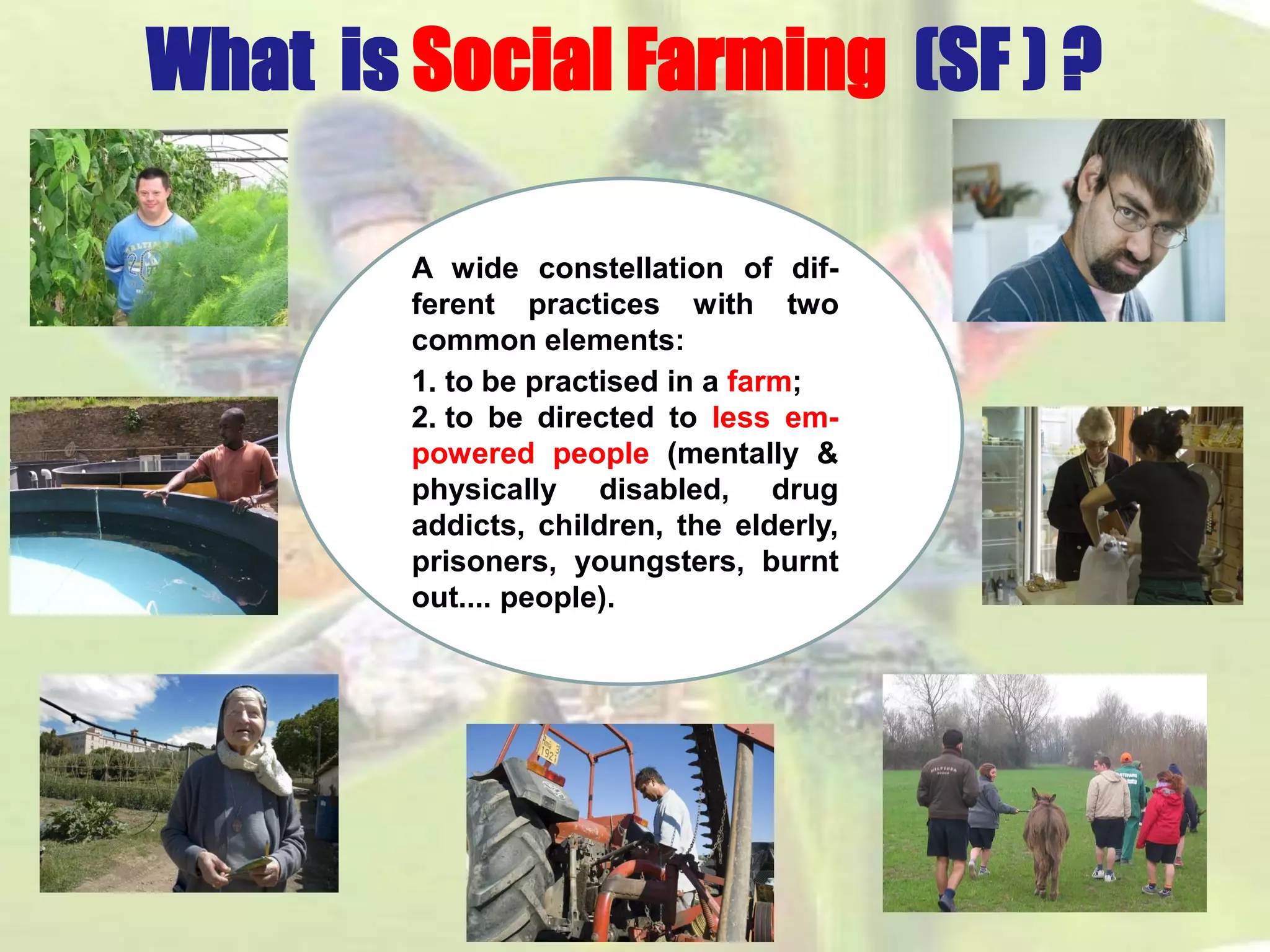
What is Social Farming (SF ) ? Awideconstellationofdif- ferentpracticeswithtwocommonelements: 
1.tobepractisedinafarm; 
2.tobedirectedtolessem- poweredpeople(mentally& physicallydisabled,drugaddicts,children,theelderly, prisoners,youngsters,burntout....people).
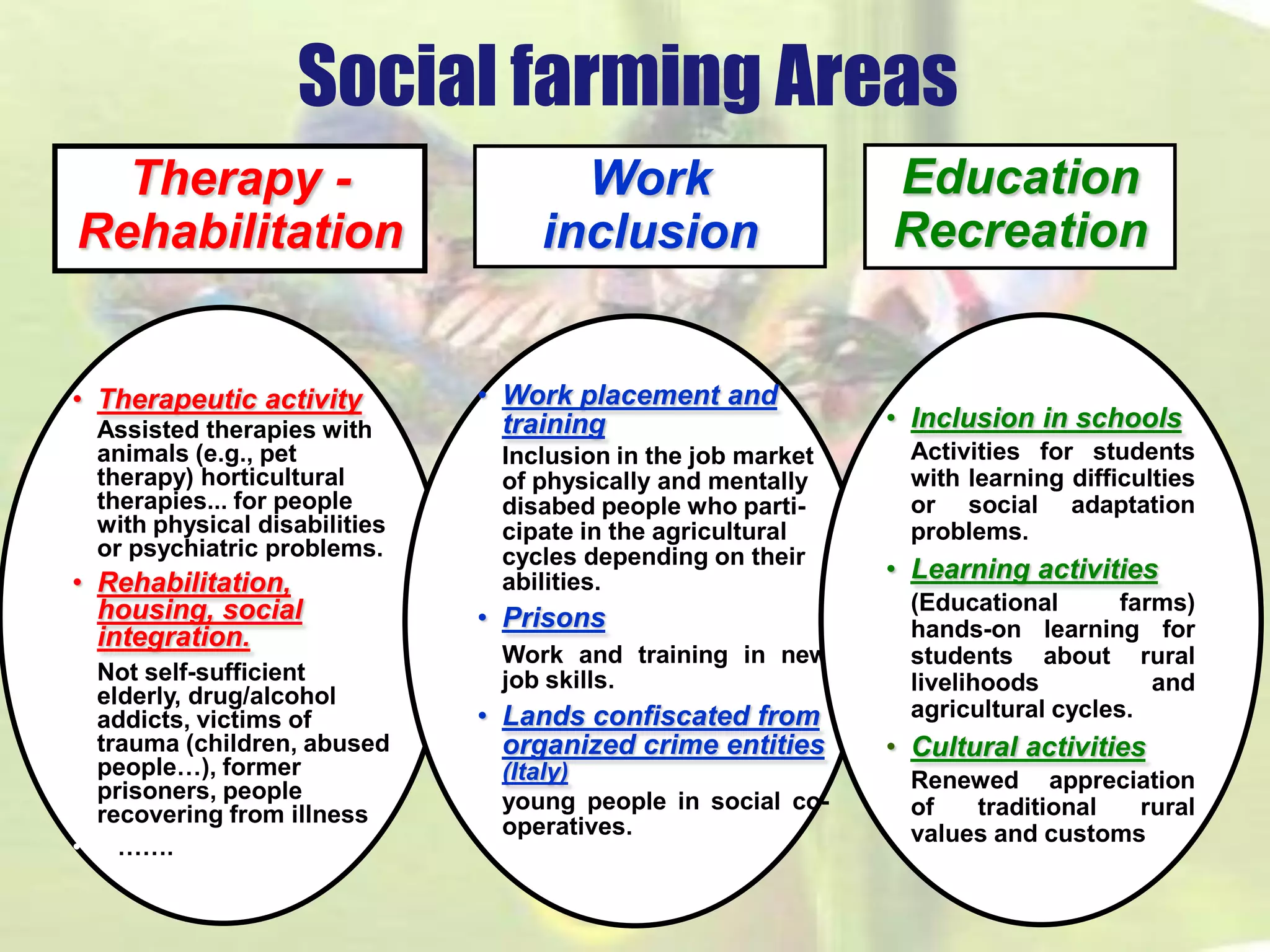
Social farmingAreasWork inclusionEducationRecreation 
•Therapeuticactivity 
•Assistedtherapieswithanimals(e.g., pettherapy) horticulturaltherapies... forpeople withphysicaldisabilitiesor psychiatricproblems. 
•Rehabilitation, housing, social integration. 
•Notself-sufficientelderly, drug/alcoholaddicts, victimsoftrauma (children, abusedpeople…), formerprisoners, people recoveringfromillness 
•……. 
•Work placement and training 
•Inclusion in the job market of physically and mentally disabed people who parti- cipate in the agricultural cycles depending on their abilities. 
•Prisons 
•Workandtraininginnewjobskills. 
•Lands confiscated from organized crime entities (Italy) 
•youngpeopleinsocialco- operatives. 
•Inclusioninschools 
•Activitiesforstudentswithlearningdifficultiesorsocialadaptationproblems. 
•Learningactivities 
•(Educationalfarms) hands-onlearningforstudentsaboutrurallivelihoodsandagriculturalcycles. 
•Culturalactivities 
•Renewedappreciationoftraditionalruralvaluesandcustoms 
Therapy- Rehabilitation
European nets on SF 
voluntary based activity 
around Social Farming 
research net focused on 
3 fields: efficiency, 
economics , Green Care 
policies 
http://sofar.unipi.it 
project aimed at sup-porting 
EU policies
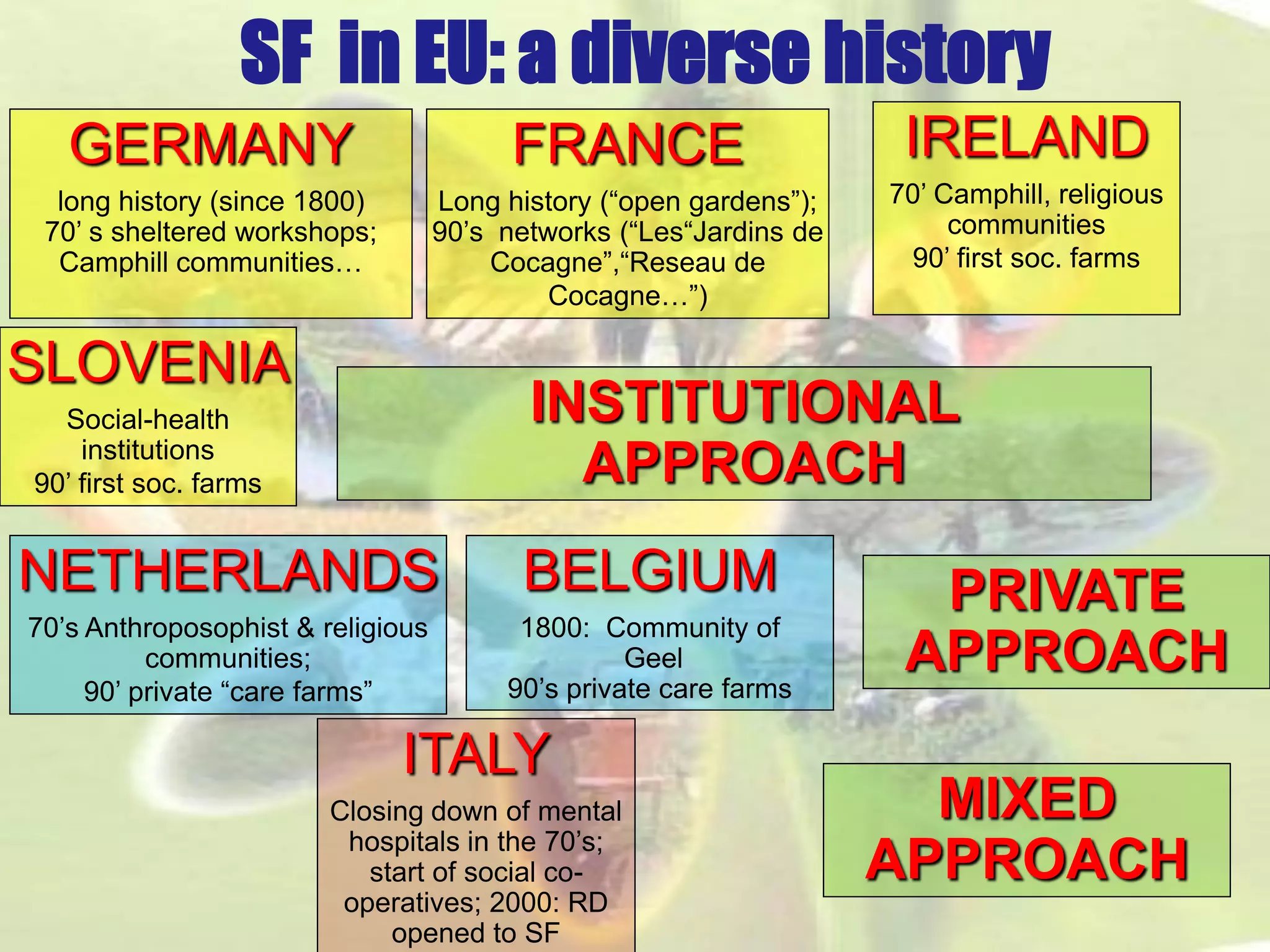
SF in EU: a diverse historyITALYClosing down of mental hospitals in the 70’s; start of social co- operatives; 2000: RD opened to SF 
GERMANY 
long history(since1800) 
70’ s shelteredworkshops; 
Camphillcommunities… IRELAND70’ Camphill, religious communities90’ first soc. farmsNETHERLANDS70’s Anthroposophist & religious communities; 90’ private “care farms” BELGIUM1800: Community ofGeel90’s private care farmsSLOVENIASocial-healthinstitutions90’ first soc. farmsFRANCELong history(“open gardens”); 90’s networks(“Les“Jardinsde Cocagne”,“Reseaude Cocagne…”) INSTITUTIONAL APPROACHPRIVATE APPROACH 
MIXED APPROACH
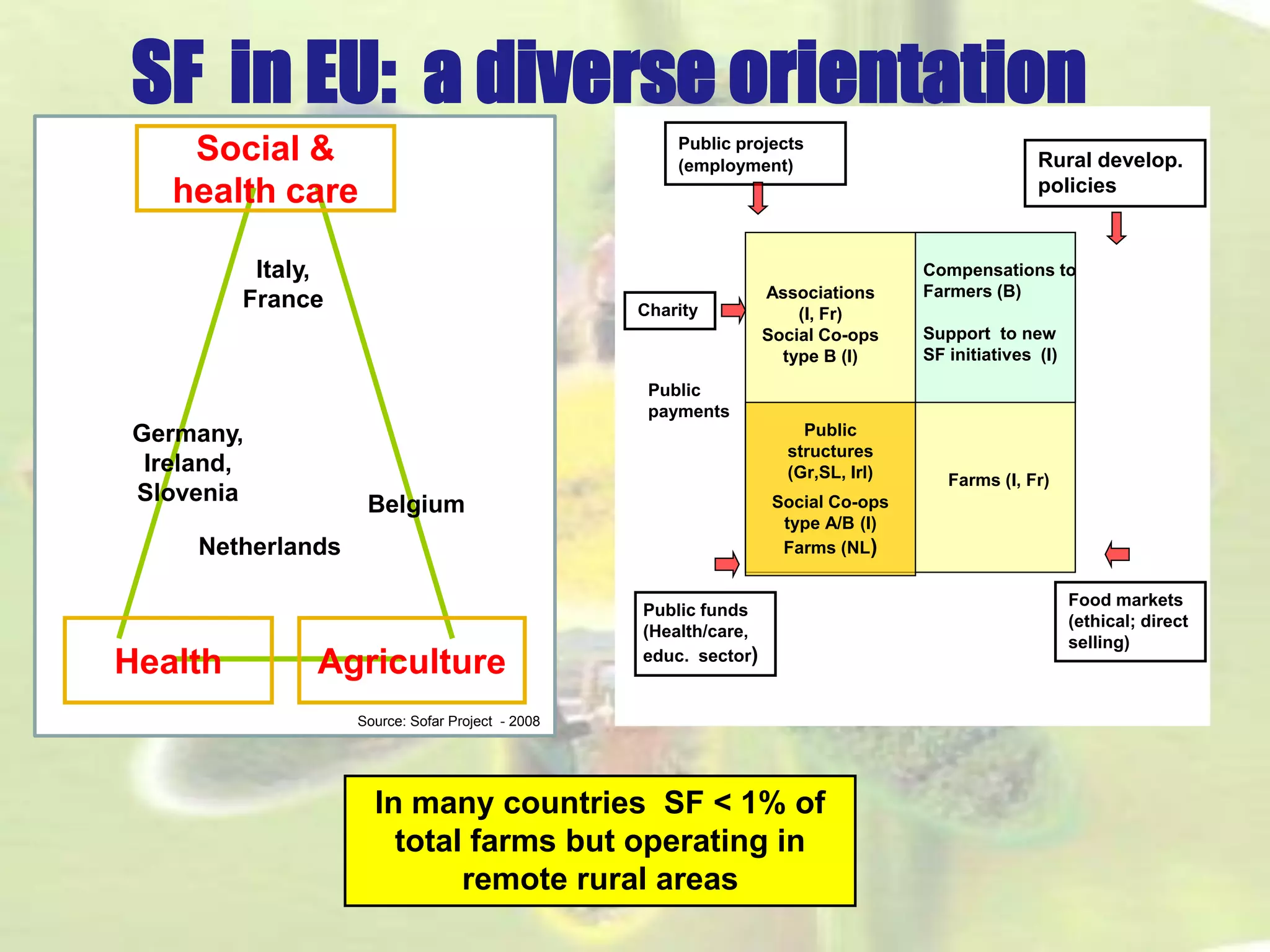
SF in EU: a diverse orientationIn many countries SF < 1% of total farms but operating in remote rural areasSource: Sofar Project -2008 
AgricultureHealth 
Italy, France 
Germany, Ireland, Slovenia 
Netherlands 
BelgiumSocial & health careRural develop. policiesPublic paymentsPublic projects(employment) Food markets (ethical; direct selling) Public structures (Gr,SL, Irl) Social Co-ops type A/B (I) Farms (NL) 
Associations 
(I, Fr) 
Social Co-ops type B (I) 
Public funds (Health/care, educ. sector) Compensations to Farmers (B) Support to new SF initiatives (I) Farms (I, Fr) 
Charity
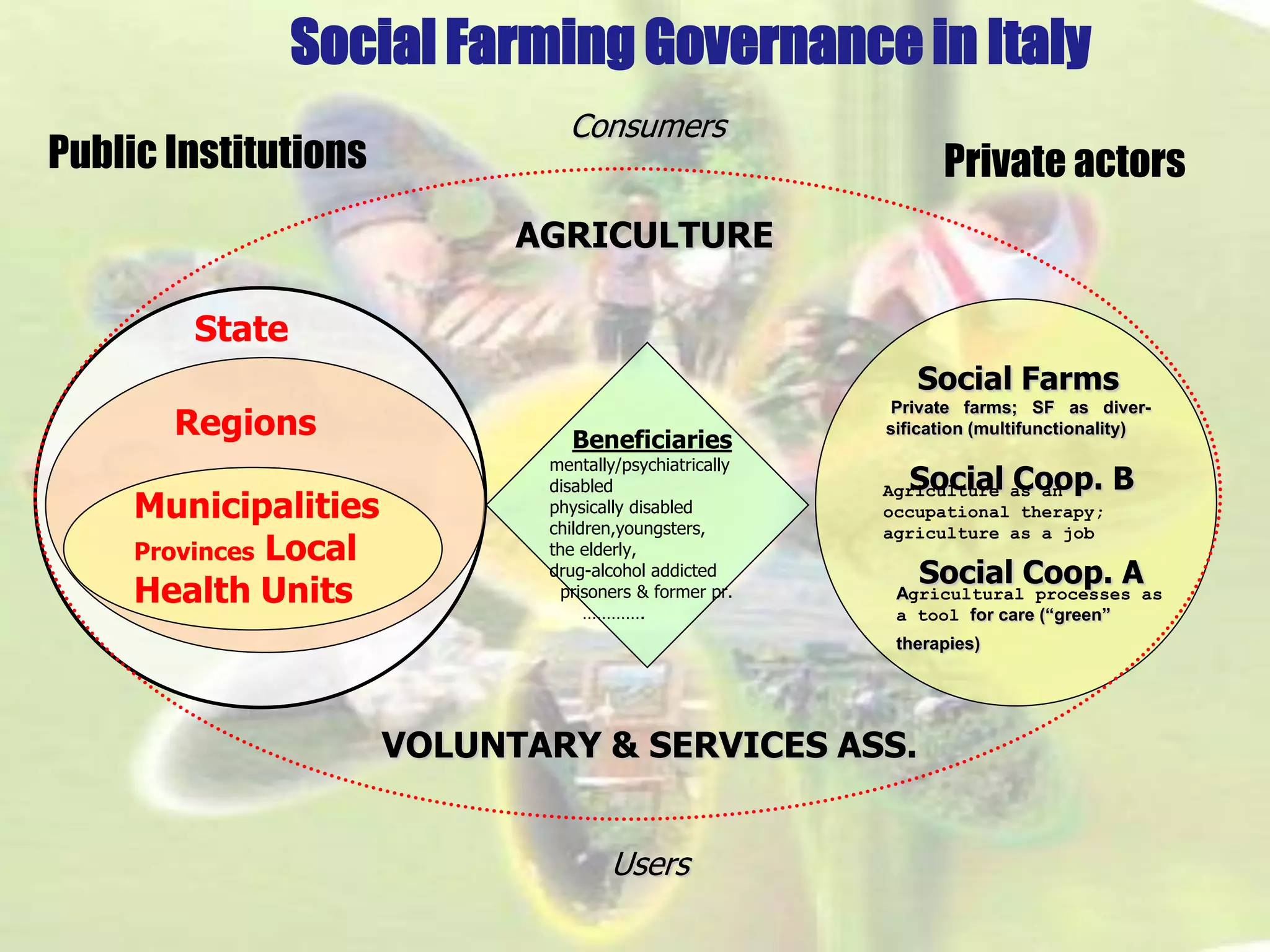
Social Farming Governance in Italy 
AGRICULTURESocial Coop. AAgriculturalprocessesasa toolforcare (“green” therapies) 
Social Coop. B 
Agriculture asanoccupationaltherapy; agricultureasa job 
Beneficiariesmentally/psychiatrically disabledphysically disabledchildren,youngsters, the elderly, drug-alcohol addictedprisoners & former pr. …………. StateRegionsMunicipalitiesProvincesLocal Health UnitsVOLUNTARY & SERVICES ASS. Private actorsPublic Institutions 
Consumers 
Users Social FarmsPrivatefarms;SFasdiver- sification(multifunctionality)
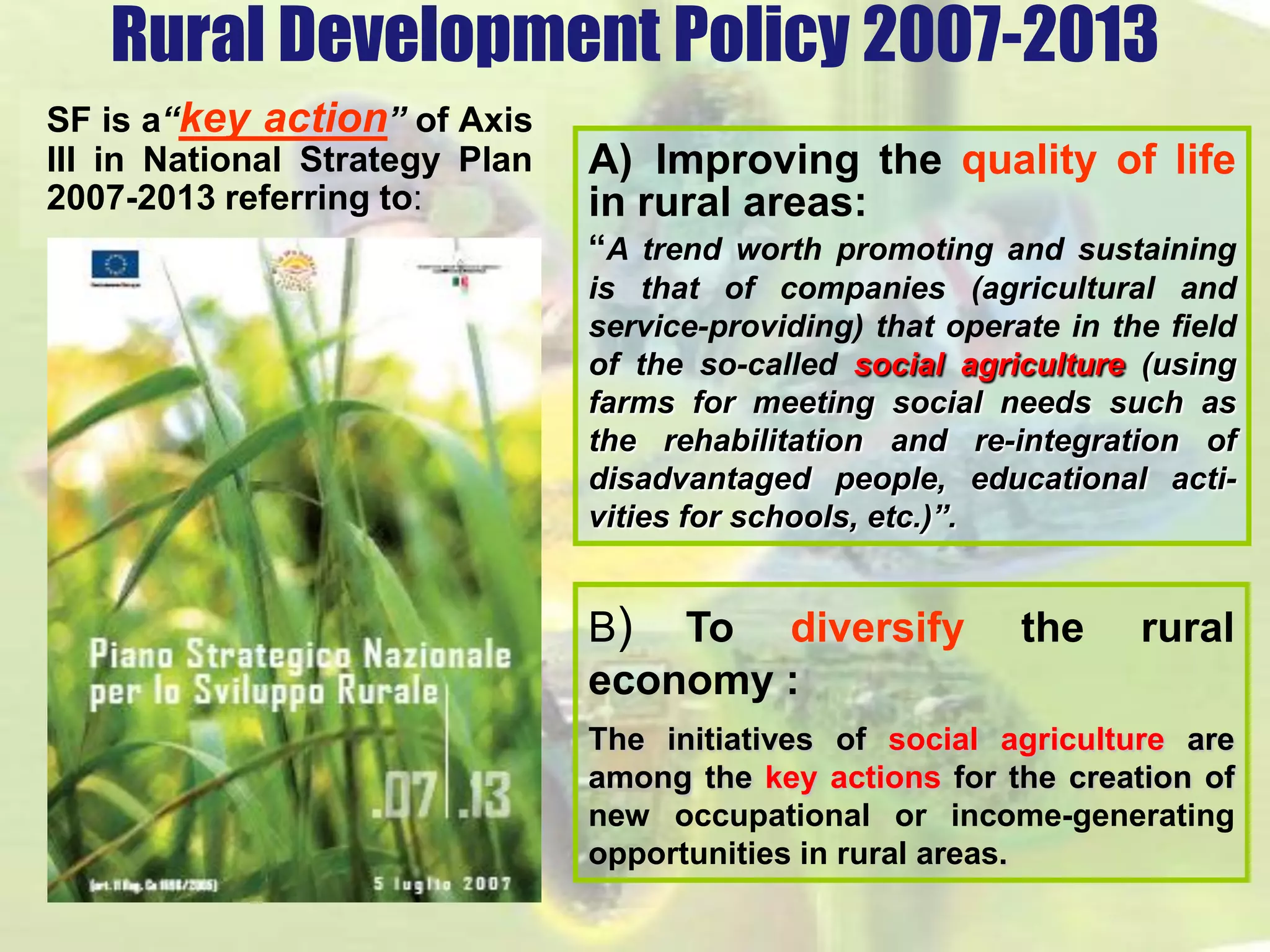
Rural Development Policy 2007-2013 
SF is a“key action” of Axis 
III in National Strategy Plan 
2007-2013 referring to: 
B) To diversify the rural 
economy : 
The initiatives of social agriculture are 
among the key actions for the creation of 
new occupational or income-generating 
opportunities in rural areas. 
A) Improving the quality of life 
in rural areas: 
“A trend worth promoting and sustaining 
is that of companies (agricultural and 
service-providing) that operate in the field 
of the so-called social agriculture (using 
farms for meeting social needs such as 
the rehabilitation and re-integration of 
disadvantaged people, educational acti-vities 
for schools, etc.)”.
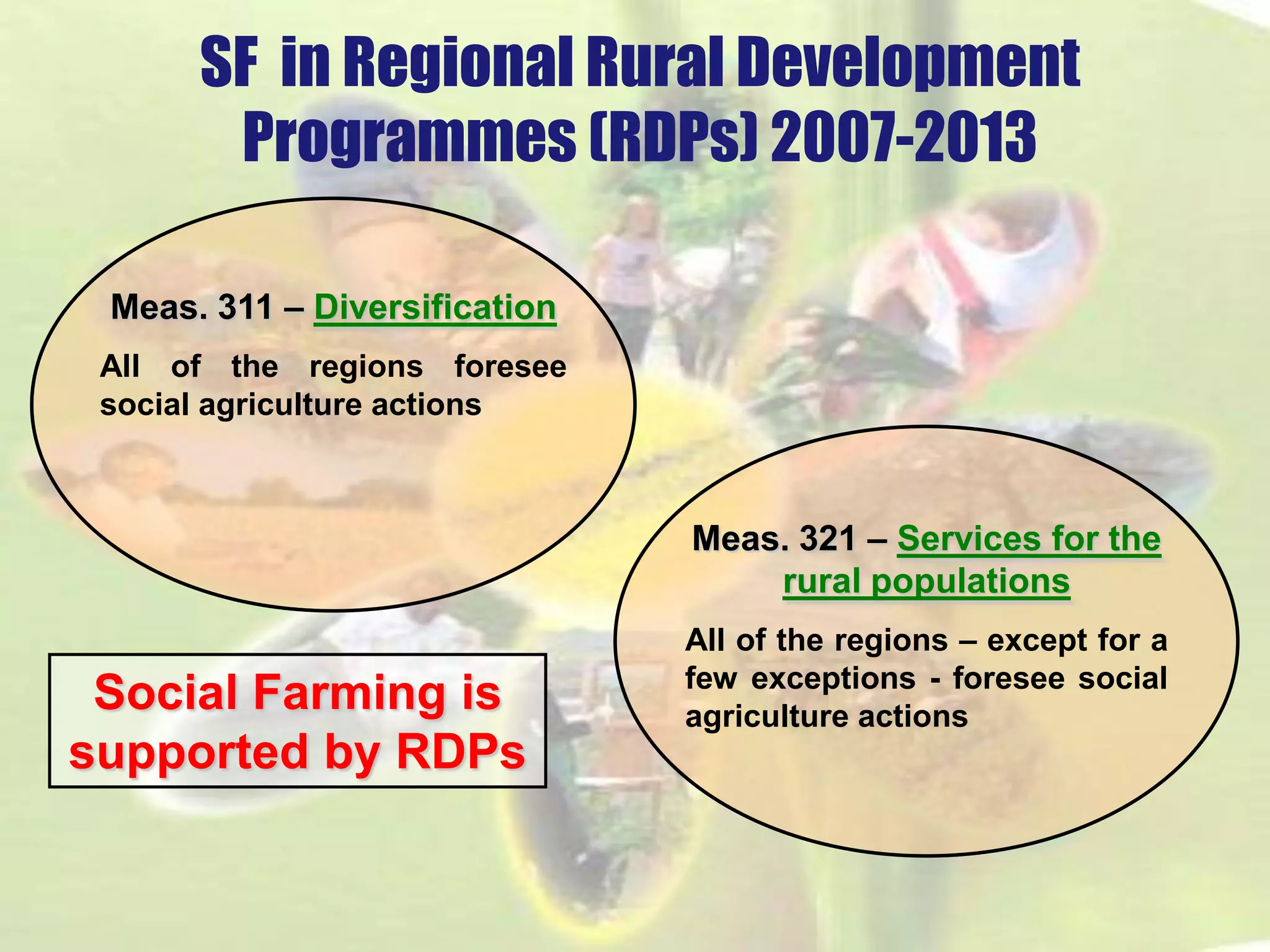
SF in Regional Rural Development Programmes (RDPs) 2007-2013 
Meas. 311 –Diversification 
AlloftheregionsforeseesocialagricultureactionsMeas. 321 –Servicesforthe ruralpopulationsAlloftheregions–exceptforafewexceptions-foreseesocialagricultureactionsSocial FarmingissupportedbyRDPs
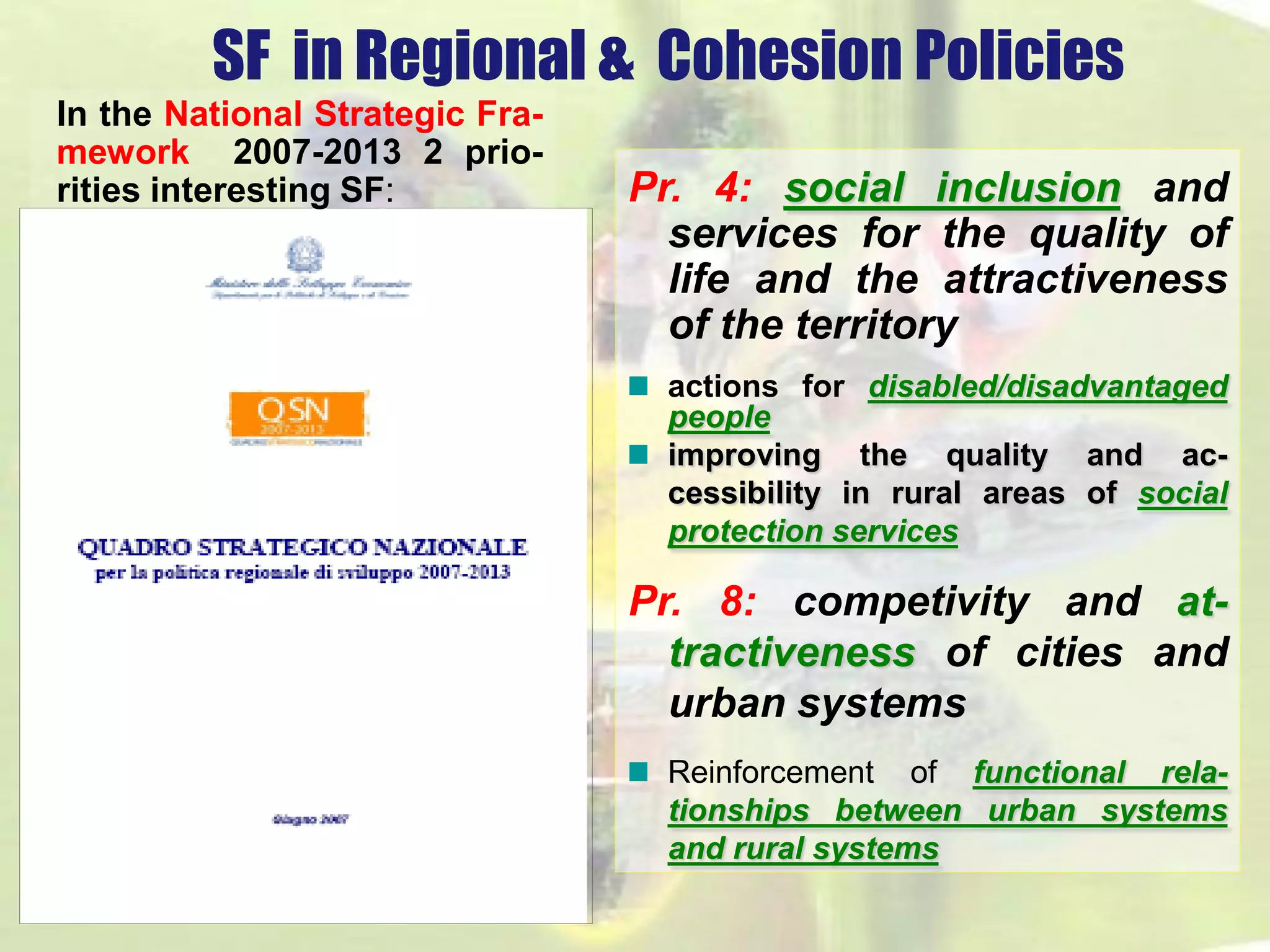
SF in Regional & Cohesion Policies 
In the National Strategic Fra-mework 
2007-2013 2 prio-rities 
interesting SF: Pr. 4: social inclusion and 
services for the quality of 
life and the attractiveness 
of the territory 
actions for disabled/disadvantaged 
people 
improving the quality and ac-cessibility 
in rural areas of social 
protection services 
Pr. 8: competivity and at-tractiveness 
of cities and 
urban systems 
Reinforcement of functional rela-tionships 
between urban systems 
and rural systems
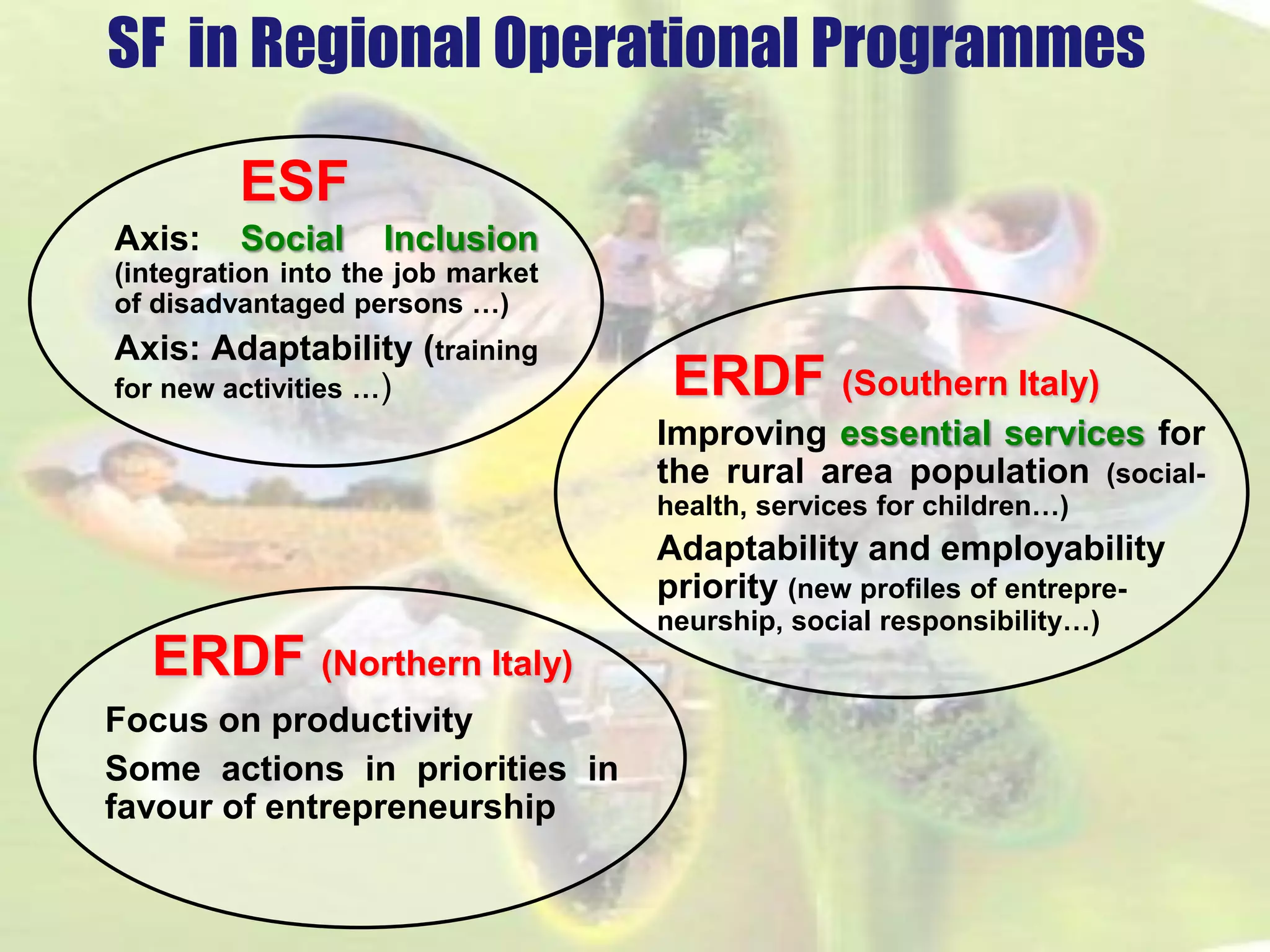
SF in RegionalOperationalProgrammesESFAxis:SocialInclusion(integrationintothejobmarketofdisadvantagedpersons…) Axis:Adaptability(trainingfornewactivities…) 
ERDF (SouthernItaly) 
Improvingessentialservicesfortheruralareapopulation(social- health,servicesforchildren…) 
Adaptabilityand employabilitypriority(newprofilesof entrepre- neurship, social responsibility…) 
ERDF (Northern Italy) 
Focusonproductivity 
Someactionsinprioritiesinfavourofentrepreneurship
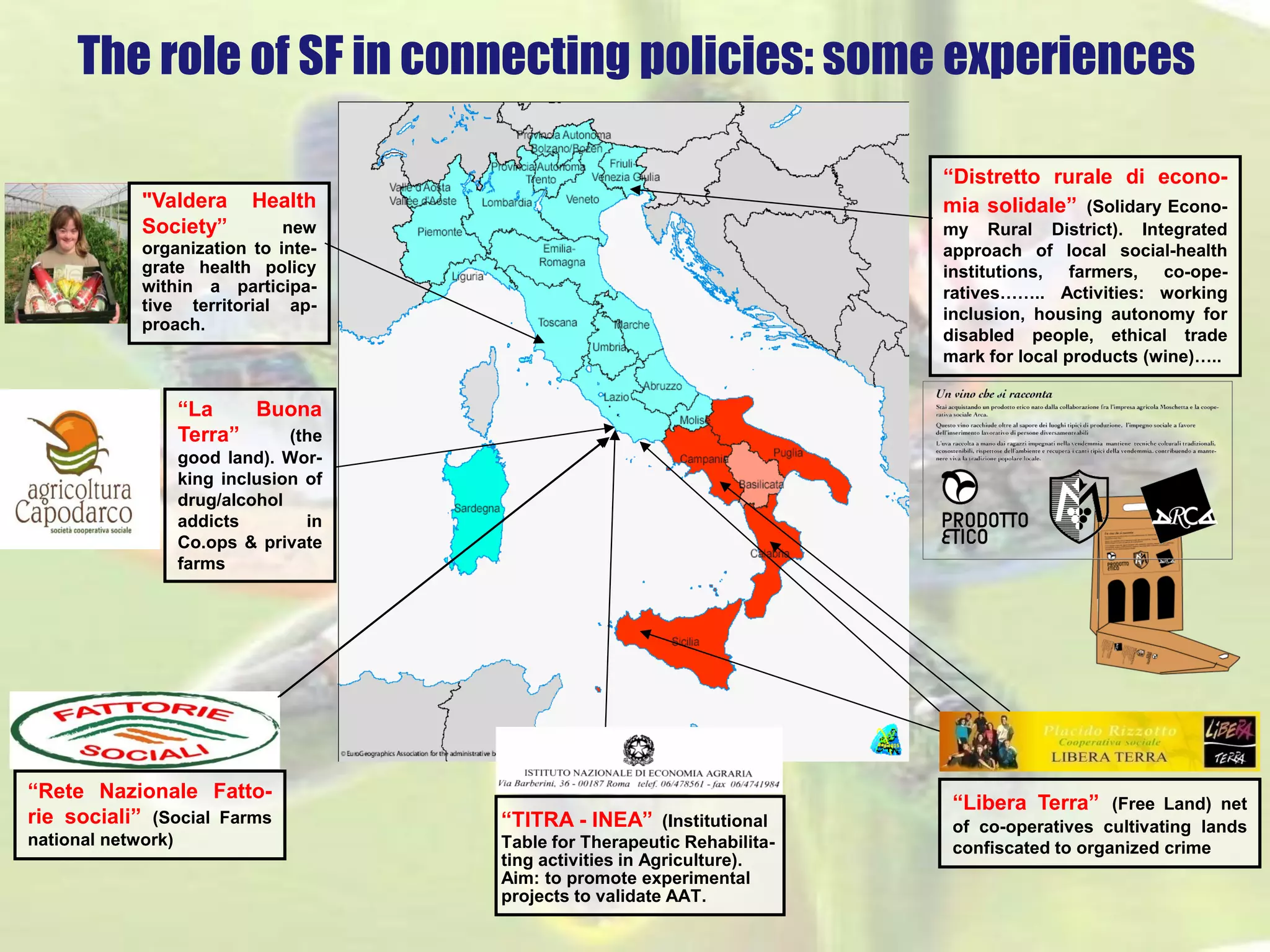
The role of SF in connecting policies: some experiences 
“Distretto rurale di econo-mia 
solidale” (Solidary Econo-my 
Rural District). Integrated 
approach of local social-health 
institutions, farmers, co-ope-ratives…….. 
Activities: working 
inclusion, housing autonomy for 
disabled people, ethical trade 
mark for local products (wine)….. 
“Rete Nazionale Fatto-rie 
sociali” (Social Farms 
national network) 
“Libera Terra” (Free Land) net 
of co-operatives cultivating lands 
confiscated to organized crime 
"Valdera Health 
Society” new 
organization to inte-grate 
health policy 
within a participa-tive 
territorial ap-proach. 
“La Buona 
Terra” (the 
good land). Wor-king 
inclusion of 
drug/alcohol 
addicts in 
Co.ops & private 
farms 
“TITRA - INEA” (Institutional 
Table for Therapeutic Rehabilita-ting 
activities in Agriculture). 
Aim: to promote experimental 
projects to validate AAT.
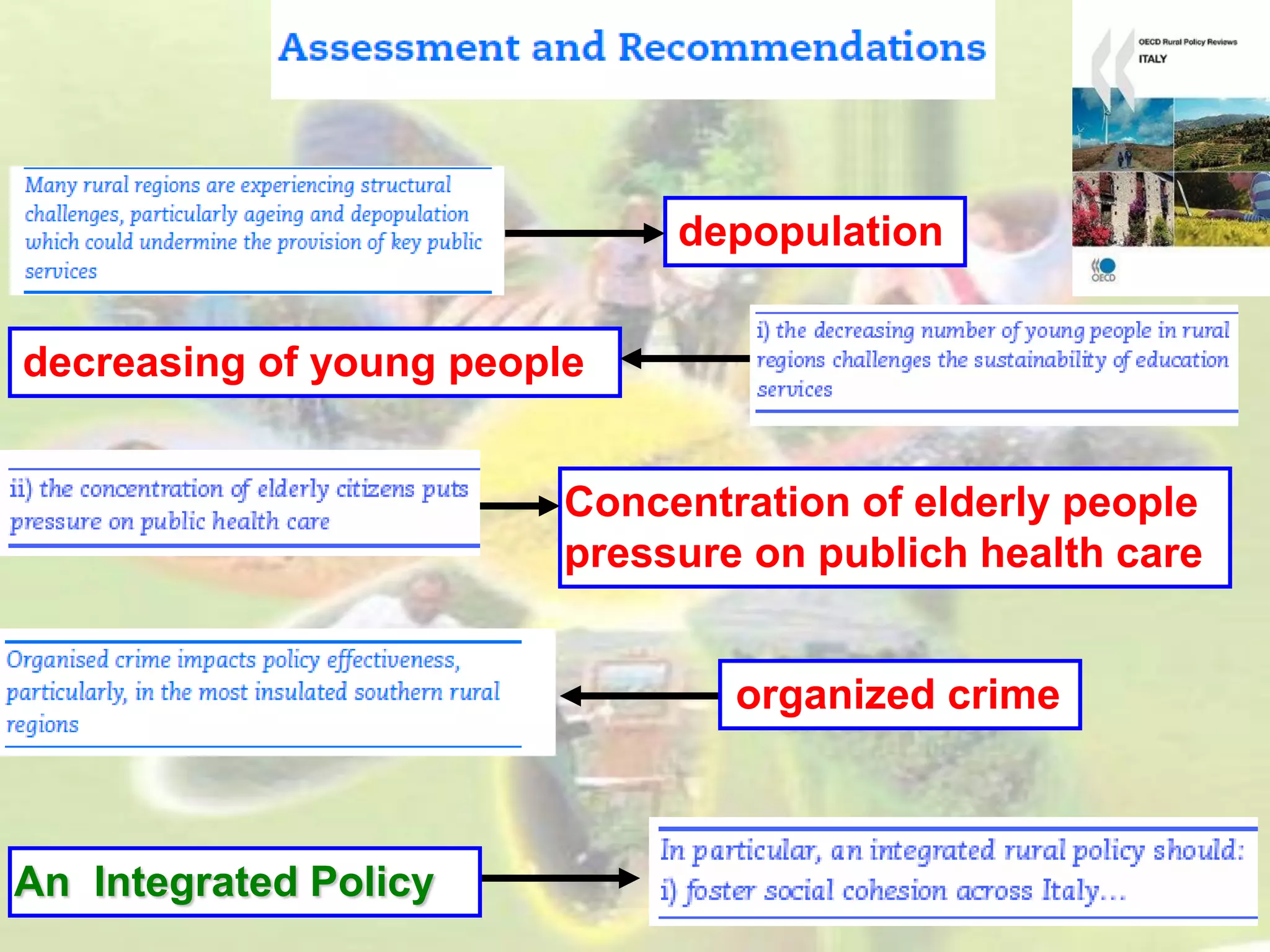
Concentration of elderly people 
pressure on publich health care 
organized crime 
An Integrated Policy 
decreasing of young people 
depopulation
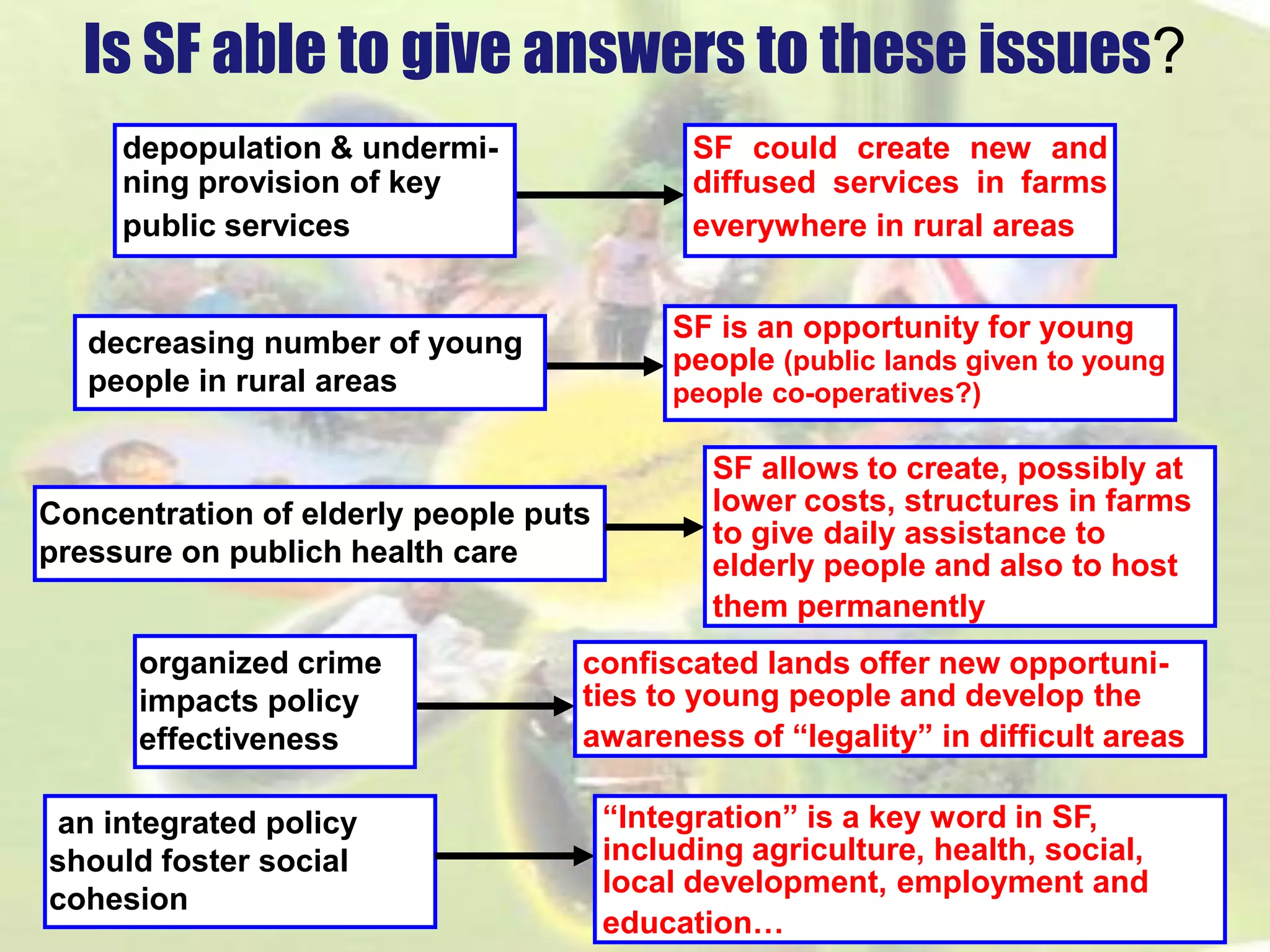
Is SF able to give answers to these issues? SFcouldcreatenewanddiffusedservicesinfarmseverywhereinruralareas 
depopulation & undermi- ning provision of key public services 
SF is an opportunity for young people (public lands given to young peopleco-operatives?) decreasing number of young people in rural areasConcentration of elderly people puts pressure on publich health care 
SF allows to create, possibly at lower costs, structures in farms to give daily assistance to elderly people and also to host them permanentlyorganized crime impacts policy effectiveness 
confiscated lands offer new opportuni- ties to young people and develop the awareness of “legality” in difficult areasan integrated policy should foster social cohesion 
“Integration” is a key word in SF, including agriculture, health, social, local development, employment and education…
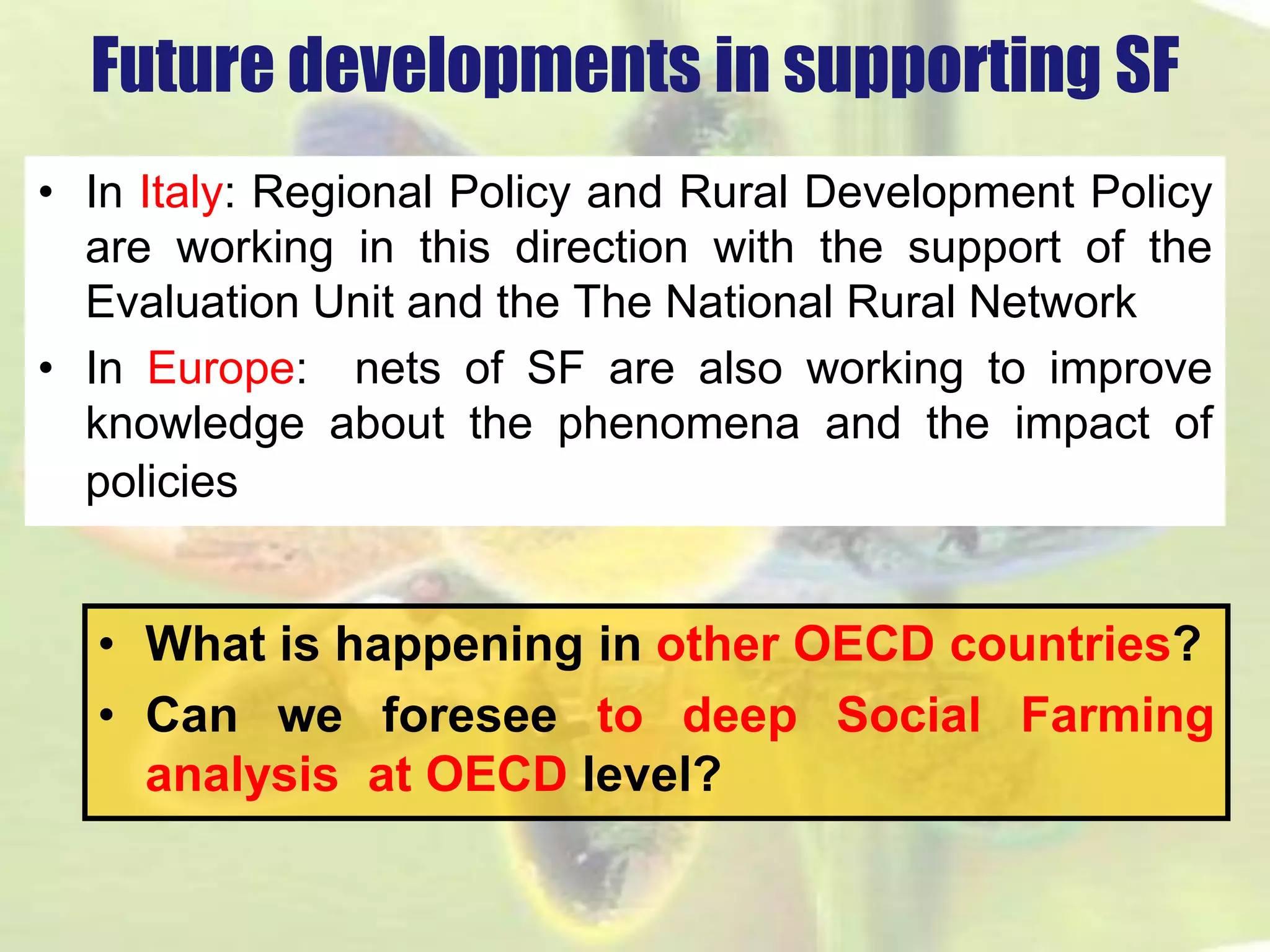
Future developments in supporting SF 
•InItaly:RegionalPolicyandRuralDevelopmentPolicyareworkinginthisdirectionwiththesupportoftheEvaluationUnitandtheTheNationalRuralNetwork 
•InEurope:netsofSFarealsoworkingtoimproveknowledgeaboutthephenomenaandtheimpactofpolicies 
•WhatishappeninginotherOECDcountries? 
•CanweforeseetodeepSocialFarminganalysisatOECDlevel?
roberto.finuola@tesoro.itThank you for your attention.

Social Farming (SF) in Italy: An Opportunity for Local Development

  • 1.
    Social Farming (SF)in Italy: an opportunity for local developmentRoberto FinuolaEconomic Development MinistryEvaluation Unit (Uval), Italyroberto.finuola@tesoro.it
  • 2.
    What is SocialFarming (SF ) ? Awideconstellationofdif- ferentpracticeswithtwocommonelements: 1.tobepractisedinafarm; 2.tobedirectedtolessem- poweredpeople(mentally& physicallydisabled,drugaddicts,children,theelderly, prisoners,youngsters,burntout....people).
  • 3.
    Social farmingAreasWork inclusionEducationRecreation •Therapeuticactivity •Assistedtherapieswithanimals(e.g., pettherapy) horticulturaltherapies... forpeople withphysicaldisabilitiesor psychiatricproblems. •Rehabilitation, housing, social integration. •Notself-sufficientelderly, drug/alcoholaddicts, victimsoftrauma (children, abusedpeople…), formerprisoners, people recoveringfromillness •……. •Work placement and training •Inclusion in the job market of physically and mentally disabed people who parti- cipate in the agricultural cycles depending on their abilities. •Prisons •Workandtraininginnewjobskills. •Lands confiscated from organized crime entities (Italy) •youngpeopleinsocialco- operatives. •Inclusioninschools •Activitiesforstudentswithlearningdifficultiesorsocialadaptationproblems. •Learningactivities •(Educationalfarms) hands-onlearningforstudentsaboutrurallivelihoodsandagriculturalcycles. •Culturalactivities •Renewedappreciationoftraditionalruralvaluesandcustoms Therapy- Rehabilitation
  • 4.
    European nets onSF voluntary based activity around Social Farming research net focused on 3 fields: efficiency, economics , Green Care policies http://sofar.unipi.it project aimed at sup-porting EU policies
  • 5.
    SF in EU:a diverse historyITALYClosing down of mental hospitals in the 70’s; start of social co- operatives; 2000: RD opened to SF GERMANY long history(since1800) 70’ s shelteredworkshops; Camphillcommunities… IRELAND70’ Camphill, religious communities90’ first soc. farmsNETHERLANDS70’s Anthroposophist & religious communities; 90’ private “care farms” BELGIUM1800: Community ofGeel90’s private care farmsSLOVENIASocial-healthinstitutions90’ first soc. farmsFRANCELong history(“open gardens”); 90’s networks(“Les“Jardinsde Cocagne”,“Reseaude Cocagne…”) INSTITUTIONAL APPROACHPRIVATE APPROACH MIXED APPROACH
  • 6.
    SF in EU:a diverse orientationIn many countries SF < 1% of total farms but operating in remote rural areasSource: Sofar Project -2008 AgricultureHealth Italy, France Germany, Ireland, Slovenia Netherlands BelgiumSocial & health careRural develop. policiesPublic paymentsPublic projects(employment) Food markets (ethical; direct selling) Public structures (Gr,SL, Irl) Social Co-ops type A/B (I) Farms (NL) Associations (I, Fr) Social Co-ops type B (I) Public funds (Health/care, educ. sector) Compensations to Farmers (B) Support to new SF initiatives (I) Farms (I, Fr) Charity
  • 7.
    Social Farming Governancein Italy AGRICULTURESocial Coop. AAgriculturalprocessesasa toolforcare (“green” therapies) Social Coop. B Agriculture asanoccupationaltherapy; agricultureasa job Beneficiariesmentally/psychiatrically disabledphysically disabledchildren,youngsters, the elderly, drug-alcohol addictedprisoners & former pr. …………. StateRegionsMunicipalitiesProvincesLocal Health UnitsVOLUNTARY & SERVICES ASS. Private actorsPublic Institutions Consumers Users Social FarmsPrivatefarms;SFasdiver- sification(multifunctionality)
  • 8.
    Rural Development Policy2007-2013 SF is a“key action” of Axis III in National Strategy Plan 2007-2013 referring to: B) To diversify the rural economy : The initiatives of social agriculture are among the key actions for the creation of new occupational or income-generating opportunities in rural areas. A) Improving the quality of life in rural areas: “A trend worth promoting and sustaining is that of companies (agricultural and service-providing) that operate in the field of the so-called social agriculture (using farms for meeting social needs such as the rehabilitation and re-integration of disadvantaged people, educational acti-vities for schools, etc.)”.
  • 9.
    SF in RegionalRural Development Programmes (RDPs) 2007-2013 Meas. 311 –Diversification AlloftheregionsforeseesocialagricultureactionsMeas. 321 –Servicesforthe ruralpopulationsAlloftheregions–exceptforafewexceptions-foreseesocialagricultureactionsSocial FarmingissupportedbyRDPs
  • 10.
    SF in Regional& Cohesion Policies In the National Strategic Fra-mework 2007-2013 2 prio-rities interesting SF: Pr. 4: social inclusion and services for the quality of life and the attractiveness of the territory actions for disabled/disadvantaged people improving the quality and ac-cessibility in rural areas of social protection services Pr. 8: competivity and at-tractiveness of cities and urban systems Reinforcement of functional rela-tionships between urban systems and rural systems
  • 11.
    SF in RegionalOperationalProgrammesESFAxis:SocialInclusion(integrationintothejobmarketofdisadvantagedpersons…)Axis:Adaptability(trainingfornewactivities…) ERDF (SouthernItaly) Improvingessentialservicesfortheruralareapopulation(social- health,servicesforchildren…) Adaptabilityand employabilitypriority(newprofilesof entrepre- neurship, social responsibility…) ERDF (Northern Italy) Focusonproductivity Someactionsinprioritiesinfavourofentrepreneurship
  • 12.
    The role ofSF in connecting policies: some experiences “Distretto rurale di econo-mia solidale” (Solidary Econo-my Rural District). Integrated approach of local social-health institutions, farmers, co-ope-ratives…….. Activities: working inclusion, housing autonomy for disabled people, ethical trade mark for local products (wine)….. “Rete Nazionale Fatto-rie sociali” (Social Farms national network) “Libera Terra” (Free Land) net of co-operatives cultivating lands confiscated to organized crime "Valdera Health Society” new organization to inte-grate health policy within a participa-tive territorial ap-proach. “La Buona Terra” (the good land). Wor-king inclusion of drug/alcohol addicts in Co.ops & private farms “TITRA - INEA” (Institutional Table for Therapeutic Rehabilita-ting activities in Agriculture). Aim: to promote experimental projects to validate AAT.
  • 13.
    Concentration of elderlypeople pressure on publich health care organized crime An Integrated Policy decreasing of young people depopulation
  • 14.
    Is SF ableto give answers to these issues? SFcouldcreatenewanddiffusedservicesinfarmseverywhereinruralareas depopulation & undermi- ning provision of key public services SF is an opportunity for young people (public lands given to young peopleco-operatives?) decreasing number of young people in rural areasConcentration of elderly people puts pressure on publich health care SF allows to create, possibly at lower costs, structures in farms to give daily assistance to elderly people and also to host them permanentlyorganized crime impacts policy effectiveness confiscated lands offer new opportuni- ties to young people and develop the awareness of “legality” in difficult areasan integrated policy should foster social cohesion “Integration” is a key word in SF, including agriculture, health, social, local development, employment and education…
  • 15.
    Future developments insupporting SF •InItaly:RegionalPolicyandRuralDevelopmentPolicyareworkinginthisdirectionwiththesupportoftheEvaluationUnitandtheTheNationalRuralNetwork •InEurope:netsofSFarealsoworkingtoimproveknowledgeaboutthephenomenaandtheimpactofpolicies •WhatishappeninginotherOECDcountries? •CanweforeseetodeepSocialFarminganalysisatOECDlevel?
  • 16.