Gardening for All 
A guide to including gardeners who have sight loss in your community
2 
Contents 
“When you lose your sight there are so many things that you can’t do, but gardening is some- thing that you CAN do; Thrive can show you how.” 
Sue Scott 
Introduction 3 
Key facts about sight loss 4 
Involvement of gardeners with sight loss 5 
Useful contacts 10 
Appendices 11 
1. Common eye conditions 1 
2. Health & Safety 13 
3. Notes on guiding 14 
4. Disability Discrimination Act 15
3 
Introduction 
Introduction 
This guide has been written and produced by Thrive and the RHS to enable community gardening groups to feel confident in welcoming gardeners who are blind or partially sighted. 
Over 2 million people in the UK are blind or partially sighted, with 100 people a day being diagnosed with serious sight loss. This often 
results in loss of confidence and increasing isolation. Research has shown that gardening is the main hobby of more than a third of people who have sight loss (RNIB 1991). Community gardening can help to reduce the isolation so often experienced by people who have sight 
Thrive is a small national charity, founded in 1978, that uses gardening to change the lives of disabled people. 
Thrive has worked with gardeners who have sight loss for more than 30 years and has built up a wealth of gardening tips and techniques. This knowledge is used to support people who have sight loss to start or continue gardening through a wide range of services offered. Please contact Thrive to find out more about these services. 
The RHS is the UK‖s leading gardening charity and right at the heart of its aims and values are communities. Community horticulture brings communities together and is a wonderful way of getting to know your neighbours, doing your bit for the environment, brightening up where you live and having a more active and healthy lifestyle. There are several RHS community gardening schemes; the Britain in Bloom campaign; It‖s Your Neighbourhood and the Affiliated Societies programme, the nation‖s largest network of gardening clubs.
4 
Key facts about sight loss 
To feel confident in welcoming gardeners who have sight loss into a community group it is important to recognise and have some understanding of the nature of visual loss. In the UK, around one million people are blind or partially sighted and a further 700,000 have sight problems that impact on their daily lives. Only 8 per cent of those impaired have no sight at all. The remainder will have varying degrees of sight, which will enable them to function visually to different degrees. Different eye conditions can result in the following types of impairment: 
 a limited field of vision, being unable to see to the side or up and down 
 some loss of central vision limiting the ability to see fine detail 
 severe short-sightedness, seeing the world as a continuous blur 
 uncontrollable oscillations of the eyeball leading to an inability to see objects clearly 
What causes sight loss? 
There are many reasons why people have little or no sight. 
Some individuals are blind from birth, others are involved in accidents and a significant number develop illnesses that cause partial or complete sight loss. There are a number of eye conditions, each of which affects vision in a different way. 
For more information about common eye conditions and some common myths about sight loss, see Appendix 1.
5 
Involvement of gardeners with sight loss 
Since gardening is a popular pastime amongst people who have sight loss there will be many local people with a wealth of experience and knowledge to bring to a community gardening group. Since sight loss is often an age-related condition, many of these people will be retired and have more time to spare for involvement in a community group. Including gardeners who have sight loss will help to reduce their isolation, increase their confidence and benefit the group as well. 
How to involve gardeners with sight loss: 
 read this guide 
 contact Thrive to register your interest and to enable follow up support 
 publicise locally that the group welcomes gardeners who have sight loss 
 recruit sighted volunteers to support gardeners who have sight loss. 
How to publicise 
 Contact local associations and clubs that might have blind or partially sighted members who are interested in gardening. These can include Voluntary Associations of the Blind, Guide Dogs for the Blind, Age UK, etc. Details of these local groups can be found in the phone book, library, Citizens Advice Bureau or from your local Volunteer Bureau. 
 Use the local talking newspaper to ask interested people to make contact with the group. 
 Approach local newspapers, radio and parish magazines to put in articles about how the community group is welcoming gardeners who have sight loss.
6 
Involvement of gardeners with sight loss 
Recruit sighted helpers 
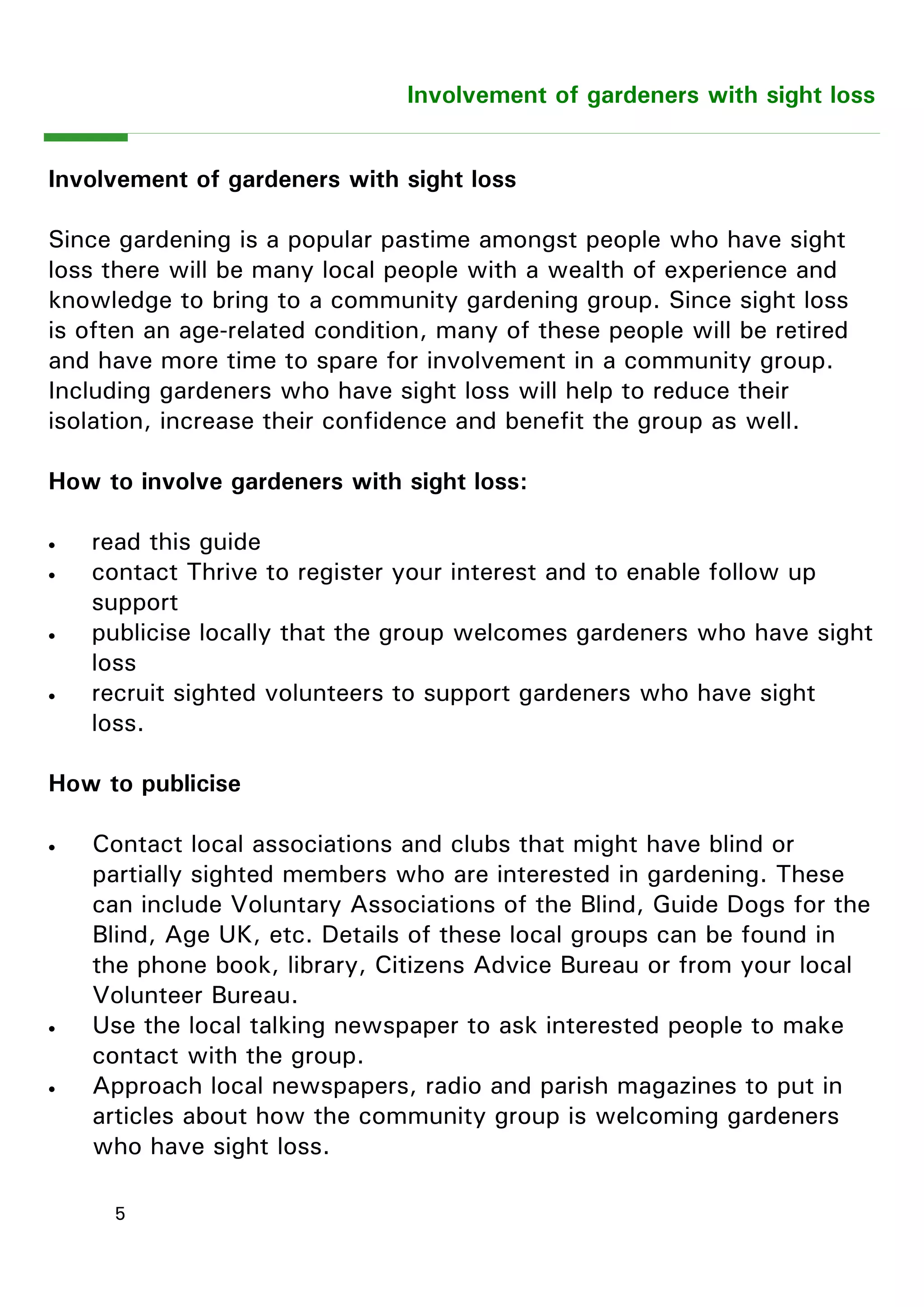
To assist with including gardeners who have sight loss in activities it can be beneficial to recruit sighted helpers. These could be partners, friends, support workers, carers, professionals or volunteers who can be very valuable giving support during activities and helping people getting to and fro. Sighted helpers can also check venues for possible dangers to gardeners who have sight loss, such as trip hazards or overhanging branches. 
Sighted helpers could be recruited from: 
 social services sensory teams 
 rehabilitation officers 
 local Voluntary Associations of the Blind 
 local Volunteer Bureaux 
 colleges and universities 
 gardening and horticulture clubs 
 Women‖s Royal Voluntary Society (WRVS) 
 Women‖s Institute—local branches 
 Round Table and Rotary clubs. 
To find out about local organisations for blind people, contact: 
Visionary—linking local sight loss charities. 
Visit www.visionary.org.uk
7 
Involvement of gardeners with sight loss 
Welcoming gardeners who have sight loss 
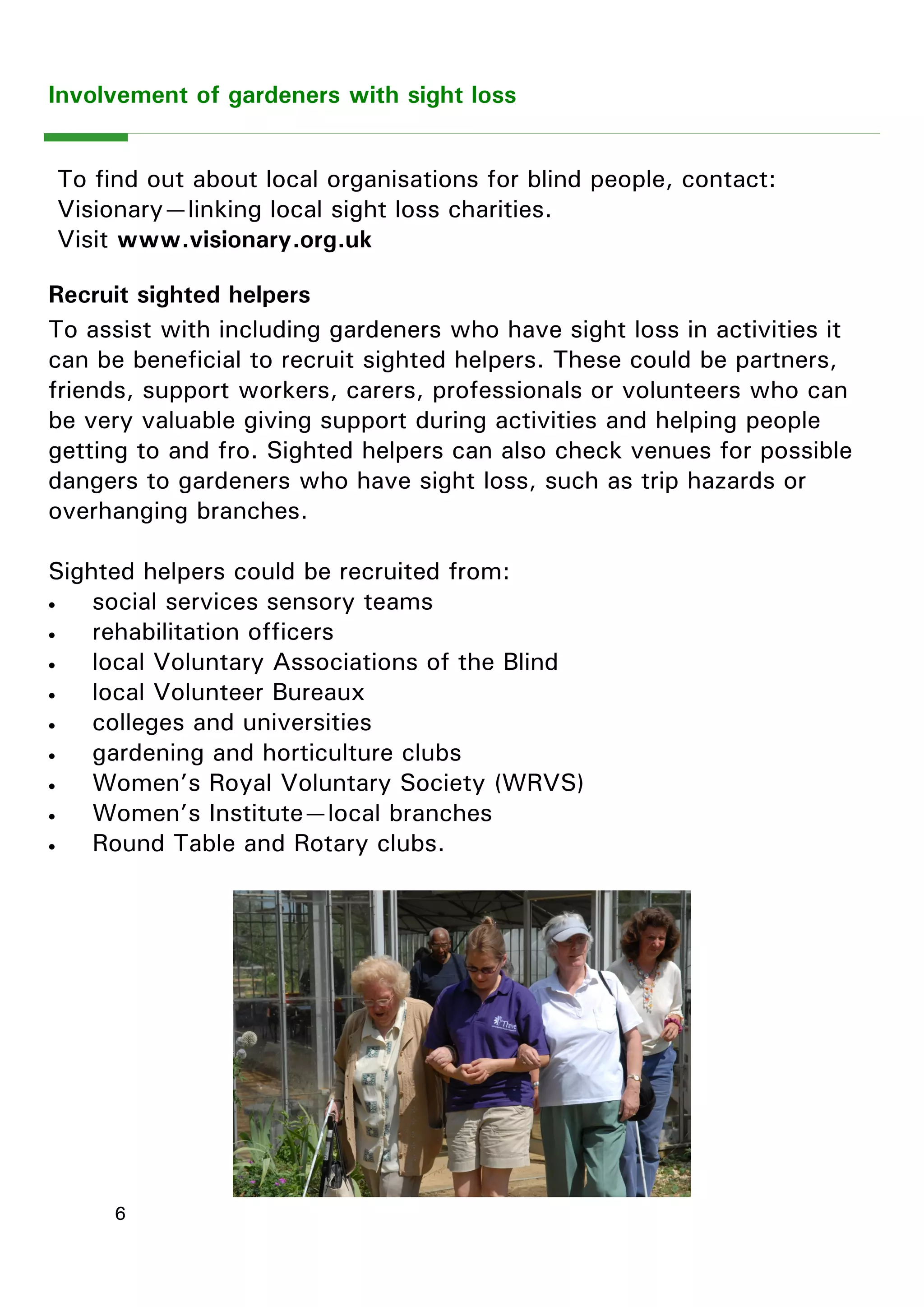
When you find local gardeners who have sight loss who wish to join your group, here is some advice on how to make them feel welcome. 
 Remember each person is an individual with unique needs; let them tell you what extra requirements they might need. 
 Talk naturally; there is no need to raise your voice (unless asked) or to avoid using words such as ―look‖ and ―see‖. When talking, try not to move around too much or move out of earshot without telling them. 
 If accompanied by a helper, remember to direct conversation to the individual, not their helper. 
 Introduce a ―Buddy system‖ where a new gardener with sight loss is paired up with a sighted member of the group initially. This system not only provides support, but also a more welcoming and social introduction to the group. 
 If your group invites speakers to give talks, ensure that the speaker is aware that the audience contains people who have sight loss so that descriptions can be made of any visual materials used.
8 
Involvement of gardeners with sight loss 
 If your group has access to communal gardening space, give a tour of this area pointing out essential features and potential hazards. The provision of landmarks such as scented plants, the noise of chimes or water, or furniture and ornaments, can help people who have sight loss to find their way around the garden. 
 Ensure that paths are even and have a surface with a good grip. 
 If you plan to make any changes to your garden to accommodate gardeners who have sight loss (such as the addition of raised beds or by adding landmarks) do make sure that they are involved in the planning of these changes to ensure that their needs are met. 
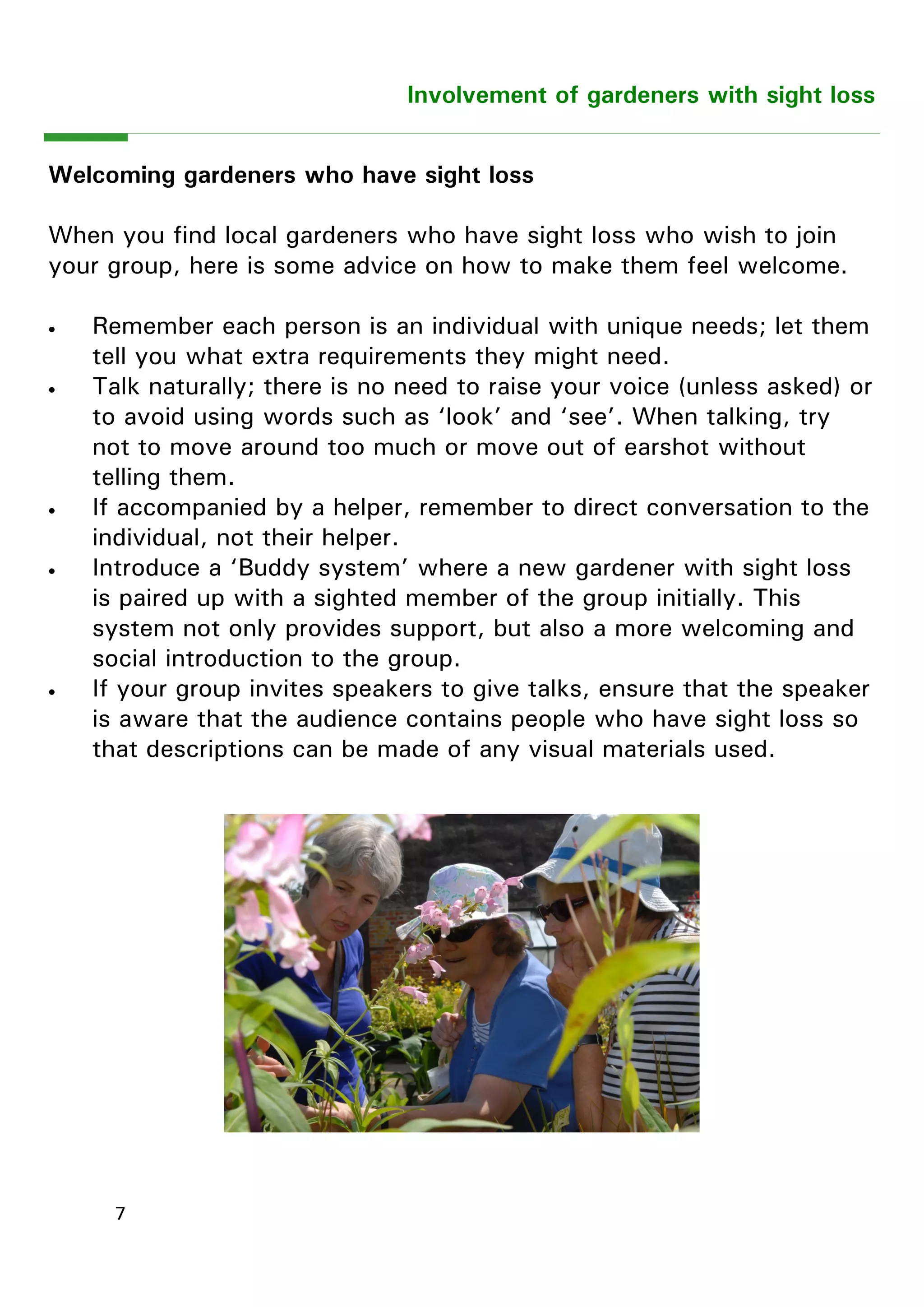
 If the person has a guide dog, the following provision can be helpful: 
 make a bowl of fresh water available 
 ensure there is space for the dog to lie by its owner in the garden or meeting room 
 do not talk/pet the dog whilst it is working 
 if possible, try to have access to an area for ―toileting‖ the dog (the owner will come prepared to clean up after it).
9 
Useful contacts 
What other support is there? 
Thrive 
Thrive offers a comprehensive information service providing advice, fact sheets and a variety of written and audio publications such as: Getting on with Gardening—a series of guides full of practical information for gardeners who have sight loss. 
For more information please contact Thrive using the contact details on the back page of this guide. 
You can also visit Thrive‖s easier gardening website www.carryongardening.org.uk which gives practical advice and a large amount of information about gardening with a disability. 
Royal National Institute of Blind People (RNIB) 
RNIB's National Leisure Services team offers professional advice, guidance, support, training and consultancy services on a wide range of sports, leisure, recreation, wellbeing, arts and tourism activities. 
The service aims to increase accessibility to mainstream leisure opportunities for blind and partially sighted people by increasing specialist leisure opportunities. We campaign and lobby policy and decision makers to improve the access to leisure opportunities including ensuring access to the London 2012 Olympic and Paralympic Games. 
To contact RNIB leisure officers or to find out more about other RNIB services, please call the RNIB helpline. 
RNIB, 105 Judd Street, London WC1H 9NE 
Helpline 0303 123 9999 
Email helpline@rnib.org.uk 
Visit www.rnib.org.uk or email leisure@rnib.org.uk 
Our thanks to RNIB for their advice on the content of this guide.
10 
Useful contacts 
Action for Blind People—part of RNIB Group 
One of the largest charities in the UK providing free and confidential support for blind and partially sighted people in all aspects of their lives. Their mission is to inspire change and create opportunities to enable people with sight loss to have equal voice and equal choice. 
Action for Blind People 
14–16 Verney Road 
London 
SE16 3DZ 
Helpline 0303 123 9999 
Email helpline@rnib.org.uk 
Visit www.actionforblindpeople.org.uk 
The Guide Dogs for the Blind Association, 
Burghfield Common 
Reading RG7 3YG 
Telephone 0118 983 5555 
Email guidedogs@guidedogs.org.uk 
Visit www.guidedogs.org.uk 
The Sensory Trust 
Advice and publications on inclusive environmental design. 
Telephone 01726 222 900 
Email enquiries@sensorytrust.org.uk 
Visit sensorytrust.org.uk
11 
Appendices 
Appendix 1: Common eye conditions 
Some of the most common eye conditions and the way that they affect sight are listed below: 
Macular degeneration 
The macular is a small area at the centre of the retina. It is responsible for what we are able to see straight in front of us. When the cells of the macular are damaged, often occurring in later life, the central vision is affected, eventually leaving just peripheral vision. This is called macular degeneration and at present there is no cure. However, sufferers never lose their peripheral vision as a result of this disease. 
Cataracts 
A cataract is a clouding of the lens inside the eye (it is not a film growing over the eye as many people think). Vision becomes blurred or dim, as light is unable to pass through the clouded lens to the back of the eye. Vision in poor light is often difficult and some people may experience double vision. A small operation can often be performed to remove the cloudy lens and replace it with a plastic one. Most people will notice an improvement a few days after the operation. 
Glaucoma 
Glaucoma is a condition that damages the optic nerve. Vision is slowly lost due to the pressure in the eye. Eventually, as the condition progresses, sight is reduced to a “small tunnel of vision”. In time, even this sight can be lost. However, if the disease is detected early enough, damage may be kept to a minimum and good vision maintained. 
Diabetic retinopathy 
This condition can occur as a result of diabetes. If it is not diagnosed in the early stages, the network of blood vessels in the retina can be affected. There are three types of diabetic retinopathy:
12 
 background diabetic retinopathy, which in its early stages has no affect on vision 
 maculopathy, which affects central vision 
 proliferative diabetic retinopathy, which is much rarer and causes blurred and patchy vision. 
Most sight-threatening diabetic problems can be prevented by laser treatment, if this is given early enough. 
For further more detailed information about sight loss contact the RNIB Helpline on 0303 123 9999. 
Common myths about sight loss 
Myth 1 
It is widely believed that people who have sight loss are endowed with a better sense of touch, hearing, taste and smell to compensate for their loss of vision. In fact, many, especially the elderly majority, have a poorer sense of hearing or touch than sighted people. Many people who have sight loss have learnt how to listen more carefully and to make more use of their remaining sense of touch. 
Myth 2 
There is no such thing as a ―Sixth Sense‖ which enables blind people to perform such feats as getting on the right bus or preparing a meal without being able to see; such accomplishments require good common sense and a lot of practice. 
Myth 3 
Other common misconceptions about people who have sight loss are that they are more clever, cheerful, outgoing, generous, creative and musical than people with sight. If they do happen to have any of these traits or talents it‖s because they are people, not because they are blind. 
Appendices
13 
Myth 4 
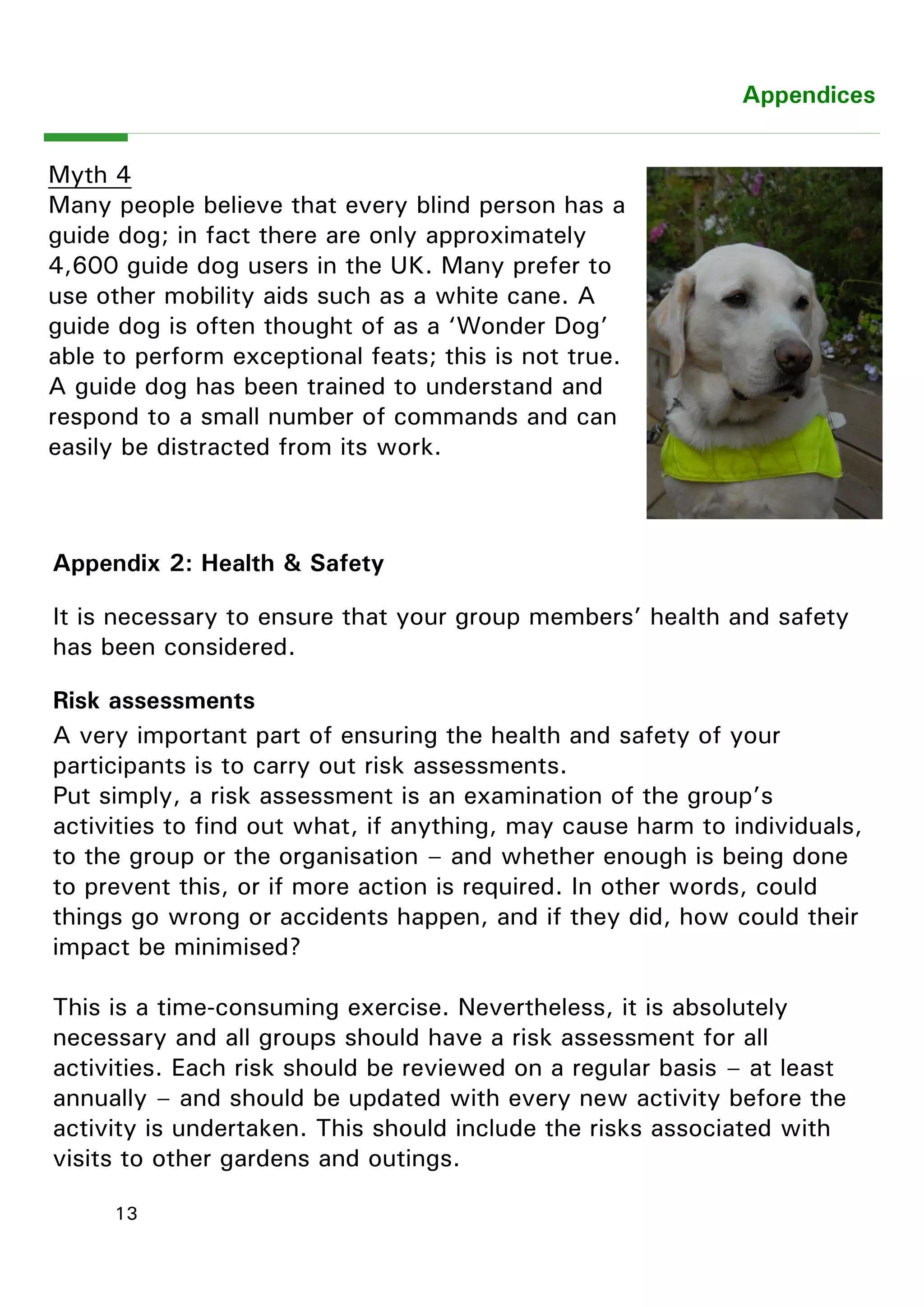
Many people believe that every blind person has a guide dog; in fact there are only approximately 4,600 guide dog users in the UK. Many prefer to use other mobility aids such as a white cane. A guide dog is often thought of as a ―Wonder Dog‖ able to perform exceptional feats; this is not true. A guide dog has been trained to understand and respond to a small number of commands and can easily be distracted from its work. 
Appendices 
Appendix 2: Health & Safety 
It is necessary to ensure that your group members‖ health and safety has been considered. 
Risk assessments 
A very important part of ensuring the health and safety of your participants is to carry out risk assessments. 
Put simply, a risk assessment is an examination of the group‖s activities to find out what, if anything, may cause harm to individuals, to the group or the organisation – and whether enough is being done to prevent this, or if more action is required. In other words, could things go wrong or accidents happen, and if they did, how could their impact be minimised? 
This is a time-consuming exercise. Nevertheless, it is absolutely necessary and all groups should have a risk assessment for all activities. Each risk should be reviewed on a regular basis – at least annually – and should be updated with every new activity before the activity is undertaken. This should include the risks associated with visits to other gardens and outings.
14 
Appendix 3: Notes on guiding 
General 
These notes are aimed at people who are escorting a person who has sight loss for the first time, so contain points that experienced escorts may already be aware of. 
To interact and communicate effectively with a person who is visually impaired, please remember to approach each person as an individual and with respect for their own decision to accept or not accept your assistance. 
Escorts are particularly needed in surroundings that are unfamiliar. 
Appendices 
For more advice about risk assessments and health and safety considerations when working with people who have sight loss please contact Thrive. 
It is recommended that your group takes out public liability insurance to cover against claims for damage or injury on third party property. 
The RHS provides insurance for both Britain in Bloom & It‖s Your Neighbourhood campaign participants, as well as bespoke insurance for Affiliated Societies, which is organized through the underwriters NFU mutual. The Public Liability inclusive of Employers Liability insurance is the best type to fully cover your society and any volunteers, whether suffering from sight loss or not. For further information on the insurance cover and to receive application forms, as well as a list of prices, please call the RHS Community Horticulture team on 020 7821 3651.
15 
Appendix 4: Disability Discrimination Act 1995 
Under this act, all organisations, buildings and open spaces that provide services for, or are open to, the public are being asked to make ―reasonable adjustments‖ to ensure disabled people are not being discriminated against. Discrimination occurs when a disabled person is treated less favourably than someone else, for a reason relating to that person‖s disability. 
Appendices 
The following guidelines will also be helpful 
 Ask the person how you can best support them. 
 Always speak directly to the person rather than through another individual. 
 Give clear and concise directions and instructions, such as to your right, indicate if you are approaching steps, ie step up, etc. 
 Never leave doors ajar, close them completely or leave them fully open. 
 It is acceptable to use such words as look, see and watch. These are common words used by everyone. 
 Always let a person know if you are leaving them or leaving the room – there is nothing more embarrassing for a person than to carry on talking to you when you are no longer there! 
 When guiding a person always let them take your arm and walk a step behind. Never take their arm and push them in front of you. 
 There will be some people with their guide dogs. Give preference to escorting those without dogs and never interrupt someone who is using their dog by taking their arm. 
For more detailed instructions on being a guide please look at RNIB website www.rnib.org.uk “How to guide people with sight problems”.
Thrive 
The Geoffrey Udall Centre 
Beech Hill 
Reading RG7 2AT 
T: 0118 988 5688 
E: info@thrive.org.uk 
W: www.thrive.org.uk 
W:www.carryongardening.org.uk 
Thrive registered charity number 277570 
Royal Horticultural Society 
80 Vincent Square 
London SW1P 2PE 
T: 020 7821 3651 
E: communities@rhs.org.uk 
W: www.rhs.org.uk 
RHS registered charity number 222897 
© Thrive 2010

A Guide to Including Gardeners Who Have Sight Loss in your Community

  • 1.
    Gardening for All A guide to including gardeners who have sight loss in your community
  • 2.
    2 Contents “Whenyou lose your sight there are so many things that you can’t do, but gardening is some- thing that you CAN do; Thrive can show you how.” Sue Scott Introduction 3 Key facts about sight loss 4 Involvement of gardeners with sight loss 5 Useful contacts 10 Appendices 11 1. Common eye conditions 1 2. Health & Safety 13 3. Notes on guiding 14 4. Disability Discrimination Act 15
  • 3.
    3 Introduction Introduction This guide has been written and produced by Thrive and the RHS to enable community gardening groups to feel confident in welcoming gardeners who are blind or partially sighted. Over 2 million people in the UK are blind or partially sighted, with 100 people a day being diagnosed with serious sight loss. This often results in loss of confidence and increasing isolation. Research has shown that gardening is the main hobby of more than a third of people who have sight loss (RNIB 1991). Community gardening can help to reduce the isolation so often experienced by people who have sight Thrive is a small national charity, founded in 1978, that uses gardening to change the lives of disabled people. Thrive has worked with gardeners who have sight loss for more than 30 years and has built up a wealth of gardening tips and techniques. This knowledge is used to support people who have sight loss to start or continue gardening through a wide range of services offered. Please contact Thrive to find out more about these services. The RHS is the UK‖s leading gardening charity and right at the heart of its aims and values are communities. Community horticulture brings communities together and is a wonderful way of getting to know your neighbours, doing your bit for the environment, brightening up where you live and having a more active and healthy lifestyle. There are several RHS community gardening schemes; the Britain in Bloom campaign; It‖s Your Neighbourhood and the Affiliated Societies programme, the nation‖s largest network of gardening clubs.
  • 4.
    4 Key factsabout sight loss Key facts about sight loss To feel confident in welcoming gardeners who have sight loss into a community group it is important to recognise and have some understanding of the nature of visual loss. In the UK, around one million people are blind or partially sighted and a further 700,000 have sight problems that impact on their daily lives. Only 8 per cent of those impaired have no sight at all. The remainder will have varying degrees of sight, which will enable them to function visually to different degrees. Different eye conditions can result in the following types of impairment:  a limited field of vision, being unable to see to the side or up and down  some loss of central vision limiting the ability to see fine detail  severe short-sightedness, seeing the world as a continuous blur  uncontrollable oscillations of the eyeball leading to an inability to see objects clearly What causes sight loss? There are many reasons why people have little or no sight. Some individuals are blind from birth, others are involved in accidents and a significant number develop illnesses that cause partial or complete sight loss. There are a number of eye conditions, each of which affects vision in a different way. For more information about common eye conditions and some common myths about sight loss, see Appendix 1.
  • 5.
    5 Involvement ofgardeners with sight loss Involvement of gardeners with sight loss Since gardening is a popular pastime amongst people who have sight loss there will be many local people with a wealth of experience and knowledge to bring to a community gardening group. Since sight loss is often an age-related condition, many of these people will be retired and have more time to spare for involvement in a community group. Including gardeners who have sight loss will help to reduce their isolation, increase their confidence and benefit the group as well. How to involve gardeners with sight loss:  read this guide  contact Thrive to register your interest and to enable follow up support  publicise locally that the group welcomes gardeners who have sight loss  recruit sighted volunteers to support gardeners who have sight loss. How to publicise  Contact local associations and clubs that might have blind or partially sighted members who are interested in gardening. These can include Voluntary Associations of the Blind, Guide Dogs for the Blind, Age UK, etc. Details of these local groups can be found in the phone book, library, Citizens Advice Bureau or from your local Volunteer Bureau.  Use the local talking newspaper to ask interested people to make contact with the group.  Approach local newspapers, radio and parish magazines to put in articles about how the community group is welcoming gardeners who have sight loss.
  • 6.
    6 Involvement ofgardeners with sight loss Recruit sighted helpers To assist with including gardeners who have sight loss in activities it can be beneficial to recruit sighted helpers. These could be partners, friends, support workers, carers, professionals or volunteers who can be very valuable giving support during activities and helping people getting to and fro. Sighted helpers can also check venues for possible dangers to gardeners who have sight loss, such as trip hazards or overhanging branches. Sighted helpers could be recruited from:  social services sensory teams  rehabilitation officers  local Voluntary Associations of the Blind  local Volunteer Bureaux  colleges and universities  gardening and horticulture clubs  Women‖s Royal Voluntary Society (WRVS)  Women‖s Institute—local branches  Round Table and Rotary clubs. To find out about local organisations for blind people, contact: Visionary—linking local sight loss charities. Visit www.visionary.org.uk
  • 7.
    7 Involvement ofgardeners with sight loss Welcoming gardeners who have sight loss When you find local gardeners who have sight loss who wish to join your group, here is some advice on how to make them feel welcome.  Remember each person is an individual with unique needs; let them tell you what extra requirements they might need.  Talk naturally; there is no need to raise your voice (unless asked) or to avoid using words such as ―look‖ and ―see‖. When talking, try not to move around too much or move out of earshot without telling them.  If accompanied by a helper, remember to direct conversation to the individual, not their helper.  Introduce a ―Buddy system‖ where a new gardener with sight loss is paired up with a sighted member of the group initially. This system not only provides support, but also a more welcoming and social introduction to the group.  If your group invites speakers to give talks, ensure that the speaker is aware that the audience contains people who have sight loss so that descriptions can be made of any visual materials used.
  • 8.
    8 Involvement ofgardeners with sight loss  If your group has access to communal gardening space, give a tour of this area pointing out essential features and potential hazards. The provision of landmarks such as scented plants, the noise of chimes or water, or furniture and ornaments, can help people who have sight loss to find their way around the garden.  Ensure that paths are even and have a surface with a good grip.  If you plan to make any changes to your garden to accommodate gardeners who have sight loss (such as the addition of raised beds or by adding landmarks) do make sure that they are involved in the planning of these changes to ensure that their needs are met.  If the person has a guide dog, the following provision can be helpful:  make a bowl of fresh water available  ensure there is space for the dog to lie by its owner in the garden or meeting room  do not talk/pet the dog whilst it is working  if possible, try to have access to an area for ―toileting‖ the dog (the owner will come prepared to clean up after it).
  • 9.
    9 Useful contacts What other support is there? Thrive Thrive offers a comprehensive information service providing advice, fact sheets and a variety of written and audio publications such as: Getting on with Gardening—a series of guides full of practical information for gardeners who have sight loss. For more information please contact Thrive using the contact details on the back page of this guide. You can also visit Thrive‖s easier gardening website www.carryongardening.org.uk which gives practical advice and a large amount of information about gardening with a disability. Royal National Institute of Blind People (RNIB) RNIB's National Leisure Services team offers professional advice, guidance, support, training and consultancy services on a wide range of sports, leisure, recreation, wellbeing, arts and tourism activities. The service aims to increase accessibility to mainstream leisure opportunities for blind and partially sighted people by increasing specialist leisure opportunities. We campaign and lobby policy and decision makers to improve the access to leisure opportunities including ensuring access to the London 2012 Olympic and Paralympic Games. To contact RNIB leisure officers or to find out more about other RNIB services, please call the RNIB helpline. RNIB, 105 Judd Street, London WC1H 9NE Helpline 0303 123 9999 Email helpline@rnib.org.uk Visit www.rnib.org.uk or email leisure@rnib.org.uk Our thanks to RNIB for their advice on the content of this guide.
  • 10.
    10 Useful contacts Action for Blind People—part of RNIB Group One of the largest charities in the UK providing free and confidential support for blind and partially sighted people in all aspects of their lives. Their mission is to inspire change and create opportunities to enable people with sight loss to have equal voice and equal choice. Action for Blind People 14–16 Verney Road London SE16 3DZ Helpline 0303 123 9999 Email helpline@rnib.org.uk Visit www.actionforblindpeople.org.uk The Guide Dogs for the Blind Association, Burghfield Common Reading RG7 3YG Telephone 0118 983 5555 Email guidedogs@guidedogs.org.uk Visit www.guidedogs.org.uk The Sensory Trust Advice and publications on inclusive environmental design. Telephone 01726 222 900 Email enquiries@sensorytrust.org.uk Visit sensorytrust.org.uk
  • 11.
    11 Appendices Appendix1: Common eye conditions Some of the most common eye conditions and the way that they affect sight are listed below: Macular degeneration The macular is a small area at the centre of the retina. It is responsible for what we are able to see straight in front of us. When the cells of the macular are damaged, often occurring in later life, the central vision is affected, eventually leaving just peripheral vision. This is called macular degeneration and at present there is no cure. However, sufferers never lose their peripheral vision as a result of this disease. Cataracts A cataract is a clouding of the lens inside the eye (it is not a film growing over the eye as many people think). Vision becomes blurred or dim, as light is unable to pass through the clouded lens to the back of the eye. Vision in poor light is often difficult and some people may experience double vision. A small operation can often be performed to remove the cloudy lens and replace it with a plastic one. Most people will notice an improvement a few days after the operation. Glaucoma Glaucoma is a condition that damages the optic nerve. Vision is slowly lost due to the pressure in the eye. Eventually, as the condition progresses, sight is reduced to a “small tunnel of vision”. In time, even this sight can be lost. However, if the disease is detected early enough, damage may be kept to a minimum and good vision maintained. Diabetic retinopathy This condition can occur as a result of diabetes. If it is not diagnosed in the early stages, the network of blood vessels in the retina can be affected. There are three types of diabetic retinopathy:
  • 12.
    12  backgrounddiabetic retinopathy, which in its early stages has no affect on vision  maculopathy, which affects central vision  proliferative diabetic retinopathy, which is much rarer and causes blurred and patchy vision. Most sight-threatening diabetic problems can be prevented by laser treatment, if this is given early enough. For further more detailed information about sight loss contact the RNIB Helpline on 0303 123 9999. Common myths about sight loss Myth 1 It is widely believed that people who have sight loss are endowed with a better sense of touch, hearing, taste and smell to compensate for their loss of vision. In fact, many, especially the elderly majority, have a poorer sense of hearing or touch than sighted people. Many people who have sight loss have learnt how to listen more carefully and to make more use of their remaining sense of touch. Myth 2 There is no such thing as a ―Sixth Sense‖ which enables blind people to perform such feats as getting on the right bus or preparing a meal without being able to see; such accomplishments require good common sense and a lot of practice. Myth 3 Other common misconceptions about people who have sight loss are that they are more clever, cheerful, outgoing, generous, creative and musical than people with sight. If they do happen to have any of these traits or talents it‖s because they are people, not because they are blind. Appendices
  • 13.
    13 Myth 4 Many people believe that every blind person has a guide dog; in fact there are only approximately 4,600 guide dog users in the UK. Many prefer to use other mobility aids such as a white cane. A guide dog is often thought of as a ―Wonder Dog‖ able to perform exceptional feats; this is not true. A guide dog has been trained to understand and respond to a small number of commands and can easily be distracted from its work. Appendices Appendix 2: Health & Safety It is necessary to ensure that your group members‖ health and safety has been considered. Risk assessments A very important part of ensuring the health and safety of your participants is to carry out risk assessments. Put simply, a risk assessment is an examination of the group‖s activities to find out what, if anything, may cause harm to individuals, to the group or the organisation – and whether enough is being done to prevent this, or if more action is required. In other words, could things go wrong or accidents happen, and if they did, how could their impact be minimised? This is a time-consuming exercise. Nevertheless, it is absolutely necessary and all groups should have a risk assessment for all activities. Each risk should be reviewed on a regular basis – at least annually – and should be updated with every new activity before the activity is undertaken. This should include the risks associated with visits to other gardens and outings.
  • 14.
    14 Appendix 3:Notes on guiding General These notes are aimed at people who are escorting a person who has sight loss for the first time, so contain points that experienced escorts may already be aware of. To interact and communicate effectively with a person who is visually impaired, please remember to approach each person as an individual and with respect for their own decision to accept or not accept your assistance. Escorts are particularly needed in surroundings that are unfamiliar. Appendices For more advice about risk assessments and health and safety considerations when working with people who have sight loss please contact Thrive. It is recommended that your group takes out public liability insurance to cover against claims for damage or injury on third party property. The RHS provides insurance for both Britain in Bloom & It‖s Your Neighbourhood campaign participants, as well as bespoke insurance for Affiliated Societies, which is organized through the underwriters NFU mutual. The Public Liability inclusive of Employers Liability insurance is the best type to fully cover your society and any volunteers, whether suffering from sight loss or not. For further information on the insurance cover and to receive application forms, as well as a list of prices, please call the RHS Community Horticulture team on 020 7821 3651.
  • 15.
    15 Appendix 4:Disability Discrimination Act 1995 Under this act, all organisations, buildings and open spaces that provide services for, or are open to, the public are being asked to make ―reasonable adjustments‖ to ensure disabled people are not being discriminated against. Discrimination occurs when a disabled person is treated less favourably than someone else, for a reason relating to that person‖s disability. Appendices The following guidelines will also be helpful  Ask the person how you can best support them.  Always speak directly to the person rather than through another individual.  Give clear and concise directions and instructions, such as to your right, indicate if you are approaching steps, ie step up, etc.  Never leave doors ajar, close them completely or leave them fully open.  It is acceptable to use such words as look, see and watch. These are common words used by everyone.  Always let a person know if you are leaving them or leaving the room – there is nothing more embarrassing for a person than to carry on talking to you when you are no longer there!  When guiding a person always let them take your arm and walk a step behind. Never take their arm and push them in front of you.  There will be some people with their guide dogs. Give preference to escorting those without dogs and never interrupt someone who is using their dog by taking their arm. For more detailed instructions on being a guide please look at RNIB website www.rnib.org.uk “How to guide people with sight problems”.
  • 16.
    Thrive The GeoffreyUdall Centre Beech Hill Reading RG7 2AT T: 0118 988 5688 E: info@thrive.org.uk W: www.thrive.org.uk W:www.carryongardening.org.uk Thrive registered charity number 277570 Royal Horticultural Society 80 Vincent Square London SW1P 2PE T: 020 7821 3651 E: communities@rhs.org.uk W: www.rhs.org.uk RHS registered charity number 222897 © Thrive 2010