ZERO OPEN DEFECATION
Department of Health:
Vision: Filipinos are among the healthiest people in Southeast Asia by
2022, Asia by 2040.
Target: DOH AO 2019-0054 (Guidelines in the Implementation of
PhATSS)
1. 100% of Barangays are practicing ZOD by 2025
2. 100% of Barangays are G2 certified or practicing Basic Sanitation by 2028
3. 100% of Barangays are G3 certified or practicing Sustainable Sanitation
National Sustainable Sanitation Plan
Vision: Sustainable sanitation for all Filipinos.
Preamble:
a. Sanitation as a human right & a public good.
b. Sanitation focus on the poorest population groups & poorest
barangays
c. Sanitation is essential for total human development
d. Sanitation that is gender sensitive
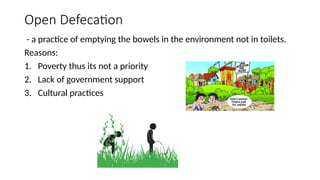
Open Defecation
- a practice of emptying the bowels in the environment not in toilets.
Reasons:
1. Poverty thus its not a priority
2. Lack of government support
3. Cultural practices
Open Defecation
Effects in Human Health:
1. Food and water-borne diseases – examples:
diarrhea, typhoid and polio
2. Vector borne diseases – Cholera carried by flies
from feces to food
3. Unending problem of disease exposure
4. Malnutrition in children
Open Defecation
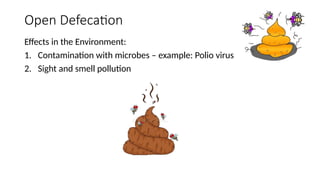
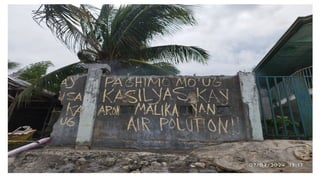
Effects in the Environment:
1. Contamination with microbes – example: Polio virus
2. Sight and smell pollution
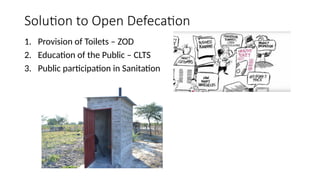
Solution to Open Defecation
1. Provision of Toilets – ZOD
2. Education of the Public – CLTS
3. Public participation in Sanitation
How to Attain PhATSS Service Level
Certification
Barangay/Municipality/City?
PhATSS Service Level Certification
Barangay Level:
1. Documentation:
Grade 1 a. Community Map
(ZOD) b. Barangay Ordinance on ZOD and
establishment of monitoring team
c. Barangay Action Plan to reach G2 (Form D)
d. List of all household heads of all residents in the
Barangay
e. Barangay Development Plan (provides fund to reach G2)
PhATSS Service Level Certification
Barangay Level:
1. Documentation:
Grade 2 a. Copy of G1 (NA in simultaneous application for G1&G2)
(Basic b. Community Map
Sanitation) c. Barangay Action Plan to reach G3 (Form D)
d. Barangay Development Plan (provides fund to reach G3)
e. Local ordinance on mgt of animal excreta & solid waste
f. Equipment list for solid waste collection
g. Schedule of collection of garbage
h. List of designated EcoAides
i. List of all household heads of all residents in the Barangay
k. List of all public institutional facilities located in the brgy
PhATSS Service Level Certification
Barangay Level:
1. Documentation:
Grade 3 a. Copy of G3
(Sustainable b. Community Map
Sanitation) c. Copy of updated WASH Sectoral Plan (PhATSS toolkit for template)
d. Barangay Development Plan
e. Local ordinance on mgt of septage/sewerage & wastewater & WSP
f. If there is a septage/sewerage treatment plant located in the brgy
* Copy of STP permit
* Copy of Septage Collector Transport Permit
g. List of all household heads of all residents in the Barangay
h. List of all public institutional facilities located in the brgy
i. Minutes of meeting of LDWQMC regarding WSP
k. List of Water Service Providers located in the brgy
PhATSS Service Level Certification
Barangay Level:
2. Request
Attachments:
a. Form A – Request Letter (Form A1/A2/A3)
b. Monitoring report (use DOH monitoring system)
c. Copy of PhATSS Service Level Certificate
PhATSS Service Level Certification
Barangay Level:
3. Verification: at least 10% of HH are randomly selected and visited for
interview and assessment
G2 & G3 verification of 50% of public institutional facilities
G3 inspection of Septage Treatment Facility & Wastewater
facility located in the requesting brgy
4. Certification: The Municipal/City PhATSS Verification & Certification
Teams awards the G1/G2/G3 certificate to the Barangay
PhATSS Service Level Certification
Municipalities/Cities
1. Submission to Municipal/City Councilor on Health a Municipal/City
PhATSS Certification Report (Form C)
a. Confirmation of the presence of a representative from the
PHO/PDOHO (CHD for HUCs)in all brgys verification&
certification activities
b. Compilation of PhATSS Service Level certificates of all brgys
c. Result of latest quarterly consolidated sanitation monitoring
report (Official DOH monitoring form)
PhATSS Service Level Certification
Municipalities/Cities
2. After Verification of the validity of documents, municipal/city
Councilor on Health files a resolution endorsing the certification of
their municipality as having complied with all the criteria for G1/G2/G3
of PhATSS.
3. Submission to PHO (Provincial coordinating body) of the ff:
a. Copy of approved municipal/city resolution
b. Monitoring report from official monitoring system of DOH
c. Municipal/City PhATSS Certification Report (Form C)
PhATSS Service Level Certification
Municipalities/Cities
4. Upon satisfactorily review of the reports, PHO & PDOHO shall jointly
confer and award a municipal-wide or city-wide PhATSS Service Level
Certification
PhATSS Service Level Certification
Provinces
When all municipalities & cities have submitted their Certification
Report, the PHO shall submit a notice to the Prov. Councilor for Health
to sponsor a resolution declaring a provincial-wide PhATSS certification
has been achieved (G1/G2/G3 sanitation level).
The resolution shall be forwarded to their respective DOH CHD for
conferring & awarding PhATSS Service Level certification
END OPEN DEFECATION
NOW!!!
Thank You!

ZERO OPEN DEFECATION FOR BARANGAY LGU.pptx

  • 1.
  • 2.
    Department of Health: Vision:Filipinos are among the healthiest people in Southeast Asia by 2022, Asia by 2040. Target: DOH AO 2019-0054 (Guidelines in the Implementation of PhATSS) 1. 100% of Barangays are practicing ZOD by 2025 2. 100% of Barangays are G2 certified or practicing Basic Sanitation by 2028 3. 100% of Barangays are G3 certified or practicing Sustainable Sanitation
  • 3.
    National Sustainable SanitationPlan Vision: Sustainable sanitation for all Filipinos. Preamble: a. Sanitation as a human right & a public good. b. Sanitation focus on the poorest population groups & poorest barangays c. Sanitation is essential for total human development d. Sanitation that is gender sensitive
  • 4.
    Open Defecation - apractice of emptying the bowels in the environment not in toilets. Reasons: 1. Poverty thus its not a priority 2. Lack of government support 3. Cultural practices
  • 5.
    Open Defecation Effects inHuman Health: 1. Food and water-borne diseases – examples: diarrhea, typhoid and polio 2. Vector borne diseases – Cholera carried by flies from feces to food 3. Unending problem of disease exposure 4. Malnutrition in children
  • 6.
    Open Defecation Effects inthe Environment: 1. Contamination with microbes – example: Polio virus 2. Sight and smell pollution
  • 8.
    Solution to OpenDefecation 1. Provision of Toilets – ZOD 2. Education of the Public – CLTS 3. Public participation in Sanitation
  • 9.
    How to AttainPhATSS Service Level Certification Barangay/Municipality/City?
  • 10.
    PhATSS Service LevelCertification Barangay Level: 1. Documentation: Grade 1 a. Community Map (ZOD) b. Barangay Ordinance on ZOD and establishment of monitoring team c. Barangay Action Plan to reach G2 (Form D) d. List of all household heads of all residents in the Barangay e. Barangay Development Plan (provides fund to reach G2)
  • 11.
    PhATSS Service LevelCertification Barangay Level: 1. Documentation: Grade 2 a. Copy of G1 (NA in simultaneous application for G1&G2) (Basic b. Community Map Sanitation) c. Barangay Action Plan to reach G3 (Form D) d. Barangay Development Plan (provides fund to reach G3) e. Local ordinance on mgt of animal excreta & solid waste f. Equipment list for solid waste collection g. Schedule of collection of garbage h. List of designated EcoAides i. List of all household heads of all residents in the Barangay k. List of all public institutional facilities located in the brgy
  • 12.
    PhATSS Service LevelCertification Barangay Level: 1. Documentation: Grade 3 a. Copy of G3 (Sustainable b. Community Map Sanitation) c. Copy of updated WASH Sectoral Plan (PhATSS toolkit for template) d. Barangay Development Plan e. Local ordinance on mgt of septage/sewerage & wastewater & WSP f. If there is a septage/sewerage treatment plant located in the brgy * Copy of STP permit * Copy of Septage Collector Transport Permit g. List of all household heads of all residents in the Barangay h. List of all public institutional facilities located in the brgy i. Minutes of meeting of LDWQMC regarding WSP k. List of Water Service Providers located in the brgy
  • 13.
    PhATSS Service LevelCertification Barangay Level: 2. Request Attachments: a. Form A – Request Letter (Form A1/A2/A3) b. Monitoring report (use DOH monitoring system) c. Copy of PhATSS Service Level Certificate
  • 14.
    PhATSS Service LevelCertification Barangay Level: 3. Verification: at least 10% of HH are randomly selected and visited for interview and assessment G2 & G3 verification of 50% of public institutional facilities G3 inspection of Septage Treatment Facility & Wastewater facility located in the requesting brgy 4. Certification: The Municipal/City PhATSS Verification & Certification Teams awards the G1/G2/G3 certificate to the Barangay
  • 15.
    PhATSS Service LevelCertification Municipalities/Cities 1. Submission to Municipal/City Councilor on Health a Municipal/City PhATSS Certification Report (Form C) a. Confirmation of the presence of a representative from the PHO/PDOHO (CHD for HUCs)in all brgys verification& certification activities b. Compilation of PhATSS Service Level certificates of all brgys c. Result of latest quarterly consolidated sanitation monitoring report (Official DOH monitoring form)
  • 16.
    PhATSS Service LevelCertification Municipalities/Cities 2. After Verification of the validity of documents, municipal/city Councilor on Health files a resolution endorsing the certification of their municipality as having complied with all the criteria for G1/G2/G3 of PhATSS. 3. Submission to PHO (Provincial coordinating body) of the ff: a. Copy of approved municipal/city resolution b. Monitoring report from official monitoring system of DOH c. Municipal/City PhATSS Certification Report (Form C)
  • 17.
    PhATSS Service LevelCertification Municipalities/Cities 4. Upon satisfactorily review of the reports, PHO & PDOHO shall jointly confer and award a municipal-wide or city-wide PhATSS Service Level Certification
  • 18.
    PhATSS Service LevelCertification Provinces When all municipalities & cities have submitted their Certification Report, the PHO shall submit a notice to the Prov. Councilor for Health to sponsor a resolution declaring a provincial-wide PhATSS certification has been achieved (G1/G2/G3 sanitation level). The resolution shall be forwarded to their respective DOH CHD for conferring & awarding PhATSS Service Level certification
  • 19.
  • 20.