Low Lighting
Techniques:
Youngblood’s English Magazine13
In many of Tim Burton’s movies, he uses
the technique of low key lighting to empha-
size the mysteriousness and to add sus-
pense to the movie and scenes.
ighting is an important part in a film, as without it,
you would not be able to see the characters, set, or
anything happening; The film would just be a dark
screen with voices and sound effects.
The way that Tim Burton uses lighting is for a
totally different reason; Tim Burton uses lighting to add
suspense and to create a mysterious vibe to his films.
For instance, have you ever seen Corpse Bride? In that
film, he uses lighting, specifically low key lighting to
add suspense towards what is going to happen when
Victor, the main character, is being dragged under-
ground by vines when lost in the forest. And it definite-
ly does the trick! It allows you to wonder what is
happening, why it is happening and especially makes
you wonder what will happen next. Personally, I
thought, ‘What’s happening?! Why is it happening?!
Why are the vines grabbing him?! The suspense is
killing me!’.
L This happens in almost all of Tim Burton’s
movies. The low lighting is used in Alice in Wonderland,
Nightmare Before Christmas, Sweeney Todd, and Edward
Scissorhands. In each one of them, you can find elements
that are leading to suspense, and make you wonder,
allowing for you to question what might happen next.
Low lighting is used to keep you on the edge of your
seat, keep you interested and wondering during the
movie. It allows for you to connect with how the charac-
ter on screen is feeling, gives you, who can see and sense
more than the character, a slight insight into the won-
dering, mysterious, confused mindset of the character. It
connects you two, and it lets you feel what the character
is feeling.
Tim Burton’s goal is to attract your attention,
and he definitely succeeds with his dark, seemingly
insane main characters, making your mind work as you
watch his films. The lighting used in Edward Scissor-
hands, in the scene where Peg enters the upstairs room
of Edward’s mansion and sees Edward for the first time,
is low key lighting. It is used to add mystery as to why he
has scissors and blades for hands, and what is going to
happen to Peg since she discovered him. It keeps you on
the edge of your seat, or at least, Tim Burton hopes it
will keep you on the edge of your seat. By using this
technique of lighting, Tim Burton hopes that he will
keep your attention, make you wonder what is going on,
and make you question Edward, attracting even more of
your attention than some bad situational comedy on
television.
In this scene from Alice in Wonderland
low key lighting is used to add mystery
as to where Alice is, and suspense
through wondering what is going to
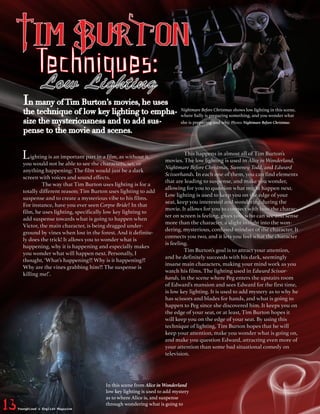
Nightmare Before Christmas shows low lighting in this scene,
where Sally is preparing something, and you wonder what
she is preparing and why. Photo: Nightmare Before Christmas
Youngblood’s English Magazine 14
“I think a lot of kids
feel alone and slightly
isolated in their own
world.” -Tim Burton
In Nightmare Before Christmas, Sally is seen making
a mixture, cooking something. You’re not sure what it is
when you first see it, as she could be making anything, but
from the low lighting used, you can tell that it’s something
sinister, and it makes you wonder what that something
sinister will be, and what will happen when the concoction
is complete. It creates the suspense for his film, in just that
single scene. The lighting adds mystery, and keeps you
wondering.
For example, in Alice in Wonderland, when Alice
first falls down the rabbit hole and rediscovers Wonder-
land, she looks around, in the low light of the
Wonderland forest, with crazy colors, plants,
and creatures. She looks lost, and the way
that Tim Burton portrays the feeling of being
lost is not only through actress Mia
Wasikowska’s facial emotion, but through
the lighting used as well. The low light that the forest gives
off, mixed with the sun bursts coming through the trees,
creates an element of mystery and suspense. It makes you
wonder why Alice has found this place, and what this
place is, and it lets you understand why it is called Won-
derland. It makes your mind wonder why, what, and
basically allows you to create your own suspense in your
head as you wonder and try to figure out what is going on.
It’s as if you’re a small child who has just discov-
ered the attic of their house. You’re mesmerized by this
new-to-you ‘world’ and you’re curious as to what lies in the
darkest shadows. You’re scared, but yet something- some
element of curiosity- is pulling your interest into discover-
ing it all. Your mind is wandering, creating short stories for
things as all kids do, and the mystery of this new place is
overwhelming. You don’t know what this place is, why it is
here, or what will happen if you go exploring in the
darkest corner, but yet, you’re bouncing with anticipation
of what you will find.
That’s the feeling that Tim Burton portrays with
the low lighting in his films. It’s the feeling of being
isolated in a world all to yourself, being alone, and
yet instead of being scared, being intrigued by the
mystery that this ‘world’ has to offer.
This can also relate to a quote by Tim
Burton, where he says, “I think a lot of kids feel
alone and slightly isolated in their own world.”*
Since you can connect to how the character is
feeling, it can also connect you to memories of your
past, where you might now have known what was
happening, or what was going to
happen next, or why certain things
happened at a certain time. It let’s
you see into those feelings,
connecting you further. That’s why
the quote, which is a vision of
what Tim Burton thinks some kids are like, can
relate you to his movies through the lighting that
causes suspense.
But it’s not only in Edward Scissorhands,
Alice in Wonderland, and Corpse Bride that Tim
Burton uses low key lighting to portray mystery,
emotion, and add suspense. He uses it in a majority
of his films, from Batman, to Sweeney Todd, to
Nightmare Before Christmas. If you’ve seen these
movies, you can probably tell that most of the
movie is dark, filmed with barely enough light to
see what is happening. The low lighting adds
suspense and mystery, and allows YOU to create an
answer to ‘Why is this happening?’ and ‘What will
happen next?’.
A scene from Edward Scissorhands
portraying low lighting. Photo:
Edward Scissorhands
Low lighting shown in Corpse Bride.
Photo: Corpse Bride
*Quote from http://www.brainyquote.com/quotes/quotes/t/timburton454896.html

Tim Burton's Style Techniques

  • 1.
    Low Lighting Techniques: Youngblood’s EnglishMagazine13 In many of Tim Burton’s movies, he uses the technique of low key lighting to empha- size the mysteriousness and to add sus- pense to the movie and scenes. ighting is an important part in a film, as without it, you would not be able to see the characters, set, or anything happening; The film would just be a dark screen with voices and sound effects. The way that Tim Burton uses lighting is for a totally different reason; Tim Burton uses lighting to add suspense and to create a mysterious vibe to his films. For instance, have you ever seen Corpse Bride? In that film, he uses lighting, specifically low key lighting to add suspense towards what is going to happen when Victor, the main character, is being dragged under- ground by vines when lost in the forest. And it definite- ly does the trick! It allows you to wonder what is happening, why it is happening and especially makes you wonder what will happen next. Personally, I thought, ‘What’s happening?! Why is it happening?! Why are the vines grabbing him?! The suspense is killing me!’. L This happens in almost all of Tim Burton’s movies. The low lighting is used in Alice in Wonderland, Nightmare Before Christmas, Sweeney Todd, and Edward Scissorhands. In each one of them, you can find elements that are leading to suspense, and make you wonder, allowing for you to question what might happen next. Low lighting is used to keep you on the edge of your seat, keep you interested and wondering during the movie. It allows for you to connect with how the charac- ter on screen is feeling, gives you, who can see and sense more than the character, a slight insight into the won- dering, mysterious, confused mindset of the character. It connects you two, and it lets you feel what the character is feeling. Tim Burton’s goal is to attract your attention, and he definitely succeeds with his dark, seemingly insane main characters, making your mind work as you watch his films. The lighting used in Edward Scissor- hands, in the scene where Peg enters the upstairs room of Edward’s mansion and sees Edward for the first time, is low key lighting. It is used to add mystery as to why he has scissors and blades for hands, and what is going to happen to Peg since she discovered him. It keeps you on the edge of your seat, or at least, Tim Burton hopes it will keep you on the edge of your seat. By using this technique of lighting, Tim Burton hopes that he will keep your attention, make you wonder what is going on, and make you question Edward, attracting even more of your attention than some bad situational comedy on television. In this scene from Alice in Wonderland low key lighting is used to add mystery as to where Alice is, and suspense through wondering what is going to Nightmare Before Christmas shows low lighting in this scene, where Sally is preparing something, and you wonder what she is preparing and why. Photo: Nightmare Before Christmas
  • 2.
    Youngblood’s English Magazine14 “I think a lot of kids feel alone and slightly isolated in their own world.” -Tim Burton In Nightmare Before Christmas, Sally is seen making a mixture, cooking something. You’re not sure what it is when you first see it, as she could be making anything, but from the low lighting used, you can tell that it’s something sinister, and it makes you wonder what that something sinister will be, and what will happen when the concoction is complete. It creates the suspense for his film, in just that single scene. The lighting adds mystery, and keeps you wondering. For example, in Alice in Wonderland, when Alice first falls down the rabbit hole and rediscovers Wonder- land, she looks around, in the low light of the Wonderland forest, with crazy colors, plants, and creatures. She looks lost, and the way that Tim Burton portrays the feeling of being lost is not only through actress Mia Wasikowska’s facial emotion, but through the lighting used as well. The low light that the forest gives off, mixed with the sun bursts coming through the trees, creates an element of mystery and suspense. It makes you wonder why Alice has found this place, and what this place is, and it lets you understand why it is called Won- derland. It makes your mind wonder why, what, and basically allows you to create your own suspense in your head as you wonder and try to figure out what is going on. It’s as if you’re a small child who has just discov- ered the attic of their house. You’re mesmerized by this new-to-you ‘world’ and you’re curious as to what lies in the darkest shadows. You’re scared, but yet something- some element of curiosity- is pulling your interest into discover- ing it all. Your mind is wandering, creating short stories for things as all kids do, and the mystery of this new place is overwhelming. You don’t know what this place is, why it is here, or what will happen if you go exploring in the darkest corner, but yet, you’re bouncing with anticipation of what you will find. That’s the feeling that Tim Burton portrays with the low lighting in his films. It’s the feeling of being isolated in a world all to yourself, being alone, and yet instead of being scared, being intrigued by the mystery that this ‘world’ has to offer. This can also relate to a quote by Tim Burton, where he says, “I think a lot of kids feel alone and slightly isolated in their own world.”* Since you can connect to how the character is feeling, it can also connect you to memories of your past, where you might now have known what was happening, or what was going to happen next, or why certain things happened at a certain time. It let’s you see into those feelings, connecting you further. That’s why the quote, which is a vision of what Tim Burton thinks some kids are like, can relate you to his movies through the lighting that causes suspense. But it’s not only in Edward Scissorhands, Alice in Wonderland, and Corpse Bride that Tim Burton uses low key lighting to portray mystery, emotion, and add suspense. He uses it in a majority of his films, from Batman, to Sweeney Todd, to Nightmare Before Christmas. If you’ve seen these movies, you can probably tell that most of the movie is dark, filmed with barely enough light to see what is happening. The low lighting adds suspense and mystery, and allows YOU to create an answer to ‘Why is this happening?’ and ‘What will happen next?’. A scene from Edward Scissorhands portraying low lighting. Photo: Edward Scissorhands Low lighting shown in Corpse Bride. Photo: Corpse Bride *Quote from http://www.brainyquote.com/quotes/quotes/t/timburton454896.html