Non Toxic Toys
Making daycare centers safe for play!
Kate Howard
Environmental Health & Safety Specialist
New York State Pollution Prevention Institute
© 2010 New York State Pollution Prevention Institute. All rights reserved
Focus
• How toxic chemicals affect children
• Hot topic: Phthlates and bisphenol A
• Toxics found in toys and their effect on the
environment
• Recall and testing information sources
• Consumer Product Safety Improvement Act
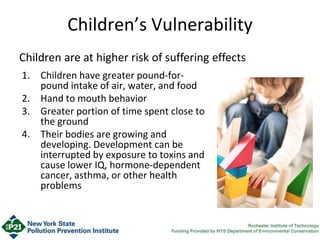
Children’s Vulnerability
1. Children have greater pound-for-
pound intake of air, water, and food
2. Hand to mouth behavior
3. Greater portion of time spent close to
the ground
4. Their bodies are growing and
developing. Development can be
interrupted by exposure to toxins and
cause lower IQ, hormone-dependent
cancer, asthma, or other health
problems
Children are at higher risk of suffering effects
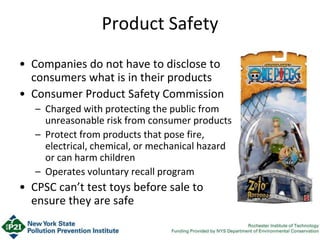
Product Safety
• Companies do not have to disclose to
consumers what is in their products
• Consumer Product Safety Commission
– Charged with protecting the public from
unreasonable risk from consumer products
– Protect from products that pose fire,
electrical, chemical, or mechanical hazard
or can harm children
– Operates voluntary recall program
• CPSC can’t test toys before sale to
ensure they are safe
Consumer Product Safety Improvement Act
• Enacted Jan08
• Goal to protect children from lead and phthalate hazards by
– Reducing lead limit
– Establishing phthalate limit
– Requiring product testing to ensure products meet limits
• Guidance & changes
– Jan08: resellers do not need to certify products against lead and
phthalate requirements
– Jan30: one year extension for testing of certain products
• Articles must meet the lead & phthalate limits, but manufacturers do not
need to test products to verify they meet the requirements
• First major deadline passed Feb10
– Lead limit reduced to 600ppm
– Limit for certain phthalates set to 0.1% (100ppm)
CPSIA (continued)
1. Lead paint ban strengthened
1977 limit of 600ppm down to 90ppm by Aug09
2. Lead in children’s products is a banned hazardous substance
600ppm Feb09
300ppm Aug09
100ppm Aug11
3. Ban on phthalates in toys & children’s products
 Products with DEHP, DBP, BBP higher than 0.1% are permanently
banned Feb09
 Products children can put in their mouth with DINP, DnOP, & DIDP
higher than 0.1% are provisionally banned Feb09
4. CPSC significant funding & staff increases
5. Increased penalties
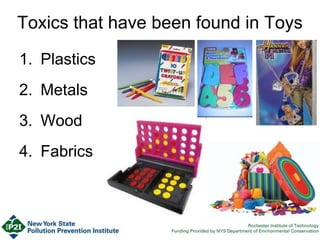
Toxics that have been found in Toys
1. Plastics
2. Metals
3. Wood
4. Fabrics
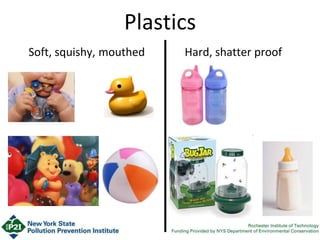
Plastics
Soft, squishy, mouthed Hard, shatter proof
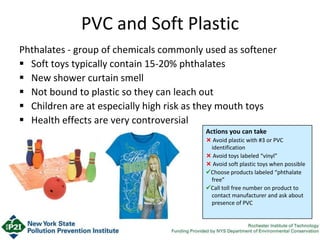
Phthalates - group of chemicals commonly used as softener
 Soft toys typically contain 15-20% phthalates
 New shower curtain smell
 Not bound to plastic so they can leach out
 Children are at especially high risk as they mouth toys
 Health effects are very controversial
PVC and Soft Plastic
Actions you can take
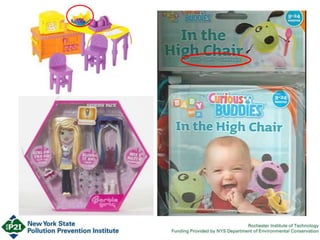
 Avoid plastic with #3 or PVC
identification
 Avoid toys labeled “vinyl”
 Avoid soft plastic toys when possible
Choose products labeled “phthalate
free”
Call toll free number on product to
contact manufacturer and ask about
presence of PVC
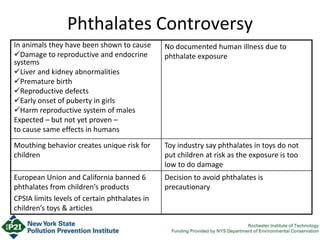
Phthalates Controversy
In animals they have been shown to cause
Damage to reproductive and endocrine
systems
Liver and kidney abnormalities
Premature birth
Reproductive defects
Early onset of puberty in girls
Harm reproductive system of males
Expected – but not yet proven –
to cause same effects in humans
No documented human illness due to
phthalate exposure
Mouthing behavior creates unique risk for
children
Toy industry say phthalates in toys do not
put children at risk as the exposure is too
low to do damage
European Union and California banned 6
phthalates from children’s products
CPSIA limits levels of certain phthalates in
children’s toys & articles
Decision to avoid phthalates is
precautionary
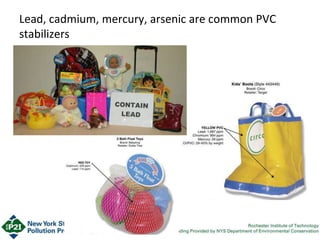
Lead, cadmium, mercury, arsenic are common PVC
stabilizers
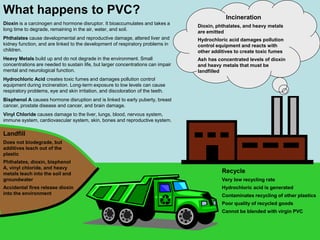
Incineration
Dioxin, phthalates, and heavy metals
are emitted
Hydrochloric acid damages pollution
control equipment and reacts with
other additives to create toxic fumes
Ash has concentrated levels of dioxin
and heavy metals that must be
landfilled
Landfill
Does not biodegrade, but
additives leach out of the
plastic
Phthalates, dioxin, bisphenol
A, vinyl chloride, and heavy
metals leach into the soil and
groundwater
Accidental fires release dioxin
into the environment
What happens to PVC?
Recycle
Very low recycling rate
Hydrochloric acid is generated
Contaminates recycling of other plastics
Poor quality of recycled goods
Cannot be blended with virgin PVC
Dioxin is a carcinogen and hormone disruptor. It bioaccumulates and takes a
long time to degrade, remaining in the air, water, and soil.
Phthalates cause developmental and reproductive damage, altered liver and
kidney function, and are linked to the development of respiratory problems in
children.
Heavy Metals build up and do not degrade in the environment. Small
concentrations are needed to sustain life, but larger concentrations can impair
mental and neurological function.
Hydrochloric Acid creates toxic fumes and damages pollution control
equipment during incineration. Long-term exposure to low levels can cause
respiratory problems, eye and skin irritation, and discoloration of the teeth.
Bisphenol A causes hormone disruption and is linked to early puberty, breast
cancer, prostate disease and cancer, and brain damage.
Vinyl Chloride causes damage to the liver, lungs, blood, nervous system,
immune system, cardiovascular system, skin, bones and reproductive system.
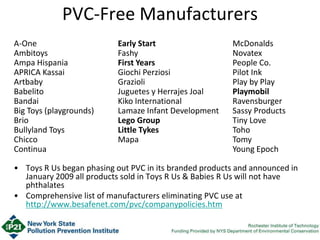
PVC-Free Manufacturers
• Toys R Us began phasing out PVC in its branded products and announced in
January 2009 all products sold in Toys R Us & Babies R Us will not have
phthalates
• Comprehensive list of manufacturers eliminating PVC use at
http://www.besafenet.com/pvc/companypolicies.htm
A-One
Ambitoys
Ampa Hispania
APRICA Kassai
Artbaby
Babelito
Bandai
Big Toys (playgrounds)
Brio
Bullyland Toys
Chicco
Continua
Early Start
Fashy
First Years
Giochi Perziosi
Grazioli
Juguetes y Herrajes Joal
Kiko International
Lamaze Infant Development
Lego Group
Little Tykes
Mapa
McDonalds
Novatex
People Co.
Pilot Ink
Play by Play
Playmobil
Ravensburger
Sassy Products
Tiny Love
Toho
Tomy
Young Epoch
Polycarbonate & BPA
Bisphenol-A – found in some polycarbonate
shatter resistant plastics
 Baby bottles, metal can linings, sippy
cups, food storage
 Water soluble
 Heating a container increases BPA
leaching into liquid
 Endocrine disruptor
 Linked to down’s syndrome, obesity,
hyperactivity, breast & prostate
cancer
 Causes breast cancer, testicular
cancer, and diabetes in laboratory
animals at low doses
 Canada banned baby bottles with BPA
 Toxic to aquatic environment
Actions you can take
 Avoid plastic with #7, OTHER, or PC
identification for storing foods and drinks
 Avoid heating drinks or food in PC plastic
 Avoid using strong cleaners on PC containers as
they release BPA from the plastic
Choose products labeled “BPA free”
Call toll free number on product to contact
manufacturer and ask about presence of BPA
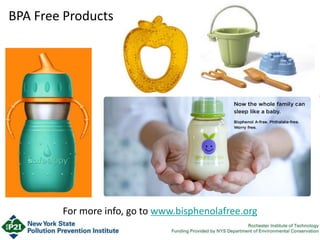
BPA Free Products
For more info, go to www.bisphenolafree.org
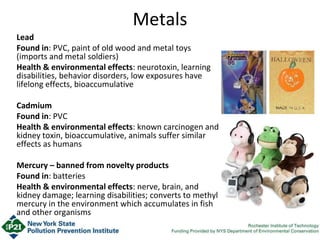
Metals
Lead
Found in: PVC, paint of old wood and metal toys
(imports and metal soldiers)
Health & environmental effects: neurotoxin, learning
disabilities, behavior disorders, low exposures have
lifelong effects, bioaccumulative
Cadmium
Found in: PVC
Health & environmental effects: known carcinogen and
kidney toxin, bioaccumulative, animals suffer similar
effects as humans
Mercury – banned from novelty products
Found in: batteries
Health & environmental effects: nerve, brain, and
kidney damage; learning disabilities; converts to methyl
mercury in the environment which accumulates in fish
and other organisms
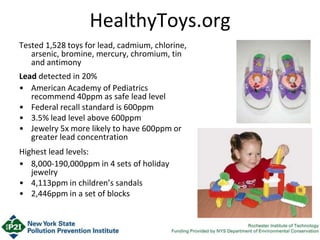
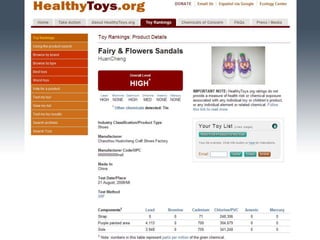
HealthyToys.org
Tested 1,528 toys for lead, cadmium, chlorine,
arsenic, bromine, mercury, chromium, tin
and antimony
Lead detected in 20%
• American Academy of Pediatrics
recommend 40ppm as safe lead level
• Federal recall standard is 600ppm
• 3.5% lead level above 600ppm
• Jewelry 5x more likely to have 600ppm or
greater lead concentration
Highest lead levels:
• 8,000-190,000ppm in 4 sets of holiday
jewelry
• 4,113ppm in children’s sandals
• 2,446ppm in a set of blocks
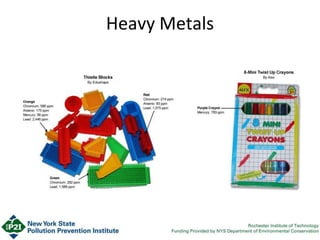
Heavy Metals
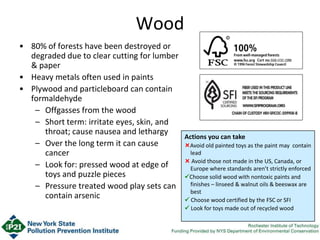
Wood
• 80% of forests have been destroyed or
degraded due to clear cutting for lumber
& paper
• Heavy metals often used in paints
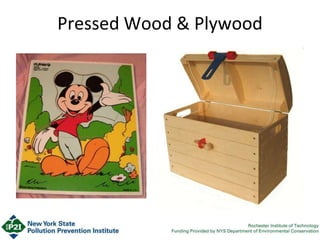
• Plywood and particleboard can contain
formaldehyde
– Offgasses from the wood
– Short term: irritate eyes, skin, and
throat; cause nausea and lethargy
– Over the long term it can cause
cancer
– Look for: pressed wood at edge of
toys and puzzle pieces
– Pressure treated wood play sets can
contain arsenic
Actions you can take
Avoid old painted toys as the paint may contain
lead
 Avoid those not made in the US, Canada, or
Europe where standards aren’t strictly enforced
Choose solid wood with nontoxic paints and
finishes – linseed & walnut oils & beeswax are
best
 Choose wood certified by the FSC or SFI
 Look for toys made out of recycled wood
Pressed Wood & Plywood
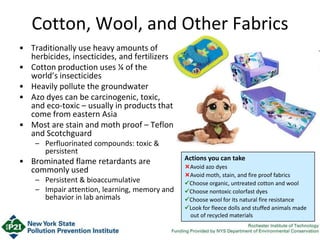
Cotton, Wool, and Other Fabrics
• Traditionally use heavy amounts of
herbicides, insecticides, and fertilizers
• Cotton production uses ¼ of the
world’s insecticides
• Heavily pollute the groundwater
• Azo dyes can be carcinogenic, toxic,
and eco-toxic – usually in products that
come from eastern Asia
• Most are stain and moth proof – Teflon
and Scotchguard
– Perfluorinated compounds: toxic &
persistent
• Brominated flame retardants are
commonly used
– Persistent & bioaccumulative
– Impair attention, learning, memory and
behavior in lab animals
Actions you can take
Avoid azo dyes
Avoid moth, stain, and fire proof fabrics
Choose organic, untreated cotton and wool
Choose nontoxic colorfast dyes
Choose wool for its natural fire resistance
Look for fleece dolls and stuffed animals made
out of recycled materials
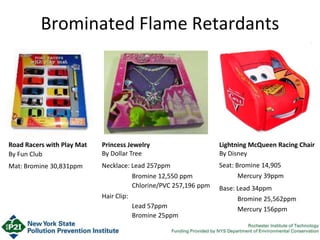
Brominated Flame Retardants
Road Racers with Play Mat
By Fun Club
Mat: Bromine 30,831ppm
Princess Jewelry
By Dollar Tree
Necklace: Lead 257ppm
Bromine 12,550 ppm
Chlorine/PVC 257,196 ppm
Hair Clip:
Lead 57ppm
Bromine 25ppm
Lightning McQueen Racing Chair
By Disney
Seat: Bromine 14,905
Mercury 39ppm
Base: Lead 34ppm
Bromine 25,562ppm
Mercury 156ppm
Information Sources
Product Testing: Healthy Toys www.healthytoys.org
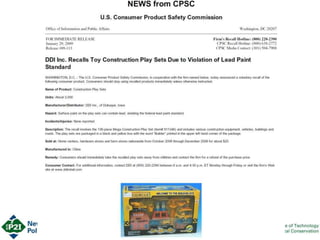
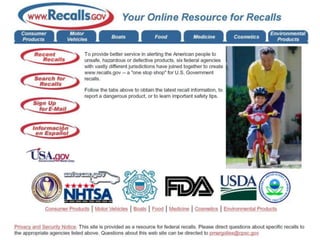
Product Recalls: CPSC www.cpsc.gov & Recalls.gov www.recalls.gov
Washington State Toxics Coalition
Safe Start for Kids http://www.watoxics.org/safer-products/safe-start-for-kids
Toxic Free Toys Campaign http://www.watoxics.org/issues/saferproducts
Environment California Stop Toxic Toys
http://www.environmentcalifornia.org/environmental-health/stop-toxic-toys
Healthy Child Healthy World http://healthychild.org
US PIRG (Public Interest Research Group) www.uspirg.org/issues/toy-safety
Environmental Working Group www.ewg.org
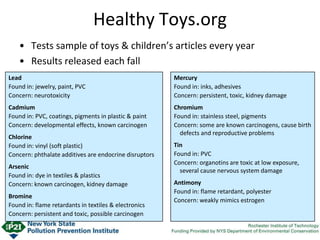
Healthy Toys.org
• Tests sample of toys & children’s articles every year
• Results released each fall
Lead
Found in: jewelry, paint, PVC
Concern: neurotoxicity
Cadmium
Found in: PVC, coatings, pigments in plastic & paint
Concern: developmental effects, known carcinogen
Chlorine
Found in: vinyl (soft plastic)
Concern: phthalate additives are endocrine disruptors
Arsenic
Found in: dye in textiles & plastics
Concern: known carcinogen, kidney damage
Bromine
Found in: flame retardants in textiles & electronics
Concern: persistent and toxic, possible carcinogen
Mercury
Found in: inks, adhesives
Concern: persistent, toxic, kidney damage
Chromium
Found in: stainless steel, pigments
Concern: some are known carcinogens, cause birth
defects and reproductive problems
Tin
Found in: PVC
Concern: organotins are toxic at low exposure,
several cause nervous system damage
Antimony
Found in: flame retardant, polyester
Concern: weakly mimics estrogen
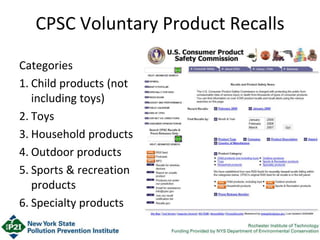
CPSC Voluntary Product Recalls
Categories
1. Child products (not
including toys)
2. Toys
3. Household products
4. Outdoor products
5. Sports & recreation
products
6. Specialty products
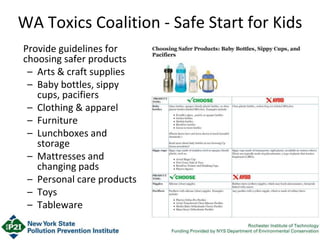
WA Toxics Coalition - Safe Start for Kids
Provide guidelines for
choosing safer products
– Arts & craft supplies
– Baby bottles, sippy
cups, pacifiers
– Clothing & apparel
– Furniture
– Lunchboxes and
storage
– Mattresses and
changing pads
– Personal care products
– Toys
– Tableware
Quick Tips Buying Guidelines
Choose
 Products made from natural materials
 Products labeled “phthalate free” and
“BPA free”
 Made in the USA, Japan, Canada or
Europe
 Solid wood instead of pressed wood
with nontoxic paints and finishes
 Wood certified by FSC or SFI
 Organic and untreated cotton, hemp,
wool
 Brands that have committed to using
environmentally friendly or sustainable
materials
 Call toll free number on product to
contact manufacturer and ask about
presence of PVC and/or BPA
Avoid
 Cheap metal jewelry due to lead
content
 Old painted toys as the paint may
contain lead
 Permanent markers and paints
 Pressed or layered wood due to toxic
glue
 Lights and sounds due to small batteries
with mercury
 Play cosmetics as they often contain
heavy metals
 Plastic labeled vinyl, #3, or PVC as it
typically contains lead and phthalates
 Plastic with #7, OTHER, or PC
identification for storing foods and
drinks
 Moth, stain, and fire proof fabrics
Questions?
Kate Howard
New York State Pollution Prevention Institute
Rochester Institute of Technology
p: 475-5390
f: 475-5455
e: kmhasp@rit.edu
www.nysp2i.rit.edu

Non Toxic Toys - Making Daycare Centers Safe for Play

  • 1.
    Non Toxic Toys Makingdaycare centers safe for play! Kate Howard Environmental Health & Safety Specialist New York State Pollution Prevention Institute © 2010 New York State Pollution Prevention Institute. All rights reserved
  • 2.
    Focus • How toxicchemicals affect children • Hot topic: Phthlates and bisphenol A • Toxics found in toys and their effect on the environment • Recall and testing information sources • Consumer Product Safety Improvement Act
  • 3.
    Children’s Vulnerability 1. Childrenhave greater pound-for- pound intake of air, water, and food 2. Hand to mouth behavior 3. Greater portion of time spent close to the ground 4. Their bodies are growing and developing. Development can be interrupted by exposure to toxins and cause lower IQ, hormone-dependent cancer, asthma, or other health problems Children are at higher risk of suffering effects
  • 4.
    Product Safety • Companiesdo not have to disclose to consumers what is in their products • Consumer Product Safety Commission – Charged with protecting the public from unreasonable risk from consumer products – Protect from products that pose fire, electrical, chemical, or mechanical hazard or can harm children – Operates voluntary recall program • CPSC can’t test toys before sale to ensure they are safe
  • 5.
    Consumer Product SafetyImprovement Act • Enacted Jan08 • Goal to protect children from lead and phthalate hazards by – Reducing lead limit – Establishing phthalate limit – Requiring product testing to ensure products meet limits • Guidance & changes – Jan08: resellers do not need to certify products against lead and phthalate requirements – Jan30: one year extension for testing of certain products • Articles must meet the lead & phthalate limits, but manufacturers do not need to test products to verify they meet the requirements • First major deadline passed Feb10 – Lead limit reduced to 600ppm – Limit for certain phthalates set to 0.1% (100ppm)
  • 6.
    CPSIA (continued) 1. Leadpaint ban strengthened 1977 limit of 600ppm down to 90ppm by Aug09 2. Lead in children’s products is a banned hazardous substance 600ppm Feb09 300ppm Aug09 100ppm Aug11 3. Ban on phthalates in toys & children’s products  Products with DEHP, DBP, BBP higher than 0.1% are permanently banned Feb09  Products children can put in their mouth with DINP, DnOP, & DIDP higher than 0.1% are provisionally banned Feb09 4. CPSC significant funding & staff increases 5. Increased penalties
  • 7.
    Toxics that havebeen found in Toys 1. Plastics 2. Metals 3. Wood 4. Fabrics
  • 8.
  • 9.
    Phthalates - groupof chemicals commonly used as softener  Soft toys typically contain 15-20% phthalates  New shower curtain smell  Not bound to plastic so they can leach out  Children are at especially high risk as they mouth toys  Health effects are very controversial PVC and Soft Plastic Actions you can take  Avoid plastic with #3 or PVC identification  Avoid toys labeled “vinyl”  Avoid soft plastic toys when possible Choose products labeled “phthalate free” Call toll free number on product to contact manufacturer and ask about presence of PVC
  • 11.
    Phthalates Controversy In animalsthey have been shown to cause Damage to reproductive and endocrine systems Liver and kidney abnormalities Premature birth Reproductive defects Early onset of puberty in girls Harm reproductive system of males Expected – but not yet proven – to cause same effects in humans No documented human illness due to phthalate exposure Mouthing behavior creates unique risk for children Toy industry say phthalates in toys do not put children at risk as the exposure is too low to do damage European Union and California banned 6 phthalates from children’s products CPSIA limits levels of certain phthalates in children’s toys & articles Decision to avoid phthalates is precautionary
  • 12.
    Lead, cadmium, mercury,arsenic are common PVC stabilizers
  • 13.
    Incineration Dioxin, phthalates, andheavy metals are emitted Hydrochloric acid damages pollution control equipment and reacts with other additives to create toxic fumes Ash has concentrated levels of dioxin and heavy metals that must be landfilled Landfill Does not biodegrade, but additives leach out of the plastic Phthalates, dioxin, bisphenol A, vinyl chloride, and heavy metals leach into the soil and groundwater Accidental fires release dioxin into the environment What happens to PVC? Recycle Very low recycling rate Hydrochloric acid is generated Contaminates recycling of other plastics Poor quality of recycled goods Cannot be blended with virgin PVC Dioxin is a carcinogen and hormone disruptor. It bioaccumulates and takes a long time to degrade, remaining in the air, water, and soil. Phthalates cause developmental and reproductive damage, altered liver and kidney function, and are linked to the development of respiratory problems in children. Heavy Metals build up and do not degrade in the environment. Small concentrations are needed to sustain life, but larger concentrations can impair mental and neurological function. Hydrochloric Acid creates toxic fumes and damages pollution control equipment during incineration. Long-term exposure to low levels can cause respiratory problems, eye and skin irritation, and discoloration of the teeth. Bisphenol A causes hormone disruption and is linked to early puberty, breast cancer, prostate disease and cancer, and brain damage. Vinyl Chloride causes damage to the liver, lungs, blood, nervous system, immune system, cardiovascular system, skin, bones and reproductive system.
  • 14.
    PVC-Free Manufacturers • ToysR Us began phasing out PVC in its branded products and announced in January 2009 all products sold in Toys R Us & Babies R Us will not have phthalates • Comprehensive list of manufacturers eliminating PVC use at http://www.besafenet.com/pvc/companypolicies.htm A-One Ambitoys Ampa Hispania APRICA Kassai Artbaby Babelito Bandai Big Toys (playgrounds) Brio Bullyland Toys Chicco Continua Early Start Fashy First Years Giochi Perziosi Grazioli Juguetes y Herrajes Joal Kiko International Lamaze Infant Development Lego Group Little Tykes Mapa McDonalds Novatex People Co. Pilot Ink Play by Play Playmobil Ravensburger Sassy Products Tiny Love Toho Tomy Young Epoch
  • 15.
    Polycarbonate & BPA Bisphenol-A– found in some polycarbonate shatter resistant plastics  Baby bottles, metal can linings, sippy cups, food storage  Water soluble  Heating a container increases BPA leaching into liquid  Endocrine disruptor  Linked to down’s syndrome, obesity, hyperactivity, breast & prostate cancer  Causes breast cancer, testicular cancer, and diabetes in laboratory animals at low doses  Canada banned baby bottles with BPA  Toxic to aquatic environment Actions you can take  Avoid plastic with #7, OTHER, or PC identification for storing foods and drinks  Avoid heating drinks or food in PC plastic  Avoid using strong cleaners on PC containers as they release BPA from the plastic Choose products labeled “BPA free” Call toll free number on product to contact manufacturer and ask about presence of BPA
  • 16.
    BPA Free Products Formore info, go to www.bisphenolafree.org
  • 17.
    Metals Lead Found in: PVC,paint of old wood and metal toys (imports and metal soldiers) Health & environmental effects: neurotoxin, learning disabilities, behavior disorders, low exposures have lifelong effects, bioaccumulative Cadmium Found in: PVC Health & environmental effects: known carcinogen and kidney toxin, bioaccumulative, animals suffer similar effects as humans Mercury – banned from novelty products Found in: batteries Health & environmental effects: nerve, brain, and kidney damage; learning disabilities; converts to methyl mercury in the environment which accumulates in fish and other organisms
  • 18.
    HealthyToys.org Tested 1,528 toysfor lead, cadmium, chlorine, arsenic, bromine, mercury, chromium, tin and antimony Lead detected in 20% • American Academy of Pediatrics recommend 40ppm as safe lead level • Federal recall standard is 600ppm • 3.5% lead level above 600ppm • Jewelry 5x more likely to have 600ppm or greater lead concentration Highest lead levels: • 8,000-190,000ppm in 4 sets of holiday jewelry • 4,113ppm in children’s sandals • 2,446ppm in a set of blocks
  • 19.
  • 20.
    Wood • 80% offorests have been destroyed or degraded due to clear cutting for lumber & paper • Heavy metals often used in paints • Plywood and particleboard can contain formaldehyde – Offgasses from the wood – Short term: irritate eyes, skin, and throat; cause nausea and lethargy – Over the long term it can cause cancer – Look for: pressed wood at edge of toys and puzzle pieces – Pressure treated wood play sets can contain arsenic Actions you can take Avoid old painted toys as the paint may contain lead  Avoid those not made in the US, Canada, or Europe where standards aren’t strictly enforced Choose solid wood with nontoxic paints and finishes – linseed & walnut oils & beeswax are best  Choose wood certified by the FSC or SFI  Look for toys made out of recycled wood
  • 21.
  • 22.
    Cotton, Wool, andOther Fabrics • Traditionally use heavy amounts of herbicides, insecticides, and fertilizers • Cotton production uses ¼ of the world’s insecticides • Heavily pollute the groundwater • Azo dyes can be carcinogenic, toxic, and eco-toxic – usually in products that come from eastern Asia • Most are stain and moth proof – Teflon and Scotchguard – Perfluorinated compounds: toxic & persistent • Brominated flame retardants are commonly used – Persistent & bioaccumulative – Impair attention, learning, memory and behavior in lab animals Actions you can take Avoid azo dyes Avoid moth, stain, and fire proof fabrics Choose organic, untreated cotton and wool Choose nontoxic colorfast dyes Choose wool for its natural fire resistance Look for fleece dolls and stuffed animals made out of recycled materials
  • 23.
    Brominated Flame Retardants RoadRacers with Play Mat By Fun Club Mat: Bromine 30,831ppm Princess Jewelry By Dollar Tree Necklace: Lead 257ppm Bromine 12,550 ppm Chlorine/PVC 257,196 ppm Hair Clip: Lead 57ppm Bromine 25ppm Lightning McQueen Racing Chair By Disney Seat: Bromine 14,905 Mercury 39ppm Base: Lead 34ppm Bromine 25,562ppm Mercury 156ppm
  • 24.
    Information Sources Product Testing:Healthy Toys www.healthytoys.org Product Recalls: CPSC www.cpsc.gov & Recalls.gov www.recalls.gov Washington State Toxics Coalition Safe Start for Kids http://www.watoxics.org/safer-products/safe-start-for-kids Toxic Free Toys Campaign http://www.watoxics.org/issues/saferproducts Environment California Stop Toxic Toys http://www.environmentcalifornia.org/environmental-health/stop-toxic-toys Healthy Child Healthy World http://healthychild.org US PIRG (Public Interest Research Group) www.uspirg.org/issues/toy-safety Environmental Working Group www.ewg.org
  • 25.
    Healthy Toys.org • Testssample of toys & children’s articles every year • Results released each fall Lead Found in: jewelry, paint, PVC Concern: neurotoxicity Cadmium Found in: PVC, coatings, pigments in plastic & paint Concern: developmental effects, known carcinogen Chlorine Found in: vinyl (soft plastic) Concern: phthalate additives are endocrine disruptors Arsenic Found in: dye in textiles & plastics Concern: known carcinogen, kidney damage Bromine Found in: flame retardants in textiles & electronics Concern: persistent and toxic, possible carcinogen Mercury Found in: inks, adhesives Concern: persistent, toxic, kidney damage Chromium Found in: stainless steel, pigments Concern: some are known carcinogens, cause birth defects and reproductive problems Tin Found in: PVC Concern: organotins are toxic at low exposure, several cause nervous system damage Antimony Found in: flame retardant, polyester Concern: weakly mimics estrogen
  • 27.
    CPSC Voluntary ProductRecalls Categories 1. Child products (not including toys) 2. Toys 3. Household products 4. Outdoor products 5. Sports & recreation products 6. Specialty products
  • 30.
    WA Toxics Coalition- Safe Start for Kids Provide guidelines for choosing safer products – Arts & craft supplies – Baby bottles, sippy cups, pacifiers – Clothing & apparel – Furniture – Lunchboxes and storage – Mattresses and changing pads – Personal care products – Toys – Tableware
  • 31.
    Quick Tips BuyingGuidelines Choose  Products made from natural materials  Products labeled “phthalate free” and “BPA free”  Made in the USA, Japan, Canada or Europe  Solid wood instead of pressed wood with nontoxic paints and finishes  Wood certified by FSC or SFI  Organic and untreated cotton, hemp, wool  Brands that have committed to using environmentally friendly or sustainable materials  Call toll free number on product to contact manufacturer and ask about presence of PVC and/or BPA Avoid  Cheap metal jewelry due to lead content  Old painted toys as the paint may contain lead  Permanent markers and paints  Pressed or layered wood due to toxic glue  Lights and sounds due to small batteries with mercury  Play cosmetics as they often contain heavy metals  Plastic labeled vinyl, #3, or PVC as it typically contains lead and phthalates  Plastic with #7, OTHER, or PC identification for storing foods and drinks  Moth, stain, and fire proof fabrics
  • 32.
    Questions? Kate Howard New YorkState Pollution Prevention Institute Rochester Institute of Technology p: 475-5390 f: 475-5455 e: kmhasp@rit.edu www.nysp2i.rit.edu