Fragrance Books Inc. @www.perfumerbook.com
Dark Side of Fragrances
Glen O. Brechbill
FRAGRANCE BOOKS INC.
www.perfumerbook.com
New Jersey - USA
2007
Fragrance Books Inc. @www.perfumerbook.com
“To my parents whose
faith in my work & abilities
made this
manuscript possible”
DARK SIDE OF FRAGRANCES ©
This book is a work of non-fiction. No part of the book may be used or reproduced in
any manner whatsoever without written permission from the author except in the case
of brief quotations embodied in critical articles and reviews.
Designed by Glen O. Brechbill
Library of Congress
Brechbill, Glen O.
Dark Side of Fragrances / Glen O. Brechbill
P. cm. 317 pgs.
1. Fragrance Ingredients Non Fiction. 2. Written odor descriptions to facillitate the
understanding of the olfactory language. 1. Essential Oils. 2. Aromas. 3. Chemicals.
4. Classification. 5. Source. 6. Art. 7. Twenty one thousand fragrances. 8. Science.
9. Creativity. I. Title.
Certificate Registry # TXu 1-593-092
Copyright © 2007 by Glen O. Brechbill
All Rights Reserved
PRINTED IN THE UNITED STATES OF AMERICA
10 9 8 7 6 5 4 3 2 1
First Edition
20071027
Glen O. BrechbillII
Fragrance Books Inc. @www.perfumerbook.com
My book titled the "Dark Side of Fragrances" encompasses an entirely different side of the industry. This side
is neither glamorous nor well understood. Issues such as MSC, asthma and cancer are serious, and the cause
of the maladies has been linked to the use of cosmetic products and fragrances.
The enclosed articles share one thing in common, and that is they have been well written and researched. News
articles on the subject are few since its not part of the business that is enchanting. My book helps to bring out
the dark side of the business, and the issues that surround the controversy. Fragrances appear in almost every
cosmetic product in use today to disguise unpleasant base odors. It's hard to avoid them. The fragrance indus-
try makes money by selling scents.
The IFRA organization was created by the perfume industry, whos aim is to regulate the use of essential oils.
They are folks with good intentions, but are lackeys. Prior to modern chemistry cosmetic products were fra-
granced predominately with essential oils. Health problems became more prevalent in the twentieth century
when petroleum became the source of the ingredients. It's O.K. to ban Linalool and Iso Eugenol, but Di Ethyl
Phthalate and Benzyl Salicylate are perfectly fine. Who benefits if the essential oil industry goes out of busi-
ness? Who can afford the massive regulatory nightmare created by an industry pushing the use of synthetics?
Givaudan Fragrance Corporation ( IFRA ) - International Fragrance Association
International Flavors & Fragrances
Firmenich Inc.
Symrise
Takasago International
DARK SIDE OF FRAGRANCES III
About the Book
Fragrance Books Inc. @www.perfumerbook.com
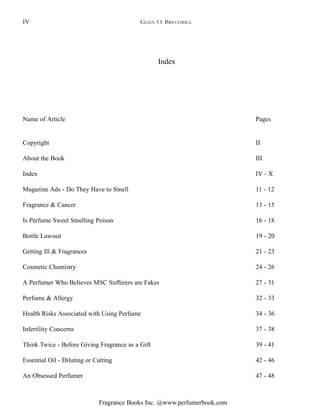
GLEN O. BRECHBILLIV
Copyright II
About the Book III
Index IV - X
Magazine Ads - Do They Have to Smell 11 - 12
Fragrance & Cancer 13 - 15
Is Perfume Sweet Smelling Poison 16 - 18
Bottle Lawsuit 19 - 20
Getting Ill & Fragrances 21 - 23
Cosmetic Chemistry 24 - 26
A Perfumer Who Believes MSC Sufferers are Fakes 27 - 31
Perfume & Allergy 32 - 33
Health Risks Associated with Using Perfume 34 - 36
Infertility Concerns 37 - 38
Think Twice - Before Giving Fragrance as a Gift 39 - 41
Essential Oil - Diluting or Cutting 42 - 46
An Obsessed Perfumer 47 - 48
Index
Name of Article Pages
Fragrance Books Inc. @www.perfumerbook.com
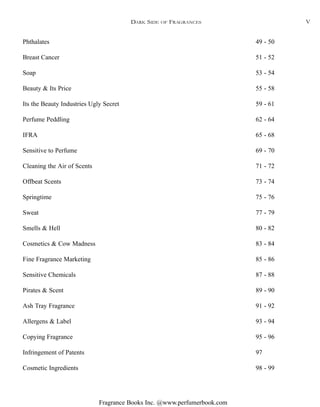
DARK SIDE OF FRAGRANCES
Phthalates 49 - 50
Breast Cancer 51 - 52
Soap 53 - 54
Beauty & Its Price 55 - 58
Its the Beauty Industries Ugly Secret 59 - 61
Perfume Peddling 62 - 64
IFRA 65 - 68
Sensitive to Perfume 69 - 70
Cleaning the Air of Scents 71 - 72
Offbeat Scents 73 - 74
Springtime 75 - 76
Sweat 77 - 79
Smells & Hell 80 - 82
Cosmetics & Cow Madness 83 - 84
Fine Fragrance Marketing 85 - 86
Sensitive Chemicals 87 - 88
Pirates & Scent 89 - 90
Ash Tray Fragrance 91 - 92
Allergens & Label 93 - 94
Copying Fragrance 95 - 96
Infringement of Patents 97
Cosmetic Ingredients 98 - 99
V
Fragrance Books Inc. @www.perfumerbook.com
GLEN O. BRECHBILL
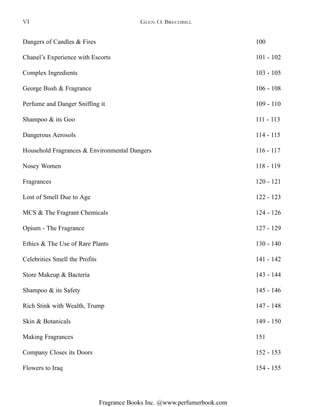
Dangers of Candles & Fires 100
Chanel’s Experience with Escorts 101 - 102
Complex Ingredients 103 - 105
George Bush & Fragrance 106 - 108
Perfume and Danger Sniffing it 109 - 110
Shampoo & its Goo 111 - 113
Dangerous Aerosols 114 - 115
Household Fragrances & Environmental Dangers 116 - 117
Nosey Women 118 - 119
Fragrances 120 - 121
Lost of Smell Due to Age 122 - 123
MCS & The Fragrant Chemicals 124 - 126
Opium - The Fragrance 127 - 129
Ethics & The Use of Rare Plants 130 - 140
Celebrities Smell the Profits 141 - 142
Store Makeup & Bacteria 143 - 144
Shampoo & its Safety 145 - 146
Rich Stink with Wealth, Trump 147 - 148
Skin & Botanicals 149 - 150
Making Fragrances 151
Company Closes its Doors 152 - 153
Flowers to Iraq 154 - 155
VI
Fragrance Books Inc. @www.perfumerbook.com
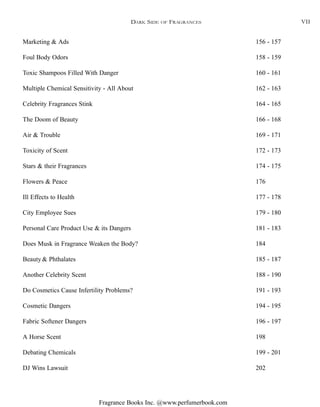
Marketing & Ads 156 - 157
Foul Body Odors 158 - 159
Toxic Shampoos Filled With Danger 160 - 161
Multiple Chemical Sensitivity - All About 162 - 163
Celebrity Fragrances Stink 164 - 165
The Doom of Beauty 166 - 168
Air & Trouble 169 - 171
Toxicity of Scent 172 - 173
Stars & their Fragrances 174 - 175
Flowers & Peace 176
Ill Effects to Health 177 - 178
City Employee Sues 179 - 180
Personal Care Product Use & its Dangers 181 - 183
Does Musk in Fragrance Weaken the Body? 184
Beauty & Phthalates 185 - 187
Another Celebrity Scent 188 - 190
Do Cosmetics Cause Infertility Problems? 191 - 193
Cosmetic Dangers 194 - 195
Fabric Softener Dangers 196 - 197
A Horse Scent 198
Debating Chemicals 199 - 201
DJ Wins Lawsuit 202
DARK SIDE OF FRAGRANCES VII
Fragrance Books Inc. @www.perfumerbook.com
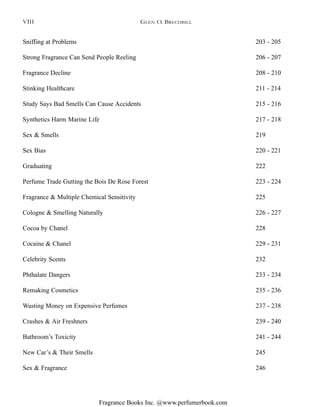
Sniffing at Problems 203 - 205
Strong Fragrance Can Send People Reeling 206 - 207
Fragrance Decline 208 - 210
Stinking Healthcare 211 - 214
Study Says Bad Smells Can Cause Accidents 215 - 216
Synthetics Harm Marine Life 217 - 218
Sex & Smells 219
Sex Bias 220 - 221
Graduating 222
Perfume Trade Gutting the Bois De Rose Forest 223 - 224
Fragrance & Multiple Chemical Sensitivity 225
Cologne & Smelling Naturally 226 - 227
Cocoa by Chanel 228
Cocaine & Chanel 229 - 231
Celebrity Scents 232
Phthalate Dangers 233 - 234
Remaking Cosmetics 235 - 236
Wasting Money on Expensive Perfumes 237 - 238
Crashes & Air Freshners 239 - 240
Bathroom’s Toxicity 241 - 244
New Car’s & Their Smells 245
Sex & Fragrance 246
GLEN O. BRECHBILLVIII
Fragrance Books Inc. @www.perfumerbook.com
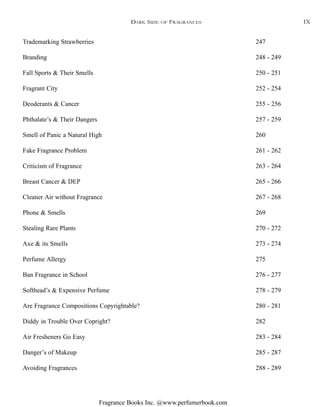
Trademarking Strawberries 247
Branding 248 - 249
Fall Sports & Their Smells 250 - 251
Fragrant City 252 - 254
Deoderants & Cancer 255 - 256
Phthalate’s & Their Dangers 257 - 259
Smell of Panic a Natural High 260
Fake Fragrance Problem 261 - 262
Criticism of Fragrance 263 - 264
Breast Cancer & DEP 265 - 266
Cleaner Air without Fragrance 267 - 268
Phone & Smells 269
Stealing Rare Plants 270 - 272
Axe & its Smells 273 - 274
Perfume Allergy 275
Ban Fragrance in School 276 - 277
Softhead’s & Expensive Perfume 278 - 279
Are Fragrance Compositions Copyrightable? 280 - 281
Diddy in Trouble Over Copright? 282
Air Fresheners Go Easy 283 - 284
Danger’s of Makeup 285 - 287
Avoiding Fragrances 288 - 289
DARK SIDE OF FRAGRANCES IX
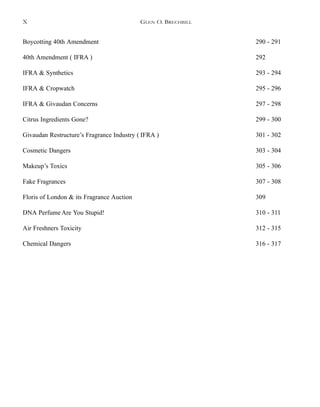
Boycotting 40th Amendment 290 - 291
40th Amendment ( IFRA ) 292
IFRA & Synthetics 293 - 294
IFRA & Cropwatch 295 - 296
IFRA & Givaudan Concerns 297 - 298
Citrus Ingredients Gone? 299 - 300
Givaudan Restructure’s Fragrance Industry ( IFRA ) 301 - 302
Cosmetic Dangers 303 - 304
Makeup’s Toxics 305 - 306
Fake Fragrances 307 - 308
Floris of London & its Fragrance Auction 309
DNA Perfume Are You Stupid! 310 - 311
Air Freshners Toxicity 312 - 315
Chemical Dangers 316 - 317
GLEN O. BRECHBILLX
Fragrance Books Inc. @www.perfumerbook.com
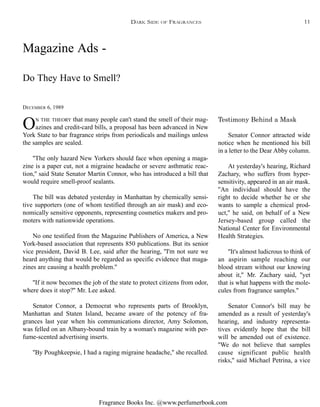
Magazine Ads -
Do They Have to Smell?
DECEMBER 6, 1989
ON THE THEORY that many people can't stand the smell of their mag-
azines and credit-card bills, a proposal has been advanced in New
York State to bar fragrance strips from periodicals and mailings unless
the samples are sealed.
''The only hazard New Yorkers should face when opening a maga-
zine is a paper cut, not a migraine headache or severe asthmatic reac-
tion,'' said State Senator Martin Connor, who has introduced a bill that
would require smell-proof sealants.
The bill was debated yesterday in Manhattan by chemically sensi-
tive supporters (one of whom testified through an air mask) and eco-
nomically sensitive opponents, representing cosmetics makers and pro-
moters with nationwide operations.
No one testified from the Magazine Publishers of America, a New
York-based association that represents 850 publications. But its senior
vice president, David B. Lee, said after the hearing, ''I'm not sure we
heard anything that would be regarded as specific evidence that maga-
zines are causing a health problem.''
''If it now becomes the job of the state to protect citizens from odor,
where does it stop?'' Mr. Lee asked.
Senator Connor, a Democrat who represents parts of Brooklyn,
Manhattan and Staten Island, became aware of the potency of fra-
grances last year when his communications director, Amy Solomon,
was felled on an Albany-bound train by a woman's magazine with per-
fume-scented advertising inserts.
''By Poughkeepsie, I had a raging migraine headache,'' she recalled.
Testimony Behind a Mask
Senator Connor attracted wide
notice when he mentioned his bill
in a letter to the Dear Abby column.
At yesterday's hearing, Richard
Zachary, who suffers from hyper-
sensitivity, appeared in an air mask.
''An individual should have the
right to decide whether he or she
wants to sample a chemical prod-
uct,'' he said, on behalf of a New
Jersey-based group called the
National Center for Environmental
Health Strategies.
''It's almost ludicrous to think of
an aspirin sample reaching our
blood stream without our knowing
about it,'' Mr. Zachary said, ''yet
that is what happens with the mole-
cules from fragrance samples.''
Senator Connor's bill may be
amended as a result of yesterday's
hearing, and industry representa-
tives evidently hope that the bill
will be amended out of existence.
''We do not believe that samples
cause significant public health
risks,'' said Michael Petrina, a vice
DARK SIDE OF FRAGRANCES 11
Fragrance Books Inc. @www.perfumerbook.com
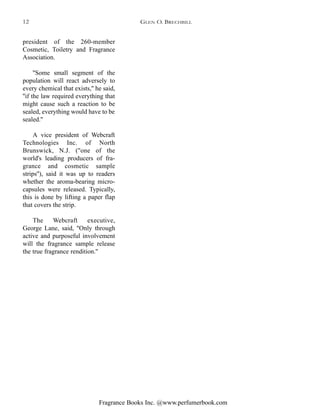
president of the 260-member
Cosmetic, Toiletry and Fragrance
Association.
''Some small segment of the
population will react adversely to
every chemical that exists,'' he said,
''if the law required everything that
might cause such a reaction to be
sealed, everything would have to be
sealed.''
A vice president of Webcraft
Technologies Inc. of North
Brunswick, N.J. (''one of the
world's leading producers of fra-
grance and cosmetic sample
strips''), said it was up to readers
whether the aroma-bearing micro-
capsules were released. Typically,
this is done by lifting a paper flap
that covers the strip.
The Webcraft executive,
George Lane, said, ''Only through
active and purposeful involvement
will the fragrance sample release
the true fragrance rendition.''
GLEN O. BRECHBILL12
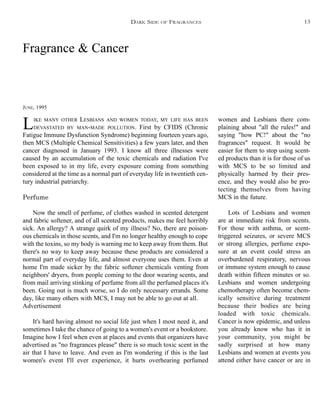
Fragrance & Cancer
JUNE, 1995
LIKE MANY OTHER LESBIANS AND WOMEN TODAY, MY LIFE HAS BEEN
DEVASTATED BY MAN-MADE POLLUTION. First by CFIDS (Chronic
Fatigue Immune Dysfunction Syndrome) beginning fourteen years ago,
then MCS (Multiple Chemical Sensitivities) a few years later, and then
cancer diagnosed in January 1993. I know all three illnesses were
caused by an accumulation of the toxic chemicals and radiation I've
been exposed to in my life, every exposure coming from something
considered at the time as a normal part of everyday life in twentieth cen-
tury industrial patriarchy.
Perfume
Now the smell of perfume, of clothes washed in scented detergent
and fabric softener, and of all scented products, makes me feel horribly
sick. An allergy? A strange quirk of my illness? No, there are poison-
ous chemicals in those scents, and I'm no longer healthy enough to cope
with the toxins, so my body is warning me to keep away from them. But
there's no way to keep away because these products are considered a
normal part of everyday life, and almost everyone uses them. Even at
home I'm made sicker by the fabric softener chemicals venting from
neighbors' dryers, from people coming to the door wearing scents, and
from mail arriving stinking of perfume from all the perfumed places it's
been. Going out is much worse, so I do only necessary errands. Some
day, like many others with MCS, I may not be able to go out at all.
Advertisement
It's hard having almost no social life just when I most need it, and
sometimes I take the chance of going to a women's event or a bookstore.
Imagine how I feel when even at places and events that organizers have
advertised as "no fragrances please" there is so much toxic scent in the
air that I have to leave. And even as I'm wondering if this is the last
women's event I'll ever experience, it hurts overhearing perfumed
women and Lesbians there com-
plaining about "all the rules!" and
saying "how PC!" about the "no
fragrances" request. It would be
easier for them to stop using scent-
ed products than it is for those of us
with MCS to be so limited and
physically harmed by their pres-
ence, and they would also be pro-
tecting themselves from having
MCS in the future.
Lots of Lesbians and women
are at immediate risk from scents.
For those with asthma, or scent-
triggered seizures, or severe MCS
or strong allergies, perfume expo-
sure at an event could stress an
overburdened respiratory, nervous
or immune system enough to cause
death within fifteen minutes or so.
Lesbians and women undergoing
chemotherapy often become chem-
ically sensitive during treatment
because their bodies are being
loaded with toxic chemicals.
Cancer is now epidemic, and unless
you already know who has it in
your community, you might be
sadly surprised at how many
Lesbians and women at events you
attend either have cancer or are in
DARK SIDE OF FRAGRANCES 13
safe. The risk is even higher when
armpits have been shaved and the
deodorant is applied to broken skin.
Of the many books and articles
I've read about healing and prevent-
ing cancer. not one mentions the
dangers of using scented products.
Many Lesbians and women who
are making huge changes in their
lives to heal from cancer are still
using perfumed products for per-
sonal care, housecleaning, and
laundry because they don't have
information about the risks
involved. Even when we don't use
those products ourselves, friends
and other members of our commu-
nities are exposing us to all the
toxic chemicals they use, including
at Lesbian and women's events,
without realizing how dangerous
those perfume chemicals are. For
information about how the perfume
industry is trying to prevent public
education about the toxins in scents
in order to protect their enormous
profits, read environmental health
newsletters like the two listed
below.
Scented Products Pose Health
Risk
Because of my experience with
MCS and what I've learned about
fragrance chemicals, I know that
avoiding perfumed products as
much as possible is an important
part of my effort to recover from
cancer. Avoiding toxic scented
products is just as important in can-
cer prevention as avoiding foods
containing pesticides, hormones,
and other artificial additives.
Over 4,000 chemicals are used
in today's fragrances, and 95% of
those chemicals are made from
petroleum. Toluene was found in
every fragrance sample collected
by the U.S. Environmental
Protection Agency for a 1991
report. Toluene has been proven to
cause cancer, asthma, birth defects,
and nervous system damage, and is
designated as hazardous waste.
Some other toxic chemicals found
in fragrances are ethanol, benzene
derivatives, acetone, formaldehyde,
methylene chloride, and limonene.
The EPA found chloroform as
well in fabric softeners.(1)
Paradichlorobenzene, used in
mothballs and in many "air freshen-
ers," is also used in pesticides,
where it is required by law to be
listed as an active ingredient. The
law does not require it to be listed
on deodorizer labels.(2) Many fra-
grance chemicals are known to
cause cancer, biological mutation,
reproduction problems, acute toxic-
ity, central nervous disorders, asth-
ma, and MCS.(3)
What we smell from petroleum-
based perfumes are volatile chemi-
cals, which travel through the air
and stick to our hair, skin, and
clothes; drift into our eyes and
breathing passages; move into our
lungs, bloodstreams and nervous
systems. If you smell it, the chemi-
cal molecules are entering your
remission and trying to prevent a
recurrence. Also sadly, if you're not
already one of us, you may yet be.
Organizers who try to make their
events fragrance-free are support-
ing health, life, and accessibility to
community for all of us and their
efforts shouldn't be undermined by
resistance and complaints. Unlike
most other kinds of pollution, this
is one kind that we can easily stop
as individuals. Instead it seems to
be increasing, and most buyers and
users of scented products are
females, who are especially target-
ed by advertisers.
I originally wrote the second
half of this article for the newsletter
of the Women's Cancer Resource
Center in Berkeley, California,
where I sometimes go to support
group meetings. Several times I've
had to leave a meeting because a
new member came wearing per-
fume. In every case the woman
wearing it was apologetic, and did-
n't realize that the perfume was
dangerous to herself as well as to
me.
Cancer-causing chemicals have
been found in fragrances, and there
are probably many ways we don't
know about yet that scented prod-
ucts put us at higher risk for cancer.
A few years ago a Lesbian wrote in
Lesbian Connection suggesting that
using underarm deodorant might
increase our risk of breast cancer.
Putting toxic chemicals on sensi-
tive skin where major lymph glands
exist close to breast tissue can't be
GLEN O. BRECHBILL14
going to be with someone who's ill,
because toxic fumes lingering on
your clothes and body can be espe-
cially dangerous to them. It's also
best to avoid burning synthetic
logs, plastic, cardboard, magazines,
newspapers, or other trash in fire-
places or wood-burning stoves.
(Even burning clean dry wood
increases pollution, but it's the
safest choice if you don't have
access to gas or electric heating.)
Everything you do to protect your-
self from toxic exposure also cre-
ates a healthier environment for
others and makes it possible for you
to be near people with MCS and
other illnesses without making
them sicker.
For those of us with MCS, res-
piratory illness, or weakened
immune systems, exposure to
scented products can cause exhaus-
tion, weakness, "hay fever" symp-
toms, dizziness, difficulty concen-
trating, headaches, rashes, swollen
lymph glands, muscle aches and
spasms, heart palpitations, nausea,
stomach cramps, vomiting, asthma
attacks (inability to breathe), neuro-
motor dysfunction, seizures, and/or
loss of consciousness. Every expo-
sure also puts us at risk of becom-
ing permanently sicker.
Someone with MCS can
become very sick from the smell of
fabric softener in your clothes, the
smell of "air freshener" clinging to
your clothes from your home or car,
or from any other scented product
you use, not only be perfume you
have put on. What may seem a mild
fragrance to you can be excruciat-
ingly toxic to someone with MCS.
Even natural fragrances can make
some people with MCS sicker,
because of the damage previously
done to our bodies by toxic chemi-
cals. For that reason it's best to
avoid any scented products at all
near anyone with MCS, or at any
event or place where it's requested
that scented products not be worn.
(1) Informational leaflets by Julia
Kendall, Citizens for a Toxic-Free
Marin. Her sources were:
Neurotoxins: At Home and the
Workplace (Report 99-827 by the
Committee on Science &
Technology, U.S. House of
Representatives, Sept. 16, 1986),
and Lance Wallace, U.S.
Environmental Protection Agency,
(703) 349-8970.
(2) The Delicate Balance, Vol. IV,
Nos. 3-4, p. 19.
3) Julia Kendall, citing a 1988
study by the U.S. House
Subcommittee on Business
Opportunities, chaired by Ron
Wyden (DOR) and the National
Institute of Occupational Safety
and Health.
body. No agency regulates the fra-
grance industry, and there is no
public education about the health
risk present in the many products
that contain chemical scents.
Not Just in a Perfume Bottle
Besides being in perfumes and
colognes, toxic chemical scents are
also present in most laundry deter-
gents, fabric softeners, anti-cling
drier sheets, dishwashing liquids,
disinfectants, "air fresheners
/deodorizers," incense, soaps,
shampoos, hair mousse and condi-
tioners, hair spray, hair processing
chemicals, deodorants, cosmetics,
suntan/sunscreen lotions, after-
shaves, analgesic creams, and lip
balms. Even products marked
"unscented" often are falsely
labelled and actually contain toxic
fragrances. Advertisements for
most of these products are especial-
ly directed to women, and because
we're experiencing an epidemic of
cancer and other illnesses linked to
toxins, it's important for us to be
informed and careful consumers.
Unscented, safer products are avail-
able for personal care, laundry, and
cleaning. (Check the resource list
below.)
Other toxic products to avoid
are all pesticides and herbicides,
insect repellant, flea powder or
spray, flea bombs, mothballs, nail
polish and remover, artificial nail
products, and dry-cleaned clothes.
Avoid pumping your own gasoline
at a service station when you are
DARK SIDE OF FRAGRANCES 15
Fragrance Books Inc. @www.perfumerbook.com
Is Perfume Sweet Smelling Poison?
1997 - PUBLICATION DATE NOT KNOWN
THE INFORMATION PROVIDED IN THIS DOCUMENT IS INTENDED TO INTRO-
DUCE THE READER to human health issues related to the widespread
use of fragrance products.
What Your Nose Can't Tell You About the
Dangers of Perfume
Culturally, Americans are enamored with fragrances, unlike our
European counterparts. Not only are many of the products we use scent-
ed, but many products also have a number of scents from which to
choose. Thus, not only can you buy a product, but you can choose
between 'spring fresh,' 'mountain fresh,' or 'lemon scented' versions of
the product.
Americans also love to wear fragrances. This love of fragrance has
allowed advertisers to reach their audience by linking fragrance with a
desired quality such as 'sexiness,' or 'freshness,' or 'innocence.' This
message is so pervasive that many men and women feel it necessary to
wear a fragrance in order to be desirable or feel sexy.
Advertisers and marketers also know that there is a very powerful
connection between scent and memory, as well as scent and emotion,
and they use this frequently in their promotions. The result is that fra-
grance is considered a 'normal' component of our everyday lives.
Many consumer products contain fragrances. These products
include personal products (i.e. perfumes/colognes, shampoos, condi-
tioners, hairspray, shaving cream, make-up, baby care products, deodor-
ants, soap, feminine products, etc.), and household products (i.e. clean-
ers, air fresheners, bleach, laundry detergent, fabric softeners, etc.).
Perfumes make their way into our mailboxes as well. Many maga-
zines carry "perfume strip" adver-
tisements which waft their odor
into the noses of unsuspecting read-
ers. Some companies use scented
stationary for their mass mailings.
Nobody seems to think that this use
of fragrances is anything by pleas-
ant and harmless.
The problem is that fragrance
products are not necessarily harm-
less, and many can cause some very
unpleasant effects.
Few people realize that there
are at least 5,000 different chemi-
cals used by the fragrance industry
in the manufacture of fragrance
products. Nor do they realize that a
fragrance product such as perfume
may contain as many as 600 indi-
vidual chemical ingredients.
Of the 5,000 different chemi-
cals used in fragrance products, less
than 20% have been tested and
reported as toxic. Many of those
chemicals that have been tested are
regulated by the federal govern-
ment as hazardous materials. The
remaining chemicals have not been
toxicity tested, so the health effects
GLEN O. BRECHBILL16
Fragrance Books Inc. @www.perfumerbook.com
ucts can cause skin sensitivity,
rashes, and dermatitis. In fact, skin
sensitivity is one of the best known
side effects of fragrances.
Fragrances have also been stud-
ied for their effect on people with
chronic lung disease, particularly
asthma. Study results differ, but
some data suggests that as many as
75% of known asthmatics (i.e.
approximately 9 million people in
the U.S. alone) have asthma attacks
that are triggered by perfumes.
Finally, a number of studies
have been conducted to show how
fragrance affects the brain. Because
of the strong connection between
scent and memory, we know that
fragrance products can cross the
blood brain barrier. This is impor-
tant because it means that fragrance
chemicals have the potential to
affect, and possibly damage, brain
tissue. This kind of effect is called
'neurotoxicity.' For example,
Linalool, the most abundant chemi-
cal in perfume and fragrance prod-
ucts, is known to cause lethargy,
depression, and life threatening res-
piratory effects.
As an example of how potent
fragrance can be in the brain, one
study conducted in Japan showed
that the fragrance of citrus was
more effective in alleviating
depression than were prescription
anti-depressants. This means that
the fragrance has psychoactive
properties, which places it in the
category of psychoactive drugs (i.e.
Prozac, Valium, Elavil, etc.).
Other studies have shown that
fragrances can alter mood and alle-
viate anxiety and stress. Mood,
anxiety and stress are properties
that are modulated by natural
chemicals in the brain. That means
that in order for those properties to
change, a chemical change has to
take place. The studies indicate that
the fragrance chemicals cause that
chemical change to occur in the
brain.
Fragrance chemicals can enter
the body through inhalation and
ingestion through the nose and
mouth, and absorption through the
skin. Once in the body they are
absorbed into the bloodstream and
transported throughout the body.
Individual sensitivity to the effects
of fragrance chemicals vary widely
from no effect at all to severe
symptoms.
Symptoms experienced by
some people include:
headache (migraine especially),
sneezing,
watery eyes,
sinus problems,
anxiety,
nausea,
wheezing (especially in asthmat-
ics),
shortness of breath,
inability to concentrate,
brain-fog, dizziness,
convulsions,
sore throat,
and regulatory potential are
unknown.
Of the 150 highest volume
chemicals used in fragrance prod-
ucts, more than 100 can be identi-
fied in the air of a room using
sophisticated testing techniques.
Most of these 100 chemicals are
known to be toxic.
Technically, the Food and Drug
Administration oversees fragrances
under the Food, Drug, and
Cosmetic act. Although the FDA
has jurisdiction, they actually
administer very little control over
fragrance products, allowing the
fragrance industry to police itself.
As a result, only about 16% of cos-
metic products on the market have
been tested for toxicity. Thus, the
FDA really knows very little about
the health effects of fragrance prod-
ucts because they do not require
manufacturers to prove their prod-
ucts are safe. It literally requires an
act of congress before the FDA can
intervene with the fragrance indus-
try to protect public health inter-
ests. However, movements to
increase the documentation of
adverse reactions to fragrance prod-
ucts with the FDA hopefully will
illustrate the need for more strin-
gent oversight of the fragrance
industry.
Studies show that fragrance
chemicals can cause health effects,
primarily at the skin, lungs and
brain. Many studies have been con-
ducted to show that fragrance prod-
DARK SIDE OF FRAGRANCES 17
Fragrance Books Inc. @www.perfumerbook.com
learning disabilities, hyperactive
behavior, and even growth retarda-
tion and seizures in extreme cases.
And even if you think that
avoiding fragranced products will
protect your child, evidence shows
that fragrance chemicals can be
stored in the body, showing up in
breast milk in the nursing mother.
A frightening prospect indeed!
Even though there are outward
symptoms that can be evident, there
may also be symptoms that we can
not see. We know that many chem-
icals can cause birth defects (both
subtle, like learning disabilities,
and overt, like limb deformities) or
make changes in DNA, but it is
often difficult, if not impossible, to
link those effects to a given expo-
sure.
The effects of many fragrance
chemicals on health is still largely
unknown. The fact that different
fragrances cause different symp-
toms (or no symptoms at all) may
indicate that some chemicals are
more toxic than others. But until all
chemicals have been tested, we
can't know which products are
harmful, and which are not. Until
the time that all chemicals have
been tested and the harmful one
removed from production process-
es, it is prudent to avoid fragranced
products as much as possible.
cough,
chest tightness,
hyperactivity (especially in chil-
dren),
tremor,
fatigue,
lethargy, and
drowsiness.
Some critics argue that people
who are 'sensitive' to fragrances are
actually experiencing an anxiety
attack brought on by the memory of
one bad experience upon the real-
ization that they have been exposed
to a fragrance. Interestingly, many
sensitive people find that different
fragrances consistently cause dif-
ferent arrays of symptoms, with
some fragrances causing no ill
effects at all. This experience
would tend to discount the anxiety
attack theory.
Further, odor isn't the cause of
symptoms. Even pleasant (an not
necessarily strong) smelling prod-
ucts, and products whose concen-
tration is too low to be smelled, can
cause symptoms, while some nox-
ious smelling products may not
even elicit a response at all.
Children are even more suscep-
tible than adults to the effects of
fragrance chemicals, yet fragrances
are added to nearly every baby
product on the market. A parent
who wears perfume or uses scented
products may well be poisoning the
air their children breathe. Exposure
to fragrances may result in the child
having difficulty concentrating,
GLEN O. BRECHBILL18
Bottle Lawsuit
MAY 11, 1999
THEY COULD HAVE AVOIDED ALL OF THIS BY TEAMING UP AND CALLING
IT ETERNAL ROMANCE.
Instead, Calvin Klein, the designer, sued his rival, Ralph Lauren,
over perfume well, actually the bottles.
Both sides agree that their fragrances smell nothing alike, but Calvin
Klein, maker of Eternity, is miffed at Ralph Lauren, which introduced
Romance last year. Calvin Klein contended the bottle for the new per-
fume looked suspiciously like Eternity's.
A Federal judge, though, has ruled that consumers are not likely to
be confused by the packaging and that surveys Calvin Klein used to bol-
ster its case were flawed and, thus, ineffective. He denied the prelimi-
nary injunction Calvin Klein sought in the case, which is pending.
Calvin Klein's fragrance unit, the Calvin Klein Cosmetics Company,
and one of its licensees, Conopco Inc., is suing the Polo Ralph Lauren
Corporation and L'Oreal S.A.'s Cosmair Inc., a Ralph Lauren licensee.
In its motion for an injunction, Calvin Klein had sought to stop
Ralph Lauren from selling or advertising Romance, saying that the bot-
tle and product packaging infringe its trademark. Federal District Judge
John E. Sprizzo in New York, rejected the contention Friday.
Representatives for Calvin Klein's cosmetics unit declined to com-
ment yesterday. The company issued a statement saying simply that the
preliminary injunction had been denied and that no trial date had been
set.
Ethan Horwitz, a lawyer for Ralph Lauren, said the decision ''comes
down on every point our way.'' Mr. Horwitz added that Calvin Klein's
assertion that the bottles were iden-
tical was the equivalent of saying
different makes of cars look alike.
''The more educated you are, obvi-
ously, you can tell the difference
between a Volkswagen and a
Cadillac.''
Both bottles are rectangular and
with silver caps and curved bottles.
The Eternity bottle, tall and thin
with a curved T-shape cap, has an
almost hourglass appearance. The
Romance bottle is short and squat,
with a flat, square cap.
''Apart from the dissimilarity of
the two bottles,'' the judge said in
his ruling, ''the likelihood of con-
sumer confusion is also minimized
by the differing marking tech-
niques'' on the packaging and the
prominent ''Romance'' name on the
bottle cap and box of the Ralph
Lauren product.
While Calvin Klein maintains
that it had developed a distinctive
bottle for its $180-an-ounce per-
fume, similar packaging apparently
has been around for, well, eternity.
DARK SIDE OF FRAGRANCES 19
In the ruling denying the
injunction, the judge said that the
Eternity perfume bottle's trademark
infringement argument was ''weak
because, considered as a whole, it is
quite similar to perfume bottles
used by past and present fragrance
designers.''
GLEN O. BRECHBILL20
Getting Ill & Fragrances
JANUARY, 2000 PUBLICATION DATE NOT KNOWN
PERFUME IS ALSO KNOWN AS FRAGRANCE OR SCENT AND HAS BEEN USED
DOWN THE AGES IN RELIGIOUS RITUALS, as aphrodisiacs and to mask
unpleasant odours.
Is there a connection between your chronic medical condition and Allergy,
Food Sensitivity, Chemical sensitivity.
Fragrance Allergy/Sensitivity
In the past fragrances were extracted from plants and natural
sources. In the late 1800s the first synthetic fragrances were introduced
and since then have been used extensively to mimic fragrances from
nature. There are currently around three thousand chemicals used in the
manufacture of fragrances. Many of these are petrochemical deriva-
tives. Chemicals used to manufacture fragrances are also used to pro-
duce flavourings.
There are thousands of body fragrances on the market today.
Fragrances are also found in a large number of perfumed consumer
products. These include personal care products, air fresheners, laundry
products, detergents, paper tissue products, essential oils, fragranced
candles and incense.
Antibacterial products added to air conditioning systems to reduce
the risk of legionella or other diseases that can be circulated via air con-
ditioning. Fragrances are present in public areas from air fresheners and
commercial cleaning products used on public transport, in public build-
ings and health care facilities.
Fragrances are now more the norm than the exception. It is difficult
to find products, including food, pharmaceuticals and tobacco products
that are not fragranced or flavoured.
Are Fragrances Safe?
Little is known about the
impact fragrances have on human
health. There are individuals in the
community who are made ill as a
result of exposure to fragrances.
Cases of anaphylaxis or allergic
shock have been observed follow-
ing fragrance exposure. Lesser
symptoms such as hay fever or
rhinitis are reported. Some studies
have shown that fragrances are res-
piratory irritants and many asth-
matics react adversely to them.
Studies also indicate that fra-
grances may actually cause asthma.
Individuals who are chemically
sensitive can become disabled
when exposed to fragrances and
cannot take part in normal activi-
ties. They report symptoms such as
migraine, nausea, dizziness,
fatigue, shortness of breath, diffi-
culty concentrating and allergy-like
symptoms. Studies show that some
15- 30% of the population report
sensitivity to chemicals while 4-
6% report that chemicals have a
major impact on their quality of
life. More than 80% of those sen-
sitive to chemicals claimed that
DARK SIDE OF FRAGRANCES 21
agents. Other ingredients eg phtha-
lates are endocrine disruptors that
are linked to birth defects.
Parabens used as preservatives in
underarm deodorants and other per-
sonal care products have been
linked to breast cancer (www ewq
orq/reports skindeep/).
Secret Ingredients
The constituents of a fragrance
do not have to be disclosed on
labels. A formula or composition is
protected by secrecy laws. All that
has to be labelled is the term 'fra-
grance'. Individuals who are aller-
gic or chemically sensitive to spe-
cific compounds do not have the
right to know what is in a product
in order to avoid unnecessary expo-
sure. In some cases products
labeled 'unperfumed' are perfumed,
while other products labeled
'unperfumed' on closer scrutiny of
the label contain 'masking fra-
grance'.
Extensive research has been
conducted on skin disorders from
contact with fragrance chemicals.
Dermatologists use 'fragrance mix'
to test for skin allergy. Fragrance
mix is a collection of eight com-
pounds, largely essential oils
www.dermnetnz.org However,
while most research on fragrances
has focused on dermal exposure as
the primary route of exposure, there
is rarely any thought given to
inhaled exposure and respiratory
testing Some researchers believe
that fragrance molecules can be
absorbed via the olfactory bulb in
the nose directly into the brain.
There is also an assumption that
fragrance only produces a sense of
odour. However, fragrance can
stimulate the olfactory and trigemi-
nal nerves causing irritation. In
turn this results in sensations such
as stinging, burning, prickling and
tingling. This process is referred to
as 'sensory irritation' and can result
in neurogenic inflammation.
Many individuals with pre-
existing nasal allergy such as hay
fever seem to react more strongly to
chemical irritants. In the vast
majority of people, exposure to
chemicals tends to cause irritation
rather than allergy. Irritation is less
responsive to treatment than aller-
gy, avoidance of chemicals is the
only effective solution to the prob-
lem.
Child Health
There is a serious lack of
research into child environmental
health. Children from infancy to
adolescence are in various stages of
development and are more vulnera-
ble to chemical insults than are
adults. Yet many products aimed at
infants, children and adolescents
are scented in spite of the lack of
data on fragrances to prove safety.
A recently initiated biomonitoring
program in the USA has discovered
measurable levels of chemicals in
the human body and breast milk eg
phthalates (wwwcdcgov/exposur-
ereport). This raises concerns for
exposure to fragrances is trouble-
some (Ashford, N and Miller, C
1998J.
The fragrance industry claims
that chemicals used in fragrances
are used at low concentrations. Ill
health is blamed because they are
more noticeable than other chemi-
cals. The industry's view is that
people who claim they react to fra-
grances suffer from psychological
problems. This view does not take
into account that fragrance chemi-
cals are part of complex mixtures of
very toxic substances. These same
chemicals are present in a large
number of frequently used con-
sumer products contributing to an
additive effect.
A study by the US EPA identi-
fied volatile organic compounds
emitted by fragranced products that
contribute to indoor air pollution
and sick building syndrome. These
compounds were found to be toxic
and carcinogenic (Wallace, L et ac
1995). While some of the com-
pounds identified occur commonly
in many fragrances, few fragrance
products containing them have
been tested for carcinogenicity. In
the USA, a report by the
Environmental Working Group
entitled "Skin Deep' found that
around 89% of the 10,500 ingredi-
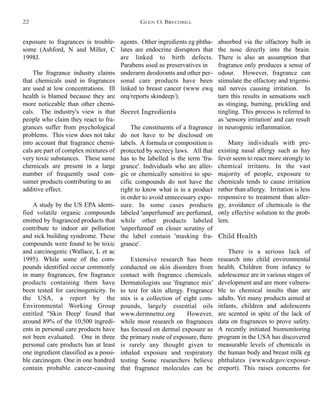
ents in personal care products have
not been evaluated. One in three
personal care products has at least
one ingredient classified as a possi-
ble carcinogen. One in one hundred
contain probable cancer-causing
GLEN O. BRECHBILL22
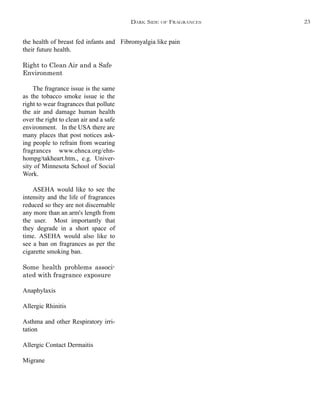
Fibromyalgia like painthe health of breast fed infants and
their future health.
Right to Clean Air and a Safe
Environment
The fragrance issue is the same
as the tobacco smoke issue ie the
right to wear fragrances that pollute
the air and damage human health
over the right to clean air and a safe
environment. In the USA there are
many places that post notices ask-
ing people to refrain from wearing
fragrances www.ehnca.org/ehn-
hompg/takheart.htm., e.g. Univer-
sity of Minnesota School of Social
Work.
ASEHA would like to see the
intensity and the life of fragrances
reduced so they are not discernable
any more than an arm's length from
the user. Most importantly that
they degrade in a short space of
time. ASEHA would also like to
see a ban on fragrances as per the
cigarette smoking ban.
Some health problems associ-
ated with fragrance exposure
Anaphylaxis
Allergic Rhinitis
Asthma and other Respiratory irri-
tation
Allergic Contact Dermaitis
Migrane
DARK SIDE OF FRAGRANCES 23
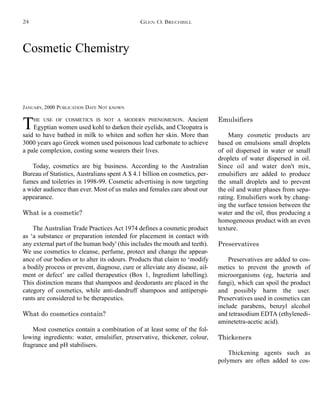
Cosmetic Chemistry
JANUARY, 2000 PUBLICATION DATE NOT KNOWN
THE USE OF COSMETICS IS NOT A MODERN PHENOMENON. Ancient
Egyptian women used kohl to darken their eyelids, and Cleopatra is
said to have bathed in milk to whiten and soften her skin. More than
3000 years ago Greek women used poisonous lead carbonate to achieve
a pale complexion, costing some wearers their lives.
Today, cosmetics are big business. According to the Australian
Bureau of Statistics, Australians spent A $ 4.1 billion on cosmetics, per-
fumes and toiletries in 1998-99. Cosmetic advertising is now targeting
a wider audience than ever. Most of us males and females care about our
appearance.
What is a cosmetic?
The Australian Trade Practices Act 1974 defines a cosmetic product
as ‘a substance or preparation intended for placement in contact with
any external part of the human body' (this includes the mouth and teeth).
We use cosmetics to cleanse, perfume, protect and change the appear-
ance of our bodies or to alter its odours. Products that claim to ‘modify
a bodily process or prevent, diagnose, cure or alleviate any disease, ail-
ment or defect’ are called therapeutics (Box 1, Ingredient labelling).
This distinction means that shampoos and deodorants are placed in the
category of cosmetics, while anti-dandruff shampoos and antiperspi-
rants are considered to be therapeutics.
What do cosmetics contain?
Most cosmetics contain a combination of at least some of the fol-
lowing ingredients: water, emulsifier, preservative, thickener, colour,
fragrance and pH stabilisers.
Emulsifiers
Many cosmetic products are
based on emulsions small droplets
of oil dispersed in water or small
droplets of water dispersed in oil.
Since oil and water don't mix,
emulsifiers are added to produce
the small droplets and to prevent
the oil and water phases from sepa-
rating. Emulsifiers work by chang-
ing the surface tension between the
water and the oil, thus producing a
homogeneous product with an even
texture.
Preservatives
Preservatives are added to cos-
metics to prevent the growth of
microorganisms (eg, bacteria and
fungi), which can spoil the product
and possibly harm the user.
Preservatives used in cosmetics can
include parabens, benzyl alcohol
and tetrasodium EDTA (ethylenedi-
aminetetra-acetic acid).
Thickeners
Thickening agents such as
polymers are often added to cos-
GLEN O. BRECHBILL24
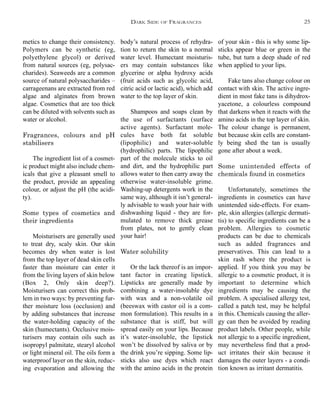
body’s natural process of rehydra-
tion to return the skin to a normal
water level. Humectant moisturis-
ers may contain substances like
glycerine or alpha hydroxy acids
(fruit acids such as glycolic acid,
citric acid or lactic acid), which add
water to the top layer of skin.
Shampoos and soaps clean by
the use of surfactants (surface
active agents). Surfactant mole-
cules have both fat soluble
(lipophilic) and water-soluble
(hydrophilic) parts. The lipophilic
part of the molecule sticks to oil
and dirt, and the hydrophilic part
allows water to then carry away the
otherwise water-insoluble grime.
Washing-up detergents work in the
same way, although it isn’t general-
ly advisable to wash your hair with
dishwashing liquid - they are for-
mulated to remove thick grease
from plates, not to gently clean
your hair!
Water solubility
Or the lack thereof is an impor-
tant factor in creating lipstick.
Lipsticks are generally made by
combining a water-insoluble dye
with wax and a non-volatile oil
(beeswax with castor oil is a com-
mon formulation). This results in a
substance that is stiff, but will
spread easily on your lips. Because
it’s water-insoluble, the lipstick
won’t be dissolved by saliva or by
the drink you’re sipping. Some lip-
sticks also use dyes which react
with the amino acids in the protein
of your skin - this is why some lip-
sticks appear blue or green in the
tube, but turn a deep shade of red
when applied to your lips.
Fake tans also change colour on
contact with skin. The active ingre-
dient in most fake tans is dihydrox-
yacetone, a colourless compound
that darkens when it reacts with the
amino acids in the top layer of skin.
The colour change is permanent,
but because skin cells are constant-
ly being shed the tan is usually
gone after about a week.
Some unintended effects of
chemicals found in cosmetics
Unfortunately, sometimes the
ingredients in cosmetics can have
unintended side-effects. For exam-
ple, skin allergies (allergic dermati-
tis) to specific ingredients can be a
problem. Allergies to cosmetic
products can be due to chemicals
such as added fragrances and
preservatives. This can lead to a
skin rash where the product is
applied. If you think you may be
allergic to a cosmetic product, it is
important to determine which
ingredients may be causing the
problem. A specialised allergy test,
called a patch test, may be helpful
in this. Chemicals causing the aller-
gy can then be avoided by reading
product labels. Other people, while
not allergic to a specific ingredient,
may nevertheless find that a prod-
uct irritates their skin because it
damages the outer layers - a condi-
tion known as irritant dermatitis.
metics to change their consistency.
Polymers can be synthetic (eg,
polyethylene glycol) or derived
from natural sources (eg, polysac-
charides). Seaweeds are a common
source of natural polysaccharides –
carrageenans are extracted from red
algae and alginates from brown
algae. Cosmetics that are too thick
can be diluted with solvents such as
water or alcohol.
Fragrances, colours and pH
stabilisers
The ingredient list of a cosmet-
ic product might also include chem-
icals that give a pleasant smell to
the product, provide an appealing
colour, or adjust the pH (the acidi-
ty).
Some types of cosmetics and
their ingredients
Moisturisers are generally used
to treat dry, scaly skin. Our skin
becomes dry when water is lost
from the top layer of dead skin cells
faster than moisture can enter it
from the living layers of skin below
(Box 2, Only skin deep?).
Moisturisers can correct this prob-
lem in two ways: by preventing fur-
ther moisture loss (occlusion) and
by adding substances that increase
the water-holding capacity of the
skin (humectants). Occlusive mois-
turisers may contain oils such as
isopropyl palmitate, stearyl alcohol
or light mineral oil. The oils form a
waterproof layer on the skin, reduc-
ing evaporation and allowing the
DARK SIDE OF FRAGRANCES 25
are used in a product are helpful
when putting on your best face.
Exfoliants and skin peels leave
the skin underneath temporarily
more vulnerable to sun exposure
because they remove the outermost
protective layer of dead skin cells.
Over-washing of hair or skin with
soaps and detergents can strip the
skin’s natural protective oily layer,
resulting in dry and scaly skin.
Alternatively, excessive use of
make-up or oily moisturisers can
block pores and aggravate acne.
More serious side effects have
been suggested for certain cosmetic
ingredients. For example, a recent
study was published that linked
breast cancer with deodorants. The
focus of the study was on parabens,
a class of chemicals commonly
used as preservatives in deodorants
and antiperspirants. While parabens
were found in breast cancer tissue,
the study did not establish that they
were the source of the cancer nor
did it identify underarm cosmetics
as the source of the chemicals.
A recent US study found that
many cosmetics and toiletries used
worldwide contained chemicals
that were either known cancer-
causing agents (carcinogens) or
were untested for their effect on
human health. More research into
the safety of cosmetic chemicals is
needed.
In our pursuit of beauty, it is
wise to remember that cosmetics
can be complex combinations of
chemicals. Reading the label and
understanding which ingredients
GLEN O. BRECHBILL26
Fragrance Books Inc. @www.perfumerbook.com
A Perfumer Who Believes
MAY 2, 2000
MSC Sufferers are Fakes
IT'S 6:30 PM AND THIS OLDER LADY (she just turned 84 years old the
week before) is putting the finishing touches to her attire. Tonight she
is going to City Hall for the monthly Council meeting. She is always
looking forward to these monthly dates with her fellow citizens of the
Nova Scotia Maritime capital: Halifax. She was born in Halifax and
likes to feel a part of her town. Although she doesn't have much to say
during the assembly she is too shy and too proper to interrupt debates -
she feels almost like it is her civil obligation to participate in the life of
her town. As some people enjoy dressing to go to the Opera or to go to
a show, she likes to dress for the council meetings. At her age, she does-
n't go out much anymore, and the occasions to wear a pretty dress, and
some of the jewelry offered by her late husband are pretty rare and the
monthly Council meetings are evenings that she treasures. That is until
tonight!
In case you live in a cavern and don't read the newspapers, let me
recap what happened at that special Council meeting held last March.
While she was sitting pretty, listening to the various speeches, someone
interrupted, asking that justice be rendered and that the person emanat-
ing toxic poisons be ejected from this room. Several agreed with that
loud woman (including some quite entertaining characters wearing gas
masks!!) and a mini riot started in City Hall. While our good old
Grandma turned around to see who brought toxic poisons (quite dan-
gerous and inconsiderate people, you have to admit?), she noticed two
Canadian Mounties walking toward her. They got right to her chair,
sniffed around like dogs looking for bad smells and said: "Yes, it's her."
They helped the old lady get up, escorted her to the door and to her dis-
may, EJECTED her from the Council meeting at City Hall. The crowd
applauded.
Her crime: with her nice dress and jewelry, she always wears a lit-
tle bit of her favorite perfume! Yes, ladies and gentlemen, you read cor-
rectly, she was wearing perfume. I
kid you not, and in Halifax, it is
now a crime! Of course, I am sure
that when she got thrown out of the
building, she stumbled over of a
few homeless people, sleeping on
the steps of City Hall in their own
body fluids, reeking of wine and
bad salmon (after all, we are in
Nova Scotia!). But it must be fine,
because these smells are natural.
When Shaune MacKinay from
The Daily News tried to contact
her, the "criminal," obviously over-
come with shame, said: "I don't
want to talk about it, because it was
really my own fault." While she
might consider herself at fault, the
rest of the world (except a few
weird people) calls her a victim of
the Halifax Hysteria!
The national press noticed the
Halifax Hysteria, from the New
York Times to The Wall Street
Journal. Many of the papers in the
nation and most recently, American
Spectator magazine are talking
about this . Michael Fumento, a
senior fellow at the Hudson
Institute, a Washington D.C. think-
DARK SIDE OF FRAGRANCES 27
Fragrance Books Inc. @www.perfumerbook.com
cafeteria's bad cook hostage, no.
The Mounties arrested him
because he violated the school's
anti-scent policy by wearing
Dippity Doo hair gel and Aqua
Velva deodorant to class. The
teacher, a "self-declared" sufferer
from MCS (Multiple Chemical
Sensitivity) syndrome claimed that
the boy, and his scents, made her
vomit, gave her headaches and
other kind of miseries. She request-
ed that the boy be charged with
assault. What was the assault
weapon? Dippity Doo Gel or Aqua
Velva? The police are still deciding
whether to press charges or not. I
have to agree with Michael
Fumento, who, writing about this
ridiculous incident said that a 17
year old boy wearing Aqua Velva
should be arrested! But the bunch
of hysterical MCS sufferers are
now pushing the envelope a bit too
far! Let's see what Washington
University Medical Professor H.
James Wedner thinks about the
MCS sufferers: "As with most mys-
tery syndromes, middle-class white
women are most likely to complain
of it. Typically, they're well off
enough that they can afford to drop
out if they're allergic to their entire
environment. If you're poor, you
simply can't afford to have MCS
syndrome." I couldn't have said it
better myself!
"Fragrance products worn by
people a block away, adversely
affect the chemically
sensitive,"claims Marin County's
Barb Wilke.
MCS sufferers are very vocal,
and try to convince the outside
world (outside of their bubble) that
they are victims and that we (the
fragrance industry) are out to get
them! We could start a collection
among the written bloopers and
printed propaganda, sell it to seri-
ous magazines and make more
money than an unlucky contestant
on "Who Wants to be a
Millionaire?" I will now try to
entertain you (or make to you cry!)
with a few quotes I have discovered
in various newspapers, magazines,
websites and other sources of
enchantment for my sarcastic point
of view! "Fragrance products worn
by people a block away, adversely
affect the chemically sensitive,"
claims Marin County's Barb Wilke.
One entire block? What are the
people from Marin county wear-
ing? Skunk juice?
Ms. Betty Bridges from the
Fragranced Products Information
Network, a Virginia-based associa-
tion against virtually everything,
not only supports Halifax's no-
scent policy but also claims victo-
ry! Victory for what? We don't
know, but she claims it! Let's see
what she said about that: "Halifax
has struck fear in the heart of the
fragrance industry. Halifax has
been able to do what the Federal
Drug Administration, the European
Commission and other regulatory
agencies have been unable to do."
Could it be because, regulatory
tank, wrote in his article "Scents
and Senselessness" in the above
mentioned American Spectator:
"Nowhere is the "Holy War" on
scent raging as it is in Halifax." In
fact, most of the city's public insti-
tutions, a number of large business-
es as well as public buses now
request or demand that employees
be "scent-free." Even the newspa-
per "The Halifax Chronicle-
Herald" forbids its 350 employees
to use perfumes, aftershave, fra-
granced deodorants, shampoos,
hair gels and even "strong-smelling
mouthwash." Listen to the person-
nel manager form this oh! so-invit-
ing-to-work-there newspaper, talk-
ing about this scent-free rule: "It's
no different from a business's rule
policy, either you abide by it or you
don't work here." Yikes! Why don't
you take a chill pill, Adolf?
The Telephone Service Center
also forbids its 1,400 employees to
use fragranced products as well.
When employees log on their com-
puters at work, reminders (not to
use fragrances) pop up on their
screens. Notes are posted in toilets,
asking again not to use toiletries!
No, I'm not going there! Another
touching story coming from our
(soon to be former) friends from
Canada. In the Halifax-area (wow,
am I surprised?) community of
Sheet Harbour, a teacher called the
RCMP (Royal Canadian Mounties
Police) to arrest Gary Falkeham, a
17-year-old student, not because he
attempted (as too often nowadays)
to shoot someone or detained the
GLEN O. BRECHBILL28
Fragrance Books Inc. @www.perfumerbook.com
restlessness, rashes, hives, eczema,
flushing, muscle and joint pain,
muscle weakness, irregular heart-
beat, hypertension, swollen lymph
glands and more" MORE? What
could be more than that? Death?
In his article, Michael Fumento
also reports the quite frightening
thoughts coming from Barb Wilke's
mind, (the same Barb who said that
fragrance could be toxic one block
away!): "Multiple sclerosis,
Parkinson's, Lupus and Alzheimer's
are all neurological disorders.
Dyslexia is a neurological dysfunc-
tion. Could any of these neurologi-
cal dysfunctions be caused by
exposure to neurotoxic chemicals?
Symptoms are often identical to
chemical hypersensitivity."
Her reasoning would be almost
a logical one if…MCS was some-
thing recognized by doctors, but,
unfortunately for her, MCS has
been widely rejected as a legitimate
organic disease by most doctors
and researchers across the U.S. and
Canada. The American Medical
Association, the American Medical
Council on Scientific Affairs, the
American College of Physicians,
the American College of
Occupational and Environmental
Medicine, and the American
Academy of Allergy, Asthma and
Immunology have all rejected MCS
as a legitimate disease.
In other words, the illness that's
taken Halifax, and almost the entire
Northern coast of California by sur-
prise may well be a figment of
these people collective imagina-
tion, in other words, a psychoso-
matic epidemic. A mania! Denver
psychologist Herman Stauden-
mayer, who has had over 500
alleged MCS cases referred to him,
published a paper last year about a
woman who was awarded worker's
compensation (that's mainly what
MCS victims are after!) after she
complained of sensitivity to fra-
grances.
"She complained of seizures,
upon exposure to various fra-
grances, she would show behav-
ioral signs of seizure activity,
including muscle jerking, becom-
ing disoriented, non-responsive,
and giving classic signs of what she
believed a seizure would look like."
As she experienced that "seizure,"
Dr. Ronald Kramer, the article's co-
author and medical director of the
Colorado Neurological Institute
and Epilepsy Center in Englewood,
conducted a video electroen-
cephalogram (EEG) to measure the
brain patterns. Dr. Kramer and
Staudenmayer report: "While she
was showing overt signs of
"seizure," her EEG was perfectly
normal. That just doesn't happen
with a real seizure." They also
added that the woman was not
exactly faking it. Her reaction was
a "learned sensitivity." She had
been led to believe she should react
to fragrances and that should be her
reaction. It's not worker's compen-
sation she should receive; it's an
Oscar for her performance! It is a
agencies base decisions on fact,
research and results; and Halifax
listens to a bunch of hysterics, and
makes policies without proof of
wrongdoing?
Ms. Bridges and her followers
(you should visit their website, its
funnier than an evening with Eddie
Murphy) should know that the
FDA, as well as the CTFA
(Cosmetic Toiletries and Fragrance
Associations), the FMA (Fragrance
Material Association), the IFRA
(International Fragrance and Raw
Material Association) and the
RIFM (Research Institute for
Fragrance Material) are constantly
at work testing fragrance ingredi-
ents, making sure that they are safe
to use. And all this, at the Fragrance
industry's expense. Not at the gov-
ernment's expense.
Check your facts, Ms. Bridges
and mostly, base your reactions and
comments on facts, not mass hyste-
ria. Ms. Bridges goes a bit further,
quoting the late Julia Kendall of
Marin County who claimed that:
"Symptoms provoked by fra-
grances include: watery or dry
eyes, double vision, sneezing, nasal
congestion, sinusitis, tinnitus, ear
pain, dizziness, vertigo, coughing,
bronchitis, difficulty breathing, dif-
ficulty swallowing, asthma, ana-
phylaxis, headaches, migraine,
seizure, fatigue, confusion, disori-
entation, incoherence, short-term
memory loss, inability to concen-
trate, nausea, lethargy, anxiety, irri-
tability, depression, mood swings,
DARK SIDE OF FRAGRANCES 29
Fragrance Books Inc. @www.perfumerbook.com
starts."
One last example of bloopers,
because my head is spinning from
all of these stupid and self-serving
declarations: Dr. Joan Gluck, an
allergist with the Florida Center for
Allergy and Asthma trying to
explain why some people are aller-
gic to fragrances to reporter Lisa
Sodders, from the Capital-Journal:
"Many perfumes are made from
plants and flowers and these can be
related to allergic plants.
Chrysanthemum, which is a base
for many perfumes, is related to
ragweed.
Someone might have a tremen-
dous problem being around per-
fume from the middle of August to
frost, maybe in the winter, not as
bad, because everything is additive.
And of course, the manufacturers
of perfume will not tell us what is
in them." Doctor Gluck, I am flab-
bergasted! What planet are you
from? How can someone advance
such fallacy and then try to blame
an entire industry for "not telling
what we put in perfumes!" You
don't seem to need our formulas as
you reveal to everyone "chrysan-
themum is a base for many per-
fumes."
How dare you give our trade
secrets? Especially since, in my
career of 34 years, I have neither
used nor seen chrysanthemum oil.
Where did you get this information,
from a perfumer on Mars? The
closest ingredient that could be
related to chrysanthemum is taget
oil, also called marigold oil, and,
believe me, it is NOT a "base for
many perfumes" as you put it. It is
an oil that is used very rarely and in
minute amounts, because of its
strength and not because it's related
to ragweed!
What would you do if we gave
you our perfumes formulas? Distort
the truth and scare the public some
more? Because that is where most
of the problem resides, when peo-
ple like you, Betty Bridges, Barb
Wilkes and all the other olfactory
activists of this world scare the
public. You don't have facts; you
start rumors and then, contaminate
the mind of the masses. Because we
are, unfortunately, part of a society
that gives to whiners and complain-
ers, you will always find a politi-
cian or two ready to listen to you
and defend a cause that does not
exist. Because the mind is some-
times weak and the voice always
powerful, the louder one speaks,
the more damage one can make and
that's how Mass Hysteria starts.
Michael Fumento agrees that
the people from Halifax "are in the
grips of a mania, not a genuine
physiological response to chemi-
cals in their environment." He also
points out that a mania that has, at
various times, shown up in Asia
and Africa, where, in villages, one
of the men believed that his penis
was shrinking. After discussing this
problem with the other men of the
village, they all believed that their
fact that one can be allergic to a
given ingredient but to be allergic
to all ingredients is not quite seri-
ous. We compile about 2,500 dif-
ferent products to create our fra-
grances and the combination
among these products is infinite.
So, as Michel Fumento puts it:
"To be allergic to all fragrances is
like being allergic to everything
beginning with the letter F." How
about this advice coming from
someone called an "allergist" that
we could qualify as a "clinical ecol-
ogist" or "environment physician,"
as are doctors who treat MCS often
called. The St. Louis Post-Dispatch
quoted an unnamed environment
physician saying: "Don't breathe in
what you cannot eat" - ? - "Look for
biodegradable products at you local
health food store" How about com-
post or cow manure? Could I wear
compost or cow manure? And now
for the grand finale: "Avoid things
that have distinct odors." That last
statement will definitely take away
the pleasure to wearing manure!
Would it be time for me to quit the
perfume industry and start a gas
mask factory?
"We are, unfortunately, part of
a society that gives to whiners and
complainers. You will always find a
politician or two ready to listen to
you and defend a cause that does
not exist. Because the mind is
sometimes weak and the voice
always powerful, the louder one
speaks, the more damage one can
make and that's how Mass Hysteria
GLEN O. BRECHBILL30
Fragrance Books Inc. @www.perfumerbook.com
This desert flower
No sweet perfume ever tortured me
more than this
I dream of rain
I lift my gaze to empty skies above
I close my eyes, this rare perfume
Is the sweet intoxication of her love
Thank you Sting.
penises were shrinking and even
disappearing! To my way of think-
ing, this is a much more serious
problem than allergies to fra-
grances!
To the people of Halifax, and to
those going there - as you cannot
use any deodorants - may I sug-
gest, to cover body odors, wear a
smoked salmon under each
arm…after all, we are in Nova
Scotia!
To my fellow non-allergic-to-
fragrances-but-allergic-to-stupidi-
ty: there is hope. As many of us
realize that fragrances are made to
make the world a nicer place, at
least odor-wise, and not a menace
to society, let's build a wall going
from Halifax to southern San
Francisco and then we'll contain the
Mania on that part of the west
coast.
After all this negativity, I
would like to bring a touch of posi-
tive thinking. I would like to quote
parts of a beautiful song,
"Desert Rose" from the latest
CD by Sting, (definitely politically
incorrect, by Halifax's standards):
This Desert Rose
by
Sting
Each of her veils, a secret promise
DARK SIDE OF FRAGRANCES 31
Perfume & Allergy
DECEMBER 12, 2000
IGREDIENTS IN COSMETICS KNOWN TO CAUSE ALLERGIC Reactions in
some people are not currently listed on labels, according to a report.
The study, by the magazine Health Which?, also found that the way
in which some other ingredients are listed can lead to confusion.
More than 10,000 ingredients used in cosmetics are required, by
law, to appear on labels.
Perfumes are the commonest cause of contact allergy from cosmet-
ics. Dr Mike Beck, Hope Hospital, Salford. The key exceptions are any
of the 2,600 fragrance chemicals which are currently listed under the
catch-all term "parfum".
This is despite 24 of these being common triggers of allergic reac-
tions.
In addition, Health Which? found most ingredients are listed by
their chemical name - an internationally-agreed system - or in Latin
which can cause confusion.
There may be problems recognising well known ingredients - for
instance, peanut oil goes by the name of Arachis hypogaea on cosmetic
labels.
Nikki Ratcliff, Senior Researcher for Health Which? said: "At the
moment if you think you are allergic to fragrance chemicals your only
option is to avoid anything which has 'parfum' on the label which means
ruling out a huge number of products.
"We welcome the proposed change in the law from the European
Commission which would require cosmetics manufacturers to list any
of the 24 fragrance ingredients that
can cause allergic reactions.
"But you may still have trouble
recognising certain well known
ingredients. If in doubt, seek advice
from a dermatologist who should
be able to tell you exactly what's in
a product."
Dermatology
Dr Mike Beck, director of the
Contact Dermatology Investigation
Unit at Hope Hospital, Salford, told
BBC News Online that failure to
specify the fragrance chemicals in
cosmetics had prevented dermatol-
ogists from carrying out work into
allergies.
He said: "Perfumes are the
commonest cause of contact allergy
from cosmetics.
"They contain quite a compli-
cated array of materials, and there-
fore just putting the word parfum
on the label has not helped us to
understand why precisely people
are becoming allergic.
GLEN O. BRECHBILL32
"We cannot tell which components
are causing the problem, or in what
concentrations they become
active."
Dr Beck said allergic reactions
to perfume usually caused a red,
scaly rash on the skin.
However, in rare cases
extremely sensitive patients might
also develop problems with sneez-
ing and breathing.
Advice
Health Which? makes recom-
mendations on how to ensure that
make up is safe and hygienic to use.
These include:
Not sharing make-up.
Washing hands before using cos-
metics.
Regularly washing brushes and
applicators in warm soapy water.
Not using cosmetics on broken or
infected skin.
Storing cosmetics in a cool, dry
place away from direct sunlight.
Not using make-up if it smells
strange or a solution has become
separated or discoloured.
Testing the product on a small
patch of skin to check for sensitivi-
ty.
Following instructions, especially
on products such as face masks.
Health Which?
Advised that people who do
suffer irritation should seek advice
from a doctor, or a skin test from a
dermatologist.
The magazine also advises peo-
ple who suffer a reaction to inform
the manufacturer.
The batch code will enable the
manufacturer to trace when the
product was made.
Trading standards may be able
to advise on disputes.
DARK SIDE OF FRAGRANCES 33
Health Risks Associated with Using Perfumes
JANUARY, 2002 PUBLICATION DATE NOT KNOWN
SENSITIVITY AND OTHER ADVERSE EFFECTS FROM FRAGRANCES ARE
HARDLY ISOLATED EVENTS. There are growing numbers of people that
are adversely impacted by the widespread use of scented products.
Fragrance:
Materials added to give the product a scent, mask the odor of other
ingredients, or alter mood and emotions. Materials used may be
synthetic, natural, or both.
This brochure is provided to help increase awareness of the negative
impact fragrances may have on your health and the health of others. The
information provided is based on medical, scientific, and industry liter-
ature.
The use of fragrance has increased tenfold since the 1950s. The
industry sales of fragrance materials used to scent products doubled
between 1980 and 1989.
This phenomenal growth means that exposure to the materials used
in fragrance has increased as well. Fragrance is added to toiletries, cos-
metics, household products, pesticides and many other items. With this
increase in exposure, problems associated with fragrance have emerged.
Not only has the incidence of adverse health effects to users of scented
products increased.1 there are problems from "second-hand" exposures
as well.
Substances used in fragrance are volatile compounds that get into
the air and linger. These compounds add to indoor air pollution and con-
tribute to poor indoor air quality. According to the EPA, poor air quali-
ty can cause headaches, irritation to eyes, nose, and throat, dizziness,
fatigue, forgetfulness and a host of other symptoms. Long-term expo-
sure to air pollutants can contribute
to the development of cancer, respi-
ratory conditions, allergies, asthma,
chemical sensitivity, and other dis-
eases.
In spite of the ubiquitous expo-
sure, there is little regulation or
monitoring of the use of fragrance
or the materials that are used in
them. Fragrance formulas are con-
sidered trade secrets and do not
have to be revealed to the public or
regulatory agencies. Regulation is
fragmented, there are few laws in
place, and these are rarely enforced.
By all accounts the fragrance indus-
try is primarily self-regulated with
very little oversight.
Health Concerns
Fragrance can enter the body
through lungs, airways, skin, inges-
tion, and via pathways from th nose
directly to the brain.3
An EPA sponsored literature
review grouped fragrance, as sec-
ond hand smoke, and formaldehyde
together as triggers for asthma. Up
to 72% of asthmatics cite fragrance
GLEN O. BRECHBILL34
designed to quickly get into the air
and some fragrance chemicals
linger in fabric and on surfaces for
months.
When a person has an adverse
effect from fragrance, it is almost
impossible to pinpoint the responsi-
ble ingredient.
Virtually every segment of the
population has exposure to fra-
grance.
Fragrance accumulates and per-
sists in the aquatic environment like
other persistent organic pollutants
such as pesticides.
Fragrance is ubiquitous in air inside
and found outside, even in remote
areas.
Many fragrance chemicals are
on the EPA's High Production
Volume List, meaning that over one
million pounds are manufactured or
imported annually.
Common Fragrance Materials
Acetic Acid, benzyl ester - Target
organs: nerves, kidneys; possible
carcinogen.
Benzyl alcohol - Central Nervous
System (CNS) depressant.
p-Cresol, 2,6-di-tert-butyl - Target
organ: lungs; possible carcinogen.
Coumarin - Animal carcinogen.
pected hormone disrupters.
Fragrance has neurological effects
that can alter blood pressure, pulse,
and mood, and have sedative
effects.
Other Concerns
80 - 90 % of materials used in
fragrance are synthesized, most
from petroleum products.
Less than 1300 of the over 3000
fragrance materials in use have
been evaluated for skin safety.
Industry testing focuses on skin
effects and rarely evaluates respira-
tory, neurological, reproductive or
systemic effects.
The materials used in fragrance
are not on the label and do not have
to be disclosed to anyone, including
regulatory agencies. The only way
to avoid problematic materials is to
avoid all scented products.
Products claiming to be
"Fragrance Free" or "Unscented"
may still contain fragrance, which
may or may not be listed as an
ingredient on the label.
Modern fragrance formulas
often contain high concentrations
of potent and long lasting synthetic
materials with little history of use
and little available health and safe-
ty data.
Modern formulations are
as a trigger .5
Fragrance contributes to indoor
air pollution and can irritate the
eyes, nose, throat. and lungs.
As much as 15% of the general
population find fragrance a lower
airway irritant.
Fragrance in the air can cause
airborne contact dermatis.
Research suggests as much as
11% of the general population may
have skin allergy to fragrance.
According to the information at
the FDA website, fragrance is the
number one cause of skin allergic
reactions to cosmetics. Scented
products often contain several
known skin sensitizers.
Common fragrance chemicals
like coumarin, methyl eugenol and
others are suspected carcinogens.
Musk xylene is a suspected car-
cinogen. Musk ketone is suspected
of increasing carcinogenic effects
of the other materials. Musk ketone
and musk xylene are found in fat
tissue and breast milk.
Synthetic musk compounds
may cross the placental barrier.
Synthetic musk and other mate-
rials have estrogenic effects.
Materials used in fragrance
(such as some phthalates) are sus-
DARK SIDE OF FRAGRANCES 35
p-Cymene - Chronic effects: dam-
age to lungs, liver, kidneys; Target
organ: CNS.
Di Ethyl phthalate - Possible risk of
congenital malformation in the
fetus; targets nerves.
Iso E Super -The chemical, physi-
cal, and toxicological properties
have not been thoroughly investi-
gated.
Musk Ketone - Increases carcino-
genic effects of other materials.
Found in blood, fat tissue, and
breast milk; crosses placental barri-
er.
Musk Yylene - Carcinogenic in ani-
mal studies. Found in blood, fat tis-
sue, and breast milk; crosses pla-
cental barrier.
6-0cten-1-ol, 3, 7 - Di Methyl -
Extremely destructive to the tissue
of the mucous membranes and
upper respiratory tract.
Toluene - Target organs: liver, kid-
neys, brain, bladder. One of nine
major starting materials for synthe-
sis of fragrance chemicals.
4-Vinyl Phenol - Toxic. May impair
fertility. Toxic by inhalation.
Respiratory and skin sensitizer.
2, 6 - Xylenol - Toxic. Harmful by
inhalation. Material is extremely
destructive to upper respiratory
system, eyes, and skin. Corrosive.
GLEN O. BRECHBILL36
Infertility Concerns
NOVEMBER 25, 2002
HIGH LEVELS OF A CHEMICAL BLAMED FOR CAUSING INFERTILITY IN MEN
HAVE BEEN FOUND IN SOME OF THE WORLD'S BEST-KNOWN PERFUMES
and cosmetics.
Chanel No5, Christian Dior's Poison, Eternity from Calvin Klein
and Tresor by Lancome were among 34 toiletries found by a Swedish
study to contain di-ethylhexyl phthalate or other phthalates.
The European Commission is proposing a ban on the use in cos-
metics of two of the most potent forms of phthalates amid fears they
cause genital abnormalities affecting up to 4 per cent of male babies.
These genital abnormalities - which can include undescended testi-
cles and malformation of the urinary tract - are blamed for soaring lev-
els of testicular cancer in young men. Cases of the disease have risen
tenfold in the past century. About 1900 British males, some as young as
15, are diagnosed every year. Nine out of 10 cases are cured, but doc-
tors are worried by the trend.
Scientists believe the phthalates could be absorbed into women's
bloodstreams through the skin or inhalation.
The Cosmetic Toiletry and Perfumery Association condemned the
report as inaccurate. It said: "Consumer safety is the first priority for the
cosmetic industry and consumers can have complete confidence in the
cosmetic products they use, and in the regulatory framework which
ensures cosmetic safety."
Numerous studies on rats and mice have shown phthalate exposure
causes genital abnormality. The latest research was conducted by a
Swedish government-accredited laboratory for Healthcare Without
Harm, a US-based organisation representing 300 consumer pressure
groups around the world.
Researchers at the Analycen lab
analysed 34 leading brands of cos-
metics and found more than three-
quarters contained phthalates,
which help prevent loss of fra-
grance.
The investigation found other
forms of the chemical in Tommy
Girl perfume, Impulse Body Spray,
Nivea Deo Compact, Sure Ultra
deodorant, Shockwaves hair
mousse and four hairsprays includ-
ing Elnett Satin, Pantene Pro-V
Extra Hold and Vidal Sassoon.
Per Rosander, who wrote the
report, said: "What we know about
these chemicals is that they cause
damage to the reproductive system.
That is why they have been classed
by the EU as reproductive toxins."
Richard Sharpe, of the Medical
Research Council's Human
Reproductive Sciences Unit in
Edinburgh, said: "If you wanted to
produce a list of environmental
causes of the reproductive health
problems in boys, phthalates would
DARK SIDE OF FRAGRANCES 37
be pretty near the top of the list."
Actor Julia Sawalha, who
played Saffy in Absolutely
Fabulous, supports the Women's
Environmental Network, a backer
of the Swedish research.
"Chemicals that pose a risk to fer-
tility do not belong in cosmetics,
and manufacturers should be made
to list ingredients," she said.
The Australian
GLEN O. BRECHBILL38
Fragrance Books Inc. @www.perfumerbook.com
Think Twice -
FEBRUARY 12, 2003
THE WAY TO THE HEART IS THROUGH THE NOSE,” asserts Symrise, a
leading fragrance manufacturer. But lovers may want to think twice
about giving a bottle of cologne or perfume for Valentines Day, say
some health advocates. Certain fragrances and their chemical con-
stituents might trigger an allergic rather than aphrodisiac response. And
some perfumes contain hidden ingredients that may pose longer-term
hazards.
If your love interest suffers from asthma, rhinitis, allergies, dermati-
tis or a growing range of chemical sensitivities, that bottle of perfume
may very well repel more than attract. According to medical specialists,
fragrance sensitivity appears to be on the rise.
It’s also a growing contributor to indoor pollution in the workplace,
says Carrie Loewenherz, an industrial hygienist for the New York
Committee for Occupational Safety and Health.
“People often joke about it, people wearing offensive perfumes,”
says Loewenherz. But it’s no laughing matter, she adds, either for the
allergy sufferers or the office managers trying to manage a delicate
problem.
Astrid Berg, director of the American Lung Association’s
Washington State office, agrees, noting that fragrance seems to be an
increasing irritant among people with asthma.
“We tend to not think of it as serious until we see someone in acute
distress,” says Berg.
Safe enough to sniff? The cosmetic industry insists its products are
safe.
“In recent years it has become
fashionable to criticize the use of
fragrances in our society, suggest-
ing that this use is associated with a
variety of negative effects,” writes
Peter Cadby of the International
Fragrance Association, in a recent
journal article. ”[But] an adequate
review and testing mechanism
exists to assure the safety of fra-
grance materials, and their combi-
nation in mixtures, for the con-
sumers of fragranced products.”
However, some health advocates
point to growing evidence that per-
fumes, hair gels and other fra-
granced products may contain
chemicals such as phthalates,
which can disrupt hormones. In
addition, they point to other com-
pounds that can affect immunity,
the nervous system, or play a role
in cancer and other health prob-
lems.
“Even if the general population
isn’t likely to suffer acute effects
from exposure to fragrances, there
are long-term chronic health effects
connected to these chemicals that
we don’t fully understand yet,”
Before Giving Fragrance as a Gift
DARK SIDE OF FRAGRANCES 39
Fragrance Books Inc. @www.perfumerbook.com
ducted the tests, found the chemical
made up about 10 percent of the
fragrance portion of the perfume,
says Bridges. The fragrance also
included synthetic musks, which
are suspected animal carcinogens
and may stimulate human cancer
tumors.
Bridges says that while search-
ing the chemical data sheets for
compounds in the fragrance, the
researchers often found the individ-
ual chemicals carried this phrase:
“The chemical, physical, and toxi-
cological properties have not been
thoroughly investigated.”
The presence of these chemi-
cals ought to be more than simply a
concern for the chemically sensi-
tive since fragrances are so ubiqui-
tous in our society, says Bridges.
To voice her concerns, Bridges
signed a May 1999 petition filed
with the Food and Drug
Administration, asking for the per-
fume to be labeled as “untested for
safety.”
Name brand products tested
Bridges and EHN aren’t the
only ones concerned about the safe-
ty of perfume. Last May, a group
of environmental and public health
organizations, led by the commis-
sioned a national laboratory to test
72 name brand beauty products for
the presence of phthalates, a large
family of industrial chemicals that
have been linked to birth defects.
also found in vapors emitted from
toxic products like solvents, wood
preservatives, paint strippers and
dry cleaning chemicals.
VOCs are known to produce
eye, nose and throat irritation, as
well as headaches, loss of coordina-
tion, nausea, liver damage, and
harm to the kidneys and central
nervous system, according to the
Environmental Protection Agency.
Some VOCs can cause cancer in
animals and are suspected or
known to cause cancer in humans.
And while adverse health
effects from VOCs typically occur
at far higher doses than what would
be found in fragrances, they never-
theless can be potentially danger-
ous in tight indoor spaces,
Loewenherz says.
A widespread problem?
Betty Bridges, director of the
says that some 72 percent of asth-
matics react adversely to perfumes
and at least 35 million Americans
are afflicted with allergies.
Bridges supported the when it
commissioned an independent lab-
oratory to test Calvin Klein’s
Eternity, one of several fragrances
most problematic for fragrance suf-
ferers. Tests revealed that the per-
fume contained more than 40 com-
pounds, among them diethyl phtha-
late, an irritant and suspected hor-
mone disruptor that is absorbed
through the skin. The lab that con-
says Loewenherz.
Once distilled simply from
flower essences, perfumes today
are complex mixtures of natural
(botanical or animal-derived) mate-
rials and synthetic chemicals.
More than 5,000 different fra-
grances are used in perfumes and
skin products in hundreds of chem-
ical combinations, according to the
American Academy of
Dermatology.
But because the chemical for-
mulas of fragrances are considered
trade secrets, companies aren’t
required to list their ingredients.
They need only label them as con-
taining “fragrance.”
That’s a problem for the med-
ical profession when it comes to
allergies, says dermatologist
Howard Maibach, a professor of
dermatology at the University of
California at San Francisco. The
large quantity and variety of chem-
icals can make it difficult to pin-
point causes of allergies or irrita-
tion.
Potentially harmful ingredients
The rising tide of fragrances in
myriad products, from skin lotions
and tissues to cleaning products and
candles, is adding to the problem,
says Loewenherz. Because some 95
percent of perfume ingredients are
synthesized from petrochemicals,
they give off volatile organic com-
pounds, known as VOCs, which are
GLEN O. BRECHBILL40
Fragrance Books Inc. @www.perfumerbook.com
additionally, EPA requires safety
testing for any new chemicals;
RIFM does it’s own safety testing
of chemicals; and many fragrance
and cosmetics companies do their
own testing,” says Roberts.
In addition, the FDA collects
complaints from consumers, “and
from their records, that’s less than 1
complaint per million users,” adds
Roberts.
Francesca Lyman is an environ-
mental and travel journalist and
author of “Inside the Dzanga-
Sangha Rain Forest” (Workman,
1998). She recently finished a
report on the health effects of the
Sept. 11 attacks titled “Messages in
the Dust,” which will be available
online at www.neha.org.
University School of Public Health
investigators found a link between
sperm damage and monoethyl
phthalate, a compound used to
maintain the color and scent in
many cosmetic items such as per-
fumes, colognes and hair spray.
But Marian Stanley, manager of the
a chemical trade group, says the
study results, while worth taking
seriously, were at variance with
many other animal studies.
Government regulation
The question remains: if there is
a significant health risk posed by
fragrances, shouldn’t the govern-
ment be regulating them? Because
cosmetics are legally defined as
products not intended to affect the
body’s functions as drugs are, the
FDA does not require any pre-mar-
ket safety testing of cosmetics or
fragrances to the extent that the
agency would a drug.
“Only drugs are pre-tested,”
says an FDA spokesperson.
“Cosmetics are treated less strict-
ly.”
Essentially, protection lies in
the hands of the fragrance industry.
Glenn Roberts, spokesperson for
the Research Institute for Fragrance
Materials, an industry-sponsored
group that does voluntary testing of
chemicals, says safety is insured in
a four-step process.
“First, we have a long history of
cosmetics ingredients use to go on;
Their report, revealed phtha-
lates in about 75 percent of the
products tested (52 out of 72 prod-
ucts), including hair gels, deodor-
ants, hair sprays, mousses, body
lotions, and in all of the 17 fra-
grances tested.
Phthalates have also been tar-
geted for concern by the Centers for
Disease Control and Prevention. In
releasing its second national
“human exposure” study, the CDC
found that phthalates were among
the chemicals found to accumulate
in body organs.
Jim Pirkle, deputy director of
science for the environmental
health lab at the Centers for Disease
Control and Prevention, said that
the agency was “surprised” to find
such a high evidence of exposure to
phthalates from personal care prod-
ucts in children, especially adoles-
cents.
“It makes us want to do more
studies to see if the levels they’re
exposed to are comparable to the
levels causing problems in ani-
mals,” says Pirkle.
Phthalates, which are estro-
genic or anti-androgenic, are of
concern, said Pirkle, who added
that more health studies are needed
to determine whether Americans
are getting overdosed with these
chemicals.
Concerns were heightened in
November when Harvard
DARK SIDE OF FRAGRANCES 41
Fragrance Books Inc. @www.perfumerbook.com
Essential Oil - Diluting or Cutting
OCTOBER 11, 2003
As far as adulteration is concerned, producers and distributors of
essential oils are frequently painted as “the bad guys”, but it should
be pointed out that their oil customers frequently demand oils below the
market price while still wanting to be told that they are authentic.
Introduction:
In this climate, the honest oil trader may find it virtually impossible
to survive on the margins he is allowed to make (many have already
gone bust). For example, in the late 20th Century, lavender oil
(Lavandula angustifolia) was being sold almost as a loss leader by many
French producers as the market was unwilling to pay a realistic price;
currently, the aroma industry is dominated by a handful of large and
powerful international houses whose corporate buyers often attempt to
drive raw material prices to impossibly low levels, not allowing work-
able profits to be made. This sets the scene for unethical practices.
Essential oils - a definition.
An essential oil (e.o.) is the volatile oil containing odiferous ele-
ments of the plant, produced by steam or hydro-distillation of aromatic
vegetable plant matter. E. o. components arise via the secondary metab-
olism of plants and are stored within specialised structures; ideally they
are isolated with minimum chemical changes from human intervention.
Citrus oils, produced by the mechanical pressing of citrus peels, are also
called essential oils, and, according to the International Standards
Organisation (ISO), so are dry-distilled oils - such as cade oil (from the
branches of Juniperus oxycedrus) and styrax pyrogenée (from
Liquidamber spp).
E.o.’s should be produced by purely physical means, and be 100%
pure and wholly derived from the named botanical source - but how are
these standards to be guaranteed?
No quality standards for the authen-
tication of essential oils exist in
aromatherapy, in spite of the reve-
lations of gross adulteration of aro-
matherapy oils for retail sale
(Health Which 2000). Professional
aromatherapy organisations have
failed to issue standards, in spite of
individual schemes being put for-
ward (Jones 1998) but, in contrast,
other essential oil-using industries
are served by the following stan-
dards.
The Pharmaceutical Trade:
British Pharmacopoeia (BP) 2002
is published on recommendation of
the Medicines Commission UK.
Oils specifications are also pub-
lished in the European
Pharmacopoeia 4th edn 2002 (Eur.
Pharm 4th edn); United States
Pharmacopoeia (USP); also the
pharmacopoeia’s of individual
nations such as China, India etc.
Earlier editions of
The British Pharmaceutical
Codex (BPC) contains many essen-
tial oil standards still in use today.
GLEN O. BRECHBILL42
Fragrance Books Inc. @www.perfumerbook.com
by aromachology perfumes (worth
£611 million for years 1999-2001
according to Mintel Database
2002) contain a proportion of syn-
thetics stipulated by the perfume
house, mixed in with the e.o.’s. The
alleged psychopharmaceutical
effects of these products still
depend on the utilization of authen-
tic essential oils in the formulation
– as far as marketing claims/hype
are concerned anyway. A realistic
“in-practice” distinction between
mass-marketed aromatherapy per-
fumes (as opposed to 100% e.o.
blends) and aromachology per-
fumes, other than at a hypothetical
level, has yet to be defined, since
both commonly employ synthetics.
The synthetics content can presum-
ably have either symbiotic, neutral
or opposing effects (mood chang-
ing etc.) to those claimed for the
e.o.’s in the perfumes in question,
hence the need for clinical testing
of the finished formulations to sup-
port advertising claims.
Types of adulteration
There are several distinct categories
of adulteration:
1. Addition of single raw materials.
This simple form of adulteration
can be conveniently divided into
two groups:
“Invisibles” – i.e. those materials
undetectable by a gas chromato-
graph (GC) analysis operating
under routine conditions to analyse
essential oils.
address the unique needs of the aro-
matherapy profession, since:
Holistic aromatherapists
demand that “pure” and “complete”
oils are used, rather than oils only
distilled for periods which are
attractive economically, on a yield:
fuel-consumption basis (although
unnecessary energy ‘wastage’ may
not be seen currently as a particu-
larly “deep green” strategy!).
Many essential oils used in aro-
matherapy are particular to that
industry, and not necessarily exten-
sively used elsewhere e.g.
Ravensara aromatica, Rosemary oil
verbenone chemotype,
Helichrysum italicum ssp.- serot-
inum etc.
As well as “pure and natural”,
the words “wild-crafted”, “organic”
and “clinical grade” are frequently
over-hyped descriptor terms used
by both aromatherapy and by “nat-
urals” traders, which need more
careful definition prior to profes-
sional endorsement.
Natural perfumery
Natural perfumers are other
potential users of pure essential
oils. Grimshaw (1989) discussed
“purist” perfumers (who employ no
chemically produced or chemically
modified ingredients), but also dis-
cussed reasons why others may
wish to use up to 50% synthetics in
formulations. This was, in a way, a
prediction today’s situation, where-
Essential Oil Trade: Monographs
on individual essential oils (EOA
Standards) were produced by the
Scientific Committee of the
Essential Oil Association Inc.
Flavourings Industry: Food
Chemicals Codex IV (1996, US)
produced at the request of the FDA
(1992), is widely used for guidance
by the food flavourings industry.
Aroma Companies: Many larger
established Flavour & Fragrance
Houses have their own internal pur-
chasing standards.
Independent Certifying Bodies:
International Standards
Organisation (ISO Standards TC
54) & Association Française de
Normalisation (AFNOR) both have
detailed standards for e.o.’s.*
An example is ISO 3515 for Oil of
Lavender (2001) which includes
minimum and maximum percent-
ages of thirteen substances, and
their occurrence in French (sponta-
neous and clonal), Bulgarian,
Russian, Australian and ‘other ori-
gin’ lavender oils. Limits for
lavandulyl acetate, for example, are
set at 2.0-5.0% in Bulgarian laven-
der oil by the standard.
Aromatherapy
Whilst it is apparent that the
current BP or ISO standards may
serve the needs of particular indus-
trial sectors, they do not entirely
DARK SIDE OF FRAGRANCES 43
Fragrance Books Inc. @www.perfumerbook.com
Benzyl Alcohol (now classified as a
sensitiser by SCCNFP opinion)
Benzyl Benzoate (now classified as
a sensitiser by SCCNFP opinion;
formerly widely used to extend
resinoids)
Carbitol (diethylene glycol
monoethyl ether or DEGME)
Diacetone Alcohol
Dipropylene Glycol (DPG)
Dipropylene glycol methyl ether
(DPGME) and Rripropylene glycol
methyl ether (TPGME) - both of
these substances are in air freshen-
er technology.
Herculyn DÔ (hydrogenated
methyl ester of rosin)
Isoparä (odourless kerosene frac-
tions often used as a candle per-
fume diluent)
Isopropyl Myristate (IPM)
Phthalate esters such as
Dibutylphthalate (DNP) or Diethyl
phthalate (DEP).
Triacetin (the anti-fungal com-
pound glycerol triacetate - a popu-
lar food flavourings vehicle). 3,3,5-
Trimethyl-hexan-1-ol.
Use of materials like isotridecyl
acetate (ITDA, Fixateur 404),
Herculyn D and Abitol, can be
moderately difficult to spot,
because the materials may show a
myriad of late-eluting small peaks
on a GC trace representing their
different constituent isomers,
which could be overlooked by an
inexperienced analyst especially at
low levels.
In all the above instances of
“visible” and “non-visible” adulter-
ants, the added material is merely a
diluent, and makes no odour contri-
bution of its own. Addition of 10-
14% of such a material may pass
un-noticed if the material is evalu-
ated against a retained standard
solely on an odour basis – even by
an expert nose – but it will in all
probability be revealed by subse-
quent physio-chemical testing e.g.
added vegetable oil in patchouli oil
can often be revealed by a solubili-
ty test in 90% alcohol at 20°C.
2. The addition of cheaper essential
oils and adjuncts.
Blending in cheaper oils to
meet a customers’ target purchas-
ing price, or to make additional
profit for the producer, is common-
place in the oil trade. Some prac-
tices mentioned by Arctander
(1960) - for example, the practice
of extending of Amyris oil (Amyris
balsamifera) with Cedarwood oil
Virginia (Juniperus virginiana) and
Copaiba Balsam (Copaifera spp.) –
are unlikely to fool too many poten-
tial customers in these present &
more educated times, but other
more common adulteration prac-
tices still remain, which include:
“Visibles – those materials normal-
ly detectable by G
“Invisibles”: an example of this
type is the deliberate addition of
vegetable or mineral oil to essential
oils (Nour-el-Din et al. 1977) -
rapeseed oil in the EU is a particu-
larly cheap vegetable oil which has
been used for this purpose.
Theoretically the “total area” of the
detectable components of the oil’s
gas chromatogram should be
reduced by this latter type of adul-
teration, creating suspicion for the
analyst and the need for further
investigation. These adulterant
materials may be revealed by aque-
ous alcohol solubility tests, and
their presence further verified by
using a different GC column &
operating conditions (to detect min-
eral oil), or by derivatisation (for
example the use of a methylating
agent for vegetable oils – whereby
the volatile methyl esters of the
fatty acid components of glyceryl
esters are revealed by subsequent
GC analysis).
“Visible” diluents in this con-
text include a number of solvents
and perfumery materials. For
example the following have been
found in commercial essential oils:
in a few instances resulting in a
warning or prosecution by regula-
tory authorities:
Abitol (a primary hydroabietyl
alcohol) – often used for extending
resinoids.
GLEN O. BRECHBILL44
Fragrance Books Inc. @www.perfumerbook.com
ers.
Lavender oil (Lavandula angustifo-
lia): addition of cheaper lavandin
(Lavandula x intermedia) oil vari-
eties; the addition of spike lavender
oil (Lavandula latifolia); the addi-
tion of ho oil rectified
(Cinnamomum spp) and acetylated
ho or acetylated lavandin oils etc.
Lemon oil (Citrus limon): addition
of orange terpenes, lemon terpenes
& by- products (e.g. steam-stripped
lemon oil). For lemon oil BP,
expressed lime or grapefruit oil is
added to poor grades to raise the
UV absorbance level sufficiently to
pass the BP specifications.
Nutmeg oil (Myristica fragrans):
the addition of nutmeg terpenes, a-
pinene, limonene, turpentine
fractions etc.
Patchouli oil (Pogostemon cablin):
addition of gurjun balsam
(Dipterocarpus spp.); vegetable
oils, Hercolyn D; patchouli and
vetiver distillation residues. The
superior Indonesian patchouli oil is
often blended with the cheaper
Chinese oil.
Petitgrain oils (Citrus spp): addi-
tion of other citrus leaf oils & frac-
tions, fatty aldehydes, linalyl
acetate, orange terpenes etc.
Peppermint oil (Mentha X piperi-
ta): addition of cornmint oil
(Mentha arvensis).
Sandalwood oil EI (Santalum
album): addition of
sandalwood terpenes, sandalwood
fragrance chemicals etc.
Rosemary oil (Rosmarinus offici-
nalis) addition of eucalyptus oil
Eucalyptus globulus) & camphor
oil white (Cinnamomum campho-
ra).
Verbena oil (Lippia citriodora): L.
citriodora herb distilled over lemon
oil.
Violet Leaf absolute (Viola odora-
ta): addition of spinach absolute
(Spinacia oleracea).
Ylang Ylang oil qualities (Cananga
odorata subsp. genuina): addition
of cananga oil (Cananga odorata),
ylang ylang oil tails etc., ylang
ylang oil reconstitutions.
And also addition of these synthet-
ics to “convert” one oil to another:
Basil oil exotic: add linalol to con-
vert to Basil oil Sweet (Arctander
1960).
Eucalyptus globulus: add a-terpine-
ol & others to convert to
Eucalyptus radiata.
Geranium oil Chinese to Geranium
oil Bourbon:
addition of balancing materials
(monoterpene alcohols and esters,
especially formates), copper
chlorophyll (for colour) and fre-
Bergamot oil (Citrus bergamia):
addition of lemon oil, rectified ho
oil (Cinnamomum spp.) and acety-
lated ho oil Bitter orange oil (Citrus
aurantium subsp. aurantium): addi-
tion of sweet orange oil (Citrus
sinensis) & orange terpenes, plus
trace amounts of character com-
pounds.
Cedarwood oil Virginia (Juniperus
virginiana):
addition of cedarwood oil Chinese
(Cupressus funebris). Cinnamon
bark oil (Cinnamomum zeylan-
icum): addition of cinnamon leaf
oil.
Cinnamon leaf oil (Cinnamomum
zeylanicum):
addition of clove fractions,
eugenol, cinnamic aldehyde etc.
Clove Bud oil (Syzygium -aro-
maticum): addition of clove stem
oil & isolates (eugenol) & eugenyl
acetate. Fir Needle oils (Abies
spp.): addition of turpentine frac-
tions, camphene, (-)- bornyl acetate
etc.
Geranium oil Chinese
(Pelargonium hybrids): addition of
adulterated Indian geranium oil
(which itself has been known to
contain diphenyl oxide!)
Grapefruit oil (Citrus paradisi):
addition of orange terpenes or
sweet orange oil distilled + minor
amounts of (+)-nootkatone & oth-
DARK SIDE OF FRAGRANCES 45
Fragrance Books Inc. @www.perfumerbook.com
cheaper “Sumatra” grades as
“Siam”).
Bergamot oil (Citrus bergamia):
addition of linalol and linalyl
acetate.
Bitter almond oil (Prunus amyg-
dalus var. dulcis): addition of, or
passing off benzaldehyde, as the
oil.
Buchu leaf oil (Barosma betulina &
B. crenulata): addition to cutters of
monoterpene sulphide fractions
synthesised from the hydrogen sul-
phide treatment of pulegone,
including p-menthan-8- thiol-3-
one.
Cassia oil (Cinnamomum aro-
maticum): the addition of synthetic
cinnamic aldehyde, methyl cinnam-
ic aldehyde & coumarin.
Chamomile oil Roman (Anthemis
nobilis): addition of isobutyl ange-
late and bisabolols.
Cinnamon bark oil (Cinnamomum
zeylanicum): the addition of syn-
thetic benzaldehde, eugenol and
cinnamic aldehyde.
Citrus oils: the addition of fatty
aldehydes and monoterpene alco-
hols and esters to terpeneless and
folded citrus oils.
Caraway seed oil (Carum carvii):
the addition of limonene and (+)-
carvone.
For balance of extensive article
please visit the web site as follows:
www.users.globalnet.co.uk/~nodic/
new/magazine/october/october.htm
quently a trace of dimethyl and/or
dibutyl sulphides.
Tangerine oil (Citrus reticula var.
tangerine): addition of g-terpinene,
dimethyl anthranilate, a-sinesal &
perilla aldehyde to convert to
Mandarin oil (Citrus reticulata var.
mandarin).
3. The addition of cheap (nature
identical) synthetics to oils that nat-
urally contain these materials.
Little detailed guidance has been
previously published in this area.
The older work of Arctander (1960)
mentions a number of adulteration
practices, but the sophistication of
customer quality control proce-
dures probably means that of the
noted practices are now too obvious
for today’s market. Looking at
other published material on adulter-
ation, Singhal et al. (2001) remarks
on the adulteration of spice oils by
simple additions of single raw
materials e.g. the addition of syn-
thetic citral to Litsea cubeba oil.
My own guide to questionable
practices include the following:
Anise oil (Pimpinella spp.): addi-
tion of technical grade anethol.
Basil oil exotic (Ocimum spp.):
addition of methyl chavicol &
linalol.
Benzoin resinoid (Styrax spp.):
addition of small amounts of
vanillin, benzyl benzoate, ethyl &
benzyl cinnamates, benzoic acid
etc. to enhance odour (or to pass off
GLEN O. BRECHBILL46
Fragrance Books Inc. @www.perfumerbook.com
An Obsessed Perfumer
OCTOBER 30, 2003
IT IS SAID THAT THE AVERAGE HUMAN NOSE CAN PICK UP SOME 4,000 DIF-
FERENT SMELLS. Many become triggers for memories freshly baked
bread, an ex-girlfriend's hair in the warm sun, old socks left for three
days in wet boots.
But smells do more than confer pleasure or tell us that meat has
turned rancid. In the creepily disturbing and occasionally repulsive
novel Perfume: The Story of a Murderer, first published almost twenty
years ago, Patrick Süskind explores the idea that our ability to smell and
the ability of others to smell us is essential to our humanity.
In fact, if one takes the message of this book to heart, the absence
of scent and an aberrant and exaggerated sense of smell can lead to
social isolation so extreme that it can drive a scentless victim to amoral-
ity and murder.
The most gifted human nose recognizes about 10,000 scents. Jean-
Baptiste Grenouille, the main character in Perfume, has just such a nose.
Grenouille can recall every odor he has ever encountered; he smells a
worm in an apple, money hidden behind brick, and people blocks away.
Perfume is so full of smells that they seem to rise from the pages of
the book.
Süskind seduces the reader's olfactory imagination with sensuous
descriptions of jasmine, attar of roses, the Florentine flasks, and copper
kettles used to reduce flowers and herbs to their essential oils. The level
of detail is remarkable, both for the book's fairly slim size and the appar-
ent lack of repetition.
Set up as a fictional biography, the novel opens in eighteenth-cen-
tury Paris, where "the streets stank of manure, the courtyards of urine,
the stairwells stank of moldering
wood and rat droppings, the
kitchens of spoiled cabbage and
mutton fat; the unaired parlors
stank of stale dust, the bedrooms of
greasy sheets, damp featherbeds,
and the pungently sweet aroma of
chamber pots."
Into this world, Grenouille is
born. His mother abandons him,
leaving him under a table at a Paris
fish market, and he grows up in an
orphanage.
As a baby, Grenouille doesn't
smell the way babies should (“like
caramel”). Although he has an
exceptional nose, he himself gives
off no bodily odor whatsoever.
Still, everyone he meets finds him
in some way repellent. “The young
Grenouille … gave the world noth-
ing but his dung no smile, no cry,
no glimmer in the eye, not even his
own scent.”
He learns different smells
around him as most children learn
the alphabet, or grasp numbers, and
he spends his days identifying and
ordering the scents in his world.
DARK SIDE OF FRAGRANCES 47
Fragrance Books Inc. @www.perfumerbook.com
scent ruled the hearts of men.”
Grenouille's immediate quest is
the ultimate and perfect scent—the
scent of love that will give him irre-
sistible power over others. With
creepy dispassion, Grenouille kills
25 young virgins and wraps their
bodies in specially oiled cloths that
capture their odors. The result is
“an aura more radiant and more
effective than any human being had
ever possessed before him.”
His triumph is brief. Grenouille
realizes that “what he had always
longed for—that other people
should love him—became at the
moment of its achievement unbear-
able.”
Much of the novel stays vaguely
within the realm of plausibility, but
Grenouille's final scene takes a turn
for the macabre. The story ends in
something of a mess: a hellish orgy
of cannibalistic desire.
The book was first published in
German in 1985. When critics and
readers caught scent of Perfume, it
became an international bestseller
and has since been translated into
37 different languages, including
the English translation by John E.
Woods, which was Süskind's first
book to appear in English .
Perfume has maintained its
popularity. This year, the British
public has voted Süskind's book
one of the nation's 100 best-loved
novels as part of the BBC's “The
Big Read.”
And fans of the novel can look
forward to the movie version. After
years of hesitation, Süskind has
given the go-ahead for a film ver-
sion of the novel to Munich-based
film producer Bernd Eichinger
(“The Name of the Rose”). No
release date has been set.
Birgit Reinert, a former associate
editor of GNN, is a freelance writer
who lives in Berlin.
His obsession with smell is
absolute. He doesn't care for people
and cares very little about himself.
At the age of 15, Grenouille
becomes an apprentice to a Parisian
master perfumer and learns the art
of dissecting and isolating scents.
One day, Grenouille's nose is
assailed by the most wondrous and
magical perfume the scent of a girl
on the brink of puberty. When he
resolves to bottle the maiden's
scent, the obsession becomes dead-
ly. Without leaving a trace or a
scent, Grenouille escapes the mur-
der scene.
After that first crime,
Grenouille understood his destiny:
He, Jean-Baptiste, the fishmonger's
bastard, was to be “the greatest per-
fumer of all time.” The goal and
purpose of his life became nothing
less than to “revolutionize the odor-
iferous world.”
For the most part, Süskind
holds the reader in suspense
through this gripping page-turner.
When Grenouille is beset by
demonic dreams, his ambition takes
a grandiose and sinister bent as he
develops a plan to rule mankind:
“People could close their eyes
to greatness, to horrors, to beauty,
and their ears to melodies or
deceiving words. But they could
not escape scent. For scent was a
brother of breath. … He who ruled
GLEN O. BRECHBILL48
Fragrance Books Inc. @www.perfumerbook.com
DARK SIDE OF FRAGRANCES
Phthalates
NOVEMBER 18, 2003
TOP BRAND COSMETICS ON SALE IN SWEDEN AND BRITAIN CONTAIN
PHTHALATES (pronounced ‘thalates’), chemicals hazardous to human
health and fertility.
Phthalates used in perfume manufacturing proven to
cause cancer in mice!
New survey reveals that some cosmetics contain fertility-threaten-
ing chemicals.
Four out of five products tested for "Pretty Nasty: phthalates in
European cosmetic products" contained at least one phthalate and more
than half contained multiple phthalates. The report authors are calling
on:
Manufacturers to pledge to remove all phthalates from their prod-
ucts and to clearly label products in the interim.
The European Union to unconditionally ban all phthalates from cos-
metics.
Consumers to press retailers, manufacturers and politicians to make
sure phthalates are no longer used in cosmetics.
Perfume from L'Oreal and Christian Dior, and hair spray from Wella
and Boots all contain phthalates that have just been conditionally
banned in cosmetic and personal care products within the EU. The
Women’s Environmental Network in Great Britain and The Swedish
Society for Nature Conservation in Sweden, in co-operation with the
international organisation Health
Care Without Harm, tested 34 lead-
ing cosmetic products in Sweden
and Great Britain for phthalates.
Perfumes, deodorants, hair
mousses, hair gels and hair sprays
were tested to see if they contained
one or several of six different
phthalates. A majority of the phtha-
lates spread in the environment,
and animal studies have shown they
can harm reproductive capacity and
foetal development. Effects include
birth defects in the male reproduc-
tive organs and contamination of
human breast milk. One US study
found "a substantial internal human
dose" of one the banned phthalate,
DBEP, in every person tested.
Women aged between 20 and 40
years old appeared to have received
the highest exposures, up to 20
times greater than for the average
person and, in some cases, above
the United States Federal safety
standard.
Phthalates were found in 27 of
34 tested products (79%), and more
than half of the products (53%)
contained two or more phthalates.
Stockholm/London -
49
Fragrance Books Inc. @www.perfumerbook.com
ment from this unnecessary risk.
All phthalates in cosmetics and
other products can add up to a harm
we can avoid if we get all phtha-
lates out of all products," says Per
Rosander, Project leader, Health
Care Without Harm.
"Our survey shows that several
manufacturers also sell products
which do not contain phthalates.
This means that there are cost-effi-
cient phthalates-free manufacturing
processes. Therefore we demand
that the cosmetic industry immedi-
ately stop all use of phthalates and
modify other production processes
to end phthalate contamination,"
concludes Mikael Karlsson,
Chairman of the Swedish Society
for Nature Conservation.
Phthalates are a group of chem-
icals that are often used as softeners
in PVC-plastic. In cosmetic manu-
facturing phthalates are used to
enhance fragrances, and as solvents
or denaturants for alcohols.
This report is courtesy of the
Women’s Environmental Network -
WEN. WEN is a national UK char-
ity and membership organisation
which campaigns on environmental
and health issues from a women's
perspective. It educates, informs
and empowers women and men
who care about the environment.
The amounts vary from a few parts
per million to almost two percent of
the product's composition. Products
like Tresor eau de parfum, Rexona
24 h intensive (sold as Sure in the
UK & US), Fructis Style Volume
Mousse, and Elnett Satin Hair
Spray contained high levels of sev-
eral phthalates.
"Chemicals that affect animal
and human health in this way
should not be in cosmetics at all.
Many people are exposed to multi-
ple doses every day from the range
of cosmetics they use, while work-
ers in the cosmetics and beauty
industry face greater exposure."
says Helen Lynn, Health Co-ordi-
nator at Women´s Environmental
Network. "Yet because the manu-
facturers don't have to list phtha-
lates on the product label, it is
impossible for the consumer to
avoid them."
Two of the phthalates found,
DEHP and DBP, are already
banned from children's toys likely
to be put in the mouth, and on
November 7th the European
Commission also agreed they
should be removed from cosmetic
and personal care products.
However, loopholes in the ruling
may still allow them to be used for
some time.
"The new EU-prohibition for
two of the phthalates in cosmetics
is an important step in the right
direction. But we need to do more
to protect people and the environ-
GLEN O. BRECHBILL50
Fragrance Books Inc. @www.perfumerbook.com
and director of the Family Risk
Program at Beth Israel Medical
Center in New York City. "I don't
think it can be dismissed."
A 1984 study estimated
parabens were used in 13,200 dif-
ferent cosmetic formulations. Of
particular concern are underarm
products, such as deodorants and
antiperspirants, which are applied
topically and absorbed through the
skin.
Darbre, a senior lecturer in
oncology at the University of
Reading in England, has been
studying breast cancer for 20 years
and has long been interested in
parabens but could not get funding
for this study.
"I was told I wouldn't find any-
thing," she says. So, she galvanized
friends and colleagues in the med-
ical community who helped her
gain access to analytic machinery
and to breast tissue.
Eventually, Darbre was able to
analyze samples of 20 human
breast tumors with high-pressure
THE MOST COMMON GROUP OF CHEMICALS USED AS PRESERVATIVES IN
COSMETICS AND DEODORANTS HAS been detected for the first time in
human breast cancer tissue.
Although the discovery by a British oncology expert points to a link
between breast tumors and the chemical group called parabens, it is not
clear exactly what the relationship is and many important questions still
need to be answered.
The U.S. Food and Drug Administration has called parabens the
most widely used preservatives in the United States, common in sham-
poos, foundations, facial masks, hair-grooming aids, nail creams, and
permanent wave products. Different animal and laboratory studies have
previously shown that parabens can mimic the actions of the hormone
estrogen. That has raised red flags because estrogen is known to fuel
breast cancer.
The latest, apparently groundbreaking research takes those findings
one step further.
"We have always been assured that parabens could not get into the
body . . . This study shows that it does. To my knowledge, no one else
has done that," says Philippa D. Darbre, the lead author of the study,
which appears in the January/February issue of the Journal of Applied
Toxicology.
"It's one more nail in the coffin, or one more piece in the jigsaw,"
Darbre adds.
"It's preliminary, but I think that it's a little worrisome and I think
there's definitely enough data here to suggest that more work needs to
be done to look at this issue," adds Dr. Bert Petersen, a breast surgeon
Breast Cancer
JANUARY 12, 2004
DARK SIDE OF FRAGRANCES 51
Fragrance Books Inc. @www.perfumerbook.com
liquid chromatography followed by
tandem mass spectrometry.
In four of the 20 tumors, total
paraben concentration was more
than twice the average level. The
form the chemicals were found in
suggests they entered the body top-
ically, not orally, the researchers
add.
"We've detected an awful lot of
other rubbish in the human body,"
Darbre says. "This is another one to
add to the dustbin."
The Cosmetic, Toiletry and
Fragrance Association defends the
safety of parabens: "A wealth of
data supports the safety of antiper-
spirants," a statement reads. "The
Food and Drug Administration
(FDA) regulates cosmetics and
nonprescription drugs to assure
their safety. There is no evidence of
harm from the use of deodorants or
antiperspirants. They are safe, and
consumers should not be unneces-
sarily alarmed."
The study authors acknowledge
many issues need to be resolved
before any definitive conclusions
can be reached. "A lot of questions
are begging from this," Darbre
says. "Lots of things need to be
done. I've set the scene."
Researchers need to determine
levels of parabens in normal breast
tissue and in other parts of the body.
Also, more samples should be
examined.
"It would be interesting to see if
normal women had very low levels
of parabens," Petersen says. "Then
you would start to move towards
maybe this isn't just an association.
There might be a causal effect
here."
Darbre hopes her study will
spur further investigation. "My
hope is that someone else will take
this up, or that someone might
decide it's worth funding," she says.
More information:
For more on breast cancer, visit the
National Cancer Institute or the
American Cancer Society.
Sources:
Philippa D. Darbre, Ph.D., senior
lecturer, oncology, University of
Reading, England; Bert Petersen,
M.D., breast surgeon and director,
Family Risk Program, Beth Israel
Medical Center, New York City;
Cosmetic, Toiletry and Fragrance
Association statement;
January/February 2004 Journal of
Applied Toxicology
GLEN O. BRECHBILL52
Fragrance Books Inc. @www.perfumerbook.com
Soap
MARCH 2, 2004
USING ANTIBACTERIAL SOAPS AND CLEANSERS AT HOME MAY not nec-
essarily reduce your risk of getting sick, researchers report.
In a new study, people who used antibacterial soaps and cleansers
developed cough, runny nose, sore throat, fever, vomiting, diarrhea and
other symptoms just as often as people who used products that did not
contain antibacterial ingredients.
Since most common infections, including colds and flu, are caused
by viruses, the lack of an effect on symptoms "is not surprising,"
according to study author Dr. Elaine L. Larson at the Columbia
University School of Nursing in New York.
"Consumers need to know that it is more important to keep clean
than it is to use a specific antibacterial product," Larson told Reuters
Health.
"Perhaps the frequent admonitions we heard as children are more
valid now than ever--cover your mouth when you cough or sneeze and
wash your hands!" Drs. J. Todd Weber and James M. Hughes of the
National Center for Infectious Diseases at the Centers for Disease
Control and Prevention in Atlanta note in a related editorial.
In response to the study, the Soap and Detergent Association and the
Cosmetic, Toiletry, and Fragrance Association said in a joint statement:
"Antibacterial cleaning and personal care products do what they say
they do: they kill harmful bacteria."
The results of the study are not surprising, according to the groups,
since antibacterial products are not
intended to be effective against
viruses.
The trade organizations' state-
ment notes that antibacterial prod-
ucts, depending on their active
ingredients, may be effective
against bacteria that cause odor,
skin infections, food poisoning and
intestinal illnesses.
According to one study,
Larson's group reports, approxi-
mately 75 percent of liquid soaps
and 29 percent of bar soaps in the
U.S. contain antibacterial ingredi-
ents. But the benefits of antibacter-
ial products in preventing infec-
tious diseases in households are
still unproven, they note.
Larson and her colleagues stud-
ied 238 Manhattan families who
were given almost a year's supply
of free soap and household clean-
ers. Half of the families were given
antibacterial products, while the
other half received products that
did not contain antibacterial ingre-
dients. Families, most of whom
were Hispanic, did not know what
New York ( Associates Health ) -
DARK SIDE OF FRAGRANCES 53
Fragrance Books Inc. @www.perfumerbook.com
leagues note that antibacterial prod-
ucts may be appropriate for pre-
venting bacterial symptoms, or in
other specific situations, such as
when a family member has a weak-
ened immune system or has skin or
gastrointestinal infections.
The authors note that any
potential benefits of antibacterial
products need to be weighed
against the possibility that bacteria
may develop resistance to antibac-
terial products. Although there is
no evidence that this has happened,
laboratory tests suggest that it may
be possible.
Source:
Annals of Internal Medicine,
March 2, 2004.
type of products they were using.
For nearly a year, the families
were closely followed to see how
often they experienced a wide vari-
ety of symptoms.
Runny nose, cough and sore
throat were the most common
symptoms, followed by fever, vom-
iting, diarrhea and skin symptoms.
These symptoms occurred just as
frequently in people who used anti-
bacterial products at home as they
did in people who did not.
Throughout the study, use of
antibacterial products did not have
a significant effect on any of the
symptoms.
The "bottom line" of the study,
according to Larson, is that all
households improved. During the
study, participants had fewer infec-
tions and lower bacterial counts on
their hands than at the start of the
study, she said.
The current report, which
appears in this week's issue of the
journal Annals of Internal
Medicine, does not include infor-
mation about bacterial counts. But
in a previous analysis of the results,
Larson and her colleagues found
that families experienced a drop in
bacterial counts whether they used
antibacterial or normal soaps and
cleansers.
Despite the lack of an effect on
symptoms, Larson and her col-
GLEN O. BRECHBILL54
Fragrance Books Inc. @www.perfumerbook.com
Beauty & Its Price
APRIL 27, 2004
FOR EVERYONE WHO TAKES PRIDE IN THEIR GROOMING, California leg-
islators are wrestling with an essential question: Is beauty bad for
your health?
Advocates vow they'll try again with a bill to regulate
chemicals in personal-care products.
Health and environmental groups are lobbying lawmakers to join
Europe in banning certain chemicals from cosmetics and personal-care
products.
Their proposal, part of a national strategy, would affect perfumes,
lipsticks, skin moisturizers, fingernail polishes, facial makeup, sham-
poos, hair color, toothpaste, deodorants and various other
products.
The California legislation they sponsored, AB 2025, apparently died
Tuesday in behind-the-scenes negotiations with the Assembly Health
Committee. But supporters vow to regroup and try again - perhaps by
amending their chemical crackdown into another bill later this year.
"The idea isn't dead," said Jeanne Rizzo, executive director of the
Breast Cancer Fund. "We're not going away."
Supporters contend that many, though not all, personal-care prod-
ucts contain chemicals found by laboratory tests of animals to be capa-
ble of causing cancer, birth defects or other health hazards.
The fight targets phthalates, acrylamide, ethylene oxide, formalde-
hyde and other such chemicals.
Assemblywoman Judy Chu, a Monterey Park Democrat who chairs
the Assembly's powerful
Appropriations Committee, intro-
duced AB 2025 in an effort to
require manufacturers to disclose
all their ingredients and to ban dis-
tribution of any personal-care prod-
ucts containing chemicals identi-
fied as having caused cancer or
birth defects.
"I think it's a very serious
issue," Chu said. "The reason we're
focusing on these products is
because they're so personal - you
put them right into your skin, right
into your hair, and of course (the
chemical) goes right into your
body. It's ingested right into your
skin."
AB 2025 would have prohibit-
ed personal-care products contain-
ing harmful chemicals from being
distributed in California after
January 2006 unless manufacturers
could prove to the state Office of
Environmental Health Hazard
Assessment that they pose no pub-
lic health threat.
In prolonged negotiations, how-
ever, Chu could not overcome
DARK SIDE OF FRAGRANCES 55
Fragrance Books Inc. @www.perfumerbook.com
there is no reason for consumers to
be alarmed at the use of cosmetics
containing phthlates."
But Rizzo, of the Breast Cancer
Fund, said many Californians use
two dozen personal-care products
each day and that little is known
about cumulative impacts over long
periods of time. "It is the responsi-
bility of government to protect our
health first," Rizzo said. "And the
safest thing to do is to say we're
going to eliminate these ingredients
from these products until you can
prove they're safe."
Both sides on AB 2025 point to
conflicting studies to bolster their
case.
State and federal agencies are
not currently required to test the
ingredients in personal-care prod-
ucts for safety before they are mar-
keted. No data is available on the
number of personal-care products
containing the chemicals in ques-
tion, but their use is believed to be
widespread.
A study two years ago by a
coalition of environmental and
public health groups found that 52
of 72 off-the-shelf products con-
tained phthalates, a family of indus-
trial chemicals linked to birth
defects in the male reproductive
system. Supporters of AB 2025
include Friends of the Earth, Sierra
Club California, Environment
California, the California Labor
Federation and Physicians for
Rizzo counters that Europe already
is demanding reformulation, that
alternative chemicals are available,
and that some firms already have
agreed to change their products for
U.S. customers.
Europe's decision to ban harm-
ful substances in personal-care
products was made in February
2003 by the European Parliament
and the Council of the European
Union. It becomes effective Sept.
11. Laboratory studies have shown
that chemicals in personal-care
products can be hazardous to the
health of animals tested, but gov-
ernment health officials have not
found that Americans are putting
themselves at significant risk
through grooming practices used
by nearly everyone.
Neither side can say with cer-
tainty what level of exposure, if
any, will harm human health. "As
an industry, we're very proud of our
safety record," Thompson said.
AB 2025 would ban the sale of
"safe cosmetics that contain even
insignificant amounts of certain
chemicals," industry officials said.
Opponents also contend that
Chu's bill unfairly singles out the
cosmetics industry for regulation
when phthalates, for example, are
found in products ranging from
food packaging to lubricating oils.
The U.S. Food and Drug
Administration, in April 2001, con-
cluded that "at the present time
opposition from Assemblywoman
Rebecca Cohn, a Saratoga
Democrat who chairs the Assembly
Health Committee, which had
scheduled a Tuesday public hearing
on AB 2025. Behind the scenes,
Chu tried to win consensus by pro-
posing to eliminate the ban and
simply require manufacturers to
disclose to the state all chemicals
used in personal-care products.
Federal law does not require such
disclosure.
When Cohn balked at the
amendment, reportedly due to fears
that disclosure could spark frivo-
lous lawsuits, Chu opted to aban-
don AB 2025 rather than fight a fel-
low Democrat to meet Friday's
deadline for pushing such bills for-
ward. "I'm convinced these chemi-
cals need to be banned, but I think
we need to make sure this bill is
something that's truly thought-out,
without any kinds of unintended
consequences," she said. Cohn
could not be reached for comment
Tuesday.
Michael Thompson, spokesman
for the Cosmetic, Toiletry and
Fragrance Association, said AB
2025 was unnecessary and that
"consumers can rest assured that
the products they are using are
safe."
Opponents of AB 2025 say that
requiring reformulation of person-
al-care products for the U.S. market
would be costly and alarmist, based
more on politics than science.
GLEN O. BRECHBILL56
Fragrance Books Inc. @www.perfumerbook.com
"I was told I wouldn't find any-
thing," she says. So, she galvanized
friends and colleagues in the med-
ical community who helped her
gain access to analytic machinery
and to breast tissue.
Eventually, Darbre was able to ana-
lyze samples of 20 human breast
tumors with high-pressure liquid
chromatography followed by tan-
dem mass spectrometry. In four of
the 20 tumors, total paraben con-
centration was more than twice the
average level. The form the chemi-
cals were found in suggests they
entered the body topically, not oral-
ly, the researchers add.
"We've detected an awful lot of
other rubbish in the human body,"
Darbre says. "This is another one to
add to the dustbin."
The Cosmetic, Toiletry and
Fragrance Association defends the
safety of parabens: "A wealth of
data supports the safety of antiper-
spirants," a statement reads. "The
Food and Drug Administration
(FDA) regulates cosmetics and
nonprescription drugs to assure
their safety. There is no evidence of
harm from the use of deodorants or
antiperspirants. They are safe, and
consumers should not be unneces-
sarily alarmed."
The study authors acknowledge
many issues need to be resolved
before any definitive conclusions
can be reached. "A lot of questions
are begging from this," Darbre
ings one step further.
"We have always been assured
that parabens could not get into the
body . . . This study shows that it
does. To my knowledge, no one
else has done that," says Philippa
D. Darbre, the lead author of the
study, which appears in the
January/February issue of the
Journal of Applied Toxicology.
"It's one more nail in the coffin, or
one more piece in the jigsaw,"
Darbre adds.
"It's preliminary, but I think that
it's a little worrisome and I think
there's definitely enough data here
to suggest that more work needs to
be done to look at this issue," adds
Dr. Bert Petersen, a breast surgeon
and director of the Family Risk
Program at Beth Israel Medical
Center in New York City. "I don't
think it can be dismissed."
A 1984 study estimated
parabens were used in 13,200 dif-
ferent cosmetic formulations. Of
particular concern are underarm
products, such as deodorants and
antiperspirants, which are applied
topically and absorbed through the
skin.
Darbre, a senior lecturer in
oncology at the University of
Reading in England, has been
studying breast cancer for 20 years
and has long been interested in
parabens but could not get funding
for this study.
Social Responsibility.
The bill was opposed by the
cosmetic industry's trade associa-
tion and by the Grocery
Manufacturers of America.
Jim Sanders can be reached at:
(916) 326-5538
Finding suggests parabens may
be linked to breast cancer.
The most common group of
chemicals used as preservatives in
cosmetics and deodorants has been
detected for the first time in human
breast cancer tissue.
Although the discovery by a
British oncology expert points to a
link between breast tumors and the
chemical group called parabens, it
is not clear exactly what the rela-
tionship is and many important
questions still need to be answered.
The U.S. Food and Drug
Administration has called parabens
the most widely used preservatives
in the United States, common in
shampoos, foundations, facial
masks, hair-grooming aids, nail
creams, and permanent wave prod-
ucts. Different animal and laborato-
ry studies have previously shown
that parabens can mimic the actions
of the hormone estrogen. That has
raised red flags because estrogen is
known to fuel breast cancer.
The latest, apparently ground-
breaking research takes those find-
DARK SIDE OF FRAGRANCES 57
Fragrance Books Inc. @www.perfumerbook.com
says. "Lots of things need to be
done. I've set the scene."
Researchers need to determine
levels of parabens in normal breast
tissue and in other parts of the body.
Also, more samples should be
examined. "It would be interesting
to see if normal women had very
low levels of parabens," Petersen
says. "Then you would start to
move towards maybe this isn't just
an association. There might be a
causal effect here."
Darbre hopes her study will
spur further investigation. "My
hope is that someone else will take
this up, or that someone might
decide it's worth funding," she says.
GLEN O. BRECHBILL58
Fragrance Books Inc. @www.perfumerbook.com
Makeup -
APRIL 30, 2004
It’s the Beauty Industry’s Ugly Secret
FOR DECADES, COSMETIC COMPANIES HAVE MADE PRODUCTS CONTAINING
CHEMICAL COMPOUNDS that have been linked to reproductive birth
defects and cancer. The compounds are phthalates (pronounced THA-
laytes) and they help cosmetics adhere without smudging.
Phthalates a compound in cosmetics products has been banned by the
European Union for its links to cancer and fetal deformities. U.S. health
advocates are pushing for a similar ban here and challenging
companies in the $29 billion industry to comply
by May 3.
The European Union has banned phthalates from all cosmetics and
now a coalition of advocacy groups has given U.S. companies a dead-
line of Monday, May 3 to support a ban.
Three environmental - conscious manufacturers (Body Shop
International, Urban Decay Cosmetics and Aveda Corporation) have
already volunteered to remove phthalates from all their products. But
New York-based Estee Lauder Companies, Inc. (which has annual rev-
enues of $4.7 billion) and Cincinnati-based Procter and Gamble
Company (which has annual revenues of $40.2 billion) are the only
large, multinational companies to follow suit-and they have done so by
removing phthalates from one product, nail polish.
Representatives of the $29 billion cosmetics industry (which is not
subject to regulatory approval before putting its products on the market
and which does not have to list phthalates on ingredient labels) are balk-
ing at the proposed ban.
Industry insiders say levels of the substance are safe and the outcry
is all based on tests of animal subjects that do not translate into human
risks. They argue that there is no need for them to reformulate their
U.S. products and use substitutes
for phthalates, as they will for all
products sold in Europe starting in
September 2004.
On April 19, Estee Lauder
pledged to eliminate the chemicals
from its MAC and Clinique nail
polish lines, while on the same day,
Procter and Gamble promised to
remove them from its Max Factor
and Cover Girl nail polish lines.
"This is a much bigger issue
than nail polish or phthalates," says
Barbara Brenner, the executive
director of the San-Francisco-based
Breast Cancer Action, one of the
advocacy groups putting pressure
on the cosmetics industry. "It could
be the beginning of a revolution in
consumer safety. People need to
know that some cosmetics contain
toxic chemicals and they need to
demand that safer ingredients be
used."
Industry Minimizes Risks
For their part, many cosmetic
industry representatives insist that
phthalate levels in makeup do not
DARK SIDE OF FRAGRANCES 59
Fragrance Books Inc. @www.perfumerbook.com
U.S. safety standards and because
most studies on the chemicals' ill
effects have been conducted on ani-
mals and not humans.
Some Human Effects Reported
While it's true that most phtha-
late studies have been done on mice
and rats, adverse effects in humans
have been reported.
When Olivia James gave birth
to her son Darren seven years ago,
she learned he had bright eyes and
a dimple on his right cheek. She
also learned he had hypospadias, a
birth defect in which the urethra
fails to extend the whole length of
the penis.
Repeated surgeries have cor-
rected Darren's problem. But his
mother, now 40 and living in
Princeton, N.J., still can't shake the
horror she felt when learned about
phthalates and realized her son's
condition could be linked to the
chemicals in the makeup and hair
products she used during her 15
years as a professional model.
Every day of her career, James
slathered on foundation, eye shad-
ow, lipstick and mascara containing
phthalates. In addition to wearing
heavy makeup, James also had her
hair straightened once a month.
Like many hair products aimed at
African Americans, the straightener
she used contained a high concen-
tration of phthalates.
problems. They pointed to a 2000
study by the Atlanta-based Centers
for Disease Control and Prevention,
which found that phthalate levels in
young women (who represent the
bulk of cosmetics consumers) may
be 20 times higher than average.
The group's researchers called on
the scientific community to study
phthalates in more depth and to
reassess exposure levels that are
considered safe.
Intensifying Campaign
The decision to remove phtha-
lates from nail polish comes in the
wake of intense lobbying from
health and environmental groups.
In March, Breast Cancer Action
and 60 other organizations sent a
letter to Estee Lauder Companies
Inc., the Procter and Gamble
Company, Avon Products Inc.,
Revlon Consumer Products
Corporation, Unilever, and the
L'Oreal Group demanding that
these companies comply with
European regulations banning "car-
cinogens, mutagens and reproduc-
tive toxins." The chemicals they're
targeting include di-n-butyl phtha-
late (DBP, commonly found in nail
polish) and di(2-ehtylhexyl) phtha-
late (DEHP, found in perfumes).
The Cosmetic, Toiletry, and
Fragrance Association calls the
European regulation "unnecessary"
and dismisses research on phtha-
lates for two reasons: Phthalate lev-
els in cosmetics are well within
pose a hazard to human health.
"Science clearly supports the con-
tinued safe use of these ingredi-
ents," says Gerald McEwan, vice
president for science at the
Cosmetic, Toiletry, and Fragrance
Association, a Washington-based
trade group. He invokes studies
done by independent researchers
and by the cosmetics companies
themselves.
Health advocates, however, say
a growing body of research indi-
cates that the ingredient is not
worth the risk.
A 2000 study at the University
of Puerto Rico in San Juan linked
phthalates (which are also used to
soften plastic) to early puberty in
girls. Studies conducted at Harvard
University in Cambridge in 2002
and 2003 linked the chemicals to
decreased sperm counts in men.
Researchers from several different
environmental groups say that
phthalates, which disrupt hormone
function, may contribute to the ris-
ing incidence of uterine problems
in women, testicular cancer in men
and infertility in both sexes.
In May 2002, the
Environmental Working Group, a
Washington-based advocacy organ-
ization, tested 72 cosmetics and
found measurable levels of phtha-
lates in three-quarters of them.
Though the levels were mini-
mal, scientists warned that their
combined effect could pose health
GLEN O. BRECHBILL60
Fragrance Books Inc. @www.perfumerbook.com
"Chemicals linked to birth
defects and infertility don't belong
in cosmetics," says Bryony
Schwan, a spokesperson for the
Montana-based advocacy group
Women's Voices for the Earth. "We
demand that manufacturers act
responsibly and immediately
remove them from the products that
we use every day."
market, the FDA regulates these
products only after they are sold,
investigating health complaints
when and if complaints are filed.
"The FDA says there is no harm
until harm is proven," says Malkan.
"U.S. cosmetic companies are not
required by law to mention phtha-
lates or many other chemical com-
pounds on their labels. Nail polish
is actually one of the few products
for which phthalates must be list-
ed."
With the nail polish victory
behind them, health advocates are
demanding that U.S. cosmetics
manufacturers starting using the
same formulations they use in
Europe, where cosmetics are made
in factories separate those sold in
the United States. In addition,
they're calling for further study of
other suspect ingredients: parabens
(which are in face creams and
lotions and have been found in
human breast tumors) and
formaldehyde (which is found in
nail polish and blush and has been
linked to cancer).
Health advocates have made
some headway in California, where
regulators have added the phthalate
DEHP to the list of chemicals
known to cause birth defects. Later
this year, California legislators plan
to vote on a bill requiring more
detailed labeling of cosmetics and
banning all ingredients that fail to
meet standards for "safe use."
"American manufacturers argue
that no single product has been
proven to have a detrimental
effect," says James, 40, of
Princeton, N. J. "But when you're
using 10 or 20 of these products
each day, the cumulative exposure
does add up."
The cosmetic industry's
defense-that it follows safety stan-
dards-is coming under fire.
Federal authorities have set the
safety level for phthalate exposure
at 2,800 milligrams of phthalates
per kilogram of body weight per
day - a threshold the critics say is
too high.
"This standard is based on old
studies," says Stacy Malkan, a
spokesperson for Health Care
Without Harm, an environmental
advocacy group based in
Washington, D.C. "Information is
not only incomplete, but conflict-
ing. The National Toxicology
Program lists some phthalates as
carcinogens, but other government
agencies do not."
Putting Risks on Labels
Health advocates are urging
authorities to reform labeling prac-
tices and study cosmetic ingredi-
ents in more depth.
The federal Food and Drug
Administration takes a hands-off
approach to cosmetics. Instead of
testing products before they hit the
DARK SIDE OF FRAGRANCES 61
Fragrance Books Inc. @www.perfumerbook.com
Perfume Peddling -
Recruiting Methods Questioned
APRIL 30, 2004
THE NEWSPAPER ADS PROMISE HIGH PAYING, MANAGEMENT JOBS, but the
young people who respond end up selling imitation perfume in
parking lots. As Trouble Shooter Jaie Avila shows us in this undercov-
er investigation, what seemed like the sweet smell of opportunity,
turned out to be a very sour disappointment.
"I looked at the paper and it said 'management trainees, $30,000 to
40,000 a year, guaranteed paid training,'" Eric Debona says. He's
looking at the eye catching ads running in San Antonio newspapers for
more than a year. With headlines like "circle me", and "fun job," they
promise "serious money" and "no experience necessary."
Debona says the real catch comes later because "you don't actually
see what they're doing' until you're already in." He's just one of the hun-
dreds of job seekers who responded to the ads. He says the "fun man-
agement job" was nothing but a smoke screen. He ended up hawking
imitation perfumes in parking lots.
"If they would have said, 'yeah, here's what you're doing, you have
to go out, put it in your car, drive from parking lot to parking lot to park-
ing lot and walk up to people and try to sell them this in the parking lot,
I wouldn't have had anything to do with it."
After receiving numerous complaints from people like Eric, the
News 4 WOAI Trouble Shooters went undercover. We answered the ad
and were told to come to an interview at an unmarked Northside office
on Wetmore Road. Inside, we noted loud music played constantly to
create a hip, casual atmosphere.
Just as Eric described, our photographer was ushered into an office
by a young woman who explains the company is called "Texas Scents
Incorporated" or "TSI." The interview says they distribute a line of
knock off fragrances called
Scentura Creations.
Here's how the interview went:
Interviewer: "I'm a manager here at
TSI. We work alongside another
company called Scentura
Creations. Have you ever heard of
them before?" WOAI Photo-graph-
er: "No."Interviewer: "They're a
fragrance company. We have over
300 worldwide locations, and we're
looking to do a big expansion in
San Antonio and the surrounding
area. So, we need managers and
assistant managers."
The interviewer never mentions
the job involves selling perfume.
She says after a few weeks of train-
ing, applicants get their own office,
and can make a lot of money.
The interviewer says, "Now
income your first year here out of
the training program, you're look-
ing at $30-40,000 in your own
location."
Eric tells us it's during that so
called training program that new
recruits are told to go out and sell
GLEN O. BRECHBILL62
Fragrance Books Inc. @www.perfumerbook.com
tude," Warner explains. "Do what
we tell you to do, even if you
question it in your mind."
Eric says Warner tells all new
recruits not to listen to family
members who may be skeptical
about the business. "They tell you
straight out that your family will
turn on you, they will try to tell you
that you're getting brainwashed.
They'll tell you the company's bad
for you. They tell you straight out,
'don't listen to your friends and
family.'"
Day after day we saw Warner in
front of the office, sending recruits
out to sell boxes of Scentura
Creations perfumes. Each bottle
sells for $30. The salesperson only
gets to keep $7 to $10. The rest
goes back to Warner.
"I don't know anybody that
made any money," Eric tells us. "I
mean, not more than 50 bucks here,
60 bucks there."
Eric says the young salespeople
are never told that most cities
require a permit to sell merchan-
dise. On one occasion everyone in
his car got tickets for selling in
Alamo Heights, which they then
brought to Brian Warner.
"We all got tickets. He took
them and said 'don't worry, I'll take
care of this...forget about it. My
permit covers all of you,' because
he had a business permit to do it,
and he made it sound like it covered
each one of us individually, which
of course I found out later, wasn't
the case." The ticket was never
paid and Eric ended up paying off a
$500 arrest warrant, on top of the
money he spent for gas.
Companies distributing
Scentura Perfumes have been
springing up in many cities. Some
young recruits have lost more than
just gas money, and the hopes of a
lucrative career. In Phoenix, two
young people were killed in a car
accident while on a sales trip for a
local distributor of Scentura per-
fume.
The mother of one of the vic-
tims says her son was working long
hours, and was under a lot of pres-
sure from the manager of that
office. She told Phoenix station
KPNX, "It's basically like they're
taking young lives and just smash-
ing them into the ground. These
kids are all going to fail."
We wanted to get some answers
from the man behind the operation
here in San Antonio, Brian Warner
of TSI. He wasn't as talkative with
us, as he is in his perfume selling
pep rallies.
News 4 WOAI Trouble Shooter
Jaie Avila
confronted Warner, "I'd like to ask
you about your business. Aren't you
misleading these young people,
telling them that they're going to be
managers earning 40 grand a year,
and they end up selling perfume
perfume, and that they should start
by targeting their relatives. He
claims, "They want you to go out
and sell to your friends and family,
see how you do."
We were invited back for a
second interview a few days later.
This time the room is filled with
other applicants. Again, the speak-
er gives few details, other than the
job will include lots of perks like
bonuses and company paid travel.
"If you're a money hungry per-
son you'll make a lot of money dur-
ing the training program," the inter-
viewer says. "You'll make a hell of
a lot of money. We also pay out
bonuses."
Eric says there were no bonus-
es, and the travel usually involved
driving your own vehicle to anoth-
er town to sell perfume. "We went
out for the trip, and they say the
hotel's paid for but we had to sell
the perfume to pay for the hotel."
One claim we caught on tape
from the interviewer is, "I've been
here 2 1/2 years. I'm making six
figures. It's incredible."
On the third interview, we final-
ly meet the man behind TSI, owner
Brian Warner. His three hour
lecture to applicants is short on
specifics, and at times sounds more
like a motivational seminar.
"You got to have an open mind,
what do you want me to do, atti-
DARK SIDE OF FRAGRANCES 63
Fragrance Books Inc. @www.perfumerbook.com
lies often work hard, and then get
cheated.
The Sunday Bergen Record
from time to time has run this ad.
Similar to a company of crooks
who are running a multi million
dollar fragrance house based on
another company’s efforts. People
are trying to make money the old
fashioned way everyday. It’s the
way of the mundo. Like the old
saying the squeaky wheel always
gets the grease.
in parking lots?" Warner
only offered, "No
comment, please leave."
While a judge in Illinois called
Scentura Perfume a "pyramid sales
scheme," there's not much local law
enforcement can do.
Aaron Valenzuela with the
Texas Attorney General's office,
says they've started tracking
complaints from parents. "They're
concerned that their children are
being exploited in the sense that
they are promised you know, high
paying managerial type employ-
ment and really what they turn out
to be is door to door salesmen."
For now, all law enforcement
can do is offer the same warning as
Eric Debona, before you fall for
one of those too good to be true
employment ads: "Smack yourself
in the head. Think. Take a minute.
Stop. I wouldn't recommend any-
body going anywhere near that
place." Basically, take the time to
sniff out what's really going on.
A pyramid marketing level
scam of course. If one looks at the
photo, and then reads Scentura
Creations internet site one can tell
right away it is a scam. In order to
compound, and then fill one ounce
perfume bottles the company
would need a large inventory then
filling equipment. As in any scam
the one’s who are in on the deal
first make the big bucks. The folks
who come in later who believe the
GLEN O. BRECHBILL64
The IFRA
MAY - JUNE, 2004
THE RELATIONSHIP BETWEEN THE FRAGRANCE INDUSTRY AND THE DER-
MATOLOGICAL COMMUNITY in the past has not always been perceived
as one of partnership. IFRA, the International Fragrance Association,
has started a series of initiatives to underline the industry's commitment
to market safe products that limit any unavoidable risk to the minimum
while at the same time enabling the consumer to choose from a variety
of fragranced products. This article describes current projects and future
initiatives.
The fragrance industry, unlike most industries, works with numer-
ous raw materials to create its products. The Research Institute for
Fragrance Materials (RIFM) database currently contains about 2500
materials used in the creation of fragrance compounds, ranging from
natural extracts to purely synthetic fragrance ingredients.
Fragrances have a myriad of uses, from perfuming industrial prod-
ucts like fuel, to household and detergent products, to prestigious fine
fragrance products of the fashion and designer world. Since 1973, the
International Fragrance Association (IFRA) has worked to ensure the
highest levels of safety of the ingredients used by the fragrance indus-
try.
IFRA membership is open to national or regional associations
worldwide and has member organizations in North and South America,
Europe, Japan, Australia, and New Zealand.
IFRA's communication instrument to its membership is the Code of
Practice. Besides general advice regarding the safe use of fragrance
ingredients, it contains more than 100 Standards covering individual
fragrance ingredients. These Standards reflect the industry standard for
fragrances, and are acknowledged as such in legal venues. The
Standards either restrict the use of fragrance ingredients by giving max-
imum skin limits, require certain
purity criteria or GMP limits (e.g.,
maximum peroxide levels), or sim-
ply ban materials for use in fra-
grance compounds due to adverse
effects. The basis for codification
in the Standards is the safety
assessment as supplied by the
RIFM Expert Panel (REXPAN).
REXPAN is a group of industry
independent experts that cover a
broad range of scientific expertise.
The Code of Practice and the
Standards are both available on
IFRA's website (www.ifraorg.org).
Several documents have been pub-
lished that in more detail describe
the process of setting Standards.
These start by reviewing the human
health and environmental criteria
(1,2) applied in selecting the mate-
rials, and choosing the optimal test
or tests needed to determine addi-
tional relevant safety information.
Industry measures are taken to col-
late information on use pattern and
fragrance material concentrations,
which are used to estimate maxi-
mum-use levels in products (3); this
is crucial for a proper safety assess-
ment. Finally, the connection of
DARK SIDE OF FRAGRANCES 65
the business through patients that
react sensitively to fragranced
products. A status of trust and part-
nership certainly would best serve
both the fragrance industry and the
dermatological community, and--
even more importantly--would be
in the best interest of patients suf-
fering from reactions to fragranced
products.
As a first step that should lead
to an improved relationship with
the dermatological community and
underline IFRA's goals including
marketing safe products that com-
ply with scientifically well-founded
risk reduction measures, keeping
the risk of fragrance allergy to an
acceptable minimum (as with any
allergen, a zero risk is neither pos-
sible nor realistic), and offering the
consumer a wide range of product
choice IFRA has initiated the
'Fragrance On Call' list.
A small segment of the popula-
tion that uses cosmetic products
will experience a skin reaction to a
product. Should this happen the
user may seek treatment from a der-
matologist who, in turn, may seek
information from the product man-
ufacturer about the product's com-
position to help diagnose the spe-
cific cause of the skin reaction. If a
fragrance ingredient is the suspect-
ed cause of a patient's skin reaction,
there had been no dialogue process
between dermatologists and the fra-
grance industry designed to make
this information exchange simple
and transparent. The initiative sum-
marized by the 'Fragrance On Call'
list sets out a structured process that
allows for prompt provision of
information regarding the fragrance
ingredients in certain fragrance
compounds which are used in con-
sumer products.
This procedure was set in place
at the end of 2002 to ensure that
dermatologists could obtain neces-
sary information as quickly as pos-
sible from the relevant manufactur-
er. The majority of fragrance manu-
facturers worldwide have already
joined the initiative, with more to
follow.
The procedure itself has been
published in several dermatological
journals (6,8) and may also be
found on IFRA's website.
In another joint initiative, IFRA
and RIFM have addressed the issue
of materials used for patch testing.
The fragrance industry regards it as
crucial that the materials used by
the manufacturers of patch test
trays, which will be exposed to
patients' skin in order to diagnose
materials responsible for adverse
skin reactions, represent the most
common quality of the material in
commerce. The goal of this project
is to assist the patch test tray manu-
facturers in preparing consistent
samples used for routine patch test-
ing, ensuring uniformity of the
composition of the material, shelf-
life, storage conditions, etc. It is the
view of the IFRA that there could
be no better partner than the fra-
multiple endpoints and exposures
are made and the determination of
the role of the RIFM Expert Panel
is published in Regulatory
Toxicology and Pharmacology (4).
It should be stressed that the
outcome of the risk assessment by
REXPAN is published unchanged
in the IFRA Standards; an IFRA
Information Letter (IL 649 (5),
available from the IFRA Secretariat
via e-mail at
secretariat@ifraorg.org) confirms
this and describes the roles of REX-
PAN and IFRA in the
Standardsetting process. The fra-
grance industry via IFRA is manag-
ing the risk management proce-
dures, but is not dealing with the
risk assessment.
Despite the efforts of the IFRA
to establish and maintain universal
and fair industry standards, many
voices from the dermatological
community, largely from Europe,
have expressed concern about
increased rates of reactions to fra-
grance ingredients, according to
their experiences and observations
in their own practices and clinics.
Differences in interpretation of data
and shortcomings in communica-
tion have led to a somewhat
strained relationship between the
two industries. This may also be
due to the fact that while the fra-
grance industry may be regarded as
focusing on the upside of fra-
grances and on ideal situations, the
dermatological industry is mainly
confronted with the downside of
GLEN O. BRECHBILL66
out of the 26 do occur in natural
extracts that are used in the fra-
grance industry; two further materi-
als are natural extracts themselves.
Calculations are necessary, as
administrative cut-off levels for the
materials have been legislatively
established regarding labeling
requirements: for leave-on products
presence of a material higher than
10 parts per million (ppm) and for
rinse-off products amounts higher
than 100 ppm need to be indicated
on the label of the finished cosmet-
ic product.
Accurate identification of the
offending ingredient would enable
a fragrance-sensitive patient to con-
tinue to use fragranced products in
accordance with the new informa-
tive product labeling. To take
advantage of this new requirement,
dermatologists would have to test
each of the listed 26 materials on
fragrance-sensitive patients to iden-
tify the culprit for a skin reaction.
The fragrance industry has there-
fore offered patch test tray manu-
facturers all information available
regarding irritation or sensitization
potential of these materials so that a
reasonable test concentration can
be chosen; time will tell whether
the results satisfy the intention of
this legislation.
If fragrance compound is iden-
tified as the cause of a skin reaction
but extended testing with the 26
single fragrance ingredients does
not identify the cause, as a further
project IFRA is investigating ways
to assist members and dermatolo-
gists in fractionating fragrance
compounds for further testing, also
to supply them with patches of
compound materials in case they
are not available in standard series
of patch test tray manufacturers.
The IFRA is confident that its
active advocacy towards the client
industry, the regulators, and the
dermatological community will
lead to a real state of trust and part-
nership that will benefit all groups
as well as the end users of fra-
granced products, whether healthy
or suffering from product incom-
patibilities.
Table 1:
List of the 26 fragrance ingre-
dients now required to be
labeled on cosmetic products
in Europe.
INCI name
Amyl Cinnamal
Benzyl Alcohol
Cinnamyl Alcohol
Citral
Eugenol
Hydroxycitronellal
Isoeugenol
Amylcinnamyl Alcohol
Benzyl Salicylate
Cinnamal
Coumarin
Geraniol
Hydroxyisohexyl 3-Cyclohexene
Carboxaldehyde
Anise Alcohol
grance industry itself to provide the
correct quality of test material; to
this end the fragrance industry has
offered the two major patch test
manufacturers (Hermal and
Chemotechnique) controlled sam-
ples of fragrance ingredients free of
charge (except for some very rare
and expensive natural extracts).
That project has been initiated in
2003 and is expected to be up and
running smoothly by the beginning
of 2004.
The fragrance industry has fur-
thermore offered to assist in the
selection of appropriate test con-
centrations for new materials that
are intended for addition to the
patch test tray. A current example
would be some of the 26 materials
that via the 7th Amendment to the
European Cosmetics Directive are
requested for labeling due to their
sensitizing potential (for the full list
of materials, see Table 1). While
the industry is not fully in line with
the criteria applied for the selection
of the materials, it will do its best in
assisting customers and dermatolo-
gists with the requirements of ful-
filling the Directive. With regard to
the industrial customer, for exam-
ple, this means providing them with
reliable information on the pres-
ence of any of these 26 materials in
a fragrance compound, so that its
finished product can be correctly
labeled for the consumer. Presence
of the material has to be indicated,
independent from its source; contri-
butions from essential oils need to
be taken into account. 16 materials
DARK SIDE OF FRAGRANCES 67
Benzyl Cinnamate
Farnesol
Butylphenyl Methylpropional
Linalool
Benzyl Benzoate
Citronellol
Hexyl Cinnamal
Limonene
Methyl 2-Octynoate
Alpha Isomethyl Ionone
Evernia Prunastri
(Oakmoss) Extract
Evernia Furfuracea
(Treemoss) Extract
The Focus on:
Section is designed to provide a
background on one of the basic
areas of our practice - A common
condition, subject, or process
which we as dermatologists may
often deal with, yet might not inti-
mately understand. This new fea-
ture will appear each issue as an
informative review of a different
dermatological topic.
References:
1. Ford RA. et al. Criteria for devel-
opment of a database for safety
evaluation of fragrance materials.
Regul Toxicol and Pharmacol
2000; 31:155-181.
2. Salvito DT. Senna RJ. Federle
TW. A framework for prioritizing
fragrance materials for aquatic risk
assessment. Environ Toxicol and
Chem 2002; 21:1301-1308.
GLEN O. BRECHBILL68
Sensitive to Perfume?
JUNE 19, 2004
FRAGRANCES ARE NOW USED IN ALMOST EVERY CLEANING, LAUNDRY,
AND PERSONAL-CARE PRODUCT ON THE MARKET. Since people have
been using perfumes for hundreds of years. It's reasonable to wonder
why the problem of using scents has surfaced only recently.
Until the 20th century, perfumes were made from natural ingredi-
ents derived directly from plants and animals, and as fragrances became
cheaper and more widespread, they also became more synthetic.
The National Academy of Sciences reports that 95% of the chemi-
cals used in fragrances today are synthetic compounds derived from
petroleum, including known toxins capable of causing cancer, birth
defects, central nervous system disorders and allergic reactions.
We have been brainwashed by the industry to feel we must cover up
our natural scents with toxic chemicals. Many of the same chemicals in
perfumes are the same chemicals that are in cigarette smoke.
You would think the government would protect people by attempt-
ing to regulate the industries that are causing harm; however, the cos-
metic industry is self regulated and isn't required to give formulations,
test results, safety data or consumer complaints to the FDA.
When you use perfume or cologne, remember you are using power-
ful chemicals regulated solely by the industry that sells them. Just
because they don't affect you now doesn't mean they won't affect some-
one in line next to you (giving them a migraine or sinus problems), or
that you will always be immune to their effects. These chemicals go
directly into the blood stream when applied to our skin, and are also
absorbed into the skin from our clothing.
We also inhale these chemical fumes that go straight to our brains
where they can do major harm, and
many of these chemical fumes have
a "narcotic" effect. ("Smelling
Good But Feeling Bad, Synthetic
Perfumes, Colognes and Scents Are
Turning Up Noses," Green Living
Your Health, and "The Health Risks
of Perfume and Other Scented
Products," emagazine.com - March
2002} Author's comment: These
effects from scents can surface days
after the exposure, and many peo-
ple do not connect the strong per-
fume/cologne smell on the lady or
gentleman next to them at the opera
to their headache or upset stomach
days later.
One of the big toxic offenders
is perfume and other scented prod-
ucts. Did you know that many of
the ingredients in your perfume are
the exact same ingredients found in
gasoline???!! The scary thing is
that the perfume industry is not reg-
ulated at all, and they can put any
number of chemicals in fragrance
without revealing what those chem-
icals are, and how they affect
humans. We humans are all partici-
pating in a giant "lab" experiment
against our knowledge and against
DARK SIDE OF FRAGRANCES 69
the controversial disorder called
multiple chemical sensitivity, in
which even low levels of exposure
to chemicals (from pesticides to
perfumes) can trigger headaches,
fatigue and other symptoms. "It is
easier for businesses to enact these
policies than to risk legal action
somewhere down the line," says
Saab.
{"Stink-Free Office Mates,"
Natural Health, Nov./Dec. 2000}
Many migraineurs are so sensi-
tive to fragrance that people wear-
ing perfumes and colognes around
them trigger an immediate and
severe migraine attack. You can
make your house a fragrance-free
zone, and if you have a visitor who
is either not aware of this or forgets,
most of the fragrance can be
removed with alcohol wipes if it
has been put on the skin and not the
clothing.
{"Fragrance Triggers," Teri
Roberts: Beating Headaches, on
Headaches/Migraines on
About.com - Dec. 2001}
our will, and it is making some of
us very sick.
{"Multiple Chemical Sensitivity -
Environmental Illness,"
www.ourlittleplace.com place.com
- April 2002}
Fragrance-free policies are begin-
ning to take hold in work places
across the United States and
Canada. Here are just a few exam-
ples:
Evergreen State College in
Olympia, Washington, asked its
employees and students to refrain
voluntarily from wearing scented
products.
The entire Halifax Regional
Municipality in Nova Scotia has a
"scent-awareness" program that
urges the use of unscented products
only.
Alacrity Ventures, a Berkeley,
California-based venture-capital
firm, not only encourages its
employees to go fragrance-free but
also uses only unscented janitorial
products.
Many businesses, at the request of
their employees, are voluntarily
creating fragrance-free policies,
says Tracie Saab, a consultant with
the "Job Accommodation
Network," a Morgantown, West
Virginia group that educates dis-
abled workers and their employers.
These policies are applauded by
people with asthma, allergies, and
GLEN O. BRECHBILL70
Fragrance Books Inc. @www.perfumerbook.com
Cleaning the Air of Scents
JULY 3, 2004
THE USE OF GOOD SCENTS IS NOT A STANDARD MANAGEMENT TOOL. Yet
fragrance has emerged as one of the more annoying and insidious
causes of allergic reactions in the modern office, whereworkers share
the air and musky colognes, often in climate-controlled towers with
tightly sealed windows.
Consider Ingrid Scherrmann, a former music teacher in a small city
in southern Germany, where she conducted regular student concerts for
doting parents. At age 55, she sought early retirement to escape what
she considered the sickening scent of various perfumes and colognes.
"It was really complicated," she said of her efforts to fit in after
developing an allergy at age 40. "I would attend conferences where
someone had fragrances, and I would start coughing for two or three
hours. I was always sitting in front of windows in my last years. I liked
my profession. I liked working with young persons, but finally I said,
cheerio, I have to go."
In some ways, early skirmishes over indoor air quality echo ciga-
rette-smoking battles. The arguments basically come down to a debate
over individual rights versus health complaints that can range from
migraine headaches to asthmatic wheezing. But it's much harder to win
sympathy for a fellow worker's aversion to Elizabeth Taylor's Passion
perfume or a dangling pine-sap air freshener.
When it comes to the sense of smell, work culture is undergoing an
evolutionary process, said Alan Hirsch, director of the Smell Taste
Treatment and Research Foundation in Chicago. "The best thing for the
work site has been the elimination of smoke. But now people are notic-
ing smells that were blocked out by
cigarettes. So you see this whole
movement of having an odor-free
environment. I think it's an artifi-
cial issue because smells are pres-
ent anyhow."
In some parts of the western
United States and Canada, church-
es, city government offices and
companies have created informal
"scent-free" policies to discourage
the use of hair spray, perfume and
scented deodorants. Alacrity
Ventures, a Berkeley-based venture
capital firm in California that
invests in Internet enterprises,
encourages employees to discard
fragrances, and its offices are
cleaned with unscented products.
Even the invitation to the
Halloween office party reminds
invited guests to leave the perfume
at home.
In Utah, a federal court initially
ruled in favor of a state tax employ-
ee who claimed a disability because
her bosses refused to shift her desk
away from a co-worker who used
heavily scented hand lotion and
perfume.
Paris - France
DARK SIDE OF FRAGRANCES 71
Fragrance Books Inc. @www.perfumerbook.com
repressively small office cubicle,
Hirsch suggests the scent of fresh
cucumber.
But when it comes to personal
colognes and perfumes, he urges
caution. Women, he said, should
not wear any fragrance, because
some research has shown that inter-
viewers or superiors react negative-
ly because they feel manipulated by
perfume.
Men, however, should study
their supervisors. The chief may
not realize it, Hirsch said, but a dis-
creet splash of a particular fra-
grance will immediately create an
unspoken connection.
Call it Boss Cologne.
The fragrance-free movement
is at a much earlier stage in Europe,
where countries like the
Netherlands and Ireland are still
learning to manage bans on work-
place smoking. This month a Dutch
government survey found that more
than 40 percent of the businesses
inspected were breaching the new
regulations.
But the impact of aromas in the
office can be profound, according
to Hirsch: "Unpleasant odors have
been found to induce aggression,
impair learning ability and create a
negative mood, making people pes-
simistic and decreasing work pro-
ductivity."
Researchers have tested the
power of scents in different settings
like hospitals and laboratories to
determine whether smell can
beused in a calculated way to ease
anxieties or even increase learning
and memory. Some hospitals now
release the clean scent of green
apples as patients are submitting to
an MRI, or magnetic resonance
imaging test. The aroma reduces
feelings of claustrophobia, accord-
ing to Hirsch, who conducted a lab-
oratory study of volunteers placed
in coffin-like structures and given
face masks infused with scents of
vanilla or buttered popcorn.
One theory is that odor is a dis-
traction from cramped quarters,
evoking fond memories of fresh air
like an orchard or apple harvest. To
apply the same principle in a
GLEN O. BRECHBILL72
Fragrance Books Inc. @www.perfumerbook.com
Offbeat Scents
JULY 3, 2004
ORDINARY SMELLS, DALE AIR CAN DO - but the breath of a
Tyrannosaurus rex?
“Where do you start?” asked Frank Knight, director of the small
British firm that specializes in “themed aromas.”
Most of the smells it creates, like “Granny’s Kitchen” or “Burnt
Wood,” are designed to enhance museum visits or call up long-lost
memories.
Re-creating the breath of a T. rex for a huge model dinosaur in
London’s Natural History Museum posed challenges all of their own.
“We spoke to paleontologists, who gave us a description of the
dinosaur. Basically, the bigger the creature, the smellier they were,” said
Knight, who is passionate about accuracy. “The dinosaurs would have
had open sores from fighting, and rotting meat stuck in the gaps
between their teeth. We needed all these features in the eventual odor.”
The T. rex breath turned out to be so revolting that the curators
instead opted for a milder swamp smell to evoke the creature’s natural
habitat.
Nasty smells are popular Requests for nasty smells come in quite a
lot, requiring some unpleasant research.
“I’ve had otter poo on my desk,” said Knight, who created the odor
for a zoo’s nature trail, alongside the smell of jaguar urine and rotting
flesh. Some jobs are easier on the nose. Dale Air has supplied branches
of British travel agent chain Lunn Poly with the scent of coconut oil,
aimed at increasing the time customers spend in their stores.
The smell of money Dale Air
started life as an air-freshener firm.
Then founder Fred Dale, who died
earlier this year, discovered a lucra-
tive sideline. He was invited to mix
familiar odors from the 1920s for
use in retirement homes. These
triggered memories and encour-
aged conversation among elderly
residents.
Dale never looked back.
Soon museums were commis-
sioning smells such as Dead Roman
Soldier’s Armpit and Viking Loo.
“My mum used to say that she
never knew who she would be
going to bed with a horse, or a bear
as the smells used to linger on my
dad’s skin,” said Fred’s son Robert.
Fred Dale’s favorite project was
the Jorvik Centre museum in York,
which opened in 1984, boasting
Viking smells as its key attraction.
Authentic historical smells have
since become a much copied fea-
ture.
Sarah Maltby, head of visitor
attractions at Jorvik, said:
DARK SIDE OF FRAGRANCES 73
Fragrance Books Inc. @www.perfumerbook.com
board.
“Say you’ve got help desk staff
who are getting tense and frustrated
they can press a button to get an
aroma to help calm them down,”
Knight said.
Most of the firm’s smells, such
as the “aromas of football” set, are
for pure entertainment.
Smells as entertainment “Footie
Pitch” smells of grass, “Trophy
Room” smells of wood polish,
“Half Time” smells of pies, and
“Changing Room” smells of lini-
ment, giving the overzealous foot-
ball fan or club shop an authentic
whiff of the beautiful game.
Knight points out that football
pitches are rarely mown the day of
a match, so the smell of freshly cut
grass won’t do.
“That’s how realistic we are —
we find out when they cut the
grass.”
“Competition is such nowadays
you have to think how you can cap-
ture the imagination of your visi-
tors, and thinking of how to capture
all the senses is one of the things
you have to do.”
Costly frankincense Dale Air’s
most expensive smell to date is
frankincense, mixed for a Queen of
Sheba exhibition at the British
museum. A kilo of the scent lasting
for a year cost $275.70 (150
pounds).
The firm’s team of perfumers
identified the chemical components
of the smell and mixed up a replica
potion.
Most aromas are supplied as
liquids and pumped out through
various dispensers. A new model
still being tested can fill a 250-seat
theater. Knight thinks cinemas may
also one day waft appropriate
scents through the auditorium, but
said they should be cautious.
“You’ve got to give people
choice. We don’t like forcing aro-
mas on people and you don’t want
people going to the cinema and not
knowing what they’ll encounter.”
However, people can use their
sense of smell to their advantage,
and there are some interesting
applications.
The firm is testing an aroma
dispenser that plugs into a comput-
er and is controlled from the key-
GLEN O. BRECHBILL74
Fragrance Books Inc. @www.perfumerbook.com
Springtime
JULY 6, 2004
When spring arrives, opening your windows and letting in the fresh
air is good not only for your state of mind but also for your health,
as the EPA has found that concentrations of pollutants inside homes can
be two to five times higher than outside.
Ironically, a major source of indoor air pollutants is conventional
cleaning products, because they're loaded with fragrances and petrole-
um-distilled chemicals known as volatile organic compounds, or VOCs,
that vaporize into the air.
"There's definitely a cause-and-effect from using petroleum-based
cleaning products, especially in poorly ventilated areas. As the chemi-
cals build up in the air space you're working in, the toxicity also builds
up," says Mike Vogel, head of the Healthy Indoor Air for America's
Homes program.
A Spanish study of over 4,000 women published in November 2003
found that 25 percent of asthma cases in the group were attributable to
domestic cleaning work. In the U.S., a 2002 Inform report detailed the
negative impacts of cleaning products on janitors' health. Reducing the
use of volatile and odorous products, Inform concluded, could improve
indoor air and protect health.
Happily, safer alternatives can be bought or mixed from such com-
mon household staples as white vinegar and baking soda. Below, some
best choices for various tasks.
Laundry:
Laundry detergents and fabric softeners are some of the most heav-
ily scented cleaners. Chemicals known as phthalates, which have
harmed hormonal systems and reproductive organs in animal tests, are
common in fragrance formulas
because they make the scent last
longer. But fragrance residues on
clothes can cause skin irritation and
provoke allergies, according to
Harvey Karp, M.D., a Los Angeles
pediatrician.
As an alternative fabric soften-
er, Kat Gasparich, a Manhattan
artist and mother of 18-month-old
Winter, uses a half-cup of vinegar
in the rinse cycle. Since vinegar
breaks down uric acid, it keeps her
baby's cloth diapers smelling fresh;
it also eliminates static cling.
Kat avoids chlorine bleach
(also called sodium hypochlorite)
due to its caustic fumes and toxici-
ty if swallowed, and doesn't worry
about stains. "Besides, in warmer
weather, the sun does a great job
bleaching them," she says. Sunlight
is a natural disinfectant too. To
boost your detergent's cleaning
power and remove odors, add a
half-cup of baking soda or washing
soda, two related minerals, along
with the detergent. For stubborn
stains, try a pre-wash soak in water
mixed with either borax, lemon
DARK SIDE OF FRAGRANCES 75
Fragrance Books Inc. @www.perfumerbook.com
Bi-O-Kleen
www.bi-o-kleen.com,
800-477-0188
Floors:
My favorite nontoxic floor
cleaner is one cup white distilled
vinegar per gallon of hot water. I've
used this on my wood floors after a
large party and it removed sticky
residue and killed odors, with no
rinsing needed. Or use 1/2 cup
borax (like vinegar, a natural disin-
fectant) and 2 gallons of water. You
can add 1/4 cup of any liquid soap
for extra cleaning power, but soap
should be rinsed.
For store-bought products:
AFM Super Clean concentrated all-
purpose cleaner/degreaser .
www.afmsafecoat.com,
619-239-0321
Dr. Bronner's Sal Suds hard-sur-
face, all-purpose cleaner.
www.drbronner.com,
760-743-2211
Ecover Natural All-Purpose clean-
er. www.ecover.com,
800-449-4925
Murphy Oil Soap
www.murphyoilsoap.com,
800-486-7627
juice, hydrogen peroxide or white
vinegar. Or mix washing soda and
water into a paste—wear gloves, as
washing soda can irritate skin. Or
buy non-chlorine bleaches that con-
tain sodium percarbonate or sodi-
um perborate.
For store-bought laundy prod-
ucts: Look on labels for plant-based
cleaning agents or castile soaps
instead of petroleum-based surfac-
tants, which deplete natural
resources and may contain harmful
impurities. The catch-all term "fra-
grance" may hide ingredients such
as phthalates. Look for plant essen-
tial oil scents or products that are
truly fragrance-free, and don't
believe the antibacterial hype! In
March 2004, researchers at
Columbia University reported that
a study of 238 Manhattan house-
holds found virtually no difference
in the rate of infectious disease
symptoms (runny nose, cough, sore
throat, fever, etc.) in homes using
antibacterial products—including
laundry detergent—and those that
did not. Best bets:
Seventh Generation
www.seventhgeneration.com,
800-456-1191
Ecover
www.ecover.com,
800-449-4925
Sun & Earth
www.sunandearth.com,
800-298-7861
GLEN O. BRECHBILL76
Fragrance Books Inc. @www.perfumerbook.com
Sweat
JULY 6, 2004
JONATHAN HAGUE AND JUDY RAHN THINK A LOT ABOUT SWEAT. Perhaps
more than any two people on the planet.
The sign in front of their office building in Rolling Meadows, Ill.,
reads, "Global Technology Center." It could just as well read, "Body
Odor Analysis and Improvement."
It is there that their employer, Unilever - the maker of things such as
Q-Tips and Lipton Tea - researches, develops and tests its Degree,
Dove, Axe and Suave antiperspirants and deodorants.
It is there that Hague and Rahn are consumed, even on a cool morn-
ing, by thoughts of clammy underarms and soggy feet.
On this day, they're getting help from 28 women who have swapped
their tops for flower-print smocks, stuffed absorbent paper pads under
their armpits and agreed to spend 80 minutes in a sultry, windowless
room to test the effectiveness of an antiperspirant formula.
As the room's temperature gauge inches toward 100 degrees, with
humidity around 35 percent, dewy women turn downright drippy. One,
Joan Penchoff, quips: "It's like doing gardening in July."
And, like gardening, this is a huge business. Americans spent more
than $1 billion on antiperspirants and deodorants last year, according to
retail tracker Information Resources.
It's why Unilever, Gillette, Procter & Gamble and their fellow sweat
battlers spend mightily on research.
A custom fit
They're mixing, stirring, sniff-
ing and cooking up new products
that let skin "breathe" and boast
"smart" fragrances that, say, work
on battling odor and sweat only
when you need it, according to
Hague, director of product formula-
tion. Hague's teams also make sure
solids stay solid and aerosols spritz.
The perplexing thing about per-
spiration is that it actually is a good
thing; it doesn't smell, and it helps
regulate the body's temperature,
cooling as moisture on the skin's
surface evaporates.
"The minute you start sweating,
you are cooling yourself down,"
said Rahn, manager of consumer
science. She oversees a staff that
handles clinical and consumer test-
ing for antiperspirants and deodor-
ants.
"That's the whole purpose of
sweating. As soon as the balance is
shifted and we become hot, we
need to re-establish that equilibri-
um, and that is achieved by sweat-
DARK SIDE OF FRAGRANCES 77
Fragrance Books Inc. @www.perfumerbook.com
itching.
Hague offers a few ideas about
the next frontier for moisture man-
agement, including the develop-
ment of different products for dif-
ferent groups in an increasingly less
homogenous America, plus issues
related to obesity.
"You never want to stop people
from sweating all over their body,"
Hague said.
"But wet patches on shirts and
skin folds that then transfer onto
clothing there's nothing active on
that, but you can see that there are
changes in society that start to
make you think, 'Actually, is it all
about just the underarm or do we
have opportunities elsewhere?'
"For us," Hague said, "it's
intriguing." Now you know all
about sweat.
What is sweat?
Mostly water, but also sodium
chloride (common salt), potassium
salts, urea (a waste product contain-
ing nitrogen) and lactic acid (a
waste product from glucose and fat
metabolism). All those salts are
why your skin tastes salty when
you've been sweating.
How much do we sweat?
A normal body on a cool day
produces about a pint of sweat. In
extreme heat, the average person
Humans have been sweating
and swabbing themselves with all
sorts of products to help them stay
dry for thousands of years.
Yet it has been only in the last
dozen years that many of the
important stink-producing elements
have been identified, thanks in part
to George Preti, an organic chemist
with the Monell Chemical Senses
Center, a Philadelphia based non-
profit.
Preti, who studies underarm
secretions, has focused his research
on odorants (smell-producing ele-
ments). One of the culprits Preti has
pegged is called 3-methyl-2
hexenoic acid. Another culprit, 3-
methyl 3-hydroxyhexenoic acid,
was identified by Swiss scientists.
"These are two big offenders,"
said Preti.
Understanding the elements in
our armpits is a step toward solving
the odor dilemma. These days,
Preti is at work trying to identify
more culprits in underarm odor, sci-
ence that could eventually play a
role in some deodorant and antiper-
spirant innovations - say, products
that zero in on a specific odorant.
But wait, there's more
Smell and moisture aren't the
only armpit issue, particularly for
women who shave their underarms
and may deal with dryness, irrita-
tion, razor burn, bumps, nicks and
ing," she said.
The body is covered with mil-
lions of sweat glands, with two
main types: Thermal (eccrine)
glands are all over the body, send-
ing moisture through pores in your
skin. Another set of sweat glands
(apocrine) kick in at puberty and
are triggered not by heat but by
emotions. They are located mostly
in the underarm and groin.
Blame bacteria
Although sweat doesn't smell,
when it arrives on the skin's surface
and mixes it up with the bacteria,
the odor brews. "You sweat all over
your body," Rahn said, "but you
perceive it in your underarms
because it's a closed area."
Deodorants that contain anti-
microbials can help eliminate the
bacteria on your skin's surface,
while the fragrance in the deodor-
ant can help mask the odor, Rahn
said.
Antiperspirants, on the other
hand, help control sweat by form-
ing gel plugs in some of the sweat
glands. They also may contain fra-
grance and may help eliminate
skin-surface bacteria.
Yet even antiperspirants don't
completely eliminate sweat, said
Rahn, noting that "the most effec-
tive product on the market is about
50 percent sweat reduction" and
that's only in the underarm area.
GLEN O. BRECHBILL78
Fragrance Books Inc. @www.perfumerbook.com
produces about three pints an hour.
As much as three gallons a day can
be lost through strenuous exercise
or during hot weather.
Why do we sweat?
To cool our bodies. The cooling
effect depends on how much mois-
ture is in the air: We don't cool
nearly as efficiently in Kansas as in
places where the air is dry, such as
Colorado.
How do you keep your cool?
Keep sweat-prone areas clean
to eliminate bacteria. Bathe daily.
Use deodorants to mask odor
and fight bacteria; use antiperspi-
rants to also inhibit sweating.
To reduce foot odor caused by
sweating, dust your feet with corn-
starch before putting on socks or
hosiery.
Prevent dehydration by drink-
ing plenty of fluids.
DARK SIDE OF FRAGRANCES 79
Fragrance Books Inc. @www.perfumerbook.com
Elizabeth King
Smells & Hell
JULY 9, 2004
AuSTRALIA IS ONLY JUST WAKING UP TO A NEW KIND OF GLOBAL BAT-
TLe - demands for a fragrance-free environment. Elisabeth King
reports.
Ever had to move away from someone who was wearing too strong
a perfume because you felt the first inkling of a headache coming on?
You're not alone.
The fragrance-sensitivity issue is looming as the new millennium's
equivalent of the anti-smoking campaigns of the 1980s. Could we soon
be working in a strictly no-fragrance workplace? Or shopping in scent-
free stores? It wouldn't be as easy to police as smoking bans, but the
growing body of evidence linking allergies and symptoms to a host of
smells is poised to present one of the biggest challenges of the next
decade for governments and businesses.
It encompasses scents emanating from an array of everday products,
from cleaning fluids to deodorants. Just as people sue companies for the
effects of passive smoking on their health, the day could be coming
when spritzing on cologne could turn you into a walking health hazard.
The storm over fragrance sensitivity, which plays a leading role in the
multiple chemical sensitivities (MCS) syndrome, has been brewing for
over a decade, but the stakes have become higher since 2000.
In the past three years, a growing number of fragrance-sensitive
employees in the US have claimed protection under the Americans With
Disabilities Act, which governs employment related civil rights.
Lady Mar, a regular campaigner on chemical poisoning issues in the
UK — who appears on the BBC's watchdog program, Face Value — has
almost singlehandedly stopped the excessive use of perfumes and
colognes in the House of Lords.
In 2003, the European
Commission proposed new legisla-
tion called Reach (Registration,
Evaluation and Author-isation of
Chemicals) to identify and govern
the uses of all chemicals on the
European market. The information
produced by Reach will be global
and, because of the international
nature of the cosmetic and pharma-
ceuticals industries, its impact will
be felt worldwide including
Australia.
Dr Mark Donohoe, an
Australian specialist on the envi-
ronment, believes the issue is set to
be bigger than the anti-smoking
campaign. "Smokers were already
in the minority when legislation
was finally formulated, and they
were easy to spot," he says.
"Chemicals are everywhere in
modern offices — photocopiers,
cleaning fluids, air fresheners, per-
sonal fragrances. But, in my belief,
what will really clinch governmen-
tal action in Australia is that many
MCS sufferers are young, talented
and vigorous people who would be
sorely missed if they were forced to
leave the workplace."
GLEN O. BRECHBILL80
Fragrance Books Inc. @www.perfumerbook.com
According to many researchers,
this has been responsible for the
number of MCS cases multiplying
since then.
Meanwhile marketers have
rushed to exploit psychological
research claiming that individual
scents can change our perception of
certain products and environments.
And perfumed products have
expanded to include scented can-
dles, upholstery fresheners and
even sweet-smelling air-condition-
ing systems.
However, fragrance doesn't
only enter the body through the
nose. It can be absorbed through
the skin (some components have
been found in breast milk) and
ingested by consuming those con-
tained in food flavourings. In fact,
many of the world's leading per-
fume manufacturing companies
reap as much and, in some cases,
more money from their food
flavouring businesses as they do
from making eau de toilettes.
It is this blanket use that under-
pins studies, reports and anecdotal
evidence identifying fragrance as a
key trigger in health problems such
as migraines, asthma and allergies.
Other studies have linked them to
unrelated conditions, from sinusitis
through to dizziness, depression,
vertigo, irritability, reproductive
problems, hypertension and irregu-
lar heartbeat.
According to the report Pretty
Nasty — conducted by Healthcare
Without Harm, the British Women's
Environmental Network and the
Swedish Society for Nature
Conservation — the latest concern
is pthalates. These chemical com-
pounds are found in many cosmetic
products including perfumes, hair-
sprays, gels and deodorants, as well
as toys, flooring materials and
pharmaceutical products. Again,
they have been in use for years but
recent fears were prompted by stud-
ies in animals that linked pthalates
with birth defects such as testicular
atrophy in males, some types of
cancer, and their ability to mimic
the actions of oestrogen in the
body.
In 2003, two types of pthalates
used in cosmetics and fragrances
were banned in the European
Union. Estee Lauder and Procter &
Gamble have announced that they
will stop using pthalates in cosmet-
ics and some nail polishes although
both companies say that they do not
believe that they are harmful to
humans.
These announcements came
just as a bill aimed at the use of
pthalates was introduced in the
California legislature earlier this
year. The bill was rejected, but will
be re-introduced. However, cos-
metic industry leaders — such as
Dr Gerald McEwen, vice president
for Science of the US Cosmetics,
Toiletry and Fragrance Association
— are not convinced that experi-
ments prove the chemicals are dan-
Germany is the only country to
have a national health policy to
fight the effects of MCS. Donohoe
is campaigning for similar regula-
tions here, but he says Australia is
still a long way behind Europe and
the US in tackling the issue.
"Having said that, there is a
growing number of employers in
most states who are already institut-
ing fragrance free environments on
an ad hoc basis in response to the
complaints of individual workers.
But after banning the wearing of
freshly dry-cleaned clothes, per-
fumes and over-fragranced clean-
ing products on a trial basis, they
often discover that all of their
employees, not just MCS sufferers,
feel much better. What started as a
temporary policy becomes a perma-
nent one because of the lift in gen-
eral productivity."
So how do fragrances and
chemicals connect? Some fra-
grance components are organic, but
today over 80 per cent are synthetic
compounds, a large chunk being
derived from various petrochemi-
cals. Over 5000 different fra-
grances can be found in the prod-
ucts used daily — from health aids
to laundry detergents.
And while synthetic com-
pounds have been in used in fra-
grance products for over a century,
perfumed formulations changed in
the 1980s with the development of
more powerful synthetics that
could be used at higher levels.
DARK SIDE OF FRAGRANCES 81
Fragrance Books Inc. @www.perfumerbook.com
gerous to human health. They say
that research animals were exposed
to pthalates far in excess of normal
human exposure.
Regardless, there has been a
call for greater transparency in
labelling. At present, fragrance for-
mulations are regarded as "trade
secrets" and manufacturers are not
required to reveal the chemical
make-up of many products.
In 2001, the US Food and Drug
Administration acknowledged that
there was little research data on
how pthalates and other cosmetic
fragrance chemicals affect human
health.
For further information on
MCS, contact AESSRA (Allergy
and Environmental Sensitivity
Support and Research Association
Inc), www.vicnet.net.au/~aessra or
P.O. Box 298, Ringwood 3134.
GLEN O. BRECHBILL82
Fragrance Books Inc. @www.perfumerbook.com
JULY 14, 2004
Cosmetics & Cow Madness
THE GOVERNMENT TOLD COSMETICS MAKERS FRIDAY THEY CAN NO
LONGER USE BRAIN AND SPINAL CORD TISSUE from older cattle in lip-
stick, hair sprays and other products.
The new Food and Drug Administration regulations come in the
wake of the first U.S. case of mad cow disease last December. They are
aimed at preventing the disease from reaching people, where it can
cause a rare but similar fatal condition, variant Creutzfeldt-Jakob dis-
ease.
Mad cow - also known as bovine spongiform encephalopathy, or
BSE - causes the brains of affected animals to waste away.
Consumer groups complained that the regulations are insufficient,
saying the government should also ban the same tissues from younger
cattle and extend the prohibition to use in animal feed.
"While the risk is small, if there does happen to be an ingredient
from a BSE-infected cow, the consequences would be incredibly dras-
tic," said Rachel Weintraub, assistant general counsel of the Consumer
Federation of America.
For instance, she said, cosmetics include sprays that could contain
animal protein, which could be inhaled. Caroline Smith DeWaal, head
of food safety for the Center for Science in the Public Interest, said it's
virtually impossible for a consumer to know from the label whether a
banned product is in cosmetics.
The agency and businesses ought to put out lists of products con-
taining bovine-derived material "so people can throw out old cosmetics
and purchase new ones that are subject to this requirement," DeWaal
said.
Cosmetic manufacturers said
they already require their suppliers
to certify that the cattle-derived
ingredients sold to them are free of
materials that carry BSE.
The Cosmetic, Toiletry and
Fragrance Association said it is
reviewing the new FDA require-
ments but noted that the agency has
indicated in the past that the U.S.
cosmetics supply is safe.
"Although our current rules are
strong, when it comes to public
health and safety we cannot be con-
tent with the status quo," Health
and Human Services Secretary
Tommy Thompson said in
announcing the new prohibitions.
The FDA said it will further
study the idea of keeping the cattle
protein out of feed for animals, a
concept it endorsed in January.
Some cattle tissue, notably the
brains and spinal cords of animals
over 30 months of age, can harbor
prions, the misshapen proteins
blamed for mad cow. The
Agriculture Department earlier this
DARK SIDE OF FRAGRANCES 83
Fragrance Books Inc. @www.perfumerbook.com
year banned those tissues and other
material, such as skulls and nervous
system tissue connected to the
spinal cord, from the products it
regulates.
Among the new proposals is the
removal of the risky materials from
all animal feed, including pet food,
to control against the possibility
that feed containing prions could
wind up fed to cattle even though it
was meant for other species. The
proposal is in line with a recom-
mendation in February by an inter-
national review panel created by
the Agriculture Department.
GLEN O. BRECHBILL84
Fragrance Books Inc. @www.perfumerbook.com
Fine Fragrance Marketing
JULY 24, 2004
THE LATEST TREND IN FRAGRANCES ISN'T About seductive scents or
eye-catching bottles.
Marketers trying to lift the fragrance industry out of a
three-year slump are signing deals with celebrities,
hoping to attract devoted fans who want
to buy
It's all about the Hollywood star connection.
Marketers trying to lift the fragrance industry out of a three-year
slump are signing deals with celebrities, hoping to attract devoted fans
who want to buy scents endorsed by Britney or Beyonce.
Elizabeth Arden Inc. signed an exclusive agreement with pop singer
Britney Spears to develop and market a line of fragrances and cosmet-
ics. Called Curious Britney Spears, the first fragrance will arrive in
stores including Bon-Macy's and Nordstrom in late September.
Singer Beyonce Knowles will be the spokeswoman for Tommy
Hilfiger's new scent True Star, while actress Scarlett Johansson will
appear in the ad campaign for Calvin Klein's Eternity Moment.
Avon Inc. has nabbed actress Salma Hayek for ads for its cosmetics
and new upscale fragrances under three names: Today, Tomorrow and
Always. And Estee Lauder Inc. has chosen actress Ashley Judd to be its
spokeswoman for American Beauty, a skin care and cosmetics brand it's
developing for Kohl's Corp.
Raul Martinez, chief executive and executive creative director of
AR, a New York-based advertising
agency, said companies believe a
"celebrity face will help." Why not
try and advertise exactly what it is
instead of making up stories,
untruths, and bending fiction and
myth into fact?
"It will help bring recognition"
to their products, he said. "It could
also backfire, if the celebrity isn't
properly matched" with a fra-
grance.
The hope is to copy Coty Inc.'s
successful partnership with
Jennifer Lopez, whose fragrance
Glow by JLO, unveiled in 2002,
was the ninth-best selling women's
fragrance in department stores last
year, according to market research
firm NPD Beauty.
Glow was followed by Lopez's
Still six months ago. The two
brands have totaled $200 million in
sales, exceeding expectations,
according to Bernd Beetz, the CEO
of Coty.
While Tommy Hilfiger, Calvin
Klein and Avon are pairing scents
with celebrity spokeswomen for the
DARK SIDE OF FRAGRANCES 85
Fragrance Books Inc. @www.perfumerbook.com
that has flooded the market in the
last 10 years is four times that of
prior years," said Timra Carlson,
president of NPD Beauty.
But even with high demand,
marketing isn't a sure thing; compa-
nies hoping to lure customers in
their 20s are finding that they need
to try new strategies, such as a
greater use of the Internet.
"The 16-24 demographic that
comprises Britney Spears' fan base
is far more elusive; they watch less
than two hours a day of TV," said
Ronald Rolleston, executive vice
president of Elizabeth Arden. "To
communicate with them, we've had
to be very precise in our choice of
vehicles."
first time, Coty and Elizabeth
Arden are developing celebrity
brands, a riskier strategy. A hot
celebrity could quickly turn cold,
hurting sales of the product.
"Two years ago, celebrity fra-
grances did not work. (Lopez)
broke the mold," said Beetz, whose
company has since tapped Celine
Dion in 2003 and teen actresses
Mary-Kate and Ashley Olsen for
namesake fragrances. Mary with
anorexia problems will definitely
be a hit with pre teen air heads.
A rare exception has been
Elizabeth Taylor's White
Diamonds, which has remained one
of the most successful celebrity fra-
grances since its 1991 launch.
Beetz said that, in the past,
companies just slapped a celebrity
name on the scent, but success now
lies in getting closer to the star,
from the scent to the packaging.
Coty is promoting Glow by offer-
ing scent strips with the singer's
CDs.
The fragrance industry is hop-
ing to reverse annual 2 percent
declines it has suffered since 2001,
according to NPD Beauty. Last
year, men's and women's fragrance
sales at department stores totaled
$2.8 billion.
Part of the industry's problem is
an over supply of brands.
"The number of new launches
GLEN O. BRECHBILL86
Fragrance Books Inc. @www.perfumerbook.com
Sensitive Chemicals
JULY 20, 2004
Dear EarthTalk: WHAT IS MULTIPLE CHEMICAL SENSITIVITY AND WHAT
CAUSES IT?
Sara Morris, Houston, Texas
PEOPLE SUFFERING FROM OTHERWISE unexplainable medical problems
such as headaches, fatigue, shortness of breath, and even chest pains
may have everyday chemicals to blame. Multiple chemical sensitivity
(MCS) is a medical condition whereby such symptoms can be attributed
to the combined exposure to synthetic pollutants commonly found in
detergents, perfumes, pesticides, solvents, and even some foods and
medicines.
While MCS goes by many other names including "environmental
illness" and "total allergy syndrome" perhaps none captures the essence
of its causes and effects quite as well as "20th century disease."
Between 1940 and 1980, the production of synthetic organic chem-
icals worldwide increased from fewer than 10 billion pounds per year to
more than 350 billion. MCS has been called "an allergy to modern life,"
literally a physical reaction to many of the common chemicals now
widely distributed.
No longer rare, MCS reportedly affects 10 percent or more of
Americans. Nevertheless, the medical community rarely takes the con-
dition seriously.
"Because MCS does not fit any of the three currently accepted
mechanisms of disease infectious, immune system, or cancer tradition-
al medicine has not known how to explain MCS and so has often
labeled it "psychogenic" originating in the patient's mind," writes Dr.
Peter Montague in Rachel's Environment and Health Weekly. "This has
left MCS sufferers in limbo. Told
they are crazy, or imagining their
disease, or making it up, they find
themselves passed from physician
to physician without any satisfacto-
ry answers and often without relief
from their very real distress."
According to the federal
Occupational Safety and Health
Administration (OSHA), "There is
insufficient scientific evidence to
confirm a relationship between any
of these possible causes and symp-
toms." While OSHA does not veri-
fy the legitimacy of MCS, it does
offer some relief by regulating the
use of cleaning products and other
air quality contaminants. But some
of the most ubiquitous MCS
offenders perfumes and air freshen-
ers are not subject to testing for tox-
ics and therefore remain unregulat-
ed.
"It's oxymoronic to talk about
perfumes and other fragrances that
can be used by people with chemi-
cal sensitivities," said Albert
Donnay, director of Multiple
Chemical Sensitivity Referral &
Resources. In order for perfumes
DARK SIDE OF FRAGRANCES 87
Fragrance Books Inc. @www.perfumerbook.com
and air fresheners to give off a
scent or be effective, he explained,
they must contain volatile organic
compounds (VOCs). Even "all-nat-
ural" products give off some VOCs.
"People with chemical sensitiv-
ities have to give up wearing per-
fume products, and people who do
wear perfume need to be sensitive
to the needs of people with chemi-
cal sensitivities," said Donnay. "It's
not much different than smoking;
only you can see secondhand
smoke."
.
GLEN O. BRECHBILL88
Fragrance Books Inc. @www.perfumerbook.com
Pirates & Scent
JULY 24, 2004
CHIC PARISIAN PARFUMEUR'S LANDMARK VICTORY AGAINST SIMILAR
DUTCH FRAGRANCE could trigger landslide of copyright actions.
Now you can own a smell: disputed scent is © Lancôme
For some, it's the scent of a new-mown lawn. Others prefer the
bewitching aroma of fresh-ground coffee. Still more may remember the
heavy bouquet of that exceptional Bordeaux, or the special fragrance of
a first love's hair.
Whatever the smell that does it for you, a landmark Dutch court rul-
ing could soon mean that if you can bottle it, you will own it. A scent,
every bit as much as a photograph, a painting or a poem, is now subject
to copyright.
The ruling, from an appeal court in Den Bosch, has sent the rarefied
world of perfume-making into a tailspin.
"If this becomes jurisprudence, it has vast implications," said Cyril
Bernet, scientific director of the prestigious International Perfume
Institute in Versailles, which trains new "noses" to create the next gen-
eration of top fragrances.
The court ruled that the intellectual property rights of the chic
Parisian house of Lancôme in its fragrance Trésor had been been vio-
lated by Kecofa, a small Dutch maker of cut-price perfumes which mar-
kets a remarkably similar scent called Female Treasure.
Mr Bernet said that up until now there has been no way to properly
protect perfumes themselves - "just their names, brands and packaging"
- and the Dutch ruling could trigger a landslide of similar lawsuits else-
where.
"There's a huge amount of
copying in the industry," he said.
"Thousands of small cut-price com-
panies deliberately try to imitate the
composition of a big-name per-
fumes. Up until now the legislation
in the field has been non-existent,
but basically it's like doing a cover
version of a song - except without
paying a copyright fee."
But Leon Meels, a spokesman
for the Dutch firm, said Kecofa was
so sure of its competitive right to
make a similar, cheaper version of
Trésor - a "radiant blend of sensual-
ity, harmony and emotion" that
sells for roughly 10 times the price
of Female Treasure's €4-€6 (£2.60-
£4) a bottle - that it will appeal
against the ruling to the Dutch
supreme court and the European
court of human rights.
"Who's to say that two smells
are precisely the same?" he
demanded. "And who's to say a
perfume is an artwork, not just an
industrial product using common
ingredients like, say, lemonade?"
The battle raises intriguing
physical, philosophical and artistic
DARK SIDE OF FRAGRANCES 89
Fragrance Books Inc. @www.perfumerbook.com
The probability of a
parfumeur other than Lancôme
independently and coincidentally
creating a perfume containing 24 of
the 26 olfactory components of
Trésor was shown to be about the
same as that of winning the lottery
every day for 100 years."
For the uninitiated, Trésor's
specific olfactory ingredients are
listed as: Top Notes Peach, Apricot,
Pineapple, Bergamot, Green Note;
Middle Notes Rose, Orris, Lily of
the Valley, Jasmin, Heliotrope;
Base Notes Sandal, Cedar, Musk,
Amber, Vanilla, Cinnamon.
"The work of a parfumeur is the
work of an artist, choosing from a
vast palette of say 3,000 options
and coming up with an original cre-
ation," Mr Bernet said. "A top nose
may create four or five big new
scents in his career - imagine how
he feels if that work is
pillaged by some guy in a lab who
takes three months to synthesise
and copy something it's taken a life-
time's experience to produce."
But according to Kecofa's Mr
Meels, "most perfumes actually
have about 150 ingredients, and
about 70% of them share the same
ones".
To prove its point that perfume
is a product like any other, the com-
pany says it is busy working on a
replacement for Female Treasure
that will have "exactly the same
odour" and yet be composed of
entirely different ingredients.
me" perfume - is composed of an
original blend of ingredients that is
"not only measurable by the senses
but also ... concrete and stable
enough to be considered an
authored work as intended in copy-
right law".
The court decided that Trésor
had "an original character bearing
the personal imprint of its creator",
and was thus entitled to copyright.
It was careful, however, to extend
protection only to "the bottled
scent-generating substance" rather
than to the airborne scent itself,
which was considered too transient
to be copyrighted.
Lancôme in Paris declined to
comment on the ruling. But the
company's lawyers hailed the deci-
sion as groundbreaking, saying it
was the first time that a court had
ruled, on the basis of physico-
chemical analysis and the laws of
probability, that a perfume was
entitled to copyright protection in
the same way as a work of art.
"The analysis showed that the
two perfumes' had 24 olfactory
components in common and that
there were only two components of
Trésor that had not been used by the
defendant," said Pieter de Weerd,
an associate with NautaDutilh, the
Dutch firm that represented
Lancôme.
"In addition, the only compo-
nent that was unique in the defen-
dant's perfume was a cheap substi-
tute for the musk used in Trésor.
questions as well as some big com-
mercial ones.
Kecofa, based in the small
Dutch town of Kerkrode, employs
70 people and books annual sales of
about €10m; Lancôme's parent
company, L'Oréal, has 50,000 em
ployees worldwide and turns over
€14bn.
Mr. Meels said that the compa-
ny's profit margins were so small
that the cost of paying an extra
accountant to figure out its past
earnings from Female Treasure
would likely be greater than the
earnings themselves. The court also
ruled that Kecofa should also pay
around €25,000 in court fees and
other costs.
Perfume makers usually try to
defend themselves from cheap
copies of their expensive scents by
imposing strict secrecy vows on
their staff, or even patenting a fra-
grance as an olfactory invention.
Test cases
In a number of test cases else-
where in the world, courts have
ruled that smells themselves are
simply too evanescent and too vari-
able to be protected by copyright,
and can by rights only be said to
belong to nature.
But in a series of decisions,
Dutch courts have decided that
Lancôme's perfume - created by the
well-known "nose" Sophie
Grossman, who dubbed it her "Hug
GLEN O. BRECHBILL90
Fragrance Books Inc. @www.perfumerbook.com
POSH AFTERSHAVE THAT SMELLS OF TOBACCO is the latest fashionable
men's scent.
After aplying one smells like a but, great christmas
gift for that special guy
As Scotland considers a smoking ban in public places, customers at
Jenners department store in Edinburgh are coughing up £48 for a bottle
of Feuilles de Tabac.
The £37.50 price tag on Fresh Tobacco Flower Cologne is another
choker for the anti-smoking lobby.
Feuilles de Tabac, meaning tobacco leaves, is putting the fumes into
perfumes.
It is said to smell of fresh cigars and its makers claim it captures the
mood of smoke-filled Parisian cafes.
Beatrice Eugenia, a perfumer at London firm Miller Hill, said:
'Feuilles de Tabac is selling very well up in Jenners. It seems to be a
popular choice in Scotland.
'It smells quite like fresh cigar and is a very masculine scent. 'It is
not meant to smell like smoky British pubs. It is about recreating the
Parisian atmosphere where gentlemen will sit for a coffee and smoke in
little brasseries.
'We expect it to be bought by refined gentlemen who wish to be part
of that culture. It conjures up images of professional men in pin-stripe
suits who enjoy fine tobacco.
'It's a comforting fragrance and
we see lots of woman buying it.
'People have childhood memo-
ries of their father smoking a pipe
or cigar and this taps in to those
feelings.
'It is also a big seller in Japan
and the United States. Now that
authorities are starting to outlaw
smoking, people are looking for
tobacco scents elsewhere.'
However, Maureen Moore, of
anti-smoking group ASH Scotland,
said: 'These people must be com-
pletely behind the times.
'Soon, we are going to be getting
rid of smoking in the workplace so
you would look a bit stupid coming
into the office stinking of this stuff.
'All it is doing is glamorising smok-
ing and that is the last thing we
need in Scotland.
'In surveys, the thing smokers
hate the most is the smell in
clothes.'
Ash Tray Fragrance
JULY 29, 2004
DARK SIDE OF FRAGRANCES 91
Fragrance Books Inc. @www.perfumerbook.com
The folks in the creative market-
ing area must be running out of
ideas. I mean really who would
want to wear a mans cologne that
smells like a bar? Besides being
gross smoking is just a revolting
habit.
GLEN O. BRECHBILL92
Fragrance Books Inc. @www.perfumerbook.com
Allergens & Label
AUGUST 6, 2004
THE CANCER PREVENTION COALITION TODAY RELEASED THE FOLLOW-
ING STATEMENT BY SAMUEL S. EPSTEIN, M.D., professor emeritus
Environmental & Occupational Medicine, University of Illinois at
Chicago School of Public Health; Chairman, Cancer Prevention
Coalition; Co-author of The Safe Shopper's Bible.
On July 20, the U.S. House of Representatives passed the "Food
Allergen Labeling and Consumer Protection Act of 2003," requiring
explicit labeling of eight major allergens in food products. This will
make life much safer for about 11 million Americans with food aller-
gies. But why has no such action yet been taken to protect more than
twice the number of Americans who develop allergies from unlabeled
allergens in fragranced products?
Exposure to these allergens can result in "allergic contact dermati-
tis" (ACD). This can range from mere itching and transient redness of
the skin, to swelling, blistering, and ulceration. ACD is usually local-
ized to the immediate area of the allergen-exposed skin. However, it
may spread extensively, and require treatment with antihistamines and
cortisone, and even hospitalization; fatal anaphylactic shock has been
reported as a rare complication. Inhalation exposure to highly volatile
fragrance allergens is also recognized as a cause of asthma in children
and adults, particularly those with sensitive airways.
Over 5,000 fragrance ingredients, predominantly synthetic, are
commonly used in a wide range of products. These include: household
products, such as soaps, cleansers, toilet blocks, sanitary wipes and
pads, air fresheners and even pesticides; common toiletries, such as
shampoos, aftershave, and cologne, particularly for men, and sun-
screens, eye, nail products, hair dyes, and perfumes, particularly for
women; and formaldehyde or other preservatives in virtually all fra-
grances and cosmetics.
Some cosmetics, and other fra-
granced products, are misleadingly
labeled "fragrance-free" if they
contain fragrance ingredients, but
not the whole fragrance itself. Also,
some companies misleadingly label
their cosmetics as "hypoallergenic"
if they do not contain any of the
more common allergens.
However, while the "hypoaller-
genic" label, and other labels such
as "allergy tested" and "safe for
sensitive skin," have considerable
promotional value, they can mean
just whatever any particular compa-
ny wants them to mean.
Manufacturers of these products are
not required to do any skin testing
to validate such claims, nor to sub-
stantiate them to the Food and Drug
Administration (FDA). It should,
however, be recognized that the
Food, Drug and Cosmetic Act
authorizes the FDA to declare any
product "misbranded" if there is
evidence that it contains harmful
ingredients.
According to recent U.S. and
Danish surveys, the incidence of
ACD has increased by about 10
DARK SIDE OF FRAGRANCES 93
Fragrance Books Inc. @www.perfumerbook.com
percent over the last decade. This
reflects the burgeoning number of
cosmetic and fragranced products
being marketed, and their increas-
ing use on infants and children, and
by men.
Representative Jan Schakows-
ky, D-Ill., has reintroduced legisla-
tion, "The Safe Notification and
Information for Fragrances
(SNIFF) Act," to amend the Food,
Drug, and Cosmetic Act. This
requires that allergens in fragranced
products be labeled accordingly.
More explicitly, the European
Parliament has recently proposed
that all products containing 26
well-known allergens should be
labeled.
In a damage control response to
these legislative initiatives, the
industry's International Fragrance
Association has agreed that infor-
mation on allergenic ingredients
should be made available, but only
on request, to dermatologists for
diagnostic purposes. However, this
"Fragrance On Call List" action
continues to deny the public its
undeniable right-to-know of major
avoidable causes of ACD.
Furthermore, the Association has
failed to respond to repeated
requests for labeling of fragranced
products, stating that they contain
no known allergens.
Finally, it should be empha-
sized that allergens represent the tip
of the iceberg of a wide range of
other unlabeled toxic ingredients in
cosmetics and toiletries. While the
effects of allergens are almost
immediate and obvious, those of
carcinogens, gene-damaging and
hormonal ingredients can be
delayed for decades. As such, they
are poorly, if at all, recognizable.
Clearly, corrective legislation is
well overdue for other toxic ingre-
dients, besides allergens.
GLEN O. BRECHBILL94
Fragrance Books Inc. @www.perfumerbook.com
Copying Fragrances
AUGUST 16, 2004
THE COMMONLY HELD IDEA THAT PERFUMES, recipes and other formu-
lae are the mere sum of their ingredients, and are therefore not pro-
tected under copyright law, was recently rejected by the Court of Appeal
of Den Bosch in the Netherlands. In a groundbreaking decision, the
court ruled that Lancôme’s perfume ‘Trésor’ was copyright-protected.
The probability of a perfumer
other than Lancôme independently and coincidentally
creating a perfume containing
24 of the 26 olfactory components of Trésor
Physicochemical analysis and the laws of probability played a big
role in the decision, which has drawn worldwide attention and reports
in hundreds of newspapers, from Taipei to Tallahassee.
As Lancôme’s counsel, NautaDutilh succeeded in convincing the
court that the blend of ingredients constituted an original work of
authorship and that the cheap perfume called ‘Female Treasure’ pro-
duced by defendant Kecofa BV could only be classified as nothing more
than a deliberate imitation. The importance of this case is twofold. Not
only is it a justified recognition of the creativity involved in making a
perfume, but it also shows that IP law is still open to change, and that
with thorough legal analysis, in combination with sophisticated research
methods, hitherto unthinkable solutions can be reached.
The boundaries of IP have always been a topic of fiery debate.
Complaints such as “Where does it all end?” and “It’s only about the
money” are never long in coming whenever protection is claimed, and
obtained, for ‘newcomers’, such as colour and sound trademarks, soft-
ware patents and now perfume copyrights. However, it is a misconcep-
tion to think that protection under IP law should be limited to what is
currently protected. The important question is: what is capable of being
protected? With creativity being the
criterion, whenever scientific and
technical progress make it possible
to expand protection for original
creations, practitioners and judges
should not hesitate to act accord-
ingly.
An unoriginal painting does not
enjoy protection, but an original
perfume deserves it. In an article
about the case (The Guardian, 24
July), Cyril Bernet, scientific direc-
tor of the International Perfume
Institute in Versailles, was quoted
as saying: “The work of a par-
fumeur is the work of an artist,
choosing from a vast palette of, say,
3,000 options and coming up with
an original creation. A top nose
may create four or five big new
scents in his career imagine how he
feels if that work is pillaged by
some guy in a lab who takes three
months to synthesise and copy
something it’s taken a lifetime’s
experience to produce.” A convinc-
ing argument.
In this case, the Dutch court cir-
cumvented the discussion about the
highly subjective and fleeting char-
DARK SIDE OF FRAGRANCES 95
Fragrance Books Inc. @www.perfumerbook.com
Trésor being coincidental, the court
ruled the defendant had deliberate-
ly and unlawfully infringed
Lancôme’s copyright.
It would be too sweeping a
statement to claim, on the basis of
the above decision, that all per-
fumes are copyright-protected in
the Netherlands. However, some
perfumes are the original products
of creative minds (or noses) and
deserve the same protection against
pillaging as other original cre-
ations.
acter of smells by ruling that the
copyright protection of a perfume
extends only to the scent-generat-
ing substance that is bottled and
sold on the market.
The court stressed that the smell
of a perfume is too transient and too
variable to be copyrighted.
This was probably the first time
that physicochemical analysis was
used in a copyright lawsuit. It
showed that the two perfumes had
24 olfactory components in com-
mon and that there were only two
components of Trésor that had not
been used by the defendant.
Also, the only component that
was unique to the defendant’s per-
fume was Gamma Dodecalactone,
a cheap substitute for the Musk
Keton used in Trésor. The probabil-
ity of a perfumer other than
Lancôme independently and coin-
cidentally creating a perfume con-
taining 24 of the 26 olfactory com-
ponents of Trésor was shown to be
about the same as that of winning
the lottery every day over a hun-
dred years.
The highly creative process of
developing this perfume was con-
vincingly explained to the court,
which decided that Trésor should
be considered as having an original
character bearing the personal
imprint of its creator, thus entitling
it to copyright protection in the
Netherlands. In view of this and the
improbability of the resemblance to
GLEN O. BRECHBILL96
Fragrance Books Inc. @www.perfumerbook.com
Infringement of Patents
AUGUST 24, 2004
CORPORATIONS COULD HAVE MORE PROTECTION FROM INTELLECTUAL-
PROPERTY-RELATED LAWSUITS than they might have thought.
The case reportedly involves Federal Insurance, a subsidiary
of Warren, NJ-based Chubb Group; two
perfume manufacturers, Dana Perfume and Houbigant
In what the National Underwriter Online Property & Casualty News
Service called a "precedent-setting decision," a federal appeals court
panel has ruled that commercial insurance policies cover claims alleg-
ing trademark infringement of brand names for commercial products.
The case reportedly involves Federal Insurance, a subsidiary of
Warren, N.J.-based Chubb Group; two perfume manufacturers, Dana
Perfume and Houbigant LTEE, LTD; and Houbigant, another manufac-
turer. Both Dana and Houbigant LTEE were insured under commercial
general liability and commercial excess umbrella policies issued by
Federal.
Houbigant had agreed to a licensing manufacturing arrangement
with the companies, but has since accused the two manufacturers, now
bankrupt, of infringing on its trademark by not living up to the terms of
the agreement, according to the insurance news service. The company
is seeking $320 million and other costs for litigation from Federal on the
policies.
In its decision, reached in July, the Third U.S. Circuit Court of
Appeals reversed a lower court decision that held to a general line hold-
ing that laws governing patent infringement extended only to infringe-
ment of trademarked names and “works of art,” the online publication
reported.
John Schryber, a partner at Patton Boggs, LLP, in Washington, D.C.,
who represented Houbigant and
argued the case before the appeals
court, reportedly said the ruling
would have "nationwide impact."
The likely effect of the ruling,
according to Schryber, would be to
force insurance companies to
rewrite the language in their com-
mercial liability policies and to
expose insurers to lawsuits from
existing policyholders who may
have been sued for trademark
infringement but denied coverage.
A bankruptcy court, overseeing
the bankruptcy of the manufactur-
ers, agreed to a settlement in which
Houbigant would be paid $50 mil-
lion for patent infringement by the
other companies, which are now
bankrupt. Houbigant was allowed
to pursue the balance of what it said
it is owed through the manufactur-
er's insurers. The perfume maker is
seeking a total award of $320 mil-
lion plus litigation costs.
A spokesperson for Chubb said
the company does not comment on
ongoing litigation, according to the
report.
DARK SIDE OF FRAGRANCES 97
Fragrance Books Inc. @www.perfumerbook.com
Cosmetic Ingredients
OCTOBER 1, 2004
AFULL-PAGE ADVERTISEMENT IN USA TODAY CHALLENGES COSMETICS
COMPANIES TO COME CLEAN about whether they plan to remove
toxic chemicals that are banned in the European Union from products
sold on American shelves. The advertisement was placed by the
Campaign for Safe Cosmetics, a coalition of US health and environ-
mental groups.
are known or highly suspected of causing cancer,
impaired fertility or birth defects - such as the phthalates
DBP and DEHP used in some fragrance, hair spray
Letters from cosmetics companies released today reveal pattern of
dismissing health concerns
This month, a law requiring cosmetics companies to stop using
chemicals that are known or highly suspected of causing cancer,
impaired fertility or birth defects such as the phthalates DBP and DEHP
used in some fragrance, hair spray and nail polish - entered into force in
25 EU countries. Cosmetics companies must remove the proscribed
chemicals from products in Europe by next spring.
"Which company do you trust with your daughter?" asks the
provocative advertisement, which depicts a young girl applying lipstick.
The ad berates industry leaders L'Oreal, Revlon and Unilever for ignor-
ing requests to remove toxic chemicals from American products.
"Today we are releasing correspondence from these companies
showing that they have failed to respond in good faith to the legitimate
concerns of American consumers," said Jeanne Rizzo, executive direc-
tor of the Breast Cancer Fund, a
founding member of the coalition.
"People are putting chemicals
on and into our bodies every day,
though use of shampoo, deodorant,
face cream, hairspray and all of the
other bottles, jars and cans that fill
our bathrooms. Chemicals linked
to cancer and birth defects do not
belong in these products, period."
According to the letters
released today by the group:
· L'Oreal failed to respond to
letters requesting meetings and
information about chemical usage,
but the company did find the time
to write a letter from their lawyers
demanding that the Campaign for
Safe Cosmetics stop using the slo-
gan, "Because We're Worth It!" - a
play on L'Oreal's "Because I'm
Worth It!" tagline.
· Revlon sent the Campaign a
form letter from an industry trade
association, implying phthalates are
"perfectly safe" a claim refuted by
government panels in several coun-
tries.
New York -
GLEN O. BRECHBILL98
Fragrance Books Inc. @www.perfumerbook.com
Unilever failed to respond to
repeated requests for dialogue,
even though the company's Korean
subsidiary has already pledged to
remove all phthalates from prod-
ucts sold in South Korea.
DARK SIDE OF FRAGRANCES 99
Fragrance Books Inc. @www.perfumerbook.com
Dangers of Candles & Fires
OCTOBER 5, 2004
GLEN O. BRECHBILL
ILIT SOME CANDLES UPSTAIRS AND WENT DOWN TO MOW MY YARD and
went to the store and everything and when I came back my house was
on fire," said Shelly Monroe, who is one of thousands of people who
have lost their home due to a fire ignited by a candle.
A family of five and a young girl were killed in a
heartbreaking fire. The tragedy is now prompting families
to plan ahead and take precautions.
While candles bring warmth and fragrance to a home they can also
bring danger.
"It's one of the only unregulated open flame devices you'll have in
your house," said Jim Hock, spokesman for the Del City fire depart-
ment.
In fact, over the last 20 years candle fires have more than doubled,
making them one of the deadliest fire starters. And, between 1991 and
2001 candle deaths have risen more than 300 percent.
"Right now, the only standard for warning labels or anything like
this is voluntary by the candle industry," Hock said.
There are some easy reminders when burning candles in your home:
a) keep candle within sight.
b) keep 12 inches away from flammables.
c) keep away from children.
d) always keep a burning candle within sight.
e) always keep flammable items at
least 12 inches away from the can-
dle.
f) and keep burning candles out of
the reach of children.
It's a precaution Shelley said
could have saved her own home.
"Maybe somebody won't make
the same mistake I made," she said.
Firefighters also urge people
not to use candles during a power
outage. Instead, they said, use a
flashlight.
100
Fragrance Books Inc. @www.perfumerbook.com
Chanel’s Experience with Escorts
OCTOBER 6, 2004
ATORONTO ESCORT WHO CALLS HERSELF CHANELLE IS BEING SUED BY
CHANEL, the international perfume and fashion giant and its
Canadian subsidiary, for infringement of its trademarks.
"To me, this is frivolous," said Chanelle, a 39-year-old who asked
that her real name not be used. She received the statement of claim yes-
terday morning and said she couldn't believe it as she read through the
legal documents filed by the perfume giant in Federal Court in
Montreal.
"It doesn't make any sense," she said. She has 30 days to file a state-
ment of defence and plans to do so.
"I'm going to fight it," she said during a telephone interview.
The dispute between the escort and the perfume company seems to
centre on the use of the website address http://www.sexychanel.com,
which is registered to the Toronto woman. On the site, Chanelle is lean-
ing on a perfume bottle, which the lawsuit alleges infringes on its design
trademark. The site offers Chanelle's unspecified services for up to
$10,000 for 24 hours, as well as a gourmet dinner-date package.
Chanelle said that, after being contacted by the company eight
months ago, she changed the website spelling to http://www.sexy-
chanelle.com. The company approved the changes of the domain name
on Feb. 17, in an e-mail to her, she said. As for the offending perfume
bottle, she said she changed the shape of it when the company first con-
tacted her. Now, she said she's not sure why she's being sued.
"I want to go public with this to get Chanel to drop this lawsuit and
to see how frivolous it is," she said. "How could a billion-dollar com-
pany be asking to see my profits because they feel my leaning on a per-
fume bottle has damaged their rep-
utation?
"I'm not selling perfume. I can
understand a company going after
another company for selling hand-
bags. But I'm not selling a product.
It's me. I'm the product."
The earlier version of the web-
site address still works.
In its statement of claim,
Chanel claims the Toronto woman
is "dealing in personal escort serv-
ices under trademarks or trade
names including a domain name
identical to, or confusingly similar
with, some of the plaintiff Chanel
S. de R.L.'s registered trademarks."
The documents also maintain
that the defendant "has offered for
sale a domain name, namely
http://www.sexychanel.com, which
comprises the trademark Chanel."
And that "the defendant's activities
are causing and are likely to cause
serious harm to the plaintiffs."
The allegations have not been
proven in court.
DARK SIDE OF FRAGRANCES 101
Fragrance Books Inc. @www.perfumerbook.com
Chanel says in the documents
that it wants the court to place a
permanent injunction on the defen-
dant, restraining her from "offering
for sale, selling, advertising and
promoting services, including the
ownership and use of the domain
name www.sexychanel.com, in
association with any of the Chanel
registered trademarks."
It wants Chanelle to be
restrained from "using or owning a
domain name as an address or oth-
erwise comprising any of the
Chanel registered trademarks or
any trademark likely to be confus-
ingly therewith, including
`Channel,' `Shanel,' `Channelle' or
`Chanelle.'
It is asking the court to stop the
defendant "from depreciating the
value of the goodwill" attached to
the name.
And most importantly, it wants
the courts to order the defendant to
give up her rights to the domain
name http://www.sexychanel.com
and transfer them to the fashion and
perfume house. The Toronto
woman had offered to sell her
domain name to the company for
$250,000 (U.S.).
A lawyer with Ogilvy Renault,
the Montreal firm representing
Chanel in this matter, would not
talk about the case, other than to
say: "I cannot speak to you because
it's a matter under litigation. The
document speaks for itself."
GLEN O. BRECHBILL102
Fragrance Books Inc. @www.perfumerbook.com
Complex Ingredients
OCTOBER 19, 2004
YOUR HAIR IS DRAB. DULL. FINE. GONE. NEEDS MORE VOLUME. Needs
less frizz. It needs something.
Maybe it needs cetyl alcohol. Mixed with a dash of propylene gly-
col, and how about a little butane?
Once upon a time, people lathered, rinsed, never repeated, and went
on their merry bad-hair days. Then, science and chemistry specialized
the way folks wax and pomade, condition and shine.
About 10 years ago, companies began creating new compounds so
they could design products for specific hair types, for curls and fine hair
and thick locks alike.
Now, some consumer groups worry about the mix of chemicals that
meld into that sudsy rinse every morning. They point to incomplete
labeling and little government oversight of the cosmetics and hair indus-
try, accusations the Food and Drug Administration does not deny.
"The FDA needs to define what is safe to put in these products, and
come up with standards," says Tim Kropp, a senior scientist with the
Environmental Working Group, a nonprofit consumer organization in
Washington, D.C., that helped produce a study on problem ingredients
in everyday products. "There are no safety standards in place."
Independent analysts and hair-care executives say the products are
safe. They say some ingredients may cause irritation in rare circum-
stances, but the ingredients are not toxic.
"The good news is: Hair-care products are better than ever before,"
says Paula Begoun, a former makeup artist who writes extensively
about the cosmetics industry. "It's really hard to buy a bad product, but
you can get conned by products that
are overpriced or bad for your hair."
There are many unrecognizable
ingredients on a shampoo bottle
label. Propylene glycol (which
inhibits freezing). Ethylparaben (a
preservative that prevents bacterial
growth). Cyclopentasiloxane
(smooths the hair). It's hard for a
curly-haired girl to figure out
whether the ingredients back up
what's promised on the label and
support the $25 price tag.
Basically, all shampoos have
the same recipe. Lathering agents.
Cleansers. Preservatives. And fra-
grances. So do all conditioners.
OK, maybe most of them don't
have butane, a pressurizing agent
that helps force the mousse out of
the can. (It doesn't harm people,
just the environment, Begoun
says.)
The government doesn't help
consumers figure out the suds
either. The ingredients used in cos-
metics and hair-care products,
unlike pharmaceuticals, have not
DARK SIDE OF FRAGRANCES 103
Fragrance Books Inc. @www.perfumerbook.com
example, are found in fragrances
(listed on most hair products as
simply "fragrance"). Some studies
have found that phthalates have
caused cancer in rats. But compa-
nies do not have to list the ingredi-
ents of products purchased else-
where, often fragrances or colors,
according to FDA regulations.
Then there are the preserva-
tives, the parabens, used to keep
products from growing bacteria.
Other studies, also in rats, have
found a risk of disrupting the hor-
mone system, says Begoun, author
of "Don't Go Shopping for Hair-
Care Products Without Me."
But even organic products can
have some chemical ingredients.
"There is no such thing as a
completely natural product," says
Begoun, who uses a dark-colored
dye on her hair. "Should you avoid
products that have parabens or
phthalates? No one really knows."
Many consumers say they don't
much care what's in the bottle as
long as their 'do does what they
want it to do.
Victoria McCoy, 31, an interior
designer, has ironed, permed, dyed
and rolled her naturally thick,
wavy, dark-brown hair.
"There was one time I had high-
lights and they left the bleach on
too long and then it turned out I was
allergic to the bleach and all my
hair fell out," says McCoy, tressed
in a nice, shoulder-length copper-
ish-brown tone.
Now she dyes her hair about
once a month, and uses fairly inex-
pensive shampoo and conditioner -
L'Oreal Fresh Vive and Suave con-
ditioner (at around $3.50 and $1.50
respectively) - and very expensive
styling products - Texture's curl
creme and Texture shine ($14 and
$12).
"I finally have the right stylist
to cut my hair and these are the
products that work well," McCoy
says.
About 15 years ago, hair-care
products underwent a revolution,
partly due to the introduction of sil-
icone. The silicone clings to the
strands, taming and conditioning
frizzy and dry hair without making
it greasy.
"As the baby boomer popula-
tion comes of age, they have all dif-
ferent kinds of hair issues," says
Alan Meyer, vice president of
research and design for L'Oreal, a
division of Proctor & Gamble.
"Younger consumers all want a
unique kind of hairstyle, look for
products with hold, to spike their
hair."
In the '50s, it was all about hair
spray and hold. In the '60s, it was
natural products. The '70s brought
the slicked-back look, and with the
'80s came mousse and styling gel.
been tested, so there's no list of
products for consumers to watch
for, says Kropp.
"The companies do their own
testing, but they don't have to sub-
mit data to show it's safe," says
Linda Katz, director of the FDA's
office of cosmetics and colors.
The government hears about
problems from consumers and
watches for trends before investi-
gating a particular product.
Most reactions "are just rashes
or local irritation," Katz says.
"Sometimes people complain that
the product just made them look
worse."
Environmental groups worry
about the cumulative effects of all
the products people use, from
shampoos and conditioners to floor
cleaners.
Tom Natan is a chemical engi-
neer for the National
Environmental Trust, an advocacy
group that helped conduct a study
in May on chemicals in everyday
products. The study noted that a lot
of the same chemicals appeared in
many common products and no one
was studying those compounds.
"We don't know very much
about these chemicals; no one
does," Natan says.
There are some concerns about
specific products; phthalates, for
GLEN O. BRECHBILL104
Fragrance Books Inc. @www.perfumerbook.com
shampoos, colognes and lotions,
says no one shampoo, conditioner
or styling product stood out as par-
ticularly toxic or worrisome. But
hair dyes, especially the dark ones,
were of some concern, the con-
sumer group says.
For example, it rated Just For
Men Shampoo-In Haircolor in Jet
Black as a 9.5 out of 10 on the
potential concern scale, because it
includes coal tar dye. The dye has
been linked to bladder cancer, but
there have been no studies confirm-
ing a cause-and-effect relationship.
Consumers should be aware of
the basics, particularly products to
which they may be sensitive or
allergic, Begoun says. People with
sensitive skin should stay away
from products with mint, for exam-
ple.
"It's difficult to talk ingredients
with consumers," she says. "How
do you describe a cross-polymer or
a styrene or an acrylamide? You
could style your hair for the rest of
your life and not need to know."
And then, in the mid-'90s, the num-
ber of options exploded.
Now there are shampoos that
volumize (for that big-hair look)
and ones that thicken; conditioners
that detangle and others that calm.
Styling products include gels and
mousses, waxes and pomades,
creams and serums, all for particu-
lar hair types.
Although you might need a
chemistry degree to decipher the
label, generally most alcohols -
cetyl alcohol in particular - are fatty
acids, used for thickening and coat-
ing. Glycerins attract water from
the air and make hair feel fuller and
give it bounce. Lanolin and other
oils make hair feel smoother.
Kiehl's, a New York-based
company that promotes itself as
using minimal amounts of chemi-
cals, includes an "ingredient glos-
sary" on its Web site so customers
can look up what's in their prod-
ucts.
"The key for consumers is to
look at the ingredient list, because
the first is what's most in the prod-
uct, and clearly whatever comes at
the end, there's not much of it in the
product," says Marie-Pierre Stark-
Flora, assistant vice president for
global product development at
Kiehl's.
The Environmental Working
Group, which gave risk ratings to
thousands of shaving creams,
DARK SIDE OF FRAGRANCES 105
Fragrance Books Inc. @www.perfumerbook.com
George Bush & Fragrance
OCTOBER 19, 2004
APRESTIGIOUS PERFUME COMPANY LAUNCHED A NEW FRAGRANCE, and
promoted it through a large advertising campaign. However, the
fragrance was a failure; and the company's marketing department com-
plained because the fragrance, which was intended to gather the fresh
scents of rare flowers, has a stinking smell, since the flowers wither and
go through fermentation during the production process, and hence prop-
agate the smell of sewers instead of the aroma of the wilderness.
Nevertheless, the production team insisted on persisting with the new
fragrance, and convinced the company's president to back it. Finally, the
bottle was changed, rather than the fragrance itself.
The failed fragrance is American foreign policy in the Middle East;
the marketing team is the State Department, the production team is the
neo-conservatives in the Department of Defense (DoD), and the pesi-
dent is the President.
I found myself comparing the U.S. administration's attempts to pro-
mote a nasty policy amongst the Arabs and the Muslims, after I read a
new report about Al-Hurra Television, which followed Radio Sawa in
another attempt by the administration to deride us.
Al-Hurra was launched last February. Radio Sawa was launched in
2002. Hi Magazine, issued by the U.S. State Department, followed them
and which assembled some of the best and most experienced Arab jour-
nalists. Former Al-Hayat Washington Bureau Chief Mowaffaq Harb,
who works in both the TV and the radio, is a craftsman whose experi-
ence surpasses his age. Colleague Raphael Calis, who works in the mag-
azine, is one of the best journalists; I have known since high school
days, and later at The Daily Star.
There is a fine Arab blend, and Al-Hurra only relies on the efforts
of a network made up of 150 journalists and reporters in its headquar-
ters in Springfield, Pennsylvania
and around the world. Some 80
journalists, from Lebanon, Egypt,
Iraq, Algeria and other countries
from the Middle East, work there.
But there is always a "but;" in
this case it is "how much could a
make-up artist embellish a hideous
face?"
These journalists are some of
the finest; however, they are not
magicians. I have no doubt that
they have succeeded despite the
difficulties, but Al-Hurra would
never compete with Al-Jazeera or
Al-Arabiya. Radio Sawa might get
a good amount of listeners from
various Arab countries, especially
amongst the target audience (ages
15 to 29); however, the listeners
pounce upon music and shut their
ears to politics. Any other talk is
BS. Some of Al-Hurra viewers and
Radio Sawa listeners are only inter-
ested in uncovering the conspira-
cies manufactured by the Bush
administration against Arabs and
Muslims. If this is true, then the
accurate news that reaches the tar-
geted Arab or Muslim becomes
GLEN O. BRECHBILL106
Fragrance Books Inc. @www.perfumerbook.com
from the reconstruction allocations.
The State Department's Inspector
General slammed Radio Sawa,
claiming that it does not promote
democracy and pro-American posi-
tions in the Middle East. However,
the Advisory Commission on
Public Diplomacy confirmed that
the radio and the TV have succeed-
ed in transmitting a true picture of
the U.S. to the audience in the war
zone of the "war on terror." They
also responded to the fairy tales
about it and offered alternatives to
extremism in the region. Of the
project's proponents is ambassador
Edward Djerejian, who led a team
that published a famous report on
Public Diplomacy, and Norman
Pattiz, a member of the
Broadcasting Board of Governors
(BBG), which oversees Sawa and
Al-Hurra.
I only speak for myself since I
am not conceited to be speaking in
the name of the entire nation. I say
that American democracy is great,
American values and principles are
highly profound and hope to some-
day possess them. The United
States has always been closer to us
than any other European country,
until we were disastrously struck by
blind support of the extremist
Israeli policies, which is the reason
behind the current hatred… the first
and foremost reason, if not the only
one. All the reconstruction money
will not change anything as long as
the policy stays the same.
I began with an example of a
million per year.
I do not believe that the expen-
diture will be beneficial as long as
the policy remains the same;
because the American administra-
tion has several reports showing
that the level of hatred for the
United States has reached a horrific
level amongst the Arabs and
Muslims. Moreover, it is not trying
to search for the reasons behind this
hatred but instead; it is only trying
to 'refine' the loathed policy, and
changing the bottle, rather than
pungent liquid inside it.
Still, the idea is good because
we need to know the American pol-
icy as its owners see it, not the way
we do. If Al-Hurra will not criticize
American policy toward us, we do
not need another station criticizing
this policy but instead we want to a
display of this policy to later form
our opinion of it.
At least, Al-Hurra is no Fox
News and Mowaffaq Harb and his
coworkers are wiser than to pro-
voke the viewers, nevertheless,
they do not only face difficulties
with us alone, since an opposition
for the project exists throughout the
United States. At the time of
launching Al-Hurra, 400 workers in
VOA forwarded a letter of com-
plaint to Congress, because Al-
Hurra's budget squeezes their own -
such as Radio Free Europe, Radio
Liberty, and Radio Free Asia.
However, there is no truth in this
since Al-Hurra's budget comes
doubtful because of the source it
comes from. Al-Ahram had a car-
toon spoofing Al-Hurra, which
depicts the screen of Al-Hurra, and
a man saying: "A promiscuous
channel which is stripped from any
truth."
There are pros and cons to the
issue, and we try to objectively
reveal them.
The idea of an American TV, a
Radio station, and a magazine tar-
geted for the Middle East indicates
that the U.S. administration is
aware of the size of hostility against
its policy in the region, and is
attempting to solve it. Congress
allocated $62 million for Al-Hurra
in its first year ($40 million for the
station specified for Iraq), and there
is a budget of around $52 million
for the coming year. As for Radio
Sawa, it started in March 2002 with
a budget of $22 million. T h e
U.S. State Department funds the $4
million budget for Hi Magazine,
while the previous figures were cut
from the amount specified for the
reconstruction of Afghanistan and
Iraq estimated at $82 billion.
Senator Joseph Biden, who is a
high-ranking Democrat on the U.S.
Senate Foreign Relations
Committee, has proposed a legisla-
tive project for similar stations
broadcasting in Persian, Turkish,
and other languages. The expansion
needs $222 million as establish-
ment expenses, $345 million annu-
ally, added to the budget of Voice of
America (VOA), which is $570
DARK SIDE OF FRAGRANCES 107
Fragrance Books Inc. @www.perfumerbook.com
fragrance and I conclude with
another similar example; since the
United States represents some sort
of jug of fresh refreshing fruit juice
where the maker tops it off with a
spoon of rubbish turning the entire
jug in rubbish.
I hope that the administration
(Bush or Kerry) will be convinced
in changing American foreign poli-
cy in the Middle East since it is a
spoon of Israeli garbage, which is
harmful to the glory of America, its
principles, values and humanity.
Moreover, our current opinion will
not be affected by any radio or tel-
evision.
GLEN O. BRECHBILL108
Fragrance Books Inc. @www.perfumerbook.com
Perfume & Danger Sniffing It
OCTOBER 21, 2004
ASNIFF OF PERFUME, AFTERSHAVE, AIR FRESHENER OR DEODORANT CAN
TRIGGER A POTENTIALLY DEADLY reaction because of a rare allergy
she has developed.
Teenager Kirsty Heywood risks her life every time she leaves home.
A sniff of perfume, aftershave, air freshener or
deodorant can trigger a potentially deadly reaction
because of a rare allergy she has developed. ...
Contact with aerosol spray leaves her struggling to breathe. She has
collapsed in public toilets, on the street, in shops and in an arcade.
Kirsty, 17, has been admitted to hospital 10 times this year after suf-
fering reactions. There she is given oxygen and steroid injections and
her heart rate is monitored.
On one occasion in Tameside General Hospital, she suffered an
attack after another patient innocently sprayed deodorant near her. Now
she is kept in isolation when she is admitted.
Kirsty, from Ashton under Lyne, suffers from asthma and is also
allergic to cats and dogs - but the cocktail of medication she takes helps
her to stay close to her pet dog Benji.
Gasping
She said: "When I was diagnosed I felt horrible. I was really
depressed and it changed my life. But I'm going to carry on - I won't let
this stop me."
Kirsty was fit and healthy up to the last day of a Christmas break to
a caravan park in Rhyl last year.
She was bitten by a
Staffordshire bull terrier and her
family believe it might in some way
have triggered the allergy. When
the dog's owner later sprayed air
freshener in the van, Kirsty started
desperately gasping for breath.
Her dad, Wayne, 42, a health
and safety adviser with a company
in Stockport, gave first aid until she
was rushed to hospital.
Kirsty of Lordsfield Avenue, in
Ashton under Lyne, has since had
extensive tests at Manchester Royal
Infirmary and Tameside General.
Her younger sister, Emma, 13,
does not have the same condition.
Mum Lorraine, 38, said: "We
don't have any deodorants, per-
fumes, aftershaves or air fresheners
in the house because they could kill
her.
Singer
"This has absolutely devastated
DARK SIDE OF FRAGRANCES 109
Fragrance Books Inc. @www.perfumerbook.com
us. Every time she goes out the
door it's as if she is playing Russian
roulette with her life.
"It's such a shame because she
will have this for the rest of her
life." Kirsty, who was forced to quit
a performing arts college course
due to her condition, dreams of
becoming a top singer. With help
from a local artist, she has pro-
duced a CD entitled From the
Heart.
She said: "I love singing
Whitney Houston songs and I real-
ly want to be a singer."
Judith May, from the chemical
sensitivity division of Allergy UK,
said: "This is the first time I've
heard of a case like this. It certainly
is very, very rare.
"We have seen an increase in
people suffering allergic reactions
to perfume, but nothing like this."
A report earlier this week
revealed air fresheners and aerosols
in the home can cause diarrhoea
and earache in youngsters and
depression in their mothers.
A spokeswoman for the
Anaphylaxis Campaign and Dr
Maureen Dawson, a clinical immu-
nologist at Manchester
Metropolitan University, both
described Kirsty's condition as
extremely rare.
GLEN O. BRECHBILL110
Fragrance Books Inc. @www.perfumerbook.com
Shampoo & Its Goo
OCTOBER 24, 2004
YOUR HAIR IS DRAB. DULL. FINE. GONE. Needs more volume. Needs
less frizz. It needs something.
Maybe it needs cetyl alcohol. With a dash of propylene glycol, and
how about a little butane?
Once upon a time, people lathered, rinsed, never repeated, and went
on their merry way. Then, science and chemistry specialized the way
folks wax and pomade, condition and shine.
About 10 years ago, companies began creating new compounds so
they could design products for specific hair types, for curls and fine hair
and thick locks alike.
Now, some consumer groups worry about the mix of chemicals that
meld into that sudsy rinse every morning. They point to incomplete
labeling and little government oversight of the cosmetics and hair indus-
try, accusations the Food and Drug Administration does not deny.
"The FDA needs to define what is safe to put in these products,"
says Tim Kropp, a senior scientist with the Environmental Working
Group, a nonprofit consumer organization in Washington, D.C., that
helped produce a study on problem ingredients in everyday products.
"There are no safety standards in place."
Something to read in the shower
Here is a sampling of hair-care products with some of the ingredi-
ents listed on their labels, not necessarily in order of importance.
Garnier Fructis, Fortifying Cream Conditioner, fine hair Propylene
glycol, methylparaben, among other ingredients.
L'Oreal among other ingredients.
John Frieda Brilliant Brunette,
Simply Sleek straightening balm
Propylene glycol, phenyl trime-
thicone (a silicone), fragrance,
methylparaben, among other ingre-
dients.
Wella Color Preserve, Foam
Mask Butane, propane, fragrance,
methylparaben, among other ingre-
dients.
The Philadelphia Inquirer
Independent analysts and hair-
care executives say the products are
safe. They say some ingredients
may cause irritation in rare circum-
stances but are not toxic.
"Hair-care products are better
than ever," says Seattleite Paula
Begoun, a former makeup artist
who writes extensively about the
cosmetics industry. "It's really hard
to buy a bad product, but you can
get conned by products that are
overpriced or bad for your hair."
There are many unrecognizable
DARK SIDE OF FRAGRANCES 111
Fragrance Books Inc. @www.perfumerbook.com
about the cumulative effects of all
the products people use, from
shampoos to floor cleaners.
Tom Natan is a chemical
engineer for the National
Environmental Trust, an advocacy
group that helped with a study in
May on chemicals in everyday
products. The study noted that a lot
of the same chemicals appeared in
many common products.
"We don't know very much
about these chemicals; no one
does," Natan says.
There are concerns about spe-
cific products; phthalates, for
example, are found in fragrances
(often listed simply as "fragrance").
Some studies have found that
phthalates have caused cancer in
rats. But companies do not have to
list the ingredients of products pur-
chased elsewhere, often fragrances
or colors, according to FDA rules.
Then there are the preserva-
tives, the parabens, used to keep
products from growing bacteria.
Other studies, also in rats, have
found a risk of disrupting the hor-
mone system, says Begoun, author
of "Don't Go Shopping for Hair-
Care Products Without Me." But
even organic products can have
some chemical ingredients.
"There is no such thing as a
completely natural product," says
Begoun. "Should you avoid prod-
ucts that have parabens or phtha-
lates? No one really knows."
Plethora of products
What to look for
Alcohols: Some of them, such as
cetyl alcohol, come from fatty
acids, which make hair shine and
reduce frizz. Others, such as
methanol or isopropyl alcohol, can
be drying and irritating. If you have
dry skin, be careful.
Peppermint/menthol: They smell
great but can irritate skin.
Parabens: Used to prevent bacterial
growth. They have been found to
disrupt rats' hormone systems, but
it is not known whether they are
harmful to humans.
Phthalates: Often listed simply as
"fragrance" on labels, these chemi-
cals have been cited as potential
carcinogens. A few rat and mouse
studies have linked them to cancer;
a link has not been found in
humans.
Coal Tar: Used in some hair-color-
ing products, particularly dark col-
ors, it has been linked in recent
studies to various cancers. But
according to the Food and Drug
Administration, the link remains
unclear. The agency suggests that
consumers may want to use henna
products, which are plant- or
acetate-based.
For more information, or to
ingredients on a shampoo bottle
label. Propylene glycol (inhibits
freezing). Ethylparaben (preserva-
tive). Cyclopentasiloxane
(smoother). It's hard to figure out
whether the ingredients back up
what's promised and support the
$25 price tag.
Basically, all shampoos have
the same recipe. Lathering agents.
Cleansers. Preservatives. And fra-
grances. So do all conditioners.
OK, maybe most don't have
butane, a pressurizing agent that
helps force the mousse out of the
can. (It doesn't harm people, just
the environment, Begoun says.)
Who's minding the suds?
The government isn't much
help. Ingredients in cosmetics and
hair-care products, unlike pharma-
ceuticals, have not been tested, so
there's no list of products for con-
sumers to watch for, says Kropp.
"Companies do their own test-
ing, but they don't have to submit
data to show it's safe," says Linda
Katz, director of the FDA's office
of cosmetics and colors.
The government takes com-
plaints and watches for trends
before investigating.
Most reactions "are just rashes
or local irritation," Katz says.
Environmental groups worry
GLEN O. BRECHBILL112
Fragrance Books Inc. @www.perfumerbook.com
The Environmental Working
Group, which gave risk ratings to
thousands of shaving creams,
shampoos, colognes and lotions,
says no one shampoo, conditioner
or styling product stood out as par-
ticularly toxic or worrisome. But
hair dyes, especially the dark ones,
were of some concern, the con-
sumer group says.
For example, it rated Just For
Men Shampoo-In Haircolor in Jet
Black as a 9.5 out of 10 on the
potential concern scale, because it
has coal-tar dye. The dye has been
linked to bladder cancer, but there
have been no studies confirming a
relationship.
Consumers should be aware of
the basics, particularly products to
which they may be sensitive or
allergic, Begoun says. People with
sensitive skin should stay away
from mint, for example.
"It's difficult to talk ingredients
with consumers," she says. "How
do you describe a cross-polymer or
a styrene or an acrylamide? ... You
could style your hair for the rest of
your life and not need to know."
search specific products, go to
www.ewg.org.
The Philadelphia Inquirer
About 15 years ago, hair-care
products underwent a revolution,
partly due to the introduction of sil-
icone. The silicone clings to the
strands, taming frizzy and dry hair
without making it greasy.
As baby boomers come of age,
they have all different kinds of hair
issues, says Alan Meyer, vice pres-
ident of research and design for
L'Oreal, a division of Proctor &
Gamble.
In the '50s, it was all about hair
spray and hold. In the '60s, natural
products. The '70s brought the
slicked-back look, and with the '80s
came mousse and styling gel. Then,
in the mid-'90s, the number of
options exploded.
Now there are shampoos that
volumize (for that big-hair look)
and ones that thicken; conditioners
that detangle and others that calm.
Styling products include gels and
mousses, waxes and pomades,
creams and serums, all for particu-
lar hair types.
Generally most alcohols cetyl
alcohol in particular are fatty acids,
used for thickening and coating.
Glycerins attract water from the air
and make hair feel fuller and give it
bounce. Lanolin and other oils
make hair feel smoother.
DARK SIDE OF FRAGRANCES 113
Fragrance Books Inc. @www.perfumerbook.com
GLEN O. BRECHBILL
Dangerous Aerosols
OCTOBER 25, 2004
FREQUENT USE DURING PREGNANCY AND EARLY CHILDHOOD was linked
with diarrhoea and earache in infants and headaches and depression
in mothers.
The culprits are volatile organic compounds released by such prod-
ucts, say the Bristol University scientists.
It might be safer to limit use in the home, they told Archives of
Environmental Health.
Harmful Effects
Volatile organic compounds (VOCs) are irritants, and indoor
sources include solvents, floor adhesives, paint, furnishings and clean-
ing products.
The researchers followed the health and development of 14,000
children since before birth.
When they looked at levels of VOCs in the homes of 170 of the chil-
dren and interviewed 10,000 of the mothers about their use of air fresh-
eners and aerosols, the scientists found some concerning trends.
Being cleaner may not necessarily mean being healthier Dr
Alexandra Farrow, lead researcherIn homes where air fresheners -
including sticks, sprays and aerosols - were used every day rather than
once a week, 32% more babies had diarrhoea.
The babies were also more likely to experience earache.
Daily use of aerosols such as polish, deodorant and hairspray was
associated with a 30% increase in infant cases of diarrhoea, and also
affected mothers' health.
These mothers who used air
fresheners and aerosols daily had
nearly 10% more headaches and
were about 26% more likely to
experience depression.
Lead researcher Dr Alexandra
Farrow, now working at Brunel
University, said: "People may think
that using these products makes
their homes cleaner and healthier,
but being cleaner may not necessar-
ily mean being healthier.
"Air fresheners combined with
other aerosol and household prod-
ucts contribute to a complex mix-
ture of chemicals and a build-up of
VOCs in the home environment."
Mounting Evidence
She said pregnant women and
babies up to six months might be
particularly susceptible to the
effects of this, because they spend
around 80% of their time at home.
"There may also be implica-
tions for other groups who are at
114
Fragrance Books Inc. @www.perfumerbook.com
to see whether people are following
advice and whether additional
advice may be required."
The research was funded by
government bodies and charitable
research organisations, including
the Medical Research Council and
the Wellcome Trust, as well as
commercial sponsors and US
research institutes.
home a good deal, such as the eld-
erly.
"More research is needed, but
in the meantime, it might be safer
to limit use of air fresheners and
aerosols in the home. Squeezing a
lemon is just as effective at fresh-
ening the air."
Professor Roy Harrison, profes-
sor of environmental health at
Birmingham University, said:
"There is a body of research on
VOCs in the indoor environment
which links them with those kinds
of symptoms - headaches and not
feeling so good."
But he said: "The mechanism is
not very well understood."
Most of the products could be
regarded as non-essential and,
therefore, might be avoided, he
added.
Dr Chris Flower, of the
Cosmetics, Toiletries and
Perfumery Association, said:
"Cosmetic products such as hair-
sprays and deodorants are required
by legislation to be safe in normal
use.
"Aerosol forms of these prod-
ucts are labelled with advice that
they should not be used in confined
spaces and current evidence shows
these products are safe.
"We shall be looking into the
new research by Bristol University
DARK SIDE OF FRAGRANCES 115
Fragrance Books Inc. @www.perfumerbook.com
Household Fragrance & Environmental Dangers
OCTOBER 29, 2004
THOSE FRAGRANT SOAPS AND SHAMPOOS WE CASUALLY RINSE DOWN
THE DRAIN MAY BE CAUSING LONG-TERM DAMAGE to aquatic wildlife
downstream by interfering with the animals' natural ability to eliminate
toxins from their system, according to a new Stanford University study
published by the National Institutes of Health (NIH).
Writing in the NIH journal Environmental Health Perspect-ives,
Stanford scientists described the biological damage that occurred when
they exposed California mussels to synthetic musks—chemical com-
pounds that are used to enhance the smell of detergents, soaps, sham-
poos, air fresheners, deodorants, cosmetics and other personal care
products.
"Synthetic musks can be easily produced and are very cheap," said
Stanford postdoctoral fellow Till Luckenbach, lead author of the study.
"They get into the environment through sewers and drains, but waste-
water treatment plants are not equipped to handle them."
In their study, Luckenbach and Stanford biologist David Epel tested
six synthetic musk compounds widely used by industry. Their goal was
to determine if these artificial fragrances affected the animals' "xenobi-
otic defense system" a biochemical process that allows cells to get rid
of poisons and other foreign substances.
"This is the first line of defense used by all cells," said Epel, the Jane
and Marshall Steel Jr. Professor of Marine Sciences. "It consists of a
special protein, called an efflux transporter, that's embedded in the cell
membrane and pumps out toxins that get into the cell."
For the experiment, gills were carefully sliced from living mussels
and placed in water containing very low concentrations of synthetic
musks 300 parts per billion or less. After two hours, the gills were
removed and washed.
To see if this short-term expo-
sure affected the animal's defense
system, the gills were placed in
musk-free water with a special red
fluorescent dye. Under normal con-
ditions, an efflux transporter will
recognize the dye as a foreign sub-
stance and remove it. But if some-
thing interferes with the transporter,
the dye will accumulate inside the
cell, which causes it to appear
brighter. That's exactly what the
researchers observed, even two
days after the gills had been washed
clean.
"What we found is that musks
are harmful in the sense that they
compromise the defense system
and let other chemicals in that
could be more harmful," Epel said.
"The amazing thing is that, even if
you wash the chemical fragrance
away, there's a long-term effect up
to 48 hours after removal."
These results indicate that even
short-term events, such as chemical
spills and storm-water runoffs,
could have long-term effects,
GLEN O. BRECHBILL116
Fragrance Books Inc. @www.perfumerbook.com
milk and blood. Germany has
placed a voluntary ban on musk
xylene, although it's still widely
used in the United States, except in
lipsticks and other products that are
applied orally. One problem for
consumers is that, when a product
has the word "fragrance" on the
label, the actual chemical com-
pound is rarely listed.
"The musks are an example, but
this group of pharmaceuticals and
personal care products consists of
thousands of different chemicals,"
Luckenbach said.
"One of the assumptions about
these chemicals is that they are
regarded as environmentally low
risk compared to pesticides and oil
products," Epel noted. "This is the
first study to show that some per-
sonal care products in water do
have an effect, even in low concen-
trations. Our results indicate that
the effects on the first line of
defense might be irreversible or
continue long after the event. It's a
warning sign. It's a smoking gun.
Are there other chemicals out there
that have similar long-term effects?
Could these be harming these
defense systems in aquatic organ-
isms? And could they be having
similar effects in humans?"
The experiment was conducted
in Epel's laboratory at Stanford's
Hopkins Marine Station in Pacific
Grove, Calif., and was funded by
the German Academic Exchange
Service, the National Ocean-
ographic and Atmospheric
Administration, the California Sea
Grant College and the California
State Resources Agency.
Luckenbach added.
The study also has implications
for human health. "People have
these same transporters in the
blood-brain barrier, the placenta
and the intestines," Luckenbach
explained. "Perhaps exposure to
chemical fragrances could compro-
mise the transporters, making it
easier for pollutants to enter the
brain, for example."
Concerns about the environ-
mental impact of drug products and
synthetic fragrances first surfaced
about 10 years ago in Japan and
Europe. "They were picking up
pharmaceutical and personal care
products in the wastewater flowing
into rivers," Epel said. "In Japan
they found them in mussels and fish
and discovered they are somewhat
persistent - they don't break down."
Pharmaceuticals, such as estro-
gens, antibiotics and antidepres-
sants, often pass through the body
without being fully metabolized,
Luckenbach noted. "A lot of them
are just dumped into the toilet, and
that's how they get into the environ-
ment."
Worldwide production of syn-
thetic musks increased from about
7,000 to 8,000 tons a year between
1987 and 1996, the authors wrote.
Use of musk xylene, the most com-
mon industrial fragrance, was pro-
hibited in Japan several years ago
after traces of the compound were
found in human body fat, breast
DARK SIDE OF FRAGRANCES 117
Fragrance Books Inc. @www.perfumerbook.com
Nosey Women
OCTOBER 31, 2004
GLENMORANGIE’S NEW MASTER BLENDER says she was born to the job,
writes Rhiannon Batten.
"Lemons, oranges, bergamot to cinnamon, ahh, mandarin, peaches,
vanilla” Rachel Barrie, Glenmorangie’s chief nose, is swirling 10-year-
old single malt round her glass. “It’s very reminiscent of peach melba,
lemon meringue, pear drops, lemongrass. ”
In an industry that makes a virtue of its heritage and traditions,
Barrie is something of a novelty. First Glenmorangie turned its back on
86 years of family ownership and sold out to French luxury goods giant
LMVH. Then it named 35-year-old Rachel Barrie as its master blender.
The first woman to break through the glass ceiling of the whisky
blending industry, she claims that she has been made very welcome by
everyone, from the Macdonald family who were, pre-LMVH, the
majority shareholders, to the blokey veterans working the stills.
“I do think there are more opportunities in the workplace generally
these days,” she says, shrugging off what less broad-minded industry
bods would see as casting against type. “If you have the ability, you’re
going to get the job you want. Traditionally people would have left
school and started off in a distillery, slowly working their way up, but
there are more graduates coming into the industry now. There are a lot
more females than there were 20 years ago, so the workforce in gener-
al is a lot more balanced.”
Small, neatly bobbed and energetic, Barrie started off in beer before
moving to whisky. Her career took a circuitous route; although she grew
up in the prime distilling territory of Inverurie, blending was never real-
ly a vocation she had considered. “If you did well at school it was med-
icine or law. I chose medicine but I realised after stints doing anatomy
and going home smelling of
formaldehyde that I could not con-
tinue so I changed to chemistry”
It was when Barrie graduated
and joined the analytical chemistry
department of the brewers Scottish
& Newcastle that her nose came
into its own. While working on the
company’s sensory panel, checking
different brews for quality and con-
sistency, it dawned on her that she
could pick up subtle differences in
the aromas of the beers.
The most surprising thing about
Barrie’s CV is that it took her so
long to discover her vocation. And
anyone who has heard her eulogise
about whisky is in no doubt that she
has found it at last.
“When you swirl the glass you
release the bouquet. Instantly you
notice the scent. It’s a wonderful
mix,” she raves. “Very evocative a
French perfumier found 26 aromas
in one glass,” she adds, drifting off.
All this before she’s tasted a
drop.
GLEN O. BRECHBILL118
Fragrance Books Inc. @www.perfumerbook.com
I’m also a pianist and on my piano
at home there are about 90 keys on
the keyboard.
“The 10-year-old Glen morang-
ie is like the lilting top notes, like a
Chopin waltz. It never rests in one
place. The Ardbeg is more like the
deep notes, chocolate. It’s more like
the bass, or cellos. Then there’s
Bailie Nicol Jarvie, our blended
Scotch. With the different malts
and grains, it sits in the middle of
your palate, and the middle of my
keyboard”.
If the ability to pick such a
spectrum of scents from a single
dram seems unlikely, it is. Barrie
has one of the most sophisticated
noses in the business. “The ability
is innate,” she insists. “You’re
either born with it or you’re not.”
It looks as if the industry has
been missing a trick for all these
years; women tend to have a more
defined sense of smell than men.
“Experience can have an effect on
how you develop the sense,” she
explains. “If you’re used to using
perfume, cooking, aromatherapy,
then you may be more tuned in to
your sense of smell.
“It’s the most complex spirit in
the world, there are about 90 aro-
matics,” she continues. “We have a
fantastic tool, which we call the
flavour wheel.” It looks like a
Dulux paint chart, but for smells.
“On the outer circle we have 90
different aromas. You could be
describing anything from treacle to
smoked fish to vanilla. It could be
something specific, Victoria plum
skins or green apples. Then you
work your way in to the centre and
you know that it belongs to one cat-
egory: estuary, fruity or floral.”
These more generic categories
are essential, allowing blenders
throughout the industry to speak the
same language. But Barrie has a
more personal take on the flavour
wheel too. “For me the aromatics
are like the notes on a keyboard.
DARK SIDE OF FRAGRANCES 119
Fragrance Books Inc. @www.perfumerbook.com
Fragrances
NOVEMBER 4, 2004
MOVE OVER ELIZABETH TAYLOR, JENNIFER LOPEZ, BRITNEY SPEARS
AND ALL THE OTHERS WHO HAVE TRADED ON THEIR FAME to sell a
perfume. There will soon be a new name on the counter: Yeslam.
The recognition factor may seem low, but it is probably better than
Bin Ladin, the marketer's nightmare first proposed as a name for the
scent.
Back in pre-9/11 days, Yeslam Bin Ladin, a half brother of the
world's most wanted terrorist, hatched the idea of bringing out the per-
fume and a line of other luxury items under the Bin Ladin brand. (Most
of the family favors that spelling, he says, to the terrorist's "bin Laden.")
"Bin Ladin is a respected name that has been around for many
years," especially, of course, in the Middle East, Mr. Bin Ladin, a 54-
year-old Saudi citizen, explained in the ornate lounge of the Plaza
Athénée Hotel here this week.
Subsequent events led him to choose his more discreet first name
instead, and with Yeslam, "a profound yet gentle message in a bottle for
all who long for inner peace," according to the advertising copy, he
hopes to prove that not all Bin Ladins are alike.
Mr. Bin Ladin grew up as a sort of anti-Osama, steeped in material-
ism while his distant half brother steered toward the spiritual and aus-
tere. He is a man whose main accomplishments are mostly recreative:
he paints, skis and pilots his own plane and is a ranked tennis player in
Switzerland. He drives a Porsche.
In 1977 he moved to Jidda to
work in the family construction
company, but bickering among his
half brothers drove him away in
1984. He moved to Switzerland,
where he started an investment
company, helped sponsor the
Geneva Film Festival and financed
several moneylosing films. He suf-
fered in the market downturn in
2000 and by 2001 was looking for a
new direction.
"When stocks slowed down we
thought we needed to diversify," he
said. His idea was to create a luxu-
ry brand using the Bin Ladin name,
still respected because of his
father's success but already grow-
ing in notoriety thanks to his half
brother's terrorist activities.
He registered Bin Ladin as a
trademark in Switzerland in March
2001, and in many other countries
across Europe and Southeast Asia.
He intended to register it in the
United States, but Sept. 11 quashed
any hope of using the family name.
Now he says it is time resume
the project. "I waited three years
Paris -
GLEN O. BRECHBILL120
Fragrance Books Inc. @www.perfumerbook.com
gel, even a deodorant.
"It was fascinating to come up
with a fragrance," he said. "I have a
nose, who is Italian and lives in
Grasse." Translated to the vernacu-
lar, that means he has hired an
Italian fragrance expert in the
southern French city of Grasse, the
Mecca of perfume manufacturers.
Mr. Bin Ladin says the perfume
is twice as expensive to produce as
the average scent because of its
concentration of natural floral
extracts, including narcissus. He
plans to sell it for about $30 an
ounce.
He recently introduced the per-
fume at an industry convention in
Cannes and hopes to have 60,000
bottles in European and Middle
Eastern stores by the end of the
year.
"I would love to launch it in the
States," he said, then asked with a
tentative smile. "What do you think
the reaction would be?"
plane crash when Yeslam was a
teenager. He and the other Bin
Ladin heirs eventually got about
$40 million apiece from the estate.
During the Persian Gulf war of
1991, some of that money was
briefly divided among Swiss bank
accounts, over which Mr. Bin Ladin
had power of attorney. He also
manages some of the family's
financial affairs through offshore
corporations.
As a result of that financial con-
nection to Osama bin Laden,
French and Swiss investigators
have questioned him about possible
financial links to Al Qaeda. He says
he has none.
Mr. Bin Ladin says he has not
been back to Saudi Arabia since
1987 and has not seen Osama since
about that time. The family dis-
owned its terrorist kinsman after he
refused to abandon his campaign
against the Saudi royal family,
which is responsible for making the
Bin Ladin clan rich.
The Yeslam perfume, Mr. Bin
Ladin explains, was developed
from a century-old French formula
that was marketed in the 1920's as
Air de Paris.
No existing Middle Eastern
brands can compare to the brands in
Europe, Mr. Bin Ladin said, spin-
ning a diaphanous vision of Yeslam
labels on everything from expen-
sive silk scarves to fancy shower
and decided I have to continue my
life," he said. "It has nothing to do
with politics."
As an alternative to the Bin
Ladin brand, he switched to his ini-
tials, YB, and his first name, which
means "to bless" or "to protect" in
Arabic. The lettering on the bottle
is a facsimile of his handwriting.
He pulls the cap off a bottle of
Yeslam for women, sprays some on
his palm and rubs it vigorously
between his hands and across his
cheeks. He is producing a heavier
cedar and sandalwood scent for
men but prefers the feminine ver-
sion.
"I have lots of perfume, bottles
and bottles," he exclaims, his voice
rising briefly from its soft-spoken
perch to produce a singular flap of
enthusiasm. But he admits that the
real motivation for coming out with
a scent of his own is that "the mar-
gins are huge."
Mr. Bin Ladin grew up in
boarding schools in Lebanon and
Sweden and graduated from the
University of Southern California
with a degree in business adminis-
tration. He said he barely knew his
father and even less his notorious
half brother. Each of Muhammad
bin Ladin's 23 wives had her own
home, and most of his 54 children
relate to one another more as
cousins than as siblings.
The elder Bin Ladin died in a
DARK SIDE OF FRAGRANCES 121
Fragrance Books Inc. @www.perfumerbook.com
Lost of Smell do to Age
NOVEMBER 6, 2004
I'VE READ THAT YOUR NOSE CONTINUES TO GROW THROUGHOUT YOUR
LIFETIME. If that is true, I wonder why it is that as your nose gets larg-
er your sense of smell lessens.
"Your sense of smell declines by about 10 percent between age 40
and 60, and by as much as 50 percent more by age 65," said Dr. Alan
Hirsch, neurological director of the Smell and Taste Treatment and
Research Foundation in Chicago.
While Hirsch's credentials lend credence to these statistics, person-
al anecdotal evidence is what first alerted me to this probability.
I have sung in church choirs since I was old enough to be tolerated.
I sat by many women during those years. Scores of them wore perfume.
My nose has been assaulted by every variety of fragrance, from
cheap dollar store selections to ones that are priced by the ounce and are
evidently as precious as gold.
I used to giggle with my teenage friends about the older women in
the choir, who we could smell from across the room. Of course, to a
teenager, anyone over 28 was old and I do not remember whether the
women of loud fragrance were actually seniors.
At the time, we were more amused by the archaic nature of their fra-
grance than by the fact that we could smell it from some distance away.
We did occasionally joke that one lady must be a klutz who habitually
spilled her perfume as she was getting ready for church.
As I got older, I began to notice that mature women seemed to have
a heavier hand when it came to applying fragrance. I paid more atten-
tion at this juncture in my life because I had developed migraine
headaches that are often triggered
by any sticky-sweet smell. Most
perfumes qualify.
I would change seats in choir to
get away from the strong-smelling
ladies. As this became more and
more necessary, I noticed that most
of the women who tended to daub
themselves liberally with perfume
also had gray hair (or roots) and
lots of wrinkles.
Thus, when I read that the sense
of smell declines dramatically
between ages 60 and 65, I had no
trouble believing this fact.
I am hoping that as I age my
declining odor detection capacity
will be paralleled by a decrease in
migraines. After all, there should be
some benefit to the loss of smell.
Of course there are definite lia-
bilities. As I age, I am more liable
to die from asphyxiation or in a gas
explosion if my sniffer is less effec-
tive. Currently I am highly sensi-
tive to the smell of natural gas. I
can walk into a home and tell if the
space heater has a small, non-lethal
leak. My nose tells me. Most peo-
GLEN O. BRECHBILL122
Fragrance Books Inc. @www.perfumerbook.com
said studies show that if seniors are
exposed several times a day to a
smell they cannot detect, they will
develop the ability to smell it with-
in three months.
I think that I will just start
throwing away food as I get older.
To me the cure sounds worse than
the problem. Can you imagine
sniffing tainted bacon three times a
day for three months just so you'll
know when your bacon has gone
bad?
Forget it, Dr. Hirsch. That
would be like sniffing skunk secre-
tion several times a day so that you
could allow the skunk family living
under your porch to keep their
home.
ple can rely on their noses to give a
similar warning, at least before the
leak reaches lethal levels.
I am also more likely to con-
tract food poisoning, but not
because I will necessarily become
more negligent. Instead, a faulty
nose is less prone to warn me that
food is tainted. When bacteria start
to work on food, it starts to smell
bad. Our noses often warn us that
food should be discarded long
before mold, slime or fuzz give us a
visual clue that the food is not fit
for human consumption.
Nutritionists advise us to dis-
card food that has been refrigerated
for two days. Yet, many of us keep
eating food until it starts to smell
bad or grow noticeable foreign sub-
stances.
If you are over 60, depending
on your sense of smell to warn that
food is inedible is even less wise.
Unfortunately, if you're over 60 you
also might have trouble remember-
ing how long something has been in
the fridge.
Perhaps seniors should fix
smaller portions and either trash
their leftovers or trade with another
senior. If the trading meals option is
used, seniors need to trade right
after the meal in question so that no
one forgets how long the leftovers
have been around.
Dr. Hirsch does offer hope to
seniors. He calls it sniff therapy. He
DARK SIDE OF FRAGRANCES 123
Fragrance Books Inc. @www.perfumerbook.com
MCS & the Fragrant Chemicals
NOVEMBER 14, 2004
IT’S HARD FOR ME TO EXPLAIN WHAT IT’S LIKE TO HAVE MCS because it
affects everything I eat and drink, everything I breathe, and every
activity that I do throughout each day," says April Carlise. "Before I
started having MCS symptoms, I was unaware of all the chemicals that
we are exposed to throughout the day. But now that I have MCS, I’m
aware of almost every chemical that I see, smell, touch or taste,
although some chemicals are odorless, tasteless and invisible."
Carlise says her symptoms vary from overwhelming fatigue, to not
thinking clearly, to not feeling emotionally strong. Her reactions may
last hours or days. Not always knowing what caused a reaction, Carlise
spends most of her time trying to avoid as many chemicals as she can,
trying to reduce the strength of chemicals to which she is exposed, and
trying to neutralize her reactions.
"When I looked into my eyes, I looked like I was slowly dying,"
says Carlise, who says she noted toxic-looking rings around her pupils
eight years ago. "The blue parts of my eyes were a murkier blue. I did-
n’t know it then, but those rings indicated my body was toxic."
From that point, her symptoms worsened. Passing by someone
wearing perfume, passing by scented candles, the aroma of laundry
detergents or fabric softeners caused reactions. She immediately left the
area seeking a clean space to breathe in what she hoped was clean air,
thus lessening the reaction. She says she read extensively and experi-
mented to find things that helped prevent the constant reactions and
even neutralize them. Unfortunately, there wasn’t always fresh air.
Items in the mail, magazines, books, clothes, even plastic shopping
bags trigger reactions. Cigarette smoke from another tenant smoking on
his balcony, or wood smoke from a next-door neighbor, or smoke from
a nearby fire, affects Carlise. Bad-air pollution, strong smells of laundry
detergent from one of the other ten-
ants or the Laundromat nearby
cause reactions. At some point,
Carlise says she also started getting
sick from pesticides and herbicides
in the foods she ate.
"I’d be really sick, and basical-
ly bedridden for days afterward,"
she says.
About five years ago, pollen
allergies added to Carlise’s difficul-
ties. Breathing fresh air to neutral-
ize chemical reactions was no
longer an option. From April to
November, she had to avoid riding
the bus into town and taking daily
short walks around the apartment
complex or on the trails into the
woods next to her apartment. She
had to keep her apartment windows
and balcony doors closed, which
kept odors inside. Running the air
conditioning with a special filter
minimizes some odors when people
enter her home to do repairs or stay
for a short visit.
The most common odors that
people bring in with them and that
linger after they leave are different
GLEN O. BRECHBILL124
Fragrance Books Inc. @www.perfumerbook.com
the medication, I was left with a
severe case of CFS, digestive prob-
lems (which I’d never had before)
and a mild case of MCS," she says.
An internist diagnosed Carlise
with "post viral illness." Carlise
disagreed, believing her illness was
caused by the medication. She later
learned that "post viral illness" was
another term for Chronic Fatigue
Syndrome.
"CFS may be caused by a virus
that the body can’t get rid of, so
maybe my severe reaction to med-
ication, combined with the viral flu,
pushed me over the edge," she says.
Carlise says she never recov-
ered from that catastrophic month.
A 1962 graduate from the
University of New Hampshire with
a bachelor’s degree in occupational
therapy, Carlise successfully com-
pleted her three required intern-
ships in a general hospital setting, a
psychiatric hospital and a rehabili-
tation center and then passed the
national OTR test in 1967. She
began a new life, a new career. All
that changed with CFS. Unable to
handle a stressful job as an occupa-
tional therapist, she worked as a
store clerk, a secretary and attempt-
ed part-time temp jobs.
"I’ve gotten better, then
relapsed, gotten better again, then
relapsed again. My current relapse
started in February l99l, when I
came down with the flu after a peri-
od of declining health, and has last-
ed 13 years," Carlise says who now
survives on disability support.
According to Carlise, the three
basic criteria for a diagnosis of CFS
are fatigue that lasts for six months
or more; diminished capacities, by
at least 50 percent, to perform daily
functions; and the absence of other
illnesses to explain the fatigue. She
met all the criteria. Furthermore,
she had lost a lot of weight, her skin
was yellow, and because her diges-
tive problems were so severe, she
says she looked like she was about
to die.
"Dr. Graciano agreed with my
diagnosis and admitted there were
no available treatments at that
time," Carlise says. (Calls to Dr.
Graciano’s office were not
returned.) "I still see Dr. Graciano
and his nurse practitioner. They’ve
written letters for me, regarding my
chemical sensitivities, for rental
assistance, etc., although they have
never mentioned the diagnosis of
MCS. They just say that I have a
‘complicated medical history,
which includes various chemical
sensitivities,’ and that my health is
fragile."
While Carlise says many peo-
ple with CFS also have fibromyal-
gia (FM), she adds that symptoms
of Gulf War Syndrome the result of
exposure to different biological and
chemical substances in Iraq in 1991
the "Agent Orange" health prob-
lems some Vietnam veterans suf-
fered, the illnesses people suffer
fragrances like perfumes, colognes,
and fabric softeners on their
clothes, hair shampoo and hand
lotion. Not only do the odors linger
in the air, they cling to anything the
person touched or sat on and may
cling to Carlise’s hair and clothes.
"That’s why I almost never
have company over or go to peo-
ple’s homes," she says.
Over the years, her symptoms
progressed from "very mild to very
severe." The severity fluctuated
depending on her overall health and
the exposure.
April Carlise of Dover stands in
her apartment, a safe haven from
many chemicals that she says have
made her sick.
"I have spent years trying to get
better. Every time I work hard to
get better, I’m exposed to more
chemicals, and my overall health
worsens," Carlise says. "There are
chemicals everywhere, and more
and more chemicals are being
added all the time. I feel like I’m
like the canary in the goldmine.
"I was dealt a double whammy.
I live with Chronic Fatigue
Syndrome (CFS) and MCS. In
l980, when I was 36, I had two
severe reactions to Flagyl, a pre-
scription medication, plus a bad
case of the flu, all within one
month. I felt my life energy drain
out of me. I was bedridden and
exhausted. When I stopped taking
DARK SIDE OF FRAGRANCES 125
Fragrance Books Inc. @www.perfumerbook.com
She says she’s never felt well
enough to leave. Almost every time
the landlord makes significant
property improvements, Carlise
says her health suffers. The chemi-
cal fumes from new hallway carpet-
ing installed two years ago caused
Carlise to be bedridden almost
every day for about six months,
until the carpet out gassed enough,
and the pollen season ended, so she
could open the windows daily to air
out the apartment.
Then came new windows and
balcony doors. Carlise says she
hasn’t felt as energetic or as well
ever since they were installed.
"My worst days are when it’s
hot and humid, which causes a sig-
nificant increase in the out gassing
of chemicals from different things
in my apartment," she says.
"Although the apartment managers
have been very kind to me and have
been as understanding as they know
how to be, I constantly research
how to protect myself.
"I’ve read that many people
have health problems that they
aren’t even aware can be traced
back to the chemicals in the food
they eat, the beverages they drink,
the air they breathe, and every
activity they do throughout the day.
I feel that everyone, whether they
have MCS or not, can benefit from
becoming more aware of how bom-
barded we are everyday with chem-
icals. Most of us just aren’t aware
of it. I used to be oblivious to it,
too."
Many factors affect this illness -
mental, emotional, spiritual and
physical. Carlise says she believes
the MCS is a reflection of how out
of balance her life was and how out
of balance humans are with the nat-
ural world.
"I think it was Chief Seattle
who predicted that Americans
would drown in their own
waste/pollution and it’s everywhere
and getting worse all the time.
More and more children and adults
are developing allergies, asthma,
chemical sensitivities, etc., and
much of it is related to the amount
of pollution that’s in our food, our
water, and the air we breathe and
within our mental, emotional and
spiritual bodies. So, to me, it’s a
combination of the individual
(myself) being "toxic" on a physi-
cal level, and unable to cope with
the chemicals out there, and our
culture, which promotes and uses
these chemicals," she says.
There is hope. A few years ago,
with the help of a homeopathic
remedy and nutritional supple-
ments, Carlise says she started to
feel better. Her symptoms have
slowly become less severe and
don’t last as long. She’s still careful
to avoid chemical exposures.
"I’ve heard of a few people who
have gotten significantly better, and
I hope to be one of those people,"
she says.
who live near oil, chemical and
mining areas, the black lung dis-
ease coal miners get, the lung dam-
age done to those exposed to
asbestos, and even the possible fall-
out from Sept. 11, 2001, as workers
and residents inhaling toxins from
the aftermath are developing debil-
itating health problems, overlap
with those of CFS, FM and MCS.
"I realize that my MCS is a part
of the CF syndrome, and can’t be
separated from it. Some people
have CFS for six months; some for
three years; and some, like myself,
for 24 or more years," she says. "I
believe CFS is caused by the body
collapsing under the weight of sev-
eral traumas and the difference in
whether a person gets CFS for six
months, or three years, or many
years, depends on the number of
layers of traumas to the person’s
body. "People who are the weakest,
in certain ways, develop MCS
first," she continues. "On a physical
level, MCS is caused by a person’s
body becoming ‘toxic,’ which
means their body is overwhelmed
by waste products of one kind or
another. In a healthy person, the
liver detoxifies any incoming tox-
ins very quickly, but in a person
with allergies and chemical sensi-
tivities, the body is so over-
whelmed with toxins, that they
build up in the body, and begin to
make the person ill."
Moving to the Dover area 10
years ago, Carlise planned to live in
a rented apartment for one year.
GLEN O. BRECHBILL126
Fragrance Books Inc. @www.perfumerbook.com
Opium - The Fragrance
NOVEMBER 21, 2004
AN ADVERTISING CAMPAIGN FOR A NEW CHRISTIAN DIOR PRODUCT HAS
DRAWN CRITICISM from a recovery advocacy group that says the ads
send a message to young women that being addicted is hip. The fol-
lowing is an "Action Alert" news release from Susan Rook, former
CNN news anchor, who is the director of communications and outreach
for Faces and Voices of Recovery:
Related Resources:
Alcoholism FAQ
What is Alcoholism
12 Step Info
Getting Help
Alcohol Effects
Other Support Groups
From Other Guides:
Substance Abuse
Elsewhere on the Web:
Voices and Faces of Recovery
Susan Rook
Fashion designer Christian Dior has launched a massive ad cam-
paign to market a new fragrance
and makeup line called 'Dior
Addict.' This outrageous marketing
campaign:
Exploits a brain disease;
Trivializes the critical public health
issue of alcohol and other drug
addiction;
Cheapens the hard work of recov-
ery and;
Shows callous disregard for the
feelings of parents who have lost a
child to addiction.
Faces and Voices of Recovery
is coordinating a diverse coalition
to launch a protest called:
Addiction is Not Fashionable. This
initiative includes recovery advo-
cates, parent groups, community
coalitions, prevention and treat-
ment providers, faith community,
front-line health care providers,
members of the fashion, media and
entertainment industries and policy
makers.
"As a parent who has lost my
DARK SIDE OF FRAGRANCES 127
Fragrance Books Inc. @www.perfumerbook.com
around the country on Monday
October 21 announced the
"Addiction is NOT Fashionable"
campaign which will begin with a
massive letter writing campaign
and an even larger email protest.
Media events are planned for:
Washington DC, Los Angeles,
Miami, Minneapolis/St. Paul and
other cities.
We need your help. To partici-
pate in the 'Addiction is not
Fashionable' campaign please send
this action alert to other people you
know.
Send letters directly to the New
York office of Dior:
DIOR
Attention: Veronica Post
Department of Consumer Affairs
19 E. 57th Street
New York, NY 10022
Please fax a copy of your letter
to Faces and Voices of Recovery
703-299-6768.
Or call 212-931-2200, the
phone number for the Perfumes
division.
Visit the website for the latest
information including a sample
protest letter, talking points and
ideas from other advocates, email
Susan Rook, or call 703-299-6760
for more information.
Well thought out marketing
campaign. Should earn millions in
Action says, "Dior's campaign
makes it virtually impossible for
parents to teach children that drugs
and alcohol can hurt them so badly
its better not to start." We spend
$200 million of our tax dollars on a
media campaign to teach children
not to use addictive drugs. How can
Dior give the message that being an
'Addict' is 'bold, daring and totally
sexy'?
"Since 1944, the National
Council on Alcoholism and Drug
Dependence has been fighting the
stigma attached to addiction and
advocating for people in recovery,"
says Stacia Murphy, the organiza-
tion's President. "Unfortunately, in
one ill-conceived effort to be hip,
sexy and cool and sell product the
Dior campaign for Addict has made
our job more difficult. Addicts the
real ones do not always smell terrif-
ic, and those who have recovered
have done so through hard work
and difficult emotional and spiritu-
al growth. Sadly, a perfume named
'Addict' can only cheapen their hard
work and contribute to the stigma
of addiction."
What You Can Do:
Dior has been asked to pull the
'Addict' campaign and re-name the
product. Consumer Affairs repre-
sentative Veronica Post says the
company 'appreciates our concern
and feedback' and asks us to 'put it
in writing.'
Simultaneous press conferences
own precious daughter to addiction
I am appalled that the world
renowned company of Dior would
use the word 'Addict' for their new
line of perfume and cosmetics' says
Sharon Smith, president, MOM-
STELL. Smith went to the website
and had this reaction, "I just cried.
How can a company push pleasure,
sensuality and energy in an add
campaign called Admit it, and talk
about getting "Higher" without the
simplest of regards for the parents
of this country who have watched a
child get "Higher", "Admit it", and
then become an "Addict" and die as
a result. The word strikes fear in
parents across this nation. In a time
of corporate responsibility, Dior is
being totally irresponsible in the
choice of words in their new cam-
paign."
Christian Dior Preying on
Young Women "They are institu-
tional predators," says Maine Youth
Advocate Marty O'Brien, "They are
preying on young women to buy
into the concept that addiction is
hip." According to Richard Brown,
MD, University of Wisconsin, "We
must condemn the glamorization of
addiction for profit. There would be
a tremendous public outcry against
attempts to profit from glamorizing
other terrible diseases like stroke,
cancer or AIDS."
Advocates working to prevent
drug use among children and ado-
lescents find Dior's glamorization
of addiction particularly offensive.
Sue Rusche, National Families in
GLEN O. BRECHBILL128
Fragrance Books Inc. @www.perfumerbook.com
extra revenue for Dior.
I am surprised by now that
someone hasn’t discovered the lost
scents of the World Trade Center
disaster. Boy would that be a
cheesy marketing scam.
A good name would be 9 & 11.
Proceeds would go to the families
of the victims.
DARK SIDE OF FRAGRANCES 129
Fragrance Books Inc. @www.perfumerbook.com
Ethics & Using Rare Plants
NOVEMBER 22, 2004
DESPITE THE EXISTENCE OF COMMODITY SHORTAGES IN THE AROMA
INDUSTRY, production and marketing strategies that are sustainable
in the long-term are driven more by consumers and organizations con-
cerned about conservation than by raw material producers and resellers.
The poverty in which many indigenous peoples are submerged increas-
es the unsustainable use of natural materials. This phenomenon is exac-
erbated by the unwillingness of large companies to pay fair and equi-
table prices to these peoples when searching and later making profit of
active ingredients found in places such as the rainforest. The author
argues for a more ethical and responsible use of raw materials in the
aroma industry. He also describes the origin, use and status of impor-
tant animal and plant aromatic items.
Introduction
The essential oil and aromatic raw materials industry is failing to
self-police itself with respect to conserving threatened plant and animal
species. Commodity shortages and higher unit prices for certain items
signal ever-increasing supply problems. Green policies and any sem-
blance of ecological awareness with respect to these commodities often
seem to originate more from the attitudes of consumers than via the raw
materials producer and re-seller, in spite of the existent national and
international laws restricting or forbidding trade in certain threatened
species. It seems that some traders will only stop marketing these valu-
able commodities when prosecuted, legally prevented, shamed or pres-
surized into adopting more ecologically sound practices.
The World Conservation Union has now classified 11,167 creatures
and 5714 plants as facing extinction (IUCN 2002). It is calculated that
loss of species is currently running up to 1000 times its natural rate, thus
it seems surely time to examine measures to help conservation strategies
for the planet (New Scientist 2002). With this in mind, the October
2002 meeting of the United Nations
Convention on Trade in
Endangered Species voted in favor
of protection of a further number of
species, thus there is hope of tough
international legislation to preserve
biodiversity (New Scientist 2002).
There is a "non-human"-centred
argument in environmental ethics,
which states that an individual
species has an absolute right to
exist. Introducing human's inter-
ests into the picture complicates the
issue, especially where products
from threatened species have asso-
ciated uses as commodities, at
which point ideological principles
are sometimes overturned. For
example, the 1973 Endangered
Species Act in the United States,
which is based on the assumption
that each life form may prove valu-
able in non-predictable ways, and
that each species is entitled to exist
for its own sake, was initially wel-
comed by a majority of the public,
but was later challenged by many
people, when the habitat of a single
unique species was seen to "get in
the way" of major industrial devel-
opment, affecting jobs and liveli-
GLEN O. BRECHBILL130
Fragrance Books Inc. @www.perfumerbook.com
and burn policies of migrating agri-
cultural practices may affect the pH
of the soil, change the viable seed
count and soil microflora, damage
the root matt structure, and may
lead to the degradation of forest
areas. Indeed the poverty of the
indigenous peoples can make huge
demands on the forest reserves, and
this effect may be comparable or
larger than the effects of logging or
other destructive forces.
Another cause of the extinction
of species is the gathering of threat-
ened organisms. One of the argu-
ments for non-interventionist poli-
cies relates to a fundamental right
of peoples to use plants and herbs
for religious, medicinal or ritual
use. In fact, endemic peoples can
easily view the imposition of eco-
logically reasoned restrictions on
these practices as a form of Western
scientific imperialism. I am sym-
pathetic to this viewpoint, and
would always seek to prevent the
more serious threat of commercial
exploitation rather than interfere
with a more "legitimate" ethnic use,
provided that this use does not con-
tinue to seriously endanger the
species in question, for instance, by
the use of sustainable practices to
ensure the long-term preservation
of natural resources. Sustainable
forest development is defined by
the International Tropical Timber
Organization as "the process of
managing permanent forest land to
achieve one or more specific
objects of management with regard
to the production of a continuous
flow of desired forest products and
services without undue reduction in
its inherent values and future pro-
ductivity, and without undue desir-
able effects on the physical and
social environment” (Mankin
1998).
But despite the fact that the
need for as sustainable manage-
ment is recognized, indigenous
peoples generally gain absolutely
nothing from large companies
searching for new pharmaceuticals,
active ingredients for cosmetics or
drugs (e.g., curare and quinine),
and agrochemicals in environments
such as the rainforest (Prance
1998). No establishment mecha-
nisms exist to reward local commu-
nities for the conservation of diver-
sity, and the growth of forest con-
servation schemes has historically
shown scant regard for the ways of
indigenous peoples.
It is not all doom and gloom
however. Panaia et al. (2000) report
that one single plant of the critical-
ly endangered Symonanthus ban-
croftii plant was discovered in
Ardath in Western Australia, and a
recovery program using in vitro
micropropagation techniques was
started via the resources of
Department of Conservation and
Land Management (CALM) and
the Botanic Gardens and Parks
Authority of Western Australia.
The plant has now a less precarious
outlook, illustrating the role of tis-
sue culture, one of the ex-situ
measures proving useful in con-
hoods, and maybe even affecting
the way people might vote
(Chadwick 1995). As another
example, Pakenham (2002) devot-
ed a complete chapter to the case of
the eucalyptus forests in Australia.
These forests contained enormous
Eucalyptus regnans trees 350-400
feet high, a wonder in themselves!
However, the cutting down of state-
owned eucalyptus forests in the
Yarra range north of Melbourne has
monetarily benefited Australian
taxpayers. It is hard to see that con-
servation can be perceived as effec-
tive and ongoing, when local gov-
ernments adopt such policies of
such seemingly negative ecological
value.
Biodiversity Conservation,
indigenous peoples and the aroma
industry.
Slash and burn was practiced
for hundreds of years in the tropics
in a process of cultivation and fal-
low rotation (and sometimes man-
agement succession) without a
great impact in the rainforest
(Brookfield and Padoch 1994;
Tomich et al. 1998). However,
population growth and pressure
from big corporations have
decreased the amount of land avail-
able, and the fallow period has
shortened with the subsequent
degradation of the land (Tomich et
al. 1998). The intensification of
slash and burn practices lead to
desertification, and agriculture and
housing needs intrude more and
more on former forest areas. Slash
DARK SIDE OF FRAGRANCES 131
Fragrance Books Inc. @www.perfumerbook.com
drawbacks of imposed monoculture
on cleared forest land, and policies
which contribute to species succes-
sion is welcomed. Some of these
exploited aromatic items are listed
below, although the list is far from
being comprehensive.
Animal Products
1. Civet. Civet products were used
in less enlightened times in per-
fumery for their animalic notes,
finding use in orientals, heavy flo-
rals and chypres. Civet paste is
obtained from squeezing or scrap-
ing the anal glands of the African
civet cat Civetticus civetta (some-
times classified as Viverra civetta),
the Indian civet Viverra zibetha
(from India, Indonesia and
Malaysia), the Lesser Indian civet
(also known as the Chinese civet)
Viverricula indica (East and South
China) and other civet species.
Viverra civettina (India), Viverra
zibetha (India) and Viverricula
indica (India) are listed under
Appendix III of the Convention on
International Trade in Endangered
Species of Wild Fauna and Flora
(CITES) (CITES 2003).
De-Sheng (1986) wrote a
review article of the civet cat and
presented detailed GC-Mass
Spectrometery data on the compo-
sition of steam micro-distillation-
extraction volatiles from civet
secretions obtained from the
Chinese Civet Viverricula indica.
Yingkang (1991) described civet
paste collection from Hangzou
Zoological Garden in China and
estimated an annual production of
12 kg of civet paste per year from a
one-hectare civet farm operated by
the zoo. Farms also operate in
Ethiopia, Kenya, Congo, Guinea,
Senegal and India. Petitdidier
(1986) glowingly reported on a
visit to Addis Abbaba Research
Institute, which controlled the civet
quality output from 105 Ethiopian
farms. A similar kind of article
would be hard to find these days,
reflecting how attitudes have
changed.
2. Musk. Musk grains/pods are
obtained from the preputial glands
of the musk deer (Moschus spp.).
Geist (1999) argues that these timid
creatures are really tragulids, the
similarity to deer only occurring by
convergent evolution. A principle
difference is that tragulids have
fewer exocrine glands than "real"
deer. Example of musk deer
species include Moschus bere-
zovskii found in Southern China
and Northern Vietnam, Moschus
chrysoagaster found in India, and
Moschus moschiferus found in
China, Mongolia, Himalayas and
Korea. Moschus spp. populations
of Afghanistan, Bhutan, India,
Myanmar, Nepal and Pakistan are
listed under Appendix I of CITES,
while other populations are includ-
ed in Appendix II (CITES 2003).
Animal musks have had a long
history of use in perfumery. Zhong
and Hui (1996) reported that China
formerly had 90% of the world
serving rare and threatened species.
The trend towards exotic botan-
ical extracts as actives in cosmetic
products is also a major develop-
ment and has spawned some inter-
esting associations, such as those
between the French Conservatory
of Specialized Botanical
Collections and producing compa-
nies in Madagascar and Brazil.
Charges of bioethnic plundering in
exotic materials for cosmetics gen-
erally are offset by the fact that
indigenous peoples may gain mon-
etarily from these exploits. But
ethno-botany is now such a buzz-
word across the cosmetic world,
thus it is hard to find out if there is
any effective monitoring for the
majority of these raw materials, and
from personal experience, complete
ignorance of the conservation sta-
tus of these commodities items
would seem to be the norm
amongst the majority of technical
staff of many leading cosmetic
companies. Further, it is possible
that extensive usage of these exotic
ingredients may further damage the
fragile ecosystems from whence
they came.
What action can we in the
aroma world take to contribute to
conserving biological diversity?
One possible way is not to formu-
late with, or trade in commodities
which origin is a threatened
species, until we are far surer that
truly sustainable production meth-
ods are in place. Dialogue to dis-
cuss how this might be done, the
GLEN O. BRECHBILL132
Fragrance Books Inc. @www.perfumerbook.com
(CITES 2003). Rice DW (2002) of
the National Maritime Mammal
Laboratory, Seattle, pointed out,
that contrary to the widely held
belief that ambergris masses may
be found floating in the sea or
washed up on shores, harvesting
therefore posing no threat to whale
viability, ambergris is hardly ever
found on beaches but is mainly
recovered from whale carcasses
4. Castoreum. Castoreum qualities
are ethylic extracts of the accumu-
lated dried material collected via
secretory glands in the abdominal
pouch of the Siberian beaver Castor
fiber and the Canadian beaver C.
canadensis living in Alaska,
Canada and Siberia. Russian and
Canadian commercial products
were available in former times
(e.g., from the Hudson Bay
Company), and at the present time
castoreum products are still avail-
able from Internet traders and cer-
tain perfumery companies (e.g.,
some in France). Castoreum was
once used in perfumery to give
leathery animal notes to chypres
and to other perfumes. In spite of
progress in understanding the
chemical composition of cas-
toreum, no synthetic replacement
or reconstitution comes close to
reproducing the in-perfume effects
produced by the authentic material.
5. Muskrat. Although the species is
not threatened, products such as
musk zibata were formerly pro-
duced from the muskrat Ondatra
zibethicus, which lives on the
Louisiana marshlands. Hall (1981)
reported that in North America
muskrat pelts are the most valuable
fur pelts in the trapping trade. The
perfumery use of muskrat products
would nowadays also be regarded
as non-ethical.
There are other "animal" prod-
ucts that are not similarly universal-
ly regarded as unethical commodi-
ties (e.g., beeswax absolute
obtained via alcoholic extract of
beeswax). The official line is that
respectable international perfumery
companies do not trade in animal
raw materials, as the trade is
regarded as unethical, if not actual-
ly illegal under CITES agreements.
It does not take the trainee in per-
fumery too long to realize that cer-
tain identifiable perfumery compa-
nies do not adhere to these criteria,
although they risk the attentions of
environmentalists and animal wel-
fare groups who might vigorously
pursue these miscreants.
An interesting development is
the reported banning of the import
by the Chinese government on
March 2002 of products from
Europe (that includes members and
non-members of the European
Union), Japan and Oman, contain-
ing or suspected of containing ani-
mal derivatives (Parfums
Cosmétiques Actualités 2002). It
will be interesting to see if the ban
just applies to some cosmetic mate-
rials - including fragrance ingredi-
ents - or also applies to musk and
other ingredients imported for use
"musk deer resources," but that
deer populations had reduced from
2.5 million on the 1960's to 100,000
in 1996. Green (1986, 1989) and
Wemmer (1998) noted that the eco-
nomic viability of musk harvesting
from either free-range or captive
musk deer has not been evaluated.
Only small amounts of musk are
nowadays used in perfumery - the
largest consumers of musk products
are China (where various musk
qualities are used in traditional
medicine) and Japan. Morita
(1992) reported that musk is no
longer an ingredient of modern
Japanese incense.
Traditional musk qualities used
in perfumery included: a) musk
tonquin from Moschus moschiferus
deer in Tibet and China; b) musk
cabardine from cabardine deer
Moschus sibiricus and Moschus
altaicus; c) musk Yunnan of differ-
ent physical appearance from ton-
quin; d) musk Bengal (maybe also
known Assam musk), usually
regarded as inferior; e) musk
Siberian from the Shansi mountain
regions; and f) musk of Boukharie.
3. Ambergris. Ambergris is a
pathological exudate from the
sperm whale Physeter macro-
cephalus and only occurs in
approximately 1% of the popula-
tion. The disease is caused by expo-
sure to sunlight and seawater pro-
ducing this formerly used per-
fumery material. Physeter spp.,
amongst other whales, are listed
under Appendix I of CITES
DARK SIDE OF FRAGRANCES 133
Fragrance Books Inc. @www.perfumerbook.com
plant hunting for new perfumes
including orchid perfumes in rain
forest areas (e.g., Madagascar) by
experts from one of the world’s
largest fragrance companies.
Current interest by the media is fur-
ther reflected in S. O'Connell's arti-
cle (2001) reporting on the work of
Josef Limacher, a perfume hunter
working on orchid scents in loca-
tions in Brazil. Kaiser (1993) pre-
sented an impressive academic
account of the chemistry of natural
orchid scents from many parts of
the world in his fabulously illustrat-
ed book. Although the threat of
mass exploitation of orchid species
is unlikely, close monitoring to pro-
tect individual habitats of these
beautiful and irreplaceable plants is
desirable.
2. Mountain tobacco. Extracts,
concretes, essential oils, the dried
roots, dried whole plant and dried
flowers of Arnica montana are
commercially offered, in spite of
declining plant populations. Due to
over-exploitation, A. montana is
listed under Annex D of the CoE
Regulations (EC) No. 338/97 and
under Annex V of the EU Habitats,
Fauna and Flora Directive
(EUROPA 2003). A rare drug, the
tincture of arnica flower oil from
the capitulum's of A.montana, has
previously achieved pharmaceuti-
cal status in the British
Pharmaceutical Codex of 1949.
The herb and its products has simi-
larly been official in many National
Pharmacopoeias (e.g., Austria,
France, Germany, Switzerland and
it is mentioned in the British Herbal
Pharmacopoeia of 1983). The mar-
ket for the dried flowers is believed
to be 50 tons per annum and this
product is almost totally derived
from wild harvesting from Spain
and Romania. An excellent review
of the status of A. montana, includ-
ing the position with respect both to
legal and illegal harvesting in
Spain, is described by Lange
(1998).
3. Costus. Products such as
extracts, concretes, and essential
oils are obtained from Saussurea
lappa (also known as Saussurea
costus). This species is sometimes
mistaken with the herbal plant
Costus speciosus. Saussurea lappa
plants, known as kuth in Hindi and
in the herb trade, are grown in
Kashmir, Sikkim and other areas of
the Himalayas, and in
Southwestern China. The plant has
become endangered and export is
banned, the species being included
in Appendix I of CITES (CITES
2003). S. lappa's qualities are bet-
ter known in perfumery as costus
absolute, costus oil etc. The plant
grows wild, mainly in Jammu and
Kashmir (specifically in the
Kishenganga and Chenab valleys),
but is also cultivated in Kashmir
and Lahul. Roots of the plant are
used in Ayurvedic, Unani, Siddha
and Tibetan medicinal systems.
The oil was formerly used in high-
class perfumery in small quantities
to impart animalic and sebaceous
notes, and some would say coupled
with orris-like effects. Up to 12
in traditional Chinese medicines.
Plant Products
1. Orchid oils. The three commer-
cially cultivated species of the
vanilla plant, Vanilla planifolia
(Bourbon or Indonesian vanilla), V.
tahitensis (Tahitian vanilla), and V.
pompona (Guadeloupe vanilla;
vanillons; W. Indian vanilla) are not
included in this category. Orchids
are already sufficiently rare in
many European countries to have
protected status, and the family
Orchidaceae is listed under
Appendix II of CITES and Annex
B of Regulation (EC) 338/97
(CITES 2003). Some examples of
threatened species still use are the
ladies slipper Cypripedium parvi-
florum var. pubescens, which is
used in herbal medicine and is list-
ed in the British Herbal
Pharmacopoeia 1983, and Ophyris
insectifera used in "salep", an
ingredient in Turkish delight and
ice cream. McGriffin (2000) pro-
posed self-regulatory initiatives to
refrain from trading in wild-har-
vested ladies slipper. He suggested
that these initiatives should be put
into practice by the herbal industry,
all American Herbal Products
Association members, and all other
individuals and businesses in the
horticultural and herb trade.
Many natural perfumes pro-
duced by many orchid species are
currently being researched by lead-
ing perfumery companies (Kaiser
1993). Pain (2001) described the
GLEN O. BRECHBILL134
Fragrance Books Inc. @www.perfumerbook.com
tree replantation with trade pur-
chases) are commendable in some
respects, but will make little impact
in the short term due to the long
maturation period of the trees.
Loss of germ plasm diversity and
narrowing of the genetic base is
believed to have already occurred
through tree over-exploitation to
satisfy the demand for essential oil,
although efforts to create a germ
plasm collection are now afoot.
Some encouraging trials for young
trees indicate better growth charac-
teristics in cleared areas compared
to the relative failure of poly-tunnel
trials. The Faculdade de Ciensias
Agrarias do Para at Belem, Brazil
recently identified specific evalua-
tion needs for formal cultivation,
including the selection of superior
germ plasm, economic studies for
production of wood and leaf oils,
and optimization management
regimes for short-rotation harvest-
ing of trunk wood and leaves.
Major purchasers of Rosewood oil
to date are believed to have been
local outposts of fragrance sector
multinationals, who have taken up
to 100 tons per annum of oil since
the eighties (the present output is
believed to be closer to 30 tons).
This is in contrast to the Brazilian
situation of the nineteen sixties,
where fifty or so Brazilian distiller-
ies provided 500 tons per year of oil
(Ohashi 1997). A review article by
S. Sheppard-Hanger and the author,
on possible substitutes for
Rosewood oil in Aromatherapy, has
just been published (Burfield &
Sheppard-Hanger 2003).
Peruvian Rosewood oil from
"sustainably grown" Ocotea cauda-
ta is also being sold into the essen-
tial oils market. The history of
exploitation of Ocotea species has
not been good up to now. The over-
exploitation of Brazilian Sassafras
O. pretosia and the valuable South
African timber tree O. bullata has
been such that the latter is a pro-
tected species. So much felling of
O. pretosia in Santa Caterina
forests of Brazil has occurred in the
last few decades in order to produce
Brazilian Sassafras oil that now the
transport distances to the distillery
are relatively great, and the oil is
starting to be uneconomic to pro-
duce. Since O. cymbarum is often
confused with O. pretosia has also
suffered reduction in numbers from
indiscriminate felling. Many
Ocotea species are slow-growing
species and may take up to forty
years to mature. If exploitation
becomes scaled up the future of O.
caudata may be uncertain, although
some oil customers dislike the infe-
rior odour profile (pine-oil disin-
fectant like) of some batches of the
oil, which makes the increase of O.
caudata exploitation very unlikely.
2. Amyris oil. Although there is no
study that I am aware of to corrob-
orate this prediction, I believe that
Amyris balsamifera is at risk of
becoming extinct in its natural
habitat, the Caribbean and Gulf of
Mexico, in less than ten years due
to over-exploitation. The oil is not
greatly valued in perfumery but
rather has found employment as an
tons of raw material per year are
exported from northwest districts
of India, in spite of their threatened
status, and not being permitted in
perfumes because of problems of
dermal sensitization associated
with sesquiterpene lactones and
other sensitizers in costus products.
Incorporation into perfumes is
against the International Fragrance
Research Association Standards,
unless specific commercial grades
offered can be shown to be non-
sensitizing.
Additonal List of Rare &
Endangered Species
The following are aroma mate-
rials from species that I believe to
be rare, very rare or threatened in
their natural habitats. Some aro-
matic raw material users may be
anxious that the conservation ideal
should ensure that not only the
morphologically distinct forms are
preserved, but also the conservation
of chemotypes is given equal
weighting.
1. Rosewood oil. Oil from the
wood of Aniba rosaedora, A. ama-
zonica, A. parviflora and other
Aniba species and varieties, is dis-
tilled to produce "bois de rose" or
Rosewood oil. The present produc-
tion is mainly from Brazil (the pure
oil is only shipped out from
Manaus), although formerly was
produced also in French Guiana,
Surinam and Peru. Time is running
out for this important raw material.
Replanting deals (i.e. guaranteeing
DARK SIDE OF FRAGRANCES 135
Fragrance Books Inc. @www.perfumerbook.com
guess is that there are possibly less
than 130,000 hectares of S. album
trees in the whole of India. In
Karataka and Tamil Nadu forests
trees grow at elevations of up to
1400 m and there is some evidence
that oil formation in the heartwood
is optimal where trees are grown at
between 600 to 900 m. It is proba-
ble that 75% of India's sandalwood
output comes from the forests of
Karnataka, where extensive
replanting trials have been carried
out, although the market sourcing
for this commodity may now focus
increasingly on Papua New Guinea.
Many replantings in other districts
of India have produced viable
plants, but with no oil content. Rai
(1999) described the plantation
techniques used for raising sandal-
wood from seeds, and container
raised seedlings. Many attempts
have resulted in failure from insuf-
ficient knowledge of the host-para-
site relationship, or from misman-
agement (e.g., deaths by dehydra-
tion, animal scavenging, or human-
caused destruction).
Trees are quite susceptible to
disease, especially to the mycoplas-
mal spike disease, which affects the
principal forests (see Nayar (1988)
for a detailed review of spike dis-
ease). Mineral and hydrational
requirements are provided by the
hot, thus spike disease is thought to
be aided by the selection of inap-
propriate hosts for the sandalwood
tree. The tree will normally die
within 3 years of infection.
There is no national or interna-
tional genetic germ plasm resource
or collection of sandalwoods in
existence anywhere. Further, full
maturity for trees may take 60-80
years. All of these factors coupled
with over-exploitation are putting
pressure on other Santalum species
from which replacement sandal-
wood oils are being produced. For
instance, S. austrocaledonicum
(sandalwood oil vanuata) and S.
yasi (Fiji, Tonga) have been so
exploited, that numbers of these
species are down to a few trees. S.
fernandezianum was exploited
since 1624 for its valuable sweet-
scented wood, and according to
Lucas and Synge (1978) the last
specimen of this species was last
seen alive by Skottsberg in 1908.
The status of tree numbers of S.
insulare (French Polynesia), S.
macgregorii (Papua New Guinea),
and S. ellipticum (Hawaii) also
needs monitoring.
Although East Indian sandal-
wood from S. album reached pro-
tected species status in 1995, most
of the aroma industry trade press
has virtually ignored the topic.
Soap, Perfumery and Cosmetics
(2002) highlighted the research on
the Australian sandalwood S. spica-
tum extract by the Institute of the
Pharmaceutical Chemistry in
Vienna, in conjunction with an
Australian Sandalwood producer
(Mt. Romance). The article is
largely devoted to extol the virtues
of S. spicatum "oil”, apparently via
felled trees from a 1.6 km2 area.
extender of other oils, or in cheap
soap perfumes.
3. Sandalwood oil. Possibly origi-
nally introduced from the Timor
islands, the parasitic sandalwood
trees (Santalum species) such as S.
freycinetianum (Lanal sandalwood)
and S. album (East Indian
Sandalwood) became endemic to
Southwest India, often hiding deep
in the Southern forests. According
to Sahni (2000) some species of
Santalum were perhaps spread
there via birds following their
establishment by man on the out-
skirts of forests or nearby villages.
Sahni (2000) also estimated that
sandalwoods have been indigenous
to parts of India for 23 centuries.
There is some evidence that essen-
tial oil formation in the heartwood
is optimal where trees are grown at
between 600 to 900 m. Due to
over-exploitation, East Indian and
Indonesian oils from S. album are
not freely available, although some
limited production of East Indian
sandalwood is taking place. The
market price of East Indian sandal-
wood at the time of writing is £425
per kilo! The production has partly
been in the control of the Madras
and Mysore state governments,
who have attempted to prevent the
unauthorized smuggling of oil.
However, illegal sandalwood oil
has been commonly offered in the
oil dealing trade, and in recent
years, the industry has largely
turned its back and pretended not to
notice the practice, and now we
may be paying the price. My best
GLEN O. BRECHBILL136
Fragrance Books Inc. @www.perfumerbook.com
ferox, Picrorhiza kurrooa and
Swertia chirata. Apart from S. chi-
rata, these species are disappearing
fast. The rhizome from N. jata-
mansi is used in Ayurvedic medi-
cine for the treatment of hysteria
and other nervous illnesses. The
larger plant N. grandiflora which
occurs in the same regions that N.
jatamansi does, achieved CITES
Appendix II listing in July 2000,
together with Picrorhiza kurrooa.
P. kurrooa is a tonic herb and pos-
sibly the most well-recognized
Himalayan medicinal herb. It is
interesting to note that N. grandi-
flora is said to be often co-gathered
with Valeriana wallichi according
to Traffic International (1999) and
that published chemical composi-
tions of essential oils from these
species are similar.
5. Chaulmoogra oils. Chaulmoogra
oils are extracted from
Hydnocarpus species from some
regions in India (especially the
Western Ghats and Karnataka).
Interestingly, chaulmoogra oils are
fixed oils, often being solid in tem-
perate European climates, but with
a history of being traded by the
essential oil industry. Their tradi-
tional indigenous medicinal use
against leprosy has been largely
superseded by modern pharmaceu-
tical drugs. Biswas (1956) noted
that species of chaulmoogra were
ruthlessly and crudely collected
and sold outside Nepal, in addition
to other species such as chirata
(Swertia chirata), and kuth
(Saussurea lappa). Since then
exploitation has further the abun-
dance of the species. Shankar and
Majundar (1997) quoted the
Foundation for Revitalization of
Local Health Traditions Research
Department, which published a first
Red Data List of threatened South
Indian medicinal plants, in which
the status of H. macrocarpa was
listed as vulnerable. CIMAP (1997)
reported that H. pentadra is facing
genetic errosion and that in general
Hydnocarpus species are in decline
due to habitat destruction.
6. Gentian. Many of the 300 or so
Gentiana species remain very rare
or threatened (IUCN 2002).
Gentiana extracts have traditionally
been used in medicines and flavor-
ings, but species such as G. tibetica
was formerly used in Tibetan
medicinal systems may be so rare
that substitutions may have to be
made. Kletter and Kriechbaum
(2001) note that G. tibetica is often
confused with G. crassicaulis and
G. robusta, and it may be that plant
gatherers are simply looking in the
wrong area for the species. The
species may occur in Nepal but is
confined to southeast Xizang,
Bhutan, Sikkim at heights between
2100 to 4200 m. Kletter and
Kriechbaum (2001) further recom-
mended that gathering of all three
species should never exceed 50%
of the total local population of
plants, and should only occur dur-
ing two years in a row followed by
one year without harvest.
G. lutea is listed in the Red
Unfortunately the article fails to
distinguish the differences in com-
positional and odor properties
between East Indian sandalwood
oil and the Australian Sandalwood
extract. Webb (2000) described the
solvent extract procedure details,
which is followed by co-distillation
as utilized by Mt. Romance in the
preparation of Australian
Sandalwood extract.
4. Jatamansi oil. Jatamansi oil is
extracted from Nardostachys jata-
mansi, which is found in the
Eastern Himalayas, Nepal, Bhutan
and Sikkim. The once abundant
herbal plants described by early
botanists (: Gammie A. 1894) have
been virtually stripped from the
hillsides by herb gatherers in many
places now, so the plant is becom-
ing extremely scarce and the peren-
nial only occurs in a few
Himalayan valleys, typically at
heights of between 3600-4800 m,
or even at the higher elevations.
Amatya and Sthapit (1994)
expressed concern about over-
exploitation of the species, calling
for increased levels of cultivation.
The authors also remarked that
although export of the herb itself
was not allowed, there is no restric-
tion on exporting oleoresin and
essential oil, and the export vol-
umes of these products are often
inaccurately reported, to avoid pay-
ment of government tax. The trad-
ing of N. jatamansi only reflects the
high levels of commercial exploita-
tion that still occurs with other
Himalayan herbs like Aconitum
DARK SIDE OF FRAGRANCES 137
Fragrance Books Inc. @www.perfumerbook.com
decline lead to the oil production
cessation in Africa, and the oil has
disappeared from the raw material
inventories of perfumery compa-
nies. The tree has been introduced
into parts of India (the Nilgiris),
and waste wood from trees cut
down for furniture making may be
distilled on a very limited scale to
produce oil for local use.
8. Agarwood. Agarwood (also
known as aloeswood) is extracted
from Aquilaria & Gonystylus spp.,
and A. malaccensis and other
Aquilaria species grow in Malaysia
and Indonesia and are becoming
rare because of the great demand
for infected sections of fragrant
wood (agaru), which fetch a great
price. A. crassna is listed as endan-
gered by the Vietnamese govern-
ment and A. malaccensis is protect-
ed under CITES. Agarwood trees
are felled indiscriminately by rov-
ing teams of agaru hunters who
search Southeast Asian territories
for this very valuable material, in
places in which the species are not
known to occur. Exploitation from
incense makers and other commer-
cial users threaten the continued
future sustainability of A. agallocha
trees (which some workers regard
as synonymous with A. malaccen-
sis) from Cambodia, Vietnam and
Thailand (Barden et. al. 2003; and
CITES Newsletter 2000). A.
malaccensis is mentioned amongst
65 listed Indian medicinal and aro-
matic plants facing genetic erosion
by CIMAP (1997), a list that also
includes Gentiana kurroo,
Sausaurea costus, Hedychium spi-
catum, Nardostaschys grandiflora,
Gaultheria procumbens and Jurinea
dolomiaea. Agarwood formation is
maximal in trees older than 25
years old, peaking in trees older
than 50 years, thus even though the
Department of Forests in
Arunachal Pradesh has developed
large Aquilaria plantations, these
measures may not affect the cutting
and illegal exporting of this prod-
uct. Attempts and trials for artifi-
cial resin inducement and biotech-
nological processes for agaru pro-
duction are planned to be covered
at a First International Agarwood
Conference which will take place in
Vietnam on November 2003. The
objective of this conference is to
lay the groundwork for collabora-
tive efforts towards preventing
Aquilaria trees becoming extinct in
the wild.
Momberg et al. (2000) provide
an insight into the social and ethical
issues surrounding the bioprospect-
ing “rush” for agaru in the Kayan
Mentarang National Park in East
Kalimantan, Indonesia. The authors
report for example that the ‘nineties
boom in agaru collecting featured
non-indigenous teams flying agaru
out by aircraft. Eventually govern-
ment restrictions stopped this activ-
ity, but only at the point when the
agaru forest reserves were exhaust-
ed; inexperienced outside collec-
tors felling every Aquilaria tree
(instead of just infected trees) have
added to a worsening situation.
Book Data listings for Bosnia,
Romania, Portugal, Bulgaria,
Albania, Germany, Czech
Republic, Ukraine and Poland. It is
commonly used as a source materi-
al in the preparation of gentian
absolute for the perfumery trade,
and as a bittering agent in alcoholic
beverages, but the more economi-
cally important use for the dried
roots and rhizome of the plant is to
produce bitters to stimulate the
digestive system. Lange (1998)
estimated the demand for dried
roots as being 1500 tons per
annum, mainly derived from gath-
ering from the wild in France,
Spain, Turkey, Bavaria, Albania
and Romania. He also noted that
wild harvesting of G. lutea in Spain
proceeds in contravention of exist-
ing legislation.
7. Kenyan cedarwood oil. Known
as the East Africa pencil cedar tree,
Juniperus procea reaches up to 30
m and is found in parts of Ethiopia
and central Kenya at 1000 to 3000
m. An oil traded as Kenyan cedar-
wood oil was formerly produced
from distillation of the chipped
wood, and was commercially avail-
able as a common perfumery raw
material up to the mid-eighties. By
1986, J. procera was included in the
FAO listing of endangered tree and
shrub species and provenances
(FAO 1986). Ciesla (2002) dis-
cussed reasons for the decline of
the species, which include the
effect of possible pathogens, drying
out of forests and human factors
such as heavy overgrazing. The
GLEN O. BRECHBILL138
Fragrance Books Inc. @www.perfumerbook.com
have been recycled from the re-
building of temples. Therefore the
oil is produced from the steam dis-
tillation of the chipped wood and
sawing wastes of the Hinoki tree
legally obtained, and buyers should
seek documented proof of legality
if buying from a Japanese source.
There may now also be some limit-
ed Chinese production of this oil
also.
12. Havozo tree oil. The practice of
bark distillation, which produces an
oil that smells strongly of aniseed
and contains 80-97% methyl chavi-
col as well as limonene, anethole,
and linalol, is threatening the sur-
vival of Ravensara anisata, the
Madagascan tree from which the oil
is extracted. There are some signs
that this practice is being discour-
aged and better forestry manage-
ment is being put into practice
(Medicinal Plant Conservation
1997).
13. Siam Wood oil. Fokiena hod-
ginsi, first reported in 1908 and
now becoming very rare, is used to
produce this oil. The oil is rarely
encountered commercially.
14. Mulanje cedarwood. Whyte
(1892) reported that forest fires
were threatening the mulanje cedar-
wood Widdringtonia whyte.
However, this African species sur-
vived in a ten-mile area until it was
replanted from Mulanje Mountains
Forest Reserve in the 1960’s to for-
mer Nyasaland, Tanganyika and
Kenya. Now over-used as timber,
sawdust is collected from timber-
yards and distilled to obtain oil for
local use.
15. Origanum oils. Several individ-
ual species of Origanum such as O.
barygyli from Syria and O. dicta-
mus and O. vetter from Greece are
rare or threatened. Several institu-
tions have collected the genetic
resources of the genus, which
reside in a number of gene banks,
and private collections across the
world.
16. Himalayan cedarwood oil.
Cedrus deodara grows on the
Himalayan slopes of northern
India, Afghanistan and Pakistan, at
elevations between 1650 and 2400
m, and has extensively been used in
India for building, furniture ad rail-
way sleepers. Felled trees are float-
ed down the rivers in the Himalayas
to the plains. Oil production is
down from former levels of 20
tons, to approx 1 ton per year. The
species is listed as threatened
(Farjon et al. 1993), and according
to Sahni (2000) the tree is the
remaining habitat for the threatened
and spectacular Western Tragopan
(Tragopan melanocephalus) in
parts of Kashmir, Himachal
Pradesh and Pakistan. The oil is
widely used in aromatherapy, but
little used in Western perfumery
where Virginian cedarwood oil
Virginia from Juniperus virginiana
L. is often preferred.
17. Cedrus atlantica commodities.
The tree is found at an elevation of
9. Greater wormwood oil. This
product is derived from Artemisia
gracilis, a now rare European
alpine plant growing at elevations
of 2400-3500 m. The oil was for-
merly used as a flavoring ingredient
in alcoholic beverages and to pro-
duce the alpine liqueur Genipy.
10. Anise scented myrtle oil. This
oil is traditionally associated with
Australia (North East part of New
South Wales, specifically the
Bellinger and Nambucca valleys).
Anise scented myrtle oil is obtained
from Backhousia anisata, a rare tree
rare that grows up to 25 m,
although plants are always smaller
in cultivation. Briggs and Leigh
(1995) list B. anisata as a rare or
threatened plant, with a geographic
range in Australia of less than 100
km. More than 1000 trees of the
species exist in natural reserves and
Briggs and Leigh (1995) consider
the species' status as adequate
inside the reserves. Annual pro-
duction of leaf or branch or bark oil
production is not known, although
is believed to be minute. Some
anecdotal reports state that leaf oils
produced from the cultivated plants
are inferior in odor profile to wild
harvested leaves. The spicy leaves
have been used in the Australian
bush tucker industry.
11. Hinoki wood oil. Since 1982
the Japanese government has pro-
tected Chamaecyparis obtusa
where the oil is extracted from, and
has only allowed the use of trees
that have died naturally, or which
DARK SIDE OF FRAGRANCES 139
Fragrance Books Inc. @www.perfumerbook.com
powerful smelling steam-distilled
oil is in flavorings and perfumery to
produce a fruity berry (especially
blackberry) note. Its diminishing
presence in the wild has been the
subject of several recent articles.
For instance Hoegler (2000) men-
tioned the poor gathering practices
in the face of increased demand that
has partially been responsible for
the demise of the species, and men-
tioned the work of Agribusiness in
Sustainable African plant Products
(A-SNAPP) which has targeted the
plant for sustainable development
initiatives. African farmers
demanded price rises of 30% for
buchu oil, a move known as "hold-
ing the market to ransom" (Parfums
Cosmétiques Actualités 2003).
20. Cinnamomum oils. At the time
of writing, the Chinese authorities
have seemingly introducing a ban
on tree felling of certain species
including Cinnamomum because of
concerns related to climate change.
Ho leaf & wood oils from species
such as C. camphora L. var.
linaloolifera and C. camphora Sieb
var. glavescens Hayata, are subject
to considerable price rises and sup-
ply problems. Zhu et al. (1994) had
previously warned of potential
problems of exhaustion of
Cinnamomum species reserves in
China, as no policy of tree replanti-
ng currently existed. The future
sustainability of this commodity is
unforeseeable at present. Another
Cinnamomum species,
Cinnamomum tamala, is listed by
CIMAP 1997 as suffering from
over exploitation and habitat
destruction in India, such that plant
populations are considerably
reduced so that it is “nearly threat-
ened”.
Just because some aromatic
materials are no longer offered, it
does not necessarily mean that they
are threatened. Unavailable prod-
ucts could be divided into various
groups: a) materials no longer
available in former quantity due to
lack of demand (e.g., Backhousia
citriodora oil for many years, after
the advent of cheap commercially
available synthetic citral, and now
enjoying modest comeback due to
interest in natural perfumery); b)
materials which have slipped from
fashionable use, but can be
obtained with difficulty (e.g., rese-
da absolute from Reseda odorata,
woodruff absolute from Galium
odorata); c) materials which go
short because of huge demand (e.g.,
vanilla oleoresin from Vanilla
spp.); d) materials which become
temporarily short due to climatic or
political difficulties (e.g., geranium
oil Chinese from Pelargonium
graveolens in 2002).
Acknowledgments
The author would like to thank
Saul Alarcon-Adams for his direc-
tion and input to this article.
Literature Cited
Please see internet article for
Bibliography
1400-2500 m growing on several
types of soil in 133,653 hectares of
cedar forest in the Moroccan
Middle Atlas, Rif Central and
Grand Atlas Oriental and Middle
Atlas Oriental mountains (Mardaga
1999). While cedarwood Atlas
trees are well conserved in specific
protected areas, the ecosystem is
very fragile, and often the margins
are subject to degradation by ero-
sion, demineralization, dehydra-
tion, and desertification, occasion-
ally resulting in areas of complete
desolation, in spite of heroic
attempts by the Moroccan authori-
ties to maintain them. Lawrence
(1985) reported that the production
of cedarwood Atlas oil was 7 tons,
but the availability in recent years
has been more limited, probably
now to around 1 ton per annum.
18. Thymus oil. Of the 350 distin-
guishable species of Thymus, the
threatened species include T.
moroderi, T. baeticus and T. zygis
subsp. gracilis (Blanco and Breaux
1997; Lange 1998). Although
licensed collection may put the
brake on international trade on cer-
tain Thymus traded items, the use
of Thymus species for essential oil
distillation within Spain is not mon-
itored, and so the true situation is
not clearly known (Lange 1998).
19. Buchu oils. Agathosma betuli-
na and A. crenulata leaves are
steam-distilled to produce the oil.
The plants have long been used in
traditional South American ethnic
medicine, but a major use for the
GLEN O. BRECHBILL140
Celebrities Smell the Profits
NOVEMBER 27, 2004
IWAS LEAFING THROUGH A MAGAZINE last week when I came across an
ad that stopped me in my tracks. It was for Donald Trump: The
Fragrance.
What could that possibly smell like, I wondered? Arrogance and
self-promotion? Bad hair and bankruptcy?
Then I realized that in any art of the deal, smell is actually second-
ary. Increasingly, cosmetics and clothes are marketed by making you
feel kinship with the person doing the selling. Think Martha Stewart.
Think Michael Jordan. The right star selling the right product can make
all the difference. There's a reason Richard Simmons doesn't shill power
tools and Ernest Borgnine isn't peddling panty shields.
Donald Trump isn't the only celebrity with a fragrance on the mar-
ket (although he is one of the few males; actor Alan Cummings also has
his own cologne). You can barely turn the page of a glossy magazine
without encountering perfume ads for Britney Spears, Paris Hilton or
Celine Dione.
Want to feel closer to Jennifer Lopez? Try her Glow perfume.
Feeling a little bit Crazy in Love? Spray on some of Beyonce's True Star
or Britney's Curious.
The companies behind these high-profile scents are quick to certify
their star's involvement. They're asked to sniff aromas until the cartilage
in their noses collapses, and given license to suggest a bit more laven-
der or cinnamon or babbling brook.
Let's face it: No diva worth her salt would put her name on some-
thing that can eat through bone.
Celebrity fragrances are noth-
ing new, of course. The Internet is
crowded with people trading rare
bottles of Cher's Uninhibited (it
lasted roughly two years in the mid-
1980s), Michael Jackson's perfume
in a special hologram package and
Elvis' aftershave. Remember
Elizabeth Taylor's White
Diamonds? If not, you weren't con-
scious in the early '90s.
What's new is the amount of
money to be made from these vani-
ty vapors. Celine Dion's scents
have sold roughly $10 million this
year, while J.Lo's Glow and Still
are past the $200 million mark.
This may seem like small change
given the American fragrance
industry's $3 billion in annual rev-
enues, until you note a 3 percent
decline in perfume sales in recent
years. The right celebrity can cause
beauty products to fly off shelves.
And the right TV show? Wal-
Mart is about to find out; it has
developed a perfume called
Enchantment tied to the All My
Children soap opera. I suggested
the slogan "A day's drama in a bot-
DARK SIDE OF FRAGRANCES 141
everything you want in a body
wash.
tle." They didn't return my call.
Studying the Donald Trump ad
got me thinking that maybe I
should name a fragrance after
myself. I'm not a star and I can't
buy and sell people. I like to think
of myself as an "everyman" with a
wee bit more girth and seasoning.
Then again, I don't have to be
somebody to get my own cologne.
A growing number of companies
will sell you the secret to making
your own fragrance or, for a little
extra, actually develop one for you.
There's a company in England that
asks you to fill out an Internet ques-
tionnaire, send them $70, and then
builds a scent to suit you.
I was halfway through the sur-
vey when I realized peanut butter
and patchouli sounds better on
paper than in reality. And when
they asked for my favorite aromas,
I got stuck on macaroni and cheese.
That's not a fragrance; it's a sign of
mental illness.
Then, of course, there's the
problem of a name. You can't just
call it "Stuff I like to sniff" and
expect people to be enamored. And
the best names already have been
taken (Eternity, Beyond Paradise,
Hai Karate) or ring too true (Sweat
Masker). No wonder they test mar-
ket new products to death.
Maybe, as my friend Ander
Murane suggests, I should just call
it "Napalm in the Morning." It's
GLEN O. BRECHBILL142
Fragrance Books Inc. @www.perfumerbook.com
Store Makeup & Bacteria
NOVEMBER 28, 2004
EVEN IN THIS MERRILY METROSEXUAL ERA, there are fundamental dif-
ferences between men and women.
I asked Irene Malbin, vice president of a 600-member
trade group called the Cosmetics, Toiletry and
Fragrance Association in Washington, DC, for comment
Take makeup - a product about which I guy-ishly admit I know
absolutely nothing.
So imagine how surprised I was to learn that some women try on
blush, foundation and other equally mysterious potions from open con-
tainers often available for sampling purposes at cosmetics counters.
And I was even more surprised by the results of a recently complet-
ed, double-blind study conducted by Rowan University professor
Elizabeth Brooks, a physician, and senior Heather Ragozine.
Turns out that, depending on the day of the week, up to 100 percent
of between 30 and 50 samples - taken from the open containers on the
counters of various Philadelphia-area department stores and/or drug-
stores - were contaminated with bacteria.
This despite the bright lights, white lab coats and ambience of pris-
tine-ness that prevail among major cosmetics departments.
(The level of contamination varied from product to product. The
"control" cultures, into which sterile swabs with no makeup samples
were introduced at the same time, showed no evidence of bacterial con-
tamination.)
Brooks and Ragozine point out that they swabbed, cultured, stained
and examined material from the
open samples available to the pub-
lic, not the sealed containers sold to
customers. And they emphasize
their findings do not indicate seri-
ous illness inevitably awaits those
who try on rouge at the mall.
But they note their study does
suggest basic housekeeping,
hygiene and common sense are
sometimes lacking - and are surely
in order for buyer and seller alike.
"We saw women take lipstick
right off the counter and put it on,"
says Brooks, 36, a podiatrist who
has been an assistant professor of
anatomy and physiology at Rowan
for six years and lives in Medford.
"Some (salespeople) give you a
sponge, but some use their fingers,"
adds Ragozine, a 21-year-old
Marlton resident who plans to go to
medical school.
As a condition of being allowed
to conduct their research, Brooks
and Ragozine agreed not to reveal
the names of the retailers that gave
them access to their stores.
DARK SIDE OF FRAGRANCES 143
Fragrance Books Inc. @www.perfumerbook.com
Drug Administration. I couldn't get
anyone from the FDA to return my
call Friday, but I did find an online
reference to that 15-year-old study,
which apparently found that "over
5 percent of samples collected
(nationwide) were seriously con-
taminated with such things as
molds, other fungi, and pathogenic
organisms."
As for the Rowan study,
Ragozine calls it "very education-
al." In the absence of providing
customers with individually pack-
aged samples, she says wiping sam-
ples with standard antibacterial
wipes ought to help lessen contam-
ination.
And Brooks has excellent
advice for anyone wishing to test a
sample from a common container:
Forget putting it on your face. "Just
put it on your wrist."
They did their work over a two-
year period at stores in South
Jersey, Pennsylvania and Delaware.
Products for the skin, eyes and lips
were tested, representing 20
brands.
All of the samples taken on
Sunday mornings (after the busy
Saturday shopping day) were con-
taminated with bacteria; the per-
centage of those taken on Saturday,
Friday and Wednesday mornings
was smaller. Nevertheless, up to 66
percent of the latter samples
showed evidence consistent with
the presence of yucky little organ-
isms such as E. coli.
Given that sales of cosmetics
and related products total about $30
billion annually in the United
States, the study has been picked up
by United Press International and is
beginning to turn up on the Internet
on places such as www.aphrodite-
womenshealth.com.
I asked Irene Malbin, vice pres-
ident of a 600-member trade group
called the Cosmetics, Toiletry and
Fragrance Association in
Washington, D.C., for comment.
"We haven't seen the study," she
says. "But we live in a world of
bacteria. It's a fact of life."
The association is not a regula-
tory agency. Nor does it gather sta-
tistics; Malbin says she's unaware
of any other studies, except for a
1989 report by the U.S. Food and
GLEN O. BRECHBILL144
Fragrance Books Inc. @www.perfumerbook.com
Shampoo & Its Safety
DECEMBER 5, 2004
NEW RESEARCH IS RAISING CONCERNS ABOUT THE SAFETY OF A PRE-
SERVATIVE that is commonly found in shampoos and other com-
mercially available cosmetics. But cosmetics industry officials say the
additive has been proven safe over years of use.
Occupational Exposure to Additive Is Bigger
Worry, Researcher Says
In laboratory studies, the bacteria-killing agent methylisothiazoli-
none (MIT) was shown to restrict the growth of immature rat nerve
cells. Studies in live animals are needed to confirm the findings. But
researchers say the early test tube evidence suggests that prolonged
exposure to MIT, or exposure to the chemical at high concentrations,
could damage the nervous system.
The research was presented Sunday at the annual meeting of the
American Society for Cell Biology in Washington D.C.
Fetal Development a Concern
The biggest potential concern, says lead researcher Elias Aizenman,
PhD, of the University of Pittsburgh School of Medicine, is for the
fetuses of pregnant women exposed to high doses of MIT on the job.
The agent is widely used in industrial settings.
"If the data that I am seeing does translate into some sort of neu-
rodevelopmental problem in people, then the risk to the developing
fetus of a woman who is exposed to this agent in [its concentrated form]
may be significant," Aizenman tells WebMD.
Another concern is that occupational exposure or routine use of
commercial products that contain MIT could trigger nerve-damaging
diseases such as Parkinson's or
Alzheimer's. Again, Aizenman is
quick to point out that there is no
direct evidence linking MIT to
these disorders. But he adds that
live animal studies are needed to
clarify the risk.
"It is very difficult to find
shampoos and conditioners that do
not contain MIT, and it is in many
other cosmetics, as well," he says.
"I can't tell you that using shampoo
is unsafe, but I can't tell you it is
safe, either."
A statement issued Friday by
the nation's largest cosmetics indus-
try trade group called the
University of Pittsburgh research
"meaningless for safety evaluation
purposes."
A Cosmetic, Toiletry, and
Fragrance Association spokesper-
son pointed out that the level of
MIT in shampoos and other com-
mercial products is extremely low.
"The experiments conducted
with (MIT) on extracted rat nerve
cells in laboratory containers do not
DARK SIDE OF FRAGRANCES 145
Fragrance Books Inc. @www.perfumerbook.com
Sources:
American Society for Cell Biology
44th Annual Meeting, Washington,
D.C., Dec. 4-8, 2004.
Elias Aizenman, PhD, professor of
neurobiology, University of
Pittsburgh School of Medicine.
News release, Cosmetic, Toiletry,
and Fragrance Association
remotely resemble the possible
consumer exposure to this preser-
vative," the CTFA statement says.
Aizenman says he became
aware of MIT while researching the
mechanisms associated with the
death of brain cells. He found that
the agent activated a novel pathway
that promoted cell death in the lab-
oratory setting, and showed in ear-
lier work that adult rat brain cells
died when exposed for short peri-
ods to MIT at high concentrations.
In their latest work, Aizenman
and colleagues exposed immature,
developing rat brain cells to very
low concentrations of MIT roughly
1/100 of the dose used in the previ-
ous study. Low-level exposure for
18 hours was found to slow down
cell growth. The higher the dose the
brain cells were exposed to, the
more effect there was.
Aizenman acknowledges that it
is "a big leap" to suggest that MIT
exposure in the womb could play a
role in the rise of developmental
disabilities in children. But he adds
that the questions raised by his
research need to be answered.
"I would caution that based on
our data, there very well could be
neurodevelopmental consequences
from MIT," he notes. "Clearly,
more study is needed, with both
scientists and government regula-
tors equally engaged."
GLEN O. BRECHBILL146
Fragrance Books Inc. @www.perfumerbook.com
Rich Stink with Wealth, Trump
DECEMBER 10, 2004
THIS HOLIDAY SEASON, FRAGRANCE COMPANIES ARE LITERALLY TRYING
TO BOTTLE AND SELL THE AROMA OF MULTIMILLION DOLLAR BONUSES,
private jets, and trophy babes. November saw the launch of both Donald
Trump: The Fragrance and Wall Street, billed by its creator, Bond No.
9, as the "world's first financial fragrance."
But the notion that there is some correlation between wearing scents
that reek of money and actually making money seems counterintuitive.
My line of work and geographic location put me in contact with plenty
of millionaires (and thanks to the underinvestment in the commuter rails
and New York City subways, much closer contact than any of us would
like). Not that I've sniffed too aggressively, but I've never noticed a dis-
tinct or recurring bouquet on any of them.
Nonetheless, for the sake of inquiry, I put the scents to a decidedly
unscientific test in the marketplace of public nostrils.
Donald Trump: The Fragrance
Who is behind it? Aramis, an arm of savvy cosmetics giant Estée
Lauder. We haven't seen it placed in the current season of The
Apprentice because (shocker!) the series was filmed last summer.
The marketing pitch: Wear this "uncompromising scent," middle
managers, and you can be like the Donald! "elegant, masculine, and
devastatingly sexy." The Trumpesque bottle it's gilded and resembles a
skyscraper captures "Mr. Trump's unparalleled confidence, success and
character." It is available exclusively at Federated Department Stores
outlets like Bloomingdale's and Macy's. The cost: $60 for a 3.4-ounce
bottle, or $282 a pound.
What Donald Trump the person smells like: No idea. Given his fear
of germs, perhaps antibacterial
soap?
What Donald Trump: The
Fragrance is supposed to smell like:
The first impression is fruits and
vegetables. "Bright citrus notes are
sparked with hints of refreshing
mint. Cucumber notes, fluid and
fresh, are complemented by crisp
herbaceous accents of black basil."
Next comes a "masculine blend of
select green and aromatic notes"
that includes extracts from "the sap
of an exotic plant" and provides
"warm woody undertones." And
finally, "herbaceous [again!] and
spicy notes drawn from different
vetiver notes." (Vetiver is a wild
grass found mostly in tropical
locales.)
What the "Moneybox" appren-
tice (6-year-old daughter) says it
smells like: women's perfume.
The effect: I open the vial, and
the smell of bad debt and over-
priced condos wafts through the air.
I saunter down Fifth Avenue near
Trump Tower, lips pursed, eye-
brows fluffed up. Nobody really
DARK SIDE OF FRAGRANCES 147
Fragrance Books Inc. @www.perfumerbook.com
What Wall Street the place really
smells like: grilled hot dogs,
exhaust from vehicles digging a
trench on Broadway, cigarette
smoke from the nicotine junkies
huddled in doorways. And, in the
summer, sweat from the traders
who have to wear those jackets no
matter how hot it is. Inside, it's not
much better. If Wall Street trading
floors smell like anything, it's stale
food, flat soda, and testosterone
with overtones of tasteless jokes
and conflicts of interest.
What they say Wall Street the
fragrance really smells like: some-
thing quite similar to Trump: The
Fragrance, actually. Its brisk top
notes are redolent of "citruses, fresh
cucumber, and sea kale accord a
reminder of New York harbor." The
midnotes are drawn from the pista-
chio and bitter orange trees, and the
base notes are "sexy musks, vetiver,
and ambergris."
What the Moneybox apprentice
says Wall Street smells like: car-
rots.
The effect: I apply the fragrance
generously and feel self-conscious.
Man enough? I meet with my
agent, who says I look like I've lost
weight. But isn't it part of his job to
pump up the fragile egos of
schlumpy writers? Ed. Later, I con-
duct an interview with an executive
whose net worth likely runs in the
eight figures. I notice that he is not
wearing any fragrance, though his
suit is plainly much nicer than
mine. The day brings no takeover
bids, friendly or otherwise.
The ultimate conclusion: Of
course, fragrances are meant to
evoke images and fantasy. But it's
clear that pricey scents aren't what
Donald Trump and Wall Street
titans plaster all over themselves to
convey an aura of confidence,
wealth, and frisson (androgynous
or otherwise). Something tells me
odorless brokerage statements and
copies of the "Forbes 400" issue
would be far more effective.
gets out of my way. But there are
signs that the essence of Trump is
seeping through my pores. I pass
Tiffany's flagship store and begin to
think about how I can barter media
placement for a piece of expensive
jewelry. Later, as I stop at a bakery
to buy a baguette, a middle-aged
woman steps aside to make room.
Could she be paying deference to
the stench of power? Possibly.
More likely she was just angling to
get a better look at the sourdough
loaves.
Wall Street
Who is behind it: Bond No. 9,
which is marketing a portfolio of
fragrances based on Manhattan
neighborhoods: Wall Street,
Riverside Drive (hints of lox from
Zabar's?), and Nouveau Bowery. (I
don't even want to go there.)
The marketing pitch:
Metrosexual financial wannabes
with cash to burn who are in sync
with lower Manhattan's "very up-
to-date androgynous frisson" (?)
and prefer class to Trump's mass.
An exclusive product, Wall Street is
not "hooked up to any celebrity"
and is available at Bond No. 9's
stores and at tony Saks Fifth
Avenue. The cost: $190 for 3.4
ounces, or $ 894 per pound. "This is
the scent to start a bull market. Just
be prepared for very friendly
takeover bids." Bond No. 9 is giv-
ing a portion of the proceeds to
lower Manhattan nonprofit Wall
Street Rising.
GLEN O. BRECHBILL148
Fragrance Books Inc. @www.perfumerbook.com
Skin & Botanicals
DECEMBER 17, 2004
BOTANICAL SKIN CARE PRODUCTS CREATED A NOT-SO-NATURAL REAC-
TION for one Houston woman.
Loophole Allows Companies To Say Products Are
Fragrance-Free
Botanical products may sound replenishing, but some dermatolo-
gists say a lot of natural products are not the best bet - especially
people with sensitive and dry skin.
From avocado, grapeseed, vanilla and apricots, you can find a vari-
ety of natural ingredients in your soaps and shampoos. But, are these
products good for your skin?
"I was looking for something that would make my hair behave bet-
ter," Lisa Loya told Local 2.
Loya's choices were endless tea tree oil to ginger mint to shampoos
with Hawafena extract.
However, Loya had a severe allergic reaction to botanicals that
affected her hands, scalp and back.
"This is absolute misery. It's 24 hours a day, 7 days a week your skin
absolutely feels like it's at war with itself," Loya said. "My skin would
just split. Your body starts to swell because your just one giant allergic
reaction."
Loya is not alone, according to Baylor College of Medicine derma-
tologist Dr. Ragani Katta.
"If you have sensitive skin or eczema, natural is something you may
actually want to stay away from,"
Katta said. "I see problems with
shampoos, makeup, hand creams."
Katta specializes in skin aller-
gies and said botanical products are
big for business.
"You can actually say in the
United States that you are a fra-
grance-free product but if you have
botanicals that's considered a loop-
hole," Katta said.
The dermatologist said botani-
cals are just that fragrances.
"This may smell really good but
I don't know how soothing it's
going to be," said Katta, who warns
her patients to watch out for
extracts. "If you look (pointing to
ingredient label), the fifth ingredi-
ent is pea extract and then there's
violet extract."
Katta said extracts could cause
redness, itching and irritation in
people with sensitive skin.
"If you read the ingredients on
products, they're putting all kinds
DARK SIDE OF FRAGRANCES 149
Fragrance Books Inc. @www.perfumerbook.com
of plant extracts in things," Loya
said.
She now has to examine every-
thing she puts on her skin because
"the itching is so severe you can't
stop itching."
Katta recommends people with
sensitive skin use Aquaphor and
Cetaphil. She also tells them to use
mild soap, like Dove, when bathing
and to apply a mild lotion or cream
when the skin is still damp to trap
in the moisture.
Finally, Katta suggests using
fragrance- and dye-free laundry
detergent.
GLEN O. BRECHBILL150
Fragrance Books Inc. @www.perfumerbook.com
Making Fragrances
DECEMBER 24, 2004
DARK SIDE OF FRAGRANCES
FOLLOW YOUR NOSE ON A FRAGRANT JOURNEY THROUGH THE SCIENCE,
HISTORY AND ART OF MAKING PERFUMES. Experiment with countless
fragrance combinations on your way to becoming a master perfumer.
Learn how your nose and olfactory system work with your brain to
sense and recognize smells.
How to Become a Perfumer for $ 49.95
Play games with your sense of smell and taste. Read about the long
history of perfumes and take a peek into the perfume industry today.
Discover where natural and synthetic fragrances come from. Use veg-
etable shortening to extract the fragrant oils from rose petals. Find out
what makes a perfume different from a cologne. Design your own per-
fumes and learn how perfumes are meticulously composed. Train your
nose to recognize the components of complex scents. Make a scented
potpourri and a sweet-smelling sachet with your homemade perfumes.
Design the perfume that suits you perfectly, and surprise your friends
with perfumes made specially for them. Perfume Science introduces
young perfumers to the biology, chemistry and techniques behind fra-
grance design. This kit is a complete perfumer’s laboratory including 8
high-quality perfume oils, decorative flacons (small bottles) for storing
your perfume creations and important tools of the trade. The 48-page
full-color manual is full of information about the biology of smelling,
the chemistry of perfumes, the fine fragrance industry and the history of
perfumes.
Topics and Experiments • Setting Up Your Perfume Laboratory •
The Physiology of Smell • Smell Memory & Taste Test Games • The
History of Perfumes • Extracting Fragrances from Plants • Where Do
Fragrances Come From? • Perfume’s Head, Heart & Base Notes •
Training Your Nose • Learning to Work as a Perfumer • Composing
Perfumes from Formulas • Designing Your Own Perfumes • Fun Facts
about Perfumes • Special Crafts for
Your Perfumes • Advice for Safe
Experimenting
Contents:
The kit includes these parts:
Experiment Manual • Four Basic
Perfume Oils (20 ml each):
Lemony, Woody, Flory, Musky •
Four Creative Perfume Oils (10 ml
each): Orienta, Mentha, Mella,
Tropica • Finalio Perfume Finisher
(50 ml) • 5 Cotton Pads • 2 Flacons
with Caps • Atomizer • Cap for
Atomizer • 2 Dropper Pipettes •
Book of Smell Strips • 2 Measuring
Cups with Lids • 2 Stirrers • Funnel
• 5 Mini Flacons with Caps •
Perfume Bottle Labels
Ages 30 and up.
Product box dimensions
(inches): 14.5x11.5x3.25
Product Shipping Weight
(pounds): 5
Great training tool saves casas lots
of money.
151
Fragrance Books Inc. @www.perfumerbook.com
Company Closes its Doors
DECEMBER 31, 2004
NEW DANA PERFUMES INC. CLOSED ITS MANUFACTURING PLANT
THURSDAY AFTER 40 YEARS OF OPERATIONS at the Crestwood
Industrial Park, leaving 200 people without jobs.
The perfume company, producer of classic scents such as Tabu,
English Leather and Love's Baby Soft, announced last month that the
plant would close at the end of the year.
The plant is owned by Dimeling, Schreiber & Park, a Philadelphia
investment firm that bought the bankrupt company in 1999.
All inquiries were deferred to Peter Schreiber, a partner with the
firm, who could not be reached for comment.
But, the closing of the plant doesn't mean the end of the familiar fra-
grances, said Al Cowger, executive vice president and general counsel
of Dana Classic Fragrance. Dana Classic is a separate company that
holds the trademark to the names and formulas of the fragrances and
markets, distributes and sells the perfumes.
Cowger said a New Jersey company would take over the bottling
operation and the distribution center would be moved to Florida, closer
to corporate headquarters. He would not disclose the name of the bot-
tler because the contract is not finalized.
Dana Classic's administrative office, which employs about 35 peo-
ple, will move to another building in the Crestwood Industrial Park.
"There will be a transitioning of about 30-60 days but our products
will not be changing at all," Cowger said.
He did not rule out hope that the manufacturing end of the business
could return to Luzerne County and
expressed concern for the displaced
workers.
"I find this very upsetting,"
Cowger said. "A lot of the people
here, this was the only jobs they
ever had in their working life. It's
sad to see the jobs go. I still think
there was a chance to save them.
But, that activity was out of our
hands."
In a three-part operating agree-
ment, the two separate companies -
New Dana Perfumes and Dana
Classic Fragrances - worked side
by side at the 99,000-square-foot,
one-story structure to manufacture,
bottle, market, sell and ship the
products.
The Florida-based Dana Classic
owns the Dana trademark and pur-
chased the bottles, supplies and
components used in the manufac-
ture of the perfumes. Dana Classic
paid New Dana to make the prod-
uct, fill the bottles and store the
inventory. Dana Classic handled all
marketing, sales and shipment of
the products.
GLEN O. BRECHBILL152
Fragrance Books Inc. @www.perfumerbook.com
Brought to you by:
World Trade Organization &
the Treaty of Free Commerce and
the North American Free Trade
Agreement
Do they actually teach how to
perpetrate these types of frauds in
school?
Possible Courses:
Running a Scam 101
Fraud 235
Espionage 105
Modern Swindles 103
Ponzi Capers 115
Tax Evasion 200
How to Lie Successfully to the SEC
by Martha Stewart $ 29.95.
Has a new gourmet cook book
coming out titled: “How to make a
gourmet meal on a hot plate”. A
perfect gift for those spending time
with the government.
Schreiber & Park for $29 million.
Renita Fennick, a Times Leader
staff writer, may be reached at 829-
7246.
Photo Not Shown:
An employee of New Dana
Perfumes Inc. enters the Wright
Township building on the plant's
final day of operation. About 200
workers, including 140 factory
employees, lost their jobs.
On the Net:
www.dsppartners.com &
www.danaclassics.com
Author’s Notes:
File for bankruptcy that wipes
out several hundred million in debt.
Layoff a hundred workers.
Open the company under a new
name in Florida with non union
workers.
Compensate the upper eschelon
who figured out this scam a nice fat
bonus.
Eventually ship everything to
China to take advantage of a skilled
cheap work force.
Corporate greed at its finest.
The 200 positions eliminated
by the plant's closing are New Dana
employees, including about 130-
140 workers who are represented
by the Paper, Allied-Industrial,
Chemical & Energy Workers
International Union.
About 20 workers were kept on
to clean up the plant, Union
President Jack Keiling said.
New Dana officials promised to
provide severance pay after all
equipment is sold, according to
Keiling.
"I just hope that (New) Dana
sticks to their word," he said.
"Some people have some accumu-
lated vacation time.
"It was a sad day, there were a
lot of tears," Keiling said.
Dana Classic is wholly owned
by Isaac Cohen and was formed in
January. Cohen is the former presi-
dent and chief executive officer of
New Dana.
Dana was founded in Spain in
1932, the same year that Tabu was
introduced.
The company opened the
Mountain Top plant in 1963. In
June 1999, Renaissance Cosmetics
Inc., Stamford, Conn., the parent
company of Dana Perfumes Corp.,
filed for Chapter 11 bankruptcy
protection. A month later, Dana
Perfumes was sold to Dimeling,
DARK SIDE OF FRAGRANCES 153
Fragrance Books Inc. @www.perfumerbook.com
Flowers to Iraq
JANUARY 5, 2005
YES! THOUSANDS OF FLOWERS TO THE MEN OF THE YEAR! Thousands
bouquets of roses, red roses, love roses to the Iraqi Resistance. To
the heroes, who are writing shining pages of the history against the most
horrifying blood thirsty Hydra in mythology or in documented history.
And all is happening, again, in Mesopotamia. All is happening again in
Iraq. God bless Iraq for the New Year. Many more flowers to Saddam
Hussein, the living martyr who engineered, conceived, planned and put
into practice the resistance against the US barbarian invaders in the land
of Sinnaar, Sinn, the god full moon.
Sorry and sorry. I didn't want to spoil this occasion by talking about
the US yobs. They are so far away from any thing noble. They are so
alien to any thing refined, generous and grand. They are so strange from
beauty. They slaughter singing birds, they stamp on flowers and their
army of gangsters happily kills innocent Iraqis of the age of flowers.
Today, I wanted my most loved Iraqi Resisters to talk to you in a lan-
guage of flowers. No other language can possibly be more appropriate
on this occasion. You have been fighting with your faith filling your
hearts the US monster in Mesopotamia, for the last twenty-four months
or so. You will for this New Year, get a special present. You will have
on your heads, above your black beautiful, Sumerian eyes, on your
wheat cloured bodies millions of the river Tigris banks roses petals.
How can I start, how can I dare talk to you? You who abandoned the
most precious and the dearest, your souls, your young lives, families
and children to carry the cross of your love for Iraq, for the love of the
Iraqi plains, Iraq's mountains, its date palm tree groves, its sacred soil.
Pardon me but I can't help it! Allow me to talk about the enemy you
are fighting. You have been giving us good news after good news
defeating the enemy of mankind. Here I promise you, even the gang-
sters will have more rapped gifts, not surprise ones I admit, it is a per-
manent wish, and I'll let you do the
rest. We wish for the mercenaries
US and co. hundred more IEDs and
thousands more bullets and many
more resounding tactical defeats for
Tarzan Abizeid and more confu-
sion, stuttering, and stammering for
the pirates boss Bush the silly holy
and the stupid lump.
Flowers, flowers, flowers.
Rains of flowers. Showers of
petals. Clouds of sent and perfume
will surround you. Their fragrance
will inhabit the martyrs. Their rain
of petals will purify Iraq from the
invaders filth.
Flower language is different
from country to country. Here I will
use the French flowers language.
The French. Guess why? And let
them stuff their bowls with more
and more Abu Ghraib freedom
fries. They will not be able to
understand any flower language, be
French, Iraqi or Palestinian! So it is
a secret between two lovers, face to
face, it is a whisper under a palm
tree, on the plains, in the moon-
light.
Twenty-four flowers, for the
GLEN O. BRECHBILL154
Fragrance Books Inc. @www.perfumerbook.com
DARK SIDE OF FRAGRANCES
While your enemy is hated
from the rising sun to the setting
sun, the world over will continue to
respect you and to love you Iraqis.
So there will be no chamomile bou-
quets to declare the end of their
love for you.
Billions of human beings all
around the planet are watching you;
they have put all their hope in your
courage. They admire your gen-
erosity, they shout waving their
hands holding a multitude of mauve
lilacs screaming in rhyme and
rhythm, and our hearts are with
you. They kneel in respect for your
raging ardor, for vowing your souls
for your beloved Iraq and they
shower you and spread on your feet
perfumed carnations or French
marigolds. These people are so
proud of you that they are jealous,
they would've like to have your
might, your devotion, they
would've liked to still carry your
ideals and be able to give their lives
for their principles as you do. I
mean a friendly jealousy and they
rain on you cyclamens. The whole
planet sees nobody but you Iraqi
resistant fighters and make you
signs with millions of daisies and
the other half planet respond
singing we love you Iraq and say
let's love each other from now on
and they will let you have white
lilacs fields spreading to the hori-
zons.
For the Tigris and the Euphrates
coquetry you loved so much and
you still love, lilies of the valleys
will grow by the thousands.
For you the most dignified of
all, the martyrs, a faithful souvenir
and many bouquets of forget-me-
nots. For your shed blood for the
multitude of humanity, irises from
tender hearts. Your martyrdom
offered security and pride to Iraq
and we cover your holy tombs, the
shrines of your remains, with
mimosas. The humanity, will give
you rendezvous, with my over-
whelming heart, soon very soon,
God willing, in liberated Iraq, hold-
ing tight against my breath, covered
with my tears, overcoming my
fears, many fears, fields of gladio-
las.
Yes, you can reproach all your
Arab brothers who once said we
didn't believe you, by offering them
sweet peas. These Arabs who were
devastated to see Iraq occupied and
have doubted one second in your
courage and determination, give
them a handful of buttercups. As
for those who love you immensely
in their heart and hide their love
because of tyrant regimes and
eunuchs kinglets, they will send
you soon tons of violets.
And for the living martyr
Saddam Hussein twenty five mil-
lion date palm trees.
Happy New Year Iraq! Happy
New Year Iraq!
For 2005 the world says: US
Imperialism we wish you a great
defeat in Iraq.
twenty-four months we saw the
Beast being humiliated in the mire
of the Land-Of-The-Two-Rivers.
This language will say it all and
more to greeting you for a new and
happy year.
For an affectionate and tender
love here are many pansies. I am
not a kind of flighty heart. My love
is not a timid or a shy love I shall
shout it on the minarets of Fallujah.
I shall scream it on the Assyrian
walls of Nineveh. I beg you to
believe me. Here I am hugging in
my arms bundles of blueberries.
From the very beginning I was in
love with you. Now let me declare
my love to you all. I love you Iraq.
Here are mountains of roses, red
roses, and here are with my love,
with my tears, with my naked
hands, with my prayers, with an
embarrassed sigh, with one handful
of the soil of Iraq in one hand and
in the other a spray of tulips from
Nineveh, from Mosul. To tell you
how much I love you and to express
the joy of my love to you Iraqi
resistant fighters please here are a
shower of azaleas. For your perse-
verance I will offer you gardens of
anemones! For the nights you don't
sleep and the days you never rest,
for your outstanding sacrifices,
there are plantations of snapdrag-
ons. For the purity of your love for
Iraq, I will spread on your proud
foreheads millions of lilies. For
your faith and you fervor, forest of
orchids. For your sincerity, and for
your loyalty, please accept, bunches
of red peonies.
155
Fragrance Books Inc. @www.perfumerbook.com
Marketing & Ads
JANUARY 6, 2005
When I get a magazine, the first thing I do is turn it upside down
and shake out all the subscription post cards.
your skin. Still, I tear each one open, trying to trick my
mind into thinking each fragrance is different from the
one before. They all smell the same pugh!
The second thing I do is tear open the cologne samples folded into
advertisements and give them a sniff. The verdict always is the same.
They smell exactly like the entrance to Marshall Field's, Yonkers or any
other department store that welcomes you with counter after counter of
fragrances.
Cologne samples in magazines always fill my nose with that very
distinct smell, which then creeps throughout every page of the publica-
tion. It never smells the same as the cologne does from a bottle or, espe-
cially, after it is spritzed on your skin.
Still, I tear each one open, trying to trick my mind into thinking each
fragrance is different from the one before. But after the first one, they
all smell the same. (I've learned you're supposed to sniff coffee beans
between fragrances, but I'm not the kind of person who keeps that type
of thing around.)
I'm not sure where this marketing scheme originated, but it's bril-
liant. I know for sure I have fallen victim to buying one or more of those
advertised fragrances based on that quick whiff.
They are the reason I have a new bottle of Tommy probably my
sixth or seventh bottle of the men's fragrance from designer Tommy
Hilfiger -- in my medicine cabinet. It doesn't mix that well with my nat-
ural scent, so I rarely use it. In my head, I thought I liked it based on my
earlier magazine sniffing. Now I'm
stuck with an entire bottle of
expensive cologne and, for some
reason, a product loyalty that just
won't wash out.
That so-called "free sample"
smeared into the glue on the maga-
zine insert really played a trick on
my mind, even though I don't real-
ly enjoy its smell. My favorite
cologne, in fact, is Classic from
Banana Republic. A bottle of
that particular fragrance costs less
than half as much as Tommy, but it
never has been advertised in the
magazines I read.
For some reason, that must
mean a lot to me. Last week, when
I went to Banana Republic, I
wouldn't even let myself buy a $12
trial bottle of Classic. That loyalty
has not been built into my life. I
must not be alone, either.
At places like Bath and Body
Works, there are samples of every
product available to try. Just this
week, one of the workers at the
Birchwood Mall store caught me
sneaking in the store just to squeeze
GLEN O. BRECHBILL156
Fragrance Books Inc. @www.perfumerbook.com
a "sample" of my favorite lotion.
(Don't worry, I have my own bottle
at home. It's definitely not my first
bottle of that product, either.)
Smell is our strongest scense
and, so it appears, the power of
advertising kind of stinks, too. At
least it does when it comes to
breaking out of habit and buying
cologne I actually like.
DARK SIDE OF FRAGRANCES 157
Fragrance Books Inc. @www.perfumerbook.com
Foul Body Odours
JANUARY 9, 2005
SOMETHING SMELLS FUNNY. DO YOU SMELL IT? It's like burnt citrus
blended with lavender over new acrylic socks worn during a 30-
minute run on a treadmill at a gym near the banks of the lower Hudson.
Please tell me you smell it. No? Try bringing this newspaper up to your
nose and take a good whiff.
Maybe scratching this column will help. You know what? Never
mind, it just occurred to me that newspapers have always lagged behind
in the scratch-and-sniff technologies.
Nevertheless, what you would be smelling, if you were capable of
smelling what I smell, is none other than Donald Trump. Donald
Trump: The Fragrance, to be more precise. (Actually, I did smell Trump
once in the early '90s right before someone tried to throw me off a bal-
cony at one of his casinos. But that is a story for another day.)
The Donald launched his own brand of cologne in November with
the sole purpose to make the entire world smell just like him. It's not as
nutty as you might think. (The scent, I mean.) For $60, you get 3.4
ounces of what I can only assume is one of his bodily fluids in a bottle
that looks like Trump Tower. With subtlety at its core, passers-by will
be certain to mistake you for one of the richest men in the world (or a
bankrupt loser), a television star (or a reality show dink) and/or a mid-
dle-aged man with a paunch and golden comb-over.
Shockingly, when asked what attracted them to Trump, not one of
his past and present amours like Marla Maples, Melania Knauss or the
herd of other nameless models, mentioned his smell.
Clearly, the main question to be asked here is whether or not the
EPA will need to be brought in to dispose of this stuff if it turns out to
be as successful as Trump Shuttle.
Repeated phone calls to Trump
headquarters went unanswered. But
sources close to the
billionaire/multi-millionaire/mil-
lionaire/broke guy confirm he has
been behind closed doors 'produc-
ing' Donald Trump: The Fragrance
for several months. Approximate-ly
once every 15 seconds, eavesdrop-
ping apprentices hear 'You're fired!'
following by the spritz of an atom-
izer. At least they hope it's an atom-
izer.
If, shockingly, it doesn't sell, it
will likely find its way to a landfill,
eventually seeping into groundwa-
ter and affecting fish and cattle
grazing nearby. If it does sell, we
will all smell like a womanizing
megalomaniac. (That one hit a little
close to home.) Either way, it
stinks. Thank God General
Electric, which owns NBC which
airs 'The Apprentice,' knows a thing
or two about contamination and
dredging.
Not surprisingly, Trump isn't
the only odiferous offender making
fragrant fouls. (Nice, huh?) Jennifer
Lopez, Celine Dion, Jessica
GLEN O. BRECHBILL158
Fragrance Books Inc. @www.perfumerbook.com
Simpson, Beyonce, Britney Spears,
Paris Hilton, Elizabeth Taylor and
Kim Catrall all have their own
scents for the masses. And that's
just the ladies.
Antonio Banderas, Michael
Jordan, Alan Cummings, Boston
Rob from 'Survivor' and even the
guys from Orange County
Choppers have come to the conclu-
sion that they have an odor the
whole world could get behind.
Even Sean Combs is releasing a
fragrance so you can smell like 'P'
(Diddy, that is).
All of this brings up an interest-
ing point (about time, huh?): If you
could smell like anyone, who
would it be? Or, more importantly,
should we even smell at all?
According to olfactory experts,
smell is the strongest sense tied to
memory. Meaning, when we smell
something familiar, it can trigger
vivid memories. For example,
when I smell a certain perfume that
my very first girlfriend wore, I have
a tendency to fumble with bras for
the next two weeks.
But I digress. My point is that
aspiring to smell like Donald
Trump or Paris Hilton should be
recognized as the first step to
admitting you have big personal
problems. How about we all smell
like Ivory Soap for a while? OK,
Ivory Soap that has rubbed up
against Jennifer Lopez.
DARK SIDE OF FRAGRANCES 159
Fragrance Books Inc. @www.perfumerbook.com
Toxic Shampoos filled with Danger
JANUARY 23, 2005
RESEARCHERS AT THE NATIONAL INSTITUTES OF HEALTH have found a
correlation between an ingredient found in shampoos and nervous
system damage. The experiments were conducted with the brain cells of
rats and they show that contact with this ingredient called methylisoth-
iazoline, or MIT, causes neurological damage.
Which products contain this chemical compound MIT? Head and
Shoulders, Suave, Clairol and Pantene Hair Conditioner all contain this
ingredient. Researchers are concerned that exposure to this chemical by
pregnant women could put their fetus at risk for abnormal brain devel-
opment. In other people, exposure could also be a factor in the devel-
opment of Alzheimer's disease and other nervous system disorders.
The chemical causes these effects by preventing communication
between neurons. Essentially, it slows the networking of neurons, and
since the nervous system and brain function on a system of neural net-
works, the slowing of this network will suppress and impair the normal
function of the brain and nervous system.
These finding were presented December 5th at the American
Society for Cell Biology annual meeting.
I have frequently warned readers about the dangers of using brand-
name personal care products. The vast majority of these products con-
tain toxic chemical compounds like MIT that contribute to cancer, liver
disorders and neurological diseases. In fact, this chemical, MIT, is just
one of dozens of such chemicals that are found in personal care prod-
ucts.
Why are these dangerous personal care products allowed to remain
on the market? Because the FDA, which is responsible for regulating
these products, spends almost no time, money or effort actually investi-
gating the safety of such products.
Instead, the FDA spends the vast
majority of its time approving new
prescription drugs rather than pro-
tecting the public against the dan-
gers from such drugs or personal
care products like shampoos, soaps,
deodorants and fragrance products.
In fact, it may surprise you to
learn that manufacturers can put
practically any chemical they want
into shampoos, even if it is a haz-
ardous chemical listed in the
RTECS database of toxicity and
even if it is considered a toxic
waste chemical by the EPA. The
FDA allows all sorts of chemicals
to be used in these products, includ-
ing chemicals that are known car-
cinogens and that contribute to liver
failure and nervous system disor-
ders. How's that for protecting pub-
lic health?
If you thought prescription
drugs were dangerous, just take a
look at the toxic chemicals found in
personal care products used by vir-
tually all Americans every single
day. Americans bathe themselves in
toxic chemicals and they do it by
GLEN O. BRECHBILL160
Fragrance Books Inc. @www.perfumerbook.com
The bottom line to all of this,
though, is that every week, it seems
like we see a new announcement
about some toxic chemical found in
personal care products that is relat-
ed to either cancer or neurological
disorders. And yet week after week
these products are being sold by
retailers and consumed in large
quantities by the American people
who remain oblivious to the real
damage these products are causing
to their health.
Once again, the solution here is
to protect yourself by learning the
truth about these products and
switching to products made with
safe ingredients. There are safe
shampoos, safe soaps, safe laundry
detergents, dishwashing liquids and
even deodorant products. You don't
have to expose yourself to toxic
chemicals to take care of personal
hygiene, because whether you
agree with it or not, these disease-
causing chemicals are going to
remain quite legal in the use of per-
sonal care products for many years
to come. Why? You can bet that the
manufacturers of these products
will fight against any attempt to
regulate or outlaw these toxic
chemicals. That's because the
chemicals are convenient for such
manufacturers. It's much the same
way in which food manufacturers
use sodium nitrate in bacon and
other packaged meats. It's all about
their convenience rather than pro-
tecting your health.
So, here's the idiot test for
today: if I was standing on a street
corner with a bottle of colored liq-
uid, and I told you that liquid con-
tained a toxic chemical that caused
neurological disorders, Alzheimer's
disease and birth defects, would
you buy that product from me and
scrub it into your scalp under warm
water?
Of course not. But if you're
buying these popular shampoo
products, that's exactly what you're
doing right now. Such is the power
of brand marketing in America.
buying and using products made by
brand name companies that have
premier shelf positioning at con-
venience stores, grocery stores and
discount clubs.
One of the more curious per-
sonal care products on the market is
Herbal Essences Shampoo by
Clairol. Personally, I think this
product is a joke because it's trying
to exploit the word "herbal" to
imply that the shampoo is healthy,
even though it is primarily made
with the same ingredients as other
popular shampoos. The first three
ingredients, for example, are:
water, sodium laureth, and sodium
lauryl sulfate. Big deal, huh? You
can find the same three ingredients
in 99-cent shampoo at Wal-Mart.
Plus, the product contains all sorts
of other ingredients that I personal-
ly would never allow to touch my
skin (like methylchloroisothiazoli-
none, if you can believe there's
actually a chemical with a name
that long). Think the color of the
shampoo is from the herbs? Think
again. Three other ingredients in
the shampoo are Yellow #5, Orange
#4 and Violet #2.
In other words, this is a sham-
poo product purchased by naive
consumers, in my opinion. People
who really know herbs and natural
products can only laugh at a prod-
uct like this. Want a real shampoo?
Buy Olive Oil Shampoo from
Heritage Products, available at
most natural health stores.
DARK SIDE OF FRAGRANCES 161
Fragrance Books Inc. @www.perfumerbook.com
Multiple Chemical Sensitivity - All About
JANUARY 23, 2005
HOW IT STARTS FOR SOME PEOPLE WITH MULTIPLE CHEMICAL SENSITIV-
ITIES (MCS), the problem begins after accidental exposure to a
chemical, perhaps at work. For others, it takes exposure to low levels of
chemicals over months or years before symptoms begin.
... People affected describe not being able to stand in
line behind people wearing perfume without getting
a severe headache, or walk through the
laundry detergent ...
The result is sensitivity to many different types of chemicals even in
small amounts, and in things that usually don't bother people, such as
perfumes, laundry detergent, or cleaning products. This sensitivity isn't
an allergy in the usual sense, but like an allergy it causes particular
physical symptoms.
The Symptons
When someone with MCS comes in contact with a substance to
which he or she is sensitive, either by breathing it in, eating it, or touch-
ing it, he or she has a physical reaction to it. Each person affected has
his or her own type of reaction, which can range from mild and uncom-
fortable to severe and life-threatening. The most common reactions are
headache, fatigue, dizziness, nausea, memory problems, breathing prob-
lems, feeling like you have the flu, rashes, and hives. Usually the symp-
toms fade between exposures, but some people have the symptoms all
the time.
The Debate
What exactly causes MCS in other words, what the physical
processes are that bring it on is not completely clear. Researchers are
studying how chemical exposure
and sensitivity can affect brain
chemistry and cause emotional and
central nervous system disorders,
such as brain inflammation (toxic
encephalopathy). Other researchers
are looking at the immune system
and how reaction to one chemical
"crosses over" into a reaction to
many chemicals.
However, there is also debate in
the medical community as to
whether MCS exists at all. Some
medical providers feel that the
symptoms are the result of panic or
anxiety disorders, and that having
the symptoms is reinforced by
physicians and others who believe
it's real. Researchers and others
point to the fact that when lab tests,
blood tests, etc., are done on
patients with MCS, nothing abnor-
mal is found. They also argue that
lawsuits won on behalf of employ-
ees suffering from MCS are based
on bad science and don't prove
MCS exists. Psychological coun-
seling, they argue, is the only treat-
ment necessary for MCS.
Yet try telling someone with
GLEN O. BRECHBILL162
Fragrance Books Inc. @www.perfumerbook.com
a private foundation). Techniques
for alleviating MCS need to be
established and the medical com-
munity informed of what proven
therapeutic measures exist and
where they are available. The pub-
lic also needs to be made aware of
the potential misuse of science by
lawyers, salesmen, and others who
wish to benefit financially from
people suffering from MCS.
There is hope for people with
MCS, and as time goes by science
will understand even better how to
deal with the disorder, and perhaps
even eliminate it.
Information for this article was
taken from:
Chemical Injury Resource
Association of Minnesota. What is
EI/MCS?
Gots, R. E. (1995). Multiple chem-
ical sensitivities: Public policy.
Clinical Toxicology, vol. 33, no. 2,
pp 111-113.
Kurt, T. L. (1995). Multiple chemi-
cal sensitivities: A syndrome of
pseudotoxicity manifest as expo-
sure perceived symptoms. Clinical
Toxicology, vol. 33, no. 2, pp 101-
105.
Nelson, Eric. The MCS Debate: A
Medical Streetfight. The Free
Press, Feb/Mar 1994.
MCS that the symptoms he or she is
experiencing only happen because
he or she believes they will. People
affected describe not being able to
stand in line behind people wearing
perfume without getting a severe
headache, or walk through the laun-
dry detergent aisle in the supermar-
ket without having trouble breath-
ing, or being unable to pump gas
because they feel dizzy and nau-
seous.
The Big Picture
It took several years before
"sick building syndrome," a situa-
tion in which people working or
living in a building become ill from
chemical exposure, was recognized
and accepted as truly existing. So
too with multiple chemical sensi-
tivity. Like chronic fatigue syn-
drome and fibromyalgia (both of
which can coexist with MCS),
MCS is finally being recognized by
the general public, the media and
the U.S. government. Since 1991
MCS could be considered a disabil-
ity under the Americans with
Disabilities Act. Many states have
established registries for chemical-
ly sensitive individuals who, for
example, will be notified of pesti-
cide applications.
Understanding MCS
The next step in understanding
MCS would seem to be the estab-
lishment of a clearinghouse for sci-
entific information on the disorder
(either by a national government or
DARK SIDE OF FRAGRANCES 163
Fragrance Books Inc. @www.perfumerbook.com
Celebrity Fragrances Stink
JANUARY 25, 2005
LET’S FACE IT. MOST CELEBRITIES STINK - LITERALLY. Celebrity fra-
grance lines are giving longtime leaders such as Escada, Versace,
and Lancôme a run for their money. Some celebs create their own lines,
while others join the advertising campaigns of established designers.
These Hollywood stars realize that they are name brands, and with the
right marketing, they can be infinitely successful. Who wouldn’t want
to stick their name on a product and collect revenue for doing absolute-
ly nothing?
Currently, Britney Spears, Paris Hilton, Beyoncé, Jessica Simpson,
J. Lo, Celine Dion, and Mary-Kate and Ashley Olsen are among the
women who have ventured into the fragrance market. Additionally,
Antonio Banderas, Donald Trump, and the cast of Orange County
Choppers (a reality show on the Discovery Channel about a motorcycle
shop) are taking a stab at success with their cologne lines. But why
would we want to smell like our favorite celebs? Doesn’t that seem a lit-
tle stalker-like? Lucky for me, I had the opportunity to sample all of
these predominantly sickening scents, thanks to Sephora and Marshall
Field’s.
As I made my way through the extremely bright and colorful fra-
grance counters, I began my sampling with Tommy Hilfiger’s True Star,
for which Beyoncé is the spokeswoman. It has a floral scent with
“nuances of sweet pea, honeysuckle, and toasted wheat grains” (accord-
ing to Tommy.com). I was quite impressed by the fresh smell, although
when I went to spray a little on the complimentary scent card, I found
myself covered from forehead to chin. So beware of the powerful spray
(it could seriously suffocate you)!
Next, I ventured over to the display with J. Lo’s fragrances namely
Glow, Still, and Miami Glow. Glow smelled like glue, Still” smelled
like rotten Chinese food, and her newest, Miami Glow, was so over-
poweringly coconut - and vanilla-
scented that I was nauseous after-
ward. She must realize how horren-
dous her perfumes are, because she
feels the need to add a cheap
“bonus gift” with every purchase,
consisting of either a heinous plas-
tic ring or string bracelet (reeking
of Taiwanese sweatshops). Not
only are her fragrances way over-
priced, but there’s also a good pos-
sibility that you’ll get a complimen-
tary migraine.
After recovering from all of the
J.Lo fragrances, I sampled Britney
Spears’ Curious. I have to point out
that the bottle is very cute and old-
fashioned, shaped like a blue dia-
mond with a pump and tassel. The
smell is “Louisiana magnolia,
infused with vanilla-musk” (brit-
neyspearsbeauty.com). This ended
up being my favorite scent—
although that’s quite disturbing to
me, considering the “musk” is
made from deer genitals (yuck).
Anyhow, I’d still say it was the best
buy (at only $39.50!) for its appeal-
ing and light quality.
Jessica Simpson’s edible fra-
GLEN O. BRECHBILL164
Fragrance Books Inc. @www.perfumerbook.com
the other hand, was enough to make
me gag. If success smells like he
does (peppery, woodsy, and sweet
all at the same time), I’m reconsid-
ering my desire for success. His
fragrance is even worse than his
hair. So, guys, stick to Spirit and
the Choppers fragrance unless you
want women fleeing from you like
you’ve got a flesh-eating disease.
Next time you’re wandering
through your local department
store, take my advice and avoid the
celebrity fragrance counters. Even
though you may like their music or
their acting, just remind yourself
that there’s a reason why creating
fragrance lines isn’t their first pro-
fession. Besides, how embarrassing
would it be to say the new perfume
or cologne you’re wearing is from
Britney, J. Lo, Paris, or, especially,
“the Donald?”
grance lines, Taste and Dessert, did
smell delicious, but they made my
tongue go numb. I’m also not sure
about the slogan: “Wear it, then
share it.” Sure, she has flavors like
“chocolate coconut” and “fresh-
baked vanilla,” but I don’t think I’d
want to eat “a subtle bouquet of
crisp green.” The sales clerk men-
tioned that mainly 12- and 13-year-
olds purchase the three types of
Desserts—Dreamy, Creamy, and
Juicy (okay, you can’t tell me that
doesn’t sound overtly sexual, espe-
cially for a target audience of 12).
Rounding off the women’s
scents, Paris Hilton’s Paris Hilton
(isn’t the name fitting?) has the
scent of “frozen apple with mimosa
blossom” (cnn.money.com). It did
have a citrus aroma, but it smelled
manly and was hard to get off my
hands after much scrubbing. Celine
Dion’s Notes and Mary-Kate and
Ashley Olsen’s One and Two were
clean, soft, and refreshing at unbe-
lievably affordable prices ($20 and
$12.95, respectively).
As for the colognes, Antonio
Banderas’ Spirit and the fragrance
from Orange County Choppers
actually weren’t that awful. I was-
n’t surprised that there was only
one bottle left of Spirit. The scent
was light and pleasing with a hint
of lemon. I also couldn’t believe
how much I liked the subtle orange
scent of the Orange County
Choppers.
Donald Trump’s cologne, on
DARK SIDE OF FRAGRANCES 165
Fragrance Books Inc. @www.perfumerbook.com
The Doom of Beauty
JANUARY 31, 2005
WE SLAP IT ALL OVER, PREENING AND POLISHING IN FRONT OF THE MIR-
ROR BEFORE WALTZING OFF LEAVING A VAPOUR TRAIL OF PERFUME in
our wake.
The bathroom cabinet groans under the weight of our assorted beau-
ty and grooming products. What would we all do without our hair
mousse and gels, shampoos and conditioners pledging shiny and man-
ageable locks, skin softening and anti-ageing potions, shaving foams,
deodorants and sweet-smelling soaps?
All are designed to make us look and feel better. Attractively pack-
aged, backed by multi-million pound advertising campaigns and used at
least once every day by millions. Surely they couldn’t actually be doing
us harm?
Hilery Dorrian is among a growing band of consumers who believes
they might.
"Pick up just about any personal care product and you will probably
find it contains parabens, which is a preservative with question marks
over its safety," she argues. "Studies show it is a skin irritant, others sug-
gest parabens may have more serious impacts on health.
"Sodium laurel sulphate is found in a lot of shampoos - it’s a foam-
ing agent - but is also used to degrease engines," she adds. "It’s also ter-
ribly irritating to the skin, which is why it’s only allowed to be used in
products that you can wash off.
"Unfortunately, people don’t know these things. I think that’s
wrong."
But, with Edinburgh-born Hilery’s help, that may be about to
change. A practising homeopath,
she sees thousands of patients a
year, all seeking help for a range of
complaints. But it is her other role,
as founder of a thriving internation-
al company offering a natural alter-
native to what she calls "skincare
junk food" that has placed her at the
centre of the debate over the chem-
icals we slap on our skin.
Her company, Barefoot
Botanicals, produces natural, plant-
based recipes to create skin prod-
ucts that the beauty experts - from
Carole Caplin to clothes gurus
Trinny and Susannah - are drooling
over. Its chemical-free toiletries are
sold in health shops and select
beauty counters, including Jenners,
up and down the country and there
is a San Francisco office to process
US internet orders.
Yet it all happened by accident,
when her young daughter Emily
arrived home with lice in her hair.
"When I went to buy something
to get rid of them, all I could find
were pretty horrible products with
things like organophosphate in
GLEN O. BRECHBILL166
Fragrance Books Inc. @www.perfumerbook.com
become a respected Edinburgh-
based QC and is now a judge,
Hilery dropped out of her Dundee
University course in social science
after discovering acupuncture.
"My parents were kind of exas-
perated with me," smiles Hilery,
now 46. "But when I heard about
acupuncture, it was like a lightbulb
being switched on. I dropped out of
my course and they weren’t very
happy."
She found a course in acupunc-
ture at Lemington Spa and moved
south from her parents’ Edinburgh
home.
"Alternative health was very
new to a lot of people then," she
explains. "Whenever I said I was
studying acupuncture, people
thought I was saying ‘agriculture’."
Today, home is in Redhill, just
outside London, and her knowledge
of the kinds of chemicals used to
make up many of our everyday
products has grown as have her
concerns. But she insists: "We’re
not here to trade on the ‘fear fac-
tor’."
CONSIDERING that human
skin absorbs 60 per cent of every-
thing it comes into contact with, it’s
no surprise that the issue is now
under the spotlight: particularly
when a recent study into contami-
nation by conservation organisation
WWF revealed children as young
as nine have higher concentrations
of certain dangerous chemicals than
much older relatives.
Among those tested were the
Batchelor family, from Trinity.
Despite mum Jan, 47, attempting to
follow a healthy lifestyle, her 15-
year-old daughter Holly had higher
levels of chemicals in her blood
than her grandmother.
However, the Cosmetic and
Toiletry Trade Association insists
there is nothing to worry about.
"Legislation requires any cosmetic
product placed on the market to be
safe under normal circumstances of
use," says a spokesman. "A safety
assessment must be carried out by
the company responsible through a
professionally qualified safety
assessor for each cosmetic product
marketed.
"Further control is exerted
through a list of substances that are
prohibited from cosmetics and
another list of ingredients that are
allowed only when complying with
specific restrictions."
Some believe that doesn’t go
far enough. Mary Taylor, a cam-
paigner for safer chemicals with
environmental organisation Friends
of the Earth, explains: "One of the
problems with many products is
that we don’t necessarily know
exactly what is in them. And a lot
of chemicals have not been fully
tested they haven’t even gone
through the basic safety tests.
them," explains Hilery.
With fellow homeopath
Jonathan Stallick, she set about cre-
ating a more natural alternative.
Drawing on her training in Chinese
medicine and homeopathy, she set a
pot on the kitchen stove and began
to create a nit-beating solution
which exasperated parents were
soon clamouring to buy.
"My kitchen was very small
and there were boxes of ingredients
everywhere, pots, people coming in
to help measure things using a
pipette we’d had to borrow from a
chemist friend. It was crazy, but
good."
News soon spread and before
long they were developing further
ranges of chemical-free, 100 per
cent plant-based products.
Today, their business sells Rosa
Fina skincare, an SOS range popu-
lar with eczema and psoriasis suf-
ferers and the Solace range of lip
salves and creams for weather-
beaten skin.
Business is booming. Yet no-
one, not even Hilery, could have
predicted that the former pupil of
Cranley School - which evolved
into St Denis and Cranley in 1979
and, four years ago, became part of
St Margaret’s School - would end
up at the helm of a natural cosmet-
ics business. Her parents had very
high hopes for her and her sister,
Leona. But while Leona went on to
DARK SIDE OF FRAGRANCES 167
"Take perfume. Many personal
products contain perfume and
many people are allergic to per-
fume. Yet labels often simply refer
to perfume without listing the
chemicals used to produce it.
"And it could be that up to 200
different chemicals are covered by
the name ‘perfume’ or ‘fragrance’.
"There’s a lot of secrecy around and
so much ignorance about what
chemicals might do to us."
GLEN O. BRECHBILL168
Fragrance Books Inc. @www.perfumerbook.com
Air & Trouble
FEBRUARY 10, 2005
FIRST IT WAS SMOKING, NOW US CITIES ARE BANNING ARTIFICIAL FRA-
GRANCES IN PUBLIC PLACES. But, as Kate Hilpern discovers, our love
of perfumes really could be making us sick
The effects of fragrance chemicals have become the focus
of a new health scare, with campaigns against "passive
smelling" becoming increasingly common....
Perfume is the new tobacco. The effects of fragrance chemicals have
become the focus of a new health scare, with campaigns against "pas-
sive smelling" becoming increasingly common.
For some people, second-hand scent is more serious than second-
hand smoke, says to Lindsay McManus of Allergy UK. The onset of
symptoms are quicker and can be debilitating, she explains. "Whilst
some people might get a mild headache from getting a whiff of perfume
from someone walking down the street, others may be very ill for sev-
eral days."
She reports that a growing number of helpline calls are from suffer-
ers of "fragrance sensitivity", with symptoms including dizziness,
fatigue, rashes, hives, watery eyes, sore throat and chest tightness.
Fragrance sensitivity has even been blamed for learning disabilities and
depression. "Normally the blood expels anything toxic," explains
McManus. "With fragrance-sensitive people this may not happen and it
can affect the nervous system."
Like many sufferers, Josh Devonshire, 32, believes his condition
becomes worse with continued exposure. "I used to enjoy wearing after-
shave in my early 20s," he says, "but now I can't even tolerate others
around me wearing perfumes, colognes or soap. It's particularly bad in
the winter, when the cold weather dries out my nasal membranes and
the chemicals seem to get into my
system even quicker."
Department stores, theatres and
even aeroplanes have become no-
go areas, he explains. "At work,
I've asked everyone to make my
desk a scent-free zone, but that has-
n't worked and, on a few occasions,
I've had to go home because my
chest feels so tight and I can't con-
centrate," he says. Medications
aiming to deal with allergies don't
work, he claims.
The US, as well as Canada,
takes the problem far more serious-
ly than Britain does. In Halifax,
Nova Scotia, a policy of "no scents
makes good sense" discourages the
wearing of cosmetic fragrances in
municipal offices, libraries,
schools, hospitals, courts and pub-
lic transport. Santa Cruz in
California has banned fragrances
from public meetings, whilst neigh-
bouring Marin County boasts a
growing number of restaurants with
fragrance-free sections.
Throughout America, the fra-
grance-free office has become
DARK SIDE OF FRAGRANCES 169
Fragrance Books Inc. @www.perfumerbook.com
become worse than ever.
"Historically, fragrance has been
for luxury and special-occasion
use," she explains. "But since the
1970s, it has become a part of daily
life. The use of fragrance has
increased tenfold since the 1950s."
A further reason for the
increase in cases, she says, is
indoor air quality. "Homes are
much tighter when it comes to insu-
lation and we use many more syn-
thetic fragranced products than we
used to."
She believes many people suf-
fer the effects of fragrances but
haven't yet made the link. Helen
Lynn, the health co-ordinator at the
Women's Environmental Network
(WEN) agrees. "People see a bottle
with nice pictures of flowers or
ferns on the front," she says, "but
what they are actually getting is a
bottle of chemicals - some of which
may be toxic."
Since WEN implemented its
fragrance-free office-policy a year
ago, she says, staff have reported an
absence of headaches, streaming
eyes and tightness of the chest, as
well as having a clearer head.
But not everyone believes fra-
grance sensitivity is a problem. In
fact, it is not accepted as a medical
condition by the NHS and many
allergists doubt its existence. Dr
Adrian Morris, an allergist from the
Surrey Allergy Clinic, explains:
"You can generally only have a
'type one' allergic reaction to some-
thing which contains a protein com-
ponent, such as house dust, peanuts
or pollen. A fragrance chemical
doesn't contain protein and can,
therefore, only cause an irritant
reaction."
Andrew Wardlaw, the president
of the British Society for Allergy
and Clinical Immunology, isn't
quite so dismissive. "Fragrances
can... cause irritation in someone
who has an underlying allergy," he
says. "Someone with asthma could
have an attack triggered by a fra-
grance."
June Harris, a 47-year-old asth-
matic, says the fumes of some
products notably air fresheners and
perfumes are enough to make her
start wheezing and, in a handful of
cases, have brought on an attack. "I
wish we could follow in America's
footsteps by taking this issue seri-
ously," she says.
Many believe this will soon be
the case. Anja Leetz of the
European Environmental Bureau
explains that much of the scepti-
cism around fragrance sensitivity in
UK medical circles is down to lack
of public information about fra-
grance chemicals and their effects -
something that is set to change with
forthcoming European legislation.
Fragrance formulas are consid-
ered trade secrets, she explains.
Manufacturers only have to print
"fragrance" or "parfum" on the
prevalent. In the past three years, a
growing number of fragrant-sensi-
tive employees have claimed pro-
tection under the Americans with
Disabilities Act.
It's not just your sexy new eau
de toilette that you may find being
blamed for causing fragrance sensi-
tivity. Some experts say the condi-
tion can be brought on by other
products with manufactured scents,
ranging from laundry aids through
to household cleaners. More than
5,000 different fragrances are in
products that are used on a daily
basis and they can enter the body
through the nose, mouth or skin.
Last month, research found that
mothers and their babies are being
made ill by products including air
fresheners, polish, deodorants and
hair sprays. Dr Alex Farrow of
Brunel University, who led a study
of 10,000 women, found that fre-
quent use appeared to increase the
risk of diarrhoea, earache and other
symptoms in infants, as well as
headaches and even depression in
mothers. "What the study doesn't
tell us is why and how the fra-
grances of these products cause
these symptoms," she says. "But
what it does suggest is that there is
an effect. Since more than 40 per
cent of families use air fresheners
regularly, this is a significant find-
ing."
Betty Bridges, who runs the
Fragranced Products Information
Network, says the problem has
GLEN O. BRECHBILL170
Fragrance Books Inc. @www.perfumerbook.com
"without perfume".
Not to be Sniffed at:
These are some common aller-
gy-causing fragrances used in per-
fumes and cosmetics. If its label
says "parfum", a product could
contain any of these
Cinnamic Alcohol - Hyacinth
Hyacinth fragrance found in natural
fragrances such as hyacinth oil, cin-
namon leaves and balsam of Peru.
Used in: perfumes, cosmetics,
deodorants, laundry products, soap,
toothpastes and mouthwashes, and
also colas, vermouths and bitters.
Eugenol - Clove
Spicy clove odour founds in oils of
clove and cinnamon leaf and also in
roses, carnations, hyacinths and
violets, with antiseptic and fungi-
cidal properties.
Used in: perfumes, cosmetics, hair
products, toothpastes and pharma-
ceutical creams.
Geraniol - Sweet Rose
Rose fragrance present in more
than 250 essential oils, including
rose oil and lavender oil.
Used in: the most widely used
fragrance in perfumes and make-
up.
Amyl CinnamicAlcohol - Floral
Synthetic essential oil with intense
jasmine odour.
Used in: perfumes, soaps, cos-
metics, toothpaste.
Hydroxycitronellal - Muguet
Synthetic fragrance of lily of the
valley.
Used in: perfumes, aftershaves,
soaps, cosmetics and eye creams.
Oakmoss absolute - Moss
Earthy, woody odour, an essential
oil made from tree lichen.
Used in: very common, inex-
pensive ingredient in perfumes and
aftershaves.
label a term that can hide up to 200
different chemicals. "For 86 per
cent of these chemicals, there isn't
sufficient data," says Ms Leetz.
"Without this, we can't do safety
assessments and suggest how the
chemical industry should be con-
trolled. The new legislation will
change this."
The chemical and fragrance
industries claim their products are
safe, she says, "but at the moment
they don't provide proof. Now they
will have to".
The problem is that it will be at
least two years until the legislation
comes in and a further 11 years
before all the data is provided, Ms
Leetz claims. "In the meantime, we
advise people to limit exposure by
opening a window instead of using
an air freshener and think about
what fragranced products are really
necessary in their lives."
Betty Bridges seconds this
advice. "Economics is a lot quicker
than legislation," she says. "If peo-
ple start demanding products that
don't contain fragrances, this will
be a far more effective and faster
solution than waiting for new laws
to come in."
But be wary of products that are
labelled "fragrance-free" or
"unscented", as these may still con-
tain fragrance chemicals. They may
contain a fragrance that is used to
cover up the odour of ingredients.
The safest bet is to go for the label
DARK SIDE OF FRAGRANCES 171
Fragrance Books Inc. @www.perfumerbook.com
Toxicity of Scent
FEBRUARY 11, 2005
ENVIRONMENTAL ACTIVISTS ON MONDAY URGED THE GOVERNMENT TO
FORMULATE REGULATIONS that will govern the sale of what they
referred to as “toxic perfumes” in the market.
36 perfumes carry ‘scent of death,’ says Greenpeace
Apart from bringing the issue to the Bureau of Food and Drugs, we
would also start meeting perfume manufacturers to discuss a phase-out
of hazardous chemicals. ...
This developed as Greenpeace released results of a study which con-
firmed that several perfumes being sold in the market, have chemicals
that are hazardous to one’s health.
The report “Eau de Toxines,” describes how 36 well-known per-
fumes were tested for two potentially hazardous man-made chemical
groups: phthalate esters and synthetic musks. The study was commis-
sioned by Greenpeace and conducted by a Dutch group TNO
Environment and Geosciences from the period 2003 to 2004.
“Current legislation fails to regulate our exposure to these chemi-
cals, contained in cosmetics and a host of other products,” Francis de la
Cruz, Greenpeace toxic campaigner, said.
Virtually all perfumes tested contained phthalates and synthetic
musks. Very high levels of one phthalate (diethyl phthalate, DEP) were
found in Calvin Klein’s Eternity for women (22.299 mg/kg, or 2.2 per-
cent of total weight) and Jean Paul Gaultier’s Le Male (9.884 mg/kg,
just under 1 percent of weight).
“Meanwhile, high total levels of synthetic nitro-and polycyclic
musks were found in Cartier’s Le Baiser Du Dragon [45.048 mg/kg, or
4.5 percent by weight] and the
Body Shop’s White Musk [94.069
mg/kg, or 9.4 percent of total
weight]. By contrast, levels of
nitromusks and polycyclic musks
were lowest in Puma’s Puma
Jamaica Man [0.1 mg/kg],” de la
Cruz noted.
Studies have shown that DEP
penetrates the skin and affects the
body following each exposure.
“Apart from bringing the issue
to the Bureau of Food and Drugs,
we would also start meeting per-
fume manufacturers to discuss a
phase-out of hazardous chemicals.
Since the presence of these chemi-
cals is rarely indicated on packag-
ing, the public cannot choose to
avoid them,” de la Cruz said.
Greenpeace said help is at hand
with the proposed EU Registration,
Evaluation and Authorization of
Chemicals (Reach), which could
require industry to phase-out haz-
ardous chemicals and substitute
them with safer alternatives.
“However, the proposal has suf-
GLEN O. BRECHBILL172
Fragrance Books Inc. @www.perfumerbook.com
fered from intense lobbying by the
chemicals industry and the US gov-
ernment. Greenpeace believes
Reach will only provide true pro-
tection from chemical hazards
when it puts substitution principle
into effect. This means evaluating a
chemical on its intrinsic hazards
and replacing it with a safer alter-
native whenever possible,” de la
Cruz explained.
He added that problems with
current regulations highlight the
difficulty, if not the impossibility,
of quantifying human and environ-
mental exposure to these chemi-
cals, and consequently of determin-
ing “risk” and acceptable exposure.
“With perfumes, for example, our
exposure is often repeated through
applications over days, months and
years and may be further increased
by exposure to other consumer
products.” Other perfumes which
have been cited to have toxic ingre-
dients are Floral Dream by Adidas,
Chance by Chanel, Poison by Dior,
Envy Me by Gucci, Boss in Motion
by Hugo Boss, Polo Blue by Ralph
Lauren, True Star by Tommy
Hilfiger, She by Armani, Sunset by
Naomi Campbell and number 5 by
Chanel.
DARK SIDE OF FRAGRANCES 173
Fragrance Books Inc. @www.perfumerbook.com
Stars & Their Fragrances
FEBRUARY 18, 2005
IT SEEMS THAT ANYONE WHO'S ANYONE OR USED TO BE SOMEONE OR
WANTS TO BE SOMEONE HAS BEEN LURED INTO THE PERFUME BIZ by the
most powerful scent of all: money.
It's all the rage, you know. Smell it and sell it.
Of course, one of the first movie stars to tempt our olfactory nerves
was Elizabeth Taylor back in the 1980s when she introduced us all to
White Diamonds. You know, just before glamour and class flung them-
selves off the Statue of Liberty.
And there's a good reason why stars of Taylor's caliber don't sell
their smells on television anymore. It's because things have gotten a bit
more - how can I put this delicately? crass and soulless and, well, slut-
ty.
Now we're stuck with Paris Hilton and her new scent called, duh,
Paris Hilton. I mean, come on, couldn't they have come up with some-
thing more original like Tacky or Head on a Stick or Huh?
And let me tell you, this stuff is so sickly sweet and fruity, teenage
girls are going to be succumbing to the fumes and dropping in the
streets. I wouldn't be surprised if scientists find secondhand Paris Hilton
fumes to be the leading cause of stupidity among our nation's youth.
Also sellin' how they're smellin' are J. Lo (Glow, Still and Miami
Glow), Britney Spears (Curious), Celine Dion (self-titled eline Dion),
Beyonce (True Star) and Mary-Kate and Ashley Olsen (also self-titled,
and I'm guessing it smells like rehab) among others.
And just this week Sarah Jessica Parker ("Sex and the City")
announced she'll be launching her own as-yet-unnamed fragrance. She's
quoted as saying it's good to have
perfume handy for those days when
you can't take a shower. What a
special little piglet she is. Gag.
Even the guys are getting in on
the deal. Antonio Banderas has a
sexy scent out called Spirit, and
Donald Trump has a new cologne
out called Donald Trump, the
Fragrance. I understand it smells
like bankruptcy with just a hint of
brimstone.
All these fragrances are flying
off the shelf. Why? Because if we
can't be rich and famous, we at least
want to smell like the rich and
famous. We want to reek of our
idols and imagine we are somehow
connected to them. We are a sick
bunch of freaks.
And I think the next step should
be fragrances named for the infa-
mous and/or evil.
Think about it. If Robert Blake
came out with a cologne right now
called Innocent or, heck, even
Guilty it would sell out in a day.
Ditto for Michael Jackson. But his
GLEN O. BRECHBILL174
Fragrance Books Inc. @www.perfumerbook.com
would be called Tito Did It.
And how about O.J. Simpson or
Charles Manson? You know I'm
right. There's no way you're not
gonna buy the sweat-laden Guilty
or sharply sour Psycho Funk.
As for me, well, I don't wanna
smell like someone else. I wanna
smell like me. So I've decided to
create my own fragrances. One for
days, one for evenings and one for
special occasions.
For days I'll combine rain water
and Febreze with fresh baked cook-
ies and Pledge. I'll call it Mornin'
Sugah.
For evenings I'll mix up a brew
of cinnamon, cloves, ham, bourbon
and fresh peaches. I'll call it
Yummy.
And for those special occa-
sions, I think a simple combination
of champagne and strawberries
dipped in chocolate suffused with a
hint of amaretto and brown sugar.
This one I'll just call Wilde.
Grrrrrrr.
DARK SIDE OF FRAGRANCES 175
Fragrance Books Inc. @www.perfumerbook.com
Flowers & Peace
FEBRUARY 28, 2005
BeAUTY QUEEN-TURNED-ACTIVIST NELIA SANCHO has found a new role
as a bridge for two North Korean prizes that could help in the rein-
vention of the Baguio Flower Festival.
Sancho is introducing the flower breeds "Kim Jong Il" and "Kim Il
Sung" to Baguio and Benguet flower producers. Jong Il is a North
Korean breed of peony blossoms that can grow as large as a center table.
It was named after the current North Korean president.
"It's actually called a Kim Jong-ilia," said Sancho.
She said Il Sung (or Kim Il-sungia) is a North Korean orchid that
was cultured to its precise fragrance, in honor of North Korea's founder
and Jong Il's father, Kim Il Sung.
Both floral breeds were introduced during North Korea's 50th found-
ing anniversary in 1998, she said.
Sancho said the flowers could restore the bridge that United States
President George W. Bush tried to cut when he declared North Korea
part of an "axis of evil" three years ago following the September 11 ter-
ror attacks.The Philippines, a member of the US-led coalition of the
willing, has standing ties with North Korea, Sancho said.
She said Philippine and North Korean ties have not gone anywhere
beyond their initial vow of cooperation, and efforts are being made by
the Philippine-Democratic People's Re-public of Korea Friendship
Society to "stimulate real exchanges" between the two countries.
Sancho, founding president of the society, said North Korean flower
experts are due to visit the Cordillera's cut flower centers in March to
promote their country's floral treasures.
She said the city's flower festi-
val was a logical destination to
introduce Kim Jong-ilia and Kim
Il-sungia, but North Koreans are
also drawn to the city because of its
huge migrant Korean population.
Many of the Baguio-based
Koreans have relatives in North
Korea and that is a bond they intend
to renew, Sancho said.
The Korean population in the
city comes from South Korea,
according to the Bureau of
Immigration. Many are students,
who go seasonally to the city to
learn English or to enroll in the
city's universities.
But the flowers are not being
marketed in the local Korean
community, Sancho said.
"These blossoms are ripe for the
Philippine market, and I think
Benguet's flower industry should
get a first crack at its marketing,"
she said.
GLEN O. BRECHBILL176
Fragrance Books Inc. @www.perfumerbook.com
Ill Effects to Health
FEBRUARY 28, 2005
REPRESENTATIVES HAS INITIATED A PROBE ON THEIR DISTRIBUTION and
sale in the Philippines.
Camarines Sur Repre-sentative Luis R. Villafuerte said yesterday
the House committees on health and on trade and industry were con-
ducting an investigation of several popular perfume brands available
locally.
Villafuerte said the Greenpeace International report, based on a
study by TNO Netherlands, an organization for applied scientific
research, identified phthalate esters and synthetic musk as being harm-
ful to one's health as they could cause irreparable damage to the body.
He said that in the study, phthalate esters and artificial musk, which
are the main ingredients in several popular perfumes, had been found to
cause ill effects when they are inhaled and absorbed through the skin.
"The study showed that the chemical poisoning by such exposure to
these substances is not acute but chronic, as their traces stay in our body
systems and accumulate in the fatty tissues and bladders
of living organisms," Villafuerte said.
He said it was also found that phthalate esters had a bad effect on
the DNA, sperm and lungs and could also cause damage to the liver,
kidneys and testicles.
As for artificial musk, Villafuerte said its accumulation in the body
could cause liver damage and could attack living tissues, interfere with
brain function and hormone communications.
He said the study further found that artificial musk detected in
human fatty tissues and blood could weaken one's immune system.
Villafuerte said the House com-
mittees have summoned officials of
the Bureau of Food and Drugs
(BFAD) and the Bureau of Trade
Regulations and Consumer
Protection (BTRCP) to shed light
on the Greenpeace report.
"The BFAD and BTRCP have
already been directed to submit
their respective evaluations and
recommendations whether or not
products containing such alleged
toxic chemicals should be allowed
to be sold and marketed in the
Philippines," he said.
Villafuerte said that should the
House inquiry validate the findings
of the Greenpeace report, the per-
fume brands would be altogether
banned from the local market.
Villafuerte said the House
would probe perfume brands such
as Floral Dream by Adidas, In
Leather by Aigner, Aqua Naturale,
Emporio Armani by Armani, White
Musk, Eau de Parfum by The Body
Shop and High Speed by Bogner.
He said the list includes BLV
DARK SIDE OF FRAGRANCES 177
Fragrance Books Inc. @www.perfumerbook.com
Notte by Bulgari, CK One for Men,
Eternity for Men and Eternity for
Women by Calvin Klein, Le Baiser
Du Dragon by Cartier, Chance No.
5 by Chanel, Poison and Pure
Poison by Christian Dior;
Him by FCUK, Fiorucci Loves
You, Envy Me by Gucci, Boss by
Hugo Boss, My Manifesto by
Isabella Rosellini, Classique and Le
Male by Jean Paul Gaultier,
Nightlife by Joop!, Iris Blue by
Melvita, Waterlove by Mexx,
Sunset by Naomi Campbell, XS
Pour Homme by Paco Rabanne,
and Jamaica Man and Jamaica
Woman by Puma.
GLEN O. BRECHBILL178
Fragrance Books Inc. @www.perfumerbook.com
City Employee Sues
MARCH 1, 2005
AN EMPLOYEE OF THE TOWN CLERK'S OFFICE WITH SEVERE ALLERGIEs to
perfumes and other chemicals is suing the city, alleging officials
have done little to cut her exposure to irritants in the workplace and that
she is being harassed.
Linda Gorman, who joined the staff in October 1995, is seeking an
unspecified amount of monetary damages and attorney's fees. Her
lawyer, Eugene Axelrod of Employment Law Group LLC in
Woodbridge, did not return a phone call yesterday.
According to her lawsuit, Gorman's difficulties began in March
2002, when Town Clerk Andrew Garfunkel hired temporary staffer
Kathleen Bohannan, whose perfume
made Gorman ill.
Garfunkel circulated a memo asking workers not to wear perfumes
or colognes. He later amended the policy to state that scented materials,
such as body lotions and detergents, could be used in moderation as
long as they could not be detected within 5 feet of Gorman.
Bohannan no longer works for the city, but in October 2002, Lisa
Olmstead, who wore perfume, joined the town clerk's office.
According to the lawsuit, Garfunkel and Personnel Director Sara
LeTourneau have not accommodated Gorman's needs and she must take
daily doses of prescription allergy medication and receive allergy shots.
The city's attorney called the suit "very puzzling and troubling."
The suit alleges that Garfunkel refused to send a memo in November
2003, reminding employees of
Gorman's sensitivity to fragrances.
LeTourneau refused to discuss the
matter with employees, Gorman
alleges in the suit.
Gorman also claims that, in
retaliation, Garfunkel gave her neg-
ative performance reviews despite
her "above average" efforts;
delayed providing her overtime
pay; refused to compensate her sick
time after she had an allergic reac-
tion after painting was done in the
office; and deliberately moved
Olmstead's work station "directly
outside her door . . . further irritat-
ing (Gorman's) allergies and exac-
erbating her symptoms."
Gorman alleges that when she
approached LeTourneau about
harassment, the personnel director
advised her to "go to counseling
(to) learn to get along with
Garfunkel."
As part of her lawsuit, Gorman
claims that her allergies constitute a
disability and she has been discrim-
inated against under the Americans
With Disabilities Act.
Norwalk -
DARK SIDE OF FRAGRANCES 179
Fragrance Books Inc. @www.perfumerbook.com
Garfunkel would not comment;
LeTourneau did not return a phone
call.
City attorney Jeffry Spahr last
night said Gorman's complaint is
"very puzzling and troubling. Her
claim is she has an allergic condi-
tion to scents, but she took a job
working with the general public.
That seems to be part and parcel of
what her job is. To the extent she's
claiming she can perform the essen-
tial function of her job, I'd disagree
with that."
"Are we supposed to put up a
sign saying 'all members of the
general public can't wear cologne'
in the town clerk's office?" Spahr
asked.
Last March, Gorman filed a
complaint with the Connecticut
Commission on Human Rights and
Opportunities.
A CHRO spokeswoman yester-
day said the commission, after
reviewing Gorman's complaint and
the city's response, decided further
investigation is needed.
But Gorman withdrew the com-
plaint in November before the
investigation started and CHRO
could issue a finding, the spokes-
woman said.
GLEN O. BRECHBILL180
Personal Care Product Use & Its Dangers
MARCH 8, 2005
RESEARCHERS ARE NOW FINDING THAT THE ACTIVE INGREDIENT IN
ANTIMICROBIAL SOAPS AND PERSONAL CARE PRODUCTS causes nerve
damage. This really isn't surprising: I've been warning readers about this
for years. The ingredient is called MIT (methylisothiazolinone), and it
is found in antimicrobial soaps, hand soaps, dish soaps and a surprising
number of personal care products. People buy these personal care prod-
ucts thinking they're protecting themselves from infectious microbes.
They think it makes them immune to viruses and bacteria that might be
found in their bathrooms or kitchens, and thus they believe in the
mythology of using antimicrobial soaps to create a sterile environment
in their own homes.
This mythology has been promoted by the manufacturers of these
products who, through clever advertising, propagate the distortion that
bacteria on the kitchen counter and in the bathroom are responsible for
making people sick. But the reality is that we don't live in a sterile envi-
ronment anyway: the only thing that prevents you from getting sick is a
healthy immune system. We are exposed to bacteria and viruses literal-
ly hundreds of thousands of times each day. It is our immune system
that takes care of these threats and keeps us safe, not antimicrobial soap.
But many consumers don't understand this. They think that they can
make their homes spotless; that they can create a level-4 biohazard
clean room in their kitchen by using this antimicrobial soap, and that
this will somehow protect them from getting sick. But the reality is that
they're giving themselves nervous system disorders while actually pro-
moting the breeding of resistant strains of bacteria. And thanks to the
nervous system damage caused by these antimicrobial ingredients, peo-
ple are probably accelerating Alzheimer's disease by using these prod-
ucts. No doubt, they are impacting the learning ability of their children
by poisoning their nervous systems, too.
It turns out that this active
ingredient is chemically similar to
Agent Orange. That's right, this
was the Weapon of Mass
Destruction used in Vietnam. And
while it's not accurate to say that
there's agent Orange in your
antimicrobial soap, there is indeed
a chemical compound that's similar
in its function, purpose, and molec-
ular structure. Is this something that
you want to be coating your dishes
with? How insane is that?
Yet it's precisely what millions
of Americans are doing each and
every day that they use these prod-
ucts. They are literally placing a
thin film of nerve agent chemicals
on their dishes, and then drinking
and eating from those dishes. Here,
Johnny, be sure to clean up your
plate! We washed 'em in something
special: nerve toxins!
There are a great number of
dangerous poisons in the average
American home. The typical pantry
is loaded with toxic chemicals. This
is something I've been warning
about for years, but most people
just laugh it off and say "If these
DARK SIDE OF FRAGRANCES 181
and then there are people using all
sorts of personal perfumes and fra-
grance products that are also loaded
with cancer-causing chemicals.
You've got people putting deodor-
ant in their armpits, and that
deodorant contains aluminum
which promotes dementia and
Alzheimer's disease. And if that's
not enough toxicity, you can buy air
fresheners that will release a mist of
toxic chemicals into the very air
that you breathe so that you can
inhale carcinogenic chemicals
directly into your lungs. Beyond
all that, we have the shampoos
which are also loaded with all sorts
of toxic chemicals, and we have the
cleaning products that contain sol-
vents which directly promote can-
cer as well as birth defects. And this
isn't even to mention the food sup-
ply yet, because the food supply in
the average American household
contains yet more toxic chemicals.
But of course, that's for another
article altogether.
So what do you do about all of
this? Some people say to me "Mike,
you sure are paranoid about all
these products." Not really, only the
ones that cause cancer and other
chronic diseases. I'm fine with all
the other products. The thing is,
you can't find those healthy prod-
ucts at your regular convenience
store or grocery store. You have to
go to a health food store or a natu-
ral grocer, and you have to know
the sources for these products. You
have to be smart enough to read
ingredient labels and figure out
what's in these products. And then
you have to educate yourself by
reading articles like this so that you
know what belongs in your body
and what doesn't. It's not that diffi-
cult to understand; it isn't rocket
science to figure out that the human
body is not a toxic waste dump
(regardless of what the consumer
products companies try to convince
you to believe).
The vast majority of these
chemicals I'm talking about are
considered environmental hazards
by the EPA. And yet it's perfectly
legal for manufacturers to put them
in their products and indirectly
allow consumers to put them into
their bodies. You could be arrested
if you dumped these same chemi-
cals into a stream -- that would be a
violation of federal law. And yet,
you put them into your body every
single day, and that's not only legal,
it's actually encouraged by media
coverage, advertisements, depart-
ment stores, and retailers.
It is perfectly possible, by the
way, to live a life free of these toxic
products. All you have to do is stop
buying the toxic products, throw
them out, and start buying products
that actually protect your health.
You could start with your laundry
detergent. Go to the health food
store, or natural grocer, and get
yourself some laundry detergent
that isn't made with all these fra-
grance chemicals (a good brand is
Seventh Generation).
Switch out all your soap: get rid
things were dangerous, they would-
n't be legal!" Yet they remain per-
fectly legal and quite dangerous at
the same time.
For example, most people still
use dryer sheets in their dryer.
These sheets really serve no func-
tion other than to spread perfume
all over your clothing. They're per-
fume sheets. And these perfumes
are not essential oils harvested from
flowers out in a wild field some-
where, they are synthetic chemi-
cals, manufactured in a chemical
plant, and many are highly carcino-
genic. So after washing their
clothes to get out all the dirt, people
are then coating their clothes with a
product that deposits a thin film of
toxic chemicals onto their clothes.
In other words, the clothes were
cleaner before they went through
the washer and dryer. And now
that they come out of the dryer,
they are dangerous to your health,
because now they have been soaked
in a toxic chemical cocktail. And
people put these clothes on every
single day, then walk around and
produce sweat which moistens the
clothes, and that accelerates the dif-
fusion of such chemicals into their
bloodstream through their skin.
They do this and then they wonder
why they are diseased. They think
their laundry is clean because it
smells like perfume.
The average American house-
hold is a toxic chemical dump.
People have antimicrobial soaps,
dryer sheets with toxic chemicals,
GLEN O. BRECHBILL182
of all that antimicrobial soap and
switch to a product like Dr.
Bronner's soap, which is only
scented with natural oils like pep-
permint and almond oil. It's a won-
derful soap, and I strongly recom-
mend it. Throw out all those ridicu-
lous brand name shampoos that are
loaded with garbage ingredients
that actually promote dandruff and
hair loss because of all the toxic
chemicals they contain. A lot of
these products actually cause the
very problems they claim to be
solving. Throw those out! Go with
olive oil shampoo from a company
called Heritage Products.
And throw out all those per-
fumes and colognes, please, people,
you are polluting the air for every-
one else who actually has olfactory
senses remaining. Maybe you can't
smell yourself because your nose
has been dulled from years and
years of use of these products, but I
tell you what - everybody else can
smell you! And we're tired of it.
Take those products, throw them
away and try to live a day without
smelling like an artificial fragrance
factory, for God's sake.
And while you're at it, throw
out the antimicrobial soap. Er, wait
a minute, that might be an EPA vio-
lation. Better call a chemical waste
processing facility and see if they
can take it off your hands in an
environmentally responsible way.
Just don't be foolish enough to coat
your skin with it.
DARK SIDE OF FRAGRANCES 183
Fragrance Books Inc. @www.perfumerbook.com
Does Musk in Fragrance Weaken the Body?
MARCH 16, 2005
SYNTHETIC MUSKS THAT ARE WIDELY USED AS FRAGRANCES in products
such as soaps, cosmetics and detergents may reduce the body's abil-
ity to defend against toxic compounds, says a study in the January issue
of Environmental Health Perspec-tives.
About 8,000 metric tons of synthetic musks are produced worldwide
each year.
In laboratory research using mussel gill tissue, researchers at
Stanford University's Hopkins Marine Station found that exposure to
synthetic musks inhibited the tissue's natural defenses against toxic
compounds from California mussels. This effect persisted long after the
end of the tissue's exposure to the synthetic musks.
The synthetic musk levels used in this study were several times
higher than those found in the environment, the study authors noted.
However, these musks concentrate in fats, including breast milk, and
remain in human tissue long after exposure. This means that long-term
exposure to these synthetic musks could result in tissue concentrations
high enough to impair natural cellular defenses in humans, the authors
suggested.
"While other studies have shown that humans are constantly
exposed to musk compounds, routine toxicology screens have always
shown these compounds to be nontoxic. This study's suggestion that
they could harm the body's ability to fight other toxicants certainly mer-
its further examination," Dr. Jim Burkhart, science editor for
Environmental Health Perspectives, said in a prepared statement.
The fragrance industry, in a prepared statement, disputed the find-
ings.
"Fragrances and fragrance
ingredients are safe. The ingredi-
ents used to make fragrances have
been extensively researched, and
fragrances have a long history of
safe use dating back hundreds of
years," Glenn Roberts, executive
director of the Fragrance Materials
Association, said.
"Nitromusks and polycyclic
musks (PCMs) are among the most
thoroughly researched and tested
fragrance ingredients. Their safety
for human health has been exten-
sively tested and affirmed by
numerous regulatory agencies and
academic scientists around the
world. The results in this paper do
not impact the safe use of nitro-
musks or PCMs, nor alter their
environmental risk assessment,"
Roberts added.
More information:
The U.S. Environmental
Protection Agency outlines expo-
sure pathways of hazardous sub-
stances.
GLEN O. BRECHBILL184
Fragrance Books Inc. @www.perfumerbook.com
Beauty & Phthalates
MARCH 17, 2005
THE CHEMICALS USED IN SOME COSMETICS, may keep your nail polish
hard and shiny and your tresses thick and glossy, but in animal tests
they cause birth defects, disrupt hormone systems and lead to reproduc-
tive problems.
Those are just a few of the reasons the European Union recently
banned them. Now, despite a huge outcry from the $35 billion cosmet-
ics industry, some California lawmakers are trying to ban phthalates in
the U.S.
California Assemblywoman Judy Chu has introduced a bill that
would ban the same two types of phthalates as the EU did. In part
because the FDA does not conduct pre-market health testing of cosmet-
ics ingredients (nor require cosmetics makers to do so), Chu was moved
to present a similar bill last year that would have banned phthalates and
other chemicals blacklist ed by entities like the International Agency for
Research on Cancer, the European Union and the Environmental
Protection Agency.
Those efforts were defeated. But if passed this session, Chu's
Phthalates Ban Bill (AB 908), would be the first ever phthalate ban in
the United States.
"After three decades of extensive studies [on] carcinogens and
reproductive toxins, the EU banned two phthalates and those are the two
that I am proposing to ban," Chu said in a recent telephone interview.
"It is outrageous that American women aren't given the same protec-
tions that European women are. How can a whole continent of women
be protected yet Americans ignore this?"
Chu says she would also like to
make companies list any phthalates
on product labels but has set aside
that politically more difficult task
(the industry argues that rejigging
its labeling process presents huge
economic burdens and could
infringe on trade secrets).
During last year's legislative
session, Chu's original bill (AB
2012), would have prohibited
phthalates and forced cosmetics
manufacturers to disclose to state
officials any hazardous chemicals
in their products. That bill failed to
pass the Assembly Health
Committee after intense industry
opposition.
"They probably spent millions
lobbying against it," says Chu.
"They flew people in from New
York and spent days and days lob-
bying members." Supporters of the
bill, ranging from the United Food
and Commercial Workers to the
Breast Cancer Fund were no match.
This time around, the cosmetics
industry plans to mount the same
kind of campaign.
Phthalates -
DARK SIDE OF FRAGRANCES 185
Fragrance Books Inc. @www.perfumerbook.com
companies to find safer chemical
formulations, and by boosting con-
sumer awareness, optimists say the
ban could shift corporate behavior
in American markets and stoke
political will to regulate.
That could well be true, says
Chu. "Last year it was difficult to
get attention on this issue because
nobody had heard of phthalates,"
Chu said, adding that Europe's
momentum has helped raise aware-
ness among lawmakers.
Already, the EU ban has pushed
some companies to change their
ways. Responding to the ban and
activist pressure, L'Oreal and
Revlon said in letters to the
Campaign for Safe Cosmetics that
they are in conformity with the new
law. In a December letter, a L'Oreal
senior vice president wrote that the
company's products are in compli-
ance with the EU cosmetics direc-
tive "no matter where they are sold
around the world." And a Revlon
spokesperson penned a letter in
December stating that "all products
sold by Revlon are currently in full
compliance" with EU directives.
The story of phthalates is one of
an industry on the loose, thanks to
failed environmental and health
legislation.
According to the Centers for
Disease Control and Prevention,
different phthalates have different
abilities to produce in animal stud-
ies effects such as testicular injury,
liver injury and liver cancer, among
other things. But the agency says
human impacts "have not been
well-studied" even though a 2002
CDC study reported that every one
of 289 persons tested for a study on
the plasticizer dibutyl phthalate
(DBP) had the compound in their
bodies.
Despite this, the FDA, by law,
can do little. In the agency's own
words, "a cosmetic manufacturer
may use almost any raw material as
a cosmetic ingredient and market
the product without an approval
from FDA."
The Environmental Working
Group, a frequently cited watchdog
organization, sums up the issue:
Phthalates are recognized as
toxic substances under environ-
mental law, but companies are free
to use unlimited amounts in cos-
metics. An environmental release
of just 10 pounds of DBP must be
reported to environmental authori-
ties under the Superfund law. The
cosmetics industry, in contrast, puts
hundreds of thousands of pounds of
DBP into nail polish each year,
with no requirements for safety
testing or reporting to anyone.
Until states or the federal gov-
ernment exert more regulation, the
principal arbiter of cosmetic safety
will continue to be the industry
itself, in the form of a panel of sci-
entists funded by CTFA, the indus-
try trade group. The Cosmetics
"We intend to vigorously
oppose any similar legislation this
year," says Irene Malbin, a spokes-
woman for the Cosmetics, Toiletry
and Fragrance Association, a trade
organization in Washington repre-
senting 600 companies such as
Revlon and Mary Kay.
The bills come amid growing
public uneasiness over cosmetics
ingredients, especially after the EU
ban, enacted in 2003 and imple-
mented in September 2004, prohib-
ited the use of chemicals, including
phthalates, known or suspected of
being toxins, mutagens and repro-
ductive toxins.
Activists say the ban, the bills
and the issue of phthalates all tell a
tale of regulatory lapses, flawed
scientific argument, and negligence
from a powerful industry that,
oddly enough, is the nation's pri-
mary arbiter over the safety of cos-
metics ingredients.
Jeanne Rizzo, director of the
Breast Cancer Fund and director of
the Campaign for Safe Cosmetics,
hopes the European ban will help
give cosmetic safety -- long buried
in the environmentalist's in-box --
its overdue day.
"Cosmetics-makers who sell their
product in Europe will have to
reformulate their products and we
are arguing that they use those
reformulations here," Rizzo said in
a telephone interview from her
home in California. By forcing
GLEN O. BRECHBILL186
Fragrance Books Inc. @www.perfumerbook.com
for industry to claim considerable
safe use over many years is to
wholly neglect the fact that we have
no publicly verifiable way of know-
ing such a claim is true," says Nick
Guroff, the group's California
organizer.
His sentiments are echoed in a
report by the Environmental
Working Group. After analyzing
CIR documents, the group reported
that the panel hasn't determined the
amounts of DBP that are absorbed
in people's bodies from cosmetics.
Nor has it determined the full range
of products in which DBP is an
ingredient.
CTFA's McEwan says cosmetic
safety is proven by the rarity of
hospital admissions.
"One of the indices of safety is
a surveillance of emergency rooms
called the Electronic Injury
Surveillance," he says. "If you look
at emergency room admissions,
you'll find that cosmetics are less
hazardous than, say, pillows and
mattresses."
Activists chaff at such argu-
ments. That people don't stagger
into emergency rooms with acute
cosmetics poisoning has nothing to
do with it. The debate is about the
long-term effects of a low-dosage
soup of chemicals and, more broad-
ly, lack of control over the industry.
"There is not the kind of precau-
tionary review to determine long-
term effect of low-doses from mul-
tiple exposures," says Rizzo. "We
don't have exposures to one lipstick
or deodorant. Every day we face
multiple exposure to these things
and there is not regulation that
looks at that.
"Ask yourself, if these chemi-
cals aren't dangerous, why do salon
workers wear masks?"
Kelly Hearn is a correspondent
for the Christian Science Monitor
and a former science and technolo-
gy writer for UPI.
Industry Review panel, or CIR, is
staffed by scientists and two non-
voting members, one from FDA
and one from the Consumer
Federation of America. The panel
is paid by CTFA to pass safety ver-
dicts on chemicals used by its cor-
porate members.
In 2002, for the second time,
the CIR ruled that diethyl (DEP),
dimethyl (DMP), and dibutyl
(DBP) phthalates were safe. And
the level for human risk was found
to be 36,000 times lower than the
amount that caused no effect level
in animals, says Dr. Gerald
McEwen, CTFA's vice president of
science.
Dr. McEwen, contacted in his
office in Washington, stressed that
CIR adheres to the same conflict-
of-interest standards as the FDA
and is staffed by only top scientists
who produce peer-reviewed
reports. Recent European Union
regulations, he claimed, are politi-
cal in nature, tacked together under
public pressure without solid scien-
tific proof. The industry's safety
procedures are healthy, he says. He
also said the panel has reviewed
some 1,200 ingredients used in cos-
metics and determined that nine
were unsafe for use and taken off
the market.
The National Environmental
Trust, another watchdog group, is
less sanguine. "Because the FDA
does no pre-market health testing of
chemical ingredients in cosmetics,
DARK SIDE OF FRAGRANCES 187
Fragrance Books Inc. @www.perfumerbook.com
MARCH 18, 2005
Another Celebrity Scent
Well, perhaps the glitterati aren't wrinkling their collective nose
every time we pass by. But the stars are hoping we'll use our
noses to take a whiff of what they're offering.
Do we really smell that bad?
America's celebrities seem to think so.
Seems like you're no one in Hollywood circles unless you're bran-
dishing your own perfume bottle. Britney, Paris and Jessica. J.Lo,
Celine, Antonio Banderas and The Donald. And, coming soon to a per-
fume counter near you: fragrances by Mary-Kate and Ashley Olsen,
Cindy Crawford and P. Diddy, not to mention tennis stars Andy Roddick
and Maria Sharapova.
Whew, that's a lot of spritzing. Or should that be p-ewwww? With
all those fragrances floating around, it's a wonder we can breathe.
But apparently we are inhaling, and for a pretty sum prices average
$39 to $60 a bottle. Although the marketing-information group NPD
Beauty reports that fragrance sales have remained flat with purchases
totaling a billion dollars for first nine months of 2004 - celebs are pump-
ing up an otherwise stale industry by adding a splash of glamour and
name recognition, according to some analysts.
"Celebrities are bringing people back to the fragrance arena," says
Rochelle Bloom, president of the Manhattan-based Fragrance
Foundation, a nonprofit trade organization.
It's not just about stars hawking their own fragrances, either; these
days, everyone from Nicole Kidman (Chanel No. 5) and Catherine Zeta-
Jones (Elizabeth Arden) to Beyoncé (Tommy Hilfiger) and Matthew
McConaughey (Stetson) is shilling
other people's scents.
In particular, Bloom says,
Kidman's glitzy but sophisticated
partnering with Chanel No. 5 was
"brilliant."
The recent ad campaign, which
included a commercial helmed by
Kidman's "Moulin Rouge" director
Baz Luhrman, was "romantic and
mysterious."
"It made people say, 'I like
Nicole Kidman. I think I'll try that
fragrance again,' " Bloom says.
Celebrity fragrances aren't new,
of course. Elizabeth Taylor helped
launch White Diamonds in 1991,
but Bloom says it wasn't until 2002,
when Jennifer Lopez introduced
Glow, that the trend really took off.
The fragrance raked in a reported
$80 million and, in 2003, Lopez
gave a repeat performance with
Still Glow. In 2004, she launched
yet another scent, Miami Glow.
If you're picturing Lopez and
stars like her hard at work in the
GLEN O. BRECHBILL188
Fragrance Books Inc. @www.perfumerbook.com
fect fit for us."
Likewise, Aramis viewed going
into partnership with Donald
Trump as a way to capitalize on the
business icon's celebrity and repu-
tation.
"Donald Trump is a business-
man, a TV personality he's respect-
ed and admired and he clearly has
an audience in America," explains
Robin Mason, vice president of
global marketing for Aramis, a
division of Estée Lauder.
Although Trump wasn't as
involved in the direct development
of his men's fragrance "He trusted
our expertise and put a lot of the
responsibility in our hands" Mason
says the "Apprentice" star nonethe-
less brought his "Midas touch" to
the fragrance that launched in
November.
"He was very committed to
talking about how it should smell
and how the packaging should
look," Mason says. "He wanted
something that was modern, sensu-
al and sexy - something that today's
man would wear."
But Dawn Scott isn't too
impressed with Trump's latest ven-
ture.
"It's OK, but I thought it would
you know because he always has a
lot of women be more appealing to
women," says Scott, who sniffed a
quick whiff of the cologne on a
recent stroll past a Macy's counter
in Arden Fair mall.
"It just didn't really do anything
for me it didn't make me want to
smell it again," Scott says.
And if anyone knows about
fancy smells, it's Scott, 56, of south
Sacramento. With more than 30 fra-
grances in her collection, Scott says
she makes a point of keeping up
with the latest scents.
While Scott also turns her nose
up at Britney's Curious ("It smelled
too sweet, like a little girl's per-
fume"), she's a fan of J.Lo's Miami
Glow.
"It seemed very sensual and
gave me a lift," says Scott, who also
counts Calvin Klein's Obsession
among her favorites. "It just seems
very sophisticated."
She'll continue to keep her nose
in overdrive and, if she likes what
she smells, keep her wallet open,
Scott says.
But while industry analyst
Bloom predicts that shoppers such
as Scott will continue to collect fra-
grances, she says the celebrity trend
will eventually fade.
"My guess is that next year,
there will not be as many celebrity
fragrances," Bloom says. "It's like
reality TV. There will be winners
and all the others will fall to the
wayside."
lab, decked out in designer smocks
while they test out perfume top
notes, think again.
But some celebrities do get
involved when it comes to deciding
how to develop and sell a signature
scent.
Britney Spears took a hands-on
approach to the September launch
of her Curious perfume, says
Tamara Steele, vice president of
global marketing for Elizabeth
Arden.
From deciding on her favorite
scents (magnolia and vanilla musk)
and design (blue-and-pink packag-
ing and a vintage-style atomizer) to
appearing in TV and print ads and
sending text messages to fans,
Spears was "totally involved" every
step of the way, Steele says.
The result, she says, is a fra-
grance, package and ad that are
"very sophisticated, beautiful and
young - very Britney."
Oh, OK.
The appeal of working with
Spears was clear and simple, adds
Steele, from her office in
Manhattan.
"She's a trendsetter and people
are interested in all aspects of her
life. She's a celebrity, an entertainer
(and) a fashion icon.
"Britney just seemed like a per-
DARK SIDE OF FRAGRANCES 189
Fragrance Books Inc. @www.perfumerbook.com
ish," "delicate and sexy."
Average sniff rating: One nose
Celeb: Jennifer Lopez
Fragrance: Miami Glow
Cost: $42 for 1.7 ounces
What they say it smells like: Pink
grapefruit, coconut water, passion
fruit and black currant.
What we think it smells like: "A
warm humid day," "tropical,"
"spicy" and "on the sweet side, but
with a citrus edge."
Average sniff rating: Three noses
Celeb: Donald Trump
Fragrance: Donald Trump, The
Fragrance
Cost: $60 for 3.4 ounces
What they say it smells like:
Cucumber and citrus with spicy,
peppery accents.
What we think it smells like: "A
cucumber salad," "masculine and
clear" and "lighter than expected."
Average sniff rating: Three noses
Celeb: Jessica Simpson
Fragrance: Taste
Cost: $45 for 1.7 ounces
What they say it smells like:
Tahitian vanilla, white chocolate,
coconut cream and honey.
What we think it smells like: As if
"you've been in the kitchen dabbing
frosting behind your ears,"
although one tester thought it to be
"generically girly but not particu-
larly bad."
Average sniff rating: One-and-a-
half noses
About the writer:
The Bee's Rachel Leibrock can be
reached at (916) 321-1176 or
rleibrock@sacbee.com.
Sample spritzes of fragrances
by the famed
What does celebrity smell like?
We took five of the latest celebrity
fragrances and put our noses to the
test. Here's what we sniffed out.
Celeb: Britney Spears
Fragrance: Curious
Cost: $39.50 for 1.7 ounces
What they say it smells like: The
Louisiana magnolia (Spears' home-
state flower) and vanilla musk.
What we think it smells like:
"Something a teenage girl would
wear," "very sweet and cloying" yet
"pleasing."
Average sniff rating: Two noses
Celeb: Paris Hilton
Fragrance: Paris Hilton
Cost: $39 for 1.7 ounces
What they say it smells like: Frozen
apples, peach nectar, Mimosa and
jasmine petals.
What we think it smells like: A split
decision: One camp found it "cloy-
ing," "sweet, sweet, sweet" and
"kind of trashy." The other, "girl-
GLEN O. BRECHBILL190
Fragrance Books Inc. @www.perfumerbook.com
Do Cosmetics Cause Infertility Problems
MARCH 17, 2005 - PUBLICATION DATE NOT KNOWN
CARCINOGENS IN COSMETICS? PETROCHEMICALS IN PERFUME? If only
this were an urban legend. Unfortunately, it's a toxic reality, and it's
showing up in our bodies.
Author Stacy Malkan reveals the dangerous truth
about everyday products we put in our hair and on
our skin.
In 2004, scientists found pesticides in the blood of newborn babies.
A year later, researchers discovered perchlorate, a component of rocket
fuel, in human breast milk. Today, people are testing positive for a litany
of hazardous substances from flame retardants to phthalates to lead.
In her new book, Not Just a Pretty Face: The Ugly Side of the
Beauty Industry, Stacy Malkan exposes the toxic chemicals that lurk,
often unlabeled, in the personal care products that millions of American
women, men and children use every day.
AlterNet spoke with Malkan about these toxins and her five-year
effort with the Campaign for Safe Cosmetics to get the beauty industry
to remove them from its products.
Heather Gehlert: There are so many environmental issues you could've
written a book about. Why cosmetics?
Stacy Malkan: I think cosmetics is something that we're all intimately
connected to. They're products that we use every day, and so I think it's
a good first place to start asking questions. What kinds of products are
we bringing into our homes? What kinds of companies are we giving
our money to?
It has something pretty interesting in common with global warming too.
It does. I think of it as global poi-
soning. I think that the ubiquitous
contamination of the human
species with toxic chemicals is a
symptom of the same problem (as
global warming), which is an econ-
omy that's based on outdated tech-
nologies of petrochemicals petrole-
um. So many of the products we're
applying to our faces and putting in
our hair come from oil. They're
byproducts of oil.
Many cosmetic products on the
market right now claim they are
pure, gentle, clean and healthy. But,
as you reveal in this book, they're
far from it. Toxic chemicals in these
products are showing up in people.
What were some of the most sur-
prising toxins you discovered in
cosmetics?
Lead in lipstick was pretty sur-
prising. We (the Campaign for Safe
Cosmetics) just released that report
last week. Many personal care
products have phthalates, which is
a plasticizer and hormone disruptor.
That's why we started the cosmetics
campaign -- because we know that
women have higher levels of phtha-
DARK SIDE OF FRAGRANCES 191
Fragrance Books Inc. @www.perfumerbook.com
metics should raise concern for
men too, regardless of whether they
use any themselves. How so?
Well, men do, first of all, use per-
sonal care products. When I ask a
group of people what products
they've used today, the men will be
keeping their hands down and
eventually, reluctantly, raising their
hands because they're using sham-
poo, conditioner, deodorant,
cologne, lotion.
So it's not just a makeup problem.
No, it's not just a makeup problem.
It's all products. And we know that
some chemicals in these products
are particularly problematic for
men. We're all exposed to phtha-
lates, and phthalates interfere with
the production of testosterone, and
they're linked to health effects like
lower sperm counts, birth defects of
the penis, testicular tumors.
You've had to struggle with some
scary health problems. Tell us
about that.
Like many of us, I've had bizarre
health problems that nobody can
explain: benign lumps in my
breasts and thyroid, which is quite
common among young women to
have thyroid problems. And then
also infertility, which is something
that's becoming an increasingly
common experience for people.
And so many of us have heard from
our doctors, "Well, we don't know
why; we can't tell you why." But I
think that's an interesting discon-
nect that we're looking at how to
treat disease, but we're not looking
at how to prevent disease.
You admit in the book that you used
to be addicted to makeup and so-
called personal care products. Do
you think that could be related to
the health issues you've had?
Well, who knows, and we can never
say what caused what and so that's
why risk assessment is not a useful
tool to how do I want to say this
that's why, in my opinion, we need
to get rid of toxins wherever we
possibly can in makeup, shampoo
and lipstick is obviously a place
where they don't need to be. But,
yes, I did use a lot of cosmetic
products 200 chemicals a day just
in those products. And I also grew
up in a very industrialized neigh-
borhood near one of the largest
incinerators in Massachusetts, near
oil refineries. And we really didn't
talk about these issues at all.
Do you think part of the problem
with creating awareness around this
issue is that the effects from toxins
are often not that immediate?
People don't say, Oh, I've been to
this toxic site and now I have a rash
all over my body.
Right, and that's what we hear from
the cosmetics companies when they
say, "Well, my product is safe if
used as directed, and you can't
prove otherwise." Which is true.
We can't say that use of X product
lates in their bodies, and we
thought that cosmetics might be a
reason. But, I think overall, the
most surprising thing was to know
that there's so much that we don't
know about these products. Many,
many chemicals are hiding in fra-
grance. Companies aren't required
to list the components of fragrance.
Products also are contaminated
with carcinogens like 1,4 dioxane
and neurotoxins like lead that aren't
listed on the label. So it's difficult
for consumers to know what we're
using.
Generally speaking, risk assess-
ment involves two factors: a hazard
and people's exposure to that haz-
ard. Could you explain some of the
unique challenges to assessing risks
with cosmetics?
That's a good question. Risk
assessment is an extremely over-
simplified way of pretending we
have enough information to know
how much chemicals we can toler-
ate in our bodies. A risk assessment
equation will say, "How hazardous
is a chemical, how much are we
exposed to it from this one product,
and is that harmful?" There's a lot
of information left out of that pic-
ture: studies that haven't been done
to determine impacts on fetuses, the
fact that we're exposed to so many
of these chemicals in so many
places every day, and the fact there
have been no or very few studies
about chemical mixtures.
In chapter 2, you say that toxic cos-
GLEN O. BRECHBILL192
Fragrance Books Inc. @www.perfumerbook.com
that address cosmetics. But it didn't
give the FDA the power to require
testing (cosmetic) products before
they go on the market. The FDA
can't require follow-up health mon-
itoring; they can't even recall prod-
ucts. Basically, the FDA has to
prove in court that a product is
harmful before it can take action.
There were several attempts to reg-
ulate the industry over the years,
and the most well-known was in the
1970s with Thomas Eagleton, a
senator from Missouri. He pro-
posed that cosmetics should be reg-
ulated more like drugs, where
there's a rigorous testing protocol
that has to happen before products
go on the market, but that was shot
down and co-opted. What the
industry has done is propose volun-
tary regulations every time a regu-
latory threat arises. And so the sys-
tem that we have now is an indus-
try-sponsored and run panel called
the Cosmetics Ingredients Review
Board, which is in charge of deter-
mining the safety of ingredients in
cosmetics. We found lots of prob-
lems with that panel. They rushed
through ingredients quickly, they
hadn't looked at most of the ingre-
dients or actually used these prod-
ucts and, most of the time, they find
things to be safe. Even when they
do make recommendations to
restrict or eliminate ingredients, the
industry is free to ignore them and
sometimes does.
You say in the book that some com-
panies have different formulations
of the same products. Some, with
harmful toxins removed, go to
Europe, and others, with toxins, go
to the U.S. Why is that?
Well, it's outrageous, but Europe
has much better health protection
laws, and they really take a precau-
tionary approach. The European
Union has banned 1,100 chemicals
from cosmetics that are thought to
cause cancer or reproductive harm,
and so they take a precautionary
approach by saying, "We know
these chemicals are hazardous."
Nobody argues about that. Instead
of arguing about at what level are
they safe in products, we need to
take them out of the products and
figure out how to make products
without them. The United States,
on the other hand, says, "We need
to be able to prove that an ingredi-
ent in this product causes harm
before we're going to do anything
about it. Consequently, there are
lots of known toxins in consumer
products. It's not just cosmetics.
Another example is formaldehyde
in kitchen cabinets perfectly legal
in the United States. You can buy
kitchen cabinets, and they're waft-
ing the carcinogen formaldehyde
into your kitchen. You can't sell
those cabinets in Europe, in Japan,
even in China.
led to X disease because we're talk-
ing about long-term diseases with
contributing factors. Doctors usual-
ly can't tell us why we got cancer,
because it could be due to multiple
factors in our pasts. We also know
that exposures during critical win-
dows of development babies in the
womb, even teenagers can lead to
later-life diseases.
Can you give me an idea of how
many chemicals one product can
contain? Earlier you said you were
exposed to 200 chemicals a day
during your youth, but that's not all
from one product.
No, I used about 20 products a day.
The average woman in the U.S.
according to our survey uses 12
products a day with about 180
chemicals. And men use about six
products with 80 chemicals com-
bined. But it depends on the prod-
uct. Some products have dozens of
chemicals -- fragrances can have
dozens or even hundreds of chemi-
cals that aren't listed on the label.
And even fragrance-free products
can have a masking fragrance.
Talk a little about the history of the
cosmetics industry. When did it
come about and why is it so unreg-
ulated?
The cosmetics industry has fought
really hard to keep itself unregulat-
ed for the last 30 years. It was first
regulated under the Food, Drug and
Cosmetics Act of 1938. That is a
350-page law with about 1.5 pages
DARK SIDE OF FRAGRANCES 193
Fragrance Books Inc. @www.perfumerbook.com
Cosmetic Dangers
MARCH 29, 2005
Imagine reaching for a tube of lipstick or a can of shaving cream and
finding this label: ''Warning The safety of this product has not been
determined.''
Many cosmetics and personal care products could bear such warnings if
the Food and Drug Administration decides they need them. The agency
would act if it determines that their ingredients haven't been adequately
tested to assure their safety. It's now working to decide that.
The FDA in February informed the Cosmetic, Toiletry and
Fragrance Association, a Washington-based trade group, that manufac-
turers of untested products may have to add the warning.
There's no hard evidence of any health impact from long-term, low-
dose exposure to the kinds of chemicals in cosmetics, said Lauren
Sucher, a spokesperson for the Environmental Working group, a private
nonprofit research center.
Some ingredients in cosmetics, such as methylpentan-2-one, found
in nail polish, haven't been tested. Others, including triethanolamine,
used in skin scrubs, are among the chemicals that researchers fear might
cause cancer.
Targeted Products
Products that could be in line for FDA warnings, based on the
Environmental Working Group's study, include:
Mascara, which can contain ingredients linked or potentially linked to
cancer.
Liquid hand soap, which may contain ingredients suspected of raising
the risk of breast and skin cancer.
Hair dye, which can contain coal
tar, which has been linked to blad-
der cancer and non-Hodgkin's lym-
phoma.
''The bottom line is people don't
know what the health effects are of
the many chemicals we're putting
on our bodies every day,'' she said.
''But consumers do have the right to
know who's looking to see whether
they're safe.''
A study last year by the
Environmental Working Group
found that only 18 of 7,500 com-
mon cosmetics and toiletries had
had all their ingredients fully tested
for safety. ''So we're talking about
over 99 percent that have never
been fully assessed for safety,''
Sucher said.
''Companies often do tests of
short-term acute exposure to see
whether their products make eyes
water or skin itch,'' she said. ''Often,
however, they're not looking at
whether they might cause cancer or
birth defects that are long-term and
GLEN O. BRECHBILL194
Fragrance Books Inc. @www.perfumerbook.com
''the first glimmer of responsibility
in several decades.''
Janet Bartucci, the vice presi-
dent for global communications at
New York-based Estee Lauder, the
cosmetics products company, said
she saw no need for FDA interven-
tion. ''Because there is so much
testing done by individual compa-
nies, they haven't had any need to
step in.''
The FDA declined to comment
for this article because it was still
reviewing a petition by the
Environmental Working Group
seeking recalls or warning labels on
a wide variety of personal-care
products.
The FDA doesn't assess the
safety of cosmetics and toiletries
before they hit the market, as it
does with drugs. The cosmetics
industry does its own evaluations
through an independent panel of
experts whom it appoints.
Representatives of the FDA and the
Consumer Federation of America,
an alliance of public interest
groups, attend those sessions.
Since 1976, the panel, known as
the Cosmetic Ingredient Review,
has found 694 ingredients to be safe
and nine to be unsafe. The
Environmental Working Group said
the panel had reviewed only 11 per-
cent of the 10,500 cosmetic ingre-
dients recorded by the FDA.
''The 89 percent of ingredients
that remain unassessed are used in
more than 99 percent of all prod-
ucts on the market,'' the group's
statement said.
The Cosmetic, Toiletry and
Fragrance Association, which cre-
ated the review panel, responded
positively to the FDA's letter sug-
gesting stronger federal oversight
of its products.
''Even an industry with an
exemplary safety record such as
ours functions best with a tough
cop on the beat and we welcome
FDA's action,'' Ed Kavanaugh, the
association president, said in a pre-
pared statement.
In an interview, however, Irene
Malbin, the association's vice pres-
ident for public affairs, called the
Environmental Working Group's
''Skin Deep'' study ''completely
wrong.'' She said, for example, that
there were no known cancer-caus-
ing ingredients in cosmetics,
although they might be present with
no objections from the FDA in such
products as shampoos and hair
dyes.
''Cosmetics are safe and con-
sumers can have complete confi-
dence in their products,'' Malbin
said.
The use of cosmetics is a $35
billion U.S. industry, and the stakes
for consumer confidence are high.
don't affect the profitability of their
products.''
Eric Kraus, the vice president
for corporate communications at
The Gillette Co. in Boston, which
makes shaving creams and other
personal care products, said:
''Gillette products undergo rigorous
testing, based on the best available
scientific information, to assure
that they are safe for use and for our
employees to make. For us, this
should not be an issue.''
Kraus said he believed that
Gillette's product-safety tests
included determinations of whether
they could cause birth defects or
cancer.
There's no federal requirement
that the ingredients in such prod-
ucts be tested for safety. But feder-
al law requires that cosmetics with
unassessed ingredients include an
FDA warning label informing con-
sumers that ''the safety of this prod-
uct has not been determined.'' Until
now, the FDA has relied on the cos-
metics industry to police its prod-
ucts.
Sign of Responsibility
Dr. Samuel Epstein, professor
emeritus of environmental and
occupational health at the Chicago
School of Public Health at the
University of Illinois and the chair-
man of the Cancer Prevention
Coalition, called the FDA's recent
letter to the cosmetics trade group
DARK SIDE OF FRAGRANCES 195
Fragrance Books Inc. @www.perfumerbook.com
Fabric Softner Dangers
APRIL 5, 2005
MANY PEOPLE WILL REMEMBER A FAMOUS TV AD WHERE A WOMAN
RACES TO HER WASHING MACHINE, fabric softener in hand, only to
arrive just as the wash ends. This woman who "forgot to ad the fabric
softener" was actually doing herself and her family a favor.
Although they may make your clothes feel soft and smell fresh, fab-
ric softener and dryer sheets are some of the most toxic products around.
And chances are that the staggering 99.8 percent of Americans who use
common commercial detergents, fabric softeners, bleaches, and stain
removers would think twice if they knew they contained chemicals that
could cause cancer and brain damage.
Here is a list of just some of the chemicals found in fabric softeners
and dryer sheets:
Benzyl Acetate: Linked to pancreatic cancer.
Benzyl Alcohol: Upper respiratory tract irritant.
Ethanol: On the Environmental Protection Agency's (EPA) Hazardous
Waste list and can cause central nervous system disorders.
A-Terpineol: Can cause respiratory problems, including fatal edema,
and central nervous system damage.
Ethyl Acetate: A narcotic on the EPA's Hazardous Waste list.
Camphor: Causes central nervous system disorders.
Chloroform: Neurotoxic, anesthetic and carcinogenic.
Linalool: A narcotic that causes central nervous system disorders.
Pentane: A chemical known to be
harmful if inhaled
How could products with pret-
ty names like Soft Ocean Mist,
Summer Orchard and April
Fresh be so dangerous?
The chemicals in fabric soften-
ers are pungent and strong smelling
so strong that they require the use
of these heavy fragrances (think 50
times as much fragrance) just to
cover up the smells. Furthermore,
synthetic fabrics, which are the rea-
son fabric softeners were created in
the first place, do not smell good
either when heated in a dryer or
heated by our bodies ... hence the
need for even more hefty fra-
grances.
In other words, remove all the
added fragrance that endears people
to fabric softeners and -- like the
cliché wolf in sheep's clothing --
the real smells of the chemical-
laced fabric softener and the syn-
thetic fabrics they were designed
around may prompt people to shoot
their laundry machines and be done
with it.
GLEN O. BRECHBILL196
Fragrance Books Inc. @www.perfumerbook.com
wash cycle to soften fabric
• Add a quarter cup of white vine-
gar to rinse to soften fabric and
eliminate cling
• Check out your local health food
store for a natural fabric softener
that uses a natural base like soy
instead of chemicals
It's likely that fabric softeners
and dryer sheets aren't the only
toxic products in your home. Many
household products that consumers
regard as safe are also full of toxic
chemicals. Our past articles on
PEG Compounds in Cosmetics and
Phenols in Common Household
Cleansers are two of the all-time
most popular articles on
SixWise.com and will make you
more aware of the pervasiveness of
harmful chemicals that can be elim-
inated from your home.
SixWise.com provides the
Web’s most read and trusted per-
sonal, family and home safety and
wellness e-newsletter at NO-COST,
with useful and practical informa-
tion, statistics and guidance from
the world’s leading experts on how
to best protect yourself and loved
ones from illness, injuries, crime,
violence, disasters, scams and
more. Go to www.SixWise.com
now to subscribe to the free
SixWise “Be Safe, Live Longer,
and Prosper” newsletter.
Are "Soft" Clothes Worth It?
Fabric softeners are made to
stay in your clothing for long peri-
ods of time. As such, chemicals are
slowly released either into the air
for you to inhale or onto your skin
for you to absorb. Dryer sheets are
particularly noxious because they
are heated in the dryer and the
chemicals are released through
dryer vents and out into the envi-
ronment. Health effects from being
exposed to the chemicals in fabric
softeners include:
Central nervous system disorders
Headaches
Nausea
Vomiting
Dizziness
Blood pressure reduction
Irritation to skin, mucus mem-
branes and respiratory tract
Pancreatic cancer
Soften Your Clothes Safely
With These Tips:
Even if you don't feel the
effects of these chemicals today,
they can affect you gradually over
time, and children, whose systems
are still developing, are particularly
at risk. There's really no reason to
expose yourself to these risky
chemicals when natural alternatives
exist. Not only are they safer for
you, your family and the environ-
ment, but they're much more eco-
nomical too:
Add a quarter cup of baking soda to
DARK SIDE OF FRAGRANCES 197
Fragrance Books Inc. @www.perfumerbook.com
A Horse Scent
MAY 10, 2005
THIS YEAR'S KENTUCKY DERBY WINNER, THE 50-1 long shot known as
Giacomo, made history again today by becoming the first winner of
the storied race to launch his own celebrity fragrance, set to hit stores
this Friday.
Accompanied by his publicist and a phalanx of marketing advisors,
Giacomo unveiled the new fragrance, called Whoa by Giacomo, at New
York City's legendary Bloomingdale's department store.
Giacomo's decision to launch a celebrity fragrance caught many in
the perfume industry by surprise, since no horse-based scent has ever
had mass-market success at the nation's cosmetic counters.
But Jesse Diblanco, who heads up the consumer products division
of Team Giacomo, dismisses such nay-saying, claiming that Giacomo is
an exception to the rule: "He's not a horse, he's a brand."
Within the racing industry, some observers are voicing their concern
that Giacomo's sudden plunge into the world of celebrity culture may
hurt his chances of winning the second leg of racing's Triple Crown, the
Preakness.
In addition to launching his fragrance, Giacomo has been seen par-
tying in recent days with such staples of the club circuit as Paris Hilton
and white-hot teen starlet Lindsay Lohan.
Late Monday night, for example, reporters spotted Giacomo stum-
bling back to his stall, trailing empty bottles of Cristal champagne in his
wake.
Racing insider Dobie Grossman worries that for Giacomo, the
Derby success was a case of too much, too soon: "Remember, at the end
of the day, he's only three years
old."
Elsewhere, Angelina Jolie
announced plans to break up the
pending marriage between singer
Elton John and longtime boyfriend
David Furnish, telling reporters, "I
like a challenge."
Andy Borowitz is the author of
The Borowitz Report, and the win-
ner of the National Press Club's
humor award. For more, go to
borowitzreport.com
Reminiscent of the old televi-
sion show Mr. Ed that I enjoyed as
a kid so many years ago.
GLEN O. BRECHBILL198
Fragrance Books Inc. @www.perfumerbook.com
Debating Chemicals
MAY 18, 2005
THEY'RE IN SOAP. AND HAIR SPRAY. BABY TOYS. HAND LOTION.
DEODORANT. VINYL UPHOLSTERY. NAIL POLISH. AND PERFUME.
Chemicals known as phthalate esters are so prevalent, in fact, that most
personal hygiene products and soft PVC plastics contain some and most
Americans have traces of the compounds circulating inside their bodies,
according to government reports.
But can they hurt us?
European regulators believe so, and have banned some from chil-
dren's toys and cosmetics, labeling them ``toxic substances.'' Cali-fornia
legislators are pushing for the removal of some phthalates and for bet-
ter disclosure of product ingredients.
Yet federal officials and product manufacturers insist the risk to
humans remains low. Toiletries and cosmetics have been used safely for
decades, they say.
Who is right?
In a sense, both sides are, scientists say.
``There's not enough human data to say they are safe and don't
cause health effects. But, on the other hand, there's not a lot of human
data showing they do,'' said Russ Hauser, a Harvard associate professor
of occupational health, who is among the few researchers to have stud-
ied phthalates in humans. Hauser's team found that some phthalates may
cause sperm abnormalities.
Phthalates which keep nail polish from chipping and perfumes from los-
ing their scent are without a doubt ubiquitous in American society.
Research results
Research has consistently
demonstrated that laboratory ani-
mals experience developmental and
reproductive problems when
exposed to high levels of some
phthalates, levels that are usually
100 to 1,000 times greater than
those people come into contact
with.
``The question is, are the levels
humans are exposed to potentially
hazardous?'' Hauser said.
The answer remains elusive.
The concerns have fueled a
flurry of legislation in California
this year, with politicians weighing
in on the pros and cons of di-(2-eth-
ylhexyl) phthalate and dibutyl
phthalate.
One bill, AB 319, would ban
phthalates from children's toys and
feeding products. A second, SB
484, would require cosmetic manu-
facturers to report to the state
Department of Health Services all
ingredients that may cause cancer
or harmful reproductive effects.
DARK SIDE OF FRAGRANCES 199
Fragrance Books Inc. @www.perfumerbook.com
does not test them.
But manufacturers are respon-
sible for substantiating the safety of
their products, and industry-sup-
ported studies have deemed phtha-
lates safe at current concentrations.
Even in slightly higher amounts,
the substances pose no risk to peo-
ple, they claim.
Products defended
``Cosmetics are safe, have been
safe, will be safe,'' said Gerald
McEwen, vice president of science
for the Cosmetic, Toiletry and
Fragrance Association. ``They have
a long history of safe use.'' Lab rats
are not humans, and they don't
respond to toxins in the same way
that people do, McEwen said.
Research by the Cosmetic
Ingredient Review Expert Panel a
group supported by the cosmetics
industry found that people detoxify
phthalates more quickly than rats.
And even the most appearance-
obsessed Americans aren't exposed
to the same levels of the substances
as lab animals.
The government has made
studying phthalates a top priority.
But from the research it has carried
out, ``we don't have any compelling
evidence that phthalates as used in
cosmetics pose a safety risk,'' said
an FDA spokeswoman.
Since 1999, the European
Union has prohibited the use of
cream or deodorant contains them.
Widespread exposure
Scientists know that phthalates
can enter the human body through
our skin, nose or mouth. In fact, of
nearly 2,500 people studied by the
Centers for Disease Control and
Prevention, more than three-fourths
were found last year to have phtha-
lates in their urine, ``suggesting
widespread exposure in the United
States.''
While the substances are
thought to stay in our system for 12
hours or less, ``if you use that prod-
uct daily or twice daily,'' Hauser
said, ``you're going to be continu-
ously exposed.''
Women of childbearing age
were found in one government
study to have elevated levels of
phthalates, raising concerns that
unborn babies considered especial-
ly vulnerable to toxins could be at
risk for health defects. ``In a perfect
world, all those chemicals we're
putting on our skin each day could
be safe. But we don't know that to
be true,'' said Lauren Sucher, a
spokeswoman for the Envir-
onmental Working Group. The
organization found that 89 percent
of the thousands of ingredients used
in personal care products have not
been evaluated for safety.
Unlike drugs, personal care
products are not subject to FDA
approval, and the agency generally
A third, AB 908, would have
prohibited the use of two phthalates
in products sold in this state, but it
failed to garner enough votes
before the Assembly health com-
mittee last month.
Even the staunchest of environ-
mentalists are not suggesting a bar
of soap or a bottle of nail polish can
kill you.
``But I'm not just using one
bottle over time,'' said Jeanne
Rizzo, executive director of the San
Francisco-based Breast Cancer
Fund, which is calling for the vol-
untary removal of some phthalates
from products.
Indeed, the average American
woman puts 12 beauty products on
her skin each day, according to the
Environmental Working Group, a
Washington advocacy organization.
Not every soap, shampoo, sun-
screen or skin lotion contains a
phthalate. But about two-thirds of
all personal hygiene products tested
do, according to an analysis
released by the Food and Drug
Administration this month. Hair
sprays, deodorants, nail products
and hair mousse were consistently
found to contain two or more.
And because manufacturers are
not required to list on labels ingre-
dients that give a product its fra-
grance -- a primary purpose of
some phthalates -- many consumers
will not even know their hand
GLEN O. BRECHBILL200
Fragrance Books Inc. @www.perfumerbook.com
phthalates in children's toys. Last
year, a new ban went into place in
European countries barring two
phthalates from cosmetics, too.
A grass-roots movement is
under way in the United States to
encourage cosmetic manufacturers
to replace potentially hazardous
ingredients with safer alternatives
within the next three years. So far,
more than 100 companies, includ-
ing Revlon and Estée Lauder, have
agreed to do so. Most are small
makers of natural products.
``If companies can make per-
sonal care products without ingre-
dients linked to cancer . . . or birth
defects, shouldn't they? To me,
that's just common sense,'' said
Sucher of the Environmental
Working Group.
``I'm willing to sacrifice a bit
of the creaminess in my hand
lotion,'' she said, ``if it means it will
be free of chemicals linked to seri-
ous health problems.''
DARK SIDE OF FRAGRANCES 201
Fragrance Books Inc. @www.perfumerbook.com
DJ Wins Lawsuit
MAY 24, 2005
AONE TIMERADIO HOST WHO SAYS A CO-WORKER'S PERFUME MADE HER
SICK has won a $10.6 million federal jury verdict against her for-
mer employer.
Erin Weber, a former DJ at Detroit country station WYCD-FM, said
she was fired in 2001 after complaining about her allergy to another
host's Tresor perfume. She said the owner of the station, Infinity
Broadcasting discriminated against her for a disability caused by the
allergy and retaliated after she filed a complaint with the
Equal Employment Opportunity Commission.
Infinity said it asked the other woman to stop wearing the perfume,
which she did, and also modified Weber's schedule so she wouldn't
come into contact with her. The company said Weber was fired for not
coming to work, the Detroit Free Press reported.
The jury on Monday awarded Weber $7 million in punitive dam-
ages, $2 million in mental anguish and emotional distress and $1.6 mil-
lion for past and future compensation. The six-woman jury in U.S.
District Court in Detroit spent eight days deliberating.
"I'm thankful that the jury took so much time to come to the right
conclusion," Weber told The Detroit News after the verdict.
Weber, 43, claimed exposure to Tresor described by maker Lancome
as a combination of rose, lilac and other scents caused her to lose her
voice and take lengthy absences from work. She also said she once "felt
an electric shock quell through my entire body" and required heavy
medication to combat the effects.
Weber, who now lives in
Cleveland, says she been unable to
get another job in radio since she
was fired in 2001. She says Infinity
Broadcasting "blacklisted her" a
claim the company denies. She now
does freelance voiceover work and
can be heard on thousands of Otis
elevators all over the country,
announcing the number of each
floor.
Infinity spokeswoman Karen
Mateo said the company planned to
appeal.
Detroit -
GLEN O. BRECHBILL202
Fragrance Books Inc. @www.perfumerbook.com
Sniffing at Problems
MAY 24, 2005
IT'S JUST A SQUIRT OF SCENT TO YOU, BUT FOR OTHERS IT IS HELL. Now
with new awareness of perfume allergy, Scots sufferers are hoping a
change in the law will help
For thousands of Scots, the modern world has become a threatening
environment. On the street, in the workplace, even in their homes there
are hazards at every turn. The cause of their distress is unexpected, for
these Scots are among the estimated 2% of the population who suffer
from a fragrance allergy. As well as those who suffer a clinical allergy,
there is also a growing number of people who believe their reactions –
including headaches, confusion and stomach pain – are caused by inhal-
ing perfume or chemical additives. For them, perfumes, toiletries,
household cleaners and air fresheners present them with daily problems.
Yet this type of reaction to fragrance is Yet this type of reaction to
fragrance is not recognised by the NHS as an allergy, or even as a sig-
nificant illness, though for people such as Alison Inglis, who has a range
of conditions including food allergy, chemical sensitivity and electro-
sensitivity, her illness is so significant she is no longer able to work.
Alison's problems began in 1970, but she is unable to pinpoint the trig-
ger, which she believes might have been her move to a new home in
Glasgow, near an electricity sub-station. "In 1970, during my third preg-
nancy, my hands began twisting in and I started suffering leg pain and
balance problems," she says. "My GP said he thought it was multiple
sclerosis and a neurologist agreed. But 13 years later, when I was prop-
erly tested, they discovered it wasn't MS after all."
Alison's condition deteriorated and she was eventually diagnosed
with a number of food allergies, including, nuts, wheat and dairy.
Exposure to electromagnetic radiation, in addition to food allergy and
chemical sensitivity problems, give Alison burning pains in her head,
loss of balance, loss of voice, fatigue and breathing difficulties. She has
had blackouts and has to use a spe-
cially-adapted phone from Sweden.
She carries an epipen an adrenalin
injector for anaphylactic shock in
addition to taking antihistamines.
Her GPs are now sympathetic,
but Alison says she has been dis-
missed as "neurotic" in the past.
"I'm now more or less housebound.
Whether it's perfume or electricity,
I'm really stuck. I might get out for
a brief walk, but that's about it."
Marion Newman, a medical
secretary in central Glasgow, has
not been so severely affected, but
has to organise her life around scent
avoidance. "I don't have anything
with perfume in my house," she
says. "And that includes toiletries,
soap powder, washing-up liquid
and air fresheners. These new plug-
in fresheners are a real nuisance, as
I'm often not aware of them until
it's too late. People just don't
realise, there is perfume every-
where. If I'm not careful, I become
unwell and suffer stomach pains."
Despite the suffering of Alison
and Marion, mainstream medical
DARK SIDE OF FRAGRANCES 203
Fragrance Books Inc. @www.perfumerbook.com
off by GPs. However, though some
GPs are becoming sympathetic to
patients who present with chemical
sensitivity problems, they are not
sure how best to progress their
treatment. We believe our callers
represent the tip of the iceberg and
we are campaigning to have the
problem recognised in the NHS."
It is recognised in the US,
where last month a former radio DJ
was awarded £5.79m in a US feder-
al court lawsuit, because she says
she was fired after complaining
about exposure to a co-worker's
perfume. Erin Weber, who had
worked at a Detroit country music
station, said she had been forced to
take lengthy absences from work.
She believed her problems with the
perfume began after someone
spilled nail polish remover in the
studio.
This isn't a one-off. Against a
backdrop of claims that "perfume is
the new tobacco", more fragrance-
sensitive employees are gaining
protection under the Americans
with Disabilities Act. Throughout
the US and Canada, campaigns for
fragrance-free offices are taking
effect. In Nova Scotia, an argument
that "no scents makes good sense"
actively discourages people from
wearing perfume in areas of local
authority jurisdiction such as
libraries, schools, hospitals, courts
and public transport.
In one part of California, there
is a perfume ban at public meet-
ings, with some restaurants offering
fragrance-free areas. While there
have been many Scots affected by
contact dermatitis in a variety of
industries, there has yet to be sig-
nificant workplace concern.
Though we may not share the com-
pensation culture of the US, this
doesn't mean we won't start experi-
encing the problems. According to
Ian Tasker, the STUC assistant sec-
retary responsible for health and
safety, chemical or fragrance sensi-
tivity may become part of the com-
plex debate on environmental
health.
"Allergy can be a significant
problem for many employees, such
as healthcare workers who have
developed a number of problems
due to latex in gloves," he says. "Of
course, for them, and for others
such as hairdressers or cleaners,
there is a direct relationship
between their condition and how
they carry out their job. The wear-
ing of perfume is different. For a
start, it's about one individual's per-
sonal choice. However, if a worker
were suffering genuine ill-health
through being near a fellow work-
er's scent, then you would expect
most employers to attempt to make
adjustments to resolve the situa-
tion."
The basic complication is that,
without medical recognition, the
sufferer may have a difficult time
convincing health professionals or
employers they have a legitimate
complaint. "It is a complex area,"
opinion remains divided about the
conditions they say they suffer.
Anyone with an obvious and severe
reaction, such as breathing difficul-
ties, might be treated in relation to
their symptoms; for instance, they
might be diagnosed as suffering
from asthma.
However, for those with less
obvious symptoms, such as dizzi-
ness, headaches, joint or stomach
pains, there is sometimes a degree
of cynicism concerning their prob-
lems. Few doctors would deny a
patient's suffering, but in this con-
troversial area, the cause of such
symptoms may be the subject of
debate. There is no evidence of
cynicism at Allergy UK, which
says calls to its chemical sensitivity
helpline have increased since its
introduction three years ago.
The organisation argues that for
some people, exposure to chemi-
cals such as formaldehyde may
have triggered their fragrance sen-
sitivity, and that because of its use
in sheep dip, for instance, there are
a significant number of calls from
farmers. "Some sufferers might just
get a bit of a headache after a whiff
of perfume," says Lindsey
McManus, of Allergy UK. "But
others can become quite ill. Many
of the people who contact us are
very poorly.
"Yet their condition is not
always regarded as a real illness,
with some doctors diagnosing
depression and some people struck
GLEN O. BRECHBILL204
Fragrance Books Inc. @www.perfumerbook.com
starting point.
There was a time when poten-
tial allergens in scent were simply
listed as "perfume". Now a change
in European law means there are 26
which have to be listed individually
if the concentration is higher than
0.001% for leave-on products
(deodorants etc) and 0.01% for
rinse-off products (shampoo etc).
What to watch for:
Amyl Cinnamal
Benzyl Alcohol
Cinnamyl Alcohol
Citral
Eugenol
Hydroxycitronellal
Iso Eugenol
Amyl Cinnamyl Alcohol
Benzyl Salicylate
Cinnamal
Coumarin
Geraniol
Hydroxy-methylpentyl-cyclohex-
enecarboxaldehyde
Anisyl Alcohol
Benzyl Cinnamate
Farnesol
2-(4-tert-Butylbenzyl) propionalde-
hyde
Linalool
Benzyl Benzoate
Citronellol
Hexyl Cinnamyl Aldehyde
d-Limonene
Methyl Heptin Carbonate
3-Methyl-4-(2,6,6-trimethyl-2-
cyclohexen-1-yl)-3-buten-2-one
Oak Moss extract
Tree Moss extract
agrees Tasker. "The subject of aller-
gy is becoming an increasing ele-
ment of my job, but it's an issue
which often crosses the border
between workplace health and safe-
ty, and more general public health."
Dr P S Mukherji, of the British
Society Dr P S Mukherji, of the
British Society for Allergy,
Environmental and Nutritional
Medicine, is seeing more patients at
his specialist clinic in Edinburgh.
Environmental doctors treat a range
of responses to environmental fac-
tors. "There are a range of symp-
toms," says Dr Mukherji, "many of
which are similar to ME. Most hos-
pitals and GPs are simply not up-to-
date on this."
In March, European legislation
came into force requiring cosmetic
fragrance manufacturers to list on
the packaging any of a special "hit-
list" of 26 substances which might
be in their products. These 26 are
considered the essential allergy cul-
prits, and the new standards are
seen as an acceptable compromise
by manufacturers who regularly
use up to 200 separate ingredients
in a perfume.
Chris Flower, director-general
of the industry's Cosmetic, Toiletry
and Perfumery Association, says
research may lead to one or two
additions to the core 26 in years to
come. "But one concern we have is
that it might be extended unreason-
ably," he adds. For people who suf-
fer fragrance and chemical sensitiv-
ity, this legislation might just be the
DARK SIDE OF FRAGRANCES 205
Fragrance Books Inc. @www.perfumerbook.com
Strong Fragrance Can Send People Reeling
JUNE 18, 2005
Kim Bowmaker and her friend Kathy Pendergast stand in the lobby
of the state Senate building waiting to take the elevator to their
offices.
It's just before 9 a.m.
Ping.
The doors slide open and the ladies get in. Just as the doors close,
they catch a whiff of some serious perfume. Shoved to the back of the
elevator, the women can't see "Rose" (not her real name, but her scent),
but they know she's there. It's yet another morning they'll suffer from
secondhand scent saturation.
"Between the movement of the elevator and the foul air, I feel like I
smoked a box of cigars and inhaled all them," Bowmaker tells
Pendergast, after making sure she's out of Rose's earshot. The two did-
n't spot Rose in advance. If they had, they would have watched which
elevator she took, and hopped in another or taken the stairs so as not to
suffer even a few minutes engulfed in the rose-and-floral fog.
"It's god-awful," Pendergast shoots back. "It's going to follow me all
day now."
It's a scene that occurs too often for these women's liking, but it's
also familiar for many.
"It's nauseating to be near a person who bathes themselves in per-
fume," Bowmaker says. "Just as I wouldn't want to inhale the scent that
emits from a garbage truck, secondhand smoke or a sewer system, I
don't feel I should be subjected to the overpowering aroma of what
another person may find pleasantly fragrant."
Not going away
Sweet as they may be, too pun-
gent aromas can bowl you over like
a stampede of paparazzi trying to
get to Brad Pitt and Angelina Jolie.
And they're not going to dissipate
anytime soon.
"A lot of people have been wearing
this perfume or that cologne for
years and years and years," says
Colleen Rickenbacher, a Dallas-
based expert on manners, etiquette
and culture. Several times a week
clients which include FedEx, Four
Seasons Resorts and the Dallas
Cowboys Cheerleaders ask her
what to do about this olfactory
overload. "It's part of their body,
and they have no clue."
When dabbed or sprayed, fra-
grance enhances the human scent,
says Rochelle Bloom, president of
the Fragrance Foundation, but keep
it in perspective.
Sometimes, though, people
don't realize they've overdone it
especially as they get older. They
lose their sense of smell and apply
GLEN O. BRECHBILL206
Fragrance Books Inc. @www.perfumerbook.com
the sneezing spell and cause the
nose to run."
OK, so smelling someone else's
scent can't make you ill, but close
to it. Once a month or so
Bowmaker and Pendergast come
across the occasional male co-
worker, who also goes a little crazy.
That elicits knowing looks across
the room, followed by Pendergast's
"Does he know he's turning people
off by wearing too much cologne?
You just need a little bit."
When the women are out
together outside of work and they
come across someone who went a
little heavy on the perfume or
cologne, they're reminded of their
overdone co-workers and often
launch into yet another tirade.
Car reeks
It happens outside of the work-
place, too, as Albany's Jeremy
Clausi learned. When he picks up
his buddies, his car typically fills
with more than just people.
"I hate it when my friends over-
load the cologne and smell up my
car," says Clausi, who never actual-
ly has told them they went a little
crazy. "It's horrible. I have to have
the car aired out the following
morning."
He's also severely turned off
smokers who "try to cover up the
odor of Kool Menthol 100's with a
bucket of Jovan White Musk." One
bad odor made worse.more than necessary, says Bloom.
Plus, when people wear the same
fragrance all the time, they become
desensitized. When you don't smell
it, you apply more.
The more you spritz or spray
on, though, the more people talk
about it: to friends, family, co-
workers, even a doctor. Basically,
grown-ups gab with everyone but
the offender the one who needs to
hear it.
"It's really, really, really diffi-
cult to tell someone that they're
scent is a little too strong," says
Rickenbacher. She equates it to
telling a person they have food
stuck in their teeth or their zipper's
down. "Initially it could be tremen-
dously embarrassing, but as time
goes on they'll appreciate it."
The allergy card
Many times people use the
allergy excuse, but it's not really a
true allergy in that you don't devel-
op an allergic antibody to the per-
fume or cologne, says Scott Osur,
an allergist at the Certified Allergy
and Asthma Consultants in Albany.
You can develop a condition called
vasomotor rhinitis, though.
"In a simplistic way, it's a sensi-
tive nose," Osur explains. "There
are a lot of people whose nerve
endings in their nose are sensitive
to irritants like cigarette smoke,
strong odors, perfume, the aisle
with the detergents. It can induce
DARK SIDE OF FRAGRANCES 207
Fragrance Books Inc. @www.perfumerbook.com
Fragrance Decline
JUNE 25, 2005
CLEOPATRA WELCOMED MARK ANTONY IN A ROOM KNEE-DEEP WITH
ROSE PETALS. SHAKESPEARe wrote about the Eglantine rose with
apple-scented leaves. Victorian women sniffed their violets and
nosegays to mask the odors of the street.
Scent may be the most heady garden element of all, but many of our
best-loved flowers have lost their fragrance over the last half-century as
hybridizers pursued traits like brighter colors, bigger flowers, compact
growth or long stems for cutting. Take a whiff of some hybrid red roses,
for example, and you'll smell well, almost nothing: an olfactory blank.
"In cut-flower breeding today, the concentration is still on shipabil-
ity and vase life, and these new flowers have all the romance of an arti-
choke," said Tom Carruth, research director of Weeks Roses, a whole-
sale grower based in Upland, Calif.
But as the gardening community grows more sophisticated, and
therefore more appreciative of the sensual and the subtle, smell the final
frontier of the senses is returning to garden fashion.
More nursery catalogs have begun to include lists of fragrant plants
on equal footing with categories like hardy vines and ground covers,
and breeders are starting to take notice.
In the fall, Weeks Roses will introduce a rose named after Julia
Child (it has a licorice smell) and a purple and lavender rose called Wild
Blue Yonder, which has a strong spicy fragrance. Child, who died in
August, picked her namesake from a sampling of new hybrids.
In addition, the company says old-fashioned varieties that never lost
their scent, like Sombreuil, a white climber from the late 19th century,
are enjoying a resurgence.
"People go for the color first,"
Carruth said by way of explanation.
"Then, 99.44 percent of the time,
it's to the nose."
It may be surprising how many
fragrant flowers are still not pro-
moted, and how many old or over-
looked varieties have yet to make a
comeback, including native azal-
eas, bearded iris, clethra and the
old-fashioned mock orange.
"Out here the mentality is, if it's
bigger, it's better," said Perry
Guillot, a landscape architect based
in Southampton, N.Y. "Fragrance
brings gardeners back to simple
earthly delights. It's not just about
who can buy the biggest tree.
Fragrance is so much subtler. It can
be a freshly mowed lawn or a hon-
eysuckle that grew in from a neigh-
bor's fence."
By most accounts, humans can
detect only five flavors: sweet,
sour, bitter, salty and a fifth flavor,
derived from the amino acid gluta-
mate and known to the Japanese as
umami. But we can discern some
10,000 distinct smells. Without
DARK SIDE OF FRAGRANCES208
Fragrance Books Inc. @www.perfumerbook.com
parents may produce a petal-perfect
but smell-less offspring."
Anticipating the demand for
fragrance, David Austin, an
English rose breeder, years ago
began to cross the hybrid tea roses,
desirable for their colors and long
periods of bloom, with antique
shrub roses, which are known for
their fragrance. The company
established an office in Tyler six
years ago. As a result, the roses are
available throughout the United
States, and they are enormously
popular.
Of course, flower fragrance,
like color, did not evolve for our
delight alone; scents are sex ploys
to attract pollinators in search of
nectar. If you smell a petunia dur-
ing the day, it may have a bit of
scent, but at night it releases a rich,
heady, lily-and-clove aroma.
Thousands of flowers are polli-
nated by nocturnal insects and
therefore do not release their per-
fumes until their animal allies are
active. Evening-scented blossoms
are often white, luminous in the
fading light of dusk just as the
moths begin their rounds. Many of
these flowers have tubular or trum-
pet shapes that evolved along with
moths' long proboscises.
But for human enjoyment, in a
world of magazine scent strips and
room deodorizers, the garden
remains a sanctuary of natural fra-
grance.
Sniffing your way through the
Botanic Garden
The Fort Worth Botanic Garden
makes scents on a hot summer day.
Its natural aromatherapy cures are
waiting and free to anyone willing
to slow down and breathe deeply.
Should you need a guide
beyond your nose, here are some
favorite fragrant flowers chosen for
us by botanic garden horticulturist
Kathleen Cook.
Stop by the front gate and take
in the heady scent of the chocolate
daisies (Berlandiera lyrata), the
light yellow blooms with dark cen-
ters.
Take a deep whiff of the flow-
ers of the butterfly bushes
(Buddleia) in front of the Gardens
Restaurant and in the Perennial
Garden. The soft scent is reminis-
cent of vanilla.
Near the restaurant is the
Fragrance Garden, in the center of
which is the sambac jasmine
(Jasminum sambac) with its heady
sweet scent from its small, white,
star-shaped flowers. This is the
flower traditionally used to make
jasmine tea. "It's worth kneeling
down for," Cook says.
While in the Fragrance Garden,
lightly rub the leaves of the pineap-
ple sage (Salvia elegans) for a
heavenly tropical scent. The fennel
releases an aroma of licorice.
smell, flavors would be barely
detectable. Remember holding your
nose when you took medicine as a
child?
Scents may be plentiful, but
they are hard to analyze, and even
harder to describe. That may
account for why smell is often an
afterthought in plant descriptions
and garden plans.
Scent is invisible, but its place-
ment is crucial. Gardeners probably
wouldn't make a planting themed
on fragrance, for example, as they
would for spring color or dwarf
evergreens. They may prefer to
sprinkle the smells like punctua-
tion. The lily is an exclamation
point; the scent of Carolina sweet-
shrub floats on the evening air like
a question mark: "What's that
smell?"
Unfortunately, it's not always
easy to find those punctuation
marks. After World War II, scent
was bred out of roses, for example,
as hybridizers worked toward new
colors, long stems and durability.
Since thick, leathery petals do not
readily disintegrate, their molecules
do not waft into the air. Instead,
they remain imbedded and unde-
tectable until the blossom begins to
rot.
In her book A Natural History
of Senses, (Random House, 1990),
Diane Ackerman surmises that
scent "seems to be a recessive trait
in roses, and two deeply fragrant
DARK SIDE OF FRAGRANCES 209
Fragrance Books Inc. @www.perfumerbook.com
Pause by the softly scented,
sweet garden phlox (Phlox panicu-
lata) in the Fuller Garden and in the
Trial Garden.
Scattered around are yellow,
orange and red day lilies
(Hemerocallis) with a soft, fresh
scent.
The gardens, off University
Drive north of Interstate 30, are
open free of charge from 8 a.m. to
dusk. But during Concerts in the
Garden, this weekend and July 1-4,
visitors are asked to finish their vis-
its by 5 p.m. (817) 871-7686;
www.fwbg.org.
GLEN O. BRECHBILL210
Fragrance Books Inc. @www.perfumerbook.com
Stinking Healthcare
JUNE 25, 2005
WHILE TOO MUCH FRAGRANCE HAS ALWAYS SPELT TROUBLE, especial-
ly in a downwind, a coalition of activists and environmentalists
has been warning that perfume and makeup are putting women and
children in grave risk of cancer and reproductive harm. The reason is
that they contain phthalates (the “ph” is silent), a family of colorless oil-
like substances that prolong the scent of perfume, make nail polish flex-
ible, and prevent children’s toys from cracking under the pressure of
being chewed.
Should you be worried about phthalates in cosmetics and toys?
The “Campaign for Safe Cosmetics” kicked off in Marin County,
California on Valentines day with “Operation Beauty Drop,” an educa-
tional project designed to make school kids aware that cosmetics con-
taining phthalates and other supposedly deadly chemicals should be
swiftly dumped. As Judi Shils, director of the Marin Cancer Project told
the Bay City News Wire: “If we make the public aware that the person-
al care and cosmetic products they are being sold may be promoting
cancer, and educate them about healthier choices, the hope is that they
will stop buying products that are probably contributing to spiraling
rates of cancer throughout our communities.”
Actually, cancer rates are declining; it just looks as if they are “spi-
raling” because the population of the United States is aging, and cancer
is much more common among those over 50 than those under. When
you adjust for age, cancer rates have been dropping since 1990. (As for
cancer rates in Marin County, they’re comparable to the rest of the
country, according to the National Cancer Institute, although some types
of cancer are below national levels and falling.)
But paying close attention to the actual scientific data has never
been a strong suit of health scare activists, who have been on a mission
to tar phthalates as deadly since
1998, even though almost every
regulatory body that has looked at
the research has found them to be
without risk.
Scare Tactics
In 2000, for example, the
Environmental Working Group
(EWG) warned that women of
childbearing age should stop wear-
ing nail polish because they had
higher levels of phthalates in their
bodies than the rest of the popula-
tion and phthalates had been linked
to birth defects in animals. In other
words, because “high levels” of
phthalates damaged animals, the
EWG invited people to believe that
“high levels” of phthalates in
humans must also be dangerous.
But it’s nothing more than a
scare tactic to say that there are
“high levels” without mentioning
that there are no adverse health
consequences associated with these
levels (the highest of all the esti-
mated exposures was still 400 times
below the Environmental
Protection Agency’s safety levels,
DARK SIDE OF FRAGRANCES 211
Fragrance Books Inc. @www.perfumerbook.com
prove that there was a correlation
between phthalates (as present in
the mother’s urine before birth) and
the length or volume of the penis or
the size of the scrotum. (See STATS
Media Claims Phthalates (Might)
Cause Genital Defects for a longer
critique.)
Instead, they measured some-
thing called the anogenital index
the distance between the base of the
penis and the anus divided by the
child’s weight. They found a corre-
lation between a narrow gap and a
high level of four out of eight dif-
ferent phthalates, and then noted
that rats fed high doses of phtha-
lates (much higher than those
absorbed by humans) have both
low anogenital indices and genital
defects.
So does that mean that much
lower doses will produce similar if
lesser effects in male fetuses? The
study couldn’t say. Nevertheless,
the media made it seem as if sexual
deformity lies in wait for future
generations of boys if we don’t
curb phthalate use now, which is
something the Massachusetts legis-
lature is currently considering.
Follow the Numbers
One of the problems with
activist-driven health scares is that
they look at toxicology from only
one perspective. Laboratory tests
involve giving animals huge daily
doses of a chemical to determine its
toxicity. But the problem is that
everything becomes toxic if the
dose is too high. Instead of looking
at the amount of a substance that
can be consumed without adverse
effect the “No Observable Adverse
Effect Level” (NOAEL) health
activists pin their fears on cases
where animals became ill at very
high doses. They assume that we,
as humans, metabolize very low
doses of a chemical in the same
way the animals that became sick
metabolized very high doses. But if
this were true, the trace amounts of
organic arsenic in root vegetables
would be lethal.
Not all toxic risks are linear,
which means that that as the degree
of exposure to a given chemical
decreases the risk of cancer or other
damage decreases but it does not
wholly disappear. Unfortunately
health activists seem to believe that
the risk from all carcinogens is lin-
ear. Most toxicologists, however,
understand that such risks can be
linear or non-linear. A non-linear
risk means that there is a threshold
below which trace amounts of the
chemical will have no adverse
effect (damaged cells will be able
to repair themselves). This is why it
is important to look at the NOAEL
for any chemical before panicking.
For example, the highest con-
centration of the phthalate DEP
found in perfume was 28,000 mil-
ligrams per liter, according to the
Environmental Working Group.
The NOAEL for DEP works out at
750 milligrams per kilo of body-
which are among the most stringent
regulatory standards in the world.
Indeed, the “high” exposure
levels found by the Centers for
Disease Control were congruent
with those found by the World
Health Organization and the Center
for Evaluation of Risks to Human
Reproduction, which is part of the
National Toxicology Program, and
neither of these institutions found
any cause for alarm. And while the
U.S. National Toxicology Program
report on the safety of DBP did find
that high doses of DBP led to
developmental damage in rats, the
authors had “minimal concern
about effects to human develop-
ment and development of the repro-
ductive system from current esti-
mated exposure.”
Unfortunately, that sort of bal-
ance tends to be lost when health
scare stories start making the news.
Phthalates and Genital
Defects
The latest push to have phtha-
lates banned has been driven by
research, which claims, if you
believe the headline in USA Toda,y
that phthalates “may cause defects
in baby boys.”
As astonishing as it may sound,
the study didn’t show what virtual-
ly all of the media reports said it
did. None of the baby boys in the
study had defective or malformed
genitals. Nor did the researchers
GLEN O. BRECHBILL212
Fragrance Books Inc. @www.perfumerbook.com
and recommended a total ban
(which will be voted on by the full
European Parliament on July 7).
Declaring DBP, DINP or any
cosmetic or toy to be dangerous
without backing it up with realistic
numbers is like shouting fire in a
crowded theater because someone
has a lighter in their pocket. There
is, at present, no reason to believe
that normal human exposure is in
any way risky just as there’s simply
no reason to believe that a person
with a cigarette lighter is an arson-
ist. And this is why regulatory bod-
ies outside the E.U. have examined
the data on phthalates and found
them to be safe as used in cosmet-
ics and toys.
Here’s the moral of this story:
We have everything to fear if we
fear numbers. And if we fear every-
thing, we’re not going to take the
genuine risks to our health serious-
ly. Risks like smoking. In April, the
American Cancer Society warned
that over the course of the next
year, some 168, 140 Americans
would die from cancer brought on
from smoking. This statistic is par-
ticularly ominous for women for
even though cancer rates are gener-
ally declining, lung and bronchial
cancer rates have sharply increased
over the past 30 years.
Activists believe that when it
comes to phthalates in cosmetics
and toys, the lack of regulation is
“shocking.” But the real scandal
here is that the public is being dis-
Given that even the most nox-
ious lounge lizard couldn’t use any-
thing close to a half gallon of
cologne a day, why are activists
advocating a radical solution to a
non-existent problem?
Blame Europe
Health activists protest that
because the European Union has
banned DBP, it must be dangerous.
This sounds compelling, but it dis-
plays a rather simplistic under-
standing of what Europe has actual-
ly done. The ban on DBP is a result
of legislation dubbed REACH
(Registration, Evaluation and
Authorization of Chemicals),
which requires chemicals to be
banned if they cannot be proven
safe. This may, on the face of it,
seem eminently sensible; but
explaining what Europe’s embrace
of the precautionary principle
meant in practice, philosopher
Roger Scruton revealed it's essen-
tially paranoid take on the world:
“If you think there is a risk, then
there is a risk; and if there is a risk,
then forbid it.”
In principle, this means that
anything can be banned on the basis
of the flimsiest of evidence; and in
practice, legislators are doing just
that. Even though a risk assessment
by the European Chemicals Bureau
in 2003 found that there was no risk
to children from the use of the
phthalate DINP in toys, a commit-
tee higher up on Europe’s regulato-
ry food chain over-ruled the report
weight per day, so an adult weigh-
ing 70 kilos (154-pounds) could
safely, if not happily, ingest 52,500
mg of DEP daily.
Divide this number by the con-
centration of DEP in the perfume
and you could drum roll douse
yourself with a half a gallon every
day without any ill effect (at least
from the DEP you might suffocate
yourself and those around you from
the stench). And what’s more, this
is a conservative estimate, as it
would mean absorbing every single
phthalate molecule in the perfume.
A similar calculation can be
performed with DBP, which is pres-
ent in nail polish. According to
research by the Cosmetic
Ingredient Review Expert Panel, an
independent, non-profit organiza-
tion charged with monitoring the
safety of cosmetics, the highest
concentration of DBP found in a
bottle of nail polish was 15 percent,
which amounts to approximate-
ly1950 milligrams of DBP per bot-
tle.
The most conservative NOAEL
for DBP (arrived at by implanting
chemicals directly into the stom-
achs of rats) is 50 milligrams per
kilo of bodyweight per day. Thus,
our 154-pound human lab rat could
consume 3,500 mg of DBP, or
every phthalate molecule from 1.8
bottles of nail polish, a day without
ill effect. Test the rats by feeding
them DBP – and the safety limit for
humans rises to 11.8 bottles a day.
DARK SIDE OF FRAGRANCES 213
Fragrance Books Inc. @www.perfumerbook.com
tracted by a health scare that has
that has yet to show any scary data.
Please Note
Given the outrage that accom-
panies any article that suggests
industry is innocent until proven
guilty when it comes to chemicals,
it should be noted that STATS has
not received any money or come
under any pressure from industry to
write any material pertaining to
phthalates. STATS is a non-profit
research center affiliated with
George Mason University, which
examines statistical and scientific
misinformation in the media.
GLEN O. BRECHBILL214
Fragrance Books Inc. @www.perfumerbook.com
Study Says Bad Smells Can Cause Accidents
JULY 8, 2005
THE WRONG SMELL IN A CAR CAN CAUSE SPEEDING, dozing, road rage
and potentially even serious accidents, according to a new study.
Having the right smell can help a driver to recognise dangers earli-
er, stay focused on the road ahead, forgive other peoples' driving errors
and even find a bit of romance.
It's astounding how much the smell in a car can affect a driver's
mood and actions, said Sue Nicholson, of the RAC Foundation, which
reviewed a US study into odours and driving.
Smell is a very powerful sense and could result in a lack of con-
centration or over-reaction to minor irritations on the road - which can
turn into potentially life threatening incidents.
The research identified peppermint and cinnamon odours as being
the best cure-all, but the range of smells that can help or hinder driving
are enormous. More than any other sense, the sense of smell circum-
navigates the logical part of the brain and acts on the limbic and emo-
tional systems.
This is why the smell of perfume can turn men into gibbering idiots
and the smell of baking bread can destroy the best intentions of a dieter.
When we bring cars into the equation, the ability of various smells
to over or under-stimulate us as drivers can have catastrophic results.
Dangerous smells to be aware of include chamomile, jasmine and
lavender, which are all used to treat insomnia and can cause drivers to
become over-relaxed behind the wheel. They are also present in many
flowery air fresheners.
The smell of fast food, fresh
bread or pastry can cause driver
irritability, a preponderance to
speed and an increased chance of
involvement in road rage because
they can all make drivers feel hun-
gry and in a hurry to satiate their
appetites. The smell of fresh cut
grass, pine woods or roadside flow-
ers, while relaxing some drivers,
can put others into a nostalgic
frame of mind where they day-
dream of swooping down country
lanes and fail to appreciate the
speed at which they are traveling.
A combination of leather seats
and oil can make some older driv-
ers remember the thrill and sense of
freedom that came with their first
cars. They could potentially then
unconsciously adopt the risk-taking
behaviour of much younger drivers.
Smells beneficial to driving
include:
Peppermint and cinnamon -
improves concentration levels as
well as making drivers less irrita-
ble.
Lemon and coffee - these smells are
DARK SIDE OF FRAGRANCES 215
Fragrance Books Inc. @www.perfumerbook.com
good for clear thinking and high
concentration levels.
New car smell (a combination of
cleaning products and organic sol-
vents) tends to make people con-
centrate better and also take more
care with their driving.
Sea ozone a blast of salty sea air
can encourage deep breathing
which relaxes the muscles, relieves
stress and calms the mind.
Citroen Australia stepped into
the odour business by introducing
the new C4 small car with a per-
fume dispenser.
C4 owners can select from a
range of nine fragrances including
lemon, cinnamon and, oops, jas-
mine and lavender. Let's hope they
stick with the lemon and cinnamon.
GLEN O. BRECHBILL216
Synthetics Harm Marine Life
JULY 11, 2005
SYNTHETIC FRAGRANCES COMMONLY ADDED TO PERFUMES, SOAPS,
SHAMPOOS, and dozens of other personal health care products are
proving harmful to the marine environment and potentially to humans
as well, according to marine scientists.
Also known as synthetic musks, the chemical compounds reported-
ly compromise a cellular defense mechanism that normally prevents
toxins from entering cells. The mechanism is controlled by efflux trans-
porter proteins embedded in cell membranes.
Household Pollutants Disrupting Fish Genes
Hermaphrodite Frogs Caused By Popular Weed Killer?
Toxins Accumulate in Arctic Peoples, Animals, Study Says.
Low Sperm Counts Blamed on Pesticides in U.S. Water.
"Efflux transporters are like bilge pumps in a ship. Another analog
is bouncersn these guys at the nightclub," said Till Luckenbach, a post-
doctoral fellow at Stanford University's Hopkins Marine Laboratory in
Pacific Grove, California.
The transporters recognize and pump out many kinds of toxins from
cells, but if too many chemicals are around, the capacity of the trans-
porters can be overwhelmed.
This is a potential danger in the presence of foreign compounds such
as synthetic fragrances, Luckenbach said. The fragrances themselves
are nontoxic, but by overwhelming the cellular bouncers, the fragrances
allow unwanted toxins to slip by and contaminate the cell.
According to Luckenbach, this
is a novel mechanism by which a
wide range of presumably nontoxic
chemicals could have a negative
impact on plants and animals.
Together with Stanford biology
professor David Epel, Luckenbach
demonstrated the effect of these
synthetic fragrances in experiments
on California mussels.
Mussel cells share properties
with some human cells, such as the
cells found in a barrier that prevents
toxins from entering the brain,
Luckenbach said.
"We can't conclude that these
[compounds] are having the same
effect on humans, but we think it's
something we should test," he said.
Luckenbach and Epel published
their findings this January
in Environmental Health
Perspectives, a journal of the U.S.
National Institutes of Health.
Mussel Experiments
According to Luckenbach,
wastewater treatment plants fail to
DARK SIDE OF FRAGRANCES 217
sliced gills off living mussels and
exposed them to six synthetic musk
compounds in water solutions.
Musk concentrations were 300
parts per billion or less. The gills
continued to function normally for
a week after being sliced off,
Luckenbach said. After two hours
of exposure to the musk com-
pounds, the gills were removed,
washed, and placed in musk-free
water with a red fluorescent dye.
Under normal conditions, efflux
transporters (the bilge pumps or
"bouncers") in the gill tissue recog-
nize the dye as a foreign compound
and remove it. If the transporters
are impaired, however, the dye can
accumulate in the cell.
This is what the researchers
observed: Gills exposed to synthet-
ic musks accumulated dye at much
higher concentrations than gills not
exposed to musks.
"We think these transporters are
just overwhelmed. Their capacity is
overstretched and they can't work
properly," Luckenbach said. The
cells, the researchers added, were
impaired for up to 48 hours after
exposure to the compounds. The
finding is troubling, the researchers
note, because there are many other
synthetic chemicals in the environ-
ment that may work in a similar
way.
"It's a warning sign. It's a smok-
ing gun. Are there other chemicals
out there that have similar long-
term effects? Could these be harm-
ing defense systems in aquatic
organisms? And could they be hav-
ing similar effects in humans?"
Epel asked in a media statement.
Consumer Beware?
Before this project started,
Luckenbach said, he knew nothing
about synthetic musks. Now that
he's aware of the potential health
hazard, he looks at the ingredients
in health care products and is sur-
prised by the lack of information he
finds. "In lot of cases you don't
know what's in the product. They
usually say 'perfume' or 'fragrance'
but do not specify the compounds,"
he said. Some products are labeled
as synthetic free or made with non-
synthetic ingredients like lime, he
added.
In a statement prepared in
response to the study, the Fragrance
Materials Association of the United
States, a Washington, D.C.-based
organization, said synthetic musks
are safe for consumers.
"They are among the most thor-
oughly researched and tested fra-
grance ingredients. Their safety for
human health has been extensively
tested and affirmed by numerous
regulatory agencies and academic
scientists around the world," the
statement reads.
The association did not return a
phone call seeking further com-
ment.
break down synthetic musks,
allowing the compounds to spill
into rivers and oceans via sewage
discharge.
The compounds persist in the
environment and have been shown
to accumulate in the tissues of fish
and other invertebrates.
Despite their pervasiveness, the
toxicity and environmental risk of
most synthetic fragrances are con-
sidered negligible, according to the
researchers.
Household Pollutants Disrupting
Fish Genes
Hermaphrodite Frogs Caused By
Popular Weed Killer?
Toxins Accumulate in Arctic
Peoples, Animals, Study Says
Low Sperm Counts Blamed on
Pesticides in U.S. Water
The compound musk xylene is
an exception. Its use was discontin-
ued in Japan and Germany and
banned in the U.S. from lipsticks
and other ingestible products. In
addition to a direct toxic effect,
Luckenbach and Epel wanted to
know whether synthetic musks
pose an indirect health risk by com-
promising an animal's "xenobiotic
defense system" the process by
which efflux proteins remove tox-
ins from cells.
To do this, the researchers
GLEN O. BRECHBILL218
Sex & Smells
JULY 26, 2005
THE CONTROVERSY IS WHETHER THE USE OF SEXUAL ADVERTISING IS
OFFENSIVE TO THE GENERAL PUBLIC. The purpose of advertising is to
convince consumers that products are of use to them in one way or
another, but the increasing amount of sexually graphic adverts has
become a worry to some people.
Is sexual advertising necessary?
The use of sex in the media is seen by some as totally unnecessary
and in poor taste. However there are those who feel that using sex is
acceptable or even essential.
Magazines contain many types of print advertising used to sell
products in specified target markets. The print advertising in magazines
face a controversial issue of whether sexual advertising is offensive to
the general public. Sexual images have been used to sell products for
decades.
The question is, is it wrong to use sex as a selling tool?
Sexual images can be used to appeal to the consumer of almost any
product. Some of the sexual advertisments in magazines are subtle,
while others are blatantly obvious.
It is clear that sex is a strong appeal to sell certain products such as
perfume or cosmetics.
Television commercials are another media vehicle that has caused
controversy in the selling or promoting of products or services. Many
commercials aired on television today incorporate sex appeal in the
message in some way.
So it seems no matter where we
look these days, sex is being used
to catch our attention and encour-
age us to buy certain products
and/or services, but it is up to us,the
viewers, consumers and general
public to decide whether we find it
perfectly acceptable or degrading
and wrong.
DARK SIDE OF FRAGRANCES 219
Sex Bias
AUGUST 12, 2005
THE CALIFORNIA SUPREME COURT RULED THURSDAY THAT THE STATE'S
LAW AGAINST SEX DISCRIMINATION applies to a cosmetics executive
who refused to fire a sales associate whom the executive's boss had
deemed unattractive.
The 4-2 decision marked a significant expansion of legal protection
for employees who oppose workplace discrimination, extending the
whistle- blower law to workers whose objections may be subtle and to
employers whose retaliation also may be undramatic.
The L'Oréal USA Inc. executive who sued in the case contended she
was subjected to unlawful retaliation for balking at a discriminatory
order to fire a productive worker and hire somebody "hot."
Whether the ruling will require a makeover of hiring practices at the
prominent cosmetics and fragrance company remains to be seen.
A trial will decide if L'Oréal did anything wrong.
But the Supreme Court ruling, reinstating the case of Elysa
Yanowitz, the company's former Northern California and Pacific
Northwest regional sales manager, made it easier for employees to get a
trial for asserted violations of the state's Fair Employment and Housing
Act.
The decision "sends a message that workers are allies with the court
in the battle against discrimination in the workplace and that if they
stand up against discrimination, the law will protect them against retal-
iation, no matter what form that retaliation takes," said Joseph Grodin,
the former Supreme Court justice
who argued Yanowitz's case.
L'Oréal did not respond to
requests for comment. I wonder
why?
The decision was the second in
less than a month in which the
state's highest court expanded
whistle-blower protections. It gave
the green light in July to a suit
against the state Department of
Corrections by two employees who
had complained about a warden's
sexual relations with other employ-
ees. Like Yanowitz, the plaintiffs
ultimately left their jobs under
strained circumstances.
Yanowitz went to work for
L'Oréal in 1981 and was promoted
to regional sales manager five years
later, earning high marks on per-
formance reviews, big bonuses and
increased responsibilities.
Trouble started in the fall of
1997, after division general manag-
er Jack Wiswall allegedly told
Yanowitz to fire a dark-skinned
sales associate whom he didn't find
San Francisco -
GLEN O. BRECHBILL220
He said employers want to
know the rules for managing a
work force, but "the court didn't
give us the bright line I'd hoped."
But attorney Charlotte
Friedman, who filed a brief on
behalf of a coalition of civil rights
organizations, said the court
showed "a very profound under-
standing of workplace dynamics,"
particularly in defining retaliation.
The justices recognized,
Friedman said, "that you can be
nibbled to death by ducks" that a
series of acts of subtle humiliation
can interfere with job performance
or future advancement or create a
hostile work environment.
tion.
"It is not difficult to envision
circumstances in which a subordi-
nate employee may wish to avoid
directly confronting a superviser
with a charge of discrimination and
the employee engages in subtler or
more indirect means in order to
avoid furthering or engaging in dis-
criminatory conduct," Chief Justice
Ronald George wrote.
George also said Yanowitz
could sue for retaliation despite the
fact that she wasn't fired or demot-
ed - that illegal employer retaliation
can take the form of "subtle, yet
damaging, injuries" rather than
"one swift blow."
The opinion drew the line at
"actions that threaten to derail an
employee's career."
Justice Ming Chin, in a dissent-
ing opinion signed by Justice
Marvin Baxter, said Yanowitz
never blew a whistle and, since
L'Oréal didn't know she was com-
plaining of discrimination, the
company can't have retaliated for
the exercise of a legal right, the dis-
sent said.
Attorney George Howard, who
submitted a brief in the case on
behalf of the statewide Employers
Group, predicted the decision will
create more litigation because it
will cause uncertainty "in the real
world" over which acts are permis-
sible.
attractive. The suit says Wiswall
told Yanowitz to "get me somebody
hot," expressing a preference for
fair-skinned blondes.
Yanowitz claims she asked for
an adequate justification to fire the
associate.
She ultimately refused to carry
out Wiswall's order.
Yanowitz alleges a series of
retaliatory acts against her began
solicitation of negative information
from her subordinates, complaints
about her performance, travel
restrictions, veiled threats of dis-
missal.
She went on stress-related dis-
ability leave in July of that year and
never returned.
Two big issues were decided
Thursday whether Yanowitz could
qualify as a whistle-blower and
whether L'Oréal's asserted actions
amounted to retaliation. The
Supreme Court said yes to both
questions.
In its defense, L'Oréal had
argued that Yanowitz never said she
was disobeying Wiswall's order
because she considered it discrimi-
natory.
The Supreme Court said she
didn't have to that her request for
adequate justification should have
put Wiswall on notice that she was
blowing a whistle on discrimina-
DARK SIDE OF FRAGRANCES 221
Graduating
AUGUST 24, 2005
ARTICLE ARGUING AGAINST GOVERNMENT PLANS TO SEND 50% OF
SCHOOL leavers to university due to lack of graduate jobs. Instead
vocational and professional qualifications should be promoted.
During the last couple of weeks another batch of twenty somethings
will have attended award ceremonies across the country in honour of
their graduations. In September, more youngsters will enter the univer-
sity system. Unfortunately, the future for these wide eyed youngsters
may not be as bright as they envisage.
With record numbers of students now attending university, there are
just not enough graduate jobs to go around. Data collected by the Higher
Education Statistics Agency shows that sixty percent of graduates can
expect to have landed a ‘graduate job’ within six months of graduating.
Just what constitutes a graduate job is questionable and the amount of
time that it takes to gain these positions is unknown and probably
amounts to months as opposed to weeks.
According to the Association of Gra-duate Recruiters the average
graduate salary is £22,000. This may be obtained by the lucky few, but
what about the majority? Well, they become statistics, forced to claim
unemployment benefit or seek temporary employment. Others enter
dead-end jobs, shattering the unrealistic illusions that the government
and universities paint.
It’s no wonder then, that many graduates are now questioning the
value of a degree. It is possible to study virtually any subject from per-
fumery to medicine, but how many degrees are vocational and actually
lead to a job? The answer is very few and a degree should definitely not
be looked upon as a passport to a good job.
In fact, many students would be wealthier and just as successful if
they entered employment after
school. They would avoid stifling
debt and could study towards pro-
fessional qualifications that were
job related. Many graduates study
for such qualifications and it is
these which help them to gain
employment as opposed to their
degree.
The government’s policy of
encouraging all young people to
attend university is annually
increasing the number of graduates
surplus to the requirements of the
US economy. Perhaps, the govern-
ment is trying to delay young peo-
ple entering the job market in an
attempt to hide unemployment.
Unfortunately, it is the graduates
that are paying the price and having
their dreams of a highly paid job
shattered. So, as you see the future
for many of the graduates of 2005
may be less than bright!
GLEN O. BRECHBILL222
Perfume Trade Cutting the Boise De Rose
AUGUST 30, 2005
UNTIL CHANEL NO. 5 PERFUME WENT ON THE MARKET IN 1921, pau
rosa, or Brazilian rosewood, was just another tree that grew in
abundance in the Amazon.
But the enduring popularity of that fragrance, which includes rose-
wood oil as a key ingredient, began a process that has led both to a black
market in the oil and the tree itself being designated as an endangered
species.
Worldwide, the demand for perfumes, soaps, balms and scented can-
dles has skyrocketed in recent years, boosted by rising incomes among
women and new-age trends such as aromatherapy. Because of rose-
wood's cachet, demand for the oil far outstrips the legal supply, and
some fragrance manufacturers will pay just about anything to get their
hands on some.
"That bouquet is unmatchable and it makes people act strangely,"
said Paulo Tarso de Sampaio, co-author of the book "Bio-Diversity in
the Amazon" and a scientist at the National Institute for Amazon
Research in Manaus.
"Intense exploitation means that all the areas where there was easy
access to rosewood have just about been leveled, but still the demand
continues to grow."
The European companies, mainly French, that dominate the fra-
grance industry originally obtained their stocks of rosewood oil from
French Guiana, 800 kilometers, or 500 miles, northeast of here. But
when the exploitation there grew so intense that the tree was virtually
wiped out, they turned next to the Brazilian Amazon.
By the late 1980s, though, the rosewood population in Brazil's east-
ern Amazon had also been eradicat-
ed. Alarmed, the environmental
protection agency responded by
putting rosewood on its list of
endangered species.
That measure was meant to stop
the depredation. But with the
agency unable to enforce its prohi-
bition, much of the rosewood trade
became clandestine, pushing prices
up and forcing companies like
Phebo, Brazil's oldest soap manu-
facturer, to look for lower-cost syn-
thetic substitutes that are imported
from places like China.
"Rosewood soap continues to
account for half our sales, but we
had to stop using the real thing
around 1990," said Roberto Lima,
manager of the company's plant in
Belém, at the mouth of the
Amazon. "We sell nearly four times
as much soap as we did back then,
but the scarcity of the natural
extract has pushed the price to a
level that only the big companies
overseas can afford."
What happens after drums
filled with the fragrant oil leave
DARK SIDE OF FRAGRANCES 223
produce the same amount of oil and
since that requires extra labor, it is
more convenient and profitable for
scofflaw lumberjacks and mill
operators to stick to the old system.
Higher labor and operating
costs also mean a higher price for
the finished product. Middlemen
have balked at paying that premium
so long as illegal supplies are still
available, but some users say they
would gladly buy the environmen-
tally friendly rosewood oil if only
it were made available to them.
bers, most of them peasant women.
They have planted and now are
tending more than 3,000 rosewood
saplings in the heart of the jungle
and distill rosewood oil and manu-
facture about 1,000 bars of soap a
month at a small plant here.
"My husband used to work at
one of the mills, and there they take
out the tree and leave nothing in its
place," said Anéte de Souza Canto,
a leader of the group. "Not us. I'm
47 years old and have five daugh-
ters, so I'm thinking of the future."
In an effort to further plumb the
riches of the rain forest, the group
has also begun harvesting other
exotic fragrances from trees for
soaps and salves, always taking
care to replace what they take.
"Everything that smells good, we're
planting," Marcio Joao Neves da
Batista, who operates the distillery
that boils leaves and branches into
oil, said.
But Avive's task has not proven
easy. Jungle lots that the govern-
ment has placed under the group's
care have been razed, with invaders
simply cutting down and hauling
away trunks from mature trees
standing as tall as 30 meters, or 100
feet, that the cooperative had hoped
to use in production for years.
According to Sampaio, the con-
centration of oil in rosewood leaves
can be twice as much as that in the
trunk. But larger volumes of
branches and leaves are needed to
mills in the Amazon and are export-
ed, however, is not always clear.
Environmental groups say that
much of the oil is routed through a
handful of brokers, many based in
the New York area, but those inter-
mediaries are reluctant to talk about
how and where they obtain the
product and how they manage to
comply with the Brazilian govern-
ment's strict regulations.
According to academic and
industry studies, legal rosewood oil
production in Brazil today is barely
one tenth of the peak annual output
of 300 tons, in the late 1960s. The
number of registered mills, which
turn rosewood tree trunks into oil
through an inefficient process at a
ratio of 100 to one, has also fallen
drastically, from more than 50 in
the 1940s to less than 8.
About six years ago, though, a
community group in Silves, a small
island town in the middle of the
Amazon River, began an effort to
try to revive the industry, this time
on a sustainable basis. Rather than
simply cut down trees and haul
away their trunks, the group, called
Avive, decided to prune branches
and leaves every five years or so,
thereby extending the usefulness of
individual rosewood trees for
decades.
Today the project, which began
with money from the World
Wildlife Fund and has also been
supported by the British and
German governments, has 42 mem-
GLEN O. BRECHBILL224
Fragrance & Multiple Chemical Sensitivity
SEPTEMBER 4, 2005
MULTIPLE CHEMICAL SENSITIVITIES (MCS) AFFECTS MILLIONS OF
AMERICANS, as well as millions of people in other countries where
artificial perfumes and pesticides are used. Perfumes are the most ubiq-
uitous of hazardous waste chemicals, since "formulations" changed in
the early 80s. Since that time, asthma rates have skyrocketed 80%, and
MCS has become a debilitating epidemic. Man-made scents contain
hundreds of untested unregulated petrochemicals, solvents, carcino-
gens, aldehydes, phthalates (suspected of causing birth defects), ben-
zenes (recently linked with leukemia), phenols, narcotics, and most
alarming, neurotoxins (chemicals that slowly poison the central nervous
system). They also contain chemicals which are known sensitizers, as
well as countless chemicals listed on the EPA's Hazardous Waste List.
Please learn more by reading my book, Get a Whiff of This:
Perfumes (fragrances)--the Invisible Chemical Poisons, by Connie Pitts.
Foreword by Rosalind C. Anderson. www.authorhouse.com, www.ama-
zon.com, www.bn.com. I hope you will read the reviews.
You can learn a great deal by reading the following websites:
www.fpinva.org, www.ehnca.org, www.nottoopretty.org, www.outlit-
tleplace.org, and www.dldewey.com/perfume.htm for an overall brief-
ing.
The numbers of people with MCS continue to rise--so does breast
cancer, all neurological diseases, children's cancers, and the indoor air
quality in most public buildings is worse than it has ever been in
American history, despite the removal of tobacco smoke.
Advertisement
MCS is a debilitating disease, and no one is immune to its effects.
It may happen slowly, then become disabling. There is no cure, only
avoidance. Millions of people lose their jobs, friends and end up home-
less. It can happen to anyone. My
own personal experience began
with becoming sensitive to my per-
fume. There is no warning label on
these deleterious products. After
years of repeated exposures to other
people's scents, I am now primarily
housebound. What is most trou-
bling is knowing that most people
continue to use harmful, falsely
advertised, products because they
simply do not know the health
risks, until it's too late.
DARK SIDE OF FRAGRANCES 225
Cologne & Smelling Naturally
SEPTEMBER 4, 2005
IAM ASSURED BY THE EDITORS OF THIS MAGAZINE THAT "THE DANDY" IS
BACK. Of course, this is exciting news. I look forward to the fall sea-
son when fashionable men will be primped and groomed like figure
skaters, with burgeoning pumpkin cravats and ankle boots sharpened
like Eberhard Fabers.
However, young squire, your right to exploratory vanity ends at my
nose. Lay off the cologne.
Believe me, I understand the impulse. Males are taught from an
early age that, left to our own devices, we smell bad. And, well, we sort
of do. Against America's pervasively astringent, odorless backdrop the
clean room where hygiene meets mass consumerism any human scent
has the faint reek of criminality.
Then there's the psychology of cologne ads, which portray fra-
grances as something like aromatic Mickey Finns, elixirs that render
females horny and stupid. In the Darwinistic dance of sexual competi-
tion, men will take any advantage they can get. Pectoral implants, for
example.
No wonder we pour it on. The irony is that the most arousing and
provocative male fragrance the one that will make women's clothes fly
off like you've turned a leaf-blower on them is Dial soap.
Karen Soza has smelled it all. She has worked the men's cologne
counter at the Nordstrom in the Glendale Galleria for going on 13 years,
long enough for her nose to put in for workers' comp. "We get immune
to it," Soza says, with just a touch of been-there-smelled-that ennui.
It's a typical day behind her mirrored and bottle-spiked counter. Two
teenagers are trying on cologne one has sprayed the crook of his elbow
and, in an effort to smell it, has his
arm wrapped around his face like
he's running through a burning
building. The other, eager to show
off his sophistication, is hyperven-
tilating into the jar of coffee beans.
Soza one of the store's "certified
fragrance specialists" instructs
them, weary and benevolent, an
experienced older woman passing
on the secret codes pour homme, a
madam of the nose.
Men start coming to Soza as
boys, often as young as 6 or 7 years
old, wanting the same cologne that
their dads wear chips off the old
block, if the block has top-notes of
bergamot and grapefruit zest.
Around 16, she says, boys start to
assert their own fragrance prefer-
ences, a bid for pheromonal identi-
ty that's as touching as it is atavistic
in its lions-on-the-savannah way.
Soza agrees, young men wear
much too much cologne. But not
just young men. Older men often
suffer a kind of olfactory impotence
they can't smell the cologne, no
matter how much they put on. Soza
has smiled with pleasant astonish-
GLEN O. BRECHBILL226
Intensive Care hand lotion, cam-
phor desiccant like the kind you put
in your toolbox. The smell of hors-
es. I had a girlfriend who adored
patchouli oil, and so I spent an
entire summer smelling like an
Amsterdam coffee house, and I
would have rubbed myself with
roadkill if she'd wanted.
And don't underestimate the
power of cheap drugstore cologne
Brut and English Leather and
British Sterling and even the anti-
quarian Clubman by Pinaud. Some
women go through life looking for
a man who smells like dear old dad.
I don't remember the first bottle
of proper cologne I bought, or
when, or how I came to know its
fragrant mysteries. But I'm pretty
sure I have someone like Soza to
thank, some woman in a depart-
ment store who took me by the
hand and patiently led me to
cologne's sweet bower.
ment while gentlemen spritz their
bald heads until the stuff is running
into their ears.
She spends a good part of her
day saving her customers from the
cologne industry's propaganda. The
effective range of cologne is about
a hand's width not, as some cologne
primers suggest, an arm's length.
Cologne should be a surprise, a dis-
covery, a conspiracy shared
between a man and a woman in a
moment of accidental closeness,
say, during the widely practiced but
often fumbled air kiss. If people in
your office can smell your cologne
at arm's length, trust me, they are
looking for a way to turn the fire
hose on you.
I don't hold with Soza on some
of the finer points of cologne wear-
ing. She recommends that cus-
tomers put it on the hot spots the
wrists, the throat, the back of the
knees. The back of the knees? Only
if you are moonlighting as a call
girl.
And I'm very suspicious of the
body chemistry theory. The truth is
men aren't that complicated. The
idea that some cologne clashes with
a given man's exquisite natural
scent is an invention of women try-
ing diplomatically to tell their hus-
bands or boyfriends that they smell
like a French polecat.
It seems to me that not all
cologne comes in a bottle. Spruce
sawdust, pipe tobacco, Vaseline
DARK SIDE OF FRAGRANCES 227
Cocoa by Chanel
SEPTEMBER 16, 2005
QUESTIONS WERE RAISED TODAY OVER WHETHER KATE MOSS'S £1.3
MILLION modelling contracts are in jeopardy after she was caught
on camera apparently snorting cocaine.
There is speculation that many of the top brands she represents may
be looking again at whether they want her associated with their prod-
ucts.
According to reports Moss, 31, who only two years ago denied tak-
ing illegal drugs, faces a doubtful future with at least five big brands.
Some are likely to have clauses in their contracts which would allow
them to sack her if she brings their products into disrepute.
Cocaine threat to Kate's career
Chanel, Christian Dior, Roberto Cavalli, Burberry and Rimmel all
declined to comment.
A 45-minute video obtained by the Daily Mirror apparently showed
the supermodel preparing and snorting lines of white powder in a west
London studio where her boyfriend Pete Doherty was taking part in a
recording session.
Chanel, which uses Moss as the face of its Mademoiselle perfume,
would not confirm she was still working for the label. A Christian Dior
spokes wo-man, asked whether Moss continued to represent the brand,
said: "Good question. I can't answer that." A spokeswoman for Roberto
Cavalli, the Italian couturier, said she was not in a position to confirm
Moss was still employed by the company.
An H&M spokesman said: "It's very sad. We don't know what will
happen at the moment. We are in talks with her agent to find out the
facts and will make a decision after that."
Moss is believed to have a per-
sonal-fortune of £30million and
last year awarded herself a salary of
£130,000 and dividends worth
£200,000 from her company Skate
Enterprises, in which she is the sole
shareholder.
The fashion and PR worlds are
split over how far the "cocaine"
episode will damage her reputation
and employability.
PR chief Max Borkowski told
the Times: "She has done more to
promote the idea of rock chic than
anyone else, but there's a difference
between flirting with that image
and being too closely associated
with the sleazy side of rock and
roll. You can play with it as long as
you aren't nailed, and she has been
crucified."
Sources close to Moss, who is
in New York for fashion week, said
her lawyer woke her to tell her
about the allegations and she
"laughed her head off". Another
source, however, claimed Moss
was upset, adding: "She is terrified
she is going to lose the Chanel con-
tract."
GLEN O. BRECHBILL228
Cocaine & Chanel
SEPTEMBER 18, 2005
FORGET THE CLOTHES. KATE AND COKE WILL BE ALL THAT THE FASH-
IONISTAS TALK ABOUT IN VIP AIRPORT LOUNGES, limousines and
dressing rooms today, as the most famous models and designers fly in
to the capital for the start of London Fashion Week.
Photographs of Kate Moss snorting cocaine have threatened the
contracts with luxury brands like Chanel and Dior that earn her up to
£4m a year. But an investigation by The Independent on Sunday has
revealed what every insider at this week's glittering event already
knows: cocaine fuels the fashion industry at every level, from glam-
orous catwalk to exotic photo shoot.
"Models use coke like truck drivers do," said an industry insider
yesterday, "to stay awake and keep working." Another said cocaine was
used as a "performance-enhancing drug" in the same way athletes use
steroids.
And the model Sophie Anderton, who gave up cocaine a year ago,
told the IoS yesterday: "Drugs are so accessible within the industry, and
it is very difficult to steer completely clear of them."
Ms Anderton, who dropped to six and a half stone as a result of her
former addiction but is now "happy and focused", said: "The enormous
pressures to stay thin in the industry almost lend themselves to take a
substance well known for suppressing appetite."
Kate Moss, who once said "I never do class A", is said to be dis-
traught at having been photographed cutting and taking cocaine while
with her boyfriend, the singer and drug addict Pete Doherty. She has yet
to comment, despite reports suggesting that she had been "carpeted" by
her modelling agency Storm and was considering entering a drug reha-
bilitation programme.
Moss has, however, apologised
to the clothing firm H&M, which
pays her £500,000 a year. "She has
assured us it will not happen again
and as a result we are willing to
give her a second chance," said a
spokeswoman. Moss will be the
star of the company's Stella
McCartney collection, due to
launch in November. "We have
strict policies for models. They
should be healthy, wholesome and
sound, and we are strongly against
drug abuse. We made this clear to
Kate Moss."
There was no comment yester-
day from Chanel, Dior, Burberry or
Fred of Paris, all of which employ
Kate Moss. Rimmel did not com-
ment but her face was still on the
opening page of its internet site,
which said she epitomised the cos-
metic company's "experimental,
no-set-rules beauty philosophy".
Her plight will attract sympathy
among many of those at the 50
shows this week. "Of course mod-
els take cocaine," said a fashion
insider, one of the many models,
stylists and others in the industry
DARK SIDE OF FRAGRANCES 229
danger. If she overdoses then so
much the better, she will be an icon.
I'd have thought it would have
made her even more of a commod-
ity. With Burberry she could be in
trouble: it's quite wholesome."
London Fashion Week is
launched with a high-glamour party
at the National History Museum
today. Among those expected to
attend is Donatella Versace, who
announced earlier this year that she
had given up cocaine after using the
drug for 18 years. "In the beginning
I had a great time," she says. "I did-
n't feel I was addicted. You just feel
more awake, more aware.
Unfortunately it didn't continue like
that." Versace had been confronted
by family and friends and agreed to
go into rehab.
Naomi Campbell, who is due to
model for Julien Macdonald this
morning, admitted earlier this year
that cocaine had provoked violent
outbursts in her. "What is very
scary is that you start to feel too
confident and you start to feel
indispensable."
Kate Moss usually turns up to
support her friend Sadie Frost when
Frost French presents a show. So
will she be there on Wednesday?
"Who knows, after this week's
episode?" said a spokeswoman for
London Fashion Week.
Fashion has long flirted with
drug imagery, as Moss knows as
well as anyone. She is paid a report-
ed £500,000 a year by Dior, which
has a perfume called Addict. She
has modelled for Calvin Klein,
which produces Crave. And she
was featured in adverts for the Yves
Saint Laurent scent Opium. The
London-born model was also a
favourite waif for designers who
opted for a wasted, "heroin chic"
look during the Nineties. That trend
produced its most dramatic result in
1998 when the designer Andrew
Groves produced a show called
Cocaine Nights that featured a
dress made of razor blades and a
catwalk strewn with white powder.
Jonathan Phang helped launch
the career of Jodie Kidd and many
others, and is now a judge on the
reality television series Britain's
Next Top Model. He has also
worked closely with Christy
Turlington, Jerry Hall and Marie
Helvin. "There is no denying that
some extremely seedy things go on
behind the scenes," he said. "There
are some horrible people willing to
stoop to any level to exploit beauti-
ful young women."
They may strut the catwalk
with confidence, said Mr Phang,
but many models are hugely inse-
cure backstage. Some have left
their friends behind at school. "I've
seen girls working in London dur-
ing the day, then getting on a plane
to Milan for a 3am fitting.
Sometimes agents are pressing
them to cash in while they are hot
property. They are not asking
approached by the IoS. "So do
designers. And hairdressers, partic-
ularly. It is there at fashion shows,
definitely, but it is quite covert.
"If you're looking for a blizzard
of cocaine, go on a shoot. They go
abroad, and it is like a little family:
the model, the stylist, the fashion
editor. That's when it really hap-
pens. I think it goes with the territo-
ry."
"The fashion business has
always had this problem trying to
deal with self-destruction,' said
Stephen Fried, who wrote the biog-
raphy of Gia Carangi. She was
widely acclaimed as the first super-
model before becoming a drug
addict. She died from an Aids-relat-
ed illness in 1986. "I have talked to
many models who have been sent
by their agencies to get cleaned up.
I don't think they have a hands-off
approach at all."
Mr Fried compared models
using cocaine to athletes who take
steroids. "These women work
incredibly hard. They take drugs
for the same reason a truck driver
takes drugs. To stay awake and do
their job. Like steroids, these are
performance-enhancing drugs."
Moss is unlikely to lose all her
contracts, said the fashion expert
James Sherwood, who spent time
with the biggest names in fashion
for the book and documentary
Models Close Up. "Companies
want Kate Moss for the whiff of
GLEN O. BRECHBILL230
examples of people". But yester-
day, as more pictureswere pub-
lished, the Met said it could do
nothing.
"If the Metropolitan Police
finds or is presented with evidence
of someone taking illegal drugs
then they will act, no matter who
that person is," said a spokes-
woman, but photographs were not
good enough evidence on their
own.
However, that did not impress
the former Home Office minister
Ann Widdecombe MP. "There
would be charges brought against a
teenager standing on a street corner
of an estate taking drugs, so the
same should apply to celebrities,"
she said.
Another person who is said to
be concerned about Moss's lifestyle
is the publisher Jefferson Hack, the
father of Moss's 3-year-old daugh-
ter: there are reports that he may be
seeking custody of Lila Grace.
whether the girls are getting enough
sleep and eating properly."
It was hard for a young model
to know whom to trust, he said.
"The wrong people use and abuse
women, and they introduce drugs
as a means of control."
Donal MacIntyre, who has
worked in the fashion industry as
an undercover reporter, said:
"Some models have to do lashes of
cocaine just to keep the weight off.
Some will literally have a piece of
toast a day. I talked to lots of mod-
els who were relying on cocaine
simply to keep the weight off. They
need to stay slim and sleek. It is a
brutal, brutal trade. Your time at the
top is not a long one. It is a lonely
trade, too. Plus, cocaine is a party
drug; fashion is a party industry."
The drug is as ubiquitous as
champagne and hors d'oeuvres at a
launch party, confirmed many of
the industry insiders the IoS spoke
to. "Backstage, at a shoot, just wait-
ing around, people use coke like
others drink coffee," said one.
Seven months ago the new
Commissioner of the Metropolitan
police, Sir Ian Blair, said he was
concerned that cocaine was socially
acceptable among the middle class-
es. "There are are some who think
their weekend's wrap of charlie is
entirely harm-free," he said, "but it
may not be entirely harm-free for
much longer." Sir Ian promised his
force would be "making a few
DARK SIDE OF FRAGRANCES 231
Celebrity Scents
SEPTEMBER 19, 2005
TO PARAPHRASE THE LATE ANDY WARHOL, will everyone have his or
her 15 minutes of … fragrance? These days almost any annoying
celebrity merits his or her own scent, in an artsy bottle and sold with a
dash of cloying hyperbole. Sarah Jessica Parker's Lovely came out last
month, described as "feminine," "classic," "romantic" and "everlasting."
Britney Spears has Curious. In February Jennifer Lopez put out her
third perfume, Miami Glow. Celine Dion and Paris Hilton named smells
after themselves. Rumors are a Madonna musk is coming.
Sales of celeb scents approached $100 million last year, part of a
$500 million market for fragrances linked to the famous, as when
Nicole Kidman did a TVcommercial cuddling up to Chanel No. 5. The
trend is so overdone that the actor Alan Cumming all but spoofed it with
his eau de toilette, Cumming, said to embody "sex, Scotch, cigars and
Scotland."Even Donald Trump has The Fragrance, with sales of more
than $1 million in its firstmonth last year.
Why can't other barons of business have their own scents, too?
Kenneth Hirst, who designed the sleek bottles for Celine's Belong and
J. Lo's Still, has concocted some "business fragrance" themes for
Martha and Oprah. We've added three others.
Martha Stewart - Forever Humble
Dandelions from prison yard. The green of the bottle is for envy, wealth
and gardening. The bottle also expresses Martha's penchant for home
decoration for the holiday season.
Oprah Winfrey - O
A rich liqueur and a luscious fruit, an indulgence for someone who can
have it all.
Bottle has subtle variations in glass
thickness to reflect Oprah's fluctu-
ating weight.
Richard T. Clark - Merck
Morning After
Men's medicinal cologne, with
hints of bourbon, eucalyptus and
tuberose. Unusually large pill-
shaped bottle is light and precarious
at the same time.
Philip J. Purcell, ex-Morgan
Stanley - Cactus
A prickly blend of pear, cedarwood
and greenbacks, for the rugged
climber. Bottle, fittingly, is shaped
like a cactus and has eight thorns in
its side.
Larry Page & Sergey Brin, Google
Voracious
Exultant mix of grapefruit, lime,
apple and berries, from fields
beyond search. Bottle is shaped like
a Las Vegas slot machine.
DARK SIDE OF FRAGRANCES232
Phthalate Dangers
OCTOBER 5, 2005
PHTHALATES, A FAMILY OF COLORLESS OIL-LIKE SUBSTANCES THAT PRO-
LONG THE SCENT OF PERFUME, make nail polish flexible, and prevent
children’s toys from cracking under the pressure of being chewed
among other uses. This follows on an activist-driven campaign over the
past year to have the chemicals banned in the U.S (see STATS earlier
article “A Health Care that Stinks” for more background).
Without directly endorsing the studies claiming a link between
phthalates and male genital deformation, the WSJ suggested that we
should be nervous: Phthalates are everywhere, and male infertility is on
the rise. Stop the production and distribution of materials using phtha-
lates, so goes the reasoning.
Only there’s a problem: the studies cited in the article are far less
conclusive than the paper suggests. The WSJ cites two human studies
that conclude there is a link, describing their experiments in detail. But
it buries the mention of two studies that failed to find a link among com-
ments doubting their validity, and, at the same time, avoids spending
any time describing the studies’ methodologies. The result is a skewed
picture of a controversial topic that guides the public towards the belief
that most of the evidence points toward a causal relationship, namely,
that phthalates are a threat to male reproductive health.
The first study cited (by Swan et. al. and published in the
Environmental Health Perspectives) found that “baby boys whose
mothers had the greatest phthalate exposures while pregnant were much
more likely than other baby boys to have certain demasculinized traits,”
according to the WSJ. But STATS examined this study carefully and
found some methodological problems, as well as a clear misinterpreta-
tion of the results by the press. The baby boys were not “demasculin-
ized” in any way: the boys had a smaller anogenital index, which is a
measure of the distance from the anus to the scrotum, adjusted for
weight. In rats, under high doses of
phthalates, this anatomical change
also occurs, as does damage to the
reproductive systems of the rats. In
humans, no damage to the repro-
ductive system was measured at all.
And the shortened anogenital dis-
tance was well within normal
ranges for baby boys.
In addition, the study failed to
follow a couple of important statis-
tical principles. The burden of
proof to show a correlation between
two things (such as high phthalate
level and small anogenital index) is
measured by what is called the “p-
value”. This value is a measure of
how likely it is that we would see
the data from the study purely by
chance and not because there’s an
actual correlation (or a causal rela-
tionship) between the two. The
same principle is behind the idea
that, if you flip a coin ten times,
you might get three heads and
seven tails. Can you conclude that
the coin is biased? Depends on how
unlikely it would be to get the
skewed results. In the case of the
Swan study, the p-value is calculat-
ed incorrectly they did not take into
DARK SIDE OF FRAGRANCES 233
as high as babies not exposed, are
trumping reports of the follow up
study, which concluded that these
same babies did not subsequently
have any fertility problems. The
high stakes involved in the phtha-
late debate make it all the more
important that the media give a bal-
anced view of the scientific evi-
dence.
Editor’s note -
STATS will look at the underly-
ing arguments made in the Wall
Street Journal series on the risk
from trace amounts of chemicals in
food, consumer products and the
environment - and the toxicological
disputes that can skew the appear-
ance of risk - at a later date.
account the fact that they tried to
correlate the anogenital index with
several different phthalates. When
you try to associate a measurement
with several different possible cor-
relates, you have a higher chance of
“finding” something that is really
just a chance relationship.
Other problems with Swan's
study include a limited sample size
from only two locations in the U.S.
This makes it very difficult to con-
trol for external factors that may be
the real “cause” of the anatomical
difference measured in the study,
rather than phthalates.
While the chips are not in on
phthalates, remarkably few studies
are looking into how phthalates get
into our system. How are phthalates
used in “construction materials,
clothing, toys and furnishings…
adhesives, waxes, inks, cosmetics,
insecticides and drugs,” as well as
perfumes and medical devices,
making their way to our babies, our
urine, and our sperm? In some
cases this might be obvious, such as
swallowing pills with a phthalate-
containing coating, but in others
(such as that found in nail polish),
the entry into the human body is not
clear at all.
Yet the argument against phtha-
lates is having an impact on indus-
tries that do not produce materials
meant to be swallowed. Scary
sound-bites, such as the result that
preemies exposed to medical tub-
ing have phthalate levels five times
GLEN O. BRECHBILL234
Remaking Cosmetics
OCTOBER 19, 2005
Everything from soaps and shampoos to makeup and perfume are a
$35 billion industry in the United States. American consumers
might be surprised to learn that cosmetics manufacturers are not
required to test a product for safety before putting it on the market.
But that may be changing. A new California law is the first to
require that cosmetics companies disclose potentially toxic ingredients.
The weekend is a busy time at cosmetics counters at shopping malls
across the United States. That's where Carrie Hetges, 17, takes a seat for
a free makeup session with Kristin Milan, product consultant with
Benefit cosmetics. "Look up for me dear! We are going to give you a
nice natural glow," she tells her customer. When Carrie tells her she isn't
going anywhere special today, Kristin Milan says simply, "Every
woman should be pampered."
Cosmetics consultant Kristin Milan with teen client Carrie Hetges.
Kristin Milan pampers Carrie's face, eyelids, eyelashes, eyebrows and
lips. Minutes later the young blond, blue-eyed teen looks in the mirror
and likes what she sees. "It's really a new me," she says, "My boyfriend
I think will like that."
In rapid succession, Kristin Milan applies nine products to Carrie's
face. On average, American women use nine products from hand lotion
to toothpaste each day. While the U.S. Food and Drug Administration
says these products must be safe and their ingredients labeled, the FDA
has not set a safety standard. The industry which sponsors a product
review panel largely regulates itself.
Jane Houlihan, with the
Environmental Working Group, a
consumer advocacy organization,
says people have a right to know
the health risks associated with the
products they use. In a recent study,
EWG analyzed ingredients in
14,000 cosmetics. "We compiled
those in a massive electronic data-
base and then compared it system-
atically against government and
academic lists of suspected health
effects from these chemicals," she
says.
Shopping for lipstick
Ms. Houlihan says the indus-
try's review panel has tested only
11% of the 10,500 ingredients in
these products. "That means the
vast majority of what we are using
on our bodies everyday has not
been assessed for safety publicly,"
she says. "We also found many
products that do raise concerns
progesterone, placenta ingredients
that are hormonally active that
could affect our hormone system,
ingredients that can effect repro-
duction or a healthy pregnancy."
Cosmetics -
DARK SIDE OF FRAGRANCES 235
many of them. This bill is a joke. It
is not making anyone safer. It is
creating bureaucracy. And would
you show me one person who was
injured by a known ingredient in
cosmetics that has caused cancer or
reproductive toxicity."
Getting a manicure and nail
polish Jane Houlihan with the
Environmental Working Group
says the proof comes from scientif-
ic studies: "A growing body of evi-
dence shows that people who use
dark hair dyes for long periods of
time for years in their life face
increased risks of bladder cancer,"
she says. "We have new evidence in
the area of phthalates. These are
common plasticizers. They are used
in fragrances and nail polishes.
And, a new study this year has
shown that baby boys exposed to
phthalates through breast milk or in
utero through their mother's expo-
sures have impaired reproductive
development."
Jane Houlihan says new
research will help consumers make
better choices. She calls on the
industry to set meaningful safety
standards for their products. The
Cosmetics, Toiletries and
Fragrance Association faults the
EWG study and says consumers
should not be alarmed. Safety deci-
sions, the Association president
says, must be based on "sound sci-
ence and not on misleading rhetoric
and Internet rumor."
JAN HOULIHAN
A new law in California makes
it the first state to require manufac-
turers to disclose known or suspect-
ed carcinogens or ingredients that
could affect developmental or
reproductive health. Jane Houlihan
applauds the new law, but says the
industry must do more.
"It doesn't make sense to use
carcinogens, reproductive toxins,
developmental toxins in personal
care products when there are alter-
natives," she says. "We need to see
companies proactively make for-
mulation changes to safer ingredi-
ents. And I think the California law
will encourage that."
DAVID STEINBERG
A statement from the Cosmetic,
Toiletry, Fragrance Association the
leading industry trade group says
the California law is "damaging"
and "will do nothing to increase
public safety." Industry analyst and
columnist David Steinberg sums up
the industry position: "California
has been loosing manufacturing
jobs in the cosmetic industry for
about the past 20 years. That is
going to accelerate," he says.
Mr. Steinberg says the law
requires checking to see if cosmet-
ics contain any of 50,000 chemi-
cals. "We are right now doing com-
puter studies to see if any of them
are showing up in cosmetics," he
says, "and we are not finding very
GLEN O. BRECHBILL236
Wasting Money on Expensive Perfumes
OCTOBER 19, 2005
THE ROMANS BELIEVED PERFUMES WERE APHRODISIACS. Only now are
various scientific studies beginning to prove these ancient beliefs
true. The Romans used perfumes lavishly, and made wide use of musk
in their perfumes. The musk they used was from the anal glands of the
Ethiopian civet cat. Research today shows that musk closely resembles
the smell of testosterone, the male sex hormone, which both men and
women have as part of a healthy and responsive libido.
Musk can also be obtained from a sac in the abdomen of the male
musk deer. Due to protests from animal rights groups, and the extreme
cost of real musk, synthetics are widely used today. Musk is used as a
fixative and a base ‘note’ in many perfumes. Perfumiers use the musi-
cal analogy of ‘notes’ to describe a perfume’s effect. Base notes, acting
as fixatives, prolong the scent of a perfume on the skin, and add an
earthier fragrance to the composition of the perfume that complements
the usually floral top and middle notes. When you smell a perfume in a
store, you smell the top note first, which lasts mere minutes, the middle
note second, which lasts a few hours, and the base note last, which can
last days. Thus, a musky perfume will mark you with a certain je ne sais
quoi for a few days.
Scent, Sex, and the Nervous System
In olfactory studies conducted at Toho University in Japan,
Professor Shizuo Torii demonstrated the influence of the scent of floral
and herbal essential oils on the sympathetic branch of the nervous sys-
tem. Sexual arousal and response is controlled by the two parts of the
sympathetic nervous system. The sympathetic nervous system prepares
us for physical action or emergencies, and the parasympathetic nervous
system generally stimulates the opposite responses. The parasympathet-
ic nervous system is dominant during arousal, until the intensity of
arousal builds, and then the sympathetic nervous system begins to flood
the bloodstream with adrenaline
until orgasm takes place.
Torii found that the parasympa-
thetic branch of the automatic nerv-
ous system was influenced by the
scent of essential oils made from
sandalwood, marjoram, lemon,
chamomile and bergamot. The
action of the sympathetic nervous
system was increased by the scents
of jasmine, ylang ylang, rose,
patchouli, peppermint, clove, bois
de rose, and clove. An ideal aphro-
disiac, then, would be a combina-
tion of these scents possibly the
ones you find most appealing. You
can buy the essential oils in health
food stores. They are very concen-
trated, however, and they need to be
diluted. You can put a few drops of
essential oil into a carrier oil like
jojoba oil, olive oil or even just
canola oil.
Are Expensive Perfumes
Alluring or a Waste of Money?
It’s not the only time a study
like this has been done. Nancy M.
Booth, professional perfumier and
author of Perfumes, Splashes and
DARK SIDE OF FRAGRANCES 237
Colognes: Discovering and
Crafting Your Own Personal
Fragrances, remembers that the
same test was done by Glamour
magazine with uncannily similar
results. “They did a multiplicity of
tests on men, to see which ones
evoked a sexual response,” she
says, “and cinnamon buns, pump-
kin pie, and licorice were the scents
that men responded to.”
But what woman wants to
smell like roast beef or pumpkin
pie?
Common Sense, Aphrodisiacs, and
Perfumes
“Your sense of smell is the
strongest of your five senses. There
is a memory center in your brain
called the smell print. If someone
enjoys someone else’s fragrance,
and then they smell it again, even if
it is years later, they will remember
it. It is like a fingerprint but it is a
smell print. Fragrance is very pow-
erful and it evokes very emotional
responses in people,” says Booth.
“I’ve had people follow me in
Home Depot and say, ‘wow, what
are you wearing’. It shows you that
on every level people are very
aware of smells.” She advises that
when trying to find a perfume to
work as an aphrodisiac, make sure
that both you and your partner are
equally enamoured with it.
“I bought a perfume that was
just wonderful,” she recalls. “And I
came home, and my husband said,
work very well in the bedroom if
they are attractive to both partner’s
noses. However, there’s nothing
that says a few drops of essential oil
in vegetable oil won’t work just as
well. That’s also an excellent mas-
sage oil.
oh, who’s wearing the cat pee? So
you have to be sure it’s something
that someone else’s nose appreci-
ates as much as yours.”
First, you have to figure out
which fragrance families you and
your partner like. In the fragrance
families for women, there’s floral,
fruity, citrus and spicy, which are
self-explanatory. There is also
‘green’, which is more or less the
scent of freshly mowed grass; mod-
ern, which is made up of chemical
scents that have no natural equiva-
lent; and chypre, a fragrance for-
mula inspired by the Mediterranean
isle of Cypress. There is also orien-
tal, the ‘heaviest’ fragrance family,
which includes wood, resin, and
musk scents. ‘Obsession’ by Calvin
Klein is an example of an oriental.
The newest family of fragrance is
ozone-oceanic: think sea-spray. As
well as the families mentioned
above, there are a few different
families in men’s fragrances, such
as leather and lavender.
“Knowing the person you are
trying to attract and what fragrance
families they like makes a big dif-
ference,” says Booth. “One couple,
it was her birthday. And she really
liked this lemon-lime (citrus fra-
grance family). So he bought the
lemon-lime. A few weeks later he
came up to me and he said, ‘do you
have any of that lemon-lime with
you?’ And I said, ‘why?’ And he
said, ‘I got lucky.’”
Expensive perfumes, then, can
GLEN O. BRECHBILL238
Crashes & Air Freshners
OCTOBER 24, 2005
CAR AIR-FRESHENERS COULD ACTUALLY CAUSE CAR CRASHES, accord-
ing to a Bahrain-based aromatherapy expert. That is because they
can cause sleepiness, headaches, irritability and even depression in driv-
ers, says Spa Arabia Concepts managing director and spa consultant
Betsy Mathieson Abdulrahman.
"Chemicals are all around you and car air-fresheners are among the
worst," she told the GDN.
"We are being bombarded with chemicals, but car air-fresheners are
worse because of the enclosed space.
"We should also be aware of chemicals in wrappers and packets in
our cars.
"Multiple Chemical Sensi-tivity (MCS) is something we should all
be aware of, as chemicals are found in food wrappers and cleaning prod-
ucts."
Mrs Abdulrahman referred to a survey conducted by a doctor in the
UK, which showed a link between depression and the use of chemical
air-fresheners.
The study examined 50 clinically depressed patients who were suf-
fering from anxiety and hyperventilation - and all used air-fresheners.
While using the air-fresheners they complained of nausea, irritabil-
ity, insomnia, headaches and depression, but once they stopped using
them their symptoms vanished.
A study conducted in 1999 by Bristol University, UK, also high-
lighted the negative effects of chemical air-fresheners.
It looked at the effects of spray
and chemical plug-in air-fresheners
on 14,000 women during their
pregnancy and on their babies six
months after birth.
The study was divided into two
groups: the first used chemical air-
fresheners on most days, while the
second was not exposed to them at
all.
It found that 25 per cent more
of those in the group exposed to air-
fresheners suffered from
headaches, while 19pc more had
post-natal depression.
Meanwhile, 30pc more babies
under six months suffered ear
infections after being exposed to
chemical air-fresheners, while 20pc
more had diarrhoea.
"There is nothing natural in
these types of air-fresheners, they
are full of man-made chemicals, or
if they do have anything natural in
them it would be a drop of an
essential oil along with 30 chemi-
cals," said Mrs Abdulrahman.
DARK SIDE OF FRAGRANCES 239
"When driving, don't use laven-
der or things that will make you too
relaxed," said Mrs Abdulrahman,
who has been working with aro-
matherapy oils since the mid-
1970s.
"You need to have your instinct
about you so you can have black
pepper, eucalyptus, bergamot, pep-
permint or tea-tree oil.
"Tea-tree oil is also anti-viral
and kills airborne viruses.
"If you need energy, or want to
be awake, take rosemary. It works
on the memory banks of the brain."
"MCS is real because of all our
environmental pollution - you walk
into the department store or the toi-
let and all of these fragrances are
forced upon you."
As an alternative to chemical
air-fresheners, Mrs Abdulrahman
recommends those made from
essential oils.
However, she advised drivers to
be careful what type of essential oil
they choose for their cars - as some
such as lavender can have a seda-
tive effect.
A report by the RAC, UK, also
showed that air-fresheners and car
smells impacted on driver behav-
iour.
It found that the smell of a car
could cause dozing and road rage,
but could also improve concentra-
tion and clear thinking.
Among other things the study
showed that camomile, lavender
and jasmine, which are often pre-
sented in many flower-scented air-
fresheners, could cause drivers to
become over relaxed.
It also showed that food and
wrappers in cars could cause irri-
tability, hunger and give rise to
speeding and road rage.
However, smells such as pep-
permint, lemon and cinnamon were
shown to improve concentration.
GLEN O. BRECHBILL240
Bathrooms Toxicity
OCTOBER 24, 2005
EARLIER THIS YEAR, THE US FOOD AND DRUG ADMINISTRATION (FDA)
DID SOMETHING AMAZING. It issued an unprecedented warning to the
cosmetics industry that it was time to inform consumers that most per-
sonal care products have not been safety tested.
Where the US goes, the UK inevitably follows. If the FDA starts the
ball rolling by flexing its muscles, it is possible that in the not too dis-
tant future 99 per cent of personal care products could be required to
carry a caution on the label: "Warning: The safety of this product has
not been determined."
What concerns scientists at the FDA and at environmental health
organisations throughout the world is the "cocktail effect" the daily mix-
ing of many different types of toxins in and on the body and how this
might damage health over the longer term.
On average, we each use nine personal care products a day contain-
ing 126 different ingredients. Such "safety" testing as exists looks for
reactions, such as skin redness, rashes or stinging, but does not investi-
gate potential long-term problems for either humans or the environ-
ment. Yet the chemicals that go into products such as shampoos and
hand creams are not trace contaminants. They are the basic ingredients.
Absorbed into the body, they can be stored in fatty tissue or organs
such as the liver, kidney, reproductive organs and brain. Cosmetics com-
panies complain of unfounded hysteria, but scientists are finding indus-
trial plasticisers such as phthalates in urine, preservatives known as
parabens in breast-tumour tissue, and antibacterials such as Triclosan
and fragrance chemicals like the hormone-disrupting musk xylene in
human breast milk. Medical research is proving that fragrances can trig-
ger asthma; that the detergents in shampoos can damage eye tissue; and
that hair-dye chemicals can cause bladder cancer and lymphoma. An
even greater number of substances
in personal care products are sus-
pected to present potential risks to
human health from this known
effect on animals.
If these problems had been
linked to pharmaceutical drugs, the
products would have been taken off
the market. At the very least,
money would have been spent on
safety studies. But because the cos-
metics industry is largely self-gov-
erning, and because we all want to
believe in the often hollow promis-
es of better skin and whiter teeth,
products containing potentially
harmful substances remain in use
and on sale. Think it can't be that
bad? Consider what goes into some
of the UK's most popular toiletries.
Olay Regenerist
What they claim: Instantly
improves the appearance of fine
lines and wrinkles.
But watch out: To work, the
product needs to be well absorbed,
so Regenerist contains penetration
enhancers like disodium EDTA.
DARK SIDE OF FRAGRANCES 241
deeply into skin and bloodstream.
Johnson’s Baby Softwash
What they claim: Best for baby,
best for you.
But watch out: Children's skin
is thinner and more absorbent than
adults', so is a less effective barrier
to chemical toxins. The rates of
eczema and allergies among chil-
dren are on the rise and the early
introduction of toiletries on to sen-
sitive skin may be a factor. When
soap does the job, why expose your
child to skin and eye irritants such
as sorbitan laurate, cocamidopropyl
betaine and acrylates/C10-30 alkyl
acrylate crosspolymer, or PEG-150
distearate, PEG-80, PEG-14M and
sodium laureth sulphate that can be
contaminated with the carcinogens
1,4 dioxane and ethylene oxide, or
hormone disrupters such as
parabens? In addition, there's noth-
ing here that naturally moisturises
the skin - only synthetic polymers
(plastic-like substances) like
polyquaternium-7 and polypropy-
lene terephthalate that coat it, mere-
ly giving the impression of smooth-
ness.
Calvin Klein’s Eternity
What they claim: What the world
needs now is love.
But watch out: Perfumes are
made from the same neurotoxic sol-
vents found in glues and adhesives
and volatile chemicals common in
garages and factories, albeit in
much smaller concentrations.
Eternity contains a staggering 41
ingredients, about 80 per cent of
which have never been tested for
safety in humans. The rest are
known neurotoxins, allergens, irri-
tants and/or hormone disrupters.
Still think perfume is sexy?
Lynx Dry
What they claim: Spray more, get
more.
But watch out: Lynx Dry con-
tains three types of neurotoxins:
solvents such as PPG-14 butyl
ether; the propellants butane, isobu-
tane and propane; and synthetic fra-
grance chemicals. It contains a pre-
servative BHT (butylated hydroxy-
toluene), which has been linked
with cancer, and PEG-8 distearate,
which can be contaminated with the
hormone-disrupting carcinogens
ethylene oxide and 1,4-dioxane as
well as polycyclic aromatic com-
pounds such as benzene and
benz(a)pyrene. Aluminium zirconi-
um tetrachlorohydrex GLY and alu-
minium chlorohydrate work by
clogging pores, but long exposure
to aluminium-containing deodor-
ants raises the risk of diseases such
as Alzheimer's.
Colgate Total
What they claim: 12-hour fresh
breath and antibacterial protection.
But watch out: Conventional
But these also drive toxins deeper
into the skin. Watch out for hor-
mone disrupters such as ethyl-
paraben, methylparaben and propy-
lparaben and potential carcinogens
such as polyacrylamide, tri-
ethanolamine (which can form can-
cer-causing nitrosamines), and the
artificial colours CI 16035, CI
19140 and PTFE (Teflon).
Regenerist contains the sunscreens
butyl methoxydibenzoylmethane
(B-MDM) and ethylhexyl salicy-
late; not enough for an SPF rating,
but potentially enough to irritate
skin.
Clairol Herbal Essences
Shampoo Dry/Damaged Hair
What they claim: A totally organic
experience.
But watch out: It looks and
smells appealing because it is
coloured using four potentially can-
cer-causing dyes (CI 17200, CI
15510, CI 42053, CI 60730) and
perfumed with synthetic fragrances
that are known neurotoxins and
skin irritants. Among its detergents,
sodium lauryl sulphate can irritate
skin and permanently damage eye
tissue, and sodium laureth sulphate
and cocamide MEA can be contam-
inated with 1,4-dioxane, a hormone
disrupter associated with breast
cancer. Cocamidopropyl betaine,
another detergent, is a penetration
enhancer, as is the solvent propy-
elel glycol and the preservative
tetrasodium EDTA; all allow other
chemicals to pene- trate more
GLEN O. BRECHBILL242
and isobutane).
Clairol Nice’N Easy
What they claim: Natural-looking
colour with complete grey cover-
age.
But watch out: All hair dye sold
in the EU containing phenylenedi-
amines, resorcinol and/or 1-naph-
thol must carry a warning: "Can
cause an allergic reaction. Do not
use to colour eyelashes or eye-
brows." Other hair dye ingredients -
including coal tar dyes, 4-chloro-
m-phenylenediamine, 2,4-toluene-
diamine, 2-nitro-p-phenylenedi-
amine and 4-amino-2-nitrophenol -
have proven carcinogenic in at least
one animal species. In humans,
intensive longer-term use of perma-
nent hair dye is associated with
breast, ovarian and bladder cancer,
non-Hodgkin's lymphoma, multiple
meyeloma and rheumatoid arthritis.
Radox Bubble Bath
What they claim: Soothes emo-
tions, cleanses the body.
But watch out: Soaking in hot
water increases skin permeability
and helps vaporise chemicals in
products, making them more easily
inhaled. Radox Relax contains
potential skin irritants (sodium lau-
reth sulphate, cocamidopropyl
betaine) potential carcinogens such
as the preservative combo
methylchloro-isothiazolinone and
methylisothiazolinone and synthet-
ic dyes, and hormone-disrupting
ethylhexyl methoxycinnamate. It
contains perfume ingredients that
are capable of irritating (coumarin,
benzyl salicylate, limonene) and
disrupting the central nervous sys-
tem (butylphenyl methylpropional,
alpha-isomethyl ionone, linalool).
Nivea Body
What they claim: Feel the essential
care.
But watch out: Along with
semi-synthetic fatty acids and
waxes, Nivea Body contains dena-
tured alcohol and glycerine, which
can dry skin with repeated use. It
also contains several estrogenic
preservatives (methylparaben,
butylparaben, ethylparaben,
isobutylparaben, propylparaben),
contact allergens (phenoxy-ethanol,
linalool, citronellol, hydroxyiso-
hexyl 3-cyclohexene carcoxalde-
hyde) and a potential carcinogen
(limonene). Film-formers like
dimethicone keep undesirable
ingredients next to the skin longer.
About one-third of the listed ingre-
dients are fragrances that are
known irritants and sensitisers of
human skin; chemicals that, with
repeated exposure, can trigger
allergic reactions.
Clearasil 3-In-1 Deep Cleaning
Wash
What they claim: Clinically proven
to help fight spots.
toothpastes often contain irritating
detergents like sodium lauryl sul-
phate, which can cause sore gums
and mouth ulcers, and abrasives
like hydrated silica, which can
erode tooth enamel. Total contains
a glue-like substance, PVM/MA
copolymer, that sticks the active
ingredients to teeth. Saccharin, a
known carcinogen in animals, is
also found. The colouring CI 42090
(banned in Austria, Belgium,
France, Germany, Norway,
Switzerland and Sweden) causes
cancer in animals. Total contains
Triclosan, an antibacterial agent
that can in certain circumstances
combine with chlorine in tap water
to produce chloroform gas, which
is easily absorbed into the skin or
inhaled and can cause depression,
liver problems and cancer.
Gillette Mach 3 Shaving Gel
What they claim: The best a man
can get.
But watch out: Helped by a
global advertising campaign featur-
ing David Beckham, Gillette shav-
ing products have carved their way
into the male psyche. If he thought
about the ingredients, would the
"epitome of the well groomed man"
be so keen to promote the product?
Mach 3 gel contains skin irritants
such as triethanolamine, palmitic
acid glyceryl oleate, three potential
carcinogens (polytetrafluoroethyl-
ene (Teflon), BHT, CI 42090) and
three central nervous system toxins
or pollutants (isopentane, parfum
DARK SIDE OF FRAGRANCES 243
longer. Fluoride in quantity is poi-
sonous if swallowed, and the
sweetener saccharin causes bladder
cancer in animals. Finally, synthet-
ic colours, aromas and flavours are
made from volatile solvents that
can alter the basic flora of the
mouth and may cause dermatitis.
Pat Thomas is health editor of The
Ecologist. Her series 'Behind the
Label' appears in the magazine
every month
(www.theecologist.org)
But watch out: A mix of strong
detergents and surfactants (sodium
lauryl sulfate, cetyl betaine, dis-
tearyl-dimonium chloride and
steareth-21), chemical exfoliants
(salicylic acid) and solvents (glyc-
erin, alcohol, menthol) that are
capable of removing the skin's nat-
ural oils, and synthetic skin condi-
tioners for repairing some of the
damage inflicted by the other ingre-
dients. It contains two potential car-
cinogens (BHT and disodium
EDTA) and fragrance ingredients
among the most commonly report-
ed contact allergens in the EU
(behenyl alcohol, limonene benzyl
salicylate, linalool and hexyl cinna-
mal). These so consistently lead to
skin problems that they must now
be listed separately on labels within
the EU.
Listerine Teeth & Gum
Defence
What they claim: Kills the germs
that cause plaque and bad breath.
But watch out: This mouthwash
is 21.6 per cent alcohol. Alcohol
dries and changes the pH of the
mouth and throat and long-term use
of alcohol-containing mouthwashes
increases the risk of mouth and
throat cancers. Listerine also con-
tains a mild detergent, poloxamer
407, that is soluble in liquids at low
temperatures but turns to a gel at
higher temperatures (ie, body tem-
perature). That makes it a film-for-
mer, "glueing" other ingredients on
to the surfaces of the mouth for
GLEN O. BRECHBILL244
New Car’s & Their Smells
OCTOBER 26, 2005
THAT NEW CAR SMELL, IS THE MOST EXPENSIVE FRAGRANCE IN THE
WORLD,” says gfn.com’s gay financial expert Andrew Tobias. It can
also be hazardous to your health.
Researchers have conclusively linked that fragrant new-car smell to
a toxic cocktail of harmful chemicals emanating from fresh plastic,
paint and upholstery.
Just sitting in a new car can subject riders to toxic emissions sever-
al times the limits deemed safe for homes or offices, according to a
study by Australia's Commonwealth Scientific and Industrial Research
Organization.
"We find new car interiors have much higher volatile organic com-
pounds levels than any building we've researched," announced research
leader Steve Brown, who noted the problem tends to dissipate after
about six months.
The fumes leached from glues, paints, vinyls and plastics in the pas-
senger compartment can trigger headaches, sore throats, nausea and
drowsiness. Prolonged exposure to some of the chemicals, like
formaldehyde, can lead to cancer.
Earlier this year, Japanese car makers addressed the issue by agree-
ing by 2007 to cut cabin levels of 13 volatile organic compounds, or
VOCs, including possible cancer-causing agents styrene and formalde-
hyde, to match Japanese Health Ministry guidelines for air quality in
homes.
Toyota, Nissan, Honda, Mitsubishi and Mazda are rolling out cars
in compliance and touting the lower VOC levels as a key selling point,
reports the Associated Press.
Toyota spokesman Paul Nolasco
told the press, "Cutting down on the
things that lead to these smells is
only something that can be better
for you."
In the U.S., the Washington-
based Alliance of Automobile
Manufacturers, which represents
nine carmakers including General
Motors Corp., Ford Motor Co. and
Daimler Chrysler AG, says it does-
n't follow the issue of VOCs.
DARK SIDE OF FRAGRANCES 245
Sex & Fragrance
OCTOBER 26, 2005
THE SECRET TO STEAMING THINGS UP IS INEXPENSIVE, doesn’t require a
prescription, and comes straight from Mother Nature. It’s scent, and
a growing body of scientific research shows that scent-producing
pheromones play a key role in attracting sexual partners.
That’s right the secret to a night of wild, uninhibited passion could
lie in the pumpkin pie that you baked or the vanilla candle you burn on
the night table.
“Sexual drive is a very primitive drive,” explained Dr. Christine
Richards, an instructor at Heaven Scent School of Aromatherapy in
London. “Smell goes straight to the brain, and if you’re smelling some-
thing you like, you can easily get aroused.”
The most commonly believed and studied claim is that women are
attracted to a man’s sweat. But it is important very important for men to
understand that keeping your dirty gym clothes in your car won’t turn
you into every woman’s fantasy.
According to a study conducted by the Social Issues Research
Centre (SIRC) entitled “The Smell Report,” there are two types of male
pheromones. One is found to be a turn-on for most women, while the
other is a guaranteed deterrent.
“Androstenol is the scent produced by fresh male sweat and is
attractive to females. Androstenone is produced by male sweat after
exposure to oxygen i.e. when less fresh and is perceived as highly
unpleasant by females (except during ovulation, when their responses
change from ‘negative’ to ‘neutral’),” according to Kate Fox, director of
the SIRC and author of the study.
But all hope isn’t lost for all you men out there who don’t feel at
home on the field/court/rink. The
culinarily-inclined can also benefit
from pheromones. Many scents of
common foods and food combina-
tions have been shown to increase
sexual stimulation, including black
licorice, cinnamon buns and a
pumpkin pie/lavender combination.
In a study conducted by Dr.
Alan Hirsch of the Chicago-based
Smell and Taste Research
Foundation, women reacted most
feverishly to a scent combination of
licorice and cucumber. They were
least aroused by the smell of cher-
ries and charcoal barbeque smoke.
What turned men off?
According to Hirsch, men were
least aroused by the scent of cran-
berries. So ladies, when you’re
cooking Thanksgiving dinner, hold
the cranberry sauce, but make extra
pumpkin pie.
One key to remember for scent
success is to use essential oils, not
synthetic, chemically manufactured
oils and fragrance, according to
Richards. Only essential oils can
produce physiological stimulation.
GLEN O. BRECHBILL246
Aoife White
Trade Marking Strawberries Fails
OCTOBER 27, 2005
AN ATTEMPT TO TRADEMARK THE SMELL OF RIPE STRAWBERRIES was
thrown out by European Union judges yesterday.
A Paris company, Eden, tried to trademark the smell and a picture
of a strawberry for a range of soaps, face cream, stationery, leather
goods and clothing.
It argued that strawberries might taste differently but they all smell
alike.
But the court said sensory experts had found they could have up to
five distinct scents. "This means ... the different varieties of strawberries
produce significantly different smells," the judges ruled.
They went on: "There is no generally accepted international classi-
fication of smells which would make it possible ... to identify an olfac-
tory sign."
However, they agreed that, in some cases, a trademark for a scent
could be allowed.
Only one scent has so far won EU trademark protection: the smell
of freshly cut grass. A Dutch perfume company registered it in 2000 and
uses it to make tennis balls smell good.
DARK SIDE OF FRAGRANCES 247
Branding
NOVEMBER 2, 2005
The Sensory Expansions
This brand new frontier is said
to be giving a big boost to odorless
products. The general idea is that
by using smell as an exclusive sen-
sory tickler, now considered by
many, a stroke of branding genius,
marketers can bring life to their
already dead brands. Sounds very
sensory, but in reality, it’s time to
smell the coffee.
According to the practitioners
of these trendy branding jockeys,
every corporation is supposed to
have their own distinct branded
smell. Remember the fumes and the
steamy whiffs when you enter a
sausage factory, a Laundromat,
beauty saloon or funeral parlor.
Now just wait for the exclusive
and powerful smell of a bank,
where every branch smells the
same. Perhaps the smell of a fish
store, or a realty office with a smell
of a rose-garden, with soft music all
aimed to hypnotize the customer.
What about the smell of a hotel?
Should it smell like an airport or the
last diesel taxi? The desperate
THE SMELL OF ARMPITS, DIRTY LAUNDRY, AND SOILED DIAPERS are all
now highly sought-after scents, as companies, pursuing smelly-
branding have all lined up, excited for having exclusive rights to aromas
which they can use to bring odor to their lifeless products. Like, peachy-
smelly-bras or chocolate-smelly-underpants and so on.
All of a sudden, there is a rush to secure a copyright on any distinct
smell from our daily lives, and exclusively use it in conjunction with a
branded product or a service. Like the smell of bread in a hot oven at
the bakery to be used by a sandwich maker, or like the smell of Gouda
cheese and the notorious whiff of dirty socks, to be exclusively used by
a shoe maker.
Ridiculous Attempts
So here it is. This is what happened to the most recent aggressive
attempts by Paris-based company, Eden Sarl, who tried very hard to get
the smell of strawberries exclusively copyrighted for products of soap,
stationery, leather goods and clothing.
Initially, EU Trademark agencies refused their earlier applications,
so they took it to their regional second-highest courts. They too, reject-
ed Eden Sarl’s application. So what’s all the fuss?
The smell of armpits, dirty laundry, and soiled diapers are all now
highly sought-after scents, as companies, pursuing smelly-branding
have all lined up, excited for having exclusive rights to aromas which
they can use to bring odor to their lifeless products. Like, peachy-
smelly-bras or chocolate-smelly-underpants and so on. There are some
not so pungent odors, like apples, bananas and oranges, but all the
attempts for exclusive use have failed.
GLEN O. BRECHBILL248
hours of the desperate branding are
already here. You not only need to
hear and see the collapse, but now
you can smell the rat too.
Branding Limitations
When there is no proper name
brand identity, and there is no
sophisticated cyber-branding game
plan, then there is certain panic to
find dumb and dumber things to do
and keep the branding circus going
in all directions.
According to BBC reports, the
EU courts stated "Strawberries do
not have just one smell. This means
that the different varieties of straw-
berries produce significantly differ-
ent smells." Surely, we now need
some wine tasters and keen noses.
On the strawberry issues, the
company wanted this aroma exclu-
sively for their product lines, just
like the way some companies
attempted to claim exclusive corpo-
rate colors, which indecently holds
no water either and no longer a
winning case, as there are only few
colors and billions of companies
and products. Blue is no longer
exclusive to IBM, but equally used
by ten thousand other computer
companies. What worked in the
fifties, as an exclusive color idea, is
no longer valid in the post-millen-
nium market. Don’t you smell trou-
ble here?
Exclusive Noses
As part of a new craze for
smelly-branding, hip brand man-
agers are desperately trying to proj-
ect a sensory message with an
exclusive aroma. Checkbooks are
being scented, clothes are pre-per-
fumed, and cars are wildly sprayed.
Now you know why massage oils
are scented, and how aromatherapy
became so popular.
For perfume companies, this
was a normal thing to come out
with an exclusive fragrance, and to
sell it as an expensive branded per-
fume or cologne. But now, for
branding to rush after the generic
smells from the public domain and
claim them exclusive for their prod-
uct lines, is a short lived gimmick
of a tricky branding attempt by the
feeble few marketers and their
nasal clogged minds.
Any brand can develop any
original fragrance and use it just
like any fashion brands have
already done so successfully, but to
say that the smell of the ocean and
sea salt is exclusively copyrighted
to a tire company is really having
the creative noses buried in merde!
Phew, that’s some aroma.
DARK SIDE OF FRAGRANCES 249
Fall Sports & Their Smells
NOVEMBER 11, 2005
OF ALL THE FIVE SENSES, SMELL IS EASILY MY FAVORITE. My reactions
to different smells vary a great deal. For instance, when certain
girls walk by me with some kind of incredible perfume or whatever
scent it is girls wear these days, I will immediately become interested in
meeting them. Sometimes a certain smell such as my chocolate chip
cookies in the oven (yes, I bake cookies), makes me hungry. This is
because we often associate scent with something we enjoy. Our sense of
smell is called "olfaction."
Certain people's olfaction is stronger than others. It was under my
suspicion that through my olfaction I could better understand fall sports
and the various smells that these athletes gleefully give off. I set out and
researched the Washington University fall sports teams. I smelled vari-
ous articles of clothing, pieces of equipment, and the occasional sweaty
person. I decided that it was better to simply rate each sport's overall
stinkage. My results were very interesting.
Football is the fall frontrunner for overall raunchy scent. According
to defensive back freshman Tommy Bawden, "Our shoulder pads are
what smell the worst, and that's pretty much because we wear them
everyday and they are never washed. Eventually as a football player,
though, you get used to it."
I indeed took a brisk whiff of a random football player's pads and
nearly passed out. I was either high or could not breathe; I could not
decide. I thought about Bawden's comments about getting used to the
smell. I thought about the people that haul manure everyday-do they get
used to that smell as well? I therefore had to give football an overall 8.7
(10 being the worst smell) due to the fact that every time I went into the
varsity locker room during my research, I was reminded of my one dev-
astating whiff by 50 or so shoulder pads resting at the top of the lock-
ers.
Soccer for both men and
women described their smells to
me. Junior Meghan Marie Fowler-
Finn claims that when the girls
wear practice pennies (those stylish
red jerseys you would throw over
your t-shirt in high school gym
class) a day after wearing them in
the rain, the pennies emit a horrid
aroma.
"It smells as if something small
like a little gray squirrel got into the
pennies and died the night before,"
commented Fowler-Finn.
Matt Fenn, a junior goalie,
claims that his goalie gloves have a
very strong odor.
"My goalie gloves are part of
the worst smell I have ever smelled
in my life. I wash my hands twice
after every game, and they still
smell," said Fenn. "Their smell is
comparable to a wet sweaty shirt
that was left in a dark place for a
month."
Although Fenn and Fowler-
Finn gave me a good case to rate
them higher than football, I decided
GLEN O. BRECHBILL250
they were indeed quite pungent.
Pungent indeed. I therefore gave
volleyball a 7.01.
Cross country comes in last on
the stank scale for a few reasons.
When I asked sophomore runner
Michael Nasuta what part of the
sport smells, he responded by say-
ing, "The groin region after running
usually omits a strong stench." He
described the smell as "the smell of
pure man." Whether or not I had to
smell this pure man stench is not
important.
Cross country, unlike any other
sport, runs in big open areas with
fresh air. I realized that every sport
probably has the same groin smell,
which I believe can also be referred
to as body odor. Since cross coun-
try has nothing unique about their
uniforms that make them smell
more or less, I had to give them a
4.0. The 4.0 rating is basically the
generic rating I give to people after
they work out.
During the past few weeks of
research I learned a lot about my
olfaction. The smell of cut grass,
crops being harvested, the fra-
grance of leaves on a wet fall day
can all bring back memories. The
smell of the men and women's var-
sity locker room makes me pinch
my nose in disgust. In the end I
realized not to get mad at fellow
students when they say that
Washington University fall sports
stink, because they may mean it lit-
erally. At least I do.
to give them a 7.37 for a couple rea-
sons. I did smell Fenn's gloves, and
alone they get a 13.2 (on scale from
1 to 10), but since there is only one
goalie during a game, his gloves are
part of a less frequent smell associ-
ated with soccer. The penny jerseys
are not part of the soccer team's
game uniform, so therefore the
dead animal stench did not pull
them to the top.
Volleyball was a sleeper on the
stank scale. I theorized that volley-
ball would be the most decent smell
and would probably average out at
about 4.1. This prediction came
with the few things I know about
women's volleyball. The uniform
consists of a tight shirt and tight
semi-shorts. With this in mind I
imagined that any bad smell would
slide off the surface of the uniform
and disappear into the stratosphere
of the well-kept athletic center.
Sophomore Kathy Leeper
informed me, however, of another
part of every volleyball player's
game attire- kneepads.
"We wear them to every prac-
tice and game, and after wearing
them so often the smell just does
not leave, no matter how many
washes the knee pads go through,"
explained Leeper.
Leeper also went on to say that
some girls on the team have worse-
smelling kneepads than others. I
did get a chance to smell some
kneepads during my research and
DARK SIDE OF FRAGRANCES 251
Fragrant City
NOVEMBER 17, 2005
IT MAKES SENSE THAT A CITY MASSING TOGETHER 8 MILLION PEOPLE, the
world capital of the arts and finance and entertainment and diploma-
cy, the teeming center of countless cultures and histories and myths,
should be known for a multitude of smells both foul and fair.
.. Veronique Ferval, director of fragrance development for International
Flavors and Fragrances, says that no matter how much we complain,
New York's subways ...
On one level, we're all inured to it. To the fishy smell on the streets
in Chinatown and the dank slaughterhouse runoff that's still between the
cobblestones in the Meatpacking District. The dog piss in the alleys, the
rotting food in garbage bags waiting to be collected and the salty sea air
that sometimes wafts over downtown to remind us we live in a port city.
Of course there are the food smells coming from restaurants and
street carts, the Indian and Thai spices, the spicy burritos, the souvlaki
steak and pretzels cooking on the vendor's grill and the roasting nuts. It
is a constant sensory overload that we learn to ignore, until some out-
of-towner points out the stink of the ginkgo trees in Central Park on a
fall day. New Yorkers noticed, though, when a sweet smell of unknown
provenance covered the city a couple of weeks back.
Whether one thought it was caramel or freshly baked pie, it was its
very unusualness that perked everyone up from Staten Island to the
Upper East Side.
"For some reason I thought it was my girlfriend's hair, and I asked
her why her hair smelled like maple syrup; it was pretty strong,"
recounts Rich Chapple, who noticed the sweet odor from bed at mid-
night.
We are so used to tuning
expected smells out, developing
our anosmia, that when an unex-
pected one emerges, it throws us.
For some, the sweet smell
struck fear. One friend of mine the-
orized at the time that it was some
kind of chemical weapon, or at
least something dangerous and
toxic, but tests by the police depart-
ment revealed nothing dangerous in
the air. A piece in The New Yorker
was more cynical, theorizing (per-
haps in jest) that it might have been
an elaborate ploy by real estate
agents to improve sagging housing
values. Some thought it might be a
quick change in the weather affect-
ing the trees. The jury is still out on
the cause, but even chocolate
maker Jacques Torres was reported-
ly questioned in the official inquiry.
The subway has its own smells.
Each station has a distinctive
aroma. Some stations aren't particu-
larly bad, with just the dank wear of
rust and and dirt, while others have
notorious smells.
A recent NY1 report pointed
GLEN O. BRECHBILL252
Veronique Ferval, director of
fragrance development for
International Flavors and
Fragrances, says that no matter how
much we complain, New York's
subways smell better than those in
Paris, where "there is more of a
scent of sweat and perfumes on the
Metro because there is no air condi-
tioning. At the same time, people's
hygiene here is also better com-
pared to Europe, so often there are
clean and subtle fragrances on the
train. Sometimes you can smell
people's detergent."
When I went to investigate
many of the other subway smells,
most struck me as sort of mundane;
the usual choking sweetness out-
side Perfumania, the pleasant sugar
and honey smell of the street
around bakeries and the noxious
industrial smell of mechanic shops
along 3rd Avenue in Brooklyn;
paint thinner, hydraulic fuel, gaso-
line. Even the steam coming out of
the grates in the street and the burn-
ing smell of electricity near some
manholes weren't so unusual.
Some were bad but kind of
weirdly reassuring. The air pushed
out of vents near hospitals and the
interiors of buses on cold, stormy
days (wet wool meets sweat). The
incense burning at Union Square is
awful, but it's always there, as is the
smell of hookah pipes near the
Middle Eastern places along
Steinway St. in Astoria and the
grease vents outside the diner on
101st and Broadway.
Rayda Vega, a perfumer at
Quest International, says New York
is a particularly odorific city
because of the volume of garbage
produced daily.
"No other city in the United
States has the amount of garbage
put out in the street for pickup,"
observes Veda. "This gives New
York a very 'ripe' smell after 10 at
night, except on Saturday night,
when the garbage is saved up for
Sunday."
Ferval says this kind of garbage
smell is particularly bad during the
summer, when New York's humid
climate makes it more susceptible
to odors hanging in the air, leaving
heavy, pungent aromas to exacer-
bate and fester and intensify. But
she notes that there are always fra-
grance respites.
"There are extreme negative
smells, but New York also has
extreme positives," says Ferval.
She says that the city's good smells
can be characterized as "sugary" as
opposed to Paris' "buttery." She
advocates a walk along the West
Side Highway for the breeze from
the ocean, or a stroll through
Chelsea Market to cleanse palates
of foul scents.
Upon returning home to Omaha
or Dubuque, it's likely many
tourists tell their friends about the
intensity of the smells in the five
boroughs. The rich, heavy aromas
may, in fact, be one of the reasons
out a particular station, the 51st
St./Lexington Ave. stop on the 6, E
and V, where a specific under-
ground hallway besieges thousands
of passengers daily with an odor
that smells like something between
a clogged toilet and a dead body.
The MTA says the odor is the
result of a broken water pump that
has left standing water to collect in
an elevator shaft for at least a year.
The agency said they would fix it
about a month ago, but the stink is
still there. A similar smell can be
found in certain corners of the
Union Square station.
An unscientific poll of people I
know revealed that almost every-
one has a gripe against a particular-
ly smelly subway station. I'm told
that walking towards the R on the
Canal St. station is putrid, the
Brooklyn Borough Hall station
reeks of dirt-infused bleach and that
several 7 stations in Queens are
plagued by the smell of pigeon shit.
"It is as if the same sandwich has
been rotting there since the dawn of
time," says one friend of the
uptown platform on the 125th St.
A, B, C and D.
There are, though, some neutral
odors and even good ones in the
subway. The 16th St. entrance to
the 14th St. F stop always smells of
freshly cooked bacon, while a "fan-
tastic chocolate smell" lingers
around the Bond/Hoyt St. and
Carroll St. stations.
DARK SIDE OF FRAGRANCES 253
that they think the city's fun to visit
"but I wouldn't want to live there."
For many of us, it is our sense of
smell that orients us and gives
streets distinction and sense of
place.
And maybe because of this,
when I'm out in the country, breath-
ing fresh air that smells vaguely
like pine and away from the heavy
city, I often can't sleep.
GLEN O. BRECHBILL254
Deoderants & Cancer
DECEMBER 5, 2005
IF YOU'VE CHECKED OUT THE BACK OF YOUR ANTIPERSPIRANT LATELY,
you might have noticed something different: new labels required by
the Food and Drug Administration. They point out that antiperspirants
are "drugs" containing "aluminum" ingredients that's what stops the
sweat.
The aluminum is also what concerns some people, including Dr.
Kris McGrath.
"I personally feel there is a very strong correlation between the
underarm hygiene habits and breast cancer," McGrath tells CBS News
correspondent Sharyl Attkisson.
McGrath, an immunologist and instructor at Northwestern
University, has been intrigued by a potential breast cancer link since
medical school.
It got personal when his wife a frequent shaver and antiperspirant
user got breast cancer.
"She was diagnosed with breast cancer in 1987," McGrath says.
"She died in 1989."
People who don't believe in a link point to this 2002 study that finds
no connection.
But it didn't take into account how often a woman shaved and used
antiperspirant, which McGrath considered crucial. So he did his own
study of breast cancer patients and found this: The more these women
shaved and used antiperspirants, the sooner they got breast cancer.
Is he trying to say all cases of breast cancer could be linked to
antiperspirants and shaving?
"Absolutely not," McGrath
says. "Breast cancer has existed
since Hippocrates. But when you
plot the sales of antiperspirant
deodorants with the incidence of
breast cancer in the United States,
they both have grown in almost a
parallel fashion."
It's not conclusive proof, but
enough, McGrath says, to call for
large-scale studies.
Rumors of a link between
antiperspirants, shaving and breast
cancer have circulated for years,
but had been written off as an urban
myth by most people including the
FDA's Web site which calls it a
"...false...scary stories..." CBS
News tried to ask the FDA whether
the case really is closed, but they
wouldn't let Attkisson interview
any of their experts.
Instead, they seemed to shift
from the "myth" status, telling CBS
News: "FDA is aware of concerns
that antiperspirant use (in conjunc-
tion with underarm shaving) may
DARK SIDE OF FRAGRANCES 255
a link can't be conclusively ruled
out. But they say there's no reason
to throw out your antiperspirant in
fear. Read the Cancer Institute's
fact sheet.
McGrath advises his patients to
consider the uncertainties. At least
one of them thinks the government
ought to go public and admit the
breast cancer antiperspirant myth
might not be a myth after all.
"I think the government should
take an honest stand and say if
they're not sure, so that women
have the right to know and that they
can make their own choice," says
Michelle Bibergal.
be associated with increased risk of
developing breast cancer. FDA
continues to search scientific litera-
ture for studies examining this pos-
sible adverse drug effect.
Unfortunately, there are many pub-
lications that discuss the issue, but
very few studies in which data has
been collected and analyzed.
Overall, the studies (containing
data) are inconclusive in determin-
ing whether antiperspirants, in any
way, contribute to the development
of breast cancer. FDA hopes that
definitive studies exploring breast
cancer incidence and antiperspirant
use will be conducted in the near
future."
The billion-dollar antiperspi-
rant industry says the products are
undeniably safe.
"Has this issue been definitive-
ly laid to rest?" Attkisson asks John
Bailey, a director of cosmetic
chemistry as the cosmetic toiletry
and fragrance association.
"I think the products are safe
and I think that the best science is
being applied to making that deter-
mination that they're safe," Bailey
says.
"But you're not saying yes or
no," Attkisson says.
"It's not a yes or no answer,"
Bailey replies.
The National Cancer Institute
and American Cancer Society agree
GLEN O. BRECHBILL256
Phthalates & Their Dangers
DECEMBER 11, 2005
ONE YEAR AGO, MICHELE HAMMOND AND HER HUSBAND, JEREMIAH
HOLLAND, sat together at their dining room table, contemplating
some frightening lab results for their two children.
Their son, Rowan, a rambunctious, towheaded toddler, had some of
the highest levels of flame retardants in his blood of anyone measured
on Earth.
And their daughter, 5-year-old Mikaela, was close behind.
The question at the time was whether these children were unique:
Did something in their home or life lead to such unusual numbers, or
might most children have higher-than-expected levels?
It is hard to say, because even today Rowan and Mikaela remain the
only two young children in the United States to have been tested for
such compounds.
A year later, however, new exposure estimates and more data about
these chemicals in our environment make the answer clear: They are not
alone.
The science suggests that for this flame retardant, polybrominated
diphenyl ethers, or PBDEs, levels in children throughout the United
States are higher and possibly much higher than their parents.
And parents, particularly in California, already have the most flame-
retardant blood in the world, so high the most-exposed are near levels
causing fertility and sexual defects in lab rats, according to one analy-
sis.
"What we are seeing here is very serious," said Ake Bergman, pro-
fessor of environmental chemistry
at Stockholm University in Sweden
and one of the first scientists to
alert the world to the threat posed
by PBDEs.
"If in fact you have exposure
the first few years that is exceeding
the parents' exposures, this may
have this may have implications for
brain development."
A year later The Berkeley fam-
ily was part of a newspaper investi-
gation of our "body burden" a
chemical legacy, picked up from
our possessions and imprinted in
our brain, blood and fat cells.
Scientists suspect synthetic
chemicals plastic, flame retardants,
pesticides, even the chemical pre-
cursors for nonstick frying pans
taint the blood of everyone alive
today.
It's the result, they say, of near-
ly 50 years of reliance on synthetic
chemistry without a full under-
standing of how these compounds
interact with our environment.
DARK SIDE OF FRAGRANCES 257
for years in the body and cause
brain, thyroid, kidney and liver
damage. Levels have leapt expo-
nentially in humans during the past
20 years, doubling and then dou-
bling again.
Banning compounds:
Europe banned the source of
compounds in 2001. California and
several other states followed start-
ing in 2003.
The amount of PBDEs in
Michele and Jeremiah was fairly
normal for Californians about 100
parts-per-billion. A typical level in
the United States is closer to 40
ppb, but in California with stricter
fire safety laws the norm sits closer
to 80 ppb, according to recent state
data.
For perspective, a bucket of
popcorn salted at such a concentra-
tion has just one-third of a grain of
salt.
The two children, however,
landed in a class by themselves.
Mikaela measured 500 ppb. Rowan
had nearly 700 ppb.
For Jeremiah and Michele,
news that those figures may not be
unusual comes as relief. For the rest
of us, scientists say, the information
becomes a concern of unknown but
worrisome proportions.
Some recent findings:
Children likely ingest 100 times the
PBDEs their parents do, based on a
Canadian model published this
summer.
Breast milk is a major pipeline for
these chemicals. Many of the
PBDEs concentrate in fat.
Using estimates published ear-
lier this year, 21/2-year-old Rowan,
who still breast-feeds, likely gets
130 ppb PBDEs from his mother
every day. Not all gets absorbed.
For newborns, the number would
be even higher though with the
effects of PBDEs so uncertain and
the benefits of breast milk so clear,
scientists strongly urge mothers to
continue breast-feeding their
babies.
And although researchers see
big differences between the body
burdens of breast-fed and non-
breast-fed infants, that difference
diminishes rapidly as they grow
and is gone completely by their
teens, Birnbaum said.
House dust is a huge reservoir
of PBDEs, for reasons not fully
understood. And young children
such as Mikaela and Rowan ingest
twice as much dust as adults,
according to EPA estimates.
Adjusted for their smaller bodies,
that means children take in nearly
10 times the PBDEs as their elders,
pound for pound.
The amount of these chemicals
in our bodies is vanishingly small;
so minuscule scientists had trouble
seeing it just 10 years ago. Now
researchers suspect some of the
compounds impair our health.
The Oakland Tribune tested the
Hammond-Hollands for traces of
five metals and four classes of
chemicals: PBDEs; their banned
cousins, the polychlorinated
biphenyls, or PCBs; plastic addi-
tives known as phthalates; and an
exotic chemical family, perfluori-
nated acids, used to make Gore-
Tex, Teflon and other nonstick and
waterproof products.
The investigation found all but
arsenic in their hair, blood or urine.
In many cases, the children's con-
centrations were higher than the
parents'. But the PBDE results con-
fronting the Hammond-Hollands at
the dinner table went far beyond
what even scientists expected.
PBDEs are a family of chemi-
cals astonishingly effective at slow-
ing fire in foam and plastic.
They permeate everything from
seat cushions and drapes to carpet
padding, TV sets and computer cas-
ings. National demand was 36,500
tons in 2001, nearly 80 percent of
the world market and almost double
demand in 1990.
The fear among scientists is
that they act like PCBs, the banned
electrical insulator known to linger
GLEN O. BRECHBILL258
Levels continue to rise, particularly
in the United States. Seventeen
years ago, the typical level in the
nation was 5 ppb. Samples from the
late 1990s put California's norm at
42 ppb, half its present-day mark.
In May, scientists reported that
two adults picked at random in
New York had the highest concen-
trations ever found in a human: one
at 4,000 ppb, the other at almost
10,000 ppb.
Those levels, particularly for the
highest exposed, exceed concentra-
tions harming animals.
A study published last month
by Tom McDonald, a former toxi-
cologist with the California
Environmental Protection Agency,
examined the body burdens of ani-
mals showing defects from PBDE
exposure.
He concluded rats start to see
impaired male fertility and ovary
cell development at 230 ppb,
behavioral change at 660 ppb and
dampened thyroid activity at 5,700
ppb.
DARK SIDE OF FRAGRANCES 259
Smell of Panic a Natural High
DECEMBER 13, 2005
HOW, I WONDER, COULD YOU BOTTLE A FRAGRANCE WHICH CAPTURED
THE VERY ESSENCE OF SWINGING LONDON? Let's not worry about
why - though the news that there is now a range of air fresheners that
reproduce the peculiar smells of the Japanese city of Osaka does offer a
kind of precedent. If there were to be an aroma that summed up our
bustling capital, what would it be? The smell of a day-old Happy Meal
being run over by an approaching District Line train? A faint of hint of
shoe-borne dog-shit that seems to follow you around? Eau de bendy
bus? A heady mix of the three?
Perhaps, but for me the quintessence of the urban experience will
always be the ongoing clash between raw aggression and unbridled
doziness. For this reason, my preferred scent has to be the intoxicating
bouquet of freshly panic-bought petrol. Here the phrase "panic-bought"
serves the same purpose "line-caught" does when used to describe sea
bass: an evocative detail which speaks in the latter instance of bearded
old salts in an open boat, and in the former of an early evening fist-fight
between a marketing consultant and a taxi driver on a fluorescent-green
forecourt. And why is such a fragrance so Londony? Because in
London, all petrol is purchased this way.
Of course it's not strictly accurate to call it panic-buying when it
happens every day. At the weekend police were once again urging
London drivers not to panic-buy their fuel in response to the Bunce-
field fire, but I think this was simply a case of crisis-induced police-hys-
teria. They fear that panic-buying will, if unchecked, lead to shortages,
and so they panic. They deploy junior officers to a nearby petrol station
to investigate. There they find a 20-car queue and people punching each
other and think: aha! Panic-buying! Just as we feared! But this is not
panic-buying.
The true reasons for the phenomenon are manifold, but chief among
them is a failure on the part of roughly half of London's motorists to
realise that in a modern, 16-pump forecourt, with its free-swivelling
nozzles and overhead-suspended
hoses, it doesn't matter which side
your petrol cap is on any more. If
you get the wrong side the hose will
still reach. Add to this the fact that
the other half of London's motorists
know this only too well and you get
the classic combination of need-
lessly long queues and lots of pent-
up anger. Can you smell that anger
now? Can you smell it on me?
That's because I dabbed a bit of
unleaded behind each ear this
morning.
I know what you're thinking.
You're thinking that all petrol
smells the same: panic-bought,
impulse-bought, London-sourced,
even the cheap stuff you get in
Spain. And you're right. London
could just as easily be evoked by
the sharply contrasting fragrances
of expensive coffee and free news-
paper, or the sweet tang of gum
chewed by the previous occupant of
a minicab, or the particular aroma
of a small corner shop into which
no more than three schoolchildren
are ever allowed at one time. In
truth, I'm just trying to avoid the
obvious answer, which is piss.
GLEN O. BRECHBILL260
Fake Fragrance Problem
DECEMBER 13, 2005
IN BRAZIL, THE STATE UNIVERSITY OF CAMPINAS, UNICAMP, HAS DEVEL-
OPED A NEW TEST to identify pirate of fake perfumes, a problem that
costs the industry millions in lost revenues every year.
Unicamp's Chemical Institute has developed the test around very
simple principles that provide accurate results in the space of just two
minutes, the Brazilian Toiletry, Perfumery and Cosmetic Association,
ABIHPEC reports.
Fake cosmetics is a growing problem of global proportions. In
Europe alone, EU customs authorities have reported that seizures of
counterfeit cosmetic products, including fragrances, jumped by 800 per
cent in the period 2003 - 2003, with the main hubs for the trafficking of
such products found in Eastern Europe and China.
Unicamp researcher Rodrigo Catharino, who has headed up the
project at the university's Sao Paulo-based research facilities, says that
the test takes a snapshot of the perfume's composition, revealing the
outstanding characteristics of the compound.
He adds that all that has to then be done is to compare the results
with the original formulas. Replicating the exact composition of a fra-
grance is a task that few counterfeit producers would have the resources
to carry out.
The scientist believes the test might allow authorities in Brazil, as
well as internationally, to inspect the perfumes easily and without hav-
ing to make a considerable investment, something that has proved diffi-
cult to do until now.
"The test is performed with a mass spectrometer, a device already in
use to prove the origin of several products. All we need is a data base of
the original perfumes' composi-
tion", he said.
Currently the identification of
authentic cosmetic products is
restricted to security tags and labels
One of the leading providers of
such solutions is US-based firm
Microtrace.
It provides tagging solutions for
a variety of consumer industries,
including cosmetics and toiletries
manufacturers. Its Microtaggant
Identification Particle technology
relies on microscopic encoded par-
ticles, incorporated into the packag-
ing to act as virtual ‘fingerprints'.
Although this has proved to be
one of the most effective solutions
in the fight against cosmetics pira-
cy, it is not the cheapest solution.
Catherino says that other packaging
identification systems for cosmetic
products have not proved to be a
deterrent, as pirate products have
been developed to even copy intri-
cate holographic safety stamps.
Although the research on the
detection system was completed
DARK SIDE OF FRAGRANCES 261
this summer, Catharino says that he
wants to work towards making this
a popular way to fight the problem
of fake fragrance products, ulti-
mately benefiting both consumers
and manufacturers.
GLEN O. BRECHBILL262
Criticism of Fragrance
DECEMBER 19, 2005
SEE, I WAS SEARCHING desperately for two things a gift for my wife
and something to mock when I saw an ad for a new perfume.
Something stinks today and, lucky for me, it's this column.
It's Carlos Santana, a scent inspired by the Grammy-winning gui-
tarist -- and probably not the distinctive aroma that surrounded him at
the original Woodstock.
Gosh, I thought, what woman wouldn't want to smell like an aging
rocker?
Then I did some online shopping and realized Santana is hardly the
only celebrity or the only odd choice on a perfume bottle.
I found fragrances from Baryshnikov and James Bond, Britney
Spears and Barbie Super Model (the last two are different people).
Heck, there's even a SpongeBob SquarePants scent. Mmmm, is that
a really hot babe or another serving of lox?
I mean, to steal a term from perfumer Christian Lacroix, it's Bazar.
It's all about image, of course. That's why you'll find scents called
Rhumba, Samba and Mambo. But no one's ever going to say, "Gee, you
smell great. Is that Square Dance?"
But because perfumers must fill a ton of tiny bottles, some
inevitably go astray with product names.
One firm makes Alien ideal if you're dating E.T.
There's Coty Wild Musk, just in
case you're into oxen.
And if you're fleeing a crime
scene, don't leave a whiff of DNA
by Bijan.
Some names are packed with
emotion.
Like, um, Emotion.
Others are perplexing.
Jean Louis Scherrer offers
Immense. To my surprise, it doesn't
come with a roller.
And Calvin Klein dreamed up
Eternity Moment, which seems like
a contradiction until you realize he
also offers a perfume that's actually
called Contradiction.
Some scents go together well
like Madness and Mania, or
Chemistry and Equation.
Then again, I'd buy Fracas or
Fragile, but not both.
I was taken aback by Caesars, a
DARK SIDE OF FRAGRANCES 263
has plenty of that.
Instead, I'm torn between Amor
Amor and Anais Anais.
She's remarked several times
on my tendency to repeat myself,
so either would be perfect.
A very favorite Chaos, reminis-
cent of the mess in Iraq.
Just perfect.
perfume from casino-operator
Caesars World. I bet it's a subtle
blend of florals and tobacco smoke.
Or am I thinking about the
man's fragrance someone dubbed
Cigar?
Another surprise was Doulton,
the scent rolled out by china-maker
Royal Doulton. You mean my wife
could smell like a gravy boat?
Wow!
With a few names, I'm just sus-
picious.
Does Elizabeth Arden's Fifth
Avenue really capture the essence
of bus fumes?
And a perfume named for ten-
nis player Maria Sharapova sup-
posedly includes Wimbledon grass.
I'd be more impressed if the little
bottle grunts when you spray it.
For a few products, I'd like to
help with their ads:
Puma Man: For guys who
should shave more.
Swiss Army: It smells kinda
neutral.
And Quorum: So you can get it
on at your next council meeting.
None of this helps with my gift
selection, though.
I'd buy Attitude, but my wife
GLEN O. BRECHBILL264
DARK SIDE OF FRAGRANCES
Breast Cancer & DEP
DECEMBER 24, 2005
ASK A MAN TO KEEP A SECRET, and he'll announce to everyone he
meets that there is something he can't talk about.
Men do not do subtle.
Tell a man that the suggested dress attire is laid back and casual, and
he'll show up in flip-flops and a Speedo.
Give a guy a couple of beers and a dance floor, and what comes to
mind is electrocution.
So when marketers began hyping various men's body sprays, wash-
es and lotions as being irresistible to women, well, the male response
has been predictable:
They've been buying the stuff by the vat, rationalizing that if a little
bit of these fragrances will help you get a girl, then crop-dusting your-
self down with a lot of the stuff will help you get a lot of girls.
This is why more and more men are walking around these days
smelling like they have been dragged through wild flowers, dipped in
the ocean and then waterboarded in rain-forest fruit pulp.
Men just do not do well with fragrances, which is why they should
probably not be allowed to purchase anything from the scent family
without a prescription.
Nor, should they be permitted to apply anything from the scent fam-
ily to their bodies with the possible exception of foot powder - without
proper supervision.
No, men are much better off teetering along the edge of funky. Give
them a shower and Speed Stick,
and they should be good to go in
most circumstances.
The only time men should
resort to outside aromatic agents is
in situations where they have not
had a chance to shower and their
natural state may violate human-
rights or chemical-weapons
treaties.
What is ironic about the current
male obsession with fragrance-iza-
tion is that it may mask the natural
scents that can actually attract
women.
From what I have been reading,
our bodies produce these odors
called pheromones. And
pheromones which are kind of
complicated but seem to work like
airborne Spanish Fly can make us
appear appealing to members of the
opposite sex.
A couple of key things to keep
in mind about pheromones are:
Unless one has undergone
bloodhound tracking training, a
265
human can't consciously smell
them.
And, in terms of appealing,
we're talking about initially appeal-
ing.
All the pheromones in the
world aren't going to help if you're
middle-aged and still living with
mom, or your pick-up line includes
stamp collecting.
Another interesting thing about
the attraction power of pheromones
is that we usually smell best to a
person whose genetically based
immunity to disease differs most
from our own.
Which, call me sentimental,
does kind of take the romance out
of it.
GLEN O. BRECHBILL266
Cleaner Air without Fragrance
JANUARY, 2006 PUBLICATION DATE NOT KNOWN
It is estimated that more than 5.2
million [with MCS] may lose jobs
as a result (Adams).
For the average person, breath-
ing in fragrances from perfumes,
colognes, hair sprays, deodorants,
air fresheners and/or cleaners can
just be a little annoying, ". ..but for
a growing number of others, these
smells, called 'emissions of volatile
organic compounds,' can be a form
of torment that throws their bodies
into reactive overdrive. One whiff
of a chemical cocktail...can result
in a vast array of debilitating symp-
toms" (Ephraim).
"Even if the general population
isn't likely to suffer acute effects
from exposure to fragrances, there
are long-term chronic health effects
connected to these chemicals that
we don't fully understand yet," says
[Carrie] Loewenherz [an industrial
hygienist for the New York
Committee for Occupational Safety
and Health] (Lyman).
Perfume Information:
Perfume formulations changed
AS MANY AS 50 MILLION PEOPLE IN THE UNITED STATES suffer from
allergic disease (AMAI).
People Who Report Reactions:
In 1998, it was estimated that 26.3 million Americans have been
diagnosed with asthma in their lifetime ( ALA of Texas ).
The Institute of Medicine placed fragrance in the same category as
second hand smoke in triggering asthma in adults and school age chil-
dren (FPINVA, By Design).
Up to 72% of asthmatics report their asthma is triggered by fra-
grance. Asthmatics and others that are negatively impacted by fragrance
often have difficulties working, obtaining medical care, and going about
activities of daily living because of others' use of scented products (
FPINVA).
Approximately 12.6% of the population suffers from multiple
chemical sensitivity (MCS), a condition in which they experience reac-
tions from exposure to low concentrations of common chemicals..."
(Adams). [MCS is] marked by multiple symptoms in multiple organ
systems (usually the neurological, immune, respiratory, skin, 'GI,'
and/or musculoskeletal) that recur chronic-ally in response to multiple
chemical exposures. MCS Symptoms commonly include difficulty
breathing, sleeping and/or concentrating, memory loss, migraines, nau-
sea, abdominal pain, chronic fatigue, aching joints and muscles, and
irritated eyes, nose, ears, throat and/or skin. In addition, some with
MCS show impaired balance and increased sensitivity not just to odors
but also to loud noises, bright lights, touch, extremes of heat and cold,
and electromagnetic fields (MCRR).
DARK SIDE OF FRAGRANCES 267
mally (LA).
By all accounts, the fragrance
industry is primarily self-regulated.
Safety tested before marketing is
not required and ingredients used in
fragrance formulas do not have to
be disclosed even to regulatory
agencies. In general fragrance is a
very low priority among regulatory
agencies and there is little monitor-
ing of compliance or enforcement
of laws that are in place. There is a
self-regulatory system in place
within the fragrance industry.
Compliance with recommendations
are voluntary and rarely monitored
(FPINVA, Facts and Fiction).
The fragrance industry has tra-
ditionally been a very secretive
industry. For decades secrecy was
required to protect fragrance for-
mulas from being copied by others.
Fragrance formulas are considered
'trade secrets' and do not have to be
revealed to anyone, including regu-
latory agencies. The secrecy of the
industry has lead to tremendous
problems in terms of regulation,
monitoring, and impact on those
that have problems from fragrance
(FPINVA, By Design).
The Cosmetic Regulations state
that within 10 days after starting to
sell a product, a list of ingredients
must be provided. 'Fragrance' is
considered a specific ingredient,
and no disclosure of the potentially
hundreds of chemicals within the
fragrance is required (QGBS).
include adult and child cancers,
numerous neurological disorders,
immune system weakening,
autoimmune disorders, asthma,
allergies, infertility, miscarriage,
and child behavior disorders
including learning disabilities,
mental retardation, hyperactivity
and ADD (attention deficit disor-
ders} (Pressinger and Sinclair}.
In 1991 a study performed by
the EPA] Identification of Polar
Volatile Organic Compounds in
Consumer Products and Common
Microenvironments, found numer-
ous chemicals commonly used in
fragrance products, including,
among others: acetone; benzalde-
hyde; benzyl acetate; benzyl alco-
hol; camphor; ethanol; ethyl
acetate; limonene; linalool; methyl-
ene chloride, one or all of which, or
in combination with one another,
cause, when inhaled, "central nerv-
ous system disorders, dizziness,
nausea, incoordination, slurred
speech, drowsiness, irritation to the
mouth, throat, eyes, skin, lungs and
GI tract, kidney damage, headache,
respiratory failure, ataxia, and
fatigue, among other symptoms and
illnesses. " Material Safety Data
Sheets on each chemical confirm
these findings (Dewey).
Fragrance Regulations:
More than 80 percent of the
chemical ingredients in these prod-
ucts have never been tested to see if
they are poisonous to humans.
Some have been tested only mini-
sometime around the late 70s and
early 80s. Today, they are approxi-
mately 95-100% synthetic (man-
made) (Pills, Featured Author).
Using crude oil or turpentine oil as
the base material, synthetics are
usually derived from chemical
reactions (Bridges).
Perfumes, colognes, and many
ot~er scented products contain an
abundance of harmful chemicals,
many of which are listed on the
EPA's Hazardous Waste List. They
also include numerous carcino-
genic chemicals, neurotoxins, res-
piratory irritants, solvents, aldehy-
des, hundreds of untested and
unregulated petrochemicals, phtha-
lates (which can act as hormone
disrupters}, narcotics, and much
more (Pitts, Featured}.
By design, fragrances are com-
posed of materials that Quickly get
into the air. Once in the air, these
materials pose serious health con-
cerns for many with asthma, aller-
gies, migraines, chronic lung dis-
ease, and other health conditions
(FPINVA, By Design}.
Approximately 95% of chemi-
cals used in fragrances are synthet-
ic compounds derived from petro-
leum (USHR}.
Petroleum based chemicals are
being found to cause significant
attritional effects to the nervous
system and immune system after
prolonged exposure. Illnesses iden-
tified in the medical research
GLEN O. BRECHBILL268
Phone & Smells
JANUARY 5, 2006
MOVE OVER RING TONES AND VIDEO TONES, 'COZ SMELL TONES are the
next generation ringtones. Instead of a ring, your mobile phone
could soon be emitting odours when you receive an incoming call or
SMS.
The technology is already available in Japan, where charms attached
to the phone emit fragrances like jasmine, wild berries, English tea and
Indian curry.
The technology releases a burst of fragrance for five seconds after
the arrival of a call or SMS and the inventors claim that it relaxes the
users.
The smell tones can even be personalised. The most popular choice
of smell tone for the boss seems to be that of rotten cabbage!
Stand-up comedian Vir Das is tickled by the idea of smell tones, "I
would love to get it. Though, I don't know if it would work each time,
specially if you keep rotten cabbage for your boss and you get a call in
a crowded room."
Actress Archana Puran Singh opts for foodie smells for her mother,
"I'd keep onions for my mother, since she reminds me of food."
To VJ Cyrus Sahukar, it is the smell of skunk, burnt rubber and
burnt sausages that he would keep for his enemies. "I love the idea of
attacking people without them even knowing about it, by giving them a
bad smell tone. But for all the people I like, I'd keep lemongrass, apples
and cinammon."
DARK SIDE OF FRAGRANCES 269
Stealing Rare Plants
JANUARY 16, 2006
ATOP SCIENTIST HAS BEEN JAILED FOR SMUGGLING MORe than 100
"priceless" orchids -the world's most desired flower -into Britain.
Pharm-aceutical researcher Dr Sian Lim, 32, was caught smuggling
some of the rarest species of the beautiful, fragrant and delicate
plant into Britain from his native Malaysia.
The illegal trade, dubbed 'orchidelirium', threatens to destroy some
species entirely. Thousands of pounds can be exchanged for each of the
flowers admired for their sensuous shape and heady scent.
Amongst the flowers recovered was one species that only grows in
small numbers in a remote area of a national park in Sarawak in
Malaysia.
Six of the flowers the most spectacular of the group are so rare they
are on the brink of extinction and can only be found on the slopes of
Mount Kinabalu on the island of Borneo.
Two of the flowers were only discovered in 1997 in the remote
Indonesian island of Sulawesi and are believed to be extinct because of
illegal collection. They are so rare that the orchid expert at Kew admit-
ted he had never even seen one.
In all 126 specimens seized from Dr Lim fall into the CITES' "Cate-
gory A" which means they are banned from all trade.
A renowned collector, Dr Lim grows rare orchids in two greenhous-
es in the garden of his home in Putney, south west London, and exhibits
at international shows.
He admitted 13 charges of smuggling rare orchids into Heathrow
Airport, but denied doing it for
commercial gain despite the thriv-
ing black market.
He claimed he had been offered
the plants for sale in Malaysia and
that he only brought them back to
Britain with him at the last moment
because the climate there was too
hot.
But after a trial at Isleworth
Crown Court, Dr Lim's claims were
rejected by Judge Richard
McGregor Johnson who jailed him
for four months.
The Judge told Lim: "I am satis-
fied you did bring in these orchids
with a view to commercial gain. It
is essential that the courts make it
plain that such behaviour for gain
will not be tolerated in order to dis-
courage other who might be tempt-
ed to follow in your footsteps."
He accused the doctor of having
a "cavalier attitude" to the regula-
tions and added: "I do not accept
your evidence in its entirety."
Orchid biologist Dr David
GLEN O. BRECHBILL270
the world."
Rejecting Dr Lim's claims, Mr
Connolly said that since June 2003
he had been issued with 399 CITES
permits to import 8,980 plants -
7,932 of which were actually
imported and that the purpose given
on each application form was
"trade."
Lim had sold plants at various
international orchid shows, includ-
ing those in London and Newbury,
acting for Creative Orchids or
Orchid Inn.
Mr Connolly said the number of
plants imported was consistent with
commercial use and not personal
collection.
After the plants were seized at
Heathrow they were taken to Kew
Gardens for inspection.
Mr Connolly said: "It was
immediately obvious that a signifi-
cant proportion of the consignment
was of wild origin for which no
permits had been obtained."
He said it was impossible to put
a value on the illegal plants as "rel-
evant experts have never heard of
or seen this species offered for sale
as mature plants."
He added: "Many of these
plants are essentially priceless as
they are rarely offered for sale and
are worth as much as someone is
prepared to pay for them."
Lim, who is head of research
and development at Medpharm Ltd
- described as a "spin-off" company
from Kings College, London
University - claimed that when he
completed the CITES permit appli-
cations, he simply used the
Malaysian export permits as a tem-
plate and was unaware the "T" in
the purpose box stood for "Trade."
He claimed he did not trade in
orchids and the fact that his name
appeared on some of the show liter-
ature was because he acted for
friends living in other countries. He
said he was not employed by either
Creative Orchids, Far East
Agriculture or Orchid Inn. Lim, of
Oakhill Road, Putney, said that his
hobby helped to relieve stress.
The international trade in
orchids has grown rapidly in the
past 20 years, and now involves up
to a billion of the plants a year. The
vast majority of that is legal and has
made orchids the UK's most popu-
lar house plant. But the illegal trade
continues and although small by
comparison, does enormous envi-
ronmental damage.
The Convention on
International Trade in Endangered
Species of wild Fauna and Flora
(CITES) is also known as the
'Washington Convention' after the
place where it was negotiated in
1973.
The Convention is administered
by the United Nations Environment
Roberts, of the Royal Botanic
Gardens, Kew, said after the case:
"Illegal trade can push some rare
orchids towards extinction.
"Many orchids are threatened
through habitat destruction, but
some, often the rarest, are also at
risk from over collecting for inter-
national trade. Illegal trade is rapid-
ly pushing those species towards
extinction."
Dominic Connolly, prosecuting,
explained that because wild orchids
are now an endangered species they
are covered by the Convention on
International Trade in Endangered
Species (CITES) under which most
trade is banned or regulated with
special permits.
Mr Connolly told the court:
"The international trade in orchids
is a multi-million dollar industry,
but the majority of this trade is in
cultivated hybrid plants.
"Legal trade in orchids taken
directly from the wild is very limit-
ed with many countries banning
their export. As a result there is an
illegal trade and they are often
offered for trade under the counter
at orchid shows."
The orchids found by customs
officers in Lim's luggage at
Heathrow when he flew in from
Malaysia on June 2, 2004, included
"some of the most sought-after
orchids in the history of orchid col-
lection - some of the most rare in
DARK SIDE OF FRAGRANCES 271
A third was P. gigantifolium,
readily identified by broad glossy
green leaves which can grow up to
60cm long and 12cm wide. It grows
just in river gorges in the Sulawesi,
Indonesia. Only discovered in
1997, it is now thought to be extinct
in its original locality due to over
collecting and may be extinct in the
wild.
Dr Roberts added: "I was par-
ticularly concerned to see
Paphiopedilum gigantifolium, an
orchid I had never seen before, as
this species was only described new
to science in 1997."
"The plants now belong to
Customs. If and when they are
handed over to Kew we will be in
touch with the likely countries of
origin to determine the future of the
plants."
Programme (UNEP) and came into
force in 1975; since then 169 coun-
tries have signed up to the
Convention.
Orchids are found all over the
world but about 7O% are found in
the tropics. There are some 25,000
species of orchids.
One of the plants confiscated
by Customs included P.
(Paphiopedilum) rothschildianum,
named after the eminent Victorian
orchid grower Baron Ferdinand de
Rothschild. Of all the species in the
genus Paphiopedilum this is one of
the rarest in nature.
Despite extensive searching for
over 100 years it has been located
only in a small number of sites on
Mount Kinabalu in Borneo,
Malaysia.
Another was P. sanderianum,
one of the most striking of all
orchids and easily recognisable by
its long drooping petals which can
grow to a length of more than a
metre. It was first discovered in
Borneo in 1885 but did not survive
long in cultivation, probably due to
its very specific habitat require-
ments.
In the wild it grows on steep
limestone cliffs in areas that are
shaded for most of the day. It was
rediscovered in 1978. It is only
known from a national park in
Borneo.
GLEN O. BRECHBILL272
Axe & Its Smells
JANUARY 17, 2006
THAT HISSING YOU HEAR EVERY MORNING BEFORE SCHOOL ISN’T A
CLUTCH OF SNAKES. It’s the smelly sound of the latest, can’t-miss
chick magnet concoctions male body spray.
The names change. Even the smells change.
But adolescent desperation is depressingly constant.
If you’re no longer in touch with the hormone-drenched teen years,
it’s possible you haven’t heard about the trend but there’s no way you
couldn’t have smelled it.
Walk down a school hallway, roller rink or mall hangout, and it
hangs as heavily as the fear of rejection before prom night. A not-so-
subtle aroma, sort of fruity, sort of gym-socksy like the time you left
your lunch-bag and gym shorts in the back window of the Datsun for a
week. Intriguing at first whiff, downright nauseating as you get closer.
Well, you know the old saying: One man’s smell is another man’s stink.
In Fayetteville, that smell is most likely Voodoo, a variation of the
body spray Axe. It’s the most popular of the sprays, according to local
merchants and consistently empty shelf spaces in megastores. Axe and
its competitors Tag and Bod Man have also found success in the young
military market.
According to industry reports, Axe’s ascension locally mirrors its
national success. Last year, A.C. Nielsen reported, Axe passed tradi-
tional men’s fragrances Old Spice and Right Guard as the top men’s
deodorant.
How exactly it can be called deodorant is open to speculation. It’s
more of an odor mask, sort of a Glade for the glandularly active.
This isn’t the first time a prod-
uct has preyed on the insecurities of
young adulthood. It doesn’t take
much of a memory to remember the
pungent promises of Hai Karate
(“Be careful how you use it!”)
Canoe, British Sterling and Old
Spice. Certainly any product that an
old sea salt could slather on and
still get the girl had to be effective.
It’s likely if there was a caveman
hawking a fragrance called T.rex,
there was a market for it.
According to The Washington
Post, Axe emerged a generation
ago as Lynx, a European product
that festooned the dance halls of
Europe with its particular pungent
smell.
American men, still deep in the
Old Spice tradition, weren’t ready
to embrace something as sissified
as body spray. They wore after-
shave, and a few might dab on a
cologne after hours.
That changed when product
creator Unilever began a tongue-in-
cheek campaign that featured hand-
DARK SIDE OF FRAGRANCES 273
Fayetteville mom Donna
Tappendon. “He sprays the under-
arms, the neck, the back, the crotch.
There are days he and his friends
smell like a French whore.”
The instructions on the can’s
back, just below the promise of “a
seductive, longer-lasting fra-
grance,” instruct users to hold the
can about 6 inches from the body
and “spray all over.”
They also warn would-be Don
Juans not to spray anywhere near
open flame, since the first ingredi-
ent is alcohol, so forget about that
candle-lit romantic interlude.
Even the scent names reflect
their motives: Tag comes in a vari-
ety of scents, such as First Move,
After Hours and Lucky Day.
They all seem to work just fine
on TV. How do females in the real
world react?
A random survey of local high
school girls reveals that the sprays
have indeed been noticed, though
not universally appreciated. The
guys, they say, tend to believe that
if a little of the stuff is good, a
whole lot is better. And no matter
what the advertisements say, good
grooming habits seem to rank high-
er than a magic smell from any
spray can.
In some schools nationwide,
principals have had to ban the prod-
ucts they were driving girls crazy
not with lust, but with headaches
and sniffles. Cumberland County
hasn’t had to make such limita-
tions, school officials say, but they
try to limit the use of sprays to help
those with allergies to perfume.
“We haven’t had any reports of
crazed girls driven wild by the
stuff,” added communications
director Wanda McPhaul.
The spray companies have
competition. Shoe maker Adidas,
Cool Water, Curve all have joined
the fragrance bandwagon. There
are still the traditional colognes for
young adults. For those who really
want to go old-school, the stray
bottle of Hai Karate and James
Bond still pops up on eBay.
You can still find Canoe, if you
know where to look.
There’s no telling how long the
fad will last. Eventually this gener-
ation will realize what their Hai
Karate-drenched dads found out:
The right girl doesn’t come around
for a can of low-priced spray.
The years will go by, and the
names will change.
But the search for the sweet
smell of success will endure.
some young guys having to fight
off ravenous females because, pre-
sumably, they were wearing Axe.
Gillette released Tag about a
year later, with an even more
aggressive horde of females.
Researchers told them that teen
guys liked the notion of having
crazed, beautiful women stalking
them did they really need to pay
someone to tell them that?
So, Tag took on Axe, and
they’ve waged a pungent campaign
in the halls of America’s class-
rooms ever since. Both have been
given away on college campuses,
including a shipment that found it’s
way to Fayetteville Technical
Community College last year.
The sprays have found a home
among young males because of
their ease of use and low price. It
takes the funky edge off a pickup
basketball game or long marching-
band practice.
Above all, it’s a can of hope for
about the same price as a couple of
manga comics. Even though most
guys can’t do much about their
looks, or height, or car, or whatever
the heck it is that’s keeping the girls
from kicking down the door, they
can sure do something about how
they smell.
And brother, do they smell.
“Every morning, my boy
assumes the position,” said
GLEN O. BRECHBILL274
Perfume Allergy
FEBRUARY, 2006
ATEENAGER WITH A RARE ALLERGY TO PERFUME says employers won’t
give her a job because of her condition.
Kirsty Howard, 18, is desperate for work but every application she
has sent in has been rejected.
On her application forms she has to delcare that she suffers from a
life-threatening form of anaphylaxis.
Any contact with aerosol sprays leave her struggling to breathe and
she needs to be rushed to hospital.
So far the teenager has had 16 attacks and was even forced to quit
her college drama course after other students allegedly sprayed perfume
near her.
Kirsty, of Lordsfield Avenue, Ashton said: "In the end I just never
went back. I was gutted I loved my course but it wasn’t worth it.
"I was having attack after attack and spending up to two weeks in
hospital after each one.
"Since then I’ve been trying to find a job, but it’s so difficult.
"I’d love a job because I hate sitting around doing nothing. But I’ve
applied for loads and not heard anything back. The only reason I can
think of is it’s because of the anaphylaxis."
After being diagnosed at 15, Kirsty had a tough time coming to
terms with her condition and admits being so depressed she didn’t want
to leave the house.
But the keen singer is back on
track now after winning North West
Female Vocalist 2005. She sang at
the Christmas lights switch-ons in
Stalybridge and Hyde and is also
making a name for herself as a
wedding singer.
She added: "I was really
depressed about it for a while but
then I just thought, ‘it’s there now
and I’m going to have to deal with
it’. I can’t lock myself in my room
forever.
"I’m concentrating on my
singing for now and I’m doing lots
of weddings and dinners. I made it
through to the second round of the
X-Factor and I’ll be going back
every year until I convince Simon
Cowell!"
DARK SIDE OF FRAGRANCES 275
Ban Fragrance in School
FEBRUARY 1, 2006
PERFUME, COLOGNE, AFTERSHAVE AND DEODORANT ARE TEMPORARILY
BANNED at the Twin Valley High School.
On Friday, a teacher is believed to have suffered an allergic reaction
to some type of perfume, which required a trip to the emergency room.
School officials quickly sent a letter to all parents, stating that "It is
essential that for the time being, from this point forward and until fur-
ther notice, that no one wears any [perfume, aftershave, cologne or
deodorant] to school or uses them in the building."
"The basic intent of us sending the letter," said Principal Frank
Spencer, "was to stabilize the situation in the short-term. We're now
working to find a solution. But to not do something would not have been
responsible."
Spencer is working with Superintendent Peter Wright. Wright said
that they are meeting with legal counsel early today.
"We're trying to see what kind of responsibilities we have to both
employees and students," said Wright.
"We want to be sure we're following the letter of the law," said
Wright. "And we want to be realistic and fair about it."
Wright said he believed the teacher's health was protected under the
Rehabilitation Act of 1973, which was designed to eliminate discrimi-
nation on the basis of handicap for any program receiving federal
money.
Wright said that any accommo-
dations made under the act were
financed at the local level.
The administration's letter con-
tinues, "We understand and appre-
ciate that in some cases this means
changing habits that are long stand-
ing, however, it is a necessary move
on our part at this time.
"And student(s) determined to
be intentionally violating this ban
will be subject to disciplinary
action which may include removal
from the school community for
specified periods of time."
Students at Twin Valley High
School Tuesday were largely sup-
portive of the administration's ban.
"If wearing perfume is going to
hurt [the teacher], I'll give it up for
a few months," said Aysa Elliott,
15. "She'd give it up for us."
Elliott said she had already pur-
chased new deodorant "just to be
safe."
T.J. Szirbik, 16, disagreed. "It's
GLEN O. BRECHBILL
Washington -
276
our civil right to wear deodorant,"
he said. "I think if a teacher can't
handle public conditions, she
shouldn't work in a public facility."
Sarah Waterman, 15, "could
really care less" about the ban.
"She's a wicked nice woman.
And it's only perfume and really
strong shampoos," said Waterman.
"It's only going to be for a short
time, anyway, until we can find a
way to maintain it."
Allen Gilbert, of the Vermont
Chapter of the American Civil
Liberties Union, said that a school
generally can regulate the behavior
of its students.
DARK SIDE OF FRAGRANCES 277
Softhead’s & Expensive Perfume
FEBRUARY 3, 2006
IMPERIAL MAJESTY, WHICH COSTS $215,000 A BOTTLE, is the most
expensive perfume in the world. Would it smell as sweet at any other
price?
Actually, yes. Imperial Majesty is a limited edition of a Clive
Christian signature scent. Sold simply as No. 1, the fragrance is priced
at $2,150 an ounce. But the reason Imperial Majesty costs so much is
that Christian, a British designer-turned-perfumer, poured 16.9 ounces
of No. 1 into a Baccarat crystal bottle, stuck a five-carat diamond into
the 18-carat gold collar and unveiled it at Harrods in London and
Bergdorf Goodman in New York City this past holiday season.
Of the five bottles released for sale (the others were kept for
Christian's archives), three have sold.
That's actually not as crazy as it sounds. There is a glut of new fra-
grances being dumped on the market from not only perfume makers and
fashion houses, but also celebrities and movie stars--many of which
scents have a shelf life as long or short as the celeb who introduced
them. From Paris to Britney, there were over 500 fragrance launches in
2005 alone. Feeling overwhelmed, people are not buying more per-
fumes, but they are willing to spend more on ones they like. According
to The NPD Group, a Long Island-based market research company, the
U.S. fragrance industry grossed $2.8 billion in sales in 2004, the last
year for which annual numbers exist, up only 1% over the prior year.
"If you look at the fragrance market, the category has been fairly
static in terms of growth. It hasn't grown enormously over the last few
years," says Paul Austin of Quest International, a fragrance house that
has collaborated with such iconic brands as Hermès, Yves St. Laurent,
Christian Dior and Karl Lagerfeld.
"A lot of women now go to a
perfume shop and say, 'What's your
newest perfume the one that you
haven't shown anyone? I want it no
matter what it costs,'" says Virginie
Morel, a spokeswoman for
the International Fragrance
Association, which has offices in
Brussels, Belgium and Geneva,
Switzerland. "Fragrances from the
big houses have been tested a lot to
please the most amount of people,
and women don't want to look like
their next door neighbor. Do you?"
"If you get a niche perfume,
you won't smell like anyone else,"
she adds. "There's a demand for
unique things, and it's a fact that
people are more willing to pay."
Elisabeth Noel Jones, a fra-
grance, cosmetics and hosiery
buyer at Bergdorf Goodman, agrees
that customers are increasingly
knowledgeable--and demanding--
when it comes to perfume. "I'm
moving away from things that are
available at Barneys, Bendel,
Bloomingdale's, Lord and Taylor,
Saks and Macy's," says Jones. "Our
customer is in the know, and she
GLEN O. BRECHBILL278
ylang-ylang flower from
Madagascar, Tahitian vanilla,
ancient Indian sandalwood, and
Florentine orris (ground iris root),
which can cost hundreds or thou-
sands of dollars a pound.
Just in time for Fashion Week
in New York City, Forbes.com has
compiled a list of the Most
Expensive Perfumes. To find out
which perfumes were the priciest,
we worked closely with Bergdorf
Goodman, whose cosmetics inven-
tory is legendary, and other upscale
international department stores, fra-
grance houses and boutiques. Most
of the perfumes on our list are "par-
fums," which means they are pure
and concentrated, making for a
higher production cost. In addition,
many of the perfumes listed come
in ornate or limited-edition bottles
that contributed to the price,
whether they're made of Italian
Murano glass, like Bulgari's Pour
Femme, or have a diamond on the
neck, like No. 1.
We listed the perfumes in order
of most expensive per bottle, not on
a per-ounce basis. We did indicate
how many ounces come in each
bottle, so you can do your own
price-per-ounce calculations.
Finally, we did not include custom-
order or by commission perfumes,
like Guerlain's Le Parfum Sur
Mesure, or Henry Dunay's Sabi,
which at $30,000 an ounce would
certainly have made the list other-
wise.
All perfumes listed are avail-
able for sale at Bergdorf Goodman,
except for Baccarat's Les Larmes
Sacrées de Thebes, which is avail-
able at Harrods.
Click here for the slide show.
Want to track news by this author
or about this industry? Forbes
Attache makes it easy. Click here.
doesn't want something that can be
recognized walking down the
street."
In the perfume industry,
Christian isn't the only vendor
smelling a profit. Last June, the
Guerlain boutique on Champs
Elysée in Paris launched a service
called Le Parfum Sur Mesure, a
personal consultation which takes
between six months and a year and
allows a customer to create her own
perfume with the help of the store's
fragrance director. After that, no
one else can buy it, but Guerlain
will keep some in stock in case she
ever runs out. The cost? €30,000, or
about $36,000.
Even outside the rarified
department stores and boutiques of
New York, Paris and London, the
fragrance industry is a powerful
force. The European fine fragrance
sales forecast for 2004 was €4.1
billion, or $4.9 billion, says Kate
Greene of Givaudan, which has
developed fragrances for Ralph
Lauren (nyse: RL - news - people ),
Elizabeth Arden, Giorgio Armani
and Calvin Klein.
But Austin estimates that the
high-end perfume market only con-
stitutes about 1% of overall sales
and warns that, "There isn't always
a direct relationship between the
price of a fragrance and the beauty
of its impression." Of course,
sometimes, there is. It takes 200
very rare ingredients to make one
drop of "No. 1," including the
DARK SIDE OF FRAGRANCES 279
Are Fragrant Compositions Copyrightable?
FEBRUARY 10, 2006
ASCENT IS A WORK OF ART JUST LIKE A PAINTING OR A SYMPHONY, A
FRENCH COURT HAS RULED in a case seen as a major victory in the
battle against copycat fragrances.
The smell of major perfumes can now be protected.
After decades of failed attempts to copyright a particular perfume,
cosmetics giant L'Oreal finally persuaded the court that its perfumes
were entitled to the French droits d'auteur (authorial rights) that protect
their creators from imitation for 70 years.
"It's an important step, as until now perfume owners could only
fight against counterfeiters who imitated a name, the packaging or a per-
fume bottle," said Denis Monégier du Sorbier, a lawyer for L'Oreal.
The company filed for charges against Dubai-based perfume firm,
Bellure, which distributes its perfumes from Belgium, after it discov-
ered that the company was selling near-identical copies of 13 of its
major perfumes.
In the past, the big perfume houses have brought copycat companies
to court on charges of unfair competition or brand imitation when pack-
aging or names are almost identical. Recent brand imitations include
Chenal No 5, Samara instead of Samsara or Temperature instead of
Farenheit.
But Bellure had changed the packaging and names sufficiently to
avoid prosecution in these areas: L'Oreal's Tresor became Valeur,
Romance was sold under the name of Cheek to Cheek and Miracle
became Pink Wonder.
So L'Oreal decided to attack it on copying the smell of the perfume.
A 1975 ruling had concluded that
perfume was a chemical mixture
but not a work of art like a novel.
But in 2004 L'Oreal scored a
partial victory by getting a court to
conclude that "a fragrance is the
creation of an original bouquet of
odorous products chosen for an aes-
thetic goal, and thus constituting a
work of the mind".
But the court threw out the
case, saying that there was no proof
that the Bellure perfumes were
exact replicas of the L'Oreal origi-
nals.
Undeterr-ed, L'Oreal broke
down a copycat perfume into its
constituent smells through chro-
matographic analysis.
It found in the case of one per-
fume that 50 out of the 52 elements
were the same. Last month, the
court ruled that the "olfactory
architecture" was almost identical,
and ordered Bellure to pay damages
of 1.5 million euros (£1 million).
Bellure has yet to say whether it
will appeal.
GLEN O. BRECHBILL280
The ruling was welcomed by
the industry's nez the perfume
maestros whose noses smell out
new fragrances. Sylvaine
Delacourte, of Guerlain, said: "We
put one to two years into creating a
new fragrance. I am a designer and
a nez, the guardian of Guerlain's
name and signature. This is a wel-
come result."
DARK SIDE OF FRAGRANCES 281
Diddy in Trouble Over Copyright?
MARCH 13, 2006
THOUGH HIS UNFORGIVABLE COLOGNE IS FLYING OFF THE SHELVES, Sean
"Diddy" Combs may soon be in legal trouble for infringing on the
trademark of another fragrance.
According to the United States Patent & Trademark Office, Diddy
was denied the Unforgivable trademark because the cologne's name was
too close to Unforgiven, a women's fragrance launched by French per-
fumer Jacques Evard.
The document dated January 12, states, "The examining attorney
refuses registration under Trademark Act Section 2, because the
[Unforgivable] applicant's mark, when used on or in connection with
the identified goods, so resembles the mark in [Unforgiven] U.S.
Registration No. 2,951,186 as to be likely to cause confusion, to cause
mistake, or to deceive."
The application for Unforgivable's trademark was filed on July 11,
2005 while Unforgiven's application was filed on June 1, 2005.
Unforgiven's notice of publication was put out January 25, 2006.
There's no word whether Unforgiven or Evard plans to take legal action.
Aside from strong sales, Diddy's Unforgivable has had a bumpy
road to date. This past January, Midwestern department stores opted not
to run the colognne's sexually suggestive ad. The ad featured Puff lying
in bed with two other women, hinting at a ménage a trois.
Diddy is no stranger to lawsuits. This past August, Gregory
Hilerbrand filed a complaint that Diddy's "It's Not Just A Label, It's A
Lifestyle" slogan borrowed from his "It's A Lifestyle" slogan.
Hilerbrand, who puts the slogan on his clothing, claims he's sold
$325,000 worth of merchandise from 2001 to 2002.
Hilderbrand's suit sought for
Diddy to stop using the label, to
recover his profits from the label
and unspecified damages.
Things have not been all bad for
Diddy. As SOHH previously
reported, the mogul is preparing a
return to reality TV. Diddy is set to
produce the celebrity cooking
miniseries, "Celebrity Cooking
Showdown."
Ever have a lover do something
unforgivable? If so, share your
story with our Unforgivable blog.
GLEN O. BRECHBILL282
Air Fresheners Go Easy
MARCH 18, 2006
TRYING TO IDENTIFY OFFENDING CHEMICALS IN HOUSEHOLD PRODUCTS
ISN'T EASY. Most packages don't list ingredients, in part because the
fragrance industry can protect formulas as trade secrets.
The Research Institute for Fragrance Materials evaluates ingredients
in air fresheners and other scented household and personal products and
provides safety assessments with the guidance of dermatologists,
pathologists, toxicologists and environmental scientists.
"Formulators of air-care products carefully choose ingredients with
low toxicity," the Consumer Specialty Products Association writes in a
consumer Q&A on its aboutair care.com Web site. "They extensively
test both the ingredients and the finished product to ensure that exposure
levels from normal product use and potential misuse are below the level
that would pose risks." In short, trust us.
"People believe the government protects them from all chemicals on the
market, but unfortunately, that's not true," Annie B. Bond, author of
"Home Enlightenment," a book on natural alternatives to synthetic
home products.
A 2004 study by the U.S. Environmental Protection Agency's
National Risk Management Research Laboratory tested plug-in air
fresheners, which contain the chemicals pinene and limonene, among
others. The EPA concluded that the air fresheners, combined with
ozone, could create a harmful indoor formaldehyde-related smog.
Ozone sources include outdoor air on a high-ozone day or an ozone-
generating air-cleaning machine.
"If you are concerned about indoor air, you should not introduce any
extra chemical sources to your home, and that includes volatile organic
compounds and ozone," Frank Princiotta, director of the EPA's Air
Pollution Prevention and Control
division, said in the report.
The U.S. Consumer Product
Safety Commission is the primary
regulator of air fresheners and other
nonpesticide household products.
In its guide to indoor air quality, the
commission concludes that "organ-
ic chemicals are widely used as
ingredients in household products.
Paints, varnishes and wax all con-
tain organic solvents, as do many
cleaning, disinfecting, cosmetic,
degreasing and hobby products.
"Many organic compounds are
known to cause cancer in animals;
some are suspected of causing, or
are known to cause, cancer in
humans."
What's a consumer to do?
The Consumer Product Safety
Commission recommends eliminat-
ing potential sources of indoor air
pollution or at least improving ven-
tilation.
Use fragrance-free products that are
truly free of fragrance. Additional
DARK SIDE OF FRAGRANCES 283
chemicals sometimes are used to
mask fragrances.
Order unscented magazines. Most
publishers will accommodate the
request.
Be alert to key words on product
labels caution, corrosive, danger,
poison, flammable or strong sensi-
tizer.
Be kind of sensitive guests by
going easy on fragrances when they
visit.
Find natural ways to keep your
home smelling fresh without chem-
icals. Throwing open windows
sounds natural, but think again.
"The fresh air could be full of
pollen and mold," said Dr.
Lawrence B. Schwartz of VCU
Medical Center's rheumatology,
microbiology and immunology
division. -- Julie Young
GLEN O. BRECHBILL284
Dangers of Makeup
SEPTEMBER 27, 2006
BY THE TIME WOMEN WALK OUT THE DOOR IN THE MORNING, AFTER
SLATHERING, SPRITZING OR SMEARING themselves with toner, mois-
turizer, eye cream, foundation, blush, eye shadow, eyeliner, mascara,
lipstick, gloss and perfume, they may have put enough chemicals onto
their bodies to be hazardous to their health. Many of the chemicals in
makeup have been linked to cancer, hormone imbalances and skin irri-
tation.
According to the Environmental Working Group, a nonprofit envi-
ronmental research organization, which conducted an assessment of
more than 1,000 cosmetic brands, less than 1 percent are made from
ingredients that have all been evaluated for safety. "Some products con-
tain carcinogens, reproductive toxins and other chemicals that may pose
health risks," notes the group's Web site.
The Food and Drug Administration does not review cosmetic ingre-
dients for their safety before they come to market, nor does it have the
authority to recall hazardous products.
According to the Campaign for Safe Cosmetics, a program of the
Marin Cancer Project that helps raise awareness about cancer-causing
chemicals in cosmetics, the average consumer (including teens) uses 15
to 25 cosmetic and personal-care products a day. These products will
contain about 200 chemicals that have been added to preserve, dye and
emulsify the products. Some are the same chemicals used in industrial
manufacturing to soften plastics, clean equipment and stabilize pesti-
cides.
One widely used group of synthetic chemicals, parabens (alkyl-p-
hydroxybenzoates), are used as antimicrobial preservatives in more than
13,000 cosmetic products. The Environmental Protection Agency states
that all parabens methyl, propyl, butyl have been proved to interfere
with the function of the endocrine
system, and these endocrine disrup-
tors are stored in our body's fatty
tissues. The Center for Children's
Health and the Environment at
Mount Sinai School of Medicine in
New York says endocrine disrup-
tors have been suspected of con-
tributing to reproductive and devel-
opmental disorders, learning prob-
lems and immune system dysfunc-
tion in children.
This is especially alarming con-
sidering that young girls are start-
ing to use cosmetics earlier and
more often. According to a 2004
cosmetic industry report by market
research firm Mintel International
Group, 90 percent of 14-year-old
girls say they use makeup. The sur-
vey revealed that 63 percent of 7- to
10-year-olds now wear lipstick;
more than 2 in 5 girls in that same
age group wear eye shadow or eye-
liner, and almost 1 in 4 uses mas-
cara.
The European Union recently
passed a law banning the use of
suspected CMRs -- carcinogens,
mutagens or reproductive toxins --
DARK SIDE OF FRAGRANCES 285
self is to read labels (use a magni-
fying glass if necessary) and be
suspicious: Words like "natural" or
"hypoallergenic" look reassuring,
but they're basically meaningless.
The FDA has no control over these
labels. Products called "natural,"
for instance, may include synthetic
dyes and fragrances.
"Hypoallergenic" just means that
the most common irritants are left
out, but other problematic chemi-
cals might still be in the mix.
"Fragrance-free" or "unscent-
ed" means a product has no odor,
but synthetic ingredients are often
added to mask odors. Products
without the word "fragrance" on
their label should be OK.
Cosmetics labeled "organic" must
contain 70 percent or more organic
ingredients (grown without the use
of pesticides), but read the ingredi-
ent list carefully. It's important to
choose products from trusted cos-
metic and body care companies that
use natural, certified organic, non-
toxic and nonsynthetic ingredients.
Bay Area examples include
Juice Beauty, Grateful Body,
Benedetta and Max Green Alchemy
(MGA). Other companies include
Dr. Hauschka, Jurlique, Iredale,
PeaceKeeper Cause-metics,
Gabriel, Zuzu, Burt's Bees, Lavera
and Honeybee Garden, which
makes a water-based nail polish
that peels off and has no odor.
While chemicals in any one
product are unlikely to cause harm,
lab experiments, these materials
may be of concern, but there is no
body of evidence that says this par-
ticular ingredient is not safe in the
concentration in which it is used in
nail products." Health advocacy
groups say that when it comes to
chemicals that affect human health
and the environment, better safe
than sorry should be the guiding
principle.
Reading labels won't always
help you avoid these chemicals
because the beauty industry doesn't
always disclose every ingredient in
its products. For example, phtha-
lates (pronounced tha-lates) are
rarely mentioned on labels, so
there's no way to tell whether
they've been used. Phthalates keep
your mascara from running, stop
your nail polish from chipping and
help fragrances linger. There's evi-
dence that exposure to phthalates
can harm the development of fetus-
es and children. According to the
Breast Cancer Fund, hundreds of
animal studies have shown that
phthalates can damage the liver,
kidneys, lungs and the reproductive
system, primarily of male off-
spring.
Health Care Without Harm, an
umbrella organization of dozens of
environmental and health groups,
lab-tested 72 cosmetics by major
brands such as Revlon, Calvin
Klein, Christian Dior and Procter &
Gamble and found phthalates in 52
of their products.
The best way to protect your-
in any cosmetics sold in the 25-
member EU. The major U.S. cos-
metics companies that sell abroad
have had to reformulate their prod-
ucts to conform to EU safety guide-
lines, but most haven't changed the
formulas they sell here. Avon, the
self-proclaimed "company for
women," hasn't signed the Compact
for Safe Cosmetics, a pledge to
remove carcinogens and other
harmful ingredients from beauty
products.
However, on Sept. 5, bowing to
pressure from environmental
groups and European lawmakers,
Orly International and OPI
Products, two top beauty-salon
brands, started selling reformulated
nail polishes without the chemicals
dibutyl phthalate (DBP, a plasticiz-
ing ingredient used to increase flex-
ibility in nail polishes), formalde-
hyde and toluene, which have been
linked to cancer and birth defects.
These chemicals are banned by the
EU but have not been targeted for
removal in this country by the
FDA. Avon has removed DBP from
its polish formula, and Sally
Hansen, the No. 1 nail polish brand
sold in drugstores, plans to start
selling similarly reformulated prod-
ucts in 2007.
"We are reacting here to chang-
ing consumer trends and a changing
regulatory environment," said
Bruce MacKay, vice president for
scientific affairs/R&D of Del
Laboratories, the maker of Sally
Hansen. "In high concentrations in
GLEN O. BRECHBILL286
Triethanolamine
Source: Safe Cosmetics
Campaign/Marin Cancer Project
here's the bottom line: We are
repeatedly exposed to synthetic
chemicals from many sources each
day. So even a small change, like
switching to a nontoxic lipstick,
might make a difference in your
health.
To avoid
According to the Safe
Cosmetics Campaign, avoid the
following chemicals in cosmetics
whenever possible:
Butyl acetate
Butylated hydroxytoluene
Coal tar
Cocamide DEA/lauramide DEA
Diazolidinyl urea
Ethyl acetate
Formaldehyde
Parabens (methyl, ethyl, propyl and
butyl)
Petrolatum
Phthalates
Propylene glycol
Sodium laureth/sodium laurel sul-
fate
Talc
Toluene
DARK SIDE OF FRAGRANCES 287
Avoiding Fragrances
JANUARY, 2007 PUBLICATION DATE NOT KNOWN
THE NATIONAL ACADEMY OF SCIENCES REPORTS THAT 95% of the
chemicals used in fragrances today are synthetic compounds
derived from petroleum, including known toxins that can cause cancer,
birth defects, central nervous system disorders, asthma and allergic
reactions. {Medical News Today, 23 Dec. 2006, "Chemical Sensitivities
and Perfume).
While you may like the smell, fragrances can harm you and others
around you--because they contain many of the same toxins as in ciga-
rette smoke, including solvents like benzene, toluene and formaldehyde.
Approximately 100,000 newer chemicals are in commercial use that
didn't used to be in our air. "Injust 26 seconds after any exposure to
chemicals, they can be found in every organ of the body" (US Dept. of
Health).
Fragrance Facts
Fragrance chemicals give off volatile organic compounds (VOCs)
that are fine particulates. "Particle pollution has been linked to hospital
admissions, emergency room visits for respiratory problems, and to pre-
mature death." (Facts about Indoor Air Pollution, American Lung
Association current brochure).
EPA Material Safety Data Sheets showed that 20 of the most com-
mon chemicals found in many fragrances were on the EPA's Hazardous
Waste lists. These carcinogens and nervous system depressants and
stimulants include acetone, benzene, benzyl acetate, benzyl alcohol,
ethanol, limonene, and terpenine. ("The Health Risks of Fragrance
Ingredients").
Air fresheners contain chloroform, and are on the "Top 10 Killer
Household Chemicals" list. (US.
Govt. Environmental Protection
Agency of Pesticides and Toxic
Substances, Washington, DC
20660).
"Safe", "Natural" or "Organic"
do not necessarily mean safe or fra-
grance-free.
The fragrance industry is
unregulated and doesn't have to dis-
close what is in their products,
except to say "fragrance". If the
ingredient list says "fragrance", the
product contains toxic fragrance
chemicals.
Short - Term Effects
Fragrance is in the same cate-
gory as secondhand smoke in trig-
gering asthma in adults and school
age children, according to the
Nat'llnstitute of Medicine.
(Environmental Health Network of
California).
Approximately 87% of asth-
matics cite fragrances as a trigger.
("Facts about Indoor Air Pollution
and Your Health", American Lung
GLEN O. BRECHBILL288
erties that are implicated in the
alarming increase in genital
defects, especially in baby boys,
and reduced sperm count in males
of all ages (DND Daily News
Central 26 Nov. 2005). Phthalates
can also cause infertility.
Neurological and developmen-
tal disorders, such as autism, MS,
Parkinson's Disease,
Asberger's syndrome, and
ADD.
Cancer: Many synthetic fragrance
chemicals are carcinogenic. Even
essential oils, while derived from
"natural" sources, become terpenes
in the milling process. Like turpen-
tine, terpenes are very toxic irri-
tants.
Common Products Containing
Toxic Fragrances
Scented laundry detergent.
Scented fabric softeners .
Plug-in and other air fresheners.
Essential oils.
Scented candles.
Potpourri.
Antibacterial soaps .
Scented soaps and lotions.
Hairsprays and gels .
Perfumes and colognes.
Citronella insect repellents.
Warning
"Natural", "Unscented" or
"Organic" does not mean "safe"!
If "fragrance" is listed as an ingre-
dient, the product is generally not
safe.
Fragrance-free products can be
found at most whole foods stores.
Unscented laundry detergents can
be found at most grocery stores.
Assn. handouts).
Asthma episodes, even fatal asthma
attacks (American Lung Assn.).
.Eye, nose and throat irritation
.Headaches and nausea.
SIDS (sudden infant death syn-
drome) can result from short term
exposure.
Fragrances contain respiratory
irritants, which can trigger aller-
gies, migraine headaches, nausea,
sore eyes, sore throats, and irritated
nasal passages.
"Brief exposure to hair sprays
produce acute bronchi-constriction
in healthy people", (Study by
Cancer Institute & New England
Journal of Medicine).
Absenteeism from school and
work from asthma episodes.
Asthma is the number one
cause of school absenteeism
(ALA). .Fragrances can cause both
fatigue and insomnia.
Long - Term Effects
Asthma, COPD, and other lung
diseases.
Damage to liver, kidneys and
central nervous system. .Birth
defects, which are increasing at an
alarming rate.
Phthalates in fragrance chemi-
cals have hormone-disrupting prop-
DARK SIDE OF FRAGRANCES 289
Boycotting 40th Amendment
FEBRUARY 15, 2007
BOYCOTT CALLED TO HALT ADOPTION OF INTERNATIONAL FRAGRANCE
ASSOCIATION’S (IFRA) 40TH AMENDMENT by UK-based Watchdog
Organization Cropwatch Gains Momentum with Online Poll and
Petition. Online poll by Perfumer and Flavorist newsletter P&Fnow
shows a landslide for Cropwatch with 85.1% of the vote.
USA - based Artisan Natural Perfumers Guild joins in effort to
Demand Opening the Process Up for Public Input and Review of the
Process before thousands of small perfumery and toiletry businesses are
adversely affected by restrictive, unfair compliance standards.
MIAMI SHORES, Fla., February 15, 2007 (SOAPWIRE) On February
7, 2007, fragrance and flavor trade magazine Perfumer & Flavorist
released the results of an online poll showing 85.1% of readers in favor
of boycotting proposed fragrance industry guidelines that will heavily
limit the use of natural essential oils in perfumes and cosmetics.
Compliance with these guidelines (the IFRA 40th Amendment)
requires that listed essential oils and naturally occurring constituents be
kept to certain minimal levels in consumer products. At the core of the
Amendment are safety issues in regard to skin reactions. The ANPG
and Cropwatch fully support sensible safety guidelines to protect the
consumer, but do not believe IFRA has proved that many of the essen-
tial oils affected present the supposed risk, nor have they allowed input
from the impacted concerns, especially small businesses.
Although IFRA guidelines are only mandatory for their members,
they have become the industry norm globally. Consequently, the liveli-
hood of many small businesses is being threatened by an organization
that does not represent them. Adhering to the complex measures not
only requires sophisticated computer software, which most small natu-
ral products businesses do not possess, it also unfairly targets natural
ingredients. Without a level playing
field, these small businesses cannot
be expected to compete.
Approximately 200 essential oils
will be controlled by IFRA if their
40th amendment is ratified.
Previous IFRA guidelines have
been responsible for the reformula-
tion of many classic perfumes,
essentially destroying works of art
that existed in liquid form. It is
asserted that perhaps a warning
label would have sufficed in allow-
ing the original perfume, scent
intact, to remain on shelves. Just as
demand for natural toiletries and
fragrances is growing worldwide,
the 40th Amendment could do
damage from the level of growers,
distillers, up to suppliers and manu-
facturers. The end result may be the
destruction of businesses and the
absence of genuine naturally scent-
ed shampoos, creams, lotions, per-
fumes and soaps from store
shelves.
To illustrate how the existing
and proposed regulations from
IFRA do not make sense, ANPG
President Anya McCoy recently
GLEN O. BRECHBILL290
warning labels on products be con-
sidered in place of prohibition or
restriction. Guild Founder, noted
natural perfumer and author Mandy
Aftel, and Guild President, per-
fumer Anya McCoy will be work-
ing with others in the industry to
challenge the IFRA stance and
open the amendment adoption
process to the public.
blogged on Peanuts vs. Perfume.
Peanuts can kill susceptible people,
yet their sales are unrestricted:
Some perfumes may cause a rash,
yet the International Fragrance
Association’s (IFRA) 40th
Amendment wants to severely limit
the public’s access to them.
Consumers are allowed to make
informed decisions about peanut
products, yet with IFRA and EU
(see the related FAQ) guidelines
and regulations in place, consumers
will no longer have the freedom to
make informed decisions about
which scented products they wish
to use. Access to aromatherapy
essential oils may also be limited.
The ANPG believes the amend-
ment may be unreasonable because
the measures are based on question-
able scientific premises, and they
are decided behind closed doors
without any possibility of public
discussion or debate. Since the call
for a boycott was proposed two
weeks ago by little-guy Cropwatch,
549 people have signed an online
petition, backing the challenge to
the Goliath IFRA. http://www.ipe-
titions.com/petition/ifra40/signa-
tures.html
Therefore, the ANPG joins
Cropwatch in asking for a moratori-
um on the IFRA 40th amendment,
until these issues have been fully
addressed. We ask that a review of
the scientific methodologies that
were used in the original determi-
nations of skin sensitization be
examined, that the compliance
requirements be reviewed, and that
DARK SIDE OF FRAGRANCES 291
40th Amendment ( IFRA )
MARCH 2, 2007
SEVERAL MAGAZINES & WEBSITES CONTINUE THE CROPWATCH BOYCOTT
OF IFRA'S 40TH AMENDMENT STORY. Clare Henderson writes a very
fair & sensible account of the issues at cosmeticsbusiness.com.
Perfumer & Flavorist give an account of why (under pressure from
IFRA) they removed the Cropwatch vs. IFRA poll result, and publish an
astonishing letter from Jean-Pierre Houri of IFRA. Tony Burfield of
Cropwatch indicates that Jean-Pierre has failed to do his homework in
attempting to dismiss the Cropwatch phenomena, and gives an account
of a Perfumers life under fragrance over-regulation at which carries on
at basenotes.net.
Meanwhile, as the end of March 2007 deadline for submission of
material to the SCCP to indicate that Tea Tree Oil is in fact safe to use
in Cosmetics, a flurry of papers on alleging negative health effects for
essential oils have emerged. Several commentators have remarked that
this timing is not co-incidental, and that the non-investigative journal-
ism featured by science reporters who have merely copied such stories
to UK newspapers, is no co-incidence either. One such account, featur-
ing a dubious hypothesis by Derek Henley & chums, allegedly linking
Lavender oil and Tea tree oil in applied cosmetics to gynecomastia in 3
young boys, published in the New England Journal of Medicine is fea-
tured in an article by ATTIA, who are demanding that the article is with-
drawn. This can be seen at http://www.attia.org.au/articles/
attia%20response%20gynecomastia%20allegations%20feb%202007.p
df
Other articles splashed across UK newspapers lately, and requiring
further examination by Cropwatch before any further comment, include
a link between the reduction of hirsutism in women and drinking
spearmint tea several times/day [Akdoan M., Tamer M.H., Cüre E.,
Cüre M.C., Körolu B.K. Deliba N. (2007) "Effect of spearmint (Mentha
spicata Labiatae) teas on androgen levels in women with hirsutism."
Phytotherapy Research
10.1002/ptr.2074] and an allegation
that tea tree oil users could fact
increased health risks from MRSA
if used at les than 4% (Taylor J.
(2007) Metro 16.0.07. p7), based
on an article the abstract of which
can be seen at http://jac.oxfordjour-
nals.org/cgi/content/abstract/dkl44
3v1.
GLEN O. BRECHBILL292
IFRA & Synthetics
MARCH 2, 2007
THE IFRA HAS SUGGESTED THAT THE MANY BENEFITS OF USING SYN-
THETIC INGREDIENTS within fragrance production outweighs the use
of natural ingredients coinciding with the controversial revision of its
code of practice last year.
The association has used its annual 2007 winter update to encourage
the use of synthetic materials, suggesting that the ingredients are more
stable and less susceptible to price fluctuations within the market.
Indeed, the IFRA has stated that although natural ingredients are
given to more variations, therefore exciting to 'play with', the benefits of
synthetic ingredients are more pronounced because their performance is
more easily concerned backing up recent concerns by lobby groups that
the Code of Practice is discriminating against natural ingredient use.
A spokesperson said, "The notes that come from synthetic sources
either come from plants that are so fragile oils cannot be extracted from
them, such as the lily of the valley. They also represent totally novel
smells, such as the Aldehydes, without which Chanel 5 wouldn't have
been created".
The marine note Calone was also cited as being influential in the
development of well-known fragrances such as Escape or L'Eau D'Issey
Miake. However, the IFRA did show awareness of the role that natural
ingredients play within the fragrance industry, stating that "They are a
complex blend of molecules that as such do not represent a single note
but actually represent a blend of different smell, each with specific
tonalities".
"They are, in effect, a mini perfume unto themselves. They are rich-
er and provide more complexity to a fragrance than single aroma chem-
icals such as the synthetics".
Despite this admission, lobby
groups such as CropWatch will no
doubt see this latest news as further
evidence that IFRA is outwardly
biased against the use of natural
ingredients within the fragrance
industry.
The IFRA code of practice was
first introduced in 1973 to properly
regulate and provide products that
are safe for use by the consumer
and for the environment and is said
to reflect the current state of devel-
opment regarding today's scientific
and business environment.
It was mooted for revision in
October 2006 after the association
called for the inclusion of new poli-
cies essential for the fragrance
industry and to update it with the
latest market knowledge.
The adoption of the new poli-
cies such as the new Quantitative
Risk Assessment (QRA) method
for fragrance sensitizers, the
Compliance Programme, and the
potential skin effects of oral care
products were an important part of
the revised code of practice.
DARK SIDE OF FRAGRANCES 293
However, lobby group
Cropwatch claims that the revised
code of practice discriminates
against natural products being used
in fragrances and favours synthetic
ingredients, with the IFRA
responding by stating that natural
products must also be regulated
heavily as they are not deemed safe
based solely on their sources.
GLEN O. BRECHBILL294
IFRA & Cropwatch
MARCH 13, 2007
WHILE IN MIDST OF CONTROVERSY ABOUT DRAWING UP NATURAL
AROMATICS GUIDELINES for Potential European Union (EU)
Adoption into Regulation, Charged With Hiding Agenda by
Manipulating Online Article
In "IFRA Promotes Synthetic Ingredients in Fragrance", an article
which first appeared on March 2, 2007 in Cosmetics Design-Europe, it
was subsequently discovered on March 6, 2007, that a major rewrite had
occurred that completely change the wording regarding the naturals vs.
synthetics debate they are currently in with Cropwatch, an independent
watchdog of the natural aromatics industry. Many of the IFRA "volun-
tary guidelines" have been adopted into law by the European Union, and
the natural aromatics industry is concerned that this latest backpedaling
on the conflict is a bad sign of journalistic manipulation to come.
It is believed that a blog that highlighted the original bias against
naturals caused IFRA to get the reporter or editor for cosmeticsdesign-
europe.com to change the article, creating a credibility and ethics prob-
lem for both IFRA and the publication, in the eyes of the naturals indus-
try. The blog article appears at http://anyasgarden.blog
spot.com/2007/03/its-synthetics-stupid-to-quote.html
The lead paragraph of the cosmeticsdesign-europe.com article, still
available on Google, originally read:
IFRA has suggested that the many benefits of using synthetic ingre-
dients within fragrance production outweighs the use of natural ingre-
dients coinciding with the controversial revision of its code of practice
last year.
Here is what the rewrite
states:
IFRA has suggested that the
many benefits of using synthetic
ingredients within fragrance pro-
duction are equally as important as
that of natural ingredients - coincid-
ing with the controversial revision
of its code of practice last year.
Here's the original second para-
graph, which apparently has not
been Googled:
The association has used its
annual 2007 winter update to
encourage the use of synthetic
materials, suggesting that the ingre-
dients are more stable and less sus-
ceptible to price fluctuations within
the market.
But the changed new version
now is very different:
The association has used its
annual 2007 winter update to
encourage the use of both synthetic
and natural materials, suggesting
that synthetic ingredients are stable
and less susceptible to price fluctu-
DARK SIDE OF FRAGRANCES
International Fragrance Association ( IFRA ) -
295
a 20% annual increase in sales in
the past few years, while the syn-
thetics fragrance sales only man-
aged an annual gain of less than
4%.
ations within the market.
This is the second scandal that
IFRA has been associated with in
the past month in their offensive
against Cropwatch and the natural
aromatics industry.
First, IFRA had Cropwatch's
landslide win in a poll on Perfumer
and Flavorist magazine reopened,
then, by the admission of the editor
of P&F, the entire issue of the poll
convinced P&F take it down two
days later. http://www.perfumerfla-
vorist.com/newsletter/5957641.htm
l
Jean Pierre Houri, the current
Director General of IFRA, was
most recently at the helm of Quest,
a synthetic perfume company,
owned by Imperial Chemicals.
Quest has recently been purchased
by Givaudan, and the company is
focused on developing synthetic
molecules for the fragrance indus-
try. From their website
http://tinyurl.com/37jrxw : “Most
of the materials are patented spe-
cialty chemicals that were first
developed at our research centers.
Thanks to a continuous effort
Givaudan has become a leading
company in term of new molecules
patents. “
"It is now becoming obvious to
the natural aromatics industry, that
IFRA wants it stifled, and that the
organization no longer represents
their interests. Conversely, the nat-
ural aromatics industry has enjoyed
GLEN O. BRECHBILL296
IFRA & Givaudan Concerns
APRIL, 2007
ON-GOING INDUSTRY MISGIVINGS THAT THE INTERNATIONAL
FRAGRANCE ASSOCIATION'S (IFRA) recent 40th amendment direct-
ly alienates smaller businesses has prompted the president of the asso-
ciation to retaliate against such accusations.
IFRA announced the 40th amendment of its voluntary Code of
Practice earlier this year, including the revised Quantitative Risk
Assessment (QRA) policy that now requires more intricate testing on all
ingredients used within fragrance manufacturing.
The complexity of implementing the QRA caused industry lobby
groups, who are mainly concerned with natural ingredient manufactur-
ing, to raise concerns that smaller businesses do not have the ability to
wade through 'the unnecessary red tape' caused by the amendment.
Jean-Pierre Houri, president of the IFRA, spoke to
CosmeticsDesign to give his stance on the matter, "The first thing to
remember is that the IFRA represents over 90 per cent of the industry,
and the amendment was not developed in isolation, but with full support
of many IFRA members, and individual bodies".
"The QRA was developed to better benefit the end consumer and
methodically refine fragrance manufacturing to further reduce the risk
of dermatological problems as a result of fragrance wearing" he contin-
ued.
With fragrance manufacturers now required to test on 11 different
levels as opposed to one, industry insiders have suggested that the fra-
grance industry will now be overrun with larger corporations who have
the capital available to implement the scheme.
In turn, it is alleged that this could lead to the end of smaller per-
fumers who rely heavily on the cur-
rent consumer trend for natural and
organic products and do not have
the time and manpower to under-
take the policy, but will also be
frowned upon if they do not adhere
to IFRA's voluntary Code of
Practice.
Houri retaliated to this query,
stating, "The revised Code of
Practice will no doubt cause much
more work for smaller businesses
and they will have to look more in-
depth at their fragrance manufac-
turing. However, it is by no means
impossible and, if done correctly, is
perfectly manageable".
He continued to say that an
upcoming 42nd amendment, set to
be announced in April, will further
benefit these smaller businesses
with new policies set to allow an
additional year for companies to
reformulate fragrances that do not
fall in line with the amendment -
setting the deadline of 2009.
The new amendment will relate
to 30-40 ingredients and is said to
allow manufacturers in the fra-
DARK SIDE OF FRAGRANCES 297
However, press reports state
that this is part of the reason why
much of the aroma trade is moving
out of the heavily legislated
European market, angered that
individuals with no experience
within the cosmetics industry are
able to oversee the way fragrances
are created.
The code of practice was first
introduced in 1973 by IFRA to
properly regulate and provide prod-
ucts that are safe for use by the con-
sumer and for the environment and
is said to reflect the current state of
development regarding today's sci-
entific and business environment.
It was mooted for revision in
October 2006 after the association
called for the inclusion of new poli-
cies essential for the fragrance
industry and to update it with the
latest market knowledge.
grance industry to 'know the rules
for QRA scheme in advance, and
abolish the step-by-step approach'
that threatened to upset the industry
further.
The independent watchdog for
the aroma trade, Cropwatch, is cur-
rently campaigning to boycott the
recent 40th amendment to its vol-
untary code of practice with a new
online petition.
At present the petition has over
700 names on it, mainly consisting
of smaller independent fragrance
companies who share Cropwatch's
view over the uncertainty of their
future if they are made to abide by
the new regulations.
The petition, hosted on numer-
ous pro natural cosmetic websites,
encourages members of the IFRA
to leave the organisation in favour
of the Cropwatch boycott, which
accuses IFRA of 'creating a hostile
environment' for the aroma trade
due to the restrictive legislation
about to be enforced.
However, according to the
IFRA, Rexpan, an independent
panel of experts that has no com-
mercial ties to the fragrance indus-
try and consists of toxicologists,
pharmacologists, pathologists,
environmental scientists and der-
matologists, reviews all findings
from the Research Institute for
Fragrance Materials (RFIM) and
bases its knowledge on existing
data.
GLEN O. BRECHBILL298
Citrus Ingredients Gone?
APRIL, 2007
BANNING CITRUS OILS FROM PERFUMES would be a drastic move from
which perfumery would never recover. But according to a commu-
nication written on 4th April 2007 by Sabine Lecrenier, Head of Unit
for the Cosmetics Sector to Cropwatch (attached to this newsletter), this
unthinkable step is precisely the outcome which the EU Cosmetics reg-
ulators have decided upon by placing a restriction on certain furano
coumarins (FCFs) such that their content in finished cosmetics cannot
collectively exceed more that 1 ppm, in line with the previous recom-
mendations of the 2001 SCCP Opinion & SCCP Opinion 0942/05. In
our view, this once more confirms the Brussels anti-naturals fragrance
ingredients machinery is operating in over-drive, becoming a vendetta
of scandalous proportions.
Executive Summary
In spite of the fact that this is potentially the most serious situation
that the perfume trade has ever faced, any open resistance to this move
is likely to be weak. The (confessed trade independent) SCCP / DG
Entr. personnel do not have an authoritative overview of the fragrance
industry and do not fully comprehend the implications of the regulations
that they help impose on the cosmetics trade. IFRA and EFFA are part
of the problem too, becoming alarmingly right-wing/authoritarian and
threatening member companies with severe measures if they do not fol-
low their Codes of Practice, which feed into the EU Cosmetic
Directives. A non-scientific Cropwatch survey of the attendance of pro-
fessional perfumery organization meetings shows a membership
increasingly dominated by regulatory affairs personnel rather than per-
fumers. The significance of these measures on the perfumery art will be
totally lost on these types of technical employees. And as we have pre-
viously proven, the trade press is largely loyal to IFRA and panders to
the interests of corporate dinosaurs, and not to interests of cosmetics
consumers. The trade essential oil organizations have angered many
essential oil producers by their obe-
dient submission of technical data
to EU regulators, which has
enabled progressive forms of
restrictive legislation to be passed
against the very trade that they are
supposed to represent.
It may very well be the case
that industry as a whole chooses to
ignore this legislation as being
completely destabilising &
unworkable. Cropwatch has to
work on a worst possible scenario,
and therefore we consider that it is
only the sophistication of the fra-
grance consumer lobby itself that
offers any real hope of true resist-
ance & reform. Cropwatch is there-
fore launching the Campaign for
real perfume hoping for consumer
support to counteract what we have
to see as philistinic regulatory
crimes against the perfumery art.
A Brief Historical Note on
Citrus Oils in Fragrances.
Citrus oils are absolutely vital
ingredients in perfumes. Citrus
colognes were originally construct-
ed by immersing various plant
DARK SIDE OF FRAGRANCES 299
Certainly by the mid 1500s cit-
rus oils were widely produced &
used for fragrancing such that indi-
vidual fragrances based on mixture
of citrus oils were developed (e.g.
Eau de Carmes). By 1709 we have
the example of major citrus oil per-
fume deployment in Eau de
Cologne (4711) by Gian Paolo
Feminis, the story of which needs
no introduction from us.
Slightly later, the use of citrus
oils is demonstrated in Eau Imp~ale
(Guerlain 1861) created by
Guerlain for Emperess Eugenie
(wife of Napoleon Ill). Nowadays
many publications recount the early
uses of these materials in the per-
fumery art, such as that of Burfield
(2002) & Williams (2004).
Felix Buccellato wrote an
excellent review of the importance
of citrus oils to the development of
Western perfumery over the last
eight of nine decades which can be
found at
Please visit Cropwatch web site for
balance of article.
materials in alcohol, the alcohol
concentrated by distillation, distill-
ing the major part off (often down
to one third of the original bulk),
and citrus and other oils were added
e.g. as in the popular fragrance
type: Millefleurs.
These early perfumes were
somewhat unstable and prone to
oxidation due to the high monoter-
pene hydrocarbons content
(Simonis 1984), but the develop-
ment of concentrated & terpeneless
citrus oils was said to vercome
these problems.
Unless specifically treated,
many essential oils derived from
species of the Apiaceae & Rutaceae
(including citrus 'oils, angelica & a
few others) will contain a fura-
nocoumarin (FCF) content appar-
ently even those labeled FCF-free.
Although FCFs may be associ-
ated with beneficial properties in
specific situations, there are con-
cerns that some may be associated
with photo-toxic &, some suggest,
possibly photo-carcinogenic reac-
tions, although this situation is
hardly new.
To our certain knowledge peo-
ple have been putting perfumes
containing FCFs on their skins for
more than 600 years for example
the lemon peel & angelica contain-
ing (and therefore FCF containing)
Carmelite Water was formulated in
1379 at Abbaye St. Juste.
GLEN O. BRECHBILL300
Givaudan Restructures Fragrance Industry
APRIL 12, 2007
CONTINUING ITS PLEDGE TO REFORM THE FRAGRANCE INDUSTRY WITH
ITS REVISED CODE OF PRACTICE, the IFRA has released a revised
Quantitative Risk Assessment booklet in a bid to educate the industry
further on the recent 42nd amendment.
It is the second edition of the booklet, which was first released by
the association early last year in relation to the then 40th amendment.
In conjunction with the booklet the IFRA is also holding a work-
shop in the US in June encouraging all members and non-members to
attend in order to fully review the implications of the 42nd amendment
and its implementation times.
The 42nd amendment has extended the number of standards set on
the basis of dermal sensitization - covering 14 new standards with 19
new materials, 'which cover most of the fragrance ingredients that
require so-called 'allergen labelling' in Europe'.
The IFRA has pitted the booklet as a way to educate fragrance sup-
pliers and users on the new amendment, and the extended implementa-
tion times designated, following industry confusion over what materials
actually need to be tested.
Jean-Paul Houri earlier commented to CosmeticsDesign-Europe
that the new amendment would help to clear up certain industry mis-
givings that the code of practice discriminates against the smaller per-
fumers who do not have the time or money to wade through 'the unnec-
essary red tape'.
Relating to 30-40 ingredients the new amendment is said to allow
manufacturers in the fragrance industry to learn the rules for the QRA
scheme in advance, abolishing the step-by-step approach' that threat-
ened to upset the industry further.
The booklet goes into depth
detailing how the new standards
will be set and how existing IFRA
standards will be handled.
In order to give manufacturers
further comfort regarding the future
of the fragrance legislation the
booklet also discusses what prac-
tices may be considered for inclu-
sion in the voluntary code of prac-
tice in the future.
First introduced in 1973 the
code was initiated to properly regu-
late and provide products that are
safe for use by the consumer and
for the environment.
It is said to reflect the current
state of development regarding
today's scientific and business envi-
ronment.
However, it was mooted for
revision in October 2006 after the
association called for the inclusion
of new policies essential for the fra-
grance industry and to update it
with the latest market knowledge.
DARK SIDE OF FRAGRANCES 301
Since the inclusion of the QRA
many organisations, such as the
independent watchdog for the
aroma trade Cropwatch, have stated
that the IFRA actively discrimi-
nates against smaller perfumers
who rely heavily on the current
consumer trend for natural and
organic products and do not have
the time and manpower to under-
take the policy.
Indeed, the watchdog has gone
so far as to create a petition to boy-
cott the amendment, which at pres-
ent has over 700 names on it.
These names mainly consist of
smaller independent fragrance
companies who share Cropwatch's
view over the uncertainty of their
future if they are made to abide by
the new regulations.
GLEN O. BRECHBILL302
Cosmetic Dangers
MAY 3, 2007
THEY HAVE TO PUT TONS AND TONS OF MAKEUP ON YOU BECAUSE of all
the lights," said Olivia James, former model.
They’re banned in Europe because of safety concerns, but they’re still widely
used in this country. Some clinical studies link phthalates to cancer and
birth defects and a federal lab in RTP is revealing why
you should be concerned about the beauty secret.
James spent 15 years living the glamorous life.
"You know you've got someone working your hair, and you've got
someone working your face," James said. "There's someone painting
your nails."
James was a New York model.
"Not just your face but your body was covered with a lot of correc-
tive makeup, whether that's foundation, concealer, um, very thick con-
sistency, um, to make it look as perfect as possible," said James.
She thinks all that makeup was filled with chemicals called phtha-
lates, and she's convinced it led to a birth defect in her son, Darren.
Something called hypospadias when the urethra does not form correct-
ly.
"I felt very guilty, as a mother," she said. "You want to do everything
you can to have a healthy happy child."
Dr. Earl Gray is a researcher in RTP. In his lab, he's found evidence
phthalates produce the very birth defect her son has.
We've studied about 13 or 14 different phthalates and of that group
eight of them are positive for these
kinds of effects," said Dr. Gray.
Gray works with the EPA. He's
doing some of the world's leading
research on the impact of phtha-
lates.
"There are also a lot of studies,
human epidemiological studies,
that have shown associations
between phthalate exposures and
cancers," he explained.
Those studies show a connec-
tion to breast cancer and testicular
cancer.
In 2005, FDA researchers test-
ed 48 different products everything
from body lotion, hair spray and
deodorant to nail polish, body wash
and shampoo.
They looked for four different
phthalates and found them in a total
of 32 products or 66 percent, but
the same study said there was no
basis to regulate phthalates in the
U.S. at that time.
"I think consumers would have
DARK SIDE OF FRAGRANCES 303
A trade group called The Cosmetic,
Toiletry and Fragrance Association
disagrees.
It says: "The use of phthalates
in cosmetics and personal car prod-
ucts is supported by an extensive
body of scientific research and data
that confirms safety."
The FDA and EPA have exam-
ined phthalates used in cosmetics
and have not restricted that use.
But Dr. Gray says that could
change. Federal officials are now
scrutinizing his research. "The EPA
has, is beginning, to do risk assess-
ments on some of the phthalates."
For now, James is on her own
crusade to convince people to stay
away from phthalates. "Whenever
I'm in the store, and I see the young
girls they're putting the makeup on.
They're trying them on, and you see
pregnant women, and they're put-
ting makeup on and I just want to
shake them."
Three cosmetic companies have
recently announced they're remov-
ing phthalates from their nail pol-
ish. They are Essie, OPI and Sally
Hansen.
This isn't just a concern for
women.
In 2005, the CDC found break-
down chemicals from two of the
most common cosmetic phthalates
in almost every member of a group
of 2,800 people.
An advocacy group said it has
obtained ingredient lists for nearly
15,000 personal care products.
In January, Consumer Reports
tested eight perfumes, and it said
the products all contained phtha-
lates.
a very difficult time in deciding the
products to not use, to avoid," Gray
said.
That's because Dr. Gray said
phthalates aren't always included
on the label.
In Europe, it's easy to avoid
phthalates. Two of them have been
banned since 2004. Cosmetic com-
panies have reformulated their
products.
"I personally take offense to
that, that you can reformulate it for
another country but you know, you
can't do it for us, our money is
green just like anyone else," James
said.
Burt's Bees is a natural cosmet-
ics company headquartered in
Wake County. Burt's refuses to use
phthalates.
"I do believe it's putting people
at risk because there's enough evi-
dence through a lot of research that
they are carcinogens," said Celeste
Lutrario, Burt's Bees.
Lutrario spends a lot of time in
the lab as head of research and
development. She said it's harder to
make products without phthalates,
but it's the right thing to do.
"They don't need to be in them,
and the fact is Europe has formulat-
ed without them, we've formulated
without them, so they don't need to
be in the products," said Lutrario.
GLEN O. BRECHBILL304
Makeup Toxicity
JULY 1, 2007
WHEN YOUR PERSONAL-CARE PRODUCTS COULD CAUSE CANCER, that's
a little too personal.
Most of us use 15 or more cosmetic and toiletry products each day,
such as shampoo, skin cream, deodorant, sunscreen, nail polish and per-
fume. The personal-care products used by Americans contain 10,500
different chemicals, according to the Seattle-based Toxic-Free Legacy
Coalition.
Only 11 percent of these chemicals have been assessed for health
and safety by any U.S. government agency, says the coalition, and one-
third of all personal-care products contain at least one chemical linked
to cancer. Some chemicals in these products also have links to birth
defects and other health problems.
Chemicals in cosmetics that pose health risks, according to the
Coalition, include suspected and proven carcinogens such as formalde-
hyde and coal tar, phthalates (alleged endocrine disrupters) and neuro-
toxins such as lead and mercury.
Many problem ingredients do not appear on labels. Under current
federal law, the cosmetics industry largely regulates itself. The U.S.
Food and Drug Administration (FDA) does not require cosmetics man-
ufacturers to have their products pre-approved before they are sold, to
report cosmetics-related injuries or to file data on ingredients.
The Cosmetic, Toiletry and Fragrance Association, a major industry
trade group, insists that concerns over health risks are unwarranted, stat-
ing, "FDA statistics confirm that cosmetics are one of the safest cate-
gories of products used by Americans today."
Check your makeup
Several encouraging develop-
ments have occurred recently. An
online cosmetics-safety database
for consumers, called "Skin Deep,"
underwent a major makeover in
May. This update made it more
comprehensive and easier to use.
Highlighting ingredients that
may pose safety risks, this ambi-
tious database maintained by the
nonprofit Environmental Working
Group (EWG) lists ingredients in
25,000 products. That's still only
one-quarter of the personal-care
products on the market. But you
will probably find data about sever-
al products you use. It might even
inspire your own cosmetics-pur-
chasing makeover.
Europe REACHes out
In the European Union, a new
law known as REACH
(Registration, Evaluation and
Authorisation of Chemicals) creat-
ed the European Chemicals Agency
on June 1. The law requires compa-
nies to register product-safety
DARK SIDE OF FRAGRANCES 305
responded to the increased scrutiny
of its products by developing a
Consumer Commitment Code and
emphasizing the role of its
Cosmetic Ingredient Review pro-
gram.
What you can do
To reduce the likelihood of
risks from your personal-care prod-
ucts, consult the "Skin Deep" data-
base and follow these additional
tips:
Use caution with problem prod-
ucts. The EWG has identified hair
dye, nail polish, "sunless tanning"
products, "anti-aging" potions and
skin lighteners as product cate-
gories with significant potential
problems.
Reduce use of fragrances.
Manufacturers rarely disclose fra-
grance ingredients. Fragrances may
contain neurotoxins and trigger
allergies, says the EWG. Even
products marketed as "unscented"
often include a masking fragrance
to cover chemical odors.
Be skeptical of product claims.
Cosmetics manufacturers don't
have to verify terms such as "natu-
ral" or "organic."
Keep it simple. In general, the
fewer ingredients, the lower the
risk.
information with the agency, and
will likely result in new bans of
chemicals.
Even before REACH, Europe
had already banned more than
1,000 ingredients in cosmetics,
compared with just eight cosmetic
ingredients outlawed in the U.S.,
according to Consumers Union.
Some cosmetics companies
market different versions of prod-
ucts, with the U.S. versions con-
taining chemicals not allowed in
the E.U. But as this becomes more
difficult for manufacturers, both
logistically and from a public-rela-
tions standpoint, more companies
will likely remove targeted chemi-
cals from their American products.
U.S. laws to become stronger?
Congress may soon consider
making U.S. chemical regulations
stronger, in response to Europe's
REACH. Activity has already
begun on the state level. The
California Safe Cosmetics Act of
2005 requires, among other provi-
sions, that manufacturers report the
use of potentially unsafe ingredi-
ents.
A similar bill in Washington
state did not make it out of commit-
tee this year. The Toxic-Free
Legacy Coalition expects related
legislation will be reintroduced in
Olympia in 2008.
The cosmetics industry has
GLEN O. BRECHBILL306
Fake Fragrances
AUGUST 3, 2007
ASKING A CHINESE COMPANY TO MANUFACTURE A PRODUCT, or out-
source a component from China could mean one thing: asking for
trouble.
In the age of globalisation, almost every consumer product is assem-
bled from parts and components supplied by vendors from a number of
countries. Manufacturers have largely become assemblers or product
integrators.
As China provides the cheapest manufacturing solution to compa-
nies worldwide, it has become the world's largest factory.
When a Dubai-based perfume manufacturer asked a Chinese facto-
ry to outsource the production of perfume bottles for his future con-
signments, he did not know what he was getting into.
"I simply ordered him to manufacture the colourful bottles in which
we pour expensive oriental perfumes and sell to our customers," said the
perfumer at an exhibition at the Dubai World Trade Centre.
"He gave me a good price, more than half the then current price. He
promised to deliver exactly the same and well in time, which was what
I was looking for at a trade fair.
Revelation
"As per the contract, he began to deliver goods on time and I con-
tinued to pay him."
However, a few months later, the same bottle was made available to
his competitors.
"My competitor was selling his
perfumes in the same bottle, that
gave the impression that the prod-
ucts were the same. After a brief
inquiry, we found that the supplier
was the same Chinese trader. This
is what they do to you," he said.
Although this model of out-
sourcing appears to be somehow
convenient to most multinational
companies, it comes with a large
risk: Piracy.
In reality, it boils down to only
one thing: Production of fakes.
That's what is happening to
global brandowners. Global brands
are losing billions of dollars in rev-
enue as someone in a Chinese fac-
tory decides to channel those to the
grey market.
Dubai's traders are also not an
exception. "China continues to be a
haven for counterfeiters and
pirates. According to one copyright
industry association, the piracy rate
remains one of the highest in the
world, more than 90 per cent, and
US companies lose over $1 billion
DARK SIDE OF FRAGRANCES 307
2005 alone.
Globally, countries and regula-
tors are trying to contain this threat.
The GCC market happens to be the
latest casualty.
As the region's economies
gradually integrate, the penetration
of fakes is creating a major prob-
lem.
Saudi Arabian officials have
now openly began blaming some of
the UAE's emirates for not doing
enough to combat piracy, resulting
in a spat.
The influx of fakes could really
pose a threat to the region's busi-
nesses which have largely remained
clean.
However, nothing is cheap in
life. As the saying goes, even
cheaper products comes with a
price!
Have your say
Do you know anyone who buys
or sells fake goods? Have you ever
bought pirated items? Why? What
do you think is a major influence in
the rising number of pirated items
being smuggled into the region?
in legitimate business each year to
piracy," according to the US
Embassy in China.
"On average, 20 per cent of all
consumer products in the Chinese
market are counterfeit. If a product
sells, it is likely to be illegally
duplicated. US companies are not
alone, as pirates and counterfeiters
target both foreign and domestic
companies."
The fact that a fake Rolex is
sold at 10 ringgit in Kuala Lumpur
or 50 baht in Bangkok is not new.
What is new is that one can now
buy it for Dh10 to Dh15 in selected
locations in the UAE.
Threat
The influx of fakes and coun-
terfeits are a growing threat to glob-
al trade. The threat originates most-
ly from China and some Southeast
Asian countries like Malaysia.
In 2005, between 85-93 per
cent of music CDs, business soft-
ware, entertainment software, and
movie DVDs in China were pirat-
ed.
"Those levels weren't signifi-
cantly higher and couldn't be much
higher in 2002, when China joined
the WTO," US legislator Sander
Levin was quoted in a recent report
as saying.
Piracy had cost the US enter-
tainment industries $2.6 billion in
GLEN O. BRECHBILL308
Floris of London & its Fragrance Auction
OCTOBER 4, 2007
DARK SIDE OF FRAGRANCES
To help spread the word about National Breast Cancer A wareness
this month, Floris London is auctioning off a classic men's fra-
grance collection for a very special cause.
Floris London is currently hosting a special eBay auction of the last
60 bottles available in the US of their exclusive and prestigious No.89
men's fragrance, and will donate 25% of the proceeds to the Susan G.
Komen for the Cure breast cancer foundation.
Sought by men the world over requests for the elusive No.89 have
been great, and this sophisticated and provocative scent has been worn
by many celebrities, including James Bond in the 007 novels and star
Daniel Craig in Casino Royale. Richard Branson was delighted when he
recently received a fresh bottle of No. 89 from us at a party in New York
City celebrating the launch ofhis new Virgin America airline.
To place a bid, please go to http://search.ebay.com/Floris-No-89
About Floris London
For over 275 years, the Floris London name has been synonymous
with superior and distinctive fragrances for men, women and home.
Floris London's current Chairman John Bodenham is an 8th descendant
of company founder Juan Femenias Floris, and their flagship store is
still located at its original 89 Jermyn Street address in Mayfair London.
Other Floris fragrances include: Night Scented Jasmine, evocative of
sumptuous and romantic Mediterranean evenings; Florissa, the true
essence of an English garden; and Seringa, a modern, assertive scent
and the adornment of pure elegance.
For more information please visit
www.florislondon-usa.com ...Floris
London- The Art of Fragrance
Press Release -
309
DNA Perfume are You Stupid!
OCTOBER 16, 2007
DNA HAS APPARENTLY BEEN AROUND FOR BILLIONS OF YEARS IN ITS
CURRENT FORM IN VIRTUALLY ALL FORMS OF LIFe, but the testing for
exclusive matches met with its greatest public exposure during the OJ
Simpson trial sparking a fragrant idea in the subconscious of
Entrepreneur, Carlton Enoch, now CEO of My DNA Fragrance.
DNA fingerprinting and exclusive identity matching introduced
during the OJ Simpson Trial smelled like a great idea for
Entrepreneur Carlton Enoch, who has spent the last 9
years developing a unique fragrance line based on
DNA blueprints.
When asked how he came up with the concept for My DNA
Fragrance, a unique new fragrance line which creates one-of-a-kind fra-
grance formulations based on individual DNA blueprints, Mr. Enoch
responded, “I was applying fragrance one morning while watching the
OJ Simpson trial when DNA fingerprinting was introduced. The idea of
creating something that was uniquely mine based on my own DNA fas-
cinated me. I knew I had a great idea and was interested in creating
something totally exclusive and individual in the area of fragrance.”
My DNA Fragrance brings a revolutionary and unique new concept
in fragrance formulation to the perfumery process, which has not
changed since antiquity, making signature fragrance a reality for con-
sumers that are increasingly demanding exclusivity in the products they
purchase.
In every interview Enoch is inevitably asked the curious question,
“How do you do it? He smiles candidly and responds, “It’s no secret that
all perfume houses closely guard their fragrant formulations. Much like
McDonald’s secret sauce and Coca-Cola’s special soda formulation, we
too have a secret.”
Enoch’s secret has quickly gar-
nered interest from fragrance dis-
tributors in Australia, China and
Armenia proposing exclusive retail
distribution rights for the introduc-
tion of the exclusive fragrance,
which is currently only available
online.
Customer responses to the
newly launched fragrance have
been favorable, as the testimonials
pour in praising the company’s
product and its service.
"I just wanted to tell you that I
had major success with your DNA-
Fragrance. Everybody was asking
me, where I got that scent from.
Much much better than any other
scent I have bought before! For that
I wanted to thank you from the bot-
tom of my heart." Patrik
Switzerland– Switzerland
“Thank you, this has been
excellent service and it is very
much to your credit that you have
been so proactive to help us. I can
not sing your praises too highly to
my friends.” Steve United
Kingdom
GLEN O. BRECHBILL310
the exact same fragrance.
The data that is being gleamed-
off of you is actually being sold to
unknown third parties. What they
are doing with it is placing the
information into a national data
bank for a quite scarry future hid-
den agenda.
Believe that I am incorrect. Do
you own a cell phone? Verizon
Wireless sells everyone’s personal
data to a company called Intelius.
For a fee they will sell your person-
al information to anyone.
First time customers will
receive a DNA home collection kit
to lightly swab the inside of their
check and return it to My DNA
Fragrance’s lab in the provided
self-addressed envelope. Soon
afterwards they will receive their
choice of 4 oz of cologne or per-
fume and a copy of their DNA pro-
file. First time cost for perfume
is$189.98 and for cologne is
$159.98. Refills are between
$89.99 and $59.99.
With more than 30,000 design-
er fragrances on the market today,
My DNA Fragrance has pioneered
a revolutionary new path in the pro-
duction of fragrance creating bio-
logically seductive liquid treasures
that caress the secret desires of the
mind in a world seeking individual-
ity and exclusivity. Your fragrance
is in the bottle, but the Scent is in
You. www.mydnafragrance.com.
Author’s Notes:
Let me get this straight. You
take a swab of your DNA from
your cheek. Then send it to DNA
Fragrances for a fragrance match. I
mean are folks really that lame.
Check out the companies web
site. In order to analyze your DNA
at the very least they would need a
sophisticated Gas Chromatography
computer including chemists.
Keep in mind everbody’s DNA
is unique. No two individuals
would smell the same even utilizing
DARK SIDE OF FRAGRANCES 311
Air Fresheners Toxicity
SEPTEMBER 27, 2007
ATEST OF AIR FRESHENER PRODUCTS RECENTLY CONDUCTED BY THE
NATURAL RESOURCES DEFENSE COUNCIL found that 12 out of 14
popular air freshener products contained a chemical known to be harm-
ful to the health of humans. Phthalates, known to cause reproductive
problems and hormone disruption in humans, were found in virtually all
air freshener brands, including several Walgreens-branded air freshen-
ers that the popular retailer has now pulled off its shelves.
Key concepts: toxic chemicals, air fresheners and cancer.
Neither the FDA nor the EPA conducts any safety testing or spot
checking of toxic chemicals in air freshener products. Essentially, con-
sumers could be exposed to any number of toxic airborne chemicals
from air freshener products, with no warning whatsoever. The safety of
chemicals used in these products is utterly ignored by the FDA in much
the same way that perfumes and cosmetic products containing cancer-
causing chemicals are routinely ignored by the agency. The FDA makes
virtually no effort to protect American consumers from cancer-causing
or hormone-disrupting chemicals in tens of thousands of consumer
products, and were it not for the efforts of consumer advocacy groups
and environmental protection groups like the NRDC, no one would be
protecting consumers at all. (U.S. government agencies usually have to
be sued by groups like the CSPI or Public Citizen before they will take
any pro-consumer action...)
Only two products tested by the NRDC Febreze Air Effects and
Renuzit Subtle Effects contained virtually no detectable levels of phtha-
lates, yet the twelve other products tested positive for the chemical even
though some were labeled "unscented" and none of them listed phtha-
lates as an ingredient. Some products were even labeled "All natural!"
(Which just goes to demonstrate, yet again, that the "All natural" claim
is meaningless.)
Walgreens pulls its air freshener
products
According to the NRDC, the air
freshener products with the highest
levels of detectable phthalates were
Walgreens Air Freshener,
Walgreens Scented Bouquet, and
Ozium Glycolized Air Sanitizer.
Walgreens has since pulled its air
freshener products from its shelves,
apparently out of this newly
revealed health concern.
Four consumer advocacy
groups (and environmental groups)
are now filing a petition with the
EPA and Consumer Product Safety
Commission (CPSC), calling for
the agency to start testing air fresh-
ener products for this toxic chemi-
cal. The four groups include the
Sierra Club, Alliance for Healthy
Homes and the National Center for
Healthy Housing.
All this brings to mind an
important question: Why hasn't
some government agency taken
steps to test these toxic chemicals
in air freshener products before?
GLEN O. BRECHBILL312
and that even popular laundry
detergent products wash your
clothes in a toxic brew of synthetic
chemicals and artificial fragrances.
Sites like NewsTarget and the
Organic Consumers Association
(www.OrganicConsumers.org) are,
of course, trying to do something
about this by educating consumers.
We've even gone out of our way to
acquire thousands of kilograms of
natural laundry detergent to replace
the toxic, brand-name detergents
sold in stores (watch for an
announcement in the next two days,
or click here to see our new soap
nuts product). Our aim is to elimi-
nate chemicals in 500,000 loads of
laundry in the next 90 days, pro-
tecting consumers from cancer and
protecting the environment from
the downstream toxicity caused by
the use of commercial laundry
detergents (which are dangerous to
aquatic ecosystems).
The bottom line to all this is
that corporations are selling con-
sumers a cocktail of toxic chemi-
cals found in tens of thousands of
different products, none of which
are effectively regulated by any
government agency. Across the
industry, there seems to be no con-
cern whatsoever for the safety of
consumers, and that's why every-
thing from pet food to perfume is
now manufactured with chemicals
that are well known to cause can-
cer, infertility, neurological disor-
ders and many other serious health
problems.
right now.
The average American con-
sumer uses close to 100 toxic
chemicals before she even leaves
the house in the morning. Many of
those chemicals are encountered in
the morning during showering,
shaving, skin care, hair care and
application of cosmetics. Other
chemicals are encountered in
breakfast foods, including bacon,
sausage, processed milk, breads
and other processed foods. By the
time the average consumer leaves
their home in the morning, they've
already poisoned their liver, pan-
creas, kidneys, heart, lungs and
brain. A typical American con-
sumers has over 300 different syn-
thetic chemicals in their body right
now. Is it any wonder degenerative
disease rates have skyrocketed in
the U.S. over the last several
decades?
Lots of chemical contaminants
now emerging
I think the U.S. population is
suddenly waking up to the fact that
the vast majority of popular prod-
ucts marketed to them and sold at
retailers are, in one way or another,
dangerous to their health.
People have suddenly come to
realize that brand-name dog food is
so toxic that it will kill your dog,
that toys from China contain dan-
gerous levels of lead, that perfume
products can contain as many as 21
different cancer-causing chemicals
Toxic products for the home are
found everywhere
The sad truth is that you can
walk down the aisle of just about
any popular retailer (Walgreens,
Wal-Mart, etc.) and find literally
hundreds of different products that
contain dangerous chemicals, many
of which are well known to pro-
mote cancer. These chemicals are
openly added to laundry detergents,
skin creams, cosmetics, pet prod-
ucts, household cleaners, car clean-
ers, dish soap, perfumes, shampoos
and many other products regularly
used by consumers. Of course,
most consumers have no idea
they're consuming cancer-causing
ingredients, and most retailers seem
to have no interest whatsoever in
testing their products for dangerous
chemical substances.
Why was Walgreens selling
products if it didn't know what was
in them? And what about retailers
like Wal-Mart, Costco and Sam's
Clubs? Aren't they also aware that
many of their consumer products
contain cancer-causing chemicals?
The sad truth is that most
brand-name consumer products
contain at least one toxic chemical,
and that's true for food as much as
it is for home care products. Unless
you're shopping at a health food
store and buying truly natural,
organic, unscented and environ-
mentally responsible products, you
can bet there are toxic chemicals all
over your home (and in your body)
DARK SIDE OF FRAGRANCES 313
only heard the beginning of all this.
Just wait until scientists someday
wake up and start realizing that vir-
tually everything sold at most
retailers is contaminated with toxic
chemicals even when those chemi-
cals are not added to the products
during manufacturing! Just remem-
ber this:
Products sitting on the shelves
at retailers exchange molecules.
Fruits and vegetables absorb mole-
cules in the air, and solvent chemi-
cals can go right through plastic
containers. When you buy some-
thing at a store, you're buying a lit-
tle bit of everything in the store! It's
another reason to stop shopping at
retailers that sell pesticides, toxic
soaps, laundry products, solvents
and cleaners. Get your food from a
FOOD store, and make sure it's real
food (not that processed garbage).
By the way, you can read the
original NRDC press release at:
www.nrdc.org/media/2007/070919.
asp
About the author: Mike Adams
is a natural health author and tech-
nology pioneer with a mission to
teach personal and planetary health
to the public He has authored more
than 1,500 articles and dozens of
reports, guides and interviews on
natural health topics, reaching mil-
lions of readers with information
that is saving lives and improving
personal health around the world.
Adams is an honest, independent
itself, slightly toxic.
Right now, nobody is talking
about this. This risk of chemical
cross-contamination hasn't even
been admitted to by mainstream
scientists, the FDA, the EPA or any
government agency. And yet it's a
huge issue that impacts virtually all
consumers; even healthy con-
sumers who think they're reading
labels and making smart shopping
choices. If they're buying food or
beverages under the same roof as a
store that sells garden pesticides,
toxic air fresheners, chemical-
soaked dryer sheets or other prod-
ucts containing dangerous chemi-
cals, then they're buying chemical-
ly contaminated food!
It's yet another reason to buy
from local farmers' markets or co-
op stores. Support Community-
Supported Agriculture organiza-
tions (CSAs) and grow what you
can yourself, in your own back
yard, where the food goes from
your garden to your plate, without
being subjected to toxic chemicals
in the air. And get some detox prod-
ucts to get rid of these chemicals.
Some great sources include Heavy
Metal Detox from www.Detox
Metals.com and Metal Magic from
www.BaselineNutritionals.com
(another interesting product is
Natural Cellular Defense which I
recommend through a friend
Jason Groode at //www.mywaio-
ra.com /195399 )
Trust me on this issue: We've
Believe me: The discovery of
phthalates in air freshener products
is just the tip of the iceberg. What
other chemicals lurk in these same
air freshener products? And can
you imagine all the toxic chemicals
found in high-fragrance shampoos,
nail polish, makeup remover and
dryer sheets? When the truth comes
out about those products someday,
consumers are going to shocked to
discover just how toxic their homes
(and bodies) have become thanks to
the relentless use of synthetic
chemicals by commercial product
manufacturers.
This stuff gets absorbed into the
food at the grocery store!
Oh, and here's another huge
"Wow" realization that, I guarantee
you, nobody else is talking about
these days: Many of these toxic fra-
grance chemicals escape from their
product bottles, circulate in the air
at grocery stores, and get absorbed
by other food products sold in the
same store.
I'm not kidding: That's why the
peaches I once bought at Costco
smell like Tide laundry detergent.
It's because the peaches have
soaked up some chemicals from the
Tide! It's why fresh produce sold at
grocery stores sometimes tastes
like soap, or why water sold in
cheap plastic jugs easily soaks up
fragrance chemicals and tastes like
Bounce dryer sheets. Any food
item you buy from a retailer that
sells toxic cleaning products is,
GLEN O. BRECHBILL314
journalist and accepts no money or
commissions on the third-party
products he writes about or the
companies he promotes. In 2007,
Adams launched EcoLEDs, a
maker of energy efficient LED
lights that greatly reduce CO2
emissions. He also launched an
online retailer of environmentally-
friendly products
(BetterLifeGoods.com) and uses a
portion of its profits to help fund
non-profit endeavors. He's also the
founder and CEO of a well known
email mail merge software devel-
oper whose software, 'Email
Marketing Director,' currently runs
the NewsTarget email subscrip-
tions. Adams volunteers his time to
serve as the executive director of
the Consumer Wellness Center, a
501(c)3 non-profit organization,
and enjoys outdoor activities,
nature photography, Pilates and
adult gymnastics.
DARK SIDE OF FRAGRANCES 315
Chemical Dangers
SEPTEMBER 27, 2007 - PUBLICATION DATE NOT KNOWN
GRIST, AN ONLINE PUBLICATION covering enviro issues with a pro-
green bent, had this series on parenting and protecting yourself and
your wee ones from potentially dangerous chemicals that wind up in all
sorts of consumer goods. They focus on chemicals that mimic hor-
mones, which can affect learning, development, fertility and all sorts of
rather important stuff.
Also this week, the Natural Resources Defense Council released it's
own research on the presence of phthalates in air fresheners (phthalates
are chemicals used in plastics and fragrances and one of the chemicals
highlighted by Grist).
NRDC, Sierra Club, Alliance for Healthy Homes and the National
Center for Healthy Housing also filed a petition asking the
Environmental Protection Agency and the Consumer Product Safety
Commission to more strictly regulate the air freshener industry.
From Jane Kay at the San Francisco Chronicle:
Scented sprays, gels and plug-in fresheners offer no public health
benefits yet contain harmful chemicals linked to breathing difficulties,
developmental problems in babies and cancer in laboratory animals,
according to the petition sent to the two federal agencies.
Air fresheners from Walgreens had some of the highest levels of
phthalates and in a rather surprising move, the company pulled them
from their shelves vowing to do testing and reformulation to cut the
phthalates.
Keep in mind some of these chemicals are found in items specifi-
cally targeted to little kids. So Washington enviro groups are holding an
event next week in Olympia where they're accepting kid items for test-
ing from legislators and their staff.
Here are the details from their
press release:
Groups Sponsor Free Toy
Testing For Toxic Chemicals
Legislators and Media Invited to
"Bring Your Kids' Toys to Work
Day"
What: The Washington Toxics
Coalition and the Toxic-Free
Legacy Coalition are sponsoring a
free toy testing day for legislators
and their staff at the State Capitol in
Olympia. Toxics experts will be
testing toys brought in by legisla-
tors, staff and members of the
media using a special tool, called
an XRF Analyzer, which can detect
toxic heavy metals like lead and
cadmium as well as PVC (vinyl).
Members of the media are invited
to bring up to three of their chil-
dren's toys for testing too.
A staff scientist from the
Washington Toxics Coalition will
be available for a short demonstra-
tion and questions at 11:30 on
Thursday, September 27, 2007.
GLEN O. BRECHBILL316
safety issue. SEATTLE PI obvious-
ly shows a common and unfortu-
nate lack of attention to detail and a
fear of all 'nasty chemicals'that are
hard to pronounce.
When: Thursday, September 27,
2007 11:30 am - 2:00 pm
Where: The First Floor Briefing
Room of the John L. O'Brien
Building
The kinds of products that can
be tested include: Plastic, wood, or
metal toys, especially those that are
painted; Costume jewelry; Items
that may be PVC (vinyl) - including
rain coats, plastic teethers, rubber
duckies and other bath toys, diaper
covers, bibs, and mattress covers.
Posted by Lisa Stiffler at
September 21, 2007 4:24 p.m.
Categories: Consumers and the
environment, Toxics
Comments
#54308Posted by unregistered user
at 9/26/07 11:44 a.m.
I'm in the "evil industry" so I
can't post my name.
Many of us heard of this 'sci-
ence' over the last 5 years.
The IFRA has commented on
many valid fragrance concerns,
even to the point of demanding
removal of certain fragrance ingre-
dients because of LACK of data.
Phthalates had not been a part of
the last 42nd Amendment.
This sounds like a fund-raiser
issue for NRDC more than any real
DARK SIDE OF FRAGRANCES 317

Dark Side of Fragrance's

  • 1.
    Fragrance Books Inc.@www.perfumerbook.com Dark Side of Fragrances Glen O. Brechbill FRAGRANCE BOOKS INC. www.perfumerbook.com New Jersey - USA 2007 Fragrance Books Inc. @www.perfumerbook.com
  • 2.
    Fragrance Books Inc.@www.perfumerbook.com “To my parents whose faith in my work & abilities made this manuscript possible” DARK SIDE OF FRAGRANCES © This book is a work of non-fiction. No part of the book may be used or reproduced in any manner whatsoever without written permission from the author except in the case of brief quotations embodied in critical articles and reviews. Designed by Glen O. Brechbill Library of Congress Brechbill, Glen O. Dark Side of Fragrances / Glen O. Brechbill P. cm. 317 pgs. 1. Fragrance Ingredients Non Fiction. 2. Written odor descriptions to facillitate the understanding of the olfactory language. 1. Essential Oils. 2. Aromas. 3. Chemicals. 4. Classification. 5. Source. 6. Art. 7. Twenty one thousand fragrances. 8. Science. 9. Creativity. I. Title. Certificate Registry # TXu 1-593-092 Copyright © 2007 by Glen O. Brechbill All Rights Reserved PRINTED IN THE UNITED STATES OF AMERICA 10 9 8 7 6 5 4 3 2 1 First Edition 20071027 Glen O. BrechbillII
  • 3.
    Fragrance Books Inc.@www.perfumerbook.com My book titled the "Dark Side of Fragrances" encompasses an entirely different side of the industry. This side is neither glamorous nor well understood. Issues such as MSC, asthma and cancer are serious, and the cause of the maladies has been linked to the use of cosmetic products and fragrances. The enclosed articles share one thing in common, and that is they have been well written and researched. News articles on the subject are few since its not part of the business that is enchanting. My book helps to bring out the dark side of the business, and the issues that surround the controversy. Fragrances appear in almost every cosmetic product in use today to disguise unpleasant base odors. It's hard to avoid them. The fragrance indus- try makes money by selling scents. The IFRA organization was created by the perfume industry, whos aim is to regulate the use of essential oils. They are folks with good intentions, but are lackeys. Prior to modern chemistry cosmetic products were fra- granced predominately with essential oils. Health problems became more prevalent in the twentieth century when petroleum became the source of the ingredients. It's O.K. to ban Linalool and Iso Eugenol, but Di Ethyl Phthalate and Benzyl Salicylate are perfectly fine. Who benefits if the essential oil industry goes out of busi- ness? Who can afford the massive regulatory nightmare created by an industry pushing the use of synthetics? Givaudan Fragrance Corporation ( IFRA ) - International Fragrance Association International Flavors & Fragrances Firmenich Inc. Symrise Takasago International DARK SIDE OF FRAGRANCES III About the Book
  • 4.
    Fragrance Books Inc.@www.perfumerbook.com GLEN O. BRECHBILLIV Copyright II About the Book III Index IV - X Magazine Ads - Do They Have to Smell 11 - 12 Fragrance & Cancer 13 - 15 Is Perfume Sweet Smelling Poison 16 - 18 Bottle Lawsuit 19 - 20 Getting Ill & Fragrances 21 - 23 Cosmetic Chemistry 24 - 26 A Perfumer Who Believes MSC Sufferers are Fakes 27 - 31 Perfume & Allergy 32 - 33 Health Risks Associated with Using Perfume 34 - 36 Infertility Concerns 37 - 38 Think Twice - Before Giving Fragrance as a Gift 39 - 41 Essential Oil - Diluting or Cutting 42 - 46 An Obsessed Perfumer 47 - 48 Index Name of Article Pages
  • 5.
    Fragrance Books Inc.@www.perfumerbook.com DARK SIDE OF FRAGRANCES Phthalates 49 - 50 Breast Cancer 51 - 52 Soap 53 - 54 Beauty & Its Price 55 - 58 Its the Beauty Industries Ugly Secret 59 - 61 Perfume Peddling 62 - 64 IFRA 65 - 68 Sensitive to Perfume 69 - 70 Cleaning the Air of Scents 71 - 72 Offbeat Scents 73 - 74 Springtime 75 - 76 Sweat 77 - 79 Smells & Hell 80 - 82 Cosmetics & Cow Madness 83 - 84 Fine Fragrance Marketing 85 - 86 Sensitive Chemicals 87 - 88 Pirates & Scent 89 - 90 Ash Tray Fragrance 91 - 92 Allergens & Label 93 - 94 Copying Fragrance 95 - 96 Infringement of Patents 97 Cosmetic Ingredients 98 - 99 V
  • 6.
    Fragrance Books Inc.@www.perfumerbook.com GLEN O. BRECHBILL Dangers of Candles & Fires 100 Chanel’s Experience with Escorts 101 - 102 Complex Ingredients 103 - 105 George Bush & Fragrance 106 - 108 Perfume and Danger Sniffing it 109 - 110 Shampoo & its Goo 111 - 113 Dangerous Aerosols 114 - 115 Household Fragrances & Environmental Dangers 116 - 117 Nosey Women 118 - 119 Fragrances 120 - 121 Lost of Smell Due to Age 122 - 123 MCS & The Fragrant Chemicals 124 - 126 Opium - The Fragrance 127 - 129 Ethics & The Use of Rare Plants 130 - 140 Celebrities Smell the Profits 141 - 142 Store Makeup & Bacteria 143 - 144 Shampoo & its Safety 145 - 146 Rich Stink with Wealth, Trump 147 - 148 Skin & Botanicals 149 - 150 Making Fragrances 151 Company Closes its Doors 152 - 153 Flowers to Iraq 154 - 155 VI
  • 7.
    Fragrance Books Inc.@www.perfumerbook.com Marketing & Ads 156 - 157 Foul Body Odors 158 - 159 Toxic Shampoos Filled With Danger 160 - 161 Multiple Chemical Sensitivity - All About 162 - 163 Celebrity Fragrances Stink 164 - 165 The Doom of Beauty 166 - 168 Air & Trouble 169 - 171 Toxicity of Scent 172 - 173 Stars & their Fragrances 174 - 175 Flowers & Peace 176 Ill Effects to Health 177 - 178 City Employee Sues 179 - 180 Personal Care Product Use & its Dangers 181 - 183 Does Musk in Fragrance Weaken the Body? 184 Beauty & Phthalates 185 - 187 Another Celebrity Scent 188 - 190 Do Cosmetics Cause Infertility Problems? 191 - 193 Cosmetic Dangers 194 - 195 Fabric Softener Dangers 196 - 197 A Horse Scent 198 Debating Chemicals 199 - 201 DJ Wins Lawsuit 202 DARK SIDE OF FRAGRANCES VII
  • 8.
    Fragrance Books Inc.@www.perfumerbook.com Sniffing at Problems 203 - 205 Strong Fragrance Can Send People Reeling 206 - 207 Fragrance Decline 208 - 210 Stinking Healthcare 211 - 214 Study Says Bad Smells Can Cause Accidents 215 - 216 Synthetics Harm Marine Life 217 - 218 Sex & Smells 219 Sex Bias 220 - 221 Graduating 222 Perfume Trade Gutting the Bois De Rose Forest 223 - 224 Fragrance & Multiple Chemical Sensitivity 225 Cologne & Smelling Naturally 226 - 227 Cocoa by Chanel 228 Cocaine & Chanel 229 - 231 Celebrity Scents 232 Phthalate Dangers 233 - 234 Remaking Cosmetics 235 - 236 Wasting Money on Expensive Perfumes 237 - 238 Crashes & Air Freshners 239 - 240 Bathroom’s Toxicity 241 - 244 New Car’s & Their Smells 245 Sex & Fragrance 246 GLEN O. BRECHBILLVIII
  • 9.
    Fragrance Books Inc.@www.perfumerbook.com Trademarking Strawberries 247 Branding 248 - 249 Fall Sports & Their Smells 250 - 251 Fragrant City 252 - 254 Deoderants & Cancer 255 - 256 Phthalate’s & Their Dangers 257 - 259 Smell of Panic a Natural High 260 Fake Fragrance Problem 261 - 262 Criticism of Fragrance 263 - 264 Breast Cancer & DEP 265 - 266 Cleaner Air without Fragrance 267 - 268 Phone & Smells 269 Stealing Rare Plants 270 - 272 Axe & its Smells 273 - 274 Perfume Allergy 275 Ban Fragrance in School 276 - 277 Softhead’s & Expensive Perfume 278 - 279 Are Fragrance Compositions Copyrightable? 280 - 281 Diddy in Trouble Over Copright? 282 Air Fresheners Go Easy 283 - 284 Danger’s of Makeup 285 - 287 Avoiding Fragrances 288 - 289 DARK SIDE OF FRAGRANCES IX
  • 10.
    Boycotting 40th Amendment290 - 291 40th Amendment ( IFRA ) 292 IFRA & Synthetics 293 - 294 IFRA & Cropwatch 295 - 296 IFRA & Givaudan Concerns 297 - 298 Citrus Ingredients Gone? 299 - 300 Givaudan Restructure’s Fragrance Industry ( IFRA ) 301 - 302 Cosmetic Dangers 303 - 304 Makeup’s Toxics 305 - 306 Fake Fragrances 307 - 308 Floris of London & its Fragrance Auction 309 DNA Perfume Are You Stupid! 310 - 311 Air Freshners Toxicity 312 - 315 Chemical Dangers 316 - 317 GLEN O. BRECHBILLX
  • 11.
    Fragrance Books Inc.@www.perfumerbook.com Magazine Ads - Do They Have to Smell? DECEMBER 6, 1989 ON THE THEORY that many people can't stand the smell of their mag- azines and credit-card bills, a proposal has been advanced in New York State to bar fragrance strips from periodicals and mailings unless the samples are sealed. ''The only hazard New Yorkers should face when opening a maga- zine is a paper cut, not a migraine headache or severe asthmatic reac- tion,'' said State Senator Martin Connor, who has introduced a bill that would require smell-proof sealants. The bill was debated yesterday in Manhattan by chemically sensi- tive supporters (one of whom testified through an air mask) and eco- nomically sensitive opponents, representing cosmetics makers and pro- moters with nationwide operations. No one testified from the Magazine Publishers of America, a New York-based association that represents 850 publications. But its senior vice president, David B. Lee, said after the hearing, ''I'm not sure we heard anything that would be regarded as specific evidence that maga- zines are causing a health problem.'' ''If it now becomes the job of the state to protect citizens from odor, where does it stop?'' Mr. Lee asked. Senator Connor, a Democrat who represents parts of Brooklyn, Manhattan and Staten Island, became aware of the potency of fra- grances last year when his communications director, Amy Solomon, was felled on an Albany-bound train by a woman's magazine with per- fume-scented advertising inserts. ''By Poughkeepsie, I had a raging migraine headache,'' she recalled. Testimony Behind a Mask Senator Connor attracted wide notice when he mentioned his bill in a letter to the Dear Abby column. At yesterday's hearing, Richard Zachary, who suffers from hyper- sensitivity, appeared in an air mask. ''An individual should have the right to decide whether he or she wants to sample a chemical prod- uct,'' he said, on behalf of a New Jersey-based group called the National Center for Environmental Health Strategies. ''It's almost ludicrous to think of an aspirin sample reaching our blood stream without our knowing about it,'' Mr. Zachary said, ''yet that is what happens with the mole- cules from fragrance samples.'' Senator Connor's bill may be amended as a result of yesterday's hearing, and industry representa- tives evidently hope that the bill will be amended out of existence. ''We do not believe that samples cause significant public health risks,'' said Michael Petrina, a vice DARK SIDE OF FRAGRANCES 11
  • 12.
    Fragrance Books Inc.@www.perfumerbook.com president of the 260-member Cosmetic, Toiletry and Fragrance Association. ''Some small segment of the population will react adversely to every chemical that exists,'' he said, ''if the law required everything that might cause such a reaction to be sealed, everything would have to be sealed.'' A vice president of Webcraft Technologies Inc. of North Brunswick, N.J. (''one of the world's leading producers of fra- grance and cosmetic sample strips''), said it was up to readers whether the aroma-bearing micro- capsules were released. Typically, this is done by lifting a paper flap that covers the strip. The Webcraft executive, George Lane, said, ''Only through active and purposeful involvement will the fragrance sample release the true fragrance rendition.'' GLEN O. BRECHBILL12
  • 13.
    Fragrance & Cancer JUNE,1995 LIKE MANY OTHER LESBIANS AND WOMEN TODAY, MY LIFE HAS BEEN DEVASTATED BY MAN-MADE POLLUTION. First by CFIDS (Chronic Fatigue Immune Dysfunction Syndrome) beginning fourteen years ago, then MCS (Multiple Chemical Sensitivities) a few years later, and then cancer diagnosed in January 1993. I know all three illnesses were caused by an accumulation of the toxic chemicals and radiation I've been exposed to in my life, every exposure coming from something considered at the time as a normal part of everyday life in twentieth cen- tury industrial patriarchy. Perfume Now the smell of perfume, of clothes washed in scented detergent and fabric softener, and of all scented products, makes me feel horribly sick. An allergy? A strange quirk of my illness? No, there are poison- ous chemicals in those scents, and I'm no longer healthy enough to cope with the toxins, so my body is warning me to keep away from them. But there's no way to keep away because these products are considered a normal part of everyday life, and almost everyone uses them. Even at home I'm made sicker by the fabric softener chemicals venting from neighbors' dryers, from people coming to the door wearing scents, and from mail arriving stinking of perfume from all the perfumed places it's been. Going out is much worse, so I do only necessary errands. Some day, like many others with MCS, I may not be able to go out at all. Advertisement It's hard having almost no social life just when I most need it, and sometimes I take the chance of going to a women's event or a bookstore. Imagine how I feel when even at places and events that organizers have advertised as "no fragrances please" there is so much toxic scent in the air that I have to leave. And even as I'm wondering if this is the last women's event I'll ever experience, it hurts overhearing perfumed women and Lesbians there com- plaining about "all the rules!" and saying "how PC!" about the "no fragrances" request. It would be easier for them to stop using scent- ed products than it is for those of us with MCS to be so limited and physically harmed by their pres- ence, and they would also be pro- tecting themselves from having MCS in the future. Lots of Lesbians and women are at immediate risk from scents. For those with asthma, or scent- triggered seizures, or severe MCS or strong allergies, perfume expo- sure at an event could stress an overburdened respiratory, nervous or immune system enough to cause death within fifteen minutes or so. Lesbians and women undergoing chemotherapy often become chem- ically sensitive during treatment because their bodies are being loaded with toxic chemicals. Cancer is now epidemic, and unless you already know who has it in your community, you might be sadly surprised at how many Lesbians and women at events you attend either have cancer or are in DARK SIDE OF FRAGRANCES 13
  • 14.
    safe. The riskis even higher when armpits have been shaved and the deodorant is applied to broken skin. Of the many books and articles I've read about healing and prevent- ing cancer. not one mentions the dangers of using scented products. Many Lesbians and women who are making huge changes in their lives to heal from cancer are still using perfumed products for per- sonal care, housecleaning, and laundry because they don't have information about the risks involved. Even when we don't use those products ourselves, friends and other members of our commu- nities are exposing us to all the toxic chemicals they use, including at Lesbian and women's events, without realizing how dangerous those perfume chemicals are. For information about how the perfume industry is trying to prevent public education about the toxins in scents in order to protect their enormous profits, read environmental health newsletters like the two listed below. Scented Products Pose Health Risk Because of my experience with MCS and what I've learned about fragrance chemicals, I know that avoiding perfumed products as much as possible is an important part of my effort to recover from cancer. Avoiding toxic scented products is just as important in can- cer prevention as avoiding foods containing pesticides, hormones, and other artificial additives. Over 4,000 chemicals are used in today's fragrances, and 95% of those chemicals are made from petroleum. Toluene was found in every fragrance sample collected by the U.S. Environmental Protection Agency for a 1991 report. Toluene has been proven to cause cancer, asthma, birth defects, and nervous system damage, and is designated as hazardous waste. Some other toxic chemicals found in fragrances are ethanol, benzene derivatives, acetone, formaldehyde, methylene chloride, and limonene. The EPA found chloroform as well in fabric softeners.(1) Paradichlorobenzene, used in mothballs and in many "air freshen- ers," is also used in pesticides, where it is required by law to be listed as an active ingredient. The law does not require it to be listed on deodorizer labels.(2) Many fra- grance chemicals are known to cause cancer, biological mutation, reproduction problems, acute toxic- ity, central nervous disorders, asth- ma, and MCS.(3) What we smell from petroleum- based perfumes are volatile chemi- cals, which travel through the air and stick to our hair, skin, and clothes; drift into our eyes and breathing passages; move into our lungs, bloodstreams and nervous systems. If you smell it, the chemi- cal molecules are entering your remission and trying to prevent a recurrence. Also sadly, if you're not already one of us, you may yet be. Organizers who try to make their events fragrance-free are support- ing health, life, and accessibility to community for all of us and their efforts shouldn't be undermined by resistance and complaints. Unlike most other kinds of pollution, this is one kind that we can easily stop as individuals. Instead it seems to be increasing, and most buyers and users of scented products are females, who are especially target- ed by advertisers. I originally wrote the second half of this article for the newsletter of the Women's Cancer Resource Center in Berkeley, California, where I sometimes go to support group meetings. Several times I've had to leave a meeting because a new member came wearing per- fume. In every case the woman wearing it was apologetic, and did- n't realize that the perfume was dangerous to herself as well as to me. Cancer-causing chemicals have been found in fragrances, and there are probably many ways we don't know about yet that scented prod- ucts put us at higher risk for cancer. A few years ago a Lesbian wrote in Lesbian Connection suggesting that using underarm deodorant might increase our risk of breast cancer. Putting toxic chemicals on sensi- tive skin where major lymph glands exist close to breast tissue can't be GLEN O. BRECHBILL14
  • 15.
    going to bewith someone who's ill, because toxic fumes lingering on your clothes and body can be espe- cially dangerous to them. It's also best to avoid burning synthetic logs, plastic, cardboard, magazines, newspapers, or other trash in fire- places or wood-burning stoves. (Even burning clean dry wood increases pollution, but it's the safest choice if you don't have access to gas or electric heating.) Everything you do to protect your- self from toxic exposure also cre- ates a healthier environment for others and makes it possible for you to be near people with MCS and other illnesses without making them sicker. For those of us with MCS, res- piratory illness, or weakened immune systems, exposure to scented products can cause exhaus- tion, weakness, "hay fever" symp- toms, dizziness, difficulty concen- trating, headaches, rashes, swollen lymph glands, muscle aches and spasms, heart palpitations, nausea, stomach cramps, vomiting, asthma attacks (inability to breathe), neuro- motor dysfunction, seizures, and/or loss of consciousness. Every expo- sure also puts us at risk of becom- ing permanently sicker. Someone with MCS can become very sick from the smell of fabric softener in your clothes, the smell of "air freshener" clinging to your clothes from your home or car, or from any other scented product you use, not only be perfume you have put on. What may seem a mild fragrance to you can be excruciat- ingly toxic to someone with MCS. Even natural fragrances can make some people with MCS sicker, because of the damage previously done to our bodies by toxic chemi- cals. For that reason it's best to avoid any scented products at all near anyone with MCS, or at any event or place where it's requested that scented products not be worn. (1) Informational leaflets by Julia Kendall, Citizens for a Toxic-Free Marin. Her sources were: Neurotoxins: At Home and the Workplace (Report 99-827 by the Committee on Science & Technology, U.S. House of Representatives, Sept. 16, 1986), and Lance Wallace, U.S. Environmental Protection Agency, (703) 349-8970. (2) The Delicate Balance, Vol. IV, Nos. 3-4, p. 19. 3) Julia Kendall, citing a 1988 study by the U.S. House Subcommittee on Business Opportunities, chaired by Ron Wyden (DOR) and the National Institute of Occupational Safety and Health. body. No agency regulates the fra- grance industry, and there is no public education about the health risk present in the many products that contain chemical scents. Not Just in a Perfume Bottle Besides being in perfumes and colognes, toxic chemical scents are also present in most laundry deter- gents, fabric softeners, anti-cling drier sheets, dishwashing liquids, disinfectants, "air fresheners /deodorizers," incense, soaps, shampoos, hair mousse and condi- tioners, hair spray, hair processing chemicals, deodorants, cosmetics, suntan/sunscreen lotions, after- shaves, analgesic creams, and lip balms. Even products marked "unscented" often are falsely labelled and actually contain toxic fragrances. Advertisements for most of these products are especial- ly directed to women, and because we're experiencing an epidemic of cancer and other illnesses linked to toxins, it's important for us to be informed and careful consumers. Unscented, safer products are avail- able for personal care, laundry, and cleaning. (Check the resource list below.) Other toxic products to avoid are all pesticides and herbicides, insect repellant, flea powder or spray, flea bombs, mothballs, nail polish and remover, artificial nail products, and dry-cleaned clothes. Avoid pumping your own gasoline at a service station when you are DARK SIDE OF FRAGRANCES 15
  • 16.
    Fragrance Books Inc.@www.perfumerbook.com Is Perfume Sweet Smelling Poison? 1997 - PUBLICATION DATE NOT KNOWN THE INFORMATION PROVIDED IN THIS DOCUMENT IS INTENDED TO INTRO- DUCE THE READER to human health issues related to the widespread use of fragrance products. What Your Nose Can't Tell You About the Dangers of Perfume Culturally, Americans are enamored with fragrances, unlike our European counterparts. Not only are many of the products we use scent- ed, but many products also have a number of scents from which to choose. Thus, not only can you buy a product, but you can choose between 'spring fresh,' 'mountain fresh,' or 'lemon scented' versions of the product. Americans also love to wear fragrances. This love of fragrance has allowed advertisers to reach their audience by linking fragrance with a desired quality such as 'sexiness,' or 'freshness,' or 'innocence.' This message is so pervasive that many men and women feel it necessary to wear a fragrance in order to be desirable or feel sexy. Advertisers and marketers also know that there is a very powerful connection between scent and memory, as well as scent and emotion, and they use this frequently in their promotions. The result is that fra- grance is considered a 'normal' component of our everyday lives. Many consumer products contain fragrances. These products include personal products (i.e. perfumes/colognes, shampoos, condi- tioners, hairspray, shaving cream, make-up, baby care products, deodor- ants, soap, feminine products, etc.), and household products (i.e. clean- ers, air fresheners, bleach, laundry detergent, fabric softeners, etc.). Perfumes make their way into our mailboxes as well. Many maga- zines carry "perfume strip" adver- tisements which waft their odor into the noses of unsuspecting read- ers. Some companies use scented stationary for their mass mailings. Nobody seems to think that this use of fragrances is anything by pleas- ant and harmless. The problem is that fragrance products are not necessarily harm- less, and many can cause some very unpleasant effects. Few people realize that there are at least 5,000 different chemi- cals used by the fragrance industry in the manufacture of fragrance products. Nor do they realize that a fragrance product such as perfume may contain as many as 600 indi- vidual chemical ingredients. Of the 5,000 different chemi- cals used in fragrance products, less than 20% have been tested and reported as toxic. Many of those chemicals that have been tested are regulated by the federal govern- ment as hazardous materials. The remaining chemicals have not been toxicity tested, so the health effects GLEN O. BRECHBILL16
  • 17.
    Fragrance Books Inc.@www.perfumerbook.com ucts can cause skin sensitivity, rashes, and dermatitis. In fact, skin sensitivity is one of the best known side effects of fragrances. Fragrances have also been stud- ied for their effect on people with chronic lung disease, particularly asthma. Study results differ, but some data suggests that as many as 75% of known asthmatics (i.e. approximately 9 million people in the U.S. alone) have asthma attacks that are triggered by perfumes. Finally, a number of studies have been conducted to show how fragrance affects the brain. Because of the strong connection between scent and memory, we know that fragrance products can cross the blood brain barrier. This is impor- tant because it means that fragrance chemicals have the potential to affect, and possibly damage, brain tissue. This kind of effect is called 'neurotoxicity.' For example, Linalool, the most abundant chemi- cal in perfume and fragrance prod- ucts, is known to cause lethargy, depression, and life threatening res- piratory effects. As an example of how potent fragrance can be in the brain, one study conducted in Japan showed that the fragrance of citrus was more effective in alleviating depression than were prescription anti-depressants. This means that the fragrance has psychoactive properties, which places it in the category of psychoactive drugs (i.e. Prozac, Valium, Elavil, etc.). Other studies have shown that fragrances can alter mood and alle- viate anxiety and stress. Mood, anxiety and stress are properties that are modulated by natural chemicals in the brain. That means that in order for those properties to change, a chemical change has to take place. The studies indicate that the fragrance chemicals cause that chemical change to occur in the brain. Fragrance chemicals can enter the body through inhalation and ingestion through the nose and mouth, and absorption through the skin. Once in the body they are absorbed into the bloodstream and transported throughout the body. Individual sensitivity to the effects of fragrance chemicals vary widely from no effect at all to severe symptoms. Symptoms experienced by some people include: headache (migraine especially), sneezing, watery eyes, sinus problems, anxiety, nausea, wheezing (especially in asthmat- ics), shortness of breath, inability to concentrate, brain-fog, dizziness, convulsions, sore throat, and regulatory potential are unknown. Of the 150 highest volume chemicals used in fragrance prod- ucts, more than 100 can be identi- fied in the air of a room using sophisticated testing techniques. Most of these 100 chemicals are known to be toxic. Technically, the Food and Drug Administration oversees fragrances under the Food, Drug, and Cosmetic act. Although the FDA has jurisdiction, they actually administer very little control over fragrance products, allowing the fragrance industry to police itself. As a result, only about 16% of cos- metic products on the market have been tested for toxicity. Thus, the FDA really knows very little about the health effects of fragrance prod- ucts because they do not require manufacturers to prove their prod- ucts are safe. It literally requires an act of congress before the FDA can intervene with the fragrance indus- try to protect public health inter- ests. However, movements to increase the documentation of adverse reactions to fragrance prod- ucts with the FDA hopefully will illustrate the need for more strin- gent oversight of the fragrance industry. Studies show that fragrance chemicals can cause health effects, primarily at the skin, lungs and brain. Many studies have been con- ducted to show that fragrance prod- DARK SIDE OF FRAGRANCES 17
  • 18.
    Fragrance Books Inc.@www.perfumerbook.com learning disabilities, hyperactive behavior, and even growth retarda- tion and seizures in extreme cases. And even if you think that avoiding fragranced products will protect your child, evidence shows that fragrance chemicals can be stored in the body, showing up in breast milk in the nursing mother. A frightening prospect indeed! Even though there are outward symptoms that can be evident, there may also be symptoms that we can not see. We know that many chem- icals can cause birth defects (both subtle, like learning disabilities, and overt, like limb deformities) or make changes in DNA, but it is often difficult, if not impossible, to link those effects to a given expo- sure. The effects of many fragrance chemicals on health is still largely unknown. The fact that different fragrances cause different symp- toms (or no symptoms at all) may indicate that some chemicals are more toxic than others. But until all chemicals have been tested, we can't know which products are harmful, and which are not. Until the time that all chemicals have been tested and the harmful one removed from production process- es, it is prudent to avoid fragranced products as much as possible. cough, chest tightness, hyperactivity (especially in chil- dren), tremor, fatigue, lethargy, and drowsiness. Some critics argue that people who are 'sensitive' to fragrances are actually experiencing an anxiety attack brought on by the memory of one bad experience upon the real- ization that they have been exposed to a fragrance. Interestingly, many sensitive people find that different fragrances consistently cause dif- ferent arrays of symptoms, with some fragrances causing no ill effects at all. This experience would tend to discount the anxiety attack theory. Further, odor isn't the cause of symptoms. Even pleasant (an not necessarily strong) smelling prod- ucts, and products whose concen- tration is too low to be smelled, can cause symptoms, while some nox- ious smelling products may not even elicit a response at all. Children are even more suscep- tible than adults to the effects of fragrance chemicals, yet fragrances are added to nearly every baby product on the market. A parent who wears perfume or uses scented products may well be poisoning the air their children breathe. Exposure to fragrances may result in the child having difficulty concentrating, GLEN O. BRECHBILL18
  • 19.
    Bottle Lawsuit MAY 11,1999 THEY COULD HAVE AVOIDED ALL OF THIS BY TEAMING UP AND CALLING IT ETERNAL ROMANCE. Instead, Calvin Klein, the designer, sued his rival, Ralph Lauren, over perfume well, actually the bottles. Both sides agree that their fragrances smell nothing alike, but Calvin Klein, maker of Eternity, is miffed at Ralph Lauren, which introduced Romance last year. Calvin Klein contended the bottle for the new per- fume looked suspiciously like Eternity's. A Federal judge, though, has ruled that consumers are not likely to be confused by the packaging and that surveys Calvin Klein used to bol- ster its case were flawed and, thus, ineffective. He denied the prelimi- nary injunction Calvin Klein sought in the case, which is pending. Calvin Klein's fragrance unit, the Calvin Klein Cosmetics Company, and one of its licensees, Conopco Inc., is suing the Polo Ralph Lauren Corporation and L'Oreal S.A.'s Cosmair Inc., a Ralph Lauren licensee. In its motion for an injunction, Calvin Klein had sought to stop Ralph Lauren from selling or advertising Romance, saying that the bot- tle and product packaging infringe its trademark. Federal District Judge John E. Sprizzo in New York, rejected the contention Friday. Representatives for Calvin Klein's cosmetics unit declined to com- ment yesterday. The company issued a statement saying simply that the preliminary injunction had been denied and that no trial date had been set. Ethan Horwitz, a lawyer for Ralph Lauren, said the decision ''comes down on every point our way.'' Mr. Horwitz added that Calvin Klein's assertion that the bottles were iden- tical was the equivalent of saying different makes of cars look alike. ''The more educated you are, obvi- ously, you can tell the difference between a Volkswagen and a Cadillac.'' Both bottles are rectangular and with silver caps and curved bottles. The Eternity bottle, tall and thin with a curved T-shape cap, has an almost hourglass appearance. The Romance bottle is short and squat, with a flat, square cap. ''Apart from the dissimilarity of the two bottles,'' the judge said in his ruling, ''the likelihood of con- sumer confusion is also minimized by the differing marking tech- niques'' on the packaging and the prominent ''Romance'' name on the bottle cap and box of the Ralph Lauren product. While Calvin Klein maintains that it had developed a distinctive bottle for its $180-an-ounce per- fume, similar packaging apparently has been around for, well, eternity. DARK SIDE OF FRAGRANCES 19
  • 20.
    In the rulingdenying the injunction, the judge said that the Eternity perfume bottle's trademark infringement argument was ''weak because, considered as a whole, it is quite similar to perfume bottles used by past and present fragrance designers.'' GLEN O. BRECHBILL20
  • 21.
    Getting Ill &Fragrances JANUARY, 2000 PUBLICATION DATE NOT KNOWN PERFUME IS ALSO KNOWN AS FRAGRANCE OR SCENT AND HAS BEEN USED DOWN THE AGES IN RELIGIOUS RITUALS, as aphrodisiacs and to mask unpleasant odours. Is there a connection between your chronic medical condition and Allergy, Food Sensitivity, Chemical sensitivity. Fragrance Allergy/Sensitivity In the past fragrances were extracted from plants and natural sources. In the late 1800s the first synthetic fragrances were introduced and since then have been used extensively to mimic fragrances from nature. There are currently around three thousand chemicals used in the manufacture of fragrances. Many of these are petrochemical deriva- tives. Chemicals used to manufacture fragrances are also used to pro- duce flavourings. There are thousands of body fragrances on the market today. Fragrances are also found in a large number of perfumed consumer products. These include personal care products, air fresheners, laundry products, detergents, paper tissue products, essential oils, fragranced candles and incense. Antibacterial products added to air conditioning systems to reduce the risk of legionella or other diseases that can be circulated via air con- ditioning. Fragrances are present in public areas from air fresheners and commercial cleaning products used on public transport, in public build- ings and health care facilities. Fragrances are now more the norm than the exception. It is difficult to find products, including food, pharmaceuticals and tobacco products that are not fragranced or flavoured. Are Fragrances Safe? Little is known about the impact fragrances have on human health. There are individuals in the community who are made ill as a result of exposure to fragrances. Cases of anaphylaxis or allergic shock have been observed follow- ing fragrance exposure. Lesser symptoms such as hay fever or rhinitis are reported. Some studies have shown that fragrances are res- piratory irritants and many asth- matics react adversely to them. Studies also indicate that fra- grances may actually cause asthma. Individuals who are chemically sensitive can become disabled when exposed to fragrances and cannot take part in normal activi- ties. They report symptoms such as migraine, nausea, dizziness, fatigue, shortness of breath, diffi- culty concentrating and allergy-like symptoms. Studies show that some 15- 30% of the population report sensitivity to chemicals while 4- 6% report that chemicals have a major impact on their quality of life. More than 80% of those sen- sitive to chemicals claimed that DARK SIDE OF FRAGRANCES 21
  • 22.
    agents. Other ingredientseg phtha- lates are endocrine disruptors that are linked to birth defects. Parabens used as preservatives in underarm deodorants and other per- sonal care products have been linked to breast cancer (www ewq orq/reports skindeep/). Secret Ingredients The constituents of a fragrance do not have to be disclosed on labels. A formula or composition is protected by secrecy laws. All that has to be labelled is the term 'fra- grance'. Individuals who are aller- gic or chemically sensitive to spe- cific compounds do not have the right to know what is in a product in order to avoid unnecessary expo- sure. In some cases products labeled 'unperfumed' are perfumed, while other products labeled 'unperfumed' on closer scrutiny of the label contain 'masking fra- grance'. Extensive research has been conducted on skin disorders from contact with fragrance chemicals. Dermatologists use 'fragrance mix' to test for skin allergy. Fragrance mix is a collection of eight com- pounds, largely essential oils www.dermnetnz.org However, while most research on fragrances has focused on dermal exposure as the primary route of exposure, there is rarely any thought given to inhaled exposure and respiratory testing Some researchers believe that fragrance molecules can be absorbed via the olfactory bulb in the nose directly into the brain. There is also an assumption that fragrance only produces a sense of odour. However, fragrance can stimulate the olfactory and trigemi- nal nerves causing irritation. In turn this results in sensations such as stinging, burning, prickling and tingling. This process is referred to as 'sensory irritation' and can result in neurogenic inflammation. Many individuals with pre- existing nasal allergy such as hay fever seem to react more strongly to chemical irritants. In the vast majority of people, exposure to chemicals tends to cause irritation rather than allergy. Irritation is less responsive to treatment than aller- gy, avoidance of chemicals is the only effective solution to the prob- lem. Child Health There is a serious lack of research into child environmental health. Children from infancy to adolescence are in various stages of development and are more vulnera- ble to chemical insults than are adults. Yet many products aimed at infants, children and adolescents are scented in spite of the lack of data on fragrances to prove safety. A recently initiated biomonitoring program in the USA has discovered measurable levels of chemicals in the human body and breast milk eg phthalates (wwwcdcgov/exposur- ereport). This raises concerns for exposure to fragrances is trouble- some (Ashford, N and Miller, C 1998J. The fragrance industry claims that chemicals used in fragrances are used at low concentrations. Ill health is blamed because they are more noticeable than other chemi- cals. The industry's view is that people who claim they react to fra- grances suffer from psychological problems. This view does not take into account that fragrance chemi- cals are part of complex mixtures of very toxic substances. These same chemicals are present in a large number of frequently used con- sumer products contributing to an additive effect. A study by the US EPA identi- fied volatile organic compounds emitted by fragranced products that contribute to indoor air pollution and sick building syndrome. These compounds were found to be toxic and carcinogenic (Wallace, L et ac 1995). While some of the com- pounds identified occur commonly in many fragrances, few fragrance products containing them have been tested for carcinogenicity. In the USA, a report by the Environmental Working Group entitled "Skin Deep' found that around 89% of the 10,500 ingredi- ents in personal care products have not been evaluated. One in three personal care products has at least one ingredient classified as a possi- ble carcinogen. One in one hundred contain probable cancer-causing GLEN O. BRECHBILL22
  • 23.
    Fibromyalgia like painthehealth of breast fed infants and their future health. Right to Clean Air and a Safe Environment The fragrance issue is the same as the tobacco smoke issue ie the right to wear fragrances that pollute the air and damage human health over the right to clean air and a safe environment. In the USA there are many places that post notices ask- ing people to refrain from wearing fragrances www.ehnca.org/ehn- hompg/takheart.htm., e.g. Univer- sity of Minnesota School of Social Work. ASEHA would like to see the intensity and the life of fragrances reduced so they are not discernable any more than an arm's length from the user. Most importantly that they degrade in a short space of time. ASEHA would also like to see a ban on fragrances as per the cigarette smoking ban. Some health problems associ- ated with fragrance exposure Anaphylaxis Allergic Rhinitis Asthma and other Respiratory irri- tation Allergic Contact Dermaitis Migrane DARK SIDE OF FRAGRANCES 23
  • 24.
    Cosmetic Chemistry JANUARY, 2000PUBLICATION DATE NOT KNOWN THE USE OF COSMETICS IS NOT A MODERN PHENOMENON. Ancient Egyptian women used kohl to darken their eyelids, and Cleopatra is said to have bathed in milk to whiten and soften her skin. More than 3000 years ago Greek women used poisonous lead carbonate to achieve a pale complexion, costing some wearers their lives. Today, cosmetics are big business. According to the Australian Bureau of Statistics, Australians spent A $ 4.1 billion on cosmetics, per- fumes and toiletries in 1998-99. Cosmetic advertising is now targeting a wider audience than ever. Most of us males and females care about our appearance. What is a cosmetic? The Australian Trade Practices Act 1974 defines a cosmetic product as ‘a substance or preparation intended for placement in contact with any external part of the human body' (this includes the mouth and teeth). We use cosmetics to cleanse, perfume, protect and change the appear- ance of our bodies or to alter its odours. Products that claim to ‘modify a bodily process or prevent, diagnose, cure or alleviate any disease, ail- ment or defect’ are called therapeutics (Box 1, Ingredient labelling). This distinction means that shampoos and deodorants are placed in the category of cosmetics, while anti-dandruff shampoos and antiperspi- rants are considered to be therapeutics. What do cosmetics contain? Most cosmetics contain a combination of at least some of the fol- lowing ingredients: water, emulsifier, preservative, thickener, colour, fragrance and pH stabilisers. Emulsifiers Many cosmetic products are based on emulsions small droplets of oil dispersed in water or small droplets of water dispersed in oil. Since oil and water don't mix, emulsifiers are added to produce the small droplets and to prevent the oil and water phases from sepa- rating. Emulsifiers work by chang- ing the surface tension between the water and the oil, thus producing a homogeneous product with an even texture. Preservatives Preservatives are added to cos- metics to prevent the growth of microorganisms (eg, bacteria and fungi), which can spoil the product and possibly harm the user. Preservatives used in cosmetics can include parabens, benzyl alcohol and tetrasodium EDTA (ethylenedi- aminetetra-acetic acid). Thickeners Thickening agents such as polymers are often added to cos- GLEN O. BRECHBILL24
  • 25.
    body’s natural processof rehydra- tion to return the skin to a normal water level. Humectant moisturis- ers may contain substances like glycerine or alpha hydroxy acids (fruit acids such as glycolic acid, citric acid or lactic acid), which add water to the top layer of skin. Shampoos and soaps clean by the use of surfactants (surface active agents). Surfactant mole- cules have both fat soluble (lipophilic) and water-soluble (hydrophilic) parts. The lipophilic part of the molecule sticks to oil and dirt, and the hydrophilic part allows water to then carry away the otherwise water-insoluble grime. Washing-up detergents work in the same way, although it isn’t general- ly advisable to wash your hair with dishwashing liquid - they are for- mulated to remove thick grease from plates, not to gently clean your hair! Water solubility Or the lack thereof is an impor- tant factor in creating lipstick. Lipsticks are generally made by combining a water-insoluble dye with wax and a non-volatile oil (beeswax with castor oil is a com- mon formulation). This results in a substance that is stiff, but will spread easily on your lips. Because it’s water-insoluble, the lipstick won’t be dissolved by saliva or by the drink you’re sipping. Some lip- sticks also use dyes which react with the amino acids in the protein of your skin - this is why some lip- sticks appear blue or green in the tube, but turn a deep shade of red when applied to your lips. Fake tans also change colour on contact with skin. The active ingre- dient in most fake tans is dihydrox- yacetone, a colourless compound that darkens when it reacts with the amino acids in the top layer of skin. The colour change is permanent, but because skin cells are constant- ly being shed the tan is usually gone after about a week. Some unintended effects of chemicals found in cosmetics Unfortunately, sometimes the ingredients in cosmetics can have unintended side-effects. For exam- ple, skin allergies (allergic dermati- tis) to specific ingredients can be a problem. Allergies to cosmetic products can be due to chemicals such as added fragrances and preservatives. This can lead to a skin rash where the product is applied. If you think you may be allergic to a cosmetic product, it is important to determine which ingredients may be causing the problem. A specialised allergy test, called a patch test, may be helpful in this. Chemicals causing the aller- gy can then be avoided by reading product labels. Other people, while not allergic to a specific ingredient, may nevertheless find that a prod- uct irritates their skin because it damages the outer layers - a condi- tion known as irritant dermatitis. metics to change their consistency. Polymers can be synthetic (eg, polyethylene glycol) or derived from natural sources (eg, polysac- charides). Seaweeds are a common source of natural polysaccharides – carrageenans are extracted from red algae and alginates from brown algae. Cosmetics that are too thick can be diluted with solvents such as water or alcohol. Fragrances, colours and pH stabilisers The ingredient list of a cosmet- ic product might also include chem- icals that give a pleasant smell to the product, provide an appealing colour, or adjust the pH (the acidi- ty). Some types of cosmetics and their ingredients Moisturisers are generally used to treat dry, scaly skin. Our skin becomes dry when water is lost from the top layer of dead skin cells faster than moisture can enter it from the living layers of skin below (Box 2, Only skin deep?). Moisturisers can correct this prob- lem in two ways: by preventing fur- ther moisture loss (occlusion) and by adding substances that increase the water-holding capacity of the skin (humectants). Occlusive mois- turisers may contain oils such as isopropyl palmitate, stearyl alcohol or light mineral oil. The oils form a waterproof layer on the skin, reduc- ing evaporation and allowing the DARK SIDE OF FRAGRANCES 25
  • 26.
    are used ina product are helpful when putting on your best face. Exfoliants and skin peels leave the skin underneath temporarily more vulnerable to sun exposure because they remove the outermost protective layer of dead skin cells. Over-washing of hair or skin with soaps and detergents can strip the skin’s natural protective oily layer, resulting in dry and scaly skin. Alternatively, excessive use of make-up or oily moisturisers can block pores and aggravate acne. More serious side effects have been suggested for certain cosmetic ingredients. For example, a recent study was published that linked breast cancer with deodorants. The focus of the study was on parabens, a class of chemicals commonly used as preservatives in deodorants and antiperspirants. While parabens were found in breast cancer tissue, the study did not establish that they were the source of the cancer nor did it identify underarm cosmetics as the source of the chemicals. A recent US study found that many cosmetics and toiletries used worldwide contained chemicals that were either known cancer- causing agents (carcinogens) or were untested for their effect on human health. More research into the safety of cosmetic chemicals is needed. In our pursuit of beauty, it is wise to remember that cosmetics can be complex combinations of chemicals. Reading the label and understanding which ingredients GLEN O. BRECHBILL26
  • 27.
    Fragrance Books Inc.@www.perfumerbook.com A Perfumer Who Believes MAY 2, 2000 MSC Sufferers are Fakes IT'S 6:30 PM AND THIS OLDER LADY (she just turned 84 years old the week before) is putting the finishing touches to her attire. Tonight she is going to City Hall for the monthly Council meeting. She is always looking forward to these monthly dates with her fellow citizens of the Nova Scotia Maritime capital: Halifax. She was born in Halifax and likes to feel a part of her town. Although she doesn't have much to say during the assembly she is too shy and too proper to interrupt debates - she feels almost like it is her civil obligation to participate in the life of her town. As some people enjoy dressing to go to the Opera or to go to a show, she likes to dress for the council meetings. At her age, she does- n't go out much anymore, and the occasions to wear a pretty dress, and some of the jewelry offered by her late husband are pretty rare and the monthly Council meetings are evenings that she treasures. That is until tonight! In case you live in a cavern and don't read the newspapers, let me recap what happened at that special Council meeting held last March. While she was sitting pretty, listening to the various speeches, someone interrupted, asking that justice be rendered and that the person emanat- ing toxic poisons be ejected from this room. Several agreed with that loud woman (including some quite entertaining characters wearing gas masks!!) and a mini riot started in City Hall. While our good old Grandma turned around to see who brought toxic poisons (quite dan- gerous and inconsiderate people, you have to admit?), she noticed two Canadian Mounties walking toward her. They got right to her chair, sniffed around like dogs looking for bad smells and said: "Yes, it's her." They helped the old lady get up, escorted her to the door and to her dis- may, EJECTED her from the Council meeting at City Hall. The crowd applauded. Her crime: with her nice dress and jewelry, she always wears a lit- tle bit of her favorite perfume! Yes, ladies and gentlemen, you read cor- rectly, she was wearing perfume. I kid you not, and in Halifax, it is now a crime! Of course, I am sure that when she got thrown out of the building, she stumbled over of a few homeless people, sleeping on the steps of City Hall in their own body fluids, reeking of wine and bad salmon (after all, we are in Nova Scotia!). But it must be fine, because these smells are natural. When Shaune MacKinay from The Daily News tried to contact her, the "criminal," obviously over- come with shame, said: "I don't want to talk about it, because it was really my own fault." While she might consider herself at fault, the rest of the world (except a few weird people) calls her a victim of the Halifax Hysteria! The national press noticed the Halifax Hysteria, from the New York Times to The Wall Street Journal. Many of the papers in the nation and most recently, American Spectator magazine are talking about this . Michael Fumento, a senior fellow at the Hudson Institute, a Washington D.C. think- DARK SIDE OF FRAGRANCES 27
  • 28.
    Fragrance Books Inc.@www.perfumerbook.com cafeteria's bad cook hostage, no. The Mounties arrested him because he violated the school's anti-scent policy by wearing Dippity Doo hair gel and Aqua Velva deodorant to class. The teacher, a "self-declared" sufferer from MCS (Multiple Chemical Sensitivity) syndrome claimed that the boy, and his scents, made her vomit, gave her headaches and other kind of miseries. She request- ed that the boy be charged with assault. What was the assault weapon? Dippity Doo Gel or Aqua Velva? The police are still deciding whether to press charges or not. I have to agree with Michael Fumento, who, writing about this ridiculous incident said that a 17 year old boy wearing Aqua Velva should be arrested! But the bunch of hysterical MCS sufferers are now pushing the envelope a bit too far! Let's see what Washington University Medical Professor H. James Wedner thinks about the MCS sufferers: "As with most mys- tery syndromes, middle-class white women are most likely to complain of it. Typically, they're well off enough that they can afford to drop out if they're allergic to their entire environment. If you're poor, you simply can't afford to have MCS syndrome." I couldn't have said it better myself! "Fragrance products worn by people a block away, adversely affect the chemically sensitive,"claims Marin County's Barb Wilke. MCS sufferers are very vocal, and try to convince the outside world (outside of their bubble) that they are victims and that we (the fragrance industry) are out to get them! We could start a collection among the written bloopers and printed propaganda, sell it to seri- ous magazines and make more money than an unlucky contestant on "Who Wants to be a Millionaire?" I will now try to entertain you (or make to you cry!) with a few quotes I have discovered in various newspapers, magazines, websites and other sources of enchantment for my sarcastic point of view! "Fragrance products worn by people a block away, adversely affect the chemically sensitive," claims Marin County's Barb Wilke. One entire block? What are the people from Marin county wear- ing? Skunk juice? Ms. Betty Bridges from the Fragranced Products Information Network, a Virginia-based associa- tion against virtually everything, not only supports Halifax's no- scent policy but also claims victo- ry! Victory for what? We don't know, but she claims it! Let's see what she said about that: "Halifax has struck fear in the heart of the fragrance industry. Halifax has been able to do what the Federal Drug Administration, the European Commission and other regulatory agencies have been unable to do." Could it be because, regulatory tank, wrote in his article "Scents and Senselessness" in the above mentioned American Spectator: "Nowhere is the "Holy War" on scent raging as it is in Halifax." In fact, most of the city's public insti- tutions, a number of large business- es as well as public buses now request or demand that employees be "scent-free." Even the newspa- per "The Halifax Chronicle- Herald" forbids its 350 employees to use perfumes, aftershave, fra- granced deodorants, shampoos, hair gels and even "strong-smelling mouthwash." Listen to the person- nel manager form this oh! so-invit- ing-to-work-there newspaper, talk- ing about this scent-free rule: "It's no different from a business's rule policy, either you abide by it or you don't work here." Yikes! Why don't you take a chill pill, Adolf? The Telephone Service Center also forbids its 1,400 employees to use fragranced products as well. When employees log on their com- puters at work, reminders (not to use fragrances) pop up on their screens. Notes are posted in toilets, asking again not to use toiletries! No, I'm not going there! Another touching story coming from our (soon to be former) friends from Canada. In the Halifax-area (wow, am I surprised?) community of Sheet Harbour, a teacher called the RCMP (Royal Canadian Mounties Police) to arrest Gary Falkeham, a 17-year-old student, not because he attempted (as too often nowadays) to shoot someone or detained the GLEN O. BRECHBILL28
  • 29.
    Fragrance Books Inc.@www.perfumerbook.com restlessness, rashes, hives, eczema, flushing, muscle and joint pain, muscle weakness, irregular heart- beat, hypertension, swollen lymph glands and more" MORE? What could be more than that? Death? In his article, Michael Fumento also reports the quite frightening thoughts coming from Barb Wilke's mind, (the same Barb who said that fragrance could be toxic one block away!): "Multiple sclerosis, Parkinson's, Lupus and Alzheimer's are all neurological disorders. Dyslexia is a neurological dysfunc- tion. Could any of these neurologi- cal dysfunctions be caused by exposure to neurotoxic chemicals? Symptoms are often identical to chemical hypersensitivity." Her reasoning would be almost a logical one if…MCS was some- thing recognized by doctors, but, unfortunately for her, MCS has been widely rejected as a legitimate organic disease by most doctors and researchers across the U.S. and Canada. The American Medical Association, the American Medical Council on Scientific Affairs, the American College of Physicians, the American College of Occupational and Environmental Medicine, and the American Academy of Allergy, Asthma and Immunology have all rejected MCS as a legitimate disease. In other words, the illness that's taken Halifax, and almost the entire Northern coast of California by sur- prise may well be a figment of these people collective imagina- tion, in other words, a psychoso- matic epidemic. A mania! Denver psychologist Herman Stauden- mayer, who has had over 500 alleged MCS cases referred to him, published a paper last year about a woman who was awarded worker's compensation (that's mainly what MCS victims are after!) after she complained of sensitivity to fra- grances. "She complained of seizures, upon exposure to various fra- grances, she would show behav- ioral signs of seizure activity, including muscle jerking, becom- ing disoriented, non-responsive, and giving classic signs of what she believed a seizure would look like." As she experienced that "seizure," Dr. Ronald Kramer, the article's co- author and medical director of the Colorado Neurological Institute and Epilepsy Center in Englewood, conducted a video electroen- cephalogram (EEG) to measure the brain patterns. Dr. Kramer and Staudenmayer report: "While she was showing overt signs of "seizure," her EEG was perfectly normal. That just doesn't happen with a real seizure." They also added that the woman was not exactly faking it. Her reaction was a "learned sensitivity." She had been led to believe she should react to fragrances and that should be her reaction. It's not worker's compen- sation she should receive; it's an Oscar for her performance! It is a agencies base decisions on fact, research and results; and Halifax listens to a bunch of hysterics, and makes policies without proof of wrongdoing? Ms. Bridges and her followers (you should visit their website, its funnier than an evening with Eddie Murphy) should know that the FDA, as well as the CTFA (Cosmetic Toiletries and Fragrance Associations), the FMA (Fragrance Material Association), the IFRA (International Fragrance and Raw Material Association) and the RIFM (Research Institute for Fragrance Material) are constantly at work testing fragrance ingredi- ents, making sure that they are safe to use. And all this, at the Fragrance industry's expense. Not at the gov- ernment's expense. Check your facts, Ms. Bridges and mostly, base your reactions and comments on facts, not mass hyste- ria. Ms. Bridges goes a bit further, quoting the late Julia Kendall of Marin County who claimed that: "Symptoms provoked by fra- grances include: watery or dry eyes, double vision, sneezing, nasal congestion, sinusitis, tinnitus, ear pain, dizziness, vertigo, coughing, bronchitis, difficulty breathing, dif- ficulty swallowing, asthma, ana- phylaxis, headaches, migraine, seizure, fatigue, confusion, disori- entation, incoherence, short-term memory loss, inability to concen- trate, nausea, lethargy, anxiety, irri- tability, depression, mood swings, DARK SIDE OF FRAGRANCES 29
  • 30.
    Fragrance Books Inc.@www.perfumerbook.com starts." One last example of bloopers, because my head is spinning from all of these stupid and self-serving declarations: Dr. Joan Gluck, an allergist with the Florida Center for Allergy and Asthma trying to explain why some people are aller- gic to fragrances to reporter Lisa Sodders, from the Capital-Journal: "Many perfumes are made from plants and flowers and these can be related to allergic plants. Chrysanthemum, which is a base for many perfumes, is related to ragweed. Someone might have a tremen- dous problem being around per- fume from the middle of August to frost, maybe in the winter, not as bad, because everything is additive. And of course, the manufacturers of perfume will not tell us what is in them." Doctor Gluck, I am flab- bergasted! What planet are you from? How can someone advance such fallacy and then try to blame an entire industry for "not telling what we put in perfumes!" You don't seem to need our formulas as you reveal to everyone "chrysan- themum is a base for many per- fumes." How dare you give our trade secrets? Especially since, in my career of 34 years, I have neither used nor seen chrysanthemum oil. Where did you get this information, from a perfumer on Mars? The closest ingredient that could be related to chrysanthemum is taget oil, also called marigold oil, and, believe me, it is NOT a "base for many perfumes" as you put it. It is an oil that is used very rarely and in minute amounts, because of its strength and not because it's related to ragweed! What would you do if we gave you our perfumes formulas? Distort the truth and scare the public some more? Because that is where most of the problem resides, when peo- ple like you, Betty Bridges, Barb Wilkes and all the other olfactory activists of this world scare the public. You don't have facts; you start rumors and then, contaminate the mind of the masses. Because we are, unfortunately, part of a society that gives to whiners and complain- ers, you will always find a politi- cian or two ready to listen to you and defend a cause that does not exist. Because the mind is some- times weak and the voice always powerful, the louder one speaks, the more damage one can make and that's how Mass Hysteria starts. Michael Fumento agrees that the people from Halifax "are in the grips of a mania, not a genuine physiological response to chemi- cals in their environment." He also points out that a mania that has, at various times, shown up in Asia and Africa, where, in villages, one of the men believed that his penis was shrinking. After discussing this problem with the other men of the village, they all believed that their fact that one can be allergic to a given ingredient but to be allergic to all ingredients is not quite seri- ous. We compile about 2,500 dif- ferent products to create our fra- grances and the combination among these products is infinite. So, as Michel Fumento puts it: "To be allergic to all fragrances is like being allergic to everything beginning with the letter F." How about this advice coming from someone called an "allergist" that we could qualify as a "clinical ecol- ogist" or "environment physician," as are doctors who treat MCS often called. The St. Louis Post-Dispatch quoted an unnamed environment physician saying: "Don't breathe in what you cannot eat" - ? - "Look for biodegradable products at you local health food store" How about com- post or cow manure? Could I wear compost or cow manure? And now for the grand finale: "Avoid things that have distinct odors." That last statement will definitely take away the pleasure to wearing manure! Would it be time for me to quit the perfume industry and start a gas mask factory? "We are, unfortunately, part of a society that gives to whiners and complainers. You will always find a politician or two ready to listen to you and defend a cause that does not exist. Because the mind is sometimes weak and the voice always powerful, the louder one speaks, the more damage one can make and that's how Mass Hysteria GLEN O. BRECHBILL30
  • 31.
    Fragrance Books Inc.@www.perfumerbook.com This desert flower No sweet perfume ever tortured me more than this I dream of rain I lift my gaze to empty skies above I close my eyes, this rare perfume Is the sweet intoxication of her love Thank you Sting. penises were shrinking and even disappearing! To my way of think- ing, this is a much more serious problem than allergies to fra- grances! To the people of Halifax, and to those going there - as you cannot use any deodorants - may I sug- gest, to cover body odors, wear a smoked salmon under each arm…after all, we are in Nova Scotia! To my fellow non-allergic-to- fragrances-but-allergic-to-stupidi- ty: there is hope. As many of us realize that fragrances are made to make the world a nicer place, at least odor-wise, and not a menace to society, let's build a wall going from Halifax to southern San Francisco and then we'll contain the Mania on that part of the west coast. After all this negativity, I would like to bring a touch of posi- tive thinking. I would like to quote parts of a beautiful song, "Desert Rose" from the latest CD by Sting, (definitely politically incorrect, by Halifax's standards): This Desert Rose by Sting Each of her veils, a secret promise DARK SIDE OF FRAGRANCES 31
  • 32.
    Perfume & Allergy DECEMBER12, 2000 IGREDIENTS IN COSMETICS KNOWN TO CAUSE ALLERGIC Reactions in some people are not currently listed on labels, according to a report. The study, by the magazine Health Which?, also found that the way in which some other ingredients are listed can lead to confusion. More than 10,000 ingredients used in cosmetics are required, by law, to appear on labels. Perfumes are the commonest cause of contact allergy from cosmet- ics. Dr Mike Beck, Hope Hospital, Salford. The key exceptions are any of the 2,600 fragrance chemicals which are currently listed under the catch-all term "parfum". This is despite 24 of these being common triggers of allergic reac- tions. In addition, Health Which? found most ingredients are listed by their chemical name - an internationally-agreed system - or in Latin which can cause confusion. There may be problems recognising well known ingredients - for instance, peanut oil goes by the name of Arachis hypogaea on cosmetic labels. Nikki Ratcliff, Senior Researcher for Health Which? said: "At the moment if you think you are allergic to fragrance chemicals your only option is to avoid anything which has 'parfum' on the label which means ruling out a huge number of products. "We welcome the proposed change in the law from the European Commission which would require cosmetics manufacturers to list any of the 24 fragrance ingredients that can cause allergic reactions. "But you may still have trouble recognising certain well known ingredients. If in doubt, seek advice from a dermatologist who should be able to tell you exactly what's in a product." Dermatology Dr Mike Beck, director of the Contact Dermatology Investigation Unit at Hope Hospital, Salford, told BBC News Online that failure to specify the fragrance chemicals in cosmetics had prevented dermatol- ogists from carrying out work into allergies. He said: "Perfumes are the commonest cause of contact allergy from cosmetics. "They contain quite a compli- cated array of materials, and there- fore just putting the word parfum on the label has not helped us to understand why precisely people are becoming allergic. GLEN O. BRECHBILL32
  • 33.
    "We cannot tellwhich components are causing the problem, or in what concentrations they become active." Dr Beck said allergic reactions to perfume usually caused a red, scaly rash on the skin. However, in rare cases extremely sensitive patients might also develop problems with sneez- ing and breathing. Advice Health Which? makes recom- mendations on how to ensure that make up is safe and hygienic to use. These include: Not sharing make-up. Washing hands before using cos- metics. Regularly washing brushes and applicators in warm soapy water. Not using cosmetics on broken or infected skin. Storing cosmetics in a cool, dry place away from direct sunlight. Not using make-up if it smells strange or a solution has become separated or discoloured. Testing the product on a small patch of skin to check for sensitivi- ty. Following instructions, especially on products such as face masks. Health Which? Advised that people who do suffer irritation should seek advice from a doctor, or a skin test from a dermatologist. The magazine also advises peo- ple who suffer a reaction to inform the manufacturer. The batch code will enable the manufacturer to trace when the product was made. Trading standards may be able to advise on disputes. DARK SIDE OF FRAGRANCES 33
  • 34.
    Health Risks Associatedwith Using Perfumes JANUARY, 2002 PUBLICATION DATE NOT KNOWN SENSITIVITY AND OTHER ADVERSE EFFECTS FROM FRAGRANCES ARE HARDLY ISOLATED EVENTS. There are growing numbers of people that are adversely impacted by the widespread use of scented products. Fragrance: Materials added to give the product a scent, mask the odor of other ingredients, or alter mood and emotions. Materials used may be synthetic, natural, or both. This brochure is provided to help increase awareness of the negative impact fragrances may have on your health and the health of others. The information provided is based on medical, scientific, and industry liter- ature. The use of fragrance has increased tenfold since the 1950s. The industry sales of fragrance materials used to scent products doubled between 1980 and 1989. This phenomenal growth means that exposure to the materials used in fragrance has increased as well. Fragrance is added to toiletries, cos- metics, household products, pesticides and many other items. With this increase in exposure, problems associated with fragrance have emerged. Not only has the incidence of adverse health effects to users of scented products increased.1 there are problems from "second-hand" exposures as well. Substances used in fragrance are volatile compounds that get into the air and linger. These compounds add to indoor air pollution and con- tribute to poor indoor air quality. According to the EPA, poor air quali- ty can cause headaches, irritation to eyes, nose, and throat, dizziness, fatigue, forgetfulness and a host of other symptoms. Long-term expo- sure to air pollutants can contribute to the development of cancer, respi- ratory conditions, allergies, asthma, chemical sensitivity, and other dis- eases. In spite of the ubiquitous expo- sure, there is little regulation or monitoring of the use of fragrance or the materials that are used in them. Fragrance formulas are con- sidered trade secrets and do not have to be revealed to the public or regulatory agencies. Regulation is fragmented, there are few laws in place, and these are rarely enforced. By all accounts the fragrance indus- try is primarily self-regulated with very little oversight. Health Concerns Fragrance can enter the body through lungs, airways, skin, inges- tion, and via pathways from th nose directly to the brain.3 An EPA sponsored literature review grouped fragrance, as sec- ond hand smoke, and formaldehyde together as triggers for asthma. Up to 72% of asthmatics cite fragrance GLEN O. BRECHBILL34
  • 35.
    designed to quicklyget into the air and some fragrance chemicals linger in fabric and on surfaces for months. When a person has an adverse effect from fragrance, it is almost impossible to pinpoint the responsi- ble ingredient. Virtually every segment of the population has exposure to fra- grance. Fragrance accumulates and per- sists in the aquatic environment like other persistent organic pollutants such as pesticides. Fragrance is ubiquitous in air inside and found outside, even in remote areas. Many fragrance chemicals are on the EPA's High Production Volume List, meaning that over one million pounds are manufactured or imported annually. Common Fragrance Materials Acetic Acid, benzyl ester - Target organs: nerves, kidneys; possible carcinogen. Benzyl alcohol - Central Nervous System (CNS) depressant. p-Cresol, 2,6-di-tert-butyl - Target organ: lungs; possible carcinogen. Coumarin - Animal carcinogen. pected hormone disrupters. Fragrance has neurological effects that can alter blood pressure, pulse, and mood, and have sedative effects. Other Concerns 80 - 90 % of materials used in fragrance are synthesized, most from petroleum products. Less than 1300 of the over 3000 fragrance materials in use have been evaluated for skin safety. Industry testing focuses on skin effects and rarely evaluates respira- tory, neurological, reproductive or systemic effects. The materials used in fragrance are not on the label and do not have to be disclosed to anyone, including regulatory agencies. The only way to avoid problematic materials is to avoid all scented products. Products claiming to be "Fragrance Free" or "Unscented" may still contain fragrance, which may or may not be listed as an ingredient on the label. Modern fragrance formulas often contain high concentrations of potent and long lasting synthetic materials with little history of use and little available health and safe- ty data. Modern formulations are as a trigger .5 Fragrance contributes to indoor air pollution and can irritate the eyes, nose, throat. and lungs. As much as 15% of the general population find fragrance a lower airway irritant. Fragrance in the air can cause airborne contact dermatis. Research suggests as much as 11% of the general population may have skin allergy to fragrance. According to the information at the FDA website, fragrance is the number one cause of skin allergic reactions to cosmetics. Scented products often contain several known skin sensitizers. Common fragrance chemicals like coumarin, methyl eugenol and others are suspected carcinogens. Musk xylene is a suspected car- cinogen. Musk ketone is suspected of increasing carcinogenic effects of the other materials. Musk ketone and musk xylene are found in fat tissue and breast milk. Synthetic musk compounds may cross the placental barrier. Synthetic musk and other mate- rials have estrogenic effects. Materials used in fragrance (such as some phthalates) are sus- DARK SIDE OF FRAGRANCES 35
  • 36.
    p-Cymene - Chroniceffects: dam- age to lungs, liver, kidneys; Target organ: CNS. Di Ethyl phthalate - Possible risk of congenital malformation in the fetus; targets nerves. Iso E Super -The chemical, physi- cal, and toxicological properties have not been thoroughly investi- gated. Musk Ketone - Increases carcino- genic effects of other materials. Found in blood, fat tissue, and breast milk; crosses placental barri- er. Musk Yylene - Carcinogenic in ani- mal studies. Found in blood, fat tis- sue, and breast milk; crosses pla- cental barrier. 6-0cten-1-ol, 3, 7 - Di Methyl - Extremely destructive to the tissue of the mucous membranes and upper respiratory tract. Toluene - Target organs: liver, kid- neys, brain, bladder. One of nine major starting materials for synthe- sis of fragrance chemicals. 4-Vinyl Phenol - Toxic. May impair fertility. Toxic by inhalation. Respiratory and skin sensitizer. 2, 6 - Xylenol - Toxic. Harmful by inhalation. Material is extremely destructive to upper respiratory system, eyes, and skin. Corrosive. GLEN O. BRECHBILL36
  • 37.
    Infertility Concerns NOVEMBER 25,2002 HIGH LEVELS OF A CHEMICAL BLAMED FOR CAUSING INFERTILITY IN MEN HAVE BEEN FOUND IN SOME OF THE WORLD'S BEST-KNOWN PERFUMES and cosmetics. Chanel No5, Christian Dior's Poison, Eternity from Calvin Klein and Tresor by Lancome were among 34 toiletries found by a Swedish study to contain di-ethylhexyl phthalate or other phthalates. The European Commission is proposing a ban on the use in cos- metics of two of the most potent forms of phthalates amid fears they cause genital abnormalities affecting up to 4 per cent of male babies. These genital abnormalities - which can include undescended testi- cles and malformation of the urinary tract - are blamed for soaring lev- els of testicular cancer in young men. Cases of the disease have risen tenfold in the past century. About 1900 British males, some as young as 15, are diagnosed every year. Nine out of 10 cases are cured, but doc- tors are worried by the trend. Scientists believe the phthalates could be absorbed into women's bloodstreams through the skin or inhalation. The Cosmetic Toiletry and Perfumery Association condemned the report as inaccurate. It said: "Consumer safety is the first priority for the cosmetic industry and consumers can have complete confidence in the cosmetic products they use, and in the regulatory framework which ensures cosmetic safety." Numerous studies on rats and mice have shown phthalate exposure causes genital abnormality. The latest research was conducted by a Swedish government-accredited laboratory for Healthcare Without Harm, a US-based organisation representing 300 consumer pressure groups around the world. Researchers at the Analycen lab analysed 34 leading brands of cos- metics and found more than three- quarters contained phthalates, which help prevent loss of fra- grance. The investigation found other forms of the chemical in Tommy Girl perfume, Impulse Body Spray, Nivea Deo Compact, Sure Ultra deodorant, Shockwaves hair mousse and four hairsprays includ- ing Elnett Satin, Pantene Pro-V Extra Hold and Vidal Sassoon. Per Rosander, who wrote the report, said: "What we know about these chemicals is that they cause damage to the reproductive system. That is why they have been classed by the EU as reproductive toxins." Richard Sharpe, of the Medical Research Council's Human Reproductive Sciences Unit in Edinburgh, said: "If you wanted to produce a list of environmental causes of the reproductive health problems in boys, phthalates would DARK SIDE OF FRAGRANCES 37
  • 38.
    be pretty nearthe top of the list." Actor Julia Sawalha, who played Saffy in Absolutely Fabulous, supports the Women's Environmental Network, a backer of the Swedish research. "Chemicals that pose a risk to fer- tility do not belong in cosmetics, and manufacturers should be made to list ingredients," she said. The Australian GLEN O. BRECHBILL38
  • 39.
    Fragrance Books Inc.@www.perfumerbook.com Think Twice - FEBRUARY 12, 2003 THE WAY TO THE HEART IS THROUGH THE NOSE,” asserts Symrise, a leading fragrance manufacturer. But lovers may want to think twice about giving a bottle of cologne or perfume for Valentines Day, say some health advocates. Certain fragrances and their chemical con- stituents might trigger an allergic rather than aphrodisiac response. And some perfumes contain hidden ingredients that may pose longer-term hazards. If your love interest suffers from asthma, rhinitis, allergies, dermati- tis or a growing range of chemical sensitivities, that bottle of perfume may very well repel more than attract. According to medical specialists, fragrance sensitivity appears to be on the rise. It’s also a growing contributor to indoor pollution in the workplace, says Carrie Loewenherz, an industrial hygienist for the New York Committee for Occupational Safety and Health. “People often joke about it, people wearing offensive perfumes,” says Loewenherz. But it’s no laughing matter, she adds, either for the allergy sufferers or the office managers trying to manage a delicate problem. Astrid Berg, director of the American Lung Association’s Washington State office, agrees, noting that fragrance seems to be an increasing irritant among people with asthma. “We tend to not think of it as serious until we see someone in acute distress,” says Berg. Safe enough to sniff? The cosmetic industry insists its products are safe. “In recent years it has become fashionable to criticize the use of fragrances in our society, suggest- ing that this use is associated with a variety of negative effects,” writes Peter Cadby of the International Fragrance Association, in a recent journal article. ”[But] an adequate review and testing mechanism exists to assure the safety of fra- grance materials, and their combi- nation in mixtures, for the con- sumers of fragranced products.” However, some health advocates point to growing evidence that per- fumes, hair gels and other fra- granced products may contain chemicals such as phthalates, which can disrupt hormones. In addition, they point to other com- pounds that can affect immunity, the nervous system, or play a role in cancer and other health prob- lems. “Even if the general population isn’t likely to suffer acute effects from exposure to fragrances, there are long-term chronic health effects connected to these chemicals that we don’t fully understand yet,” Before Giving Fragrance as a Gift DARK SIDE OF FRAGRANCES 39
  • 40.
    Fragrance Books Inc.@www.perfumerbook.com ducted the tests, found the chemical made up about 10 percent of the fragrance portion of the perfume, says Bridges. The fragrance also included synthetic musks, which are suspected animal carcinogens and may stimulate human cancer tumors. Bridges says that while search- ing the chemical data sheets for compounds in the fragrance, the researchers often found the individ- ual chemicals carried this phrase: “The chemical, physical, and toxi- cological properties have not been thoroughly investigated.” The presence of these chemi- cals ought to be more than simply a concern for the chemically sensi- tive since fragrances are so ubiqui- tous in our society, says Bridges. To voice her concerns, Bridges signed a May 1999 petition filed with the Food and Drug Administration, asking for the per- fume to be labeled as “untested for safety.” Name brand products tested Bridges and EHN aren’t the only ones concerned about the safe- ty of perfume. Last May, a group of environmental and public health organizations, led by the commis- sioned a national laboratory to test 72 name brand beauty products for the presence of phthalates, a large family of industrial chemicals that have been linked to birth defects. also found in vapors emitted from toxic products like solvents, wood preservatives, paint strippers and dry cleaning chemicals. VOCs are known to produce eye, nose and throat irritation, as well as headaches, loss of coordina- tion, nausea, liver damage, and harm to the kidneys and central nervous system, according to the Environmental Protection Agency. Some VOCs can cause cancer in animals and are suspected or known to cause cancer in humans. And while adverse health effects from VOCs typically occur at far higher doses than what would be found in fragrances, they never- theless can be potentially danger- ous in tight indoor spaces, Loewenherz says. A widespread problem? Betty Bridges, director of the says that some 72 percent of asth- matics react adversely to perfumes and at least 35 million Americans are afflicted with allergies. Bridges supported the when it commissioned an independent lab- oratory to test Calvin Klein’s Eternity, one of several fragrances most problematic for fragrance suf- ferers. Tests revealed that the per- fume contained more than 40 com- pounds, among them diethyl phtha- late, an irritant and suspected hor- mone disruptor that is absorbed through the skin. The lab that con- says Loewenherz. Once distilled simply from flower essences, perfumes today are complex mixtures of natural (botanical or animal-derived) mate- rials and synthetic chemicals. More than 5,000 different fra- grances are used in perfumes and skin products in hundreds of chem- ical combinations, according to the American Academy of Dermatology. But because the chemical for- mulas of fragrances are considered trade secrets, companies aren’t required to list their ingredients. They need only label them as con- taining “fragrance.” That’s a problem for the med- ical profession when it comes to allergies, says dermatologist Howard Maibach, a professor of dermatology at the University of California at San Francisco. The large quantity and variety of chem- icals can make it difficult to pin- point causes of allergies or irrita- tion. Potentially harmful ingredients The rising tide of fragrances in myriad products, from skin lotions and tissues to cleaning products and candles, is adding to the problem, says Loewenherz. Because some 95 percent of perfume ingredients are synthesized from petrochemicals, they give off volatile organic com- pounds, known as VOCs, which are GLEN O. BRECHBILL40
  • 41.
    Fragrance Books Inc.@www.perfumerbook.com additionally, EPA requires safety testing for any new chemicals; RIFM does it’s own safety testing of chemicals; and many fragrance and cosmetics companies do their own testing,” says Roberts. In addition, the FDA collects complaints from consumers, “and from their records, that’s less than 1 complaint per million users,” adds Roberts. Francesca Lyman is an environ- mental and travel journalist and author of “Inside the Dzanga- Sangha Rain Forest” (Workman, 1998). She recently finished a report on the health effects of the Sept. 11 attacks titled “Messages in the Dust,” which will be available online at www.neha.org. University School of Public Health investigators found a link between sperm damage and monoethyl phthalate, a compound used to maintain the color and scent in many cosmetic items such as per- fumes, colognes and hair spray. But Marian Stanley, manager of the a chemical trade group, says the study results, while worth taking seriously, were at variance with many other animal studies. Government regulation The question remains: if there is a significant health risk posed by fragrances, shouldn’t the govern- ment be regulating them? Because cosmetics are legally defined as products not intended to affect the body’s functions as drugs are, the FDA does not require any pre-mar- ket safety testing of cosmetics or fragrances to the extent that the agency would a drug. “Only drugs are pre-tested,” says an FDA spokesperson. “Cosmetics are treated less strict- ly.” Essentially, protection lies in the hands of the fragrance industry. Glenn Roberts, spokesperson for the Research Institute for Fragrance Materials, an industry-sponsored group that does voluntary testing of chemicals, says safety is insured in a four-step process. “First, we have a long history of cosmetics ingredients use to go on; Their report, revealed phtha- lates in about 75 percent of the products tested (52 out of 72 prod- ucts), including hair gels, deodor- ants, hair sprays, mousses, body lotions, and in all of the 17 fra- grances tested. Phthalates have also been tar- geted for concern by the Centers for Disease Control and Prevention. In releasing its second national “human exposure” study, the CDC found that phthalates were among the chemicals found to accumulate in body organs. Jim Pirkle, deputy director of science for the environmental health lab at the Centers for Disease Control and Prevention, said that the agency was “surprised” to find such a high evidence of exposure to phthalates from personal care prod- ucts in children, especially adoles- cents. “It makes us want to do more studies to see if the levels they’re exposed to are comparable to the levels causing problems in ani- mals,” says Pirkle. Phthalates, which are estro- genic or anti-androgenic, are of concern, said Pirkle, who added that more health studies are needed to determine whether Americans are getting overdosed with these chemicals. Concerns were heightened in November when Harvard DARK SIDE OF FRAGRANCES 41
  • 42.
    Fragrance Books Inc.@www.perfumerbook.com Essential Oil - Diluting or Cutting OCTOBER 11, 2003 As far as adulteration is concerned, producers and distributors of essential oils are frequently painted as “the bad guys”, but it should be pointed out that their oil customers frequently demand oils below the market price while still wanting to be told that they are authentic. Introduction: In this climate, the honest oil trader may find it virtually impossible to survive on the margins he is allowed to make (many have already gone bust). For example, in the late 20th Century, lavender oil (Lavandula angustifolia) was being sold almost as a loss leader by many French producers as the market was unwilling to pay a realistic price; currently, the aroma industry is dominated by a handful of large and powerful international houses whose corporate buyers often attempt to drive raw material prices to impossibly low levels, not allowing work- able profits to be made. This sets the scene for unethical practices. Essential oils - a definition. An essential oil (e.o.) is the volatile oil containing odiferous ele- ments of the plant, produced by steam or hydro-distillation of aromatic vegetable plant matter. E. o. components arise via the secondary metab- olism of plants and are stored within specialised structures; ideally they are isolated with minimum chemical changes from human intervention. Citrus oils, produced by the mechanical pressing of citrus peels, are also called essential oils, and, according to the International Standards Organisation (ISO), so are dry-distilled oils - such as cade oil (from the branches of Juniperus oxycedrus) and styrax pyrogenée (from Liquidamber spp). E.o.’s should be produced by purely physical means, and be 100% pure and wholly derived from the named botanical source - but how are these standards to be guaranteed? No quality standards for the authen- tication of essential oils exist in aromatherapy, in spite of the reve- lations of gross adulteration of aro- matherapy oils for retail sale (Health Which 2000). Professional aromatherapy organisations have failed to issue standards, in spite of individual schemes being put for- ward (Jones 1998) but, in contrast, other essential oil-using industries are served by the following stan- dards. The Pharmaceutical Trade: British Pharmacopoeia (BP) 2002 is published on recommendation of the Medicines Commission UK. Oils specifications are also pub- lished in the European Pharmacopoeia 4th edn 2002 (Eur. Pharm 4th edn); United States Pharmacopoeia (USP); also the pharmacopoeia’s of individual nations such as China, India etc. Earlier editions of The British Pharmaceutical Codex (BPC) contains many essen- tial oil standards still in use today. GLEN O. BRECHBILL42
  • 43.
    Fragrance Books Inc.@www.perfumerbook.com by aromachology perfumes (worth £611 million for years 1999-2001 according to Mintel Database 2002) contain a proportion of syn- thetics stipulated by the perfume house, mixed in with the e.o.’s. The alleged psychopharmaceutical effects of these products still depend on the utilization of authen- tic essential oils in the formulation – as far as marketing claims/hype are concerned anyway. A realistic “in-practice” distinction between mass-marketed aromatherapy per- fumes (as opposed to 100% e.o. blends) and aromachology per- fumes, other than at a hypothetical level, has yet to be defined, since both commonly employ synthetics. The synthetics content can presum- ably have either symbiotic, neutral or opposing effects (mood chang- ing etc.) to those claimed for the e.o.’s in the perfumes in question, hence the need for clinical testing of the finished formulations to sup- port advertising claims. Types of adulteration There are several distinct categories of adulteration: 1. Addition of single raw materials. This simple form of adulteration can be conveniently divided into two groups: “Invisibles” – i.e. those materials undetectable by a gas chromato- graph (GC) analysis operating under routine conditions to analyse essential oils. address the unique needs of the aro- matherapy profession, since: Holistic aromatherapists demand that “pure” and “complete” oils are used, rather than oils only distilled for periods which are attractive economically, on a yield: fuel-consumption basis (although unnecessary energy ‘wastage’ may not be seen currently as a particu- larly “deep green” strategy!). Many essential oils used in aro- matherapy are particular to that industry, and not necessarily exten- sively used elsewhere e.g. Ravensara aromatica, Rosemary oil verbenone chemotype, Helichrysum italicum ssp.- serot- inum etc. As well as “pure and natural”, the words “wild-crafted”, “organic” and “clinical grade” are frequently over-hyped descriptor terms used by both aromatherapy and by “nat- urals” traders, which need more careful definition prior to profes- sional endorsement. Natural perfumery Natural perfumers are other potential users of pure essential oils. Grimshaw (1989) discussed “purist” perfumers (who employ no chemically produced or chemically modified ingredients), but also dis- cussed reasons why others may wish to use up to 50% synthetics in formulations. This was, in a way, a prediction today’s situation, where- Essential Oil Trade: Monographs on individual essential oils (EOA Standards) were produced by the Scientific Committee of the Essential Oil Association Inc. Flavourings Industry: Food Chemicals Codex IV (1996, US) produced at the request of the FDA (1992), is widely used for guidance by the food flavourings industry. Aroma Companies: Many larger established Flavour & Fragrance Houses have their own internal pur- chasing standards. Independent Certifying Bodies: International Standards Organisation (ISO Standards TC 54) & Association Française de Normalisation (AFNOR) both have detailed standards for e.o.’s.* An example is ISO 3515 for Oil of Lavender (2001) which includes minimum and maximum percent- ages of thirteen substances, and their occurrence in French (sponta- neous and clonal), Bulgarian, Russian, Australian and ‘other ori- gin’ lavender oils. Limits for lavandulyl acetate, for example, are set at 2.0-5.0% in Bulgarian laven- der oil by the standard. Aromatherapy Whilst it is apparent that the current BP or ISO standards may serve the needs of particular indus- trial sectors, they do not entirely DARK SIDE OF FRAGRANCES 43
  • 44.
    Fragrance Books Inc.@www.perfumerbook.com Benzyl Alcohol (now classified as a sensitiser by SCCNFP opinion) Benzyl Benzoate (now classified as a sensitiser by SCCNFP opinion; formerly widely used to extend resinoids) Carbitol (diethylene glycol monoethyl ether or DEGME) Diacetone Alcohol Dipropylene Glycol (DPG) Dipropylene glycol methyl ether (DPGME) and Rripropylene glycol methyl ether (TPGME) - both of these substances are in air freshen- er technology. Herculyn DÔ (hydrogenated methyl ester of rosin) Isoparä (odourless kerosene frac- tions often used as a candle per- fume diluent) Isopropyl Myristate (IPM) Phthalate esters such as Dibutylphthalate (DNP) or Diethyl phthalate (DEP). Triacetin (the anti-fungal com- pound glycerol triacetate - a popu- lar food flavourings vehicle). 3,3,5- Trimethyl-hexan-1-ol. Use of materials like isotridecyl acetate (ITDA, Fixateur 404), Herculyn D and Abitol, can be moderately difficult to spot, because the materials may show a myriad of late-eluting small peaks on a GC trace representing their different constituent isomers, which could be overlooked by an inexperienced analyst especially at low levels. In all the above instances of “visible” and “non-visible” adulter- ants, the added material is merely a diluent, and makes no odour contri- bution of its own. Addition of 10- 14% of such a material may pass un-noticed if the material is evalu- ated against a retained standard solely on an odour basis – even by an expert nose – but it will in all probability be revealed by subse- quent physio-chemical testing e.g. added vegetable oil in patchouli oil can often be revealed by a solubili- ty test in 90% alcohol at 20°C. 2. The addition of cheaper essential oils and adjuncts. Blending in cheaper oils to meet a customers’ target purchas- ing price, or to make additional profit for the producer, is common- place in the oil trade. Some prac- tices mentioned by Arctander (1960) - for example, the practice of extending of Amyris oil (Amyris balsamifera) with Cedarwood oil Virginia (Juniperus virginiana) and Copaiba Balsam (Copaifera spp.) – are unlikely to fool too many poten- tial customers in these present & more educated times, but other more common adulteration prac- tices still remain, which include: “Visibles – those materials normal- ly detectable by G “Invisibles”: an example of this type is the deliberate addition of vegetable or mineral oil to essential oils (Nour-el-Din et al. 1977) - rapeseed oil in the EU is a particu- larly cheap vegetable oil which has been used for this purpose. Theoretically the “total area” of the detectable components of the oil’s gas chromatogram should be reduced by this latter type of adul- teration, creating suspicion for the analyst and the need for further investigation. These adulterant materials may be revealed by aque- ous alcohol solubility tests, and their presence further verified by using a different GC column & operating conditions (to detect min- eral oil), or by derivatisation (for example the use of a methylating agent for vegetable oils – whereby the volatile methyl esters of the fatty acid components of glyceryl esters are revealed by subsequent GC analysis). “Visible” diluents in this con- text include a number of solvents and perfumery materials. For example the following have been found in commercial essential oils: in a few instances resulting in a warning or prosecution by regula- tory authorities: Abitol (a primary hydroabietyl alcohol) – often used for extending resinoids. GLEN O. BRECHBILL44
  • 45.
    Fragrance Books Inc.@www.perfumerbook.com ers. Lavender oil (Lavandula angustifo- lia): addition of cheaper lavandin (Lavandula x intermedia) oil vari- eties; the addition of spike lavender oil (Lavandula latifolia); the addi- tion of ho oil rectified (Cinnamomum spp) and acetylated ho or acetylated lavandin oils etc. Lemon oil (Citrus limon): addition of orange terpenes, lemon terpenes & by- products (e.g. steam-stripped lemon oil). For lemon oil BP, expressed lime or grapefruit oil is added to poor grades to raise the UV absorbance level sufficiently to pass the BP specifications. Nutmeg oil (Myristica fragrans): the addition of nutmeg terpenes, a- pinene, limonene, turpentine fractions etc. Patchouli oil (Pogostemon cablin): addition of gurjun balsam (Dipterocarpus spp.); vegetable oils, Hercolyn D; patchouli and vetiver distillation residues. The superior Indonesian patchouli oil is often blended with the cheaper Chinese oil. Petitgrain oils (Citrus spp): addi- tion of other citrus leaf oils & frac- tions, fatty aldehydes, linalyl acetate, orange terpenes etc. Peppermint oil (Mentha X piperi- ta): addition of cornmint oil (Mentha arvensis). Sandalwood oil EI (Santalum album): addition of sandalwood terpenes, sandalwood fragrance chemicals etc. Rosemary oil (Rosmarinus offici- nalis) addition of eucalyptus oil Eucalyptus globulus) & camphor oil white (Cinnamomum campho- ra). Verbena oil (Lippia citriodora): L. citriodora herb distilled over lemon oil. Violet Leaf absolute (Viola odora- ta): addition of spinach absolute (Spinacia oleracea). Ylang Ylang oil qualities (Cananga odorata subsp. genuina): addition of cananga oil (Cananga odorata), ylang ylang oil tails etc., ylang ylang oil reconstitutions. And also addition of these synthet- ics to “convert” one oil to another: Basil oil exotic: add linalol to con- vert to Basil oil Sweet (Arctander 1960). Eucalyptus globulus: add a-terpine- ol & others to convert to Eucalyptus radiata. Geranium oil Chinese to Geranium oil Bourbon: addition of balancing materials (monoterpene alcohols and esters, especially formates), copper chlorophyll (for colour) and fre- Bergamot oil (Citrus bergamia): addition of lemon oil, rectified ho oil (Cinnamomum spp.) and acety- lated ho oil Bitter orange oil (Citrus aurantium subsp. aurantium): addi- tion of sweet orange oil (Citrus sinensis) & orange terpenes, plus trace amounts of character com- pounds. Cedarwood oil Virginia (Juniperus virginiana): addition of cedarwood oil Chinese (Cupressus funebris). Cinnamon bark oil (Cinnamomum zeylan- icum): addition of cinnamon leaf oil. Cinnamon leaf oil (Cinnamomum zeylanicum): addition of clove fractions, eugenol, cinnamic aldehyde etc. Clove Bud oil (Syzygium -aro- maticum): addition of clove stem oil & isolates (eugenol) & eugenyl acetate. Fir Needle oils (Abies spp.): addition of turpentine frac- tions, camphene, (-)- bornyl acetate etc. Geranium oil Chinese (Pelargonium hybrids): addition of adulterated Indian geranium oil (which itself has been known to contain diphenyl oxide!) Grapefruit oil (Citrus paradisi): addition of orange terpenes or sweet orange oil distilled + minor amounts of (+)-nootkatone & oth- DARK SIDE OF FRAGRANCES 45
  • 46.
    Fragrance Books Inc.@www.perfumerbook.com cheaper “Sumatra” grades as “Siam”). Bergamot oil (Citrus bergamia): addition of linalol and linalyl acetate. Bitter almond oil (Prunus amyg- dalus var. dulcis): addition of, or passing off benzaldehyde, as the oil. Buchu leaf oil (Barosma betulina & B. crenulata): addition to cutters of monoterpene sulphide fractions synthesised from the hydrogen sul- phide treatment of pulegone, including p-menthan-8- thiol-3- one. Cassia oil (Cinnamomum aro- maticum): the addition of synthetic cinnamic aldehyde, methyl cinnam- ic aldehyde & coumarin. Chamomile oil Roman (Anthemis nobilis): addition of isobutyl ange- late and bisabolols. Cinnamon bark oil (Cinnamomum zeylanicum): the addition of syn- thetic benzaldehde, eugenol and cinnamic aldehyde. Citrus oils: the addition of fatty aldehydes and monoterpene alco- hols and esters to terpeneless and folded citrus oils. Caraway seed oil (Carum carvii): the addition of limonene and (+)- carvone. For balance of extensive article please visit the web site as follows: www.users.globalnet.co.uk/~nodic/ new/magazine/october/october.htm quently a trace of dimethyl and/or dibutyl sulphides. Tangerine oil (Citrus reticula var. tangerine): addition of g-terpinene, dimethyl anthranilate, a-sinesal & perilla aldehyde to convert to Mandarin oil (Citrus reticulata var. mandarin). 3. The addition of cheap (nature identical) synthetics to oils that nat- urally contain these materials. Little detailed guidance has been previously published in this area. The older work of Arctander (1960) mentions a number of adulteration practices, but the sophistication of customer quality control proce- dures probably means that of the noted practices are now too obvious for today’s market. Looking at other published material on adulter- ation, Singhal et al. (2001) remarks on the adulteration of spice oils by simple additions of single raw materials e.g. the addition of syn- thetic citral to Litsea cubeba oil. My own guide to questionable practices include the following: Anise oil (Pimpinella spp.): addi- tion of technical grade anethol. Basil oil exotic (Ocimum spp.): addition of methyl chavicol & linalol. Benzoin resinoid (Styrax spp.): addition of small amounts of vanillin, benzyl benzoate, ethyl & benzyl cinnamates, benzoic acid etc. to enhance odour (or to pass off GLEN O. BRECHBILL46
  • 47.
    Fragrance Books Inc.@www.perfumerbook.com An Obsessed Perfumer OCTOBER 30, 2003 IT IS SAID THAT THE AVERAGE HUMAN NOSE CAN PICK UP SOME 4,000 DIF- FERENT SMELLS. Many become triggers for memories freshly baked bread, an ex-girlfriend's hair in the warm sun, old socks left for three days in wet boots. But smells do more than confer pleasure or tell us that meat has turned rancid. In the creepily disturbing and occasionally repulsive novel Perfume: The Story of a Murderer, first published almost twenty years ago, Patrick Süskind explores the idea that our ability to smell and the ability of others to smell us is essential to our humanity. In fact, if one takes the message of this book to heart, the absence of scent and an aberrant and exaggerated sense of smell can lead to social isolation so extreme that it can drive a scentless victim to amoral- ity and murder. The most gifted human nose recognizes about 10,000 scents. Jean- Baptiste Grenouille, the main character in Perfume, has just such a nose. Grenouille can recall every odor he has ever encountered; he smells a worm in an apple, money hidden behind brick, and people blocks away. Perfume is so full of smells that they seem to rise from the pages of the book. Süskind seduces the reader's olfactory imagination with sensuous descriptions of jasmine, attar of roses, the Florentine flasks, and copper kettles used to reduce flowers and herbs to their essential oils. The level of detail is remarkable, both for the book's fairly slim size and the appar- ent lack of repetition. Set up as a fictional biography, the novel opens in eighteenth-cen- tury Paris, where "the streets stank of manure, the courtyards of urine, the stairwells stank of moldering wood and rat droppings, the kitchens of spoiled cabbage and mutton fat; the unaired parlors stank of stale dust, the bedrooms of greasy sheets, damp featherbeds, and the pungently sweet aroma of chamber pots." Into this world, Grenouille is born. His mother abandons him, leaving him under a table at a Paris fish market, and he grows up in an orphanage. As a baby, Grenouille doesn't smell the way babies should (“like caramel”). Although he has an exceptional nose, he himself gives off no bodily odor whatsoever. Still, everyone he meets finds him in some way repellent. “The young Grenouille … gave the world noth- ing but his dung no smile, no cry, no glimmer in the eye, not even his own scent.” He learns different smells around him as most children learn the alphabet, or grasp numbers, and he spends his days identifying and ordering the scents in his world. DARK SIDE OF FRAGRANCES 47
  • 48.
    Fragrance Books Inc.@www.perfumerbook.com scent ruled the hearts of men.” Grenouille's immediate quest is the ultimate and perfect scent—the scent of love that will give him irre- sistible power over others. With creepy dispassion, Grenouille kills 25 young virgins and wraps their bodies in specially oiled cloths that capture their odors. The result is “an aura more radiant and more effective than any human being had ever possessed before him.” His triumph is brief. Grenouille realizes that “what he had always longed for—that other people should love him—became at the moment of its achievement unbear- able.” Much of the novel stays vaguely within the realm of plausibility, but Grenouille's final scene takes a turn for the macabre. The story ends in something of a mess: a hellish orgy of cannibalistic desire. The book was first published in German in 1985. When critics and readers caught scent of Perfume, it became an international bestseller and has since been translated into 37 different languages, including the English translation by John E. Woods, which was Süskind's first book to appear in English . Perfume has maintained its popularity. This year, the British public has voted Süskind's book one of the nation's 100 best-loved novels as part of the BBC's “The Big Read.” And fans of the novel can look forward to the movie version. After years of hesitation, Süskind has given the go-ahead for a film ver- sion of the novel to Munich-based film producer Bernd Eichinger (“The Name of the Rose”). No release date has been set. Birgit Reinert, a former associate editor of GNN, is a freelance writer who lives in Berlin. His obsession with smell is absolute. He doesn't care for people and cares very little about himself. At the age of 15, Grenouille becomes an apprentice to a Parisian master perfumer and learns the art of dissecting and isolating scents. One day, Grenouille's nose is assailed by the most wondrous and magical perfume the scent of a girl on the brink of puberty. When he resolves to bottle the maiden's scent, the obsession becomes dead- ly. Without leaving a trace or a scent, Grenouille escapes the mur- der scene. After that first crime, Grenouille understood his destiny: He, Jean-Baptiste, the fishmonger's bastard, was to be “the greatest per- fumer of all time.” The goal and purpose of his life became nothing less than to “revolutionize the odor- iferous world.” For the most part, Süskind holds the reader in suspense through this gripping page-turner. When Grenouille is beset by demonic dreams, his ambition takes a grandiose and sinister bent as he develops a plan to rule mankind: “People could close their eyes to greatness, to horrors, to beauty, and their ears to melodies or deceiving words. But they could not escape scent. For scent was a brother of breath. … He who ruled GLEN O. BRECHBILL48
  • 49.
    Fragrance Books Inc.@www.perfumerbook.com DARK SIDE OF FRAGRANCES Phthalates NOVEMBER 18, 2003 TOP BRAND COSMETICS ON SALE IN SWEDEN AND BRITAIN CONTAIN PHTHALATES (pronounced ‘thalates’), chemicals hazardous to human health and fertility. Phthalates used in perfume manufacturing proven to cause cancer in mice! New survey reveals that some cosmetics contain fertility-threaten- ing chemicals. Four out of five products tested for "Pretty Nasty: phthalates in European cosmetic products" contained at least one phthalate and more than half contained multiple phthalates. The report authors are calling on: Manufacturers to pledge to remove all phthalates from their prod- ucts and to clearly label products in the interim. The European Union to unconditionally ban all phthalates from cos- metics. Consumers to press retailers, manufacturers and politicians to make sure phthalates are no longer used in cosmetics. Perfume from L'Oreal and Christian Dior, and hair spray from Wella and Boots all contain phthalates that have just been conditionally banned in cosmetic and personal care products within the EU. The Women’s Environmental Network in Great Britain and The Swedish Society for Nature Conservation in Sweden, in co-operation with the international organisation Health Care Without Harm, tested 34 lead- ing cosmetic products in Sweden and Great Britain for phthalates. Perfumes, deodorants, hair mousses, hair gels and hair sprays were tested to see if they contained one or several of six different phthalates. A majority of the phtha- lates spread in the environment, and animal studies have shown they can harm reproductive capacity and foetal development. Effects include birth defects in the male reproduc- tive organs and contamination of human breast milk. One US study found "a substantial internal human dose" of one the banned phthalate, DBEP, in every person tested. Women aged between 20 and 40 years old appeared to have received the highest exposures, up to 20 times greater than for the average person and, in some cases, above the United States Federal safety standard. Phthalates were found in 27 of 34 tested products (79%), and more than half of the products (53%) contained two or more phthalates. Stockholm/London - 49
  • 50.
    Fragrance Books Inc.@www.perfumerbook.com ment from this unnecessary risk. All phthalates in cosmetics and other products can add up to a harm we can avoid if we get all phtha- lates out of all products," says Per Rosander, Project leader, Health Care Without Harm. "Our survey shows that several manufacturers also sell products which do not contain phthalates. This means that there are cost-effi- cient phthalates-free manufacturing processes. Therefore we demand that the cosmetic industry immedi- ately stop all use of phthalates and modify other production processes to end phthalate contamination," concludes Mikael Karlsson, Chairman of the Swedish Society for Nature Conservation. Phthalates are a group of chem- icals that are often used as softeners in PVC-plastic. In cosmetic manu- facturing phthalates are used to enhance fragrances, and as solvents or denaturants for alcohols. This report is courtesy of the Women’s Environmental Network - WEN. WEN is a national UK char- ity and membership organisation which campaigns on environmental and health issues from a women's perspective. It educates, informs and empowers women and men who care about the environment. The amounts vary from a few parts per million to almost two percent of the product's composition. Products like Tresor eau de parfum, Rexona 24 h intensive (sold as Sure in the UK & US), Fructis Style Volume Mousse, and Elnett Satin Hair Spray contained high levels of sev- eral phthalates. "Chemicals that affect animal and human health in this way should not be in cosmetics at all. Many people are exposed to multi- ple doses every day from the range of cosmetics they use, while work- ers in the cosmetics and beauty industry face greater exposure." says Helen Lynn, Health Co-ordi- nator at Women´s Environmental Network. "Yet because the manu- facturers don't have to list phtha- lates on the product label, it is impossible for the consumer to avoid them." Two of the phthalates found, DEHP and DBP, are already banned from children's toys likely to be put in the mouth, and on November 7th the European Commission also agreed they should be removed from cosmetic and personal care products. However, loopholes in the ruling may still allow them to be used for some time. "The new EU-prohibition for two of the phthalates in cosmetics is an important step in the right direction. But we need to do more to protect people and the environ- GLEN O. BRECHBILL50
  • 51.
    Fragrance Books Inc.@www.perfumerbook.com and director of the Family Risk Program at Beth Israel Medical Center in New York City. "I don't think it can be dismissed." A 1984 study estimated parabens were used in 13,200 dif- ferent cosmetic formulations. Of particular concern are underarm products, such as deodorants and antiperspirants, which are applied topically and absorbed through the skin. Darbre, a senior lecturer in oncology at the University of Reading in England, has been studying breast cancer for 20 years and has long been interested in parabens but could not get funding for this study. "I was told I wouldn't find any- thing," she says. So, she galvanized friends and colleagues in the med- ical community who helped her gain access to analytic machinery and to breast tissue. Eventually, Darbre was able to analyze samples of 20 human breast tumors with high-pressure THE MOST COMMON GROUP OF CHEMICALS USED AS PRESERVATIVES IN COSMETICS AND DEODORANTS HAS been detected for the first time in human breast cancer tissue. Although the discovery by a British oncology expert points to a link between breast tumors and the chemical group called parabens, it is not clear exactly what the relationship is and many important questions still need to be answered. The U.S. Food and Drug Administration has called parabens the most widely used preservatives in the United States, common in sham- poos, foundations, facial masks, hair-grooming aids, nail creams, and permanent wave products. Different animal and laboratory studies have previously shown that parabens can mimic the actions of the hormone estrogen. That has raised red flags because estrogen is known to fuel breast cancer. The latest, apparently groundbreaking research takes those findings one step further. "We have always been assured that parabens could not get into the body . . . This study shows that it does. To my knowledge, no one else has done that," says Philippa D. Darbre, the lead author of the study, which appears in the January/February issue of the Journal of Applied Toxicology. "It's one more nail in the coffin, or one more piece in the jigsaw," Darbre adds. "It's preliminary, but I think that it's a little worrisome and I think there's definitely enough data here to suggest that more work needs to be done to look at this issue," adds Dr. Bert Petersen, a breast surgeon Breast Cancer JANUARY 12, 2004 DARK SIDE OF FRAGRANCES 51
  • 52.
    Fragrance Books Inc.@www.perfumerbook.com liquid chromatography followed by tandem mass spectrometry. In four of the 20 tumors, total paraben concentration was more than twice the average level. The form the chemicals were found in suggests they entered the body top- ically, not orally, the researchers add. "We've detected an awful lot of other rubbish in the human body," Darbre says. "This is another one to add to the dustbin." The Cosmetic, Toiletry and Fragrance Association defends the safety of parabens: "A wealth of data supports the safety of antiper- spirants," a statement reads. "The Food and Drug Administration (FDA) regulates cosmetics and nonprescription drugs to assure their safety. There is no evidence of harm from the use of deodorants or antiperspirants. They are safe, and consumers should not be unneces- sarily alarmed." The study authors acknowledge many issues need to be resolved before any definitive conclusions can be reached. "A lot of questions are begging from this," Darbre says. "Lots of things need to be done. I've set the scene." Researchers need to determine levels of parabens in normal breast tissue and in other parts of the body. Also, more samples should be examined. "It would be interesting to see if normal women had very low levels of parabens," Petersen says. "Then you would start to move towards maybe this isn't just an association. There might be a causal effect here." Darbre hopes her study will spur further investigation. "My hope is that someone else will take this up, or that someone might decide it's worth funding," she says. More information: For more on breast cancer, visit the National Cancer Institute or the American Cancer Society. Sources: Philippa D. Darbre, Ph.D., senior lecturer, oncology, University of Reading, England; Bert Petersen, M.D., breast surgeon and director, Family Risk Program, Beth Israel Medical Center, New York City; Cosmetic, Toiletry and Fragrance Association statement; January/February 2004 Journal of Applied Toxicology GLEN O. BRECHBILL52
  • 53.
    Fragrance Books Inc.@www.perfumerbook.com Soap MARCH 2, 2004 USING ANTIBACTERIAL SOAPS AND CLEANSERS AT HOME MAY not nec- essarily reduce your risk of getting sick, researchers report. In a new study, people who used antibacterial soaps and cleansers developed cough, runny nose, sore throat, fever, vomiting, diarrhea and other symptoms just as often as people who used products that did not contain antibacterial ingredients. Since most common infections, including colds and flu, are caused by viruses, the lack of an effect on symptoms "is not surprising," according to study author Dr. Elaine L. Larson at the Columbia University School of Nursing in New York. "Consumers need to know that it is more important to keep clean than it is to use a specific antibacterial product," Larson told Reuters Health. "Perhaps the frequent admonitions we heard as children are more valid now than ever--cover your mouth when you cough or sneeze and wash your hands!" Drs. J. Todd Weber and James M. Hughes of the National Center for Infectious Diseases at the Centers for Disease Control and Prevention in Atlanta note in a related editorial. In response to the study, the Soap and Detergent Association and the Cosmetic, Toiletry, and Fragrance Association said in a joint statement: "Antibacterial cleaning and personal care products do what they say they do: they kill harmful bacteria." The results of the study are not surprising, according to the groups, since antibacterial products are not intended to be effective against viruses. The trade organizations' state- ment notes that antibacterial prod- ucts, depending on their active ingredients, may be effective against bacteria that cause odor, skin infections, food poisoning and intestinal illnesses. According to one study, Larson's group reports, approxi- mately 75 percent of liquid soaps and 29 percent of bar soaps in the U.S. contain antibacterial ingredi- ents. But the benefits of antibacter- ial products in preventing infec- tious diseases in households are still unproven, they note. Larson and her colleagues stud- ied 238 Manhattan families who were given almost a year's supply of free soap and household clean- ers. Half of the families were given antibacterial products, while the other half received products that did not contain antibacterial ingre- dients. Families, most of whom were Hispanic, did not know what New York ( Associates Health ) - DARK SIDE OF FRAGRANCES 53
  • 54.
    Fragrance Books Inc.@www.perfumerbook.com leagues note that antibacterial prod- ucts may be appropriate for pre- venting bacterial symptoms, or in other specific situations, such as when a family member has a weak- ened immune system or has skin or gastrointestinal infections. The authors note that any potential benefits of antibacterial products need to be weighed against the possibility that bacteria may develop resistance to antibac- terial products. Although there is no evidence that this has happened, laboratory tests suggest that it may be possible. Source: Annals of Internal Medicine, March 2, 2004. type of products they were using. For nearly a year, the families were closely followed to see how often they experienced a wide vari- ety of symptoms. Runny nose, cough and sore throat were the most common symptoms, followed by fever, vom- iting, diarrhea and skin symptoms. These symptoms occurred just as frequently in people who used anti- bacterial products at home as they did in people who did not. Throughout the study, use of antibacterial products did not have a significant effect on any of the symptoms. The "bottom line" of the study, according to Larson, is that all households improved. During the study, participants had fewer infec- tions and lower bacterial counts on their hands than at the start of the study, she said. The current report, which appears in this week's issue of the journal Annals of Internal Medicine, does not include infor- mation about bacterial counts. But in a previous analysis of the results, Larson and her colleagues found that families experienced a drop in bacterial counts whether they used antibacterial or normal soaps and cleansers. Despite the lack of an effect on symptoms, Larson and her col- GLEN O. BRECHBILL54
  • 55.
    Fragrance Books Inc.@www.perfumerbook.com Beauty & Its Price APRIL 27, 2004 FOR EVERYONE WHO TAKES PRIDE IN THEIR GROOMING, California leg- islators are wrestling with an essential question: Is beauty bad for your health? Advocates vow they'll try again with a bill to regulate chemicals in personal-care products. Health and environmental groups are lobbying lawmakers to join Europe in banning certain chemicals from cosmetics and personal-care products. Their proposal, part of a national strategy, would affect perfumes, lipsticks, skin moisturizers, fingernail polishes, facial makeup, sham- poos, hair color, toothpaste, deodorants and various other products. The California legislation they sponsored, AB 2025, apparently died Tuesday in behind-the-scenes negotiations with the Assembly Health Committee. But supporters vow to regroup and try again - perhaps by amending their chemical crackdown into another bill later this year. "The idea isn't dead," said Jeanne Rizzo, executive director of the Breast Cancer Fund. "We're not going away." Supporters contend that many, though not all, personal-care prod- ucts contain chemicals found by laboratory tests of animals to be capa- ble of causing cancer, birth defects or other health hazards. The fight targets phthalates, acrylamide, ethylene oxide, formalde- hyde and other such chemicals. Assemblywoman Judy Chu, a Monterey Park Democrat who chairs the Assembly's powerful Appropriations Committee, intro- duced AB 2025 in an effort to require manufacturers to disclose all their ingredients and to ban dis- tribution of any personal-care prod- ucts containing chemicals identi- fied as having caused cancer or birth defects. "I think it's a very serious issue," Chu said. "The reason we're focusing on these products is because they're so personal - you put them right into your skin, right into your hair, and of course (the chemical) goes right into your body. It's ingested right into your skin." AB 2025 would have prohibit- ed personal-care products contain- ing harmful chemicals from being distributed in California after January 2006 unless manufacturers could prove to the state Office of Environmental Health Hazard Assessment that they pose no pub- lic health threat. In prolonged negotiations, how- ever, Chu could not overcome DARK SIDE OF FRAGRANCES 55
  • 56.
    Fragrance Books Inc.@www.perfumerbook.com there is no reason for consumers to be alarmed at the use of cosmetics containing phthlates." But Rizzo, of the Breast Cancer Fund, said many Californians use two dozen personal-care products each day and that little is known about cumulative impacts over long periods of time. "It is the responsi- bility of government to protect our health first," Rizzo said. "And the safest thing to do is to say we're going to eliminate these ingredients from these products until you can prove they're safe." Both sides on AB 2025 point to conflicting studies to bolster their case. State and federal agencies are not currently required to test the ingredients in personal-care prod- ucts for safety before they are mar- keted. No data is available on the number of personal-care products containing the chemicals in ques- tion, but their use is believed to be widespread. A study two years ago by a coalition of environmental and public health groups found that 52 of 72 off-the-shelf products con- tained phthalates, a family of indus- trial chemicals linked to birth defects in the male reproductive system. Supporters of AB 2025 include Friends of the Earth, Sierra Club California, Environment California, the California Labor Federation and Physicians for Rizzo counters that Europe already is demanding reformulation, that alternative chemicals are available, and that some firms already have agreed to change their products for U.S. customers. Europe's decision to ban harm- ful substances in personal-care products was made in February 2003 by the European Parliament and the Council of the European Union. It becomes effective Sept. 11. Laboratory studies have shown that chemicals in personal-care products can be hazardous to the health of animals tested, but gov- ernment health officials have not found that Americans are putting themselves at significant risk through grooming practices used by nearly everyone. Neither side can say with cer- tainty what level of exposure, if any, will harm human health. "As an industry, we're very proud of our safety record," Thompson said. AB 2025 would ban the sale of "safe cosmetics that contain even insignificant amounts of certain chemicals," industry officials said. Opponents also contend that Chu's bill unfairly singles out the cosmetics industry for regulation when phthalates, for example, are found in products ranging from food packaging to lubricating oils. The U.S. Food and Drug Administration, in April 2001, con- cluded that "at the present time opposition from Assemblywoman Rebecca Cohn, a Saratoga Democrat who chairs the Assembly Health Committee, which had scheduled a Tuesday public hearing on AB 2025. Behind the scenes, Chu tried to win consensus by pro- posing to eliminate the ban and simply require manufacturers to disclose to the state all chemicals used in personal-care products. Federal law does not require such disclosure. When Cohn balked at the amendment, reportedly due to fears that disclosure could spark frivo- lous lawsuits, Chu opted to aban- don AB 2025 rather than fight a fel- low Democrat to meet Friday's deadline for pushing such bills for- ward. "I'm convinced these chemi- cals need to be banned, but I think we need to make sure this bill is something that's truly thought-out, without any kinds of unintended consequences," she said. Cohn could not be reached for comment Tuesday. Michael Thompson, spokesman for the Cosmetic, Toiletry and Fragrance Association, said AB 2025 was unnecessary and that "consumers can rest assured that the products they are using are safe." Opponents of AB 2025 say that requiring reformulation of person- al-care products for the U.S. market would be costly and alarmist, based more on politics than science. GLEN O. BRECHBILL56
  • 57.
    Fragrance Books Inc.@www.perfumerbook.com "I was told I wouldn't find any- thing," she says. So, she galvanized friends and colleagues in the med- ical community who helped her gain access to analytic machinery and to breast tissue. Eventually, Darbre was able to ana- lyze samples of 20 human breast tumors with high-pressure liquid chromatography followed by tan- dem mass spectrometry. In four of the 20 tumors, total paraben con- centration was more than twice the average level. The form the chemi- cals were found in suggests they entered the body topically, not oral- ly, the researchers add. "We've detected an awful lot of other rubbish in the human body," Darbre says. "This is another one to add to the dustbin." The Cosmetic, Toiletry and Fragrance Association defends the safety of parabens: "A wealth of data supports the safety of antiper- spirants," a statement reads. "The Food and Drug Administration (FDA) regulates cosmetics and nonprescription drugs to assure their safety. There is no evidence of harm from the use of deodorants or antiperspirants. They are safe, and consumers should not be unneces- sarily alarmed." The study authors acknowledge many issues need to be resolved before any definitive conclusions can be reached. "A lot of questions are begging from this," Darbre ings one step further. "We have always been assured that parabens could not get into the body . . . This study shows that it does. To my knowledge, no one else has done that," says Philippa D. Darbre, the lead author of the study, which appears in the January/February issue of the Journal of Applied Toxicology. "It's one more nail in the coffin, or one more piece in the jigsaw," Darbre adds. "It's preliminary, but I think that it's a little worrisome and I think there's definitely enough data here to suggest that more work needs to be done to look at this issue," adds Dr. Bert Petersen, a breast surgeon and director of the Family Risk Program at Beth Israel Medical Center in New York City. "I don't think it can be dismissed." A 1984 study estimated parabens were used in 13,200 dif- ferent cosmetic formulations. Of particular concern are underarm products, such as deodorants and antiperspirants, which are applied topically and absorbed through the skin. Darbre, a senior lecturer in oncology at the University of Reading in England, has been studying breast cancer for 20 years and has long been interested in parabens but could not get funding for this study. Social Responsibility. The bill was opposed by the cosmetic industry's trade associa- tion and by the Grocery Manufacturers of America. Jim Sanders can be reached at: (916) 326-5538 Finding suggests parabens may be linked to breast cancer. The most common group of chemicals used as preservatives in cosmetics and deodorants has been detected for the first time in human breast cancer tissue. Although the discovery by a British oncology expert points to a link between breast tumors and the chemical group called parabens, it is not clear exactly what the rela- tionship is and many important questions still need to be answered. The U.S. Food and Drug Administration has called parabens the most widely used preservatives in the United States, common in shampoos, foundations, facial masks, hair-grooming aids, nail creams, and permanent wave prod- ucts. Different animal and laborato- ry studies have previously shown that parabens can mimic the actions of the hormone estrogen. That has raised red flags because estrogen is known to fuel breast cancer. The latest, apparently ground- breaking research takes those find- DARK SIDE OF FRAGRANCES 57
  • 58.
    Fragrance Books Inc.@www.perfumerbook.com says. "Lots of things need to be done. I've set the scene." Researchers need to determine levels of parabens in normal breast tissue and in other parts of the body. Also, more samples should be examined. "It would be interesting to see if normal women had very low levels of parabens," Petersen says. "Then you would start to move towards maybe this isn't just an association. There might be a causal effect here." Darbre hopes her study will spur further investigation. "My hope is that someone else will take this up, or that someone might decide it's worth funding," she says. GLEN O. BRECHBILL58
  • 59.
    Fragrance Books Inc.@www.perfumerbook.com Makeup - APRIL 30, 2004 It’s the Beauty Industry’s Ugly Secret FOR DECADES, COSMETIC COMPANIES HAVE MADE PRODUCTS CONTAINING CHEMICAL COMPOUNDS that have been linked to reproductive birth defects and cancer. The compounds are phthalates (pronounced THA- laytes) and they help cosmetics adhere without smudging. Phthalates a compound in cosmetics products has been banned by the European Union for its links to cancer and fetal deformities. U.S. health advocates are pushing for a similar ban here and challenging companies in the $29 billion industry to comply by May 3. The European Union has banned phthalates from all cosmetics and now a coalition of advocacy groups has given U.S. companies a dead- line of Monday, May 3 to support a ban. Three environmental - conscious manufacturers (Body Shop International, Urban Decay Cosmetics and Aveda Corporation) have already volunteered to remove phthalates from all their products. But New York-based Estee Lauder Companies, Inc. (which has annual rev- enues of $4.7 billion) and Cincinnati-based Procter and Gamble Company (which has annual revenues of $40.2 billion) are the only large, multinational companies to follow suit-and they have done so by removing phthalates from one product, nail polish. Representatives of the $29 billion cosmetics industry (which is not subject to regulatory approval before putting its products on the market and which does not have to list phthalates on ingredient labels) are balk- ing at the proposed ban. Industry insiders say levels of the substance are safe and the outcry is all based on tests of animal subjects that do not translate into human risks. They argue that there is no need for them to reformulate their U.S. products and use substitutes for phthalates, as they will for all products sold in Europe starting in September 2004. On April 19, Estee Lauder pledged to eliminate the chemicals from its MAC and Clinique nail polish lines, while on the same day, Procter and Gamble promised to remove them from its Max Factor and Cover Girl nail polish lines. "This is a much bigger issue than nail polish or phthalates," says Barbara Brenner, the executive director of the San-Francisco-based Breast Cancer Action, one of the advocacy groups putting pressure on the cosmetics industry. "It could be the beginning of a revolution in consumer safety. People need to know that some cosmetics contain toxic chemicals and they need to demand that safer ingredients be used." Industry Minimizes Risks For their part, many cosmetic industry representatives insist that phthalate levels in makeup do not DARK SIDE OF FRAGRANCES 59
  • 60.
    Fragrance Books Inc.@www.perfumerbook.com U.S. safety standards and because most studies on the chemicals' ill effects have been conducted on ani- mals and not humans. Some Human Effects Reported While it's true that most phtha- late studies have been done on mice and rats, adverse effects in humans have been reported. When Olivia James gave birth to her son Darren seven years ago, she learned he had bright eyes and a dimple on his right cheek. She also learned he had hypospadias, a birth defect in which the urethra fails to extend the whole length of the penis. Repeated surgeries have cor- rected Darren's problem. But his mother, now 40 and living in Princeton, N.J., still can't shake the horror she felt when learned about phthalates and realized her son's condition could be linked to the chemicals in the makeup and hair products she used during her 15 years as a professional model. Every day of her career, James slathered on foundation, eye shad- ow, lipstick and mascara containing phthalates. In addition to wearing heavy makeup, James also had her hair straightened once a month. Like many hair products aimed at African Americans, the straightener she used contained a high concen- tration of phthalates. problems. They pointed to a 2000 study by the Atlanta-based Centers for Disease Control and Prevention, which found that phthalate levels in young women (who represent the bulk of cosmetics consumers) may be 20 times higher than average. The group's researchers called on the scientific community to study phthalates in more depth and to reassess exposure levels that are considered safe. Intensifying Campaign The decision to remove phtha- lates from nail polish comes in the wake of intense lobbying from health and environmental groups. In March, Breast Cancer Action and 60 other organizations sent a letter to Estee Lauder Companies Inc., the Procter and Gamble Company, Avon Products Inc., Revlon Consumer Products Corporation, Unilever, and the L'Oreal Group demanding that these companies comply with European regulations banning "car- cinogens, mutagens and reproduc- tive toxins." The chemicals they're targeting include di-n-butyl phtha- late (DBP, commonly found in nail polish) and di(2-ehtylhexyl) phtha- late (DEHP, found in perfumes). The Cosmetic, Toiletry, and Fragrance Association calls the European regulation "unnecessary" and dismisses research on phtha- lates for two reasons: Phthalate lev- els in cosmetics are well within pose a hazard to human health. "Science clearly supports the con- tinued safe use of these ingredi- ents," says Gerald McEwan, vice president for science at the Cosmetic, Toiletry, and Fragrance Association, a Washington-based trade group. He invokes studies done by independent researchers and by the cosmetics companies themselves. Health advocates, however, say a growing body of research indi- cates that the ingredient is not worth the risk. A 2000 study at the University of Puerto Rico in San Juan linked phthalates (which are also used to soften plastic) to early puberty in girls. Studies conducted at Harvard University in Cambridge in 2002 and 2003 linked the chemicals to decreased sperm counts in men. Researchers from several different environmental groups say that phthalates, which disrupt hormone function, may contribute to the ris- ing incidence of uterine problems in women, testicular cancer in men and infertility in both sexes. In May 2002, the Environmental Working Group, a Washington-based advocacy organ- ization, tested 72 cosmetics and found measurable levels of phtha- lates in three-quarters of them. Though the levels were mini- mal, scientists warned that their combined effect could pose health GLEN O. BRECHBILL60
  • 61.
    Fragrance Books Inc.@www.perfumerbook.com "Chemicals linked to birth defects and infertility don't belong in cosmetics," says Bryony Schwan, a spokesperson for the Montana-based advocacy group Women's Voices for the Earth. "We demand that manufacturers act responsibly and immediately remove them from the products that we use every day." market, the FDA regulates these products only after they are sold, investigating health complaints when and if complaints are filed. "The FDA says there is no harm until harm is proven," says Malkan. "U.S. cosmetic companies are not required by law to mention phtha- lates or many other chemical com- pounds on their labels. Nail polish is actually one of the few products for which phthalates must be list- ed." With the nail polish victory behind them, health advocates are demanding that U.S. cosmetics manufacturers starting using the same formulations they use in Europe, where cosmetics are made in factories separate those sold in the United States. In addition, they're calling for further study of other suspect ingredients: parabens (which are in face creams and lotions and have been found in human breast tumors) and formaldehyde (which is found in nail polish and blush and has been linked to cancer). Health advocates have made some headway in California, where regulators have added the phthalate DEHP to the list of chemicals known to cause birth defects. Later this year, California legislators plan to vote on a bill requiring more detailed labeling of cosmetics and banning all ingredients that fail to meet standards for "safe use." "American manufacturers argue that no single product has been proven to have a detrimental effect," says James, 40, of Princeton, N. J. "But when you're using 10 or 20 of these products each day, the cumulative exposure does add up." The cosmetic industry's defense-that it follows safety stan- dards-is coming under fire. Federal authorities have set the safety level for phthalate exposure at 2,800 milligrams of phthalates per kilogram of body weight per day - a threshold the critics say is too high. "This standard is based on old studies," says Stacy Malkan, a spokesperson for Health Care Without Harm, an environmental advocacy group based in Washington, D.C. "Information is not only incomplete, but conflict- ing. The National Toxicology Program lists some phthalates as carcinogens, but other government agencies do not." Putting Risks on Labels Health advocates are urging authorities to reform labeling prac- tices and study cosmetic ingredi- ents in more depth. The federal Food and Drug Administration takes a hands-off approach to cosmetics. Instead of testing products before they hit the DARK SIDE OF FRAGRANCES 61
  • 62.
    Fragrance Books Inc.@www.perfumerbook.com Perfume Peddling - Recruiting Methods Questioned APRIL 30, 2004 THE NEWSPAPER ADS PROMISE HIGH PAYING, MANAGEMENT JOBS, but the young people who respond end up selling imitation perfume in parking lots. As Trouble Shooter Jaie Avila shows us in this undercov- er investigation, what seemed like the sweet smell of opportunity, turned out to be a very sour disappointment. "I looked at the paper and it said 'management trainees, $30,000 to 40,000 a year, guaranteed paid training,'" Eric Debona says. He's looking at the eye catching ads running in San Antonio newspapers for more than a year. With headlines like "circle me", and "fun job," they promise "serious money" and "no experience necessary." Debona says the real catch comes later because "you don't actually see what they're doing' until you're already in." He's just one of the hun- dreds of job seekers who responded to the ads. He says the "fun man- agement job" was nothing but a smoke screen. He ended up hawking imitation perfumes in parking lots. "If they would have said, 'yeah, here's what you're doing, you have to go out, put it in your car, drive from parking lot to parking lot to park- ing lot and walk up to people and try to sell them this in the parking lot, I wouldn't have had anything to do with it." After receiving numerous complaints from people like Eric, the News 4 WOAI Trouble Shooters went undercover. We answered the ad and were told to come to an interview at an unmarked Northside office on Wetmore Road. Inside, we noted loud music played constantly to create a hip, casual atmosphere. Just as Eric described, our photographer was ushered into an office by a young woman who explains the company is called "Texas Scents Incorporated" or "TSI." The interview says they distribute a line of knock off fragrances called Scentura Creations. Here's how the interview went: Interviewer: "I'm a manager here at TSI. We work alongside another company called Scentura Creations. Have you ever heard of them before?" WOAI Photo-graph- er: "No."Interviewer: "They're a fragrance company. We have over 300 worldwide locations, and we're looking to do a big expansion in San Antonio and the surrounding area. So, we need managers and assistant managers." The interviewer never mentions the job involves selling perfume. She says after a few weeks of train- ing, applicants get their own office, and can make a lot of money. The interviewer says, "Now income your first year here out of the training program, you're look- ing at $30-40,000 in your own location." Eric tells us it's during that so called training program that new recruits are told to go out and sell GLEN O. BRECHBILL62
  • 63.
    Fragrance Books Inc.@www.perfumerbook.com tude," Warner explains. "Do what we tell you to do, even if you question it in your mind." Eric says Warner tells all new recruits not to listen to family members who may be skeptical about the business. "They tell you straight out that your family will turn on you, they will try to tell you that you're getting brainwashed. They'll tell you the company's bad for you. They tell you straight out, 'don't listen to your friends and family.'" Day after day we saw Warner in front of the office, sending recruits out to sell boxes of Scentura Creations perfumes. Each bottle sells for $30. The salesperson only gets to keep $7 to $10. The rest goes back to Warner. "I don't know anybody that made any money," Eric tells us. "I mean, not more than 50 bucks here, 60 bucks there." Eric says the young salespeople are never told that most cities require a permit to sell merchan- dise. On one occasion everyone in his car got tickets for selling in Alamo Heights, which they then brought to Brian Warner. "We all got tickets. He took them and said 'don't worry, I'll take care of this...forget about it. My permit covers all of you,' because he had a business permit to do it, and he made it sound like it covered each one of us individually, which of course I found out later, wasn't the case." The ticket was never paid and Eric ended up paying off a $500 arrest warrant, on top of the money he spent for gas. Companies distributing Scentura Perfumes have been springing up in many cities. Some young recruits have lost more than just gas money, and the hopes of a lucrative career. In Phoenix, two young people were killed in a car accident while on a sales trip for a local distributor of Scentura per- fume. The mother of one of the vic- tims says her son was working long hours, and was under a lot of pres- sure from the manager of that office. She told Phoenix station KPNX, "It's basically like they're taking young lives and just smash- ing them into the ground. These kids are all going to fail." We wanted to get some answers from the man behind the operation here in San Antonio, Brian Warner of TSI. He wasn't as talkative with us, as he is in his perfume selling pep rallies. News 4 WOAI Trouble Shooter Jaie Avila confronted Warner, "I'd like to ask you about your business. Aren't you misleading these young people, telling them that they're going to be managers earning 40 grand a year, and they end up selling perfume perfume, and that they should start by targeting their relatives. He claims, "They want you to go out and sell to your friends and family, see how you do." We were invited back for a second interview a few days later. This time the room is filled with other applicants. Again, the speak- er gives few details, other than the job will include lots of perks like bonuses and company paid travel. "If you're a money hungry per- son you'll make a lot of money dur- ing the training program," the inter- viewer says. "You'll make a hell of a lot of money. We also pay out bonuses." Eric says there were no bonus- es, and the travel usually involved driving your own vehicle to anoth- er town to sell perfume. "We went out for the trip, and they say the hotel's paid for but we had to sell the perfume to pay for the hotel." One claim we caught on tape from the interviewer is, "I've been here 2 1/2 years. I'm making six figures. It's incredible." On the third interview, we final- ly meet the man behind TSI, owner Brian Warner. His three hour lecture to applicants is short on specifics, and at times sounds more like a motivational seminar. "You got to have an open mind, what do you want me to do, atti- DARK SIDE OF FRAGRANCES 63
  • 64.
    Fragrance Books Inc.@www.perfumerbook.com lies often work hard, and then get cheated. The Sunday Bergen Record from time to time has run this ad. Similar to a company of crooks who are running a multi million dollar fragrance house based on another company’s efforts. People are trying to make money the old fashioned way everyday. It’s the way of the mundo. Like the old saying the squeaky wheel always gets the grease. in parking lots?" Warner only offered, "No comment, please leave." While a judge in Illinois called Scentura Perfume a "pyramid sales scheme," there's not much local law enforcement can do. Aaron Valenzuela with the Texas Attorney General's office, says they've started tracking complaints from parents. "They're concerned that their children are being exploited in the sense that they are promised you know, high paying managerial type employ- ment and really what they turn out to be is door to door salesmen." For now, all law enforcement can do is offer the same warning as Eric Debona, before you fall for one of those too good to be true employment ads: "Smack yourself in the head. Think. Take a minute. Stop. I wouldn't recommend any- body going anywhere near that place." Basically, take the time to sniff out what's really going on. A pyramid marketing level scam of course. If one looks at the photo, and then reads Scentura Creations internet site one can tell right away it is a scam. In order to compound, and then fill one ounce perfume bottles the company would need a large inventory then filling equipment. As in any scam the one’s who are in on the deal first make the big bucks. The folks who come in later who believe the GLEN O. BRECHBILL64
  • 65.
    The IFRA MAY -JUNE, 2004 THE RELATIONSHIP BETWEEN THE FRAGRANCE INDUSTRY AND THE DER- MATOLOGICAL COMMUNITY in the past has not always been perceived as one of partnership. IFRA, the International Fragrance Association, has started a series of initiatives to underline the industry's commitment to market safe products that limit any unavoidable risk to the minimum while at the same time enabling the consumer to choose from a variety of fragranced products. This article describes current projects and future initiatives. The fragrance industry, unlike most industries, works with numer- ous raw materials to create its products. The Research Institute for Fragrance Materials (RIFM) database currently contains about 2500 materials used in the creation of fragrance compounds, ranging from natural extracts to purely synthetic fragrance ingredients. Fragrances have a myriad of uses, from perfuming industrial prod- ucts like fuel, to household and detergent products, to prestigious fine fragrance products of the fashion and designer world. Since 1973, the International Fragrance Association (IFRA) has worked to ensure the highest levels of safety of the ingredients used by the fragrance indus- try. IFRA membership is open to national or regional associations worldwide and has member organizations in North and South America, Europe, Japan, Australia, and New Zealand. IFRA's communication instrument to its membership is the Code of Practice. Besides general advice regarding the safe use of fragrance ingredients, it contains more than 100 Standards covering individual fragrance ingredients. These Standards reflect the industry standard for fragrances, and are acknowledged as such in legal venues. The Standards either restrict the use of fragrance ingredients by giving max- imum skin limits, require certain purity criteria or GMP limits (e.g., maximum peroxide levels), or sim- ply ban materials for use in fra- grance compounds due to adverse effects. The basis for codification in the Standards is the safety assessment as supplied by the RIFM Expert Panel (REXPAN). REXPAN is a group of industry independent experts that cover a broad range of scientific expertise. The Code of Practice and the Standards are both available on IFRA's website (www.ifraorg.org). Several documents have been pub- lished that in more detail describe the process of setting Standards. These start by reviewing the human health and environmental criteria (1,2) applied in selecting the mate- rials, and choosing the optimal test or tests needed to determine addi- tional relevant safety information. Industry measures are taken to col- late information on use pattern and fragrance material concentrations, which are used to estimate maxi- mum-use levels in products (3); this is crucial for a proper safety assess- ment. Finally, the connection of DARK SIDE OF FRAGRANCES 65
  • 66.
    the business throughpatients that react sensitively to fragranced products. A status of trust and part- nership certainly would best serve both the fragrance industry and the dermatological community, and-- even more importantly--would be in the best interest of patients suf- fering from reactions to fragranced products. As a first step that should lead to an improved relationship with the dermatological community and underline IFRA's goals including marketing safe products that com- ply with scientifically well-founded risk reduction measures, keeping the risk of fragrance allergy to an acceptable minimum (as with any allergen, a zero risk is neither pos- sible nor realistic), and offering the consumer a wide range of product choice IFRA has initiated the 'Fragrance On Call' list. A small segment of the popula- tion that uses cosmetic products will experience a skin reaction to a product. Should this happen the user may seek treatment from a der- matologist who, in turn, may seek information from the product man- ufacturer about the product's com- position to help diagnose the spe- cific cause of the skin reaction. If a fragrance ingredient is the suspect- ed cause of a patient's skin reaction, there had been no dialogue process between dermatologists and the fra- grance industry designed to make this information exchange simple and transparent. The initiative sum- marized by the 'Fragrance On Call' list sets out a structured process that allows for prompt provision of information regarding the fragrance ingredients in certain fragrance compounds which are used in con- sumer products. This procedure was set in place at the end of 2002 to ensure that dermatologists could obtain neces- sary information as quickly as pos- sible from the relevant manufactur- er. The majority of fragrance manu- facturers worldwide have already joined the initiative, with more to follow. The procedure itself has been published in several dermatological journals (6,8) and may also be found on IFRA's website. In another joint initiative, IFRA and RIFM have addressed the issue of materials used for patch testing. The fragrance industry regards it as crucial that the materials used by the manufacturers of patch test trays, which will be exposed to patients' skin in order to diagnose materials responsible for adverse skin reactions, represent the most common quality of the material in commerce. The goal of this project is to assist the patch test tray manu- facturers in preparing consistent samples used for routine patch test- ing, ensuring uniformity of the composition of the material, shelf- life, storage conditions, etc. It is the view of the IFRA that there could be no better partner than the fra- multiple endpoints and exposures are made and the determination of the role of the RIFM Expert Panel is published in Regulatory Toxicology and Pharmacology (4). It should be stressed that the outcome of the risk assessment by REXPAN is published unchanged in the IFRA Standards; an IFRA Information Letter (IL 649 (5), available from the IFRA Secretariat via e-mail at secretariat@ifraorg.org) confirms this and describes the roles of REX- PAN and IFRA in the Standardsetting process. The fra- grance industry via IFRA is manag- ing the risk management proce- dures, but is not dealing with the risk assessment. Despite the efforts of the IFRA to establish and maintain universal and fair industry standards, many voices from the dermatological community, largely from Europe, have expressed concern about increased rates of reactions to fra- grance ingredients, according to their experiences and observations in their own practices and clinics. Differences in interpretation of data and shortcomings in communica- tion have led to a somewhat strained relationship between the two industries. This may also be due to the fact that while the fra- grance industry may be regarded as focusing on the upside of fra- grances and on ideal situations, the dermatological industry is mainly confronted with the downside of GLEN O. BRECHBILL66
  • 67.
    out of the26 do occur in natural extracts that are used in the fra- grance industry; two further materi- als are natural extracts themselves. Calculations are necessary, as administrative cut-off levels for the materials have been legislatively established regarding labeling requirements: for leave-on products presence of a material higher than 10 parts per million (ppm) and for rinse-off products amounts higher than 100 ppm need to be indicated on the label of the finished cosmet- ic product. Accurate identification of the offending ingredient would enable a fragrance-sensitive patient to con- tinue to use fragranced products in accordance with the new informa- tive product labeling. To take advantage of this new requirement, dermatologists would have to test each of the listed 26 materials on fragrance-sensitive patients to iden- tify the culprit for a skin reaction. The fragrance industry has there- fore offered patch test tray manu- facturers all information available regarding irritation or sensitization potential of these materials so that a reasonable test concentration can be chosen; time will tell whether the results satisfy the intention of this legislation. If fragrance compound is iden- tified as the cause of a skin reaction but extended testing with the 26 single fragrance ingredients does not identify the cause, as a further project IFRA is investigating ways to assist members and dermatolo- gists in fractionating fragrance compounds for further testing, also to supply them with patches of compound materials in case they are not available in standard series of patch test tray manufacturers. The IFRA is confident that its active advocacy towards the client industry, the regulators, and the dermatological community will lead to a real state of trust and part- nership that will benefit all groups as well as the end users of fra- granced products, whether healthy or suffering from product incom- patibilities. Table 1: List of the 26 fragrance ingre- dients now required to be labeled on cosmetic products in Europe. INCI name Amyl Cinnamal Benzyl Alcohol Cinnamyl Alcohol Citral Eugenol Hydroxycitronellal Isoeugenol Amylcinnamyl Alcohol Benzyl Salicylate Cinnamal Coumarin Geraniol Hydroxyisohexyl 3-Cyclohexene Carboxaldehyde Anise Alcohol grance industry itself to provide the correct quality of test material; to this end the fragrance industry has offered the two major patch test manufacturers (Hermal and Chemotechnique) controlled sam- ples of fragrance ingredients free of charge (except for some very rare and expensive natural extracts). That project has been initiated in 2003 and is expected to be up and running smoothly by the beginning of 2004. The fragrance industry has fur- thermore offered to assist in the selection of appropriate test con- centrations for new materials that are intended for addition to the patch test tray. A current example would be some of the 26 materials that via the 7th Amendment to the European Cosmetics Directive are requested for labeling due to their sensitizing potential (for the full list of materials, see Table 1). While the industry is not fully in line with the criteria applied for the selection of the materials, it will do its best in assisting customers and dermatolo- gists with the requirements of ful- filling the Directive. With regard to the industrial customer, for exam- ple, this means providing them with reliable information on the pres- ence of any of these 26 materials in a fragrance compound, so that its finished product can be correctly labeled for the consumer. Presence of the material has to be indicated, independent from its source; contri- butions from essential oils need to be taken into account. 16 materials DARK SIDE OF FRAGRANCES 67
  • 68.
    Benzyl Cinnamate Farnesol Butylphenyl Methylpropional Linalool BenzylBenzoate Citronellol Hexyl Cinnamal Limonene Methyl 2-Octynoate Alpha Isomethyl Ionone Evernia Prunastri (Oakmoss) Extract Evernia Furfuracea (Treemoss) Extract The Focus on: Section is designed to provide a background on one of the basic areas of our practice - A common condition, subject, or process which we as dermatologists may often deal with, yet might not inti- mately understand. This new fea- ture will appear each issue as an informative review of a different dermatological topic. References: 1. Ford RA. et al. Criteria for devel- opment of a database for safety evaluation of fragrance materials. Regul Toxicol and Pharmacol 2000; 31:155-181. 2. Salvito DT. Senna RJ. Federle TW. A framework for prioritizing fragrance materials for aquatic risk assessment. Environ Toxicol and Chem 2002; 21:1301-1308. GLEN O. BRECHBILL68
  • 69.
    Sensitive to Perfume? JUNE19, 2004 FRAGRANCES ARE NOW USED IN ALMOST EVERY CLEANING, LAUNDRY, AND PERSONAL-CARE PRODUCT ON THE MARKET. Since people have been using perfumes for hundreds of years. It's reasonable to wonder why the problem of using scents has surfaced only recently. Until the 20th century, perfumes were made from natural ingredi- ents derived directly from plants and animals, and as fragrances became cheaper and more widespread, they also became more synthetic. The National Academy of Sciences reports that 95% of the chemi- cals used in fragrances today are synthetic compounds derived from petroleum, including known toxins capable of causing cancer, birth defects, central nervous system disorders and allergic reactions. We have been brainwashed by the industry to feel we must cover up our natural scents with toxic chemicals. Many of the same chemicals in perfumes are the same chemicals that are in cigarette smoke. You would think the government would protect people by attempt- ing to regulate the industries that are causing harm; however, the cos- metic industry is self regulated and isn't required to give formulations, test results, safety data or consumer complaints to the FDA. When you use perfume or cologne, remember you are using power- ful chemicals regulated solely by the industry that sells them. Just because they don't affect you now doesn't mean they won't affect some- one in line next to you (giving them a migraine or sinus problems), or that you will always be immune to their effects. These chemicals go directly into the blood stream when applied to our skin, and are also absorbed into the skin from our clothing. We also inhale these chemical fumes that go straight to our brains where they can do major harm, and many of these chemical fumes have a "narcotic" effect. ("Smelling Good But Feeling Bad, Synthetic Perfumes, Colognes and Scents Are Turning Up Noses," Green Living Your Health, and "The Health Risks of Perfume and Other Scented Products," emagazine.com - March 2002} Author's comment: These effects from scents can surface days after the exposure, and many peo- ple do not connect the strong per- fume/cologne smell on the lady or gentleman next to them at the opera to their headache or upset stomach days later. One of the big toxic offenders is perfume and other scented prod- ucts. Did you know that many of the ingredients in your perfume are the exact same ingredients found in gasoline???!! The scary thing is that the perfume industry is not reg- ulated at all, and they can put any number of chemicals in fragrance without revealing what those chem- icals are, and how they affect humans. We humans are all partici- pating in a giant "lab" experiment against our knowledge and against DARK SIDE OF FRAGRANCES 69
  • 70.
    the controversial disordercalled multiple chemical sensitivity, in which even low levels of exposure to chemicals (from pesticides to perfumes) can trigger headaches, fatigue and other symptoms. "It is easier for businesses to enact these policies than to risk legal action somewhere down the line," says Saab. {"Stink-Free Office Mates," Natural Health, Nov./Dec. 2000} Many migraineurs are so sensi- tive to fragrance that people wear- ing perfumes and colognes around them trigger an immediate and severe migraine attack. You can make your house a fragrance-free zone, and if you have a visitor who is either not aware of this or forgets, most of the fragrance can be removed with alcohol wipes if it has been put on the skin and not the clothing. {"Fragrance Triggers," Teri Roberts: Beating Headaches, on Headaches/Migraines on About.com - Dec. 2001} our will, and it is making some of us very sick. {"Multiple Chemical Sensitivity - Environmental Illness," www.ourlittleplace.com place.com - April 2002} Fragrance-free policies are begin- ning to take hold in work places across the United States and Canada. Here are just a few exam- ples: Evergreen State College in Olympia, Washington, asked its employees and students to refrain voluntarily from wearing scented products. The entire Halifax Regional Municipality in Nova Scotia has a "scent-awareness" program that urges the use of unscented products only. Alacrity Ventures, a Berkeley, California-based venture-capital firm, not only encourages its employees to go fragrance-free but also uses only unscented janitorial products. Many businesses, at the request of their employees, are voluntarily creating fragrance-free policies, says Tracie Saab, a consultant with the "Job Accommodation Network," a Morgantown, West Virginia group that educates dis- abled workers and their employers. These policies are applauded by people with asthma, allergies, and GLEN O. BRECHBILL70
  • 71.
    Fragrance Books Inc.@www.perfumerbook.com Cleaning the Air of Scents JULY 3, 2004 THE USE OF GOOD SCENTS IS NOT A STANDARD MANAGEMENT TOOL. Yet fragrance has emerged as one of the more annoying and insidious causes of allergic reactions in the modern office, whereworkers share the air and musky colognes, often in climate-controlled towers with tightly sealed windows. Consider Ingrid Scherrmann, a former music teacher in a small city in southern Germany, where she conducted regular student concerts for doting parents. At age 55, she sought early retirement to escape what she considered the sickening scent of various perfumes and colognes. "It was really complicated," she said of her efforts to fit in after developing an allergy at age 40. "I would attend conferences where someone had fragrances, and I would start coughing for two or three hours. I was always sitting in front of windows in my last years. I liked my profession. I liked working with young persons, but finally I said, cheerio, I have to go." In some ways, early skirmishes over indoor air quality echo ciga- rette-smoking battles. The arguments basically come down to a debate over individual rights versus health complaints that can range from migraine headaches to asthmatic wheezing. But it's much harder to win sympathy for a fellow worker's aversion to Elizabeth Taylor's Passion perfume or a dangling pine-sap air freshener. When it comes to the sense of smell, work culture is undergoing an evolutionary process, said Alan Hirsch, director of the Smell Taste Treatment and Research Foundation in Chicago. "The best thing for the work site has been the elimination of smoke. But now people are notic- ing smells that were blocked out by cigarettes. So you see this whole movement of having an odor-free environment. I think it's an artifi- cial issue because smells are pres- ent anyhow." In some parts of the western United States and Canada, church- es, city government offices and companies have created informal "scent-free" policies to discourage the use of hair spray, perfume and scented deodorants. Alacrity Ventures, a Berkeley-based venture capital firm in California that invests in Internet enterprises, encourages employees to discard fragrances, and its offices are cleaned with unscented products. Even the invitation to the Halloween office party reminds invited guests to leave the perfume at home. In Utah, a federal court initially ruled in favor of a state tax employ- ee who claimed a disability because her bosses refused to shift her desk away from a co-worker who used heavily scented hand lotion and perfume. Paris - France DARK SIDE OF FRAGRANCES 71
  • 72.
    Fragrance Books Inc.@www.perfumerbook.com repressively small office cubicle, Hirsch suggests the scent of fresh cucumber. But when it comes to personal colognes and perfumes, he urges caution. Women, he said, should not wear any fragrance, because some research has shown that inter- viewers or superiors react negative- ly because they feel manipulated by perfume. Men, however, should study their supervisors. The chief may not realize it, Hirsch said, but a dis- creet splash of a particular fra- grance will immediately create an unspoken connection. Call it Boss Cologne. The fragrance-free movement is at a much earlier stage in Europe, where countries like the Netherlands and Ireland are still learning to manage bans on work- place smoking. This month a Dutch government survey found that more than 40 percent of the businesses inspected were breaching the new regulations. But the impact of aromas in the office can be profound, according to Hirsch: "Unpleasant odors have been found to induce aggression, impair learning ability and create a negative mood, making people pes- simistic and decreasing work pro- ductivity." Researchers have tested the power of scents in different settings like hospitals and laboratories to determine whether smell can beused in a calculated way to ease anxieties or even increase learning and memory. Some hospitals now release the clean scent of green apples as patients are submitting to an MRI, or magnetic resonance imaging test. The aroma reduces feelings of claustrophobia, accord- ing to Hirsch, who conducted a lab- oratory study of volunteers placed in coffin-like structures and given face masks infused with scents of vanilla or buttered popcorn. One theory is that odor is a dis- traction from cramped quarters, evoking fond memories of fresh air like an orchard or apple harvest. To apply the same principle in a GLEN O. BRECHBILL72
  • 73.
    Fragrance Books Inc.@www.perfumerbook.com Offbeat Scents JULY 3, 2004 ORDINARY SMELLS, DALE AIR CAN DO - but the breath of a Tyrannosaurus rex? “Where do you start?” asked Frank Knight, director of the small British firm that specializes in “themed aromas.” Most of the smells it creates, like “Granny’s Kitchen” or “Burnt Wood,” are designed to enhance museum visits or call up long-lost memories. Re-creating the breath of a T. rex for a huge model dinosaur in London’s Natural History Museum posed challenges all of their own. “We spoke to paleontologists, who gave us a description of the dinosaur. Basically, the bigger the creature, the smellier they were,” said Knight, who is passionate about accuracy. “The dinosaurs would have had open sores from fighting, and rotting meat stuck in the gaps between their teeth. We needed all these features in the eventual odor.” The T. rex breath turned out to be so revolting that the curators instead opted for a milder swamp smell to evoke the creature’s natural habitat. Nasty smells are popular Requests for nasty smells come in quite a lot, requiring some unpleasant research. “I’ve had otter poo on my desk,” said Knight, who created the odor for a zoo’s nature trail, alongside the smell of jaguar urine and rotting flesh. Some jobs are easier on the nose. Dale Air has supplied branches of British travel agent chain Lunn Poly with the scent of coconut oil, aimed at increasing the time customers spend in their stores. The smell of money Dale Air started life as an air-freshener firm. Then founder Fred Dale, who died earlier this year, discovered a lucra- tive sideline. He was invited to mix familiar odors from the 1920s for use in retirement homes. These triggered memories and encour- aged conversation among elderly residents. Dale never looked back. Soon museums were commis- sioning smells such as Dead Roman Soldier’s Armpit and Viking Loo. “My mum used to say that she never knew who she would be going to bed with a horse, or a bear as the smells used to linger on my dad’s skin,” said Fred’s son Robert. Fred Dale’s favorite project was the Jorvik Centre museum in York, which opened in 1984, boasting Viking smells as its key attraction. Authentic historical smells have since become a much copied fea- ture. Sarah Maltby, head of visitor attractions at Jorvik, said: DARK SIDE OF FRAGRANCES 73
  • 74.
    Fragrance Books Inc.@www.perfumerbook.com board. “Say you’ve got help desk staff who are getting tense and frustrated they can press a button to get an aroma to help calm them down,” Knight said. Most of the firm’s smells, such as the “aromas of football” set, are for pure entertainment. Smells as entertainment “Footie Pitch” smells of grass, “Trophy Room” smells of wood polish, “Half Time” smells of pies, and “Changing Room” smells of lini- ment, giving the overzealous foot- ball fan or club shop an authentic whiff of the beautiful game. Knight points out that football pitches are rarely mown the day of a match, so the smell of freshly cut grass won’t do. “That’s how realistic we are — we find out when they cut the grass.” “Competition is such nowadays you have to think how you can cap- ture the imagination of your visi- tors, and thinking of how to capture all the senses is one of the things you have to do.” Costly frankincense Dale Air’s most expensive smell to date is frankincense, mixed for a Queen of Sheba exhibition at the British museum. A kilo of the scent lasting for a year cost $275.70 (150 pounds). The firm’s team of perfumers identified the chemical components of the smell and mixed up a replica potion. Most aromas are supplied as liquids and pumped out through various dispensers. A new model still being tested can fill a 250-seat theater. Knight thinks cinemas may also one day waft appropriate scents through the auditorium, but said they should be cautious. “You’ve got to give people choice. We don’t like forcing aro- mas on people and you don’t want people going to the cinema and not knowing what they’ll encounter.” However, people can use their sense of smell to their advantage, and there are some interesting applications. The firm is testing an aroma dispenser that plugs into a comput- er and is controlled from the key- GLEN O. BRECHBILL74
  • 75.
    Fragrance Books Inc.@www.perfumerbook.com Springtime JULY 6, 2004 When spring arrives, opening your windows and letting in the fresh air is good not only for your state of mind but also for your health, as the EPA has found that concentrations of pollutants inside homes can be two to five times higher than outside. Ironically, a major source of indoor air pollutants is conventional cleaning products, because they're loaded with fragrances and petrole- um-distilled chemicals known as volatile organic compounds, or VOCs, that vaporize into the air. "There's definitely a cause-and-effect from using petroleum-based cleaning products, especially in poorly ventilated areas. As the chemi- cals build up in the air space you're working in, the toxicity also builds up," says Mike Vogel, head of the Healthy Indoor Air for America's Homes program. A Spanish study of over 4,000 women published in November 2003 found that 25 percent of asthma cases in the group were attributable to domestic cleaning work. In the U.S., a 2002 Inform report detailed the negative impacts of cleaning products on janitors' health. Reducing the use of volatile and odorous products, Inform concluded, could improve indoor air and protect health. Happily, safer alternatives can be bought or mixed from such com- mon household staples as white vinegar and baking soda. Below, some best choices for various tasks. Laundry: Laundry detergents and fabric softeners are some of the most heav- ily scented cleaners. Chemicals known as phthalates, which have harmed hormonal systems and reproductive organs in animal tests, are common in fragrance formulas because they make the scent last longer. But fragrance residues on clothes can cause skin irritation and provoke allergies, according to Harvey Karp, M.D., a Los Angeles pediatrician. As an alternative fabric soften- er, Kat Gasparich, a Manhattan artist and mother of 18-month-old Winter, uses a half-cup of vinegar in the rinse cycle. Since vinegar breaks down uric acid, it keeps her baby's cloth diapers smelling fresh; it also eliminates static cling. Kat avoids chlorine bleach (also called sodium hypochlorite) due to its caustic fumes and toxici- ty if swallowed, and doesn't worry about stains. "Besides, in warmer weather, the sun does a great job bleaching them," she says. Sunlight is a natural disinfectant too. To boost your detergent's cleaning power and remove odors, add a half-cup of baking soda or washing soda, two related minerals, along with the detergent. For stubborn stains, try a pre-wash soak in water mixed with either borax, lemon DARK SIDE OF FRAGRANCES 75
  • 76.
    Fragrance Books Inc.@www.perfumerbook.com Bi-O-Kleen www.bi-o-kleen.com, 800-477-0188 Floors: My favorite nontoxic floor cleaner is one cup white distilled vinegar per gallon of hot water. I've used this on my wood floors after a large party and it removed sticky residue and killed odors, with no rinsing needed. Or use 1/2 cup borax (like vinegar, a natural disin- fectant) and 2 gallons of water. You can add 1/4 cup of any liquid soap for extra cleaning power, but soap should be rinsed. For store-bought products: AFM Super Clean concentrated all- purpose cleaner/degreaser . www.afmsafecoat.com, 619-239-0321 Dr. Bronner's Sal Suds hard-sur- face, all-purpose cleaner. www.drbronner.com, 760-743-2211 Ecover Natural All-Purpose clean- er. www.ecover.com, 800-449-4925 Murphy Oil Soap www.murphyoilsoap.com, 800-486-7627 juice, hydrogen peroxide or white vinegar. Or mix washing soda and water into a paste—wear gloves, as washing soda can irritate skin. Or buy non-chlorine bleaches that con- tain sodium percarbonate or sodi- um perborate. For store-bought laundy prod- ucts: Look on labels for plant-based cleaning agents or castile soaps instead of petroleum-based surfac- tants, which deplete natural resources and may contain harmful impurities. The catch-all term "fra- grance" may hide ingredients such as phthalates. Look for plant essen- tial oil scents or products that are truly fragrance-free, and don't believe the antibacterial hype! In March 2004, researchers at Columbia University reported that a study of 238 Manhattan house- holds found virtually no difference in the rate of infectious disease symptoms (runny nose, cough, sore throat, fever, etc.) in homes using antibacterial products—including laundry detergent—and those that did not. Best bets: Seventh Generation www.seventhgeneration.com, 800-456-1191 Ecover www.ecover.com, 800-449-4925 Sun & Earth www.sunandearth.com, 800-298-7861 GLEN O. BRECHBILL76
  • 77.
    Fragrance Books Inc.@www.perfumerbook.com Sweat JULY 6, 2004 JONATHAN HAGUE AND JUDY RAHN THINK A LOT ABOUT SWEAT. Perhaps more than any two people on the planet. The sign in front of their office building in Rolling Meadows, Ill., reads, "Global Technology Center." It could just as well read, "Body Odor Analysis and Improvement." It is there that their employer, Unilever - the maker of things such as Q-Tips and Lipton Tea - researches, develops and tests its Degree, Dove, Axe and Suave antiperspirants and deodorants. It is there that Hague and Rahn are consumed, even on a cool morn- ing, by thoughts of clammy underarms and soggy feet. On this day, they're getting help from 28 women who have swapped their tops for flower-print smocks, stuffed absorbent paper pads under their armpits and agreed to spend 80 minutes in a sultry, windowless room to test the effectiveness of an antiperspirant formula. As the room's temperature gauge inches toward 100 degrees, with humidity around 35 percent, dewy women turn downright drippy. One, Joan Penchoff, quips: "It's like doing gardening in July." And, like gardening, this is a huge business. Americans spent more than $1 billion on antiperspirants and deodorants last year, according to retail tracker Information Resources. It's why Unilever, Gillette, Procter & Gamble and their fellow sweat battlers spend mightily on research. A custom fit They're mixing, stirring, sniff- ing and cooking up new products that let skin "breathe" and boast "smart" fragrances that, say, work on battling odor and sweat only when you need it, according to Hague, director of product formula- tion. Hague's teams also make sure solids stay solid and aerosols spritz. The perplexing thing about per- spiration is that it actually is a good thing; it doesn't smell, and it helps regulate the body's temperature, cooling as moisture on the skin's surface evaporates. "The minute you start sweating, you are cooling yourself down," said Rahn, manager of consumer science. She oversees a staff that handles clinical and consumer test- ing for antiperspirants and deodor- ants. "That's the whole purpose of sweating. As soon as the balance is shifted and we become hot, we need to re-establish that equilibri- um, and that is achieved by sweat- DARK SIDE OF FRAGRANCES 77
  • 78.
    Fragrance Books Inc.@www.perfumerbook.com itching. Hague offers a few ideas about the next frontier for moisture man- agement, including the develop- ment of different products for dif- ferent groups in an increasingly less homogenous America, plus issues related to obesity. "You never want to stop people from sweating all over their body," Hague said. "But wet patches on shirts and skin folds that then transfer onto clothing there's nothing active on that, but you can see that there are changes in society that start to make you think, 'Actually, is it all about just the underarm or do we have opportunities elsewhere?' "For us," Hague said, "it's intriguing." Now you know all about sweat. What is sweat? Mostly water, but also sodium chloride (common salt), potassium salts, urea (a waste product contain- ing nitrogen) and lactic acid (a waste product from glucose and fat metabolism). All those salts are why your skin tastes salty when you've been sweating. How much do we sweat? A normal body on a cool day produces about a pint of sweat. In extreme heat, the average person Humans have been sweating and swabbing themselves with all sorts of products to help them stay dry for thousands of years. Yet it has been only in the last dozen years that many of the important stink-producing elements have been identified, thanks in part to George Preti, an organic chemist with the Monell Chemical Senses Center, a Philadelphia based non- profit. Preti, who studies underarm secretions, has focused his research on odorants (smell-producing ele- ments). One of the culprits Preti has pegged is called 3-methyl-2 hexenoic acid. Another culprit, 3- methyl 3-hydroxyhexenoic acid, was identified by Swiss scientists. "These are two big offenders," said Preti. Understanding the elements in our armpits is a step toward solving the odor dilemma. These days, Preti is at work trying to identify more culprits in underarm odor, sci- ence that could eventually play a role in some deodorant and antiper- spirant innovations - say, products that zero in on a specific odorant. But wait, there's more Smell and moisture aren't the only armpit issue, particularly for women who shave their underarms and may deal with dryness, irrita- tion, razor burn, bumps, nicks and ing," she said. The body is covered with mil- lions of sweat glands, with two main types: Thermal (eccrine) glands are all over the body, send- ing moisture through pores in your skin. Another set of sweat glands (apocrine) kick in at puberty and are triggered not by heat but by emotions. They are located mostly in the underarm and groin. Blame bacteria Although sweat doesn't smell, when it arrives on the skin's surface and mixes it up with the bacteria, the odor brews. "You sweat all over your body," Rahn said, "but you perceive it in your underarms because it's a closed area." Deodorants that contain anti- microbials can help eliminate the bacteria on your skin's surface, while the fragrance in the deodor- ant can help mask the odor, Rahn said. Antiperspirants, on the other hand, help control sweat by form- ing gel plugs in some of the sweat glands. They also may contain fra- grance and may help eliminate skin-surface bacteria. Yet even antiperspirants don't completely eliminate sweat, said Rahn, noting that "the most effec- tive product on the market is about 50 percent sweat reduction" and that's only in the underarm area. GLEN O. BRECHBILL78
  • 79.
    Fragrance Books Inc.@www.perfumerbook.com produces about three pints an hour. As much as three gallons a day can be lost through strenuous exercise or during hot weather. Why do we sweat? To cool our bodies. The cooling effect depends on how much mois- ture is in the air: We don't cool nearly as efficiently in Kansas as in places where the air is dry, such as Colorado. How do you keep your cool? Keep sweat-prone areas clean to eliminate bacteria. Bathe daily. Use deodorants to mask odor and fight bacteria; use antiperspi- rants to also inhibit sweating. To reduce foot odor caused by sweating, dust your feet with corn- starch before putting on socks or hosiery. Prevent dehydration by drink- ing plenty of fluids. DARK SIDE OF FRAGRANCES 79
  • 80.
    Fragrance Books Inc.@www.perfumerbook.com Elizabeth King Smells & Hell JULY 9, 2004 AuSTRALIA IS ONLY JUST WAKING UP TO A NEW KIND OF GLOBAL BAT- TLe - demands for a fragrance-free environment. Elisabeth King reports. Ever had to move away from someone who was wearing too strong a perfume because you felt the first inkling of a headache coming on? You're not alone. The fragrance-sensitivity issue is looming as the new millennium's equivalent of the anti-smoking campaigns of the 1980s. Could we soon be working in a strictly no-fragrance workplace? Or shopping in scent- free stores? It wouldn't be as easy to police as smoking bans, but the growing body of evidence linking allergies and symptoms to a host of smells is poised to present one of the biggest challenges of the next decade for governments and businesses. It encompasses scents emanating from an array of everday products, from cleaning fluids to deodorants. Just as people sue companies for the effects of passive smoking on their health, the day could be coming when spritzing on cologne could turn you into a walking health hazard. The storm over fragrance sensitivity, which plays a leading role in the multiple chemical sensitivities (MCS) syndrome, has been brewing for over a decade, but the stakes have become higher since 2000. In the past three years, a growing number of fragrance-sensitive employees in the US have claimed protection under the Americans With Disabilities Act, which governs employment related civil rights. Lady Mar, a regular campaigner on chemical poisoning issues in the UK — who appears on the BBC's watchdog program, Face Value — has almost singlehandedly stopped the excessive use of perfumes and colognes in the House of Lords. In 2003, the European Commission proposed new legisla- tion called Reach (Registration, Evaluation and Author-isation of Chemicals) to identify and govern the uses of all chemicals on the European market. The information produced by Reach will be global and, because of the international nature of the cosmetic and pharma- ceuticals industries, its impact will be felt worldwide including Australia. Dr Mark Donohoe, an Australian specialist on the envi- ronment, believes the issue is set to be bigger than the anti-smoking campaign. "Smokers were already in the minority when legislation was finally formulated, and they were easy to spot," he says. "Chemicals are everywhere in modern offices — photocopiers, cleaning fluids, air fresheners, per- sonal fragrances. But, in my belief, what will really clinch governmen- tal action in Australia is that many MCS sufferers are young, talented and vigorous people who would be sorely missed if they were forced to leave the workplace." GLEN O. BRECHBILL80
  • 81.
    Fragrance Books Inc.@www.perfumerbook.com According to many researchers, this has been responsible for the number of MCS cases multiplying since then. Meanwhile marketers have rushed to exploit psychological research claiming that individual scents can change our perception of certain products and environments. And perfumed products have expanded to include scented can- dles, upholstery fresheners and even sweet-smelling air-condition- ing systems. However, fragrance doesn't only enter the body through the nose. It can be absorbed through the skin (some components have been found in breast milk) and ingested by consuming those con- tained in food flavourings. In fact, many of the world's leading per- fume manufacturing companies reap as much and, in some cases, more money from their food flavouring businesses as they do from making eau de toilettes. It is this blanket use that under- pins studies, reports and anecdotal evidence identifying fragrance as a key trigger in health problems such as migraines, asthma and allergies. Other studies have linked them to unrelated conditions, from sinusitis through to dizziness, depression, vertigo, irritability, reproductive problems, hypertension and irregu- lar heartbeat. According to the report Pretty Nasty — conducted by Healthcare Without Harm, the British Women's Environmental Network and the Swedish Society for Nature Conservation — the latest concern is pthalates. These chemical com- pounds are found in many cosmetic products including perfumes, hair- sprays, gels and deodorants, as well as toys, flooring materials and pharmaceutical products. Again, they have been in use for years but recent fears were prompted by stud- ies in animals that linked pthalates with birth defects such as testicular atrophy in males, some types of cancer, and their ability to mimic the actions of oestrogen in the body. In 2003, two types of pthalates used in cosmetics and fragrances were banned in the European Union. Estee Lauder and Procter & Gamble have announced that they will stop using pthalates in cosmet- ics and some nail polishes although both companies say that they do not believe that they are harmful to humans. These announcements came just as a bill aimed at the use of pthalates was introduced in the California legislature earlier this year. The bill was rejected, but will be re-introduced. However, cos- metic industry leaders — such as Dr Gerald McEwen, vice president for Science of the US Cosmetics, Toiletry and Fragrance Association — are not convinced that experi- ments prove the chemicals are dan- Germany is the only country to have a national health policy to fight the effects of MCS. Donohoe is campaigning for similar regula- tions here, but he says Australia is still a long way behind Europe and the US in tackling the issue. "Having said that, there is a growing number of employers in most states who are already institut- ing fragrance free environments on an ad hoc basis in response to the complaints of individual workers. But after banning the wearing of freshly dry-cleaned clothes, per- fumes and over-fragranced clean- ing products on a trial basis, they often discover that all of their employees, not just MCS sufferers, feel much better. What started as a temporary policy becomes a perma- nent one because of the lift in gen- eral productivity." So how do fragrances and chemicals connect? Some fra- grance components are organic, but today over 80 per cent are synthetic compounds, a large chunk being derived from various petrochemi- cals. Over 5000 different fra- grances can be found in the prod- ucts used daily — from health aids to laundry detergents. And while synthetic com- pounds have been in used in fra- grance products for over a century, perfumed formulations changed in the 1980s with the development of more powerful synthetics that could be used at higher levels. DARK SIDE OF FRAGRANCES 81
  • 82.
    Fragrance Books Inc.@www.perfumerbook.com gerous to human health. They say that research animals were exposed to pthalates far in excess of normal human exposure. Regardless, there has been a call for greater transparency in labelling. At present, fragrance for- mulations are regarded as "trade secrets" and manufacturers are not required to reveal the chemical make-up of many products. In 2001, the US Food and Drug Administration acknowledged that there was little research data on how pthalates and other cosmetic fragrance chemicals affect human health. For further information on MCS, contact AESSRA (Allergy and Environmental Sensitivity Support and Research Association Inc), www.vicnet.net.au/~aessra or P.O. Box 298, Ringwood 3134. GLEN O. BRECHBILL82
  • 83.
    Fragrance Books Inc.@www.perfumerbook.com JULY 14, 2004 Cosmetics & Cow Madness THE GOVERNMENT TOLD COSMETICS MAKERS FRIDAY THEY CAN NO LONGER USE BRAIN AND SPINAL CORD TISSUE from older cattle in lip- stick, hair sprays and other products. The new Food and Drug Administration regulations come in the wake of the first U.S. case of mad cow disease last December. They are aimed at preventing the disease from reaching people, where it can cause a rare but similar fatal condition, variant Creutzfeldt-Jakob dis- ease. Mad cow - also known as bovine spongiform encephalopathy, or BSE - causes the brains of affected animals to waste away. Consumer groups complained that the regulations are insufficient, saying the government should also ban the same tissues from younger cattle and extend the prohibition to use in animal feed. "While the risk is small, if there does happen to be an ingredient from a BSE-infected cow, the consequences would be incredibly dras- tic," said Rachel Weintraub, assistant general counsel of the Consumer Federation of America. For instance, she said, cosmetics include sprays that could contain animal protein, which could be inhaled. Caroline Smith DeWaal, head of food safety for the Center for Science in the Public Interest, said it's virtually impossible for a consumer to know from the label whether a banned product is in cosmetics. The agency and businesses ought to put out lists of products con- taining bovine-derived material "so people can throw out old cosmetics and purchase new ones that are subject to this requirement," DeWaal said. Cosmetic manufacturers said they already require their suppliers to certify that the cattle-derived ingredients sold to them are free of materials that carry BSE. The Cosmetic, Toiletry and Fragrance Association said it is reviewing the new FDA require- ments but noted that the agency has indicated in the past that the U.S. cosmetics supply is safe. "Although our current rules are strong, when it comes to public health and safety we cannot be con- tent with the status quo," Health and Human Services Secretary Tommy Thompson said in announcing the new prohibitions. The FDA said it will further study the idea of keeping the cattle protein out of feed for animals, a concept it endorsed in January. Some cattle tissue, notably the brains and spinal cords of animals over 30 months of age, can harbor prions, the misshapen proteins blamed for mad cow. The Agriculture Department earlier this DARK SIDE OF FRAGRANCES 83
  • 84.
    Fragrance Books Inc.@www.perfumerbook.com year banned those tissues and other material, such as skulls and nervous system tissue connected to the spinal cord, from the products it regulates. Among the new proposals is the removal of the risky materials from all animal feed, including pet food, to control against the possibility that feed containing prions could wind up fed to cattle even though it was meant for other species. The proposal is in line with a recom- mendation in February by an inter- national review panel created by the Agriculture Department. GLEN O. BRECHBILL84
  • 85.
    Fragrance Books Inc.@www.perfumerbook.com Fine Fragrance Marketing JULY 24, 2004 THE LATEST TREND IN FRAGRANCES ISN'T About seductive scents or eye-catching bottles. Marketers trying to lift the fragrance industry out of a three-year slump are signing deals with celebrities, hoping to attract devoted fans who want to buy It's all about the Hollywood star connection. Marketers trying to lift the fragrance industry out of a three-year slump are signing deals with celebrities, hoping to attract devoted fans who want to buy scents endorsed by Britney or Beyonce. Elizabeth Arden Inc. signed an exclusive agreement with pop singer Britney Spears to develop and market a line of fragrances and cosmet- ics. Called Curious Britney Spears, the first fragrance will arrive in stores including Bon-Macy's and Nordstrom in late September. Singer Beyonce Knowles will be the spokeswoman for Tommy Hilfiger's new scent True Star, while actress Scarlett Johansson will appear in the ad campaign for Calvin Klein's Eternity Moment. Avon Inc. has nabbed actress Salma Hayek for ads for its cosmetics and new upscale fragrances under three names: Today, Tomorrow and Always. And Estee Lauder Inc. has chosen actress Ashley Judd to be its spokeswoman for American Beauty, a skin care and cosmetics brand it's developing for Kohl's Corp. Raul Martinez, chief executive and executive creative director of AR, a New York-based advertising agency, said companies believe a "celebrity face will help." Why not try and advertise exactly what it is instead of making up stories, untruths, and bending fiction and myth into fact? "It will help bring recognition" to their products, he said. "It could also backfire, if the celebrity isn't properly matched" with a fra- grance. The hope is to copy Coty Inc.'s successful partnership with Jennifer Lopez, whose fragrance Glow by JLO, unveiled in 2002, was the ninth-best selling women's fragrance in department stores last year, according to market research firm NPD Beauty. Glow was followed by Lopez's Still six months ago. The two brands have totaled $200 million in sales, exceeding expectations, according to Bernd Beetz, the CEO of Coty. While Tommy Hilfiger, Calvin Klein and Avon are pairing scents with celebrity spokeswomen for the DARK SIDE OF FRAGRANCES 85
  • 86.
    Fragrance Books Inc.@www.perfumerbook.com that has flooded the market in the last 10 years is four times that of prior years," said Timra Carlson, president of NPD Beauty. But even with high demand, marketing isn't a sure thing; compa- nies hoping to lure customers in their 20s are finding that they need to try new strategies, such as a greater use of the Internet. "The 16-24 demographic that comprises Britney Spears' fan base is far more elusive; they watch less than two hours a day of TV," said Ronald Rolleston, executive vice president of Elizabeth Arden. "To communicate with them, we've had to be very precise in our choice of vehicles." first time, Coty and Elizabeth Arden are developing celebrity brands, a riskier strategy. A hot celebrity could quickly turn cold, hurting sales of the product. "Two years ago, celebrity fra- grances did not work. (Lopez) broke the mold," said Beetz, whose company has since tapped Celine Dion in 2003 and teen actresses Mary-Kate and Ashley Olsen for namesake fragrances. Mary with anorexia problems will definitely be a hit with pre teen air heads. A rare exception has been Elizabeth Taylor's White Diamonds, which has remained one of the most successful celebrity fra- grances since its 1991 launch. Beetz said that, in the past, companies just slapped a celebrity name on the scent, but success now lies in getting closer to the star, from the scent to the packaging. Coty is promoting Glow by offer- ing scent strips with the singer's CDs. The fragrance industry is hop- ing to reverse annual 2 percent declines it has suffered since 2001, according to NPD Beauty. Last year, men's and women's fragrance sales at department stores totaled $2.8 billion. Part of the industry's problem is an over supply of brands. "The number of new launches GLEN O. BRECHBILL86
  • 87.
    Fragrance Books Inc.@www.perfumerbook.com Sensitive Chemicals JULY 20, 2004 Dear EarthTalk: WHAT IS MULTIPLE CHEMICAL SENSITIVITY AND WHAT CAUSES IT? Sara Morris, Houston, Texas PEOPLE SUFFERING FROM OTHERWISE unexplainable medical problems such as headaches, fatigue, shortness of breath, and even chest pains may have everyday chemicals to blame. Multiple chemical sensitivity (MCS) is a medical condition whereby such symptoms can be attributed to the combined exposure to synthetic pollutants commonly found in detergents, perfumes, pesticides, solvents, and even some foods and medicines. While MCS goes by many other names including "environmental illness" and "total allergy syndrome" perhaps none captures the essence of its causes and effects quite as well as "20th century disease." Between 1940 and 1980, the production of synthetic organic chem- icals worldwide increased from fewer than 10 billion pounds per year to more than 350 billion. MCS has been called "an allergy to modern life," literally a physical reaction to many of the common chemicals now widely distributed. No longer rare, MCS reportedly affects 10 percent or more of Americans. Nevertheless, the medical community rarely takes the con- dition seriously. "Because MCS does not fit any of the three currently accepted mechanisms of disease infectious, immune system, or cancer tradition- al medicine has not known how to explain MCS and so has often labeled it "psychogenic" originating in the patient's mind," writes Dr. Peter Montague in Rachel's Environment and Health Weekly. "This has left MCS sufferers in limbo. Told they are crazy, or imagining their disease, or making it up, they find themselves passed from physician to physician without any satisfacto- ry answers and often without relief from their very real distress." According to the federal Occupational Safety and Health Administration (OSHA), "There is insufficient scientific evidence to confirm a relationship between any of these possible causes and symp- toms." While OSHA does not veri- fy the legitimacy of MCS, it does offer some relief by regulating the use of cleaning products and other air quality contaminants. But some of the most ubiquitous MCS offenders perfumes and air freshen- ers are not subject to testing for tox- ics and therefore remain unregulat- ed. "It's oxymoronic to talk about perfumes and other fragrances that can be used by people with chemi- cal sensitivities," said Albert Donnay, director of Multiple Chemical Sensitivity Referral & Resources. In order for perfumes DARK SIDE OF FRAGRANCES 87
  • 88.
    Fragrance Books Inc.@www.perfumerbook.com and air fresheners to give off a scent or be effective, he explained, they must contain volatile organic compounds (VOCs). Even "all-nat- ural" products give off some VOCs. "People with chemical sensitiv- ities have to give up wearing per- fume products, and people who do wear perfume need to be sensitive to the needs of people with chemi- cal sensitivities," said Donnay. "It's not much different than smoking; only you can see secondhand smoke." . GLEN O. BRECHBILL88
  • 89.
    Fragrance Books Inc.@www.perfumerbook.com Pirates & Scent JULY 24, 2004 CHIC PARISIAN PARFUMEUR'S LANDMARK VICTORY AGAINST SIMILAR DUTCH FRAGRANCE could trigger landslide of copyright actions. Now you can own a smell: disputed scent is © Lancôme For some, it's the scent of a new-mown lawn. Others prefer the bewitching aroma of fresh-ground coffee. Still more may remember the heavy bouquet of that exceptional Bordeaux, or the special fragrance of a first love's hair. Whatever the smell that does it for you, a landmark Dutch court rul- ing could soon mean that if you can bottle it, you will own it. A scent, every bit as much as a photograph, a painting or a poem, is now subject to copyright. The ruling, from an appeal court in Den Bosch, has sent the rarefied world of perfume-making into a tailspin. "If this becomes jurisprudence, it has vast implications," said Cyril Bernet, scientific director of the prestigious International Perfume Institute in Versailles, which trains new "noses" to create the next gen- eration of top fragrances. The court ruled that the intellectual property rights of the chic Parisian house of Lancôme in its fragrance Trésor had been been vio- lated by Kecofa, a small Dutch maker of cut-price perfumes which mar- kets a remarkably similar scent called Female Treasure. Mr Bernet said that up until now there has been no way to properly protect perfumes themselves - "just their names, brands and packaging" - and the Dutch ruling could trigger a landslide of similar lawsuits else- where. "There's a huge amount of copying in the industry," he said. "Thousands of small cut-price com- panies deliberately try to imitate the composition of a big-name per- fumes. Up until now the legislation in the field has been non-existent, but basically it's like doing a cover version of a song - except without paying a copyright fee." But Leon Meels, a spokesman for the Dutch firm, said Kecofa was so sure of its competitive right to make a similar, cheaper version of Trésor - a "radiant blend of sensual- ity, harmony and emotion" that sells for roughly 10 times the price of Female Treasure's €4-€6 (£2.60- £4) a bottle - that it will appeal against the ruling to the Dutch supreme court and the European court of human rights. "Who's to say that two smells are precisely the same?" he demanded. "And who's to say a perfume is an artwork, not just an industrial product using common ingredients like, say, lemonade?" The battle raises intriguing physical, philosophical and artistic DARK SIDE OF FRAGRANCES 89
  • 90.
    Fragrance Books Inc.@www.perfumerbook.com The probability of a parfumeur other than Lancôme independently and coincidentally creating a perfume containing 24 of the 26 olfactory components of Trésor was shown to be about the same as that of winning the lottery every day for 100 years." For the uninitiated, Trésor's specific olfactory ingredients are listed as: Top Notes Peach, Apricot, Pineapple, Bergamot, Green Note; Middle Notes Rose, Orris, Lily of the Valley, Jasmin, Heliotrope; Base Notes Sandal, Cedar, Musk, Amber, Vanilla, Cinnamon. "The work of a parfumeur is the work of an artist, choosing from a vast palette of say 3,000 options and coming up with an original cre- ation," Mr Bernet said. "A top nose may create four or five big new scents in his career - imagine how he feels if that work is pillaged by some guy in a lab who takes three months to synthesise and copy something it's taken a life- time's experience to produce." But according to Kecofa's Mr Meels, "most perfumes actually have about 150 ingredients, and about 70% of them share the same ones". To prove its point that perfume is a product like any other, the com- pany says it is busy working on a replacement for Female Treasure that will have "exactly the same odour" and yet be composed of entirely different ingredients. me" perfume - is composed of an original blend of ingredients that is "not only measurable by the senses but also ... concrete and stable enough to be considered an authored work as intended in copy- right law". The court decided that Trésor had "an original character bearing the personal imprint of its creator", and was thus entitled to copyright. It was careful, however, to extend protection only to "the bottled scent-generating substance" rather than to the airborne scent itself, which was considered too transient to be copyrighted. Lancôme in Paris declined to comment on the ruling. But the company's lawyers hailed the deci- sion as groundbreaking, saying it was the first time that a court had ruled, on the basis of physico- chemical analysis and the laws of probability, that a perfume was entitled to copyright protection in the same way as a work of art. "The analysis showed that the two perfumes' had 24 olfactory components in common and that there were only two components of Trésor that had not been used by the defendant," said Pieter de Weerd, an associate with NautaDutilh, the Dutch firm that represented Lancôme. "In addition, the only compo- nent that was unique in the defen- dant's perfume was a cheap substi- tute for the musk used in Trésor. questions as well as some big com- mercial ones. Kecofa, based in the small Dutch town of Kerkrode, employs 70 people and books annual sales of about €10m; Lancôme's parent company, L'Oréal, has 50,000 em ployees worldwide and turns over €14bn. Mr. Meels said that the compa- ny's profit margins were so small that the cost of paying an extra accountant to figure out its past earnings from Female Treasure would likely be greater than the earnings themselves. The court also ruled that Kecofa should also pay around €25,000 in court fees and other costs. Perfume makers usually try to defend themselves from cheap copies of their expensive scents by imposing strict secrecy vows on their staff, or even patenting a fra- grance as an olfactory invention. Test cases In a number of test cases else- where in the world, courts have ruled that smells themselves are simply too evanescent and too vari- able to be protected by copyright, and can by rights only be said to belong to nature. But in a series of decisions, Dutch courts have decided that Lancôme's perfume - created by the well-known "nose" Sophie Grossman, who dubbed it her "Hug GLEN O. BRECHBILL90
  • 91.
    Fragrance Books Inc.@www.perfumerbook.com POSH AFTERSHAVE THAT SMELLS OF TOBACCO is the latest fashionable men's scent. After aplying one smells like a but, great christmas gift for that special guy As Scotland considers a smoking ban in public places, customers at Jenners department store in Edinburgh are coughing up £48 for a bottle of Feuilles de Tabac. The £37.50 price tag on Fresh Tobacco Flower Cologne is another choker for the anti-smoking lobby. Feuilles de Tabac, meaning tobacco leaves, is putting the fumes into perfumes. It is said to smell of fresh cigars and its makers claim it captures the mood of smoke-filled Parisian cafes. Beatrice Eugenia, a perfumer at London firm Miller Hill, said: 'Feuilles de Tabac is selling very well up in Jenners. It seems to be a popular choice in Scotland. 'It smells quite like fresh cigar and is a very masculine scent. 'It is not meant to smell like smoky British pubs. It is about recreating the Parisian atmosphere where gentlemen will sit for a coffee and smoke in little brasseries. 'We expect it to be bought by refined gentlemen who wish to be part of that culture. It conjures up images of professional men in pin-stripe suits who enjoy fine tobacco. 'It's a comforting fragrance and we see lots of woman buying it. 'People have childhood memo- ries of their father smoking a pipe or cigar and this taps in to those feelings. 'It is also a big seller in Japan and the United States. Now that authorities are starting to outlaw smoking, people are looking for tobacco scents elsewhere.' However, Maureen Moore, of anti-smoking group ASH Scotland, said: 'These people must be com- pletely behind the times. 'Soon, we are going to be getting rid of smoking in the workplace so you would look a bit stupid coming into the office stinking of this stuff. 'All it is doing is glamorising smok- ing and that is the last thing we need in Scotland. 'In surveys, the thing smokers hate the most is the smell in clothes.' Ash Tray Fragrance JULY 29, 2004 DARK SIDE OF FRAGRANCES 91
  • 92.
    Fragrance Books Inc.@www.perfumerbook.com The folks in the creative market- ing area must be running out of ideas. I mean really who would want to wear a mans cologne that smells like a bar? Besides being gross smoking is just a revolting habit. GLEN O. BRECHBILL92
  • 93.
    Fragrance Books Inc.@www.perfumerbook.com Allergens & Label AUGUST 6, 2004 THE CANCER PREVENTION COALITION TODAY RELEASED THE FOLLOW- ING STATEMENT BY SAMUEL S. EPSTEIN, M.D., professor emeritus Environmental & Occupational Medicine, University of Illinois at Chicago School of Public Health; Chairman, Cancer Prevention Coalition; Co-author of The Safe Shopper's Bible. On July 20, the U.S. House of Representatives passed the "Food Allergen Labeling and Consumer Protection Act of 2003," requiring explicit labeling of eight major allergens in food products. This will make life much safer for about 11 million Americans with food aller- gies. But why has no such action yet been taken to protect more than twice the number of Americans who develop allergies from unlabeled allergens in fragranced products? Exposure to these allergens can result in "allergic contact dermati- tis" (ACD). This can range from mere itching and transient redness of the skin, to swelling, blistering, and ulceration. ACD is usually local- ized to the immediate area of the allergen-exposed skin. However, it may spread extensively, and require treatment with antihistamines and cortisone, and even hospitalization; fatal anaphylactic shock has been reported as a rare complication. Inhalation exposure to highly volatile fragrance allergens is also recognized as a cause of asthma in children and adults, particularly those with sensitive airways. Over 5,000 fragrance ingredients, predominantly synthetic, are commonly used in a wide range of products. These include: household products, such as soaps, cleansers, toilet blocks, sanitary wipes and pads, air fresheners and even pesticides; common toiletries, such as shampoos, aftershave, and cologne, particularly for men, and sun- screens, eye, nail products, hair dyes, and perfumes, particularly for women; and formaldehyde or other preservatives in virtually all fra- grances and cosmetics. Some cosmetics, and other fra- granced products, are misleadingly labeled "fragrance-free" if they contain fragrance ingredients, but not the whole fragrance itself. Also, some companies misleadingly label their cosmetics as "hypoallergenic" if they do not contain any of the more common allergens. However, while the "hypoaller- genic" label, and other labels such as "allergy tested" and "safe for sensitive skin," have considerable promotional value, they can mean just whatever any particular compa- ny wants them to mean. Manufacturers of these products are not required to do any skin testing to validate such claims, nor to sub- stantiate them to the Food and Drug Administration (FDA). It should, however, be recognized that the Food, Drug and Cosmetic Act authorizes the FDA to declare any product "misbranded" if there is evidence that it contains harmful ingredients. According to recent U.S. and Danish surveys, the incidence of ACD has increased by about 10 DARK SIDE OF FRAGRANCES 93
  • 94.
    Fragrance Books Inc.@www.perfumerbook.com percent over the last decade. This reflects the burgeoning number of cosmetic and fragranced products being marketed, and their increas- ing use on infants and children, and by men. Representative Jan Schakows- ky, D-Ill., has reintroduced legisla- tion, "The Safe Notification and Information for Fragrances (SNIFF) Act," to amend the Food, Drug, and Cosmetic Act. This requires that allergens in fragranced products be labeled accordingly. More explicitly, the European Parliament has recently proposed that all products containing 26 well-known allergens should be labeled. In a damage control response to these legislative initiatives, the industry's International Fragrance Association has agreed that infor- mation on allergenic ingredients should be made available, but only on request, to dermatologists for diagnostic purposes. However, this "Fragrance On Call List" action continues to deny the public its undeniable right-to-know of major avoidable causes of ACD. Furthermore, the Association has failed to respond to repeated requests for labeling of fragranced products, stating that they contain no known allergens. Finally, it should be empha- sized that allergens represent the tip of the iceberg of a wide range of other unlabeled toxic ingredients in cosmetics and toiletries. While the effects of allergens are almost immediate and obvious, those of carcinogens, gene-damaging and hormonal ingredients can be delayed for decades. As such, they are poorly, if at all, recognizable. Clearly, corrective legislation is well overdue for other toxic ingre- dients, besides allergens. GLEN O. BRECHBILL94
  • 95.
    Fragrance Books Inc.@www.perfumerbook.com Copying Fragrances AUGUST 16, 2004 THE COMMONLY HELD IDEA THAT PERFUMES, recipes and other formu- lae are the mere sum of their ingredients, and are therefore not pro- tected under copyright law, was recently rejected by the Court of Appeal of Den Bosch in the Netherlands. In a groundbreaking decision, the court ruled that Lancôme’s perfume ‘Trésor’ was copyright-protected. The probability of a perfumer other than Lancôme independently and coincidentally creating a perfume containing 24 of the 26 olfactory components of Trésor Physicochemical analysis and the laws of probability played a big role in the decision, which has drawn worldwide attention and reports in hundreds of newspapers, from Taipei to Tallahassee. As Lancôme’s counsel, NautaDutilh succeeded in convincing the court that the blend of ingredients constituted an original work of authorship and that the cheap perfume called ‘Female Treasure’ pro- duced by defendant Kecofa BV could only be classified as nothing more than a deliberate imitation. The importance of this case is twofold. Not only is it a justified recognition of the creativity involved in making a perfume, but it also shows that IP law is still open to change, and that with thorough legal analysis, in combination with sophisticated research methods, hitherto unthinkable solutions can be reached. The boundaries of IP have always been a topic of fiery debate. Complaints such as “Where does it all end?” and “It’s only about the money” are never long in coming whenever protection is claimed, and obtained, for ‘newcomers’, such as colour and sound trademarks, soft- ware patents and now perfume copyrights. However, it is a misconcep- tion to think that protection under IP law should be limited to what is currently protected. The important question is: what is capable of being protected? With creativity being the criterion, whenever scientific and technical progress make it possible to expand protection for original creations, practitioners and judges should not hesitate to act accord- ingly. An unoriginal painting does not enjoy protection, but an original perfume deserves it. In an article about the case (The Guardian, 24 July), Cyril Bernet, scientific direc- tor of the International Perfume Institute in Versailles, was quoted as saying: “The work of a par- fumeur is the work of an artist, choosing from a vast palette of, say, 3,000 options and coming up with an original creation. A top nose may create four or five big new scents in his career imagine how he feels if that work is pillaged by some guy in a lab who takes three months to synthesise and copy something it’s taken a lifetime’s experience to produce.” A convinc- ing argument. In this case, the Dutch court cir- cumvented the discussion about the highly subjective and fleeting char- DARK SIDE OF FRAGRANCES 95
  • 96.
    Fragrance Books Inc.@www.perfumerbook.com Trésor being coincidental, the court ruled the defendant had deliberate- ly and unlawfully infringed Lancôme’s copyright. It would be too sweeping a statement to claim, on the basis of the above decision, that all per- fumes are copyright-protected in the Netherlands. However, some perfumes are the original products of creative minds (or noses) and deserve the same protection against pillaging as other original cre- ations. acter of smells by ruling that the copyright protection of a perfume extends only to the scent-generat- ing substance that is bottled and sold on the market. The court stressed that the smell of a perfume is too transient and too variable to be copyrighted. This was probably the first time that physicochemical analysis was used in a copyright lawsuit. It showed that the two perfumes had 24 olfactory components in com- mon and that there were only two components of Trésor that had not been used by the defendant. Also, the only component that was unique to the defendant’s per- fume was Gamma Dodecalactone, a cheap substitute for the Musk Keton used in Trésor. The probabil- ity of a perfumer other than Lancôme independently and coin- cidentally creating a perfume con- taining 24 of the 26 olfactory com- ponents of Trésor was shown to be about the same as that of winning the lottery every day over a hun- dred years. The highly creative process of developing this perfume was con- vincingly explained to the court, which decided that Trésor should be considered as having an original character bearing the personal imprint of its creator, thus entitling it to copyright protection in the Netherlands. In view of this and the improbability of the resemblance to GLEN O. BRECHBILL96
  • 97.
    Fragrance Books Inc.@www.perfumerbook.com Infringement of Patents AUGUST 24, 2004 CORPORATIONS COULD HAVE MORE PROTECTION FROM INTELLECTUAL- PROPERTY-RELATED LAWSUITS than they might have thought. The case reportedly involves Federal Insurance, a subsidiary of Warren, NJ-based Chubb Group; two perfume manufacturers, Dana Perfume and Houbigant In what the National Underwriter Online Property & Casualty News Service called a "precedent-setting decision," a federal appeals court panel has ruled that commercial insurance policies cover claims alleg- ing trademark infringement of brand names for commercial products. The case reportedly involves Federal Insurance, a subsidiary of Warren, N.J.-based Chubb Group; two perfume manufacturers, Dana Perfume and Houbigant LTEE, LTD; and Houbigant, another manufac- turer. Both Dana and Houbigant LTEE were insured under commercial general liability and commercial excess umbrella policies issued by Federal. Houbigant had agreed to a licensing manufacturing arrangement with the companies, but has since accused the two manufacturers, now bankrupt, of infringing on its trademark by not living up to the terms of the agreement, according to the insurance news service. The company is seeking $320 million and other costs for litigation from Federal on the policies. In its decision, reached in July, the Third U.S. Circuit Court of Appeals reversed a lower court decision that held to a general line hold- ing that laws governing patent infringement extended only to infringe- ment of trademarked names and “works of art,” the online publication reported. John Schryber, a partner at Patton Boggs, LLP, in Washington, D.C., who represented Houbigant and argued the case before the appeals court, reportedly said the ruling would have "nationwide impact." The likely effect of the ruling, according to Schryber, would be to force insurance companies to rewrite the language in their com- mercial liability policies and to expose insurers to lawsuits from existing policyholders who may have been sued for trademark infringement but denied coverage. A bankruptcy court, overseeing the bankruptcy of the manufactur- ers, agreed to a settlement in which Houbigant would be paid $50 mil- lion for patent infringement by the other companies, which are now bankrupt. Houbigant was allowed to pursue the balance of what it said it is owed through the manufactur- er's insurers. The perfume maker is seeking a total award of $320 mil- lion plus litigation costs. A spokesperson for Chubb said the company does not comment on ongoing litigation, according to the report. DARK SIDE OF FRAGRANCES 97
  • 98.
    Fragrance Books Inc.@www.perfumerbook.com Cosmetic Ingredients OCTOBER 1, 2004 AFULL-PAGE ADVERTISEMENT IN USA TODAY CHALLENGES COSMETICS COMPANIES TO COME CLEAN about whether they plan to remove toxic chemicals that are banned in the European Union from products sold on American shelves. The advertisement was placed by the Campaign for Safe Cosmetics, a coalition of US health and environ- mental groups. are known or highly suspected of causing cancer, impaired fertility or birth defects - such as the phthalates DBP and DEHP used in some fragrance, hair spray Letters from cosmetics companies released today reveal pattern of dismissing health concerns This month, a law requiring cosmetics companies to stop using chemicals that are known or highly suspected of causing cancer, impaired fertility or birth defects such as the phthalates DBP and DEHP used in some fragrance, hair spray and nail polish - entered into force in 25 EU countries. Cosmetics companies must remove the proscribed chemicals from products in Europe by next spring. "Which company do you trust with your daughter?" asks the provocative advertisement, which depicts a young girl applying lipstick. The ad berates industry leaders L'Oreal, Revlon and Unilever for ignor- ing requests to remove toxic chemicals from American products. "Today we are releasing correspondence from these companies showing that they have failed to respond in good faith to the legitimate concerns of American consumers," said Jeanne Rizzo, executive direc- tor of the Breast Cancer Fund, a founding member of the coalition. "People are putting chemicals on and into our bodies every day, though use of shampoo, deodorant, face cream, hairspray and all of the other bottles, jars and cans that fill our bathrooms. Chemicals linked to cancer and birth defects do not belong in these products, period." According to the letters released today by the group: · L'Oreal failed to respond to letters requesting meetings and information about chemical usage, but the company did find the time to write a letter from their lawyers demanding that the Campaign for Safe Cosmetics stop using the slo- gan, "Because We're Worth It!" - a play on L'Oreal's "Because I'm Worth It!" tagline. · Revlon sent the Campaign a form letter from an industry trade association, implying phthalates are "perfectly safe" a claim refuted by government panels in several coun- tries. New York - GLEN O. BRECHBILL98
  • 99.
    Fragrance Books Inc.@www.perfumerbook.com Unilever failed to respond to repeated requests for dialogue, even though the company's Korean subsidiary has already pledged to remove all phthalates from prod- ucts sold in South Korea. DARK SIDE OF FRAGRANCES 99
  • 100.
    Fragrance Books Inc.@www.perfumerbook.com Dangers of Candles & Fires OCTOBER 5, 2004 GLEN O. BRECHBILL ILIT SOME CANDLES UPSTAIRS AND WENT DOWN TO MOW MY YARD and went to the store and everything and when I came back my house was on fire," said Shelly Monroe, who is one of thousands of people who have lost their home due to a fire ignited by a candle. A family of five and a young girl were killed in a heartbreaking fire. The tragedy is now prompting families to plan ahead and take precautions. While candles bring warmth and fragrance to a home they can also bring danger. "It's one of the only unregulated open flame devices you'll have in your house," said Jim Hock, spokesman for the Del City fire depart- ment. In fact, over the last 20 years candle fires have more than doubled, making them one of the deadliest fire starters. And, between 1991 and 2001 candle deaths have risen more than 300 percent. "Right now, the only standard for warning labels or anything like this is voluntary by the candle industry," Hock said. There are some easy reminders when burning candles in your home: a) keep candle within sight. b) keep 12 inches away from flammables. c) keep away from children. d) always keep a burning candle within sight. e) always keep flammable items at least 12 inches away from the can- dle. f) and keep burning candles out of the reach of children. It's a precaution Shelley said could have saved her own home. "Maybe somebody won't make the same mistake I made," she said. Firefighters also urge people not to use candles during a power outage. Instead, they said, use a flashlight. 100
  • 101.
    Fragrance Books Inc.@www.perfumerbook.com Chanel’s Experience with Escorts OCTOBER 6, 2004 ATORONTO ESCORT WHO CALLS HERSELF CHANELLE IS BEING SUED BY CHANEL, the international perfume and fashion giant and its Canadian subsidiary, for infringement of its trademarks. "To me, this is frivolous," said Chanelle, a 39-year-old who asked that her real name not be used. She received the statement of claim yes- terday morning and said she couldn't believe it as she read through the legal documents filed by the perfume giant in Federal Court in Montreal. "It doesn't make any sense," she said. She has 30 days to file a state- ment of defence and plans to do so. "I'm going to fight it," she said during a telephone interview. The dispute between the escort and the perfume company seems to centre on the use of the website address http://www.sexychanel.com, which is registered to the Toronto woman. On the site, Chanelle is lean- ing on a perfume bottle, which the lawsuit alleges infringes on its design trademark. The site offers Chanelle's unspecified services for up to $10,000 for 24 hours, as well as a gourmet dinner-date package. Chanelle said that, after being contacted by the company eight months ago, she changed the website spelling to http://www.sexy- chanelle.com. The company approved the changes of the domain name on Feb. 17, in an e-mail to her, she said. As for the offending perfume bottle, she said she changed the shape of it when the company first con- tacted her. Now, she said she's not sure why she's being sued. "I want to go public with this to get Chanel to drop this lawsuit and to see how frivolous it is," she said. "How could a billion-dollar com- pany be asking to see my profits because they feel my leaning on a per- fume bottle has damaged their rep- utation? "I'm not selling perfume. I can understand a company going after another company for selling hand- bags. But I'm not selling a product. It's me. I'm the product." The earlier version of the web- site address still works. In its statement of claim, Chanel claims the Toronto woman is "dealing in personal escort serv- ices under trademarks or trade names including a domain name identical to, or confusingly similar with, some of the plaintiff Chanel S. de R.L.'s registered trademarks." The documents also maintain that the defendant "has offered for sale a domain name, namely http://www.sexychanel.com, which comprises the trademark Chanel." And that "the defendant's activities are causing and are likely to cause serious harm to the plaintiffs." The allegations have not been proven in court. DARK SIDE OF FRAGRANCES 101
  • 102.
    Fragrance Books Inc.@www.perfumerbook.com Chanel says in the documents that it wants the court to place a permanent injunction on the defen- dant, restraining her from "offering for sale, selling, advertising and promoting services, including the ownership and use of the domain name www.sexychanel.com, in association with any of the Chanel registered trademarks." It wants Chanelle to be restrained from "using or owning a domain name as an address or oth- erwise comprising any of the Chanel registered trademarks or any trademark likely to be confus- ingly therewith, including `Channel,' `Shanel,' `Channelle' or `Chanelle.' It is asking the court to stop the defendant "from depreciating the value of the goodwill" attached to the name. And most importantly, it wants the courts to order the defendant to give up her rights to the domain name http://www.sexychanel.com and transfer them to the fashion and perfume house. The Toronto woman had offered to sell her domain name to the company for $250,000 (U.S.). A lawyer with Ogilvy Renault, the Montreal firm representing Chanel in this matter, would not talk about the case, other than to say: "I cannot speak to you because it's a matter under litigation. The document speaks for itself." GLEN O. BRECHBILL102
  • 103.
    Fragrance Books Inc.@www.perfumerbook.com Complex Ingredients OCTOBER 19, 2004 YOUR HAIR IS DRAB. DULL. FINE. GONE. NEEDS MORE VOLUME. Needs less frizz. It needs something. Maybe it needs cetyl alcohol. Mixed with a dash of propylene gly- col, and how about a little butane? Once upon a time, people lathered, rinsed, never repeated, and went on their merry bad-hair days. Then, science and chemistry specialized the way folks wax and pomade, condition and shine. About 10 years ago, companies began creating new compounds so they could design products for specific hair types, for curls and fine hair and thick locks alike. Now, some consumer groups worry about the mix of chemicals that meld into that sudsy rinse every morning. They point to incomplete labeling and little government oversight of the cosmetics and hair indus- try, accusations the Food and Drug Administration does not deny. "The FDA needs to define what is safe to put in these products, and come up with standards," says Tim Kropp, a senior scientist with the Environmental Working Group, a nonprofit consumer organization in Washington, D.C., that helped produce a study on problem ingredients in everyday products. "There are no safety standards in place." Independent analysts and hair-care executives say the products are safe. They say some ingredients may cause irritation in rare circum- stances, but the ingredients are not toxic. "The good news is: Hair-care products are better than ever before," says Paula Begoun, a former makeup artist who writes extensively about the cosmetics industry. "It's really hard to buy a bad product, but you can get conned by products that are overpriced or bad for your hair." There are many unrecognizable ingredients on a shampoo bottle label. Propylene glycol (which inhibits freezing). Ethylparaben (a preservative that prevents bacterial growth). Cyclopentasiloxane (smooths the hair). It's hard for a curly-haired girl to figure out whether the ingredients back up what's promised on the label and support the $25 price tag. Basically, all shampoos have the same recipe. Lathering agents. Cleansers. Preservatives. And fra- grances. So do all conditioners. OK, maybe most of them don't have butane, a pressurizing agent that helps force the mousse out of the can. (It doesn't harm people, just the environment, Begoun says.) The government doesn't help consumers figure out the suds either. The ingredients used in cos- metics and hair-care products, unlike pharmaceuticals, have not DARK SIDE OF FRAGRANCES 103
  • 104.
    Fragrance Books Inc.@www.perfumerbook.com example, are found in fragrances (listed on most hair products as simply "fragrance"). Some studies have found that phthalates have caused cancer in rats. But compa- nies do not have to list the ingredi- ents of products purchased else- where, often fragrances or colors, according to FDA regulations. Then there are the preserva- tives, the parabens, used to keep products from growing bacteria. Other studies, also in rats, have found a risk of disrupting the hor- mone system, says Begoun, author of "Don't Go Shopping for Hair- Care Products Without Me." But even organic products can have some chemical ingredients. "There is no such thing as a completely natural product," says Begoun, who uses a dark-colored dye on her hair. "Should you avoid products that have parabens or phthalates? No one really knows." Many consumers say they don't much care what's in the bottle as long as their 'do does what they want it to do. Victoria McCoy, 31, an interior designer, has ironed, permed, dyed and rolled her naturally thick, wavy, dark-brown hair. "There was one time I had high- lights and they left the bleach on too long and then it turned out I was allergic to the bleach and all my hair fell out," says McCoy, tressed in a nice, shoulder-length copper- ish-brown tone. Now she dyes her hair about once a month, and uses fairly inex- pensive shampoo and conditioner - L'Oreal Fresh Vive and Suave con- ditioner (at around $3.50 and $1.50 respectively) - and very expensive styling products - Texture's curl creme and Texture shine ($14 and $12). "I finally have the right stylist to cut my hair and these are the products that work well," McCoy says. About 15 years ago, hair-care products underwent a revolution, partly due to the introduction of sil- icone. The silicone clings to the strands, taming and conditioning frizzy and dry hair without making it greasy. "As the baby boomer popula- tion comes of age, they have all dif- ferent kinds of hair issues," says Alan Meyer, vice president of research and design for L'Oreal, a division of Proctor & Gamble. "Younger consumers all want a unique kind of hairstyle, look for products with hold, to spike their hair." In the '50s, it was all about hair spray and hold. In the '60s, it was natural products. The '70s brought the slicked-back look, and with the '80s came mousse and styling gel. been tested, so there's no list of products for consumers to watch for, says Kropp. "The companies do their own testing, but they don't have to sub- mit data to show it's safe," says Linda Katz, director of the FDA's office of cosmetics and colors. The government hears about problems from consumers and watches for trends before investi- gating a particular product. Most reactions "are just rashes or local irritation," Katz says. "Sometimes people complain that the product just made them look worse." Environmental groups worry about the cumulative effects of all the products people use, from shampoos and conditioners to floor cleaners. Tom Natan is a chemical engi- neer for the National Environmental Trust, an advocacy group that helped conduct a study in May on chemicals in everyday products. The study noted that a lot of the same chemicals appeared in many common products and no one was studying those compounds. "We don't know very much about these chemicals; no one does," Natan says. There are some concerns about specific products; phthalates, for GLEN O. BRECHBILL104
  • 105.
    Fragrance Books Inc.@www.perfumerbook.com shampoos, colognes and lotions, says no one shampoo, conditioner or styling product stood out as par- ticularly toxic or worrisome. But hair dyes, especially the dark ones, were of some concern, the con- sumer group says. For example, it rated Just For Men Shampoo-In Haircolor in Jet Black as a 9.5 out of 10 on the potential concern scale, because it includes coal tar dye. The dye has been linked to bladder cancer, but there have been no studies confirm- ing a cause-and-effect relationship. Consumers should be aware of the basics, particularly products to which they may be sensitive or allergic, Begoun says. People with sensitive skin should stay away from products with mint, for exam- ple. "It's difficult to talk ingredients with consumers," she says. "How do you describe a cross-polymer or a styrene or an acrylamide? You could style your hair for the rest of your life and not need to know." And then, in the mid-'90s, the num- ber of options exploded. Now there are shampoos that volumize (for that big-hair look) and ones that thicken; conditioners that detangle and others that calm. Styling products include gels and mousses, waxes and pomades, creams and serums, all for particu- lar hair types. Although you might need a chemistry degree to decipher the label, generally most alcohols - cetyl alcohol in particular - are fatty acids, used for thickening and coat- ing. Glycerins attract water from the air and make hair feel fuller and give it bounce. Lanolin and other oils make hair feel smoother. Kiehl's, a New York-based company that promotes itself as using minimal amounts of chemi- cals, includes an "ingredient glos- sary" on its Web site so customers can look up what's in their prod- ucts. "The key for consumers is to look at the ingredient list, because the first is what's most in the prod- uct, and clearly whatever comes at the end, there's not much of it in the product," says Marie-Pierre Stark- Flora, assistant vice president for global product development at Kiehl's. The Environmental Working Group, which gave risk ratings to thousands of shaving creams, DARK SIDE OF FRAGRANCES 105
  • 106.
    Fragrance Books Inc.@www.perfumerbook.com George Bush & Fragrance OCTOBER 19, 2004 APRESTIGIOUS PERFUME COMPANY LAUNCHED A NEW FRAGRANCE, and promoted it through a large advertising campaign. However, the fragrance was a failure; and the company's marketing department com- plained because the fragrance, which was intended to gather the fresh scents of rare flowers, has a stinking smell, since the flowers wither and go through fermentation during the production process, and hence prop- agate the smell of sewers instead of the aroma of the wilderness. Nevertheless, the production team insisted on persisting with the new fragrance, and convinced the company's president to back it. Finally, the bottle was changed, rather than the fragrance itself. The failed fragrance is American foreign policy in the Middle East; the marketing team is the State Department, the production team is the neo-conservatives in the Department of Defense (DoD), and the pesi- dent is the President. I found myself comparing the U.S. administration's attempts to pro- mote a nasty policy amongst the Arabs and the Muslims, after I read a new report about Al-Hurra Television, which followed Radio Sawa in another attempt by the administration to deride us. Al-Hurra was launched last February. Radio Sawa was launched in 2002. Hi Magazine, issued by the U.S. State Department, followed them and which assembled some of the best and most experienced Arab jour- nalists. Former Al-Hayat Washington Bureau Chief Mowaffaq Harb, who works in both the TV and the radio, is a craftsman whose experi- ence surpasses his age. Colleague Raphael Calis, who works in the mag- azine, is one of the best journalists; I have known since high school days, and later at The Daily Star. There is a fine Arab blend, and Al-Hurra only relies on the efforts of a network made up of 150 journalists and reporters in its headquar- ters in Springfield, Pennsylvania and around the world. Some 80 journalists, from Lebanon, Egypt, Iraq, Algeria and other countries from the Middle East, work there. But there is always a "but;" in this case it is "how much could a make-up artist embellish a hideous face?" These journalists are some of the finest; however, they are not magicians. I have no doubt that they have succeeded despite the difficulties, but Al-Hurra would never compete with Al-Jazeera or Al-Arabiya. Radio Sawa might get a good amount of listeners from various Arab countries, especially amongst the target audience (ages 15 to 29); however, the listeners pounce upon music and shut their ears to politics. Any other talk is BS. Some of Al-Hurra viewers and Radio Sawa listeners are only inter- ested in uncovering the conspira- cies manufactured by the Bush administration against Arabs and Muslims. If this is true, then the accurate news that reaches the tar- geted Arab or Muslim becomes GLEN O. BRECHBILL106
  • 107.
    Fragrance Books Inc.@www.perfumerbook.com from the reconstruction allocations. The State Department's Inspector General slammed Radio Sawa, claiming that it does not promote democracy and pro-American posi- tions in the Middle East. However, the Advisory Commission on Public Diplomacy confirmed that the radio and the TV have succeed- ed in transmitting a true picture of the U.S. to the audience in the war zone of the "war on terror." They also responded to the fairy tales about it and offered alternatives to extremism in the region. Of the project's proponents is ambassador Edward Djerejian, who led a team that published a famous report on Public Diplomacy, and Norman Pattiz, a member of the Broadcasting Board of Governors (BBG), which oversees Sawa and Al-Hurra. I only speak for myself since I am not conceited to be speaking in the name of the entire nation. I say that American democracy is great, American values and principles are highly profound and hope to some- day possess them. The United States has always been closer to us than any other European country, until we were disastrously struck by blind support of the extremist Israeli policies, which is the reason behind the current hatred… the first and foremost reason, if not the only one. All the reconstruction money will not change anything as long as the policy stays the same. I began with an example of a million per year. I do not believe that the expen- diture will be beneficial as long as the policy remains the same; because the American administra- tion has several reports showing that the level of hatred for the United States has reached a horrific level amongst the Arabs and Muslims. Moreover, it is not trying to search for the reasons behind this hatred but instead; it is only trying to 'refine' the loathed policy, and changing the bottle, rather than pungent liquid inside it. Still, the idea is good because we need to know the American pol- icy as its owners see it, not the way we do. If Al-Hurra will not criticize American policy toward us, we do not need another station criticizing this policy but instead we want to a display of this policy to later form our opinion of it. At least, Al-Hurra is no Fox News and Mowaffaq Harb and his coworkers are wiser than to pro- voke the viewers, nevertheless, they do not only face difficulties with us alone, since an opposition for the project exists throughout the United States. At the time of launching Al-Hurra, 400 workers in VOA forwarded a letter of com- plaint to Congress, because Al- Hurra's budget squeezes their own - such as Radio Free Europe, Radio Liberty, and Radio Free Asia. However, there is no truth in this since Al-Hurra's budget comes doubtful because of the source it comes from. Al-Ahram had a car- toon spoofing Al-Hurra, which depicts the screen of Al-Hurra, and a man saying: "A promiscuous channel which is stripped from any truth." There are pros and cons to the issue, and we try to objectively reveal them. The idea of an American TV, a Radio station, and a magazine tar- geted for the Middle East indicates that the U.S. administration is aware of the size of hostility against its policy in the region, and is attempting to solve it. Congress allocated $62 million for Al-Hurra in its first year ($40 million for the station specified for Iraq), and there is a budget of around $52 million for the coming year. As for Radio Sawa, it started in March 2002 with a budget of $22 million. T h e U.S. State Department funds the $4 million budget for Hi Magazine, while the previous figures were cut from the amount specified for the reconstruction of Afghanistan and Iraq estimated at $82 billion. Senator Joseph Biden, who is a high-ranking Democrat on the U.S. Senate Foreign Relations Committee, has proposed a legisla- tive project for similar stations broadcasting in Persian, Turkish, and other languages. The expansion needs $222 million as establish- ment expenses, $345 million annu- ally, added to the budget of Voice of America (VOA), which is $570 DARK SIDE OF FRAGRANCES 107
  • 108.
    Fragrance Books Inc.@www.perfumerbook.com fragrance and I conclude with another similar example; since the United States represents some sort of jug of fresh refreshing fruit juice where the maker tops it off with a spoon of rubbish turning the entire jug in rubbish. I hope that the administration (Bush or Kerry) will be convinced in changing American foreign poli- cy in the Middle East since it is a spoon of Israeli garbage, which is harmful to the glory of America, its principles, values and humanity. Moreover, our current opinion will not be affected by any radio or tel- evision. GLEN O. BRECHBILL108
  • 109.
    Fragrance Books Inc.@www.perfumerbook.com Perfume & Danger Sniffing It OCTOBER 21, 2004 ASNIFF OF PERFUME, AFTERSHAVE, AIR FRESHENER OR DEODORANT CAN TRIGGER A POTENTIALLY DEADLY reaction because of a rare allergy she has developed. Teenager Kirsty Heywood risks her life every time she leaves home. A sniff of perfume, aftershave, air freshener or deodorant can trigger a potentially deadly reaction because of a rare allergy she has developed. ... Contact with aerosol spray leaves her struggling to breathe. She has collapsed in public toilets, on the street, in shops and in an arcade. Kirsty, 17, has been admitted to hospital 10 times this year after suf- fering reactions. There she is given oxygen and steroid injections and her heart rate is monitored. On one occasion in Tameside General Hospital, she suffered an attack after another patient innocently sprayed deodorant near her. Now she is kept in isolation when she is admitted. Kirsty, from Ashton under Lyne, suffers from asthma and is also allergic to cats and dogs - but the cocktail of medication she takes helps her to stay close to her pet dog Benji. Gasping She said: "When I was diagnosed I felt horrible. I was really depressed and it changed my life. But I'm going to carry on - I won't let this stop me." Kirsty was fit and healthy up to the last day of a Christmas break to a caravan park in Rhyl last year. She was bitten by a Staffordshire bull terrier and her family believe it might in some way have triggered the allergy. When the dog's owner later sprayed air freshener in the van, Kirsty started desperately gasping for breath. Her dad, Wayne, 42, a health and safety adviser with a company in Stockport, gave first aid until she was rushed to hospital. Kirsty of Lordsfield Avenue, in Ashton under Lyne, has since had extensive tests at Manchester Royal Infirmary and Tameside General. Her younger sister, Emma, 13, does not have the same condition. Mum Lorraine, 38, said: "We don't have any deodorants, per- fumes, aftershaves or air fresheners in the house because they could kill her. Singer "This has absolutely devastated DARK SIDE OF FRAGRANCES 109
  • 110.
    Fragrance Books Inc.@www.perfumerbook.com us. Every time she goes out the door it's as if she is playing Russian roulette with her life. "It's such a shame because she will have this for the rest of her life." Kirsty, who was forced to quit a performing arts college course due to her condition, dreams of becoming a top singer. With help from a local artist, she has pro- duced a CD entitled From the Heart. She said: "I love singing Whitney Houston songs and I real- ly want to be a singer." Judith May, from the chemical sensitivity division of Allergy UK, said: "This is the first time I've heard of a case like this. It certainly is very, very rare. "We have seen an increase in people suffering allergic reactions to perfume, but nothing like this." A report earlier this week revealed air fresheners and aerosols in the home can cause diarrhoea and earache in youngsters and depression in their mothers. A spokeswoman for the Anaphylaxis Campaign and Dr Maureen Dawson, a clinical immu- nologist at Manchester Metropolitan University, both described Kirsty's condition as extremely rare. GLEN O. BRECHBILL110
  • 111.
    Fragrance Books Inc.@www.perfumerbook.com Shampoo & Its Goo OCTOBER 24, 2004 YOUR HAIR IS DRAB. DULL. FINE. GONE. Needs more volume. Needs less frizz. It needs something. Maybe it needs cetyl alcohol. With a dash of propylene glycol, and how about a little butane? Once upon a time, people lathered, rinsed, never repeated, and went on their merry way. Then, science and chemistry specialized the way folks wax and pomade, condition and shine. About 10 years ago, companies began creating new compounds so they could design products for specific hair types, for curls and fine hair and thick locks alike. Now, some consumer groups worry about the mix of chemicals that meld into that sudsy rinse every morning. They point to incomplete labeling and little government oversight of the cosmetics and hair indus- try, accusations the Food and Drug Administration does not deny. "The FDA needs to define what is safe to put in these products," says Tim Kropp, a senior scientist with the Environmental Working Group, a nonprofit consumer organization in Washington, D.C., that helped produce a study on problem ingredients in everyday products. "There are no safety standards in place." Something to read in the shower Here is a sampling of hair-care products with some of the ingredi- ents listed on their labels, not necessarily in order of importance. Garnier Fructis, Fortifying Cream Conditioner, fine hair Propylene glycol, methylparaben, among other ingredients. L'Oreal among other ingredients. John Frieda Brilliant Brunette, Simply Sleek straightening balm Propylene glycol, phenyl trime- thicone (a silicone), fragrance, methylparaben, among other ingre- dients. Wella Color Preserve, Foam Mask Butane, propane, fragrance, methylparaben, among other ingre- dients. The Philadelphia Inquirer Independent analysts and hair- care executives say the products are safe. They say some ingredients may cause irritation in rare circum- stances but are not toxic. "Hair-care products are better than ever," says Seattleite Paula Begoun, a former makeup artist who writes extensively about the cosmetics industry. "It's really hard to buy a bad product, but you can get conned by products that are overpriced or bad for your hair." There are many unrecognizable DARK SIDE OF FRAGRANCES 111
  • 112.
    Fragrance Books Inc.@www.perfumerbook.com about the cumulative effects of all the products people use, from shampoos to floor cleaners. Tom Natan is a chemical engineer for the National Environmental Trust, an advocacy group that helped with a study in May on chemicals in everyday products. The study noted that a lot of the same chemicals appeared in many common products. "We don't know very much about these chemicals; no one does," Natan says. There are concerns about spe- cific products; phthalates, for example, are found in fragrances (often listed simply as "fragrance"). Some studies have found that phthalates have caused cancer in rats. But companies do not have to list the ingredients of products pur- chased elsewhere, often fragrances or colors, according to FDA rules. Then there are the preserva- tives, the parabens, used to keep products from growing bacteria. Other studies, also in rats, have found a risk of disrupting the hor- mone system, says Begoun, author of "Don't Go Shopping for Hair- Care Products Without Me." But even organic products can have some chemical ingredients. "There is no such thing as a completely natural product," says Begoun. "Should you avoid prod- ucts that have parabens or phtha- lates? No one really knows." Plethora of products What to look for Alcohols: Some of them, such as cetyl alcohol, come from fatty acids, which make hair shine and reduce frizz. Others, such as methanol or isopropyl alcohol, can be drying and irritating. If you have dry skin, be careful. Peppermint/menthol: They smell great but can irritate skin. Parabens: Used to prevent bacterial growth. They have been found to disrupt rats' hormone systems, but it is not known whether they are harmful to humans. Phthalates: Often listed simply as "fragrance" on labels, these chemi- cals have been cited as potential carcinogens. A few rat and mouse studies have linked them to cancer; a link has not been found in humans. Coal Tar: Used in some hair-color- ing products, particularly dark col- ors, it has been linked in recent studies to various cancers. But according to the Food and Drug Administration, the link remains unclear. The agency suggests that consumers may want to use henna products, which are plant- or acetate-based. For more information, or to ingredients on a shampoo bottle label. Propylene glycol (inhibits freezing). Ethylparaben (preserva- tive). Cyclopentasiloxane (smoother). It's hard to figure out whether the ingredients back up what's promised and support the $25 price tag. Basically, all shampoos have the same recipe. Lathering agents. Cleansers. Preservatives. And fra- grances. So do all conditioners. OK, maybe most don't have butane, a pressurizing agent that helps force the mousse out of the can. (It doesn't harm people, just the environment, Begoun says.) Who's minding the suds? The government isn't much help. Ingredients in cosmetics and hair-care products, unlike pharma- ceuticals, have not been tested, so there's no list of products for con- sumers to watch for, says Kropp. "Companies do their own test- ing, but they don't have to submit data to show it's safe," says Linda Katz, director of the FDA's office of cosmetics and colors. The government takes com- plaints and watches for trends before investigating. Most reactions "are just rashes or local irritation," Katz says. Environmental groups worry GLEN O. BRECHBILL112
  • 113.
    Fragrance Books Inc.@www.perfumerbook.com The Environmental Working Group, which gave risk ratings to thousands of shaving creams, shampoos, colognes and lotions, says no one shampoo, conditioner or styling product stood out as par- ticularly toxic or worrisome. But hair dyes, especially the dark ones, were of some concern, the con- sumer group says. For example, it rated Just For Men Shampoo-In Haircolor in Jet Black as a 9.5 out of 10 on the potential concern scale, because it has coal-tar dye. The dye has been linked to bladder cancer, but there have been no studies confirming a relationship. Consumers should be aware of the basics, particularly products to which they may be sensitive or allergic, Begoun says. People with sensitive skin should stay away from mint, for example. "It's difficult to talk ingredients with consumers," she says. "How do you describe a cross-polymer or a styrene or an acrylamide? ... You could style your hair for the rest of your life and not need to know." search specific products, go to www.ewg.org. The Philadelphia Inquirer About 15 years ago, hair-care products underwent a revolution, partly due to the introduction of sil- icone. The silicone clings to the strands, taming frizzy and dry hair without making it greasy. As baby boomers come of age, they have all different kinds of hair issues, says Alan Meyer, vice pres- ident of research and design for L'Oreal, a division of Proctor & Gamble. In the '50s, it was all about hair spray and hold. In the '60s, natural products. The '70s brought the slicked-back look, and with the '80s came mousse and styling gel. Then, in the mid-'90s, the number of options exploded. Now there are shampoos that volumize (for that big-hair look) and ones that thicken; conditioners that detangle and others that calm. Styling products include gels and mousses, waxes and pomades, creams and serums, all for particu- lar hair types. Generally most alcohols cetyl alcohol in particular are fatty acids, used for thickening and coating. Glycerins attract water from the air and make hair feel fuller and give it bounce. Lanolin and other oils make hair feel smoother. DARK SIDE OF FRAGRANCES 113
  • 114.
    Fragrance Books Inc.@www.perfumerbook.com GLEN O. BRECHBILL Dangerous Aerosols OCTOBER 25, 2004 FREQUENT USE DURING PREGNANCY AND EARLY CHILDHOOD was linked with diarrhoea and earache in infants and headaches and depression in mothers. The culprits are volatile organic compounds released by such prod- ucts, say the Bristol University scientists. It might be safer to limit use in the home, they told Archives of Environmental Health. Harmful Effects Volatile organic compounds (VOCs) are irritants, and indoor sources include solvents, floor adhesives, paint, furnishings and clean- ing products. The researchers followed the health and development of 14,000 children since before birth. When they looked at levels of VOCs in the homes of 170 of the chil- dren and interviewed 10,000 of the mothers about their use of air fresh- eners and aerosols, the scientists found some concerning trends. Being cleaner may not necessarily mean being healthier Dr Alexandra Farrow, lead researcherIn homes where air fresheners - including sticks, sprays and aerosols - were used every day rather than once a week, 32% more babies had diarrhoea. The babies were also more likely to experience earache. Daily use of aerosols such as polish, deodorant and hairspray was associated with a 30% increase in infant cases of diarrhoea, and also affected mothers' health. These mothers who used air fresheners and aerosols daily had nearly 10% more headaches and were about 26% more likely to experience depression. Lead researcher Dr Alexandra Farrow, now working at Brunel University, said: "People may think that using these products makes their homes cleaner and healthier, but being cleaner may not necessar- ily mean being healthier. "Air fresheners combined with other aerosol and household prod- ucts contribute to a complex mix- ture of chemicals and a build-up of VOCs in the home environment." Mounting Evidence She said pregnant women and babies up to six months might be particularly susceptible to the effects of this, because they spend around 80% of their time at home. "There may also be implica- tions for other groups who are at 114
  • 115.
    Fragrance Books Inc.@www.perfumerbook.com to see whether people are following advice and whether additional advice may be required." The research was funded by government bodies and charitable research organisations, including the Medical Research Council and the Wellcome Trust, as well as commercial sponsors and US research institutes. home a good deal, such as the eld- erly. "More research is needed, but in the meantime, it might be safer to limit use of air fresheners and aerosols in the home. Squeezing a lemon is just as effective at fresh- ening the air." Professor Roy Harrison, profes- sor of environmental health at Birmingham University, said: "There is a body of research on VOCs in the indoor environment which links them with those kinds of symptoms - headaches and not feeling so good." But he said: "The mechanism is not very well understood." Most of the products could be regarded as non-essential and, therefore, might be avoided, he added. Dr Chris Flower, of the Cosmetics, Toiletries and Perfumery Association, said: "Cosmetic products such as hair- sprays and deodorants are required by legislation to be safe in normal use. "Aerosol forms of these prod- ucts are labelled with advice that they should not be used in confined spaces and current evidence shows these products are safe. "We shall be looking into the new research by Bristol University DARK SIDE OF FRAGRANCES 115
  • 116.
    Fragrance Books Inc.@www.perfumerbook.com Household Fragrance & Environmental Dangers OCTOBER 29, 2004 THOSE FRAGRANT SOAPS AND SHAMPOOS WE CASUALLY RINSE DOWN THE DRAIN MAY BE CAUSING LONG-TERM DAMAGE to aquatic wildlife downstream by interfering with the animals' natural ability to eliminate toxins from their system, according to a new Stanford University study published by the National Institutes of Health (NIH). Writing in the NIH journal Environmental Health Perspect-ives, Stanford scientists described the biological damage that occurred when they exposed California mussels to synthetic musks—chemical com- pounds that are used to enhance the smell of detergents, soaps, sham- poos, air fresheners, deodorants, cosmetics and other personal care products. "Synthetic musks can be easily produced and are very cheap," said Stanford postdoctoral fellow Till Luckenbach, lead author of the study. "They get into the environment through sewers and drains, but waste- water treatment plants are not equipped to handle them." In their study, Luckenbach and Stanford biologist David Epel tested six synthetic musk compounds widely used by industry. Their goal was to determine if these artificial fragrances affected the animals' "xenobi- otic defense system" a biochemical process that allows cells to get rid of poisons and other foreign substances. "This is the first line of defense used by all cells," said Epel, the Jane and Marshall Steel Jr. Professor of Marine Sciences. "It consists of a special protein, called an efflux transporter, that's embedded in the cell membrane and pumps out toxins that get into the cell." For the experiment, gills were carefully sliced from living mussels and placed in water containing very low concentrations of synthetic musks 300 parts per billion or less. After two hours, the gills were removed and washed. To see if this short-term expo- sure affected the animal's defense system, the gills were placed in musk-free water with a special red fluorescent dye. Under normal con- ditions, an efflux transporter will recognize the dye as a foreign sub- stance and remove it. But if some- thing interferes with the transporter, the dye will accumulate inside the cell, which causes it to appear brighter. That's exactly what the researchers observed, even two days after the gills had been washed clean. "What we found is that musks are harmful in the sense that they compromise the defense system and let other chemicals in that could be more harmful," Epel said. "The amazing thing is that, even if you wash the chemical fragrance away, there's a long-term effect up to 48 hours after removal." These results indicate that even short-term events, such as chemical spills and storm-water runoffs, could have long-term effects, GLEN O. BRECHBILL116
  • 117.
    Fragrance Books Inc.@www.perfumerbook.com milk and blood. Germany has placed a voluntary ban on musk xylene, although it's still widely used in the United States, except in lipsticks and other products that are applied orally. One problem for consumers is that, when a product has the word "fragrance" on the label, the actual chemical com- pound is rarely listed. "The musks are an example, but this group of pharmaceuticals and personal care products consists of thousands of different chemicals," Luckenbach said. "One of the assumptions about these chemicals is that they are regarded as environmentally low risk compared to pesticides and oil products," Epel noted. "This is the first study to show that some per- sonal care products in water do have an effect, even in low concen- trations. Our results indicate that the effects on the first line of defense might be irreversible or continue long after the event. It's a warning sign. It's a smoking gun. Are there other chemicals out there that have similar long-term effects? Could these be harming these defense systems in aquatic organ- isms? And could they be having similar effects in humans?" The experiment was conducted in Epel's laboratory at Stanford's Hopkins Marine Station in Pacific Grove, Calif., and was funded by the German Academic Exchange Service, the National Ocean- ographic and Atmospheric Administration, the California Sea Grant College and the California State Resources Agency. Luckenbach added. The study also has implications for human health. "People have these same transporters in the blood-brain barrier, the placenta and the intestines," Luckenbach explained. "Perhaps exposure to chemical fragrances could compro- mise the transporters, making it easier for pollutants to enter the brain, for example." Concerns about the environ- mental impact of drug products and synthetic fragrances first surfaced about 10 years ago in Japan and Europe. "They were picking up pharmaceutical and personal care products in the wastewater flowing into rivers," Epel said. "In Japan they found them in mussels and fish and discovered they are somewhat persistent - they don't break down." Pharmaceuticals, such as estro- gens, antibiotics and antidepres- sants, often pass through the body without being fully metabolized, Luckenbach noted. "A lot of them are just dumped into the toilet, and that's how they get into the environ- ment." Worldwide production of syn- thetic musks increased from about 7,000 to 8,000 tons a year between 1987 and 1996, the authors wrote. Use of musk xylene, the most com- mon industrial fragrance, was pro- hibited in Japan several years ago after traces of the compound were found in human body fat, breast DARK SIDE OF FRAGRANCES 117
  • 118.
    Fragrance Books Inc.@www.perfumerbook.com Nosey Women OCTOBER 31, 2004 GLENMORANGIE’S NEW MASTER BLENDER says she was born to the job, writes Rhiannon Batten. "Lemons, oranges, bergamot to cinnamon, ahh, mandarin, peaches, vanilla” Rachel Barrie, Glenmorangie’s chief nose, is swirling 10-year- old single malt round her glass. “It’s very reminiscent of peach melba, lemon meringue, pear drops, lemongrass. ” In an industry that makes a virtue of its heritage and traditions, Barrie is something of a novelty. First Glenmorangie turned its back on 86 years of family ownership and sold out to French luxury goods giant LMVH. Then it named 35-year-old Rachel Barrie as its master blender. The first woman to break through the glass ceiling of the whisky blending industry, she claims that she has been made very welcome by everyone, from the Macdonald family who were, pre-LMVH, the majority shareholders, to the blokey veterans working the stills. “I do think there are more opportunities in the workplace generally these days,” she says, shrugging off what less broad-minded industry bods would see as casting against type. “If you have the ability, you’re going to get the job you want. Traditionally people would have left school and started off in a distillery, slowly working their way up, but there are more graduates coming into the industry now. There are a lot more females than there were 20 years ago, so the workforce in gener- al is a lot more balanced.” Small, neatly bobbed and energetic, Barrie started off in beer before moving to whisky. Her career took a circuitous route; although she grew up in the prime distilling territory of Inverurie, blending was never real- ly a vocation she had considered. “If you did well at school it was med- icine or law. I chose medicine but I realised after stints doing anatomy and going home smelling of formaldehyde that I could not con- tinue so I changed to chemistry” It was when Barrie graduated and joined the analytical chemistry department of the brewers Scottish & Newcastle that her nose came into its own. While working on the company’s sensory panel, checking different brews for quality and con- sistency, it dawned on her that she could pick up subtle differences in the aromas of the beers. The most surprising thing about Barrie’s CV is that it took her so long to discover her vocation. And anyone who has heard her eulogise about whisky is in no doubt that she has found it at last. “When you swirl the glass you release the bouquet. Instantly you notice the scent. It’s a wonderful mix,” she raves. “Very evocative a French perfumier found 26 aromas in one glass,” she adds, drifting off. All this before she’s tasted a drop. GLEN O. BRECHBILL118
  • 119.
    Fragrance Books Inc.@www.perfumerbook.com I’m also a pianist and on my piano at home there are about 90 keys on the keyboard. “The 10-year-old Glen morang- ie is like the lilting top notes, like a Chopin waltz. It never rests in one place. The Ardbeg is more like the deep notes, chocolate. It’s more like the bass, or cellos. Then there’s Bailie Nicol Jarvie, our blended Scotch. With the different malts and grains, it sits in the middle of your palate, and the middle of my keyboard”. If the ability to pick such a spectrum of scents from a single dram seems unlikely, it is. Barrie has one of the most sophisticated noses in the business. “The ability is innate,” she insists. “You’re either born with it or you’re not.” It looks as if the industry has been missing a trick for all these years; women tend to have a more defined sense of smell than men. “Experience can have an effect on how you develop the sense,” she explains. “If you’re used to using perfume, cooking, aromatherapy, then you may be more tuned in to your sense of smell. “It’s the most complex spirit in the world, there are about 90 aro- matics,” she continues. “We have a fantastic tool, which we call the flavour wheel.” It looks like a Dulux paint chart, but for smells. “On the outer circle we have 90 different aromas. You could be describing anything from treacle to smoked fish to vanilla. It could be something specific, Victoria plum skins or green apples. Then you work your way in to the centre and you know that it belongs to one cat- egory: estuary, fruity or floral.” These more generic categories are essential, allowing blenders throughout the industry to speak the same language. But Barrie has a more personal take on the flavour wheel too. “For me the aromatics are like the notes on a keyboard. DARK SIDE OF FRAGRANCES 119
  • 120.
    Fragrance Books Inc.@www.perfumerbook.com Fragrances NOVEMBER 4, 2004 MOVE OVER ELIZABETH TAYLOR, JENNIFER LOPEZ, BRITNEY SPEARS AND ALL THE OTHERS WHO HAVE TRADED ON THEIR FAME to sell a perfume. There will soon be a new name on the counter: Yeslam. The recognition factor may seem low, but it is probably better than Bin Ladin, the marketer's nightmare first proposed as a name for the scent. Back in pre-9/11 days, Yeslam Bin Ladin, a half brother of the world's most wanted terrorist, hatched the idea of bringing out the per- fume and a line of other luxury items under the Bin Ladin brand. (Most of the family favors that spelling, he says, to the terrorist's "bin Laden.") "Bin Ladin is a respected name that has been around for many years," especially, of course, in the Middle East, Mr. Bin Ladin, a 54- year-old Saudi citizen, explained in the ornate lounge of the Plaza Athénée Hotel here this week. Subsequent events led him to choose his more discreet first name instead, and with Yeslam, "a profound yet gentle message in a bottle for all who long for inner peace," according to the advertising copy, he hopes to prove that not all Bin Ladins are alike. Mr. Bin Ladin grew up as a sort of anti-Osama, steeped in material- ism while his distant half brother steered toward the spiritual and aus- tere. He is a man whose main accomplishments are mostly recreative: he paints, skis and pilots his own plane and is a ranked tennis player in Switzerland. He drives a Porsche. In 1977 he moved to Jidda to work in the family construction company, but bickering among his half brothers drove him away in 1984. He moved to Switzerland, where he started an investment company, helped sponsor the Geneva Film Festival and financed several moneylosing films. He suf- fered in the market downturn in 2000 and by 2001 was looking for a new direction. "When stocks slowed down we thought we needed to diversify," he said. His idea was to create a luxu- ry brand using the Bin Ladin name, still respected because of his father's success but already grow- ing in notoriety thanks to his half brother's terrorist activities. He registered Bin Ladin as a trademark in Switzerland in March 2001, and in many other countries across Europe and Southeast Asia. He intended to register it in the United States, but Sept. 11 quashed any hope of using the family name. Now he says it is time resume the project. "I waited three years Paris - GLEN O. BRECHBILL120
  • 121.
    Fragrance Books Inc.@www.perfumerbook.com gel, even a deodorant. "It was fascinating to come up with a fragrance," he said. "I have a nose, who is Italian and lives in Grasse." Translated to the vernacu- lar, that means he has hired an Italian fragrance expert in the southern French city of Grasse, the Mecca of perfume manufacturers. Mr. Bin Ladin says the perfume is twice as expensive to produce as the average scent because of its concentration of natural floral extracts, including narcissus. He plans to sell it for about $30 an ounce. He recently introduced the per- fume at an industry convention in Cannes and hopes to have 60,000 bottles in European and Middle Eastern stores by the end of the year. "I would love to launch it in the States," he said, then asked with a tentative smile. "What do you think the reaction would be?" plane crash when Yeslam was a teenager. He and the other Bin Ladin heirs eventually got about $40 million apiece from the estate. During the Persian Gulf war of 1991, some of that money was briefly divided among Swiss bank accounts, over which Mr. Bin Ladin had power of attorney. He also manages some of the family's financial affairs through offshore corporations. As a result of that financial con- nection to Osama bin Laden, French and Swiss investigators have questioned him about possible financial links to Al Qaeda. He says he has none. Mr. Bin Ladin says he has not been back to Saudi Arabia since 1987 and has not seen Osama since about that time. The family dis- owned its terrorist kinsman after he refused to abandon his campaign against the Saudi royal family, which is responsible for making the Bin Ladin clan rich. The Yeslam perfume, Mr. Bin Ladin explains, was developed from a century-old French formula that was marketed in the 1920's as Air de Paris. No existing Middle Eastern brands can compare to the brands in Europe, Mr. Bin Ladin said, spin- ning a diaphanous vision of Yeslam labels on everything from expen- sive silk scarves to fancy shower and decided I have to continue my life," he said. "It has nothing to do with politics." As an alternative to the Bin Ladin brand, he switched to his ini- tials, YB, and his first name, which means "to bless" or "to protect" in Arabic. The lettering on the bottle is a facsimile of his handwriting. He pulls the cap off a bottle of Yeslam for women, sprays some on his palm and rubs it vigorously between his hands and across his cheeks. He is producing a heavier cedar and sandalwood scent for men but prefers the feminine ver- sion. "I have lots of perfume, bottles and bottles," he exclaims, his voice rising briefly from its soft-spoken perch to produce a singular flap of enthusiasm. But he admits that the real motivation for coming out with a scent of his own is that "the mar- gins are huge." Mr. Bin Ladin grew up in boarding schools in Lebanon and Sweden and graduated from the University of Southern California with a degree in business adminis- tration. He said he barely knew his father and even less his notorious half brother. Each of Muhammad bin Ladin's 23 wives had her own home, and most of his 54 children relate to one another more as cousins than as siblings. The elder Bin Ladin died in a DARK SIDE OF FRAGRANCES 121
  • 122.
    Fragrance Books Inc.@www.perfumerbook.com Lost of Smell do to Age NOVEMBER 6, 2004 I'VE READ THAT YOUR NOSE CONTINUES TO GROW THROUGHOUT YOUR LIFETIME. If that is true, I wonder why it is that as your nose gets larg- er your sense of smell lessens. "Your sense of smell declines by about 10 percent between age 40 and 60, and by as much as 50 percent more by age 65," said Dr. Alan Hirsch, neurological director of the Smell and Taste Treatment and Research Foundation in Chicago. While Hirsch's credentials lend credence to these statistics, person- al anecdotal evidence is what first alerted me to this probability. I have sung in church choirs since I was old enough to be tolerated. I sat by many women during those years. Scores of them wore perfume. My nose has been assaulted by every variety of fragrance, from cheap dollar store selections to ones that are priced by the ounce and are evidently as precious as gold. I used to giggle with my teenage friends about the older women in the choir, who we could smell from across the room. Of course, to a teenager, anyone over 28 was old and I do not remember whether the women of loud fragrance were actually seniors. At the time, we were more amused by the archaic nature of their fra- grance than by the fact that we could smell it from some distance away. We did occasionally joke that one lady must be a klutz who habitually spilled her perfume as she was getting ready for church. As I got older, I began to notice that mature women seemed to have a heavier hand when it came to applying fragrance. I paid more atten- tion at this juncture in my life because I had developed migraine headaches that are often triggered by any sticky-sweet smell. Most perfumes qualify. I would change seats in choir to get away from the strong-smelling ladies. As this became more and more necessary, I noticed that most of the women who tended to daub themselves liberally with perfume also had gray hair (or roots) and lots of wrinkles. Thus, when I read that the sense of smell declines dramatically between ages 60 and 65, I had no trouble believing this fact. I am hoping that as I age my declining odor detection capacity will be paralleled by a decrease in migraines. After all, there should be some benefit to the loss of smell. Of course there are definite lia- bilities. As I age, I am more liable to die from asphyxiation or in a gas explosion if my sniffer is less effec- tive. Currently I am highly sensi- tive to the smell of natural gas. I can walk into a home and tell if the space heater has a small, non-lethal leak. My nose tells me. Most peo- GLEN O. BRECHBILL122
  • 123.
    Fragrance Books Inc.@www.perfumerbook.com said studies show that if seniors are exposed several times a day to a smell they cannot detect, they will develop the ability to smell it with- in three months. I think that I will just start throwing away food as I get older. To me the cure sounds worse than the problem. Can you imagine sniffing tainted bacon three times a day for three months just so you'll know when your bacon has gone bad? Forget it, Dr. Hirsch. That would be like sniffing skunk secre- tion several times a day so that you could allow the skunk family living under your porch to keep their home. ple can rely on their noses to give a similar warning, at least before the leak reaches lethal levels. I am also more likely to con- tract food poisoning, but not because I will necessarily become more negligent. Instead, a faulty nose is less prone to warn me that food is tainted. When bacteria start to work on food, it starts to smell bad. Our noses often warn us that food should be discarded long before mold, slime or fuzz give us a visual clue that the food is not fit for human consumption. Nutritionists advise us to dis- card food that has been refrigerated for two days. Yet, many of us keep eating food until it starts to smell bad or grow noticeable foreign sub- stances. If you are over 60, depending on your sense of smell to warn that food is inedible is even less wise. Unfortunately, if you're over 60 you also might have trouble remember- ing how long something has been in the fridge. Perhaps seniors should fix smaller portions and either trash their leftovers or trade with another senior. If the trading meals option is used, seniors need to trade right after the meal in question so that no one forgets how long the leftovers have been around. Dr. Hirsch does offer hope to seniors. He calls it sniff therapy. He DARK SIDE OF FRAGRANCES 123
  • 124.
    Fragrance Books Inc.@www.perfumerbook.com MCS & the Fragrant Chemicals NOVEMBER 14, 2004 IT’S HARD FOR ME TO EXPLAIN WHAT IT’S LIKE TO HAVE MCS because it affects everything I eat and drink, everything I breathe, and every activity that I do throughout each day," says April Carlise. "Before I started having MCS symptoms, I was unaware of all the chemicals that we are exposed to throughout the day. But now that I have MCS, I’m aware of almost every chemical that I see, smell, touch or taste, although some chemicals are odorless, tasteless and invisible." Carlise says her symptoms vary from overwhelming fatigue, to not thinking clearly, to not feeling emotionally strong. Her reactions may last hours or days. Not always knowing what caused a reaction, Carlise spends most of her time trying to avoid as many chemicals as she can, trying to reduce the strength of chemicals to which she is exposed, and trying to neutralize her reactions. "When I looked into my eyes, I looked like I was slowly dying," says Carlise, who says she noted toxic-looking rings around her pupils eight years ago. "The blue parts of my eyes were a murkier blue. I did- n’t know it then, but those rings indicated my body was toxic." From that point, her symptoms worsened. Passing by someone wearing perfume, passing by scented candles, the aroma of laundry detergents or fabric softeners caused reactions. She immediately left the area seeking a clean space to breathe in what she hoped was clean air, thus lessening the reaction. She says she read extensively and experi- mented to find things that helped prevent the constant reactions and even neutralize them. Unfortunately, there wasn’t always fresh air. Items in the mail, magazines, books, clothes, even plastic shopping bags trigger reactions. Cigarette smoke from another tenant smoking on his balcony, or wood smoke from a next-door neighbor, or smoke from a nearby fire, affects Carlise. Bad-air pollution, strong smells of laundry detergent from one of the other ten- ants or the Laundromat nearby cause reactions. At some point, Carlise says she also started getting sick from pesticides and herbicides in the foods she ate. "I’d be really sick, and basical- ly bedridden for days afterward," she says. About five years ago, pollen allergies added to Carlise’s difficul- ties. Breathing fresh air to neutral- ize chemical reactions was no longer an option. From April to November, she had to avoid riding the bus into town and taking daily short walks around the apartment complex or on the trails into the woods next to her apartment. She had to keep her apartment windows and balcony doors closed, which kept odors inside. Running the air conditioning with a special filter minimizes some odors when people enter her home to do repairs or stay for a short visit. The most common odors that people bring in with them and that linger after they leave are different GLEN O. BRECHBILL124
  • 125.
    Fragrance Books Inc.@www.perfumerbook.com the medication, I was left with a severe case of CFS, digestive prob- lems (which I’d never had before) and a mild case of MCS," she says. An internist diagnosed Carlise with "post viral illness." Carlise disagreed, believing her illness was caused by the medication. She later learned that "post viral illness" was another term for Chronic Fatigue Syndrome. "CFS may be caused by a virus that the body can’t get rid of, so maybe my severe reaction to med- ication, combined with the viral flu, pushed me over the edge," she says. Carlise says she never recov- ered from that catastrophic month. A 1962 graduate from the University of New Hampshire with a bachelor’s degree in occupational therapy, Carlise successfully com- pleted her three required intern- ships in a general hospital setting, a psychiatric hospital and a rehabili- tation center and then passed the national OTR test in 1967. She began a new life, a new career. All that changed with CFS. Unable to handle a stressful job as an occupa- tional therapist, she worked as a store clerk, a secretary and attempt- ed part-time temp jobs. "I’ve gotten better, then relapsed, gotten better again, then relapsed again. My current relapse started in February l99l, when I came down with the flu after a peri- od of declining health, and has last- ed 13 years," Carlise says who now survives on disability support. According to Carlise, the three basic criteria for a diagnosis of CFS are fatigue that lasts for six months or more; diminished capacities, by at least 50 percent, to perform daily functions; and the absence of other illnesses to explain the fatigue. She met all the criteria. Furthermore, she had lost a lot of weight, her skin was yellow, and because her diges- tive problems were so severe, she says she looked like she was about to die. "Dr. Graciano agreed with my diagnosis and admitted there were no available treatments at that time," Carlise says. (Calls to Dr. Graciano’s office were not returned.) "I still see Dr. Graciano and his nurse practitioner. They’ve written letters for me, regarding my chemical sensitivities, for rental assistance, etc., although they have never mentioned the diagnosis of MCS. They just say that I have a ‘complicated medical history, which includes various chemical sensitivities,’ and that my health is fragile." While Carlise says many peo- ple with CFS also have fibromyal- gia (FM), she adds that symptoms of Gulf War Syndrome the result of exposure to different biological and chemical substances in Iraq in 1991 the "Agent Orange" health prob- lems some Vietnam veterans suf- fered, the illnesses people suffer fragrances like perfumes, colognes, and fabric softeners on their clothes, hair shampoo and hand lotion. Not only do the odors linger in the air, they cling to anything the person touched or sat on and may cling to Carlise’s hair and clothes. "That’s why I almost never have company over or go to peo- ple’s homes," she says. Over the years, her symptoms progressed from "very mild to very severe." The severity fluctuated depending on her overall health and the exposure. April Carlise of Dover stands in her apartment, a safe haven from many chemicals that she says have made her sick. "I have spent years trying to get better. Every time I work hard to get better, I’m exposed to more chemicals, and my overall health worsens," Carlise says. "There are chemicals everywhere, and more and more chemicals are being added all the time. I feel like I’m like the canary in the goldmine. "I was dealt a double whammy. I live with Chronic Fatigue Syndrome (CFS) and MCS. In l980, when I was 36, I had two severe reactions to Flagyl, a pre- scription medication, plus a bad case of the flu, all within one month. I felt my life energy drain out of me. I was bedridden and exhausted. When I stopped taking DARK SIDE OF FRAGRANCES 125
  • 126.
    Fragrance Books Inc.@www.perfumerbook.com She says she’s never felt well enough to leave. Almost every time the landlord makes significant property improvements, Carlise says her health suffers. The chemi- cal fumes from new hallway carpet- ing installed two years ago caused Carlise to be bedridden almost every day for about six months, until the carpet out gassed enough, and the pollen season ended, so she could open the windows daily to air out the apartment. Then came new windows and balcony doors. Carlise says she hasn’t felt as energetic or as well ever since they were installed. "My worst days are when it’s hot and humid, which causes a sig- nificant increase in the out gassing of chemicals from different things in my apartment," she says. "Although the apartment managers have been very kind to me and have been as understanding as they know how to be, I constantly research how to protect myself. "I’ve read that many people have health problems that they aren’t even aware can be traced back to the chemicals in the food they eat, the beverages they drink, the air they breathe, and every activity they do throughout the day. I feel that everyone, whether they have MCS or not, can benefit from becoming more aware of how bom- barded we are everyday with chem- icals. Most of us just aren’t aware of it. I used to be oblivious to it, too." Many factors affect this illness - mental, emotional, spiritual and physical. Carlise says she believes the MCS is a reflection of how out of balance her life was and how out of balance humans are with the nat- ural world. "I think it was Chief Seattle who predicted that Americans would drown in their own waste/pollution and it’s everywhere and getting worse all the time. More and more children and adults are developing allergies, asthma, chemical sensitivities, etc., and much of it is related to the amount of pollution that’s in our food, our water, and the air we breathe and within our mental, emotional and spiritual bodies. So, to me, it’s a combination of the individual (myself) being "toxic" on a physi- cal level, and unable to cope with the chemicals out there, and our culture, which promotes and uses these chemicals," she says. There is hope. A few years ago, with the help of a homeopathic remedy and nutritional supple- ments, Carlise says she started to feel better. Her symptoms have slowly become less severe and don’t last as long. She’s still careful to avoid chemical exposures. "I’ve heard of a few people who have gotten significantly better, and I hope to be one of those people," she says. who live near oil, chemical and mining areas, the black lung dis- ease coal miners get, the lung dam- age done to those exposed to asbestos, and even the possible fall- out from Sept. 11, 2001, as workers and residents inhaling toxins from the aftermath are developing debil- itating health problems, overlap with those of CFS, FM and MCS. "I realize that my MCS is a part of the CF syndrome, and can’t be separated from it. Some people have CFS for six months; some for three years; and some, like myself, for 24 or more years," she says. "I believe CFS is caused by the body collapsing under the weight of sev- eral traumas and the difference in whether a person gets CFS for six months, or three years, or many years, depends on the number of layers of traumas to the person’s body. "People who are the weakest, in certain ways, develop MCS first," she continues. "On a physical level, MCS is caused by a person’s body becoming ‘toxic,’ which means their body is overwhelmed by waste products of one kind or another. In a healthy person, the liver detoxifies any incoming tox- ins very quickly, but in a person with allergies and chemical sensi- tivities, the body is so over- whelmed with toxins, that they build up in the body, and begin to make the person ill." Moving to the Dover area 10 years ago, Carlise planned to live in a rented apartment for one year. GLEN O. BRECHBILL126
  • 127.
    Fragrance Books Inc.@www.perfumerbook.com Opium - The Fragrance NOVEMBER 21, 2004 AN ADVERTISING CAMPAIGN FOR A NEW CHRISTIAN DIOR PRODUCT HAS DRAWN CRITICISM from a recovery advocacy group that says the ads send a message to young women that being addicted is hip. The fol- lowing is an "Action Alert" news release from Susan Rook, former CNN news anchor, who is the director of communications and outreach for Faces and Voices of Recovery: Related Resources: Alcoholism FAQ What is Alcoholism 12 Step Info Getting Help Alcohol Effects Other Support Groups From Other Guides: Substance Abuse Elsewhere on the Web: Voices and Faces of Recovery Susan Rook Fashion designer Christian Dior has launched a massive ad cam- paign to market a new fragrance and makeup line called 'Dior Addict.' This outrageous marketing campaign: Exploits a brain disease; Trivializes the critical public health issue of alcohol and other drug addiction; Cheapens the hard work of recov- ery and; Shows callous disregard for the feelings of parents who have lost a child to addiction. Faces and Voices of Recovery is coordinating a diverse coalition to launch a protest called: Addiction is Not Fashionable. This initiative includes recovery advo- cates, parent groups, community coalitions, prevention and treat- ment providers, faith community, front-line health care providers, members of the fashion, media and entertainment industries and policy makers. "As a parent who has lost my DARK SIDE OF FRAGRANCES 127
  • 128.
    Fragrance Books Inc.@www.perfumerbook.com around the country on Monday October 21 announced the "Addiction is NOT Fashionable" campaign which will begin with a massive letter writing campaign and an even larger email protest. Media events are planned for: Washington DC, Los Angeles, Miami, Minneapolis/St. Paul and other cities. We need your help. To partici- pate in the 'Addiction is not Fashionable' campaign please send this action alert to other people you know. Send letters directly to the New York office of Dior: DIOR Attention: Veronica Post Department of Consumer Affairs 19 E. 57th Street New York, NY 10022 Please fax a copy of your letter to Faces and Voices of Recovery 703-299-6768. Or call 212-931-2200, the phone number for the Perfumes division. Visit the website for the latest information including a sample protest letter, talking points and ideas from other advocates, email Susan Rook, or call 703-299-6760 for more information. Well thought out marketing campaign. Should earn millions in Action says, "Dior's campaign makes it virtually impossible for parents to teach children that drugs and alcohol can hurt them so badly its better not to start." We spend $200 million of our tax dollars on a media campaign to teach children not to use addictive drugs. How can Dior give the message that being an 'Addict' is 'bold, daring and totally sexy'? "Since 1944, the National Council on Alcoholism and Drug Dependence has been fighting the stigma attached to addiction and advocating for people in recovery," says Stacia Murphy, the organiza- tion's President. "Unfortunately, in one ill-conceived effort to be hip, sexy and cool and sell product the Dior campaign for Addict has made our job more difficult. Addicts the real ones do not always smell terrif- ic, and those who have recovered have done so through hard work and difficult emotional and spiritu- al growth. Sadly, a perfume named 'Addict' can only cheapen their hard work and contribute to the stigma of addiction." What You Can Do: Dior has been asked to pull the 'Addict' campaign and re-name the product. Consumer Affairs repre- sentative Veronica Post says the company 'appreciates our concern and feedback' and asks us to 'put it in writing.' Simultaneous press conferences own precious daughter to addiction I am appalled that the world renowned company of Dior would use the word 'Addict' for their new line of perfume and cosmetics' says Sharon Smith, president, MOM- STELL. Smith went to the website and had this reaction, "I just cried. How can a company push pleasure, sensuality and energy in an add campaign called Admit it, and talk about getting "Higher" without the simplest of regards for the parents of this country who have watched a child get "Higher", "Admit it", and then become an "Addict" and die as a result. The word strikes fear in parents across this nation. In a time of corporate responsibility, Dior is being totally irresponsible in the choice of words in their new cam- paign." Christian Dior Preying on Young Women "They are institu- tional predators," says Maine Youth Advocate Marty O'Brien, "They are preying on young women to buy into the concept that addiction is hip." According to Richard Brown, MD, University of Wisconsin, "We must condemn the glamorization of addiction for profit. There would be a tremendous public outcry against attempts to profit from glamorizing other terrible diseases like stroke, cancer or AIDS." Advocates working to prevent drug use among children and ado- lescents find Dior's glamorization of addiction particularly offensive. Sue Rusche, National Families in GLEN O. BRECHBILL128
  • 129.
    Fragrance Books Inc.@www.perfumerbook.com extra revenue for Dior. I am surprised by now that someone hasn’t discovered the lost scents of the World Trade Center disaster. Boy would that be a cheesy marketing scam. A good name would be 9 & 11. Proceeds would go to the families of the victims. DARK SIDE OF FRAGRANCES 129
  • 130.
    Fragrance Books Inc.@www.perfumerbook.com Ethics & Using Rare Plants NOVEMBER 22, 2004 DESPITE THE EXISTENCE OF COMMODITY SHORTAGES IN THE AROMA INDUSTRY, production and marketing strategies that are sustainable in the long-term are driven more by consumers and organizations con- cerned about conservation than by raw material producers and resellers. The poverty in which many indigenous peoples are submerged increas- es the unsustainable use of natural materials. This phenomenon is exac- erbated by the unwillingness of large companies to pay fair and equi- table prices to these peoples when searching and later making profit of active ingredients found in places such as the rainforest. The author argues for a more ethical and responsible use of raw materials in the aroma industry. He also describes the origin, use and status of impor- tant animal and plant aromatic items. Introduction The essential oil and aromatic raw materials industry is failing to self-police itself with respect to conserving threatened plant and animal species. Commodity shortages and higher unit prices for certain items signal ever-increasing supply problems. Green policies and any sem- blance of ecological awareness with respect to these commodities often seem to originate more from the attitudes of consumers than via the raw materials producer and re-seller, in spite of the existent national and international laws restricting or forbidding trade in certain threatened species. It seems that some traders will only stop marketing these valu- able commodities when prosecuted, legally prevented, shamed or pres- surized into adopting more ecologically sound practices. The World Conservation Union has now classified 11,167 creatures and 5714 plants as facing extinction (IUCN 2002). It is calculated that loss of species is currently running up to 1000 times its natural rate, thus it seems surely time to examine measures to help conservation strategies for the planet (New Scientist 2002). With this in mind, the October 2002 meeting of the United Nations Convention on Trade in Endangered Species voted in favor of protection of a further number of species, thus there is hope of tough international legislation to preserve biodiversity (New Scientist 2002). There is a "non-human"-centred argument in environmental ethics, which states that an individual species has an absolute right to exist. Introducing human's inter- ests into the picture complicates the issue, especially where products from threatened species have asso- ciated uses as commodities, at which point ideological principles are sometimes overturned. For example, the 1973 Endangered Species Act in the United States, which is based on the assumption that each life form may prove valu- able in non-predictable ways, and that each species is entitled to exist for its own sake, was initially wel- comed by a majority of the public, but was later challenged by many people, when the habitat of a single unique species was seen to "get in the way" of major industrial devel- opment, affecting jobs and liveli- GLEN O. BRECHBILL130
  • 131.
    Fragrance Books Inc.@www.perfumerbook.com and burn policies of migrating agri- cultural practices may affect the pH of the soil, change the viable seed count and soil microflora, damage the root matt structure, and may lead to the degradation of forest areas. Indeed the poverty of the indigenous peoples can make huge demands on the forest reserves, and this effect may be comparable or larger than the effects of logging or other destructive forces. Another cause of the extinction of species is the gathering of threat- ened organisms. One of the argu- ments for non-interventionist poli- cies relates to a fundamental right of peoples to use plants and herbs for religious, medicinal or ritual use. In fact, endemic peoples can easily view the imposition of eco- logically reasoned restrictions on these practices as a form of Western scientific imperialism. I am sym- pathetic to this viewpoint, and would always seek to prevent the more serious threat of commercial exploitation rather than interfere with a more "legitimate" ethnic use, provided that this use does not con- tinue to seriously endanger the species in question, for instance, by the use of sustainable practices to ensure the long-term preservation of natural resources. Sustainable forest development is defined by the International Tropical Timber Organization as "the process of managing permanent forest land to achieve one or more specific objects of management with regard to the production of a continuous flow of desired forest products and services without undue reduction in its inherent values and future pro- ductivity, and without undue desir- able effects on the physical and social environment” (Mankin 1998). But despite the fact that the need for as sustainable manage- ment is recognized, indigenous peoples generally gain absolutely nothing from large companies searching for new pharmaceuticals, active ingredients for cosmetics or drugs (e.g., curare and quinine), and agrochemicals in environments such as the rainforest (Prance 1998). No establishment mecha- nisms exist to reward local commu- nities for the conservation of diver- sity, and the growth of forest con- servation schemes has historically shown scant regard for the ways of indigenous peoples. It is not all doom and gloom however. Panaia et al. (2000) report that one single plant of the critical- ly endangered Symonanthus ban- croftii plant was discovered in Ardath in Western Australia, and a recovery program using in vitro micropropagation techniques was started via the resources of Department of Conservation and Land Management (CALM) and the Botanic Gardens and Parks Authority of Western Australia. The plant has now a less precarious outlook, illustrating the role of tis- sue culture, one of the ex-situ measures proving useful in con- hoods, and maybe even affecting the way people might vote (Chadwick 1995). As another example, Pakenham (2002) devot- ed a complete chapter to the case of the eucalyptus forests in Australia. These forests contained enormous Eucalyptus regnans trees 350-400 feet high, a wonder in themselves! However, the cutting down of state- owned eucalyptus forests in the Yarra range north of Melbourne has monetarily benefited Australian taxpayers. It is hard to see that con- servation can be perceived as effec- tive and ongoing, when local gov- ernments adopt such policies of such seemingly negative ecological value. Biodiversity Conservation, indigenous peoples and the aroma industry. Slash and burn was practiced for hundreds of years in the tropics in a process of cultivation and fal- low rotation (and sometimes man- agement succession) without a great impact in the rainforest (Brookfield and Padoch 1994; Tomich et al. 1998). However, population growth and pressure from big corporations have decreased the amount of land avail- able, and the fallow period has shortened with the subsequent degradation of the land (Tomich et al. 1998). The intensification of slash and burn practices lead to desertification, and agriculture and housing needs intrude more and more on former forest areas. Slash DARK SIDE OF FRAGRANCES 131
  • 132.
    Fragrance Books Inc.@www.perfumerbook.com drawbacks of imposed monoculture on cleared forest land, and policies which contribute to species succes- sion is welcomed. Some of these exploited aromatic items are listed below, although the list is far from being comprehensive. Animal Products 1. Civet. Civet products were used in less enlightened times in per- fumery for their animalic notes, finding use in orientals, heavy flo- rals and chypres. Civet paste is obtained from squeezing or scrap- ing the anal glands of the African civet cat Civetticus civetta (some- times classified as Viverra civetta), the Indian civet Viverra zibetha (from India, Indonesia and Malaysia), the Lesser Indian civet (also known as the Chinese civet) Viverricula indica (East and South China) and other civet species. Viverra civettina (India), Viverra zibetha (India) and Viverricula indica (India) are listed under Appendix III of the Convention on International Trade in Endangered Species of Wild Fauna and Flora (CITES) (CITES 2003). De-Sheng (1986) wrote a review article of the civet cat and presented detailed GC-Mass Spectrometery data on the compo- sition of steam micro-distillation- extraction volatiles from civet secretions obtained from the Chinese Civet Viverricula indica. Yingkang (1991) described civet paste collection from Hangzou Zoological Garden in China and estimated an annual production of 12 kg of civet paste per year from a one-hectare civet farm operated by the zoo. Farms also operate in Ethiopia, Kenya, Congo, Guinea, Senegal and India. Petitdidier (1986) glowingly reported on a visit to Addis Abbaba Research Institute, which controlled the civet quality output from 105 Ethiopian farms. A similar kind of article would be hard to find these days, reflecting how attitudes have changed. 2. Musk. Musk grains/pods are obtained from the preputial glands of the musk deer (Moschus spp.). Geist (1999) argues that these timid creatures are really tragulids, the similarity to deer only occurring by convergent evolution. A principle difference is that tragulids have fewer exocrine glands than "real" deer. Example of musk deer species include Moschus bere- zovskii found in Southern China and Northern Vietnam, Moschus chrysoagaster found in India, and Moschus moschiferus found in China, Mongolia, Himalayas and Korea. Moschus spp. populations of Afghanistan, Bhutan, India, Myanmar, Nepal and Pakistan are listed under Appendix I of CITES, while other populations are includ- ed in Appendix II (CITES 2003). Animal musks have had a long history of use in perfumery. Zhong and Hui (1996) reported that China formerly had 90% of the world serving rare and threatened species. The trend towards exotic botan- ical extracts as actives in cosmetic products is also a major develop- ment and has spawned some inter- esting associations, such as those between the French Conservatory of Specialized Botanical Collections and producing compa- nies in Madagascar and Brazil. Charges of bioethnic plundering in exotic materials for cosmetics gen- erally are offset by the fact that indigenous peoples may gain mon- etarily from these exploits. But ethno-botany is now such a buzz- word across the cosmetic world, thus it is hard to find out if there is any effective monitoring for the majority of these raw materials, and from personal experience, complete ignorance of the conservation sta- tus of these commodities items would seem to be the norm amongst the majority of technical staff of many leading cosmetic companies. Further, it is possible that extensive usage of these exotic ingredients may further damage the fragile ecosystems from whence they came. What action can we in the aroma world take to contribute to conserving biological diversity? One possible way is not to formu- late with, or trade in commodities which origin is a threatened species, until we are far surer that truly sustainable production meth- ods are in place. Dialogue to dis- cuss how this might be done, the GLEN O. BRECHBILL132
  • 133.
    Fragrance Books Inc.@www.perfumerbook.com (CITES 2003). Rice DW (2002) of the National Maritime Mammal Laboratory, Seattle, pointed out, that contrary to the widely held belief that ambergris masses may be found floating in the sea or washed up on shores, harvesting therefore posing no threat to whale viability, ambergris is hardly ever found on beaches but is mainly recovered from whale carcasses 4. Castoreum. Castoreum qualities are ethylic extracts of the accumu- lated dried material collected via secretory glands in the abdominal pouch of the Siberian beaver Castor fiber and the Canadian beaver C. canadensis living in Alaska, Canada and Siberia. Russian and Canadian commercial products were available in former times (e.g., from the Hudson Bay Company), and at the present time castoreum products are still avail- able from Internet traders and cer- tain perfumery companies (e.g., some in France). Castoreum was once used in perfumery to give leathery animal notes to chypres and to other perfumes. In spite of progress in understanding the chemical composition of cas- toreum, no synthetic replacement or reconstitution comes close to reproducing the in-perfume effects produced by the authentic material. 5. Muskrat. Although the species is not threatened, products such as musk zibata were formerly pro- duced from the muskrat Ondatra zibethicus, which lives on the Louisiana marshlands. Hall (1981) reported that in North America muskrat pelts are the most valuable fur pelts in the trapping trade. The perfumery use of muskrat products would nowadays also be regarded as non-ethical. There are other "animal" prod- ucts that are not similarly universal- ly regarded as unethical commodi- ties (e.g., beeswax absolute obtained via alcoholic extract of beeswax). The official line is that respectable international perfumery companies do not trade in animal raw materials, as the trade is regarded as unethical, if not actual- ly illegal under CITES agreements. It does not take the trainee in per- fumery too long to realize that cer- tain identifiable perfumery compa- nies do not adhere to these criteria, although they risk the attentions of environmentalists and animal wel- fare groups who might vigorously pursue these miscreants. An interesting development is the reported banning of the import by the Chinese government on March 2002 of products from Europe (that includes members and non-members of the European Union), Japan and Oman, contain- ing or suspected of containing ani- mal derivatives (Parfums Cosmétiques Actualités 2002). It will be interesting to see if the ban just applies to some cosmetic mate- rials - including fragrance ingredi- ents - or also applies to musk and other ingredients imported for use "musk deer resources," but that deer populations had reduced from 2.5 million on the 1960's to 100,000 in 1996. Green (1986, 1989) and Wemmer (1998) noted that the eco- nomic viability of musk harvesting from either free-range or captive musk deer has not been evaluated. Only small amounts of musk are nowadays used in perfumery - the largest consumers of musk products are China (where various musk qualities are used in traditional medicine) and Japan. Morita (1992) reported that musk is no longer an ingredient of modern Japanese incense. Traditional musk qualities used in perfumery included: a) musk tonquin from Moschus moschiferus deer in Tibet and China; b) musk cabardine from cabardine deer Moschus sibiricus and Moschus altaicus; c) musk Yunnan of differ- ent physical appearance from ton- quin; d) musk Bengal (maybe also known Assam musk), usually regarded as inferior; e) musk Siberian from the Shansi mountain regions; and f) musk of Boukharie. 3. Ambergris. Ambergris is a pathological exudate from the sperm whale Physeter macro- cephalus and only occurs in approximately 1% of the popula- tion. The disease is caused by expo- sure to sunlight and seawater pro- ducing this formerly used per- fumery material. Physeter spp., amongst other whales, are listed under Appendix I of CITES DARK SIDE OF FRAGRANCES 133
  • 134.
    Fragrance Books Inc.@www.perfumerbook.com plant hunting for new perfumes including orchid perfumes in rain forest areas (e.g., Madagascar) by experts from one of the world’s largest fragrance companies. Current interest by the media is fur- ther reflected in S. O'Connell's arti- cle (2001) reporting on the work of Josef Limacher, a perfume hunter working on orchid scents in loca- tions in Brazil. Kaiser (1993) pre- sented an impressive academic account of the chemistry of natural orchid scents from many parts of the world in his fabulously illustrat- ed book. Although the threat of mass exploitation of orchid species is unlikely, close monitoring to pro- tect individual habitats of these beautiful and irreplaceable plants is desirable. 2. Mountain tobacco. Extracts, concretes, essential oils, the dried roots, dried whole plant and dried flowers of Arnica montana are commercially offered, in spite of declining plant populations. Due to over-exploitation, A. montana is listed under Annex D of the CoE Regulations (EC) No. 338/97 and under Annex V of the EU Habitats, Fauna and Flora Directive (EUROPA 2003). A rare drug, the tincture of arnica flower oil from the capitulum's of A.montana, has previously achieved pharmaceuti- cal status in the British Pharmaceutical Codex of 1949. The herb and its products has simi- larly been official in many National Pharmacopoeias (e.g., Austria, France, Germany, Switzerland and it is mentioned in the British Herbal Pharmacopoeia of 1983). The mar- ket for the dried flowers is believed to be 50 tons per annum and this product is almost totally derived from wild harvesting from Spain and Romania. An excellent review of the status of A. montana, includ- ing the position with respect both to legal and illegal harvesting in Spain, is described by Lange (1998). 3. Costus. Products such as extracts, concretes, and essential oils are obtained from Saussurea lappa (also known as Saussurea costus). This species is sometimes mistaken with the herbal plant Costus speciosus. Saussurea lappa plants, known as kuth in Hindi and in the herb trade, are grown in Kashmir, Sikkim and other areas of the Himalayas, and in Southwestern China. The plant has become endangered and export is banned, the species being included in Appendix I of CITES (CITES 2003). S. lappa's qualities are bet- ter known in perfumery as costus absolute, costus oil etc. The plant grows wild, mainly in Jammu and Kashmir (specifically in the Kishenganga and Chenab valleys), but is also cultivated in Kashmir and Lahul. Roots of the plant are used in Ayurvedic, Unani, Siddha and Tibetan medicinal systems. The oil was formerly used in high- class perfumery in small quantities to impart animalic and sebaceous notes, and some would say coupled with orris-like effects. Up to 12 in traditional Chinese medicines. Plant Products 1. Orchid oils. The three commer- cially cultivated species of the vanilla plant, Vanilla planifolia (Bourbon or Indonesian vanilla), V. tahitensis (Tahitian vanilla), and V. pompona (Guadeloupe vanilla; vanillons; W. Indian vanilla) are not included in this category. Orchids are already sufficiently rare in many European countries to have protected status, and the family Orchidaceae is listed under Appendix II of CITES and Annex B of Regulation (EC) 338/97 (CITES 2003). Some examples of threatened species still use are the ladies slipper Cypripedium parvi- florum var. pubescens, which is used in herbal medicine and is list- ed in the British Herbal Pharmacopoeia 1983, and Ophyris insectifera used in "salep", an ingredient in Turkish delight and ice cream. McGriffin (2000) pro- posed self-regulatory initiatives to refrain from trading in wild-har- vested ladies slipper. He suggested that these initiatives should be put into practice by the herbal industry, all American Herbal Products Association members, and all other individuals and businesses in the horticultural and herb trade. Many natural perfumes pro- duced by many orchid species are currently being researched by lead- ing perfumery companies (Kaiser 1993). Pain (2001) described the GLEN O. BRECHBILL134
  • 135.
    Fragrance Books Inc.@www.perfumerbook.com tree replantation with trade pur- chases) are commendable in some respects, but will make little impact in the short term due to the long maturation period of the trees. Loss of germ plasm diversity and narrowing of the genetic base is believed to have already occurred through tree over-exploitation to satisfy the demand for essential oil, although efforts to create a germ plasm collection are now afoot. Some encouraging trials for young trees indicate better growth charac- teristics in cleared areas compared to the relative failure of poly-tunnel trials. The Faculdade de Ciensias Agrarias do Para at Belem, Brazil recently identified specific evalua- tion needs for formal cultivation, including the selection of superior germ plasm, economic studies for production of wood and leaf oils, and optimization management regimes for short-rotation harvest- ing of trunk wood and leaves. Major purchasers of Rosewood oil to date are believed to have been local outposts of fragrance sector multinationals, who have taken up to 100 tons per annum of oil since the eighties (the present output is believed to be closer to 30 tons). This is in contrast to the Brazilian situation of the nineteen sixties, where fifty or so Brazilian distiller- ies provided 500 tons per year of oil (Ohashi 1997). A review article by S. Sheppard-Hanger and the author, on possible substitutes for Rosewood oil in Aromatherapy, has just been published (Burfield & Sheppard-Hanger 2003). Peruvian Rosewood oil from "sustainably grown" Ocotea cauda- ta is also being sold into the essen- tial oils market. The history of exploitation of Ocotea species has not been good up to now. The over- exploitation of Brazilian Sassafras O. pretosia and the valuable South African timber tree O. bullata has been such that the latter is a pro- tected species. So much felling of O. pretosia in Santa Caterina forests of Brazil has occurred in the last few decades in order to produce Brazilian Sassafras oil that now the transport distances to the distillery are relatively great, and the oil is starting to be uneconomic to pro- duce. Since O. cymbarum is often confused with O. pretosia has also suffered reduction in numbers from indiscriminate felling. Many Ocotea species are slow-growing species and may take up to forty years to mature. If exploitation becomes scaled up the future of O. caudata may be uncertain, although some oil customers dislike the infe- rior odour profile (pine-oil disin- fectant like) of some batches of the oil, which makes the increase of O. caudata exploitation very unlikely. 2. Amyris oil. Although there is no study that I am aware of to corrob- orate this prediction, I believe that Amyris balsamifera is at risk of becoming extinct in its natural habitat, the Caribbean and Gulf of Mexico, in less than ten years due to over-exploitation. The oil is not greatly valued in perfumery but rather has found employment as an tons of raw material per year are exported from northwest districts of India, in spite of their threatened status, and not being permitted in perfumes because of problems of dermal sensitization associated with sesquiterpene lactones and other sensitizers in costus products. Incorporation into perfumes is against the International Fragrance Research Association Standards, unless specific commercial grades offered can be shown to be non- sensitizing. Additonal List of Rare & Endangered Species The following are aroma mate- rials from species that I believe to be rare, very rare or threatened in their natural habitats. Some aro- matic raw material users may be anxious that the conservation ideal should ensure that not only the morphologically distinct forms are preserved, but also the conservation of chemotypes is given equal weighting. 1. Rosewood oil. Oil from the wood of Aniba rosaedora, A. ama- zonica, A. parviflora and other Aniba species and varieties, is dis- tilled to produce "bois de rose" or Rosewood oil. The present produc- tion is mainly from Brazil (the pure oil is only shipped out from Manaus), although formerly was produced also in French Guiana, Surinam and Peru. Time is running out for this important raw material. Replanting deals (i.e. guaranteeing DARK SIDE OF FRAGRANCES 135
  • 136.
    Fragrance Books Inc.@www.perfumerbook.com guess is that there are possibly less than 130,000 hectares of S. album trees in the whole of India. In Karataka and Tamil Nadu forests trees grow at elevations of up to 1400 m and there is some evidence that oil formation in the heartwood is optimal where trees are grown at between 600 to 900 m. It is proba- ble that 75% of India's sandalwood output comes from the forests of Karnataka, where extensive replanting trials have been carried out, although the market sourcing for this commodity may now focus increasingly on Papua New Guinea. Many replantings in other districts of India have produced viable plants, but with no oil content. Rai (1999) described the plantation techniques used for raising sandal- wood from seeds, and container raised seedlings. Many attempts have resulted in failure from insuf- ficient knowledge of the host-para- site relationship, or from misman- agement (e.g., deaths by dehydra- tion, animal scavenging, or human- caused destruction). Trees are quite susceptible to disease, especially to the mycoplas- mal spike disease, which affects the principal forests (see Nayar (1988) for a detailed review of spike dis- ease). Mineral and hydrational requirements are provided by the hot, thus spike disease is thought to be aided by the selection of inap- propriate hosts for the sandalwood tree. The tree will normally die within 3 years of infection. There is no national or interna- tional genetic germ plasm resource or collection of sandalwoods in existence anywhere. Further, full maturity for trees may take 60-80 years. All of these factors coupled with over-exploitation are putting pressure on other Santalum species from which replacement sandal- wood oils are being produced. For instance, S. austrocaledonicum (sandalwood oil vanuata) and S. yasi (Fiji, Tonga) have been so exploited, that numbers of these species are down to a few trees. S. fernandezianum was exploited since 1624 for its valuable sweet- scented wood, and according to Lucas and Synge (1978) the last specimen of this species was last seen alive by Skottsberg in 1908. The status of tree numbers of S. insulare (French Polynesia), S. macgregorii (Papua New Guinea), and S. ellipticum (Hawaii) also needs monitoring. Although East Indian sandal- wood from S. album reached pro- tected species status in 1995, most of the aroma industry trade press has virtually ignored the topic. Soap, Perfumery and Cosmetics (2002) highlighted the research on the Australian sandalwood S. spica- tum extract by the Institute of the Pharmaceutical Chemistry in Vienna, in conjunction with an Australian Sandalwood producer (Mt. Romance). The article is largely devoted to extol the virtues of S. spicatum "oil”, apparently via felled trees from a 1.6 km2 area. extender of other oils, or in cheap soap perfumes. 3. Sandalwood oil. Possibly origi- nally introduced from the Timor islands, the parasitic sandalwood trees (Santalum species) such as S. freycinetianum (Lanal sandalwood) and S. album (East Indian Sandalwood) became endemic to Southwest India, often hiding deep in the Southern forests. According to Sahni (2000) some species of Santalum were perhaps spread there via birds following their establishment by man on the out- skirts of forests or nearby villages. Sahni (2000) also estimated that sandalwoods have been indigenous to parts of India for 23 centuries. There is some evidence that essen- tial oil formation in the heartwood is optimal where trees are grown at between 600 to 900 m. Due to over-exploitation, East Indian and Indonesian oils from S. album are not freely available, although some limited production of East Indian sandalwood is taking place. The market price of East Indian sandal- wood at the time of writing is £425 per kilo! The production has partly been in the control of the Madras and Mysore state governments, who have attempted to prevent the unauthorized smuggling of oil. However, illegal sandalwood oil has been commonly offered in the oil dealing trade, and in recent years, the industry has largely turned its back and pretended not to notice the practice, and now we may be paying the price. My best GLEN O. BRECHBILL136
  • 137.
    Fragrance Books Inc.@www.perfumerbook.com ferox, Picrorhiza kurrooa and Swertia chirata. Apart from S. chi- rata, these species are disappearing fast. The rhizome from N. jata- mansi is used in Ayurvedic medi- cine for the treatment of hysteria and other nervous illnesses. The larger plant N. grandiflora which occurs in the same regions that N. jatamansi does, achieved CITES Appendix II listing in July 2000, together with Picrorhiza kurrooa. P. kurrooa is a tonic herb and pos- sibly the most well-recognized Himalayan medicinal herb. It is interesting to note that N. grandi- flora is said to be often co-gathered with Valeriana wallichi according to Traffic International (1999) and that published chemical composi- tions of essential oils from these species are similar. 5. Chaulmoogra oils. Chaulmoogra oils are extracted from Hydnocarpus species from some regions in India (especially the Western Ghats and Karnataka). Interestingly, chaulmoogra oils are fixed oils, often being solid in tem- perate European climates, but with a history of being traded by the essential oil industry. Their tradi- tional indigenous medicinal use against leprosy has been largely superseded by modern pharmaceu- tical drugs. Biswas (1956) noted that species of chaulmoogra were ruthlessly and crudely collected and sold outside Nepal, in addition to other species such as chirata (Swertia chirata), and kuth (Saussurea lappa). Since then exploitation has further the abun- dance of the species. Shankar and Majundar (1997) quoted the Foundation for Revitalization of Local Health Traditions Research Department, which published a first Red Data List of threatened South Indian medicinal plants, in which the status of H. macrocarpa was listed as vulnerable. CIMAP (1997) reported that H. pentadra is facing genetic errosion and that in general Hydnocarpus species are in decline due to habitat destruction. 6. Gentian. Many of the 300 or so Gentiana species remain very rare or threatened (IUCN 2002). Gentiana extracts have traditionally been used in medicines and flavor- ings, but species such as G. tibetica was formerly used in Tibetan medicinal systems may be so rare that substitutions may have to be made. Kletter and Kriechbaum (2001) note that G. tibetica is often confused with G. crassicaulis and G. robusta, and it may be that plant gatherers are simply looking in the wrong area for the species. The species may occur in Nepal but is confined to southeast Xizang, Bhutan, Sikkim at heights between 2100 to 4200 m. Kletter and Kriechbaum (2001) further recom- mended that gathering of all three species should never exceed 50% of the total local population of plants, and should only occur dur- ing two years in a row followed by one year without harvest. G. lutea is listed in the Red Unfortunately the article fails to distinguish the differences in com- positional and odor properties between East Indian sandalwood oil and the Australian Sandalwood extract. Webb (2000) described the solvent extract procedure details, which is followed by co-distillation as utilized by Mt. Romance in the preparation of Australian Sandalwood extract. 4. Jatamansi oil. Jatamansi oil is extracted from Nardostachys jata- mansi, which is found in the Eastern Himalayas, Nepal, Bhutan and Sikkim. The once abundant herbal plants described by early botanists (: Gammie A. 1894) have been virtually stripped from the hillsides by herb gatherers in many places now, so the plant is becom- ing extremely scarce and the peren- nial only occurs in a few Himalayan valleys, typically at heights of between 3600-4800 m, or even at the higher elevations. Amatya and Sthapit (1994) expressed concern about over- exploitation of the species, calling for increased levels of cultivation. The authors also remarked that although export of the herb itself was not allowed, there is no restric- tion on exporting oleoresin and essential oil, and the export vol- umes of these products are often inaccurately reported, to avoid pay- ment of government tax. The trad- ing of N. jatamansi only reflects the high levels of commercial exploita- tion that still occurs with other Himalayan herbs like Aconitum DARK SIDE OF FRAGRANCES 137
  • 138.
    Fragrance Books Inc.@www.perfumerbook.com decline lead to the oil production cessation in Africa, and the oil has disappeared from the raw material inventories of perfumery compa- nies. The tree has been introduced into parts of India (the Nilgiris), and waste wood from trees cut down for furniture making may be distilled on a very limited scale to produce oil for local use. 8. Agarwood. Agarwood (also known as aloeswood) is extracted from Aquilaria & Gonystylus spp., and A. malaccensis and other Aquilaria species grow in Malaysia and Indonesia and are becoming rare because of the great demand for infected sections of fragrant wood (agaru), which fetch a great price. A. crassna is listed as endan- gered by the Vietnamese govern- ment and A. malaccensis is protect- ed under CITES. Agarwood trees are felled indiscriminately by rov- ing teams of agaru hunters who search Southeast Asian territories for this very valuable material, in places in which the species are not known to occur. Exploitation from incense makers and other commer- cial users threaten the continued future sustainability of A. agallocha trees (which some workers regard as synonymous with A. malaccen- sis) from Cambodia, Vietnam and Thailand (Barden et. al. 2003; and CITES Newsletter 2000). A. malaccensis is mentioned amongst 65 listed Indian medicinal and aro- matic plants facing genetic erosion by CIMAP (1997), a list that also includes Gentiana kurroo, Sausaurea costus, Hedychium spi- catum, Nardostaschys grandiflora, Gaultheria procumbens and Jurinea dolomiaea. Agarwood formation is maximal in trees older than 25 years old, peaking in trees older than 50 years, thus even though the Department of Forests in Arunachal Pradesh has developed large Aquilaria plantations, these measures may not affect the cutting and illegal exporting of this prod- uct. Attempts and trials for artifi- cial resin inducement and biotech- nological processes for agaru pro- duction are planned to be covered at a First International Agarwood Conference which will take place in Vietnam on November 2003. The objective of this conference is to lay the groundwork for collabora- tive efforts towards preventing Aquilaria trees becoming extinct in the wild. Momberg et al. (2000) provide an insight into the social and ethical issues surrounding the bioprospect- ing “rush” for agaru in the Kayan Mentarang National Park in East Kalimantan, Indonesia. The authors report for example that the ‘nineties boom in agaru collecting featured non-indigenous teams flying agaru out by aircraft. Eventually govern- ment restrictions stopped this activ- ity, but only at the point when the agaru forest reserves were exhaust- ed; inexperienced outside collec- tors felling every Aquilaria tree (instead of just infected trees) have added to a worsening situation. Book Data listings for Bosnia, Romania, Portugal, Bulgaria, Albania, Germany, Czech Republic, Ukraine and Poland. It is commonly used as a source materi- al in the preparation of gentian absolute for the perfumery trade, and as a bittering agent in alcoholic beverages, but the more economi- cally important use for the dried roots and rhizome of the plant is to produce bitters to stimulate the digestive system. Lange (1998) estimated the demand for dried roots as being 1500 tons per annum, mainly derived from gath- ering from the wild in France, Spain, Turkey, Bavaria, Albania and Romania. He also noted that wild harvesting of G. lutea in Spain proceeds in contravention of exist- ing legislation. 7. Kenyan cedarwood oil. Known as the East Africa pencil cedar tree, Juniperus procea reaches up to 30 m and is found in parts of Ethiopia and central Kenya at 1000 to 3000 m. An oil traded as Kenyan cedar- wood oil was formerly produced from distillation of the chipped wood, and was commercially avail- able as a common perfumery raw material up to the mid-eighties. By 1986, J. procera was included in the FAO listing of endangered tree and shrub species and provenances (FAO 1986). Ciesla (2002) dis- cussed reasons for the decline of the species, which include the effect of possible pathogens, drying out of forests and human factors such as heavy overgrazing. The GLEN O. BRECHBILL138
  • 139.
    Fragrance Books Inc.@www.perfumerbook.com have been recycled from the re- building of temples. Therefore the oil is produced from the steam dis- tillation of the chipped wood and sawing wastes of the Hinoki tree legally obtained, and buyers should seek documented proof of legality if buying from a Japanese source. There may now also be some limit- ed Chinese production of this oil also. 12. Havozo tree oil. The practice of bark distillation, which produces an oil that smells strongly of aniseed and contains 80-97% methyl chavi- col as well as limonene, anethole, and linalol, is threatening the sur- vival of Ravensara anisata, the Madagascan tree from which the oil is extracted. There are some signs that this practice is being discour- aged and better forestry manage- ment is being put into practice (Medicinal Plant Conservation 1997). 13. Siam Wood oil. Fokiena hod- ginsi, first reported in 1908 and now becoming very rare, is used to produce this oil. The oil is rarely encountered commercially. 14. Mulanje cedarwood. Whyte (1892) reported that forest fires were threatening the mulanje cedar- wood Widdringtonia whyte. However, this African species sur- vived in a ten-mile area until it was replanted from Mulanje Mountains Forest Reserve in the 1960’s to for- mer Nyasaland, Tanganyika and Kenya. Now over-used as timber, sawdust is collected from timber- yards and distilled to obtain oil for local use. 15. Origanum oils. Several individ- ual species of Origanum such as O. barygyli from Syria and O. dicta- mus and O. vetter from Greece are rare or threatened. Several institu- tions have collected the genetic resources of the genus, which reside in a number of gene banks, and private collections across the world. 16. Himalayan cedarwood oil. Cedrus deodara grows on the Himalayan slopes of northern India, Afghanistan and Pakistan, at elevations between 1650 and 2400 m, and has extensively been used in India for building, furniture ad rail- way sleepers. Felled trees are float- ed down the rivers in the Himalayas to the plains. Oil production is down from former levels of 20 tons, to approx 1 ton per year. The species is listed as threatened (Farjon et al. 1993), and according to Sahni (2000) the tree is the remaining habitat for the threatened and spectacular Western Tragopan (Tragopan melanocephalus) in parts of Kashmir, Himachal Pradesh and Pakistan. The oil is widely used in aromatherapy, but little used in Western perfumery where Virginian cedarwood oil Virginia from Juniperus virginiana L. is often preferred. 17. Cedrus atlantica commodities. The tree is found at an elevation of 9. Greater wormwood oil. This product is derived from Artemisia gracilis, a now rare European alpine plant growing at elevations of 2400-3500 m. The oil was for- merly used as a flavoring ingredient in alcoholic beverages and to pro- duce the alpine liqueur Genipy. 10. Anise scented myrtle oil. This oil is traditionally associated with Australia (North East part of New South Wales, specifically the Bellinger and Nambucca valleys). Anise scented myrtle oil is obtained from Backhousia anisata, a rare tree rare that grows up to 25 m, although plants are always smaller in cultivation. Briggs and Leigh (1995) list B. anisata as a rare or threatened plant, with a geographic range in Australia of less than 100 km. More than 1000 trees of the species exist in natural reserves and Briggs and Leigh (1995) consider the species' status as adequate inside the reserves. Annual pro- duction of leaf or branch or bark oil production is not known, although is believed to be minute. Some anecdotal reports state that leaf oils produced from the cultivated plants are inferior in odor profile to wild harvested leaves. The spicy leaves have been used in the Australian bush tucker industry. 11. Hinoki wood oil. Since 1982 the Japanese government has pro- tected Chamaecyparis obtusa where the oil is extracted from, and has only allowed the use of trees that have died naturally, or which DARK SIDE OF FRAGRANCES 139
  • 140.
    Fragrance Books Inc.@www.perfumerbook.com powerful smelling steam-distilled oil is in flavorings and perfumery to produce a fruity berry (especially blackberry) note. Its diminishing presence in the wild has been the subject of several recent articles. For instance Hoegler (2000) men- tioned the poor gathering practices in the face of increased demand that has partially been responsible for the demise of the species, and men- tioned the work of Agribusiness in Sustainable African plant Products (A-SNAPP) which has targeted the plant for sustainable development initiatives. African farmers demanded price rises of 30% for buchu oil, a move known as "hold- ing the market to ransom" (Parfums Cosmétiques Actualités 2003). 20. Cinnamomum oils. At the time of writing, the Chinese authorities have seemingly introducing a ban on tree felling of certain species including Cinnamomum because of concerns related to climate change. Ho leaf & wood oils from species such as C. camphora L. var. linaloolifera and C. camphora Sieb var. glavescens Hayata, are subject to considerable price rises and sup- ply problems. Zhu et al. (1994) had previously warned of potential problems of exhaustion of Cinnamomum species reserves in China, as no policy of tree replanti- ng currently existed. The future sustainability of this commodity is unforeseeable at present. Another Cinnamomum species, Cinnamomum tamala, is listed by CIMAP 1997 as suffering from over exploitation and habitat destruction in India, such that plant populations are considerably reduced so that it is “nearly threat- ened”. Just because some aromatic materials are no longer offered, it does not necessarily mean that they are threatened. Unavailable prod- ucts could be divided into various groups: a) materials no longer available in former quantity due to lack of demand (e.g., Backhousia citriodora oil for many years, after the advent of cheap commercially available synthetic citral, and now enjoying modest comeback due to interest in natural perfumery); b) materials which have slipped from fashionable use, but can be obtained with difficulty (e.g., rese- da absolute from Reseda odorata, woodruff absolute from Galium odorata); c) materials which go short because of huge demand (e.g., vanilla oleoresin from Vanilla spp.); d) materials which become temporarily short due to climatic or political difficulties (e.g., geranium oil Chinese from Pelargonium graveolens in 2002). Acknowledgments The author would like to thank Saul Alarcon-Adams for his direc- tion and input to this article. Literature Cited Please see internet article for Bibliography 1400-2500 m growing on several types of soil in 133,653 hectares of cedar forest in the Moroccan Middle Atlas, Rif Central and Grand Atlas Oriental and Middle Atlas Oriental mountains (Mardaga 1999). While cedarwood Atlas trees are well conserved in specific protected areas, the ecosystem is very fragile, and often the margins are subject to degradation by ero- sion, demineralization, dehydra- tion, and desertification, occasion- ally resulting in areas of complete desolation, in spite of heroic attempts by the Moroccan authori- ties to maintain them. Lawrence (1985) reported that the production of cedarwood Atlas oil was 7 tons, but the availability in recent years has been more limited, probably now to around 1 ton per annum. 18. Thymus oil. Of the 350 distin- guishable species of Thymus, the threatened species include T. moroderi, T. baeticus and T. zygis subsp. gracilis (Blanco and Breaux 1997; Lange 1998). Although licensed collection may put the brake on international trade on cer- tain Thymus traded items, the use of Thymus species for essential oil distillation within Spain is not mon- itored, and so the true situation is not clearly known (Lange 1998). 19. Buchu oils. Agathosma betuli- na and A. crenulata leaves are steam-distilled to produce the oil. The plants have long been used in traditional South American ethnic medicine, but a major use for the GLEN O. BRECHBILL140
  • 141.
    Celebrities Smell theProfits NOVEMBER 27, 2004 IWAS LEAFING THROUGH A MAGAZINE last week when I came across an ad that stopped me in my tracks. It was for Donald Trump: The Fragrance. What could that possibly smell like, I wondered? Arrogance and self-promotion? Bad hair and bankruptcy? Then I realized that in any art of the deal, smell is actually second- ary. Increasingly, cosmetics and clothes are marketed by making you feel kinship with the person doing the selling. Think Martha Stewart. Think Michael Jordan. The right star selling the right product can make all the difference. There's a reason Richard Simmons doesn't shill power tools and Ernest Borgnine isn't peddling panty shields. Donald Trump isn't the only celebrity with a fragrance on the mar- ket (although he is one of the few males; actor Alan Cummings also has his own cologne). You can barely turn the page of a glossy magazine without encountering perfume ads for Britney Spears, Paris Hilton or Celine Dione. Want to feel closer to Jennifer Lopez? Try her Glow perfume. Feeling a little bit Crazy in Love? Spray on some of Beyonce's True Star or Britney's Curious. The companies behind these high-profile scents are quick to certify their star's involvement. They're asked to sniff aromas until the cartilage in their noses collapses, and given license to suggest a bit more laven- der or cinnamon or babbling brook. Let's face it: No diva worth her salt would put her name on some- thing that can eat through bone. Celebrity fragrances are noth- ing new, of course. The Internet is crowded with people trading rare bottles of Cher's Uninhibited (it lasted roughly two years in the mid- 1980s), Michael Jackson's perfume in a special hologram package and Elvis' aftershave. Remember Elizabeth Taylor's White Diamonds? If not, you weren't con- scious in the early '90s. What's new is the amount of money to be made from these vani- ty vapors. Celine Dion's scents have sold roughly $10 million this year, while J.Lo's Glow and Still are past the $200 million mark. This may seem like small change given the American fragrance industry's $3 billion in annual rev- enues, until you note a 3 percent decline in perfume sales in recent years. The right celebrity can cause beauty products to fly off shelves. And the right TV show? Wal- Mart is about to find out; it has developed a perfume called Enchantment tied to the All My Children soap opera. I suggested the slogan "A day's drama in a bot- DARK SIDE OF FRAGRANCES 141
  • 142.
    everything you wantin a body wash. tle." They didn't return my call. Studying the Donald Trump ad got me thinking that maybe I should name a fragrance after myself. I'm not a star and I can't buy and sell people. I like to think of myself as an "everyman" with a wee bit more girth and seasoning. Then again, I don't have to be somebody to get my own cologne. A growing number of companies will sell you the secret to making your own fragrance or, for a little extra, actually develop one for you. There's a company in England that asks you to fill out an Internet ques- tionnaire, send them $70, and then builds a scent to suit you. I was halfway through the sur- vey when I realized peanut butter and patchouli sounds better on paper than in reality. And when they asked for my favorite aromas, I got stuck on macaroni and cheese. That's not a fragrance; it's a sign of mental illness. Then, of course, there's the problem of a name. You can't just call it "Stuff I like to sniff" and expect people to be enamored. And the best names already have been taken (Eternity, Beyond Paradise, Hai Karate) or ring too true (Sweat Masker). No wonder they test mar- ket new products to death. Maybe, as my friend Ander Murane suggests, I should just call it "Napalm in the Morning." It's GLEN O. BRECHBILL142
  • 143.
    Fragrance Books Inc.@www.perfumerbook.com Store Makeup & Bacteria NOVEMBER 28, 2004 EVEN IN THIS MERRILY METROSEXUAL ERA, there are fundamental dif- ferences between men and women. I asked Irene Malbin, vice president of a 600-member trade group called the Cosmetics, Toiletry and Fragrance Association in Washington, DC, for comment Take makeup - a product about which I guy-ishly admit I know absolutely nothing. So imagine how surprised I was to learn that some women try on blush, foundation and other equally mysterious potions from open con- tainers often available for sampling purposes at cosmetics counters. And I was even more surprised by the results of a recently complet- ed, double-blind study conducted by Rowan University professor Elizabeth Brooks, a physician, and senior Heather Ragozine. Turns out that, depending on the day of the week, up to 100 percent of between 30 and 50 samples - taken from the open containers on the counters of various Philadelphia-area department stores and/or drug- stores - were contaminated with bacteria. This despite the bright lights, white lab coats and ambience of pris- tine-ness that prevail among major cosmetics departments. (The level of contamination varied from product to product. The "control" cultures, into which sterile swabs with no makeup samples were introduced at the same time, showed no evidence of bacterial con- tamination.) Brooks and Ragozine point out that they swabbed, cultured, stained and examined material from the open samples available to the pub- lic, not the sealed containers sold to customers. And they emphasize their findings do not indicate seri- ous illness inevitably awaits those who try on rouge at the mall. But they note their study does suggest basic housekeeping, hygiene and common sense are sometimes lacking - and are surely in order for buyer and seller alike. "We saw women take lipstick right off the counter and put it on," says Brooks, 36, a podiatrist who has been an assistant professor of anatomy and physiology at Rowan for six years and lives in Medford. "Some (salespeople) give you a sponge, but some use their fingers," adds Ragozine, a 21-year-old Marlton resident who plans to go to medical school. As a condition of being allowed to conduct their research, Brooks and Ragozine agreed not to reveal the names of the retailers that gave them access to their stores. DARK SIDE OF FRAGRANCES 143
  • 144.
    Fragrance Books Inc.@www.perfumerbook.com Drug Administration. I couldn't get anyone from the FDA to return my call Friday, but I did find an online reference to that 15-year-old study, which apparently found that "over 5 percent of samples collected (nationwide) were seriously con- taminated with such things as molds, other fungi, and pathogenic organisms." As for the Rowan study, Ragozine calls it "very education- al." In the absence of providing customers with individually pack- aged samples, she says wiping sam- ples with standard antibacterial wipes ought to help lessen contam- ination. And Brooks has excellent advice for anyone wishing to test a sample from a common container: Forget putting it on your face. "Just put it on your wrist." They did their work over a two- year period at stores in South Jersey, Pennsylvania and Delaware. Products for the skin, eyes and lips were tested, representing 20 brands. All of the samples taken on Sunday mornings (after the busy Saturday shopping day) were con- taminated with bacteria; the per- centage of those taken on Saturday, Friday and Wednesday mornings was smaller. Nevertheless, up to 66 percent of the latter samples showed evidence consistent with the presence of yucky little organ- isms such as E. coli. Given that sales of cosmetics and related products total about $30 billion annually in the United States, the study has been picked up by United Press International and is beginning to turn up on the Internet on places such as www.aphrodite- womenshealth.com. I asked Irene Malbin, vice pres- ident of a 600-member trade group called the Cosmetics, Toiletry and Fragrance Association in Washington, D.C., for comment. "We haven't seen the study," she says. "But we live in a world of bacteria. It's a fact of life." The association is not a regula- tory agency. Nor does it gather sta- tistics; Malbin says she's unaware of any other studies, except for a 1989 report by the U.S. Food and GLEN O. BRECHBILL144
  • 145.
    Fragrance Books Inc.@www.perfumerbook.com Shampoo & Its Safety DECEMBER 5, 2004 NEW RESEARCH IS RAISING CONCERNS ABOUT THE SAFETY OF A PRE- SERVATIVE that is commonly found in shampoos and other com- mercially available cosmetics. But cosmetics industry officials say the additive has been proven safe over years of use. Occupational Exposure to Additive Is Bigger Worry, Researcher Says In laboratory studies, the bacteria-killing agent methylisothiazoli- none (MIT) was shown to restrict the growth of immature rat nerve cells. Studies in live animals are needed to confirm the findings. But researchers say the early test tube evidence suggests that prolonged exposure to MIT, or exposure to the chemical at high concentrations, could damage the nervous system. The research was presented Sunday at the annual meeting of the American Society for Cell Biology in Washington D.C. Fetal Development a Concern The biggest potential concern, says lead researcher Elias Aizenman, PhD, of the University of Pittsburgh School of Medicine, is for the fetuses of pregnant women exposed to high doses of MIT on the job. The agent is widely used in industrial settings. "If the data that I am seeing does translate into some sort of neu- rodevelopmental problem in people, then the risk to the developing fetus of a woman who is exposed to this agent in [its concentrated form] may be significant," Aizenman tells WebMD. Another concern is that occupational exposure or routine use of commercial products that contain MIT could trigger nerve-damaging diseases such as Parkinson's or Alzheimer's. Again, Aizenman is quick to point out that there is no direct evidence linking MIT to these disorders. But he adds that live animal studies are needed to clarify the risk. "It is very difficult to find shampoos and conditioners that do not contain MIT, and it is in many other cosmetics, as well," he says. "I can't tell you that using shampoo is unsafe, but I can't tell you it is safe, either." A statement issued Friday by the nation's largest cosmetics indus- try trade group called the University of Pittsburgh research "meaningless for safety evaluation purposes." A Cosmetic, Toiletry, and Fragrance Association spokesper- son pointed out that the level of MIT in shampoos and other com- mercial products is extremely low. "The experiments conducted with (MIT) on extracted rat nerve cells in laboratory containers do not DARK SIDE OF FRAGRANCES 145
  • 146.
    Fragrance Books Inc.@www.perfumerbook.com Sources: American Society for Cell Biology 44th Annual Meeting, Washington, D.C., Dec. 4-8, 2004. Elias Aizenman, PhD, professor of neurobiology, University of Pittsburgh School of Medicine. News release, Cosmetic, Toiletry, and Fragrance Association remotely resemble the possible consumer exposure to this preser- vative," the CTFA statement says. Aizenman says he became aware of MIT while researching the mechanisms associated with the death of brain cells. He found that the agent activated a novel pathway that promoted cell death in the lab- oratory setting, and showed in ear- lier work that adult rat brain cells died when exposed for short peri- ods to MIT at high concentrations. In their latest work, Aizenman and colleagues exposed immature, developing rat brain cells to very low concentrations of MIT roughly 1/100 of the dose used in the previ- ous study. Low-level exposure for 18 hours was found to slow down cell growth. The higher the dose the brain cells were exposed to, the more effect there was. Aizenman acknowledges that it is "a big leap" to suggest that MIT exposure in the womb could play a role in the rise of developmental disabilities in children. But he adds that the questions raised by his research need to be answered. "I would caution that based on our data, there very well could be neurodevelopmental consequences from MIT," he notes. "Clearly, more study is needed, with both scientists and government regula- tors equally engaged." GLEN O. BRECHBILL146
  • 147.
    Fragrance Books Inc.@www.perfumerbook.com Rich Stink with Wealth, Trump DECEMBER 10, 2004 THIS HOLIDAY SEASON, FRAGRANCE COMPANIES ARE LITERALLY TRYING TO BOTTLE AND SELL THE AROMA OF MULTIMILLION DOLLAR BONUSES, private jets, and trophy babes. November saw the launch of both Donald Trump: The Fragrance and Wall Street, billed by its creator, Bond No. 9, as the "world's first financial fragrance." But the notion that there is some correlation between wearing scents that reek of money and actually making money seems counterintuitive. My line of work and geographic location put me in contact with plenty of millionaires (and thanks to the underinvestment in the commuter rails and New York City subways, much closer contact than any of us would like). Not that I've sniffed too aggressively, but I've never noticed a dis- tinct or recurring bouquet on any of them. Nonetheless, for the sake of inquiry, I put the scents to a decidedly unscientific test in the marketplace of public nostrils. Donald Trump: The Fragrance Who is behind it? Aramis, an arm of savvy cosmetics giant Estée Lauder. We haven't seen it placed in the current season of The Apprentice because (shocker!) the series was filmed last summer. The marketing pitch: Wear this "uncompromising scent," middle managers, and you can be like the Donald! "elegant, masculine, and devastatingly sexy." The Trumpesque bottle it's gilded and resembles a skyscraper captures "Mr. Trump's unparalleled confidence, success and character." It is available exclusively at Federated Department Stores outlets like Bloomingdale's and Macy's. The cost: $60 for a 3.4-ounce bottle, or $282 a pound. What Donald Trump the person smells like: No idea. Given his fear of germs, perhaps antibacterial soap? What Donald Trump: The Fragrance is supposed to smell like: The first impression is fruits and vegetables. "Bright citrus notes are sparked with hints of refreshing mint. Cucumber notes, fluid and fresh, are complemented by crisp herbaceous accents of black basil." Next comes a "masculine blend of select green and aromatic notes" that includes extracts from "the sap of an exotic plant" and provides "warm woody undertones." And finally, "herbaceous [again!] and spicy notes drawn from different vetiver notes." (Vetiver is a wild grass found mostly in tropical locales.) What the "Moneybox" appren- tice (6-year-old daughter) says it smells like: women's perfume. The effect: I open the vial, and the smell of bad debt and over- priced condos wafts through the air. I saunter down Fifth Avenue near Trump Tower, lips pursed, eye- brows fluffed up. Nobody really DARK SIDE OF FRAGRANCES 147
  • 148.
    Fragrance Books Inc.@www.perfumerbook.com What Wall Street the place really smells like: grilled hot dogs, exhaust from vehicles digging a trench on Broadway, cigarette smoke from the nicotine junkies huddled in doorways. And, in the summer, sweat from the traders who have to wear those jackets no matter how hot it is. Inside, it's not much better. If Wall Street trading floors smell like anything, it's stale food, flat soda, and testosterone with overtones of tasteless jokes and conflicts of interest. What they say Wall Street the fragrance really smells like: some- thing quite similar to Trump: The Fragrance, actually. Its brisk top notes are redolent of "citruses, fresh cucumber, and sea kale accord a reminder of New York harbor." The midnotes are drawn from the pista- chio and bitter orange trees, and the base notes are "sexy musks, vetiver, and ambergris." What the Moneybox apprentice says Wall Street smells like: car- rots. The effect: I apply the fragrance generously and feel self-conscious. Man enough? I meet with my agent, who says I look like I've lost weight. But isn't it part of his job to pump up the fragile egos of schlumpy writers? Ed. Later, I con- duct an interview with an executive whose net worth likely runs in the eight figures. I notice that he is not wearing any fragrance, though his suit is plainly much nicer than mine. The day brings no takeover bids, friendly or otherwise. The ultimate conclusion: Of course, fragrances are meant to evoke images and fantasy. But it's clear that pricey scents aren't what Donald Trump and Wall Street titans plaster all over themselves to convey an aura of confidence, wealth, and frisson (androgynous or otherwise). Something tells me odorless brokerage statements and copies of the "Forbes 400" issue would be far more effective. gets out of my way. But there are signs that the essence of Trump is seeping through my pores. I pass Tiffany's flagship store and begin to think about how I can barter media placement for a piece of expensive jewelry. Later, as I stop at a bakery to buy a baguette, a middle-aged woman steps aside to make room. Could she be paying deference to the stench of power? Possibly. More likely she was just angling to get a better look at the sourdough loaves. Wall Street Who is behind it: Bond No. 9, which is marketing a portfolio of fragrances based on Manhattan neighborhoods: Wall Street, Riverside Drive (hints of lox from Zabar's?), and Nouveau Bowery. (I don't even want to go there.) The marketing pitch: Metrosexual financial wannabes with cash to burn who are in sync with lower Manhattan's "very up- to-date androgynous frisson" (?) and prefer class to Trump's mass. An exclusive product, Wall Street is not "hooked up to any celebrity" and is available at Bond No. 9's stores and at tony Saks Fifth Avenue. The cost: $190 for 3.4 ounces, or $ 894 per pound. "This is the scent to start a bull market. Just be prepared for very friendly takeover bids." Bond No. 9 is giv- ing a portion of the proceeds to lower Manhattan nonprofit Wall Street Rising. GLEN O. BRECHBILL148
  • 149.
    Fragrance Books Inc.@www.perfumerbook.com Skin & Botanicals DECEMBER 17, 2004 BOTANICAL SKIN CARE PRODUCTS CREATED A NOT-SO-NATURAL REAC- TION for one Houston woman. Loophole Allows Companies To Say Products Are Fragrance-Free Botanical products may sound replenishing, but some dermatolo- gists say a lot of natural products are not the best bet - especially people with sensitive and dry skin. From avocado, grapeseed, vanilla and apricots, you can find a vari- ety of natural ingredients in your soaps and shampoos. But, are these products good for your skin? "I was looking for something that would make my hair behave bet- ter," Lisa Loya told Local 2. Loya's choices were endless tea tree oil to ginger mint to shampoos with Hawafena extract. However, Loya had a severe allergic reaction to botanicals that affected her hands, scalp and back. "This is absolute misery. It's 24 hours a day, 7 days a week your skin absolutely feels like it's at war with itself," Loya said. "My skin would just split. Your body starts to swell because your just one giant allergic reaction." Loya is not alone, according to Baylor College of Medicine derma- tologist Dr. Ragani Katta. "If you have sensitive skin or eczema, natural is something you may actually want to stay away from," Katta said. "I see problems with shampoos, makeup, hand creams." Katta specializes in skin aller- gies and said botanical products are big for business. "You can actually say in the United States that you are a fra- grance-free product but if you have botanicals that's considered a loop- hole," Katta said. The dermatologist said botani- cals are just that fragrances. "This may smell really good but I don't know how soothing it's going to be," said Katta, who warns her patients to watch out for extracts. "If you look (pointing to ingredient label), the fifth ingredi- ent is pea extract and then there's violet extract." Katta said extracts could cause redness, itching and irritation in people with sensitive skin. "If you read the ingredients on products, they're putting all kinds DARK SIDE OF FRAGRANCES 149
  • 150.
    Fragrance Books Inc.@www.perfumerbook.com of plant extracts in things," Loya said. She now has to examine every- thing she puts on her skin because "the itching is so severe you can't stop itching." Katta recommends people with sensitive skin use Aquaphor and Cetaphil. She also tells them to use mild soap, like Dove, when bathing and to apply a mild lotion or cream when the skin is still damp to trap in the moisture. Finally, Katta suggests using fragrance- and dye-free laundry detergent. GLEN O. BRECHBILL150
  • 151.
    Fragrance Books Inc.@www.perfumerbook.com Making Fragrances DECEMBER 24, 2004 DARK SIDE OF FRAGRANCES FOLLOW YOUR NOSE ON A FRAGRANT JOURNEY THROUGH THE SCIENCE, HISTORY AND ART OF MAKING PERFUMES. Experiment with countless fragrance combinations on your way to becoming a master perfumer. Learn how your nose and olfactory system work with your brain to sense and recognize smells. How to Become a Perfumer for $ 49.95 Play games with your sense of smell and taste. Read about the long history of perfumes and take a peek into the perfume industry today. Discover where natural and synthetic fragrances come from. Use veg- etable shortening to extract the fragrant oils from rose petals. Find out what makes a perfume different from a cologne. Design your own per- fumes and learn how perfumes are meticulously composed. Train your nose to recognize the components of complex scents. Make a scented potpourri and a sweet-smelling sachet with your homemade perfumes. Design the perfume that suits you perfectly, and surprise your friends with perfumes made specially for them. Perfume Science introduces young perfumers to the biology, chemistry and techniques behind fra- grance design. This kit is a complete perfumer’s laboratory including 8 high-quality perfume oils, decorative flacons (small bottles) for storing your perfume creations and important tools of the trade. The 48-page full-color manual is full of information about the biology of smelling, the chemistry of perfumes, the fine fragrance industry and the history of perfumes. Topics and Experiments • Setting Up Your Perfume Laboratory • The Physiology of Smell • Smell Memory & Taste Test Games • The History of Perfumes • Extracting Fragrances from Plants • Where Do Fragrances Come From? • Perfume’s Head, Heart & Base Notes • Training Your Nose • Learning to Work as a Perfumer • Composing Perfumes from Formulas • Designing Your Own Perfumes • Fun Facts about Perfumes • Special Crafts for Your Perfumes • Advice for Safe Experimenting Contents: The kit includes these parts: Experiment Manual • Four Basic Perfume Oils (20 ml each): Lemony, Woody, Flory, Musky • Four Creative Perfume Oils (10 ml each): Orienta, Mentha, Mella, Tropica • Finalio Perfume Finisher (50 ml) • 5 Cotton Pads • 2 Flacons with Caps • Atomizer • Cap for Atomizer • 2 Dropper Pipettes • Book of Smell Strips • 2 Measuring Cups with Lids • 2 Stirrers • Funnel • 5 Mini Flacons with Caps • Perfume Bottle Labels Ages 30 and up. Product box dimensions (inches): 14.5x11.5x3.25 Product Shipping Weight (pounds): 5 Great training tool saves casas lots of money. 151
  • 152.
    Fragrance Books Inc.@www.perfumerbook.com Company Closes its Doors DECEMBER 31, 2004 NEW DANA PERFUMES INC. CLOSED ITS MANUFACTURING PLANT THURSDAY AFTER 40 YEARS OF OPERATIONS at the Crestwood Industrial Park, leaving 200 people without jobs. The perfume company, producer of classic scents such as Tabu, English Leather and Love's Baby Soft, announced last month that the plant would close at the end of the year. The plant is owned by Dimeling, Schreiber & Park, a Philadelphia investment firm that bought the bankrupt company in 1999. All inquiries were deferred to Peter Schreiber, a partner with the firm, who could not be reached for comment. But, the closing of the plant doesn't mean the end of the familiar fra- grances, said Al Cowger, executive vice president and general counsel of Dana Classic Fragrance. Dana Classic is a separate company that holds the trademark to the names and formulas of the fragrances and markets, distributes and sells the perfumes. Cowger said a New Jersey company would take over the bottling operation and the distribution center would be moved to Florida, closer to corporate headquarters. He would not disclose the name of the bot- tler because the contract is not finalized. Dana Classic's administrative office, which employs about 35 peo- ple, will move to another building in the Crestwood Industrial Park. "There will be a transitioning of about 30-60 days but our products will not be changing at all," Cowger said. He did not rule out hope that the manufacturing end of the business could return to Luzerne County and expressed concern for the displaced workers. "I find this very upsetting," Cowger said. "A lot of the people here, this was the only jobs they ever had in their working life. It's sad to see the jobs go. I still think there was a chance to save them. But, that activity was out of our hands." In a three-part operating agree- ment, the two separate companies - New Dana Perfumes and Dana Classic Fragrances - worked side by side at the 99,000-square-foot, one-story structure to manufacture, bottle, market, sell and ship the products. The Florida-based Dana Classic owns the Dana trademark and pur- chased the bottles, supplies and components used in the manufac- ture of the perfumes. Dana Classic paid New Dana to make the prod- uct, fill the bottles and store the inventory. Dana Classic handled all marketing, sales and shipment of the products. GLEN O. BRECHBILL152
  • 153.
    Fragrance Books Inc.@www.perfumerbook.com Brought to you by: World Trade Organization & the Treaty of Free Commerce and the North American Free Trade Agreement Do they actually teach how to perpetrate these types of frauds in school? Possible Courses: Running a Scam 101 Fraud 235 Espionage 105 Modern Swindles 103 Ponzi Capers 115 Tax Evasion 200 How to Lie Successfully to the SEC by Martha Stewart $ 29.95. Has a new gourmet cook book coming out titled: “How to make a gourmet meal on a hot plate”. A perfect gift for those spending time with the government. Schreiber & Park for $29 million. Renita Fennick, a Times Leader staff writer, may be reached at 829- 7246. Photo Not Shown: An employee of New Dana Perfumes Inc. enters the Wright Township building on the plant's final day of operation. About 200 workers, including 140 factory employees, lost their jobs. On the Net: www.dsppartners.com & www.danaclassics.com Author’s Notes: File for bankruptcy that wipes out several hundred million in debt. Layoff a hundred workers. Open the company under a new name in Florida with non union workers. Compensate the upper eschelon who figured out this scam a nice fat bonus. Eventually ship everything to China to take advantage of a skilled cheap work force. Corporate greed at its finest. The 200 positions eliminated by the plant's closing are New Dana employees, including about 130- 140 workers who are represented by the Paper, Allied-Industrial, Chemical & Energy Workers International Union. About 20 workers were kept on to clean up the plant, Union President Jack Keiling said. New Dana officials promised to provide severance pay after all equipment is sold, according to Keiling. "I just hope that (New) Dana sticks to their word," he said. "Some people have some accumu- lated vacation time. "It was a sad day, there were a lot of tears," Keiling said. Dana Classic is wholly owned by Isaac Cohen and was formed in January. Cohen is the former presi- dent and chief executive officer of New Dana. Dana was founded in Spain in 1932, the same year that Tabu was introduced. The company opened the Mountain Top plant in 1963. In June 1999, Renaissance Cosmetics Inc., Stamford, Conn., the parent company of Dana Perfumes Corp., filed for Chapter 11 bankruptcy protection. A month later, Dana Perfumes was sold to Dimeling, DARK SIDE OF FRAGRANCES 153
  • 154.
    Fragrance Books Inc.@www.perfumerbook.com Flowers to Iraq JANUARY 5, 2005 YES! THOUSANDS OF FLOWERS TO THE MEN OF THE YEAR! Thousands bouquets of roses, red roses, love roses to the Iraqi Resistance. To the heroes, who are writing shining pages of the history against the most horrifying blood thirsty Hydra in mythology or in documented history. And all is happening, again, in Mesopotamia. All is happening again in Iraq. God bless Iraq for the New Year. Many more flowers to Saddam Hussein, the living martyr who engineered, conceived, planned and put into practice the resistance against the US barbarian invaders in the land of Sinnaar, Sinn, the god full moon. Sorry and sorry. I didn't want to spoil this occasion by talking about the US yobs. They are so far away from any thing noble. They are so alien to any thing refined, generous and grand. They are so strange from beauty. They slaughter singing birds, they stamp on flowers and their army of gangsters happily kills innocent Iraqis of the age of flowers. Today, I wanted my most loved Iraqi Resisters to talk to you in a lan- guage of flowers. No other language can possibly be more appropriate on this occasion. You have been fighting with your faith filling your hearts the US monster in Mesopotamia, for the last twenty-four months or so. You will for this New Year, get a special present. You will have on your heads, above your black beautiful, Sumerian eyes, on your wheat cloured bodies millions of the river Tigris banks roses petals. How can I start, how can I dare talk to you? You who abandoned the most precious and the dearest, your souls, your young lives, families and children to carry the cross of your love for Iraq, for the love of the Iraqi plains, Iraq's mountains, its date palm tree groves, its sacred soil. Pardon me but I can't help it! Allow me to talk about the enemy you are fighting. You have been giving us good news after good news defeating the enemy of mankind. Here I promise you, even the gang- sters will have more rapped gifts, not surprise ones I admit, it is a per- manent wish, and I'll let you do the rest. We wish for the mercenaries US and co. hundred more IEDs and thousands more bullets and many more resounding tactical defeats for Tarzan Abizeid and more confu- sion, stuttering, and stammering for the pirates boss Bush the silly holy and the stupid lump. Flowers, flowers, flowers. Rains of flowers. Showers of petals. Clouds of sent and perfume will surround you. Their fragrance will inhabit the martyrs. Their rain of petals will purify Iraq from the invaders filth. Flower language is different from country to country. Here I will use the French flowers language. The French. Guess why? And let them stuff their bowls with more and more Abu Ghraib freedom fries. They will not be able to understand any flower language, be French, Iraqi or Palestinian! So it is a secret between two lovers, face to face, it is a whisper under a palm tree, on the plains, in the moon- light. Twenty-four flowers, for the GLEN O. BRECHBILL154
  • 155.
    Fragrance Books Inc.@www.perfumerbook.com DARK SIDE OF FRAGRANCES While your enemy is hated from the rising sun to the setting sun, the world over will continue to respect you and to love you Iraqis. So there will be no chamomile bou- quets to declare the end of their love for you. Billions of human beings all around the planet are watching you; they have put all their hope in your courage. They admire your gen- erosity, they shout waving their hands holding a multitude of mauve lilacs screaming in rhyme and rhythm, and our hearts are with you. They kneel in respect for your raging ardor, for vowing your souls for your beloved Iraq and they shower you and spread on your feet perfumed carnations or French marigolds. These people are so proud of you that they are jealous, they would've like to have your might, your devotion, they would've liked to still carry your ideals and be able to give their lives for their principles as you do. I mean a friendly jealousy and they rain on you cyclamens. The whole planet sees nobody but you Iraqi resistant fighters and make you signs with millions of daisies and the other half planet respond singing we love you Iraq and say let's love each other from now on and they will let you have white lilacs fields spreading to the hori- zons. For the Tigris and the Euphrates coquetry you loved so much and you still love, lilies of the valleys will grow by the thousands. For you the most dignified of all, the martyrs, a faithful souvenir and many bouquets of forget-me- nots. For your shed blood for the multitude of humanity, irises from tender hearts. Your martyrdom offered security and pride to Iraq and we cover your holy tombs, the shrines of your remains, with mimosas. The humanity, will give you rendezvous, with my over- whelming heart, soon very soon, God willing, in liberated Iraq, hold- ing tight against my breath, covered with my tears, overcoming my fears, many fears, fields of gladio- las. Yes, you can reproach all your Arab brothers who once said we didn't believe you, by offering them sweet peas. These Arabs who were devastated to see Iraq occupied and have doubted one second in your courage and determination, give them a handful of buttercups. As for those who love you immensely in their heart and hide their love because of tyrant regimes and eunuchs kinglets, they will send you soon tons of violets. And for the living martyr Saddam Hussein twenty five mil- lion date palm trees. Happy New Year Iraq! Happy New Year Iraq! For 2005 the world says: US Imperialism we wish you a great defeat in Iraq. twenty-four months we saw the Beast being humiliated in the mire of the Land-Of-The-Two-Rivers. This language will say it all and more to greeting you for a new and happy year. For an affectionate and tender love here are many pansies. I am not a kind of flighty heart. My love is not a timid or a shy love I shall shout it on the minarets of Fallujah. I shall scream it on the Assyrian walls of Nineveh. I beg you to believe me. Here I am hugging in my arms bundles of blueberries. From the very beginning I was in love with you. Now let me declare my love to you all. I love you Iraq. Here are mountains of roses, red roses, and here are with my love, with my tears, with my naked hands, with my prayers, with an embarrassed sigh, with one handful of the soil of Iraq in one hand and in the other a spray of tulips from Nineveh, from Mosul. To tell you how much I love you and to express the joy of my love to you Iraqi resistant fighters please here are a shower of azaleas. For your perse- verance I will offer you gardens of anemones! For the nights you don't sleep and the days you never rest, for your outstanding sacrifices, there are plantations of snapdrag- ons. For the purity of your love for Iraq, I will spread on your proud foreheads millions of lilies. For your faith and you fervor, forest of orchids. For your sincerity, and for your loyalty, please accept, bunches of red peonies. 155
  • 156.
    Fragrance Books Inc.@www.perfumerbook.com Marketing & Ads JANUARY 6, 2005 When I get a magazine, the first thing I do is turn it upside down and shake out all the subscription post cards. your skin. Still, I tear each one open, trying to trick my mind into thinking each fragrance is different from the one before. They all smell the same pugh! The second thing I do is tear open the cologne samples folded into advertisements and give them a sniff. The verdict always is the same. They smell exactly like the entrance to Marshall Field's, Yonkers or any other department store that welcomes you with counter after counter of fragrances. Cologne samples in magazines always fill my nose with that very distinct smell, which then creeps throughout every page of the publica- tion. It never smells the same as the cologne does from a bottle or, espe- cially, after it is spritzed on your skin. Still, I tear each one open, trying to trick my mind into thinking each fragrance is different from the one before. But after the first one, they all smell the same. (I've learned you're supposed to sniff coffee beans between fragrances, but I'm not the kind of person who keeps that type of thing around.) I'm not sure where this marketing scheme originated, but it's bril- liant. I know for sure I have fallen victim to buying one or more of those advertised fragrances based on that quick whiff. They are the reason I have a new bottle of Tommy probably my sixth or seventh bottle of the men's fragrance from designer Tommy Hilfiger -- in my medicine cabinet. It doesn't mix that well with my nat- ural scent, so I rarely use it. In my head, I thought I liked it based on my earlier magazine sniffing. Now I'm stuck with an entire bottle of expensive cologne and, for some reason, a product loyalty that just won't wash out. That so-called "free sample" smeared into the glue on the maga- zine insert really played a trick on my mind, even though I don't real- ly enjoy its smell. My favorite cologne, in fact, is Classic from Banana Republic. A bottle of that particular fragrance costs less than half as much as Tommy, but it never has been advertised in the magazines I read. For some reason, that must mean a lot to me. Last week, when I went to Banana Republic, I wouldn't even let myself buy a $12 trial bottle of Classic. That loyalty has not been built into my life. I must not be alone, either. At places like Bath and Body Works, there are samples of every product available to try. Just this week, one of the workers at the Birchwood Mall store caught me sneaking in the store just to squeeze GLEN O. BRECHBILL156
  • 157.
    Fragrance Books Inc.@www.perfumerbook.com a "sample" of my favorite lotion. (Don't worry, I have my own bottle at home. It's definitely not my first bottle of that product, either.) Smell is our strongest scense and, so it appears, the power of advertising kind of stinks, too. At least it does when it comes to breaking out of habit and buying cologne I actually like. DARK SIDE OF FRAGRANCES 157
  • 158.
    Fragrance Books Inc.@www.perfumerbook.com Foul Body Odours JANUARY 9, 2005 SOMETHING SMELLS FUNNY. DO YOU SMELL IT? It's like burnt citrus blended with lavender over new acrylic socks worn during a 30- minute run on a treadmill at a gym near the banks of the lower Hudson. Please tell me you smell it. No? Try bringing this newspaper up to your nose and take a good whiff. Maybe scratching this column will help. You know what? Never mind, it just occurred to me that newspapers have always lagged behind in the scratch-and-sniff technologies. Nevertheless, what you would be smelling, if you were capable of smelling what I smell, is none other than Donald Trump. Donald Trump: The Fragrance, to be more precise. (Actually, I did smell Trump once in the early '90s right before someone tried to throw me off a bal- cony at one of his casinos. But that is a story for another day.) The Donald launched his own brand of cologne in November with the sole purpose to make the entire world smell just like him. It's not as nutty as you might think. (The scent, I mean.) For $60, you get 3.4 ounces of what I can only assume is one of his bodily fluids in a bottle that looks like Trump Tower. With subtlety at its core, passers-by will be certain to mistake you for one of the richest men in the world (or a bankrupt loser), a television star (or a reality show dink) and/or a mid- dle-aged man with a paunch and golden comb-over. Shockingly, when asked what attracted them to Trump, not one of his past and present amours like Marla Maples, Melania Knauss or the herd of other nameless models, mentioned his smell. Clearly, the main question to be asked here is whether or not the EPA will need to be brought in to dispose of this stuff if it turns out to be as successful as Trump Shuttle. Repeated phone calls to Trump headquarters went unanswered. But sources close to the billionaire/multi-millionaire/mil- lionaire/broke guy confirm he has been behind closed doors 'produc- ing' Donald Trump: The Fragrance for several months. Approximate-ly once every 15 seconds, eavesdrop- ping apprentices hear 'You're fired!' following by the spritz of an atom- izer. At least they hope it's an atom- izer. If, shockingly, it doesn't sell, it will likely find its way to a landfill, eventually seeping into groundwa- ter and affecting fish and cattle grazing nearby. If it does sell, we will all smell like a womanizing megalomaniac. (That one hit a little close to home.) Either way, it stinks. Thank God General Electric, which owns NBC which airs 'The Apprentice,' knows a thing or two about contamination and dredging. Not surprisingly, Trump isn't the only odiferous offender making fragrant fouls. (Nice, huh?) Jennifer Lopez, Celine Dion, Jessica GLEN O. BRECHBILL158
  • 159.
    Fragrance Books Inc.@www.perfumerbook.com Simpson, Beyonce, Britney Spears, Paris Hilton, Elizabeth Taylor and Kim Catrall all have their own scents for the masses. And that's just the ladies. Antonio Banderas, Michael Jordan, Alan Cummings, Boston Rob from 'Survivor' and even the guys from Orange County Choppers have come to the conclu- sion that they have an odor the whole world could get behind. Even Sean Combs is releasing a fragrance so you can smell like 'P' (Diddy, that is). All of this brings up an interest- ing point (about time, huh?): If you could smell like anyone, who would it be? Or, more importantly, should we even smell at all? According to olfactory experts, smell is the strongest sense tied to memory. Meaning, when we smell something familiar, it can trigger vivid memories. For example, when I smell a certain perfume that my very first girlfriend wore, I have a tendency to fumble with bras for the next two weeks. But I digress. My point is that aspiring to smell like Donald Trump or Paris Hilton should be recognized as the first step to admitting you have big personal problems. How about we all smell like Ivory Soap for a while? OK, Ivory Soap that has rubbed up against Jennifer Lopez. DARK SIDE OF FRAGRANCES 159
  • 160.
    Fragrance Books Inc.@www.perfumerbook.com Toxic Shampoos filled with Danger JANUARY 23, 2005 RESEARCHERS AT THE NATIONAL INSTITUTES OF HEALTH have found a correlation between an ingredient found in shampoos and nervous system damage. The experiments were conducted with the brain cells of rats and they show that contact with this ingredient called methylisoth- iazoline, or MIT, causes neurological damage. Which products contain this chemical compound MIT? Head and Shoulders, Suave, Clairol and Pantene Hair Conditioner all contain this ingredient. Researchers are concerned that exposure to this chemical by pregnant women could put their fetus at risk for abnormal brain devel- opment. In other people, exposure could also be a factor in the devel- opment of Alzheimer's disease and other nervous system disorders. The chemical causes these effects by preventing communication between neurons. Essentially, it slows the networking of neurons, and since the nervous system and brain function on a system of neural net- works, the slowing of this network will suppress and impair the normal function of the brain and nervous system. These finding were presented December 5th at the American Society for Cell Biology annual meeting. I have frequently warned readers about the dangers of using brand- name personal care products. The vast majority of these products con- tain toxic chemical compounds like MIT that contribute to cancer, liver disorders and neurological diseases. In fact, this chemical, MIT, is just one of dozens of such chemicals that are found in personal care prod- ucts. Why are these dangerous personal care products allowed to remain on the market? Because the FDA, which is responsible for regulating these products, spends almost no time, money or effort actually investi- gating the safety of such products. Instead, the FDA spends the vast majority of its time approving new prescription drugs rather than pro- tecting the public against the dan- gers from such drugs or personal care products like shampoos, soaps, deodorants and fragrance products. In fact, it may surprise you to learn that manufacturers can put practically any chemical they want into shampoos, even if it is a haz- ardous chemical listed in the RTECS database of toxicity and even if it is considered a toxic waste chemical by the EPA. The FDA allows all sorts of chemicals to be used in these products, includ- ing chemicals that are known car- cinogens and that contribute to liver failure and nervous system disor- ders. How's that for protecting pub- lic health? If you thought prescription drugs were dangerous, just take a look at the toxic chemicals found in personal care products used by vir- tually all Americans every single day. Americans bathe themselves in toxic chemicals and they do it by GLEN O. BRECHBILL160
  • 161.
    Fragrance Books Inc.@www.perfumerbook.com The bottom line to all of this, though, is that every week, it seems like we see a new announcement about some toxic chemical found in personal care products that is relat- ed to either cancer or neurological disorders. And yet week after week these products are being sold by retailers and consumed in large quantities by the American people who remain oblivious to the real damage these products are causing to their health. Once again, the solution here is to protect yourself by learning the truth about these products and switching to products made with safe ingredients. There are safe shampoos, safe soaps, safe laundry detergents, dishwashing liquids and even deodorant products. You don't have to expose yourself to toxic chemicals to take care of personal hygiene, because whether you agree with it or not, these disease- causing chemicals are going to remain quite legal in the use of per- sonal care products for many years to come. Why? You can bet that the manufacturers of these products will fight against any attempt to regulate or outlaw these toxic chemicals. That's because the chemicals are convenient for such manufacturers. It's much the same way in which food manufacturers use sodium nitrate in bacon and other packaged meats. It's all about their convenience rather than pro- tecting your health. So, here's the idiot test for today: if I was standing on a street corner with a bottle of colored liq- uid, and I told you that liquid con- tained a toxic chemical that caused neurological disorders, Alzheimer's disease and birth defects, would you buy that product from me and scrub it into your scalp under warm water? Of course not. But if you're buying these popular shampoo products, that's exactly what you're doing right now. Such is the power of brand marketing in America. buying and using products made by brand name companies that have premier shelf positioning at con- venience stores, grocery stores and discount clubs. One of the more curious per- sonal care products on the market is Herbal Essences Shampoo by Clairol. Personally, I think this product is a joke because it's trying to exploit the word "herbal" to imply that the shampoo is healthy, even though it is primarily made with the same ingredients as other popular shampoos. The first three ingredients, for example, are: water, sodium laureth, and sodium lauryl sulfate. Big deal, huh? You can find the same three ingredients in 99-cent shampoo at Wal-Mart. Plus, the product contains all sorts of other ingredients that I personal- ly would never allow to touch my skin (like methylchloroisothiazoli- none, if you can believe there's actually a chemical with a name that long). Think the color of the shampoo is from the herbs? Think again. Three other ingredients in the shampoo are Yellow #5, Orange #4 and Violet #2. In other words, this is a sham- poo product purchased by naive consumers, in my opinion. People who really know herbs and natural products can only laugh at a prod- uct like this. Want a real shampoo? Buy Olive Oil Shampoo from Heritage Products, available at most natural health stores. DARK SIDE OF FRAGRANCES 161
  • 162.
    Fragrance Books Inc.@www.perfumerbook.com Multiple Chemical Sensitivity - All About JANUARY 23, 2005 HOW IT STARTS FOR SOME PEOPLE WITH MULTIPLE CHEMICAL SENSITIV- ITIES (MCS), the problem begins after accidental exposure to a chemical, perhaps at work. For others, it takes exposure to low levels of chemicals over months or years before symptoms begin. ... People affected describe not being able to stand in line behind people wearing perfume without getting a severe headache, or walk through the laundry detergent ... The result is sensitivity to many different types of chemicals even in small amounts, and in things that usually don't bother people, such as perfumes, laundry detergent, or cleaning products. This sensitivity isn't an allergy in the usual sense, but like an allergy it causes particular physical symptoms. The Symptons When someone with MCS comes in contact with a substance to which he or she is sensitive, either by breathing it in, eating it, or touch- ing it, he or she has a physical reaction to it. Each person affected has his or her own type of reaction, which can range from mild and uncom- fortable to severe and life-threatening. The most common reactions are headache, fatigue, dizziness, nausea, memory problems, breathing prob- lems, feeling like you have the flu, rashes, and hives. Usually the symp- toms fade between exposures, but some people have the symptoms all the time. The Debate What exactly causes MCS in other words, what the physical processes are that bring it on is not completely clear. Researchers are studying how chemical exposure and sensitivity can affect brain chemistry and cause emotional and central nervous system disorders, such as brain inflammation (toxic encephalopathy). Other researchers are looking at the immune system and how reaction to one chemical "crosses over" into a reaction to many chemicals. However, there is also debate in the medical community as to whether MCS exists at all. Some medical providers feel that the symptoms are the result of panic or anxiety disorders, and that having the symptoms is reinforced by physicians and others who believe it's real. Researchers and others point to the fact that when lab tests, blood tests, etc., are done on patients with MCS, nothing abnor- mal is found. They also argue that lawsuits won on behalf of employ- ees suffering from MCS are based on bad science and don't prove MCS exists. Psychological coun- seling, they argue, is the only treat- ment necessary for MCS. Yet try telling someone with GLEN O. BRECHBILL162
  • 163.
    Fragrance Books Inc.@www.perfumerbook.com a private foundation). Techniques for alleviating MCS need to be established and the medical com- munity informed of what proven therapeutic measures exist and where they are available. The pub- lic also needs to be made aware of the potential misuse of science by lawyers, salesmen, and others who wish to benefit financially from people suffering from MCS. There is hope for people with MCS, and as time goes by science will understand even better how to deal with the disorder, and perhaps even eliminate it. Information for this article was taken from: Chemical Injury Resource Association of Minnesota. What is EI/MCS? Gots, R. E. (1995). Multiple chem- ical sensitivities: Public policy. Clinical Toxicology, vol. 33, no. 2, pp 111-113. Kurt, T. L. (1995). Multiple chemi- cal sensitivities: A syndrome of pseudotoxicity manifest as expo- sure perceived symptoms. Clinical Toxicology, vol. 33, no. 2, pp 101- 105. Nelson, Eric. The MCS Debate: A Medical Streetfight. The Free Press, Feb/Mar 1994. MCS that the symptoms he or she is experiencing only happen because he or she believes they will. People affected describe not being able to stand in line behind people wearing perfume without getting a severe headache, or walk through the laun- dry detergent aisle in the supermar- ket without having trouble breath- ing, or being unable to pump gas because they feel dizzy and nau- seous. The Big Picture It took several years before "sick building syndrome," a situa- tion in which people working or living in a building become ill from chemical exposure, was recognized and accepted as truly existing. So too with multiple chemical sensi- tivity. Like chronic fatigue syn- drome and fibromyalgia (both of which can coexist with MCS), MCS is finally being recognized by the general public, the media and the U.S. government. Since 1991 MCS could be considered a disabil- ity under the Americans with Disabilities Act. Many states have established registries for chemical- ly sensitive individuals who, for example, will be notified of pesti- cide applications. Understanding MCS The next step in understanding MCS would seem to be the estab- lishment of a clearinghouse for sci- entific information on the disorder (either by a national government or DARK SIDE OF FRAGRANCES 163
  • 164.
    Fragrance Books Inc.@www.perfumerbook.com Celebrity Fragrances Stink JANUARY 25, 2005 LET’S FACE IT. MOST CELEBRITIES STINK - LITERALLY. Celebrity fra- grance lines are giving longtime leaders such as Escada, Versace, and Lancôme a run for their money. Some celebs create their own lines, while others join the advertising campaigns of established designers. These Hollywood stars realize that they are name brands, and with the right marketing, they can be infinitely successful. Who wouldn’t want to stick their name on a product and collect revenue for doing absolute- ly nothing? Currently, Britney Spears, Paris Hilton, Beyoncé, Jessica Simpson, J. Lo, Celine Dion, and Mary-Kate and Ashley Olsen are among the women who have ventured into the fragrance market. Additionally, Antonio Banderas, Donald Trump, and the cast of Orange County Choppers (a reality show on the Discovery Channel about a motorcycle shop) are taking a stab at success with their cologne lines. But why would we want to smell like our favorite celebs? Doesn’t that seem a lit- tle stalker-like? Lucky for me, I had the opportunity to sample all of these predominantly sickening scents, thanks to Sephora and Marshall Field’s. As I made my way through the extremely bright and colorful fra- grance counters, I began my sampling with Tommy Hilfiger’s True Star, for which Beyoncé is the spokeswoman. It has a floral scent with “nuances of sweet pea, honeysuckle, and toasted wheat grains” (accord- ing to Tommy.com). I was quite impressed by the fresh smell, although when I went to spray a little on the complimentary scent card, I found myself covered from forehead to chin. So beware of the powerful spray (it could seriously suffocate you)! Next, I ventured over to the display with J. Lo’s fragrances namely Glow, Still, and Miami Glow. Glow smelled like glue, Still” smelled like rotten Chinese food, and her newest, Miami Glow, was so over- poweringly coconut - and vanilla- scented that I was nauseous after- ward. She must realize how horren- dous her perfumes are, because she feels the need to add a cheap “bonus gift” with every purchase, consisting of either a heinous plas- tic ring or string bracelet (reeking of Taiwanese sweatshops). Not only are her fragrances way over- priced, but there’s also a good pos- sibility that you’ll get a complimen- tary migraine. After recovering from all of the J.Lo fragrances, I sampled Britney Spears’ Curious. I have to point out that the bottle is very cute and old- fashioned, shaped like a blue dia- mond with a pump and tassel. The smell is “Louisiana magnolia, infused with vanilla-musk” (brit- neyspearsbeauty.com). This ended up being my favorite scent— although that’s quite disturbing to me, considering the “musk” is made from deer genitals (yuck). Anyhow, I’d still say it was the best buy (at only $39.50!) for its appeal- ing and light quality. Jessica Simpson’s edible fra- GLEN O. BRECHBILL164
  • 165.
    Fragrance Books Inc.@www.perfumerbook.com the other hand, was enough to make me gag. If success smells like he does (peppery, woodsy, and sweet all at the same time), I’m reconsid- ering my desire for success. His fragrance is even worse than his hair. So, guys, stick to Spirit and the Choppers fragrance unless you want women fleeing from you like you’ve got a flesh-eating disease. Next time you’re wandering through your local department store, take my advice and avoid the celebrity fragrance counters. Even though you may like their music or their acting, just remind yourself that there’s a reason why creating fragrance lines isn’t their first pro- fession. Besides, how embarrassing would it be to say the new perfume or cologne you’re wearing is from Britney, J. Lo, Paris, or, especially, “the Donald?” grance lines, Taste and Dessert, did smell delicious, but they made my tongue go numb. I’m also not sure about the slogan: “Wear it, then share it.” Sure, she has flavors like “chocolate coconut” and “fresh- baked vanilla,” but I don’t think I’d want to eat “a subtle bouquet of crisp green.” The sales clerk men- tioned that mainly 12- and 13-year- olds purchase the three types of Desserts—Dreamy, Creamy, and Juicy (okay, you can’t tell me that doesn’t sound overtly sexual, espe- cially for a target audience of 12). Rounding off the women’s scents, Paris Hilton’s Paris Hilton (isn’t the name fitting?) has the scent of “frozen apple with mimosa blossom” (cnn.money.com). It did have a citrus aroma, but it smelled manly and was hard to get off my hands after much scrubbing. Celine Dion’s Notes and Mary-Kate and Ashley Olsen’s One and Two were clean, soft, and refreshing at unbe- lievably affordable prices ($20 and $12.95, respectively). As for the colognes, Antonio Banderas’ Spirit and the fragrance from Orange County Choppers actually weren’t that awful. I was- n’t surprised that there was only one bottle left of Spirit. The scent was light and pleasing with a hint of lemon. I also couldn’t believe how much I liked the subtle orange scent of the Orange County Choppers. Donald Trump’s cologne, on DARK SIDE OF FRAGRANCES 165
  • 166.
    Fragrance Books Inc.@www.perfumerbook.com The Doom of Beauty JANUARY 31, 2005 WE SLAP IT ALL OVER, PREENING AND POLISHING IN FRONT OF THE MIR- ROR BEFORE WALTZING OFF LEAVING A VAPOUR TRAIL OF PERFUME in our wake. The bathroom cabinet groans under the weight of our assorted beau- ty and grooming products. What would we all do without our hair mousse and gels, shampoos and conditioners pledging shiny and man- ageable locks, skin softening and anti-ageing potions, shaving foams, deodorants and sweet-smelling soaps? All are designed to make us look and feel better. Attractively pack- aged, backed by multi-million pound advertising campaigns and used at least once every day by millions. Surely they couldn’t actually be doing us harm? Hilery Dorrian is among a growing band of consumers who believes they might. "Pick up just about any personal care product and you will probably find it contains parabens, which is a preservative with question marks over its safety," she argues. "Studies show it is a skin irritant, others sug- gest parabens may have more serious impacts on health. "Sodium laurel sulphate is found in a lot of shampoos - it’s a foam- ing agent - but is also used to degrease engines," she adds. "It’s also ter- ribly irritating to the skin, which is why it’s only allowed to be used in products that you can wash off. "Unfortunately, people don’t know these things. I think that’s wrong." But, with Edinburgh-born Hilery’s help, that may be about to change. A practising homeopath, she sees thousands of patients a year, all seeking help for a range of complaints. But it is her other role, as founder of a thriving internation- al company offering a natural alter- native to what she calls "skincare junk food" that has placed her at the centre of the debate over the chem- icals we slap on our skin. Her company, Barefoot Botanicals, produces natural, plant- based recipes to create skin prod- ucts that the beauty experts - from Carole Caplin to clothes gurus Trinny and Susannah - are drooling over. Its chemical-free toiletries are sold in health shops and select beauty counters, including Jenners, up and down the country and there is a San Francisco office to process US internet orders. Yet it all happened by accident, when her young daughter Emily arrived home with lice in her hair. "When I went to buy something to get rid of them, all I could find were pretty horrible products with things like organophosphate in GLEN O. BRECHBILL166
  • 167.
    Fragrance Books Inc.@www.perfumerbook.com become a respected Edinburgh- based QC and is now a judge, Hilery dropped out of her Dundee University course in social science after discovering acupuncture. "My parents were kind of exas- perated with me," smiles Hilery, now 46. "But when I heard about acupuncture, it was like a lightbulb being switched on. I dropped out of my course and they weren’t very happy." She found a course in acupunc- ture at Lemington Spa and moved south from her parents’ Edinburgh home. "Alternative health was very new to a lot of people then," she explains. "Whenever I said I was studying acupuncture, people thought I was saying ‘agriculture’." Today, home is in Redhill, just outside London, and her knowledge of the kinds of chemicals used to make up many of our everyday products has grown as have her concerns. But she insists: "We’re not here to trade on the ‘fear fac- tor’." CONSIDERING that human skin absorbs 60 per cent of every- thing it comes into contact with, it’s no surprise that the issue is now under the spotlight: particularly when a recent study into contami- nation by conservation organisation WWF revealed children as young as nine have higher concentrations of certain dangerous chemicals than much older relatives. Among those tested were the Batchelor family, from Trinity. Despite mum Jan, 47, attempting to follow a healthy lifestyle, her 15- year-old daughter Holly had higher levels of chemicals in her blood than her grandmother. However, the Cosmetic and Toiletry Trade Association insists there is nothing to worry about. "Legislation requires any cosmetic product placed on the market to be safe under normal circumstances of use," says a spokesman. "A safety assessment must be carried out by the company responsible through a professionally qualified safety assessor for each cosmetic product marketed. "Further control is exerted through a list of substances that are prohibited from cosmetics and another list of ingredients that are allowed only when complying with specific restrictions." Some believe that doesn’t go far enough. Mary Taylor, a cam- paigner for safer chemicals with environmental organisation Friends of the Earth, explains: "One of the problems with many products is that we don’t necessarily know exactly what is in them. And a lot of chemicals have not been fully tested they haven’t even gone through the basic safety tests. them," explains Hilery. With fellow homeopath Jonathan Stallick, she set about cre- ating a more natural alternative. Drawing on her training in Chinese medicine and homeopathy, she set a pot on the kitchen stove and began to create a nit-beating solution which exasperated parents were soon clamouring to buy. "My kitchen was very small and there were boxes of ingredients everywhere, pots, people coming in to help measure things using a pipette we’d had to borrow from a chemist friend. It was crazy, but good." News soon spread and before long they were developing further ranges of chemical-free, 100 per cent plant-based products. Today, their business sells Rosa Fina skincare, an SOS range popu- lar with eczema and psoriasis suf- ferers and the Solace range of lip salves and creams for weather- beaten skin. Business is booming. Yet no- one, not even Hilery, could have predicted that the former pupil of Cranley School - which evolved into St Denis and Cranley in 1979 and, four years ago, became part of St Margaret’s School - would end up at the helm of a natural cosmet- ics business. Her parents had very high hopes for her and her sister, Leona. But while Leona went on to DARK SIDE OF FRAGRANCES 167
  • 168.
    "Take perfume. Manypersonal products contain perfume and many people are allergic to per- fume. Yet labels often simply refer to perfume without listing the chemicals used to produce it. "And it could be that up to 200 different chemicals are covered by the name ‘perfume’ or ‘fragrance’. "There’s a lot of secrecy around and so much ignorance about what chemicals might do to us." GLEN O. BRECHBILL168
  • 169.
    Fragrance Books Inc.@www.perfumerbook.com Air & Trouble FEBRUARY 10, 2005 FIRST IT WAS SMOKING, NOW US CITIES ARE BANNING ARTIFICIAL FRA- GRANCES IN PUBLIC PLACES. But, as Kate Hilpern discovers, our love of perfumes really could be making us sick The effects of fragrance chemicals have become the focus of a new health scare, with campaigns against "passive smelling" becoming increasingly common.... Perfume is the new tobacco. The effects of fragrance chemicals have become the focus of a new health scare, with campaigns against "pas- sive smelling" becoming increasingly common. For some people, second-hand scent is more serious than second- hand smoke, says to Lindsay McManus of Allergy UK. The onset of symptoms are quicker and can be debilitating, she explains. "Whilst some people might get a mild headache from getting a whiff of perfume from someone walking down the street, others may be very ill for sev- eral days." She reports that a growing number of helpline calls are from suffer- ers of "fragrance sensitivity", with symptoms including dizziness, fatigue, rashes, hives, watery eyes, sore throat and chest tightness. Fragrance sensitivity has even been blamed for learning disabilities and depression. "Normally the blood expels anything toxic," explains McManus. "With fragrance-sensitive people this may not happen and it can affect the nervous system." Like many sufferers, Josh Devonshire, 32, believes his condition becomes worse with continued exposure. "I used to enjoy wearing after- shave in my early 20s," he says, "but now I can't even tolerate others around me wearing perfumes, colognes or soap. It's particularly bad in the winter, when the cold weather dries out my nasal membranes and the chemicals seem to get into my system even quicker." Department stores, theatres and even aeroplanes have become no- go areas, he explains. "At work, I've asked everyone to make my desk a scent-free zone, but that has- n't worked and, on a few occasions, I've had to go home because my chest feels so tight and I can't con- centrate," he says. Medications aiming to deal with allergies don't work, he claims. The US, as well as Canada, takes the problem far more serious- ly than Britain does. In Halifax, Nova Scotia, a policy of "no scents makes good sense" discourages the wearing of cosmetic fragrances in municipal offices, libraries, schools, hospitals, courts and pub- lic transport. Santa Cruz in California has banned fragrances from public meetings, whilst neigh- bouring Marin County boasts a growing number of restaurants with fragrance-free sections. Throughout America, the fra- grance-free office has become DARK SIDE OF FRAGRANCES 169
  • 170.
    Fragrance Books Inc.@www.perfumerbook.com become worse than ever. "Historically, fragrance has been for luxury and special-occasion use," she explains. "But since the 1970s, it has become a part of daily life. The use of fragrance has increased tenfold since the 1950s." A further reason for the increase in cases, she says, is indoor air quality. "Homes are much tighter when it comes to insu- lation and we use many more syn- thetic fragranced products than we used to." She believes many people suf- fer the effects of fragrances but haven't yet made the link. Helen Lynn, the health co-ordinator at the Women's Environmental Network (WEN) agrees. "People see a bottle with nice pictures of flowers or ferns on the front," she says, "but what they are actually getting is a bottle of chemicals - some of which may be toxic." Since WEN implemented its fragrance-free office-policy a year ago, she says, staff have reported an absence of headaches, streaming eyes and tightness of the chest, as well as having a clearer head. But not everyone believes fra- grance sensitivity is a problem. In fact, it is not accepted as a medical condition by the NHS and many allergists doubt its existence. Dr Adrian Morris, an allergist from the Surrey Allergy Clinic, explains: "You can generally only have a 'type one' allergic reaction to some- thing which contains a protein com- ponent, such as house dust, peanuts or pollen. A fragrance chemical doesn't contain protein and can, therefore, only cause an irritant reaction." Andrew Wardlaw, the president of the British Society for Allergy and Clinical Immunology, isn't quite so dismissive. "Fragrances can... cause irritation in someone who has an underlying allergy," he says. "Someone with asthma could have an attack triggered by a fra- grance." June Harris, a 47-year-old asth- matic, says the fumes of some products notably air fresheners and perfumes are enough to make her start wheezing and, in a handful of cases, have brought on an attack. "I wish we could follow in America's footsteps by taking this issue seri- ously," she says. Many believe this will soon be the case. Anja Leetz of the European Environmental Bureau explains that much of the scepti- cism around fragrance sensitivity in UK medical circles is down to lack of public information about fra- grance chemicals and their effects - something that is set to change with forthcoming European legislation. Fragrance formulas are consid- ered trade secrets, she explains. Manufacturers only have to print "fragrance" or "parfum" on the prevalent. In the past three years, a growing number of fragrant-sensi- tive employees have claimed pro- tection under the Americans with Disabilities Act. It's not just your sexy new eau de toilette that you may find being blamed for causing fragrance sensi- tivity. Some experts say the condi- tion can be brought on by other products with manufactured scents, ranging from laundry aids through to household cleaners. More than 5,000 different fragrances are in products that are used on a daily basis and they can enter the body through the nose, mouth or skin. Last month, research found that mothers and their babies are being made ill by products including air fresheners, polish, deodorants and hair sprays. Dr Alex Farrow of Brunel University, who led a study of 10,000 women, found that fre- quent use appeared to increase the risk of diarrhoea, earache and other symptoms in infants, as well as headaches and even depression in mothers. "What the study doesn't tell us is why and how the fra- grances of these products cause these symptoms," she says. "But what it does suggest is that there is an effect. Since more than 40 per cent of families use air fresheners regularly, this is a significant find- ing." Betty Bridges, who runs the Fragranced Products Information Network, says the problem has GLEN O. BRECHBILL170
  • 171.
    Fragrance Books Inc.@www.perfumerbook.com "without perfume". Not to be Sniffed at: These are some common aller- gy-causing fragrances used in per- fumes and cosmetics. If its label says "parfum", a product could contain any of these Cinnamic Alcohol - Hyacinth Hyacinth fragrance found in natural fragrances such as hyacinth oil, cin- namon leaves and balsam of Peru. Used in: perfumes, cosmetics, deodorants, laundry products, soap, toothpastes and mouthwashes, and also colas, vermouths and bitters. Eugenol - Clove Spicy clove odour founds in oils of clove and cinnamon leaf and also in roses, carnations, hyacinths and violets, with antiseptic and fungi- cidal properties. Used in: perfumes, cosmetics, hair products, toothpastes and pharma- ceutical creams. Geraniol - Sweet Rose Rose fragrance present in more than 250 essential oils, including rose oil and lavender oil. Used in: the most widely used fragrance in perfumes and make- up. Amyl CinnamicAlcohol - Floral Synthetic essential oil with intense jasmine odour. Used in: perfumes, soaps, cos- metics, toothpaste. Hydroxycitronellal - Muguet Synthetic fragrance of lily of the valley. Used in: perfumes, aftershaves, soaps, cosmetics and eye creams. Oakmoss absolute - Moss Earthy, woody odour, an essential oil made from tree lichen. Used in: very common, inex- pensive ingredient in perfumes and aftershaves. label a term that can hide up to 200 different chemicals. "For 86 per cent of these chemicals, there isn't sufficient data," says Ms Leetz. "Without this, we can't do safety assessments and suggest how the chemical industry should be con- trolled. The new legislation will change this." The chemical and fragrance industries claim their products are safe, she says, "but at the moment they don't provide proof. Now they will have to". The problem is that it will be at least two years until the legislation comes in and a further 11 years before all the data is provided, Ms Leetz claims. "In the meantime, we advise people to limit exposure by opening a window instead of using an air freshener and think about what fragranced products are really necessary in their lives." Betty Bridges seconds this advice. "Economics is a lot quicker than legislation," she says. "If peo- ple start demanding products that don't contain fragrances, this will be a far more effective and faster solution than waiting for new laws to come in." But be wary of products that are labelled "fragrance-free" or "unscented", as these may still con- tain fragrance chemicals. They may contain a fragrance that is used to cover up the odour of ingredients. The safest bet is to go for the label DARK SIDE OF FRAGRANCES 171
  • 172.
    Fragrance Books Inc.@www.perfumerbook.com Toxicity of Scent FEBRUARY 11, 2005 ENVIRONMENTAL ACTIVISTS ON MONDAY URGED THE GOVERNMENT TO FORMULATE REGULATIONS that will govern the sale of what they referred to as “toxic perfumes” in the market. 36 perfumes carry ‘scent of death,’ says Greenpeace Apart from bringing the issue to the Bureau of Food and Drugs, we would also start meeting perfume manufacturers to discuss a phase-out of hazardous chemicals. ... This developed as Greenpeace released results of a study which con- firmed that several perfumes being sold in the market, have chemicals that are hazardous to one’s health. The report “Eau de Toxines,” describes how 36 well-known per- fumes were tested for two potentially hazardous man-made chemical groups: phthalate esters and synthetic musks. The study was commis- sioned by Greenpeace and conducted by a Dutch group TNO Environment and Geosciences from the period 2003 to 2004. “Current legislation fails to regulate our exposure to these chemi- cals, contained in cosmetics and a host of other products,” Francis de la Cruz, Greenpeace toxic campaigner, said. Virtually all perfumes tested contained phthalates and synthetic musks. Very high levels of one phthalate (diethyl phthalate, DEP) were found in Calvin Klein’s Eternity for women (22.299 mg/kg, or 2.2 per- cent of total weight) and Jean Paul Gaultier’s Le Male (9.884 mg/kg, just under 1 percent of weight). “Meanwhile, high total levels of synthetic nitro-and polycyclic musks were found in Cartier’s Le Baiser Du Dragon [45.048 mg/kg, or 4.5 percent by weight] and the Body Shop’s White Musk [94.069 mg/kg, or 9.4 percent of total weight]. By contrast, levels of nitromusks and polycyclic musks were lowest in Puma’s Puma Jamaica Man [0.1 mg/kg],” de la Cruz noted. Studies have shown that DEP penetrates the skin and affects the body following each exposure. “Apart from bringing the issue to the Bureau of Food and Drugs, we would also start meeting per- fume manufacturers to discuss a phase-out of hazardous chemicals. Since the presence of these chemi- cals is rarely indicated on packag- ing, the public cannot choose to avoid them,” de la Cruz said. Greenpeace said help is at hand with the proposed EU Registration, Evaluation and Authorization of Chemicals (Reach), which could require industry to phase-out haz- ardous chemicals and substitute them with safer alternatives. “However, the proposal has suf- GLEN O. BRECHBILL172
  • 173.
    Fragrance Books Inc.@www.perfumerbook.com fered from intense lobbying by the chemicals industry and the US gov- ernment. Greenpeace believes Reach will only provide true pro- tection from chemical hazards when it puts substitution principle into effect. This means evaluating a chemical on its intrinsic hazards and replacing it with a safer alter- native whenever possible,” de la Cruz explained. He added that problems with current regulations highlight the difficulty, if not the impossibility, of quantifying human and environ- mental exposure to these chemi- cals, and consequently of determin- ing “risk” and acceptable exposure. “With perfumes, for example, our exposure is often repeated through applications over days, months and years and may be further increased by exposure to other consumer products.” Other perfumes which have been cited to have toxic ingre- dients are Floral Dream by Adidas, Chance by Chanel, Poison by Dior, Envy Me by Gucci, Boss in Motion by Hugo Boss, Polo Blue by Ralph Lauren, True Star by Tommy Hilfiger, She by Armani, Sunset by Naomi Campbell and number 5 by Chanel. DARK SIDE OF FRAGRANCES 173
  • 174.
    Fragrance Books Inc.@www.perfumerbook.com Stars & Their Fragrances FEBRUARY 18, 2005 IT SEEMS THAT ANYONE WHO'S ANYONE OR USED TO BE SOMEONE OR WANTS TO BE SOMEONE HAS BEEN LURED INTO THE PERFUME BIZ by the most powerful scent of all: money. It's all the rage, you know. Smell it and sell it. Of course, one of the first movie stars to tempt our olfactory nerves was Elizabeth Taylor back in the 1980s when she introduced us all to White Diamonds. You know, just before glamour and class flung them- selves off the Statue of Liberty. And there's a good reason why stars of Taylor's caliber don't sell their smells on television anymore. It's because things have gotten a bit more - how can I put this delicately? crass and soulless and, well, slut- ty. Now we're stuck with Paris Hilton and her new scent called, duh, Paris Hilton. I mean, come on, couldn't they have come up with some- thing more original like Tacky or Head on a Stick or Huh? And let me tell you, this stuff is so sickly sweet and fruity, teenage girls are going to be succumbing to the fumes and dropping in the streets. I wouldn't be surprised if scientists find secondhand Paris Hilton fumes to be the leading cause of stupidity among our nation's youth. Also sellin' how they're smellin' are J. Lo (Glow, Still and Miami Glow), Britney Spears (Curious), Celine Dion (self-titled eline Dion), Beyonce (True Star) and Mary-Kate and Ashley Olsen (also self-titled, and I'm guessing it smells like rehab) among others. And just this week Sarah Jessica Parker ("Sex and the City") announced she'll be launching her own as-yet-unnamed fragrance. She's quoted as saying it's good to have perfume handy for those days when you can't take a shower. What a special little piglet she is. Gag. Even the guys are getting in on the deal. Antonio Banderas has a sexy scent out called Spirit, and Donald Trump has a new cologne out called Donald Trump, the Fragrance. I understand it smells like bankruptcy with just a hint of brimstone. All these fragrances are flying off the shelf. Why? Because if we can't be rich and famous, we at least want to smell like the rich and famous. We want to reek of our idols and imagine we are somehow connected to them. We are a sick bunch of freaks. And I think the next step should be fragrances named for the infa- mous and/or evil. Think about it. If Robert Blake came out with a cologne right now called Innocent or, heck, even Guilty it would sell out in a day. Ditto for Michael Jackson. But his GLEN O. BRECHBILL174
  • 175.
    Fragrance Books Inc.@www.perfumerbook.com would be called Tito Did It. And how about O.J. Simpson or Charles Manson? You know I'm right. There's no way you're not gonna buy the sweat-laden Guilty or sharply sour Psycho Funk. As for me, well, I don't wanna smell like someone else. I wanna smell like me. So I've decided to create my own fragrances. One for days, one for evenings and one for special occasions. For days I'll combine rain water and Febreze with fresh baked cook- ies and Pledge. I'll call it Mornin' Sugah. For evenings I'll mix up a brew of cinnamon, cloves, ham, bourbon and fresh peaches. I'll call it Yummy. And for those special occa- sions, I think a simple combination of champagne and strawberries dipped in chocolate suffused with a hint of amaretto and brown sugar. This one I'll just call Wilde. Grrrrrrr. DARK SIDE OF FRAGRANCES 175
  • 176.
    Fragrance Books Inc.@www.perfumerbook.com Flowers & Peace FEBRUARY 28, 2005 BeAUTY QUEEN-TURNED-ACTIVIST NELIA SANCHO has found a new role as a bridge for two North Korean prizes that could help in the rein- vention of the Baguio Flower Festival. Sancho is introducing the flower breeds "Kim Jong Il" and "Kim Il Sung" to Baguio and Benguet flower producers. Jong Il is a North Korean breed of peony blossoms that can grow as large as a center table. It was named after the current North Korean president. "It's actually called a Kim Jong-ilia," said Sancho. She said Il Sung (or Kim Il-sungia) is a North Korean orchid that was cultured to its precise fragrance, in honor of North Korea's founder and Jong Il's father, Kim Il Sung. Both floral breeds were introduced during North Korea's 50th found- ing anniversary in 1998, she said. Sancho said the flowers could restore the bridge that United States President George W. Bush tried to cut when he declared North Korea part of an "axis of evil" three years ago following the September 11 ter- ror attacks.The Philippines, a member of the US-led coalition of the willing, has standing ties with North Korea, Sancho said. She said Philippine and North Korean ties have not gone anywhere beyond their initial vow of cooperation, and efforts are being made by the Philippine-Democratic People's Re-public of Korea Friendship Society to "stimulate real exchanges" between the two countries. Sancho, founding president of the society, said North Korean flower experts are due to visit the Cordillera's cut flower centers in March to promote their country's floral treasures. She said the city's flower festi- val was a logical destination to introduce Kim Jong-ilia and Kim Il-sungia, but North Koreans are also drawn to the city because of its huge migrant Korean population. Many of the Baguio-based Koreans have relatives in North Korea and that is a bond they intend to renew, Sancho said. The Korean population in the city comes from South Korea, according to the Bureau of Immigration. Many are students, who go seasonally to the city to learn English or to enroll in the city's universities. But the flowers are not being marketed in the local Korean community, Sancho said. "These blossoms are ripe for the Philippine market, and I think Benguet's flower industry should get a first crack at its marketing," she said. GLEN O. BRECHBILL176
  • 177.
    Fragrance Books Inc.@www.perfumerbook.com Ill Effects to Health FEBRUARY 28, 2005 REPRESENTATIVES HAS INITIATED A PROBE ON THEIR DISTRIBUTION and sale in the Philippines. Camarines Sur Repre-sentative Luis R. Villafuerte said yesterday the House committees on health and on trade and industry were con- ducting an investigation of several popular perfume brands available locally. Villafuerte said the Greenpeace International report, based on a study by TNO Netherlands, an organization for applied scientific research, identified phthalate esters and synthetic musk as being harm- ful to one's health as they could cause irreparable damage to the body. He said that in the study, phthalate esters and artificial musk, which are the main ingredients in several popular perfumes, had been found to cause ill effects when they are inhaled and absorbed through the skin. "The study showed that the chemical poisoning by such exposure to these substances is not acute but chronic, as their traces stay in our body systems and accumulate in the fatty tissues and bladders of living organisms," Villafuerte said. He said it was also found that phthalate esters had a bad effect on the DNA, sperm and lungs and could also cause damage to the liver, kidneys and testicles. As for artificial musk, Villafuerte said its accumulation in the body could cause liver damage and could attack living tissues, interfere with brain function and hormone communications. He said the study further found that artificial musk detected in human fatty tissues and blood could weaken one's immune system. Villafuerte said the House com- mittees have summoned officials of the Bureau of Food and Drugs (BFAD) and the Bureau of Trade Regulations and Consumer Protection (BTRCP) to shed light on the Greenpeace report. "The BFAD and BTRCP have already been directed to submit their respective evaluations and recommendations whether or not products containing such alleged toxic chemicals should be allowed to be sold and marketed in the Philippines," he said. Villafuerte said that should the House inquiry validate the findings of the Greenpeace report, the per- fume brands would be altogether banned from the local market. Villafuerte said the House would probe perfume brands such as Floral Dream by Adidas, In Leather by Aigner, Aqua Naturale, Emporio Armani by Armani, White Musk, Eau de Parfum by The Body Shop and High Speed by Bogner. He said the list includes BLV DARK SIDE OF FRAGRANCES 177
  • 178.
    Fragrance Books Inc.@www.perfumerbook.com Notte by Bulgari, CK One for Men, Eternity for Men and Eternity for Women by Calvin Klein, Le Baiser Du Dragon by Cartier, Chance No. 5 by Chanel, Poison and Pure Poison by Christian Dior; Him by FCUK, Fiorucci Loves You, Envy Me by Gucci, Boss by Hugo Boss, My Manifesto by Isabella Rosellini, Classique and Le Male by Jean Paul Gaultier, Nightlife by Joop!, Iris Blue by Melvita, Waterlove by Mexx, Sunset by Naomi Campbell, XS Pour Homme by Paco Rabanne, and Jamaica Man and Jamaica Woman by Puma. GLEN O. BRECHBILL178
  • 179.
    Fragrance Books Inc.@www.perfumerbook.com City Employee Sues MARCH 1, 2005 AN EMPLOYEE OF THE TOWN CLERK'S OFFICE WITH SEVERE ALLERGIEs to perfumes and other chemicals is suing the city, alleging officials have done little to cut her exposure to irritants in the workplace and that she is being harassed. Linda Gorman, who joined the staff in October 1995, is seeking an unspecified amount of monetary damages and attorney's fees. Her lawyer, Eugene Axelrod of Employment Law Group LLC in Woodbridge, did not return a phone call yesterday. According to her lawsuit, Gorman's difficulties began in March 2002, when Town Clerk Andrew Garfunkel hired temporary staffer Kathleen Bohannan, whose perfume made Gorman ill. Garfunkel circulated a memo asking workers not to wear perfumes or colognes. He later amended the policy to state that scented materials, such as body lotions and detergents, could be used in moderation as long as they could not be detected within 5 feet of Gorman. Bohannan no longer works for the city, but in October 2002, Lisa Olmstead, who wore perfume, joined the town clerk's office. According to the lawsuit, Garfunkel and Personnel Director Sara LeTourneau have not accommodated Gorman's needs and she must take daily doses of prescription allergy medication and receive allergy shots. The city's attorney called the suit "very puzzling and troubling." The suit alleges that Garfunkel refused to send a memo in November 2003, reminding employees of Gorman's sensitivity to fragrances. LeTourneau refused to discuss the matter with employees, Gorman alleges in the suit. Gorman also claims that, in retaliation, Garfunkel gave her neg- ative performance reviews despite her "above average" efforts; delayed providing her overtime pay; refused to compensate her sick time after she had an allergic reac- tion after painting was done in the office; and deliberately moved Olmstead's work station "directly outside her door . . . further irritat- ing (Gorman's) allergies and exac- erbating her symptoms." Gorman alleges that when she approached LeTourneau about harassment, the personnel director advised her to "go to counseling (to) learn to get along with Garfunkel." As part of her lawsuit, Gorman claims that her allergies constitute a disability and she has been discrim- inated against under the Americans With Disabilities Act. Norwalk - DARK SIDE OF FRAGRANCES 179
  • 180.
    Fragrance Books Inc.@www.perfumerbook.com Garfunkel would not comment; LeTourneau did not return a phone call. City attorney Jeffry Spahr last night said Gorman's complaint is "very puzzling and troubling. Her claim is she has an allergic condi- tion to scents, but she took a job working with the general public. That seems to be part and parcel of what her job is. To the extent she's claiming she can perform the essen- tial function of her job, I'd disagree with that." "Are we supposed to put up a sign saying 'all members of the general public can't wear cologne' in the town clerk's office?" Spahr asked. Last March, Gorman filed a complaint with the Connecticut Commission on Human Rights and Opportunities. A CHRO spokeswoman yester- day said the commission, after reviewing Gorman's complaint and the city's response, decided further investigation is needed. But Gorman withdrew the com- plaint in November before the investigation started and CHRO could issue a finding, the spokes- woman said. GLEN O. BRECHBILL180
  • 181.
    Personal Care ProductUse & Its Dangers MARCH 8, 2005 RESEARCHERS ARE NOW FINDING THAT THE ACTIVE INGREDIENT IN ANTIMICROBIAL SOAPS AND PERSONAL CARE PRODUCTS causes nerve damage. This really isn't surprising: I've been warning readers about this for years. The ingredient is called MIT (methylisothiazolinone), and it is found in antimicrobial soaps, hand soaps, dish soaps and a surprising number of personal care products. People buy these personal care prod- ucts thinking they're protecting themselves from infectious microbes. They think it makes them immune to viruses and bacteria that might be found in their bathrooms or kitchens, and thus they believe in the mythology of using antimicrobial soaps to create a sterile environment in their own homes. This mythology has been promoted by the manufacturers of these products who, through clever advertising, propagate the distortion that bacteria on the kitchen counter and in the bathroom are responsible for making people sick. But the reality is that we don't live in a sterile envi- ronment anyway: the only thing that prevents you from getting sick is a healthy immune system. We are exposed to bacteria and viruses literal- ly hundreds of thousands of times each day. It is our immune system that takes care of these threats and keeps us safe, not antimicrobial soap. But many consumers don't understand this. They think that they can make their homes spotless; that they can create a level-4 biohazard clean room in their kitchen by using this antimicrobial soap, and that this will somehow protect them from getting sick. But the reality is that they're giving themselves nervous system disorders while actually pro- moting the breeding of resistant strains of bacteria. And thanks to the nervous system damage caused by these antimicrobial ingredients, peo- ple are probably accelerating Alzheimer's disease by using these prod- ucts. No doubt, they are impacting the learning ability of their children by poisoning their nervous systems, too. It turns out that this active ingredient is chemically similar to Agent Orange. That's right, this was the Weapon of Mass Destruction used in Vietnam. And while it's not accurate to say that there's agent Orange in your antimicrobial soap, there is indeed a chemical compound that's similar in its function, purpose, and molec- ular structure. Is this something that you want to be coating your dishes with? How insane is that? Yet it's precisely what millions of Americans are doing each and every day that they use these prod- ucts. They are literally placing a thin film of nerve agent chemicals on their dishes, and then drinking and eating from those dishes. Here, Johnny, be sure to clean up your plate! We washed 'em in something special: nerve toxins! There are a great number of dangerous poisons in the average American home. The typical pantry is loaded with toxic chemicals. This is something I've been warning about for years, but most people just laugh it off and say "If these DARK SIDE OF FRAGRANCES 181
  • 182.
    and then thereare people using all sorts of personal perfumes and fra- grance products that are also loaded with cancer-causing chemicals. You've got people putting deodor- ant in their armpits, and that deodorant contains aluminum which promotes dementia and Alzheimer's disease. And if that's not enough toxicity, you can buy air fresheners that will release a mist of toxic chemicals into the very air that you breathe so that you can inhale carcinogenic chemicals directly into your lungs. Beyond all that, we have the shampoos which are also loaded with all sorts of toxic chemicals, and we have the cleaning products that contain sol- vents which directly promote can- cer as well as birth defects. And this isn't even to mention the food sup- ply yet, because the food supply in the average American household contains yet more toxic chemicals. But of course, that's for another article altogether. So what do you do about all of this? Some people say to me "Mike, you sure are paranoid about all these products." Not really, only the ones that cause cancer and other chronic diseases. I'm fine with all the other products. The thing is, you can't find those healthy prod- ucts at your regular convenience store or grocery store. You have to go to a health food store or a natu- ral grocer, and you have to know the sources for these products. You have to be smart enough to read ingredient labels and figure out what's in these products. And then you have to educate yourself by reading articles like this so that you know what belongs in your body and what doesn't. It's not that diffi- cult to understand; it isn't rocket science to figure out that the human body is not a toxic waste dump (regardless of what the consumer products companies try to convince you to believe). The vast majority of these chemicals I'm talking about are considered environmental hazards by the EPA. And yet it's perfectly legal for manufacturers to put them in their products and indirectly allow consumers to put them into their bodies. You could be arrested if you dumped these same chemi- cals into a stream -- that would be a violation of federal law. And yet, you put them into your body every single day, and that's not only legal, it's actually encouraged by media coverage, advertisements, depart- ment stores, and retailers. It is perfectly possible, by the way, to live a life free of these toxic products. All you have to do is stop buying the toxic products, throw them out, and start buying products that actually protect your health. You could start with your laundry detergent. Go to the health food store, or natural grocer, and get yourself some laundry detergent that isn't made with all these fra- grance chemicals (a good brand is Seventh Generation). Switch out all your soap: get rid things were dangerous, they would- n't be legal!" Yet they remain per- fectly legal and quite dangerous at the same time. For example, most people still use dryer sheets in their dryer. These sheets really serve no func- tion other than to spread perfume all over your clothing. They're per- fume sheets. And these perfumes are not essential oils harvested from flowers out in a wild field some- where, they are synthetic chemi- cals, manufactured in a chemical plant, and many are highly carcino- genic. So after washing their clothes to get out all the dirt, people are then coating their clothes with a product that deposits a thin film of toxic chemicals onto their clothes. In other words, the clothes were cleaner before they went through the washer and dryer. And now that they come out of the dryer, they are dangerous to your health, because now they have been soaked in a toxic chemical cocktail. And people put these clothes on every single day, then walk around and produce sweat which moistens the clothes, and that accelerates the dif- fusion of such chemicals into their bloodstream through their skin. They do this and then they wonder why they are diseased. They think their laundry is clean because it smells like perfume. The average American house- hold is a toxic chemical dump. People have antimicrobial soaps, dryer sheets with toxic chemicals, GLEN O. BRECHBILL182
  • 183.
    of all thatantimicrobial soap and switch to a product like Dr. Bronner's soap, which is only scented with natural oils like pep- permint and almond oil. It's a won- derful soap, and I strongly recom- mend it. Throw out all those ridicu- lous brand name shampoos that are loaded with garbage ingredients that actually promote dandruff and hair loss because of all the toxic chemicals they contain. A lot of these products actually cause the very problems they claim to be solving. Throw those out! Go with olive oil shampoo from a company called Heritage Products. And throw out all those per- fumes and colognes, please, people, you are polluting the air for every- one else who actually has olfactory senses remaining. Maybe you can't smell yourself because your nose has been dulled from years and years of use of these products, but I tell you what - everybody else can smell you! And we're tired of it. Take those products, throw them away and try to live a day without smelling like an artificial fragrance factory, for God's sake. And while you're at it, throw out the antimicrobial soap. Er, wait a minute, that might be an EPA vio- lation. Better call a chemical waste processing facility and see if they can take it off your hands in an environmentally responsible way. Just don't be foolish enough to coat your skin with it. DARK SIDE OF FRAGRANCES 183
  • 184.
    Fragrance Books Inc.@www.perfumerbook.com Does Musk in Fragrance Weaken the Body? MARCH 16, 2005 SYNTHETIC MUSKS THAT ARE WIDELY USED AS FRAGRANCES in products such as soaps, cosmetics and detergents may reduce the body's abil- ity to defend against toxic compounds, says a study in the January issue of Environmental Health Perspec-tives. About 8,000 metric tons of synthetic musks are produced worldwide each year. In laboratory research using mussel gill tissue, researchers at Stanford University's Hopkins Marine Station found that exposure to synthetic musks inhibited the tissue's natural defenses against toxic compounds from California mussels. This effect persisted long after the end of the tissue's exposure to the synthetic musks. The synthetic musk levels used in this study were several times higher than those found in the environment, the study authors noted. However, these musks concentrate in fats, including breast milk, and remain in human tissue long after exposure. This means that long-term exposure to these synthetic musks could result in tissue concentrations high enough to impair natural cellular defenses in humans, the authors suggested. "While other studies have shown that humans are constantly exposed to musk compounds, routine toxicology screens have always shown these compounds to be nontoxic. This study's suggestion that they could harm the body's ability to fight other toxicants certainly mer- its further examination," Dr. Jim Burkhart, science editor for Environmental Health Perspectives, said in a prepared statement. The fragrance industry, in a prepared statement, disputed the find- ings. "Fragrances and fragrance ingredients are safe. The ingredi- ents used to make fragrances have been extensively researched, and fragrances have a long history of safe use dating back hundreds of years," Glenn Roberts, executive director of the Fragrance Materials Association, said. "Nitromusks and polycyclic musks (PCMs) are among the most thoroughly researched and tested fragrance ingredients. Their safety for human health has been exten- sively tested and affirmed by numerous regulatory agencies and academic scientists around the world. The results in this paper do not impact the safe use of nitro- musks or PCMs, nor alter their environmental risk assessment," Roberts added. More information: The U.S. Environmental Protection Agency outlines expo- sure pathways of hazardous sub- stances. GLEN O. BRECHBILL184
  • 185.
    Fragrance Books Inc.@www.perfumerbook.com Beauty & Phthalates MARCH 17, 2005 THE CHEMICALS USED IN SOME COSMETICS, may keep your nail polish hard and shiny and your tresses thick and glossy, but in animal tests they cause birth defects, disrupt hormone systems and lead to reproduc- tive problems. Those are just a few of the reasons the European Union recently banned them. Now, despite a huge outcry from the $35 billion cosmet- ics industry, some California lawmakers are trying to ban phthalates in the U.S. California Assemblywoman Judy Chu has introduced a bill that would ban the same two types of phthalates as the EU did. In part because the FDA does not conduct pre-market health testing of cosmet- ics ingredients (nor require cosmetics makers to do so), Chu was moved to present a similar bill last year that would have banned phthalates and other chemicals blacklist ed by entities like the International Agency for Research on Cancer, the European Union and the Environmental Protection Agency. Those efforts were defeated. But if passed this session, Chu's Phthalates Ban Bill (AB 908), would be the first ever phthalate ban in the United States. "After three decades of extensive studies [on] carcinogens and reproductive toxins, the EU banned two phthalates and those are the two that I am proposing to ban," Chu said in a recent telephone interview. "It is outrageous that American women aren't given the same protec- tions that European women are. How can a whole continent of women be protected yet Americans ignore this?" Chu says she would also like to make companies list any phthalates on product labels but has set aside that politically more difficult task (the industry argues that rejigging its labeling process presents huge economic burdens and could infringe on trade secrets). During last year's legislative session, Chu's original bill (AB 2012), would have prohibited phthalates and forced cosmetics manufacturers to disclose to state officials any hazardous chemicals in their products. That bill failed to pass the Assembly Health Committee after intense industry opposition. "They probably spent millions lobbying against it," says Chu. "They flew people in from New York and spent days and days lob- bying members." Supporters of the bill, ranging from the United Food and Commercial Workers to the Breast Cancer Fund were no match. This time around, the cosmetics industry plans to mount the same kind of campaign. Phthalates - DARK SIDE OF FRAGRANCES 185
  • 186.
    Fragrance Books Inc.@www.perfumerbook.com companies to find safer chemical formulations, and by boosting con- sumer awareness, optimists say the ban could shift corporate behavior in American markets and stoke political will to regulate. That could well be true, says Chu. "Last year it was difficult to get attention on this issue because nobody had heard of phthalates," Chu said, adding that Europe's momentum has helped raise aware- ness among lawmakers. Already, the EU ban has pushed some companies to change their ways. Responding to the ban and activist pressure, L'Oreal and Revlon said in letters to the Campaign for Safe Cosmetics that they are in conformity with the new law. In a December letter, a L'Oreal senior vice president wrote that the company's products are in compli- ance with the EU cosmetics direc- tive "no matter where they are sold around the world." And a Revlon spokesperson penned a letter in December stating that "all products sold by Revlon are currently in full compliance" with EU directives. The story of phthalates is one of an industry on the loose, thanks to failed environmental and health legislation. According to the Centers for Disease Control and Prevention, different phthalates have different abilities to produce in animal stud- ies effects such as testicular injury, liver injury and liver cancer, among other things. But the agency says human impacts "have not been well-studied" even though a 2002 CDC study reported that every one of 289 persons tested for a study on the plasticizer dibutyl phthalate (DBP) had the compound in their bodies. Despite this, the FDA, by law, can do little. In the agency's own words, "a cosmetic manufacturer may use almost any raw material as a cosmetic ingredient and market the product without an approval from FDA." The Environmental Working Group, a frequently cited watchdog organization, sums up the issue: Phthalates are recognized as toxic substances under environ- mental law, but companies are free to use unlimited amounts in cos- metics. An environmental release of just 10 pounds of DBP must be reported to environmental authori- ties under the Superfund law. The cosmetics industry, in contrast, puts hundreds of thousands of pounds of DBP into nail polish each year, with no requirements for safety testing or reporting to anyone. Until states or the federal gov- ernment exert more regulation, the principal arbiter of cosmetic safety will continue to be the industry itself, in the form of a panel of sci- entists funded by CTFA, the indus- try trade group. The Cosmetics "We intend to vigorously oppose any similar legislation this year," says Irene Malbin, a spokes- woman for the Cosmetics, Toiletry and Fragrance Association, a trade organization in Washington repre- senting 600 companies such as Revlon and Mary Kay. The bills come amid growing public uneasiness over cosmetics ingredients, especially after the EU ban, enacted in 2003 and imple- mented in September 2004, prohib- ited the use of chemicals, including phthalates, known or suspected of being toxins, mutagens and repro- ductive toxins. Activists say the ban, the bills and the issue of phthalates all tell a tale of regulatory lapses, flawed scientific argument, and negligence from a powerful industry that, oddly enough, is the nation's pri- mary arbiter over the safety of cos- metics ingredients. Jeanne Rizzo, director of the Breast Cancer Fund and director of the Campaign for Safe Cosmetics, hopes the European ban will help give cosmetic safety -- long buried in the environmentalist's in-box -- its overdue day. "Cosmetics-makers who sell their product in Europe will have to reformulate their products and we are arguing that they use those reformulations here," Rizzo said in a telephone interview from her home in California. By forcing GLEN O. BRECHBILL186
  • 187.
    Fragrance Books Inc.@www.perfumerbook.com for industry to claim considerable safe use over many years is to wholly neglect the fact that we have no publicly verifiable way of know- ing such a claim is true," says Nick Guroff, the group's California organizer. His sentiments are echoed in a report by the Environmental Working Group. After analyzing CIR documents, the group reported that the panel hasn't determined the amounts of DBP that are absorbed in people's bodies from cosmetics. Nor has it determined the full range of products in which DBP is an ingredient. CTFA's McEwan says cosmetic safety is proven by the rarity of hospital admissions. "One of the indices of safety is a surveillance of emergency rooms called the Electronic Injury Surveillance," he says. "If you look at emergency room admissions, you'll find that cosmetics are less hazardous than, say, pillows and mattresses." Activists chaff at such argu- ments. That people don't stagger into emergency rooms with acute cosmetics poisoning has nothing to do with it. The debate is about the long-term effects of a low-dosage soup of chemicals and, more broad- ly, lack of control over the industry. "There is not the kind of precau- tionary review to determine long- term effect of low-doses from mul- tiple exposures," says Rizzo. "We don't have exposures to one lipstick or deodorant. Every day we face multiple exposure to these things and there is not regulation that looks at that. "Ask yourself, if these chemi- cals aren't dangerous, why do salon workers wear masks?" Kelly Hearn is a correspondent for the Christian Science Monitor and a former science and technolo- gy writer for UPI. Industry Review panel, or CIR, is staffed by scientists and two non- voting members, one from FDA and one from the Consumer Federation of America. The panel is paid by CTFA to pass safety ver- dicts on chemicals used by its cor- porate members. In 2002, for the second time, the CIR ruled that diethyl (DEP), dimethyl (DMP), and dibutyl (DBP) phthalates were safe. And the level for human risk was found to be 36,000 times lower than the amount that caused no effect level in animals, says Dr. Gerald McEwen, CTFA's vice president of science. Dr. McEwen, contacted in his office in Washington, stressed that CIR adheres to the same conflict- of-interest standards as the FDA and is staffed by only top scientists who produce peer-reviewed reports. Recent European Union regulations, he claimed, are politi- cal in nature, tacked together under public pressure without solid scien- tific proof. The industry's safety procedures are healthy, he says. He also said the panel has reviewed some 1,200 ingredients used in cos- metics and determined that nine were unsafe for use and taken off the market. The National Environmental Trust, another watchdog group, is less sanguine. "Because the FDA does no pre-market health testing of chemical ingredients in cosmetics, DARK SIDE OF FRAGRANCES 187
  • 188.
    Fragrance Books Inc.@www.perfumerbook.com MARCH 18, 2005 Another Celebrity Scent Well, perhaps the glitterati aren't wrinkling their collective nose every time we pass by. But the stars are hoping we'll use our noses to take a whiff of what they're offering. Do we really smell that bad? America's celebrities seem to think so. Seems like you're no one in Hollywood circles unless you're bran- dishing your own perfume bottle. Britney, Paris and Jessica. J.Lo, Celine, Antonio Banderas and The Donald. And, coming soon to a per- fume counter near you: fragrances by Mary-Kate and Ashley Olsen, Cindy Crawford and P. Diddy, not to mention tennis stars Andy Roddick and Maria Sharapova. Whew, that's a lot of spritzing. Or should that be p-ewwww? With all those fragrances floating around, it's a wonder we can breathe. But apparently we are inhaling, and for a pretty sum prices average $39 to $60 a bottle. Although the marketing-information group NPD Beauty reports that fragrance sales have remained flat with purchases totaling a billion dollars for first nine months of 2004 - celebs are pump- ing up an otherwise stale industry by adding a splash of glamour and name recognition, according to some analysts. "Celebrities are bringing people back to the fragrance arena," says Rochelle Bloom, president of the Manhattan-based Fragrance Foundation, a nonprofit trade organization. It's not just about stars hawking their own fragrances, either; these days, everyone from Nicole Kidman (Chanel No. 5) and Catherine Zeta- Jones (Elizabeth Arden) to Beyoncé (Tommy Hilfiger) and Matthew McConaughey (Stetson) is shilling other people's scents. In particular, Bloom says, Kidman's glitzy but sophisticated partnering with Chanel No. 5 was "brilliant." The recent ad campaign, which included a commercial helmed by Kidman's "Moulin Rouge" director Baz Luhrman, was "romantic and mysterious." "It made people say, 'I like Nicole Kidman. I think I'll try that fragrance again,' " Bloom says. Celebrity fragrances aren't new, of course. Elizabeth Taylor helped launch White Diamonds in 1991, but Bloom says it wasn't until 2002, when Jennifer Lopez introduced Glow, that the trend really took off. The fragrance raked in a reported $80 million and, in 2003, Lopez gave a repeat performance with Still Glow. In 2004, she launched yet another scent, Miami Glow. If you're picturing Lopez and stars like her hard at work in the GLEN O. BRECHBILL188
  • 189.
    Fragrance Books Inc.@www.perfumerbook.com fect fit for us." Likewise, Aramis viewed going into partnership with Donald Trump as a way to capitalize on the business icon's celebrity and repu- tation. "Donald Trump is a business- man, a TV personality he's respect- ed and admired and he clearly has an audience in America," explains Robin Mason, vice president of global marketing for Aramis, a division of Estée Lauder. Although Trump wasn't as involved in the direct development of his men's fragrance "He trusted our expertise and put a lot of the responsibility in our hands" Mason says the "Apprentice" star nonethe- less brought his "Midas touch" to the fragrance that launched in November. "He was very committed to talking about how it should smell and how the packaging should look," Mason says. "He wanted something that was modern, sensu- al and sexy - something that today's man would wear." But Dawn Scott isn't too impressed with Trump's latest ven- ture. "It's OK, but I thought it would you know because he always has a lot of women be more appealing to women," says Scott, who sniffed a quick whiff of the cologne on a recent stroll past a Macy's counter in Arden Fair mall. "It just didn't really do anything for me it didn't make me want to smell it again," Scott says. And if anyone knows about fancy smells, it's Scott, 56, of south Sacramento. With more than 30 fra- grances in her collection, Scott says she makes a point of keeping up with the latest scents. While Scott also turns her nose up at Britney's Curious ("It smelled too sweet, like a little girl's per- fume"), she's a fan of J.Lo's Miami Glow. "It seemed very sensual and gave me a lift," says Scott, who also counts Calvin Klein's Obsession among her favorites. "It just seems very sophisticated." She'll continue to keep her nose in overdrive and, if she likes what she smells, keep her wallet open, Scott says. But while industry analyst Bloom predicts that shoppers such as Scott will continue to collect fra- grances, she says the celebrity trend will eventually fade. "My guess is that next year, there will not be as many celebrity fragrances," Bloom says. "It's like reality TV. There will be winners and all the others will fall to the wayside." lab, decked out in designer smocks while they test out perfume top notes, think again. But some celebrities do get involved when it comes to deciding how to develop and sell a signature scent. Britney Spears took a hands-on approach to the September launch of her Curious perfume, says Tamara Steele, vice president of global marketing for Elizabeth Arden. From deciding on her favorite scents (magnolia and vanilla musk) and design (blue-and-pink packag- ing and a vintage-style atomizer) to appearing in TV and print ads and sending text messages to fans, Spears was "totally involved" every step of the way, Steele says. The result, she says, is a fra- grance, package and ad that are "very sophisticated, beautiful and young - very Britney." Oh, OK. The appeal of working with Spears was clear and simple, adds Steele, from her office in Manhattan. "She's a trendsetter and people are interested in all aspects of her life. She's a celebrity, an entertainer (and) a fashion icon. "Britney just seemed like a per- DARK SIDE OF FRAGRANCES 189
  • 190.
    Fragrance Books Inc.@www.perfumerbook.com ish," "delicate and sexy." Average sniff rating: One nose Celeb: Jennifer Lopez Fragrance: Miami Glow Cost: $42 for 1.7 ounces What they say it smells like: Pink grapefruit, coconut water, passion fruit and black currant. What we think it smells like: "A warm humid day," "tropical," "spicy" and "on the sweet side, but with a citrus edge." Average sniff rating: Three noses Celeb: Donald Trump Fragrance: Donald Trump, The Fragrance Cost: $60 for 3.4 ounces What they say it smells like: Cucumber and citrus with spicy, peppery accents. What we think it smells like: "A cucumber salad," "masculine and clear" and "lighter than expected." Average sniff rating: Three noses Celeb: Jessica Simpson Fragrance: Taste Cost: $45 for 1.7 ounces What they say it smells like: Tahitian vanilla, white chocolate, coconut cream and honey. What we think it smells like: As if "you've been in the kitchen dabbing frosting behind your ears," although one tester thought it to be "generically girly but not particu- larly bad." Average sniff rating: One-and-a- half noses About the writer: The Bee's Rachel Leibrock can be reached at (916) 321-1176 or rleibrock@sacbee.com. Sample spritzes of fragrances by the famed What does celebrity smell like? We took five of the latest celebrity fragrances and put our noses to the test. Here's what we sniffed out. Celeb: Britney Spears Fragrance: Curious Cost: $39.50 for 1.7 ounces What they say it smells like: The Louisiana magnolia (Spears' home- state flower) and vanilla musk. What we think it smells like: "Something a teenage girl would wear," "very sweet and cloying" yet "pleasing." Average sniff rating: Two noses Celeb: Paris Hilton Fragrance: Paris Hilton Cost: $39 for 1.7 ounces What they say it smells like: Frozen apples, peach nectar, Mimosa and jasmine petals. What we think it smells like: A split decision: One camp found it "cloy- ing," "sweet, sweet, sweet" and "kind of trashy." The other, "girl- GLEN O. BRECHBILL190
  • 191.
    Fragrance Books Inc.@www.perfumerbook.com Do Cosmetics Cause Infertility Problems MARCH 17, 2005 - PUBLICATION DATE NOT KNOWN CARCINOGENS IN COSMETICS? PETROCHEMICALS IN PERFUME? If only this were an urban legend. Unfortunately, it's a toxic reality, and it's showing up in our bodies. Author Stacy Malkan reveals the dangerous truth about everyday products we put in our hair and on our skin. In 2004, scientists found pesticides in the blood of newborn babies. A year later, researchers discovered perchlorate, a component of rocket fuel, in human breast milk. Today, people are testing positive for a litany of hazardous substances from flame retardants to phthalates to lead. In her new book, Not Just a Pretty Face: The Ugly Side of the Beauty Industry, Stacy Malkan exposes the toxic chemicals that lurk, often unlabeled, in the personal care products that millions of American women, men and children use every day. AlterNet spoke with Malkan about these toxins and her five-year effort with the Campaign for Safe Cosmetics to get the beauty industry to remove them from its products. Heather Gehlert: There are so many environmental issues you could've written a book about. Why cosmetics? Stacy Malkan: I think cosmetics is something that we're all intimately connected to. They're products that we use every day, and so I think it's a good first place to start asking questions. What kinds of products are we bringing into our homes? What kinds of companies are we giving our money to? It has something pretty interesting in common with global warming too. It does. I think of it as global poi- soning. I think that the ubiquitous contamination of the human species with toxic chemicals is a symptom of the same problem (as global warming), which is an econ- omy that's based on outdated tech- nologies of petrochemicals petrole- um. So many of the products we're applying to our faces and putting in our hair come from oil. They're byproducts of oil. Many cosmetic products on the market right now claim they are pure, gentle, clean and healthy. But, as you reveal in this book, they're far from it. Toxic chemicals in these products are showing up in people. What were some of the most sur- prising toxins you discovered in cosmetics? Lead in lipstick was pretty sur- prising. We (the Campaign for Safe Cosmetics) just released that report last week. Many personal care products have phthalates, which is a plasticizer and hormone disruptor. That's why we started the cosmetics campaign -- because we know that women have higher levels of phtha- DARK SIDE OF FRAGRANCES 191
  • 192.
    Fragrance Books Inc.@www.perfumerbook.com metics should raise concern for men too, regardless of whether they use any themselves. How so? Well, men do, first of all, use per- sonal care products. When I ask a group of people what products they've used today, the men will be keeping their hands down and eventually, reluctantly, raising their hands because they're using sham- poo, conditioner, deodorant, cologne, lotion. So it's not just a makeup problem. No, it's not just a makeup problem. It's all products. And we know that some chemicals in these products are particularly problematic for men. We're all exposed to phtha- lates, and phthalates interfere with the production of testosterone, and they're linked to health effects like lower sperm counts, birth defects of the penis, testicular tumors. You've had to struggle with some scary health problems. Tell us about that. Like many of us, I've had bizarre health problems that nobody can explain: benign lumps in my breasts and thyroid, which is quite common among young women to have thyroid problems. And then also infertility, which is something that's becoming an increasingly common experience for people. And so many of us have heard from our doctors, "Well, we don't know why; we can't tell you why." But I think that's an interesting discon- nect that we're looking at how to treat disease, but we're not looking at how to prevent disease. You admit in the book that you used to be addicted to makeup and so- called personal care products. Do you think that could be related to the health issues you've had? Well, who knows, and we can never say what caused what and so that's why risk assessment is not a useful tool to how do I want to say this that's why, in my opinion, we need to get rid of toxins wherever we possibly can in makeup, shampoo and lipstick is obviously a place where they don't need to be. But, yes, I did use a lot of cosmetic products 200 chemicals a day just in those products. And I also grew up in a very industrialized neigh- borhood near one of the largest incinerators in Massachusetts, near oil refineries. And we really didn't talk about these issues at all. Do you think part of the problem with creating awareness around this issue is that the effects from toxins are often not that immediate? People don't say, Oh, I've been to this toxic site and now I have a rash all over my body. Right, and that's what we hear from the cosmetics companies when they say, "Well, my product is safe if used as directed, and you can't prove otherwise." Which is true. We can't say that use of X product lates in their bodies, and we thought that cosmetics might be a reason. But, I think overall, the most surprising thing was to know that there's so much that we don't know about these products. Many, many chemicals are hiding in fra- grance. Companies aren't required to list the components of fragrance. Products also are contaminated with carcinogens like 1,4 dioxane and neurotoxins like lead that aren't listed on the label. So it's difficult for consumers to know what we're using. Generally speaking, risk assess- ment involves two factors: a hazard and people's exposure to that haz- ard. Could you explain some of the unique challenges to assessing risks with cosmetics? That's a good question. Risk assessment is an extremely over- simplified way of pretending we have enough information to know how much chemicals we can toler- ate in our bodies. A risk assessment equation will say, "How hazardous is a chemical, how much are we exposed to it from this one product, and is that harmful?" There's a lot of information left out of that pic- ture: studies that haven't been done to determine impacts on fetuses, the fact that we're exposed to so many of these chemicals in so many places every day, and the fact there have been no or very few studies about chemical mixtures. In chapter 2, you say that toxic cos- GLEN O. BRECHBILL192
  • 193.
    Fragrance Books Inc.@www.perfumerbook.com that address cosmetics. But it didn't give the FDA the power to require testing (cosmetic) products before they go on the market. The FDA can't require follow-up health mon- itoring; they can't even recall prod- ucts. Basically, the FDA has to prove in court that a product is harmful before it can take action. There were several attempts to reg- ulate the industry over the years, and the most well-known was in the 1970s with Thomas Eagleton, a senator from Missouri. He pro- posed that cosmetics should be reg- ulated more like drugs, where there's a rigorous testing protocol that has to happen before products go on the market, but that was shot down and co-opted. What the industry has done is propose volun- tary regulations every time a regu- latory threat arises. And so the sys- tem that we have now is an indus- try-sponsored and run panel called the Cosmetics Ingredients Review Board, which is in charge of deter- mining the safety of ingredients in cosmetics. We found lots of prob- lems with that panel. They rushed through ingredients quickly, they hadn't looked at most of the ingre- dients or actually used these prod- ucts and, most of the time, they find things to be safe. Even when they do make recommendations to restrict or eliminate ingredients, the industry is free to ignore them and sometimes does. You say in the book that some com- panies have different formulations of the same products. Some, with harmful toxins removed, go to Europe, and others, with toxins, go to the U.S. Why is that? Well, it's outrageous, but Europe has much better health protection laws, and they really take a precau- tionary approach. The European Union has banned 1,100 chemicals from cosmetics that are thought to cause cancer or reproductive harm, and so they take a precautionary approach by saying, "We know these chemicals are hazardous." Nobody argues about that. Instead of arguing about at what level are they safe in products, we need to take them out of the products and figure out how to make products without them. The United States, on the other hand, says, "We need to be able to prove that an ingredi- ent in this product causes harm before we're going to do anything about it. Consequently, there are lots of known toxins in consumer products. It's not just cosmetics. Another example is formaldehyde in kitchen cabinets perfectly legal in the United States. You can buy kitchen cabinets, and they're waft- ing the carcinogen formaldehyde into your kitchen. You can't sell those cabinets in Europe, in Japan, even in China. led to X disease because we're talk- ing about long-term diseases with contributing factors. Doctors usual- ly can't tell us why we got cancer, because it could be due to multiple factors in our pasts. We also know that exposures during critical win- dows of development babies in the womb, even teenagers can lead to later-life diseases. Can you give me an idea of how many chemicals one product can contain? Earlier you said you were exposed to 200 chemicals a day during your youth, but that's not all from one product. No, I used about 20 products a day. The average woman in the U.S. according to our survey uses 12 products a day with about 180 chemicals. And men use about six products with 80 chemicals com- bined. But it depends on the prod- uct. Some products have dozens of chemicals -- fragrances can have dozens or even hundreds of chemi- cals that aren't listed on the label. And even fragrance-free products can have a masking fragrance. Talk a little about the history of the cosmetics industry. When did it come about and why is it so unreg- ulated? The cosmetics industry has fought really hard to keep itself unregulat- ed for the last 30 years. It was first regulated under the Food, Drug and Cosmetics Act of 1938. That is a 350-page law with about 1.5 pages DARK SIDE OF FRAGRANCES 193
  • 194.
    Fragrance Books Inc.@www.perfumerbook.com Cosmetic Dangers MARCH 29, 2005 Imagine reaching for a tube of lipstick or a can of shaving cream and finding this label: ''Warning The safety of this product has not been determined.'' Many cosmetics and personal care products could bear such warnings if the Food and Drug Administration decides they need them. The agency would act if it determines that their ingredients haven't been adequately tested to assure their safety. It's now working to decide that. The FDA in February informed the Cosmetic, Toiletry and Fragrance Association, a Washington-based trade group, that manufac- turers of untested products may have to add the warning. There's no hard evidence of any health impact from long-term, low- dose exposure to the kinds of chemicals in cosmetics, said Lauren Sucher, a spokesperson for the Environmental Working group, a private nonprofit research center. Some ingredients in cosmetics, such as methylpentan-2-one, found in nail polish, haven't been tested. Others, including triethanolamine, used in skin scrubs, are among the chemicals that researchers fear might cause cancer. Targeted Products Products that could be in line for FDA warnings, based on the Environmental Working Group's study, include: Mascara, which can contain ingredients linked or potentially linked to cancer. Liquid hand soap, which may contain ingredients suspected of raising the risk of breast and skin cancer. Hair dye, which can contain coal tar, which has been linked to blad- der cancer and non-Hodgkin's lym- phoma. ''The bottom line is people don't know what the health effects are of the many chemicals we're putting on our bodies every day,'' she said. ''But consumers do have the right to know who's looking to see whether they're safe.'' A study last year by the Environmental Working Group found that only 18 of 7,500 com- mon cosmetics and toiletries had had all their ingredients fully tested for safety. ''So we're talking about over 99 percent that have never been fully assessed for safety,'' Sucher said. ''Companies often do tests of short-term acute exposure to see whether their products make eyes water or skin itch,'' she said. ''Often, however, they're not looking at whether they might cause cancer or birth defects that are long-term and GLEN O. BRECHBILL194
  • 195.
    Fragrance Books Inc.@www.perfumerbook.com ''the first glimmer of responsibility in several decades.'' Janet Bartucci, the vice presi- dent for global communications at New York-based Estee Lauder, the cosmetics products company, said she saw no need for FDA interven- tion. ''Because there is so much testing done by individual compa- nies, they haven't had any need to step in.'' The FDA declined to comment for this article because it was still reviewing a petition by the Environmental Working Group seeking recalls or warning labels on a wide variety of personal-care products. The FDA doesn't assess the safety of cosmetics and toiletries before they hit the market, as it does with drugs. The cosmetics industry does its own evaluations through an independent panel of experts whom it appoints. Representatives of the FDA and the Consumer Federation of America, an alliance of public interest groups, attend those sessions. Since 1976, the panel, known as the Cosmetic Ingredient Review, has found 694 ingredients to be safe and nine to be unsafe. The Environmental Working Group said the panel had reviewed only 11 per- cent of the 10,500 cosmetic ingre- dients recorded by the FDA. ''The 89 percent of ingredients that remain unassessed are used in more than 99 percent of all prod- ucts on the market,'' the group's statement said. The Cosmetic, Toiletry and Fragrance Association, which cre- ated the review panel, responded positively to the FDA's letter sug- gesting stronger federal oversight of its products. ''Even an industry with an exemplary safety record such as ours functions best with a tough cop on the beat and we welcome FDA's action,'' Ed Kavanaugh, the association president, said in a pre- pared statement. In an interview, however, Irene Malbin, the association's vice pres- ident for public affairs, called the Environmental Working Group's ''Skin Deep'' study ''completely wrong.'' She said, for example, that there were no known cancer-caus- ing ingredients in cosmetics, although they might be present with no objections from the FDA in such products as shampoos and hair dyes. ''Cosmetics are safe and con- sumers can have complete confi- dence in their products,'' Malbin said. The use of cosmetics is a $35 billion U.S. industry, and the stakes for consumer confidence are high. don't affect the profitability of their products.'' Eric Kraus, the vice president for corporate communications at The Gillette Co. in Boston, which makes shaving creams and other personal care products, said: ''Gillette products undergo rigorous testing, based on the best available scientific information, to assure that they are safe for use and for our employees to make. For us, this should not be an issue.'' Kraus said he believed that Gillette's product-safety tests included determinations of whether they could cause birth defects or cancer. There's no federal requirement that the ingredients in such prod- ucts be tested for safety. But feder- al law requires that cosmetics with unassessed ingredients include an FDA warning label informing con- sumers that ''the safety of this prod- uct has not been determined.'' Until now, the FDA has relied on the cos- metics industry to police its prod- ucts. Sign of Responsibility Dr. Samuel Epstein, professor emeritus of environmental and occupational health at the Chicago School of Public Health at the University of Illinois and the chair- man of the Cancer Prevention Coalition, called the FDA's recent letter to the cosmetics trade group DARK SIDE OF FRAGRANCES 195
  • 196.
    Fragrance Books Inc.@www.perfumerbook.com Fabric Softner Dangers APRIL 5, 2005 MANY PEOPLE WILL REMEMBER A FAMOUS TV AD WHERE A WOMAN RACES TO HER WASHING MACHINE, fabric softener in hand, only to arrive just as the wash ends. This woman who "forgot to ad the fabric softener" was actually doing herself and her family a favor. Although they may make your clothes feel soft and smell fresh, fab- ric softener and dryer sheets are some of the most toxic products around. And chances are that the staggering 99.8 percent of Americans who use common commercial detergents, fabric softeners, bleaches, and stain removers would think twice if they knew they contained chemicals that could cause cancer and brain damage. Here is a list of just some of the chemicals found in fabric softeners and dryer sheets: Benzyl Acetate: Linked to pancreatic cancer. Benzyl Alcohol: Upper respiratory tract irritant. Ethanol: On the Environmental Protection Agency's (EPA) Hazardous Waste list and can cause central nervous system disorders. A-Terpineol: Can cause respiratory problems, including fatal edema, and central nervous system damage. Ethyl Acetate: A narcotic on the EPA's Hazardous Waste list. Camphor: Causes central nervous system disorders. Chloroform: Neurotoxic, anesthetic and carcinogenic. Linalool: A narcotic that causes central nervous system disorders. Pentane: A chemical known to be harmful if inhaled How could products with pret- ty names like Soft Ocean Mist, Summer Orchard and April Fresh be so dangerous? The chemicals in fabric soften- ers are pungent and strong smelling so strong that they require the use of these heavy fragrances (think 50 times as much fragrance) just to cover up the smells. Furthermore, synthetic fabrics, which are the rea- son fabric softeners were created in the first place, do not smell good either when heated in a dryer or heated by our bodies ... hence the need for even more hefty fra- grances. In other words, remove all the added fragrance that endears people to fabric softeners and -- like the cliché wolf in sheep's clothing -- the real smells of the chemical- laced fabric softener and the syn- thetic fabrics they were designed around may prompt people to shoot their laundry machines and be done with it. GLEN O. BRECHBILL196
  • 197.
    Fragrance Books Inc.@www.perfumerbook.com wash cycle to soften fabric • Add a quarter cup of white vine- gar to rinse to soften fabric and eliminate cling • Check out your local health food store for a natural fabric softener that uses a natural base like soy instead of chemicals It's likely that fabric softeners and dryer sheets aren't the only toxic products in your home. Many household products that consumers regard as safe are also full of toxic chemicals. Our past articles on PEG Compounds in Cosmetics and Phenols in Common Household Cleansers are two of the all-time most popular articles on SixWise.com and will make you more aware of the pervasiveness of harmful chemicals that can be elim- inated from your home. SixWise.com provides the Web’s most read and trusted per- sonal, family and home safety and wellness e-newsletter at NO-COST, with useful and practical informa- tion, statistics and guidance from the world’s leading experts on how to best protect yourself and loved ones from illness, injuries, crime, violence, disasters, scams and more. Go to www.SixWise.com now to subscribe to the free SixWise “Be Safe, Live Longer, and Prosper” newsletter. Are "Soft" Clothes Worth It? Fabric softeners are made to stay in your clothing for long peri- ods of time. As such, chemicals are slowly released either into the air for you to inhale or onto your skin for you to absorb. Dryer sheets are particularly noxious because they are heated in the dryer and the chemicals are released through dryer vents and out into the envi- ronment. Health effects from being exposed to the chemicals in fabric softeners include: Central nervous system disorders Headaches Nausea Vomiting Dizziness Blood pressure reduction Irritation to skin, mucus mem- branes and respiratory tract Pancreatic cancer Soften Your Clothes Safely With These Tips: Even if you don't feel the effects of these chemicals today, they can affect you gradually over time, and children, whose systems are still developing, are particularly at risk. There's really no reason to expose yourself to these risky chemicals when natural alternatives exist. Not only are they safer for you, your family and the environ- ment, but they're much more eco- nomical too: Add a quarter cup of baking soda to DARK SIDE OF FRAGRANCES 197
  • 198.
    Fragrance Books Inc.@www.perfumerbook.com A Horse Scent MAY 10, 2005 THIS YEAR'S KENTUCKY DERBY WINNER, THE 50-1 long shot known as Giacomo, made history again today by becoming the first winner of the storied race to launch his own celebrity fragrance, set to hit stores this Friday. Accompanied by his publicist and a phalanx of marketing advisors, Giacomo unveiled the new fragrance, called Whoa by Giacomo, at New York City's legendary Bloomingdale's department store. Giacomo's decision to launch a celebrity fragrance caught many in the perfume industry by surprise, since no horse-based scent has ever had mass-market success at the nation's cosmetic counters. But Jesse Diblanco, who heads up the consumer products division of Team Giacomo, dismisses such nay-saying, claiming that Giacomo is an exception to the rule: "He's not a horse, he's a brand." Within the racing industry, some observers are voicing their concern that Giacomo's sudden plunge into the world of celebrity culture may hurt his chances of winning the second leg of racing's Triple Crown, the Preakness. In addition to launching his fragrance, Giacomo has been seen par- tying in recent days with such staples of the club circuit as Paris Hilton and white-hot teen starlet Lindsay Lohan. Late Monday night, for example, reporters spotted Giacomo stum- bling back to his stall, trailing empty bottles of Cristal champagne in his wake. Racing insider Dobie Grossman worries that for Giacomo, the Derby success was a case of too much, too soon: "Remember, at the end of the day, he's only three years old." Elsewhere, Angelina Jolie announced plans to break up the pending marriage between singer Elton John and longtime boyfriend David Furnish, telling reporters, "I like a challenge." Andy Borowitz is the author of The Borowitz Report, and the win- ner of the National Press Club's humor award. For more, go to borowitzreport.com Reminiscent of the old televi- sion show Mr. Ed that I enjoyed as a kid so many years ago. GLEN O. BRECHBILL198
  • 199.
    Fragrance Books Inc.@www.perfumerbook.com Debating Chemicals MAY 18, 2005 THEY'RE IN SOAP. AND HAIR SPRAY. BABY TOYS. HAND LOTION. DEODORANT. VINYL UPHOLSTERY. NAIL POLISH. AND PERFUME. Chemicals known as phthalate esters are so prevalent, in fact, that most personal hygiene products and soft PVC plastics contain some and most Americans have traces of the compounds circulating inside their bodies, according to government reports. But can they hurt us? European regulators believe so, and have banned some from chil- dren's toys and cosmetics, labeling them ``toxic substances.'' Cali-fornia legislators are pushing for the removal of some phthalates and for bet- ter disclosure of product ingredients. Yet federal officials and product manufacturers insist the risk to humans remains low. Toiletries and cosmetics have been used safely for decades, they say. Who is right? In a sense, both sides are, scientists say. ``There's not enough human data to say they are safe and don't cause health effects. But, on the other hand, there's not a lot of human data showing they do,'' said Russ Hauser, a Harvard associate professor of occupational health, who is among the few researchers to have stud- ied phthalates in humans. Hauser's team found that some phthalates may cause sperm abnormalities. Phthalates which keep nail polish from chipping and perfumes from los- ing their scent are without a doubt ubiquitous in American society. Research results Research has consistently demonstrated that laboratory ani- mals experience developmental and reproductive problems when exposed to high levels of some phthalates, levels that are usually 100 to 1,000 times greater than those people come into contact with. ``The question is, are the levels humans are exposed to potentially hazardous?'' Hauser said. The answer remains elusive. The concerns have fueled a flurry of legislation in California this year, with politicians weighing in on the pros and cons of di-(2-eth- ylhexyl) phthalate and dibutyl phthalate. One bill, AB 319, would ban phthalates from children's toys and feeding products. A second, SB 484, would require cosmetic manu- facturers to report to the state Department of Health Services all ingredients that may cause cancer or harmful reproductive effects. DARK SIDE OF FRAGRANCES 199
  • 200.
    Fragrance Books Inc.@www.perfumerbook.com does not test them. But manufacturers are respon- sible for substantiating the safety of their products, and industry-sup- ported studies have deemed phtha- lates safe at current concentrations. Even in slightly higher amounts, the substances pose no risk to peo- ple, they claim. Products defended ``Cosmetics are safe, have been safe, will be safe,'' said Gerald McEwen, vice president of science for the Cosmetic, Toiletry and Fragrance Association. ``They have a long history of safe use.'' Lab rats are not humans, and they don't respond to toxins in the same way that people do, McEwen said. Research by the Cosmetic Ingredient Review Expert Panel a group supported by the cosmetics industry found that people detoxify phthalates more quickly than rats. And even the most appearance- obsessed Americans aren't exposed to the same levels of the substances as lab animals. The government has made studying phthalates a top priority. But from the research it has carried out, ``we don't have any compelling evidence that phthalates as used in cosmetics pose a safety risk,'' said an FDA spokeswoman. Since 1999, the European Union has prohibited the use of cream or deodorant contains them. Widespread exposure Scientists know that phthalates can enter the human body through our skin, nose or mouth. In fact, of nearly 2,500 people studied by the Centers for Disease Control and Prevention, more than three-fourths were found last year to have phtha- lates in their urine, ``suggesting widespread exposure in the United States.'' While the substances are thought to stay in our system for 12 hours or less, ``if you use that prod- uct daily or twice daily,'' Hauser said, ``you're going to be continu- ously exposed.'' Women of childbearing age were found in one government study to have elevated levels of phthalates, raising concerns that unborn babies considered especial- ly vulnerable to toxins could be at risk for health defects. ``In a perfect world, all those chemicals we're putting on our skin each day could be safe. But we don't know that to be true,'' said Lauren Sucher, a spokeswoman for the Envir- onmental Working Group. The organization found that 89 percent of the thousands of ingredients used in personal care products have not been evaluated for safety. Unlike drugs, personal care products are not subject to FDA approval, and the agency generally A third, AB 908, would have prohibited the use of two phthalates in products sold in this state, but it failed to garner enough votes before the Assembly health com- mittee last month. Even the staunchest of environ- mentalists are not suggesting a bar of soap or a bottle of nail polish can kill you. ``But I'm not just using one bottle over time,'' said Jeanne Rizzo, executive director of the San Francisco-based Breast Cancer Fund, which is calling for the vol- untary removal of some phthalates from products. Indeed, the average American woman puts 12 beauty products on her skin each day, according to the Environmental Working Group, a Washington advocacy organization. Not every soap, shampoo, sun- screen or skin lotion contains a phthalate. But about two-thirds of all personal hygiene products tested do, according to an analysis released by the Food and Drug Administration this month. Hair sprays, deodorants, nail products and hair mousse were consistently found to contain two or more. And because manufacturers are not required to list on labels ingre- dients that give a product its fra- grance -- a primary purpose of some phthalates -- many consumers will not even know their hand GLEN O. BRECHBILL200
  • 201.
    Fragrance Books Inc.@www.perfumerbook.com phthalates in children's toys. Last year, a new ban went into place in European countries barring two phthalates from cosmetics, too. A grass-roots movement is under way in the United States to encourage cosmetic manufacturers to replace potentially hazardous ingredients with safer alternatives within the next three years. So far, more than 100 companies, includ- ing Revlon and Estée Lauder, have agreed to do so. Most are small makers of natural products. ``If companies can make per- sonal care products without ingre- dients linked to cancer . . . or birth defects, shouldn't they? To me, that's just common sense,'' said Sucher of the Environmental Working Group. ``I'm willing to sacrifice a bit of the creaminess in my hand lotion,'' she said, ``if it means it will be free of chemicals linked to seri- ous health problems.'' DARK SIDE OF FRAGRANCES 201
  • 202.
    Fragrance Books Inc.@www.perfumerbook.com DJ Wins Lawsuit MAY 24, 2005 AONE TIMERADIO HOST WHO SAYS A CO-WORKER'S PERFUME MADE HER SICK has won a $10.6 million federal jury verdict against her for- mer employer. Erin Weber, a former DJ at Detroit country station WYCD-FM, said she was fired in 2001 after complaining about her allergy to another host's Tresor perfume. She said the owner of the station, Infinity Broadcasting discriminated against her for a disability caused by the allergy and retaliated after she filed a complaint with the Equal Employment Opportunity Commission. Infinity said it asked the other woman to stop wearing the perfume, which she did, and also modified Weber's schedule so she wouldn't come into contact with her. The company said Weber was fired for not coming to work, the Detroit Free Press reported. The jury on Monday awarded Weber $7 million in punitive dam- ages, $2 million in mental anguish and emotional distress and $1.6 mil- lion for past and future compensation. The six-woman jury in U.S. District Court in Detroit spent eight days deliberating. "I'm thankful that the jury took so much time to come to the right conclusion," Weber told The Detroit News after the verdict. Weber, 43, claimed exposure to Tresor described by maker Lancome as a combination of rose, lilac and other scents caused her to lose her voice and take lengthy absences from work. She also said she once "felt an electric shock quell through my entire body" and required heavy medication to combat the effects. Weber, who now lives in Cleveland, says she been unable to get another job in radio since she was fired in 2001. She says Infinity Broadcasting "blacklisted her" a claim the company denies. She now does freelance voiceover work and can be heard on thousands of Otis elevators all over the country, announcing the number of each floor. Infinity spokeswoman Karen Mateo said the company planned to appeal. Detroit - GLEN O. BRECHBILL202
  • 203.
    Fragrance Books Inc.@www.perfumerbook.com Sniffing at Problems MAY 24, 2005 IT'S JUST A SQUIRT OF SCENT TO YOU, BUT FOR OTHERS IT IS HELL. Now with new awareness of perfume allergy, Scots sufferers are hoping a change in the law will help For thousands of Scots, the modern world has become a threatening environment. On the street, in the workplace, even in their homes there are hazards at every turn. The cause of their distress is unexpected, for these Scots are among the estimated 2% of the population who suffer from a fragrance allergy. As well as those who suffer a clinical allergy, there is also a growing number of people who believe their reactions – including headaches, confusion and stomach pain – are caused by inhal- ing perfume or chemical additives. For them, perfumes, toiletries, household cleaners and air fresheners present them with daily problems. Yet this type of reaction to fragrance is Yet this type of reaction to fragrance is not recognised by the NHS as an allergy, or even as a sig- nificant illness, though for people such as Alison Inglis, who has a range of conditions including food allergy, chemical sensitivity and electro- sensitivity, her illness is so significant she is no longer able to work. Alison's problems began in 1970, but she is unable to pinpoint the trig- ger, which she believes might have been her move to a new home in Glasgow, near an electricity sub-station. "In 1970, during my third preg- nancy, my hands began twisting in and I started suffering leg pain and balance problems," she says. "My GP said he thought it was multiple sclerosis and a neurologist agreed. But 13 years later, when I was prop- erly tested, they discovered it wasn't MS after all." Alison's condition deteriorated and she was eventually diagnosed with a number of food allergies, including, nuts, wheat and dairy. Exposure to electromagnetic radiation, in addition to food allergy and chemical sensitivity problems, give Alison burning pains in her head, loss of balance, loss of voice, fatigue and breathing difficulties. She has had blackouts and has to use a spe- cially-adapted phone from Sweden. She carries an epipen an adrenalin injector for anaphylactic shock in addition to taking antihistamines. Her GPs are now sympathetic, but Alison says she has been dis- missed as "neurotic" in the past. "I'm now more or less housebound. Whether it's perfume or electricity, I'm really stuck. I might get out for a brief walk, but that's about it." Marion Newman, a medical secretary in central Glasgow, has not been so severely affected, but has to organise her life around scent avoidance. "I don't have anything with perfume in my house," she says. "And that includes toiletries, soap powder, washing-up liquid and air fresheners. These new plug- in fresheners are a real nuisance, as I'm often not aware of them until it's too late. People just don't realise, there is perfume every- where. If I'm not careful, I become unwell and suffer stomach pains." Despite the suffering of Alison and Marion, mainstream medical DARK SIDE OF FRAGRANCES 203
  • 204.
    Fragrance Books Inc.@www.perfumerbook.com off by GPs. However, though some GPs are becoming sympathetic to patients who present with chemical sensitivity problems, they are not sure how best to progress their treatment. We believe our callers represent the tip of the iceberg and we are campaigning to have the problem recognised in the NHS." It is recognised in the US, where last month a former radio DJ was awarded £5.79m in a US feder- al court lawsuit, because she says she was fired after complaining about exposure to a co-worker's perfume. Erin Weber, who had worked at a Detroit country music station, said she had been forced to take lengthy absences from work. She believed her problems with the perfume began after someone spilled nail polish remover in the studio. This isn't a one-off. Against a backdrop of claims that "perfume is the new tobacco", more fragrance- sensitive employees are gaining protection under the Americans with Disabilities Act. Throughout the US and Canada, campaigns for fragrance-free offices are taking effect. In Nova Scotia, an argument that "no scents makes good sense" actively discourages people from wearing perfume in areas of local authority jurisdiction such as libraries, schools, hospitals, courts and public transport. In one part of California, there is a perfume ban at public meet- ings, with some restaurants offering fragrance-free areas. While there have been many Scots affected by contact dermatitis in a variety of industries, there has yet to be sig- nificant workplace concern. Though we may not share the com- pensation culture of the US, this doesn't mean we won't start experi- encing the problems. According to Ian Tasker, the STUC assistant sec- retary responsible for health and safety, chemical or fragrance sensi- tivity may become part of the com- plex debate on environmental health. "Allergy can be a significant problem for many employees, such as healthcare workers who have developed a number of problems due to latex in gloves," he says. "Of course, for them, and for others such as hairdressers or cleaners, there is a direct relationship between their condition and how they carry out their job. The wear- ing of perfume is different. For a start, it's about one individual's per- sonal choice. However, if a worker were suffering genuine ill-health through being near a fellow work- er's scent, then you would expect most employers to attempt to make adjustments to resolve the situa- tion." The basic complication is that, without medical recognition, the sufferer may have a difficult time convincing health professionals or employers they have a legitimate complaint. "It is a complex area," opinion remains divided about the conditions they say they suffer. Anyone with an obvious and severe reaction, such as breathing difficul- ties, might be treated in relation to their symptoms; for instance, they might be diagnosed as suffering from asthma. However, for those with less obvious symptoms, such as dizzi- ness, headaches, joint or stomach pains, there is sometimes a degree of cynicism concerning their prob- lems. Few doctors would deny a patient's suffering, but in this con- troversial area, the cause of such symptoms may be the subject of debate. There is no evidence of cynicism at Allergy UK, which says calls to its chemical sensitivity helpline have increased since its introduction three years ago. The organisation argues that for some people, exposure to chemi- cals such as formaldehyde may have triggered their fragrance sen- sitivity, and that because of its use in sheep dip, for instance, there are a significant number of calls from farmers. "Some sufferers might just get a bit of a headache after a whiff of perfume," says Lindsey McManus, of Allergy UK. "But others can become quite ill. Many of the people who contact us are very poorly. "Yet their condition is not always regarded as a real illness, with some doctors diagnosing depression and some people struck GLEN O. BRECHBILL204
  • 205.
    Fragrance Books Inc.@www.perfumerbook.com starting point. There was a time when poten- tial allergens in scent were simply listed as "perfume". Now a change in European law means there are 26 which have to be listed individually if the concentration is higher than 0.001% for leave-on products (deodorants etc) and 0.01% for rinse-off products (shampoo etc). What to watch for: Amyl Cinnamal Benzyl Alcohol Cinnamyl Alcohol Citral Eugenol Hydroxycitronellal Iso Eugenol Amyl Cinnamyl Alcohol Benzyl Salicylate Cinnamal Coumarin Geraniol Hydroxy-methylpentyl-cyclohex- enecarboxaldehyde Anisyl Alcohol Benzyl Cinnamate Farnesol 2-(4-tert-Butylbenzyl) propionalde- hyde Linalool Benzyl Benzoate Citronellol Hexyl Cinnamyl Aldehyde d-Limonene Methyl Heptin Carbonate 3-Methyl-4-(2,6,6-trimethyl-2- cyclohexen-1-yl)-3-buten-2-one Oak Moss extract Tree Moss extract agrees Tasker. "The subject of aller- gy is becoming an increasing ele- ment of my job, but it's an issue which often crosses the border between workplace health and safe- ty, and more general public health." Dr P S Mukherji, of the British Society Dr P S Mukherji, of the British Society for Allergy, Environmental and Nutritional Medicine, is seeing more patients at his specialist clinic in Edinburgh. Environmental doctors treat a range of responses to environmental fac- tors. "There are a range of symp- toms," says Dr Mukherji, "many of which are similar to ME. Most hos- pitals and GPs are simply not up-to- date on this." In March, European legislation came into force requiring cosmetic fragrance manufacturers to list on the packaging any of a special "hit- list" of 26 substances which might be in their products. These 26 are considered the essential allergy cul- prits, and the new standards are seen as an acceptable compromise by manufacturers who regularly use up to 200 separate ingredients in a perfume. Chris Flower, director-general of the industry's Cosmetic, Toiletry and Perfumery Association, says research may lead to one or two additions to the core 26 in years to come. "But one concern we have is that it might be extended unreason- ably," he adds. For people who suf- fer fragrance and chemical sensitiv- ity, this legislation might just be the DARK SIDE OF FRAGRANCES 205
  • 206.
    Fragrance Books Inc.@www.perfumerbook.com Strong Fragrance Can Send People Reeling JUNE 18, 2005 Kim Bowmaker and her friend Kathy Pendergast stand in the lobby of the state Senate building waiting to take the elevator to their offices. It's just before 9 a.m. Ping. The doors slide open and the ladies get in. Just as the doors close, they catch a whiff of some serious perfume. Shoved to the back of the elevator, the women can't see "Rose" (not her real name, but her scent), but they know she's there. It's yet another morning they'll suffer from secondhand scent saturation. "Between the movement of the elevator and the foul air, I feel like I smoked a box of cigars and inhaled all them," Bowmaker tells Pendergast, after making sure she's out of Rose's earshot. The two did- n't spot Rose in advance. If they had, they would have watched which elevator she took, and hopped in another or taken the stairs so as not to suffer even a few minutes engulfed in the rose-and-floral fog. "It's god-awful," Pendergast shoots back. "It's going to follow me all day now." It's a scene that occurs too often for these women's liking, but it's also familiar for many. "It's nauseating to be near a person who bathes themselves in per- fume," Bowmaker says. "Just as I wouldn't want to inhale the scent that emits from a garbage truck, secondhand smoke or a sewer system, I don't feel I should be subjected to the overpowering aroma of what another person may find pleasantly fragrant." Not going away Sweet as they may be, too pun- gent aromas can bowl you over like a stampede of paparazzi trying to get to Brad Pitt and Angelina Jolie. And they're not going to dissipate anytime soon. "A lot of people have been wearing this perfume or that cologne for years and years and years," says Colleen Rickenbacher, a Dallas- based expert on manners, etiquette and culture. Several times a week clients which include FedEx, Four Seasons Resorts and the Dallas Cowboys Cheerleaders ask her what to do about this olfactory overload. "It's part of their body, and they have no clue." When dabbed or sprayed, fra- grance enhances the human scent, says Rochelle Bloom, president of the Fragrance Foundation, but keep it in perspective. Sometimes, though, people don't realize they've overdone it especially as they get older. They lose their sense of smell and apply GLEN O. BRECHBILL206
  • 207.
    Fragrance Books Inc.@www.perfumerbook.com the sneezing spell and cause the nose to run." OK, so smelling someone else's scent can't make you ill, but close to it. Once a month or so Bowmaker and Pendergast come across the occasional male co- worker, who also goes a little crazy. That elicits knowing looks across the room, followed by Pendergast's "Does he know he's turning people off by wearing too much cologne? You just need a little bit." When the women are out together outside of work and they come across someone who went a little heavy on the perfume or cologne, they're reminded of their overdone co-workers and often launch into yet another tirade. Car reeks It happens outside of the work- place, too, as Albany's Jeremy Clausi learned. When he picks up his buddies, his car typically fills with more than just people. "I hate it when my friends over- load the cologne and smell up my car," says Clausi, who never actual- ly has told them they went a little crazy. "It's horrible. I have to have the car aired out the following morning." He's also severely turned off smokers who "try to cover up the odor of Kool Menthol 100's with a bucket of Jovan White Musk." One bad odor made worse.more than necessary, says Bloom. Plus, when people wear the same fragrance all the time, they become desensitized. When you don't smell it, you apply more. The more you spritz or spray on, though, the more people talk about it: to friends, family, co- workers, even a doctor. Basically, grown-ups gab with everyone but the offender the one who needs to hear it. "It's really, really, really diffi- cult to tell someone that they're scent is a little too strong," says Rickenbacher. She equates it to telling a person they have food stuck in their teeth or their zipper's down. "Initially it could be tremen- dously embarrassing, but as time goes on they'll appreciate it." The allergy card Many times people use the allergy excuse, but it's not really a true allergy in that you don't devel- op an allergic antibody to the per- fume or cologne, says Scott Osur, an allergist at the Certified Allergy and Asthma Consultants in Albany. You can develop a condition called vasomotor rhinitis, though. "In a simplistic way, it's a sensi- tive nose," Osur explains. "There are a lot of people whose nerve endings in their nose are sensitive to irritants like cigarette smoke, strong odors, perfume, the aisle with the detergents. It can induce DARK SIDE OF FRAGRANCES 207
  • 208.
    Fragrance Books Inc.@www.perfumerbook.com Fragrance Decline JUNE 25, 2005 CLEOPATRA WELCOMED MARK ANTONY IN A ROOM KNEE-DEEP WITH ROSE PETALS. SHAKESPEARe wrote about the Eglantine rose with apple-scented leaves. Victorian women sniffed their violets and nosegays to mask the odors of the street. Scent may be the most heady garden element of all, but many of our best-loved flowers have lost their fragrance over the last half-century as hybridizers pursued traits like brighter colors, bigger flowers, compact growth or long stems for cutting. Take a whiff of some hybrid red roses, for example, and you'll smell well, almost nothing: an olfactory blank. "In cut-flower breeding today, the concentration is still on shipabil- ity and vase life, and these new flowers have all the romance of an arti- choke," said Tom Carruth, research director of Weeks Roses, a whole- sale grower based in Upland, Calif. But as the gardening community grows more sophisticated, and therefore more appreciative of the sensual and the subtle, smell the final frontier of the senses is returning to garden fashion. More nursery catalogs have begun to include lists of fragrant plants on equal footing with categories like hardy vines and ground covers, and breeders are starting to take notice. In the fall, Weeks Roses will introduce a rose named after Julia Child (it has a licorice smell) and a purple and lavender rose called Wild Blue Yonder, which has a strong spicy fragrance. Child, who died in August, picked her namesake from a sampling of new hybrids. In addition, the company says old-fashioned varieties that never lost their scent, like Sombreuil, a white climber from the late 19th century, are enjoying a resurgence. "People go for the color first," Carruth said by way of explanation. "Then, 99.44 percent of the time, it's to the nose." It may be surprising how many fragrant flowers are still not pro- moted, and how many old or over- looked varieties have yet to make a comeback, including native azal- eas, bearded iris, clethra and the old-fashioned mock orange. "Out here the mentality is, if it's bigger, it's better," said Perry Guillot, a landscape architect based in Southampton, N.Y. "Fragrance brings gardeners back to simple earthly delights. It's not just about who can buy the biggest tree. Fragrance is so much subtler. It can be a freshly mowed lawn or a hon- eysuckle that grew in from a neigh- bor's fence." By most accounts, humans can detect only five flavors: sweet, sour, bitter, salty and a fifth flavor, derived from the amino acid gluta- mate and known to the Japanese as umami. But we can discern some 10,000 distinct smells. Without DARK SIDE OF FRAGRANCES208
  • 209.
    Fragrance Books Inc.@www.perfumerbook.com parents may produce a petal-perfect but smell-less offspring." Anticipating the demand for fragrance, David Austin, an English rose breeder, years ago began to cross the hybrid tea roses, desirable for their colors and long periods of bloom, with antique shrub roses, which are known for their fragrance. The company established an office in Tyler six years ago. As a result, the roses are available throughout the United States, and they are enormously popular. Of course, flower fragrance, like color, did not evolve for our delight alone; scents are sex ploys to attract pollinators in search of nectar. If you smell a petunia dur- ing the day, it may have a bit of scent, but at night it releases a rich, heady, lily-and-clove aroma. Thousands of flowers are polli- nated by nocturnal insects and therefore do not release their per- fumes until their animal allies are active. Evening-scented blossoms are often white, luminous in the fading light of dusk just as the moths begin their rounds. Many of these flowers have tubular or trum- pet shapes that evolved along with moths' long proboscises. But for human enjoyment, in a world of magazine scent strips and room deodorizers, the garden remains a sanctuary of natural fra- grance. Sniffing your way through the Botanic Garden The Fort Worth Botanic Garden makes scents on a hot summer day. Its natural aromatherapy cures are waiting and free to anyone willing to slow down and breathe deeply. Should you need a guide beyond your nose, here are some favorite fragrant flowers chosen for us by botanic garden horticulturist Kathleen Cook. Stop by the front gate and take in the heady scent of the chocolate daisies (Berlandiera lyrata), the light yellow blooms with dark cen- ters. Take a deep whiff of the flow- ers of the butterfly bushes (Buddleia) in front of the Gardens Restaurant and in the Perennial Garden. The soft scent is reminis- cent of vanilla. Near the restaurant is the Fragrance Garden, in the center of which is the sambac jasmine (Jasminum sambac) with its heady sweet scent from its small, white, star-shaped flowers. This is the flower traditionally used to make jasmine tea. "It's worth kneeling down for," Cook says. While in the Fragrance Garden, lightly rub the leaves of the pineap- ple sage (Salvia elegans) for a heavenly tropical scent. The fennel releases an aroma of licorice. smell, flavors would be barely detectable. Remember holding your nose when you took medicine as a child? Scents may be plentiful, but they are hard to analyze, and even harder to describe. That may account for why smell is often an afterthought in plant descriptions and garden plans. Scent is invisible, but its place- ment is crucial. Gardeners probably wouldn't make a planting themed on fragrance, for example, as they would for spring color or dwarf evergreens. They may prefer to sprinkle the smells like punctua- tion. The lily is an exclamation point; the scent of Carolina sweet- shrub floats on the evening air like a question mark: "What's that smell?" Unfortunately, it's not always easy to find those punctuation marks. After World War II, scent was bred out of roses, for example, as hybridizers worked toward new colors, long stems and durability. Since thick, leathery petals do not readily disintegrate, their molecules do not waft into the air. Instead, they remain imbedded and unde- tectable until the blossom begins to rot. In her book A Natural History of Senses, (Random House, 1990), Diane Ackerman surmises that scent "seems to be a recessive trait in roses, and two deeply fragrant DARK SIDE OF FRAGRANCES 209
  • 210.
    Fragrance Books Inc.@www.perfumerbook.com Pause by the softly scented, sweet garden phlox (Phlox panicu- lata) in the Fuller Garden and in the Trial Garden. Scattered around are yellow, orange and red day lilies (Hemerocallis) with a soft, fresh scent. The gardens, off University Drive north of Interstate 30, are open free of charge from 8 a.m. to dusk. But during Concerts in the Garden, this weekend and July 1-4, visitors are asked to finish their vis- its by 5 p.m. (817) 871-7686; www.fwbg.org. GLEN O. BRECHBILL210
  • 211.
    Fragrance Books Inc.@www.perfumerbook.com Stinking Healthcare JUNE 25, 2005 WHILE TOO MUCH FRAGRANCE HAS ALWAYS SPELT TROUBLE, especial- ly in a downwind, a coalition of activists and environmentalists has been warning that perfume and makeup are putting women and children in grave risk of cancer and reproductive harm. The reason is that they contain phthalates (the “ph” is silent), a family of colorless oil- like substances that prolong the scent of perfume, make nail polish flex- ible, and prevent children’s toys from cracking under the pressure of being chewed. Should you be worried about phthalates in cosmetics and toys? The “Campaign for Safe Cosmetics” kicked off in Marin County, California on Valentines day with “Operation Beauty Drop,” an educa- tional project designed to make school kids aware that cosmetics con- taining phthalates and other supposedly deadly chemicals should be swiftly dumped. As Judi Shils, director of the Marin Cancer Project told the Bay City News Wire: “If we make the public aware that the person- al care and cosmetic products they are being sold may be promoting cancer, and educate them about healthier choices, the hope is that they will stop buying products that are probably contributing to spiraling rates of cancer throughout our communities.” Actually, cancer rates are declining; it just looks as if they are “spi- raling” because the population of the United States is aging, and cancer is much more common among those over 50 than those under. When you adjust for age, cancer rates have been dropping since 1990. (As for cancer rates in Marin County, they’re comparable to the rest of the country, according to the National Cancer Institute, although some types of cancer are below national levels and falling.) But paying close attention to the actual scientific data has never been a strong suit of health scare activists, who have been on a mission to tar phthalates as deadly since 1998, even though almost every regulatory body that has looked at the research has found them to be without risk. Scare Tactics In 2000, for example, the Environmental Working Group (EWG) warned that women of childbearing age should stop wear- ing nail polish because they had higher levels of phthalates in their bodies than the rest of the popula- tion and phthalates had been linked to birth defects in animals. In other words, because “high levels” of phthalates damaged animals, the EWG invited people to believe that “high levels” of phthalates in humans must also be dangerous. But it’s nothing more than a scare tactic to say that there are “high levels” without mentioning that there are no adverse health consequences associated with these levels (the highest of all the esti- mated exposures was still 400 times below the Environmental Protection Agency’s safety levels, DARK SIDE OF FRAGRANCES 211
  • 212.
    Fragrance Books Inc.@www.perfumerbook.com prove that there was a correlation between phthalates (as present in the mother’s urine before birth) and the length or volume of the penis or the size of the scrotum. (See STATS Media Claims Phthalates (Might) Cause Genital Defects for a longer critique.) Instead, they measured some- thing called the anogenital index the distance between the base of the penis and the anus divided by the child’s weight. They found a corre- lation between a narrow gap and a high level of four out of eight dif- ferent phthalates, and then noted that rats fed high doses of phtha- lates (much higher than those absorbed by humans) have both low anogenital indices and genital defects. So does that mean that much lower doses will produce similar if lesser effects in male fetuses? The study couldn’t say. Nevertheless, the media made it seem as if sexual deformity lies in wait for future generations of boys if we don’t curb phthalate use now, which is something the Massachusetts legis- lature is currently considering. Follow the Numbers One of the problems with activist-driven health scares is that they look at toxicology from only one perspective. Laboratory tests involve giving animals huge daily doses of a chemical to determine its toxicity. But the problem is that everything becomes toxic if the dose is too high. Instead of looking at the amount of a substance that can be consumed without adverse effect the “No Observable Adverse Effect Level” (NOAEL) health activists pin their fears on cases where animals became ill at very high doses. They assume that we, as humans, metabolize very low doses of a chemical in the same way the animals that became sick metabolized very high doses. But if this were true, the trace amounts of organic arsenic in root vegetables would be lethal. Not all toxic risks are linear, which means that that as the degree of exposure to a given chemical decreases the risk of cancer or other damage decreases but it does not wholly disappear. Unfortunately health activists seem to believe that the risk from all carcinogens is lin- ear. Most toxicologists, however, understand that such risks can be linear or non-linear. A non-linear risk means that there is a threshold below which trace amounts of the chemical will have no adverse effect (damaged cells will be able to repair themselves). This is why it is important to look at the NOAEL for any chemical before panicking. For example, the highest con- centration of the phthalate DEP found in perfume was 28,000 mil- ligrams per liter, according to the Environmental Working Group. The NOAEL for DEP works out at 750 milligrams per kilo of body- which are among the most stringent regulatory standards in the world. Indeed, the “high” exposure levels found by the Centers for Disease Control were congruent with those found by the World Health Organization and the Center for Evaluation of Risks to Human Reproduction, which is part of the National Toxicology Program, and neither of these institutions found any cause for alarm. And while the U.S. National Toxicology Program report on the safety of DBP did find that high doses of DBP led to developmental damage in rats, the authors had “minimal concern about effects to human develop- ment and development of the repro- ductive system from current esti- mated exposure.” Unfortunately, that sort of bal- ance tends to be lost when health scare stories start making the news. Phthalates and Genital Defects The latest push to have phtha- lates banned has been driven by research, which claims, if you believe the headline in USA Toda,y that phthalates “may cause defects in baby boys.” As astonishing as it may sound, the study didn’t show what virtual- ly all of the media reports said it did. None of the baby boys in the study had defective or malformed genitals. Nor did the researchers GLEN O. BRECHBILL212
  • 213.
    Fragrance Books Inc.@www.perfumerbook.com and recommended a total ban (which will be voted on by the full European Parliament on July 7). Declaring DBP, DINP or any cosmetic or toy to be dangerous without backing it up with realistic numbers is like shouting fire in a crowded theater because someone has a lighter in their pocket. There is, at present, no reason to believe that normal human exposure is in any way risky just as there’s simply no reason to believe that a person with a cigarette lighter is an arson- ist. And this is why regulatory bod- ies outside the E.U. have examined the data on phthalates and found them to be safe as used in cosmet- ics and toys. Here’s the moral of this story: We have everything to fear if we fear numbers. And if we fear every- thing, we’re not going to take the genuine risks to our health serious- ly. Risks like smoking. In April, the American Cancer Society warned that over the course of the next year, some 168, 140 Americans would die from cancer brought on from smoking. This statistic is par- ticularly ominous for women for even though cancer rates are gener- ally declining, lung and bronchial cancer rates have sharply increased over the past 30 years. Activists believe that when it comes to phthalates in cosmetics and toys, the lack of regulation is “shocking.” But the real scandal here is that the public is being dis- Given that even the most nox- ious lounge lizard couldn’t use any- thing close to a half gallon of cologne a day, why are activists advocating a radical solution to a non-existent problem? Blame Europe Health activists protest that because the European Union has banned DBP, it must be dangerous. This sounds compelling, but it dis- plays a rather simplistic under- standing of what Europe has actual- ly done. The ban on DBP is a result of legislation dubbed REACH (Registration, Evaluation and Authorization of Chemicals), which requires chemicals to be banned if they cannot be proven safe. This may, on the face of it, seem eminently sensible; but explaining what Europe’s embrace of the precautionary principle meant in practice, philosopher Roger Scruton revealed it's essen- tially paranoid take on the world: “If you think there is a risk, then there is a risk; and if there is a risk, then forbid it.” In principle, this means that anything can be banned on the basis of the flimsiest of evidence; and in practice, legislators are doing just that. Even though a risk assessment by the European Chemicals Bureau in 2003 found that there was no risk to children from the use of the phthalate DINP in toys, a commit- tee higher up on Europe’s regulato- ry food chain over-ruled the report weight per day, so an adult weigh- ing 70 kilos (154-pounds) could safely, if not happily, ingest 52,500 mg of DEP daily. Divide this number by the con- centration of DEP in the perfume and you could drum roll douse yourself with a half a gallon every day without any ill effect (at least from the DEP you might suffocate yourself and those around you from the stench). And what’s more, this is a conservative estimate, as it would mean absorbing every single phthalate molecule in the perfume. A similar calculation can be performed with DBP, which is pres- ent in nail polish. According to research by the Cosmetic Ingredient Review Expert Panel, an independent, non-profit organiza- tion charged with monitoring the safety of cosmetics, the highest concentration of DBP found in a bottle of nail polish was 15 percent, which amounts to approximate- ly1950 milligrams of DBP per bot- tle. The most conservative NOAEL for DBP (arrived at by implanting chemicals directly into the stom- achs of rats) is 50 milligrams per kilo of bodyweight per day. Thus, our 154-pound human lab rat could consume 3,500 mg of DBP, or every phthalate molecule from 1.8 bottles of nail polish, a day without ill effect. Test the rats by feeding them DBP – and the safety limit for humans rises to 11.8 bottles a day. DARK SIDE OF FRAGRANCES 213
  • 214.
    Fragrance Books Inc.@www.perfumerbook.com tracted by a health scare that has that has yet to show any scary data. Please Note Given the outrage that accom- panies any article that suggests industry is innocent until proven guilty when it comes to chemicals, it should be noted that STATS has not received any money or come under any pressure from industry to write any material pertaining to phthalates. STATS is a non-profit research center affiliated with George Mason University, which examines statistical and scientific misinformation in the media. GLEN O. BRECHBILL214
  • 215.
    Fragrance Books Inc.@www.perfumerbook.com Study Says Bad Smells Can Cause Accidents JULY 8, 2005 THE WRONG SMELL IN A CAR CAN CAUSE SPEEDING, dozing, road rage and potentially even serious accidents, according to a new study. Having the right smell can help a driver to recognise dangers earli- er, stay focused on the road ahead, forgive other peoples' driving errors and even find a bit of romance. It's astounding how much the smell in a car can affect a driver's mood and actions, said Sue Nicholson, of the RAC Foundation, which reviewed a US study into odours and driving. Smell is a very powerful sense and could result in a lack of con- centration or over-reaction to minor irritations on the road - which can turn into potentially life threatening incidents. The research identified peppermint and cinnamon odours as being the best cure-all, but the range of smells that can help or hinder driving are enormous. More than any other sense, the sense of smell circum- navigates the logical part of the brain and acts on the limbic and emo- tional systems. This is why the smell of perfume can turn men into gibbering idiots and the smell of baking bread can destroy the best intentions of a dieter. When we bring cars into the equation, the ability of various smells to over or under-stimulate us as drivers can have catastrophic results. Dangerous smells to be aware of include chamomile, jasmine and lavender, which are all used to treat insomnia and can cause drivers to become over-relaxed behind the wheel. They are also present in many flowery air fresheners. The smell of fast food, fresh bread or pastry can cause driver irritability, a preponderance to speed and an increased chance of involvement in road rage because they can all make drivers feel hun- gry and in a hurry to satiate their appetites. The smell of fresh cut grass, pine woods or roadside flow- ers, while relaxing some drivers, can put others into a nostalgic frame of mind where they day- dream of swooping down country lanes and fail to appreciate the speed at which they are traveling. A combination of leather seats and oil can make some older driv- ers remember the thrill and sense of freedom that came with their first cars. They could potentially then unconsciously adopt the risk-taking behaviour of much younger drivers. Smells beneficial to driving include: Peppermint and cinnamon - improves concentration levels as well as making drivers less irrita- ble. Lemon and coffee - these smells are DARK SIDE OF FRAGRANCES 215
  • 216.
    Fragrance Books Inc.@www.perfumerbook.com good for clear thinking and high concentration levels. New car smell (a combination of cleaning products and organic sol- vents) tends to make people con- centrate better and also take more care with their driving. Sea ozone a blast of salty sea air can encourage deep breathing which relaxes the muscles, relieves stress and calms the mind. Citroen Australia stepped into the odour business by introducing the new C4 small car with a per- fume dispenser. C4 owners can select from a range of nine fragrances including lemon, cinnamon and, oops, jas- mine and lavender. Let's hope they stick with the lemon and cinnamon. GLEN O. BRECHBILL216
  • 217.
    Synthetics Harm MarineLife JULY 11, 2005 SYNTHETIC FRAGRANCES COMMONLY ADDED TO PERFUMES, SOAPS, SHAMPOOS, and dozens of other personal health care products are proving harmful to the marine environment and potentially to humans as well, according to marine scientists. Also known as synthetic musks, the chemical compounds reported- ly compromise a cellular defense mechanism that normally prevents toxins from entering cells. The mechanism is controlled by efflux trans- porter proteins embedded in cell membranes. Household Pollutants Disrupting Fish Genes Hermaphrodite Frogs Caused By Popular Weed Killer? Toxins Accumulate in Arctic Peoples, Animals, Study Says. Low Sperm Counts Blamed on Pesticides in U.S. Water. "Efflux transporters are like bilge pumps in a ship. Another analog is bouncersn these guys at the nightclub," said Till Luckenbach, a post- doctoral fellow at Stanford University's Hopkins Marine Laboratory in Pacific Grove, California. The transporters recognize and pump out many kinds of toxins from cells, but if too many chemicals are around, the capacity of the trans- porters can be overwhelmed. This is a potential danger in the presence of foreign compounds such as synthetic fragrances, Luckenbach said. The fragrances themselves are nontoxic, but by overwhelming the cellular bouncers, the fragrances allow unwanted toxins to slip by and contaminate the cell. According to Luckenbach, this is a novel mechanism by which a wide range of presumably nontoxic chemicals could have a negative impact on plants and animals. Together with Stanford biology professor David Epel, Luckenbach demonstrated the effect of these synthetic fragrances in experiments on California mussels. Mussel cells share properties with some human cells, such as the cells found in a barrier that prevents toxins from entering the brain, Luckenbach said. "We can't conclude that these [compounds] are having the same effect on humans, but we think it's something we should test," he said. Luckenbach and Epel published their findings this January in Environmental Health Perspectives, a journal of the U.S. National Institutes of Health. Mussel Experiments According to Luckenbach, wastewater treatment plants fail to DARK SIDE OF FRAGRANCES 217
  • 218.
    sliced gills offliving mussels and exposed them to six synthetic musk compounds in water solutions. Musk concentrations were 300 parts per billion or less. The gills continued to function normally for a week after being sliced off, Luckenbach said. After two hours of exposure to the musk com- pounds, the gills were removed, washed, and placed in musk-free water with a red fluorescent dye. Under normal conditions, efflux transporters (the bilge pumps or "bouncers") in the gill tissue recog- nize the dye as a foreign compound and remove it. If the transporters are impaired, however, the dye can accumulate in the cell. This is what the researchers observed: Gills exposed to synthet- ic musks accumulated dye at much higher concentrations than gills not exposed to musks. "We think these transporters are just overwhelmed. Their capacity is overstretched and they can't work properly," Luckenbach said. The cells, the researchers added, were impaired for up to 48 hours after exposure to the compounds. The finding is troubling, the researchers note, because there are many other synthetic chemicals in the environ- ment that may work in a similar way. "It's a warning sign. It's a smok- ing gun. Are there other chemicals out there that have similar long- term effects? Could these be harm- ing defense systems in aquatic organisms? And could they be hav- ing similar effects in humans?" Epel asked in a media statement. Consumer Beware? Before this project started, Luckenbach said, he knew nothing about synthetic musks. Now that he's aware of the potential health hazard, he looks at the ingredients in health care products and is sur- prised by the lack of information he finds. "In lot of cases you don't know what's in the product. They usually say 'perfume' or 'fragrance' but do not specify the compounds," he said. Some products are labeled as synthetic free or made with non- synthetic ingredients like lime, he added. In a statement prepared in response to the study, the Fragrance Materials Association of the United States, a Washington, D.C.-based organization, said synthetic musks are safe for consumers. "They are among the most thor- oughly researched and tested fra- grance ingredients. Their safety for human health has been extensively tested and affirmed by numerous regulatory agencies and academic scientists around the world," the statement reads. The association did not return a phone call seeking further com- ment. break down synthetic musks, allowing the compounds to spill into rivers and oceans via sewage discharge. The compounds persist in the environment and have been shown to accumulate in the tissues of fish and other invertebrates. Despite their pervasiveness, the toxicity and environmental risk of most synthetic fragrances are con- sidered negligible, according to the researchers. Household Pollutants Disrupting Fish Genes Hermaphrodite Frogs Caused By Popular Weed Killer? Toxins Accumulate in Arctic Peoples, Animals, Study Says Low Sperm Counts Blamed on Pesticides in U.S. Water The compound musk xylene is an exception. Its use was discontin- ued in Japan and Germany and banned in the U.S. from lipsticks and other ingestible products. In addition to a direct toxic effect, Luckenbach and Epel wanted to know whether synthetic musks pose an indirect health risk by com- promising an animal's "xenobiotic defense system" the process by which efflux proteins remove tox- ins from cells. To do this, the researchers GLEN O. BRECHBILL218
  • 219.
    Sex & Smells JULY26, 2005 THE CONTROVERSY IS WHETHER THE USE OF SEXUAL ADVERTISING IS OFFENSIVE TO THE GENERAL PUBLIC. The purpose of advertising is to convince consumers that products are of use to them in one way or another, but the increasing amount of sexually graphic adverts has become a worry to some people. Is sexual advertising necessary? The use of sex in the media is seen by some as totally unnecessary and in poor taste. However there are those who feel that using sex is acceptable or even essential. Magazines contain many types of print advertising used to sell products in specified target markets. The print advertising in magazines face a controversial issue of whether sexual advertising is offensive to the general public. Sexual images have been used to sell products for decades. The question is, is it wrong to use sex as a selling tool? Sexual images can be used to appeal to the consumer of almost any product. Some of the sexual advertisments in magazines are subtle, while others are blatantly obvious. It is clear that sex is a strong appeal to sell certain products such as perfume or cosmetics. Television commercials are another media vehicle that has caused controversy in the selling or promoting of products or services. Many commercials aired on television today incorporate sex appeal in the message in some way. So it seems no matter where we look these days, sex is being used to catch our attention and encour- age us to buy certain products and/or services, but it is up to us,the viewers, consumers and general public to decide whether we find it perfectly acceptable or degrading and wrong. DARK SIDE OF FRAGRANCES 219
  • 220.
    Sex Bias AUGUST 12,2005 THE CALIFORNIA SUPREME COURT RULED THURSDAY THAT THE STATE'S LAW AGAINST SEX DISCRIMINATION applies to a cosmetics executive who refused to fire a sales associate whom the executive's boss had deemed unattractive. The 4-2 decision marked a significant expansion of legal protection for employees who oppose workplace discrimination, extending the whistle- blower law to workers whose objections may be subtle and to employers whose retaliation also may be undramatic. The L'Oréal USA Inc. executive who sued in the case contended she was subjected to unlawful retaliation for balking at a discriminatory order to fire a productive worker and hire somebody "hot." Whether the ruling will require a makeover of hiring practices at the prominent cosmetics and fragrance company remains to be seen. A trial will decide if L'Oréal did anything wrong. But the Supreme Court ruling, reinstating the case of Elysa Yanowitz, the company's former Northern California and Pacific Northwest regional sales manager, made it easier for employees to get a trial for asserted violations of the state's Fair Employment and Housing Act. The decision "sends a message that workers are allies with the court in the battle against discrimination in the workplace and that if they stand up against discrimination, the law will protect them against retal- iation, no matter what form that retaliation takes," said Joseph Grodin, the former Supreme Court justice who argued Yanowitz's case. L'Oréal did not respond to requests for comment. I wonder why? The decision was the second in less than a month in which the state's highest court expanded whistle-blower protections. It gave the green light in July to a suit against the state Department of Corrections by two employees who had complained about a warden's sexual relations with other employ- ees. Like Yanowitz, the plaintiffs ultimately left their jobs under strained circumstances. Yanowitz went to work for L'Oréal in 1981 and was promoted to regional sales manager five years later, earning high marks on per- formance reviews, big bonuses and increased responsibilities. Trouble started in the fall of 1997, after division general manag- er Jack Wiswall allegedly told Yanowitz to fire a dark-skinned sales associate whom he didn't find San Francisco - GLEN O. BRECHBILL220
  • 221.
    He said employerswant to know the rules for managing a work force, but "the court didn't give us the bright line I'd hoped." But attorney Charlotte Friedman, who filed a brief on behalf of a coalition of civil rights organizations, said the court showed "a very profound under- standing of workplace dynamics," particularly in defining retaliation. The justices recognized, Friedman said, "that you can be nibbled to death by ducks" that a series of acts of subtle humiliation can interfere with job performance or future advancement or create a hostile work environment. tion. "It is not difficult to envision circumstances in which a subordi- nate employee may wish to avoid directly confronting a superviser with a charge of discrimination and the employee engages in subtler or more indirect means in order to avoid furthering or engaging in dis- criminatory conduct," Chief Justice Ronald George wrote. George also said Yanowitz could sue for retaliation despite the fact that she wasn't fired or demot- ed - that illegal employer retaliation can take the form of "subtle, yet damaging, injuries" rather than "one swift blow." The opinion drew the line at "actions that threaten to derail an employee's career." Justice Ming Chin, in a dissent- ing opinion signed by Justice Marvin Baxter, said Yanowitz never blew a whistle and, since L'Oréal didn't know she was com- plaining of discrimination, the company can't have retaliated for the exercise of a legal right, the dis- sent said. Attorney George Howard, who submitted a brief in the case on behalf of the statewide Employers Group, predicted the decision will create more litigation because it will cause uncertainty "in the real world" over which acts are permis- sible. attractive. The suit says Wiswall told Yanowitz to "get me somebody hot," expressing a preference for fair-skinned blondes. Yanowitz claims she asked for an adequate justification to fire the associate. She ultimately refused to carry out Wiswall's order. Yanowitz alleges a series of retaliatory acts against her began solicitation of negative information from her subordinates, complaints about her performance, travel restrictions, veiled threats of dis- missal. She went on stress-related dis- ability leave in July of that year and never returned. Two big issues were decided Thursday whether Yanowitz could qualify as a whistle-blower and whether L'Oréal's asserted actions amounted to retaliation. The Supreme Court said yes to both questions. In its defense, L'Oréal had argued that Yanowitz never said she was disobeying Wiswall's order because she considered it discrimi- natory. The Supreme Court said she didn't have to that her request for adequate justification should have put Wiswall on notice that she was blowing a whistle on discrimina- DARK SIDE OF FRAGRANCES 221
  • 222.
    Graduating AUGUST 24, 2005 ARTICLEARGUING AGAINST GOVERNMENT PLANS TO SEND 50% OF SCHOOL leavers to university due to lack of graduate jobs. Instead vocational and professional qualifications should be promoted. During the last couple of weeks another batch of twenty somethings will have attended award ceremonies across the country in honour of their graduations. In September, more youngsters will enter the univer- sity system. Unfortunately, the future for these wide eyed youngsters may not be as bright as they envisage. With record numbers of students now attending university, there are just not enough graduate jobs to go around. Data collected by the Higher Education Statistics Agency shows that sixty percent of graduates can expect to have landed a ‘graduate job’ within six months of graduating. Just what constitutes a graduate job is questionable and the amount of time that it takes to gain these positions is unknown and probably amounts to months as opposed to weeks. According to the Association of Gra-duate Recruiters the average graduate salary is £22,000. This may be obtained by the lucky few, but what about the majority? Well, they become statistics, forced to claim unemployment benefit or seek temporary employment. Others enter dead-end jobs, shattering the unrealistic illusions that the government and universities paint. It’s no wonder then, that many graduates are now questioning the value of a degree. It is possible to study virtually any subject from per- fumery to medicine, but how many degrees are vocational and actually lead to a job? The answer is very few and a degree should definitely not be looked upon as a passport to a good job. In fact, many students would be wealthier and just as successful if they entered employment after school. They would avoid stifling debt and could study towards pro- fessional qualifications that were job related. Many graduates study for such qualifications and it is these which help them to gain employment as opposed to their degree. The government’s policy of encouraging all young people to attend university is annually increasing the number of graduates surplus to the requirements of the US economy. Perhaps, the govern- ment is trying to delay young peo- ple entering the job market in an attempt to hide unemployment. Unfortunately, it is the graduates that are paying the price and having their dreams of a highly paid job shattered. So, as you see the future for many of the graduates of 2005 may be less than bright! GLEN O. BRECHBILL222
  • 223.
    Perfume Trade Cuttingthe Boise De Rose AUGUST 30, 2005 UNTIL CHANEL NO. 5 PERFUME WENT ON THE MARKET IN 1921, pau rosa, or Brazilian rosewood, was just another tree that grew in abundance in the Amazon. But the enduring popularity of that fragrance, which includes rose- wood oil as a key ingredient, began a process that has led both to a black market in the oil and the tree itself being designated as an endangered species. Worldwide, the demand for perfumes, soaps, balms and scented can- dles has skyrocketed in recent years, boosted by rising incomes among women and new-age trends such as aromatherapy. Because of rose- wood's cachet, demand for the oil far outstrips the legal supply, and some fragrance manufacturers will pay just about anything to get their hands on some. "That bouquet is unmatchable and it makes people act strangely," said Paulo Tarso de Sampaio, co-author of the book "Bio-Diversity in the Amazon" and a scientist at the National Institute for Amazon Research in Manaus. "Intense exploitation means that all the areas where there was easy access to rosewood have just about been leveled, but still the demand continues to grow." The European companies, mainly French, that dominate the fra- grance industry originally obtained their stocks of rosewood oil from French Guiana, 800 kilometers, or 500 miles, northeast of here. But when the exploitation there grew so intense that the tree was virtually wiped out, they turned next to the Brazilian Amazon. By the late 1980s, though, the rosewood population in Brazil's east- ern Amazon had also been eradicat- ed. Alarmed, the environmental protection agency responded by putting rosewood on its list of endangered species. That measure was meant to stop the depredation. But with the agency unable to enforce its prohi- bition, much of the rosewood trade became clandestine, pushing prices up and forcing companies like Phebo, Brazil's oldest soap manu- facturer, to look for lower-cost syn- thetic substitutes that are imported from places like China. "Rosewood soap continues to account for half our sales, but we had to stop using the real thing around 1990," said Roberto Lima, manager of the company's plant in Belém, at the mouth of the Amazon. "We sell nearly four times as much soap as we did back then, but the scarcity of the natural extract has pushed the price to a level that only the big companies overseas can afford." What happens after drums filled with the fragrant oil leave DARK SIDE OF FRAGRANCES 223
  • 224.
    produce the sameamount of oil and since that requires extra labor, it is more convenient and profitable for scofflaw lumberjacks and mill operators to stick to the old system. Higher labor and operating costs also mean a higher price for the finished product. Middlemen have balked at paying that premium so long as illegal supplies are still available, but some users say they would gladly buy the environmen- tally friendly rosewood oil if only it were made available to them. bers, most of them peasant women. They have planted and now are tending more than 3,000 rosewood saplings in the heart of the jungle and distill rosewood oil and manu- facture about 1,000 bars of soap a month at a small plant here. "My husband used to work at one of the mills, and there they take out the tree and leave nothing in its place," said Anéte de Souza Canto, a leader of the group. "Not us. I'm 47 years old and have five daugh- ters, so I'm thinking of the future." In an effort to further plumb the riches of the rain forest, the group has also begun harvesting other exotic fragrances from trees for soaps and salves, always taking care to replace what they take. "Everything that smells good, we're planting," Marcio Joao Neves da Batista, who operates the distillery that boils leaves and branches into oil, said. But Avive's task has not proven easy. Jungle lots that the govern- ment has placed under the group's care have been razed, with invaders simply cutting down and hauling away trunks from mature trees standing as tall as 30 meters, or 100 feet, that the cooperative had hoped to use in production for years. According to Sampaio, the con- centration of oil in rosewood leaves can be twice as much as that in the trunk. But larger volumes of branches and leaves are needed to mills in the Amazon and are export- ed, however, is not always clear. Environmental groups say that much of the oil is routed through a handful of brokers, many based in the New York area, but those inter- mediaries are reluctant to talk about how and where they obtain the product and how they manage to comply with the Brazilian govern- ment's strict regulations. According to academic and industry studies, legal rosewood oil production in Brazil today is barely one tenth of the peak annual output of 300 tons, in the late 1960s. The number of registered mills, which turn rosewood tree trunks into oil through an inefficient process at a ratio of 100 to one, has also fallen drastically, from more than 50 in the 1940s to less than 8. About six years ago, though, a community group in Silves, a small island town in the middle of the Amazon River, began an effort to try to revive the industry, this time on a sustainable basis. Rather than simply cut down trees and haul away their trunks, the group, called Avive, decided to prune branches and leaves every five years or so, thereby extending the usefulness of individual rosewood trees for decades. Today the project, which began with money from the World Wildlife Fund and has also been supported by the British and German governments, has 42 mem- GLEN O. BRECHBILL224
  • 225.
    Fragrance & MultipleChemical Sensitivity SEPTEMBER 4, 2005 MULTIPLE CHEMICAL SENSITIVITIES (MCS) AFFECTS MILLIONS OF AMERICANS, as well as millions of people in other countries where artificial perfumes and pesticides are used. Perfumes are the most ubiq- uitous of hazardous waste chemicals, since "formulations" changed in the early 80s. Since that time, asthma rates have skyrocketed 80%, and MCS has become a debilitating epidemic. Man-made scents contain hundreds of untested unregulated petrochemicals, solvents, carcino- gens, aldehydes, phthalates (suspected of causing birth defects), ben- zenes (recently linked with leukemia), phenols, narcotics, and most alarming, neurotoxins (chemicals that slowly poison the central nervous system). They also contain chemicals which are known sensitizers, as well as countless chemicals listed on the EPA's Hazardous Waste List. Please learn more by reading my book, Get a Whiff of This: Perfumes (fragrances)--the Invisible Chemical Poisons, by Connie Pitts. Foreword by Rosalind C. Anderson. www.authorhouse.com, www.ama- zon.com, www.bn.com. I hope you will read the reviews. You can learn a great deal by reading the following websites: www.fpinva.org, www.ehnca.org, www.nottoopretty.org, www.outlit- tleplace.org, and www.dldewey.com/perfume.htm for an overall brief- ing. The numbers of people with MCS continue to rise--so does breast cancer, all neurological diseases, children's cancers, and the indoor air quality in most public buildings is worse than it has ever been in American history, despite the removal of tobacco smoke. Advertisement MCS is a debilitating disease, and no one is immune to its effects. It may happen slowly, then become disabling. There is no cure, only avoidance. Millions of people lose their jobs, friends and end up home- less. It can happen to anyone. My own personal experience began with becoming sensitive to my per- fume. There is no warning label on these deleterious products. After years of repeated exposures to other people's scents, I am now primarily housebound. What is most trou- bling is knowing that most people continue to use harmful, falsely advertised, products because they simply do not know the health risks, until it's too late. DARK SIDE OF FRAGRANCES 225
  • 226.
    Cologne & SmellingNaturally SEPTEMBER 4, 2005 IAM ASSURED BY THE EDITORS OF THIS MAGAZINE THAT "THE DANDY" IS BACK. Of course, this is exciting news. I look forward to the fall sea- son when fashionable men will be primped and groomed like figure skaters, with burgeoning pumpkin cravats and ankle boots sharpened like Eberhard Fabers. However, young squire, your right to exploratory vanity ends at my nose. Lay off the cologne. Believe me, I understand the impulse. Males are taught from an early age that, left to our own devices, we smell bad. And, well, we sort of do. Against America's pervasively astringent, odorless backdrop the clean room where hygiene meets mass consumerism any human scent has the faint reek of criminality. Then there's the psychology of cologne ads, which portray fra- grances as something like aromatic Mickey Finns, elixirs that render females horny and stupid. In the Darwinistic dance of sexual competi- tion, men will take any advantage they can get. Pectoral implants, for example. No wonder we pour it on. The irony is that the most arousing and provocative male fragrance the one that will make women's clothes fly off like you've turned a leaf-blower on them is Dial soap. Karen Soza has smelled it all. She has worked the men's cologne counter at the Nordstrom in the Glendale Galleria for going on 13 years, long enough for her nose to put in for workers' comp. "We get immune to it," Soza says, with just a touch of been-there-smelled-that ennui. It's a typical day behind her mirrored and bottle-spiked counter. Two teenagers are trying on cologne one has sprayed the crook of his elbow and, in an effort to smell it, has his arm wrapped around his face like he's running through a burning building. The other, eager to show off his sophistication, is hyperven- tilating into the jar of coffee beans. Soza one of the store's "certified fragrance specialists" instructs them, weary and benevolent, an experienced older woman passing on the secret codes pour homme, a madam of the nose. Men start coming to Soza as boys, often as young as 6 or 7 years old, wanting the same cologne that their dads wear chips off the old block, if the block has top-notes of bergamot and grapefruit zest. Around 16, she says, boys start to assert their own fragrance prefer- ences, a bid for pheromonal identi- ty that's as touching as it is atavistic in its lions-on-the-savannah way. Soza agrees, young men wear much too much cologne. But not just young men. Older men often suffer a kind of olfactory impotence they can't smell the cologne, no matter how much they put on. Soza has smiled with pleasant astonish- GLEN O. BRECHBILL226
  • 227.
    Intensive Care handlotion, cam- phor desiccant like the kind you put in your toolbox. The smell of hors- es. I had a girlfriend who adored patchouli oil, and so I spent an entire summer smelling like an Amsterdam coffee house, and I would have rubbed myself with roadkill if she'd wanted. And don't underestimate the power of cheap drugstore cologne Brut and English Leather and British Sterling and even the anti- quarian Clubman by Pinaud. Some women go through life looking for a man who smells like dear old dad. I don't remember the first bottle of proper cologne I bought, or when, or how I came to know its fragrant mysteries. But I'm pretty sure I have someone like Soza to thank, some woman in a depart- ment store who took me by the hand and patiently led me to cologne's sweet bower. ment while gentlemen spritz their bald heads until the stuff is running into their ears. She spends a good part of her day saving her customers from the cologne industry's propaganda. The effective range of cologne is about a hand's width not, as some cologne primers suggest, an arm's length. Cologne should be a surprise, a dis- covery, a conspiracy shared between a man and a woman in a moment of accidental closeness, say, during the widely practiced but often fumbled air kiss. If people in your office can smell your cologne at arm's length, trust me, they are looking for a way to turn the fire hose on you. I don't hold with Soza on some of the finer points of cologne wear- ing. She recommends that cus- tomers put it on the hot spots the wrists, the throat, the back of the knees. The back of the knees? Only if you are moonlighting as a call girl. And I'm very suspicious of the body chemistry theory. The truth is men aren't that complicated. The idea that some cologne clashes with a given man's exquisite natural scent is an invention of women try- ing diplomatically to tell their hus- bands or boyfriends that they smell like a French polecat. It seems to me that not all cologne comes in a bottle. Spruce sawdust, pipe tobacco, Vaseline DARK SIDE OF FRAGRANCES 227
  • 228.
    Cocoa by Chanel SEPTEMBER16, 2005 QUESTIONS WERE RAISED TODAY OVER WHETHER KATE MOSS'S £1.3 MILLION modelling contracts are in jeopardy after she was caught on camera apparently snorting cocaine. There is speculation that many of the top brands she represents may be looking again at whether they want her associated with their prod- ucts. According to reports Moss, 31, who only two years ago denied tak- ing illegal drugs, faces a doubtful future with at least five big brands. Some are likely to have clauses in their contracts which would allow them to sack her if she brings their products into disrepute. Cocaine threat to Kate's career Chanel, Christian Dior, Roberto Cavalli, Burberry and Rimmel all declined to comment. A 45-minute video obtained by the Daily Mirror apparently showed the supermodel preparing and snorting lines of white powder in a west London studio where her boyfriend Pete Doherty was taking part in a recording session. Chanel, which uses Moss as the face of its Mademoiselle perfume, would not confirm she was still working for the label. A Christian Dior spokes wo-man, asked whether Moss continued to represent the brand, said: "Good question. I can't answer that." A spokeswoman for Roberto Cavalli, the Italian couturier, said she was not in a position to confirm Moss was still employed by the company. An H&M spokesman said: "It's very sad. We don't know what will happen at the moment. We are in talks with her agent to find out the facts and will make a decision after that." Moss is believed to have a per- sonal-fortune of £30million and last year awarded herself a salary of £130,000 and dividends worth £200,000 from her company Skate Enterprises, in which she is the sole shareholder. The fashion and PR worlds are split over how far the "cocaine" episode will damage her reputation and employability. PR chief Max Borkowski told the Times: "She has done more to promote the idea of rock chic than anyone else, but there's a difference between flirting with that image and being too closely associated with the sleazy side of rock and roll. You can play with it as long as you aren't nailed, and she has been crucified." Sources close to Moss, who is in New York for fashion week, said her lawyer woke her to tell her about the allegations and she "laughed her head off". Another source, however, claimed Moss was upset, adding: "She is terrified she is going to lose the Chanel con- tract." GLEN O. BRECHBILL228
  • 229.
    Cocaine & Chanel SEPTEMBER18, 2005 FORGET THE CLOTHES. KATE AND COKE WILL BE ALL THAT THE FASH- IONISTAS TALK ABOUT IN VIP AIRPORT LOUNGES, limousines and dressing rooms today, as the most famous models and designers fly in to the capital for the start of London Fashion Week. Photographs of Kate Moss snorting cocaine have threatened the contracts with luxury brands like Chanel and Dior that earn her up to £4m a year. But an investigation by The Independent on Sunday has revealed what every insider at this week's glittering event already knows: cocaine fuels the fashion industry at every level, from glam- orous catwalk to exotic photo shoot. "Models use coke like truck drivers do," said an industry insider yesterday, "to stay awake and keep working." Another said cocaine was used as a "performance-enhancing drug" in the same way athletes use steroids. And the model Sophie Anderton, who gave up cocaine a year ago, told the IoS yesterday: "Drugs are so accessible within the industry, and it is very difficult to steer completely clear of them." Ms Anderton, who dropped to six and a half stone as a result of her former addiction but is now "happy and focused", said: "The enormous pressures to stay thin in the industry almost lend themselves to take a substance well known for suppressing appetite." Kate Moss, who once said "I never do class A", is said to be dis- traught at having been photographed cutting and taking cocaine while with her boyfriend, the singer and drug addict Pete Doherty. She has yet to comment, despite reports suggesting that she had been "carpeted" by her modelling agency Storm and was considering entering a drug reha- bilitation programme. Moss has, however, apologised to the clothing firm H&M, which pays her £500,000 a year. "She has assured us it will not happen again and as a result we are willing to give her a second chance," said a spokeswoman. Moss will be the star of the company's Stella McCartney collection, due to launch in November. "We have strict policies for models. They should be healthy, wholesome and sound, and we are strongly against drug abuse. We made this clear to Kate Moss." There was no comment yester- day from Chanel, Dior, Burberry or Fred of Paris, all of which employ Kate Moss. Rimmel did not com- ment but her face was still on the opening page of its internet site, which said she epitomised the cos- metic company's "experimental, no-set-rules beauty philosophy". Her plight will attract sympathy among many of those at the 50 shows this week. "Of course mod- els take cocaine," said a fashion insider, one of the many models, stylists and others in the industry DARK SIDE OF FRAGRANCES 229
  • 230.
    danger. If sheoverdoses then so much the better, she will be an icon. I'd have thought it would have made her even more of a commod- ity. With Burberry she could be in trouble: it's quite wholesome." London Fashion Week is launched with a high-glamour party at the National History Museum today. Among those expected to attend is Donatella Versace, who announced earlier this year that she had given up cocaine after using the drug for 18 years. "In the beginning I had a great time," she says. "I did- n't feel I was addicted. You just feel more awake, more aware. Unfortunately it didn't continue like that." Versace had been confronted by family and friends and agreed to go into rehab. Naomi Campbell, who is due to model for Julien Macdonald this morning, admitted earlier this year that cocaine had provoked violent outbursts in her. "What is very scary is that you start to feel too confident and you start to feel indispensable." Kate Moss usually turns up to support her friend Sadie Frost when Frost French presents a show. So will she be there on Wednesday? "Who knows, after this week's episode?" said a spokeswoman for London Fashion Week. Fashion has long flirted with drug imagery, as Moss knows as well as anyone. She is paid a report- ed £500,000 a year by Dior, which has a perfume called Addict. She has modelled for Calvin Klein, which produces Crave. And she was featured in adverts for the Yves Saint Laurent scent Opium. The London-born model was also a favourite waif for designers who opted for a wasted, "heroin chic" look during the Nineties. That trend produced its most dramatic result in 1998 when the designer Andrew Groves produced a show called Cocaine Nights that featured a dress made of razor blades and a catwalk strewn with white powder. Jonathan Phang helped launch the career of Jodie Kidd and many others, and is now a judge on the reality television series Britain's Next Top Model. He has also worked closely with Christy Turlington, Jerry Hall and Marie Helvin. "There is no denying that some extremely seedy things go on behind the scenes," he said. "There are some horrible people willing to stoop to any level to exploit beauti- ful young women." They may strut the catwalk with confidence, said Mr Phang, but many models are hugely inse- cure backstage. Some have left their friends behind at school. "I've seen girls working in London dur- ing the day, then getting on a plane to Milan for a 3am fitting. Sometimes agents are pressing them to cash in while they are hot property. They are not asking approached by the IoS. "So do designers. And hairdressers, partic- ularly. It is there at fashion shows, definitely, but it is quite covert. "If you're looking for a blizzard of cocaine, go on a shoot. They go abroad, and it is like a little family: the model, the stylist, the fashion editor. That's when it really hap- pens. I think it goes with the territo- ry." "The fashion business has always had this problem trying to deal with self-destruction,' said Stephen Fried, who wrote the biog- raphy of Gia Carangi. She was widely acclaimed as the first super- model before becoming a drug addict. She died from an Aids-relat- ed illness in 1986. "I have talked to many models who have been sent by their agencies to get cleaned up. I don't think they have a hands-off approach at all." Mr Fried compared models using cocaine to athletes who take steroids. "These women work incredibly hard. They take drugs for the same reason a truck driver takes drugs. To stay awake and do their job. Like steroids, these are performance-enhancing drugs." Moss is unlikely to lose all her contracts, said the fashion expert James Sherwood, who spent time with the biggest names in fashion for the book and documentary Models Close Up. "Companies want Kate Moss for the whiff of GLEN O. BRECHBILL230
  • 231.
    examples of people".But yester- day, as more pictureswere pub- lished, the Met said it could do nothing. "If the Metropolitan Police finds or is presented with evidence of someone taking illegal drugs then they will act, no matter who that person is," said a spokes- woman, but photographs were not good enough evidence on their own. However, that did not impress the former Home Office minister Ann Widdecombe MP. "There would be charges brought against a teenager standing on a street corner of an estate taking drugs, so the same should apply to celebrities," she said. Another person who is said to be concerned about Moss's lifestyle is the publisher Jefferson Hack, the father of Moss's 3-year-old daugh- ter: there are reports that he may be seeking custody of Lila Grace. whether the girls are getting enough sleep and eating properly." It was hard for a young model to know whom to trust, he said. "The wrong people use and abuse women, and they introduce drugs as a means of control." Donal MacIntyre, who has worked in the fashion industry as an undercover reporter, said: "Some models have to do lashes of cocaine just to keep the weight off. Some will literally have a piece of toast a day. I talked to lots of mod- els who were relying on cocaine simply to keep the weight off. They need to stay slim and sleek. It is a brutal, brutal trade. Your time at the top is not a long one. It is a lonely trade, too. Plus, cocaine is a party drug; fashion is a party industry." The drug is as ubiquitous as champagne and hors d'oeuvres at a launch party, confirmed many of the industry insiders the IoS spoke to. "Backstage, at a shoot, just wait- ing around, people use coke like others drink coffee," said one. Seven months ago the new Commissioner of the Metropolitan police, Sir Ian Blair, said he was concerned that cocaine was socially acceptable among the middle class- es. "There are are some who think their weekend's wrap of charlie is entirely harm-free," he said, "but it may not be entirely harm-free for much longer." Sir Ian promised his force would be "making a few DARK SIDE OF FRAGRANCES 231
  • 232.
    Celebrity Scents SEPTEMBER 19,2005 TO PARAPHRASE THE LATE ANDY WARHOL, will everyone have his or her 15 minutes of … fragrance? These days almost any annoying celebrity merits his or her own scent, in an artsy bottle and sold with a dash of cloying hyperbole. Sarah Jessica Parker's Lovely came out last month, described as "feminine," "classic," "romantic" and "everlasting." Britney Spears has Curious. In February Jennifer Lopez put out her third perfume, Miami Glow. Celine Dion and Paris Hilton named smells after themselves. Rumors are a Madonna musk is coming. Sales of celeb scents approached $100 million last year, part of a $500 million market for fragrances linked to the famous, as when Nicole Kidman did a TVcommercial cuddling up to Chanel No. 5. The trend is so overdone that the actor Alan Cumming all but spoofed it with his eau de toilette, Cumming, said to embody "sex, Scotch, cigars and Scotland."Even Donald Trump has The Fragrance, with sales of more than $1 million in its firstmonth last year. Why can't other barons of business have their own scents, too? Kenneth Hirst, who designed the sleek bottles for Celine's Belong and J. Lo's Still, has concocted some "business fragrance" themes for Martha and Oprah. We've added three others. Martha Stewart - Forever Humble Dandelions from prison yard. The green of the bottle is for envy, wealth and gardening. The bottle also expresses Martha's penchant for home decoration for the holiday season. Oprah Winfrey - O A rich liqueur and a luscious fruit, an indulgence for someone who can have it all. Bottle has subtle variations in glass thickness to reflect Oprah's fluctu- ating weight. Richard T. Clark - Merck Morning After Men's medicinal cologne, with hints of bourbon, eucalyptus and tuberose. Unusually large pill- shaped bottle is light and precarious at the same time. Philip J. Purcell, ex-Morgan Stanley - Cactus A prickly blend of pear, cedarwood and greenbacks, for the rugged climber. Bottle, fittingly, is shaped like a cactus and has eight thorns in its side. Larry Page & Sergey Brin, Google Voracious Exultant mix of grapefruit, lime, apple and berries, from fields beyond search. Bottle is shaped like a Las Vegas slot machine. DARK SIDE OF FRAGRANCES232
  • 233.
    Phthalate Dangers OCTOBER 5,2005 PHTHALATES, A FAMILY OF COLORLESS OIL-LIKE SUBSTANCES THAT PRO- LONG THE SCENT OF PERFUME, make nail polish flexible, and prevent children’s toys from cracking under the pressure of being chewed among other uses. This follows on an activist-driven campaign over the past year to have the chemicals banned in the U.S (see STATS earlier article “A Health Care that Stinks” for more background). Without directly endorsing the studies claiming a link between phthalates and male genital deformation, the WSJ suggested that we should be nervous: Phthalates are everywhere, and male infertility is on the rise. Stop the production and distribution of materials using phtha- lates, so goes the reasoning. Only there’s a problem: the studies cited in the article are far less conclusive than the paper suggests. The WSJ cites two human studies that conclude there is a link, describing their experiments in detail. But it buries the mention of two studies that failed to find a link among com- ments doubting their validity, and, at the same time, avoids spending any time describing the studies’ methodologies. The result is a skewed picture of a controversial topic that guides the public towards the belief that most of the evidence points toward a causal relationship, namely, that phthalates are a threat to male reproductive health. The first study cited (by Swan et. al. and published in the Environmental Health Perspectives) found that “baby boys whose mothers had the greatest phthalate exposures while pregnant were much more likely than other baby boys to have certain demasculinized traits,” according to the WSJ. But STATS examined this study carefully and found some methodological problems, as well as a clear misinterpreta- tion of the results by the press. The baby boys were not “demasculin- ized” in any way: the boys had a smaller anogenital index, which is a measure of the distance from the anus to the scrotum, adjusted for weight. In rats, under high doses of phthalates, this anatomical change also occurs, as does damage to the reproductive systems of the rats. In humans, no damage to the repro- ductive system was measured at all. And the shortened anogenital dis- tance was well within normal ranges for baby boys. In addition, the study failed to follow a couple of important statis- tical principles. The burden of proof to show a correlation between two things (such as high phthalate level and small anogenital index) is measured by what is called the “p- value”. This value is a measure of how likely it is that we would see the data from the study purely by chance and not because there’s an actual correlation (or a causal rela- tionship) between the two. The same principle is behind the idea that, if you flip a coin ten times, you might get three heads and seven tails. Can you conclude that the coin is biased? Depends on how unlikely it would be to get the skewed results. In the case of the Swan study, the p-value is calculat- ed incorrectly they did not take into DARK SIDE OF FRAGRANCES 233
  • 234.
    as high asbabies not exposed, are trumping reports of the follow up study, which concluded that these same babies did not subsequently have any fertility problems. The high stakes involved in the phtha- late debate make it all the more important that the media give a bal- anced view of the scientific evi- dence. Editor’s note - STATS will look at the underly- ing arguments made in the Wall Street Journal series on the risk from trace amounts of chemicals in food, consumer products and the environment - and the toxicological disputes that can skew the appear- ance of risk - at a later date. account the fact that they tried to correlate the anogenital index with several different phthalates. When you try to associate a measurement with several different possible cor- relates, you have a higher chance of “finding” something that is really just a chance relationship. Other problems with Swan's study include a limited sample size from only two locations in the U.S. This makes it very difficult to con- trol for external factors that may be the real “cause” of the anatomical difference measured in the study, rather than phthalates. While the chips are not in on phthalates, remarkably few studies are looking into how phthalates get into our system. How are phthalates used in “construction materials, clothing, toys and furnishings… adhesives, waxes, inks, cosmetics, insecticides and drugs,” as well as perfumes and medical devices, making their way to our babies, our urine, and our sperm? In some cases this might be obvious, such as swallowing pills with a phthalate- containing coating, but in others (such as that found in nail polish), the entry into the human body is not clear at all. Yet the argument against phtha- lates is having an impact on indus- tries that do not produce materials meant to be swallowed. Scary sound-bites, such as the result that preemies exposed to medical tub- ing have phthalate levels five times GLEN O. BRECHBILL234
  • 235.
    Remaking Cosmetics OCTOBER 19,2005 Everything from soaps and shampoos to makeup and perfume are a $35 billion industry in the United States. American consumers might be surprised to learn that cosmetics manufacturers are not required to test a product for safety before putting it on the market. But that may be changing. A new California law is the first to require that cosmetics companies disclose potentially toxic ingredients. The weekend is a busy time at cosmetics counters at shopping malls across the United States. That's where Carrie Hetges, 17, takes a seat for a free makeup session with Kristin Milan, product consultant with Benefit cosmetics. "Look up for me dear! We are going to give you a nice natural glow," she tells her customer. When Carrie tells her she isn't going anywhere special today, Kristin Milan says simply, "Every woman should be pampered." Cosmetics consultant Kristin Milan with teen client Carrie Hetges. Kristin Milan pampers Carrie's face, eyelids, eyelashes, eyebrows and lips. Minutes later the young blond, blue-eyed teen looks in the mirror and likes what she sees. "It's really a new me," she says, "My boyfriend I think will like that." In rapid succession, Kristin Milan applies nine products to Carrie's face. On average, American women use nine products from hand lotion to toothpaste each day. While the U.S. Food and Drug Administration says these products must be safe and their ingredients labeled, the FDA has not set a safety standard. The industry which sponsors a product review panel largely regulates itself. Jane Houlihan, with the Environmental Working Group, a consumer advocacy organization, says people have a right to know the health risks associated with the products they use. In a recent study, EWG analyzed ingredients in 14,000 cosmetics. "We compiled those in a massive electronic data- base and then compared it system- atically against government and academic lists of suspected health effects from these chemicals," she says. Shopping for lipstick Ms. Houlihan says the indus- try's review panel has tested only 11% of the 10,500 ingredients in these products. "That means the vast majority of what we are using on our bodies everyday has not been assessed for safety publicly," she says. "We also found many products that do raise concerns progesterone, placenta ingredients that are hormonally active that could affect our hormone system, ingredients that can effect repro- duction or a healthy pregnancy." Cosmetics - DARK SIDE OF FRAGRANCES 235
  • 236.
    many of them.This bill is a joke. It is not making anyone safer. It is creating bureaucracy. And would you show me one person who was injured by a known ingredient in cosmetics that has caused cancer or reproductive toxicity." Getting a manicure and nail polish Jane Houlihan with the Environmental Working Group says the proof comes from scientif- ic studies: "A growing body of evi- dence shows that people who use dark hair dyes for long periods of time for years in their life face increased risks of bladder cancer," she says. "We have new evidence in the area of phthalates. These are common plasticizers. They are used in fragrances and nail polishes. And, a new study this year has shown that baby boys exposed to phthalates through breast milk or in utero through their mother's expo- sures have impaired reproductive development." Jane Houlihan says new research will help consumers make better choices. She calls on the industry to set meaningful safety standards for their products. The Cosmetics, Toiletries and Fragrance Association faults the EWG study and says consumers should not be alarmed. Safety deci- sions, the Association president says, must be based on "sound sci- ence and not on misleading rhetoric and Internet rumor." JAN HOULIHAN A new law in California makes it the first state to require manufac- turers to disclose known or suspect- ed carcinogens or ingredients that could affect developmental or reproductive health. Jane Houlihan applauds the new law, but says the industry must do more. "It doesn't make sense to use carcinogens, reproductive toxins, developmental toxins in personal care products when there are alter- natives," she says. "We need to see companies proactively make for- mulation changes to safer ingredi- ents. And I think the California law will encourage that." DAVID STEINBERG A statement from the Cosmetic, Toiletry, Fragrance Association the leading industry trade group says the California law is "damaging" and "will do nothing to increase public safety." Industry analyst and columnist David Steinberg sums up the industry position: "California has been loosing manufacturing jobs in the cosmetic industry for about the past 20 years. That is going to accelerate," he says. Mr. Steinberg says the law requires checking to see if cosmet- ics contain any of 50,000 chemi- cals. "We are right now doing com- puter studies to see if any of them are showing up in cosmetics," he says, "and we are not finding very GLEN O. BRECHBILL236
  • 237.
    Wasting Money onExpensive Perfumes OCTOBER 19, 2005 THE ROMANS BELIEVED PERFUMES WERE APHRODISIACS. Only now are various scientific studies beginning to prove these ancient beliefs true. The Romans used perfumes lavishly, and made wide use of musk in their perfumes. The musk they used was from the anal glands of the Ethiopian civet cat. Research today shows that musk closely resembles the smell of testosterone, the male sex hormone, which both men and women have as part of a healthy and responsive libido. Musk can also be obtained from a sac in the abdomen of the male musk deer. Due to protests from animal rights groups, and the extreme cost of real musk, synthetics are widely used today. Musk is used as a fixative and a base ‘note’ in many perfumes. Perfumiers use the musi- cal analogy of ‘notes’ to describe a perfume’s effect. Base notes, acting as fixatives, prolong the scent of a perfume on the skin, and add an earthier fragrance to the composition of the perfume that complements the usually floral top and middle notes. When you smell a perfume in a store, you smell the top note first, which lasts mere minutes, the middle note second, which lasts a few hours, and the base note last, which can last days. Thus, a musky perfume will mark you with a certain je ne sais quoi for a few days. Scent, Sex, and the Nervous System In olfactory studies conducted at Toho University in Japan, Professor Shizuo Torii demonstrated the influence of the scent of floral and herbal essential oils on the sympathetic branch of the nervous sys- tem. Sexual arousal and response is controlled by the two parts of the sympathetic nervous system. The sympathetic nervous system prepares us for physical action or emergencies, and the parasympathetic nervous system generally stimulates the opposite responses. The parasympathet- ic nervous system is dominant during arousal, until the intensity of arousal builds, and then the sympathetic nervous system begins to flood the bloodstream with adrenaline until orgasm takes place. Torii found that the parasympa- thetic branch of the automatic nerv- ous system was influenced by the scent of essential oils made from sandalwood, marjoram, lemon, chamomile and bergamot. The action of the sympathetic nervous system was increased by the scents of jasmine, ylang ylang, rose, patchouli, peppermint, clove, bois de rose, and clove. An ideal aphro- disiac, then, would be a combina- tion of these scents possibly the ones you find most appealing. You can buy the essential oils in health food stores. They are very concen- trated, however, and they need to be diluted. You can put a few drops of essential oil into a carrier oil like jojoba oil, olive oil or even just canola oil. Are Expensive Perfumes Alluring or a Waste of Money? It’s not the only time a study like this has been done. Nancy M. Booth, professional perfumier and author of Perfumes, Splashes and DARK SIDE OF FRAGRANCES 237
  • 238.
    Colognes: Discovering and CraftingYour Own Personal Fragrances, remembers that the same test was done by Glamour magazine with uncannily similar results. “They did a multiplicity of tests on men, to see which ones evoked a sexual response,” she says, “and cinnamon buns, pump- kin pie, and licorice were the scents that men responded to.” But what woman wants to smell like roast beef or pumpkin pie? Common Sense, Aphrodisiacs, and Perfumes “Your sense of smell is the strongest of your five senses. There is a memory center in your brain called the smell print. If someone enjoys someone else’s fragrance, and then they smell it again, even if it is years later, they will remember it. It is like a fingerprint but it is a smell print. Fragrance is very pow- erful and it evokes very emotional responses in people,” says Booth. “I’ve had people follow me in Home Depot and say, ‘wow, what are you wearing’. It shows you that on every level people are very aware of smells.” She advises that when trying to find a perfume to work as an aphrodisiac, make sure that both you and your partner are equally enamoured with it. “I bought a perfume that was just wonderful,” she recalls. “And I came home, and my husband said, work very well in the bedroom if they are attractive to both partner’s noses. However, there’s nothing that says a few drops of essential oil in vegetable oil won’t work just as well. That’s also an excellent mas- sage oil. oh, who’s wearing the cat pee? So you have to be sure it’s something that someone else’s nose appreci- ates as much as yours.” First, you have to figure out which fragrance families you and your partner like. In the fragrance families for women, there’s floral, fruity, citrus and spicy, which are self-explanatory. There is also ‘green’, which is more or less the scent of freshly mowed grass; mod- ern, which is made up of chemical scents that have no natural equiva- lent; and chypre, a fragrance for- mula inspired by the Mediterranean isle of Cypress. There is also orien- tal, the ‘heaviest’ fragrance family, which includes wood, resin, and musk scents. ‘Obsession’ by Calvin Klein is an example of an oriental. The newest family of fragrance is ozone-oceanic: think sea-spray. As well as the families mentioned above, there are a few different families in men’s fragrances, such as leather and lavender. “Knowing the person you are trying to attract and what fragrance families they like makes a big dif- ference,” says Booth. “One couple, it was her birthday. And she really liked this lemon-lime (citrus fra- grance family). So he bought the lemon-lime. A few weeks later he came up to me and he said, ‘do you have any of that lemon-lime with you?’ And I said, ‘why?’ And he said, ‘I got lucky.’” Expensive perfumes, then, can GLEN O. BRECHBILL238
  • 239.
    Crashes & AirFreshners OCTOBER 24, 2005 CAR AIR-FRESHENERS COULD ACTUALLY CAUSE CAR CRASHES, accord- ing to a Bahrain-based aromatherapy expert. That is because they can cause sleepiness, headaches, irritability and even depression in driv- ers, says Spa Arabia Concepts managing director and spa consultant Betsy Mathieson Abdulrahman. "Chemicals are all around you and car air-fresheners are among the worst," she told the GDN. "We are being bombarded with chemicals, but car air-fresheners are worse because of the enclosed space. "We should also be aware of chemicals in wrappers and packets in our cars. "Multiple Chemical Sensi-tivity (MCS) is something we should all be aware of, as chemicals are found in food wrappers and cleaning prod- ucts." Mrs Abdulrahman referred to a survey conducted by a doctor in the UK, which showed a link between depression and the use of chemical air-fresheners. The study examined 50 clinically depressed patients who were suf- fering from anxiety and hyperventilation - and all used air-fresheners. While using the air-fresheners they complained of nausea, irritabil- ity, insomnia, headaches and depression, but once they stopped using them their symptoms vanished. A study conducted in 1999 by Bristol University, UK, also high- lighted the negative effects of chemical air-fresheners. It looked at the effects of spray and chemical plug-in air-fresheners on 14,000 women during their pregnancy and on their babies six months after birth. The study was divided into two groups: the first used chemical air- fresheners on most days, while the second was not exposed to them at all. It found that 25 per cent more of those in the group exposed to air- fresheners suffered from headaches, while 19pc more had post-natal depression. Meanwhile, 30pc more babies under six months suffered ear infections after being exposed to chemical air-fresheners, while 20pc more had diarrhoea. "There is nothing natural in these types of air-fresheners, they are full of man-made chemicals, or if they do have anything natural in them it would be a drop of an essential oil along with 30 chemi- cals," said Mrs Abdulrahman. DARK SIDE OF FRAGRANCES 239
  • 240.
    "When driving, don'tuse laven- der or things that will make you too relaxed," said Mrs Abdulrahman, who has been working with aro- matherapy oils since the mid- 1970s. "You need to have your instinct about you so you can have black pepper, eucalyptus, bergamot, pep- permint or tea-tree oil. "Tea-tree oil is also anti-viral and kills airborne viruses. "If you need energy, or want to be awake, take rosemary. It works on the memory banks of the brain." "MCS is real because of all our environmental pollution - you walk into the department store or the toi- let and all of these fragrances are forced upon you." As an alternative to chemical air-fresheners, Mrs Abdulrahman recommends those made from essential oils. However, she advised drivers to be careful what type of essential oil they choose for their cars - as some such as lavender can have a seda- tive effect. A report by the RAC, UK, also showed that air-fresheners and car smells impacted on driver behav- iour. It found that the smell of a car could cause dozing and road rage, but could also improve concentra- tion and clear thinking. Among other things the study showed that camomile, lavender and jasmine, which are often pre- sented in many flower-scented air- fresheners, could cause drivers to become over relaxed. It also showed that food and wrappers in cars could cause irri- tability, hunger and give rise to speeding and road rage. However, smells such as pep- permint, lemon and cinnamon were shown to improve concentration. GLEN O. BRECHBILL240
  • 241.
    Bathrooms Toxicity OCTOBER 24,2005 EARLIER THIS YEAR, THE US FOOD AND DRUG ADMINISTRATION (FDA) DID SOMETHING AMAZING. It issued an unprecedented warning to the cosmetics industry that it was time to inform consumers that most per- sonal care products have not been safety tested. Where the US goes, the UK inevitably follows. If the FDA starts the ball rolling by flexing its muscles, it is possible that in the not too dis- tant future 99 per cent of personal care products could be required to carry a caution on the label: "Warning: The safety of this product has not been determined." What concerns scientists at the FDA and at environmental health organisations throughout the world is the "cocktail effect" the daily mix- ing of many different types of toxins in and on the body and how this might damage health over the longer term. On average, we each use nine personal care products a day contain- ing 126 different ingredients. Such "safety" testing as exists looks for reactions, such as skin redness, rashes or stinging, but does not investi- gate potential long-term problems for either humans or the environ- ment. Yet the chemicals that go into products such as shampoos and hand creams are not trace contaminants. They are the basic ingredients. Absorbed into the body, they can be stored in fatty tissue or organs such as the liver, kidney, reproductive organs and brain. Cosmetics com- panies complain of unfounded hysteria, but scientists are finding indus- trial plasticisers such as phthalates in urine, preservatives known as parabens in breast-tumour tissue, and antibacterials such as Triclosan and fragrance chemicals like the hormone-disrupting musk xylene in human breast milk. Medical research is proving that fragrances can trig- ger asthma; that the detergents in shampoos can damage eye tissue; and that hair-dye chemicals can cause bladder cancer and lymphoma. An even greater number of substances in personal care products are sus- pected to present potential risks to human health from this known effect on animals. If these problems had been linked to pharmaceutical drugs, the products would have been taken off the market. At the very least, money would have been spent on safety studies. But because the cos- metics industry is largely self-gov- erning, and because we all want to believe in the often hollow promis- es of better skin and whiter teeth, products containing potentially harmful substances remain in use and on sale. Think it can't be that bad? Consider what goes into some of the UK's most popular toiletries. Olay Regenerist What they claim: Instantly improves the appearance of fine lines and wrinkles. But watch out: To work, the product needs to be well absorbed, so Regenerist contains penetration enhancers like disodium EDTA. DARK SIDE OF FRAGRANCES 241
  • 242.
    deeply into skinand bloodstream. Johnson’s Baby Softwash What they claim: Best for baby, best for you. But watch out: Children's skin is thinner and more absorbent than adults', so is a less effective barrier to chemical toxins. The rates of eczema and allergies among chil- dren are on the rise and the early introduction of toiletries on to sen- sitive skin may be a factor. When soap does the job, why expose your child to skin and eye irritants such as sorbitan laurate, cocamidopropyl betaine and acrylates/C10-30 alkyl acrylate crosspolymer, or PEG-150 distearate, PEG-80, PEG-14M and sodium laureth sulphate that can be contaminated with the carcinogens 1,4 dioxane and ethylene oxide, or hormone disrupters such as parabens? In addition, there's noth- ing here that naturally moisturises the skin - only synthetic polymers (plastic-like substances) like polyquaternium-7 and polypropy- lene terephthalate that coat it, mere- ly giving the impression of smooth- ness. Calvin Klein’s Eternity What they claim: What the world needs now is love. But watch out: Perfumes are made from the same neurotoxic sol- vents found in glues and adhesives and volatile chemicals common in garages and factories, albeit in much smaller concentrations. Eternity contains a staggering 41 ingredients, about 80 per cent of which have never been tested for safety in humans. The rest are known neurotoxins, allergens, irri- tants and/or hormone disrupters. Still think perfume is sexy? Lynx Dry What they claim: Spray more, get more. But watch out: Lynx Dry con- tains three types of neurotoxins: solvents such as PPG-14 butyl ether; the propellants butane, isobu- tane and propane; and synthetic fra- grance chemicals. It contains a pre- servative BHT (butylated hydroxy- toluene), which has been linked with cancer, and PEG-8 distearate, which can be contaminated with the hormone-disrupting carcinogens ethylene oxide and 1,4-dioxane as well as polycyclic aromatic com- pounds such as benzene and benz(a)pyrene. Aluminium zirconi- um tetrachlorohydrex GLY and alu- minium chlorohydrate work by clogging pores, but long exposure to aluminium-containing deodor- ants raises the risk of diseases such as Alzheimer's. Colgate Total What they claim: 12-hour fresh breath and antibacterial protection. But watch out: Conventional But these also drive toxins deeper into the skin. Watch out for hor- mone disrupters such as ethyl- paraben, methylparaben and propy- lparaben and potential carcinogens such as polyacrylamide, tri- ethanolamine (which can form can- cer-causing nitrosamines), and the artificial colours CI 16035, CI 19140 and PTFE (Teflon). Regenerist contains the sunscreens butyl methoxydibenzoylmethane (B-MDM) and ethylhexyl salicy- late; not enough for an SPF rating, but potentially enough to irritate skin. Clairol Herbal Essences Shampoo Dry/Damaged Hair What they claim: A totally organic experience. But watch out: It looks and smells appealing because it is coloured using four potentially can- cer-causing dyes (CI 17200, CI 15510, CI 42053, CI 60730) and perfumed with synthetic fragrances that are known neurotoxins and skin irritants. Among its detergents, sodium lauryl sulphate can irritate skin and permanently damage eye tissue, and sodium laureth sulphate and cocamide MEA can be contam- inated with 1,4-dioxane, a hormone disrupter associated with breast cancer. Cocamidopropyl betaine, another detergent, is a penetration enhancer, as is the solvent propy- elel glycol and the preservative tetrasodium EDTA; all allow other chemicals to pene- trate more GLEN O. BRECHBILL242
  • 243.
    and isobutane). Clairol Nice’NEasy What they claim: Natural-looking colour with complete grey cover- age. But watch out: All hair dye sold in the EU containing phenylenedi- amines, resorcinol and/or 1-naph- thol must carry a warning: "Can cause an allergic reaction. Do not use to colour eyelashes or eye- brows." Other hair dye ingredients - including coal tar dyes, 4-chloro- m-phenylenediamine, 2,4-toluene- diamine, 2-nitro-p-phenylenedi- amine and 4-amino-2-nitrophenol - have proven carcinogenic in at least one animal species. In humans, intensive longer-term use of perma- nent hair dye is associated with breast, ovarian and bladder cancer, non-Hodgkin's lymphoma, multiple meyeloma and rheumatoid arthritis. Radox Bubble Bath What they claim: Soothes emo- tions, cleanses the body. But watch out: Soaking in hot water increases skin permeability and helps vaporise chemicals in products, making them more easily inhaled. Radox Relax contains potential skin irritants (sodium lau- reth sulphate, cocamidopropyl betaine) potential carcinogens such as the preservative combo methylchloro-isothiazolinone and methylisothiazolinone and synthet- ic dyes, and hormone-disrupting ethylhexyl methoxycinnamate. It contains perfume ingredients that are capable of irritating (coumarin, benzyl salicylate, limonene) and disrupting the central nervous sys- tem (butylphenyl methylpropional, alpha-isomethyl ionone, linalool). Nivea Body What they claim: Feel the essential care. But watch out: Along with semi-synthetic fatty acids and waxes, Nivea Body contains dena- tured alcohol and glycerine, which can dry skin with repeated use. It also contains several estrogenic preservatives (methylparaben, butylparaben, ethylparaben, isobutylparaben, propylparaben), contact allergens (phenoxy-ethanol, linalool, citronellol, hydroxyiso- hexyl 3-cyclohexene carcoxalde- hyde) and a potential carcinogen (limonene). Film-formers like dimethicone keep undesirable ingredients next to the skin longer. About one-third of the listed ingre- dients are fragrances that are known irritants and sensitisers of human skin; chemicals that, with repeated exposure, can trigger allergic reactions. Clearasil 3-In-1 Deep Cleaning Wash What they claim: Clinically proven to help fight spots. toothpastes often contain irritating detergents like sodium lauryl sul- phate, which can cause sore gums and mouth ulcers, and abrasives like hydrated silica, which can erode tooth enamel. Total contains a glue-like substance, PVM/MA copolymer, that sticks the active ingredients to teeth. Saccharin, a known carcinogen in animals, is also found. The colouring CI 42090 (banned in Austria, Belgium, France, Germany, Norway, Switzerland and Sweden) causes cancer in animals. Total contains Triclosan, an antibacterial agent that can in certain circumstances combine with chlorine in tap water to produce chloroform gas, which is easily absorbed into the skin or inhaled and can cause depression, liver problems and cancer. Gillette Mach 3 Shaving Gel What they claim: The best a man can get. But watch out: Helped by a global advertising campaign featur- ing David Beckham, Gillette shav- ing products have carved their way into the male psyche. If he thought about the ingredients, would the "epitome of the well groomed man" be so keen to promote the product? Mach 3 gel contains skin irritants such as triethanolamine, palmitic acid glyceryl oleate, three potential carcinogens (polytetrafluoroethyl- ene (Teflon), BHT, CI 42090) and three central nervous system toxins or pollutants (isopentane, parfum DARK SIDE OF FRAGRANCES 243
  • 244.
    longer. Fluoride inquantity is poi- sonous if swallowed, and the sweetener saccharin causes bladder cancer in animals. Finally, synthet- ic colours, aromas and flavours are made from volatile solvents that can alter the basic flora of the mouth and may cause dermatitis. Pat Thomas is health editor of The Ecologist. Her series 'Behind the Label' appears in the magazine every month (www.theecologist.org) But watch out: A mix of strong detergents and surfactants (sodium lauryl sulfate, cetyl betaine, dis- tearyl-dimonium chloride and steareth-21), chemical exfoliants (salicylic acid) and solvents (glyc- erin, alcohol, menthol) that are capable of removing the skin's nat- ural oils, and synthetic skin condi- tioners for repairing some of the damage inflicted by the other ingre- dients. It contains two potential car- cinogens (BHT and disodium EDTA) and fragrance ingredients among the most commonly report- ed contact allergens in the EU (behenyl alcohol, limonene benzyl salicylate, linalool and hexyl cinna- mal). These so consistently lead to skin problems that they must now be listed separately on labels within the EU. Listerine Teeth & Gum Defence What they claim: Kills the germs that cause plaque and bad breath. But watch out: This mouthwash is 21.6 per cent alcohol. Alcohol dries and changes the pH of the mouth and throat and long-term use of alcohol-containing mouthwashes increases the risk of mouth and throat cancers. Listerine also con- tains a mild detergent, poloxamer 407, that is soluble in liquids at low temperatures but turns to a gel at higher temperatures (ie, body tem- perature). That makes it a film-for- mer, "glueing" other ingredients on to the surfaces of the mouth for GLEN O. BRECHBILL244
  • 245.
    New Car’s &Their Smells OCTOBER 26, 2005 THAT NEW CAR SMELL, IS THE MOST EXPENSIVE FRAGRANCE IN THE WORLD,” says gfn.com’s gay financial expert Andrew Tobias. It can also be hazardous to your health. Researchers have conclusively linked that fragrant new-car smell to a toxic cocktail of harmful chemicals emanating from fresh plastic, paint and upholstery. Just sitting in a new car can subject riders to toxic emissions sever- al times the limits deemed safe for homes or offices, according to a study by Australia's Commonwealth Scientific and Industrial Research Organization. "We find new car interiors have much higher volatile organic com- pounds levels than any building we've researched," announced research leader Steve Brown, who noted the problem tends to dissipate after about six months. The fumes leached from glues, paints, vinyls and plastics in the pas- senger compartment can trigger headaches, sore throats, nausea and drowsiness. Prolonged exposure to some of the chemicals, like formaldehyde, can lead to cancer. Earlier this year, Japanese car makers addressed the issue by agree- ing by 2007 to cut cabin levels of 13 volatile organic compounds, or VOCs, including possible cancer-causing agents styrene and formalde- hyde, to match Japanese Health Ministry guidelines for air quality in homes. Toyota, Nissan, Honda, Mitsubishi and Mazda are rolling out cars in compliance and touting the lower VOC levels as a key selling point, reports the Associated Press. Toyota spokesman Paul Nolasco told the press, "Cutting down on the things that lead to these smells is only something that can be better for you." In the U.S., the Washington- based Alliance of Automobile Manufacturers, which represents nine carmakers including General Motors Corp., Ford Motor Co. and Daimler Chrysler AG, says it does- n't follow the issue of VOCs. DARK SIDE OF FRAGRANCES 245
  • 246.
    Sex & Fragrance OCTOBER26, 2005 THE SECRET TO STEAMING THINGS UP IS INEXPENSIVE, doesn’t require a prescription, and comes straight from Mother Nature. It’s scent, and a growing body of scientific research shows that scent-producing pheromones play a key role in attracting sexual partners. That’s right the secret to a night of wild, uninhibited passion could lie in the pumpkin pie that you baked or the vanilla candle you burn on the night table. “Sexual drive is a very primitive drive,” explained Dr. Christine Richards, an instructor at Heaven Scent School of Aromatherapy in London. “Smell goes straight to the brain, and if you’re smelling some- thing you like, you can easily get aroused.” The most commonly believed and studied claim is that women are attracted to a man’s sweat. But it is important very important for men to understand that keeping your dirty gym clothes in your car won’t turn you into every woman’s fantasy. According to a study conducted by the Social Issues Research Centre (SIRC) entitled “The Smell Report,” there are two types of male pheromones. One is found to be a turn-on for most women, while the other is a guaranteed deterrent. “Androstenol is the scent produced by fresh male sweat and is attractive to females. Androstenone is produced by male sweat after exposure to oxygen i.e. when less fresh and is perceived as highly unpleasant by females (except during ovulation, when their responses change from ‘negative’ to ‘neutral’),” according to Kate Fox, director of the SIRC and author of the study. But all hope isn’t lost for all you men out there who don’t feel at home on the field/court/rink. The culinarily-inclined can also benefit from pheromones. Many scents of common foods and food combina- tions have been shown to increase sexual stimulation, including black licorice, cinnamon buns and a pumpkin pie/lavender combination. In a study conducted by Dr. Alan Hirsch of the Chicago-based Smell and Taste Research Foundation, women reacted most feverishly to a scent combination of licorice and cucumber. They were least aroused by the smell of cher- ries and charcoal barbeque smoke. What turned men off? According to Hirsch, men were least aroused by the scent of cran- berries. So ladies, when you’re cooking Thanksgiving dinner, hold the cranberry sauce, but make extra pumpkin pie. One key to remember for scent success is to use essential oils, not synthetic, chemically manufactured oils and fragrance, according to Richards. Only essential oils can produce physiological stimulation. GLEN O. BRECHBILL246
  • 247.
    Aoife White Trade MarkingStrawberries Fails OCTOBER 27, 2005 AN ATTEMPT TO TRADEMARK THE SMELL OF RIPE STRAWBERRIES was thrown out by European Union judges yesterday. A Paris company, Eden, tried to trademark the smell and a picture of a strawberry for a range of soaps, face cream, stationery, leather goods and clothing. It argued that strawberries might taste differently but they all smell alike. But the court said sensory experts had found they could have up to five distinct scents. "This means ... the different varieties of strawberries produce significantly different smells," the judges ruled. They went on: "There is no generally accepted international classi- fication of smells which would make it possible ... to identify an olfac- tory sign." However, they agreed that, in some cases, a trademark for a scent could be allowed. Only one scent has so far won EU trademark protection: the smell of freshly cut grass. A Dutch perfume company registered it in 2000 and uses it to make tennis balls smell good. DARK SIDE OF FRAGRANCES 247
  • 248.
    Branding NOVEMBER 2, 2005 TheSensory Expansions This brand new frontier is said to be giving a big boost to odorless products. The general idea is that by using smell as an exclusive sen- sory tickler, now considered by many, a stroke of branding genius, marketers can bring life to their already dead brands. Sounds very sensory, but in reality, it’s time to smell the coffee. According to the practitioners of these trendy branding jockeys, every corporation is supposed to have their own distinct branded smell. Remember the fumes and the steamy whiffs when you enter a sausage factory, a Laundromat, beauty saloon or funeral parlor. Now just wait for the exclusive and powerful smell of a bank, where every branch smells the same. Perhaps the smell of a fish store, or a realty office with a smell of a rose-garden, with soft music all aimed to hypnotize the customer. What about the smell of a hotel? Should it smell like an airport or the last diesel taxi? The desperate THE SMELL OF ARMPITS, DIRTY LAUNDRY, AND SOILED DIAPERS are all now highly sought-after scents, as companies, pursuing smelly- branding have all lined up, excited for having exclusive rights to aromas which they can use to bring odor to their lifeless products. Like, peachy- smelly-bras or chocolate-smelly-underpants and so on. All of a sudden, there is a rush to secure a copyright on any distinct smell from our daily lives, and exclusively use it in conjunction with a branded product or a service. Like the smell of bread in a hot oven at the bakery to be used by a sandwich maker, or like the smell of Gouda cheese and the notorious whiff of dirty socks, to be exclusively used by a shoe maker. Ridiculous Attempts So here it is. This is what happened to the most recent aggressive attempts by Paris-based company, Eden Sarl, who tried very hard to get the smell of strawberries exclusively copyrighted for products of soap, stationery, leather goods and clothing. Initially, EU Trademark agencies refused their earlier applications, so they took it to their regional second-highest courts. They too, reject- ed Eden Sarl’s application. So what’s all the fuss? The smell of armpits, dirty laundry, and soiled diapers are all now highly sought-after scents, as companies, pursuing smelly-branding have all lined up, excited for having exclusive rights to aromas which they can use to bring odor to their lifeless products. Like, peachy- smelly-bras or chocolate-smelly-underpants and so on. There are some not so pungent odors, like apples, bananas and oranges, but all the attempts for exclusive use have failed. GLEN O. BRECHBILL248
  • 249.
    hours of thedesperate branding are already here. You not only need to hear and see the collapse, but now you can smell the rat too. Branding Limitations When there is no proper name brand identity, and there is no sophisticated cyber-branding game plan, then there is certain panic to find dumb and dumber things to do and keep the branding circus going in all directions. According to BBC reports, the EU courts stated "Strawberries do not have just one smell. This means that the different varieties of straw- berries produce significantly differ- ent smells." Surely, we now need some wine tasters and keen noses. On the strawberry issues, the company wanted this aroma exclu- sively for their product lines, just like the way some companies attempted to claim exclusive corpo- rate colors, which indecently holds no water either and no longer a winning case, as there are only few colors and billions of companies and products. Blue is no longer exclusive to IBM, but equally used by ten thousand other computer companies. What worked in the fifties, as an exclusive color idea, is no longer valid in the post-millen- nium market. Don’t you smell trou- ble here? Exclusive Noses As part of a new craze for smelly-branding, hip brand man- agers are desperately trying to proj- ect a sensory message with an exclusive aroma. Checkbooks are being scented, clothes are pre-per- fumed, and cars are wildly sprayed. Now you know why massage oils are scented, and how aromatherapy became so popular. For perfume companies, this was a normal thing to come out with an exclusive fragrance, and to sell it as an expensive branded per- fume or cologne. But now, for branding to rush after the generic smells from the public domain and claim them exclusive for their prod- uct lines, is a short lived gimmick of a tricky branding attempt by the feeble few marketers and their nasal clogged minds. Any brand can develop any original fragrance and use it just like any fashion brands have already done so successfully, but to say that the smell of the ocean and sea salt is exclusively copyrighted to a tire company is really having the creative noses buried in merde! Phew, that’s some aroma. DARK SIDE OF FRAGRANCES 249
  • 250.
    Fall Sports &Their Smells NOVEMBER 11, 2005 OF ALL THE FIVE SENSES, SMELL IS EASILY MY FAVORITE. My reactions to different smells vary a great deal. For instance, when certain girls walk by me with some kind of incredible perfume or whatever scent it is girls wear these days, I will immediately become interested in meeting them. Sometimes a certain smell such as my chocolate chip cookies in the oven (yes, I bake cookies), makes me hungry. This is because we often associate scent with something we enjoy. Our sense of smell is called "olfaction." Certain people's olfaction is stronger than others. It was under my suspicion that through my olfaction I could better understand fall sports and the various smells that these athletes gleefully give off. I set out and researched the Washington University fall sports teams. I smelled vari- ous articles of clothing, pieces of equipment, and the occasional sweaty person. I decided that it was better to simply rate each sport's overall stinkage. My results were very interesting. Football is the fall frontrunner for overall raunchy scent. According to defensive back freshman Tommy Bawden, "Our shoulder pads are what smell the worst, and that's pretty much because we wear them everyday and they are never washed. Eventually as a football player, though, you get used to it." I indeed took a brisk whiff of a random football player's pads and nearly passed out. I was either high or could not breathe; I could not decide. I thought about Bawden's comments about getting used to the smell. I thought about the people that haul manure everyday-do they get used to that smell as well? I therefore had to give football an overall 8.7 (10 being the worst smell) due to the fact that every time I went into the varsity locker room during my research, I was reminded of my one dev- astating whiff by 50 or so shoulder pads resting at the top of the lock- ers. Soccer for both men and women described their smells to me. Junior Meghan Marie Fowler- Finn claims that when the girls wear practice pennies (those stylish red jerseys you would throw over your t-shirt in high school gym class) a day after wearing them in the rain, the pennies emit a horrid aroma. "It smells as if something small like a little gray squirrel got into the pennies and died the night before," commented Fowler-Finn. Matt Fenn, a junior goalie, claims that his goalie gloves have a very strong odor. "My goalie gloves are part of the worst smell I have ever smelled in my life. I wash my hands twice after every game, and they still smell," said Fenn. "Their smell is comparable to a wet sweaty shirt that was left in a dark place for a month." Although Fenn and Fowler- Finn gave me a good case to rate them higher than football, I decided GLEN O. BRECHBILL250
  • 251.
    they were indeedquite pungent. Pungent indeed. I therefore gave volleyball a 7.01. Cross country comes in last on the stank scale for a few reasons. When I asked sophomore runner Michael Nasuta what part of the sport smells, he responded by say- ing, "The groin region after running usually omits a strong stench." He described the smell as "the smell of pure man." Whether or not I had to smell this pure man stench is not important. Cross country, unlike any other sport, runs in big open areas with fresh air. I realized that every sport probably has the same groin smell, which I believe can also be referred to as body odor. Since cross coun- try has nothing unique about their uniforms that make them smell more or less, I had to give them a 4.0. The 4.0 rating is basically the generic rating I give to people after they work out. During the past few weeks of research I learned a lot about my olfaction. The smell of cut grass, crops being harvested, the fra- grance of leaves on a wet fall day can all bring back memories. The smell of the men and women's var- sity locker room makes me pinch my nose in disgust. In the end I realized not to get mad at fellow students when they say that Washington University fall sports stink, because they may mean it lit- erally. At least I do. to give them a 7.37 for a couple rea- sons. I did smell Fenn's gloves, and alone they get a 13.2 (on scale from 1 to 10), but since there is only one goalie during a game, his gloves are part of a less frequent smell associ- ated with soccer. The penny jerseys are not part of the soccer team's game uniform, so therefore the dead animal stench did not pull them to the top. Volleyball was a sleeper on the stank scale. I theorized that volley- ball would be the most decent smell and would probably average out at about 4.1. This prediction came with the few things I know about women's volleyball. The uniform consists of a tight shirt and tight semi-shorts. With this in mind I imagined that any bad smell would slide off the surface of the uniform and disappear into the stratosphere of the well-kept athletic center. Sophomore Kathy Leeper informed me, however, of another part of every volleyball player's game attire- kneepads. "We wear them to every prac- tice and game, and after wearing them so often the smell just does not leave, no matter how many washes the knee pads go through," explained Leeper. Leeper also went on to say that some girls on the team have worse- smelling kneepads than others. I did get a chance to smell some kneepads during my research and DARK SIDE OF FRAGRANCES 251
  • 252.
    Fragrant City NOVEMBER 17,2005 IT MAKES SENSE THAT A CITY MASSING TOGETHER 8 MILLION PEOPLE, the world capital of the arts and finance and entertainment and diploma- cy, the teeming center of countless cultures and histories and myths, should be known for a multitude of smells both foul and fair. .. Veronique Ferval, director of fragrance development for International Flavors and Fragrances, says that no matter how much we complain, New York's subways ... On one level, we're all inured to it. To the fishy smell on the streets in Chinatown and the dank slaughterhouse runoff that's still between the cobblestones in the Meatpacking District. The dog piss in the alleys, the rotting food in garbage bags waiting to be collected and the salty sea air that sometimes wafts over downtown to remind us we live in a port city. Of course there are the food smells coming from restaurants and street carts, the Indian and Thai spices, the spicy burritos, the souvlaki steak and pretzels cooking on the vendor's grill and the roasting nuts. It is a constant sensory overload that we learn to ignore, until some out- of-towner points out the stink of the ginkgo trees in Central Park on a fall day. New Yorkers noticed, though, when a sweet smell of unknown provenance covered the city a couple of weeks back. Whether one thought it was caramel or freshly baked pie, it was its very unusualness that perked everyone up from Staten Island to the Upper East Side. "For some reason I thought it was my girlfriend's hair, and I asked her why her hair smelled like maple syrup; it was pretty strong," recounts Rich Chapple, who noticed the sweet odor from bed at mid- night. We are so used to tuning expected smells out, developing our anosmia, that when an unex- pected one emerges, it throws us. For some, the sweet smell struck fear. One friend of mine the- orized at the time that it was some kind of chemical weapon, or at least something dangerous and toxic, but tests by the police depart- ment revealed nothing dangerous in the air. A piece in The New Yorker was more cynical, theorizing (per- haps in jest) that it might have been an elaborate ploy by real estate agents to improve sagging housing values. Some thought it might be a quick change in the weather affect- ing the trees. The jury is still out on the cause, but even chocolate maker Jacques Torres was reported- ly questioned in the official inquiry. The subway has its own smells. Each station has a distinctive aroma. Some stations aren't particu- larly bad, with just the dank wear of rust and and dirt, while others have notorious smells. A recent NY1 report pointed GLEN O. BRECHBILL252
  • 253.
    Veronique Ferval, directorof fragrance development for International Flavors and Fragrances, says that no matter how much we complain, New York's subways smell better than those in Paris, where "there is more of a scent of sweat and perfumes on the Metro because there is no air condi- tioning. At the same time, people's hygiene here is also better com- pared to Europe, so often there are clean and subtle fragrances on the train. Sometimes you can smell people's detergent." When I went to investigate many of the other subway smells, most struck me as sort of mundane; the usual choking sweetness out- side Perfumania, the pleasant sugar and honey smell of the street around bakeries and the noxious industrial smell of mechanic shops along 3rd Avenue in Brooklyn; paint thinner, hydraulic fuel, gaso- line. Even the steam coming out of the grates in the street and the burn- ing smell of electricity near some manholes weren't so unusual. Some were bad but kind of weirdly reassuring. The air pushed out of vents near hospitals and the interiors of buses on cold, stormy days (wet wool meets sweat). The incense burning at Union Square is awful, but it's always there, as is the smell of hookah pipes near the Middle Eastern places along Steinway St. in Astoria and the grease vents outside the diner on 101st and Broadway. Rayda Vega, a perfumer at Quest International, says New York is a particularly odorific city because of the volume of garbage produced daily. "No other city in the United States has the amount of garbage put out in the street for pickup," observes Veda. "This gives New York a very 'ripe' smell after 10 at night, except on Saturday night, when the garbage is saved up for Sunday." Ferval says this kind of garbage smell is particularly bad during the summer, when New York's humid climate makes it more susceptible to odors hanging in the air, leaving heavy, pungent aromas to exacer- bate and fester and intensify. But she notes that there are always fra- grance respites. "There are extreme negative smells, but New York also has extreme positives," says Ferval. She says that the city's good smells can be characterized as "sugary" as opposed to Paris' "buttery." She advocates a walk along the West Side Highway for the breeze from the ocean, or a stroll through Chelsea Market to cleanse palates of foul scents. Upon returning home to Omaha or Dubuque, it's likely many tourists tell their friends about the intensity of the smells in the five boroughs. The rich, heavy aromas may, in fact, be one of the reasons out a particular station, the 51st St./Lexington Ave. stop on the 6, E and V, where a specific under- ground hallway besieges thousands of passengers daily with an odor that smells like something between a clogged toilet and a dead body. The MTA says the odor is the result of a broken water pump that has left standing water to collect in an elevator shaft for at least a year. The agency said they would fix it about a month ago, but the stink is still there. A similar smell can be found in certain corners of the Union Square station. An unscientific poll of people I know revealed that almost every- one has a gripe against a particular- ly smelly subway station. I'm told that walking towards the R on the Canal St. station is putrid, the Brooklyn Borough Hall station reeks of dirt-infused bleach and that several 7 stations in Queens are plagued by the smell of pigeon shit. "It is as if the same sandwich has been rotting there since the dawn of time," says one friend of the uptown platform on the 125th St. A, B, C and D. There are, though, some neutral odors and even good ones in the subway. The 16th St. entrance to the 14th St. F stop always smells of freshly cooked bacon, while a "fan- tastic chocolate smell" lingers around the Bond/Hoyt St. and Carroll St. stations. DARK SIDE OF FRAGRANCES 253
  • 254.
    that they thinkthe city's fun to visit "but I wouldn't want to live there." For many of us, it is our sense of smell that orients us and gives streets distinction and sense of place. And maybe because of this, when I'm out in the country, breath- ing fresh air that smells vaguely like pine and away from the heavy city, I often can't sleep. GLEN O. BRECHBILL254
  • 255.
    Deoderants & Cancer DECEMBER5, 2005 IF YOU'VE CHECKED OUT THE BACK OF YOUR ANTIPERSPIRANT LATELY, you might have noticed something different: new labels required by the Food and Drug Administration. They point out that antiperspirants are "drugs" containing "aluminum" ingredients that's what stops the sweat. The aluminum is also what concerns some people, including Dr. Kris McGrath. "I personally feel there is a very strong correlation between the underarm hygiene habits and breast cancer," McGrath tells CBS News correspondent Sharyl Attkisson. McGrath, an immunologist and instructor at Northwestern University, has been intrigued by a potential breast cancer link since medical school. It got personal when his wife a frequent shaver and antiperspirant user got breast cancer. "She was diagnosed with breast cancer in 1987," McGrath says. "She died in 1989." People who don't believe in a link point to this 2002 study that finds no connection. But it didn't take into account how often a woman shaved and used antiperspirant, which McGrath considered crucial. So he did his own study of breast cancer patients and found this: The more these women shaved and used antiperspirants, the sooner they got breast cancer. Is he trying to say all cases of breast cancer could be linked to antiperspirants and shaving? "Absolutely not," McGrath says. "Breast cancer has existed since Hippocrates. But when you plot the sales of antiperspirant deodorants with the incidence of breast cancer in the United States, they both have grown in almost a parallel fashion." It's not conclusive proof, but enough, McGrath says, to call for large-scale studies. Rumors of a link between antiperspirants, shaving and breast cancer have circulated for years, but had been written off as an urban myth by most people including the FDA's Web site which calls it a "...false...scary stories..." CBS News tried to ask the FDA whether the case really is closed, but they wouldn't let Attkisson interview any of their experts. Instead, they seemed to shift from the "myth" status, telling CBS News: "FDA is aware of concerns that antiperspirant use (in conjunc- tion with underarm shaving) may DARK SIDE OF FRAGRANCES 255
  • 256.
    a link can'tbe conclusively ruled out. But they say there's no reason to throw out your antiperspirant in fear. Read the Cancer Institute's fact sheet. McGrath advises his patients to consider the uncertainties. At least one of them thinks the government ought to go public and admit the breast cancer antiperspirant myth might not be a myth after all. "I think the government should take an honest stand and say if they're not sure, so that women have the right to know and that they can make their own choice," says Michelle Bibergal. be associated with increased risk of developing breast cancer. FDA continues to search scientific litera- ture for studies examining this pos- sible adverse drug effect. Unfortunately, there are many pub- lications that discuss the issue, but very few studies in which data has been collected and analyzed. Overall, the studies (containing data) are inconclusive in determin- ing whether antiperspirants, in any way, contribute to the development of breast cancer. FDA hopes that definitive studies exploring breast cancer incidence and antiperspirant use will be conducted in the near future." The billion-dollar antiperspi- rant industry says the products are undeniably safe. "Has this issue been definitive- ly laid to rest?" Attkisson asks John Bailey, a director of cosmetic chemistry as the cosmetic toiletry and fragrance association. "I think the products are safe and I think that the best science is being applied to making that deter- mination that they're safe," Bailey says. "But you're not saying yes or no," Attkisson says. "It's not a yes or no answer," Bailey replies. The National Cancer Institute and American Cancer Society agree GLEN O. BRECHBILL256
  • 257.
    Phthalates & TheirDangers DECEMBER 11, 2005 ONE YEAR AGO, MICHELE HAMMOND AND HER HUSBAND, JEREMIAH HOLLAND, sat together at their dining room table, contemplating some frightening lab results for their two children. Their son, Rowan, a rambunctious, towheaded toddler, had some of the highest levels of flame retardants in his blood of anyone measured on Earth. And their daughter, 5-year-old Mikaela, was close behind. The question at the time was whether these children were unique: Did something in their home or life lead to such unusual numbers, or might most children have higher-than-expected levels? It is hard to say, because even today Rowan and Mikaela remain the only two young children in the United States to have been tested for such compounds. A year later, however, new exposure estimates and more data about these chemicals in our environment make the answer clear: They are not alone. The science suggests that for this flame retardant, polybrominated diphenyl ethers, or PBDEs, levels in children throughout the United States are higher and possibly much higher than their parents. And parents, particularly in California, already have the most flame- retardant blood in the world, so high the most-exposed are near levels causing fertility and sexual defects in lab rats, according to one analy- sis. "What we are seeing here is very serious," said Ake Bergman, pro- fessor of environmental chemistry at Stockholm University in Sweden and one of the first scientists to alert the world to the threat posed by PBDEs. "If in fact you have exposure the first few years that is exceeding the parents' exposures, this may have this may have implications for brain development." A year later The Berkeley fam- ily was part of a newspaper investi- gation of our "body burden" a chemical legacy, picked up from our possessions and imprinted in our brain, blood and fat cells. Scientists suspect synthetic chemicals plastic, flame retardants, pesticides, even the chemical pre- cursors for nonstick frying pans taint the blood of everyone alive today. It's the result, they say, of near- ly 50 years of reliance on synthetic chemistry without a full under- standing of how these compounds interact with our environment. DARK SIDE OF FRAGRANCES 257
  • 258.
    for years inthe body and cause brain, thyroid, kidney and liver damage. Levels have leapt expo- nentially in humans during the past 20 years, doubling and then dou- bling again. Banning compounds: Europe banned the source of compounds in 2001. California and several other states followed start- ing in 2003. The amount of PBDEs in Michele and Jeremiah was fairly normal for Californians about 100 parts-per-billion. A typical level in the United States is closer to 40 ppb, but in California with stricter fire safety laws the norm sits closer to 80 ppb, according to recent state data. For perspective, a bucket of popcorn salted at such a concentra- tion has just one-third of a grain of salt. The two children, however, landed in a class by themselves. Mikaela measured 500 ppb. Rowan had nearly 700 ppb. For Jeremiah and Michele, news that those figures may not be unusual comes as relief. For the rest of us, scientists say, the information becomes a concern of unknown but worrisome proportions. Some recent findings: Children likely ingest 100 times the PBDEs their parents do, based on a Canadian model published this summer. Breast milk is a major pipeline for these chemicals. Many of the PBDEs concentrate in fat. Using estimates published ear- lier this year, 21/2-year-old Rowan, who still breast-feeds, likely gets 130 ppb PBDEs from his mother every day. Not all gets absorbed. For newborns, the number would be even higher though with the effects of PBDEs so uncertain and the benefits of breast milk so clear, scientists strongly urge mothers to continue breast-feeding their babies. And although researchers see big differences between the body burdens of breast-fed and non- breast-fed infants, that difference diminishes rapidly as they grow and is gone completely by their teens, Birnbaum said. House dust is a huge reservoir of PBDEs, for reasons not fully understood. And young children such as Mikaela and Rowan ingest twice as much dust as adults, according to EPA estimates. Adjusted for their smaller bodies, that means children take in nearly 10 times the PBDEs as their elders, pound for pound. The amount of these chemicals in our bodies is vanishingly small; so minuscule scientists had trouble seeing it just 10 years ago. Now researchers suspect some of the compounds impair our health. The Oakland Tribune tested the Hammond-Hollands for traces of five metals and four classes of chemicals: PBDEs; their banned cousins, the polychlorinated biphenyls, or PCBs; plastic addi- tives known as phthalates; and an exotic chemical family, perfluori- nated acids, used to make Gore- Tex, Teflon and other nonstick and waterproof products. The investigation found all but arsenic in their hair, blood or urine. In many cases, the children's con- centrations were higher than the parents'. But the PBDE results con- fronting the Hammond-Hollands at the dinner table went far beyond what even scientists expected. PBDEs are a family of chemi- cals astonishingly effective at slow- ing fire in foam and plastic. They permeate everything from seat cushions and drapes to carpet padding, TV sets and computer cas- ings. National demand was 36,500 tons in 2001, nearly 80 percent of the world market and almost double demand in 1990. The fear among scientists is that they act like PCBs, the banned electrical insulator known to linger GLEN O. BRECHBILL258
  • 259.
    Levels continue torise, particularly in the United States. Seventeen years ago, the typical level in the nation was 5 ppb. Samples from the late 1990s put California's norm at 42 ppb, half its present-day mark. In May, scientists reported that two adults picked at random in New York had the highest concen- trations ever found in a human: one at 4,000 ppb, the other at almost 10,000 ppb. Those levels, particularly for the highest exposed, exceed concentra- tions harming animals. A study published last month by Tom McDonald, a former toxi- cologist with the California Environmental Protection Agency, examined the body burdens of ani- mals showing defects from PBDE exposure. He concluded rats start to see impaired male fertility and ovary cell development at 230 ppb, behavioral change at 660 ppb and dampened thyroid activity at 5,700 ppb. DARK SIDE OF FRAGRANCES 259
  • 260.
    Smell of Panica Natural High DECEMBER 13, 2005 HOW, I WONDER, COULD YOU BOTTLE A FRAGRANCE WHICH CAPTURED THE VERY ESSENCE OF SWINGING LONDON? Let's not worry about why - though the news that there is now a range of air fresheners that reproduce the peculiar smells of the Japanese city of Osaka does offer a kind of precedent. If there were to be an aroma that summed up our bustling capital, what would it be? The smell of a day-old Happy Meal being run over by an approaching District Line train? A faint of hint of shoe-borne dog-shit that seems to follow you around? Eau de bendy bus? A heady mix of the three? Perhaps, but for me the quintessence of the urban experience will always be the ongoing clash between raw aggression and unbridled doziness. For this reason, my preferred scent has to be the intoxicating bouquet of freshly panic-bought petrol. Here the phrase "panic-bought" serves the same purpose "line-caught" does when used to describe sea bass: an evocative detail which speaks in the latter instance of bearded old salts in an open boat, and in the former of an early evening fist-fight between a marketing consultant and a taxi driver on a fluorescent-green forecourt. And why is such a fragrance so Londony? Because in London, all petrol is purchased this way. Of course it's not strictly accurate to call it panic-buying when it happens every day. At the weekend police were once again urging London drivers not to panic-buy their fuel in response to the Bunce- field fire, but I think this was simply a case of crisis-induced police-hys- teria. They fear that panic-buying will, if unchecked, lead to shortages, and so they panic. They deploy junior officers to a nearby petrol station to investigate. There they find a 20-car queue and people punching each other and think: aha! Panic-buying! Just as we feared! But this is not panic-buying. The true reasons for the phenomenon are manifold, but chief among them is a failure on the part of roughly half of London's motorists to realise that in a modern, 16-pump forecourt, with its free-swivelling nozzles and overhead-suspended hoses, it doesn't matter which side your petrol cap is on any more. If you get the wrong side the hose will still reach. Add to this the fact that the other half of London's motorists know this only too well and you get the classic combination of need- lessly long queues and lots of pent- up anger. Can you smell that anger now? Can you smell it on me? That's because I dabbed a bit of unleaded behind each ear this morning. I know what you're thinking. You're thinking that all petrol smells the same: panic-bought, impulse-bought, London-sourced, even the cheap stuff you get in Spain. And you're right. London could just as easily be evoked by the sharply contrasting fragrances of expensive coffee and free news- paper, or the sweet tang of gum chewed by the previous occupant of a minicab, or the particular aroma of a small corner shop into which no more than three schoolchildren are ever allowed at one time. In truth, I'm just trying to avoid the obvious answer, which is piss. GLEN O. BRECHBILL260
  • 261.
    Fake Fragrance Problem DECEMBER13, 2005 IN BRAZIL, THE STATE UNIVERSITY OF CAMPINAS, UNICAMP, HAS DEVEL- OPED A NEW TEST to identify pirate of fake perfumes, a problem that costs the industry millions in lost revenues every year. Unicamp's Chemical Institute has developed the test around very simple principles that provide accurate results in the space of just two minutes, the Brazilian Toiletry, Perfumery and Cosmetic Association, ABIHPEC reports. Fake cosmetics is a growing problem of global proportions. In Europe alone, EU customs authorities have reported that seizures of counterfeit cosmetic products, including fragrances, jumped by 800 per cent in the period 2003 - 2003, with the main hubs for the trafficking of such products found in Eastern Europe and China. Unicamp researcher Rodrigo Catharino, who has headed up the project at the university's Sao Paulo-based research facilities, says that the test takes a snapshot of the perfume's composition, revealing the outstanding characteristics of the compound. He adds that all that has to then be done is to compare the results with the original formulas. Replicating the exact composition of a fra- grance is a task that few counterfeit producers would have the resources to carry out. The scientist believes the test might allow authorities in Brazil, as well as internationally, to inspect the perfumes easily and without hav- ing to make a considerable investment, something that has proved diffi- cult to do until now. "The test is performed with a mass spectrometer, a device already in use to prove the origin of several products. All we need is a data base of the original perfumes' composi- tion", he said. Currently the identification of authentic cosmetic products is restricted to security tags and labels One of the leading providers of such solutions is US-based firm Microtrace. It provides tagging solutions for a variety of consumer industries, including cosmetics and toiletries manufacturers. Its Microtaggant Identification Particle technology relies on microscopic encoded par- ticles, incorporated into the packag- ing to act as virtual ‘fingerprints'. Although this has proved to be one of the most effective solutions in the fight against cosmetics pira- cy, it is not the cheapest solution. Catherino says that other packaging identification systems for cosmetic products have not proved to be a deterrent, as pirate products have been developed to even copy intri- cate holographic safety stamps. Although the research on the detection system was completed DARK SIDE OF FRAGRANCES 261
  • 262.
    this summer, Catharinosays that he wants to work towards making this a popular way to fight the problem of fake fragrance products, ulti- mately benefiting both consumers and manufacturers. GLEN O. BRECHBILL262
  • 263.
    Criticism of Fragrance DECEMBER19, 2005 SEE, I WAS SEARCHING desperately for two things a gift for my wife and something to mock when I saw an ad for a new perfume. Something stinks today and, lucky for me, it's this column. It's Carlos Santana, a scent inspired by the Grammy-winning gui- tarist -- and probably not the distinctive aroma that surrounded him at the original Woodstock. Gosh, I thought, what woman wouldn't want to smell like an aging rocker? Then I did some online shopping and realized Santana is hardly the only celebrity or the only odd choice on a perfume bottle. I found fragrances from Baryshnikov and James Bond, Britney Spears and Barbie Super Model (the last two are different people). Heck, there's even a SpongeBob SquarePants scent. Mmmm, is that a really hot babe or another serving of lox? I mean, to steal a term from perfumer Christian Lacroix, it's Bazar. It's all about image, of course. That's why you'll find scents called Rhumba, Samba and Mambo. But no one's ever going to say, "Gee, you smell great. Is that Square Dance?" But because perfumers must fill a ton of tiny bottles, some inevitably go astray with product names. One firm makes Alien ideal if you're dating E.T. There's Coty Wild Musk, just in case you're into oxen. And if you're fleeing a crime scene, don't leave a whiff of DNA by Bijan. Some names are packed with emotion. Like, um, Emotion. Others are perplexing. Jean Louis Scherrer offers Immense. To my surprise, it doesn't come with a roller. And Calvin Klein dreamed up Eternity Moment, which seems like a contradiction until you realize he also offers a perfume that's actually called Contradiction. Some scents go together well like Madness and Mania, or Chemistry and Equation. Then again, I'd buy Fracas or Fragile, but not both. I was taken aback by Caesars, a DARK SIDE OF FRAGRANCES 263
  • 264.
    has plenty ofthat. Instead, I'm torn between Amor Amor and Anais Anais. She's remarked several times on my tendency to repeat myself, so either would be perfect. A very favorite Chaos, reminis- cent of the mess in Iraq. Just perfect. perfume from casino-operator Caesars World. I bet it's a subtle blend of florals and tobacco smoke. Or am I thinking about the man's fragrance someone dubbed Cigar? Another surprise was Doulton, the scent rolled out by china-maker Royal Doulton. You mean my wife could smell like a gravy boat? Wow! With a few names, I'm just sus- picious. Does Elizabeth Arden's Fifth Avenue really capture the essence of bus fumes? And a perfume named for ten- nis player Maria Sharapova sup- posedly includes Wimbledon grass. I'd be more impressed if the little bottle grunts when you spray it. For a few products, I'd like to help with their ads: Puma Man: For guys who should shave more. Swiss Army: It smells kinda neutral. And Quorum: So you can get it on at your next council meeting. None of this helps with my gift selection, though. I'd buy Attitude, but my wife GLEN O. BRECHBILL264
  • 265.
    DARK SIDE OFFRAGRANCES Breast Cancer & DEP DECEMBER 24, 2005 ASK A MAN TO KEEP A SECRET, and he'll announce to everyone he meets that there is something he can't talk about. Men do not do subtle. Tell a man that the suggested dress attire is laid back and casual, and he'll show up in flip-flops and a Speedo. Give a guy a couple of beers and a dance floor, and what comes to mind is electrocution. So when marketers began hyping various men's body sprays, wash- es and lotions as being irresistible to women, well, the male response has been predictable: They've been buying the stuff by the vat, rationalizing that if a little bit of these fragrances will help you get a girl, then crop-dusting your- self down with a lot of the stuff will help you get a lot of girls. This is why more and more men are walking around these days smelling like they have been dragged through wild flowers, dipped in the ocean and then waterboarded in rain-forest fruit pulp. Men just do not do well with fragrances, which is why they should probably not be allowed to purchase anything from the scent family without a prescription. Nor, should they be permitted to apply anything from the scent fam- ily to their bodies with the possible exception of foot powder - without proper supervision. No, men are much better off teetering along the edge of funky. Give them a shower and Speed Stick, and they should be good to go in most circumstances. The only time men should resort to outside aromatic agents is in situations where they have not had a chance to shower and their natural state may violate human- rights or chemical-weapons treaties. What is ironic about the current male obsession with fragrance-iza- tion is that it may mask the natural scents that can actually attract women. From what I have been reading, our bodies produce these odors called pheromones. And pheromones which are kind of complicated but seem to work like airborne Spanish Fly can make us appear appealing to members of the opposite sex. A couple of key things to keep in mind about pheromones are: Unless one has undergone bloodhound tracking training, a 265
  • 266.
    human can't consciouslysmell them. And, in terms of appealing, we're talking about initially appeal- ing. All the pheromones in the world aren't going to help if you're middle-aged and still living with mom, or your pick-up line includes stamp collecting. Another interesting thing about the attraction power of pheromones is that we usually smell best to a person whose genetically based immunity to disease differs most from our own. Which, call me sentimental, does kind of take the romance out of it. GLEN O. BRECHBILL266
  • 267.
    Cleaner Air withoutFragrance JANUARY, 2006 PUBLICATION DATE NOT KNOWN It is estimated that more than 5.2 million [with MCS] may lose jobs as a result (Adams). For the average person, breath- ing in fragrances from perfumes, colognes, hair sprays, deodorants, air fresheners and/or cleaners can just be a little annoying, ". ..but for a growing number of others, these smells, called 'emissions of volatile organic compounds,' can be a form of torment that throws their bodies into reactive overdrive. One whiff of a chemical cocktail...can result in a vast array of debilitating symp- toms" (Ephraim). "Even if the general population isn't likely to suffer acute effects from exposure to fragrances, there are long-term chronic health effects connected to these chemicals that we don't fully understand yet," says [Carrie] Loewenherz [an industrial hygienist for the New York Committee for Occupational Safety and Health] (Lyman). Perfume Information: Perfume formulations changed AS MANY AS 50 MILLION PEOPLE IN THE UNITED STATES suffer from allergic disease (AMAI). People Who Report Reactions: In 1998, it was estimated that 26.3 million Americans have been diagnosed with asthma in their lifetime ( ALA of Texas ). The Institute of Medicine placed fragrance in the same category as second hand smoke in triggering asthma in adults and school age chil- dren (FPINVA, By Design). Up to 72% of asthmatics report their asthma is triggered by fra- grance. Asthmatics and others that are negatively impacted by fragrance often have difficulties working, obtaining medical care, and going about activities of daily living because of others' use of scented products ( FPINVA). Approximately 12.6% of the population suffers from multiple chemical sensitivity (MCS), a condition in which they experience reac- tions from exposure to low concentrations of common chemicals..." (Adams). [MCS is] marked by multiple symptoms in multiple organ systems (usually the neurological, immune, respiratory, skin, 'GI,' and/or musculoskeletal) that recur chronic-ally in response to multiple chemical exposures. MCS Symptoms commonly include difficulty breathing, sleeping and/or concentrating, memory loss, migraines, nau- sea, abdominal pain, chronic fatigue, aching joints and muscles, and irritated eyes, nose, ears, throat and/or skin. In addition, some with MCS show impaired balance and increased sensitivity not just to odors but also to loud noises, bright lights, touch, extremes of heat and cold, and electromagnetic fields (MCRR). DARK SIDE OF FRAGRANCES 267
  • 268.
    mally (LA). By allaccounts, the fragrance industry is primarily self-regulated. Safety tested before marketing is not required and ingredients used in fragrance formulas do not have to be disclosed even to regulatory agencies. In general fragrance is a very low priority among regulatory agencies and there is little monitor- ing of compliance or enforcement of laws that are in place. There is a self-regulatory system in place within the fragrance industry. Compliance with recommendations are voluntary and rarely monitored (FPINVA, Facts and Fiction). The fragrance industry has tra- ditionally been a very secretive industry. For decades secrecy was required to protect fragrance for- mulas from being copied by others. Fragrance formulas are considered 'trade secrets' and do not have to be revealed to anyone, including regu- latory agencies. The secrecy of the industry has lead to tremendous problems in terms of regulation, monitoring, and impact on those that have problems from fragrance (FPINVA, By Design). The Cosmetic Regulations state that within 10 days after starting to sell a product, a list of ingredients must be provided. 'Fragrance' is considered a specific ingredient, and no disclosure of the potentially hundreds of chemicals within the fragrance is required (QGBS). include adult and child cancers, numerous neurological disorders, immune system weakening, autoimmune disorders, asthma, allergies, infertility, miscarriage, and child behavior disorders including learning disabilities, mental retardation, hyperactivity and ADD (attention deficit disor- ders} (Pressinger and Sinclair}. In 1991 a study performed by the EPA] Identification of Polar Volatile Organic Compounds in Consumer Products and Common Microenvironments, found numer- ous chemicals commonly used in fragrance products, including, among others: acetone; benzalde- hyde; benzyl acetate; benzyl alco- hol; camphor; ethanol; ethyl acetate; limonene; linalool; methyl- ene chloride, one or all of which, or in combination with one another, cause, when inhaled, "central nerv- ous system disorders, dizziness, nausea, incoordination, slurred speech, drowsiness, irritation to the mouth, throat, eyes, skin, lungs and GI tract, kidney damage, headache, respiratory failure, ataxia, and fatigue, among other symptoms and illnesses. " Material Safety Data Sheets on each chemical confirm these findings (Dewey). Fragrance Regulations: More than 80 percent of the chemical ingredients in these prod- ucts have never been tested to see if they are poisonous to humans. Some have been tested only mini- sometime around the late 70s and early 80s. Today, they are approxi- mately 95-100% synthetic (man- made) (Pills, Featured Author). Using crude oil or turpentine oil as the base material, synthetics are usually derived from chemical reactions (Bridges). Perfumes, colognes, and many ot~er scented products contain an abundance of harmful chemicals, many of which are listed on the EPA's Hazardous Waste List. They also include numerous carcino- genic chemicals, neurotoxins, res- piratory irritants, solvents, aldehy- des, hundreds of untested and unregulated petrochemicals, phtha- lates (which can act as hormone disrupters}, narcotics, and much more (Pitts, Featured}. By design, fragrances are com- posed of materials that Quickly get into the air. Once in the air, these materials pose serious health con- cerns for many with asthma, aller- gies, migraines, chronic lung dis- ease, and other health conditions (FPINVA, By Design}. Approximately 95% of chemi- cals used in fragrances are synthet- ic compounds derived from petro- leum (USHR}. Petroleum based chemicals are being found to cause significant attritional effects to the nervous system and immune system after prolonged exposure. Illnesses iden- tified in the medical research GLEN O. BRECHBILL268
  • 269.
    Phone & Smells JANUARY5, 2006 MOVE OVER RING TONES AND VIDEO TONES, 'COZ SMELL TONES are the next generation ringtones. Instead of a ring, your mobile phone could soon be emitting odours when you receive an incoming call or SMS. The technology is already available in Japan, where charms attached to the phone emit fragrances like jasmine, wild berries, English tea and Indian curry. The technology releases a burst of fragrance for five seconds after the arrival of a call or SMS and the inventors claim that it relaxes the users. The smell tones can even be personalised. The most popular choice of smell tone for the boss seems to be that of rotten cabbage! Stand-up comedian Vir Das is tickled by the idea of smell tones, "I would love to get it. Though, I don't know if it would work each time, specially if you keep rotten cabbage for your boss and you get a call in a crowded room." Actress Archana Puran Singh opts for foodie smells for her mother, "I'd keep onions for my mother, since she reminds me of food." To VJ Cyrus Sahukar, it is the smell of skunk, burnt rubber and burnt sausages that he would keep for his enemies. "I love the idea of attacking people without them even knowing about it, by giving them a bad smell tone. But for all the people I like, I'd keep lemongrass, apples and cinammon." DARK SIDE OF FRAGRANCES 269
  • 270.
    Stealing Rare Plants JANUARY16, 2006 ATOP SCIENTIST HAS BEEN JAILED FOR SMUGGLING MORe than 100 "priceless" orchids -the world's most desired flower -into Britain. Pharm-aceutical researcher Dr Sian Lim, 32, was caught smuggling some of the rarest species of the beautiful, fragrant and delicate plant into Britain from his native Malaysia. The illegal trade, dubbed 'orchidelirium', threatens to destroy some species entirely. Thousands of pounds can be exchanged for each of the flowers admired for their sensuous shape and heady scent. Amongst the flowers recovered was one species that only grows in small numbers in a remote area of a national park in Sarawak in Malaysia. Six of the flowers the most spectacular of the group are so rare they are on the brink of extinction and can only be found on the slopes of Mount Kinabalu on the island of Borneo. Two of the flowers were only discovered in 1997 in the remote Indonesian island of Sulawesi and are believed to be extinct because of illegal collection. They are so rare that the orchid expert at Kew admit- ted he had never even seen one. In all 126 specimens seized from Dr Lim fall into the CITES' "Cate- gory A" which means they are banned from all trade. A renowned collector, Dr Lim grows rare orchids in two greenhous- es in the garden of his home in Putney, south west London, and exhibits at international shows. He admitted 13 charges of smuggling rare orchids into Heathrow Airport, but denied doing it for commercial gain despite the thriv- ing black market. He claimed he had been offered the plants for sale in Malaysia and that he only brought them back to Britain with him at the last moment because the climate there was too hot. But after a trial at Isleworth Crown Court, Dr Lim's claims were rejected by Judge Richard McGregor Johnson who jailed him for four months. The Judge told Lim: "I am satis- fied you did bring in these orchids with a view to commercial gain. It is essential that the courts make it plain that such behaviour for gain will not be tolerated in order to dis- courage other who might be tempt- ed to follow in your footsteps." He accused the doctor of having a "cavalier attitude" to the regula- tions and added: "I do not accept your evidence in its entirety." Orchid biologist Dr David GLEN O. BRECHBILL270
  • 271.
    the world." Rejecting DrLim's claims, Mr Connolly said that since June 2003 he had been issued with 399 CITES permits to import 8,980 plants - 7,932 of which were actually imported and that the purpose given on each application form was "trade." Lim had sold plants at various international orchid shows, includ- ing those in London and Newbury, acting for Creative Orchids or Orchid Inn. Mr Connolly said the number of plants imported was consistent with commercial use and not personal collection. After the plants were seized at Heathrow they were taken to Kew Gardens for inspection. Mr Connolly said: "It was immediately obvious that a signifi- cant proportion of the consignment was of wild origin for which no permits had been obtained." He said it was impossible to put a value on the illegal plants as "rel- evant experts have never heard of or seen this species offered for sale as mature plants." He added: "Many of these plants are essentially priceless as they are rarely offered for sale and are worth as much as someone is prepared to pay for them." Lim, who is head of research and development at Medpharm Ltd - described as a "spin-off" company from Kings College, London University - claimed that when he completed the CITES permit appli- cations, he simply used the Malaysian export permits as a tem- plate and was unaware the "T" in the purpose box stood for "Trade." He claimed he did not trade in orchids and the fact that his name appeared on some of the show liter- ature was because he acted for friends living in other countries. He said he was not employed by either Creative Orchids, Far East Agriculture or Orchid Inn. Lim, of Oakhill Road, Putney, said that his hobby helped to relieve stress. The international trade in orchids has grown rapidly in the past 20 years, and now involves up to a billion of the plants a year. The vast majority of that is legal and has made orchids the UK's most popu- lar house plant. But the illegal trade continues and although small by comparison, does enormous envi- ronmental damage. The Convention on International Trade in Endangered Species of wild Fauna and Flora (CITES) is also known as the 'Washington Convention' after the place where it was negotiated in 1973. The Convention is administered by the United Nations Environment Roberts, of the Royal Botanic Gardens, Kew, said after the case: "Illegal trade can push some rare orchids towards extinction. "Many orchids are threatened through habitat destruction, but some, often the rarest, are also at risk from over collecting for inter- national trade. Illegal trade is rapid- ly pushing those species towards extinction." Dominic Connolly, prosecuting, explained that because wild orchids are now an endangered species they are covered by the Convention on International Trade in Endangered Species (CITES) under which most trade is banned or regulated with special permits. Mr Connolly told the court: "The international trade in orchids is a multi-million dollar industry, but the majority of this trade is in cultivated hybrid plants. "Legal trade in orchids taken directly from the wild is very limit- ed with many countries banning their export. As a result there is an illegal trade and they are often offered for trade under the counter at orchid shows." The orchids found by customs officers in Lim's luggage at Heathrow when he flew in from Malaysia on June 2, 2004, included "some of the most sought-after orchids in the history of orchid col- lection - some of the most rare in DARK SIDE OF FRAGRANCES 271
  • 272.
    A third wasP. gigantifolium, readily identified by broad glossy green leaves which can grow up to 60cm long and 12cm wide. It grows just in river gorges in the Sulawesi, Indonesia. Only discovered in 1997, it is now thought to be extinct in its original locality due to over collecting and may be extinct in the wild. Dr Roberts added: "I was par- ticularly concerned to see Paphiopedilum gigantifolium, an orchid I had never seen before, as this species was only described new to science in 1997." "The plants now belong to Customs. If and when they are handed over to Kew we will be in touch with the likely countries of origin to determine the future of the plants." Programme (UNEP) and came into force in 1975; since then 169 coun- tries have signed up to the Convention. Orchids are found all over the world but about 7O% are found in the tropics. There are some 25,000 species of orchids. One of the plants confiscated by Customs included P. (Paphiopedilum) rothschildianum, named after the eminent Victorian orchid grower Baron Ferdinand de Rothschild. Of all the species in the genus Paphiopedilum this is one of the rarest in nature. Despite extensive searching for over 100 years it has been located only in a small number of sites on Mount Kinabalu in Borneo, Malaysia. Another was P. sanderianum, one of the most striking of all orchids and easily recognisable by its long drooping petals which can grow to a length of more than a metre. It was first discovered in Borneo in 1885 but did not survive long in cultivation, probably due to its very specific habitat require- ments. In the wild it grows on steep limestone cliffs in areas that are shaded for most of the day. It was rediscovered in 1978. It is only known from a national park in Borneo. GLEN O. BRECHBILL272
  • 273.
    Axe & ItsSmells JANUARY 17, 2006 THAT HISSING YOU HEAR EVERY MORNING BEFORE SCHOOL ISN’T A CLUTCH OF SNAKES. It’s the smelly sound of the latest, can’t-miss chick magnet concoctions male body spray. The names change. Even the smells change. But adolescent desperation is depressingly constant. If you’re no longer in touch with the hormone-drenched teen years, it’s possible you haven’t heard about the trend but there’s no way you couldn’t have smelled it. Walk down a school hallway, roller rink or mall hangout, and it hangs as heavily as the fear of rejection before prom night. A not-so- subtle aroma, sort of fruity, sort of gym-socksy like the time you left your lunch-bag and gym shorts in the back window of the Datsun for a week. Intriguing at first whiff, downright nauseating as you get closer. Well, you know the old saying: One man’s smell is another man’s stink. In Fayetteville, that smell is most likely Voodoo, a variation of the body spray Axe. It’s the most popular of the sprays, according to local merchants and consistently empty shelf spaces in megastores. Axe and its competitors Tag and Bod Man have also found success in the young military market. According to industry reports, Axe’s ascension locally mirrors its national success. Last year, A.C. Nielsen reported, Axe passed tradi- tional men’s fragrances Old Spice and Right Guard as the top men’s deodorant. How exactly it can be called deodorant is open to speculation. It’s more of an odor mask, sort of a Glade for the glandularly active. This isn’t the first time a prod- uct has preyed on the insecurities of young adulthood. It doesn’t take much of a memory to remember the pungent promises of Hai Karate (“Be careful how you use it!”) Canoe, British Sterling and Old Spice. Certainly any product that an old sea salt could slather on and still get the girl had to be effective. It’s likely if there was a caveman hawking a fragrance called T.rex, there was a market for it. According to The Washington Post, Axe emerged a generation ago as Lynx, a European product that festooned the dance halls of Europe with its particular pungent smell. American men, still deep in the Old Spice tradition, weren’t ready to embrace something as sissified as body spray. They wore after- shave, and a few might dab on a cologne after hours. That changed when product creator Unilever began a tongue-in- cheek campaign that featured hand- DARK SIDE OF FRAGRANCES 273
  • 274.
    Fayetteville mom Donna Tappendon.“He sprays the under- arms, the neck, the back, the crotch. There are days he and his friends smell like a French whore.” The instructions on the can’s back, just below the promise of “a seductive, longer-lasting fra- grance,” instruct users to hold the can about 6 inches from the body and “spray all over.” They also warn would-be Don Juans not to spray anywhere near open flame, since the first ingredi- ent is alcohol, so forget about that candle-lit romantic interlude. Even the scent names reflect their motives: Tag comes in a vari- ety of scents, such as First Move, After Hours and Lucky Day. They all seem to work just fine on TV. How do females in the real world react? A random survey of local high school girls reveals that the sprays have indeed been noticed, though not universally appreciated. The guys, they say, tend to believe that if a little of the stuff is good, a whole lot is better. And no matter what the advertisements say, good grooming habits seem to rank high- er than a magic smell from any spray can. In some schools nationwide, principals have had to ban the prod- ucts they were driving girls crazy not with lust, but with headaches and sniffles. Cumberland County hasn’t had to make such limita- tions, school officials say, but they try to limit the use of sprays to help those with allergies to perfume. “We haven’t had any reports of crazed girls driven wild by the stuff,” added communications director Wanda McPhaul. The spray companies have competition. Shoe maker Adidas, Cool Water, Curve all have joined the fragrance bandwagon. There are still the traditional colognes for young adults. For those who really want to go old-school, the stray bottle of Hai Karate and James Bond still pops up on eBay. You can still find Canoe, if you know where to look. There’s no telling how long the fad will last. Eventually this gener- ation will realize what their Hai Karate-drenched dads found out: The right girl doesn’t come around for a can of low-priced spray. The years will go by, and the names will change. But the search for the sweet smell of success will endure. some young guys having to fight off ravenous females because, pre- sumably, they were wearing Axe. Gillette released Tag about a year later, with an even more aggressive horde of females. Researchers told them that teen guys liked the notion of having crazed, beautiful women stalking them did they really need to pay someone to tell them that? So, Tag took on Axe, and they’ve waged a pungent campaign in the halls of America’s class- rooms ever since. Both have been given away on college campuses, including a shipment that found it’s way to Fayetteville Technical Community College last year. The sprays have found a home among young males because of their ease of use and low price. It takes the funky edge off a pickup basketball game or long marching- band practice. Above all, it’s a can of hope for about the same price as a couple of manga comics. Even though most guys can’t do much about their looks, or height, or car, or whatever the heck it is that’s keeping the girls from kicking down the door, they can sure do something about how they smell. And brother, do they smell. “Every morning, my boy assumes the position,” said GLEN O. BRECHBILL274
  • 275.
    Perfume Allergy FEBRUARY, 2006 ATEENAGERWITH A RARE ALLERGY TO PERFUME says employers won’t give her a job because of her condition. Kirsty Howard, 18, is desperate for work but every application she has sent in has been rejected. On her application forms she has to delcare that she suffers from a life-threatening form of anaphylaxis. Any contact with aerosol sprays leave her struggling to breathe and she needs to be rushed to hospital. So far the teenager has had 16 attacks and was even forced to quit her college drama course after other students allegedly sprayed perfume near her. Kirsty, of Lordsfield Avenue, Ashton said: "In the end I just never went back. I was gutted I loved my course but it wasn’t worth it. "I was having attack after attack and spending up to two weeks in hospital after each one. "Since then I’ve been trying to find a job, but it’s so difficult. "I’d love a job because I hate sitting around doing nothing. But I’ve applied for loads and not heard anything back. The only reason I can think of is it’s because of the anaphylaxis." After being diagnosed at 15, Kirsty had a tough time coming to terms with her condition and admits being so depressed she didn’t want to leave the house. But the keen singer is back on track now after winning North West Female Vocalist 2005. She sang at the Christmas lights switch-ons in Stalybridge and Hyde and is also making a name for herself as a wedding singer. She added: "I was really depressed about it for a while but then I just thought, ‘it’s there now and I’m going to have to deal with it’. I can’t lock myself in my room forever. "I’m concentrating on my singing for now and I’m doing lots of weddings and dinners. I made it through to the second round of the X-Factor and I’ll be going back every year until I convince Simon Cowell!" DARK SIDE OF FRAGRANCES 275
  • 276.
    Ban Fragrance inSchool FEBRUARY 1, 2006 PERFUME, COLOGNE, AFTERSHAVE AND DEODORANT ARE TEMPORARILY BANNED at the Twin Valley High School. On Friday, a teacher is believed to have suffered an allergic reaction to some type of perfume, which required a trip to the emergency room. School officials quickly sent a letter to all parents, stating that "It is essential that for the time being, from this point forward and until fur- ther notice, that no one wears any [perfume, aftershave, cologne or deodorant] to school or uses them in the building." "The basic intent of us sending the letter," said Principal Frank Spencer, "was to stabilize the situation in the short-term. We're now working to find a solution. But to not do something would not have been responsible." Spencer is working with Superintendent Peter Wright. Wright said that they are meeting with legal counsel early today. "We're trying to see what kind of responsibilities we have to both employees and students," said Wright. "We want to be sure we're following the letter of the law," said Wright. "And we want to be realistic and fair about it." Wright said he believed the teacher's health was protected under the Rehabilitation Act of 1973, which was designed to eliminate discrimi- nation on the basis of handicap for any program receiving federal money. Wright said that any accommo- dations made under the act were financed at the local level. The administration's letter con- tinues, "We understand and appre- ciate that in some cases this means changing habits that are long stand- ing, however, it is a necessary move on our part at this time. "And student(s) determined to be intentionally violating this ban will be subject to disciplinary action which may include removal from the school community for specified periods of time." Students at Twin Valley High School Tuesday were largely sup- portive of the administration's ban. "If wearing perfume is going to hurt [the teacher], I'll give it up for a few months," said Aysa Elliott, 15. "She'd give it up for us." Elliott said she had already pur- chased new deodorant "just to be safe." T.J. Szirbik, 16, disagreed. "It's GLEN O. BRECHBILL Washington - 276
  • 277.
    our civil rightto wear deodorant," he said. "I think if a teacher can't handle public conditions, she shouldn't work in a public facility." Sarah Waterman, 15, "could really care less" about the ban. "She's a wicked nice woman. And it's only perfume and really strong shampoos," said Waterman. "It's only going to be for a short time, anyway, until we can find a way to maintain it." Allen Gilbert, of the Vermont Chapter of the American Civil Liberties Union, said that a school generally can regulate the behavior of its students. DARK SIDE OF FRAGRANCES 277
  • 278.
    Softhead’s & ExpensivePerfume FEBRUARY 3, 2006 IMPERIAL MAJESTY, WHICH COSTS $215,000 A BOTTLE, is the most expensive perfume in the world. Would it smell as sweet at any other price? Actually, yes. Imperial Majesty is a limited edition of a Clive Christian signature scent. Sold simply as No. 1, the fragrance is priced at $2,150 an ounce. But the reason Imperial Majesty costs so much is that Christian, a British designer-turned-perfumer, poured 16.9 ounces of No. 1 into a Baccarat crystal bottle, stuck a five-carat diamond into the 18-carat gold collar and unveiled it at Harrods in London and Bergdorf Goodman in New York City this past holiday season. Of the five bottles released for sale (the others were kept for Christian's archives), three have sold. That's actually not as crazy as it sounds. There is a glut of new fra- grances being dumped on the market from not only perfume makers and fashion houses, but also celebrities and movie stars--many of which scents have a shelf life as long or short as the celeb who introduced them. From Paris to Britney, there were over 500 fragrance launches in 2005 alone. Feeling overwhelmed, people are not buying more per- fumes, but they are willing to spend more on ones they like. According to The NPD Group, a Long Island-based market research company, the U.S. fragrance industry grossed $2.8 billion in sales in 2004, the last year for which annual numbers exist, up only 1% over the prior year. "If you look at the fragrance market, the category has been fairly static in terms of growth. It hasn't grown enormously over the last few years," says Paul Austin of Quest International, a fragrance house that has collaborated with such iconic brands as Hermès, Yves St. Laurent, Christian Dior and Karl Lagerfeld. "A lot of women now go to a perfume shop and say, 'What's your newest perfume the one that you haven't shown anyone? I want it no matter what it costs,'" says Virginie Morel, a spokeswoman for the International Fragrance Association, which has offices in Brussels, Belgium and Geneva, Switzerland. "Fragrances from the big houses have been tested a lot to please the most amount of people, and women don't want to look like their next door neighbor. Do you?" "If you get a niche perfume, you won't smell like anyone else," she adds. "There's a demand for unique things, and it's a fact that people are more willing to pay." Elisabeth Noel Jones, a fra- grance, cosmetics and hosiery buyer at Bergdorf Goodman, agrees that customers are increasingly knowledgeable--and demanding-- when it comes to perfume. "I'm moving away from things that are available at Barneys, Bendel, Bloomingdale's, Lord and Taylor, Saks and Macy's," says Jones. "Our customer is in the know, and she GLEN O. BRECHBILL278
  • 279.
    ylang-ylang flower from Madagascar,Tahitian vanilla, ancient Indian sandalwood, and Florentine orris (ground iris root), which can cost hundreds or thou- sands of dollars a pound. Just in time for Fashion Week in New York City, Forbes.com has compiled a list of the Most Expensive Perfumes. To find out which perfumes were the priciest, we worked closely with Bergdorf Goodman, whose cosmetics inven- tory is legendary, and other upscale international department stores, fra- grance houses and boutiques. Most of the perfumes on our list are "par- fums," which means they are pure and concentrated, making for a higher production cost. In addition, many of the perfumes listed come in ornate or limited-edition bottles that contributed to the price, whether they're made of Italian Murano glass, like Bulgari's Pour Femme, or have a diamond on the neck, like No. 1. We listed the perfumes in order of most expensive per bottle, not on a per-ounce basis. We did indicate how many ounces come in each bottle, so you can do your own price-per-ounce calculations. Finally, we did not include custom- order or by commission perfumes, like Guerlain's Le Parfum Sur Mesure, or Henry Dunay's Sabi, which at $30,000 an ounce would certainly have made the list other- wise. All perfumes listed are avail- able for sale at Bergdorf Goodman, except for Baccarat's Les Larmes Sacrées de Thebes, which is avail- able at Harrods. Click here for the slide show. Want to track news by this author or about this industry? Forbes Attache makes it easy. Click here. doesn't want something that can be recognized walking down the street." In the perfume industry, Christian isn't the only vendor smelling a profit. Last June, the Guerlain boutique on Champs Elysée in Paris launched a service called Le Parfum Sur Mesure, a personal consultation which takes between six months and a year and allows a customer to create her own perfume with the help of the store's fragrance director. After that, no one else can buy it, but Guerlain will keep some in stock in case she ever runs out. The cost? €30,000, or about $36,000. Even outside the rarified department stores and boutiques of New York, Paris and London, the fragrance industry is a powerful force. The European fine fragrance sales forecast for 2004 was €4.1 billion, or $4.9 billion, says Kate Greene of Givaudan, which has developed fragrances for Ralph Lauren (nyse: RL - news - people ), Elizabeth Arden, Giorgio Armani and Calvin Klein. But Austin estimates that the high-end perfume market only con- stitutes about 1% of overall sales and warns that, "There isn't always a direct relationship between the price of a fragrance and the beauty of its impression." Of course, sometimes, there is. It takes 200 very rare ingredients to make one drop of "No. 1," including the DARK SIDE OF FRAGRANCES 279
  • 280.
    Are Fragrant CompositionsCopyrightable? FEBRUARY 10, 2006 ASCENT IS A WORK OF ART JUST LIKE A PAINTING OR A SYMPHONY, A FRENCH COURT HAS RULED in a case seen as a major victory in the battle against copycat fragrances. The smell of major perfumes can now be protected. After decades of failed attempts to copyright a particular perfume, cosmetics giant L'Oreal finally persuaded the court that its perfumes were entitled to the French droits d'auteur (authorial rights) that protect their creators from imitation for 70 years. "It's an important step, as until now perfume owners could only fight against counterfeiters who imitated a name, the packaging or a per- fume bottle," said Denis Monégier du Sorbier, a lawyer for L'Oreal. The company filed for charges against Dubai-based perfume firm, Bellure, which distributes its perfumes from Belgium, after it discov- ered that the company was selling near-identical copies of 13 of its major perfumes. In the past, the big perfume houses have brought copycat companies to court on charges of unfair competition or brand imitation when pack- aging or names are almost identical. Recent brand imitations include Chenal No 5, Samara instead of Samsara or Temperature instead of Farenheit. But Bellure had changed the packaging and names sufficiently to avoid prosecution in these areas: L'Oreal's Tresor became Valeur, Romance was sold under the name of Cheek to Cheek and Miracle became Pink Wonder. So L'Oreal decided to attack it on copying the smell of the perfume. A 1975 ruling had concluded that perfume was a chemical mixture but not a work of art like a novel. But in 2004 L'Oreal scored a partial victory by getting a court to conclude that "a fragrance is the creation of an original bouquet of odorous products chosen for an aes- thetic goal, and thus constituting a work of the mind". But the court threw out the case, saying that there was no proof that the Bellure perfumes were exact replicas of the L'Oreal origi- nals. Undeterr-ed, L'Oreal broke down a copycat perfume into its constituent smells through chro- matographic analysis. It found in the case of one per- fume that 50 out of the 52 elements were the same. Last month, the court ruled that the "olfactory architecture" was almost identical, and ordered Bellure to pay damages of 1.5 million euros (£1 million). Bellure has yet to say whether it will appeal. GLEN O. BRECHBILL280
  • 281.
    The ruling waswelcomed by the industry's nez the perfume maestros whose noses smell out new fragrances. Sylvaine Delacourte, of Guerlain, said: "We put one to two years into creating a new fragrance. I am a designer and a nez, the guardian of Guerlain's name and signature. This is a wel- come result." DARK SIDE OF FRAGRANCES 281
  • 282.
    Diddy in TroubleOver Copyright? MARCH 13, 2006 THOUGH HIS UNFORGIVABLE COLOGNE IS FLYING OFF THE SHELVES, Sean "Diddy" Combs may soon be in legal trouble for infringing on the trademark of another fragrance. According to the United States Patent & Trademark Office, Diddy was denied the Unforgivable trademark because the cologne's name was too close to Unforgiven, a women's fragrance launched by French per- fumer Jacques Evard. The document dated January 12, states, "The examining attorney refuses registration under Trademark Act Section 2, because the [Unforgivable] applicant's mark, when used on or in connection with the identified goods, so resembles the mark in [Unforgiven] U.S. Registration No. 2,951,186 as to be likely to cause confusion, to cause mistake, or to deceive." The application for Unforgivable's trademark was filed on July 11, 2005 while Unforgiven's application was filed on June 1, 2005. Unforgiven's notice of publication was put out January 25, 2006. There's no word whether Unforgiven or Evard plans to take legal action. Aside from strong sales, Diddy's Unforgivable has had a bumpy road to date. This past January, Midwestern department stores opted not to run the colognne's sexually suggestive ad. The ad featured Puff lying in bed with two other women, hinting at a ménage a trois. Diddy is no stranger to lawsuits. This past August, Gregory Hilerbrand filed a complaint that Diddy's "It's Not Just A Label, It's A Lifestyle" slogan borrowed from his "It's A Lifestyle" slogan. Hilerbrand, who puts the slogan on his clothing, claims he's sold $325,000 worth of merchandise from 2001 to 2002. Hilderbrand's suit sought for Diddy to stop using the label, to recover his profits from the label and unspecified damages. Things have not been all bad for Diddy. As SOHH previously reported, the mogul is preparing a return to reality TV. Diddy is set to produce the celebrity cooking miniseries, "Celebrity Cooking Showdown." Ever have a lover do something unforgivable? If so, share your story with our Unforgivable blog. GLEN O. BRECHBILL282
  • 283.
    Air Fresheners GoEasy MARCH 18, 2006 TRYING TO IDENTIFY OFFENDING CHEMICALS IN HOUSEHOLD PRODUCTS ISN'T EASY. Most packages don't list ingredients, in part because the fragrance industry can protect formulas as trade secrets. The Research Institute for Fragrance Materials evaluates ingredients in air fresheners and other scented household and personal products and provides safety assessments with the guidance of dermatologists, pathologists, toxicologists and environmental scientists. "Formulators of air-care products carefully choose ingredients with low toxicity," the Consumer Specialty Products Association writes in a consumer Q&A on its aboutair care.com Web site. "They extensively test both the ingredients and the finished product to ensure that exposure levels from normal product use and potential misuse are below the level that would pose risks." In short, trust us. "People believe the government protects them from all chemicals on the market, but unfortunately, that's not true," Annie B. Bond, author of "Home Enlightenment," a book on natural alternatives to synthetic home products. A 2004 study by the U.S. Environmental Protection Agency's National Risk Management Research Laboratory tested plug-in air fresheners, which contain the chemicals pinene and limonene, among others. The EPA concluded that the air fresheners, combined with ozone, could create a harmful indoor formaldehyde-related smog. Ozone sources include outdoor air on a high-ozone day or an ozone- generating air-cleaning machine. "If you are concerned about indoor air, you should not introduce any extra chemical sources to your home, and that includes volatile organic compounds and ozone," Frank Princiotta, director of the EPA's Air Pollution Prevention and Control division, said in the report. The U.S. Consumer Product Safety Commission is the primary regulator of air fresheners and other nonpesticide household products. In its guide to indoor air quality, the commission concludes that "organ- ic chemicals are widely used as ingredients in household products. Paints, varnishes and wax all con- tain organic solvents, as do many cleaning, disinfecting, cosmetic, degreasing and hobby products. "Many organic compounds are known to cause cancer in animals; some are suspected of causing, or are known to cause, cancer in humans." What's a consumer to do? The Consumer Product Safety Commission recommends eliminat- ing potential sources of indoor air pollution or at least improving ven- tilation. Use fragrance-free products that are truly free of fragrance. Additional DARK SIDE OF FRAGRANCES 283
  • 284.
    chemicals sometimes areused to mask fragrances. Order unscented magazines. Most publishers will accommodate the request. Be alert to key words on product labels caution, corrosive, danger, poison, flammable or strong sensi- tizer. Be kind of sensitive guests by going easy on fragrances when they visit. Find natural ways to keep your home smelling fresh without chem- icals. Throwing open windows sounds natural, but think again. "The fresh air could be full of pollen and mold," said Dr. Lawrence B. Schwartz of VCU Medical Center's rheumatology, microbiology and immunology division. -- Julie Young GLEN O. BRECHBILL284
  • 285.
    Dangers of Makeup SEPTEMBER27, 2006 BY THE TIME WOMEN WALK OUT THE DOOR IN THE MORNING, AFTER SLATHERING, SPRITZING OR SMEARING themselves with toner, mois- turizer, eye cream, foundation, blush, eye shadow, eyeliner, mascara, lipstick, gloss and perfume, they may have put enough chemicals onto their bodies to be hazardous to their health. Many of the chemicals in makeup have been linked to cancer, hormone imbalances and skin irri- tation. According to the Environmental Working Group, a nonprofit envi- ronmental research organization, which conducted an assessment of more than 1,000 cosmetic brands, less than 1 percent are made from ingredients that have all been evaluated for safety. "Some products con- tain carcinogens, reproductive toxins and other chemicals that may pose health risks," notes the group's Web site. The Food and Drug Administration does not review cosmetic ingre- dients for their safety before they come to market, nor does it have the authority to recall hazardous products. According to the Campaign for Safe Cosmetics, a program of the Marin Cancer Project that helps raise awareness about cancer-causing chemicals in cosmetics, the average consumer (including teens) uses 15 to 25 cosmetic and personal-care products a day. These products will contain about 200 chemicals that have been added to preserve, dye and emulsify the products. Some are the same chemicals used in industrial manufacturing to soften plastics, clean equipment and stabilize pesti- cides. One widely used group of synthetic chemicals, parabens (alkyl-p- hydroxybenzoates), are used as antimicrobial preservatives in more than 13,000 cosmetic products. The Environmental Protection Agency states that all parabens methyl, propyl, butyl have been proved to interfere with the function of the endocrine system, and these endocrine disrup- tors are stored in our body's fatty tissues. The Center for Children's Health and the Environment at Mount Sinai School of Medicine in New York says endocrine disrup- tors have been suspected of con- tributing to reproductive and devel- opmental disorders, learning prob- lems and immune system dysfunc- tion in children. This is especially alarming con- sidering that young girls are start- ing to use cosmetics earlier and more often. According to a 2004 cosmetic industry report by market research firm Mintel International Group, 90 percent of 14-year-old girls say they use makeup. The sur- vey revealed that 63 percent of 7- to 10-year-olds now wear lipstick; more than 2 in 5 girls in that same age group wear eye shadow or eye- liner, and almost 1 in 4 uses mas- cara. The European Union recently passed a law banning the use of suspected CMRs -- carcinogens, mutagens or reproductive toxins -- DARK SIDE OF FRAGRANCES 285
  • 286.
    self is toread labels (use a magni- fying glass if necessary) and be suspicious: Words like "natural" or "hypoallergenic" look reassuring, but they're basically meaningless. The FDA has no control over these labels. Products called "natural," for instance, may include synthetic dyes and fragrances. "Hypoallergenic" just means that the most common irritants are left out, but other problematic chemi- cals might still be in the mix. "Fragrance-free" or "unscent- ed" means a product has no odor, but synthetic ingredients are often added to mask odors. Products without the word "fragrance" on their label should be OK. Cosmetics labeled "organic" must contain 70 percent or more organic ingredients (grown without the use of pesticides), but read the ingredi- ent list carefully. It's important to choose products from trusted cos- metic and body care companies that use natural, certified organic, non- toxic and nonsynthetic ingredients. Bay Area examples include Juice Beauty, Grateful Body, Benedetta and Max Green Alchemy (MGA). Other companies include Dr. Hauschka, Jurlique, Iredale, PeaceKeeper Cause-metics, Gabriel, Zuzu, Burt's Bees, Lavera and Honeybee Garden, which makes a water-based nail polish that peels off and has no odor. While chemicals in any one product are unlikely to cause harm, lab experiments, these materials may be of concern, but there is no body of evidence that says this par- ticular ingredient is not safe in the concentration in which it is used in nail products." Health advocacy groups say that when it comes to chemicals that affect human health and the environment, better safe than sorry should be the guiding principle. Reading labels won't always help you avoid these chemicals because the beauty industry doesn't always disclose every ingredient in its products. For example, phtha- lates (pronounced tha-lates) are rarely mentioned on labels, so there's no way to tell whether they've been used. Phthalates keep your mascara from running, stop your nail polish from chipping and help fragrances linger. There's evi- dence that exposure to phthalates can harm the development of fetus- es and children. According to the Breast Cancer Fund, hundreds of animal studies have shown that phthalates can damage the liver, kidneys, lungs and the reproductive system, primarily of male off- spring. Health Care Without Harm, an umbrella organization of dozens of environmental and health groups, lab-tested 72 cosmetics by major brands such as Revlon, Calvin Klein, Christian Dior and Procter & Gamble and found phthalates in 52 of their products. The best way to protect your- in any cosmetics sold in the 25- member EU. The major U.S. cos- metics companies that sell abroad have had to reformulate their prod- ucts to conform to EU safety guide- lines, but most haven't changed the formulas they sell here. Avon, the self-proclaimed "company for women," hasn't signed the Compact for Safe Cosmetics, a pledge to remove carcinogens and other harmful ingredients from beauty products. However, on Sept. 5, bowing to pressure from environmental groups and European lawmakers, Orly International and OPI Products, two top beauty-salon brands, started selling reformulated nail polishes without the chemicals dibutyl phthalate (DBP, a plasticiz- ing ingredient used to increase flex- ibility in nail polishes), formalde- hyde and toluene, which have been linked to cancer and birth defects. These chemicals are banned by the EU but have not been targeted for removal in this country by the FDA. Avon has removed DBP from its polish formula, and Sally Hansen, the No. 1 nail polish brand sold in drugstores, plans to start selling similarly reformulated prod- ucts in 2007. "We are reacting here to chang- ing consumer trends and a changing regulatory environment," said Bruce MacKay, vice president for scientific affairs/R&D of Del Laboratories, the maker of Sally Hansen. "In high concentrations in GLEN O. BRECHBILL286
  • 287.
    Triethanolamine Source: Safe Cosmetics Campaign/MarinCancer Project here's the bottom line: We are repeatedly exposed to synthetic chemicals from many sources each day. So even a small change, like switching to a nontoxic lipstick, might make a difference in your health. To avoid According to the Safe Cosmetics Campaign, avoid the following chemicals in cosmetics whenever possible: Butyl acetate Butylated hydroxytoluene Coal tar Cocamide DEA/lauramide DEA Diazolidinyl urea Ethyl acetate Formaldehyde Parabens (methyl, ethyl, propyl and butyl) Petrolatum Phthalates Propylene glycol Sodium laureth/sodium laurel sul- fate Talc Toluene DARK SIDE OF FRAGRANCES 287
  • 288.
    Avoiding Fragrances JANUARY, 2007PUBLICATION DATE NOT KNOWN THE NATIONAL ACADEMY OF SCIENCES REPORTS THAT 95% of the chemicals used in fragrances today are synthetic compounds derived from petroleum, including known toxins that can cause cancer, birth defects, central nervous system disorders, asthma and allergic reactions. {Medical News Today, 23 Dec. 2006, "Chemical Sensitivities and Perfume). While you may like the smell, fragrances can harm you and others around you--because they contain many of the same toxins as in ciga- rette smoke, including solvents like benzene, toluene and formaldehyde. Approximately 100,000 newer chemicals are in commercial use that didn't used to be in our air. "Injust 26 seconds after any exposure to chemicals, they can be found in every organ of the body" (US Dept. of Health). Fragrance Facts Fragrance chemicals give off volatile organic compounds (VOCs) that are fine particulates. "Particle pollution has been linked to hospital admissions, emergency room visits for respiratory problems, and to pre- mature death." (Facts about Indoor Air Pollution, American Lung Association current brochure). EPA Material Safety Data Sheets showed that 20 of the most com- mon chemicals found in many fragrances were on the EPA's Hazardous Waste lists. These carcinogens and nervous system depressants and stimulants include acetone, benzene, benzyl acetate, benzyl alcohol, ethanol, limonene, and terpenine. ("The Health Risks of Fragrance Ingredients"). Air fresheners contain chloroform, and are on the "Top 10 Killer Household Chemicals" list. (US. Govt. Environmental Protection Agency of Pesticides and Toxic Substances, Washington, DC 20660). "Safe", "Natural" or "Organic" do not necessarily mean safe or fra- grance-free. The fragrance industry is unregulated and doesn't have to dis- close what is in their products, except to say "fragrance". If the ingredient list says "fragrance", the product contains toxic fragrance chemicals. Short - Term Effects Fragrance is in the same cate- gory as secondhand smoke in trig- gering asthma in adults and school age children, according to the Nat'llnstitute of Medicine. (Environmental Health Network of California). Approximately 87% of asth- matics cite fragrances as a trigger. ("Facts about Indoor Air Pollution and Your Health", American Lung GLEN O. BRECHBILL288
  • 289.
    erties that areimplicated in the alarming increase in genital defects, especially in baby boys, and reduced sperm count in males of all ages (DND Daily News Central 26 Nov. 2005). Phthalates can also cause infertility. Neurological and developmen- tal disorders, such as autism, MS, Parkinson's Disease, Asberger's syndrome, and ADD. Cancer: Many synthetic fragrance chemicals are carcinogenic. Even essential oils, while derived from "natural" sources, become terpenes in the milling process. Like turpen- tine, terpenes are very toxic irri- tants. Common Products Containing Toxic Fragrances Scented laundry detergent. Scented fabric softeners . Plug-in and other air fresheners. Essential oils. Scented candles. Potpourri. Antibacterial soaps . Scented soaps and lotions. Hairsprays and gels . Perfumes and colognes. Citronella insect repellents. Warning "Natural", "Unscented" or "Organic" does not mean "safe"! If "fragrance" is listed as an ingre- dient, the product is generally not safe. Fragrance-free products can be found at most whole foods stores. Unscented laundry detergents can be found at most grocery stores. Assn. handouts). Asthma episodes, even fatal asthma attacks (American Lung Assn.). .Eye, nose and throat irritation .Headaches and nausea. SIDS (sudden infant death syn- drome) can result from short term exposure. Fragrances contain respiratory irritants, which can trigger aller- gies, migraine headaches, nausea, sore eyes, sore throats, and irritated nasal passages. "Brief exposure to hair sprays produce acute bronchi-constriction in healthy people", (Study by Cancer Institute & New England Journal of Medicine). Absenteeism from school and work from asthma episodes. Asthma is the number one cause of school absenteeism (ALA). .Fragrances can cause both fatigue and insomnia. Long - Term Effects Asthma, COPD, and other lung diseases. Damage to liver, kidneys and central nervous system. .Birth defects, which are increasing at an alarming rate. Phthalates in fragrance chemi- cals have hormone-disrupting prop- DARK SIDE OF FRAGRANCES 289
  • 290.
    Boycotting 40th Amendment FEBRUARY15, 2007 BOYCOTT CALLED TO HALT ADOPTION OF INTERNATIONAL FRAGRANCE ASSOCIATION’S (IFRA) 40TH AMENDMENT by UK-based Watchdog Organization Cropwatch Gains Momentum with Online Poll and Petition. Online poll by Perfumer and Flavorist newsletter P&Fnow shows a landslide for Cropwatch with 85.1% of the vote. USA - based Artisan Natural Perfumers Guild joins in effort to Demand Opening the Process Up for Public Input and Review of the Process before thousands of small perfumery and toiletry businesses are adversely affected by restrictive, unfair compliance standards. MIAMI SHORES, Fla., February 15, 2007 (SOAPWIRE) On February 7, 2007, fragrance and flavor trade magazine Perfumer & Flavorist released the results of an online poll showing 85.1% of readers in favor of boycotting proposed fragrance industry guidelines that will heavily limit the use of natural essential oils in perfumes and cosmetics. Compliance with these guidelines (the IFRA 40th Amendment) requires that listed essential oils and naturally occurring constituents be kept to certain minimal levels in consumer products. At the core of the Amendment are safety issues in regard to skin reactions. The ANPG and Cropwatch fully support sensible safety guidelines to protect the consumer, but do not believe IFRA has proved that many of the essen- tial oils affected present the supposed risk, nor have they allowed input from the impacted concerns, especially small businesses. Although IFRA guidelines are only mandatory for their members, they have become the industry norm globally. Consequently, the liveli- hood of many small businesses is being threatened by an organization that does not represent them. Adhering to the complex measures not only requires sophisticated computer software, which most small natu- ral products businesses do not possess, it also unfairly targets natural ingredients. Without a level playing field, these small businesses cannot be expected to compete. Approximately 200 essential oils will be controlled by IFRA if their 40th amendment is ratified. Previous IFRA guidelines have been responsible for the reformula- tion of many classic perfumes, essentially destroying works of art that existed in liquid form. It is asserted that perhaps a warning label would have sufficed in allow- ing the original perfume, scent intact, to remain on shelves. Just as demand for natural toiletries and fragrances is growing worldwide, the 40th Amendment could do damage from the level of growers, distillers, up to suppliers and manu- facturers. The end result may be the destruction of businesses and the absence of genuine naturally scent- ed shampoos, creams, lotions, per- fumes and soaps from store shelves. To illustrate how the existing and proposed regulations from IFRA do not make sense, ANPG President Anya McCoy recently GLEN O. BRECHBILL290
  • 291.
    warning labels onproducts be con- sidered in place of prohibition or restriction. Guild Founder, noted natural perfumer and author Mandy Aftel, and Guild President, per- fumer Anya McCoy will be work- ing with others in the industry to challenge the IFRA stance and open the amendment adoption process to the public. blogged on Peanuts vs. Perfume. Peanuts can kill susceptible people, yet their sales are unrestricted: Some perfumes may cause a rash, yet the International Fragrance Association’s (IFRA) 40th Amendment wants to severely limit the public’s access to them. Consumers are allowed to make informed decisions about peanut products, yet with IFRA and EU (see the related FAQ) guidelines and regulations in place, consumers will no longer have the freedom to make informed decisions about which scented products they wish to use. Access to aromatherapy essential oils may also be limited. The ANPG believes the amend- ment may be unreasonable because the measures are based on question- able scientific premises, and they are decided behind closed doors without any possibility of public discussion or debate. Since the call for a boycott was proposed two weeks ago by little-guy Cropwatch, 549 people have signed an online petition, backing the challenge to the Goliath IFRA. http://www.ipe- titions.com/petition/ifra40/signa- tures.html Therefore, the ANPG joins Cropwatch in asking for a moratori- um on the IFRA 40th amendment, until these issues have been fully addressed. We ask that a review of the scientific methodologies that were used in the original determi- nations of skin sensitization be examined, that the compliance requirements be reviewed, and that DARK SIDE OF FRAGRANCES 291
  • 292.
    40th Amendment (IFRA ) MARCH 2, 2007 SEVERAL MAGAZINES & WEBSITES CONTINUE THE CROPWATCH BOYCOTT OF IFRA'S 40TH AMENDMENT STORY. Clare Henderson writes a very fair & sensible account of the issues at cosmeticsbusiness.com. Perfumer & Flavorist give an account of why (under pressure from IFRA) they removed the Cropwatch vs. IFRA poll result, and publish an astonishing letter from Jean-Pierre Houri of IFRA. Tony Burfield of Cropwatch indicates that Jean-Pierre has failed to do his homework in attempting to dismiss the Cropwatch phenomena, and gives an account of a Perfumers life under fragrance over-regulation at which carries on at basenotes.net. Meanwhile, as the end of March 2007 deadline for submission of material to the SCCP to indicate that Tea Tree Oil is in fact safe to use in Cosmetics, a flurry of papers on alleging negative health effects for essential oils have emerged. Several commentators have remarked that this timing is not co-incidental, and that the non-investigative journal- ism featured by science reporters who have merely copied such stories to UK newspapers, is no co-incidence either. One such account, featur- ing a dubious hypothesis by Derek Henley & chums, allegedly linking Lavender oil and Tea tree oil in applied cosmetics to gynecomastia in 3 young boys, published in the New England Journal of Medicine is fea- tured in an article by ATTIA, who are demanding that the article is with- drawn. This can be seen at http://www.attia.org.au/articles/ attia%20response%20gynecomastia%20allegations%20feb%202007.p df Other articles splashed across UK newspapers lately, and requiring further examination by Cropwatch before any further comment, include a link between the reduction of hirsutism in women and drinking spearmint tea several times/day [Akdoan M., Tamer M.H., Cüre E., Cüre M.C., Körolu B.K. Deliba N. (2007) "Effect of spearmint (Mentha spicata Labiatae) teas on androgen levels in women with hirsutism." Phytotherapy Research 10.1002/ptr.2074] and an allegation that tea tree oil users could fact increased health risks from MRSA if used at les than 4% (Taylor J. (2007) Metro 16.0.07. p7), based on an article the abstract of which can be seen at http://jac.oxfordjour- nals.org/cgi/content/abstract/dkl44 3v1. GLEN O. BRECHBILL292
  • 293.
    IFRA & Synthetics MARCH2, 2007 THE IFRA HAS SUGGESTED THAT THE MANY BENEFITS OF USING SYN- THETIC INGREDIENTS within fragrance production outweighs the use of natural ingredients coinciding with the controversial revision of its code of practice last year. The association has used its annual 2007 winter update to encourage the use of synthetic materials, suggesting that the ingredients are more stable and less susceptible to price fluctuations within the market. Indeed, the IFRA has stated that although natural ingredients are given to more variations, therefore exciting to 'play with', the benefits of synthetic ingredients are more pronounced because their performance is more easily concerned backing up recent concerns by lobby groups that the Code of Practice is discriminating against natural ingredient use. A spokesperson said, "The notes that come from synthetic sources either come from plants that are so fragile oils cannot be extracted from them, such as the lily of the valley. They also represent totally novel smells, such as the Aldehydes, without which Chanel 5 wouldn't have been created". The marine note Calone was also cited as being influential in the development of well-known fragrances such as Escape or L'Eau D'Issey Miake. However, the IFRA did show awareness of the role that natural ingredients play within the fragrance industry, stating that "They are a complex blend of molecules that as such do not represent a single note but actually represent a blend of different smell, each with specific tonalities". "They are, in effect, a mini perfume unto themselves. They are rich- er and provide more complexity to a fragrance than single aroma chem- icals such as the synthetics". Despite this admission, lobby groups such as CropWatch will no doubt see this latest news as further evidence that IFRA is outwardly biased against the use of natural ingredients within the fragrance industry. The IFRA code of practice was first introduced in 1973 to properly regulate and provide products that are safe for use by the consumer and for the environment and is said to reflect the current state of devel- opment regarding today's scientific and business environment. It was mooted for revision in October 2006 after the association called for the inclusion of new poli- cies essential for the fragrance industry and to update it with the latest market knowledge. The adoption of the new poli- cies such as the new Quantitative Risk Assessment (QRA) method for fragrance sensitizers, the Compliance Programme, and the potential skin effects of oral care products were an important part of the revised code of practice. DARK SIDE OF FRAGRANCES 293
  • 294.
    However, lobby group Cropwatchclaims that the revised code of practice discriminates against natural products being used in fragrances and favours synthetic ingredients, with the IFRA responding by stating that natural products must also be regulated heavily as they are not deemed safe based solely on their sources. GLEN O. BRECHBILL294
  • 295.
    IFRA & Cropwatch MARCH13, 2007 WHILE IN MIDST OF CONTROVERSY ABOUT DRAWING UP NATURAL AROMATICS GUIDELINES for Potential European Union (EU) Adoption into Regulation, Charged With Hiding Agenda by Manipulating Online Article In "IFRA Promotes Synthetic Ingredients in Fragrance", an article which first appeared on March 2, 2007 in Cosmetics Design-Europe, it was subsequently discovered on March 6, 2007, that a major rewrite had occurred that completely change the wording regarding the naturals vs. synthetics debate they are currently in with Cropwatch, an independent watchdog of the natural aromatics industry. Many of the IFRA "volun- tary guidelines" have been adopted into law by the European Union, and the natural aromatics industry is concerned that this latest backpedaling on the conflict is a bad sign of journalistic manipulation to come. It is believed that a blog that highlighted the original bias against naturals caused IFRA to get the reporter or editor for cosmeticsdesign- europe.com to change the article, creating a credibility and ethics prob- lem for both IFRA and the publication, in the eyes of the naturals indus- try. The blog article appears at http://anyasgarden.blog spot.com/2007/03/its-synthetics-stupid-to-quote.html The lead paragraph of the cosmeticsdesign-europe.com article, still available on Google, originally read: IFRA has suggested that the many benefits of using synthetic ingre- dients within fragrance production outweighs the use of natural ingre- dients coinciding with the controversial revision of its code of practice last year. Here is what the rewrite states: IFRA has suggested that the many benefits of using synthetic ingredients within fragrance pro- duction are equally as important as that of natural ingredients - coincid- ing with the controversial revision of its code of practice last year. Here's the original second para- graph, which apparently has not been Googled: The association has used its annual 2007 winter update to encourage the use of synthetic materials, suggesting that the ingre- dients are more stable and less sus- ceptible to price fluctuations within the market. But the changed new version now is very different: The association has used its annual 2007 winter update to encourage the use of both synthetic and natural materials, suggesting that synthetic ingredients are stable and less susceptible to price fluctu- DARK SIDE OF FRAGRANCES International Fragrance Association ( IFRA ) - 295
  • 296.
    a 20% annualincrease in sales in the past few years, while the syn- thetics fragrance sales only man- aged an annual gain of less than 4%. ations within the market. This is the second scandal that IFRA has been associated with in the past month in their offensive against Cropwatch and the natural aromatics industry. First, IFRA had Cropwatch's landslide win in a poll on Perfumer and Flavorist magazine reopened, then, by the admission of the editor of P&F, the entire issue of the poll convinced P&F take it down two days later. http://www.perfumerfla- vorist.com/newsletter/5957641.htm l Jean Pierre Houri, the current Director General of IFRA, was most recently at the helm of Quest, a synthetic perfume company, owned by Imperial Chemicals. Quest has recently been purchased by Givaudan, and the company is focused on developing synthetic molecules for the fragrance indus- try. From their website http://tinyurl.com/37jrxw : “Most of the materials are patented spe- cialty chemicals that were first developed at our research centers. Thanks to a continuous effort Givaudan has become a leading company in term of new molecules patents. “ "It is now becoming obvious to the natural aromatics industry, that IFRA wants it stifled, and that the organization no longer represents their interests. Conversely, the nat- ural aromatics industry has enjoyed GLEN O. BRECHBILL296
  • 297.
    IFRA & GivaudanConcerns APRIL, 2007 ON-GOING INDUSTRY MISGIVINGS THAT THE INTERNATIONAL FRAGRANCE ASSOCIATION'S (IFRA) recent 40th amendment direct- ly alienates smaller businesses has prompted the president of the asso- ciation to retaliate against such accusations. IFRA announced the 40th amendment of its voluntary Code of Practice earlier this year, including the revised Quantitative Risk Assessment (QRA) policy that now requires more intricate testing on all ingredients used within fragrance manufacturing. The complexity of implementing the QRA caused industry lobby groups, who are mainly concerned with natural ingredient manufactur- ing, to raise concerns that smaller businesses do not have the ability to wade through 'the unnecessary red tape' caused by the amendment. Jean-Pierre Houri, president of the IFRA, spoke to CosmeticsDesign to give his stance on the matter, "The first thing to remember is that the IFRA represents over 90 per cent of the industry, and the amendment was not developed in isolation, but with full support of many IFRA members, and individual bodies". "The QRA was developed to better benefit the end consumer and methodically refine fragrance manufacturing to further reduce the risk of dermatological problems as a result of fragrance wearing" he contin- ued. With fragrance manufacturers now required to test on 11 different levels as opposed to one, industry insiders have suggested that the fra- grance industry will now be overrun with larger corporations who have the capital available to implement the scheme. In turn, it is alleged that this could lead to the end of smaller per- fumers who rely heavily on the cur- rent consumer trend for natural and organic products and do not have the time and manpower to under- take the policy, but will also be frowned upon if they do not adhere to IFRA's voluntary Code of Practice. Houri retaliated to this query, stating, "The revised Code of Practice will no doubt cause much more work for smaller businesses and they will have to look more in- depth at their fragrance manufac- turing. However, it is by no means impossible and, if done correctly, is perfectly manageable". He continued to say that an upcoming 42nd amendment, set to be announced in April, will further benefit these smaller businesses with new policies set to allow an additional year for companies to reformulate fragrances that do not fall in line with the amendment - setting the deadline of 2009. The new amendment will relate to 30-40 ingredients and is said to allow manufacturers in the fra- DARK SIDE OF FRAGRANCES 297
  • 298.
    However, press reportsstate that this is part of the reason why much of the aroma trade is moving out of the heavily legislated European market, angered that individuals with no experience within the cosmetics industry are able to oversee the way fragrances are created. The code of practice was first introduced in 1973 by IFRA to properly regulate and provide prod- ucts that are safe for use by the con- sumer and for the environment and is said to reflect the current state of development regarding today's sci- entific and business environment. It was mooted for revision in October 2006 after the association called for the inclusion of new poli- cies essential for the fragrance industry and to update it with the latest market knowledge. grance industry to 'know the rules for QRA scheme in advance, and abolish the step-by-step approach' that threatened to upset the industry further. The independent watchdog for the aroma trade, Cropwatch, is cur- rently campaigning to boycott the recent 40th amendment to its vol- untary code of practice with a new online petition. At present the petition has over 700 names on it, mainly consisting of smaller independent fragrance companies who share Cropwatch's view over the uncertainty of their future if they are made to abide by the new regulations. The petition, hosted on numer- ous pro natural cosmetic websites, encourages members of the IFRA to leave the organisation in favour of the Cropwatch boycott, which accuses IFRA of 'creating a hostile environment' for the aroma trade due to the restrictive legislation about to be enforced. However, according to the IFRA, Rexpan, an independent panel of experts that has no com- mercial ties to the fragrance indus- try and consists of toxicologists, pharmacologists, pathologists, environmental scientists and der- matologists, reviews all findings from the Research Institute for Fragrance Materials (RFIM) and bases its knowledge on existing data. GLEN O. BRECHBILL298
  • 299.
    Citrus Ingredients Gone? APRIL,2007 BANNING CITRUS OILS FROM PERFUMES would be a drastic move from which perfumery would never recover. But according to a commu- nication written on 4th April 2007 by Sabine Lecrenier, Head of Unit for the Cosmetics Sector to Cropwatch (attached to this newsletter), this unthinkable step is precisely the outcome which the EU Cosmetics reg- ulators have decided upon by placing a restriction on certain furano coumarins (FCFs) such that their content in finished cosmetics cannot collectively exceed more that 1 ppm, in line with the previous recom- mendations of the 2001 SCCP Opinion & SCCP Opinion 0942/05. In our view, this once more confirms the Brussels anti-naturals fragrance ingredients machinery is operating in over-drive, becoming a vendetta of scandalous proportions. Executive Summary In spite of the fact that this is potentially the most serious situation that the perfume trade has ever faced, any open resistance to this move is likely to be weak. The (confessed trade independent) SCCP / DG Entr. personnel do not have an authoritative overview of the fragrance industry and do not fully comprehend the implications of the regulations that they help impose on the cosmetics trade. IFRA and EFFA are part of the problem too, becoming alarmingly right-wing/authoritarian and threatening member companies with severe measures if they do not fol- low their Codes of Practice, which feed into the EU Cosmetic Directives. A non-scientific Cropwatch survey of the attendance of pro- fessional perfumery organization meetings shows a membership increasingly dominated by regulatory affairs personnel rather than per- fumers. The significance of these measures on the perfumery art will be totally lost on these types of technical employees. And as we have pre- viously proven, the trade press is largely loyal to IFRA and panders to the interests of corporate dinosaurs, and not to interests of cosmetics consumers. The trade essential oil organizations have angered many essential oil producers by their obe- dient submission of technical data to EU regulators, which has enabled progressive forms of restrictive legislation to be passed against the very trade that they are supposed to represent. It may very well be the case that industry as a whole chooses to ignore this legislation as being completely destabilising & unworkable. Cropwatch has to work on a worst possible scenario, and therefore we consider that it is only the sophistication of the fra- grance consumer lobby itself that offers any real hope of true resist- ance & reform. Cropwatch is there- fore launching the Campaign for real perfume hoping for consumer support to counteract what we have to see as philistinic regulatory crimes against the perfumery art. A Brief Historical Note on Citrus Oils in Fragrances. Citrus oils are absolutely vital ingredients in perfumes. Citrus colognes were originally construct- ed by immersing various plant DARK SIDE OF FRAGRANCES 299
  • 300.
    Certainly by themid 1500s cit- rus oils were widely produced & used for fragrancing such that indi- vidual fragrances based on mixture of citrus oils were developed (e.g. Eau de Carmes). By 1709 we have the example of major citrus oil per- fume deployment in Eau de Cologne (4711) by Gian Paolo Feminis, the story of which needs no introduction from us. Slightly later, the use of citrus oils is demonstrated in Eau Imp~ale (Guerlain 1861) created by Guerlain for Emperess Eugenie (wife of Napoleon Ill). Nowadays many publications recount the early uses of these materials in the per- fumery art, such as that of Burfield (2002) & Williams (2004). Felix Buccellato wrote an excellent review of the importance of citrus oils to the development of Western perfumery over the last eight of nine decades which can be found at Please visit Cropwatch web site for balance of article. materials in alcohol, the alcohol concentrated by distillation, distill- ing the major part off (often down to one third of the original bulk), and citrus and other oils were added e.g. as in the popular fragrance type: Millefleurs. These early perfumes were somewhat unstable and prone to oxidation due to the high monoter- pene hydrocarbons content (Simonis 1984), but the develop- ment of concentrated & terpeneless citrus oils was said to vercome these problems. Unless specifically treated, many essential oils derived from species of the Apiaceae & Rutaceae (including citrus 'oils, angelica & a few others) will contain a fura- nocoumarin (FCF) content appar- ently even those labeled FCF-free. Although FCFs may be associ- ated with beneficial properties in specific situations, there are con- cerns that some may be associated with photo-toxic &, some suggest, possibly photo-carcinogenic reac- tions, although this situation is hardly new. To our certain knowledge peo- ple have been putting perfumes containing FCFs on their skins for more than 600 years for example the lemon peel & angelica contain- ing (and therefore FCF containing) Carmelite Water was formulated in 1379 at Abbaye St. Juste. GLEN O. BRECHBILL300
  • 301.
    Givaudan Restructures FragranceIndustry APRIL 12, 2007 CONTINUING ITS PLEDGE TO REFORM THE FRAGRANCE INDUSTRY WITH ITS REVISED CODE OF PRACTICE, the IFRA has released a revised Quantitative Risk Assessment booklet in a bid to educate the industry further on the recent 42nd amendment. It is the second edition of the booklet, which was first released by the association early last year in relation to the then 40th amendment. In conjunction with the booklet the IFRA is also holding a work- shop in the US in June encouraging all members and non-members to attend in order to fully review the implications of the 42nd amendment and its implementation times. The 42nd amendment has extended the number of standards set on the basis of dermal sensitization - covering 14 new standards with 19 new materials, 'which cover most of the fragrance ingredients that require so-called 'allergen labelling' in Europe'. The IFRA has pitted the booklet as a way to educate fragrance sup- pliers and users on the new amendment, and the extended implementa- tion times designated, following industry confusion over what materials actually need to be tested. Jean-Paul Houri earlier commented to CosmeticsDesign-Europe that the new amendment would help to clear up certain industry mis- givings that the code of practice discriminates against the smaller per- fumers who do not have the time or money to wade through 'the unnec- essary red tape'. Relating to 30-40 ingredients the new amendment is said to allow manufacturers in the fragrance industry to learn the rules for the QRA scheme in advance, abolishing the step-by-step approach' that threat- ened to upset the industry further. The booklet goes into depth detailing how the new standards will be set and how existing IFRA standards will be handled. In order to give manufacturers further comfort regarding the future of the fragrance legislation the booklet also discusses what prac- tices may be considered for inclu- sion in the voluntary code of prac- tice in the future. First introduced in 1973 the code was initiated to properly regu- late and provide products that are safe for use by the consumer and for the environment. It is said to reflect the current state of development regarding today's scientific and business envi- ronment. However, it was mooted for revision in October 2006 after the association called for the inclusion of new policies essential for the fra- grance industry and to update it with the latest market knowledge. DARK SIDE OF FRAGRANCES 301
  • 302.
    Since the inclusionof the QRA many organisations, such as the independent watchdog for the aroma trade Cropwatch, have stated that the IFRA actively discrimi- nates against smaller perfumers who rely heavily on the current consumer trend for natural and organic products and do not have the time and manpower to under- take the policy. Indeed, the watchdog has gone so far as to create a petition to boy- cott the amendment, which at pres- ent has over 700 names on it. These names mainly consist of smaller independent fragrance companies who share Cropwatch's view over the uncertainty of their future if they are made to abide by the new regulations. GLEN O. BRECHBILL302
  • 303.
    Cosmetic Dangers MAY 3,2007 THEY HAVE TO PUT TONS AND TONS OF MAKEUP ON YOU BECAUSE of all the lights," said Olivia James, former model. They’re banned in Europe because of safety concerns, but they’re still widely used in this country. Some clinical studies link phthalates to cancer and birth defects and a federal lab in RTP is revealing why you should be concerned about the beauty secret. James spent 15 years living the glamorous life. "You know you've got someone working your hair, and you've got someone working your face," James said. "There's someone painting your nails." James was a New York model. "Not just your face but your body was covered with a lot of correc- tive makeup, whether that's foundation, concealer, um, very thick con- sistency, um, to make it look as perfect as possible," said James. She thinks all that makeup was filled with chemicals called phtha- lates, and she's convinced it led to a birth defect in her son, Darren. Something called hypospadias when the urethra does not form correct- ly. "I felt very guilty, as a mother," she said. "You want to do everything you can to have a healthy happy child." Dr. Earl Gray is a researcher in RTP. In his lab, he's found evidence phthalates produce the very birth defect her son has. We've studied about 13 or 14 different phthalates and of that group eight of them are positive for these kinds of effects," said Dr. Gray. Gray works with the EPA. He's doing some of the world's leading research on the impact of phtha- lates. "There are also a lot of studies, human epidemiological studies, that have shown associations between phthalate exposures and cancers," he explained. Those studies show a connec- tion to breast cancer and testicular cancer. In 2005, FDA researchers test- ed 48 different products everything from body lotion, hair spray and deodorant to nail polish, body wash and shampoo. They looked for four different phthalates and found them in a total of 32 products or 66 percent, but the same study said there was no basis to regulate phthalates in the U.S. at that time. "I think consumers would have DARK SIDE OF FRAGRANCES 303
  • 304.
    A trade groupcalled The Cosmetic, Toiletry and Fragrance Association disagrees. It says: "The use of phthalates in cosmetics and personal car prod- ucts is supported by an extensive body of scientific research and data that confirms safety." The FDA and EPA have exam- ined phthalates used in cosmetics and have not restricted that use. But Dr. Gray says that could change. Federal officials are now scrutinizing his research. "The EPA has, is beginning, to do risk assess- ments on some of the phthalates." For now, James is on her own crusade to convince people to stay away from phthalates. "Whenever I'm in the store, and I see the young girls they're putting the makeup on. They're trying them on, and you see pregnant women, and they're put- ting makeup on and I just want to shake them." Three cosmetic companies have recently announced they're remov- ing phthalates from their nail pol- ish. They are Essie, OPI and Sally Hansen. This isn't just a concern for women. In 2005, the CDC found break- down chemicals from two of the most common cosmetic phthalates in almost every member of a group of 2,800 people. An advocacy group said it has obtained ingredient lists for nearly 15,000 personal care products. In January, Consumer Reports tested eight perfumes, and it said the products all contained phtha- lates. a very difficult time in deciding the products to not use, to avoid," Gray said. That's because Dr. Gray said phthalates aren't always included on the label. In Europe, it's easy to avoid phthalates. Two of them have been banned since 2004. Cosmetic com- panies have reformulated their products. "I personally take offense to that, that you can reformulate it for another country but you know, you can't do it for us, our money is green just like anyone else," James said. Burt's Bees is a natural cosmet- ics company headquartered in Wake County. Burt's refuses to use phthalates. "I do believe it's putting people at risk because there's enough evi- dence through a lot of research that they are carcinogens," said Celeste Lutrario, Burt's Bees. Lutrario spends a lot of time in the lab as head of research and development. She said it's harder to make products without phthalates, but it's the right thing to do. "They don't need to be in them, and the fact is Europe has formulat- ed without them, we've formulated without them, so they don't need to be in the products," said Lutrario. GLEN O. BRECHBILL304
  • 305.
    Makeup Toxicity JULY 1,2007 WHEN YOUR PERSONAL-CARE PRODUCTS COULD CAUSE CANCER, that's a little too personal. Most of us use 15 or more cosmetic and toiletry products each day, such as shampoo, skin cream, deodorant, sunscreen, nail polish and per- fume. The personal-care products used by Americans contain 10,500 different chemicals, according to the Seattle-based Toxic-Free Legacy Coalition. Only 11 percent of these chemicals have been assessed for health and safety by any U.S. government agency, says the coalition, and one- third of all personal-care products contain at least one chemical linked to cancer. Some chemicals in these products also have links to birth defects and other health problems. Chemicals in cosmetics that pose health risks, according to the Coalition, include suspected and proven carcinogens such as formalde- hyde and coal tar, phthalates (alleged endocrine disrupters) and neuro- toxins such as lead and mercury. Many problem ingredients do not appear on labels. Under current federal law, the cosmetics industry largely regulates itself. The U.S. Food and Drug Administration (FDA) does not require cosmetics man- ufacturers to have their products pre-approved before they are sold, to report cosmetics-related injuries or to file data on ingredients. The Cosmetic, Toiletry and Fragrance Association, a major industry trade group, insists that concerns over health risks are unwarranted, stat- ing, "FDA statistics confirm that cosmetics are one of the safest cate- gories of products used by Americans today." Check your makeup Several encouraging develop- ments have occurred recently. An online cosmetics-safety database for consumers, called "Skin Deep," underwent a major makeover in May. This update made it more comprehensive and easier to use. Highlighting ingredients that may pose safety risks, this ambi- tious database maintained by the nonprofit Environmental Working Group (EWG) lists ingredients in 25,000 products. That's still only one-quarter of the personal-care products on the market. But you will probably find data about sever- al products you use. It might even inspire your own cosmetics-pur- chasing makeover. Europe REACHes out In the European Union, a new law known as REACH (Registration, Evaluation and Authorisation of Chemicals) creat- ed the European Chemicals Agency on June 1. The law requires compa- nies to register product-safety DARK SIDE OF FRAGRANCES 305
  • 306.
    responded to theincreased scrutiny of its products by developing a Consumer Commitment Code and emphasizing the role of its Cosmetic Ingredient Review pro- gram. What you can do To reduce the likelihood of risks from your personal-care prod- ucts, consult the "Skin Deep" data- base and follow these additional tips: Use caution with problem prod- ucts. The EWG has identified hair dye, nail polish, "sunless tanning" products, "anti-aging" potions and skin lighteners as product cate- gories with significant potential problems. Reduce use of fragrances. Manufacturers rarely disclose fra- grance ingredients. Fragrances may contain neurotoxins and trigger allergies, says the EWG. Even products marketed as "unscented" often include a masking fragrance to cover chemical odors. Be skeptical of product claims. Cosmetics manufacturers don't have to verify terms such as "natu- ral" or "organic." Keep it simple. In general, the fewer ingredients, the lower the risk. information with the agency, and will likely result in new bans of chemicals. Even before REACH, Europe had already banned more than 1,000 ingredients in cosmetics, compared with just eight cosmetic ingredients outlawed in the U.S., according to Consumers Union. Some cosmetics companies market different versions of prod- ucts, with the U.S. versions con- taining chemicals not allowed in the E.U. But as this becomes more difficult for manufacturers, both logistically and from a public-rela- tions standpoint, more companies will likely remove targeted chemi- cals from their American products. U.S. laws to become stronger? Congress may soon consider making U.S. chemical regulations stronger, in response to Europe's REACH. Activity has already begun on the state level. The California Safe Cosmetics Act of 2005 requires, among other provi- sions, that manufacturers report the use of potentially unsafe ingredi- ents. A similar bill in Washington state did not make it out of commit- tee this year. The Toxic-Free Legacy Coalition expects related legislation will be reintroduced in Olympia in 2008. The cosmetics industry has GLEN O. BRECHBILL306
  • 307.
    Fake Fragrances AUGUST 3,2007 ASKING A CHINESE COMPANY TO MANUFACTURE A PRODUCT, or out- source a component from China could mean one thing: asking for trouble. In the age of globalisation, almost every consumer product is assem- bled from parts and components supplied by vendors from a number of countries. Manufacturers have largely become assemblers or product integrators. As China provides the cheapest manufacturing solution to compa- nies worldwide, it has become the world's largest factory. When a Dubai-based perfume manufacturer asked a Chinese facto- ry to outsource the production of perfume bottles for his future con- signments, he did not know what he was getting into. "I simply ordered him to manufacture the colourful bottles in which we pour expensive oriental perfumes and sell to our customers," said the perfumer at an exhibition at the Dubai World Trade Centre. "He gave me a good price, more than half the then current price. He promised to deliver exactly the same and well in time, which was what I was looking for at a trade fair. Revelation "As per the contract, he began to deliver goods on time and I con- tinued to pay him." However, a few months later, the same bottle was made available to his competitors. "My competitor was selling his perfumes in the same bottle, that gave the impression that the prod- ucts were the same. After a brief inquiry, we found that the supplier was the same Chinese trader. This is what they do to you," he said. Although this model of out- sourcing appears to be somehow convenient to most multinational companies, it comes with a large risk: Piracy. In reality, it boils down to only one thing: Production of fakes. That's what is happening to global brandowners. Global brands are losing billions of dollars in rev- enue as someone in a Chinese fac- tory decides to channel those to the grey market. Dubai's traders are also not an exception. "China continues to be a haven for counterfeiters and pirates. According to one copyright industry association, the piracy rate remains one of the highest in the world, more than 90 per cent, and US companies lose over $1 billion DARK SIDE OF FRAGRANCES 307
  • 308.
    2005 alone. Globally, countriesand regula- tors are trying to contain this threat. The GCC market happens to be the latest casualty. As the region's economies gradually integrate, the penetration of fakes is creating a major prob- lem. Saudi Arabian officials have now openly began blaming some of the UAE's emirates for not doing enough to combat piracy, resulting in a spat. The influx of fakes could really pose a threat to the region's busi- nesses which have largely remained clean. However, nothing is cheap in life. As the saying goes, even cheaper products comes with a price! Have your say Do you know anyone who buys or sells fake goods? Have you ever bought pirated items? Why? What do you think is a major influence in the rising number of pirated items being smuggled into the region? in legitimate business each year to piracy," according to the US Embassy in China. "On average, 20 per cent of all consumer products in the Chinese market are counterfeit. If a product sells, it is likely to be illegally duplicated. US companies are not alone, as pirates and counterfeiters target both foreign and domestic companies." The fact that a fake Rolex is sold at 10 ringgit in Kuala Lumpur or 50 baht in Bangkok is not new. What is new is that one can now buy it for Dh10 to Dh15 in selected locations in the UAE. Threat The influx of fakes and coun- terfeits are a growing threat to glob- al trade. The threat originates most- ly from China and some Southeast Asian countries like Malaysia. In 2005, between 85-93 per cent of music CDs, business soft- ware, entertainment software, and movie DVDs in China were pirat- ed. "Those levels weren't signifi- cantly higher and couldn't be much higher in 2002, when China joined the WTO," US legislator Sander Levin was quoted in a recent report as saying. Piracy had cost the US enter- tainment industries $2.6 billion in GLEN O. BRECHBILL308
  • 309.
    Floris of London& its Fragrance Auction OCTOBER 4, 2007 DARK SIDE OF FRAGRANCES To help spread the word about National Breast Cancer A wareness this month, Floris London is auctioning off a classic men's fra- grance collection for a very special cause. Floris London is currently hosting a special eBay auction of the last 60 bottles available in the US of their exclusive and prestigious No.89 men's fragrance, and will donate 25% of the proceeds to the Susan G. Komen for the Cure breast cancer foundation. Sought by men the world over requests for the elusive No.89 have been great, and this sophisticated and provocative scent has been worn by many celebrities, including James Bond in the 007 novels and star Daniel Craig in Casino Royale. Richard Branson was delighted when he recently received a fresh bottle of No. 89 from us at a party in New York City celebrating the launch ofhis new Virgin America airline. To place a bid, please go to http://search.ebay.com/Floris-No-89 About Floris London For over 275 years, the Floris London name has been synonymous with superior and distinctive fragrances for men, women and home. Floris London's current Chairman John Bodenham is an 8th descendant of company founder Juan Femenias Floris, and their flagship store is still located at its original 89 Jermyn Street address in Mayfair London. Other Floris fragrances include: Night Scented Jasmine, evocative of sumptuous and romantic Mediterranean evenings; Florissa, the true essence of an English garden; and Seringa, a modern, assertive scent and the adornment of pure elegance. For more information please visit www.florislondon-usa.com ...Floris London- The Art of Fragrance Press Release - 309
  • 310.
    DNA Perfume areYou Stupid! OCTOBER 16, 2007 DNA HAS APPARENTLY BEEN AROUND FOR BILLIONS OF YEARS IN ITS CURRENT FORM IN VIRTUALLY ALL FORMS OF LIFe, but the testing for exclusive matches met with its greatest public exposure during the OJ Simpson trial sparking a fragrant idea in the subconscious of Entrepreneur, Carlton Enoch, now CEO of My DNA Fragrance. DNA fingerprinting and exclusive identity matching introduced during the OJ Simpson Trial smelled like a great idea for Entrepreneur Carlton Enoch, who has spent the last 9 years developing a unique fragrance line based on DNA blueprints. When asked how he came up with the concept for My DNA Fragrance, a unique new fragrance line which creates one-of-a-kind fra- grance formulations based on individual DNA blueprints, Mr. Enoch responded, “I was applying fragrance one morning while watching the OJ Simpson trial when DNA fingerprinting was introduced. The idea of creating something that was uniquely mine based on my own DNA fas- cinated me. I knew I had a great idea and was interested in creating something totally exclusive and individual in the area of fragrance.” My DNA Fragrance brings a revolutionary and unique new concept in fragrance formulation to the perfumery process, which has not changed since antiquity, making signature fragrance a reality for con- sumers that are increasingly demanding exclusivity in the products they purchase. In every interview Enoch is inevitably asked the curious question, “How do you do it? He smiles candidly and responds, “It’s no secret that all perfume houses closely guard their fragrant formulations. Much like McDonald’s secret sauce and Coca-Cola’s special soda formulation, we too have a secret.” Enoch’s secret has quickly gar- nered interest from fragrance dis- tributors in Australia, China and Armenia proposing exclusive retail distribution rights for the introduc- tion of the exclusive fragrance, which is currently only available online. Customer responses to the newly launched fragrance have been favorable, as the testimonials pour in praising the company’s product and its service. "I just wanted to tell you that I had major success with your DNA- Fragrance. Everybody was asking me, where I got that scent from. Much much better than any other scent I have bought before! For that I wanted to thank you from the bot- tom of my heart." Patrik Switzerland– Switzerland “Thank you, this has been excellent service and it is very much to your credit that you have been so proactive to help us. I can not sing your praises too highly to my friends.” Steve United Kingdom GLEN O. BRECHBILL310
  • 311.
    the exact samefragrance. The data that is being gleamed- off of you is actually being sold to unknown third parties. What they are doing with it is placing the information into a national data bank for a quite scarry future hid- den agenda. Believe that I am incorrect. Do you own a cell phone? Verizon Wireless sells everyone’s personal data to a company called Intelius. For a fee they will sell your person- al information to anyone. First time customers will receive a DNA home collection kit to lightly swab the inside of their check and return it to My DNA Fragrance’s lab in the provided self-addressed envelope. Soon afterwards they will receive their choice of 4 oz of cologne or per- fume and a copy of their DNA pro- file. First time cost for perfume is$189.98 and for cologne is $159.98. Refills are between $89.99 and $59.99. With more than 30,000 design- er fragrances on the market today, My DNA Fragrance has pioneered a revolutionary new path in the pro- duction of fragrance creating bio- logically seductive liquid treasures that caress the secret desires of the mind in a world seeking individual- ity and exclusivity. Your fragrance is in the bottle, but the Scent is in You. www.mydnafragrance.com. Author’s Notes: Let me get this straight. You take a swab of your DNA from your cheek. Then send it to DNA Fragrances for a fragrance match. I mean are folks really that lame. Check out the companies web site. In order to analyze your DNA at the very least they would need a sophisticated Gas Chromatography computer including chemists. Keep in mind everbody’s DNA is unique. No two individuals would smell the same even utilizing DARK SIDE OF FRAGRANCES 311
  • 312.
    Air Fresheners Toxicity SEPTEMBER27, 2007 ATEST OF AIR FRESHENER PRODUCTS RECENTLY CONDUCTED BY THE NATURAL RESOURCES DEFENSE COUNCIL found that 12 out of 14 popular air freshener products contained a chemical known to be harm- ful to the health of humans. Phthalates, known to cause reproductive problems and hormone disruption in humans, were found in virtually all air freshener brands, including several Walgreens-branded air freshen- ers that the popular retailer has now pulled off its shelves. Key concepts: toxic chemicals, air fresheners and cancer. Neither the FDA nor the EPA conducts any safety testing or spot checking of toxic chemicals in air freshener products. Essentially, con- sumers could be exposed to any number of toxic airborne chemicals from air freshener products, with no warning whatsoever. The safety of chemicals used in these products is utterly ignored by the FDA in much the same way that perfumes and cosmetic products containing cancer- causing chemicals are routinely ignored by the agency. The FDA makes virtually no effort to protect American consumers from cancer-causing or hormone-disrupting chemicals in tens of thousands of consumer products, and were it not for the efforts of consumer advocacy groups and environmental protection groups like the NRDC, no one would be protecting consumers at all. (U.S. government agencies usually have to be sued by groups like the CSPI or Public Citizen before they will take any pro-consumer action...) Only two products tested by the NRDC Febreze Air Effects and Renuzit Subtle Effects contained virtually no detectable levels of phtha- lates, yet the twelve other products tested positive for the chemical even though some were labeled "unscented" and none of them listed phtha- lates as an ingredient. Some products were even labeled "All natural!" (Which just goes to demonstrate, yet again, that the "All natural" claim is meaningless.) Walgreens pulls its air freshener products According to the NRDC, the air freshener products with the highest levels of detectable phthalates were Walgreens Air Freshener, Walgreens Scented Bouquet, and Ozium Glycolized Air Sanitizer. Walgreens has since pulled its air freshener products from its shelves, apparently out of this newly revealed health concern. Four consumer advocacy groups (and environmental groups) are now filing a petition with the EPA and Consumer Product Safety Commission (CPSC), calling for the agency to start testing air fresh- ener products for this toxic chemi- cal. The four groups include the Sierra Club, Alliance for Healthy Homes and the National Center for Healthy Housing. All this brings to mind an important question: Why hasn't some government agency taken steps to test these toxic chemicals in air freshener products before? GLEN O. BRECHBILL312
  • 313.
    and that evenpopular laundry detergent products wash your clothes in a toxic brew of synthetic chemicals and artificial fragrances. Sites like NewsTarget and the Organic Consumers Association (www.OrganicConsumers.org) are, of course, trying to do something about this by educating consumers. We've even gone out of our way to acquire thousands of kilograms of natural laundry detergent to replace the toxic, brand-name detergents sold in stores (watch for an announcement in the next two days, or click here to see our new soap nuts product). Our aim is to elimi- nate chemicals in 500,000 loads of laundry in the next 90 days, pro- tecting consumers from cancer and protecting the environment from the downstream toxicity caused by the use of commercial laundry detergents (which are dangerous to aquatic ecosystems). The bottom line to all this is that corporations are selling con- sumers a cocktail of toxic chemi- cals found in tens of thousands of different products, none of which are effectively regulated by any government agency. Across the industry, there seems to be no con- cern whatsoever for the safety of consumers, and that's why every- thing from pet food to perfume is now manufactured with chemicals that are well known to cause can- cer, infertility, neurological disor- ders and many other serious health problems. right now. The average American con- sumer uses close to 100 toxic chemicals before she even leaves the house in the morning. Many of those chemicals are encountered in the morning during showering, shaving, skin care, hair care and application of cosmetics. Other chemicals are encountered in breakfast foods, including bacon, sausage, processed milk, breads and other processed foods. By the time the average consumer leaves their home in the morning, they've already poisoned their liver, pan- creas, kidneys, heart, lungs and brain. A typical American con- sumers has over 300 different syn- thetic chemicals in their body right now. Is it any wonder degenerative disease rates have skyrocketed in the U.S. over the last several decades? Lots of chemical contaminants now emerging I think the U.S. population is suddenly waking up to the fact that the vast majority of popular prod- ucts marketed to them and sold at retailers are, in one way or another, dangerous to their health. People have suddenly come to realize that brand-name dog food is so toxic that it will kill your dog, that toys from China contain dan- gerous levels of lead, that perfume products can contain as many as 21 different cancer-causing chemicals Toxic products for the home are found everywhere The sad truth is that you can walk down the aisle of just about any popular retailer (Walgreens, Wal-Mart, etc.) and find literally hundreds of different products that contain dangerous chemicals, many of which are well known to pro- mote cancer. These chemicals are openly added to laundry detergents, skin creams, cosmetics, pet prod- ucts, household cleaners, car clean- ers, dish soap, perfumes, shampoos and many other products regularly used by consumers. Of course, most consumers have no idea they're consuming cancer-causing ingredients, and most retailers seem to have no interest whatsoever in testing their products for dangerous chemical substances. Why was Walgreens selling products if it didn't know what was in them? And what about retailers like Wal-Mart, Costco and Sam's Clubs? Aren't they also aware that many of their consumer products contain cancer-causing chemicals? The sad truth is that most brand-name consumer products contain at least one toxic chemical, and that's true for food as much as it is for home care products. Unless you're shopping at a health food store and buying truly natural, organic, unscented and environ- mentally responsible products, you can bet there are toxic chemicals all over your home (and in your body) DARK SIDE OF FRAGRANCES 313
  • 314.
    only heard thebeginning of all this. Just wait until scientists someday wake up and start realizing that vir- tually everything sold at most retailers is contaminated with toxic chemicals even when those chemi- cals are not added to the products during manufacturing! Just remem- ber this: Products sitting on the shelves at retailers exchange molecules. Fruits and vegetables absorb mole- cules in the air, and solvent chemi- cals can go right through plastic containers. When you buy some- thing at a store, you're buying a lit- tle bit of everything in the store! It's another reason to stop shopping at retailers that sell pesticides, toxic soaps, laundry products, solvents and cleaners. Get your food from a FOOD store, and make sure it's real food (not that processed garbage). By the way, you can read the original NRDC press release at: www.nrdc.org/media/2007/070919. asp About the author: Mike Adams is a natural health author and tech- nology pioneer with a mission to teach personal and planetary health to the public He has authored more than 1,500 articles and dozens of reports, guides and interviews on natural health topics, reaching mil- lions of readers with information that is saving lives and improving personal health around the world. Adams is an honest, independent itself, slightly toxic. Right now, nobody is talking about this. This risk of chemical cross-contamination hasn't even been admitted to by mainstream scientists, the FDA, the EPA or any government agency. And yet it's a huge issue that impacts virtually all consumers; even healthy con- sumers who think they're reading labels and making smart shopping choices. If they're buying food or beverages under the same roof as a store that sells garden pesticides, toxic air fresheners, chemical- soaked dryer sheets or other prod- ucts containing dangerous chemi- cals, then they're buying chemical- ly contaminated food! It's yet another reason to buy from local farmers' markets or co- op stores. Support Community- Supported Agriculture organiza- tions (CSAs) and grow what you can yourself, in your own back yard, where the food goes from your garden to your plate, without being subjected to toxic chemicals in the air. And get some detox prod- ucts to get rid of these chemicals. Some great sources include Heavy Metal Detox from www.Detox Metals.com and Metal Magic from www.BaselineNutritionals.com (another interesting product is Natural Cellular Defense which I recommend through a friend Jason Groode at //www.mywaio- ra.com /195399 ) Trust me on this issue: We've Believe me: The discovery of phthalates in air freshener products is just the tip of the iceberg. What other chemicals lurk in these same air freshener products? And can you imagine all the toxic chemicals found in high-fragrance shampoos, nail polish, makeup remover and dryer sheets? When the truth comes out about those products someday, consumers are going to shocked to discover just how toxic their homes (and bodies) have become thanks to the relentless use of synthetic chemicals by commercial product manufacturers. This stuff gets absorbed into the food at the grocery store! Oh, and here's another huge "Wow" realization that, I guarantee you, nobody else is talking about these days: Many of these toxic fra- grance chemicals escape from their product bottles, circulate in the air at grocery stores, and get absorbed by other food products sold in the same store. I'm not kidding: That's why the peaches I once bought at Costco smell like Tide laundry detergent. It's because the peaches have soaked up some chemicals from the Tide! It's why fresh produce sold at grocery stores sometimes tastes like soap, or why water sold in cheap plastic jugs easily soaks up fragrance chemicals and tastes like Bounce dryer sheets. Any food item you buy from a retailer that sells toxic cleaning products is, GLEN O. BRECHBILL314
  • 315.
    journalist and acceptsno money or commissions on the third-party products he writes about or the companies he promotes. In 2007, Adams launched EcoLEDs, a maker of energy efficient LED lights that greatly reduce CO2 emissions. He also launched an online retailer of environmentally- friendly products (BetterLifeGoods.com) and uses a portion of its profits to help fund non-profit endeavors. He's also the founder and CEO of a well known email mail merge software devel- oper whose software, 'Email Marketing Director,' currently runs the NewsTarget email subscrip- tions. Adams volunteers his time to serve as the executive director of the Consumer Wellness Center, a 501(c)3 non-profit organization, and enjoys outdoor activities, nature photography, Pilates and adult gymnastics. DARK SIDE OF FRAGRANCES 315
  • 316.
    Chemical Dangers SEPTEMBER 27,2007 - PUBLICATION DATE NOT KNOWN GRIST, AN ONLINE PUBLICATION covering enviro issues with a pro- green bent, had this series on parenting and protecting yourself and your wee ones from potentially dangerous chemicals that wind up in all sorts of consumer goods. They focus on chemicals that mimic hor- mones, which can affect learning, development, fertility and all sorts of rather important stuff. Also this week, the Natural Resources Defense Council released it's own research on the presence of phthalates in air fresheners (phthalates are chemicals used in plastics and fragrances and one of the chemicals highlighted by Grist). NRDC, Sierra Club, Alliance for Healthy Homes and the National Center for Healthy Housing also filed a petition asking the Environmental Protection Agency and the Consumer Product Safety Commission to more strictly regulate the air freshener industry. From Jane Kay at the San Francisco Chronicle: Scented sprays, gels and plug-in fresheners offer no public health benefits yet contain harmful chemicals linked to breathing difficulties, developmental problems in babies and cancer in laboratory animals, according to the petition sent to the two federal agencies. Air fresheners from Walgreens had some of the highest levels of phthalates and in a rather surprising move, the company pulled them from their shelves vowing to do testing and reformulation to cut the phthalates. Keep in mind some of these chemicals are found in items specifi- cally targeted to little kids. So Washington enviro groups are holding an event next week in Olympia where they're accepting kid items for test- ing from legislators and their staff. Here are the details from their press release: Groups Sponsor Free Toy Testing For Toxic Chemicals Legislators and Media Invited to "Bring Your Kids' Toys to Work Day" What: The Washington Toxics Coalition and the Toxic-Free Legacy Coalition are sponsoring a free toy testing day for legislators and their staff at the State Capitol in Olympia. Toxics experts will be testing toys brought in by legisla- tors, staff and members of the media using a special tool, called an XRF Analyzer, which can detect toxic heavy metals like lead and cadmium as well as PVC (vinyl). Members of the media are invited to bring up to three of their chil- dren's toys for testing too. A staff scientist from the Washington Toxics Coalition will be available for a short demonstra- tion and questions at 11:30 on Thursday, September 27, 2007. GLEN O. BRECHBILL316
  • 317.
    safety issue. SEATTLEPI obvious- ly shows a common and unfortu- nate lack of attention to detail and a fear of all 'nasty chemicals'that are hard to pronounce. When: Thursday, September 27, 2007 11:30 am - 2:00 pm Where: The First Floor Briefing Room of the John L. O'Brien Building The kinds of products that can be tested include: Plastic, wood, or metal toys, especially those that are painted; Costume jewelry; Items that may be PVC (vinyl) - including rain coats, plastic teethers, rubber duckies and other bath toys, diaper covers, bibs, and mattress covers. Posted by Lisa Stiffler at September 21, 2007 4:24 p.m. Categories: Consumers and the environment, Toxics Comments #54308Posted by unregistered user at 9/26/07 11:44 a.m. I'm in the "evil industry" so I can't post my name. Many of us heard of this 'sci- ence' over the last 5 years. The IFRA has commented on many valid fragrance concerns, even to the point of demanding removal of certain fragrance ingre- dients because of LACK of data. Phthalates had not been a part of the last 42nd Amendment. This sounds like a fund-raiser issue for NRDC more than any real DARK SIDE OF FRAGRANCES 317