Master Gardeners, June 21, 2011
with guest speaker Jim Quinn
President Rich Frieden asked Laura Redfield Jacobs to call the meeting to order at 7:05. She
introduced Jim Quinn from Extension, who will be speaking on organic pest controls in vegetable
gardens.
Currently in the Vegetable Garden: June Pests & Planting Options
Jim brought an insect display case of vegetable insects. The group briefly discussed moles in the
vegetable garden, as they can undermine plants, but they are difficult to predict. Japanese beetles
arrived in the area approximately last week (~June 13-15).
Cucurbits (plant by July 4)
squash
pumpkin
cucumber
zucchini (may be getting too hot)
cantaloupe
--are vulnerable to cucurbit bugs
--difficult plant family to grow organically
Cucurbit-related pests:
striped & spotted cucumber beetles:
Spotted beetles have wider feeding range than striped beetles – striped ones are more likely to
stay in local garden area than spotted.
Cucumber beetles transmit bacterial wilt – cucumber & cantaloupe particularly susceptible.
They can be repelled by row covers on plants, but the covers need to be removed for pollination
(unless done by hand).
Spraying plants after they‟ve already wilted is less effective than removing dead plants first.
Jim recommends pyrethrin to deter cucumber beetles. Bythenthrin is a longer-lasting insecticde but has
an extended period before it's safe to harvest from the treated plants. He does not recommend Seven
because it can be harmful to bees.
Jaime Piñero at Lincoln University in Jefferson City is researching organic controls such as the
application of kaolin clay powder.
squash bugs
Recommend pyrethrin.
squash vine borer
One proposed solution is to wrap the base of the plant with tinfoil (foil buried in soil) before the
plant flowers.
Cover the vine above the bore-hole with soil for advantageous rooting.
Cut into the stem & kill the borer.
Plant resistant varieties, such as butternut squash.
Plant parthenocarpic zucchini (sets fruit without pollination) – can then leave the row cover on
indefinitely.
Associated problem with row covers – covers limit the growth of plants which can
otherwise get large.
Chickens have also been proposed as an insect control. Some people propose to put chickens in
the vegetable garden. Chickens can be kept in small area, be used to prepare the ground for planting
(eating greenery and bugs), and can clean up plant residue & bugs after harvest.
Note: chickens may not work well with household pets!
Jim noted from his own experiences with chickens that they seemed to reduce squash bugs and
cucumber beetles, but didn't eat caterpillars.
powdery mildew – This is especially a problem late in the season. Jim recommended planting resistant
plant varieties.
Cole crops
Similar treatments as for cucurbits – use row covers.
Common pests: cabbage buterfly, cabbage looper, cabbage worm
Common pest treatments – Bt, spinosad, Neem oil, synthetic insecticides
Jim recommends 'spreader sticker' when using a spray – it helps the spray stay on waxy plant leaves
when it might otherwise roll off.
The group discussed use of a homemade saline spray of 1 tablespoon salt in one gallon of water, which
can bring worms out of cabbage/broccoli plants for removal. The saline can also be used after harvest
as a wash to draw worms out of harvested vegetables.
Tomatoes
Common problems:
Early blight – recently recorded in Missouri.
Early blight overwinters in diseased plant residue. It starts in older plants & moves up plant,
and is favored by heavy dews & rain.
Septoria leaf spot (tiny spots) - Occurs under favorable conditions similar to those for early blight
(above).
Both early blight and septoria leaf spot are fungal. Controls include chlorothalonil (home use)
and mancozeb/maneb/strobin (commercial use).
Bacterial speck & spot – bacterial, not fungal.
Can affect fruit as well as leaf, otherwise difficult to distinguish from early blight, but blight
doesn't affect fruit.
Bac. spot can also affect peppers (which are not susceptible to blight).
Bacterial speck and spot have been a problem in the area in recent years due to wet summers.
Treatments: chlorothalonil for fungal diseases; copper based products for bacterial.
Jim stated that gardeners may have to treat for both fungal and bacterial problems in order to determine
which is the exact problem. He also recommended that gardeners begin preventative treatments
(“prevention is easier than curing”) in approximately May, but these could also be done in June (now).
Jim reminded the audience that plants grown in full sun and good soil fertility (adequate nitrogen) are
more resistant. Hehas a recent article on this in Missouri Environment and Garden (Volume 17,
number 5, “Preventing Foliar Tomato Blights,”available online at
http://ppp.missouri.edu/newsletters/meg/).
Jim also discussed using resistant tomato varieties, and the importance of healthy soils, compost,
mulch, staking, plant spacing, and drip irrigation.
Blossom end rot: Not a disease, blossom end rot is associated with low calcium availability to the
plant. Folier application of calcium doesn't help. It is more common early in the growing season, and
aggravated by dry weather.
Cracking – Cracking is a fruit disorder caused by irregular watering or over pruning (over suckering).
Jim stated that vegetable gardens typically need approximately 1 inch of water per 5 days when the
weather is hot, 7-10 days when the weather is less hot. He recommended using reports from the rain
gauge at Sanborn field or the Columbia Airport as a judge of rain needs.
Hornworm – Hornworm is a pest which can rapidly defoliate tomato plants, and needs to be controlled
when the worms are young. Hornworms are attracted to tubular flowers such as morning glory and
jimson weed.
Stink bugs - Stink bugs can leave feeding damage (spots) on tomatoes, but do not harm the fruit or
foliage beyond the cosmetic spots. Stink bug spots can be cut off harvested fruit as desired.
Flea beetles - Flee beetles are a common pest on eggplant , and tend to be worst at the small-transplant
stage. They generally seem to disappear in hot weather.
can use row covers or insecticde
Damping off – Damping off affects warm season plants in cold wet weather, and was particularly bad
this spring.
Corn earworm aka cotton boleworm, aka tomato worm:
These worms are attracted to green cornsilk; there is no sense treating the plants after the green
silk is gone.
Early plantings seem to have less problems with this pest.
difficult to treat with Bt, but can try dusting corn on stalk
Other corn pests include wildlife such as deer, raccoons, & squirrels.
Japanese beetle
A new pest arriving in central Missouri is the japanese beetle. Japanese beetles affect brambles,
grapes, roses, hibiscus, okra, and beans. Jim said that Seven is an effective treatment against the
beetles, but is hazardous to bees. The group discussed trapping. Jim commented that extensive
trapping may catch only a small percentage of the population. Also, traps may attract beetles from
further away.
Fall gardening
Jim offered a couple of recommendations for fall gardening.
First, extend warm season into fall by planting warm season crops late in the planting window so that
they can be harvested in fall:
Pumpkins & winter squash can be planted in late June;
Tomatoes can be planted in July;
Snap beans can be planted in August.
Second, plant cool season vegetables in late summer when it has started to cool off:
Plant cole crops in early/mid August;
seed beets by mid-August,
seed greens in late August and early September,
seed spinach by ethe nd of September.
Plant garlic in the fall (approximately November 1). The bulb should have just rooted in and
started to emerge before winter. The garlic can then be harvested in July, once it has 3 brown leaves.
The group discussed hard vs soft neck garlic.
Hard neck garlic has several larger cloves, store better, and gardeners can harvest the scapes
(treat like asparagus; harvesting makes the bulb grow bigger).
Soft neck garlic has one clove, and the stalks can be braided for storage.
Asparagus
To control weeds in asparagus patches, Jim recommended that once finished harvesting, gardeners cut
the asparagus stalks to the ground, spray the area with weed killer (such as RoundUp), and cover a day
later with wood chips. The asparagus then grows up through wood chips & no weeds the rest of the
season. Wood chips keep weeds down while the growing asparagus ferns keeps out other weeds. Cut
down the ferns in late October and treat with weed killer again before winter.
Gooseberries
A master gardener at the meeting asked Jim about gooseberries. He said that there is a good chapter in
the Midwest Home Fruit Production Guide issued by Ohio State (free online) on gooseberries &
pawpaws - fruits that can both be grown in the shade.
Master Gardener Program and MU Extension
At the end of his talk, Jim Quinn and Laura Redfield-Jacobs addressed the group‟s questions on the
Master Gardener program‟s relationship with MU Extension. The Master Gardener Program is
transitioning to the State Master Gardener Association, and the current state advisory board will
probably transition into Missouri State Master Garden Association. The advisory board has finalized
the bylaws of the new Association. Laura Redfield-Jacobs is a member of the advisory board.
Extension will not have funds to continue supporting MG program as it has in past, although the
Extension will still offer Master Gardener classes and will partner with the Master Gardener groups
across the state.
An advantage of becoming a separate association is that the Master Gardener Association can lobby the
University & State government with the increased influence of a private organization than it could as
an Extension program. The Missouri Master Gardener Association is being modeled on associations
from Wisconsin & Texas.
The Missouri Master Gardener Association has filed papers with the State of Missouri and Federal IRS
as a 501c3 non-profit organization, and the advisory group hopes that status will go into effect in
January 2012. Each local chapter can decide whether to join the state association, and each region will
send a representative to the association. There would be dues paid by each member all members would
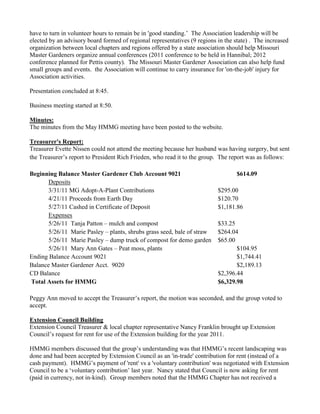
have to turn in volunteer hours to remain be in 'good standing.‟ The Association leadership will be
elected by an advisory board formed of regional representatives (9 regions in the state) . The increased
organization between local chapters and regions offered by a state association should help Missouri
Master Gardeners organize annual conferences (2011 conference to be held in Hannibal; 2012
conference planned for Pettis county). The Missouri Master Gardener Association can also help fund
small groups and events. the Association will continue to carry insurance for 'on-the-job' injury for
Association activities.
Presentation concluded at 8:45.
Business meeting started at 8:50.
Minutes:
The minutes from the May HMMG meeting have been posted to the website.
Treasurer's Report:
Treasurer Evette Nissen could not attend the meeting because her husband was having surgery, but sent
the Treasurer‟s report to President Rich Frieden, who read it to the group. The report was as follows:
Beginning Balance Master Gardener Club Account 9021 $614.09
Deposits
3/31/11 MG Adopt-A-Plant Contributions $295.00
4/21/11 Proceeds from Earth Day $120.70
5/27/11 Cashed in Certificate of Deposit $1,181.86
Expenses
5/26/11 Tanja Patton – mulch and compost $33.25
5/26/11 Marie Pasley – plants, shrubs grass seed, bale of straw $264.04
5/26/11 Marie Pasley – dump truck of compost for demo garden $65.00
5/26/11 Mary Ann Gates – Peat moss, plants $104.95
Ending Balance Account 9021 $1,744.41
Balance Master Gardener Acct. 9020 $2,189.13
CD Balance $2,396.44
Total Assets for HMMG $6,329.98
Peggy Ann moved to accept the Treasurer‟s report, the motion was seconded, and the group voted to
accept.
Extension Council Building
Extension Council Treasurer & local chapter representative Nancy Franklin brought up Extension
Council‟s request for rent for use of the Extension building for the year 2011.
HMMG members discussed that the group‟s understanding was that HMMG‟s recent landscaping was
done and had been accepted by Extension Council as an 'in-trade' contribution for rent (instead of a
cash payment). HMMG‟s payment of 'rent' vs a 'voluntary contribution' was negotiated with Extension
Council to be a „voluntary contribution‟ last year. Nancy stated that Council is now asking for rent
(paid in currency, not in-kind). Group members noted that the HMMG Chapter has not received a
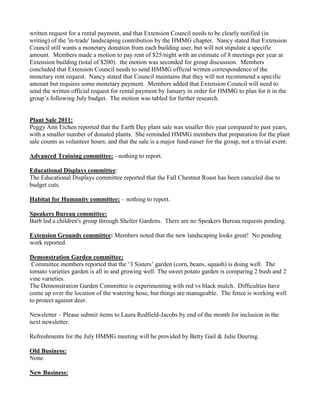
written request for a rental payment, and that Extension Council needs to be clearly notified (in
writing) of the 'in-trade' landscaping contribution by the HMMG chapter. Nancy stated that Extension
Council still wants a monetary donation from each building user, but will not stipulate a specific
amount. Members made a motion to pay rent of $25/night with an estimate of 8 meetings per year at
Extension building (total of $200). the motion was seconded for group discussion. Members
concluded that Extension Council needs to send HMMG official written correspondence of the
monetary rent request. Nancy stated that Council maintains that they will not recommend a specific
amount but requires some monetary payment. Members added that Extension Council will need to
send the written official request for rental payment by January in order for HMMG to plan for it in the
group‟s following July budget. The motion was tabled for further research.
Plant Sale 2011:
Peggy Ann Eichen reported that the Earth Day plant sale was smaller this year compared to past years,
with a smaller number of donated plants. She reminded HMMG members that preparation for the plant
sale counts as volunteer hours, and that the sale is a major fund-raiser for the group, not a trivial event.
Advanced Training committee: - nothing to report.
Educational Displays committee:
The Educational Displays committee reported that the Fall Chestnut Roast has been canceled due to
budget cuts.
Habitat for Humanity committee: – nothing to report.
Speakers Bureau committee:
Barb led a children's group through Shelter Gardens. There are no Speakers Bureau requests pending.
Extension Grounds committee: Members noted that the new landscaping looks great! No pending
work reported.
Demonstration Garden committee:
Committee members reported that the „3 Sisters‟ garden (corn, beans, squash) is doing well. The
tomato varieties garden is all in and growing well. The sweet potato garden is comparing 2 bush and 2
vine varieties.
The Demonstration Garden Committee is experimenting with red vs black mulch. Difficulties have
come up over the location of the watering hose, but things are manageable. The fence is working well
to protect against deer.
Newsletter – Please submit items to Laura Redfield-Jacobs by end of the month for inclusion in the
next newsletter.
Refreshments for the July HMMG meeting will be provided by Betty Gail & Julie Deering.
Old Business:
None
New Business:
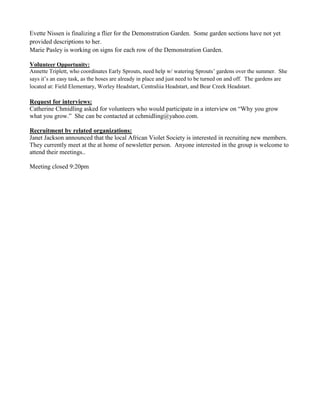
Evette Nissen is finalizing a flier for the Demonstration Garden. Some garden sections have not yet
provided descriptions to her.
Marie Pasley is working on signs for each row of the Demonstration Garden.
Volunteer Opportunity:
Annette Triplett, who coordinates Early Sprouts, need help w/ watering Sprouts‟ gardens over the summer. She
says it‟s an easy task, as the hoses are already in place and just need to be turned on and off. The gardens are
located at: Field Elementary, Worley Headstart, Centraliia Headstart, and Bear Creek Headstart.
Request for interviews:
Catherine Chmidling asked for volunteers who would participate in a interview on “Why you grow
what you grow.” She can be contacted at cchmidling@yahoo.com.
Recruitment by related organizations:
Janet Jackson announced that the local African Violet Society is interested in recruiting new members.
They currently meet at the at home of newsletter person. Anyone interested in the group is welcome to
attend their meetings..
Meeting closed 9:20pm

Row Covers & Pest Control; Gardening Guidebook for Boone County, Missouri

  • 1.
    Master Gardeners, June21, 2011 with guest speaker Jim Quinn President Rich Frieden asked Laura Redfield Jacobs to call the meeting to order at 7:05. She introduced Jim Quinn from Extension, who will be speaking on organic pest controls in vegetable gardens. Currently in the Vegetable Garden: June Pests & Planting Options Jim brought an insect display case of vegetable insects. The group briefly discussed moles in the vegetable garden, as they can undermine plants, but they are difficult to predict. Japanese beetles arrived in the area approximately last week (~June 13-15). Cucurbits (plant by July 4) squash pumpkin cucumber zucchini (may be getting too hot) cantaloupe --are vulnerable to cucurbit bugs --difficult plant family to grow organically Cucurbit-related pests: striped & spotted cucumber beetles: Spotted beetles have wider feeding range than striped beetles – striped ones are more likely to stay in local garden area than spotted. Cucumber beetles transmit bacterial wilt – cucumber & cantaloupe particularly susceptible. They can be repelled by row covers on plants, but the covers need to be removed for pollination (unless done by hand). Spraying plants after they‟ve already wilted is less effective than removing dead plants first. Jim recommends pyrethrin to deter cucumber beetles. Bythenthrin is a longer-lasting insecticde but has an extended period before it's safe to harvest from the treated plants. He does not recommend Seven because it can be harmful to bees. Jaime Piñero at Lincoln University in Jefferson City is researching organic controls such as the application of kaolin clay powder. squash bugs Recommend pyrethrin. squash vine borer One proposed solution is to wrap the base of the plant with tinfoil (foil buried in soil) before the plant flowers. Cover the vine above the bore-hole with soil for advantageous rooting. Cut into the stem & kill the borer. Plant resistant varieties, such as butternut squash. Plant parthenocarpic zucchini (sets fruit without pollination) – can then leave the row cover on indefinitely. Associated problem with row covers – covers limit the growth of plants which can otherwise get large.
  • 2.
    Chickens have alsobeen proposed as an insect control. Some people propose to put chickens in the vegetable garden. Chickens can be kept in small area, be used to prepare the ground for planting (eating greenery and bugs), and can clean up plant residue & bugs after harvest. Note: chickens may not work well with household pets! Jim noted from his own experiences with chickens that they seemed to reduce squash bugs and cucumber beetles, but didn't eat caterpillars. powdery mildew – This is especially a problem late in the season. Jim recommended planting resistant plant varieties. Cole crops Similar treatments as for cucurbits – use row covers. Common pests: cabbage buterfly, cabbage looper, cabbage worm Common pest treatments – Bt, spinosad, Neem oil, synthetic insecticides Jim recommends 'spreader sticker' when using a spray – it helps the spray stay on waxy plant leaves when it might otherwise roll off. The group discussed use of a homemade saline spray of 1 tablespoon salt in one gallon of water, which can bring worms out of cabbage/broccoli plants for removal. The saline can also be used after harvest as a wash to draw worms out of harvested vegetables. Tomatoes Common problems: Early blight – recently recorded in Missouri. Early blight overwinters in diseased plant residue. It starts in older plants & moves up plant, and is favored by heavy dews & rain. Septoria leaf spot (tiny spots) - Occurs under favorable conditions similar to those for early blight (above). Both early blight and septoria leaf spot are fungal. Controls include chlorothalonil (home use) and mancozeb/maneb/strobin (commercial use). Bacterial speck & spot – bacterial, not fungal. Can affect fruit as well as leaf, otherwise difficult to distinguish from early blight, but blight doesn't affect fruit. Bac. spot can also affect peppers (which are not susceptible to blight). Bacterial speck and spot have been a problem in the area in recent years due to wet summers. Treatments: chlorothalonil for fungal diseases; copper based products for bacterial. Jim stated that gardeners may have to treat for both fungal and bacterial problems in order to determine which is the exact problem. He also recommended that gardeners begin preventative treatments (“prevention is easier than curing”) in approximately May, but these could also be done in June (now). Jim reminded the audience that plants grown in full sun and good soil fertility (adequate nitrogen) are more resistant. Hehas a recent article on this in Missouri Environment and Garden (Volume 17, number 5, “Preventing Foliar Tomato Blights,”available online at http://ppp.missouri.edu/newsletters/meg/).
  • 3.
    Jim also discussedusing resistant tomato varieties, and the importance of healthy soils, compost, mulch, staking, plant spacing, and drip irrigation. Blossom end rot: Not a disease, blossom end rot is associated with low calcium availability to the plant. Folier application of calcium doesn't help. It is more common early in the growing season, and aggravated by dry weather. Cracking – Cracking is a fruit disorder caused by irregular watering or over pruning (over suckering). Jim stated that vegetable gardens typically need approximately 1 inch of water per 5 days when the weather is hot, 7-10 days when the weather is less hot. He recommended using reports from the rain gauge at Sanborn field or the Columbia Airport as a judge of rain needs. Hornworm – Hornworm is a pest which can rapidly defoliate tomato plants, and needs to be controlled when the worms are young. Hornworms are attracted to tubular flowers such as morning glory and jimson weed. Stink bugs - Stink bugs can leave feeding damage (spots) on tomatoes, but do not harm the fruit or foliage beyond the cosmetic spots. Stink bug spots can be cut off harvested fruit as desired. Flea beetles - Flee beetles are a common pest on eggplant , and tend to be worst at the small-transplant stage. They generally seem to disappear in hot weather. can use row covers or insecticde Damping off – Damping off affects warm season plants in cold wet weather, and was particularly bad this spring. Corn earworm aka cotton boleworm, aka tomato worm: These worms are attracted to green cornsilk; there is no sense treating the plants after the green silk is gone. Early plantings seem to have less problems with this pest. difficult to treat with Bt, but can try dusting corn on stalk Other corn pests include wildlife such as deer, raccoons, & squirrels. Japanese beetle A new pest arriving in central Missouri is the japanese beetle. Japanese beetles affect brambles, grapes, roses, hibiscus, okra, and beans. Jim said that Seven is an effective treatment against the beetles, but is hazardous to bees. The group discussed trapping. Jim commented that extensive trapping may catch only a small percentage of the population. Also, traps may attract beetles from further away. Fall gardening Jim offered a couple of recommendations for fall gardening. First, extend warm season into fall by planting warm season crops late in the planting window so that they can be harvested in fall: Pumpkins & winter squash can be planted in late June;
  • 4.
    Tomatoes can beplanted in July; Snap beans can be planted in August. Second, plant cool season vegetables in late summer when it has started to cool off: Plant cole crops in early/mid August; seed beets by mid-August, seed greens in late August and early September, seed spinach by ethe nd of September. Plant garlic in the fall (approximately November 1). The bulb should have just rooted in and started to emerge before winter. The garlic can then be harvested in July, once it has 3 brown leaves. The group discussed hard vs soft neck garlic. Hard neck garlic has several larger cloves, store better, and gardeners can harvest the scapes (treat like asparagus; harvesting makes the bulb grow bigger). Soft neck garlic has one clove, and the stalks can be braided for storage. Asparagus To control weeds in asparagus patches, Jim recommended that once finished harvesting, gardeners cut the asparagus stalks to the ground, spray the area with weed killer (such as RoundUp), and cover a day later with wood chips. The asparagus then grows up through wood chips & no weeds the rest of the season. Wood chips keep weeds down while the growing asparagus ferns keeps out other weeds. Cut down the ferns in late October and treat with weed killer again before winter. Gooseberries A master gardener at the meeting asked Jim about gooseberries. He said that there is a good chapter in the Midwest Home Fruit Production Guide issued by Ohio State (free online) on gooseberries & pawpaws - fruits that can both be grown in the shade. Master Gardener Program and MU Extension At the end of his talk, Jim Quinn and Laura Redfield-Jacobs addressed the group‟s questions on the Master Gardener program‟s relationship with MU Extension. The Master Gardener Program is transitioning to the State Master Gardener Association, and the current state advisory board will probably transition into Missouri State Master Garden Association. The advisory board has finalized the bylaws of the new Association. Laura Redfield-Jacobs is a member of the advisory board. Extension will not have funds to continue supporting MG program as it has in past, although the Extension will still offer Master Gardener classes and will partner with the Master Gardener groups across the state. An advantage of becoming a separate association is that the Master Gardener Association can lobby the University & State government with the increased influence of a private organization than it could as an Extension program. The Missouri Master Gardener Association is being modeled on associations from Wisconsin & Texas. The Missouri Master Gardener Association has filed papers with the State of Missouri and Federal IRS as a 501c3 non-profit organization, and the advisory group hopes that status will go into effect in January 2012. Each local chapter can decide whether to join the state association, and each region will send a representative to the association. There would be dues paid by each member all members would
  • 5.
    have to turnin volunteer hours to remain be in 'good standing.‟ The Association leadership will be elected by an advisory board formed of regional representatives (9 regions in the state) . The increased organization between local chapters and regions offered by a state association should help Missouri Master Gardeners organize annual conferences (2011 conference to be held in Hannibal; 2012 conference planned for Pettis county). The Missouri Master Gardener Association can also help fund small groups and events. the Association will continue to carry insurance for 'on-the-job' injury for Association activities. Presentation concluded at 8:45. Business meeting started at 8:50. Minutes: The minutes from the May HMMG meeting have been posted to the website. Treasurer's Report: Treasurer Evette Nissen could not attend the meeting because her husband was having surgery, but sent the Treasurer‟s report to President Rich Frieden, who read it to the group. The report was as follows: Beginning Balance Master Gardener Club Account 9021 $614.09 Deposits 3/31/11 MG Adopt-A-Plant Contributions $295.00 4/21/11 Proceeds from Earth Day $120.70 5/27/11 Cashed in Certificate of Deposit $1,181.86 Expenses 5/26/11 Tanja Patton – mulch and compost $33.25 5/26/11 Marie Pasley – plants, shrubs grass seed, bale of straw $264.04 5/26/11 Marie Pasley – dump truck of compost for demo garden $65.00 5/26/11 Mary Ann Gates – Peat moss, plants $104.95 Ending Balance Account 9021 $1,744.41 Balance Master Gardener Acct. 9020 $2,189.13 CD Balance $2,396.44 Total Assets for HMMG $6,329.98 Peggy Ann moved to accept the Treasurer‟s report, the motion was seconded, and the group voted to accept. Extension Council Building Extension Council Treasurer & local chapter representative Nancy Franklin brought up Extension Council‟s request for rent for use of the Extension building for the year 2011. HMMG members discussed that the group‟s understanding was that HMMG‟s recent landscaping was done and had been accepted by Extension Council as an 'in-trade' contribution for rent (instead of a cash payment). HMMG‟s payment of 'rent' vs a 'voluntary contribution' was negotiated with Extension Council to be a „voluntary contribution‟ last year. Nancy stated that Council is now asking for rent (paid in currency, not in-kind). Group members noted that the HMMG Chapter has not received a
  • 6.
    written request fora rental payment, and that Extension Council needs to be clearly notified (in writing) of the 'in-trade' landscaping contribution by the HMMG chapter. Nancy stated that Extension Council still wants a monetary donation from each building user, but will not stipulate a specific amount. Members made a motion to pay rent of $25/night with an estimate of 8 meetings per year at Extension building (total of $200). the motion was seconded for group discussion. Members concluded that Extension Council needs to send HMMG official written correspondence of the monetary rent request. Nancy stated that Council maintains that they will not recommend a specific amount but requires some monetary payment. Members added that Extension Council will need to send the written official request for rental payment by January in order for HMMG to plan for it in the group‟s following July budget. The motion was tabled for further research. Plant Sale 2011: Peggy Ann Eichen reported that the Earth Day plant sale was smaller this year compared to past years, with a smaller number of donated plants. She reminded HMMG members that preparation for the plant sale counts as volunteer hours, and that the sale is a major fund-raiser for the group, not a trivial event. Advanced Training committee: - nothing to report. Educational Displays committee: The Educational Displays committee reported that the Fall Chestnut Roast has been canceled due to budget cuts. Habitat for Humanity committee: – nothing to report. Speakers Bureau committee: Barb led a children's group through Shelter Gardens. There are no Speakers Bureau requests pending. Extension Grounds committee: Members noted that the new landscaping looks great! No pending work reported. Demonstration Garden committee: Committee members reported that the „3 Sisters‟ garden (corn, beans, squash) is doing well. The tomato varieties garden is all in and growing well. The sweet potato garden is comparing 2 bush and 2 vine varieties. The Demonstration Garden Committee is experimenting with red vs black mulch. Difficulties have come up over the location of the watering hose, but things are manageable. The fence is working well to protect against deer. Newsletter – Please submit items to Laura Redfield-Jacobs by end of the month for inclusion in the next newsletter. Refreshments for the July HMMG meeting will be provided by Betty Gail & Julie Deering. Old Business: None New Business:
  • 7.
    Evette Nissen isfinalizing a flier for the Demonstration Garden. Some garden sections have not yet provided descriptions to her. Marie Pasley is working on signs for each row of the Demonstration Garden. Volunteer Opportunity: Annette Triplett, who coordinates Early Sprouts, need help w/ watering Sprouts‟ gardens over the summer. She says it‟s an easy task, as the hoses are already in place and just need to be turned on and off. The gardens are located at: Field Elementary, Worley Headstart, Centraliia Headstart, and Bear Creek Headstart. Request for interviews: Catherine Chmidling asked for volunteers who would participate in a interview on “Why you grow what you grow.” She can be contacted at cchmidling@yahoo.com. Recruitment by related organizations: Janet Jackson announced that the local African Violet Society is interested in recruiting new members. They currently meet at the at home of newsletter person. Anyone interested in the group is welcome to attend their meetings.. Meeting closed 9:20pm