International Year of Cooperatives
                                                                                                   issue brief series


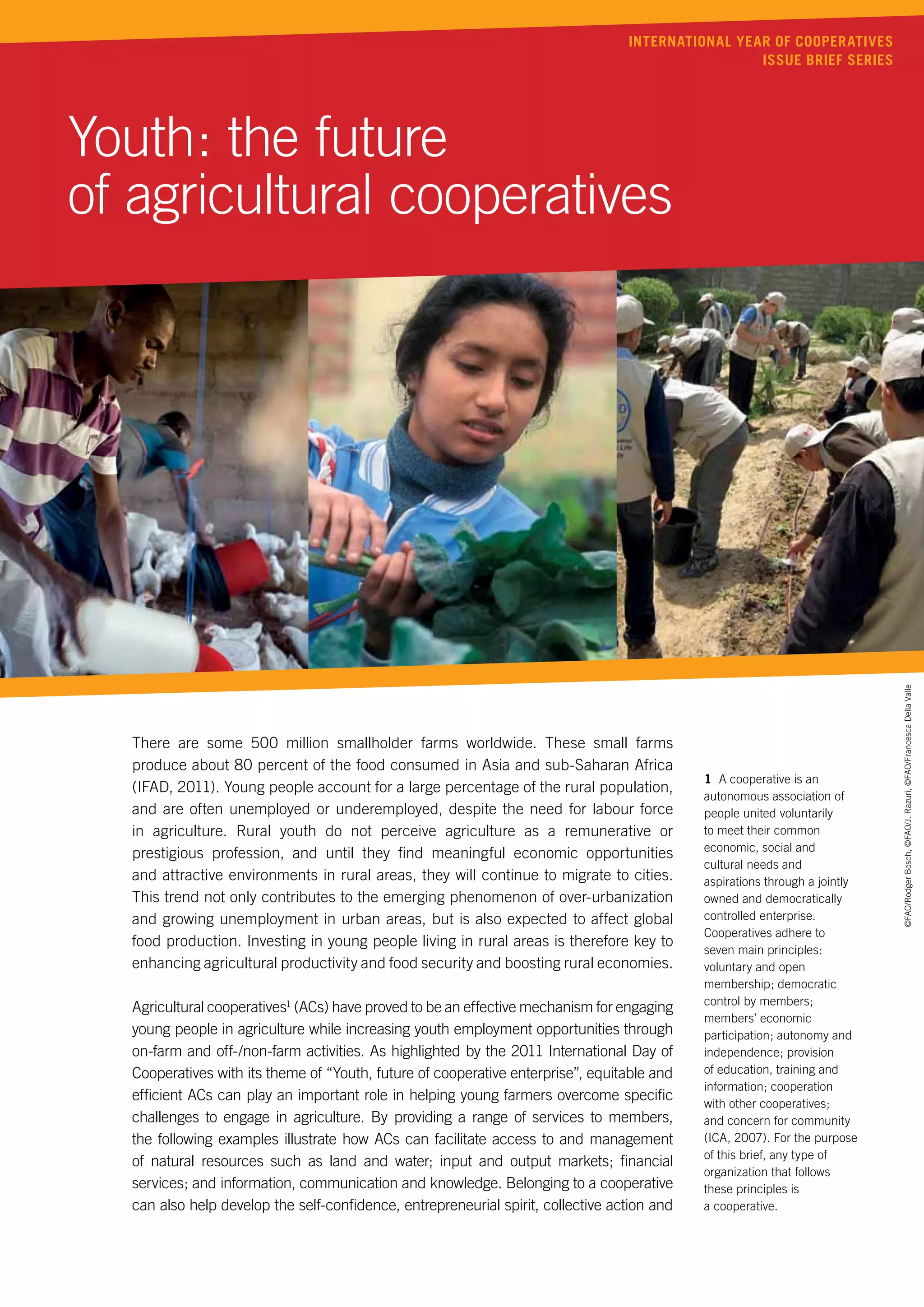
Youth: the future
of agricultural cooperatives


                                                                                                                             ©FAO/Rodger Bosch, ©FAO/J. Razuri, ©FAO/Francesca Della Valle
  There are some 500 million smallholder farms worldwide. These small farms
  produce about 80 percent of the food consumed in Asia and sub-Saharan Africa
                                                                                             1 A cooperative is an
  (IFAD, 2011). Young people account for a large percentage of the rural population,
                                                                                             autonomous association of
  and are often unemployed or underemployed, despite the need for labour force               people united voluntarily
  in agriculture. Rural youth do not perceive agriculture as a remunerative or               to meet their common
                                                                                             economic, social and
  prestigious profession, and until they find meaningful economic opportunities
                                                                                             cultural needs and
  and attractive environments in rural areas, they will continue to migrate to cities.       aspirations through a jointly
  This trend not only contributes to the emerging phenomenon of over-urbanization            owned and democratically
  and growing unemployment in urban areas, but is also expected to affect global             controlled enterprise.
                                                                                             Cooperatives adhere to
  food production. Investing in young people living in rural areas is therefore key to
                                                                                             seven main principles:
  enhancing agricultural productivity and food security and boosting rural economies.        voluntary and open
                                                                                             membership; democratic
                                                                                             control by members;
  Agricultural cooperatives1 (ACs) have proved to be an effective mechanism for engaging
                                                                                             members’ economic
  young people in agriculture while increasing youth employment opportunities through        participation; autonomy and
  on-farm and off-/non-farm activities. As highlighted by the 2011 International Day of      independence; provision
  Cooperatives with its theme of “Youth, future of cooperative enterprise”, equitable and    of education, training and
                                                                                             information; cooperation
  efficient ACs can play an important role in helping young farmers overcome specific        with other cooperatives;
  challenges to engage in agriculture. By providing a range of services to members,          and concern for community
  the following examples illustrate how ACs can facilitate access to and management          (ICA, 2007). For the purpose
                                                                                             of this brief, any type of
  of natural resources such as land and water; input and output markets; financial
                                                                                             organization that follows
  services; and information, communication and knowledge. Belonging to a cooperative         these principles is
  can also help develop the self-confidence, entrepreneurial spirit, collective action and   a cooperative.
social capital of its members. Cooperatives can enhance young farmers’ participation
                                          in policy dialogue so that youth-sensitive policies are more likely to be developed. Youth
                                          are an important asset for ACs, not only because they ensure the generational renewal
                                          of the membership and will be the ACs’ future leaders, but also because they have a
                                          greater capacity for innovation and entrepreneurship, are more inclined to work with
                                          new technologies, and generally have higher levels of education than older farmers.


                                          Youth’s participation in cooperatives:
                                          challenges and successes
                                          Youth face specific constraints in joining a cooperative. Some cooperative by-laws stipulate
                                          membership conditions, such as landownership and the payment of membership fees,
                                          to which youth often cannot adhere. Youth, particularly young women, typically do not
                                          own (enough) land and cannot pay membership fees. To address this issue, some
                                          Latin American organizations have introduced the concept of household membership,
                                          ensuring that family members other than the head of household who owns the land
                                          can be involved in the organization (MIJARC/IFAD/FAO,2012). Cooperatives can also
                                          play an important role in facilitating land access for youth. For example, cooperatives in
                                          Burkina Faso have negotiated with village chiefs to convince them to give land to young
                                          women in their communities. When youth form their own cooperatives, they often
                                          struggle with cumbersome and complex procedures to register these cooperatives.

                                          Youth-only and mixed organizations (those with both young and older members) face
                                          different constraints in representing youth. Youth-only organizations are generally informal
                                          and lack human and financial resources. On the other hand, although youth often form
                                          a large percentage of the membership of mixed organizations, they are frequently not
                                          well represented in and excluded from decision-making processes. Young people’s
                                          limited participation within organizations also undermines their ability to participate


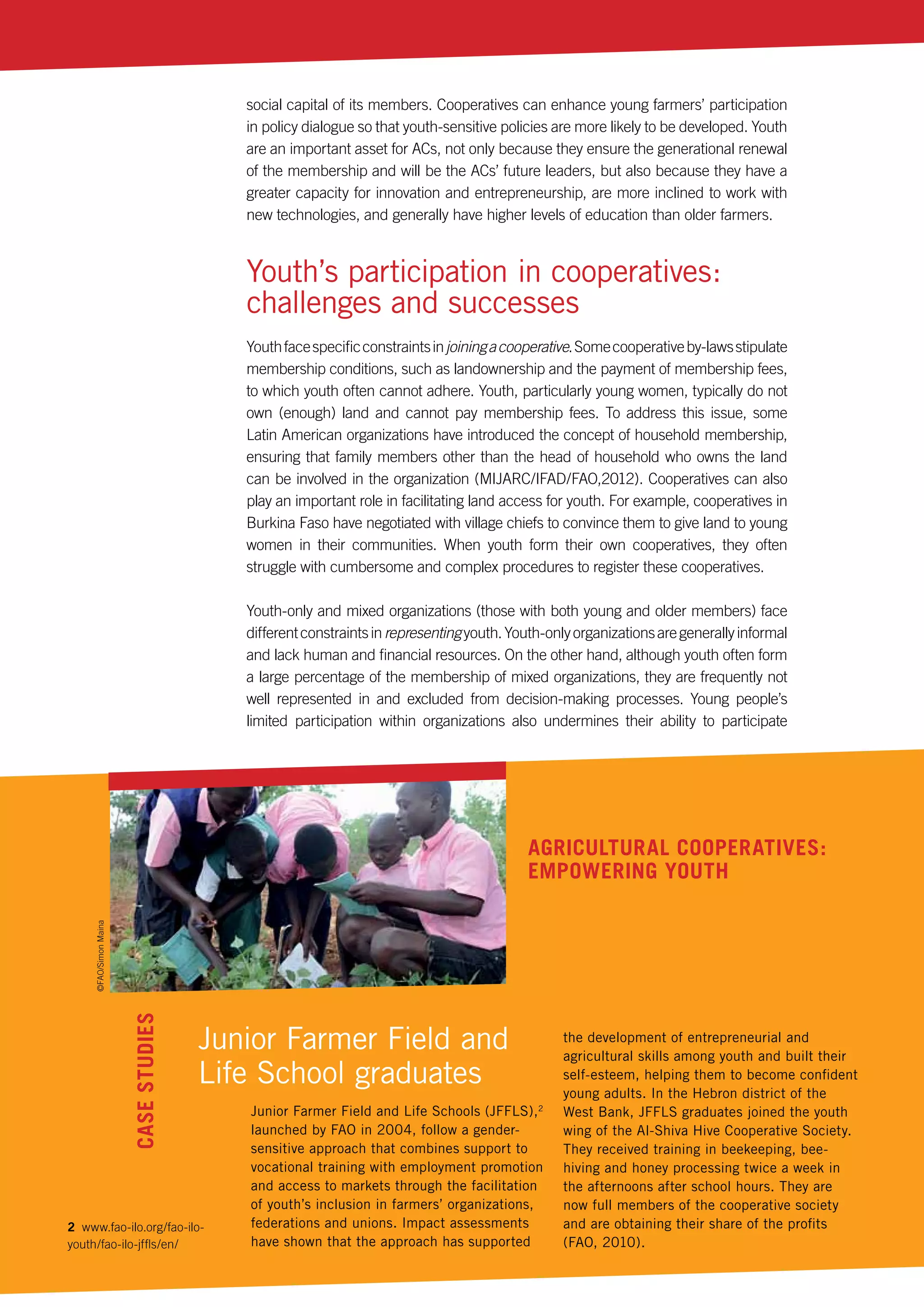
                                                                                         Agricultural cooperatives:
                                                                                         empowering youth
     ©FAO/Simon Maina


                        case studies


                                       Junior Farmer Field and                                 the development of entrepreneurial and
                                                                                               agricultural skills among youth and built their
                                       Life School graduates                                   self-esteem, helping them to become confident
                                                                                               young adults. In the Hebron district of the
                                          Junior Farmer Field and Life Schools (JFFLS),2       West Bank, JFFLS graduates joined the youth
                                          launched by FAO in 2004, follow a gender-            wing of the Al-Shiva Hive Cooperative Society.
                                          sensitive approach that combines support to          They received training in beekeeping, bee-
                                          vocational training with employment promotion        hiving and honey processing twice a week in
                                          and access to markets through the facilitation       the afternoons after school hours. They are
                                          of youth’s inclusion in farmers’ organizations,      now full members of the cooperative society
2 www.fao-ilo.org/fao-ilo-                federations and unions. Impact assessments           and are obtaining their share of the profits
youth/fao-ilo-jffls/en/                   have shown that the approach has supported           (FAO, 2010).
International Year of Cooperatives
                                                                                                     issue brief series


   in policy processes outside the organization. Culture and traditions characterized by
   hierarchical relationships in which young people are expected to obey older community
   members also complicate youth’s participation in cooperatives. Again, young women
   face additional challenges in having their voices heard. However, there is growing
   recognition of the importance of ensuring adequate representation of young people
   in cooperatives and their active participation in decision-making. As a result, many
   cooperatives have been expanding their membership bases to include young people,
   establishing youth structures within the organization, and promoting youth leadership.


   Agricultural cooperatives
   empowering youth, how?


                                                                                              ©IFAD/Jon Spaull
   A series of recommendations for increasing agricultural cooperatives’ empowerment
   of youth were drawn up by rural youth and young producers’ representatives at joint
   regional workshops held by FAO, the International Fund for Agricultural Development
   (IFAD) and the International Movement of Catholic Agricultural and Rural Youth
   (MIJARC) in Senegal, Sri Lanka and Peru in 2011. These recommendations were
   refined during the fourth global meeting of the Farmers’ Forum hosted by IFAD in
   2012, and are addressed to cooperatives, governments and donors.

   1.	 Cooperatives should become youth-sensitive, particularly in their representation
       and governance. Youth sections should be created within mixed cooperatives,
       and gender inequalities should be addressed to ensure the active participation of
       young women. The creation of youth-only cooperatives should also be facilitated.
   2.	 Cooperatives should provide mentoring, guidance and advisory services to their
       young members, so that they can become leaders and farmer entrepreneurs,
       and can overcome constraints (e.g., through access to training, land and credit).


Market access in Togo
   REJEPPAT, the young farmers’ section of             contacted the Togolese Chamber of
   Coordination Togolaise des Organizations            Agriculture, which put the young farmers
   Paysannes et de Producteurs Agricoles decided       in touch with the International Trade
   to invest in “aggressive market research” for its   Centre (ITC). ITC accompanied REJEPPAT
   members’ agricultural produce. Members visited      members on a market prospecting visit to
                                                                                                                 ©FAO/Giulio Napolitano


   markets in various West African countries,          Morocco to identify other suitable markets
   negotiating a contract at the large Katako          for selling their pineapples. REJEPPAT
   market in Niamey to sell their bananas and          is also negotiating a contract to sell soy
   pineapples, and signing another contract to sell    produce to the PKL agrifood business in
   their green beans in Burkina Faso. REJEPPAT         Côte d’Ivoire (MIJARC/IFAD/FAO, 2012).


Young coffee growers in Peru
   The National Association of Coffee Producers        (CONAJOC) was created as a section of JNC’s
   (JNC) of Peru represents 52 coffee producer         national board. CONAJOC activities include
   organizations. Older members of JNC                 training and workshops targeting young coffee
   encouraged youth to participate in the              producers, technical support, and launching of a
   organizations’ decision-making processes, but       Youth Innovation Fund. To facilitate membership,
   the organizational structure did not allow for      CONAJOC encourages parents to anticipate the
   this. In 2005, it was acknowledged that it was      inheritance of part of their coffee plantations
   time for a generational renewal of leadership       so that their children can join the committee
   within JNC. As a consequence, the National          (MIJARC/IFAD/FAO, 2012).
   Coordinating Committee of Young Coffee Growers
3.	 Cooperatives should value indigenous/traditional agricultural knowledge and
    practices, while also promoting innovations to stimulate youth’s interest in agriculture.
4.	 Cooperatives, donors and governments should formulate and implement youth-
    focused agricultural development projects and programmes.
5.	 Cooperatives, governments and the international community should play a
    proactive role in raising the image/profile of agriculture. Cooperatives can be a
    platform for sharing/demonstrating farmers’ success stories, or linking young
    women and men to educational institutions and agricultural schools.
6.	 Donors and governments should provide specific financial support for the
    development of cooperatives that involve and/or engage with young people.


References

FAO. 2010. Promoting employment and entrepreneurship for vulnerable youths in West Bank
and the Gaza Strip, F. Dalla Valle. Rome. www.fao.org/docrep/012/i1450e/i1450e00.pdf
ICA. 2007. Factsheet: Differences between Co-operatives, Corporations and Non-Profit
Organisations, US Overseas Cooperative Development Council. Geneva.
http://2012.coop/sites/default/files/Factsheet%20-%20Differences%20between%20Coops%20
Corps%20and%20NFPs%20-%20US%20OCDC%20-%202007.pdf


                                                                                                    ©FAO/Giuseppe Bizzarri
IFAD. 2011. Viewpoint: Smallholders can feed the world, K.F. Nwanze. Rome.
http://www.ifad.org/pub/viewpoint/smallholder.pdf
MIJARC/IFAD/FAO. 2012. The Farmers’ Forum Youth Session 18 February 2012.
Summary of the findings of the project implemented by MIJARC in collaboration with FAO
and IFAD: Facilitating access of rural youth to agricultural activities. Rome.
http://www.ifad.org/farmer/2012/youth/report.pdf


Contact:
Nora Ourabah Haddad, Cooperatives and Producer Organizations Coordinator
nora.ourabahHaddad@fao.org
Charlotte Goemans, Gender and Rural Institutions Specialist
charlotte.goemans@fao.org


                                                          Food and Agriculture Organization of the United Nations
                                                          Viale delle Terme di Caracalla – 00153 Rome, Italy
                                                          Tel: + 39 06 57051 – www.fao.org

                                                          International Fund for Agricultural Development
                                                          Via Paolo di Dono, 44 – 00142 Rome, Italy
                                                          Tel: +39 06 54591 – www.ifad.org

                                                          International Year of Cooperatives website
                                                          http://social.un.org/coopsyear/


                                                                                 Enabling poor rural people
                                                                                 to overcome poverty

Youth and agriculture

  • 1.
    International Year ofCooperatives issue brief series Youth: the future of agricultural cooperatives ©FAO/Rodger Bosch, ©FAO/J. Razuri, ©FAO/Francesca Della Valle There are some 500 million smallholder farms worldwide. These small farms produce about 80 percent of the food consumed in Asia and sub-Saharan Africa 1 A cooperative is an (IFAD, 2011). Young people account for a large percentage of the rural population, autonomous association of and are often unemployed or underemployed, despite the need for labour force people united voluntarily in agriculture. Rural youth do not perceive agriculture as a remunerative or to meet their common economic, social and prestigious profession, and until they find meaningful economic opportunities cultural needs and and attractive environments in rural areas, they will continue to migrate to cities. aspirations through a jointly This trend not only contributes to the emerging phenomenon of over-urbanization owned and democratically and growing unemployment in urban areas, but is also expected to affect global controlled enterprise. Cooperatives adhere to food production. Investing in young people living in rural areas is therefore key to seven main principles: enhancing agricultural productivity and food security and boosting rural economies. voluntary and open membership; democratic control by members; Agricultural cooperatives1 (ACs) have proved to be an effective mechanism for engaging members’ economic young people in agriculture while increasing youth employment opportunities through participation; autonomy and on-farm and off-/non-farm activities. As highlighted by the 2011 International Day of independence; provision Cooperatives with its theme of “Youth, future of cooperative enterprise”, equitable and of education, training and information; cooperation efficient ACs can play an important role in helping young farmers overcome specific with other cooperatives; challenges to engage in agriculture. By providing a range of services to members, and concern for community the following examples illustrate how ACs can facilitate access to and management (ICA, 2007). For the purpose of this brief, any type of of natural resources such as land and water; input and output markets; financial organization that follows services; and information, communication and knowledge. Belonging to a cooperative these principles is can also help develop the self-confidence, entrepreneurial spirit, collective action and a cooperative.
  • 2.
    social capital ofits members. Cooperatives can enhance young farmers’ participation in policy dialogue so that youth-sensitive policies are more likely to be developed. Youth are an important asset for ACs, not only because they ensure the generational renewal of the membership and will be the ACs’ future leaders, but also because they have a greater capacity for innovation and entrepreneurship, are more inclined to work with new technologies, and generally have higher levels of education than older farmers. Youth’s participation in cooperatives: challenges and successes Youth face specific constraints in joining a cooperative. Some cooperative by-laws stipulate membership conditions, such as landownership and the payment of membership fees, to which youth often cannot adhere. Youth, particularly young women, typically do not own (enough) land and cannot pay membership fees. To address this issue, some Latin American organizations have introduced the concept of household membership, ensuring that family members other than the head of household who owns the land can be involved in the organization (MIJARC/IFAD/FAO,2012). Cooperatives can also play an important role in facilitating land access for youth. For example, cooperatives in Burkina Faso have negotiated with village chiefs to convince them to give land to young women in their communities. When youth form their own cooperatives, they often struggle with cumbersome and complex procedures to register these cooperatives. Youth-only and mixed organizations (those with both young and older members) face different constraints in representing youth. Youth-only organizations are generally informal and lack human and financial resources. On the other hand, although youth often form a large percentage of the membership of mixed organizations, they are frequently not well represented in and excluded from decision-making processes. Young people’s limited participation within organizations also undermines their ability to participate Agricultural cooperatives: empowering youth ©FAO/Simon Maina case studies Junior Farmer Field and the development of entrepreneurial and agricultural skills among youth and built their Life School graduates self-esteem, helping them to become confident young adults. In the Hebron district of the Junior Farmer Field and Life Schools (JFFLS),2 West Bank, JFFLS graduates joined the youth launched by FAO in 2004, follow a gender- wing of the Al-Shiva Hive Cooperative Society. sensitive approach that combines support to They received training in beekeeping, bee- vocational training with employment promotion hiving and honey processing twice a week in and access to markets through the facilitation the afternoons after school hours. They are of youth’s inclusion in farmers’ organizations, now full members of the cooperative society 2 www.fao-ilo.org/fao-ilo- federations and unions. Impact assessments and are obtaining their share of the profits youth/fao-ilo-jffls/en/ have shown that the approach has supported (FAO, 2010).
  • 3.
    International Year ofCooperatives issue brief series in policy processes outside the organization. Culture and traditions characterized by hierarchical relationships in which young people are expected to obey older community members also complicate youth’s participation in cooperatives. Again, young women face additional challenges in having their voices heard. However, there is growing recognition of the importance of ensuring adequate representation of young people in cooperatives and their active participation in decision-making. As a result, many cooperatives have been expanding their membership bases to include young people, establishing youth structures within the organization, and promoting youth leadership. Agricultural cooperatives empowering youth, how? ©IFAD/Jon Spaull A series of recommendations for increasing agricultural cooperatives’ empowerment of youth were drawn up by rural youth and young producers’ representatives at joint regional workshops held by FAO, the International Fund for Agricultural Development (IFAD) and the International Movement of Catholic Agricultural and Rural Youth (MIJARC) in Senegal, Sri Lanka and Peru in 2011. These recommendations were refined during the fourth global meeting of the Farmers’ Forum hosted by IFAD in 2012, and are addressed to cooperatives, governments and donors. 1. Cooperatives should become youth-sensitive, particularly in their representation and governance. Youth sections should be created within mixed cooperatives, and gender inequalities should be addressed to ensure the active participation of young women. The creation of youth-only cooperatives should also be facilitated. 2. Cooperatives should provide mentoring, guidance and advisory services to their young members, so that they can become leaders and farmer entrepreneurs, and can overcome constraints (e.g., through access to training, land and credit). Market access in Togo REJEPPAT, the young farmers’ section of contacted the Togolese Chamber of Coordination Togolaise des Organizations Agriculture, which put the young farmers Paysannes et de Producteurs Agricoles decided in touch with the International Trade to invest in “aggressive market research” for its Centre (ITC). ITC accompanied REJEPPAT members’ agricultural produce. Members visited members on a market prospecting visit to ©FAO/Giulio Napolitano markets in various West African countries, Morocco to identify other suitable markets negotiating a contract at the large Katako for selling their pineapples. REJEPPAT market in Niamey to sell their bananas and is also negotiating a contract to sell soy pineapples, and signing another contract to sell produce to the PKL agrifood business in their green beans in Burkina Faso. REJEPPAT Côte d’Ivoire (MIJARC/IFAD/FAO, 2012). Young coffee growers in Peru The National Association of Coffee Producers (CONAJOC) was created as a section of JNC’s (JNC) of Peru represents 52 coffee producer national board. CONAJOC activities include organizations. Older members of JNC training and workshops targeting young coffee encouraged youth to participate in the producers, technical support, and launching of a organizations’ decision-making processes, but Youth Innovation Fund. To facilitate membership, the organizational structure did not allow for CONAJOC encourages parents to anticipate the this. In 2005, it was acknowledged that it was inheritance of part of their coffee plantations time for a generational renewal of leadership so that their children can join the committee within JNC. As a consequence, the National (MIJARC/IFAD/FAO, 2012). Coordinating Committee of Young Coffee Growers
  • 4.
    3. Cooperatives shouldvalue indigenous/traditional agricultural knowledge and practices, while also promoting innovations to stimulate youth’s interest in agriculture. 4. Cooperatives, donors and governments should formulate and implement youth- focused agricultural development projects and programmes. 5. Cooperatives, governments and the international community should play a proactive role in raising the image/profile of agriculture. Cooperatives can be a platform for sharing/demonstrating farmers’ success stories, or linking young women and men to educational institutions and agricultural schools. 6. Donors and governments should provide specific financial support for the development of cooperatives that involve and/or engage with young people. References FAO. 2010. Promoting employment and entrepreneurship for vulnerable youths in West Bank and the Gaza Strip, F. Dalla Valle. Rome. www.fao.org/docrep/012/i1450e/i1450e00.pdf ICA. 2007. Factsheet: Differences between Co-operatives, Corporations and Non-Profit Organisations, US Overseas Cooperative Development Council. Geneva. http://2012.coop/sites/default/files/Factsheet%20-%20Differences%20between%20Coops%20 Corps%20and%20NFPs%20-%20US%20OCDC%20-%202007.pdf ©FAO/Giuseppe Bizzarri IFAD. 2011. Viewpoint: Smallholders can feed the world, K.F. Nwanze. Rome. http://www.ifad.org/pub/viewpoint/smallholder.pdf MIJARC/IFAD/FAO. 2012. The Farmers’ Forum Youth Session 18 February 2012. Summary of the findings of the project implemented by MIJARC in collaboration with FAO and IFAD: Facilitating access of rural youth to agricultural activities. Rome. http://www.ifad.org/farmer/2012/youth/report.pdf Contact: Nora Ourabah Haddad, Cooperatives and Producer Organizations Coordinator nora.ourabahHaddad@fao.org Charlotte Goemans, Gender and Rural Institutions Specialist charlotte.goemans@fao.org Food and Agriculture Organization of the United Nations Viale delle Terme di Caracalla – 00153 Rome, Italy Tel: + 39 06 57051 – www.fao.org International Fund for Agricultural Development Via Paolo di Dono, 44 – 00142 Rome, Italy Tel: +39 06 54591 – www.ifad.org International Year of Cooperatives website http://social.un.org/coopsyear/ Enabling poor rural people to overcome poverty