Your Name: Jeanie Tran
Title of book: Young MacDonald
Author/Illustrator: David Milgrim
Publisher, copyright date: Dutton Children's Books, 2006
Suggested grade level: Kindergarten
CCSS:
 With prompting and support, ask and answer questions about key details in a text.
 Blend and segment onsets and rimes of single-syllable spoken words.
 Identify the front cover, back cover, and title page of a book.
Learning Target:
 I can identify the onset and rime single-syllable spoken words.
 I can understand the sequence of book beginning and end.
 I can begin to identify key details from a text.
Materials needed:
book, crayon, markers, color pencil, construction paper, internet access, computer, projector
and/or smart board, document camera
Pre-Reading
(5 minutes)
 I have a short little video I want you all to listen to.
http://www.youtube.com/watch?v=5oYKonYBujg
 With a show of hands, how many of you knew that song? Well
Today we are going to be reading a story that is very similar to
“Old McDonald” It is called Young MacDonald by David
Milgrim. He also drew the pictures for this book. How can you
tell David Milgrim is the author/illustrator of this book?
 What do you see on the cover?
 By looking at the cover of the book, who do you think is Young
Macdonald is?
 Why do you think Young MacDonald is wearing a white coat?
 Is there anything else you think the cover is telling us about this
story?
During Reading
(10 minutes)
As I read I want you to pay close attention to the new animals and how
they are formed.
 What do think is a HIG? (a Pig and a Horse)
 What two animals are used to make some DEESE? (two donkeys
and two Geese)
 What is a SHICKEN? (Sheep and Chicken)
 How did Young Macdonald make some MUCKS? (two mice and
two Ducks)
 What two animals makes a COWL? (a cow and an owl)
 What is going to happen when the boy and dog are in the middle
of science experiment? What did the boy and dog become? BOG
(a boy and a dog)
 In this page of illustrations what you do predict is going to
happen next? (I see or I think...)
After Reading
(5 minutes)
How did Young Macdonald make everything right?
What did we learn about Young MacDonald? (Wait for student
responses). We learned Young Macdonald is a mad-scientist who has no
trouble putting two different animals in one form.
Did you like the story? How is are Young MacDonald and Old
Macdonald alike? How are they different?
Follow-Up Activity
(20 minutes)
I do
We do
You do
On my worksheet on the document camera/smartboard, I have decided to
put a pig and cow together. What sounds does the pig and cow make?
(oink and moo). What is the first sound or onset of the word pig? “P”.
What does the letter P sounds like? What is the rime sound in the word
cow? OW. If we put the onset and rime together, what is it called? A
POW.
As a class, we will review over all the animals to make sure you
understand the sounds of the animal and how the words for all the
animals are spelt.
On the smart board/whiteboard, I will write each spelling and sounds of
the animal.
 Cow-Moo
 Horse-Neigh
 Pig-Oink
 Sheep-Baa
 Duck-Quack
 Dog-Bark
 Chicken-Baak
 Owl-Hoo
 Donkey-Hee
 Geese-Honk
 Mouse-Squeak
 Dog-Arf
 Cat-Meow
 Bird-Chirp
Now I want you boys and girls to go back to your desk and put together
two animals as one form just like Young MacDonald did in the book.
Assessment  Focused on student learning and development outcomes.
 Gathering information by observation, glancing over the work
samples, and testing how they engaging during our read aloud.
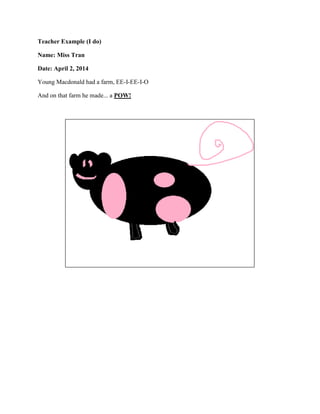
Teacher Example (I do)
Name: Miss Tran
Date: April 2, 2014
Young Macdonald had a farm, EE-I-EE-I-O
And on that farm he made... a POW!
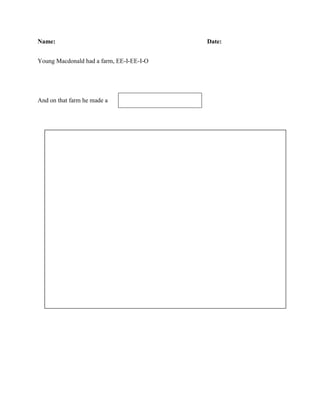
Name: Date:
Young Macdonald had a farm, EE-I-EE-I-O
And on that farm he made a

"Young MacDonald" Read Aloud Lesson Plan

  • 1.
    Your Name: JeanieTran Title of book: Young MacDonald Author/Illustrator: David Milgrim Publisher, copyright date: Dutton Children's Books, 2006 Suggested grade level: Kindergarten CCSS:  With prompting and support, ask and answer questions about key details in a text.  Blend and segment onsets and rimes of single-syllable spoken words.  Identify the front cover, back cover, and title page of a book. Learning Target:  I can identify the onset and rime single-syllable spoken words.  I can understand the sequence of book beginning and end.  I can begin to identify key details from a text. Materials needed: book, crayon, markers, color pencil, construction paper, internet access, computer, projector and/or smart board, document camera Pre-Reading (5 minutes)  I have a short little video I want you all to listen to. http://www.youtube.com/watch?v=5oYKonYBujg  With a show of hands, how many of you knew that song? Well Today we are going to be reading a story that is very similar to “Old McDonald” It is called Young MacDonald by David Milgrim. He also drew the pictures for this book. How can you tell David Milgrim is the author/illustrator of this book?  What do you see on the cover?  By looking at the cover of the book, who do you think is Young Macdonald is?  Why do you think Young MacDonald is wearing a white coat?  Is there anything else you think the cover is telling us about this story? During Reading (10 minutes) As I read I want you to pay close attention to the new animals and how they are formed.  What do think is a HIG? (a Pig and a Horse)  What two animals are used to make some DEESE? (two donkeys and two Geese)  What is a SHICKEN? (Sheep and Chicken)  How did Young Macdonald make some MUCKS? (two mice and two Ducks)  What two animals makes a COWL? (a cow and an owl)  What is going to happen when the boy and dog are in the middle of science experiment? What did the boy and dog become? BOG (a boy and a dog)  In this page of illustrations what you do predict is going to happen next? (I see or I think...)
  • 2.
    After Reading (5 minutes) Howdid Young Macdonald make everything right? What did we learn about Young MacDonald? (Wait for student responses). We learned Young Macdonald is a mad-scientist who has no trouble putting two different animals in one form. Did you like the story? How is are Young MacDonald and Old Macdonald alike? How are they different? Follow-Up Activity (20 minutes) I do We do You do On my worksheet on the document camera/smartboard, I have decided to put a pig and cow together. What sounds does the pig and cow make? (oink and moo). What is the first sound or onset of the word pig? “P”. What does the letter P sounds like? What is the rime sound in the word cow? OW. If we put the onset and rime together, what is it called? A POW. As a class, we will review over all the animals to make sure you understand the sounds of the animal and how the words for all the animals are spelt. On the smart board/whiteboard, I will write each spelling and sounds of the animal.  Cow-Moo  Horse-Neigh  Pig-Oink  Sheep-Baa  Duck-Quack  Dog-Bark  Chicken-Baak  Owl-Hoo  Donkey-Hee  Geese-Honk  Mouse-Squeak  Dog-Arf  Cat-Meow  Bird-Chirp Now I want you boys and girls to go back to your desk and put together two animals as one form just like Young MacDonald did in the book. Assessment  Focused on student learning and development outcomes.  Gathering information by observation, glancing over the work samples, and testing how they engaging during our read aloud.
  • 3.
    Teacher Example (Ido) Name: Miss Tran Date: April 2, 2014 Young Macdonald had a farm, EE-I-EE-I-O And on that farm he made... a POW!
  • 4.
    Name: Date: Young Macdonaldhad a farm, EE-I-EE-I-O And on that farm he made a