YOGA
(padmasanam and vajrasanam)
By
V. Amudha
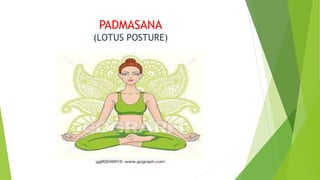
PADMASANA
PADMASANA
(LOTUS POSTURE)
Posture
 It is a Lotus Posture.
 The name of this asana is called padmasana
because the final position of this asana seems to
be like lotus.
 Position:
 Long Sitting Position. Sit with the legs extended
forward.
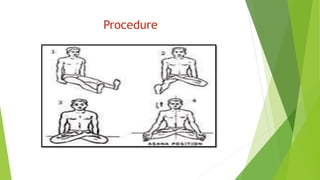
Procedure
Procedure
 Stage1:
 Slowly bring the right leg and place it on the left thigh.
 The heel of the right foot should as much as possible touch the
groin.
 Stage 2:
 Slowly bring the left leg and place it on the right thigh.
 The heel of the left foot should as much as possible touch the
groin.
 If you are not able to perform this stage, just fold the left leg
and place under the right leg at the initial practice.
 After a few days, or few weeks of practice, you can perform it
properly.
Procedure
 Stage:
 Keep the hands straight and rest them on your knees.
 Touch your thumb with your index finger, and spread out
the other fingers close to each other, thus forming Chin
Mudra.
Duration
 In the final position relax the whole body as much as
possible
 Remain in the pose for minimum of 15 to 30 seconds, and
at the maximum for 60 to 90 seconds.
 Closure:
 Slowly come back to the staring position by releasing the
stages in the reverse order. i.e. third, second and first
stages.
Points to be notice.
 Care should be taken that the knees touch the ground.
 The vertebral column and the body from the waist
upward should be kept erect.
 Keep the normal breath and normal eyesight.
Benefits
Benefits
 General:
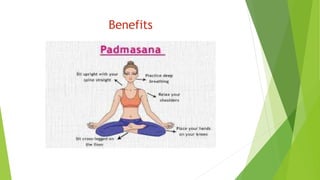
 Padmasana is used for meditation, prayer, and worship and for
pranayama practice.
 It develops the physical and mental stability.
 It relieves the stiffness of joints, particularly knees and guards from
rheumatism.
 This asana helps for the players to obtain mental control.
 Padmasana keeps a person young.
 Physiological:
 The abdominal region receives more supply of the blood.
 Padmasana improves the digestion process.
 It activates the functions of kidney.
Therapeutic:
 Padmasana relieves constipation, and indigestion.
 It is a very good asana for cuing knee ailments.
 Padmasana is useful in curing the flatulence (gastric
trouble at the stomach).
 It also cure pile complaints.
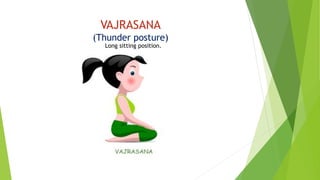
VAJRASANA
(Thunder posture)
Long sitting position.
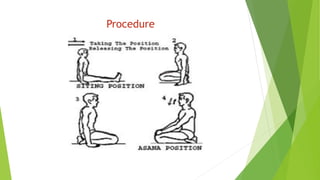
Procedure
Procedure
 Stage 1:
 Bring the right leg side ward, and then sit on the right heel.
 Stage 2:
 Bring the left leg side ward, and then sit on the heels.
 Stage 3:
 Place the hands on the knees with palms facing down wards.
Duration:
 In the final position relax the whole body as much as
possible.
 Remain in the pose for minimum of 15 to 30 seconds, and
at the maximum for 60 to 90 seconds.
 Closure:
 Slowly come back to the straight position by releasing the
stages in the reverse order ( third, second, and first
stages.
Point to be notice.
Benefits
 General:
 It strengthens the thigh and calf muscles.
 It develops physical and mental stability.
 It is used for prayer pose of the Muslims and the
meditation pose of Japanese Buddhists.
 It is used for meditation, prayer, and worship and for
pranayama practice.
 It relieves the stiffness of joints particularly at knee, hip
and ankle.
Physiological:
 more supply of the blood. It improves the digestion process.
 It regulates the functions of the circulatory and respiratory system.
 It activates the functions of the nervous system.
 The abdominal region receives more supply of the food.
 Therapeutic:
 It is useful for curing the headache.
 It relives constipation, and indigestion.
 It is useful in curing the flatulence, (gastric trouble at the stomach).
THANK YOU

Yoga

  • 1.
  • 2.
  • 3.
  • 4.
    Posture  It isa Lotus Posture.  The name of this asana is called padmasana because the final position of this asana seems to be like lotus.  Position:  Long Sitting Position. Sit with the legs extended forward.
  • 5.
  • 6.
    Procedure  Stage1:  Slowlybring the right leg and place it on the left thigh.  The heel of the right foot should as much as possible touch the groin.  Stage 2:  Slowly bring the left leg and place it on the right thigh.  The heel of the left foot should as much as possible touch the groin.  If you are not able to perform this stage, just fold the left leg and place under the right leg at the initial practice.  After a few days, or few weeks of practice, you can perform it properly.
  • 7.
    Procedure  Stage:  Keepthe hands straight and rest them on your knees.  Touch your thumb with your index finger, and spread out the other fingers close to each other, thus forming Chin Mudra.
  • 8.
    Duration  In thefinal position relax the whole body as much as possible  Remain in the pose for minimum of 15 to 30 seconds, and at the maximum for 60 to 90 seconds.  Closure:  Slowly come back to the staring position by releasing the stages in the reverse order. i.e. third, second and first stages.
  • 9.
    Points to benotice.  Care should be taken that the knees touch the ground.  The vertebral column and the body from the waist upward should be kept erect.  Keep the normal breath and normal eyesight.
  • 10.
  • 11.
    Benefits  General:  Padmasanais used for meditation, prayer, and worship and for pranayama practice.  It develops the physical and mental stability.  It relieves the stiffness of joints, particularly knees and guards from rheumatism.  This asana helps for the players to obtain mental control.  Padmasana keeps a person young.  Physiological:  The abdominal region receives more supply of the blood.  Padmasana improves the digestion process.  It activates the functions of kidney.
  • 12.
    Therapeutic:  Padmasana relievesconstipation, and indigestion.  It is a very good asana for cuing knee ailments.  Padmasana is useful in curing the flatulence (gastric trouble at the stomach).  It also cure pile complaints.
  • 13.
  • 14.
  • 15.
    Procedure  Stage 1: Bring the right leg side ward, and then sit on the right heel.  Stage 2:  Bring the left leg side ward, and then sit on the heels.  Stage 3:  Place the hands on the knees with palms facing down wards.
  • 16.
    Duration:  In thefinal position relax the whole body as much as possible.  Remain in the pose for minimum of 15 to 30 seconds, and at the maximum for 60 to 90 seconds.  Closure:  Slowly come back to the straight position by releasing the stages in the reverse order ( third, second, and first stages.
  • 17.
    Point to benotice.
  • 18.
    Benefits  General:  Itstrengthens the thigh and calf muscles.  It develops physical and mental stability.  It is used for prayer pose of the Muslims and the meditation pose of Japanese Buddhists.  It is used for meditation, prayer, and worship and for pranayama practice.  It relieves the stiffness of joints particularly at knee, hip and ankle.
  • 19.
    Physiological:  more supplyof the blood. It improves the digestion process.  It regulates the functions of the circulatory and respiratory system.  It activates the functions of the nervous system.  The abdominal region receives more supply of the food.  Therapeutic:  It is useful for curing the headache.  It relives constipation, and indigestion.  It is useful in curing the flatulence, (gastric trouble at the stomach).
  • 20.