YOGA - ASANAS
• An asana is a body posture, used in medieval hatha
yoga and modern yoga.[1] The term is derived from
the Sanskrit word for 'seat'. While many of the oldest mentioned
asanas are seated postures for meditation, asanas may
be standing, seated, arm balances, twists, inversions, forward
bends, backbends, or reclining in prone or supine positions. The
asanas have been given a variety of English names by
competing schools of yoga
Ashtanga Yoga (Maharishi Patanjali):
• The Samkhya philosophy which is the basis of Patanjali’s Yoga,
states that all the things that are visible on earth are made up of
2 eternal, uncompromising, and metaphysical principles namely
‘purusha’ i.e. consciousness and ‘prakriti’ i.e. matter (similar to
the Chinese Yin and Yang philosophy). Yoga is the process of
realizing the ‘Purusha’ in himself i.e. to achieve harmony in the
body, mind, and soul; it is also the end goal of ‘Samadhi’ i.e.
concentration where the body and mind fade away and only the
soul/purusha is realized.
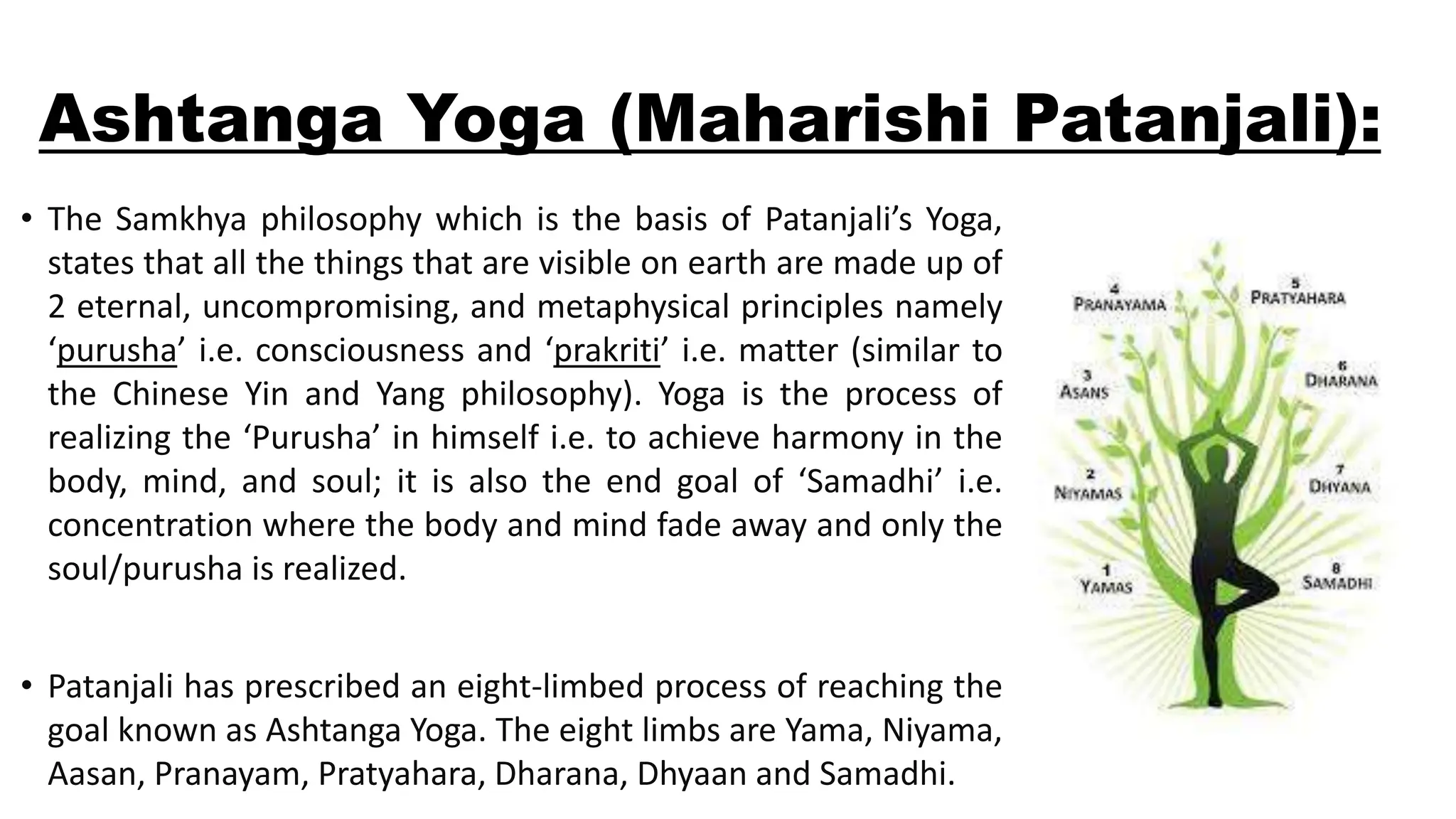
• Patanjali has prescribed an eight-limbed process of reaching the
goal known as Ashtanga Yoga. The eight limbs are Yama, Niyama,
Aasan, Pranayam, Pratyahara, Dharana, Dhyaan and Samadhi.
You might wonder, why do we need all the
8 limbs? Here is why.
• The answer rests in the arrangement of these 8 limbs itself – these are in ascending
hierarchal order which means each limb leads to the next. Every limb needs to be
mastered before practicing the next one. Let us know them one by one.
• Yama and Niyama
• Just as we need to clear our primary, and secondary school education before following
higher studies, the same way the Yamas (1st anga of social attitude) and Niyamas
(2nd anga of personal discipline) help the person to become mentally and physically ready
for the postures to be adopted in asanas.
• Asana
• The Asanas (3rd anga of physical postures) retrain our musculoskeletal system to
be still and steady for a prolonged time. To remain still in one posture, complete
concentration is needed wherein the mind becomes so focused that
the asanas can be performed slowly and effortlessly, one’s awareness becomes
intensified and one can experience infinity.
• Pranayama
• When one masters his musculoskeletal apparatus, he is now ready for
Pranayama (4th anga of expanding the ‘prana’ or vital energy by controlling the
breath). When the breath is controlled, one can control the mind. When the
breath is extended and controlled, there is cessation of activity in the mind.
• Pratyahara
• Hath Pradipika, a classic manual on yoga says ‘Chale vate chalam chittam
nischale nischalam bhavet’, meaning when the mind gets steady and
thoughtless, Pratyahara (5th anga of going inwards) begins where we shut off
external sense organs and look inwards.
• Dharana
• After focusing inwards, one comes to Dharana (6th anga of concentration on one object,
in one place).
• Dhyaan and Samadhi
• As one becomes adept and Dharana intensifies, Dhyaan (7th anga) and Samadhi (8th anga)
of meditation take place.
When we follow these 8 limbs of Patanjali’s Yoga, positive effects are
perceived on the body, mind, and soul;
• The body becomes supple, muscular coordination becomes smoother and
lightness is felt.
• Mind becomes serene; known as samyama; there may be flashes of
intuition.
• Soul i.e.chitta attains purusha i.e. consciousness and spiritual growth is
seen.
Supine Position Asanas
WHAT IS SUPINE POSITION
ASANA:-
The supine position in yoga refers to lying flat
on your back with your face and torso facing
upward. In yoga, many asanas (poses) are
practiced in the supine position.
Example:- Ardhahalasan, sarvangasan,
pawanmuktasan.
Ardha Halasana:-
Also known as Half Plough
Pose, is a yoga asana that
resembles the position of a
plough.
1-Lie flat on your back with your arms beside your body and palms
down.
2-Inhale and raise your legs off the ground, keeping them straight.
3-Lift your legs to a 90-degree angle or as far as comfortable.
4-Support your lower back with your hands if needed.
5-Hold the pose for a few breaths.
6-Exhale and gently lower your legs back to the floor.
7-Relax and repeat if desired
PROCEDURE:-
BENEFITS
• Strengthens abdominal muscles.
• Stretches hamstrings and back muscles.
• Improves digestion.
• Stimulates abdominal organs.
• Helps in weight loss.
• Relieves stress and fatigue.
PRECAUTIONS
• Avoid if you have any neck or back injuries.
• Pregnant women should avoid this pose.
• Don't force the stretch; go only as far as
comfortable.
• Keep the neck and head relaxed.
• Listen to your body and stop if you feel any pain
or discomfort.
SARVANGASANA
Sarvangasana, also known as Shoulder Stand
Pose, is an advanced yoga pose that offers
numerous benefits.
PROCEDURE
• Lie flat on your back with arms alongside your body, palms down.
• Inhale and raise your legs, hips, and trunk off the ground, supporting your lower back with
your hands.
• Keep your legs straight and perpendicular to the ground.
• Engage your core and lift your hips higher, bringing your legs and torso into a vertical
line.
• Keep your neck straight, chin slightly tucked, and gaze toward your toes.
• Hold the pose for a few breaths, gradually increasing the duration over time.
• To release, exhale and lower your legs and back down to the ground slowly and with
control.
• Improves blood circulation.
• Strengthens shoulders, arms, and core
muscles.
• Stimulates thyroid and parathyroid glands.
• Calms the nervous system.
• Relieves stress and anxiety.
• Enhances digestion.
BENEFITS
PRECAUTIONS
• Avoid if you have neck or shoulder injuries.
• Women should avoid during menstruation.
• Pregnant women should avoid this pose.
• Avoid if you have high blood pressure or eye
problems like glaucoma.
• Practice under the guidance of a qualified instructor,
especially if you're a beginner.
PAWANMUKTASANA
Pawanmuktasana" translates to "Wind-Relieving Pose"
in English. It's a yoga asana that involves bringing the
knees to the chest while lying on the back. This pose is
believed to help relieve gas and bloating in the digestive
system, hence the name "wind-relieving."
PROCEDURE
• Begin by lying flat on your back with legs straight and arms beside your
body.
• As you inhale, bend your right knee and hug it towards your chest.
• Clasp your hands around your shin or knee, whichever is comfortable.
• Keep your left leg straight on the ground.
• Hold the pose for a few breaths, feeling the stretch in your hip and lower
back.
• Exhale and release the right leg back to the floor.
• Repeat the same process with the left leg.
BENEFITS
• Improves digestion and relieves
bloating.
• Massages abdominal organs, aiding
in detoxification.
• Relieves gas and constipation.
• Stretches the lower back and hip
flexors.
• Helps alleviate lower back pain.
PRCAUTIONS
• Avoid if you have recent abdominal surgery
or hernia.
• Take care if you have a back injury, and
consult with a healthcare professional before
practicing.
• Pregnant women should practice this pose
with caution and under guidance.
YOGA - ASANAS PRESENTATION FROM SHAMBHAVI

YOGA - ASANAS PRESENTATION FROM SHAMBHAVI

  • 1.
  • 2.
    • An asanais a body posture, used in medieval hatha yoga and modern yoga.[1] The term is derived from the Sanskrit word for 'seat'. While many of the oldest mentioned asanas are seated postures for meditation, asanas may be standing, seated, arm balances, twists, inversions, forward bends, backbends, or reclining in prone or supine positions. The asanas have been given a variety of English names by competing schools of yoga
  • 3.
    Ashtanga Yoga (MaharishiPatanjali): • The Samkhya philosophy which is the basis of Patanjali’s Yoga, states that all the things that are visible on earth are made up of 2 eternal, uncompromising, and metaphysical principles namely ‘purusha’ i.e. consciousness and ‘prakriti’ i.e. matter (similar to the Chinese Yin and Yang philosophy). Yoga is the process of realizing the ‘Purusha’ in himself i.e. to achieve harmony in the body, mind, and soul; it is also the end goal of ‘Samadhi’ i.e. concentration where the body and mind fade away and only the soul/purusha is realized. • Patanjali has prescribed an eight-limbed process of reaching the goal known as Ashtanga Yoga. The eight limbs are Yama, Niyama, Aasan, Pranayam, Pratyahara, Dharana, Dhyaan and Samadhi.
  • 4.
    You might wonder,why do we need all the 8 limbs? Here is why. • The answer rests in the arrangement of these 8 limbs itself – these are in ascending hierarchal order which means each limb leads to the next. Every limb needs to be mastered before practicing the next one. Let us know them one by one. • Yama and Niyama • Just as we need to clear our primary, and secondary school education before following higher studies, the same way the Yamas (1st anga of social attitude) and Niyamas (2nd anga of personal discipline) help the person to become mentally and physically ready for the postures to be adopted in asanas.
  • 5.
    • Asana • TheAsanas (3rd anga of physical postures) retrain our musculoskeletal system to be still and steady for a prolonged time. To remain still in one posture, complete concentration is needed wherein the mind becomes so focused that the asanas can be performed slowly and effortlessly, one’s awareness becomes intensified and one can experience infinity. • Pranayama • When one masters his musculoskeletal apparatus, he is now ready for Pranayama (4th anga of expanding the ‘prana’ or vital energy by controlling the breath). When the breath is controlled, one can control the mind. When the breath is extended and controlled, there is cessation of activity in the mind. • Pratyahara • Hath Pradipika, a classic manual on yoga says ‘Chale vate chalam chittam nischale nischalam bhavet’, meaning when the mind gets steady and thoughtless, Pratyahara (5th anga of going inwards) begins where we shut off external sense organs and look inwards.
  • 6.
    • Dharana • Afterfocusing inwards, one comes to Dharana (6th anga of concentration on one object, in one place). • Dhyaan and Samadhi • As one becomes adept and Dharana intensifies, Dhyaan (7th anga) and Samadhi (8th anga) of meditation take place. When we follow these 8 limbs of Patanjali’s Yoga, positive effects are perceived on the body, mind, and soul; • The body becomes supple, muscular coordination becomes smoother and lightness is felt. • Mind becomes serene; known as samyama; there may be flashes of intuition. • Soul i.e.chitta attains purusha i.e. consciousness and spiritual growth is seen.
  • 7.
  • 8.
    WHAT IS SUPINEPOSITION ASANA:- The supine position in yoga refers to lying flat on your back with your face and torso facing upward. In yoga, many asanas (poses) are practiced in the supine position. Example:- Ardhahalasan, sarvangasan, pawanmuktasan.
  • 9.
    Ardha Halasana:- Also knownas Half Plough Pose, is a yoga asana that resembles the position of a plough.
  • 10.
    1-Lie flat onyour back with your arms beside your body and palms down. 2-Inhale and raise your legs off the ground, keeping them straight. 3-Lift your legs to a 90-degree angle or as far as comfortable. 4-Support your lower back with your hands if needed. 5-Hold the pose for a few breaths. 6-Exhale and gently lower your legs back to the floor. 7-Relax and repeat if desired PROCEDURE:-
  • 11.
    BENEFITS • Strengthens abdominalmuscles. • Stretches hamstrings and back muscles. • Improves digestion. • Stimulates abdominal organs. • Helps in weight loss. • Relieves stress and fatigue.
  • 12.
    PRECAUTIONS • Avoid ifyou have any neck or back injuries. • Pregnant women should avoid this pose. • Don't force the stretch; go only as far as comfortable. • Keep the neck and head relaxed. • Listen to your body and stop if you feel any pain or discomfort.
  • 14.
    SARVANGASANA Sarvangasana, also knownas Shoulder Stand Pose, is an advanced yoga pose that offers numerous benefits.
  • 15.
    PROCEDURE • Lie flaton your back with arms alongside your body, palms down. • Inhale and raise your legs, hips, and trunk off the ground, supporting your lower back with your hands. • Keep your legs straight and perpendicular to the ground. • Engage your core and lift your hips higher, bringing your legs and torso into a vertical line. • Keep your neck straight, chin slightly tucked, and gaze toward your toes. • Hold the pose for a few breaths, gradually increasing the duration over time. • To release, exhale and lower your legs and back down to the ground slowly and with control.
  • 16.
    • Improves bloodcirculation. • Strengthens shoulders, arms, and core muscles. • Stimulates thyroid and parathyroid glands. • Calms the nervous system. • Relieves stress and anxiety. • Enhances digestion. BENEFITS
  • 17.
    PRECAUTIONS • Avoid ifyou have neck or shoulder injuries. • Women should avoid during menstruation. • Pregnant women should avoid this pose. • Avoid if you have high blood pressure or eye problems like glaucoma. • Practice under the guidance of a qualified instructor, especially if you're a beginner.
  • 19.
    PAWANMUKTASANA Pawanmuktasana" translates to"Wind-Relieving Pose" in English. It's a yoga asana that involves bringing the knees to the chest while lying on the back. This pose is believed to help relieve gas and bloating in the digestive system, hence the name "wind-relieving."
  • 20.
    PROCEDURE • Begin bylying flat on your back with legs straight and arms beside your body. • As you inhale, bend your right knee and hug it towards your chest. • Clasp your hands around your shin or knee, whichever is comfortable. • Keep your left leg straight on the ground. • Hold the pose for a few breaths, feeling the stretch in your hip and lower back. • Exhale and release the right leg back to the floor. • Repeat the same process with the left leg.
  • 21.
    BENEFITS • Improves digestionand relieves bloating. • Massages abdominal organs, aiding in detoxification. • Relieves gas and constipation. • Stretches the lower back and hip flexors. • Helps alleviate lower back pain.
  • 22.
    PRCAUTIONS • Avoid ifyou have recent abdominal surgery or hernia. • Take care if you have a back injury, and consult with a healthcare professional before practicing. • Pregnant women should practice this pose with caution and under guidance.