By
C.Leena Roja
10381A0521
CONTENTS:
 INTRODUCTION
 HISTORY
 TECHNOLOGIES
 INSTALLATION
 PERFORMANCE
 MODULE
 ADVANTAGES AND DISADVANTAGES
 CONCLUSION
Introduction:
 Yii is pronounced as Yee or ji:,and is acronym for “Yes It Is!”.
 Yii is a high-performance component-based PHP framework for developing
large-scale Webapplications.
 The Yii is a free,open-source web application development framework
written in PHP5.
 It has been built with sophisticated,enterprise applications in mind.
 Yii supports MVC design pattern.
History:
 Developed by Qiang Xue.
 Qiang Xue was with experience in development of frameworks PRADO
one of famous framework for PHP
 By having the Years of experience ,he started the Yii project on january
1,2008.
 On december 3,2008,after nearly one year’s development,Yii 1.0 was
formally released to the public.
Technologies:
YII incorporates many ideas and work from other well-known web programming
frameworks and applications.
 Ruby on Rails:-Yii inherits its spirit of convention over configuration. Yii also
referenced its implementation of the active record design pattern for its ORM
layer.
 PRADO:-prado(framework) is major source in development of YII.
 Jquery:-Jquery is integrated in yii .
 Symphony and joomla :- were also used in development of yii.
Installation:
Step1:
 Download latest version of Yii framework from www.yiiframework.com
 And then click on “Download Yii” button in that website
 Step2:Open the file containing folder and then extract the file.
 Step3:Rename the file to yii.
 Step4:open command prompt,type cd,yii,frameworkyiic.
(If yiic file is unable to open,then change the
path(c:xamppphpphp.exe),by opening that file in a
notepad++)
 Step5:specify the path to create first Yii application.
 The path will be c:xampphtdocsyiitest
 Step6:next the command will be displayed,type ‘yes’ for creation of
application.
 Yiitestcss
Home About
Step7:type localhost/yiitest/ in the address bar of the browser then an
web application will be appear
contact login
Features:
 MVC design pattern
 Form input and validation
 Authentication and Authorization
 Error handling and Logging errors
 Security
 Detailed documentation
 Automatic code generation
Performance:
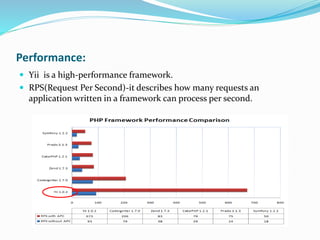
 Yii is a high-performance framework.
 RPS(Request Per Second)-it describes how many requests an
application written in a framework can process per second.
Why Yii is so fast?
 Yii is so much faster because it is using lazy loading techinque.
 Eg:it does not include class file and does not access object until those
are needed.
 By having Benchmark,we can measure the performance.
 Benchmark in computing is the act of running a computer program,a
set of programs,or other operations,in order to assess the relative
performance of an object.
License:
 The Yii framework is free software. It is released under the terms of the
BSD License.
 Redistribution and use in source and binary forms,with or without
modifications are permitted by having BSD license only.
 The text contained in the official and user-contributed documentation is
licensed under the GNU Free Documentation License(GFDL).
 GFDL license allows users to copy,distribute and/or modify the document.
Module:
 A module is a self contained software unit that consists of
models,views,controllers and other components.
 A module resembles to an application.
 But module cnnot be deployed alone and it must be reside inside of an
application.
 Modules are useful for a large-scale application.single module can be
divided into several modules.
 Each being developed and maintained seperately.
 Can
 Creating module
 Using expression ucfirst(id).’module’.
 Using module
 Declare the module ID in the modules property of the application.
 Nested module
 First call the former parent ,later child module.
 Child modules must be declared in the modules property of their parent.
MVC:
 It divides an interactive application into three components.
 Model
 View
 Controller
 Through this approch each component is created and maintained
seperately.
Model:
 A model represents a single data object.
 Models are used to keep data and their relevant business rules.
 It could be a row in a database table or an html form with user input
fields.
 Yii implements two kinds of models:
 Form models
 Active records
Kinds of models:
 Form model:
 Used to store collected data
from user input.
 Such data is often collected,used
and discarded.
 Active records:
 Tells which record is currently
using.
View:
 View renders the components of a model.
 It access applications,data through model and specifies how that data
should be presented.
 It’s views responsibility to maintain consisitency.
 Layout:
 used to decorate views.
 it contains header and footer,content is embedded in between.
 Widget:
 it is an element of GUI that displays information and provides specific way
for user to interacr with application and operating system.
 System view:
 used by Yii to display error and logging information.
Controller:
 It translates interactions with the views into actions to be performed by
the model.
 Front controller for routing.
 Route:
 Formed by controller ID+module ID.
 Seperated by a slash(moduleID/controllerID/actionID)
 controller instantiation:
 Is created when it receives an request.
 Action:
 Action will be performed when it receives an request.
 Default action.
 Filter:
 Filter can be applied before and/or after an action is executed for
authentication.
 Advantages:
 Very fast and efficient
 Accelerate the development process
 MVC
 Authentication and role-based access control
 Website-portal
 Great documentation
 Disadvantages:
 Different subdomains,decrease in main domain
pagerank.
Conclusion:
 Yii does not need to be installed under a Web-accessible directory.
 An Yii application has one entry script which is usually the only file that
needs to be exposed to Web users.
 Compare with other PHP scripts,it is the best and secured one.
THANK YOU

Yii framework

  • 1.
  • 2.
    CONTENTS:  INTRODUCTION  HISTORY TECHNOLOGIES  INSTALLATION  PERFORMANCE  MODULE  ADVANTAGES AND DISADVANTAGES  CONCLUSION
  • 3.
    Introduction:  Yii ispronounced as Yee or ji:,and is acronym for “Yes It Is!”.  Yii is a high-performance component-based PHP framework for developing large-scale Webapplications.  The Yii is a free,open-source web application development framework written in PHP5.  It has been built with sophisticated,enterprise applications in mind.  Yii supports MVC design pattern.
  • 4.
    History:  Developed byQiang Xue.  Qiang Xue was with experience in development of frameworks PRADO one of famous framework for PHP  By having the Years of experience ,he started the Yii project on january 1,2008.  On december 3,2008,after nearly one year’s development,Yii 1.0 was formally released to the public.
  • 5.
    Technologies: YII incorporates manyideas and work from other well-known web programming frameworks and applications.  Ruby on Rails:-Yii inherits its spirit of convention over configuration. Yii also referenced its implementation of the active record design pattern for its ORM layer.  PRADO:-prado(framework) is major source in development of YII.  Jquery:-Jquery is integrated in yii .  Symphony and joomla :- were also used in development of yii.
  • 6.
    Installation: Step1:  Download latestversion of Yii framework from www.yiiframework.com  And then click on “Download Yii” button in that website
  • 7.
     Step2:Open thefile containing folder and then extract the file.  Step3:Rename the file to yii.  Step4:open command prompt,type cd,yii,frameworkyiic. (If yiic file is unable to open,then change the path(c:xamppphpphp.exe),by opening that file in a notepad++)  Step5:specify the path to create first Yii application.  The path will be c:xampphtdocsyiitest  Step6:next the command will be displayed,type ‘yes’ for creation of application.  Yiitestcss
  • 8.
    Home About Step7:type localhost/yiitest/in the address bar of the browser then an web application will be appear
  • 9.
  • 10.
    Features:  MVC designpattern  Form input and validation  Authentication and Authorization  Error handling and Logging errors  Security  Detailed documentation  Automatic code generation
  • 11.
    Performance:  Yii isa high-performance framework.  RPS(Request Per Second)-it describes how many requests an application written in a framework can process per second.
  • 12.
    Why Yii isso fast?  Yii is so much faster because it is using lazy loading techinque.  Eg:it does not include class file and does not access object until those are needed.  By having Benchmark,we can measure the performance.  Benchmark in computing is the act of running a computer program,a set of programs,or other operations,in order to assess the relative performance of an object.
  • 13.
    License:  The Yiiframework is free software. It is released under the terms of the BSD License.  Redistribution and use in source and binary forms,with or without modifications are permitted by having BSD license only.  The text contained in the official and user-contributed documentation is licensed under the GNU Free Documentation License(GFDL).  GFDL license allows users to copy,distribute and/or modify the document.
  • 14.
    Module:  A moduleis a self contained software unit that consists of models,views,controllers and other components.  A module resembles to an application.  But module cnnot be deployed alone and it must be reside inside of an application.
  • 15.
     Modules areuseful for a large-scale application.single module can be divided into several modules.  Each being developed and maintained seperately.  Can  Creating module  Using expression ucfirst(id).’module’.  Using module  Declare the module ID in the modules property of the application.  Nested module  First call the former parent ,later child module.  Child modules must be declared in the modules property of their parent.
  • 16.
    MVC:  It dividesan interactive application into three components.  Model  View  Controller  Through this approch each component is created and maintained seperately.
  • 17.
    Model:  A modelrepresents a single data object.  Models are used to keep data and their relevant business rules.  It could be a row in a database table or an html form with user input fields.  Yii implements two kinds of models:  Form models  Active records
  • 18.
    Kinds of models: Form model:  Used to store collected data from user input.  Such data is often collected,used and discarded.  Active records:  Tells which record is currently using.
  • 19.
    View:  View rendersthe components of a model.  It access applications,data through model and specifies how that data should be presented.  It’s views responsibility to maintain consisitency.  Layout:  used to decorate views.  it contains header and footer,content is embedded in between.
  • 20.
     Widget:  itis an element of GUI that displays information and provides specific way for user to interacr with application and operating system.  System view:  used by Yii to display error and logging information. Controller:  It translates interactions with the views into actions to be performed by the model.  Front controller for routing.
  • 21.
     Route:  Formedby controller ID+module ID.  Seperated by a slash(moduleID/controllerID/actionID)  controller instantiation:  Is created when it receives an request.  Action:  Action will be performed when it receives an request.  Default action.  Filter:  Filter can be applied before and/or after an action is executed for authentication.
  • 22.
     Advantages:  Veryfast and efficient  Accelerate the development process  MVC  Authentication and role-based access control  Website-portal  Great documentation  Disadvantages:  Different subdomains,decrease in main domain pagerank.
  • 23.
    Conclusion:  Yii doesnot need to be installed under a Web-accessible directory.  An Yii application has one entry script which is usually the only file that needs to be exposed to Web users.  Compare with other PHP scripts,it is the best and secured one.
  • 24.