YEAST: DESCRIPTION AND STRUCTURE
Lect . 1
• Introduction
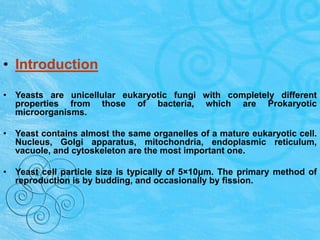
• Yeasts are unicellular eukaryotic fungi with completely different
properties from those of bacteria, which are Prokaryotic
microorganisms.
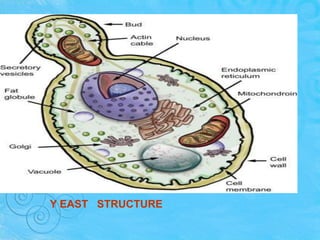
• Yeast contains almost the same organelles of a mature eukaryotic cell.
Nucleus, Golgi apparatus, mitochondria, endoplasmic reticulum,
vacuole, and cytoskeleton are the most important one.
• Yeast cell particle size is typically of 5×10μm. The primary method of
reproduction is by budding, and occasionally by fission.
Yeast can be identified and characterized
based on cell morphology, physiology,
immunology, and using molecular biology
techniques.
The natural habitat of yeast may be soil, water,
plants, animals, and insects with special habitat
of plant tissues.
Many commercial products contain a mixture of
varying proportions of live and dead S.
cerevisiae cells are available for using as feed
additives in animals nutrition.
• s
Y EAST STRUCTURE
Yeast
• Yeasts are single-celled budding organisms. They
do not produce mycelia. The
• colonies are usually visible on the plates in 24-48 h.
Their soft, moist colonies
• resemble bacterial cultures rather than molds. There
are many species of yeasts which
• can be pathogenic for humans.
Molecular taxonomy of the yeasts.
Kurtzman CP1.
The phylogenetic diversity of yeasts is illustrated by
their assignment to two taxonomic classes of fungi,
the Ascomycetes and the Basidiomycetes.
.
Description and significance
• Yeasts are fungi, whose common characteristics are
predominant or permanent unicellular state. Yeasts are
unicellular eukaryotic fungi with completely different
properties than those of bacteria, which are Prokaryotes
• The main method of yeast reproduction is primarily by
budding, and occasionally by fission, and these do not
form spores in or on a fruiting body.
• Identification and characterization of yeast species may
be according to a number of criteria such as cell
morphology (e.g., mode of cell division and spore
shape), physiology (e.g., sugar fermentation tests),
immunology (e.g., immunofluorescence), and molecular
biology.
• Among yeast, S. cerevisiaeis of industrially
important due to its ability to convert sugars (i.e.,
glucose, maltose) into ethanol and carbon
dioxide (baking, brewing yeast).
• S. cerevisiae breaks down glucose through
aerobic respiration in presence of oxygen. If
oxygen is absent, the yeast will then go through
anaerobic fermentation.
• The net result of this process is two adenosine
triphosphate molecules, in addition to two by
products; carbon dioxide and ethanol.
• Another common use of yeast is in the rising of
bread. The carbon dioxide that is produce inside
the dough causes it to rise and expand. ( baker’s
yeast),
Ecology and natural habitats
Yeast distribute in the natural environment
as soil, water, plants, animals, and
insects.
Animal :-Several non-pathogenic yeasts are
associated with the intestinal tract and skin
of warm-blooded animals; yeasts (e.g.,
Candida albicans) are opportunistic
pathogen to humans and animals; yeasts are
commensally associated with insects which
acting as important vectors in the natural
distribution.
Atmosphere:- A few viable yeast cells may be
expected per cubic meter of air. Generally,
Cryptococcus, Debaryomyces spp., Rhodotorula,
and Sporobolomyces are dispersed by air from
layers above soil surfaces.
• Plants:- surface of plant leaves is a common
niches for yeasts; spread of yeasts on the
phyllosphere is aided by insects. The presence
of some organic compounds on plant surface
surface creates conditions favorable for growth
of yeasts .
• Plant tissues (i.e. leaves, flowers, and fruits) are
preferred yeast habitats.
Soil :- Soil may only be a reservoir for the long-
term survival of yeast, rather than a habitat for
growth. Yeasts are present with a high
concentration in cultivated soils (nearly 10 000
cells/g of soil) and are found only in the upper,
aerobic soil layers (10–15cm). Lipomyces and
Schwanniomyces are isolated exclusively from
soil.
Water:- Yeasts predominate in surface layers of
fresh and salt waters, but are not present in great
numbers (nearly 1000 cells/L). Most aquatic yeast
isolates are of red pigmented genera
(Rhodotorula). The species Debaryomyces
hansenii is a halotolerant yeast that can grow in
nearly saturated brine solutions
• Several species of yeast may be isolated from specialized or
extreme environments, with high sugar or salt concentrations
(i.e., low water potential), with low temperature, and with low
oxygen availability.
CANDIDIASIS (Candida albicans)
There are many species of the genus Candida
that cause disease. The infections caused by all
species of Candida are called candidiasis.
Candida albicans is an endogenous organism.
It can be found in 40-80% of normal human
beings. It is present in the mouth, gut, and
vagina. It may be present as a commensal or a
pathogenic organism.
Infections with Candida usually occur when a
patient has some alteration in cellular
immunity, normal flora or normal physiology.
Patients with decreased cellular immunity
have decreased resistance to fungal
infections.
Prolonged antibiotic or steroid therapy
destroys the balance of normal flora in the
intestine allowing the endogenous Candida
to overcome the host.
Invasive procedures, such as cardiac surgery
and indwelling catheters, produce
alterations in host physiology and some of
these patients develop Candida infections .
• Candida is a polymorphic yeast, i.e., yeast cells, and
pseudohyphae are produced.
Pseudohyphae may be formed from budding yeast cells
that remain attached to each other. Spores may be
formed on the Pseudomycelium. These are called
Chlamydospores and they can be used to identify
different species of Candida.
yeast lect 1 .ppt

yeast lect 1 .ppt

  • 1.
    YEAST: DESCRIPTION ANDSTRUCTURE Lect . 1
  • 2.
    • Introduction • Yeastsare unicellular eukaryotic fungi with completely different properties from those of bacteria, which are Prokaryotic microorganisms. • Yeast contains almost the same organelles of a mature eukaryotic cell. Nucleus, Golgi apparatus, mitochondria, endoplasmic reticulum, vacuole, and cytoskeleton are the most important one. • Yeast cell particle size is typically of 5×10μm. The primary method of reproduction is by budding, and occasionally by fission.
  • 3.
    Yeast can beidentified and characterized based on cell morphology, physiology, immunology, and using molecular biology techniques. The natural habitat of yeast may be soil, water, plants, animals, and insects with special habitat of plant tissues. Many commercial products contain a mixture of varying proportions of live and dead S. cerevisiae cells are available for using as feed additives in animals nutrition.
  • 4.
    • s Y EASTSTRUCTURE
  • 5.
    Yeast • Yeasts aresingle-celled budding organisms. They do not produce mycelia. The • colonies are usually visible on the plates in 24-48 h. Their soft, moist colonies • resemble bacterial cultures rather than molds. There are many species of yeasts which • can be pathogenic for humans.
  • 6.
    Molecular taxonomy ofthe yeasts. Kurtzman CP1. The phylogenetic diversity of yeasts is illustrated by their assignment to two taxonomic classes of fungi, the Ascomycetes and the Basidiomycetes. .
  • 7.
    Description and significance •Yeasts are fungi, whose common characteristics are predominant or permanent unicellular state. Yeasts are unicellular eukaryotic fungi with completely different properties than those of bacteria, which are Prokaryotes • The main method of yeast reproduction is primarily by budding, and occasionally by fission, and these do not form spores in or on a fruiting body. • Identification and characterization of yeast species may be according to a number of criteria such as cell morphology (e.g., mode of cell division and spore shape), physiology (e.g., sugar fermentation tests), immunology (e.g., immunofluorescence), and molecular biology.
  • 8.
    • Among yeast,S. cerevisiaeis of industrially important due to its ability to convert sugars (i.e., glucose, maltose) into ethanol and carbon dioxide (baking, brewing yeast). • S. cerevisiae breaks down glucose through aerobic respiration in presence of oxygen. If oxygen is absent, the yeast will then go through anaerobic fermentation. • The net result of this process is two adenosine triphosphate molecules, in addition to two by products; carbon dioxide and ethanol. • Another common use of yeast is in the rising of bread. The carbon dioxide that is produce inside the dough causes it to rise and expand. ( baker’s yeast),
  • 9.
    Ecology and naturalhabitats Yeast distribute in the natural environment as soil, water, plants, animals, and insects. Animal :-Several non-pathogenic yeasts are associated with the intestinal tract and skin of warm-blooded animals; yeasts (e.g., Candida albicans) are opportunistic pathogen to humans and animals; yeasts are commensally associated with insects which acting as important vectors in the natural distribution.
  • 10.
    Atmosphere:- A fewviable yeast cells may be expected per cubic meter of air. Generally, Cryptococcus, Debaryomyces spp., Rhodotorula, and Sporobolomyces are dispersed by air from layers above soil surfaces. • Plants:- surface of plant leaves is a common niches for yeasts; spread of yeasts on the phyllosphere is aided by insects. The presence of some organic compounds on plant surface surface creates conditions favorable for growth of yeasts . • Plant tissues (i.e. leaves, flowers, and fruits) are preferred yeast habitats.
  • 11.
    Soil :- Soilmay only be a reservoir for the long- term survival of yeast, rather than a habitat for growth. Yeasts are present with a high concentration in cultivated soils (nearly 10 000 cells/g of soil) and are found only in the upper, aerobic soil layers (10–15cm). Lipomyces and Schwanniomyces are isolated exclusively from soil.
  • 12.
    Water:- Yeasts predominatein surface layers of fresh and salt waters, but are not present in great numbers (nearly 1000 cells/L). Most aquatic yeast isolates are of red pigmented genera (Rhodotorula). The species Debaryomyces hansenii is a halotolerant yeast that can grow in nearly saturated brine solutions • Several species of yeast may be isolated from specialized or extreme environments, with high sugar or salt concentrations (i.e., low water potential), with low temperature, and with low oxygen availability.
  • 13.
    CANDIDIASIS (Candida albicans) Thereare many species of the genus Candida that cause disease. The infections caused by all species of Candida are called candidiasis. Candida albicans is an endogenous organism. It can be found in 40-80% of normal human beings. It is present in the mouth, gut, and vagina. It may be present as a commensal or a pathogenic organism. Infections with Candida usually occur when a patient has some alteration in cellular immunity, normal flora or normal physiology.
  • 14.
    Patients with decreasedcellular immunity have decreased resistance to fungal infections. Prolonged antibiotic or steroid therapy destroys the balance of normal flora in the intestine allowing the endogenous Candida to overcome the host. Invasive procedures, such as cardiac surgery and indwelling catheters, produce alterations in host physiology and some of these patients develop Candida infections .
  • 15.
    • Candida isa polymorphic yeast, i.e., yeast cells, and pseudohyphae are produced. Pseudohyphae may be formed from budding yeast cells that remain attached to each other. Spores may be formed on the Pseudomycelium. These are called Chlamydospores and they can be used to identify different species of Candida.

Editor's Notes