Page1www.busymindscenter.com
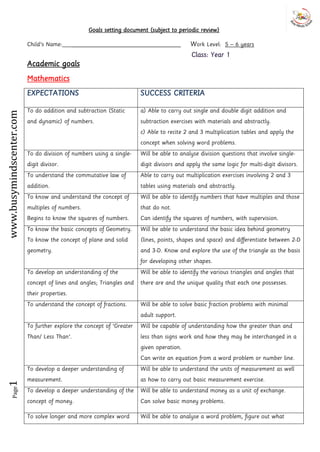
Goals setting document (subject to periodic review)
Child’s Name:________________________________ Work Level: 5 – 6 years
Class: Year 1
Academic goals
Mathematics
EXPECTATIONS SUCCESS CRITERIA
To do addition and subtraction (Static
and dynamic) of numbers.
a) Able to carry out single and double digit addition and
subtraction exercises with materials and abstractly.
c) Able to recite 2 and 3 multiplication tables and apply the
concept when solving word problems.
To do division of numbers using a single-
digit divisor.
Will be able to analyse division questions that involve single-
digit divisors and apply the same logic for multi-digit divisors.
To understand the commutative law of
addition.
Able to carry out multiplication exercises involving 2 and 3
tables using materials and abstractly.
To know and understand the concept of
multiples of numbers.
Begins to know the squares of numbers.
Will be able to identify numbers that have multiples and those
that do not.
Can identify the squares of numbers, with supervision.
To know the basic concepts of Geometry.
To know the concept of plane and solid
geometry.
Will be able to understand the basic idea behind geometry
(lines, points, shapes and space) and differentiate between 2-D
and 3-D. Know and explore the use of the triangle as the basis
for developing other shapes.
To develop an understanding of the
concept of lines and angles; Triangles and
their properties.
Will be able to identify the various triangles and angles that
there are and the unique quality that each one possesses.
To understand the concept of fractions. Will be able to solve basic fraction problems with minimal
adult support.
To further explore the concept of ‘Greater
Than/ Less Than’.
Will be capable of understanding how the greater than and
less than signs work and how they may be interchanged in a
given operation.
Can write an equation from a word problem or number line.
To develop a deeper understanding of
measurement.
Will be able to understand the units of measurement as well
as how to carry out basic measurement exercise.
To develop a deeper understanding of the
concept of money.
Will be able to understand money as a unit of exchange.
Can solve basic money problems.
To solve longer and more complex word Will be able to analyse a word problem, figure out what
Page2www.busymindscenter.com
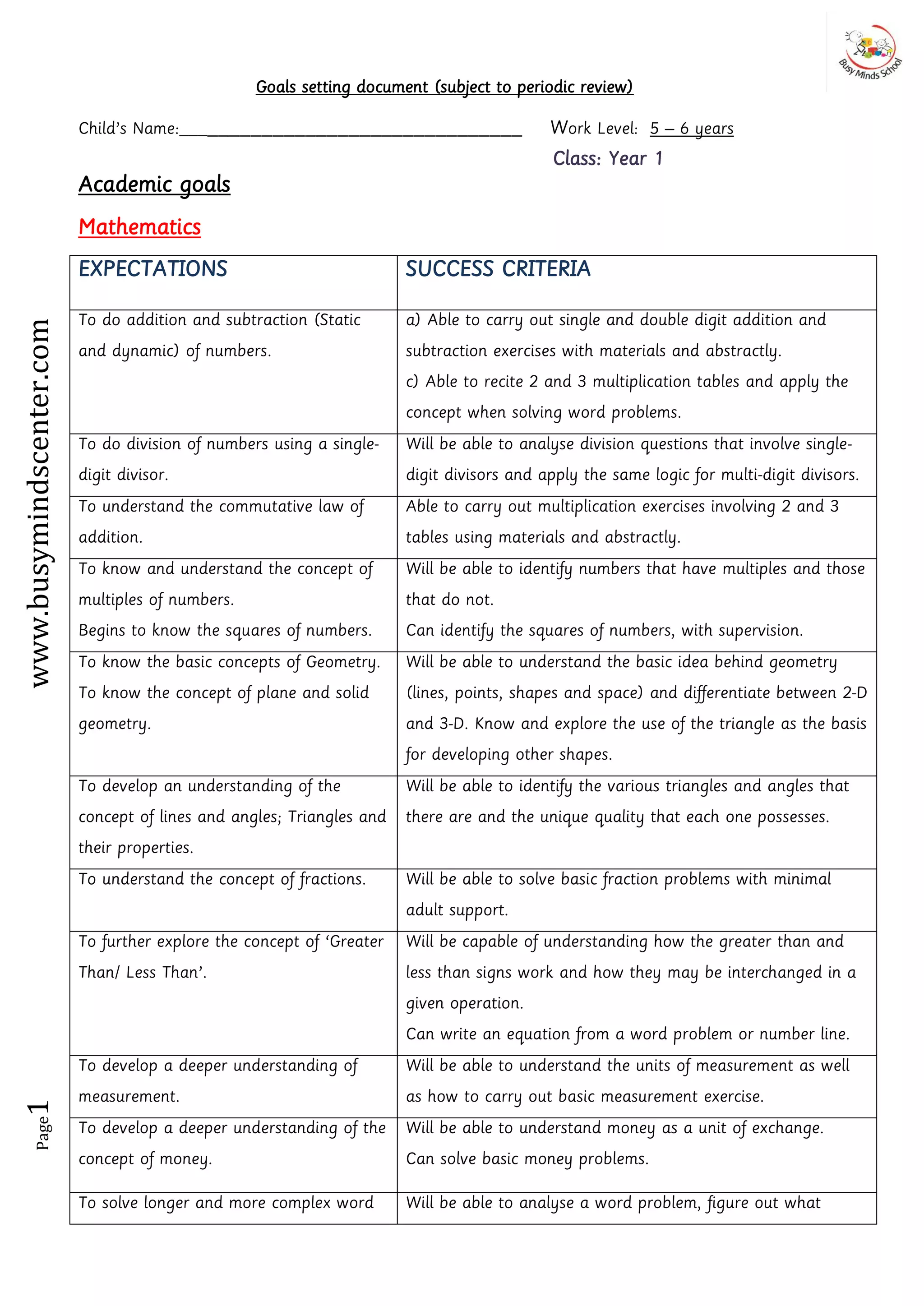
problems using one or more of the math
operations (i.e. +, -, x, ÷).
operations should be treated first and so on.
Write an equation from a word problem.
Language
EXPECTATIONS SUCCESS CRITERIA
Reading comprehension. To understand what is being read.
Reading fluency in three, four and five letter
words.
To be able to read longer passages with more
understanding and fluency.
To learn the spelling of the words as well as
understand their meaning.
Can spell using phonogram rules.
Can use the dictionary to find the meaning s of words.
To enlarge the vocabulary by the use of these
words.
Introduction to synonym and antonyms.
To begin to understand the six traits of writing
plus one (i.e. idea, organisation, voice, word
choice, sentence fluency, convention and
presentation)
Starts to engage in do creative writing activities using
prompts.
To develop further understanding of the function
of words of the different parts of speech)
Can identify a Noun, Verb adverb and conjunction.
Can use them adequately.
Sentence construction and usage To be able to construct grammatically correct
sentences.
To be able to analyse sentences by identifying the
different parts of a sentence.
To develop the knowledge of antonyms,
compound words, plurals, homonyms, affixes and
the use of contractions.
Can convert from singular to plural
Work with antonyms in the basic forms.
To give examples orally and identify homophones.
Begin to understand the use of contractions.
To develop an understanding of the use of the
Dictionary.
Child demonstrates the ability to use the dictionary to
find the meaning of words with minimal support.
To learn the use of the commas, full stop,
question mark and the exclamation mark.
Increasing proficiency in the appropriate use of
punctuation.
To be able to explain a process or present information, ensuring items are clearly sequenced, relevant
details are included and events end appropriately.
To follow up others’ points and show whether they agree or disagree in a whole-class discussion.
Page3www.busymindscenter.com
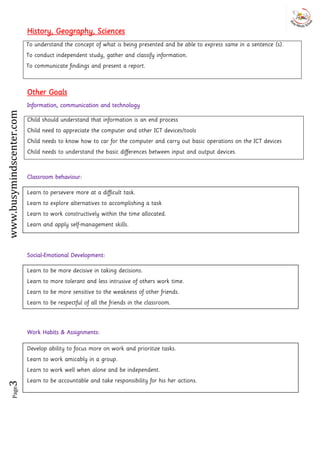
History, Geography, Sciences
To understand the concept of what is being presented and be able to express same in a sentence (s).
To conduct independent study, gather and classify information.
To communicate findings and present a report.
Other Goals
Information, communication and technology
Child should understand that information is an end process
Child need to appreciate the computer and other ICT devices/tools
Child needs to know how to car for the computer and carry out basic operations on the ICT devices
Child needs to understand the basic differences between input and output devices.
Classroom behaviour:
Social-Emotional Development:
Work Habits & Assignments:
Learn to persevere more at a difficult task.
Learn to explore alternatives to accomplishing a task
Learn to work constructively within the time allocated.
Learn and apply self-management skills.
Learn to be more decisive in taking decisions.
Learn to more tolerant and less intrusive of others work time.
Learn to be more sensitive to the weakness of other friends.
Learn to be respectful of all the friends in the classroom.
Develop ability to focus more on work and prioritize tasks.
Learn to work amicably in a group.
Learn to work well when alone and be independent.
Learn to be accountable and take responsibility for his her actions.
Page4www.busymindscenter.com
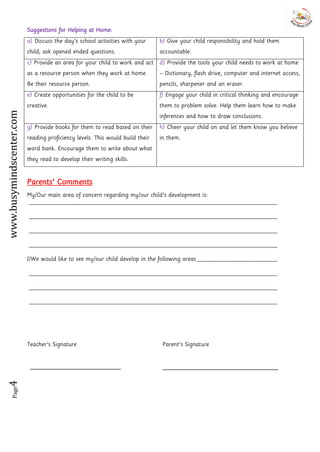
Suggestions for Helping at Home:
a) Discuss the day’s school activities with your
child; ask opened ended questions.
b) Give your child responsibility and hold them
accountable.
c) Provide an area for your child to work and act
as a resource person when they work at home.
Be their resource person.
d) Provide the tools your child needs to work at home
– Dictionary, flash drive, computer and internet access,
pencils, sharpener and an eraser.
e) Create opportunities for the child to be
creative.
f) Engage your child in critical thinking and encourage
them to problem solve. Help them learn how to make
inferences and how to draw conclusions.
g) Provide books for them to read based on their
reading proficiency levels. This would build their
word bank. Encourage them to write about what
they read to develop their writing skills.
h) Cheer your child on and let them know you believe
in them.
Parents’ Comments
My/Our main area of concern regarding my/our child’s development is:
_____________________________________________________________________________
_____________________________________________________________________________
_____________________________________________________________________________
_____________________________________________________________________________
I/We would like to see my/our child develop in the following areas_________________________
_____________________________________________________________________________
_____________________________________________________________________________
_____________________________________________________________________________
Teacher’s Signature Parent’s Signature
___________________________ ________________________________

Year 1 goal setting form

  • 1.
    Page1www.busymindscenter.com Goals setting document(subject to periodic review) Child’s Name:________________________________ Work Level: 5 – 6 years Class: Year 1 Academic goals Mathematics EXPECTATIONS SUCCESS CRITERIA To do addition and subtraction (Static and dynamic) of numbers. a) Able to carry out single and double digit addition and subtraction exercises with materials and abstractly. c) Able to recite 2 and 3 multiplication tables and apply the concept when solving word problems. To do division of numbers using a single- digit divisor. Will be able to analyse division questions that involve single- digit divisors and apply the same logic for multi-digit divisors. To understand the commutative law of addition. Able to carry out multiplication exercises involving 2 and 3 tables using materials and abstractly. To know and understand the concept of multiples of numbers. Begins to know the squares of numbers. Will be able to identify numbers that have multiples and those that do not. Can identify the squares of numbers, with supervision. To know the basic concepts of Geometry. To know the concept of plane and solid geometry. Will be able to understand the basic idea behind geometry (lines, points, shapes and space) and differentiate between 2-D and 3-D. Know and explore the use of the triangle as the basis for developing other shapes. To develop an understanding of the concept of lines and angles; Triangles and their properties. Will be able to identify the various triangles and angles that there are and the unique quality that each one possesses. To understand the concept of fractions. Will be able to solve basic fraction problems with minimal adult support. To further explore the concept of ‘Greater Than/ Less Than’. Will be capable of understanding how the greater than and less than signs work and how they may be interchanged in a given operation. Can write an equation from a word problem or number line. To develop a deeper understanding of measurement. Will be able to understand the units of measurement as well as how to carry out basic measurement exercise. To develop a deeper understanding of the concept of money. Will be able to understand money as a unit of exchange. Can solve basic money problems. To solve longer and more complex word Will be able to analyse a word problem, figure out what
  • 2.
    Page2www.busymindscenter.com problems using oneor more of the math operations (i.e. +, -, x, ÷). operations should be treated first and so on. Write an equation from a word problem. Language EXPECTATIONS SUCCESS CRITERIA Reading comprehension. To understand what is being read. Reading fluency in three, four and five letter words. To be able to read longer passages with more understanding and fluency. To learn the spelling of the words as well as understand their meaning. Can spell using phonogram rules. Can use the dictionary to find the meaning s of words. To enlarge the vocabulary by the use of these words. Introduction to synonym and antonyms. To begin to understand the six traits of writing plus one (i.e. idea, organisation, voice, word choice, sentence fluency, convention and presentation) Starts to engage in do creative writing activities using prompts. To develop further understanding of the function of words of the different parts of speech) Can identify a Noun, Verb adverb and conjunction. Can use them adequately. Sentence construction and usage To be able to construct grammatically correct sentences. To be able to analyse sentences by identifying the different parts of a sentence. To develop the knowledge of antonyms, compound words, plurals, homonyms, affixes and the use of contractions. Can convert from singular to plural Work with antonyms in the basic forms. To give examples orally and identify homophones. Begin to understand the use of contractions. To develop an understanding of the use of the Dictionary. Child demonstrates the ability to use the dictionary to find the meaning of words with minimal support. To learn the use of the commas, full stop, question mark and the exclamation mark. Increasing proficiency in the appropriate use of punctuation. To be able to explain a process or present information, ensuring items are clearly sequenced, relevant details are included and events end appropriately. To follow up others’ points and show whether they agree or disagree in a whole-class discussion.
  • 3.
    Page3www.busymindscenter.com History, Geography, Sciences Tounderstand the concept of what is being presented and be able to express same in a sentence (s). To conduct independent study, gather and classify information. To communicate findings and present a report. Other Goals Information, communication and technology Child should understand that information is an end process Child need to appreciate the computer and other ICT devices/tools Child needs to know how to car for the computer and carry out basic operations on the ICT devices Child needs to understand the basic differences between input and output devices. Classroom behaviour: Social-Emotional Development: Work Habits & Assignments: Learn to persevere more at a difficult task. Learn to explore alternatives to accomplishing a task Learn to work constructively within the time allocated. Learn and apply self-management skills. Learn to be more decisive in taking decisions. Learn to more tolerant and less intrusive of others work time. Learn to be more sensitive to the weakness of other friends. Learn to be respectful of all the friends in the classroom. Develop ability to focus more on work and prioritize tasks. Learn to work amicably in a group. Learn to work well when alone and be independent. Learn to be accountable and take responsibility for his her actions.
  • 4.
    Page4www.busymindscenter.com Suggestions for Helpingat Home: a) Discuss the day’s school activities with your child; ask opened ended questions. b) Give your child responsibility and hold them accountable. c) Provide an area for your child to work and act as a resource person when they work at home. Be their resource person. d) Provide the tools your child needs to work at home – Dictionary, flash drive, computer and internet access, pencils, sharpener and an eraser. e) Create opportunities for the child to be creative. f) Engage your child in critical thinking and encourage them to problem solve. Help them learn how to make inferences and how to draw conclusions. g) Provide books for them to read based on their reading proficiency levels. This would build their word bank. Encourage them to write about what they read to develop their writing skills. h) Cheer your child on and let them know you believe in them. Parents’ Comments My/Our main area of concern regarding my/our child’s development is: _____________________________________________________________________________ _____________________________________________________________________________ _____________________________________________________________________________ _____________________________________________________________________________ I/We would like to see my/our child develop in the following areas_________________________ _____________________________________________________________________________ _____________________________________________________________________________ _____________________________________________________________________________ Teacher’s Signature Parent’s Signature ___________________________ ________________________________