What Is Yarn ?
By
Engr Hassan Ahmad
Textile Engineer - NTU
Definition :-
Yarn is a collective term of linear
assembles of fibers or filaments
that are twisted together to impart
strength or they can laid together
to form a continuous strand that
is suitable to manufacture fabric.
[Add a graphic that provides
evidence of what you learned]
Types of Yarn - Major
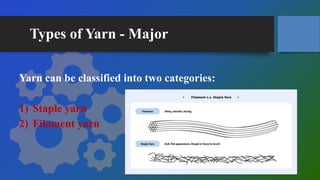
Yarn can be classified into two categories:
1) Staple yarn
2) Filament yarn
Staple Yarn
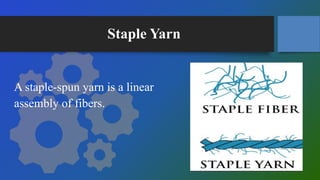
A staple-spun yarn is a linear
assembly of fibers.
Staple Yarn
Fibers are held together by the insertion of twist, to form a
continuous strand that is smaller in cross-section with specified
length.
Staple Yarn
Staple yarns divide into different categories based on their
length, no. of ply, twist direction, spinning method etc.
Staple Yarn Types
Staple-spun yarn can be classified into two
categories :
1) Short staple yarn:
2) Long staple yarn:
Short Staple Yarn
A short staple fiber has a length of between 10 and
60mm.
For Example :- cotton fiber is a short staple at about
25–45mm.
Long Staple Yarn
A long staple fiber has a length more than 60mm.
For Example :- wool fiber is a long staple at about
60–150mm.
Filament Yarn
Filament yarn is a collective form of twisted or without twisted
strands of filaments, each of the filaments runs the complete
length of yarn.
Filament yarn can be natural, non-synthetic, and synthetic.
Filament Yarn Types
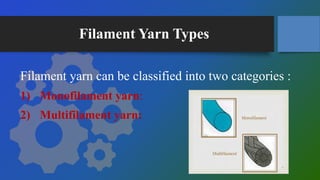
Filament yarn can be classified into two categories :
1) Monofilament yarn:
2) Multifilament yarn:
Monofilament Yarn
Mono filament yarn is a single strand of filament
form yarn.
Thicker mono filaments are generally used for
industrial purposes rather than fabric production.
Monofilament Yarn
Monofilament yarns are mostly used for
manufacturing sewing threads, metallic yarns, bare
elastic or fishing lines
Multifilament Yarn
Multi filament yarns are composed of two or more
filament strands twisted, plied or yarns twisted
together to form one yarn.
50-100 filaments may be present in the
multifilament.

Yarn NTU.pptx

  • 1.
    What Is Yarn? By Engr Hassan Ahmad Textile Engineer - NTU
  • 2.
    Definition :- Yarn isa collective term of linear assembles of fibers or filaments that are twisted together to impart strength or they can laid together to form a continuous strand that is suitable to manufacture fabric. [Add a graphic that provides evidence of what you learned]
  • 3.
    Types of Yarn- Major Yarn can be classified into two categories: 1) Staple yarn 2) Filament yarn
  • 4.
    Staple Yarn A staple-spunyarn is a linear assembly of fibers.
  • 5.
    Staple Yarn Fibers areheld together by the insertion of twist, to form a continuous strand that is smaller in cross-section with specified length.
  • 6.
    Staple Yarn Staple yarnsdivide into different categories based on their length, no. of ply, twist direction, spinning method etc.
  • 7.
    Staple Yarn Types Staple-spunyarn can be classified into two categories : 1) Short staple yarn: 2) Long staple yarn:
  • 8.
    Short Staple Yarn Ashort staple fiber has a length of between 10 and 60mm. For Example :- cotton fiber is a short staple at about 25–45mm.
  • 9.
    Long Staple Yarn Along staple fiber has a length more than 60mm. For Example :- wool fiber is a long staple at about 60–150mm.
  • 10.
    Filament Yarn Filament yarnis a collective form of twisted or without twisted strands of filaments, each of the filaments runs the complete length of yarn. Filament yarn can be natural, non-synthetic, and synthetic.
  • 11.
    Filament Yarn Types Filamentyarn can be classified into two categories : 1) Monofilament yarn: 2) Multifilament yarn:
  • 12.
    Monofilament Yarn Mono filamentyarn is a single strand of filament form yarn. Thicker mono filaments are generally used for industrial purposes rather than fabric production.
  • 13.
    Monofilament Yarn Monofilament yarnsare mostly used for manufacturing sewing threads, metallic yarns, bare elastic or fishing lines
  • 14.
    Multifilament Yarn Multi filamentyarns are composed of two or more filament strands twisted, plied or yarns twisted together to form one yarn. 50-100 filaments may be present in the multifilament.

Editor's Notes

  • #3 Notes to presenter: Description of what you learned in your own words on one side. Include information about the topic Details about the topic will also be helpful here. Tell the story of your learning experience. Just like a story there should always be a beginning, middle and an end. On the other side, you can add a graphic that provides evidence of what you learned. Feel free to use more than one slide to reflect upon your process. It also helps to add some video of your process.