







































Yahoo @ Nike
Yahoo @ Nike
Yahoo @ Nike
Yahoo @ Nike
Yahoo @ Nike
Yahoo @ Nike
Yahoo @ Nike
Yahoo @ Nike
Yahoo @ Nike
Yahoo @ Nike
Yahoo @ Nike
Yahoo @ Nike
Yahoo @ Nike
Yahoo @ Nike
Yahoo @ Nike
Yahoo @ Nike
Yahoo @ Nike
Yahoo @ Nike
Yahoo @ Nike
Yahoo @ Nike
Yahoo @ Nike
Yahoo @ Nike
Yahoo @ Nike
Yahoo @ Nike
Yahoo @ Nike
Yahoo @ Nike
Yahoo @ Nike
Yahoo @ Nike
Yahoo @ Nike
Yahoo @ Nike
Yahoo @ Nike
Yahoo @ Nike
Yahoo @ Nike
Yahoo @ Nike
Yahoo @ Nike
Yahoo @ Nike
Yahoo @ Nike
Yahoo @ Nike
Yahoo @ Nike
Yahoo @ Nike
Yahoo @ Nike
Yahoo @ Nike
Yahoo @ Nike
Yahoo @ Nike
Yahoo @ Nike
Yahoo @ Nike
Yahoo @ Nike
Yahoo @ Nike
Yahoo @ Nike
Yahoo @ Nike
Yahoo @ Nike
Yahoo @ Nike
Yahoo @ Nike
Yahoo @ Nike
Yahoo @ Nike
Yahoo @ Nike
Yahoo @ Nike
Yahoo @ Nike
Yahoo @ Nike
Yahoo @ Nike
Yahoo @ Nike
Yahoo @ Nike
Yahoo @ Nike
Yahoo @ Nike
Yahoo @ Nike
Yahoo @ Nike
Yahoo @ Nike
Yahoo @ Nike
Yahoo @ Nike
Yahoo @ Nike
Yahoo @ Nike
Yahoo @ Nike
Yahoo @ Nike
Yahoo @ Nike
Yahoo @ Nike
Yahoo @ Nike
Yahoo @ Nike
Yahoo @ Nike
Yahoo @ Nike
Yahoo @ Nike
Yahoo @ Nike
Yahoo @ Nike
Yahoo @ Nike
Yahoo @ Nike
Yahoo @ Nike
Yahoo @ Nike
Yahoo @ Nike
Yahoo @ Nike
Yahoo @ Nike
Yahoo @ Nike
Yahoo @ Nike
Yahoo @ Nike
Yahoo @ Nike
Yahoo @ Nike
Yahoo @ Nike
Yahoo @ Nike
Yahoo @ Nike
Yahoo @ Nike
Yahoo @ Nike
Yahoo @ Nike
Yahoo @ Nike
Yahoo @ Nike
Yahoo @ Nike
Yahoo @ Nike
Yahoo @ Nike
Yahoo @ Nike
Yahoo @ Nike
Yahoo @ Nike
Yahoo @ Nike
Yahoo @ Nike
Yahoo @ Nike
Yahoo @ Nike
Yahoo @ Nike
Yahoo @ Nike
Yahoo @ Nike
Yahoo @ Nike
Yahoo @ Nike
Yahoo @ Nike
Yahoo @ Nike
Yahoo @ Nike
Yahoo @ Nike
Yahoo @ Nike
Yahoo @ Nike
Yahoo @ Nike
Yahoo @ Nike
Yahoo @ Nike
Yahoo @ Nike
Yahoo @ Nike
Yahoo @ Nike
Yahoo @ Nike
Yahoo @ Nike
Yahoo @ Nike
Yahoo @ Nike
Yahoo @ Nike
Yahoo @ Nike
Yahoo @ Nike
Yahoo @ Nike
Yahoo @ Nike
Yahoo @ Nike
Yahoo @ Nike
Yahoo @ Nike
Yahoo @ Nike
Yahoo @ Nike
Yahoo @ Nike
Yahoo @ Nike
Yahoo @ Nike
Yahoo @ Nike
Yahoo @ Nike
Yahoo @ Nike
Yahoo @ Nike
Yahoo @ Nike
Yahoo @ Nike
Yahoo @ Nike
Yahoo @ Nike
Yahoo @ Nike
Yahoo @ Nike
Yahoo @ Nike
Yahoo @ Nike
Yahoo @ Nike
Yahoo @ Nike

Editor's Notes

  • #6 lots of interest in the markets, people doing widgets.. what’s a widget? is blueprint for widgets?
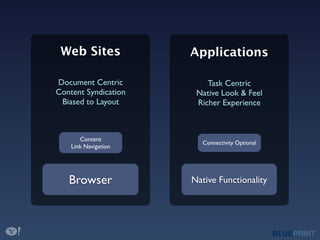
  • #7 at the beginning, j2me tools from nokia or sun and you could make a text app WML / WAP browsers didn’t really spark imagination but worked lowest common denominator or lots of work it’s getting hard - developer mindshare
  • #8 at the beginning, j2me tools from nokia or sun and you could make a text app WML / WAP browsers didn’t really spark imagination but worked lowest common denominator or lots of work it’s getting hard - developer mindshare
  • #9 at the beginning, j2me tools from nokia or sun and you could make a text app WML / WAP browsers didn’t really spark imagination but worked lowest common denominator or lots of work it’s getting hard - developer mindshare
  • #10 at the beginning, j2me tools from nokia or sun and you could make a text app WML / WAP browsers didn’t really spark imagination but worked lowest common denominator or lots of work it’s getting hard - developer mindshare
  • #11 at the beginning, j2me tools from nokia or sun and you could make a text app WML / WAP browsers didn’t really spark imagination but worked lowest common denominator or lots of work it’s getting hard - developer mindshare
  • #12 at the beginning, j2me tools from nokia or sun and you could make a text app WML / WAP browsers didn’t really spark imagination but worked lowest common denominator or lots of work it’s getting hard - developer mindshare
  • #13 so which platform do you pick? iphone? android? site builders, netbiscuits, Samsung/Nokia W3C Widgets, LG Flash Widgets, BONDI? 500m visitors per month aiming for 1bn mobile users
  • #14 so which platform do you pick? iphone? android? site builders, netbiscuits, Samsung/Nokia W3C Widgets, LG Flash Widgets, BONDI? 500m visitors per month aiming for 1bn mobile users
  • #15 so which platform do you pick? iphone? android? site builders, netbiscuits, Samsung/Nokia W3C Widgets, LG Flash Widgets, BONDI? 500m visitors per month aiming for 1bn mobile users
  • #16 so which platform do you pick? iphone? android? site builders, netbiscuits, Samsung/Nokia W3C Widgets, LG Flash Widgets, BONDI? 500m visitors per month aiming for 1bn mobile users
  • #17 so which platform do you pick? iphone? android? site builders, netbiscuits, Samsung/Nokia W3C Widgets, LG Flash Widgets, BONDI? 500m visitors per month aiming for 1bn mobile users
  • #18 so which platform do you pick? iphone? android? site builders, netbiscuits, Samsung/Nokia W3C Widgets, LG Flash Widgets, BONDI? 500m visitors per month aiming for 1bn mobile users
  • #19 i.e. can a consumer use them? which consumer? where? can they tell their friends? their dad?
  • #20 i.e. can a consumer use them? which consumer? where? can they tell their friends? their dad?
  • #21 i.e. can a consumer use them? which consumer? where? can they tell their friends? their dad?
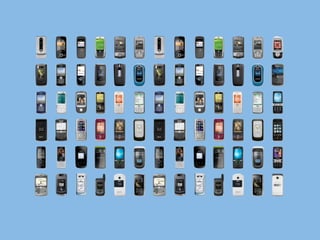
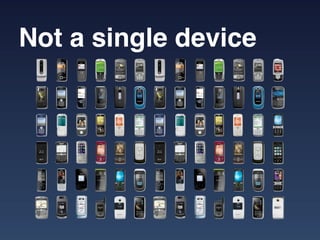
  • #22 not one country, region, segment. framing the market as billions means it can’t be one phone, one OS or even one technology.
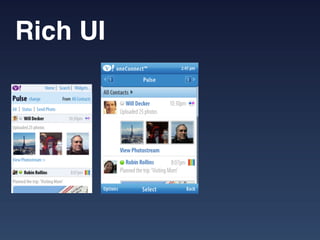
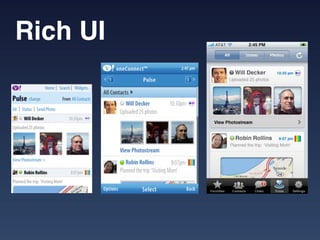
  • #30 Web as the Platform Rich UI Lightweight Programming Model Software above a single device End of Release Cycle Data is the next Intel Inside Collective Intelligence
  • #31 Browsers, lots of them. Clients. For different UIs, Java, Windows, Symbian, and more.. sat nav anyone? and the iPhone.. the touch-screen daddy.
  • #32 Browsers, lots of them. Clients. For different UIs, Java, Windows, Symbian, and more.. sat nav anyone? and the iPhone.. the touch-screen daddy.
  • #33 Browsers, lots of them. Clients. For different UIs, Java, Windows, Symbian, and more.. sat nav anyone? and the iPhone.. the touch-screen daddy.
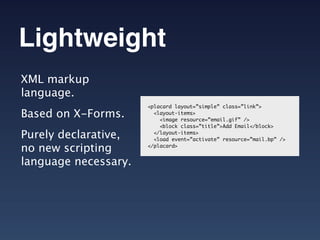
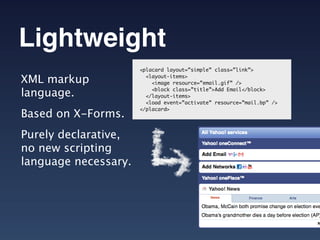
  • #34 XForms does AJAX without the J. It helps structure an app by separating data and presentation. MVC. XForms has the model in the head and references it from the page. Look at W3C site for more info. DON’T HAVE TO LEARN OBJECTIVE-C
  • #35 XForms does AJAX without the J. It helps structure an app by separating data and presentation. MVC. XForms has the model in the head and references it from the page. Look at W3C site for more info. DON’T HAVE TO LEARN OBJECTIVE-C
  • #36 XForms does AJAX without the J. It helps structure an app by separating data and presentation. MVC. XForms has the model in the head and references it from the page. Look at W3C site for more info. DON’T HAVE TO LEARN OBJECTIVE-C
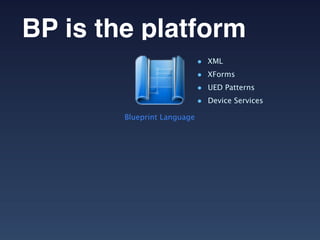
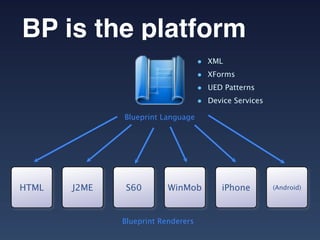
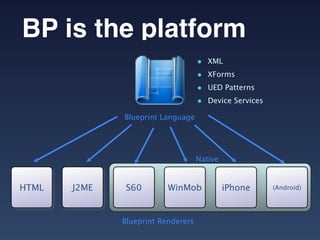
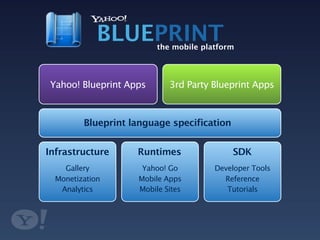
  • #37 Blueprint is the platform - software above a single device
  • #39 We have a placard for that.
  • #40 We have a placard for that.
  • #41 We have a placard for that.
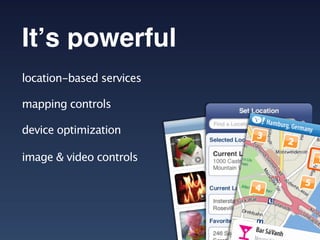
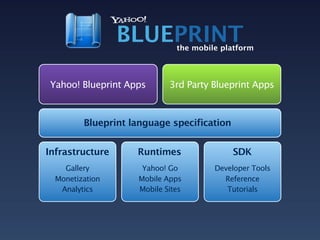
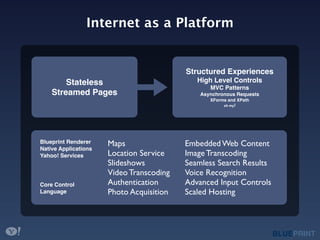
  • #42 video transcoding cell tower database - growing rapidly maps inc. satellite, driving directions, points of interest and soon KML.
  • #43 video transcoding cell tower database - growing rapidly maps inc. satellite, driving directions, points of interest and soon KML.
  • #44 video transcoding cell tower database - growing rapidly maps inc. satellite, driving directions, points of interest and soon KML.
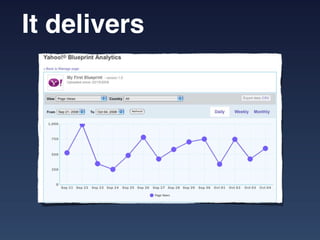
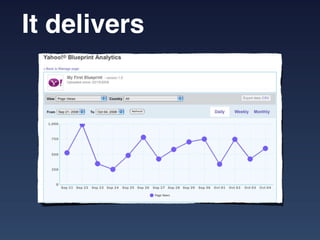
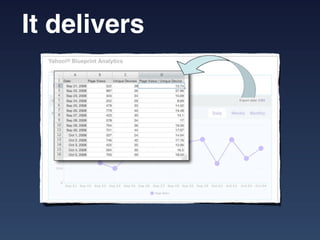
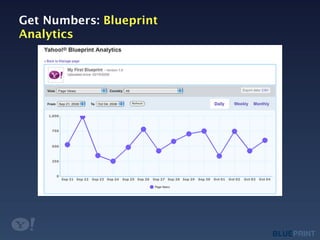
  • #45 Right now basic usage and device stats. We are integrating with IndexTools which is probably the best web analytics platform there is.
  • #46 Right now basic usage and device stats. We are integrating with IndexTools which is probably the best web analytics platform there is.
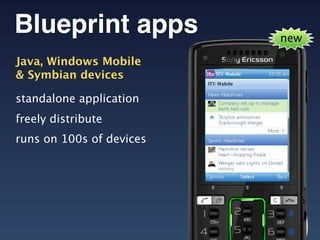
  • #66 Go is for Windows Mobile, Java, Blackberry & Symbian. Stated aim to support all platforms we can.
  • #67 All platforms we support for Go. Basically single widget version of Go.
  • #68 We transcode across may devices. In the future we will support branding.
  • #69 We transcode across may devices. In the future we will support branding.
  • #70 We transcode across may devices. In the future we will support branding.
  • #71 targeted at the mass market. mostly you want reach, distribution and users!
  • #72 targeted at the mass market. mostly you want reach, distribution and users!
  • #73 targeted at the mass market. mostly you want reach, distribution and users!
  • #74 targeted at the mass market. mostly you want reach, distribution and users!
  • #75 targeted at the mass market. mostly you want reach, distribution and users!
  • #76 targeted at the mass market. mostly you want reach, distribution and users!
  • #77 targeted at the mass market. mostly you want reach, distribution and users!
  • #78 targeted at the mass market. mostly you want reach, distribution and users!
  • #79 targeted at the mass market. mostly you want reach, distribution and users!
  • #80 targeted at the mass market. mostly you want reach, distribution and users!
  • #81 targeted at the mass market. mostly you want reach, distribution and users!
  • #82 targeted at the mass market. mostly you want reach, distribution and users!
  • #83 targeted at the mass market. mostly you want reach, distribution and users!
  • #84 targeted at the mass market. mostly you want reach, distribution and users!
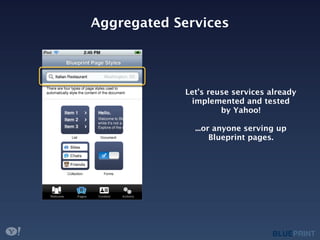
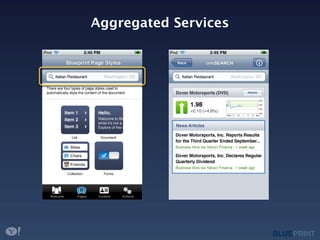
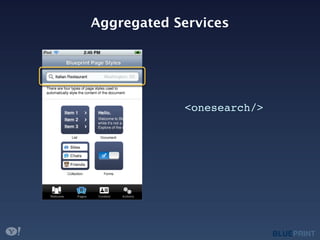
  • #85 carriers, oneSearch, frontpage
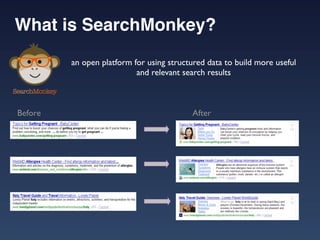
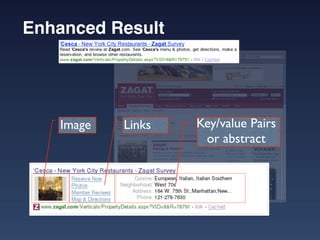
  • #154 A SearchMonkey Enhanced result contains a great deal of structured data. It could have a picture, key/value pairs, deep links… This kind of information goes far beyond what normal search results give you – a title and an autoextracted summary. Where does this information come from?
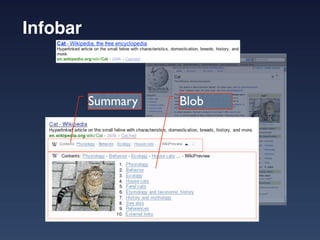
  • #155 Likewise, an Infobar has a summary (what the user sees before the pane is expanded) and a “blob”, an area of free-form HTML.
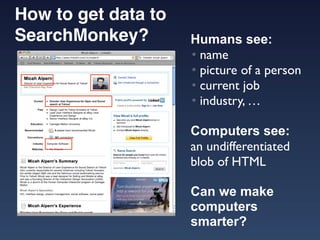
  • #156  Here’s a profile page for a colleague of mine on LinkedIn. When you and I glance at the page, we see all sorts of structured information. We see pictures, contact info, names, … all sorts of items that have actual meaning. But spiders just see a blob of markup. The spider can extract some basic info, like a title (probably correct), a summary (could be good or not), and some other metadata. But for pulling structured information out of web pages, human beings beat computers hands down. So how to harvest structured data? One approach would be to make computers SMARTER, by improving their ability to do pattern recognition and natural language processing. DRAWBACKS: these sorts of AI-type features have proven to be pretty expensive and difficult to develop. I’m not smart enough to do this, so I want you to do it for me. YOU know a lot more about YOUR site than we do. even with a “dumb” approach, indexing all these billions of webpages already takes many thousands of CPU cores, crunching away. Again, very expensive. finally, we all know what happens here. The computer begins scouring information from the entire world wide web, starts learning at a geometric rate, becomes self-aware, …
  • #157 Computers become intelligent, begin to learn at a geometric rate, form SkyNet, and scour the Earth with nuclear fire. Shareholder value decreases. So we decided to go with the approach of -- keep our spider fairly dumb, and figure out different ways for people to provide us with structured data.
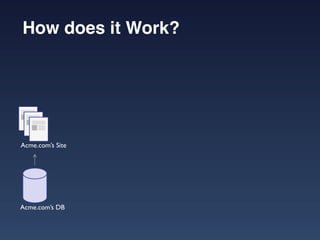
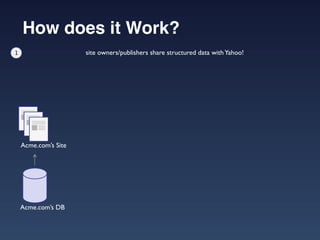
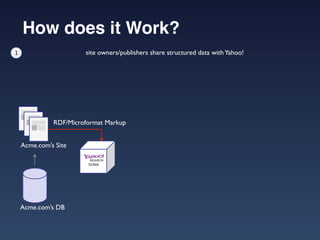
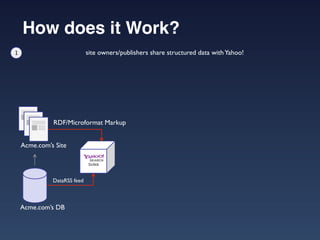
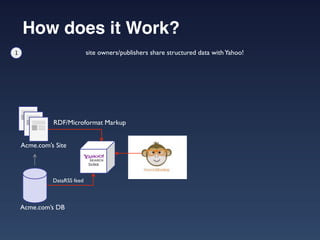
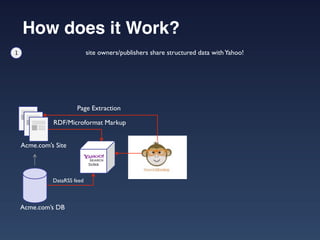
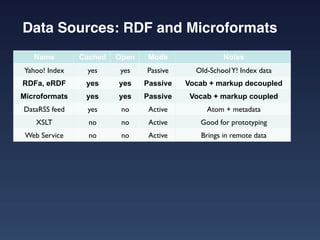
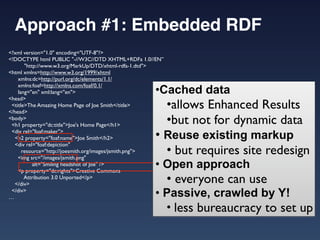
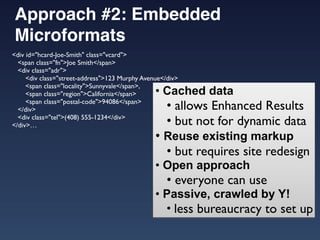
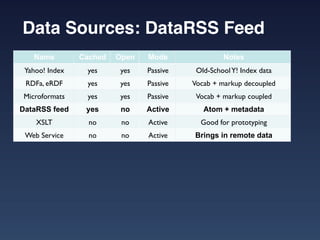
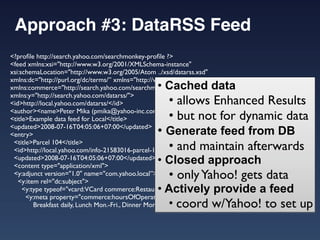
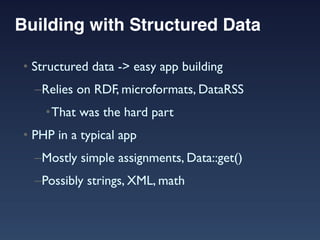
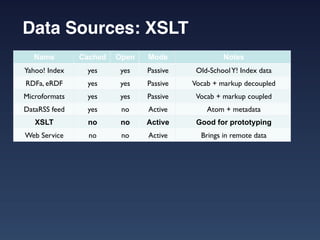
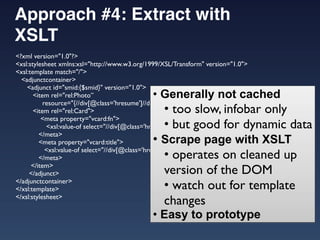
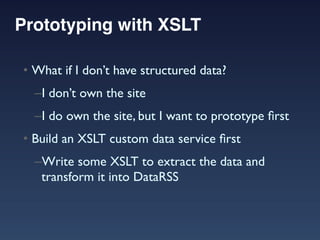
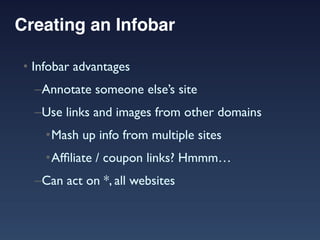
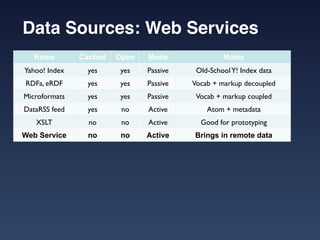
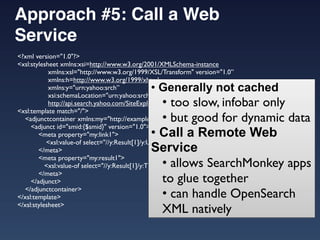
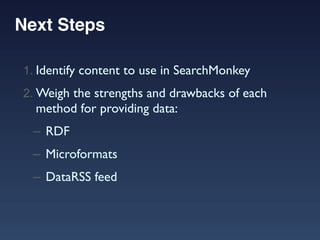
  • #158 In this scenario, we see all the different ways that you can feed SearchMonkey with data. A real SearchMonkey app probably wouldn’t use ALL these methods. From your database / CMS, you generate web pages with HTML markup. Those web pages can contain microformats or RDF, special markup that provides semantic meaning about the data on your pages. Our crawler can extract this information, just as it does the title, the page content, the mime-type, and so on. Alternatively, from your database you can also provide us with a DataRSS feed (more on that later) that we consume and place into our index. SearchMonkey also has two ways to actively retrieve information. You can create a Page Extractor, which scrapes information from a web page. You can also call a web service to retrieve more information about a page. We’ll talk more about all these methods in the subsequent slides.
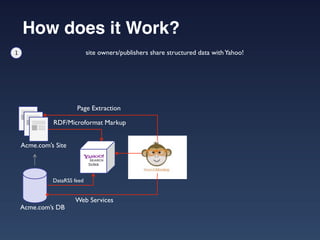
  • #159 In this scenario, we see all the different ways that you can feed SearchMonkey with data. A real SearchMonkey app probably wouldn’t use ALL these methods. From your database / CMS, you generate web pages with HTML markup. Those web pages can contain microformats or RDF, special markup that provides semantic meaning about the data on your pages. Our crawler can extract this information, just as it does the title, the page content, the mime-type, and so on. Alternatively, from your database you can also provide us with a DataRSS feed (more on that later) that we consume and place into our index. SearchMonkey also has two ways to actively retrieve information. You can create a Page Extractor, which scrapes information from a web page. You can also call a web service to retrieve more information about a page. We’ll talk more about all these methods in the subsequent slides.
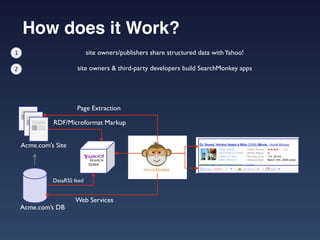
  • #160 In this scenario, we see all the different ways that you can feed SearchMonkey with data. A real SearchMonkey app probably wouldn’t use ALL these methods. From your database / CMS, you generate web pages with HTML markup. Those web pages can contain microformats or RDF, special markup that provides semantic meaning about the data on your pages. Our crawler can extract this information, just as it does the title, the page content, the mime-type, and so on. Alternatively, from your database you can also provide us with a DataRSS feed (more on that later) that we consume and place into our index. SearchMonkey also has two ways to actively retrieve information. You can create a Page Extractor, which scrapes information from a web page. You can also call a web service to retrieve more information about a page. We’ll talk more about all these methods in the subsequent slides.
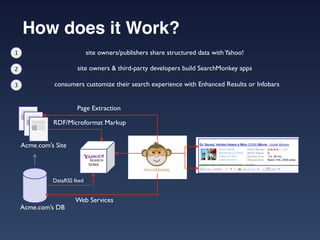
  • #161 In this scenario, we see all the different ways that you can feed SearchMonkey with data. A real SearchMonkey app probably wouldn’t use ALL these methods. From your database / CMS, you generate web pages with HTML markup. Those web pages can contain microformats or RDF, special markup that provides semantic meaning about the data on your pages. Our crawler can extract this information, just as it does the title, the page content, the mime-type, and so on. Alternatively, from your database you can also provide us with a DataRSS feed (more on that later) that we consume and place into our index. SearchMonkey also has two ways to actively retrieve information. You can create a Page Extractor, which scrapes information from a web page. You can also call a web service to retrieve more information about a page. We’ll talk more about all these methods in the subsequent slides.