













Creating Structure in
Unstructured Data
What is possible, today…?

Marco Gralike
“Big Data” = XML ?
Challenges are!
Ahum, the problems are!
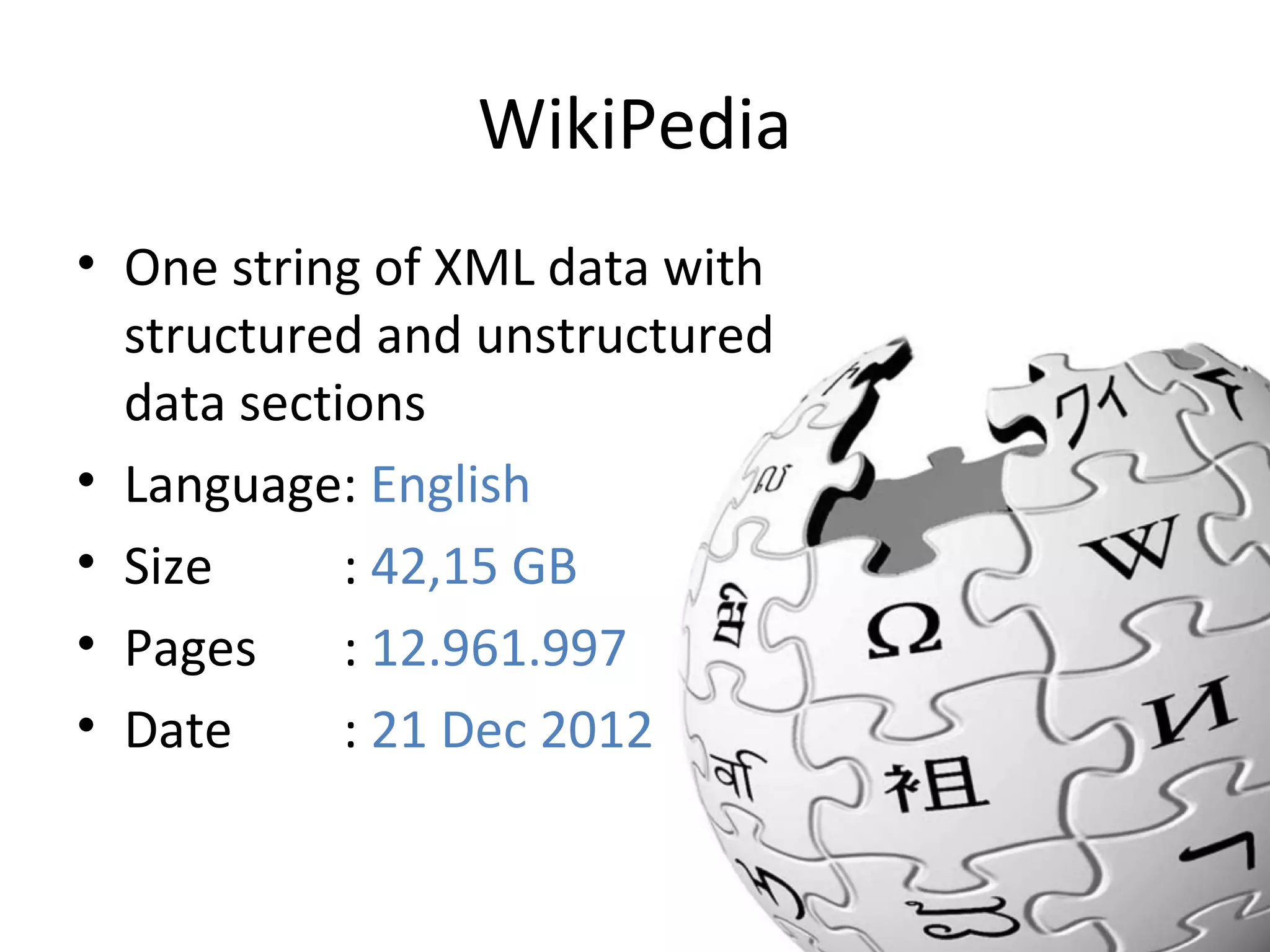
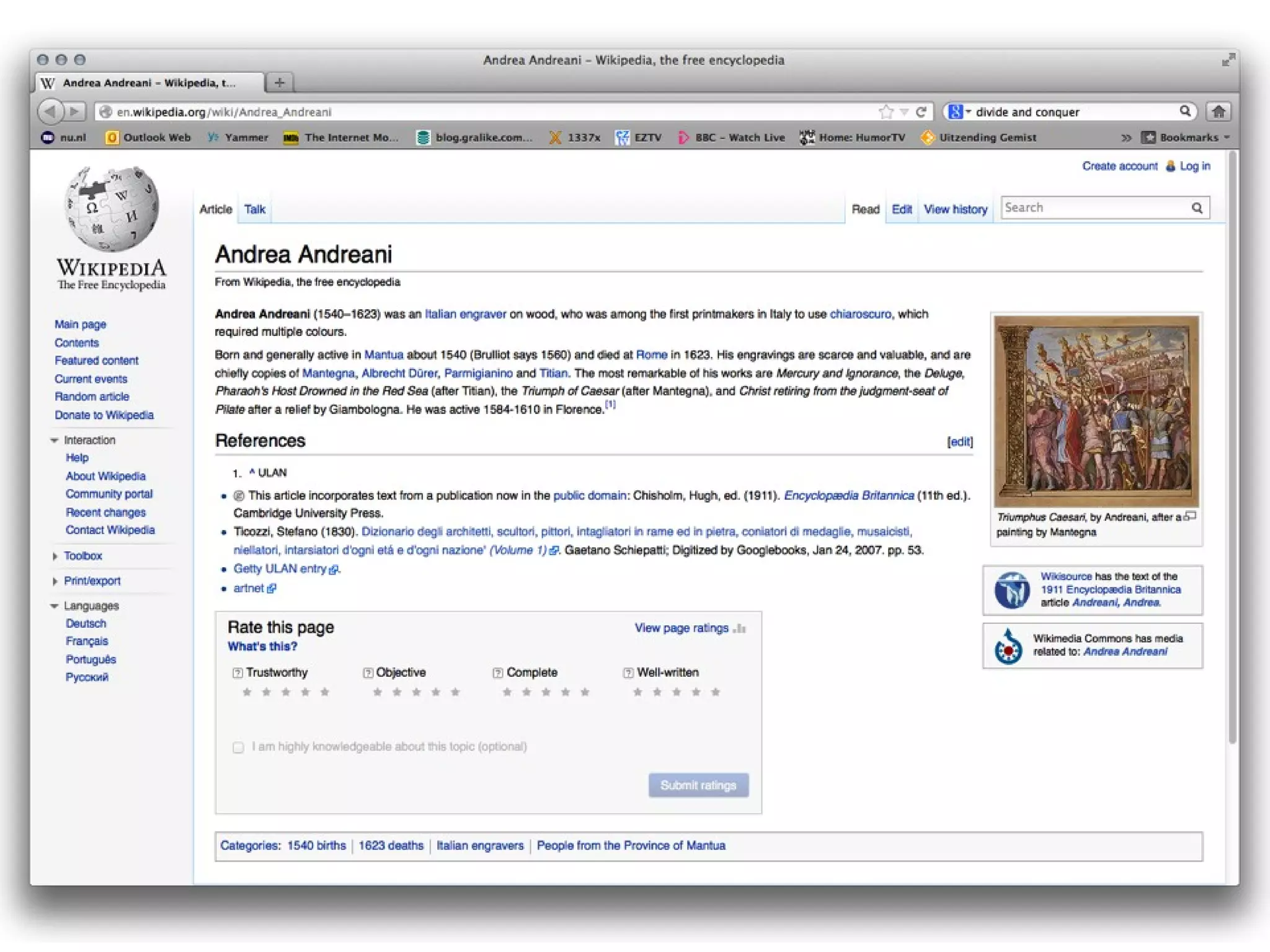
WikiPedia
• One string of XML data with
structured and unstructured
data sections
• Language: English
• Size
: 42,15 GB
• Pages
: 12.961.997
• Date
: 21 Dec 2012
Adventures into
the unknown…?
Setup
• VirtualBox VM
– OEL 5U8 (64)
– 8 GB RAM

• LaCie Little Big Disk
– RAID 0
– Thunderbolt

• Database
– SGA
– PGA

4GB
2GB
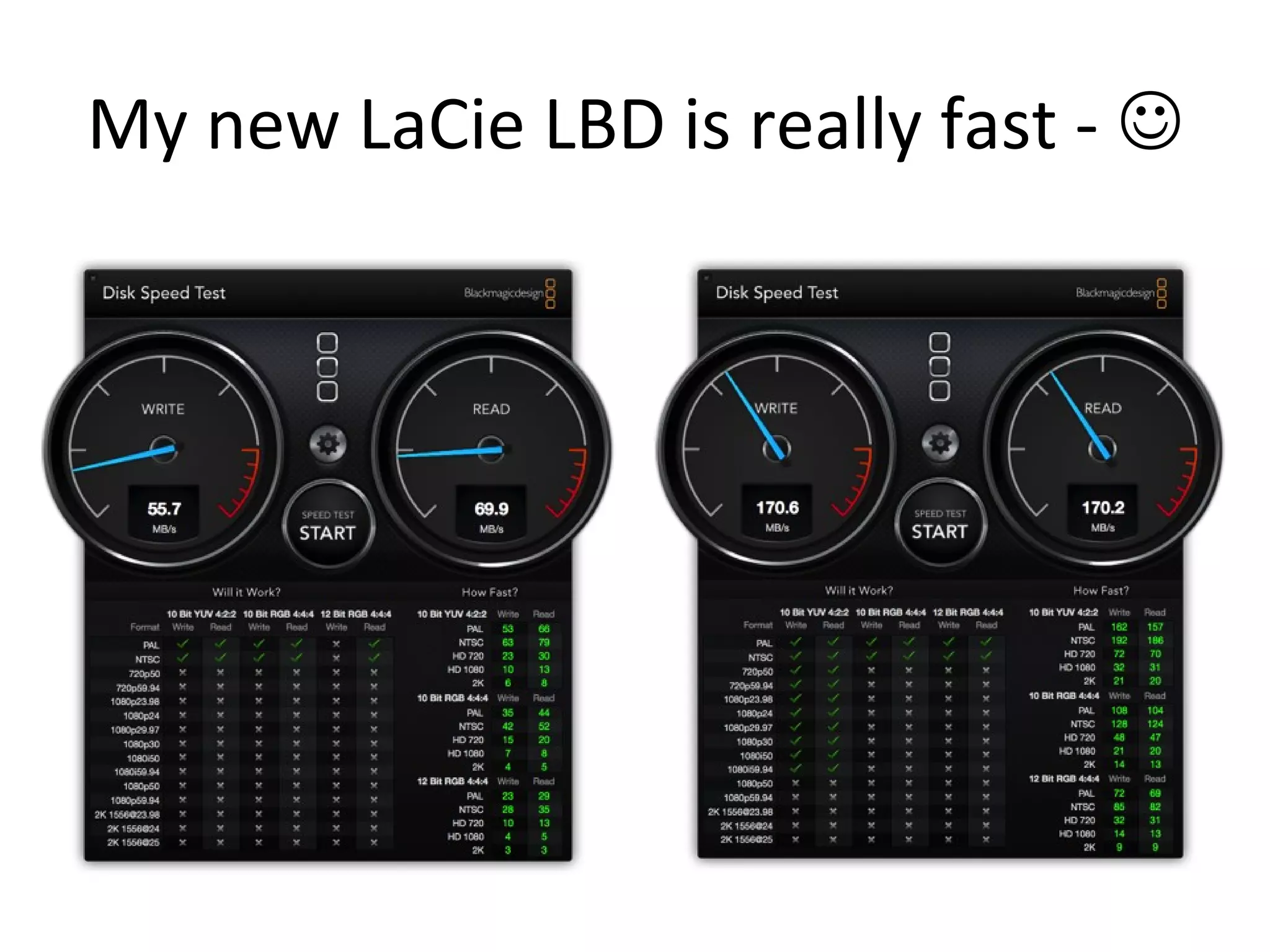
My new LaCie LBD is really fast - 
Defeat?! - 1.000.000 pages only
Status of Technology used
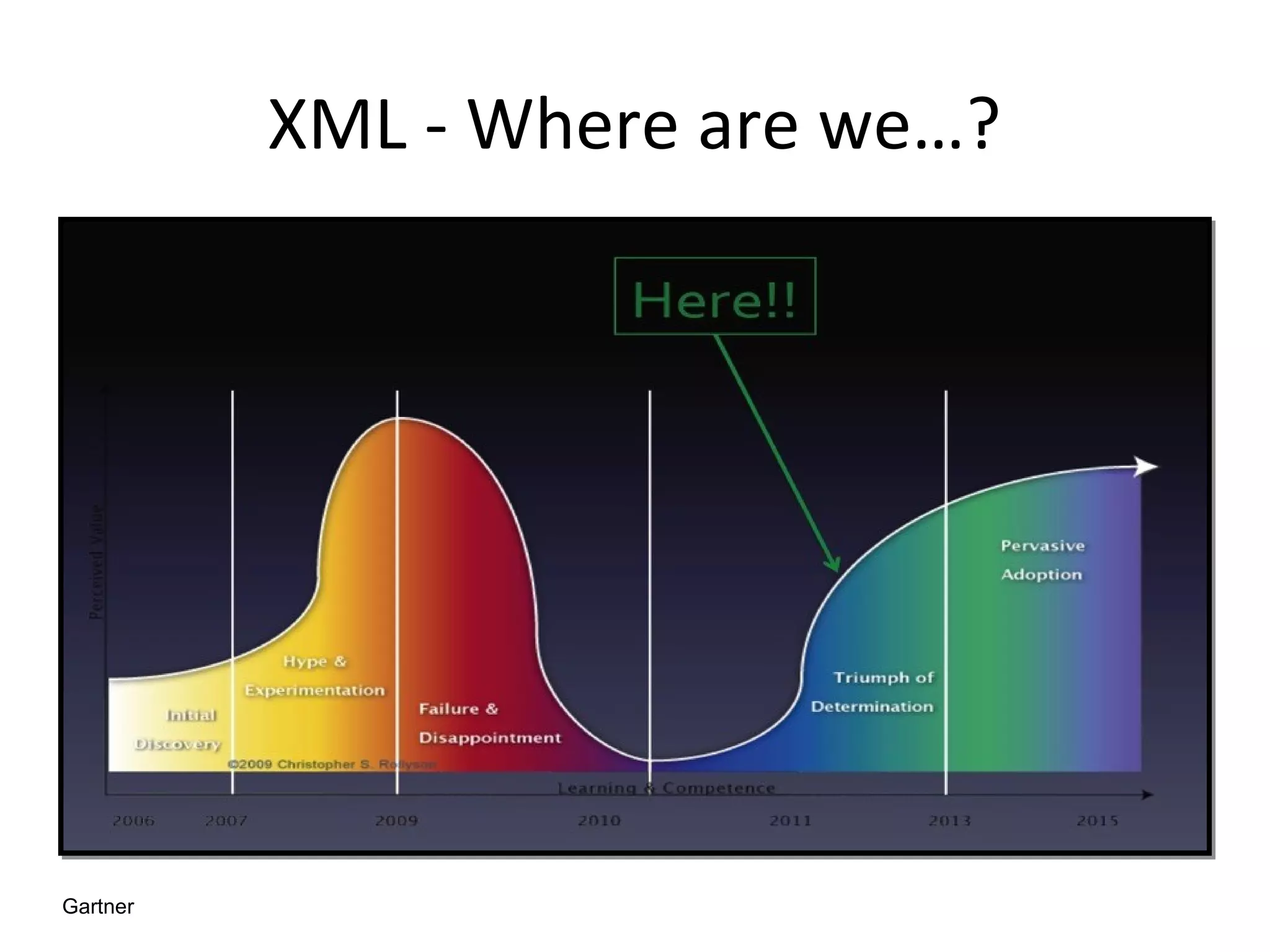
XML - Where are we…?

Gartner
Performance

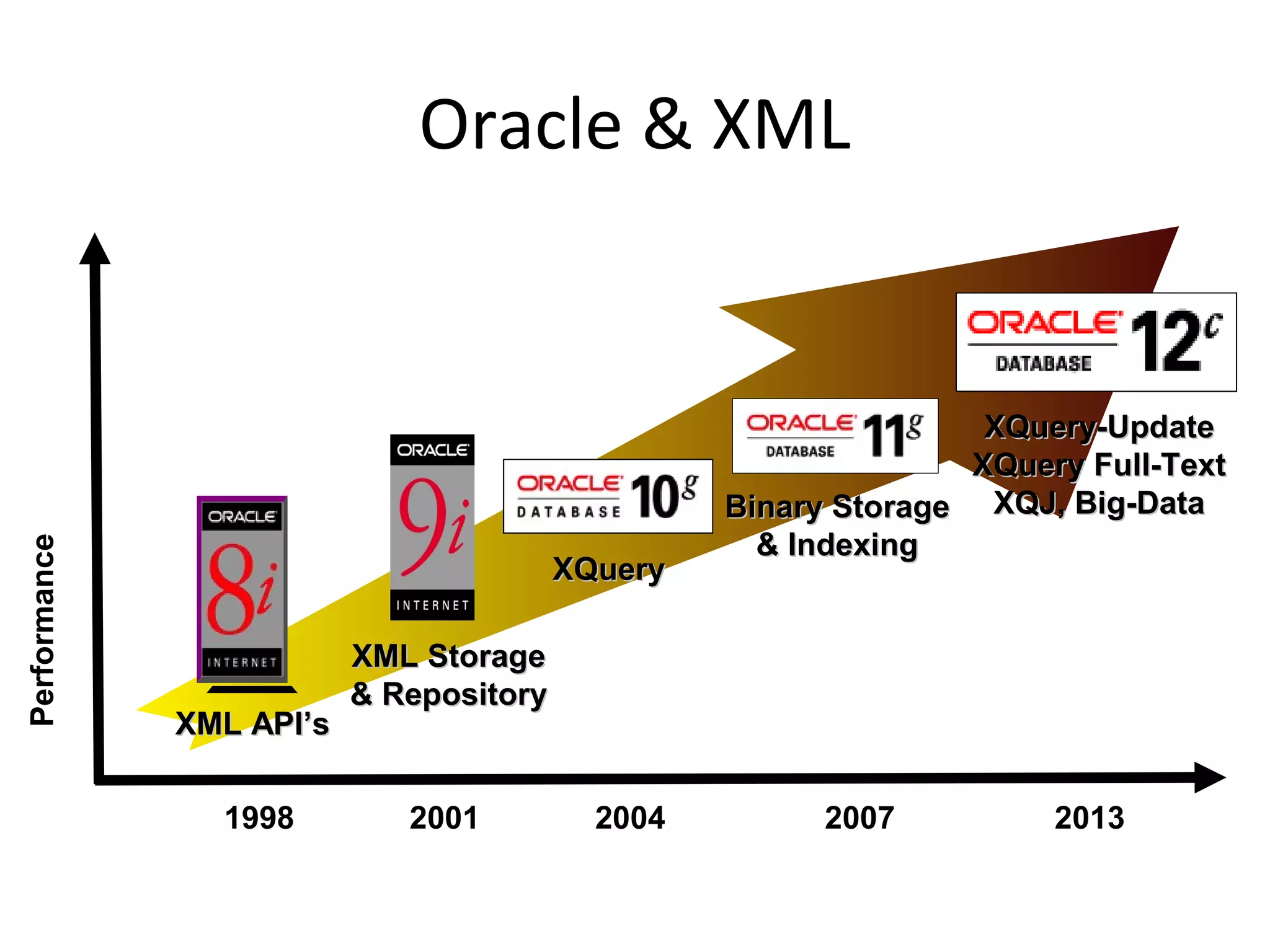
Oracle & XML

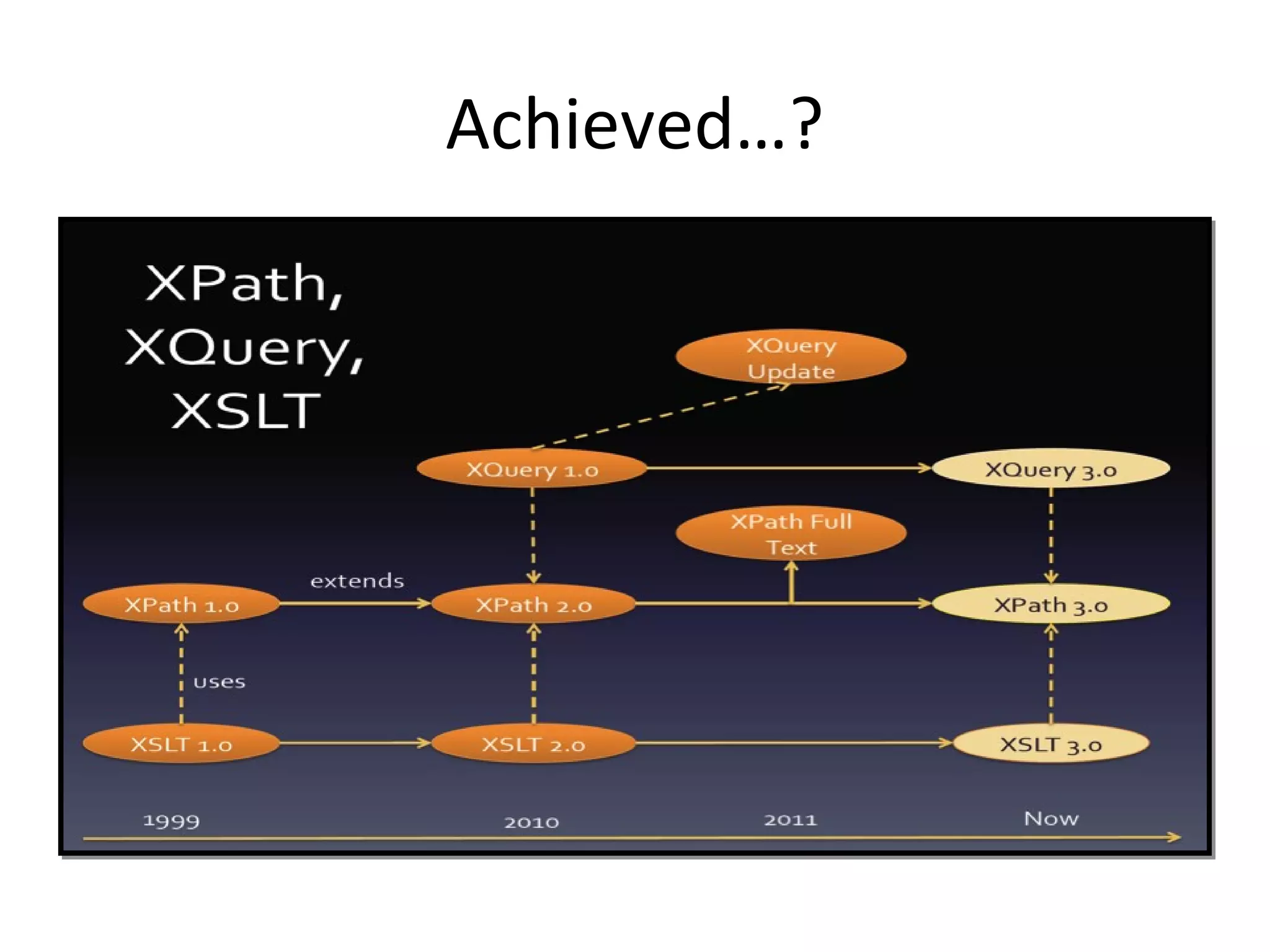
XQuery

XML API’s
1998

XQuery-Update
XQuery Full-Text
Binary Storage XQJ, Big-Data
& Indexing

XML Storage
& Repository

2001

2004

2007

2013
Achieved…?
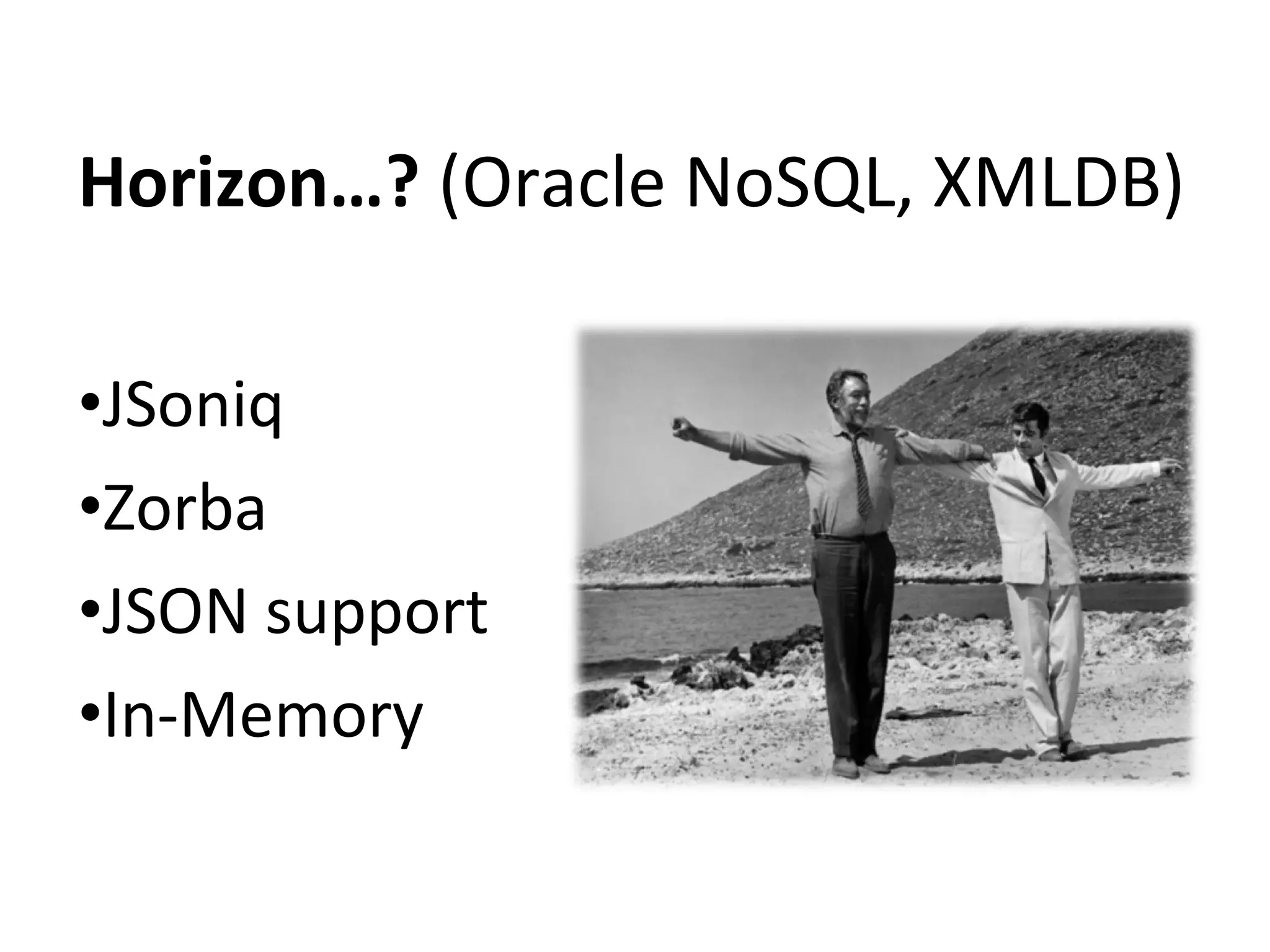
Horizon…? (Oracle NoSQL, XMLDB)
•JSoniq
•Zorba
•JSON support
•In-Memory
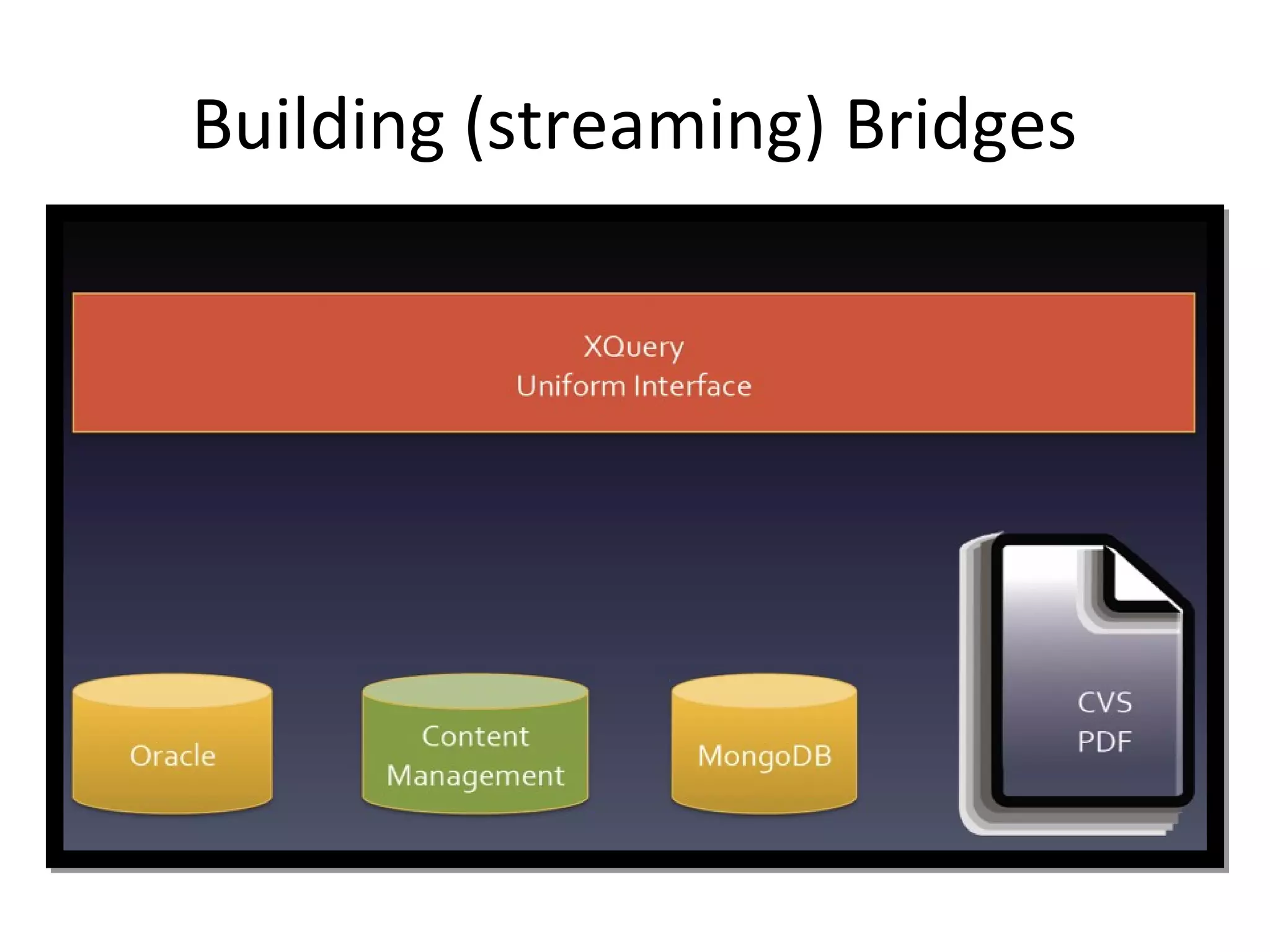
Building (streaming) Bridges
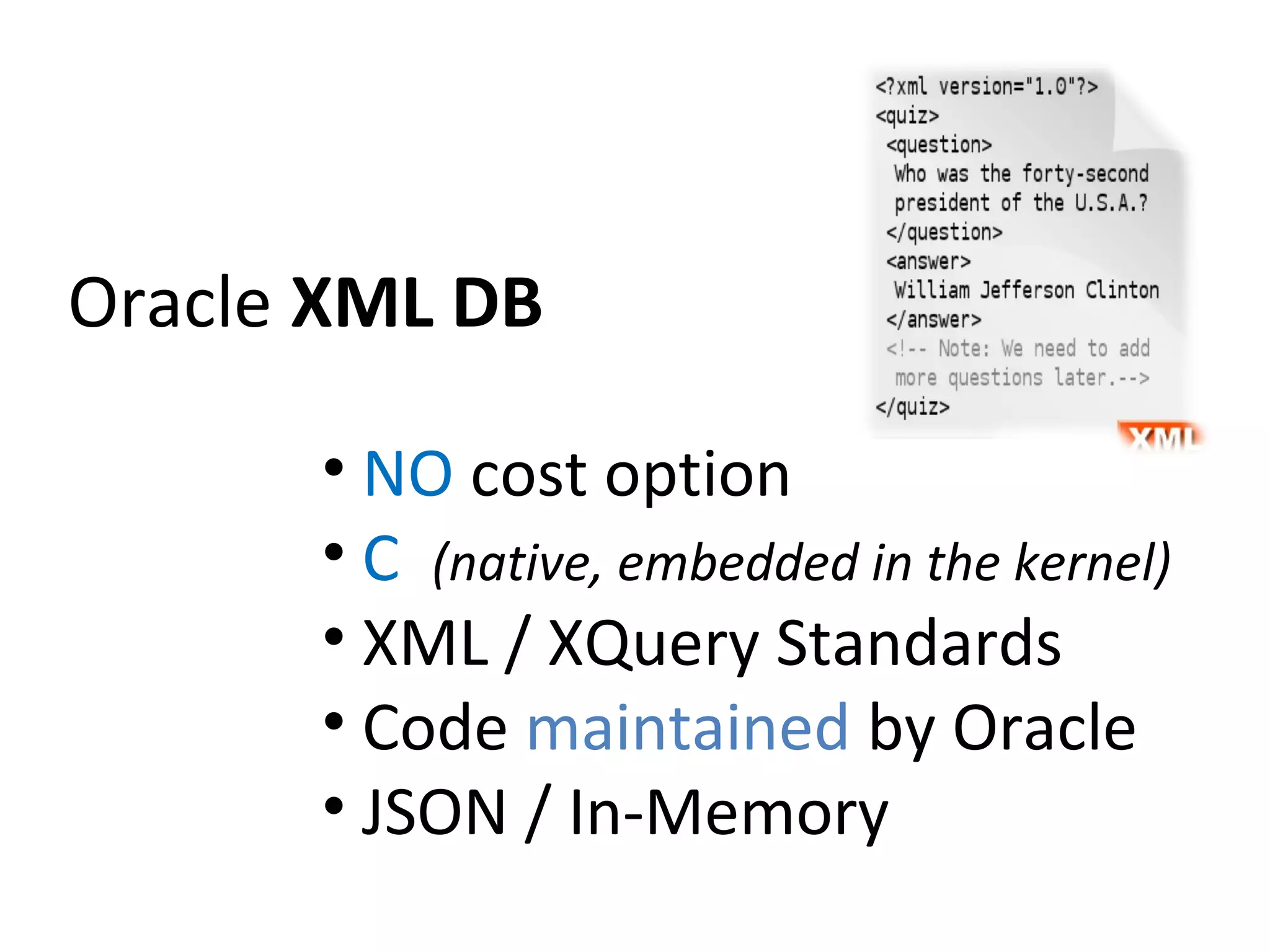
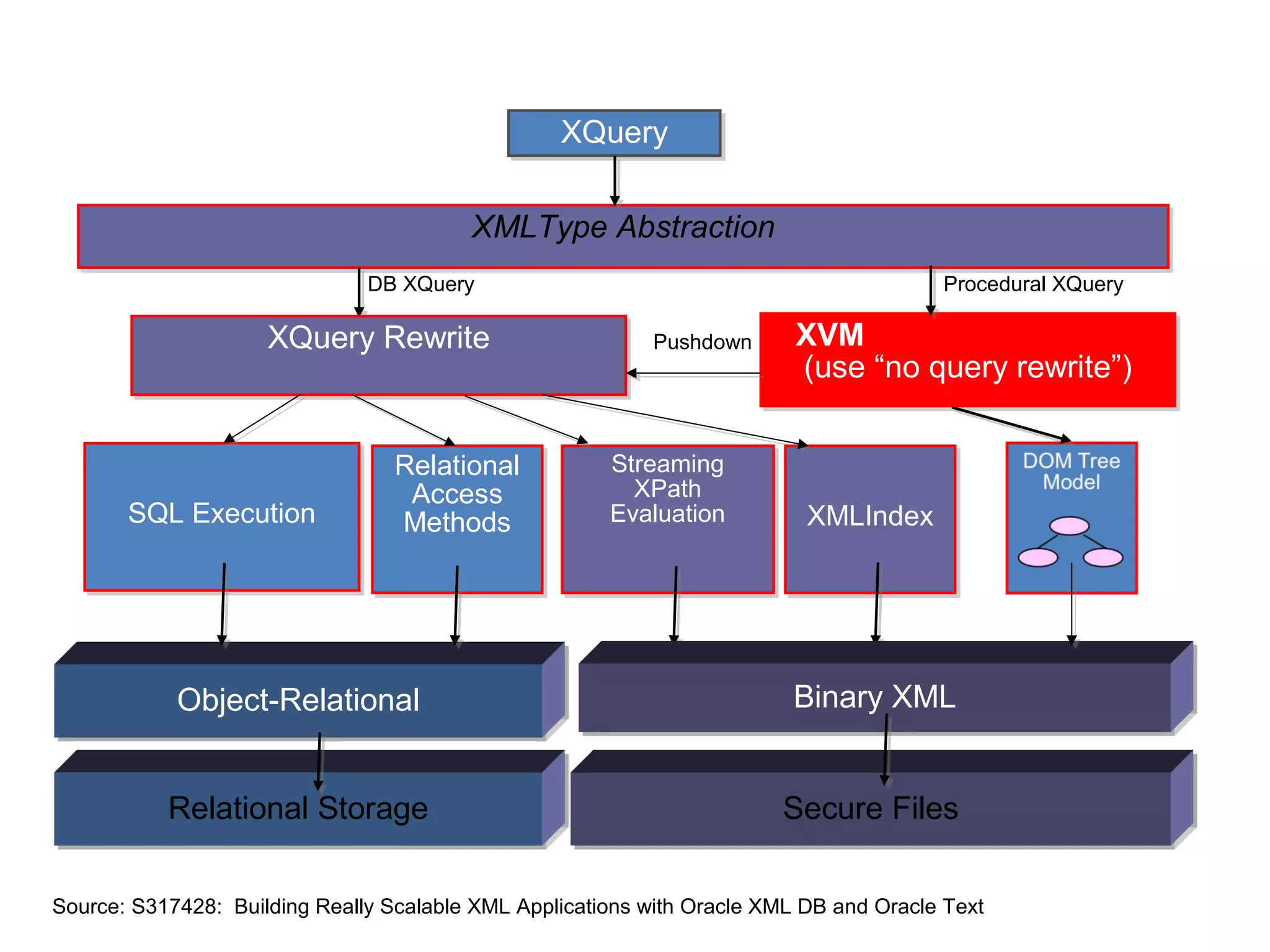
Oracle XML DB
• NO cost option
• C (native, embedded in the kernel)
• XML / XQuery Standards
• Code maintained by Oracle
• JSON / In-Memory
XQuery
XQuery
XMLType Abstraction
XMLType Abstraction
DB XQuery

XQuery Rewrite
XQuery Rewrite

SQL Execution
SQL Execution

Relational
Relational
Access
Access
Methods
Methods

Procedural XQuery
Pushdown

Streaming
Streaming
XPath
XPath
Evaluation
Evaluation

XVM
XVM
(use “no query rewrite”)

XMLIndex
XMLIndex

Object-Relational

Binary XML

Relational Storage

Secure Files

Source: S317428: Building Really Scalable XML Applications with Oracle XML DB and Oracle Text
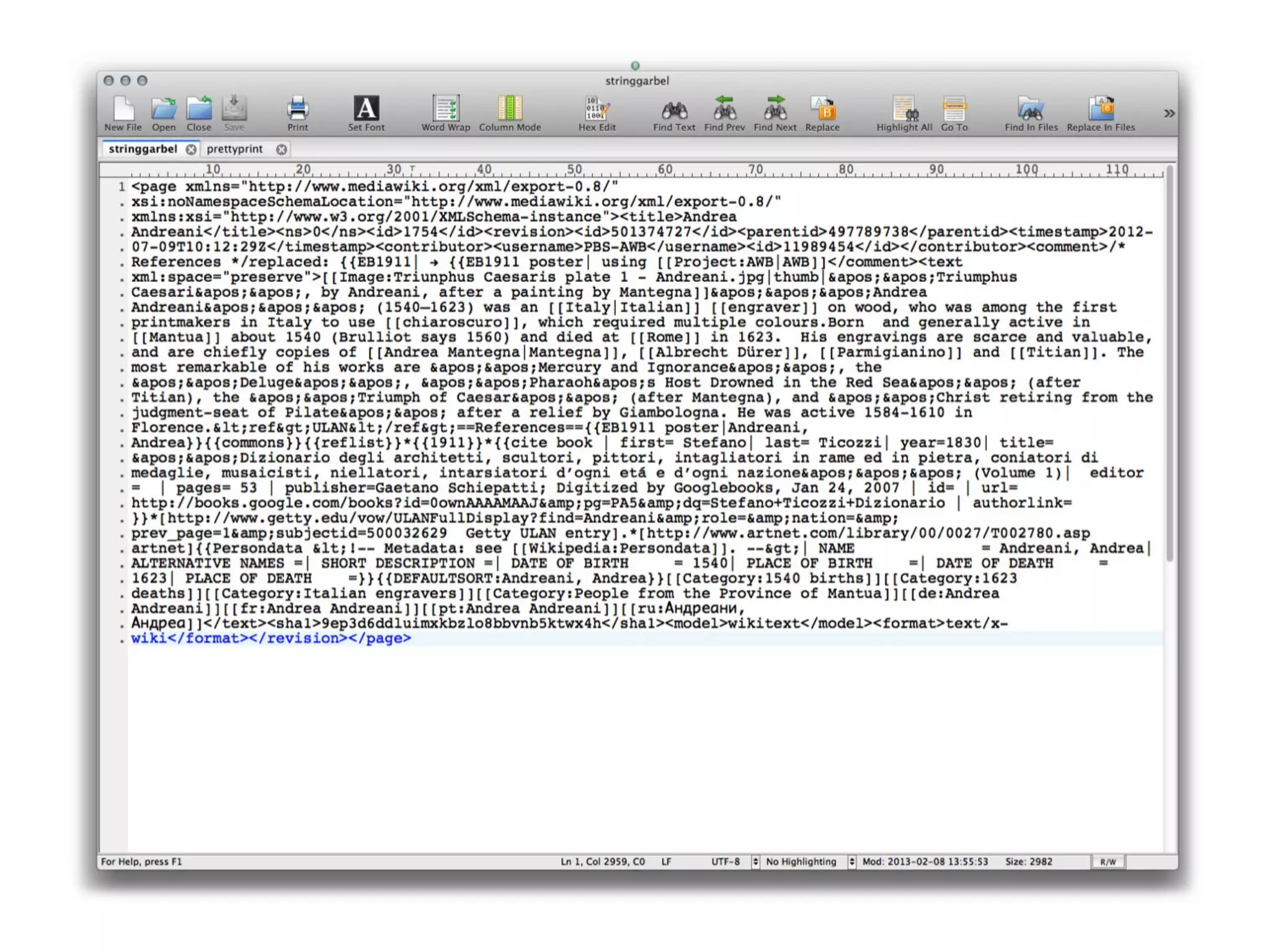
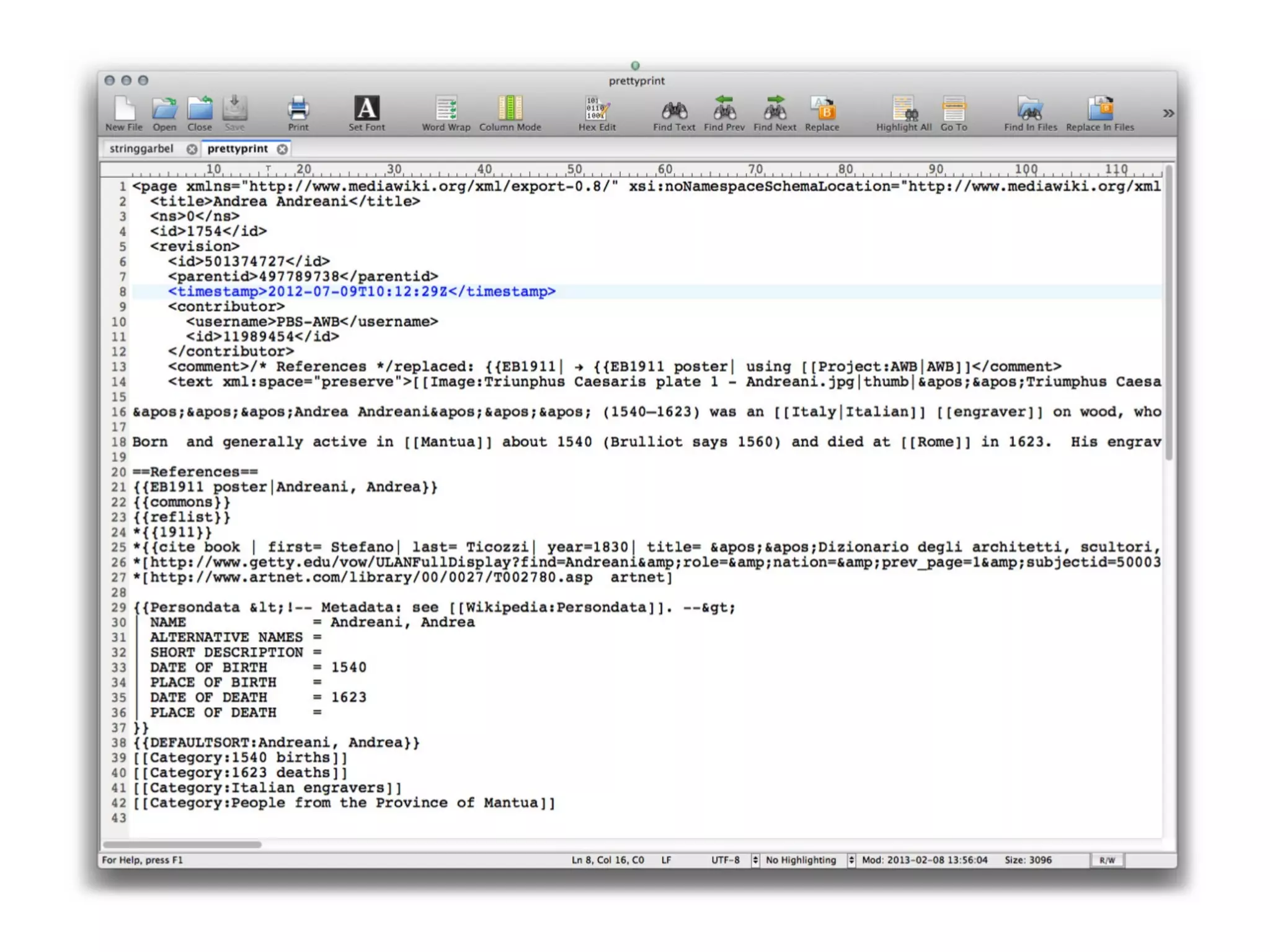
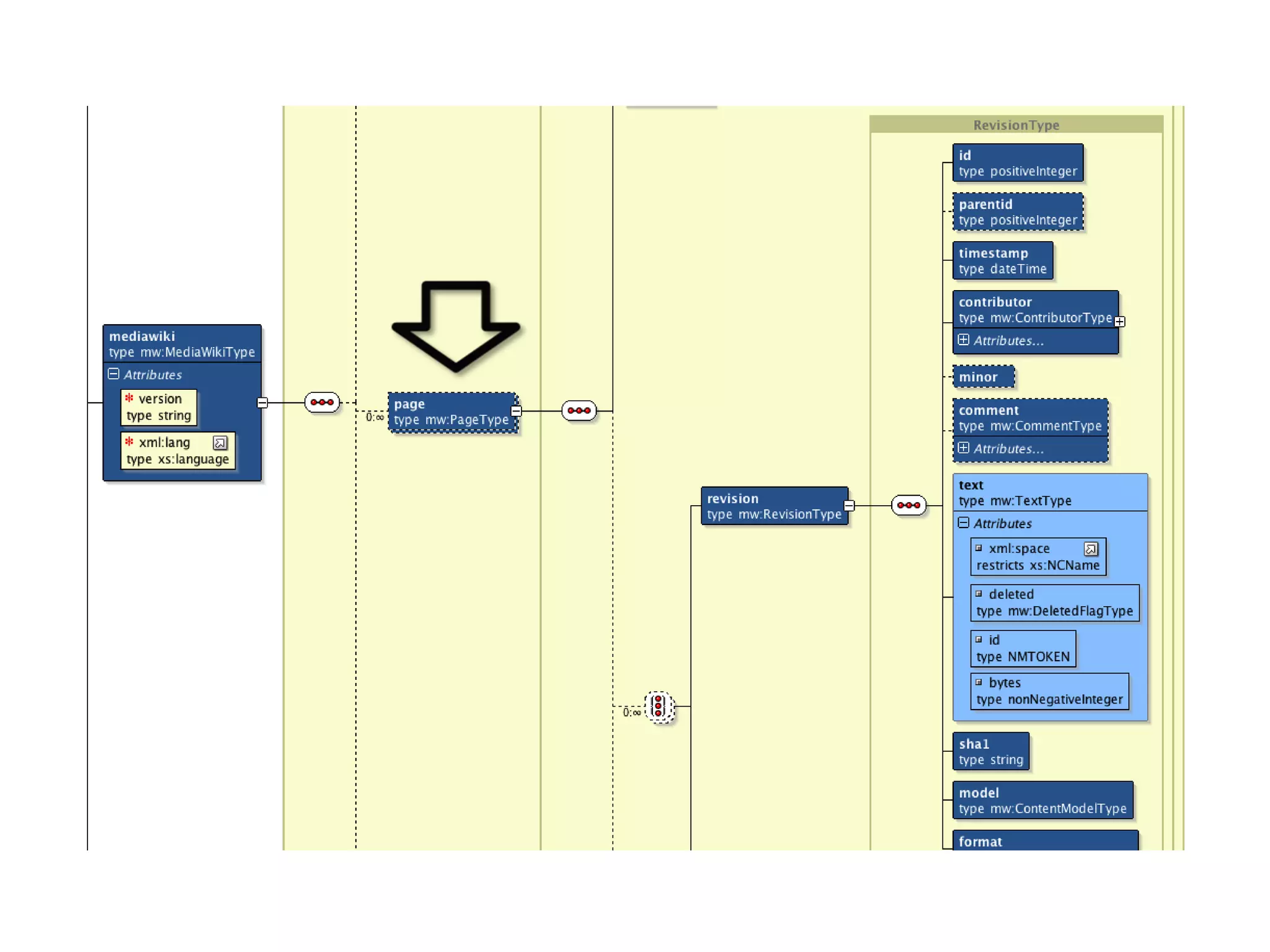
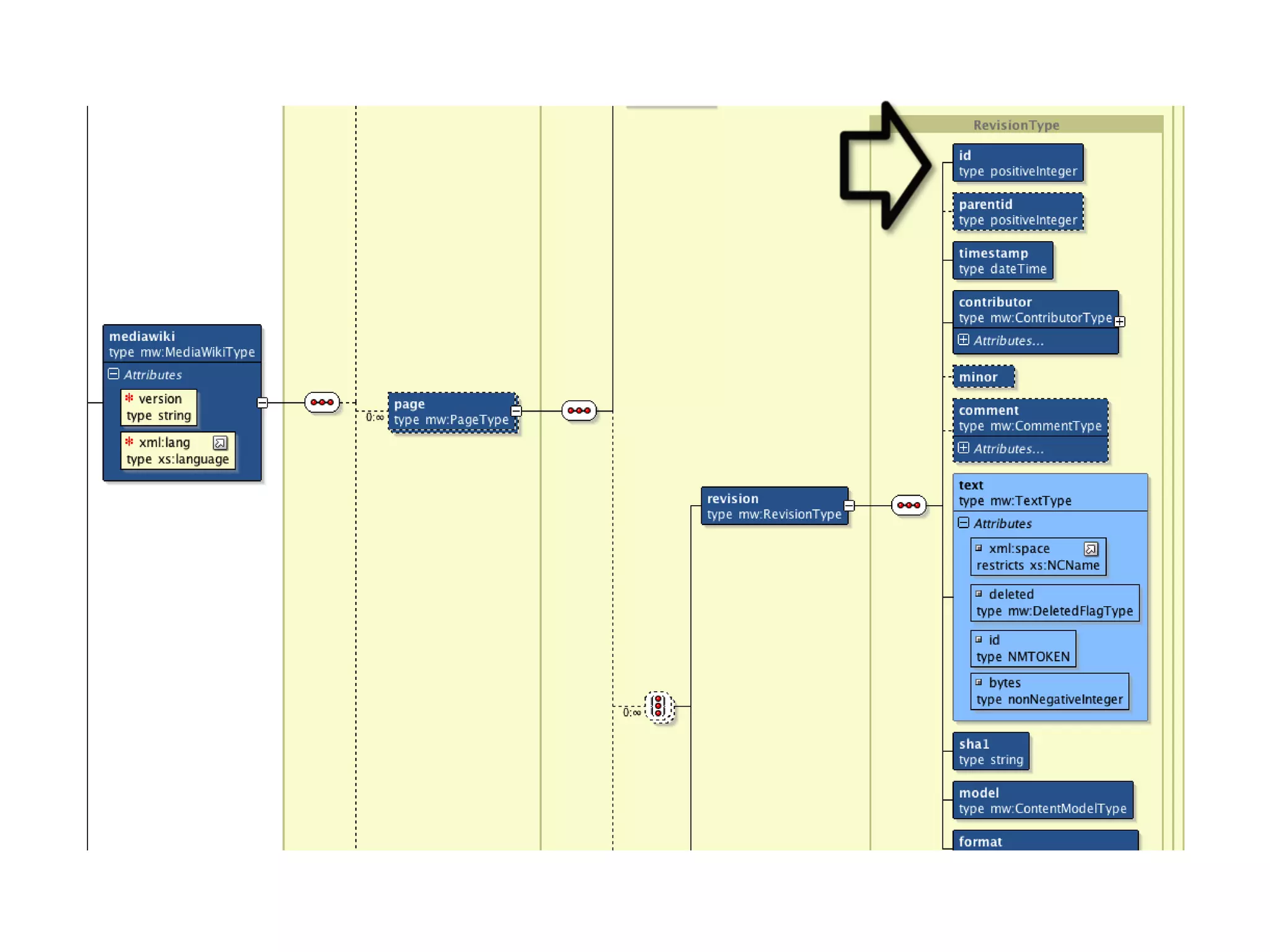
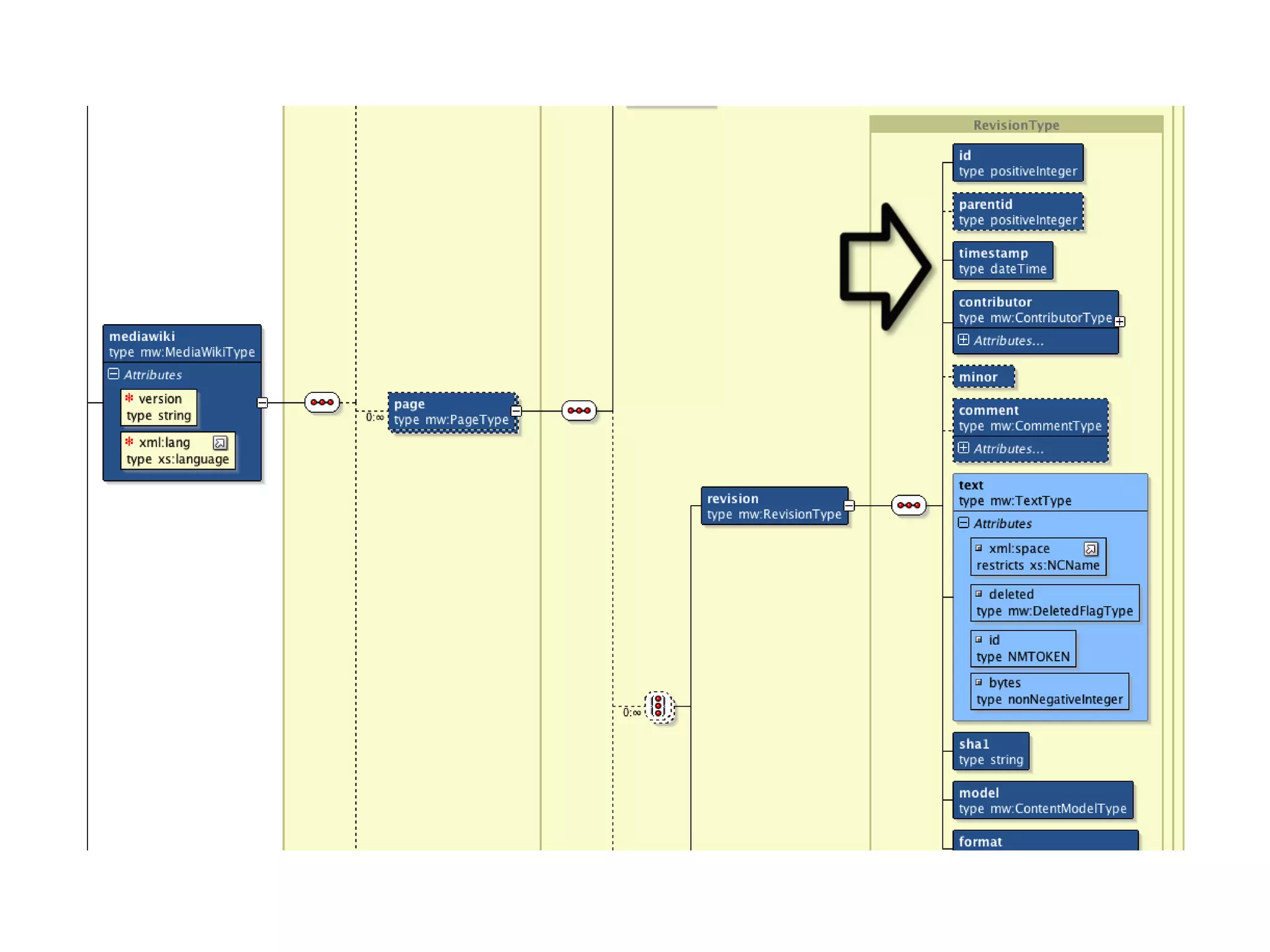
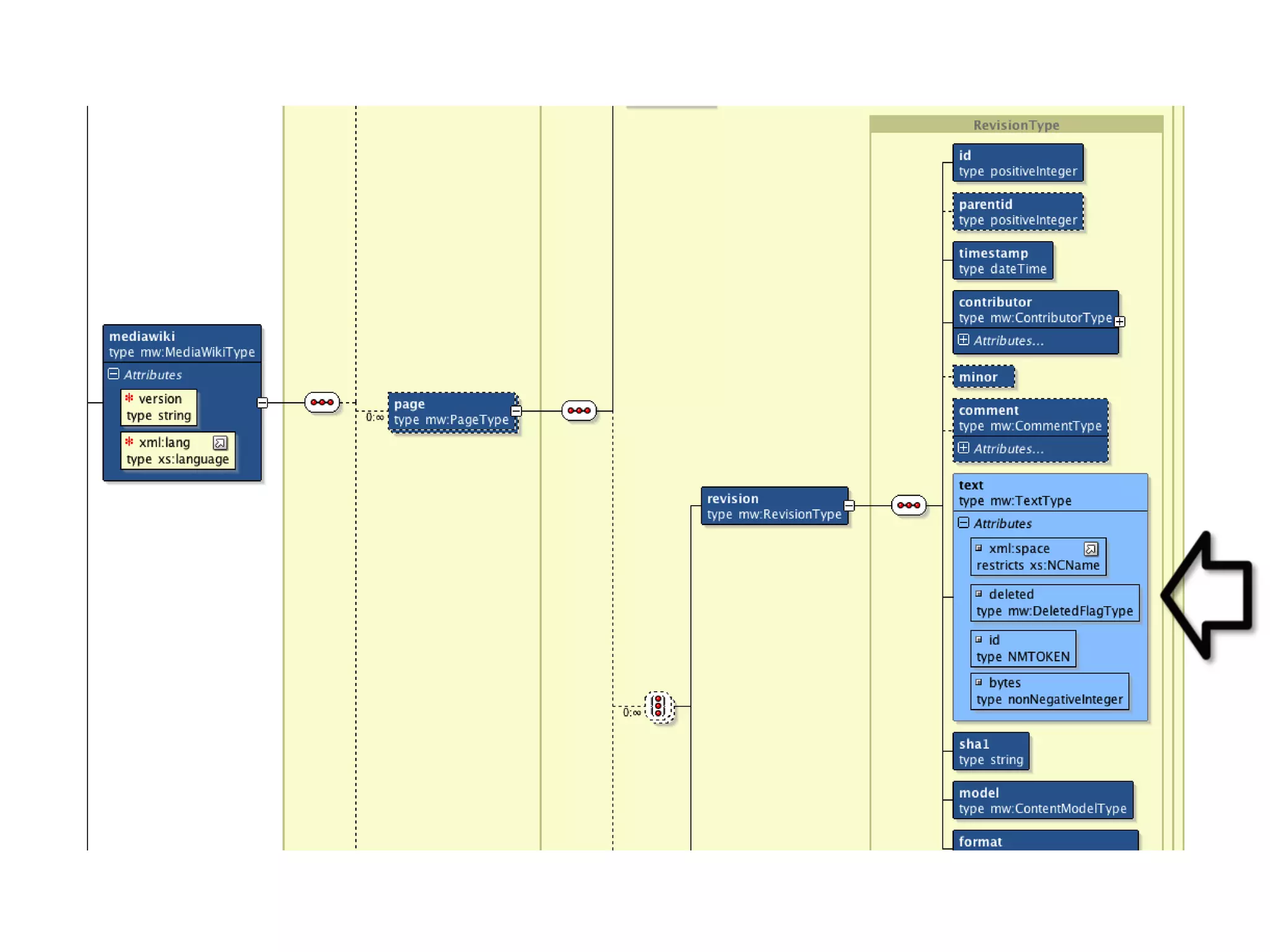
What are we talking about?
WikiPedia
• Structured & Unstructured
bits and pieces
• A lot of “unbounded”
elements
• Not a lot of restrictions
• The bit with value is in
element “tekst”
How do we get this Structured?
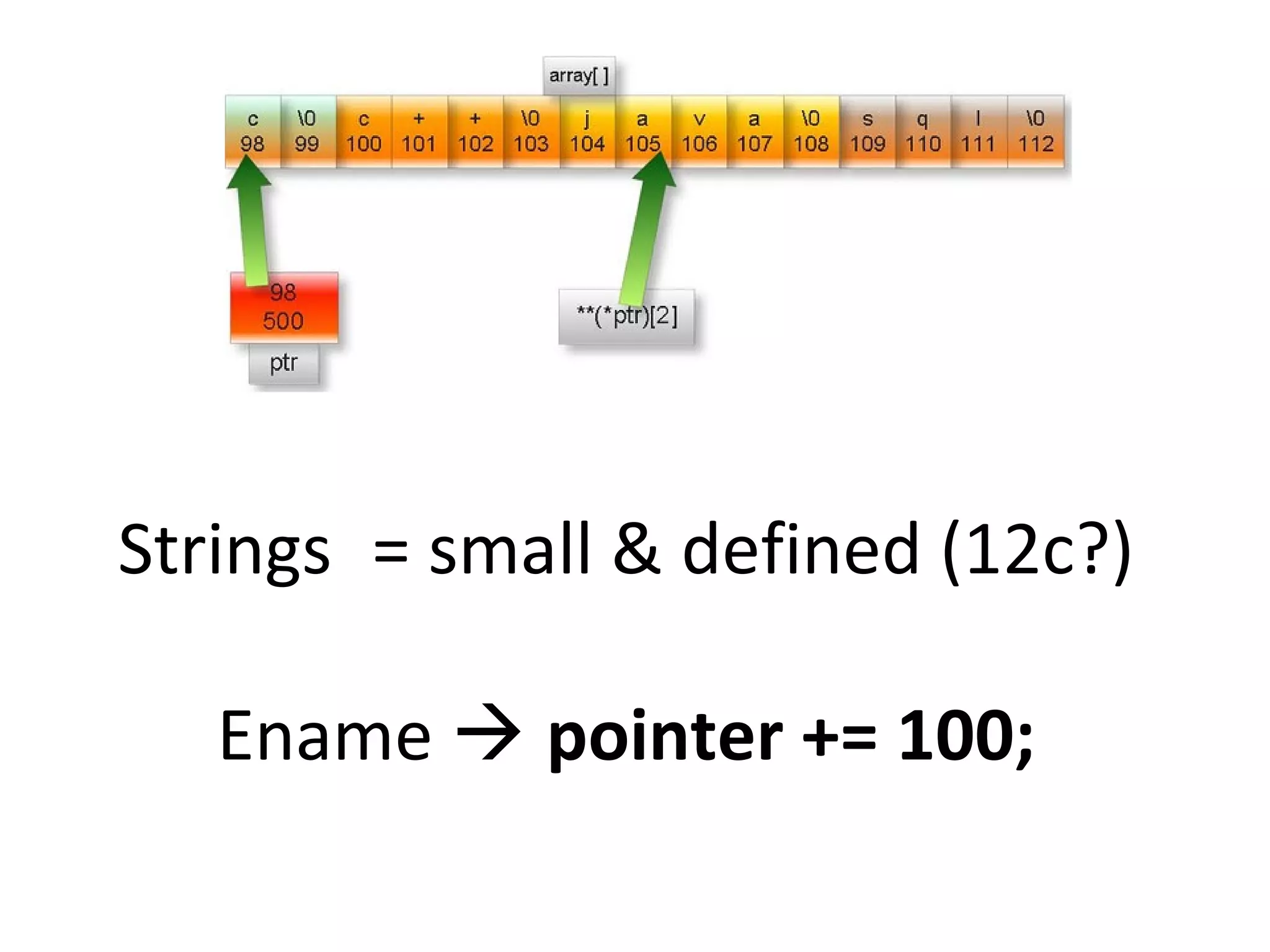
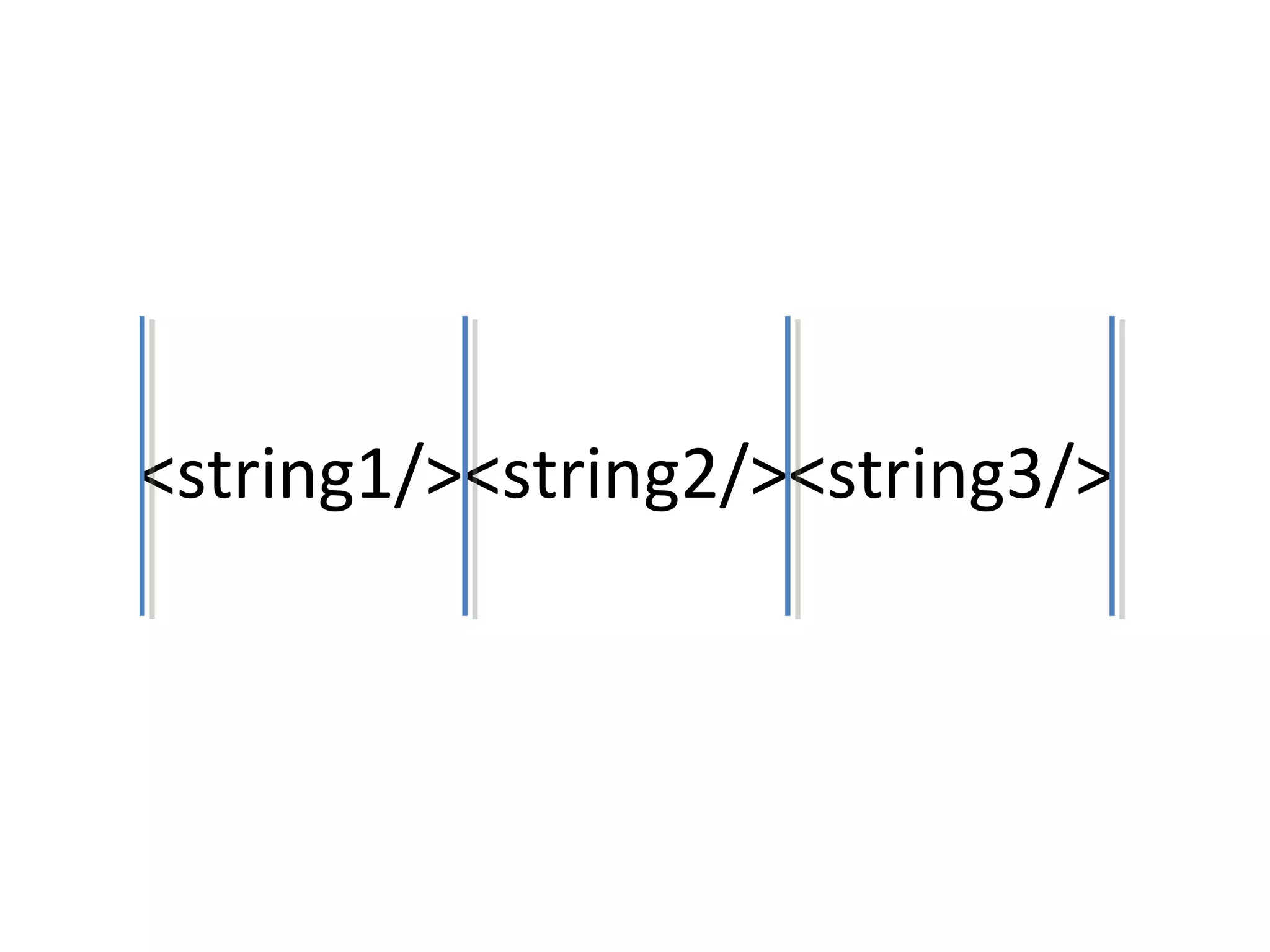
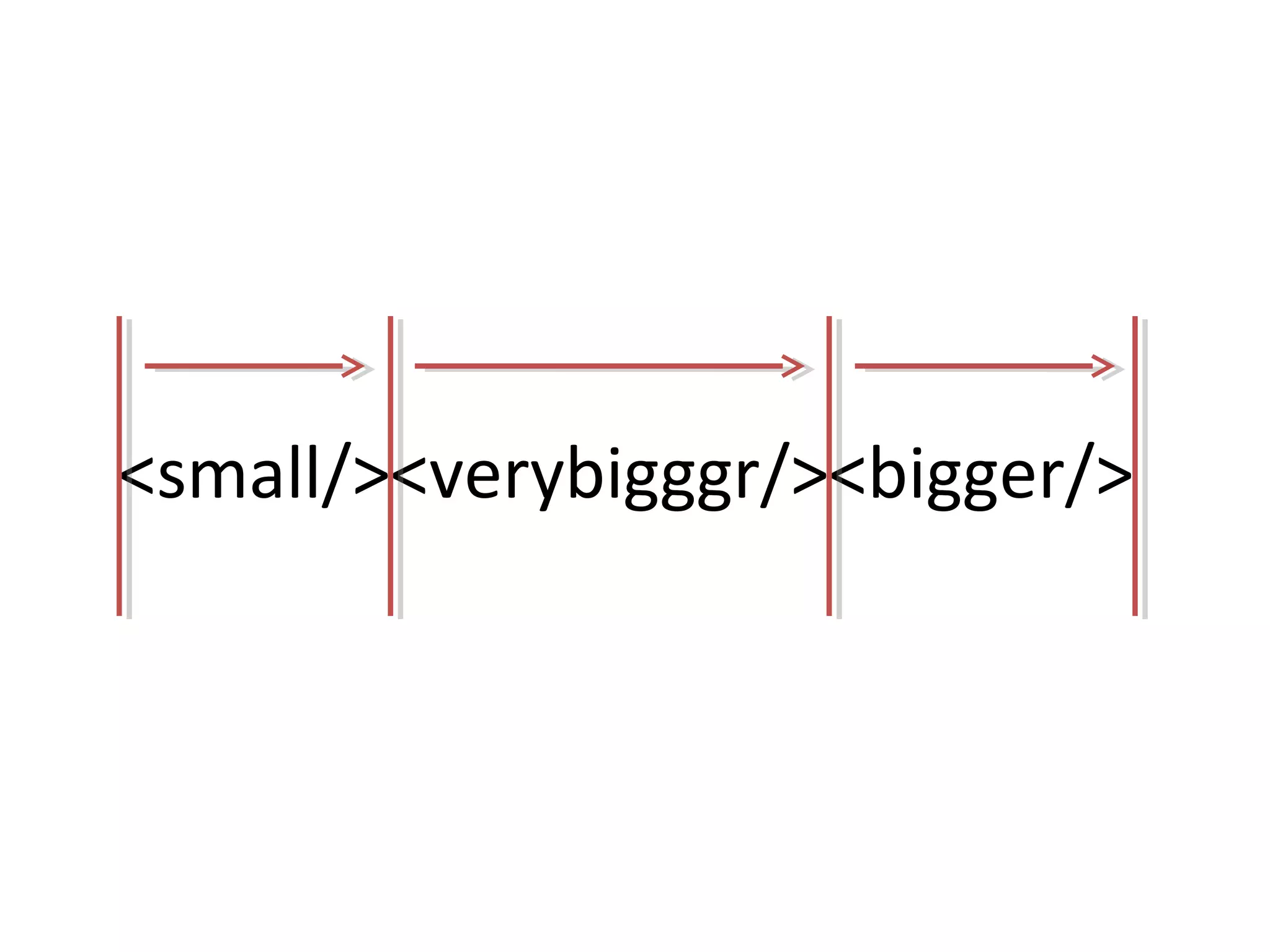
Strings = small & defined (12c?)
Ename  pointer += 100;
<string1/><string2/><string3/>
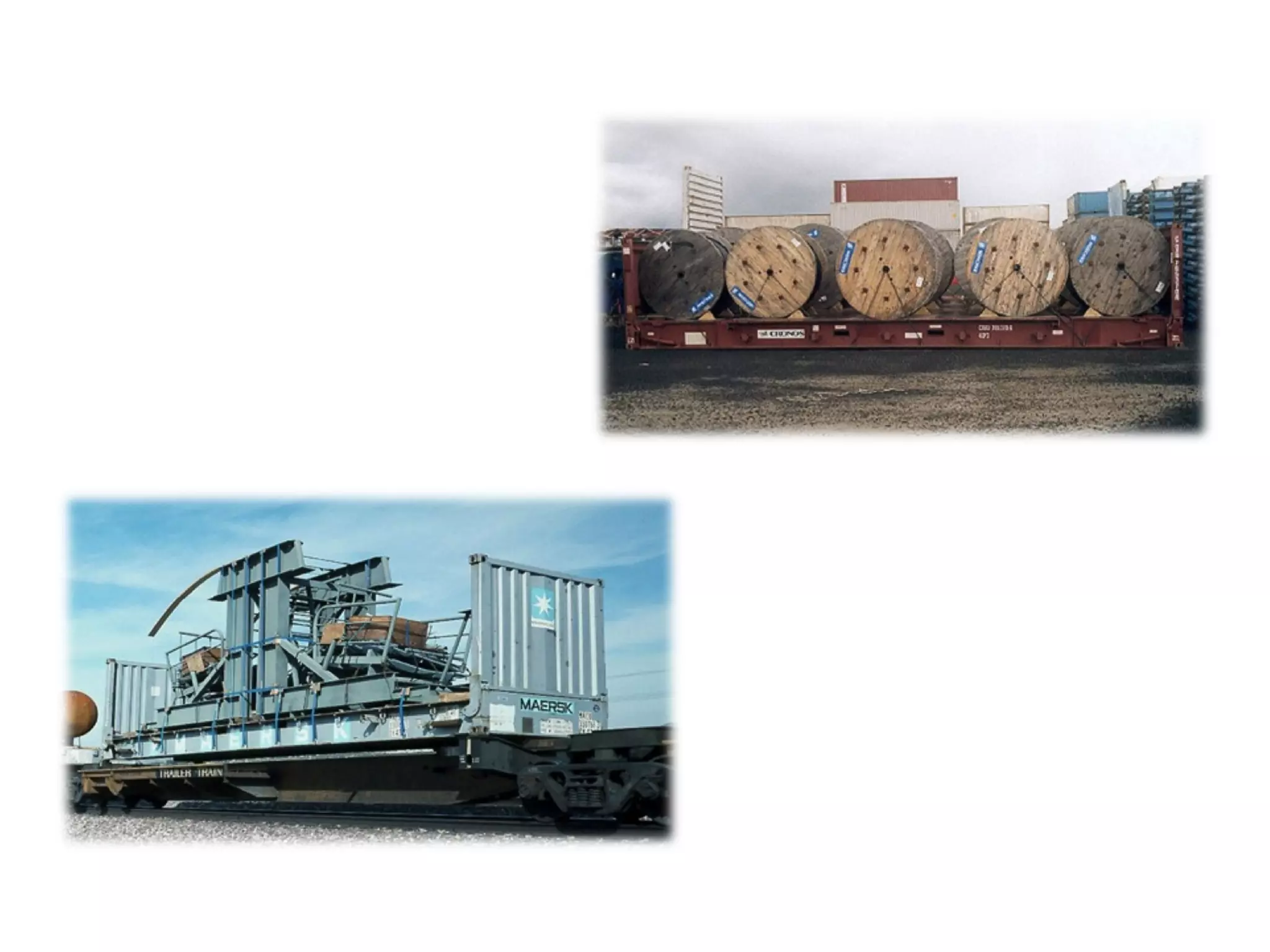
Flexible, Humans
No Design Patterns
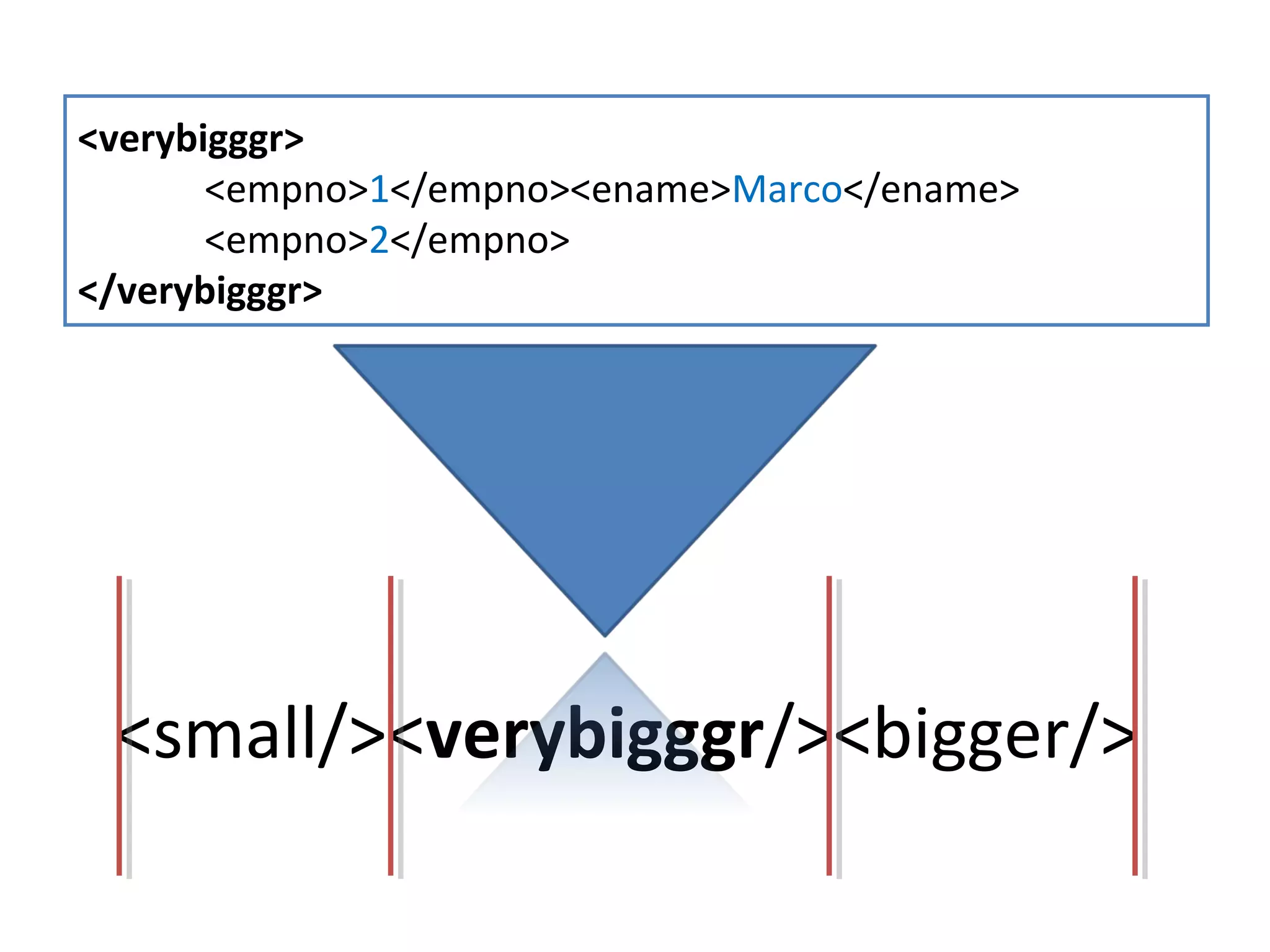
<small/><verybigggr/><bigger/>
<verybigggr>
<empno>1</empno><ename>Marco</ename>
<empno>2</empno>
</verybigggr>

<small/><verybigggr/><bigger/>
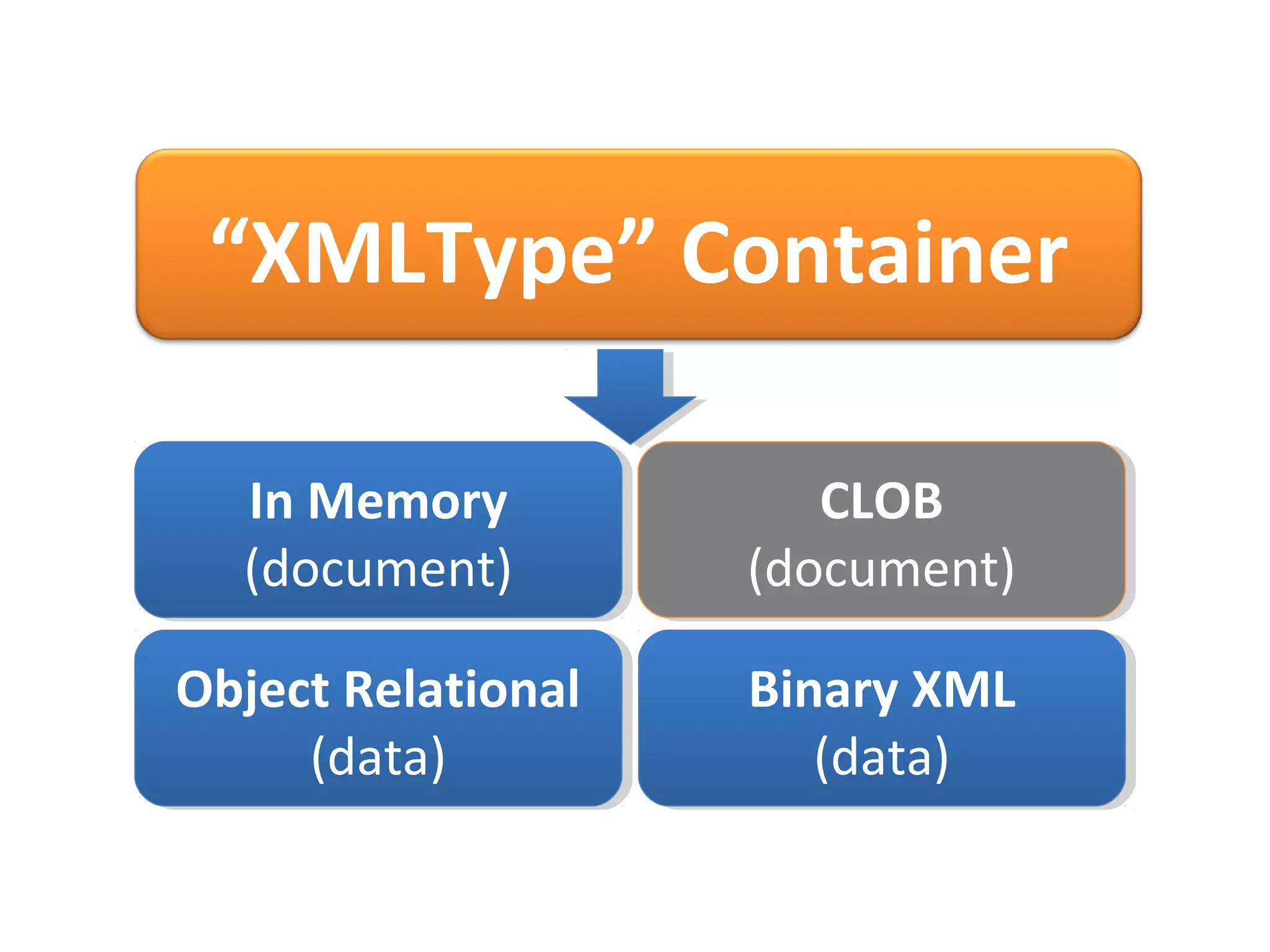
We need options!
“XMLType” Container
In Memory
In Memory
(document)
(document)

CLOB
CLOB
(document)
(document)

Object Relational
Object Relational
(data)
(data)

Binary XML
Binary XML
(data)
(data)
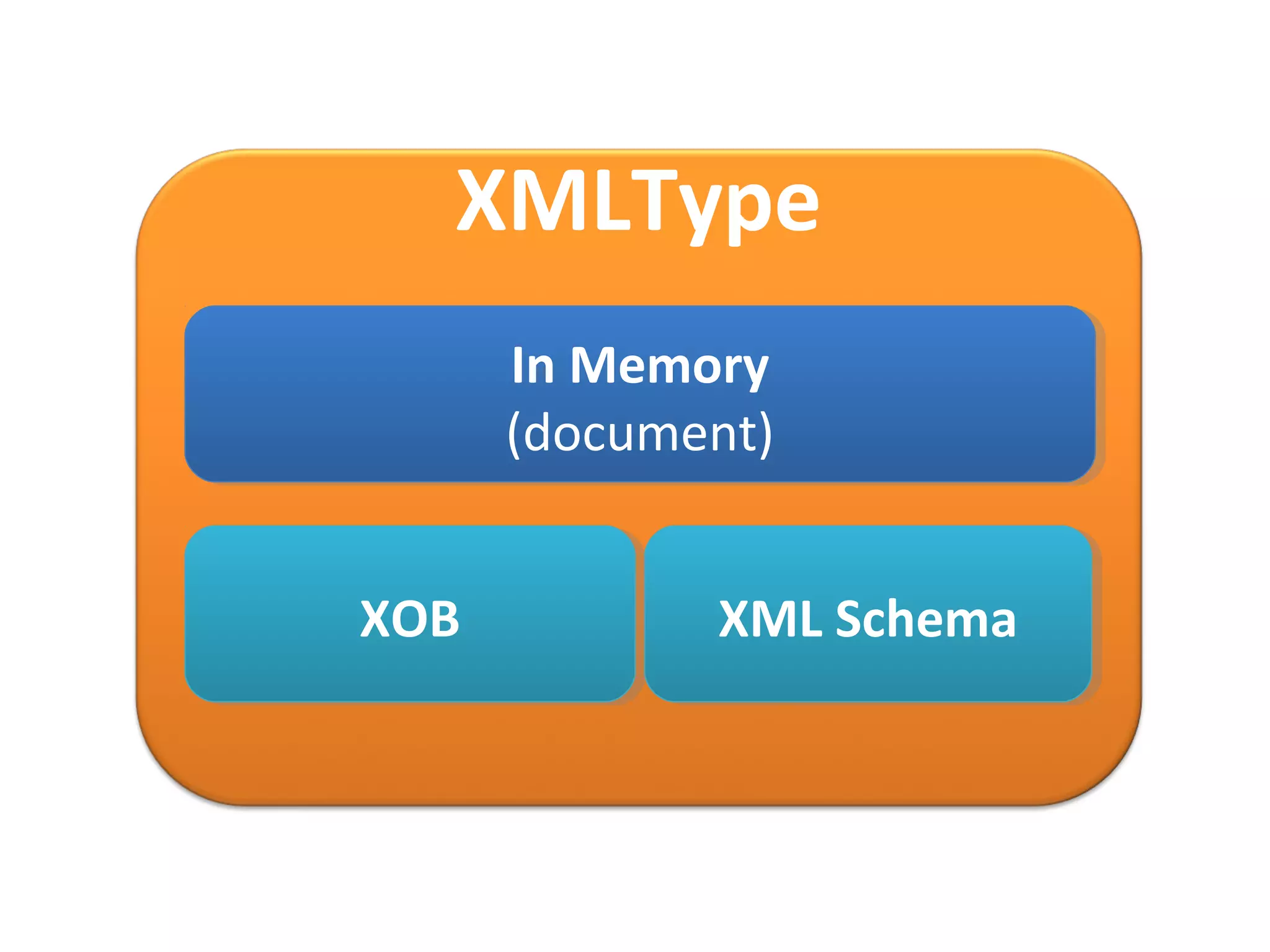
XMLType
In Memory
In Memory
(document)
(document)
XOB
XOB

XML Schema
XML Schema
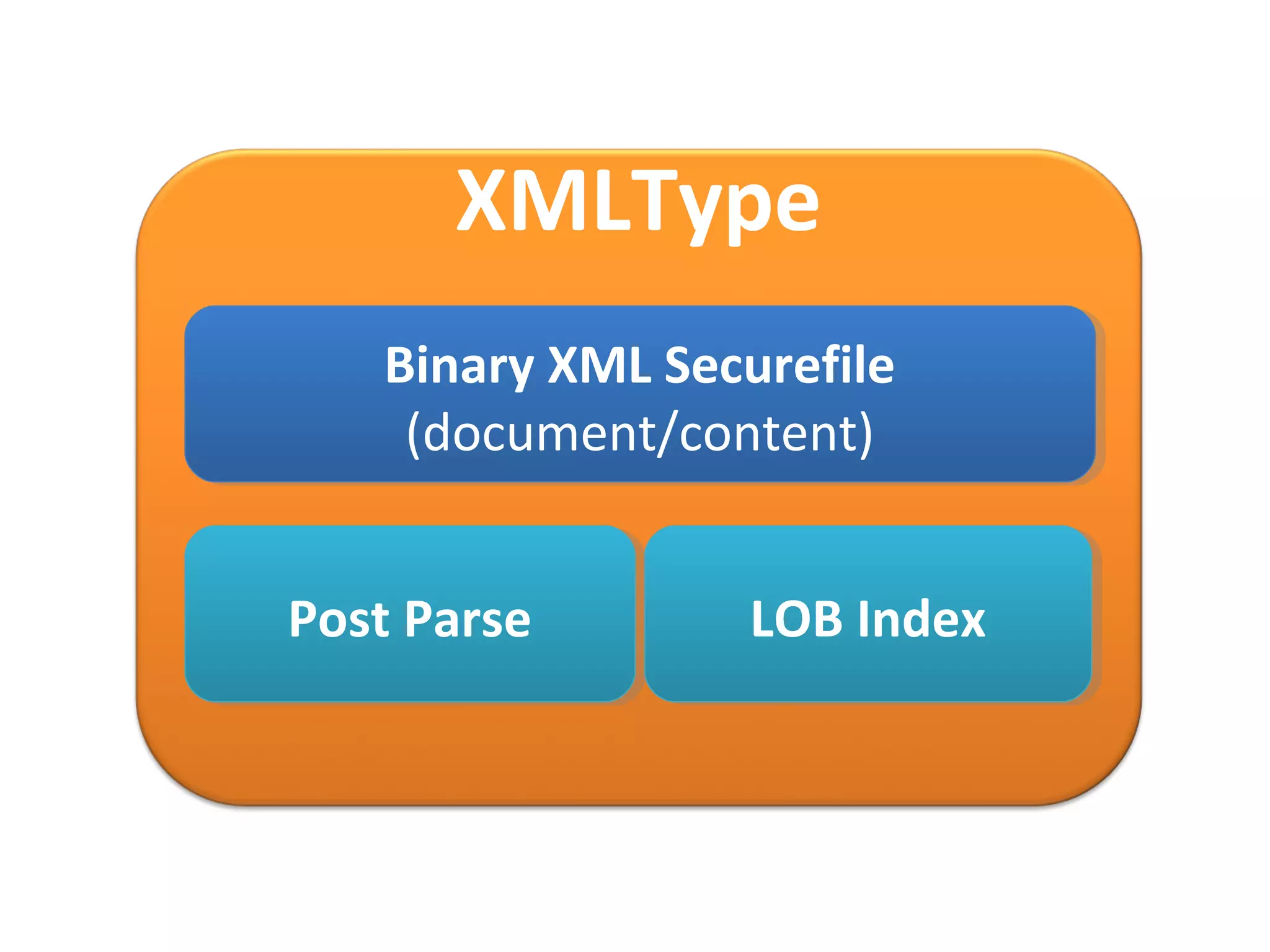
XMLType
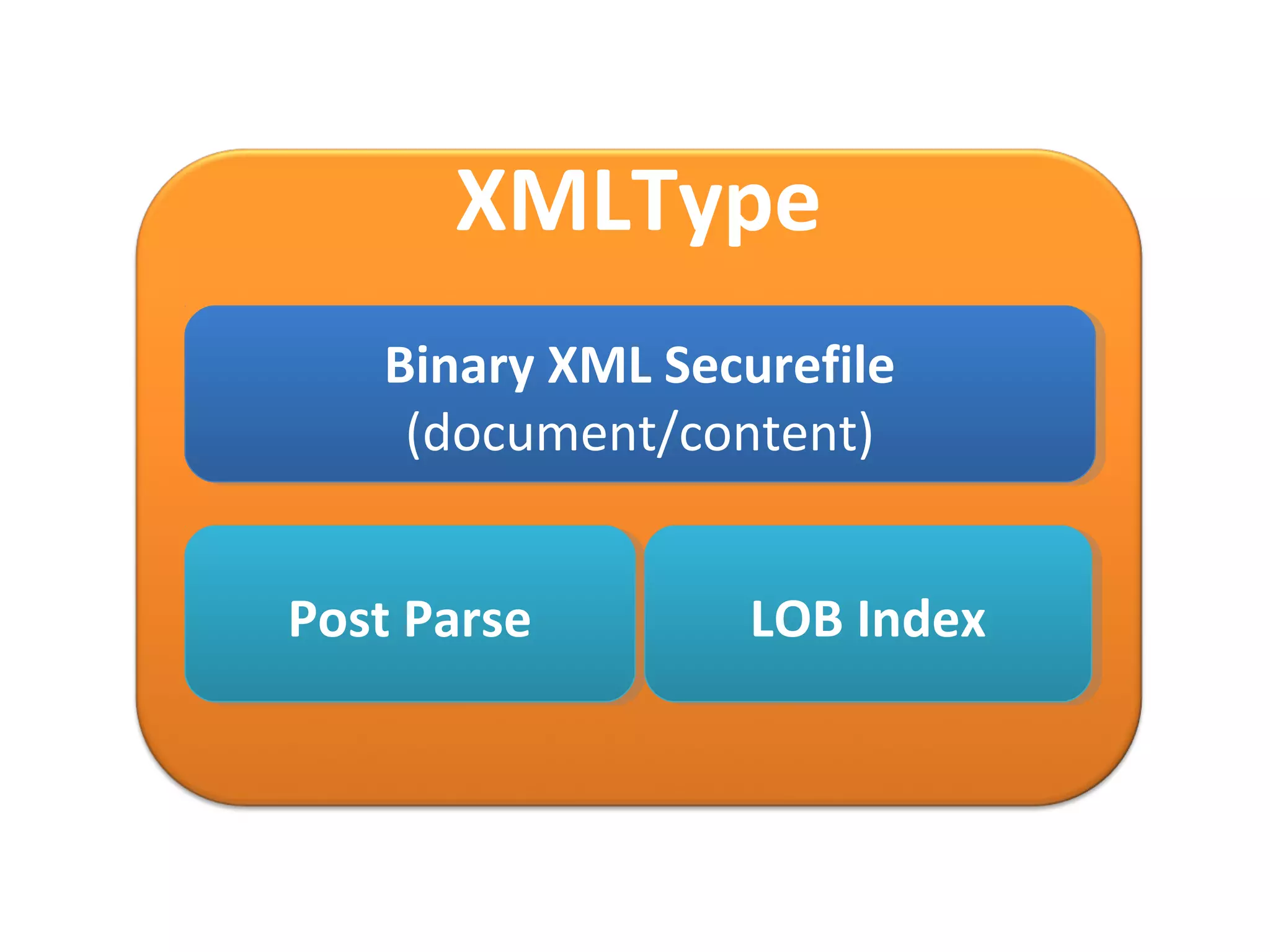
Binary XML Securefile
(document/content)
(document/content)
Post Parse
Post Parse

LOB Index
LOB Index
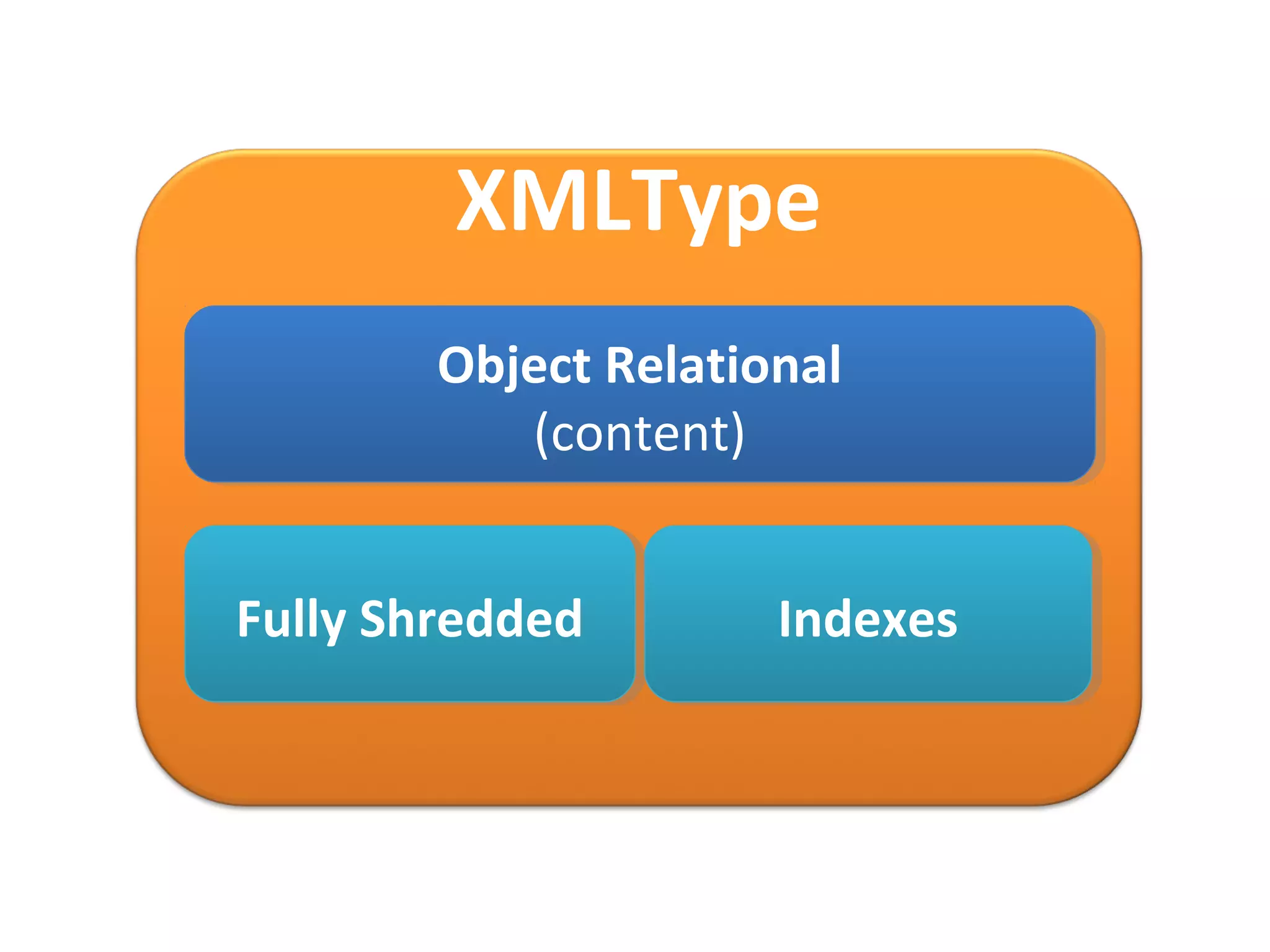
XMLType
Object Relational
Object Relational
(content)
(content)
Fully Shredded
Fully Shredded

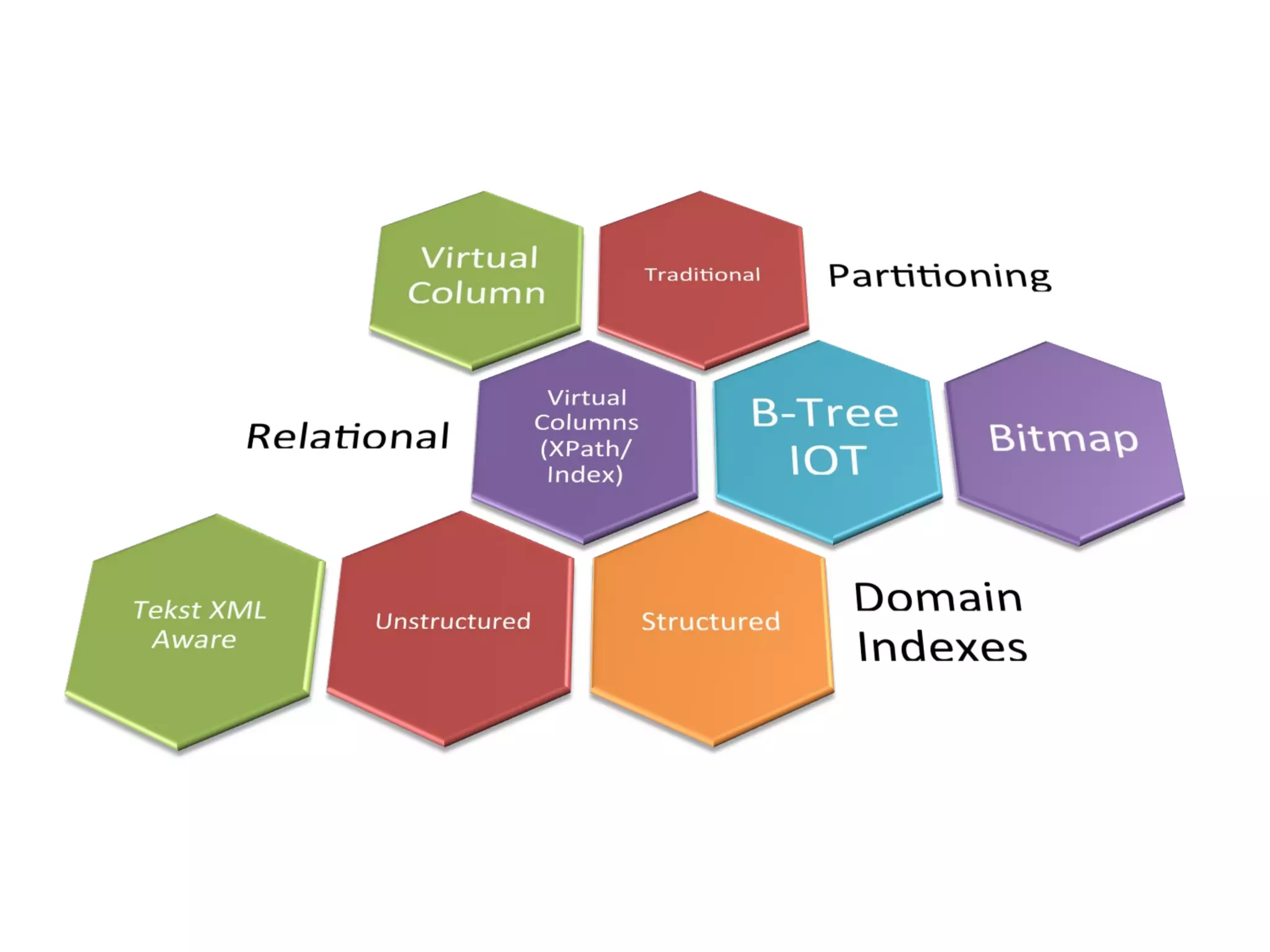
Indexes
Indexes
Something else to Realize !
“What is the fastest way to get this
stuff in the database…?”
“…it depends…”
“So what is the fastest way to get XML
in the database…
… and

useful in my case…?”
Garbage IN – Garbage OUT
WikiPedia
•
•
•
•

SQL*Loader
Parallel or Direct
Securefile LOB Column
2.5 hours

And no (performant) way
to get the details out…
a.k.a “completely useless”
WikiPedia
•
•
•
•

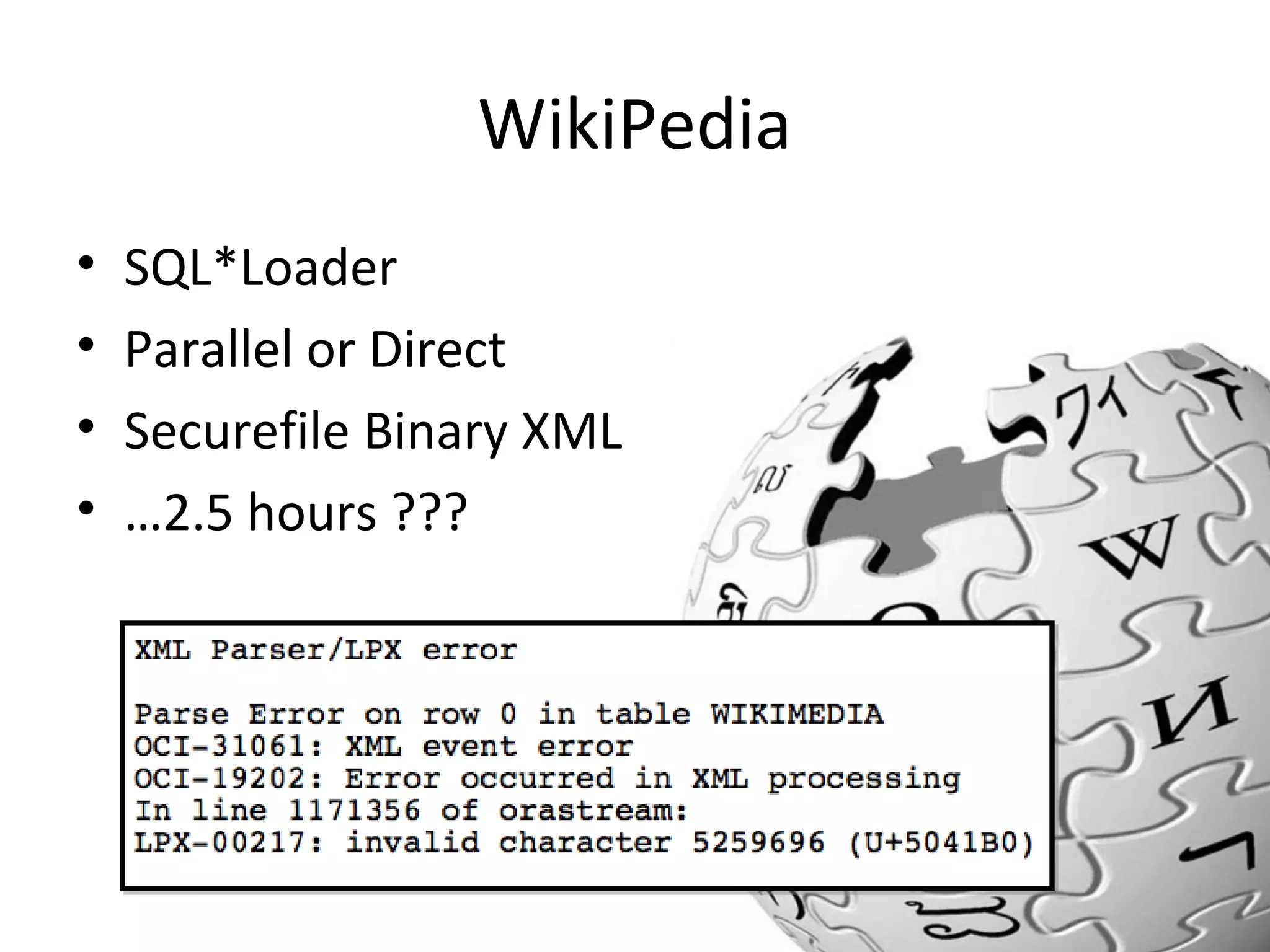
SQL*Loader
Parallel or Direct
Securefile Binary XML
…2.5 hours ???
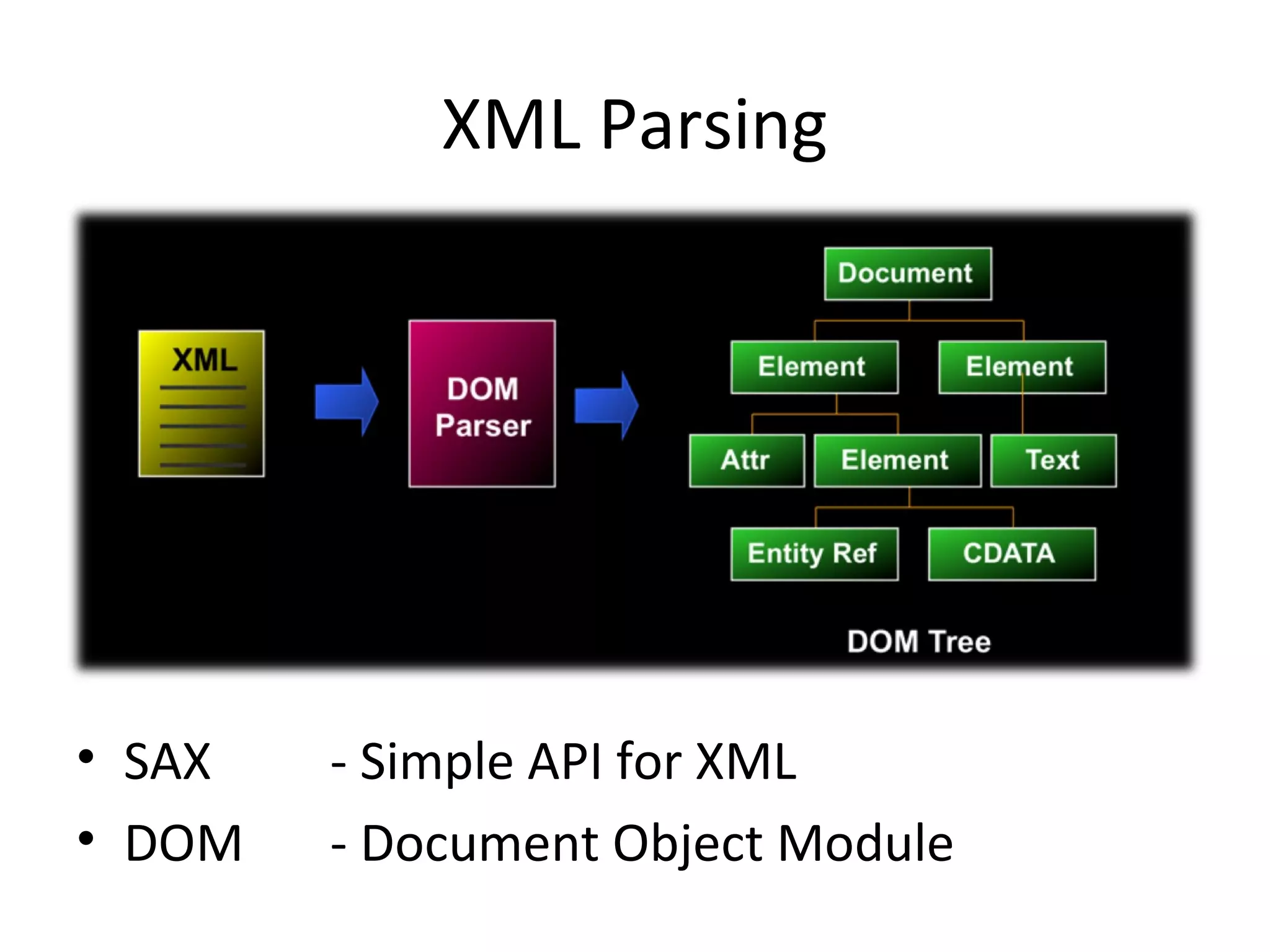
XML Parsing

• SAX
• DOM

- Simple API for XML
- Document Object Module
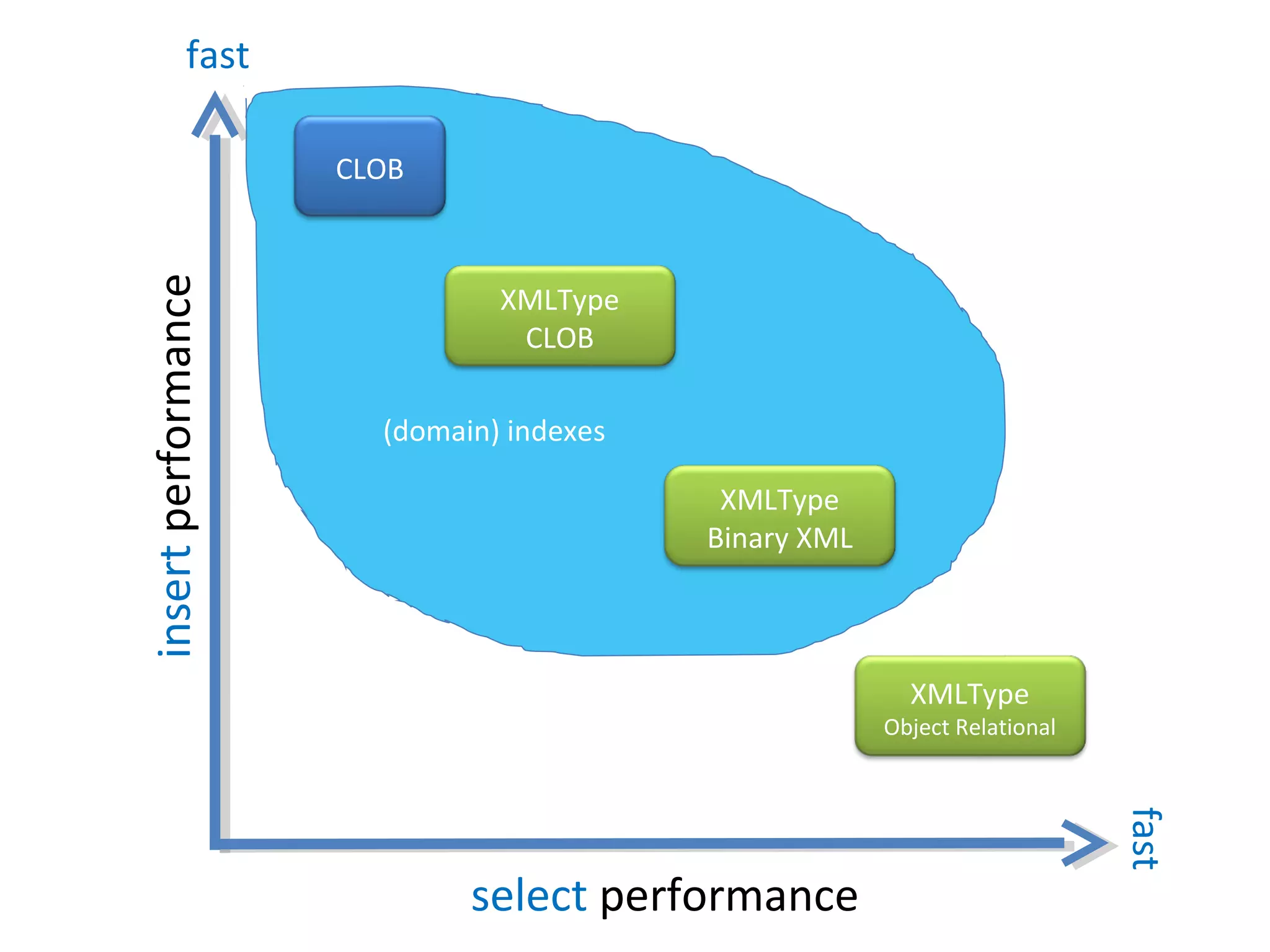
fast

insert performance

CLOB

XMLType
CLOB
(domain) indexes
XMLType
Binary XML

XMLType

Object Relational

fast

select performance
So let’s pick a XMLType storage
method…
XMLType
Binary XML Securefile
(document/content)
(document/content)
Post Parse
Post Parse

LOB Index
LOB Index
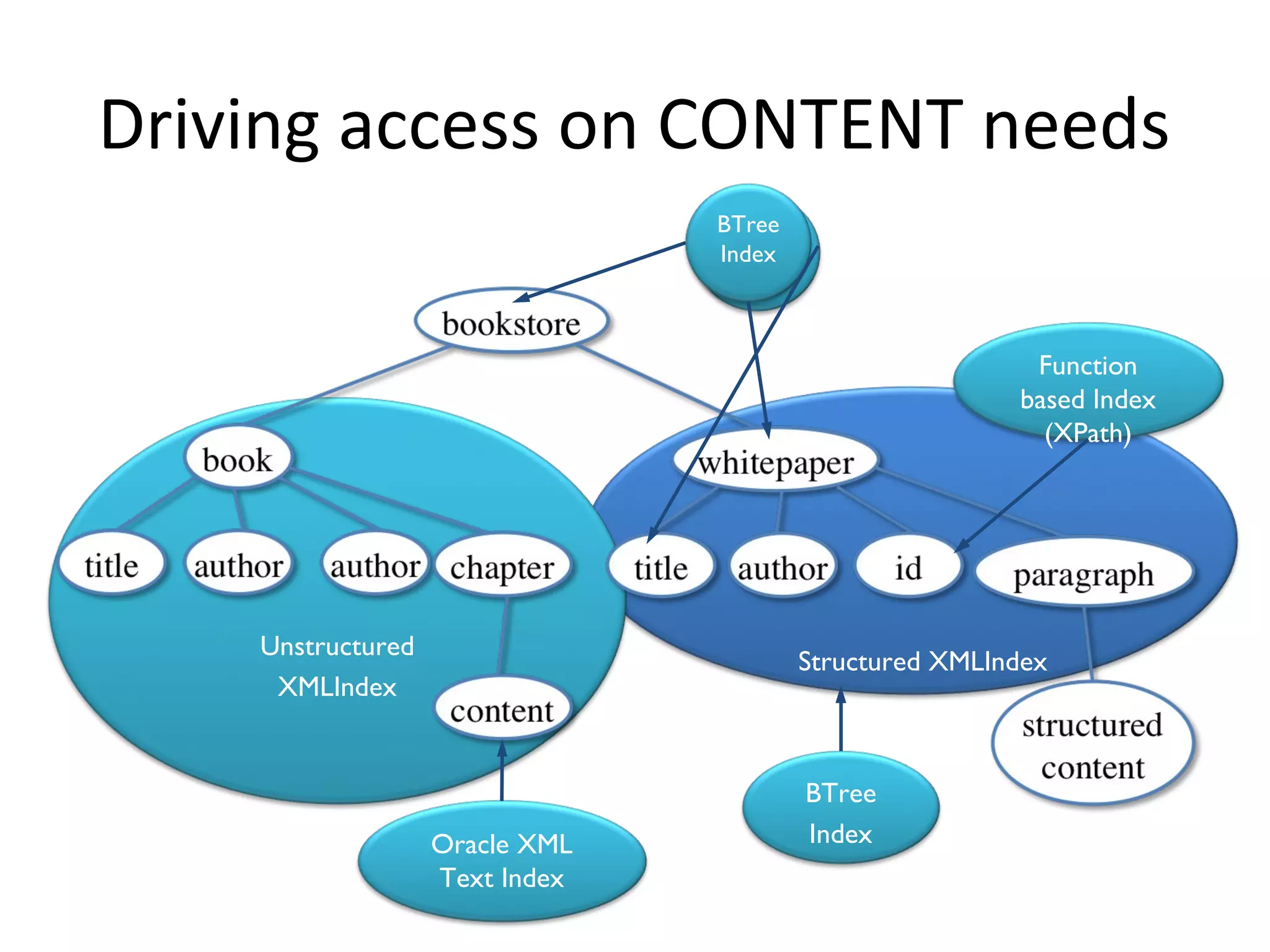
Driving access on CONTENT needs
BTree
Index

Function
based Index
(XPath)

Unstructured
XMLIndex

Structured XMLIndex

Oracle XML
Text Index

BTree
Index
Structured Data
Structured XMLIndex (SXI)
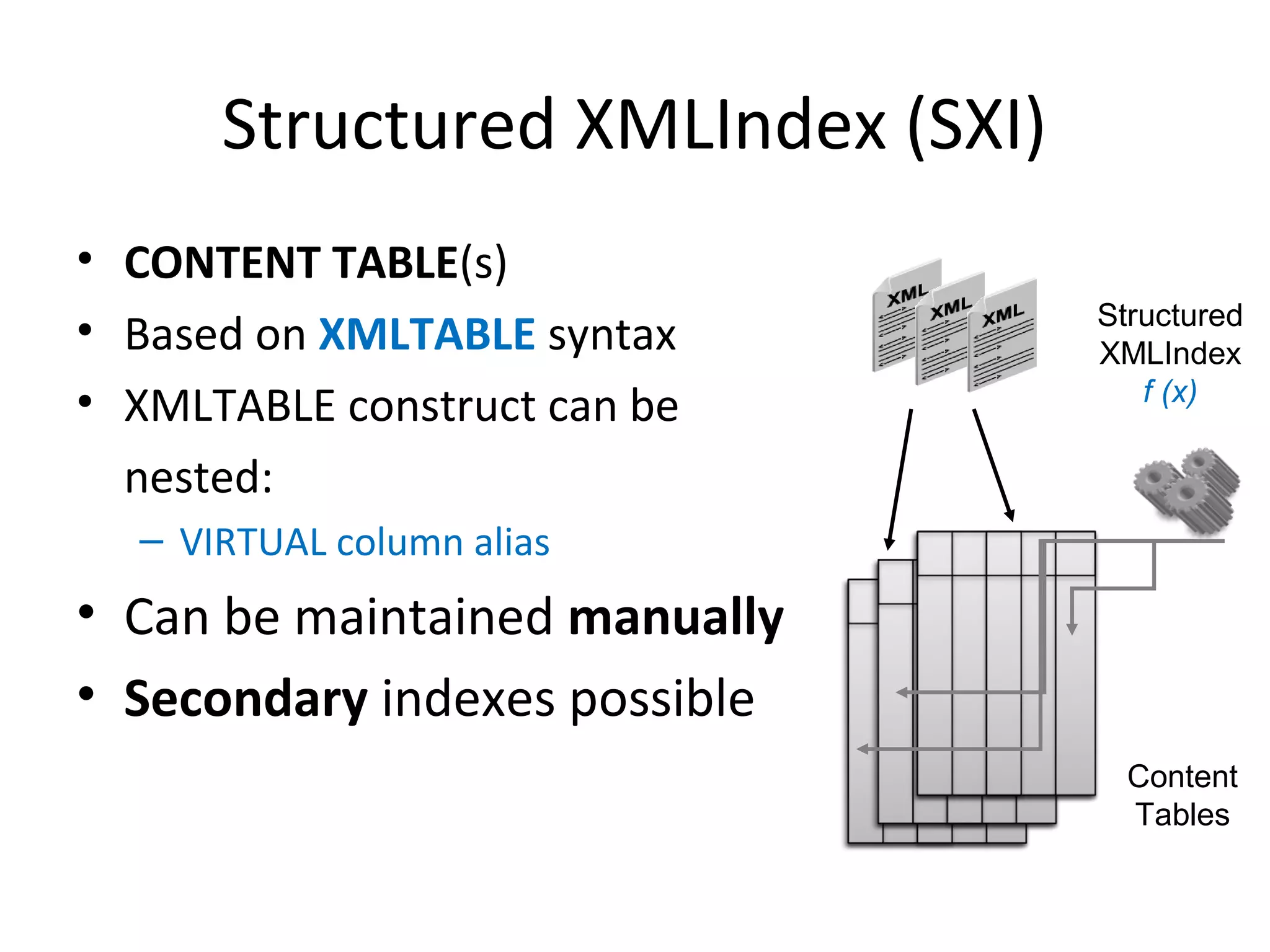
• CONTENT TABLE(s)
• Based on XMLTABLE syntax
• XMLTABLE construct can be
nested:

Structured
XMLIndex
f (x)

– VIRTUAL column alias

• Can be maintained manually
• Secondary indexes possible
Content
Tables
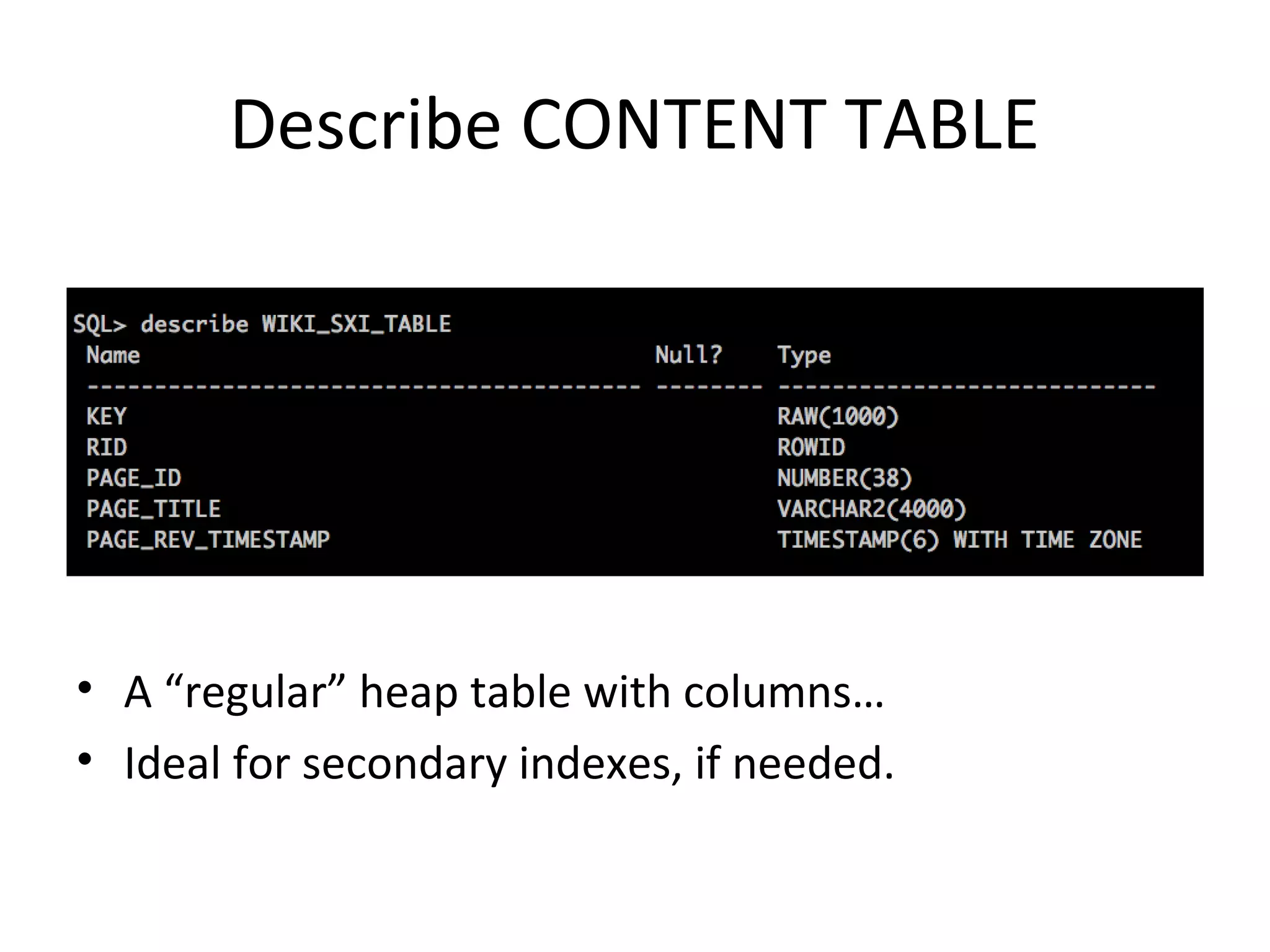
Describe CONTENT TABLE

• A “regular” heap table with columns…
• Ideal for secondary indexes, if needed.
Semi-Structured Data
Unstructured XMLIndex (UXI)
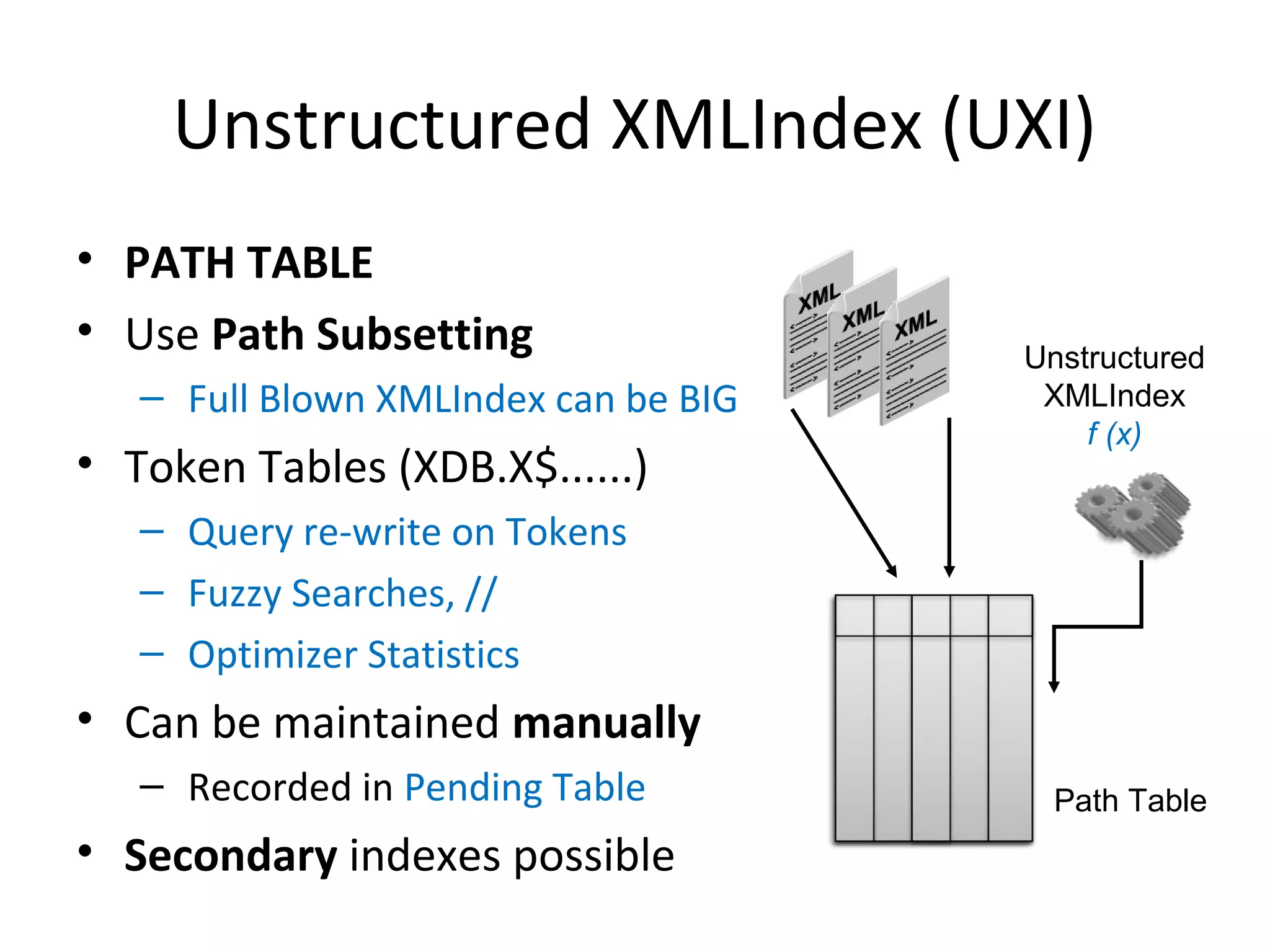
• PATH TABLE
• Use Path Subsetting
– Full Blown XMLIndex can be BIG

• Token Tables (XDB.X$......)

Unstructured
XMLIndex
f (x)

– Query re-write on Tokens
– Fuzzy Searches, //
– Optimizer Statistics

• Can be maintained manually
– Recorded in Pending Table

• Secondary indexes possible

Path Table
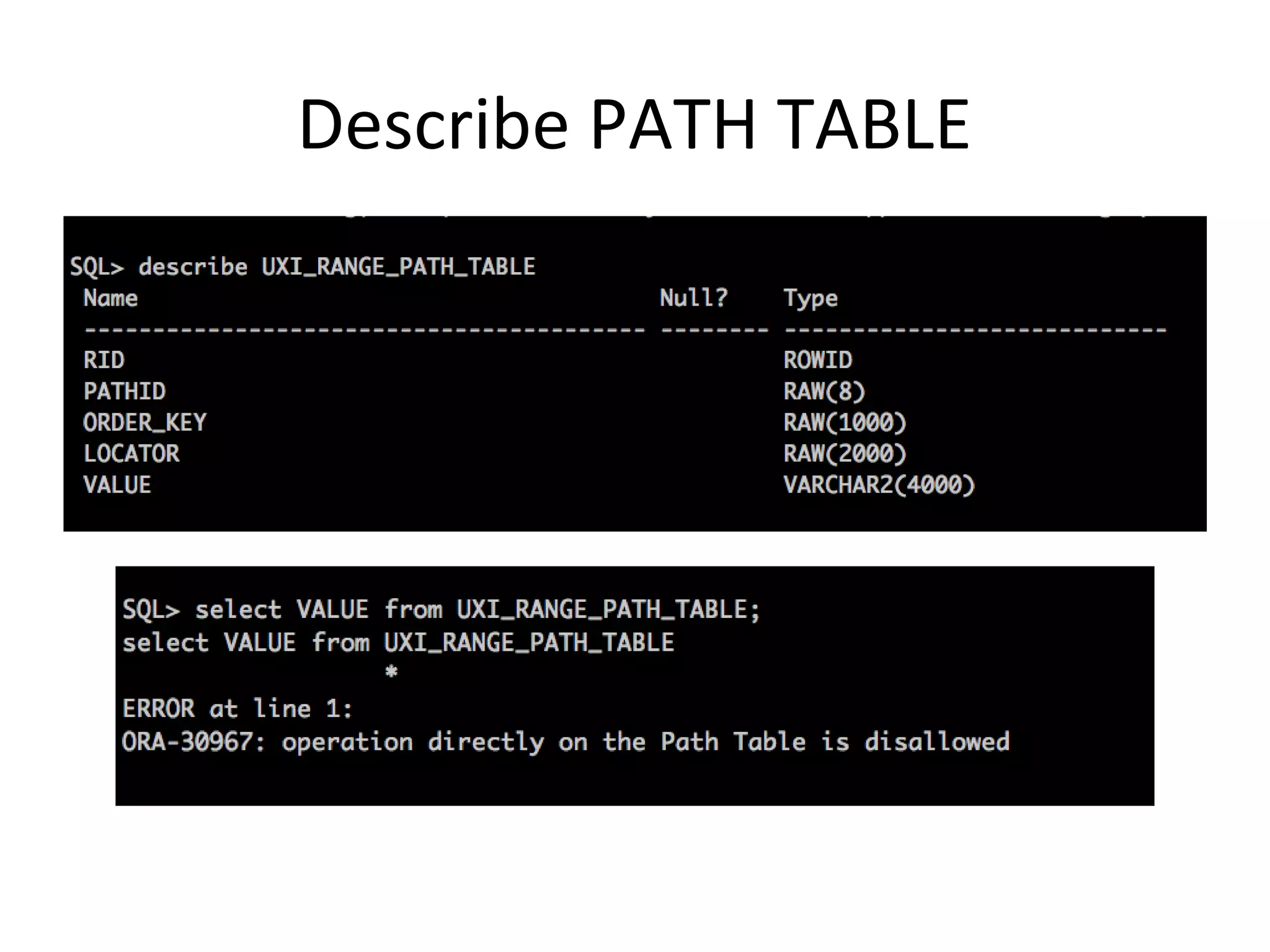
Describe PATH TABLE
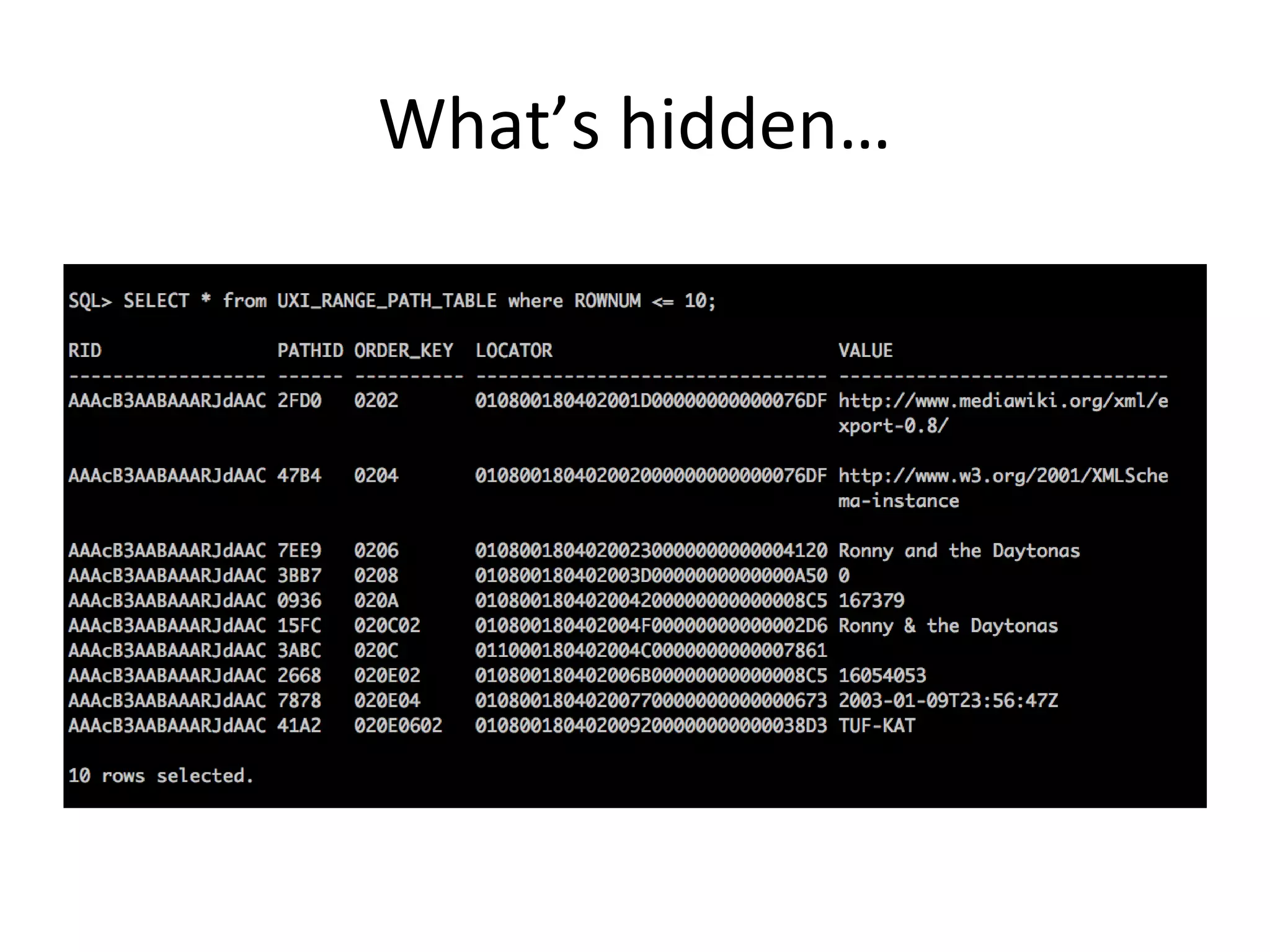
What’s hidden…
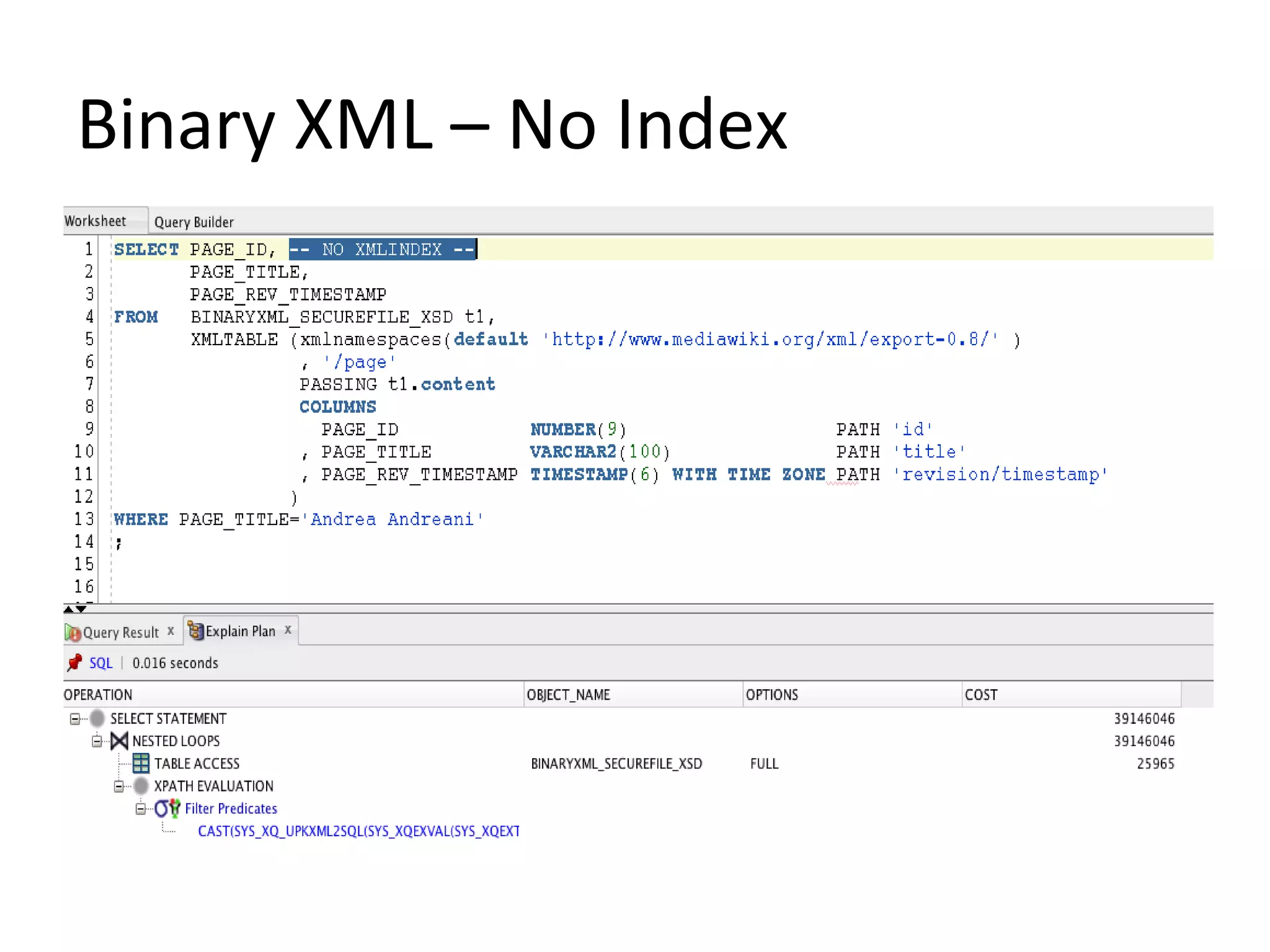
Binary XML – No Index
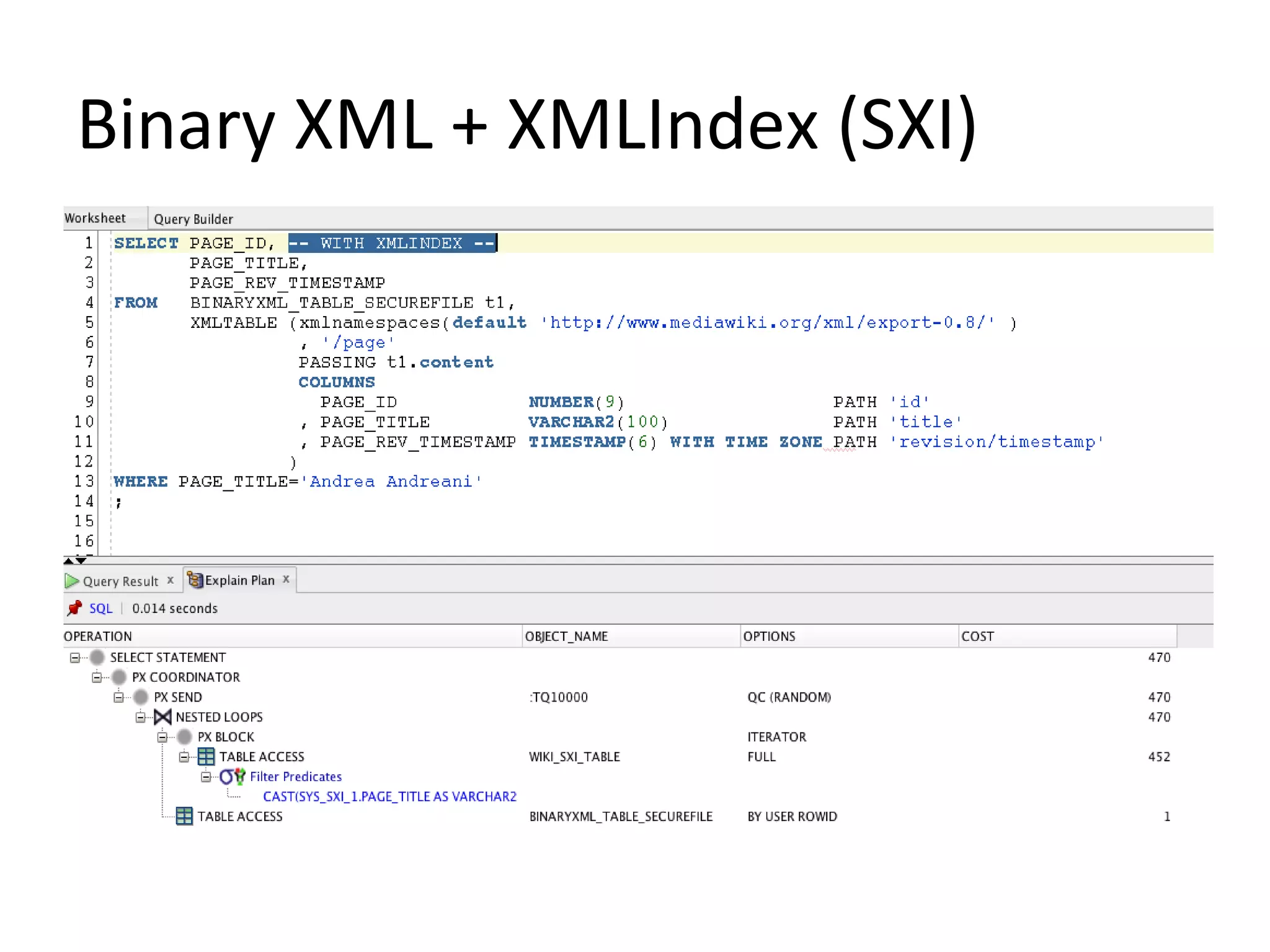
Binary XML + XMLIndex (SXI)
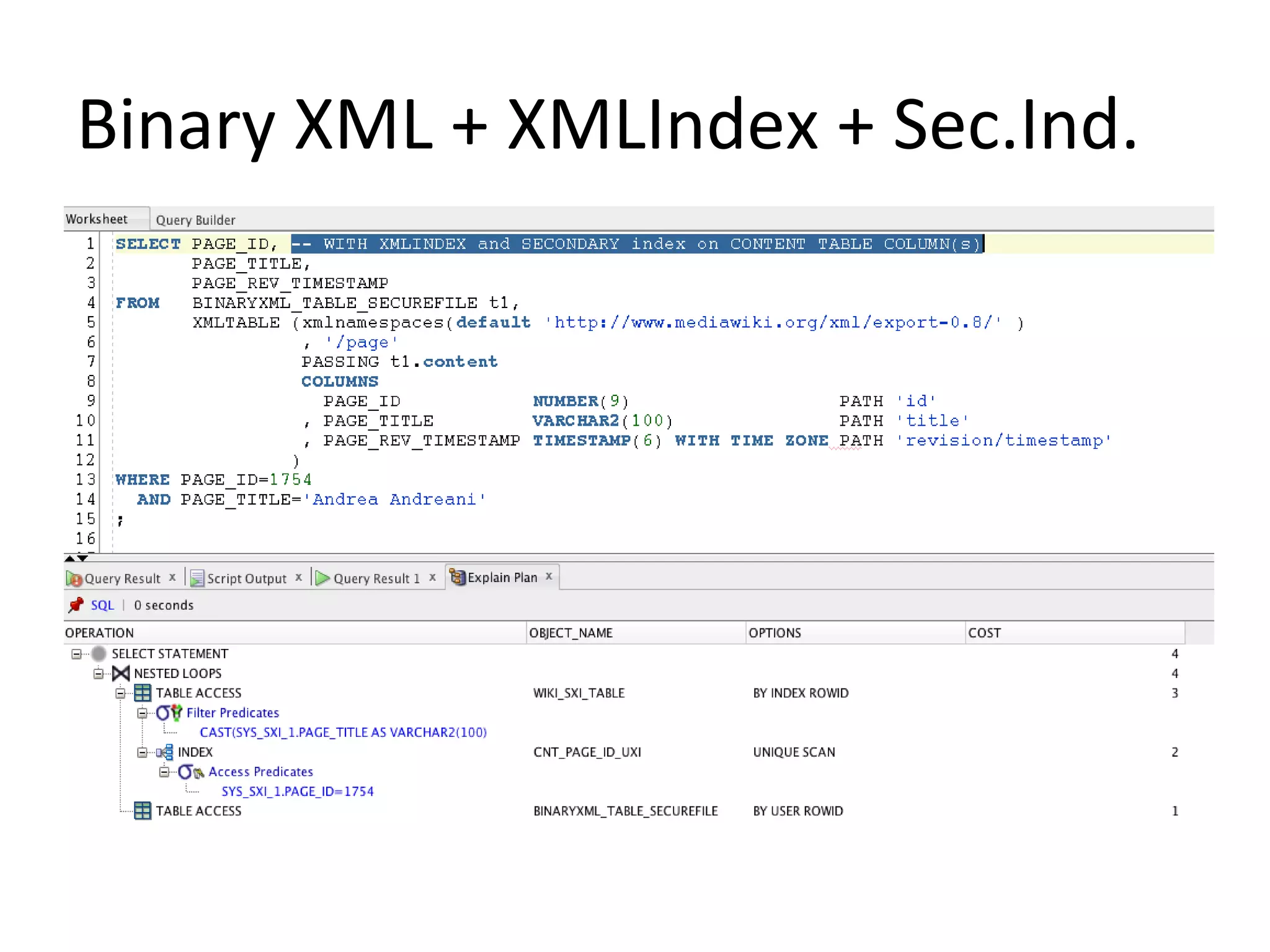
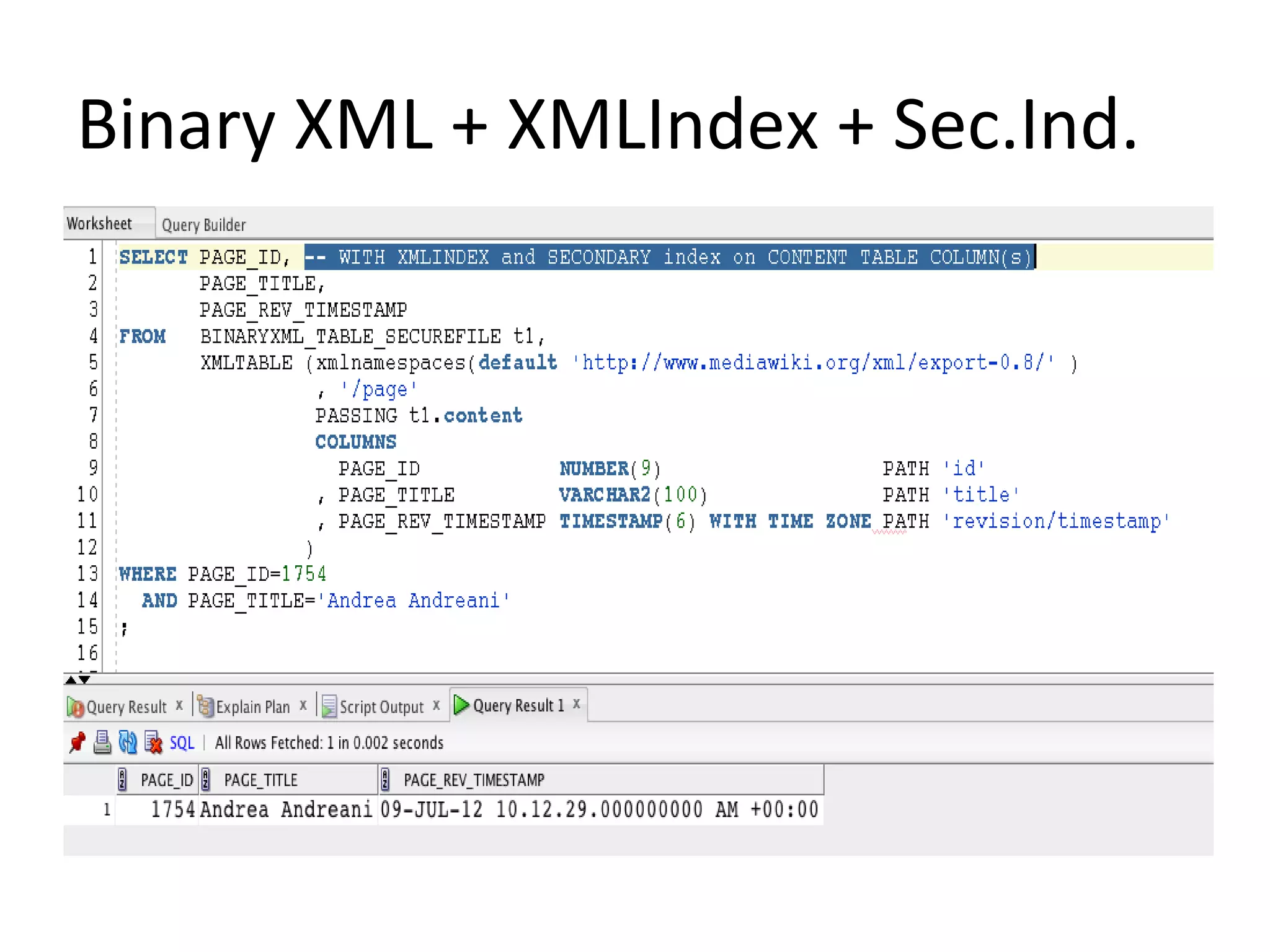
Binary XML + XMLIndex + Sec.Ind.
Un-Structured Data
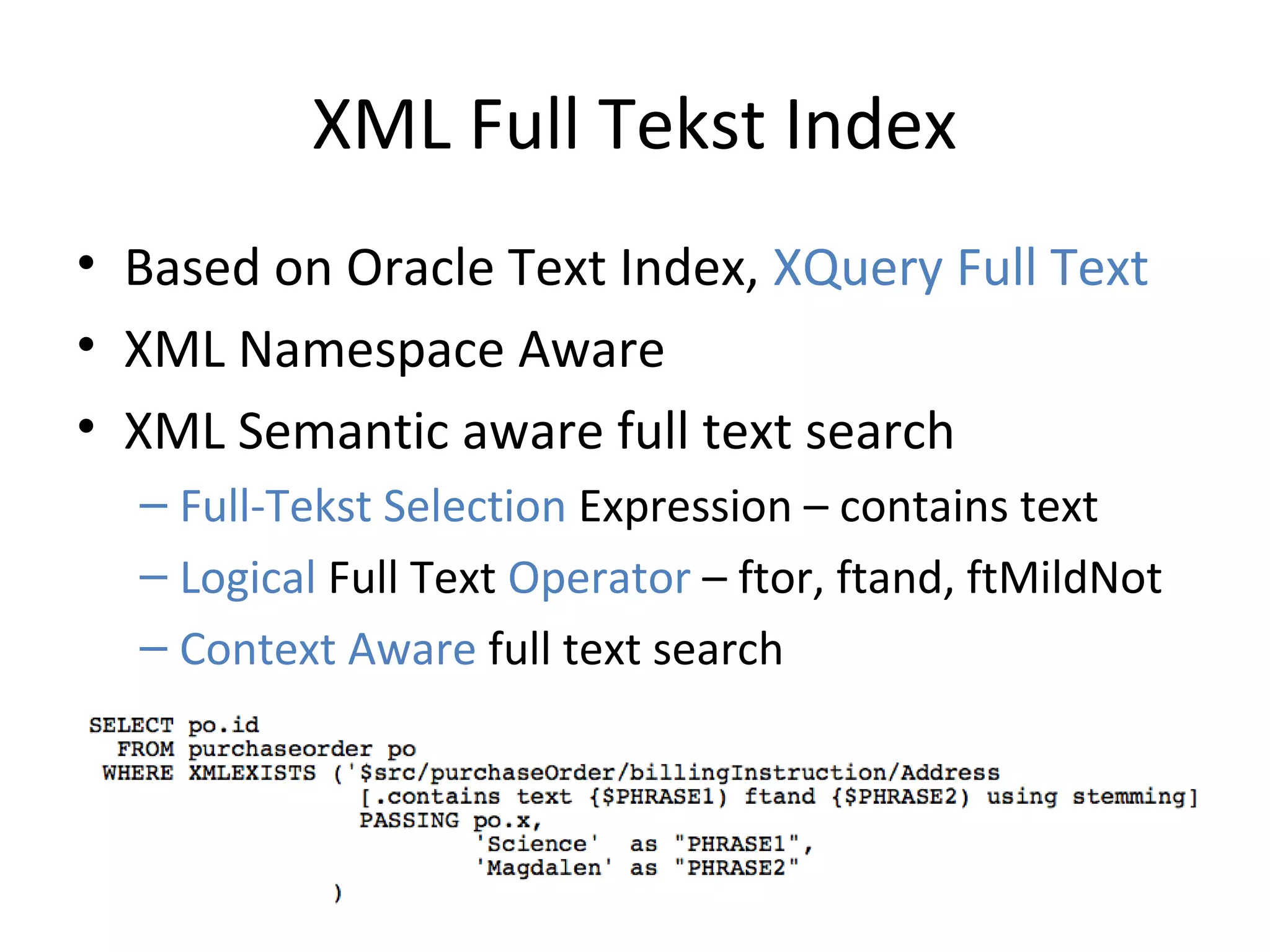
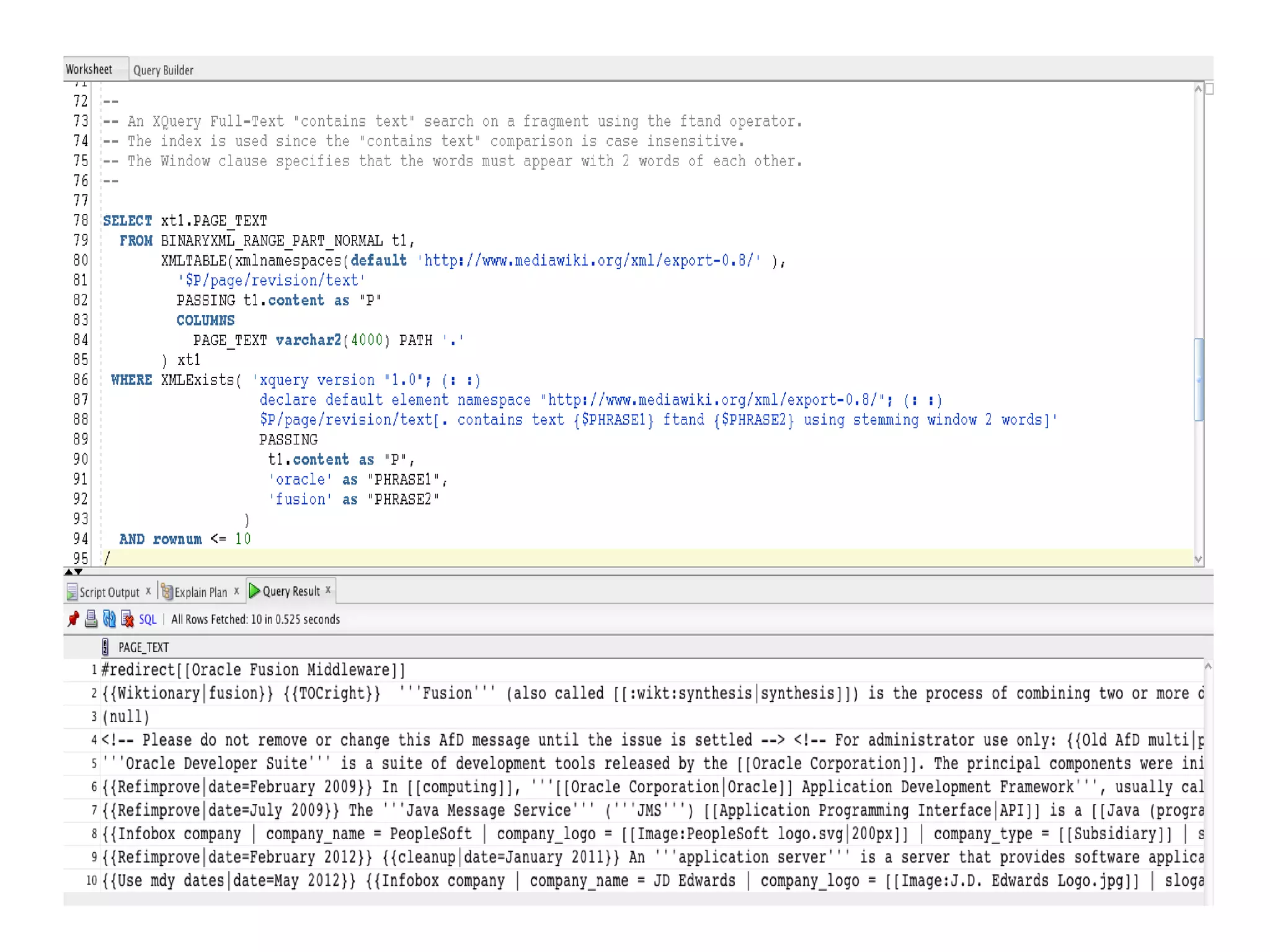
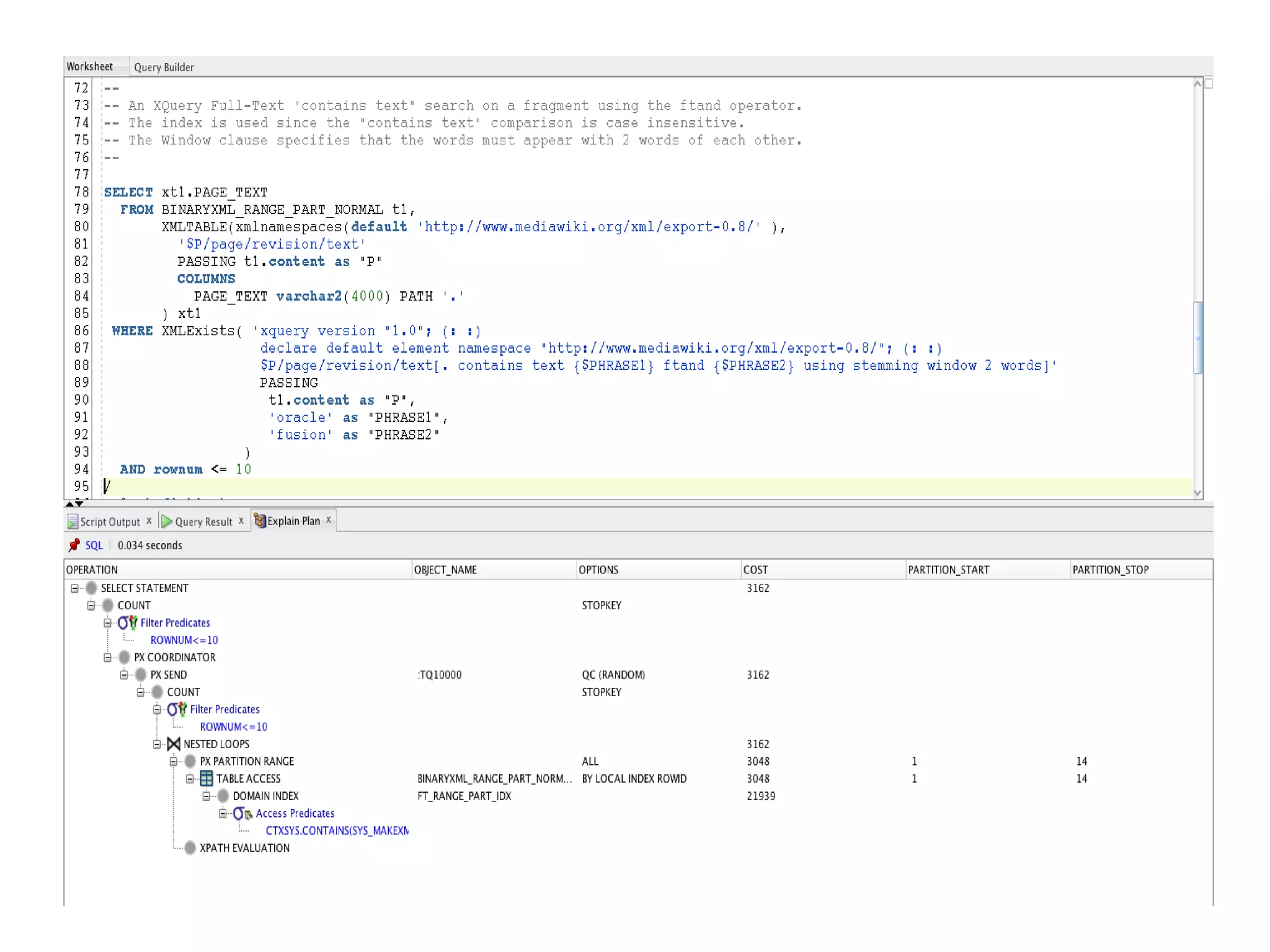
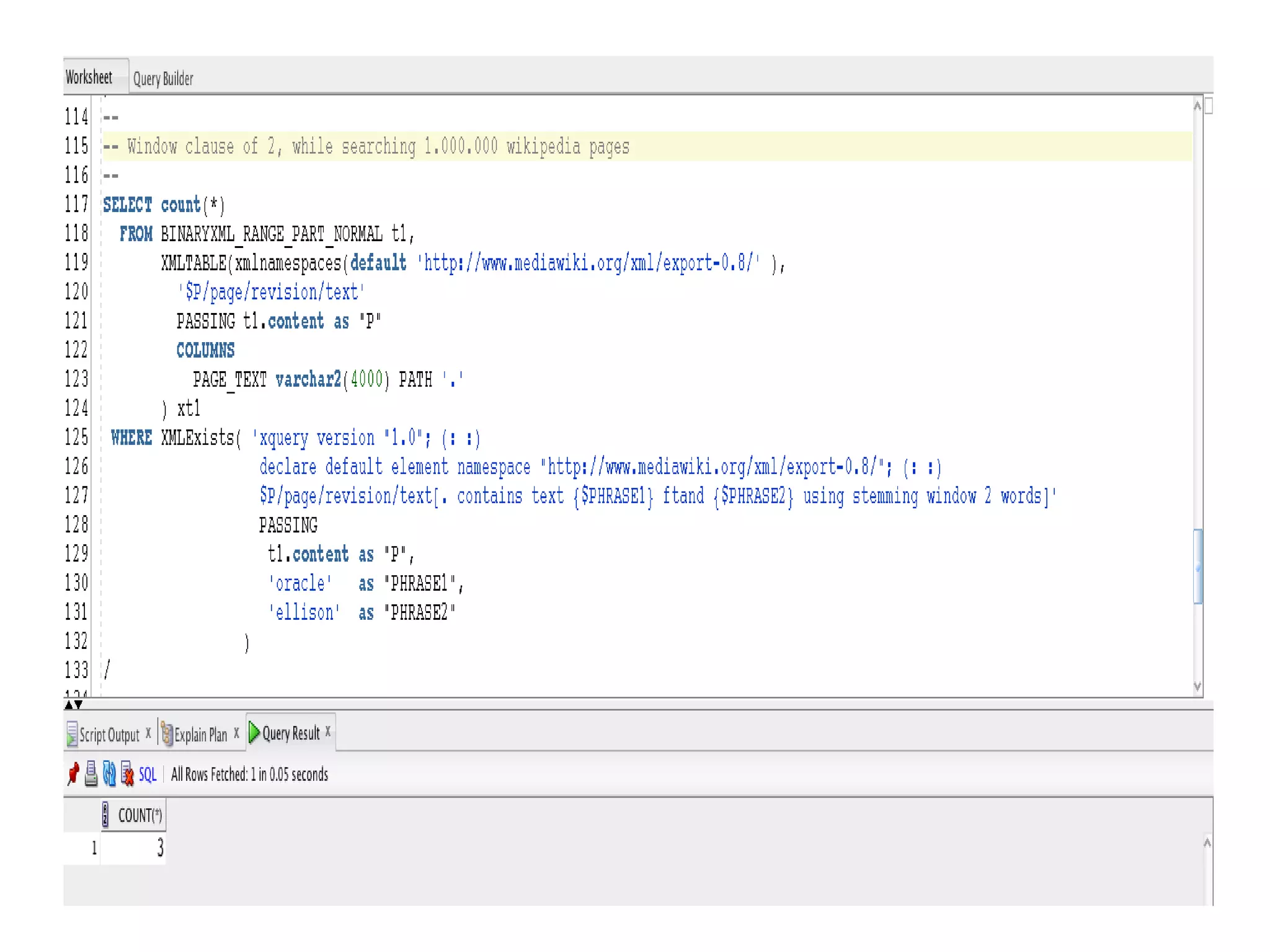
XML Full Tekst Index
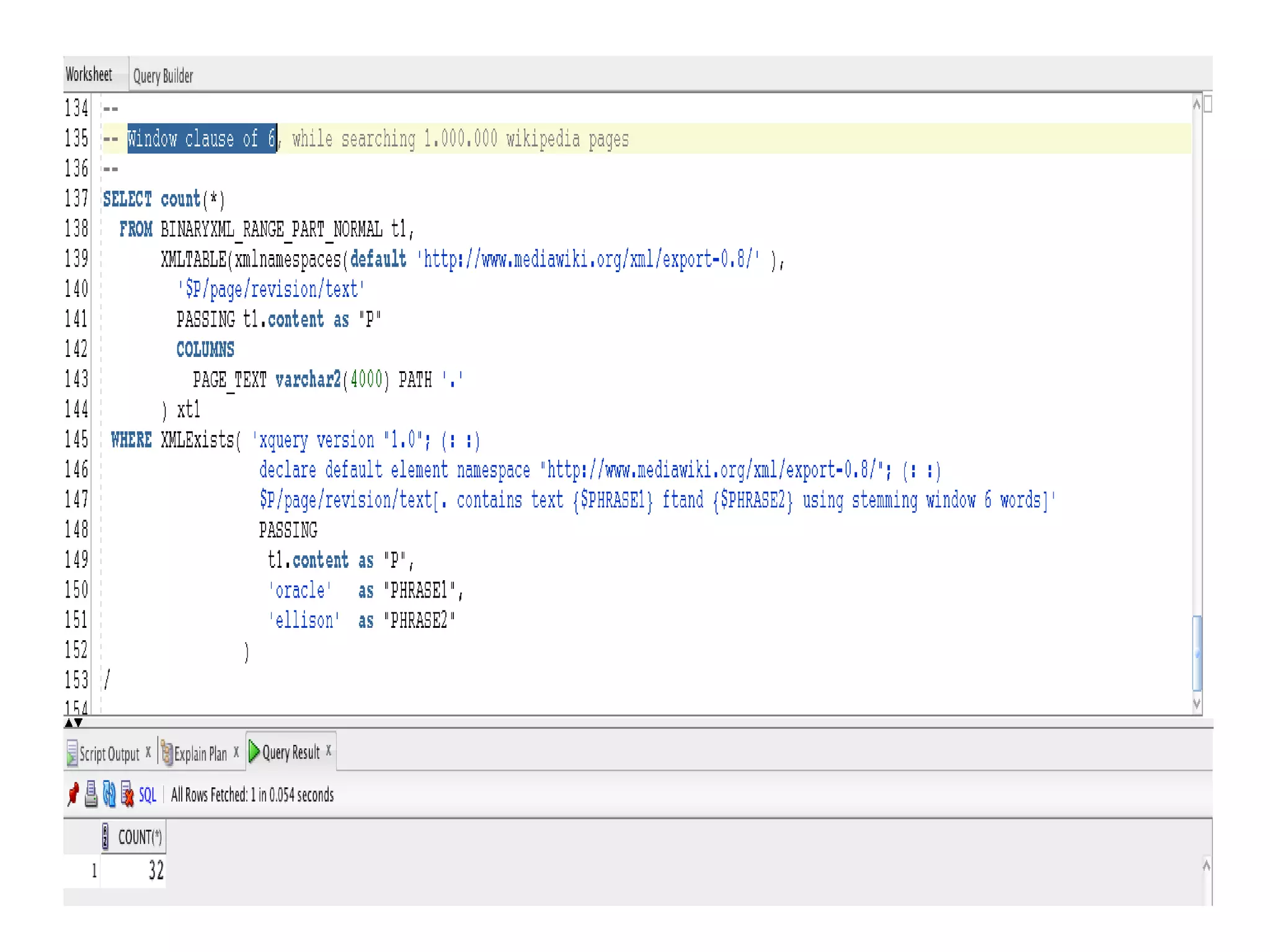
• Based on Oracle Text Index, XQuery Full Text
• XML Namespace Aware
• XML Semantic aware full text search
– Full-Tekst Selection Expression – contains text
– Logical Full Text Operator – ftor, ftand, ftMildNot
– Context Aware full text search
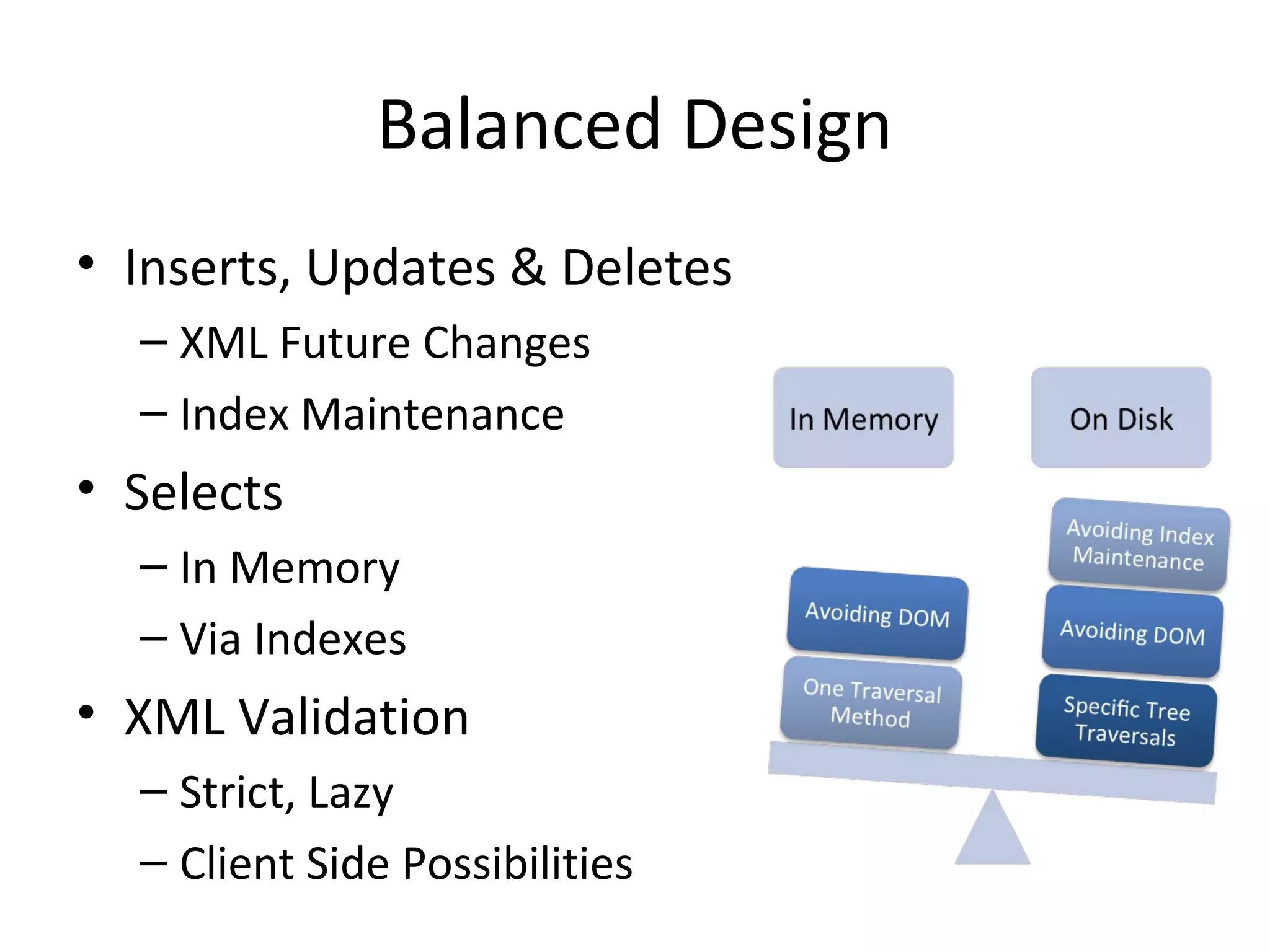
Balanced Design
• Inserts, Updates & Deletes
– XML Future Changes
– Index Maintenance

• Selects
– In Memory
– Via Indexes

• XML Validation
– Strict, Lazy
– Client Side Possibilities
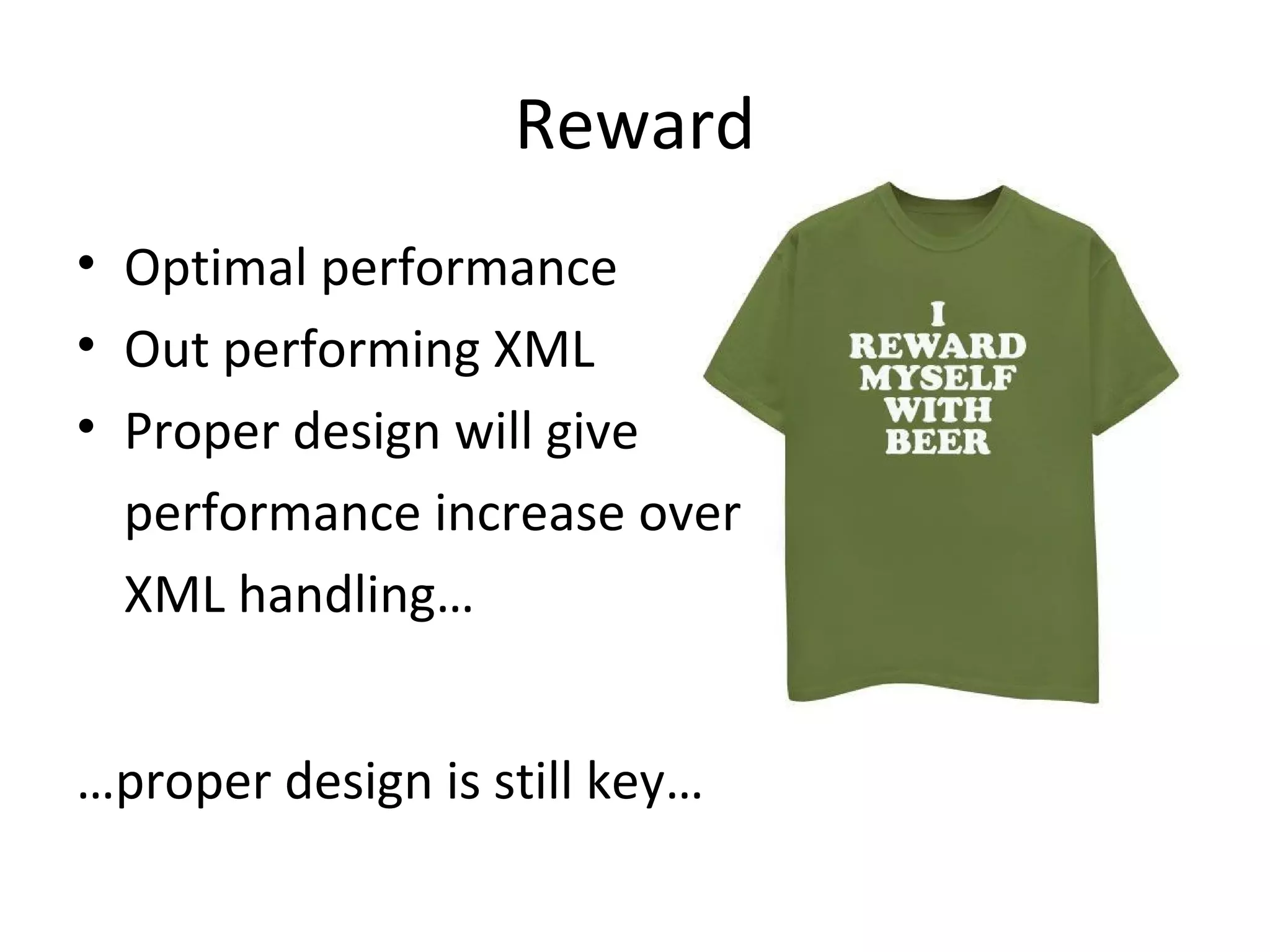
Reward
• Optimal performance
• Out performing XML
• Proper design will give
performance increase over
XML handling…
…proper design is still key…
References
Oracle XML DB
– http://www.oracle.com/pls/db112/homepage

XML DB FAQ Thread
– http://forums.oracle.com/forums/thread.jspa?
threadID=410714

Personal Blog
– http://www.xmldb.nl
– http://technology.amis.nl
References
Daniela Florescu, Oracle Corporation
Advances in XML and XQuery

Sam Idicula, Oracle XML DB Development Team
Binary XML Storage and Query Processing in Oracle

Jinyu Wang, Scott Brewton
Making XML Technology Easier to Use

Joel Spolsky - Joel on Software
Back to Basics
References
Oracle XML DB Main page material
• Oracle XML DB : Best Practices to Get Optimal
Performance out of XML Queries (PDF)
• Oracle XML DB : Choosing the Best XMLType
Storage Option for Your Use Case (PDF)
• A Request for Comments for the Oracle Binary
XML Format

XML Amsterdam - Creating structure in unstructured data

Editor's Notes

  • #20 See also OOW 2010, S317428: Building Really Scalable XML Applications with Oracle XML DB and Oracle Text – Nipun Agarwal, Oracle