Name Date
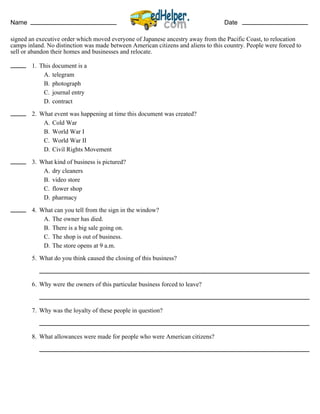
Japanese-American Relocation in World War II
Shortly after the bombing of Pearl Harbor, it became obvious that the people of the United States did not trust people
of Japanese descent living within the country. In the eyes of the citizens who were shocked by the Japanese attack on
the United States, all Japanese-Americans were potential spies. Americans feared for their own safety, and persons of
Japanese descent feared harm at the hands of these anti-Japanese Americans. In February, 1942, President Roosevelt
Name Date
signed an executive order which moved everyone of Japanese ancestry away from the Pacific Coast, to relocation
camps inland. No distinction was made between American citizens and aliens to this country. People were forced to
sell or abandon their homes and businesses and relocate.
1. This document is a
A. telegram
B. photograph
C. journal entry
D. contract
2. What event was happening at time this document was created?
A. Cold War
B. World War I
C. World War II
D. Civil Rights Movement
3. What kind of business is pictured?
A. dry cleaners
B. video store
C. flower shop
D. pharmacy
4. What can you tell from the sign in the window?
A. The owner has died.
B. There is a big sale going on.
C. The shop is out of business.
D. The store opens at 9 a.m.
5. What do you think caused the closing of this business?
6. Why were the owners of this particular business forced to leave?
7. Why was the loyalty of these people in question?
8. What allowances were made for people who were American citizens?
Name Date
9. The sign in the Iseri's window does not sound bitter or resentful. What do you think the attitude of the
relocated Japanese-Americans was? How would you feel if something like this happened to you?
Name Date
10. Do you think President Roosevelt was right in making the decision to relocate Japanese-Americans, even
those who were citizens? What else could he have done? Do you think the Japanese-Americans were in
danger from other citizens?
Name Date
"They Shall Not Have Died in Vain."
Image Caption: "They Shall Not Have Died in Vain. Remember Pearl Harbor. Work, Fight, Sacrifice. Let's get it over
with!" (ca. 1942-ca. 1943) Records of the War Production Board; Record Group 179; National Archives.
Name Date
1. This document is a (n) _____.
A. newspaper article
B. photograph
C. map
D. advertisement
2. What dates are on the document?
A. 1941 Dec. 7th 1942
B. 1911 Dec. 8th 1912
C. 1911 Nov. 7th 1912
D. 1914 Dec. 7th 1915
3. What is significant about the date on the document?
A. It marks the date and anniversary of the Declaration of Independence.
B. It marks the date and anniversary of the Pearl Harbor attack.
C. It marks the date and anniversary of World War I.
D. It marks America's birthday.
4. During which war would this document have been printed or distributed?
A. Revolutionary War
B. World War II
C. French and Indian War
D. World War I
5. "They Shall Not Have Died in Vain" refers to _____.
A. those who were killed in the Pearl Harbor attack
B. suffragists
C. colonists who perished
D. those who died in World War I
6. What was the significance of the Pearl Harbor attack in history?
Name Date
7. Explain the sentiment of the poster.
Name Date
Stars in Service: Invest in War Bonds
Name Date
1. This document can best be described as a(n)____.
A. advertisement
B. map
C. sketch
D. cartoon
2. What is the primary purpose of this document?
A. to persuade
B. to entertain
C. to explain
D. both A&C are correct
3. Who is Bob Feller?
A. a baseball player for the Cleveland Indians
B. a member of the axis
C. the creator of this document
D. the President of the United States
4. How many men did Bob Feller strike out in one game?
A. 12
B. 0
C. 15
D. 18
5. Why does this document feature Bob Feller?
6. What is Bob Feller's contribution to the war?
7. What percentage of one's income should be invested in war bonds, according to this document?
8. Based on this document, is Bob Feller on the side of the Axis in the war?
Name Date
9. Why are stars used to sell things? Give examples of things that stars sell today, and whether or not you
think this practice is an effective marketing technique.
Name Date
10. Based on your knowledge of history, and on this document, approximately when would this document have
been created? During which war would it have been published? Which countries fought in the war? Which
country, or countries, emerged victorious?
Name Date
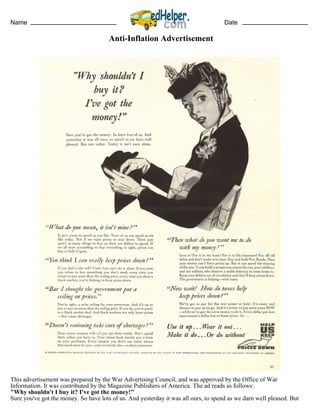
Anti-Inflation Advertisement
This advertisement was prepared by the War Advertising Council, and was approved by the Office of War
Information. It was contributed by the Magazine Publishers of America. The ad reads as follows:
"Why shouldn't I buy it? I've got the money!"
Sure you've got the money. So have lots of us. And yesterday it was all ours, to spend as we darn well pleased. But
Name Date
not today. Today it isn't ours alone.
"What do you mean it isn't mine?"
It isn't yours to spend as you like. None of us can spend as we like today. Not if we want prices to stay down. There
just aren't as many things to buy as there are dollars to spend. If we all start scrambling to buy everything in sight,
prices can kite to heck-‘n'-gone.
"You think I can really keep prices down?"
If you don't, who will? Uncle Sam can't do it alone. Every time you refuse to buy something you don't need, every
time you refuse to pay more than the ceiling price, every time you shun a black market, you're helping to keep prices
down.
"But I thought the government put a ceiling on prices."
You're right, a price ceiling for your protection. And it's up to you to pay no more than the ceiling price. If you do,
you're party to a black market deal. And black markets not only boost prices - they cause shortages.
"Doesn't rationing take care of shortages?"
Your ration coupons will - if you use them wisely. Don't spend them unless you have to. Your ration book merely
sets a limit on your purchases. Every coupon you don't use today means that much more for you - and everybody else
- to share tomorrow.
"Then what do you want me to do with my money?"
Save it! Put it in the bank! Put it in life insurance! Pay off old debts and don't make new ones. Buy and hold war
bonds. Then your money can't force prices up. But it can speed the winning of the war. It can build a prosperous
nation for you, your children, and our soldiers, who deserve a stable America to come home to. Keep your dollars out
of circulation and they'll keep prices down. The government is helping - with taxes.
" ow wait! How do taxes help keep prices down?"
We've got to pay for this war sooner or later. It's easier and cheaper to pay as we go. And it's better to pay more taxes
NOW - while we've got the extra money to do it. Every dollar put into taxes means a dollar less to boost prices. So...
Use it up...Wear it out...Make it do...Or do without!
1. This document can best be described as a(n)____.
A. cartoon
B. advertisement
C. map
D. sketch
2. What is the primary purpose of this document?
A. to persuade
B. to entertain
C. to explain
D. both A&C are correct
3. Who created this document?
A. the local PTA
B. the Magazine Publishers of America
C. the War Advertising Council
D. the Office of War Information
4. Where might Americans have seen this document?
A. in a magazine
B. on a street corner
C. on television
D. in a newspaper
Name Date
5. Name five things that this document suggests that this woman do with her money rather than spend it.
6. According to the document, how do ration coupons help to avert shortages?
7. According to this document, how can the average citizen keep prices down?
8. According to the document, why are black markets a bad thing?
9. According to the document, what are some reasons one shouldn't buy something if she has the money?
Name Date
10. Give two examples of advice presented in this document which are appropriate to current-day situations.
Name Date
Rosie the Riveter
World War II made it necessary to produce planes, bombs, tanks, and other weapons to arm the military. But the men
were signing up to fight in the war. Who would produce all of these weapons?
More than six million women stepped in without hesitation to work in the factories and to learn how to do "men's
work." They not only worked in the factories producing wartime materials, but held all other kinds of jobs, such as
Name Date
streetcar drivers, heavy construction machinery operators, lumber and steel mill workers, freight loaders and much
more. They created a new image for themselves as a capable and valuable work force, and set the stage for generations
to come.
1. This document is a (n) _________
A. instruction guide.
B. poster.
C. editorial.
D. newspaper article.
2. The purpose of this document was
A. to appeal to women to join the work force.
B. to advertise a gym membership.
C. to entertain the soldiers.
D. to encourage people to vote.
3. When was this poster used?
A. during the Civil War
B. during World War II
C. during the Industrial Revolution
D. during Roosevelt's presidential campaign.
4. Who is the woman who is featured?
A. an average American woman
B. a teamster
C. a movie star
D. Eleanor Roosevelt
5. Who is the document addressing when it says, "We Can Do It"?
6. What is it telling women that they can do?
7. How is this women dressed and what does her style of dress indicate?
8. What kind of jobs did women do during the war?
Name Date
9. Women were generally perceived to be too delicate to do anything except stay at home and raise children.
How did World War II help to change the image of American women? Did the changed image continue
when the war was over?
Name Date
10. Think about American society today. Do you think women are better off than they were before World War
II? Has women joining the work force improved society in general?
Name Date
Advertisement from the New York Herald Tribune, 1945
Name Date
1. This document can best be described as a(n)_____.
A. newspaper article
B. letter
C. advertisement
D. magazine article
2. Where was this document originally published?
A. the New York Herald Tribune
B. the New York Post
C. the New York Times
D. the New Yorker
3. In what year was this document created?
A. 1945
B. 1954
C. 1845
D. 1941
4. During what war was this document published?
A. the Gulf War
B. WWIII
C. WWI
D. WWII
5. Who created this document?
6. What is the purpose of this document?
7. Where do you think the soldier in the picture is supposed to be speaking from?
8. How many soldiers are depicted in this document?
Name Date
9. For what purpose did Americans buy war bonds at this time in history? What function did war bonds serve?
Name Date
10. Consider the date of this document. At what point in the war was it? Given your answer, would the appeal
of this soldier have been more or less poignant? Do you find this document effective? Do you think it
enticed people to buy war bonds?
Name Date
Transcript of Joint Address to Congress Leading to a Declaration of War Against
Japan (1941)
Mr. Vice President, and Mr. Speaker, and Members of the Senate and House of Representatives:
Yesterday, December 7, 1941-a date which will live in infamy-the United States of America was suddenly and
deliberately attacked by naval and air forces of the Empire of Japan.
The United States was at peace with that Nation and, at the solicitation of Japan, was still in conversation with its
Government and its Emperor looking toward the maintenance of peace in the Pacific. Indeed, one hour after Japanese
air squadrons had commenced bombing in the American Island of Oahu, the Japanese Ambassador to the United States
and his colleague delivered to our Secretary of State a formal reply to a recent American message. And while this reply
stated that it seemed useless to continue the existing diplomatic negotiations, it contained no threat or hint of war or of
armed attack.
It will be recorded that the distance of Hawaii from Japan makes it obvious that the attack was deliberately planned
many days or even weeks ago. During the intervening time the Japanese Government has deliberately sought to
deceive the United States by false statements and expressions of hope for continued peace.
The attack yesterday on the Hawaiian Islands has caused severe damage to American naval and military forces. I regret
to tell you that very many American lives have been lost. In addition American ships have been reported torpedoed on
the high seas between San Francisco and Honolulu.
Yesterday the Japanese Government also launched an attack against Malaya.
Last night Japanese forces attacked Hong Kong.
Last night Japanese forces attacked Guam.
Last night Japanese forces attacked the Philippine Islands.
Last night the Japanese attacked Wake Island. And this morning the Japanese attacked Midway Island.
Japan has, therefore, undertaken a surprise offensive extending throughout the Pacific area. The facts of yesterday and
today speak for themselves. The people of the United States have already formed their opinions and well understand
the implications to the very life and safety of our Nation.
As Commander in Chief of the Army and Navy I have directed that all measures be taken for our defense.
But always will our whole Nation remember the character of the onslaught against us.
No matter how long it may take us to overcome this premeditated invasion, the American people in their righteous
might will win through to absolute victory. I believe that I interpret the will of the Congress and of the people when I
assert that we will not only defend ourselves to the uttermost but will make it very certain that this form of treachery
shall never again endanger us.
Hostilities exist. There is no blinking at the fact that our people, our territory, and our interests are in grave danger.
With confidence in our armed forces-with the unbounding determination of our people-we will gain the inevitable
triumph- so help us God.
I ask that the Congress declare that since the unprovoked and dastardly attack by Japan on Sunday, December 7, 1941,
a state of war has existed between the United States and the Japanese Empire.
Document Caption:
U. S. National Archives & Records Administration
700 Pennsylvania Avenue NW, Washington, DC 20408
Document Information:
The Pearl Harbor attack was an incredible military surprise. It devastated the U.S. Pacific Fleet. It killed or wounded
over 3,000 Americans. This is the speech given by President Franklin D. Roosevelt to Congress and the country.
1. This document is a (n) _____.
A. newspaper article
B. editorial
C. presidential speech
D. advertisement
Name Date
2. What county attacked the U.S. Pacific Fleet?
A. China
B. Mexico
C. Canada
D. Japan
3. What other attacks were launched the same day?
A. Hong Kong
B. Philippine Islands
C. Guam
D. all of the above
4. What was the date of the attack?
A. December 7, 1941
B. November 11, 1941
C. November 11, 1914
D. December 7, 1914
5. Based on this document and your knowledge of U.S. history, to what did the attack lead?
A. U.S. entrance into World War II
B. U.S. entrance into the Revolutionary War
C. U.S. entrance into the Iraq War
D. U.S. entrance into World War I
6. Explain the famous quote, "a date which will live in infamy."
Name Date
7. Explain why the United States felt this was a preplanned attack.
Name Date
8. Based on this document and your knowledge of history, discuss the short term and long term causes of
World War II.

Wwii documents

  • 1.
    Name Date Japanese-American Relocationin World War II Shortly after the bombing of Pearl Harbor, it became obvious that the people of the United States did not trust people of Japanese descent living within the country. In the eyes of the citizens who were shocked by the Japanese attack on the United States, all Japanese-Americans were potential spies. Americans feared for their own safety, and persons of Japanese descent feared harm at the hands of these anti-Japanese Americans. In February, 1942, President Roosevelt
  • 2.
    Name Date signed anexecutive order which moved everyone of Japanese ancestry away from the Pacific Coast, to relocation camps inland. No distinction was made between American citizens and aliens to this country. People were forced to sell or abandon their homes and businesses and relocate. 1. This document is a A. telegram B. photograph C. journal entry D. contract 2. What event was happening at time this document was created? A. Cold War B. World War I C. World War II D. Civil Rights Movement 3. What kind of business is pictured? A. dry cleaners B. video store C. flower shop D. pharmacy 4. What can you tell from the sign in the window? A. The owner has died. B. There is a big sale going on. C. The shop is out of business. D. The store opens at 9 a.m. 5. What do you think caused the closing of this business? 6. Why were the owners of this particular business forced to leave? 7. Why was the loyalty of these people in question? 8. What allowances were made for people who were American citizens?
  • 3.
    Name Date 9. Thesign in the Iseri's window does not sound bitter or resentful. What do you think the attitude of the relocated Japanese-Americans was? How would you feel if something like this happened to you?
  • 4.
    Name Date 10. Doyou think President Roosevelt was right in making the decision to relocate Japanese-Americans, even those who were citizens? What else could he have done? Do you think the Japanese-Americans were in danger from other citizens?
  • 5.
    Name Date "They ShallNot Have Died in Vain." Image Caption: "They Shall Not Have Died in Vain. Remember Pearl Harbor. Work, Fight, Sacrifice. Let's get it over with!" (ca. 1942-ca. 1943) Records of the War Production Board; Record Group 179; National Archives.
  • 6.
    Name Date 1. Thisdocument is a (n) _____. A. newspaper article B. photograph C. map D. advertisement 2. What dates are on the document? A. 1941 Dec. 7th 1942 B. 1911 Dec. 8th 1912 C. 1911 Nov. 7th 1912 D. 1914 Dec. 7th 1915 3. What is significant about the date on the document? A. It marks the date and anniversary of the Declaration of Independence. B. It marks the date and anniversary of the Pearl Harbor attack. C. It marks the date and anniversary of World War I. D. It marks America's birthday. 4. During which war would this document have been printed or distributed? A. Revolutionary War B. World War II C. French and Indian War D. World War I 5. "They Shall Not Have Died in Vain" refers to _____. A. those who were killed in the Pearl Harbor attack B. suffragists C. colonists who perished D. those who died in World War I 6. What was the significance of the Pearl Harbor attack in history?
  • 7.
    Name Date 7. Explainthe sentiment of the poster.
  • 8.
    Name Date Stars inService: Invest in War Bonds
  • 9.
    Name Date 1. Thisdocument can best be described as a(n)____. A. advertisement B. map C. sketch D. cartoon 2. What is the primary purpose of this document? A. to persuade B. to entertain C. to explain D. both A&C are correct 3. Who is Bob Feller? A. a baseball player for the Cleveland Indians B. a member of the axis C. the creator of this document D. the President of the United States 4. How many men did Bob Feller strike out in one game? A. 12 B. 0 C. 15 D. 18 5. Why does this document feature Bob Feller? 6. What is Bob Feller's contribution to the war? 7. What percentage of one's income should be invested in war bonds, according to this document? 8. Based on this document, is Bob Feller on the side of the Axis in the war?
  • 10.
    Name Date 9. Whyare stars used to sell things? Give examples of things that stars sell today, and whether or not you think this practice is an effective marketing technique.
  • 11.
    Name Date 10. Basedon your knowledge of history, and on this document, approximately when would this document have been created? During which war would it have been published? Which countries fought in the war? Which country, or countries, emerged victorious?
  • 12.
    Name Date Anti-Inflation Advertisement Thisadvertisement was prepared by the War Advertising Council, and was approved by the Office of War Information. It was contributed by the Magazine Publishers of America. The ad reads as follows: "Why shouldn't I buy it? I've got the money!" Sure you've got the money. So have lots of us. And yesterday it was all ours, to spend as we darn well pleased. But
  • 13.
    Name Date not today.Today it isn't ours alone. "What do you mean it isn't mine?" It isn't yours to spend as you like. None of us can spend as we like today. Not if we want prices to stay down. There just aren't as many things to buy as there are dollars to spend. If we all start scrambling to buy everything in sight, prices can kite to heck-‘n'-gone. "You think I can really keep prices down?" If you don't, who will? Uncle Sam can't do it alone. Every time you refuse to buy something you don't need, every time you refuse to pay more than the ceiling price, every time you shun a black market, you're helping to keep prices down. "But I thought the government put a ceiling on prices." You're right, a price ceiling for your protection. And it's up to you to pay no more than the ceiling price. If you do, you're party to a black market deal. And black markets not only boost prices - they cause shortages. "Doesn't rationing take care of shortages?" Your ration coupons will - if you use them wisely. Don't spend them unless you have to. Your ration book merely sets a limit on your purchases. Every coupon you don't use today means that much more for you - and everybody else - to share tomorrow. "Then what do you want me to do with my money?" Save it! Put it in the bank! Put it in life insurance! Pay off old debts and don't make new ones. Buy and hold war bonds. Then your money can't force prices up. But it can speed the winning of the war. It can build a prosperous nation for you, your children, and our soldiers, who deserve a stable America to come home to. Keep your dollars out of circulation and they'll keep prices down. The government is helping - with taxes. " ow wait! How do taxes help keep prices down?" We've got to pay for this war sooner or later. It's easier and cheaper to pay as we go. And it's better to pay more taxes NOW - while we've got the extra money to do it. Every dollar put into taxes means a dollar less to boost prices. So... Use it up...Wear it out...Make it do...Or do without! 1. This document can best be described as a(n)____. A. cartoon B. advertisement C. map D. sketch 2. What is the primary purpose of this document? A. to persuade B. to entertain C. to explain D. both A&C are correct 3. Who created this document? A. the local PTA B. the Magazine Publishers of America C. the War Advertising Council D. the Office of War Information 4. Where might Americans have seen this document? A. in a magazine B. on a street corner C. on television D. in a newspaper
  • 14.
    Name Date 5. Namefive things that this document suggests that this woman do with her money rather than spend it. 6. According to the document, how do ration coupons help to avert shortages? 7. According to this document, how can the average citizen keep prices down? 8. According to the document, why are black markets a bad thing? 9. According to the document, what are some reasons one shouldn't buy something if she has the money?
  • 15.
    Name Date 10. Givetwo examples of advice presented in this document which are appropriate to current-day situations.
  • 16.
    Name Date Rosie theRiveter World War II made it necessary to produce planes, bombs, tanks, and other weapons to arm the military. But the men were signing up to fight in the war. Who would produce all of these weapons? More than six million women stepped in without hesitation to work in the factories and to learn how to do "men's work." They not only worked in the factories producing wartime materials, but held all other kinds of jobs, such as
  • 17.
    Name Date streetcar drivers,heavy construction machinery operators, lumber and steel mill workers, freight loaders and much more. They created a new image for themselves as a capable and valuable work force, and set the stage for generations to come. 1. This document is a (n) _________ A. instruction guide. B. poster. C. editorial. D. newspaper article. 2. The purpose of this document was A. to appeal to women to join the work force. B. to advertise a gym membership. C. to entertain the soldiers. D. to encourage people to vote. 3. When was this poster used? A. during the Civil War B. during World War II C. during the Industrial Revolution D. during Roosevelt's presidential campaign. 4. Who is the woman who is featured? A. an average American woman B. a teamster C. a movie star D. Eleanor Roosevelt 5. Who is the document addressing when it says, "We Can Do It"? 6. What is it telling women that they can do? 7. How is this women dressed and what does her style of dress indicate? 8. What kind of jobs did women do during the war?
  • 18.
    Name Date 9. Womenwere generally perceived to be too delicate to do anything except stay at home and raise children. How did World War II help to change the image of American women? Did the changed image continue when the war was over?
  • 19.
    Name Date 10. Thinkabout American society today. Do you think women are better off than they were before World War II? Has women joining the work force improved society in general?
  • 20.
    Name Date Advertisement fromthe New York Herald Tribune, 1945
  • 21.
    Name Date 1. Thisdocument can best be described as a(n)_____. A. newspaper article B. letter C. advertisement D. magazine article 2. Where was this document originally published? A. the New York Herald Tribune B. the New York Post C. the New York Times D. the New Yorker 3. In what year was this document created? A. 1945 B. 1954 C. 1845 D. 1941 4. During what war was this document published? A. the Gulf War B. WWIII C. WWI D. WWII 5. Who created this document? 6. What is the purpose of this document? 7. Where do you think the soldier in the picture is supposed to be speaking from? 8. How many soldiers are depicted in this document?
  • 22.
    Name Date 9. Forwhat purpose did Americans buy war bonds at this time in history? What function did war bonds serve?
  • 23.
    Name Date 10. Considerthe date of this document. At what point in the war was it? Given your answer, would the appeal of this soldier have been more or less poignant? Do you find this document effective? Do you think it enticed people to buy war bonds?
  • 24.
    Name Date Transcript ofJoint Address to Congress Leading to a Declaration of War Against Japan (1941) Mr. Vice President, and Mr. Speaker, and Members of the Senate and House of Representatives: Yesterday, December 7, 1941-a date which will live in infamy-the United States of America was suddenly and deliberately attacked by naval and air forces of the Empire of Japan. The United States was at peace with that Nation and, at the solicitation of Japan, was still in conversation with its Government and its Emperor looking toward the maintenance of peace in the Pacific. Indeed, one hour after Japanese air squadrons had commenced bombing in the American Island of Oahu, the Japanese Ambassador to the United States and his colleague delivered to our Secretary of State a formal reply to a recent American message. And while this reply stated that it seemed useless to continue the existing diplomatic negotiations, it contained no threat or hint of war or of armed attack. It will be recorded that the distance of Hawaii from Japan makes it obvious that the attack was deliberately planned many days or even weeks ago. During the intervening time the Japanese Government has deliberately sought to deceive the United States by false statements and expressions of hope for continued peace. The attack yesterday on the Hawaiian Islands has caused severe damage to American naval and military forces. I regret to tell you that very many American lives have been lost. In addition American ships have been reported torpedoed on the high seas between San Francisco and Honolulu. Yesterday the Japanese Government also launched an attack against Malaya. Last night Japanese forces attacked Hong Kong. Last night Japanese forces attacked Guam. Last night Japanese forces attacked the Philippine Islands. Last night the Japanese attacked Wake Island. And this morning the Japanese attacked Midway Island. Japan has, therefore, undertaken a surprise offensive extending throughout the Pacific area. The facts of yesterday and today speak for themselves. The people of the United States have already formed their opinions and well understand the implications to the very life and safety of our Nation. As Commander in Chief of the Army and Navy I have directed that all measures be taken for our defense. But always will our whole Nation remember the character of the onslaught against us. No matter how long it may take us to overcome this premeditated invasion, the American people in their righteous might will win through to absolute victory. I believe that I interpret the will of the Congress and of the people when I assert that we will not only defend ourselves to the uttermost but will make it very certain that this form of treachery shall never again endanger us. Hostilities exist. There is no blinking at the fact that our people, our territory, and our interests are in grave danger. With confidence in our armed forces-with the unbounding determination of our people-we will gain the inevitable triumph- so help us God. I ask that the Congress declare that since the unprovoked and dastardly attack by Japan on Sunday, December 7, 1941, a state of war has existed between the United States and the Japanese Empire. Document Caption: U. S. National Archives & Records Administration 700 Pennsylvania Avenue NW, Washington, DC 20408 Document Information: The Pearl Harbor attack was an incredible military surprise. It devastated the U.S. Pacific Fleet. It killed or wounded over 3,000 Americans. This is the speech given by President Franklin D. Roosevelt to Congress and the country. 1. This document is a (n) _____. A. newspaper article B. editorial C. presidential speech D. advertisement
  • 25.
    Name Date 2. Whatcounty attacked the U.S. Pacific Fleet? A. China B. Mexico C. Canada D. Japan 3. What other attacks were launched the same day? A. Hong Kong B. Philippine Islands C. Guam D. all of the above 4. What was the date of the attack? A. December 7, 1941 B. November 11, 1941 C. November 11, 1914 D. December 7, 1914 5. Based on this document and your knowledge of U.S. history, to what did the attack lead? A. U.S. entrance into World War II B. U.S. entrance into the Revolutionary War C. U.S. entrance into the Iraq War D. U.S. entrance into World War I 6. Explain the famous quote, "a date which will live in infamy."
  • 26.
    Name Date 7. Explainwhy the United States felt this was a preplanned attack.
  • 27.
    Name Date 8. Basedon this document and your knowledge of history, discuss the short term and long term causes of World War II.