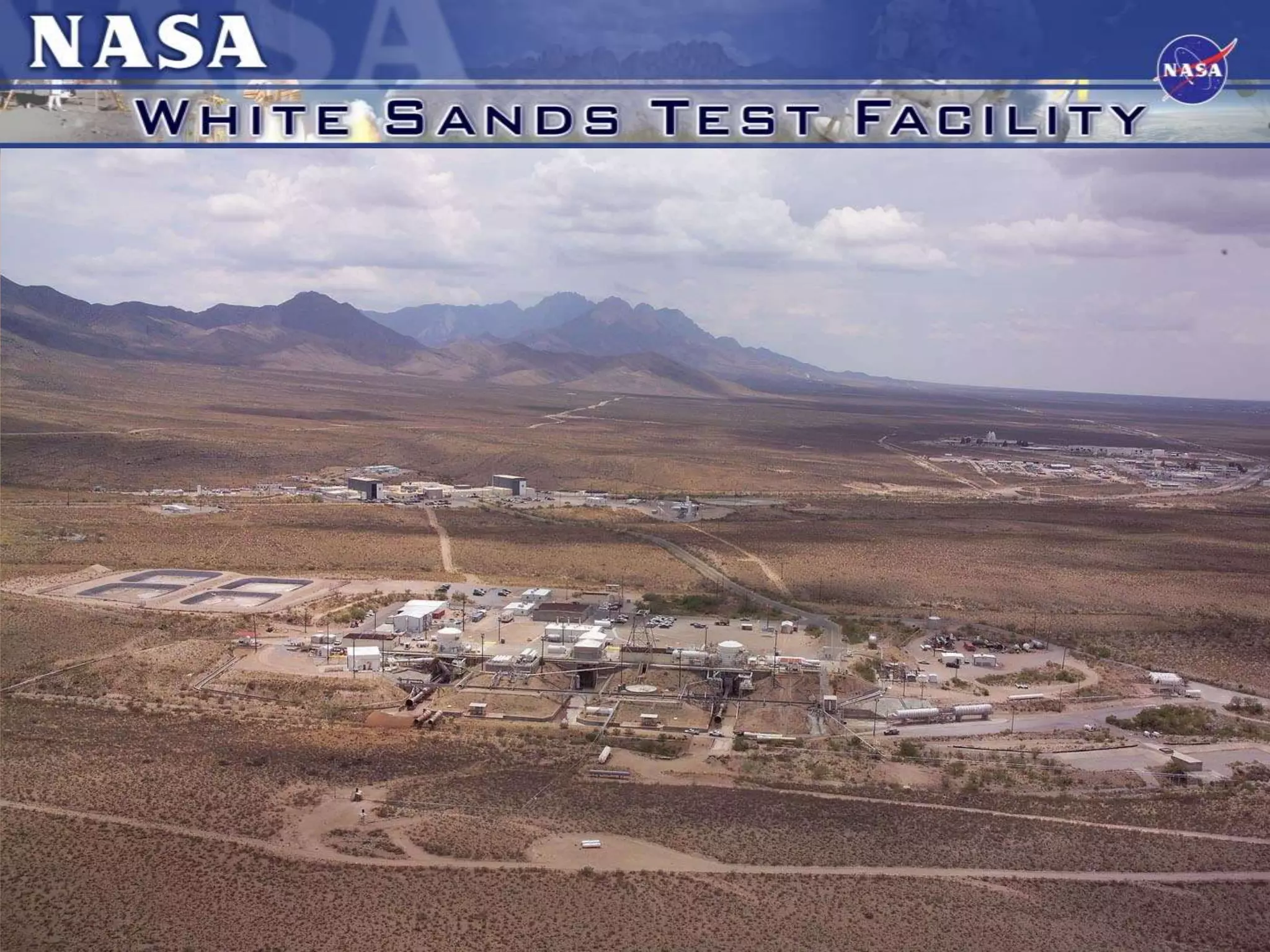
Economic Impact of WSTF - Fiscal Year 2011
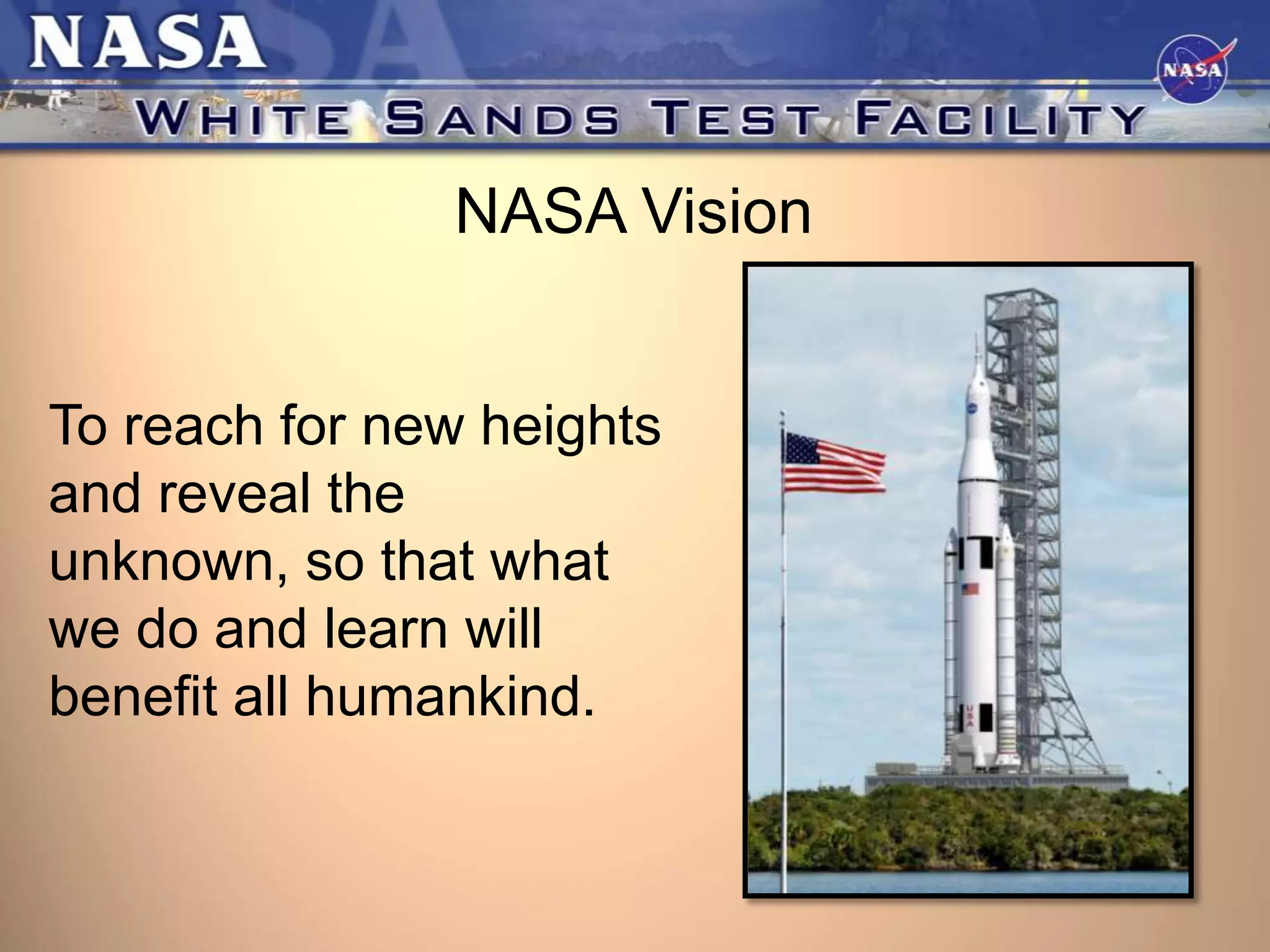
NASA Vision
To reach for new heights
and reveal the
unknown, so that what
we do and learn will
benefit all humankind.
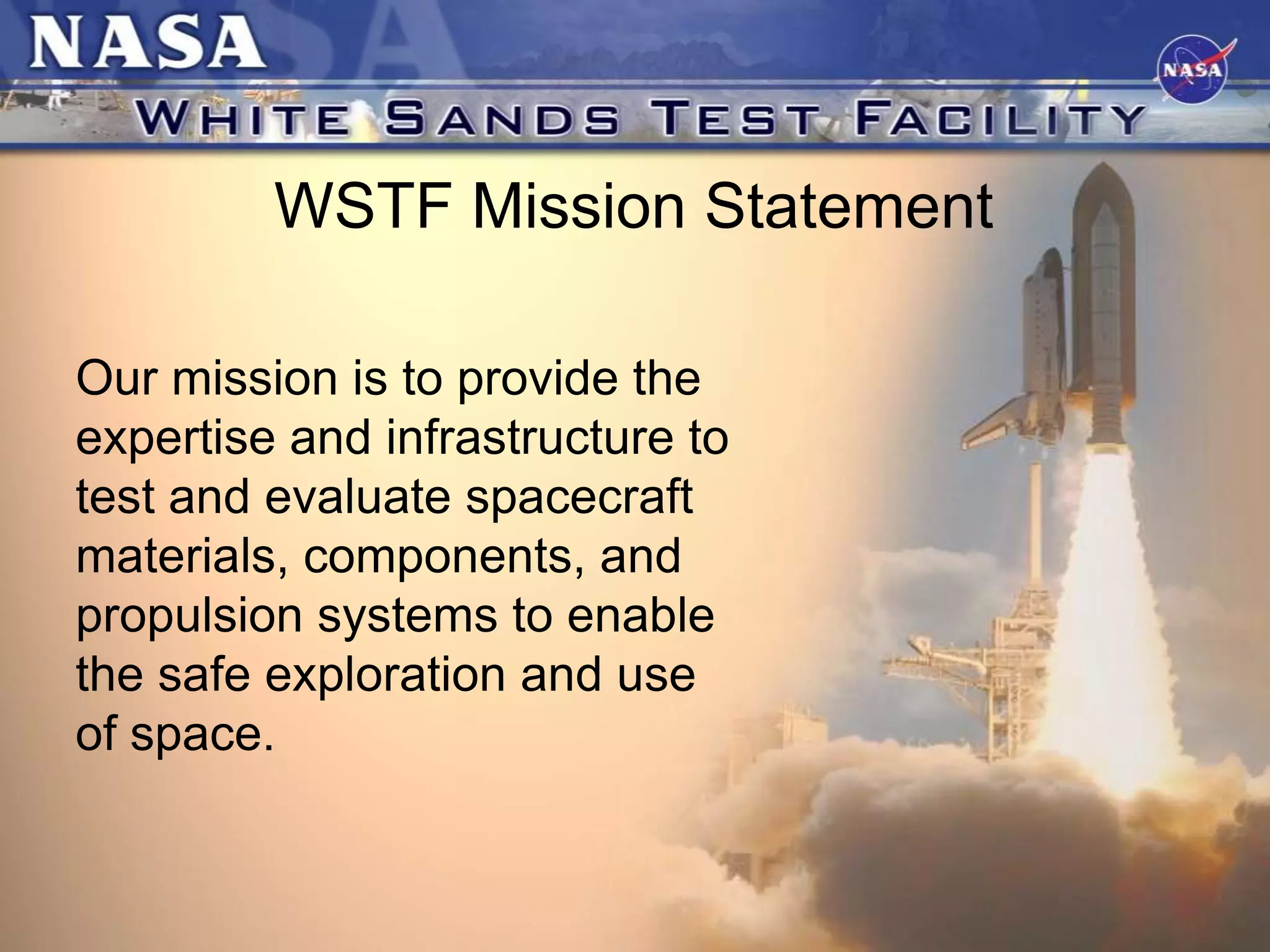
WSTF Mission Statement
Our mission is to provide the
expertise and infrastructure to
test and evaluate spacecraft
materials, components, and
propulsion systems to enable
the safe exploration and use
of space.
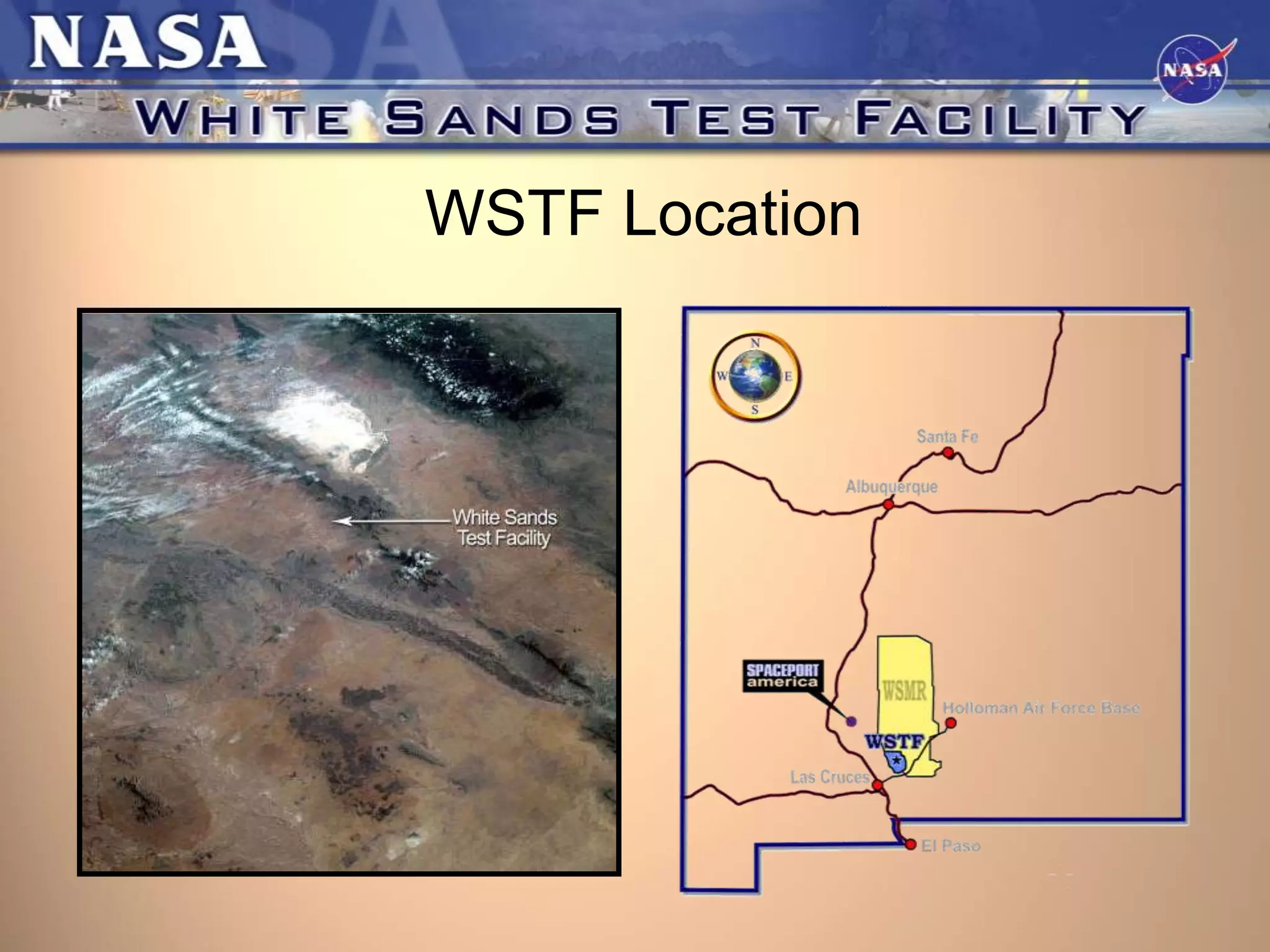
WSTF Location
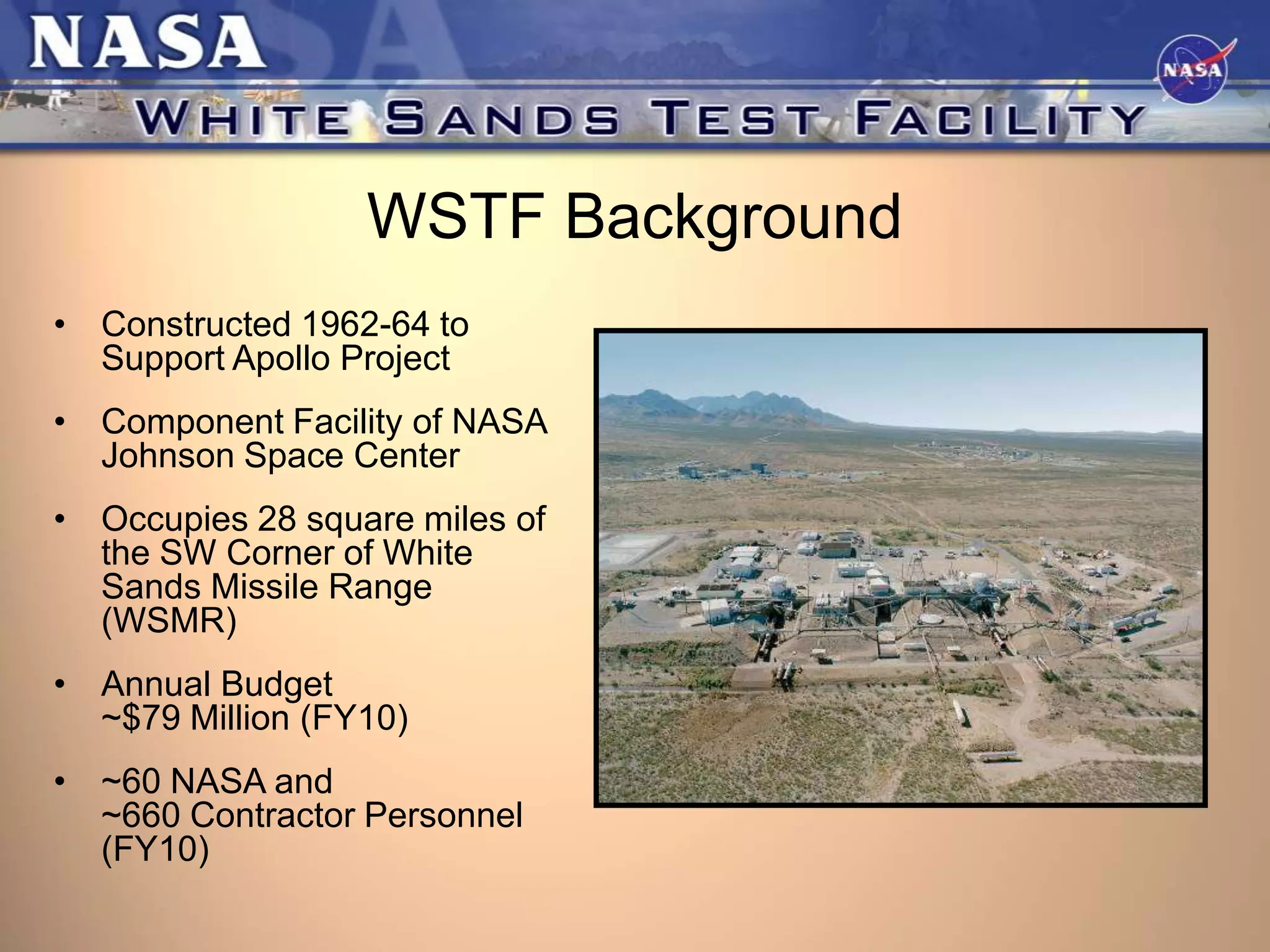
WSTF Background
• Constructed 1962-64 to
Support Apollo Project
• Component Facility of NASA
Johnson Space Center
• Occupies 28 square miles of
the SW Corner of White
Sands Missile Range
(WSMR)
• Annual Budget
~$79 Million (FY10)

• ~60 NASA and
~660 Contractor Personnel
(FY10)
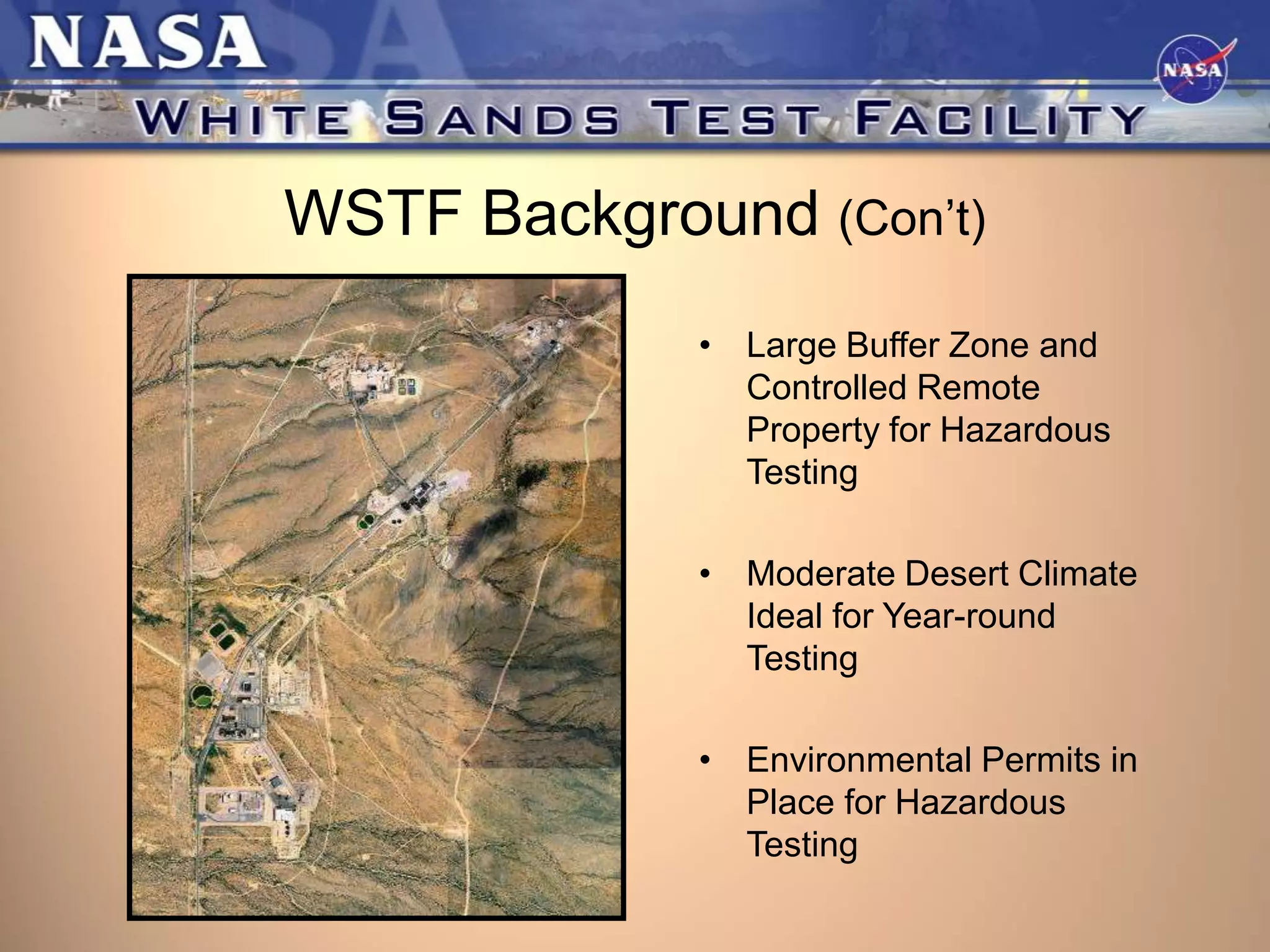
WSTF Background (Con’t)
• Large Buffer Zone and
Controlled Remote
Property for Hazardous
Testing
• Moderate Desert Climate
Ideal for Year-round
Testing
• Environmental Permits in
Place for Hazardous
Testing
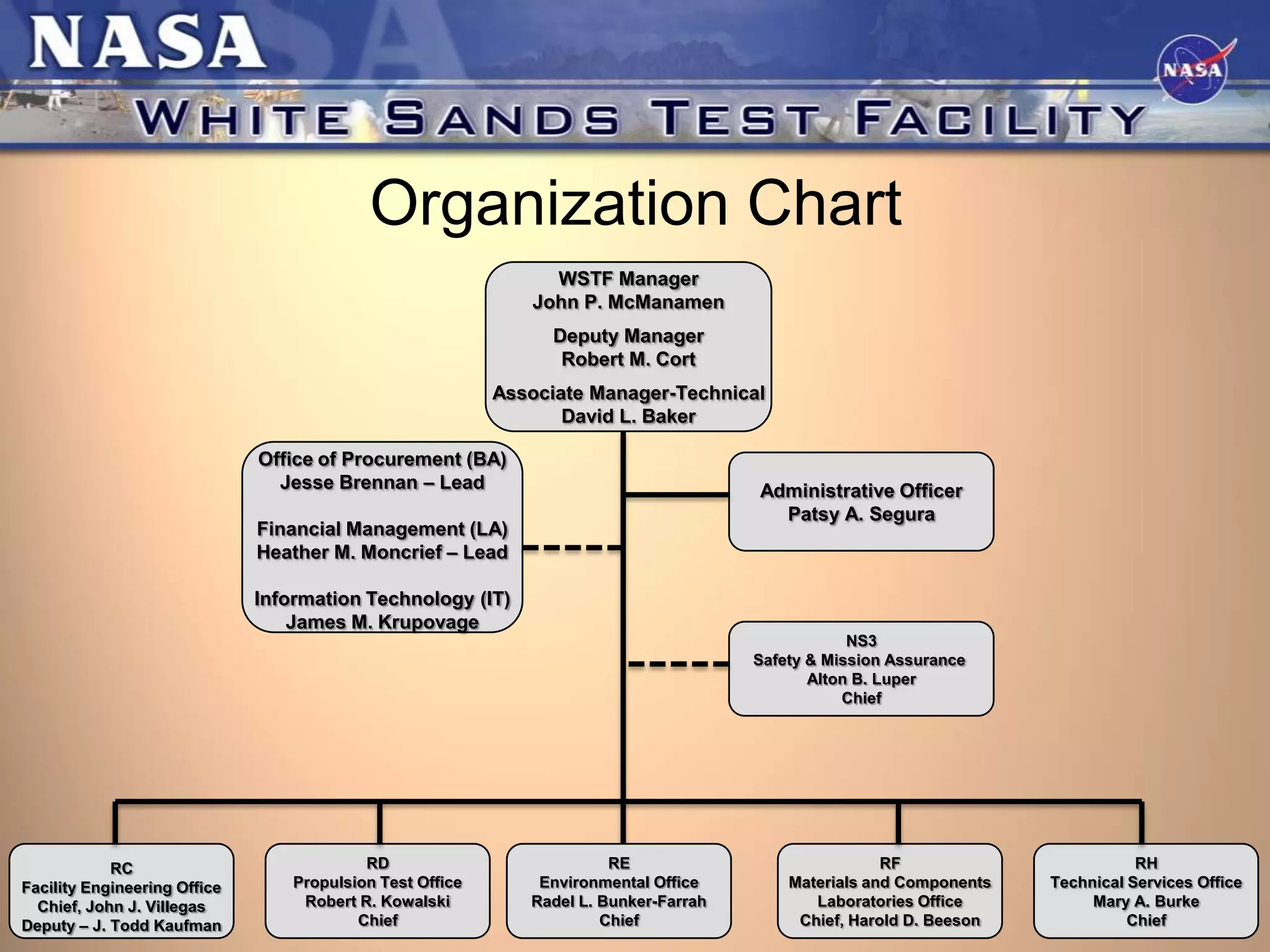
Organization Chart
WSTF Manager
John P. McManamen
Deputy Manager
Robert M. Cort
Associate Manager-Technical
David L. Baker
Office of Procurement (BA)
Jesse Brennan – Lead

Administrative Officer
Patsy A. Segura

Financial Management (LA)
Heather M. Moncrief – Lead
Information Technology (IT)
James M. Krupovage

NS3
Safety & Mission Assurance
Alton B. Luper
Chief

RC
Facility Engineering Office
Chief, John J. Villegas
Deputy – J. Todd Kaufman

RD
Propulsion Test Office
Robert R. Kowalski
Chief

RE
Environmental Office
Radel L. Bunker-Farrah
Chief

RF
Materials and Components
Laboratories Office
Chief, Harold D. Beeson

RH
Technical Services Office
Mary A. Burke
Chief
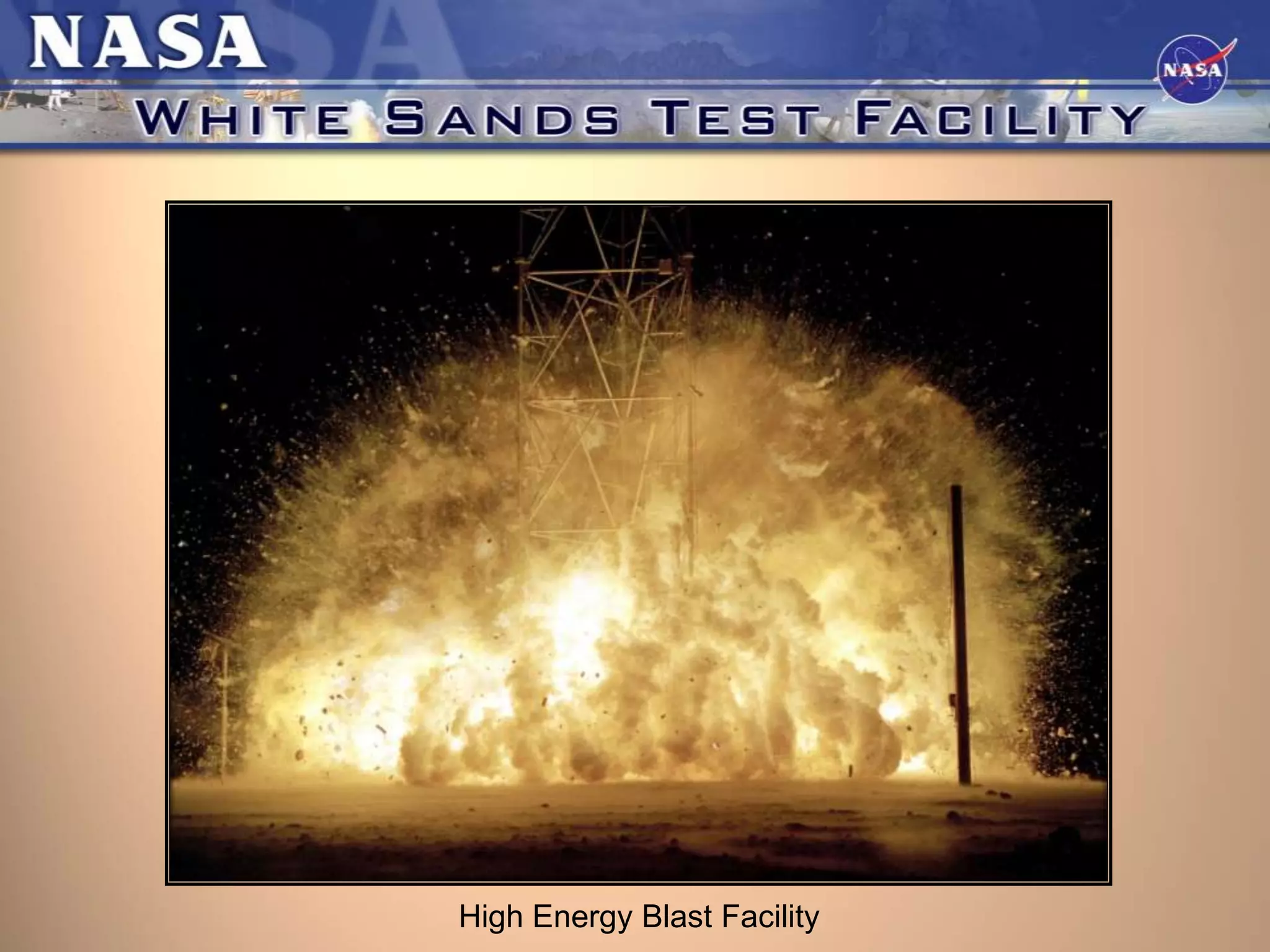
High Energy Blast Facility
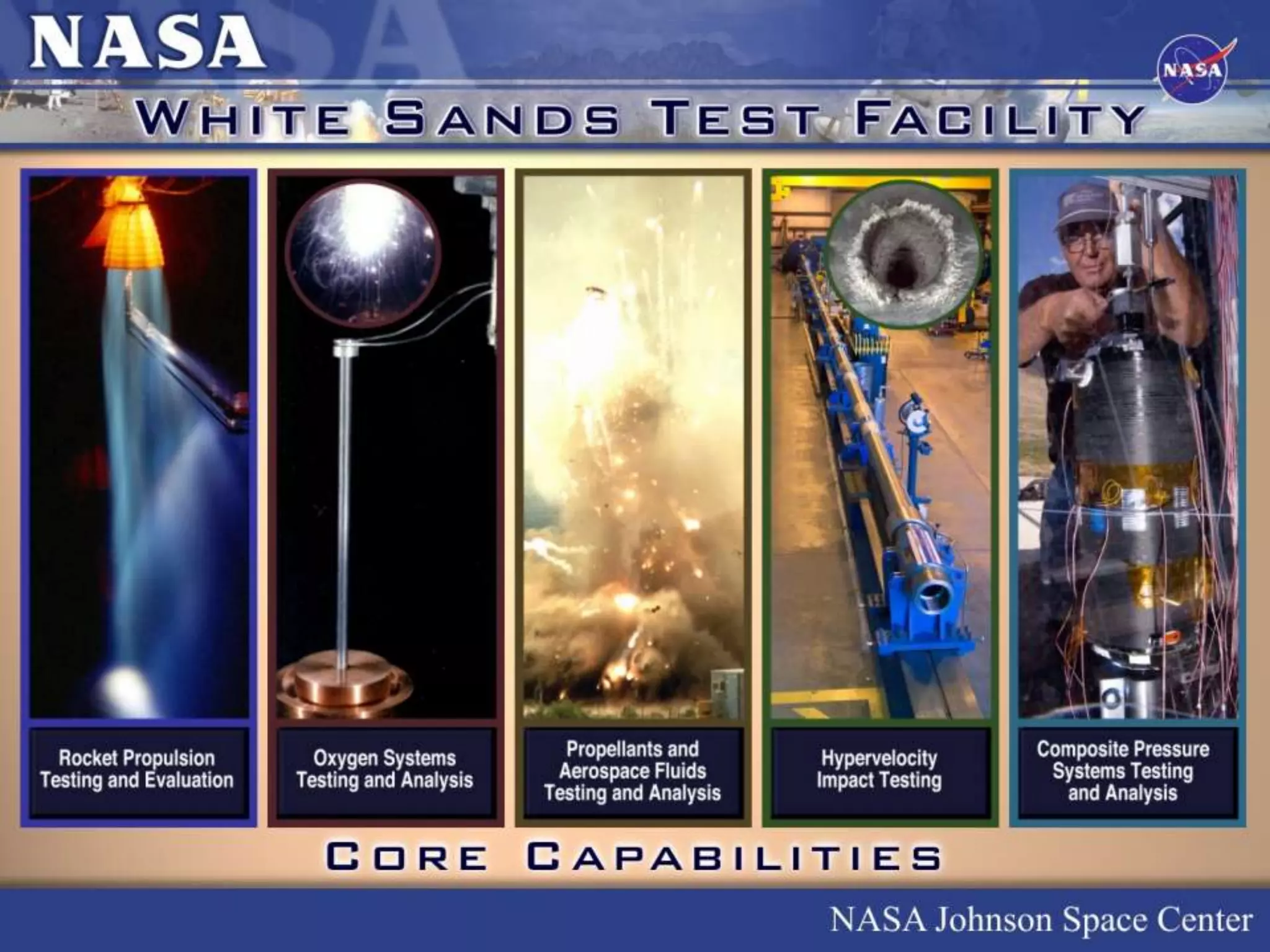
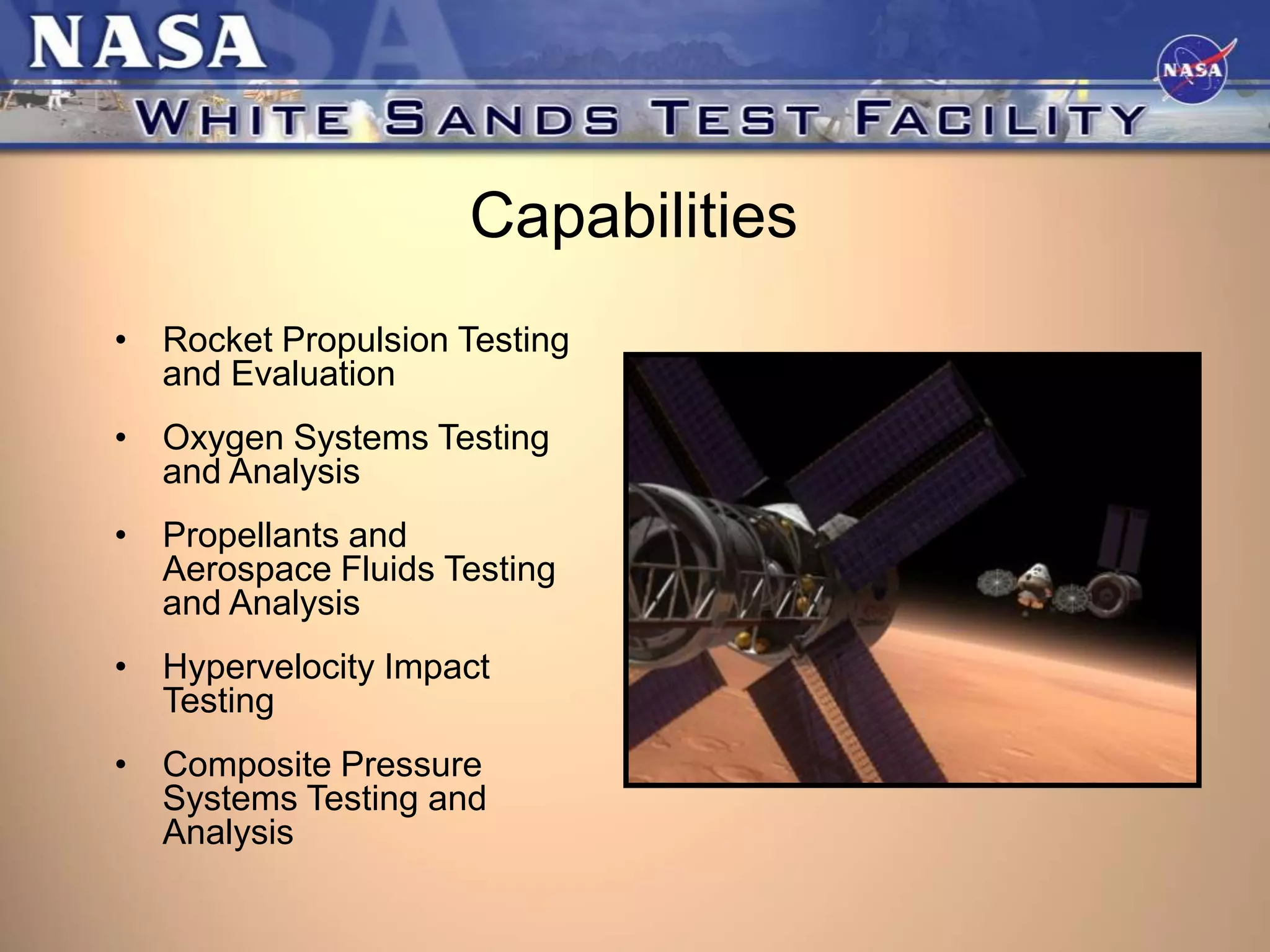
Capabilities
•

Rocket Propulsion Testing
and Evaluation

•

Oxygen Systems Testing
and Analysis

•

Propellants and
Aerospace Fluids Testing
and Analysis

•

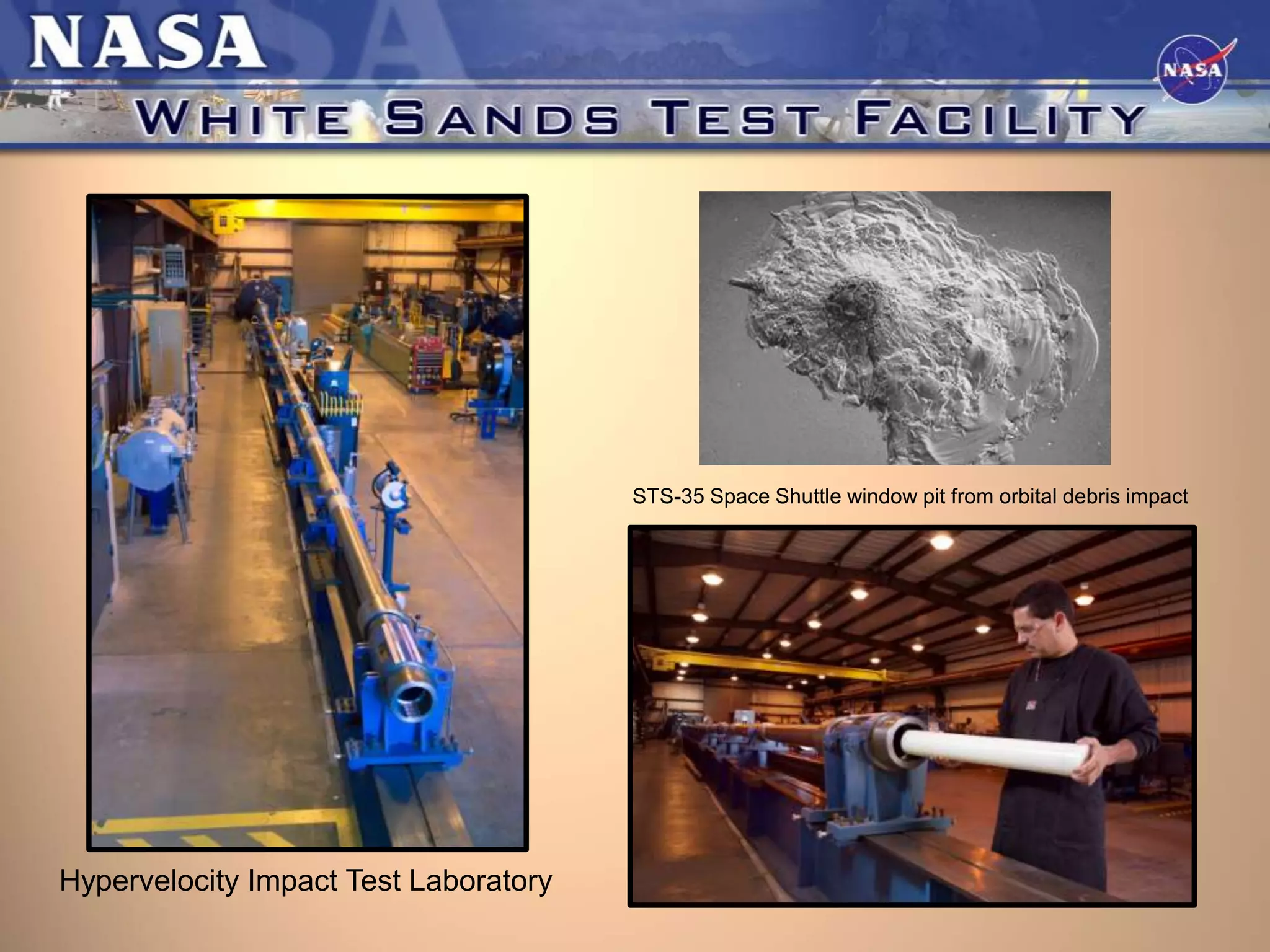
Hypervelocity Impact
Testing

•

Composite Pressure
Systems Testing and
Analysis
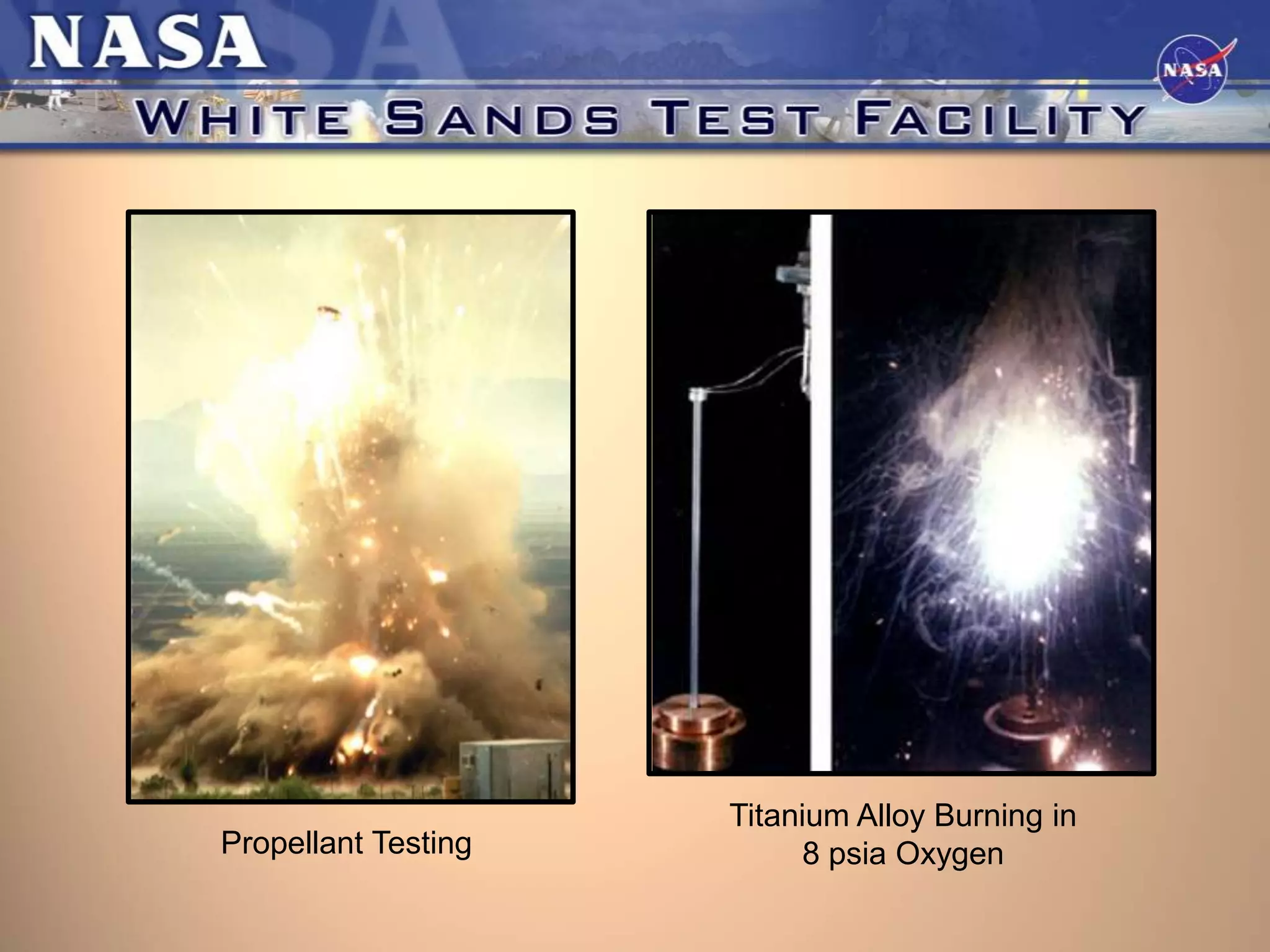
Propellant Testing

Titanium Alloy Burning in
8 psia Oxygen
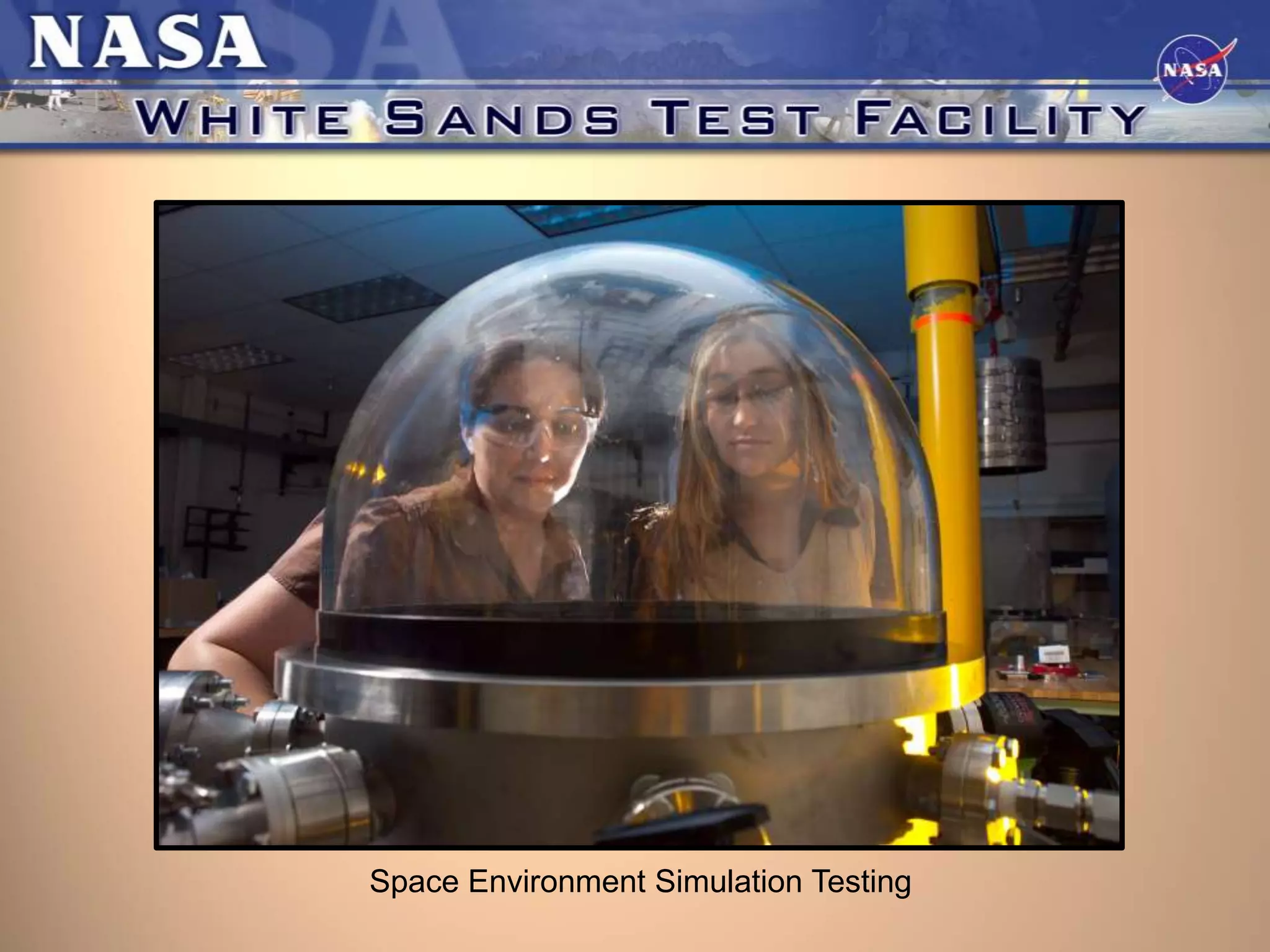
Space Environment Simulation Testing
STS-35 Space Shuttle window pit from orbital debris impact

Hypervelocity Impact Test Laboratory
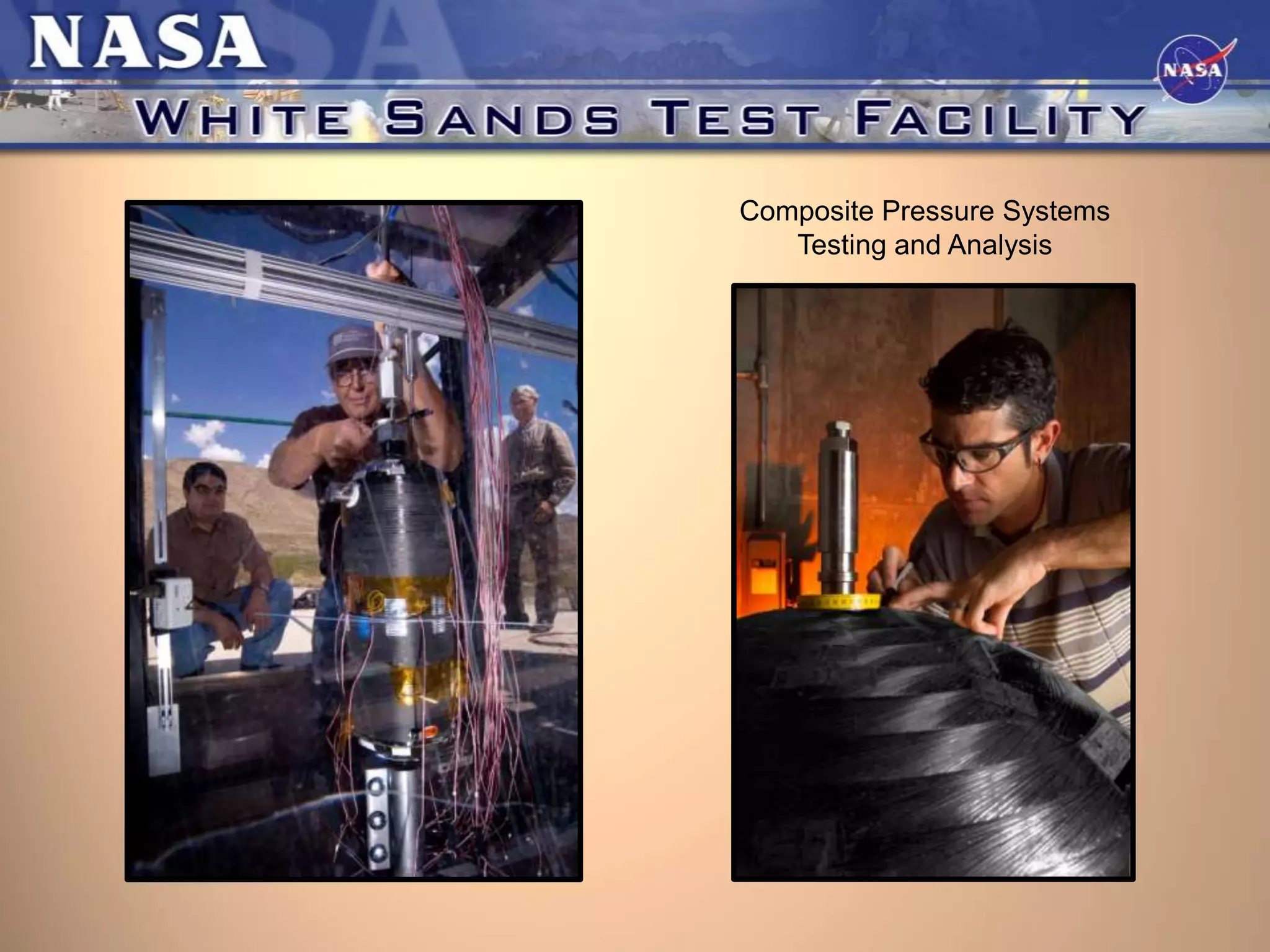
Composite Pressure Systems
Testing and Analysis
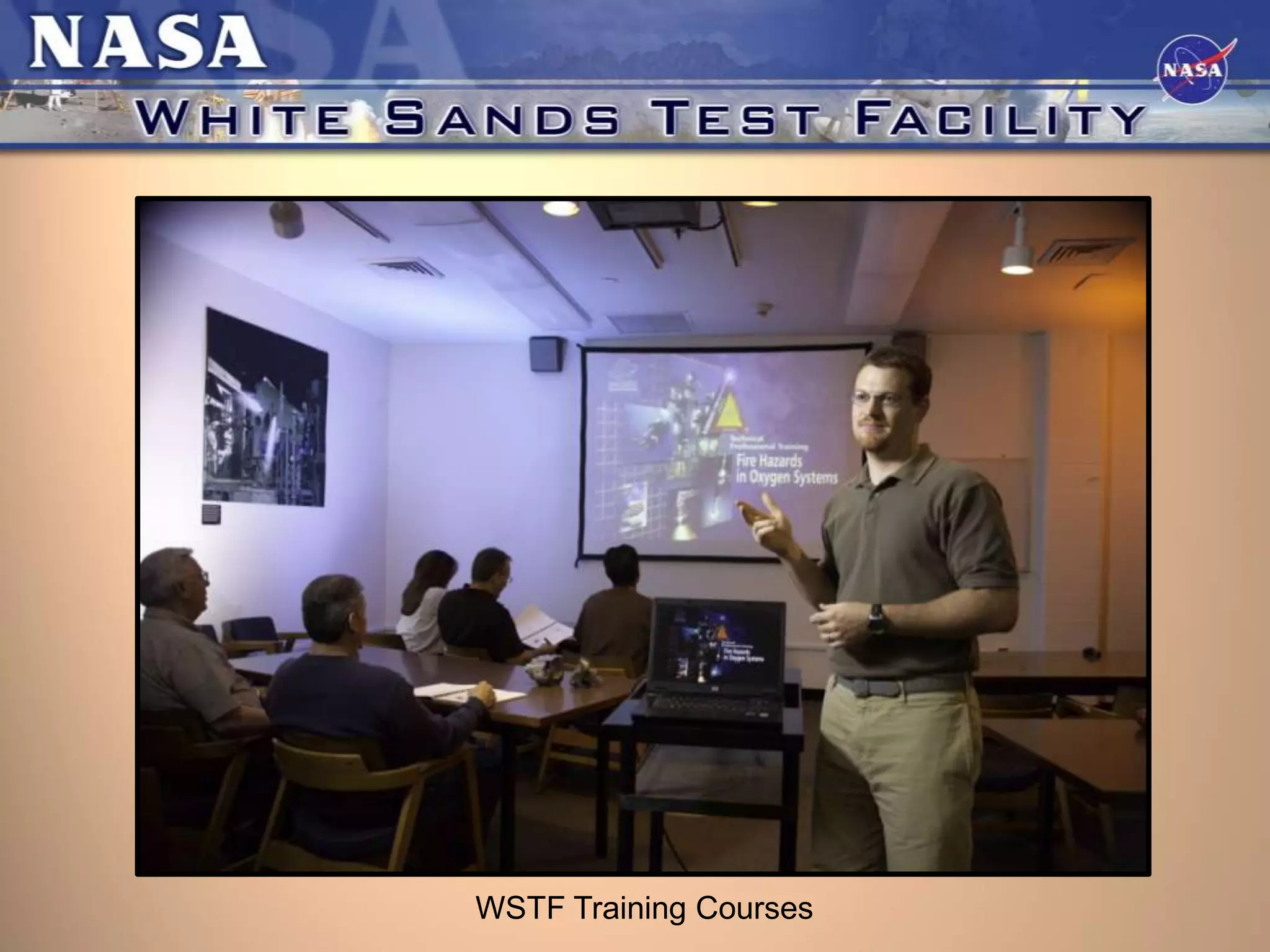
WSTF Training Courses
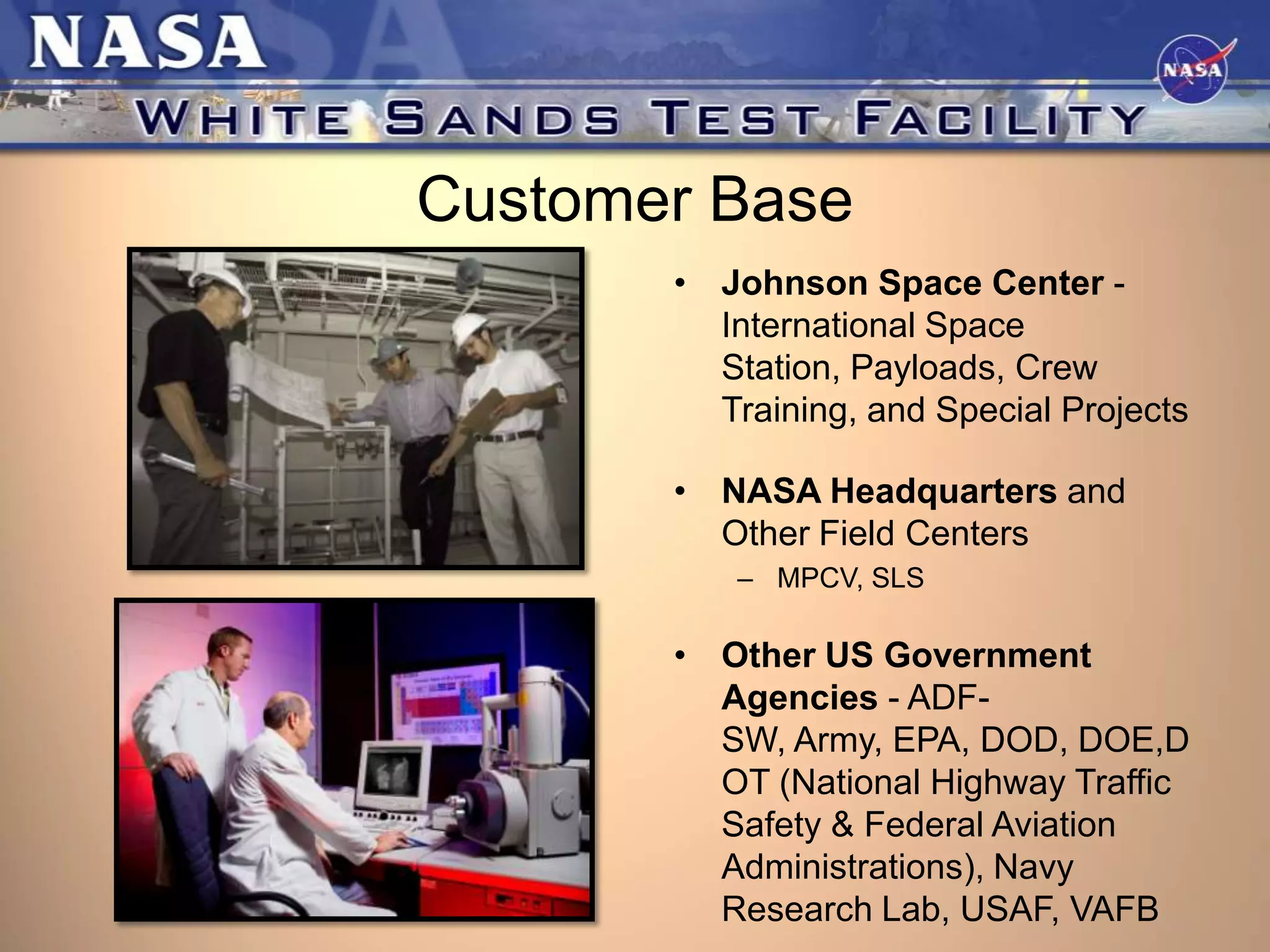
Customer Base
• Johnson Space Center International Space
Station, Payloads, Crew
Training, and Special Projects
• NASA Headquarters and
Other Field Centers
– MPCV, SLS

• Other US Government
Agencies - ADFSW, Army, EPA, DOD, DOE,D
OT (National Highway Traffic
Safety & Federal Aviation
Administrations), Navy
Research Lab, USAF, VAFB
Customer Base (Con’t)
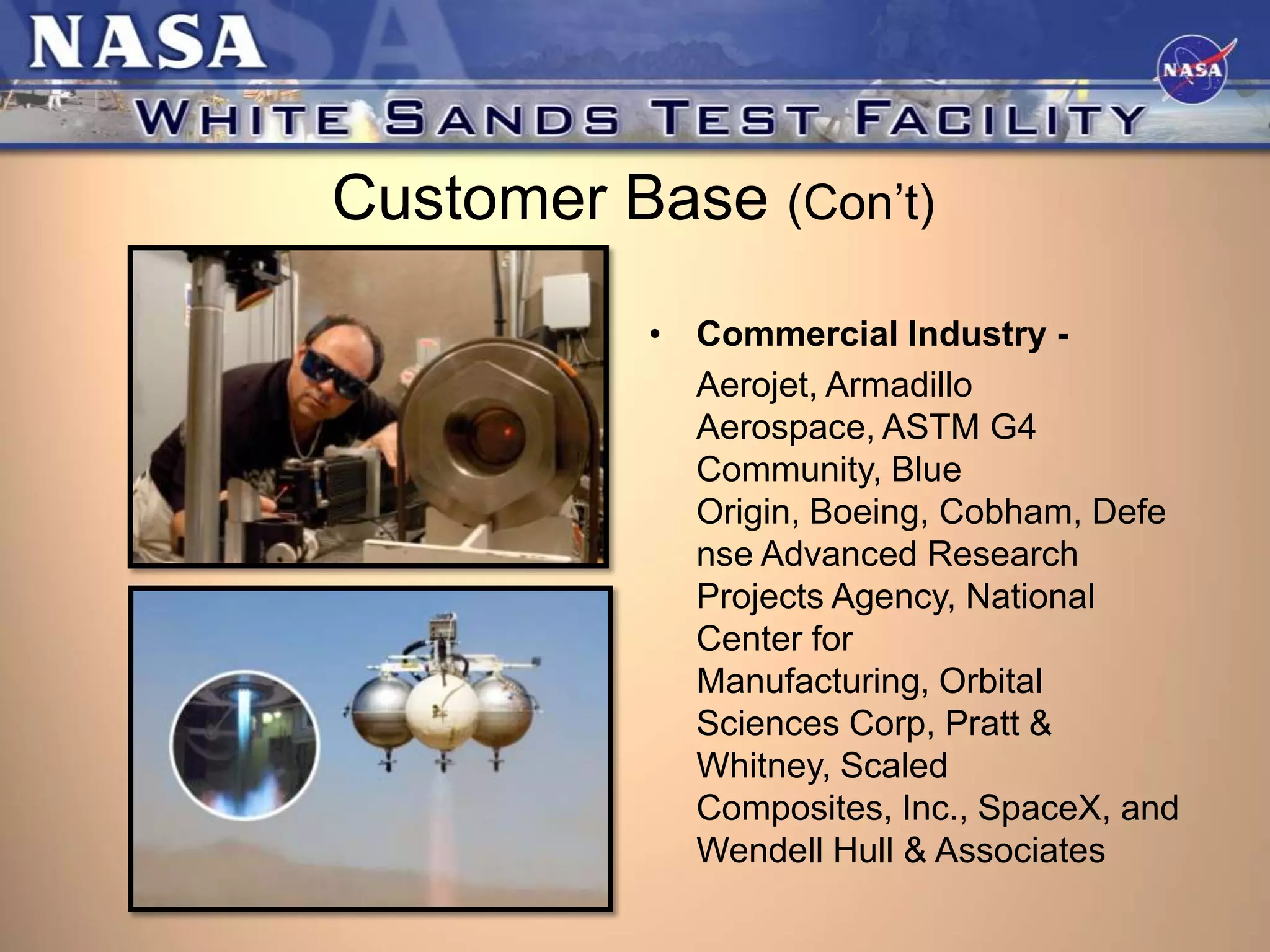
• Commercial Industry Aerojet, Armadillo
Aerospace, ASTM G4
Community, Blue
Origin, Boeing, Cobham, Defe
nse Advanced Research
Projects Agency, National
Center for
Manufacturing, Orbital
Sciences Corp, Pratt &
Whitney, Scaled
Composites, Inc., SpaceX, and
Wendell Hull & Associates
Space Shuttle Test and Evaluation
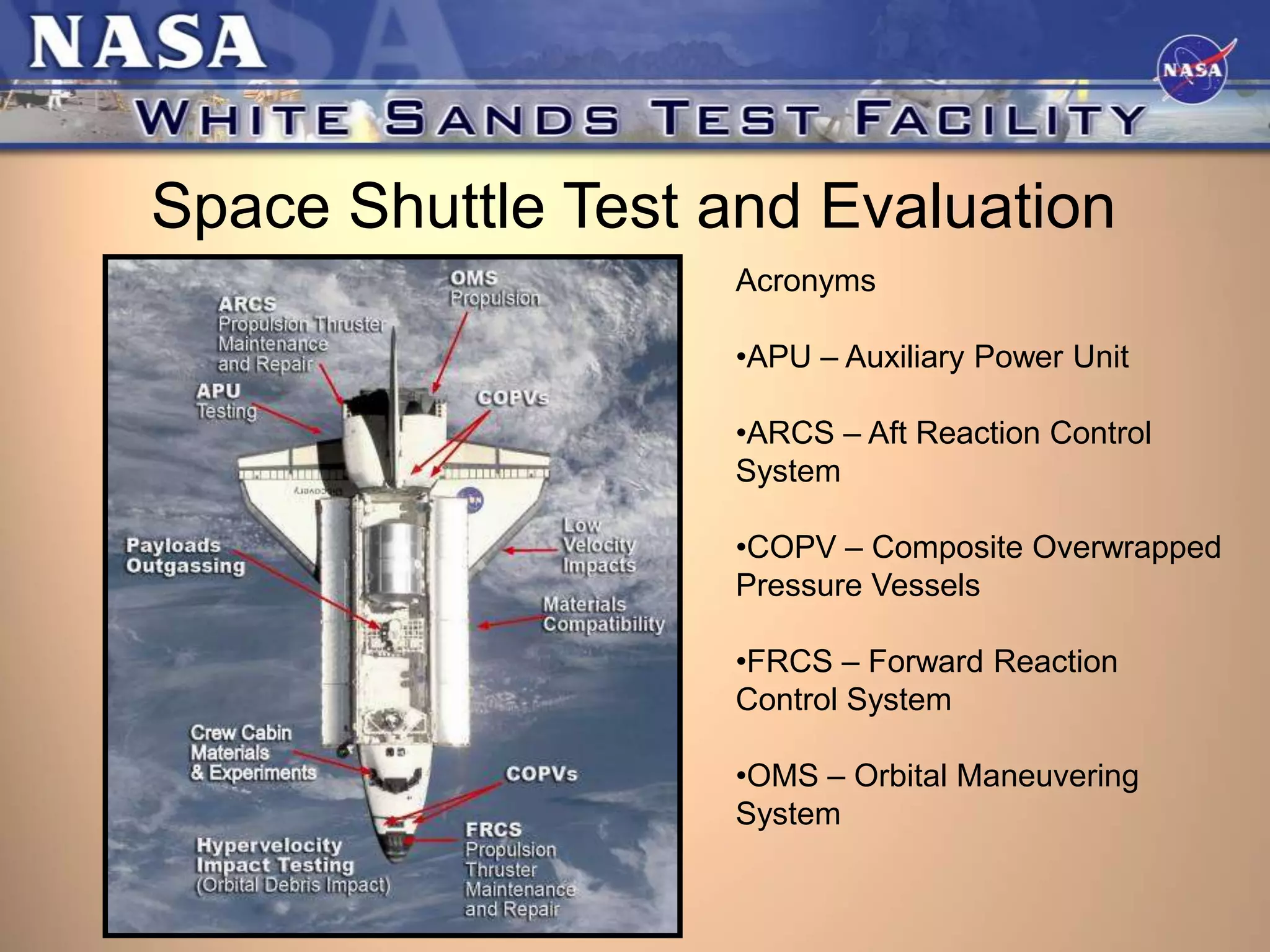
Acronyms
•APU – Auxiliary Power Unit
•ARCS – Aft Reaction Control
System

•COPV – Composite Overwrapped
Pressure Vessels
•FRCS – Forward Reaction
Control System
•OMS – Orbital Maneuvering
System
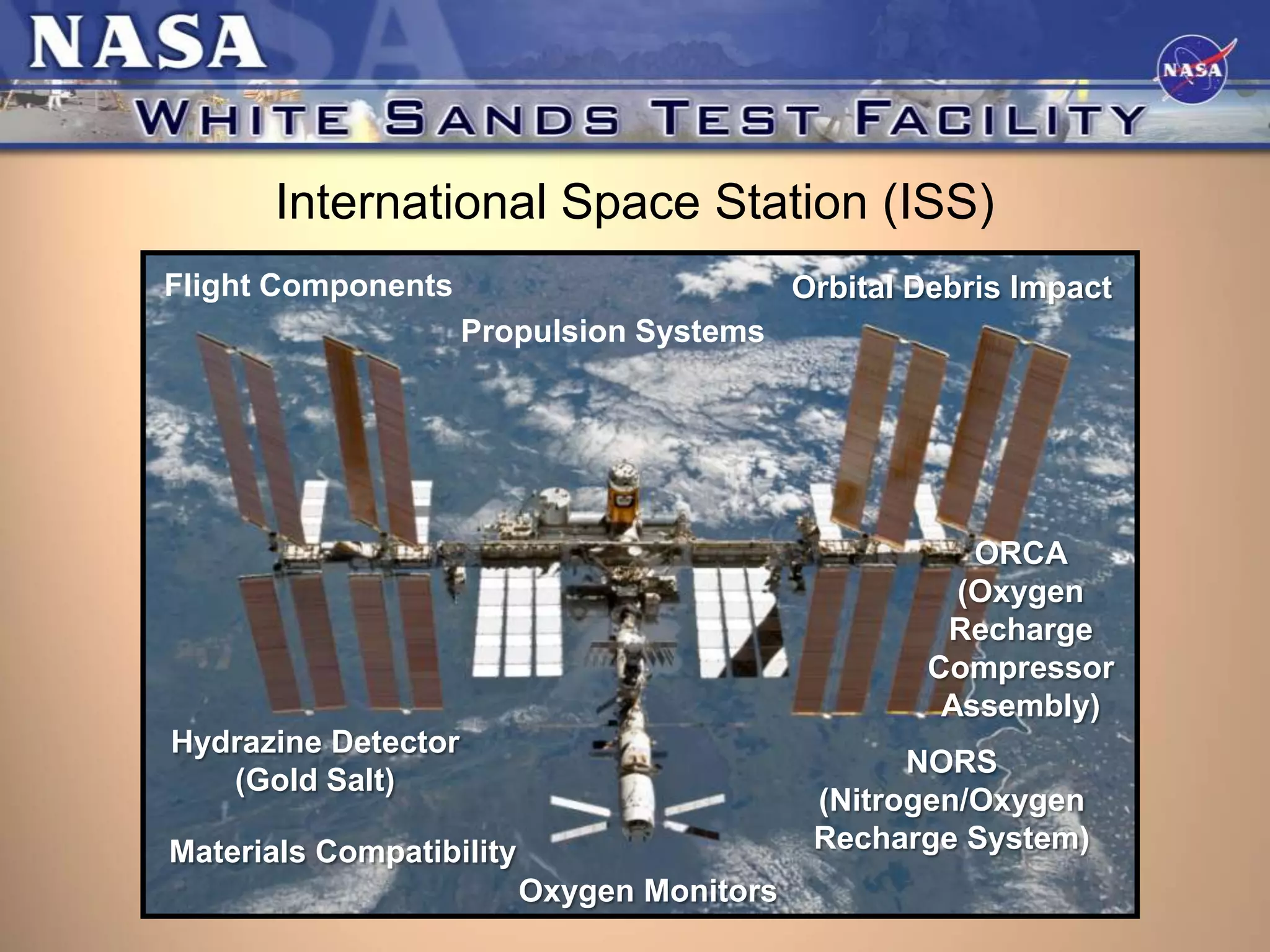
International Space Station (ISS)
Flight Components

Orbital Debris Impact
Propulsion Systems

ORCA
(Oxygen
Recharge
Compressor
Assembly)
Hydrazine Detector
(Gold Salt)

NORS
(Nitrogen/Oxygen
Recharge System)

Materials Compatibility
Oxygen Monitors
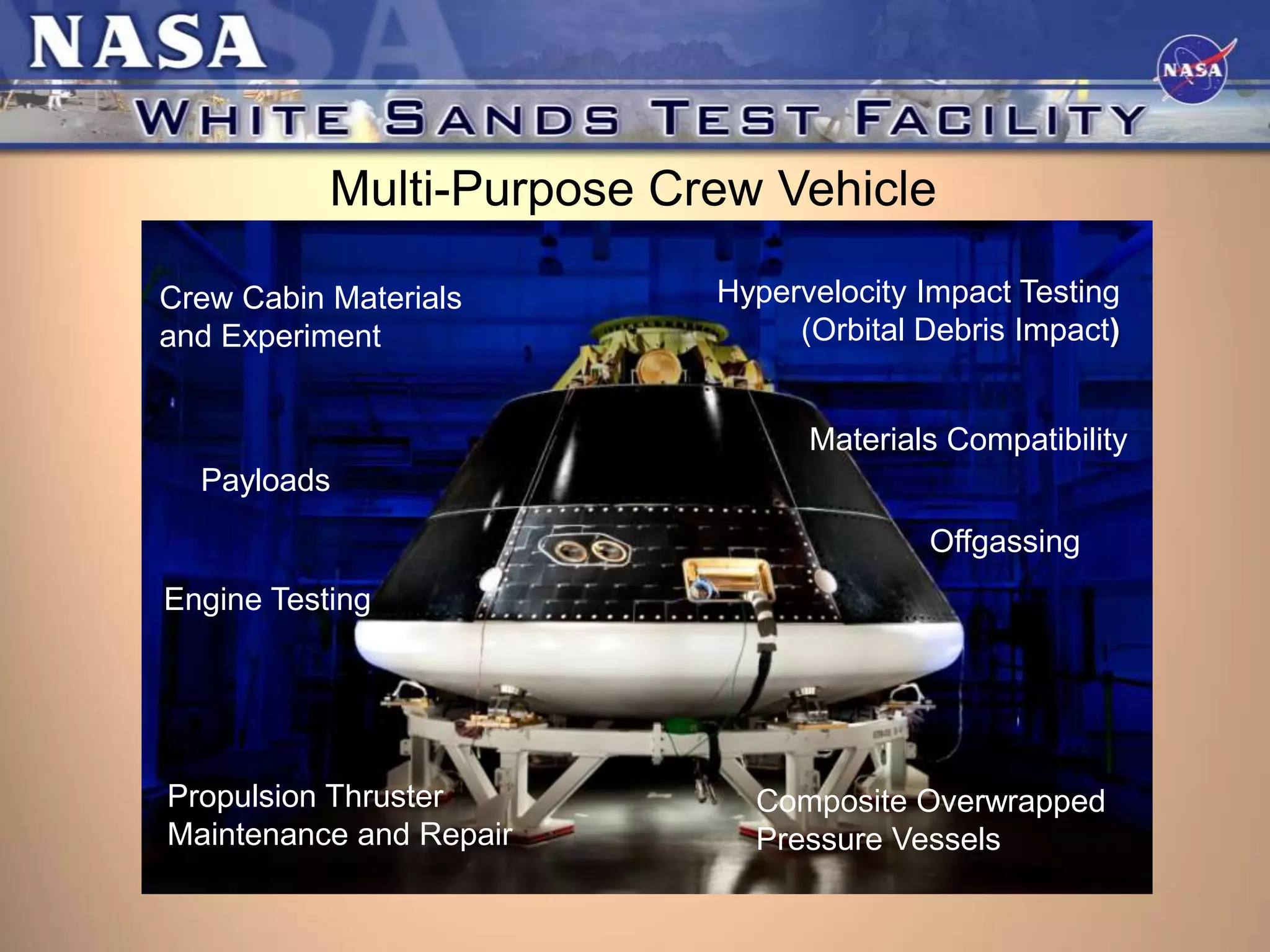
Multi-Purpose Crew Vehicle
Crew Cabin Materials
and Experiment

Hypervelocity Impact Testing
(Orbital Debris Impact)

Materials Compatibility

Payloads
Offgassing
Engine Testing

Propulsion Thruster
Maintenance and Repair

Composite Overwrapped
Pressure Vessels
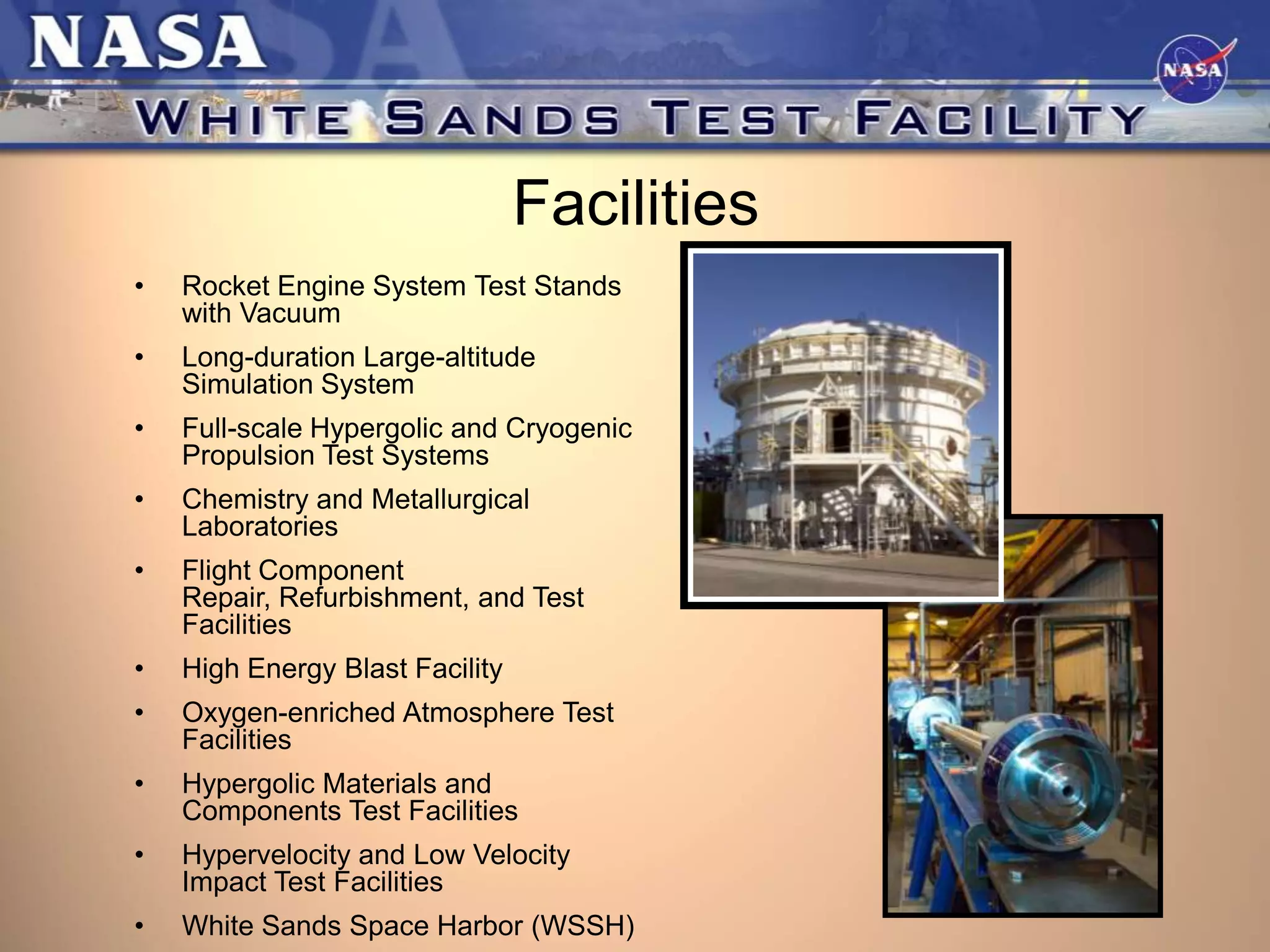
Space Launch Systems
Materials Compatibility
Engine Testing
Composite Overwrapped
Pressure Vessels

Offgassing

Payloads
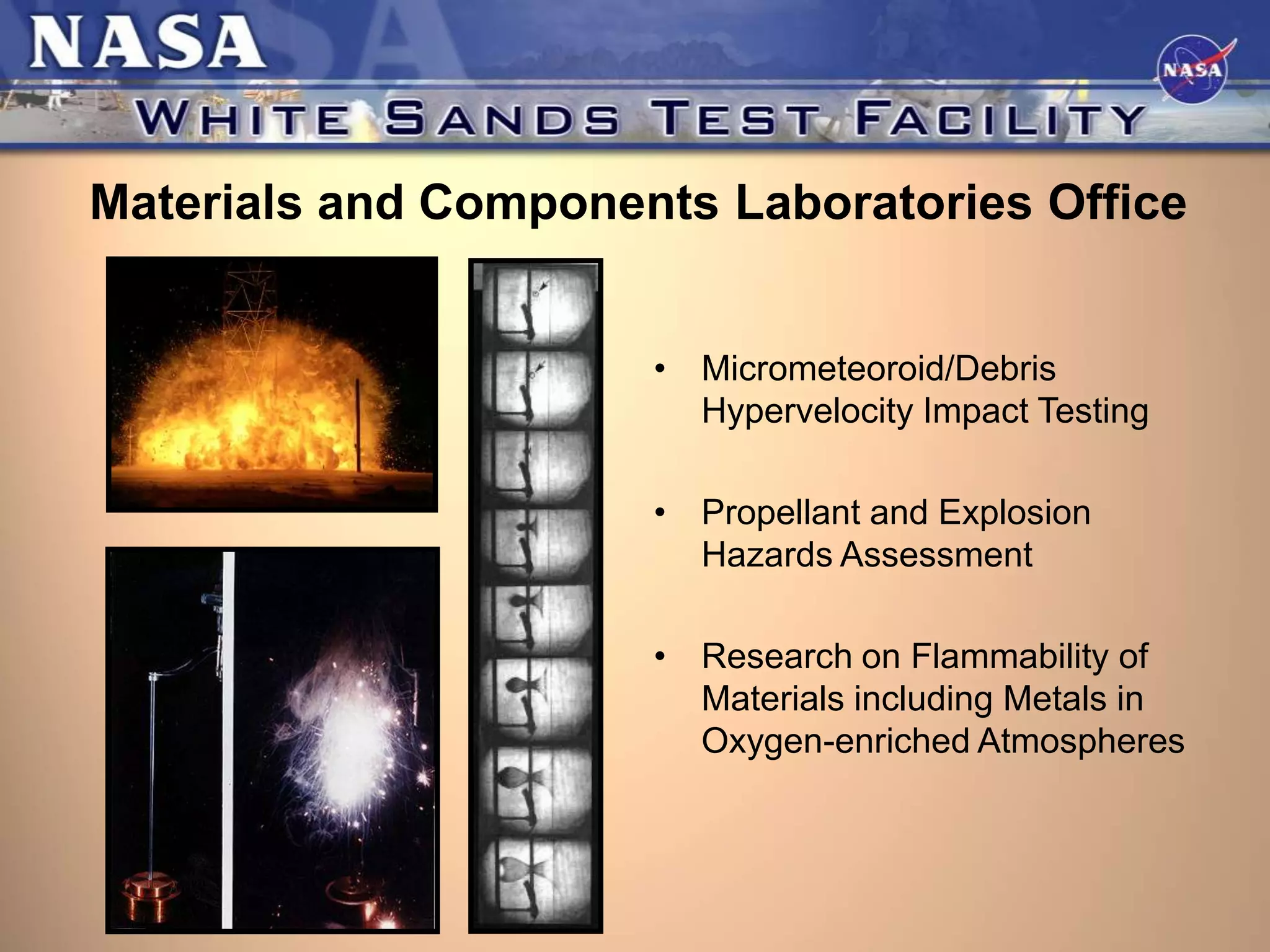
Facilities
•

Rocket Engine System Test Stands
with Vacuum

•

Long-duration Large-altitude
Simulation System

•

Full-scale Hypergolic and Cryogenic
Propulsion Test Systems

•

Chemistry and Metallurgical
Laboratories

•

Flight Component
Repair, Refurbishment, and Test
Facilities

•

High Energy Blast Facility

•

Oxygen-enriched Atmosphere Test
Facilities

•

Hypergolic Materials and
Components Test Facilities

•

Hypervelocity and Low Velocity
Impact Test Facilities

•

White Sands Space Harbor (WSSH)
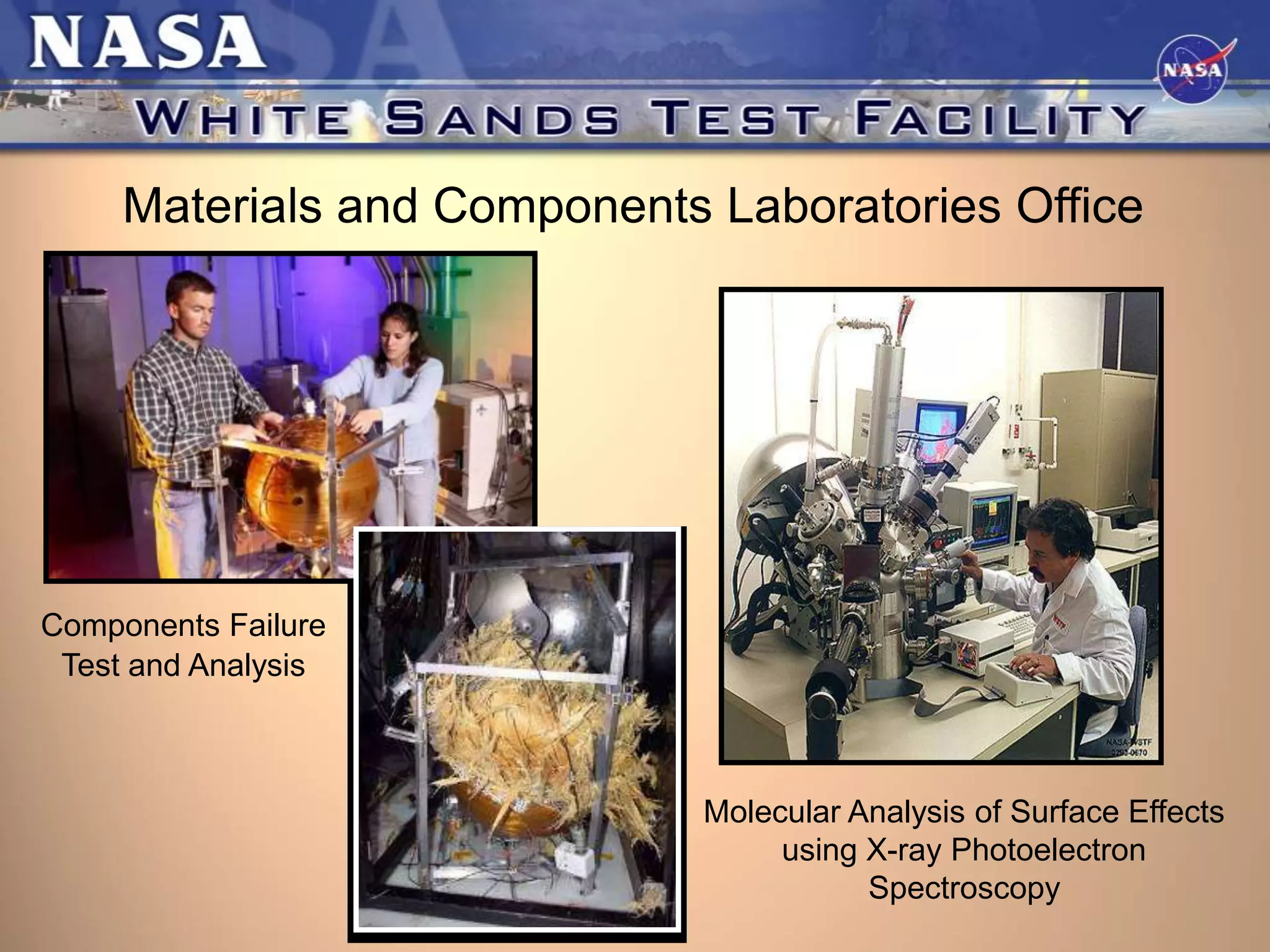
Materials and Components Laboratories Office
• Micrometeoroid/Debris
Hypervelocity Impact Testing
• Propellant and Explosion
Hazards Assessment

• Research on Flammability of
Materials including Metals in
Oxygen-enriched Atmospheres
Materials and Components Laboratories Office

Components Failure
Test and Analysis

Molecular Analysis of Surface Effects
using X-ray Photoelectron
Spectroscopy
Materials and Components Laboratories Office

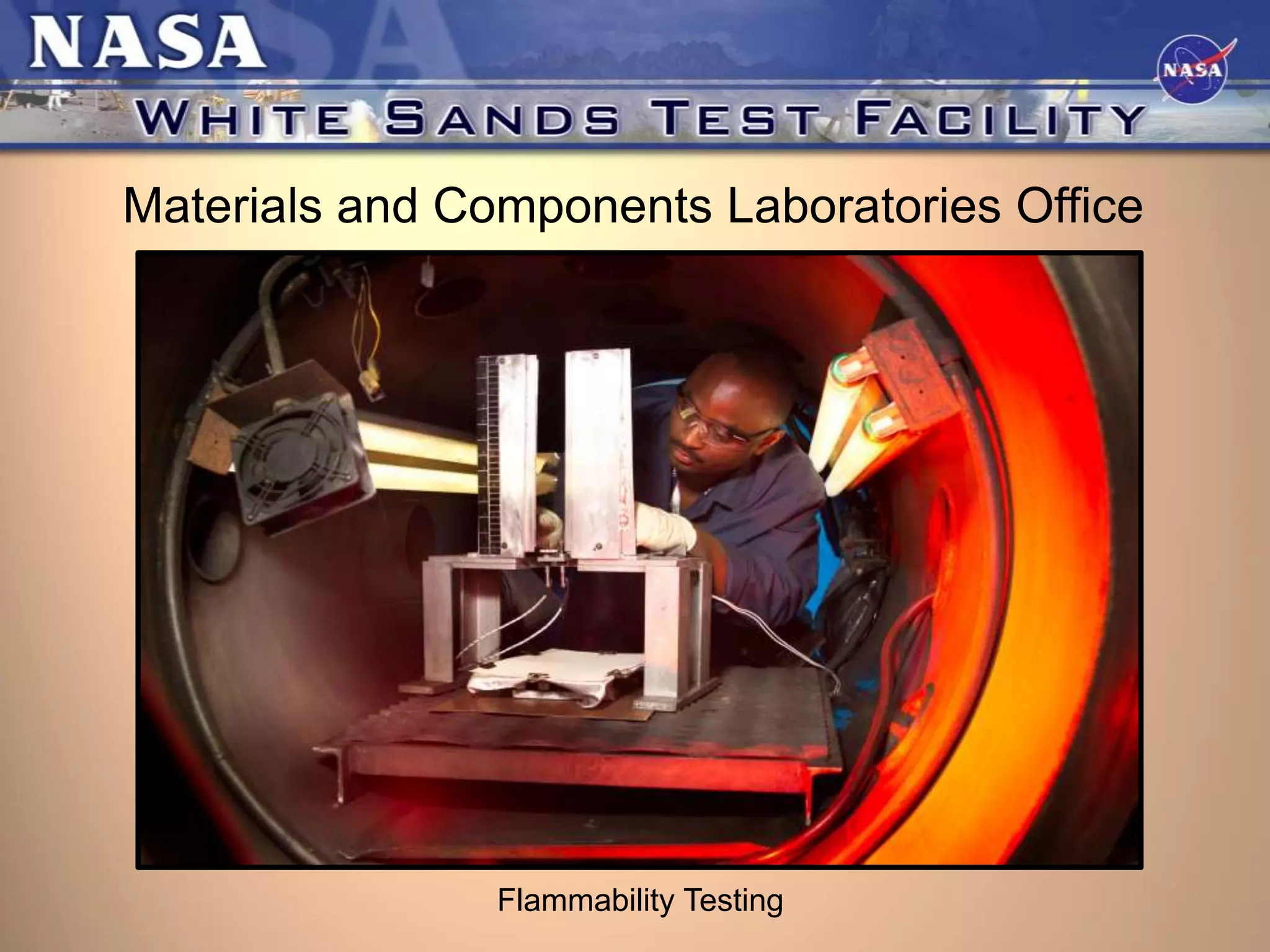
Flammability Testing
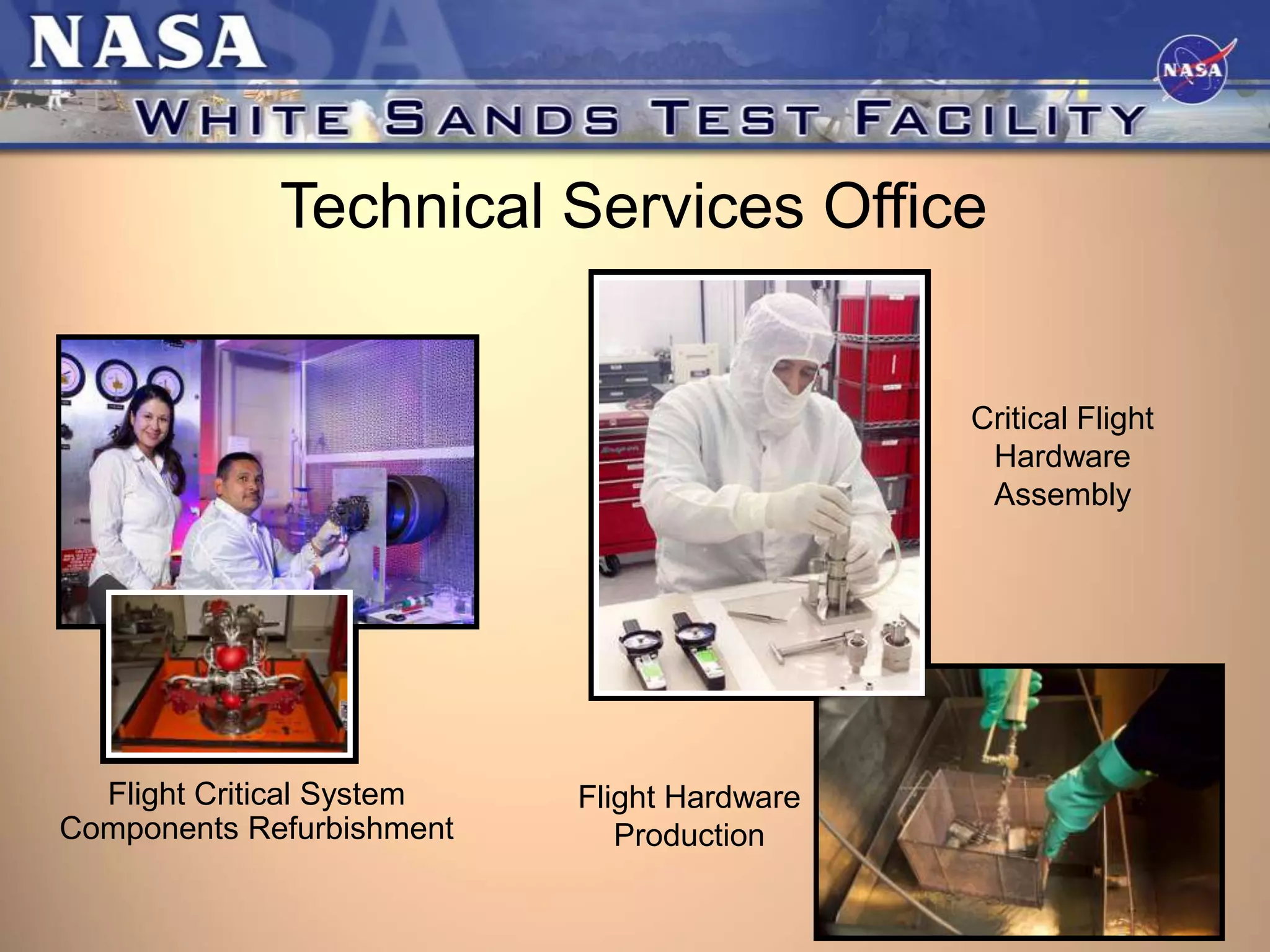
Technical Services Office

Critical Flight
Hardware
Assembly

Flight Critical System
Components Refurbishment

Flight Hardware
Production
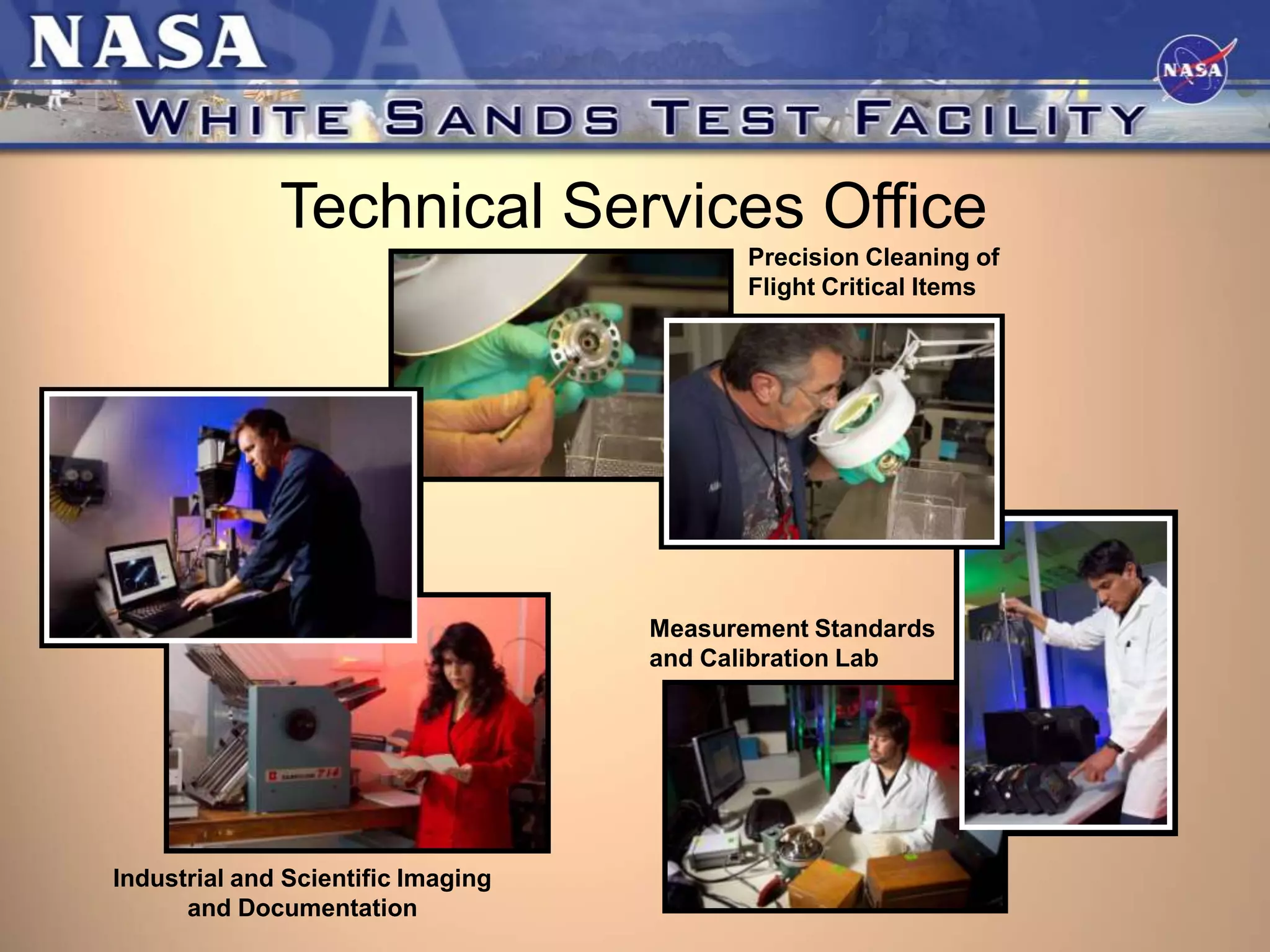
Technical Services Office
Precision Cleaning of
Flight Critical Items

Measurement Standards
and Calibration Lab

Industrial and Scientific Imaging
and Documentation
Technical Services Office

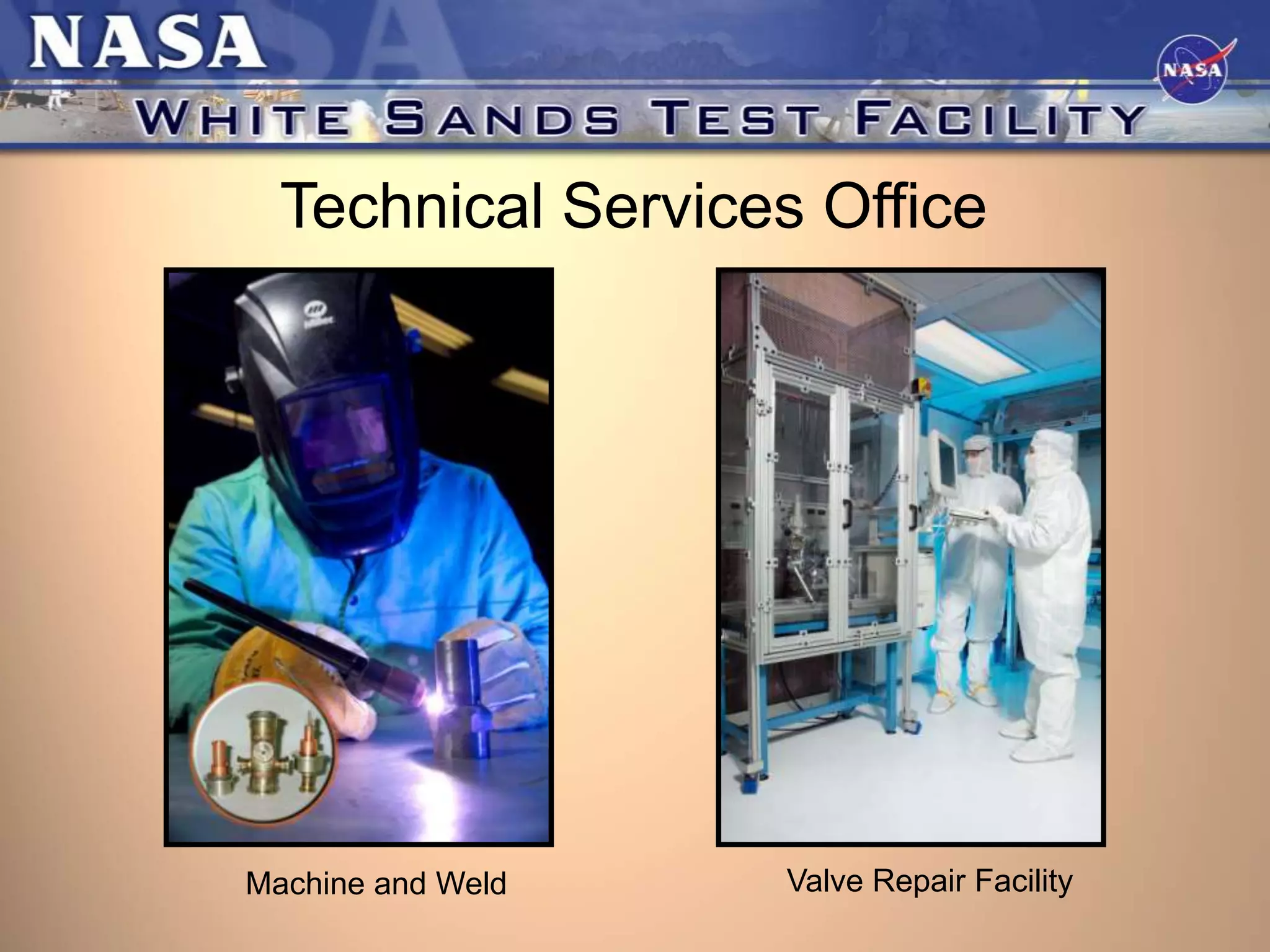
Machine and Weld

Valve Repair Facility
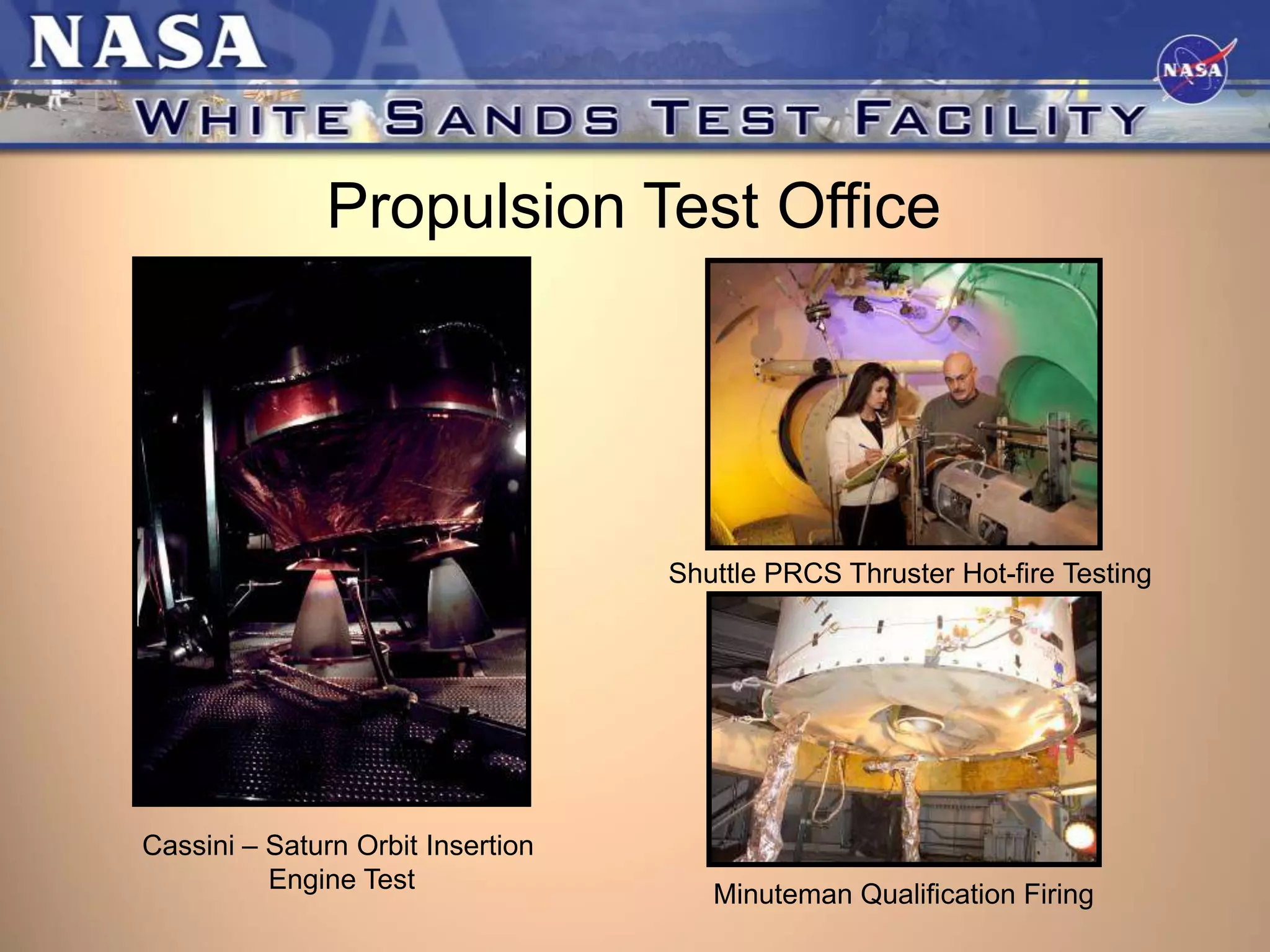
Propulsion Test Office

Shuttle PRCS Thruster Hot-fire Testing

Cassini – Saturn Orbit Insertion
Engine Test

Minuteman Qualification Firing
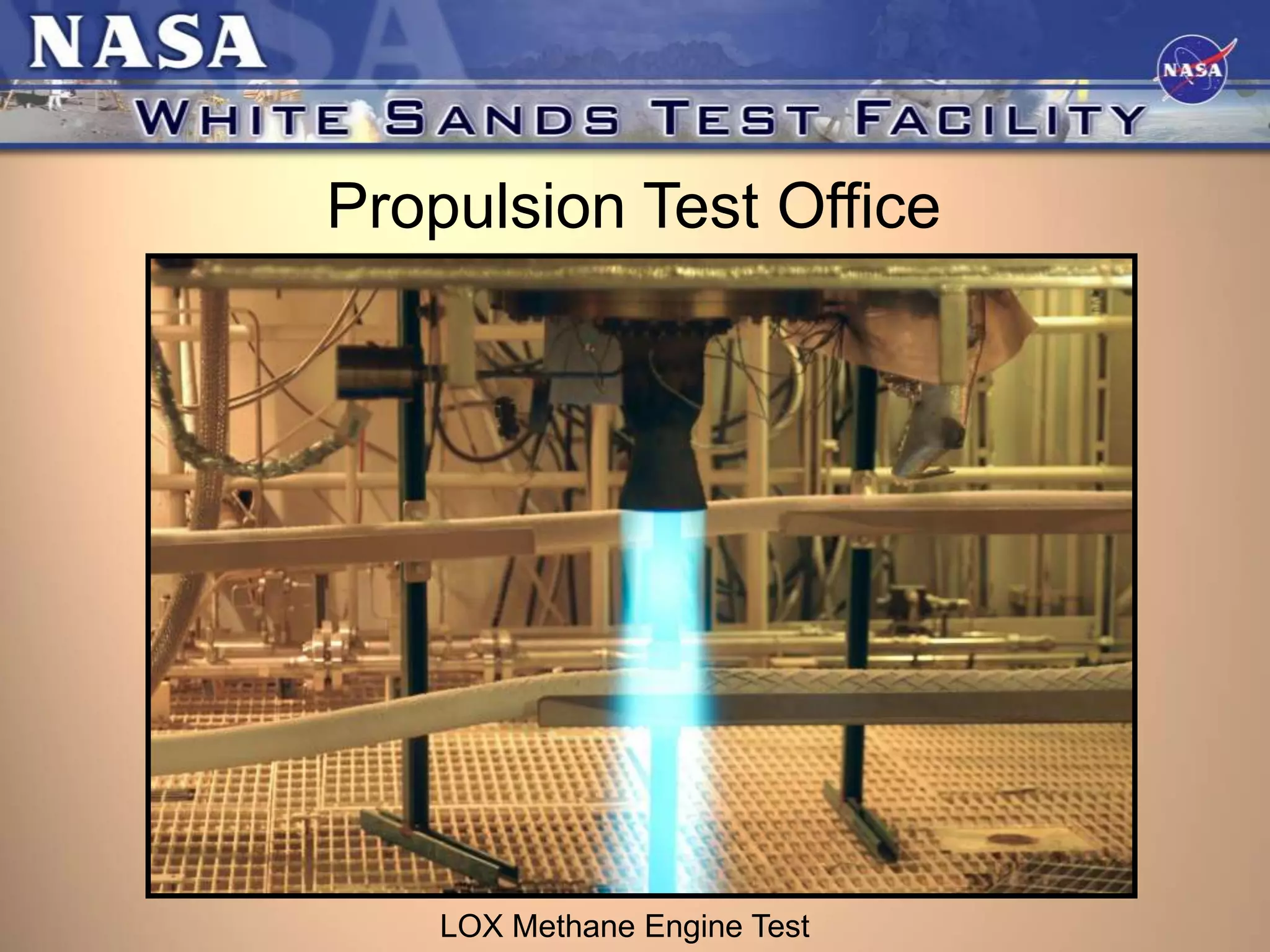
Propulsion Test Office

LOX Methane Engine Test
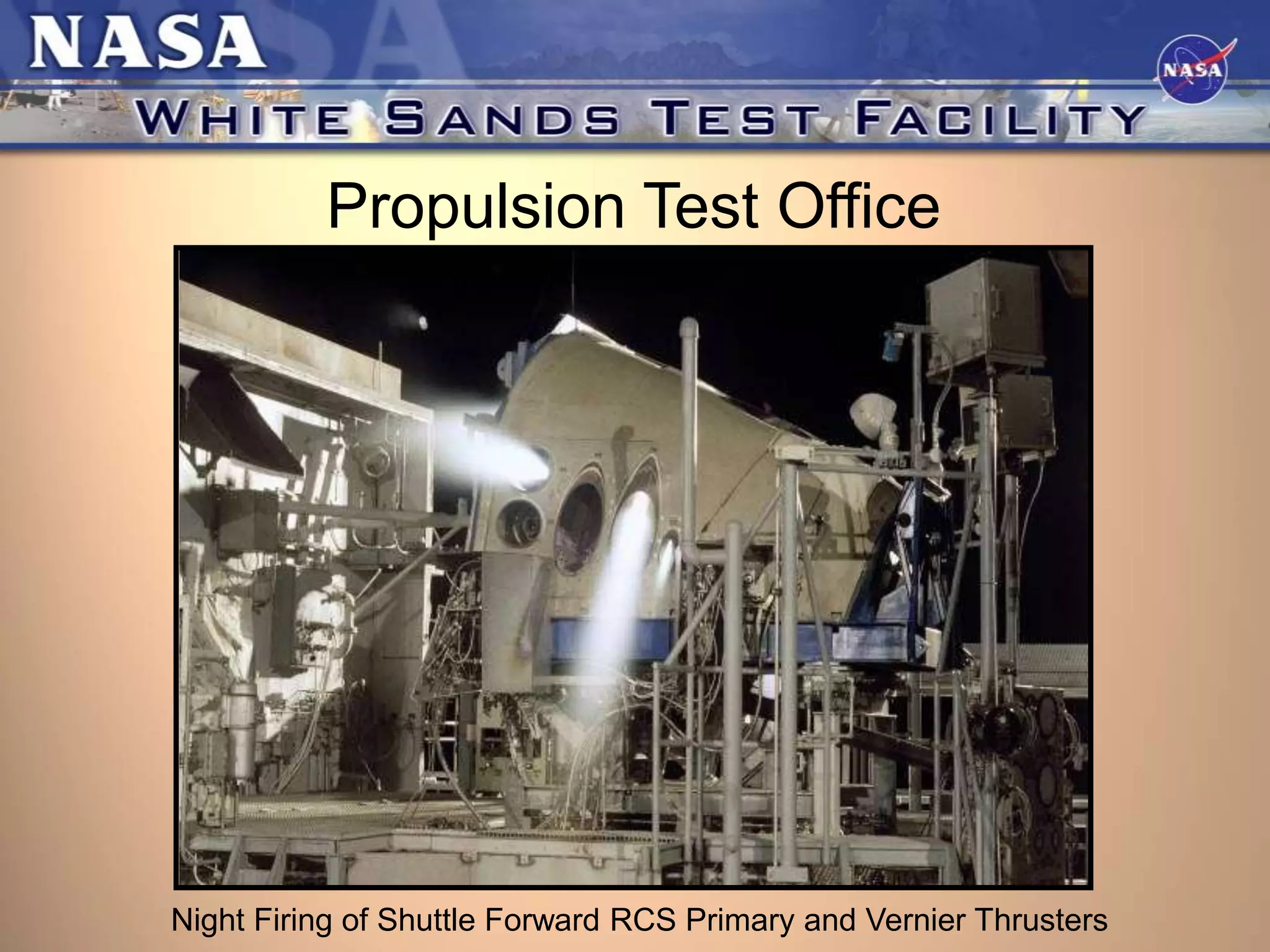
Propulsion Test Office

Night Firing of Shuttle Forward RCS Primary and Vernier Thrusters
Propulsion Test Office

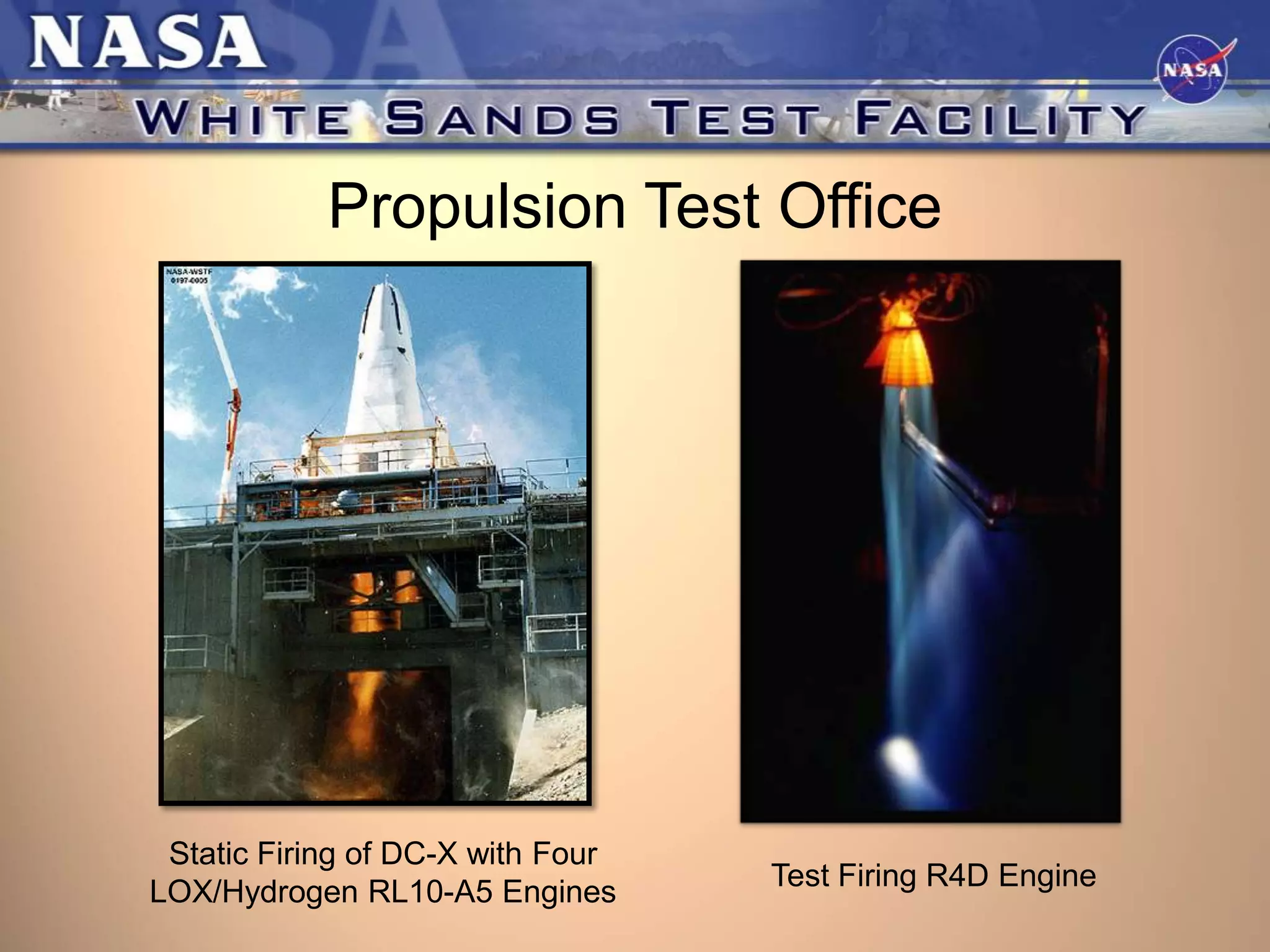
Static Firing of DC-X with Four
LOX/Hydrogen RL10-A5 Engines

Test Firing R4D Engine
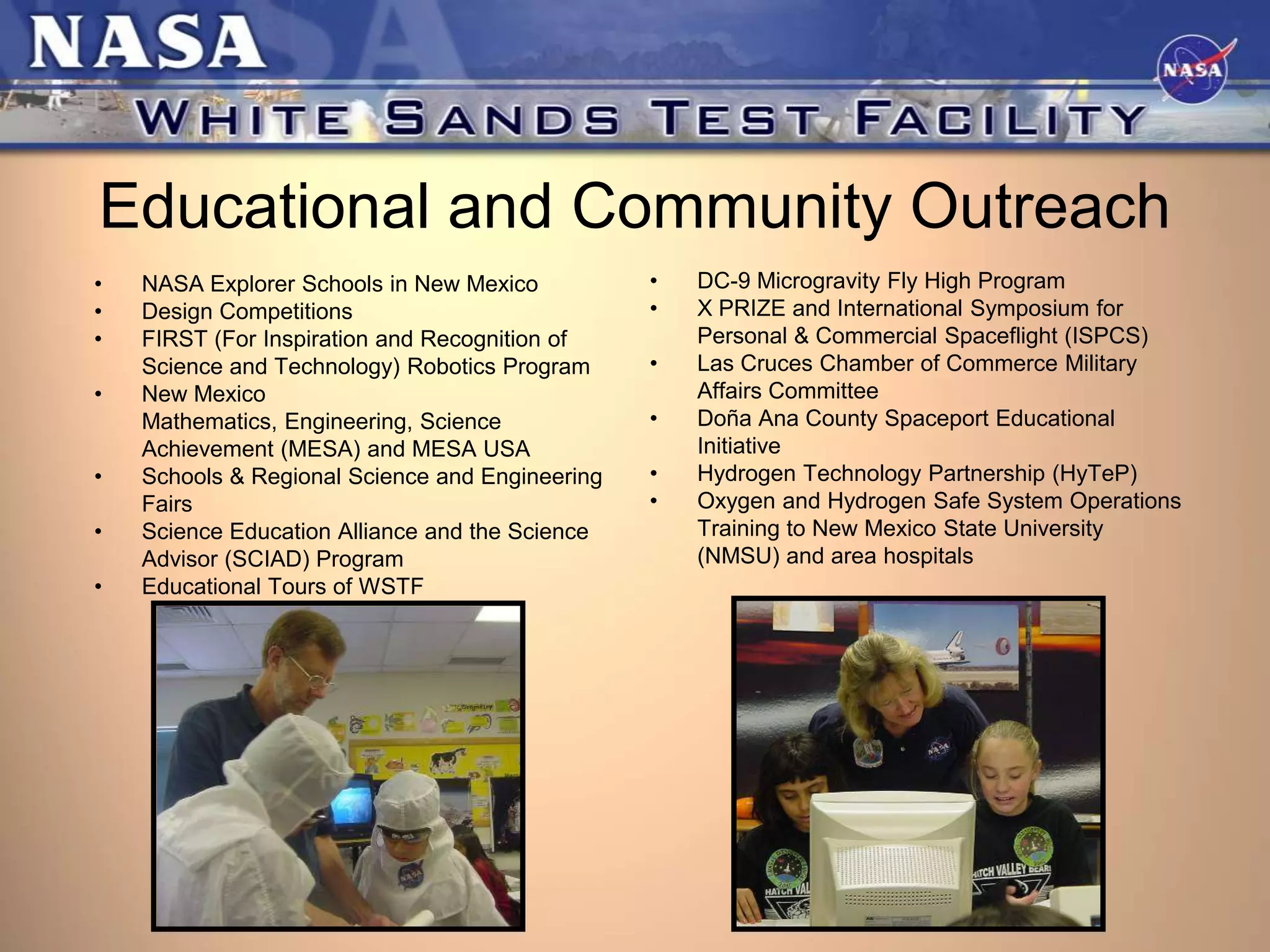
Educational and Community Outreach
•
•
•
•
•
•
•

NASA Explorer Schools in New Mexico
Design Competitions
FIRST (For Inspiration and Recognition of
Science and Technology) Robotics Program
New Mexico
Mathematics, Engineering, Science
Achievement (MESA) and MESA USA
Schools & Regional Science and Engineering
Fairs
Science Education Alliance and the Science
Advisor (SCIAD) Program
Educational Tours of WSTF

•
•
•
•
•
•

DC-9 Microgravity Fly High Program
X PRIZE and International Symposium for
Personal & Commercial Spaceflight (ISPCS)
Las Cruces Chamber of Commerce Military
Affairs Committee
Doña Ana County Spaceport Educational
Initiative
Hydrogen Technology Partnership (HyTeP)
Oxygen and Hydrogen Safe System Operations
Training to New Mexico State University
(NMSU) and area hospitals
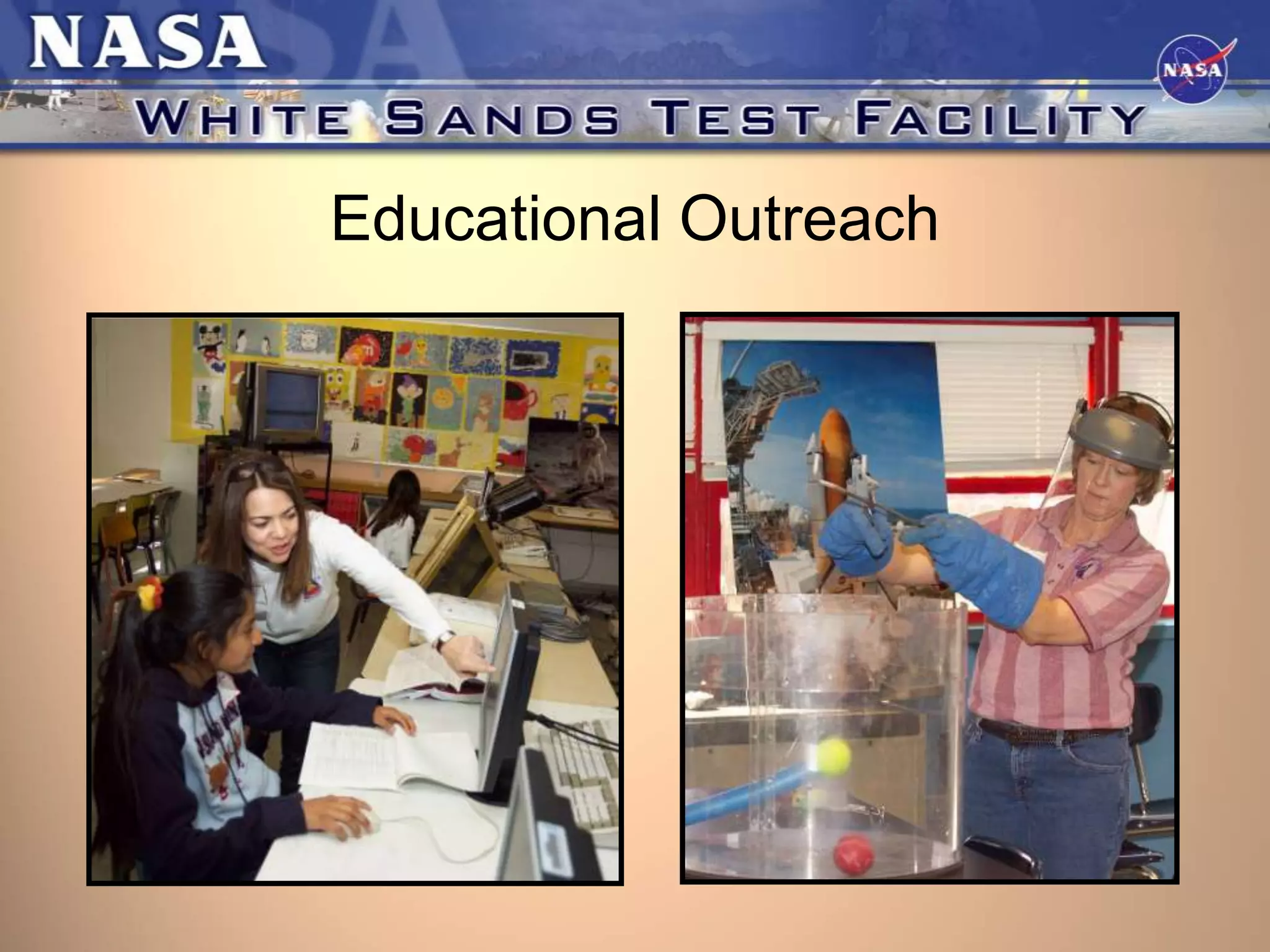
Educational Outreach

Overview of NASA JSC White Sands Test Facility (WSTF)

  • 1.
    Economic Impact ofWSTF - Fiscal Year 2011
  • 3.
    NASA Vision To reachfor new heights and reveal the unknown, so that what we do and learn will benefit all humankind.
  • 4.
    WSTF Mission Statement Ourmission is to provide the expertise and infrastructure to test and evaluate spacecraft materials, components, and propulsion systems to enable the safe exploration and use of space.
  • 5.
  • 6.
    WSTF Background • Constructed1962-64 to Support Apollo Project • Component Facility of NASA Johnson Space Center • Occupies 28 square miles of the SW Corner of White Sands Missile Range (WSMR) • Annual Budget ~$79 Million (FY10) • ~60 NASA and ~660 Contractor Personnel (FY10)
  • 7.
    WSTF Background (Con’t) •Large Buffer Zone and Controlled Remote Property for Hazardous Testing • Moderate Desert Climate Ideal for Year-round Testing • Environmental Permits in Place for Hazardous Testing
  • 8.
    Organization Chart WSTF Manager JohnP. McManamen Deputy Manager Robert M. Cort Associate Manager-Technical David L. Baker Office of Procurement (BA) Jesse Brennan – Lead Administrative Officer Patsy A. Segura Financial Management (LA) Heather M. Moncrief – Lead Information Technology (IT) James M. Krupovage NS3 Safety & Mission Assurance Alton B. Luper Chief RC Facility Engineering Office Chief, John J. Villegas Deputy – J. Todd Kaufman RD Propulsion Test Office Robert R. Kowalski Chief RE Environmental Office Radel L. Bunker-Farrah Chief RF Materials and Components Laboratories Office Chief, Harold D. Beeson RH Technical Services Office Mary A. Burke Chief
  • 9.
  • 10.
    Capabilities • Rocket Propulsion Testing andEvaluation • Oxygen Systems Testing and Analysis • Propellants and Aerospace Fluids Testing and Analysis • Hypervelocity Impact Testing • Composite Pressure Systems Testing and Analysis
  • 11.
    Propellant Testing Titanium AlloyBurning in 8 psia Oxygen
  • 12.
  • 13.
    STS-35 Space Shuttlewindow pit from orbital debris impact Hypervelocity Impact Test Laboratory
  • 14.
  • 15.
  • 16.
    Customer Base • JohnsonSpace Center International Space Station, Payloads, Crew Training, and Special Projects • NASA Headquarters and Other Field Centers – MPCV, SLS • Other US Government Agencies - ADFSW, Army, EPA, DOD, DOE,D OT (National Highway Traffic Safety & Federal Aviation Administrations), Navy Research Lab, USAF, VAFB
  • 17.
    Customer Base (Con’t) •Commercial Industry Aerojet, Armadillo Aerospace, ASTM G4 Community, Blue Origin, Boeing, Cobham, Defe nse Advanced Research Projects Agency, National Center for Manufacturing, Orbital Sciences Corp, Pratt & Whitney, Scaled Composites, Inc., SpaceX, and Wendell Hull & Associates
  • 18.
    Space Shuttle Testand Evaluation Acronyms •APU – Auxiliary Power Unit •ARCS – Aft Reaction Control System •COPV – Composite Overwrapped Pressure Vessels •FRCS – Forward Reaction Control System •OMS – Orbital Maneuvering System
  • 19.
    International Space Station(ISS) Flight Components Orbital Debris Impact Propulsion Systems ORCA (Oxygen Recharge Compressor Assembly) Hydrazine Detector (Gold Salt) NORS (Nitrogen/Oxygen Recharge System) Materials Compatibility Oxygen Monitors
  • 20.
    Multi-Purpose Crew Vehicle CrewCabin Materials and Experiment Hypervelocity Impact Testing (Orbital Debris Impact) Materials Compatibility Payloads Offgassing Engine Testing Propulsion Thruster Maintenance and Repair Composite Overwrapped Pressure Vessels
  • 21.
    Space Launch Systems MaterialsCompatibility Engine Testing Composite Overwrapped Pressure Vessels Offgassing Payloads
  • 22.
    Facilities • Rocket Engine SystemTest Stands with Vacuum • Long-duration Large-altitude Simulation System • Full-scale Hypergolic and Cryogenic Propulsion Test Systems • Chemistry and Metallurgical Laboratories • Flight Component Repair, Refurbishment, and Test Facilities • High Energy Blast Facility • Oxygen-enriched Atmosphere Test Facilities • Hypergolic Materials and Components Test Facilities • Hypervelocity and Low Velocity Impact Test Facilities • White Sands Space Harbor (WSSH)
  • 23.
    Materials and ComponentsLaboratories Office • Micrometeoroid/Debris Hypervelocity Impact Testing • Propellant and Explosion Hazards Assessment • Research on Flammability of Materials including Metals in Oxygen-enriched Atmospheres
  • 24.
    Materials and ComponentsLaboratories Office Components Failure Test and Analysis Molecular Analysis of Surface Effects using X-ray Photoelectron Spectroscopy
  • 26.
    Materials and ComponentsLaboratories Office Flammability Testing
  • 27.
    Technical Services Office CriticalFlight Hardware Assembly Flight Critical System Components Refurbishment Flight Hardware Production
  • 28.
    Technical Services Office PrecisionCleaning of Flight Critical Items Measurement Standards and Calibration Lab Industrial and Scientific Imaging and Documentation
  • 29.
    Technical Services Office Machineand Weld Valve Repair Facility
  • 30.
    Propulsion Test Office ShuttlePRCS Thruster Hot-fire Testing Cassini – Saturn Orbit Insertion Engine Test Minuteman Qualification Firing
  • 31.
    Propulsion Test Office LOXMethane Engine Test
  • 32.
    Propulsion Test Office NightFiring of Shuttle Forward RCS Primary and Vernier Thrusters
  • 33.
    Propulsion Test Office StaticFiring of DC-X with Four LOX/Hydrogen RL10-A5 Engines Test Firing R4D Engine
  • 34.
    Educational and CommunityOutreach • • • • • • • NASA Explorer Schools in New Mexico Design Competitions FIRST (For Inspiration and Recognition of Science and Technology) Robotics Program New Mexico Mathematics, Engineering, Science Achievement (MESA) and MESA USA Schools & Regional Science and Engineering Fairs Science Education Alliance and the Science Advisor (SCIAD) Program Educational Tours of WSTF • • • • • • DC-9 Microgravity Fly High Program X PRIZE and International Symposium for Personal & Commercial Spaceflight (ISPCS) Las Cruces Chamber of Commerce Military Affairs Committee Doña Ana County Spaceport Educational Initiative Hydrogen Technology Partnership (HyTeP) Oxygen and Hydrogen Safe System Operations Training to New Mexico State University (NMSU) and area hospitals
  • 35.

Editor's Notes

  • #3 Star 48
  • #7 On July 6, 1962, NASA Headquarters announced the site selection for the Johnson Space Center (JSC) Propulsion Systems Development Facility, primarily to serve the Apollo Program. The name of the site was changed to White Sands Operations and again in June 1965 to White Sands Test Facility. Site planning activities began in August 1962, and actual construction began in May 1963 with construction of the access road from U. S. Highway 70. Design and construction for the original scope of the site proceeded through 1964 at a cost of $6.57 million. In the mid-1960’s, at the peak of the Apollo era, WSTF employed over 1,700 people. In 1970 WSTF faced closure, but because of environmental advantages, existing unique test facilities, and buffer zones, it was revitalized to perform hazardous tests for the Space Shuttle. Additional Construction for the Space Shuttle program began in 1974.
  • #10 Explosion from 2000 lb mixture of liquid H2 & liquid O2Vertical Impact Test Explosive blasts equivalent to 500 lb TNT250 ft drop towerTests 1 to 300 lb TNT, C4, or pentolite150 lb monomethylhydrazine/LO2LOX/RP-1Hydrogen peroxide/Jet A (Jet-A is commercial aviation fuel. Very close to kerosene.)100-450 lb solid propellantOne STAR 48B4430 lb solid propellant
  • #11 (300, 400 Areas) Rocket Propulsion Testing and Evaluation(200 Area) Oxygen Systems Testing and AnalysisPropellants and Aerospace Fluids Testing and Analysis(270)Hypervelocity Impact Testing(800 Area) Composite Pressure Systems Testing and Analysis
  • #12 STAR 48High pressure oxygen poses a fire hazardMir Space StationAircraftLife supportMedical applicationsMust be assessed and mitigated to ensure personnel safety
  • #13 Standard Materials Testing – Propellant Characterization
  • #16 Oxygen Systems: Operation & MaintenanceFire Hazards in Oxygen SystemsCOPV Damage Detection CourseComposite Pressure Systems and Structure NDEHydrogen TrainingHypergolic Propellants TrainingStandard Testing Class
  • #17 Air Force Support:Peacekeeper 4th Stage DemilitarizationMinuteman Upper Stage Life TestsMobile Oxygen Storage Tanks (Past)Vandenberg Air Force Base
  • #18 Armadillo Aerospace Pixel with inset photo of actual WSTF Armadillo Aerospace Main Engine Firing (4/10/2009)----
  • #19 WSSHOMS POD Decon
  • #30 VR Shop certified to work on Code relief valves
  • #31 TS 401 3 hr 20 min continuous firing (Cassini)TS 401 Vacuum Test Cell (Minuteman)
  • #34 Vertical take off and landing executed at WSMR May 21, 1996ODES TS 401Operation and Deployment Experiments Simulator