WSO2 Microservices Framework for Java 2.0.0
Overview
Agenda
•  Introduction
•  Core Features
•  Performance
•  Deployment
2	
  
Introduction
3	
  
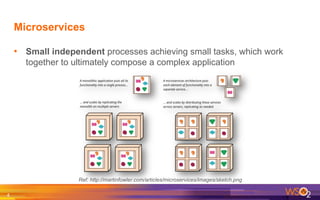
Microservices
•  Small independent processes achieving small tasks, which work
together to ultimately compose a complex application
4	
  
Ref: http://martinfowler.com/articles/microservices/images/sketch.png
Microservices Architecture
•  Modular and composable
•  Easy to maintain - Components can be easily replaced and bugs in
one component can be fixed without affecting others
•  Highly scalable
•  Easy deployment
5	
  
WSO2 Microservices Framework for Java
•  A lightweight, high performance framework for building
microservices in Java
•  Simple Java based programming model with JAX-RS and Swagger
based annotations
•  Fast boot up - microservices can be booted in a few milliseconds in
a Docker container and can be easily added to a Docker image
•  Secures microservices leveraging JWT, BasicAuth and OAuth2 and
has the capability to integrate with third-party authentication servers
•  Monitors microservices service behavior with analytics dashboards
6	
  
Vision of WSO2 MSF4J
•  Lightweight and fast runtime
•  Use Java annotations as a way of defining microservices APIs as
well as met
•  Provide simple ways to develop and deploy microservices
•  Built-in metrics and analytics APIs with OOB integration with WSO2
Data Analytics Server (WSO2 DAS)
•  To be used in the WSO2 platform as a way of replacing all admin
services as well as defining other microservices for inter-component
interactions
7	
  
Implementation of WSO2 MSF4J
•  Based on the new WSO2 Carbon 5.0 Kernel
•  Transport is based on Netty 4.0
•  Supports streaming
•  High performance
•  9MB pack size
•  Starts within 300 ms
•  Less than 25 MB memory consumption for the framework
8	
  
Core Features
9	
  
Annotation-based Programming Model
•  Supports JAX-RS based annotations
•  Class-level annotations
•  Method-level annotations
•  Parameter-level annotations
•  Lifecycle callback method annotations
•  Supports Swagger based annotations
•  Enables generating Swagger API definition from a single API call
•  Humans and computers can discover and understand the capabilities of
each service
10	
  
Spring-based Microservices
•  WSO2 MSF4J Supports a Spring-native development model with
•  Dependency Injection (DI)
•  Standard configuration annotations (e.g. @Configuration,
@Component, @AutoWired)
•  Makes it easy to bring in other 3rd party libraries & wire them in at
runtime
•  For example those who are familiar with Spring-JPA can use the
Spring-JPA library to integrate the Hibernate ORM framework with
an WSO2 MSF4J service
11	
  
Server-less Execution
•  Supports server-less execution with fat JAR
•  Fat JAR is a JAR file with all dependencies in one fat (uber) JAR
•  Creating a fat JAR and running it in a Java process is referred to as
server-less execution
•  Server-less execution does not involve unzipping a file and helps to
start an app without a shell script
•  Supports service lifecycle methods
•  Easy to run within a container-friendly model
12	
  
Streaming
•  WSO2 MSF4J adopts an efficient model to handle Streaming Input
(request messages) and Streaming Output (response messages)
•  Streaming Input - HTTP chunked requests can be handled in two ways:
•  Zero-copy method – Each chunk of a request is treated separately
•  chunk() method is called when requests arrive
•  finished () method is called after the last chunk arrives
•  error () method called if an error occurs while processing the request
•  Chunk aggregation – Aggregates all chunks of the request and presents it as
a full http request to the resource method
•  Streaming Output – Useful when handling large data volumes – no need
to load into memory
13	
  
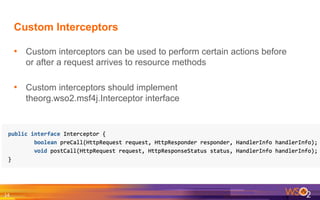
Custom Interceptors
•  Custom interceptors can be used to perform certain actions before
or after a request arrives to resource methods
•  Custom interceptors should implement
theorg.wso2.msf4j.Interceptor interface
14	
  
File Handling
•  Serve files from the resource methods by returning either of the
following
•  java.io.File
•  java.io.InputStream
•  javax.ws.rs.core.Response object with a java.io.File
•  java.io.InputStream entity
•  Streaming is supported by default for java.io.File and
java.io.InputStream entities
•  javax.ws.rs.core.StreamingOutput is also supported by WSO2
MSF4J - provides the service author more control over the chunk
size
15	
  
Templates
•  Enables dynamic Web pages to be easily developed as
microservices
•  Any data model can be easily rendered with a template and
exposed as a REST service using this concept
16	
  
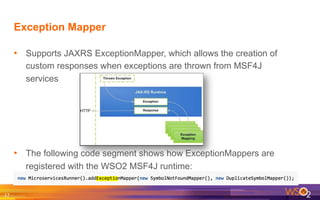
Exception Mapper
•  Supports JAXRS ExceptionMapper, which allows the creation of
custom responses when exceptions are thrown from MSF4J
services
•  The following code segment shows how ExceptionMappers are
registered with the WSO2 MSF4J runtime:
17	
  
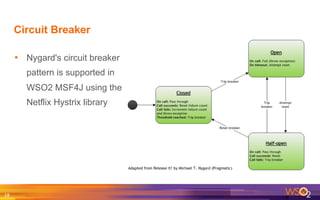
Circuit Breaker
•  Nygard's circuit breaker
pattern is supported in
WSO2 MSF4J using the
Netflix Hystrix library
18	
  
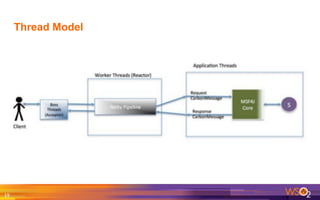
Thread Model
19	
  
Security
•  Security is done via a central server issuing JWT tokens
•  The JWTSecurityInterceptor verifies the signature, expiry and claims
in the token
20	
  
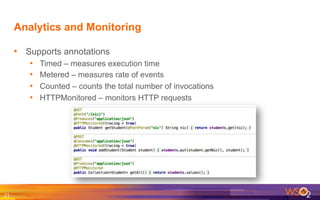
Analytics and Monitoring
•  Supports annotations
•  Timed – measures execution time
•  Metered – measures rate of events
•  Counted – counts the total number of invocations
•  HTTPMonitored – monitors HTTP requests
21	
  
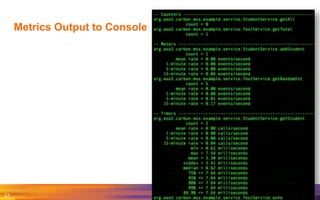
Metrics Output to Console
22	
  
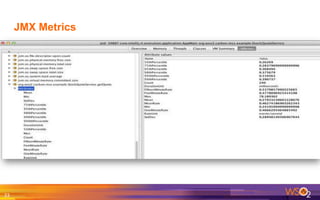
JMX Metrics
23	
  
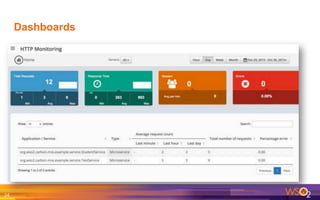
Dashboards
24	
  
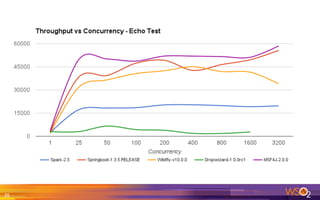
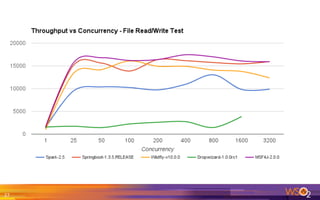
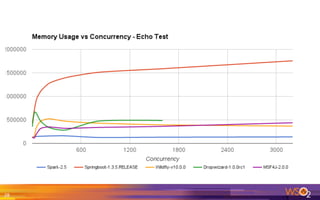
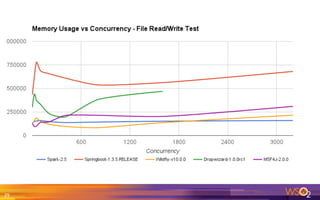
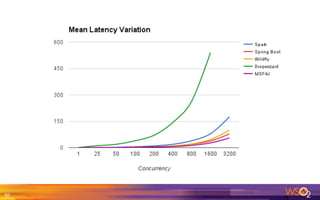
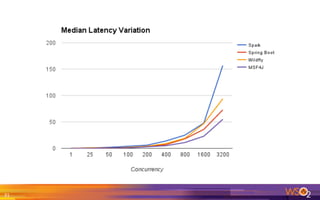
Performance
25	
  
26	
  
27	
  
28	
  
29	
  
30	
  
31	
  
Deployment
32	
  
33	
  
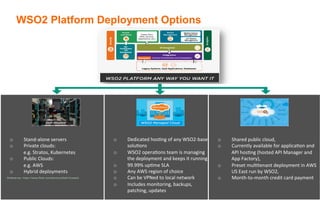
WSO2 Platform Deployment Options
o  Stand-­‐alone	
  servers	
  
o  Private	
  clouds:	
  	
  
e.g.	
  Stratos,	
  Kubernetes	
  
o  Public	
  Clouds:	
  	
  
e.g.	
  AWS	
  
o  Hybrid	
  deployments	
  	
  
o  Dedicated	
  hosKng	
  of	
  any	
  WSO2-­‐based	
  
soluKons	
  
o  WSO2	
  operaKons	
  team	
  is	
  managing	
  
the	
  deployment	
  and	
  keeps	
  it	
  running	
  
o  99.99%	
  upKme	
  SLA	
  
o  Any	
  AWS	
  region	
  of	
  choice	
  
o  Can	
  be	
  VPNed	
  to	
  local	
  network	
  
o  Includes	
  monitoring,	
  backups,	
  
patching,	
  updates	
  
o  Shared	
  public	
  cloud,	
  
o  Currently	
  available	
  for	
  applicaKon	
  and	
  
API	
  hosKng	
  (hosted	
  API	
  Manager	
  and	
  
App	
  Factory),	
  
o  Preset	
  mulKtenant	
  deployment	
  in	
  AWS	
  
US	
  East	
  run	
  by	
  WSO2,	
  
o  Month-­‐to-­‐month	
  credit	
  card	
  payment	
  	
  
CONTACT US !

WSO2 Microservices Framework for Java - Product Overview

  • 1.
    WSO2 Microservices Frameworkfor Java 2.0.0 Overview
  • 2.
    Agenda •  Introduction •  CoreFeatures •  Performance •  Deployment 2  
  • 3.
  • 4.
    Microservices •  Small independentprocesses achieving small tasks, which work together to ultimately compose a complex application 4   Ref: http://martinfowler.com/articles/microservices/images/sketch.png
  • 5.
    Microservices Architecture •  Modularand composable •  Easy to maintain - Components can be easily replaced and bugs in one component can be fixed without affecting others •  Highly scalable •  Easy deployment 5  
  • 6.
    WSO2 Microservices Frameworkfor Java •  A lightweight, high performance framework for building microservices in Java •  Simple Java based programming model with JAX-RS and Swagger based annotations •  Fast boot up - microservices can be booted in a few milliseconds in a Docker container and can be easily added to a Docker image •  Secures microservices leveraging JWT, BasicAuth and OAuth2 and has the capability to integrate with third-party authentication servers •  Monitors microservices service behavior with analytics dashboards 6  
  • 7.
    Vision of WSO2MSF4J •  Lightweight and fast runtime •  Use Java annotations as a way of defining microservices APIs as well as met •  Provide simple ways to develop and deploy microservices •  Built-in metrics and analytics APIs with OOB integration with WSO2 Data Analytics Server (WSO2 DAS) •  To be used in the WSO2 platform as a way of replacing all admin services as well as defining other microservices for inter-component interactions 7  
  • 8.
    Implementation of WSO2MSF4J •  Based on the new WSO2 Carbon 5.0 Kernel •  Transport is based on Netty 4.0 •  Supports streaming •  High performance •  9MB pack size •  Starts within 300 ms •  Less than 25 MB memory consumption for the framework 8  
  • 9.
  • 10.
    Annotation-based Programming Model • Supports JAX-RS based annotations •  Class-level annotations •  Method-level annotations •  Parameter-level annotations •  Lifecycle callback method annotations •  Supports Swagger based annotations •  Enables generating Swagger API definition from a single API call •  Humans and computers can discover and understand the capabilities of each service 10  
  • 11.
    Spring-based Microservices •  WSO2MSF4J Supports a Spring-native development model with •  Dependency Injection (DI) •  Standard configuration annotations (e.g. @Configuration, @Component, @AutoWired) •  Makes it easy to bring in other 3rd party libraries & wire them in at runtime •  For example those who are familiar with Spring-JPA can use the Spring-JPA library to integrate the Hibernate ORM framework with an WSO2 MSF4J service 11  
  • 12.
    Server-less Execution •  Supportsserver-less execution with fat JAR •  Fat JAR is a JAR file with all dependencies in one fat (uber) JAR •  Creating a fat JAR and running it in a Java process is referred to as server-less execution •  Server-less execution does not involve unzipping a file and helps to start an app without a shell script •  Supports service lifecycle methods •  Easy to run within a container-friendly model 12  
  • 13.
    Streaming •  WSO2 MSF4Jadopts an efficient model to handle Streaming Input (request messages) and Streaming Output (response messages) •  Streaming Input - HTTP chunked requests can be handled in two ways: •  Zero-copy method – Each chunk of a request is treated separately •  chunk() method is called when requests arrive •  finished () method is called after the last chunk arrives •  error () method called if an error occurs while processing the request •  Chunk aggregation – Aggregates all chunks of the request and presents it as a full http request to the resource method •  Streaming Output – Useful when handling large data volumes – no need to load into memory 13  
  • 14.
    Custom Interceptors •  Custominterceptors can be used to perform certain actions before or after a request arrives to resource methods •  Custom interceptors should implement theorg.wso2.msf4j.Interceptor interface 14  
  • 15.
    File Handling •  Servefiles from the resource methods by returning either of the following •  java.io.File •  java.io.InputStream •  javax.ws.rs.core.Response object with a java.io.File •  java.io.InputStream entity •  Streaming is supported by default for java.io.File and java.io.InputStream entities •  javax.ws.rs.core.StreamingOutput is also supported by WSO2 MSF4J - provides the service author more control over the chunk size 15  
  • 16.
    Templates •  Enables dynamicWeb pages to be easily developed as microservices •  Any data model can be easily rendered with a template and exposed as a REST service using this concept 16  
  • 17.
    Exception Mapper •  SupportsJAXRS ExceptionMapper, which allows the creation of custom responses when exceptions are thrown from MSF4J services •  The following code segment shows how ExceptionMappers are registered with the WSO2 MSF4J runtime: 17  
  • 18.
    Circuit Breaker •  Nygard'scircuit breaker pattern is supported in WSO2 MSF4J using the Netflix Hystrix library 18  
  • 19.
  • 20.
    Security •  Security isdone via a central server issuing JWT tokens •  The JWTSecurityInterceptor verifies the signature, expiry and claims in the token 20  
  • 21.
    Analytics and Monitoring • Supports annotations •  Timed – measures execution time •  Metered – measures rate of events •  Counted – counts the total number of invocations •  HTTPMonitored – monitors HTTP requests 21  
  • 22.
    Metrics Output toConsole 22  
  • 23.
  • 24.
  • 25.
  • 26.
  • 27.
  • 28.
  • 29.
  • 30.
  • 31.
  • 32.
  • 33.
    33   WSO2 PlatformDeployment Options o  Stand-­‐alone  servers   o  Private  clouds:     e.g.  Stratos,  Kubernetes   o  Public  Clouds:     e.g.  AWS   o  Hybrid  deployments     o  Dedicated  hosKng  of  any  WSO2-­‐based   soluKons   o  WSO2  operaKons  team  is  managing   the  deployment  and  keeps  it  running   o  99.99%  upKme  SLA   o  Any  AWS  region  of  choice   o  Can  be  VPNed  to  local  network   o  Includes  monitoring,  backups,   patching,  updates   o  Shared  public  cloud,   o  Currently  available  for  applicaKon  and   API  hosKng  (hosted  API  Manager  and   App  Factory),   o  Preset  mulKtenant  deployment  in  AWS   US  East  run  by  WSO2,   o  Month-­‐to-­‐month  credit  card  payment    
  • 34.